Taxing business

One subject that seems destined to get little attention in the current election campaign is the appropriate tax rate to be applied to business income.  As I’ve noted previously, our company tax rate is now in the upper third of those in OECD countries.  And if there is any discussion at all in this campaign, it seems more likely to centre on plans to raise more money from companies –  foreign companies anyway.   The government has just announced measures designed to have that effect, and parties on the left seem keen on doing even more, under the cover of OECD-coordinated moves in that direction.

I was talking to some tax people yesterday, which prompted me to dig out the OECD data on company tax rates and company tax revenue.  Both matter.  A country can have quite a high statutory headline company tax rate but also have so many exemptions, deductions etc, that the company tax doesn’t actually raise that much money.  The United States is a good example –  the general government corporate tax rate is 38.9 per cent, the highest in any OECD country, and yet corporate income tax receipts are only 2.2 per cent of GDP, well below the median OECD country.  Corporate tax reform is well overdue in the United States (although my money is on nothing very fundamental happening in the current presidential term).

What about New Zealand?

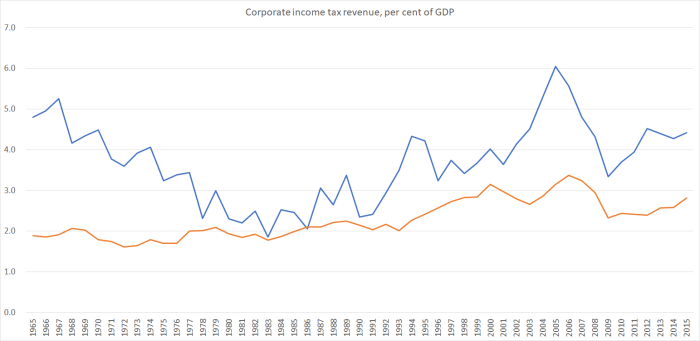
Here is a chart, using OECD data, showing company tax receipts as a share of GDP for New Zealand (blue) and for the median OECD country (orange), all the way back to 1965.
corporate tax revenue

We take a much larger share of GDP in company tax revenue than most OECD countries do.  In fact, in recent years, the only countries that have taken a larger share have been Australia, Chile, Norway, and Luxembourg.   Given the importance of minerals in the first three of those countries, the company tax receipts may include a large chunk of what might be better described as resource rentals  (and in addition production processes in those extractive sectors tend to be quite capital intensive).

But several other things struck me:

  • the rising trend in company tax receipts as a share of GDP over the last 30+ years.  It probably isn’t the impression most people have when you hear all the talk about taxing (or not taxing) multinationals.    Presumably part of the increase will have been accounted for by the larger share in overall national income now accounted for by returns to capital in many countries.
  • just how large the gap was between the New Zealand line and the OECD line at the start of the period (and, hence, how much of a convergence happened during the period when Sir Robert Muldoon was our Minister of Finance –  most of the time from 1967 to 1984).
  • and the substantial rewidening of the gap since the reforms of the late 1980s.  The broad-base low(er) rate strategy seems to have raised a great deal of revenue.

But it does leave me with at least two questions:

  • why has New Zealand typically raised so much more (per cent of GDP) in company tax revenue than most other OECD countries?
  • is this a sensible approach to tax policy, particularly in the context of our long-term structural economic underperformance.

In the earlier decades, a heavily protected economy probably meant a business sector that was ripe for the (headlines of) plucking.    Between the non-tradable service sectors and the highly-protected manufacturing sector, there was plenty of scope to pass increased business costs, in the form of high headline business taxes, on to domestic consumers.  The export sector was mostly based around family farms –  and probably didn’t pay much company tax.  But bear in mind that exports as a share of GDP were shrinking through this period – high internal domestic costs (including business taxes) also help to erode competitiveness.

These days the economy is much less protected, but we are still back to taking a much larger share of GDP in company tax than most other countries do.  Many of our biggest tax paying firms are foreign-owned  (apparently around 40 per cent of all company tax revenue is paid by foreign-controlled firms), which command little public sympathy or support.  The Australian banks are perhaps the most prominent example.   Perhaps it looks like a “free lunch” to tax heavily such operations?

(In principle, our dividend imputation system  –  also adopted in Australia –  may act to make people more relaxed about conducting business through a corporate vehicle, since for domestic shareholders there is no double-taxation of dividends.  I don’t know whether this will be part of the explanation, although I’d be surprised if it explained much, given the other advantages of limited liability.)

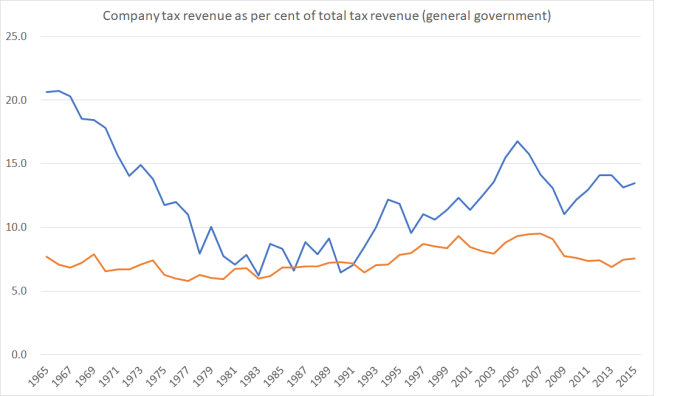
And our large share of company tax revenue as a share of GDP isn’t just because New Zealand taxes everyone heavily –  in fact, our tax revenue as a share of GDP doesn’t stand out as being high.  Here is the chart showing company tax revenue as a share of total tax revenue (NZ in blue, OECD median in orange).
coy tax revenue

Our heavy reliance on company tax revenue looks to be a deliberate choice to favour that soource of revenue.

Whatever the reason for why we take such a large share in company tax, it seems unlikely to be a sensible element of a successful economic strategy.    It is well-known that business investment as a share of GDP has been quite low in New Zealand for many decades.  It is one of the more obvious symptoms of our economic underperformance.  We also now have a quite moderate level of inward foreign investment.  It seems at least plausible that the tax regime might be one part of the explanation –  after all, particularly for foreign investors, the choice to operate here (or not) is purely an economic one, influenced largely by the expected after-tax returns, and the risk around those returns.   For foreign investors (who can’t take advantage of imputation credits) the New Zealand company tax rate should matter a lot.    Partly for that reason, the estimated deadweight costs of business taxation are far higher than those for most other taxes. You get less of what you tax, and foreign investment is likely to be particularly sensitive to taxes.

The OECD data on company tax rates does not go back as far.  But here is how our rates have compared to those of:

  • the median OECD country, and
  • the median “poor” OECD country (ie those who’ve had consistently lower GDP per capita or productivity than New Zealand).
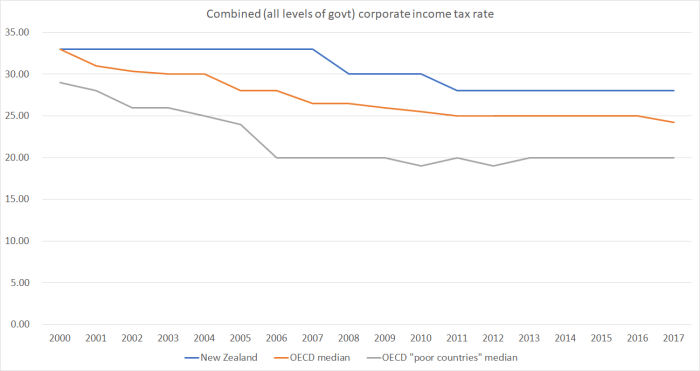
corporate tax rates Of the “poor” OECD countries, only Mexico and Portugal now have higher company tax rates than we do.  Whereas most of the “poor” countries are closing the income/productivity gaps to the richer OECD countries, Mexico and Portugal (and New Zealand) aren’t.  I’m not suggesting it is the only factor by any means, just highlighting the choice that the more successful converging countries have been making.

In much of the debate around these issues, all the focus is one who writes the cheque, not on who actually bears the burden of the tax (the incidence).  Foreign investors, for example, will have target after-tax rates of return.  Higher tax rates discourage reinvestment in the business, discourage new investment, and in time result in lower average productivity and lower wage rates.    By contrast, lowering business taxation is a pro-growth, pro working people, policy.

Again, there is a tendency to discount this point with a response along the lines of “look at all the existing investment; cut taxes on the profits on those businesses and it is just a windfall transfer to existing owners”.     That often seems particularly unappealing if the owners are foreign –  as if it was a pure welfare loss to New Zealanders.     The banks are good example of what bothers people –  mostly owned by big Australian operations.  But actually, the banks are a sector where lower tax rates offer the prospect of genuine savings across the board, for all users of financial services in New Zealand, even if the size of the banking sector itself doesn’t change much.   Cut taxes on banks’ profits and, over time, you’ll find fees and interest margins falling.  Not from the goodness of a bank’s heart, but from the competitive process at work, as each competes for market share and finds they can discount their pricing a bit more and still deliver on Sydney or Melbourne’s after-tax return expectations.

I don’t think we should be making tax policy specifically to favour foreign investors over domestic ones –  which would be the effect of simply cutting the company tax rate – but I do think there is a good case for materially lower taxes on business income.  I’ve argued prevously for a Nordic system, in which capital income is taxed at a lower rate than labour income.  A more ambitious approach still would be to work towards the development of a progressive consumption tax.   Whatever the precise solution, the current arrangements –  high rates of company tax, high shares of GDP taken in company tax – don’t look like the right answer if we serious about lifting economic performance in New Zealand, and with it raising the capital intensity of production in New Zealand.

(Commenters on previous posts have asked whether I’m being consistent, in calling for lower business tax rates and at the same time noting the serious limitations of our remoteness.   I certainly accept that if we were adopt the Irish company tax policy it would not have the scale of benefits for us it has had for Ireland.  But an integrated economic strategy for New Zealand would also involve lower real interest rates and a lower real exchange rate, and in conjunction with lower business tax rates, that would be likely to bring forth quite a range of new business investment –  in some cases in new sectors (or retaining firms in New Zealand that might otherwise relocate), and in other cases, adopting more capital intensive (ie higher labour productivity) modes of production in existing sectors, including agriculture.)

The Labour Party is campaigning on establishing a tax working group if it forms the next government.  I hope they envisage something more than just a tidy-up and a recommendation for a capital gains tax, and that in thinking now about the possible terms of reference for the proposed tax working group –  which they will presumably want to move quickly on once in office –  they are willing to cast the net rather wider, and invite the proposed group to consider connnections between the design and balance of our tax system and our overall economic performance.   Higher taxes on business – especially the dreaded multinationals – might be some sort of “progressive” shibboleth, but in fact lower business taxes should be an option that any seriously progressive government, concerned to lift living standards for all, takes very seriously.
 

Economic performance

The second half of the Grant Robertson/Steven Joyce debate on Sunday was around things to do with overall economic performance and management.

On one thing they agreed: Winston Peters’ proposal that New Zealand should adopt a Singapore-style approach to monetary policy and the exchange rate isn’t an option for New Zealand.  I agree with them, and explained why in a post a few months ago.

Grant Robertson reminded viewers that John Key had promised to close the gaps between New Zealand incomes and productivity and those in Australia, noting that no progress has actually been made.   Steven Joyce likes to push-back by citing numbers that suggest that after-tax real wages have been rising faster here than in Australia.    When I’ve looked at that claim previously, a lot appeared to depend on which exchange rate one used to convert wages in the two countries into a common currency.  Using PPP exchange rates, the gap has actually widened a bit further.    Comparing wage series across countries isn’t that easy –  countries measure things differently, and things that are effectively part of remuneration (eg employer superannuation contributions) often aren’t included.

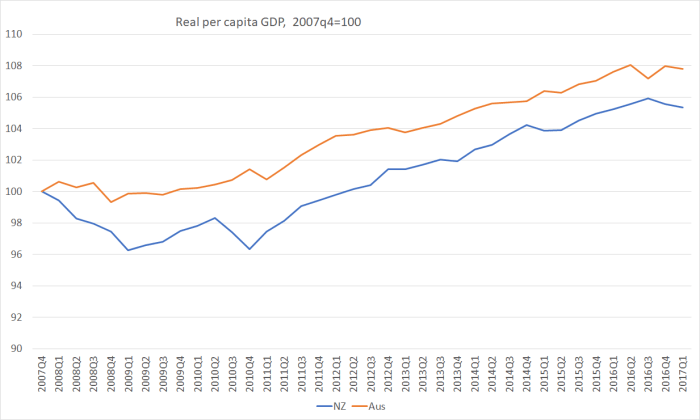
Personally, I prefer to focus on economywide measures, which are compiled in a consistent manner across countries.   Here is real GDP per capita for the two countries, indexed to 2007q4, just before the global downturn/recession began.

real gdp pc nz and aus

I could have started the chart a few quarters later, to coincide with the change of government.  Either way, no progress at all has been made in closing the gap to Australia.

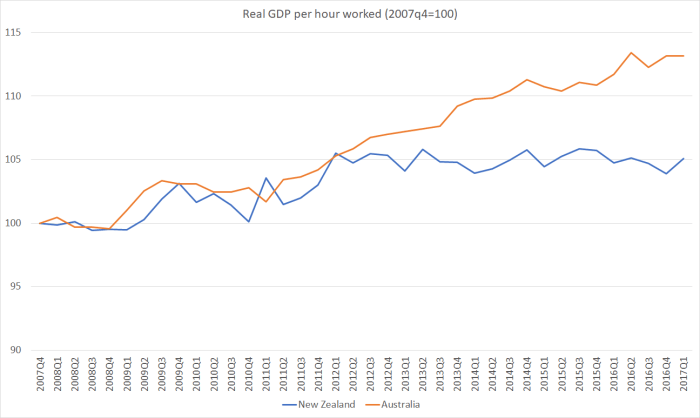
Things look worse if we focus on labour productivity (real GDP per hour worked).

real gdp phw nz and aus aug 16

Best summary?  We haven’t lost much ground against Australia when we focus on GDP per capita, but since relative productivity has dropped away badly we’ve only maintained even that mediocre real GDP per capita record by working even longer hours on average.

But if the government’s record is pretty poor, it isn’t clear that the Labour Party is offering anything much different.   It is all very well to criticise the current government for making no progress in closing the gaps, but Labour doesn’t even seem to be talking about doing so.    Robertson did highlight the four or five years now of zero productivity growth, and talked of needing a plan for something different.  But it wasn’t obvious from anything he said, or anything I’ve read, quite what the plan is, that might be equal to the challenge.   There is plenty of talk of lifting skills –  but the OECD data already suggest New Zealand skills levels are among the very highest among advanced countries.    There is talk of a tax working group, with an apparent presumption that that is likely to lead to a capital gains tax.  And there is talk of R&D tax credits.  But I doubt anyone –  even those who support such measures – believes that they are remotely enough to make the sort of difference closing the gaps to Australia might involve.

Of course, the National Party’s position seems no better.  The Minister’s rhetoric is that people are voting with their feet and realising that the jobs and incomes are now here.  Sure, the annual outflow of New Zealanders to Australia has dropped, but it is still an outflow each and every year.   And no one seriously thinks other than that average incomes in Australia remain much higher than those here.  But it is tougher to get established in Australia at present –  that’s a bad thing for New Zealanders, not a good one.

Steven Joyce was touting the success of certain subsets of firms exporting from New Zealand.  It is perhaps easy to forget that the government has long had a goal of substantially increasing the export share of GDP (and, presumably, the import share, since we export to import –  sell stuff to other people so that we can consume ourselves).

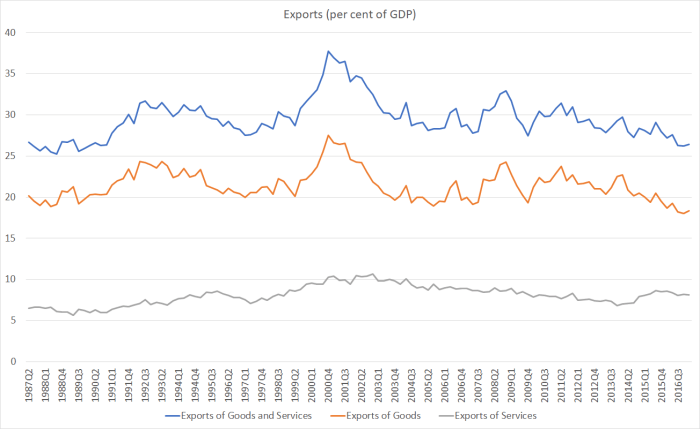
Here are exports as a share of GDP.

exports joyce It is easy for one’s eye to go to those peaks in 2000 –  at a time when the exchange rate had fallen sharply – but even much more recently the trends haven’t been favourable.  Even the vaunted services exports are lower now as a share of GDP than they were 10 years ago, or than when the government came to power.   The Minister talked of “high-tech value-added manufacturing” as the future, but then overall goods exports are lower as a share of GDP now than at any time in the last 30 years.
Mr Joyce talked of a slump in global trade, as if our experience was just something like everyone else had experienced.  But even that isn’t true.     The share of exports in GDP for the median OECD country has increased by around 5 percentage points in the last decade.  In that decade before that, it increased by about 6 percentage points.

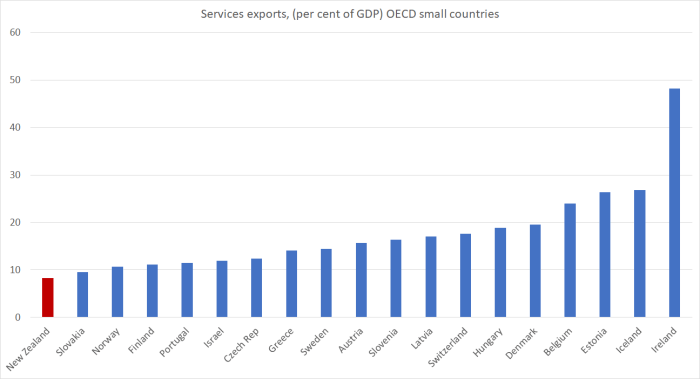
And for all the talk of services exports, here are exports of services as a per cent of GDP for New Zealand and the other small OECD countries.

services x small countries

Grant Robertson was prepared to go as far as to say that the exchange rate is “too high”.  Artificially lowering it wasn’t, we were told, the answer (and I’d agree, if by that he meant eg a Singapore-style monetary policy).  But there was no hint of how Labour thought a lower exchange rate might be brought about in a more sustainable manner.

New Zealand has faced some obstacles to growing the tradables sector of our economy in the last decade.  The earthquakes meant that real resources had to be used for other things –  repair and rebuild –  and other activities had to make room.  Policymakers have known this since the very days after the earthquakes occurrred.  The substantial amount of offshore reinsurance just reinforced the way in which the earthquakes represented a large shock skewing the economy for a time more towards the non-tradables sectors.

But what was extraordinary is that the same policymakers allowed, and cheered on, another even bigger non-tradables-skewing shock.

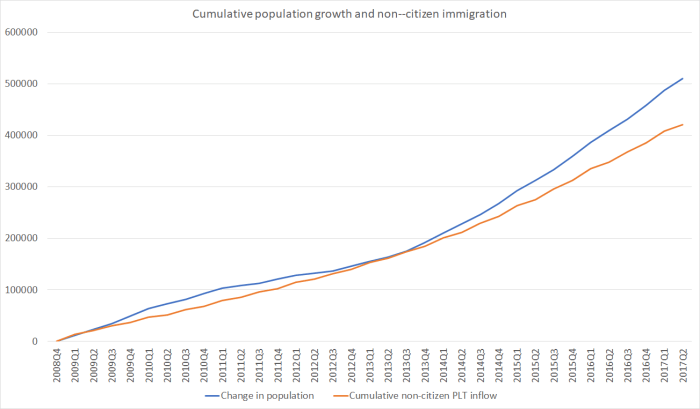
Here is a chart showing cumulative population growth since National took office, and the cumulative inflow of non-citizens (the PLT data, with all their pitfalls).

popn and immigration

We’ve had a 510000 increase in population over the term of this government, 421000 of which is accounted for by the net inflow of non-citizens.    The fertility and migration choices of New Zealanders would, all else equal, have given us only around 2 per cent population growth over the eight and half years, putting a great deal less pressure on

  • housing markets
  • other infrastructure
  • the physical environment, and
  • the tradables sector as a whole.

Remember that each new arrival need a lot more physical capital stock than is accounted for by the labour those people supply early on.   Policy has been deliberately skewing our economy away from the tradables sector.    We’ve had a net non-citizen migration inflow of almost exactly 300000 people in just the last five years.   With no productivity growth at all in that time, and an export (and import) sector shrinking as a share of GDP, and business investment pretty subdued too, one might reasonably ask ‘to what end?’ for New Zealanders.

We should be left wondering why, if we vote for them, either main party expects anything different than the mediocre economic performance of the last few years.   Gareth Morgan criticised Labour’s apparent lack of much policy substance  as “putting lipstick on a pig”.  It isn’t obvious that the National Party is even offering the lipstick.

And all this is without even repeating for the umpteenth time that the unemployment rate now is still higher than it was at any time in the last five years of the previous Labour government, at a time when demographics appear to be lowering the natural rate of unemployment.  Or the underutilisation rate of almost 12 per cent.      We should be able to do a great deal better for New Zealanders.


Debating housing

The centrepieces of the two weekend TV current affairs shows were political debates: The Nation had Phil Twyford and Amy Adams on housing, and Q&A had Grant Robertson and Steven Joyce on the economy more generally (but with a large chunk on housing).   I only saw the Q&A debate, but I have glanced through the transcript of Twyford/Adams.

In the course of his debate, Phil Twyford was asked how much house prices should be relative to income.    His response was excellent

Twyford: Ideally, they should be three times. If we had a housing market that was working properly, your housing would be— the median price would be about three to four times the median household income.

Grant Robertson repeated those sorts of numbers in his exchange with Steven Joyce.  It was good, clear, encouraging stuff.    A reminder of just how totally out of whack things are in the New Zealand house and urban land market.   And a suggestion that the main opposition party wants things to be materially different and better.

But I can’t help wondering in which decade they expect things to be more or less okay again.   In time for, say, my children –  perhaps 10 to 15 years from now –  or will it only be the grandchildren?

Don’t get me wrong.   Watching the Robertson/Joyce debate, as someone who has no idea who he will vote for, I thought Robertson had much the better of the housing side of the debate.   The current government seems reduced to some mix of lamenting that it is “a global problem”, reluctantly conceding that Auckland prices are a bit too high, and claiming that just over the horizon there is a wave of supply that will substantially address the problems.   So if I’m critical of Labour here, take for granted that almost all the criticisms apply with more force to National.

Here is Phil Twyford avoiding suggesting that Labour wants house prices to come down

So is it Labour’s goal to get it down to that – about four times?
Twyford: We want to stabilise the housing market and stop these ridiculous, year on year, capital gains that have made housing unaffordable for a whole generation of young Kiwis.
But in essence, you’re going to drop the value of houses, if you want them to be four times the price of the average income.
Twyford: Well, we’re going to build through KiwiBuild. We’re going to 100,000 affordable homes.
I want to come to KiwiBuild in a moment. I just want to talk to you about the price.
Twyford: That will make housing affordable for young Kiwi families. That’s our policy.

Stabilising the housing market, and ending rapid house price appreciation, isn’t a recipe for fixing up the housing market for the current generation of young people.

Grant Robertson was much the same –  reiterating the goal of house prices of 3 to 4 times income, but he couldn’t or wouldn’t say how long it would take.  There was plenty of talk about building “affordable houses” (around $600000?) and “cracking down on speculators” and beyond that it all seemed to be down to growing incomes.   But there wasn’t even a mention of freeing up land supply –  a topic where formal Labour policy looks better than anything else on offer from major parties.  Even though, the largest single component in the increase in New Zealand (especially Auckland) house prices has been the land component.

On the other side of the exchange Steven Joyce was taunting Robertson with the suggestion that “Labour wants to crash house prices with a punitive capital gains tax” –  as if, whatever the (de)merits of a CGT, much lower house prices would be the worst thing in the world.

Lifting growth in productivity and real incomes is highly desirable.   All else equal, flat nominal house prices and faster income growth is a recipe for improved housing affordability.  But how long might it take on reasonable assumptions?

I’ve shown similar charts on this point previously.  Here I assume a starting point of a price to income ratio of 10 (around current Auckland levels) and that (a) nominal house prices hold at current levels for the indefinite future, and (b) incomes grow at a rate equal to 2 per cent (midpoint inflation target) plus the rate of economywide productivity growth.  I’m just going to assume that the 2 per cent average inflation could be achieved quite easily if the government wanted to. Productivity is the harder issue.  Here I’m showing four lines using:

  • actual productivity growth (GDP per hour worked) over the last decade (just under 0.6 per cent per annum),
  • actual productivity growth over the last thirty years (for which we have quarterly real GDP and hours data), of just under 1.2 per cent per annum,
  • productivity growth of 1.5 per cent per annum, and
  • productivity growth of 2 per cent per annum.

The straight line on the chart is at a price to income ratio of 3.5 (ie the midpoint of the 3 to 4 times income Labour is talking of).

house price to income ratio with flat nominal house prices

On the best of these scenarios, price to income ratios get to 3.5 in about 27 years time.   If we manage productivity growth equal to that for the last 30 years –  which itself would be quite an achievement at present – we’d be waiting almost 35 years.

Affordable housing, and a functional housing market, for the current generation simply requires a fall in nominal house prices.   And yet no major party politicians seems to have the courage, or the self-belief (in their ability to communicate and take people with them), to make that simple point.

For most existing home-owners, the market value of their house does not matter a great deal.  A large proportion of home-owners have a modest mortgage or none at all, so negative equity isn’t a risk.  And since most people retire in the same city they’ve spent their working lives in, their house price doesn’t even affect very materially their own expected future purchasing power.

Fear of falling house prices seems to reduce to two particular dimensions:

  • people who, having bought in perhaps the last five years, would find themselves with negative equity if house prices fell markedly (in turn divisible between new owner-occupiers and purchasers of additional rental properties), and
  • some generalised fear that a fall in house prices goes hand in hand with economic disaster, serious recessions and the sort of experience the US or Ireland had.

The latter is mostly a category error.  In both the US and Ireland, there was material overbuilding (excess stocks of actual houses).  There is no prospect of that situation in New Zealand on any of the policies of the major parties.  In Ireland, the situation had been compounded by joining the euro, which gave Ireland interest rates set in Frankfurt that bore no relationship to the needs of the Irish economy.  In the US, there had been persistent official efforts –  from Congress, the Fed, and successive Administrations –  to encourage, or compel, the financial system to take on housing lending risk that the private sector would be unlikely to have assumed willingly.   None of that resembles New Zealand.  Not only do we set our own interest rates, but to the extent there is state involvement in the housing finance market it is reducing the supply of credit.

A severe recession could, at least for a time, lower New Zealand house prices.  Recessions –  severe or otherwise –  aren’t things to welcome.  But the sort of land market liberalisation (with associated infrastructure rules) that might, as a matter of policy, set out to materially lower New Zealand house and land prices would be most unlikely to materially dampen demand or economic activity.  If anything, it could represent a material boost to demand, as building became more affordable.   (And if some people would find themselves with negative equity, whole swathes of younger generations would suddenly face new opportunities and less of a desperate need to save.)

What about the people facing negative equity?  I don’t have any particular sympathy with those who’ve purchased investment properties in recent years and might face being wiped out.   They’d have taken a business and investment risk –  in this case on the regulatory distortions never being fixed –  and lost.  That happens in all sorts of market –  think of the people with exposures to shares after 1987, or in finance companies 10 years ago.  Or those with businesses based in import licenses in earlier decades.  It is tough for them individually, and almost all of them have votes.  But it was a business risk, and a conscious voluntary choice.

I’m much more sympathetic to those who bought a first house and could face a large chunk of negative equity.    I touched on this in a post a few weeks ago

No one will much care about rental property owners who might lose in this transition –  they bought a business, took a risk, and it didn’t pay off.  That is what happens when regulated industries are reformed and freed up.    It isn’t credible –  and arguably isn’t fair –  that existing owner-occupiers (especially those who just happened to buy in the last five years) should bear all the losses.   Compensation isn’t ideal but even the libertarians at the New Zealand Initiative recognise that sometimes it can be the path to enabling vital reforms to occur.  So promise a scheme in which, say, owner-occupiers selling within 10 years of purchase at less than, say, 75 per cent of what they paid for a house, could claim half of any additional losses back from the government (up to a maximum of say $100000).  It would be expensive but (a) the costs would spread over multiple years, and (b) who wants to pretend that the current disastrous housing market isn’t costly in all sorts of fiscal (accommodation supplements) and non-fiscal ways.

Those numbers were made up on the the fly, but even on later reflection they look like a reasonable basis for something that might not be unreasonable, and also might not be unbearably expensive.  It would recognise that people need to bear some material risk themselves (a 25 per cent fall in nominal house prices is not small).  But it is also designed in recognition of the fact that since 2013, it has been hard for first home buyers to get a mortgage above an initial LVR of 80 per cent, so that not many would be in negative equity now even if house prices fell by 25 per cent from here.

Since many people will stay in their existing house for a long time if they have to, and the scheme only compensates if the house is sold, that also limits the potential fiscal cost.  In fact, the biggest pool of owner-occupiers who would sell at a material loss would be those forced in the event of new severe recession (unemployment is typically the biggest threat to the ability to service mortgage debt) and (a) those people would naturally command a degree of public sympathy and (b) land liberalisation would be a stimulatory policy, reducing the chances of a near-term future recession.  There would be some voluntary sellers, to capture the compensation, but the cost of selling and buying a house, and of moving house, is not trivial.   If 100000 households were to claim the maximum compensation of $100000 that would be total additional government expenditure of around $1 billion, spread over a considerable period of time.   And to claim $100000, you’d have to have bought say a $1 million first house and seen house prices fall 45 per cent from your entry price.

It isn’t a perfect scheme by any means, and lots of details would need to be fleshed out.   One could relatively easily restrict it to apply only to those in a first owner-occupied house, again the people who will naturally command the most sympathy anyway.    But if something of this sort could be done for, say $1 billion, and it helped the pave the way for a genuine structural fix in the housing market –  a willingness to actively embrace lower house prices –  it would seem likely to offer more value than, say, the least valuable of the proposed 10 new “roads of national significance”, which are estimated to cost on  average just over $1 billion each.  How much congestion is there on the existing road from Levin to Sanson?

And three final points on housing:

  • it was depressing to read the housing section of Jacinda Ardern’s campaign opening speech.  It wasn’t the focus of her speech, but –  just like Andrew Little at his conference speech earlier in the year –  there was reference to dealing to “speculators”, barring foreign purchasers, and to the state building more houses, but not a word –  not even hint –  about freeing up the land market in a way that might make those price to income aspirations achievable,
  • it was slightly strange listening to Robertson and Joyce debating the possibilities of a capital gains tax, focused on housing.  Weirdly Robertson didn’t take the opportunity to rule out applying a CGT to unrealised gains –  even though he surely really realises that, whatever the theoretical appeal, there is no way anyone is going apply a CGT to anything other than realisations.  But it was even more strange to hear this debate going on after both sides were insisting they “had a plan” to fix housing.  If they really did then surely there would be few/no systematic capital gains in the housing market for decades to come?
  • and finally, Steven Joyce ran his line that house prices are a global problem.  This seemed to be a variant of the sort of “problems of success” line John Key often ran.  Out of curiosity, I dug out the OECD’s real house prices series this morning.   They don’t have data for quite every country, but here is the change in real house prices from 2007 to 2016 (annual data) for the countries they have the data for.    There are a few countries that have done worse, but not many.  In the median OECD country, real house prices have fallen over the last decade.

house prices last decade

Mostly, the countries that have been about as bad as us have also had quite rapid population growth (Israel, Australia and Luxembourg in the lead on that count) –  not, of course, that either Finance spokesperson suggested doing anything about that.

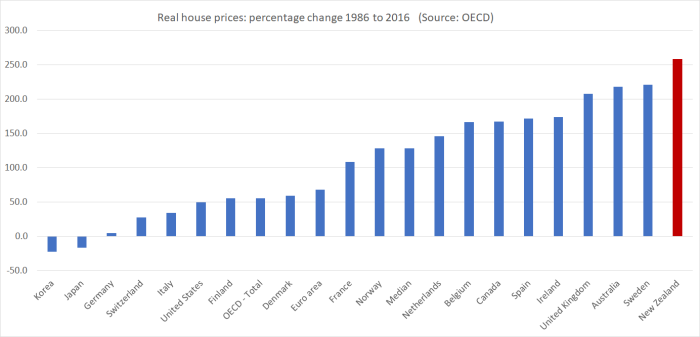
What about a longer-term comparison.  There are lots of gaps in the OECD data for earlier decades, but here are real house prices increases for the countries they have data for over the three decades to 2016.

house prices since 86

Worst of them all, without even the income growth to match.

We need to face up to the importance of lowering house prices, of adopting policies likely to sustainably make that happen, and – if necessary –  consider compensation packages for some to help make that transition possible.

Submission on the DTI proposals

Submissions close today on the Reserve Bank’s consultation on its proposal to add a debt to income limit tool to the approved list of possible direct controls on bank housing lending.

Despite the Prime Minister’s comments the other day, I don’t regard this as a “dead duck” at all.  The Reserve Bank won’t be coming back to the Minister of Finance with its recommendation, in light of the consultation, until after the election, and who knows what the political or housing market climate will be like by then.  Graeme Wheeler will be gone by then, and so the Reserve Bank’s decision will be in the hands of the (illegally appointed) acting Governor, Grant Spencer, and new Head of Financial Stability (and presumed Governor-aspirant) Geoff Bascand.  Perhaps they will have less appetite for controls than Wheeler has had –  both come from backgrounds that were not particularly keen on direct interventions –  but for now we have to assume that the proposal will continue to move ahead.

As I noted earlier in the week, there is a lot of useful and detailed material in Ian Harrison’s paper on the DTIs, which I gather he is putting in as a submission.

I ummed and aahed about whether to make a submission.  In one sense, it is a pure waste of time, since the Bank is unlikely to grapple very seriously with any points I make.  But, on other hand, it is good to have alternative perspectives, and questions, on the issue out there, and just possibly it might provide some angles for people with a bit more influence than I have.

So I did write a fairly brief submission.  My overview and summary is here

Overview

I am firmly against adding any sort of serviceability restriction (henceforward “DTI”) to the list of possible controls.  The Reserve Bank has failed to mount a convincing case, and has not demonstrated that it (or anyone) has the level of knowledge required for such restrictions to operate in a way likely to make New Zealanders as a whole better off.  Such restrictions would appear to go well beyond the Reserve Bank’s statutory mandate (contributing little or nothing to soundness and eroding the efficiency of the financial system), and a better cost-benefit analysis would in any case suggest that such controls would probably be welfare-detracting.   Other instruments (such as capital requirements and associated risk weights) that do not impinge directly on the borrowing and lending options open to individuals and firms remain a superior way to manage any future risks to the soundness of the financial system.  Serious microeconomic reform remains the best route to fix the serious housing affordability/land price problems.

As a reminder, the Reserve Bank has no statutory mandate to target house prices or the level (or growth rates) of credit in the New Zealand economy.   It also has no “house purchaser or borrower protection” mandate.  Restrictions of the sort proposed in the consultative document would represent serious regulatory over-reach.

The fact that a handful of advanced economies have deployed somewhat similar tools is little comfort or basis for support for the Reserve Bank’s own proposals.  Bad policy elsewhere isn’t a good reason to adopt bad policy here.  But more specifically, the interests of regulators themselves and of citizens are not necessarily, or naturally, well-aligned, a point that Reserve Bank material rarely if ever addresses.  For example, the Reserve Bank makes much of the British and Irish DTI limits (which do not apply to investment properties, where the consultative document says the Reserve Bank would want to focus), but never addresses the institutional incentives facing regulators in those countries following the financial crises each experienced in 2008/09 (the typical regulator incentive in the wake of a crisis to overdo caution –  and “to be seen to be doing something”, in the regulator’s own bureau-protection interests).     On the flip side, neither in the current consultative document nor in past Reserve Bank material has the Bank seriously engaged with the experience of housing loan portfolios in floating exchange rate countries during the 2008/09 crisis.  In countries like ours –  including Australia, Canada, the UK, Norway, Sweden, as well as New Zealand –  residential loan books emerged largely unscathed, despite big credit and housing booms in the prior years, and the subsequent nasty recession and, in most of these countries, a sustained period of surprisingly low income growth.

There has also been no evidence presented that banks have been systematically poor at making and managing portfolios of loans secured by residential mortgage, let alone that citizens should have any confidence in the ability of (and incentives on) regulators to do the job better.    Anyone can suppress overall credit creation with tough enough controls, but to what end, at what cost, to whom?     Controls of the sort now proposed, and the sorts of LVR restrictions already extensively used, seem to represent ill-targeted measures, based on an inadequate model of house and land prices.  They temporarily paper over symptoms –  house prices driven high by the failures of regulation elsewhere require high levels of credit – rather than address the structural causes of the housing market problems.     And because they seem to be premised on a model that wrongly treats credit as a leading factor in the housing market problems, they also do little to address any (limited) financial stability risks.  And in the process, they systematically favour some groups in society over others –  the sorts of distributional choices that, if made at all, should be made only by elected politicians, not by an unelected official.

A reasonable starting proposition would be that in the 25 years prior to the imposition of LVR restrictions the New Zealand housing finance market had been efficient and well-functioning.  Lenders lost little money, more borrowers could get better access to credit than in the earlier regulated decades, borrowers had no need to concern themselves with the changing details of Reserve Bank regulatory restrictions, there were no rewards to special interest group lobbying and rent-seeking, and competitive neutrality among different classes of lending institutions prevailed.  Perhaps the Reserve Bank would disagree with that characterisation of the market, but if so then, in proposing still further extensions of its regulatory intervention powers, surely the onus should be on you to make your case, not simply to ignore the past, apparently successful, experience?

Anyone interested can read the whole document here

Submission to RBNZ consultation on DTI proposal Aug 2017

The DTI proposal is a tool to address, inefficiently, a problem that isn’t there (threats to the soundness of the financial system), while appearing to try to do something about an actual serious problem (house and urban land prices), of successive governments’ making, about which the DTI tool can do little or nothing useful.  It won’t help, and if anything it distracts attention from the real issues, and from those really responsible, for the disaster that is the New Zealand housing “market”.

Virtue signalling, with your money

I haven’t written about the New Zealand Superannuation Fund (NZSF) for a while, and a well-informed reader has been encouraging me to get back to the economics of the Fund (and some of the important issues raised in a recent review paper).  I will, but for now I remain of the view that the Fund is serving no useful purpose and should be wound up.

But while we have it, it needs to be run well.

One of the annoying aspects of the Fund is the way in which the Board and management get to take your tax money and mine, and invest (or not) in causes which they happen to find appealing.    Of course, the Act isn’t written that way, but that is what it boils down to.   I’m not too keen on my money being invested in abortion providers or private prison operators –  just to span the ideological spectrum –  but obviously Adrian Orr and his Board don’t have a problem with such exposures.   They, on the other hand, object to tobacco companies and whaling, which don’t greatly bother me.

But the other day, they announced a big new policy shift that has substantially reduced the carbon exposure of the Fund (somewhat puzzlingly, I saw no mention in any of their documents of methane exposures, and as we know in New Zealand at least methane exposures make up a very large chunk of greenhouse gases).

To their credit, NZSF pro-actively released several background and Board papers relevant to this move, as well as several pages of question and answer material (all at the link in the previous paragraph).

This shift is dressed up as a simple matter of economic and financial management.  Indeed, they are at pains to assert that ethical (or presumably political) considerations played no part in the shift.  But, on the material they have presented it just doesn’t ring very true.

For example, they released a presentation to the Board from a few months ago.  In it, the chief investment officer and the “head of responsible investment” told the Board that

We believe climate change is a material long-term risk for which the Fund will not be rewarded.

What they appear to mean is the market prices of shares with (adverse) exposure to climate change and any associated policy responses do not adequately reflect those risks.

It is an arguable proposition, for which you might expect that evidence would be marshalled.  But the Board appears to have been presented with no evidence whatever, just assertions, and questionable economic reasoning.  Thus, on the next page

Climate change is a market and policy failure: markets are producing too many emissions and are over-invested in fossil fuels. We believe carbon risk is under-priced partly because the time horizon over which the effects will manifest is too long for most market analysts – but it is relevant to the time horizon that matters for the Fund.

This is a hodge-podge paragraph. For a start, climate change itself isn’t a market failure, but may well arise from market failures (costs aren’t properly internalised etc).   But the fact of climate change –  whatever role past policy or market failures may have played – tells one nothing about whether shares in companies exposed to carbon are now fairly priced or not.  They are just two completely different things.

And there is still no evidence presented for the proposition (“belief”) that markets have overpriced these companies (such that expected future risk-adjusted returns on them won’t match those available elsewhere).  Other market participants know as much (or as little) as NZSF staff know.

There was a more detailed Board paper in April containing the final recommendations.   It has more text, but no more analysis of the risks or of why the Board (or we) should believe that NZSF is better placed than the market to appropriately value climate change related risk.    Instead, we get a repeat of the same assertions,

NZSF quote

followed by a sentence which is best summarised as “but we really don’t know”.

There are repeated references to lines such as “ignoring Climate Change presents an undue risk”, but that isn’t even remotely the issue.  The issue is whether (a) the market on average is mispricing that risk, and (b) whether NZSF staff, management, and Board are better placed to evaluate the complex mix of scientific, economic, technological, and political factors that determine how things will play out (and thus what fair value pricing will prove to have been).     Thus, it is quite likely that the market on average has the appropriate pricing of these risks wrong, because much of what is relevant is inherently unknowable.  But if it is likely that the market is wrong, there is no particular reason to be confident which side the error lies on.   And it isn’t obvious why it is easier for NZSF to be confident it is right about this, than about any of the other very long-term risks embedded in many sectors, or in the market as a whole.

There are also hints that really this has little to do with a careful evaluation of financial investment risk and a lot more about politics and “good causes” –  virtue signalling.

NZSF 2

Consistent with this political focus, the very first item in the proposed communications strategy reads

“Recommend engaging with the Greens to explain to them the approach we have taken”

(And, sure enough, they were lauded by the Greens – although not for the quality of their financial analysis –  when the new policy was finally announced the other day.)

NZSF’s detailed public story is contained in the Q&A document they released.  This is text that they will have had months to refine, the Board having made this decision in April.

But again, there is no analysis presented or summarised to indicate why the Board is confident the market has it wrong. Instead they seem reduced to lines like this

We believe that now is the right time to act. Even if there remains some uncertainty about global policy, its general direction is consistent with meaningful carbon reductions.

This is the basis for a major strategic investment choice by the Board managing taxpayers’ money??   “General directions” are one thing, assessing market pricing and demonstrating with a high degree of confidence that market prices are wrong is quite another.

Or lines like this

The Mercer climate change study that we participated in during 2015 found that the biggest risk to investors from climate change was to be on the wrong side of strengthening global policy and/or technological disruption. Mercer found that investors who got ahead of the curve could mitigate the potential downside.

Well, of course.  If you read markets well, and judge policy correctly, there is plenty of money to be made.  But doing so is hard…..very hard, and NZSF provides no evidence that they are able to beat the market uniquely well is this particular area of their global exposures.

There is further evidence that this move is about politics and virtue signalling, rather than robust financial analysis.

Will your active managers be allowed to hold stocks that have been sold from the passive portfolio on the Fund’s behalf?
Our active NZ equity managers (who may also from time to time invest in Australia) will not invest in these stocks.

If this were just a strategic view that markets were systematically mispricing this risk, there would be no reason to bar active managers from holding such stocks from time to time (after all, even if one average the market is mispricing this risks, it doesn’t mean there won’t occasionally be opportunities in individual stocks that are exposed to such risks.)

There is very strong sense that NZSF decided to reduce its climate change exposures, and then back-filled the (rather weak) argumentation in support of that.  As it is put early on in the April Board paper, setting the scene for the recommendation.

“a reduction of climate-change related risks for the Fund is a key goal of the CCIS [Climate Change Investment Strategy]”

Perhaps there is some other economic and financial analysis, that they haven’t yet released, to support that strategic preference (I’ve lodged an OIA request to that end) but at the moment it looks like a political choice not a financial one.

The NZSF has implemented this strategic choice by the Board and management by altering their so-called Reference Portfolio benchmark.   They have long argued that the reference portfolio is what their performance should be benchmarked against  (the numbers scream out at one, in large type, when one goes onto their website).  I’ve long argued that is the wrong benchmark for citizens and taxpayers to focus on (useful as it might be for the Board to judge staff active management choices against).  In this case, the Board itself has taken what amounts to a punt (an active call) that the market is underpricing risk in a particular sector.  They need to be evaluated on the results of that call over time, not avoid accountability by burying the implications of their policy decision in what looks like a passive benchmark that is beyond their control.

Perhaps the NZSF choice will be widely popular.  But that isn’t their job.  In fact, it has always been one of the dangers of the Fund.    It isn’t their job to be playing politics by tilting the portfolio towards trendy causes.  If anything, long-term investors (the advantage they constantly assert) might be better positioned to take somewhat contrarian stances, leaning against the tide of opinion at times (but only when backed up with sound analysis).    And if they really believed that the market was underpricing climate change risk, why not be rather more open about the resulting investment choices  –  leave the reference portfolio unchanged, and implement the market call through active management positions?

And you do have to wonder how, in a country where policy is still aimed at opening up further oil and gas deposits, a New Zealand government agency now has an official ban on buying shares in companies that might be developing those resources.  Will an NZSF ban on dairy exposures be next?

We have elections to choose the people who will make policy decisions.  If the public want to ban dairying, or oil and gas exploration, then elect the politicians to make those calls, and hold them to account.   But lets not have bureaucrats and unaccountable Board members pursuing personal agendas (even popular ones) with our money.  If the economic and financial case is really there –  and remember that active management calls of this sort don’t have a great track record globally –  then lay it out for us to see.  On what they’ve released to date, this look much more like a virtue-signalling call than one consistent with the NZSF’s statutory mandate, or with the sort of professional expertise we should hope for from well-remunerated investment managers.


LVR restrictions

The successive waves of LVR controls that the Reserve Bank Governor has imposed on banks’ housing lending in recent years are back in the headlines, with comments from both the Prime Minister and the Leader of the Opposition (here and here).

As readers know, I’m no defender of LVR restrictions.  The other day I summarised my position this way

I never favoured putting the successive waves of LVR restrictions on in the first place.  They are discrimatory –  across classes of borrowers, classes of borrowing, and classes of lending institutions –  they aren’t based on any robust analysis, as a tool to protect the financial system they are inferior to higher capital requirements, they penalise the marginal in favour of the established (or lucky), and generally undermine an efficient and well-functioning housing finance market, for little evident end.  Oh, and among types of housing lending, they deliberately carve-out an unrestricted space for the most risky class of housing lending –  that on new builds.

You’d never know, from listening to the Governor or reading the Bank’s material, that New Zealand banks – like those in most other floating exchange rate countries –  appear to have done quite a good job over the decades in providing housing finance and managing the associated credit risks.   We had a huge credit boom last decade, followed by a nasty recession, and our banks’ housing loan book –  and those in other similar countries –  came through just fine.

The Bank’s statutory mandate is to promote the soundness and efficiency of the financial system.  On soundness, successive (very demanding) stress tests suggest that there is no credible threat to soundness, while the efficiency of the system is compromised at almost every turn by these controls.

At a more micro level, this comment (from my post yesterday) about the Bank’s debt to income limit proposals is just as relevant to the actual LVR controls they’ve put on in successive waves.

Much of the case the Reserve Bank seeks to make for having the ability to use a debt to income limit rests on the assumption that banks don’t do risk management and credit assessment well and that, inevitably crude, central bank interventions will do better.  The Bank’s consultation paper makes little or no effort to engage on that point at all.  It provides no evidence, for example, that the Reserve Bank has looked carefully at banks’ loan origination and management standards, and identified specific –  empirically validated –  failings in those standards.  Neither has it attempted to demonstrate that over time it and its staff have an –  empirically validated –  superior ability to identify and manage risks appropriately.

For all that, in partial defence of the LVR controls right now, many of those who are calling for the controls to be lifted or eased seem to be giving all the credit (or blame) for the current pause in housing market activity to the LVR controls.   That seems unlikely.  Other factors that are probably relevant include rising interest rates, self-chosen tightening in banks’ credit standards, pressure from Australian regulators on the Australian banking groups’ housing lending, a marked slowdown in Chinese capital outflows, and perhaps some election uncertainty (Labour is proposing various tax changes affecting housing).  I don’t know how much of the current slowdown is explained by each factor, but then neither do those focusing on the LVR controls.   Neither does the Reserve Bank.

And the backdrop remains one in which house price problems haven’t been caused mostly by credit conditions, but by the toxic brew of continuing tight land use restrictions (and associated infrastructure issues) and continuing rapid population growth.     Those two factors haven’t changed, so neither has the medium-term outlook for house and land prices.  Political parties talk about improving affordability, but neither main party leader will openly commit to a goal of falling house prices, and neither main party’s policies will make much sustained difference to the population pressures.   A brave person might bet on  some combination of (a) a recovering Australian economy easing population pressure, and (b) talk of abolishing limits around Auckland actually translating into action and much more readily useable land.  It’s a possibility, but so is the alternative –  continued cyclical swings around a persistently uptrend in the price of an artificially scarce asset.

And thus, in a sense, the Reserve Bank has a tiger by the tail.  House prices are primarily a reflection of serious structural and regulatory failures, and the problem won’t just be fixed by cutting off access to credit for some, or even by just buying a few months breathing space until a few more houses are built (before even more people need even more houses).   This isn’t a “bubble”, it is a regulatorily-induced severely distorted market.

So I strongly agree with the Prime Minister that, having repeatedly sold the LVR controls as temporary, the Reserve Bank Governor really needs to lay down clear and explicit markers that would see the controls be wound back and, eventually, removed completely.     And yet how can the Governor do that in any sensible way?   After all, the underlying problem wasn’t credit standards, or even overall credit growth.  It appeared to be simply that the Governor thought that he should “do something” to try and have some influence on house prices, even though he (a) had no good model of house prices in the first place, and (b) his tool didn’t address causes at all, and bore no relationship to those causes –  it was simply a rather arbitrary symptom-suppression tool.  And the Reserve Bank knew that all along –  they never claimed LVR controls would do much to house prices for long.

Because the interventions weren’t well-designed, any easing or removal of the controls will inevitably be rather arbitrary, with a considerable element of luck around how the removal would go.   What sort of criteria might they lay out?

  • a pause in house prices for a couple of years?  Well, perhaps, but as everyone knows no one is good at forecasting cyclical fluctuations in immigration.  Take off the LVR controls and, for unrelated reasons, house price pressures could still return very quickly,
  • housing credit growth down to, say, the rate of growth of nominal GDP for a couple of years.  But there isn’t much information in such a measure, as the stock of housing credit is mostly endogenous to house prices (high house prices require a higher stock of credit).

The latest set of restrictions seemed to be motivated as much by a distaste for investor buyers as by any sort of credit or systemic risk analysis, so it isn’t clear what indicators they could use to provide markers for winding back the investor-lending controls.  And since the Bank has never documented the specific concerns about banks’ lending standards that might have motivated the controls in the first place, it isn’t obvious that they could easily lay out markers in that area either.  Since the controls were never well-aligned with the underlying issues or risks, it seems likely that any easing won’t be able to be much better grounded –  almost inevitably it will be as much about “whim” and “taste” as anything robust.  Unless, that is, the incoming Governor simply decides they are the wrong tool for the job, and decides to (gradually) lift them as a matter of policy.   Doing so would put the responsibility for the house price debacle where it belongs: with politicians and bureaucrats who keep land artificially scarce, and at the same time keep driving up the population.

Some have also taken the Prime Minister’s comments as ruling out any chance of the Reserve Bank’s debt to income tool getting approval from the government.  I didn’t read it that way at all.

But he [English] explicitly ruled out giving the bank the added tool of DTIs, which it had requested earlier in the year.

“We don’t see the need for the further tools, Those are being examined. If there was a need for it then we’re open to it, but we don’t see the need at the moment. We won’t be looking at it before the election.”

As even the Governor isn’t seeking to use a DTI limit at present (only add it to the approved tool kit), and as submissions on the Bank’s proposal haven’t yet closed, of course the government won’t be looking at it before the election (little more than a month away).  It will take at least that long for the Reserve Bank to review submissions and go through its own internal processes.  In fact, at his press conference last week Graeme Wheeler was explicitly asked about the DTI proposal, and responded that it would be a matter for his (acting) successor and the new Minister of Finance to look at after the election.    Perhaps the Prime Minister isn’t keen, but his actual comments yesterday were much less clear cut on the DTI proposal than they might have looked.

In many ways, the thing that interested me most in yesterday’s comments was the way both the Prime Minister and the Leader of the Opposition seemed to treat decisions on direct interventions like LVR or DTI controls as naturally a matter for the Reserve Bank to decide.

The Prime Minister’s stance was described by interest.co.nz as

However, he again reiterated that relaxing LVR restrictions was a matter for the Reserve Bank. “I’m not here to tell them what to do.” English said government was not going to make the decision for them and that he did not want to give the public the impression that politicians could decide to remove them. “The Reserve Bank decides that.”

The Leader of Opposition similarly

“But we’ve not proposed removing their ability to set those…use those tools,” Ardern said. “We’re not taking away their discretion and independence.”

Both of them accurately describe the law as it stands.  The Reserve Bank –  well, the Governor personally –  has the power to impose such controls.    But there isn’t any particularly good reason why the Reserve Bank Act should be written that way.

The case for central bank independence mostly relates to monetary policy.  In monetary policy, there is a pretty clearly specified objective set by the politicians, for which (at least in principle) the Governor can be held to account.  In our legislation, the Governor can only use indirect instruments (eg the OCR) to influence things –  he has not direct regulatory powers that he is able to use.

Banking regulation and supervision are quite different matters.  I think there is a clear-cut argument for keeping politicians out of banking supervision as it relates to any individual bank –  we don’t want politicians favouring one bank over another, and we want whatever rules are in place applied without fear and favour.  In the same way, we don’t want politicians making decisions that person x gets a welfare benefit and person y doesn’t.  But the rules of the welfare system itself are rightly a matter for Parliamant and for ministers.

There isn’t compelling reason why things should be different for banking controls (and, in fact, things aren’t different for non-bank controls, where the Governor does not have the same freedom).  As my former colleague Kirdan Lees pointed out on Morning Report this morning, when it comes to financial stability and efficiency, there are no well-articulated specific statutory goals the Reserve Bank Governor is charged with pursuing.  That gives the holder of that office a huge amount of policy discretion –  a lot more so than is typical for public sector agencies and their chief executives – and very little effective accountability.    So when Ms Ardern says that she doesn’t propose to take away the Bank’s discretion or independence, the appropriate response really should be “why not?”.

We need expert advisers in these areas, and we need expert people implementing the controls and ensuring that different banks are treated equitably, but policy is (or should be) a matter for politicians.  It is why we have elections.  We get to choose, and toss out, those who make the rules.  It is how the system is supposed to work –  just not, apparently, when it comes to the housing finance market.

I’ve welcomed the broad direction of the Labour Party’s proposal to shift to a committee-based decisionmaking model for monetary policy.   But, as I noted at the time of the release, their proposals were too timid, involved too much deference to the Governor (whoever he or she may be), and simply didn’t even address this financial stability and regulatory aspects of the Bank’s powers.      There is a useful place for experts but –  especially where the goals are vague, and the associated controls bear heavily on ordinary citizens –  it should be in advising and implementing, not in making policy.   Decisions to impose, or lift, LVR controls or DTI controls should –  if we must have them at all – be made by politicians whom we’ve elected, not by a single official who faces almost no effective accountability.


Some praise for the Reserve Bank

Last week I bemoaned the fact that the Reserve Bank had dropped various questions from its Survey of (business and professional) Expectations, and although it had added some new questions (in some cases more or less directly replacing the ones they had dropped) they had withheld the survey results for those new questions.  Presumably their logic was to build up a time series of responses before making the information available outside the Bank.

That wasn’t very satisfactory. It gave them information the rest of us didn’t have, and meant that  –  in particular –  we had suddenly lost any survey-based measures of what the Bank was expected to be doing with monetary policy.  Thus, they’d deleted a 90 day bill rate question and added a question about OCR expectations, but weren’t planning to tell us the results for some (unknown) time.

I wasn’t too happy about that stance, and thought it probably wouldn’t stand up to an Official Information Act request –  it is, after all, official information, and couldn’t possibly be withheld on the usual grounds the Bank likes to invoke (eg free and frank advice).  So I lodged a request for the answers to the new questions.

That request was lodged on 7 August.  This afternoon their reply turned up, providing everything I’d asked for.

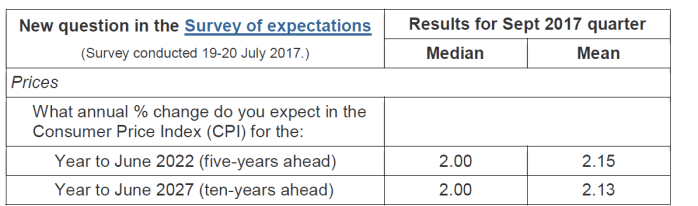
expecs 1.png

expecs 2

They also indicated that future summary responses to these questions will be released with the regular Survey of Expectations releases.

Of course, it is new data so there is only a limited amount one can take from this first set of numbers.  But I was interested that respondents have a mean expectation for inflation 10 years ahead of 2.13 per cent –  quite a bit higher than is probably implicit in the gap between indexed and nominal bonds (my own response to that question was 1.4 per cent).

Respondents (in a survey in late July) put a pretty high probability on the Reserve Bank having raised the OCR by next June, and respondents also seem to be of the view that the worst of the house price inflation is over for now –  rather than, say, what we are seeing at present being just a brief pause.

In time, these new questions will enrich the Survey of Expectations.  The Bank could (and should) have gone further – eg a question about the OCR five years hence (a proxy for expectations of the neutral rate) and a question or two about expected net immigration flows.   But at least we now have some new data.

I don’t often praise the Bank, but I am impressed at the quick change of mind, and helpful and full response I got today.


Misconceived and deeply flawed

Later this week submissions close on the Reserve Bank Governor’s attempt to get the some sort of debt to income restriction added to the list of possible direct controls on banks upon which the government has bestowed its favour.  (I write it in that slightly awkward way because, by law, the Governor does not need the Minister’s permission at all –  Parliament, somewhat recklessly, appears to have given all those powers to the Governor personally, but a few years ago the Governor committed to only using restrictive tools that the government had approved of.)

This would be the latest in the series of direct interventions by which the Reserve Bank has been undermining the effectiveness and efficiency of the housing finance market.  For now, the (outgoing) Governor says he wouldn’t apply a debt to income restriction even if he had the Minister’s imprimatur.  But all it will need will be another rebound in the property market and Wheeler would no doubt be keen.  Whether his permanent successor next year shares that enthusiasm is, I would hope, something the Board and the (next) Minister turn their minds to in considering possible candidates for Governor.

I probably will put in a submission, but if so it will overlap in many areas with the paper just published by my former colleague (now Tailrisk Economics) Ian Harrison.    Ian spent many years in the prudential supervisory wing of the Reserve Bank and led the work on risk modelling that has underpinned the Bank’s positions on capital, risk weights etc.  He has previously written and published his critical analysis on the Reserve Bank’s decision to treat residential mortgage loans owed by investors as riskier than the same loan on the same security when owed by owner-occupiers.  It was published under the somewhat provocative title House of Cards – and I wrote about it here.

His new paper on the proposal to have a debt to income instrument available doesn’t have a provocative title.   But it is no less forceful in its conclusions.  Here is the bulk of Ian’s press release

A report by Tailrisk Economics on the Reserve Bank’s justifications for possibly imposing debt to income (DTI) limits on housing lending, shows that that they are deeply flawed.

The main problem is that the DTI is a crude tool that does not adequately assess borrowers’ debt servicing capacities, and which will perversely target better quality loans.

“The Reserve Bank has presented no substantive evidence that higher DTI loans are ‘excessively’ risky, or that a DTI ratio of 5 is a sensible cut-off,” said Ian Harrison, Principal of Tailrisk Economics, “but there is significant evidence that DTIs do not predict loan defaults, or reduce the likelihood or severity of crises”. The European Systemic Risk Board found, in a recent assessment of GFC performance, that DTI levels did not have any “relevant effect either on the prediction of the crisis or on the depth of the crisis” .

The application of the DTI limit to investor loans, which are the primary focus of the policy, is particularly misconceived, because DTI limits are only intended to apply to owner occupier borrowers. The DTI measure assumes that when investor purchases a new property their living expenses increase. “This simply does not make sense”, Harrison commented.

The effect of the policy could be to impose an effective LVR limit as low as 30 percent on professional investors.  No other country has imposed DTI restrictions on investor loans.

“Higher future interest rates do not pose a material systemic risk, providing the conduct of monetary policy is competent”  Harrison added. “Further, the Bank’s assessment that the restrictions would have a net welfare benefit, is very optimistic. Our assessment is that they will have  a welfare cost, like most misconceived quantitative interventions.”

Much of the case the Reserve Bank seeks to make for having the ability to use a debt to income limit rests on the assumption that banks don’t do risk management and credit assessment well and that, inevitably crude, central bank interventions will do better.  The Bank’s consultation paper makes little or no effort to engage on that point at all.  It provides no evidence, for example, that the Reserve Bank has looked carefully at banks’ loan origination and management standards, and identified specific –  empirically validated –  failings in those standards.  Neither has it attempted to demonstrate that over time it and its staff have an –  empirically validated –  superior ability to identify and manage risks appropriately.

One of the Reserve Bank’s bugbears is that while the current lending practices may look broadly okay at current interest rates, those same loans will look rather less sound if interest rates rise considerably.  Of course, banks already take into account the resilience of each borrower, including their ability to cope with unexpected changes in servicing costs.    I wrote about this in my post on the most recent FSR.

… there was something a little odd in the box the Bank included on “Vulnerability of owner-occupiers to higher mortgage rates“, clearly softening us up for the consultation paper on debt to income ratios.  They argue that

New Zealand is particularly vulnerable to a sharp rise in mortgage rates as the banking system funds a large proportion of its mortgage credit from offshore wholesale markets. The cost of this funding can increase sharply if there is an unexpected increase in global interest rates or a change in investor risk appetite, and banks are likely to pass on the higher funding costs to customers through higher mortgage rates.

But mostly this is just untrue.  The Reserve Bank sets the OCR in New Zealand based on overall inflation pressures in New Zealand.  If funding spreads rise –  as they did in 2008/09 –  and domestic inflation pressures don’t the Reserve Bank can easily offset most or all of the potential impact on retail interest rates by lowering the OCR.    That is what happened in 2008/09.

Of course, retail interest rates can rise, quite materially.  As the Bank points out, new floating mortgages rose from “around 7 per cent to over 10 per cent between early 2004 and 2007”.  Of course, as we used to stress at the time, fixed mortgage rates rose nowhere near that much.  But, more importantly, interest rates here didn’t rise because foreign rates were rising, but because the economy was cyclically strong, unemployment was low and falling, and wage and price inflation were increasing.  Wages rose roughly 20 per cent in that period.

It is fine and good for the Reserve Bank to do these sorts of stress-testing exercises, looking at what happens if interest rates rise to 7 per cent, or 9 per cent.  But in any realistic assessment, those sorts of substantial increases are only remotely likely if the economy is doing really cyclically well.  If jobs are readily available and wages are rising, not many people will be under that much stress even if interest rates rise quite a lot.  And those that are should quite readily be able to sell their house and move on.  It might be painful for them, but it simply isn’t a financial stability event.

Ian makes many of the same points, including

Financial  stability  will  only  be  threatened  if  there  is  a  large  number  of  borrowers   who  can  not  service  their  loans,  and  if  there  is  a  material  fall  in  house  prices.      If   house  prices  hold  up  through  the  interest  rate  cycle  then  borrowers  who  come   under  servicing  pressure  will  generally  be  able  to  resolve  their  problem  by  selling  the   house.  A  systemic  problem  only  starts  to  arises  if  the  interest  rate  increases  cause  a   large  fall  in  house  prices.    However,  if  this  did  occur  then  RBNZ  could  readily  respond   by  reducing  the  OCR.  It  is  almost  inconceivable  that  a  large  house  price  shock  would   not  feed  through  into  broader  economic  activity,  and  into  the  inflation  rate,  which   would  naturally  require  a  monetary  policy  response.    Mortgage  interest  rate  would   fall  and  the  pressure  on  borrowers’  servicing  capacity  would  be  relieved.

He also rightly highlights how unusual it is to propose including investor loans in a debt to income limit.  The Reserve Bank likes to highlight the debt to income limits adopted by the United Kingdom and Ireland, but simply hasn’t engaged with the fact that neither country includes investor loans in its limits.   Of the Bank of England Ian notes

The  Bank  of   England  has  the  legal  capacity  to  apply  DTI  limits  to  investor  lending,  but  has  not  done  so,   because  the  retail  DTI  limits  do  not  readily  translate  to  investor  lending.  Instead  the  Bank   requires  banks  to  meet  minimum  qualitative  standards  in  their  affordability  assessments.  In   addition,  banks  are  required  to  apply  a  2  percentage  point  stress  test  to  the  interest  cost   assessment,  and  the  test  rate  must  be  at  least  5.5  percent.  Where  buy-­‐to-­‐let  borrowers  rely   on  other  income  to  support  the  loan,  account  must  be  taken  of  taxation  and  living  costs.  This   is  basically  the  methodology  that  New  Zealand  banks  apply  to  retail  investment  lending.   There  are  no  further  quantitative  restrictions  such  as  times  interest  cover.  This  is  left  to   individual  bank’s  assessments.

In its assessment of submissions, the Reserve Bank should really be expected to provide rather more justification for the inclusion of investment loans than it has done to date.

Ian concludes his press release this way

“There are simpler, and less distortionary, ways of targeting ‘excessive’ house price rises, which appears to be the Bank’s primary motivation for DTI restrictions,” Harrison said. “Banks could be required to apply a prescribed higher test interest rate to affordibilty assessments.  This would provide the Reserve Bank with an interest rate policy tool that can be directed to imbalances in the housing market.”

His is a pragmatic response.   Mine is perhaps more hardnosed –  and perhaps less “realistic”.  It is no business of the Reserve Bank to be targeting house prices, targeting whether investors or owner-occupiers are buying, or even targeting levels of household debt.  Apart from anything else, they have no robust model of the housing market, or of the incidence of financial crises, and without those all they appear to have is gubernatorial whim, or the shifting winds of political preferences.  That is no basis for sound public policy.     The Bank –  and its political masters –  needs to be reminded of its mandate in this area: to promote the soundness and the efficiency of the financial system.  Direct controls that apply to one set of lenders and not others, to one set of loans and not others, to one class of borrowers but not others, are quite simply inferior on both limbs of that mandate to reliance on indirect instrument, such as capital standards, stress tests, and a deeply informed understanding of how banks are measuring, monitoring and managing risk.   To their credit, banks in countries like ours appear to have done a good job in recent decades of managing housing loan books.  It is a shame that the same cannot be said of the central and local government politicians and officials who have regulated urban land markets to the point where a house purchase is an increasingly impossible dream for too many of our fellow citizens.    How did we allow such disastrous outcomes?

Anyway, for anyone interested in the DTI proposal I’d commend Ian’s paper.  I don’t agree with everything in it, but is a detailed review of many of the relevant issues, and of the “evidence” the Reserve Bank seeks to rely on.  I hope that, for example, the Treasury will pay careful attention when they formulate their advice on the Reserve Bank inevitable (regardless of this “consultative process”) bid for approval to add debt to income limits to their toolkit of direct controls.


Doomed to repeat history…..or not

Last week marked 10 years since the pressures that were to culminate in the so-called “global financial crisis” burst into the headlines .

Local economist Shamubeel Eaqub marked the anniversary in his Sunday Star-Times column yesterday.  It grabbed my attention with the headlines Ten years on from the GFC” and “We appear dooomed to repeat history” .  

Frankly, it all seemed a bit overwrought.

It seems inevitable that there will be yet another crisis in the global financial system in the coming decade.

There have been few lessons from the GFC. There is more debt now than ever before and asset prices are super expensive. The next crisis will hopefully lead to much tighter regulation of the financial sector, that will force it to change from its current cancerous form, to one that does what it’s meant to.

The first half of the column is about the rest of the world.  But what really caught my attention was the second half, where he excoriates both the Reserve Bank and the government for their handling of the last decade or so.    This time, I’m defending both institutions.

There are some weird claims.

We were well into a recession when the GFC hit. So, when global money supplies dried up, it didn’t matter too much, because there was so little demand to borrow money in New Zealand anyway.

Here he can’t make his mind as to whether he wants to date the crisis to, say, August 2007 (10 years ago, when liquidity pressures started to flare up) or to the really intense phase from, say, September 2008 to early 2009.

Our recession dates from the March quarter of 2008 (while the US recession is dated from December 2007), but quite where he gets the idea that when funding markets froze it didn’t matter here, I do not know.  Banks had big balance sheets that needed to be continuously funded, whether or not they were still expecting any growth in those balance sheets. And they had a great deal of short-term foreign funding.  Frozen foreign funding markets, which made it difficult for banks to rollover any such funding for more than extremely short terms, made a huge impression on local banks.  For months I was in the thick of our (Treasury and Reserve Bank) efforts to use Crown guarantees to enable banks to re-enter term wholesale funding markets.  Banks were telling us that their boards wouldn’t allow them to maintain outstanding credit if they were simply reliant on temporary Reserve Bank liquidity as a form of life support.

Despite what he says I doubt Eaqub really believes the global liquidity crunch was irrelevant to New Zealand, because his next argument is that the Reserve Bank mishandled the crisis.

The GFC highlighted that our central bank is slow to recognise big international challenges. They were too slow to cut rates aggressively. They were not part of the large economies that clubbed together to co-ordinate rate cuts and share understanding of the crisis.

I have a little bit of sympathy here –  but only a little.  I well remember through late 2007 and the first half of 2008 our international economics people patting me on the head and telling me to go away whenever I suggested that perhaps events in the US might lead to something very bad (and I’m not claiming any great foresight into just how bad things would actually get).  And I still have a copy of an email from (incoming acting Governor) Grant Spencer in August 2007 suggesting that it was very unlikely the international events would come to much and that contingency planning wasn’t worth investing in.

And, with hindsight, of course every central bank should have cut harder and earlier.  I recall going to an international central banking meeting in June 2007 when a very senior Fed official commented along the lines of “some in the market are talking about the prospect of rate cuts, but if anything we are thinking we might have to tighten again”.

As for international coordination, well the Reserve Bank was part of the BIS –  something initiated in Alan Bollard’s term.  Then again, we were tiny.   So it was hardly likely than when various central banks did coordinate a cut in October 2008 they would invite New Zealand to join in.  Of its own accord, the Reserve Bank of New Zealand cut by 100 basis points only two weeks later (having already cut a few weeks earlier).

But what did the Reserve Bank of New Zealand actually do, and how did it compare with other advanced country central banks?

The OECD has data on (a proxy for) policy rates for 19 OECD countries/regions with their own currencies, and a few other major emerging markets.   Here is the change in the policy rates between August 2007 (when the liquidity pressures first became very evident) and August 2008, just before the Lehmans/AIG/ agencies dramatic intensification of the crisis.

policy rate to aug 08

The Reserve Bank had cut only once by this time.  But most of these countries had done nothing to ease monetary policy.  It wasn’t enough, but it wasn’t exactly at the back of the field, especially when one recalls that at the time core inflation was outside the top of the target range, and oil prices had recently been hitting new record highs.

That was the record to the brink of the intense phase of the crisis.  Here is the same chart showing the total interest rate adjustment between August 2007 and August 2009 –  a few months after the crisis phase had ended.

policy rate to aug 09

Only Iceland (having had its own crisis, and increased interest rates, in the midst of this all) and Turkey cut policy rates more than our Reserve Bank did.   In many cases, the other central banks might like to have cut by more but they got to around the zero bound.  Nonetheless, the Reserve Bank cut very aggressively, to the credit of the then Governor.  It was hardly as if by then the Reserve Bank was sitting to one side oblivious.

Obviously I’m not going to defend the Reserve Bank when, as Eaqub does, he criticises them for the mistaken 2010 and 2014 tightening cycles.  And the overall Reserve Bank record over several decades isn’t that good (as I touched on in a post on Friday), but their monetary policy performance during the crisis itself doesn’t look out of the international mainstream.   Neither, for that matter, did their handling of domestic liquidity issues during that period.

Eaqub also takes the government to task

The government bizarrely embarked on two terms of fiscal contraction. This contraction was at a time of historically low cost of money, and a long list of worthy infrastructure projects in housing and transport.

Projects that would have created long term economic growth and made our future economy much more productive, tax revenue higher, and debt position better.

Our fiscal policy is economically illiterate: choosing fiscal tightening at a time when the economy needed spending and that spending made financially made sense.

To which I’d make several points in response:

  • our interest rates, while historically low, remain very high relative to those in other countries,
  • in fact, our real interest rates remain materially higher than our rate of productivity growth (ie no productivity growth in the last four or five years),
  • we had a very large fiscal stimulus in place at the time the 2008/09 recession hit, and
  • we had another material fiscal stimulus resulting from the Canterbury earthquakes.

Actually, I’d agree with Eaqub that the economy needed more spending (per capita) over most of the last decade –  the best indicator of that is the lingering high unemployment rate – but monetary policy is the natural, and typical, tool for cyclical management.

And, in any case, here is what has happened to gross government debt as a share of GDP over the last 20 years.

gross govt debt

Not a trivial increase in the government’s debt.   Not necessarily an inappropriate response either, given the combination of shocks, but it is a bit hard to see why it counts as “economically illiterate”.  Much appears to rest on Eaqub’s confidence that there are lots of thing governments could have spent money on that would have returned more than the cost of government capital.  In some respects I’d like to share his confidence.  But I don’t.   Not far from here, for example, one of the bigger infrastructure projects is being built –  Transmission Gully –  for which the expected returns are very poor.

Eaqub isn’t just concerned about how the Reserve Bank handled the crisis period.

Our central bank needs to own up to regulate our banks much better: they have allowed mortgage borrowing to reach new and more dangerous highs.

I’d certainly agree they could do better –  taking off LVR controls for a start.  But bank capital requirements, and liquidity requirements, are materially more onerous than they were a decade ago.  And our banking system came through the last global crisis largely unscathed –  a serious liquidity scare, but no material or system-threatening credit losses.  Their own stress tests suggest the system is resilient today.  If Eaqub disagrees, that is fine but surely there is some onus on him to advance some arguments or evidence as to why our system is now in such a perilous position.

Macro-based crisis prediction models seem to have gone rather out of fashion since the last crisis.  In a way, that isn’t so surprising as those models didn’t do very well.     Countries with big increases in credit (as a share of GDP), big increases in asset prices, and big increases in the real exchange rate were supposed to be particularly vulnerable.  Countries like New Zealand.   The intuitive logic behind those models remained sound, but many countries had those sorts of experiences and had banks that proved able to make decent credit decisions.  And we know that historically loan losses on housing mortgage books have rarely been a key part in any subsequent crisis.     Thus, the domestic loan books of countries like New Zealand, Australia, Canada, the UK, Norway and Sweden all came through the last boom, and subsequent recession, pretty much unscathed.

One of the key indicators that used to worry people (it was the centrepiece of BIS concerns) was the ratio of credit to GDP.  Here is private sector credit as a per cent of GDP, annually, back to when the Reserve Bank data start in 1988.

psc to gdp

Private sector credit to GDP was trending up over the two decades leading up to the 2008/09 recession.   There was a particularly sharp increase from around 2002 to 2008 –  I recall once getting someone to dig out the numbers suggesting that over this period credit to GDP had increased more in New Zealand than it had increased in the late 1980s in Japan.  It wasn’t just housing credit.  Dairy debt was increasing even more rapidly, and business credit was also growing strongly.   There was good reason for analysts and central bankers to be a bit concerned during that period.  But what actually happened?  Loan losses picked up, especially in dairy, but despite this huge increase in credit –  to levels not seen as a share of GDP since the 1920s and 30s – there was nothing that represented a systemic threat.

And what has happened since?  Private sector credit to GDP has barely changed from the 2008 peak.  In other words, overall credit to the private sector has increased at around the same rate as nominal GDP itself.  It doesn’t look very concerning on the face of it.  Of course, total credit in the economy has increased as a share of GDP, but that reflects the growth in government debt (see earlier chart), and Eaqub apparently thinks that debt stock should have been increased even more rapidly.

It is certainly true that household debt, taken in isolation, has increased a little relative to household income.  But even there (a) the increase has been mild compared to the run-up in the years prior to 2008, and (b) higher house prices –  driven by the interaction of population pressure and regulatory land scarcity – typically require more gross credit (if “young” people are to purchase houses from “old” people).

If anything, what is striking is how little new net indebtedness there has been in the New Zealand economy in recent years.  Despite unexpectedly rapid population growth and despite big earthquake shocks, our net indebtedness to the rest of the world has been shrinking (as a share of GDP) not increasing.  Again, big increases in the adverse NIIP position has often been associated with the build up of risks that culminated in a crisis –  see Spain, Ireland, Greece, and to some extent even the US.   I can’t readily think of cases where crisis risk has been associated with flat or falling net indebtedness to the rest of the world.

There is plenty wrong with the performance of the New Zealand economy, issues that warrant debate and intense scrutiny leading up to next month’s election.  In his previous week’s column, Eaqub foreshadowed the possibility of a domestic recession here in the next year or two: that seems a real possibility and our policymakers don’t seem remotely well-positioned to cope with such a downturn.     But there seems little basis for “GFC redux” concerns, especially here:

  • for a start, we didn’t have a domestic financial crisis last time round, even at the culmination of two decades of rapid credit expansion,
  • private sector credit as a share of GDP has been roughly flat for a decade,
  • our net indebtedness to the rest of the world has been flat or falling for a decade,
  • there is little sign of much domestic financial innovation such that risks are ending up in strange and unrecognised places, and
  • whereas misplaced and over-optimistic investment plans are often at the heart of brutal economic and financial adjustments, investment here has been pretty subdued (especially once one looks at capital stock growth per capita).

In other words, we have almost none of the makings of any sort of financial crisis, “GFC” like, or otherwise.

House prices are a disgrace. We seem to have no politicians willing to call for, or commit to, seeking lower house prices.  But markets distorted by flawed regulation can stay out of line with more structural fundamentals for decades.  If house prices are distorted that way, it means a need for lots of gross credit.  But it tells you nothing about the risks of financial crisis, or the ability of banks to manage and price the associated risks.

LVRs, interest rates and so on

I was recording an interview earlier this afternoon, in which the focus of the questioning was the Real Estate Institute’s call for some easing in the Reserve Bank’s LVR restrictions.

Of course, I never favoured putting the successive waves of LVR restrictions on in the first place.  They are discrimatory –  across classes of borrowers, classes of borrowing, and classes of lending institutions –  they aren’t based on any robust analysis, as a tool to protect the financial system they are inferior to higher capital requirements, they penalise the marginal in favour of the established (or lucky), and generally undermine an efficient and well-functioning housing finance market, for little evident end.  Oh, and among types of housing lending, they deliberately carve-out an unrestricted space for the most risky class of housing lending –  that on new builds.

That doesn’t mean I think it is remotely likely that the Reserve Bank will be easing the restrictions any time soon –  apart from anything else, it would leave their consultation paper on debt to income ratio restrictions looking a little silly.   Of course, it would be good if the Reserve Bank did lay out some specific criteria for lifting these ostensibly temporary restrictions, but with the toxic brew of rapid population growth and continuing land use restrictions in place, if I saw the world as they seem to, I wouldn’t be in a hurry to lift the restrictions either.

In any case, it isn’t that clear quite how large a role the LVR restrictions are playing in the reduction in sales volumes.   They must be playing a part, but so too will higher interest rates, and the apparent increase in banks’ own lending standards, and pressure through the parents from APRA (on the lending standards across the whole of Australian banking groups).  Which, of course, is also why it isn’t clear quite how much difference any easing back in the New Zealand LVR controls might make.  Some presumably, but even the Reserve Bank has never claimed that LVR controls would have a very large impact on house prices, or housing market activity, for very long.   And while I noticed an article this morning about negative equity, it is worth bearing in mind that, on the REINZ index (not using median prices), house prices have risen 65 per cent in the last five years, and are currently 0.6 per cent off their peak.

But what of interest rates?  A year ago, the OCR was 2.25 per cent, and today it is 1.75 per cent.  Thus, the Reserve Bank talks of having eased monetary policy.   Here are mortgage rates though.

mortgage ratesI don’t suppose anyone is taking out four or five year fixed rate mortgages, but across the entire curve, interest rates are higher not lower.   Or we could go back another year or so, to just prior to when the Reserve Bank began cutting the OCR.   The OCR has been cut by 175 basis points since then.   Even at the shortish end of the mortgage curve, rates are down only 50-70 basis points.
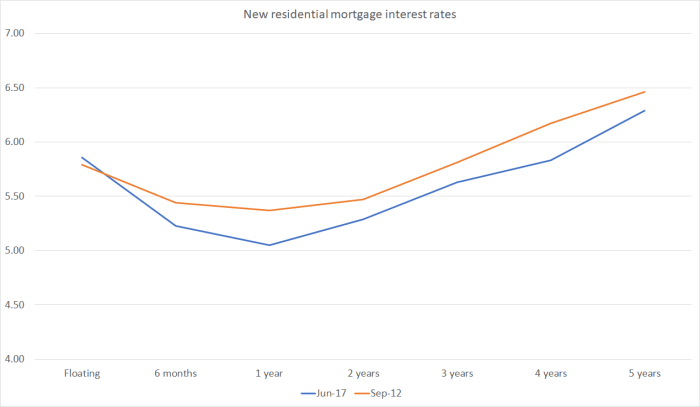
Having been reflecting this morning on Graeme Wheeler’s performance over his term, I had a look back at where interest rates were when Wheeler took office in September 2012.

mortgage rates sept 12Barely lower, even though core inflation –  on their own favoured measure – is as low today as it was then (and has been consistently low throughout his term).

I wondered if there were offsetting factors but:

  • Two year ahead inflation expectations are about 25 basis points lower than they were then (largely offsetting any reductions in nominal mortgage rates, to leave real rates little changed)
  • the TWI measure of the exchange rate is a bit higher than it was then,
  • the ANZ commodity price index, in inflation-adjusted world price terms, is hardly changed from what it was then.

Of course, the unemployment rate has fallen since September 2012, but there hasn’t been any sign of a pick-up in the best indicator of labour scarcity –  real wage inflation.

So, overall, it is a bit of a puzzle how the Governor expected to get core inflation back to fluctuating around the target midpoint without actually easing monetary conditions.  I don’t happen to agree with him on this one, but he keeps talking about how the huge migration inflows have reduced net inflation pressures (supply effects outweighing the demand effects).  If he really believes that it is even more puzzling that monetary conditions haven’t been eased.

I’m not sure how he’d respond.  But perhaps he could explain that too in the forthcoming speech.