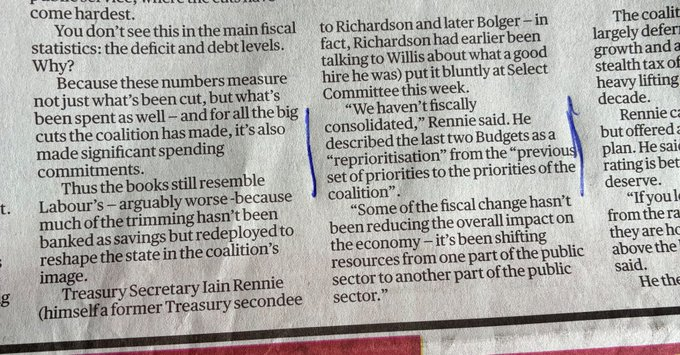
A couple of weeks ago the Sunday Star-Times published a piece by me (that they’d requested) trying to explain productivity and why it mattered. The mandate for that piece included avoiding controversy (around, notably, specific ideas for reversing New Zealand’s decades-long productivity underperformance).
As a follow-up to that, the editor invited me to participate in the SST’s series in which various people – most of whom, like me, probably have no interest in actually running for office – are given 750 words on what they’d do in their first 100 days as Prime Minister. I’ve found proposals I could support in columns by both Oliver Hartwich on the right and Peter Davis on the left.
In my reply to the editor I noted that my putative first 100 days would almost certainly be my last, as mobs with pitchforks might have stormed the Beehive by then (others since have suggested that 20 days might be my limit). Anyway, it was an interesting exercise, and since people are only supposed to become Prime Minister having campaigned on what they’d propose to do if they won, I had to assume that the public had actually voted for something very like my plan, unlikely as that might seem.
One can’t cover everything in 750 words, and can’t push back against very many at all of possible objections or counterarguments, but my key point really was that if we are serious about much better outcomes (durably much higher real wages and ending the decades-long large outflow of New Zealanders), it wasn’t going to be done with half-measures or by pretending that there are painless solutions, or by yet more handouts to voters.
(I do occasionally get asked what I’d do and I did a post along those lines here in 2018, much of which still rings true.)
Two other points to note about yesterday’s column: first, this particular column is focused on economics matters (and there are plenty of other things that actually matter to me at least as much), and second, these days I tend not to comment about policy areas for which MCERT is responsible for advising governments on, given my wife’s senior role there. As it happens, that didn’t constrain my choice of priority issues (about which material progress could be begun in the first 100 days) this time.
Anyway, for anyone interested here is the text of my piece.
The campaign that (unexpectedly) elected me would have emphasised that hard choices need to be made to markedly lift New Zealand’s economic performance and end the relentless outflow of our people (500000 or so since 2000). We won’t reverse decades of relative decline with half-measures or policies that simply paper over symptoms or pretend there are painless solutions.
Heading into tough times, trust in those lead is going to be vital. So from the start I’ll be clear to ministers and officials that anyone found to have deliberately misled Parliament or the public will be shown the door. Strict conflict of interest standards will be enforced.
Successive governments have run large structural fiscal deficits. That’s borrowing to, in effect, pay for the groceries. It has to stop. Subsidies to business will be ended, whether for “major events”, or grants to film and gaming. The last KiwiSaver subsidies and most early childcare ones will go. Interest will go back on student loans. A large proportion of people aged 65-69 are now still in work, and we will act immediately to raise the superannuation eligibility age to 70 over the next ten years. I’m 64, and the change will start before I turn 65. Spending will fall and tax revenue will rise.
Discipline around capital spending has been weak too. We will be a lot more stringent. Government agencies now evaluate projects as if a 2 per cent real return is just fine, when private firms typically require annual returns in excess of 10 per cent.
Getting durably higher real wage growth depends on productivity growth. That, in turn, depends on firms: new or existing ones finding many profitable opportunities to build more or better businesses in New Zealand. That simply hasn’t been happening to anything like the extent required. And too much of what investment there is has been inward-focused, simply to keep up with a rising population. Exports – a marker of firms’ success in the global market – have languished as a share of GDP.
Taxes on business income poll well, but the burden ultimately falls mostly on wage-earners. If firms choose not to innovate and invest, because the expected after-tax returns aren’t good enough for the risks involved, there will be little scope for sustained wage rises. New Zealand imposes some of the highest business tax rates in the OECD. Much of our government spending is, in effect, social insurance, and so I’d move quickly to reorient the tax system to better reflect that. I’d cut all personal and company income tax rates by 10 percentage points and instead put in place a 10 per cent social security tax (of the sort used across the OECD) on wages and salaries only. Closing the fiscal gaps may well require GST to be raised to 17.5 per cent.
New Zealand is the most remote country on earth, still trading mostly on our (limited) natural resources. For decades lots of our own people have been leaving, a signal that well-intentioned but misguided politicians have chosen to ignore. In countries with a fairly high level of skills (such as modern New Zealand) large scale immigration of non-citizens has rarely, if ever, been a successful way to lift productivity or GDP per capita. In remote resource-based economies such policies seem to have been directly harmful. We’ve tried the large scale immigration path again for the last 35 years, and it has failed. So we’ll cut the non-citizen inflow sharply. Of course we should take a decent quota of refugees and welcome returning New Zealanders (and their spouses) but most highly productive countries take only a fairly small number of non-citizen migrants each year. I’ll also make temporary work visas much harder to get for all but the most highly skilled.
There will be claims that firms will struggle without migrant labour. Some may, but the overall business climate will be much more favourable. The cost of capital will be lower and the exchange rate is likely to fall as part of the necessary adjustment. Sectors that have relied largely on raw population growth will shrink, freeing up New Zealand workers. And as economic prospects durably improve there is a vast pool of New Zealanders in Australia many of whom might, over time, begin to find it attractive to move home again.
We’ll make New Zealand not just a green and pleasant land but a dynamic and high-performing economy for us all once again.
(No, two posts in two weeks does not foreshadow any sort of return to regular blogging – tempting as it has occasionally been at least for the pre-election period – but having written copious amounts on the Reserve Bank’s monetary policy, associated governance, and lack of serious accountability during and after the Covid period, I thought it would be worthwhile documenting some reactions to the report of the Independent Review of the Monetary Policy Response to the Covid-19 Pandemic which was released on Wednesday yesterday. And, of course, writing helps clarify my own thoughts.)
One of the (minor) odd features of the report was that it did not include the terms of reference given to the reviewers by the government when they commissioned it back in February. Interested readers had to go hunting for themselves. Here is a link to the terms of reference.
There were a number of weaknesses in the terms of reference. The very first purpose listed for the review was to “support accountability” and yet only the decisions of the MPC itself were in scope (not, notably, those charged with holding them to account, whether the Bank’s Board, The Treasury, or the (then) Minister of Finance). Given that the system, as legislated by Parliament, is supposed to balance operational autonomy for the MPC with meaningful accountability, it is a shame that the workings of the entire system over that period were not reviewed. Equally less than ideal was that the reviewers chose to focus solely on the committee as a whole and not on the roles, responsibilities, performance etc of individual members, executive and external.
And it was only when I went back and read the terms of reference yesterday that I was reminded of this.
It seems very odd for ministers to put a page limit on an independent report, and especially one into matters so complex and consequential (and, as it happens, costly).
There was a KC report into the some specific issues around the conduct of the previous FMA chair Craig Stobo earlier this year, which (without apparent page limit) ran to 45 pages. The first of the reports into the Mount Maunganui landslide earlier this year ran to 250 pages. And more directly relevantly, as part of the 2023 (broad) review of the Reserve Bank of Australia, one of the authors of this review (Orphanides) wrote the reviewers a background paper on the RBA’s monetary policy near the effective lower bound, and it – just a background paper – ran to 62 pages. Lars Svensson’s 2001 independent review of Reserve Bank monetary policy ran to almost 80 pages.
Who knows quite why the Minister of Finance imposed such a limit, which more or less guaranteed that a lot of issues would have to be skated over all too lightly. Perhaps it was the delays they experienced with coalition partners and then finding potential reviewers, but we’d probably have gotten a more substantively useful document had the reporting deadline been extended somewhat (no doubt beyond the election) and the reviewers left freer to elaborate.
Another odd feature of this review – as opposed to Svensson’s – was that public submissions were not sought. The reviewers talked to a reasonable range of economists (only, listed at the back) but, for example, did not talk at all to one of Orr’s most vociferous economist critics during the period. Nor, for example, did they talk to (then) ministers or their advisers, to FEC members, to (it appears) senior Treasury people during the period (including the then Secretary, who was a non-voting MPC member) or even to people who were on the Reserve Bank Board (charged with holding MPC to account, and recommending (re)appointments) through the period. These sorts of people should have been relevant even if only as those who had direct exposure to the Bank and MPC members, and how they thought and operated, throughout this turbulent period. (To be clear, I’m not complaining for myself: not only did I have a fairly long meeting with the reviewers but at David Archer’s request I provided some written material at the start of the process, mostly as pointers to real-time perspectives and analysis I had written during the Covid period.)
The reviewers also seemed oblivious to (or at least uninterested in) the issue of whether or not, and if so to what extent, people (expert and otherwise) may have lost (or, I suppose, gained) confidence in the Reserve Bank/MPC through the experience of the period, whether from the substance of their decisions, the outcomes, the way they communicated and engaged, or otherwise. It is all a bit odd, especially as both Archer and Orphanides have had exposure to the wider governance/legitimacy side of things, Orphanides as Governor (central bank of Cyprus, admittedly part of the least-acccountable central bank system on earth, the ECB) and Archer latterly in his senior BIS role and various papers he has written or co-authored – I discussed one of those here a couple of years ago.
Back when the review was first announced to report in September (having been promised for some years) there were some feverish people on Twitter suggesting it was all a political jack-up designed to embarrass the Labour Party weeks out from the election. There was even talk of “evil” Atlas Network connections. I thought that was pretty much nonsense (and said so), initially because of what I knew of the reviewers (I worked with/for David on several occasions over 20 years, and today we are both trustees of the Reserve Bank’s troubled superannuation scheme), neither of whom seemed the type to do anything other than articulate their conclusions freely and frankly (and neither seemed likely to be wanting future business/appointments from the New Zealand government). As it happens, OIAed documents revealed that the original intention had been for the review to be done and completed ages ago, but…coalition parties and finding credible reviewers added delays.
And whatever your personal opinion of the government(s) in office over the period, I do not believe there is much evidence that the government or its ministers can be blamed for the succession of decisions that led to such a costly outbreak of inflation and such large financial losses. The MPC is set up to have operational autonomy over monetary policy, which is supposed to mean that specific governments neither get the blame when things go wrong (MPC makes bad calls) or gets the particular credit when things go well. In practice it isn’t like that, of course, but such pressures are to be resisted. Operational independence becomes hard to sustain if politicians get tarred with all the blame (or even the credit) but have none of the decision-making authority. Sure, bad appointments can be made but – to take Orr as an example – while he was appointed by Robertson in late 2017 it was (and had to be) on the recommendation of the Bank’s board, who had been wholly appointed by the outgoing National government. No doubt Robertson was weak to have gone along with the Orr/Quigley 2018/19 blackball on appointing experts as non-executive MPC members, but in doing so he was acting on advice (and Treasury seems not to have pushed back on that advice). Did those mediocre appointees make a difference? I’m a bit sceptical (much as I wish it was otherwise) and of course the reviewers never even touched on the quality of those on the MPC.
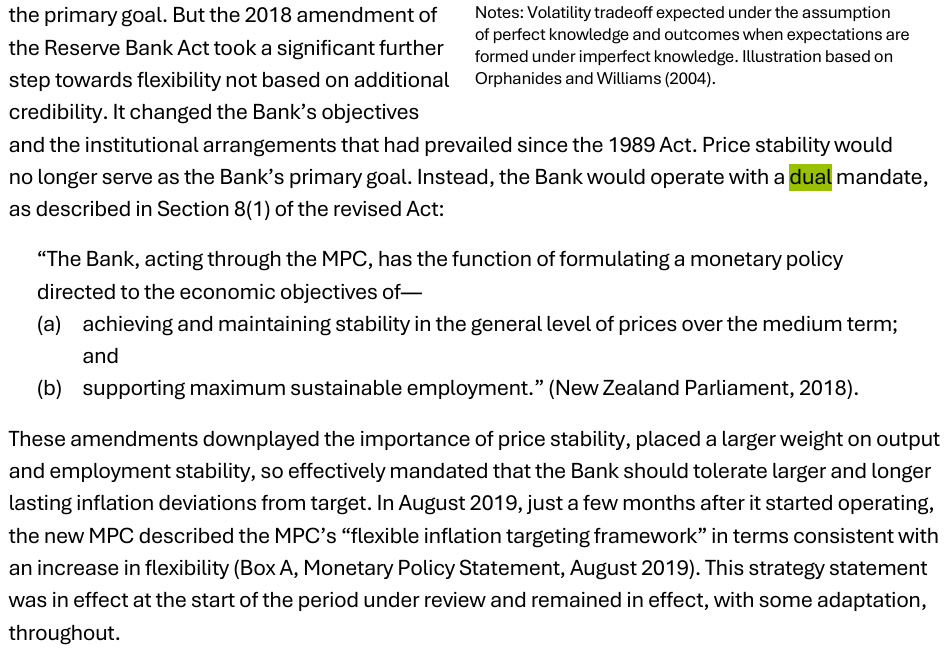
Where politics does come into focus primarily is in the context of the so-called dual mandate added to the Reserve Bank Act in 2018. The reviewers clearly did not like that amendment one little bit (which could readily have been predicted).
That was, no doubt, music to the ears of the Minister of Finance (quoted in her press release) but the problem is that the report itself offers no analysis at all to support the suggestion that the statutory change made any difference to policy choices or outcomes. They never, for example, even mention of the line run several times by the former Governor that in his assessment (and he did chair the committee) the change had made no difference to decisions made over this period, and they never (for example) engage in even the simplest cross-country assessment (did countries with dual-mandate specifications come through this period with worse outcomes than countries that retained a simpler specification?). It is well understood that in the face of demand shocks, you get exactly the same recommended policy response with a sole medium-term price stability focus (what the Bank was required to focus on immediately prior to the law change), as with something like a dual mandate specification. And since (as the report notes) no inflation-targeting central bank was ever an “inflation nutter” faced with near-term supply shocks to prices – precisely because of the output and employment consequences – it isn’t clear how the authors themselves believe the law change changed outcomes.
As I’ve pointed out on plenty of occasions, the Bank’s forecasts through 2020 and the first half of 2021 typically suggested that if anything MORE policy stimulus was required, and that such stimulus would both raise inflation towards the target midpoint and lower unemployment towards the non-inflationary sustainable rate (because forecast inflation was low and forecast unemployment was high). Their forecasts were very wrong, but there is nothing the reviewers point to – and they had access to MPC members and presumably to the unpublished background papers – suggesting the dual mandate made a difference. They were, of course, constrained by that page limit, but must have been aware of the political sensitivity of the issue. It is an unfortunate omission, and while they might seek to defend themselves by noting that the terms of reference explicitly refer to “the objectives of monetary policy that applied at the time”, they were the ones who chose to open up the dual mandate issue (probably rightly in my view, because it is a question that should be asked, and investigated seriously).
I noted that there was no attempt at a cross-country perspective on whether the form of the mandate made a difference (and I suspect they knew there was little reason to think it would) but it is just an example of another significant weakness of the report. They were specifically charged with considering as background “relevant decisions made by comparable central banks” but there are very few specific mentions of other central banks at all, and no attempts to compare and contrast policy choices, initial shocks (that central banks faced) or inflation outcomes (again allowing for things like different shocks – eg gas prices were to matter vastly in Europe in 2022, but not all in New Zealand). There is some reason to think that our Reserve Bank may have done worse than many (as I have long pointed out, and as more-recent Reserve Bank pieces note, we are estimated to have had probably large positive output gap – measure of economic overheating – of any advanced economy), but equally it is fair to point out (and the report never does) that central banks in most (but not all) advanced countries made very similar errors – notably forecasting errors – to those made by our Reserve Bank. On the one hand, that is some (modest) defence – it would be worse if ours had been uniquely bad – although on the other, each central bank takes on responsibility for outcomes only in its own country, and each has to be accountable for those national outcomes.
It is also puzzling that the report never looks closely at private sector, or implied market, views of the outlook for New Zealand inflation or required monetary policy. There is simply a parenthetic reference largely dismissing the fact that those views were very similar to the Bank’s (on grounds that the Bank’s forecasts can influence outside forecasters’ views). But when private forecasters and commentators think a central bank is getting things very wrong, they tend to say so (even if they also need to guess what the Bank will actually do). It is less bad when the MPC makes the same mistake as people operating in the private sector, with lots of money at stake, but……private forecasters, informed commentators, and hedge funds etc aren’t responsible for NZ monetary policy and inflation (or thus to the wider public at all), while the MPC is. In fact, the review is sometimes reluctant to even assign responsibility (on the very first page we are told, abstractly, that “mistakes were made”, but not that named individuals who assumed voluntarily the responsibility and prestige of MPC appointments themselves made those mistakes (here and abroad). The report is very light indeed on any serious form of accountability (including, for example, never once – in the body of the text – mentioning the names of those involved).
Incidentally, one wonders if journalists have sought comment on the report from those who were MPC members during the period. My guess is that they will be reasonably happy with it, to an extent they probably should not have been able to be.
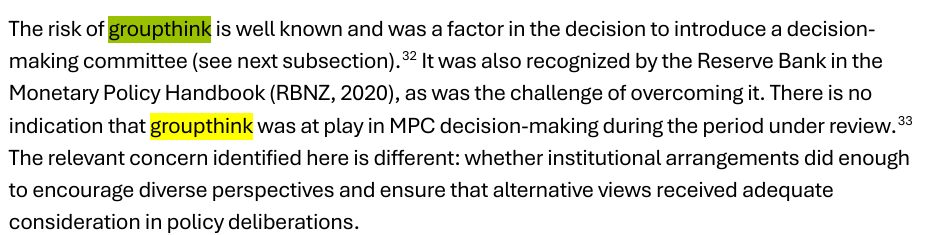
They get off rather lightly, both individuallly and collectively. More than a few points are just never developed, Take, for example, this
And that footnote? “One of the reviewers, Mr Archer, does not agree with this statement.” There were, after all, only two reviewers (so, for a start, how did they decide whose view got in the main text and whose in the footnote?), and this is the only highlighted difference between them, and yet there is no sign of what evidence or reports they each used to reach a view on this quite significant issue (on which Archer has had strong documented views for years). They seem to resolve to agreeing on the abstract (“institutional arrangements” doing “enough to encourage diverse perspectives”) without serious analysis of what actually happened in the specific, very costly, period of policy conduct they were asked to review.
And while there are abstract and general issues worth considering, and certainly in any committee constituted as MPC then was, it is pretty extraordinary that none of the specifics around individuals, notably the Governor, are engaged with. Orr has had a reputation for too often having been intolerant of dissent or challenge, whether internal or externally-sourced. And during this period he was cycling through senior managers, including those directly associated with monetary policy. The able Deputy Governor had apparently had enough and announced he was leaving, only to have his employment summarily terminated a few weeks early, the Chief Economist through the period seemed pleasant but not really up to the senior role and seems to have found it best to leave, and then of course late in the period under review an utterly unqualified (for MPC-type responsibilities) new DCE responsible for macro matters was appointed. In a committee required by law to have a majority of internals those people, and sets of circumstances, don’t sound like a mix that would have produced optimally open debate and mutual challenge. Committees don’t exist in the abstract, but with concrete individuals, with their personalities, dispositions, incentives, and so on. Perhaps it really was all okay, but the reviewers make no serious attempt to engage on the issue.
There isn’t even any reflection, anywhere in the report, on the fact that throughout the entire, very challenging, Covid period there was not one dissent recorded, ever (and while consensus was formally encouraged, votes were never prohibited, nor the clear expression of an alternative view). My bias is to the agree with Archer’s dissent, but….they had the opportunity to gather and report evidence from inside, and yet they seem to have chosen not to do so.
Perhaps in a similar vein, there is nothing in the report about the extent of external engagement, or otherwise, of MPC members during a period of extreme turbulence and great uncertainty. There were barely any serious speeches through the period, almost no external engagement by external MPC members, and little or no sign of any systematic attempts to engage with the uncertainty by, for example, hosting workshops or conferences to try to open themselves to alternative perspectives or explore the uncertainties they (and everyone else) faced. And, of course, because for example the external accountability stuff was out of scope, there is nothing about the frosty way in which the Bank engaged with any challenge or scrutiny at FEC. None of it suggested a “learning organisation”, an open one, or one that recognised the need to maintain its legitimacy and the centrality of accountability.
Not all punches are pulled. It was good to see the review highlight how extraordinary it was that nothing had been done before 2020 to ensure that banks’ systems etc could cope with negative (policy) interest rates (having had years of notice of the issue, and having themselves expressed in public the view that negative rates were likely to be a better tool than large scale asset purchases. Had they got onto that earlier – even had the new MPC raised concerns when it was established – it is likely the MPC would never have engaged in such large scale, risky, and (as it turned out) very costly LSAP purchases. Billions of dollars wasted for a failure by the Bank to have been suitably prepared for a foreseeable threat (makes MBIE’s technology project woes seem cheap). The Taxpayers’ Union may not be flavour of the week, but in their inimitable style they called out the waste.
But this is precisely where the official independent review gets weak. They suggest that the initial LSAP purchases were just fine (market stabilisation and all that), but don’t ever bother to engage on whether those RB purchases made any difference (to a temporary market liquidity crisis centred not here but in US Treasuries and where the Fed itself was intervening directly), or as to why once markets did settle profits weren’t quickly taken. More concerningly, there is no serious analysis of the effectiveness of the more-sustained LSAP purchase process that followed. They, fairly, note that to the extent there was much stimulus it proved, with hindsight, unwelcome (since inflation blew out) but never engage on the question of how much effective macroeconomic stimulus there actually was in the specific context of New Zealand. The financial losses are never quoted, and there is no attempt to engage or review with the claims, as recently as late last year, from the Reserve Bank that really it was all fine, and perhaps even net positive for the Crown. Without having done (or reported) any of that sort of analysis, they blithely suggest that there is a continuing role in the arsenal for LSAPs (and actually suggest legislative changes to remove some possible future roadblocks). And, on the other hand, despite those comments on negative interest rate capability earlier, there is nothing at all about the desirability of work to ease the remaining ELB constraint. Perhaps the reviewers think that would be a bad idea, but they don’t say, or offer any analysis. As it is, the OCR is about 350 basis points from the effective lower bound, and typical past cycles have involved 500 points of easing.
They also pull their punches around the Funding for Lending programme. They seem, reasonably, sceptical of the case for having introduced it (although, to be fair, it wasn’t completely inconsistent with their macro forecasts at the time) but never touch on the extraordianry way they went on providing crisis-support (cheap funding), exacerbating their OCR challenges long after any need for macro support had passed (claiming they were somehow “bound” – legally or morally was never clear, neither at all robust – to keep on).
Another area where I’d be critical of the report is around the initial monetary policy stimulus. The reviewers go to some lengths to portray the monetary policy approach from May to later in 2020 as reasonable given the forecasts the MPC was using. But in doing so they tend to treat the forecasts as a given, handed to the MPC by other people, when the forecasts themselves are the collective views of the MPC itself. They are certainly advised and supported by staff, but recall that the MPC at the time included the Governor and three other senior internal economists: the forecasts (or “baseline scenarios” as they were being called for a time in 2020) cannot be very meaningfully separated from the policy calls. In each case, each decisionmaker was applying their own “model” of the economy and of how the macroeconomics of the shock was going to play out, and then – given the Remit – how best policy should respond. MPC members had, certainly, to work with the initially limited data they had, but much more important in this case is that they were – again with hindsight – all clearly using the wrong models to think about how pandemic macroeconomics was going to play out (demand vs supply effects for example). This is a point that is simply never touched on in the report, even though it was (arguably) the single most important failing, not just by the Reserve Bank MPC but by macroeconomists around the world, in central banks and out. Perhaps we can call it pardonable to some extent – after all, it was a completely unknown sort of event – but it proved to be a huge and costly weakness. But also idiosyncratic.
Had we (they) properly understood the pandemic macroeconomics, and taken account of what fiscal policy was doing (as the Bank in fact did, so this isn’t the main issue), there would have been a strong case for the OCR never to have been cut in March 2020 and probably to have been raised very quickly, at least by the time the first successful lockdown was over. But again, the reviewers never engage with that sort of thought experiment, and they show no sign of having used their vast experience to reflect on why it was that the Bank (and so many others) misunderstood the economics. (I don’t purport to have a compelling answer either, but it was the root cause of what went so badly wrong later.)
Partly as a result, the report ends up being too inclined to absolve the MPC of responsibility for the mess (boom and bust, large unexpected transfers of purchasing power). If what was done initially was reasonable (“praiseworthy”, “rapid”, “innovative”, providing a “timely and much-need boost” [the latter as if lags are almost instant, and as if the aim of policy in March 2020 had not been to markedly shrink economic activity, temporarily]). And so the reviewers end up more or less buying into a line, run now by the Reserve Bank itself for several years, that really, while of course they should have started tightening a bit earlier, really it either wouldn’t have made much difference or would have done so only at untenable economic cost. The reviewers devote a lot of space to a little modelling exercise the Bank put out last year, suggesting that if they started tightening in late February 2021 with the goal of keeping inflation always at 3 per cent or less, it would have done huge economic damage (it first went through 3% in the June quarter, centred on mid-May). Well, of course, not only does no one thinks that monetary policy works with that short a lag, but….the bigger issue is why so much easing had been done in the first place. (I’m not suggesting the MPC members themselves deserve huge criticism for those March 2020 calls but….they did have quite the wrong model, and it was the source of what followed, the aftermath of which we are still living with.)
This has become a very long post. I want to finish with just a limited number of other specific points:
it is very odd that throughout the entire paper there is never a single reference to a core inflation measure (or concept). Now it is, of course, true that the inflation target is specified in terms of the headline CPI, but Remits and (previously PTAs) have always enjoined the Bank to “look through” temporary or one-off price disturbances, to extent consistent with maintaining medium-term price stability. Thus, central banks rarely respond directly to, eg, sharp rise or falls in petrol prices which can make a big difference to near-term headline inflation. In this case, for example, the report emphasises the large fall in the CPI in the June quarter 2020 (quoted in American-style annualised terms), while never noting the huge role that petrol prices played – you may recall world crude prices briefly going negative in a quarter when not much driving or flying was happening). The approach they take simply doesn’t engage with the practical and real challenges actual central bankers faced during that period (and thus one should be hesitant about their recommendation that “near-term inflation signals may be more robust than forecasts at the policy horizon – I’m no fan of medium-term forecasts, but the operative word there has to be “may”, in some circumstances.)
I agree with their broad approach to fiscal policy (consensus assignment remains appropriate and formal coordination is unlikely to be wise or called for) but am a bit hesitant about the suggestion that in some circumstances the Bank should build into its forecasts (or scenarios) its own view of what a government is likely to do. In terms of thinking about risks, there is probably some validity to the point, but I cannot see how it could be viable to include speculative numbers in published forecasts (it sets up potential for political fights in which the Bank is unncessarily caught in the middle).
Recommendation 11 proposes that “the Bank should allocate sufficient resources to support the effective functioning of the MPC, including policy, research and analysis to support diverse perspectives in policy deliberations”. There is no elaboration of this point in the body of the report (one of a couple of examples suggested the final process ended up rather rushed, another being around reviewing/altering the Remit), and I’m not fully sure what they have in mind. If, as I initially thought, they mean providing dedicated analytical resource to the external MPC members – as, for example, happens at the Bank of England – I strongly agree (otherwise the Governor has a stranglehold on what the Committee sees). But reading it again, it is possible they had something else in mind.
Recommendation 12 states “Sections 121 and 208 of the RBNZ Act create risks to monetary stability that should be reevaluated. The RBNZ Board should note have the authority to refuse to implement the MPC’s monetary policy.”. I want to devote some space to this because the Minister’s response to the report states explicitly that this “warrants further consideration and [the government] has commissioned further policy work from Treasury. Section 121 relates to powers of the Board, but actually (as the Report notes) section 208 relates to powers of the Minister, who can direct the Bank to “take all reasonable steps” to maintain a minimum level of capital specified by the Minister and have regard to the Minister’s expectations as to the Bank’s financial risk management. The report rather cavalierly suggests that “it is advisable to seek solutions that are implementable well before the Bank is required by unfortunate circumstances [emphasis added] to take on large financial risks to protect the New Zealand economy from from a deflationary shock”. This is melodramatic stuff, that not only does not engage with the likely actual effectiveness of either future LSAPs or big fx interventions, but more importantly does not engage with the guarantee powers the Minister of Finance already had under the Public Finance Act. To the Bank’s credit, it did not do the LSAP at its own risk (our risk imposed on us by them) but went and sought an indemnity from the Minister of Finance. It cannot be desirable that unelected officials, barely substantively accountable, can debauch the public finances without seeking the consent of the Minister of Finance. Extreme times call for political responsibility (including because, as demonstrated over 2020, with the best will in the world economists get thing badly wrong, and yet politicians are accountable). So I would urge The Treasury and whoever is Minister after the election not to be swayed by the these reviewers into re-establishing unlimited scope for the MPC to impose financial risks.
Overall, it is a fairly mixed bag of a report. If I scroll through the 12 formal recommendations I agree to a greater or lesser extent with most of them, although I think they probably tend to overstate what difference they might make in extreme unknown scenarios of the sort faced in 2020 and 2021. The recommendations are forward-looking, which is fine and has a place (including in the terms of reference they had to work to) but where the report is much weaker is on the backward-looking analysis and critical review. It gives passes to the MPC that aren’t really deserved and thus avoids some of the more difficult challenges of making sense of the period. It also tends, too much, to the purely technocratic – issues inside the Bank and the MPC – to the near-complete exclusion of the wider issues around legitimacy, accountability, and the confidence the public and markets might have in those who put their hands up to be entrusted with such huge delegated power.
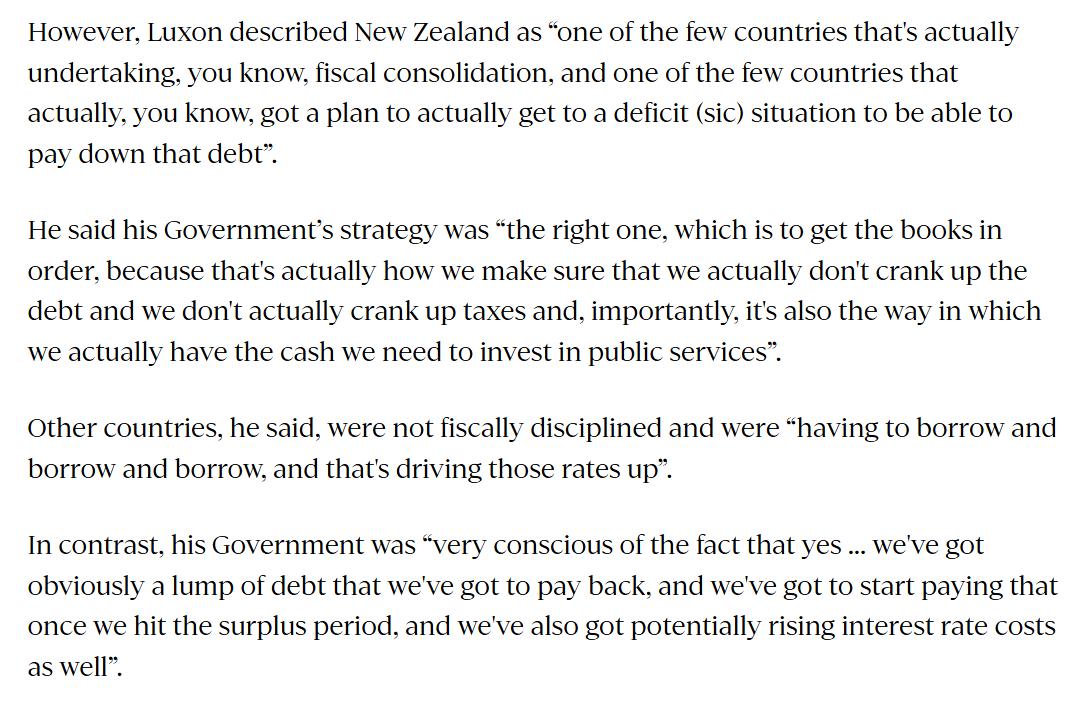
Yesterday the Prime Minister and leader of the National Party made some rather preposterous claims in his post-Cabinet press conference (as reported here by The Post)
When you read stuff like this from the head of the government perhaps one comes to better understand why senior officials can actively mislead parliamentary select committees and suffer no real consequences. People in power seem simply not to care about the facts, or even a plausible grounding in truth.
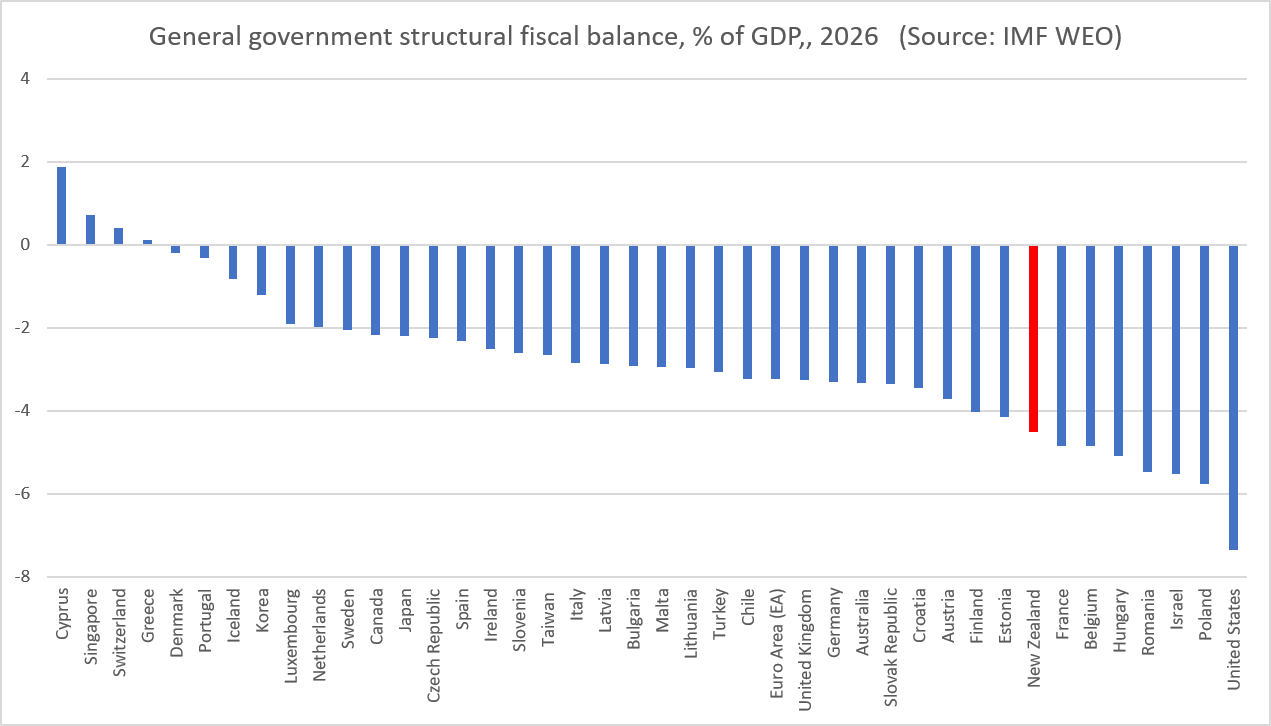
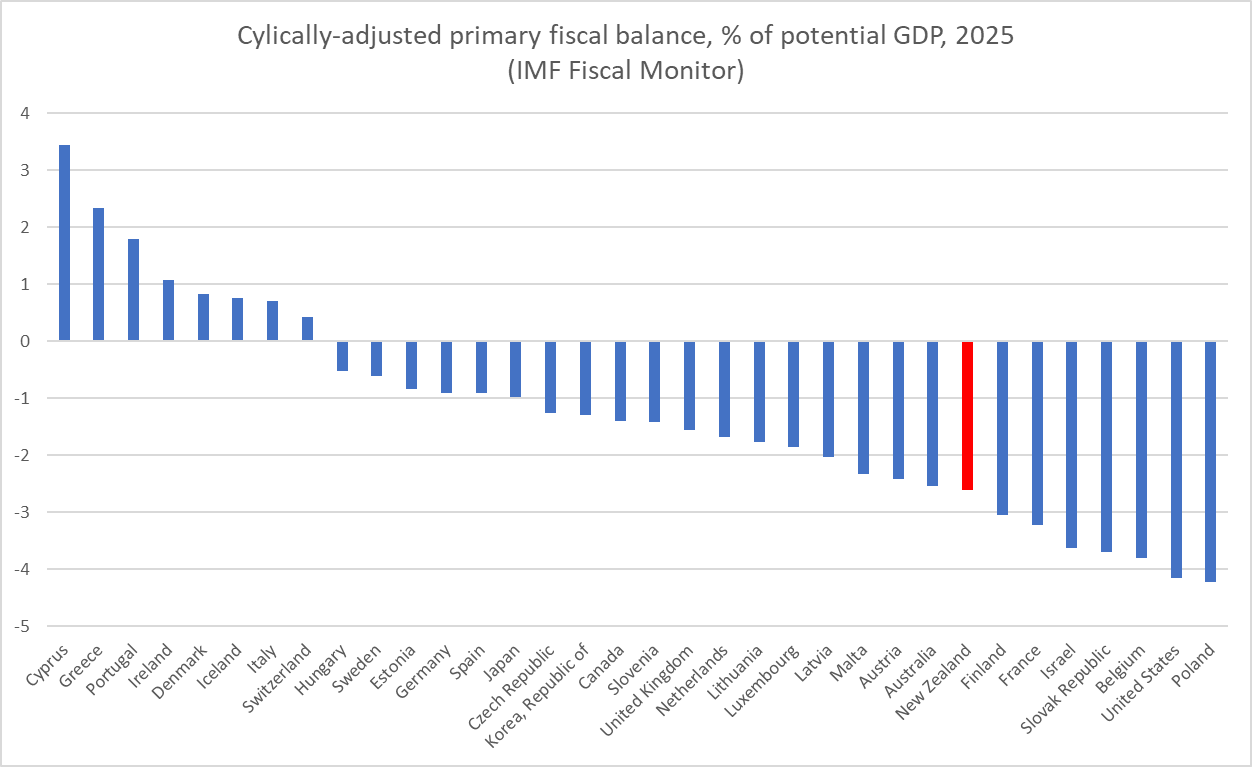
Where to start? Well, perhaps here in a chart I ran on Twitter back at budget time in May.
On the IMF’s reckoning, New Zealand had one of the larger structural fiscal deficits of any advanced economy this year. As I noted then “This is from the April IMF WEO but on Tsy numbers nothing in the budget yesterday altered the structural deficit for this year so the chart should still be representative.” There is a variety of other IMF fiscal deficit measures, and New Zealand now shows up poorly on all on them.
Now, the Prime Minister is quite correct that a lot of advanced economies have made no progress in cutting their deficits, but then a) ours are typically larger than theirs (and were in 2023) and b) more importantly, neither has New Zealand. That is so whether one looks as these IMF metrics or if one looks at the New Zealand Treasury’s own structural deficit estimates.
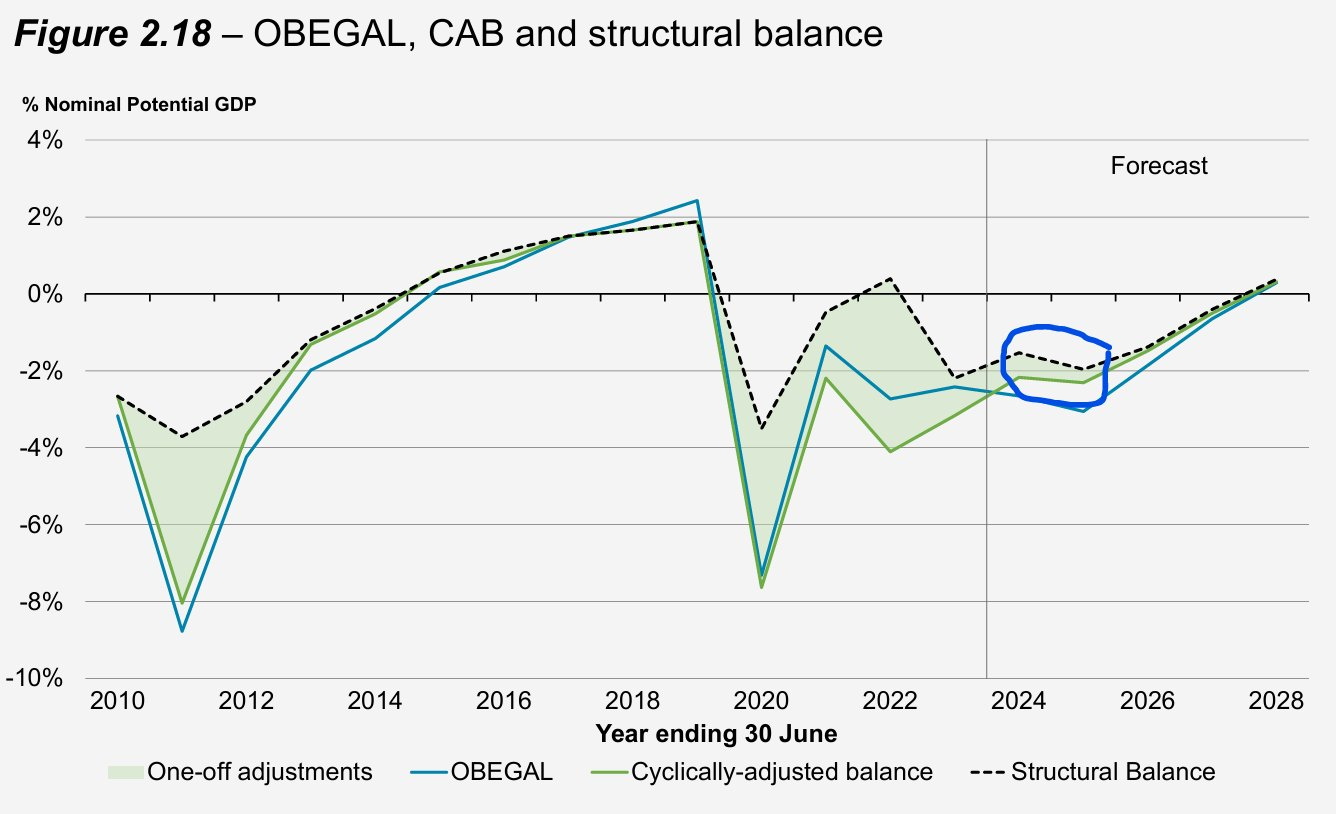
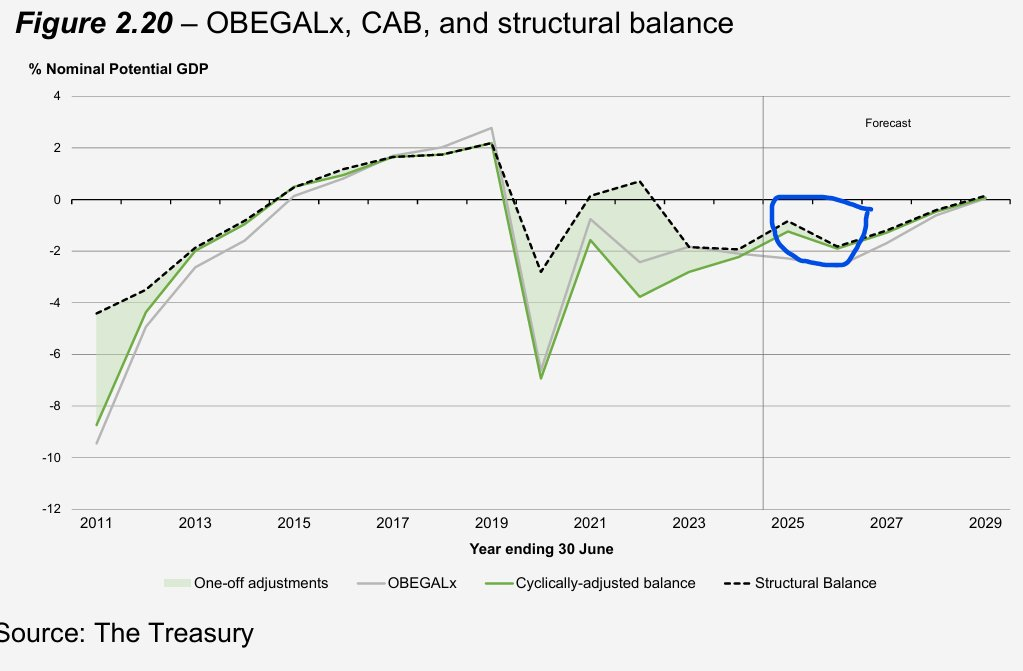
In each year’s Budget Economic and Fiscal Update The Treasury includes tables showing their estimates of the structural deficit (ie the bit not driven around simply be cyclical economic fluctuations, the bit that will only go away with specific policy choices). The Budget is typically released in May, so there is an estimate for the fiscal year just about to end and one for the year just about to start (shaped by the specific concrete fiscal choices and appropriations from the budget being announced).
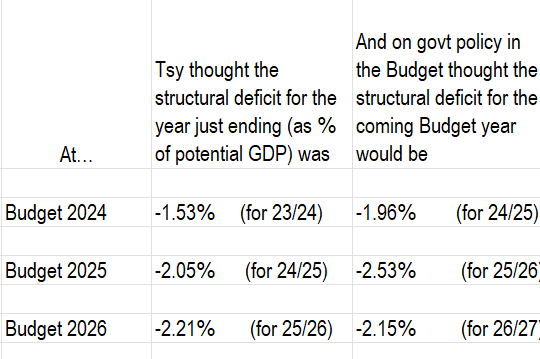
Here is a summary table for the three budgets to date brought down by this government
In the 2024 and 2025 Budgets the government consciously and deliberately (since they had the Treasury numbers in front of them) chose to increase the structural deficit, and in this year’s budget there was a very slight estimated reduction. Taken together, over three budgets discretionary fiscal policy has not produced any fiscal consolidation at all.
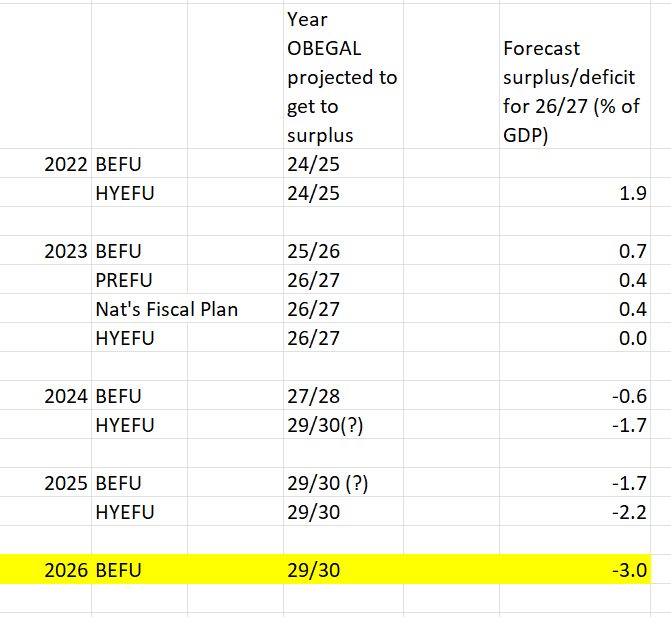
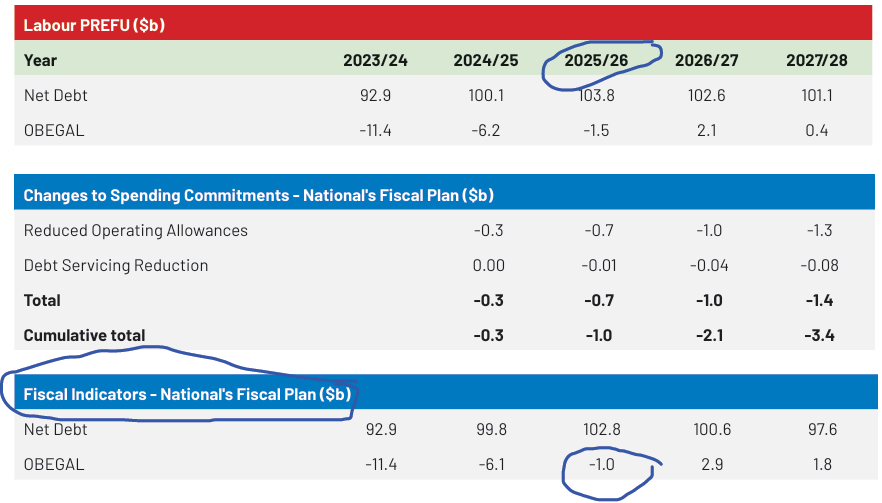
Of course, in the outer years budgets (under this government and its predecessor) almost always show a track in which structural and headline deficits shrink and eventually we return to surplus. Here is summary table showing successive EFUs (PREFU 2023 captured Labour’s stated fiscal policy) and National’s 2023 Fiscal Plan
On both Labour and National’s stated numbers at the time of the 2023 election we’d be in (modest) surplus, on the proper OBEGAL measure, this year. Instead – and of course it is National that has led the government – the deficit for this year was projected to be around 3 per cent of GDP (most of which is structural).
We were promised consolidation, but none has been delivered. None.
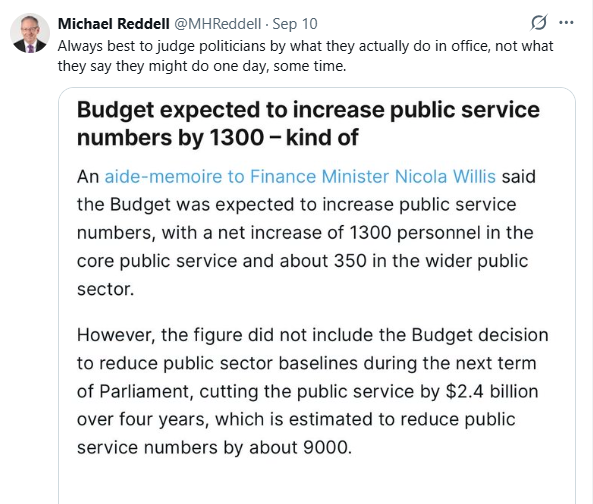
A good illustration was reported by the Herald last week, when the proactive release of Budger-related papers finally occurred.
There has been lots of fine talk about public service staffing cuts (it suits National to talk them up as an achievement and Labour to bemoan “austerity” etc) but the numbers so far have not amounted to much in total and (as Treasury reports in that paper) the 2026 Budget was expected to result in a material increase in core public service staffing numbers.
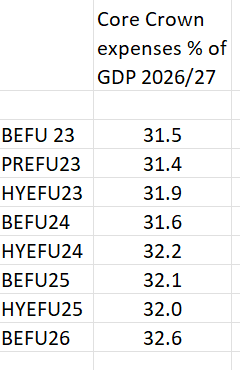
Easy to talk before an election of what you might do after it, but it seems safer for voters to be guided more by what has actually been done. And that has not been fiscal consolidation (or overall spending cuts)
A few weeks ago National came out with its (so-called) Budget Responsibility Rules, which consisted (in effect) of making much the same commitments as they’d run in their 2023 Fiscal Plan: a return to surplus (on the Treasury standard OBEGAL measure) three years’ hence, but few/no credible specifics as to how they would deliver that, and a track record that gives potential voters little reason to believe that they are really serious this time. Why would we? After all, if they win a second term a) things always get harder to do in later terms, and b) on all polling this year, National is likely to be in a relatively weaker position within the government than they are now. Is there anything in how the government has governed in the last three years, or in their specific giveaways promised this year, that would lead one to believe that they will really make the scale of cuts required to deliver a return to surplus?
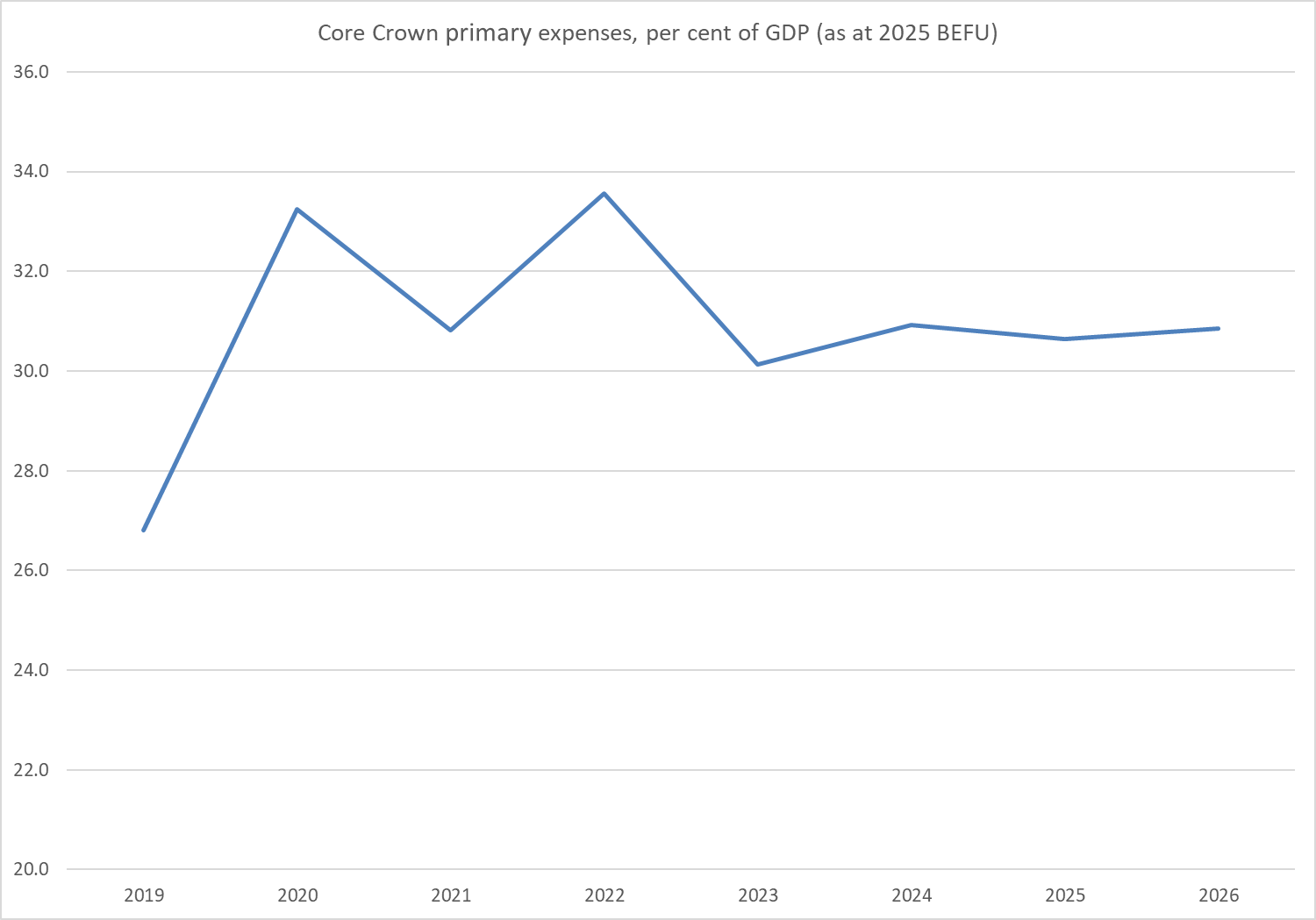
The government has raised debt (materially – more than at any time in decades outside identifiable crises like Covid or the Christchurch earthquakes), it is relying on fiscal drag (increasing tax/GDP), and it has not cut spending as a share of GDP. The words of St Augustine, “Lord, give me continence and chastity, but not yet” spring repeatedly to mind.
Not, of course, that there is any sign of Labour being much, if at all, better. It was, after all, Labour that bequeathed the government the large structural deficits. Labour too that promised – look, the forward tracks – that in government they’d have delivered a return to surplus by now (with no credible policy basis for believing that promise either). It is, I suppose, good that political parties still feel the need to talk about returns to surplus (I don’t think we see the same language in the UK for example) but neither side seems to feel obliged to actually deliver.
This time, Labour too promises a return to surplus (OBEGAL) on much the same time frame as National and the current government. The problem is that there is no more basis for believing that than there was a) for believing them in 2023, or b) for believing National at either election. Labour says it envisages a higher core level of government spending than National plans (as I guess you’d expect) but…..that means more tax than otherwise to finance that spending. And not only is the proposed CGT forecast revenue fully committed to fund specific additional spending pledges, but that revenues depends entirely on house prices rising but they are still falling (and ideally should keep falling if land use reform is at all serious).
The Prime Minister’s claims are more egregious – and at this point matter more as he is actually the Prime Minister – but there is really no sign of a) any fiscal consolidation to now or b) any real reason to believe that we will see any serious and deliberate fiscal consolidation from either side, whoever wins the election. It will be a decade of deficits, unless something quite fortuitous happens, and then we’ll probably start out on a second decade as the demographic pressures on spending mount and nothing material is done.
We can still take comfort in the level of overall public debt being relatively modest. But debt levels build. It wasn’t many decades since the UK was a low debt country, and now it is at the leading edge of the rise in global bond yields. It isn’t the way New Zealand should be content to go, but there is little sign of willingness by our politicians – notably including our current ministers – to either make hard decisions or to be honest with the public about the scale of the challenges. More giveaways, more bread and circuses….and more debt again seems so much easier for our fiscally feckless politicians.
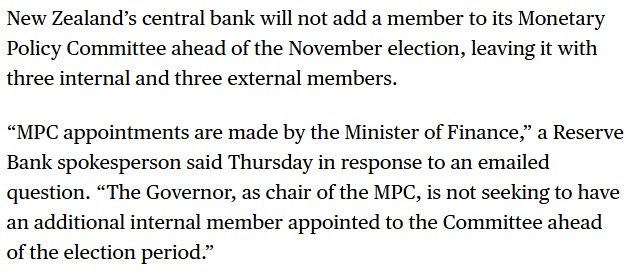
A month or so ago the Reserve Bank announced the appointment of a new Assistant Governor (a deputy chief executive) responsible for its financial stability functions. That must have prompted a Bloomberg journalist to ask what was happening to the vacant position on the Monetary Policy Committee (given that, previously, Geoff Bascand and then Christian Hawkesby as holders of that role had also been on the MPC). Later that day a story appeared which had this snippet (which someone had sent me)
I gave it a bit of attention at the time on Twitter but had seen no follow through.
So I was pleased to see an article in the Herald this morning reporting an interview that Jenee Tibshraeny had done with the Governor where she asked Breman just what was going on. And got some not-very-satisfactory answers, that don’t put the Governor or the Board (or perhaps the Minister too) in a very good light, and (incidentally) suggests that the Bank was not being entirely straight (to say the least) with Bloomberg when they asked last month.
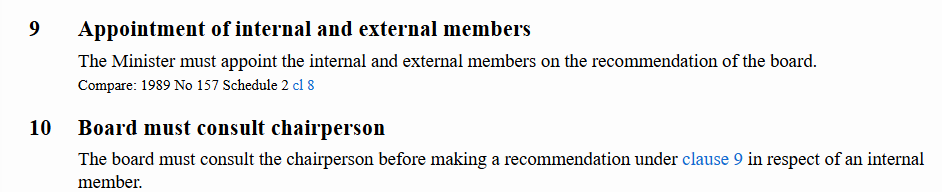
The Reserve Bank Act is pretty clear about MPC appointments. The Minister of Finance appoints MPC members, but does so (only) on the recommendation of the Bank’s Board. The Governor is a member of the board, but formally also has to be consulted in her role as chair of MPC before recommendations are made in respect of internal members (people who directly work for the Governor).
There is no minimum term of appointment (which could be a weakness in some circumstances, but the law is fairly new and is what it is).
In the short history of the MPC, a temporary appointment has already been made once, back in early 2022 (after the chief economist had left and before another permanent appointment was made to that role)
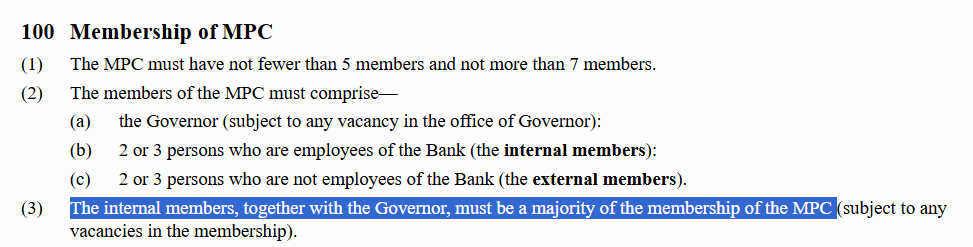
And, as importantly as all this, the Act is specifically clear that there must be a majority of internal members on the MPC
NB: In the event of a tie the Governor does have a casting vote, but this provision is explicitly about members not about votes.
Again, one can debate the merits of requiring an internal majority, but it was a choice Parliament made only quite recently (within the last decade). And if someone dies, or resigns with no notice, vacancies can’t be filled overnight (presumably the point of the bit in brackets at the end of 100(3)), but……there has now been a vacancy on the MPC since Adrian Orr resigned (his resignation having taken effect from 31 March 2025). That is now 16 months ago.
The Governor seems to have been totally at sea when Tibshraeny asked her what was going on. She is quoted as saying that “I don’t know if it’s possible to have a temporary position. That’s apparently what’s happened before [see above] so I’m just looking into that”.
But she has been in the role of eight months now, she chairs the MPC (so you might suppose she’d have made herself familiar with the statutory provisions, especially when leading changes to make voting more of a thing on the committee), and had apparently been comfortable with her spokesperson a month ago telling Bloomberg she had no intention of seeking to fill the position before the election.
Now, even the comment she had had provided to Bloomberg was at best misleading (since the responsibility for recommending MPC members rests with the Board – chaired by Rodger Finlay – not with the Governor, let alone the Minister), but it also seems quite at odds with what she was saying to Tibshraeny when interviewed the other day.
And what on earth did the election have to do with it? There is a well-understood convention (repeated in this Cabinet Office circular for this election) about not making significant permanent appointments to commence in the period starting from three months prior to the election. (Thus, in the Reserve Bank case, back in 2017 there was an – almost certainly illegal – appointment of an acting Governor because a new permanent Governor could not be appointed to start in the weeks either side of the election.)
But the pre-election window begins this week, and the MPC vacancy has existed since March last year. Christian Hawkesby left his job (as Acting Governor and substantive head of financial stability) eight months ago, and even that permanent appointment of a Head of Financial Stability was announced more than a month before the pre-election window. And, as the Governor (and Board) presumably now appear to know/remember, temporary appointments (say, 6-12 months) are perfectly possible in this case (and, in any case, since it is the appointment of an internal – not appointed by the Minister to the day job in the first place – it was difficult to see how an MPC appointment was likely to be particularly politically contentious).
The Governor appeared to be caught on the hop in her interview last week (pretty bad when the Bank had already made those comments to Bloomberg) because the Herald article suggests that after the interview a “Reserve Bank spokesperson” was sent out to tidy up after the Governor.
Of which a number of things can be said:
The Board has no authority to simply leave a vacancy indefinitely (the law explictly requires an internal majority),
The appointment of a permanent Governor was made in September last year (and at the same time it was announced that Hawkesby was leaving the Bank),
There was nothing, at any stage, to stop a temporary appointment (whether of the chap who was filling in for Hawkesby as head of financial stability or – since he was a lawyer – some other senior economics/markets person),
The person who was acting as head of financial stability was appointed to the permanent role a month ago now. Either he could have been appointed to the MPC straightaway (eg the Minister confirm it was her intention to so appoint) or, very belatedly, a temporary appointment could have been made. In fact, the Bank told Bloomberg they weren’t looking to make an appointment now, but now say “there is a process underway”.
The Minister of Finance is reported (briefly) in the article, noting that “it has been the practice for successive governments to exercise restraint in making significant appointments in the pre-election period, which begins on 7 August”. Which is factually correct, but largely irrelevant in this context given a) the vacancy has been there for 16 months, and b) there is both authority and precedent for a temporary appointment. You have to wonder, though, what Treasury, paid as official monitors of the Reserve Bank, had been doing all this time about simple matters like ensuring that the Bank and the Board complied with the law, putting up nominations enabling the Minister to make an appointment.
Does it matter greatly? Perhaps at one level, not so much. But the law isn’t just there as a suggestion but as a set of obligations and responsibilities, and the Board seems to have deliberately flouted one of its responsibilities in this case. Laws imposing duties and responsibilities on government agencies need to be observed punctiliously. As it is, one recent OCR decision was made only by the Governor’s casting vote, a vote she would not have needed to (or been able to) deploy had the Board and the Minister done their job and ensured an internal majority of members. There have been all-too-many “pretty legal” things from the Bank and its Board in the last few years (whether misleading Parliament, misleading the public, OIA obstructionism, knowingly blowing the previous Funding Agreement spending limits, purporting to consult on proposed physical cash requirements which it had no legal authority to insist on, and so on). And misleading journalists – as appears to have happened on this issue with Bloomberg – isn’t exactly a way to build and restore confidence in a troubled institution.
On the substance – the vacant MPC seat – we are left wondering what is going on. Presumably Angus McGregor is not going to be appointed (could easily have been done or signalled already if he was). His predecessors had been on MPC but then they’d all had an economics background and he’s a lawyer. There don’t seem to be that many obvious current internal possibilities – one might be Adam Richardson, now director of financial markets (who’d been the acting MPC appointee back in 2022). Or perhaps there are other plans. It is still hard to believe that the Governor has done nothing about Karen Silk – surely the most underqualified central bank DCE responsible for macroeconomics and monetary policy anywhere in the advanced world – and perhaps there are plans afoot. Perhaps she is contemplating hiring someone as (eg) Adviser to the Governor with the strong New Zealand macro perspective that neither she nor Silk has? We don’t know but the current situation is unsatisfactory – the board, apparently with her acquiescence, is wilfully choosing to ignore the legal requirements, and a journalist (and thus the public) seems to have been knowingly misled as recently as a month ago. And, as recently as a few days ago, the Governor herself was unable or unwilling to give a straight answer to what should have been a pretty straightforward questions (about an unsatisfactory situation).
And, if I have been inclined to absolve the Minister of primary responsibility, she has formal responsibility for the Bank, she has the full resources of The Treasury at her disposal, and the Board chair was personally appointed by her (and just last week she appointed a deputy chair
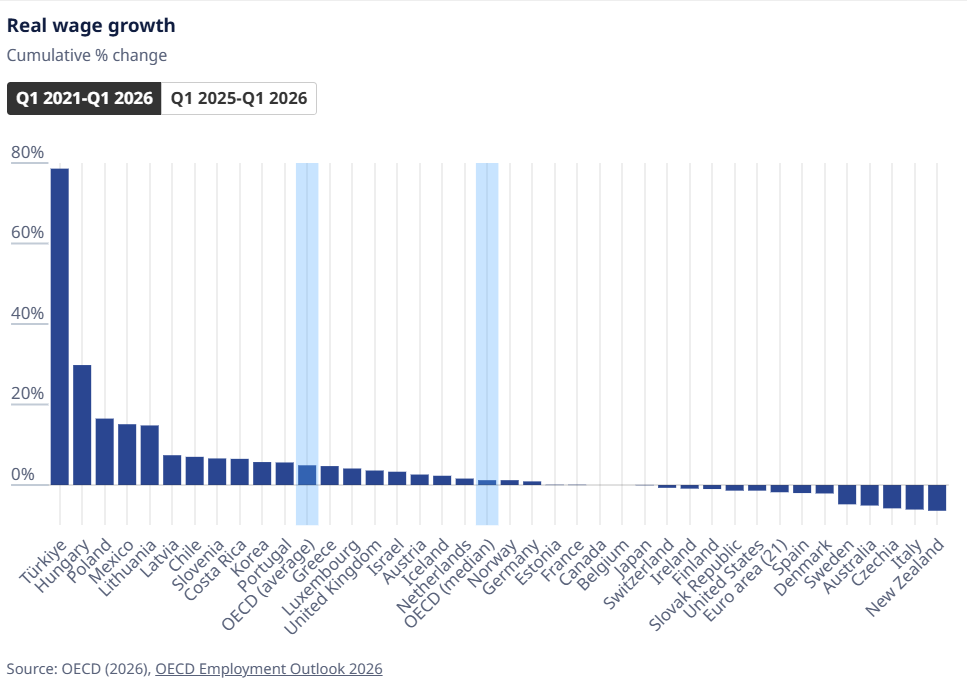
Various media last weekend (I think this was the first) latched onto a chart in the OECD’s latest Employment Outlook publication which appeared to show that over the last five years New Zealand real wages had not only fallen sharply (down 6.4 per cent) but by more than any other OECD country.
Since then the line has popped up repeatedly in columns and other commentaries (when I looked a few days ago a former Prime Minister’s tweet on the matter had been retweeted 140 times).
Within hours of the first stories appearing various economists, including me, pointed out that the OECD appeared to have used the wrong data for New Zealand, and that if better series were used, New Zealand would have been much more in the middle of the pack (assuming data for the other countries was generally representative). Wage growth comparisons across countries are often fraught because different countries measure things that might sound the same in somewhat different ways.
A few days ago The Post invited me to write a piece for publication on the issue. There is a link here to the online version, but I’ve also included the text at the end of this post.
What went wrong is best captured in this chart which I ran on Twitter several days ago
The OECD used the grey line (the LCI) even though it (by design) is not a measure of wage rates received by workers at all (it adjust for improvements in performance, so that eg over time economy.wide improvements in productivity will tend to flow into wages but should, in principle, end up largely netted off in the LCI). As you can see, over 30+ years of data the real LCI has hardly changed at all (but having increased for a few years it did actually fall 6.4 per cent over the last five years).
There is no ideal measure of real wages, but a much better starting point is provided by either the LCI Analytical Unadjusted series (blue line) or the QES average ordinary time hourly earnings. As you can see, both series increased strongly over the 25 years pre-Covid (broadly speaking reflective of improvements in economywide productivity and terms of trade over that period).
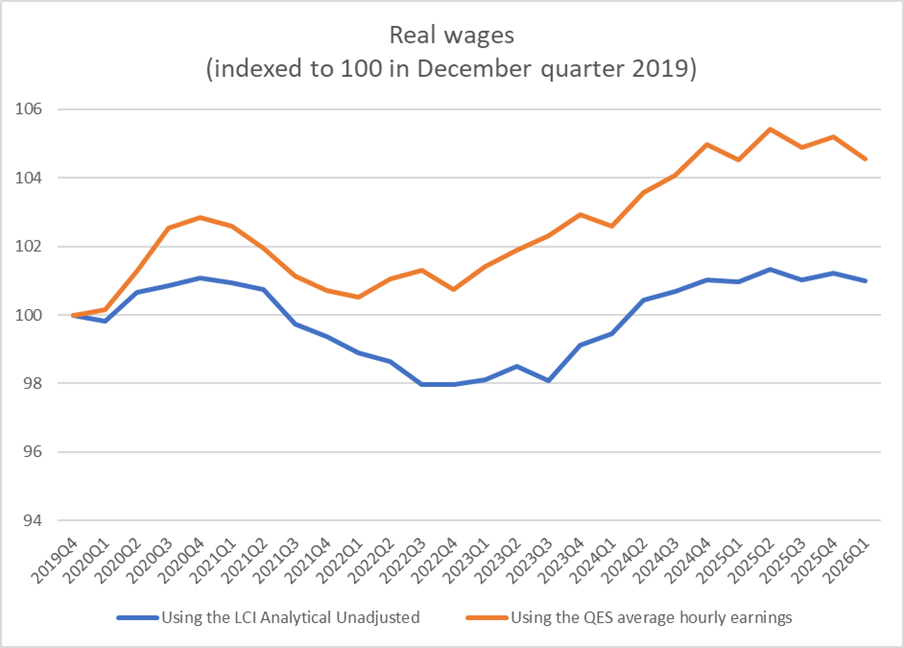
Here is what those two series look like for the period since the end of 2019, just prior to Covid.
As the OECD did, I’ve deflated both series by increases in the CPI. Then, whether one focuses (as the OECD did) on just the last five years or (as seems more meaningful) over the period just prior to Covid, real wages over the full period have either been flat or have increased a bit. Any improvement in real wages hasn’t been large, but then (as in most countries) the period since Covid began hasn’t been a particularly good one economically. (And perhaps it is worth noting that real wages did fall when the unexpected large outbreak of inflation hit, enabled by poor Reserve Bank monetary policy judgements. But that unexpected lost ground has since been regained.)
Here it is perhaps also worth noting that nothing about my comments here is partisan. It wasn’t the politicians’ fault that the Reserve Bank (like many of its peers) got it wrong, and it isn’t obvious that trend productivity growth is any better now.
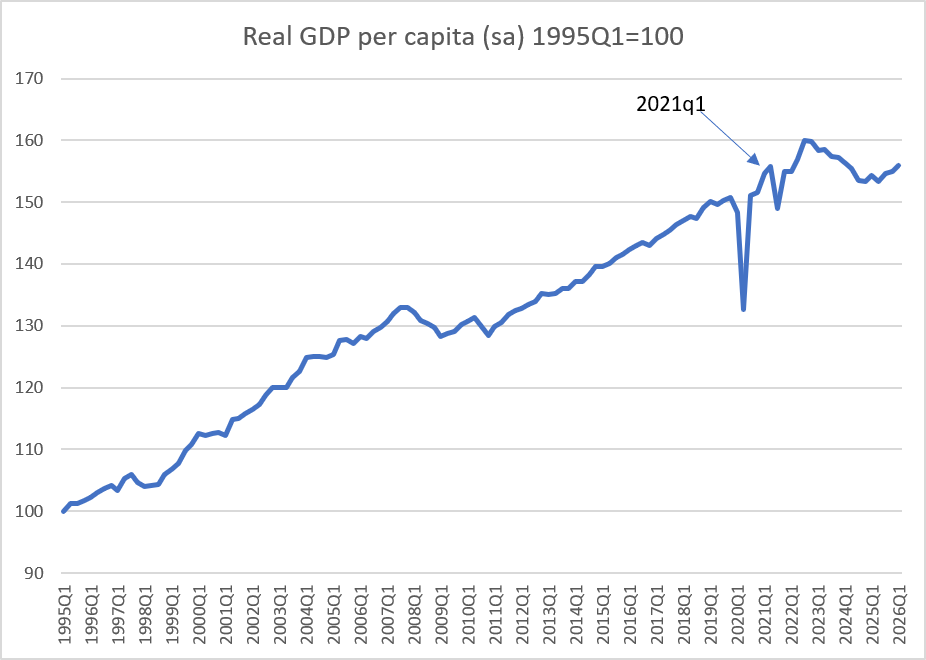
When I say the economy hasn’t performed well this is the sort of chart I have in mind.
Since 2019Q4, real GDP per capita has increased by only 3.5 per cent (over more than six years). It isn’t surprising that real wages haven’t increased much (if at all). But it would be very surprising indeed had real wages fallen to anything like the extent the OECD was claiming.
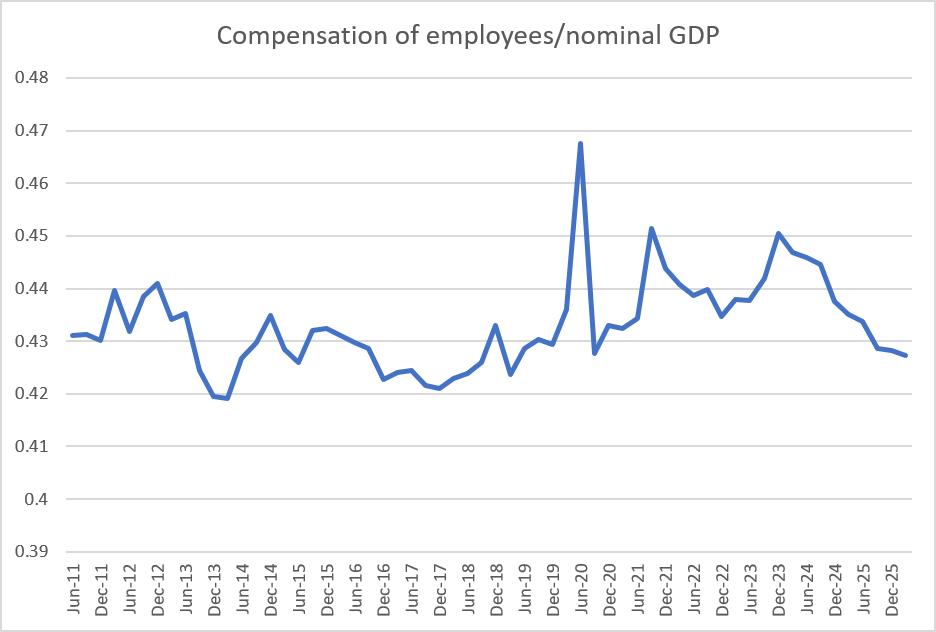
As another cross-check, I took a look at SNZ’s breakdown of nominal GDP, and in particular at the wages (“compensation of employees”) share. It was thrown all over the place by Covid (you can see the extreme June quarter 2020 spike, with the first wage subsidy and the most intensive lockdown), but over the full period since 2019Q4 compensation of employees has barely changed as a share of GDP (marginally down, but then the employment/population ratio has also fallen a bit).
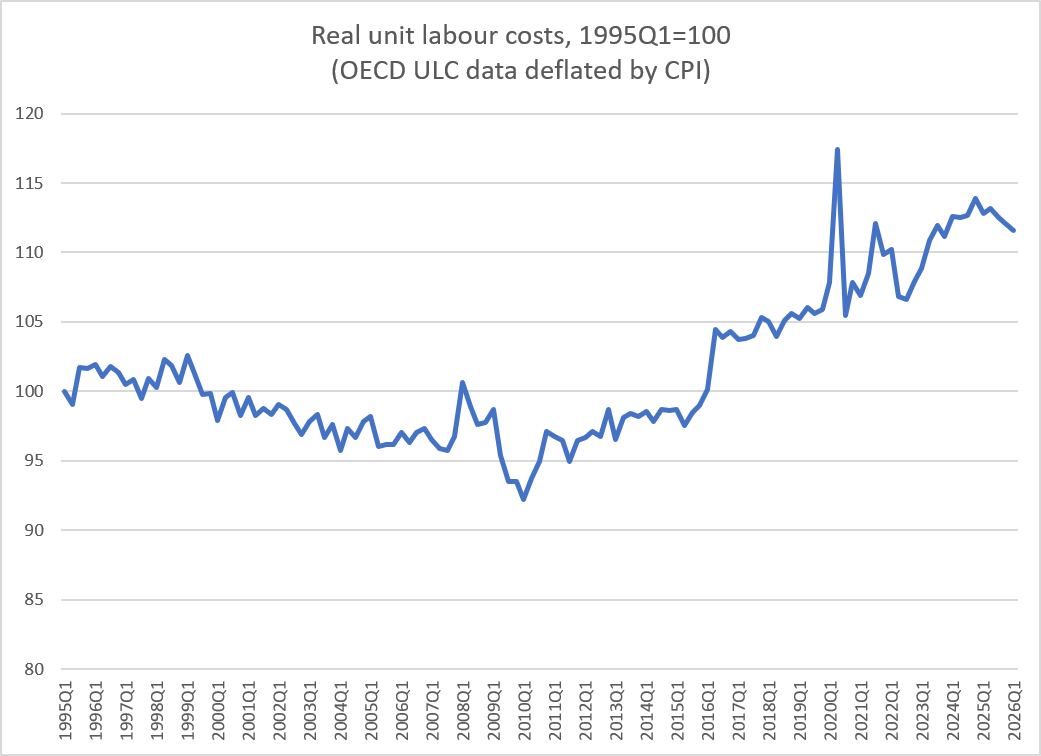
Finally, in some of my initial comments I suggested that, in principle, the LCI was a bit like a measure of Unit Labour Costs. A few people asked if the OECD was intending to use ULC data in its chart, which seemed very unlikely (because they have well-labelled series of their own estimates of ULCs) and, in any case, was at odds with the footnotes on the table behind the OECD chart). In principle, Unit Labour Costs measures the effective cost to employers of labour, adjusting for productivity growth (and thus, one of the OECD’s real exchange rate series is a measure using relative unit labour costs across countries). The series doesn’t get a lot of attention but, for what it is worth, here is what the OECD’s unit labour cost series deflated by the CPI looks like for New Zealand over the last 30 years.
I wouldn’t put much weight on it myself, but at very least it is inconsistent with any sort of narrative about employers profiting at the expense of workers.
None of this is cause for any complacency. New Zealand’s economic performance, under successive governments, has been poor to mediocre for decades (probably at least back to 1950), with gaps opening up to the rest of the advanced world. In absolute terms things have worsened (as in so many countries) in recent years, with little average real income growth. But it is simply nothing like as bad (in absolute terms or – almost certainly – in relative ones) as the OECD made out.
OECD cross-country comparisons can often be very useful. But when a number – in any publication – looks particularly interesting it is always worth stopping and checking whether it is really showing (meaningfully) what it purports to show.
Real wages haven’t fallen 6 per cent
Michael Reddell
Michael Reddell is an economic commentator and former Reserve Bank and Treasury official
Last week the Paris-based OECD released its annual Employment Outlook report. It is a long and often rather dry report, 400 pages long and 130 charts. But just the thing for labour market nerds to pore over on a wet Saturday afternoon.
One chart in that report caught the eye of New Zealand journalists, leading to a succession of stories and columns claiming – with the authority of the OECD – that New Zealand real wages (i.e. after adjusting for CPI inflation) had fallen by 6.4 per cent in the last five years, more than in any other OECD country.
Within hours of the first story appearing various economists pointed out that the OECD appeared to have used the wrong data for New Zealand. If more appropriate data series had been used, the New Zealand experience would have looked much more middle-of-the-pack. But that hasn’t stopped the story running this week. Real wages in New Zealand, we have been told again and again, have plummeted, and we have done particularly poorly. That simply isn’t so.
So what went wrong? In their chart, the OECD used data from the Labour Cost Index (LCI). That might sound like a measure of wage rates but (and by design) it isn’t. Instead, the LCI tries to measure wage costs after adjusting for various things, but particularly for any improvement in the performance of employees. Over time, if labour productivity improves actual wage rates will tend to increase but the Labour Cost Index won’t. For some purposes it can be a useful index (e.g. for analysts looking at whether higher wage increases might put pressure on inflation, which they shouldn’t if productivity is rising too). But it simply isn’t useful as a measure of what is happening to the purchasing power of workers’ wages.
For that purpose, there are two other series. The first, less well known, is the Labour Cost Index – Analytical Unadjusted. That is an ungainly mouthful of a label, but Statistics New Zealand itself describes this series as providing “a more comprehensive picture of wage changes”. Like the LCI it is a stratified index – one not thrown around by compositional changes – but it doesn’t seek to adjust out things like improvements in performance and productivity. It isn’t a perfect measure, but for these purposes it is a lot more relevant than the headline LCI.
And then there is the simple measure of average ordinary time hourly earnings, taken from the Quarterly Employment Survey. It isn’t really a proper index at all, and it is thrown around by compositional changes (e.g. in downturns young people and lower-skilled people are relatively more likely to be out of work). But it is a measure of what was paid to people who were in work, and so has a certain appeal of simplicity.
To get at real wages we have to adjust for inflation. Once we do so, both these measures have increased substantially over the decades. In the chart, I’ve just shown them starting from just prior to Covid. As it happens, whether one looks just at the five years since March 2021 (as the OECD chart did) or at the entire period since 2019, the picture is much the same. Real wages dipped when the surprisingly severe outbreak of inflation hit later in 2021 and 2022, but they recovered and over the full period real wages have either been flat or have increased a bit. That isn’t a great performance at all – few economies have done particularly well in recent years – but it would have put us more in the middle of the pack in that OECD chart.
Quite why the OECD appears to have stuffed up on this occasion isn’t clear. It probably doesn’t help that Statistics New Zealand typically gives high profile coverage in their releases to the LCI, and buries the Analytical Unadjusted series well down the page. As for why the misleading comparisons have continued to be reported, that is probably down to some mix of, on the one hand, the OECD usually being a good source for cross-country data, and on the other, the “biggest fall in real wages in the OECD” sounds like a good headline (perhaps especially in election year).
There is an old cautionary adage that if a number appears particularly interesting it is probably wrong. In this case, the LCI was simply the wrong measure for the purposes of what the OECD was trying to illustrate. It is easy to be gloomy about New Zealand’s long-term economic performance, but not all statistics that look tantalizingly bad will be capturing quite what users think they might be. Always ask questions. Always cross-check.
No, this is nothing to do with (say) Neil Quigley’s months-long spin and obfuscation from last year (eg here or here).
Decades ago, when the Commonwealth counted for more, the regular Finance Ministers’ meetings seemed to usually be held in some of the more exotic and picturesque of the member countries (these days, barely attracting any attention, they seem to be held in the margins of the IMF/World Bank annual meetings). The 1985 meeting was held in (then newly-admitted to the Commonwealth) the Maldives. New Zealand’s then Minister of Finance Roger Douglas attended.
In the mid 1980s one of the issues again wracking the Commonwealth was what to do about (former member) South Africa, still under the apartheid government that was reforming, if at all, very slowly indeed. In the late 70s there had been the Gleneagles agreement on sporting contacts but by the mid 80s economic pressure and possible sanctions (including forced divestment) were in view, and not just among Commonwealth countries. Pressure was building too on private sector firms and in 1985 a refusal by international banks to rollover South African government short-term foreign debt led to greatly intensified pressures.
The Commonwealth, of course, is and was a diverse grouping. Some member countries (New Zealand was one, but it was true of Caribbean member countries too) had almost no economic ties to South Africa. Others – small border states in particular – were very heavily dependent on South Africa (migrant labour remittances, access to imports etc). And UK firms collectively made up by far the largest source of foreign investment in South Africa. Getting any sort of common view was a challenge to say the least, even when all deplored the apartheid system and looked towards a future transition. The South African government and security forces were not known as soft touches. Neither, of course, was Margaret Thatcher.
The Commonwealth was never able to agree on any very serious package of economic sanctions, but just a few weeks after that Finance Ministers meeting, the Commonwealth Heads of Government, meeting in the Bahamas, did agree a fairly mild set of measures. A further round was adopted the following year. Probably like all sanctions policies, economic and political historians no doubt debate quite what role sanctions did, or might have had, in leading to the early 1990s transition.
Back in 1985, the then Reserve Bank Economic Adviser (until recently Chief Economist) Peter Nicholl took up a one-year IMF-sponsored secondment as Head of Economic Research to the central bank of the Seychelles, also an Indian Ocean Commonwealth member country. Peter tells the story thus:
One thing I did during the evenings and weekends there was write a political thriller called Sanctions in Paradise. It was set in the Seychelles so i didn’t have to make up the scenery, just observe it. There is a Commonwealth Finance Ministers’ Conference being held in Seychelles. I had attended a couple of those boring meetings so I knew how they were organized and run. The main item on the agenda was whether or not to impose economic sanctions on South Africa because of their apartheid policies. The idea of trying to write the story occurred to me when I read a report on a group of South African mercenaries led by Mad Mike Hoare that had flown into Seychelles three years before I went there to try and overthrow the government – they failed. But reading the report gave me the idea of the South Africans trying to disrupt the meeting.
Peter came back to the Reserve Bank of New Zealand, spent several years as Deputy Governor, then as Executive Director at the World Bank, before an eight-year IMF-sponsored stint as the first Governor of the Central Bank of Bosnia and Herzegovina. (He made an appearance on this blog last year, having written a column for his local newspaper in Cambridge on the Reserve Bank shambles.)
Peter’s email to me a few weeks ago went on
I only sent it to one publisher. I got a very nice letter back – but it was a rejection letter. I put the book aside. I then lost the computer it was on and forgot all about it. About 3 years ago my sister found a printed copy in a box of papers from my mother’s estate. My mother was a hoarder – fortunately for me in this instance. I thought that was an omen so I decided to get the book self-published.
He offered to send me a copy, in the hope that I might like it and give it a plug. Self-marketing isn’t always easy. He passed on a couple of enthusiastic comments from eminent economists, both of whom had “thoroughly enjoyed it”. one adding “I found your accounts of the different national positions on sanctions on South Africa to be fascinating and compelling. The plot was good, your knowledge of Commonwealth meetings was obviously first rate and your writing is really good” and the other suggesting it had been a great read and suggesting Peter write another book.
I’m quite a fan of political or spy thrillers, especially those written and set in bygone decades which capture some of the flavour of the times without the benefit of hindsight (on Tyler Cowen’s recommendation last year I devoured those, mostly from the 1930s, of English writer Eric Ambler).
Much of Peter’s book is written in the voice of a rather hapless Treasury secondee (doubling as the Minister’s speechwriter) in the office of the Minister of Finance, part of the small New Zealand party at the conference. Resemblances between the Minister of Finance character and Roger Douglas seem slight at best, but the PM does get a bit part and there might be a few more resemblances to David Lange there.
So what did I make of the book? It was pretty well plotted and so I enjoyed the story. Since the author knew both the local setting and the political setting (as he notes, he’d been to previous Commonwealth Finance Ministers meetings) there is quite a sense of authenticity about it. The political issues and tensions from the times were very real, and if I’m old enough to hazily remember them, younger readers might appreciate an undemanding dip into the political tensions of another time. And if the book seemed a little slow to get going (albeit there is a high-drama event on page 3), it gathers pace and ends with a plausible-enough plot twist that I really didn’t see coming. And while newly released, the circumstances of the writing, loss and recovery, mean it does treat real history as we live it – without the benefit of hindsight, knowing how things eventually turned out.
As a reviewer, I’d note that the plot was stronger than the character development – but then it is a political thriller, not claiming to be “literary fiction” – and the dialogue at times was a bit clunky. Oh, and in a few places an editor might have been helpful (I noted Peter slipped between talking of a Prime Minister and a President of South Africa – from 1984 it was President (P W Botha)). But, yes, it was an enjoyable read, and not at all bad for the price.
Yes, Peter sent me a free copy but it appears that you can buy it for $19.95 in paperback or $5.99 for the e-book. Orders appear to to be able to placed here although Peter suggested that anyone wanting to buy a copy could contact him direct at peterwenicholl@yahoo.co.nz.
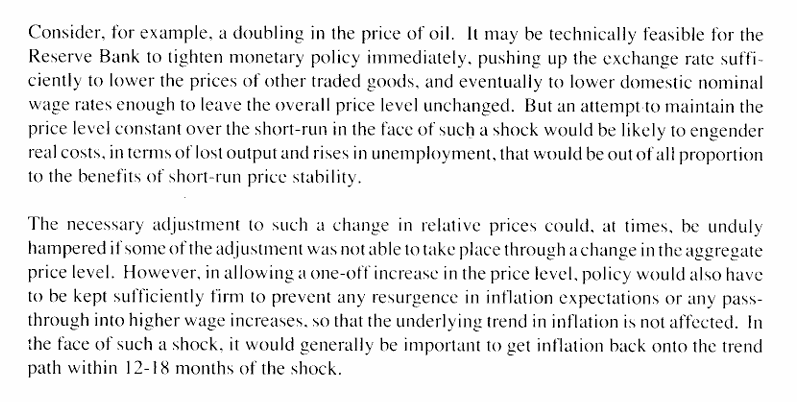
I didn’t have too much problem with either the Reserve Bank Governor’s speech a couple of weeks ago on a framework for how monetary policy might deal with the oil shock, or with this week’s OCR review release from the Monetary Policy Committee. It was really all very orthodox stuff, much as any of the previous Reserve Bank Governors over the inflation targeting era might have said. Almost always, you will let the first round (direct and indirect) price increases through – as major relative price changes, and as happening too soon for monetary policy to do anything much about anyway – and then keep a very close eye on what happens beyond that to the generalised medium-term inflation outlook (where the pressures can be conflicting – weaker economy on the one hand, and potentially higher “true” inflation expectations on the other). And, of course, when the oil shock hits, no one really knows how long the disruption and associated price effects will last, and that matters.
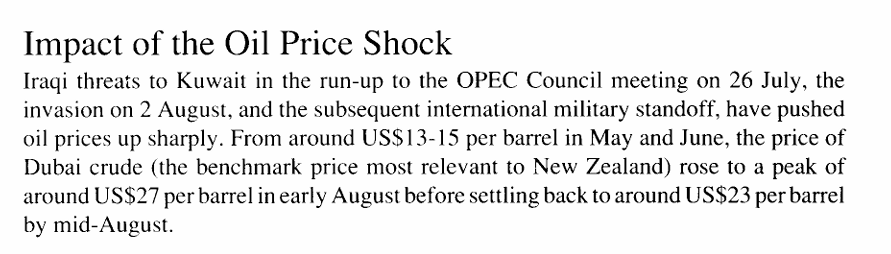
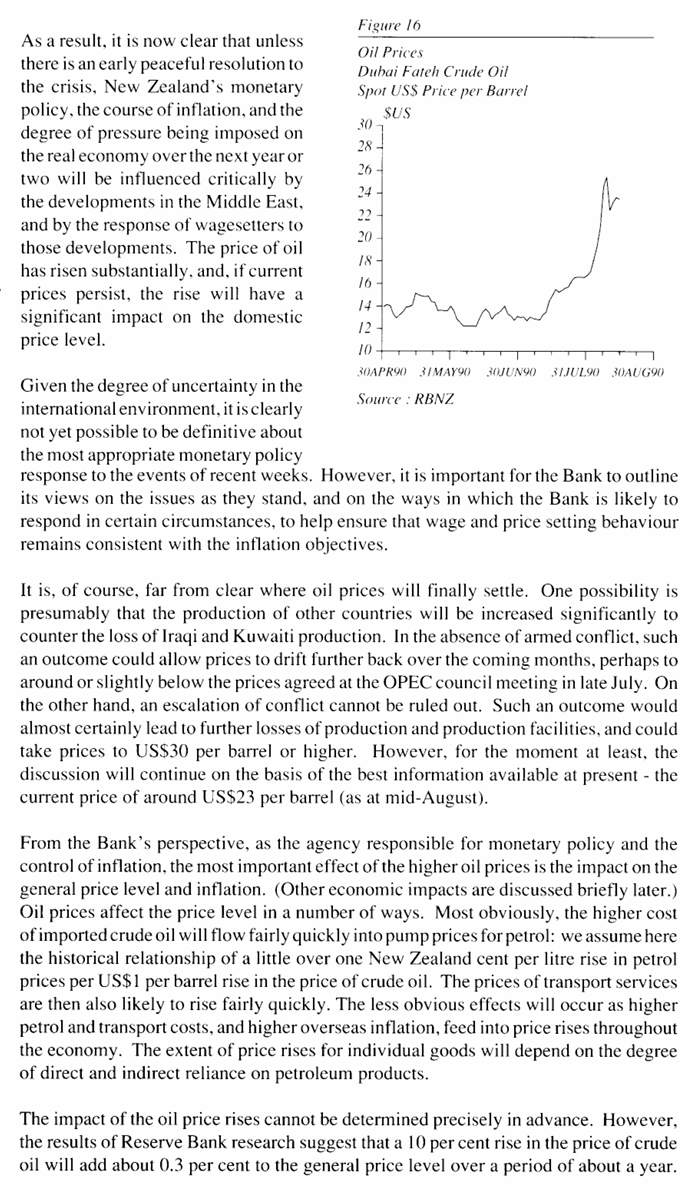
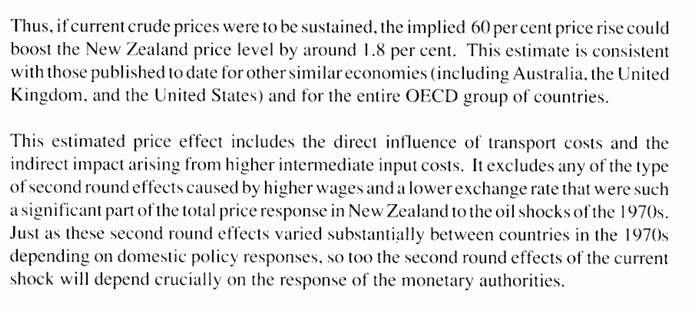
A comment that was passed to me yesterday had expressed concern that the MPC might be going soft on inflation risks, they having mentioned the potential near-term growth implications of the shock (which could yet be savage, given how low the price elasticity of demand for diesel is). That prompted me to go and dig out the Monetary Policy Statement the Bank issued in the wake of the first oil shock of the inflation targeting era, that prompted by Iraq’s invasion and occupation of Kuwait on 2 August 1990.
That invasion caught most of the world flat-footed. It complicated life for us too. We’d just issued a small tightening statement on 1 August, which hadn’t made us at all popular with a government that was facing a crushing defeat in an election now only a couple of months away. We tightened again – different system then from today’s OCR – on 3 August, and when mortgage rates rose that day the (normally sensible) Minister of Finance was reduced to calling the banks “mean” and claiming they were out to get the government. We were also just a couple of weeks out from the scheduled release of our second Monetary Policy Statement (editorial and production processes were a lot more protracted then than now, and the documents weren’t forecast focused), for which the team I managed was responsible. We pretty quickly realised that we needed to postpone the MPS by a couple of weeks and I spent a harried few days rushing out a substantial redraft, centred now on the oil shock policy issues.
Oil price shocks, of course, had not exactly been unknown to this point. In fact, the two dramatic ones to that point (1973 and 1979) were only about as far back in history then as 2007/08 and 2022 shocks are now. And in devising the inflation targeting framework, and the formal Policy Targets Agreements between the Governor and Minister, we’d been careful to think hard about how to handle supply shocks of that sort. And we had discussed specifically an oil shock scenario in our first Monetary Policy Statement in April 1990.
Folklore sometimes has it that the Brash Reserve Bank was full of utter zealots and nothing, but nothing, would ever allow us to deviate from a narrow path to price stability, and certainly not any considerations of output or employment. It simply was not so, whether in conception, or in practice. There were numerous examples during the early years, but this is a particularly clean one.
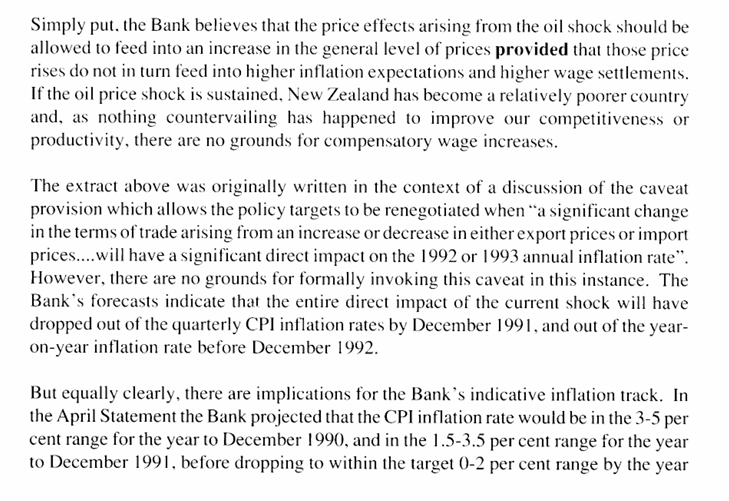
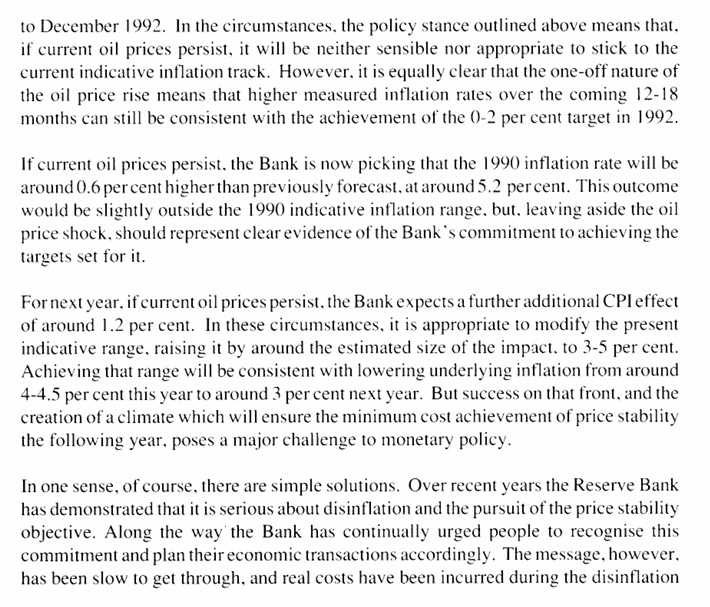
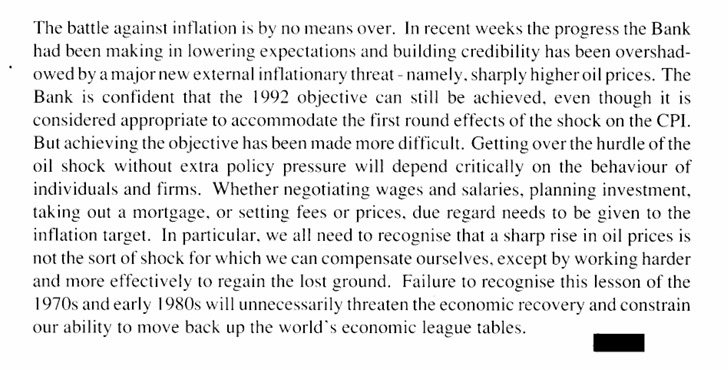
Here is what we had to say in the Monetary Policy Statement finally released at the start of September.
Whereupon the extract (above) from April was repeated, before the discussion continued
Reading that final sentence, there is a certain similarity to much current commentary…..
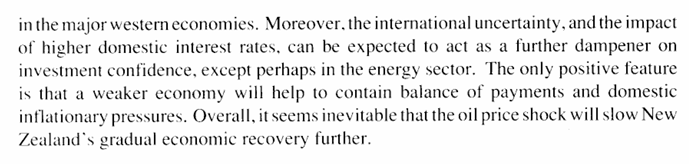
And we ended the entire document this way
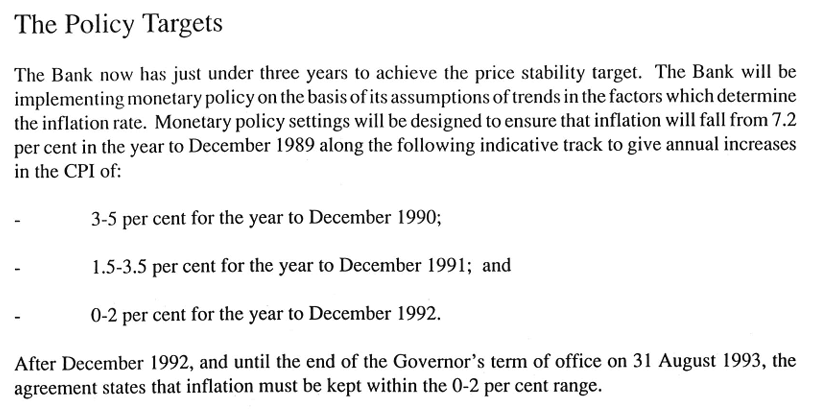
Our monetary policy approach then was right, and flexible, and not at all reluctant (my diary, for example, records a senior-level meeting on 7 August where we agreed, without apparently any significant dissent, that even the 1991 indicative target range for inflation on the path to price stability (announced here in the April MPS) should probably be increased (there was later a formal adjustment, in agreement with the Minister)).
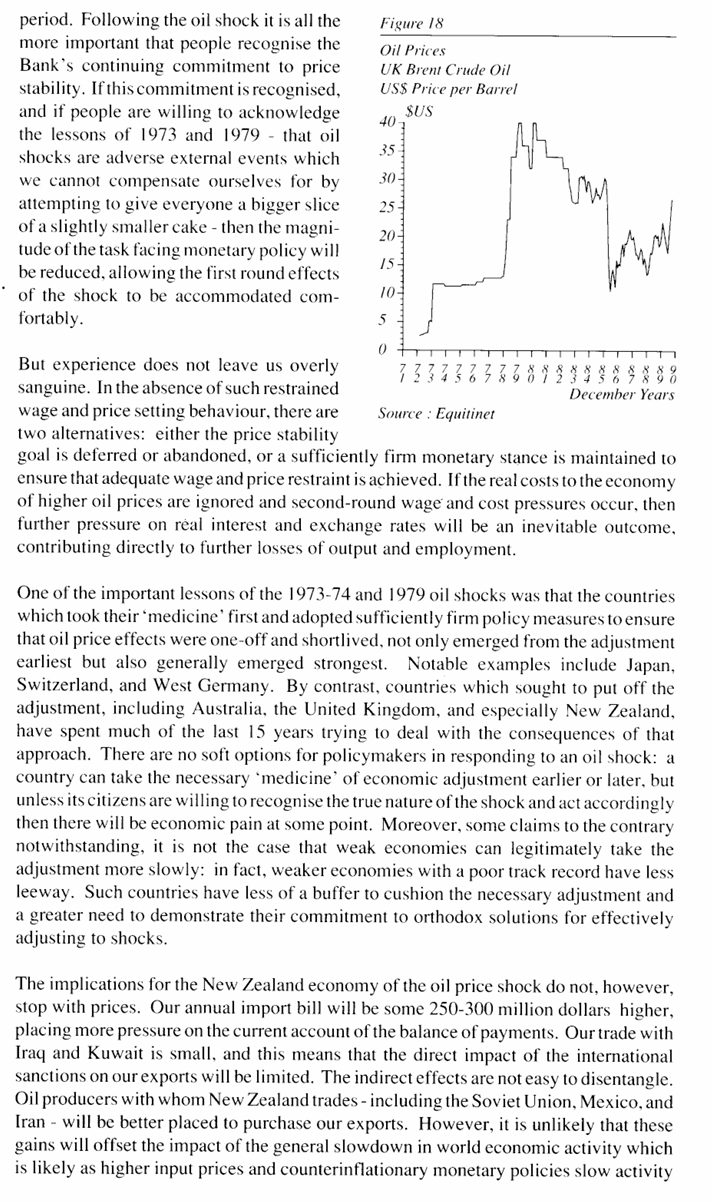
Rereading that 36 year old text, one thing I was struck by was that our experience then had been with oil price shocks that proved semi-permanent (see Figure 18 above for both the 1973 and 1979 shocks). Faced with permanent oil shocks it really was critical to get across messages like the one above, that if the national cake was now smaller we couldn’t try to fix that by all trying to cut ourselves a larger slice. As it happened, permanent shocks haven’t been a feature since then; whether in 1990/91, in 2008 (more a demand-driven surge, but still extreme for countries like us), or in 2022. The current view is that the Iran-related disruption, severe as it is (and likely to worsen, as it affects end users at least) will also be temporary, and that presumption is a reasonable one on which central banks are likely to operate for the time being.
(Acute readers may have noticed the final sentence of that September 1990 document – the bit about threatening “our ability to move back up the world’s economic league tables”. We were then optimistic. Unfortunately, in the decades since, we’ve managed nothing better than slowing our rate of relative decline. It is difficult to think of any country we were poorer than in 1990 that we are richer than now. But whatever the – contested – reasons for the failure, it wasn’t anything much to do with the Reserve Bank or its handling of monetary policy over the decades, whether faced with demand shocks or more supply shocks like today’s oil one.)
UPDATE: Prompted by my son, I had a look at the claim in the previous paragraph. Using the IMF per capita GDP data, expressed in PPP terms, it seems we have overtaken two countries since 1990 (Oman and Japan). Since per capita numbers are influenced by changing demographics, I also had a look at the OECD real GDP per hour worked data, also expressed in PPP terms. We have also overtaken Japan on that metric (Oman is not part of the OECD). Note that relative to Japan, they have gone from being well ahead of us in 1990, to just slightly behind now (essentially, given measurement issues, much the same). Overall, using the real GDP per capita data from the IMF, New Zealand has dropped about 10 places down the international league table since 1990.
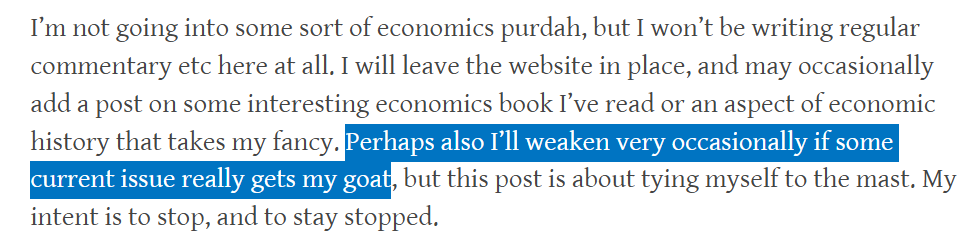
When I stopped regular blogging in December I wrote
This is one of those issues that has really got my goat. (There won’t be any other return to blogging, although if I make a submission to the government’s belated independent review of Covid-era monetary policy I might put a link to that in a post.)
It is a nice summer evening in Wellington and would be a good time to be at the beach but….well…Wellington City Council…
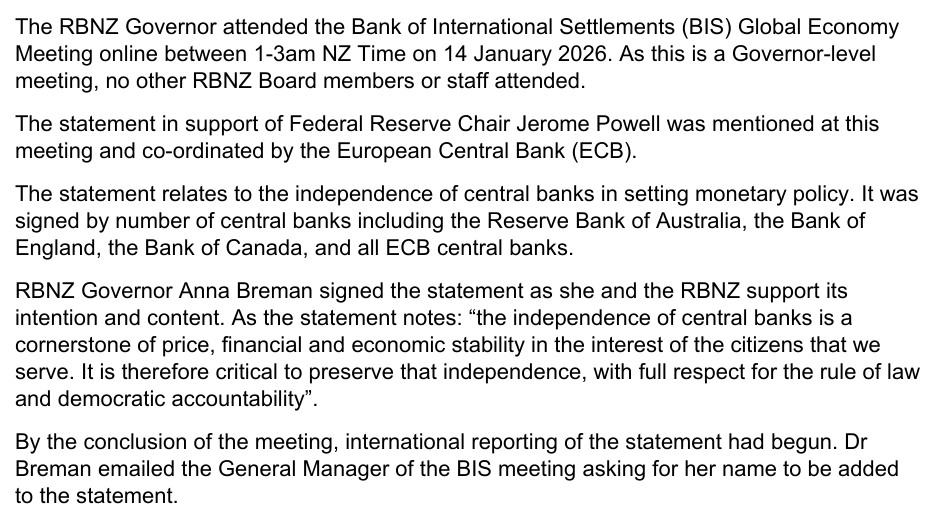
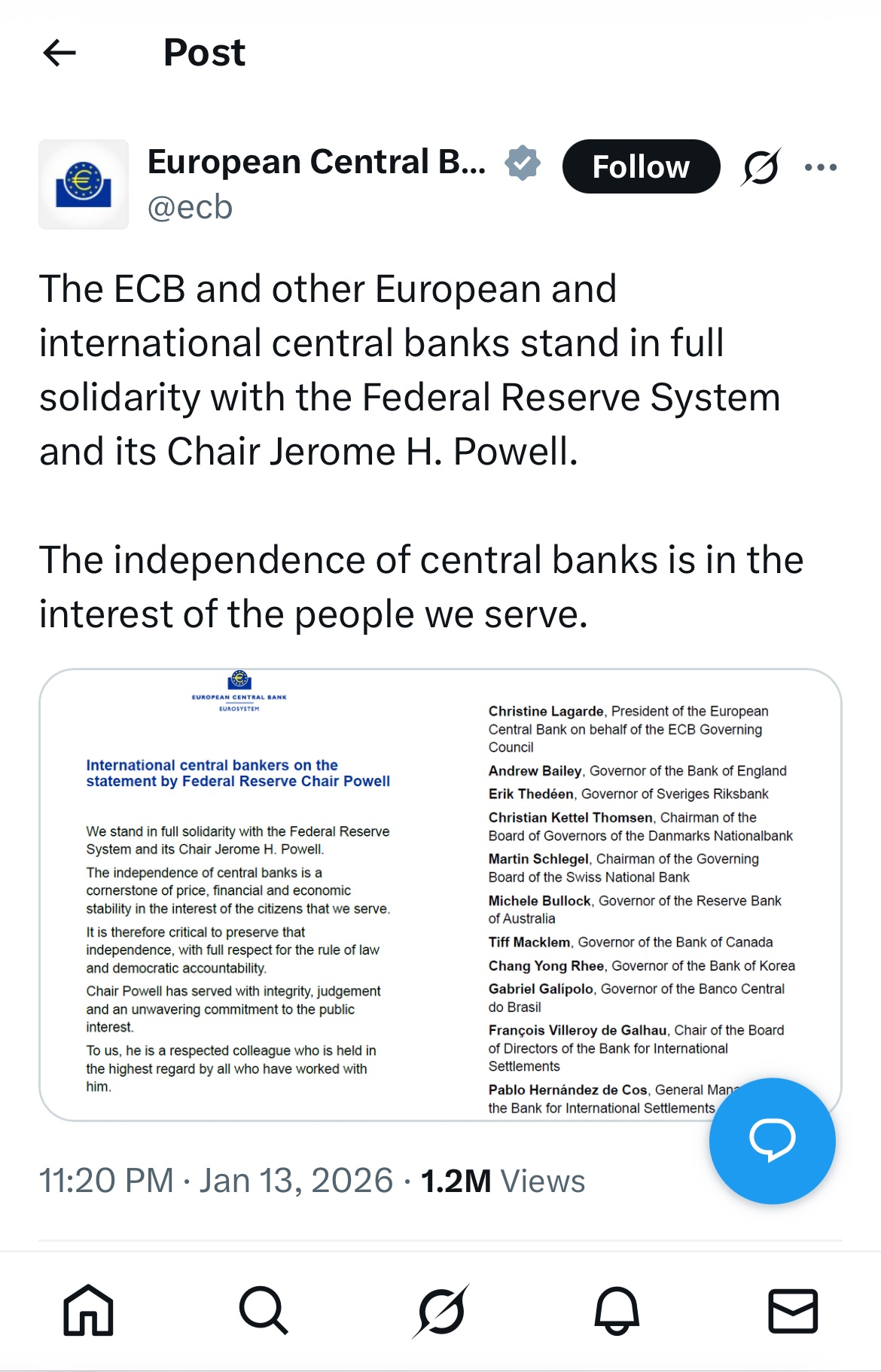
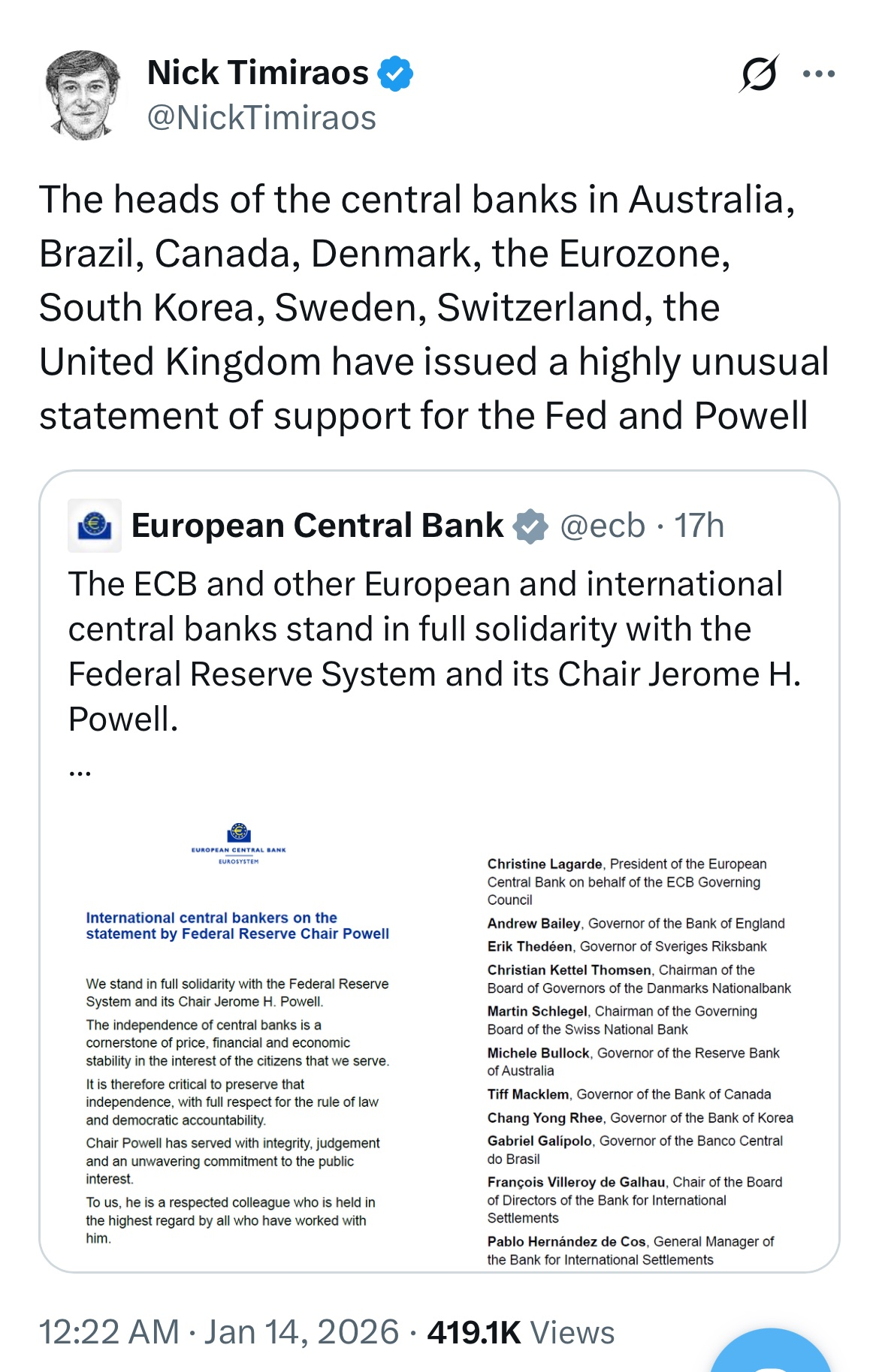
A month or so ago the new Governor of the Reserve Bank signed up to a public statement by a group of several other central banks (ECB, BOE, RBA, Riksbank etc) in support of the outgoing Fed chair, Jerome Powell, following his revelations of what appeared to be an attempt to intimidate him by Trump’s Department of Justice. Most of the world’s (operationally independent) central banks didn’t sign (14 central banks signed up, and among those who didn’t were – from among advanced countries – central banks of Japan, Israel, Czech Republic, Poland, and Chile). Nor, of course, did the non-independent central banks from advanced countries (Singapore, Taiwan).
One can debate the substantive pros and cons of the statement (eg was it wise, helpful, accurate and so on). But that isn’t my focus here. One can also debate the best way for countries to respond to Trump (my own stance would be much more openly critical than our government’s own timid approach). But again not my focus here.
Instead my focus is on the Reserve Bank Governor’s approach and response.
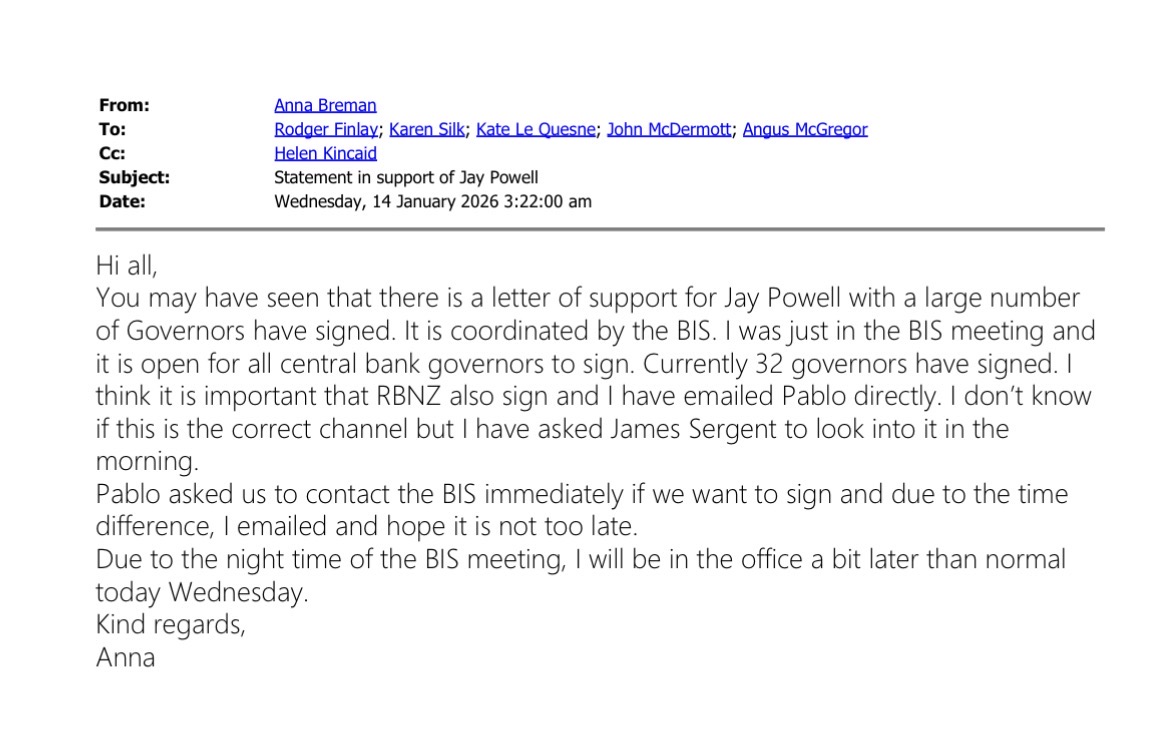
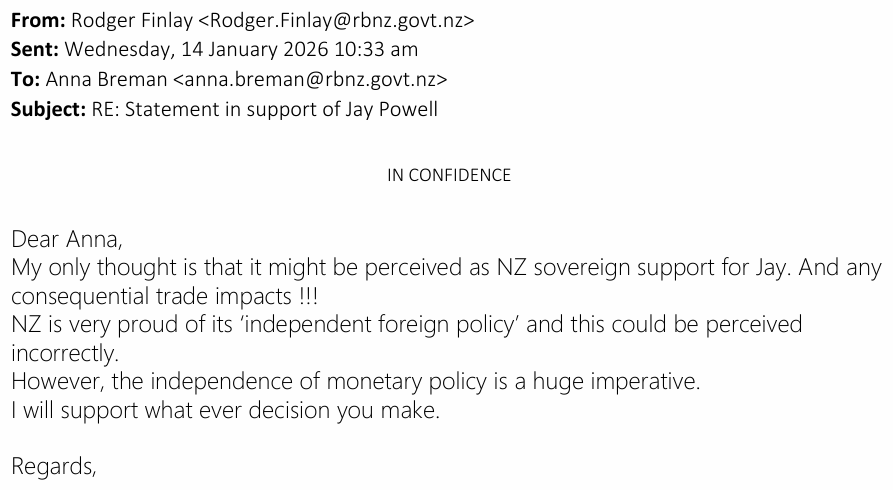
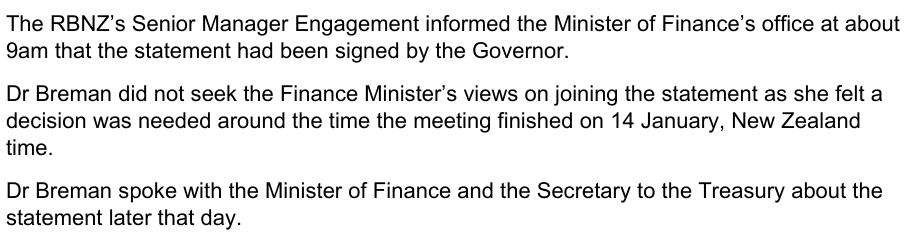
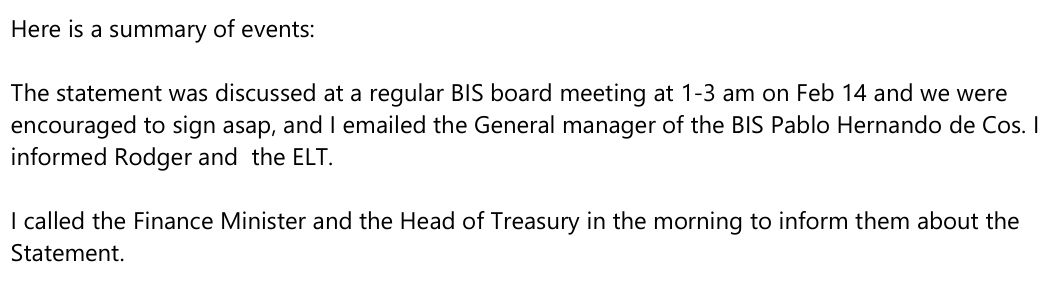
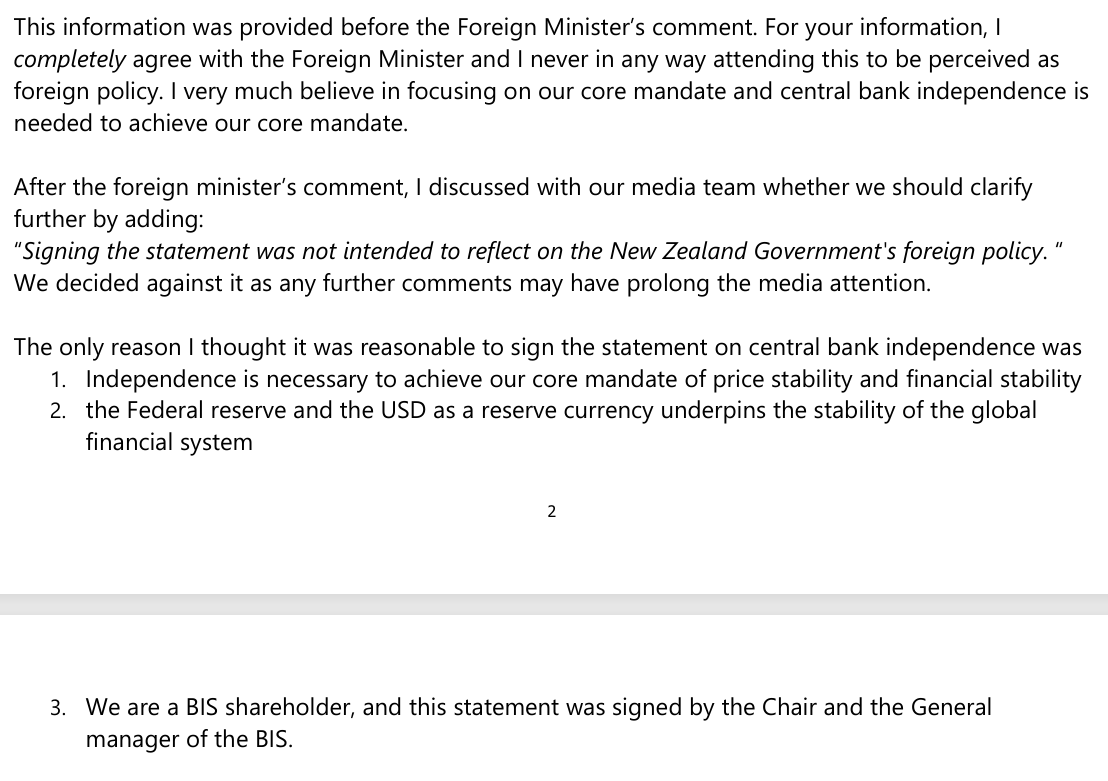
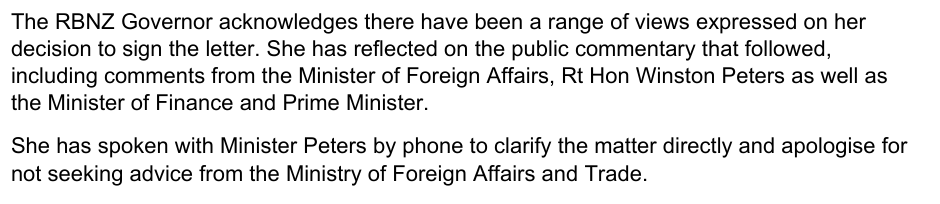
Shortly after the news emerged that she had signed on to the statement (on 14 January) I OIA’ed the Bank (and the Minister) for all relevant material, including on (for example) invitations to join, consultation within the Bank, and consultation across other government agencies/ministers. An hour or two later, the Minister of Foreign Affairs Winston Peters had a go at Breman, noting that there had been no consultation with MFAT and strongly suggesting that the Governor needed to stay in her lane, suggesting that the Bank had operational independence in various domestic areas, but not to go trespassing across foreign policy, as a government agency.
(Personally, my initial scepticism about signing had to do with the credibility of the Reserve Bank itself – if you wanted good central bank governance and accountability you would certainly not have looked to the Reserve Bank of New Zealand over the last couple of years (budget busting, active misrepresentation by the outgoing board chair, repeated attempts to mislead Parliament, and finally the appointment of a new chair who’d been not only an active part of all that but had initially been appointed to the board when he had a clear conflict of interest. Oh, and a Minister of Finance who prevailed on the Bank to change its – independent – bank capital policies. Should anyone in the US administration have cared enough, a New Zealand signature would have looked laughably hypocritical (even if the new Governor might have good intentions.)
As it happens, in this particular saga documents released today suggest that, for all his other faults, the Board chair was one of the adults in the room.
You may recall that the Governor claimed that she was under real time pressure to sign up to the statement (at an on-line BIS meeting held from 1 to 3am that day). And, being the middle of the night, she didn’t feel she should bother the Minister of Finance (for example). The Minister of Finance has since made it pretty clear that the Governor should have felt free to have rung. The Prime Minister also weighed in with a gentle rap over the knuckles. And the Governor has apologised to both ministers (Finance and Foreign Affairs) for having gone ahead without consulting them (and/or their agencies).
When you listen to the Governor’s rhetoric one of the attractive dimensions is the claim that she wants a greater degree of transparency. That is welcome, but once again she does not walk the talk.
That OIA request of mine was lodged on 14 January. The Official Information Act requires agencies to respond as soon as reasonably practicable. The deadline for my request is tomorrow (the Bank probably envisaged sending it at 5pm on Friday). But this afternoon a 39 page release appeared silently (no press release or anything) on the pro-active releases page. I happened to spot it only because I was checking up something else. The 39 page document is presumably what they will tomorrow treat as the response to my OIA. Were they actually committed to transparency they could have put the lot out just a few days after the request was received (the release consists of a summary statement, a long set of letters from members of the public in support or opposed to the Governor’s decision to sign up, and a set of emails mostly among a few senior managers and board members, with no substantive redactions). But when bureaucrats tell you they are committed to transparency, mostly it is only for occasions when it suits them, and that is no accountability at all.
I’ll use the “Summary background statement” to frame all that follows, since it is the story the Governor has apparently chosen now to tell.
Which is fine, except all that it leaves out. What you would not know from this statement, or any comment from the Bank last month, is that the initial statement (9 central banks signing) had gone out a couple of hours before the BIS meeting (at 11:10pm New Zealand time). The ECB had it on its Twitter feed by 11:20pm
And, despite the Governor’s comment that “by the conclusion of the meeting, international reporting of the statement had begun”, in fact the WSJ’s chief economics correspondent had been tweeting about it by 12:22am
In this part of the world, the RBA had put the statement on its website at 12:30am NZ time
The statement had gone out, and was being reported on, before the 1am meeting even began.
There is no sign that the Governor or her staff were aware of any of this or (importantly) that they had even been invited to sign. My OIA request included any invitations to sign or correspondence with other central banks etc, and there is simply nothing of that sort in the response. The nine signatories will not have done so on the spur of the moment (there must have been exchanges over drafting, substance etc in at least the day prior to release, and probably at least some heads-ups within those individual central banks and perhaps to other government agencies/ministers. Some who were invited – one might guess the BoJ – apparently chose not to sign.)
Apparently (from the Governor’s email to her staff at 3:23 that morning) in the BIS meeting it had been indicated that any central bank that wanted to was free to sign. The Governor notes that “I..hope it is not too late” for them.
There is simply no basis for her claim that there was anything so pressing she needed to act immediately. The statement had gone out already, she hadn’t been invited….but perhaps she wanted to associate with the “cool kids” central banking club? Why would she still be seeking to mislead the public like that?
What of consultation?
It turns out that she consulted no one at all. Not senior staff, not the Board chair, not the ministers, not the Treasury or MFAT. We’d been told previously that she had informed Finlay. It wasn’t then clear whether that was before or after she signed (bearing in mind it was the middle of the night there may have been no practical difference if she’d just sent an email).
Here is the email, sent nine minutes after her email signing up.
No sign of any consideration of pros and cons. No suggestion even of people who might need to be advised in the morning. Not even any mention to her colleagues that she’d consciously decided not to consult the Minister. No consideration of whether signing could have waited until morning.
Quite a few hours later the board chair Finlay gets back to her
You can tell he is not exactly impressed and, again, the Governor’s statement spins things in her favour. He raises the foreign policy concern issues – exactly of the sort the Foreign Minister would later make in public. And while Breman is technically correct to say that “he supported her decision” it really reads a lot more like “what is done is done. too late now, but….you are my new handpicked Governor and of course I will back you”.
That he was hardly an enthusiastic supporter is also implied by a email to the Board the Governor sends out the following day, which includes this “I have discussed this with our Chair at length yesterday”. The “at length” really says it all. Finlay seems to deserve a rare “well done”.
And what of the rest of government. The official statement now says:
But in fact, even here the documents released suggest a less favourable story. Two of the Assistant Governors weigh in enthusiastically when they finally read the email (after 8am – don’t these senior people check their emails when they wake up?), only for one – a non policy guy – to suggest that perhaps “we should also give MoF a heads-up…..maybe MFAT” – maybe, when the boss has, hours ago, signed up to a statement by implication attacking the volatile US President. Karen Silk, the egregiously underqualified macro policy DCE then qualifies her enthusiasm with a belated “sorry, also agree with John – in particular MFAT just as an FYI”. She – the macro person – apparently didn’t think Treasury or the Minister were worth bothering about.
The Governor herself may still have been on her way to work at this point – she isn’t part of the email chain – but some comms people get on to telling the Minister of Finance’s office, but even then there is no record of them advising Treasury or MFAT. Quite when Breman spoke to Willis or Rennie isn’t clear although it seems to have been later in the morning (there is no email traffic relevant to these calls, either mooting them or reporting what was discussed).
The final set of documents released relate to an email to Board members from the Governor the following day.
She claims “we were encouraged to sign asap” but…..after all, she was a free agent. The statement itself had already gone out. It is simply extraordinary that the Governor – a new Governor, with probably (and understandably) little sense of New Zealand government ways or foreign policy perspectives – allowed herself to be rushed into signing up with the cool kids without consulting a single other person on her side, in the middle of the night. What, precisely, would have been the consequences of having said “it is the middle of the night here, I’ll talk to my colleagues in the Bank and elsewhere in government and get back to you by midday”? (In fact the statement on the ECB website still reads “Other central banks may be added to the list of signatories later on” although none have been added since later that first day.)
She concludes this email to board members this way
It betrays an almost incredible degree of naivete. The Bank – like many government entities – has some, quite defined, operational independence. It is however fully a part of the New Zealand public sector. The Minister of Finance appoints and dismisses the Governor, sets spending limits, sets policy targets etc. How did the Governor not think that her signing on might be seen by some as stepping across foreign policy boundaries? Being the middle of the night is no excuse – all manner of real crises can occur in the dark hours too. It was a serious rookie error.
Responses from only two board members are recorded, both formal and neither offering either support (or criticism)
And the Bank’s summary statement ends this way
Previous reports indicate that she had also apologised to the Minister of Finance.
As I said earlier, I’m not here to debate the pros and cons of the statement. My interest is in two things. The first is the apparent inexperience and rookie-error stuff of the new Governor, revealed in her actions and descriptions. Relatedly is how weak her management team seem – it took hours for any one of her top team to suggest that perhaps they needed to look others in government know, none of them raised the foreign policy/appearance issues, and none of them seem to have proposed a strategy to deal with the mess they found when they woke up (Silk, here, seems particularly culpable).
And then there is the spin still to this day. Why skip over the fact that you hadn’t been invited to sign up initially, or that the statement had gone out (and been reported on) well before the 1am meeting even started. Why suggest, in the summary statement, that the board chair had been more enthusiastic than the later documents really suggest. Why imply an urgency – to act without consulting anyone, having gone into a meeting apparently not even aware of the statement – that simply was not, in any substantive way there.
It is a pretty poor start from the Governor, not at all consistent with her statements about improving transparency. Perhaps it is an illustration of the old line that you can change the people but organisational cultures – good and (in this case) ill – can prove quite enduring.
She needs to up her game, and the board and Minister need to insist on it.
UPDATE (Fri): The OIA response came this morning (in substance the same as what the RB put out yesterday)
About 15 years ago (partly thanks to a couple of years at Treasury, partly to the financial crises in the US and Europe) I started to get much more systematically interested in New Zealand’s disappointing and underwhelming economic performance, and in economic and financial history more generally. And as our kids were growing I was thinking about what to do next. The idea of writing a blog (it was still the heyday of economics blogging) appealed, focused on New Zealand economic (under)performance issues – something I obviously couldn’t do as a public servant. The kids were going to grow up fast and I wanted to be around more for them. My wife got to a position in her career where we could live fairly comfortably on one income and fortunately that coincided with Graeme Wheeler’s desire to be rid of me. And thus, with that double coincidence of wants, this blog launched on 2 April 2015.
Those who’ve followed the blog from early days may recall that for several years I was often writing twice a day, often six days a week. I had fairly voracious interests and the blog found a surprising (to me) number of readers. It also became more Reserve Bank focused than I’d ever envisaged (productivity etc matters a great deal more).
From time to time I’ve thought about how long to continue and in what form. Frequency of posts dropped off, through some combination of circumstances, including poor health for much of the last five years (weird fatigue, including post-Covid, that came and went to some extent but never seemed to go away) and other commitments. I was fortunate enough to be appointed to the board of the (central) Bank of Papua New Guinea two years ago, which has proved to be a big time commitment, and introduced something of a six-weekly cycle to posting here.
On the 10th anniversary of the blog earlier this year, I noted
Circumstances change and I’ve got busier. I have occasionally thought about shutting it down and doing other stuff – I had an outline on my desk when the BPNG appointment came through of a time-consuming project I’d still like to pursue. For now, various circumstances and considerations mean I’m going to try to discipline my public comment more narrowly. There has been an increasing range of things I’d like to have written about but it wasn’t possible/appropriate. For this blog that will mean primarily Reserve Bank things, fiscal policy, productivity and not much else, which was the original intended focus.
And now the time has come to discontinue the blog, at least as a forum for regular economic and economic policy commentary/analysis. I certainly haven’t lost interest in the issues, and the economic and institutional problems, here and elsewhere, haven’t gone away. But there have been a couple of influences. As I noted in April there has been an increasing range of things I couldn’t really comment on. Some of that was about the senior role my wife has held this year (eg largely avoiding things – many – her minister was responsible for). But longer-term my BPNG role, where I now chair the board’s financial stability and related issues committee, has also come to act as a constraint: I don’t find it as easy to comment much on things like bank capital, CBDCs, exchange rate regimes, financial market regulation, payment systems, emergency liquidity provision, failure management (or the IMF). I’ve also become increasingly uneasy about writing on central bank governance and related issues, even when specific issues are very different by country. I’d have stopped months ago if it hadn’t been for the whistleblower whose disclosures to me helped us get closer to the bottom of the Orr/Quigley stories.
So those were some constraints. But at least as importantly is the question of opportunity cost. I could have kept on writing this blog in some form or another more or less indefinitely. But time isn’t unlimited, and having given this ten years plus, I might have ten good years ahead. There are other things to do and focus on. As just one example, thinking more seriously about New Zealand’s economic and financial history, including in a cross-country context.
And, mercifully, in recent months my health seems finally to have fully recovered. I’m back to walking, fairly fast, an hour a day and getting home not exhausted. It is a very nice change to have that energy back.
I’m not going into some sort of economics purdah, but I won’t be writing regular commentary etc here at all. I will leave the website in place, and may occasionally add a post on some interesting economics book I’ve read or an aspect of economic history that takes my fancy. Perhaps also I’ll weaken very occasionally if some current issue really gets my goat, but this post is about tying myself to the mast. My intent is to stop, and to stay stopped.
And if I’m writing shorter pieces much of it may be more oriented towards my fellow Christians. I do have another blog, and I have started writing there again in the last couple of months. I intend to keep on with that, and to read more deeply in theology, biblical studies, and related societal issues.
Anyway, thank you to the everyone who has read the blog over the last 10+ years. It has, mostly, been fun, and stimulating. Writing has often clarified my own thinking and it has been great to have had an audience. I’ve enjoyed interacting with a range of people through blog comments and private correspondence. And I’m not going anywhere.
It is the church’s season of Advent. In the first few years of the blog I’d often include some explicitly Christian material to end my final post each year. So here I’ll leave you with the words of one of my favourite Advent carols.
Back in the far flung days – well, really only just more than two years ago – the National Party went to the election with a fiscal plan under which the government’s operating deficit would have been more or less closed by now. This was the table from that plan.
And in case you are wondering, the PREFU projections that provided the economic base for National’s numbers still had a negative output gap of 0.9 per cent of GDP for the 25/26 year, so it wasn’t exactly a rosy economic scenario. But the deficit was to be more or less closed by now ($1bn for the full year is a bit under 0.25 per cent of GDP, and by the second half of that year – which we are almost in – presumably consistent with a tiny surplus).
There will be an update with the HYEFU next week, but in this year’s Budget – where the government last made overall fiscal decisions – the deficit for 2025/26 was forecast to be $15.6 billion.
Now, to be fair, going into the 2023 election National wasn’t exactly making much of the structural deficits they expected to inherit (I recall at the time noting that there were few or no references to the deficit in the fiscal plan document). And, thus, I guess they’ve been consistent. When the deficit turned out to be more embedded than they’d expected – Treasury having badly misjudged how much tax revenue the economy was generating – National chose not to be any more bothered. They simply chose, in both budgets so far, to do nothing at all about closing the deficits.
This had been apparent in Treasury’s analytical numbers. They publish estimates each year of the structural deficit – ie the bit not amenable simply to the cyclical state of the economy.
This chart was from 2024 budget documents
History is as it is (or, at least, is estimated to be). The medium-term future numbers are, under any government, just vapourware (Treasury uses the future operating allowances the then Minister advises them, which need not bear any relationship to what is actually done when the time comes). But what I’ve highlighted is the move from one year to another, for the fiscal year to which the Budget relates. Thus, in the 2024 Budget Treasury had an estimate as to how big the structural deficit had been for 23/24 and then, given the hard decisions ministers were making, and getting parliamentary approval for, a forecast as to what the structural deficit would be for 24/25. As you can see, in that Budget, the government chose – they had these numbers and associated analysis – to take steps that, taken together, slightly worsened the structural deficit.
The picture from the 2025 Budget was much the same
For a second year in succession, this government’s Budget slightly worsened the structural deficit.
Of course, all the numbers are imprecise estimates, but they were the best estimates available to ministers when they made the Budget decisions.
And recall that a structural operating deficit is akin, in a family context, to borrowing to pay for the groceries even when the family’s employment and income position is pretty normal. A bad practice….for the family, and for the Crown.
It was the Secretary to the Treasury himself who told FEC last week that there had been no fiscal consolidation under this government.
Things haven’t got radically worse in structural terms, but all this has come on the back on deficits under the previous government, and the ever-increasing ageing population fiscal pressures that Treasury has (among other people) warned about for years.
Of course, it hasn’t suited politicians on either side of the aisle to acknowledge Rennie’s point. The government has repeatedly suggested that their fiscal consolidation efforts have helped considerably in bringing about the large cuts in the OCR over the last 16 months, while the Opposition has been content to suggest that something akin to a “slash and burn” approach explains the weakness of the economy over that period. The numbers don’t back up either side – which surely their smarter people actually knew? – because there has been no fiscal consolidation. Sure, the government has cut some spending, but those savings have been (slightly) more than outweighed by new spending. Consistent with that. core Crown expenses as a share of GDP for 2025/26 were estimated at Budget time to be 32.9 per cent of GDP, up slightly on the previous year, and a full percentage point higher than the last full year for which Labour had been responsible. All those numbers are in the public domain, but….politicians……. (In the last full year pre Covid, by the way, spending was 28.0 per cent of GDP.)
Ah, you might be thinking, but what about the interest burden run up by the accumulated deficits of recent years. Surely the incoming government was pretty much stuck with that, making overall expenditure cuts more difficult? And there is something to that, so in this chart I show primary spending (ie excluding the finance costs line from the core Crown expenses table).
It doesn’t really make much difference to the picture: primary spending is still a) far above levels for the June 2019 year (last pre Covid), and b) higher than in the last full year of the previous government, both as a share of GDP.
Spending levels aren’t really my focus. If governments want to spend more then so be it, provided they raise the taxes to pay for the spending. This government simply hasn’t done that, and so the structural deficits stay large, and have been widened a bit (an active choice, not a passive outcome).
In the last couple of days there has been something of a spat between the current Minister of Finance, Nicola Willis, and her National predecessor Ruth Richardson. It seems there is to be a debate between them, after the HYEFU numbers come out next week. But if no one ever really expected Nicola Willis to take anything like a Ruth Richardson approach to public finances, her comments yesterday (as reported in The Post, still seemed extraordinary.
Can the Minister really have been serious in suggesting that any fiscal consolidation – and recall she did none – would have come only at the cost of “human misery”? Fewer film subsidies for example? Or cutting the Reserve Bank budget back a bit more? Or…… (and there is a long list of new initiatives, all choices)? Really?
I’m not overly interested in relitigating the Richardson record, particularly in 1990/91. One can mount an argument that by the time National took office in late 1990, there was already a primary surplus – itself usually sufficient over time to bring finances into order – with the high interest costs themselves somewhat exaggerated (in terms of real burden) by the persistently high inflation of the previous few years. And, as it turned out, even the return to headline surpluses took place sooner than had generally been expected after the 1990 and 1991 fiscal cuts (I was co-author of a Reserve Bank Bulletin article that attracted the ire of Michael Cullen for suggesting that surpluses might not be too far away, and even we were too pessimistic). All that said, fear of large credit rating downgrades was a major consideration at the end of 1990 and into early 1991, and the second failure of the BNZ wasn’t exactly confidence-enhancing. (Then again, the demographics were much less unfavourable back then – in fact quite favourable for the following decade or so, given low birth rates during the Great Depression.)
But whether or not the full extent of the fiscal adjustments back then were strictly necessary is beside the point now. We have much better fiscal data and analytical models, and we have substantial structural deficits on which the government has chosen to make no inroads at all, all while also doing nothing about the medium-term demographic pressures on government finances. The Minister is quoted in the Herald this morning as suggesting (in effect) that the lady’s not for turning, and that she is keeping right on with her borrow and hope strategy – hoping, no doubt genuinely, that one day something will turn up and the deficits she has chosen to run will just go away. If they don’t, we are on a path that – persisted with – takes us in the same direction as, for example, the UK, once – not that long ago – an only modestly indebted advanced economy.
Cross-country comparisons of fiscal situations aren’t made easy by the way New Zealand presents its own data (useful for some purposes, but rendering comparisons hard). But twice a year the IMF produces a Fiscal Monitor publication with a range of indicators presented on a comparable basis across countries. This chart, using data from the October issue, shows the cyclically-adjusted primary balance for New Zealand and other advanced countries (these are overall balances, not operating ones). There are countries running larger deficits, but most advanced economies are running much deficits or even primary surpluses.
When it comes to deficits, the New Zealand government is choosing to do poorly on almost metric you choose to name (history, cross-country comparisons, expectations of the Public Finance Act). And it is choosing to do nothing about it. With an election year next year, not a time known for fiscal consolidation.
I had noticed reports that the Taxpayers’ Union was launching its own campaign on these issues, and the government’s fiscal fecklessness – choosing to do nothing about fixing a problem they inherited. I don’t have anything to do with that but while I was typing this a courier turned up with the props they are distributing to journalists and commentators. I’m sure we’ll enjoy their fudge.
Is it a fiscal fudge though? More like open and outright bad, and rather irresponsible, choices. We need something better.