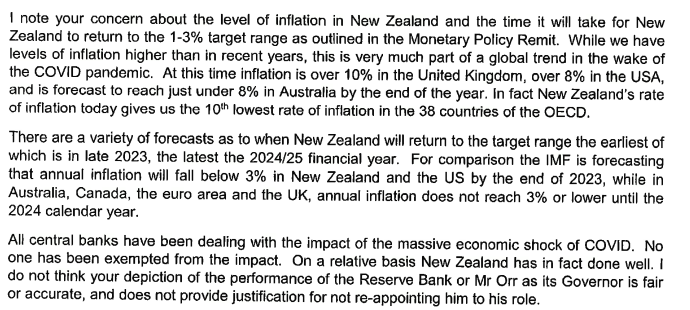
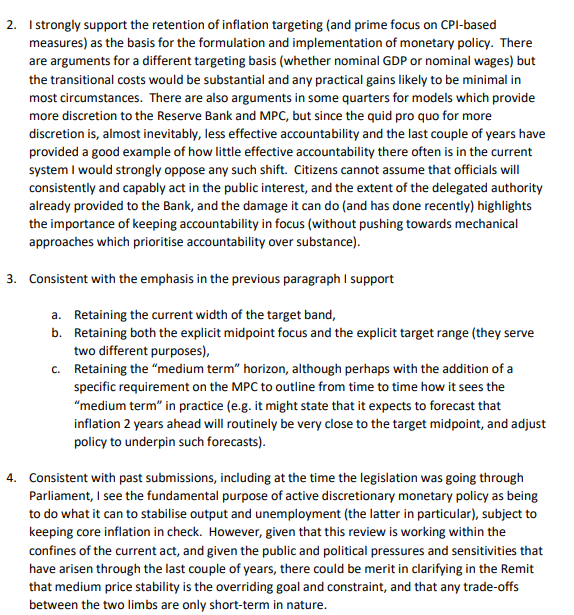
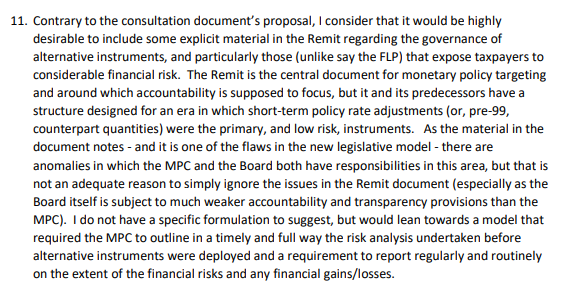
Really?

In the Sunday Star-Times yesterday there was a double-page spread in which various moderately prominent people (all apparently “leading speakers” at some “annual University of Waikato economic forum” this week were given 100 to 150 words to tell us “How can NZ build back following a string of serious economic and social setbacks”.

Most of the contributions were pretty underwhelming to say the least. To be fair, 150 words isn’t a lot, but real insight tends to shine through and there wasn’t much on offer in this selection. But then, who really cares much what the chief executive of the Criminal Cases Review Commission or the co-founder of an advertising agency think on such issues.

By contrast, Paul Conway is a statutory office-holder in an economic field. He is the (relatively new) chief economist of the Reserve Bank of New Zealand and in that capacity has been appointed by the Minister of Finance as an internal member of the decision-making Monetary Policy Committee. This was his contribution.

It was pretty bad. It is hard to argue with the first sentence, although the previous decades had not been an unbroken record of success and low inflation (check out core inflation measures over 2007 and 2008). But it was when I read the second sentence that I started to get concerned. What possible analytical or empirical basis is there for that claim?

For decades the Reserve Bank has told us (and rightly so) that there are no material long-run trade-offs between inflation and activity/unemployment/”prosperity”. That is so on the upside – you can’t buy sustained prosperity or lower unemployment by pursuing or settling for a higher inflation rate – but it is also largely true on the other side. Not only does lower inflation not create permanent adverse economic outcomes, but it is not a magic path towards materially better economic outcomes either. At best, and this is a line the Bank has also run for years, sustained and predictable low inflation, or price stability, may be conducive to the wider economy functioning a little better than otherwise, but any such effect is typically viewed as very small, and difficult to isolate statistically.

Unfortunately, Conway’s line has the feel of political spin, the sort of thing we might here these days from Luxon or Hipkins amid talk of a “cost of living crisis”. But, as the Reserve Bank MPC members should know only too well, real hits to economywide material living standards are not a consequence of general inflation but of supply shocks that (a) central bank can do nothing about, and (b) which would have been a thing, with adverse consequences for average living standards, even if the central bank’s MPC had done its job better over the last few years (Conway himself was not there when the mistakes were being made). As it happens, the process of actually getting inflation back down again will – on the Bank’s own forecasts – actually, and necessarily, involve some temporary losses of output and “prosperity”.

It was pretty poor from the chief economist of the central bank who (unlike his boss, the deputy chief executive responsible for macro matters and monetary policy) is a qualified and experienced economist.

Then we get the curious claim that monetary policy “is only part of the solution to reducing inflation”. Except that it isn’t. The way things are set, the Reserve Bank Monetary Policy Committee is responsible for keeping (core) inflation at or near the target midpoint, after taking into account all the other stuff that is going on, all the other policy initiatives here or abroad. Monetary policy isn’t the only influence on inflation, but it is given the job of delivering low inflation having factored in all those other influences. Thus, when the Canterbury earthquakes happened and there was a huge stimulus to demand over the next few years, it was still monetary policy (and monetary policy alone) that was responsible for delivering inflation near to target. We wouldn’t have wanted the repair and rebuild process slowed down just to have made the Reserve Bank’s job a bit easier. Same will go, on a smaller scale, for the repairs etc after the recent storms. Perhaps Conway or his colleagues think the government should be running a different fiscal policy, but as monetary policymakers it is really none of their business: fiscal policy and the central bank should normally each do their own jobs. As it is, Conway’s line gives aid and comfort to people talking up things like temporary petrol excise tax cuts as a way of helping ease inflation.

But bad as some of that stuff was it was the last three sentences that really struck me, including because Conway likes to talk about productivity (he was head of research at the Productivity Commission in that agency’s better day, and produced a range of interesting papers). We should all be able to agree that, in general, higher economywide productivity growth would be a good thing. People would be better off and individuals and governments would have more real choices.

But it isn’t a path to lower inflation, let alone lower interest rates, whether in the short or long run. And it isn’t clear why Conway appears to think otherwise.

In the short run, perhaps he has in his mind a model in which the Reserve Bank determines nominal GDP growth. If it did then, all else equal, the higher real economic activity was in any particular period then, mechanically, the lower inflation would be in that period. If higher productivity was an element in that higher real economic activity, and nothing else changed as a result, then higher productivity might be part of such a story. But the Reserve Bank does not control nominal GDP growth in that sort of mechanical sense, and if firms suddenly stumble on paths to higher productivity it is very likely nothing else will change as a result. Over the longer-term, higher rates of real GDP growth – and productivity growth – tend to be associated with higher, not lower, interest rates (a “good thing” in that context, as not only is there typically strong investment demand to take advantage of the productivity shocks and the opportunities they create, but also expected future incomes will be stronger and people will rationally want to lift consumption now in anticipation of those future gains). And if, as it appears may be the case, Conway is more focused on the short-term (“without the need for ongoing interest rate increases”) then it is really just magic fairy stuff, distracting from the (hard) choices the Reserve Bank has been having to make. Productivity growth isn’t just conjured out of the air at short notice to suit the cyclical preferences of central bankers.

It might have been better if Conway had declined to participate in this elite vox pop (after all, monetary policy really hasn’t much to offer, and we shouldn’t want to hear a central banker’s personal views on other policies) but if he was going to participate he really should have produced something better than what actually appeared. Yes, he didn’t have many words to play with, but the basic points aren’t hard to make quite simply. Whatever shocks, positive or negative, the economy experiences the Reserve Bank should be looking to provide a stable macroeconomic backdrop, and nothing monetary policy does can do more than take some of the rough edges off the worst of booms and busts while delivering a stable and predictable general level of prices. After the failures of recent years, that wouldn’t be nothing.

A couple of MPS thoughts

I don’t have very much I want to say about yesterday’s Reserve Bank Monetary Policy Statement – although “welcome back from the long holiday” might be in order. Oh, and I noticed a nice photo from my own neighbourhood on page 6 of the pdf.

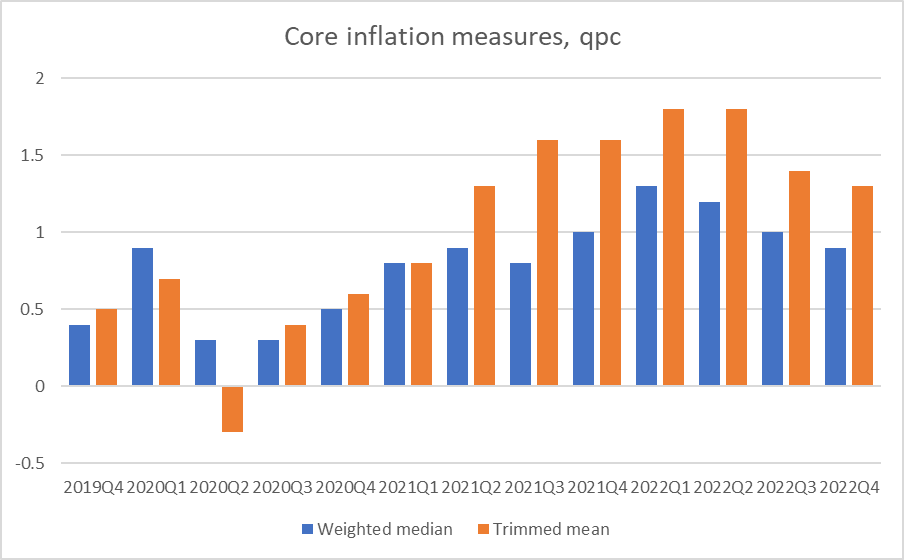
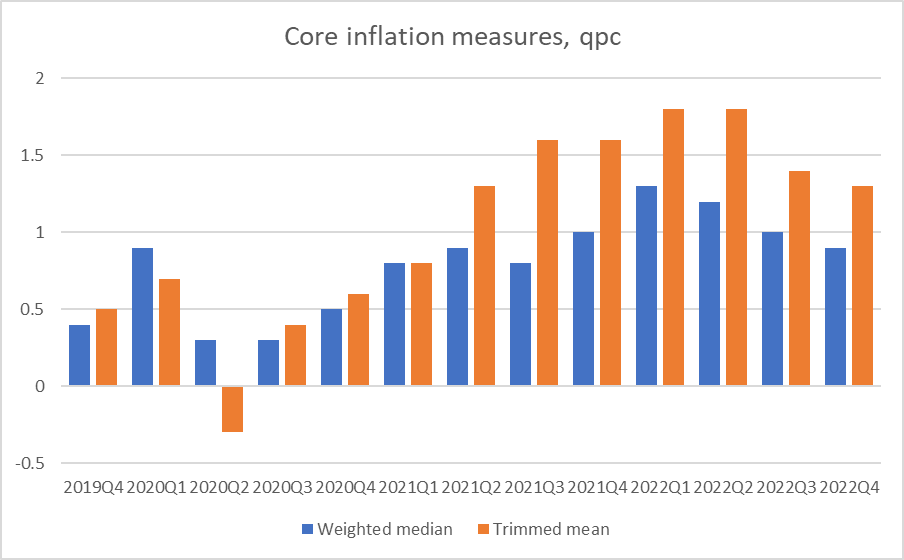
As so often, I continue to be a bit surprised by the fairly superficial analysis of inflation itself. Thus, they include a chart of various core inflation measures, but all as annual rates. Surely, surely, surely, a central bank Monetary Policy Committee, ostensibly forward looking, would want to be focused as much as possible on the very latest quarterly data. For example, this chart from my own post last month on inflation data.

It isn’t impossible that the “true” story is less encouraging than this quarterly series might appear to suggest, but I’d have hoped to hear/see the analysis why or why not from the Bank. As just one example, the data aren’t seasonally adjusted, but the RB is big enough and has enough clout with SNZ that they could either redo the series using seasonally adjusted data or get it done for them (or having looked into it concluded any difference was small enough it didn’t matter). As it is, even if there are some seasonality issues the Q4 numbers for both series were lower than for Q4 in 2021. It looks to be a somewhat encouraging story – still some way to go to get back to annual rates around 2 per cent – but better than it was, better than it might have been.

There is still no sign either – in the MPS or any of the other material the Bank has published in recent months – that the Bank has thought any deeper about what and why they (like many other people) got the inflation (and, thus, monetary policy) story so badly wrong over 2020 to 2022. The Governor was reported this morning as telling MPC that he didn’t think the inflation outcomes represented a “failure”. With hindsight, things might be partly understandable, perhaps even somewhat excusable, but against (a) the targets the government set for the Bank, and (b) the promises of central bankers over recent decades as to what they could deliver, it does not help the advancement of knowledge or understanding (although perhaps it helps MPC members sleep at night) to pretend what has happened has been anything other than a failure. I

I’m not taking a strong view on what the inflation outlook is, or even how much additional monetary policy restraint may (or may not) be needed, but the second point from the MPS that struck me was around their own story and how well it held together.

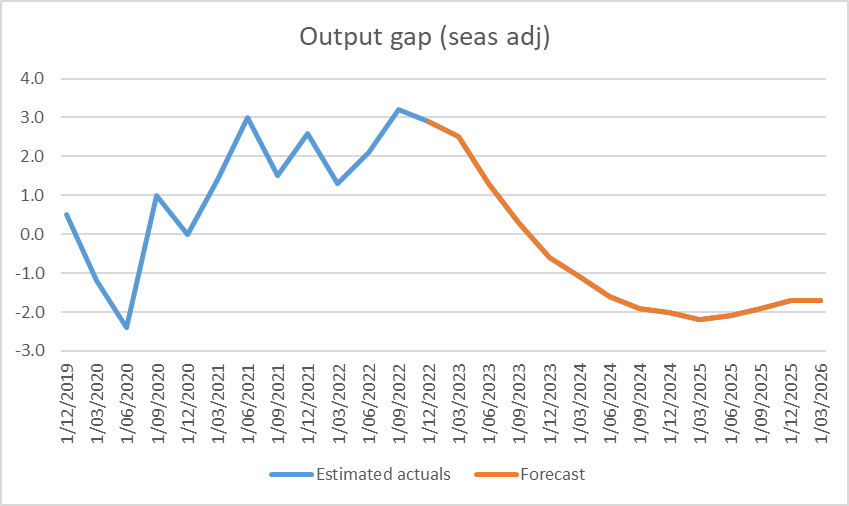
On their numbers, the output gap was estimated to have been 2.1 per cent of (potential) GDP in the June quarter last year, rising to a new peak of 3.2 per cent in the September quarter. Here are the estimates and forecasts

Their forecasts show that they expect the output gap to have averaged 2.7 per cent of (potential) GDP for the Dec and March quarters too. In other words, the period of maximum pressure on resources and of upward pressure on core domestic inflation includes right now (around the middle of the March quarter).

If so, core inflation (quarterly) should have been continuing to rise, something there is no sign of in the data. And a great deal turns on the June quarter, when they expect a sharp fall in the output gap as GDP growth itself turns negative. That is a fairly big call in itself (and of course, actual events will be messed up by post-cyclone repair activity).

But what of inflation? The Bank forecasts that by the December quarter of this year, headline quarterly CPI inflation will be down to only 0.6 per cent. There is some seasonality in the headline CPI numbers, and December inflation tends to be a bit lower as a result. But the difference looks fairly consistently to be only about 0.1 per cent, so that a seasonally adjusted forecast for the December quarter (measured as at mid November, nine months from now) is probably 0.7 per cent. That would be the least bad outcome since 2020, and in annualised terms back inside the target range. (And the December quarter numbers won’t have been thrown around by the end of the petrol excise tax cut or temporary fruit and veg effects of the cyclone). If they deliver that it will be a good, and welcome, outcome. If we apply the eyeballed seasonal factors to their remaining CPI forecasts, by the September quarter of next year, quarterly seasonally adjusted inflation is right back down to 0.5 per cent – slap bang in the middle of the target range.

But I’m left puzzled about two things. The first is that the Bank usually tells us that monetary policy takes 12-24 months to have its full effects on inflation. If so, then why on their story do we need further OCR increases from here when inflation 18 months hence is already back at target midpoint. And then, given that inflation is at the target midpoint 18 months from now, why is policy projected to be set in ways that deliver deeply negative output gaps (not narrowing rapidly at all) all the way out to March 2026? Perhaps there is a good and coherent story, but I can’t see what it is (and I don’t see it articulated in the document). Entrenched inflation expectations can’t really be the story, because as the Bank has often noticed medium to long term expectations have stayed reasonably subdued and shorter term surveys of inflation always tend to move a lot with headline inflation which is expected to be rapidly falling by this time next year.

(My own story would probably put more emphasis on the unemployment rate as an indicator of resource pressures. On the Bank’s (and SNZ”s) numbers, the unemployment rate troughed a year ago.)

The final aspect of the MPS I wanted to comment on was the brief section (4 pages from p30) on “The international dimension of non-tradables inflation”. It is good that they are attempting to include some background analysis in the document, although sometimes one can’t help thinking it might better have been put out first in an Analytical Note where all the i’s could dotted and t’s crossed, and the argumentation tested. We might reasonably wonder what the non-expert members of the MPC make of chapters like this, which they nonetheless own.

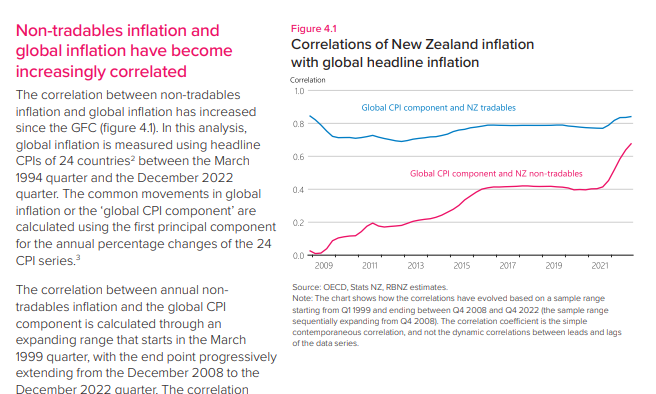
The centrepiece of the discussion is this chart, which looks quite eye-catching.

Count me a bit sceptical for three reasons. The first is that I am wary of a picture that starts at the absolute depth of a severe recession and would be interested to know what it would have looked like taken back another three or five years. Perhaps they didn’t do so because the treatment of housing changed (very materially) in 1999, when the dataset they used starts from, but one is left wondering. Second, end-point revisions are a significant issue with the techniques used to derive the global CPI component, and might be particularly so over the last year when headline inflation has been thrown around so differentially depending on (a) exposure to European wholesale gas prices and mitigating government measures. And then there is the question of the countries in the sample. Of the 24, 12 are part of the euro-area (or in Denmark’s case, tightly pegged to the euro) for which there is a single monetary policy. For these purposes, it is like using as half your sample individual US states or Japanese prefectures. I don’t understand why they chose those countries, or why (for example) Hungary is in but the Czech Republic and Poland (all with their own monetary policies) are out. Or why you’d include Luxumbourg – which has the euro as its currency – and not (similar-sized) Iceland with its own monetary policy. And since this is just using headline CPI inflation data why you’d use only these countries anyway and not a range of non-OECD countries with market economies and their own monetary policies. Perhaps it would make little difference, but we don’t know, and the Bank makes no effort to tell us or to explain their choices.

Now, to be honest, if you had asked me before seeing this section I would probably have said ‘yes, well given that a whole bunch of advanced economy central banks made similar mistakes I might expect to see a stronger than usual correlation between New Zealand non-tradables inflation and some sense of “advanced world core inflation”. And thus I wasn’t overly surprised by the right hand side of the chart above.

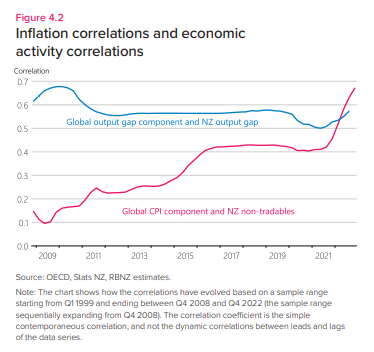
The Bank attempts to address that question, summarised in this chart, using the same period and same 24 countries as in the earlier one.

But count me a little sceptical. Almost every OECD country – including their 24 (with all the same issues around selection of countries) – had unemployment rates late last year at or very close to cyclical lows. As New Zealand did as well. But whereas the Reserve Bank estimates our output gap late last year was +2.7 per cent of potential GDP (and, by deduction, the Bank must be using their own estimate in this calculation) OECD output gap estimates have 12 of the Bank’s 24 countries running negative output gaps last year (they don’t even think New Zealand’s output gap was positive last year, despite abundant evidence of resource stresses here). Given the choice between fairly hard unemployment rate indicators and output gap estimates which are notorous for revisions, personally I’d be putting a lot more weight on the labour market indicators where (as the Governor himself has emphasised in the past) all his peers say they have the same issue of “labour shortages”. (The OECD no longer publishes “unemployment gap” estimates but they do publish “employment gap” estimates, and of the Bank’s 24 countries only a handful had (small) estimated negative employment gaps in 2022).

They end the special section with a paragraph “What does this mean for monetary policy?”. I didn’t find their story persuasive – that it would mean monetary policy was harder – but given how little confidence we can have in the charts, it isn’t worth spending more time on that discussion.

Harry White, and reconstructing the international financial system

Harry White and the American Creed: How a Federal Bureaucrat Created the Modern Global Economy (and Failed to Get the Credit), a new book by James Boughton, was my weekend reading.

Boughton, now retired, was formerly the official in-house historian of the International Monetary Fund (IMF).   White was a fairly senior official in the US Treasury, a key adviser to Secretary Henry Morgenthau, from the late 1930s to 1945, and has a fair claim to have been the technocratic father of the IMF (and was then for a short time the first US Executive Director of the IMF).  It was a short official career and he died quite young, but has an interesting – and contested – story nonetheless.

What of the book?   Well, ignore most of the title.  I’m still not at all sure what the “American Creed” is supposed to mean in this context, and the bit about “created the modern global economy” is simply laughably wrong (and seriously misleading to the casual bookshop browser).  It is a full biography, but two-thirds of the book is about the last 7 years of White’s life (1941-48), including extensive discussion of the allegations which have dogged his reputation ever since that White may have been a Soviet spy.

By the time White became even moderately senior in the US Treasury, pretty much every country had moved off the Gold Standard (the European “gold bloc” countries not until 1936) and most major exchange rates floated.  In the diminishing number of democratic countries, private capital movements were mostly still free (although in the US for example private holdings of gold were simply outlawed).  Views differed on whether the new exchange rate regimes were a “good thing” or otherwise (in another book on my shelves there is a record of White on an official trip to London in the mid 1930s talking to prominent business figures who had embraced an era of floating exchange rates, but officialdom was often less enthusiastic).  In some circles then – and still today (Boughton seems guided by this story) – there was a narrative that non-fixed exchange rates were a material element causing a backing away from globalisation and multilateral trade in the 1930s (a story that I don’t think stands much scrutiny). It is certainly true that floating exchange rates in peace time were something of a novelty.

Then came the war (the US eventually joining in late 1941) with the attendant debt, disruption, and extensive controls over all manner of aspects in life in pretty every combatant country (and even many neutrals).

White wasn’t heavily involved in the creation of lend-lease, that innovative form of cross-country support initiated by the US (although they too were recipients of lend-lease assistance, New Zealand (for example) being a net provider of assistance to the US) but eventually had oversight responsibility for the administration of the scheme.  The real focus of his efforts as described in the book was on post-war planning, which absorbed a huge amount of resource among (in particular) US and UK officials even as the physical conflict raged.

As is fairly well known, there were rival conceptions of the details of what the post-war international monetary order should look like, exemplified by the ideas of White (for the US) and Keynes (a key adviser to the British).   But what no one seems to have been in much doubt about was that a regime of fixed (but adjustable) exchange rates should be established, and that if current account convertibility (ability to buy, sell and pay for goods and services freely from abroad) was over time to be a goal for many/most, private capital mobility was (at best) looked on with considerable suspicion (neither White nor Keynes were keen).  If you weren’t going to allow private capital mobility, not only were fixed exchange rates were more or less unavoidable but governments had to be sure of their own access to foreign reserves to manage fluctuations in the demand for their respective currencies.  There was no appetite for a return to a classical Gold Standard, but also a surprising attachment to the idea that gold should still have a place in the international monetary system (one presumption being that countries would be reluctant to accumulate substantial foreign reserves simply in the currency of another country without the ability to convert to gold).

If there were different conceptions there were also different interests and contexts.  The US, for example, had been a net provider of assistance to the rest of the world during the war, and so although it would emerge from the war with large domestic debts it had not accumulated an adverse international position.    The US under Roosevelt also came and went a bit on to what extent they sought to undermine the future of the British Empire and British Commonwealth relationships (notably the imperial preference trade arrangements, and the “sterling area” which had developed after Britain went off gold in 1931).  The UK, by contrast, had suffered a real large deterioration in its external financial position (as well as having lots of domestic debt) as a result of the war, and had accumulated huge volumes of blocked sterling liabilities to Commonwealth and Empire countries (goods had been sold to Britain, sellers had been paid in sterling, and the resulting central bank balances were not readily convertible into other currencies –  notably dollars).  New Zealand was among the countries that had accumulated such large claims on the UK.  The overhang of sterling liabilities was to be an issue for decades.   The US was keen on a fairly early move to convertibility, while the UK was wary, to say the least.   (There were, of course, many other countries, including the exiled governments of occupied countries like the Netherlands and Norway, but the bulk of the discussion and negotiation was between US and UK officials –  often led by White and Keynes (both of whom seem to have been awkward characters in different ways).

In institutional terms the US conception won the day. It was almost always going to. The US was by the biggest economy, was not itself dependent on external finance (although had a clear interest in a general post-war economic revival), and of course whatever was agreed between governments had to get through a US Congress that –  as ever – was not generally under the control of the executive.   And, in truth, the basic IMF structure (my focus here although the World Bank –  International Bank for Reconstruction and Development – also emerged, less controversially from this process) was an elegant one.   Countries would fix an exchange rate to the USD, while the USD itself would be convertible (for governments/central banks) into gold at a fixed rate.  Each member country would deposit some portion of their gold or USD reserves with the Fund, which in turn would establish rights for countries to “borrow” from the Fund in times of temporary balance of payments pressures.  Countries could make modest exchange rate adjustments themselves, but larger adjustments – to address structural imbalances – would require the approval of the Fund, itself governed by Executive Directors appointed or elected according to the quotas negotiated for each country.  I put “borrow” in quote marks, as formally the IMF did not do loans, but things that were more like currency swaps –  and obscure currency swaps (partly modelled on what had been done with the US’s own Exchange Stabilisation Fund in the 1930s) were thought easier to get through Congress than loans.  In economic substance there was no difference.

Boughton was, as I noted earlier, the official in-house historian of the IMF. Since the IMF still exists today, it is a perspective that leans him to seeing what was created in 1944/45 as an unquestionably good thing.   I’m much more sceptical.  One could wind up the IMF today and the world would not be worse off.   And one could mount an argument that if negotiated arrangements were almost inevitable in 1945, there is still little reason to suppose that the creation of the Fund was a net positive even then.

It didn’t –  couldn’t –  deal with the really big overhanging issues (including, but not limited to, those blocked sterling balances) and was part of state-led arrangements that enabled for a time some deeply unrealistic post-war exchange rates.  Britain, for example, went through a period of seeking further US financial assistance, was then forced by the US in exchange to allow early convertibility which went badly wrong very quickly, and only finally took the deep exchange rate depreciation that was always needed under pressure in 1949.   It is not hard to think that restoring floating exchange rates pretty much as soon as the war ended might have been a better way (also reducing the pressure later for the Marshall Plan – a point some US sceptics made even at the time).

But whether or not the creation was a good thing, there is little doubt that White was the technocratic father of the Fund – which exists today even if the world it was created for almost wholly doesn’t – and Boughton has written a useful and interesting account of aspects of that period, complementing the range of other books (many on the Bretton Woods conference in 1944 where the final details were negotiated with 40+ allied countries in attendance).

There is lots of other interesting detail in the book (occasionally too much – even as a former Washington resident I did not need every single street address White lived at), including White’s involvement in helping flesh out the madcap Morgenthau Plan that envisaged turning post-war Germany into primarily an agricultural economy. White owed his position to Morgenthau who in in turn owed his position and influence to his friend and neighbour Roosevelt. Once Roosevelt died, White’s hour in the US government system had passed,

One is left with the impression of an influential, extremely hardworking, smart individual, but also an abrasive and not altogether pleasant one.  In an age of great figures –  good and evil – my sense is that no one would today be writing biographies of him if (a) the IMF no longer existed, and (b) it were not for the espionage allegations (the two aren’t unrelated since it was uncomfortable for the Fund to have such allegations about one of its “founders”).

The espionage allegations were not my main interest in buying the book. Not being American I’m probably less interested in any case against White than in, say, the truth about Bill Sutch.   Boughton goes to great lengths to review and rebut in detail many of the claims that have been made ever since the 1940s.  In some cases, he seems very persuasive, and in others a bit less so.   What is now unquestionable is that some of White’s good friends and colleagues were Soviet agents in one form or another (in some cases very active), and even Boughton concedes that at times White may have been indiscreet in his ties with people who, while Soviet officials, were still wartime allies and official interlocutors.  But if Boughton’s is the pro-White case, other serious people (without IMF ties) still seem equally certain of White’s guilt.  Perhaps we will never really know.

New Zealand participated in the Bretton Woods conference where the new international monetary arrangements were settled.  Our key delegate was Walter Nash then (simultaneously) Deputy Prime Minister, Minister of Finance, and resident NZ Ambassador to the United States.  His small delegation including the Secretary to the Treasury, Ashwin, the then Deputy Governor (later Governor) of the Reserve Bank, Fussell, and the highly regarded economist AGB Fisher.   There were two main working groups at the conference –  one on the Fund chaired by White, and another on the World Bank chaired by Keynes.  Nash chaired a less important working group.

Bretton Woods was, in many respects, not a matter of great moment in New Zealand (and it is interesting that neither the war economy  nor political and external affairs volumes of the NZ official history of World War Two seem to have any mention of the conference or the issue).   New Zealand was firmly in the sterling area –  our pound pegged to sterling –  and Nash had a strong aversion to overseas debt.  But there was still an important defensive interest, since Labour has put in place pre-war extensive exchange controls and import licensing restrictions and had no intention of removing those restrictions in peacetime.

Digging around various other books on my shelves, it seems clear that Nash and the NZ delegation did not make a great impression.  Ed Conway’s book, The Summit, has a few comments.  Introducing Marriner Eccles, the then chair of the Fed, he suggests that Eccles’ oratory “would give New Zealand’s dreary Walter Nash a run for his money as the most self-important and tedious delegate”.  The relative size of each country’s quota in the Fund was then, as now, a matter of politicking dressed up behind an apparent technical façade.  New Zealand was among those objecting to the US proposal (not helped by the fact that Nash apparently confused sterling and dollar amounts) “in a ten-minute sermon from the country’s dreary lead negotiator, the Hon Walter Nash”.  Conway quotes from the contemporary diary of UK delegate/economist Lionel Robbins “throughout the conference {Nash] has shown a tendency to be about three bars behind the band”. 

A more recent history of New Zealand diplomacy during the war, by Gerald Hensley, has a more substantive discussion.  He notes that the delegation had a good grasp of the basic New Zealand needs “But not one had been able to do any deeper thinking about the implications of the Fund and on this occasion it showed”.  He goes to quote from a contemporary British delegation report back home which concluded that Nash was simply out of his depth (“He understood comparatively little of the technicalities, but could not restrain himself from intervening in an embarrassing manner on many complicated points which were, moreover, not the least concern to his country”).  The Australian delegation also recorded complaints.

As Hensley notes, however, the government’s (and Nash’s) main focus was on ensuring that nothing in the agreement would interfere with the government’s ability to maintain exchange and import restrictions.   Nash’s official biographer, Keith Sinclair records that “according to the notes he made at this time, he asked the chairman Harry D White whether exchange controls were permissible, provided that exchange was used to pay for all current transactions.  White replied that this was his understanding, and he asked the meeting if there was any dissent. There was none.”

(Which is all very well but it was not be until the early 1980s that New Zealand finally removed all restrictions on even current account transactions)

If Nash himself was content with the final form of the agreement, there was still a significant amount of angst back home.  Instructions came from the Prime Minister that New Zealand was not to sign adhesion to the Final Act from the conference, and in the end the two most junior officials in our delegation were allowed merely to sign a document that certified that it was a true record of the conference proceedings. That Nash himself was persuaded is reflected in a letter to Harry White that was read to the conference by a senior US delegate as the conference was winding up (Nash had had to leave early)

“Owing to the urgency to make a train last night it was not possible to say goodbye before leaving for New Zealand.  In congratulating you and those working with you on the foundation work in connection with the Fund and the Bank I affirm that it can easily be the greatest step in world history with possibilities of removing one of the major causes of war, if not the major cause.”

Talk about overblown political rhetoric.

New Zealand was one of a very small handful of countries that participated in Bretton Woods that did not join the Fund early on (the most prominent of course was the Soviet Union, but even Australia did not join until 1947).  There is an entire article to be written on this strange history one day (I have a big folder of papers I collected a few years ago but cannot immediately find it).  There was significant unease on both sides of parliamentary politics with talk of free votes. It seems to have been one of those issues that few cared much about (either way) but a minority (against) felt very strongly about.   The Labour government failed to take any lead (there was significant dissent in their own caucus), and by the 1946 election campaign the leader of the National Party was openly opposed to joining.   There seem to have been a range of concerns, some reasonable, some not, and it is not as if there was no sensible dissent in other places either (I read one speech from a senior former UK minister in the House of Commons ratification debate expressing concern that the IMF would allow the UK less exchange rate flexibility than the UK had needed in 1931).  Between close ties to the UK, some unease about an emerging US-led system, a commitment to the sterling area and UK trade preferences, all combined with on the one hand the NZ regime of controls and, in the late 40s, New Zealand’s strong external position (we revalued our currency in 1948) there wasn’t much momentum, before the undertones of Social Credit type concerns were mentioned.  When New Zealand did finally sign up in 1961, Hansard still records unease from Labour members that IMF membership might threaten New Zealand’s full employment record.

New Zealand did join.  New Zealand has borrowed from the IMF on a few occasions ( a former colleague recently described to me the gaming of the rules of one particular facility in the 1970s).  It isn’t clear that joining or not really made very much difference then or now – these days we get only not-very-useful advice and a few job opportunities for officials – although it would these days look odd not to be a member.

(Personally I’m quite glad NZ finally did join as four years on the IMF payroll –  two resident in Zambia, two as Alternative Executive Director in Washington – were by far the highest paid of my career, and the only technical assistance mission I ever did for them, in China, was conveniently timed to pay the bills for our wedding.)

UPDATE: Someone inquired about my observation that NZ was a net provider of lend-lease assistance to the US. On checking, I’m reminded that in accounting terms the two sets of flows were roughly even (we received about as much as we provided), however Hensley’s book (p250) notes that this somewhat misrepresented the flow of real value, since much of what New Zealand provided was valued at pre-war prices, while material received from the US was typically accounted for in contemporary price terms. To the extent this was so, NZ was a net provider to the US.

Reappointing Orr – some documents

Yesterday’s Herald had an interesting article on the reappointment late last year of Adrian Orr as Governor of the Reserve Bank. The article appeared to have been prompted by the Bank’s response to an OIA I lodged last year asking for background material on the reappointment. A link to that OIA response is now on the Bank website.
The key quote was this, from the letter from the Board chair Neil Quigley to the Minister of Finance recommending Orr’s reappointment.

“The governor will also model the highest standards of behaviour in promoting a safe environment for debate and in treating with respect those people with different views from their own, consistent with Public Service Commission guidelines,” 

The best that might be said for that claim is that it may represent wishful thinking that somehow their leopard once reappointed might change his spots. So many people who have interacted with Orr was Governor, or observed him interacting with others, could testify that he has modelled none of that sort of behaviour (and there are specific accounts on record from people for Victoria University’s Martien Lubberink and the NZ Initiative’s Roger Partridge, as well as the story that Quigley himself one day felt obliged to pull Orr out of a Bank Board meeting over concerns about Orr’s conduct in the meeting). Watch any Orr appearance at FEC and much of time his response to challenge and questioning has been pretty testy. There must have been a recent Damascene conversion for Quigley’s assertion to the Minister to be anything other than wishful thinking at best. More likely it is just outright spin.

There was another interesting quote in the Herald article itself, from Chris Eichbaum a Labour-affiliated member of the outgoing board (both the outgoing board and the new Robertson board recommended the reappointment). Eichbaum is quoted as claiming that

An outgoing board member, Chris Eichbaum, confirmed to the Herald the old board went through a “robust and exhaustive”, “backward and forward-looking” process before coming to its decision to endorse Orr.

However, the Bank released summary minutes of the relevant meeting of the non-executive old-Board directors on 12 May last year (which, incidentally, was attended by Rodger Finlay, at the time chair of the majority owner of Kiwibank, the subject of Reserve Bank prudential supervision). The entire meeting lasted only an hour, with five items on the agenda, including the Annual Review for the then Deputy Governor.

“Perfunctory” looks like a more accurate description than “robust and exhaustive” – which isn’t surprising since the old Board had no formal responsibility any more and most of the members were by then probably more interested in their own next opportunities beyond 30 June (I recall one telling us at about that time of the next role he was going to take on once he left the Bank Board). You get the impression that the new Board – on average even less fit for office – must have been even more perfunctory in its deliberations because the Bank neither released nor withheld minutes recording their deliberations on the matter (at their very first meeting on their first day in office, 1 July). Note that not even the Bank’s own self-review of monetary policy was yet available to either Board.

The Reserve Bank OIA response was not, however, the only relevant one. When Orr was reappointed I lodged requests with the Bank, The Treasury, and with the Minister of Finance. They all obviously coordinated their responses since all three were late and all three finally arrived on the same day.

What was interesting in these releases is what wasn’t there (not what was done but withheld, but what appears never to have been done). Thus one of the better aspects of the amended Reserve Bank legislation was supposed to be a heightened and more formalised role for The Treasury in monitoring the Bank on behalf of the Minister of Finance. But there is no advice at all from The Treasury to the Minister of Finance on the substantive pros and cons of reappointing the Governor even though (a) Treasury had just taken on a new heightened role and responsibility, and (b) the question of reappointment was arising amid the biggest monetary policy failure for decades. They drafted the Cabinet paper for the Minister of Finance to reflect the Minister’s own views, but that seems to have been all. There is no sign Treasury was even made aware, let alone asked for advice, when the two Opposition parties raised concerns about the proposed reappointment, even though this was the first time such consultation provisions had existed for a Governor appointment.

As often seems to be the case, the Minister of Finance’s response was fullest, although there were these documents withheld

Intriguing, since there is no sign in any of the other documents of any legal doubts about the ability to reappoint (and all these documents pre-date the letter from Quigley cotaining the Board’s recommendation to reappoint Orr).

The statutory provisions the Minister had inserted require the Minister of Finance to consult other parties in Parliament before recommended to the Governor-General the (re)appointment of a Governor. It was an interesting addition to the legislation (and arguably there is a stronger case for such a provision for the Governor than for Board members, where the record indicates that the Minister had already treated the consultation provision as no more than a cosmetic hoop to jump through on the way to doing whatever he wanted) and certainly suggested an intent that anyone appointed as Governor should at least command the grudging acceptance of other political parties (perhaps especially the major ones) given the huge discretionary power the Governor, Bank and Governor-dominated MPC wield.

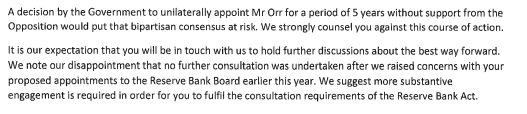
Here is the body of the letter sent to the other parties on 19 September

Interestingly, the letter makes no substantive case for the proposed reappointment, addresses nothing (good or ill) about his record etc. I guess parties might be presumed to know Orr, but it still seems a little curious to make not even a one sentence case. But that is the Minister’s choice.

Three of the four non-Labour parties in Parliament responded (the Maori Party did not). This was the response from Genter/Shaw for the Greens

Being an unserious party, they supported reappointment because of things the Bank and Governor have no statutory responsibility for.

Both National and ACT expressed opposition to the reappointment. The letter from Nicola Willis has been released previously and so I won’t clutter the post by reproducing it all here. Their opposition was on the (deeply flawed) ground that they believed no five year appointment should be made for a term starting in election year (even though the starting date for the second term was in March 2023 and the election then seemed likely to be in October or November). However, Willis ended her letter this way.

Willis has since described the reappointment as “appalling”, but seems to continue to rely on the argument about a five-year term even though (as I’ve pointed out previously) their 2017 comparison is flawed and the legislation has always been designed deliberately not to make it easy for new governments, of whatever stripe, to come in and appoint their own person.

We had known that ACT was opposed to the reappointment but had not seen the body of Seymour’s letter back to Robertson. It is a couple of pages long and raises substantive concerns about both style and policy substance (but rightly not questioning the ability of the government to make a five year appointment). It has a distinctive Seymour style to it (and so even as an Orr sceptic some lines jar with me) but it is an undeniably serious document, in response to the first ever statutorily-required political party consultation over the appointment of a Governor.

But it was all just ignored. This is what little the Minister of Finance told Cabinet

so not even a hint as to the nature of the concerns the Opposition parties had expressed, or any reflection on what expectations (around multi-party acceptance, if not endorsement) the government’s own legislation might have given rise to.

After the Cabinet paper had been lodged, Robertson did write back to Nicola Willis in a fairly substantive letter (the full text of this and other documents is in here)

Robertson OIA on Orr reappointment 2022

The Minister rightly pushes back on the argument about pre-election appointments, highlighting the substantial differences to the 2017 case (and actually makes the interesting point, that I had not noticed, that the law provides for only a single reappointment, so any one year term for Orr would have to have been his final term).

Perhaps of more substantive interest are the comments from the Minister on the Governor’s monetary policy stewardship

A lot more spin than substance, that fails (completely but no doubt deliberately) to distinguish things central banks are responsible for and those they aren’t really, chooses not to distinguish shocks that New Zealand did not face (eg global gas prices), and in the end is simply complacent about the serious core inflation outbreaks here and everywhere else. There is no sense of any accountability.

The Minister’s letter ends this way

Not only has the entire legislative structure long been built around a model in which the Minister of Finance has always been free to reject a nominee (but cannot impose his or her own favourite) but it was Robertson’s own government that added the political party consultation provisions. Rejecting an Orr nomination – especially after both Opposition parties had expressed serious concerns – would not to have been to politicise the process, but would simply have been the Minister of Finance doing his job. As it is, the risk now is that the consultation provisions will come to be regarded just as an empty shell.

Those paragraphs above from the Minister’s letter to Willis are nonetheless of some interest because they are the only material, across three separate OIA responses, even mentioning the conduct of monetary policy on the Governor’s watch. In the Board minutes (see above) there was no sign of any consideration or analytical input (not that none of the Board members really had the capability to provide such an assessment themselves. In the Quigley letter to Robertson there is this

which is not only input-focused (rather than outcomes), focused on March 2020 (rather than the aftermath), but shows no sign of any critical reflection or evaluation. And in the Minister’s paper to Cabinet monetary policy and inflation – let alone $9bn of avoidable losses to the taxpayer – get no mention at all, just burble about Orr as a change manager (leading decline and fall perhaps?)

It was a poor appointment (my long list of reasons was in this post) even if one that was always to have been expected, since Robertson had never displayed any serious interest in accountability or performance, or much in the substance of the Bank’s role at all (and failure to reappoint might have risked raising questions about the government itself). But it is still a little surprising how short on substance, around the key failings of the Governor in recent years (style and substance), the documented parts of the process leading to reappointment seem to have been.

There are, of course, some levers open to a new National/ACT government were they to win the election, but it would be a little surprising if they do much at all. More likely, the decline and fall of a now bloated and unfocused institution will continue through Orr’s second (and apparently final) term.

Reviewing the MPC’s Remit

Once upon a time the Reserve Bank’s monetary policy was guided by a Policy Targets Agreement reached between the Governor and the Minister of Finance. These days things are different. As one of the more sensible aspects of the 2018 legislative overhaul, the new Monetary Policy Committee now works to a Remit (current one here) determined ultimately solely by the Minister of Finance. That is the way things should be: if officials are free to implement policy, the policy goals should be set by those whom we elect, in this case the Minister of Finance. At times, the Minister may put daft things in the Remit – as the current one did a couple of years back with the house price references – but that is how our system of government works (as it should).

Another sensible aspect of those reforms was a requirement that every five years or so the Reserve Bank should provide advice to the Minister on the form and content of the Remit, and that the Bank should have to undertake public consultation in bringing together that advice. These provisions seem to have been quite influenced by the Canadian model, with the very big difference being that the Bank of Canada has typically generated a large volume of research in support of each quinquennial review whereas for the first review – underway at present – the Reserve Bank of New Zealand has generated none. That is, sadly, consistent with the dramatic decline in the research output, whether on monetary policy or financial stability functions, of the Orr-led Reserve Bank.

There have been two rounds of consultation. I wrote up and included a link to my submission on the first round here. The second stage of consultation invited submissions by today (although an email from the Bank today says that if you feel inclined they would be happy to receive submissions even on Monday).

It is January and I haven’t been particularly motivated to write about monetary policy. But I do approve in principle of the process of consultation on the Remit – and can only hope that future Governors make a more substantive and research-led fist of it – so thought I should probably make a submission on the second stage. It seems likely that neither the Governor nor the Minister are seeking any very material changes, but there are some longer term issues that need addressing – including dealing structurally with the near-zero effective lower bound on nominal interest rates – and there may be more scope for change on issues around the MPC Charter (which deals with MPC decision-making and communications), on which the Bank was also seeking views. So I got up this morning and spent a couple of hours on a fairly short submission. The full text is here

Comments on second round of Reserve Bank MPC remit review consultation

The first section has nothing that should be terribly controversial

Remit 1

A longer-term concern of mine has been the failure of central banks, here and abroad, to deal effectively with the lower bound, itself existing only because of passive choices by successive generations of governments and central banks. It would be unwise to lower the inflation target without fixing the lower bound issue, but if that constraint was removed there would be little or no good reason not to return to a target centred closer to true zero CPI inflation

remit 2

The consultation document addresses the question as to whether there should be text in the Remit around the governance of alternative policy instruments (like the – expensive and ineffective – LSAP). The Bank prefers not, but I reckon there is a pretty strong case, although the issue is complicated by the divided responsibilitities between the Bank’s Board – who know nothing about monetary policy – and the MPC. There is no easy solution, but the Remit is supposed to be the focal document for guiding monetary policy accountability.

remit 3

On the composition and strcuture of the MPC there are several significant matters that can only be dealt with by amending legislation (I hope National is open to making some fixes) but I took the opportunity to lament again the blackball the Governor, Board and Minister have in place preventing anyone with current expertise in monetary policy or macroeconomic research/analysis from serving as an external MPC member, a decision that among other things cements the Governor’s continued dominance of the system (the Governor himself having only limited depth and authoritative expertise in such matters). But my main comments were about matters that are directly dealt with in the Charter and in the culture that has developed around the operation of the MPC since it was established.

remit 4

If you felt inclined to make a late submission, the relevant email address is remit-review@rbnz.govt.nz

A mixed bag

Quite a bit later than almost all other advanced countries we finally got an update on December quarter inflation yesterday. Even then, our quarterly CPI is mostly a measure of the change from mid-August to mid-November, while almost all other OECD countries have data for the month of December.

From the government we heard more of the same old spin, about how low New Zealand’s inflation is relative to that in other countries. At a headline CPI level there is, of course, some truth to that, but (a) we have an independent (of other countries) monetary policy to ensure that we can control our own inflation rate, and (b) New Zealand, mercifully, has not faced the gas price shock most of the European countries have. I presume not even the government is claiming credit for that – it is almost entirely just good luck, a rare advantage of our extreme remoteness.

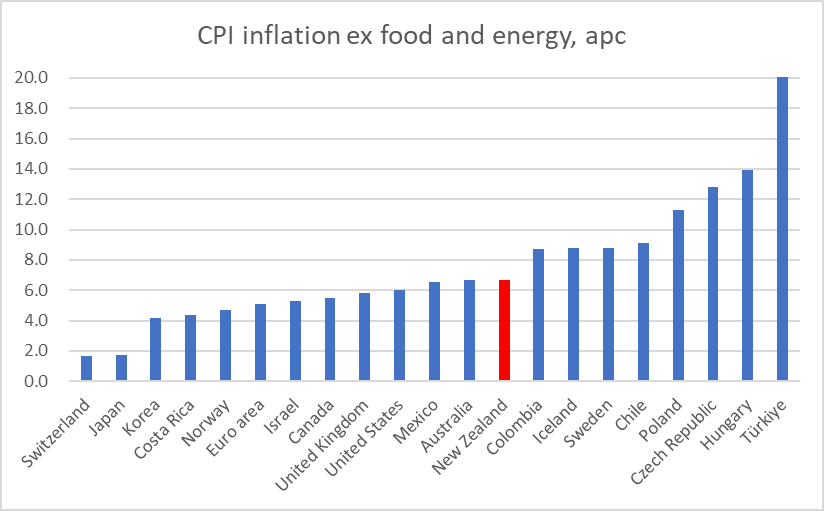
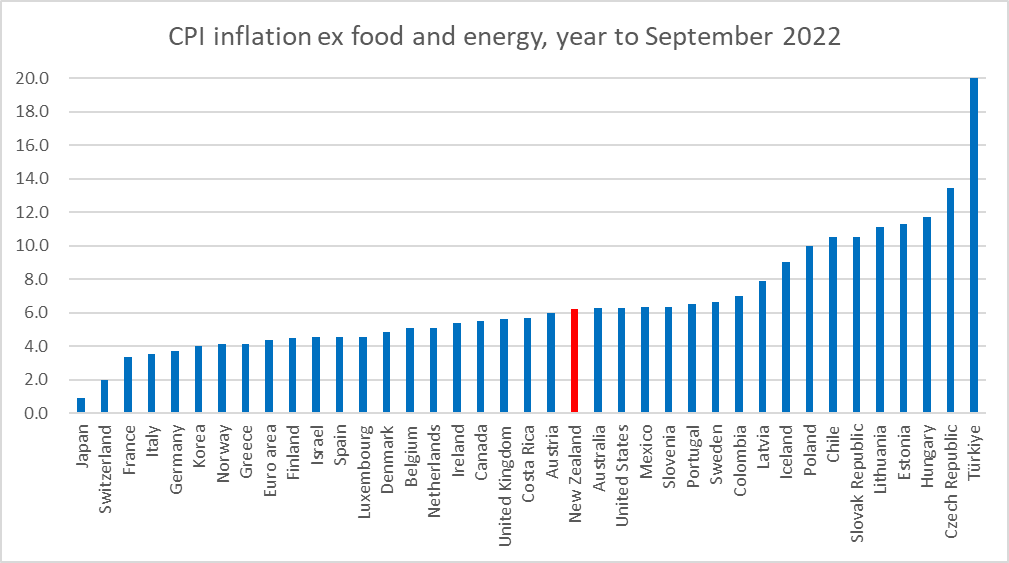
For international comparisons across a wide range of countries that focus on the inflation central banks and governments can sensibly be held accountable for, really the only available data are for the respective CPIs ex food and energy. It isn’t a perfect measure by any means – and differences in the ways countries put together their CPIs, notably the treatment of housing, also matter – but it is what we have. Here are the latest annual CPI ex food and energy inflation rates for the OECD countries (euro-area shown as a single number, reflecting the single monetary policy). (The OECD has not yet updated their table for yesterday’s Australian CPI, so I use here the very similar RBA series CPI ex volatile items (ie fruit and vegetables and motor fuel).

New Zealand and Australia are both at 6.7 per cent, just a touch above the median country. But note that if there are countries that have done worse than us, all the main advanced countries or country groupings (Japan, euro-area, Canada, UK, US – something close to the G7) are now less bad. Most haven’t done very well – 5 per cent core inflation is nothing to be complacent about or comfortable with – but less bad than us, or more specifically our central bank.

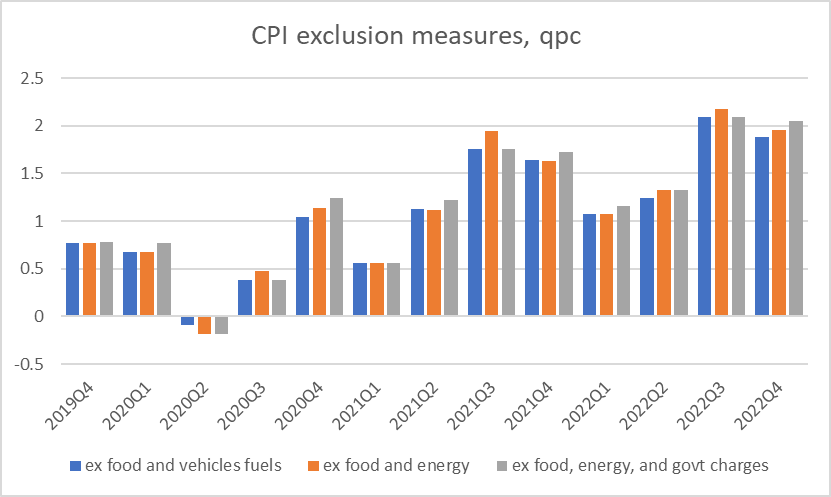
On a quarterly basis, the New Zealand exclusion measures of core inflation also don’t look particularly good – the latest annualised rates are around 8 per cent.

Once one gets away from international comparisons, it is often better to focus on the so-called analytical measures of core inflation. In New Zealand’s case these still aren’t ideal as (unlike the ABS) SNZ does not report these on a seasonally adjusted basis, but eyeballing the series seasonality does not appear to be particularly strong.

These measures either exclude or de-emphasise particularly large price changes and try to get to something more like a central tendency (the Reserve Bank’s sectoral core inflation series also aims to do something like this, but it uses annual data only and is prone to big revisions when the inflation rate is moving around a lot).

This chart seems to me the most favourable story one can currently tell about New Zealand inflation. There is an unusually large gap between the rates of increase in the two series – which should be a little troubling – but both series suggest that the peak has passed, that quarterly inflation was at its worst in perhaps the March quarter of last year (by when the OCR was still below pre-Covid levels). Given that the unemployment rate stayed at/near record lows all last year – and on all forecasts is expected to increase from here – one could take a reasonable amount of comfort from this chart. (Core) inflation should never have been allowed to get away – that it was is a generational failure by the new MPC – and is still, in annualised terms, a long way from 2 per cent, but things seem to be heading in the right direction.

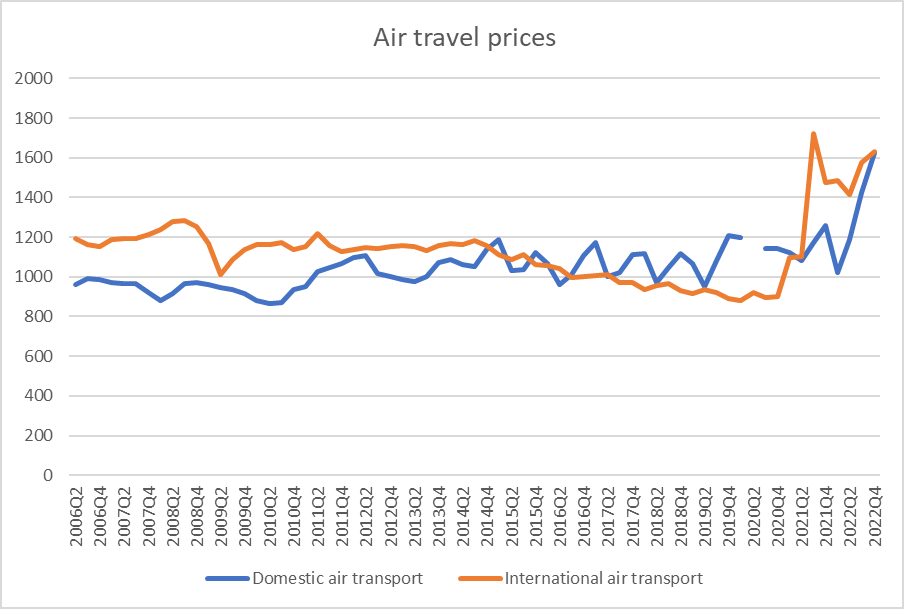
One of the wild cards in the entire story is the price of air travel, and particularly international air travel (the latter currently 83 per cent more expensive than just prior to Covid)

You would have to suppose that in time (real) prices will fall back, and it is in some sense a Covid phenomenon. On the other hand, it is also a classic case at present where excess demand (relative to available capacity) is an issue, and excess demand often shows up more in some places than others (a few quarters back it was domestic construction costs that were increasing at annualised rates of around 20 per cent). High air travel prices aren’t now a direct consequence of current government interventions – and the New Zealand government is actually still in the last few months of subsidising international air freight capacity, having kept air travel capacity higher than otherwise. But you wouldn’t want central bankers aggressively targeting a measure that currently gives a significant weight to air transport prices.

For now, things look to be moving in the right direction in New Zealand. They would need to be, after such a signal policy failure. The forward indicators are for much weaker economic growth quite soon which, all else equal, will continue to pull the inflation rate back towards target – although the question forecasters will need to grapple with is “how rapidly?”. The coming suite of labour market data will be the next piece in the New Zealand puzzle.

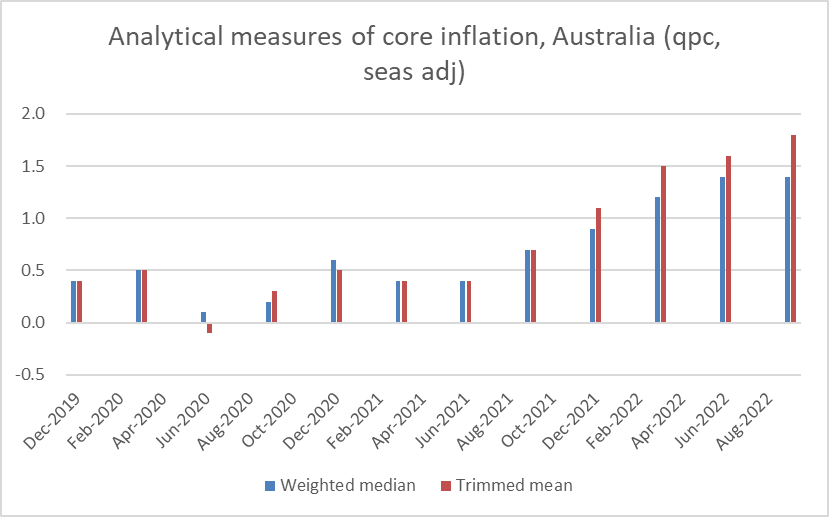
Whether or not things are yet on track in New Zealand, this is one of those times when one would much rather be sitting in the New Zealand central bank than at the RBA. Here are the analytical measures of quarterly core inflation for Australia

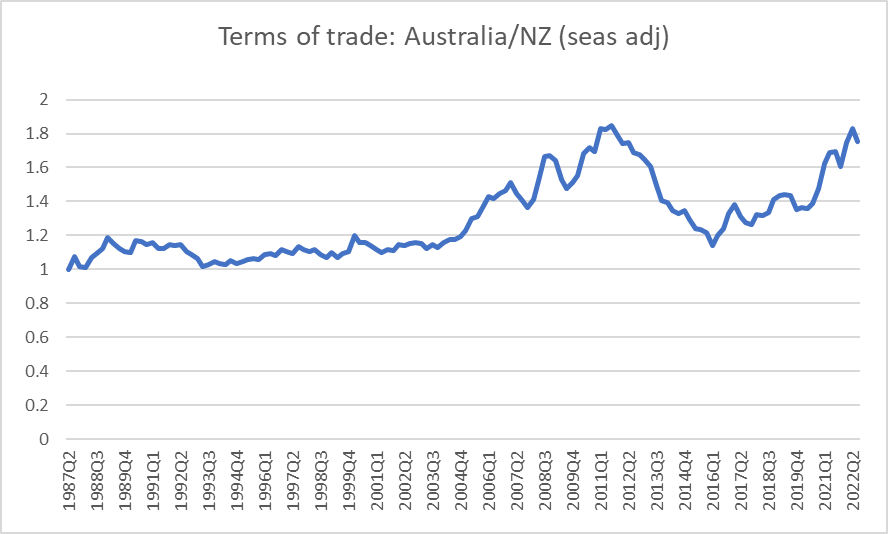
Not only are they now higher than those for New Zealand, but there is no sign they have necessarily yet peaked. It is perhaps not too surprising when the RBA was so late to start raising the policy rate – against a very similar Covid and economic backdrop to New Zealand (and a stronger terms of trade).

Reluctantly and belatedly recognising conflicts of interest

For just over six months now I’ve been on the trail of questionable appointments to the new Reserve Bank Board. Most of the Board members aren’t really fit for office in anything other than ornamental roles – this in the midst of the worst monetary policy failure in decades and the Board being responsible for key appointments and for holding the MPC to account. But my main focus has been on the appointment last October of Rodger Finlay, while he was chair of the majority owner of Kiwibank, with a lesser focus on Byron Pepper, appointed in June this year while also serving as a a director of an insurance company operating in New Zealand (the largest shareholder in which was another insurance company subject to prudential regulation by the Reserve Bank.

The Reserve Bank has spent months trying to avoid/delay answering questions about these appointments. For any first time readers, the appointments themselves are made formally by the Minister of Finance, but materials previously released make it clear that the Reserve Bank (and The Treasury) were actively involved in the selection and evaluation of candidates for Board positions (as is quite customary).

A few weeks ago, the Bank gave me Hobson’s choice. Either face the likelihood of them declining the entire OIA request I had had with them (with the chance that one day, a year or two hence, the Ombudsman might make them give me more) or accept something of a black-box offer.

I took the offer. Yesterday I received their response.

RB pseudo OIA response re Finlay and Pepper Dec 2022

As I will lay out, there is some interesting material included, but as I had half-expected it is a pretty cagey and dishonest effort, since it includes nothing at all about how conflicts of interests had or had not been handled in the selection, interview, and evaluation process prior to the appointments being made.

Taking Pepper first, the documented provided is a four page letter dated 27 July 2022 (a month after Pepper’s appointment had been announced) to Pepper from Neil Quigley, the chair of the Board. In that letter, which addresses advice from both internal and external legal counsel, Quigley acknowledge that Pepper himself had been entirely upfront

I acknowledge that you have pro-active and transparent in declaring the above interests in each of your pre-appointment discussions with RBNZ board members and senior executives of The Treasury, and that you subsequently confirmed these in your pre-appointment interests disclosure to RBNZ staff.

But…

The RBNZ is …. under constant scrutiny from both its regulated institutions, market participants and interested members of the public as a whole. The RBNZ is also subject to the Official Information Act, and more generally as a public institution has an obligation to respond in good faith, and within the limits of privacy and commercial sensitivity, provide good faith responses to
questions and enquiries received. As a result, the RBNZ needs to set the highest standards, and take appropriately conservative approaches to the management of interests and the avoidance of both actual and perceived conflicts of interest, as both Mr McBride and Mr Wallis point out in their advice to me. This also means that the RBNZ needs to avoid complexity and opaqueness in managing in the interests of Board members, because these are challenging to explain to journalists and to the
public.

and “the legal position will not stop interested members of the public from asking us how we manage the situation”.

Quigley (no doubt here also by this time reflecting the stance of the Governor) writes

Pepper then chose to give up the insurance company directorship (he could presumably instead have resigned the Reserve Bank directorship).

A few quick points:

  • one might have some sympathy with Pepper himself. He appears to have hidden nothing, and the Reserve Bank Board role was the first government appointment he appears to have received.   A really strong ethical perspective should probably have had him recognising from the start that it was going to be a dreadful look to be both an insurance regulator (director thereof) and director of an insurance company operating in New Zealand (even one not directly regulated by the Bank), but (a) he’d been open, and (b) had got through the recruitments consultants the government was using, discussions with senior RB and Treasury figures, and Cabinet.
  • did Neil Quigley (and Orr and the rest) not appreciate previously that appointees to the new, much more powerful, Reserve Bank Board were going to receive scrutiny, and that actual, potential or perceived conflicts of interest would inevitably be a major focus for a Board responsible for prudential regulatory policy across banking, non-bank deposit-taking, payments systems, and insurance?  If not, why not?
  • even at the late date of the letter, Quigley seems to regard the problem as being as much the OIA rather than the importance of appointments to powerful regulatory agency bodies being above reproach or ethical question.  In fact, it is blindingly clear that Quigley, Orr and the rest of them approached Board appointments only with the narrowest legal constraints in mind.  If, as the law was written, the Pepper (or Finlay) appointments were not illegal (and they weren’t) there could be no problem. Astonishingly, in both cases The Treasury –  much more experienced in making and advising on government board appointments generally – seems to have gone along (as did the Minister of Finance and his colleagues).  It is a poor reflection on all involved.

And that is all I want to say about Pepper. In the end, the right thing seems to have been done, but only after public and media scrutiny and criticism.  Recall that a few years ago Orr got on his high horse about “culture and conduct” in the financial sector: we really should have been able to expect a much higher pro-active standard around key appointments than was evident here, and as so often concerns brought to light on the things we the public get to see leave one wondering about the standards the Bank and Board chair apply in areas we don’t easily get to see. 

What of the Finlay issues?

What has been released (link above) is a three-page summary, apparently prepared by the Bank’s in-house lawyer summarising various selected bits of correspondence relevant to the handling of Finlay’s conflicts of interest but only from the time his appointment to the Reserve Bank Board, from 1 July 2022, was announced in October 2021 (plus some editorial spin intended to try to shape the interpretation drawn by readers).  Between those two dates Finlay was paid to serve on the “transition board” handling the establishment of the new governance regime, but previous OIAs have disclosed that he also routinely attended meetings of the then-official Reserve Bank Board during this period.  My OIA request had explicitly covered a period starting on 1 April 2021, shortly before the public advertisements had appeared for positions on the new Reserve Bank Board, and it is telling that the Bank has chosen to release nothing from the selection and evaluation period.

Were this Reserve Bank document to be the only material we had, it might appear that everyone had acted honourably and appropriately in a slightly difficult time (what with secret discussions around the future ownership of Kiwibank going on in the background that very few people –  Treasury, Bank or even Ministers –  could reasonably be made aware of).

Thus

  • on 18 October 2021 we are told that Rodger Finlay “had outlined all interests that might potentially be relevant. In particular, he declared interest [in] (as a director of) NZ Post and Ngai Tahu holdings.” (this latter, which I have not focused on relates to the substantial – but not controlling – stake Ngai Tahu was taking in an insurance company that is subject to Reserve Bank prudential supervision)
  • on 20 October, the Governor asked about commitments Finlay had made about “management of conflicts of interest”, with Quigley weighing in that the Bank needed to “remain conservative on this front and maintain a very low risk appetite, particularly regarding Kiwibank”
  • on 17 November, a couple of senior Bank staff met Finlay who “outlined how particular interests could be eliminated before 1 July 2022 [presumably a first reference to the prospect of changed Kiwibank ownership] and how any COIs that could not be eliminated could be managed post 1 July 2022”
  • on 23 November, the Governor noted that “Kiwibank’s ownership structure would be resolved by July 2022….The Governor sought more information on how any conflicts through Ngai Tahu Holdings could be managed”.  Quigley responded “noting that it is important to avoid or resolve perceived COIs as it is to avoid or resolve actual COIs”, noting that he would discuss the Nagi Tahu situation further with Finlay, but “expected NZ Post will resolve itself by July 2022”.
  • on 17 March 2022, Finlay emailed the chair and Governor indicating he had been advised that NZ Post’s divestment from Kiwibank would be complete before 1 July 2022, and that he was no longer chair of the Ngai Tahu Holdings Audit Committee.

In the editorial at the end of the document this appears

finlay dec 22

(That final paragraph is not very satisfactory, since my OIA request had been explicitly about conflicts of interest generally, and not just the Kiwibank case, although it is slightly encouraging that the Bank has at least been cognisant of the conflict, even if it is not dealt with at all adequately by the restriction mentioned, since it seems Finlay is free to participate in discussions and votes on policy matters that affect a regulated company he has a significant interest in, as director of a significant shareholder.)

All that might sound fairly exculpatory for the Bank (perhaps especially Quigley, who seems to have been more concerned than management) and for Finlay – all honourable people acting in an honourable and above-board way, and all that.

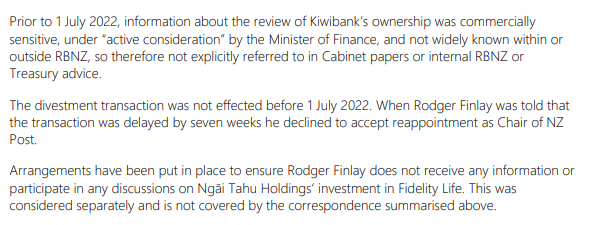
Except that (a) not only does none of this cover the period before Finlay was appointed, but (b) what little the Bank released is far from all we now know about what went on.  I’ve written various posts on various material Treasury and the Minister of Finance have released.  Of particular interest is the “incident report” prepared over the signature of Treasury deputy secretary Leilani Frew. You will recall that the Secretary to the Treasury had had to apologise in writing to the Minister of Finance in late June for the failure of Treasury staff to ensure that Finlay’s conflicts re Kiwibank were disclosed in key papers to the Minister and to Cabinet.   The “incident report“, which I wrote about here, had been requested by the Secretary, to identify what went wrong and what lessons there were for the future.  Since it wasn’t written for publication, and The Treasury had by this time already owned up to an error, and since it covers the full period, it should be treated as a much more reliable and complete account than what the Bank has now selectively released.

Of direct relevance

Conflicts of interest were closely considered throughout this process. G & A Manager Gael Webster sought statement of conflict protocols from the Chair of the RB board, set up the process for the appointment of Transition board members and the new board, and contracted Kerridge & Partners to run the recruitment process, initially for the Transition board.

Kerridge met with the Treasury and RB Governor where conflicts were discussed, and Kerridge was provided with the Bank’s conflict protocols.

We also already knew, and the incident report confirms, that Finlay himself disclosed no possible conflicts to the consultants or the interview panel (not Kiwibank, not Ngai Tahu).

The report goes on

The due diligence interview with Mr Finlay proceeded with a panel comprising Sir Brian Roche as chair, Neil Quigley and Tania Simpson from the current RB board, Caralee McLeish, Wayne Byres (chair of the Australian Prudential Regulation Authority), and Murray Costello. The panel knew that Mr Finlay was chair of NZ Post which owned a majority share in Kiwi Group Holdings Ltd, which in turn owned Kiwibank, which is subject to regulation by the RB.

Sir Brian recalls conflicts being discussed but it was considered Mr Finlay was not conflicted. The RB’s Conflict of Interest policy stated that Mr Finlay would have a conflict that should be declared if he was a director of Kiwi Group Holdings Ltd, or a director of its subsidiary banking company Kiwibank Ltd. Neither of those situations existed and Mr Finlay is completely removed from the governance and operations of Kiwibank.

This reflects poorly on every single one of these people. There is no sign any of them were yet aware of the Ngai Tahu issue (which, see above, the Bank itself now appears to regard as a real conflict) but as regards Kiwibank they seem to have been driven by a narrow and legalistic interpretation – that can only have come from the Reserve bank side – that whatever was not illegal was therefore entirely proper and unproblematic).

Now, quite possibly – we don’t know – discussions around the future ownership of Kiwibank were already underway by mid last year (when the interview and evaluation were going on), but we know that The Treasury staff dealing with this appointment were not aware of that project until March/April this year, it seems unlikely the matter would have been disclosed to a foreign regulator (Byres, Kiwibank having no Australian presence), there is no sign Roche was aware (or surely he would have mentioned it as a consideration when asked in June/July 2022 by people who themselves were now aware), and even if Quigley was aware there is no obvious reason Simpson should have been advised (the old RB Board being purely advisory on policy matters). It seems quite safe to conclude that judgements – in which the Reserve Bank shared – about Finlay’s acceptability for the Reserve Bank Board role were made in the expectation that he would continue to be NZ Post chair and that NZ Post would continue to own the majority of Kiwibank. And it is just inconceivable how they – and especially the RB people, who should have been most concerned with, and conscious of, appearance risk – thought it was okay.

(In the material the Bank released there is an attempt to minimise Finlay’s role at Post and Post’s role re Kiwibank, but none of it changes the fundamental fact that Reserve Bank policy decisions would potentially severely affect the operations and fortunes of an entity NZ Post, chaired by Finlay, majority owned.)

The “we all knew what we were doing and there was never going to be a problem because the Kiwibank ownership would be resolved before 1 July 2022” line just does not wash. A much more compelling story is that all involved were running with narrow legalistic interpretations – it was lawful, therefore just fine – and had lost any sense of the big picture around integrity and appearances of integrity. For some reasons – not really clear, although I’ve heard suggestions they are similar personalities – Orr wanted Finlay and nothing was going to stand in the way.

The story the Bank now spins about how “we were all doing the right thing but just couldn’t write it down, even in Cabinet papers” doesn’t stack up for a moment:

  • it is entirely inconsistent with the fact of the Secretary to the Treasury’s written apology
  • it is inconsistent with the account of that interview panel (and of Finlay’s non-disclosure of any conflicts)
  • it is inconsistent with the twin facts that (a) the Minister of Finance had to consult with Opposition parties on the appointment and b) that the appointment was disclosed on the RB website by the end of 2021 (even if no one much noticed then).  Had the true story really been “oh, we’ll have changed the ownership of Kiwibank by 30/6/22 so that NZ Post won’t own it by then” the commerical-in-confidence story would have prevented them giving an honest answer to any Opposition party that had been on the ball and asked about apparent conflicts, or the people like me and the journalists who wrote about the issue if we had picked it up earlier. 
  • there is no sign in any of the papers released of the Bank raising any concerns late in the piece as it became clear that the Kiwibank ownership situation would not be sorted out by 30 June 2022 (no sign eg of them urging the Minister to get Finlay to take leave of absence from the RB Board until it was sorted out).  All the signs are that they just did not care very much, if at all. It wasn’t unlawful, and if it wasn’t ideal it was still okay.  If there is evidence that this is not the correct interpretation they could readily have released it.

No, the decision to appoint Finlay back in October 2021 was clearly taken on the narrow basis that the law did not prevent Finlay being appointed even if he chaired the majority owner of Kiwibank.  And that reflects very poorly on everyone involved –  Orr, Quigley, Byres, Treasury and the Minister of Finance (and his colleagues).    It would not have happened in any moderately well-governed country, but it happened here, made worse by the refusal of the Reserve Bank (Governor and chair) to take any responsibility for an egregious misjudgment, the sort of defensiveness that feeds the slow corruption of the state.

Suppose that Finlay was really appeared like a potential star catch as a potential Reserve Bank Board member (not clear why he might but just suppose).  Suppose too that you (Governor, Minister, Board chair, Secretary to the Treasury) knew that negotiations were getting underway to get Kiwibank out from under NZ Post, and you thought those would be likely to be sorted out by mid 2022.  It would have been easy enough, and entirely proper, to have made an in-principle decision to appoint Finlay but to delay any consultation with the Opposition and any announcement until the conflict –  real and substantial –  was removed.  Perhaps that might have meant Finlay taking up his appointment at the Reserve Bank on 1 September rather than 1 July, and his services –  just another professional company director (as Treasury notes in that report “there were other candidates the Minister could have considered for the Reserve Bank”) – wouldn’t have been available to the Governor during the transition period.  It would have been a perfectly right and proper thing to have done.  But Orr –  and apparently Quigley, MacLeish, and Robertson –  just didn’t care.  In Orr’s case, still doesn’t it seems.  As so often with him, responsibility, contrition, and doing the honourable thing (doing, and being seen to do) count for little or nothing.  There are no standards, just the bare minimum of (inadequate) legal restrictions, and whatever he can get away with.

UPDATE 23/12:  The Bank has chosen very consciously to play silly games and to deliberately not provide any material re Finlay for the period prior to mid-October 2021, the period in which the selection, evaluation, assessment and recommendations to the Minister of potential candidates was taking place.  It is clearly the period they don’t want light shed on, and as would have been very clear from my earlier writings it was a period of considerable interest to me (and was explicitly covered in my original requests).  Accordingly, I have lodged a new request with the Bank for all material relevant to the selection, evaluation etc of Finlay and Pepper, for the periods up to mid-October 2021 in Finlay’s case and up to 30 June 2022 in Pepper’s case.  

For those interested in reading further, Jenee Tibshraeny had an article in the Herald this morning prompted by the OIA material in this post. including a brief and unconvincing comment from Finlay (the first we’ve heard from him I think).

NZ and Australia

In a couple of weeks it will be 2023. And then in a couple of years it will be 2025.

Those with longish geeky memories may recall that there was once talk of closing the gap between New Zealand and Australian incomes/productivity by 2025. Without any great enthusiasm no doubt, the incoming National government led by John Key agreed to ACT’s request for a (time and resource-limited) official 2025 Taskforce that would offer some analysis and advice on what it would take to achieve such a goal. The Taskforce’s first report had been dismissed by the Prime Minister before it was even released and after the second report the Taskforce was quietly disbanded. I held the pen on the first report and had some input on the second one (itself written by the current chair of the Reserve Bank Board), and since the reports were written when my kids were very young and I still held some vague hope that they might grow up into a first world country that goal of catching Australia has stayed with me, as has the disillusionment with our political and bureaucratic classes who, no doubt comfortable themselves, seem to have lost all interest. It need hardly be repeated – I’ve made the point often enough – that, despite all its mineral riches, Australia is not a stellar productivity performer, so aiming to catch them was hardly reaching for the stars.

My preferred summary metric for such comparisons is real GDP per hour worked. It isn’t the only meaningful national accounts measure but (for example) it isn’t thrown around by the vagaries of commodity price (terms of trade) fluctuations which, especially in economies like ours, are exogenous variables our governments can’t do a lot about. In 2007, just prior to the last recession, OECD estimates have Australian real GDP per hour worked about 23 per cent higher than that in New Zealand.

What has happened since? On that same (annual) OECD metric the gap last year was about 31 per cent.

The ABS produces an official quarterly series of real GDP per hour worked. SNZ does not, but it does publish two measures of real GDP (production and expenditure) and both the HLFS hours worked series and the QES hours paid series. Over time the various possible New Zealand productivity growth measures tend to converge (as they should), but at any point in time the estimates for the most recent few years can and often do diverge quite substantially. Here is a chart with the most recent data.

Covid has probably only compounded the situation, both because measuring what actually happened to GDP over the disrupted last three years is more than usually challenging and because hours worked and hours paid series will have diverged in ways that make sense but hadn’t really been anticipated. In doing charts like this I used to simply work on the basis that the two were just roughly the same thing, each measured noisily and so averages would usually be the least bad way to go. But then governments compelled people to stay at home (often not able to work) and yet funded employers to enable them to be paid. Hours paid held up in lockdowns even as hours worked fell away. More recently of course there is a lot more sickness than usual – for much of which people will have been paid, but may not have worked.

I still don’t have any particular reason to favour one GDP measure over the other, but the HLFS hours actually worked (self-reported) seems a better denominator for labour productivity estimates at present. Here is that line, together with the official Australian series.

And here is the same chart just for the Covid period

The New Zealand series is much more volatile, but count me a bit sceptical for both countries. Go back one chart and it looks as if productivity growth in both countries has been faster during the Covid period than in the previous half-dozen years, and that doesn’t make a lot of sense. There are plenty of puzzles about how the economy has performed over the last three years – starting with what everyone missed and got wrong on inflation – but if “true” labour productivity growth really accelerated over the Covid period that should spark a lot of future research papers.

I remember back in 2020 people suggesting that (eg) that lift in reported productivity in Australia in June 2020 might have been because (eg) the shock to tourism saw a lot of very low wage workers not working, so simply averaging up productivity for the rest. But a couple of years on both countries have very high labour force participation rates and very low unemployment rates (relative to history Australia even more so than New Zealand). And we’ve had huge (probably largely inevitable) policy and virus uncertainty, and it isn’t many years since economics commentary used to full of talk of the damage that increased (policy) uncertainty would cause. And when supply chains have been disrupted, and people haven’t been able to foster face-to-face connections globally, it isn’t usually a climate considered most conducive to productivity growth. It isn’t as if productivity growth in these estimates has been stellar, but it is a bit puzzling. Perhaps where we are now the numbers are just flattered by overheated economies. Perhaps it will all end revised a way anyway, but for now at least (a) both countries have had a bit more productivity growth in the data that might have been expected, and (b) over the Covid period, the gap between New Zealand and Australia does not appear to have gotten any wider.

As I noted earlier, for commodity exporting countries, fluctuations in the terms of trade are largely exogenous. But, unfortunately for New Zealanders, whether one starts one’s comparison 15 years ago just before the last big recession or focuses just on the last couple of years, Australia’s terms of trade has performed better than New Zealand’s.

Indications from the Australian government that it is going to make it easier for New Zealanders to move to Australia is great for young New Zealanders, opening up higher income opportunities that have been harder to access in recent years. It isn’t so good for a community of people who choose to dwell in these islands. But there is no sign either main political party actually cares enough to think hard about overhauling policy here in a way that might one day mean New Zealand might offer the world-matching living standards it did not that many decades ago.

At it again

At last year’s Annual Review hearing at the Finance and Expenditure Committee the Reserve Bank Governor was shown to have misled (presumably deliberately) Parliament twice. Last month he was at it again with the preposterous claim to FEC that the Bank would have to have been able to forecast back in 2020 the Ukraine invasion for inflation now to have been in the target range. It was just made up – quite probably on the spur of the moment – and of course they’ve never produced any later analysis to support the claim (despite an MPS and the five-yearly review of monetary policy in the following weeks).

On Wednesday afternoon the Bank was back for this year’s Annual Review hearing. It was the last day of term for Parliament, and there was quite a feel to it in the rather desultory scatter-gun approach to the questioning from the Opposition. You wouldn’t know that the two Opposition parties had just openly objected to the Governor’s reappointment to a new five year term.

But MPs – and the viewing public – were still subject to more of Orr being anything other than straightforward, open, and accountable. More spin, usually irrelevant and sometimes simply dishonest.

The meeting opened with Orr apologising that the Board chairman was absent. Apparently he had some function to attend in his fulltime executive job, but you might have thought that when you were the chair of the Board through a year when inflation went so badly off the rails, and still chair now when the Bank is averring that a recession will be needed to get things back under control, you might have made it a priority to turn up for Parliament’s annual scrutiny of the Bank’s performance. And if your day job commitment was really that pressing you might have sent along a deputy. Whether prior to 1 July (the year actually under review) or since the Board was explicitly charged with holding the Governor and MPC to account. and the Board controls all the nominations for (re)appointments. The Board was, after all, complicit in barring people with actual relevant expertise from serving as external MPC members.

No doubt the failure of anyone from the Board to show up just speaks to how – whatever it says on paper – the Bank is still a totally management (Orr) dominated place.

Then there was Orr’s transparent attempt to talk out the clock, reducing available question time with a long opening statement (with not even a hint of contrition over the Bank’s monetary policy failures). Mercifully, the committee chair eventually told him to cut it short.

If the Opposition’s questioning was never very focused or sustained, to his credit National’s Andrew Bayly did attempt a question about the appointment of Rodger Finlay – then chair of NZ Post, majority owner of Kiwibank, subject to Reserve Bank prudential regulation – to the “transition board” as part of the move to the new governance model from 1 July this year. As regular readers will know, the Reserve Bank has been doing everything possible to avoid giving straight answers on the Finlay matter, and Orr was at it again on Wednesday. First, he attempted to deflect responsibility to the Minister of Finance as the person who finally makes Board appointments (even though documents the Minister and The Treasury have already released make it clear that management and the previous Board were actively involved in the selection of people to recommend for the new Board) and then he fell back on the twin claim that there was no conflict of interest as regards the “transition board” (which had no formal powers) and that if there were any conflicts they had been removed by the time Finlay was on the Board itself.

There was no follow-up from Bayly, who could and should have made the point that when Finlay was appointed to the “transition board”, in October 2021, he was also appointed to the full Reserve Bank Board from 1 July 2022, and at that time – indeed right up to mid-June this year when Cabinet was considering his reappointment to the NZ Post role – there had been no suggestion that Finlay would not remain in his NZ Post role while serving on the Reserve Bank Board which would be directly responsible for prudential regulation. Indeed, documents already released reveal that the Bank had told The Treasury and the Minister that they had no concerns about this. It was an egregious appointment, inconceivable in any well-governed country, and yet the Opposition did not pursue the matter and the Governor – the one who likes to boast of his “open and transparent” institution – makes no effort to honestly account for his part in this highly dubious appointment.

If Orr was put under no pressure on the Finlay matter, on monetary policy and related issues he had a clear field. There were no questions at all – nothing for example about the Annual Report (the basis for the hearing) in which climate change featured dozens of times and the inflation outcomes – well outside the target range, on core metrics – got hardly any attention. No suggestion that a simple apology from the Governor and MPC might be in order – not one of those faux ones regretting the shocks the New Zealand economy was now exposed to. It was after all these people who voluntarily took on the role (and pay and prestige) of macro stabilisation and, on this occasion and perhaps with the best will in the world, failed. Just nothing.

And so the field was left to Orr. In his opening remarks we had this

Which is just spin. He seems to want to claim credit for New Zealand’s low unemployment rate even though (a) as he often and rightly points out the Reserve Bank has no influence on the average rate of unemployment or the NAIRU (which are functions of structural policy), and (b) the extremely overheated labour market and unsustainably low unemployment rate are a big part of our current excessively high core inflation problem. In the end, aggregate excess demand is the fault of the Reserve Bank. not something they should be claiming as a “good thing”, let alone seeking credit for. (In their better moments – eg the MPS – they know this, talking about the labour market being unsustainably overheated, but then Orr’s spin inclinations take hold). At the peaks of booms, unemployment is always cyclically low (or very low). But often what matters is what needs to be done to get inflation back in check.

And what about that claim on inflation? Well, if he wants to simply say the New Zealand is fortunate not to be integrated to the global gas and LNG market that is fine, but it is a complete distraction from a central bank that is responsible primarily for core inflation in New Zealand. On core inflation – in this case, because it is available and comparable, CPI inflation ex food and energy – for the year to September (latest NZ data) we are no better than the middle of the pack.

An honest central bank Governor, committed to serious scrutiny, might better say that we are in a quite unfortunate situation, for which the Reserve Bank itself has to take much of the responsibility. Instead we get more spin

“Even with the expected slowdown in the period ahead, it is anticipated that the level of employment will remain high.”

which is no doubt true, but the Bank’s own forecast is for a sharp rise in the rate of unemployment.

But Orr is more in the realm of minimising (his) responsibility. In recent months we’ve had the absurd and unsupported claim that without the war inflation would have been in the target range. We’ve also had the suggestion – heard a couple of times from his chief economist – that perhaps half the inflation is overseas-sourced. This claim also appears to be undocumented, and simply doesn’t stack up: core inflation is the Bank’s responsibility, the New Zealand domestic economy is badly overheated, and the whole point of floating the exchange rate decades ago was so that even if other countries had increases in their core inflation rates, New Zealand did not need to suffer that inflation. We had our own independent monetary policy, and a central bank responsible for New Zealand core inflation outcomes.

To FEC, Orr ran this claim

It is certainly true that if the Bank had begun to raise the OCR a little earlier in 2021, it would not have made that much difference to inflation (core or headline) now. 25 basis points in each of May and July 2021 might together have lowered headline inflation by September 2022 by half a percent at most. But in this framing – also in their recent Review – there are two elements that are little better than dishonest. Purely with the benefit of hindsight (their own criterion) it is now clear that monetary policy should not have been eased at all in 2020, and that monetary policy should have been run much tighter over the period since then. Had that been done, core inflation would have stayed inside the target range. Now that might be an impossible standard, but that is simply to point out what I noted in my post on the Review was the major weakness: there was just no sign the Bank or MPC had devoted any serious thought or research to trying to understand what they (and everyone else) missed in 2020 and 2021. But they were responsible.

And then there is the continual effort to blame food and energy price shocks, in a way that simply flies in the face of the data. Headline inflation is the year to September was 7.2 per cent. Excluding food and energy, it was 6.2 per cent. 6.2 per cent is a long long way above the top of the Bank’s target rage – more than 4 percentage points above the target midpoint the Minister of Finace requires them to focus on.

And as I pointed out in a post debunking the “war is to blame” claim, core inflation was very high, the labour market well overheated, before the war.

Oh, and Orr was at it again with his claim – apparently intended as a defence – that

I’ve shown before that 7 OECD central banks (out of 20 or so) had started raising their policy interest rates before the Reserve Bank of New Zealand (Orr seems to want to claim credit for stopping the LSAP but (a) he has claimed that by 2021 it wasn’t having much effect anyway and b) the Funding for Lending programme carried on all the way to this month). And since each central bank is responsible for its own country’s (core) inflation, a simple ranking of who moved when reveals precisely nothing. As early as the end of 2020, only 8 OECD central banks were experiencing annual core inflation (ex food and energy) higher than New Zealand (quite a few with higher inflation targets than New Zealand, including chaotic Turkey). By mid 2021, there were only 7 central banks with higher core inflation than New Zealand (mostly the countries that began raising policy interest rates earlier than New Zealand). New Zealand’s core inflation then was already materially higher than that in Australia, Canada, the UK, and the euro area (but behind the US, and I find the Fed’s approach to monetary policy last year quite impossible to defend).

Overall it is hard to find any OECD central banks that have done a good job over the last couple of years (the central bank of Korea looks like one candidate for a fairly good rating). It is quite possible – current core inflation might suggest it – that the Reserve Bank of New Zealand has done no worse than average. But that isn’t ever the spin we get from the Governor, for whom responsibility let alone contrition seem like words from a foreign language for which no dictionary was available. No one is suggesting the last 3 years have been other than hard and challenging for central banks, but that is nothing to what they are proving for the people who have suffered – and will suffer over the next year or two – from their misjudgments, well-intentioned as they may well have been.

Orr’s behaviour has been given licence by the Minister of Finance – reappointing him despite his poor record on multiple counts. But it would have been nice if Parliament’s Finance and Expenditure Committee had ever shown a bit more vigour and focus in holding the feet of the Governor and his colleagues to the fire, instead of all wishing each other Merry Christmas and heading off for the holidays.

Dipping into the HYEFU

Just a few things caught my eye flicking through yesterday’s HYEFU summary tables – if you don’t count points like the fact that The Treasury projects we will have had five successive years of operating deficits (in a period of a high terms of trade and an overheated economy), and that net debt as a per cent of GDP (even excluding NZSF) is still increasing, notwithstanding the big inflation surprise the government has benefited (materially) from.

This chart captures one of the things that surprised me. It shows export volumes and real GDP, actual and Treasury projections. Exports dipped sharply over the Covid period (closed borders and all that), but even by the year to June 2027 Treasury does not expect export volumes to have returned either to the pre-Covid trend, or to the relationship with real GDP growth that had prevailed over the pre-Covid decade.

The Reserve Bank does not forecast as far ahead as the Treasury but has quarterly projections for these two variables out to the end of 2025. Here is a chart of their most recent projections

It is a quite dramatically different story.

The issue is here is not so much who is right – given the vagaries of medium-term macro forecasting there is a fair chance that none of those four lines will end up closely resembling reality – as that the government’s principal macroeconomic advisers (The Treasury) have such a gloomy view on the outward orientation of the New Zealand economy. One of the hallmarks of successful economies, and especially small ones, tends to be a growing number of firms footing it successfully in the world market. Earnings from abroad, after all, underpin over time our ability to consume what the rest of the world has to offer. Quite why The Treasury is that pessimistic isn’t clear from their documents – one could guess at various possibilities in aspects of government economic policy – but it does tend to stand rather at odds with the puffery and empty rhetoric the PM and Minister of Trade are given to.

Then there was this

On Treasury forecasts the CPI in 2025 will have been 13.3 per cent higher than if the Reserve Bank had simply done its core job and delivered inflation on average at 2 per cent per annum (the Reserve Bank’s own projections are very similar). It is a staggering policy failure – especially when you recall that the Governor used to insist that public inflation expectations were securely anchored at around 2 per cent. It is an entirely arbitrary redistribution of wealth that no one voted one, few seem to comment on, and no one seems to be held to account for, even though avoiding such arbitrary redistributions (benefiting the indebted at the expense of depositors and bondholders) was a core element of the Reserve Bank’s job. We don’t – and probably shouldn’t – run price level targets, but let’s not lose sight of what policy failures of this order actually mean to individuals.

And the third line that caught my eye was this

A good question for the National Party might be to ask how much of this 3.5 percentage point increase in tax/GDP they intend to reverse, and how, or would any new National government simply be content to leave little changed what Labour has bequeathed them?

As longer-term context (slightly different measure to get back to the 70s) the only similarly large increases in tax/GDP seem to have been under the 1972-75 and 1984-90 Labour governments.