In a couple of weeks it will be 2023. And then in a couple of years it will be 2025.
Those with longish geeky memories may recall that there was once talk of closing the gap between New Zealand and Australian incomes/productivity by 2025. Without any great enthusiasm no doubt, the incoming National government led by John Key agreed to ACT’s request for a (time and resource-limited) official 2025 Taskforce that would offer some analysis and advice on what it would take to achieve such a goal. The Taskforce’s first report had been dismissed by the Prime Minister before it was even released and after the second report the Taskforce was quietly disbanded. I held the pen on the first report and had some input on the second one (itself written by the current chair of the Reserve Bank Board), and since the reports were written when my kids were very young and I still held some vague hope that they might grow up into a first world country that goal of catching Australia has stayed with me, as has the disillusionment with our political and bureaucratic classes who, no doubt comfortable themselves, seem to have lost all interest. It need hardly be repeated – I’ve made the point often enough – that, despite all its mineral riches, Australia is not a stellar productivity performer, so aiming to catch them was hardly reaching for the stars.
My preferred summary metric for such comparisons is real GDP per hour worked. It isn’t the only meaningful national accounts measure but (for example) it isn’t thrown around by the vagaries of commodity price (terms of trade) fluctuations which, especially in economies like ours, are exogenous variables our governments can’t do a lot about. In 2007, just prior to the last recession, OECD estimates have Australian real GDP per hour worked about 23 per cent higher than that in New Zealand.
What has happened since? On that same (annual) OECD metric the gap last year was about 31 per cent.
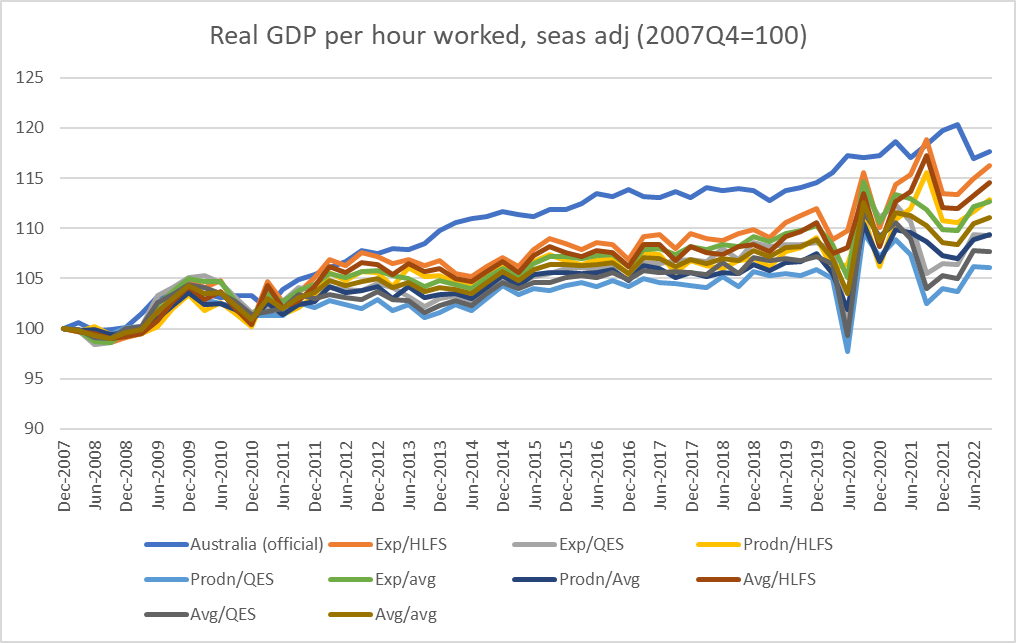
The ABS produces an official quarterly series of real GDP per hour worked. SNZ does not, but it does publish two measures of real GDP (production and expenditure) and both the HLFS hours worked series and the QES hours paid series. Over time the various possible New Zealand productivity growth measures tend to converge (as they should), but at any point in time the estimates for the most recent few years can and often do diverge quite substantially. Here is a chart with the most recent data.
Covid has probably only compounded the situation, both because measuring what actually happened to GDP over the disrupted last three years is more than usually challenging and because hours worked and hours paid series will have diverged in ways that make sense but hadn’t really been anticipated. In doing charts like this I used to simply work on the basis that the two were just roughly the same thing, each measured noisily and so averages would usually be the least bad way to go. But then governments compelled people to stay at home (often not able to work) and yet funded employers to enable them to be paid. Hours paid held up in lockdowns even as hours worked fell away. More recently of course there is a lot more sickness than usual – for much of which people will have been paid, but may not have worked.
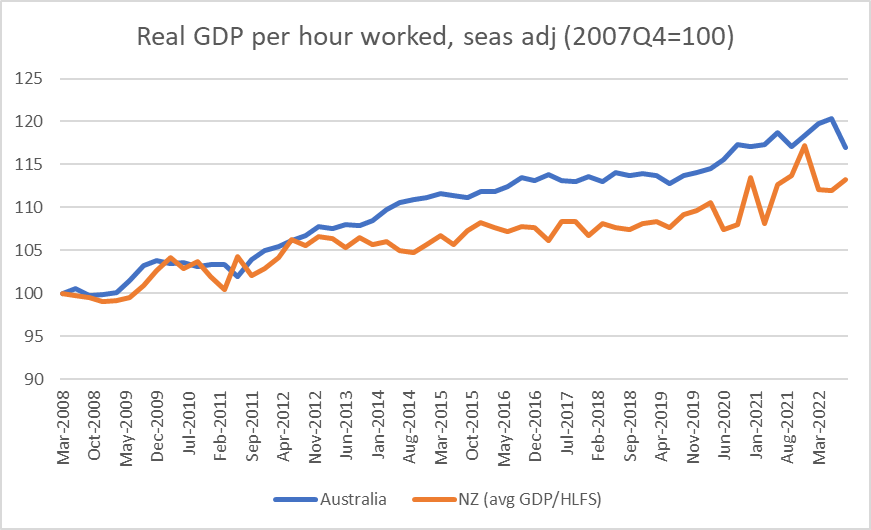
I still don’t have any particular reason to favour one GDP measure over the other, but the HLFS hours actually worked (self-reported) seems a better denominator for labour productivity estimates at present. Here is that line, together with the official Australian series.
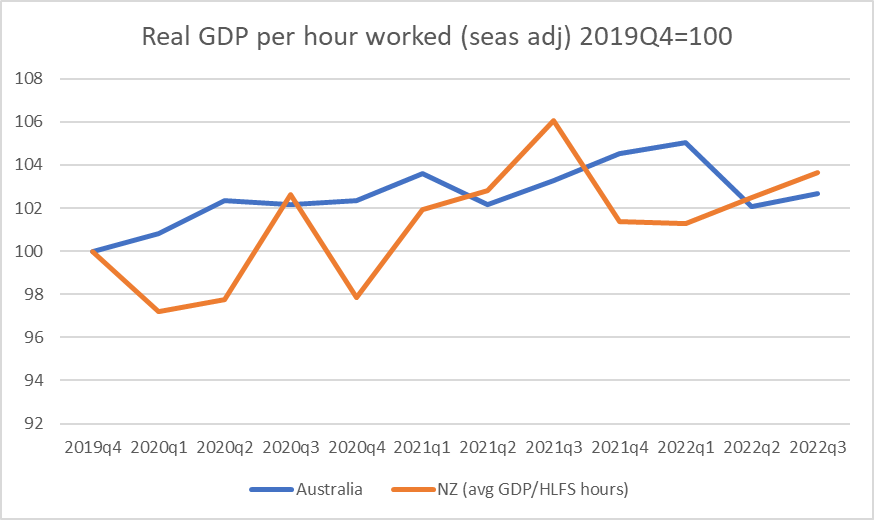
And here is the same chart just for the Covid period
The New Zealand series is much more volatile, but count me a bit sceptical for both countries. Go back one chart and it looks as if productivity growth in both countries has been faster during the Covid period than in the previous half-dozen years, and that doesn’t make a lot of sense. There are plenty of puzzles about how the economy has performed over the last three years – starting with what everyone missed and got wrong on inflation – but if “true” labour productivity growth really accelerated over the Covid period that should spark a lot of future research papers.
I remember back in 2020 people suggesting that (eg) that lift in reported productivity in Australia in June 2020 might have been because (eg) the shock to tourism saw a lot of very low wage workers not working, so simply averaging up productivity for the rest. But a couple of years on both countries have very high labour force participation rates and very low unemployment rates (relative to history Australia even more so than New Zealand). And we’ve had huge (probably largely inevitable) policy and virus uncertainty, and it isn’t many years since economics commentary used to full of talk of the damage that increased (policy) uncertainty would cause. And when supply chains have been disrupted, and people haven’t been able to foster face-to-face connections globally, it isn’t usually a climate considered most conducive to productivity growth. It isn’t as if productivity growth in these estimates has been stellar, but it is a bit puzzling. Perhaps where we are now the numbers are just flattered by overheated economies. Perhaps it will all end revised a way anyway, but for now at least (a) both countries have had a bit more productivity growth in the data that might have been expected, and (b) over the Covid period, the gap between New Zealand and Australia does not appear to have gotten any wider.
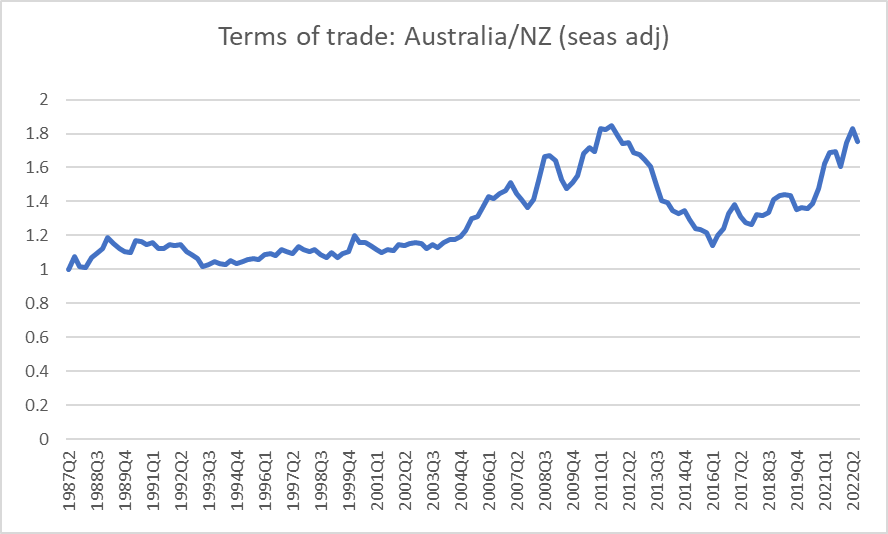
As I noted earlier, for commodity exporting countries, fluctuations in the terms of trade are largely exogenous. But, unfortunately for New Zealanders, whether one starts one’s comparison 15 years ago just before the last big recession or focuses just on the last couple of years, Australia’s terms of trade has performed better than New Zealand’s.
Indications from the Australian government that it is going to make it easier for New Zealanders to move to Australia is great for young New Zealanders, opening up higher income opportunities that have been harder to access in recent years. It isn’t so good for a community of people who choose to dwell in these islands. But there is no sign either main political party actually cares enough to think hard about overhauling policy here in a way that might one day mean New Zealand might offer the world-matching living standards it did not that many decades ago.
At last year’s Annual Review hearing at the Finance and Expenditure Committee the Reserve Bank Governor was shown to have misled (presumably deliberately) Parliament twice. Last month he was at it again with the preposterous claim to FEC that the Bank would have to have been able to forecast back in 2020 the Ukraine invasion for inflation now to have been in the target range. It was just made up – quite probably on the spur of the moment – and of course they’ve never produced any later analysis to support the claim (despite an MPS and the five-yearly review of monetary policy in the following weeks).
On Wednesday afternoon the Bank was back for this year’s Annual Review hearing. It was the last day of term for Parliament, and there was quite a feel to it in the rather desultory scatter-gun approach to the questioning from the Opposition. You wouldn’t know that the two Opposition parties had just openly objected to the Governor’s reappointment to a new five year term.
But MPs – and the viewing public – were still subject to more of Orr being anything other than straightforward, open, and accountable. More spin, usually irrelevant and sometimes simply dishonest.
The meeting opened with Orr apologising that the Board chairman was absent. Apparently he had some function to attend in his fulltime executive job, but you might have thought that when you were the chair of the Board through a year when inflation went so badly off the rails, and still chair now when the Bank is averring that a recession will be needed to get things back under control, you might have made it a priority to turn up for Parliament’s annual scrutiny of the Bank’s performance. And if your day job commitment was really that pressing you might have sent along a deputy. Whether prior to 1 July (the year actually under review) or since the Board was explicitly charged with holding the Governor and MPC to account. and the Board controls all the nominations for (re)appointments. The Board was, after all, complicit in barring people with actual relevant expertise from serving as external MPC members.
No doubt the failure of anyone from the Board to show up just speaks to how – whatever it says on paper – the Bank is still a totally management (Orr) dominated place.
Then there was Orr’s transparent attempt to talk out the clock, reducing available question time with a long opening statement (with not even a hint of contrition over the Bank’s monetary policy failures). Mercifully, the committee chair eventually told him to cut it short.
If the Opposition’s questioning was never very focused or sustained, to his credit National’s Andrew Bayly did attempt a question about the appointment of Rodger Finlay – then chair of NZ Post, majority owner of Kiwibank, subject to Reserve Bank prudential regulation – to the “transition board” as part of the move to the new governance model from 1 July this year. As regular readers will know, the Reserve Bank has been doing everything possible to avoid giving straight answers on the Finlay matter, and Orr was at it again on Wednesday. First, he attempted to deflect responsibility to the Minister of Finance as the person who finally makes Board appointments (even though documents the Minister and The Treasury have already released make it clear that management and the previous Board were actively involved in the selection of people to recommend for the new Board) and then he fell back on the twin claim that there was no conflict of interest as regards the “transition board” (which had no formal powers) and that if there were any conflicts they had been removed by the time Finlay was on the Board itself.
There was no follow-up from Bayly, who could and should have made the point that when Finlay was appointed to the “transition board”, in October 2021, he was also appointed to the full Reserve Bank Board from 1 July 2022, and at that time – indeed right up to mid-June this year when Cabinet was considering his reappointment to the NZ Post role – there had been no suggestion that Finlay would not remain in his NZ Post role while serving on the Reserve Bank Board which would be directly responsible for prudential regulation. Indeed, documents already released reveal that the Bank had told The Treasury and the Minister that they had no concerns about this. It was an egregious appointment, inconceivable in any well-governed country, and yet the Opposition did not pursue the matter and the Governor – the one who likes to boast of his “open and transparent” institution – makes no effort to honestly account for his part in this highly dubious appointment.
If Orr was put under no pressure on the Finlay matter, on monetary policy and related issues he had a clear field. There were no questions at all – nothing for example about the Annual Report (the basis for the hearing) in which climate change featured dozens of times and the inflation outcomes – well outside the target range, on core metrics – got hardly any attention. No suggestion that a simple apology from the Governor and MPC might be in order – not one of those faux ones regretting the shocks the New Zealand economy was now exposed to. It was after all these people who voluntarily took on the role (and pay and prestige) of macro stabilisation and, on this occasion and perhaps with the best will in the world, failed. Just nothing.
And so the field was left to Orr. In his opening remarks we had this
Which is just spin. He seems to want to claim credit for New Zealand’s low unemployment rate even though (a) as he often and rightly points out the Reserve Bank has no influence on the average rate of unemployment or the NAIRU (which are functions of structural policy), and (b) the extremely overheated labour market and unsustainably low unemployment rate are a big part of our current excessively high core inflation problem. In the end, aggregate excess demand is the fault of the Reserve Bank. not something they should be claiming as a “good thing”, let alone seeking credit for. (In their better moments – eg the MPS – they know this, talking about the labour market being unsustainably overheated, but then Orr’s spin inclinations take hold). At the peaks of booms, unemployment is always cyclically low (or very low). But often what matters is what needs to be done to get inflation back in check.
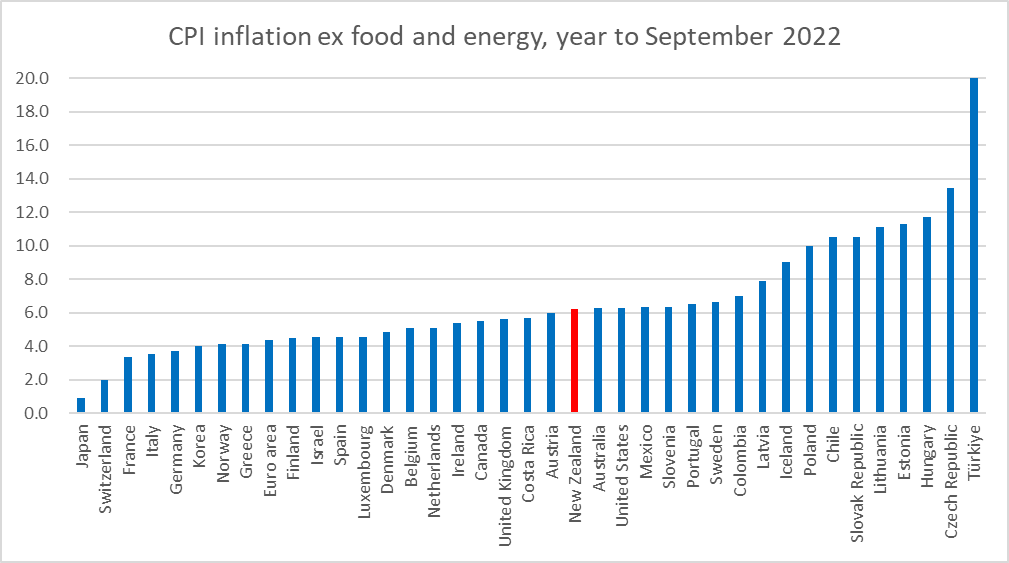
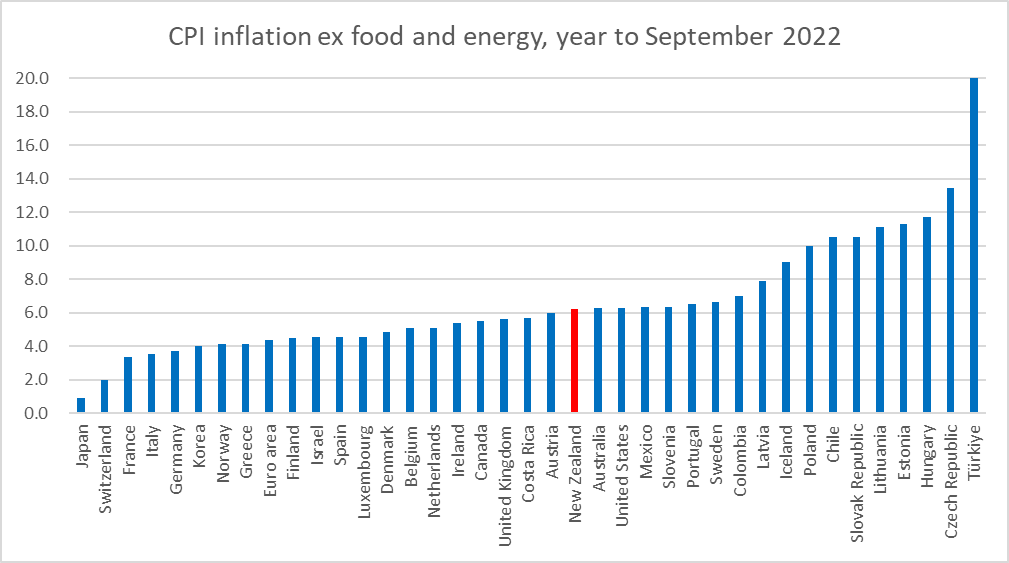
And what about that claim on inflation? Well, if he wants to simply say the New Zealand is fortunate not to be integrated to the global gas and LNG market that is fine, but it is a complete distraction from a central bank that is responsible primarily for core inflation in New Zealand. On core inflation – in this case, because it is available and comparable, CPI inflation ex food and energy – for the year to September (latest NZ data) we are no better than the middle of the pack.
An honest central bank Governor, committed to serious scrutiny, might better say that we are in a quite unfortunate situation, for which the Reserve Bank itself has to take much of the responsibility. Instead we get more spin
“Even with the expected slowdown in the period ahead, it is anticipated that the level of employment will remain high.”
which is no doubt true, but the Bank’s own forecast is for a sharp rise in the rate of unemployment.
But Orr is more in the realm of minimising (his) responsibility. In recent months we’ve had the absurd and unsupported claim that without the war inflation would have been in the target range. We’ve also had the suggestion – heard a couple of times from his chief economist – that perhaps half the inflation is overseas-sourced. This claim also appears to be undocumented, and simply doesn’t stack up: core inflation is the Bank’s responsibility, the New Zealand domestic economy is badly overheated, and the whole point of floating the exchange rate decades ago was so that even if other countries had increases in their core inflation rates, New Zealand did not need to suffer that inflation. We had our own independent monetary policy, and a central bank responsible for New Zealand core inflation outcomes.
To FEC, Orr ran this claim
It is certainly true that if the Bank had begun to raise the OCR a little earlier in 2021, it would not have made that much difference to inflation (core or headline) now. 25 basis points in each of May and July 2021 might together have lowered headline inflation by September 2022 by half a percent at most. But in this framing – also in their recent Review – there are two elements that are little better than dishonest. Purely with the benefit of hindsight (their own criterion) it is now clear that monetary policy should not have been eased at all in 2020, and that monetary policy should have been run much tighter over the period since then. Had that been done, core inflation would have stayed inside the target range. Now that might be an impossible standard, but that is simply to point out what I noted in my post on the Review was the major weakness: there was just no sign the Bank or MPC had devoted any serious thought or research to trying to understand what they (and everyone else) missed in 2020 and 2021. But they were responsible.
And then there is the continual effort to blame food and energy price shocks, in a way that simply flies in the face of the data. Headline inflation is the year to September was 7.2 per cent. Excluding food and energy, it was 6.2 per cent. 6.2 per cent is a long long way above the top of the Bank’s target rage – more than 4 percentage points above the target midpoint the Minister of Finace requires them to focus on.
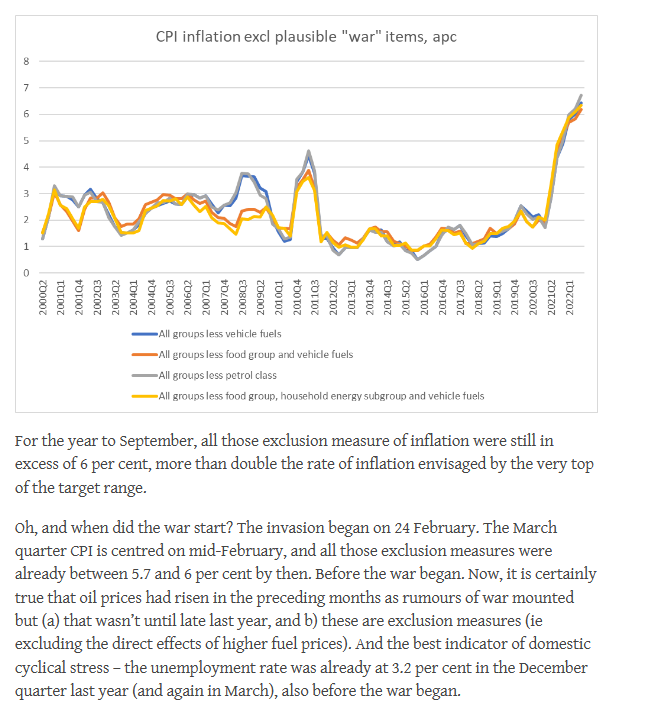
And as I pointed out in a post debunking the “war is to blame” claim, core inflation was very high, the labour market well overheated, before the war.
Oh, and Orr was at it again with his claim – apparently intended as a defence – that
I’ve shown before that 7 OECD central banks (out of 20 or so) had started raising their policy interest rates before the Reserve Bank of New Zealand (Orr seems to want to claim credit for stopping the LSAP but (a) he has claimed that by 2021 it wasn’t having much effect anyway and b) the Funding for Lending programme carried on all the way to this month). And since each central bank is responsible for its own country’s (core) inflation, a simple ranking of who moved when reveals precisely nothing. As early as the end of 2020, only 8 OECD central banks were experiencing annual core inflation (ex food and energy) higher than New Zealand (quite a few with higher inflation targets than New Zealand, including chaotic Turkey). By mid 2021, there were only 7 central banks with higher core inflation than New Zealand (mostly the countries that began raising policy interest rates earlier than New Zealand). New Zealand’s core inflation then was already materially higher than that in Australia, Canada, the UK, and the euro area (but behind the US, and I find the Fed’s approach to monetary policy last year quite impossible to defend).
Overall it is hard to find any OECD central banks that have done a good job over the last couple of years (the central bank of Korea looks like one candidate for a fairly good rating). It is quite possible – current core inflation might suggest it – that the Reserve Bank of New Zealand has done no worse than average. But that isn’t ever the spin we get from the Governor, for whom responsibility let alone contrition seem like words from a foreign language for which no dictionary was available. No one is suggesting the last 3 years have been other than hard and challenging for central banks, but that is nothing to what they are proving for the people who have suffered – and will suffer over the next year or two – from their misjudgments, well-intentioned as they may well have been.
Orr’s behaviour has been given licence by the Minister of Finance – reappointing him despite his poor record on multiple counts. But it would have been nice if Parliament’s Finance and Expenditure Committee had ever shown a bit more vigour and focus in holding the feet of the Governor and his colleagues to the fire, instead of all wishing each other Merry Christmas and heading off for the holidays.
Just a few things caught my eye flicking through yesterday’s HYEFU summary tables – if you don’t count points like the fact that The Treasury projects we will have had five successive years of operating deficits (in a period of a high terms of trade and an overheated economy), and that net debt as a per cent of GDP (even excluding NZSF) is still increasing, notwithstanding the big inflation surprise the government has benefited (materially) from.
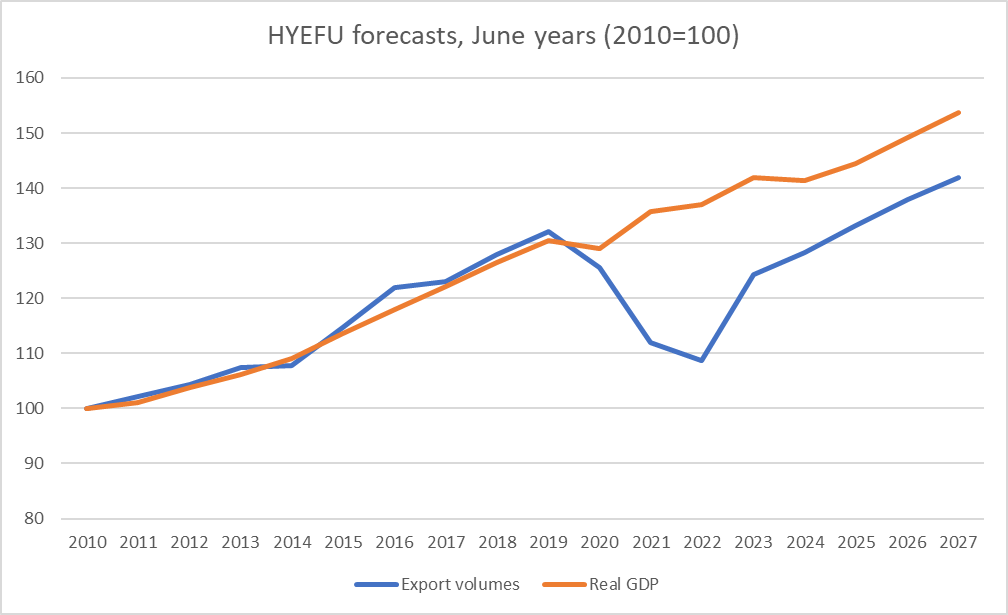
This chart captures one of the things that surprised me. It shows export volumes and real GDP, actual and Treasury projections. Exports dipped sharply over the Covid period (closed borders and all that), but even by the year to June 2027 Treasury does not expect export volumes to have returned either to the pre-Covid trend, or to the relationship with real GDP growth that had prevailed over the pre-Covid decade.
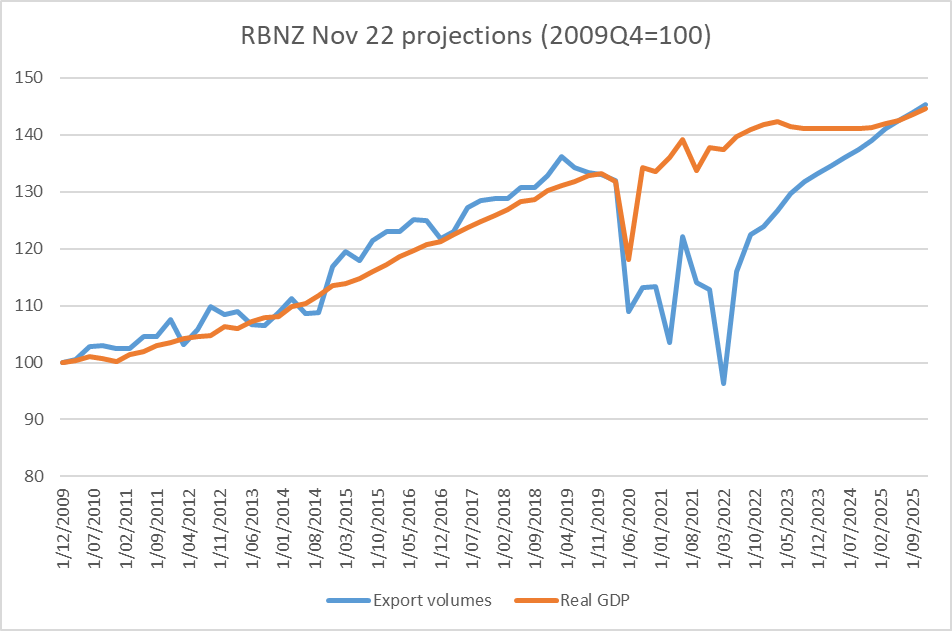
The Reserve Bank does not forecast as far ahead as the Treasury but has quarterly projections for these two variables out to the end of 2025. Here is a chart of their most recent projections
It is a quite dramatically different story.
The issue is here is not so much who is right – given the vagaries of medium-term macro forecasting there is a fair chance that none of those four lines will end up closely resembling reality – as that the government’s principal macroeconomic advisers (The Treasury) have such a gloomy view on the outward orientation of the New Zealand economy. One of the hallmarks of successful economies, and especially small ones, tends to be a growing number of firms footing it successfully in the world market. Earnings from abroad, after all, underpin over time our ability to consume what the rest of the world has to offer. Quite why The Treasury is that pessimistic isn’t clear from their documents – one could guess at various possibilities in aspects of government economic policy – but it does tend to stand rather at odds with the puffery and empty rhetoric the PM and Minister of Trade are given to.
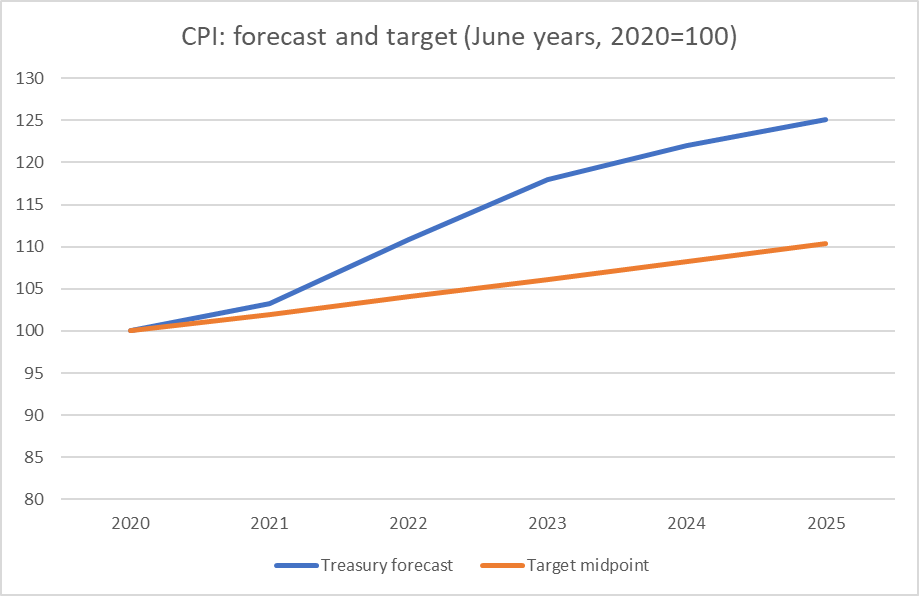
Then there was this
On Treasury forecasts the CPI in 2025 will have been 13.3 per cent higher than if the Reserve Bank had simply done its core job and delivered inflation on average at 2 per cent per annum (the Reserve Bank’s own projections are very similar). It is a staggering policy failure – especially when you recall that the Governor used to insist that public inflation expectations were securely anchored at around 2 per cent. It is an entirely arbitrary redistribution of wealth that no one voted one, few seem to comment on, and no one seems to be held to account for, even though avoiding such arbitrary redistributions (benefiting the indebted at the expense of depositors and bondholders) was a core element of the Reserve Bank’s job. We don’t – and probably shouldn’t – run price level targets, but let’s not lose sight of what policy failures of this order actually mean to individuals.
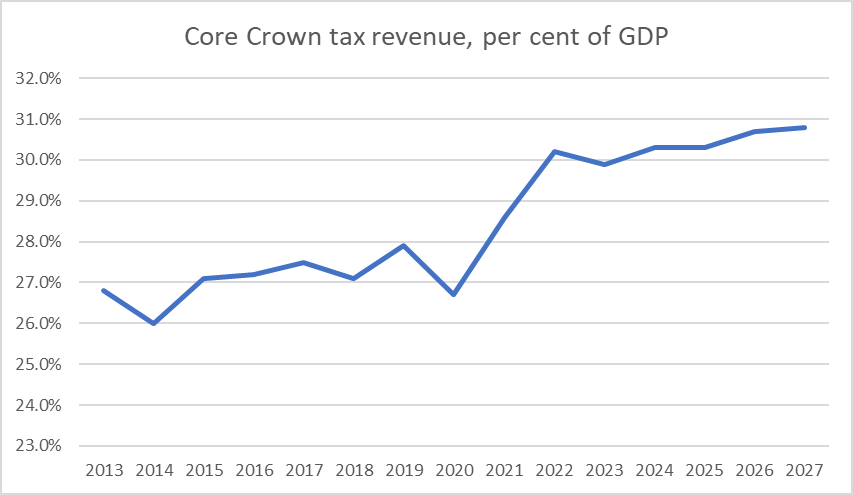
And the third line that caught my eye was this
A good question for the National Party might be to ask how much of this 3.5 percentage point increase in tax/GDP they intend to reverse, and how, or would any new National government simply be content to leave little changed what Labour has bequeathed them?
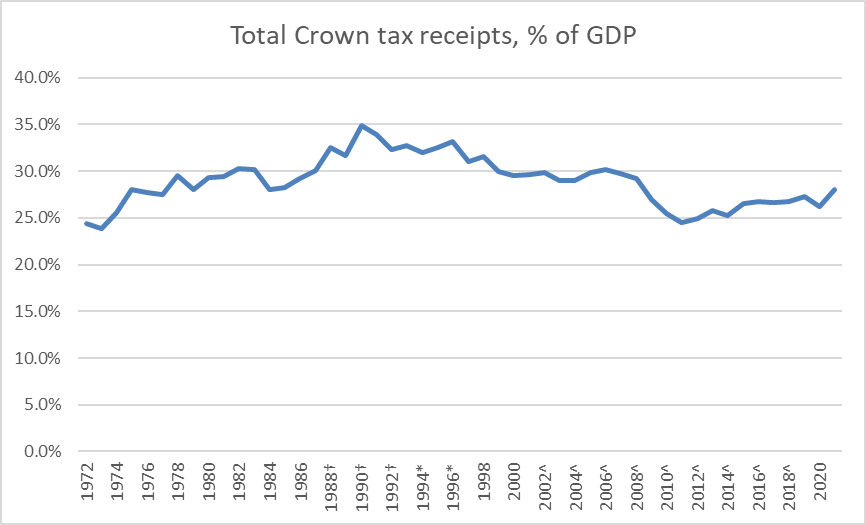
As longer-term context (slightly different measure to get back to the 70s) the only similarly large increases in tax/GDP seem to have been under the 1972-75 and 1984-90 Labour governments.
It is sometimes hard to tell when Reserve Bank actions are concerted, when somewhat chaotic, and quite what mix applies in any particular case.
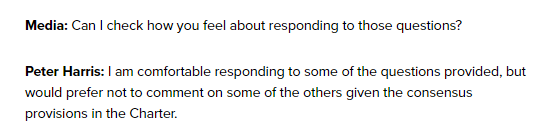
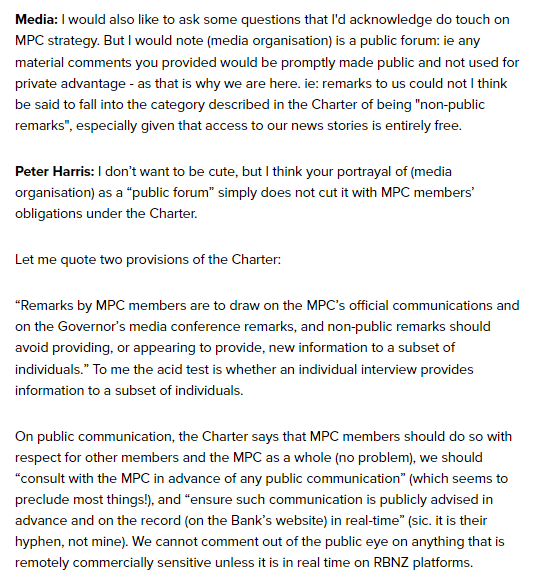
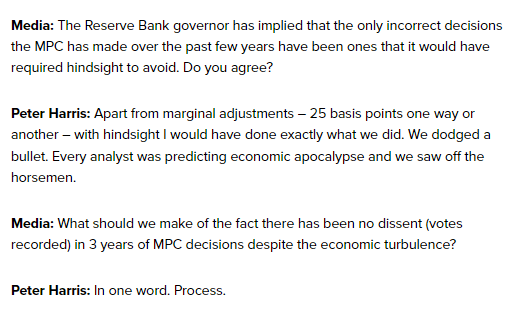
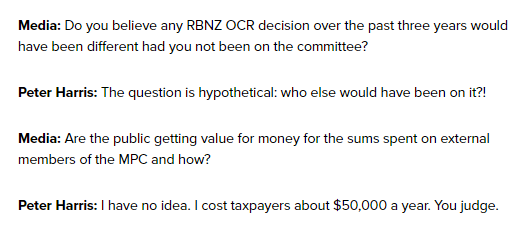
Earlier this week I wrote about MPC member Peter Harris’s “interview” – responses to an initial series of emailed questions – with Stuff’s Tom Pullar-Strecker. I assumed it was coordinated and managed by the Bank – though on reflection who could possibly have advised Harris to answer as he did – but it appears the trainwreck, which reflects poorly on both him and the institution, may have been almost all of his own doing.
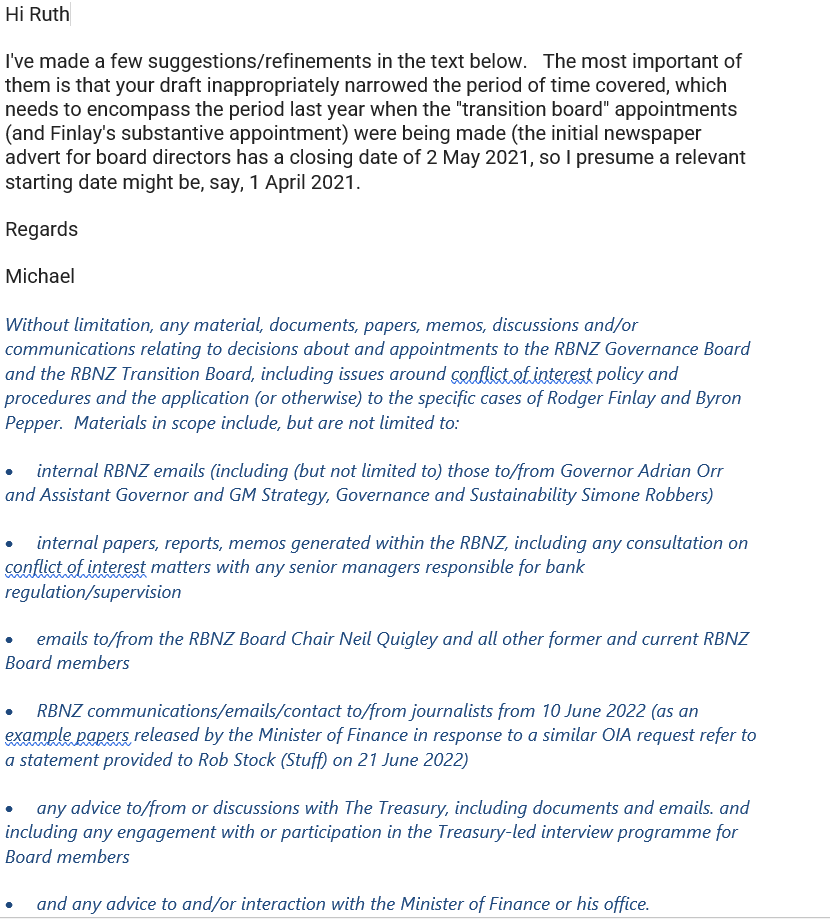
And then there is the saga of Rodger Finlay, appointed last year as part of the Bank’s “transition board” and as a full Board mmbers from 1 July this year while he was – and intended to continue as – chair of the board of NZ Post, the majority owner of Kiwibank, an entity subject to the Reserve Bank’s prudential regulation and supervision. It was a staggering conflict of interest, almost inconceivable in any well-governed country, that the Reserve Bank itself (Governor and outgoing Board) seem to have had no problem with. Ever since I noticed this appointment in June, I have been trying to get to the bottom of what went on.
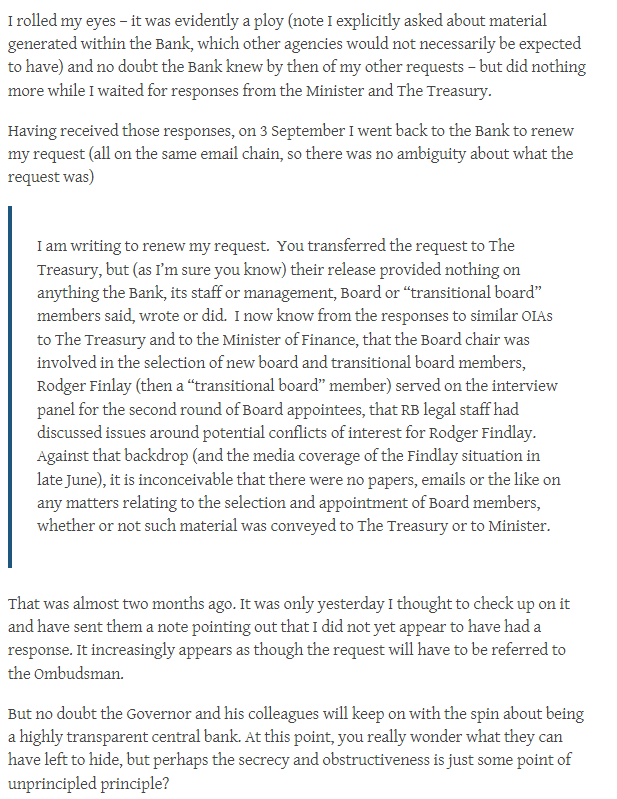
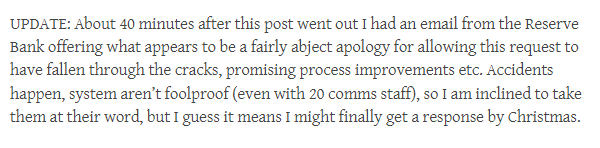
Both The Treasury and the Minister of Finance have answered OIA requests in a fairly timely, and apparently fairly open, way. Not so the Reserve Bank. The text below is from a post dated 27 October.
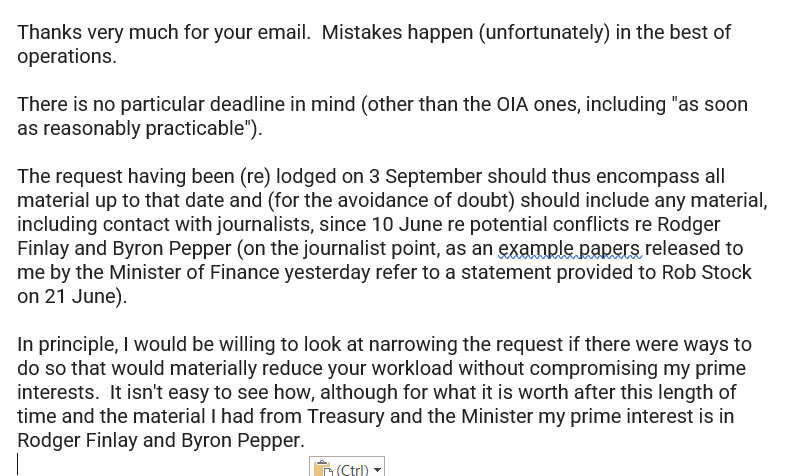
I replied to that apology thus
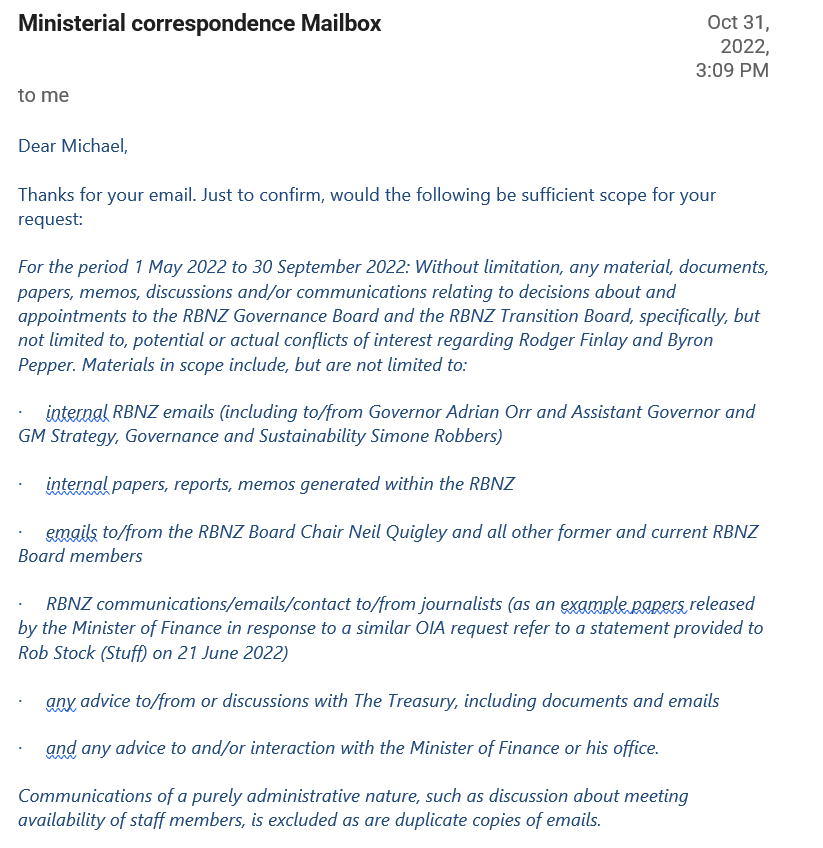
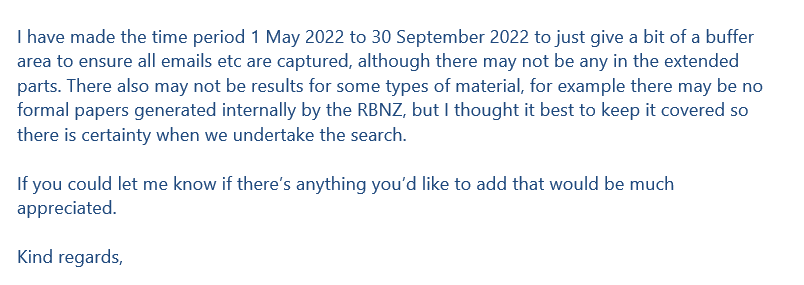
And I few days later I had this from the Bank, with specific suggestions – from them – on framing the request
I responded the next day
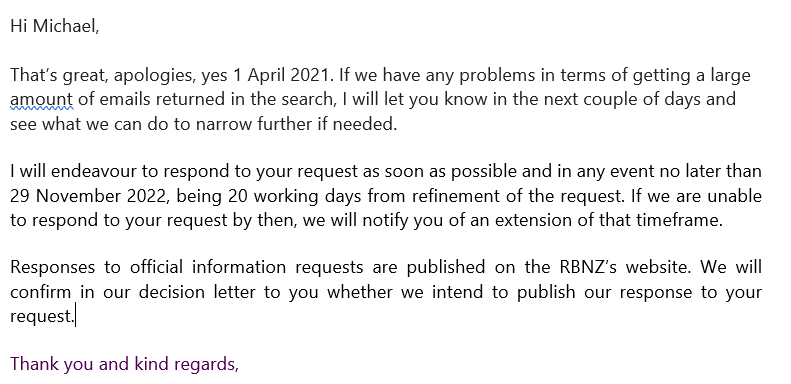
And within a couple of hours she responded
Note that “next couple of days” in the first paragraph.
I heard nothing more until Tuesday, which must have been almost the last of the 20 working days the Bank had to respond. Then I received an email from the same staffer advising me – no great surprise, and I wasn’t greatly bothered – that they were extending the request and giving themselves another 14 working days. But, as I noted to myself, at least I’d have results by Christmas.
Note that the reason given for the extension was “This is in accordance with section 15A(1)(b) of the OIA, where the consultations necessary to make a decision on the request are such that a proper response to the request cannot reasonably be made within the original time limit.”
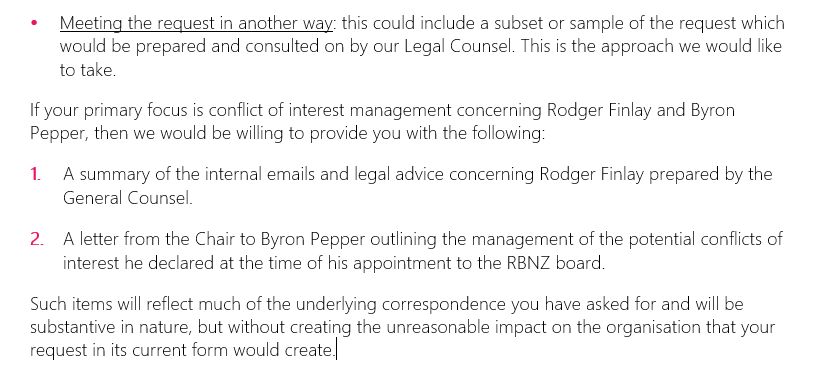
But late the next day I had a lengthy letter from one Adrienne Martin, Manager Government and Industry Relations, and apparently Ruth’s boss, threatening to refuse my request altogether on the grounds that it would – she claimed – take an estimated 67 working days to respond to it, an estimate itself (she claimed) based on a narrower request than the one the Bank had suggested (see above), as refined (see above). After rehearsing the options open to the Bank she concluded thus
All of which has already bought the Governor 5 months of delay in getting any clarity on how he, his senior managers, and/or the old Board thought it could possibly have been appropriate to have appointed the chair of the majority owner of a registered bank, supervised by the Reserve Bank, to the board which would take full legal responsibility for all the Bank’s supervisory and regulatory functions.
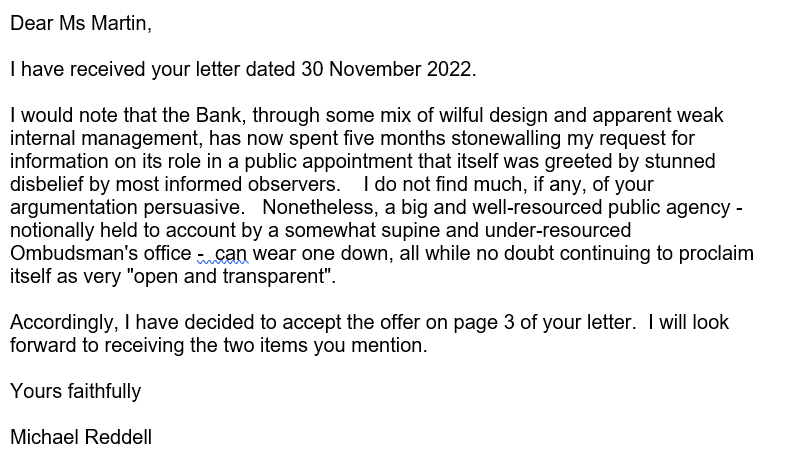
I’m not yet sure how I will respond. I simply do not buy the “67 working day” line, and it is particularly incredible when they offer that they will provide a substantive summary of the relevant emails (presumably they don’t take the affected parties 67 working days to find, let alone summarise). Moreover, the Bank’s General Counsel has form as an aggressive and very motivated player, championing the Bank’s corner, and (more specifically) earlier releases suggest that he and his staff were themselves key participants in these discussions, so how much confidence should I have in the integrity of the process? I’m also not just interested in the “conflict of interest management” but how the Bank came to take the view that this conflict could ever be manageable (substantively and reputationally) when few/no other serious bank regulators would have.
On the other hand, the alternative may be ending up with nothing at all.
As a reminder, the Bank regularly claims it is very open and transparent. As I have pointed out for years – predating Orr – they tend to be fairly transparent about things that advance their interests (who isn’t?) but not otherwise, and real transparency and accountability encompasses both. The Bank falls a long way short and this is just the latest example. Serious questions have been raised about the Bank’s involvement with a major public appointment. An open and transparent central bank, once serious questions were being raised, would have been pro-active in identifying and releasing all the relevant papers, making a public statement, and perhaps opening themselves up for serious questioning.
But this is the Orr/Quigley Reserve Bank.
The public deserves better.
UPDATE (5/12): I gave up, and sent this response this morning
Over the last couple of years I’ve commented at various times on (a) the loss of experienced research staff (b) the rapid turnover of senior managers, and (c) the bloated number of (very highly paid) new senior managers at the Reserve Bank.
I haven’t paid overly much attention to the overall staff turnover data. And it turns out that was probably just as well.
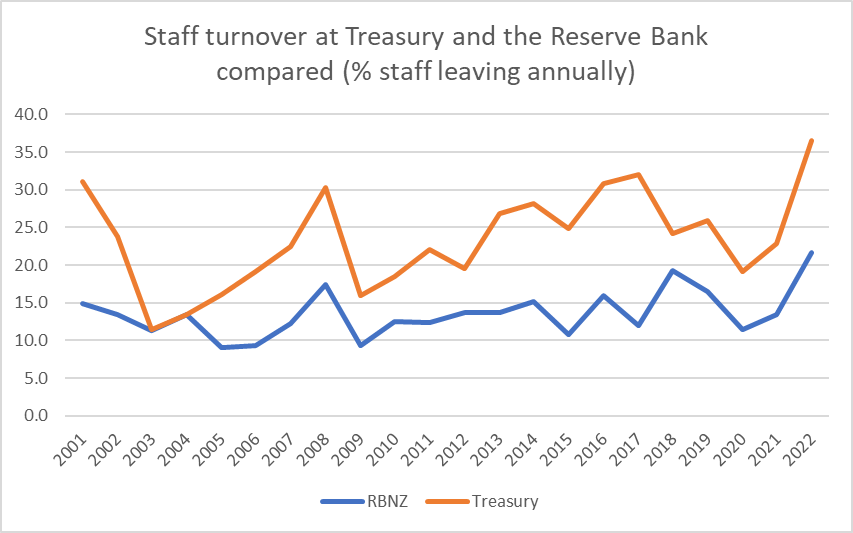
Here is a chart of annual staff turnover rates for the Bank this century. There has been a sharp increase in the last year (to June 2022).
But Simon Chapple, at Victoria University’s Institute for Governance and Policy Studies, went to the effort of digging out the same data for the Bank and a bunch of other public sector agencies, and kindly sent me a copy of his spreadsheet.
Of all the other public sector agencies, perhaps the best comparator is The Treasury. They are very different agencies but have often been bracketed together.
There is a lot more variability in the Treasury series, but (a) it has been higher or no lower than the Bank every year this century, and (b) over the last year has had an absolutely staggering 36.5 per cent turnover rate. It was bringing to mind the stories from 35 years ago when at one point (and if I recall correctly) the median length of service at The Treasury was under two years.
Here is the data for three other agencies: the (public service) Department of Prime Minister and Cabinet, the Public Service Commission (previously SSC), and Statistics New Zealand.
I suspect the DPMC figures can be discounted, as DPMC built up a huge temporary operation to co-ordinate the Covid response (including lots of comms staff for all those adverts), but in the most recent year even SNZ had slightly higher staff turnover than the Reserve Bank. (For the public service as a whole – not shown – the staff turnover rate was exactly the same as at the Reserve Bank.)
Over the last year or so, presumably two – mutually reinforcing – influences have been at work. First, the economy has been materially overheated reflected, among other places, in an extremely tight labour market. When the opportunities are good and finding new jobs is easy a given person is more likely to move in any particular year. And the second is the rather arbitrary block on wage increases for many public servants. All else equal, not only has that made moving to the private sector relatively more attractive – private sector wage increases have run well ahead of public sector ones – but has also created the readily-visible bizarre incentive that the only way many public servants can get a pay rise is to change jobs (whether to other positions in the private sector or elsewhere in the public sector), perhaps with some grade inflation thrown in (people who aren’t really senior or principal analyst material getting given those titles and salaries). Moving simply because it is the only way to get a pay rise – in a generally overheated labour market – makes sense for the individual, but almost certainly does not for the public sector as a whole.
(And here I am not entering into questions of whether public sector salaries are generally too high (or not) or the size of the public sector: issues for other people on another day.)
Zero staff turnover would generally not be desirable. When I used to pay more attention to these things at the Bank we used to be told that for established well-run professional organisations a 10-15 per cent annual turnover rate was fairly normal (perhaps coincidentally that was the rate the Bank tended to have). I find it harder to believe that 25-30 per cent annual turnover rates – as at The Treasury – is entirely healthy, no matter how much you might encourage rotation, fresh opportunities etc. But one would have to hope that the 2022 turnover rates for all these public sector agencies prove to be peaks, and that by the 2023 and (especially) 2024 annual reports, staff turnover has settled back to much more normal levels for organisations of this sort. Whatever your view of the appropriate size of government, what agencies we do need need capable and experienced staff.
A consistent theme of this blog over the 3.5 years since the Monetary Policy Committee was established has been the severe inadequacies in the way the MPC was designed, and in the way it has been staffed. Last Tuesday, Stuff journalist Tom Pullar-Strecker had an article that reported on a variety of similar concerns, informed by extensive comments from former Reserve Bank chief economist John McDermott. A particular focus was on the role of the non-executive members (“the externals”).
At the press conference for the Monetary Policy Statement Pullar-Strecker asked the Governor about the externals, and if he didn’t get far (the awkward questions at that press conference were mostly left completely unaddressed), he did get from Orr an observation that externals were free to talk, subject to (Orr’s interpretation of) the MPC Charter provisions (in turn agreed by Orr and the Minister) under which for the first 24 hours after an MPS the Governor was the sole spokesperson for the Committee. It rather invited questions once that 24 hour window had passed.
And it seems that Pullar-Strecker did. Just before 5pm yesterday a document headed “Monetary Policy Committe (MPC) external committee member Peter Harris responds to media questions” dropped into the inboxes of anyone signed up for Reserve Bank announcements. Given the context, it was pretty obvious that the questions were from Pullar-Strecker (later confirmed by him and his story), but the Reserve Bank was at pains to keep anonymous the media outlet, even deleting a reference to Stuff in one of the reporter’s questions.
Kudos to Pullar-Strecker for pursuing the issue. In 3.5 years of the MPC’s life, it is only the second interview ever granted by an external MPC member (there was some comments by Harris to Bloomberg a couple of years back), despite the huge power that (on paper anyway) MPC members wield, not to speak of the mayhem (inflation, looming recession) now following in their wake.
Unfortunately, if the Bank can now push back and say “see, Harris did (another) interview”, the substance of the interview mostly just serves to confirm doubts about the institution and the individuals. From their perspective it is hard to see what, if anything, is gained by choosing to make him available in this way (and I don’t think we need to doubt that doing the interview will have had the sign-off of the Governor, and was perhaps encouraged by him). At times, Harris displays all the grace and constructive open and engagement we might expect in a rebellious 15 year old told they have to make conversation with Grandma at the family Christmas celebrations. If the answers aren’t quite monosyllabic grunts. most of them might as well be.
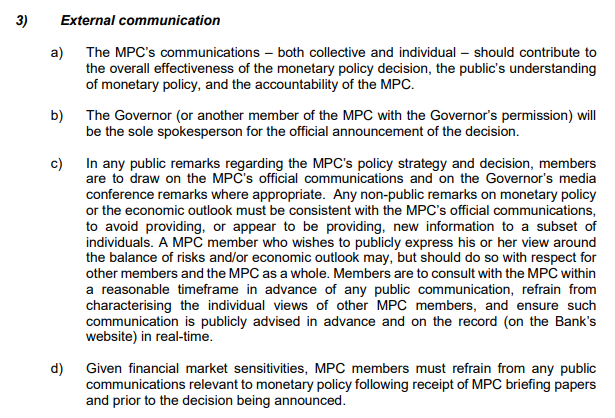
Since it is important background to the interview, here is the relevant section of the MPC Charter.
I don’t suppose anyone has any particular problem with a), b) and d). In fact, from a) one might positively welcome the explicit mention of the notion that communications should contribute to the accountability of the MPC. The focus is on c). If one interprets the first two sentences as being about the most recent decisions, there isn’t too much problematic there, at least in principle, given the model that favours consensus decisionmaking. After all, good minutes of the MPC meetings (unlike the ones we have) would give considerable weight to outlining the conflicting arguments, perspectives, considerations, and some members might reasonably emphasise some of those rather than others (a consensus decision that everyone can “live with” – the Governor’s own word – does not necessarily mean everyone came to that decision for the same reasons.
Note that the Charter does not prevent – in fact explicitly allows for – members from expressing “his or her view around the balance of risks and/or economic outlook”. As the Governor put it last week, there are some courtesies to be observed (let your colleagues know in advance, don’t attack other individual members’ views in public). And there is the requirement that “such communication is advised in advance and on the record (on the Bank’s website) in real-time”. There is certainly no obstacle to recent MPC members reflecting on what has passed, or on the structure, processes etc of the MPC. Note too that the Charter applies to all MPC members, not just the externals
That final provision in c) looks to have been designed to cater for MPC member speeches. It is easy to announce in advance that an address will be being given and to commit to release the text on the Bank’s website when the address is being given. Whether speakers stick to their written text – Orr apparently rarely does – is perhaps harder to police.
Note, however, that there was no advance notice of the Harris interview, so the Bank – which issued the statement on Harris’s behalf – appears to have been complicit in breach of the Charter. More generally, although the text of this interview is available on the Bank’s website, no other interviews by MPC members are (in the last few days for example, Conway with Bernard Hickey, Hawkesby with Stuff, Silk with Reuters – as it happens, each of those MPC members talking about more market-sensitive stuff than Harris ended up doing). It isn’t uncommon for (internal) MPC members to give interviews to media outlets and (a) never provide transcripts, and (b) which are behind paywalls. The Charter looks like it could do with an amendment to require that the text of any media interview with an MPC member in their MPC capacity should be published on the Bank’s website simultaneously with the story published by the interviewing outlet. That is the sort of approach an organisation seriously committed to transparency would take.
On this occasion, the Bank’s approach – emailing out the text – looks to have been some sort of revenge play, undermining the capacity of the journalist to break a story from the interview, in return for the offence of challenging the Bank/MPC. The rules and practices depend on how compliant the journalist is. Pullar-Strecker noted on Twitter that the Bank had not even told him this was the approach they were going to take.
What of the substance of Peter Harris’s interview.
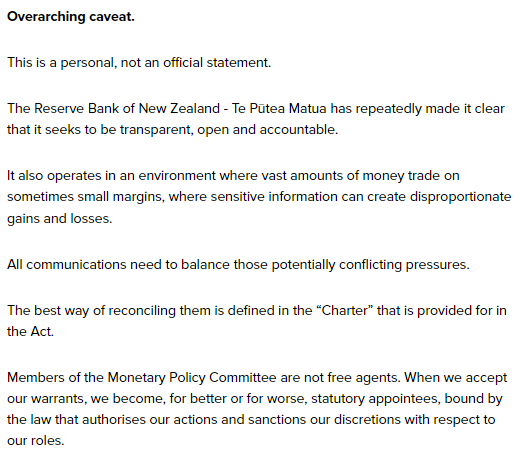
It begins with this rather defensive ‘overarching caveat”
Except that Conway, Silk, and Hawkesby had each given fairly extensive interviews in recent days. The Charter just is not that constraining, unless you want to avoid scrutiny/comment (or, more generally, Orr seems to favour internal members, who of course directly answer to him). Now, it is fair to note that none of those internal member interviewees were actively advancing alternative perspectives on the inflation and monetary policy outlook, but they weren’t all simply reciting already-published lines either (from Silk we learned that apparently we will have only a “technical recession”, from Hawkesby – rather better qualified to comment – that actually these things are often quite a bit sharper than forecast).
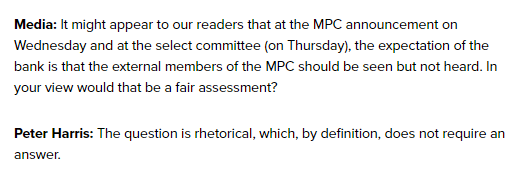
Before proceeding further I should say that I didn’t think all the questions to Harris were particularly well-framed. But it is pretty standard media advice that you answer the question you want to answer. If the question is ill-phrased or not really to the point, answer another one. And if you and your organisation are really committed to being “transparent, open, and accountable” do it in an open, constructive and positive way, not grudgingly or petulantly.
Surely he could have come up with a more constructive response than that? It was, after all, a reasonable question when Orr highlights that all the MPC members were present, but only he and his direct reports were able to say anything. No one forced them to be there, so what did they themselves see the point as having been?
This was interesting, suggesting that Harris had the questions in writing so had had the opportunity to think – and take advice – about how to respond.
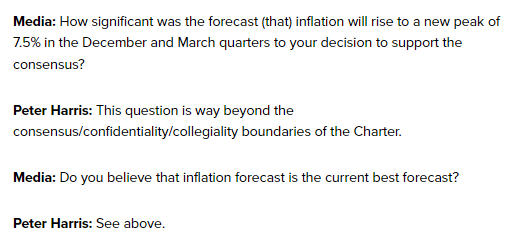
As far as I can see none of the questions on monetary policy itself went beyond the sort of thing the internal MPC members were answering in their recent interviews. The journalist pushes back
Which surely leaves everyone confused. The transcript of this interview was published in full on the Bank’s website. If MPC members really aren’t allowed to interviews, why is he doing one?
Even if you don’t want to say much of substance, there are ways of answering these questions that don’t come across as deliberately obstructive, and indeed might offer some insight on the value (or otherwise) a particular MPC member is adding. To take the second question as an example, it was an easy invitation to say something like “yes, but of course any medium-term forecast is inevitably not that much better than a shot in the dark – that is the nature of economics and economies – and mostly likely a lot will turn out different. It is our – my – best view for now, but our processes emphasise holding any view lightly, and regularly updating our forecasts and policy”.
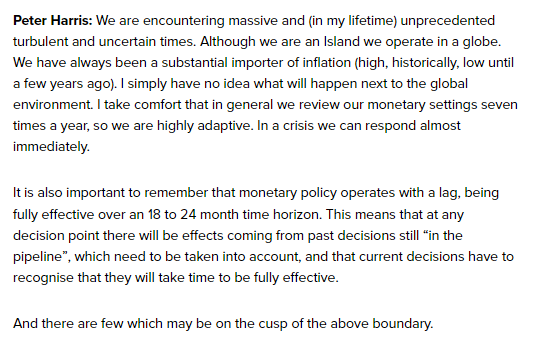
The interview continues
I have no idea what the final sentence is supposed to mean. Of the rest, when a family member read the interview they commented of the first sentence “is he 35?”. In fact, Harris is a lot closer to 70. If he really believes the first sentence – against the backdrop of the 1970s and 80s New Zealand – at very least the claim needs more elaboration. As it is, it simply seems designed as cover for the Bank’s failure (in company with many other central banks).
The interview continues
What an extraordinary claim: worst inflation outbreak in decades, MPC now aiming for a recession to reverse it,, not to speak of crisis lending programmes running on years after the crisis (something even management suggests they might have done better) and $9bn+ losses on the LSAP programme, and even “with hindsight I would have done exactly what we did”. It might be one thing to argue that “only with hindsight would I have done things much differently”, but “with hindsight I’d have done exactly what we did” is….well, almost beyond words. And all that apocalyptic rhetoric……I mean, with hindsight it is clear that “every analyst” (and more importantly in this context, every MPC) was wrong. With hindsight, they were mirages not the Four Horsemen.
He does go on after the one word (“Process”) to describe that process. The internal process doesn’t sound to have changed much since the decades I spent on the internal advisory MPC/OCRAG, but perhaps it is worth noting that in those days unanimity among the Governor’s advisers (it was then finally solely his call) wasn’t that common – in fact, successive Governors had us each put our recommendations in writing, initially without seeing what others were recommending, precisely to limit the risk of groupthink or peer pressure towards the end of the process. It is a very poor reflection on all involved that through the period of great uncertainty and the worst monetary policy stuff-up since the 1989 Reserve Bank Act gave the power to the Bank, not one MPC member, not even once, felt and reasoned sufficiently strongly as to dissent, on anything. Even now, no external MPC member has given us their own accounting for the handling of the last three years (beyond Harris’s “with hindsight we did it right”). Note that the recent Reserve Bank self-review is a management document, and I have an OIA request in at present to try to learn what the externals contributed and whether or not they agreed.
The interviews ends with two answers that sum up the grudging approach
Surely the first of those questions could have been treated as an open invitation to talk expansively about how “I can’t be certain about that, but let me tell you about what I think I as an external member have been able to bring to the table [as someone with decades of experience in New Zealand economic policy, strong connections to the labour market, as someone standing outside the day to day pressure staff and management face, as someone willing to ask awkward questions as part of a confidential deliberative process] – or whatever value he thinks he has offered.
And the final question? What would have been wrong with a more gracious “look others will have to be the judge of that, but I wouldn’t have accepted appointment and reappointment if I hadn’t thought I was adding value. If I can’t be totally detached in assessing my own contribution, when I look at my colleagues – Bob Buckle and Caroline Saunders – I can see the impact they’ve had around the table, the questions they’ve posed, the research they’ve helped spark.” and so on?
It was, of course, a shame that the interviewer didn’t also ask Harris to justify the exclusion of people with current expertise in matters monetary and macroeconomic from serving as external members of the Committee. It wasn’t his choice – Orr, Quigley and Robertson did that – but he now has the benefit of 3.5 years serving on a New Zealand MPC as an external member, and it would be quite reasonable to seek his perspective (and not at all in breach of the charter for him to have given a substantive answer).
We need a better model, and we need better people (internal and external) on the MPC. While perhaps it is better than nothing to have had this Haris interview, the substance (or lack) of it only tends to confirm how poorly we are being served.
I watched the Q&A interview yesterday with the Leader of the Opposition Chris Luxon. Monetary policy and the position of the Reserve Bank Governor came up.
It is really quite disappointing that the Minister of Finance, presumably with the acquiescence of the Prime Minister, has so politicised the situation that a Leader of the Opposition can reasonably be asked what he would expect (eg possible resignation) of the Reserve Bank Governor after the election if National wins. If he is at all serious about his answer – appoint an independent reviewer as soon as they take office and only decide after that – it is a recipe for considerable, unwelcome, market uncertainty, and further reputational risk for New Zealand and its system of economic governance.
We really should have appointees to such positions that both sides of politics can respect and trust. That has always been implicit in the model under which the central bank is given operational autonomy over monetary policy (and the massive cyclical influence that involves), the Governor (and MPC members) are appointed for terms not coinciding with, and longer than, parliamentary terms, and (in NZ since 1990) where the Minister of Finance cannot simply appoint his or her own person as Governor. That expectation was further reinforced when the current Prime Minister and Minister of Finance in 2018 amended the Reserve Bank Act to explicitly require consultation with other parties in Parliament before a person is (re)appointed as Governor.
When Adrian Orr was first appointed at the end of 2017 that “general acceptance” threshold was probably met. There was plenty of Orr sceptics about. although often rather quietly (since they or their employers had to deal with either NZSF or the Reserve Bank, and Orr was never known for embracing criticism), but there was no great controversy about the appointment (as it happened the search and selection process had been well underway before the election and change of government, and the Bank’s Board – which put forward Orr’s nomination – had been entirely appointed by the previous National government).
It isn’t the case now. The two main Opposition parties had both made clear to the government, when the legally-required consultation occurred, that they had concerns about the proposed reappointment. But there has been no hint or sign that the Minister of Finance made any effort to engage to allay those concerns, instead – his own legislation notwithstanding – he simply pushed ahead and reappointed Orr, having had the nomination made by the new Reserve Bank Board, possessed of almost no subject expertise, he himself had appointed just a couple of months earlier. Perhaps a bit like the entrenchment outrage in the headlines today, it was lawful (much is in New Zealand) but it was far from proper.
(As I’ve pointed out before the actual argument National made in their letter re Orr was weak and their historical parallel was flawed, but then they were caught in a difficult position – unless Robertson heeded their concerns and looked elsewhere for a new Governor, they could be stuck with Orr as Governor, almost certainly unable to dismiss him (unless he did something particularly new and egregious in his new term) – and may have felt reluctant to outline a range of specific concerns about Orr and his stewardship in writing.)
TVNZ’s interviewer, who usually does a fairly good job, seemed to come to yesterday’s interview holding a brief for Orr. Among the lines he put to Luxon was the suggestion that he shouldn’t be too critical or Orr and the Bank because they had been the first developed country to raise their policy interest rate. This is the sort of spin the Bank itself likes to hear, and it uses a more-muted version of it at times. I don’t know how many times it has to be said but it is simply a false claim. It isn’t a matter of interpretation or nuance, it is simply false.
There are probably two main sets of groupings that are used to capture a list of developed countries or advanced economies. The first is membership of the OECD, and the second is the IMF’s “advanced economies” groupings. Neither is ideal. The OECD includes several Latin American countries (Costa Rica, Colombia, Chile, and Mexico) that are mostly much poorer and less productive than other members (I’ve often suggested they are “diversity hires”),and excludes Singapore and Taiwan. The IMF list on the other hand does not include any of the Latin American countries, but in central and eastern Europe seems to include countries if they are in the euro but not if not, even if the latter are equally productive. Since so many advanced countries are in the euro, there are really only 20 or so countries with monetary autonomy, setting their own interest rate.
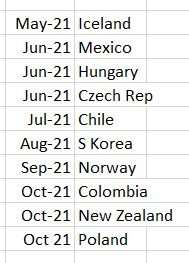
On several occasions in the past on Twitter I’ve used the BIS’s monthly data on policy interest rates. Of the countries there that are on either the OECD or IMF lists, these were the first countries to raise policy interest rates in 2021.
Discount Mexico and Chile if you like and you are still left with five advanced country central banks having moved before our Reserve Bank did, all of them for countries that are either materially richer/more productive than New Zealand or (Korea, Hungary, Czech Republic) about the same. You could make further allowance for the Reserve Bank and accept that if their MPC meeting in August 2021 had been a day earlier, the OCR would first have been raised then, but they still wouldn’t have been the first to move.
There is no question but that our Reserve Bank moved earlier than the other Anglo central banks (or even the ECB) but what of it?
More generally, when individual central banks moved (early or late in calendar time) is really neither here nor there anyway. Each central bank faced different domestic situations in terms of capacity pressures, emergent inflation, and the core inflation outlook.
I’m not going to attempt to analyse the story each central bank faced last year, but I’ve shown this chart in a previous post.
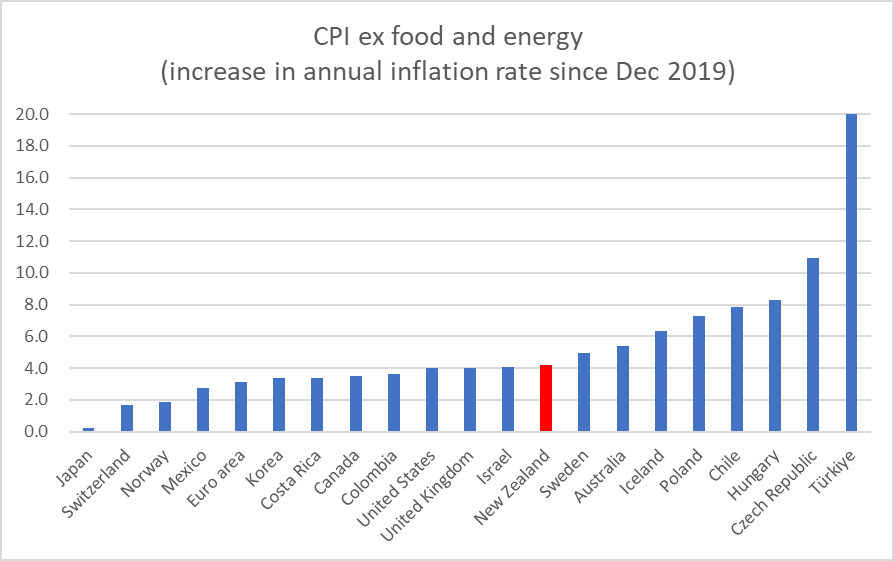
On the most recent data, for the only internationally comparable measure of core inflation we readily have, New Zealand’s core inflation rate now – a year on from the first OCR increase – is nothing special, being just above that of the median OECD country. If we focus only on OECD countries with their own monetary policies (and the euro area as a single observation) we get this chart showing the increase in the core inflation rate since just prior to Covid (actual Turkey increase is far larger than the scale allows).
It isn’t one of the worst, but again it is slightly worse than the median country (and, as it happens, worse than in three of the four Anglo countries, and worse than the euro area).
This isn’t another post trying to evaluate in any detail the Bank’s absolute or relative performance, but as a general observation almost all central banks have done poorly in the last couple of years, and little about the Reserve Bank’s policies or policy outcomes stands out from the pack. Media defenders of the Governor should take note, and/or get better basic researchers.
What the post is mainly about is central bank appointments. We’ve had some dreadful ones this year – the deputy chief executive responsible for matters macroeconomic who has no background or evident expertise in the subject, and who yet is a full voting MPC member, and (see above) the reappointment of the Governor. Then there was the decision (apparently joint between the Governor, Minister and (old) Board) to keep in place the blackball prohibiting anyone with current in-depth expertise in matters macroeconomic or monetary from serving on the MPC, all as prelude to the reappointment without much scrutiny of two external MPC members whose terms were expiring.
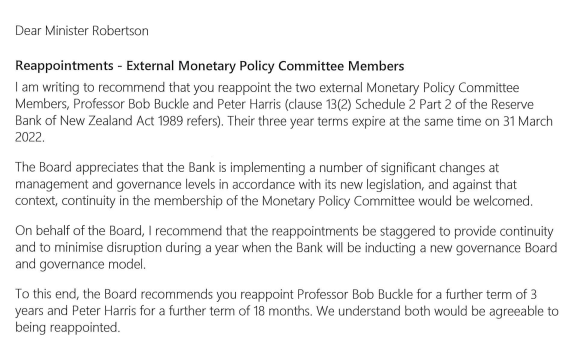
On which note, I had another OIA request back the other day, which included the letter from the Reserve Bank Board chair to the Minister of Finance recommending those reappointments. It was perhaps even more lame than I had expected. There was no attempt to evaluate or describe the contributions Buckle and Harris had made, nothing at all about the rapidly rising (core) inflation backdrop for which they shared responsibility, no suggestion of having considered any alternative candidates (neither Buckle nor Harris are young). In fact, the strongest (only) argument for reappointment seems to have been that “the Bank is implementing a number of significant changes in governance in accordance with its new legislation”, even though almost none of the 2021 Act had anything to do with monetary policy or the MPC
That letter did, however, partly answer one question I’d had. Peter Harris – former politically-appointed adviser in Michael Cullen’s office – was reappointed for a term of only 18 months to expire on 1 October 2023, right in the middle of the likely election campaign. Why, I wondered, would Robertson have done that – ministers after all being well aware of the convention that new appointments should not be made to positions starting close to likely election dates? But it turns out it was the Board’s doing, and there is no sign they gave any thought to the fact that the end of Harris’s term was going to land in the midst of the election period. Which seems quite unnecessarily careless of them. One hopes there is no question of any new appointment being made until after the election. If National were to win, the vacancy would give them an opportunity to begin to exert some influence; one would hope they would remove the bar on expertise, and at the same time amend the MPC’s charter to make it clearer that individual members were expected to bring expertise to bear and to be individually accountable.
But the current government is quite free to make the next MPC appointment. The worst of the first batch of external MPC members was Caroline Saunders. Her term expires on 31 March 2023. The papers released at the time of those 2019 appointments make it pretty clear that she was a diversity hire. Professor Saunders may be very capable in her own field but she has no background at all in macroeconomics or monetary policy. Consistent with that, we have heard not a word from here in her (almost) four years on the MPC. She has taken the taxpayers’ dime and there is no evidence she has made any contribution at all, and has done or said nothing – no speech, no interview, no parliamentary committee appearance – to provide any basis for holding her to account, even as she shares formal responsibility for the biggest monetary policy stuff-up in decades
It would be quite unfortunate if Saunders is reappointed (but most probably it is already a fait accompli, given that no vacancies have been advertised). If there was ever a case for a token female appointment (which there wasn’t; token appointees are never desirable), the ultimate in token appointees now holds a senior executive role on the committee. More generally, in any body – public or private – fresh blood should be introduced from time to time, and yet none of the externals has been changed, and (by the rules they themselves signed up to) those members are not allowed to foster any independent subject expertise themselves in their time on the MPC (and the Bank has been doing very little serious research, so there won’t be much expertise being fostered/extended inside). From a narrowly political perspective, one might have thought it might have been in the government’s interest to have found a strong new appointee who might have a good chance of doing two future terms.
Which bring us back to Luxon. It isn’t clear that National cares very much about any of this,or will fllow through if and when it takes office (why rock the boat when you now have an office to hold and savour?). I’m not at all optimistic, but if they are more serious than they seem, here was a post outlining some of things they could look at.
If you’d been given a great deal of delegated power and had messed up badly – not through any particular ill-intent, but perhaps you’d misjudged some important things or belatedly realised you didn’t have the knowledge to cope with an unexpected circumstance that you thought you had – and if you are anything like a normal decent person you would be extremely apologetic and quite contrite. Heck, borrow a friend’s car for the afternoon and come back with a dent in it – not even necessarily your fault – and most of us would be incredibly embarrassed and very apologetic. Bump into someone (literally) in the supermarket aisle and most of us will be quite apologetic – often enough proferring a “sorry” just in case, even if it is pretty clear it is the other person who knocked into us.
But the apparently sociopathic world of central banking seems to be different. The Reserve Bank (Governor and MPC) are delegated a great deal of power and influence. Back before the days of the MPC I used to describe the Governor as by far the most powerful unelected person in New Zealand (and more powerful individually than almost all elected people too). The powers – exercised for good or for ill – haven’t changed, they’ve just been (at least on paper) slightly diffused among a group of (mostly silent) people whose views we never quite know, and whose appointment is largely (effectively) controlled by the Govenor. (There was a nice piece in Stuff yesterday on the problems of the MPC, echoing many points made here over the years.)
It is not as if the Bank took on these powers reluctantly, or that the Governor had to have his arm twisted to do the job. The Bank championed the delegation (and reasonably enough) and every single member of the MPC took on the role – amply remunerated – entirely voluntarily. But they seem to have long since forgotten that counterpart to autonomy and operational independence that used to feature so prominently in all their literature, that great delegated power needs to be accompanied by serious accountability. Among decent people that would include evident contrition when things go wrong, no matter how good your intentions might have been, even if you thought you’d done just the best you personally could have.
The Auditor-General was reported yesterday raising concerns about the serious decline in standards of accountability in New Zealand public life. Whatever the situation elsewhere – and I have no reason to question the Auditor-General’s view – nowhere is it more evident than around the Reserve Bank, which exercises so much power with so few formal constraints. Much too little attention has been given to the fact that, having delegated them huge amounts of discretionary power to keep (core) inflation near 2 per cent, the Reserve Bank has messed up very badly over the last couple of years.
The issue here is not about intent or lack of goodwill, but about outcomes. When central banks were given operational autonomy it was on the implied promise that they’d deliver those sort of inflation outcomes, pretty much year in year out. The public wouldn’t need to worry about inflation because control of it – under a target set by elected politicians who would hold them to account – had been delegated to a specialist, notionally expert, agency, which would know what it was doing. 20 years ago the expectation on the Bank was fleshed out a little more: that they should do their job while avoiding unnecessary variability in interest rates, exchange rates, and output.
And what do we now have? Roughly 6 per cent core inflation, three years of annual headline inflation above the top of the target range, public doubts about just whether the Bank will deliver 2 per cent in future. Oh, and now the necessity (very belatedly acknowledged by the Bank yesterday) of a recession and a significant rise in unemployment to levels well beyond any sort of NAIRU to get inflation back in check. Add in the arbitrary wealth distributions – that no Parliament voted on – with the heavily indebted (including the government) benefiting from the unexpected surge of inflation the Reserve Bank has overseen, at the expense of those with financial savings. And the huge disruptions to lives and businesses from both the extremely overheated economy we’ve had for the last 12-18 months and the coming nasty shakeout. Oh, and that is not to mention more than in passing the $9.2 billion of LSAP losses the Reserve Bank up entirely unnecessarily (foreseeably).
It has not, to put it mildly, been the finest hour of the Reserve Bank. But there has been no a word of contrition – from the Governor or any of the rest of the Committee – and no real accountability at all (among other things, Orr and two of the MPC have been reappointed this year, with no sign of any searching scrutiny of their records or contributions).
Instead we just get lots of spin, and lightweight analysis. One of Orr’s favourite lines (repeated as I type at FEC this morning) is that the Reserve Bank was one of the very first central banks to tighten “by some considerable margin”, when in fact there were half a dozen OECD central banks that moved before our central bank did. We had claims from Orr a while ago that the macro benefits of the LSAP programme were “multiples” of those mark to market losses to taxpayers – a claim that quietly disappeared when they actually published their review of monetary policy. A few weeks ago Orr was telling Parliament that if it weren’t for the Ukraine war inflation would have been in the target range – notwithstanding the hard data showing core inflation was already very high well before the war – and then nothing more is heard of that claim when the MPS itself was published.
Yesterday we heard lots of bluster about workers, firms and households being enjoined to change their behaviour – even trying to damp down Christmas – as if inflation was the responsibility of the private sector, not the outcome of a succession of Bank choices and mistakes. But not a word from the Bank or Governor accepting any responsibility themselves.
To repeat, I don’t doubt that the Bank was well-intentioned throughout the last few years. Plenty of other people made similar mistakes in interpreting events. But it is the Reserve Bank and its MPC who are charged with – and paid for – the job of keeping the inflation rate and check. They’ve failed. Given that stuff-up they may now fix things up, but it is no consolation or offset to the initial huge series of mistakes. And not a word of contrition, barely even much acceptance of responsibility.
Which is a bit of a rant, but about a serious issue: with great power must go great responsibility, accountability….and a considerably degree of humility. Little or none has been evident here.
But what of the substance of the Monetary Policy Statement? Here I really had only three points.
The first is the glaring absence of any serious in-depth analysis of what has actually been going on with inflation, at a time of some of the biggest forecast errors – and revisions in the OCR outlook – we’ve seen for many years. For example, every chart seems to feature annual inflation, which is fine for headlines but tells you nothing about what has been happening within that one year period. What signs are there, for example, that quarterly core inflation might have peaked (or not) – eg some of the charts I included here? There seemed to be no disaggregated analysis at all, for example of the sort one economic analyst pointed to in comments here the other day. This from the organisation that is responsible for inflation, and which has by far the biggest team of macroeconomists in the country. We – and those paid to hold the Bank to account – really should expect better.
And almost equally absent was any persuasive supporting analysis for the really big lift in the forecast path of the OCR, now projected to peak at 5.5 per cent. My main point is not that I think they are wrong but that there is little or no recognition that having misread badly the last 2-3 years (in good company to be sure), there is little reason for them or us to have any particular confidence in their forecast view now. Models and sets of understandings that didn’t do well in preventing us getting into this mess probably haven’t suddenly become reliable for the getting out phase. But even granting that, the scale of the revision up seems disproportionate to the surprises in the new data of the last few months. It has the distinct feel of just another stab in the dark (but then I’ve been a long-term sceptic of the value of central bank OCR forecasts), with little engagement with either weakening forward indicators or the lags in the system (in the last 6 weeks the Bank has now increased the OCR by as much as it did in the first six months of the tightening cycle. With a recession already now finally in the forecasts based on what the MPC has already done (they don’t meet again until late February and the deepest forecast fall in GDP is in the quarter starting just 5 weeks later – the lags aren’t that short) they can’t really be very confident of how much more (if any) OCR action might be needed.
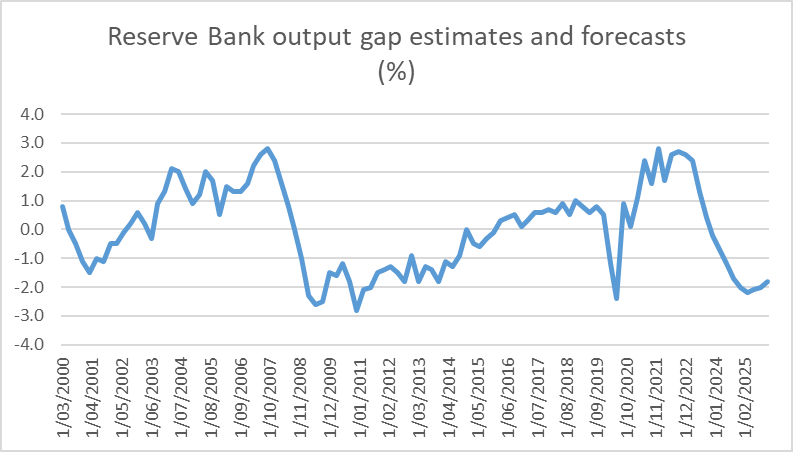
Finally, it is constantly worth bearing in mind the scale of the task. Core inflation has been running around 6 per cent and should be close to 2 per cent. That scale of reduction in core inflation hasn’t been needed/sought since around 1990. In 2007/08 inflation had got away on us to some extent, but a 1.5 percentage point reduction would have done the job of getting back to around 2 per cent. As Westpac pointed out in their commentary, the scale of the economic adjustment envisaged in these forecasts (change in estimated output gap) is very similar to what (the Bank now estimates) we experienced over 2008 to 2010.
The open question then is perhaps whether this sort of change in the output gap is likely to be sufficient: 13 years ago it delivered a 2 percentage point reduction in core inflation, but at present it looks as though we need a 4 percentage point reduction now. It isn’t obvious that other surrounding circumstances now will prove more propitious than then (eg for supply chains normalising now read the deep fall in world oil prices then).
Perhaps it will, perhaps it won’t, but you might have expected a rigorously analytical central bank and MPC to have attempted to shed some light on the issue. But once again they didn’t.
(My own money is probably on a deeper recession next year, here and abroad but……and it applies to me as much as to anyone else … if you got the last 2-3 years so wrong you have to be very modest in your claims to have the current and year-ahead story right.)
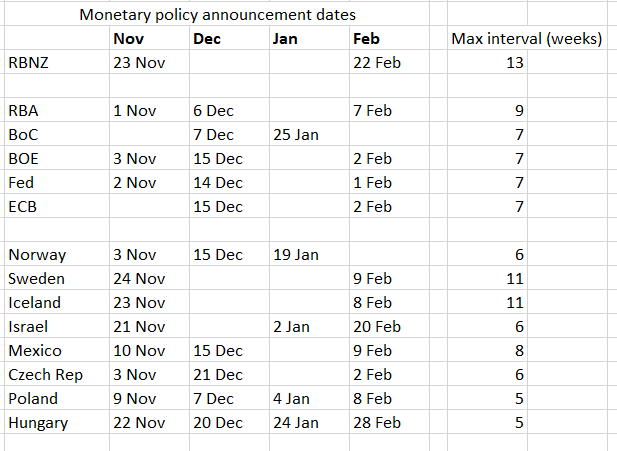
The Reserve Bank’sMonetary Policy Committee has its final meeting for the year on Wednesday, and then they shut up shop. For a long time. The next scheduled announcement is not until 22 February, a full 13 weeks (3 months) away. Nice job if you can get it, and although I’m sure management and staff will still be working for much of the intervening period, the same is unlikely to be said for the three non-executive members, who are generously remunerated by the taxpayer, utterly invisible, and only need to show up when meetings are scheduled.
This strange schedule has been in place for quite a few years now, having been adopted at a time when the OCR wasn’t being moved much at all (and when the Bank was raising the OCR, it often proved to have been a mistake). But having been in place for a while does not make it any more defensible or sensible. In fact, last year’s three month summer break almost certainly was one factor in how slow the MPC was to get on with raising the OCR once they’d finally made a start. On no reading of the data (contemporary data that is) did it make sense for us to have ended 2021 with the OCR still lower, in nominal terms, than it had been just prior to Covid. And having experienced the issue last summer (when perhaps it caught them by surprise) there was no excuse for not resetting the schedule for this summer.
One can always mount defences (for almost anything I suppose). Monetary policy works with a lag, the OCR adjustments can be just as large as they have to be, perhaps there is a bit of a tradeoff between time doing analysis and time spent preparing for meetings. But none of it is very convincing in this context. And it is out of step with their peers.
Here is a table of the monetary policy announcements dates over November to February for a fairly wide range of OECD country central banks. None, not even Sweden and tiny Iceland, are taking as long a break as our MPC (and although I didn’t tot up all the northern hemisphere summer meeting dates, it didn’t look as though any took as long a break then as our MPC takes now). The median country has a longest gap of seven weeks between meetings over this period.
[UPDATE: In addition, the South Korean central bank meets on 24 Nov, 13 Jan, and 23 Feb]
There are substantive macroeconomic arguments for (and against) a 75 basis point OCR adjustment this week, but one of arguments some have advanced is that they really need to go 75 basis points this week because they don’t have another opportunity until late February. But whose fault is that? It is entirely an MPC choice. They have a very flexible instrument and just choose to tie their hands behind their backs to give themselves a very long summer break.
The whole situation is compounded by the inadequacies of New Zealand’s key bits of macroeconomic data. We now have the CPI and the unemployment rate for mid-August (the midpoint of the September quarter). Most OECD central banks already have October CPI data, almost all have September unemployment rate data (and several have October unemployment rate data), and three-quarters of OECD countries already have September quarter GDP data (a few even have monthly GDP estimates).
The combination of slow and inadequate data and widely-spaced summer meetings really isn’t good enough, especially at a time when there is so much (perhaps inevitable) uncertainty about the inflation situation and outlook. The inadequacies of our national macroeconomic statistics cannot be fixed in short order (not that the government shows any interest in doing so anyway). But how often, and when, the MPC meets is entirely at the Committee’s discretion, and easily altered with little or no disruption other than to the holiday plans of some appointed and (supposedly) accountable policymakers (people who not incidentially – and pardonably or otherwise – have done such a demonstrably poor job of their main responsibility, keeping core inflation in the target range, in recent times.
The MPC should be announcing on Wednesday (a) an extra OCR review for a few days after the CPI release in January, and (b) a commitment to revisit the meeting schedule for future years to bring the length of the long summer break back to (say) no longer than the one the RBA takes. If they don’t journalists at the press conference and MPs at FEC should be asking why not.
(Writing this post brought to mind memories of Orr 20+ years ago when the OCR was first introduced championing having only four reviews a year. The OCR then was new, inflation was low and stable. One hopes that sort of thinking no longer lurks in the back of the Governor’s mind.)
Way back in 1990 Parliament formally handed over the general responsibility for implementing monetary policy to the Reserve Bank. The government has always had the lead in setting the objectives the Bank is required to work to, and has the power to hire and fire if the Bank doesn’t do its job adequately, but a great deal of discretion has rested with the Bank. With power is supposed to come responsibility, transparency, and accountability.
And every so often in the intervening period there have been reviews. The Bank has itself done several over the years, looking (roughly speaking) at each past business cycle and, distinctly, what role monetary policy has played. These have generally been published as articles in the Bank’s Bulletin. When I looked back, I even found Adrian Orr’s name on one of the policy review articles and mine on another. It was a good initiative by the Bank, intended as some mix of contribution to debate, offering insights that were useful to the Bank itself, and defensive cover (there has rarely been a time over those decades when some controversy or other has not swirled around the Bank and monetary policy).
There have also been a couple of (broader-ranging) independent reviews. Both had some partisan intent, but one was a more serious effort than the other. When the Labour-led government took office in 1999 they had promised an independent review, partly in reaction to their sense that we had messed up over the previous few years. A leading Swedish academic economist Lars Svensson, who had written quite a bit about inflation targeting, was commissioned to do the review (you can read the report here). And towards the end of that government’s term – monetary policy (and the exchange rate) again being in the spotlight – Parliament’s Finance and Expenditure Committee did a review.
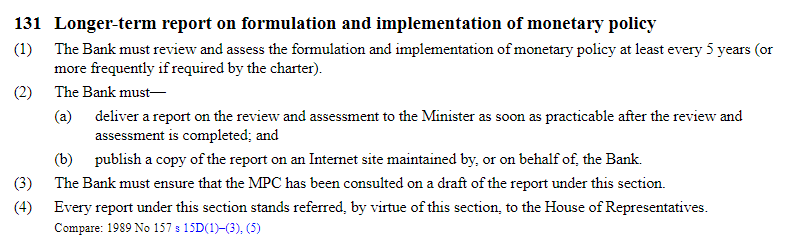
When the monetary policy provisions of the Reserve Bank Act were overhauled a few years ago this requirement was added
It made sense to separate out this provision explicitly from that for Monetary Policy Statements (in fact, I recall arguing for such an amendment years ago) but the clause has an odd feature: MPSs (and the conduct of monetary policy itself) are the responsibility of the MPC, but these five-yearly longer-term reviews are the responsibility of “the Bank”. In the Act, the Bank’s Board is responsible for evaluating the performance of both management and the MPC, but the emphasis here does not seem to be on the Board. It seems pretty clear that this is management’s document, and of course management (mainly the Governor) dominates the MPC. Since the Board has no expertise whatever in monetary policy, it is pretty clear that the first of these reports, released last week, really was, in effect, the Governor reporting on himself.
And although plenty of people have made scathing comments about that, there isn’t anything necessarily wrong about a report of that sort. After all, it isn’t uncommon (although I always thought it odious and unfair given the evident power imbalance) for managers to ask staff to write about notes on their own performance, as part of an annual performance appraisal, before the manager adds his/her perspective. The insights an employee can offer about his or her own performance can often be quite revealing. And it isn’t as if the Bank’s own take on its performance is ever going to be the only relevant perspective (although, of course, the Governor has far more resources and information at his disposal than anyone else is going to have). The only real question is how good a job the Bank has done of its self-review and what we learn from the documents.
On which note, I remain rather sceptical about the case (National in particular is making) for an independent review specifically on the recent conduct of monetary policy. Some of those advocating such an inquiry come across as if what they have in mind is something more akin to a final court verdict on the Bank’s handling of affairs – one decisive report that resolve all the points of contention. That sort of finality is hardly ever on offer – scholars are still debating aspects of the handling of the Great Depression – and if there was ever a time when choice of reviewer would largely determine the broad thrust of the review’s conclusions this would be among them. Anyone (or group) with the expertise to do a serious review will already have put their views on record – not necessarily about the RBNZ specifically (if they were an overseas hire) but about the handling of the last few years by central banks generally. There is precedent: the Svensson review (mentioned above) was a serious effort, but the key decision was made right at the start when Michael Cullen agreed to appoint someone who was generally sympathetic to the RB rather than some other people, some of equal eminence if different backgrounds, who were less so. It would be no different this time around (with the best will in the world all round). A review might throw up a few useful points and suggestions, and would probably do no harm, but at this point the idea is mostly a substantive distraction. Conclusions about the Reserve Bank and about its stewardship are now more a matter for New Zealand expert observers and the New Zealand political process (ideally the two might engage). Ideally, we might see some New Zealand economics academics weighing in, although in matters macroeconomics most are notable mainly by their absence from the public square.
That is a somewhat longwinded introduction to some thoughts about the report the Bank came out with last week (120 pages of it, plus some comments from their overseas reviewers, and a couple of other background staff papers).
I didn’t think the report presented the Bank in a very good light at all. And that isn’t because they concluded that monetary policy could/should (they alternate between the two) have been tightened earlier. That took no insight whatever, when your primary target is keeping inflation near the middle of the target range and actual core inflation ends up miles outside the range. Blind Freddy could recognise that monetary policy should have been tightened earlier. When humans make decisions, mistakes will happen.
The rest of the conclusions of the report were mostly almost equally obvious and/or banal (eg several along the lines of “we should understand the economy better” Really?). And, of course, we had the Minister of Finance – not exactly a disinterested party – spinning the report as follows: “It is really important to note that the report does indicate that they got the big decisions right”. It should take no more than two seconds thought to realise that that is simply not true: were it so we would not now have core inflation so far outside the target range and (as the report itself does note) pretty widespread public doubts about how quickly inflation will be got down again. It would be much closer to the truth to say that the Reserve Bank – and, no doubt, many of their peers abroad – got most of the big decisions wrong. It has, after all, been the worst miss in the 32 years our Reserve Bank has been independent, and across many countries probably the worst miss in the modern era of operationally independent central banks (in most countries, after all, monetary policy in the great inflation of the 1970s was presided over by Ministers of Finance not central banks).
But there is no sense in the report at all of the scale of the mistake, no sense of contrition, and – perhaps most importantly in my view – no insight as to why those mistakes were made, and not even any sign of any curiosity about the issue. The focus is almost entirely defensive, and shows no sense of any self-critical reflection. There are no fresh analytical insights and (again) not even any effort to frame the questions that might in time lead to those insights. And no doubt that is just the way the Governor (who has repeatedly told us he had ‘no regrets’) would have liked it. And here we are reminded that this is very much the Orr Reserve Bank: the two senior managers most responsible for the review (the chief economist and his boss, the deputy chief executive responsible for monetary policy and macroeconomics) only joined the Bank this year, and so had no personal responsibility for the analysis, preparation and policy of 2020 and 2021 but still produced a report offering so little insight and so much spin. Silk, in particular, probably had no capacity to do more, but the occasional hope still lingered that perhaps Paul Conway, the new chief economist, might do better. But these were Orr’s hires, and it is widely recognised that Orr brooks no dissent, no challenge, and in his almost five years as Governor has never offered any material insight himself on monetary policy or cyclical economic developments. Even if they had no better analysis to offer – and perhaps they didn’t, so degraded does the Bank’s capabilities now seem – contrition could have taken them some way. But nothing in the report suggests they feel in their bones the shame of having delivered New Zealanders 6 per cent core inflation, with all the arbitrary unexpected wealth redistributions that go with that, let alone the inevitable economic disruption now involved in bringing inflation a long way back down again. It comes across as more like a game to them: how can we put ourselves in the least bad light possible with a mid-market not-very-demanding audience (all made more unserious as we realised that the Minister of Finance had made the decision a couple of months ago to reappoint Orr, not even waiting for the 120 pages of spin).
At this juncture, a good report would be most unlikely to have had all the answers. After all, similar questions exist in a whole bunch of other countries/central banks, and if the Reserve Bank has the biggest team of macroeconomists in New Zealand, there are many more globally (in central banks, academe, and beyond) but it doesn’t take having all the answers to recognise the questions, or the scale of the mistakes. In fact, answers usually require an openness to questions, even about your own performance, first. And there is none of that in the Bank’s report.
Thus, we get lame lines – of the sort Conway ran several times at Thursday’s press conference – that if the Bank had tightened a bit more a bit earlier it would have made only a marginal difference to annual inflation by now. And quite possibly that is so, but where is the questioning about what it would have taken – in terms of understanding the economy and the inflation process – to have kept core inflation inside the target range? What is it that they missed? (And when I say “they” of course I recognise that most everyone else, me included, also missed it and misunderstood it, but……central banks are charged by Parliaments with the job of keeping inflation at/near target, exercise huge discretion, carry all the prestige, and have big budgets for analytical purposes, so when central banks report on their performance, we should expect something much better than “well, we acted on the forecasts we had at the time and, with hindsight, those forecasts were (wildly) wrong”.) The question is why, what did they miss, and what have they learned that reduces the chances of future mistakes (including over the next year or two – if your model for how we got into this mess was so astray, why should the public have any confidence that you have the right model – understanding of the economy and inflation – for getting out of the mess? At the press conference the other day the Governor and the Board chair prattled on about being a “learning organisation” but you aren’t likely to have learned much if you never recognised the scale of the failure or shown any sign of digging deep in your thought, analysis, and willingness to engage in self-criticism. We – citizens – should have much more confidence in an organisation and chief executive will to do that sort of hard, uncomfortable, work than in one of the sort evident in last week’s report.
With hindsight one can make a pretty good case that no material monetary policy action was required at all in 2020. One might be more generous and say that by September/October 2020 with hindsight it was clear that what had been done was no longer needed. But that wasn’t the judgement the Reserve Bank came to at the time – and it is the Bank that has been tasked with getting these things right. Why? (And, of course, the same questions can be asked of other central banks and private forecasters, but the Reserve Bank is responsible for monetary policy and for inflation outcomes in this country.)
I may come back in subsequent posts to look at more detail at a number of specific aspects of the report (including a couple of genuinely interesting revelations) but at the big picture level the report does not even approach providing the sort of analysis and reflection the times and circumstances called for (in some easier times a report of this sort might have not been too bad, although you would always look for some serious research backing even then).
And if you think that I’m the only sceptic, I’d commend to you the comments from the former Deputy Governor of the Bank of Canada. On page after page – amid the politeness (and going along with distractions like the alleged role of the Russian invasion) – he highlights just how relatively weak the analysis in the report is, how many questions there still are, and a number of areas in which he thinks the Bank’s defensive spin is less than entirely convincing.
New Zealanders deserved better. That we did not get it in this report just highlights again that Orr is not really fit for the office he holds. In times like those of the last few years – with all the uncertainties – an openness to alternative perspectives, willingness to engage, willingness to self-critically reflect, and modelling a demand for analytical excellence are more important than ever.