A few years ago I wrote a post here, rather in the abstracr, on an idea then being touted in some circles for Wellington City Council to shift to a land-value rating model.
I ended that post this way
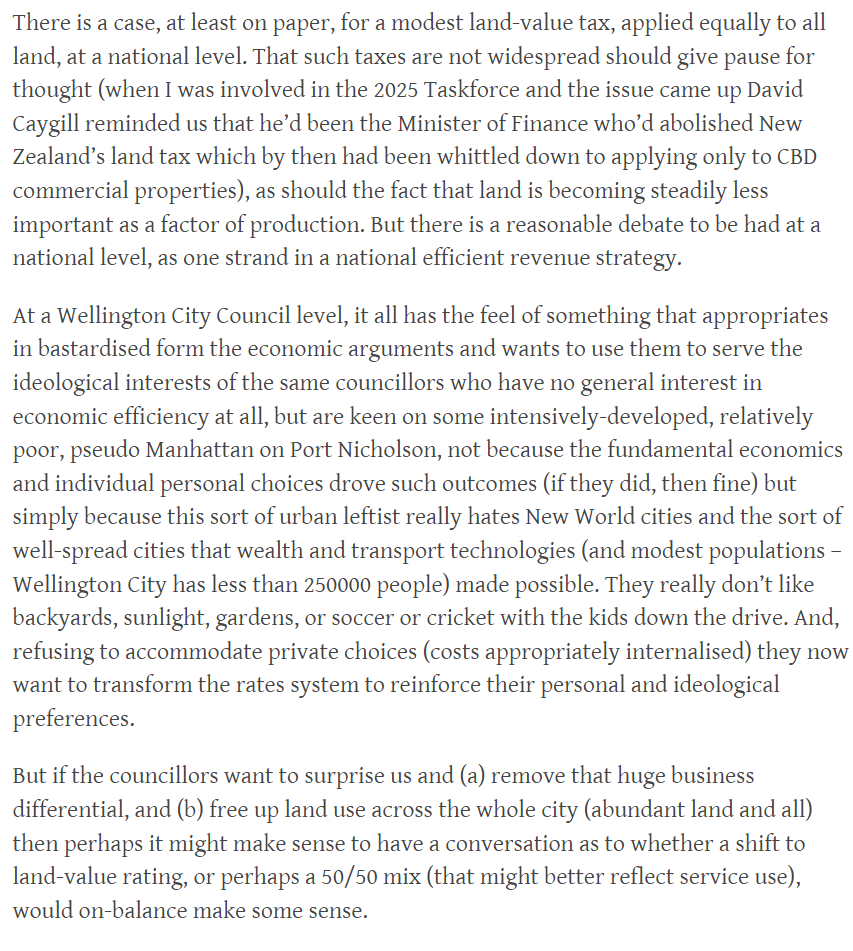
Three years on and the Council has a consultation document out. Submissions close on Sunday.
It is a rather odd document. First, it is astonishingly lightweight. There are five separate proposals – some apparently at odds with others, in a way never fully explained or reconciled – and yet the body of the document (the proposals) is only 13 well-spaced pages long (several of which are graphics or pretty pictures). One of the proposals is to up-end the existing rating model and replace it with land-value based rating. That gets five pages, but with almost no supporting analysis. It is the sort of document that perhaps might be a shop-window easy-to-read document for a household with no more than a vague interest (that was probably the two-page version that turned up in everyone’s letterbox), but there appears to be nothing else (there is no more-substantial document at all). A proposal this lightweight from a central government agency would surely be laughed out of court, the authors sent away to come up with something more in-depth, more comprehensive, and more rigorous.
Stranger still, a couple of months ago the Wellington City Council voted that it should go out of existence, merged into one or other of the amalgamation schemes that people have suggested. Why then would you consult on major changes in the rating system that may well a) never be implemented anyway, or b) quickly be reversed? The centrepiece of the consultation document is land-value rating, but as the document notes all the other Wellington TLAs use capital-value rating, so the proposal is to deliberately diverge just before (what councillors would prefer) an eventual convergence. As the document also notes, there has been a trend across the country for more TLAs to adopt capital-value rating (many have moved over the last 20 years), but the document neither engages with this revealed preference, nor makes any attempt to use those experiences to shed light on the likely impact of change, or of a different model over time.
I haven’t had a great deal of free time this week so my submission is more rushed than I would have liked. I lodged it this afternoon and a copy is here.
Of the five proposals, my focus was on two of them. The first was to begin to reduce the extraordinarily high commercial rates differential. Here is what I said on that one.
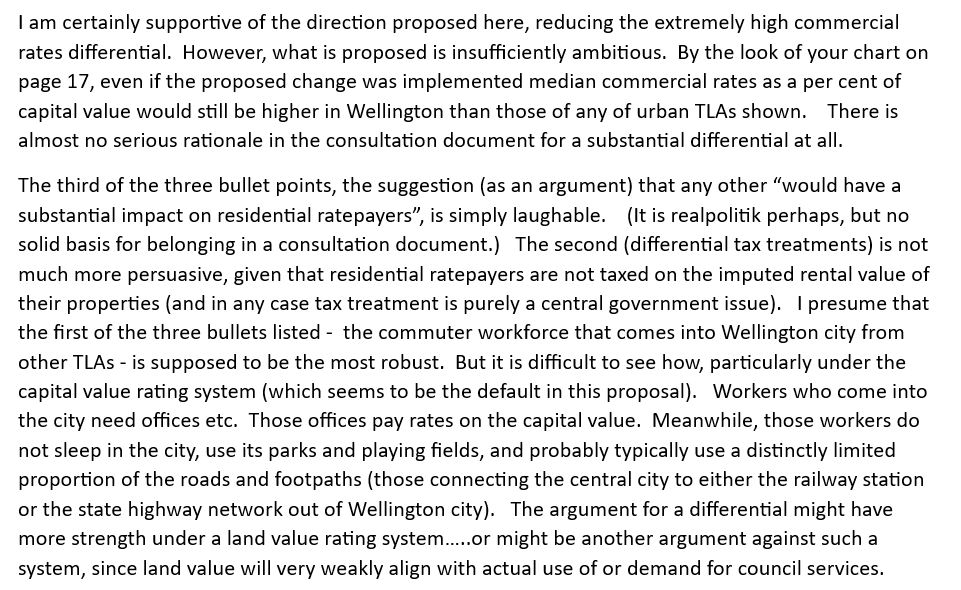

(“Appropriate starting point” that is if there is any commercial rates differential at all. It is difficult to see a robust case for one.)
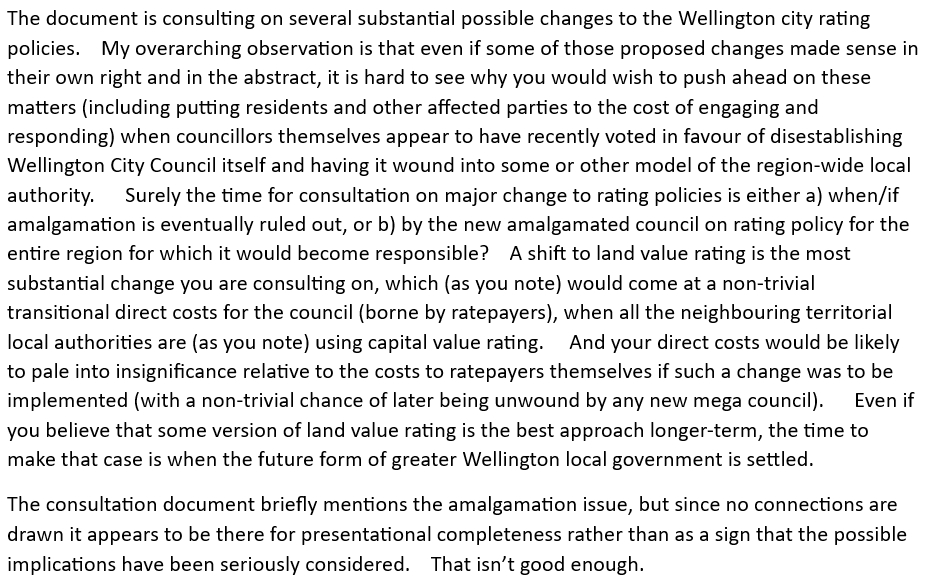
The second, and the one that has made more attention, is the land-value rating proposal. It is extraordinary to be proposing such a disruptive shift when WCC’s own future is up in the air
And, after discussion of various specific points, notably that capital value rating is almost certainly better aligned with demand for, and use of, those council services that are not, and perhaps cannot be charged directly, I ended
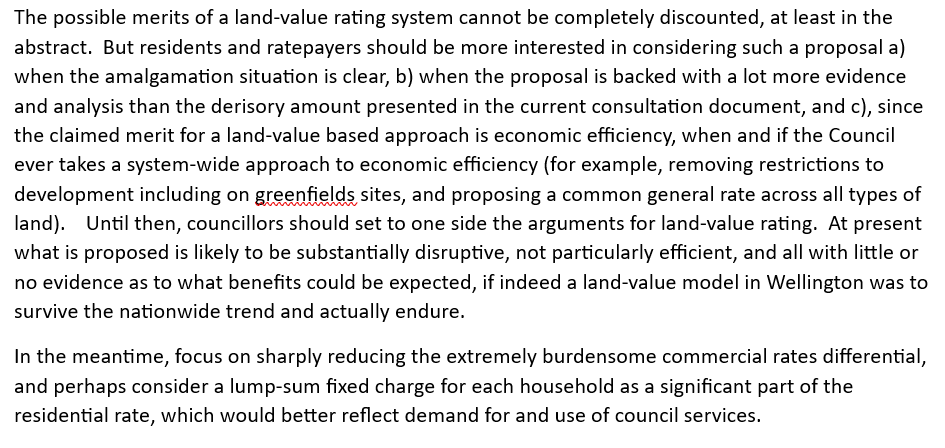
(Again, two posts in a week is not a marker of any sort of return to regular blogging.)


Thank you, Michael for sharing. Your views will be helpful to me in formulating my submission on what is half-baked scheme.
I wrote to the rating policy team and explained that I understood pure land value rating to be where all land irrespective of its use is rated equally and that land value rating would result in a very significant increase in residential rates.
Their reply:
“As explained in the online consultation material, pure Land Value rating would NOT result in a substantial increase in rates for all residential land.”
And then they went on to say that the differential and targeted rates would still apply. I replied and said in effect “so not pure land value rating then.”
Their reply : “We apologise if we have caused any confusion in the words pure land value rates. We have not intended to import any pre-existing economic definition to that phrase. To us, for the purposes of the consultation, pure land value meant all general rates would be based on land value (for example we don’t carve out any special provisions for (say) utilities). Property use differentials would still apply. Targeted rates would still apply as before (based on CV).”
What can you say?
Best wishes to you,
Julie Ward
LikeLiked by 1 person
This whole rigmarole is probably just an exercise by council staff to justify their own existence and to bolster staff work in advance of any almalgamations in order to justify larger staff numbers than there actually needs to be. Look out for other pointless staff work along the same lines
LikeLike
I think it has been driven mostly by a group of left-wing councillors, many/most of whom have a strong bias towards intensification.
LikeLike