(No, two posts in two weeks does not foreshadow any sort of return to regular blogging – tempting as it has occasionally been at least for the pre-election period – but having written copious amounts on the Reserve Bank’s monetary policy, associated governance, and lack of serious accountability during and after the Covid period, I thought it would be worthwhile documenting some reactions to the report of the Independent Review of the Monetary Policy Response to the Covid-19 Pandemic which was released on Wednesday yesterday. And, of course, writing helps clarify my own thoughts.)
One of the (minor) odd features of the report was that it did not include the terms of reference given to the reviewers by the government when they commissioned it back in February. Interested readers had to go hunting for themselves. Here is a link to the terms of reference.
There were a number of weaknesses in the terms of reference. The very first purpose listed for the review was to “support accountability” and yet only the decisions of the MPC itself were in scope (not, notably, those charged with holding them to account, whether the Bank’s Board, The Treasury, or the (then) Minister of Finance). Given that the system, as legislated by Parliament, is supposed to balance operational autonomy for the MPC with meaningful accountability, it is a shame that the workings of the entire system over that period were not reviewed. Equally less than ideal was that the reviewers chose to focus solely on the committee as a whole and not on the roles, responsibilities, performance etc of individual members, executive and external.
And it was only when I went back and read the terms of reference yesterday that I was reminded of this.

It seems very odd for ministers to put a page limit on an independent report, and especially one into matters so complex and consequential (and, as it happens, costly).
There was a KC report into the some specific issues around the conduct of the previous FMA chair Craig Stobo earlier this year, which (without apparent page limit) ran to 45 pages. The first of the reports into the Mount Maunganui landslide earlier this year ran to 250 pages. And more directly relevantly, as part of the 2023 (broad) review of the Reserve Bank of Australia, one of the authors of this review (Orphanides) wrote the reviewers a background paper on the RBA’s monetary policy near the effective lower bound, and it – just a background paper – ran to 62 pages. Lars Svensson’s 2001 independent review of Reserve Bank monetary policy ran to almost 80 pages.
Who knows quite why the Minister of Finance imposed such a limit, which more or less guaranteed that a lot of issues would have to be skated over all too lightly. Perhaps it was the delays they experienced with coalition partners and then finding potential reviewers, but we’d probably have gotten a more substantively useful document had the reporting deadline been extended somewhat (no doubt beyond the election) and the reviewers left freer to elaborate.
Another odd feature of this review – as opposed to Svensson’s – was that public submissions were not sought. The reviewers talked to a reasonable range of economists (only, listed at the back) but, for example, did not talk at all to one of Orr’s most vociferous economist critics during the period. Nor, for example, did they talk to (then) ministers or their advisers, to FEC members, to (it appears) senior Treasury people during the period (including the then Secretary, who was a non-voting MPC member) or even to people who were on the Reserve Bank Board (charged with holding MPC to account, and recommending (re)appointments) through the period. These sorts of people should have been relevant even if only as those who had direct exposure to the Bank and MPC members, and how they thought and operated, throughout this turbulent period. (To be clear, I’m not complaining for myself: not only did I have a fairly long meeting with the reviewers but at David Archer’s request I provided some written material at the start of the process, mostly as pointers to real-time perspectives and analysis I had written during the Covid period.)
The reviewers also seemed oblivious to (or at least uninterested in) the issue of whether or not, and if so to what extent, people (expert and otherwise) may have lost (or, I suppose, gained) confidence in the Reserve Bank/MPC through the experience of the period, whether from the substance of their decisions, the outcomes, the way they communicated and engaged, or otherwise. It is all a bit odd, especially as both Archer and Orphanides have had exposure to the wider governance/legitimacy side of things, Orphanides as Governor (central bank of Cyprus, admittedly part of the least-acccountable central bank system on earth, the ECB) and Archer latterly in his senior BIS role and various papers he has written or co-authored – I discussed one of those here a couple of years ago.
Back when the review was first announced to report in September (having been promised for some years) there were some feverish people on Twitter suggesting it was all a political jack-up designed to embarrass the Labour Party weeks out from the election. There was even talk of “evil” Atlas Network connections. I thought that was pretty much nonsense (and said so), initially because of what I knew of the reviewers (I worked with/for David on several occasions over 20 years, and today we are both trustees of the Reserve Bank’s troubled superannuation scheme), neither of whom seemed the type to do anything other than articulate their conclusions freely and frankly (and neither seemed likely to be wanting future business/appointments from the New Zealand government). As it happens, OIAed documents revealed that the original intention had been for the review to be done and completed ages ago, but…coalition parties and finding credible reviewers added delays.
And whatever your personal opinion of the government(s) in office over the period, I do not believe there is much evidence that the government or its ministers can be blamed for the succession of decisions that led to such a costly outbreak of inflation and such large financial losses. The MPC is set up to have operational autonomy over monetary policy, which is supposed to mean that specific governments neither get the blame when things go wrong (MPC makes bad calls) or gets the particular credit when things go well. In practice it isn’t like that, of course, but such pressures are to be resisted. Operational independence becomes hard to sustain if politicians get tarred with all the blame (or even the credit) but have none of the decision-making authority. Sure, bad appointments can be made but – to take Orr as an example – while he was appointed by Robertson in late 2017 it was (and had to be) on the recommendation of the Bank’s board, who had been wholly appointed by the outgoing National government. No doubt Robertson was weak to have gone along with the Orr/Quigley 2018/19 blackball on appointing experts as non-executive MPC members, but in doing so he was acting on advice (and Treasury seems not to have pushed back on that advice). Did those mediocre appointees make a difference? I’m a bit sceptical (much as I wish it was otherwise) and of course the reviewers never even touched on the quality of those on the MPC.
Where politics does come into focus primarily is in the context of the so-called dual mandate added to the Reserve Bank Act in 2018. The reviewers clearly did not like that amendment one little bit (which could readily have been predicted).
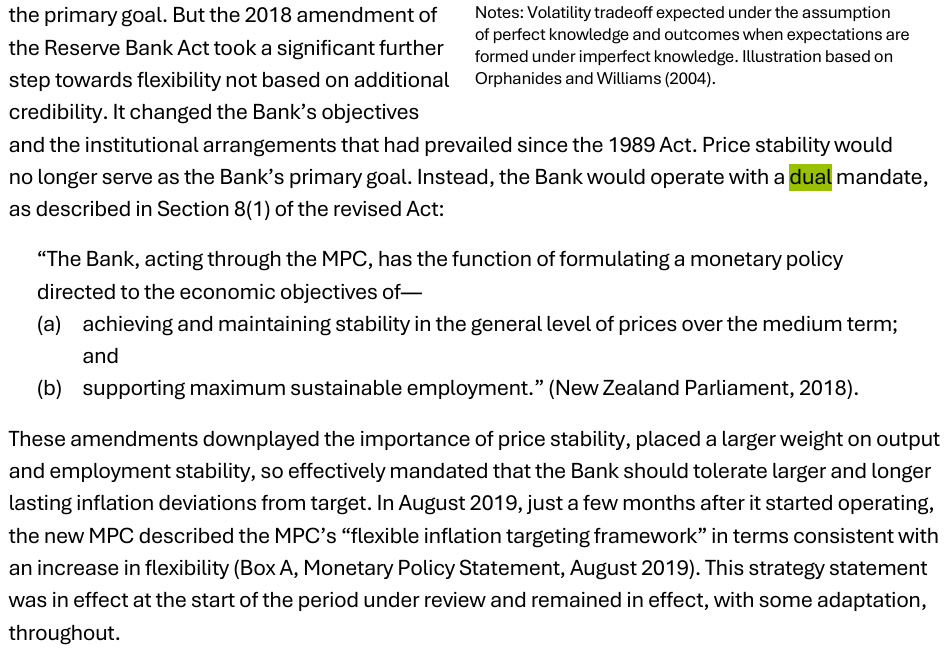

That was, no doubt, music to the ears of the Minister of Finance (quoted in her press release) but the problem is that the report itself offers no analysis at all to support the suggestion that the statutory change made any difference to policy choices or outcomes. They never, for example, even mention of the line run several times by the former Governor that in his assessment (and he did chair the committee) the change had made no difference to decisions made over this period, and they never (for example) engage in even the simplest cross-country assessment (did countries with dual-mandate specifications come through this period with worse outcomes than countries that retained a simpler specification?). It is well understood that in the face of demand shocks, you get exactly the same recommended policy response with a sole medium-term price stability focus (what the Bank was required to focus on immediately prior to the law change), as with something like a dual mandate specification. And since (as the report notes) no inflation-targeting central bank was ever an “inflation nutter” faced with near-term supply shocks to prices – precisely because of the output and employment consequences – it isn’t clear how the authors themselves believe the law change changed outcomes.
As I’ve pointed out on plenty of occasions, the Bank’s forecasts through 2020 and the first half of 2021 typically suggested that if anything MORE policy stimulus was required, and that such stimulus would both raise inflation towards the target midpoint and lower unemployment towards the non-inflationary sustainable rate (because forecast inflation was low and forecast unemployment was high). Their forecasts were very wrong, but there is nothing the reviewers point to – and they had access to MPC members and presumably to the unpublished background papers – suggesting the dual mandate made a difference. They were, of course, constrained by that page limit, but must have been aware of the political sensitivity of the issue. It is an unfortunate omission, and while they might seek to defend themselves by noting that the terms of reference explicitly refer to “the objectives of monetary policy that applied at the time”, they were the ones who chose to open up the dual mandate issue (probably rightly in my view, because it is a question that should be asked, and investigated seriously).
I noted that there was no attempt at a cross-country perspective on whether the form of the mandate made a difference (and I suspect they knew there was little reason to think it would) but it is just an example of another significant weakness of the report. They were specifically charged with considering as background “relevant decisions made by comparable central banks” but there are very few specific mentions of other central banks at all, and no attempts to compare and contrast policy choices, initial shocks (that central banks faced) or inflation outcomes (again allowing for things like different shocks – eg gas prices were to matter vastly in Europe in 2022, but not all in New Zealand). There is some reason to think that our Reserve Bank may have done worse than many (as I have long pointed out, and as more-recent Reserve Bank pieces note, we are estimated to have had probably large positive output gap – measure of economic overheating – of any advanced economy), but equally it is fair to point out (and the report never does) that central banks in most (but not all) advanced countries made very similar errors – notably forecasting errors – to those made by our Reserve Bank. On the one hand, that is some (modest) defence – it would be worse if ours had been uniquely bad – although on the other, each central bank takes on responsibility for outcomes only in its own country, and each has to be accountable for those national outcomes.
It is also puzzling that the report never looks closely at private sector, or implied market, views of the outlook for New Zealand inflation or required monetary policy. There is simply a parenthetic reference largely dismissing the fact that those views were very similar to the Bank’s (on grounds that the Bank’s forecasts can influence outside forecasters’ views). But when private forecasters and commentators think a central bank is getting things very wrong, they tend to say so (even if they also need to guess what the Bank will actually do). It is less bad when the MPC makes the same mistake as people operating in the private sector, with lots of money at stake, but……private forecasters, informed commentators, and hedge funds etc aren’t responsible for NZ monetary policy and inflation (or thus to the wider public at all), while the MPC is. In fact, the review is sometimes reluctant to even assign responsibility (on the very first page we are told, abstractly, that “mistakes were made”, but not that named individuals who assumed voluntarily the responsibility and prestige of MPC appointments themselves made those mistakes (here and abroad). The report is very light indeed on any serious form of accountability (including, for example, never once – in the body of the text – mentioning the names of those involved).
Incidentally, one wonders if journalists have sought comment on the report from those who were MPC members during the period. My guess is that they will be reasonably happy with it, to an extent they probably should not have been able to be.
They get off rather lightly, both individuallly and collectively. More than a few points are just never developed, Take, for example, this
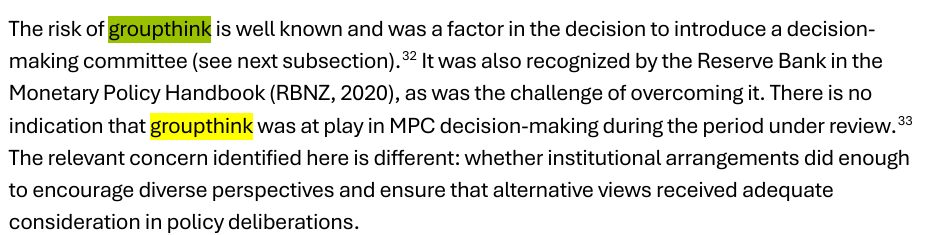
And that footnote? “One of the reviewers, Mr Archer, does not agree with this statement.” There were, after all, only two reviewers (so, for a start, how did they decide whose view got in the main text and whose in the footnote?), and this is the only highlighted difference between them, and yet there is no sign of what evidence or reports they each used to reach a view on this quite significant issue (on which Archer has had strong documented views for years). They seem to resolve to agreeing on the abstract (“institutional arrangements” doing “enough to encourage diverse perspectives”) without serious analysis of what actually happened in the specific, very costly, period of policy conduct they were asked to review.
And while there are abstract and general issues worth considering, and certainly in any committee constituted as MPC then was, it is pretty extraordinary that none of the specifics around individuals, notably the Governor, are engaged with. Orr has had a reputation for too often having been intolerant of dissent or challenge, whether internal or externally-sourced. And during this period he was cycling through senior managers, including those directly associated with monetary policy. The able Deputy Governor had apparently had enough and announced he was leaving, only to have his employment summarily terminated a few weeks early, the Chief Economist through the period seemed pleasant but not really up to the senior role and seems to have found it best to leave, and then of course late in the period under review an utterly unqualified (for MPC-type responsibilities) new DCE responsible for macro matters was appointed. In a committee required by law to have a majority of internals those people, and sets of circumstances, don’t sound like a mix that would have produced optimally open debate and mutual challenge. Committees don’t exist in the abstract, but with concrete individuals, with their personalities, dispositions, incentives, and so on. Perhaps it really was all okay, but the reviewers make no serious attempt to engage on the issue.
There isn’t even any reflection, anywhere in the report, on the fact that throughout the entire, very challenging, Covid period there was not one dissent recorded, ever (and while consensus was formally encouraged, votes were never prohibited, nor the clear expression of an alternative view). My bias is to the agree with Archer’s dissent, but….they had the opportunity to gather and report evidence from inside, and yet they seem to have chosen not to do so.
Perhaps in a similar vein, there is nothing in the report about the extent of external engagement, or otherwise, of MPC members during a period of extreme turbulence and great uncertainty. There were barely any serious speeches through the period, almost no external engagement by external MPC members, and little or no sign of any systematic attempts to engage with the uncertainty by, for example, hosting workshops or conferences to try to open themselves to alternative perspectives or explore the uncertainties they (and everyone else) faced. And, of course, because for example the external accountability stuff was out of scope, there is nothing about the frosty way in which the Bank engaged with any challenge or scrutiny at FEC. None of it suggested a “learning organisation”, an open one, or one that recognised the need to maintain its legitimacy and the centrality of accountability.
Not all punches are pulled. It was good to see the review highlight how extraordinary it was that nothing had been done before 2020 to ensure that banks’ systems etc could cope with negative (policy) interest rates (having had years of notice of the issue, and having themselves expressed in public the view that negative rates were likely to be a better tool than large scale asset purchases. Had they got onto that earlier – even had the new MPC raised concerns when it was established – it is likely the MPC would never have engaged in such large scale, risky, and (as it turned out) very costly LSAP purchases. Billions of dollars wasted for a failure by the Bank to have been suitably prepared for a foreseeable threat (makes MBIE’s technology project woes seem cheap). The Taxpayers’ Union may not be flavour of the week, but in their inimitable style they called out the waste.
But this is precisely where the official independent review gets weak. They suggest that the initial LSAP purchases were just fine (market stabilisation and all that), but don’t ever bother to engage on whether those RB purchases made any difference (to a temporary market liquidity crisis centred not here but in US Treasuries and where the Fed itself was intervening directly), or as to why once markets did settle profits weren’t quickly taken. More concerningly, there is no serious analysis of the effectiveness of the more-sustained LSAP purchase process that followed. They, fairly, note that to the extent there was much stimulus it proved, with hindsight, unwelcome (since inflation blew out) but never engage on the question of how much effective macroeconomic stimulus there actually was in the specific context of New Zealand. The financial losses are never quoted, and there is no attempt to engage or review with the claims, as recently as late last year, from the Reserve Bank that really it was all fine, and perhaps even net positive for the Crown. Without having done (or reported) any of that sort of analysis, they blithely suggest that there is a continuing role in the arsenal for LSAPs (and actually suggest legislative changes to remove some possible future roadblocks). And, on the other hand, despite those comments on negative interest rate capability earlier, there is nothing at all about the desirability of work to ease the remaining ELB constraint. Perhaps the reviewers think that would be a bad idea, but they don’t say, or offer any analysis. As it is, the OCR is about 350 basis points from the effective lower bound, and typical past cycles have involved 500 points of easing.
They also pull their punches around the Funding for Lending programme. They seem, reasonably, sceptical of the case for having introduced it (although, to be fair, it wasn’t completely inconsistent with their macro forecasts at the time) but never touch on the extraordianry way they went on providing crisis-support (cheap funding), exacerbating their OCR challenges long after any need for macro support had passed (claiming they were somehow “bound” – legally or morally was never clear, neither at all robust – to keep on).
Another area where I’d be critical of the report is around the initial monetary policy stimulus. The reviewers go to some lengths to portray the monetary policy approach from May to later in 2020 as reasonable given the forecasts the MPC was using. But in doing so they tend to treat the forecasts as a given, handed to the MPC by other people, when the forecasts themselves are the collective views of the MPC itself. They are certainly advised and supported by staff, but recall that the MPC at the time included the Governor and three other senior internal economists: the forecasts (or “baseline scenarios” as they were being called for a time in 2020) cannot be very meaningfully separated from the policy calls. In each case, each decisionmaker was applying their own “model” of the economy and of how the macroeconomics of the shock was going to play out, and then – given the Remit – how best policy should respond. MPC members had, certainly, to work with the initially limited data they had, but much more important in this case is that they were – again with hindsight – all clearly using the wrong models to think about how pandemic macroeconomics was going to play out (demand vs supply effects for example). This is a point that is simply never touched on in the report, even though it was (arguably) the single most important failing, not just by the Reserve Bank MPC but by macroeconomists around the world, in central banks and out. Perhaps we can call it pardonable to some extent – after all, it was a completely unknown sort of event – but it proved to be a huge and costly weakness. But also idiosyncratic.
Had we (they) properly understood the pandemic macroeconomics, and taken account of what fiscal policy was doing (as the Bank in fact did, so this isn’t the main issue), there would have been a strong case for the OCR never to have been cut in March 2020 and probably to have been raised very quickly, at least by the time the first successful lockdown was over. But again, the reviewers never engage with that sort of thought experiment, and they show no sign of having used their vast experience to reflect on why it was that the Bank (and so many others) misunderstood the economics. (I don’t purport to have a compelling answer either, but it was the root cause of what went so badly wrong later.)
Partly as a result, the report ends up being too inclined to absolve the MPC of responsibility for the mess (boom and bust, large unexpected transfers of purchasing power). If what was done initially was reasonable (“praiseworthy”, “rapid”, “innovative”, providing a “timely and much-need boost” [the latter as if lags are almost instant, and as if the aim of policy in March 2020 had not been to markedly shrink economic activity, temporarily]). And so the reviewers end up more or less buying into a line, run now by the Reserve Bank itself for several years, that really, while of course they should have started tightening a bit earlier, really it either wouldn’t have made much difference or would have done so only at untenable economic cost. The reviewers devote a lot of space to a little modelling exercise the Bank put out last year, suggesting that if they started tightening in late February 2021 with the goal of keeping inflation always at 3 per cent or less, it would have done huge economic damage (it first went through 3% in the June quarter, centred on mid-May). Well, of course, not only does no one thinks that monetary policy works with that short a lag, but….the bigger issue is why so much easing had been done in the first place. (I’m not suggesting the MPC members themselves deserve huge criticism for those March 2020 calls but….they did have quite the wrong model, and it was the source of what followed, the aftermath of which we are still living with.)
This has become a very long post. I want to finish with just a limited number of other specific points:
- it is very odd that throughout the entire paper there is never a single reference to a core inflation measure (or concept). Now it is, of course, true that the inflation target is specified in terms of the headline CPI, but Remits and (previously PTAs) have always enjoined the Bank to “look through” temporary or one-off price disturbances, to extent consistent with maintaining medium-term price stability. Thus, central banks rarely respond directly to, eg, sharp rise or falls in petrol prices which can make a big difference to near-term headline inflation. In this case, for example, the report emphasises the large fall in the CPI in the June quarter 2020 (quoted in American-style annualised terms), while never noting the huge role that petrol prices played – you may recall world crude prices briefly going negative in a quarter when not much driving or flying was happening). The approach they take simply doesn’t engage with the practical and real challenges actual central bankers faced during that period (and thus one should be hesitant about their recommendation that “near-term inflation signals may be more robust than forecasts at the policy horizon – I’m no fan of medium-term forecasts, but the operative word there has to be “may”, in some circumstances.)
- I agree with their broad approach to fiscal policy (consensus assignment remains appropriate and formal coordination is unlikely to be wise or called for) but am a bit hesitant about the suggestion that in some circumstances the Bank should build into its forecasts (or scenarios) its own view of what a government is likely to do. In terms of thinking about risks, there is probably some validity to the point, but I cannot see how it could be viable to include speculative numbers in published forecasts (it sets up potential for political fights in which the Bank is unncessarily caught in the middle).
- Recommendation 11 proposes that “the Bank should allocate sufficient resources to support the effective functioning of the MPC, including policy, research and analysis to support diverse perspectives in policy deliberations”. There is no elaboration of this point in the body of the report (one of a couple of examples suggested the final process ended up rather rushed, another being around reviewing/altering the Remit), and I’m not fully sure what they have in mind. If, as I initially thought, they mean providing dedicated analytical resource to the external MPC members – as, for example, happens at the Bank of England – I strongly agree (otherwise the Governor has a stranglehold on what the Committee sees). But reading it again, it is possible they had something else in mind.
- Recommendation 12 states “Sections 121 and 208 of the RBNZ Act create risks to monetary stability that should be reevaluated. The RBNZ Board should note have the authority to refuse to implement the MPC’s monetary policy.”. I want to devote some space to this because the Minister’s response to the report states explicitly that this “warrants further consideration and [the government] has commissioned further policy work from Treasury. Section 121 relates to powers of the Board, but actually (as the Report notes) section 208 relates to powers of the Minister, who can direct the Bank to “take all reasonable steps” to maintain a minimum level of capital specified by the Minister and have regard to the Minister’s expectations as to the Bank’s financial risk management. The report rather cavalierly suggests that “it is advisable to seek solutions that are implementable well before the Bank is required by unfortunate circumstances [emphasis added] to take on large financial risks to protect the New Zealand economy from from a deflationary shock”. This is melodramatic stuff, that not only does not engage with the likely actual effectiveness of either future LSAPs or big fx interventions, but more importantly does not engage with the guarantee powers the Minister of Finance already had under the Public Finance Act. To the Bank’s credit, it did not do the LSAP at its own risk (our risk imposed on us by them) but went and sought an indemnity from the Minister of Finance. It cannot be desirable that unelected officials, barely substantively accountable, can debauch the public finances without seeking the consent of the Minister of Finance. Extreme times call for political responsibility (including because, as demonstrated over 2020, with the best will in the world economists get thing badly wrong, and yet politicians are accountable). So I would urge The Treasury and whoever is Minister after the election not to be swayed by the these reviewers into re-establishing unlimited scope for the MPC to impose financial risks.
Overall, it is a fairly mixed bag of a report. If I scroll through the 12 formal recommendations I agree to a greater or lesser extent with most of them, although I think they probably tend to overstate what difference they might make in extreme unknown scenarios of the sort faced in 2020 and 2021. The recommendations are forward-looking, which is fine and has a place (including in the terms of reference they had to work to) but where the report is much weaker is on the backward-looking analysis and critical review. It gives passes to the MPC that aren’t really deserved and thus avoids some of the more difficult challenges of making sense of the period. It also tends, too much, to the purely technocratic – issues inside the Bank and the MPC – to the near-complete exclusion of the wider issues around legitimacy, accountability, and the confidence the public and markets might have in those who put their hands up to be entrusted with such huge delegated power.

