Yesterday the Prime Minister and leader of the National Party made some rather preposterous claims in his post-Cabinet press conference (as reported here by The Post)
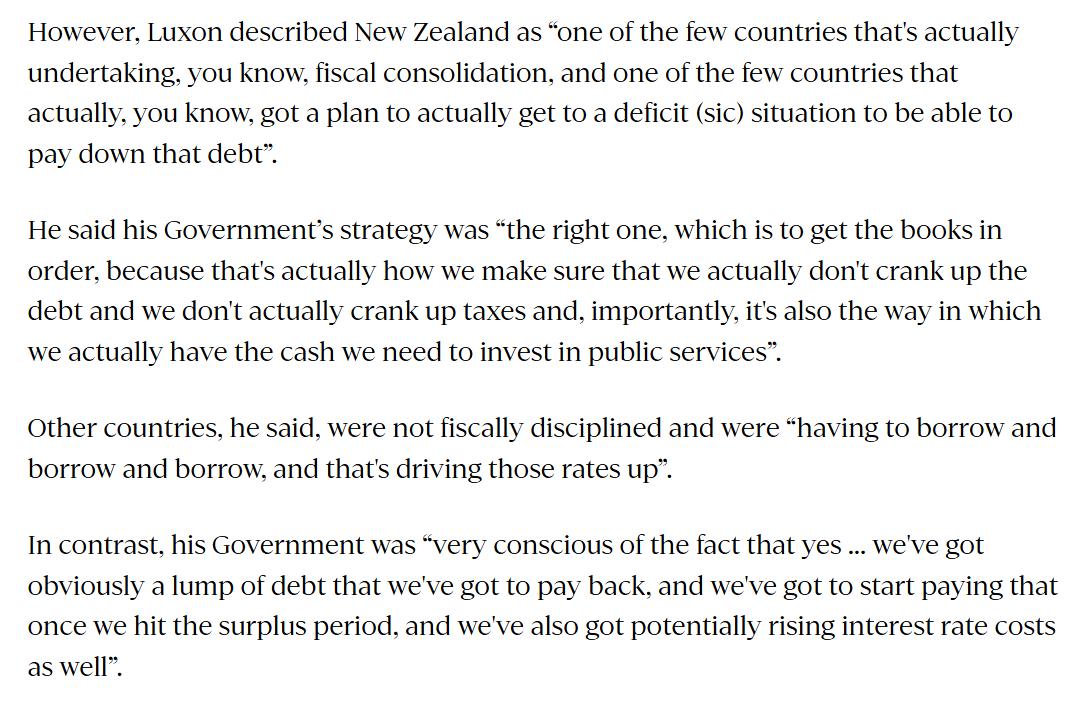
When you read stuff like this from the head of the government perhaps one comes to better understand why senior officials can actively mislead parliamentary select committees and suffer no real consequences. People in power seem simply not to care about the facts, or even a plausible grounding in truth.
Where to start? Well, perhaps here in a chart I ran on Twitter back at budget time in May.
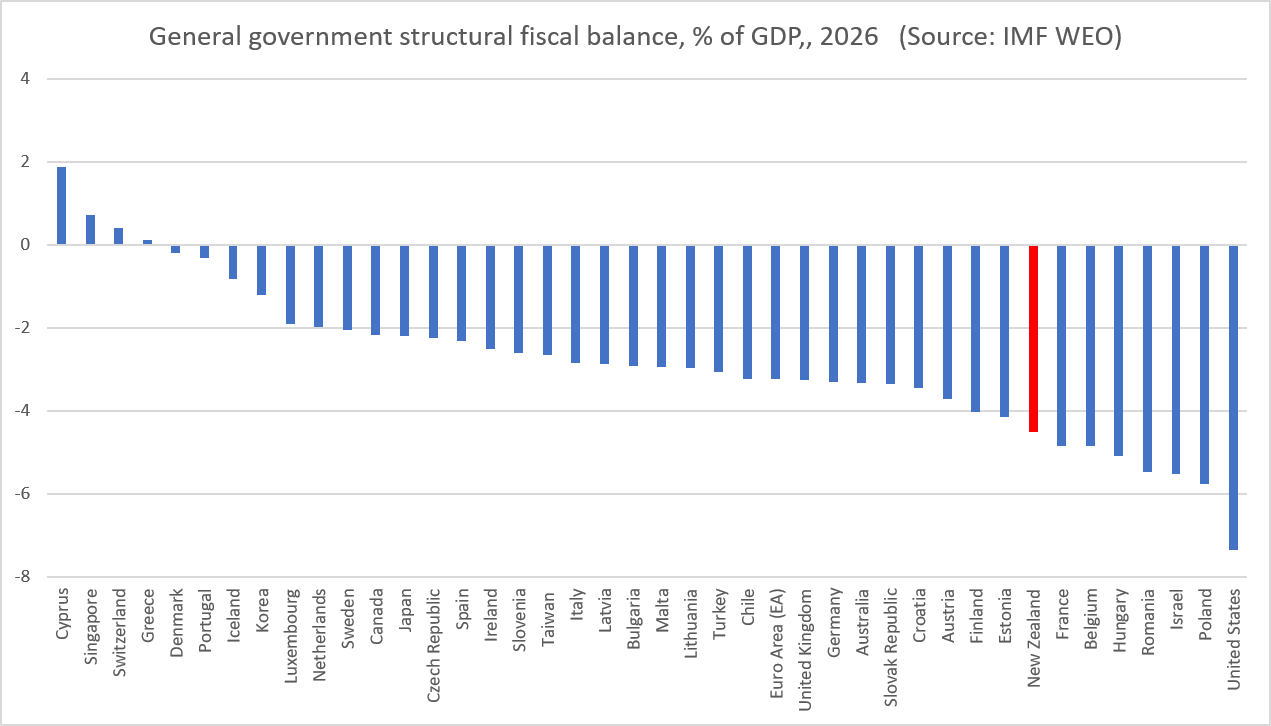
On the IMF’s reckoning, New Zealand had one of the larger structural fiscal deficits of any advanced economy this year. As I noted then “This is from the April IMF WEO but on Tsy numbers nothing in the budget yesterday altered the structural deficit for this year so the chart should still be representative.” There is a variety of other IMF fiscal deficit measures, and New Zealand now shows up poorly on all on them.
Now, the Prime Minister is quite correct that a lot of advanced economies have made no progress in cutting their deficits, but then a) ours are typically larger than theirs (and were in 2023) and b) more importantly, neither has New Zealand. That is so whether one looks as these IMF metrics or if one looks at the New Zealand Treasury’s own structural deficit estimates.
In each year’s Budget Economic and Fiscal Update The Treasury includes tables showing their estimates of the structural deficit (ie the bit not driven around simply be cyclical economic fluctuations, the bit that will only go away with specific policy choices). The Budget is typically released in May, so there is an estimate for the fiscal year just about to end and one for the year just about to start (shaped by the specific concrete fiscal choices and appropriations from the budget being announced).
Here is a summary table for the three budgets to date brought down by this government
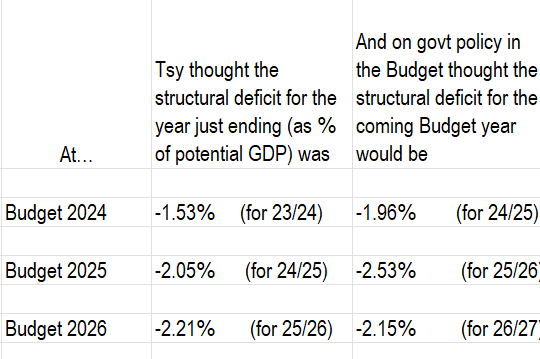
In the 2024 and 2025 Budgets the government consciously and deliberately (since they had the Treasury numbers in front of them) chose to increase the structural deficit, and in this year’s budget there was a very slight estimated reduction. Taken together, over three budgets discretionary fiscal policy has not produced any fiscal consolidation at all.
Of course, in the outer years budgets (under this government and its predecessor) almost always show a track in which structural and headline deficits shrink and eventually we return to surplus. Here is summary table showing successive EFUs (PREFU 2023 captured Labour’s stated fiscal policy) and National’s 2023 Fiscal Plan
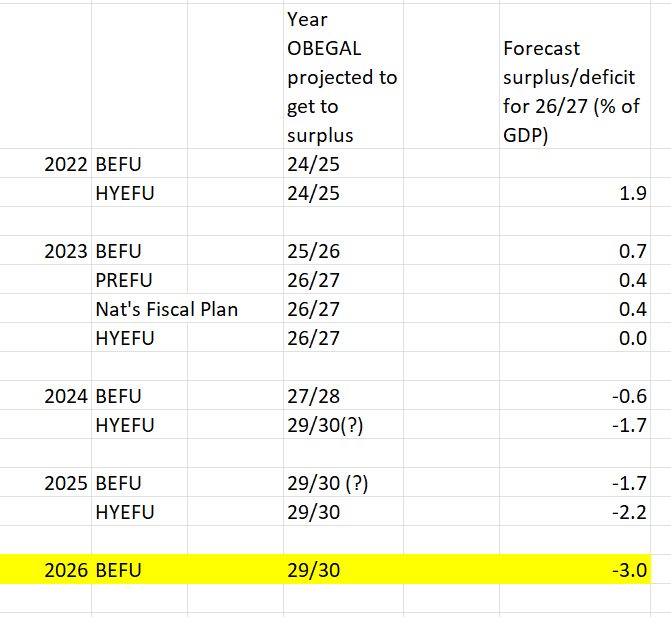
On both Labour and National’s stated numbers at the time of the 2023 election we’d be in (modest) surplus, on the proper OBEGAL measure, this year. Instead – and of course it is National that has led the government – the deficit for this year was projected to be around 3 per cent of GDP (most of which is structural).
We were promised consolidation, but none has been delivered. None.
A good illustration was reported by the Herald last week, when the proactive release of Budger-related papers finally occurred.
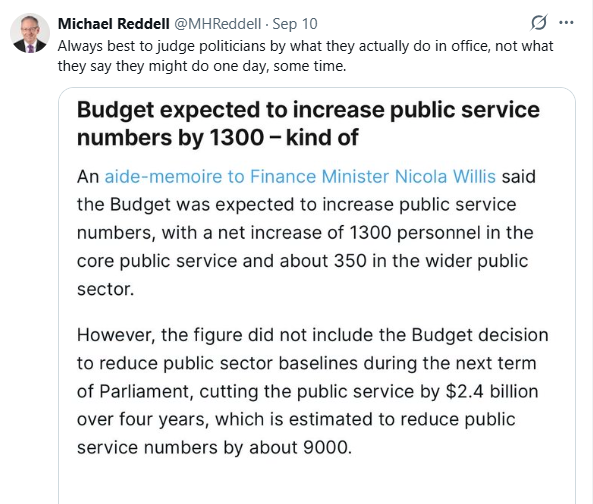
There has been lots of fine talk about public service staffing cuts (it suits National to talk them up as an achievement and Labour to bemoan “austerity” etc) but the numbers so far have not amounted to much in total and (as Treasury reports in that paper) the 2026 Budget was expected to result in a material increase in core public service staffing numbers.
Easy to talk before an election of what you might do after it, but it seems safer for voters to be guided more by what has actually been done. And that has not been fiscal consolidation (or overall spending cuts)
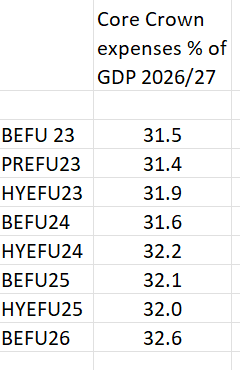
A few weeks ago National came out with its (so-called) Budget Responsibility Rules, which consisted (in effect) of making much the same commitments as they’d run in their 2023 Fiscal Plan: a return to surplus (on the Treasury standard OBEGAL measure) three years’ hence, but few/no credible specifics as to how they would deliver that, and a track record that gives potential voters little reason to believe that they are really serious this time. Why would we? After all, if they win a second term a) things always get harder to do in later terms, and b) on all polling this year, National is likely to be in a relatively weaker position within the government than they are now. Is there anything in how the government has governed in the last three years, or in their specific giveaways promised this year, that would lead one to believe that they will really make the scale of cuts required to deliver a return to surplus?
The government has raised debt (materially – more than at any time in decades outside identifiable crises like Covid or the Christchurch earthquakes), it is relying on fiscal drag (increasing tax/GDP), and it has not cut spending as a share of GDP. The words of St Augustine, “Lord, give me continence and chastity, but not yet” spring repeatedly to mind.
Not, of course, that there is any sign of Labour being much, if at all, better. It was, after all, Labour that bequeathed the government the large structural deficits. Labour too that promised – look, the forward tracks – that in government they’d have delivered a return to surplus by now (with no credible policy basis for believing that promise either). It is, I suppose, good that political parties still feel the need to talk about returns to surplus (I don’t think we see the same language in the UK for example) but neither side seems to feel obliged to actually deliver.
This time, Labour too promises a return to surplus (OBEGAL) on much the same time frame as National and the current government. The problem is that there is no more basis for believing that than there was a) for believing them in 2023, or b) for believing National at either election. Labour says it envisages a higher core level of government spending than National plans (as I guess you’d expect) but…..that means more tax than otherwise to finance that spending. And not only is the proposed CGT forecast revenue fully committed to fund specific additional spending pledges, but that revenues depends entirely on house prices rising but they are still falling (and ideally should keep falling if land use reform is at all serious).
The Prime Minister’s claims are more egregious – and at this point matter more as he is actually the Prime Minister – but there is really no sign of a) any fiscal consolidation to now or b) any real reason to believe that we will see any serious and deliberate fiscal consolidation from either side, whoever wins the election. It will be a decade of deficits, unless something quite fortuitous happens, and then we’ll probably start out on a second decade as the demographic pressures on spending mount and nothing material is done.
We can still take comfort in the level of overall public debt being relatively modest. But debt levels build. It wasn’t many decades since the UK was a low debt country, and now it is at the leading edge of the rise in global bond yields. It isn’t the way New Zealand should be content to go, but there is little sign of willingness by our politicians – notably including our current ministers – to either make hard decisions or to be honest with the public about the scale of the challenges. More giveaways, more bread and circuses….and more debt again seems so much easier for our fiscally feckless politicians.

