Newsroom’s Marc Daalder got in touch yesterday looking for comment on the term of the outgoing Minister of Finance, Nicola Willis. His article, quoting me and a couple of other economists, is here. I’d jotted down some notes for our chat, which are the basis for this post.
I might add here that I’ve never met Willis – closest I’ve ever come was Wellington airport late last Friday night, while I was waiting for someone to arrive and she walked past, looking exhausted but still very on-message in her “No New Taxes” blue jacket – and although I pick up a few impressions, comments, and insights here and there (it is Wellington after all) this is all public domain stuff.
When I went looking for something else this morning, I stumbled on a post I’d written here almost exactly three years on, with some thoughts on what Willis might be like as Minister of Finance. I wasn’t overly optimistic – some readers will recall the foreign buyers’ tax controversy during the election campaign, which while the amounts involved were small in themselves had quite materially undercut my confidence in the then Opposition spokesperson on finance – but rereading it this morning there have been no areas where she surprised on the upside, and quite a few where she undershot even my modest expectations.
Last year, prompted by a Listener journalist’s question, I did a post here trying to provide some basis for assessing the more significant of our Ministers of Finance in the last 100 years. I left Willis out of that comparison, partly because it was only 18 months in (somewhat arbitrarily I used as a threshold a minimum of three years in office), but also because she still had a big say over a couple of issues that mattered a lot to me (see below).
The first line on my scrawled notes for my chat with Daalder read “will be regarded as an inconsequential placeholder” as Minister of Finance (probably too as Minister for (the improbable new portfolio) Economic Growth). There are multiple, mutually reinforcing, reasons for that conclusion.
Perhaps the first role of the Minister of Finance is manager and steward of the government finances. Going into the 2023 election, National’s fiscal plan had the budget (on the standard OBEGAL measure) back in surplus in 2026/27. It isn’t of course, and this election we’ve been treated to another round of “trust us, this time we are serious”, with vapourware cuts to spending in the out-years (and, of course, a conveniently respecified deficit measure, which Willis preferred but Treasury didn’t like). The vapourware spending cuts for the next few years look a lot like those National (and Labour) promised in 2023.
Here are a couple of graphics. The first, which might need reading slowly, shows the structural deficit estimates in each of Willis’s three budgets.
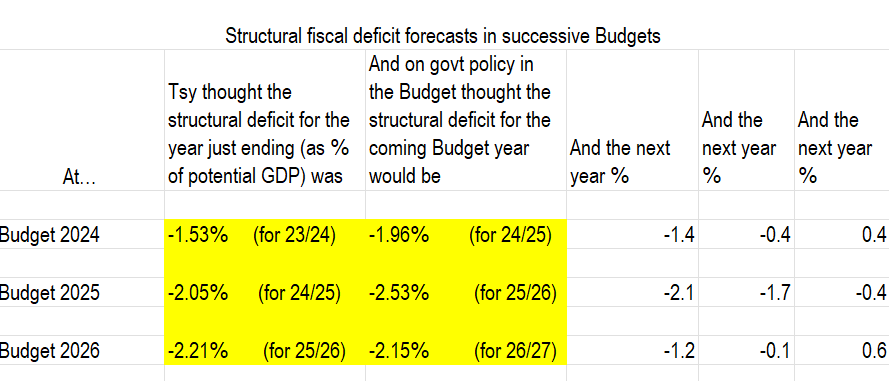
The yellow highlighted section is where the rubber hits the road. The Budget is brought down in May for a June fiscal year. The first highlighted column is Treasury’s estimate of the structural deficit for the year just ending, and the second is their estimate of the structural deficit for the year just about to start (based on the government’s Budget policies and the appropriations for the year ahead in that Budget). As you’ll see, in the first two budgets, the measures adopted modestly widened/worsened the structural deficit, while in this year’s Budget there was a tiny reduction. Three Budgets, three years in office, and the Minister of Finance’s choices and actions – no doubt with Treasury’s estimates in front of her – made no contribution at all to returning the operating budget to balance. (And, of course, the economy hasn’t been in good cyclical health in the last three years, but this table is estimates of the structural imbalance – the bit that would remain even when the output gap closed.)
And then there was operating spending, one of the things National highlighted as a real concern in the 2023 campaign. The government and the Minister have worn a great deal of flak for cuts to government spending over the last three years, but here are the Treasury numbers for operating spending as a share of GDP.
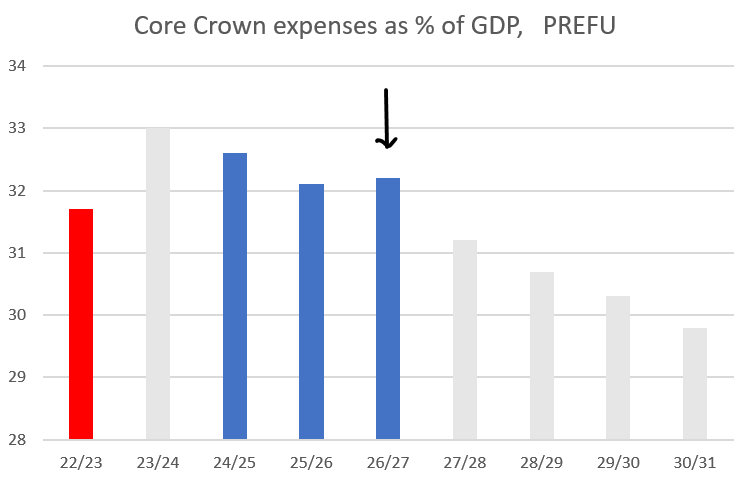
For this year – not apparently unrepresentative of the last three – Treasury projected in PREFU that spending will be higher, as a share of GDP, than in the last full year for which the previous Labour government was responsible (higher than pre-Covid too). (The grey bars to the right of the chart are the vapourware I mentioned earlier – easy to right down in table precisely because they do not yet involve hard choices or actual appropriations. If you flick back to the table above, those grey spending bars are how we get the equally imaginary out-year eventual returns to surplus).
There have, of course, been some cuts to some aspects of government spending, but the net effect has still been that all and any such savings have been used to finance other new spending, including the new giveaways that both main parties have competed to offer in recent years. And there were, of course, the 2024 tax cuts – one of the centrepieces of National’s 2023 campaign. At the time, they claimed to be able to do it and deliver a fairly timely return to surplus. The tax cuts happened – with the budget in substantial deficit – and the return to surplus didn’t. There is still no sign that Willis has ever herself, or forced her colleagues to, identified what is that they do not want the government to be doing in future. Without making those tough and considered choices, we end with (at best) across-the-board cuts, which even if implemented are just unlikely to endure. More likely, any brief return to surplus would be just happy accident.
Under the “steward of government finances” heading, I’d add just two more points:
- – with Willis as their Minister of Finance and finance spokesperson, National this year has abandoned any specific promise on which to campaign around raising the NZS eligibility age. She, I’m sure, knows that the demographic pressures are real, and yet – after three elections in succession in which they had a specific policy – they’ve just ceded the debate to the parties (partners and opponents) of no. And instead we have the incoherence of an election in which the major campaign pledge in the economic/fiscal space is to compel people to participate in Kiwisaver, at a very high rate of contribution: a policy which if it made sense at all does so only as a counterpart to winding back NZS eligibility/entitlement. Instead, having run the government finances on “borrow now and someone else can adjust later” it is as if they insist that households – even poor ones, one with new business starting out – have to save now, to be overprovided for decades hence in retirement. Of course, something will give in future, but Willis will have played no serious role in shaping that future.
- – Willis ended up going along passively with a Treasury move to lower the normal discount rate used to evaluate government spending, investment and regulatory proposals to 2 per cent. It wasn’t something she initiated – work was begun under the previous government – but neither she nor her office ever seemed to question a move which would make more and more proposals that agencies might dream up look economically sensible, even as that discount rate bore no relationship to the actual cost of capital for taxpayers, or to the sorts of hurdle rates of return private sector firms (with more governance disciplines – threat of bankruptcy) use. Did it make much difference to bottom lines? Perhaps not, but it is another area here she could have left her mark, reinforcing the good rhetoric about better discipline, but just chose to let things go by.
Investment Boost – the flagship policy initiative of the 2025 Budget – represented Willis as both Minister of Finance and Minister for Economic Growth. It is fair to say that probably a fair chunk of National’s business support base liked the policy, but it wasn’t cheap, and is all funded from borrowed money (recall those deficits). And it has its own incoherence. By the far the biggest winners from the policy are those investing in new commercial buildings – not something New Zealand has obviously been short of – and directly at odds with a revenue-grabbing policy the government had introduced the previous year to eliminate tax deprecation on commercial buildings. There was simply no coherence. (I’m also old enough to have been around Treasury when in 2010, supported then by lots of serious analysis and modelling, the then government had scrapped accelerated provisions then in place).
The Minister of Finance (perhaps especially when also Minister for Economic Growth) has the primary role in leading tax policy (Ministers of Revenue tend to be fairly junior). We’ve gone through three years with no sign of any particular Willis approach to the future of tax policy.
And, of course, there has been no sign of any serious thinking about the answers to the economic growth and productivity failures that have dogged New Zealand for decades. I’m not one of those who thinks you need to be an economist to be a good Minister of Finance – just as well, as there have been none here – but there is no sign of even any intellectual interest or political leadership in the issue; no sign (for example) of having sought to rebuild Treasury as some sort of intellectual powerhouse of policy analysis and economic thought leadership and advice. In fact, what signs we do see of policy initiatives associated with Willis have mostly been knee-jerk populist stuff, that perhaps might win a news cycle, but at best are peripheral. A good example was the supermarket breakup policy National took into the campaign, clearly Willis’s thing – criticisms of which are only reinforced by the discovery yesterday (Herald article) that she’d asked MBIE only to release the consultants’ report that seemed to support her policy, not the one (also paid for with taxpayers’ money) that would lead readers in quite the opposite direction. But, no doubt, it won a news cycle.
Much of all that has gone before in this post shouldn’t have been too surprising to anyone contemplating three years ago how Willis might do as Minister of Finance (and various other portfolios).
Where, I guess, I ended up surprised was by how weak she too often seemed to be around the key people and institutions she was responsible for. Perhaps she was unlucky with Andy Coster (perhaps) but appointments as heads of government departments do not happen without the support of the relevant minister (she was responsible for the Social Investment Agency when that appointment was made). Brian Roche as Public Service Commissioner was her doing (as Minister for the Public Service): took ages to make an appointment at all, only managed to get someone (already quite old) for 2.5 years, and then agreed that he could do the job on less than a fulltime basis (hadn’t fixing the public service and structure of government been a key rhetorical priority?), all while – astonishingly for a central agency head – allowing him to hold several private sector directorships simultaneously. And now, as Willis leaves, Roche has been giving signs he can’t wait to get out the door himself.
Then there is Nic Blakeley, head of MBIE. Found to have mislead a parliamentary select committee (and not offered any immediate correction), Blakeley offered his resignation, but neither the Public Service Commissioner nor ministers (Willis being MBIE’s primary minister) saw fit to accept it. Since then it appears that Blakeley had, as deputy secretary, had more involvement in the underlying technology project failure (which also involved misleading ministers) than had previously been apparent. It hardly speaks to a Minister insisting on top quality performance from the public servants. But, conveniently for her, I guess he didn’t proactively release the Coriolis supermarkets report…..
Then, of course, there was/is the Reserve Bank. In Opposition, her scepticism of Adrian Orr was (creditable and) pretty evident to anyone watching the FEC hearings, while his dismissive approach to her (and anyone else occasionally asking awkward questions) was all too often on display. She’d highlighted the bloat, in spending and staff numbers. If they couldn’t (and they couldn’t) dismiss Orr when they came to office, there was plenty they could have done to bring the Bank to heel. I’ve documented all this here over 2024 and 2025 but there was a startling degree of passivity on display. First, she reappointed the Board chair at the end of his term – having already served for more than a decade, and been chair through all the Orr excesses. Then she (and her office and Treasury) seemed never even to notice when the Bank’s Board adopted a 2024/25 budget that allowed for a further large increase in operating spending, and only very belatedly seemed to “get religion” about the new five year Funding Agreement, when clear markers should have been laid down as soon as she took office (pretty much every agency got cuts straight away). All that had the fortuitous side effect of seeing Orr resign, having apparently fallen out with the board, the Treasury, and (of course) Willis herself. But then Willis provided active cover for months for the Board chair Neil Quigley who actively misled the public about what had gone on, and attempted to block uses of the OIA. Eventually, months on, Willis had finally had enough and left Quigley no choice to resign – but it was months on. And then who did she appoint as chair of the Board? Not a new broom, but rather the incumbent deputy chair, who’d sat on the board all through the previous three turbulent years, never apparently dissenting from anything (substantive – eg budget blowouts – or the coverup around Orr’s departure) and who was to go on to appear at FEC late last year to praise Quigley as an outstanding chair. Outside observers have generally found her choices in this area mystifying to say the least. It was as if she never realised how important building strong institutions was if she wanted to leave an enduring substantive legacy.
Willis’s professional background had been as a political adviser/operative. In her three years as Minister of Finance (and a bunch of other senior portfolios) she rarely seemed to rise above that background. She wasn’t to blame for the dismal economic performance of recent years (falling per capita GDP, no growth in real wages, core inflation sticking around too high, largest falls in employment/population of any OECD country over that period) – most of that was on the Reserve Bank, belatedly sorting out their own mistakes over 2020 to 2022 – but she will inevitably suffer by association. And if normally one might be a little sympathetic – things happen, many of them outside the control of ministers, some deliberately so – any such sympathy must be tempered by the relentless and ill-founded “politicisation” of every single OCR (and for a while CPI) announcement over her term: every OCR cut was allegedly because of a) what the government had done to get inflation down [nothing – not their job] and b) the government’s spending cuts [see chart above: there were none in aggregate as a share of GDP]. Just last week there was an egregious claim that the fact that our OCR was lower than those in Australia, UK, and the USA was an example of New Zealand as a beacon of strong economic performance by global standards – when it probably had more to do with our cyclical high unemployment rate [not the government’s fault either]. I guess all political figures do this sort of stuff to some extent, but Willis/Luxon seemed more than usually prone to it, and without any serious balancing of substantive strategic leadership around the policies and institutions Willis was responsible for.
I gather (from my conversation with Daalder yesterday) that Willis is claiming she did well facing and handling the vicsissitudes of her term. She mentioned inflation. Core inflation was certainly an ongoing problem, but not one she had any control over. She apparently also mentioned the US tariffs. But they made little difference here, and at a policy level were Todd McClay’s territory. And then of course there was the Iran war and the associated threat to fuel supplies. A genuine external shock, which has set everyone back this year, and Willis fronted the government’s response. We can’t see behind the bureaucratic or Cabinet curtains, but at least as the front person for the response she seemed to handle it quite well. But none of it absolves her from responsibility for all the other stuff left undone, and the leadership foregone. None of it prevented taking structural fiscal adjustment seriously.
So, an inconsequential placeholder. That doesn’t of course mean that every decision was bad, every choice flawed. She did, eventually, cut back the Reserve Bank budget to a limited extent, and has gone along with this year’s improvements in MPC transparency. In other areas, people will no doubt be able to cite other specifics. But, in the end, how much difference has it made? In fiscal terms, she’s kicked the can down the road for another three years. In terms of growth and productivity she joins a long list of senior ministers who showed little interest or ambition/energy, And there is little or no sign she leaves behind the promise of flourishing strong excellent and efficient institutions or policy leaders. What does she have to show for her term?
Addendum: Willis and an issue that matters to me and those I have responsiblity to
Right back at the start I mentioned an issue I was involved in where she held the power. I’m a trustee of the Reserve Bank superannuation scheme. As our number of members drops away through death, we’d initiated looking at whether the Government Superannuation Fund could be paid, by us, to take over the pension liabilities (thus saving ongoing administrative costs and the governance challenges in a scheme where the median surviving member was over 80). It was, and is, a good idea. The only problem is that although our trust deed allows for the possibility, the Government Superannuation Fund Act pretty clear does not. That could be easily fixed, with a very short legislative amendment that would provide certainty for our ageing members.
A couple of years I wrote to Willis, who is the responsible minister for all the government agencies involved (Reserve Bank, Treasury, GSFA) outlining in some detail my substantive concerns and proposing a simple legislative fix (the letter and some context was eventually included here). Without it, very elderly members face the risk that the whole arrangement falls apart in coming years, leaving very elderly members at sea. I never even had the courtesy of a response, not even a perfunctory one (and I am not someone in the habit of bombarding ministers with correspondence, having written perhaps three letters to ministers in my life).
Having waited for a year or so and gotten no response, I wrote another letter to the Minister (partly prompted by evidence she was getting misleading advice from elsewhere). The proposed mechanism involves an Order in Council which purports to allow GSF to assume the pension liabilities. My concern is that an ultra vires Order in Council could be overturned by a court, be revoked on the advice of some future Minister of Finance, or be disallowed by Parliament (and pretty (il)legal stuff should be sorted out) so I expressed this specific concern to Willis and again proposed the legislative fix, to provide certainty to our members.
I did get a brief response to that letter. It avoided the core issue. In it, Willis assured me that “this government has no intention of revoking the Order in Council once it is in place”. No doubt – I wasn’t suggesting that she would do so – but, five months out from an election, I’d specifically highlighted that my concern was about future governments and ministers, over whom Willis had no power or probably even influence. It was, sadly, typical Willis. It isn’t an issue that will command great general interest and affects only 50 or so people but you’d really expect better from a Minister of Finance.

