Remote regions, immigration, and prosperity

A couple of years ago I did a post on some remote and very small places, many of which had quite a lot of land and very few people.  My point was to suggest that New Zealand was quite unusual in having so many people in such a remote spot, all the more so when much of the population growth had been accounted for by deliberate immigration policy.    As readers will know –  apart from anything else, I keep pointing it out –  over at least the last 70 years, productivity growth here has been pretty poor and we’ve drifted a long way down the global league tables.  My proposition is that the two stylised facts aren’t unrelated.

At the time of the earlier post, my young daughter was fascinated by a book on remote islands.   At the moment –  a bit older now –  she’s got really interested in Wales and keeps telling me all sort of interesting snippets.  But talking with her about Wales reminded me that at the time of the Lions Tour last year I’d been meaning to write a post highlighting just how little population growth there had been in some of the outer reaches of the United Kingdom.

More generally, I’d been thinking about how global studies attempting to assess the economic impact of immigration focus on comparing across countries.  In some ways, that makes sense –  data are often easier to come by, and countries control immigration policies.    But I suspect there is information in the experiences of remote regions.   After all, if there were typically really good economic opportunities in remote regions, people in a country are free to move there.  The population of the United States, for example, has risen by over 200 million people in the last 100 years –  through a mix of immigration and (mostly) natural increase.  Those peope have been free to locate themselves where the best opportunities are.   One can think of parts of Canada or Australia in the same way.  And if our politicians had made different choices in the 1890s, we could simply have been part of the Australian Commonwealth, and it seems unlikely that the economic opportunities here would have been much different if that choice had been made.

Here I’ve focused on the last 100 years or so.   Why?  Mostly because just prior to World War One New Zealand had probably the highest (or 2nd or 3rd highest) GDP per capita of any country in the world (per the historical tables put together by Angus Maddison).  But it was also some decades on from the first big waves of colonial settlement (whether here, Australia, Canada, or the mid-west and west of the United States).  At around 1 million people in the 1911 Census, New Zealand was already a functioning country of reasonable size (not large, but there are many smaller countries even today).

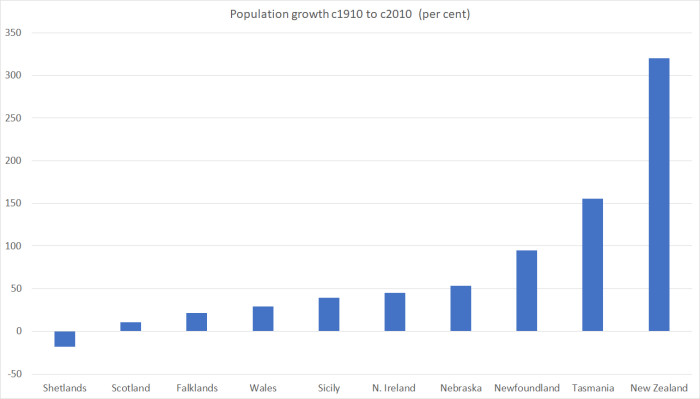
In this table I’ve focused on population growth between the Census nearest 1910 and the most recent Census (in most cases 2010 or 2011, but in New Zealand 2013).   The chart shows the percentage increase in population for these remote regions of countries, plus that for New Zealand  (Nebraska gets chosen as a “remote” US area mostly because I happen to have been there a few times.)

remote regions

Australia and Canada (and the US) have had rapid national population growth rates, but these remote regions  (Nebraska, Newfoundland, and Tasmania) have had much lower population growth rates than New Zealand.  (And, on checking, each of those three have lower population densities now than New Zealand does.)   But given that all of these regions have small populations, relative to the respective nation’s total population, there would have been nothing to stop lots of people gravitating to the remote spots if there was real evidence of good economic opportunities for many people in those places.

It has, after all, happened in some remote regions: West Australia for example, now has about 10 times the population it had in 1910, presumably attracted by the mineral resources that mean West Australia has the highest GDP per capita of the Australian states.    And two really remote parts of the United States –  which I didn’t show on the chart, partly because they were settled so much later (not admitted as US states until 1959) –  are Hawaii and Alaska.  Both have had faster population growth than New Zealand over the last 100 years (although between them only around 2 million people in total): in Alaska’s case no doubt the oil resources attracted people (Alaska also has among the highest GDP per capita of any state).

But over that hundred years –  or any shorter period you like to name really –  New Zealand (like Wales, Northern Ireland, Tasmania, Nebraska, or Newfoundland) has had no big natural resource discoveries, or asymmetric productivity shocks specifically favouring our location.   Like those places, we’ve only had the skills of our people and the instititutions we’ve built or inherited (in the case of this group a fairly-common Anglo set) to make the most of, and to overcome what appear to be the resurgent disadvantages and costs of distance/remoteness.  Our birth rates won’t have been much different over long periods, and New Zealand like all these places –  the Shetlands most extremely of the places on my chart –  have seen outflows of our own people.  The big difference here is immigration policy, which has actively sought to substantially boost the population.

Try a thought experiment.  Say the New Zealand and Australian governments had simply combined their respective immigration policies over the last 100 years or so  (eg if New Zealand was offering 45000 residence approvals per annum and Australia 200000 –  similar to the current policies –  the two countries simply said we’ll issue 245000 residence visas and the arrivals can go wherever they like), what would have happened.   By construction, the total population of the two countries would have been pretty much the same as what we actually see (5.4 million in 1910, and about 29 million now) but what would the distribution look like?     We know that in Australia –  given the same choice –  the remote region with a mild climate and no big new natural resources (Tasmania) saw much weaker population growth than the rest of Australia.   Why wouldn’t it be the case that New Zealand would have experienced much the same phenomenon?    At Tasmania’s population growth rate for the last 100 years we might now have a population of around 2.5 million.   After all, for almost 50 years now native New Zealanders have (net) been relocating to (the non-Tasmania) bits of Australia, so why –  given the free choice –  wouldn’t the migrants –  facing a free choice at the point of approval –  have done so too?

Would we have been better off?    The migrants who went to Australia instead presumably would have been –  both judged from revealed preference (they made the choice) and that incomes in Australia are higher than those here.  I’d argue that the smaller number of New Zealanders probably would have been economically better off as well.  Natural resources are still a huge part of the economic opportunities in these remote islands –  perhaps still 85 per cent of our exports –  and those limited resources would be spread across a considerably smaller number of people.  For those who simply prefer “more people” for its own sake, perhaps they’d have been worse off –  but then such people could have self-selected for Sydney or Melbourne (as Tasmanians of a similar ilk do, or people in Newfoundland who wanted to be part of something big self-select for Toronto).

I’m not suggesting something conclusive here, just that people pause for thought, and reflect on what questions the experiences.    For a remote place we aren’t particularly lightly settled, and especially not as a remote place without the sort of abundant natural resources of –  say –  a West Australia.  We’ve had no distinctive favourable productivity shocks, and we’ve long lost any claim to be the richest (per capita) country on earth.  It is no surprise that some people want to move here –  plenty would want to move to Nebraska if it had its own immigration policy like ours – but there isn’t much evidence, from experience of other remote regions, to suggest we benefit from them doing so.   Without big new natural resource discoveries, remote places –  regions, territories  – in the advanced world  tend to have quite weak population growth rates.  It isn’t obvious why in New Zealand we should let immigration policy up-end that otherwise natural outcome.

The Reserve Bank and financial regulation

Still working my way through the various articles and documents that turned up just before Christmas, I got to a lengthy issue of the Reserve Bank Bulletin, headed “Independence with acccountability: financial system regulation and the Reserve Bank”.   It is, I suspect, designed to fend off calls for any significant reform.

The Bulletin speaks for the Bank, and although as I read through the article I noticed distinct authorial touches and tendencies, when all is boiled down the author was sent into the lists to make the case for how things are done now: powers, governance, and accountability.  He does a pretty good job of presenting the party-line, against significant odds in many areas.    Even where one disagrees with the Bank’s case, it is a useful and accessible addition, in part because the Bank’s powers and responsibilities in regulatory areas have grown like topsy over the years and are scattered across various pieces of legislation.

Much of the first half of the article is designed to make a case for an independent prudential regulator, by reference to the theory and to the writings of the Productivity Commission.  But, for my tastes, it was far too broad-brush to add much value.  Probably no one disputes that we want the rules applied fairly and impartially, with politicians largely kept out of the process.  In the same way, we don’t want politicians deciding which person gets arrested and which not –  we want an operationally independent Police for that –  or who gets convicted  –  independent courts – or which airline passes safety standards and which not, and so on, so we don’t want politicians deciding to look favourably on one bank’s risk models and not on another’s.   There are many independent regulatory agencies –  or even government departments where the chief executive exercises responsibility in independently applying the rules –  but to a very substantial extent they apply and administer the rules, while other people make the policy/rules.

The Reserve Bank wants to make the case that in its area the rules/policy shouldn’t be set by elected people (whether Parliament itself, or ministers by regulation), but by an independent agency, and that the same agency should both make and apply the rules (without any possibility of substantive appeal).  It is the “administrative state” at its most ambitious –  unelected officials (a single one at present, not even directly appointed by a Minister) are lawmakers, prosecutor, judge and jury (and quite possibly the equivalent of the Department of Corrections as well).

The Bank seeks to rest a lot on the notion of time-inconsistency, a notion from the academic literature that is sometimes used to try to explain the high inflation of the 60s and 70s, and to make the case for an independent central bank to make monetary policy.  The idea is that even though one knows what is good in the long-run, the short-term benefits of departing from that strategy (and endless repeats of the short-term) mean that the long-term gains are never realised.  The solution, so it was argued, was to remove the short-term management of the business cycle from politicians.    I’m not particularly persuaded by the model as it applies to monetary policy (a topic for another day), and it is curious to see a central bank putting so much weight on that model after year upon year of inflation below target.  But today’s topic is financial regulation and financial stability, where the Bank would have us believe it is desirable/important to have the rules themselves –  the policy –  set by someone other than politicians.

No doubt it is true that there can be some tension between the short and the long-term around financial stability.  But that is surely so in almost every area of government life and public policy?  Underspending on defence now frees up more resources for other things now, but one might severely regret doing so if an unexpected war happens later.  Skimping on educational spending now won’t make much difference (adversely) to economic performance or the earnings of anyone (teachers aside I suppose) for a decade or two.  Running big fiscal deficits now can offer some short-term benefits, but at the risk of heightened vulnerability etc a decade or two down the track.   But in none of these areas do we outsource policymaking: they are political choices, and we then employ officials and public agencies to administer and deliver those choices.     The Reserve Bank has, as far as I’m aware, never offered any explanation as to what makes their specific area of policy different.   Sometimes they draw on academic authors writing about financial regulation, but many of those specialists fall into the same trap –  they see their own field, but never stand back and think about how democratic societies organise themselves across a wide range of policy.

As it happens, the current system around the Reserve Bank and financial regulation is a bit ad hoc and inconsistent to say the least, a point that the article more or less acknowledges.     Thus, for banks the Reserve Bank can vary the “conditions of registration” to change all sorts of big policy parameters, without any formal involvement from elected politicians at all (all the variants of LVR policy, from the first Wheeler whim were done this way).  But even for banks rules around disclosure have to be done by Order-in-Council, and thus require ministerial approval.  No one would write the law that way –  such different regimes for two different aspects of  bank regulation –  if starting from scratch (the actual legislation has evolved since 1986).

For insurance companies, the Reserve Bank itself can issues solvency standards (effectively, capital requirements for insurers), but for non-bank deposit-takers capital rules (and other main prudential controls) can only be set by regulation, again requiring the involvement and approval of the Minister of Finance.   (Incidentally, this is why LVR rules apply to banks but not non-bank deposit-takers: Wheeler could regulated banks directly, but couldn’t do the same for non-bank deposit-takers.

(And, as the Bank notes, it has “no direct role in developing rules associated with AMLCFT”, even though it administers and applies those rules for banks.)

At very least, there would appear to be a case for streamlining and standardising the procedures for setting the rules.     It isn’t clear why the Reserve Bank Governor should have almost a free hand when it comes to banks, but such limited scope to set policy when it comes to non-bank deposit-takers.   And, if anything, the case for ministerial involvement in settting the rules for banks is greater than that for the other types of institutions because (as the Bank acknowledges) bailouts and recessions associated with financial crises etc have major fiscal implications, and one might reasonably expect elected ministers to have a key role in setting parameters that influence the risk of systemic bank failures.   And, again as the Bank acknowledges, it isn’t easy to pre-specifiy a charter –  akin to say the Policy Targets Agreement –  for financial stability policy.

The Bank attempts to cover itself against suggestions that it might be, in some sense and in some areas, a law unto itself, by highlighting various ways in which the Minister of Finance might have some say.   There are, for example, the (non-binding) letters of expectation, the need to consult on Statements of Intent, and the potential for the Minister to issue directions requiring the Bank to “have regard” for or other area of government policy.     These aren’t nothing, but they aren’t much either –  and as the Rennie report noted, the power to issue “have regard” directions has never been used.    Even budgetary discipline is so weak as to be almost non-existent: there is a five-yearly funding agreement, but it isn’t mandatory  (something that needs fixing in the current review), isn’t particularly binding, and doesn’t control the allocation of spending across the Bank’s various functions.   The Minister of Finance doesn’t even get to make his own choice of Governor –  and all Bank powers still rest with the Governor personally.

The contrast with the other main New Zealand financial regulatory agency, the FMA, is pretty striking.   Policy is mostly set by the Minister (by regulation), advised by MBIE (to whom the FMA is accountable), and the powers of the organisation itself rest with the FMA’s Board, all the members of which are appointed directly by a Minister, and all of whom –  under standard Crown entity rules – can be removed, for cause, by the Minister.  Employees, including the chief executive, only have powers as delegated by the Board.    The FMA model is now a pretty standard New Zealand regulatory model, and an obvious point of comparison with the Reserve Bank.

Somewhat cheekily, the Reserve Bank attempts to present their own model as providing more scope for ministerial input than for the FMA  (see footnote 16, in which they note that for the FMA there is no power of government direction).   As regards policy, it isn’t necessary, since the government sets policy and appoints (or dismisses) the Board.   As regards the application of rules, one wouldn’t want –  and doesn’t have –  powers of government direction in either case.   As regards the banking system, mostly ministers can’t set policy, can’t hire their own Governor, and can’t fire him (re financial system policy) either.   The Governor and the Bank have far more policy power than is typical –  across other regulatory agencies –  appropriate, or safe.

The second half of the article is about accountability.  As they reasonably note, when considerable power is delegated to unelected agencies, effective accountability needs to provided for.    In their words “accountability therefore generates legitimacy and legitimacy in turn supports independence”.

It is, therefore, unfortunate that the Bank’s very considerable powers are matched, in this area in particular, by such weak accountability.   After pages of attempting to explain themselves and what they see as the various aspects of accountability, even they end up largely conceding the point.     These sentences are from the last page of the article

the BIS (2011) argues that financial sector accountability mechanisms should be focussed more on the decision making process rather than outcomes per se. This is because of the more intrusive nature of financial sector policy, and the issues associated with observing outcomes (lack of quantification and very long lags). Put another way, there should be less reliance on ex post accountability mechanisms and more obligations placed on ensuring decision-makers are transparent about the basis for their actions.

I’m not sure I entirely agree –  although there is certainly the well-recognised point that absence of crisis is evidence of nothing –  but at very least a focus on strong process might argue for:

  • a more effective separation between policymaking and policy administration (as is customary for many regulatory entities, but largely not for New Zealand bank supervision),
  • a decisionmaking structure in which power did not rest simply with a single individual, who is himself not directly appointed by an elected person,
  • decisionmaking structures that involve real power with non-executive decisionmakers,
  • effective and binding budgetary accountability,
  • a high degree of commitment to transparency and to ongoing external engagement,
  • a culture that is self-critical and open to debate,
  • perhaps some more effective scope for judicical review (including on the merits, rather than just process),
  • monitors with the expertise, mandate, and resources to ask hard questions and to critically review and challenge choices being made around policy and its application.

At present, as far as I can see, we have none of these for the Reserve Bank of New Zealand as financial regulator.

Take the formal monitors for example.  Parliament’s Finance and Expenditure Committee has little time, no resources, and little expertise.  The Treasury has no formal role, no routine access to Bank materials (or eg Board papers) and is probably quite resource-constrained in developing the expertise.

And what of the Bank’s Board?   By law, they play a key role, as agent for the Minister of Finance in monitoring the Governor, and (now) obliged to report publically each year on the Bank’s performance.    The Bank often likes to talk up the role of the Board –  doing so provides them cover, suggesting the presence of robust accountability –  but the latest article is surprisingly honest.  The Board gets a single paragraph, which simply describes the legislative provisions.  There is no suggestion of the Board have actually played a key role in holding the Bank (Governor) to account – not surprisingly, since in the 15 years they have been publishing Annual Reports, there has never been so much as a critical or sceptical word uttered.  Of course, it isn’t surprising that the Board doesn’t do a good job: it has no independent resources at all (even its Secretary is a senior Bank staffer), the Governor himself sits on a Board (whose main role, notionally, is to hold the Governor to account) and the Board members themselves typically have little expertise in the areas (quite diverse) around which they are expected to hold the Governor to account for.   (Their job is, of course, made harder by the rather non-specific mandate the Bank has in regulatory areas –  there is nothing akin to the Policy Targets Agreement (which has its own challenges in monitoring).)

What of some of the other claims about accountability?  The Bank points out that it is required to do regulatory impact assessments –  but these are typically done by the same people proposing the policies, and there is (or was when I was there) nothing akin to the sort of process some government departments have for independent panels vetting the quality of the regulatory impact assessments.

They are also required to consult on regulatory initiatives, and must “have regard” to the submissions.  But, except perhaps on the most technical points, there is little evidence that they actually do pay any real heed to submissions.    For a long time, they also kept the submissions themselves secret –  even attempting to claim that they were required by law to do so.  They’d publish a “summary of submissions”, which highlighted only the issues they themselves chose to identify.   As they note, and in a small win for a campaign by this blog, they have now started publishing individual submissions, belatedly bringing them into line with, say, Select Committees of Parliament or most other regulatory bodies.  But there is no sign of much change in the overall attitude, or of any greater openness to ongoing debate and critical scrutiny.

Then, of course, there is the Official Information Act.  The Bank is subject to the Act, but chafes under the bit, is very reluctant to release much, threatens to charge requesters, and generally seems to see the Act as a nuisance, rather than an integral part of an open and accountable government.

We had a good example just a couple of months ago as to how unaccountable the Bank is in its prudential regulatory areas.  It emerged that Westpac had not had appropriate regulatory approval for some model changes used in its risk-modelling and capital calculations.   But, as I noted at the time, the short Bank statement left many more questions than it answered, and no one –  including journalists asking directly –  has been able to get straight answers from them, even though capital modelling is at the heart of the regulatory system.

And, of course, if the formal monitors are lightly (or not at all) resourced, there isn’t much other sustained scrutiny.   Banks are scared –  and more –  to speak out: this is where culture matters a great deal, as banks will always have a lot of balls in the air with the regulator, and in an open society should feel free to openly challenge the regulator, without fair of undue repercussions.   Academics with much expertise in the area are thin on the ground, as are journalists with the time or expertise.

Mostly, in its exercise of its extensive financial regulatory powers, our Reserve Bank isn’t very accountable at all.   Providing it jumps through the right, minimal, process hoops it can do pretty much what it likes in many areas of policy, and the public is left just having to take the Bank’s word (or not) that things are okay.  That needs to change –  and thus phase 2 of the current review of the Bank’s Act needs to be taken seriously.    Making the changes isn’t about one single measure, and there are plenty of details that will take a lot of work, and thought, to get right.   Part of it is about building a better internal culture, one that (from the top) really wants to engage, and which welcomes challenge and critical review.

After yesterday’s post I had an email from a reader with considerable senior-level experience in the banking sector noting just how weak much of the formal scrutiny of the Bank is in these areas.

From my perspective the Bank would benefit from independent challenge about their prudential responsibilities, and cost-benefit analysis. I am unsure if they have reviewed this post the Westpac capital model issues.

I am unsure how the Board discharges the independent prudential review role effectively given their experience – two Directors have insurance experience  and no directors have Banking, payments system or other non-bank financial experience. Likewise experience of Insurance/Banking/Payments technology systems and risks. While there are some very good RBNZ executives they are not particularly strong in banking risk experience – funding, liquidity, credit etc.

…. I think it would be useful for the RBNZ at a governance level to have experience of how financial balance sheets, and liquidity operate under stress, they will have some very important decisions to make when the next financial crisis occurs.

Much of that rings true to me.    We have typically had Governors with more experience of macro policy, and perhaps financial markets, than of banking –  and yet financial regulation is a hugely important role in what the Bank does – and now have a new Head of Financial Stability with no background in banking or finance at all.   We have a Board responsible for monitoring the Bank across monetary and regulatory responsibilities, and with little specialist expertise.   The contrast with, say, the FMA is quite stark.

Quite what the right balance of a solution is, I’m not quite sure.   I favour moving to a committee-based decision-making structure, and moving more of the policy back to the Minister (with the Bank as a key adviser), but even a Financial Policy Committee might only have three or four externals on it, and no such group is going to encompass all the right bits of expertise.   As often, I guess it is partly about the willingness to ask the hard questions, and to be willing to commission independent expertise (whether from New Zealand or abroad, from academics or people with industry background) and to engage.   If the Board remains as a monitoring agency –  as Rennie recommends, but I’m sceptical of –  it needs to be provided with resources.   And the Minister needs to be willing to use his statutory powers to commission independent reviews of aspects of the Bank’s stewardship, to enable us (and the Bank) to learn from experience by critically evaluating performance (and process).  Personally, I’m still tantalised by the idea of a small independent agency resourced to pose questions, and commission research, on the stewardship of fiscal, monetary and financial regulatory policy.

If not all the answers are clear, what is clear is that New Zealand is a long way from having got the model right: the right allocation of powers, the right accumulations of expertise in the right places, the right cultures, and the appropriate mix of formal and informal accountability that can really give New Zealanders confidence in the regulation of the financial system.
 

The Rennie report finally sees the light

Almost a year ago now, the former Minister of Finance Steven Joyce asked The Treasury to commission some advice on possible changes to the governance of the Reserve Bank.  We only found this out a couple of months later, and then only when hints of a review seeped out prompting a journalist to put the direct question to the then Minister.  It turned out that Iain Rennie, former State Services Commissioner (and before that former senior Treasury official) had been commissioned to write the report –  indeed, by the time we learned of the commission, Rennie had already largely completed his work.

All along the way, The Treasury has been incredibly obstructive about the review.   The terms of reference have never been released.    They eventually told us (some of) the people Rennie had talked to, and the names of the peer reviewers Treasury had used but refused to release drafts of the reports, comments made by reviewers, or the finished report itself.   They even took to arguing that it had all been Treasury’s idea, and that the report was just to inform Treasury’s own post-election advice, as if Steven Joyce had never been any part of the story.    Frankly, it was a pretty gross case of flouting the Official Information Act –  for what was, when all boiled down, a private consultant’s report, paid for with public money, on matters of organisational design and goverance of a single government agency.

But yesterday The Treasury finally (and quietly) released the report itself, along with comments from the peer reviewers (on an earlier version, itself still secret), some advice on the report from Treasury to the (new) Minister of Finance, and some recent comments from the Reserve Bank on the contents of the Rennie report (all available here).   I appreciate the pro-activity of The Treasury in at least letting me know that the report was now, belatedly, available.    The material is all now presented as background material for the current two-stage review of the Reserve Bank Act, including the contribution of the Independent Expert Advisory Panel.

The Rennie report itself is here.  It isn’t a bad report –  in fact, for a fairly short report done quite quickly, it is a bit better than I had come to expect.   In some respects, the details don’t matter that much –  it is just one person’s view (having consulted not very widely, and mostly with people inside the central bank “club”), and his report has been superseded by the wider review Grant Robertson has commissioned.  Rennie’s report will be just one input to that mix.

Then again, Rennie had been the State Services Commissioner.  And he’d been the Treasury Deputy Secretary responsible for things to do with macro policy and the Reserve Bank (at the time of the last major review, with Lars Svensson, at which time Treasury had opposed any change in the governance and decisionmaking model).

And Rennie is quite clear that:

  • the current single decisionmaker model is far from best practice, whether considered relative to other central banks/ financial regulatory agencies, or relative to the governance of other New Zealand public sector entities,
  • a single committee is not a sensible solution.  Rennie, in fact, ends up favouring three separate committees (a model very similar to the one used now in the United Kingdom –  one for monetary policy, one for (so-called) micro-prudential policy, and one for (so-called) macro-prudential policy),
  • an internal executive committee (or even several of them) is not an appropriate solution.  External, non-executive, members should be involved,
  • the Minister of Finance should have primary responsibility for the appointment of all the members of the decisionmaking committees, given that the committees exercise significant statutory powers.

And on monetary policy he favours a materially greater degree of transparency than exists at present, including favouring (on-balance) the individualistic model –  as, for example, in the US, the UK and Sweden –  where individual members are individually accountable for their advice and their votes.    Existing Reserve Bank management hates –  I don’t think that is too strong a word –  that model: they hated it when I was still at the Bank, and in recent months they have gone public with their intense dislike of it.

There are lots of other details in the report, some of which I strongly agree with (eg the Policy Targets Agreement shouldn’t be tied to the appointment of the Governor, and if the Board is to be retained as a monitoring agency, it needs some resources of its own, and the Governor himself should not be a member), and others of which I’m more sceptical of (eg the proposed role of the State Services Commission in advice on the selection of the Governor and Deputy Governors, or the idea of devising a –  meaningful –  formal charter for the prudential committees).   One of the peer reviewers –  my former colleague David Archer –  is keen on a greater formal role for Parliament in the appointments, something I’m sceptical of (it just isn’t our constitutional system).  But I would probably favour emulating one aspect of the UK system Rennie doesn’t really touch on: hearings by Parliament’s Finance and Expenditure Committee in which nominees to the various committees can be scrutinised by MPs (and reported on), although not a binding confirmation vote (as in the US).

There are also limitations to the Rennie report.   For example, he treats the current assignment of powers to the Reserve Bank as given (perhaps this was inevitable in what he was asked for, but isn’t a limitation of the current review), a particular issue in the area of financial regulation and supervision.   There also isn’t much richness to his treatment of other countries’ models –  and it remains surprising that he made no effort to engage with Lars Svensson, who was not only a former reviewer of the New Zealand system, but a former practitioner (member of the Swedish monetary policy committee) in the sort of system (open contest of ideas) Reserve Bank management hates.  And perhaps partly because Rennie seems only to have talked to insiders –  eg there was three pages of (totally withheld) material in the Reserve Bank Board minutes on his meeting with them, and no attempt at open consultation –  there is no serious attempt to evaluate how effectively (or otherwise) the Board model has worked over the years.

What of the Treasury’s comments on Rennie?  Their report is short and is mostly a summary of Rennie’s recommendation.  But it was good to see this observation

“we are strongly of the view that a committee decision-making model should be codified in the Reserve Bank Act, and agree that there should be multiple committtees which include external experts”

In the first stage of the current review the government has only committed to a committee, with externals, for monetary policy.  I hope Treasury sticks to its guns, and persuades the Minister of Finance that better governance and decisionmaking on the financial regulation side of things is at least as important, and needs it own statutory reforms.    As even Rennie noted, there is –  for example –  a stark contrast between the governance of the other main financial regulatory –  the FMA –  and that of the Reserve Bank.  In the former, a non-executive Board (all appointed directly by the Minister) has overall responsibility for the organisation and the exercise of its powers, with some specific powers being delegated the Board to the chief executive and staff.  That is a much more conventional, and defensible, model than the Reserve Bank model in which all the power is held by the Governor personally.    And the Reserve Bank exercises a much greater degree of discretion over policy itself –  especially as regards banks –  than the FMA does (where big picture policy is mostly set by the Minister on the advice of MBIE).

As I noted, in yesterday’s release there was also a short note by the Reserve Bank commenting on the Rennie report.  Even though the report was completed months ago, this note is dated 11 December, and is prepared for the Independent Expert Advisory Panel assisting the Treasury-led phase one of the current review of the Reserve Bank Act.  Presumably there are rather more substantive comments, which the Bank is keeping secret –  along with all the extensive background work  (Rennie mentions it) done a few years ago on these issues, which the Bank has previously refused to disclose.

The Reserve Bank does not like the Rennie report at all.

we believe that much of the analysis underpinning the report was insufficient, and consequently the conclusions of the report are unreliable, or would require considerable further analysis.

“Sniffily dismissive” was my own summary of the Reserve Bank’s reaction.

In hand-waving mode, the Bank loftily notes

The Report does not define the nature of the problem it is seeking to address and needs a clearer analysis of the current decision-making framework and why it needs amending. In proposing a particular set of changes to the decision-making framework, the Report fails to provide options and does not demonstrate why the particular changes proposed would result in better policy decisions for monetary or financial policy in New Zealand.

You might suppose that having a decisionmaking and governance model designed thirty years ago when

(a) few central banks had updated their laws in these areas for a long time,

(b) our own laws and practices for governing Crown entities had not really been updated,

(c) the prevailing conception in New Zealand was that monetary policy was simple, and that it would be easy to hold a single decisionmaker to account,

(d) when financial regulation was conceived as a small and largely passive part of what the Reserve Bank did and

(e) when open government was still a pretty new concept, largely unknown to central banks and related regulatory agencies

was sufficient grounds for a serious review, and the probability that better models could be designed.   One might be strengthened in that view if one was aware that (as Rennie notes) no central bank has shifted from a committee-based decisionmaking to a single decisionmaker model for monetary policy, or was aware that no other significant regulatory body in New Zealand was governed the way the Reserve Bank is.

Had a five person Commission spent a year on the report, no doubt there would have been a lot more richness to the background material.  But the case for change has come to be pretty widely accepted already, and even the Reserve Bank gives the game away by conceding that committee-based decisionmaking is generally better than that of a single individual.  Once they conceded that –  and they could hardly do otherwise –  much of the rest of the issue is about detail.

But it doesn’t stop the Bank attempting to distract the Independent Expert Panel.

The Report makes no attempt to document the processes that the Bank actually uses to support its decision-making, beyond the high level parameters established by the Act. Nor does The Report attempt to evaluate the mechanisms that the Bank currently has in place to help ensure that its decision-makers confront a broad range of policy perspectives, including a wide range of views of those outside the Bank. There is, for example, no mention of the role of the broader group of MPC members in providing policy advice to the Governing Committee, the use of external advisers on the MPC, the Bank’s programme of business and financial sector liaison, its active public outreach programme, or its participation in the international financial and economic community. These are all ways in which the Bank considers a diversity of external views and perspectives ahead of its monetary policy decisions.

But so what?   All central banks do this sort of stuff in one form or another, and yet almost all of them also have the respective country’s Parliament specify a statutory committee as the basis for monetary policy decisions.  And if it is good enough for the Governor to invite a couple of outsiders into his second-ring of advisers (these days: it was the first tier when the system was established) why shouldn’t Parliament mandate the involvement of external members?   Moreover, the case for reform has rarely been about the problems with an individual Governor, but about a core principle of institutional design –  resilience.  We don’t want a system that works adequately only when a decent Governor is in place, but when that is resilient to bad choices and bad individual appointees (because in human systems there will be some of those).

I don’t disagree with all the Bank’s comments.  They oppose establishing two separate statutory committees for the different aspects of prudential policy, and I agree with them on that (apart from anything else, the whole thrust of bank supervision –  in particular-  is systemic in nature).

Rennie’s report recommended leaving the precise composition of statutory committees as a matter for negotiation through time.  I think that is wrong.  That balance is sufficiently important that it should be specificed in legislation (as, I understand it, is the near-universal practice abroad).   The Reserve Bank is clearly opposed to any suggestion that external members should out-number internal or executive members.

There is a strong argument that external members should not be able to out-vote the internal members if the latter are in agreement. Such an occurrence could severely undermine the influence of the Governors and the credibility of the institution.

I disagree, and was pleased to see that external reviewer Archer took the same view.  He argued  –  noting that the “probability of groupthink increases with the presence of hierarchy”  –  that “the law should restrict the proportion of executive insiders to below half by a big enough margin that these tendencies have a chance to be offset.

On the Reserve Bank’s argument:

  • if the Reserve Bank insiders, with all the resources and professional expertise at their disposal, can’t persuade enough outsiders to their point of view, it suggests they haven’t got a particularly compelling case (and may in turn struggle to convince outsiders),
  • if the system is set up with, say a 4:3 mix of outsiders and internals, it is explicitly designed by Parliament not to make the Governor a dominant figure (let alone any deputies).  The Governor and Deputy Governors have important executive roles in the management of the institution (generating advice and research, implementing decisions etc) and there should be no automatic presumption that the holders of those offices should play the key role in deciding the OCR outcome,
  • other countries have managed situations in which the Governor has been outvoted, without undermining the institution, and finally
  • even if there were such concerns, the Governor (and other executive staff) always have the option of voting tactically, such that there is no a straight insider/outsider split.  In a number of overseas models, the Governor chooses to vote last.

Perhaps anecdotes aren’t worth much, but it is worth recalling that the senior managers of the Wheeler bank were unanimous in their support of the 2014 tightening cycle.  And wrong.   Groupthink among internals is one of the problems reforms should be trying to overcome.

The Reserve Bank is also pushing back against Rennie’s proposal that all members of the decisionmaking committees (all three of them in his case) should be appointed by the Minister of Finance.

As in any other senior management context, it is essential that the Governor has confidence in his or her senior staff. There are few examples where a Chief Executive has no input into the selection of the senior management team.   It is also surprising that the Report does not confront the dangers that could arise in a system where appointments to the Policy Committees were made by the Minister of Finance. While the Report’s recommendation appears to be made largely on the grounds of ensuring decision-makers have democratic legitimacy (as per the discussion in para 102), the potential risks of political appointments are not considered.

The first of those arguments might look superficially plausible, at least in a corporate context.  But this is a situation where people are exercising considerable statutory powers.  And in central banks it is not at all uncommon for senior figures (often “deputy governors”) to be appointed directly  by Ministers with no formal role for the Governor in that decision (in practice, no doubt there is often consultation).   That is the way things work at the Reserve Bank of Australia (although the Governor then gets to appoint all the actual department heads, which seems appropriate), and at the Bank of England (for deputy governors), and at the Federal Reserve, and at the ECB.  It is pretty much the norm in fact.     Things are different in more conventional models like the Financial Markets Authority, where power vests with the Board, not with management (even the CEO, let alone his/her deputies).

As for the second argument, yes of course there are risks with political appointments.  There are risks with democracy in fact.  But if the Reserve Bank criticises Rennie for not covering that issue in great depth –  he touches on it, and to some extent takes it for granted –  the Bank itself never acknowledges that direct political appointment is the norm in other countries, and seems to work.  Certainly, they cite no evidence suggesting that the New Zealand system has produced superior results to those abroad.  As it happens, Rennie does touch on and speaks favourably of consultation by the government with other political parties for some of these appointments (as is apparently required  by the NZ Superannuation Fund board).

The final Reserve Bank concern that I want to touch on today is the one that seems to concern them a lot: the idea (endorsed by Rennie) that individual members of the statutory Monetary Policy Committee should be individually accountable for their views: that votes, and views, should be minuted and disclosed, and that individual members should be able to openly voice their views (in, eg, speeches or interviews).     It is pretty much exactly the model that has been used in the UK, the USA, and Sweden for quite a long time now.

But here is the Bank.

The proposition that members of the monetary policy committee would be able (and expected) to highlight their individual policy views in public is problematic. While this approach is clearly adopted in some countries (notably the UK, US), we believe such an approach could be destabilising in a small open economy like New Zealand. Any perception of a rift between committee members would be likely to add unhelpful noise to the communication of policy as well as inviting outside lobbying around particular views. There are more constructive ways of conveying divergent viewpoints and the balance of risks around monetary policy decisions.

Neither here nor previously has the Bank –  Spencer, Bascand, McDermott, the existing senior management –  ever sought to clearly articulate what it is about the model used in other countries that would not work well here.   I gather they aren’t even able to do so effectively in private and they floundered in an earlier press conference when they tackled the topic.

What makes New Zealand so different from, say, Sweden –  another “small open economy” –  or in these respects different from the US or the UK (UK economists often like to claim it too is a small open economy)?    The Bank makes no effort to tell us.    They never grapple with notions of open government –  as Rennie notes, the principles of the Official Information Act bias towards openness –  but perhaps as importantly they never really grapple with the huge uncertainties that face monetary policymakers everywhere and always.  Differences of view among policymakers shouldn’t be seen as problematic –  and they don’t seem to create great problems in other countries –  but as, if anything, reassuring.  Groupthink is one of the perils of any institution, and it is perhaps particularly risky where so little of the relevant future is known with any confidence.

Here is David Archer –  former chief economist of the Bank, and now head of central bank studies at the BIS.

Apparent unanimity is quickly shown to be untrustworthy spin. The essential reason is that the future is largely unknowable, and it is foolish to pretend otherwise. Consider the records of the few central banks – including the RBNZ – that publish forward policy interest rate paths. Forecast paths are almost always poor predictors of reality, even in the RBNZ case where unanimity about the outlook exists by construction. Being honest about the limited predictive powers of even highly paid specialists is likely eventually to increase their trustworthiness, at least relative to the results of repeated false marketing
of ostensible consensus.

I’d agree with every word of that.  He argues for timely release of good and transparent minutes, which reflect the individual differences of view.

I don’t like to think that the existing management of the Bank are just trying to protect their own position –  although bureaucrats will tend to protect themselves and their bureau, often to the detriment of the public –  but without a more robust articulation of their specific concerns, grounded in the international experience, it is hard to conclude otherwise.    Policymaking is typically better for dialogue, debate, and challenge –  inside the institution, outside in, and across the boundaries between the two.    Where there is so much uncertainty, and no institutional monopolies on wisdom or knowledge, it is perhaps as important in these functions as in any other areas of government.  It might not be comfortable for the bureaucrats, but that isn’t the goal of policy or institutional design.  And excellent officials –  as excellent outsiders –  should thrive on the opportunities that open and transparent contest of ideas and analysis throws up.

For now, I urge Treasury and the Independent Expert Advisory Panel –  not a group of individuals I have huge confidence in –  to reject the Bank’s apparently self-serving arguments, and to make recommendations that would lead to the redevelopment of a leading open, transparent and accountable central bank.

The Reserve Bank and housing collapses

In early December, the Reserve Bank published a Bulletin article, “House price collapses: policy responses and lessons learned”.  The article wasn’t by a Reserve Bank staffer –  it was written by a contractor (ex Treasury and IMF) –  but Bulletin articles speak for the Bank itself, they aren’t disclaimed as just the views of the author.   Given the subject matter, I’m sure this one would have had a lot of internal scrutiny.  Or perhaps I’ll rephrase, it certainly should have had a lot of scrutiny, but the substance of the article raises considerable doubt as to whether anyone senior thought hard about what they were publishing in the Reserve Bank’s name.

I’ve only just got round to reading the article and was frankly a bit stunned at how weak it was.    Perhaps that helps explain why it appears to have had no material media coverage at all.

The article begins with the claim that

This article considers several episodes of house price collapses around the globe over the past 30 years

In fact, it looks at none of these in any depth, and readers would have to know quite a bit about what was going on in each of these countries to be able to evaluate much of the story-telling and policy lessons the author presents.

Too much of the Reserve Bank’s writing about house prices tends to present substantial house price falls as exogenous, almost random, events: a country just happened to get unlucky.  But house prices booms –  or busts –  don’t take place in a vacuum.  They are the result of a set of circumstances, choices and policies.

And none of the Reserve Bank’s writings on housing markets ever takes any account of the information on the experiences of countries which didn’t experience nasty housing busts.  Partly as a result they tend to treat (or suggest that we should treat) all house price booms as the same.  And yet, for example,  New Zealand, Australia, the UK and Norway all had big credit and housing booms in the years leading up to 2008 but –  unlike the US or Ireland –  didn’t see a housing bust.  What do we learn from that difference?   The Reserve Bank seems totally uninterested.   Their approach seems to be, if the bust hasn’t already happened it is only a matter of time, but 2018 is a decade on from 2008.

One particular policy difference they often seek to ignore is the choice between fixed and floating exchange rates.  When you fix your exchange rate to that of another country, your interest rates are largely set by conditions in the other country.  If economic conditions in your country and the other country are consistently similar that might work out just fine.  If not, then you can have a tiger by the tail.  Ireland, for example, in the 00s probably needed something nearer New Zealand interest rates, but chose a currency regime that gave it interest rates appropriate to France/Germany.    Perhaps not surprisingly, things went badly wrong.

In the Bulletin article, the Bank presents a chart showing “house price falls in [10 OECD] selected crisis episodes” (surprisingly, not including Ireland).  But of those, eight were examples of fixed exchange rate countries (in several cases, the associated crisis led the country concerned to move to a floating exchange rate).   The same goes for all the Asian countries the author mentions in the context of the 1990s Asian financial crisis.     There can be advantages to fixing the exchange rate, but the ability to cope with idiosyncratic national shocks in not one of them.     And yet in the ten lessons the author draws in the article, there is no hint of the advantages of a floating exchange rate, in limiting the probability of a build-up of risk, and then in managing any busts that do arise.    It is a huge omission.  As a reminder, New Zealand, Australia, Norway, the UK, and Canada –  the latter a country that has never had a systemic financial crisis –  were all floating exchange rate countries during the 2000s boom and the subsequent recession/recovery period.

The author also hardly seems to recognise that even if house prices fall, house prices may not be the main event.   Even the Reserve Bank has previously, perhaps somewhat reluctantly, acknowledged the Norges Bank observation that housing loan losses have only rarely played a major role in systemic financial crises.   But there is no hint of that in this article.     Thus, in the severe post-liberalisation crises in the Nordics in the late 1980s and early 1990s, house prices certainly went up a lot and fell back a lot too, but most accounts suggest that those developments were pretty marginal relative to the boom and bust in commercial property, in particular development lending.  The same story seems to have been true for Ireland in the crisis there a decade ago.  Housing also wasn’t the main event in Iceland –  a floating exchange rate country not mentioned here that did have a crisis.  Even of the two floating exchange rate countries the article mentions –  Japan and the United States –  only in the United States could housing lending, and the housing market, be considered anything like the main event (and the US experience may not generalise given the very heavy role the state has historically played in the US housing finance market).

(And as I’ve noted here before,  even the US experience needs rather more critical reflection than it often receives: the path of the US economy in the decade since 2007 wasn’t much different to that of, say, New Zealand and New Zealand experienced no housing bust at all.)

Some of the other omissions from the article are also notable.  The author seems quite uneasy, perhaps even disapproving, about low global interest rates (without ever mentioning that inflation has remained persistently low), but there is no hint in the entire article that neutral interest rates may have been falling, or that global trend productivity growth may have been weak (weakening before the 2008/09 crisis showed up).   Thus, where economic activity is now –  10 years on –  may have little or nothing to do with the specifics of housing market adjustments a decade ago.   And although he highlights the limits of conventional monetary policy in many countries (interest rates around or just below zero), again he doesn’t draw any lessons about the possible need for policymakers to give themselves more room to cope with future downturns (by, for example, easing or removing the technological/legislative constraints that give rise to the near-zero lower bound in the first place.)

It is also remarkable that in an article on housing market collapses, there is only one mention of the possible role of land use restrictions in giving rise to sharp increases in house prices in the first place.   And then it is a rather misguided bureaucrats’ response: because supply may eventually catch up with demand the public need wise officials to encourage them to think long-term.  Perhaps the officials and politicians might be better off concentrating their energies on doing less harm in the first place –  whether fixing exchange rates in ways that give rise to large scale misallocation of resources, or avoiding land use restrictions that mean demand pressures substantially translate in higher land and house prices.

But in all the lessons the Bank (and the author) draw in the article, not one seems to be about the limitations of policy and of regulators.   There are typical references to short-termism in markets – although your typical Lehmans employee had more personal financial incentive (deferred remuneration tied up in shares that couldn’t be sold) to see the firm survive for the following five years –  than a typical central bank regulator does, but none about incentives as they face regulators and politicians (including that in extreme booms, an “insanity” can take hold almost everywhere, and even if there were a very cautious regulatory body, the head of such a body would struggle to be reappointed).

And nor is there any sense, anywhere in the article, as to when cautionary advice might, and might not, look sensible.  Alan Greenspan worried aloud about irrational exuberance years before the NASDAQ/tech bust –  someone heading his concerns then and staying out of the market subsequently would probably have ended up worse off than otherwise.   Much the same surely goes for housing.  In New Zealand, central bankers have been anguishing about house prices for decades.  Even if at some point in the next decade, New Zealand house prices fall 50 per cent and stay down –  the combination being exceedingly unlikely, based on historical experience of floating exchange rate countries, unless there is full scale land use deregulation –  that might not be much encouragement to someone who responded to Reserve Bank concerns 20 years ago.  (Oh, and repeated Reserve Bank stress tests suggest that even in a severe adverse economic shock of the sort that might trigger such a fall, our banks would come through in pretty good shape.)

The article concludes “housing market crashes are costly”.    Perhaps, but even that seems far too much of a reduced-form conclusion.  The misallocations of real resources that are associated with housing and credit booms are likely to be costly: misallocations generally are, and often it is the initial misallocation (rather than the inevitable sorting out process) that is the problem.  To me, it looks like an argument for avoiding policy choices that give rise to major misallocations (and all the associated spending) in the first place: be it fixed exchange rates (Nordics or Ireland), land use restrictions (New Zealand and other countries), or state-guided preferential lending (as in the United States).   Of the three classes, perhaps land use restrictions are most distortionary longer-term, and yet least prone to financial crises and corrections, since there are no market forces which eventually compel an adjustment.

It was a disappointing article on an important topic, sadly all too much in the spirit of a lot (but not all) of the Reserve Bank’s pronouncements on housing in recent years.

On housing, in late November, the Minister of Housing Phil Twyford commissioned an independent report on the New Zealand housing situation.   According to the Minister

“This report will provide an authoritative picture of the state of housing in New Zealand today, drawing on the best data available.

The report was to be done before Christmas and it is now 15 January.  Surely it is about time for it to be released?

Savings rates in international context

In putting together yesterday’s post, I stumbled on something I hadn’t noticed previously.  In yesterday’s post I showed only New Zealand saving rates –  in particular, net national savings (ie savings of New Zealand resident entities, after allowing for depreciation) as a share of net national income.  The net national savings rate has picked up quite a bit in the last few years, although not to historically exceptional levels.

But here are the New Zealand and Australian net national savings rates plotted on the same chart.

net nat savings nz and aus

For the last couple of years, the net savings rate of New Zealanders has been higher than that of Australians.  I wouldn’t want to make very much of a couple of years data, and over, say, the last 25 years, the average savings rate of New Zealanders has still been a little lower than that of Australians.  But even that average gap has been much smaller over that period than over, say, the previous 20 years.

It isn’t a story you would typically hear from those who argue that savings behaviour is at the heart of New Zealand’s economic challenges.   Some will point to the compulsory private savings system now in place in Australia (phased in from 1992).  There is no easy way of assessing the counterfactual –  what if the system had never been introduced? –  but there is no obvious sign that the system has led to a lift in national savings rates in Australia, whether absolutely or relative to New Zealand.  Others will (rightly) highlight the big tax changes implemented here in the late 1980s which materially increased the tax burden on income earned by savers (in a way pretty inconsistent with the recommendations of a lot of economic theory).  I don’t think those changes were appropriate, or even fair, and would favour a less onerous regime.  But in the decades since the changes were made, our savings rates have been closer to those in Australia (where a less onerous tax regime applies as well) than they were in the earlier decades.

One policy change that may have made a difference is overall fiscal policy: the improvement in New Zealand’s overall fiscal position (reduction in general government debt) has been larger than that in Australia (largely reflecting the fact that we were in a bigger fiscal hole 25 or 30 years ago).   Higher average rates of public saving may have lifted average national savings rates to some extent.

What about other countries.  In a paper I wrote some years ago for a Reserve Bank/Treasury conference, I illustrated that over time New Zealand’s savings rate hadn’t been much different from that of some other Anglo countries.  Here is a more recent version of that sort of chart.

net nat savings anglo

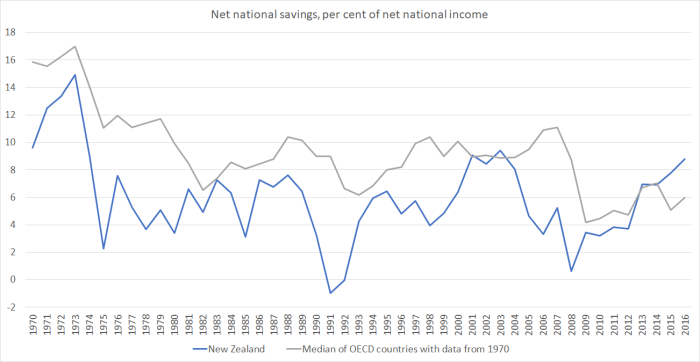
New Zealand’s national savings rates have typically been below those in the OECD group of advanced countries as a whole (and perhaps particularly some of the more economically successful of those countries –  whether by chance, cause, or effect).   But even on that score the last few years look a little different.   This chart compares New Zealand against the median of the 22 OECD countries for which there is consistent data over the full period.

net national savings oecd

It is quite a striking change, and the reasons aren’t at all clear (see yesterday’s post on the puzzles around the New Zealand data).  Perhaps in time some of the rise in the New Zealand savings rate will end up being revised away.  Perhaps the lift will prove real, but temporary (as, say, happened for a few years around 2000). But if not, the apparent change in the relationship between our savings rate and those in other advanced countries should help keep our real interest rates –  and our real exchange rate –  a bit lower than otherwise.  If sustained, that would be expected to lift our economic prospects a bit, all else equal.

But it is worth remembering that, all else equal, a country with materially faster population growth than its peers should typically expect to have a higher national savings rate over time than its peers.   All else is never equal of course, but New Zealand continues to have a population growth rate well above that of the median advanced country.


New Zealand savings rate trends

Making sense of savings behaviour (the bit of flow income not spent) in New Zealand is a bit of a challenge.  Perhaps that is true of other countries as well, but I know their individual stories less well.  In the New Zealand case, it isn’t helped by the rather limited historical data: we have an official estimate of national savings back only as far as the year to March 1972, we only have a sectoral decomposition of savings (household government, etc) back to 1987, and there is no official quarterly data.  Australia, by contrast, has all this data back as far as 1959.

Our sustained period of high inflation didn’t help either.   A significant chunk of any interest rate is typically compensation for inflation, and on the other hand in inflationary periods depreciation (typically on a historic cost basis) tends to be understated.  Decades ago, the Reserve Bank was pointing out that in that era, inflation was flattering our national savings figures.

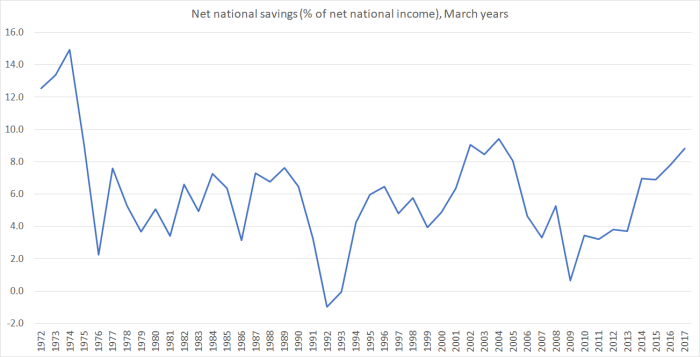
Here is the official series of net national savings expressed as a percentage of net national income (“net” in both cases being net of depreciation – or “consumption of fixed capital”, and “national” referring to the income and savings of New Zealand residents, as distinct from “domestic” –  as in GDP  –  being any activity occurring in New Zealand.)

net savings to nni jan 18

If your eye is anything like mine, you are probably drawn to those last few observations, suggesting quite a significant increase in the net national savings rate in the last few years.    It isn’t exceptional by historical standards –  the savings rate averaged just a little higher for several years in the early 2000s –  but is interesting nonetheless.   Of the other potentially interesting observations, I have no good story for why national savings rates were so much higher at the very start of the period (and thus can only lament the absence of a longer run of official data).   One thing is clear: the lowest points in the series (years to March 1992 and March 2009) coincide with severe recessions.   That probably isn’t too surprising.   But there isn’t anything really comparable on the other side: if savings rates have tended to be higher in cyclically stronger periods, the peaks certainly don’t coincide very strongly with cyclical economic peaks.   Perhaps the other thing to note is that for the last 40 years there has been no obvious trend in the series: fluctuations have been around a fairly constant average rate of 5 to 6 per cent.    Perhaps the reduction in the inflation rate masks an underlying modest trend improvement, but even if so, the high inflation era itself ended 25 years ago.

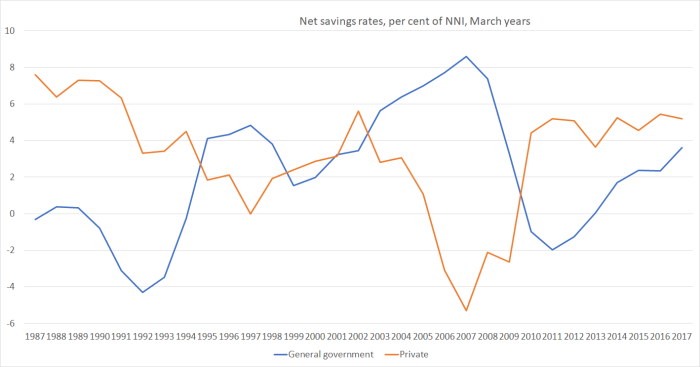
What about the sectoral breakdown of net national savings?   Here is the split between government and private savings.

savings rate jan 18

It is pretty well-recognised that there has been an inverse relationship between the two series.  Quite what that means, or why it occurs, is another question.    Some of it is about the automatic stabilisers built into the tax system (in particular).   Government tax revenue tends to increase more than proportionally in economic upswings, and vice versa (eg on the company tax side, many companies record losses in recession, and it may take a few years of a recovery before they start having a tax payment liability again).      Some may be about government spending taking the place of private spending: if the government suddenly starts paying for, say, childcare costs, households no longer have to and some of that money might now be saved.    Some might be about rational expectations of future fiscal adjustments –  not in some very long-term Ricardian sense, but just that political debate tends to compete to spend large surpluses when they do arise, and people may anticipate that they will soon have more money in their pockets (eg from tax cuts).   Whatever the reason, the pattern has been there over the last 30 years or so.  It is one reason to be a little cautious about the idea sometimes heard that, if raising national savings rates was some sort of national economic priority, it might be enabled by governments simply running larger surpluses.    History –  here and abroad –  suggests that such surpluses aren’t likely to be sustainable, at least when starting from a low debt position, and that the public will relatively quickly recognise that.

Having said that, it is interesting that over the last few years the increase in the national savings rate has been almost wholly reflected in a rise in government savings.  The private savings rate, by contrast, has been pretty stable for some years.

But what about the breakdown within the private savings rate.  This chart shows household and business savings separately, both as share of NNI.

savings rates jan 18 pte

It is useful to be reminded that for some decades now business (net) savings rates have been quite a bit larger than those of households.  Little commentary ever focuses on business savings rates.

Some commentators –  including, at times, the Reserve Bank –  tend to make quite a lot of the role of house prices in explaining household savings behaviour.   I’ve never really found that convincing, and suspect that fiscal policy may be more important an influence on the cyclical swings in the savings rate.  Why?   Well, consumption as a share of GDP has been remarkably stable over 30 years, in the face of huge increases in house prices, and quite substantial swings in house price inflation.   That shouldn’t really be a surprise: after all, higher house prices aren’t a net gain in the community’s real purchasing power, they just redistribute purchasing power a bit (to those just about the downsize and retire to the provinces, and away from those trying to purchase a first home).  And, as it happens, the low point in the household savings rate series came in the year to March 2003, just prior to the first great surge upwards in house prices.

And, of course, one keeps seeing talk –  typically from interested parties –  of the rising tide of Kiwisaver funds.  No doubt, there is a big increase in the stock of funds bearing a Kiwisaver label, but there is nothing in household savings data over the last decade that really suggests any material change in households’ overall rates of savings.   Those rates were very low when the government was running big surpluses, picked up somewhat when the government had big deficits (and the economic climate was uncertain) and have been falling off again in recent years as the budget moved back into (actual and prospective) larger surpluses.

As for business savings, I don’t know how to interpret the data at all.  There has been too little analysis (at least that I’ve seen) attempting to make sense of the swings in the years leading up to 2008 –  that really sharp fall in business savings rates well before the recession itself –  or of the extent of the subsequent recovery.    Terms of trade fluctuations, for example, don’t readily explain the patterns.    Of course, in the end  firms are ultimately owned by households, and the boundaries between the two may be somewhat permeable (and affected, for example, by tax changes and dividend distribution policies.)

I’m not one of those who is alarmed by New Zealand savings rates.   They are towards the low side in international comparisons (a topic for another day), but it isn’t obvious that that is because of specific policy distortions here which materially adversely affecting savings (and more so here than in other countries).   The government accounts have been fairly healthy for decades, our welfare and retirement income system discourages private savings less than those of many other countries, and although our tax system bears materially more heavily on institutional savings than the regimes of many other countries, one has to be cautious about putting too much weight on that argument: it is not, after all, as if savings rates have been materially lower since the late 1980s (when the tax system was markedly reoriented) than previously.   A highly successful economy would be likely –  based on international comparisons –  to see higher average savings rates, but that doesn’t mean that policies designed to boost savings rates could themselves do much to lift the performance of the economy (partly because policies designed to “boost savings” don’t themselves have a particularly good track record).   Rather, when firms are finding abundant investment opportunities, they will tend to be wanting to retain more in the business, and earning the rates of return that support those high business savings rates.

As a reminder, this post has been about flow savings rates.  Some people are keen to talk about asset revaluations, and gains in recorded wealth.     That is, largely, a different topic, but –  as already noted –  bearing in mind that we all have to live somewhere, higher house prices do not make us, as a community, better off.   Higher equity prices may well do so –  and thus US research used to find a stronger wealth effect on consumption from equity prices –  especially if those gains are reflecting underlying improvements in productivity etc.

Workers in a fool’s paradise

A couple of months ago I did a post highlighting some little recognised aspects of the New Zealand data on wages and labour income.   They suggested that, given the underlying relatively poor performance of the economy, workers hadn’t done badly at all. I was curious how the latest national accounts data had changed the picture.

The first chart that attracted my interest was the labour income (“compensation of employees”) share of GDP.   The data are only available annually, but they suggested quite a recovery in the labour share of GDP in the 00s, which had been sustained this decade to date.

COE

That was the picture on the previous iteration of data.     Here is the updated version.

COE jan 17

The picture is subtly different, and if anything the labour income share looks to have been shrinking gradually this decade, even if it is still well above where it was in 2001/2 (the historical low).

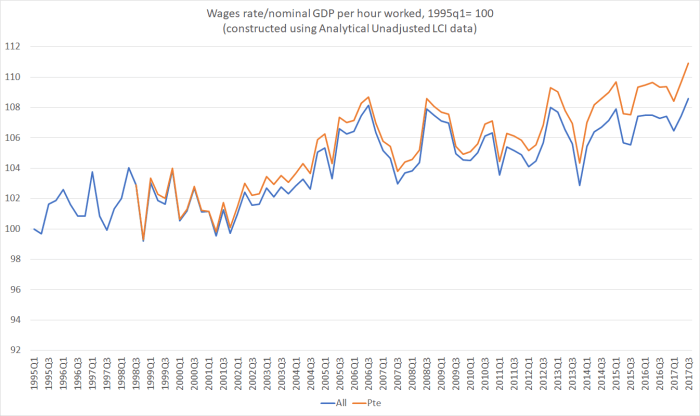
But the other chart, which I found more striking, was one in which I compared growth in nominal wage rates against growth in nominal GDP per hour worked.   I used the Statistics New Zealand Analytical Unadjusted Labour Cost Index series.  It isn’t widely referred to, but relative to the headline LCI series it is a pure wages series, not one in which SNZ has already tried to adjust for productivity, and relative to the QES, it is much smoother (the way economists typically think of wage-setting behaviour) and produces more sensible and plausible series (some of the problems with the QES were illustrated in the earlier post).

When I did the exercise earlier, on the old data, I found that cumulative wage inflation –  particularly that in the private sector –  had run quite a bit ahead of productivity (GDP per hour worked) since around 2002.    Here is the updated version of the chart.

wages and nom GDP phw jan 18

There is a lot of short-term noise in the series –  and wages last year were somewhat “artificially” boosted by the pay equity settlement – but if the extent to which wages have moved ahead of productivity is less than it was in the previous iteration of the data (GDP has been revised up, and wage rate data are unchanged), the trend I highlighted last year is still there.

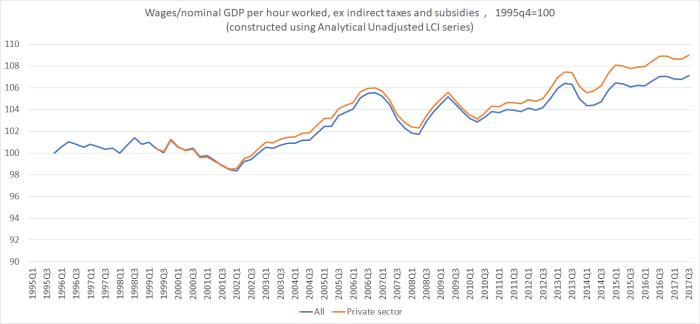
In my earlier post, I noted that this chart had been done using GDP itslf, and that to be more strictly accurate I should have taken account of, eg, the 2010 change in GST (which boosted GDP but shouldn’t have affected wages).    Data on indirect taxes and subsidies are only available annually, so here is a smoothed (four quarter moving average) version of the chart, this time comparing wages against nominal GDP per hour worked excluding indirect taxes and subsidies.

wages and nom GDP phw ex taxes and subsides jan 18

What has been going on?   One possibility is that the Analytical Unadjusted wages data are just substantially wrong?   But they are series that have now been published by SNZ for more than 20 years, and I don’t have specific things I can point to suggesting that they are wrong.

If the data are picking up something real, what then might be the story?   Here was what I included in the earlier post.

My explanation is pretty simple: the (real) exchange rate, which stepped up sharply about 15 years ago and has never sustainably come down since.    When the exchange rate is high, firms in the tradables sectors make less money than they otherwise would have done.   The usual counter to that is that the terms of trade have risen.  But the increase in the real exchange rate has been considerably more than the higher terms of trade would warrant, and in any case much of the gains in the terms of trade have come in the form of lower real import prices, rather than higher real export prices.

And why has the exchange rate been so high?  Because the economy has been strongly skewed towards the non-tradables sector which –  by definition –  does not face the test of international competition.  Demand for labour in that sector has been strong, on average, over the last 15 years, and it is the non-tradables sector that has, in effect, set the marginal price for labour.  For those firms, in aggregate, the lack of productivity growth doesn’t matter much –  they pass costs on to customers.  But it matters a lot for tradables sector producers, who have to pay the market price for labour, with no ability to pass those costs on (while the exchange rate puts downward pressure on their overall returns).  Another definition of the real exchange rate is the price of non-tradables relative to those of tradables. Consistent with this sort of story, in per capita terms real tradables sector GDP peaked back in 2004 (levels that is, not growth rates).

It isn’t, to repeat, a story in which labour has done well absolutely.  As I illustrated the other day, over the last five years there has been about 1 per cent real productivity growth in total.  For decades, we’ve been slipping backwards relative to other advanced countries.   But given the weak overall performance, labour doesn’t look to have done too badly.   That isn’t a recommendation for the “economic strategy” the last two governments have pursued.  A climate in which firms don’t find investment attractive –  perhaps especially investment in the internationally-competitive tradables sector –  isn’t likely to be one that conduces to generating sustained high performance and strong medium-term income growth.

And here is the proxy for business investment (total investment less housing and government) as a share of GDP

bus inv jan 18

Despite some of the best terms of trade in decades, business investment has been poor this cycle –  following on from several decades when it has typically been well below that of the median OECD country (despite well above median population growth).  The notion that “investment has been weak in lots of countries”, even to the extent true, should be no consolation: we started so far behind there was (and is) plenty of scope for us to have caught up, not being so affected by financial crises, euro-area ructions, zero lower bounds or whatever.

It is a fool’s paradise model: non-tradables focused businesses (of which there are many) do just fine, supported by continuing rapid population growth, but there isn’t much net investment at all outside those sectors as New Zealand proves to be an increasingly unfavourable place to build and base internationally competitive businesses.  Productivity growth remains weak, perhaps even weakens further.   Wages might well outstrip productivity growth, but in the long-run only sustained productivity growth will support high material living standards here.   It isn’t a model that need end in crisis, but rather in mediocrity.  And New Zealanders could do so much better.


Reflecting on Jim Anderton

I have a pleasant memory of the only time I met Jim Anderton. One of his daughters was in the same class as me at Remuera Intermediate, and at the end of the year the Andertons hosted a class barbecue at their home just up the street from the school.   I was a youthful political junkie and Jim Anderton was running for Mayor of Auckland.  It was a pleasant evening and he seemed to be a lively and engaged parent (later struck by the awfulness of the suicide of another daughter).

Accounts suggest that Anderton did a good job of helping to revitalise the Labour Party organisation in the late 1970s and early 1980s.  He was, for the time, a moderniser, instrumental in helping reduce the direct influence of the trade unions in the party, and promoting the selection of some able candidates who hadn’t served time in the party (eg Geoffrey Palmer).  Various tributes talk of a personal, and practical, generosity.

I don’t suppose either that there was any doubt that he pursued causes he believed in, and that those causes were, more or less, what he regarded as being in the best interests of New Zealanders (perhaps especially “ordinary working New Zealanders”).   Probably most politicians do.  Sometimes they are mostly right about the merits of the causes they pursue, and sometimes not.    In Anderton’s case, even if one agreeed with the sort of outcomes he might have hoped for, his views on the best means seem –  perhaps even more so with hindsight than at the time –  to have been pretty consistently wrong.   And for all the public talk in the last few days about Anderton’s contribution to New Zealand, few (if any) of the things he opposed in the 1980s have been unwound/reversed, and few of the things he championed when he served later as an effective senior minister have done much for New Zealanders.

Take the 1980s when, upon entering Parliament in 1984, Anderton quickly isolated himself in caucus.  Even before that election, he’d opposed the CER agreement with Australia, and opposed Roger Douglas’s talk of a need for a devaluation and a reduction in the real exchange rate.  Even after the 1984 election, in circumstances of quasi-crisis, Anderton still opposed the by-then inevitable devaluation –  and in league with Sir Robert Muldoon sought to use a select committee to run a kangaroo-court inquiry, to undermine the choices his own government had made.   He was opposed to GST, and he was opposed to creating SOEs for state-trading operations.   He opposed privatisations, whether small or large.   Of the large, there was vocal opposition to the sale of the BNZ and of Telecom.  I suspect the list of reform measures, not subsequently unwound, that Anderton did enthusiastically support would be considerably shorter –  perhaps vanishingly so –  than the list of those he opposed.

As a pure political achievement, to have survived resigning from the Labour Party – in a pre MMP period –  was worthy of note.  But then Winston Peters did much the same thing –  and he’d had the courage to resign his seat and win a by-election to return to Parliament.  And the distinctive Jim Anderton party has long since disappeared, as Anderton returned to the Labour fold.

And what causes did he champion as a senior minister (for a time, deputy prime minister, in the fifth Labour government).   Probably the institution that will be always associated with Anderton’s name is Kiwibank: it certainly wouldn’t have existed without him.  But to what end?   Has Kiwibank changed the shape of New Zealand banking?  Not in ways I can see.  It remains a pretty small player, operating in segments of the market where there has always been plenty of competition.  It hasn’t come to a sticky end –  as many state-owned banks have here and abroad –  but we’ve never had the data to know whether, even on strictly commercial grounds, the establishment of the bank was a good deal for taxpayers (but the fact that no private new entrant has tried something similar suggests probably not).   If simply promoting competition in banking had been the goal, perhaps it would have been preferable to have prevented the takeover of The National Bank by the ANZ?

There has been talk in the last few days of Anderton’s contribution to “revitalising the regions”.  I’m not sure what this can possibly mean –  even allowing for a few government offices being decentralised (at some cost) around regional centres.   Generally, the real exchange rate mattters much more for the economic health of the regions than direct stuff governments do.   Anderton was Minister of Economic Development.  In that role, he was keen on using taxpayer money to subsidise yacht-building (which didn’t end well), and a champion of film industry subsidies.   In tributes this week, there has also been the suggestion that Anderton was one of those responsible for the creation of the New Zealand Superannuation Fund, something I hadn’t heard before.   If so, I guess he deserves some partial credit for the fiscal restraint the then Labour government exercised in its first few years.  Beyond that, what was created was a leveraged speculative investment fund –  not a model followed, as far as I can tell, in other advanced economy –   with returns that over almost 15 years now really only seem to approximately compensate for the high risks the taxpayer is being exposed to.  No doubt Anderton opposed the decision in 1989 or 1990 to start raising the NZS eligibility age from 60 to 65, and the same opposition to any further increase in the age beyond 65 –  even though it is a step many other advanced countries have taken, as life expectancies improved –  was presumably behind any involvement he had in the creation of the NZSF.  In so doing, once again his hand was involved in holding back sensible gradual reforms, and keeping New Zealand a bit poorer than it need be.

I suspect many of the tributes of the last few days are mostly a reflection of Anderton’s part in the Labour reconcilation.  The prodigal son returned –  having been one of the leading figures in fomenting the civil wars in the first place, before walking out of the party.   They were tumultuous years, and few things are nastier than civil wars.  Anderton doesn’t ever seem to have been a team player, but by the end of his career he seem to have found his place back alongside the team he started with.

But from a whole-of-nation perspective, what did Anderton accomplish?     If the reforms of the 1980s and 1990s haven’t produced the results the advocates hoped for –  we still drift, more slowly, further behind other advanced countries – that wasn’t for the sorts of reasons Anderton advanced.  Had we followed his advice, we’d most likely now be poorer still –  and many of the issues around equality and social cohesion that he worried about might have been no more effectively addressed.     In the end, Anderton is perhaps best seen as a belated figure from the New Zealand of the 1950s and 60s.  There was a lot to like about the New Zealand of those years –  some of the best living standards in the world then – for all the increasingly costly distortions to our economy.   There are parallels to Muldoon –  who famously told a TV interviewer of his goal to leave New Zealand no worse than he found it –  both in the genuineness of their concerns, and the wrongness of too many of their policy stances.  Both seemed to back very reluctantly into the future, with all too much willingness to trust our fortunes to the state, and the possible winners identified by politicians and officials, rather than to the market.

A very strong economy driven by the strong economic plan?

The latest quarterly GDP data came out just before Christmas, and they included substantial revisions to the data for the last few years, flowing on from the annual national accounts data released in November.

The actual level of GDP is now a bit higher than had previously been reported, but what caught my eye was the reported claim from the former Minister of Finance, Steven Joyce, that the new data suggested that there was no productivity growth problem after all.   You’ll recall that for some time I –  and others –  have been highlighting data suggesting that there had been basically no productivity growth at all in New Zealand for the last five years.

Here was Steven Joyce’s specific claim

Mr Joyce says the figures released today finally put to bed the fallacy that New Zealand was having a ‘productivity recession’.

and he went on to claim that

“These figures provide clear confirmation that the new Government has inherited a very strong economy driven by the strong economic plan of the previous Government.

So what do the productivity numbers look like on the revised GDP data?  You may recall that I’ve been calculating nine different measures of real GDP per hour worked (using the two quarterly measures of GDP, and the HLFS and QES hours data, and an average measure).    Since GDP for the last few years had been revised upwards and the hours numbers weren’t touched, productivity growth was inevitably going to be a bit stronger than previous estimates had suggested  (which was a relief, because the previous estimates had, if anything, suggested a modest fall in the level of productivity and that didn’t really ring very true).

Here is how the average measure of real GDP per hour worked has behaved over the almost 10 years since 2007 q4 (just prior to the 08/09 recession).

GDP phw worked NZ Jan18

Over the last 10 years (less one quarter), total labour productivity growth has been 6 per cent.    Over the last five years, New Zealand’s total productivity growth has been 1 per cent (ie about 0.2 per cent per annum).   It is a little better than the previous iteration of data has suggested, but……it isn’t much to boast about.

Using the same average measure, I calculated the average annual rate of productivity growth for a few historical periods:

  • Under the National-led governments in the 1990s,  average annual productivity growth was 1.2 per cent (quite dismal enough, given how far behind we had slipped),
  • Under the Labour-led governments of 1999 to 2008, average annual productivity growth was 1.0 per cent,
  • Under the National-led governments of 2008 to 2017, average annual productivity growth was 0.8 per cent, and
  • (as already noted), over the last five years, average annual productivity growth was 0.2 per cent per annum.

And here is the comparison with Australia, on the newly-updated New Zealand data.

AUs and NZ reaL gdp PHW

Australia’s numbers seems to have been flat for the last couple of years, but even over that short period we’ve done a bit worse than they have.

If these results are what Steven Joyce had in mind in talking of a “very strong economy driven by the strong economic plan” one can only really shake one’s head in despair.   If there was a plan to lift overall productivity performance, it clearly didn’t work.  Economic policy was simply misguided, and seems to have paid no attention to the severe limitations of our location.   Perhaps more depressing –  given that Joyce and his colleagues are in Opposition –  is that there is little sign that the new government has any more convincing a strategy  (and where is the deeply-grounded persuasive advice of MBIE and Treasury?).   One hopes –  but is that just against hope –  that they care.

On more mundane matters, I had cause to wonder about even the cyclical strength of demand when, over the holidays, one evening my wife and I walked from Epsom to Parnell and back, and were staggered by just how many empty shops there were in both Newmarket and Parnell.    Any reader insights into just what is going on (or not) in those up-market shopping districts would be of interest.


OIA obstructionism – yet more evidence for RB reform

Working my way through things that turned up while I was away, I stumbled on an impressive piece of public sector diligence.  At 3.44pm on the last working before Christmas – a time by which surely most office-bound workers had already left work for the holidays –  Angus Barclay, from the Communications Department of the Reserve Bank, responded to an Official Information Act request I’d lodged with the Bank’s Board several weeks earlier.   I was impressed that Angus had still been at work, but was less impressed with the substance of the response.

I’d asked the Board for copies of the minutes of meetings of the full Board and any Board committees in the second half of last year (specifically 1 July to 30 November).  It didn’t seem likely to be an onerous request: there would probably only have been four or five full Board meetings, and perhaps some committee minutes, all of which will have been readily accessible (in other words virtually no time all in search or compilation).    Perhaps the Board would have wanted to withhold some material, and (subject to the statutory grounds) that would have been fine.  But again, doing so shouldn’t have been onerous.   The Board, after all, exists mostly to monitor the performance of the Governor, on behalf of the public.   In an open society, it isn’t naturally the sort of material one should expect to be kept secret.

In fact, in the 22 December response I received I was informed that there were only five documents.  But I couldn’t have them.  Instead, the request was extended for almost another two months, with a new deadline of 19 February.   Oh, and they foreshadowed that they would probably want to charge me for whatever they might eventually choose to release.

Why was I asking?     After an earlier request to the Board, around the appointment of an “acting Governor”, it had come to light that there was no documentation at all around the process for the appointment of a new Governor (that had been underway in 2016, before Steven Joyce told them to stop), which in turn appeared to be a clear violation of the Public Records Act.    The process of selecting a candidate to be the new Governor is one of the Board’s single most important powers.   And yet the records showed that nothing had been documented –  to be clear (see earlier post), it wasn’t that material was withheld (for which there might well have been an arguable case), it just didn’t exist.   Following that post in May, I was interested to see whether the Board had sharpened up its act, and come into compliance with its statutory obligations.

I had some other interests, of course.   For example, in the five months covered by my request, Graeme Wheeler had finished his term, and I also wondered if there might be some insight in the minutes on the still-secret Rennie review on the governance of the Reserve Bank.

But instead I met obstruction.

There are two things that interest me about the response.  The first is that, although the request was explicitly made of the Reserve Bank Board –  which has a separate statutory existence, and whose prime function is to hold the Bank/Governor to account –  the response came from Reserve Bank staff, referencing only Reserve Bank policies and practices.  It is consistent with my longstanding claim that the Board has allowed itself to simply serve the interests of, and identify with, the Bank –  rather than, say, the Minister who appointed them, or they public whom they (ultimately) serve.

Thus, in respect of the charging threat, I received this line

The Ombudsman states on page 4 of the guidelines on charging that: “It may also be relevant to consider the requester’s recent conduct. If the requester has previously made a large volume of time-consuming requests to an agency, it may be reasonable to start charging in order to recover some of the costs associated with meeting further requests.”

I’m not precisely sure how many OIA requests I lodged with the Board last year, but I’m pretty sure it was no more than four (and one of those was to secure material that was in fact covered by, but ignored in the answer to, an earlier request).   Three of the four I can recall were simply requests for copies of minutes – with no substantial search or collation costs.  Given the uncertainty around the legality of the appointment of the “acting Governor”, major events during the year such as the Rennie review, questions around compliance with the Public Records Act, and the process of selecting a new Governor, it didn’t seem like an undue burden on the Board.

As the Ombudsman’s charging guidelines also note

Note, however, that some requesters (for example, MPs and members of the news media), may have good reasons for making frequent requests for official information, and they should not be penalised for doing so.

Since this blog is one of the main vehicles through which a powerful public agency –  Bank and/or Board –  is challenged and scrutinised, I’d say I was on pretty strong ground in my request for straightforward Board minutes.  (And just to check that the Board itself isn’t being overwhelmed with other requests, I lodged a simple further request this morning asking how many OIA requests the Board has received in each of the last two years, and copies of the Board’s procedures of handling OIA requests made of it.)

I can only assume that the Bank itself, which seems to be controllling the handling of requests made even to the Board, has gotten rather annoyed with me again, and decided to use the threat of charging as some sort of penalty or deterrent.  Longstanding readers may recall that we have been this way once before.  About two years ago, the Bank got very annoyed with me (and some other requesters) and started talking of charging left, right and centre.   Reaction wasn’t very favourable, and Deputy Governor Geoff Bascand even took to the newspapers with an op-ed defending the Bank’s stance.   There was talk of a “mushrooming” number of requests, but on closer examination even that didn’t really stack up –  the number of OIA requests the Bank received was much smaller than, say, those The Treasury received.     Explaining is (often) losing, and as I noted at the time, the Bank didn’t come out of the episode well.   As a refresher, the Bank released responses to 20 OIA requests in 2017.  The Treasury, by contrast, released responses to more than 80 OIA requests (in both agencies there will be have responses not posted on the respective websites).

But even in their defence a couple of years ago, Bascand asserted that the Bank –  no mention of the Board –  would be charging only when the requests were “large, complex or frequent”.  My latest request of the Board is neither large nor complex, and neither were the earlier requests.

Even though the Bank and the Board are not the same entities, they are clearly trying to conflate my requests to both entities.   But over the course of last year, my records suggest I lodged no requests at all with the Reserve Bank itself in the first five months of last year.    Between June and the end of the year, there seem to have been quite a few, but on topics as diverse as:

  • the new “PTA” signed by Steven Joyce and Grant Spencer,
  • the Toplis suppression affair,
  • assumptions about new government policies the Bank referred to in its latest MPS,
  • some data from an expectations survey that the Bank had not published
  • three old papers, each clearly-identified in the request,
  • a specific paper on RB governance issues explicitly mentioned in the Bank’s BIM, and
  • work on digital currencies that the Bank explicitly highlighted in a recent research paper.

All still seem like reasonable requests, of a powerful agency which has a wide range of functions.  It seems unlikely that many of them should have involved any material amount of time to search for, or collate (in fact, in response to several requests the Bank responded quite quickly and in full, prompting notes of thanks from me).   There are no requests that can reasonably be described as “fishing expeditions”, and no pattern of repeated requests for much the same information.  They seem like the sort of requests those who devised the Official Information Act might have had in mind.

Finally, it is worth noting what the Ombudsman’s guidelines suggest can and can’t be charged for (bearing in mind that very few agencies charge at all).    Agencies can, in appropriate circumstances, charge for things like

Search and retrieval 

Collation (bringing together the information at issue) 

Research (reading and reviewing to identify the information at issue) 

Editing (the physical task of excising or redacting withheld information) 

Scanning or copying

Five nicely-filed documents (Board minutes) will have taken mere minutes to retrieve, no time to copy (since they will exist in electronic form already) and no time to research.  It is conceivable that the physical task of redacting withheld information might take a little time –  but very little.

And what can’t agencies charge for at all?

Work required to decide whether to grant the request in whole or part, including:
– reading and reviewing to decide on withholding or release;

– seeking legal advice to decide on withholding or release;

– consultation to decide on withholding or release; and – peer review of the decision to withhold or release. 

Work required to decide whether to charge and if so, how much, including estimating the charge.

If the Reserve Bank or the Board think that trying to charge for five simple, easily accessible, documents is consistent with the principles of the Official Information Act, or of the sort of transparency they often like to boast of, things are even worse than I’d supposed.   And in the attempt, they will again damage their own image and reputation more than they inconvenience me.

If anything, it is further evidence of why a full overall of the Reserve Bank Act –  and of the institution –  is required.  You might have supposed that, with a review underway, the Bank and the Board would have wanted to go out of their way to attempt to demonstrate that there were no problems, no issues, in an attempt to convince the Minister to make only minimal changes, leaving incumbents with as much power and control over information as possible.  But no, instead by the words and actions they simply reinforce the case for reform, and indicate that they have little concept of what genuine public accountability means.   We should be looking for openness, not obtuseness and obstructiveness from the Bank –  whether the Governor (“acting” or permanent) or the Board, supposedly operating on our behalf to keep the Bank in check.  Once again, we don’t see what we should have the right to expect.

Perhaps, on reflection, the Bank or the Board will reconsider their wish to charge for some simple documents –  the sort of documents that should probably be pro-actively released as a matter of course.  If not, one can only assume they have something to hide.   The “good governance” former public servant in me is sufficiently disquieted about the evidence of weak or non-existent recordkeeping that I am thinking of taking further the apparent breach of the Public Records Act.  Options might include:

  • a letter to the chair of the Board, asking how the Board is assured that it is operating in compliance with the Act,
  • a letter to the Minister of Finance, asking whether (and how) he can be sure that his appointees (the Board) are operating in compliance, given past evidence of major gaps,
  • a letter to the minister responsible for the Public Records Act itself,
  • a letter to the Auditor-General expressing concerns about the evidence suggesting that the Board of the Reserve Bank is not meeting its statutory obligations under the Public Records Act.