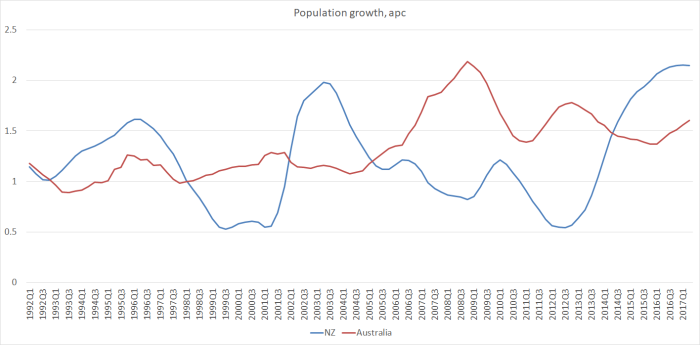
Some labour market statistics that really should be looked into

There was a curious line in the Labour-New Zealand First agreement, under “Economy”.

Review the official measures for unemployment to ensure they accurately reflect the workforce of the 21st century.

I wasn’t (and still am not) clear what the two parties had in mind.  It got some people rather hot and bothered, with suggestions of political interference to get numbers that happened to suit the government of the day.  That interpretation seemed pretty far-fetched.  Plenty of people –  politicians included –  have views on what Statistics New Zealand should collect and report data on.  And governments have to decide what to fund Statistics New Zealand for –  regional nominal GDP data got added to the mix a while ago, there are now weird (and intrusive) things like the General Social Survey, and on the other hand we still don’t have monthly CPI data, monthly industrial production data (in both cases, unlike almost every other advanced country) or quarterly income-based measures of GDP.   Rather rashly, governments and SNZ appear on course to degrade our travel and immigration data.

So I don’t have a problem if parties to a government want to have a look again at some or other area of our official statistics, and perhaps even get Treasury and MBIE to commission some expert or other to have a fresh look at indicators of unemployment etc.  I’d be even more pleased if such a review led to the allocation of a bit more money to Statistics New Zealand.  But I’m not sure there is much of a problem with the HLFS as it is, even if my confidence in the data have taken a bit of a dip since my household has been in the survey (over the last few quarters).   Oh, and when they made changes to the HLFS last year, and made no attempt to backdate the new employment and hours series, simply leaving a level shift in the official series that was a bit trying too (one always has to remember to make a rough and ready adjustment for the break – I almost forgot to in the charts below).

Is it a bit odd and arbitrary that the headline measure of unemployment doesn’t count you as unemployed if you managed one hour’s paid work in the survey week, even if that was the only hour you managed to get all quarter and you’d really like a 40 hour a week job?    Absolutely it is.    But so long as the headline unemployment measures are used either for cross-country comparisons, or for comparisons within New Zealand over time, precisely where one draws that (inevitably) arbitrary line won’t matter very much.  Other countries also calculate headline unemployment rates that way, and we’ve been using the HLFS since 1986.

It is more of a problem when complacent commentators misuse the measure to go on about how “unemployment” is “only” 4.6 per cent, as if all is rosy.   Of course, even a 5 per cent “true” unemployment rate would mean that over a 40 year working life, the typical person would be unemployed –  on the quite narrow definition –  for two years.  That is a large chunk of time, and (like me) probably few of those commentators ever spent any time unemployed on this measure.

But SNZ does now do quite a reasonable job of providing a richer array of data that enables users –  and media and other commentators –  to get a fuller picture of overall supply/demand imbalances in the labour market.  We have data on the people in part-time work who would like to work more hours.  And data on people who would like a job but have become discouraged by repeated failure, and have given up searching (to the definitions of the HLFS).  Outside the HLFS we have data on those on welfare benefits.  Now there is even an official underutilisation rate, which can also be compared across time and (with more difficulty) across countries.   At 11.8 per cent that is a pretty high number, and probably one that –  were it more widely known –  would trouble many people (as it does me).   These numbers tend not to matter much to macroeconomic commentators, focused mostly on cyclical fluctuations, since the various different series tend to move together and a demand for long-term time series drives people quickly back to the headline measure.  But it doesn’t make the other measures less valuable or important for other purposes.

It is meaningless to say that “the” unemployment rate is 4.6 per cent, but that would have been as true in 1997 as it is 2017.  Then again, it probably isn’t meaningless to say that all the measures of excess labor supply are higher than they were 10 years ago, a period over which demographic trends have probably been working to lower the long-run sustainable rate of unemployment (on whichever measure you choose).

Statistics New Zealand don’t seem any better informed about the review

[Labour market manager] Ramsay said Statistics NZ had no more information about the review apart from what was in the coalition agreement.

“Nothing at this point. No content at all.”

But if there are resources to spend on reviewing and improving labour market statistics, I’d be making a bid for something around wages data.

A repeated theme from the Labour Party during the election campaign was that wage growth has been slow, and that this needed to change.  When the Labour Party leader was, at times, challenged about this claim, her response was that people didn’t “feel” better off.    Now, I’m sure perceptions matter a lot in politics, but ideally perceptions –  and the policies of governments – will be informed and shaped by the data, rather than the other way round.

In a post a few months ago I illustrated, using national accounts data, that the labour share of income has been trending up in New Zealand over the last 15 years or so.  COE

Over that period, on official data, New Zealand’s experience has been quite different from that of the other Anglo countries (and much of the commentary we read is British or American).  Across the OECD as a whole, the labour share in the median country hasn’t changed in the last 15 years, and New Zealand has had one of the larger increases. [UPDATE: An interesting illustration of how different the Australian experience has been.]

One of the problems in making sense of what is going on is that (a) we don’t have a quarterly income-based measure of GDP, so we fall back on the published wages data, and (b) the published wages data are all over the place.

Still most widely quoted is the very-volatile Quarterly Employment Survey measure of average hourly wage rates, a measure that (by construction) is subject to compositional changes  (if, this quarter, lots more low-skilled get jobs, even at good wage rates for those jobs, average hourly wage rates will fall even though no one is earning less per hour than they were).

Then there is the Labour Cost Index (LCI) which doesn’t purport to be a series of wage rates, but rather a proxy for unit labour costs. In other words, it is an attempt to measure wages adjusted for changes in productivity etc.  It is a smooth series, and is given prominence by SNZ, but it tells us nothing at all about the growth in the hourly earnings of the people who are in employment (adjusted for changes in composition).

And then there is the Analytical Unadjusted Index.  Even the name would deter most casual users.  It is found buried among the Labour Cost Index series, and  –  at least on paper –  looks like the best series we have.  It is constructed from the raw wages data SNZ collects to generate the headline LCI series, and is constructed in a stratifed way, to eliminate (or minimise) distortions arising from compositional changes.

This is what inflation in the Analytical Unadjusted series looks like

analytical unadj nov 17

It is relatively smooth –  conforming to economists’ priors about how labour markets work –  and, of course, (nominal) wage inflation is much lower it was a decade ago.  (Remember that the tick up in the most recent quarter is the impact of the pay-equity settlement.)    Of course, CPI inflation is also a lot lower than it was then.

A couple of months ago, I did a post using the Analytical Unadjusted data, deflating it by core inflation and comparing it with growth in real GDP per hour worked.  Real wage inflation appeared to have been running well ahead of productivity growth (the latter, non-existent, in aggregate, for the last five years).

But in that chart, I didn’t take account of the terms of trade.  A higher terms of trade – and New Zealand’s have done quite well in the last 15 years or so –  lifts the incomes the economy can afford to pay.  A better way to look at things might be to compare nominal wage growth with growth in nominal GDP per hour worked.  There is a lot of short-term variability in nominal GDP growth –  as dairy and oil prices ebb and flow  – but if we look at cumulative growth over fairly long periods we might hope to find something interesting.  Over very long periods of time we might expect hourly wage rates to increase at around the rate of growth in nominal GDP per hour worked.

The Analytical Unadjusted data go back to mid 1990s for the whole economy, and to the late 1990s for the private sector.   Here is what the resulting chart looks like.  Both series –  wage rates and nominal GDP per hour worked – are indexed to 100 when the Analytical Unadjusted data start.  (Recall that we still only have q2 GDP data).   I’m showing the ratio of the two series: when the line is rising, wage rates are rising faster than nominal GDP per hour worked.

wages and nomina GDP phw an unadj.png

For the first seven or eight years, the chart looks much as you’d expect.    There is quarter to quarter volatility in GDP, which is reflected in the ratio, but broadly wages were rising at around the rate of growth of  nominal GDP per hour worked.  Wages outstripped nominal GDP growth in the late boom years –  even as the terms of trade were rising –  and have done so again, in the last five years.   Over the last 15 years, private sector wage rates –  on this measure –  have risen perhaps 12 per cent faster than growth in the value of nominal GDP per hour worked.  (And the tax switch in 2010 will have boosted nominal GDP, without any reason to expect it would change pre-tax wage rates. so the “true” increases in wages relative to underlying GDP is even larger than the chart suggests).

I find this picture plausible, and I think I can tell a sensible story about what might have been going on.  But before I tell that story, here’s an alternative chart.    The QES wages data go back further, to 1989.  And here is what the chart of QES ordinary time wages rates looks like relative to growth in nominal GDP per hour worked back to 1989.
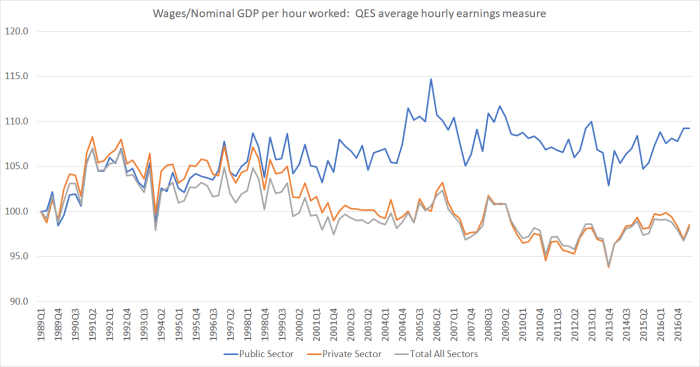
wages and nom GDP QES

It is on exactly the same scale as the previous chart.  But on this measure, private sector wages have barely kept pace with nominal GDP per hour worked growth over almost 30 years now (and have been losing ground since end of the 1990s), while public sector wage rates have outperformed (but almost all the out-performance was in the 1990s, under those spendthrifts, Ruth Richardson and Jenny Shipley.

I just don’t believe that the QES picture is portraying an accurate picture of what has been going on in the labour market.  For a start, it is inconsistent with the national accounts (the labour income share chart, which suggests that something turned in labour’s favour 15 years or so ago).  And the labour income share chart looks more consistent with the stratifed Analytical Unadjusted based measure.

To be clear, I’m not suggesting that labour has done particularly well.  The productivity performance of the New Zealand economy has been pretty lousy –  especially in the last five years –  and the unexpected (and outside our control) improvement in the terms of trade only offsets a bit of that gap.   Absolute levels of nominal GDP per hour worked in New Zealand remain very low by advanced country standards and, thus, so do wage rates.   But given the relatively poor performance of the economy as a whole, labour hasn’t done badly at all.  If people have feelings about these things it doesn’t look as though they should be about evil capitalists (or evil governments) rapaciously transferring money to themselves or their rich mates.  Simply that poorly performing economies –  with little or no productivity growth –  shouldn’t expect much wage inflation.  If there is rage, it should be about successive governments of both parties that have done nothing to redress that failure.

There might still be some serious problems with the statistics.  But if the Analytical Unadjusted series is roughly right (even if not many commentators cite it), how might one explain what it shows?  My explanation is pretty simple: the (real) exchange rate, which stepped up sharply about 15 years ago and has never sustainably come down since.    When the exchange rate is high, firms in the tradables sectors make less money than they otherwise would have done.   The usual counter to that is that the terms of trade have risen.  But the increase in the real exchange rate has been considerably more than the higher terms of trade would warrant, and in any case much of the gains in the terms of trade have come in the form of lower real import prices, rather than higher real export prices.

And why has the exchange rate been so high?  Because the economy has been strongly skewed towards the non-tradables sector which –  by definition –  does not face the test of international competition.  Demand for labour in that sector has been strong, on average, over the last 15 years, and it is the non-tradables sector that has, in effect, set the marginal price for labour.  For those firms, in aggregate, the lack of productivity growth doesn’t matter much –  they pass costs on to customers.  But it matters a lot for tradables sector producers, who have to pay the market price for labour, with no ability to pass those costs on (while the exchange rate puts downward pressure on their overall returns).  Another definition of the real exchange rate is the price of non-tradables relative to those of tradables. Consistent with this sort of story, in per capita terms real tradables sector GDP peaked back in 2004 (levels that is, not growth rates).

Perhaps it isn’t the correct story. Perhaps there is some serious problem with the data.  But if the government is serious about the words in the Speech from the Throne

A shift is required to create a more productive economy

one (small) step towards getting there might be set out to resolve the puzzles, and apparent inconsistencies, in our labour market (wages) data.  At present though, the best-constructed series suggests a badly-unbalanced economy.  Workers haven’t done badly given the poor performance of the overall economy, but the foundations haven’t been laid for durable real income growth –  if anything, they’ve been progressively whittled away as the foreign trade share of the economy has eroded.


The Washington Post falls for Ben Mack

A few weeks ago I devoted a post to an absurd article the Herald had run, by one of their “lifestyle columnists” (himself here on a work visa), Ben Mack.   It was published a couple of days before New Zealand First chose to join Labour in a coalition government, supported by the Greens.  Mack claimed that as a (temporary) immigrant, he was “terrified of Winston Peters”.  It was an absurd article, debasing any sort of prospect of intelligent debate, and really unworthy of a serious media outlet –  as the Herald still sometimes is.

But now he has, somehow, got a genuinely serious media outlet –  the Washington Post no less –  to run an article by him on “How the far-right is poisoning New Zealand”.  No one in New Zealand is going to take it seriously, but some Americans –  knowing pardonably little about New Zealand –  might.  If the article reflects poorly on Mack –  but then he is a “lifestyle columnist” who has only been in New Zealand for a couple of years –  that is nothing to what it says about one of the world’s better newspapers.

The article isn’t some considered analysis of that scattering of what might genunely be called “far-right” groups in New Zealand –  the tiny National Front for example, whose small group of lawful protesters (and the rather larger group of “counter-protestors”) were recently in the news.  No, instead we read that

A shadow is poisoning Middle-earth

But for all the excitement around Prime Minister Jacinda Ardern and her new government, the real power lies with the far right. And, more terrifying: The far right seized power by exploiting the very system meant to be a fairer version of democracy.

Little did you know.  But now you do.

It is, apparently “appalling” that a small party that, in principle, could have supported either side into government (and has in the past), got to decide which bloc ended up forming a government.  It isn’t clear why it is appallling: it seems a lot like MMP, which most New Zealanders (although not me) seem to like.  PR systems are how most European countries elect Parliaments, and thus put together governing coalitions.  It must seem strange to Americans, but it isn’t that hard to get your head round.  And had the Greens been willing to deal with National, or Labour and National been willing to form a “grand coalition”, New Zealand First wouldn’t even have been in play.  Parties made their choices, the voters made theirs, and on this occasion that left New Zealand First holding the decisive bloc of seats.  And Mack also has a go at them for taking so long, apparently not aware of how slowly coalition negotiations proceeded this year in the Netherlands, and are still going on in Germany.  It isn’t two months since the election.

But the pernicious influence of New Zealand First is already at work

The effects of the far right’s influence are already being felt. Amid pressure from New Zealand First, the government has vowed to slash immigration by tens of thousands by making it harder to obtain visas and requiring employers to prove they cannot find a qualified New Zealand citizen before hiring a non-citizen. They’ve also put forward legislation banning non-citizens from owning property,

But….but…….   New Zealand First didn’t get any of its immigration policies (such as they were) adopted at all.  The new government says it is adopting the centre-left Labour Party’s policy.  And that ban on foreign purchases (of existing houses)?  Well, it was supported –  going into the election –  by all three parties in the government, including the rather left-wing Greens.

It gets worse, US readers are told

Like American white supremacists in the age of Trump, bigots in New Zealand have also been emboldened by New Zealand First’s success into taking action beyond ranting on Internet message boards and social media. In late October, clashes erupted when white supremacists rallied in front of Parliament.

But apparently the National Front has a little rally every year.  What changed this year was the actions of a group –  led by two Green MPs –  to break-up a lawful protest.

It is all pretty weird stuff.  You might –  as I did –  read the Reserve Bank’s Monetary Policy Statement today, which lists the new government policies the Bank had specifically looked at.  There were higher minimum wages, new state-house building programmes, increased government spending (and reversal of tax cuts) and a larger fiscal deficit.  Oh, and the Labour Party’s modest promsed changes to immigration policy.   This, according to Mack, is the “far-right” setting the agenda.  He didn’t mention that the new government was going to reform the Reserve Bank Act to ensure that the central bank explicitly keeps an eye on keeping the labour market close to full employment.   The far right at work no doubt.  Because, you see

Put simply, while Ardern may be the public face, it’s the far right pulling the strings and continuing to hold the nation hostage.

and

What’s happened in New Zealand isn’t just horrifying because of the long-term implications of hate-mongers controlling the country, but also because it represents a blueprint that the far right can follow to seize power elsewhere.

Appealing to ethnically homogenous, overwhelmingly cisgender male voters with limited education and economic prospects who feel they’re being left behind in a changing world is nothing new for the far right. But what is new is its savvy at exploiting democracy by doubling down on these voters while mostly allowing larger political parties to attack each other on their own, thus positioning themselves as “kingmakers” who can demand concessions from those larger parties before carrying them into power.

As others have pointed out, like them or not, New Zealand First gets a larger share of its votes from Maori than many other parties.  In fact, Peters himself is Maori.

And haven’t we been here before?   As I noted in my earlier post

But –  and here is where a bit of perspective and experience of New Zealand might have come in handy to Mr Mack – not usually that much [clout] at all.   New Zealand First was in coalition with National in the mid 1990s –  Winston Peters as Deputy Prime Minister and Treasurer –  and it was in partnership with Labour for a few years from 2005 –  Winston Peters serving a Foreign Minister, and generally accepted as having done a reasonable job.   And what changed?  1996 is a while ago now, but I can recall:

  • a small increase in the inflation target, never subsequently reversed,
  • free doctor’s visits for kids under six, never subsequently reversed, and
  • a referendum on reform of New Zealand Superannuation, in which the cause Peters was advocating lost decisively.

Oh, and I think there was a Population Conference.

The 2005 to 2008 term was even less memorable, unless you were a Ministry of Foreign Affairs bureaucrat: their Minister secured them a great deal of additional money and the prospect of various new embassies.

I’m sure there was other stuff, but none of it was transformative.

New Zealand First’s vote shared peaked in the 1996 election.  But the far-right is rampant –  in control actually.

And looking through the Labour-New Zealand First agreement, quite what did New Zealand First secure?     There were some ministerial jobs, they saw off the possibility of a water tax, they got a “regional development fund” which will be used (among other things) to plant lots and lots of trees.  There were even more Police than Labour was promising, free driver training for secondary school students, a free health check for old people, and the possibility –  no more –  of some more capital for the state-owned bank.   And not a jot on immigration policy.

You might like the new government’s policies, or you might not.  You might like what NZ First specifically won, or you might not.  But that coalition agreement doesn’t seem to offer any support for anyone wanting to claim that the “far-right” was somehow in control of New Zealand, or of the government.  Indeed, if the (libertarian) right in New Zealand is celebrating anything in this government, it will be the referendum on personal use of cannabis, approval for medicinal cannabis use (Green causes) and the promise that the new government might free up onerous planning rules which drives house prices sky high (Labour policy).  If there is a genuine “far right” in New Zealand, I struggle to see how they’d find anything to celebrate in the new government, with New Zealand First or not.

Quite how a quite newly-arrived American lifestyle columnist so misreads New Zealand is a bit of mystery.  But how one of the world’s major media outlets, and serious newspapers, fell for this nonsense is a rather bigger puzzle.  It might be the age of “fake news”, but generally serious newspapers are supposed to be guardians against it, not the purveyors of nonsense to the world.

UPDATE (Friday): The Post has now published a response by a New Zealand journalist.


The Reserve Bank second XI takes the field

The second XI at the Reserve Bank fronted up to present today’s Monetary Policy Statement.    There was the unlawfully appointed “acting Governor” Grant Spencer –  who is now signing himself as “Governor”, not even as acting Governor –  the chief economist, John McDermott, and the new head of financial stability (and openly acknowledged applicant for Governor) Geoff Bascand.    At best, they are holding the fort until the new Governor is appointed, and a new Policy Targets Agreement put in place, but despite that Spencer still felt confident enough to assert that “monetary policy will remain accommodative for a considerable period”.     How would he know?  He won’t be there.

One could feel a little sorry for the Bank.  After all, not only is the second XI holding the fort, but a new government took office only a week or so ago.    Between Labour’s manifesto commitments and the agreements with New Zealand First and the Greens, there are a lot of new policy measures coming.  But there is not a lot of detail on most of them.    The Bank’s typical approach in the past has been not to incorporate things into the economic projections until they become law (at, in the case of fiscal policy, in a Budget).   They’ve departed from that approach on this occasion, and have incorporated estimates of the macro effects of four new policies:

  • fiscal policy,
  • minimum wage policy,
  • Kiwibuild, and
  • changes to visa requirements affecting students and work visas.

I suspect they’d have been better to have waited.  On fiscal policy, for example, there are no publically available numbers yet –  just last week the Prime Minister told us to wait for the HYEFU.    On immigration, there has been nothing from the new government on the timing of any changes.  And on Kiwibuild, there is no sign of any analysis behind the assumption the Bank has made that around half of Kiwibuild activity will displace private sector building that would otherwise have taken place.  And so on.

And then there are the numerous other policy promises the Bank hasn’t accounted for.  In the Speech from the Throne yesterday there was a clear commitment to “remove the Auckland urban growth boundary and free up density controls” in this term of government.  If so, surely that would be expected to affect house prices and perhaps building activity?   Binding carbon budgets are also likely to have macro effects.

I’m not suggesting the Bank can produce good estimates for any of these effects.  Rather, they’d have been better to have stayed on the sidelines for a bit longer, since they were under no pressure at all to change the OCR today, rather than incorporate rough and ready estimates of a handful of forthcoming changes, with little sign that they have really stood back and thought about how the economy is unfolding.

And the conclusions they’ve come to do seem rather questionable.  The “acting Governor” kicked off his press conference talking of the “very positive” economic outlook.  I’m not sure how many other people will agree with him. As the Bank themselves note, they’ve been surprised on the downside by recent GDP outcomes, and housing market activity has been fading.  Even dairy prices have been edging back down, and oil prices have been rising.  (And, of course, there has been no productivity growth for years.)

The Bank forecasts an acceleration of economic growth –  even as population growth slows –  on the back of additional fiscal stimulus and additional building activity under the Kiwibuild programme.    Like other commentators, I’m rather sceptical that we will see anything quite that strong.  But even on their own numbers, productivity growth over the next few years is now projected to be weaker than the Bank was projecting in August.       And if Kiwibuild really is going to add so much to housing supply, in conjunction with slower population growth than the Bank was expecting, how plausible is it real house prices will simply be flat as far the eye can see (or the forecasts go)?  Not very, I’d have thought.

In the end, the numbers don’t matter very much.  Spencer will be gone at the end of March, and we’ll have a new Governor and a new PTA.  A new Governor will make his or her own assessment, and own OCR decisions.  But part of what that person will need to do is take a look at lifting the quality of the Bank’s economic analysis.

For all the talk of initiatives promised by the new government, the Monetary Policy Statement itself was striking for containing not a word –  not one –  mentioning that the monetary policy regime itself is under review.  Of course the “acting Governor” can’t pre-empt changes the detail of which aren’t known, but the Act does require the Bank to discuss in MPSs how monetary policy might be conducted over the following five years: a horizon over which we’ll have a different PTA, a different Governor, an amended statutory mandate, and a statutory committee to make decisions.

My main interest was in the contents of the press conference, where journalists raised both the issue of the proposed new mandate and the proposed changes to the statutory decisionmaking model.    In both cases, I suspect the second XI said too much.

Asked about the proposed mandate changes, Spencer began noting that he couldn’t say too much as the review was just getting started.  He then went on to assert that “moving to a dual mandate was unlikely to have a major impact on how policy is run”, explaining that in many ways flexible inflation targeting is akin to a “dual mandate” (something that, in principle, I agree with).     But then, somewhat surprisingly, he claimed that the proposed change could lead the Bank to become more flexible, potentially allowing greater volatility in inflation to promote greater stability in employment.  I guess it depends on the details of the changes, which none of us yet knows, but it was the first I’d heard of anyone calling for more volatility in inflation.  Over the last decade, those who think the Bank hasn’t put sufficient weight on the labour market indicators (like me) would have been quite happy to have seen core inflation at the target midpoint on average.  The previous Governor committed to that, but didn’t deliver.

On which note, it was a little surprising to hear the Chief Economist talk about how the Bank had improved its forecasts, and got its inflation forecasts right over the last couple of years.  That would then explain why core inflation has remained persistently below the target midpoint???  And has not got even a jot closer in the last couple of years?

Spencer noted that at present the Bank regarded the labour market as ‘pretty balanced’, such that a dual mandate wouldn’t make much difference right now.   But it turns out that they really don’t know.

They were asked a question about the government’s goal of getting the unemployment rate below 4 per cent, and –  fairly enough –  drew a distinction between structural policies that might lower the NAIRU and anything monetary policy could do.  When pushed, they argued that on current structural policies, an unemployment rate lower than 4 per cent would be inflationary, and suggested that estimates of the NAIRU range from 4 to 5 per cent at present.

But then all three of the second XI went on.  Spencer noted that the estimates are ‘very uncertain” and that in anticipation of a “dual mandate” the Bank was now doing some work to come up with some estimates of the NAIRU, suggesting that they haven’t had a precise estimate until now [although there were always assumptions embedded in the model].    Then the chief economist –  who at almost every press conference tries to discourage the use  of a NAIRU concept –  chipped in claiming that any NAIRU was “very very variable” and “changes all the time”, without offering a shred of evidence for that proposition.

And then the head of financial stability chipped in, opining that estimates of NAIRUs around the world have been declining (not apparently seeing any connection between this thought and (a) the NZ experience, and (b) his colleague’s observation a few moments earlier that the numbers were pretty meaningless anyway.

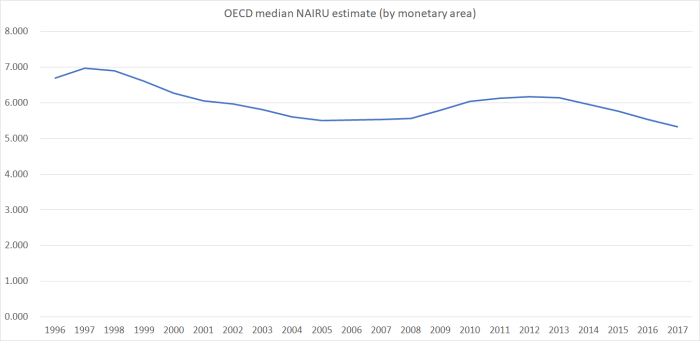
Out of curiousity I had a look at the OECD’s published NAIRU estimates.  This is the NAIRU for the median OECD monetary areas (ie countries with their own monetary policy plus the euro-area as a whole).

nairu oecd

The estimate for 2017 is 5.3 per cent.  That for 2007 was 5.5 per cent.     There just isn’t much short-run variability in the structural estimates of the long-run sustainable unemployment rate. That is true for other advanced countries.  It is almost certainly true for New Zealand.    It reflects poorly on the Reserve Bank how little they’ve done in this area, and it one reason why a change in the wording of the statutory mandate is appropriate.  The unemployment rate is a major measure of excess capacity, pretty closely studied by most central banks but not, until now it appears, by our own.

(Of course, had they wanted to be a little controversial, they could have noted that proposed structural policy changes –  notably the increased minimum wages they explicitly allowed for –  will tend to raise (not lower) the NAIRU to some extent.)

If they were at sea on the unemployment rate issue, what really staggered me was the way Spencer (and Bascand) used the press conference to campaign for minimal changes to the statutory governance and decisionmaking model for monetary policy.      They didn’t need to say more than “decisionmaking structures are ultimately a matter for Parliament, and we will be providing some technical input and advice to the Treasury-led process the Minister of FInance announced earlier in the week”.

But instead, they took the opportunity to campaign for as little change as possible.  Spencer noted that they agreed the Act should be changed to provide for a committee, but noted that they already had a committee, they thought it worked well, and they would like to reflect that in the Act.   Others might challenge whether the advisory committee, or the Governor, has done such a good job in the last five years (or today) but set that to one side for the moment.

They loftily conceded that there were possible advantages to having externals on a committee –  the potential for greater diversity of view. But they were concerned that in a small country it could be very difficult to find outsiders with unconflicted expertise to make the system work.  There was nothing to back this –  no explanation, for example, as to how places like Norway and Sweden manage, or how we manage to fill the numerous other government boards in New Zealand.

But what they really hate –  and I knew this, but was still surprised to hear them proclaim it so openly, just as a proper review is getting underway –  is the idea that any differences of view might be known to the public.   They could, we were told, tolerate a system of ‘collective responsibility’ –  in which all debates are in-house and then everyone presents a monolithic front externally –  but were strongly opposed to any sort “individualistic committee” in which individual views might become known.    These systems –  of the sort prevailing in the UK, the United States, Sweden, and the euro-area –  have, they claimed, the potential to become a “circus” with too much media focus on monetary policy, and a concern about “heightened volaility” in financial markets.   Spencer went so far as to suggest that an individualistic approach could undermine the reputation and credibility of the institution.

A slightly flippant observer might suggest that the second XI and their former boss have done that all by themselves –  between the actual conduct of policy, and attempts (in which they all participated) to silence one of their chief critics.  A more serious observer might ask for some evidence from the international experience, to suggest that the more individualistic approach has damaged the standing of the Fed, the BOE, or the Riksbank.  Are these less well-regarded organisations than the Reserve Bank of New Zealand?    I’d have thought it would be hard to find such evidence.

Bascand –  one of the declared candidates for Governor –  then chipped in to note that what management was concerned about was to ensure that the focus of discussion was on the issues “the Bank” had identified, not on individuals or their particular views. Loftily –  earnestly no doubt – he declared that they wanted the focus to be on substance.  No doubt, as defined by management.   It reinforces the point I’ve made often that Bascand is the candidate for the status quo.  Bureaucrats setting out to protect their bureau.  Predictable behaviour – even if usually more subtle than this –  and what the public need protecting from.

There are successful central banks that adopt the collegial approach –  the RBA is one, albeit one with a rather old-fashioned committee decisionmaking model –  but there is nothing to suggest, in the international experience, that that model produces better outcomes, or a more credible central bank, than the individualistic approach.  Indeed, many observers would regard Lars Svensson’s open disagreement with his colleagues on the Riksbank decisionmaking committee as a useful part of the process that finally led the rest of the committee, including the Governor, to abandon their previous excessively hawkish approach a few years ago.

The second XI’s approach is that of “the priesthood of the temple” –  we will tell you, the great unwashed, only what it suits us to tell you, in the form we want to present it.  It is simply out of step with notions of open government, or with a serious recognition that monetary policy is an area of great uncertainty and understanding is most likely to be advanced by the open challenge and contest of ideas.

Fortunately, the new government shows signs of seeing things differently.   There is a minister for open government (admittedly, lowly ranked), a commitment to improving transparency under the Official Information Act.  And in the Speech from the Throne yesterday there was an explicit commitment –  not referenced by the Second XI, still trying to relitigate – that

“The Bank’s decision-making processes will be changed so that a committee, including external appointees, will be responsible for setting the Official Cash Rate, improving transparency.”

Note the use of “will”.   The Bank management’s preference for a “collective model” would do nothing at all to improve transparency.

It is all a reminder of how uncertain things still are, and how important the membership of the Independent Expert Advisory Panel the Minister of Finance has pledged to appoint as part of review of the Act might be (including whether the panel is really “expert” or –  as rumour suggests – a politician might chair it).   And also how important it is that Bank management do not have a leading say in the advice that goes to the Minister.  Management is paid to implement Parliament’s choices, not to devise models that cement in the dominance (and secrecy) of management.

It is also a reminder of just how important the appointment of the new Governor is, and why it remains hard to be confident about just how committed the government is to serious change when they’ve left that appointment in the hands of the Reserve Bank Board –  all appointed by the previous government, all on record endorsing the way things have gone for the last five years, and with a strong track record of serving the interests of management rather than those of (a) the public and (b) good public policy.

700 years of real interest rates

When I mentioned to my wife this morning that I’d been reading a fascinating post about 700 years of real interest rate data her response was that that was the single most nerdy thing I’d said in the 20 years we’ve known each other (and that there had been quite a lot of competition).   Personally, I probably give higher “nerd” marks to the day she actually asked for an explanation of how interest rate swaps worked.

The post in question was on the Bank of England’s staff blog Bank Underground, written by a visiting Harvard historian, and drawing on a staff working paper the same author has written on  bond bull markets and subsequent reversals.    It looks interesting, although I haven’t yet read it.

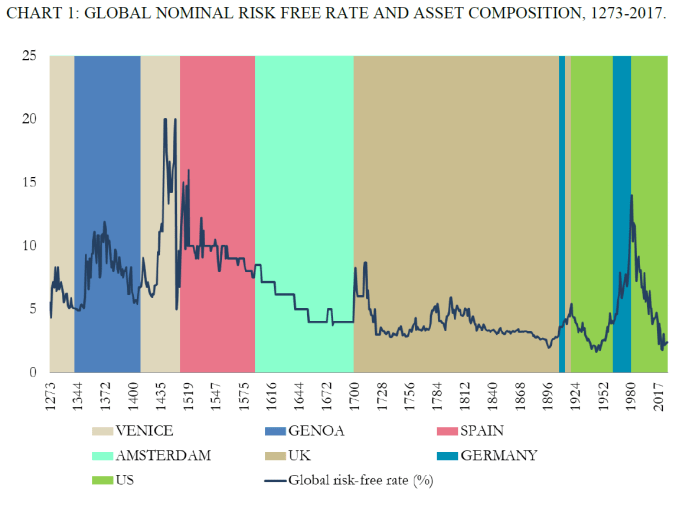
Here is the nominal bond rate series Schmelzing constructed back to 1311.

very long term nom int rates

And with a bit more effort, and no doubt some heroic assumptions at times, it leads to this real rate series.

very long-term real rates.png

Loosely speaking, on this measure, the trend decline has been underway for 450 years or so.   It rather puts the 1980s (high real global rates) in some sort of context.

In the blog post the series is described this way

We trace the use of the dominant risk-free [emphasis added] asset over time, starting with sovereign rates in the Italian city states in the 14th and 15th centuries, later switching to long-term rates in Spain, followed by the Province of Holland, since 1703 the UK, subsequently Germany, and finally the US.

In the working paper itself, “risk-free” (rather more correctly) appears in quote marks.  In fact, what he has done is construct a series of government bonds rates from the markets that were the leading financial centres of their days.     That might be a sensible base to work from in comparing returns on different assets –  perhaps constructing historical CAPM estimates –  but if US and West German government debt has been largely considered free of default risk in the last few decades, that certainly wasn’t true of many of the issuers in earlier centuries.  Spain accounts for a fair chunk of the series –  most of the 16th century  – but a recent academic book (very readable) bears the title Lending to the borrower from hell: Debt, taxes, and default in the age of Philip II.  Philip defaulted four times ‘yet he never lost access to capital markets and could borrow again within a year or two of each default’.  Risk was, and presumably is, priced.  Philip was hardly the only sovereign borrower to default.  Or –  which should matter more to the pricing of risk –  to pose a risk of default.

In just the last 100 years, Germany (by hyperinflation), the United Kingdom (on its war loans) and the United States (abrograting the gold convertibility clauses in bonds) have all in effect defaulted – the three most recent countries in the chart.  Perhaps one thing that is different about the last 30 or 40 years is the default has become beyond the conception of lenders.  Perhaps prolonged periods of peace –  or minor conflicts – help produce that sort of confidence, well-founded or not.

I’m not suggesting that real interest rates haven’t fallen.  They clearly have. But very very long-term levels comparisons of the sort in the charts above might well be concealing as much as they are revealing.    They certainly don’t capture –  say –  a centuries-long decline in productivity growth (productivity growth really only picked up from the 19th century) or changing demographics (again, rapid population growth was mostly a 19th and 20th century thing).  And interest rates meant something quite different in an economy where (for example) house mortgages weren’t pervasive –  or even enforceable – than they do today.

As for New Zealand, at the turn of the 20th century our government long-term bonds (30 years) were yielding about 3.5 per cent, in an era when there was no expected inflation.  Yesterday, according to the Reserve Bank, the longest maturity government bond (an inflation-indexed one) was yielding a real return of 2.13 per cent per annum.    Real governments yields have certainly fallen over that 100+ year period, but at the turn of the 20th century New Zealand was one of the most indebted countries on the planet  whereas these days we bask in the warm glow of some of the stronger government accounts anywhere.  Adjusted for changes in credit risk it is a bit surprising how small the compression in real New Zealand yields has been.

The Robertson reviews of the RB Act

When you’ve favoured a reform for the best part of 20 years, and made the case for it –  inside the bureaucracy and out –  for several years, then, even though it was a reform whose time was coming eventually, there is something deeply satisfying about hearing the Minister of Finance confirm that legislative change will happen.    That was my situation yesterday when Grant Robertson released the terms of reference for the review of the Reserve Bank Act, including specific steps that will before long end the single decisionmaker approach to managing monetary policy.   Various Opposition parties had called for change (the Greens for the longest), market economists had favoured change,  The Treasury had tried to interest the previous government in change five or six years ago, before Graeme Wheeler was appointed.  But now the Minister of Finance has confirmed the government’s intention to introduce legislation next year.   The amended legislation won’t be in place before the new Governor takes office, but presumably the policy will be clear enough by then that the new Governor will know what to expect, and what is expected of him or her.  Reform was overdue, but at least it now looks as though it will happen.

There were several aspects to yesterday’s announcement from the Minister of Finance:

  • the new “Policy Targets Agreement”,
  • the two stage process for an overhaul of the Reserve Bank Act, and
  • inaction on the appointment of the new Governor.

In what looks like not much more than a photo opportunity, Grant Robertson got Grant Spencer, current “acting Governor” of the Reserve Bank over to his office and together they signed a “Policy Targets Agreement” that was, in substance, identical to the one Steven Joyce and Grant Spencer had signed in June.

There was no legal need for a new Policy Targets Agreement (even if either of these two documents had legal force, which they don’t), and no incoming Minister of Finance has ever before requested a new PTA (the Minister has to ask, and can’t insist) that is exactly the same as the unexpired one that was already in place.   When National came to power in 2008, they did ask for a new PTA.   The core of the document –  the obligations on the Governor –  weren’t altered, but they did replace clause 1(b), which describes the government’s economic policy and how the pursuit of price stability fits in.  Under Labour that had read

The objective of the Government’s economic policy is to promote sustainable and balanced economic development in order to create full employment, higher real incomes and a more equitable distribution of incomes. Price stability plays an important part in supporting the achievement of wider economic and social objectives.

National replaced that with

The Government’s economic objective is to promote a growing, open and competitive economy as the best means of delivering permanently higher incomes and living standards for New Zealanders. Price stability plays an important part in supporting this objective.

If the new Minister of Finance really thought a new PTA was required to mark his accession to office, surely he could have at least replaced the National government’s policy description with one of his own –  even simply going back to Michael Cullen’s formulation, which actually mentioned full employment.

Apart from the photo op, I’m not sure what yesterday’s re-signing was supposed to achieve.  The Minister presented it as providing certainty to markets, but it does nothing of the sort: we are in the same position now we were a couple of days ago, Robertson had already told us he wouldn’t make substantive changes until the new Governor was appointed and we still have no idea who that person will be, or what the precise mandate for monetary policy only a few months hence will look like.  Nor, presumably, does the Reserve Bank.

And by signing the document, Robertson seems to have bought into Steven Joyce’s “pretty legal” (but almost certainly nothing of the sort) approach to the appointment of an “acting Governor”.    As I’ve noted previously, the Reserve Bank Act does not provide for an acting Governor except when a Governor’s term is unexpectedly interrupted (death, dismissal, resignation or whatever), and –  consistent with this –  there is no provision in the Act for a new Policy Targets Agreement with an acting Governor (since a lawful acting Governor will only be holding the fort during the uncompleted term of a permanent Governor who would already have had a proper and binding PTA in place).    Spencer’s appointment appears to have been unlawful, and Robertson has now made himself complicit in this fast and loose approach to the law.   Consistent with the fast and loose approach, he allowed Spencer to sign yesterday’s Policy Targets Agreement as “Governor”, not as “acting Governor”.  He cannot be Governor, since under the Act any Governor has –  for good reasons around operational independence – to have been appointed for an initial term of five years.  And he isn’t acting Governor, since there is no lawful provision for him to be so in these circumstances.  At best, he is “acting Governor” –  someone purporting to hold that title.

The heart of yesterday’s announcement, however, was the two stage process for reviewing and amending the Reserve Bank Act.

Phase 1:

The review will:
• recommend changes to the Act to provide for requiring monetary policy decision-makers to give due consideration to maximising employment alongside the price stability framework; and

• recommend changes to the Act to provide for a decision-making model for monetary policy decisions, in particular the introduction of a committee approach, including the participation of external experts.

• consider whether changes are required to the role of the Reserve Bank Board as a consequence of the changes to the decision making model.

A Bill to progress the policy elements of the review, including on the details necessary to introduce a potential committee for monetary policy decisions, will be introduced as soon as possible in 2018. This will give greater certainty on the direction of reform in advance of the appointment of the next Reserve Bank Governor, currently scheduled in March 2018.

Phase 1 of the review will be led by the Treasury, on behalf of the Minister of Finance. The Treasury will work closely with the Reserve Bank who will provide expert and technical advice. An Independent Expert Advisory Panel will be appointed by the Minister of Finance to provide input and support to both phases of the Review.

Phase 2:
In line with the Government’s coalition agreement to review and reform the Reserve Bank Act, the Reserve Bank and the Treasury will jointly produce a list of areas where further investigations of the Reserve Bank’s activities are desirable. This list will be produced in consultation with the Independent Expert Advisory Panel.

This list, and the next steps for the review, will be communicated early in 2018. This phase of the review will incorporate the review of the macro-prudential framework that was already scheduled for 2018.

It is clearly intended as a pragmatic approach.  With a new Governor to take office in March, they want to get on with the specific changes Labour campaigned on  so that they come into effect as soon as possible after the new Governor is in office (realistically, it is still hard to envisage the new Monetary Policy Commitee making OCR decisions and publishing Monetary Policy Statements until very late next year –  perhaps the November 2018 MPS – at the earliest.)  It also appears to aim to separate the things on which the government mostly just wants advice on how best to implement changes they’ve promised, from other issues that may need looking at but where the parties in government have not taken a strong position.

But it still leaves me a little uneasy, on a couple of counts.

First, while it would be easy enough, after due consideration, to make limited changes to the Act to give effect to the desire to make explicit a focus on employment/low unemployment without many spillovers into the rest of the Act (I listed here a handful of clauses I think they could amend to do that),  I’m less sure that is true of the monetary policy decisionmaking provisions.    As the terms of reference note, if monetary policy decisions are, in future, to be made by a statutory committee, it raises questions about the role of the Bank’s Board –  whose whole role at present is built around the single decisionmaker (the Governor has personal responsibility for all Bank decisions not just monetary policy ones).

But how can you sensibly make decisions about the future role of the Board without knowing what changes (if any) you might want to make to the Bank’s other functions?  If, in the end, you leave all the other powers in the hands of the Governor personally, something like the current Board structure might still make sense, with some minor changes as regard monetary policy decisions.  But if you concluded that a statutory committee was also appropriate for financial stability issues, and that even the corporate functions should be governed in more conventional ways (Board decides, chief executive implements), there might be no place at all for a Board of the sort (ex post monitoring and review agency) we have now.    Decisions about the governance of an institution need to start by taking account of all the responsibilities of the institution, not just one prominent set of powers.

Second, it may be difficult to maintain momentum for more comprehensive reform once the government’s own immediate priorities have been dealt with.    On paper, it doesn’t look like a problem, but resources are scarce, legislating takes time and energy, implementing new arrangements for monetary policy takes time and energy, and it would be easy for momentum on the second stage to lapse (whether at the bureaucratic level, or getting space on the government’s legislative agenda).    That risk is compounded by an important distinction between phases one and two.    In phase one, the Treasury is clearly taking the lead, on behalf the Minister.  In phase two, we are told, “the Reserve Bank and the Treasury”  (the order is theirs) will “jointly” produce a “list of areas where further investigations of the Reserve Bank’s activities are desirable”.    A joint list raises the possibility of the Bank holding a blocking veto –  not formally, but in practice –  and where the Bank is more interested in (a) blocking other far-reaching changes that might constrain management’s freedoms, and (b) advancing whatever list of minor reforms it might have in mind itself.

Perhaps in the end much will depend on the Minister himself, and on the Independent Expert Advisory Panel he plans to appoint.  But the Minister of Finance will be a very busy man, and up to now he has shown little interest in reforms of the Reserve Bank legislation beyond the first stage ones.

What of the panel?  We’ll know more when we see what sort of people are appointed to it, and how much time they are being asked to give to the issue.

In a set of Q&As released with yesterday’s announcement the Minister indicated of the panel that “they will be individuals with independence and stature in the field of monetary policy, including governance roles”.   That is probably fine for phase one (which is monetary policy focused), but the bulk of the Bank’s legislation, and much of its responsibility, has nothing to do with monetary policy at all.  So if the panel is going to play a substantive role in the planned phase 2, I’d urge the Minister to consider casting his net a bit wider.

As to who might serve on it, there aren’t that many with what look like the right mix of skill, experience, and independence.  It is sobering to reflect that when the (still secret) Rennie review on related issues was done earlier in the year, not a single domestic expert was consulted.  I imagine they will want to draw mainly on people who actually live here.  But if possible, I would urge Treasury and the Minister to consider inviting Lars Svensson to be part of the panel –  as someone who has undertaken a previous review for an earlier Labour government, someone who supports an explicit employment focus, and someone with practical experience as a monetary policy decisionmaker.    David Archer – a New Zealander (and former RB senior manager) who now heads the BIS central banking studies department – might also be worth drawing on.

The third dimension of yesterday’s announcement was the Minister of Finance’s comments about the process for appointing a new Governor.    There I think he is making a mistake.

In his Q&As, the Minister noted that “the process for appointing a new Governor is in the hands of the Board”.

Newsroom reports that, when asked, Robertson noted that

“I’ve met with the chair of the board and he has assured me that process is underway and well under way and going well. I sought an assurance from him that any candidates he was interviewing would be ones who would be able to implement a change to policy along the lines we’re going, he expressed his confidence about that but in the end the process itself lies in his hands.”

Appointing a new Governor of the Reserve Bank is –  or should be –  the most consequential appointment Robertson will make in the next three years.  For a time that person will, single-handedly, wield short-term macro-stabilisation policy (which is what monetary policy is) and –  perhaps indefinitely –  will wield all the regulatory powers of the Bank.  Even if committees end up being established for both main functions, the Governor will have –  and probably should have –  a big influence on how, and how well, macro and financial regulatory policy is conducted over the next five years.

There has been a pretty widespread sense that the Reserve Bank in recent years has not been operating at the sort of level of performance –  on various dimensions –  citizens and other stakeholders should expect.  That isn’t just about substantive decisions, but about supporting analysis, communications, operating style etc.  And yet the Reserve Bank Board –  and chairman Quigley –  have backed the past Governor all the way (whether on minor but egregious issues like the attempts to silence Stephen Toplis, or on the conduct of monetary and regulatory policy).   But the new government claims to want something different.   The issue isn’t whether a potential candidate can, as a technical matter, manage the sort of phase 1 changes the Minister plans.  I’m sure any competent manager could.  The more important issues are around alignment and vision.  Is the Minister content to leave the process to the Board –  all appointed by the previous government – and take a chance on them coming up with someone who represents more than just the status quo?   At this point, it appears so.  Apparently, the selection process will not be reopened, even though the advertising closed months ago and the role of the Bank (and Governor) is to be changed.

It is quite an (ongoing) abdication by the new Minister. In (almost all) other countries, the Governor of the Reserve Bank is appointed directly by political leaders (Minister of Finance, head of government or whoever).   Those leaders no doubt take soundings in various quarters, but the power –  and the responsibility –  rests with the politician.   Here, Grant Robertson just rolls the dice –  relying on a bunch of private sector directors appointed by his predecessors –  without (it seems, from the tone of his comment above) a high degree of confidence in the outcome.  Perhaps he’ll like who the Board comes up with. But if he doesn’t, so much time will have passed that he’ll be stuck. He can reject a Board nomination, but they’ll just come back with the next person on their own list, evaluated according to their own sense of priorities etc.  It isn’t the way appointments to very powerful positions –  the most powerful unelected person in the country for the time being –  should be done.

And two, very brief, final points:

  • now that the government has changed, and the Minister who asked for the Rennie review of Reserve Bank governance issues has gone, surely there can be no good grounds for continuing to withhold Rennie’s report and associated papers?  It is not as if it is playing any role in the current Minister’s thinking.

    Newsroom also asked Robertson if he had seen a review of the bank undertaken by former State Services Commissioner Iain Rennie that was requested by former Finance Minister Steven Joyce.   He said he was yet to see it, but had asked Treasury about it.

  • we are told to expect a new Policy Targets Agreement when the new Governor is appointed.   Presumably, true to past practice, the first the public will know about it is when the document –  guide to macro-management for the next five years –  is released.    It would good if the Minister of Finance would commit now to proper transparency, including pro-active release (once the document is signed) of  relevant documents.  It would be better still if he would think about adopting the considerably more open, and rigorous, Canadian model.

    Less than a year since completing the last review of its inflation-targeting mandate, the Bank of Canada is starting to prepare for the next one in 2021.

    Consultations kick off in Ottawa on Sept. 14 with an invitation-only workshop of economists that will be webcast on the central bank’s website. It’s an early public start to the process, and comes amid a growing sense that a deeper look at the inflation target is needed after almost a decade of poor economic performance.

A more open approach to these issues – as practised in Canada for years – has much to commend it (even if I didn’t always think so when I was a bureaucrat.)

Why are NZ interest rates so persistently high (Part 2)?

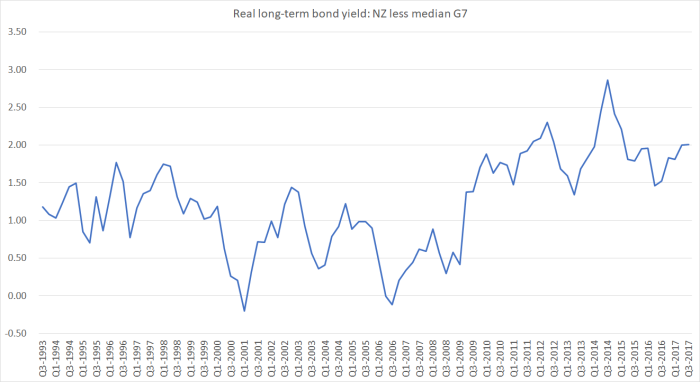
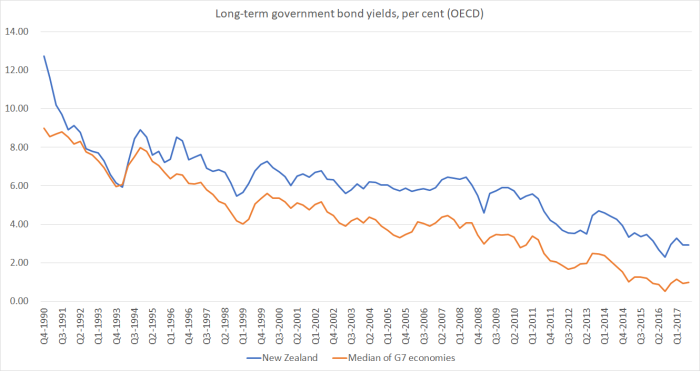
In Friday’s post, I illustrated how persistent and large the gap between New Zealand long-term interest rates and those in other advanced countries has been (and remains).  The summary chart was this one

real NZ less G7

The gap is large and persistent whichever summary measure of other countries’ interest rates one looks at.

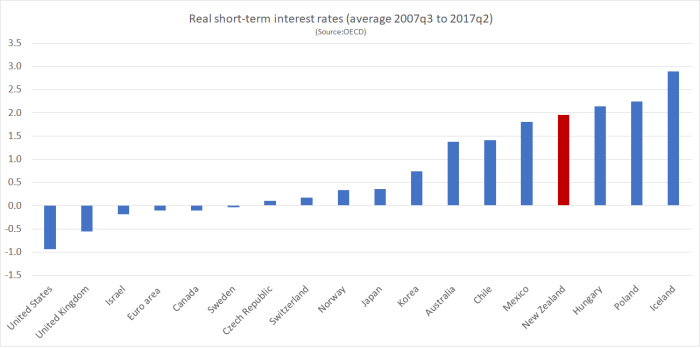
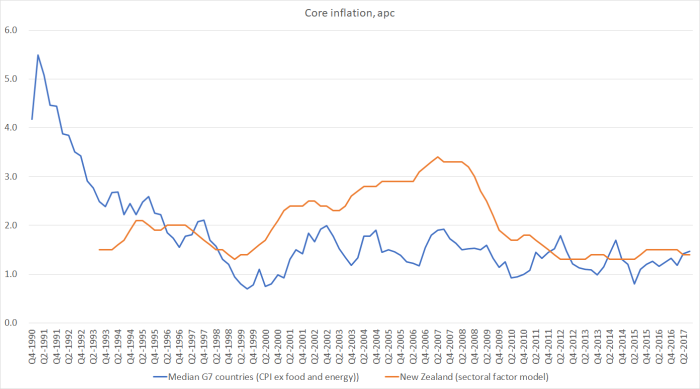
It is also there for short-term interest rates.  In this chart, I’ve shown average real short-term interest rates for the OECD monetary areas (17 countries with their own monetary policies, plus the euro-area) for the last 10 years, adjusting average nominal interest rates for average core inflation (the OECD reported measure of CPI inflation ex food and energy).

real short-term int rates oecd

Of the countries to the right of the chart, Iceland and Hungary have had full-blown IMF crisis programmes in the last decade, and Mexico and Poland had precautionary programmes.  That isn’t meant to suggest that New Zealand is crisis-prone, just to highlight how anomalous our interest rates look relative to those of the other more-established advanced economies.

In yesterday’s post I reviewed some of the arguments sometimes advanced to explain why New Zealand interest rates have been persistently higher than those in other advanced countries.   As I noted, these factors don’t look like a material, or compelling, part of the story:

  • size (of the country),
  • (lack of) economic diversification
  • market liquidity,
  • creditworthiness,
  • accumulated external indebtedness,
  • unusually rapid productivity growth

And, as I noted, none of those explanations has as a corollary a persistently strong real exchange rate.  A story that can make sense of New Zealand’s persistently high real interest rates needs to be able to make sense of the persistently strong exchange rate, and also of New Zealand’s persistently poor productivity performance.  As it is, in a country with a poor productivity performance and the disadvantages of remoteness, one might have expected to find persistently low interest rates and a persistently rather weak exchange rate.

At an economywide level, interest rates are about balancing the availability of resources with the calls on those resources.  In principle, they have almost nothing to do with central banks –  we had interest rates millennia before we had central banks.  They also don’t have anything necesssarily to do with “money”, except to the extent that money represents claims on real resources.

In any economy with lots of exceptionally attractive and profitable opportunities, firms will be wanting to do a lot of investment.  Resources used for investment today might well generate really strong returns in the future, but those resources can’t also be used for consumption (or producing consumption goods) today.  Interest rates play the role prices typically do –  acting as “rationing device”.  Higher interest rates today make some people willing to consume a bit less now, and they also help ensure that the only the investment projects with the higher expected returns go ahead.    In other words, interest rates help reconcile savings and investment plans.  (If they couldn’t adjust that way, the price level would do the adjustment –  and that is where central banks these days come in, adjusting the actual short-term interest rate to reconcile savings and investment plans while keeping inflation in check).

Sometimes the strong desire to undertake investment projects will be based on genuinely great new technologies.    Sometimes it might be just based on a pipe-dream (credit-fuelled commercial property development booms are often like that).   Sometimes, it will be based on direct government interventions (one could think of the Think Bg energy projects).  And sometimes, it will simply be based on rapid population growth –  people in advanced economies need lots of investment (houses, roads, shops, offices, schools etc).

Various factors can influence the desire to save.   If firms in your country have developed genuinely great new technologies, it may seem reasonable to expect the future incomes will be a lot higher than those today.  If so, it might be quite rational to spend heavily now in anticipation of those income gains (consumption-smoothing).  Some governments tend towards the spendthrift, and others towards the cautious end of the spectrum.  Tax and welfare rules might affect desire and willingness to save (although my reading of the evidence is that they affect more the vehicles through which people choose to save).   Demographics matter, and compulsion may also play a part.    Culture probably matters, although economists are often hesitant about relying on it as an explanation.  Business saving is often forgotten in these discussions, but can be a significant part of total savings.

But if, for whatever reason, people, firms and governments don’t have a strong desire/willingness to save at “the world interest rate”, then (all else equal) interest rates in your country will tend to be a bit higher than those in other countries.   And if firms, households and governments have a strong desire to invest (building capital assets) at “the world interest rate”, then (all else equal) interest rates in your country will also tend to be a bit higher than those in other countries.      Quite how much higher might well depend on how interest-sensitive that investment spending is (in aggregate).

Of course, we don’t get to observe actual supply curves for savings, or demand curves for investment.  We don’t know how much New Zealanders (or people in other countries) would choose to save or invest at “the world interest rate”.  Instead, we have to reason from what we do see –  actual investment (and its components) and actual savings.

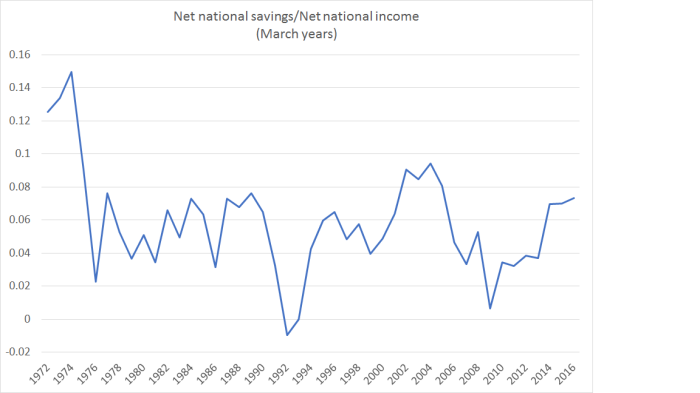
Take savings rate first (and by “savings” here I mean national accounts measure –  in effect, the share of current income not consumed).  Net national savings rates in New Zealand have been similar, over the decades, to the median for the other (culturally similar) Anglo countries, but lower typically than in advanced (OECD) countries more generally.  Savings rates are somewhat cyclical, but as this chart illustrates, for some decades now they’ve cycled around a fairly stable mean (through big changes in eg tax policy, retirement income policy, fiscal policy, financial liberalisation etc).

net national savings.png

All else equal, if tomorrow we woke up and found that somehow New Zealanders had a much stronger desire to save then our interest rates would fall relative to those in the rest of the world.   But that is an illustrative thought-experiment only, not a basis for direct policy interventions.  A relatively low but stable trend savings rate over a long period of time –  especially against a backdrop of moderate government debt –  suggests something more akin to a established feature of New Zealand that policy advisers need to take account of.   A different New Zealand economy might well feature a higher national savings rate –  more successful firms, wanting to invest more heavily over time to pursue great profit opportunities, retaining more profits to reinvest –  but that would be an outcome of a transformed economic environment, not an input governments could or should directly engineer.   Higher saving rates are not, automatically, in and of themselves, “a good thing”.

By the same token, if we all woke tomorrow and (collectively) wanted to build less physical capital (“invest less” in national accounts terminoloy), our interest rates would fall relative to those in the rest of the world.  Actually, that is roughly what happens in a recession: pressure on scarce resources eases and so do interest rates (central banks typically helping the process along).  But less (desired) investment is not, in and of itself, “a good thing”.   Nor, for that matter, is more investment automatically desirable – in the last 40 years, investment/GDP was at its highest in the Think Big construction phase.

Whether over the last 40 years, or just over the last decade, investment/GDP in New Zealand has been very close to that of the typical advanced country.  On IMF data, investment/GDP for 2007 to 2016 averaged 22.0 per cent in New Zealand, and the median advanced country had investment as a share of GDP of 22.1 per cent.

But these investment shares for New Zealand happened with (real) interest rates so much higher than those in the rest of the world.  As I noted earlier, we can’t directly observe how much investment firms, households and governments would want to have undertaken at the “world” real interest rate –  perhaps 150 basis points lower than we actually had.

We might, however, reasonably assume that desired investment would have been quite a bit higher than actual investment.  Both because some investment –  whether by firms, households or (more weakly) government –  is interest rate sensitive, and because we’ve had much more rapid population growth than the typical advanced economy.   In the last 10 years, the median advanced country has had 6 per cent population growth, and we’ve had 13 per cent growth in population.   More people need more houses, shops, offices, road, machines, factories, schools etc.    All else equal, with that much faster population growth we’d have expected more investment here (as a share of current output) than in the typical advanced economy.  But all else isn’t equal, because our interest rates are so much higher.   That population-driven additional demand is one of the reasons why interest rates have been so much higher than those abroad.  Combine it with a modest desired savings rate, and you have pretty much the whole story.

As I noted earlier, some investment is more readily deterred by higher interest rates than others (“more interest-elastic” in the jargon).    Most of government capital expenditure isn’t –  government capex disciplines are pretty weak, and if (say) there are more kids, there will, soon enough, be more schools.  And more people will mean more roads.  A lot of household investment isn’t very interest-sensitive either: everyone needs a roof over their head and (by and large) they get it.    With a higher population growth rate than other countries, on average we devote a larger share of real resources to building houses than other advanced countries typically do (albeit less than might occur with well-functioning land markets).  Business investment is another matter altogether.  Businesses only invest if they expect to make a dollar (after cost of capital) from doing so.  All else equal, increase the interest rate and less investment will occur.  That won’t apply to all sectors, because in the domestically-oriented bits of the economy not only are interest rates higher, but the underlying demand is higher (more people).  And so non-tradables sector investment probably isn’t very materially affected.  But for the bits of the economy exposed to international competition (whether exporting, competing with imports, or supplying firms that do one of those) it is a quite different story.  An increased population here doesn’t materially increased demand, and a higher cost of capital makes it harder to justify investment in the sector.

And all that is before even mentioning the exchange rate.

In an open economy, the floating exchange rate system is what allows countries to have different (risk-adjusted) nominal interest rates.  Without a floating exchange rate, higher interest rates here would offer a “free lunch”, and the interest rate differences wouldn’t last.   With a floating exchange rate, one can have differences in interest rates across countries, but the exchange rate adjusts such that, overall, expected returns are more or less equal across markets.  Higher interest rates here are, roughly speaking, offset by an implicit expectation that one day our exchange rate will fall quite a lot.  It appreciates upfront, to create room for that future depreciation.

The exchange rate, of course, also serves as a “rationing device”.    Some of the high domestic demand spills over into imports.  And the higher exchange rate makes exporting less profitable, all else equal.  And so when we have domestic pressures (savings/investment imbalances at “world” interest rates) that put upward pressure on our interest rates, not only is business investment in general squeezed, but the squeeze falls particularly on potential investment in the tradables sector.  Firms in (or servicing) that sector face a double-whammy: a higher cost of capital, from the higher real New Zealand interest rates, and lower expected revenues as a result of the higher exchange rate.

We don’t have good data on investment broken down between tradables and non-tradables sectors. But we do know that overall business investment as a share of GDP has been towards the lower quartile among OECD countries (whether one looks back one, two, three or four decades), even though we’ve had faster population growth than most.  We also know that there has been no growth at all in tradables sector real per capita GDP since around 2000, and we know that the export share of GDP has been flat for decades (even though in successful economies it tends to be rising).   Those stylised facts are strongly suggestive of a situation in which:

  • lots of government investment takes place (market disciplines are weak),
  • lots of houses get built (even if not enough –  because people need a roof over their heads),
  • a fair amount of investment occurs in the non-tradables sectors, despite the high interest rates, but
  • a great deal of potential investment in the tradables (and tradables servicing) sectors has been squeezed out.

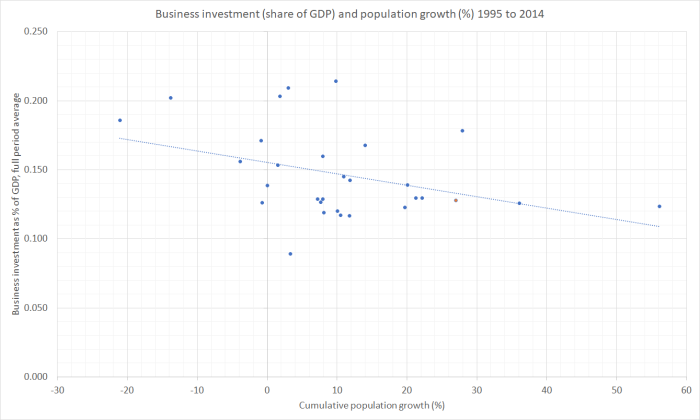
That is, roughly speaking, how we end up with rapid population growth and yet an investment share of GDP that is no different from that of a median advanced economy.  We know that population growth seems to adversely affect total business investment across the OECD (I ran this chart a few months ago)

Bus I % of GDP

And it is surely only commonsense to reason that tradables sector investment will have borne a lot more of the brunt than the non-tradables sectors.

I’m not getting into the details of immigration policy in this post.  Suffice to say that our immigration policy –  the number of non-citizens we allow to settle here –  is the single thing that has given New Zealand a population growth rate faster than that of the median OECD/advanced country in the last 25 years or so.  It is, solely, a policy choice.  Our birth rate is a little higher than that of the median advanced country, but we have a large trend/average outflow of New Zealanders.  So, on average, the choices of individual New Zealanders would have resulted in a below-average population growth rate (again, on average over several decades).  And that, in turn, would seem likely to have delivered us rather low real interest rates and a lower real exchange rate.  Real resources would have been less needed simply to meet the physical needs of a rising population, and more firms in the tradables sectors would have been able to have overcome the disadvantages of distance. And our productivity outcomes –  and material living standards – would, as a result, almost certainly have been better.

You can read about all this at greater length in a paper I did for a Reserve Bank and Treasury forum on the exchange rate and related issues back in 2013.

Why are NZ interest rates so persistently high (Part 1)?

On Friday, I illustrated (again) just how large and persistent the gap between New Zealand’s long-term interest rates and those in other advanced countries has been.   If anything, that gap has been larger in recent years (say, since 2009/10) than it was in the previous decade, but there has certainly been no sign of the gap shrinking.    It is at least as large now as it was 20 years ago.

Previous posts have illustrated that the gap is large and persistent however one cuts the data.  It exists whether one looks just at the big advanced economies (my charts on Friday focused on G7 countries) or just at the small ones (places like Norway, Sweden, Switzerland, and Israel).  Short-term interest rates are more variable than long-term ones, but on average the gap exists in short rates as well as long rates.  (If you aren’t convinced of the relationship between short and long rates, here are the average short and long-term interest rates for the last decade for each of the 18 OECD monetary areas –  ie countries with their own monetary policies, plus the euro-area as a bloc).

short and long term rates OECD

(The country on the far right of the chart is Iceland.)

Today’s post and tomorrow’s are about why those large and persistent gaps exist.  They will repeat material I’ve covered in earlier posts over the years, but readers come and go, old posts can be hard to find, and the issue hasn’t shown any signs of going away.   Much of today’s post is about a process of elimination: clearing away various possible explanations that, on my reading of the evidence, don’t take us very far.

10 years ago, the Reserve Bank wrote a short paper on exactly this issue.  It was part of our submission to the inquiry being undertaken into monetary policy by Parliament’s Finance and Expenditure Committee.   I wrote the paper, but it was of course signed out by the powers that be, including the then Governor Alan Bollard and his deputy Grant Spencer.  Rereading it this morning, I don’t now agree with every word of that earlier document –  partly because my own thinking has gone beyond where we had got to then – but it still does a good job of laying the foundations.  I’d be surprised if today’s Reserve Bank sees any reason to disavow that 2007 interpretation.

In writing the earlier paper, one of our main concerns was to distinguish between things the Reserve Bank could sensibly be held responsible for and things that really had little or nothing to do with us.   In particular, so we argued, the Reserve Bank sets the OCR, and expectations about the future OCR affect longer-term interest rates, but that does not mean that over prolonged periods of time the Reserve Bank gets to decide the average level of real interest rates in New Zealand.

In a mechanical sense, then, if short-term interest rates are persistently higher than those in other countries it is because the Bank put them there. However, the OCR is not set arbitrarily. Rather, the Bank looks at actual inflation outcomes, and at all the data on the outlook for inflation, before setting the OCR with the aim of keeping inflation comfortably inside the target range over the medium-term. If the Reserve Bank was consistently setting the OCR too high, we would expect over time to see inflation averaging towards the bottom end, or perhaps below the bottom, of the target range. In fact, inflation has consistently averaged in the upper half of successive target ranges – this decade, for example, inflation has averaged 2.6 percent. If monetary policy had been set consistently too tight, the solution would be easy. But there is no sign of that.

It has, at times, been argued that New Zealand’s inflation target was too ambitious and that this might explain why New Zealand’s interest rates have been persistently higher than those in other countries. In the early years of inflation targeting, our inflation target was lower than those in other countries, but …… our target (midpoint at 2 percent) has been firmly in the international mainstream. The most common developed country inflation target (actual or implicit) is around 2 percent. ……there is no convincing reason why achieving an inflation target of around 2 percent should, over time, be any more demanding in New Zealand than it is in other developed countries.

One thing has changed since then.  (Core) inflation has been averaging a bit below the target midpoint, but even so the average inflation rate here over the last five or ten years has been very similar to that in the typical (median) advanced economy.    Monetary policy settings that have been a bit tighter than necessary can, at most, explain only a small part of the average gap between New Zealand and international interest rates (nominal and real).

As we pointed out 10 years ago, credit risk wasn’t a compelling explanation either.    That story feels even more robust today than it did then.    Our government finances aren’t the very strongest in the entire OECD, but they are among the best.   And the negative net NIIP position (the net indebtedness of all New Zealand entities to the rest of the world) is smaller, as a share of GDP, than it was 10 years ago.  Plenty of observers worry about high levels of private sector credit but (a) as a share of GDP it isn’t much different now than it was 10 years ago, and (b) the crisis literature tends to worry more about quick increases in debt ratios at least as much as high levels.

(Small) size isn’t really much of an explanation either.   There are a couple of possible strands to a story about size.  The first would be something about secondary market liquidity.  The New Zealand government bond market is tiny in comparison to those of, say, the United States, Japan, France, Italy, or even Germany.   That makes it difficult, or expensive, to offload a very large position, and might (in principle) given rise to an additional “illiquidity premium” in our long-term interest rates.

In practice, it doesn’t seem likely to be a material part of the explanation.  Over the last decade, for example, our real interest rates have been about as much above those of the small well-managed OECD countries as they have been above those of the G7 countries.   And the “illiquidity premium” is a story that should apply to bond rates more than to overnight rates and yet over the last few decades our short-term rates have been higher relative to our long-term rates than has been the experience of most other advanced countries.  Over the last decade, interpreting that relationship has been made more difficult as many other countries had short-term rates near-zero and felt unable to take them any lower even if they’d wanted to.    But even over the last decade, there has been no sign that New Zealand’s long-term interest rates have been surprisingly high, given where short-term rates were.

I covered off another possible small country story in a post last November

There is another possible story which hasn’t really entered the mainstream of the New Zealand debate, but should be covered off for completeness.  It notes that New Zealand is a small country, with quite a volatile terms of trade, and that the currencies of such countries offer less-good diversification opportunities, suggesting that anyone investing here would require a higher return than elsewhere.  It sounds initially plausible, but it has a number of problems.  The first is that our interest rates have been persistently higher than those in other not-large countries with their own currencies ……  And the second is that if this were an important channel, it would suggest that small countries face a higher cost of capital than large ones, which would limit the growth prospects of small countries.  But (badly as New Zealand specifically has done) there is no real sign that small countries typically grow (per capita, or per hour worked) more slowly than large ones.  At present, I don’t think it is a particularly strong candidate to explain New Zealand’s persistently high interest rates.  Apart from anything else, if this were the story, why would New Zealand have accumulated –  and maintained – such a large negative net international investment position (NIIP) (still among the largest of the OECD countries)?

Monetary policy doesn’t explain the gaps, and neither do size or credit risks considerations.  Here was the Reserve Bank summary a decade ago

Standing back, it seems unlikely that factors such as credit risk, size and market liquidity help very much at all in explaining the persistent gap between our real interest rates and those in other developed countries. Apart from anything else, if these factors were (collectively) an important influence, we would expect to see New Zealand firms and household taking on less debt than those in other countries. In fact, of course, one of the well-recognised facts about New Zealand is that our households are highly indebted by international standards, and that the nation as a whole has been unusually willing to borrow, and raise equity capital, from abroad.

Productivity growth doesn’t help as an explanation either.

If a country had very strong persistent productivity growth it would, all else equal, tend to have higher interest rates than would be seen in other countries.  There would be lots of profitable investment opportunities in that high productivity growth country, lots of (expected) income growth that people might be consuming in anticipation of, and so on.  And over time, that high-productivity growth country could expect to see its real exchange rate rise.  Unfortunately, high productivity growth isn’t the story of New Zealand in the last few decades.  Indeed, more often rather the reverse.  Over the last five years, we’ve recorded no labour productivity growth at all.  Over the last 10 years, at best we’ve only been around a middling OECD country for productivity growth, and over longer-terms still we’ve had one of the worst records anywhere.      I illustrated a few months ago, the depressing comparisons of productivity growth between New Zealand and the emerging economies of central and eastern Europe.

A more prominent explanation for New Zealand’s persistently high interest rates points to the large negative NIIP position and asserts that the explanation for high interest rates is pretty straightforward: lots of debt means lots of risk, and hence the need for a substantial risk premium on New Zealand interest rates.  Taken in isolation –  if someone told you only that a country had a large negative NIIP position this year –  it might sound plausible.  Once you think a bit more richly about the New Zealand experience it no longer works as a story.

Here was the Reserve Bank commentary on this possible story a decade ago.

But the fact that this correlation exists between net international positions and local interest rates does not explain very much at all. In particular, it does nothing to explain what leads countries such as New Zealand to take on such large amounts of foreign capital in the first place. More specifically (and given that the Crown now has no net debt), what motivates New Zealand firms and households to take the actions that lead to this accumulation of foreign capital? And having accumulated the foreign liabilities (and New Zealand’s, as a share of GDP, have not changed much in a decade), what makes higher interest rates sustainable here for prolonged periods?

First, our NIIP has been large (and negative) for a very long time now –  for at least the last 25 years, and over that time there has been no persistent tendency for the NIIP position to get better or worse for long.  By contrast, 20 years earlier than that New Zealand had almost no net foreign debt.  The heavy government borrowing undertaken in the 70s and 80s had markedly worsened the position.  It is quite plausible that foreign lenders might then have got very nervous and wanted a premium ex ante return to cover the risk. In fact, we know some (agents of) foreign investors got very nervous –  there was the threat of a double credit rating downgrade in early 1991.  But when lenders get very nervous, borrowers tend to change their behavior, voluntarily or otherwise, working off the debt and restoring their creditworthiness.   And in New Zealand, the government did exactly that –  running more than a decade of surpluses and restoring a pretty respectable government balance sheet.  But the large interest rate differential has persisted –  in a way that it did in no other advanced country (including those that went through much worse crises and threats or crises than anything New Zealand has seen in the last 25 years).

As I’ve already touched on, short-term interest rates are set by the Reserve Bank, in response to domestic inflation pressures. But long-term interest rates are set in the markets.  If investors had really been persistently uneasy about New Zealand’s NIIP position, we might not have seen it much in short-term interest rates, but should certainly have expected to see it in the longer-term interest rates. (That, after all, is what we see in various euro countries that have lapsed in and out of near-crisis conditions).   But in one obvious place one might look for direct evidence of such a risk premium, it just isn’t there.

And remember that when risk concerns about a country/currency rise, one of the first things one typically sees –  at least in a floating exchange rate country –  is a fall in the exchange rate.  It is a bit like how things work in equity markets.  When investors get uneasy about a company, or indeed a whole market, they only rarely succeed in getting higher dividends out of the company(ies) concerned.  If the companies were sufficiently profitable to support higher dividends the concerns probably wouldn’t have arisen in the first place.  Instead, what tends to happen is that share prices fall –  and they fall to the point where expected dividends, and the expected future price appreciations of the share(s) concerned, in combination leave investors happy to hold those shares. In that process, an increased equity risk premium is built into the pricing.

At an economywide level,  if investors had had such concerns about the New Zealand economy and the accumulated net debt position, the most natural places to have seen it would have been in (a) higher long-term bond yields, and (b) a fall in the exchange rate (and perhaps a persistence of a surprisingly weak exchange rate). But we’ve seen neither in New Zealand.  Had we done so, presumably domestic demand would have weakened, and net exports would have increased.  The combined effects of those two shifts would have been to have reduced the negative NIIP position, and reduced whatever basis there had been for investors’ concerns.  Nothing in the New Zealand experience over the last 20 years or more squares with that sort of story.

And that is the really the problem with the most common stories used to explain New Zealand’s persistently high interest rates. They simply cannot explain the co-existence of high interest rates and a high exchange rate over long periods.

My story attempts to.  More on that tomorrow.

Can any good thing come from the BIS?

The Bank for International Settlements was supposed to be wound up after World War Two.  That was agreed at the Bretton Woods conference in 1944, partly because the International Monetary Fund was being established, and partly because the BIS –  based in Basle, just over the border from Germany – was perceived to have got altogether too cosy with, and protective of the interests of, the other side.

But the BIS –  originally set up to handle reparations settlements and related issues –  survived.  These days it provides a variety of useful services to central banks around the world, provides a venue for various central bank meetings, and employs some interesting people and publishes some stimulating research.    The BIS was once largely a North Atlantic affair, but these days even the Reserve Bank of New Zealand is a shareholder.

Prior to the financial crisis and 2008/09 financial crisis, the then head of the BIS Monetary and Economic Department, Bill White, was one of the few prominent establishment voices foreshadowing serious problems ahead.  Inflation targeting, he argued, was one of the causes of the looming problems.  Few national central bankers were at all receptive to his views (not all of which, by any means, were correct).

These days, the head of the Monetary and Economic Department is Claudio Borio, a long-serving BIS economist who, individually and with co-authors, has published a series of papers on matters financial and macroeconomic that have also tended to challenge  the current “establishment view”.   Over the last few years he –  and the BIS –  have been sceptical of case for official interest rates being as low as they’ve actually been, arguing that economic outcomes might even have been better if interest rates had been higher, and that monetary policy should be driven more by considerations around ‘financial cycles” than by (the outlook for) inflation.    There is a lot of work resting behind these arguments, and even if I don’t end up agreeing with many of the conclusions, Borio’s articles and speeches are well worth reading for anyone interested in the issues (a recent accessible example is here, which I might back and write about substantively at some point)

The prompt for this post was a column that appeared in the (UK) Daily Telegraph a few days ago, in which their economics columnist Ambrose Evans-Pritchard sought to tie together the BIS/Borio views –  which would have argued for a much tougher approach to monetary policy in recent years (at least on conventional definitions) –  with the New Zealand Labour Party’s (and the new government’s) desire to amend our Reserve Bank Act.   The article, which various readers sent me, appears under the somewhat flamboyant heading “Apostasy in New Zealand spells end of global central bank era”  (the article is behind a paywall, but if you register you can get one article per week free).

It begins

The cult of inflation targeting began in New Zealand in the late Eighties. We may date its demise to a remarkable ideological pivot in the same country thirty years later, and with it the end of central bank ascendancy across the world.

Which would not, I’d have thought, be how Grant Robertson (or his senior colleagues in the new government) would have thought about what they appear to be proposing for New Zealand.  They aren’t proposing to change the inflation target range itself (or even, so far as we’ve heard, move away from the explicit midpoint added in 2012), but argue that in adding a requirement (details to be advised) that the Reserve Bank pay explicit attention to the maintaining something near “full employment” (long-run sustainable rate of unemployment), they are simply converging on the international mainstream.  In particular, they cite Australia and the United States.

And if pushed about what difference such a focus might have made had it been in the Reserve Bank Act in the past, Grant Robertson has suggested that the Reserve Bank would have been less likely to have tightened (as much) in 2014 –  the shortlived, ill-fated, tightening cycle that proved unwarranted by inflation developments.  In other words, if anything  (and no one can be sure that different words, but same Governor, would have made a difference), it would have been towards having interest rates a little lower, a little sooner, than otherwise.   In other words, the diametrical opposite of the approach that Claudio Borio, the BIS, (and Ambrose Evans-Pritchard) would have favoured.  If anything, I suspect that the BIS view may have influenced Graeme Wheeler’s enthusiasm for raising the OCR in 2014 –  with constant references to “normalising” policy.

Evans-Pritchard concludes his article

“[Western central banks] can excuse themselves for runaway asset prices, vaguely talking about the deformities of China’s Leninist capitalism, or the Confucian ethic, or some unfounded exogenous shock from Mars.  It has let them cling to inflation targeting shibboleths for far too long. Premier Ardern is the canary in the mineshaft.  It was the same New Zealand Labour Party back in the Eighties that pioneered so much of what we think of as globalisation [I’m really not sure where he gets that idea from], before it was gamed by the elites and began to go off the rails.  The Party now wants to reassert the primacy of the democratic nation state, and to call time on the excesses –  starting with a ban on home purchases by foreigners.  The global axis is shifting.”

The BIS –  or Evans-Pritchard –  might (or might not) be right about the politics or the economics globally.  But nothing we’ve seen or heard from the new Minister of Finance –  or his colleagues –  suggest that they have anything in mind for New Zealand monetary policy, or the mandate of the Reserve Bank of New Zealand, that steps outside the international mainstream at all.  That might disappoint some –  who actively prefer higher interest rates without first securing the productivity growth and investment demand which would sustain higher real interest rates –  but what those people wish for is nothing like what Labour’s words suggest we in New Zealand are likely to be delivered.

Of course, the first big decision about monetary policy for the new government is who should be the next Governor.   Individuals matter at least as much, arguably more, than the details of formal mandates.   In almost all other countries, political leaders themselves get to appoint directly the head of the nation’s central bank.  Obama appointed Janet Yellen, Scott Morrison (Australia’s Treasurer) appointed Phil Lowe, George Osborne appointed Mark Carney, euro-area heads of government appointed Mario Draghi, and so on.  It is the way democratic societies typically work –  actually, non-democratic ones come to that.  But not New Zealand.

Here, unless he changes the Act, the Minister’s hands are tied. He will have to appoint as Governor someone nominated by Reserve Bank Board.  All the Board members were appointed by the previous government, the advert for the job was framed under the previous government, all the Board members have endorsed the conduct of monetary policy (and the performance of the Bank more generally) in recent years, none has much experience in central banking, financial regulation, and none has any public accountability.  And yet they will decide who will, single-handedly (for the time being) wield the levers of macroeconomic policy.  It is a gaping democratic deficit –  even if you don’t think actual policy should be run even a little differently in future.   The Government could easily change those provisions, and bring New Zealand into line with standard international practice. It requires a simple amendment to the Reserve Bank Act, deleting six words.

Strong candidates for Governor aren’t exactly thick on the ground. But if the Minister were to make a change, or even to make suggestions to the Board, one of the people he shouldn’t go past actually works at the BIS.   David Archer currently holds a senior position at the BIS, but until 2004 had spent a decade as first Head of Financial Markets, and then as Head of Economics (including carrying the title of Assistant Governor) at the Reserve Bank.  He fell out with Alan Bollard and made his escape.

I worked closely with (and for) David across a couple of decades.  Up that close you see both the strengths and weaknesses.  David has a reputation as something of an “inflation hawk”.  That was perhaps most obvious over 2003/04, when he was right –  interest rates were too low for too long, and as a result core inflation got away on us (see the chart in yesterday’s post).   But such reputations (“hawk” or “dove”) usually don’t mean very much –  smart people will sometimes differ on how to read any data, and at different times the same person will end up on the different side of those debates.  David’s greatest strength in my view is a high degree of intellectual curiosity, a demand for rigour, but an openness to debate, to challenge, to exploration of alternative views and ideas. It certainly isn’t the only quality one needs in a Governor, but it is an important one –  perhaps especially in a single-decisionmaker system, but also as the Reserve Bank recovers from the Wheeler years.  He is the sort of person who attracts capable people –  again something the Bank will need in the coming years.

There are drawbacks, or gaps, as there are with all the possible candidates.   David hasn’t had much involvement in bank regulation or supervision –  now a big part of what the Bank does –  and was (rigorously) sceptical of the Reserve Bank getting actively involved in discretionary supervision and regulation.   I’m not sure how his views on these issues may have evolved over the years, but what could be counted on would be a rigorous and systematic approach to the application of the law, and to recommendations on any possible changes to the law.  And, of course, he has now been away from New Zealand for 13 years –  that brings the upside of extensive international contacts, but the downside of reduced familiarity with New Zealand (and the way the Bank’s own role in the public sector has evolved).    That people here still recognise his potential value was seen in Treasury’s choice of him as one of the external reviewers of the recent (as yet unseen) Rennie review –  Treasury is currently fighting to keep Archer’s comments secret.

David wouldn’t be a candidate for the status quo.  If the Minister of Finance is really content with the status quo, he might as well just stick with the Board-led process, likely to end up appointing Deputy Governor Geoff Bascand.  But whether around decisionmaking structures, transparency and accountability, and monetary policy goals themselves, all the public indications have been that the government is looking for change, and a lift in the overall performance of the Bank.   If so, Basle might well, on this occasion, be one of the possible alternative places to look for someone to take on this very influential, powerful, role.


NZ interest rates are still remarkably high

By international standards that is.   And that gap, between our interest rates and those abroad, is nothing much to do with monetary policy.

If the new government is serious about addressing New Zealand’s dismal long-term productivity growth record –  which has been particularly poor in the last five years – it needs get serious about recognising that one of the key symptoms of our structurally unbalanced economy is that persistent gap between real interest rates in New Zealand and those almost anywhere else in the world.

Of course, the big story about interest rates over the last 25 years or more has been the persistent downward trend in the level of nominal and real interest rates.  In this chart, I’ve illustrated that for New Zealand and the median of the G7 advanced economies, using the OECD’s series of long-term interest rates (usually a 10 year government bond).  To stress, these aren’t central bank policy rates, but market-determined long-term yields.

long-term bond yields Nov 17

Once upon a time, very briefly, our long-term interest rates actually touched those (median) foreign rates.   But the dominant story in both series is the downward trend.  In fact, there is no real sign that the trend has yet ended –  each peak, for example, still looks a little lower than the previous one.

Inflation was falling a lot in many countries in the 80s and early 90s, but for the last 20 years or so core inflation has been pretty low and stable in the core advanced economies. In other words, the falls in international interest rates in the last 20 years or so have almost entirely been falls in real interest rates too.

core inflation G7

What about the gap between New Zealand and world interest rates?   Here is the gap between the two series shown in the first chart above.

gap between NZ and world int rates

The gap collapsed, briefly, in the early 1990s as we got on top of inflation, actual and expected short-term interest rates came down, and NZD assets became very attractive globally.  But the compression didn’t last.  Since around 2004 the gap between New Zealand bond yields and this measure of global rates has fluctuated around 200 basis points, with no obvious trend.   (The gap is smaller than that, typically, relative to the United States, and much larger relative to Japan and Germany.)

(I should stress that there is no single right way to summarily aggregate the various overseas long-term interest rates.   Whichever median of some of all OECD countries I used, the broad pattern was much the same, although the absolute size of the gap differs.)

What about real interest rates.   In this chart, I’ve adjusted the median G7 nominal interest rates using the median CPI inflation ex food and energy (the core inflation measure the OECD reports) for the G7 countries, and adjusted the New Zealand interest rates by the Reserve Bank’s preferred sectoral factor model measure.  The sectoral factor model data starts only in September 1993, so that is when I start this chart.   In principle, one might want to do the adjustment using measures of inflation expectations, but there are no consistent long-term measures available across countries.  Core inflation can be thought of as a proxy for inflation expectations.

real NZ less G7

Not only has there been no sign of the gap between New Zealand and “world” real interest rates closing, but if anything the gap has been wider since around 2009/10 than we’d seen previously.  On this measure, the gap has averaged 190 basis points over the past 8 years.

These are really large gaps.  On this measure, over the life of a 10 year bond they make for a 20 per cent difference in total returns.  That makes it a lot harder for a potential investment project evaluated in New Zealand to stack up than it would be for an equivalent project in other countries.

It is also tends to be reflected in big differences in exchange rates.   Those higher yields in New Zealand, if expected to persist, will look very attractive to overseas investors.  It might even look like a “free lunch”.  What takes away the “free lunch” dimension is an appreciation in the real exchange rate now, such that over the following 10 years the exchange rate is expected to depreciate just enough to leave the investor indifferent between holding NZD assets and those in other currencies.   That isn’t a mechanical relationship, but it is a pretty strong tendency.  It is the bigger-picture of the sort of modest jump (fall) in the exchange rate we often see when a Reserve Bank OCR announcement is surprisingly hawkish (dovish).    Comparing 10 year rates, it could account for a 20 per cent ‘overvaluation’ of the exchange rate.  On even longer-term rates the cumulative differences are even larger.  No wonder we don’t see much new investment in the tradables sector in New Zealand.

Perhaps you still doubt that the real interest rates gaps can really be as large as these summary series suggest.   We can check the sotry by looking directly at yields on inflation-indexed bonds issued by governments in various advanced countries.     Getting time series data for some of these countries can be a pain (unless one is setting in front of a Bloomberg terminal), but these are some of the current interest rates I tracked down a few days ago.

Our longest maturity inflation indexed bond matures in September 2040 (23 years away).  On Monday the Reserve Bank was reporting a real yield of 2.22 per cent on that bond.

The Australian government issues an indexed bond maturing on exactly the same date. The real interest rate on that bond, again on Monday, was (so the RBA reports) 1.18 per cent.

So even relative to Australia –  which also has quite high interest rates by advanced standards –  our very long-term real interest rates are very high.

What about some other countries?

The United States has an inflation indexed bond maturing in February 2040.  According to the Wall St Journal tables that bond opened the week yielding 0.89 per cent, roughly 130 basis points lower than the New Zealand 2040 bond.

Canada has a 2044 indexed bond, which was yielding about 0.75 per cent.

I could only find data for a 10 year Japanese inflation indexed bond, which appeared to be yielding about -0.4 per cent.

And Germany offers a range of maturities for its government inflation indexed bonds.   A few days ago, the 2030 bond was yielding -0.67 per cent, and the 2046 bond –  almost 30 years to maturity –  was yielding -0.34 per cent.

(UK indexed bond yields are not directly comparable because the tax treatment of the inflation adjustment is materially different).

There is certainly a range of real long-term yields across countries.    But ours are extremely high relative to those in other core advanced economies.

A year ago, I wrote a post along similar lines (although looking at the data in slightly different ways).  In that post I concluded

…our interest rates (a) are and have been higher than those abroad, (b) this is so for short and long term interest rates, (c) is true even if we look just at small countries, and (d) is true in nominal or real interest rate terms.  And the gap(s) shows no sign of closing.

All that is as true today as it was then.  It should be worrying anyone seriously interested in lifting New Zealand productivity and long-term per capita income performance.  On Monday, I will review some of the possible explanations for the gap –  partly to back the claim that it is a symptom that we should be worrying about, and partly to point in the direction of possible, and sensible, remedies.


Foreign bans and CGTs

I was going to write about something quite different this morning but I noticed an article by Bernard Hickey suggesting that the presence of a capital gains tax in Australia, and tighter restrictions there on foreign ownership of residential property, explains a substantial difference in performance in the two housing markets, across decades and over the last few years in particular.

Hickey starts from this chart, using a helpful tool The Economist makes available for comparing house price inflation across countries.

hickey chart

But (a) this is a chart of nominal house prices and everyone knows we had much more general inflation than these countries early in the period, and (b) 1980 marked near the trough of a savage correction in New Zealand real house prices (down around 40 per cent over five years or so, as the New Zealand economy went through some troubled times and the exodus of New Zealanders to Australia (not then offset by increases in other immigration) began).   1980 is the starting point The Economist uses, but it isn’t where I’d be starting looking for evidence of the contribution of Australia’s CGT and foreign ownership restrictions.

Australia’s capital gains tax came into effect in September 1985.  The restriction on foreign ownership of residential properties was already in place, but no one thinks that was a material issue in Australia at the time (either there, or here).    Rising concerns about non-resident foreign ownership (actual or potential) of residential dwellings –  especially in New Zealand –  have mostly been an issue for the last five years.

So how have real house prices in the two countries behaved since September 1985, when Australia introduced the CGT?  Using the same Economist  database – which has data only up to the end of 2016 – this is the resulting picture.

real house prices since 85 q3

In total, real house prices have increased a little more here than in Australia.  But at times, even over this period, prices in Australia have been increasing faster and at times here.   In the late 80s for example –  just after the capital gains tax was put in place –  prices in Australia were much stronger (the difference is quite large even if, without a log scale, it doesn’t appear that way).  And real house prices here fell from around 1997 to 2002 while they surged in Australia.

There are, of course, differences in the housing markets in the two countries, but the similarities look a lot stronger than the differences.  Both countries have tight land use restrictions, both countries have had rapid population growth (and although both countries currently have quite low absolute interest rates, both countries have among the highest real interest rates anywhere in the advanced world).  Here is the last 20 years of data (1996 q4 to 2016 q4).

economist index

Over the whole period, New Zealand house prices have increased just slightly less than those in Australia.

Of course, over just the last few years New Zealand real house prices have increased more than those in Australia.  Capital gains tax provisions haven’t changed materially in the two countries, although we did impose the bright-line provisions (on re-sale within two years) in 2015, and Hickey notes that Australia “removed the exemption from its capital gains tax for the main home for overseas investors in this year’s budget” (beyond the end of the data in these charts).

Perhaps the differing approaches to non-resident non-citizen purchases of existing residential property have played a part, at the margin.    We’d need a much more careful study to know, and it may never be possible to conclusively answer the question.  But recall –  the point I made yesterday –  that banning, or taxing, non-resident purchases of existing dwellings does not stop such purchasers buying new properties, or does not remove any of the road-blocks that stand in way of increased supply, of urban land in particular.  In both countries, land price inflation is by far the largest component of urban house+land inflation.

Personally, I’ve got a different candidate explanation for why house price inflation has been stronger in New Zealand just in the last few years than it was in Australia: our population growth has simply been much faster.

popn growth nz vs aus

Those are huge swings –  both in New Zealand’s own population growth rate, and in that growth rate relative to Australia’s population growth rate.     You might think that rapid population growth is a fine thing –  as people at the New Zealand Initiative (probably) do –  or a deeply problematic one, as I do, but no serious observer is going to dispute that when you have the sorts of land-use restrictions that both New Zealand and Australia do, big unexpected changes in population growth will, all else equal, quickly spill into higher house prices.  They did in Australia around the post-recession peak mining investment boom years, and they’ve done so here in the last few years.     Over longer periods of time, the two housing markets look (depressingly) similarly bad.

To be clear, I’m not suggesting that idiosyncratic tax or (eg) credit-restriction changes have no effect on housing market in the short-term. Australia has tinkered with its CGT, we’ve altered depreciation rules, ring-fencing rules etc, and we’ve put up and lowered again our maximum marginal tax rates (all things potentially relevant for investors).  I’m also not suggesting that large enough changes in the foreign buyer rules will have no effect in the short-term.    But the New Zealand and Australian experience over decades suggests that such effects don’t last for very long (and any permanent effects are pretty small), that the similarities in the two markets are much more important than the differences,  and the toxic brew of tight land use restrictions in the face of policies that drive up the population rapidly are a more compelling part of the story in both countries.    Relative economic cycles aren’t always in synch, and waves of intense population growth occur at slightly different times but the divergences in relative housing market performance never seem to have last for very long.   And are unlikely to, unless one or other set of governments sets about seriously fixing the land-use rules (and/or materially pull back on the policy contribution to population growth and housing demand).

Even the government seems to agree.    Asked about the foreign buyers ban the other day, David Parker noted (according to a record of press conference I saw) that “the impact on the number of houses built in New Zealand will be negligible”, and suggested that any price effect now would be pretty modest too.