Interest rates: all the fuss for 1 basis point?

I watched the TVNZ Q&A interview with the Prime Minister yesterday.  Apparently, the National Party has a widely-distributed brochure suggesting that interest rates are set to rise if the Labour Party takes office after the election.   I haven’t seen the brochure, but the Prime Minister seemed determined to defend the claim, even as he had to concede that –  of course –  he couldn’t guarantee that interest rates would not rise over the next three years if his own party was re-elected.     When pushed, his claim seemed to reduce to the proposition that interest rates were more likely to rise, and perhaps might rise more, if Labour was in office.

I know that a lot of people now have a lot of debt, and most New Zealand loans reprice pretty frequently (floating rate or short-term fix).  But no serious person will argue that interest rates are quite low at present because the economy is doing well.  Market interest rates around the advanced world (and central bank policy rates) have been very low for some years now, despite all the public and private debt, because demand (real economic demand) at any given interest rate isn’t what it was.  Population growth has slowed in most countries (not New Zealand of course), productivity growth has slowed, and there just don’t seem to be the number of profitable investment opportunities there were. Globally, higher interest rates would, most likely, result from some improvement in the medium-term health of the economy.      That would be true here as well  (with the caveat that ideally one day some government would make the sorts of policy changes that would allow the persistent gap between New Zealand and “world” interest rates to close.)

But the Prime Minister’s claims about interest rates were also odd because:

  • actual retail interest rates (those ordinary people pay and receive) have been rising over the last year, and
  • both the Reserve Bank and The Treasury have official published projections showing policy interest rates rising over the next three years.

The increases in actual interest rates over the last year havn’t been large (about 25 basis points for floating rates, and something less for deposit and business overdraft rates).  But as we’ll see, those are large changes compared to the sorts of effect the Prime Minister seemed to be talking about.

And what about the next few years, on current policies (monetary and fiscal)?  These are the projections from the latest Reserve Bank Monetary Policy Statement and from The Treasury’s PREFU.

int rate projections

The Reserve Bank doesn’t expect much of an increase in the OCR over the next three years, but it is an increase nonetheless.  The Treasury seems quite gung-ho –  by the time of the next election, they expect we’ll have seen 150 basis points of interest rate increases.   I suspect that Treasury’s numbers are too high, but both sets of projections are (a) upwards, and (b) well within the historical margins of uncertainty.    Neither agency gives enough weight, at least in what they are saying in public, to the possibility – again well within historical bands of uncertainty – of materially lower interest rates.  It seems unlikely that the Prime Minister would welcome a world in which such interest rate cuts were required.

The Prime Minister’s specific claim seemed to be that the Labour Party’s fiscal policy would result in higher interest rates than the fiscal policy adopted by the National Party.  He attempted to muddy the water with talk of what any Labour coalition parties might demand, but of course on current polling it seems likely that any National-led government would also have to face coalition party demands.  So, for now, lets just focus on actual main party plans –  National’s as per the PREFU, and Labour’s as per their published fiscal plan.

There would seem to be two plausible channels through which fiscal differences might mean different interest rates.   The first would be if Labour was to run materially lower surpluses, or even deficits.  The increased demand that would flow from those annual spending or revenue choices might, all else equal, lead the Reserve Bank to raise the OCR.  But here (as I’ve shown before) are the two surplus tracks.
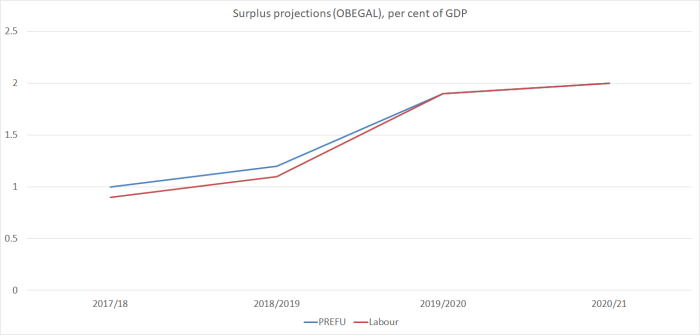
labour surplus

They are all but identical, especially when one bears in mind that the Reserve Bank is typically looking a couple of years ahead in setting interest rates.   If Labour does take office, no Reserve Bank Governor –  acting or otherwise –  is going to be looking at that track, with a slight difference in 2018/19 and none beyond that –  and altering his or her interest rate projections.

The other channel is through a stock effect; the effect of a higher accumulated stock of debt.   The Minister of Finance has attempted to highlight that Labour’s plans involve around $7 billion more of net core Crown debt in 2020/21.    Sounds like a lot of money.   In fact, the difference is 2.2 per cent of GDP.  And around half that difference doesn’t show up in a true net debt series (such as that reported by the OECD) at all:  it is the additional $3 billion of contributions to the NZ Superannuation Fund.  I don’t happen to think that resuming those contributions is particularly sensible, but both main parties do –  their only difference is timing –  and if contributions to the NZSF add a bit more risk (variability) to the Crown balance sheet, they don’t make us poorer.  It is very very unlikely that raising a little more gross debt to put money in an investment fund like the NZSF will have any effect at all on New Zealand retail interest rates.

But what does the research show?   Disentangling the determinants of New Zealand interest rates isn’t easy, and I’m not aware of (m)any new studies over the last decade or so.  But a couple of prominent New Zealand economists did some interesting modelling work on the issue back in 2002, for Westpac.  Adrian Orr is now head of the NZSF –  and perhaps a contender for being the next Governor –  and Paul Conway is head of research for the Productivity Commission.     They looked at the impact of net government debt (not idiosyncratic national definitions, but drawing from international databases), and this is what they found

Table 2 shows the marginal and total impact of government debt on real bond rates. Moving from a net debt level of 10% of GDP to 20% of GDP adds only 3bps to real rates and the total contribution of debt to the risk premium is only 6.5bps.

As one might expect, the effects were quite a bit larger when debt levels were a lot higher than they are in New Zealand.

On these internationally comparable net debt measures, current net government debt in New Zealand is about 9 per cent of GDP, and on both National’s plans and Labour’s will fall from here.   Labour reduces public debt a bit less than National does over the next few years, but recall that by 2020 even on the Treasury measure of net debt the difference was 2.2 per cent of GDP.  Applying the Orr/Conway model results (that 6.5bps for 10 percentage point change in debt), and even that increase will produce only around a 1 basis point change in interest rates (with significant margins of uncertainty around those estimates).   And these are long-term government bond rates they were modelling.  Any effect on short-term retail rates –  probably zero –  would be indiscernible.

Are they other possible differences in interest rates that might show up depending on who wins the election?  These ones occurred to me:

  • both parties, but perhaps particularly Labour, look likely to have some difficulty keeping to their announced spending plans in the next few years, given baseline cost and population pressures and the recent electoral auction.  Whether that would result in smaller surpluses depends on what other offsetting actions respective governments might take (and, of course, what happens to revenue flows).
  • one reason why Labour’s net debt numbers are a bit higher than National’s is Kiwibuild.  In the Labour fiscal plan, they allow $2 billion of new and additional debt to get the Kiwibuild programme going (intending to roll that forward as new houses are built and sold).  I suspect that much of the Kiwibuild activity will displace private sector construction, but if it doesn’t –  and it actually adds to total construction activity –  that would put more pressure on available resources and –  all else equal –  increase the chances of OCR increases in the next few years.   But since both sides agree that more houses need to be built, it is hard to see how either could describe any such increase in the OCR as a bad thing –  if anything, in their own terms, it would be a mark of success.
  • Labour is talking about reducing net immigration inflows.  I’m a bit sceptical as to whether they would carrry through on that, given the evident decision to downplay the issue since Ardern took over. But if they do follow through, there would be a reasonably material reduction in overall demand and resource pressures over the next 12-18 months (especially as their proposed cuts are focused on the student sector).  All else equal, that would reduce the chances of OCR increases in the next couple of years.
  • Labour is promising Reserve Bank reforms.  Much is likely to depend on the key individuals they appoint, but –  all else equal –  their proposal to add an unemployment objective would be likely to reduce the chances of near-term OCR increases.  (In the longer-term there is a risk, that would have to be managed, that such a reform could slightly increase longer-term inflation expectations, and thus the level of nominal interest rates.)

In the end, this is fairly silly debate.  The differences in fiscal policy are small, and the track record of the two main parties over 30 years now is of pretty responsible fiscal management.  Debt levels are low and, absent a severe crisis, near-certain to remain so.

And interest rates do move around.  In well-managed countries they most often rise when economies have been doing pretty well, and they fall when something bad happens.   What will determine what happens to interest rates –  market and official –  over the next three years?  It won’t (overwhelmingly) be our choice of Prime Minister, but –  in the famous phrase of Harold MacMillan, former British Prime Minister –  “events, dear boy, events”.

And we, they (politicians) and the Reserve Bank should fear the sort of events that could yet take our interest rates quite a bit lower than they already are.

As bad as having a former KGB officer in Parliament?

When Newsroom picked up and ran my post on National MP Jian Yang, they highlighted the analogy I drew

Imagine a former KGB officer serving in the New Zealand Parliament in the 1970s, advocating the interests and views of the Soviet Union

(to which I had added “and hob-nobbing with representatives of the Soviet Embassy”.

I noticed that, in response, one prominent commentator on the right suggested that the comparison (with Yang and China) was overblown, and that today’s China was nothing like the Soviet Union of the 1970s.  I’ve reflected on that and frankly I’m at a bit of a loss to see the differences that put modern China in a better light than the 1970s Soviet Union.  Unless perhaps it is the current Chinese dictators wear better suits?

Of course, there are some significant economic differences between the two regimes.  Chinese firms trade with and invest in the wider world, while the Soviet Union traded mostly (but not solely) with other communist countries.   China allows the market considerable play in matters economic, and the Soviet Union didn’t.    So long, that is, as a notionally private company concerned doesn’t step out of line (see Richard McGregor’s excellent The Party).  And some of the key dimensions of a market economy are the rule of law, a market-led allocation of credit, and the ability to fail. On none of those does China score well.

And it isn’t as if China is some startling economic success story either.    Here is a chart from a post I ran last year on China’s continuing economic failure (relative to both the US –  as representative of a leading advanced economy –  and to other east Asian countries).

asia gdp pc cf US

China today is richer (per capita GDP) than the Soviet Union was in the 1970s, but almost every country has got a lot richer since then.  As a proportion of US (or New Zealand) GDP per capita, China’s current GDP per capita is estimated to be a bit lower today than the Soviet Union’s was in the 1970s.

Quite probably, China will close the gap to some extent over the next decade or two, even if they persist with the current credit-driven, absence of supply-side reforms, economic model.    But embedded within the system are huge misallocations of credit, and thus of real resources.   They can avoid a financial crisis, but they can’t avoid that waste.

But this isn’t primarily a post about matters economic.  A strong economy can support foreign policy ambitions, and a weak one can eventually undermine those ambitions.  So even if China were to achieve greater economic success, it shouldn’t be particularly reassuring to the rest of the world.  On checking I noticed, for example, that in 1938 German manufacturing exports were 20 per cent of the world total –  a large proportion of which will presumably have been to countries that only a year or two later were the subject of Hitler’s aggressive intentions.    There will have been plenty of people in each of those countries with a strong economic interest in making a case for Germany.

To me, there are two aspects of China –  and thus about Jian Yang’s past active service in that regime (and Party’s) cause –  that should be of concern.   There are the values the Chinese authorities apply internally, and the approach they adopt and encourage externally.   Neither should be encouraging to anyone who values the free and liberal democracy –  with all its faults –  that countries like our own built and maintained over the last few hundred years.     It is a regime that murders protestors –  what Jian Yang refers to just as “student demonstrations” –  that imprisons dissenters, that denies freedom of worship, the bans internet access to sites critical of the regime (or indeed, to services that won’t act as agents of the regime in suppressing dissent).  For decades, they forced abortions on couples who wanted more than one child.  And today they are at the forefront of using surveillance technology – much more advanced than anything the Soviet Union could use 40 years –  to keep the citizenry in check.    The obscene inequalities of wealth, flowing in the direction of the political elite and those close to them, are just another aspect of the evil.   Prada handbags and smartphones tell us nothing about the character of the regime.   (And I don’t see anything in the character of the sort of regime in this paragraph that marks it out from the Soviet Union.)

I’m not one who favours interfering in the internal governance of other countries, large or small, and no matter how unsavoury they are.     But if someone who was an active part of such a vile regime –  voluntarily a Party member –  comes to New Zealand and wants to be part of governing our country, one might reasonably expect he would (a) acknowledge his part in, and (b) denounce the evils of, the system.    As a member of the Chinese language media put it to me, the language Yang used in his maiden speech about Tianamen Square was the sort of language one would only use if one supported the brutual suppression of those demonstrations by the government and Communist Party of China –  in whose cause Jang had then been working.

But it is the foreign policy of China that should be even more disconcerting.  In the 1970s, the West and the Soviet Union and its allies were fighting the odd proxy war (eg Angola –  with Cuba on one side and South Africa on the other), and there was the invasion of Afghanistan.  I’m not about to trivialise the Soviet Union, but it was the also the era of great power detente.  Both sides were suspicious of the other –  and the risks of misinterpretations leading to nuclear conflict –  but by the 1970s few people saw the Soviet Union’s intentions as primarily expansionist or aggressive.    And the UN apart, the Soviet Union wasn’t part of most international agencies (eg IMF, World Bank, WTO/GATT).

And these days?  China remains the leading protector of North Korea.  China propounds values, and standards of international governance, through international organisations, that are inimical to those of the West.  China is an actively expansionist power –  most visibly in the South China Sea, where it has been in flagrant breach of international law.  China is a key player in cyber-espionage.  China is widely-recognised as attempting to suborn regional political leaders –  apparently successful for now in the Philippines.  And China’s strategy of attempting to exert influence in a wide range of countries through the deployment of its (current or former) citizens in other countries is pretty well-documented.   China still lays claim over a democratic state (Taiwan) and has never renounced the possibility of using force to take Taiwan.  In short, China represents a considerable threat to the sort of regional and world order that New Zealand has been a part of, and which (historically at least) its leaders were willing to champion.

(I’m not really interested in “what-aboutism”.  “Our side” does questionable things in the international sphere at times too, and as I noted the other day I’d be concerned –  albeit less so – if a former member (especially an unacknowledged one) of US intelligence services were in our Parliament.  But our values are not those of the current Chinese regime, and that regime is not content to apply its standards only in its territory.)

And then, frankly, there are two other differences: numbers and location.  The Soviet Union in the 1970s had a population similar to that of the United States, and much smaller than that of all the NATO (and associated) countries.    China –  still relatively poor in per capita income terms, as the Soviet Union was, now has (or shortly will) have the largest economy in the world.   Such a large economy buys a lot of weapons systems, and potentially a lot of clout.  And location?   The Soviet Union’s prime focus wasn’t south and east Asia. China’s is.  New Zealand is a long way from either country, but the threat to our values, and our systems, is real nonetheless –  and, compared with the 1970s, New Zealand stands more alone than it did then.

I don’t suppose China has any intention of invading New Zealand, any more than the Soviet Union did.  Something akin to vassal status will do just fine –  countries that are reluctant to stick up for what they once believed, that are reluctant to stick up for countries with similar values in east Asia, that are reluctant to call out China’s territorial expansionism or its internal abuses.  Yes, I’d say the China is at least as serious a threat to us today as the Soviet Union once way –  perhaps more so, because the threat is less well-recognised, and more insidious.  Better suits, and good hospitality.   And our own ministers –  probably of either main party –  all too eager to please.

And what of our media?  Credit goes to Newsroom (and the Financial Times) for breaking the Yian Jang story.  But what of our mainstream media?  They seem to have given the story some initial coverage, but then been keen for it to die.  I hope that is an incorrect interpretation, but a week out from an election it was striking that there was nothing at all about the story in the Dominion-Post yesterday or today, or –  as far as I could see –  in the Herald yesterday or today.  And yet this is a story about a government MP, actively recruited by senior National Party figures to in some sense “represent” the Chinese community (identity politics rule, as Stephen Franks notes), who appears to have hidden –  from the public at very least –  his active membership in the Chinese Communist Party and his service in the Chinese intelligence services, and who appears to remain close to the Chinese Embassy.   At very least, there are allegations of SIS investigations –  paralleling similar investigations around Chinese-born politicians in Canada and Australia.  And there also seem to be suggestions of incomplete, or misleading, disclosures when Yang sought New Zealand residency and/or citizenship.  It seems as though it should be a major ongoing story –  with tough questions for the Prime Minister, the National Party, John Key, the Minister of Internal Affairs, and (for that matter) the leaders of other political parties?  Does ACT regard this as acceptable in a governing party they support?  Do Labour, or the Greens?

After all, Yang appears to have more or less acknowledged his own deceptions.  There was a story on the Herald website yesterday in which he is said to be reviewing his citizenship application form.  The article ends this way

Jian Yang told the Herald on Tuesday he didn’t name the Air Force Engineering University or Luoyang People’s Liberation Army University of Foreign Languages when making the applications that led to New Zealand citizenship, which he was granted in 2004.

He instead gave the names of two Chinese universities for civilians that had “partnership” status with the military institutions where he taught intelligence agency cadets as an English lecturer.

Asked if he made a false declaration on his citizenship application, Yang said giving the name of “partnership” universities instead of the institutes he actually worked and studied at was not a false declaration and was required if he was to leave China.

But in 2004, when he was applying for New Zealand citizenship, he was living in New Zealand.  There was no obstacle to telling the truth.  Unless he counted perceived obligations to the Communist Party of China, and the military and intelligence system of China, as more important than legal obligations to complete truthfully his citizenship application form.

In truth, his citizenship doesn’t worry me overly much.  From reports I’ve seen, he seems to have been a capable academic at Auckland University.  But membership of our Parliament and, perhaps in time our executive, is a different matter.  And with two minutes research, I found the Herald profile of him from 2011 when he was first running for Parliament.    If I’d read it at the time –  and I probably did, being a junkie –  I’d have been quite impressed by the tale of triumphing over adversity and poverty, and perhaps even a little inspired (he even expresses support for some social conservative causes I put a priority on).    But that’s because of all the stuff he didn’t tell the Herald  – or voters.    Perhaps there was a clue in this line

He said the effective dictatorship in China had provided a stable platform for long-term economic policy, while a surge in international trade had improved human rights and the flow of information.

Hmmmm…….

But not a word of his membership of the Communist Party (remember only about 5 per cent of Chinese belong; it isn’t some automatic part of living in China), or of his education in a military intelligence university, or subsequent service in that intelligence system.  Not a word about it, then or since.  And not a word of criticism of this system which is inimical to the values that built and sustain this country.

As I noted the other day, perhaps he hid it from the National Party too, which would speak very poorly of their candidate vetting. Or he told them, and they didn’t care, (and perhaps even told him to keep his past quiet) which speaks even more poorly of them, their values, and their priorities.    Either way, it should be unacceptable.

So, yes, it would have been regarded as quite inconceivable in the 1970s to have had a former serving KGB officer (whatever his specific role in that establishment) as a member of the New Zealand Parliament.  If that person had grossly misrepresented their past, and continued to associate closely with the Soviet Embassy, the scandal would have been all the greater.  It should be just an unacceptable today for a former serving member of the Chinese Communist Party, and the Chinese intelligence services, having consciously misrepresented his past and never denounced the system, to be in –  and put forward again as a candidate for –  our Parliament today.

Working more, not getting more productive

Over on Kiwiblog I noticed a chart showing that average real GDP growth in New Zealand over the three years 2014, 2015 and 2016 had been faster (quite a bit faster) than any of the selected small group of other countries shown.  In fairness, the chart shows some of the larger OECD economies –  all of whom are richer than us already.

But, of course, it makes no allowance for the fact that our population growth rate has been far higher than those of almost all other OECD countries.   Per capita income is what counts –  for almost any serious purpose.  Here is how we have done over those three years (I’ve taken total growth from  the level in 2013 to the level in 2016, thus capturing the three years the Kiwiblog chart does).

real GDP pc last 3 years

You can discount the Irish number (which goes off the chart –  they’ve had a strong recovery, but some tax-driven factors have also distorted their national accounts numbers).  We and the Netherlands have been the median countries.   Nothing spectacular.  Nothing disastrous either.  Just middling.  And so making no progess at all in closing the gaps to the rest of the OECD.

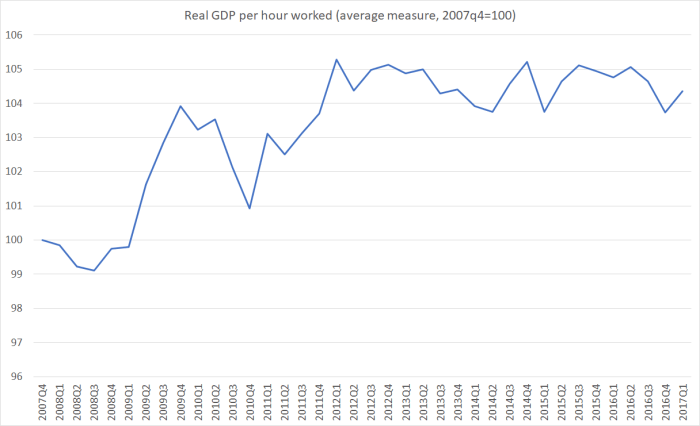
And then, of course, how one grows matters.  One can work longer hours, or one can capture the benefits of productivity gains (doing things smarter, doing things with more capital).    Regular readers here know the New Zealand story.  We’ve had no productivity growth at all –  not just for three years, but for five years.  Let it sink in…….none at all for five years.

real GDP phw farrar

Even the Minister of Finance seemed prepared to concede the other day that, just possibly, it might be a bit of an issue.

UPDATE:  Take this chart with a pinch of salt.  The OECD doesn’t have productivity numbers for all its member countries for 2016 yet, and revisions are always possible.  And three years is, any case, only just getting long enough to look through some of the noise in the data.  But for what it is worth here is labour productivity growth for the same period as the GDP per capita chart above, for the countries for whom the OECD reports the data.

growth in real GDP pc

We don’t score well –  absolutely (previous chart of NZ data only) or relative to our advanced country peers.


Scattered thoughts on tax and fiscal policy

It has been a quite remarkable rookie error by the Labour Party that allowed the mere possibility of specific tax increases to become such a major part of the election campaign, in a climate where the government’s debt is very low, and where official forecasts show surpluses projected for years to come.   If government finances were showing large deficits, and there was a desperate need to close them, that political pressure might have been unavoidable.  Closing big deficits involves governments taking money off people who currently have it –  by whatever mix of spending cuts or tax increases – and doing so in large amounts.   But the PREFU had growing surpluses, and Labour’s fiscal plan had almost identical surpluses for the next few years –  without relying on any further tax changes that might have flowed from the recommendations of the proposed Tax Working Group.

These are the surplus projections

labour surplus

Of course, Treasury GDP forecasts can’t always be counted on – and it is seven years now since the last recession – but there is quite a large buffer in those numbers even if the economic outlook changes.  But the other side of politics wasn’t disputing the (Treasury) GDP assumptions.  And it seems to have been lost sight of that in a growing economy, with low and stable debt levels, modest deficits (on average) are the steady-state outcome (consistent with low stable debt).     That might involve decent surpluses in boom years, and perhaps quite big deficits in recession years (as the automatic stabilisers work on both sides) –  but again the Treasury numbers, which both sides are basing their numbers on, say that at present we are in the middle (estimated output gap around zero, unemployment still a bit above a NAIRU, and on the other hand the terms of trade above average).

I guess it was always the sort of risk Labour faced in changing their leader so close to the election (things move fast and something –  who knew what specifically –  was almost bound to not work out well), but it was all so easily avoidable.  They could have:

  • stuck with the Andrew Little policy (now reverted to) of no changes flowing out of the TWG process to come into effect before the 2020 election,
  • they could have reverted to the 2014 policy (a specific detailed capital gains tax proposal, perhaps including revenue estimates), or
  • they could have committed to any package of TWG-inspired changes implemented before the next election being at least revenue neutral (if not revenue negative).   This latter sort of commitment would have been easy to make precisely because of the large surpluses in the projections both sides are using (see chart above).

After weeks of contention and uncertainty –  some reasonable, some just fear-mongering – they’ve finally adopted the first option.

But you have to wonder what the proposed Tax Working Group will be left to do?  In practice, it looks as though it might most usefully be described as a capital gains tax advisory group –  to advise on the practical options and details on how to make a capital gains tax work, as well perhaps as to review the evidence and arguments for (and against) such an extension to our tax system (my reflections on the CGT option are here).

They’ve ruled out increases in personal or company tax rates, they’ve ruled out GST increases, and they’ve ruled out a land tax affecting the land under “the family home” (which is most of the value of land in New Zealand).    They apparently haven’t ruled out revenue-neutral packages that involve a reduction in income tax rates, but this looks like a pretty empty suggestion.  Why?

The first reason is that they claim that their suite of policies are going to solve the housing crisis.   I’m a bit sceptical about their claims (and those of the government), but if they are right, how much revenue do they suppose there is likely to be from a capital gains tax anytime in (say) the next 20 years?  Treasury once produced some rather large revenue estimates, but (from memory) they involved some sort of muted extrapolation of the experience of the previous 20 years.       Both sides of politics seem to think they can stabilise nominal house prices, and then let income growth and inflation reduce real prices and price to income ratios.   If so, there are no systematic capital gains on housing  –  and idiosyncratic ones (particular cities or specific locations that do well) won’t add to much revenue at all.    Of course, it might be different if the housing measures fail, but Grant Robertson yesterday seemed pretty adamant.

“What we are signalling is, the Labour Party’s policy is that our focus is on fixing the housing crisis. That is our focus.

A capital gains tax might (or might not) be a sensible addition to the tax system, but it shouldn’t raise much money.

What else is there?  I’m sure tax experts have various small things they’d like the working group to look at, but it is hard to believe there is anything that could raise much revenue.    For some, a land tax looked promising –  my own scepticism is here.  But Labour has now ruled out a tax on the land under “the family home”, which effectively nullifies any possibility of a sensible, credible, and enduring land tax.

It is one thing to rule the family home out of a capital gains tax net.  Even for most of those left liable for capital gains tax (CGT), the effective liability can be deferred for many years (reducing the present value) simply by not realising the gain (not selling the asset).  That is even more true with the sort of institutional holders than many seem keen to encourage into the rental market.  And, of course, there is only a liability if prices actually go up.    Those are among the reasons why the overseas literature tends to find little evidence that a CGT would make much useful difference to the housing market.

A land tax would be different.  It is a liability year in, year out.  Owner-occupiers (and associated trusts etc) wouldn’t pay it, but everyone else would.  It would be a huge change in the effective cost of (say) providing rental services.

New Zealand real interest rates are the highest in the advanced world.   A very long-term real government bond rate is around 2.5 per cent at present (the real OCR is currently zero or slightly negative).  So suppose a government imposed a 1 per cent per annum land tax on land not under owner-occupied dwellings.     Relative to a risk-free rate of, at most, 2.5 per cent that would be a huge impost (40 per cent of the implied safe earnings of the asset –  the appropriate benchmark since the tax itself isn’t risk-dependent.)   It would dramatically lower how much any bidder who wasn’t planning to live on the land could afford to pay for the land –  by perhaps as much as 40 per cent.

That might sound quite appealing.   Rental property owners (actual and potential) drop out of the market and land (and house+land) prices plummet.    But wait.   Wasn’t the political promise that they weren’t trying to cut existing house prices?    And what about the people who –  because of youth, or desire for mobility –  don’t want to own a house and positively prefer, for time being at least, to rent.    And what about farmers?  Lifestyle blocks (presumably exempt from the land tax) instantly become much more affordable than farming (which presumably does face the tax).    To what social or economic end?

Attempt to impose such a land tax and my prediction would be (a) that it would never pass, since it would represent such a heavy impost on a large number of people (and yet on not enough to raise enough revenue to allow meaningful income tax cuts to offset the effect), and (b) if it did pass, exemptions and carve-outs would quite quickly reduce it to the sort of land tax we actually had in New Zealand only 30 years ago –  which only affected city commercial property.

Now perhaps there is a limited middle ground.  There is a plausible case that can be made for use of land value rating by local councils rather than the capital value rating system that most councils now use.  I’m not aware that we have good studies suggesting better (empirical) outcomes in places that still use land value rating, but the theory is good.  The problem, of course, is that by ruling out a land tax on the family home, Labour would appear to have ruled out (say) using legislation to encourage or compel councils to rely more heavily on land value rating.   Perhaps that might leave undeveloped land within existing urban areas as potentially subject to land value rating?  There might be some merit in that, but the potential seems quite limited.

So, as I say, it looks as though the proposed tax working group should really just be a CGT advisory group.

And that would be a shame because, whatever you think of the merits of a CGT, it isn’t the only issue that would have been worth addressing in a proper review of the design of our tax system.  For 30 years now –  since what was a fairly cynical revenue grab (recognised at the time by those involved) in 1988/89 –  our tax system has systematically penalised returns to savings  (both relative to how we treated those returns previously, and relative to how other countries typically treat such returns).    The prevailing mantra –  broad base low rate –  which holds the commanding heights in Wellington sounds good, until one stops to think about it.     We have modest rates of national savings, and consistently low rates of business investment –  and our productivity languishes –  and yet the relevant elites continue to think it makes sense to tax capital income as heavily as labour income.  It doesn’t, whether in theory or in practice.   They don’t, for example, in social democratic Scandinavia.  They don’t –  when it comes to returns to financial savings –  almost anywhere else in the advanced world.    We should be looking carefully at options like a Nordic system, a progressive consumption tax, at inflation-indexing the tax treatment of interest, and at whether interest should be taxed (or deductible) at all.

Plenty of people are worrying about the potentially radical nature of some aspects of a possible new left-wing government.  I come from the market-oriented right on matters economic, but I worry that in these areas they won’t be radical enough –  won’t even be willing to open up the serious issues that might be contributing to our sustained economic underperformance.  And frankly, when the debt levels are as low as they now, and sustained surpluses appear to be in prospect, if ever there is a time to look at more serious structural reforms it is now.   It is a great deal easier to do tax reform when any changes can be revenue-negative (actually the approach taken by the current government in 2010 –  see table of static estimates here) or (depending on your orientation) used to increase public spending.  But it looks as though another opportunity is going to be let go by.    That would be a shame.

(Having mentioned the 2010 package in passing, I am a little surprised that the increase in the effective rate of business taxation in that package doesn’t get more attention.     It often passes unnoticed because the headline company tax rate was reduced, but as the published Treasury assessment at the time put it

While the tax package lowers the company tax rate, changes to thin capitalisation rules and depreciation allowances mean that, on average, firms will pay more tax as the reduction in the company tax rate does not fully offset the impact of higher taxable income owing to the base-broadening measures. As a result combined company and dividend tax revenues are estimated to be about 3-4% higher than in the absence of the package. In the case where all investment is financed by equity, this could increase the user cost of capital by about 0.6%.
Using the New Zealand Treasury Model (NZTM) we estimate that the increase in the user cost of capital leads to the private business capital stock reducing by 0.45% compared to what would have been the case in the absence of the package.

Not obviously a desirable outcome for an economy that had, for decades, had low levels of business investment.)

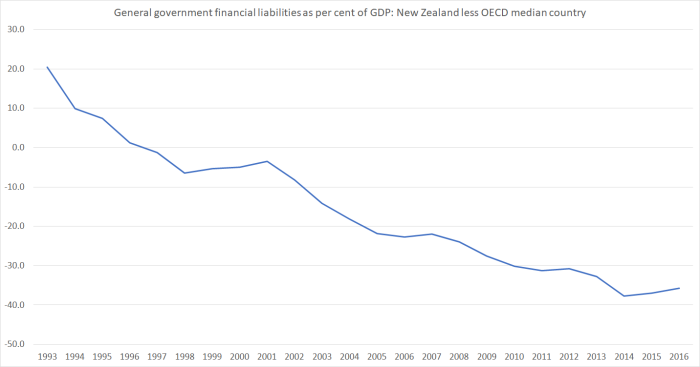
And finally, a chart showing in just what good shape New Zealand public finances are relative to those in the rest of the advanced world.   New Zealand government debt has increased relative to GDP under the term of the current government (mostly some mix of a recession and earthquakes), but government debt as a share of GDP has increased in most other countries too.   Here is the gap between New Zealand and the median OECD country, using the OECD’s series of general government net financial liabilities.   Our net financial liabilities last year were around 5 per cent of GDP on this measure  (seven OECD countries have less net debt, or have net assets).  The median OECD country has net financial liabilities of 40 per cent of GDP.  But here is the gap, going back to 1993 when the data commence for New Zealand.

gen govt net liabs nz less oecd median

It is quite a striking chart –  and took me a little by surprise frankly.   If you didn’t know when the two changes of government had occurred, there would be no hint in this chart.  For almost 25 years now we’ve kept on lowering our net debt relative to that of other OECD countries, through good times (for them and us) and for tougher times, under National governments and Labour ones.  There just isn’t any obvious break in the series.  And as we have a lot fewer off-balance sheet liabilities (eg public service pension commitments) the actual position is even more favourable than suggested here.

I’m not a big fan of increasing government debt as a share of GDP –  and low as current interest rates are (a) productivity growth is lower still, and (b) our interest rates are still the highest around.  But you do have to wonder quite what analysis backs up the drive for still lower rates of government debt to GDP, absolutely and relative to the rest of the advanced world.   And persisting with the “big New Zealand” strategy of rapid population growth makes the emphasis on very low levels of government debt even more difficult to make much rational sense of.

On standards in public life, and Jian Yang

My honeymoon was paid for by a week or so helping an arm of the expansionist and repressive Chinese government  (the IMF was paying, and it involved helping run a course in some obscure provincial city on liquidity management and the implementation of monetary policy).  In more recent times, I’ve also done a couple of lectures on New Zealand economic management, under the auspices of the Australia New Zealand School of Government, for groups of up-and-coming Communist Party officials –  ANZSOG had wanted Graeme Wheeler, and they got me instead.   Indeed, to my own bemusement, for a time I even held a security clearance that (I was advised) meant that if, for example, I wanted to take a holiday in China, I needed to give advance notice to, maybe even seek approval from, our intelligence agencies.

These days it is hard for many people in the public sector to avoid sullying themselves with contact with Chinese government/Party representatives.   Some of that, no doubt, is just an inevitable part of state to state diplomacy.   But when the opportunities arise, there is also the fascination with an ancient culture, and its modern manifestations, and with a country that is home to perhaps a fifth of the human race.   Perhaps it was like that for the Soviet Union in earlier decades?  Or Germany in the 1930s?  It is easy to say now, but with hindsight I now regret the (very small) assistance I provided to the Chinese government and their officials.  However amiable and intelligent individuals might be –  and there were many such in Soviet Russia and Nazi Germany –  they worked for, and advanced the cause of, a state which is the enemy of freedom, and the enemy of the values that made this country, and countries like it, what we are.   A state with an active aggressive agenda, propounding internationally an alternative authoritarian vision of governance, and brutally suppressing those who disagree with them.   A state ruled by a Party which actively connived in the murder and starvation of tens of millions of its own people.

Which is why those people (including the man himself) attempting to dismiss the concerns raised in the Financial Times/Newsroom stories about National MP Jian Yang as somehow “racist” are just playing distraction and trying to avoid the real issues, and real questions.

Would I be worried if, say, the National Party (or any other party for that matter) had made as one of its MPs someone with an equivalent background in the former ruling parties and military intelligence institutions of former authoritarian states like, say, Paraguay, Zambia, or Serbia?  Well, yes I would to some extent.   Such a background would speak of the values of the individual concerned –  and there has been no suggestion Jian Yang was forced to work for military intelligence or join the Communist Party; instead he will have been judged “reliable” to have been allowed to do so.  It would also say something about the values of a New Zealand political party which treated so lightly our own historical values and freedoms as to recruit someone like this.  Perhaps prioritising party fundraising over the values and freedoms of New Zealanders?

But in those cases, (a) the authoritarian states are now democracies, and (b) they are countries (chosen deliberately) with no particular interest in, or wish to exert influence on, New Zealand.

What about people with backgrounds in the intelligence services of the United States, the United Kingdom or (to use the example an FT columnist cites) Italy?  Frankly, I would have some concerns about the ability of someone who has ever worked in the military and intelligence establishment of another country to ever completely relinquish those loyalties and put the interests of New Zealand first.   Then again, such countries –  whatever their faults –  have been our allies over many decades.  The potential for serious conflicts of interest are much less than they are for some other regimes.

In other words, these things are points along a spectrum.    I’m not sure that former members of foreign intelligence services ever have a place in our Parliament, but those of Australia or the UK worry me less than those of the US, which worry me less than those of Singapore, Paraguay or Serbia, which worry me less than those of Russia or China.      The latter two are (a) large, and (b) aggressive powers.  Of the two, China is much more of threat in this part of the world than Russia.   But in the 1970s, the order might have been reversed.  Imagine a former KGB officer serving in the New Zealand Parliament in the 1970s, advocating the interests and view of the Soviet Union, and hob-nobbing with representatives of the Soviet Embassy.

Some people come out of the establishment of brutal aggressive authoritarian states and recant completely their former loyalties.  Their eyes have been opened to the evil that state represented, and often such people become leaders in the cause of urging people in the West to recognise the threat.  Sometimes, even, with the zeal of a convert their opposition to the state of their birth can be uncomfortable or even a little embarrassing.  And I don’t suppose that after his defection Oleg Gordievsky spent much time with the Soviet Embassy in London.

But what of Jian Yang?  I had a look yesterday at his maiden speech in Parliament, delivered in February 2012.  Maiden speeches are often an occasion for a new member to outline their personal philosophy, and the things that made them who they are, and led them to seek to enter politics.  A few are classics –  I recall being taught from Sir John Marshall’s in my first year politics course decades ago.  But what of Yang’s?

Read without knowing he’d been a member of the Communist Party (well under 10 per cent of China’s citizens are), or had been a serving participant in the intelligence establishment, it might seem inoffensive enough, although still a little surprising.       To serious champions of liberty, the Tianamen Square protests, and subsequent government massacres, stand as a continuing charge against the Chinese state and Party.  How does Yang deal with them (they disrupted his plans for graduate study abroad)?  They are nothing more than “student demonstrations”.

He can safely be mildly critical of the Cultural Revolution –  his parents were apparently sent to the countryside for “re-education” –  but never mentions the dreadful evil of the Great Famine, one of the worst man-made (Chinese government made) disasters ever.  There are boilerplate references to his support for opportunity and choice, but no attacks on the evil of the one-child policy, still in place at the time Yang gave his speech. Nothing about the lack of freedom of expression, the lack of freedom of religion, the lack of any free alternative to the Communist Party in China.      Instead, we get paeans to the “success” of the Chinese government in “lifting millions of people out of poverty”, as if the same government hadn’t driven them unnecessarily further into poverty in the first place –  and he has the gall to suggest that “reflecting on the way in which China has achieved its positive change and development gives me a firm belief that the policies of the National Party are in the best interests of New Zealand.”     And for someone with an academic background in international relations and an expressed interest in contributing on foreign affairs matters in Parliament, nothing at all about Chinese expansionism in the South China Sea, or its advocacy internationally of alternative visions of governance antithetical to liberal democracy.

It is one thing to be proud of your ethnic background –  and China has an ancient culture that once led the world –  but Yang showed absolutely no sign of having turned his back on, or a desire to call out, the evils of a repressive authoritarian party and government that has never recanted its mistakes, that has failed economically (compare Taiwan and China for example) and which represents a threat to us, and to countries (and believers in freedom) throughout east Asia.

And it wasn’t just the maiden speech.  As the Financial Times notes, since entering Parliament

He has consistently pushed for closer ties with Beijing and for international policies and positions echoing those of China’s Communist party.

In one of the FT articles on this story, there is photo of Yang posing with the Chinese defence attache at a celebration a year or two ago of the anniversary of the founding of the Chinese army.  Perhaps a Minister of Foreign Affairs more or less has to attend such functions.  Backbenchers don’t, and they certainly don’t need to be posing with military representatives of aggressive foreign governments, unless doing so speaks of their ongoing sympathies.  There is simply no sign of Yang having recanted his active involvement in the Chinese intelligence establishment –  indeed, until yesterday that inolvement was not generally known,

If, say, Russel Norman or Julie-Anne Genter (adult migrants who subsequently became NZ MPs) had been as actively involved in advancing Australian or US government causes (respectively) there would also have been considerable grounds for concern, mitigated to some extent by them not having been serving members in the intelligence regimes of the countries of their birth.

Who knows quite what the nature of Yang’s ongoing association with the Chinese authorities is.  But as the FT report notes, China has been increasingly active in placing and cultivating people in Western democracies and helping them gradually reach positions of political influence, and it reports concrete areas of concern in Canada (including from the intelligence authorities) and Australia.    Perhaps Yang doesn’t fit that bill at all, but if so his case would be a lot more convincing if he’d had a track record of being consistently and openly critical of the Chinese government and the Communist Party.  Instead, as the FT notes, in an interview recently he repeatedly requested the journalists not to include information about his intelligence background in articles about him.  You’d think it might have been an opportunity to openly criticise the authoritarian regime (being able to use the insider’s perspective he’d gained in his misguided youth) that he had turned his back on in choosing to come to New Zealand.  But apparently not.

It really is a quite extraordinary story.  On the one hand, quite remarkable that it has taken six years in Parliament for the media to look into the background of this MP –  one has to wonder why these stories weren’t being written in 2011 when the National Party first put him on the list. Perhaps there would have been more scrutiny if he’d been attempting to become a constituency MP?

But more concerning is the seeming indifference of the National Party to Mr Yang’s background.  He was/is (we are told) a very effective fundraiser for the National Party, and politics isn’t cheap.  Once upon a time the National Party could be counted on for a fairly hardline on defence and security. But these days, if this story is illustrative, do they just no longer care, so long as they can maintain a cosy relationship with the Chinese establishment and host visits from Chinese leaders and Chinese warships?  It is easy to downplay geopolitics when one is as physically remote as New Zealand.  But the issues and threats to us, and to like-minded countries, are real nonetheless.

On a similar note, shouldn’t it be somewhat concerning that the largest donor to the National Party is an entity called the Inner Mongolian Rider Horse Industry (NZ) Ltd.  I suppose we should be grateful the donation was made in a way that it was disclosed, but this is a company which has a small New Zealand operation, subsidiary of quite a large Chinese parent owned by a Chinese billionaire.

I have no way of knowing if the National Party is worse on such matters than the Labour Party would be (or for that matter, New Zealand First, which now has a prominent candidate Shane Jones of Bill Liu citizenship shame.)  But Jian Yang is a member of the National Party, and the National Party has now led the government for nine years.  For now, the hard questions seem to need to be asked of them.   If they didn’t know Yang’s background before recruiting him, that was slipshod or deliberately indifferent, and if they did know but just didn’t care –  and stuck him on the Foreign Affairs committee nonetheless – it risks looking like just another form of depraved indifference, whether through blindness to the threat China poses to things we (and people like us, from Taiwan, from Canada, from the UK or wherever) have held dear, or just a focus on keeping the donor money and votes flowing in.

I’m no New Zealand First fan, but the slogan on their campaign billboards “Had enough?” sums it up for me.  After the housing disaster, the economic failures (and worse, the near lies about them), and episode after episode that speaks of the degradation of standards of public life in New Zealand, for me it is just another nail in the coffin.  More nails than timber now.


Mr Joyce tries to defend New Zealand’s export record

Alex Tarrant, at interest.co.nz, has done a couple of interesting interviews, one each with the current Minister of Finance, Steven Joyce, and with the man who would replace him, Labour’s Grant Robertson.     There are various things in each interview that I might comment on in the next few days –  including in particular Robertson’s comments on his plans re the Reserve Bank.

In the interview with Joyce, this blog even got a mention, as the Minister was forced to concede that five years of no productivity growth (at least as measured at present) might perhaps be something that should be taken seriously.

“Productivity has been a struggle everywhere. If you look across the eight years – and let’s be clear, these people that talk about productivity measures over a year, they’re really…”
I cut in: former Reserve Bank economist, and Croaking Cassandra blogger Michael Reddell’s talking about the last five years, when productivity growth has been negative by most measures.
“Five years is getting more like it,” he accepts. “The thing about measuring productivity is it’s generally measured more effectively a couple of years after the fact, which is very frustrating for those us who are focussed on it,” he said.

So now, apparently, we are reduced to just hoping that the last few years’ data end up revised away?  Maybe……

But today I wanted to focus on Joyce’s comments around the New Zealand export performance and the government’s export target, partly because on this occasion he has articulated his perspective more fully than I’ve seen previously.     Here is the heart of that section of the interview

I ended by putting a couple of numbers to Joyce – one was on the goal to increase exports as a proportion of GDP from 30% to 40% by 2025. It hasn’t shifted from 29% since 2008. Is he disappointed?
“I’d like to see more growth in that.” He couldn’t really have said much else. “But you have to go and look at what’s been happening under the hood. And under the hood, world trade intensity has dropped.
“So, if you look at New Zealand relative to say, your Singapores, your Denmarks or so on, which are the big traders, they’ve gone back a bit, because we’ve had an extended period of a decline in world trade,” he says.
“We’ve held our own. Again, it’s nothing to write home about necessarily, except that we haven’t slipped back the way other countries have.”
Another thing New Zealand had been dealing with was our biggest export had been “down a bit of a hole over the last two or three years,” Joyce said (about dairy).

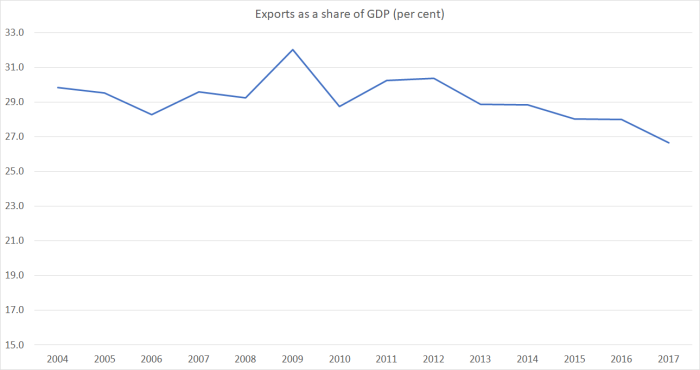
Actually, Tarrant’s introduction is a bit generous.   Exports as a share of GDP in New Zealand were 29.2 per cent in the year to March 2008, rose quite a bit when the exchange rate plummeted in the following year, but were down to 26.7 per cent in the year to March 2017.  The last time the export share was lower than that was 1990.

exports 1

What of the Minister’s claim about what’s gone on in the rest of the world?   It isn’t entirely clear how relevant it is to New Zealand anyway, given that the government has set, and regularly updated, the New Zealand target, including in the Business Growth Agenda refreshes as recently as this year.  But set that to one side for the moment.  What do the data show, and how do we compare?

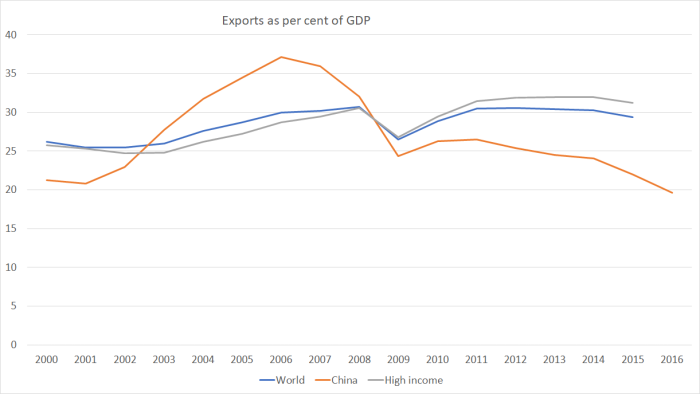
For the whole world, the best source of data is the World Bank.  Often it is only available with a bit of a lag.

exports 2.png

For the world as a whole, exports as a share of GDP have indeed dropped slightly since 2007 or 2008.  But that is very largely a China story –  after a couple of decades of very strong export-led growth, the story of China in the years since the 2008/09 recession has been a domestic credit and infrastructure phase.  The foreign trade share of GDP has fallen back a long way –  and is probably still above what would expect in the long-term for a country the size of China.    For high income countries (a World Bank category) exports haven’t grown markedly as a share of GDP, but they have grown.  Of the Minister’s other examples, Singapore’s export share is very high and quite volatile, and has fallen back somewhat  –  as I illustrated in a post a few months ago, they’ve had a huge increase in their real exchange rate –  but Denmark’s hasn’t.

The usual group we compare New Zealand against is the other advanced economies in the OECD.   Here is how New Zealand has done relative to the median OECD country.

exports 3.png

The shifts aren’t dramatic but (a) we’ve done less well than them, and (b) we were the country whose government set a target for a dramatic change.

If we use calendar year 2007 as a reference point (the last full year before the recession), there are a few countries whose (nominal) export share of GDP has dropped by materially more than New Zealand’s.  They are Chile, Israel, and Norway.   Of them, Chile and Norway have experienced very substantial falls in their terms of trade –  sustained falls in copper and oil prices.    By contrast, New Zealand(despite the ups and downs in dairy prices) and Israel have had the largest increases in the terms of trade of any OECD country over that (almost) decade.  All else equal, a rising terms of trade should have tended to lift a country’s export share of GDP relative to those in other countries (matched, in time, by a higher import share of GDP, as the proceeds of the better prices are spent).

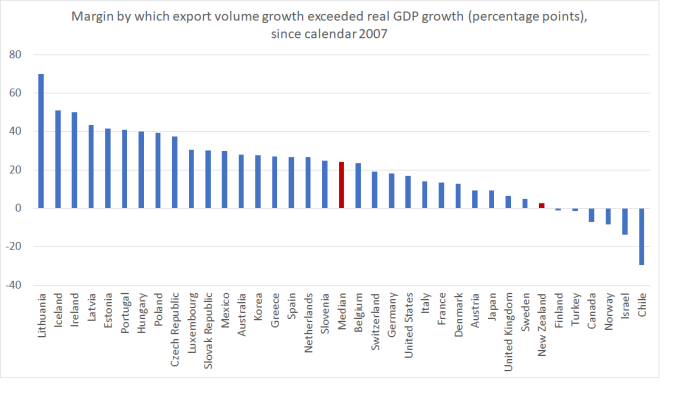
All of these numbers to date have been measures of the nominal value of exports relative to nominal GDP.  The government has expressed its export target in terms of volumes.  As I’ve noted before, ratios of real variables don’t make a lot of sense, and Statistics New Zealand advises against using them.   But one way of looking at volumes that does make some sense is to compare the volume growth of exports to the volume growth of GDP over a reasonable period.  In this case, I’ll look at the most recent year (to March 2017) relative to that last pre-recession year, calendar 2007.

In this chart I have calculated the total percentage growth in the volume of exports since 2007 and substracted from that the total percentage growth in real GDP over that same period.  (It might be more proper to do this multiplicatively, but I’ve checked and it doesn’t change the rankings.)

exports 4

There are OECD countries that have had a weaker relative export volume performance than New Zealand over this period, but not many.  And the median country’s experience is very different than ours has been.  And that is even with all those subsidised additional education exports and (as the Opposition parties might note) additional unpriced water pollution and methane emissions associated with the growth in agricultural exports.

Recall too that the whole logic behind the government’s export target was about closing some of those income and productivity gaps to the rest of the advanced world.  As Mr Joyce noted elsewhere in that same interview “productivity has been a 30 to 40-year issue for New Zealand” (longer than that actually).    One of the ways in which sustainable success of an economy tends to manifest is in the ability of firms based in a country to sell more stuff successfully abroad, enabling us to purchase more stuff from them.

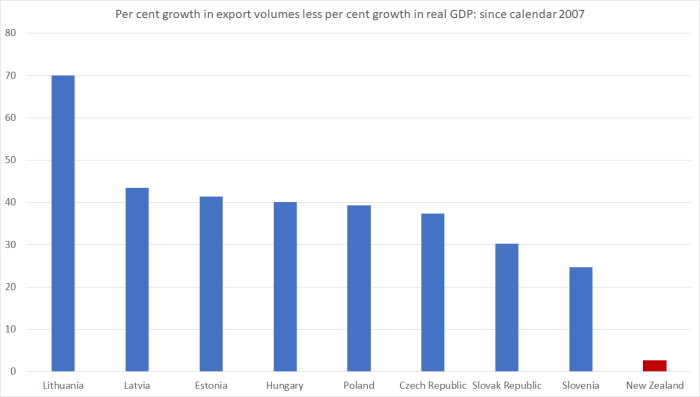
In a post the other day, I highlighted our experience relative to a bunch of other countries that had been setting out to catch up, eight (now) fairly-advanced central and eastern European former communist countries.

Here is how (nominal) exports as a share of GDP have done in New Zealand and in those countries since 2007.

exports 5

and here is a chart showing the gap between the growth rate of export volumes and the growth rate of real GDP (again, latest 12 months compared to calendar 2007).

exports 6

And, drawing this towards a close, in case anyone was hoping (against hope) that the services sector might provide a more encouraging export story (death of distance as technology advances etc) here is the chart of how services exports as a share of GDP have done.

exports 7.png

But no.

Were I trying to make a case for the defence, I would highlight two relevant considerations that Steven Joyce didn’t mention:

  • first, the impact of the Canterbury earthquakes.  Real resources have had to be used for the repair and rebuild process that simply couldn’t be used elsewhere (eg to build export industries), particularly as much of the cost was covered by offshore reinsurance (which gave people cash, but not more real resources to do the rebuilding with).  As that phase passes, resources will be freed up and we might expect them to flow back towards the tradable sectors of the economy,
  • second, the unexpected sharp and persistent reduction in interest rates which (for a country with a large private external debt) represented a considerable windfall.  We have been able to consume more without having to produce (or export) more.  It is a windfall, but in the longer-run it is no substitute for a policy climate that supports productivity growth and the growth in both the export and import share of our economy.

And, on the other hand, you might have noticed that I mentioned earlier that Israel had been somewhat like us.  Exports as a share of GDP had fallen further than in New Zealand, and the terms of trade had increased over the last decade by about as much as New Zealand’s had.   The other thing that constantly marks out Israel is the rate of population growth, from a mix of high (but falling) birth rates and high rates of immigration.    Israel’s population has increased by just over 20 per cent since 2007  (New Zealand’s population has increased quite rapidly by international standard, but “only” by about 12 per cent).

Just like the earthquake story, real resources required to build the considerable infrastructure (houses, road, offices, factories, schools etc) associated with a rapidly growing population aren’t available for growing other industries.  In New Zealand’s case that rationing process works through a persistently high real exchange rate and real interest rates persistently high relative to other advanced countries.   I’ve written previously about Israel’s underwhelming long-term productivity performance, and suggest that, as with New Zealand, rapid population growth in an unpropitious location, has made it hard for firms based in either country to take on the world (economicially) and succeed.   The experience of recent years –  remember, no productivity growth at all in New Zealand for five years now – looks like another straw in the wind in support of that suggestion.

Relative to the government’s target, export performance in New Zealand has been poor.  Relative to other advanced countries, it has also been poor.  And all that notwithstanding very favourable terms of trade.   Exports aren’t everything by any means, but the only OECD country in the last decade that has had a worse overall export performance than New Zealand and had a good terms of trade has been the one advanced country with a consistently faster rate of population growth.   Export volumes have grown quite a lot in the last decade – just over 20 per cent –  but they’ve barely kept up with overall GDP growth (in most countries, there has been much more export volume growth), and even then only through new subsidies (export education) and unpriced environmental externalities.  It is a flawed strategy.  And it is an unsustainable one.


Who will build the houses?

One of the Prime Minister’s campaign lines has been “who will build the houses?” if immigration numbers are cut back.   It is a curious line of argument, for a variety of reasons.

But it takes on a particular air of unreality when used –  as I heard in a debate last week –  to attack the Labour Party.    After all, Labour is campaigning on a policy that will (a) leave the current 45000 per annum residence approvals target unchanged, and (b) reduce students visa numbers quite substantially (resulting in a one-year reduction in the net PLT migration inflow).  On their own numbers, the changes they are proposing won’t make that much difference to the number of work visas issued, and where those numbers do change, the intention is to focus reductions at the lower-end of the skill spectrum.  (Their document is here, and my post on it is here.)   For what it is worth, Labour even proposes a Kiwibuild visa, designed to ensure that any reductions in work visa numbers don’t interrupt a flow of construction workers.

The student aspect aside (and even that isn’t part of the 100 day plan, although it isn’t that long until the new academic year starts), one might reasonably doubt whether Labour is serious at all about reducing ongoing immigration pressures.   Their policy, if implemented, won’t materially alter the net inflow over time. And I heard this morning an extended interview with Jacinda Ardern on Radio New Zealand in which she declared that she would have no problem at all with a net 70000 migration inflow per annum if only the houses were there, and actively endorsed some recent strongly pro-immigration comments made by Helen Clark.    Labour, like National, is still a “big New Zealand” party –  despite the economic damage that strategy has been doing over decades (remember how bad our productivity record has been) and will continue to do (ever more people and a heightened priority on improving water quality and meeting climate change targets is a recipe for severely undermining our productivity prospects.)

But this post isn’t about Labour’s proposals, but about (a) what has actually been happening over the last few years in the construction sector and related migrant inflows, and (b) more briefly, how the economy might adjust if there was to be a sustained material cut to target levels of non-citizen immigration.

In his weekly column in last Friday’s Herald, Brian Fallow touched on some of the first of those topics.  He went to the latest annual MBIE Migration Trends and Outlook publication (for the year to June 2016 –   MBIE could you please make data easily accessible on a more timely basis), looked at the data on who had been granted Essential Skills work visas in recent years, and concluded thus:

The conclusion has to be that the impact of net migration flows on the housing market and the construction industry is overwhelmingly on the demand, not the supply, side.

There has been a big increase in construction activity in New Zealand in the last few years.  Some of that is driven by the Christchurch repair and rebuild process, but increasingly the key influence has been the unexpectedly rapid growth in the population.  Each of those people needs a roof over their head.

And so employment in the construction sector has increased rapidly.    Here is the data from the HLFS, showing the percentage increase in people employed from calendar 2013 to calendar 2016 for each of the sectors employing more than 100000 people.

HLFS by sector

The construction sector has had by far the biggest increase in employment over the last three years.  Around 56000 more people were employed in construction in 2016 (on average) than in 2013 (the current total number of people employed in the sector is around 240000).

What contribution has non-citizen immigration (the bits our policy controls) made to this employment?

As Brian Fallow noted, on MBIE’s own numbers, this is how many Essential Skills visas were granted for construction trades and construction labouring roles in the year to June 2016.

And a startlingly low proportion – 7 per cent, or 2233 to be precise – were classified as construction trades workers like carpenters, plumbers, plasterers, tilers and painters. If you include scaffolders and builders’ labourers, the proportion rises to nearly 10 per cent.

And here are the corresponding figures for the previous couple of years.

Essential skills visas granted
2013/14 2014/15 2015/16
Construction trades workers 2090 2123 2233
Construction and mining labourers 399 546 831
Construction sub-total  2489  2669  

3064


Total 26502 28548 31766
Construction as % of total 9.4 9.3 9.6

Those might look like quite large numbers but:

  • at last report, construction jobs made up 9.3 per cent of all employment (and yet in this really rapidly growing sector only around that share of Essential Skills visas –  suggesting that immigration was hardly easing sector-specific pressures), and
  • as Brian Fallow also pointed out, most of these Essential Skills visas were being granted to people who were already in New Zealand (eg renewals).  Of 31766 Essential Skills visas granted in the year to 2016, only 8334 (or 26 per cent) were new workers (the proportions are similar in the earlier years).
  • people arriving and taking up first-time work visas need to be offset against people leaving.    In the three years I’m looking at here, MBIE tells us that the total stock of people here on essential skills visas increased by only 10062.   If the patterns were similar for construction jobs as for other roles, construction would account for about 1000 of that increase.

Of course, some people will have moved from work visas and obtained residence visas.  Based on the 2015/16 residence visa approvals numbers, that might have been around 450 people working in construction roles per annum.  Over three years, perhaps as much as 1500 people.

In other words, in a construction sector where total employment has increased by 56000 in three years, perhaps only 2500 (or less than 5 per cent) of that increase will have been met by the immigration of non-citizens.

So in that sense the answer to the Prime Minister’s question is easy.  Who will build the houses if immigration is cut back?  The same people who always overwhelmingly have, people who were already here.

But perhaps more importantly, if immigration were to be sharply cut back, the number of people needing accommodation would fall.  At one extreme, if the population is growing by 100000 per annum (as it has in the last couple of years), that suggests a “need” for around another 35000 houses each year (on top of the small number that would need replacing each year with a static population).  With net non-citizen migration at present in excess of 70000, the non-citizen immigrant flows alone create a “need” for perhaps 23000 additional houses each year.     Even if we go back to Brian Fallow’s original numbers of gross approvals of Essentials Skills visas, 3000 construction workers cannot build 23000 houses a year.   So the way immigration policy is actually being conducted it is exacerbating pressure on the construction industry, not relieving it.  That additional pressure is substantial.

(It needn’t be that way of course.  In the short-term immigration will almost always in increase economywide demand more than it increases supply.  But composition of the immigrants afffects where the pressures are most felt.  At the extreme, if all the migrants were builders (and related occupations), they’d probably just about keep up with the additional demand for housing (building, in effect, to house themselves).  Then the demand pressures would show up more severely in other sectors.    But when there is a big increase in the population, and hence in construction activity, immigration policy certainly isn’t relieving construction sector constraints when only around 10 per cent work visas are going to construction workers, when almost a quarter of the new jobs are in construction.)

So what would happen if, say, the 45000 residence approvals target was cut to, say, the 10000 to 15000 per annum I’ve been advocating (still, in per capita terms, around the rate of permanent approvals in the United States), and issuance of work visas was also tightened up, so that the stock of people on temporary work visas was no longer growing?

Overall, growth in domestic demand would weaken, and with it the pressure on domestic resources.  The notion that the short-run demand effects of immigration outweigh the supply effects shouldn’t really be controversial.  It has been that way in New Zealand for many decades.  But, given the huge scale of the pressures that new people put on the construction sector (not just houses, but roads, schools, offices, shops etc), and the fact that immigration policy as actually run has not seen us bring in many construction workers (10 per cent of the visas, when 25 per cent of the new jobs have been in construction), such a policy change would greatly ease resource pressures in the construction sector specifically.  In some other sectors it is quite conceivable that resource pressures could increase (one could think of export-oriented sectors such as tourism or dairying) if such an immigration policy change was made.  But on the construction side of things –  one of the most politically and economically pressing areas of our economy – the gains (the relief of pressure) would be substantial and almost immediate.  Not only would construction sector resource pressure ease, but land prices could also be expected to fall back to some extent (due to a reduction in expected future demand).

More generally, across the economy one would expect to see  interest rates falling (both market interest rates and the OCR) and with them the real exchange rate.    A lower real exchange rate would help secure the overdue resource-switching towards the tradable sectors. It would also provide the additional margin that would enable employers in those sectors to bid up wages to the extent required to attract existing residents to take up jobs in those sectors.    Plenty of people would be freed up from the construction sector –  a country with a modestly growing population wouldn’t have 10 per cent of total employment in construction –  and they’d be looking for jobs elsewhere.  Most of them would be long-term residents or citizens –  something we know with a high degree of confidence because the government’s own data tell us not many visas have been issued in recent years to people in construction, whether skilled workers or labourers.

But I guess the Labour Party can’t really use these arguments to push back against the Prime Minister because they aren’t actually planning a material and sustained reduction in non-citizen immigration at all.  That’s a shame.

(And if you wonder why all this discussion has used visa numbers up to June 2016, that is because MBIE only release more recent numbers in massive (600000 line) unwieldly spreadsheets.  It is possible that patterns in the last year have been a little different, but it seems unlikely –  given the similarity in each of the previous three years.  But debate would be better-informed, and more timely, if MBIE would make  timely data available in more readily accessible formats, as happens for almost all other important economic data released by Statistics New Zealand, the Reserve Bank or whoever.)


Spencer appointment still appears unlawful

Just a couple of days after the election, Graeme Wheeler’s term as Governor of the Reserve Bank expires and Wheeler will leave office.

In the normal course of events, a new appointment of a permanent Governor would long since have been made.   But as officials belatedly realised late last year, and as the Reserve Bank Board had eventually to be directed to recognise, a new permanent appointment of someone to take office in late September could not be made in the run-up to the election, without breaching the conventions that govern how the period around elections is handled.

I’d been drawing attention to the issue for 18 months or so, and had suggested that the practical solution would have been to have invited Wheeler to accept a short extension of his term, allowing whoever formed the new government after the election to make their own appointment.  We don’t know whether Wheeler wasn’t willing to consider that, or whether the Minister of Finance wasn’t, but there were no legal obstacles to such an extension.  And yet it didn’t happen.

Instead in early February, the Minister of Finance announced that he was appointing the existing Deputy Governor (and deputy chief executive) as acting Governor for six months after Wheeler’s departure.  Spencer in turn had indicated that he would not be seeking permanent appointment and would retire at the end of the acting Governor period.

There is provision in the Reserve Bank Act for an acting Governor in some circumstances.  Thus, when in 2002 Don Brash resigned in the middle of his term to enter politics, Deputy Governor Rod Carr was appointed as acting Governor for a few months.

But ever since the Spencer appointment was announced I’ve been raising questions about the legality of this appointment (I have no concerns at all about Spencer himself).   There was this post on the day the Spencer appointment was announced.   And then a later post outlining the argument in more detail.   The gist of the argument is that the wording of the Act appears to provide for an acting Governor only when a vacancy arises in the course of a Governor’s term (as happened in the Brash/Carr case), and not when a Governor’s term expires and the Minister decides, for whatever reason, not to make a permanent appointment for a time.  Not only do the words naturally lead to that interpretation, but the overall context (the way related bits of the Act are designed) suggests that that was indeed Parliament’s intention in using those words.

I lodged OIA requests with the Reserve Bank Board (responsible for recommending appointees), the Minister of Finance, and with The Treasury (principal advisers to the  Minister of Finance).   The Board’s response was both obstructive, and indicative of how badly they appear to be in breach of the Public Records Act.  But, as usual, the response from Treasury was much more helpful.   In this post, I outlined the considerable amount we learned about the process from the papers Treasury released.      But The Treasury withheld the advice they had received from Crown Law on the lawfulness of various aspects of the appointment, and there was not even any report of the Crown Law reasoning in any of the policy advice documents.

The protection of legal professional privilege is grounds for withholding documents under the Official Information Act, and is widely used by officials to keep the thrust of legal advice confidential.    But this ground for withholding, like several others, is subject to a caveat

unless, in the circumstances of the particular case, the withholding of that information is outweighed by other considerations which render it desirable, in the public interest, to make that information available.

The Ombudsman had relatively recently highlighted this provision, and on occasion had ordered the release of either the legal advice itself, or a full summary of that advice.  And so I appealed to the Ombudsman against Treasury’s decision to withhold the legal advice. I didn’t really expect to get the advice itself, but I wanted to understand the reasoning and argumentation Crown Law had provided in support of the Minister of Finance’s decision.  And since it involved an appointment to a position holding very considerable discretionary power in a number of policy areas, it seemed to me that it would be in the public interest to make at least a summary of the advice available.  After all, if there were doubts about that lawfulness of the appointment, that could undermine confidence in the Bank’s action, and its capacity (during the term of a purported acting Governor) to exercise (for example) its crisis management powers.

And, somewhat to my surprise, the system worked.  In a post at the time, in April, I lodged the appeal I noted

I suppose it will take some considerable time for the Ombudsman’s office to get to this request –  perhaps even after the acting Governor’s term has ended –  but with the possibility of reviews to the Reserve Bank Act governance provisions in the next couple of years, it would still be valuable for this advice and intepretation (in full or in summary) to be put in the public domain. This is, after all, about the appointment and accountability provisions for the most powerful unelected public office in New Zealand.

But last Friday the Ombudsman’s Office rang to inform me that after discussions between the Ombudsman and Treasury, Treasury had agreed to release a summary of the Crown Law advice.  The Ombudsman’s office assured me that, having seen all the orginal opinions themselves, it was a fair and representative summary of the advice.  Since I only ever really expected to obtain a summary of the advice, I agreed to discontinue my appeal for the full advice.  An hour or two later, the summary of the Crown Law office arrived in my email in-box.   Only five months after the original appeal was lodged, and before the (purported) acting Governor takes office.  I was impressed, and grateful that Treasury did not seek to drag the matter out longer (which they could have done).  I’m not sure why they changed stance, but perhaps they recognised that with the changeover only a couple of weeks away, there might well be further questions about the lawfulness of the appointment.  If so, it would be desirable to have the Crown case in the public domain.  Perhaps too they had noticed reports of Grant Robertson’s concerns about some of the Reserve Bank appointments this year (I’m not sure if he has concerns about lawfulness, but he might reasonably be disgruntled at not being consulted over the appointment of a very powerful public official to commence work on the third working day after the election). Spencer might be (purporting to be) acting, but in that role he would have all the discretionary policy powers of the Governor.

The document I received from The Treasury is here.

Crown Law summary advice re acting Governor Official Information Act Response – Michael Reddell (20170031)

Macroeconomists often don’t have much to do with lawyers and legal opinions.  But I’ve had more than more my share, both in various regulatory and markets role over the years, here and abroad, but also for the last nine years as a trustee of the (somewhat troubled) Reserve Bank staff superannuation scheme.   There are good lawyers and poor ones.  And even from decent lawyers there are good and persuasive opinions and poor ones too.   In just the last six weeks, I’ve read a very persuasive opinion on an issue where I was initially inclined to (and would have preferred) the opposite interpretation, and an opinion  –  the conclusion of which I was inclined to agree with –  where the reasoning left a great deal to be desired.     We’ve had cases where draft legal opinions have come back and we’ve had to point out that the lawyers have simply overlooked key considerations that seem relevant, and so on.

Ours is an adversarial legal system, where in each side of any particular case, there are lawyers arguing the interests of their clients.  Whatever the truth is –  whatever the final judicial decision is –  there is no particular reason to expect it to be captured in a single opinion from a lawyer arguing the interests of his or her client.  In this case, the Minister of Finance wanted to make an acting appointment, of Grant Spencer, and Crown Law’s advice appears (see those earlier documents linked to above) to have been sought quite late in the piece, to backfill a political and bureaucratic preference.   It is what in-house lawyers do –  and that is the role Crown Law serves.  Sometimes they will say “no you just can’t do that” but often enough they be casting around for a half-plausible interpretation to enable the client to do what they want to do anyway, perhaps especially when the risk of an actual court challenge is low.

Which is all by way of saying that I didn’t find the Crown Law reasoning persuasive.  I didn’t really expect to, but I was curious to see what arguments –  or precedents –  they would mount.    In fact, I was surprised by how thin and unconvincing their reasoning was.    I’m now more worried than ever that this major public appointment will be unlawful and, therefore, that real doubts will hang over the lawfulness of any Reserve Bank actions taken by the (purported) acting Governor during the next few months.

Crown Law notes, by reference to a couple of Supreme Court cases from last decade, that under the Interpretation Act 1999

The meaning of an enactment must be ascertained from its text and in the light of its purpose

As the Supreme Court noted,

even if the meaning of the text may appear plain in isolation of purpose that meaning should always be cross checked against purpose in order to observe the dual requirements

In this case, both the text and the purpose work in the same direction, towards the same interpretation.  And that interpretation isn’t the one Crown Law places on the relevant provisions of the Reserve Bank Act.  In fact it highlights the limitations of legal opinions when the lawyers concerned are not intimately familiar with the legislation concerned and with the policy purposes behind the relevant provisions.

Section 48 of the Reserve Bank Act allows the Minister, on the recommendation of the Board, to appoint an acting Governor

for a period not exceeding 6 months or for the remainder of the Governor’s term, whichever is less

The plain meaning of the text “in isolation” is that an acting Governor can be appointed if a vacancy arises during a Governor’s term, but not if the Minister and Board simply don’t appoint an acting Governor.  After all, on 27 September there is no “remainder” of any Governor’s term, and the relevant term limit is “whichever is less”.    There is no number of days –   let alone months –  less than zero.

Ah, but, argues Crown Law, “the scheme of Part 3 of the RBNZ Act indicates that there is to be a Governor at all times”.   This assertion governs much of the rest of their advice.  If there has to be a Governor at all times and a permanent appointment hasn’t been made, a temporary (acting) appointment must be able to be made, and “whichever is less” is of no account.

Actually, I’d agree that the Act envisages there being someone with the powers of  Governor at all times.  But the Act’s wording appears to be designed so that there can be an acting Governor –  if an unexpected vacancy arises during a Governor’s term –  wielding those powers, but that in the normal course of events it is up to the Board and the Minister to get on and make a substantive appointment so that a new Governor is in place at the end of the old Governor’s term.   There is no provision, express or implied, for the Minister and Governor to evade those expectations and restrictions.  (It might, in some cases, be desirable for there to be such provisions –  for exactly a case like this, where the election date falls near the end of the outgoing Governor’s term, but there isn’t.   Laws as passed are not always written in the way that, with hindsight, we might prefer.)

The Crown Law people appear to have realised that a key aspect of the Reserve Bank Act is operational autonomy in respect of monetary policy.  But they don’t seem to have appreciated –  they certainly don’t mention –  the explicit precautions Parliament took to prevent that autonomy being eroded through the appointments process.  Thus, any new Governor must be appointed for five years.    The initial appointment cannot be shorter, even if some superb candidate turned up and was only available for four years.  Without a restriction of that sort, it will have been reasoned, the Minister and the (Minister-appointed) Board could get together and appoint someone for six months or a year at a time, rolling over those appointments if appropriate depending on the extent to which the Governor heeded the Minister’s preferences.  It simply can’t be done, under the Act as it stands.  An existing Governor (but only he) can be extended for a short period, but of course that person will already (by construction) have served at least five years in office.

Thus, for Crown Law to be correct –  in claiming that the Minister and the Board are free to appoint an acting Governor for up to six months even when there is no remaining term to complete –  they are effectively arguing that one of the key provisions of the Act –  that specific five year initial term –  can be effectively subverted by a succession of six-month acting appointments.  These are extreme illustrative examples, but my point is not that this is what was intended by the Spencer appointment, but that it is what the law must allow if Crown Law is right.  Since the plain words and the purpose of the relevant provisions of the Act take us in the opposite direction, Crown Law simply must be wrong on this point.

I have also argued previously that there is no statutory provision for the signing of a Policy Targets Agreement between the Minister and an acting Governor.   That makes sense on my interpretation of the Act because on that interpretation, there can only be an acting Governor when an existing gubernatorial term has been unexpectedly interrupted.   Thus, a Policy Targets Agreement is signed “for that person’s term of office” (section 9) before a Governor is appointed.   And when Don Brash resigned his term still had another 17 months to run, and there was already a PTA in place for that term.  Thus when the Minister appointed Rod Carr to be acting Governor for a few months of that remaining term, there were already policy targets in place for the Bank, signed by the person whose term Carr was partially completing.      There is nothing comparable from 27 September this year, since the PTA Wheeler signed with Bill English in 2012 will have expired the previous day.

Crown Law attempts to get round this by asserting –  and it is simply an assertion  –  that  acting Governor “is the Governor”.  If he is the Governor, there must be a PTA signed with him before he is appointed.   But they offer no statutory support for this proposition (acting Governor “is” Governor).  After all, the Act talks of an acting Governor having the powers and responsibilities of the Governor, but still maintains a distinction between the two titles.   If there was no distinction, there would be no need for the acting Governor statutory provisions.  But Parliament chose to make such a distinction, and must have intended something thereby.    And it seems to  have done so because of the emphasis Parliament placed on having all actual gubernatorial appointments be for five years.    There is no provision in the Act for an acting Governor to sign a PTA, because the Act clearly envisages (literal wording and policy purpose) that an acting Governor would be appointed only during the unexpired portion of a term of a substantive Governor.

Anyway, you can read the summary of the Crown Law advice yourself.  Perhaps you’ll be persuaded.  I’m not.     It would appear that (a) an unlawful appointment is about to be (or has already been) made, and thus the Reserve Bank will have no lawful head after Graeme Wheeler leaves office on 26 September, and (b) that the document Grant Spencer and Steven Joyce signed on 7 June, which purports to be a Policy Targets Agreement under section 9 of the Reserve Bank Act is, in fact, no such thing.

If so, not only will the Bank have no lawful head on 27 September, it will have no Policy Targets Agreement to guide and constrain any monetary policy actions it takes, or purports to take, over the period from them until the new permanent Governor takes office.   Even if my interpretation were finally to be shown to be wrong in law, the fact that it is a plausible interpretation –  I would argue the most natural interpretation, consistent with the provisions of the Interpretation Act –  should raise serious concerns, and leaves some doubt hanging over the ability of the Bank to act effectively over the next few months.

Quite possibly, the Bank won’t need to do much in that time.  Markets don’t expect the OCR to change, and it doesn’t seem likely that debt to income limits will be imposed either.  But circumstances can change quickly.  We might have a new government in a couple of weeks, and the Labour Party has indicated a desire to have the Bank focus on unemployment as well as inflation.  A natural step in the early days of such a new government would have been to seek a change in the PTA to make that expectation explicit, pending a subsequent change in the Act.   But what, formally, is the status of the existing document, let alone any new one Grant Robertson might seek to put in place?  Can he override (section 12) a purported PTA which isn’t a real PTA?  (In any case, shouldn’t the Opposition have been consulted about the 7 June purported PTA, given that it was an action being taken, to come into effect after the election to shape the conduct of macro policy for the first six months of any post-election government’s term).

The sad thing about this whole episode is how unnecessary it was.  First, if Graeme Wheeler had been persuaded to stay for another six months, there would be no legal uncertainty whatever.  If that couldn’t happen, a simple one-off amendment could have been made to the Reserve Bank Act to allow for this specific acting appointment, with a sunset clause such that the provision lapsed next March.  At this point, neither option is possible – Wheeler is off to take up his directorships, and Parliament doesn’t sit before 27 September.   For the time being, we –  and institutions directly regulated by the Bank –  will simply have to live with the uncertainty, hope that no difficult decisions arise before a substantive appointment is made.  And perhaps the Minister –  whoever he or she is –  might need to be prepared to legislate quickly if circumstances should turn nasty and the need for greater certainty becomes apparent (one wouldn’t want the exercise of crisis management powers being tested through the courts for years to come).

It has been pointed out to me that section 51 of the Reserve Bank Act allows the Governor to delegate any of his functions and powers to the Deputy Chief Executive and

Any such delegation, until it is revoked, shall continue in force according to its tenor, notwithstanding that the Governor who made it may have ceased to hold office.

In principle, so it might be argued, since Spencer is now the Deputy Chief Executive, the outgoing Governor could delegate all his powers to Spencer as deputy chief executive, and such a delegation would continue to be valid even though the Governor who gave the delegation has ceased to hold office.

It is an interesting idea.  But according to Board minutes released to me previously, the Board has already recognised that from 27 September the other Deputy Governor, Geoff Bascand, will be the deputy chief executive, replacing Spencer –  who presumably would not then have those powers.

It is the sort of issue that would seem to need a good lawyer’s advice.    Can a delegation remain in force not just if the Governor who gave it is no longer in office, but if there is no Governor at all (and recall that the Act puts almost all the powers of the Bank in the hands of the Governor).

It is a mess.  And a quite unnecessary one, if only the process had been better managed by the Minister of Finance, the Reserve Bank Board, and The Treasury from the start.


(PS.  Incidentally, were Crown Law to be correct that an acting Governor had to have a new PTA before he or she could have been appointed, Michael Cullen and Rod Carr would have been in breach of the Act in 2002.   This isn’t compelling on its own –  people do make inadvertent mistakes – but it is illustrative as to how the relevant provisions of the Act have previously been read.)


Housing failure set to continue

I’ve long been sceptical that any government is likely to fix the housing market problems any decade soon.   Some of that was specific New Zealand points: National seemed to be doing almost nothing, Labour had done almost nothing when it was in government, and Labour seemed likely to rely on the anti-development Greens if and when it formed another government.    But most of the scepticism was – and is –  rather more overarching: no one has been able to show me a case study anywhere in the world where intense land use restrictions had once badly messed up a housing market, and where those controls had then been successfully unwound and housing made affordable again.   In principle, there was no reason why New Zealand should not have been first.  But the ages of pathbreaking New Zealand reforms  –  whether the 1890s or the 1980s –  seem well behind us at present.

It wasn’t a weekend that led my to revise my opinion.    In yesterday’s Sunday Star-Times Rob Stock had a piece reporting widespread scepticism about the claims that both Labour and National are making.  He began with both leaders’ reluctance to even call for lower house prices.  No one much seemed persuaded by the idea that nominal house prices might hold flat and incomes rise steadily to reduce price to income ratios.  On paper it could be a plausible story, but even if so it is a solution for the next generation not the current one.   And the article also reported a great deal of scepticism about the apparent Labour aspiration to introduce a lot more lower-priced homes without having much impact on the prices of existing dwellings.    The people Stock quoted seemed a bit more optimistic that –  despite the disavowals – Labour’s plans might actually lower house prices.   Fundamentally improve the land supply situation and perhaps that might be realistic.  Without that, government-sponsored builds seem likely to substantially displace private sector builds.

But then there were the policy cues.  Yesterday morning, National announced that, if re-elected, it would increase the subsidies offered to first-home buyers.  First-home buyer grants, in a supply-constrained market, are a policy so daft that I’m not aware of any serious analyst, from any side of the political/economic debate, who thinks they are a good idea (and Treasury and the Reserve Bank have opposed them).  New Zealand was mercifully free of such subsidies for most of its history –  and policy people used to look across the Tasman, slightly disdainfully, at the grants there.   First home buyer grants are, largely, an expensive way of getting house prices a bit higher than they otherwise would be.  And here that outcome is even more likely given the announced increases in accommodation supplement payments next year.   Renters will be able to pay a bit more (so investors can afford to pay a bit more), and potential first home buyers would now also be able to pay a bit more –  perhaps especially in provincial areas where the grant goes a bit further.  Since the policy is well-foreshadowed, most of the effects will have been compounded into prices before the first young couple can get their increased grant.  And, as so often, the winners will be the people selling out of the market –  those who already have.  It is the sort of policy that gets adopted when governments have given up on  believing that they might actually fix the underlying problems –  and/or given up believing that they can convince voters that they might.    Subsidies to home buyers –  rather than fixing the underlying problem –  is like some throwback to the early 1980s (actually the last time we had such direct first-home buyer subsidies).

The messages from the other side of politics weren’t much more encouraging.  The leader of the Opposition yesterday announced her plans for the first 100 days of a Labour government.  Housing appears on the list, but the three most specific items are

  • Pass the Healthy Homes Guarantee Bill, requiring all rentals to be warm and dry
  • Ban overseas speculators from buying existing houses
  • Issue an instruction to Housing New Zealand to stop the state house sell-off

Whatever you make of the Healthy Homes Guarantee Bill, it won’t improve the affordability of housing (if anything, rather than contrary for renters).  And stopping the sell-off of state houses might (or might not) make some sense, but again it won’t alter, by one iota, the affordability of housing in New Zealand.   And, in fairness, both are probably being done for other reasons.  And so the one specific thing they’ll pledge to pass by Christmas actually designed to improve housing affordability is the proposed ban on non-resident foreigners buying existing housing.  Consistent with this, on Labour’s website, the very first thing one comes to under housing policy is

Crack down on speculators


Ban foreign speculators from buying existing homes

Reasonable people can differ on the specifics of this (and other “anti-speculation” measures –  the extension of the bright-line test for investment properties, and ring-fencing).   To me, it has the much the same feel as that around first-home buyer grants –  it is the sort of policy one adopts when one has given up on dealing with the underlying problems.    Blaming “speculators”, for the symptoms of a rigged and dysfunctional market, is a distraction strategy from way back for politicians here and abroad.

Banning non-resident foreign purchases of existing houses isn’t the worst policy imaginable –  and any adverse impact on New Zealanders is likely to be small to non-existent – but as a flagship policy for a possible new government it is hardly one that suggests a serious focus on fixing the underlying long-term problems.  Sure, it is probably quite easy legislation to draft  (though no doubt MFAT officials will be turning their minds to the issue of how to reconcile the proposed ban with, eg, the New Zealand-Korea “free trade” agreement) and comprehensively fixing the planning system isn’t.  But after years in opposition, and with policies around land supply that look promising on paper, if they were really serious about far-reaching reform in this area, one might have hoped they’d have found something specific to have done in the first 100 days –  a stake in the ground, an earnest of a serious commitment to free-up land supply later in a first term.   But when the previous leader never mentioned the issue, the current leader never does, and when there is nothing in the 100 day action plan, I’ll stick with my scepticism for the time being.

Bloodless economists probably aren’t supposed to do disgust, but that pretty much summed up my reaction to the weekend story that, less than a year out of office, John Key had sold his Parnell property, at what is apparently a very substantial profit, to enable him and his wife to downsize.    No doubt it is mostly about “time of life” thing –  kids off their hands etc –  and I’m not suggesting that the National Party’s failure to do anything much about fixing the housing market problems for nine years was mostly about personal enrichment.     But this was a leader whose approach to the increasingly severe housing disaster was to glibly call it a “quality problem” or some sort of “sign of success”.  As I put it 18 months ago

In a speech to an Auckland business audience yesterday –  there is a report here, and also video footage –  the Prime Minister repeated his breezy claims that Auckland’s “challenges” around housing and transport are “a quality problem”, and a “sign of success”, and that both the city and the country are doing “incredibly well”.

Perhaps that is how it appears when you are already wealthy, live in a large house in a prime inner suburb, and have a taxpayer-provided chauffeur at your constant disposal.  Neither housing nor traffic problems must impinge terribly much.

And so, having moved on from public life, Key now extracts what is reported to be several million dollars of profits which are really just monopoly rents.  Keep the land supply market dysfunctional, boost the population considerably, allow house prices to be driven up to an extent that an ever-larger proportion of the young and the poor can’t afford to buy, and then simply take your own profits.   It is, in effect, money taken at the expense of the poor of Auckland –  not because any of them could afford Parnell, but because most of the increase in Parnell land prices is a reflection of the same common factor that has driven prices high across Auckland.  It is easy to be indifferent to a problem when you yourself benefit – even just passively –  from that continuing indifference.    The record, the policies, National is campaigning on today, including around housing and land, are more or less exactly the same as those of the first eight years of a National government, under John Key –  who has now cashed-out millions of dollars personally, made from his government’s refusal to fix the housing market.

Putting disgust aside and returning to the numbers, one often hears the current Prime Minister talking of 10000 houses a year now being built in Auckland, as if somehow this is the answer to the past policy failure.    It is often complemented by references to bureaucrats’ claims that tens of thousands of new houses are in the pipeline – I think I’ve even heard references to some multiples of Hamilton being built in the next few years.    (I’m not sure why we should be impressed by that figure, when New Zealand’s population is currently growing by as much as Hamilton every two years).

Of course, as Core Logic has pointed out, the actual increase in the housing stock is much less than the number of new dwellings being consented (many new builds require the demolition of existing houses), but even just focusing on building permits, is there any sign that the number of permits being granted in Auckland is getting ahead of the population growth?

The chart below uses official data.  It shows the number of building permits being granted in Auckland each (June) year relative to the (SNZ) estimated increased in the population over that same year.  Comparisons that look just at consents per capita are meaningless –  it is increases in the population that (are the biggest factor that) increase the need for accommodation.    The data are only annual, but for the year to June, so the actual building consents numbers are almost right up to date.    The population estimates for individual areas for June 2017 won’t be out until later next month.  But Auckland’s population is estimated by SNZ to have increased by 2.82 per cent in the year to June 2015 and by 2.83 per cent in the year to June 2016, and there has been no material change in net migration inflows over the most recent year.  So I’ve assumed a population increase in Auckland of another 2.82 per cent in the year to June 2017.   It is a rough estimate, but it would be surprising if the SNZ estimate next month was materially different.

building permits per person increase

So, yes, in annual terms, the number of building permits for new dwellings per person increase in the population has increased, but not by much.  But in the last two years, the rate of consenting has still been lower than in any year in the first decade of the data series.    It is unspectacular at best.  Sure, there is a lot of building going on right now, but then there are huge (government-abetted) increases in the population which don’t yet show any sign of abating.

And if there is a lot of house-building activity going on at present, there are straws in the wind suggesting there will be less in future.  At a national level we’ve already seen some of that already in the building work put in place data released last week.  But here is a chart of Auckland new dwelling permits.  The data are noisy from month to month, so here I’ve taken the annual growth rate in the three-monthly total (eg May to July 2017 over May to July 2016) and shown the data for (a) the total number of new dwellings consented, and (b) for the total floor area of those consented new dwellings.

building permits 2

Both annual growth rates are now (a) well below where they were, and (b) actually are negative.  In other words, in annual terms the volume of new housing being consented in Auckland is dropping.  And there is no sign that the rate of population increase is.

Views will differ on whether these numbers reflect capacity constraints or the limits of effective demand at the prevailing (extremely high) prices.  My own bias tends towards the latter story –  and Rodney Dickens at SRA has done some analysis taking the same view.  But whichever story you think is more convincing, the numbers don’t suggest any near-term lift in the overall supply of houses relative to the increase in the population.  Taken together with the lack of much land-use regulation reform, it all provides little reason to think that housing affordability in our largest city is likely to improve much, or for long, on anything like current policies.  Meanwhile, the system will remain skewed to those who have, and against those who have not, and we can only expect yet more ad hoc measures –  whether from the elected government or outfits like the Reserve Bank –  to paper over the symptoms of housing market failure.


Eastern and central Europe, and us

Eastern and central Europe don’t get much coverage in the New Zealand media, or in New Zealand economic analysis.   But I’m intrigued by the region.    There are multiple levels to that –  religion, other dimensions of culture, battles in two world wars, decades of Soviet repression, and so on.   But what really plays on my mind is that these countries regained their freedom, and the hope that came with that, at much the same time that many senior and influential people here (and young economists like me) were convincing themselves that New Zealand had passed a turning point and our economic prospects really would be looking up.

Here there had been the famous jibe from David Lange, comparing New Zealand’s economy pre-1984 to a Polish shipyard.  At one level of course, it was a ridiculous claim, which trivialised the evils –  and rank inefficiency – of Communism.    But it had also captured something about the mood for change, partly in reaction to the plethora of controls the New Zealand economy had laboured under for decades.   Actually, New Zealand had been been liberalising for decades, but (generally) rather slowly and inconsistently.   And our living standards relative to those in other advanced countries had been dropping for several decades; the inefficiencies the heavy protectionism etc created were compounded by our worst terms of trade for a very long time.  Daft interventions like the Think Big energy projects just reinforced the sense of something having gone very wrong.

And so, over 10 years or so, there was a dramatic –  at times almost frenzied – period of far-reaching economic and institutional reform.  Much of it was admired –  even envied –  abroad, at least among the like-minded.   Outfits like the OECD and IMF praised the reforms, and typically had a few more to suggest, and there really was a belief that nothing much now stood in the way of reversing the decades of relative economic decline.  Productivity growth would, it was assumed, follow smart economic reforms much as night follows day.    There are some people from that era who will now dispute that anyone seriously expected that sort of improvement, but David Caygill was the (very capable) Minister of Finance, and here is how he illustrated the story.

caygill 1989 expectations

No sense there that the reforms –  which were extended further by his successors –  would simply slow our relative decline.

At the time, I was heavily involved in the Reserve Bank’s (small)  part in all this –  achieving and maintaining low and stable inflation.   Medium-term growth and productivity issues weren’t our focus, but a couple of colleagues –  including then deputy chief economist Arthur Grimes –  had been doing some work on exactly those issues.  Their findings were published in mid-1990.    Having established the nature of New Zealand’s relative decline, and identified some of the possible causes (including, in their view, past rapid population growth) they ended their article this way.

grimes smith text

And at around the same time, eastern and central Europe was regaining its freedom.  The Berlin Wall fell, democratic governments were elected in Poland and Czechoslovakia, the Baltic states regained independence, a place like Slovenia emerged peacefully from what was left of hitherto communist Yugoslavia and so on.    They were great days for the cause of human freedom.  But also of economic opportunity.   The former eastern bloc countries didn’t have identical economies, and it isn’t as if there hadn’t been economic progress even during the Communist years.  Some –  notably Hungary –  had started reform and economic liberalisation earlier than others.    But each of them had highly distorted economies, typically insecure property rights, and little in the way of a proper financial system.    Data from this period are pretty patchy – especially for the countries that had been part of other countries up until then – but these countries weren’t dirt-poor: the better of them probably had GDP per hour worked in 1990 similar to, say, that in Korea.    They were middle income countries.   Then again, as far as we can tell, in say the 80 years prior to World War Two none of them had ever been much better than middle income countries either.  Certainly, they’d nothing like the productivity, GDP per capita, or material living standards of New Zealand.

So if we go back 25 years or so, both in New Zealand and in eastern Europe those leading the economic reforms, and those running governments, had serious aspirations of catching up with the richer and more productive advanced countries.    Of course, the mess in eastern Europe was a whole lot bigger than the mess here.  In both countries, unwinding controls and protectionist structures involved short-term losses of output.  Those were moderate here, but savage in some of the eastern European countries.  But in both places there seemed to be great opportunities for catch-up and convergence.

I illustrated the other day how poor our productivity performance has been relative to the other advanced OECD countries over that period.  From a starting point in 1989, productivity levels have slipped another 12 per cent further behind the median advanced OECD country.  In other words, no convergence has happened at all.  That has been so even over the last decade or so when productivity growth in the the “frontier” countries has itself slowed, which might have been an opportunity for some catch-up when we were starting so far behind.

But how do we compare with the eastern European countries?  Seven of them –  the Czech Republic, Estonia, Hungary, Latvia, Poland, Slovakia, and Slovenia –  are now in the OECD, and thus in the OECD statistical databases.  One other –  Lithuania –  isn’t in the OECD but has apparently reached data standards that mean the OECD is reporting their productivity data.   There are other countries not covered –  from Belarus or Moldova at the bleak extreme, to EU countries such as Bulgaria, Romania (which I wrote about here), and Croatia at the other.    There is good data for some of them in other databases, but for today I just wanted to use the same OECD database Steven Joyce was using the other day in talking up New Zealand’s performance.

The OECD data on real GDP per hour worked for these countries starts in various years during the 1990s.  2000 is the first year for which there is data on all eight eastern European countries.  In a way, it is a shame not to be able to start from the late 1980s, as I did in comparing us with the more advanced OECD countries.  On the other hand, by 2000 the worst of the immediate post-communist disruption was well behind these countries (as the initial output losses in our own structural reforms were behind us).    Sixteen years since 2000 (annual data is available to 2016) is a reasonable run of time to see how we’ve done relative to them –  and neither the initial year nor the most recent year is muddied by recessions or financial crises.   Each country has had a recession during this period, and in some cases they were pretty wrenching adjustments, involving IMF support.

Here is the cumulative real productivity growth for each of those countries, and New Zealand, since 2000.

eastern europe 1

The country with the slowest growth – Slovenia –  managed twice the productivity growth of New Zealand over this period, and the OECD estimates suggest that the level of productivity in Slovenia –  30 years ago a province of a communist non-market country –  is now approximately equal to that in New Zealand.

And here is the time series: the level of productivity in each country is indexed to 100 in 2000 and then I’ve taken a median of the eight eastern European countries.

easetern europe 6

You can see that the downturn in 2008/09 was much more severe for many of these countries (especially the ones running semi-fixed or hard-fixed exchange rates).

And here is the ratio of those two series.

eastern europe 3.png

Our rate of decline, relative to the eastern European countries, might slowed a little in the last decade, but there is no sign of things levelling out.

And if defenders of New Zealand’s performance want to argue something along the lines of ‘well, they are still poorer and less productive than New Zealand, so they should be achieving faster productivity growth than we are’,   well we are a great deal less productive than the median advanced OECD country, and yet we’ve not managed to achieve faster productivity growth than them.

In fact, here is a chart showing OECD estimates of the 2015 level of real GDP per hour worked, converted at PPP exchange rates, for the eight eastern and central European countries,  for New Zealand, and for four of the big higher-productivity OECD countries.

eastern europe 4

These days, our productivity levels look a lot more like those of the eastern and central European countries than of the OECD leaders (and Norway and Luxembourg and –  questionably –  Ireland are well above even those countries’ numbers).

At about this point, people often start saying “well, of course…those eastern European countries are close to the industrial centres of western Europe, and have been able to be attract foreign investment in manufacturing and become extensively integrated into the value chains associated with modern manufacturing”.

To which my response is along the lines of “well, yes, that is my point about New Zealand”.  We are poorly located –  for anything other than not being overrun by German or Soviet armies – and not many firms seem to have been able to develop substantial (unsubsidised) businesses selling internationally competitive products and services from here, based on anything other than our (fixed) natural resources.

Which is why it has come to seem so odd that we, as a matter of public policy, are aggressively trying to grow our population –  issuing 45000 residence approvals a year, three times the per capita rate of the US.  In doing so, we simply make it harder for ourselves to prosper here.

In fact, here are the population growth rates of the eastern European countries and of New Zealand since 2000.

eastern europe 5

I don’t think I’d be too keen on living next door to revanchist Russia.  But the five non-Baltic states here are firmly ensconced in central Europe, and over the last 16 years they’ve had an average of zero population growth, while our population has grown by almost 23 per cent.

Countries like that don’t have to devote huge shares of available resources (capital and labour) simply to keeping with the infrastructure needs of a rapidly rising population.    That, in turn, keeps pressure off domestic costs, and keeps the real exchange rate lower than otherwise. Combined with more favourable locations, lower company tax rates (in most cases) and (the perhaps mixed blessing of) EU membership, they’ve been able to lift productivity and living standards for their people in a way that has had no parallel in recent decades in New Zealand.     On typical institutional metrics like ease of doing business and corruption perceptions we score well ahead of any of those countries.  We don’t need marches in the street to protect the independence of the judiciary (as in Poland).  And our people do well on international skills comparisons.  But it isn’t enough if one draws too many people into an unpropitious location.

Until we face up to the evident limitations of our location, and the absurdity of actively importing so many people from abroad into such a difficult location, it is difficult to believe that our underperformance, that has now stretched out over almost 70 years, will even begin to be reversed.    For most of modern New Zealand history, France and Germany and the Netherlands had lower labour productivity than New Zealand did.  Now they are far ahead. Slovakia is already passing us, and it seems reasonable to think that if we and they keep doing the same things we’ve been doing for the last 20 years,  Slovenia and the Czech Republic will also go past us in the next decade.    That’s good for them.  I don’t begrudge their success –  the fruits of freedom and decent policy, in the context of a good location – but what about us?

Here we have one main party that wants to pretend that productivity growth is just fine –  simply ignoring the data.   And another which recognises and is now highlighting the problem –  I was seriously encouraged to see Jacinda Ardern making the “flat-lining at best” point about productivity in last night’s debate –  but doesn’t seem to have seriously engaged with what might produce significantly better and different outcomes in the future.   The scary thing is that if their roles were reversed, Labour might well be pretending there wasn’t a problem, while National still wouldn’t be offering much of a serious solution.   And so, from the apparent refusal of either main party to really confront the presenting symptoms and attempt a serious diagnosis of what has been going on, we seem doomed to slip slowly ever further down the league tables.    There are always many useful reforms to be considered.  But, foremost, we need to markedly cut back that 45000 residence approvals target, and then back our own able people to make the most of the natural resources we have, in the face of the real and –  on curent technology ineradicable – severe disadvantages of our location.