Oops

As readers know, I have been putting a lot of weight on the unemployment rate. It isn’t a perfect measure of excess capacity, but it has lingered at uncomfortably high levels since the recession. Very uncomfortable for those who are unemployed, no doubt. But particularly when inflation has been persistently well below the agreed target midpoint, those unemployment numbers should also have been very disconcerting for people with responsibility for short-term economic management.

The Reserve Bank Governor began an OCR tightening cycle at the start of last year, and was still talking about further OCR increases as late as last December.

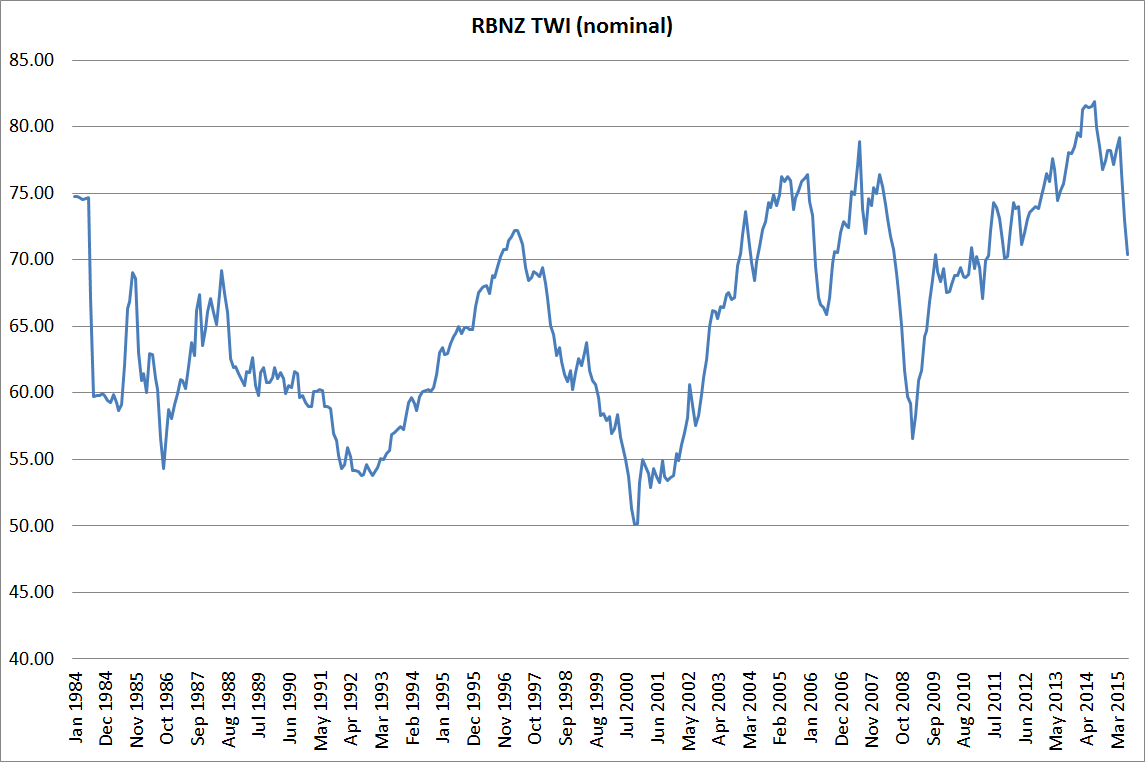
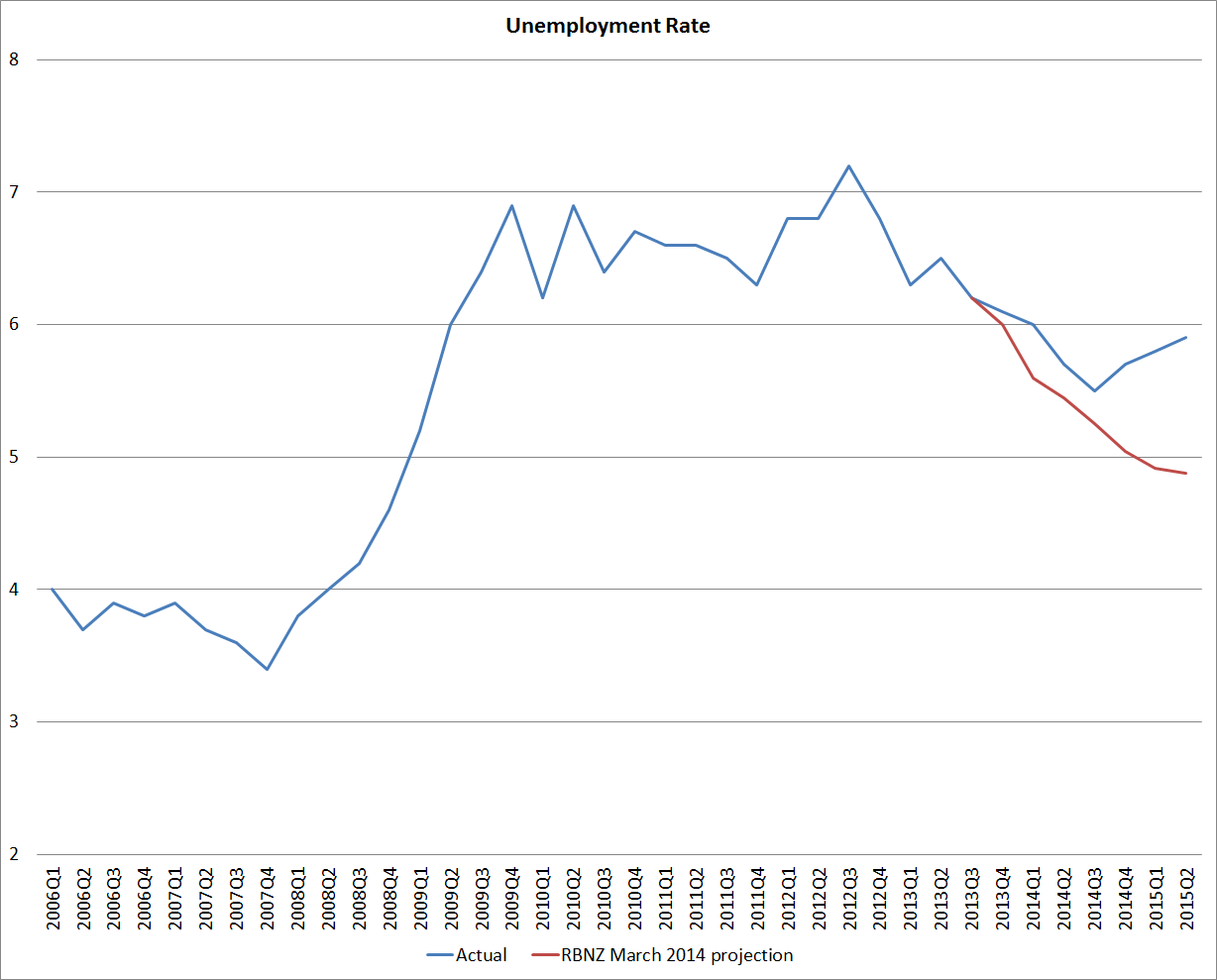
The red line in this chart is what the Reserve Bank thought was going to happen to the unemployment rate last March – the numbers from the March 2014 MPS projection. The blue line, by contrast, is what actually happened.

hlfs error

The first OCR increase was announced in March 2014. It takes a little while for monetary policy changes (even expected ones) to have much of an effect on the economy. By the September quarter of 2014, the unemployment rate had reached what now appears to have been a trough. Even by them, the unemployment rate hadn’t been falling as fast as the Reserve Bank expected. And since then, the divergence has grown materially. The Bank had expected the unemployment rate would be 4.9 per cent by now. In fact, SNZ tell us, it is 5.9 per cent. That is a difference of around 25000 people. And unemployment doesn’t just affect the people who are unemployed, but their spouses and families as well.

Is it all down to the Reserve Bank’s misjudgement? Probably not – and there is noise in the series – but monetary policy is our principal macroeconomic stabilisation tool. Mistakes on this scale, when there was no pressure to tighten in the first place, have to be sheeted home to those responsible. That is, very largely, the Governor.

Optimists have told stories about the unemployment rate holding up mainly because of rising participation rates. But participation rates have been rising in much of the OECD, and since September New Zealand’s participation rate has risen by only 0.2 percentage points.  It doesn’t explain the difference. The Reserve Bank seems to credit surprisingly high immigration with boosting unemployment, in defiance of all the evidence (and its own research) that shocks to population affect demand more than they do supply in the short-term.

The HLFS is a sample survey, and occassionally it does seem to give slightly rogue steers (notably the increase in the unemployment rate in 2012), but this time it doesn’t seem inconsistent with most of the rest of the labour market data, and in particular the absence of any resurgence in wage inflation. The uncomfortable truth seems to be that after rising more than 3 percentage points during the recession, the unemployment rate at 5.9 per cent is only about 0.5 percentage points below the average level for 2009 to 2012.

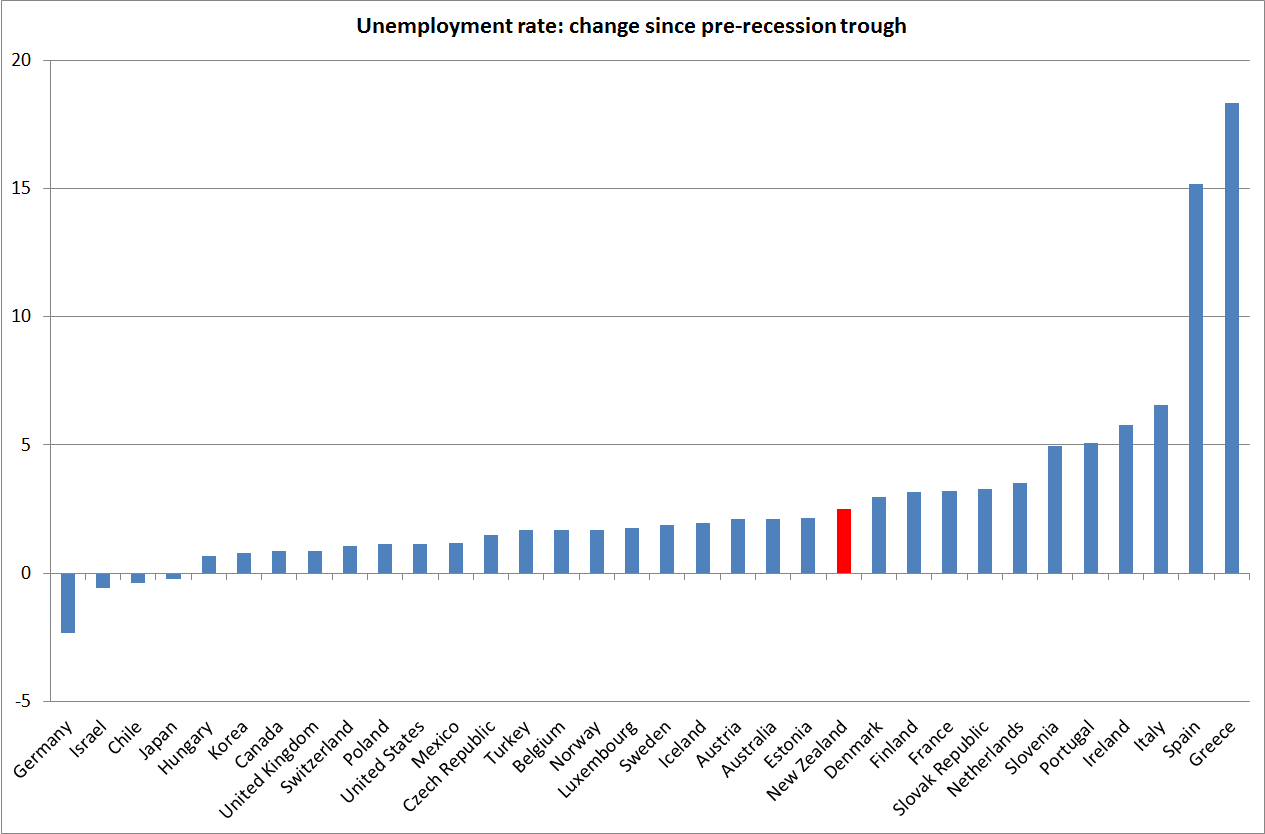
This is no small failing. Among all the OECD countries, the only ones whose current unemployment rates are higher, relative to pre-recession lows, are a group of countries in the euro-area with no ability to adjust monetary policy at all.
OECD U

Sometimes a rise in unemployment is unavoidable. And forecasting is a mug’s game. But with what was always an anaemic recovery (by historical standards), with very weak price and wage inflation, and no external constraints (eg ZLB) on macroeconomic policy, there was no pressure on the Reserve Bank to tighten when it did. They could have held their hand, and let the numbers unemployed continue to fall. But they didn’t.

As I noted last week, I wonder how Graeme Wheeler explains this to the, now, 148000 unemployed people when he meets any of them? I really do.

In Fran O’Sullivan’s column in today’s Herald there is a report of the recent Minter Ellison Rudd Watts’ 2015 Corporate Governance Symposium in Auckland on Monday, attended by, inter alia, a number of “leading independent directors and chairs”. Participants were addressed by various independent directors, and O’Sullivan notes:

It was said that while the regulatory and social pressure on major organisations mounts, the 24-hour news cycle is shrinking to 24 minutes and accountability is increasing.

Where, the unemployed might wonder, is the accountability for the Governor?

Dairy: another day, another price slump

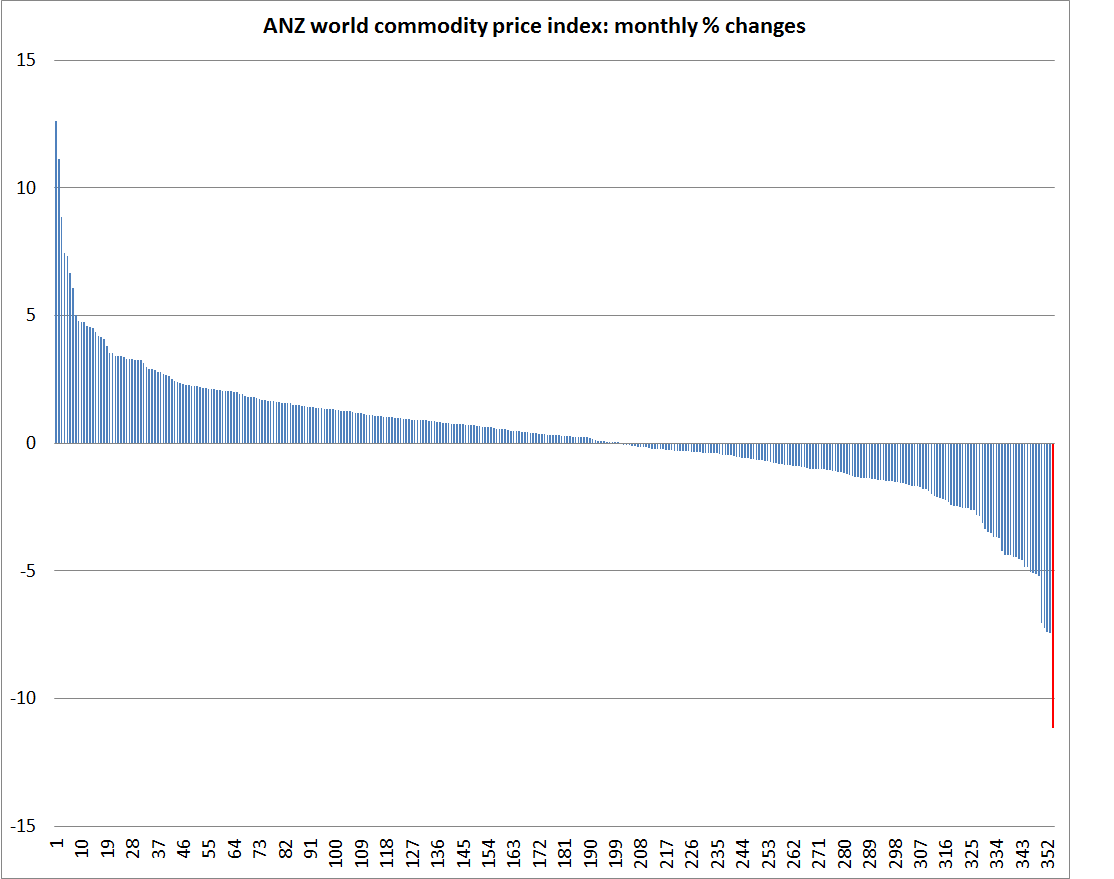
In the last 24 hours we’ve had two gloomy headline indicators out. The ANZ Commodity Price Index for July was out, with a record 11 per cent fall in the world prices of New Zealand export commodities. And the latest GDT auction saw another 10 per cent fall in whole milk powder prices, with portents of further falls to come.

Neither piece of news was that surprising on the day, but to say that is to risk underestimating the severity of what has been going on.

As the ANZ notes, the latest fall was the largest fall in the almost 30 year history of their series. What they didn’t mention is that it was the largest fall by a large margin. By an even larger margin it was the largest monthly fall in world dairy prices.

anz monthy changes

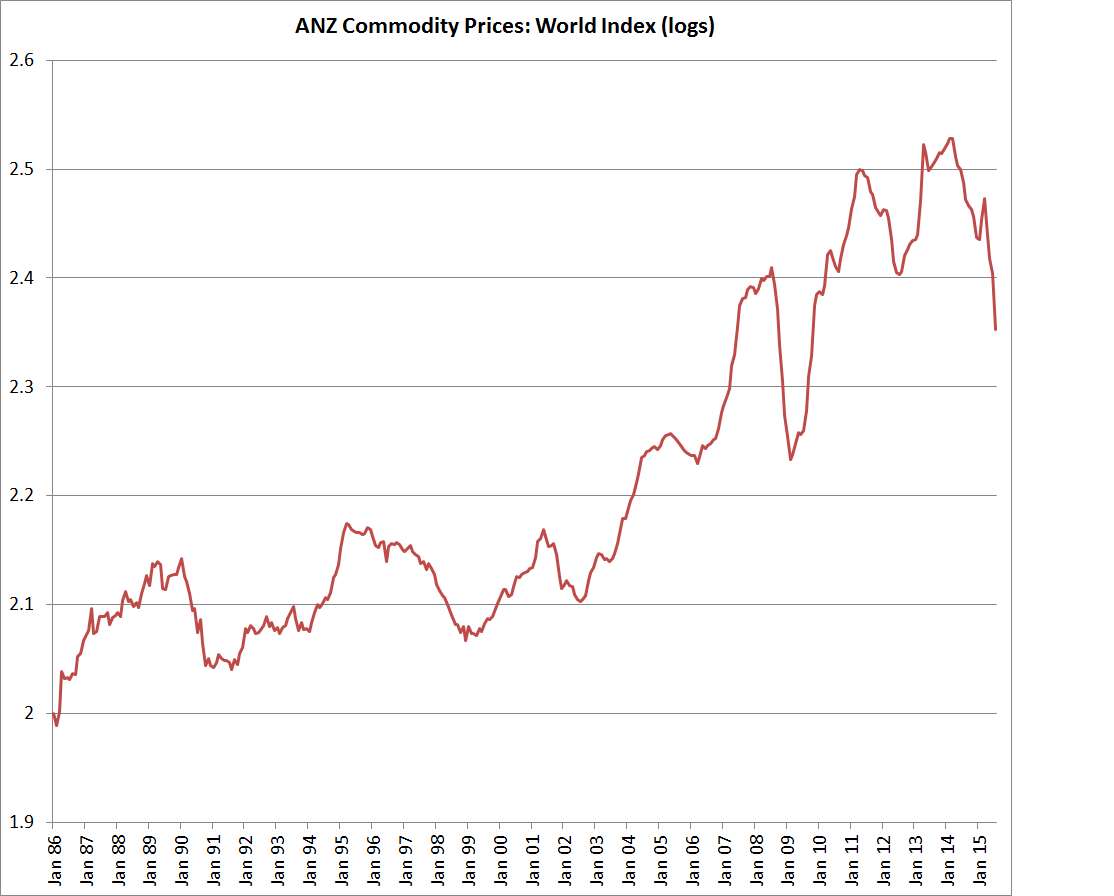
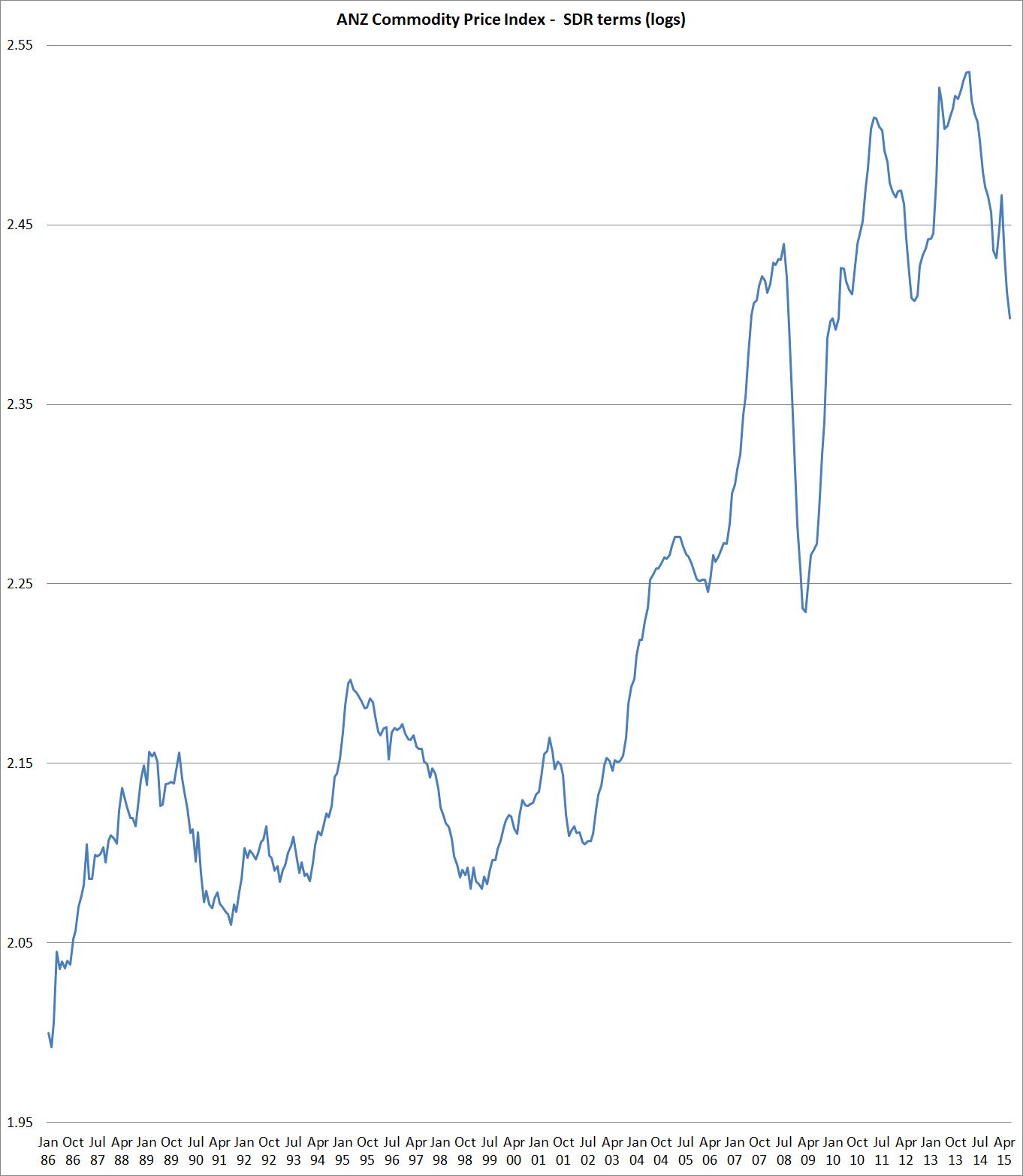
On the ANZ measure, the scale of the fall in commodity prices in the last year or so now matches what happened during the 2008/09 recession.

ANZ Commodity

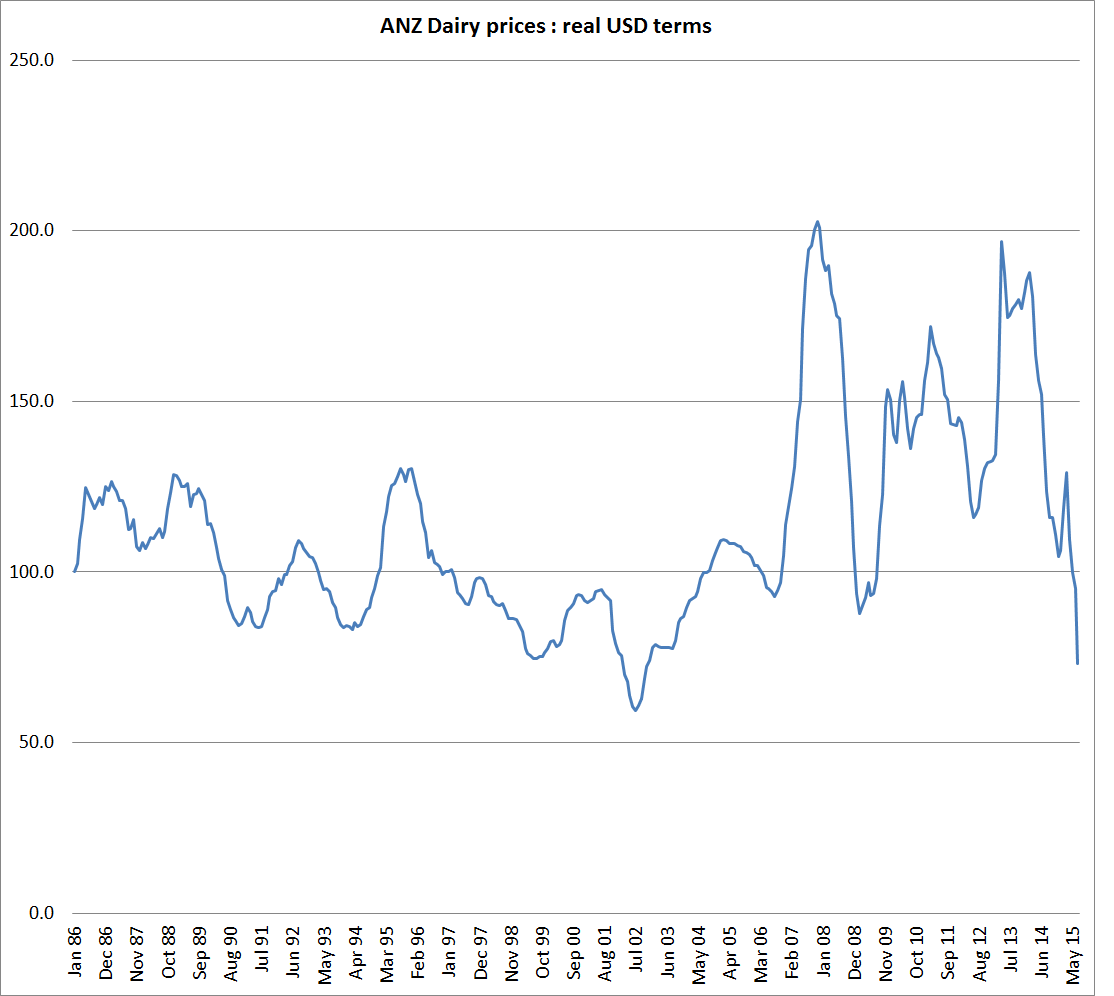
For dairy prices themselves, the fall in the GDT index now materially exceeds the scale of the fall in 2008/09. Real dairy prices now appear to be around the lowest levels for 30 years – although not necessarily at levels wildly inconsistent with trends up to 2006.

ANZ commodity real USD dairy

The fall in commodity prices didn’t cause New Zealand’s recession in 2008/09. A drought didn’t help. Neither did lingering inflationary pressures that for a while made the Reserve Bank reluctant to cut the OCR. And, of course, there was the recession that engulfed the rest of the world, which in turn helped exaggerate the fall in commodity prices. So I’m not suggesting that the falls in New Zealand commodity prices necessarily mean we are now heading for negative GDP quarters, but the loss of national income is now large and the risks of some pretty bad outcomes must be rising. There are no forces operating in the other direction, to boost growth rates. The real exchange rate is only around 10 per cent below the average for the previous couple of years – as I pointed out the other day, that is a pretty modest adjustment by historical standards.

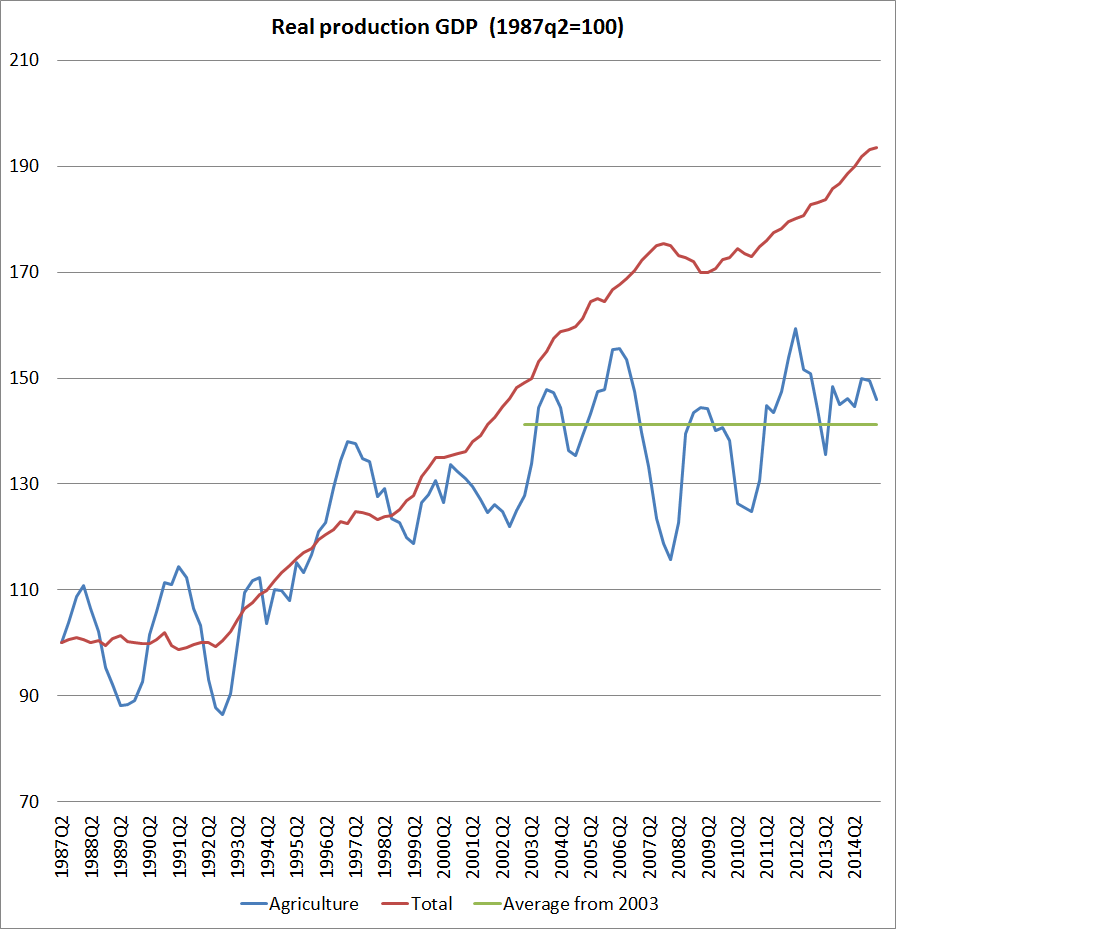
For a few years, I’ve been intrigued by how little growth there has been in real value-added in the agricultural sector. The terms of trade have been high, and in particular world dairy prices have been high, and yet over 10 years or so there has been almost no growth in what SNZ record as real value-added in the agricultural sector. Here is the most recent version of a chart I’ve run previously.

agriculture real GDP

Total factor productivity growth in agriculture has also been quite remarkably weak.

I’ve noted previously that some of this may have reflected the incentives of rising prices. It is well-known that dairy production processes have become much more input-intensive over the last decade or more.   Much of that is about supplementary feed, but it also includes irrigation and other more capital-intensive production models.  In principle, in the face of high product prices these additional inputs could improve the profitability of the agricultural sector, even though the real (constant price) value-added is not increased. If more inputs are being used to produce more outputs, and those outputs can be sold profitably, then it is just one of the ways in which farmers (and their suppliers) capture the benefits of the rising terms of trade.

I was never sure quite how persuasive that reassuring story was. But a reader has got in touch to point me to some papers which suggest that things might be nowhere near as rosy as that story suggests. A basic proposition of economics is that one should produce to the point where the marginal revenue from the additional production equals the marginal cost of doing so. Beyond that point, one starts losing money on every additional unit of production.

I don’t suppose anyone imagines that this model exactly describes how any single business actually operates.   But it is a tendency towards which economists typically, and implicitly, assume that firms in a competitive market will gravitate.  Why, for example, would one produce more if you were going to lose money on each new unit of production. And in the rural sector, where land is huge component of inputs, a farmer generating the highest rates of profit should be able to bid a higher price for land. Resources should gravitate to those best able to use them.

But there is no guarantee of this happening, especially over relatively short periods of time.

In their paper “The intensification of the NZ Dairy Industry – Ferrari cows being run on two-stroke fuel on a road to nowhere?”, presented at an agricultural economics conference last year, Peter Fraser and two co-authors (Warren Anderson, an academic at Massey, and Barrie Ridler,a Principal at Grazing Systems Limited) argue that many New Zealand dairy farmers have been applying anything but the principle of producing until marginal revenue equals marginal cost.  I spent quite a bit of time working with Peter during the 2008/09 dairy price crash – I knew about debt but he (at MAF) knew, and taught me, a lot about dairy. I have a lot of time for his (often-trenchantly-expressed) views.

Fraser et al argue that most of the farm models used by farmers and their advisors in New Zealand take an average cost approach rather than a marginal cost approach, which is inducing increases in production beyond the point of profit maximisation.

none of the mainstream dairy industry farming simulation models (e.g. the Whole Farm Model, Farmax, DairyMax, Udder) and performance measures (e.g. information derived from Dairy Base or Red Sky, benchmarks such as milksolids per hectare, average profit per hectare, gross farm returns, production at x percentile, etc.) are economic models or measures as none employ marginal analysis. As a result, none can profit maximise at a farm level and all are likely to lead to a production decision where marginal costs are greater than marginal revenue.

They argue that this misinformation has not been driven out by competitive processes partly because many dairy farmers are not necessarily setting out to be profit-maximisers.

The corollary is that if farmers are focused on accumulating assets then a ‘satisficing’ position of having sufficient cash flows to pay drawings and to service debt is likely to suffice. Critically, this can also explain why more resources are flowing into the dairy industry: farmers are willing to borrow (and banks willing to lend) in order to accumulate assets (and potentially realise [untaxed] capital gains, especially if converting a dry stock farm into a dairy farm, as this is akin to property development).

In short, a combination of systemic misinformation combined with farmer motives can go a fair way towards explaining why a $10 note may be left on the pavement after all.

One can debate whether this explanation for why is wholly persuasive (the more aggressive dairy developments in recent years, seem far removed from the traditional Waikato or Taranaki (satisficing?) family dairy farmer), but the fact that many farmers are not getting good marginal-based advice and analysis does seem reasonably clear.

Fraser et all go on to support their case with results from a Lincoln University model farm, suggesting that using more sophisticated models (using marginal analysis) profit maximisation would typically result from milking fewer cows (per hectare).

The argument appears to be that much of the growth in total milk production in New Zealand in recent years (perhaps 10-15 per cent of total production) is resulting from an average-cost led focus on boosting total production, rather than maximising profits. Even at the higher prices that were prevailing until recently, production volumes should probably have been lower (the authors also note the potential environmental benefits).

Quite how all this feeds into thinking about the current situation, and the likely response to falling payouts, I’m not sure.   Marginal revenue is plummeting, and even an average-cost based approach would presumably lead to some reduction in production. On the other hand, there is an awfully large stock of debt to service, and maintaining production levels remains sensible if (but only if, and only to the extent that) current payouts are covering short-run marginal costs.

Relatedly, a reader notes:

I would contend that the family farming structure adapts more readily to the pressure of a price slump. The corporates’ general means of survival is by committing more capital to sustain an existing production plan. Family farms shift more quickly into survival mode and if the household has a trained nurse or teacher sends her back to work to support the family household! The dairy industry in its drive to maximise total production has blithely discarded the flexibilities inherent in the cooperative based systems developed over the previous 150 years. It seems there may be a price to be paid for that negligence.

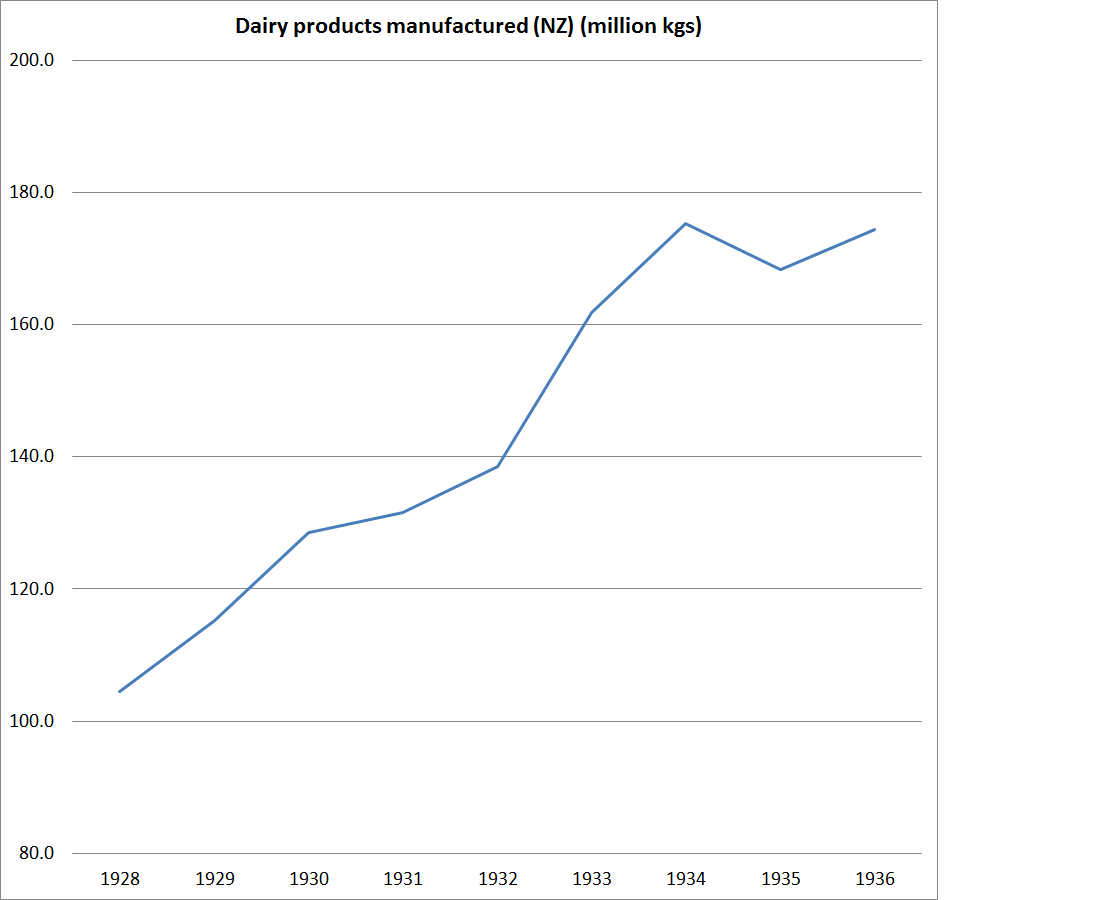
On which note, however, I have long been struck by the production response of the New Zealand dairy industry to the collapse of export prices in the Great Depression   If one didn’t price the farmer’s family labour, short-run variable marginal costs were presumably extremely low, and there was a great deal of debt to service.

dairy depression

I don’t claim expertise in this area, but I found the analysis stimulating and one reconciliation for those otherwise puzzling GDP data I showed earlier. It does look as though participants in the industry will need to think harder about how best to maximise returns, not just production. I like driving obscure and remote roads when we travel the country on family holidays, and I’m often prompted to wonder about the economics of collecting milk from the remote suppliers that linger in such places, and just how long that can go on.  On its own that is a small issue, but perhaps symptomatic of an industry not yet adequately focused on medium to long-term profit maximisation.   Industry structure issues often crop up in the context of discussions like this.  Co-operative structures or not should be a choice for farmers – and they are common internationally in the dairy sector – but direct government legislative interventions facilitated the existing, less than fully competitive, industry structure. So far, the gains to New Zealand from having done so are less than fully apparent.

Why have interest rates fallen so much?

When the Bank of England launched its new blog a while ago I suggested that, despite the promotional material suggesting it would publish materially challenging current orthodoxies, that seemed unlikely – unless, that is, it was to be a vehicle for challenging orthodoxies that senior management themselves wanted to challenge.

I haven’t seen any sign of orthodoxies challenged so far. But, on the other hand, the blog has proved an excellent vehicle for Bank of England staff to give greater visibility to work on a range of interesting, mostly empirical, economics and finance issues. And to do so in bite-sized, not overly technical, chunks.

A while ago I ran a series of posts (eg here and here) on why New Zealand’s real interest rates had been so persistently high relative to those in other advanced countries. Our real interest rates are much lower than they were 20 years ago, but so are those pretty much everywhere.

interest1

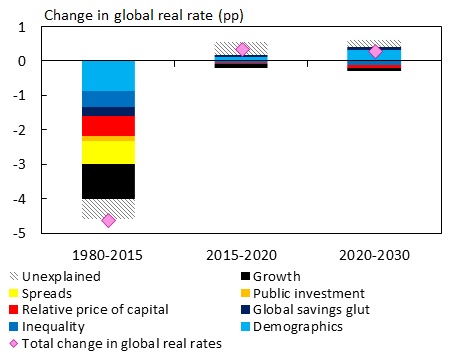
Over the last few days, two Bank of England blog posts (here and here) have looked at what lay behind that global trend decline – of around 450 basis points since 1980.   They use as a framework the idea that observed real interest rates, at least at a global level, reflect the interaction of desired savings rates and desired investment rates. At the global level, actual savings and actual investment are equal ,and the real interest rates adjust to reconcile any ex ante differences.

The authors identify a number of factors which they estimate can explain perhaps 90 per cent of the fall. These includes slowing global population growth, falls in desired public investment spending, the falling price of capital goods, an emerging markets “savings glut”, rising income inequality, slower growth rates, and so on. Here is their summary picture.

BOE world real rates

And here is how they apply the framework to thinking about the next few years.

Our framework allows us to speculate what will happen next (Figure 6, above). The big picture message is that the trends we have analysed are likely to persist: we do not predict a big further drag, or a rapid unwind of any of these forces. Some are likely to drag a little further (global growth is set to decline further out; the relative price of capital is likely to continue to fall; and inequality may continue to rise); but this will be broadly offset by a rebound in other forces (particularly demographics).  What happens to the unexplained component depends on what’s driving it. In Chart 6 we illustrate the implications of assuming it is largely cyclical. Despite that, this would still imply global neutral rates will stay low, perhaps around 1% in real terms over the next 5 years.

I don’t find every detail persuasive, but the broad story rings true. Interest rates (short or long term) are not low because of central banks, but because of rather more fundamental forces. And few of those seem likely to reverse any time soon.

Perhaps it would be helpful if the authors had been able to interpret their results for the last 35 years in a much longer historical context. Even if we can explain the fall in real interest rates since 1980, it is much harder (I suspect) to provide a compelling reason for why interest rates are now so much lower (in most countries) than at any time for hundreds of years.  Rapid population growth, for example, was substantially a post-WWII story.  But perhaps that reconciliation is one for another author.

In a New Zealand context, I remain fairly convinced that demographics have played a material role in explaining interest rate pressures here.   In particular, the policy-driven component, of our immigration policies over the decades.   As one small component of a world economy, the argument is not as straightforward as for the world economy as a whole. But with one of the faster population growth rates in the advanced world, it should not be any great surprise that we have seen persistent pressure on our real interest rates (and, hence, on the real exchange rate). We’ve shared in most of the fall in global interest rates, but there has been no sign of any closing in the large trend gap. In the 1950s and 1960s those pressures showed up in tight credit controls and import controls etc (to suppress demand by fiat).  Since liberalisation they have shown up as persistently higher average interest rates than those in the rest of the advanced world. As a result, business investment has been quite subdued, and what business investment there has been has been concentrated more heavily in the non-tradables sector than one might have otherwise expected in an economy that had undergone the sort of liberalising reforms New Zealand undertook in the 1980s and early 1990s.

Why?

Fossicking round in some old legislation yesterday, I stumbled on the Music Teachers Act.  I’d assumed this was one of those pieces of legislation that might have gone the way of Raspberry Marketing Regulations 1979, that governed the New Zealand Raspberry Marketing Council until 1999.

But no, the Music Teachers Act is still on the statute books.  It is

An Act to consolidate and amend the Music Teachers Registration Act 1928, and to make better provision for the registration and control of music teachers and the advancement of music teaching.

The prime function of the Act is to establish and govern The Institute of Registered Music Teachers of New Zealand, again with the statutory purpose of

Purposes of institute

  • The purposes of the institute shall be––

    • (a) to promote the general advancement of music teaching, and the acquisition and dissemination of knowledge and skills connected with music teaching:

    • (b) to protect the interests of music teachers in New Zealand:

    • (c) to protect and promote the interests of the public in relation to music teaching:

    • (d) to hold conferences on music teaching and related subjects:

    • (e) to publish a year book, giving an account of the proceedings of the institute, the names of persons currently registered under this Act, and such other matters as may be of interest to members of the institute:

    • (f) to grant prizes, scholarships, and financial or other assistance to any person or organisation that may further the aims of the institute:

    • (g) to administer the fund known as the Helen Macgregor Tizard Benevolent Fund, previously administered by the Music Teachers Registration Board of New Zealand.

Some of these might be worthy enough objectives in some lights, but where is the public policy interest?  And especially in protecting “the interests of music teachers in New Zealand”.  Consumers’ or customers’ interests perhaps, but legislation to protect the interests of music teachers.

The Institute seems to have no powers over anyone, and appears to do some worthy stuff.  But why does it need a statute to make such a body function effectively?  If it offers good courses, or even certification, surely it can do that on its own merits?   The New Zealand Association of Economists, for example, has no statutory backing.

I asked my children’s piano teacher yesterday what he knew of the Act, or the Institute.  He is a smart young guy, who is active in music teaching programmes in schools and privately.  And he had never come across the body.

So perhaps the Act does both little harm and little good. In other words, it is largely irrelevant.  Those of us hiring music teachers presumably do so mostly the old-fashioned way –  by repute, and word of mouth.  And we keep them on if we judge that they are helping our children learn.

For decades, governments have been reluctant to tackle occupational licensing (which is nowhere near as pervasive here as in the United States). But for a third term government with a light legislative agenda, perhaps this is one bit of ever-burgeoning statute books that can quietly be repealed.

(Right after they secure the freedom to fly remote-controlled toy helicopters in the local park.)

What legislation used to require of monetary policy

This was what section 8 of the Reserve Bank Act, and associated provisions, replaced.  It is easy to forget –  and for many younger readers, never to have been aware –  just how different things were.  Of course, we had a singe decision-maker back then too, although as Minister of Finance and an elected MP, the single decision-maker could be (and often was) tossed out of office.

8. Primary functions of Bank

(1) The primary functions of the Bank

shall be—

(a) To act as the central bank for New Zealand; and

(b) To ensure that the availability and conditions of credit provided

by financial institutions are not inconsistent with the sovereign right of the Crown to control money and credit in the

public interest; and

(c) To advise the Government on matters relating to monetary policy, banking, credit, and overseas exchange; and

(d) Within the limits of its powers, to give effect to the monetary policy of the Government as communicated in writing to the Bank under subsection (2) of this section, and to any resolution of Parliament in relation to that monetary policy.

(2) For the purposes of this Act, the Minister may from time to time

communicate to the Bank the monetary policy of the Government, which shall be directed to the maintenance and promotion of economic and social welfare in New Zealand, having regard to the desirability of promoting the highest level of production and trade and full employment, and of maintaining a stable internal price level.

(3) The Bank shall, as directed by the Minister, regulate and control on behalf of the Government—

(a) Money, banking, banking transactions, any class of transactions of financial institutions, credit, currency, and the borrowing and lending of money:

(b) Rates of interest in respect of such classes of transactions as may from time to time be prescribed:

(c) Overseas exchange, and overseas exchange transactions.

(4) The Bank shall make such loans to the Government and on such conditions as the Minister decides from time to time, in order to ensure the continuing full employment of labour and other resources of any kind.

For those interested in the history, and how the functions/objectives/powers provisions changed (as they repeatedly did –  this was the 1973 formulation) there is an interesting Bulletin article here by Christie Smith and James Graham.  In case anyone thinks my post this morning was a recantation of a commitment to monetary stability (which it certainly wasn’t) I remain proud of the fact that my grandfather’s cousin was the Minister of Finance who introduced the concept of a stable internal price level to the Reserve Bank Act, and removed the formal power for the Minister of Finance to direct the Bank.  Those changes didn’t last long.

Should the statutory objective for monetary policy be changed?

Since 1989, section 8 of the Reserve Bank of New Zealand Act has read as follows:

The primary function of the Bank is to formulate and implement monetary policy directed to the economic objective of achieving and maintaining stability in the general level of prices.

That provision was widely seen as one of the centrepieces of the new Reserve Bank Act in 1989. It does not directly guide day-to-day monetary policy, but rather it should constrain the Minister and the Governor in negotiating Policy Targets Agreements (PTAs). PTAs must, by law, be consistent with section 8: as the Act puts it, the targets are “for the carrying out by the Bank of its primary function”.

The wording raises a variety of geeky questions.   Should, for example, the Act really describe monetary policy as the Bank’s “primary function”, or just treat monetary policy as one of a variety of functions Parliament assigns to the Bank?   Is it really sensible to talk of stable levels of prices, when neither the Bank (nor ministers, nor Treasury) has ever shown any interest in stabilising the level of prices, as distinct from the rate of change in those prices (“the inflation rate”). More troublingly, perhaps, can a medium-term trend inflation rate of 3 per cent (which we had got up to prior to the 2008/09 recession, and which would double prices every 24 years) really be described as “price stability”?

I’m not going to try to answer those questions today. But they illustrate that there is no particular reason to think that the current specification of section 8 should be treated as sacrosanct. My impression over many years at the Reserve Bank was of a tendency (I may have shared this attitude at times) to treat section 8 as the battle standard of orthodoxy, such that any change would be akin to allowing the barbarians to overrun the fortress.

Going into last year’s election, each of the Opposition parties (Labour, Greens, New Zealand First, Internet-Mana) was campaigning to change section 8 of the Reserve Bank Act.   Of course, typically they were looking for rather more change than just a change of overarching statutory objective, but two parties were quite specific in what they were looking to do with section 8 itself

In Labour’s case, as I noted a couple of weeks ago, they came up with this formulation

“The primary function of the Bank with respect to monetary policy is to enhance New Zealand’s economic welfare through maintaining stability in the general level of prices in a manner which best assists in achieving a positive external balance over the economic cycle, thereby having the most favourable impact on the stability of economic growth and the level of employment.”

And New Zealand First has sought to introduce legislation amending section 8 to read as follows:

The primary function of the Bank is to formulate and implement monetary policy directed to the economic objective of maintaining stability in the general level of prices while maintaining an exchange rate that is conducive to real export growth and job creation.”

In both cases, it would appear that the framework of a Policy Targets Agreement would continue.   Labour was quite explicit about maintaining the inflation target.

In fact, looking around the world’s advanced economies there is a wide variety of ways in which countries have written down what they are looking for from their central bank and monetary policy. In a fairly short issue of the Reserve Bank Bulletin published late last year, Amy Wood and I looked at the wide variety of ways legislation is written in 18 advanced countries (or regions in the case of the euro) that now use inflation targets as the day-to-day centrepiece of monetary policy.

There are big differences across countries. Some of those differences are about the age of the legislation. Old legislation looks quite different from newer legislation. Some is probably about the preferences of legislative drafters in different countries. And one important difference that became apparent is that in some countries they have written a limited statement of what a central bank can directly achieve, while in others they have written more about the longer-term desired outcomes that might flow from good monetary policy. And while acts of Parliament are one part of the mix, they often aren’t the only place in which society’s aspirations for monetary policy are set down.

At one extreme, in Sweden the only formal document – the central bank act – simply states that the goal of the Riksbank’s monetary policy is “price stability”. There are no other formal or binding documents (although there are plenty of Riksbank texts on what current governors interpret the Act as meaning).

The US legislation, by contrast, is a mix of medium-term objectives (things the central bank might more directly affectl) and desired outcomes from good policy. The Federal Reserve Act requires the Fed to “maintain long-run growth in the monetary and credit aggregates commensurate with the economy’s long-run potential to increase production”. Stable money growth was the thing the Fed could directly influence. But the Act goes on to state that this is to be done “so as to promote effectively the goals of maximum employment, stable prices, and moderate long-term interest rates”. Congress didn’t care about money supply growth for its own sake, but for the things that are thought to flow from it.

The Bank of Canada operates under very old legislation. The Bank is required to “regulate credit and currency to control and protect the external value of the national monetary unit” (this dates back to before the era of floating exchange rates), but again it does not do this simply for its own sake. Rather, Parliament goes on to explain that the desired outcome of monetary policy is “to promote the economic and financial welfare of Canada”

I could go on. Even the ECB, established by treaty rather than by national legislation, operates under provisions which state that while the primary objective is “price stability” a variety of good things that should flow from the work of the ECB specifically and the EU more generally (eg “…stable prices, sound public finances and monetary conditions and a sustainable balance of payments”).  When I first stumbled on that last clause, about a sustainable balance of payments, I wondered if the Labour Party people were aware of it.

In many countries, even with quite recent legislation, there is an explicit obligation on the central bank to work together with, or support, other government economic policies, at least so long as doing so does not threaten the primary price stability goal,

What about the New Zealand situation?

Section 8 of the Act is pretty clear and succinct about what monetary policy is for, but nature tends to abhor a vacuum. Trace through the evolution of the Policy Targets Agreements since 1990 and you will more and more stuff written down, that was previously unwritten and somewhat taken for granted. But political pressures and criticisms of the Bank saw more and more details added in.  The 1992 PTA was perhaps the most cut-down approach.

Price Stability Target Consistent with section 8 of the Act and with the provisions of this agreement, the Reserve Bank shall formulate and implement monetary policy with the intention of maintaining a stable general level of prices

But in late 1996, a revised PTA was signed as part of the National-New Zealand First deal. It moved beyond just writing down the direct stuff the Bank could manage, to articulating what the point of pursuing price stability was.   The ‘so that” language that Winston Peters introduced here paralleled the “so as to” in the Federal Reserve Act.

Price Stability Target

Consistent with section 8 of the Act and with the provisions of this agreement, the Reserve Bank shall formulate and implement monetary policy with the intention of maintaining a stable general level of prices, so that monetary policy can make its maximum contribution to sustainable economic growth, employment and development opportunities within the New Zealand economy.

In 1999, in the wake of the MCI debacle, Michael Cullen added this provision.

In pursuing its price stability objective, the Bank shall implement monetary policy in a sustainable, consistent and transparent manner and shall seek to avoid unnecessary instability in output, interest rates and the exchange rate

It isn’t in the Act, but it is no less binding on the Governor (and successive Governors who have signed it). Unfortunately, as I noted last week, it is a somewhat troublesome clause, in that no one has ever been sure quite what the practical import was. At one level it was uncontroversial – avoid “unnecessary instability” – but quite what is “necessary”?

In 2002, Michael Cullen and Alan Bollard reformulated clause 1, restoring a clean focus on price stability in a), which just mirrors section 8 of the Act, while adding a separate sub-clause outlining what the government’s economic policy was looking for, and a sense of how price stability contributes.

Price stability

a) Under Section 8 of the Act the Reserve Bank is required to conduct monetary policy with the goal of maintaining a stable general level of prices

b) The objective of the Government’s economic policy is to promote sustainable and balanced economic development in order to create full employment, higher real incomes and a more equitable distribution of incomes. Price stability plays an important part in supporting the achievement of wider economic and social objectives.

With a change of government in 2008 there was a change in economic policy goal

The Government’s economic objective is to promote a growing, open and competitive economy as the best means of delivering permanently higher incomes and living standards for New Zealanders.  Price stability plays an important part in supporting this objective.

And finally in 2012, the words –  already present in section 10 of the Reserve Bank Act since 1989 – about having regard to the efficiency and soundness of the financial system in conducting monetary policy were added.  Quite what these words mean in practice is also less than clear –  even after 26 years.

No other countries have a binding legal arrangement akin to the Policy Targets Agreement.

There is a wide variety of ways in which countries, with very similar practical monetary policies, write down what they want from their central banks.  So the current wording of section 8 should not be sacrosanct –  the only possible way sound money could be preserved.  Personally, I would have no great objection if the wording introduced to the PTA in 1996 were to be translated in an amended section 8 of the Act.    I’d probably have slightly more problem with the Labour Party’s version from the manifesto last year, but ultimately it is for politicians to lay out higher level objectives for the Reserve Bank, and monetary policy.

But, and in a sense this is the point of the Bulletin article, those sorts of alternative formulations would not, on their own, be likely to make any material difference to the way monetary policy was run.  Practical differences flow from different Governors and different Policy Targets Agreements.  If political parties want actual practical differences in how monetary policy is run, they need to look to what they are negotiating in the PTA, and with whom.  As it stands, although the Reserve Bank has made more than its fair share of policy mistakes, evidence suggests that in normal times it has responded to incoming data in much the same way as central banks in Australia, the US, or Canada do.  And legislatures in each of those countries have written things down in rather different ways, to each other and to New Zealand.

There is no harm in amendments that may have little practical impact.  Symbolism matters, and since few would argue that  price stability should be sought for its own sake, there should be no strong objection to writing down in statute what it is hoped that good monetary policy will help contribute to.  Indeed, I would argue that it is better to write it down in statute than to keep fiddling with the Policy Targets Agreement. PTAs can be signed in the dead of night, perhaps involving two people only, as part of bundles of post-election negotiations.  The first the public know about the new terms is when the parties publish the signed document.  By contrast, even in New Zealand, the legislative process is usually much more open and transparent. Bills typically go to select committees, which invite submissions and review the arguments from outsiders before making recommendations.  And the hurdle of making changes in law is higher than for the PTA –  which has become something each change of government feels obliged to change.

I would favour amending section 8.  We need to face the fact that New Zealand is probably the only advanced country in which monetary policy has been repeatedly an election issue.  There has not been an election since 1987 in which one or other party was not campaigning on changes to the Act or the PTA.  That is no passing discontent.

Changing section 8 isn’t the biggest issue to address is reforming the Reserve Bank, but it shouldn’t be treated as of no importance either.

Since I’m not a die-hard inflation targeter either, I would favour something along these lines

Monetary policy shall be formulated and implemented towards the economic objective of maintaining medium-term stability in the purchasing power of the New Zealand dollar, so as to  maximise the medium-term contribution monetary policy makes to full employment and to the economic and social welfare of the people of New Zealand.

With such a clause, clause 4b –  the troublesome clause about avoiding unnecessary variability – should be able to be junked.  Parliament will have made clear that the whole point of the Bank is to promote good economic outcomes, and the longer-term interests of New Zealanders.  But don’t lose sight of the fact that New Zealand’s real medium-term economic failures have little or nothing to do with the conduct of monetary policy, or the way the Reserve Bank Act is written.

Of course, there still will –  and should  –  be vigorous debates about what intermediate targets the Bank should be required to pursue.  Many will favour the status quo, others might favour NGDP targets, and some might come to favour wage growth targets.  Some might favour a more active role in exchange rate smoothing. But those debates too should be carried on openly.  As I’ve argued before, the Minister of Finance and the Treasury (with or without the cooperation of the Bank) should already be planning an open process for consideration of issues before the next PTA will be due in 2017.  As 2017 is election year, the earlier the better really.

Of course, there is probably another debate to be had, before the Act is next comprehensively reviewed, as to whether there should be a single overarching objective for monetary policy and financial regulatory policy.  I think that would be a step in the wrong direction.  They are two quite different functions, just as monetary policy and fiscal policy are quite different.  But perhaps that is a topic for another day.
The exchange rate “needs” to come down?

I’ve been continuing to reflect on Graeme Wheeler’s repeated observation that New Zealand’s exchange rate “needs” to come down. I’m still not entirely sure what he means. The exchange rate is an asset price and presumably should reflect all expected future relevant information, not just spot information about current dairy prices. And the market has no particular reason to focus on stabilising the net international investment position at around current levels. Indeed, although it is a convenient reference point, neither does the Reserve Bank.

“Need” or not, I’d have thought it was likely that the exchange rate would fall further.

The ANZ Commodity Price Index, which lags behind (for example) falling GDT and futures dairy prices, has already had one of the larger falls in the history of the series.

ANZ Commodity

Meanwhile, the fall in the exchange rate, while material, remains pretty small by the standards of past New Zealand adjustments since the float in 1985. At the moment, the adjustment is comparable to what we saw in the shortlived growth (and risk) scare in 2006.

RBNZ TWI
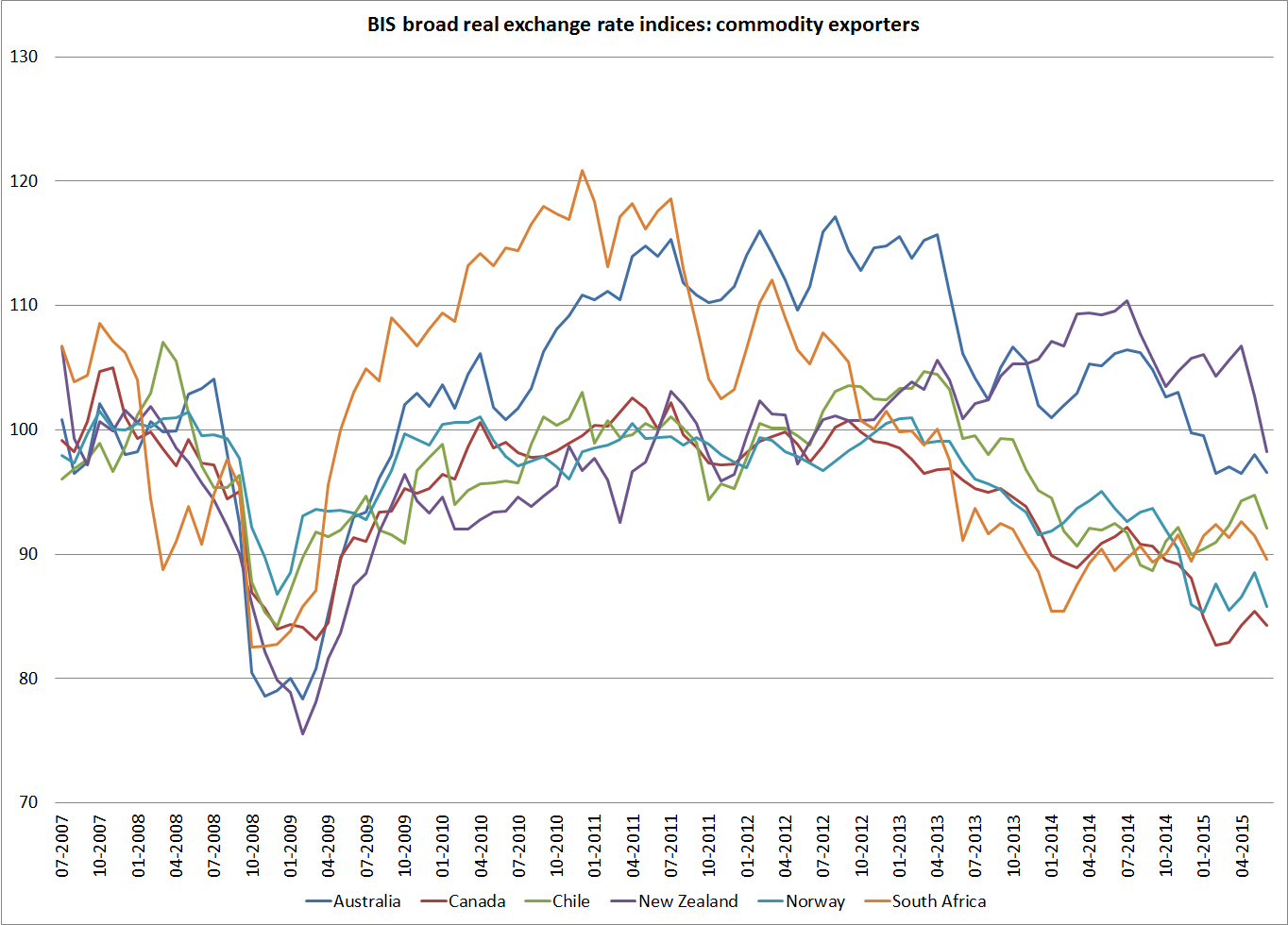
And here are the BIS real exchange rates for the five OECD commodity exporting countries, and South Africa. Each has experienced rather different commodity price pressures and opportunities. Here the exchange rates are each based to 100 at the average for each country in the year to June 2008 just prior to the global recession and crisis.

bis exch rates

New Zealand’s exchange rate doesn’t stand out dramatically, but it remains higher, relative to pre-recession levels, than in these other countries. In part that is likely to reflect yield differentials. New Zealand is the only one of these six countries still to have policy interest rates higher than they were 18 months ago. That is Graeme Wheeler’s choice, and while data may eventually force him to change his view, it is his view that for now determines short-term interest rates on offer in New Zealand