What rates of return do major US firms require to invest?

In my post on Saturday about the appropriate New Zealand public sector discount rate, I linked to an article from the Reserve Bank of Australia’s Bulletin which included the results of a survey in which Australian firms’ CFOs were asked what hurdle rates of return their firm used in evaluating proposed investment projects.

This was the chart of those survey results:

rba hurdle rate

Prompted by a commenter, I was curious whether there was something similar for the US.  I found this JP Morgan piece, undated but apparently from last year, which reports the hurdle rates that some major US firms have disclosed.  Here was the chart, and a little commentary, from that piece.

JPM US hurdle rates

If anything, this small sample of US firms had eve higher hurdle rates than the Australian firms.

In both cases, there are a few companies using hurdle rates as low as the 8 per cent real recommended by New Zealand’s Treasury for evaluating public sector investment and regulatory proposals, but not many.  As JPM point out, these high hurdle rates are a little surprising, and it may be that firms are missing out on some opportunities, but firms are presumably making decisions that appear rational to them, subject to the threat of takeover if they underperform.

Government finances are quite highly cyclical, and it seems to me that we would need a pretty compelling case for encouraging governments –  which face rather weak disciplines –  to use our money more freely than private businesses would do.  Things governments really need to do –  true public goods –  should easily pass high hurdle rate tests.

Birthplaces of our net PLT migrants

The chart below shows the birth countries for the net permanent and long-term (self-identified) migrants for the 14 years ending March 2002 to 2015 (SNZ has a break in the series prior to that).  SNZ don’t break out all the countries, but these are the ones they separately identify.  “Net” is emphasised by the large negative number for the New Zealand-born.

I don’t have a point to make.  I hadn’t had a look at the birthplace data for a while, and I’m always conscious that two of my children are net PLT immigrants, so I was a little curious.

plt by birthplace
A few things surprised me a little, in the second tier of countries.  I was a little surprised at how many people had come from the United States, Japan, Germany and France –  all countries with higher per capita incomes than New Zealand.  Of course, the flows are tiny relative to the respective home populations, and some portion will be people like my kids (New Zealanders born overseas while their parents were working abroad), but it was a flow I was a little surprised by.  Perhaps relatedly, the size of the flow of Australian-born immigrants was interesting –  similar in total to the flow from the United States, despite being closer and despite Australian citizens having free entry.  I wonder what proportion of the Australian-born net flow is the children of New Zealanders who went to Australian for a few years and then came home?

On a somewhat selective account of policy measures affecting the housing market

In the somewhat party-political and evidence-light press release on housing the Reserve Bank has just released…

“Much more rapid progress in producing new housing is needed in order to get on top of this issue. Tax policy is also an important driver, and we welcome the changes announced in the 2015 Budget, including the two year bright-line test, the proposed non-resident withholding tax and the requirement for tax numbers to be provided by house purchasers.”

…it is perhaps not too surprising that, once again, there is no reference to the enhanced first-home buyer subsidies announced, as it happens, a year ago today, as the centrepiece of the Prime Minister’s launch of the National Party election campaign.   We know quite a lot about first home buyer subsidies.  In the presence of supply constraints, all they do is bid up the price of houses (house plus land).  Other countries have tried them (Australia closest to home).  They don’t raise home ownership rates or do any socially useful thing.  And, if the subsidies don’t last for ever (which they often don’t, especially in real terms –  for example, Sir Robert Muldoon had a short-lived one of these subsidies late in his term), they simply increase the risk of a nastier correction in house prices later.  Those corrections are what the Governor, and his deputy, often tell us they are worried about.

You might think it would be inappropriate for an unelected central bank to be commenting on party election promises, even when they become legislated government policy.  And I would have some considerable sympathy with that position.  But the same surely goes for other aspects of tax policy, regulatory policy, government data collection policy and so on (eg the list in the press release), all of which are contentious in some circles or other.  Oh, and was there any mention of the role of immigration policy –  the bit directly controlled by central government?

Today’s papers report on the take-up of the enhanced subsidies. Fortunately, perhaps, Auckland prices are already too high for many potential Auckland buyers to bid prices higher.  But elsewhere, in Tauranga, for example, where people worry about the spillover from the Auckland boom, those who’ve used that subsidy will have bid prices up just a little faster than otherwise.  But no mention of it from the Reserve Bank?

In getting so involved with regulatory matters, that go well beyond its areas of responsibility, the Reserve Bank is playing a dangerous game.   There is a strong, but not unarguable, case for central bank autonomy on monetary policy, but the case is much harder to sustain when the unelected Governor is weighing in, with words and actions, to decide who should and shouldn’t get credit, what general regulatory interventions make sense, and which he thinks don’t.  And when it stays quiet on really bad policy that drives house prices higher, but helped generate some useful headlines in the middle of an election campaign,

The Governor –  and his deputy –  would be well-advised to stick to their knitting.  Get inflation back to around the middle of the target range and keep it there (it would make a change), and focus on indirect instruments (capital requirements) to promote the continued soundness and efficiency of the financial system.  And leave the rest to the political debate, and decisions made by those whom we can hold to account.

Q&A on immigration

As most New Zealand readers will now know, TVNZ’s Q&A programme yesterday featured a debate around the economics of immigration. Unfortunately, the programme got prominence not for anything of substance that was said by the participants, but for a vulgar outburst by Shamubeel Eaqub. It was pretty unfortunate, but then this was the guy who only a few weeks ago was dismissing my analytical arguments as “that’s racist” , and then turned his attention to Fonterra, suggesting they were treating their investors as ‘scum’.

TVNZ got together Don Brash, Shamubeel Eaqub, and Massey University population/immigration professor, Paul Spoonley. They had asked me to go on the programme, but I don’t do work-like things on Sundays.

Don Brash articulated some of my macroeconomic arguments about the impact of our large-scale programme of targeting non-citizen migrants. I’ve argued that in an economy with modest savings, high average immigration inflows exacerbate pressures on real interest rates and the real exchange rate. We’ve had the highest real interest rates in the advanced world for several decades, and a real exchange rate that has been much higher than is consistent with our dismal productivity performance. In combination, the high real interest and exchange rates have squeezed out business investment – our levels have been low for decades – and skewed returns in ways that favour investment in the domestic or non-tradables sectors. Returns from investing heavily to tap world markets just haven’t been there, so even once we opened up our economy, business investment in the tradables sector has been subdued.   None of this is a story about the last 12 months, or any short-term window, it is about average patterns seen over the last 25 years or so.  (Unfortunately, some of the debate got bogged down in the last 12 months’ data.)

One should always try to ensure that one understands the arguments people on the other side are making, so in this post I have tried to identify the various points that Eaqub and Spoonley were making, and offer some comments on them.

Eaqub started out by simply asserting that my arguments were wrong.   He argues that volatility of net immigration is an important issue (“the short-term pressures are absolutely clear”) especially in the context of house prices. He argues that we need to “fix” housing supply responsiveness and associated infrastructure issues. He goes on to claim there is just a failure of political leadership, and that any “infrastructure” issues could be dealt with by more government borrowing, since the government faces no debt constraint.

Of course, I agree that housing supply responsiveness should be improved, and that the central and local government policies that impede these are a scandal.   But he seems to totally miss the point of my argument. Real resources that are used for building houses or “infrastructure” can’t be used for other stuff, and the real exchange rate and the real interest rate move to free up resources to meet these population-based demands. We could have more investment in, eg, Auckland roads, but all else equal that would put more pressure on scarce resources. Meeting the demands of a rapidly rising population squeezes out other stuff – in this case, business investment, especially that in our tradables sector.

Eaqub also asserted at this point that “immigrants are good for New Zealand, as they been for centuries for New Zealand. They’ve increased our human and physical capital base”.

Don Brash challenged him as to whether the increase in the total size of the economy from the large scale immigration programme had had benefits for New Zealanders, noting that productivity growth in New Zealand had been weak for decades. He articulated a story in which the far-reaching reforms of the late 1980s and early 1990s had not reversed that underperformance, even though immigration policy had been materially liberalised at much the same time.

Eaqub responded to this by arguing that “perhaps they weren’t the right reforms”. That is a reasonable possibility to explore, but he didn’t back it up. He said that deregulating the economy had been “fantastic”, and the only policy he cited that he was uncomfortable with was the amount of student debt being “piled on” students.  Reasonable people might have a range of different views on that one, but given the surge in New Zealand tertiary participation over the last 25 years, it is difficult to know what mechanism Eaqub had in mind for how student loans policy might explain much of New Zealand’s economic underperformance.

Eaqub also repeated the argument he made in his recent book that net immigration has not accounted for much of total population growth in the last 50 years. But as I’ve pointed out previously, net migration includes the coming and goings (mostly the latter) of New Zealanders, and that a discussion about immigration policy needed to focus on the flows of non-citizens (the bit the New Zealand government controls). As I’ve explained previously, and as Don highlighted, without non-citizen immigration, our trend population would now be flat or falling.   There would be cyclical population pressures on the housing market, but no trend ones.

The interviewer drew attention to the 2006 Australian Productivity Commission study Don Brash has cited which concludes that any gains from immigration were captured by the migrants, and there was no gain to Australians. Don noted that there was no comparable study in New Zealand and that there is little or no evidence that New Zealand’s immigration programme has improved productivity or economic well-being for New Zealanders.

Eaqub rejected that proposition, advancing as evidence a recent NZIER piece. That seemed rash. The NZIER piece in question is a four page note, and its conclusion were based on a single unreported equation (the Australian Productivity Commission report was, by contrast, hundreds of page long). I went to a discussion on the NZIER paper at Treasury last year, and I think it would be fair to say that even the advocates of immigration who were at that meeting did not find it particularly persuasive. And, in any case, since the single equation looks only at total (per capita) GDP, which combines GDP accruing to New Zealanders and to immigrants, it does not shed light on the specific question at hand: if there are gains from immigration, how many (if any) of them have flowed to New Zealanders as distinct from migrants.  Notwithstanding his claims for this NZIER note, Eaqub actually went on to acknowledge that the bulk of gains from immigration flow to the migrants, before asserting that it is “absolutely clear” that the type of immigration policy we have in New Zealand is improving skills and human capital. As Don noted, actually many of the migrants (temporary and permanent) don’t seem that skilled at all.

The interviewer interjected my past references to work done at the Reserve Bank suggesting that a 1 per cent of population immigration shock had boosted house prices by perhaps 7 or 10 per cent. Eaqub came back with his assertion again that the only thing that mattered was the volatility in net migration, reiterating this claim that net migration can’t explain most of growth in population, while ignoring the distinction between immigration of non-citizens (the bit the New Zealand government controls) and other flows. (Somewhat surprisingly, later in the show Eaqub actually claimed that New Zealand had relied on immigration for its population growth throughout its history)

In the second half of the show, the interviewer introduced some of the numbers I’ve run here about the number of shelf-fillers and checkout operators who had been given work visas under the Essential Skills category.  He went on to suggest that “beggars can’t be choosers” and that perhaps the best people just wouldn’t want to come to New Zealand. Somewhat surprisingly, Eaqub rejected that suggestion (I’ve previously heard it acknowledged by leading academic advocates of immigration) asserting that we “generally” get “very highly skilled people”, [even though no more than half of the permanent residence approvals are even in the skilled/business category, which includes not just the primary applicant but their immediate family] before rushing on to the “massive shortages” in places like orchards.  Eaqub argued that the challenge is to boost human capital, and that we need “more skills” to compete in the global economy. Despite our very large inward migration programme, he made no effort to show how this has actually been happening – in, for example, an economy where the share of exports in GDP is unchanged over 30 years, and where productivity growth has been among the worst in the advanced world.   Paul Spoonley backed up Eaqub claiming that, while not defending the checkout operator approvals, “by and large we are bringing in the right people” and that we had a selection system that was the envy of the world. He has just returned from Europe, where people would “die” for our system. But here I should add that one of the advantages New Zealand has is that we have near-absolute control on who comes in – we don’t have boat people, or other illegal migrants, and only Australians have automatic rights to come here (and not many do). The question is whether there is evidence that the migrants we’ve had have added to the economic well-being of New Zealanders.

Discussion turned to the (quite large) family reunification component of our immigration programme (around a quarter of approvals). As Don Brash noted, many of these people don’t appear to be particularly highly-skilled migrants. Eaqub’s somewhat surprising response was along the lines of “there has to be a human element to it.   You can’t just allow people in and then say they can’t maintain family connections, and we need empathy in policymaking”.   But……immigration policy is supposed to set to benefit New Zealanders (that “economic lever” MBIE and ministers tell us about). No migrant is forced to come to New Zealand, and any are free to take holidays back home (or to have family holiday here). And unlike the 19th century, technology now enables people to talk to overseas family easily and cheaply as frequently as they like.

Eaqub went on to argue that there was no problem because immigrants as a whole provided a fiscal boost to New Zealand public finances.   That is by no means certain, but even if we accept that the average migrant does makes a positive fiscal contribution, that need not be true of the marginal migrants, and as economists and policymakers we should be thinking at the margin. Many migrants probably make a positive fiscal contribution. But those who come under family reunification approvals in mid-life almost certainly do not (they typically don’t pay enough taxes for long enough to cover the full NZS and health entitlements).  It was at about this point that his vulgarity occurred – the expletive perhaps being a substitute for a missing substantive argument?

Paul Spoonley offered a slightly more sophisticated defence, arguing that our family reunification policies help provide migrants with a reason to stay in New Zealand (the centre of the family is now here), and that the cheap childcare the grandparents could provide was an economic gain for New Zealand.   His attachment story is a plausible argument, although whether it stands up to empirical scrutiny is another question. Perhaps instead primary migrants stay just long enough to get families into New Zealand and secure health and welfare rights? Having “bought the insurance” and secured the family, there is no compelling need for the migrant to stay. But even if Spoonley is correct, it simply puts more of a burden of proof on the advocates of immigration – if we need to bring in family members and parents, and provided associated welfare support, to get migrants to stay, we should be very sure that the primary migrants themselves are substantially benefiting New Zealanders by being here.   There is little real evidence of that so far.

The interviewer also raised the question of our ability to attract high net worth investor migrants. Don Brash noted that it wasn’t matter of how many we attracted, or how much money they might bring, but of whether any inflow (of financial or human capital) boosted productivity for New Zealanders. For that, he asserted, the evidence was skimpy. Eaqub reiterated his claim that in fact the evidence is yes, that gains accrue over long periods of time, and that we have relied on immigration for population and productivity growth across all our history. In his view, it made no sense to arbitrarily look at the previous 25 years or so. This made little sense to me. First, as Don Brash pointed out our productivity growth (relative to other countries) has been atrocious for decades. And second, we actually had a major change of immigration policy 25 or so years ago, and a conventional approach to policy evaluation would suggest looking at what had happened in the economy in the subsequent years.

Eaqub was asked by the interviewer what level of immigration he would regard as too high. He argued that we need to focus on medium-term trends, not annual fluctuations. This seemed inconsistent with his story that the volatility of net migration was the only problem, but perhaps it wasn’t. He seemed to favour bringing in any number of “high quality and skilled people”, and that the only problem is other “broken markets” (presumably housing supply and immigration.

In concluding the discussion, neither Don Brash nor Shamubeel Eaqub seemed keen on the recent change to immigration policy that will give more points to those willing to settle somewhere other than Auckland. As I noted recently this will, more or less as a matter of algebra, lower the average quality of the “skilled” migrants we do get.

Spoonley didn’t weigh in much on the bigger economic issues. He thinks we choose migrants well – even though seriously high-skilled migrants make up only a moderate share of our overall immigration programme. But as Spoonley noted in his 2012 book “understanding exactly how immigrants contribute to economic outcomes is still somewhat fraught in the New Zealand context”.

Eaqub made most of the economic arguments in defence of New Zealand’s immigration programme, but in the end I was a little surprised at how thin his case seemed to be. Despite his comments:

  • We simply have nothing comparable in New Zealand to the Australian Productivity Commissions studies on the economic impact of immigration.
  • Housing market problems certainly could be fixed without touching immigration settings, but there is no doubt that policy-controlled immigration (the inflow of non-citizens) is now the only source of trend population pressure on the housing market.  And annual fluctuations simply aren’t that controllable.
  • A surprisingly large proportion of New Zealand permanent residence approvals are not coming in under the skilled or business stream, despite the official rhetoric about a skills-focused immigration programme. Even among those who are, many are dependents, not those who have independently demonstrated value to New Zealand, and a disconcertingly large share of the “skilled” migrants don’t seem that skilled at all
  • Despite the repeated mantra about the need for more skills and more human capital, there is no evidence I’ve seen that New Zealand is now particularly short of human capital, or that large scale migration can easily resolve the gaps there might be.  We now have high levels of tertiary participation, and rather low estimated economic returns to tertiary education, suggesting that availability of “skills” isn’t the pressing constraint on lifting New Zealand’s medium-term productivity performance.
  • We need to be thinking about immigration (like all policies) at the margin, not as an average. I’ve no doubt that there are some migrants who make a huge contribution to New Zealand, and to New Zealanders.  But I think there are some pretty good arguments that the 45000th permanent residence approval is unlikely to be generating a net gain at all.  If there really are material gains to be had from immigration, we could presumably capture most of them with, say, an annual target of 20000 permanent residence approvals, especially if we wind-back further the family categories and focus on genuinely high-skilled migrants.

There may be other good explanations for the stylised facts around New Zealand:

  • Persistently high real interest rates
  • A persistently high average real exchange rate
  • Persistently weak productivity performance, despite much-lauded liberalisation in the 1980s and early 1990s
  • Persistently weak business investment,
  • A persistently modest export sector
  • A persistently high level of net international debt, despite the strong government balance sheet.

But against that backdrop, the very large scale non-citizen programme that New Zealand has run over the last 25 years – a really big policy experiment – looks a plausible candidate for what might have gone wrong. At best, the advocates of the large experiment are still struggling to show that there have been any real benefits for New Zealanders. At worst, if my story is right, much of the expansion in total GDP that we have had in the last 25 years might have been at the expense of the sort of productivity gains that would benefit all New Zealanders.   Since 1990, not many advanced countries have had more growth in total real GDP than New Zealand, and not many have had less growth in real GDP per hour worked.

There is apparently a great deal of faith among New Zealand elites that our large-scale immigration programme is “a good thing”. As I’ve noted previously, in the biblical book of Hebrews, there is a verse that reads “Now faith is the assurance of things hoped for, the evidence of things not seen”.       The evidence of the economic benefits to New Zealanders from one of the largest controlled immigration programmes anywhere still remains largely a thing not seen,

What price should be put on proposed government projects?

Professor Miles Kimball from the University of Michigan recently spent a few weeks at The Treasury. Kimball has written a lot about the need for central banks and governments to be more active to overcoming the technological and/or legislative constraints that have allowed the near-zero lower bound to become a major constraint on monetary policy in much of the advanced world.  Weak demand has been a major constraint in much of the West in recent years, and the limits on monetary policy have been a material part of that story. (Monetary policy mistakes, by central banks in places like the euro-area, Sweden and New Zealand haven’t helped.)

We had a good conversation about the ZLB issues while Kimball was here.   My sense is that the ZLB issues are again becoming more pressing globally. That makes it highly regrettable that our Reserve Bank has done no pre-emptive work, and appears uninterested in doing any such work, about avoiding the constraint becoming an issue in New Zealand. They’ve invested in interesting research on making sense of other countries’ interest rate yield curves in the presence of the zero lower bound, but not on the practical policy options for New Zealand to overcome the constraint.

A reader pointed me to another topic that Kimball spent some time on while he was in New Zealand. Last week, he devoted a substantial blog post to the question of the appropriate discount rate to use in evaluating New Zealand government projects. The Treasury recommends that, as a default, a pre-tax real discount rate of 8 per cent should be used in evaluating most government projects (including regulatory ones). Kimball, learning of this, notes that “this custom makes no sense to me”, arguing in effect that the New Zealand government should be much more willing to borrow to undertake projects, or to invest in international equity markets through the government’s highly-leveraged hedge fund, the New Zealand Superannuation Fund (NZSF).

As Kimball notes, the government’s borrowing costs are quite low (by historical standards, although not by international standards). Real long-term government bond interest rates are just over 2 per cent at present, and implied forward rates even fifteen years ahead are probably no higher than 2.5 per cent. No one knows what the future holds. Many people expect global real interest rates to rise at some point, but even if that happens there is no necessary reason to think that New Zealand real interest rates over the next 30 to 50 years will be materially higher than they are now.  Long-term global population and productivity trends don’t look as though they would support equilibrium real interest rates much above (or even as high as) 2.5 per cent.

But using a bond yield to evaluate long-term government projects just seems wrong. Finance theory typically encourages people to evaluate projects using a weighted average cost of (debt and equity) capital. And, in practice, in evaluating projects corporations appear to use required rates of return that are higher than estimates of their cost of capital. The cost of capital isn’t directly observable, but (for example) estimates of the market equity risk premium (the cost of equity over risk-free debt) have often been in the 4 to 7 per cent range.   Treasury appears to be using a 7 per cent equity risk premium.

I was struck reading Kimball’s material that the cost of the government’s equity did not get a mention. There was a strong tendency to treat the government as an autonomous agent (like a household) managing its own wealth, whose low borrowing costs depends only on the innate qualities of the government and its decision-makers. But that is simply wrong. A government’s financial strength – and ability to borrow at or near a conceptual “risk-free” interest rate – rests on the ability and willingness of the government to raise taxes (or cut spending) as required to meet the debt commitments. That ability to tax is implicit equity, and it has a cost (an opportunity cost) that is considerably higher, in most cases, than 2.5 per cent real.  So long as the government will raise taxes as required, the bondholder bears none of the downside if a project goes wrong. But shareholders – citizens – do.  Bearing that risk has a cost, and that cost needs to be taken into account by government decision-makers.

There is a related argument sometimes heard that governments should do infrastructure projects rather than private firms simply because the government’s borrowing costs are typically lower than those of a private firm. But, again, that rests on the power to tax, and the ability to force citizens/residents to pay additional taxes has a cost from their perspective (even if the government never chooses to exercise the option).   As citizens, the possibility that the government will raise taxes (or cut other spending programmes – eg NZS) impinges on our own ability and willingness to take risks, and hence to consume or invest in other areas.   That often won’t be a small cost. The opportunity cost of the government not undertaking a project is not what, say. the NZSF might be able to earn on the funds, but what citizens themselves might prefer to do if that risk-bearing capacity was freed up..

There is also a  variety of rather philosophical arguments around whether it is morally correct to discount some far-future costs and benefits at any material discount rate at all. If, for example, a particular policy would have benefits now but (with certainty) would turn New Zealand into a wasteland 100 years hence, a conventional discount rate would give that far-distant cost almost no weight. But most projects (physical or regulatory) that governments are evaluating aren’t remotely of that sort, and conventional project evaluation techniques seem a sensible starting point. We have too little disciplined analysis of the costs and benefits of most government projects, and too little willingness to allow decisions to be guided by the results of the analysis when it is undertaken (did I hear the words “Transmission Gully”?).

I don’t have a strong view on whether 8 per cent is the “right” real discount rate to use in evaluating government projects, but the government bond yield is just not the appropriate benchmark.

The Reserve Bank of Australia recently ran an interesting and accessible Bulletin article on the required hurdle rates of return that businesses use in Australia.  They report survey results suggesting that most firms in Australia use pre-tax nominal hurdle rates of return in a range of 10-16 per cent (the largest group fell in the range10-13 per cent, and the second largest in a 13-16 per cent band). Recall that nominal interest rates in Australia are typically a little lower than those in New Zealand, and their inflation target is a little higher than ours.   In other words, it would surprising if New Zealand firms didn’t use hurdle rates at least as high in nominal terms as those used by their Australia peers.     The RBA reports a standard finding that required rates of return were typically a little above the firms’ estimated weighted average cost of capital. The literature suggests a variety of reasons why firms might adopt that approach, including as a buffer against potential biases in the estimated benefits used in evaluating projects.

As a citizen, it is not clear why I would want to government to use scarce capital much more profligately than private businesses might do. I use the word “profligately” advisedly – using a lower required rate of return puts less value on citizens’ capital than they do themselves in running businesses that they themselves control.  And if the disciplines of the market are imperfect for private businesses (as they are), the disciplines on public sector decision-makers to use resources wisely and effectively are far far weaker. Fletcher Challenge took some pretty bad investment decisions in the 1980s and 1990s: its shareholders and managers paid the price and the firm disappeared from the scene (along with many more reckless “investment companies”). The New Zealand government, architect of Think Big debacle, lives on – citizens were the poorer, but ministers and officials paid no price.

If anything, there are several reason why governments should be using higher discount rates than private citizens would do:

  • Governments raise equity (“power to tax”) coercively rather voluntarily, and effectively impose near unlimited liability on citizens.
  • Governments are subject to fewer competitive pressures and market disciplines to minimise the risk of resources being misapplied.
  • Many government investment projects exaggerate the exposure of citizens to the economic cycles (the projects go bad when the economy goes bad)

I wouldn’t necessarily push that case strongly, and it is hard enough to get disciplined use of public money even with an 8 per cent real discount rate, but we should resist the siren calls to apply even lower discount rates.

Finally, Kimball seems to have become fascinated by the New Zealand Superannuation Fund. Ever since I started this blog, I’ve been meaning to write something on NZSF, but haven’t yet got that far down my list. Today isn’t the day, but suffice to say that even if the NZSF were to offer high expected returns (a) it is doubtful that those returns would get over a typical corporate hurdle required rate of return, and (b) since the returns to the NZSF are highly pro-cyclical, losses are likely to be largest at just the points when the taxpayers (and the rest of government) are under most financial stress, and calls for additional fiscal stimulus will typically be largest.  There was perhaps a plausible case for NZSF 15 years ago, enabling the Minister of Finance to protect surpluses from his colleagues, and to delay the sort of spending binge that happened after 2005 anyway. But there is no reason to think that the New Zealand government will prove to be a superior leveraged investor in global markets, and no obvious reason to coerce citizens to participate in such leveraged punts.

Surely we deserve better than this?

No, that was not a reference to the latest release from the Reserve Bank on investor finance restrictions.  We do deserve better from them, but I’ll elaborate on that later.

Somewhere along the line I must have signed up for releases from the Minister of Trade, Tim Groser.  I don’t recall doing so, but this release turned up earlier this afternoon

Good afternoon Michael

There’s been a lot of debate recently about the proposed Trans Pacific Partnership (TPP).

The TPP aims to create a regional free trade agreement involving 12 Asia Pacific countries, including Australia, Japan, the United States, Canada, and New Zealand. These 12 countries have combined a GDP of US$27 trillion (NZ$40 trillion).

If we are able to secure a deal, this would deliver massive benefits to the New Zealand economy. It will help to create more jobs for New Zealanders and lift incomes.

“Massive benefits” sounds good, if perhaps implausible (few things governments do actually deliver “massive” benefits).    Whatever the deal, it probably won’t create more jobs either –  higher returns for the jobs we have, and perhaps some different jobs as we gain from more trade, but you can have full employment under tight controls (New Zealand in the 1960s) or under free trade.

Trade is incredibly important to New Zealand. As a small, island nation we need to trade with other countries to ensure we are not left behind. We can’t get richer by selling stuff to ourselves.

The reason the Government hasn’t released much detail to date is because the negotiations are still underway. Just like any normal business deal and other free trade agreement New Zealand has reached, these negotiations are always conducted with a degree of discretion.

The words “extreme understatement” spring to mind in response to that last phrase.

This is about getting the best possible deal for New Zealand, not a deal at any cost. We are confident we will reach an agreement that is in the best interests of New Zealand

Good to know, but the paragraph no longer has the tone of delivering “massive benefits”.

If we are able to secure a deal, New Zealanders have an opportunity to review it and provide feedback. Any deal will require examination by a Parliamentary Select Committee where members of the public will be able to make submissions. Legislation will also need to be passed, which will involve further scrutiny by Parliament, before it takes effect.

As I’ve already mentioned, we will not be signing a deal that’s not in New Zealand’s best interests. I firmly believe the TPP will be hugely beneficial to our country if we are able to secure a deal.

Since the Minister doesn’t seem to know whether a deal will yet even be possible, how can he be sure a deal will be “hugely beneficial”? It is plausible, perhaps, that a deal might offer huge benefits, but surely a deal that is only just good enough to sign must also be possible – otherwise he wouldn’t be uncertain whether there would be a deal at all. And given the uncertainty about any estimates about the impact of micro reforms, a deal he initially thought to be beneficial to New Zealand could turn out later not to have been so. Or vice versa.

I suppose ministerial missives like this are simply meant to lift the spirits. In this case, I can’t see how it works. If he has nothing concrete he can say, perhaps he should just stick to “we’ll be working hard to reach a deal that will benefit New Zealand”.

And the case for an intensive independent review of the costs and benefits of any deal by, say, the Productivity Commission remains strong.

Big countries don’t seem to have got richer faster

Implicit in much of the discussion around an appropriate immigration policy for New Zealand is a sense that our prospects would be better if only New Zealand had more people. Some have come out and actively argued the case – see, for example, this brief note from the NZIER last year.

I’ve long been fairly sceptical of that proposition. A casual glance around the world suggests no very obvious relationship. The United States and Iceland co-exist, and Japan and Singapore. At the other ends of the income spectrum, India and Bhutan, and Brazil and Costa Rica. There are all sorts of arguments advanced around the economics of agglomeration, and that analysis seems to work quite well in describing what happens within countries. But it does much less well in describing economic performance across countries. And as I’ve pointed out to people previously, if the real economic opportunities in big countries were so much superior to those in small countries, large countries would tend to have (more high-yielding projects and) higher real interest rates than small countries. But they don’t.

Angus Maddison put together the most widely-used longer-term estimates of GDP per capita for a wide range of countries. There are plenty of holes that can be poked in those estimates, but they are what we have.   He produced estimates for a large number of countries for 1913, just before the disruption and destruction of World War One, and as he died a few years ago his last numbers were for 2008.

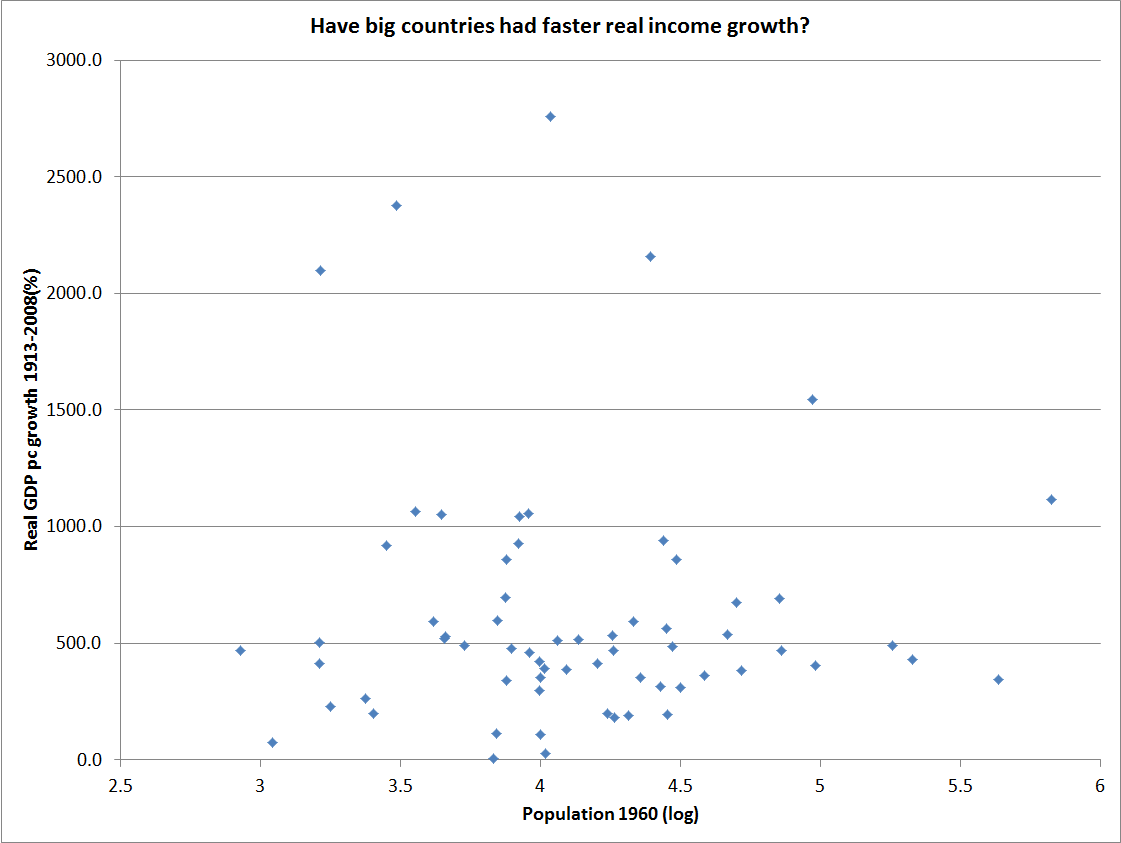
This chart shows per capita real GDP growth from 1913 to 2008 for the sixty or so countries Maddison had estimates for, plotted against the level of the population of each country in 1960 (roughly half way through his period).

popn and growth 1913 to 2008

There is no relationship. And there is also no relationship if:

  • We take out the countries that had exceptionally fast growth over that 95 year period, or
  • If we restrict the sample to  a group of countries that were already fairly advanced in 1913 (Western Europe, and the Anglo offshoot countries).  The United States and Switzerland, for example, had almost identical real per capita GDP growth over that period.

What about more recent periods? The Conference Board has built on Maddison’s work and has estimates for a wider range of variables for more recent decades.  One argument – advanced in a New Zealand context by Phil McCann – is that size has become a much more important issue for advanced countries in the last few decades. If so, perhaps we might have expected to see big countries growing faster than small countries over that period.

Here are two charts that look at that relationship for 33 advanced economies.

The first shows the relationship between the (logged) level of population in 1990 and growth in real per capita GDP growth since 1990.

population and gdp pc since 1990

And the second shows the relationship between the (logged) level of total hours worked in 1990 and growth in real GDP per hour worked since 1990.
hours worked and productivity since 1990
In neither case, is there any sign of a positive relationship.

Charts of this sort are, of course, not conclusive. Lots of other things are going on in each country.  In an ideal world, one would want a much fuller and formal modelling of the determinants of growth. But equally, the absence of a positive relationship between the size of the country and its subsequent growth shouldn’t be surprising, and there have been previous formal research results suggesting a negative relationship.

Of course, perhaps New Zealand is an exception. Perhaps real per capita incomes would really be materially lifted if we had many more people here, even though there has been no such relationship across the wider range of advanced countries in history.  But in a sense we have been trying that strategy for 100 years and there is no sign that it has worked so far.   Very few relatively advanced countries have had weaker real per capita growth than New Zealand in the last 100 years (only places like Argentina and Rumania).

Perhaps the next 25 or 100 years would be different. But I think the onus is now on the advocates of policies to bring about a bigger and more populous New Zealand to demonstrate where and how the gains to New Zealanders from a much larger population are occurring?  Recall that all our population growth now is resulting from government policy choices – the level of non-citizen immigration that the New Zealand government is targeting. If population growth were being driven by the private choices of New Zealanders (higher birth rates, or a permanent reversal of the New Zealand diaspora), I wouldn’t regard it as a particular matter of policy interest. But when our governments are actively targeting a larger population the onus is surely on them to demonstrate the real economic gains to New Zealanders. 25 years on in the current strategy there is no sign of them yet.

One could make a case that New Zealand’s greatest asset is the fertile land and temperate climate.  Refrigeration and much reduced shipping costs in the late 19th century gave those natural resources real economic value.  But there has been no comparable “shock” for the last hundred years, and arguably we are simply spreading those natural resource “rents” over more and more people.  Norway would be unlikely to have the highest real GDP per capita in Europe if they had responded to the discovery of vast oil and gas resources by doubling their population.

Natural resources alone don’t make a country rich (see Iran or Zambia), and natural resources aren’t the only way to get rich (see Singapore or Taiwan) but for a very isolated country they may well, in conjunction with strong institutions and competitive markets, provide the best possible basis for re-establishing top tier living standards for a small population.  So far, adding lots more people doesn’t seem to have helped.

Talking of which, it is now 21 August and there is still no sign of an MBIE response to my 28 May request for copies of advice to ministers on the economic impact of immigration, and on the permanent residence approvals target.

Monetary policy transparency US style

I opened the Wall Street Journal website this morning and noticed a prominent piece of advocacy (and here) , making the case for not increasing the Federal funds rate target yet. Plenty of market and other commentators openly run either side of that argument. But this column was from Narayana Kocherlakota, President of the Minneapolis Fed, and rotating member of (and permanent participant in) the Federal Open Market Committee, which takes monetary policy decisions in the US.

This is no, “on the one hand, on the other hand” treatment, but an article that begins with the rather bold statement

I’m often asked by members of the public about the biggest danger facing the economy. My answer is that monetary policy itself poses the biggest danger.

In his view, raising interest rates in the near-term would “create profound economic risks for the US economy”.

I happen to mostly agree with Kocherlakota’s conclusion –  since core inflation remains very low, and there is little or no sign of a quick return to the target rate –  but that isn’t my point.  I drew attention to the article because of the refreshing contrast  it represents to the way in which monetary policy deliberations and debates occur in New Zealand (and, to a lesser extent, in most other advanced countries).

I’ve highlighted previously that the Reserve Bank of New Zealand is just not that transparent about monetary policy.  Their formal model remains under wraps, written advice to the Governor on OCR decisions is kept secret, and no minutes of the Monetary Policy Committee or the Governing Committee are published.  The Bank was recently forced to release background papers for an OCR decision and Monetary Policy Statement from 10 years ago, but experience suggests they would fight very hard to avoid releasing rather more recent papers.  And that is even though all this material is official information, generated at the cost of your taxes and mine.

But one of the key features of forecast-based discretionary monetary policy (what the Fed, and the Reserve Bank and most other central banks try to practice) is how little any of us knows with any certainty.  Reasonable people can reach quite different views, not just on the outlook but on where the economy and inflation pressures are right now.  Reasonable people can also differ on how the Policy Targets Agreement should be best interpreted and applied.   And views inside central banks are typically no more monolithic –  if perhaps equally prone to herd behaviour –  than views outside.

So what is gained by maintaining the secrecy?  In some areas of public life there might be a real need for temporary secrecy.  Shaping negotiating positions, and identifying bottom lines, in trade negotiations might be an example.  But monetary policy deliberations aren’t like that.  The reputation of the Federal Reserve system doesn’t suffer because Kocherlakota runs a dovish line right now, or James Bullard runs a hawkish line. If anything, the reputation of the system is enhanced, because people can see able people grappling with the range of issues and evidence that need to feed into monetary policy decisions, and can test and evaluate the arguments those people are making.

Of course, it is much easier to adopt such a model in the US system, where FOMC members are independently appointed, and are not dependent on Fed system chair for pay or resources or the like.  It would be much harder to do in the New Zealand system at present, where all those who have a formal say in the system are senior staff, appointed by and accountable to the Governor.  But that only goes to highlight the weakness of our system, and why it would not be appropriate, when Parliament reforms the Reserve Bank Act, to simply give all decision-making powers to a group of senior managers and insiders.  Monetary policy issues like those we –  and the US, and most other countries face –  need robust and searching debate, and especially in a small country much of the expertise is tied up inside government institutions.  We need to create a culture that can encourage debate, and can live with differences of perspective.   I’m not suggesting that all debate should take place in public, but that there is a place for those actively involved in the decisionmaking process to participate openly in debate on these important issues, as happens in the United States or Sweden (and to a lesser extent in the UK)

Even now, if, for example, Deputy Governor Geoff Bascand opposes OCR cuts, we –  and not just the Governor –  should hear his case. Perhaps, with hindsight such an argument might prove right, or perhaps not.   In the nature of these things, no one is ever going to have the answer right all the time, and so in a collective decision-making model, of the sort other countries have, we should be holding participants to account not so much for any particular call, but for the quality and tone of the arguments and judgements each participant brings to the table.   Under the current system, perhaps a start might be made by publishing the written OCR advice the Governor gets prior to each OCR decision, and the minutes of the Governing Committee, when – straight after the MPS –  that information goes to the Bank’s Board.  But that is no more than a start: we need to move towards a system where an independent committee makes monetary policy decisions.  Under such a model, the Governor and staff would still have a crucial role, but their primary role would be advising the decision-makers.

In the next few days I want to come back to the much more severe problems of lack of transparency around the regulatory and supervisory functions of the Reserve Bank.

Some longer-term house price charts

Reflecting further on the risks facing our banking system, I dug out some fairly long-term house price inflation data from the BIS for 19 OECD countries.  I was slightly hesitant about doing so, because there is a risk of feeding the narrative that vanilla lending secured on residential property is likely to be an important independent element in any financial system stress. As the Norges Bank has pointed out, and as the Reserve Bank has affirmed, that just hasn’t been so historically. To the extent that the United States last decade may have appeared an exception, it is important to recall that the heavy role Congress and the Federal government played in driving down lending standards, and the non-vanilla nature of much of the lending.

But for what it is worth, here are a few charts. In all cases, the latest observations are for the December 2014 quarter, which is as up to date as the BIS data are.

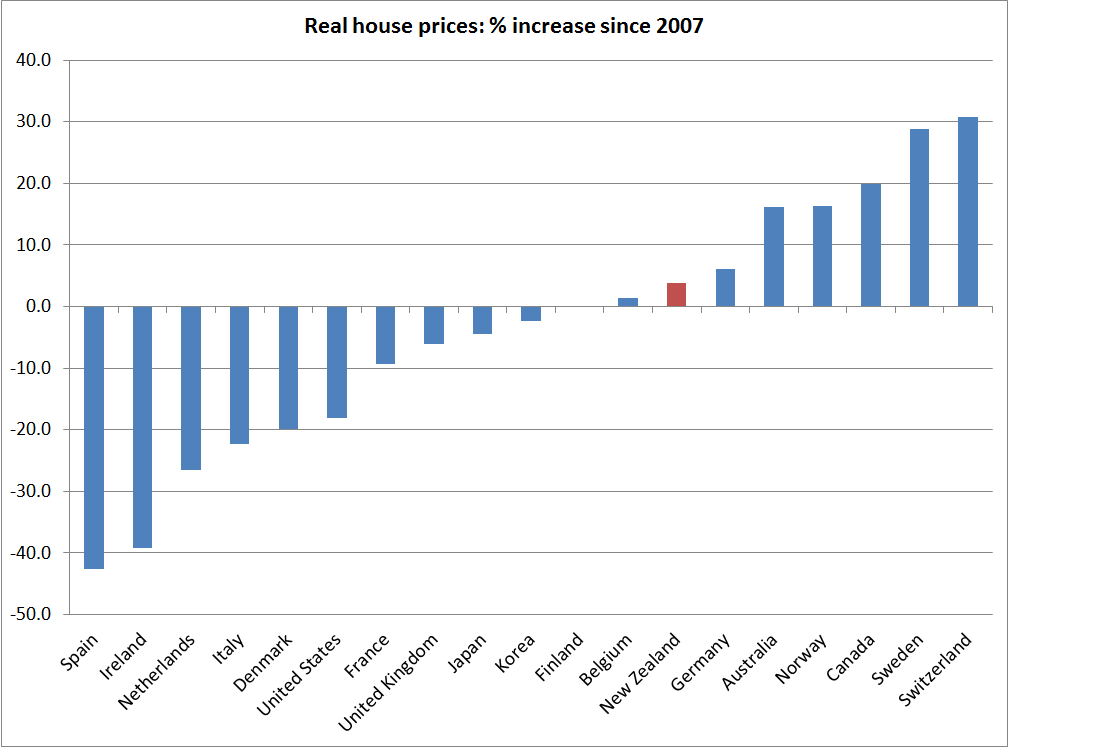
Here are real house prices changes since 2007 (most countries had a peak in or around 2007).

house prices since 2007

Real house prices in New Zealand have increased by less than those in Australia and Canada – and yet it is New Zealand banks that have been downgraded to BBB+, a rating not much higher than that held by South Canterbury Finance in 2008. As we’ve seen previously, New Zealand credit growth has done no more than roughly track nominal GDP growth over that period.

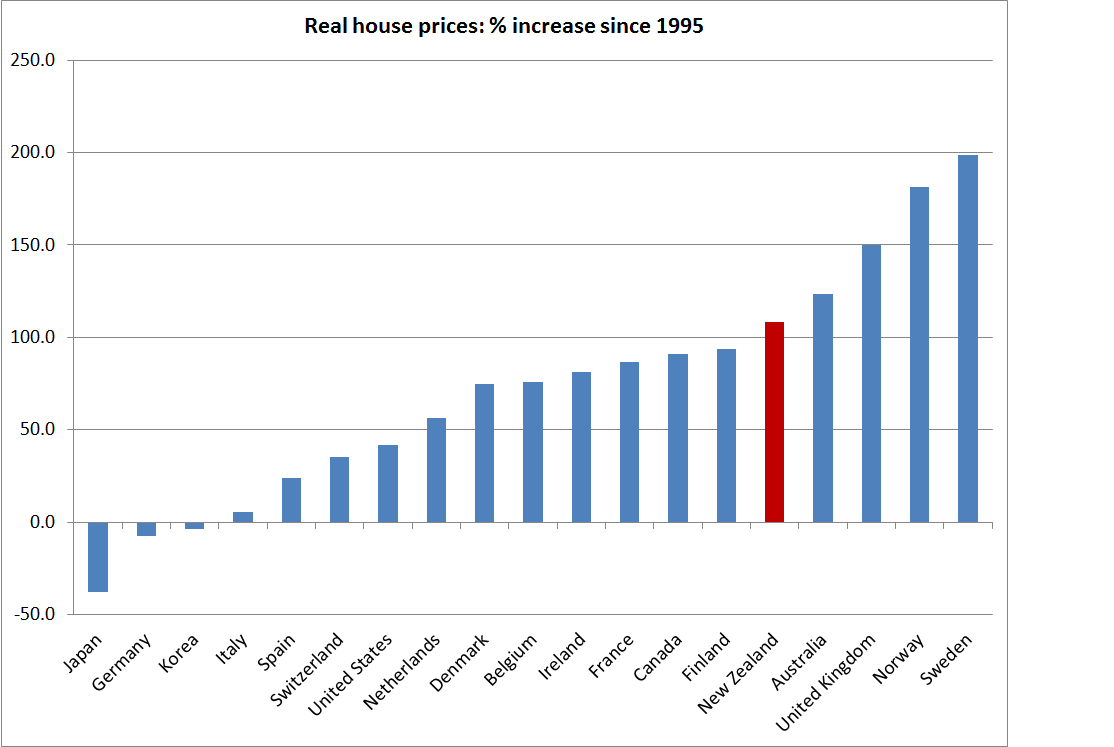
The BIS base their data at 1995. There is nothing special about 1995, although in most of these countries it was before any of the strongest house price booms had got underway.

house prices since 1995

Even over the whole 20 years, New Zealand real house prices have increased less than those in Australia and the UK. For the boom period itself (1995 to 2007) New Zealand’s house price inflation was only a touch stronger than that of the median country in this sample.

For most of the countries the BIS has data back to 1970, but for all 19 countries they have data back to 1976. Whether one starts from 1970 or 1976, New Zealand has had less real house price inflation than Australia and the UK, although more than Canada.

house prices since 1976

And what about periods of falling real house prices? There have been 53 episodes across these 19 countries of real house price falls in excess of 5 per cent.   Germany and Belgium have had only one such episode each. Five countries – including New Zealand – have had four such episodes each (including the 15 per cent real fall in and around the 2008/09 recession).

None of this is intended to convey any sort of sense of complacency about house prices in New Zealand (and especially Auckland). They are a scandal, resulting primarily from the acts (of omission and commission) of central and local government), but if anything have increased a little less than we’ve seen in countries with similar planning and land use restrictions (the UK’s are probably tighter, but population growth pressures are less there than in New Zealand and Australia).

But singling out the New Zealand banking system – as S&P appears to have done – seems unwarranted. There is no obvious material differentiation in the sorts of housing risks being taken on by New Zealand banks. Perhaps S&P are right about New Zealand. But the Reserve Bank’s stress tests results don’t suggest so. And, perhaps as importantly, historically, vanilla housing loans don’t lead to bank collapses, and systemic banks don’t collapse (or even come under severe stress) when credit has been growing no faster than GDP.  Reckless property development lending is a much more plausible culprit –  and we haven’t had it in the years since the recession.

Not entirely unrelatedly, I saw a piece the other day by Auckland City’s chief economist in which he cited some work done for the Council by NZIER suggesting that part of the growth in Auckland house prices can be explained by the proposed district plan changes that will allow for greater intensification in some parts of Auckland. I’ve seen a similar argument made by the Westpac economics team. But I must be missing the point. I can easily see why allowing more intensification on a particular section will increase the relative price of that section, but I cannot see how it can be raising prices of houses and land across Auckland as a whole.   Reducing land use restrictions – whether in respect of intensification, or allowing more dispersed development – increases the effective supply of land. And it seems unlikely that increasing supply will itself materially alter demand (eg materially increasing population growth, most of which is now driven by immigration policy). At least when I did introductory economics, increased supply would generally lower the price. It is easy to see why the relative (and perhaps even absolute) prices of some sections might rise if the reforms are for real, but surely any such effect should be more than offset by a fall in urban prices more generally?   If there is serious scope for more intensification, and that potential is expected to be utilised, then rational potential buyers all over Auckland should already expect less intense competition in future for this now less-scarce resource.  If anything, those prospective regulatory changes should be lowering prices now (perhaps only a little, because no one knows yet what real effect they will have), not raising them.

The same Chief Economist also noted that

“we need to economise on the massive amount of urban land we already have, and use it to its best effect. Acukland needs to treat its land like gold dust and a little needs to go a long way”.

I’ve got no problem with removing land use restrictions, whether they are on outward or upward development, but lets recall that the only thing that makes Auckland urban land remotely comparable to gold dust is the regulatory regime which the Auckland Council administers and imposes. Yes, Parnell might always be expensive, but there is simply no reason why  sections in middling suburbs should be. Historically, as cities become richer they have less dense, not more dense.   Planners, councillors, and associated bureaucracts are the people who systematically impede that normal and natural process.

Standard and Poor’s: probably wrong on New Zealand banks

I’ve been puzzling over S&P announcement (and supplementary Q&A material)  the other day, lowering the stand-alone credit ratings of the major banks and the Banking Industry Country Risk Assessment (BICRA) score for New Zealand.  The BICRA was lowered from 3 to 4, on a 10 point scale, where the banking industries of Greece and the Ukraine score 10.

As I noted on Friday, the S&P ratings appeared somewhat inconsistent with the Reserve Bank’s 2014 stress test results, in which even some very severe adverse shocks did not generate loan provisions/losses that were large enough to induce material annual losses in any year of the scenario for any of the major banks.

As a reminder, S&P did not lower the actual issuer credit ratings of any of the major banks. Those issuer ratings incorporate the probability of parental support, and the possibility of government support, in the event that one of the banks got into difficulty. The issuer credit ratings remain at pretty respectable levels, with each of the big four banks at AA-.    This table, taken from sorted.org.nz, draws on Reserve Bank resources to summarise the ratings scale.

Capacity to make timely payment

Description Standard & Poor’s scale Moody’s scale Fitch scale Approx. probability of default over 5 years*
Extremely strong AAA Aaa AAA 1 in 600
Very strong AA Aa AA 1 in 300
Strong A A A 1 in 150
Adequate BBB Baa BBB 1 in 30

* The approximate, median likelihood that an investor will not receive repayment on a five-year  investment in time and in full based upon historical default rates published by each agency.

Source: Reserve Bank

So the chances of getting your money back, from the big New Zealand banks, are still rated extremely highly. That seems about right to me. The chances of the parent banks, and the Australian and New Zealand governments, allowing creditors of these major subsidiaries of big Australian banks to lose money seems very small.   In that sense, creditors of the New Zealand banks may be slightly better-placed than creditors of the Australian banks – there is no large parent, with concerns about contagion risks, standing behind the Australian banking groups themselves.

But the focus of last week’s announcement was not on the issuer ratings, but on the standalone ratings, and the wider environment in which the banking industry is operating. Standalone ratings look at the ability of the bank concerned to meet claims on it without extraordinary parental or government support. In other words, primarily, the quality of the loans on the bank’s books and the level of capital it has to absorb any losses.

And there, having read the S&P documents, and the limited media accounts of their follow-up comments, I am still puzzled.   Three of the big banks now have standalone ratings of BBB+ (while ASB is one notch stronger, and KIwibank and Rabobank are one notch weaker). As the table above suggests, a rating at that level is not much better than adequate. Based on historical experience it is really quite risky. When the Reserve Bank sets minimum capital requirements for banks – and all these banks have capital well in excess of the minimum – they are looking at something much more robust than that.

An S&P spokesman is quoted as saying ‘I think we are on the same page, more or less, as the RBNZ”. But I don’t see how they can be.    Here are the loan losses from the Reserve Bank’s stress test scenarios.

stress tests impaired assets

And here are the key capital indicators from the November FSR.

stress tests prudential indicators nov 14 FSR

Capital ratios are much higher than they were in 2007 (and the risk weights are now typically more demanding as well), and there is a substantial buffer over the regulatory minima. The Reserve Bank’s stress test loan loss estimates could be understated by half, and the soundness of the banking system as a whole would still not appear likely to be in jeopardy.

But there are other puzzles in the S&P material:

There is no mention at all of the banks’ heavy dairy sector exposures, even though risk on that book is no longer a “low probability event” but something that is crystallising now, as weak world dairy prices and a continued high exchange rate combine to create severe cash-flow difficulties for many farmers, and the likelihood of a significant reduction in the value of the collateral banks have. After all, in a case of somewhat mixed messages, even the government is now belatedly talking of selling dairy farms.

If there is one area where one might be a little critical of the Reserve Bank’s stress tests it is around the dairy scenario, which assumes payouts of just over $5 for several years. Payouts at that level would be not much different, in real terms, from the longer-term historical average levels. There is a real risk already of something more severe than that scenario.   I think the Reserve Bank scenario came out this way because it was built on a severe recession (to trigger the big housing market correction and sharp rise in unemployment). A severe recession would be likely to see a much steeper fall in the exchange rate than we’ve seen so far, which would support the NZD value of returns to dairy farmers. In other words, potential losses on dairy debt aren’t additive to potential losses on housing loans – the scenario in which one might be very bad will typically be offset by less bad losses on the other portfolio. In the current climate, the dairy books look rather sick, while housing losses remain trivially low. If the housing situation worsened markedly (unemployment rose to anything like the 13 per cent in the Reserve Bank’s scenario), the exchange rate would probably be revisiting the lows seem in 2000 (around 50 on the TWI) and net returns to dairy farmers wouldn’t look anywhere near so bad.

But having said all that, it is still surprising that S&P didn’t even mention dairy exposures, by far the largest non-housing economic exposures on New Zealand bank balance sheets.

And S&P still regard any major rapid correction to house prices as “unlikely”.   From his public comments the Governor appears to think the risk is rather greater than that, even while reporting stress test results suggesting that the banks can cope with such a shock. It is all very well for S&P to talk about how a major house price correction would also have wider adverse economic ramifications. Everyone probably agrees with that – at least, unless the house price fall resulted from regulatory liberalisation, which might well be net stimulatory – but New Zealand authorities have far more room to lean against a severe economic slowdown than do authorities almost anywhere else in the advanced world (most of whom have interest rates stuck near zero already). Even relative to Australia (of which more below), the Reserve Bank has an additional 100 basis points available to cut the OCR.

And in either country, interest rates cut to zero would be expected to result in a very large further fall in the exchange rate. Puzzlingly, in their supplementary material, S&P highlight such a depreciation as a risk. They talk of a possible fall in the exchange rate, following a sharp house price fall, as “damaging confidence and potentially limiting monetary policy flexibility”, but they provide no basis for these interpretations. Since both banks and borrowers are pretty well-hedged to exchange rate fluctuations, a sharp fall in the exchange rate would almost certainly be a helpful mitigant. And I’m not aware of any floating exchange rate country in the 2008/09 cycle where the fall in the exchange rate was regarded as problematic or a constraint on monetary policy flexibility. Perhaps Iceland is an exception, but no one thinks of the New Zealand banking system as akin to Iceland’s (even today Iceland gets a BICRA score of 7 from S&P).

Some of the cross-country perspectives don’t make a lot of sense either.   Just a couple of weeks ago, S&P was talking of upgrading the standalone credit ratings of the Australian banks, from A to A+, if those banks raised more capital to meet the higher minimum risk weights APRA is to require. But, as the IMF has recognised and is I think well-understood by the banks themselves, risk weights on housing loans have been materially more demanding in New Zealand than in Australia (or other advanced countries), thanks to the appropriately conservative approach taken by our Reserve Bank. APRA’s latest announcements probably only have the effect of bringing risk weights on Australian mortgage loans up to towards those already in use in New Zealand (the AFR reports average risk weights will have to be increased from a minimum of 16 per cent at present to a minimum of 25 per cent in future). House price inflation has also been strong in Australia – Sydney prices are even more unaffordable than those in Auckland –  and, if anything, credit growth has been running faster in Australia than in New Zealand. It is difficult to see quite how, on the material they have put out, the New Zealand subsidiaries warrant standalone ratings that would be three notches lower than those of the parents.

Finally, S&P defended the BICRA score (the move from 3 to 4) by noting that only 23 other countries had higher scores than New Zealand. That doesn’t sound too bad – although a far cry from “one of the strongest banking systems in the world”) if one thinks of 200 countries in the world, but in fact they only seem to do BICRA scores for about 85 countries. According to this document, from last November, only Switzerland scores a 1. At the time, countries with a 3 were Chile, Denmark, France, Korea, Netherlands, New Zealand, the UK and the US. That was, perhaps, questionable enough company given that Denmark, Netherlands, the UK and the US had all had banking crises in the last few years, and France was saved from one by the Greek bailout in 2010.   In group 4, along with New Zealand now, we find the Czech Republic, Israel, Kuwait, Malaysia, Mexico, Oman, Peru, Qatar, Slovakia and Taiwan. By contrast, Australia (and Canada) still scores a 2. I struggle to see how the risks in New Zealand look more similar to those “4” countries than they do to those in Australia and Canada (or even the UK). In each of those latter countries, house prices – at least in major cities – have got detached from sensible unregulated longer-term fundamentals.   And even S&P reckon that New Zealand house prices are not a “bubble” about to burst. Each has a floating exchange rate – a major element in economic resilience – and New Zealand banks seem particularly strongly and conservatively capitalised (the combination of risk weights, and actual capital ratios). Historically, residential mortgage loan losses not played a key role in systemic bank failures, and yet they are far the biggest exposures on New Zealand bank balance sheets.

The S&P model appears to put quite a lot of weight on New Zealand’s relatively high negative NIIP position. But I think they are largely wrong on that score too. First, the NIIP/GDP ratio has been fluctuating around a stable average for 25 years now. That is very different from the explosive run-up in international debt in countries such as Spain and Greece prior to 2008/09. But also the debt is largely taken on by the government (issuing New Zealand dollar bonds) and the banks. No one seriously questions the strength of the government’s balance sheet, or servicing capacity, even after years of deficits. And the ability of banks to borrow abroad largely depends on the quality of their assets and the size of their capital buffers. If asset quality really is much poorer than most have recognised, rollover risk could become a real problem, but it isn’t really an independent source of vulnerability

I’m not sure where I come out on all this. Even though the Governor is acting as if he doesn’t really believe the stress tests, neither he nor staff have given us any good reason to think their estimates – suggesting a highly resilient banking system at present – are wrong. Then again, people pay substantial amounts of money for S&P’s ratings services. It would be more reassuring if, in the follow-up commentary S&P had directly and specifically explained why they found the stress test results unpersuasive, or even why they think the risks to New Zealand banks are so much greater than those in, say, Australia or Canada.  Banks just don’t fail when they are (a) privately-owned, (b)  operating in a fairly stable environment (ie not newly deregulated), (c) not subject to government pressures to take on inappropriate risks, (d) where total assets have been growing no faster than nominal GDP for years, (e) strongly (and increasingly) capitalised, and (e) where the largest component of assets is residential mortgage loans.

As some commenters have pointed out, having been somewhat burned in 2008, perhaps rating agencies have an incentive to overstate risk at present. But even if that is true – and I’m not sure it is, after all the last few years have been characterised by a renewed and rather desperate global search for yield, any yield – it still can’t explain why S&P seem to see so much risk in New Zealand relative to the situation in other floating exchange rate advanced countries. Of flexible exchange rate OECD countries, only Turkey, Iceland and Hungary now have BICRA scores worse than New Zealand.

I don’t believe it.