Macro policy flexibility since 2007

I’ve been looking at how advanced economies have performed since 2007.  New Zealand has not done that well, contrary to some of the stories one sees around (eg the somewhat incredible “rockstar economy” phraseology that held sway for a while).

It surprised me that New Zealand had not done a little better since 2007.  As I noted last week, we have had some of the strongest terms of trade of any OECD country.  But we also had other advantages.  For example, we did not have a substantial domestic financial crisis.   No major financial institution failed, and although many finance companies failed they were fairly peripheral.  Overall loan losses appear to have been relatively modest, and any disruption to the financial intermediation process –  of the sort often discussed in the literature around the economic costs of financial crises – must have been slight at best.  That New Zealand and the United States have had such similar paths of GDP in the last decade has left more sceptical than I was of the proposition that financial crises have large sustained real economic costs.

New Zealand also had more macroeconomic policy leeway than most countries.  Macroeconomic policy tools –  fiscal and monetary policy –  don’t make much difference to a country’s long-term prosperity, but they can make quite a difference to a country’s ability to rebound quickly from shocks.  Thus, for example, almost half the advanced countries I’ve been looking at are now members of the euro area.    Individual countries have no national monetary policy (so they can’t adjust their own interest rates or their nominal exchange rates) and the region as a whole has been at or near the lower bound on nominal interest rates for years now.  Many other advanced economies –  the US, UK, Japan, Switzerland, Sweden, the Czech Republic –  are also at the lower bound for nominal interest rate.  In all cases except Japan, they were able to cut policy rates a long way when the recession hit, but then they ran into limits.

New Zealand did not run into such limits.  In 2008/09 the Reserve Bank cut its policy rate, the OCR, by more than almost any of the other advanced country central banks.  But even then the rate was still 2.5 per cent.  There was plenty more leeway had that been judged warranted.  And during the recession itself, our floating exchange rate fell very substantially..

But the other area of macroeconomic policy where we had leeway was fiscal policy.  Intense debates rage around the role of fiscal policy in economic cycles.  When a country is not at the zero bound it seems reasonable that the stance of fiscal policy won’t make much difference to the path of GDP  (although it may affect the composition, and in particular that between tradables and non-tradables).  But it is likely to be a different matter for a country at the zero bound.  If there is little or no effective monetary policy leeway, changes in the fiscal balances are likely to have reasonably predictable “Keynesian” type effects: fiscal contractions will dampen recoveries, and fiscal expansions will support them.  Of course, confidence effects can undermine those effects, but in reasonably well-governed countries with floating exchange rates, it takes a lot to lead to material adverse confidence effects.  There is no evidence, for example, that the UK or the US came close to triggering serious adverse confidence effects during the years since 2007.

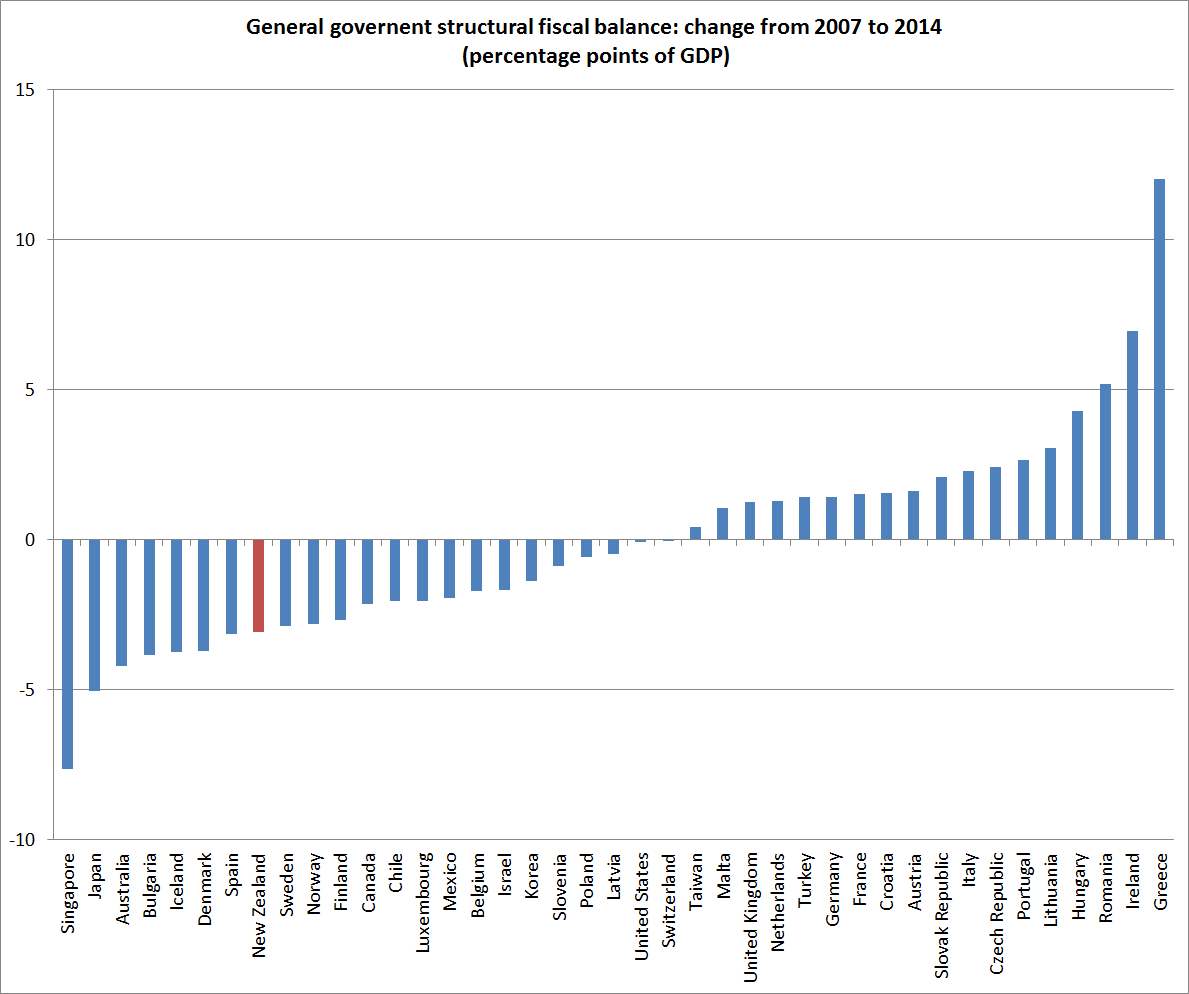
Turning to the IMF WEO database again, we can see what has happened to (estimates of) structural fiscal balances since 2007.  I would stress the word “estimates” –  no one can ever know the level of a structural fiscal balance with certainty, and current estimates for 2014 will be revised, in some cases perhaps quite substantially.  But here is how structural fiscal balances have changed since 2007.
fiscalbalances

Around half the countries have had fiscal contractions over that full period, while the other half have had expansionary fiscal stances.    Over the period as a whole, only seven countries are estimated to have had more expansionary fiscal stances than New Zealand.  What I found interesting is that of the 15 countries to the left of the chart, 10 had floating (or flexible in Singapore’s case) exchange rates.  Of the countries that have had contractionary fiscal stances, only a handful have flexible exchange rates.

Like most countries, New Zealand’s picture is one of two halves.  There was a huge shift from substantial structural surpluses as recently as 2007 ( when only Singapore had a materially larger structural surplus than New Zealand) , to large structural deficits just a couple of years later.   When I did one of these charts back in 2010, New Zealand had then had (depending on the measure used) either the largest or second largest expansionary shift in fiscal policy of any advanced economy.  The odd thing about New Zealand’s shift was that almost none of it was fiscal stimulus measures initiated once the recession hit –  it was all the effects of decisions made when it was thought (by politicians and their Treasury advisers) that times would stay good.

Since 2009 New Zealand, like many other countries, has been gradually reducing its structural fiscal deficit.  My point here is simply that we had the flexibility to do so, fast or slow, without materially affecting the economic cycle, because we never ran out of room to use conventional monetary policy to offset the short-term demand effects of fiscal consolidation decisions.  Having, on average, the highest real interest rates in the advanced world isn’t a good thing for our longer-term growth prospects (I argue) but in getting through the last few years it has had one distinct upside –  we had more room to cut rates than almost anyone else.  Given our disappointing economic performance, and weak inflation outcomes, one might argue that it is a shame that that leeway was not used more aggressively.

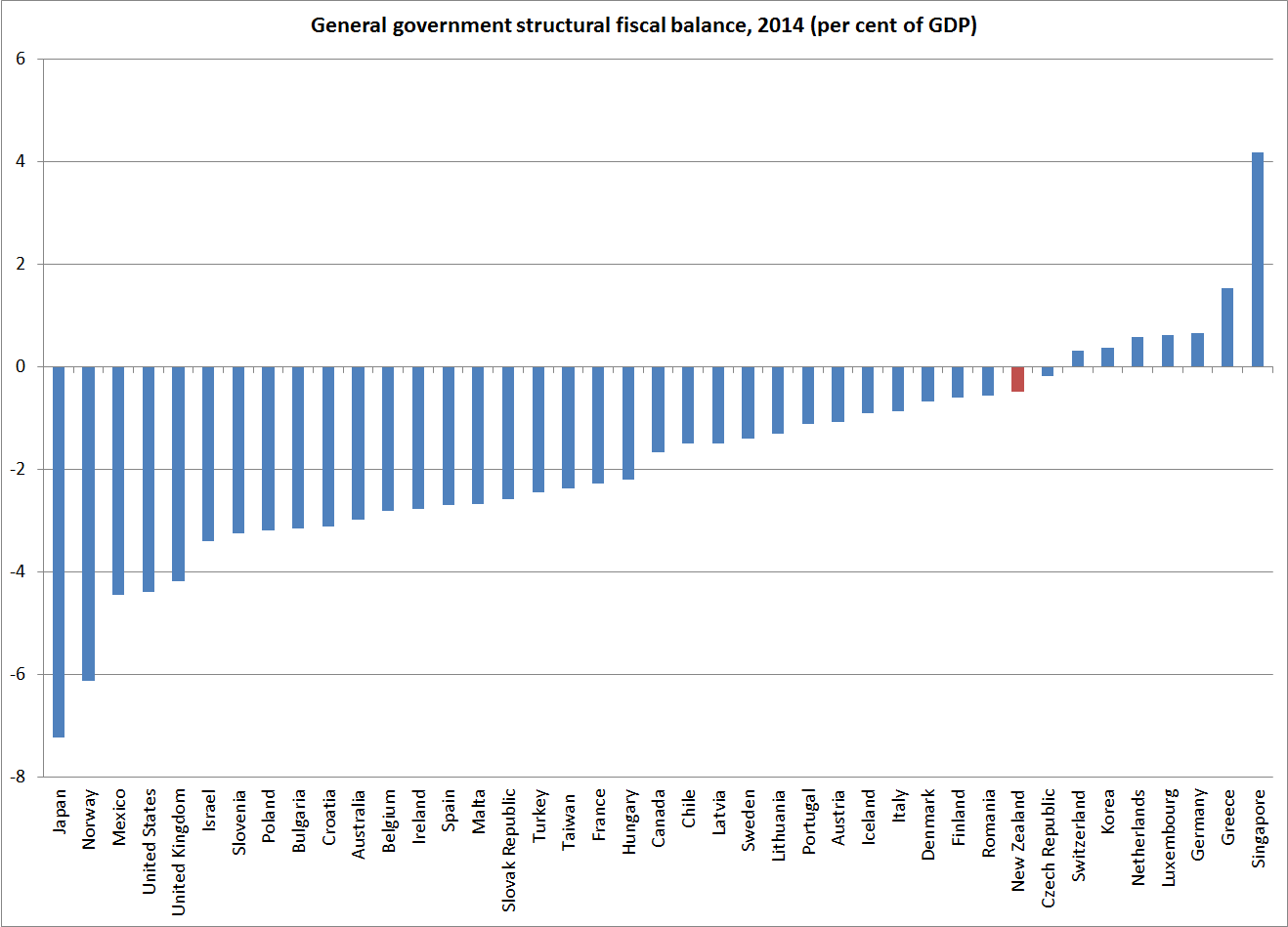
And finally, a chart of the IMF’s estimate of the level of each country’s structural fiscal balance in 2014.  New Zealand looks pretty good on this score (although the terms of trade flatter our numbers somewhat).
fiscal2014
Perhaps the saddest bars on both charts are those for Greece.  Running structural fiscal surpluses, in an economy at the zero bound and with 27 per cent unemployment, would not normally be considered sensible.  But that is what happens when a country loses market access, and yet lingers on in a straitjacket like the euro.  I stand by my assertion a month or two ago that there is no politically acceptable deal (politically acceptable in both other countries and in Greece) that can allow Greece to stay in the euro and yet begin to make material ground reversing the catastrophic loss of output and the appalling unemployment rate.  It increasingly looks as though the break is coming soon.  When and if it does, it will be messy for a time, but it finally offers a way back towards a more fully-employed economy.
“Larry Summers on TPP makes perfect sense”?

Tyler Cowen wrote last night “Larry Summers on TPP makes perfect sense.  I haven’t seen anything on the anti- side coming close to this level of analysis, and in a short column at that.”

I’ve been a bit ambivalent about TPP, so thought that I’d better read the Summers piece.  My problem was that I came away more skeptical than I went in.

My own priors are pretty clear.  Free trade is good –  as a matter of liberty and as a means to greater prosperity.  I’m sure one can find exceptions, but the rule is a pretty good one to live, and make policy, by.

But then Summers tells us that:

First, the era of agreements that achieve freer trade in the classic sense is essentially over. The world’s remaining tariff and quota barriers are small and, where present, less reflections of the triumph of protectionist interests and more a result of deep cultural values such as the Japanese attachment to rice farming. What we call trade agreements are in fact agreements on the protection of investments and the achievement of regulatory harmonization and establishment of standards in areas such as intellectual property. There may well be substantial gains to be had from such agreements, but this needs to be considered on the merits area by area. A reflexive presumption in favor of free trade should not be used to justify further agreements. Concerns that trade agreements may be a means to circumvent traditional procedures for taking up issues ranging from immigration to financial regulation must be taken seriously.

But if free trade is good, the same case can’t be made for “regulatory harmonisation”.  We just don’t know enough about what regulation is sensible, and worthwhile, and we live in democracies where the case for regulation in specific areas should be fought out through domestic political processes.    A diversity of regulatory approaches is often the way we learn.     And protections for intellectual property are typically far too high anyway –  in other words, agreements on such matters risk being (or are by design) generally anti-competitive, anti-market, measures.

In fact, the strongest argument for TPP I could find in the article was one grounded in domestic US politics ( recalling that Summers had been a senior official in both the current and previous Democratic administrations).

The repudiation of the TPP would neuter the U.S. presidency for the next 19 months. It would reinforce global concerns that the vicissitudes of domestic politics are increasingly rendering the United States a less reliable ally.

Really?    We all know that second-term US Presidents, especially those whose Vice-President is not heir presumptive, quite quickly become lame ducks.  Is this presidency really any different?  And where is the pressing demand for TPP?  No doubt there are elites in each of the negotiating countries with a great deal at stake, but where is the popular demand for this agreement?  As Summers puts it, it doesn’t seem to be a free trade agreement anyway.  Which population centre will think worse of the US if negotiations stall?    No doubt some US business groups will be aggrieved, but that is domestic politics, not international relations.  Failure of TPP would be embarrassing for Barack Obama, but that seems less like a national interest issue than a partisan one?

I’ve long been a bit puzzled by what was supposed to be in any deal that would make it economically worthwhile for New Zealand (as distinct from being “inside the club”).  I recall the IMF doing some modelling a decade or more ago on the US-Australia FTA, which had concluded that that agreement had been modestly welfare-diminishing for Australia –  as if a desire for a deal, any deal, and perhaps the momentum that any  process takes on over time had overridden a hard-headed assessment of the economic interests of Australia.   If there were genuine large-scale liberalisation of the global dairy trade, then we might reasonably think New Zealand would be better off from a deal.  But has that ever seemed very likely?  And if only small (or no) trade gains are on offer, how should we weigh that against the losses from strengthened intellectual  property protections?

And how should be think about the incentives on our key political participants?  Having pursued an agreement for so long, what sort of threshold would have to be crossed before they would be willing to walk away from negotiations?  It is not clear that the personal and national interests are necessarily tightly aligned.  Perhaps the US Congress will  vote in ways that mean they never have to make that decision.

To repeat, I’m a free trader.  I think New Zealand should have removed its remaining tariffs, and wound back its anti-dumping regime, long ago.  I’m in favour of a materially more liberal approach to foreign investment.  And I generally favour less regulation rather than more.  But all these are causes that should be fought out openly, and in the domestic political process.    So, I hope there is a better case for TPP than that put forward by Larry Summers, who actually seems somewhat ambivalent if it weren’t for the impact on Obama’s political position, but so far I haven’t found it.

And that before I saw Keith Woodford’s recent column on interest.co.nz.  Woodford knows a great deal about the global dairy industry, and he makes what seem like pretty persuasive arguments that there might not be much in it for New Zealand even if the US and Canada were to move towards an unsubsidised and less heavily regulated dairy industry.

Savings and investment since 2007

Last week, I started showing a few charts about how New Zealand had done against various other advanced economies since 2007, the last year before the recession that engulfed most of the world in 2008/09.

Today I’m going to show the charts for investment and national savings, using the data from the IMF’s WEO database.

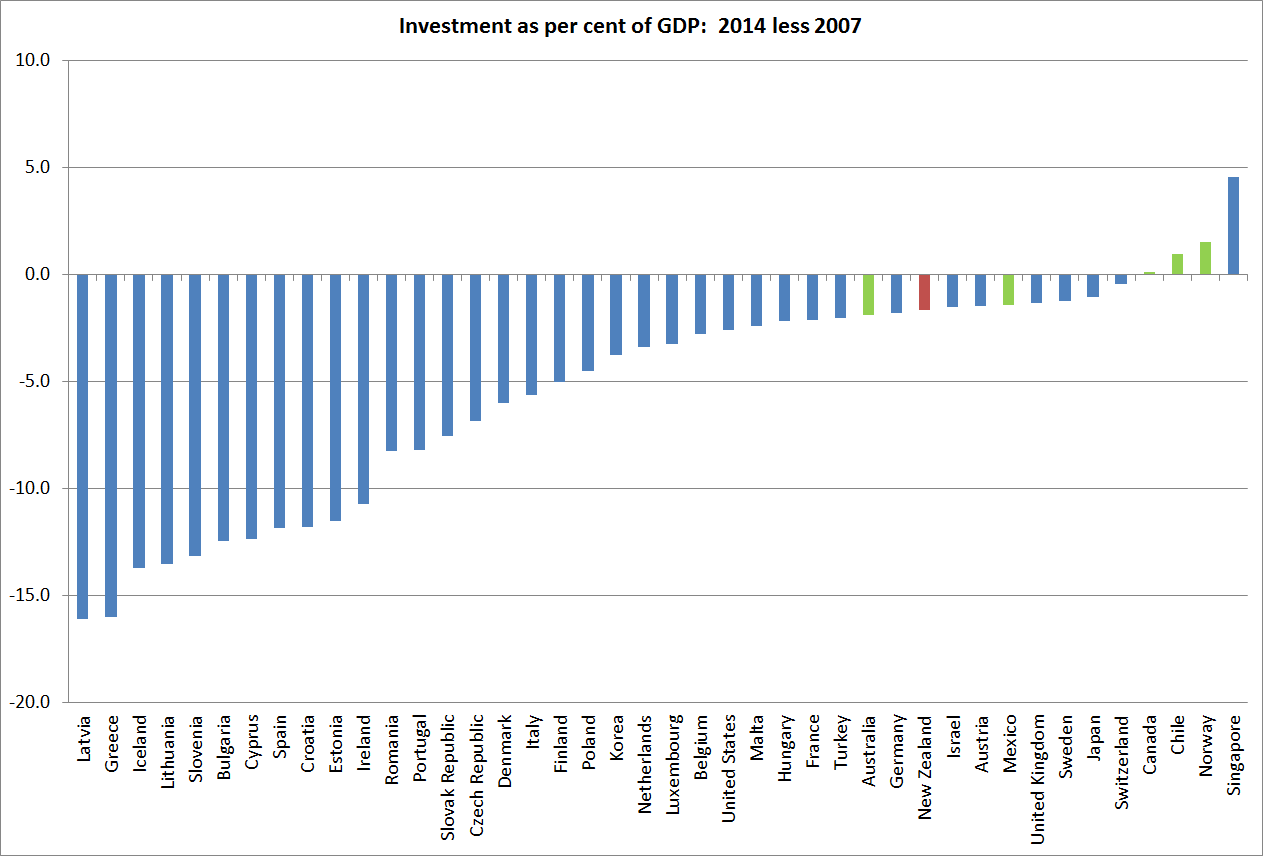
First investment.

investment2014

Of this group of advanced countries, only four had a share of investment in GDP higher in 2014 than it was in 2007.  That probably doesn’t come as a great surprise.  2007 was a cyclical peak, and by last year hardly any of these countries would have been considered to have been operating at capacity.  Across the advanced world as a whole, population growth rates are falling, and lower rates of population growth mean less of GDP needs to be devoted to investment for any given level of technology.

But my main interest was the cross-country dimension.  Perhaps unsurprisingly, the commodity exporting advanced economies have all been among the countries with the most strength in investment.  But Germany comes between Australia and New Zealand, and I was surprised to find the United Kingdom, Japan, and Sweden doing better than either New Zealand or Australia.  At the other end of the chart, the 18 weakest economies all either use the euro, or have a currency pegged to the euro.

The New Zealand story itself is a little less favourable than it might first appear. Recall that I noted last week that there had been no sign of a surge in New Zealand business investment in response to the high terms of trade.  And, on the other hand, a significant amount of the strength in New Zealand’s investment in the last few years has been the repair and rebuilid activity in Canterbury.  It counts as gross investment but, since it is mostly replacing capacity that was destroyed or severely damaged, it isn’t adding much to the capital stock.

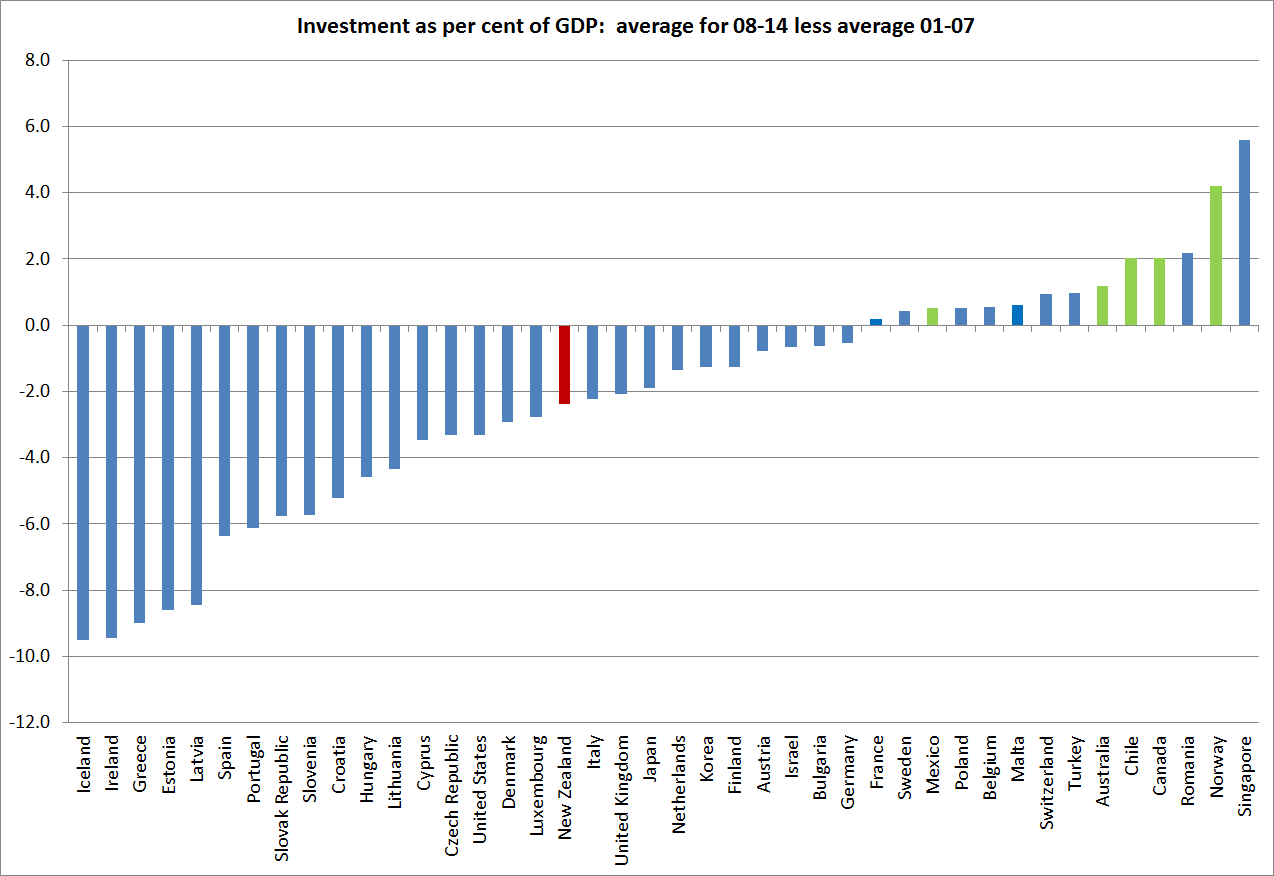
If we do the same chart comparing the average for 2008-14 with the average for 2001-07, New Zealand drops back to the middle of the field, and well behind the other commodity exporters.

investmentwholeperiod

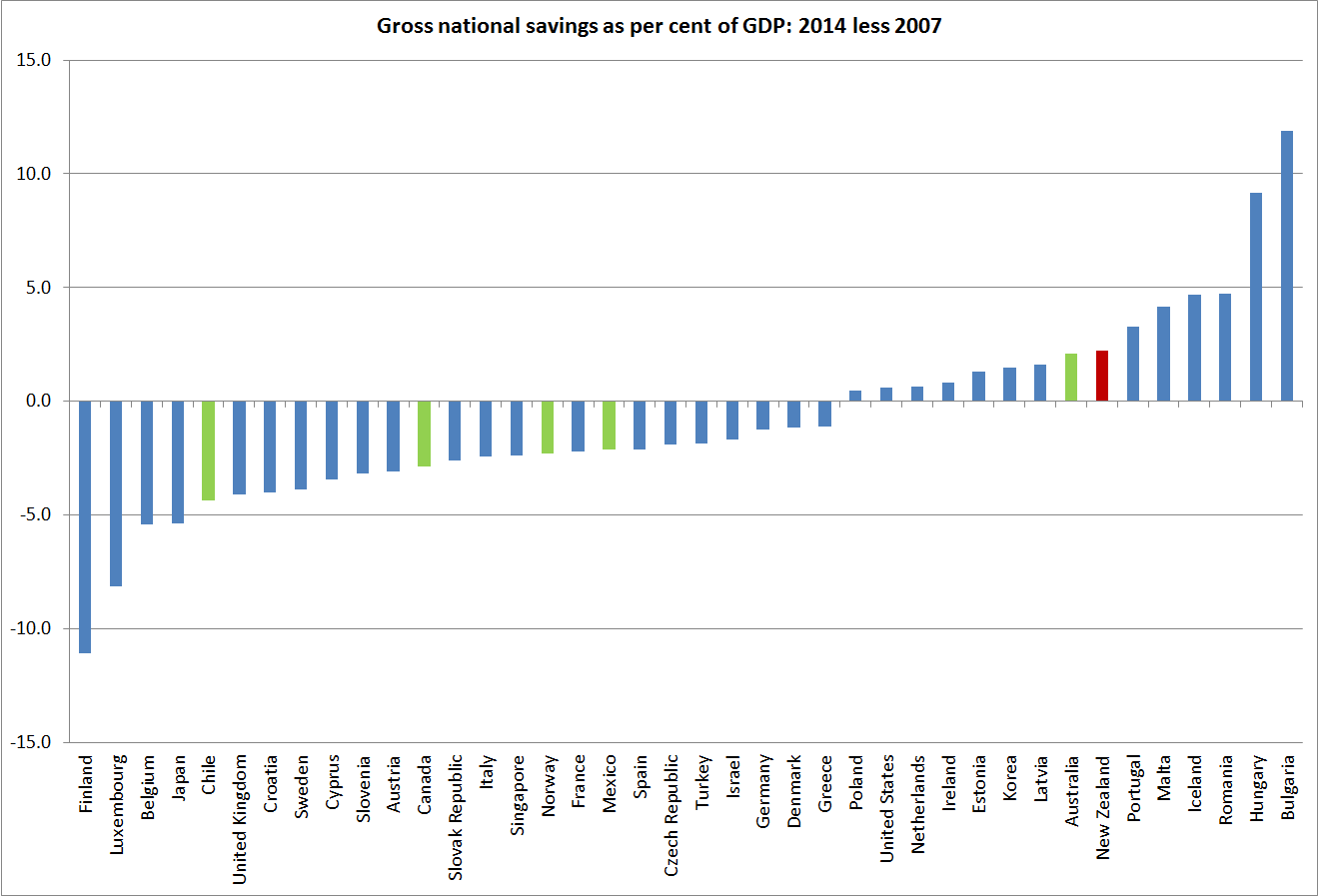
And what about national savings?  On this chart, any patterns are much less obvious.   Savings rates have fallen in more countries than they have risen, but 16 countries have had increases in their national savings rates.  Euro area countries, for example, are not bunched at one end or the other, and New Zealand and Australia show up as among the countries with the larger increases in national savings rates.

savings

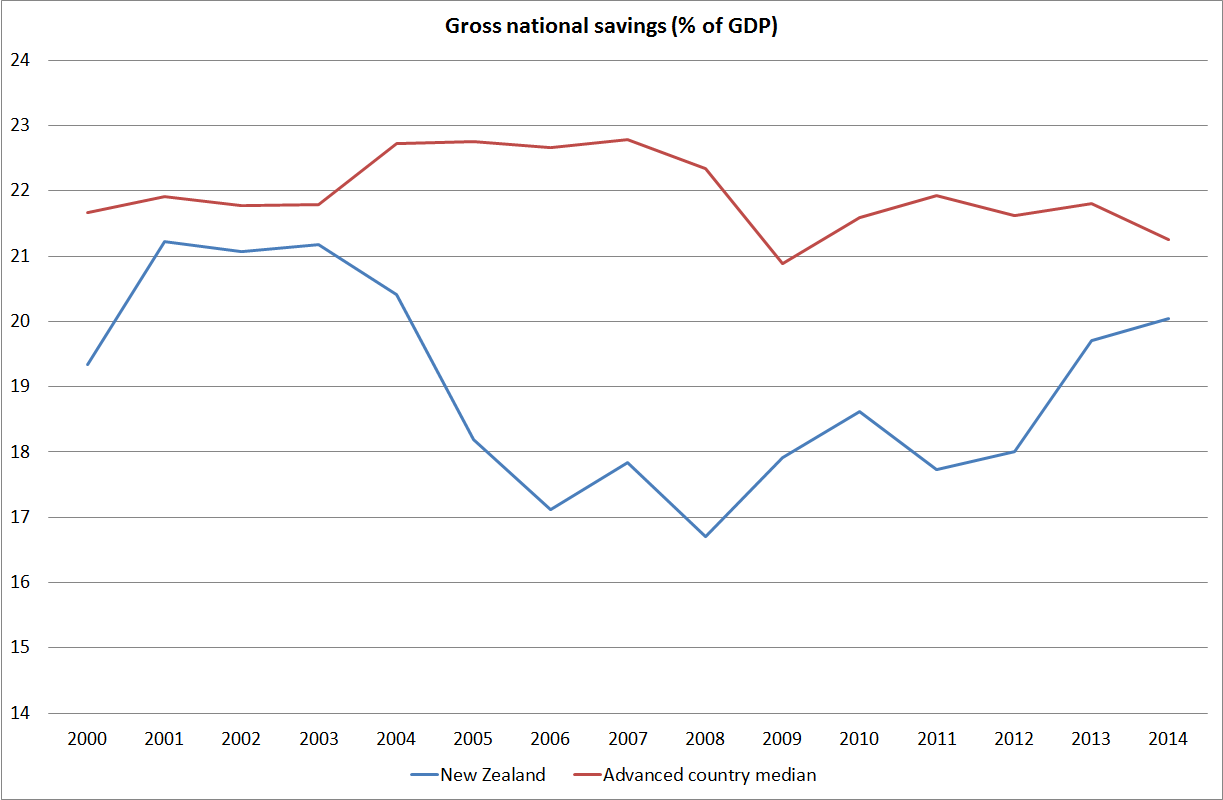
Before anyone starts getting excited about, for example, the impact of Kiwisaver, I should point out that when I compared savings rates for 2008-14 as a whole with those for 2001-07,  New Zealand dropped right back to around the middle of the chart.  Unlike the median advanced country in this sample, New Zealand’s national savings rate fell away sharply in the middle of the last decade, as public (and business) savings rates dropped away sharply.   Our national savings rate is only now back to around the level seen in the early 2000s.

savings2

(And one final note, these are ratios of national savings to domestic product.  In other words, the savings of New Zealanders as share of all that is produced in New Zealand, whether by New Zealanders or foreigners.  In other words, the two series aren’t strictly comparable.  For most countries the difference doesn’t matter, but here national income is materially less than domestic product (the difference is mostly the net earnings of foreigners on New Zealand’s negative net international investment position).  Taking national savings as a share of national income, New Zealand’s national savings rate would be around the median of this group of advanced countries.)

A disappointing cheap shot from ACT

I keep an eye on what quite a few political parties have to say.  Among the bits and pieces that turn up in the in-box is the ACT Party’s newsletter.  This afternoon it had this gratuitous piece in it.

Keep Politicians away from Monetary Policy
Like the rugby boor who wants to endlessly debate past refereeing decisions, we have Russell Norman, with time on his hands now, tweeting about the OCR decision: Would Reserve Bank have made (mistaken) decision to start tightening last year if Board (w broad economy reps) were deciders not just Gov? One thing Russell obviously is not, is an expert on monetary policy.

Who knows what the answer to Russel Norman’s question is.  It might well have depended both on the sort of Board chosen, and the quality of the people appointed to it.  But it seems to me that is an entirely reasonable question for an opposition party finance spokesperson to be asking.  Parliament made the Reserve Bank operationally independent.  Parliament funds the Reserve Bank.  The Minister of Finance takes the lead in setting the policy target.  And the Finance and Expenditure Committee –  which Norman has served on for some years –  has an important role in scrutinising and holding to account the Reserve Bank, including in its conduct of monetary policy.  And, as everyone recognises, Reserve Bank choices, and  occasional Reserve Bank mistakes, have implications for people and their businesses.  People elect MPs to hold public agencies to account.  And we learn by reviewing past decisions in the light of experience.  Who does ACT think should be asking questions if not MPs?

I’ve long been rather ambivalent about the ACT Party, but have usually respected their willingness to treat serious issues seriously. And, in fairness, much the same could be said of the Greens.  There are plenty of Russel Norman’s observations about monetary policy that I’ve disagreed with over the years, but his proposal for a different governance structure is not unusual internationally, and his question as to whether it might have made a difference to the actual path of policy seems an entirely reasonable one.

Cheap shots of this sort don’t advance either the issue, or the reputation of the ACT Party.

Housing, financial stability etc – LEANZ seminar 25 June

About the time, back in April, when I posted some comments on Grant Spencer’s speech on housing LEANZ invited me to speak at one of their Wellington seminars, next Thursday 25 June.

LEANZ is an organisation dedicated to the advancement in New Zealand of the understanding of law and economics. It provides a forum for the exchange of information, analysis and ideas amongst those with an interest in this form of analysis. That interest may be practical (for example, the field of law and economics is very relevant to many aspects of the practice of law, public policy and consultancy), or it may be more academic.

“Nowhere is the baneful effect of the division into specialisms more evident than in … economics and law … the rules of just conduct which the lawyer studies serve a kind of order the character of which the lawyer is largely ignorant; this order is studied chiefly by the economist who in turn is similarly ignorant of the character of the rules of just conduct on which the order he studies rests.” F A Hayek Law, Legislation and Liberty Vol I, pp 4-5. LEANZ hopes to work to bridge this divide.

This is the topic blurb I gave them some time ago –  by the look of it, written before the new lending restrictions proposed in the May FSR

House prices, especially in Auckland, have become increasingly unaffordable. This is largely the outcome of the collision between two sets of public policies: restrictions on land use which impede new housing supply, and high target levels of inward migration of non-citizens.  One or other policy might make sense, but the combination has very adverse effects on the younger and poorer elements of the population of our largest city.  It is a real phenomenon rather than a financial one, and the pressures can only be sustainably alleviated by government action in these policy areas.  The Reserve Bank appears to have taken on itself some responsibility for trying to manage house price fluctuations.  However, the Bank’s involvement appears to be based on a misconception of what is going on, and a misapplication of insights from financial crises abroad, notably that in the United States last decade. There is little or no evidence that financial stability in New Zealand is in any way threatened.  The LVR restrictions –  and others the Bank appears to be contemplating – undermine the efficiency of the financial system.  They may also be slightly impairing its soundness.  Parliament should be asking harder questions about whether such uses of regulatory powers, especially by a single unelected official, are appropriate.

LEANZ tell me that all are welcome to attend –  there is no obligation to become a member first, although I’m sure they would also be happy to have a few more paid-up members.   Details of the event are here.

Magna Carta, the regulatory state, and the Reserve Bank

In the very early days of this blog, one commenter observed that he was looking forward to posts based on my (rather large) collection of books more than fifty years old.  This is one of them.

Today is the 800th anniversary of the Magna Carta.  The charter is dated 15 June 1215, although apparently it was probably signed a few days later.    In anticipation, I pulled down from the bookcase last week an excellent 1961 biography (by W L Warren) of King John, the monarch who provoked the demands that the charter responded to.    One clause of the Magna Carta is (according to an article in the  Herald the other day) part of current New Zealand law (in fact, here it is), but in a sense the charter is more important for what it came to represent in the stories we tell ourselves about Anglo-American freedoms, limited government etc than for the specifics of the 1215 document (which was annulled only a few months later, only to be later reissued).   The specifics are worth reading –  but probably, for anyone other than scholars of medieval law, only once.

There is plenty of material around on Magna Carta, John, and the history of the times.  I particularly liked this piece by Daniel Hannan.  But I’m writing this post mostly because of a single point that struck me as I read.

Part of what provoked the demands that led to Magna Carta was the king’s increasingly need for money.  John had been fighting to defend his extensive French territories, and wars don’t come cheap.  Unable to raise more money by conventional measures, which even then required the consent of the barons, John’s government chose to resort to ratcheting-up discretionary impositions.

One example was amercements.  As Warren notes:

“It was easy to get on the wrong side of the authorities, to be adjudged in misericordiam – at the king’s mercy –  and to escape only by paying an “amercement”.  Amercements were not imposed for crimes (upon which death, mutilation or outlawry were visited) but for misdemeanours, such as neglect of public duties, failing to bring a criminal to justice, or for mistaken or stumbling pleading in a case before the court.  “You were almost bound to come out of the court poorer than you went in”, it has been said, “whether you were there as plaintiff or defendant, pledge or juryman.”…. The charges imposed by the justices were not often large, but they rarely fell below half a mark (6s 8d) and this was a serious vurden for many men at a time when a wage labourer could not expect to make more than thrity shillings a year, and the goods and chattels of an ordinary peasant were worth little more than ten shillings.  Most men, it seems, could expected to be amerced at least once a year in the normal course, so it was intolerable when, as in 1210, special justices came round the courts in addition to the normal circuit judges who seemed to have no object beyond the collection of money for the king’s coffers.  Though the barons were not usually amerced themselves, they were deeply concerned that their peasants and villagers should not be ruined by hard-hearted royal judges.

John had his own ways of getting extra revenue out of the barons, including levying extremely heavy (much more than conventional) charges on heirs taking up a title and estate.   Technically such levies were within the law, and John pushed them to such an extreme as to provoke Magna Carta

Both abuses were addressed in clauses of the Magna Carta.  Clause 2 limited succession duties to £100 for a baron, and 100 shillings for a knight, and clause 20 provided that

A freeman shall not be amerced for a slight offence except in accordance with the degree of the offence, and for a grave offence he shall be amerced in accordance with its gravity, yet saving his way of living; and a merchant in the same way, saving his stock-in-trade; and a villain shall be amerced in the same way, saving his means of livelihood –  if they have fallen into our mercy: and none of the aforesaid amercements shall be imposed except by the oath of upright men of the neighbourhood.

It perhaps won’t surprise you that in reading this, I had the regulatory actions of the Reserve Bank in mind.  But it isn’t only the Reserve Bank (and it isn’t only a New Zealand issue).  In the last couple of months I’ve read very nice pieces concerned about the growth of the regulatory state, one from the right by Chris Berg (who the NZ Initiative have visiting later this month) in Quadrant and one from the left by David Graeber in Harpers.

As Berg notes:

We often imagine that our modern concerns are distinct from those of the past.  But how much legislative power the executive could exercise without parliamentary approval was one of the great contests in the lead-up to the English Civil War.  The seventeenth century English historian Roger Twysden declared that “the basis or ground of all the liberty and franchise of the subject” was “this maxim, that the king cannot alone alter the law”.  Yet through executive pronouncements and delegation governments have vested vast legislative power in what scholars call “non-majoritarian” regulatory and bureaucratic agencies.”

As a New Zealand First MP put in Parliament recently  “Although my party has issues with this Government’s economic policies, it is elected, whereas Messrs Wheeler and Spencer most definitely are not”

How consistent is it with the sorts of freedoms and limited government that our ancestors fought for that a single unelected official can determine  who private businesses can, and cannot, deal with, and on what terms?  The Governor, for example,  asserts the right to allow banking businesses to be subject one set of constraints in Auckland, and a different set in Dunedin –  although we live in a unitary state.   He plans to impose severe limits on one type of property owners (but not others), in some regions (but not others) to use otherwise identical collateral to support their spending or investment plans.  And he proposes to impose such restrictions through a process that lacks transparency:

  • He commissions policy proposals and the background work in support of them, and then makes final policy decisions himself (there is none of the customary separation between, say,  ministers and officials, or even between an individual minister and the Executive Council)
  • He takes submissions on his proposals, but the public has no automatic or timely access to those submissions before final decisions are made (and no guarantee of seeing them even afterwards)
  • Unlike debates in Parliament on new primary legislation, the Governor’s own internal deliberations are not public.  Minutes of key internal meetings are not published and since, ultimately, the decisions are those of a single person, the mental musings that lead to new law are not even effectively OIA-able).
  • He uses provisions of 25 years old law which were never intended to be used for such intrusive and restrictive purposes.
  • He seeks to compel banks to comply with his new law before he has even gone through the required legal processes to make it law.
  • And, if the previous LVRs restrictions are any guide, he will no doubt seek to require, on pain of potentially severe penalties, banks to comply with the “spirit of the restriction”.  What happened, one might wonder, to law being written in ways that citizens could consciously comply with, not being dependent on the whim of an official as to whether he judged one’s actions to be compliant with the “spirit of the law”?

I’m not suggesting that what the Reserve Bank Governor has been doing is against the law.  But neither, generally, were the sorts of initiatives King John took.  But what is lawful is not necessarily legitimate or right.

Of course, there are more protections for citizens now than there were in the 13th century (judicial review –  which banks seem strangely reluctant to use –  the rather weak reed of the Official Information Act, and ultimately the capacity of Parliament to change the enabling legislation), but it is not the sort of style of government that made Anglo countries some of the most prosperous, and freest, societies on earth.

No doubt there are other examples, in other areas of New Zealand public life, of this sort of discretionary regulatory overreach.   And the regulation-making power of even elected ministers should be a concern (thank goodness for the, not extensively used, powers of the Regulations Review Committee established in the 1980s), but such extensive powers exercised by a single official seem particularly egregious, and disconcerting, in a month when we remember, with gratitude to our forebears, our inheritance of law and politics, of freedom and of limited government.

“We didn’t get it wrong: Wheeler”

I’m getting tired of the subject, and readers probably are too, but I noticed that in today’s Herald Brian Fallow had reported Graeme Wheeler’s case that the Reserve Bank had not made a mistake in raising the OCR so much last year, and holding it up for so long.

I’m sure Graeme had no say in the headline “We didn’t get it wrong: Wheeler”, and perhaps Brian Fallow didn’t either.   But actually the article is a compilation of individual items where the Bank did get it wrong over the last 18 months.  Some of those mistakes were probably quite pardonable (in full or in part), but they were mistakes:

  • The Bank did not forecast a material fall in dairy prices
  • It did not forecast the fall in oil prices
  • It did not forecast the extent of the net migration inflow (or, apparently, the proportion of those arriving who were (a) students, or (b) young workers.
  • It did not forecast the extent of the increase in the labour force participation rate.

As I noted yesterday, dairy prices have been volatile for the last decade.  Faced with dairy prices as high as they were at the start of last year, it was imprudent of the Bank to have acted on the assumption that they would stay anywhere near that high for long.

The Governor seems to have in mind some sort of version of the world where GDP growth had been around 3.5 per cent, and yet labour force growth had been much lower than it was.  That would, almost certainly have been a more inflationary economy than the one we have seen.  And in fact it was what the Bank was forecasting at the start of last year.  But we now know that GDP growth would not have reached anything like 3.5 per cent without the growth in the population and the labour force we’ve seen.  Demand just wasn’t strong enough otherwise.  And, on the other hand, population growth surprises add a lot to demand.

I was also puzzled by the claims around migration.  Fallow reports:

The bank says the composition of the immigrants – more single workers recruited for the Canterbury rebuild and more students – has meant that the boost to the supply-side capacity of the economy has been faster and stronger, and the effect on demand weaker, than headcount alone would historically have indicated.

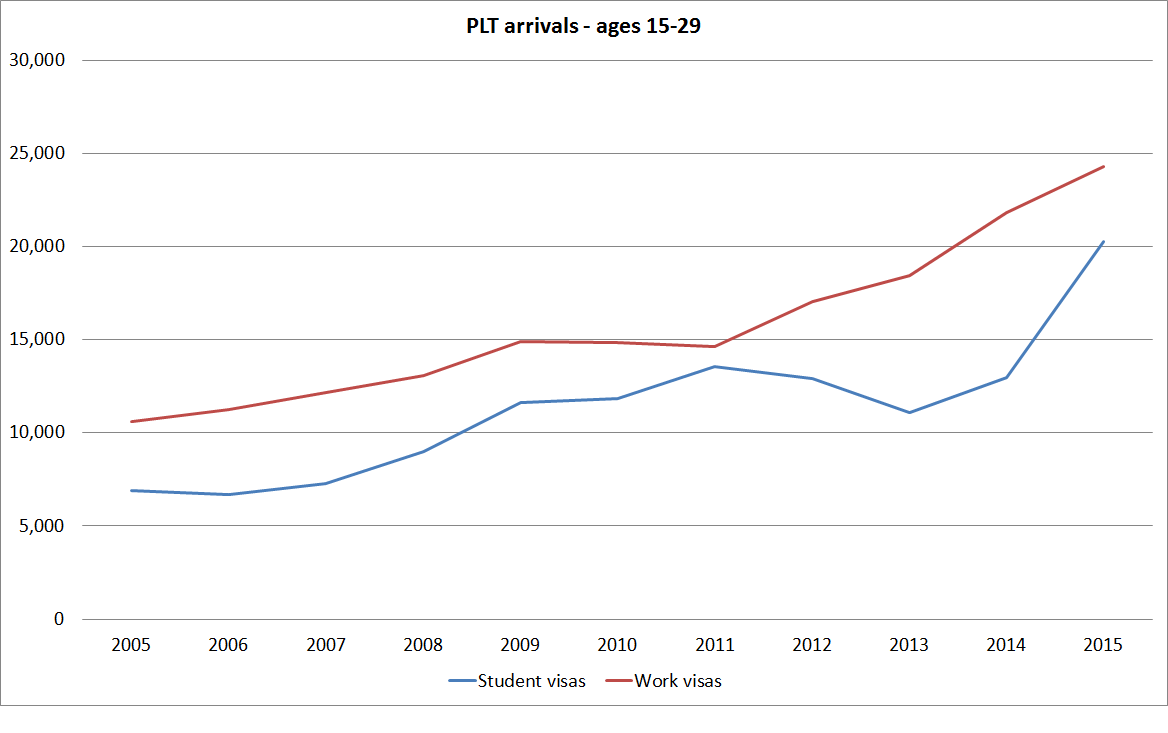
This sentence seems internally contradictory.  More single workers [or presumably married ones without children] certainly have the direction of effect the Bank talks about, but more students goes in the opposite direction.  Foreign students add to demand (for accommodation, for education, and for other consumption items) but generally add very little to labour supply.  This chart shows permanent long-term arrivals for those in the age group 15-29.  If anything, over the last year or two, the rate of increase in those of student visas has been even greater than the increase in the number of young foreign workers.

plt15-29

The article also reports

Combined with capital investment by business it means that it has taken a couple of years longer for the slack in the economy to be taken up and the output gap to turn positive than the bank expected when it started tightening last year.

But as I noted the other day:

  • The Bank’s view of the level of excess capacity that existed 18 months ago, at the start of the tightening cycle, has been revised materially.  Judging spare capacity isn’t easy, but they now think they were wrong about the earlier view that excess capacity had already been fully absorbed.
  • The level of investment since then just has not been very strong.  Growth in hours worked has been quite rapid over the last year, even by the standards of the previous boom, and yet investment did not reach previous boom levels.  (And, of course, when the previous rates of investment were occurring there was still a lot of inflationary pressure). As our best estimate is also that productivity growth has been lousy, this story of an unexpected growth in supply capacity just does not wash.

Economic forecasting is hard, and mistakes will happen.  With the possible exception of the over-optimism about dairy prices, I wouldn’t be very critical of the Bank on any of those forecasting errors.  They are the sort of thing that happens.

But what I think translated the events of the last 18 months into something a little more serious (and again, it isn’t the worst monetary policy mistake ever, by a long shot) is that the Reserve Bank was under no pressure at all to have acted at all last year:

  • Core inflation, on the estimates available to the Bank at the time, was around 1.6 per cent, and had been for several years
  • The unemployment rate was still 6.1 per cent, not far below the sort of level it have averaged in the recession years
  • Credit growth was modest

And inflation had stayed low, to that point, despite the very big and concentrated increase in residential building activity that had already occurred in Christchurch.  For several years, the Bank had (quite reasonably) cited the rebuild as one of the forthcoming major pressures on resources and inflation.  For that matter, there was no sign that commodity prices –  which had been high for a year, while inflation stayed low – were about to rise further.

When inflation is high and resources are demonstrably stretched it is quite understandable when central banks are a little jumpy about new inflationary pressures.  As I noted yesterday, Alan  Bollard raised the OCR four times in succession in 2007 when dairy prices were soaring.  With hindsight, those increases weren’t necessary –  the 2008 recession took care of the inflation, and reversed the dairy price increases –  but I wouldn’t call those 2007 increases a policy mistake.

But in 2014 the Reserve Bank did not need to act.  There were no new inflationary pressures, and the Bank was under no pressure to raise rates, other than the pressure it imposed on itself.  Having started raising the OCR, it was under no pressure to carry on increasing rates.  It was under no pressure, as late as December last year, to be talking of further rate increases.

It was a policy mistake.    They happen.  They have occurred in the past, here and abroad.    And policy mistakes will happen again.

Here’s roughly how, in Graeme Wheeler’s shoes, I  would have answered the question “did you make a mistake?”

Yes, we did.  Monetary policy aims to keep inflation over the medium-term at around 2 per cent.  Doing so means we make extensive use of economic forecasts –  trying to make sense of where we are now, and where things are likely to head over the next couple of years.    Our forecasts were not so very different from those of other economists and agencies     But we misjudged just how much pressure there was (and was going to be) on resources, and as a result we raised interest rates sooner, and further, than was really warranted.

One of the lessons people should take away from this episode is that monetary policy isn’t a precise or surgical tool.  We have to make judgements about things that reasonable people can reach quite different views about.  That means at times we will make mistakes.  When we do, we’ll be very open about them, and correct them as quickly as we can.  What I can’t promise you –  and no one can –  is that there will be no mistakes in the future.

I’m disappointed that we got it wrong this time –  and as the chief executive and single (statutory) decision-maker I have to take responsibility for that error.  Our mistakes matter for people’s lives and businesses.   But you have my commitment that we are going to learn from this episode –  not just about the economy, and also about our processes for making sense of, and responding to, the data.

I’d have applauded an answer like that. I suspect the wider community probably would have too.

Policy interest rate reversals since 2009

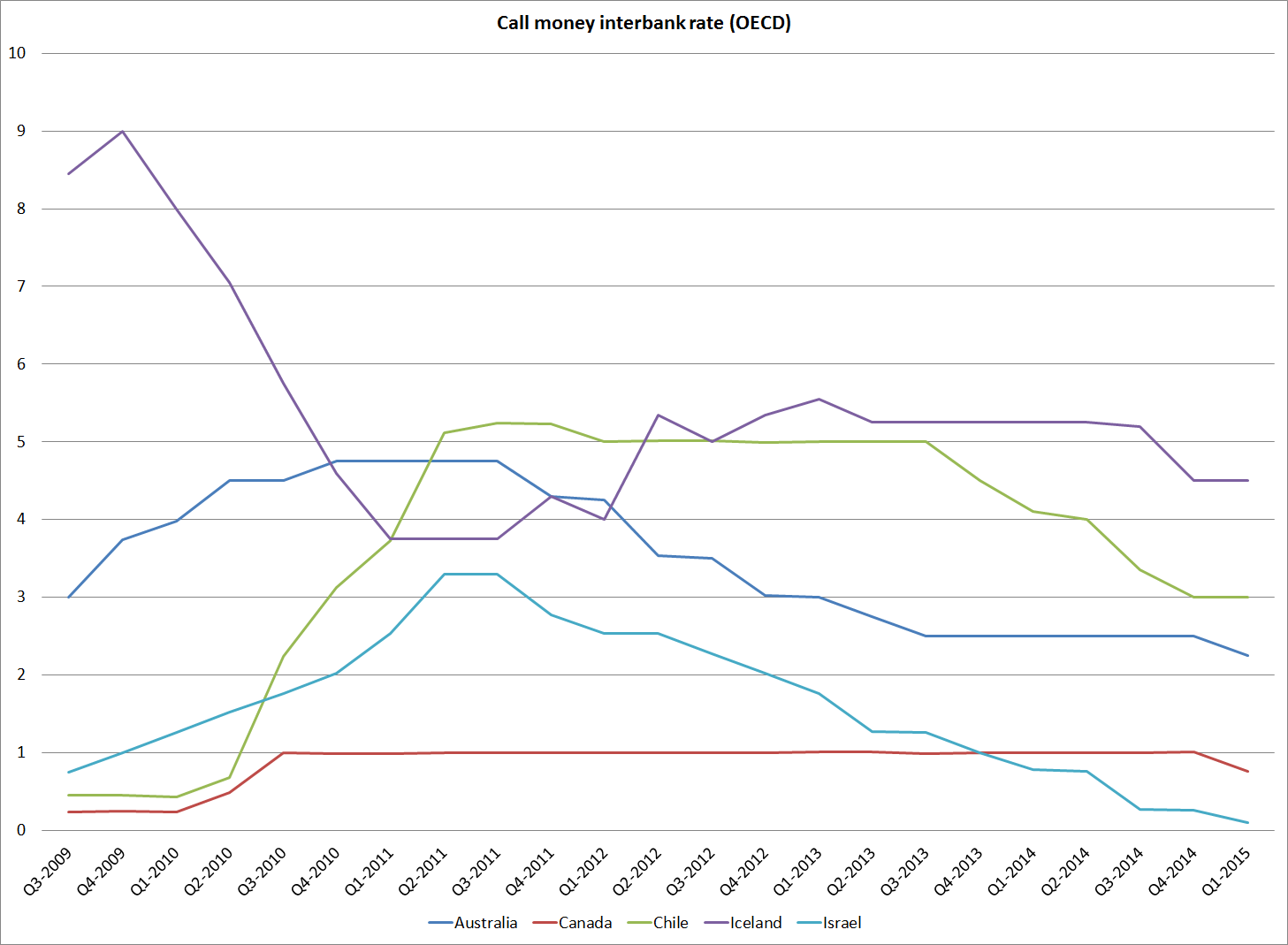
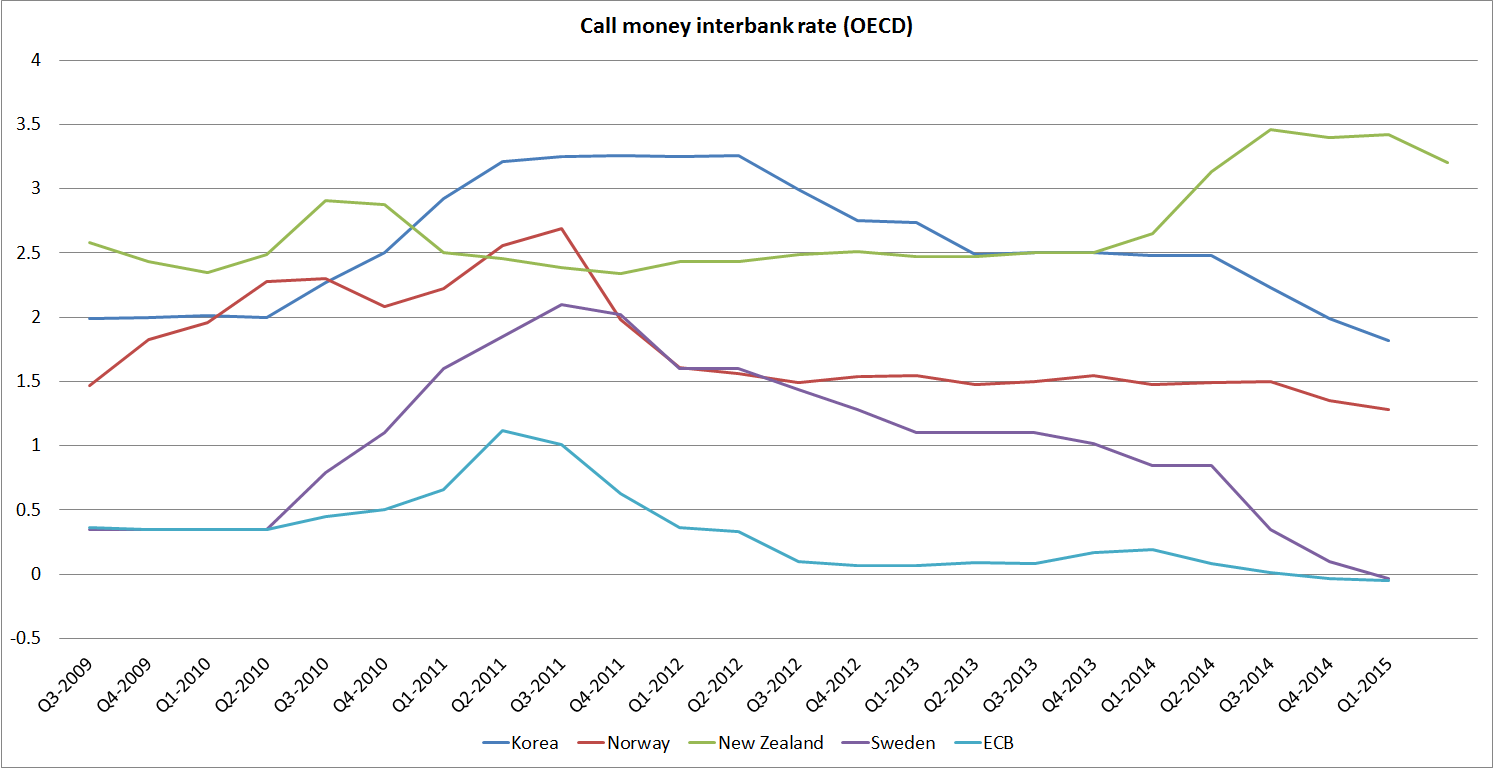
I had a look at ten OECD countries/areas whose central banks have since mid-2009 raised their policy interest rates and subsequently lowered them again.  I was curious as to how quickly those reversals came, and what else was going on.

The overnight interest rates for these countries are shown below.  Overnight rates aren’t the same as policy rates, but the OECD has these data readily available.

call1

call2

A couple of cases we can fairly quickly set to one side.  The Bank of Canada began raising its policy rate in mid 2010, and only in late 2014 did it make a single subsequent cut.  Iceland raised rates in 2011, and did not cut again until mid 2014.  Given the turbulent circumstances of Iceland, the stability in policy rates is quite surprising.

Australia and Chile both benefited hugely for a time from the late phase in the hard commodities price boom that peaked in 2011.  In both cases the increases after the 08/09 crisis seemed pretty well-warranted, and in Chile’s case the peak rate was held for two years before some cuts were put in place.  In neither country’s case has inflation been uncomfortably low relative to the target.

I don’t know much about Israel, but the very shortlived nature of the post 2009 peak interest rate, combined with the fact that the policy rate has subsequently been cut to new lows, and that CPI ex food and energy inflation has been running well under 1 per cent for some time suggests a policy mistake.

The Swedish policy mistake has been well-documented by Lars Svensson (and only rather grudgingly accepted by the Stefan Ingves, the Governor of the Riksbank).  Both Sweden and Norway will have been affected by the unforeseen severity of the euro crisis, but in Sweden’s case in particular there was a clear misjudgement by the policy committee.

The ECB’s policy tightening in 2011 proved to be extremely shortlived.  I’m not aware of anyone who would call it anything other than a mistake.  There is probably a variety of factors that influenced the ECB at the time, but they acted too soon, under no (inflation target) pressure, and quickly had to reverse themselves.

Finally, we have the Reserve Bank of New Zealand, the only one of our ten central banks to have reversed itself twice in five years.  The 2010 increases took place at a time when a variety of other central banks were raising policy rates.  There was some reason to think that the recession was behind us, and that it would be prudent to begin raising rates.  I wasn’t involved in the Reserve Bank’s 2010 decisions –  I was on secondment at Treasury –  but from memory I thought they were sensible moves.  As it turned out, by the time the rate increases were being put through the economy was already turning down again, and had a  shallow “double-dip recession”  The February 2011 earthquake was the catalyst for cutting the OCR again.  Initially, it was sold as a pre-emptive step, but we fairly soon realised that the level of interest rates  actually needed to be lower even once the initial shock had passed.

And then the Reserve Bank did it again.  I’m not going to rehearse the ground I covered this morning, but it is difficult not to put this episode –  the increases last year, now needing to be reversed – in the category of a mistake.  It is harder to evaluate other countries’ policies, but I would group it with the Swedish and ECB mistakes.    Monetary policy mistakes do happen, and they can happen on either side (too tight or too loose).  But since 2009 it has been those central banks too eager to anticipate future inflation pressures that have made the mistakes and had to reverse themselves.  As a straw in wind, in a country with an unusual governance model, it should be a little troubling that our central bank appears to be the only one to have made the same mistake twice.  It brings to mind the line from “The Importance of Being Earnest”:

To lose one parent may be regarded as a misfortune; to lose both looks like carelessness.”

Was a mistake made?

Both the Dominion-Post and the Herald this morning devoted their editorials to monetary policy and yesterday’s announcement by Graeme Wheeler.  The Herald, somewhat oddly, commends the Governor on “seeking to get ahead of the curve”.  In principle, I suppose that is always what he is trying to do –  it is, after all, forecast-based inflation targeting.  But I’m not sure that too many people would regard one OCR cut, just beginning to reverse last year’s increases, as “getting ahead of the curve” when core inflation has been so persistently low, and the unemployment rate has remained troublingly high.  A belatedly awakening might be a better description.

But I was more interested in the Dominion-Post’s thoughtful piece.  Here is the heart of it:

This is more than just an abstract number. It is a signal that more was possible. It suggests that, even though growth has been robust for the past couple of years, it might have been higher, with few costs, had the bank kept rates lower. That, in turn, might have meant more jobs and lower unemployment – which, at 5.8 per cent currently, is still too high.

Was it possible to sense any of this earlier? Monetary policy is a difficult business, and reasonable people can disagree. Certainly the plunge in global oil prices, a key factor behind low inflation, was a surprise to most observers. The slump in dairy prices, too, which will likely weigh heavily on the economy, has been steeper and more prolonged than anticipated.

But other factors were perhaps not so shocking – the slow progress of the global economy, the large influx of migrants to New Zealand (in train before last year), the persistence of low wage growth and local unemployment.

Much hinges on the opaque question of the economy’s “capacity” – essentially how hot it is running. It is always difficult to tell at any given moment; the truth gets clearer in the rear-view mirror.

The bank moved swiftly last year when dairy prices soared, the housing market surged, and the economy began hitting its straps. In hindsight, it moved too fast; it turns out there was more capacity – more labour and resources – to go round than it thought.

At the least, bank governor Graeme Wheeler and his team will need to consider if they were too quick to jump then, and too slow to reverse course.

Still, they have done it now, and rightly so.

I happen to agree with the editorial, but that isn’t really my point.  I’m hardly alone in lamenting the quality of a lot of public debate and media coverage of policy issues, but I was impressed that a newspaper editorial in this country could, in a calm way, highlight the uncertainties that monetary policy makers face, and the scope for reasonable people to disagree on the outlook for the economy.    And that the paper could suggest, in a very moderate tone, that it might be time for some critical self-examination by the Governor and his team .  It was the sort of balanced perspective that, say, those charged with holding the Reserve Bank to account, such as the Bank’s Board, might have read with profit, or which their advisers might have written.  (Of course, it is an open question whether it is the sort of piece that sells more newspapers.)

I noticed media accounts of the Governor’s appearance at FEC yesterday report him again denying that he made a mistake last year, whether in raising the OCR so much or holding it up for so long.  I’m not quite sure what he hopes to gain by this stance.  The Governor used to tell staff that his aim was for the Reserve Bank to be the “best small central bank in the world”.  One of the marks of a successful, learning, organisation is the ability to acknowledge mistakes, learn from them, and move on.  I suspect that there is a more chastened attitude internally than is evident publically, but this is a powerful public organisation, and we should reasonably expect to see more evidence of an ability to acknowledge mistakes.  A misjudgement  about monetary policy is not the worst thing in the world  –  it is in the nature of the game.   If anything, a refusal to acknowledge the misjudgement is more worrying, and detrimental to our ability to have confidence in the Governor, or in the single decision-maker governance framework.  It might, for example, be easier for a committee to acknowledge a mistake than for an individual to do so.

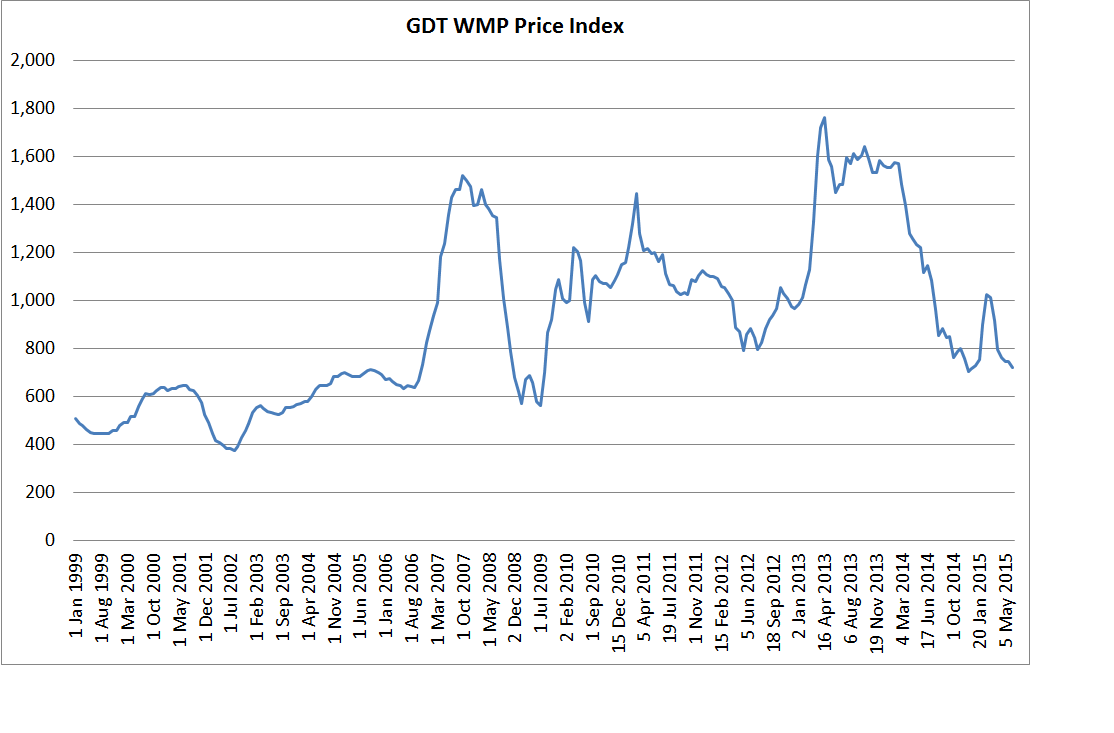
But was it a mistake?  The Governor appears to put a great deal of weight on the high dairy prices at the start of last year.  Even then, the Bank’s forecasts did not have export prices staying up indefinitely.  But the Bank’s optimistic forecasts for dairy prices back then required something quite out of the ordinary.  In the last decade, since EU policies began to change and dairy stockpiles were exhausted, global dairy prices have been much more volatile than previously (and production is much more responsive to changes in output prices and input costs).  At the start of 2015 a reasonable person might not have forecast dairy prices falling quite as low as they have or for long, but they would not have assumed the persistence of anything like the WMP prices seen in 2014.

wmp

This is what the Governor had to say in the March 2014 Monetary Policy Statement as he initiated the tightening cycle

Overall, trading partner growth has seen demand for New Zealand’s goods exports remain robust. Increasing rates of urbanisation and protein consumption in China are supporting demand for many of New Zealand’s commodity exports

Consequently, global prices of New Zealand’s commodities are extremely high, particularly for dairy. Dairy prices increased substantially in the first half of 2013 and remain at those high levels.

Rising demand in New Zealand’s trading partners, and particularly China, will result in continued growth in demand for New Zealand’s exports over the projection. Export prices are expected to remain high relative to history, though ease by about 3 percent over the next year due to an assumed moderation in global dairy prices.

The Bank –  and the Governor –  seemed beguiled by China.  A rather more reasonable approach would have been to have assumed that large fall in dairy prices were likely, even if the Bank could not be quite sure when they would occur.  Forecasters have to have a specific track.  Policymakers need to exercise judgement.

And context matters greatly.  When the first OCR increase was put in place, the unemployment rate was still above 6 per cent, less than one percentage point off the peak during the 2008/09 recession.  The recovery had not (and still has not) ever achieved the sorts of real GDP growth rates seen in earlier recoveries. And, of course, headline and core inflation were both (still) below the midpoint of the target range.  Private sector credit growth was running at around 5 per cent per annum, less than the (then) rate of growth in nominal GDP.

There just was no urgency[1].  There was slack in the economy,  continuing low inflation, modest credit growth.  Reasonable people might have been able to differ about the first OCR increase –  for what its worth, I advised against it, but I was a minority voice –  but the Governor went on tightening, moving at each of four successive reviews, even as dairy prices started falling sharply and core inflation just kept on staying low.  As late as December last year, the Governor was talking about the likely need for further OCR increases.

But he was wrong.  His approach last year was a mistake.  It appeared to be driven, at least in part, by a belief that there was something anomalous about the OCR as low as it had been, and that getting interest rates nearer the Bank’s estimate of neutral would be “a good thing”.

In one sense it shouldn’t be a great surprise that such mistakes are made. The single decision-maker system system is not well-designed to minimise the risk of mistakes (some of Alan Bollard’s early moves were also mistaken, as he later acknowledged).  And the Governor does not have a strong background in monetary policy or macroeconomics, and had not worked in New Zealand for 15 years when he took up the job.  Last year’s OCR adjustments were the first OCR changes he had made.

It would be better if the Governor simply acknowledged that he had made a mistake.  They happen.  It would be better for him, for the organisation (externally and internally –  learning organisations have to create room for staff to make mistakes), and for the country which entrusts so much power to the Governor.  If he is so unwilling to acknowledge a pretty clear-cut mistake, how willing is he to engage in critical self—scrutiny (or encourage it among staff) in areas where there might be rather more shades of grey?

[1] And, thus, the situation was quite different at the start of 2007 when, with unemployment already very low and core inflation very high, a lift in dairy prices, from relatively low levels, prompted Alan Bollard to raise the OCR four times in successive reviews.

Good news, but some continuing concerns

Today’s OCR decision was good news (and a pleasant surprise).  The Reserve Bank has finally recognised just how persistently weak inflation pressures are in New Zealand and has cut the OCR.  It has foreshadowed the possibility of one more cut.  And at least for the next two years there is no hint of the OCR being raised back towards the unchanged  estimate of the “neutral interest rate”.

There is likely to have been an element of deliberate smoothing of the numbers to produce such a flat track for two years ahead.  If so that is something to be welcomed.  I have two  –  slightly contradictory –  reasons for welcoming it.  First, no one (ever) has any good idea what the appropriate OCR will be two years hence. But, second, easing cycles (or tightening cycles) rarely stop at 50 basis points.  In the 16 years of experience with the OCR, the only time the Reserve Bank has moved by only 50 points was when it prematurely raised the OCR in 2010, and then unwound those increases after the February 2011 earthquake.  As I noted yesterday, if the Governor was going to cut the OCR he was most likely to back into modest cuts rather than embrace a wholesale change of view at this stage.

The document does not give a sense of a central bank with a very strong sense of what is going on.  In a sense, that is a step forward.  Huge uncertainty is something all central banks always face, and so many central banks have got things so far wrong over the years since the recession (repeatedly thinking that tightenings will soon be needed)  that it is better to play things by ear, putting quite a lot of weight on actual developments in (core) inflation, rather than on stories about how future events might unfold.

I’m not going to comment in much detail on the numbers in the projections, but I did want to make a couple of points on them and then turn to slightly longer-term policy considerations.

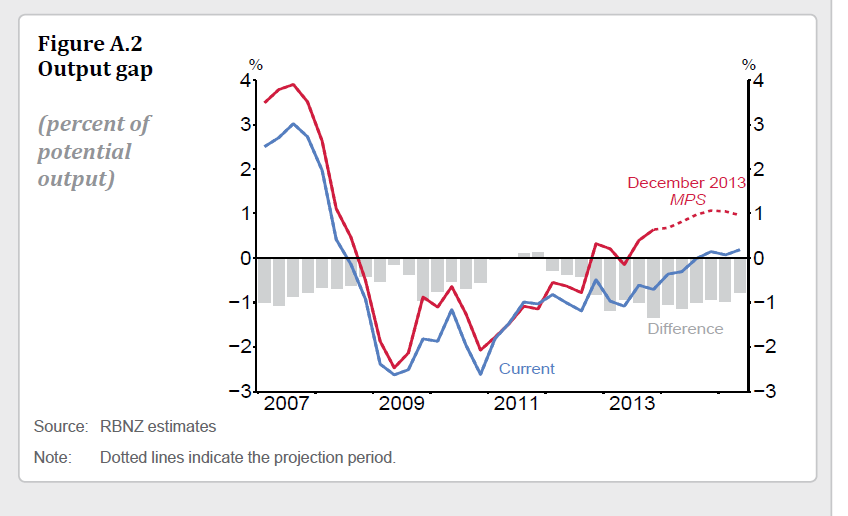
The first point was around this chart from the MPS, showing the Bank’s output gap estimates 18 months ago, and those now.

mps output gap

In one sense, the levels of the two estimates are not hugely different.  And  when we look back five years from now neither might closely resemble the best historical estimates.  But the differences  matter because the Bank, and its forecasting staff, have for several years been putting a lot of weight on the notion that excess capacity was exhausted (and hence it was “time to tighten”).  But in this chart there is almost two years difference in the crossover point.   Other indicators –   notably the unemployment rate –  cast doubt on whether the economy is even now operating at potential.  The point is not that the previous precise estimates are wrong (that is inevitable), but that the Bank has been consistently wrong in its narrative about what has been going on.

The second was around the line, oft-repeated this morning, about the way the economy’s supply potential had expanded rapidly, enabling supply to accommodate growth in demand.   It was presented as a good news story.   But it just is not that good.

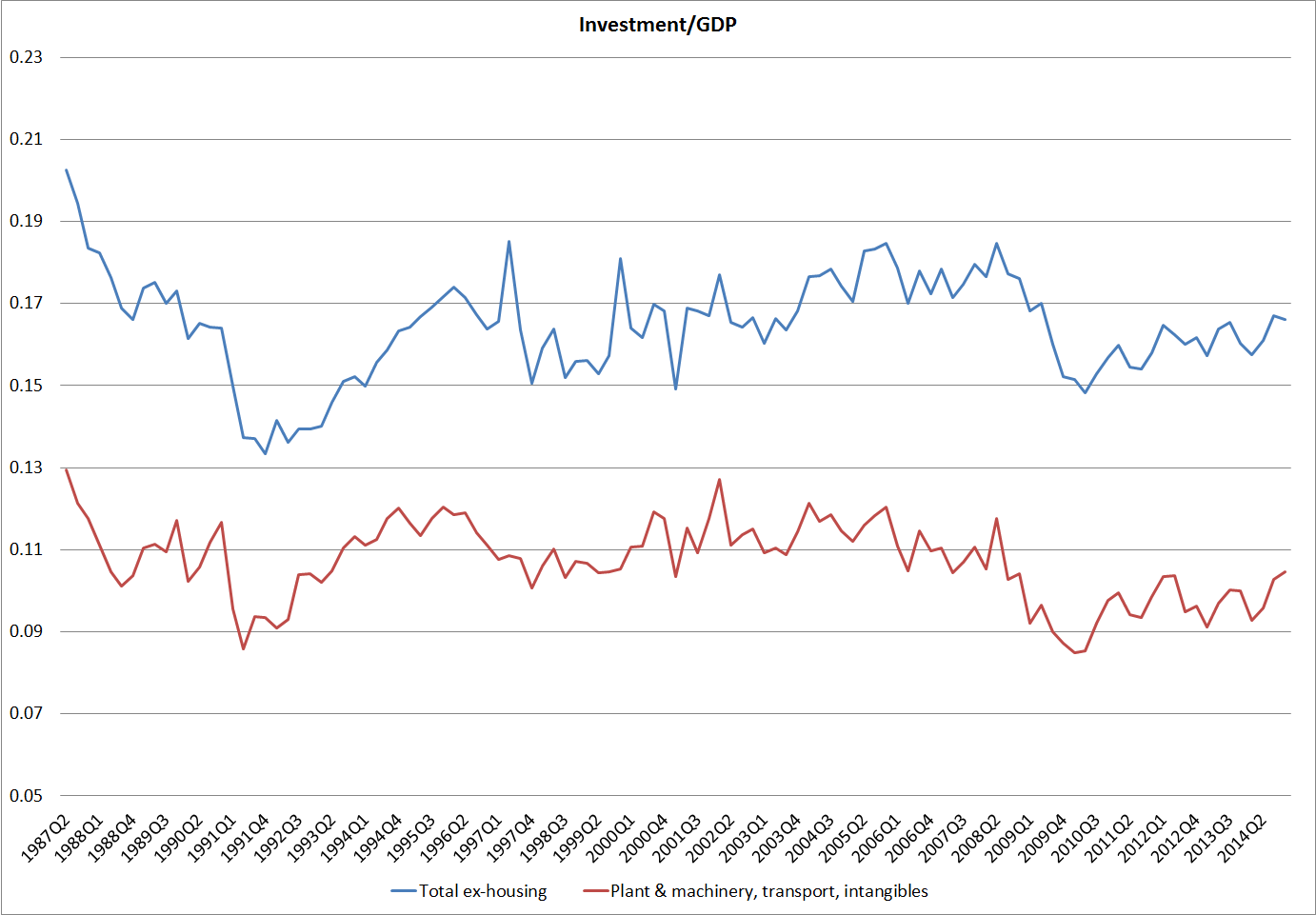
The labour supply has certainly increased rapidly, largely on the back of high (not record) net inward migration.  But in the short-term increases in population growth boost demand more than they boost supply –  always have done in New Zealand, and there is no sign of that changing.  As the tables in the MPS remind us –  and it is a point I’ve made here repeatedly –  productivity growth has been lousy (on the Bank’s measure 0.7 per cent per annum).  And even investment has just not been that strong.  Here is a chart of investment/GDP .

investment mps

I’ve shown both total investment ex housing, and investment in “plant and machinery, transport equipment, and intangibles”.    Investment has been recovering, but on neither of these measures has investment as a share of GDP got back to the average levels seen in the decade prior to the recession,  even though employment has been growing quite rapidly (lots of workers need equipping).  And both measures (even though they exclude housing) will have been boosted by activity in Christchurch to replace lost capacity (think of that underground infrastructure work).  There is no easy way to strip those Christchurch effects out, at least until we get the annual capital stock estimates, but there is really nothing to suggest that underlying growth in per capita capacity has been strong.  A more likely story of what has gone on in New Zealand (as in many other countries) is just that there was quite a lot of excess capacity, which has been enough to accommodate even the demand pressures of a migration inflow without boosting inflation.

The press conference was striking for how little searching scrutiny there was of the Bank’s judgements and performance over the last year or two.  Perhaps FEC will do better this afternoon?  But Rob Hosking of NBR did ask whether the Bank had made a mistake in raising the OCR last year and holding it up for so long.  “Not at all” was the Governor’s response.  His argument was that no one 18 months ago could have anticipated the sharp fall in oil prices or the sharp fall in dairy prices  (which, incidentally, are offsetting effects in the Bank’s forecasts).  I’m not sure about “no one”,  but even if we grant the point, the Governor is surely not arguing the continued weak core inflation, and declines in non-tradables inflation that we have already seen in the data, are a reflection of either of those forecast errors?  Weak commodity prices are going to exert an increasing drag on spending this year, and perhaps beyond,  but weak wage and price inflation were well-entrenched before  the depth of the correction in dairy prices became fully apparent.  I think it is more accurate to say that the Bank misjudged the level of spare capacity at the end of 2013, it misjudged the underlying inflation processes, it misjudged the inflation implications of the resurgence in the housing market, and thus was far too ready to initiate, and carry on, a tightening cycle.  It was a mistake.

As I’ve said before, there is huge uncertainty in monetary policy. In a sense I can understand why the Governor would not want to openly acknowledge that he had made mistakes (he’s human too), but it is a shame that he did not use the opportunity to convey to journalists and the public more of a sense of the limitations of anyone’s knowledge, and the inevitability that central banks will from time to time get it wrong.   And if the Governor did not want to  acknowledge the mistake in the press conference, some more sustained critical self-examination in the Monetary Policy Statement itself would have been appropriate, and consistent with the spirit of the legislative provisions governing such documents.  Perhaps a scenario experiment, running through the Bank’s models the implications of having held the OCR at 2.5 per cent since the start of last year, would have been an interesting basis for a conversation, including with the Bank’s Board (the Minister’s agent in holding the Governor to account).

But perhaps my biggest concern about today was an issue that won’t get any headlines.  It was how the Governor and Assistant Governor dealt with a question about whether the inflation target should be changed.  The Governor noted that outgoing IMF Chief Economist Olivier Blanchard had [been among various others who had] proposed raising inflation targets, to help minimise the risk that the near-zero lower bound would be such a problem in future.  As the Governor noted, Blanchard [and one of his predecessors Ken Rogoff ] had not got a lot of support for his proposal.   But then the Governor went on to note that monetary policy was proving a lot harder than people had expected and that it was very difficult to raise very low inflation expectations.

As I’ve noted previously, for other countries –  already entrenched at zero interest rates –  there is no easy way in which raising the inflation target now would make much difference.  It is too late.   But New Zealand (and Australia) are different.  We still have materially positive policy interest rates.  That means we are both still exposed to the possibility of hitting the zero lower bound in the next serious downturn.  And yet the Governor seems indifferent  to –  or perhaps not even consciously aware of –  the possibility, and the implications for the economy (and for the people who would be unemployed).  Raising the inflation target is certainly not an ideal option, but as I’ve argued here previously unless governments and central banks are going to do something active about removing the near-zero lower bound (and neither the Governor nor the minister has given any hint of doing that) there should be a more serious discussion about whether our inflation target should be raised, as a pre-emptive and precautionary move.   At very least, inflation outcomes in the upper half of the target range would provide slightly better buffers than a continuation of outcomes below the midpoint.   There would be no excuse, given how much notice our central banks have had, if in the next serious downturn New Zealand or Australia become trapped for years with interest rates at some floor (a floor that arises out of policy and legislative choices, not as some force of nature).  Perhaps, at a pinch, it was excusable not to think much about the zero bound when the Governor was signing the PTA in 2012.  It can’t be excusable now.

The Assistant Governor’s response to the question about the target was even more disappointing.  I suspect he was trying to help his boss, by asking the journalist whether he meant to suggest raising or lowering the inflation target.   But it is difficult to believe that a serious senior central banker could, in the current climate of extremely low inflation (here and abroad), seven years on from a recession which took policy rates to their lower limit and has seen them more or less stuck there, could even toy publically with the idea of lowering the inflation target.  If the Bank were to convincingly sort out the zero lower bound issues, then perhaps it would make sense to have that conversation (to aim for “true” price stability, rather than 2 per cent annual inflation).  But the Bank has given no hint that it even takes these risks seriously.

McDermott concluded that “changing targets is a very risky thing to do”.  Well, perhaps, but the risks in considering raising the target need to be weighed against the risks of adverse shocks that deliver New Zealand another recession before  the unemployment rate has even fully recovered from the last recessions.  Those are people’s lives the Bank toys with. As even the Governor recognised, the risks of something very nasty around a Greek exit from the euro are far from trivial –  though how, in the same breath, he could assert that deflation risks had passed in Europe was something that eluded me.

And finally a reminder about the gaps in the Bank’s transparency around monetary policy:

  • The forecasting models, developed at considerable public expense, are still not public
  • We will not see, even with a lag, any minutes from the Governing Committee or the Monetary Policy Committee, and will see no hint of the advice provided to the Governor.
  • Despite the Bank last week releasing 10 year old “forecast week” papers, we still have so sense as to how long a lag we might face before having access to the Bank’s forecasting papers for the last 18 months or so.
  • We will not see any minutes of the Board discussion of monetary policy and the Bank’s adherence to the PTA.  Nor we will see the written advice prepared for the Board.

As I’ve put it previously, the Bank is quite transparent about the things it (and we) don’t know much about –  ie the future –  and not very transparent at all about the things it knows a great deal about (its own analysis and deliberations and debates that went into shaping the Governor’s decisions, both today’s and those of the last 18 months).