The big projected deficits in 2008

As part of the current political debate about the relative capability of the two main parties to manage the government finances responsibly, I sometimes see references to the large deficit forecasts that greeted the incoming National government in 2008.

I wrote about this issue a few months ago, in response to some specific claims made by one analyst at the time.  I’m reproducing the bulk of that post below (not indented).  My bottom line, supported with documentation is

But on best Treasury advice, the then Labour government thought they were leaving an essentially balanced budget [ie the 2008 Budget, their final fiscal policy choices], on top of an already very low debt level, not deficits.

It is certainly true that when the current government took office in November 2008, official fiscal forecasts showed large deficits for many years into the future.  But the last fiscal initiatives of the outgoing Labour government had been the 2008 Budget, the parameters for which were set out in the Budget Policy Statement released at the end of 2007.

Throughout much of the previous Labour government’s term of office, a key theme of fiscal policy developments had been the surprising strength in revenue.  It was, in many respects, why the fiscal surpluses were so large during those years –   Treasury and the government kept being taken by surprise, and Treasury was (prudently) cautious about treating the surprises as permanent.  If it was just a series of one-offs, or something cyclical, it wouldn’t have made sense to increase spending or cut taxes in response.

The Treasury gradually revised upwards their assessment of the underlying fiscal position.  Unfortunately, they took a particularly optimistic stance by the end of 2007.  I can recall the then Prime Minister making much of the fact that Treasury was now assuming that most of the revenue gains would prove permanent (and thus could support some mix of increased spending and lower tax rates) without the risk of dropping back into deficits.  I joined Treasury on secondment in mid-2008 and I have seen documents written to the Minister of Finance during early 2008 stating that reassessment.  I was under the impression that some had been released, perhaps as part of the pro-active release of 2008 Budget papers, but on checking that link on the Treasury website, I couldn’t see the paper in question.

But the facts of the reassessment aren’t in dispute.  Several Treasury staff produced a paper last year on the process of getting back to surplus, including the background to the deficits.  Here is what they had to say

Over the period 2005-2008, the Treasury increased its estimates of structural revenues by around 1 percentage point of GDP each year, and by 2008 the Treasury considered most of the operating surplus was “structural”

and

When the tax reductions [along with further spending increases] were announced in Budget 2008, the Treasury was still predicting the operating balance to remain in surplus through the forecast period, albeit at a lower level.

With the benefit of hindsight, the degree to which the surpluses were structural was overestimated. Although the tax reductions announced in 2008 turned out to be well-timed from the perspective of stabilising the economy following the GFC, their permanent nature added to the subsequent structural deficits.

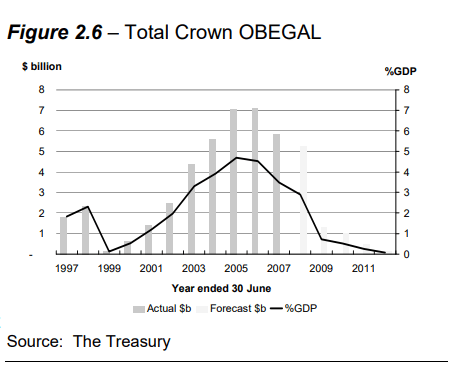
Here is the chart from the 2008 Budget Economic and Fiscal Update.

2008 Budget forecast obegal

That document was signed off  by the Secretary to the Treasury as representing his best professional assessment of the economic and fiscal outlook, incorporating the effects of announced government policy.  In New Zealand –  unlike many countries – the forecasts are those of the professional advisers, not those of the Minister of Finance.

On the basis of the economic and fiscal information available to it, the Treasury has used its best professional judgement in supplying the Minister of Finance with this Economic and Fiscal Update. The Update incorporates the fiscal and economic implications both of Government decisions and circumstances as at 9 May 2008 that were communicated to me, and of other economic and fiscal information available to the Treasury in accordance with the provisions of the Public Finance Act 1989.

John Whitehead
Secretary to the Treasury

14 May 2008

The projected surpluses by the end of the forecast period were tiny –  essentially the budget was projected to be in balance by then.  The economic and revenue outlook had worsened over the first few months of 2008, after the broad parameters of the Budget had already been sketched out in the BPS.   As we now know, New Zealand was already in recession by May 2008.   But on best Treasury advice, the then Labour government thought they were leaving an essentially balanced budget, on top of an already very low debt level, not deficits.

Of course, the government was wrong in that assumption.  But, specifically, Treasury was wrong in its best professional advice.    Perhaps the government would have run quite expansionary discretionary fiscal policy anyway, even if Treasury had been less optimistic about how permanent the revenue was.  They were, after all, behind in the polls, and the PM’s office –  didn’t Grant Robertson work there? –  would no doubt have been putting a lot of pressure on the Minister of Finance.  But that hypothetical didn’t arise.    They didn’t have to make such awkward political choices –  their own professional advisers told them they could have tax cuts and spending increases, and still keep the budget in (modest) surplus.  The Opposition National Party shaped its, more generous, tax cutting promises on much the same sort of Treasury forecasts and estimates.  (And a few years earlier, the 2005 election had partly been a bidding war as to how best to spend the surplus –  not whether there really was a structural surplus).

It wasn’t Treasury at its finest.  It is, perhaps, a reason to be cautious about just how much a fiscal council might add.   Would such a body, faced with similar circumstances –  a long succession of revisions upwards in revenue –  have really reached materially different judgements about the outlook then?  Perhaps.  We can’t know, but back in 2008 Treasury was using its best professional judgement, and the mistakes were still made.

There is a bit of a tendency afoot to suggest that the current National-led government has done a better job of fiscal management than the previous Labour government did.  I’m not really convinced by that story.   I’d accept that the previous government might have had an easier job than the current government has –  since one inherited modest but growing surpluses, while the other inherited deficits.  The current government had some nasty shocks (earthquakes) but also some of the best terms of trade in decades and the weakest wage pressures.      But if we expect our politicians to be guided by professional advice in areas like this, the previous government did what most orthodox opinion advised them to, keeping on delivering surpluses and reducing outstanding debt.  Probably they should have emphasised tax cuts more than spending increases, but this particular debate is about overall fiscal balances.

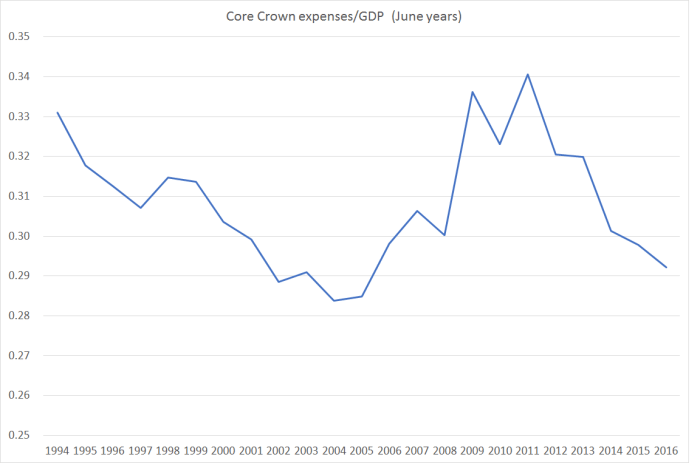
By the end of Labour’s term, government spending as a share of GDP was rising a lot –  but then Treasury was telling the government the money was there to spend.  And for all the talk of how the new Labour/Greens rules commit a new left-wing government to keep spending at around current National government levels, that level is around the average level that prevailed under the previous Labour government.

core crown expenses

There are things I’d criticise about the previous government’s policy. Allowing big structural surpluses to build up, as happened in the first half of the term, set the scene for a big spend-up later (which would have been big tax cuts if National had won in 2005). It is probably better to recognise the limitations of knowledge and typically keep both surpluses and deficits small. But it is easier to say in hindsight than it might have been at the time.  And in 1999 [when Labour had come to office], the severe fiscal stresses of 1990/91 were pretty fresh in everyone’s memory.

Tougher than Ruth Richardson?: implausible spending numbers

An overnight commenter on yesterday’s fiscal post made this suggestion

I wonder if some improvement in the PREFU could help. As you say, the Health budget has been increasing by $6-700m for the last couple of years, but is forecast to change by only minor amounts in future years. No one seriously believes that do they? Why not have assumptions for GDP, population, inflation, interest rates, demographics etc included in the PREFU numbers (maybe they are), and adjust the future years costs/incomes accordingly. So rather than having flat-lining health numbers, adjust for population, (health) inflation, demographics etc. I would hope that this would allow us to get a better sense of how promises stack up relative to a ‘normal’ expectation of what might happen. If someone wants to ‘deliver a modern health system’, but they aren’t going to increase the health budget, at least it would hopefully be apparent.

It may be far from perfect, but should at least be a bit more realistic?

I have a lot of sympathy with what the commenter suggests.  It is, more or less, what Treasury already do for the medium-term fiscal projections (beyond the four year budget window), and it wouldn’t be hard for them –  or an independent Fiscal Council –  to do something similar for the four years of the PREFU numbers (in addition to what is done now, rather than in substitution).   The numbers would be illustrative, and one might need to provide some ready reckoners to allow for different assumptions, but illustrative scenarios can still help to illuminate debate.

In that spirit, how would one look at the Health budget?   As I noted yesterday, in Labour’s fiscal plan they expect to spend $2361 million more on health in 2020/21 than the (basically flat) PREFU numbers.  To be clear, those PREFU numbers do not reflect what a re-elected National government would expect to spend; they just reflect what has already been allocated.

The Labour Party has claimed that their numbers allow for cost increases that would result from continuing inflation and population growth, as well as making provision for the various policy measures they have promised.    In the plan document they summarise this as

Reverse National’s health cuts and begin the process of making up for the years of underfunding that have occurred. This extra funding will allow us to invest in mental health services, reduce the cost of going to the doctor, carry out more operations, provide the latest medicines, invest in Māori health initiatives including supporting Whānau Ora, and start the rebuild of Dunedin Hospital.

The language suggests quite a lot more of an increase in spending than would be implied simply by inflation and population increases from here.

As it happens, we do have some insight as to how they think those inflation and population pressures should be allowed for.  After yesterday’s post a commenter sent me a link to a June 2017 press release from then-leader Andrew Little, which in turn linked to some work Infometrics had been commissioned to do for Labour on whether health spending had kept up with inflation and population pressures over the term of the current government.    In the tables in that short piece of work, Infometrics use CPI inflation and they allow for demographics pressures (ie the combination of an ageing population and a growing population) using (a) actual population growth and (b) some Treasury numbers that weight the population by its demand for health services.  With an ageing population that seems to lead to a demographic increase in demand for health services about half a percentage point higher than the population growth rate  (a bit more in years of low immigration – migrants on average are younger and have less short-term demand for health services).

If we take the Treasury projections for CPI inflation and population increase (from the PREFU), and apply the same sort of ageing population factor that Treasury and Infometrics have previously used, this is what we get.

CPI Inflation – Tsy forecast Population % increase –  Tsy forecast Total demographic % increase Implied % increase in health budget to keep pace $m increase
2018/19 1.7 1.5 2 3.7 608
2019/20 2.1 1.3 1.8 3.9 665
2020/21 2.1 1.1 1.6 3.7 655

If this approach is roughly right, the health budget (total Crown basis) would have to increase from the PREFU estimate for 2017/18 of $16432 million to $18360 million by 2020/21 just to keep pace with inflation and demographic pressures that are expected/forecast but haven’t yet happened.  In Labour’s fiscal plan, they expect to spent $18757 million on health in 2020/21.

On this basis – a methodology we know they used quite recently –  there is some margin between the expected (fiscal plan) numbers and those required simply to keep pace with future cost pressures.  That margin is $397 million in 2020/21.    But they argue –  the numbers are in the tables – that the health budget has been underfunded just for cost and demographic pressures during the term of this government to the tune now of almost $300 million per annum, and if one goes to their Health policy the first additional specific policy promise –  around GP fees – is itself estimated to cost $259 million a year, starting next year.  (Of course, National has made a similar promise in this area.)   It looks likely to be very difficult to deliver all those promises, and cover the basic inflation and demographic cost pressures, within that $18757 million.      That isn’t really surprising because, as I illustrated yesterday, the numbers suggest that health spending as a share of GDP won’t be changing –  and will be lower than it has been for most of the last decade.

Labour health

My actual interest in health policy and the health budget is quite limited (although my wife tells me I’m getting old and so should be more interested), but it is worth noting that Infometrics (and Labour apparently) used CPI inflation as a measure of the cost pressures. Ideally, one would want to use a specific index relating to health system costs.  I’m not aware that we have one in New Zealand –  certainly not one widely available –  but I did have a quick look at the CPI components data.

% increase since 08/09
CPI 13.2
Dental services 27.9
Paramedical services 29.1
Hospital services 32.3

Perhaps there might be some reason to worry that the CPI understates health inflation pressures (although it is true that the item “therapeutic appliances and equipment” –  one of those low inflation tradables – increased by only 2.6 per cent).    Even 1 percentage point more health inflation in total over three years would make considerable inroads into the margin Labour seems to have to deliver more medical services (or the same ones at cheaper prices to users).

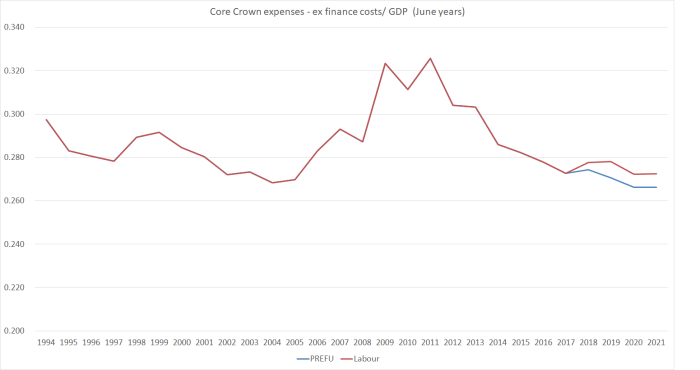
In a sense, my larger point in yesterday’s post was about how plausible it is to expect to see government operating expenditure falling further as a share of GDP.  That is what both parties are promising.     Here is a chart of core Crown spending as a share of GDP, stripping out finance costs, and simply looking at the things governments are purchasing and the transfers they are making.

core crown spending 17 election

The data only go back, in this form, to around 1994.  But government spending as a share of GDP –  again excluding finance costs – hadn’t been any lower than shown in this chart (and was mostly higher) in the previous 20 years.

So the National Party’s proposed spending numbers would be smaller as a share of GDP than at any time in the last 40 years, and Labour’s would be smaller than at any time except for two years in the last Labour government that were (a) only very slightly lower, and (b) proved unsustainable, with big increases in spending over the following few years.  Grant Robertson and Steven Joyce: both tougher than Ruth Richardson.

A small government person might well look at these numbers with pleasure, and assume that the government was getting out of whole areas and handing responsibility back to citizens. I recall discussions with the late Roger Kerr who talked of how an advanced economy could have a basic safety net welfare state and still keep spending perhaps 10 percentage points lower than shown in this chart.     But he didn’t have in mind, for example, relentless increases in the share of GDP devoted to NZS (as both parties promise for the next two decades).    Or moves towards fee-free tertiary education.  Or real increases in welfare benefit rates.  Or……

If we compare what the state was spending on things 10 or 12 years ago and what either main party wants to spend on things over the next few years (Labour more than National of course, but in historical perspective the differences are small), how credible is it that the spending share of GDP will be able to be held so low?  Yes, the burden of some spending programmes has been wound back, but it isn’t easy to think of things the state has simply decided to stop doing, and it easy to see areas (in the current electoral auction) where there is pressure to do more.     And it is not as if, in recent years, productivity gains (non-existent for five years now) have been giving us “free lunches”.

I’m not taking a view here on what the appropriate level of spending (or taxes) should be.  My own biases would be to lower both selectively (but also run smaller surpluses).  It is simply a point about the realism of the numbers both parties are campaigning on, given what they say they want to be able to deliver.

But I am still a bit perplexed, as I said yesterday, about why an opposition party campaigning against serious sustained underfunding in various key areas of government spending, and wanting to do some big new things, would also be campaigning on cutting government spending as a share of GDP –  just smaller cuts than the current governing party is promising.   Perhaps it would make some sense (economically) if we were in some sort of fiscal or debt crisis –  all those debates in the UK about the appropriate pace of “austerity” –  but we aren’t.    Net core Crown debt (properly measured) in the last financial year was 9.2 per cent of GDP.    Quite what the political imperative, or the economic narrative, is for further reductions from there is a bit beyond me.

Thoughts prompted by Joyce vs Robertson

If Steven Joyce had simply noted that the Labour Party appears to have made so many specific policy promises that if they were to form the next government it would be very hard to deliver on those specific policy commitments, meet ongoing increases in the cost of normal government activities, and yet at the same time meet the specific spending, surplus, and debt numbers they’ve outlined in their fiscal plan, a useful and constructive exchange might well have followed.  My summary stance: I think that looks like a reasonable conclusion.  How much it matters probably depends largely on how much weight you put on the importance of those surplus and debt numbers.

I didn’t read the Labour fiscal plan when it was released.  The specific policy promises had already been announced and in an MMP era, in particular, documents of this sort always seem like not much more than opening offers going into potential negotiations around the formation, and conduct, of a new government.    They also involve a degree of ritual obeisance to the belief that economic forecasts have much value; a ritual belief that while entirely conventional leaves me cold (whether opposition parties or government agencies are doing it).

None of us knows what the terms of trade will do over the next few years, or net migration, or the myriad of other things here and abroad that will affect the economic and fiscal outlook.  Even the rate of inflation will affect how large the operating allowance should sensibly be each year (since it is nominal –  and cost pressures will be different if the Reserve Bank delivers inflation at 1.2% than if it delivers 2.2% inflation).   Of course, we want specific promises to be costed, and on a multi-year basis.  But this debate hasn’t been about specific policy costings.  And beyond that, the amount of information in these documents is really quite limited.   Among other things, Labour’s numbers use exactly the same GDP track as in the PREFU, but presumably they expect their wider economic policy measures to make some difference to that (eg somewhat less immigration  –  at least in the first year –  and perhaps appointing a Reserve Bank Governor who might generate a bit less unemployment and a bit more inflation –  two measures deliberately used here because they have offsetting effects on nominal GDP).

But, for now, lets play the game.

Labour has laid out their numbers in a series of summary tables.  They have explicitly identified numbers for each of their (revenue and expenditure) major policy initiatives, and made explicit summary provision for the cost of a group of less expensive policies.  And they identified how much (or little) still unallocated money they would plan to have available.   The resulting operating surplus numbers are almost identical to those in PREFU, but where they do take on a bit more debt –  to fund NZSF contributions and the Kiwibuild programme – they also allow for additional financing costs.

And then they had BERL go through the numbers.    People on the right are inclined to scoff at BERL and note that they are ideologically inclined to the left.  No doubt.  But all they’ve done on this occasion is a fairly narrow technical exercise.  They haven’t taken a view on the merits of any specific policy promises or even (as far I can see) on the line item costings Labour uses.  And they haven’t taken a view on the ability of a Labour-led government to control spending more broadly.   They’ve taken the Labour numbers, and the PREFU economic assumptions and spending/revenue baselines, and checked that when Labour’s spending and revenue assumptions are added into that mix that the bottom line numbers are

consistent with their stated Budget Responsibility Rules and, in particular

  • The OBEGAL remains in surplus throughout the period to 2022
  • Net Core Crown debt is reduced to 20% of GDP by June 2022
  • Core Crown expenses remain comfortably under 30% throughout the period to 2022.

An economics consultancy with a right wing orientation would have happily signed off on the same conclusion.  The numbers add up, on the material they were given.  In that sense, there is no $11.7 billion “fiscal hole” and the opening claim by Steven Joyce on Monday was simply wrong.   Arguably, irresponsibly so from a serving Minister of Finance.

But where there is more of an issue is that Labour’s spending plans on the things they are promising mean that to meet these surplus and debt objectives, on these macro numbers, there is very little new money left over in the next few years.     That might not sound like a problem –  after all, why do they need much “new money” in the next few years when the things they want to do are already specifically identified and included in the allocated money in the Labour fiscal plan.      The answer to that reflects the specifics of how the fiscal numbers are laid out, and how fiscal management is done.   Government departments do not get routine adjustments to their future spending allowances to cope with, say, the rising demands for a rising population, or the increased costs from ongoing inflation (recall that the target is 2 per cent inflation annually).   Rather, they are given a number to manage to, and only when the pips really start squeaking might a discretionary adjustment to the department’s baseline spending be made.  Any such discretionary adjustments comes from the “operating allowance” –  which thus isn’t just available for new policies.

You can see in the PREFU numbers.   Health spending rose around $600 million last year, and is budgeted to rise by around $700 million this year (2017/18).  And then….

$m
2017/18 16432
2018/19 16449
2019/20 16481
2020/21 16396

No one expects health spending to remain constant in nominal terms for the next three fiscal years.  But there will need to be conscious decisions made in each successive Budget to allocate some of the operating allowance to health –  some presumably to cover new policies, and much to cover cost increases (wages, drugs, property etc, and more people), all offset by whatever productivity gains the sector can generate.

And here is why I think there are questions about Labour’s numbers.  By 2021, they expect to be spending $2361 million more on health than is reflected in these PREFU numbers.     About 10 per cent of that increase is described as “Paying back National’s underfunding” and the rest is labelled as “Delivering a Modern Health System”.

This is how they describe their first term health policies

Reverse National’s health cuts and begin the process of making up for the years of underfunding that have occurred. This extra funding will allow us to invest in mental health services, reduce the cost of going to the doctor, carry out more operations, provide the latest medicines, invest in Māori health initiatives including supporting Whānau Ora, and start the rebuild of Dunedin Hospital.

That sounds like an intention to deliver materially more health outputs/outcomes (ie volume gains, or reduced prices to users).

In response to Steven Joyce’s attack, Grant Robertson is reported as having told several journalists that Labour’s health (and education) numbers include allowances for increased costs (eg rising population and inflation  –  and inflation in the PREFU is forecast to pick up) as well as the costs of the new initiatives.   Perhaps, and if so perhaps a pardonable effort to put a favourable gloss on the proposed health (and education) spends –  ie sell as new initiatives what are in significant part really just keeping with cost and population pressures.  I say “pardonable” because governments do it all the time.

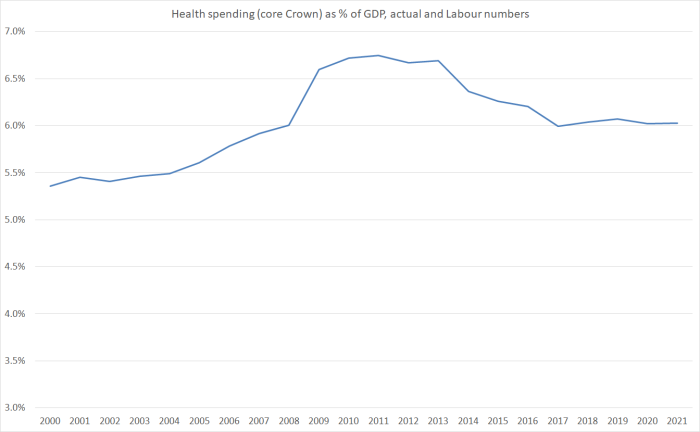
In this chart, I’ve shown core Crown health expenditure as a share of GDP since 2000, and including Labour’s plans for the next three budgets.  (Labour show total Crown numbers, but I’ve taken their policy initiative numbers –  ie changes from PREFU –  and applied them to the core Crown data, which Treasury has a readily accessible time series for.  The differences between core and total Crown in this sector are small.)

Labour health

In other words, on these numbers health as a share of GDP over the next three years would be less than it was for most of the current government’s term, and virtually identical to what it was in Labour’s last full year in government, 2007/08.    Some of the peaks a few years ago were understandable –  the economy was weak, and recessions don’t reduce health spending demands.  But even so, we know that there are strong pressures for the health share of GDP to increase, as a result of improving technology (more options) and an ageing population.  Treasury’s “historical spending patterns” analysis in their Long-term Fiscal Statement last year had health spending rising from 6.2 per cent of GDP in 2015 to 6.8 per cent in 2030.

Without seeing more detail than Labour has released there really only seem to be two possible interpretations.  Either Labour hasn’t allowed for the ongoing (ie from here) population and cost increases in their health sector spending numbers, or there must be much less in the way of increases in health outputs than the documents seem to want to have us believe (eg “reversing years of underfunding”).  One has potential fiscal implications.  The other perhaps political ones.    Glancing through Labour’s health policy, which seems quite specific, I’m more inclined to the former possibility (ie not allowing for population and cost pressures), but I’d be happy to shown otherwise.

Eyeballing that chart –  and as someone with no expertise in health –  it would look more reasonable to expect that health spending might be more like 6.5 per cent of GDP by the end of the decade, in a climate where a party is promising more stuff not less, and with no strategy to (say) shift more of the burden back onto upper income citizens.

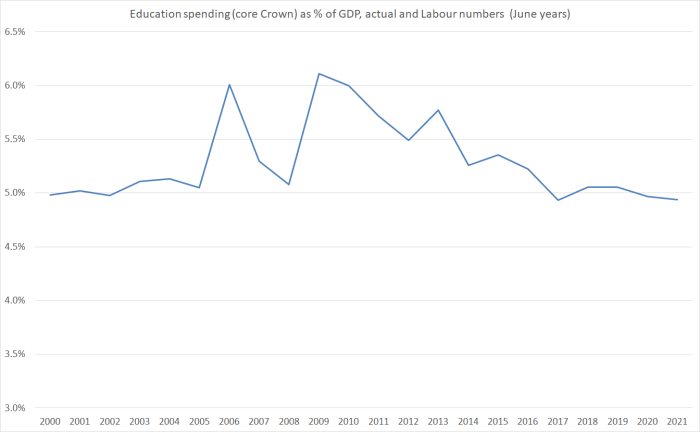
One could do much the same exercise for education.  Labour has seven line items in its “new investments” table.  Most of them are very specific (including increased student allowances and the transitions towards zero-fees tertiary education).     There is a general (large) item labelled “Delivering a Modern Education System” but in the manifesto there are a lot of things that look like they are covered by that.    There isn’t any suggestion that general inflation and population cost increases are included, but perhaps they are.  But again, here is the chart of education spending as a share of GDP, including Labour’s numbers for the next three years.
labour education.png

I’m not altogether sure what some of those earlier spikes were (perhaps something to do with interest-free student loans), but again what is striking is that Labour’s plans appear to involve spending slightly less on education as a share of GDP than when they were last in government.  And that more or less flat track from here doesn’t suggest a party responding to this stuff

National has chosen to undermine quality as a cost-saving measure. After nine years of being under resourced and overstretched, our education sector is under immense pressure and the quality of education is suffering. The result is a narrowing of the curriculum, more burnt out teachers, and falling tertiary education participation.

and at the same time committing to flagship policies around things like student allowances and fee-free tertiary study.

Again, it begins to look as though Labour has included in its education numbers the ongoing multi-year costs of its own new policies, but not the ongoing cost increases resulting from wage and price inflation and population increases.  Again, I’d happily be shown otherwise.

Of course, there is some unallocated spending in Labour’s numbers, but the amounts are very small for the next few years, and some of these sectors are very large.  And although population growth pressures are forecast to ease a little in the next few years, inflation is forecast to pick up and settle around the middle of the target range, so there are likely to be increased general cost pressures (including, for example, wage pressures if as Labour state in the fiscal plan document “by the end of our first term, we expect to see unemployment in New Zealand among the lowest in the OECD, from the current position of 13th”).

How much does it matter?  After all, we don’t know many specifics on the policy initiatives National (and/or its support partners) might fund in the next term, and there was the strong suggestion the other night of a new “families package” in 2020 (which would come from any operating allowance).  Quite probably the next few years will be tough, in budget terms, for whoever forms the government.  After all, the terms of trade isn’t expected to increase further, and inflation is.  And there is a sense that in a number of areas of government spending things have been run a bit too tight in recent years.      On the other hand, Labour participated in this ritual exercise and it looks as though they may have implied rather more fiscal degrees of freedom than were actually there, if –  critical point –  they happened to want to produce a surplus track very like National’s.    Gilding the lily isn’t unknown from either side of politics of course.

But perhaps the bigger question one might reasonably put to both sides is why the focus on (almost identical) rising surpluses?   These are the numbers.
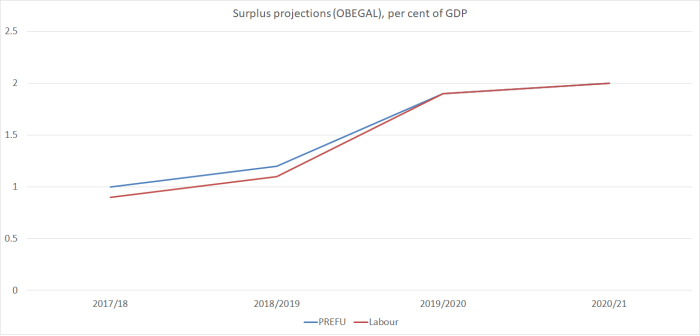
labour surplusWhen net core Crown debt is already as low as 9.2 per cent of GDP –  not on the measure Treasury, the government and Labour all prefer, but the simple straightforward metric –  what is the economic case for material operating surpluses at all?   With the output gap around zero and unemployment above the NAIRU, it is not as if the economy is overheating (the other usual case for running surpluses).   Even just a balanced budget would slowly further lower the debt to GDP ratios.   One could mount quite a reasonable argument for somewhat lower taxes (if you were a party of the right) or somewhat higher targeted spending (if you were a party of the left, campaigning on structural underfunding of various key government spending areas).

Labour is promising to spend (and tax –  thus the surpluses are the same) more than National.  But their commitment (rule 4) was to keep core Crown expenditure “around 30% of GDP”, not “comfortably below 30 per cent”.

labour spending

28.5 per cent is quite a lot lower than 30 per cent (almost $5 billion in 2020/21 – not cumulatively, as GDP is forecast to to be about $323 billion). And 30 per cent wasn’t described as a ceiling. And in the last two years of the previous Labour government, core Crown spending was 30.6 per cent of GDP (06/07) and 30 per cent of GDP (07/08).

It is a curious spectacle to see a party campaigning on serious structural underfunding of various public services and yet proposing to cut government spending as a share of GDP.  It would be difficult to achieve –  given the various specific policy promises –  but you have to wonder, at least a little, why one would set out to try.     We simply aren’t in some highly-indebted extremely vulnerable place.

Finally, the affair of the last 48 hours has revived arguments for some sort of offiical costings unit to be set up, as Labour and Greens have called for (in their Budget Responsibility Rules) and people like the New Zealand Initiative have also apparently favoured.  I’m much more sceptical of such proposals, and covered some of the reasons in earlier posts (when the Greens first made a play of this issue last year, and when the Labour/Greens rules were announced).   I support the idea of a Fiscal Council –  as Labour/Greens have proposed, and as past external reviewers have suggested  –  although would favour something more macroeconomic focused (ie advice and review functions on monetary policy as well as fiscal policy), but I don’t think the case for a costing unit has been made.

As I noted in one of those earlier posts

On balance, I still think there is a role for something like a (macro oriented) fiscal council in New Zealand, perhaps subsumed within the sort of macroeconomic or monetary and economic council I suggested here (but perhaps that just reflects my macro background).   And there is probably a role for better-resourcing select committees.  But when it comes to political party proposals, if (and I don’t think the case is open and shut by any means) we are going to spend more public money on the process, I would probably prefer to provide a higher level of funding to parliamentary parties, to enable them to commission any independent evaluations or expertise they found useful, and then have the parties fight it out in the court of public opinion.  The big choices societies face mostly aren’t technocratic in nature, and I’m not sure that the differences between whether individual proposals are properly costed or not is that important in the scheme of things (and perhaps less so than previously under MMP, where all promises are provisional, given that absolute parliamentary majorities are very rare).  If there are serious doubts about the costings, let the politicians (and the experts each can marshall) contest the matter.

And this particular dispute wasn’t even about the details of the costings of individual policy proposals.  It seems to have been more or less sorted out through the cut and thrust of political debate and expert commentary.  That feels to me like the way I’d want the system –  competing political parties, open democracy – to work.  No non-partisan experts can reasonably decree that one set of spending plans is or isn’t feasible or appropriate –  much of that is inevitably about politics.     There are gaps in our debate –  it was notable in the last couple of days that no academics were quoted, even though for example, Victoria University likes to hold itself out as policy-focused, and they even have a professorial chair in public finance –  but it isn’t clear that spending more taxpayers’ money to cost political party proposals (according to the particular model of that particular group of technocrats) is a high priority use for scarce fiscal resources.

(I noticed a couple of journalists last night describing me as “dryish right” and thus happy to fling mud at Labour.  I’d probably accept “dryish right” broadly speaking, but I’m sufficiently disillusioned with the total failure of this government to deal with housing, and the failures (and, what are in effect, lies) around productivity growth that I’d be more than keen to see a serious credible alternative.  As it happens, Labour’s policies around monetary policy and the Reserve Bank –  issues of some importance to me, even if not of wide general interest – seem to be heading the right direction.  I’m more sceptical as to whether they have more of an effective economic strategy than the government does.  Which is by way of saying that I like to think I’m an equal opportunity sceptic –  who doesn’t usually vote on economic issues anyway –  and if some of this post does identify some challenges for Labour, it isn’t because I’m champing at the bit to see Mr Joyce succeed.)
 

A depressing debate

Watching last night’s party leaders’ debate had its entertaining moments, but mostly if it  was clarifying it was so in a pretty depressing way.    And one of these two will be Prime Minister for the next three years.

There was the sight of both party leaders falling over themselves to disavow any notion that house prices should fall.  Apparently, a $1 million average house price (or the less headline-grabbing but still obscene median price of $800000+) in Auckland is just fine.  I suppose we should be grateful that on the one hand the National Party has moved on from the nauseating talk of how these house prices were a “sign of success” or a “quality problem”, and on the other hand that Labour’s housing spokesman will openly talk of an aspiration to having house prices averaging perhaps 3 to 4 times income.    Perhaps both party leaders really would prefer that Auckland house prices hadn’t increased very substantially in the last five years, but now they both seem content to simply treat it as a bygone –  as if we should simply live with $1 million house prices indefinitely until, some decades hence, a combination of inflation (mostly) and real income growth, might render home-owning in our largest city once again affordable to new entrants.

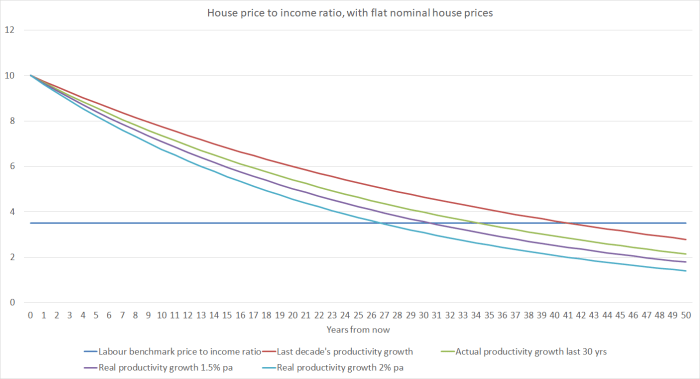
A couple of weeks ago I showed this chart.  Starting from a price to income ratio of 10 –  roughly that in Auckland now –  it traces out how house price to income ratios would evolve if nominal house prices were unchanged from here on (something both party leaders now appear regard as a good outcome).

house price to income ratio with flat nominal house prices

Just focus on the green line.  If we have inflation averaging two per cent, and productivity growth matching the performance of the last 30 years (quite a step up from where we are now) it would take almost 25 years to get price to income ratios down to even around five times income.     The Prime Minister talked of this being an issue for his kids.  The solution, to the extent there is one, seems to be aimed at his grandchildren.

Ardern seemed to try to have it both ways with the talk of “we just need to build more affordable houses”.   Lay members of my household responded “well, wouldn’t building more houses lower prices, which she just said she didn’t want?”.     Actually, it is unlikely to make very much difference, unless she is serious about freeing up land supply.  Without that, the overall affordability of the housing stock won’t change much, and any new houses built by or for the state will largely displace others that would have been built by the private sector.  And yet, although on paper Labour’s policy on improving land supply looks promising, the current Leader of the Opposition continues in path trod by her predecessor and simply never mentions the land issue –  even though everyone recognises that in Auckland in particular, the price of land is the largest component of a house+land.   Relative to that, further extending capital gains taxes is just a third order distraction.   At any plausible rate  –  in today’s low interest rate environment –  so is a land tax.

Sadly, I suspect there is an element of dishonesty about both party leaders’ responses.  If their housing policies really worked, I can’t imagine that either one would have a problem if house prices fell by, say, 20 per cent all else equal.  That alone would lower price to income ratios in Auckland to eight times.    It seems unlikely that that sort of fall would put anyone much in severe financial difficulty –   not that many people recently have been able to borrow at LVRs over 80 per cent anyway, and servicing capacity mostly depends on continued employment.     Continuing to talk of stable nominal house prices perhaps avoids (a) scaring the many people whose equity would be wiped out if house prices fell by 50 per cent, and (b) leaving themselves open to scare stories about how falling houses inevitably mean terrible economic times.   But it also makes a hard to develop a constituency for the sort of changes that might, in time, make a real difference, and enable this generation of young people  –  ordinary working families – to afford a decent home.

If that was bad enough, Jacinda Ardern’s superannuation pledge was worse.    John Key’s  pledge to resign rather than increase the NZS eligibility age was cynical –  he was quite open to Treasury that the age would rise, just not under his watch – but perhaps almost understandable in the context of the 2008 campaign.   Helen Clark would have run the “secret agenda to raise the age” line, at a time when Labour itself had no intention of raising the age, and had established the NZSF to buttress the political messaging.   But in this election, the incumbent Prime Minister leads a party which intends to legislate to increase the NZS age –  by a little, and some decades down the track.  It could hardly attack Labour for leaving open the possibility.   Even if Labour didn’t want to increase the NZS age itself now, what would have been wrong with a simple pledge that “no, we don’t see a need to raise the NZS age at present.  I don’t envisage it happening, but if at some point that judgement changes, I pledge that we won’t change the age without taking it to the public first as an election campaign promise”?

When the Prime Minister announced his NZS policy back in March, I ran this chart

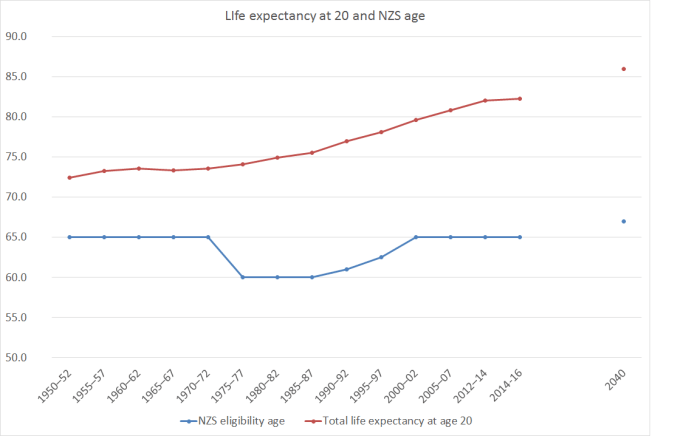
Here is a chart showing life expectancy at 20, and the NZS eligibility age.  The final two dots are what might have happened by 2040 if the life expectancy gains continue at the same rate as since 1950, and the NZS eligibility age if yesterday’s National Party policy proposal comes to pass.

life and NZS age

Over that full period, 90 years, the NZS eligibility age would have risen by two years, and adult life expectancy (those getting to 20) would have increased by about 13.5 years.  By 2040 it will be amost 40 years since the NZS age got back to 65.  In that time, adult life expectancy is likely to have risen by 5 to 6 years, and yet the NZS age will have risen only by two years, if the new National Party policy is implemented.

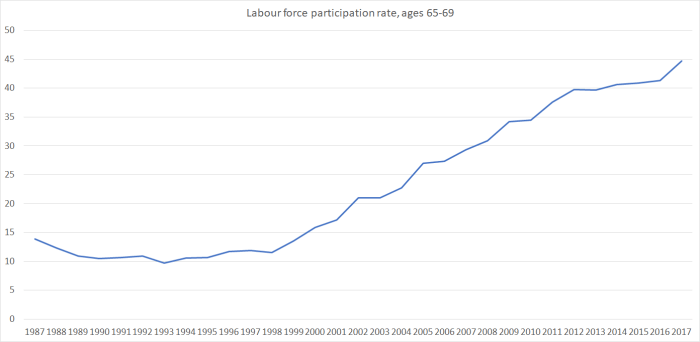
How has a New Zealand politics got so febrile that parties that claim they want to use scarce fiscal resources to solve child poverty are reduced to this?   We can be pretty sure Bill English won’t be Prime Minister in 2037, so the NZS age won’t actually increase on his watch –  he’ll just foreshadow change decades down the track –  so in effect both candidates to be Prime Minister are refusing to increase the age while they are PM.   Old people vote of course, but this isn’t an issue about today’s old people –  it is about today’s middle-aged and younger people.   Even among today’s older people, almost half of those aged 65 to 69 are still in the labour force.

partic rate 65 to 69

Personally, I support a modest universal age-pension, but not one that cuts in at an age when a huge proportion of the recipients are still working, and are physically capable of doing so.    And how come we can scarcely even have that political debate even though all manner of other advanced countries have been willing to take steps to increase the eligibility age?  In Australia, for example, the age pension eligibility age will be 67 by 2024 –  and technically, all those Australians, and (a more plausible possibility) the New Zealanders living in Australia, would be eligible to relocate to New Zealand and claim our NZS, with no prior residence requirement, at age 65.

I found the “debate” around child poverty almost as depressing.    Neither party is actually willing to campaign for lower house prices –  even though housing costs have been a big factor in the material and financial challenges some face.  And all the talk was of how much money (other people’s money) the government could throw at the problem, with no mention at all of the possibility that improved economic performance might be the best way to lift living standards for everyone.  But then neither party seems to have  a serious idea as to how to lift our economic performance –  or even to care much about doing so (the Prime Minister just makes up stuff about the current performance of the economy).   And the Prime Minister was very keen to talk up how he, lots of data, and some public servants, are going to solve all manner of social problems.  Which, on the one hand, displays a touching faith in the capability of politicians and bureaucrats –  usually shared only by politicians and bureaucrats, and with little in past experience to support it –  and on the other simply refuses to address the likelihood that cultural factors are part of the story in dysfunction and deprivation.    I don’t really expect it from today’s Labour Party, but the Prime Minister is a self-described social conservative.

And then there was the wages debate.  On that one, I reckon the Prime Minister is right on the facts –  real wages have been rising, and faster than productivity has –  and I was disappointed to see the Leader of the Opposition still running here “its how people feel that matters”.   It might be uncomfortable to face it but wage inflation running ahead of productivity (and even than terms of trade gains) is one of the symptoms of an overvalued real exchange rate.  Plenty of observers –  including the outgoing Governor –  have highlighted that as a serious challenge for New Zealand.  It is part of the reason why Treasury forecast that exports will be shrinking as a share of GDP on current policies.   (If this whole point is obscure, it is partly a teaser for a forthcoming post.)

UPDATE:  On further reflection I’ve deleted the final paragraph.  I wrote it based on reading various commentaries, but before digging into the numbers myself (a salutary lesson that I shouldn’t need).   Understanding better both the Labour numbers and the National claims, I’d now take a more nuanced stance.

And, of course, there was the $11 billion fiscal hole that wasn’t.   Perhaps the National Party really believed their story when they put it out yesterday morning. By debate time, it was pretty clear to anyone without an axe to grind that there was little or nothing there.     Wouldn’t an honourable Prime Minister have simply quietly let the issue slide, and addressed the real challenges New Zealand faces, including real and legitimate questions about his own government’s performance over nine years, and about the aspirations and specific proposals the Labour Party is now outlining.

Consistently dismal relative productivity growth

Having done Saturday’s post unpicking some of Steven Joyce’s claims about New Zealand’s productivity performance, I thought it might be worth using the data for a few more charts illustrating something of our performance relative to other advanced countries going back a few decades.

Of the official SNZ data I used in my nine measures of real GDP per hour worked:

  • real GDP measures go back to 1987,
  • the HLFS goes back to 1986, and
  • the Quarterly Employment Survey goes back to the start of 1989.

Thus, using official SNZ data, we can really only do the international comparisons back to full year 1989.   The OECD and the Conference Board produce numbers of New Zealand going rather further back (using earlier SNZ data for much of that), and those estimates usefully illustrate our longer-term relative decline.  But in these particular posts, I just want to use the official New Zealand sources for New Zealand (and the OECD-reported data for other advanced countries).

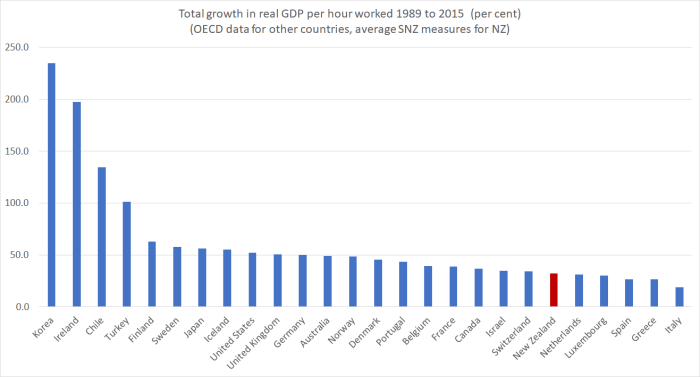
Many of the current OECD countries (largely the former eastern bloc ones) don’t have useable data going that far back.  So in these charts I’m comparing New Zealand against the 25 OECD countries that have such data all the way back to 1989.    That includes all the more “traditional” advanced OECD countries except Austria.  But the OECD only has data for all these countries to 2015, so this chart compares total productivity growth across countries from 1989 to 2015.

productivity joyce 3

“Pretty dismal” would be my summary of New Zealand’s performance over that entire period.  There is a handful of countries that have done even worse.  Two are much richer and more productive than us anyway; the others some of the basket cases of the euro-area.  And recall that at the start of the period we were in the midst of an economic restructuring programme sold, in part, as designed to reverse the decades-long deterioriation in New Zealand’s economic performance.    As a comparisons, in 1989 Ireland is estimated to have had around the same level of real GDP per hour worked as New Zealand.

As I noted in Saturday’s post, there are nine simple ways to combine the various GDP and hours series to produce estimates of GDP per hour worked. In the chart above, I used the average of those nine measures –  a 32.4 per cent increase.   The range of the nine measures was from 29.0 per cent to 35.7 per cent.   At best, we also beat out Switzerland and Israel.  At worst, Netherlands and Luxembourg beat us.  Over that long period, data uncertainty just doesn’t change the picture much.

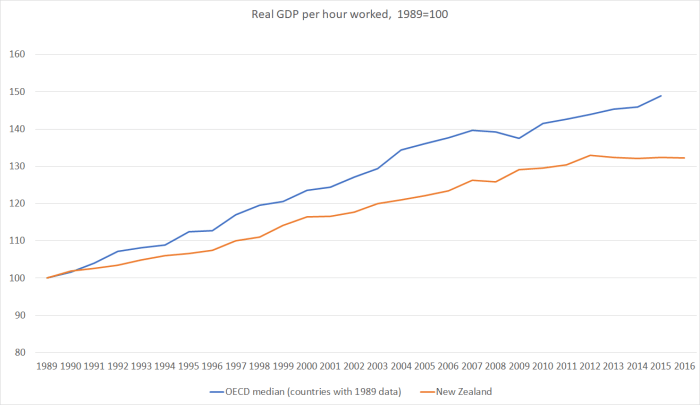
In the next chart, I’ve shown the annual path of real GDP per hour worked for New Zealand (again using the average measure) and for the median OECD country for which there is data throughout the period.  In all cases, countries were indexed to 100 in 1989, and so the chart is showing cumulative growth over the period in the two series.  The OECD does not yet have data for all countries for 2016.

productivity joyce 2

And here is the same data transformed into a ratio: the New Zealand line divided by the median OECD line, again indexed to equal 100 in 1989.

productivity joyce 1

On this chart, I have included an estimate for 2016, by taking the median productivity growth rate for those OECD countries (most of them) that have 2016 data.  I’ve also marked the final year of each of the three governments that changed during this period (1990, when Labour lost office; 1999 when National lost office; and 2008 when Labout lost office).

Over the course of these 27 years,  the trend has been downwards –  we’ve done (cumulatively) a lot worse than these other advanced countries (and the decline relative to those former eastern bloc countries is materially worse).

I don’t regard the dates around changes of government as being particularly meaningful for these economic comparisons: structural policy changes affect outcomes with a lag, and anyway, at least for the last two changes of government (1999 and 2008) there has been a lot more continuity than differences between the economic policies of the outgoing and incoming governments.  But in each of the different governments’ terms there have been years when our productivity growth was faster than that of the median OECD country.  Under the current government that year was 2009.  And so, as I noted the other day, in their first few years in office we actually made up a little ground relative to these other advanced countries.   But since then, the picture has been downhill again. Over the last four to five years all those gains have been lost, and more.

It is what happens when your country manages no productivity growth at all for five years or more (illustrated here using the average of the nine measures).

productivity joyce 4

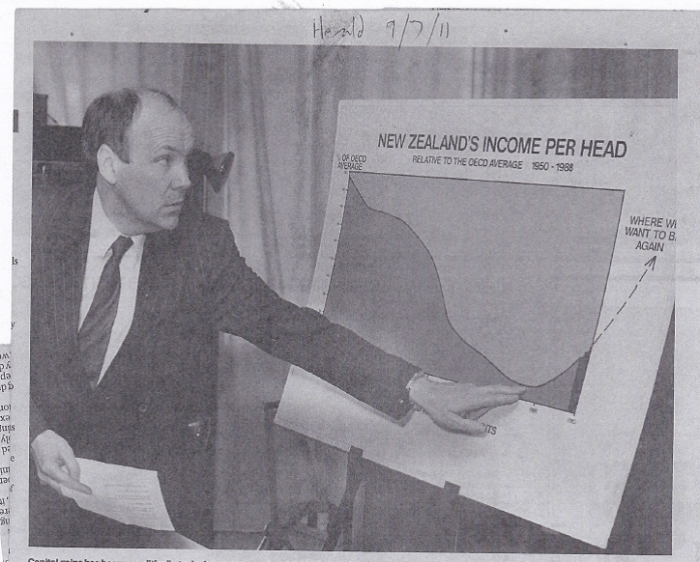
I chose 1989 for the cross-country comparisons for the practical reason that 1989 is when the consistently-compiled New Zealand data go back to. But it was also David Caygill’s first year in office as Minister of Finance.     I’ve shown previously this photo in which he was illustrating his aspirations.

caygill 1989 expectations

But like his predecessors for several decades before him, and all his successors – including those in the last Labour government and the current National government – he failed. Terms of trade windfalls have help our incomes, but over the longer-term improved living standards – catching up with other countries – depends on improved productivity performance.  Our governments have consistently failed that test, and I can’t see anything in the current electoral offerings that seems likely to change the picture in, say, the next decade.

Unpicking Steven Joyce’s press release

As I noted yesterday afternoon, Steven Joyce had put out a press release on productivity.  The press release was a mix of policy-based digs at the Labour Party (which weren’t of any particular interest to me) and some statistical claims, some of which seemed more or less reasonable and others not.   My post yesterday afternoon briefly responded to some of those points.

The press release made these claims

On one of the key measures of productivity, GDP per hours worked, New Zealand’s productivity has lifted nearly 10 per cent since National came into office. That’s a faster rate than the UK, Canada, the US, the EU, the G7 and the average across the whole OECD.

“The last time Labour was in office, it was the reverse. Our productivity growth was 5.5 per cent over eight years and much slower than all those other economies.

I wasn’t quite sure where the Minister had got his numbers from, but was going to just let the matter lie.  After all, the point that people like me have been making for some time, and which the Labour Party had picked up on, was that there has been no productivity growth in New Zealand for the last five years or so.  And over the longer run of history, everyone knows our performance has been relatively poor, although for some sub-periods we’ve done better than others –  at times more or less matching the growth rates of other advanced economies.    And since no one thinks that economies suddenly change, for better or worse, immediately on changes of government –  and in recent decades, the policy changes from one government to another hadn’t been large anyway –  I wasn’t overly interested in the narrow partisan point as to whether average productivity growth had been better under this government or its predecessor.

But I couldn’t help myself.   And a story by Bernard Hickey alerted me to the fact that the Minister had used these numbers, or ones very like them, in answer to a parliamentary question a few weeks ago.    With less rounding, the Minister then said that “another measure used by the OECD is GDP per hour worked, which has increased 9.6 percent since 2008”.    The answer to the PQ suggested Treasury had probably supplied the numbers, so I was curious as to whether I could work out what had been done.

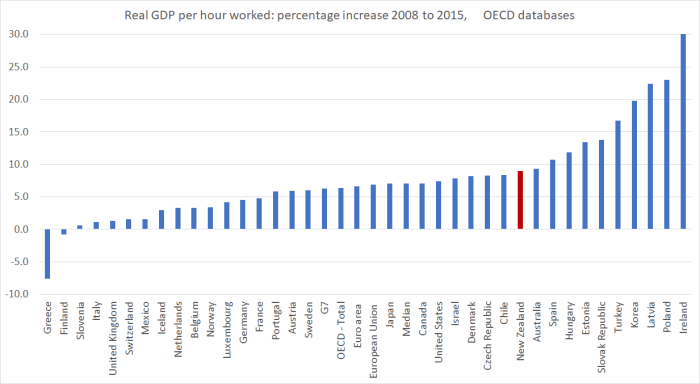
The most likely source was OECD data, which are only reported on an annual basis.   So I found the OECD’s table showing the level of real GDP per hour worked, in real (“constant price”) national currency terms.    And, sure enough, on that measure the OECD reports real GDP per hour worked having increased by 9.6 per cent from 2008 to 2016.   For quite a few countries (about a third of the total) the OECD doesn’t yet have full year 2016 data for this variable.   So the Minister’s observations about how New Zealand has done relative to other countries seem to use comparisons between 2008 and 2015.

And here is a chart of that data.

joyce 1

I wouldn’t put much weight on the Irish number (which goes off the chart, having to do with tax-related anomalies in their national accounts), but on this particular OECD-reported measure, over this particular period, only 10 OECD countries did better than New Zealand.  Hence Mr Joyce’s claims.

But there are some pretty serious problems with the comparison (even setting aside the fact that it is now mid-late 2017).  There is an old line about OECD data –  you trust (or at least use) every country’s data except your own.  Typically, that is because you know the pitfalls in your own country’s data and not always the pitfalls in data from other countries.   But here the problem is a bit different.  Specifically, the OECD’s data for productivity growth in New Zealand doesn’t bear much relationship to the New Zealand data itself.   From memory, when I’ve tried to do these comparisons before I’ve just replaced the OECD New Zealand data with SNZ data.     The OECD don’t have data of their own, and they must do some transformations of the data they get from here, but not ones that are readily open to scrutiny.

As I’ve explained previously, when I do charts of New Zealand productivity performance over recent years I average the expenditure and production measure of GDP, and divide by HLFS hours worked (corrected for the series break last year).    But I remembered last night that the OECD prefers to focus on the expenditure measure of GDP.  Many New Zealand analysts focus on the production measure  (which, a long time ago, was less volatile).  And although I use the HLFS, there is also a QES measure of hours.   That gives one quite a range of ways to calculate GDP per hour worked, even on an annual basis.

Percentage growth
2008 to 2015 2008 to 2016
Expenditure GDP/HLFS hours 8 7.6
Expenditure GDP/QES hours 4.8 5.3
Production GDP/HLFS hours 5.6 4.8
Production GDP/QES hours 2.4 2.5
Expenditure GDP/average of the two hours series 6.4 6.5
Production GDP/average of the two hours series 4 3.7
Average of the GDP measures/HLFS hours 6.7 6.2
Average of the GDP measures/QES hours 3.6 3.9
Average GDP measures/Average hours measures 5.2 5.1
Average of all these measures 5.2 5.1

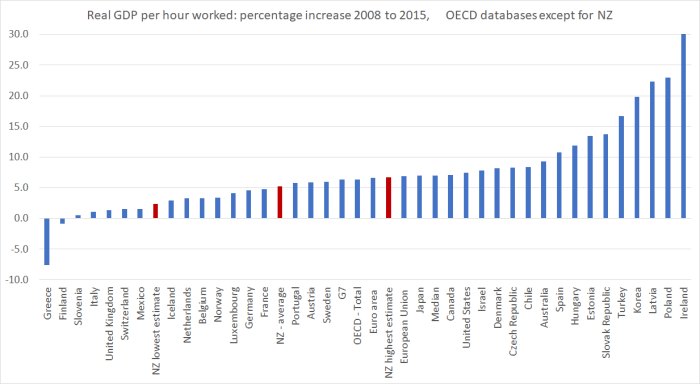
Replacing the OECD’s questionable New Zealand numbers in the chart above with our own data –  highest, lowest, and average from this table –  makes the chart look like this.

joyce 2

On none of these measures did we quite match the performance of the median OECD country over this period.    It is fair to note that over the first half of the period –  2008 to 2012 – we did match, or even modestly exceed, the productivity growth of the typical OECD country.

But here’s the thing: across those nine possible New Zealand annual measures (see table above), not one has shown any growth in productivity at all over the (most recent) four complete years from 2012 to 2016.  The estimates are tightly bunched –  between a cumulative fall of 0.6 per cent, and a cumulative fall of 1.2 per cent.    All those numbers are prone to revisions, mainly as the GDP numbers themselves are revised, but for now they simply reinforce the point I and others have been making for some time: there seems to have been no productivity growth at all in New Zealand for some years now.

But what about the comparisons the Minister of Finance was making with productivity growth performance during the term of the previous government?   He asserted that

The last time Labour was in office, it was the reverse. Our productivity growth was 5.5 per cent over eight years and much slower than all those other economies.

So I went to the same OECD spreadsheet he seemed to have taken his productivity growth number from in talking about the current government’s term.   On that OECD measure, productivity had grown by 10.6 per cent over the whole period 1999 to 2008, or by 7.4 per cent over the eight years the Minister appears to focus on (2000 to 2008).

But what did the New Zealand data itself show?  I went back to the nine different measures (see above).  For the full period 1999 to 2008, across the nine measures there was a range from 7.3 per cent to 13.0 per cent growth in real GDP per hour worked.  The average of those measures was a 10.2 per cent increase.   I couldn’t quite replicate the 5.5 per cent number the Minister quotes for 2000 to 2008, but on one of the nine measures productivty growth in that period had been 5.8 per cent  (close enough I guess).

And how did other advanced countries do over the term of the previous New Zealand government?  Between 1999 and 2008 the median OECD country had productivity growth of 15.7 per cent.   So, as the Minister pointed out, productivity growth lagged that in other advanced countries during the term of the previous government.

The data go back far enough to also look at the experience under the 1990 to 1999 National government.  As ever, a reminder that comparisons between the experience in different terms of office have little or no economic meaning.  But, for what it is worth, here are the summary results.  Because the OECD doesn’t have annual data for quite a few countries past 2015.  I haven’t included numbers for the median OECD country for the last two lines.

Total growth in real GDP per hour
Range of NZ measures Average of measures Median OECD country
National 90 to 99 10.7 to 13.4 12 19.5
Labour 99 to 08 7.3 to 13.0 10.2 15.7
National 08 to 15 2.4 to 8.0 5.2 7.0
National 08 to 16 2.5 to 7.6 5.1
Last four years -1.2 to -0.6 -0.9

I’ll leave you to draw your own conclusion.  My overarching one remains that for 70 years or so our productivity growth has underperformed that of other advanced countries, and there has been no extended period in that time, under any government, when any progress has been made in closing the large (levels) gaps that have opened up between productivty here and that in much of the rest of the advanced world.

To facilitate the cross-country comparisons all the numbers and charts in this post so far have used annual data only.

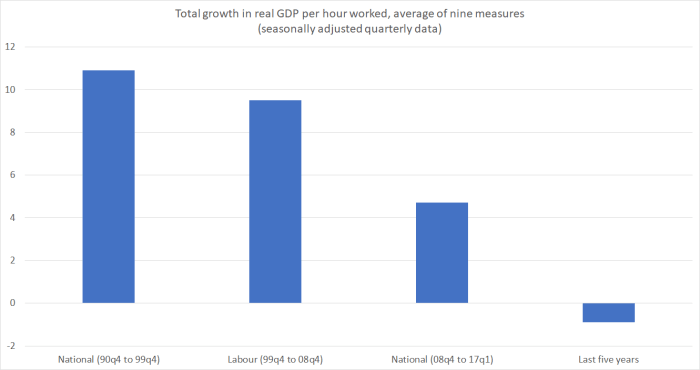
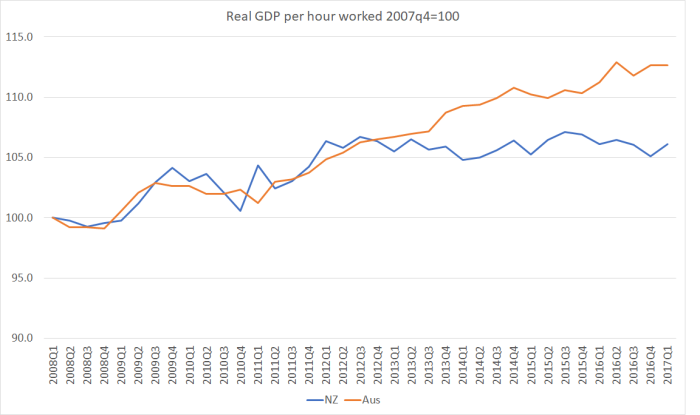
For shorter-term, and more timely, analysis, one can use quarterly seasonally adjusted data  (that is what I usually do when, for example, I’ve shown the chart of how productivity growth performances in New Zealand and Australia have diverged in recent years).   I usually use just one of the measures (average of the GDP measures divided by HLFS hours).  But again there are nine potential measures, as per the first table above.   This chart shows the average growth rate across those measures in each of the periods shown.

quarterly

There are no direct comparisons possible to a big group of other advanced countries.  But in each of these four periods productivity growth, on this summary measure, has been less than that in Australia.

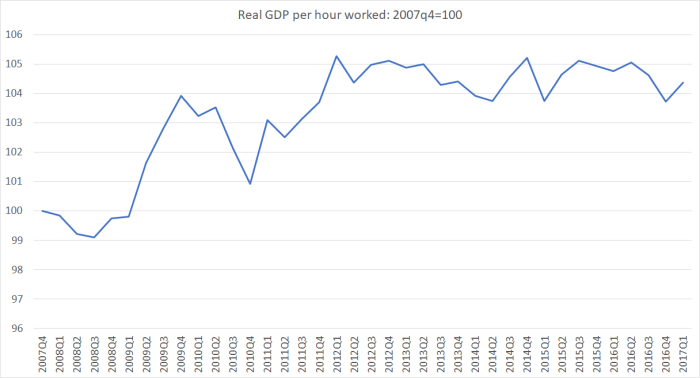
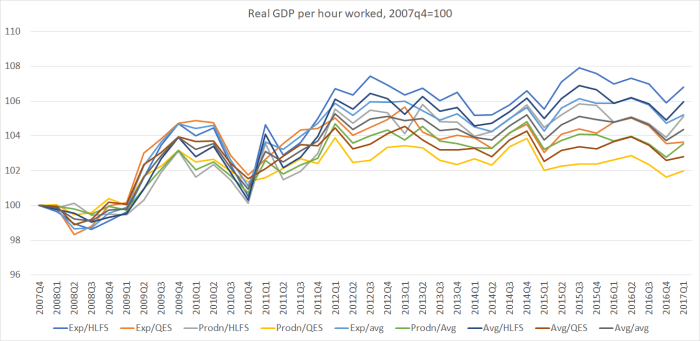
In this chart, I’ve shown all nine measures indexed to 2007q4.  That doesn’t align neatly with political terms, but I find it a more useful dating for economic analysis, starting just prior to the start of the recession (here and abroad).

real GDP phw qtrly

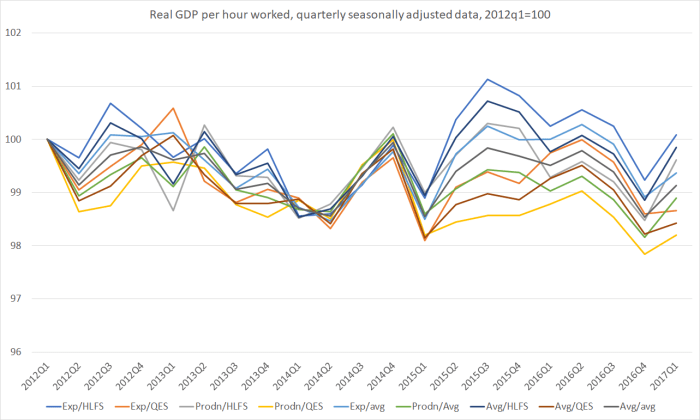
You can see that there is quite a big difference in what the various measures show for productivity growth over the first few years (and in particular from around 2010 to 2012 –  by 2012 the lines are a fair way apart).  There are some puzzles for people to work through about just how New Zealand did during that period,   But, again, there isn’t much difference in the growth rates (or lack) of them over the last five years.  That is even more stark if we look just at the last five years, indexing each of the series to 100 in 2012q1 (and noting the compressed scale of the chart).

real GDP phw 2012q1 base

Not one of the measures shows any material productivity growth over the last five years taken together.  And although there are some divergences in the last couple of years –  while we wait for SNZ to revise, and increasingly reconcile, the two GDP measures –  there isn’t any sign of the trend changing even in that very recent period.

Global productivity growth has been pretty weak since around 2005 –  ie before the recession and (domestically) the change of government.   But having no productivity growth at all here for five years now doesn’t look to be just an international phenomenon.  In fact, from the same table the Minister quoted from, productivity growth in the median OECD country in the last four years appears to have been around 0.8 to 0.9 per cent per annum.

So as I suggested yesterday when the Prime Minister claims that “productivity in New Zealand has been growing pretty well”,  a response along the lines of “yeah right”  seems quite appropriate.  The last five years look particularly bad.


(Non-economist readers might well be surprised, or disillusioned, by the wide range of possible estimates of productivity growth in some particular periods.   Unfortunately that is the way things are.  Measurement is a real challenge, not helped in New Zealand by persistent underfunding of official statistics.)


Productivity growth in perspective

Someone sent me a copy of a press release put out today by the Minister of Finance, Steven Joyce, is his capacity as the chair of National’s campaign.    In it he claims that productivity growth over National’s term of government has exceeded that when Labour was last in office, and has exceeded that of many other OECD countries.

On the latter claim, over the whole of government’s term in office, my view is that it is a broadly fair description.  I’ve put out posts noting that we’ve been no better than middling over the whole period since just prior to the recession and financial crisis.  That didn’t seem to me to be a particularly good performance, in view of the fact that (a) we had a big lift in the terms of trade, (b) we didn’t have a domestic financial crisis, (c) weren’t in the euro and (d) we didn’t run out of room to use conventional monetary policy.  Oh, and we had a big levels gap –  we were a lot poorer –  and were supposed to be about catching up.

But my comments, and those of J B Were economist Bernard Doyle, have focused on the last five years or so.   Since then, on New Zealand official numbers, our productivity has gone slightly backwards –  ie the level now is slightly less than it was five years ago.    That is sufficiently stark, and has now gone on for long enough, that it seems worth singling out.   What, one might wonder, would be likely to turn that around?  (Frankly, I’ve seen nothing from either main party  –  or, for the avoidance of doubt, minor parties – that seems very promising.)   It is difficult to get very up-to-date useful data for many other countries, but over that five years we have certainly done less well than the US and Australia.

What about comparisons across terms of government?  We can only calculate the GDP per hours work series back to 1987, so I’ve shown  productivity growth in the term of the 1990s National government (1990q4 to 1999q4), the Labour government of the 2000s (1999q4 to 2008q4), and the current government (from 2008q4 with GDP data only available to 2017q1). I’ve also shown the last five years.

For each of those periods I’ve also shown the exactly comparable data for Australia.   Australia is one of the few countries for which exactly comparable (real, quarterly, national currency) data are available.  They are shown on the ABS website.  Australia is also a relevant comparator because (a) it didn’t have a domestic financial crisis, or (b) run out of monetary policy room, and (c) because it is the easiest alternative option for New Zealanders (migrating) and a standard historical comparator.  The aspiration of catching Australia was one the current government articulated when it came into office.

As a reminder, for New Zealand I have:

  • averaged the two real GDP series (expenditure and production).  Using one or the other alone will produce slightly different numbers, but there is no obvious reason to prefer one over the other, and
  • divided the resulting series by the HLFS hours worked series, and
  • corrected for a series break in the HLFS hours worked series in June 2016, when the survey question was changed.  Not correcting for that would lower productivity growth estimates over the last few years by a further 2 per cent.

And this is the resulting table [UPDATE: with some very minor corrections]

Cumulative growth in real GDP per hour worked (per cent)
NZ Australia
National (90q4 to 99q4) 8.5 20.7
Labour (99q4 to 08 q4) 12.1 12.4
National (08q4 to 17q4) 6.7 13.7
Last five years (to 17q1) -0.2 7.5

As it happens, in not a single one of these particular periods did productivity growth in New Zealand exceed that in Australia  (although there will be shorter periods where we did).

There are other measures of course, but real GDP per hour worked is a pretty standard basis for comparison.  And to make such comparisons of growth rates sensibly (as distinct from levels comparisons) one shouldn’t use PPP-converted data but rather real national currency data as I have done here.

As a caveat, governments can’t take all the credit or all the blame for productivity trends in their time in office.  International trends matter, and even policies work with a lag.  Recessions affect comparisons – and I don’t suppose anyone is going to suggest the 2008/09 recession was either New Zealand party’s fault.      Partly for that reason I’ve suggested focusing on the distinctive, and disconcerting, New Zealand productivity performance over the last five years.  The relevant growth number is zero (or marginally worse).

What’s happening to immigration data?

Back in May when Statistics New Zealand released the first results of their new 12/16 method of calculating net migration, based not on surveyed intentions, but on what travellers subsequently actually did, I was free with my praise.    The new data would provide a very useful, if lagged by at least 16 months, additional insight on what migrants were doing.  In particular, it offered richer insights on the activities of New Zealand citizens (we have administrative data on visa approvals etc for non-New Zealanders, but of course New Zealanders don’t need approval from our government to come and go).

But it seems that I should have been more suspicious.  This morning SNZ released the second wave of the data, bringing the data forward to March 2016 (for which they needed to be able to look at subsequent movements up to the end of July 2017).    That’s good, and the data are even available in a more user-friendly format than when they put the first release out.

But then there was this in the SNZ release

“With the pending removal of departure cards, developing the ‘12/16-month rule’ is a part of our work towards ensuring we can measure migration without depending on traveller cards,” population statistics senior manager Peter Dolan said.

“In the near future, the outcomes-based ‘12/16-month rule’ is expected to become a key component in how we determine the number of migrants in New Zealand.”

This is just astonishing.  Or perhaps not, but appalling anyway.  For a long time there has been a push  –  presumably from airlines and perhaps bureaucrats –  to get rid of arrival and departure cards.  I was involved from the Reserve Bank side in pushing back against an earlier initiative to dump them more years ago than I can now remember.     We pointed out the value of timely high frequency data on movements of people across the border ((tourists and migrants) for those doing macroeconomic policy and associated forecasting and analysis.    Bear in mind that New Zealand not only has some of the largest migration flows (in, out, and net) of any advanced economy, we also have among the most variable migration flows.  And cyclical fluctuations matter a lot when your job is cyclical stabilisation (ie monetary policy) –  let alone making sense of short-term developments in the housing market.   So you’d think it might be a high priority to have and keep high quality high frequency data.

And, as it is, we have some of the very best migration data in the world.   Being an island country, we have secure borders.  Being a remote set of islands, almost everyone arrives by air, at a handful of secure locations.  So it is easy to collect accurate data, and a pretty rich set of data, and to get it out pretty quickly  for forecasters, analysts, and even politicians to use.

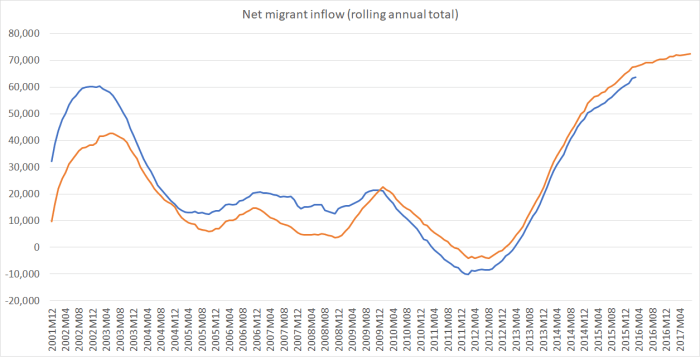
I’ve explained here previously why the resulting PLT data has its limitations.   It isn’t a good basis to use to look at immigration policy itself.  Approvals data from MBIE is better for those purposes –  and would be better still if they made the information available in an accessible format on a more timely basis.     And the PLT data are based on self-reported intentions, and intentions aren’t always what people end up doing.  Some people think they are leaving permanently, and are back six months later, and vice versa..   But intentions data isn’t nothing either  (just as business surveys capture intentions/expectations and things don’t always turn out as they expect).    The patterns –  and especially the cyclical patterns, the turning points –  in the PLT data tend to match those in the (lagged) 12/16 data quite closely.

There are quite enough gaps (and long lags) in New Zealand economic data as it is –  monthly CPIs, monthly manufacturing data, quarterly income measure of GDP just for starters –  that I’m just stagggered that key economic agencies are apparently willing to let SNZ/Customs go ahead and consider dropping departure (and arrival?) cards.  Where are Treasury and the Reserve Bank on this?

How, specifically, does it matter?   Without departure or arrival cards we would, of course, still have immigration approvals data for most non-citizens (other than Australians).  In principle, they could be published weekly or monthly with just a day or two’s lag, and be available in quite accessible formats.  Since approvals lead actual arrivals, there is certainly useful information in those approvals numbers (it is just that they aren’t made easily available now).

We could presumably also have data on the total number of people crossing the border (gross and net) from passport scanning.   I’m not aware that those numbers are published at present, but they could be.  And presumably they could be broken down by nationality (or at least by the passport the person happened to be travelling on).    That would be useful –  relative to having no arrivals or departures data –  but not very.   If you look at total net arrivals or departures (or net) data it is enormously volatile, and thrown around things like Lions tours –  in other words, holidaymaker and other short-term visitor numbers swamp movements of migrants.   Using that data alone, we’d have no ability to pick turning points for some considerable time after the turn had already happened.

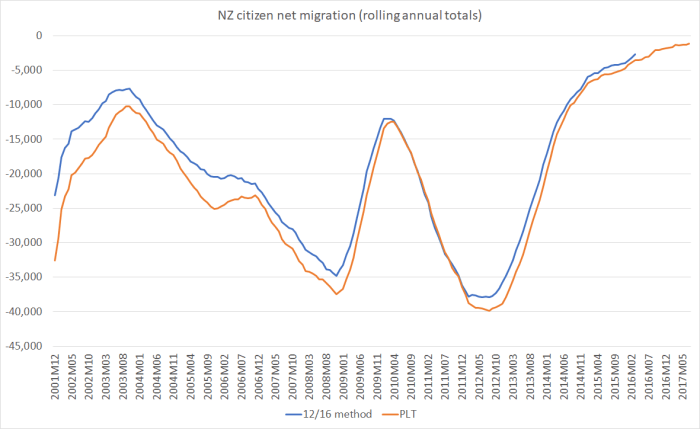
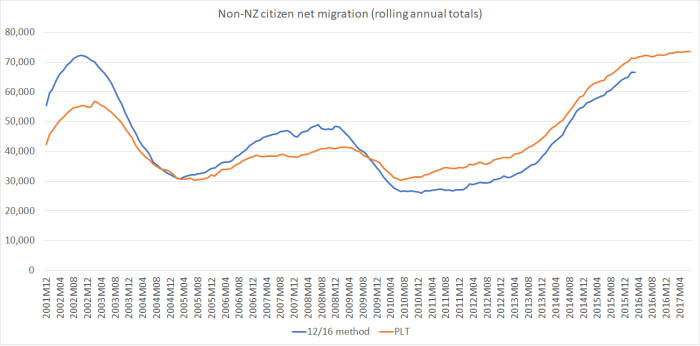
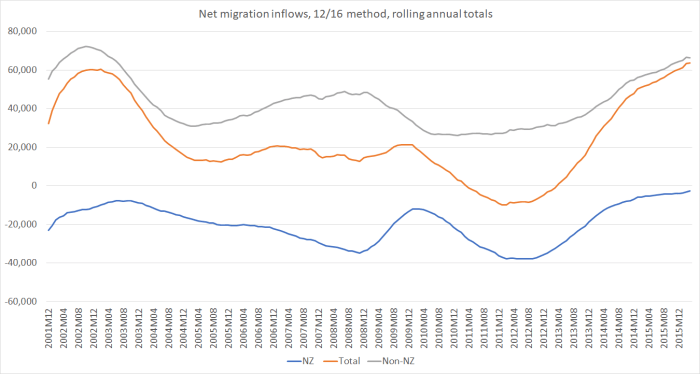
The gaps would be particularly serious for the movement of New Zealanders, and more than half the variability in the 12/16 measure of net migration has arisen from fluctuations in the movements of New Zealanders.  We would have no secure way of knowing if someone leaving was planning to be off for a week’s holiday, or intending to stay away for ever.  The 12/16 method would eventually tell us what they did –  but there is a lag of almost 18 months on the availability of that information.    And even if the new plan involves keeping arrival cards and only getting rid of departure cards, most of the variability in New Zealanders’ migration movements is in the numbers leaving, not the numbers arriving.

Less importantly, without the departure cards we would seem likely to lose the ability to analyse migration (including reflows outwards by migrants who become NZ citizens) by the birthplace of the migrant.

Perhaps someone has done a robust cost-benefit analysis on getting rid of departure (and arrival?) cards.  If so, I would be keen to see it, and particularly keen to see how the relevant officials have factored in the loss of some of world’s best migration data to macroeconomic monitoring and forecasting, in a country with some of the most volatile immigration flows in the advanced world (and not a great track record of getting monetary policy, or housing markets, right as it is).  And even if one sets aside the macroeconomic analysts interests, it is not as if net migration numbers are one of those issues of no political salience at all.  Put an 18 month lag on decent data, and you risk not silencing debate – which some might wish for – but allowing all sorts of misconceptions and concerns to flourish, which no one will be in a position to allay.  It would, frankly, seem crazy.    Immigration has a economic and political salience here which it might not have in a country with land borders and small permanent inflows/outflows.

In the report they released this morning, SNZ recognise that 17 month lags aren’t exactly ideal.   They say they have plans to try to come up with something better, but frankly they don’t seem that confident.

The analysis in this report shows the outcomes-based measure is better suited to estimating migration levels when accuracy is the primary concern. However, a 17-month wait for migration measures is not always appropriate. Stats NZ is prioritising work to address this.

Improving the timeliness of outcomes-based migration measures

The 12/16-month methodology of the outcomes-based migration measure will always carry a minimum associated lag of 17 months.

For this reason, Stats NZ is investigating methods and data sources for a more-accurate estimate of migration than the current PLT measure, but one that is also suitably timely.

These estimates will be generated through a probabilistic predictive model of traveller type (ie short-term traveller, or long-term migrant), based on available characteristics of travellers. Such a model will provide a provisional estimate of migration, which we can then revise (if required) as sufficient time passes for us to apply the outcomes-based measure. The migration statistics series will be extended to include both provisional and final estimates of migrant arrivals and departures.

What we are trying to model

A modelling approach needs to extract the small number of migrant movements from the very large number of overall border movements. For example in the year ending June 2017 there were:

  • 131,400 migrant arrivals, of 6.53 million arrivals (2.0 percent of all arrivals)
  • 59,100 migrant departures, of 6.46 million departures (0.9 percent of all departures).

This shows the imbalance of the traveller type present in the border movements. This highlights the considerable challenges that exist in achieving the required level of precision when estimating migration through a modelling approach.

In a country where migration flows matter, and fluctuate, as much as they do here, you might hope that they could show that they have techniques that would actually work before talk of eliminating departure cards got going.

Anyway, what do the latest wave of data actually show?    In these charts, I’m showing the 12/16 method and the PLT estimates for the various citizenship classes.

New Zealanders

nz citizens

The patterns are very similar (although the cumulative net outflow has been about 10 per cent smaller than the PLT numbers had suggested).  But, to reinforce the point above, the PLT data are an excellent indicator of cyclical fluctations in NZ citizen movements.  That is greatly jeopardised if departure cards are lost.

And here are non-citizen net migrant numbers.

non NZ citizens

There are, at times, big differences in the two series, but –  and this matters for macroeconomists –  the turning points are very much the same.  There is information in the PLT numbers relevant to, for example, the number of non-citizens likely to need a roof over their heads, and thus to housing market pressures.

The other thing I would note about this chart (and it is a point I’ve made previously) is that the net inflow of non-New Zealanders in the latest year for which we have this data (year to March 2016) is still less than the peak inflow in 2002.  And New Zealand’s population today is about 20 per cent larger than it was then.  In per capita terms, there are no record inflows (large certainly, but not record).

And here are the total net flows on the two measures

overall

They don’t match up perfectly –  one wouldn’t expect them to, and there is information even in the differences (eg what led people to change their plans) –  but no analyst would happily give up a series that provided a 17 month lead this (relatively) good on the 12/16 series.    (And, as above, in per capita terms the peak inflows look as though they will struggle to reach 2002 peaks-  albeit those peaks were shorter-lived).

And finally, here is just the 12/16 data.  Behold what SNZ would like you to consider as the official series.

12-16 method

It is good to have this data.  But, even together with the administrative approvals data, it can’t replace the PLT data.  If that goes –  if departure cards are dropped –  we risk a new, big, hole, in the New Zealand stock of statistics.


Productivity, wages, and other debate thoughts

Like many, I watched the major party leaders’ debate last night.   It was civil and courteous, playing the issues rather than the person.  So far, so good.  But sadly neither leader seemed to offer anything very substantial on fixing our pressing economic challenges, or even show any real sign of understanding the issues.     At a time when the unemployment is still well above what it was a decade ago, when the underutilisation rate for women is still almost 15 per cent…..

underutilisation

…when there has been no productivity growth for five years, and when the export share of GDP has been shrinking, the Leader of the Opposition seemed content to concede that the economy was in good shape.  “Relentlessly positive”  I suppose.

Not that the Prime Minister was having a bar of any concerns about productivity.   As Newsroom put it

English dismissed outright a report from sharebroker J B Were which concluded the country had a productivity recession. They were wrong. “They are way over-stating the case. Productivity in New Zealand has been growing pretty well….

Well, you can read the J B Were piece for yourself.  I did when it came out, and did again this morning.   It made many of the points I’ve been making here for some time.    There isn’t anything in the economic side of the report I’d materially disagree with.  The data –  as officially reported by Statistics New Zealand –  speak for themselves on the productivity underperformance, particularly over the last five years.

I’ve run this chart numerous times before.

real GDP phw july 17 Not only have we had no labour productivity growth for five years, but our near-neighbour Australia –  which the government was once willing to talk about catching up to – has gone on generating continuing labour productivity gains.    Yes, there has been a productivity growth slowdown in much of the advanced world, dating back to around 2005.    But our additional and more recent slowdown –  well, dead stop really – looks like something different, and probably directly attributable to New Zealand specific factors.   Things New Zealand governments have responsibility for responding to.
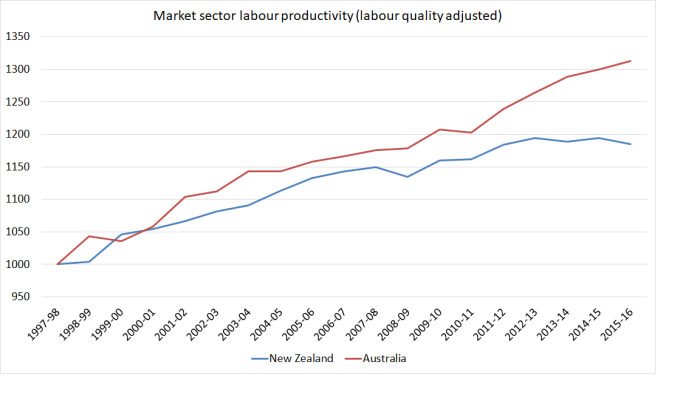
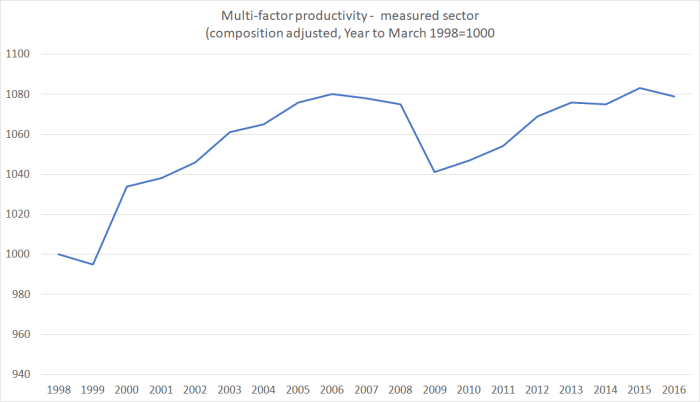
I’ve also shown this chart before –  labour productivity for the better-measured parts of the economy, with SNZ’s attempt to adjust for changing labour quality. It is annual data, and only available with a bit of lag.

market sector LP

Again, no labour productivity growth at all in the last few years.

And what about multi-factor productivity growth?  It doesn’t get as much attention, partly because the data are only annual, and the construction of these estimates involves quite a few assumptions.   Nonetheless, here is the SNZ estimate for the (better) measured bulk of the economy.

mfp to 2016

The series is cyclical –  if machines are idle in a recesson estimated MFP falls and then recovers as utilisation picks up –  but looking through the recession, the estimated index level of MFP is the same now as it was 10 years previously.  No growth.

But somehow the Prime Minister thinks “productivity in New Zealand has been growing pretty well”.    One for the Tui billboards I’d have thought.

And all that is without even getting into the lamentable failure of governments led by both main parties to do anything about reversing the precipitous decline in levels of productivity in New Zealand relative to those in other advanced economies.    Lifts in the terms of trade –  experienced under both this government and its predecessor –  are of course welcome, but they can’t be a credible medium-term substitute for productivity growth.

From the other side, the Leader of the Opposition’s suggestion that data on real wage growth didn’t matter, and what really mattered was how people felt, seemed almost equally risible.  In terms of attracting votes, perhaps she is right.   But when the Prime Minister pointed out that real wages have been rising, he was of course correct.  I’m not sure why people put so much weight on the QES measure of hourly wage inflation.  It has well-known problems (for these purposes) and is hugely volatile.   Here is a chart showing wage inflation for the private sector according to (a) the QES, and (b) the Labour Cost Index, analytical unadjusted series.

wages debate  No economic analyst thinks wage inflation is anything like as volatile as the blue line –  in fact, wage stickiness, and persistence in wage-setting patterns is one of the features of modern market economies.
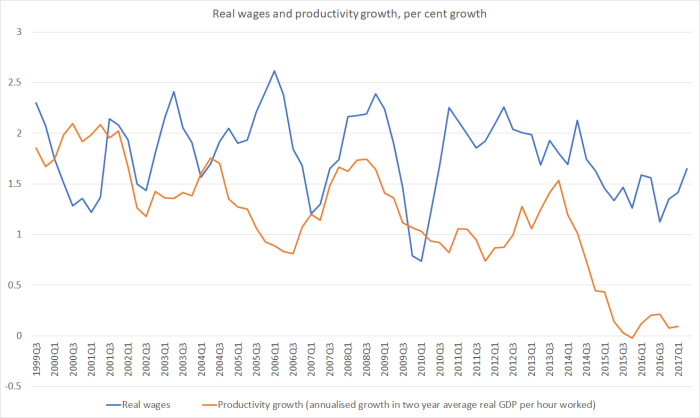
And here is the chart I ran last week, comparing real private sector wage inflation (the orange line above, adjusted for the sectoral core measure of CPI inflation) with productivity growth.

Real wage inflation now is lower than it was in the pre-2008 boom years, but it is running well ahead of productivity growth (however one lags or transforms it).    From here, lifting productivity growth is the only way real wage inflation is going to increase, and such increases in economywide productivity really should be recognised for what they are –  a well overdue imperative.

Sadly, the Prime Minister seems to want to bluff his way through, simply pretending there isn’t an issue, with no real answers as to how to  (for example) lift the outward-orientation (exports and imports) of the New Zealand economy, and refusing to face the fact that productivity growth has vanished since the latest new large net migration inflow began in 2013.  It won’t be the only reason why productivity growth has been vanished, but it is unlikely that there is no connection at all (and certainly the much-vaunted official and political claims that high non-citizen immigration flows are helping lift productivity look emptier than ever).

And the Opposition leader is no better.    When Ardern was asked last night who was going to build the houses if immigration was cut back, my 14 year old son turned to me and asked “why doesn’t she just say that if there are fewer migrants fewer houses would need to be built”.   Sadly, I could only point out that Labour’s approach to immigration actually isn’t materially different to the National Party’s.  The net inflow might be a lower in the first year, but in the essentials they are two sides of the same coin.  Here is what I wrote when Labour released their policy in June.

Overall, some interesting steps, some of which are genuinely in the right direction.  But, like the government, Labour is still in the thrall of the “big New Zealand” mentality, and its immigration policy –  like the government’s – remain this generation’s version of Think Big.  And it is just as damaging.    The policy doesn’t face up to the symptoms of our longer-term economic underperformance –  the feeble productivity growth, the persistently high real interest and exchange rates, the failure to see market-led exports growing as a share of GDP, and the constraints of extreme distance.  None of those suggest it makes any sense to keep running one here of the large non-citizen immigration programmes anywhere in the world, pulling in lots of new people year after year, even as decade after decade we drift slowly further behind other advanced countries, and se the opportunities for our own very able people deteriorate.

And what is Labour’s solution to the economic challenges?   There is lots of talk about more skills training, even though the OECD surveys suggest that our people are already among the most skilled in any OECD country.       Beyond that, Jacinda Ardern was invoking the OECD –  “they’ve told us what we need to do” to lift productivity and economic performance.

Well, this table is from the latest OECD Economic Survey of New Zealand, released a few months ago.  On the left hand side are the “main findings” and on the right the “key recommendations”

OECD recs

I don’t wildly disagree with most of those recommendations –  sceptical as I am of R&D subsidies.     But (a) with the exception of R&D subsidies, does this look at all like Labour Party economic policy  (has there been talk of the tax working group possibly proposing lower capital taxes?), and (b) more importantly, does anyone really think that these items, even taken together, are remotely enough to materially reverse the decades long decline in our relative productivity performance, that the OECD themselves highlighted?

Sadly, there was all too much of “let’s pretend” to the debate, and nothing to suggest that either side is really serious about engaging with, and delivering solutions to, the decades of underperformance, presenting now in five years of no productivity growth at all, and an economy increasingly skewed inwards rather than outwards.