Unborn firms utter no cries

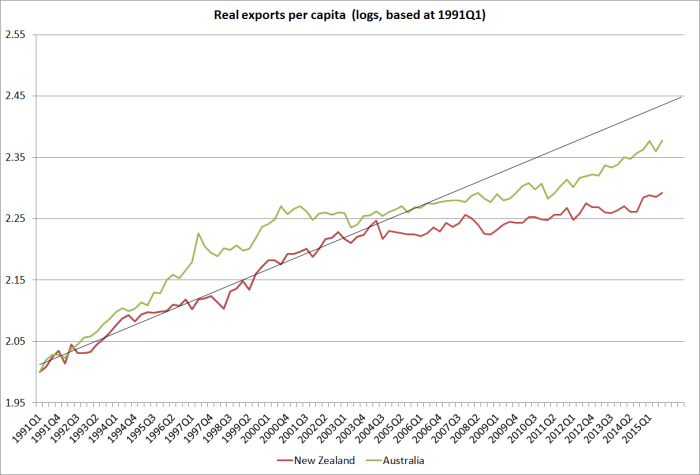
Late last year, in a series of posts on the quarterly national accounts I showed this chart of export volumes per capita (for New Zealand and Australia).

exports real pc

Exports (per capita) had carried on growing over the last decade or so, although at a materially slower rate than they had been growing previously.

Exports matter, but they are only one outcome of the international competitiveness of the New Zealand economy.  Another way of looking at things is to think of the economy as divided between tradable and non-tradable sectors.  It is a useful analytical device, but (like many useful economic concepts) doesn’t map 100 per cent easily onto the official data we have available.

My proposition (not, I think, overly controversial) is that a high-performing economy will be one in which the tradables sector –  the bits selling to, and directly exposed to competition from, the rest of the world –  is growing strongly, absolutely and certainly in per capita terms.   Such growth in the tradables sector in a mark of the success of companies operating here in being able to meet, and succeed in, the global market.  There is, of course, nothing wrong with non-tradables activity: we want phone services, cafes, theatre, and holidays at the beach.  But it is exceedingly rare that a strong sustainable economic performance, especially in a small economy, is led from production in the sectors that aren’t exposed to international competition.

In an IMF Article report from perhaps 10 years ago the Fund staff had the clever idea of representing the tradables and non-tradables sectors in a single chart.  It was rather rough and ready, and the Fund knew it, but it helped illustrate something of how the New Zealand economy had been unfolding.   They started with the production measure of real GDP, and allocated the primary and manufacturing sectors to tradables.    Our exports and imports are typically either primary or manufactured goods, or they are services.  To proxy the contribution of services to tradables production, they took the services exports component (from real expenditure GDP) and also assigned that to the tradables sector.  Everything left over was non-tradables.   The resulting chart was reproduced in various fora around Wellington over the years, even used by the Minister of Finance  –  much to the distaste of purists.

I hadn’t seen the resulting chart for a while, and was curious how things had been going.  In particular, given the rapid growth in the population over the last decade, I was curious about how tradables sector activity had been doing per capita.  After all, both National and Labour governments have constantly talked of strengthening New Zealand’s international competitiveness, international connections etc.

In this chart, I’ve shown primary and manufacturing real value-added per capita, and real services exports per capita, back to when the quarterly population series began in 1991.  Each component here is indexed to 100 in 1991.  At the end of the period, these three components of tradables production are of broadly similar size.

tradables components

If your eye is drawn to the services line, as it probably is, bear in mind that not one of these series is now at its historic peak.  One peak was in 2004, one in 2005, and one (primary) in 1997.     By contrast, real per capita GDP is at its historic peak –  growth hasn’t been strong over the last decade, but has been around 8 per cent over the last decade.  Per capita export volumes haven’t been doing that well (see first chart above) –  but they have clearly done a whole lot better than the domestic (import-competing) component of tradables production.

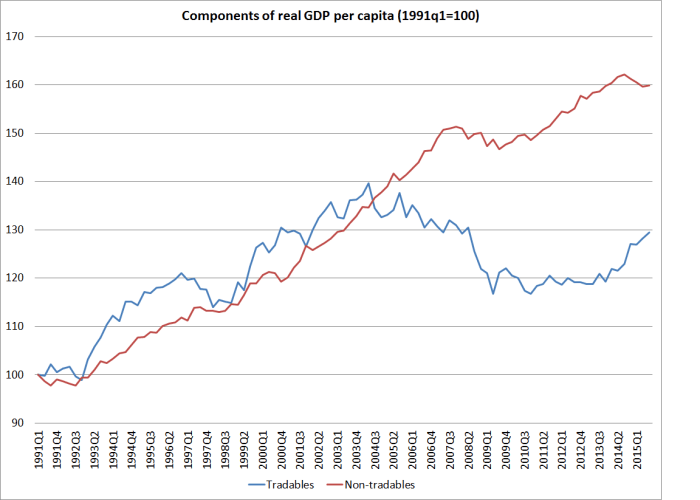
So here are the aggregate tradables and non-tradables components, as proxied by this particular approach.

tradables and non-tradables gdp

I found it a rather bleak picture, to say the very least.  Tradables sector production, per capita, is now nowhere near as high as it was as much as 12 or 13 years ago.  It is most unlikely that New Zealand will make any progress at all in sustainably closing income and productivity gaps to the rest of the advanced world if it can achieve no growth in per capita tradables sector production over a period that long.

Why has it happened?  What has so strongly skewed production towards non-tradables?  I’d argue that it has, primarily, been rapid population growth, which had to be accommodated through a much higher exchange rate (the big step in the exchange rate dates back to 2003). For many of our tradable product sectors, raising our own population does nothing to materially boost output –  land and sea and mineral resources are given, and the (real and significant) productivity possibilities in those sectors are independent of population.  And the higher exchange rate just made it that much harder for other firms in the tradables sector to survive or thrive.  The exchange rate has been so high for so long that we don’t hear many squeals any more –  those who can thrive at these exchange rates do, and dead firms and unborn (ie never launched) firms utter no cries.  Loosely speaking, it is a fully-employed economy (no 5.3% isn’t full employment, but 4.5% might be –  and that difference is swamped by the scale of the divergences evident in this chart), but it isn’t a path to sustained prosperity.   Non-tradables firms, especially in Auckland, do well –  as they do in every population-fuelled boom anywhere (in history or now) –  but it isn’t a path to sustained national prosperity.

Are there some caveats to the story?  Yes, sure. The Christchurch repair and rebuild process exacerbated the skew to non-tradables, and there wasn’t anything much we could do about that.  And high terms of trade, in principle, made it less necessary to produce tradables volumes (price substitutes for volume)….but, in the longer term, higher terms of trade tend to induce strong investment and volume growth in the sectors that are benefiting.  There was no sign of that in New Zealand.

As I noted, purists don’t like the tradables/non-tradables chart, for a variety of reasons (some good, others less so).  A couple of SNZ staff made an effort a couple of years ago to do a slightly more refined version. It was a worthwhile exercise, but I wasn’t persuaded that the more complex version materially altered the results, while making it a bit harder to explain just what had been done.  Bottom line: this has been quite an unbalanced, more inward-focused, economy for more than a decade now, and there is little real sign of that sustainably changing.


The IMF at sea on New Zealand’s (lack of) growth

As I noted yesterday, the IMF released several “selected issues” background papers in association with the release of the New Zealand Article IV report.  These papers are usually a little more in-depth than the main report, and the topics chosen reflect some mix of the expertise and interests of the people on the staff team and the priorities of the New Zealand agencies involved (Treasury and the Reserve Bank).  In my experience, the efforts of the team are often spread too thinly and so unfortunately not many of the papers have added very much to the understanding of the macroeconomic issues facing New Zealand.

The papers this time are:

  • Prospects for potential growth in New Zealand
  • House prices, household debt, and financial stability in New Zealand, and
  • New Zealand – Options for Tax Policy Reform

It would be interesting to know whose initiative the last paper was done at.  My guess is that Treasury may have reacted to the Fund’s anguishing about savings with the comment “well, show us what might actually make a difference”.   Unsurprisingly, the Fund doesn’t conclude on an optimistic note:

while there is some ambiguity on the effectiveness of tax incentives to raise private savings, short of the introduction of a compulsory savings scheme there are no alternatives to providing incentives.

There are real doubts our policies will work, but……we have to do something.  Not exactly reassuring.

The potential growth paper has a few interesting charts, and recognizes the probable importance (as a symptom)  of the ex ante savings/investment imbalances [1] that have given us persistently high real interest rates (relative to those abroad) and a real exchange rate that has been persistently out of line with medium-term fundamentals.  But the authors don’t have much of substance to offer on the way ahead.  They, like everyone else, can see the gaps between us and the world, but they don’t seem to have a “model” –  a way of thinking about or understanding the issues – that can usefully help respond to the specifics of New Zealand’s underperformance.

They believe

there are few if any low hanging fruit in terms of reform……..however, there may be targeted areas for improvement

They claim that

increasing New Zealand’s international exposure is a major aspect of productivity oriented reforms

but the actual list of reforms, and the evidence or arguments connecting them to the desired outcomes, is thin (and sometimes questionable), to say the least

  • “directly enhance innovation through greater expenditure on R&D”
  • “increase labour productivity through education”
and a couple of ideas picked up from last year’s OECD report
  • user and congestion charging for infrastructure, and
  • “more frequently update immigration targets and skill shortage categories”

The final paragraph of the whole paper begins by noting that there are “no obvious liberalization policies at hand”, and then lapses into the rather trite (because there is nothing to back it)

efforts would have to be made to exploit opportunities for greater international integration in order to boost competitiveness and overcome the disadvantage of distance

But for all this, in its apparent enthusiasm to accentuate the positive the IMF actually understates just how poorly New Zealand has done in recent years (or decades).   In particular, I was surprised to find this assertion in the report, citing the experience over the period 1995 to 2012.

Compared with other OECD countries, New Zealand’s TFP growth performance compares favorably

I was taken aback by this claim, and wondered what I had missed, so I went to check the data on the OECD website.  The OECD compiles TFP estimates for only 20 of its member countries.  Here is the total growth in TFP for each of them for that 1995 to 2012 period.

oecd tfp growth 95 to 12

We’ve been the lower quartile country for that whole period.  The only four countries which did worse over that period are either in the euro or tied to it (Denmark), and three of them (Spain, Italy, and Portugal) have had a simply atrocious economic performance in recent years.  If one looks as just the most recent 10 year period for which the OECD has data (2003 to 2013) we were actually second worst of all these OECD countries.

Estimating TFP growth rates involves a model – a way of estimating the contribution of capital and labour to growth, isolating the resulting TFP residual.  The OECD’s approach isn’t the only one, and I’m not sufficiently expert in the field to offer an opinion on which approach is best.  One other big international database that reports TFP estimates in the Conference Board, which produces estimates for a much wider range of countries.

I had a quick look at 37 pretty advanced economies for which the Conference Board reports complete data.  For the IMF’s chosen period –  1995 to 2012 –  there were only seven countries that had recorded less TFP growth than New Zealand had done  (the ones who did worse than us on the OECD measure, and Chile, Norway, and Greece (for whom the OECD reports no data).  So even on this measure, for this range of countries, we’ve been no better than a bottom quartile performer.  The Conference Board has data for all 37 countries as far back as 1989-  and since then, only Spain, Portugal, Greece, Turkey and Hungary have done worse than us.

The Conference Board reports estimates up to 2014.   Here is how those 37 countries have done over the most recent 10 years for which they have data, 2004 to 2014.

conference board TFP 04 ot 14

The picture doesn’t really change.  It is, perhaps, a little less bad than on the OECD’s ranking, but again we’ve been no better than a lower quartile performer.

TFP isn’t the be-all and end-all, and for minerals producers in particular it can be driven downwards in periods of high commodity prices (because less accessible, or lower grade, resources are (profitably) mined).  But there is really no way of looking at the New Zealand performance and reading it as any sort of good news story.

It is surely about time that the elites –  be it leading offshore agencies like the IMF and OECD, or our political and bureaucratic ones –  began to recognize, and state openly, just how consistently poor New Zealand’s economic performance has been, and to acknowledge just how limited or inadequate the policy responses they put up to deal with it  are, and have been.   Identifying policy responses might be hard –  although I reckon that a major reorientation of our immigration policy would go a fair way –  but the first step is an honest assessment that recognizes that what we have been doing simply hasn’t been working.  And it is no use falling back on “but its nice place to live” – as I’ve noted previously, Uruguay looks to have nice beaches – or “but lots of people want to come here” –  well, of course, poorly performing as we have been, we are still richer than China, India, South Africa or the Philippines.  The better test is what our own people are doing – and they just keep on leaving, even though the hurdles to doing so (in Australia in particular) have been getting higher

[1] They even approvingly cite my 2013 paper.


The IMF Report: saving and vulnerability

The IMF released its latest Article IV report on New Zealand yesterday.  There are also some background research papers released with the report, and I might come back to look at them later.

There aren’t material surprises in the IMF’s views in the full report, which builds on the Concluding Statement released at the end of the staff mission here last November.  My comments about that statement (here) were fairly critical, noting both the marked change in the messages from one review to the next, and the fairly limited evidence base for many of the policies the Fund was recommended –  quite a few of which were a considerable distance removed from the core business, or expertise (macroeconomic policy and financial stability) of the International Monetary Fund.

Today I wanted to focus just on the Fund’s claim that there is a major policy problem as it affects savings in New Zealand, a proposition on which much of the rest of the report rests.  The Fund talks of a “chronically low national saving” rate, and worries about the vulnerability that allegedly results from a net international investment position (NIIP) of around -65 per cent of GDP.  In the Fund’s Board discussion, we read that “Directors agreed that raising national, and in particular private, saving is critical to reducing external vulnerabilities from the still heavy reliance of offshore funding”.  Note the strong words:  action is “critical”.

I’ve shown a version of the following chart before.  It is common to present charts of net national savings as a per cent of GDP, but to do so involves two errors: first, the numerator is net but the denominator is gross (the difference is depreciation), and second, the numerator refers to savings of New Zealanders and the denominator refers to economic activity occurring within New Zealand, whether owned by foreigners or New Zealanders.  A more conceptually meaningful approach is to do as I do here: compare the net savings of New Zealanders with the net national income of New Zealanders.  Here it is shown all the way back to 1970.

net savings to nni feb 2016

Savings of New Zealanders (public and private combined) as a share of income have been consistently lower than the median of the whole group of OECD countries.  But there is a very diverse range of experiences, and cultures, within the OECD group.  I’ve also shown the comparison with the median of the five other, probably more culturally similar, Anglo countries (US, UK, Canada, Australia, and Ireland).  Over the 45 year period, mostly we don’t look much different from the Anglo median –  we did worse in the years of very large fiscal deficits in the late 70s and early 80s, but other than the experiences are pretty similar on average.     Where is the evidence of a chronic savings problem?  And it is no defence simply to focus on private, or (worse) household savings: first, the boundaries between household and business savings are blurred, and second, the private sector takes account (typically implicitly) the savings behavior of governments over time.  New Zealand governments have done less badly than most for some decades.

The IMF makes no systematic effort to identify reasons why national savings rates might have been as they are.  Instead, they mostly repeat old lines that don’t have much basis to them.  For example, they assert that an overwhelming proportion of household assets are in the form of housing, even though new Reserve Bank estimates –  published almost a year ago –  make clear that that claim was never justified.  After all, relative to population, there is now a consensus that we have too few houses not too many.  The Fund also asserts that there is something wrong with the tax treatment of housing, but appears to make no effort to illustrate, whether in a cross-country or time series context, how that has contributed to national savings behavior.  They urge changes to Kiwisaver and the NZS, but again make little effort to illustrate how policy parameters in these areas explain savings behaviour.  All in all, it seems like a rather weak basis on which to rest quite strong policy recommendations.

The other aspect of this issue which they just seem to take for granted is the alleged vulnerability that the NIIP position gives rise too.  Buried deep in an Annex to the report, they do produce a chart making clear that there has been no worsening trend in the NIIP position for over 25 years –  the negative position tends to widen in boom times and narrow in downturns, but has fluctuated around a pretty stable trend level.  At present, the negative NIIP position is actually below (less negative) than the average since 1988.

The report has no analysis of the nature of the vulnerability that this NIIP position gives rise to –  even though addressing this vulnerability is considered “critical” by staff and Board.  And it gives no example of any country, anywhere, ever,  in which a stable (but quite high) negative NIIP position over 25-30 years has been (causally) followed by a crisis.  I’m pretty sure there are none –  and remind that IMF that for most of its first 100 years, New Zealand’s negative NIIP position was materially larger than it has been over the last 25 years, again without ending in crisis.  There are plenty of cases where a rapid worsening in the NIIP position over a few years led to trouble –  Spain, Ireland, and Greece are three recent advanced country examples –  but that is a very different situation from the New Zealand situation in recent decades.  As has been the case for many years, the IMF simply seems to struggle to come to grips with New Zealand.

Most of the negative NIIP position is represented by (net) banking system borrowing from abroad.  But that creates serious macroeconomic risks only if the assets that are financed by the overseas borrowing are of poor quality.  Often that is the case when foreign debt is rising quickly  –  but that hasn’t been the New Zealand story.  Perhaps the Fund believes that the New Zealand banking system is shaky?   But Directors noted that “the banking system is resilient and well-supervised” –  the resilience conclusion is certainly backed by the Reserve Bank’s own stress tests, which I discussed at length last year.

New Zealand deserves better quality analysis and insights from its membership of the IMF than it has had in the main part of this report.

The report also contains brief sections headed “Authorities’ views” –  the wording of which will have been approved by our Treasury and the Reserve Bank.   I was surprised to find that “the authorities agreed that raising national saving was an important policy objective”, going on to state that the authorities would “consider measures to boost private saving….in the future”.  There isn’t much elaboration of the point, but the statement itself was something of a surprise.  Last I had heard, the Minister of Finance was very sceptical that there was a “national saving problem” in New Zealand, and particularly that there was an issue materially amenable to policy remedies.  If one can’t convincingly identify policy distortions that materially lower national saving rates relative to those in other countries, it is hard to see a good case for policy interventions to encourage people to save when, on their own, they would not.    It would be interesting to know what was behind this latest, apparent, change of view.


Lessons from Mario Draghi

In two successive days last week, two heads of central banks gave speeches on monetary policy.   Graeme Wheeler’s speech was characterized by a rather desperate defensiveness –  attacking nameless critics for views that no one seems to hold, in an attempt to defend his (and the Bank’s) rather poor track record: a CPI inflation rate that hasn’t been at the midpoint of the target range for four years.

A commenter pointed me to ECB head Mario Draghi’s speech, given the following day, “How central banks meet the challenge of low inflation” .   It isn’t a perfect speech by any means –  the claim that “monetary integration in the euro area is both complete and secure” must just be one of those lines he has to use, regardless of the continuing severe stresses on the system.  It is a speech of two halves –  the second half is about the particular challenges of the euro area, but the first half is an excellent and authoritative discussion of how central banks generally should respond to low inflation.

Core inflation in each jurisdiction is quite similar: in 2015 CPI inflation ex food and energy was 1 per cent in the euro-area, and was 0.9 per cent in New Zealand.  If anything, New Zealand’s inflation target is a little higher than that for the euro-area: our Reserve Bank is required to focus on 2 per cent, while the ECB articulates its goal as keeping CPI inflation close to, but below, 2 per cent over the medium-term.

Draghi’s speech is well worth reading.  It is the speech of someone who has a deep belief in the power of monetary policy – that inflation is, over time, a monetary phenomenon, and that if inflation is persistently below whatever goal is set for the central bank it is the central bank’s responsibility to do something about it.    It is a refreshing speech, especially as the ECB is no doubt closer than it would like to the limits of conventional monetary policy (with the policy rate already below zero).    Draghi could have offered excuses, but instead it is robust call for monetary policy to simply do its job.

Draghi draws on the lessons of the 1970s, when central bankers often wanted to shift the responsibility for high inflation onto other structural forces.  He fully recognizes the wide range of shocks than can hit an economy (demography, technology etc), and the way some of them can persist, but  argues that monetary policy authorities are responsible for offsetting the effects of those shocks on inflation –  whether they are pushing upwards (as in the 1970s) or downwards (as at present).

… in a context of prolonged low inflation, monetary policy cannot be relaxed about a succession of supply shocks. Adopting a wait-and-see attitude and extending the policy horizon brings with it risks: namely a lasting de-anchoring of expectations leading to persistently weaker inflation. And if that were to happen, we would need a much more accommodative monetary policy to reverse it. Seen from that perspective, the risks of acting too late outweigh the risks of acting too early.

In sum, even when faced with protracted global shocks, it is still monetary policy that determines medium-term price stability. If we do not “surrender” to low inflation – and we certainly do not – in the steady state it will return to levels consistent with our objective. If on the other hand we capitulate to “inexorable disinflationary forces”, or invoke long periods of transition for inflation to come down, we will in fact only perpetuate disinflation.

This is the clear lesson of monetary history, especially the experience of the 1970s.

Nor does he offer up excuses of the sort that “inflation is low everywhere, so there isn’t much we can –  or perhaps should –  do about it”.

We now have plenty of evidence that, if we have the will to meet our objective, we have the instruments.

and

So there is no reason for central banks to resign their mandates simply because we are all being affected by global disinflation. In fact, if all central banks submit to that logic then it becomes self-fulfilling. If, on the other hand, we all act to deliver our mandates, then global disinflationary forces can eventually be tamed.

He even deals with the line of argument that easing monetary policy to get inflation back to target may do more harm than good.

Still, there are some that argue that even if central banks can lean against global disinflationary forces, in doing so they do more harm than good. In particular, expansionary monetary policies at home lead to the accumulation of excessive foreign currency debt or asset price bubbles abroad, especially in emerging markets. And when these financial imbalances eventually unwind, it weakens global growth and only adds to global disinflation.

To which his response is:

In fact, when central banks have pursued the alternative course – i.e. an unduly tight monetary policy in a nascent recovery – the track record has not been encouraging. Famously, the Fed began raising reserve requirements in 1936-37, partially due to fear of a renewed stock bubble, but had to reverse course the next year as the economy fell back into recession. That has also been the experience of some central banks in recent years: raising rates to offset financial stability risks has undermined the primary mandate, and ultimately required rates to stay lower for longer.

This suggests that the so-called “assignment problem” between monetary policy and financial stability at the domestic level should also apply at the global level. Monetary policy should not try to balance opposing objectives: it is optimal for all parties if it delivers its mandate. And if that creates financial stability concerns, they need to be addressed by other policies more suited to the task. And in fact there are several policy levers available.

Countries can improve their financial regulation and supervision to make their financial systems more resilient to external shocks. They can adjust their fiscal policies. They can adopt macro-prudential measures.

That is the sort of speech that Graeme Wheeler should have been giving last week – indeed, given how badly inflation has been undershooting the Reserve Bank’s target, he should have been giving it a year or two ago.  Instead, he drove up interest rates –  when his preferred measure of core inflation was even lower than it is now.  And even now that the OCR increases have reluctantly been fully reversed, we are left with real interest rates that are higher than they were two years ago, even as confidence in inflation getting back to target erodes further (and the terms of trade have fallen, the peak impulse from Christchurch has passed, and the global situation has materially worsened).

Chris Green, at First New Zealand Capital, had a commentary out late last week on the Governor’s speech.  I agreed with almost all of it.  But two lines particularly caught my eye:

“My sense is that the Governor is far more focused in defending his current position than objectively attempting to assess the optimal risk-adjusted monetary policy response”

and

“The perception that they give of a reasonably high hurdle before cutting rates would be more consistent with CPI out-turns around the top of the band, not having been below the midpoint for more than 5 years [I presume he means on the Bank’s preferred core measure] and not projected to get back there until the December quarter of 2017 –  at the earliest”.

Quite.   And one could add that the problem is compounded by the Governor’s reluctance to substantively engage with the issues –  rather than responding to straw men of his own imagining –  or indeed to open himself to sustained scrutiny from the media.

The Governor and his chief economist have been putting a lot of weight on inflation expectations measures recently, and suggesting that there is really nothing to worry about.  We’ll have a new round of inflation expectations data shortly, and I’ll come back to the topic then, but for now consider this chart, drawn from the Bank’s survey of household expectations.

household expecs Feb 16

People are asked whether they expect inflation to rise, fall or stay the same over the coming year.  The survey has been running for over 20 years, and in every single survey a net balance have reported expecting inflation to increase (suggesting that not much weight should be put on the absolute numerical value of the answer).  But what I wanted to highlight is that at present fewer people expect inflation to rise than at any time in the history of the series, with the exception of the depths of the recession in 2008/09.    But in March 2009, when only 20 per cent people expected inflation to rise over the coming year, the last annual inflation rate they’d seen was 3.4 per cent.  Of course –  in the middle of a recession, with plummeting oil prices –  they didn’t expect inflation to rise.  And they were right.  Annual inflation fell sharply.    The most recent observation in the survey was November 2015.  When those respondents completed the survey, the most recent annual inflation rate they’d seen was 0.4 per cent.  And still, not many (by historical standards) expected annual inflation to rise.   There is nothing to be complacent about in the inflation expectations data –  and even among more expert observers, medium-term inflation expectations are lower, relative to the target midpoint, than they have been since inflation targeting began.

It must almost be time for the Minister of Finance’s annual letter of expectations to the Governor.  As I noted last year, the persistent undershoot of the target has had little or no attention in  past year’s letters.  We must hope that this year’s is different.  The primary responsibility for the persistent undershoot of the target rests with the Governor, his chief economist, and his other senior advisers.  But the apparent passivity to date of those charged with holding the Governor to account –  the Minister of Finance, who set the target, and the Bank’s Board, paid to monitor the Governor’s pursuit of the target –  risks making them complicit in the failure.  After all, together they were responsible for the appointment of an individual as Governor who increasingly seems to lack the stature and qualities that the position demands.

A chart for New Zealand’s national day

Cross-country comparisons of material living standards aren’t easy to do well, and especially for earlier historical periods when data are often patchy, to say the least.

But Professor Angus Maddison made the effort of compiling estimates for a range of a countries –  in some cases going back (with estimates every few centuries) as far as the year 1AD.  He used the best estimates he could find from other researchers where they were available, and did his own estimates to fill in some of the gaps.  As one gets further into the 20th century, more official or semi-official estimates could be used.

His fullest set of estimates for the last couple of hundred years was for a group of 16 Western European countries and the four advanced “offshoots” –  New Zealand, Australia, Canada, and the United States.     The estimates have to be taken with a considerable pinch of salt, but in broad outline they seem fairly consistent with other research on the relative prosperity of various countries.

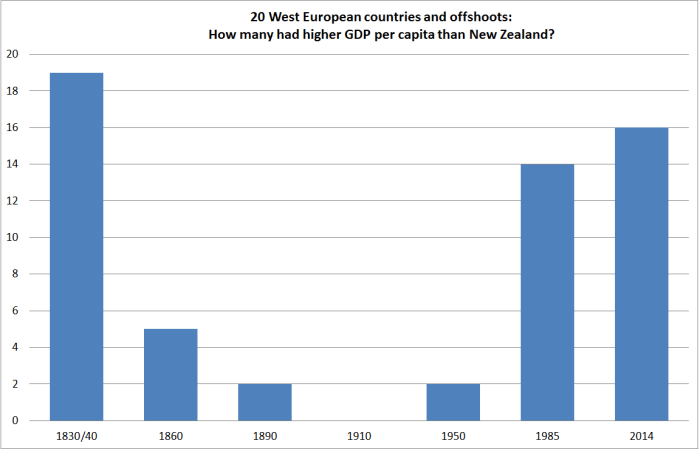
Maddison reports an estimate for each country for either 1830 or 1840.  For New Zealand he uses an estimate for 1840 that was consistent with his estimates for much of Europe in 1000AD (and the same low estimate as he uses for pre-settlement Canada, US, and Australia).  If that estimate is even roughly right, then material living standards in New Zealand at the time the Treaty was signed were lower than those in all other 19 countries.

Here is how that ranking is estimated to have changed (using the Conference Board’s Total Economy Database, which builds on Maddison’s work, for the latest observation).

waitangi


Through some combination of immigration of people and technology, substantially (and often forcibly) displacing the previously dominant population and culture, fifty years later GDP per capita in New Zealand is estimated to have been among the very highest in the world.  One wouldn’t put much weight on precise numbers, but on this particular series, in 1910 no country had a higher GDP per capita than New Zealand.

But 100 years on, 16 of these 19 countries now have higher GDP per capita than New Zealand does.

Absolute living standards in all of these countries are, of course, far higher than they were in 1840.   And the evidence strongly suggests that living standards in New Zealand –  and Canada, US, and Australia –  are now far higher than they’d have been without European settlement (see here or here).  But the last 100 years has been a fairly dismal relative performance by New Zealand.  And there is no sign of that reversing again.

Government bailouts and market discipline

The speech and Bulletin put out by the Reserve Bank yesterday made much of the importance of market discipline in the financial sector.  The two documents have slightly different lists of conditions which the respective authors think make it more likely that market discipline will be effective, but a common element is “market participants [must] have incentives to monitor financial institutions”.  Toby Fiennes argues that in the New Zealand context:

“some aspects of the regulatory framework, such as Open Bank Resolution (OBR) and no deposit insurance, reinforce these incentives.”

and O’Connor-Close and Austin, in the Bulletin, add in

“nor is there any policyholder protection scheme for insurance firm customers.”

This has been a longstanding view held by the Reserve Bank.  I’ve long thought it was wrong.

Of course, if you were confident that, were a bank to fail in which you were holding deposits or other interest-bearing securities, you would lose money, and no one would bail you out, you would have quite a strong incentive to pay attention to the health of any institution in which you had a reasonable amount of money, and (to economise on monitoring costs) to hold  your money, as far as possible, with those institutions generally regarded as safest.

Same goes for insurance.  If you had your house insurance with an insurance company, and no one would bail you or it out if the company failed, you’d have quite an incentive to insure with companies that would prove resilient through the worst of shocks.

In the case of banks, OBR is designed to make it more technically feasible for political leaders to let major banks fail.  In that model any losses  (mostly) fall on the creditors, and yet the failed bank can quickly re-open, keeping the day-to-day flow of transactions and routine business credit operational.  It is technically elegant system.  But whether or not it is ever used is not up to the Reserve Bank.  That is matter for whoever is Minister of Finance at the time –  and no doubt the Prime Minister of the day too.

Suppose a big bank is on the brink of failure.  Purely illustrative, let’s assume that one day some years hence the ANZ boards in New Zealand and Australia approach the respective governments and regulators, announcing “we are bust”.

Perhaps the Reserve Bank will favour adopting OBR for the New Zealand subsidiary (since the parent is also failing they can’t get the parent to stump up more capital to solve the problem that way).    But why would the Minister of Finance agree?

First, Australia doesn’t have a system like OBR and no one I’m aware of thinks it is remotely likely that an Australia government would simply let one of their big banks fail.  But in the very unlikely event they did, not only is there a statutory preference for Australian depositors over other creditors, but Australia has a deposit insurance scheme.

I’m not sure of the precise numbers, but as ANZ is our largest bank, perhaps a third of all New Zealanders will have deposits at ANZ.

So, if the New Zealand Minister of Finance is considering using OBR he has to weigh up:

  • the headlines, in which ANZ depositors in Australia would be protected, but ANZ depositors in New Zealand would immediately lose a large chunk of their money (an OBR ‘haircut’ of 30 per cent is perfectly plausible),
  • and, even with OBR, it is generally accepted (it is mentioned in the Bulletin) that the government would need to guarantee all the remaining deposits of the failed bank (otherwise depositors would rationally remove those funds ASAP from the failed bank)
  • and I’ve long  thought it likely that once the remaining funds of the failed bank are guaranteed, the government might also have to guarantee the deposits of the other banks in the system.  Banks rarely fail in isolation, and faced with the failure of a major banks, depositors might quite rationally prefer to shift their funds to the bank that now has the government guarantee.

And all this is before considering the huge pressure that would be likely to come on the New Zealand government, from the Australian government, to bail-out the combined ANZ group.  The damage to the overall ANZ brand, from allowing one very subsidiary to fail, would be quite large.  And Australian governments can play hardball.

So, the Minister of Finance (and PM) could apply OBR, but only by upsetting a huge number of voters (and voters’ families), upsetting the government of the foreign country most important to New Zealand, and still being left with large, fairly open-ended, guarantees on the books.

Or, they could simply write a cheque –  perhaps in some (superficially) harmonious trans-Tasman deal to jointly bail out parent and subsidiary  (the haggling would no doubt be quite acrimonious).  After all, our government accounts are in pretty reasonable shape by international standards.

And the real losses –  the bad loans –  have already happened.  It is just a question of who bears them.  And if one third of the population is bearing them –  in an institution that the Reserve Bank was supposed to have been supervising –  well, why not just spread them over all taxpayers?    And how reasonable is it to think that an 80 year pensioner, with $100000 in our largest bank, should have been expected to have been exercising more scrutiny and market discipline than our expert professional regulator (the Reserve Bank) succeeded in doing?  Or so will go the argument –  and it will get a lot of sympathy.

(There is provision in the OBR scheme for a “de minimis” amount below which the haircut might not apply.   If the de minimis amount is, say, $500 –  roughly a fortnightly New Zealand Superannuation amount for a couple –  it is neither here nor there for the scheme as a whole.  But a high de minimis amount looks a lot like ex post unfunded deposit insurance.)

Note that I’m not arguing that bailouts are “a good thing”, simply that having the OBR tool really does not dramatically alter the incentives politicians will face in dealing, at the time, with the imminent failure of a large bank.   And rational investor know that.  For the case of a large bank, OBR simply isn’t really a time-consistent strategy for politicians.

Some people at the Reserve Bank will accept the point, but argue that we still need OBR to have a credible weapon to wave in front of the Australians in a crisis.  If they think New Zealand might just be “crazy” enough to use it, it might  –  so it is argued – help us negotiate a slightly less unfavourable bail-out deal.  Perhaps.  But Australians can read domestic politics too.  I have no problem with having it in the toolkit –  perhaps it could be useful for a small bank  –  but no one should pretend that it solves bail-out risks and restores retail market discipline, red of tooth and claw.  And the probability of a bail-out, with a focus on protecting retail deposits, probably weakens market discipline at the margin even among wholesale investors.

And what are the precedents?  25 years ago the Bank of New Zealand was bailed out.  Yes, the government was the largest shareholder at the time, but I didn’t detect any sense –  at the very peak of the Douglas-Richardson era – that ownership determined whether the government of the day let the BNZ survive or fail.

More recently, the retail deposit guarantee scheme was put in place in late 2008 – not just for finance companies, but for the big banks too.  The decision was made by the previous Labour government – but it was endorsed by the Key/English led Opposition, and was recommended (in substance if not in precise detail) by the Reserve Bank and Treasury. I wrote many of the papers.

And more recently still, AMI was bailed out –  by the current government, on the recommendation of the Reserve Bank and Treasury.

In his speech, Fiennes note that

“it is of course true that many people expect governments to stand behind their deposits. That expectation was reinforced by the widespread Government guarantees (including in New Zealand) during the GFC.  The existence of an expectation, though, is not a sound reason to adopt deposit insurance”.

That might be true if depositors had no leverage.  But they do. It is called the ballot box, and politicians are very well aware of it.

If depositors, or policyholders, expect bailouts, and political leaders have incentives to respond to, and deliver on those expectations, then it may be a much less inferior option to adopt an explicit retail deposit insurance scheme upfront.

Deposit insurance need not be a substitute for OBR, but may actually make it a little more credible that OBR could be allowed to work.  If there is a bail-out, it will benefit not just New Zealand retail depositors, but wholesale lenders too, domestic and foreign.  There is likely to be much less political appetite for bailing out the wholesale creditors (especially the foreign ones), but a simple bailout does not enable one to distinguish.  By contrast, a properly specified deposit insurance scheme enables one to be very clear upfront which deposits are likely to be covered, and which not –  and to charge for that coverage accordingly.  In event of a bank failure, OBR could be applied to all creditors, with the deposit insurance scheme “reimbursing” the retail depositors to the extent defined in the scheme.  And in the event of a serious bank failure, the ability to impose loss on (particularly) foreign lenders (though in practice all wholesale creditors) is a net welfare gains to New Zealanders.  Letting losses fall on New Zealand retail depositors might be reasonable economics, but (a) it probably doesn’t work politically, and (b) it simply transfers the losses from one set of New Zealanders to another.

Deposit insurance schemes are not ideal –  and the Reserve Bank speech and article repeat some of the challenges.  But bailouts are not ideal either, and experience suggests very strongly that bailouts remain the preferred default option at the point of crisis.  As someone put it to me recently, in some sense if you don’t have an explicit limited deposit insurance scheme then, de facto, you have an implicit unlimited deposit insurance scheme (ie bailouts).  And reasonable depositors will know it.

And if deposit insurance schemes aren’t ideal, they are fairly ubiquitous.   As this recent IMF Working Paper points out (p32) every single advanced economy member of the IMF has an explicit deposit insurance scheme, with the exception of Israel, San Marino, and New Zealand.  San Marino aside, every European country, advanced or emerging, has such a scheme, and Africa is the only continent where a majority of countries do not have such schemes.  It has never been clear why the Reserve Bank thinks New Zealand can, or sensibly should, sustain being different, given the political economy pressures that all governments face.

And it is not as if deposit insurance has been withering since the financial crises of 2008/09.  As the IMF paper illustrates, coverage has often been extended, and co-payments wound back.

I noted this morning that, for all its insistence on having regular private data that creditors can’t get access to, the Reserve Bank continues to assert that, in effect, it has no financial “skin in the game” –  the risks are with creditors. In a second-best world, a deposit insurance scheme actually helps ensure that government agencies really do directly have skin in the game; financial risk if things go wrong.  That might actually sharpen accountability.

It was really rather naughty, and unhelpful, of the Reserve Bank not to have devoted some space to the political economy pressures, and the New Zealand bailouts/guarantees to which they (and The Treasury) have been party.  Of course, it might have been difficult to have done so, and would have undermined a good story, but it would have got us closer to better understanding the real choices and tradeoffs that societies face and make in this area, ex ante and ex post.

Of course, the decision on a deposit insurance scheme is not one for the Reserve Bank.  It is a government decision, and one that would require legislation to implement. It is understandable that the current government feels badly burned by the cost of the guarantee of South Canterbury Finance.  But given the incentives that governments will inevitably face if a major bank, or insurer, is on the brink of failure, it is surely time to shift direction, and put in place an explicit insurance scheme, for which depositors would be charged. Doing so would probably, overall, strengthen market disciplines a little, not weaken them as the Bank argues.  Bailouts of all creditors might still happen –  between Australian government pressure, and the threat of disrupted access to foreign funding markets –  but at least (a) the government would have raised some revenue in advance of the costs, and (b) we would be able to have more rational, and emotionally (and politically) plausible, arguments about the reasonableness of allowing unsophisticated investors who had taken little or no obvious risk (deposits in one of our larger banks) to face large unanticipated losses.

At interest.co.nz, Gareth Vaughan recently had a nice piece also making the case for deposit insurance in New Zealand.
 

Bank regulation: the Reserve Bank’s unease about transparency

The Reserve Bank has been firing out on-the-record speeches this week. I discussed the Governor’s troubling effort here, and may come back to that again in the next few days.  I probably won’t say much about the Assistant Governor’s lecture yesterday –  except perhaps to draw attention to his claim that ‘there are times when the Bank will know more about the economic situation and outlook than does the public or market participants’.  Really?   I guess the last three years, when the Governor has consistently failed to get inflation near the 2 per cent target, and has had to dramatically and grudgingly reverse his own rather strident policy stance, hasn’t been one of those times.

Perhaps more interesting were the two releases late yesterday afternoon on the role of market discipline in the context of prudential regulation of banks (in particular).   Toby Fiennes, the head of the Bank’s prudential supervision area delivered a speech to some of those he regulates headed “Regulation and the Importance of Market Discipline” , and an issue of the Bulletin by two of his staff headed “The importance of market discipline in the Reserve Bank’s prudential regime” was released.    In both of yesterday’s releases there is a refreshing reaffirmation of the importance of market discipline –  even if the actual direction of policy isn’t really that consistent with the rhetoric.

The Fiennes speech is a mix: in part a lecture on the Bank’s view of the importance of market discipline, and partly a report on the outcome of the Bank’s recent tidying up exercise, the so-called  “regulatory stocktake”.  I wrote about the results of that process here (and a mere four months after first requesting them I have recently had released to me around half of the submissions the Bank received on the stocktake consultation ) [1].

I wanted to touch on just two aspects of the stocktake material.  I was one of several submitters who had made the case that all submissions on Reserve Bank consultative documents should be published (as is now common practice in other government agencies and parliamentary select committees).  The Bank has always been very resistant to such openness. But in its release in December, there were encouraging signs

Our current approach is based on our understanding that respondents prefer to keep their submissions confidential. Prior feedback indicated that banks, in particular, were reticent to share cost information and the Reserve Bank is concerned that the publication of submissions would impact the quality and detail of the submission feedback. On the other hand we also recognise the importance of transparency in the policy-making process, so we will return to this issue and consult on a revised approach under which the default position would be that all submissions are published on our website (although submitters could ask to have any confidential information in submissions redacted).

Unfortunately, the discussion in last night’s speech –  when Fiennes went out among the banks –  was weaker than what they put out in December.

Some submitters suggested that we publish all written submissions on our public consultations. Our current approach is based on prior feedback, which indicated that respondents prefer to keep their submissions private on the grounds of commercial confidentiality. We will test this more rigorously with stakeholders. The alternative would be to publish all submissions by default unless submitters ask for them to be withheld or redacted.

Talk of a new default position of publication has disappeared.  What I wrote in December seems even more apposite in light of last night’s comments

I think this statement tells one a lot about the extent to which the Reserve Bank sees its clients as primarily the institutions it regulates, rather than the public the institution exists for.  I’m sure that banks would generally prefer to keep their submissions confidential, and it is precisely for that reason that their submissions, in particular, should be made public.  It is too easy for a cosy relationship to develop between the regulator and the regulated

I hope that the Reserve Bank remembers that its primary stakeholders are the public, and the representatives of the public (the Minister and members of Parliament), not the entities they are statutorily charged with regulating.

But to balance that unease, I want to give Fiennes kudos for one aspect of his speech. In my submission to the stocktake I had argued that if the Bank was serious about promoting market discipline, it shouldn’t be devoting undue time to refining disclosure statements, which the Bank quite openly states don’t contain the information the Bank itself uses. Instead, I argued, the Bank should require that all the private information the Reserve Bank now collects should be published on the relevant bank’s website at the same time it is supplied to the Bank.  Recall that the Bank is keen to emphasise that creditors, not the Reserve Bank or the Crown, bear the losses in the event of a bank failure.

The Bank’s published response to the submissions did not deal with that proposal at all.  But last night’s speech did.  Here is what Fiennes said

As some of you may have read, several submitters argued that we should publish all of the information we receive through private reporting, potentially publishing a monthly dashboard of this information.

While this principle has some appeal, there are two main reasons why we do not consider it appropriate.

First, the potential trade-off between timeliness and data quality. We sometimes accept a marginal reduction in data quality in private reporting in exchange for receiving the information quickly. While this is appropriate for supervisory purposes, public disclosure needs to maintain a high minimum accuracy in order to support the credibility of the regime. This is underscored by the penalties in the legislation for false disclosure, and is an issue we are giving careful thought to in the design of the dashboard.

Second, there is the issue of commercial sensitivity. Often the private data we received is commercially sensitive, or might be open to misinterpretation if released without the appropriate context – especially if this was occurring in a situation of rapidly rising financial system risk.

At least now we can better understand the Bank’s objections. But I don’t find the counter-arguments persuasive.

Fiennes asserts that the Bank can “sometimes” live with a “marginal reduction in data quality…in exchange for receiving the information quickly”,  but that they can’t possibly expose the public to this “marginal reduction”.  But it is the money owned by the public that is at stake in these banks: Reserve Bank staff and management have nothing directly at stake.  More generally, the Bank doesn’t seem to recognise that all sorts of real and financial markets trade on imperfect information all the time –  in monetary policy, the constant revisions to GDP data for years afterwards are just the most obvious example.  If the information is sufficiently valuable to the Reserve Bank that it will use statutory powers to compel banks to supply it (without charge) that information, then such timely information should be at least as valuable to the public who are investing with the banks.  If the data really helps shed light on the financial positions of banks, investors have more use for it than officials.

The Reserve Bank’s other counter-argument is “commercial sensitivity”.  But if the Reserve Bank really needs this timely information to do its job, how can depositors and other lenders not need it to evaluate the changing nature of the risks they are running?  No doubt the same sorts of arguments were run when disclosure statements were first developed in the 1990s.  Fiennes is also concerned that data might be “open to misinterpretation if released without the appropriate context” –  but nothing stops the disclosing bank itself, or the Reserve Bank , or any private sector commentators providing that context.  Any data can be misinterpreted   – and can also be explained.  Fiennes amplifies the point by arguing that misinterpretation is perhaps especially likely “in a situation of rapidly rising financial system risk”.   But disclosure isn’t overly valuable to any creditor in good times – the value of having that information is precisely when actual and perceived risks are rising.  And, to be boringly repetitive, it is depositors’ and investors’ money that is at stake.

Here was some of my discussion of the issues in my original submission:

Moving in the direction discussed just above would, of course, represent a substantial change in  approach.  Timely statistical returns of the sort banks supply to the Reserve Bank can’t first go through a full audit sign-off and director attestation, but the Reserve Bank itself –  by its own  revealed preferences –  clearly thinks that in terms of knowing what is going on on a timely basis, those protections are less important than getting timely information.  If things are very timely there will almost inevitably be the occasional error, but that is not an argument against the idea.  After all, even Statistics New Zealand (perhaps even the Reserve Bank) occasionally finds mistakes in its data.  The concern shouldn’t be errors –  people are human and will err –  but about the risk of being deceived.  But adequate protections against deliberate attempts to deceive either the Reserve Bank or creditors (by deliberately supplying erroneous or misleading information) surely either already exist in statute or common law, or could be legislated separately.  And the fact that the Reserve Bank’s own analysts would be reliant on the same data that were going public would provide an additional layer of comfort –  since the Bank is readily able to ask, and require answers to, probing follow-up questions.

I am also not suggesting an absolutist approach to this issue.  I have no problem with the answers to  ad hoc inquiries by the Reserve Bank of an individual bank not being published.  And in times when an individual institution may be approaching crisis, there probably inevitably needs to be a degree of confidentiality around the handling of that detailed information involved in crisis management (although such material should probably still be discoverable after the event).  Indeed, protecting that sort of information was a part of the justification for the (now abused) section 105 secrecy provisions in the Reserve Bank Act.  There is no foolproof dividing line, but I would suggest as a starting point that any statistical returns which are (a) regular, and (b) required of all (or a significant subset of) banks should be subject to my immediate disclosure rule.  And perhaps the Reserve Bank Board could offer an attestation in its Annual Report that it has satisfied itself that staff and management are operating the system in a way that ensures all regular supervisory information is being made available to depositors and other creditors.

I still think the case for full and immediate publication of all regular bank statistical returns is strong.

New Zealand’s regime around depositor protection is extremely unusual internationally –  something I will come back to in a follow-up post.   We don’t protect depositors.  Perhaps keeping information private –  having the real oil only going to the Reserve Bank –  might be acceptable in some idealised world in which bank regulators were consistently wise, insightful, benevolent and consistently right. (“we’ll look after everything for you”).   But they aren’t.  They are human beings, and their track record (around the world) isn’t particularly good.  That isn’t a comment about the Reserve Bank of New Zealand in particular –  it hasn’t been put to the test in the last 20 years –  but about bank regulators more generally (and other regulators for that matter).

Regulators simply do not have the incentives to process and interpret information correctly –  and it isn’t their money at stake.  Sometimes they get too cosy with those they regulate.  At other times, they get too cosy with their political masters. And often enough – being human –  they simply pursue their own bureaucratic interests –  a bigger agency, with more power, more information, not too much scrutiny and a quiet life.  There isn’t much reason to think that Reserve Bank regulators will consistently make better use of ‘private data’ from banks better than the people who have lent to those banks will.  Disclosure can be messy, and bureaucrats abhor messiness.  But the contest of ideas and interpretations, and the intense scrutiny of available information (partial as it might often be), is the essence of competitive market processes.  Tidiness, not so much.   If regulators need data promptly, so do those who invest with the banks they regulate.


[1] The Bank told me a week ago they were going to post that release on their website (here), but have not yet done so.  If anyone wants a copy of those submissions please email me.  [UPDATE: The Bank has now posted the release.]


TPP: some economists

Eric Crampton had a post this morning drawing attention to recent posts on TPP by Brian Easton (“to the left of the NZ economist punditsphere”) and me (“to the right of the same”).

In our posts we primarily asked slightly different questions.  Brian posed the question “Can we afford not to adopt the TPPA?” .  He doesn’t express a strong view one way or the other on the economic merits of the deal itself (but, as Eric notes, he doesn’t come across as overly enthusiastic).  Instead, his focus is on the fact that the deal has already been agreed, and that if New Zealand were not to ratify it now, it could be deeply damaging to a range of international relationships.

The logic in this column is that we now do not have much choice about the TPPA. The government is trapped into agreeing to it because rejecting it has implications for other trade deals and our wider international relations.

That is probably right.  I didn’t give that dimension much attention in my post, as I take for granted that having signed the deal the current government will ratify it.  It doesn’t need a vote in Parliament to do so, but would have the numbers even if it did.

My focus was different –  more about the question of whether we, as New Zealanders, should welcome, or regret, that the deal was done at all.  Given that the deal has been done, the implications are quite different if it eventually falls over because the US political process rejects it (neither a President Sanders nor a President Trump might even submit to Congress), than if a single minor country (eg New Zealand) were to walk away unilaterally.

I suspect we’d be better off if the deal had not been done.     But I’d feel more confident of any view  –  positive or negative –  if we had had a proper independent evaluation of all the aspects of the agreement from a capable independent agency (such as the Productivity Commission).

I was also interested in Eric’s own take on the deal

I’ll remain a fence-sitter as it would take just too much work to come to a strong view on it. My confidence interval on whether the thing’s worth signing spans low/mid positive and low negative figures, and it wouldn’t be easy to tighten that up. If Congress decided not to pass it and the other partners could then clear out the worse parts on copyright, it wouldn’t bother me that much – though the deal on copyright is far better than I’d thought it could have been.

Eric is also on “the right of the economist punditsphere” (probably more so than I am).  In a sense, his point about “it would take just too much work to come to a strong view” echoes the argument for a proper independent expert evaluation.

And, of course, from the left was the sceptical paper on The Economics of TPPA which I linked to other day, which had substantial input from economics academics Geoff Bertram and Tim Hazeldine.

Perhaps I’ve missed someone, but I haven’t seen a ringing endorsement of the overall economic benefits to New Zealand of TPPA from any New Zealand economic commentators.      Perhaps the overall deal is slightly beneficial, or slightly detrimental, to New Zealand’s overall interests.  And different people might reasonably reach different views, by placing different emphases on the various strands of a complex deal.

In the Herald this morning, the Trade Minister argues that “today is exceptionally important day for New Zealand”.  Frankly, that seems unlikely either way.  He claims to believe that his own National Interest Assessment understates the likely economic gains to New Zealand.  It seems unlikely, but it would be interesting to see his argumentation and evidence.

Either way, I had a circular National Party e-mail from McClay yesterday, with a link to a site allegedly “setting the record straight on TPP”. He lost me here

FALSE: Supporting the TPP is a left-right issue

Actually, it’s an economic literacy issue.

I know it is politics, but I rather wondered who the Minister of Trade thought he was convincing.  The issues are important enough –  whether McClay is right or some of the sceptics and outright opponents are – for a rather more serious level of discussion and debate.

Rather desperate defensiveness

The Governor of the Reserve Bank has this afternoon delivered his annual speech to the Canterbury Employers Chamber of Commerce.  In many respects it was an elaboration on last week’s brief OCR review statement –  “we might have to cut the OCR, and risks are tilted to the downside, but we don’t really want to”.

Beyond that, it wasn’t an impressive effort.  Once again, the Governor simply does not seriously engage with the arguments made by those who suggest that a lower OCR would have been, and would be, preferable.  Instead, he basically makes up an inflation story that simply isn’t supported by the numbers, and attacks straw men.  The defensiveness is disheartening.

Lets take the numbers first.  On several occasions the Governor repeats the claim that “Annual headline inflation is currently 0.1 percent. This is primarily because of the negative inflation in the tradables sector, and the decline in oil prices in particular.”

First, you can’t just ignore tradables prices –  when the target is expressed in terms of CPI inflation, and around half the index is tradables.  CPI inflation is a weighted average of tradables and non-tradables inflation, and tradables inflation is typically lower than that for non-tradables.  Perhaps one might set tradables to one side for a time if the exchange rate has just been moving very sharply –  exchange rate changes do tend to affect the level of domestic tradables prices (and so temporarily affect the inflation rate).  But the peak in the New Zealand TWI was 18 months ago now.  If anything, the lower exchange rate has been holding up, perhaps only a little, tradables prices in the last year.  And non-tradables inflation in the last year was only 1.8 per cent.  If inflation was really consistent with the target midpoint, we should expect to see non-tradables inflation around 2.5 per cent.  It is a long way off that at present.

Second, the Governor repeats the story from last week’s statement that really it is mostly about falling oil/petrol prices.  But it takes no sophisticated analysis to read the SNZ CPI release, or consult the Reserve Bank website, and find that CPI inflation ex petrol was 0.5 per cent last year –  at a time when the exchange rate has been falling.  The Governor also invokes the cut in ACC motor vehicles levies in his defence –  which would be fine, except that he completely ignores the offsetting government decision to increase tobacco excise tax yet again.  SNZ publishes a series of non-tradables inflation excluding government charges and the alcohol and tobacco component.  That series increased by 1.8 per cent last year –  exactly the same as the overall non-tradables inflation rate itself.  In other words, administered government taxes and charges do not explain low headline inflation, and neither (to a great extent) does low petrol prices.  To argue otherwise  –  without much more supporting analysis –  just isn’t supported by the data.

Here are a range of analytical and exclusion measures that one might reasonably look at in assessing current core inflation

Annual inflation, year to Dec 2015
Trimmed mean 0.4
Weighted median 1.5
Factor model 1.3
Sectoral factor model 1.6
CPI ex petrol 0.5
CPI ex food and vehicle fuel 0.9
CPI ex food, household energy and vehicle fuel 0.9
CPI ex cigarettes and tobacco -0.3
Non-tradables ex govt charges and alcohol and tobacco 1.8

As he did in last week’s release, the Governor focuses on the sectoral core factor model measure –  which just happens to  be the highest of any of the inflation measures.  Since previous OCR releases had not focused on specific core inflation measures, we might have hoped for either a balanced assessment from the Governor, or a more in-depth case for why we should regard the sectoral factor model as the best measure.  Why not, for example, (and at the other extreme) the trimmed mean (which has had quarterly deflation in three of the last five quarters)?  But there was simply nothing : just assertions.  (Incidentally, even if the Governor is correct that the sectoral factor model is the best read, it is quite a slow-moving smooth series, and a deviation of 0.4 percentage points from the target midpoint would not be insignificant. )

So perhaps we can debate quite where the underlying rate of inflation really is –  as I noted last week, neither the Governor, nor anyone else, knows that with any certainty.  But the Governor doesn’t engage in that debate, he reverts to attacking straw men.

Once upon a time –  a quarter a century ago, says he gulping –  a wise boss at the Bank objected when I was drafting Monetary Policy Statements attacking anonymous views of outsiders (“some commentators said”) and suggested that if we wanted to deal with criticisms we should identify them specifically, and respond to what people had actually said.  It took more work, but he was right.

By contrast, we hear today from the Governor the lofty declaration that “the Policy Targets Agreement is a relatively simple document [arguable, but we’ll let that pass] we continue to be surprised at the wide range of interpretations that we see in the media and in the commentaries”.  Really?    But the Governor gives no indication as to whose interpretations he has in mind, and what those interpretations might be.    I see comments occasionally from people who argue that the Act or the PTA should be changed, but I don’t recall seeing any very great divergences over the last few years in the interpretation of the PTA itself.  Yes, there is some uncertainty about what, if anything, the longstanding obligations to “have regard to the soundness and efficiency of the financial system” and to avoid “unnecessary variability in exchange rates, interest rates and output” might practically mean –  but there is nothing new about that, and the Bank itself can’t give an straightforward answer to those questions (a lot, inevitably, is “it depends on the specific circumstances”).  But the debate about the conduct of monetary policy over the last few years has mostly been squarely within an entirely conventional framework.  The Governor and his advisers (and initially many of the bank economists) expected inflation to pick up and hence thought the OCR needed to be raised a lot.  Others were more sceptical.  But both sides of the argument operated largely within a forecast-based model  –  suggesting that the OCR should be adjusted in line with the medium-term outlook for inflation.  As it happens, the Bank –  and those who adopted the same line –  were proved wrong –  but it wasn’t really a dispute about the PTA itself.  They were forecasting differences and –  while forecasting is hard –  the Bank and the Governor have been repeatedly wrong-footed by the data.  They had the wrong model.  Again, some of their international peers made the same mistake –  others were just constrained (or thought they were) by the near-zero lower bound.

The Governor also devotes space to attacking a related straw man. Indeed, this one is the centrepiece of the press release he put out with the speech:

“Mr Wheeler said that the Bank would avoid taking a mechanistic approach to interpreting the PTA.  Some commentators see a low headline inflation number and immediately advocate interest rate cuts:, he said.  A mechanistic approach can lead to an inappropriate fixation on headline inflation”

This is just the flailing around.  All his predecessors have also sought to avoid taking a ‘mechanistic’ approach to the PTA, so there is just nothing new or interesting in the assertion that he doesn’t want to be mechanistic (although some have argued that “mechanistic” might describe his own 2014 stance).   Perhaps more pointedly, I’d challenge the Governor to name a single commentator who has suggested that policy should be run in reaction to current headline inflation.  I can’t think of any.  I’ve been more dovish than probably any other commentator over the last year, and if anything I have repeatedly criticised the Governor for an unwarranted focus on headline inflation in his OCR releases (when he was arguing that the lower exchange rate would soon have inflation back to rights).  Who are these “mechanistic” people the Governor has in mind?

It is good to know that the Governor will “continue to draw on the flexibility contained in the PTA”, but in the end the PTA requires the Bank to focus on keeping inflation near 2 per cent.  It simply hasn’t succeeding in delivering that sort of outcome –  in fact, not once since the current Governor took office.  I’ve suggested that one practical approach to those repeated errors might be to aim for inflation a little higher than 2 per cent.   If the past forecasting errors continue –  and they may, because no one fully understands what is going on globally – it is more likely that actual inflation will end up around 2 per cent.  And if the forecasting errors do go away, actual inflation would come in a bit over 2 per cent –  not ideal, but not the worst outcome after years of undershooting, and consistent with the sort of flexibility the PTA provides.  Perhaps that is one of the strange interpretations of the PTA the Governor has in mind?    But it certainly doesn’t argue for driving policy off current headline inflation.

The country really deserves more engagement from the Governor, and some intelligent debate.  There are puzzles in the data that aren’t easy to resolve (there are new ones in today’s HLFS).  Resolving them and getting appropriate good quality policy from the most powerful  unelected official (and agency) in New Zealand isn’t helped by some mix of lofty condescension and attacking straw men –  cases no one is making –  rather than grappling with the alternative issues and arguments.

With all the resources at the Governor’s disposal, we should expect more from him than is evident in this defensive piece.  Those charged with holding him to account – the Board, the Minister, and Parliament’s Finance and Expenditure Committee should be asking hard questions, of him and of themselves.


Natural resources and economic performance: Anthony Trollope’s observation

The great Victorian novelist Anthony Trollope (and senior public servant in the British Post Office) visited Australia and New Zealand in 1871 and 1872.  His son had become a New South Wales sheep farmer, so the trip was partly about family, and partly an income-earning opportunity to write a book about the Antipodean colonies.

Much of the material from the New Zealand leg of the trip –  two months travelling from Bluff to Auckland –  was reproduced in With Anthony Trollope in New Zealand 1872, edited by A H Reed, and published in 1969.  I read the book over the weekend (having dipped into it, and found some quotes on railways and the incentives facing officials and politicians, here).

In 1872, it was only 32 years on from the Treaty of Waitangi  –  as close as 1984 is today to 2016.  All the New Zealand and Australian colonies were young –  it was only 84 years since the Sydney penal colony –  and whenever I read about the period I’m struck by how rapidly development occurred in many of these places.

By 1872 New Zealand had already been through some turbulent times.  The 1860s had brought the South Island gold rushes, and the huge influx of miners, but they were also the time of the worst of the land wars in the North Island –  where the burden on manpower and government finances was so severe that one sometimes wonders why the British government persevered. Trollope records contemporary British estimates that the New Zealand “wars with the Maoris…have been declared by competent authorities at home to have cost England twelve millions [and] have cost that colony nearly four millions and a half”.   Nominal GDP for New Zealand is estimated to have been only £4.4m in 1859 and £16 million by 1870.    Fortunately for the New Zealand taxpayer, Britain bore most of the fiscal cost.

One of the issues often debated is the role of natural resources in explaining the wealth of nations.  Natural resources alone don’t make a country prosperous –  think Bolivia, Angola or Iran –  but it can help a lot, especially in a country with a fairly small population –  think Equatorial Guinea, Kuwait or Brunei.  The natural resources have always been there, but it takes technology, management. and capital to utilize them, and really bad governance can impede all of that, and see any gains rapidly dissipated.  Among advanced countries, I think there is little doubt that Norway (in particular) and Australia would not have reached their current living standards without the natural resource endowments their people and institutions have enabled those countries to tap.  I’m going to come back to the case of Australia in the next few days.

Trollope was writing about the situation in 1872, and he included an interesting couple of paragraphs (pp38-39) about what we might term a “natural experiment” –  contrasting the performance of the province of Otago (which at the time had its own provincial government, with quite extensive powers) with that of the colony of Western Australia.

I will quote a few words from a printed dispatch respecting Otago, sent home by Sir George Bowen, the Governor of the colony, in 1871 – “after the lapse of only twenty-three years” –  from the first settlement of the province, – “I find from official statistics that the population of Otago approaches nearly to 70000, that the public revenue, ordinary and territorial, actually raised thereon exceeds  £520,000; that the number of acres farmed is above a million; that the number of horses exceeds 20000; of horned cattle 110.000; and of sheep 4,000,000.  The progress achieved in all the other elements of material prosperity is equally remarkable; while the Provincial Council has made noble provision for primary, secondary, and industrial schools; for hospitals and benevolent asylums; for athenaeums and schools of art; and for the new university which is to be opened in Dunedin in next year”.  I found this to be all true.  The schools, hospitals and reading-rooms, and university, were all there, and in useful operation; – so that life in the province may be said to be a happy life, and one in which men and women may and do have food to eat, and clothes to wear, books to read, and education to enable them to read the books.

The province is now twenty four years old…. Poor Western Australia is forty-five years old, and, with a territory so large, that an Otago could be take from one of its corners without being missed, it has only 25,000 inhabitants, and less than one million sheep, –  sheep being  more decidedly the staple of Western Australia than of Otago. I do not know that British colonists have ever succeeded more quickly or more thoroughly than they have in Otago.  They have had a good climate, good soil, and mineral wealth; and they have not had convicts, nor has the land been wasted by great grants…  And in Western Australia gold has not been found.  I know no two offshoots from Great Britain which show a greater contrast”

Western Australia was settled a little before Otago, and was materially closer to Britain (making it cheaper to immigrate to).  The cultural backgrounds of the settlers were very similar, and both operated under British law and institutions.  And yet Otago had prospered and Western Australia had underperformed.  There seems little real doubt that natural resource discoveries –  gold primarily – was the difference at the time.

Natural resources very rarely make a country or region rich forever –  usually only human skills and capability do that.  The South Island gold didn’t last long, on any scale, and in time Western Australia would become a major exporter of mineral products –  which couldn’t readily be exploited with 1860s technology.  Today, partly as a result, Western Australia has around 2.5 million people, and the Otago and Southland regional council areas (roughly the old Otago Province) have around 270000 people.