AUT Briefing Papers on housing

AUT University has, over the last few weeks, been running a series of short essays on housing-related issues, in their Briefing Papers series.  There are now seven contributions from a range of different perspectives –  from economics, to social housing and health issues.  My contribution to the series is up today.  In it I reprise (briefly) my story that persistently high house prices, especially in Auckland, are best seen as the result of policy blunders of successive governments: land use restrictions running head-on into high target rates of inwards non-citizen migration.

For regular readers there will be nothing new in the latest piece.  For others, a fuller version of that story is here, and a complementary piece explaining why Reserve Bank investor finance restrictions are not a sensible or appropriate response to a problem of this nature is here.

Skills-based immigration – C

Lots of the work visas approved in the last five years were for occupations starting with C.   There were quite a few carpenters, as one might expect, but when three of the top four categories are chef, cook, and café and restaurant manager it doesn’t have the ring of a strategy well implemented to enhance productivity and the earnings prospects of New Zealanders.  I was also struck by the number of commercial cleaners, commercial housekeepers, and community workers.  And I mentioned the 250 or so checkout operators yesterday.

A skills-based economic lever to lift productivity and living standards for New Zealanders?  Really…….

work visas c

Skills-based immigration – B

Not so many people came in with “letter B” occupations, but again the list of occupations with more than 100 approvals wasn’t a great advert for the transformational productivity-enhancing possibilities of our immigration policy.

work visas b

I won’t get into debates about the possible role of temporary migration in dealing with Canterbury rebuild pressures –  but really, builder’s labourers?  But even setting construction-related roles to one side for now, a list that has the top four places taken by beauty therapists, bar attendants, bus drivers, and baristas isn’t a great advert for the  productivity (and wage) possibilities this programme creates for New Zealanders.

Frankly, I’m surprised by how few of these work visa approvals seem to have been for genuinely highly-skilled roles.  But I led a sheltered life –  the Reserve Bank used to periodically recruit foreign PhD economists.   Then again, even in the Treasury papers I noticed reference to the declining average quality of migrants.

The Treasury papers also note (p 52) that

from a dynamic productivity perspective, we consider that migration shouldn’t provide a “path of least resistance” for growth in certain sectors of the economy.  By this we mean that temporary migration shouldn’t act as a lever that keeps labour costs in certain industries down to the extent that it dulls incentives to invest in capital or increase working conditions to attract local labour.

Perhaps they had the aged-care sector in mind? Or the dairy industry?

What sort of people get New Zealand work visas?

Fossicking on one of MBIE’s websites, I found a huge spreadsheet showing all work visas applications for the last five years.  I deleted the ones that were declined and starting to have a look at what occupations the people had who received New Zealand work visas over that period.   Not all of them, by any means, will have gone on to permanent residence, but most permanent residence approvals are of people  already living in the country (eg on a work visa).

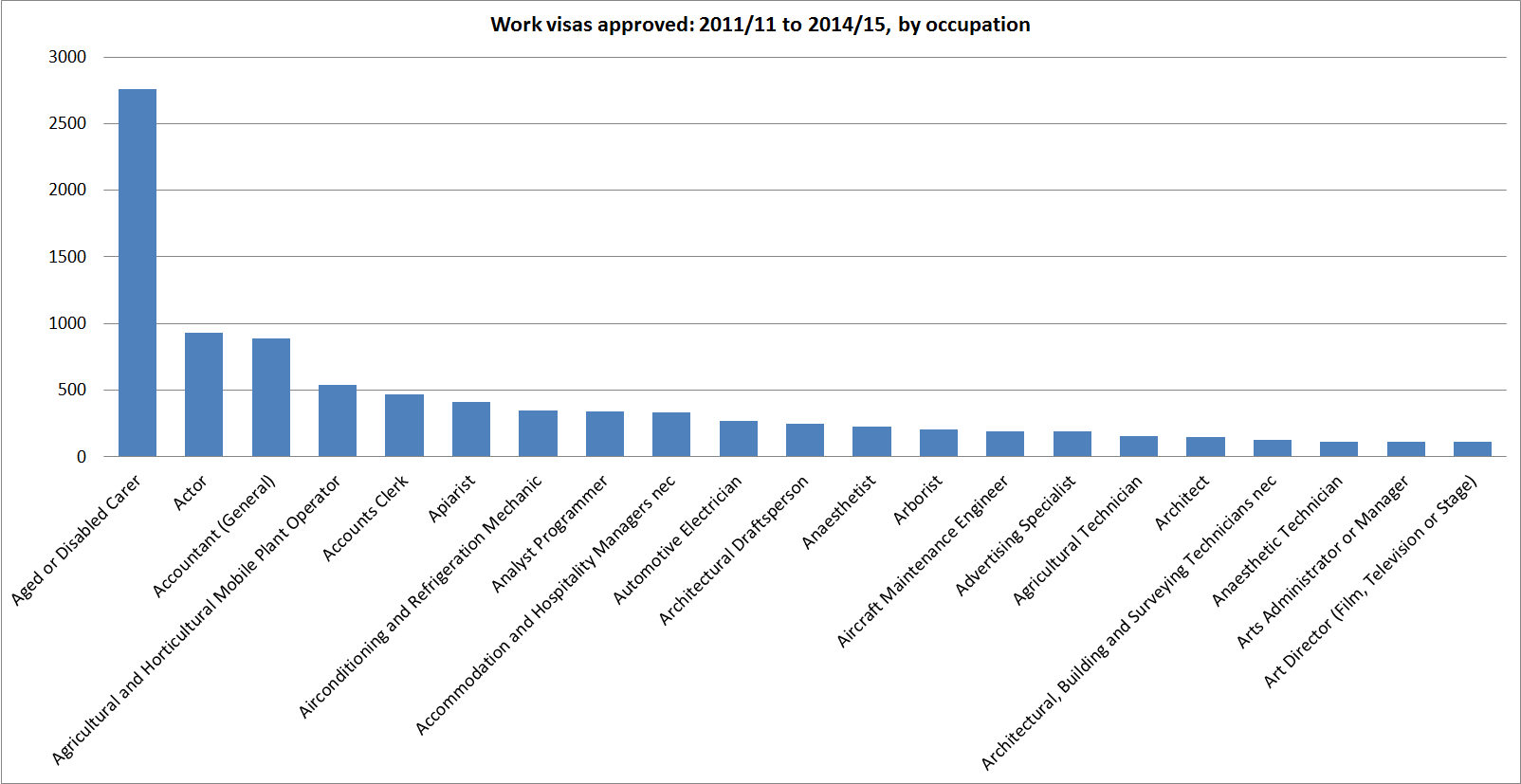
This chart is just for occupations starting with the letter A, showing those for which there were more than 100 approvals  over this period.  Given that the focus of the immigration programme is supposedly on highly-skilled migrants, the number of aged care workers was striking (albeit not too surprising).  I’ll assume that most of the actors were genuinely short-term project related (while recognising that the film industry only survives through large taxpayer subsidies), but number 5 on this list was also a bit of surprise.  Skill-based lifts in productivity driving off an influx of foreign accounts clerks?

work visas a

Some of the approvals I don’t show raised a wry smile.  It wasn’t clear, for example, quite what demand there was in New Zealand for a (single) Aboriginal and Torres Strait Islander Health Worker.   Or for an antique dealer?

I’m not sure my enthusiasm will hold for the rest of the alphabet, but in case not I should mention that as I glanced through the spreadsheet I found that the New Zealand government –  focused on lifting national productivity, according to those Treasury papers –  had granted work visas to 149 checkout operators and 227 shelf-fillers.

The Treasury on immigration

Some months ago, I commented briefly on a speech by the Secretary to the Treasury, Gabs Makhlouf (himself a fairly recent temporary immigrant), in which he had lauded the economic gains to New Zealand from our large-scale non-citizen immigration programme.  Makhlouf asserted that:

Migration helps to lift our productive capacity – it enables the economy to grow faster by increasing the size of the workforce, in much the same way that foreign capital allows us to grow faster than domestic savings alone would permit.

Like foreign investment, migrants also bring new skills, new ideas and a diversity of perspectives and experiences that help to make our businesses more innovative and productive.

And perhaps most importantly, migrants often retain strong personal and cultural connections to other parts of the world, which opens up, and helps us to pursue, new business opportunities. We are in a pretty incredible position in this regard, with so many New Zealanders – around 1 million people – living overseas, and so many people who live here having been born in another country.

More recently, I passed on the comment Makhlouf had reportedly made, in an official capacity, that ‘immigration is good, it is as simple as that” (or words to that effect).

Some time ago, I lodged a request with Treasury for copies of any advice they had provided to ministers over the last couple of years on the economic impact of immigration in New Zealand, and on the permanent residence approvals target (currently 45000 to 50000 per annum). I was curious as to see what analysis and argumentation might lie behind their chief executive’s rather gung-ho views, but was really more interested in any economic analysis around the permanent residence approvals target, which I knew had been reviewed last year.

It took quite a while for the papers to be released, but eventually I did get part or all of 21 documents. Treasury suggested that they might put the material on their website, but they do not appear to have done so [UPDATE: a link here], so here is a link to a single pdf which contains all the material they released.  Subsequent page references are to this document.

Treasury immigration OIA results

Perhaps what surprised me most – I’m a starry-eyed optimist at heart – is how little substantive material or argumentation there was. I wasn’t expecting a major essay in each paper, but across the 21 papers there just wasn’t much there, even taken together.  Having said that, I was pleasantly surprised to find that the advice Treasury staff were providing the Minister seemed rather less glowingly optimistic than the perspectives offered by the Secretary.

The government sees (and probably previous governments saw) immigration primarily as an economic lever. If so, we do it mostly because we think it benefits us.  The non-citizen migration programme is certainly large, and Treasury recognises that New Zealand’s non-citizen immigration programme is one of the largest (as a share of population) of any advanced country. An immigration programme of the size and character of the one New Zealand has run over the last 25 years has changed New Zealand very substantially.   Total population continues to increase quite rapidly (not now the case in many other advanced countries), and the ethnic composition of the population has been changing markedly. By sheer scale, it is probably larger than any other aspect of government economic policy in the last 25 years.   Statistics record a net 862000 non-citizen permanent and long-term arrivals in the 25 years to March, and the true scale of the inflow is probably larger than that.

But what is there to show for it?   The idea is, to quote from two of the Treasury papers:

High-skilled migrant labour increases the average productivity of the labour market, and this is the micro-economic channel through which many of the benefits of immigration accrue (p56)

Granting residence to skilled migrants can increase New Zealand’s human capital by helping meet skill shortages in a growing economy, improving productivity by reducing search costs for employers, and increasing the diversity and innovation of the workforce. These effects can improve labour market productivity over time, which contributes to New Zealand’s overall economic productivity. (page 29)

But there is no evidence of it having happened. We’ve had one of the largest targeted migration programmes anywhere, and there is no sign of any improvement in New Zealand’s productivity performance relative to other advanced economies.   In none of these papers is there anything concrete Treasury points to to suggest more favourable outcomes.

An independent economist (and former Treasury staffer) Julie Fry was commissioned by the Treasury’s Macroeconomic Policy team to prepare a paper on links between immigration and New Zealand’s macroeconomic performance. The resulting work last year found its way into a published Treasury Working Paper on the issues. Her abstract read as follows:

New Zealand’s immigration policy settings are based on the assumption that the macroeconomic impacts of immigration may be significantly positive, with at worst small negative effects. However, both large positive and large negative effects are possible. Reviewing the literature, the balance of evidence suggests that while past immigration has, at times, ha significant net benefits, over the past couple of decades the positive effects of immigration on per capita growth, productivity, fiscal balance an mitigating population ageing are likely to have been modest. There is also some evidence that immigration, together with other forms of population growth, has exacerbate pressures on New Zealand’s insufficiently-responsive housing market. Meeting the infrastructure needs of immigrants in an economy with a quite modest rate of national saving may also have diverted resources from productive tradable activities, with negative macroeconomic impacts. Therefore from a macroeconomic perspective, a least regrets approach suggests that immigration policy should be more closely tailored to the economy’s ability to adjust to population increase. At a minimum, this emphasises the importance of improving the economy’s ability to respond to population increase. If this cannot be achieve, there may be merit in considering a reduced immigration target as a tool for easing macroeconomic pressures. More work is require to assess the potential net benefits of an increase in immigration as part of a strategy to pursue scale an agglomeration effects through increase population, or whether a decrease in immigration would facilitate lower interest rates, a lower exchange rate, an more balance growth going forward.

The Fry paper considers a number of my ideas around the potential adverse effects of high rates on inward migration to New Zealand. I don’t entirely agree with her conclusion, which I think is probably too generous to the immigration programme New Zealand has run over the last quarter century, but even her conclusion is modest enough – any gains, from a very large scale programme, are likely to have been “modest”.   If so, why bother with the programme?

Just before the Fry paper was released, Treasury wrote an aide-memoire to the Minister of Finance, which they have released in full (from p 18). It is interesting because it is a joint product of the macro policy area of Treasury and more micro-oriented labour market and welfare team.   The authors note that “on the whole, The Treasury agrees with the assessment of the evidence in the paper”.  They don’t necessarily agree with the policy recommendations, but the government’s principal economic advisory agency apparently sees no reason to be more optimistic about the economic impact of immigration than Fry’s quite downbeat assessment. It is a very different from the tone of Makhlouf’s March 2015 public speech.

As I have noted on various occasions, with a well-functioning market in housing supply and urban land, immigration should have no material or sustained impact on house prices. But if supply is sluggish – as it undoubtedly is in New Zealand, largely for policy-determined reasons – increases in population will put considerable pressure on house and land prices. All New Zealand’s population growth now results from the large non-citizen immigration programme – without it, we would have a flat or slightly falling population. Against this background, it is surprising that the papers Treasury released make very little mention of the implications of the target level of immigration for house prices, in Auckland in particular, and hence for affordability and inequality issues. The young and the poor, the latter disproportionately brown, pay the price of a government commitment to continued high levels of non-citizen immigration. It is not as if other parts of Treasury are oblivious to the problem – this recently released paper on the housing market treats the issue quite well – but it does not seem to have been factored into immigration policy advice.

In my macroeconomic arguments about the effects of immigration, I have tended to assume the best about the make-up of the immigration programme itself – that it was bringing in mostly well-qualified people. I was willing to concede that there might be some skills gains, but to argue that these were probably outweighed by the macroeconomic pressures (on real interest and exchange rates). But people keep pointing out that even the skills gains are not as clear one might like to think. Apparently, we’ve given 20000   work visas for chefs in recent years.  And Fry points to formal studies showing how disconcertingly long it takes many similarly-qualified immigrants to reach New Zealand native earnings. And, as the Treasury papers show (page 26), over the three years to 2013/14 only around half of permanent residence approvals were to people under the “Skilled/investor” heading (while more than 10 per cent were for the parents of New Zealand citizens or residents).

I had also not paid much attention to the numbers coming under the numerous working holiday schemes that New Zealand is now party to.   But Treasury has, and actually recommended to the Minister of Finance last year that a cap should be placed on the numbers coming to New Zealand under the various uncapped working holiday schemes, highlighted a number of risks, including that the substantial growth in the number of working holiday visas might adversely affect employment opportunities for New Zealand young people.   This is no small point, since standard analysis (to which I largely subscribe) tends to be very sceptical of the idea that immigration undermines employment prospects, whatever it might do (positively or negatively) to productivity or wages. And it is not just one paper. In another, from December last year, Treasury notes that “immigration policy often involves trading off domestic labour market objectives with other policy objectives” (page 52) – a rather different tone, again, from the Makhlouf speech – and observing that “there is reason to be concerned about the impact some of our current immigration policies may be having on the labour market prospects of low-skill New Zealanders.”

And I’ve already highlighted some of MBIE’s own work suggesting that the investor and entrepreneur immigration categories might struggle to provide much net economic benefit to New Zealanders. There is no sign in these papers that Treasury is any more optimistic.

The other thing I learned from these papers, which I had not previously been aware of, is that when Cabinet reviewed the New Zealand Residence Programme last year, they agreed to set a two-year target rather than a three year one. That was, apparently, partly to shift future decisions, perhaps still triennial, into non-election years. But they also “directed officials to undertake a review of NZRP and report back to Cabinet by November 2015”. Treasury observes (page 53) “MBIE is currently undertaking a strategic review of immigration policy settings. One particular area of interest that has emerged is the extent to which labour market objectives are balanced against goals like foreign policy, tourism and export education”. It all seems a far-cry from a hopeful vision of substantial productivity gains, and beneficial spillovers to long-term New Zealand living standards, from a large scale inward migration programme.

Twenty five years on there is little or no evidence that our very large scale inward migration programme is producing economic benefits for New Zealanders – which should be the principal criterion guiding what is, after all, sold as an “economic lever”. There are some obvious winners – notably those who happened to be property owners in Auckland –  but that is purely a redistributional effect, at a serious cost to those who are increasingly squeezed out of being able to afford to buy a house in Auckland. And there are serious reasons to worry that actually the immigration programme has made things worse for New Zealanders, by putting pressure on scarce resources, and driving up real interest and exchange rates, and crowding out much of the sort of business investment we might otherwise have expected after the economy was freed-up in the late 1980s and early 1990s.

The Secretary to the Treasury is upbeat on the economic benefits to New Zealanders of the immigration programme. But where is his evidence? His staff don’t seem to have been able to find it.

Notwithstanding the prejudices of the elites, there would seem to be a pretty good case now for substantially reducing the non-citizen immigration programme, rather than just pushing on with a failed strategy –  a huge intervention in New Zealand’s economy and society for which Treasury can point to no material demonstrable benefits.

Of course, MBIE may yet have the answers. At the same time I lodged the original OIA request with Treasury I lodged a similar one with MBIE, the department with prime responsibility for immigration policy issues. That request is still working its way through the system, more than two months after it was first lodged. I’m beginning to wonder what interesting gems it contains, or (perhaps more saliently) which might yet be deleted and withheld.   Two weeks ago I had a friendly email from them telling me I would have the information the following week, and then last week I had another email, from someone further up the hierarchy, telling me that consultation – with the Minister’s office perhaps? – was taking longer than expected, but “we are working to provide a response to you as soon as possible”.   It isn’t an overly urgent issue, but it has now been more than two months, and the basic timeframe under the Act is 20 working days.

Manufacturing sector employment

Having finished the last post, I flicked over to Kiwiblog and found a slightly flippant post, suggesting that Andrew Little’s comments about the dairy sector being in “crisis” could be safely discounted, in view of earlier Labour worries about the manufacturing sector having come to nothing. Indeed, on this take,

Their manufactured manufacturing crisis has seen record job growth in manufacturing.

I don’t follow sectoral employment data closely, so presumed I’d missed something.  Indeed, since much of manufacturing activity is a derived demand from construction activity (which has been very buoyant) and dairy processing makes up another component, and milk production has been growing strongly (even if agricultural value-added hasn’t), some strength in manufacturing employment sounded plausible.

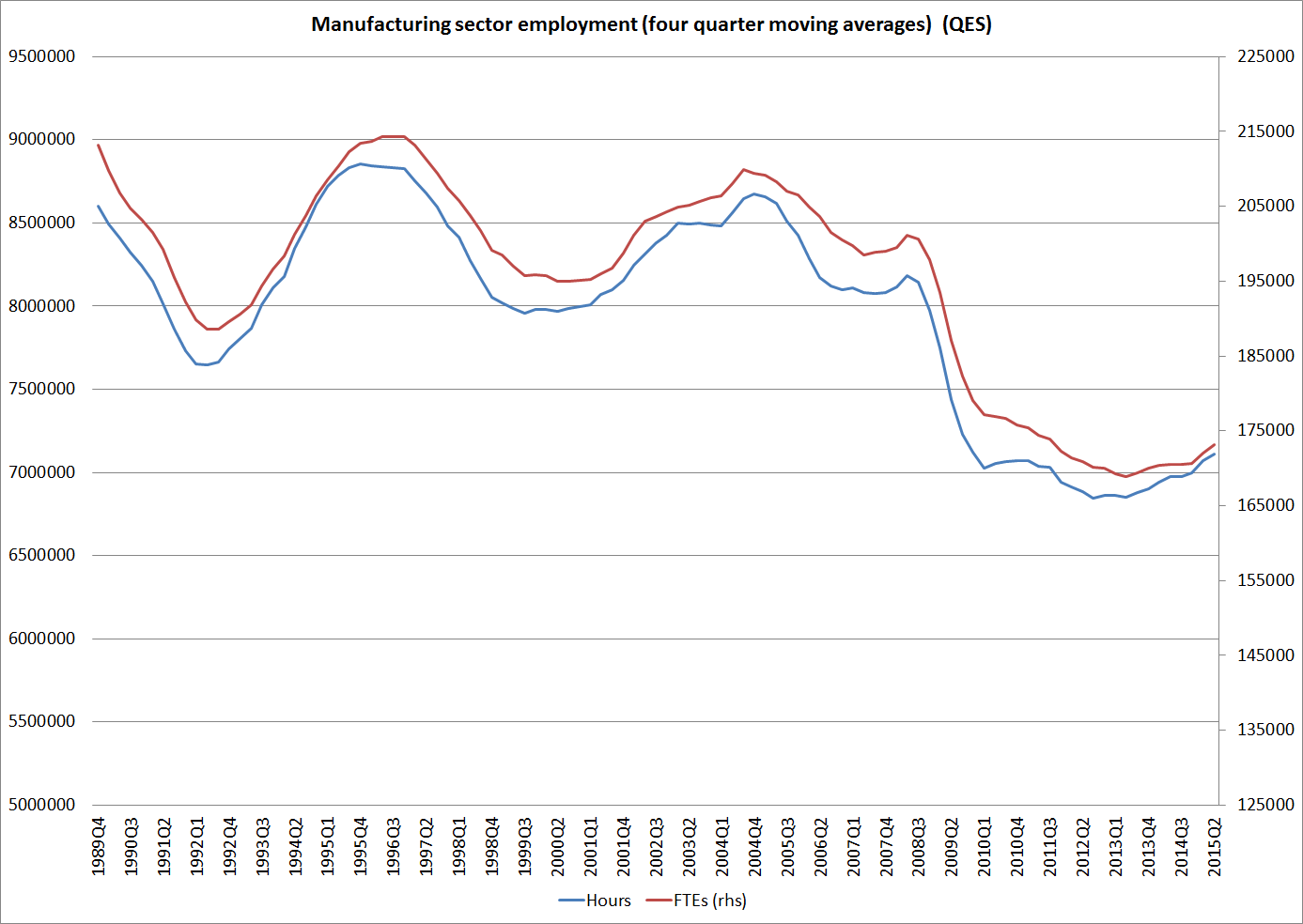
But here is the chart of the Quarterly Employment Survey data, showing hours worked and number of full-time equivalent employees for the manufacturing sector as a whole.  The QES is a survey of firms, and probably quite reliable for these sorts of questions.

qes manuf

Given the strength of construction activity over the last couple of years, these seems quite remarkably weak data.

The HLFS (a survey of individuals) has a shorter series, and only for the total number of employees.  It has shown greater strength in the last few quarters, but even on this measure the numbers employed in manufacturing are still not up to pre-recessionary levels.

There is a long-running debate on the importance of manufacturing, both here and abroad.  Here was my summary take from a couple of months ago.

I’m not one of those who thinks that the relative decline of manufacturing is a tragedy, but on the other hand I also don’t think that it is a matter of total indifference.  Most likely, the relatively weak manufacturing sector performance in recent years, despite the buoyant construction sector, is a reflection of the persistently high real exchange rate.  Like Graeme Wheeler, I think the real exchange rate is out of line with medium to longer–term economic fundamentals.  A more strongly performing New Zealand economy, one making some progress in closing the gaps to the rest of the OECD, would be likely to see a stronger manufacturing sector.  It might still be shrinking as a share of a fast-growing economy, but a manufacturing sector that has seen no growth at all in almost 20 years doesn’t feel like a feature of a particularly successful economy.

The weak manufacturing sector, despite the support from construction sector demand, seems to be yet another symptom of an underperforming New Zealand economy.  If there were clear signs of rapid growth in investment and productivity in other parts of the tradables sector, we might reasonably be unbothered by the manufacturing numbers.  As it is, I don’t think we can be that relaxed.  And it isn’t a matter of targeting measures directly to boosting manufacturing, but about removing obstacles that have held up the real exchange rate (over decades), and which undermine the attractiveness of business investment across the economy as a whole.

Putting the exchange rate fall in historical context

New Zealand’s exchange rate has fallen quite a way in the last few months. The fall was most dramatic from late April to the start of July, when the Reserve Bank’s TWI measure fell from just over 80 to just over 70, a fall of around 12 per cent. Using monthly average data the fall from April to July was almost as large as any three-month fall we’ve seen in the 30 years New Zealand’s exchange rate has been floating.

twi 3 month changes

But sharp as that fall has been, the total fall in the TWI so far still looks only moderate by the standards of past corrections in the New Zealand dollar. In this chart, I’ve gone back a bit further. The new Reserve Bank TWI data only go back to the start of 1984 at present, but using the BIS indices we can go back another 20 years, to give us just 50 years of data.

TWI largest falls

The first three adjustments were discretionary devaluations, two (1967 and 1975) in response to sharp falls in the terms of trade, and the last associated with the change of government in 1984. As I noted a couple of weeks ago, the fall in the exchange rate so far is similar in magnitude to the short-lived sharp fall in the first half of 2006, when a “growth pause” (still showing in the data as no real GDP growth from 2005Q2 to 2005Q4) sparked expectations of forthcoming cuts in the OCR.

Graeme Wheeler has been using the slightly odd terminology that the exchange rate “needs” to come down and I have already commented earlier on that.  He seems to have in mind some sense of an exchange rate which would stabilise the ratio of NIIP/GDP.  But it is not entirely clear why he thinks the exchange rate is likely to actually fall further. After all, he has been openly disagreeing with market commentators who think the OCR might need to fall to 2 per cent, suggesting that he doesn’t see that the need for the OCR to fall much further. Recall that the falls in the OCR he seems to be envisaging will be tiny when compared to previous policy rate cycles here and abroad. His story seems to envisage that perhaps last year’s OCR increases will be fully reversed, but no more –   but previous easing cycles have involved multiple hundreds of basis points moves.  And, on the Governor’s rather upbeat story, we might reasonably expect the negative NIIP position to widen, to act as the buffer for some of the loss of national income, over the next year or two.

niip to gdp

After all, in the last few years, the NIIP/GDP position has been less negative than it had been for most of the last 25 years (through some combination of the offshore insurance claims resulting from the earthquakes, not yet fully spent, and the high terms of trade). On his story why should we expect much more? If he is right about New Zealand’s monetary policy outlook, many in the market will be surprised and, if anything, the TWI might rise.

But I’m sceptical of the Governor’s story about the New Zealand economy and prospects for domestic monetary policy. When I filled in the Bank’s Survey of Expectations last week, I wrote down a prediction that implies an OCR below 2 per cent by this time next year, and I wondered afterwards if my number was low enough yet. I don’t think anything that weak is yet priced into the central market view. If so, most likely the TWI will move quite a bit lower yet.   Heightened periods of risk are also often bad for New Zealand’s exchange rate –  no one has to hold New Zealand dollar assets when times are risky –  and markets still seem remarkably relaxed about China and the euro-area as sources of economic and financial risk.

Finally, recall that the TWI fell to the lowest level in the last quarter century in 2000, the last (and only) time since liberalisation when US short-term interest rates matched those in New Zealand.  At the 2000 trough, the TWI was some 30 per cent lower than it is today.

Wheeler and his critics

The print issue of today’s NBR has a double-page feature on “Wheeler and his critics”. It includes – with a few transcription errors – the heart of an interview I did with Rob Hosking in early July.

There are few broad issues touched on in the article:

The first is monetary policy. Hosking correctly points out that market economists’ forecasts of inflation have been even less accurate than those of the Reserve Bank. That doesn’t reflect well on the market economists, who in 2013 and 2014 were also often even more “hawkish” on policy than Graeme Wheeler has been. The same results are reflected in the survey results of the NZIER’s Shadow Board.

Being less wrong than market economists is convenient defensive cover for the Reserve Bank. During the 2003-2007 boom, we used the argument on the other side. We (the Bank) let inflation drift too far up, and tightened too slowly. But, on average, the markets (pricing and economists) were more dovish – constant looking for the first easing.

And if the Governor has to make mistakes – and inevitably every central bank will from time to time – it is better to be in good company than out on his own. But only one agency – in New Zealand, one individual – is charged by law with keeping inflation near target. And the Governor has been given a lot of public resources to do the analysis and research to support his policy decisions.  In this cycle, our Reserve Bank wasn’t doing that well in 2013 – core inflation was below the target midpoint (although 2013 outcomes were largely a result of Alan Bollard’s choices). But then they tightened policy – at a time when no other advanced country central bank was doing so – and kept on tightening. And core inflation just kept edging lower (and unemployment began to rise again). They were bad calls – increasingly clearly so with hindsight – and should be acknowledged as such, by the Governor – and by those paid to hold him to account, the Bank’s Board, and the Minister.

So I’m not one of those arguing that the Governor has put too much focus on inflation. Instead, he seems to have put far too little focus on actually keeping the medium-term trend in inflation on target. And that focus on the 2 per cent midpoint was one that Graeme Wheeler and Bill English added to the PTA less than three years ago.  He seems to have been distracted by Auckland house prices – a serious issues, for political leaders –  and by beliefs about what “normal” interest rates should be.

The second issue is around governance, and particularly the decision-making structures Parliament set up for the (rather different) Bank back in 1989. I get the sense that no one is really now defending the current system, which has no counterpart anywhere else in the advanced world. A single unelected individual is responsible for all the Bank’s analysis, and for all its decisions – not just on monetary policy, but on banking supervision, insurance supervision, note and coin designs, housing finance regulation, foreign exchange intervention, and so on. No other country does it that way. No other New Zealand public agency I’m aware of does it that way. The Greens have been raising concerns (and do so again in this NBR article), the Treasury has been suggesting changes, market economists have favoured change. In this article, now-independent economist Shamubeel Eaqub calls for change. And, of course, I’ve argued that it is past time for change. Actually, I suspect Graeme Wheeler favours change – although his preferences as to how are likely to be different from those of most others. This is not an ideological issue. It is common-sense one where reform is needed to bring the governance structures up to date. There are important discussions to be had about precisely what alternative model to adopt. I’ve made the case for something like the model the British government has recently adopted for the Bank of England, but there are reasonable arguments for other possible solutions. Unfortunately, the obstacle to reform now is the current government. I’m not quite sure why.

The third issue is around LVR controls. Shamubeel worries that active Reserve Bank involvement in housing finance restrictions invites, over time, a more direct political involvement in future Bank decisions, perhaps including around monetary policy. I think that is a risk. My points about LVR restrictions are twofold.  These are really the sorts of decisions that should be made by politicians, if anyone is to make them. Direct controls of that sort, that impinge of so many people’s finances and businesses aren’t the sort of thing unelected officials should be deciding, But, in a sense, that is a decision Parliament needs to make, to take back (and then take) responsibility for such decisions.

But perhaps more importantly, the Bank – the Governor – has still not made a compelling case that the soundness of the New Zealand financial system requires such controls. They have not made a clear and convincing public case that investment housing lending is riskier than owner-occupier lending. More importantly, even if such lending is a bit riskier, there is no sign that lending is growing rapidly, or that even very major falls in house prices and rises in unemployment would threaten the health of New Zealand banks. The Reserve Bank did the stress tests, not me – and they seem to be very demanding tests. My response to their consultative document is here. In the meantime, they are now hiding behind provisions of the Official Information Act, and highly questionable provisions of the Reserve Bank Act, to keep from the public the submissions people have made on the proposals.   Here are the submissions on some of the government’s housing initiatives. But where are the submissions on the Governor’s planned direct controls? The provisions the Bank rests on to keep them secret were never designed to shelter public submissions on major new macroeconomic policy initiatives. I’ll come back to this issue next week.

The interview reports a few areas where I have been critical of the Governor. In particular, I noted that he seemed very reluctant to engage in serious or robust debate on any of the policy or analytical issues.  That was certainly the case internally, but I think it is true externally as well. Various people have made the point to me that the Governor seems uncomfortable with the media, or with the sort of scrutiny that inevitably should go with the sort of power he wields. I’m not sure that we’ve yet seen a serious and searching interview about his proposed new LVR restrictions, or about his conduct of monetary policy over the last 18 months or so. (Incidentally, I’m reported as calling the Governor “Action Man” – in fact, the credit for that description, emphasising action rather than analysis and reflection, belongs to one of the Governor’s own current direct reports.)

Finally, Rob Hosking highlights the issue of possible comparisons between the Governor and the late former Minister of Finance, Sir Robert Muldoon. As I noted, I did not make such a comparison, and I don’t think it would be helpful to do so. There is a sense in New Zealand debates that the first person to invoke Muldoon comparisons loses. And Sir Robert was Minister through some of the most difficult years New Zealand faced, and his record in response was a mix of the good and the rather less good.

But through the post-war decades, we had an extraordinary piece on legislation on the books, the Economic Stabilisation Act. It was introduced by a Labour government, and used and abused by both Labour and National governments over the decades. It gave ministers the power to impose wide-ranging economic controls (in Geoffrey Palmer’s words) “without resort to Parliament in ways that were unique in the western world”.  It was finally repealed by the Labour government in 1987.

But it is worth noting that these decisions had to be made by a committee (the Governor General by Order in Council) and perhaps more importantly had to be made by people with an initial electoral mandate to hold office: Cabinet ministers are elected MPs, and can be tossed out again.

By contrast, Parliament just a few years later (in the original 1989 Reserve Bank Act and subsequent amendments) passed legislation allowing an unelected official to single-handedly (not even by Order in Council) impose far-reaching controls on almost any aspect relating to banking, which has potentially pervasive influences on whole classes of economic activity. The scope is, of course, nowhere near as wide as the powers under the Economic Stabilisation Act, but there are even fewer checks and balances, in an age that typically puts much greater weight on openness and transparency.

Graeme Wheeler is not responsible for having passed the Reserve Bank Act. That was Parliament’s choice. But the Governor has choices about whether, and how, he deploys those powers.   Without a much stronger case, establishing the serious prospect of a threat to the soundness of the financial system, simply banning people from using banks to finance their residential rental businesses, when the initial exposure would exceed 70 per cent, seems unwise, and a step too far. Several serious people have argued to me that the Governor’s proposals are ultra vires. I’m not a lawyer, and issues of that sort can really only be resolved in the courts.   But when banks are willing to lend, and customers are willing to borrow, and there is no evidence of any serious deterioration in credit standards, we should be wary about the prospect of a single public servant telling them they just can’t.

Greece’s impressive economic performance

There was nothing new on this blog yesterday because

  1. On Wednesday evening I accidentally hit “publish”, went I meant to schedule it for release yesterday, on the post about the striking anomalies between the fairly heavy penalties the Reserve Bank Act provides for breaches by bank directors of the Reserve Bank’s disclosure requirements, and the somewhat derisory penalties the Superannuation Schemes Act provides for scheme trustees for breaches of the disclosure obligations under that Act, and
  2. Because I’ve been dealing with a bunch of historical events, which included what has now been established to have been a breach of the disclosure requirements of the Superannuation Schemes Act by past trustees of the Reserve Bank staff superannuation scheme.  Unfortunately, this involved, inter alia, some people with strong (and otherwise well-deserved) records on issues around transparency and disclosure.    Current trustees have now issued an apology.  As I noted on Wednesday, “You wouldn’t want to be in a scheme where the rules could be changed without you being aware of it”.

But this post is about Greece.

I’ve just finished reading Mark Mazower’s book, Salonica: City of Ghosts.  the story of Greece’s second largest city, and its hugely varied past. In Christian history, it was the first city in which the apostle Paul is recorded as having preached the gospel.  Little more than 100 years ago it was still a major city in the decaying Ottoman Empire, birthplace of Mustafa Kemal, with a population that was much more heavily Jewish and (to a lesser extent) Muslim than it was Greek. Earlier in the year, I reading Twice a Stranger, an account of the brutal and murderous expulsion of hundreds of thousands Greek Christians from Turkey to Greece, and of the (rather less brutal but just as effective) removal of the Muslim population of Greece to Turkey, in and around 1923.   We might think of Greece as an ancient country, and it certainly has many ancient places, but modern Greece became independent only in 1832 – just a few years before the Treaty of Waitangi and the British annexation of New Zealand. Greece’s current borders weren’t settled until the 1920s.

And within whatever boundaries it had, Greece’s history has hardly been a settled one. Reinhart and Rogoff have documented the history of sovereign debt defaults. But I had in mind foreign wars, occupation, civil war, political assassinations, suspensions of democracy, and a military junta that gave up power little more than 40 years ago.

And yet…. as Scott Sumner pointed out recently, in some ways it is remarkable that Greece has done as well economically as it has.  Add to the turbulent history, scores in any of the global competitiveness indices that are really very bad

The Heritage Foundation publishes an annual ranking of 178 countries, in terms of economic freedom.  This ranking has some flaws, but it gives a ballpark estimate of how “market-oriented” an economy is.

The three countries directly above Greece in economic freedom are Niger, India and Suriname, the three right below are Bangladesh, Burundi and Yemen. It’s a strange neighborhood for a developed European country.

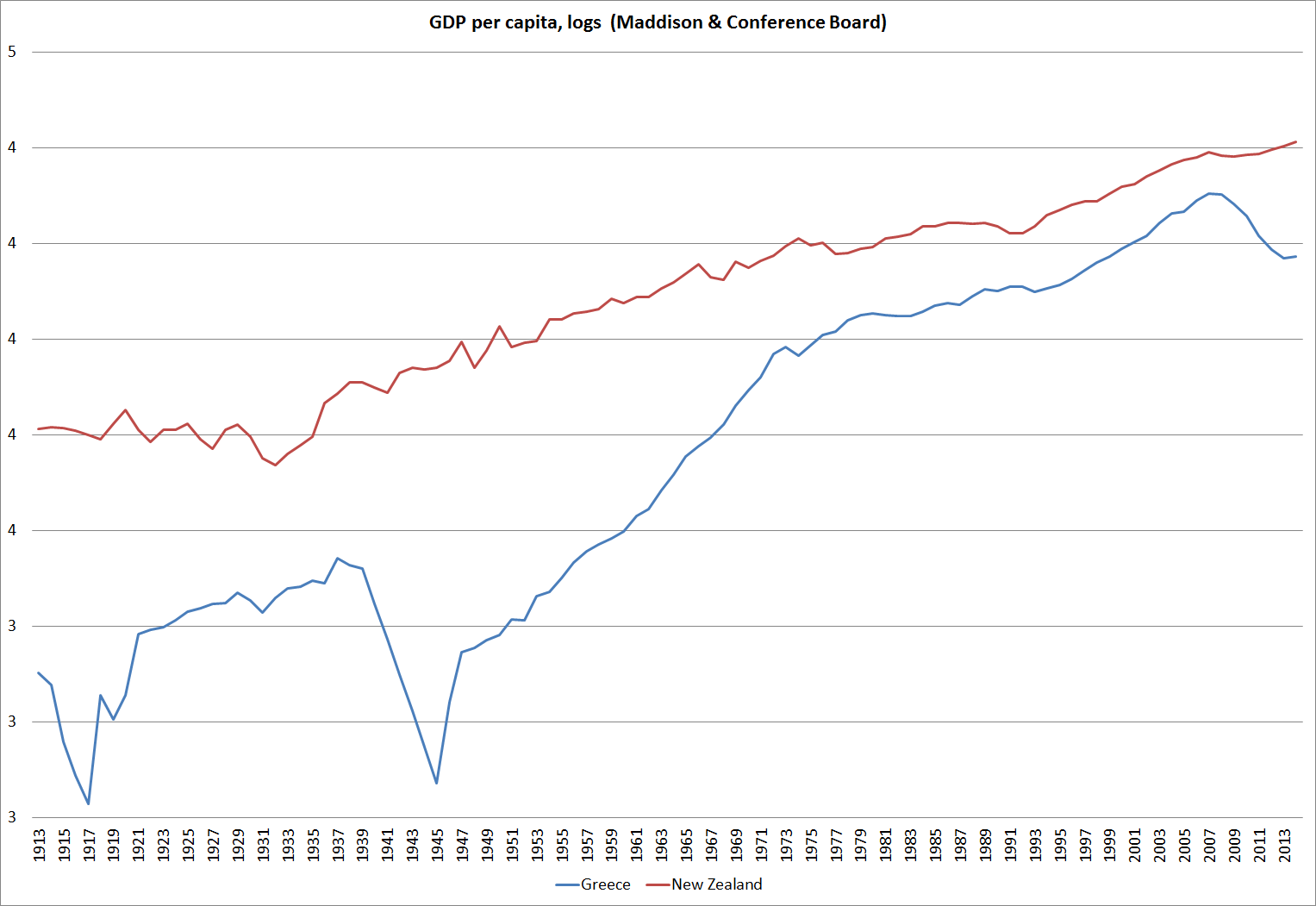
Here are the Angus Maddison estimates of GDP per capita for Greeece and New Zealand since 1913.  They are only estimates, and no doubt could be contested on many details, but the general picture seems plausible.

Greece maddison

I found the chart striking for two reasons.  The first is that in 1913, Greece is estimated to have had GDP per capita less than one-third that of New Zealand.  That is a really large gap.  Of course, at the time New Zealand had some of the very highest living standards in the world.  But, by comparison, the poorest EU and OECD countries today (Mexico, Turkey, Romania, and Bulgaria) now have incomes about half those of New Zealand’s.

On this measure, at peak, in 2007/08, Greece’s GDP per capita is estimated to have been around 80 per cent of ours.  On other (better) measures,  but for which there is no comparable long-term time series, Greece is estimated to have had higher GDP per capita than New Zealand by then.   Of course, New Zealand has been one of the worst performing advanced economies in the last 100 year, but even last year the Conference Board estimates that Greek GDP per capita was around half that of the United States.  Greece has managed a great deal of convergence

The other thing that struck me about the chart was the variability in the estimates of Greek GDP.  For New Zealand, the Great Depression of the 1930s was the largest dip.  Greek GDP fell then too, but it is barely noticeable.  And even the catastrophic fall in Greek GDP in the last few years is shaded by the earlier falls –  those associated with, first, World War One, and then with World War Two, the occupation, and the subsequent civil war.  Other occupied countries experienced a sharp fall in GDP per capita during World War Two –  France’s fell by around 50 per cent, but had surpassed 1939 levels by 1949.  Greece didn’t get past 1937 levels of GDP per capita until 1957.

Perhaps depressions of the magnitude Greece is experiencing now feel different with those sort of historical memories in mind?

My other recent reading about Greece was last week’s New Yorker profile of Yanis Varoufakis (here), until recently Minister of Finance in the Syriza government.  I didn’t find Varoufakis a sympathetic character, at all, but the profile is well worth reading, as background to the continuing crisis.  But it was some of the biographical stuff that really caught my eye.

As we drove, Varoufakis talked of his father, George, whose example of stubbornness had helped shape him. In 1946, during Greece’s civil war against Communist insurgents, George Varoufakis was arrested as a student leftist, and refused to sign a denunciation of Communism. He was imprisoned for four years, and repeatedly tortured. His signature would have freed him. I later met the senior Varoufakis—the courtly chairman of a steel company who, at ninety, still goes to the office every day. He told me that for years after he was freed he couldn’t listen to Johann Strauss: his torturers had “put on waltzes, very high, in order not to hear our voices, our screaming.”

After George Varoufakis returned to college, a female student kept an eye on him for a paramilitary right-wing group—“Stasi stuff,” as Yanis put it. But she fell in love with George, and they married. Yanis was born in 1961. During the military dictatorship of 1967 to 1974, Varoufakis’s uncle, a libertarian, was imprisoned for participating in small-scale terrorism. Varoufakis recalled his excitement when charged with smuggling notes to him on prison visits.

What a country.

Of course, plenty of other European countries had a bad time in the 20th century –  Spain, Portugal, and most of eastern Europe.  But it helps make more sense, to me at least, of why the Greek population seems so unwilling to leave the euro, despite the peacetime economic disaster they are now living through.

I’m now reading a contemporary account of the political situation in Europe written in 1936. It is widely recognised now that countries that came off the Gold Standard and devalued their currencies recovered fastest from the Great Depression.  France was one of the last to do so.  This book was written just after France had finally gone off the Gold Standard in mid-1936.  The author, John Gunther, observes

“Why did the rentiers, the small capitalists, the peasants with savings, swallow such a [deflationary] programme when devaluation of the franc might much less painlessly lighten the burden?  The reason is, of course, largely psychological.  The terrors of deflation were comparatively known; those of inflation [rife in France in the 1920s] were known and doubly feared”

And if I were a Greek voter today, remembering the extreme instability of my own country, perhaps I too might cling to the euro and the EU, even amid all the humiliation and economic dislocation, rather than risking a leap into what might reasonably be seen as an abyss.  It is easy for macroeconomic analysts to talk of real exchange rate adjustments, unemployment rates etc. But what are they against the memories of torture, betrayal, civil war, military government, occupation, forced mass relocations – a precariousness that is difficult for those in the handful of countries who’ve had settled boundaries, no military conflicts on our territories, and stable democratic government for the last century [1] to fully grasp.

The current arrangements, limping from month to month, seems no way to consolidate that 20th century closing of the Greece/New Zealand income gap. Staying on the Gold Standard until 1936 wasn’t that wise for France either, but it happened. History is context.

[1]  A list no longer perhaps than Australia, New Zealand, Switzerland, Sweden, Canada, and the United States?

Disclosure requirements: some anomalous laws

Parliamentary sovereignty is a key feature of our political and governance system. But sometimes parliaments end up producing rather anomalous results when we look from one piece of legislation to another.

Twenty years ago, the Reserve Bank moved to a system of prudential regulation of banks that was designed to rely heavily on public disclosure of key information on a regular basis. Disclosure was never envisaged as the only element of the regulatory regime. Basle 1 basic regulatory capital requirements were also in place, and were left in place as much at the request of the banks (who wanted to be seen as operating in an internationally-recognisable regime) as because of any conviction by the Reserve Bank that capital requirements were worthwhile. And the Bank and the Minister of Finance retained significant powers to intervene if a bank was getting into trouble, and was (or appeared to be approaching) insolvency.

But the proposition underpinning the disclosure framework was that investors (depositors, bond-holders) and others transacting with a bank should have all the information that the Reserve Bank had about a regulated bank. That seemed only fair and reasonable – after all, it was investors’ money that was at stake, not the Reserve Bank’s.  And if the Reserve Bank had private information that was not disclosed to depositors/investors that could, in the event of a subsequent failure, open the Reserve Bank up to charges (political and rhetorical, even if not legal) that it should have acted earlier, and thus prevented the losses investors/depositors subsequently experienced.  Private information might have supported the argument for government bailouts if things went wrong.

A lot of effort went in to devising the disclosure regime. In some areas it may have gone a little too far.  One example might have been requirements on banks to have Key Information Summary documents immediately available in every branch.  I suspect the number of these documents that were ever actually read was extremely small. The regime went to somewhat absurd lengths: someone who worked in the economics department of one local bank told me that their bank interpreted the regulations to mean that Key Information Summaries had to be available for perusal in the economics department (“branch”)  itself – a part of a bank not typically visited by the public.

Because so much weight was put on disclosure requirements, the law was written in a way that exposed those responsible for bank disclosure documents to significant penalties (including potential imprisonment) for breaches of the requirements. Don Brash has many stories to tell of the reaction of outraged directors (and puzzled ones in other jurisdictions). There had, perhaps, been a tendency for bank boards to be made up of people with gilded reputations, rather than much ability or willingness to ask hard questions about the conduct of the Bank. The prospect of such steep penalties certainly altered incentives, and behaviour.   Banks may, or may not, be safer, but directors have certainly gone to considerable lengths to minimise their own risks

In the last decade, the Reserve Bank has backed away from heavy reliance on the public disclosure aspect of the regulatory regime for banks. The disclosure requirements have themselves been watered down, and there are proposals for further reductions in the requirements in a recent Bank consultative document. This tendency seems unfortunate – despite inevitable complaints from banks about compliance costs. If anything, the focus globally in recent decades has been on more and more disclosure. Perhaps more concerning is the explicit shift the Reserve Bank has made to collecting private information about banks’ day-to-day activities and risks, information which is not available to investors and depositors.  The  Reserve Bank has been keen to promote the idea of its OBR tool being used in the event of a bank failure, so it remains the case that the regime is designed to be about depositors/investors being primarily at risk of losing money, not the Crown. And yet the Crown uses statutory powers to acquire information about these regulated institutions which depositors do not typically have access to.

But notwithstanding the diminished emphasis on disclosure, the Reserve Bank is still keen to remind people of the stiff penalties for breaches of disclosure requirements. In a speech only a couple of years ago, the head of the banking supervision department noted

Self-discipline is closely linked with sound governance. We have a strong tradition of director attestations, coupled with heavy penalties for non-compliance. For example, bank directors who fail to comply with disclosure obligations face fines of up to $200,000 or 18 months in prison.

Those are very stiff penalties for individuals, even if the scale of potential fines on the institutions themselves seems lighter (a maximum fine of $2 million –  banks typically have rather more than 10 times the equity of a typical director).

But, of course, banks are only one element of the financial system, and only one of the areas in which people are exposed to financial risk.  Another, in which people are typically quite risk averse, is superannuation schemes.   There is no prudential supervisory regime for superannuation schemes –  no government regulator actively scrutinises the business of schemes to minimise the risk of failure.  To a large extent, members of superannuation schemes are on their own.

However, there is a Superannuation Schemes Act, which is designed to provide some basic regulatory parameters and protections for members.  One key component of that regime is disclosure.  And that makes sense, how can members make good decisions, and help ensure that their money is safe, if they do not have access to information.

One of the key requirements is regarding scheme annual reports.  For members of superannuation schemes, the material in the Annual Report is akin to a disclosure statement for bank depositors.  But an important difference is that there is a quite a lot of public information available about banks, even if disclosure statements didn’t exist (credit rating information for example), whereas there is almost none about superannuation schemes.  The disclosures in the Annual Report are absolutely imperative.

There is an entire schedule to the Act which sets out minimum information that must be included in the Annual Reports.  That includes audited financial statements, disclosure of related party exposures, affirmations that contributions and payments have been made in accord with the rules of the relevant scheme.  And scheme trustees must also advise members of any amendments to the relevant trust deed since the previous Annual Report.  All of those seem pretty foundational.  You wouldn’t want to be in a scheme where the rules could be changed without you being aware of it.

Recall that breaches of disclosure requirements on banks could be met with both civil and criminal sanctions, with the latter including up to 18 months in prison.

And in the Superannuation Schemes Act?  Well, there, Parliament seemed to take a rather different approach.  Breaches of disclosure requirements are subject to a fine of up to $500.  No, there are no missing zeroes there, the maximum penalty is five hundred dollars.  I’m a trustee of a superannuation fund, and I was surprised to learn how light the potential criminal penalties are [1].  And yet people who are members of longstanding defined benefit pension schemes typically have far more money tied up in those schemes than most will have in any bank or other regulated financial institution.

I’m not quite sure why Parliament in 1989 had such a different approach to the importance of full  and honest legally-required disclosures than it had only a few years later when it came to consider the case of banks.

I’m not usually a fan of increased regulation, but if there is a good case for such disclosure laws at all, as there probably is with very long-lived commitments such as superannuation schemes, which often involve people in their declining years, then such slight penalties almost make a joke of the requirements.  Trustees might, for example, come to treat apparent breaches of such requirements as a matter of little account, even if the consequences for members of such breaches could have been serious.

I hesitate to encourage them, but this looks an issue for MBIE, in its policy role, and the FMA to take up.

[1] And apparently, and equally remarkably, there is apparently a two year statute of limitations on prosecuting such offences