A severe commentary

Plenty of commentaries have remarked on the very low inflation numbers out this morning.

None (that I have seen) has highlighted what a severe commentary these numbers are on the Reserve Bank’s conduct of monetary policy over the last few years.

Reciting the history in numbers gets a little repetitive, but:
• December 2009 was the last time the sectoral factor model measure of core inflation was at or above the target midpoint (2 per cent)
• Annual non-tradables inflation has been lower than at present only briefly, in 2001, when the inflation target itself was 0.5 percentage points lower than it is now.
• Non-tradables inflation is only as high as it is because of the large contribution being made by tobacco tax increases (which aren’t “inflation” in any meaningful sense).
• Even with the rebound in petrol prices, CPI inflation ex tobacco was -0.1 over the last year – this at the peak of a building boom.
• CPI ex petrol inflation has never been lower (than the current 0.7 per cent) in the 15 years for which SNZ report the data.
• Both trimmed mean and weighted median measures of inflation have reached new lows, and appear to be as low as they’ve ever been.

This wasn’t the way the Bank told us it was going to be. And more importantly, it wasn’t the basis on which they held interest rates up through 2012 and 2013, and then raised them last year. As late as December last year, they were still talking of raising the OCR further. Real interest rates never needed to rise, and as a result of the misjudgement they rose even further than the Bank intended (inflation expectations fell away).

It has been a sequence of cumulatively severe misjudgements. The word “mistake” keeps springing to mind, although of course the Governor rejected that characterisation at the time of last month’s MPS. Perhaps he is rethinking now? As I’ve pointed out previously, inflation outcomes so far weren’t mostly the result of unforeseeable external economic shocks. And if core inflation measures are this weak now, we have to start worrying what will happen to them as economic growth slows further, construction pressures ease, and the deepening loss of income from the declining terms of trade bites. Wage inflation has been very low, and more recently wage inflation expectations have been falling.

The Reserve Bank has belatedly recognised the need to modestly change direction. The Governor cut the OCR by 25 basis points last month, and foreshadowed that at least one more cut was likely. But the problem is that they are still well behind the game. The data are weakening faster than they are cutting, and the OCR was already too high right through last year. Difficult as it might be to make a large move at an intra-quarter review next week, the substantive case for a 50 point move is certainly strong. If not next week, then at the latest it should happen at the September MPS. There also needs to be a recognition that there is nothing wrong or inappropriate even if the OCR goes to new lows. The OCR simply needs to be set consistent with a realistic appraisal of the inflation outlook (not the upwardly biased one that has guided too many central banks in recent years). An apology, and a heartfelt mea culpa, from the (single decision-maker) Governor would also be appropriate.

As inflation expectations measures are likely to keep falling, this mistake is also increasing the risk that the zero lower bound will end up being binding in New Zealand. But, if we take the Reserve Bank’s Statement of Intent seriously, this is not something they worry about. They should.

But questions also need to be asked about the role of the Bank’s Board as agent for the public and the Minister of Finance. Inflation outcomes now are reflecting policy choices made last year. But here is all the Reserve Bank Board has to say about monetary policy in their latest Annual Report, published only nine months or so ago. In introducing the document, they note that:

Our formal review of the Bank’s performance is included in the Bank’s Annual Report.

And when they get to monetary policy

In the last year, we have considered the Bank’s decisions to hold the OCR at a record low of 2.5 percent for an unprecedented three-year period, and to increase the OCR four times from March to July 2014.

The level of disclosure in monetary policy was very high. We considered that the Bank’s policy decisions were appropriate, initially taking into account the need to provide support for the economic recovery after the disruptions of recession and earthquakes, and lately the need to ensure that the recovery is sustainable, by restraining emerging inflationary pressure.

This was a “formal review”? I still find it astounding that, less than a year ago, the Bank’s Board – the independent agency responsible for scrutinising the Bank – made no mention at all of the continued undershooting of the inflation target. I’m not suggesting they should have read the data better than the Governor – they are paid as ex-post monitors, not as monetary policy decision makers – but there is little sign of any serious scrutiny at all. It reinforces my view that the governance model is inappropriate in a wide variety of dimensions, and that the Board in particular plays little useful or effective role as agent for either the Minister or the public. By construction, it is simply too close to the Bank, and thus is more prone to act as defensive cover for the Governor, than as a source of serious scrutiny and challenge in the public interest. At very least, we should expect something much more substantive from the Board in its next Annual Report.

The Minister of Finance has commented a couple of times recently about the Bank undershooting the inflation target midpoint (which was added explicitly to the PTA by him in 2012). Such “shots across the bow” seem both understandable, and quite appropriate. The Minister initiates the inflation target, but has no say in individual OCR decisions. But he is responsible to the public (and Parliament) for having the target met by the Governor. Whether with hindsight or foresight, monetary policy has been too tight for probably five years. Partly as a result, New Zealand’s economic recovery has been anaemic – much more muted than in a usual recovery, despite the huge boost to demand provided by the Canterbury repair and rebuild process. The unemployed pay a particularly severe price for that, but they aren’t the only ones.

The real question is whether the Minister is willing to do more than talk. My impression is that his instincts are often in the right direction, but there is often a reluctance to follow through (one could think of housing supply issues as a prime example).

I’ve touched previously on some of the options the Minister has to show that he takes these issues seriously. In May I noted:

The Minister could seek a report from The Treasury on their view of how well the Governor was doing consistent with the Policy Targets Agreement, could let it be known such work was underway, and could arrange for such a report to be published. The New Zealand Treasury offers independent professional advice to the Minister of Finance and would have to take seriously such an exercise. It might be expected to consult externally (but confidentially) to canvass opinion. At present, for example, most financial market economists – not the only relevant observers but not unimportant either – in New Zealand seem quite comfortable with the Governor’s handling of monetary policy.
The Minister could also seek formal advice from the Bank’s Board, and let it be known that he was doing so. This would be a totally orthodox approach – the Board exists as a monitoring agent for the Minister – and it was, for example, the approach taken in the mid-1990s when inflation first went outside the target range. The Board has a number of able people on it, but as an effective agent for accountability risks being too close to management. The Governor sits on the Board, the Board meets on Bank premises, it has no independent resources, and it has been chaired exclusively by former senior managers of the Reserve Bank. It was striking that last year’s Board Annual Report (which is just embedded in the Bank’s Annual Report document) had nothing substantive on the deviation of inflation from the policy target.

Those are both still serious options. I suspect that it might be timely to exercise both of them.

Longer-term, it is now only just over two years until the Governor’s term expires. There must be real questions as to whether Graeme Wheeler could credibly be reappointed (recommended by the Board or accepted by the Minister) after his succession of overconfident monetary policy misjudgements, and in light of the poor quality analysis he has used to support his over-reaching policy initiatives in the regulatory areas. Perhaps Graeme will make it easy and conclude that, at his age, one term is enough?

The mistakes of the last few years don’t result primarily from the governance model, but the governance model – with too few checks on the Governor, as decision-maker and chief executive responsible for all the supporting analysis – is likely to have contributed. The mistakes –  an exaggerated version of those made in various other countries – highlight the material weaknesses in our most unusual system. The start of a new gubernatorial term is a good opportunity for the Minister to take the lead in reforming the Reserve Bank Act to bring governance of this powerful agency more into line with international practice and with governance standards in the rest of the New Zealand public sector. Treasury recommended doing something in 2012, and the Minister refused. He should take the lead this time. If he did, I suspect he would find pretty widespread support – from other political parties and from market economists. Perhaps even from the Reserve Bank itself.

PS.  Following on from earlier commentary, SNZ has altered how it is doing seasonal adjustment of the non-tradables inflation series.  The cost of doing so, is quite a short series, but for what it is worth, seasonally adjusted quarterly non-tradables inflation last quarter (0.3 per cent) was about half what it had been each quarter for the last 2-3 years.
Considering the veracity of Chinese GDP – Christopher Balding

One of my favourite sites for making sense of what is, and isn’t, going on in China is Balding’s World, written by Christopher Balding, a professor of economics of Peking University.

He has had a succession of useful posts over the last few weeks, and here is the link to his piece on yesterday’s somewhat implausible GDP data.  The summary of Balding’s take is captured in his title.  As he notes, the problems with Chinese data have been deep-seated, extensive, and long-running.  In conclusion he tellingly observes:

Only last month, an initiative was announced to improve labor market data as the official unemployment rate has been nearly unchanged for more than a decade.  If Chinese leaders are telling the world how poor the statistical agencies in China are, imagine the reality.

Wouldn’t it be preferable if these issues were getting serious treatment in the media rather than the hyper-ventilation about the gyrations of the Chinese stock markets? When stock prices rise 100% in less than a year, in an economy that appears to have been slowing sharply, sharp falls are hardly a surprise. And they mean no more for economic performance than falls in stock prices in the US in 1929 did – while media continue to run a cheap, incorrect, line that a collapse in share prices somehow caused the great depression. Stock prices move for a reason, and it is much more useful to try and get behind what is going on in the underlying economies than to focus too much on share prices themselves. That was true in New Zealand around 1987, and is probably true of China today.

The Productivity Commission looks into immigration

The Australian Productivity Commission that is.

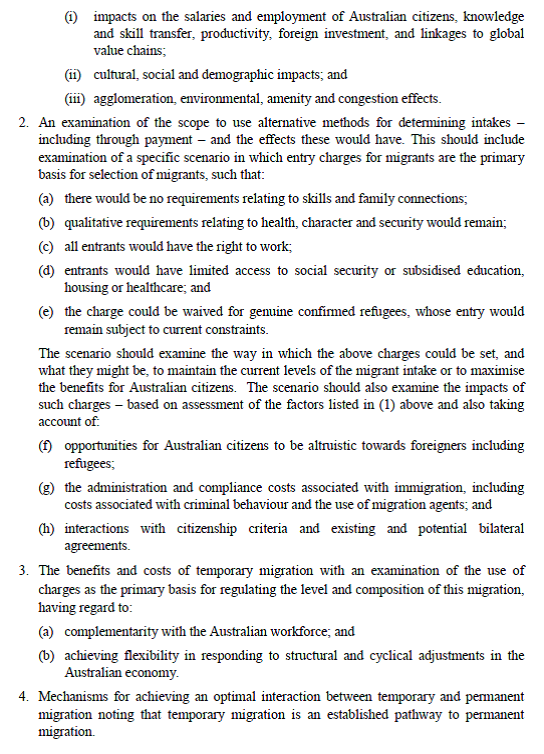
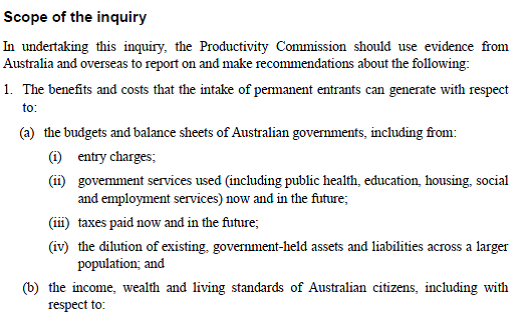
The Australian Productivity Commission has underway an interesting inquiry, initiated by the Federal Treasurer, into immigration to Australia. Here is the scope of the inquiry, taken from the Treasurer’s Terms of Reference.

aus pc1
aus pc2

It is interesting that the Australian government has chosen to initiate another Productivity Commission inquiry only 9 years after the previous large report into the economic impact of immigration. That bulky report concluded that in Australia, the gains from immigration mostly accrued to the immigrants, with little evidence of any material gains to native Australians. Despite the size of that earlier report, there was some aspects of the economic issues (possible benefits, as well as possible costs) that were not covered at all, and the modelling work that was done looked at the medium-term rather than the long term.

The new inquiry has two areas of focus. The first is helping to answer the questions about the costs and benefits of immigration, both to Australian citizens more generally and to the fiscal position of Australian governments more specifically. The second is around the intriguing idea of charging for entry. The idea of rationing entry by price turns up in immigration debates from time to time. “Intriguing” here is my code word for something like “this idea appeals to the economist in me, but yet there is something about it – which I can’t quite put my finger on – that is distasteful, and it seems unlikely to fly”. I can’t see it happening, and yet I’m not entirely sure why it shouldn’t. If we set aside the refugee quota, countries like New Zealand and Australia allow and promote immigration largely for economic reasons, and a price should tell something useful about who could get most value out of permission to live in our country. Perhaps willingness to pay is not overly well aligned to ability to help generate domestic productivity benefits?   But is there good reason not to use price to ration demand for places among those who meet certain basic criteria (age, English language, lack of criminal history etc)? It will be interesting to see what the Commission comes up with in this area.

To their credit, the team working on this immigration inquiry sent a couple of senior people to Wellington this week. New Zealand has quite similar immigration policies to Australia, and for Australia in particular, the largely-free trans-Tasman immigration area also complicates things (as it does for us, in the possibility of people returning home late in life to claim New Zealand welfare benefits). I was among the various groups of public and private sector people they met while they were here, and we had a good wide-ranging discussion.

I noted that I had increasingly come to think that good immigration policy – in countries like ours, with no treaty obligations to allow open access, and (unlike Israel) no national identity/security reasons to promote immigration – is best thought of as an optional complement to economic success. The alternative, which seems to be at the heart of the arguments of immigration advocates in New Zealand, is to see immigration policy as an engine (perhaps large, perhaps small) helping generate economic success.  I can’t think of a country – going back centuries – where immigration has materially improved the economic fortunes of the recipient country. In the last great age of immigration – the decades prior to World War One – migrants flowed to countries that were already economically successful (be it New Zealand, Australia, Canada, Argentina, the United States or even within Europe itself). Economic success allows a country, if it chooses, to support more people at high incomes. And emigration eases the pressures in the source country, lifting living standards among those who remain.

There is, of course, an exception to my story. Immigration has transformed the economic prospects of some physical territories, but only by totally taking over and largely replacing the indigenous population, and the economic institutions of that culture.   New Zealand – like each of the colonies of settlement – is an example of that. And it is an uncomfortable example. My assessment (backed, for example, by the work of people like Easterly, looking at long-term global economic performance) is that Maori average incomes are higher now than they would have been without extensive European settlement, but was the trade worthwhile – across all its dimensions – for the indigenous population? There are huge discontinuities between 21st century New Zealand and 18th century “New Zealand” that don’t exist for, say, the United Kingdom or France.

By advanced economy standards, New Zealand is a classic example of an underperforming country that people should be leaving. And, of course, for decades New Zealanders have been doing so, mostly to more successful Australia.   Of course, we can always attract plenty of people from other (even poorer) countries if we want to. But why would we?     There is no obvious area of the world where the culture and economic institutions are so obviously superior to our own Northern European-sourced ones that we can get the sort of transformative gains (at whatever costs) that Maori may have achieved by allowing extensive European settlement in the 19th century. There is no sign in the data that slightly larger countries grow faster (per capita) than slightly smaller ones.  And there is no reason to think we can somehow attract the very best of possible migrants to a small, remote, underperforming, but pleasant, country.   And if current migration patterns were repeated at scale, or for long enough, we would face the risk of factor price equalisation occurring, but not in the way we want – the typical migrant to New Zealand comes from countries, and economic cultures, that generate materially lower living standards and levels of productivity than New Zealand (or Australia) does.

The draft report of the Australian inquiry is due out in mid-November. I’ll be keeping an eye out for it. Perhaps it might be time for a similar inquiry in New Zealand. I think I’ve mentioned that when I first started raising my arguments about the possible link between immigration policy and New Zealand economic underperformance, there was a lot of discomfort at Treasury. Senior people then talked of the new Productivity Commission as a good place for such issues to be explored. That remains true today, and Treasury has a key role in advising ministers which inquiries to request from our Productivity Commission.

I have had Official Information Act requests in for some time with Treasury and MBIE for copies of advice to ministers on the economic impacts of immigration, and on the target level of permanent residence approvals. As is customary with government agencies, the responses to the requests have both been extended/delayed.   These aren’t particularly time-sensitive requests, but I will be interested to see what the departments have had to say. MBIE is well-known to be strongly pro-immigration, and I have heard reported that current Secretary to the Treasury (himself a temporary migrant) recently reiterated in private a view that “immigration is good; it is as simple as that” (repeating the tenor of comments in a speech earlier this year). Perhaps, but let’s see the argumentation, in the specific context of New Zealand, and in the light of cross-country economic history and experience.

Offshore demand for houses – some further thoughts

Rodney Jones has a nice piece on the Herald website about the non-resident property issue, perhaps slightly oversold by the sub-editors as “How he’d solve the property crisis”.  Before non-resident purchases were a material issue, house prices (especially in Auckland) were still hugely distorted by poor domestic policy.

Rodney’s approach to understanding the issue is very similar to that in my post yesterday, emphasising how historically unusual the situation is in which a large economic power has such weak domestic institutions that its citizens are looking to buy individual houses in other countries.  As he notes “to express concern about the potential impact of these flows is not racism”.

Rodney goes further than I would yet do.  He proposes a 20 per cent stamp duty on non-resident purchases of Auckland [residential?] property.  Turnover taxes generally make me feel queasy, and I’m always reluctant to endorse a regional approach to tax policy in a unitary state – which creates its own new distortions.  Since there is probably relatively little offshore demand for property outside Auckland there would be no harm in extending such a tax, if it were adopted, to the entire country.   But I suspect that the terms of our various free trade agreements might be more of a constraint.  Some FTAs might allow such restrictions, and some might not, but the China agreement for example does not allow us to adopt measures that discriminate against China relative to other countries (and we have a strong commitment to an open market between New Zealand and Australia).  And I doubt that such a tax could credibly be sold as a “macro-prudential” measure.  But Treasury and MFAT should be carefully exploring the legal options,  and the implications of our interacting web of FTAs, if they have not already done so.   It is not impossible that there is nothing that could legally be done that would not cause more distortions and costs than they would be worth

Rodney’s is a much more substantive contribution to the debate than the lofty op-ed penned by former Foreign Minister (and head of something called the New Zealand China Council) Don McKinnon.  In this surveillance age, the article is somewhat ominously titled “China listening to our housing debate”.  Then again, perhaps we should celebrate the fact.  We are open society, and have our debates openly.  China doesn’t, and its people are the poorer for that.

Or what of the reported comments of Pat English, executive director of the New Zealand China Council.  He claims that “New Zealand has a superb relationship with China. But Labour has done immeasurable damage to that relationship, due to where the debate has ended up”.   Really?  Where is the evidence?  Of course, he may be literally correct – since any damage is unable to be measured.  But any relationship that can’t stand the strain of open public debate is one of rather questionable value.   And these issues are being debated in many other countries too.

In open societies sometimes mixed messages might be heard.  And actually sometimes ambivalence is real and appropriate.  I suspect we’d be happier, and China’s citizens would be happier and better off, if they had the ability to, for example, buy secure freehold title to property in China. Or a system with the sort of economic governance, and rule of law, that the US or the UK had as they rose to dominant positions in the world economy, that made “capital flight” simply unnecessary.  China would probably be better off if, as an emerging economy, it were running current account deficits (drawing capital in from the rest of the world) rather than current account surpluses.  Of course, China’s brutal authoritarian leaders might be less happy and less secure, but that is scarcely a priority for New Zealanders.

Richer than Australia by 2025? Really……

I opened the Dominion-Post this morning to find this story, reporting the aspiration of the new Wellington Regional Economic Development Agency (WREDA, mostly a Wellington City Council agency) that Wellington should be, by 2025, “the most prosperous, liveable and vibrant region in Australasia”.

Memories of an earlier 2025 goal flooded back.  I helped the government’s 2025 Taskforce with their reports, which outlined policy proposals for how New Zealand might catch up with Australia economically by 2025.  But that was 2008/09, and for a whole country.  At the time, the Taskforce concluded that New Zealand could catch up with Australia over 16 years, with the right set of policies, but it required a fairly major reorientation of policy, across numerous fronts, pretty quickly.

But now there is only 10 years until 2025, and the Wellington City Council (with a bit of help from the Regional Council) wants to make Wellington not just as prosperous as the average Australian city, but more prosperous than any of them.  The Tui billboards spring to mind.  Even one of the more sensible regional councillors agrees the timeframe is unachievable.

In search of any substance behind this ambition, I dug out WREDA’s Statement of Intent.  But there was no substance.  There was:

  • No quantification of any of these goals, or any attempt to illustrate how large the gaps are now.
  • No analysis of the economics of cities.
  • No analysis of the sorts of policy tools that are, and are not, available to local councils, and how much difference they have ever made to regional per capita growth.
  • No analysis (or links to other analysis) of the costs and benefits of the grab-bag of policy ideas they do list.
  • No analysis of what has been done in the past, and what has worked and what has not.

At one level it is just a bureaucractic/political feel-good document.  But these sorts of agendas, together with an ambitious new CEO, tend to become the basis for new council spending proposals –  the commitment of real resources that belong to citizens, with little effective accountability.

I’m all for ambition.  Sadly, I think many of New Zealand’s elites have been too willing to settle for the mediocre economic performance New Zealand has achieved over the last 25 years.  But to the extent that governments can change medium-term economic outcomes, it is mostly central government that matters.  If Wellington is ever the most prosperous city in Australasia, it will be because of choices central government has made, and how the private sector has responded to that improved environment.  Central government controls taxes, most regulation, immigration, education, and so on.  Relative to that list, the difference any council can make is very small – and the track record (sports stadia, street car races, application of land use restrictions, and so on) seems pretty poor.  Of course, central government does lots of crazy stuff too (in a Wellington context, film subsidies), but at least they have the potential to make a lot of difference for the good.

This story, small in itself, is just another reason to be wary of seeing local councils as the solution to problems.  In discussions around housing, for example, some, including the Productivity Commission, have argued that a big part of the problem is councils held back from doing “the right thing” by the lobbying and votes of citizens.  Personally, I reckon that the problem is more likely to be one in which councils pursue their own interests and ideologies with little effective check on those activities by citizens.  Strengthening the property rights of citizens, and reducing what damage councils can do, seems a more promising, and economically efficient, way forward.

In the meantime, perhaps the Wellington City Council could get on with stuff we must actually look to councils to do.  The seawall at Island Bay was badly damaged (photos here) in a storm more than two years ago.  Since then, we’ve had a long consultative process, but there has been no progress in actually fixing it up.  Simple really.  They can do it. It will make a material difference to people living here now.  But instead we get this pie-in-the-sky aspirational stuff, with little or nothing behind it.

A useful SNZ innovation, but a question

Statistics New Zealand, our under-resourced national statistics agency, has just taken another small but useful step forward.  As from the June quarter CPI this week they will be publishing additional series seasonally adjusting the CPI data.  Most other major SNZ series are published, and analysed, in seasonally adjusted terms and there is clearly significant seasonality in some of the components of the CPI.  Analysts could previously do their own seasonal adjustment but few did, and none of those estimates got any media coverage.  In time, we might hope that the seasonally adjusted series will become the ones analysts and media focus on.

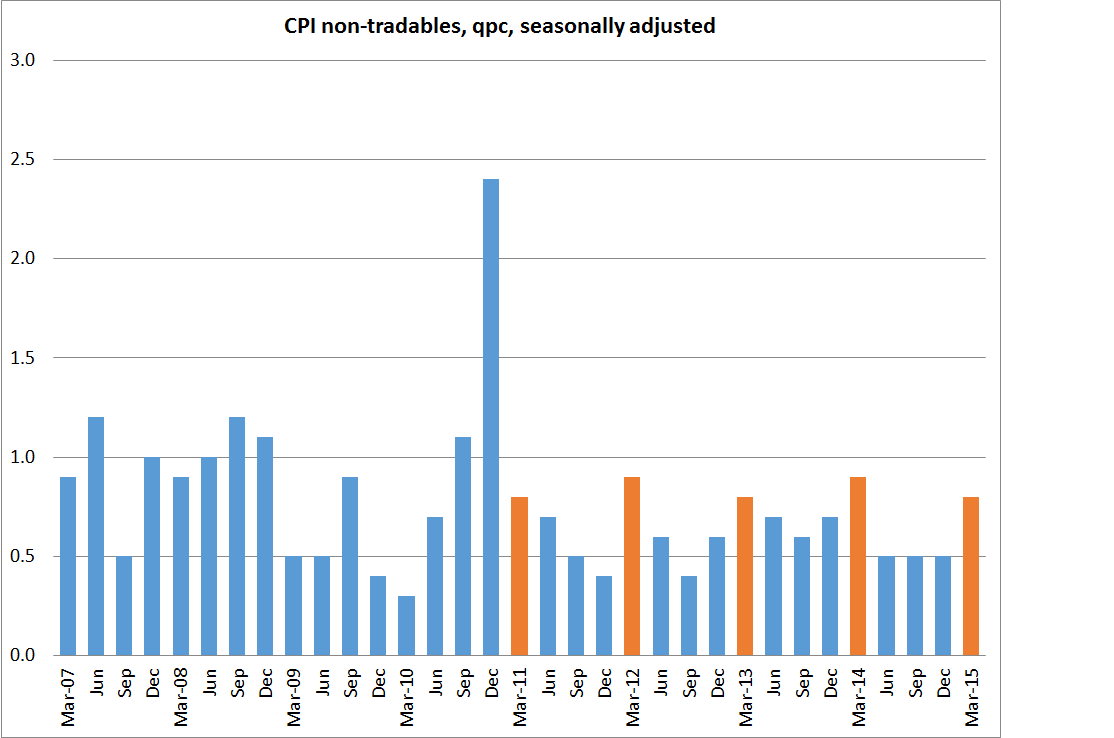
Last week, SNZ released the seasonally adjusted historical data.  True to my hope that people would focus on the seasonally adjusted series, I went to the table which showed quarterly non-tradables inflation in seasonally adjusted terms.  As one who has been sceptical for a long time of the Reserve Bank’s story that core inflation is just about to turn up, I was somewhat taken aback to find SNZ reporting that seasonally adjusted non-tradables inflation had been 0.8 per cent for the March quarter, up from 0.5 per cent in each of the previous three quarters.

But then I looked at the rest of the series, and was disconcerted to find that in each of the previous three years, the March quarter inflation rate had been higher than the quarterly inflation rates for each of the other three quarters.  That looks a lot like some residual seasonality that hasn’t been picked up in the seasonal adjustment.  I took comfort from the fact that the March quarter increase was the (equal) lowest March quarter increase over 2011-2015.   But something about the seasonally adjusted series doesn’t look quite right.

cpi seas adj

(If anyone from SNZ has an explanation, I’ll happily report it.)

In terms of future innovations, backdating the tradables and non-tradables breakdown, as official (even if “experimental” or “analytical”) SNZ series, would be helpful.  The Reserve Bank has estimates going back to the early 1990s that we derived from detailed SNZ data (not initially very scientifically –  I and one of my staff went through the components with a pen, labelling each T or NT), but it would be useful to have semi-official series going further back than 2006.  Producing good linked estimates of trimmed mean and weighted median inflation further back would also be helpful.

And then, one day, perhaps we might dare to hope that SNZ might be funded to allow the publication of a monthly CPI, joining the rest of the advanced world (other than Australia, the only other country producing a quarterly CPI).

UPDATE: A commenter reminds me of the role of the tobacco tax increases.  Here is the SNZ comment

Non-tradables are goods and services that do not face foreign competition. They include rentals for housing, and services such as hairdressing. The non-tradables series is seasonally adjusted. The algorithm suggested the series probably wasn’t seasonal, but that there was emerging seasonality in the data over the past three years. Figure 5 below shows this, where the pattern from 2011 in the actual series appears to be more consistent than previously. We see the biggest peak occurs in the March quarters in the actual series, but this effect is lessened in the seasonally adjusted series.

The multiple-point method detects seasonality in the full time series when we include the more recent quarters. We investigated to see if any one contributing series was influencing the pattern and found that cigarettes and tobacco did increase the size of the peak in March quarters since 2011. Checking the diagnostics, we found it was a marginally seasonal series and decided to seasonally adjust.

Sadly, this suggests that the seasonally adjusted series is not very helpful.

Offshore demand for houses

What to make of the housing data released by the Labour Party, and of the subsequent debate?

I’m writing this partly to help clarify my own thoughts.

First, can the data be relied on?  Well, no, but then no one really suggests that it can be.  Even if we assume that the data Labour obtained are reported accurately, they are still only a partial snapshot, and report something that is likely to be aligned, but not that closely, with the subject of interest –  purchases of residential property in Auckland by non-resident investors.  It isn’t ideal, but then neither are other contributions to the debate (eg searches on juwai.com, or anecdotes from people on either side of the debate).  There is a reasonable argument that there are no particular grounds for official statistics to be collected in this area.  But if so then informal statistics and surveys are likely to be the best there is.   And for those who do favour official data collections, well they are being put in place but the results won’t be available for months, since the data requirements don’t come into effect until 1 October.

Frankly, it seems reasonable to suppose that buying by non-resident Chinese is a material part of the market at present.  If so, that is not a normal state of affairs.  Generally, people do not buy individual residential properties in other countries as a part of a balanced investment portfolio.  In particular, they do not buy such property in small cities at the end of the earth.   People might, on occasion, own holiday houses abroad.  The super-rich might have second houses in great world cities such as New York and London.  But normal middle and upper middle class people in developed market economies don’t generally invest for their retirement in rental properties in faraway cities.  Apart from anything else, monitoring costs are high.  In fact, when people do own residential rental properties they are usually owned in locations quite close to where the owners themselves live.

In the 175 years since British government was established here, I expect this is the first time we’ve had this particular debate in New Zealand.  And it is a different debate than one around immigration and housing.  Reasonable people can differ about how much immigration we should have, and even where we might welcome migrants from, but if we are going to allow people to settle here they need to live somewhere.

“Capital flight” is a different issue.  In Latin America, Africa, and now China, people who have acquired money in ill-governed countries – many of the gains themselves might be ill-gotten, but many won’t be – want safety and security for themselves and their families.  That might be protection against a rickety domestic financial system.  Or it might be protection against the current ruling elite cracking down on political enemies (as much of Xi Jinping’s recent “anti-corruption crackdown” seems to have been).  It might just be protection against the risk of a substantial depreciation in the local exchange rate (which would probably be an appropriate course of action in China now, from a Chinese perspective).  In countries where many forms of capital outflow are illegal, people have to take what routes they can.

So, I think people who talk of offshore-Chinese interest in residential property abroad as something we just have to get used to, or an inevitable feature of globalisation, are wrong.   This demand is a function of the failure of China, not its success.  There was never a time when British or American savers were managing their investments by buying houses in Sydney or Auckland.  They were well-governed countries with rule of law protections.  China, to date, is not.

People are also wrong if they suggest something odd in singling out Chinese purchasers.  In most places around the world, the issue at present is about Chinese-sourced flows –  and, of course, unlike many of corrupt countries from which capital has previously flown, China now has one of the largest economies in the world, so any spill-over effects potentially matter more.  But if it were Russian or Argentinian buyers (which it isn’t, and has not ever been here), it would be just as much an issue.

Which is why I thought the intervention of the Race Relations Commissioner in this debate was particularly unhelpful and ill-judged.

But why might non-resident purchases of houses in Auckland matter? And to whom?  I’d argue that they matter only because laws and administrative practices make new housing supply so sluggishly responsive to changes in demand.   There is apparently substantial Chinese buying interest in Houston too, but when housing supply is much more responsive to changes in demand, foreign interest in local properties is largely beneficial to the local economy and its permanent residents.  It is, in effect, just another export opportunity.

But things are different when supply is so sluggish – and when it is mostly government policy that makes it so.   If supply were sluggish enough, even a few percentage points of additional demand could have material implications for house and urban land prices.  I’d be surprised if anything like 20 per cent of demand in Auckland was from non-residents, but if the true number is five per cent (which wouldn’t surprise me) it could still be making a material difference to prices in the current rather over-heated environment.  The Reserve Bank’s current and proposed lending restrictions are only likely to increase the relative importance of such offshore demand in explaining continuing price increases.

If most of any offshore-purchased houses are quickly put back on the rental market, offshore demand does not affect the availability of accommodation in Auckland.  If anything, it would probably drive further declines in rental yields (though not in nominal rents).  But it would still put home ownership further beyond the reach of New Zealand citizens and permanent residents living in our largest city.

The implications would be more serious if (and we don’t have the data) any material proportion of the offshore demand is being bought and left (largely) empty –  perhaps occupied two weeks a year if the owners take a holiday here.  Again, if housing supply were responsive, this demand would be pure gain (as at a holiday resort town), but in a city with tight housing supply restrictions (imposed, maintained and administered by central and local government), such demand would represent a reduction in effective accommodation supply, with consequences not just for the affordability of home ownership, but also for rents.  In that case, there are gains from offshore demand for the immediate sellers of the property (at least if they are leaving Auckland) but the distributional consequences for the wider Auckland population look pretty awful.  It doesn’t affect existing home owners, but the young and the poor typically end up worse off –  and in Auckland, as David Parker has noted, those on the margins are disproportionately of Maori and Pacific backgrounds.

Bernard Hickey has suggested that offshore demand should be welcomed if it is accompanied by large scale apartment building, perhaps directly financed by Chinese capital.  I’d have no objection at all to such investment, although as one who is a little sceptical of the estimates of the scale of any “shortage of physical houses”( the issue is mostly a land price issue), such a huge building programme could well sow the seeds of a subsequent collapse in Auckland property prices if the offshore demand for Auckland property proved not to be a long-term phenomenon.  Real overbuilding tends to be more economically damaging than simply price overshoots.

In the longer-term I suspect (hope?) the offshore non-resident demand is a second or third order issue.  Indeed, it may not be an issue at all.  A more liberalised Chinese financial system would allow savers to diversify their holdings offshore through much more efficient investment vehicles.  And Auckland is still a small city (and not exactly London, Sydney or San Francisco), compared to most of the others in which Chinese investors are reported to be interested, suggesting that demand would reallocate away from New Zealand if prices in Auckland got too high.  In the medium to longer-term, it is still likely that the interaction between tight land use restrictions and high target rates of inward migration  (which permanently boosts the population and demand for housing) will be more important for house and land prices in Auckland, and housing affordability.  As I remain sceptical that housing supply can (politically) be substantially liberalised –  I’m still curious to learn of any overseas examples where the controls have been substantially unwound –  winding back the target level of inward migration needs to be discussed.  It would be a more useful place to focus policy debate than overseas purchaser restrictions (and easier to implement effectively).  Again, this is an issue that should be able to be debated without accusations of “xenophobia” or ‘racism” being flung around by the great and the good.

I favour a relatively unrestricted environment for foreign investment, putting foreign investors on the same footing as New Zealand citizens and residents (though not as more favourable footing, as ISDS provisions have the effect of doing).  Most of our current restrictions appear unnecessary or counter-productive.

But when the government makes it hard to use urban land and increase housing supply, we are moving into a world of considering second or third best policy options if there is a large sustained source of offshore demand to own New Zealand houses.  Policy should be made in the interests of New Zealand citizens and permanent residents, and it is not clear what interest of New Zealanders is served by allowing an unrestricted inflow of offshore demand (if indeed it is substantial).  I heard David Mahon on Radio New Zealand this morning suggesting that even raising the issue would adversely affect our image in China, highlighting some deep “latent xenophobia”.  Perhaps it will affect our image, but I rather doubt it will affect how much milk powder is sold, or the price at which it is sold.  And when the country with the largest population in the world is both sufficiently ill-governed that many of its people just want to get their money out any way they can (after one of the biggest, and least disciplined credit booms in history), and just sufficiently liberal that there are some legal vehicles for those outflows, it is not inappropriate that other countries’ citizens might be wary about the implications.  China  –  and the choices of the Chinese rich – matters for other countries in a way that Zaire mostly did not.

Are there easy answers?  I doubt it.  People talk of the Australian policy of allowing non-resident purchases only of new houses – which sounds not totally implausible in principle, but doesn’t appear to have worked that well in practice.  If the government is confident that its registration scheme will produce robust data, perhaps an “offshore investor levy” –  akin to Treasury’s dubious “Auckland investor levy” –  could be considered.  But I suspect any such provision would run into problems with provisions in any number of our free trade agreements.  The same might go for banning non-resident purchasers altogether (eg from anyone without New Zealand citizenship or residence).

I’m not sure what the answer is, in a third best world.  But in this debate, I reckon the medium-term interests of people needing accommodation in Auckland, and wanting to buy their own home, need to be the policy priority.

And good quality debate around what could be an important issue isn’t help by sloganeering from people on any side of the issue.  I rather liked the guidelines for debate that Bryan Caplan and David Henderson have posted on Econlog in the last few days.  I’d add just one other –  to win a debate, and deserve to win it, one has to engage with the strongest arguments of those on the other side, not the weakest.  Attacking straw men perhaps has its satisfactions, but doesn’t really advance understanding, or the cause of good policy.

Just how large a contribution has net migration made to population growth?

One of the challenges in discussing the impact of immigration in New Zealand is making sense of the data.  I’m running a story that says two (largely unrelated) things:

  • Given the severe land use restrictions in place, the high target level of non-citizen immigration (the bit directly amenable to New Zealand policy) is a major explanation for the upward pressure on house and urban land prices.  I’ve shown that, on one measure, all of New Zealand’s trend population growth is now resulting from immigration policy.
  • Given the modest rate of national savings, the high target level of non-citizen immigration is a major contributing factor to New Zealand’s persistently high (relative to other countries) real interest rates, the high average real exchange rate, and –  hence –  to the weak growth in productivity and the failure to reverse any of the decades-long decline in New Zealand incomes relative to those in other advanced countries.

We know the key policy parameters.  Specifically, there is a currently a government target of 135000 to 150000 permanent residence approvals on a rolling three year basis.  That isn’t all the non-citizen migration but it is the overwhelming bulk of trends in it.  There are lots of short-term flows, but my real interest is not in year to year fluctuations but in the contribution of immigration policy to the trend growth in New Zealand’s population.

When people turn to Statistics New Zealand data to analyse migration they most often look at the data on permanent and long-term (PLT) migration.  For any analysis about what is happening over short periods of time, it is the only sensible series to use.  The alternative is to use SNZ’s total migration data but (even when seasonally adjusted) it is hugely volatile in the short-term.  The noise swamps any signal.  Major sporting events –  eg Lions tours, or the rugby world cup – are an example of what muddies the water.

But the PLT data have their own limitations.  The total migration data are volatile, but they do count every person arriving in and departing from New Zealand, and so provide a highly accurate count of the cross-border contribution to the number of people in New Zealand at any one time.  By contrast, the PLT numbers are less volatile, but they rely on the self-reported intentions of travellers.  When someone arrives, or leaves, they fill in the arrival/departure card stating whether they intend to go/come for less or more than 12 months.  Those stating “more than 12 months” are treated as permanent or long-term movements.

But even if everyone answers the question honestly, plans change.  Some New Zealanders go to Australia in search of a better life, perhaps planning never to live here again.  But Australia doesn’t always live up to expectations, and some will come back to New Zealand a few months later.  Those people will have been PLT departures when they left, but returning short-term travellers when they come home.  Similarly, some foreigners come to New Zealanders planning to stay forever, but leave again a few months later.  Some New Zealanders go to Australia for a few months, but find a good job, settle, and don’t come back.  And some foreigners might arrive initially on short-term visas, but then end up staying permanently (most permanent residence visas these days are issued to people already in New Zealand).

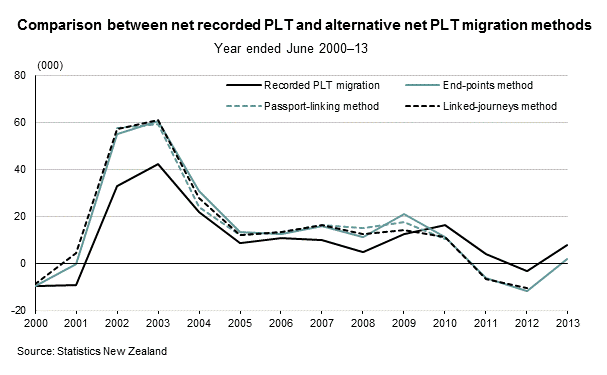
You might suppose that the differences would be small, and would wash out over time.  To the extent that I had ever given the issue any thought, I suppose that was what I used to assume too.  In fact, there are large and persistent differences between the two series.  The difference was at its starkest in the 2002/03 migration boom, when the annual PLT inflow peaked at around 40000 and the total inflow peaked at almost 80000.  The differences didn’t just wash out the following year.

Statistics New Zealand has recognised the issue.  Late last year, partly prompted by my focus on the issue, they published a paper (which unfortunately got little or no coverage), reporting some experimental work they had done on trying to improve estimates of actual permanent and long-term migration (as opposed to self-reported intentions).  As one example of what they did, passport numbers were matched to check how many of those who (for example) said they were coming for less than 12 months were still here 12 months later.  Over the 2000s it was pretty clear that estimates of actual permanent and long-term migration could be materially improved.  Over 2002/03 “true” PLT flows appear to have been materially larger than self-reported PLT flows, and over 2010-12, true PLT flows were materially weaker than the self-reported flows.  In each case, trends in the total migration series were more reflective of what was going on than the self-reported PLT numbers.  This chart is from the SNZ paper.

plt-methods

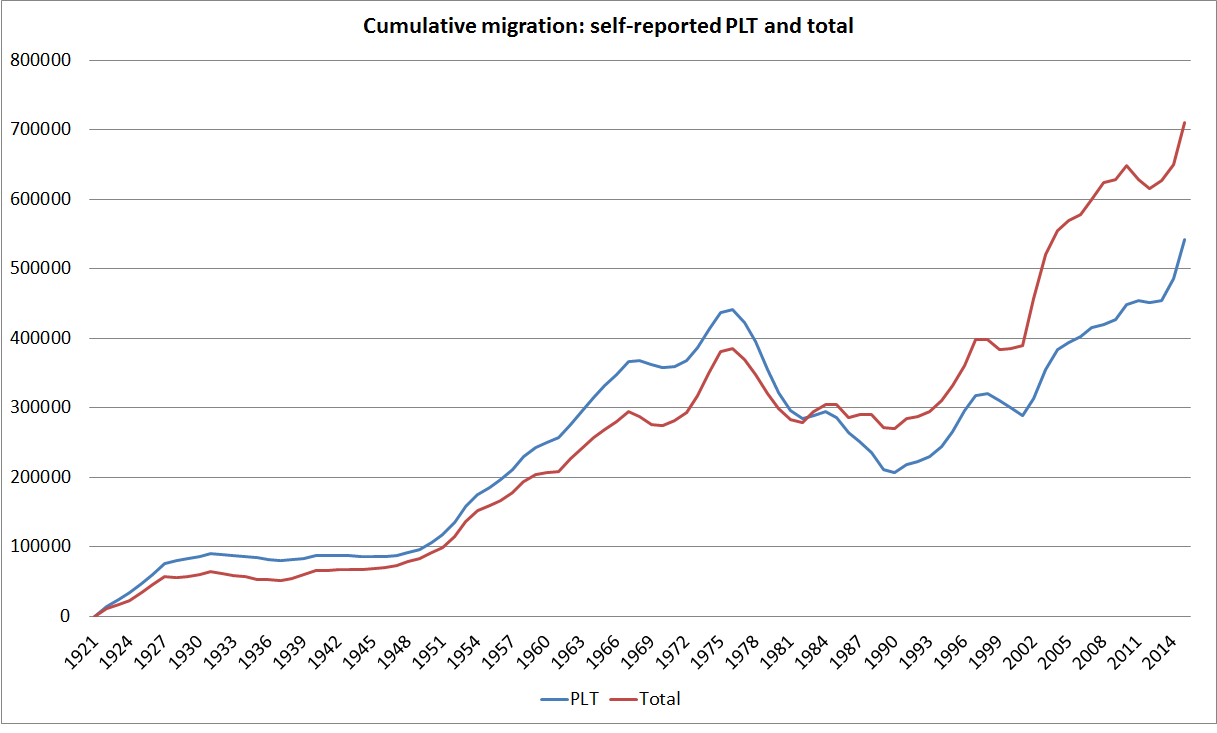
SNZ has not backdated its experimental estimates prior to 2000, and apparently (and unfortunately) does not have funding to produce these estimates on an ongoing basis.  But over much longer periods of time these differences also appear to matter.   Infoshare has data that distinguishes PLT and total migration since 1921.  Here are the cumulative net inflows in the two series.
cumulative migration since 1921
The cumulative difference is 170000 people (total net migration is much larger than self-reported PLT) –  quite material in terms of thinking about changes in New Zealand’s population which, even now, totals only 4.6 million people.  And the difference is not just down to, say, the growth of tourism: SNZ report that at any one time there are around 150000 foreign visitors in New Zealand, and around 115000 New Zealand visitors in other countries.

The divergence since 1921 is large, but note the crossover point in the early 1980s.  Until the end of the 1960s, self-reported PLT immigration had been consistently larger than total net immigration.  In earlier decades, there wasn’t much short-term tourism or many foreign students in our universities.  Since the outflows of New Zealanders also weren’t large until late in the period, much of the difference was probably down to people getting here and deciding New Zealand wasn’t really for them and going home again.

Self-reported net PLT outflows from the mid 1970s were large.  The flow of non-New Zealanders was quite small in this period (policy having been tightened materially in 1974), while the big change was the upsurge in the outflow of New Zealanders.  But since the (accurate) measure of total inflows and outflows shows nothing as large as the recorded self-reported PLT outflows, my hypothesis is that many New Zealanders set out to go to Australia for the long-term but quickly came home again.  The differences are huge: PLT data suggest a net 250000 outflow from 1976 to 1990. But the total migration data suggest a net outflow of only a little over 100000.

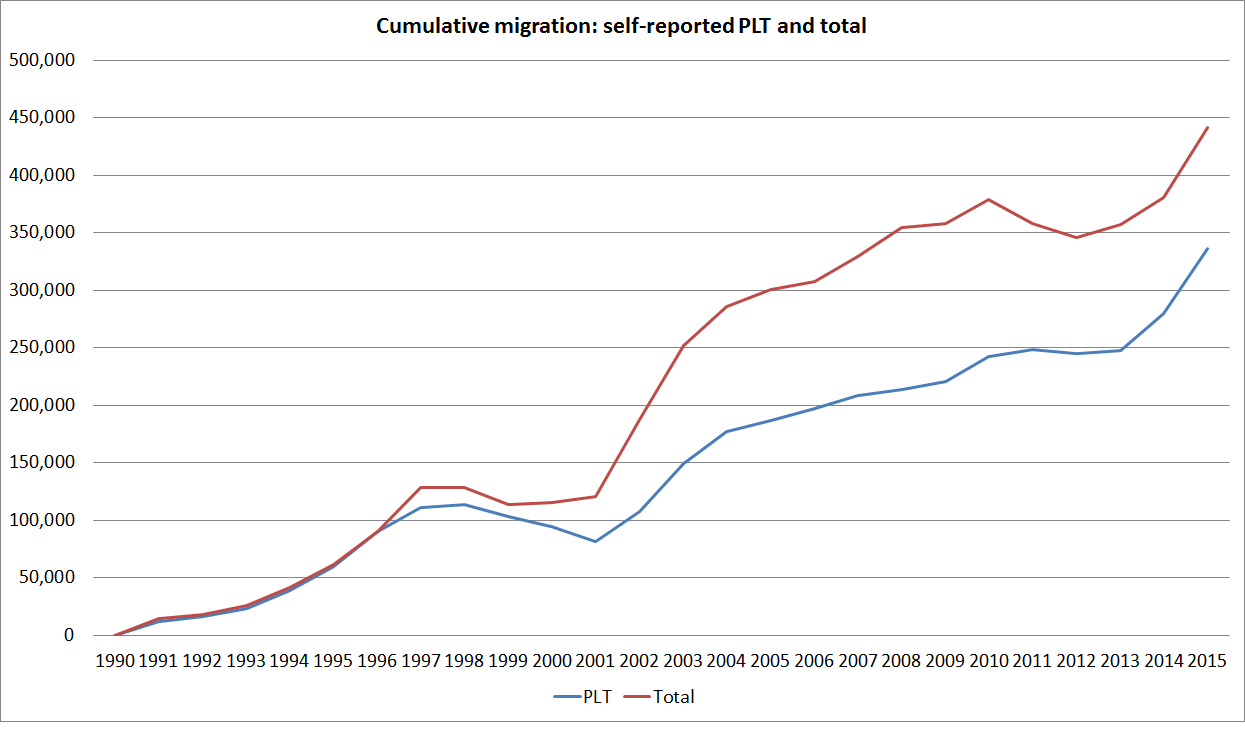
What about the more recent period?  Immigration policy was reformed and materially liberalised from around 1990 (in a succession of changes).    Here is the chart for total migration and self-reported PLT migration since 1990.

cumulative plt since 1990b

There isn’t much difference in the first few years, but from the late 1990s there has been a material difference between the two series.  Even the direction of change isn’t the same each year in the two series.  If one takes the total migration series as a better representation of the migration flows contribution to population changes (and demand for accommodation) than the self-reported PLT series, there was little or no net migration over 2008 to 2013 taken together (the red line goes sideways for that period), before the population pressures resumed strongly from 2013.  That coincides with the resurgence of very high house price inflation in Auckland.  Quite what is accounting for the divergences in the two series recently isn’t clear.  The SNZ paper I linked to earlier does not distinguish between NZ passport holders and other passport holders (although presumably they have the data).  Plausibly, some part of the difference will be down to New Zealanders finding Australia tougher than they expected and returning to New Zealand within 12 months of leaving, and some part will be down to foreigners arriving short-term and finding legal ways to stay for a longer term.

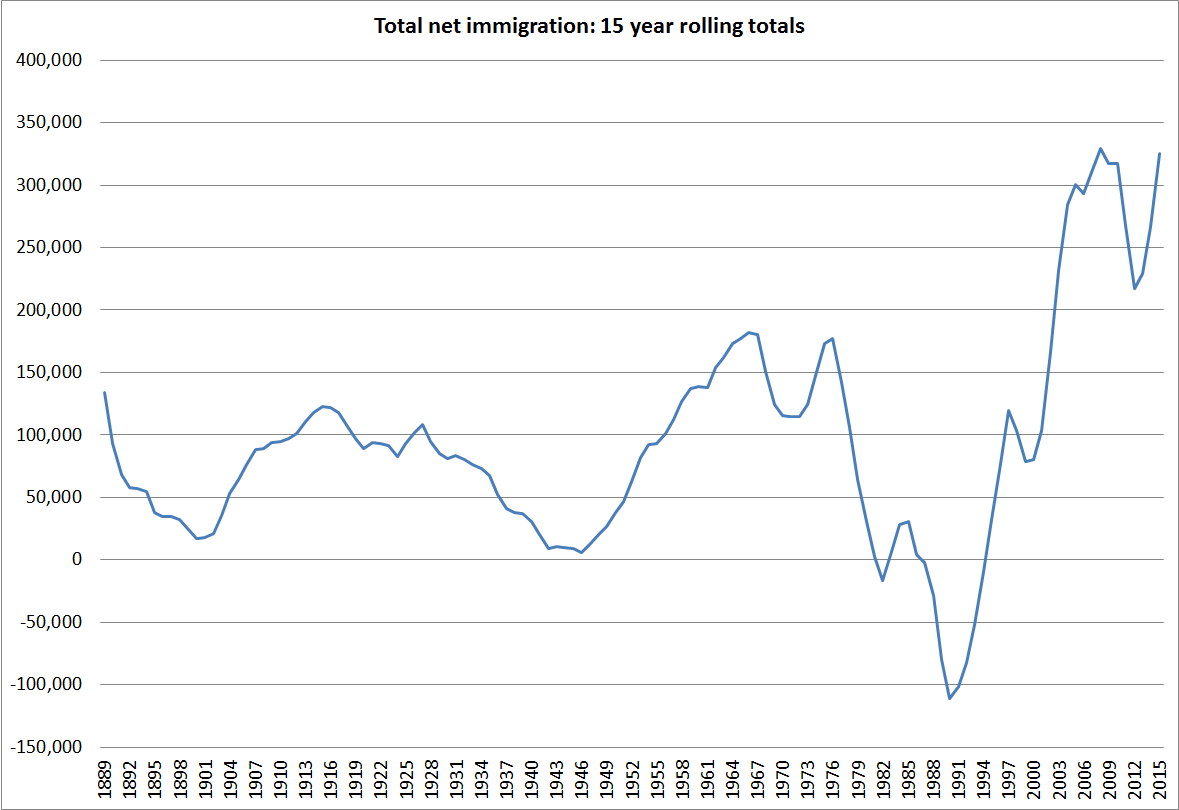
Finally, a chart showing just how large the total migration net inflows have been.  SNZ reports total migration data since 1875.  Here is the chart showing rolling 15 year totals (which should largely abstract from purely cyclical effects).

total net migration

These aren’t scaled for population, but New Zealand’s population in 1960 was about half what it is now, and the net migration inflows recently have been about twice as large as they were in those early post-war decades.  In those post-war decades,New Zealand experienced persistent pretty extreme excess demand pressures.  They didn’t show up in high interest rates (which were controlled) or in the foreign debt (the private sector largely couldn’t borrow, and the government didn’t). Instead, it showed up in the extensive network of controls  – on credit, on building activity, on imports, on holidays abroad etc – that was needed to keep excess demand in check.  Economic historians writing about New Zealand’s post-war experience seem to have been pretty well agreed that immigration policy exacerbated those demand pressures, rather than alleviated them (as I documented in this file note  Economic effects of immigration and the New Zealand economic historians ).

My story is that much the same pressures have been apparent since the resurgence of immigration in the 1990s –  but this time they show up in real interest rates and in a large negative NIIP position (which would otherwise probably have shrunk considerably as the fiscal accounts moved strongly into surplus).

Greece: fourth weakest export growth among OECD countries since 2007

I was reading this morning Robert Waldmann’s critique of Olivier Blanchard’s defence of the IMF’s involvement with Greece since 2010. I agreed with much of what Waldmann had to say, and remain fairly unpersuaded by Blanchard’s case.
But one of Waldmann’s comments caught my eye. It was the suggestion that Greece has achieved a massive internal devaluation over the last few years.

I’ve pointed out previously that that doesn’t seem right. The measure of a successful internal devaluation is surely in the degree of resource-switching that has gone on.

Those wanting to put an optimistic gloss on the data can certainly produce real exchange rate measures that seem to show some gains in competitiveness. Perhaps, but it is difficult to adjust for compositional effects (the least productive people will have lost their jobs, but presumably want to be employed again one day).

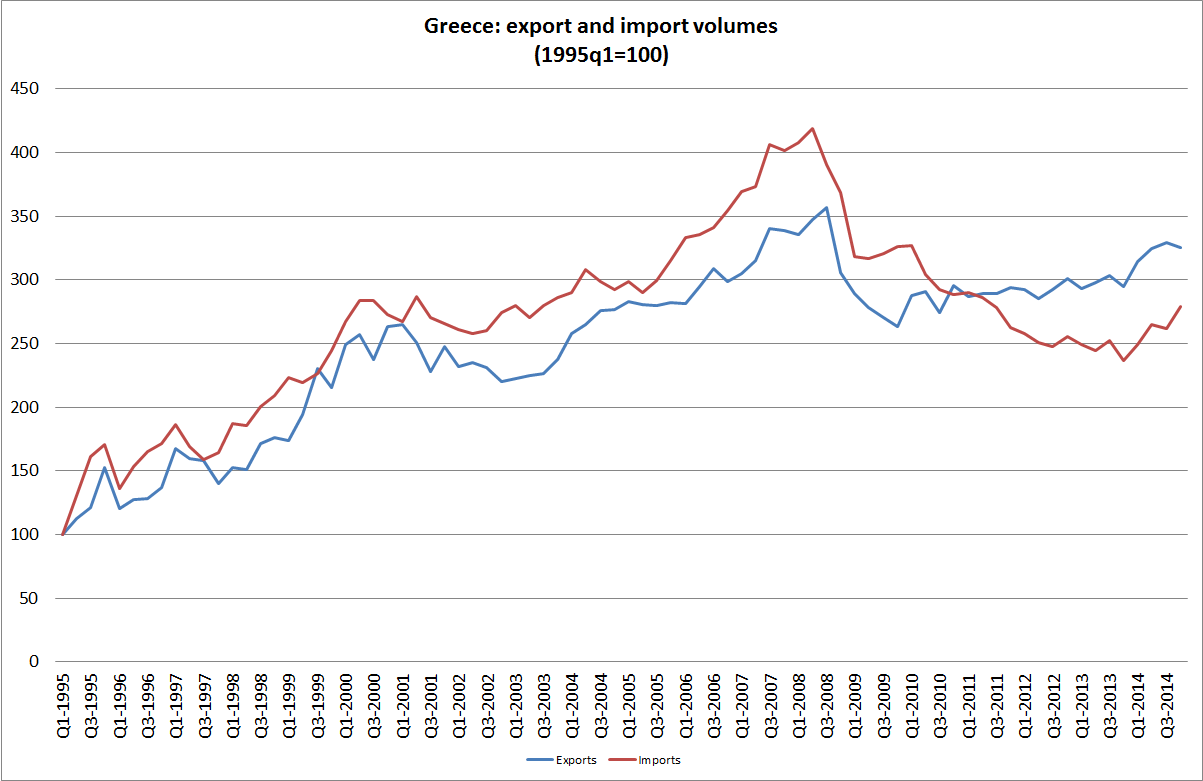
These two charts just look at some of the key aggregates, drawing from the OECD’s quarterly national accounts database.

greece1

Exports have been recovering somewhat since the trough after the global recession of 2008/09, but the volume of exports is only now back to 2007 levels. In an economy with unemployment in excess of 25 per cent, there is no crowding out of the export sector.

Import volumes have certainly fallen, very substantially. That might reflect competitiveness gains, and greater opportunities for domestic import-competing tradables producers. But it looks a lot more likely to mostly reflect a severe compression in demand. The collapse in real investment is particularly telling.

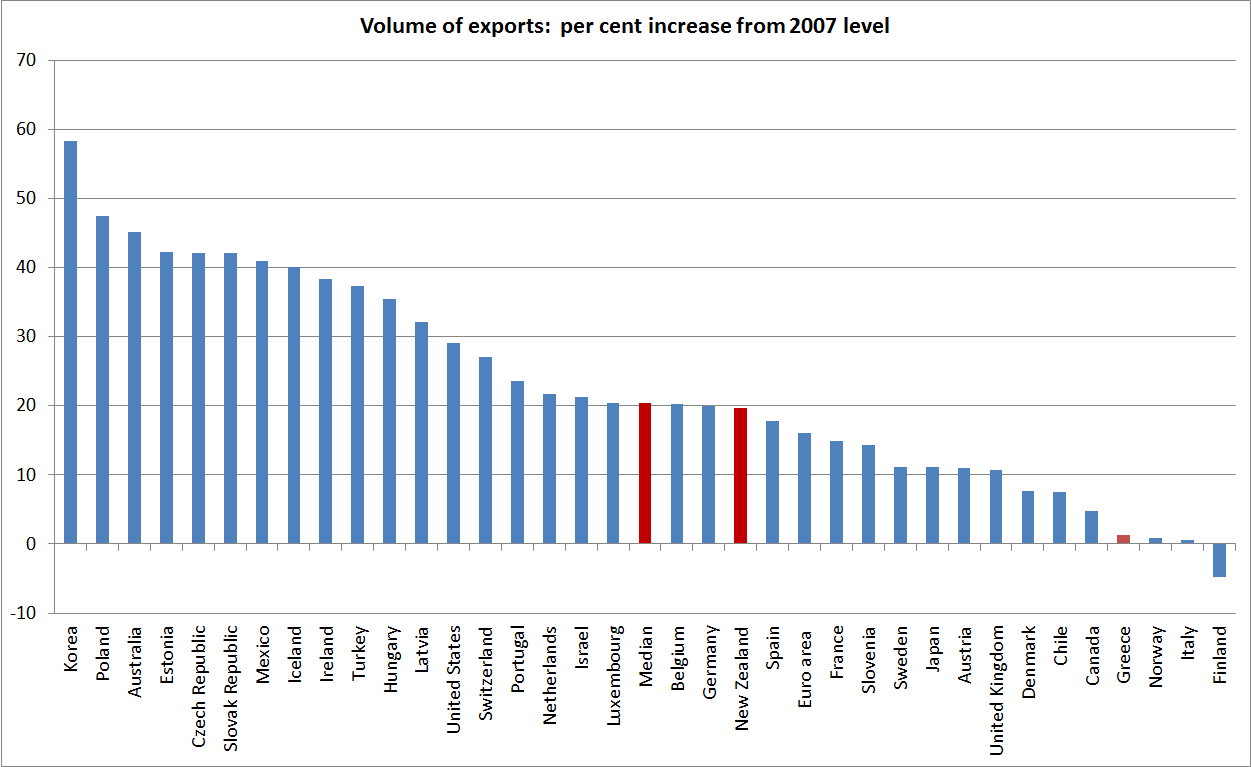
Out of curiosity I also dug out from the OECD data on export volumes for all the OECD countries since 2007. This chart shows export volume growth from the 2007 annual level to the most recent quarter (mostly the March quarter of 2015).

oecd exports since 2007

Of the 35 individual countries shown (OECD members, plus Latvia), Greece has had the fourth weakest export volume performance over that period. The result isn’t particularly sensitive to the starting point: I also looked at growth since the 2007-2008 quarterly peak, and Greece was second worst on that. With so much spare capacity, and no room to use domestic macroeconomic policy tools to stimulate demand, Greece needed export growth more than any other country in the group. But it has simply not achieved it –  and not even really begun to achieve it.

Who knows what the outcome of the weekend’s meetings in Europe will be. But it looks as if Greece still desperately needs a substantial real exchange rate devaluation. For Greece, resource-switching has not occurred within the euro, despite years of extraordinarily high unemployment. It is hard to see how any of the recent “austerity plans” will materially alter that situation any time soon. Flexible exchange rates tend to make the adjustment easier.  They provide no guarantee, but what does staying with the status quo offer economically?

In passing, the New Zealand export performance has not been that impressive – around the median of this group of countries, and not much different from the euro-area countries as a whole (and these aren’t per capita data, and we’ve had stronger population growth than most).

Investor finance restrictions

The Reserve Bank is consulting on the Governor’s proposal to ban loans with an LVR in excess of 70 per cent for residential investment property businesses in Auckland.  I have written quite a bit on this proposal since it was first revealed when the FSR was published in mid-May, and was hesitant about spending more time on the issue (my kids would have preferred another board game or two). But I did decide to write something.

Submission to RBNZ investor finance restrictions July 2015

Submissions close on Monday.

Here are a few extracts from the introduction and conclusion of my (not overly long) submission.

As I have noted in various pieces of public commentary on this proposal, in such matters the Governor effectively acts as prosecutor, judge and jury in his own case.  As such it is difficult to have any confidence in the consultative process –  it is simply implausible that the  single person actively and publicly proposing such restrictions can take a properly dispassionate and impartial approach to assessing submissions on the proposal.    The proposed turnaround time, from the closing date for submissions to the release of the final policy position (“early August”), casts further doubt on the seriousness, and open-mindedness, with which the Bank (the Governor, as sole decision-maker) is approaching the consultative process on the substantive proposal (as distinct perhaps from the fine operational details).   Confidence in the process is further undermined by the fact that no cost-benefit analysis has been provided for the proposal.   We all know that cost-benefit analysis, in the right hands, can be generated to support any proposal, no matter how egregious, but proper cost-benefit analysis at least force the preparers to write down their assumptions, which enables them to be scrutinised, debated, and challenged.

My concerns about the substance of the proposal fall under five headings:

  • The failure to demonstrate that the soundness of the financial system is jeopardised (this includes the failure to substantively engage with the results of the Bank’s stress tests).
  • The failure of the consultative document to deal remotely adequately, with the Bank’s statutory obligation to use its powers to promote the efficiency of the financial system.
  • The failure to demonstrate that the statutory goals the Bank is required to use its power to pursue can only, or are best, pursued with such a direct restriction.
  • The lack of any sustained analysis (here or elsewhere in published Bank material) on the similarities and differences between New Zealand’s situation and the situations of those advanced countries that have experienced financial crises primarily related to their domestic housing markets.
  • The failure to engage with the uncertainty that the Bank (and all of us) inevitably face in making judgements around the housing market and associated financial risks, and the costs and consequences of being wrong.

The absence of any substantive discussion of the likely distributional consequences of such measures is also disconcerting.  Distributional consequences are not something the Reserve Bank has ever been good at analysing.  In many respects they were unimportant when the Bank’s prudential powers were being exercised largely through indirect instruments (in particular, capital requirements) but they are much more important when the Bank is considering deploying direct controls.  In particular, the combination of tight investor finance restrictions in Auckland and the continuing overall residential mortgage “speed limit” is likely to skew house purchases in Auckland to cashed-up buyers.  In effect, to the extent that the restrictions “work” they will provide cheap entry levels.  New Zealand first home buyers and prospective small business owners will be disadvantaged, in favour of (for example) non-resident foreign owners.    At very least, it should be incumbent on the Bank to spell out the likely nature of these distributional effects.

Conclusion 

The restrictions proposed by the Reserve Bank do not pass the test of good policy.  The problem definition is inadequate, the supporting analysis is weak, and the alignment between the measures proposed and the statutory provisions that govern the use of the Bank’s regulatory powers is poor.

Reasonable people might differ on when policy tools should be deployed, but we should be able to disagree on the basis of much more extensive, robust, and well-documented background material than has been presented in this consultative document.   At present, the evidence that we do have suggests that the New Zealand banking system is strong and highly resilient, with no sign that there has been any serious or disconcerting deterioration in lending standards.  The Reserve Bank appears to be mistaking high house prices that result from real structural factors (land use restrictions and immigration policy), with those that results from a credit-led process.  The latter might argue for much tougher prudential controls, though probably still less distortionary indirect ones.     But there is simply no evidence at present of such a credit-led process.  Yes, house purchases need to be financed, but that appears to be a largely passive facilitative process, which poses no materially enlarged threat to the soundness of the financial system.