Some snippets from the annual trade data, with a China tinge

Statistics New Zealand released yesterday the annual data on New Zealand’s overall foreign trade (goods and services) by country.  It is a nice summary set of tables for people who don’t spend lots of time looking at trade data, and the services data are only available annually.

Since the end of last year, these have also been the data the Reserve Bank now uses to calculate the weights in its trade-weighted index measure of the exchange rate.  Those weights are calculated on a total trade basis (imports and exports, goods and services) for 17 currencies, covering countries that currently account for a bit over 80 per cent of New Zealand’s foreign trade.  The weights are updated annually, and when they are updated in December there will be a few changes.  After much noise about China becoming our largest trading partner (which it has not yet been on a total trade, or even total exports, basis), China’s share in New Zealand’s foreign trade dropped back quite a bit over the last year.  By contrast, the United States’ share rose.  Whereas this year, the weight on the Australian dollar was only 2 percentage points more than that on the Chinese yuan, both well ahead of the US dollar, next year the weight on the yuan will be around halfway between those on the Australian and US dollars.

twi weights

There is no easy right answer as to how to weight an exchange rate index.  My own sense is that the current weighting structures overstates the importance of Australia, and understates the importance of the United States and the euro area (or the EU more broadly).  These latter two economies/regions are a huge share of total world production/consumption, and are major competitors in our largest (net) export products, particularly dairy.  Neither element is captured in the current weighting scheme.  And while Australia is our largest export market, those numbers are flattered by the fact that still more than 12 per cent of our exports to Australia are crude oil and precious metals (presumably mostly newly-mined gold), which have nothing to do with wider economic conditions in Australia, or movements in the Australian dollar.

It is interesting how much of our trade with Australia is now dominated by travel.  Excluding oil and precious metals, 28 per cent of our exports to Australia are travel and transport.  No other single category exceeded 7 per cent of our exports to Australia last year.   The picture is similar on the import side, where travel and transportation account for 27 per cent of our Australian imports.

And, finally, I was interested in the dairy export data.  The media has been full of discussions around dairy exports to China, which had surged in 2013/14.

Here are our milk powder, butter and cheese exports for the last five years to China on the one hand, and the ASEAN countries on the other.

dairy exports china and asean

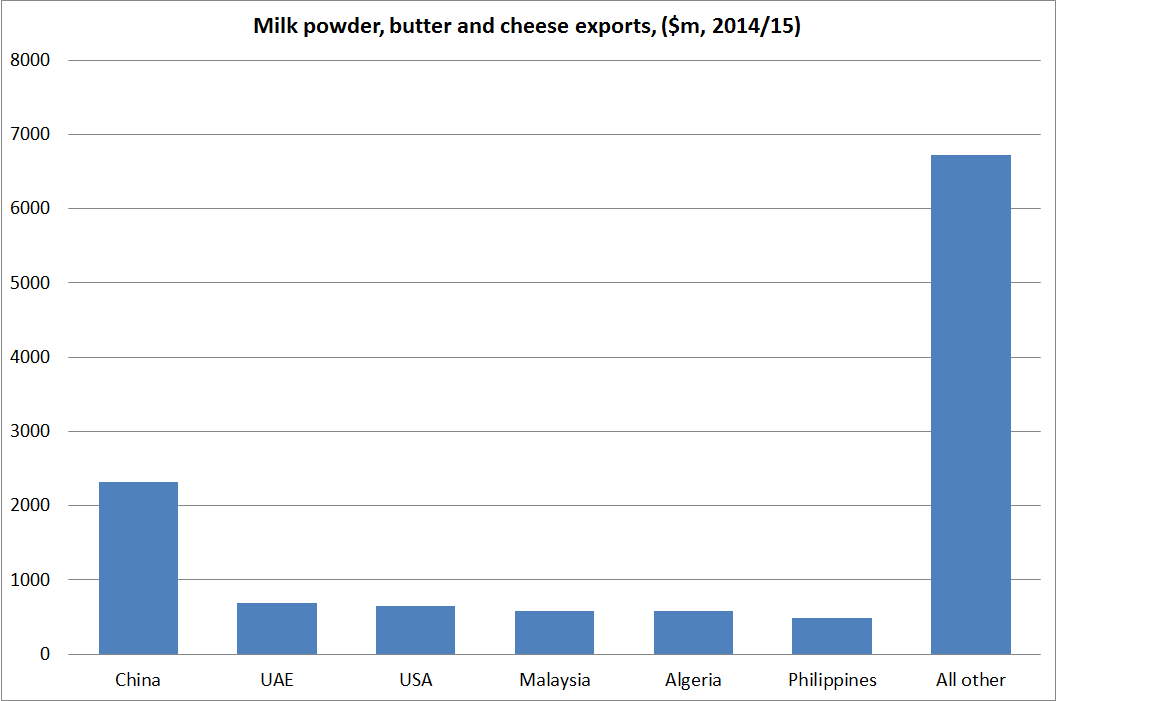
It highlights both how unusual last year was, but also how important those other countries are in New Zealand’s dairy trade.   In a typical year, New Zealand firms export as much milk powder, butter and cheese to these countries as to China, and yet these countries in total have annual GDP not much more than 20 per cent of China’s.  Actually, the data also illustrate just how diversified dairy exports are in a typical year.

dairy exports 2014 15

By contrast, in the 1950s almost all our dairy exports went to the United Kingdom, and there were few other export markets anywhere for dairy products.

None of this is to suggest that China is unimportant.  China is now the world’s second largest economy, with a very large foreign trade for a country of its size.  And is a badly-managed, highly non-transparent, economy, at the tail end of one of the bigger, least-disciplined, credit booms in history.  What happens in China matters a great deal to most countries, but there is no reason to think it matters abnormally more to New Zealand.

(As one perspective on the lack of transparency –  and, worse, outright misrepresentation –  that plagues the rest of world making sense of China, I’d recommend the latest from Christopher Balding, who takes on those who want to defend China’s data as providing a broadly accurate and representative picture of what has been going on).

“Financial literacy”, schools, and governments

According to a new poll out this week, 93 per cent of New Zealanders want “financial literacy” to be a compulsory subject taught in all schools.  The details of the poll don’t seem to be available, but we can probably assume that the questions were phrased in such a way as to encourage a positive answer.  No doubt even a more balanced question might have drawn a positive response.  To many it sounds like a “good thing”.  I’m sceptical.

I’m sceptical at a variety of levels.  First, and perhaps most practically, these surveys (and the reported views of advocates) never ask what people would prefer schools to stop teaching.  There are only so many hours in the day/year.  I’d face the same question as what should the schools stop teaching, but given a choice, personally I’d rather that schools were required to teach a sustained course in New Zealand and British/European history than that they teach so-called financial literacy.   Kids are exposed every day to their parents’ attitudes to, and practices with, money and things.  They aren’t directly exposed, to anything like the same extent, to maths, science, history, or foreign languages.

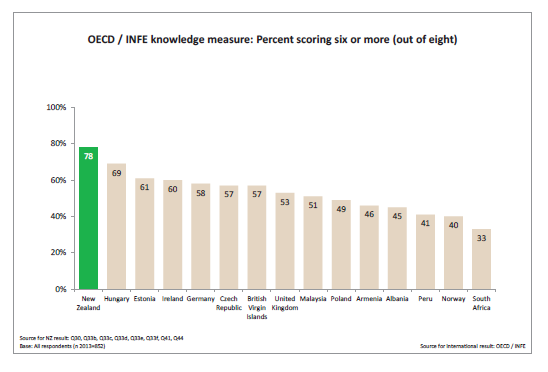
Second, as far as I can see, the evidence is pretty mixed as to whether teaching “financial literacy” makes any difference to anything that matters.  Are countries with higher “financial literacy” scores richer as a result, more stable, happier?  And a recent report (page 32) for our own government agency that deals with this stuff actually showed that, for what it is worth, the “financial literacy” of New Zealanders scored quite well in international comparisons.  What is the nature of the problem?

financial literacy

Third, why would we expect that the government, and its representatives, would be good people to teach children about money?  Perhaps we should judge people by their track record.  The current Retirement Commissioner, as captured in this profile, does not exactly inspire confidence on that front (unless perhaps “do as she doesn’t kids”).  And at a bigger picture level, in one way or another governments are the source of most financial crises –  Spain, Ireland, Argentina, the United States, China.   Governments are more prone than most to undertaking projects that they know provide low or negative economic rates of return.  Governments face fewer market disciplines than citizens. And governments don’t have to live with the consequences of their mistakes.  So perhaps I could support a civics programme that included a section on critically evaluating election promises and government policy announcements.

Fourth, much of the discussion in this area is quite strongly value-laden.  And no doubt it has always been so.  I recall the day when our 6th form economics class was visited by a banker, to try to promote savings etc.  He brought along a hundred dollar note –  this was 1978, and it was probably the first time any of us had seen one.  Trying to set up a discussion about the merits of bank deposits (probably with negative real interest rates at the time), he asked us all what we’d do with the $100 if we had it.  Various class mates rattled off their spending wishes, but the banker was totally flummoxed when one of my friends, a strong Christian, told him that what she’d do was to give it away.   .

And where, for example, in all the discussion of financial literacy is there any reference to the findings that one of the best routes to financial security is to get married and to stay married?  Finding the right spouse, and learning what is required to make a lifelong commitment work, is almost certainly a more (financially) valuable lesson that knowing that when interest rates fall bond prices rise.  But it is not one we are likely to hear from the powers that be.

And fourth, this becomes an excuse for yet more bureaucratic/political bumf, reinforcing a sense that governments should have “strategies” about everything and anything.  I was somewhat surprised to learn that our government has a financial capability strategy.  Why?

Building the financial capability of New Zealanders is a priority for the Government.  It will help us improve the wellbeing of our families and communities, reduce hardship, increase investment, and  grow the economy.

The National Strategy for Financial Capability led by the Commission for Financial Capability provides a framework for building financial capability. It has five key streams:

  • Talk: a cultural shift where it’s easy to talk about money
  • Learn: effective financial learning throughout life
  • Plan: everyone has a current financial plan and is prepared for the unexpected
  • Debt-smart: people make smart use of debt
  • Save and invest: everyone saving and investing

On this measure, might we assume that “debt-smart” would mean taking as much interest-free student debt as possible and paying it off as slowly as possible?  Not an approach I will be encouraging in my children.

More generally, I’m not sure that any of these items represent areas where we should expect governments to bring much of value to the table.  One might marvel that human beings had got to our current state of material prosperity and security without the aid of government financial literacy/capability strategies. And since when has a traditional Anglo reticence about matters of money been something for governments to try to change?   Better perhaps might be a focus on improving the financial capability of governments.

The Commission’s own research (p 26) shows what one might expect, people develop more “financial literacy” as they need it.  So-called “literacy” is low among young people (18% of 18-24 year old males are “high knowledge”), who don’t need it much.  It rises strongly during the working (child-rearing, mortgage etc) years (53% of 55-64 males are “high knowledge”), and then looks to tail off a little in retirement.  All of which is unsurprising, and (to me) unconcerning.

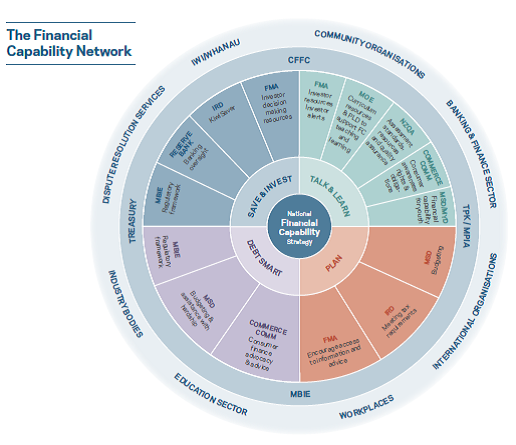
I know the so-called Commission for Financial Capability doesn’t cost that much money, but as I’m sure they would point out, every little counts.  The money they fritter away on national strategies and capabilities is money that New Zealanders don’t have to spend, or save, for themselves.  In fact, this graphic, from the government’s policy statement, might suggest a few other government agencies that could be a trimmed back.  Governments need to do well what only governments can do.  So-called “financial literacy” isn’t obviously one of those things.

financial literacy 2

As an easy way into this, consider this US-government funded online quiz, a shop window for a US project on better understanding financial literacy.  I imagine that most readers of this blog will score 5/5, while the average American scores 2.9.  But then stand back and ask yourself why the average American (or New Zealander) needs to know the answers to these questions, phrased rather in the manner of a school economics exam.  People who read blogs like this take for granted a knowledge of the answers, but in what way has that knowledge made your life, or mine, better?

The Treasury on the government’s plans to reward migrants to the regions

The sadly inadequate quality of New Zealand’s immigration policy, and official advice around it, is on display again today.

In late July, as the headline announcement in the Prime Minister’s National Party conference address, the government announced a number of immigration policy changes.  One of those changes was to offer materially more points to people applying for entry as skilled migrants if they had a job offer outside Auckland.  The relevant Cabinet paper hasn’t been released, and nor has there been any regulatory impact assessment published.

But the Herald asked for a copy of Treasury’s advice on these changes.  The Treasury’s view on the proposal to grant permanent residence to certain low-skilled workers was withheld (we might reasonably assume the comments were quite sceptical), but the Herald reported what they got here.  My thanks to Kim Fulton at NZME who passed on a copy of what was released.

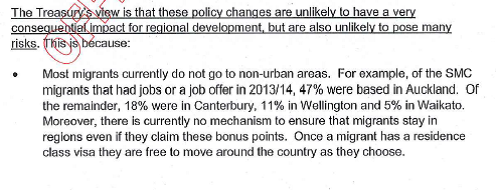
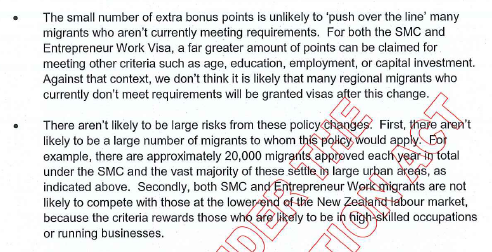
Here is what Treasury had to say about the proposed scheme.

tsy 1
tsy 2

Cabinet must have agreed with them to some extent, since the final announced version of the policy was twice as generous as the version of the proposal Treasury was commenting on.

I entirely agree with them that the proposed changes –  and even the amped-up approved version –  is unlikely to do anything useful for regional development.  It is just another “subsidy”, and subsidies are both costly and aren’t what the regions need.  A sustainably lower real exchange rate –  and perhaps some comprehensive reform of capital income taxation – is much closer to the heart of what would make a difference.

But what I found surprising and disappointing was how blasé Treasury seemed to be about the whole proposal: “won’t do much good, but not many risks either”, which is pretty much a message from the government’s chief economic adviser that Cabinet might as well go ahead.

What are the risks?  Well, first and foremost, as I noted here, any person who just gets across the points threshold and secures permanent residence will beat out some other potential migrant who was objectively better qualified (whether on age. education, employment or capital investment –  Treasury’s own list).  And contrary to what Treasury suggests, this proposal isn’t just affecting a small number of people. On Treasury’s own numbers around half of migrants go somewhere other than Auckland, so the potential for debasing the average (and marginal) quality of New Zealand’s migrants is quite real.  As I’ve been highlighting in the last few weeks, a large proportion of our migrants (and temporary workers) are already not that skilled at all.  As Treasury has struggled to produce any convincing evidence of the gains from the large scale immigration programme, we might have hoped that they would be rather harder-nosed in pushing back against changes that worsen the chances of real and tangible gains to New Zealanders ever showing up.

And then Treasury observes that there isn’t much risk of competition with people at the lower end of the New Zealand labour market because the skilled migrant category rewards high-skilled people.  Yes, and very high-skilled people will easily cross the threshold already, and won’t represent competition for people at the bottom end of the market.  But this change is about making things easier for people who just aren’t that highly-skilled –  they are the marginal cases, and they get in only because they manage to get the extra points that will come from securing a job offer outside Auckland.  At the margin, it is those people –  the ones who directly benefit from this policy –  who are most likely to be competing with people at the lower end of the New Zealand labour market. I’m not suggesting they’ll be competing with shelf-fillers and checkout operators, but there are plenty of immigrants who don’t appear to rank very high up the spectrum of skills. There will be more under this policy.

As I read the advice I wondered why Treasury was not rather harder-nosed in its advice.  As we saw in previously released papers, they seem much less sanguine about the economic benefits of immigration to New Zealanders than their chief executive has been.  Perhaps they just didn’t have much time to look at the proposal and the weaknesses in the proposal just slipped through?  Perhaps they just knew it was all about politics, and the headlines in the media after the Prime Minister’s speech?

The permanent residence approvals programme, and especially the skilled migrant category, is seen by the government as an “economic lever”.  It operates on a very large scale, and has significant effects across the country.  We should expect a rather more rigorous critique –  and some of that rare free and frank advice – when ministers want to debase the currency (points), in ways that must, if the policy works at all, debase the average quality of the new migrants.  Productivity growth isn’t so abundant in New Zealand that we can afford a cavalier Treasury when proposals turn up that will, if they do anything, worsen our productivity prospects.

What economic gains are New Zealanders getting from older immigrants?

The New Zealand government’s permanent residence approvals target is 45000 to 50000 per annum.  The target hasn’t changed for quite a long time, although actual approvals fluctuate from year to year.

As I’ve noted previously, even though the immigration programme is explicitly described as an “economic lever” only around half the permanent residence approvals have been under the skills (or business) stream, and even that total includes the immediate family of the primary applicant.

It is well-known that it takes many immigrants years to reach the earnings that a New Zealander with similar qualifications would achieve.   Here is how Julie Fry summarised the evidence in her 2014 Treasury working paper.

However, they also face language and adjustment barriers, at times including discrimination, which on average take 10-20 years to overcome. In common with overseas patterns, recent New Zealand immigrants have poorer outcomes than others in the labour market, although those outcomes improve over time.  Immigrants who are from culturally similar source countries (such as Australia and the United Kingdom) adjust more quickly. On average, migrants from Asia take longer to adjust, and migrants from the Pacific Islands never reach parity with the New Zealand-born, reflecting the fact that they enter mainly on family reunification grounds and non-skills-based quotas.  University-qualified migrants also adjust more quickly.

Ten to twenty years is a large chunk of a working life, and if the New Zealand immigration programme is really going to boost productivity and per capita incomes of New Zealanders that adjustment period is a significant hurdle to get over (as for much of their working lives here many of the migrants can’t even match the earnings New Zealanders reach).  That probably wasn’t the experience of migrants to New Zealand in the mid to late 19th century.

The issue is even more acute in respect of older immigrants, and is likely to be particular so for those from countries that are not (in Fry’s words), “culturally similar”.  A migrant arriving at age 55 has only perhaps 10-15 years left in the workforce, and that expected time in the workforce drops as the arrival age increases.

Unfortunately, although the permanent residence approvals target has not changed, the proportion of it being used up by older immigrants has been steadily increasing.  Unsurprisingly, not many people 55 and over come on work visas (around 275 in the latest year, not much changed over the previous decade). By contrast, 3279 people aged 55 and over arrived on residence visas in the year to June 2015, just over double the number who came in the year to June 2004 (the first year the data are reported).  The chances of many of these people making any material contribution to boosting productivity and incomes of New Zealanders seem small.  And yet they now make up 7 per cent of our total (skills-focused) permanent residence approvals target.

If there is little obvious economic reason to allow in most of these older arrivals –  and, in fairness, the arguments made for doing are not typically economics ones –  there are fiscal reasons to be quite uneasy about doing so.  As I’ve highlighted previously, someone who moves to New Zealand need only live here for 10 years before becoming eligible for full New Zealand Superannuation entitlements, and once granted residence they are eligible for our public health system (and time spent in Australia counts as time spent in New Zealand for NZS eligibility purposes).

The New Zealand Superannuation issue is less severe in respect of those coming from advanced economies.  Pensions earned in those countries are set off against NZS entitlements, so that New Zealand pays only a portion of the total retirement income cost.  But for people from poorer countries where there is no public pension entitlement, or nothing that can be claimed abroad, the full cost falls on New Zealand once the ten year residence period has passed.   Considered from a fiscal perspective, it is perhaps unfortunate that most of the increase in the number of older arrivals has been of people from India and China (numbers from the UK are significant, but have not increased materially).

plt arrivals 55+

Of course, there is a much larger fiscal risk in the possibility of large numbers of older New Zealanders returning from Australia (in particular) at around retirement age, having paid few New Zealand taxes and now claiming full NZS and health entitlements.  The number of older New Zealanders returning from Australia has been increasing (around 2700 of those 55 and over in the last year, about 800 of whom are 65 and over), but are still modest compared to the total number of New Zealanders living in Australia.

The average migrant to New Zealand probably makes a net positive fiscal contribution over the course of their time in New Zealand.  But that average is dragged materially downwards by these older arrivals. It tends to reinforce the argument that any real economic gains from the immigration programme could be obtained with a much lower permanent residence approvals target.

Without even touching the refugee component of the target (perhaps even increasing it), restricting permanent residence approvals to the sorts of high skilled positions illustrated in yesterday’s post, and prohibiting any permanent residence approvals for people aged over 55[1], would enable us to capture most of the putative gains with a permanent residence approvals target of perhaps 10000 to 15000 per annum.  Reducing the permanent residence approvals target by two-thirds would materially reduce the demand pressures associated with a fast-growing population.  Doing that would materially ease pressures on real interest and real exchange rates, which would allow New Zealanders and the remaining highly-skilled immigrants to take advantage of the new tradables sector business investment opportunities that would become much more attractive as a result.

As a comparative benchmark, the average annual net inflow of non-New Zealand citizens was 8500 in the 1980s.  If we are serious about lifting economic performance, and using a skills-focused immigration programme as part of that we need to get much more hard-headed about the sort of people we allow in (refugee issues aside).  In fact, over the last decade or more we’ve been going in the wrong direction, as the highly skilled have made up a decreasing share of migrants.  Many of our business migrants seem to be attracted more by the lifestyle than by the prospect of building high productivity businesses here. And the immigration programme was diluted against just recently with the decision to award more points to people moving to places other than Auckland, which will squeeze out other better-qualified applicants.

[1] With an exception perhaps for a small number of people who are entirely self-funded for their lifetime.

School choice and the ACT Party

Reading the Herald over lunch, I found an article about potential future heightened pressures on the rolls of Auckland Grammar and Epsom Girls’ Grammar.

But what struck me was the stance of the local MP, and leader of the ACT Party, David Seymour. In addition to these roles, Seymour is also

  • Parliamentary Under-Secretary to the Minister of Education
  • Parliamentary Under-Secretary to the Minister of Regulatory Reform

The ACT website says of ACT’s policy on schools and pre-schools

ACT believes that education at this level is an investment in human capital that the government rightly makes.  However, the delivery of the service has been captured, at the primary, intermediate, and secondary levels at least, by a providing bureaucracy that limits choice and innovation for the purpose of self-preservation.

ACT believes that state education funding should be seen primarily as an asset of the parent and child, to be used at a school, public or private, of their choice.  ACT would diminish the role of the Ministry of Education in allocating resources, separate the property ownership role of the Ministry from the operations role, make Boards of Trustees more autonomous in their  governorship of schools, introduce better mechanisms for State and Integrated schools to expand and contract according to demand, and increase the subsidy to private schools to the extent that it is expenditure neutral.

To be sure, ACT has only a single seat, in effect gifted to it by the National Party, but where is the evidence of this sort of approach in the stance adopted by Mr Seymour?  ACT has pursued the cause of so-called Partnership Schools, but these are not really a vehicle for parental choice, since the only people who can set up these schools are those targeting “underachieving children”.  That is one worthy goal, but it is quite different from a framework that facilitates widespread parental choice on schooling.  Reasonable academic achievement isn’t the only thing parents value.

What does Seymour have to say about the pressures in the Grammar zones?  Is he suggesting abolishing the zones?  Is he suggesting establishing new excellent state schools?  Is he suggesting allowing new integrated schools to be established easily?  Is he suggesting practical ways to treat “state education funding…primarily as an asset of the parent and child”.  The answer, of course, is none of the above.  And it gets worse, as he is reported as toying with an idea that students in new houses would not be included in the zone?  And this from a party allegedly favouring more responsive housing supply.

Seymour’s response seems to be primarily about protecting the choice, and the property values, of one small group of among the highest income New Zealanders, in Mount Eden, Parnell, Newmarket, Remuera, and Epsom.  And it is not as if this stance is new.  As the Herald reports, he has previously come out opposed to intensification in his own area, and opposed efforts of neighbouring schools to extend their zones in ways that overlap with the Grammar zones.  ACT rightly criticises corporate welfare, and has also been fairly critical of the growth of the welfare benefit system, but there is gaping inconsistency right at the heart of their home territory.  It looks a lot like protecting elite privilege.  Many people would like to send their kids to one of the Grammars –  or schools like them.  But a rapidly decreasing number can afford the house prices in those suburbs and the dominant state provider doesn’t build any more.  Why would one take Seymour seriously on any proposed policy when he is not willing for his policies to start at home?

I think he is right about the education bureaucracy, but it isn’t only the provider bureaucracy that seems driven by self-preservation.  The Under-Secretary for Education and MP for Epsom seems to have gone the same way.  ACT is likely to be at its best when it is attacking, not defending, established advantage, and when it is campaigning to democratise access to excellence and strongly advocating competition, even if it means some transitional costs fall on some of their own supporters.  Thank goodness that governments that abolished import licensing – which had provided many very comfortable livings –  did not take the ACT approach.  I’m sure Seymour (and his party colleagues), knows that his position is untenable when put up alongside party policy.  And so I wonder what he really stands for?  Allowing bars to open more easily on the mornings of a few rugby games is all well and good, but beginning to make progress on allowing real school choice for the mass of middle New Zealand is a rather more important, and more enduring, issue for the longer-term.

These issues don’t just arise in Auckland.  In the weird world on education bureaucracy, my son is zoned out of the closest state boys’ school (which we don’t particularly want him to attend) because for decades the Ministry of Education has failed to build even a single state school in what is generally regarded as New Zealand’s largest suburb.

New Zealand already has a limited quasi-voucher system in the integrated schools system.  For some parents, there is an effective choice, between a neighbourhood state school and a (slightly more expensive) integrated school.  But in practice the choice is limited: most of the schools are Catholic, and Catholics are supposed to attend Catholic schools and (reasonably enough) there aren’t many places for those from other traditions.   And rolls are capped.  The integrated schools model was a far-reaching reform of the Third Labour Government in the 1970s, in response to a funding crisis in the Catholic system.  More than 10 per cent of New Zealand children are educated at such schools, and (unlike the so-called Partnership Schools) there seems to be little debate around their performance –  it is just recognised that some parents will prefer one sort of school, and others will prefer different types.  But why not use the integrated schools model as a basis for a real extension of choice?  Allow proprietors –  existing, new, for-profit, and non-profit –  to set up new schools, as they like, and provide per capita funding accordingly if they can attracts parents and students.  For most parents –  especially with more than one child – private schools aren’t a real choice –  the financial burden is just too heavy.    And perhaps there will never be much effective choice in most small towns. But most of our population lives in our larger cities –  half in Auckland, Wellington and Christchurch alone –  and in those places (and no doubt most of our larger provincial centres) effective and genuine affordable choice could be made to work.

Yes, no doubt there would be some duds set up.  There are some disastrous schools now.  No doubt there would be some excess capacity built.   But that is akin to an argument that we’d be better off with one supermarket in a suburb than two, to avoid the wasted extra physical capital, or the old days of licensing when a new entrant might have to prove there was insufficient capacity, rather than simply being allowed to take a risk and open up.

Yes, there are lots of other details to work out  The state has some legitimate interest in ensuring a minimum standard of schools, but it has much less interest in that than parents have. The state, its bureaucrats and ministers, gets to make mistakes over and over again.  But each child only goes through school once: the stakes are that much higher for parents and kids than they are for the education bureaucrats and politicians.

None of that necessarily helps with what should happen in Auckland right now.  Someone is going to miss out, and political choices will (openly or not) decide who.   That is a  problem for Mr Seymour, and perhaps one he should have thought harder about before campaigning for school choice and reduced land use restrictions in suburbs like Epsom.  Real choice rarely comes from the elites –  they aren’t, generally, the ones with most to gain from it.

What occupations did our permanent and long-term migrants have?

Governments have purported to run New Zealand’s immigration programme primarily as an “economic lever”, intended to help lift the productivity and performance of the New Zealand economy, presumably with the aim of lifting not just average per capita incomes of those living in New Zealand, but of lifting the average incomes of New Zealanders.  Public policy, especially in matters economic, should be made primarily with the interests of New Zealanders in view.

As I’ve noted previously, even among those gaining permanent residence approvals only around half (including the immediate family of the primary applicants) come under a skills heading, and in some cases they don’t seem overly highly skilled.

I highlighted a couple of weeks ago how relatively unskilled many, perhaps even most, of those coming to New Zealand on work visas are, even under a so-called Essential Skills category.  That programme increasingly looks like another example of corporate welfare.  But the standards are somewhat more demanding to gain a permanent residence approval.  I used the work visa data because it was available at the right, disaggregated, level of detail.  I haven’t been able to find anything comparable for permanent residence approvals  (if any readers know of such data I’d happily be pointed to it).

But Statistics New Zealand does have data on Infoshare about the occupations of permanent and long-term arrivals.  These data have their limitations including:

  • They aren’t published by citizenship, and PLT arrivals include lots of returning New Zealanders, who of course aren’t subject to our immigration policy
  • Intentions (about whether one is coming for the long-term or not) are self-reported, and subject to change.
  • Occupations are self-reported (as distinct from the work visa data, where the approval is for a specific position).

Many arrivals don’t have an occupation either –  they might be students, children, the aged, or non-employed spouses caring for children.  Oh, and SNZ report that around 5 per cent of all stated occupations (on arrivals cards) are illegible, or otherwise unable to be fitted into ANZSCO occupational classifications.

There isn’t anything that can be done about the second and third points, but most of the flow of New Zealanders is to and from Australia, and most of the flow between New Zealand and Australia is New Zealand citizens.  So the charts below shows PLT arrivals, for the last five years, from places other than Australia, where the person arriving wrote down a clearly identifiable occupation.  There were around 135000 of these people.

First, the positive story.  This chart showed the occupations that looked like the sort of positions people (including me) have in mind when they hear that New Zealand has a skills-focused immigration programme, designed to lift overall economic performance over the medium-term.  There were about 38000 arrivals in these occupational groupings.  Jokes about, say, lawyers aside, I doubt anyone is going to quarrel much with people like these, if we are going to run a large scale immigration programme.

plt arrivals highly skilled

Second, the not-so-positive side.  There were 51000 arrivals (38 per cent) in occupations that few people think of when they think of a skills-focused immigration programme.   People will no doubt differ a little on what roles to put in this list, but as a whole it makes quite sobering reading.  And remember that SNZ are only capturing here the people who actually report an occupation.

PLT arrival less skilled

There is a middle group of occupations that I won’t show in detail. In deference to the Christchurch repair and rebuild process, I’ve put most building and construction-related positions in that category.  But the largest single group in that middle category, somewhat to my surprise, was school teachers. No doubt there are many able immigrant school teachers, but again they aren’t usually the sort of grouping most people have in mind thinking about skills-based immigration programme (and I doubt many of them are teaching advanced high school science courses).

So most of our migrant arrivals aren’t actually here for their skills at all, even on the government’s rather generous interpretation of skills.  And of those who are, a huge proportion look to be people, or occupations, that aren’t overly skilled at all.  The Treasury papers I discussed a few weeks ago provided little or no basis (or reference to other material) showing how our skills-based immigration, as actually run, was boosting the productivity and future incomes of New Zealanders, despite the rhetoric of ministers and of the Secretary to the Treasury.  I now have the papers MBIE has released, but have not yet had time to work through them. I’m hoping there is something more substantial there.  At the moment, however, the large scale active immigration programme has the feel of something just focused on driving up New Zealand’s population, with little or no robust analysis or evidence to support a belief that New Zealanders are benefiting from the programme.  If there are benefits to New Zealanders from the skills migrants are bringing, they are likely to be concentrated in the sort of occupations/skills captured in the first chart above. We could tap those gains with a much smaller permanent residence approvals programme –  perhaps 10000 to 15000 per annum, rather than the current (very large by international standards) 45000 to 50000 per annum.

A tale of two regulators

Earlier this week two banking regulators gave speeches about housing.  Both  began the same way –  one noting that housing is a “hot topic of dinner conversation” and the other that it is “not unusual…for the topic of conversation over a meal – be it a dinner table with friends, or a barbeque in the backyard –  to turn to the subject of real estate”.

The first speech was by Grant Spencer, Deputy Governor (with responsibility for financial stability functions) of the Reserve Bank of New Zealand.  The second was by Wayne Byres, Chairman of the Australia Prudential Regulatory Authority (APRA).  The speeches are really like chalk and cheese –  very different and the differences largely reflect positively on APRA.

I’ve already touched on a few points from Spencer’s speech, mainly around the tension between the encouraging results of last year’s demanding stress tests and the Reserve Bank’s increasingly intrusive and expensive lending restrictions.  In that post, I also passed on an observation someone had made to me that Spencer’s speech had a very strong macroeconomist’s flavour to it, with little sense that he, or the Bank, had much feel for the credit standards being applied by the banks.  At one level, that isn’t surprising: Spencer (and most of his senior colleagues) has a background in macroeconomics.  But Grant Spencer has now been responsible for financial stability and regulatory functions for eight years, and spent the best part of a decade in fairly senior positions in the ANZ.

Byres, by contrast, appears to have been a bank supervisor/regulator for most of his career.  And it shows.   He knows that banks get into trouble when they make bad loans (and banking systems get into trouble when enough banks make enough bad loans).  At one level that is a truism, but it seems to drive Byres, at least on the evidence of this speech, is to focus on the quality of the loans banks are making, and the standards banks (management and Boards) are applying in advancing credit

Byres articulates APRA’s goal as “to preserve the resilience of the banking system”, rather similar to the Reserve Bank’s statutory goal to “promote the maintenance of a sound and efficient financial system”.  And that seems to be his focus: to ensure that banks have enough good quality capital to withstand shocks when they come, and focus on monitoring the quality of banks’ lending behaviour to help (a) ensure those capital buffers are large enough, and (b) reduce the risk of a large number of loans turning very bad.

Rightly, in my view, he does not seem to see it as APRA’s role to stabilise house prices, nationally or in any particular city/region.  Other stuff happens, and it is the responsibility of the banking supervisor/regulator to ensure that the banking system can cope if things go wrong.  Stress tests are one component of that –  and Byres gave a good speech on them late last year.

Here is Byres on what drives the housing market

Any discussion on housing market conditions these days typically starts – and sometimes ends – with housing prices. It’s clear that Australian housing prices are high. On common metrics such as pricesto-incomes or prices-to-rents Australian housing prices are at the higher end of the spectrum, measured either historically or internationally. There are many reasons proffered for why this is: a strongly growing population, geographic and regulatory constraints on supply, the impact of lower inflationary expectations and financial deregulation, and taxation arrangements all feature prominently in explanations of the level of Australian housing prices.

He doesn’t seem to see it as APRA’s role to praise (or damn) aspects of government policy, or to lecture others (based on no underlying research or analysis) on what needs to be done.  He just accepts that there are active debates on many of these issues and, whatever the cause, Australian house prices are high.  That might become an issue for a banking regulator, and to know that one needs to understand the quality of the loan books (individually, and across the system as a whole) and the capital banks have.

Contrast that with Grant Spencer’s speech, written as if the Reserve Bank were a pre-eminent source of wisdom on wider housing market issues, impatient that mere politicians have been slow to get with the Bank’s preferred programme.  Tax changes are “essential”, “much more rapid progress” is needed in improving housing supply, and so on.  And all the time, other areas of policy, which might be inconvenient to the current government (eg the role of new first home buyer subsidies, active immigration programmes) are passed over in silence.  The issue is not whether Spencer is correct in any of his individual observations –  on some I think he is right, and in others probably not –  but that he cites no evidence or research for his views, and that such advocacy on highly controversial political issues, is just not the role of a banking regulator (or a central bank).   “Tax” appears a lot more often in Spencer’s speech than phrases such as “lending standards”, “loan quality”, “origination standards” or the like  (as far I can see, those phrases don’t appear at all).

Byres appears to know better.  He concentrates on banking; on what banks do, and on the regulatory role of APRA.  Doing banking regulation well is not always easy.  No doubt plenty of supervisors in the United States, Ireland and the United Kingdom thought they were doing a fine job in the years running up to 2008.  It turned out not to be so.  Lending standards will, of course, often look rather better before a crisis, or even a recession, than they do in the wake of such events.  But if we are going to have official prudential supervisors –  and for better or worse we do  – we need people with enough knowledge of the industry to ask the hard questions, and sceptically sift and weigh the evidence.  As Byers notes (if only we heard this line more often from our Reserve Bank).

“lower credit quality portfolios may not necessarily be worrisome if the strategy is a conscious one, the additional risk is appropriately priced and managed, and adequate capital is held.  That is really what much of our work has been designed to test”

And much of the rest of his speech is devoting to talking through what evidence there is on these points.  It is what one might expect from a bank supervisor.

He observes that there is no evidence in Australia that investor loans have been riskier than owner-occupier mortgage loans, while noting the need to be cautious about extrapolating that experience into a more stressful scenario.  Our Reserve Bank does not even seem to have gathered the data on the New Zealand experience, including in the last few years in which some regions have had material falls in nominal house prices.

Byers steps through data on third-party originated loans, interest-only loans, high LVR loans (interestingly, he focuses on loans with LVRs greater than 90 per cent, not (say) the above 70 per cent loans the Reserve Bank is about to control in Auckland), and loans approved outside standard loan parameters.  I’m not sure I saw anything specific about pricing.  But I came away from the speech with a sense of better understanding the market, but also with a sense of a supervisory agency that knew, and could talk judiciously, about what was going on.

The impression I took from Grant Spencer’s speech was rather different.  There was very little about indicators of risk arising from the behavioural choices of banks.  We’ve seen no evidence advanced that credit standards have been deteriorating (eg specifically in the Auckland investor property finance market), let alone that any such deterioration was not appropriately matched by pricing, and capital, that covers the risks.     There might be problems looming, but the Reserve Bank just does not set out the evidence, even though it has rushed in with a succession of heavy-handed policy interventions.  There is a sense of an institution flailing around, citing this statistic and that, but without a coherent and well-grounded analysis of the issues and risks to the banking system.

There are limitations to Byres’s brief speech.  He is no more inclined that the Reserve Bank to acknowledge that supervisors and regulators get things wrong.  And perhaps he is light on the sort of big- picture macro-oriented, internationally-informed analysis of systemic risks.  But when the Reserve Bank tries to offer this latter perspective it does not do it well.  As far as I’m aware no country has ever run into a systemic banking crisis when credit has been rising no faster the nominal GDP (and perhaps especially when nominal GDP itself has been growing slowly by historical standards). But you won’t learn that from any Reserve Bank document, even though that is the current New Zealand (and Australian) situation.  You also won’t get any sort of systematic analysis, or even a summary distillation of such analysis, on the similarities and differences between what has been going on in New Zealand in recent years and, on the one hand, what happened in the crisis countries, and on the other hand, what happened in countries that avoided crises.  Grant Spencer and Graeme Wheeler repeatedly invoke Ireland and the United States, but no serious observer thinks developments in New Zealand remotely parallel the specifics of those two (quite different) country experiences.

There has been a tendency in some quarters to lionise APRA –  I’ve been in meetings where it has been lauded as the world’s best bank supervisor.  I’m not in that camp.  Apart from anything else, the minimum risk weights the Reserve Bank has insisted on for housing loans have been more conservative than those required in Australia, and APRA is only now catching up.  And I’m also not convinced by arguments that we should out-source our bank supervision and regulation to APRA – ultimately much about bank supervision is about crisis management, and in crises managing national interests matters a lot.   But for the time being, APRA presents a much more credible and convincing face to the world, conveying a calm and balanced sense that they understand banking and banking risk, than does the regulatory/supervisory side of the Reserve Bank of New Zealand.  New Zealand deserves better than that.

Perhaps it is another dimension for the Reserve Bank Board to assess in its forthcoming Annual Report?

How much foreign stuff do we use in our exports?

In my post this morning, I mentioned the way that, for many countries, exports now contain a larger share of imported inputs than they did in earlier decades, as the cross-border trade in componentry has grown (facilitated by, inter alia, reduction in regulatory barriers).  Each imported input represents value-added (returns to labour, land, and capital) in the country where those inputs were produced.

Here is the OECD-WTO data on the estimated percentage shares of foreign value-added in each country’s gross exports in 2011.  They have data for 60 countries, which makes for a long chart.  Keep going and you will eventually find New Zealand.  59 per cent of Luxembourg’s gross exports actually reflected value-added generated in other countries, but for New Zealand the comparable number was just under 17 per cent.

foreign value added

Only 10 countries had a lower foreign value-added share than New Zealand.  And of the bottom thirteen countries, eleven would be considered as primarily commodity exporters (whether raw or processed).  Commodity production doesn’t lend itself to cross-border trade in componentry.    The exceptions are the United States and Japan.    The US number probably shouldn’t be too surprising – there is after all an enormous domestic supplier base. On a smaller scale, I guess the same goes for Japan, but the Japanese number was a bit of a surprise.  At the other end of the scale is a mix of Asian and EU countries.

Occasionally, it is suggested that the low share of imported inputs in our exports is itself a sign of New Zealand’s underperformance.  Perhaps, but China and Mexico stand out as large countries with a large foreign value-added share of their exports, and rather low levels of per capita incomes.  Assembly businesses are presumably economic if labour is relatively cheap.

The first snapshot of these data are for 1995.  Back then, 18 countries has a smaller foreign value-added share of exports than New Zealand did.  And only a handful of countries had more than 40 per cent of their gross exports accounted for by foreign value-added.  From 1995 to 2011 the median country’s share rose from 21.5 to 26.5 per cent, but the median wasn’t very representative: lots of countries saw little change, or the foreign share even shrank (for both China and New Zealand that share fell slightly), while for a large group of countries that foreign value-added share of their exports rose by 10 percentage points or more.

On their own, these numbers are interesting, but don’t necessarily lead anywhere.  They tell us more  about economic geography and the type of goods that are exported than anything about performance.  But, of course, Denmark was once largely an agricultural exporter as well (two thirds of all Denmark’s exports were agricultural in the 1930s), and had it stayed that way it would (a) be poorer today than it is, and (b) would probably have a much lower foreign value-added share of its exports.  What would the export mix of a New Zealand that generated top tier OECD incomes gain look like?  I don’t know, and nor does anyone else.  If we got there by uncovering and utilising huge mineral resources, we’d probably stay towards the bottom of the chart (like much richer Australia).  But there might be other paths –  a swathe of home-grown high tech industries – that might push our foreign share of exports further up.  But our geography –  last bus stop before Antarctica  – means that we are never likely to be found near the top of this particular chart.  Israel, small and with a large high-tech sector caught my eye as one possible comparison.

Once were international traders

J.B Condliffe was one of the greater New Zealand economists of the first half (or so) of the 20th century. One evening earlier in the week I was dipping into his New Zealand in the Making, an economic history of New Zealand, the second edition of which was published in 1959. On the first page, I noted this line

“Today New Zealand claims the largest overseas trade per head of any country in the world”

Those were the days when the story was often told about about how exposed to foreign trade New Zealand was.  Protectionists wanted to reduce that exposure.  In the 1950s, global trade as a share of GDP was much lower than it is today.  Even New Zealand’s trade share  was a little lower than it is now (services exports were not material in those days, and merchandise exports were around 27 per cent of GDP).  Our export share of GDP was about that high even though New Zealand had very heavy industry protection in place,  promoting domestic manufacturing.  That acted as a tax on exports, reducing both exports and imports below what they would otherwise have been.

The late 1950s were also the days when New Zealand still had among the highest per capita incomes in the world.  In the mid- late 1950s, Maddison estimates that New Zealand incomes were behind only those in the United States and Switzerland.  Whatever the “true” number, we were still in the top tier of material living standards

How do things compare today on foreign trade?

I dug out the OECD data for total exports per capita (for 2013) and converted them into a common currency.  Here is the chart.

gross exports pc

New Zealand is in the bottom half of this chart.

Big countries tend to export less than small countries –  fewer firms need to tap the wider world when there is already a large market at home – and distant countries tend to export less than countries that are close to lots of other markets.  Firms in the United States, for example, export a lot less per capita than firms in (similarly well-off) Switzerland does.

Whatever the situation in the 1950s, it would have been a little surprising if we had been in the top tier of the 2013 chart.  One of the big changes in international trade since the 1950s has been the rise, particularly in manufacturing, of “global value chains”, where different stages of production occur in different countries.  In other words, a car finished in Germany and exported to France might include a substantial proportion of components produced in (and exported from) a range of Eastern European countries.    And some other products exported from, say, Slovakia will use lots of components imported from Germany.  The value of a country’s gross exports rises with this (typically mutually beneficial) activity, but the share of a country’s total value-added (which GDP is capturing) resulting from exports might not have risen much at all.  For New Zealand, a long way away, this sort of trade doesn’t happen in the way that it might between say Austria and the Czech Republic.

The OECD and WTO have recently done the work of trying to trace what proportion of each country’s exports are domestic value-added.   The latest data are for 2011, but the domestic value-added shares don’t fluctuate much from year to year (production patterns don’t change that fast).  Applying the 2011 data on the share of exports that reflect domestic value-added to the 2013 exports data, we get a chart of per capita exports of domestic value-added.
gross value-added exports

Here, New Zealand shows up just above the middle of the pack, but with a level of exports per capita (near the peak of a terms of trade boom) that was only a third to a quarter of the exports of domestic value-added from the Netherlands and Switzerland.

It is a far cry from the 1950s position of the largest overseas trade per head.  And, of course, today we languish in the bottom third of OECD countries for GDP per capita.

There is always a danger of seeming to come across as suggesting that exports are either good for their own sake, or are the only possible route to prosperity.  We export (or sell anything) to support present and future consumption, and for an individual or a firm it makes no particular difference whether goods or services are sold to domestic or foreign purchasers.  But at a whole economy level, the export underperformance nonetheless remains a disconcerting indicator.  We can’t remedy New Zealand’s underperformance just by exporting more –  Mao was exporting grain during the great famine, and we’ve had export subsidies in the past ourselves –  but successful economies tend to be those with increasing numbers of the products that the wider world wants to buy more of, at prices that encourage further innovation and investment.  Many individual firms have done well, but in aggregate New Zealand doesn’t seem to have been in that position.

What has gone wrong?  I’ve argued that our real exchange rate has been out of line with the productivity fundamentals for decades.  Excess domestic demand has driven up the price of non-tradables relative to tradables, skewing investment and activity away from the tradables and export sector.  Part of that story –  a significant part in my view – has been the active large scale inward migration programme, which has diverted resources away from global markets to (what successive governments have instead made) their most profitable use; meeting the physical capital (houses, road, factories, shops, offices etc) needs of a population that has continued to grow quite rapidly.  The only time since World War Two when our governments pulled back from actively pushing up the population was from the mid 1970s to the late 1980s, and in that period we messed things up in other ways – the Think Big debacle, a post-deregulation credit and property boom and bust, and of course a very weak terms of trade.

I’ve commented previously on the government’s peculiar exports target.  There is no chance of meeting that target  on any sort of sustainable basis, without changing the factors that give rise to the persistently higher real interest rates and the high real exchange rate.

Looking forward to a robust assessment of the Reserve Bank’s performance?

The Children’s Commissioner has today released its first annual State of Care report.  The Commissioner is not required to publish such a report, but he is required as follows:

13 Functions in relation to Children, Young Persons, and Their Families Act 1989

  • (1) The Commissioner has the following functions in relation to the Children, Young Persons, and Their Families Act 1989:
    • (a) to investigate any decision or recommendation made, or any act done or omitted, under that Act in respect of any child or young person in that child’s or young person’s personal capacity:
    • (b) to monitor and assess—
      • (i) the policies and practices of the department; and
      • (ii) the policies and practices of any other person, body, or organisation that relate to the performance or exercise by the person, body, or organisation of a function, duty, or power under that Act or regulations made under that Act:
    • (c) to encourage the development, within the department, of policies and services that are designed to promote the welfare of children and young persons:
    • (d) on the Commissioner’s own initiative or at the request of the Minister, to advise the Minister on any matter that relates to the administration of that Act or regulations made under that Act:

The State of Care report is to be is “an annual summary from our independent monitoring of Child, Youth and Family’s policies, practices and services”. The report is 60 pages long , and it appears to ask some pretty serious and searching questions. It has certainly resulted in considerable media coverage this morning.

The Reserve Bank’s Board will, if last year’s schedule holds, just have finalised their Annual Report for the year ending June 2015. Last year’s report was signed by the Board on 26 August 2014.

The Reserve Bank Act lays down the responsibilities of the Board. They aren’t the same as those of the Children’s Commissioner as regard CYF, but the Board acts primarily as the agent of the Minister of Finance and the public to hold the Reserve Bank Governor to account.  They must report to the Minister if the Governor isn’t performing, and may recommend dismissal.

For the last decade or so, the Board has had to publish an Annual Report

The Board must prepare, for each financial year, a report setting out the Board’s assessment of the matters referred to in section 53(1).

And section 53(1) reads as follows

53 Duties of Board
• (1) Subject to this Act, the Board of the Bank shall—
• (a) keep under constant review the performance of the Bank in carrying out—
• (i) its primary function; and
• (ii) its functions relating to promoting the maintenance of a sound and efficient financial system; and
• (iii) its other functions under this Act or any other enactment:
• (b) keep under constant review the performance of the Governor in discharging the responsibilities of that office:
• (c) keep under constant review the performance of the Governor in ensuring that the Bank achieves the policy targets agreed to with the Minister under section 9 or section 12(7)(b):
• (d) determine whether policy statements made pursuant to section 15 are consistent with the Bank’s primary function and the policy targets agreed to with the Minister under section 9 or section 12(7)(b):
• (e) keep under constant review the use of the Bank’s resources.

Last year’s Board Annual Report (pages 6 and 7) was totally anodyne. It was the first report since former Acting (and Deputy) Governor, Rod Carr took over as chair. The report was less two pages long and is almost totally descriptive (and still manages to contain a relatively minor, but telling, factual error, which I have recently drawn to their attention). The Board’s report comes bound in the middle of the Bank’s own Annual Report.

The contrast with the Children’s Commissioner’s report is striking. I think it sheds some light on the weakness of this area of the governance/accountability of the Reserve Bank. The office of the Children’s Commissioner isn’t heavily resourced, but it has resources of its own. By contrast, the Reserve Bank’s Board has no independent financial or staff resources – indeed, its Secretary is one of the senior managers of the Bank. The Board meets on Bank premises – in “the Board room”, although of course the room is primarily used for a range of day-to-day management and policy meetings. For a Board whose primary responsibility is about holding the Governor and Bank to account (ie a very different role from a corporate or even Crown entity board), it is curious (and inappropriate) that the Governor is a member of the Board itself. In the years since the Governor ceased being chair, both subsequent chairs have been former senior managers of the Bank.   Reading past Annual Reports it sometimes seems that the Board sees part of its role as being to help the Governor spread the good news and explain the choices the Governor is making.

It simply isn’t a recipe for being able to maintain appropriate distance from the Governor, to enable critical evaluation and commentary to take place. However good the individuals are – and there are able people on the Board – the structure is set up in ways that make it unlikely that they will be willing or able to stand up to a Governor (at least to one who has any ability at all to manage his relationships with Board members). The Governor has resources, profile, and spends all day on this stuff. Board members gather for a few hours a month, and consider papers submitted and prepared by staff (who all work for the Governor).

This year’s Annual Report might perhaps cover, in some depth, issues such as:
The way that core inflation has now been well below the middle of the target range for some years
• The significant policy mistake that was made last year, in raising the OCR repeatedly and only very belatedly beginning to slowly cut it again.
• The poor quality of the Bank’s research, analysis and argumentation around the housing market, and around the new investor finance restrictions in particular.
• The obstructive and non-transparent approach the Bank has taken, including with respect to compliance with the Official Information Act

What is about the Governor’s performance, and stewardship of resources, that has led to these outcomes? And what steps are being taken to avoid a repetition?  Many outsiders might have a view, but the Board has unique access to the inner workings of the Bank, and the ability to grill management.

A report of two pages, effectively stating that they have lots of meetings, see lots of papers, and generally think the Governor does a good job, doesn’t really cut it. I’m not a huge fan of the Children’s Commissioner, but in this area he seems to have shown a way that the Reserve Bank’s Board might think about following. It is important to have external review of CYF – children in their care are very vulnerable. But when a single unelected official has as much clout as the Governor of our central bank does – having a huge impact on the short-term performance of the economy, and the numbers of people unemployed, speculating with a huge balance sheet, and with the seemingly arbitrary ability to decide who banks can and can’t legally lend money to, it is also very important that we have serious and substantive evaluative monitoring and reporting on the Governor’s conduct. When he makes mistakes – and he’s human so he will – we pay the price.  The Board is charged with doing that assessment, and we should expect to see evidence of it.

I don’t expect we’ll get what I’m looking for. The system needs far-reaching institutional reform. But even under the current law, the Board could offer us much more evidence of critical scrutiny than we’ve been seeing so far. 60 pages might be a little too much, at least annually, but 10 pages of serious reporting and evaluation, published separately from management’s reports, might be a start. If the Board hasn’t engaged substantively with the sorts of issues I’ve outlined above, the annual report isn’t due until 30 September, so perhaps they should pull what they‘ve done already back from the printers and start again.