What do we want with the Belt and Road?

Readers will recall that the New Zealand China Council was set up by the government a few years ago, and is largely funded by the government, to promote

deeper, stronger and more resilient links between New Zealand and China

The Council includes the heads of government departments/agencies (MFAT and NZTE), and includes plenty of people –  including retired politicians – with strong business links to the People’s Republic of China.    A significant part of what they do –  see their Annual Report – is a “communications and advocacy programme”, designed –  it seems – to help ensure that as far as possible New Zealanders see things their way, and don’t create trouble around either the character of the regime (and the party that controls it), or that regime’s activities at home, abroad, and in New Zealand itself.   There are, after all, deals to be done, political donations to be solicited, friends to be protected, and so on.

Stephen Jacobi is the executive director of the Council, and its public face.  In the last few weeks I’ve written about a speech Jacobi gave recently in which he attempted –  without much depth or rigour –  to bat away concerns about PRC activities and risks, and also about a rather economics-lite press release he had put out attempting (Trump-like) to make much of the current trade surplus with the People’s Republic of China.

This week Jacobi was out with another speech, this one on Investing in Belt and Road – A New Zealand Perspective.  “Belt and Road Initiative” (or BRI) is the most recent label (previously “One Belt, One Road”) on a somewhat ill-defined but expanding PRC programme, partly about improved infrastructure (initially in and around central Asia) and partly –  some argue mainly – about extending PRC geopolitical interests in ways that display scant regard for recipient countries’ debt burdens, social or environmental standards, transparency and so on. A few weeks ago, a Bloomberg story reported that Xi Jinping had just added the Arctic and Latin America to the areas (now almost the entire world) supposedly cover by the Belt and Road initiative

BRI graphic

Or as a recent New Yorker story put it

“Across Asia, there is wariness of China’s intentions. Under the Belt and Road Initiative it has loaned so much money to its neighbours that critics liken the debt to a form of imperialism.  When Sri Lanka couldn’t repay loans on a deepwater port, China took majority ownership of the project”

I’ve also linked previously to a recent report on the potential debt risks associated with the BRI programme.

Last week’s speech isn’t, of course, the first time Jacobi has been talking about the BRI.  In a Newsroom article last year he was quoted this way

Jacobi says “the real play” in our corner of the world is less about infrastructure and more about connecting up with China through including the flow of goods, services and people.

“I’ve even heard reference to the Digital Silk Road, the vision is expanding … there’s a bit of talk in China about Belt and Road being a new way to manage globalisation instead of the old ways, which have been done off the back of trade liberalisation in particular.”

But it wasn’t very clear, at all, what it meant for New Zealand

Jacobi says New Zealand shouldn’t let too much time go by before it develops more concrete ideas for what Belt and Road could achieve in New Zealand.

“We’ve really got to move from a very conceptual phase to talking about more definite projects: I can see scope for some projects that exist at the national level between New Zealand and China on bigger picture economic cooperation-type matters, and I can see scope for more discrete projects with individual provinces.”

But what did Mr Jacobi have to say this week?

He mightn’t be sure quite what the substance of the Initiative is, but Jacobi seems pretty sure it is a good thing.

Meanwhile China under its newly-empowered President is proceeding to implement the Belt and Road Initiative (BRI) as a new model for globalisation, precisely at the time when people all around the world are calling for new ways to make globalisation work better.

What China –  with far-reaching restrictions still in place on foreign access to its market, especially around services –  means by “globalisation” isn’t what most people think of.

And so he tells us that

It is the assessment of the NZ China Council that New Zealand cannot afford to stand aside from developing a contribution to Belt and Road.

If we choose not to engage, others most certainly will and we will find our preferential position in the Chinese market further eroded.

There is the odd caveat

At the same time, we need to proceed carefully and in a way which matches our interests, our values and, especially, our comparative advantage.

although I don’t think I noticed any substantive discussion of our values or what they might mean in this context.

The context for any New Zealand involvement is a Memorandum of Arrangement signed by the two governments a year ago.

As Jacobi puts it

The MoA is non-binding and largely aspirational –  it set a timetable of 18 months for the development of this co-operation – we understand the official wheels are now in motion to put some greater flesh on the bones of how we might co-operate in the future.

And the China Council is working up its own ideas.

We suspect the greater benefit for NZ is likely to be in the “soft infrastructure” rather than the “hard infrastructure” – the way goods, services, capital and people move along the belt and road rather than building the road itself.

New Zealand has wide policy expertise and commercial services to offer in this area which matches a number of the policy areas China has highlighted for Belt and Road including policy co-ordination, investment and trade facilitation, and cultural and social exchange.

And they’ve had a consultant’s report done –  to be released in May –  with proposals.

Count me a little sceptical.  When Statistics New Zealand released the country breakdown of goods and services exports a few weeks ago, I had a look at the services exports of New Zealand firms to the PRC.  Under services exports –  themselves only 20 per cent of the total –  were tourism, export education, and travel/transportation.  Fifth on the list of “major services exports” was “other business services”.  Last year, that totalled $32 million – a fraction of 1 per cent of total exports to China.  It isn’t surprising, given that tight restrictions China has on most services sector trade, but it does leave you wondering what Mr Jacobi has in mind from his champion of globalisation.

I hadn’t previously got round to reading the Memorandum of Arrangement.  On doing so, it was hard to disagree with Mr Jacobi’s “aspirational” characterisation.  But equally, one had to wonder whether these were aspirations we should share (with Simon Bridges, who signed the agreement for the previous government).

It was, for example, a little hard to take at face value this bit of the preamble
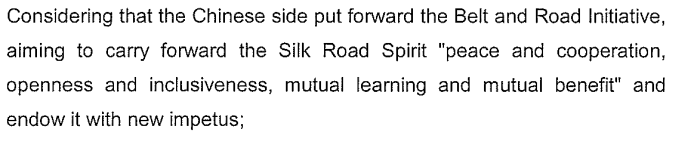
BRI 1

and a bit further on the preamble started to get positively troubling, the Participants

BRI 2

I’m quite sure I – and most New Zealanders –  have  little interest in pushing forward “coordinated economic…and cultural development” with a state that can’t deliver anything like first world living standards for its own people (while Taiwan, Singapore, South Korea etc do) and whose idea of cultural development appears to involve the deliberate suppression of culture in Xinjiang, the persecution of religion (Christian, Muslim, Falun Gong or whatever), the denial of freedom of expression (let alone the vote) and which has only recently backed away from compelling abortions.  And that is just their activities inside China.    “Fusion among civilisations” doesn’t sound overly attractive either –  most of us cherish our own, and value and respect the good in others, without wanting any sort of fusion,and loss of distinctiveness.  But perhaps Simon Bridges saw things differently?

The next section is “Cooperation Objectives”.  There is lots of blather, including this

BRI 3

Hard not to think that “regional peace and development” might be better secured if the PRC forebore from creating new articial islands, seizing reefs etc in the South China Sea, or patrolling menacingly around the Senkaku Islands, engaging in military standoffs with India, or even making threatening noises about Taiwan.  There seem to be two main threats to regional peace, and the other is North Korea.  But you’d never hear anything of that sort from a New Zealand government.

The next section is “Cooperation Principles” under which the governments agree to

BRI 4

In other words, if New Zealand keeps quiet and never ever upsets Beijing, whether about their domestic policies (economic, human rights, democracy), their foreign policies (expansionist and aggressive) or their influence activities in other countries, including our own, everything will be just fine, and the PRC will keep dealing with us.  And on the other hand…….?

There are then  five “Cooperation Areas”.   Apparently, we are going to actively conduct “mutually beneficial cooperation in….public financial management” (hint: that “wall of debt” is a sign things haven’t been done well so far).  But the one that really caught my eye was under the heading “policy cooperation”, where Simon Bridges committed us to
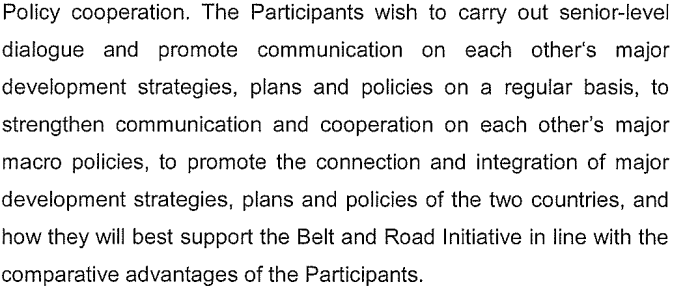
BRI 5

It isn’t obvious New Zealand now has any “major development strategies” (see sustained lack of productivity growth) or that the PRC ones offer much to anyone –  well, individual business deals aside –  when compared with, say, those of Taiwan, Singapore, or Korea.     And what is this bit about strengthening “communication and cooperation on each other’s major macro policies”?     Why?  To what end?     And who thinks it is desirable for New Zealand to “connect and integrate” our (largely non-existent) “major development strategies”, and our “plans and policies” with those of the PRC?  A country that, as even Mr Jacobi recognised in his earlier speech, has fundamentally different values.

And the agreement concludes

bri 6

One has to wonder how it is in the interests of the people of New Zealand (as a whole –  as distinct perhaps from some individual businesses looking for a good deal), or consonant with their values, to support such an initiative, or a regime such as that of the PRC. Apart from anything else, it all seems curiously one-sided: the agreement isn’t to support New Zealanders, but rather to advance a geopolitical projection strategy of a major power, with very different values than our own.   Can anyone imagine us having signed such an agreement with the Soviet Union in the 1970s?

We can only wait and see the details of what the China Council will propose in their paper in May.   And, even more interestingly, what the government comes up with –  being bound to formulate a detailed work plan by September.  Winston Peters may regret the previous government signing up, but he is now stuck with the agreeement for four more years.  One hopes the government will find a way to some minimalist, not very costly, arrangements, but given how keen governments of both major parties have been to cosy up to Beijing –  party presidents praising Xi Jinping –  it is difficult to be optimistic.  On the other hand, it is difficult to see quite what any New Zealand involvement might amount to, and perhaps Beijing has already had the real win –  getting a Western country, a Five Eyes member, to sign up to such a questionable deal with such an obnoxious regime.

But to get back to Mr Jacobi’s speech, nearing the end he observes

There is currently a debate in New Zealand about the extent of Chinese influence in our economy.

I am on record as being concerned about some of the “anti-China” narrative in that debate, especially in the unfortunate targeting of prominent individuals in the Chinese community, but there is nothing wrong with a debate focused on how to build a resilient relationship with China given the difference political values between our two countries.

While I welcome his final half-sentence, it is a little hard to take seriously when he never – at least in public –  engages seriously with the concerns that people like Anne-Marie Brady have been raising.  As I noted about his earlier speech, among other things he will simply never

  • address why it is appropriate to have as member of Parliament in New Zealand a former Chinese intelligence official, former (at least on paper) member of the Communist Party, someone who now openly acknowledges misrepresenting his past on forms to gain entry to New Zealand (apparently because that is what the PRC regime told people to do),
  • address the PRC control of the local Chinese language media, and associated (and apparently heightened) restriction on content,

Instead he falls back on plaintive laments about the “unfortunate targeting of prominent individuals in the Chinese community”.   These same people –  since presumably he has in mind Jian Yang and Raymond Huo –  sit on his own advisory board.  And both are not members of the public, but elected members of Parliament: not in either case elected by a local constituency (and certainly not by “the Chinese community”), but by all New Zealand voters for their respective parties.     And yet both of them –  but particularly Jian Yang –  simply refuse to answer questions or appear in the English language media to explain and defend (in Yang’s case) the background, and their ongoing ties to the PRC and apparent reluctance to ever say a critical word about that heinous regime.

It must now be six months –  since the Newsroom stories first broke –  since Jian Yang has appeared.   At the moment, it looks much less like “unfortunate targeting”, than quite specific and detailed targeting, with unfortunate defence and distraction being played by key figures in the New Zealand establishment, including Mr Jacobi.  Perhaps people might be more persuaded by Jacobi’s case –  that working closely with, and constantly deferring to, the PRC was in the best long-term interests of New Zealanders, if he called for his board members to front up, rather than giving them cover to simply shut up.

In concluding the post a few weeks ago about Mr Jacobi’s earlier speech, I had a speculative paragraph on some uncomfortable parallels between the PRC now, and Germany in the 1930s.  If the parallel isn’t exact –  and we must hope not, given how the earlier episode ended –  it still seems closer than any other historical case I can think of, including the same desperate desire to appease, to understand, to get alongside (key figures in the British Cabinet were still hoping to do economic deals with Berlin well into 1939), and the same reluctance to confront evil or take a stand (even at some cost to some businesses).  In a week when the PRC “Parliament” passed the amendment to remove the term limit on the office of President with 2958 votes in favour and two against, I decided to check out the results of the referendum Hitler staged in August 1934 after President Hindenburg died, to finally concentrate all power in his own hands.  This was 18 months into the Nazi era.  Despite widespread intimidation, almost 10 per cent of voters (on a high turnout) felt free to dissent

For 38,394,848 88.1
Against 4,300,370 9.9
Invalid/blank votes 873,668 2.0
Total 43,568,886 100

There is something to be said for our governments openly and honestly confronting the nature of the Beijing regime.   We can’t change them, and it isn’t our place to, but we can choose with whom we associate, we can choose how often we just keep quiet, and how much of our own values (and the interests of many of our own Chinese citizens) we compromise in the quest for a few deals for a few businesses (and universities) – and a steady flow of political party donations.   And we can, and do, as I’ve pointed out before, make our own prosperity.  If individuals firms want to deal with the PRC, on its terms, then good luck to them I suppose, but we then need to wary of those same firms and institutions, and to ask whose interests they are now, implicitly or explicitly, championing.

There is a weird line in Matthew Hooton’s column in today’s Herald in which he asserts that no one should be critical of China because “China is just doing what emerging Great Powers always do”.  That may be a semi-accurate description.  It didn’t stop us calling out, and resisting, the expansionist tendencies of Germany, Japan, or the Soviet Union.  It shouldn’t hold us back in recognising the threat the latest party-State, the People’s Republic of China, poses both abroad and here.



Our rather moribund economy

The quarterly national accounts data were out yesterday.  They made pretty underwhelming reading.

There was the (rather modest) growth in per capita GDP

pc GDP mar 18

This expansion –  dating from around 2010 –  has been quite a lot weaker than the previous two growth phases.  In the chart you can see that almost every peak for the last 25 years has been lower than the one before.   And for the last year – full year 2017 over full year 2016 – we managed only 0.8 per cent growth in real GDP per capita.   Growth has been slower than that only in the midst of the last two recessions.

At least real per capita GDP grew, you might say.  But hours worked per capita (whether measured by the HLFS or the QES) grew by a touch over 0.8 per cent over that same period.  In fact, there was no growth in labour productivity at all.

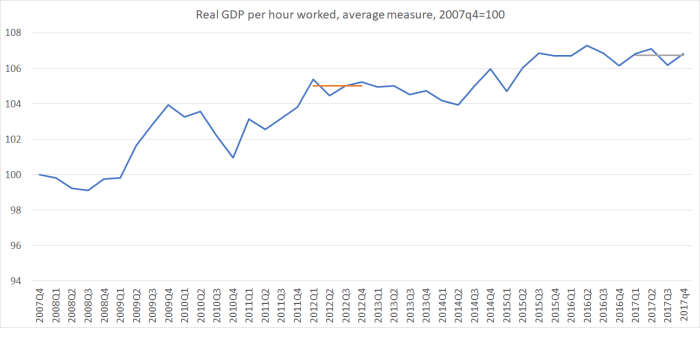
Here is my standard labour productivity chart, averaging the different possible combinations of QES and HLFS hours data and production and expenditure GDP data.

productivity mar 18

There has been no productivity growth at all in the last year, and in the last five years ( the grey line relative to the orange line) average annual labour productivity growth has been only around 0.3 per cent per annum.   And this in an economy that the previous government liked to boast –  and the new government seemed happy to concede –  was doing pretty well.  Productivity growth is the only sustained basis for long-term improvement in material living standards.   We have very little of it –  even as we start so far behind most other advanced countries.

Perhaps our firms have been managing more success in taking in world markets?

There was bounce in the terms of trade –  dairy prices were improving –  so nominal exports as a share of nominal GDP did improve.

x share of gdp

Unfortunately, it looks like another of those series in which each peak is a bit lower than the one before it.    And services exports –  the wave that was much talked of a year or two back –  look to be dropping away again.  Exports of services –  often talked of as the way of the future –  first got to the current level (share of GDP) in 1998.

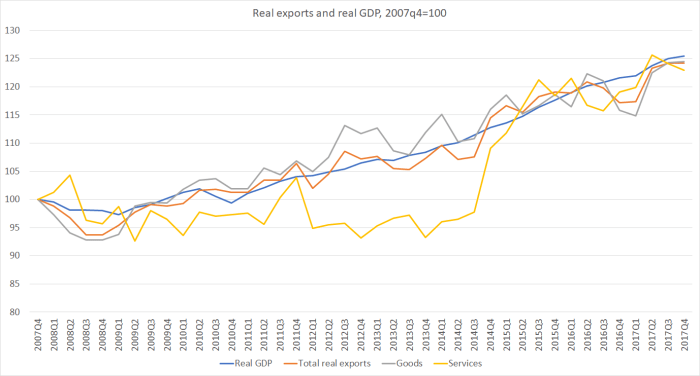
I don’t often show charts of export volumes.  As a share of GDP such charts aren’t very meaningful.  But one can compare growth rates, in this case for the last decade, since just prior to the 2008/09 recession.

x and gdp real

Over the decade as a whole, export volume growth has barely kept pace with the unimpressive growth in real GDP, and even the services surge in 2014/15 only ‘made up’ for the severe underperformance of that sector in the previous few years.   Recall that, for a country with a small population, New Zealand’s export share of GDP is very low to start with, and over this decade there has been no progress in closing that gap (something probably an integral mark of any sucessful policy programme to close the overall productivity gaps).  The result isn’t very surprising given how out of line with relative productivity our real exchange rate has become, but it can be (soberingly) useful to see the hypothesis confirmed in the data.

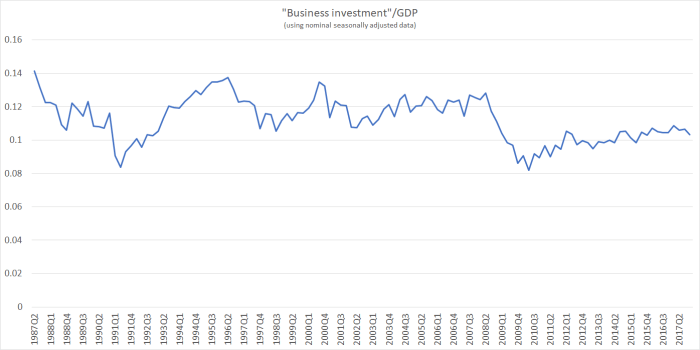
And one last chart.  Here is the proxy for business investment spending as a share of GDP (total investment less government and residential investment).

business investment to dec 17

Yet another chart in which each peak seems lower than the one before it –  and this in a country where, with very rapid population growth at present, one might have hoped to see a temporarily larger than usual share of current GDP going to business investment, to maintain the capital stock per worker.   But no.    If anything –  and there is noise in the series so I wouldn’t make anything much of it – things may have been falling off again in the last few quarters.

These weren’t outcomes the previous government showed any sign of caring about.   In Opposition, Grant Robertson would regularly release statements when the national accounts came out lamenting the relatively poor performance.  In office, there was no statement yesterday.  And despite the occasional ritual obeisance to the idea of lifting productivity performance, there is no sign that government –  or their Treasury advisers –  has any serious idea how such outcomes might be brought about, or any very serious commitment to trying.


Estimating NAIRU

The Reserve Bank of New Zealand has long been averse to references to a “natural rate of unemployment” or its cognate a “non-accelerating inflation rate of unemployment” (NAIRU).  It started decades ago, when the unemployment rate was still very high, emerging from the structural reforms and disinflation efforts of the late 80s.  We didn’t want to lay ourselves open to charges, eg from Jim Anderton, that we regarded unemployment as natural or inevitable, or were indifferent to it, let alone that we were in some sense targeting a high rate of unemployment.   Such a criticism would have had little or no analytical foundation –  we and most mainstream economists held that a NAIRU or “natural” rate of unemployment was influenced largely by labour market regulation, welfare provisions, demographics, and other structural aspects (eg rate of turnover in the labour market) that were quite independent of monetary policy.  But the risk was about politics not economics, and every election there were parties looking to change the Reserve Bank Act.  And so we never referrred to NAIRUs if we could avoid it –  which we almost always could –  preferring to focus discussions of excess capacity etc on (equally unobservable) concepts such as the output gap.  In our formal models of the economy, a NAIRU or a long-run natural rate could be found lurking, but it made little difference to anything (inflation forecasts ran off output gap estimates and forecasts, not unemployment gaps).

Other central banks do things a bit differently, perhaps partly because in some cases (notably Australia and the US) there is explicit reference to employment/unemployment in monetary policy mandates those central banks are working to.   In a recent article, the Reserve Bank of Australia observed that

“When updating the economic forecasts each quarter, Bank staff use the latest estimate of the NAIRU as an input into the forecasts for inflation and wage growth”

It may not make their monetary policy decisions consistently any better than those here, but it is a difference in forecasting approach, and in how the RBA is prepared to talk about the contribution of unemployment gaps (as one indicator of excess capacity) to changes in the inflation rate.

I’ve been arguing for some years –  first inside the Bank, and more recently outside –  that our Reserve Bank put too little emphasis (basically none) on unemployment gaps (between the actual unemployment rates and the best estimate of a NAIRU).  It has been the only central bank in the advanced world to start two tightening cycles since 2009, only to have to reverse both, and I had noted that this outcome (the reversals) wasn’t that surprising when for years the unemployment rate had been above any plausible estimate of the NAIRU.   The Bank sought to fob off criticisms like this with a new higher-tech indicator of labour market capacity (LUCI) –  touted by the Deputy Governor in a speech, used in MPSs etc – only for that indicator to end badly and quietly disappear.

But since the change of government  –  a government promising to add an explicit employment dimension to the Bank’s monetary policy objective (now only 12 days to go til the new Governor and we still haven’t seen the new PTA version) –  there has been some pressure for the Bank to be a bit more explicit about how it sees, and thinks about, excess capacity in the labour market, including through a NAIRU lens.  In last month’s Monetary Policy Statement, they told us their point estimate of the NAIRU (4.7 per cent) and in the subsequent press conference, the Governors told us about the confidence bands around those estimates.  All this was referenced to an as-yet-unpublished staff research paper (which still seems an odd inversion – senior management touting the results before the research has had any external scrutiny).

Last week, the research paper was published.  Like all RB research paper it carries a disclaimer that the views are not necessarily those of the Reserve Bank, but given the sensitivity of the issue, and the reliance on the paper at the MPS press conference, it seems safe to assume that the paper contains nothing that current management is unhappy with.  What the new Governor will make of it only time will tell.

There was interesting material on the very first page, where the authors talk about the role of monetary policy.

The focus of monetary policy is to minimise fluctuations in cyclical unemployment, as indicated by the gap between the unemployment rate and the NAIRU, while also maintaining its objective of price stability.

I would very much agree.  In fact, that way of stating the goal of monetary policy isn’t far from the sort of wording I suggested be used in the amended Reserve Bank Act. Active discretionary monetary policy exists for economic stabilisation purposes, subject to a price stability constraint.  But the words are very different from what one has typically seen from the Reserve Bank over the years (including, for example, in their Briefing to the Incoming Minister late last year).

But the focus of the research paper isn’t on policy, but on estimation.  The authors use a couple of different techniques to estimate time-varying NAIRUs.   Since the NAIRU isn’t directly observable, it needs to be backed-out of the other observable data (on, eg, inflation, wages, unemployment, inflation expectations) and there are various ways to do that.   The authors draw a distinction between a “natural rate of unemployment” and the NAIRU: the former, conceptually is slower moving (in response to changes in structural fundamentals –  regulation, demographics etc), while the NAIRU can be more cyclical but tends back over time to the longer-term natural rate.  I’m not myself convinced the distinction is that important –  and may actually be harmful rhetorically –  but here I’m mostly just reporting what the Bank has done.

The first set of estimates of the NAIRU are done using a Phillips curve, in which wage or price inflation is a function of inflation expectations, the gap between the NAIRU and the unemployment rate, and some near-term supply shocks (eg oil price shocks).  Here is their chart showing the three variants the estimate, and the average of those variants.

nairu estimates.png

Perhaps it might trouble you (as it does me) but the authors never mention that their current estimates of the New Zealand NAIRU, using this (pretty common) approach, are that it has been increasing for the last few years.    Frankly, it doesn’t seem very likely that the “true” NAIRU has been increasing –  there hadn’t been an increase in labour market regulation, the welfare system hadn’t been becoming more generous, and demographic factors (a rising share of older workers) have been tending to lower the NAIRU.

As it happens, the authors have some other estimates, this time derived from a small structural model of the economy.

NAIRU NK

Even on this, rather more variable, measure, the current central estimate of the NAIRU is a bit higher than the authors estimate it was in 2014.    But the rather bigger concern is probably the extent to which over 2008 to 2015, the estimated NAIRU on this model seems to jump around so much with the actual unemployment rate.   Again, the authors offer no thoughts on why this is, or why the pattern looks different than what we observed in the first half of their sample.  Is there a suggestion that the model has trouble explaining inflation with the variables it uses, and thus all the work is being done by implicitly assuming that what can’t otherwise be explained must be down to the (unobserved) NAIRU changing?   Without more supporting analysis I just don’t find it persuasive that the NAIRU suddenly shot up so much in 2008/09.   For what it is worth, however, do note that the actual unemployment rate was well above the NAIRU (beyond those grey confidence bands) for years.

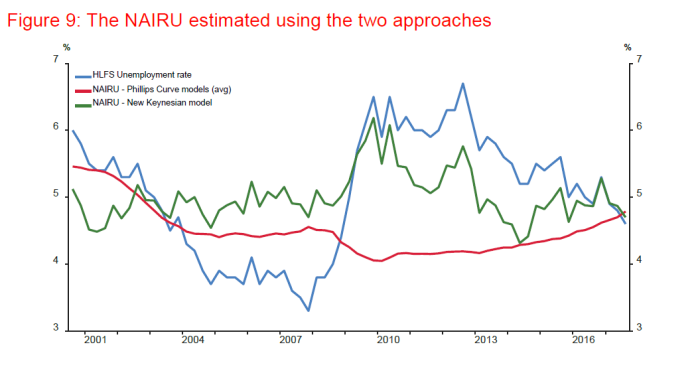
Here is what the picture looks like when both sets of estimates are shown on the same chart.

nairu x2

On one measure, the NAIRU fell during the 08/09 recession, and on the other it rose sharply.  On one measure the NAIRU has been steadily rising for several years, while on the other it has been jerkily falling.  No doubt the Bank would like you to focus on the end-point, when the two sets of estimates are very close, but the chart does have a bit of a “a stopped clock is right twice a day” look to it.   When the historical estimates coincide it seems to be more by chance than anything else, with no sign of any consistent convergence.

I noted the end-point, where the two estimates are roughly the same.  But end-points are a significant problem for estimating these sorts of time-varying variables.  The authors note that in passing but, somewhat surprisingly, they give us no sense of how material those revisions can be, and have been in the past.  I went back to the authors and asked

I presume you’ve done real-time estimates for earlier periods, and then checked how  –  if at all –  the addition of the more recent data alters the estimates of the NAIRU for those earlier periods, but if so do you have any comments on how significant an issue it is?

To which their response was

An assessment of the real-time properties of the NAIRU and the implied unemployment gap was beyond the scope of our paper.

Which seems like quite a glaring omission, if these sorts of model-based estimates of a time-varying NAIRU are expected to play any role in forecasting, or in articulating the policy story (as the Governors did in February).

As it happens, the Reserve Bank of Australia published a piece on estimating NAIRUs etc last year.  As a Bulletin article it is a very accessible treatment of the issue.   The author used the (reduced form) Phillips curve models (of the sort our Reserve Bank used in the first chart above).

nairu rba

The solid black line is the current estimate of Australia’s NAIRU over the whole of history.  But the coloured lines show the “real-time” estimates at various points in the past. In 1997 for example (pink line) they thought the NAIRU was increasing much more –  and thus there was less excess labour market capacity –  than they now think (or, their model now estimates) was the case.  In 2009 there was a stark difference in the other direction.  Using this model, the RBA would have materially underestimated how tight the labour market actually was.

It would be surprising if a comparable New Zealand picture looked much different, but it would be nice if the Reserve Bank authors would show us the results.   These end-point problems don’t mean that the model estimates are useless, but rather that they are much more useful for identifying historical NAIRUs (valuable for all sorts of research) than for getting a good fix on what is going on right now (the immediate policy problem).    That is true of many estimates of output gaps, core inflation (eg the RB sectoral core measure) and so on.

Having said that, at least the Australian estimates suggest that Australia’s NAIRU has been pretty steadily falling for the last 20 years or so, with only small cyclical dislocations.  Quite why the Reserve Bank of New Zealand’s Phillips curve models suggest our NAIRU has been rising –  when demographics and welfare changes typically point the other way –  would be worth some further examination, reflection, and commentary (especially if Governors are going to cite these estimates as more or less official).

Comparing the two articles, I noticed that the RBA had used a measure of core inflation –  their favoured measure, the trimmed mean –  for their Phillips curve estimates, while the RBNZ authors had used headline CPI inflation (ex GST).  Given all the noise in the latter series – eg changes in taxes and government charges –  I wondered why the authors didn’t use, say, the sectoral factor model estimate of core inflation (the Reserve Bank’s favoured measure).  It would be interesting to know whether the NAIRU results for the last half decade (when core inflation has been very stable) would be materially different.  It might also be worth thinking about using a different wages variable. The authors use the headline LCI measure, as a proxy for unit labour costs. But we have actual measures of unit labour costs (at least for the measured sector), and the authors could also think about using, say, the LCI analytical adjusted series and then adjusting that for growth in real GDP per hour worked (a series that has itself been revised quite a bit in the last year).  No model estimate is going to be perfect, but there does seem to be some way to go in refining/reporting analysis research in this area.

I have argued previously that the Reserve Bank should be required to report its estimates of the NAIRU, and offer commentary in the MPS on the contribution monetary policy is making to closing any unemployment gaps.   I’d have no problem with the Bank publishing these sorts of model estimates, but I’d have in mind primarily something a bit more like the Federal Reserve projections, in which the members of the (new, forthcoming) statutory Monetary Policy Committee would be required to publish their own estimates of the long-run sustainable rate of unemployment that they expect the actual unemployment rate would converge to (absent new shocks or structural changes).  The individual estimates are combined and reported as a range.  No doubt those individual estimates will have been informed by various different models, but in the end they represent best policymaker judgement, not the unadorned result of a single model (end-point) problems and all.

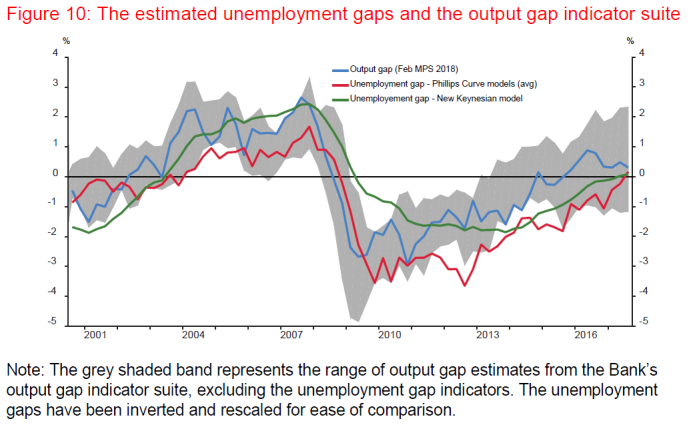
And finally, the Reserve Bank (aided and abetted by the Board) has always refused to concede it made a mistake with its (eventually reversed) tightening cycle of 2014 –  sold, when they started out, as the beginning of 200 basis points of increases.  The absence of any emphasis on the unemployment rate, or unemployment gaps, was part of what got them into trouble.  In the latest research paper there is a chart comparing the Bank’s current estimates of the NAIRU (see above) with their current estimates of the output gap.

nairu and output gap

The tightening cycle was being foreshadowed in 2013, it was implemented in 2014, it was maintained well into 2015.  And through that entire period, their unemployment gap estimates were outside the range of the output gap estimates.

We don’t have their real-time estimates of the unemployment gap, but we do have their real-time output gap estimates.  They might now reckon that the output gap in mid 2014 (blue line) was still about -1 per cent but in the June 2014 MPS they thought it was more like +1.5 per cent.

output gap from june 2014 mps

The failure to give anything like adequate weight to the direct indicators of excess capacity from the labour market (ie the unemployment rate and estimates of the NAIRU) looks –  as it felt internally at the time – to have contributed materially to the 2014 policy mistake.

(In this post, I’m not weighing into the specific question of what exactly the level of the NAIRU is right now, and the Bank does emphasise that there are confidence bands around its specific estimates, but I’m aware that is also possible to produce estimates in which the current NAIRU would be 4 per cent or even below.)

“Productivity” missing in action

There was going to be a post yesterday, on the Reserve Bank’s newly-published estimates of the natural rate of unemployment, the NAIRU etc.   But then, walking down the stairs at home, I went over on my right foot and, so it turns out, broke a bone.   And so now I sit encased in plaster for a couple of weeks, not able to do much of what stay-at-home parents do.  But I can still type and the NAIRU post might appear later in the day.

In the meantime, this morning the Tax Working Group released its Submissions Background Paper.  I’m sure there is plenty of interesting material in it, and in due course I’ll read it, and probably write about it (especially the capital gains tax sections).  But, out of curiousity, I electronically searched the document.   First, I searched for “productivity”    There were two footnotes referring to Productivity Commission documents, and one quote from the terms of reference for the Tax Working Group; one of the government’s objectives for the tax system is

·             A system that promotes the long-term sustainability and productivity of the economy

And that was it.

So I tried “productive”.  That produced four results, but

  • one was in the appendix reproducing the Terms of Reference,
  • one was in an appendix of questions for submittters”,
  • one was a question posed at the start of a chapter, and
  • the final one simply described the question the government had asked them to think about.

In other words, no analysis, no description at all.   The (short) Terms of Reference were weak on this score –  the clear focus was “fairness” –  but the TWG’s own much-longer document was even worse.    And just in case some serious analysis or discussion was lurking under terms like “the tradables sector” or a concern about growing “exports” I searched under various forms of those words, and there were no references at all.  Not one.

The yawning productivity gap isn’t the only problem or issue New Zealand faces, and it shouldn’t be the only consideration in the design of the tax system.   But when it is totally absent from the discussion document framing the Tax Working Group’s work, it simply further reinforces that perception (which I’ve writtten about here and here) that there is little reason to think the government is serious about grappling with the decades of relative decline.  I doubt that anything in the tax system is overly important in explaining that relative decline –  although a heavy tax burden on returns to business investment (especially FDI) won’t be helping –  but it seems extraordinary that the issue isn’t even touched on in the working group’s background document.


From the weekend current affairs shows

Two of the government’s top four ministers appeared on the weekend TV current affairs shows. It wasn’t encouraging.

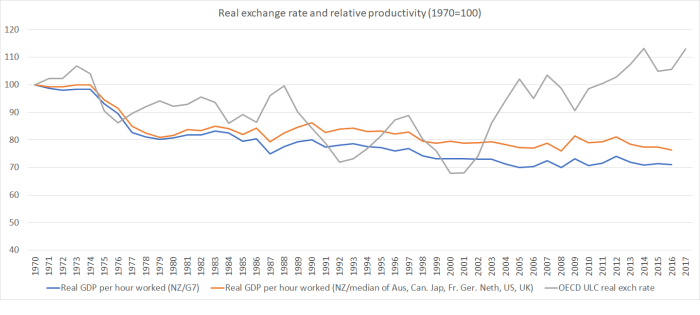
The Minister of Finance appeared on TVNZ’s Q&A.   There was a great deal of talk about boosting wages –  after several years in which real wage growth has outstripped (almost non-existent) productivity growth.  But nothing about credible steps that might lift productivity growth itself.  It is easy to spend money, but much harder to generate the foundations for higher incomes in the first place.   And there seemed to be no recognition whatever that the real exchange rate has been increasingly out of line with the dismal productivity performance

rer and rel GDP phw

or, not unrelatedly, that the export share of New Zealand GDP has been shrinking, not rising.  And, of course, no plans, no suggestions even, as to what might be done to reverse this decline.

There was talk of the tax system having, it was claimed, underpinned a “speculative economy”, but no sense of how the Minister of Finance saw possible tax system changes producing materially different outcomes –  notably around house prices –  than they have in Australia, the UK, Canada, or much of the coastal US.    Nothing, of course, about fixing the fundamental problem: land-use restrictions, the effects of which appear to have become increasingly binding (some nice new evidence on just that point from Australia was published last week).

There was blather about the forthcoming ‘wellbeing budgets”, built on The Treasury’s living standards framework, but no sense of how decisionmaking was going to be improved or economic (or other) outcomes improved.

There was a lot of talk about the “future of work” –  one of the Minister’s favourite themes –  and the potential to support workers facing displacement by the advance of technology etc, at a time when the employment rate and the participation rate are both higher than they’ve been at any time in the 30+ years history of the HLFS data.

There was enthusiastic talk about the economic benefits of immigration, but no evidence or argumentation.  And for all the talk about “skills gaps” no recognition of the OECD data suggesting New Zealand workers are among the most skilled of any in the advanced world.  And for all the allusions to the role of immigrants in building houses, no apparent recognition of just how few construction workers are among the immigrants, or of the new research published by the Reserve Bank of which the authors note (and which in many ways just repeats what New Zealand economists knew decades ago)

The estimates further suggest population change may be ‘hyperexpansionary’ as the residential construction demand associated with an additional person is higher than the output they produce. In these circumstances, population increases raise the demand for labour and create pressure for additional inward migration, potentially explaining why migration-fueled boom-bust cycles may occur.

And that was just the Minister of Finance.

On Saturday, the Deputy Prime Minister and Minister of Foreign Affairs had been interviewed on The Nation.   When I read the news story about the interview I couldn’t quite believe what I was reading, and went back to watch the interview to see if Winston Peters was being fairly reported. He was.

It was bad enough to find New Zealand’s Minister of Foreign Affairs appearing to defend Donald Trump’s tariff policy.   I can understand that it might not have been diplomatic to have openly attacked them as rushed, ill-considered, dangerous and not grounded in any decent economic analysis.   In other words, stepping around the issue delicately would have been one thing.  But the defence of Trump was pretty shameful –  the more so in a week when the government of which he is Deputy Prime Minister was signing up to what it would have us believe was a new “free trade agreement”.

But rather than oppose the move as detrimental to free trade, Mr Peters said Mr Trump was reacting to unfair deals.

“What’s Donald Trump’s biggest complaint? It’s that countries shouting out ‘free trade for America’ don’t practise free trade themselves. In fact it’s New Zealand First’s and my complaint that the countries we deal with apply tariffs against us whilst we’re giving them total and unfettered access to our country. It’s simply not fair.”

He said Mr Trump’s move was “not Luddite, it’s not old-fashioned”.

“It happens to be an economic fact which some propagandists of the free market tenet should face up to, and describe why it’s not fair for Donald Trump to do what he’s doing.

Do the Minister of Finance, the Minister for Trade and Export Growth, and the Prime Minister agree with this sort of “trade as zero-sum” analysis and approach, that threatens to further undermine the WTO arrangements governing world trade, which have been of considerable value to New Zealand?

But our Minister of Foreign Affairs hadn’t finished.    He also went on record as one of the few people left, outside the Russian government, asserting that Russia had not been attempting to meddle in the US 2016 election.    Reasonable people might differ on whether there is any real evidence that such meddling made any material difference –  as staunch an anti-Putin anti-Trump observer as Masha Gessen remains very sceptical.  One might even take the view that it is not really any of New Zealand’s business.  But for our Foreign Minister to actually be weighing in in defence of Putin should be inconceivable, inexplicable, and indefensible.  Sadly, it is now only the latter two.

But even that was just the entree.  The crowning outrage was the attempt by our Deputy Prime Minister and Minister of Foreign Affairs to suggest that the Russian authorities had no part in any responsibility for the downing of the Malaysian airliner over Ukraine and the deaths of 298 people.  Sure, Vladimir Putin himself didn’t the fire the missile (leaders rarely do) but as David Farrar summarises it

the Dutch investigation found the Buk missile system was transported from Russia on the day of the crash, fired from a rebel controlled area and returned to Russia after it was used to shoot down MH17.

If the Minister just wanted to mount an argument that our firms can still trade with evil regimes –  a point he went on to make – that would be one thing.  After all, our governments have been pursuing deals with Saudi Arabia, even as it is primarily responsible for the ongoing disaster in Yemen.  If he wanted to make an argument that there are bigger threats to the world than Russia –  China say? –  reasonable people could also debate that proposition.

But to minimise the Russian regime’s responsibility for what was an act of mass murder of innocent, otherwise uninvolved, civilians is just shameful, indeed disgraceful.  It shouldn’t be allowed to pass quietly by by the Prime Minister, the rest of her Cabinet, or (say) the leaders of the Green Party on whom the government also depends.   What sort of country would we be becoming if a senior minister can get away with lines like this?

It seemed to be a weekend for trivialising the really dangerous stuff by use of spurious –  and insulting –  comparisons.   In the same interview, Peters seemed to compare Russsa’s actions in Ukraine (or the US) with Australia’s in legally deporting from Australia non-citizens convicted of committing crimes in Australia.  And in another interview a few days ago Peters seemed to be attempting to draw parallels between the activities of the government of the People’s Republic of China in the Pacific (and presumably New Zealand) and those of private citizens among the Samoan and Tongan diaspora in New Zealand.

Amidst fears about outside influence from the Chinese in the Pacific, Peters is quick to note that New Zealand possesses some influencers of its own.

“One of great forces in Tongan society is the Tongan society in New Zealand, that’s where an enormous amount of remittance money is coming from, and that’s the same for Samoa.

“So when you talk about outside influences, bear in mind that we have massive outside influences on Samoa.”

If you refuse to actually confront real threats, that is one thing, but don’t insult us – or our friends, allies, and even our citizens –  with such efforts at trivialising those threats, those behaviours.


The Treasury reminds us that GDP – and productivity – really is almost everything

In recent times, we’ve heard endlessly from The Treasury and the government about the emphasis they want to place on the “living standards framework” Treasury has been cooking up for some years for a left-wing government (the previous government had little interest).  We are constantly told that there should be less emphasis on GDP-based measures.

This was a news report just a few week ago

Prime Minister Jacinda Ardern was enthusiastic about the new approach in her speech in a church on Wednesday about the Government’s plans beyond the first 100 days. From 2019, Budgets would be delivered using new metrics designed to paint a more accurate picture of New Zealanders’ lives and encourage government to tailor spending to lift the country’s performance across those metrics, she announced.

Budgets would go beyond GDP per capita and debt to GDP ratios to analyse the wider effects on people’s wellbeing and the state of the environment in an inter-generational way, she said.

“By Budget 2019 Grant and I want New Zealand to be the first country to assess bids for budget spending against new measures that determine, not just how our spending will impact on GDP, but also on our natural, social, human, and possibly cultural capital too,” she told the crowd.

I’m among those who’ve long been sceptical of the Living Standards Framework, and the “four capitals” approach that is now its shop window.   It has always seemed content-light, and more about product differentiation (on the one hand), and a way of avoiding focusing on the decades-long record of productivity growth underperformance (on the other).   Treasury has had no compelling answers to the productivity failure, and so it must have been tempting to shift the focus. Since the new government evidently has no plan, and they have “feel-good” constituencies to please, it must have seem doubly appealing.

I’ve been meaning to write some more about some of the papers and speeches The Treasury has released recently, expecting to cast further doubt on whether the new framework is likely to add any analytic value, or improve the quality of policymaking.

But yesterday I noticed that The Treasury had saved me the effort.  On their Twitter feed was this retweet

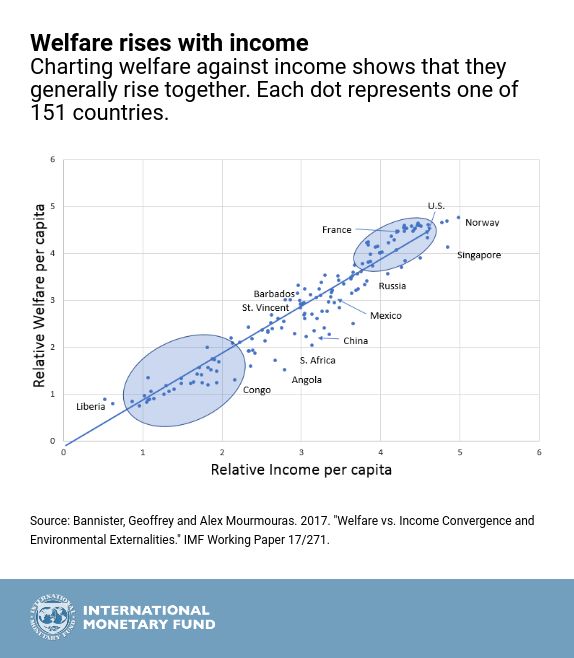
vs. : What makes countries better off? IMF economists crunch the numbers. Read

It was drawn from this IMF piece. In it, the IMF reports

For years, economists have worked to develop a way of measuring general well-being and comparing it across countries. The main metric has been differences in income or gross domestic product per person. But economists have long known that GDP is an imperfect measure of well-being, counting just the value of goods and services bought and sold in markets.

The challenge is to account for non-market factors such as the value of leisure, health, and home production, such as cleaning, cooking and childcare, as well as the negative byproducts of economic activity, such as pollution and inequality.

Charles Jones and Peter Klenow proposed a new index two years ago (American Economic Review, 2016) that combines data on consumption with three non-market factors—leisure, excessive inequality, and mortality—in an economically consistent way to calculate expected lifetime economic benefits across countries. In our recent working paper, Welfare vs. Income Convergence and Environmental Externalities, we updated and extended this work, attempting to include measures of environmental effects and sustainability. In this blog we look at our results from updating the new index.

Our findings clearly suggest that per capita income or GDP does capture the main component of well-being. And health—a key component of well being—is critical to raising welfare and income.

The well-being index

What emerges from Jones and Klenow’s work is a consumption-equivalent index that measures welfare derived from consumption, then adds the value of leisure (or home production) and subtracts costs related to inequality. This calculation is made for each country over one year and then multiplied by the life expectancy in each country. This gives us a measure of average expected lifetime welfare based on consumption, leisure, inequality, and life expectancy. (Click here for a further discussion of the well-being index.)

There is a close relationship between our calculation of per capita welfare for 151 countries in 2014 and per capita income or GDP. The chart above [reproduced in the tweet] shows that most countries line up fairly well along the 45-degree line (where relative welfare and income per capita are the same) indicating correlation, but there are significant differences, too. Poorer countries on the left are largely below the line, showing that welfare is lower than income. Richer countries at the top right are above the line, reflecting welfare that is higher than income.

Enough said really.  There is little sign of any obvious gain from shifting the focus of the Budget, or The Treasury’s advice from GDP per capita, and the productivity measures –  GDP per hour worked, and MFP –  which are associated with them –  to amorphous living standards/ “four capitals” measures.

Of course GDP isn’t perfect.  And of course governments can boost GDP is welfare-detracting ways (eg conscription and forced labour), and yet The Treasury ends up promoting new research from the IMF suggesting that in fact countries don’t do so to any material extent (if it were otherwise more countries would be much further from the 45 degree line).  It suggests what everyone has always known –  that in setting policy governments do think about other stuff, not just GDP (check out all those Cabinet papers with “Treaty implications” section, as just one example).  And that measures that free people and economies to lift productivity, and with it potential GDP, remain the most salient and reliable way to lift key elements of living standards (not just material consumption).  Fix productivity and many other possibilities comes with it.   It still won’t capture everything, but beyond that a great deal involves explicit value judgements, in which area Treasury has no superior expertise or insight.

Perhaps instead of diverting so much of their analytical resource into the new-fangled, not particularly robust, tools and frameworks, The Treasury could return to getting the basics right: robust advice on expenditure, calling out bad or rushed policy when it is proposed/promised, and focusing in –  with a genuinely open mind – on the specifics of why New Zealand’s long-term productivity performance has been so poor.


Is the government doing some serious thinking about immigration policy?

The general impression since the formation of the new government has been that this government –  like its National and Labour predecessors –  is largely a champion of the large-scale immigration programme New Zealand has run for decades.  That impression has only been reinforced by the way corporate interests –  probably especially the export education industry – appear to have persuaded them to back off, at least for now, from even the modest changes around student work visas that the Labour Party had campaigned on.  But then I noticed this advert in my in-box (and no, I am not looking for a job) from a firm that describes themselves as “public sector recruitment specialists” (emphasis added).

Principal Policy Advisors x 6
Permanent

· Be involved in a new high profile programme of work
· Own and drive strategic policy and lead complex policy programmes
· Bring your fresh perspective and challenge the status quo

The Challenge
We are looking for six Principal Policy Advisors that are keen to take part in a unique government initiative, across five different policy domains.
As thought leaders, your work here is set to impact the New Zealand economy, its labour market, and immigration policies.
This is an opportunity to challenge your selves to put forward new ideas and bring a fresh perspective on managing one of New Zealand’s biggest and most complex issues.

Six Principal Advisors  – who don’t come cheap –  is a serious commitment of resource to whatever this “unique government initiative” is.

I don’t know what the project is –  perhaps someone could ask the Minister of Immigration or the Minister for Economic Development –  but in tight fiscal times, it certainly looks as though some agency has been found the money for something fairly significant on immigration policy.  If so, of course, it is not before time.

UPDATE (20/3):  A few days after this post this comment came in, and has been showing below.

Clive Horne

That seemed quite startlingly incompetent.

I had a further note from Mr Horne this noting that “unfortunately MBIE are still receiving enquiries around this. As mentioned the roles are around the teams involved in the labour market issues and are to fill existing vacancies not focused on a new initiative”.   At his request I have elevated his earlier comment into the body of this post.

And, as far we can now tell, there is no new thinking going on about immigration and economic performance, and MBIE has still not published the (well overdue) annual data on approvals etc under current policy (when I asked the other day, I was told it should be out by the end of April, six months late on the normal schedule.

Preparing for the next serious recession

There have been three New Zealand recessions since inflation targeting was introduced.  That, in turn, wasn’t long after interest rates were liberalised and the exchange rate was floated in 1984/85.   Of those recessions, two were severe and one (the 1997/98 episode) was more moderate.    Here is how 90 day bank bill interest rates –  the benchmark indicator before the OCR was introduced –  fell (and were allowed to fall by monetary policy) in those episodes.

Mid-late 1990 to mid-late 1992                   780 basis points

Mid-1997 to end 1998                                   340 basis points

Late 2007 to mid 2009                                  590 basis points (OCR cut 575 basis points)

Over the first of those periods, medium-term inflation expectations fell by about 2 percentage points (from about 4.3 to 2.3 per cent) –  that was in the midst of the major drive to lower the inflation rate.  In the other two episodes there was no material change in surveyed inflation expectations.    So in the two severe recessions, short-term real interest rates fell (or were cut) by about 580 basis points, and in the less serious recession they fell by 340 basis ponts.

At present, the OCR is 1.75 per cent (and 90 day bank bill rates are about 1.9 per cent).    As things stand today (current laws, rules, and central bank practices), no one is confident that the OCR could be cut further than around -0.75 per cent.   Below that, it seems likely that it would become economic for large scale moves into physical cash (which earns zero less storage and insurance costs) to occur –  mostly not by households, but by market participants with large holdings of New Zealand dollars.  To the extent such shifts happen, market interest rates wouldn’t fall much even if the OCR was cut further.  That would dramatically undermine the effectiveness of conventional monetary policy (which works mostly either through direct interest rate effects, or through the influence of interest rates on the exchange rate).

There isn’t anything very controversial about that story.  At the Reserve Bank it was a conclusion we got to in a project I led back in about 2012 when the euro-crisis seemed to foreshadow risks of new externally-sourced crisis/recession.   It is consistent with the revealed practices of other central banks (no one has cut below -0.75 per cent), and is just pretty standard analysis.

So if the next recession hit today, the Reserve Bank could count on having around 250 basis points of policy adjustment capacity (the OCR could be cut that much).   But it has needed more than that in each of the (small sample of) recessions in recent decades.

And it isn’t that the New Zealand numbers are unusual.  In the US recessions going back to the 1960s, the median cut in the (nominal) Fed funds rate has been just over 500 basis points.

If the OCR can’t be cut as much as normal, monetary policy cannot do its job.  We have active discretionary monetary policy to minimise the output and employment losses in downturns (adverse economic shocks come along every so often, like it or not).    And if markets, and businesses, know that monetary policy is thus hamstrung, they will factor that into their expectations and the actual downturn will probably end up even worse (the monetary policy cavalry aren’t expected to ride to the rescue).

And so, every so often since I started writing this blog, I’ve been highlighting the potential problem the next time a serious recession comes along, and lamenting the apparent (certainly in public) indifference of our Reserve Bank, Treasury, and Ministers of Finance to the issue.  Other countries ran into the limits of conventional policy in the last recession.  They couldn’t do much about it then, and paid the price in a very sluggish recovery (slow closing of output and employment gaps). But no country needed to find itself in this position if it prepared the ground well before the next recession.

In raising these concerns, I’ve been in good company.    Since shortly after the last recession various prominent economists –  of pretty impeccable orthodoxy –  have been raising the possible need to think about an increase in inflation targets.  Two of the most prominent were former IMF chief economists, Ken Rogoff and Olivier Blanchard.  Their logic is simple.  Inflation targets were set on the assumption (implict or explicit –  in our case, we actually wrote it down at times) that the near-zero lower bound on nominal interest rates was only a theoretical curiosity, and of little or no practical relevance.  Experience in various countries proved that assumption wrong.   And in the medium to long term, the most reliable way to raise nominal interest rates –  and thus leave room for substantial cuts in future recessions – is to raise actual and expected trend inflation.  (One counter to this argument for some countries a few years ago was that since most central banks were having trouble meeting existing inflation targets, and had already exhausted conventional capacity, how could they hope to credibly target still higher inflation.)

Other economists –  Miles Kimball, Willem Buiter, and more recently Ken Rogoff –  have focused on the other side of the issue: can changes in currency laws or practices be put in place which would mean that nominal interest rates could be cut more deeply.  As various observers have noted, some estimates of a conventional Taylor rule suggest that ideally the Fed funds rate would have been cut –  for a short time perhaps –  as low as -3 or even -5 per cent at the height of the 2008/09 recession.

In practice, nothing much has changed yet.  No one has changed their inflation target –  or adopted, say, price level of nominal GDP level targeting which some (including the head of the San Francisco Fed) believe could provide more resilence –  or taken steps to deal directly with the practical lower bound.   We are drifting towards the next severe recession, with the toolkit severely depleted.

In New Zealand, it has been harder than in most places to get any serious debate going at all.   I suspect a variety of factors contributes to that, including:

  • the fact that we didn’t get particularly close to the near-zero lower bound ourselves in the last recession,
  • the persistent belief that before long interest rates will again be much higher,
  • the belief that New Zealand has lots of fiscal headroom such that even if monetary policy is constrained in some future recession it won’t matter,
  • given the perpetual discontent in some quarters in New Zealand around monetary policy (it has been an election issue for some or other party every election since 1990) a desire, among the orthodox, not to be seen as “giving aid and comfort to the enemy”.

There is also a bit of handwaving around the possibilities of QE (direct asset purchases), but this is mostly handwaving and attempting to play distraction as no one in other countries –  that have actually used QE –  believe it is an effective substitute, on feasible scales, for the conventional interest rate instruments.

I would not, myself, regard a higher inflation target as any sort of first-best option.  Indeed, in an ideal world, I’d be more comfortable with a regime that delivered average inflation near-zero over time (allowing for the modest measurement biases in the CPI).  Inflation has costs, although economists have struggled to find convincing estimates of large adverse effects at relatively low inflation rates.  And many of the costs that do exist arise from the fact that the tax system is designed for a zero inflation rate.  Inflation-indexing the tax system (mostly around the treatment of interest and depreciation) could tackle that issue quite directly (and there are official reports from decades ago, here and abroad) identifying how it could be done.   (It would treat savers, and borrowers, more fairly, even with a 2 per cent inflation target: perhaps I point I might make in my submission to the Tax Working Group.)

But if there are modest –  largely avoidable –  costs of a slightly higher inflation target, they quite quickly pale in comparison with the output and welfare losses if monetary policy isn’t able to operate as effectively in leaning against recessions.  Drifting towards imposing that cost on ordinary New Zealanders –  and it won’t be the Treasury or Reserve Bank officials who face those cyclical costs – should be pretty inexcusable.

And so I was encouraged when, the other day, Radio New Zealand’s Patrick O’Meara rang up.  He’d been reading my post which had noted, in passing, the IGM survey of US economists in which 86 per cent of those senior US academics agreed that

Raising the inflation target to 4% would make it possible for the Fed to lower rates by a greater amount in a future recession.

and was interested in how one might think about these issues, and do something about them (immediately and in the medium-term), in a New Zealand context.   We talked at some length, and then he talked to some other people, and the result was this story.

I was quoted this way

While uneasy about higher inflation, economic commentator and former Reserve Bank official Michael Reddell said increasing the Reserve Bank’s inflation target band of one to three percent was worth discussing.

“It’s really important to start planning, having the discussions about how we’re going to cope with the next downturn.”

“The next recession could be relatively minor,” he said.

“We could just get away with needing to cut the OCR by 50 or 100 basis points [0.5 to one percent].”

“But the typical severe recession, whether it’s in the US or New Zealand needs, typically, [400-600] basis points of interest rate cuts, and we’re just not positioned for that,” Mr Reddell said.

What surprised me was the comments from others that O’Meara talked to –  not so much the conclusion, but the argumentation.    In fairness to the individuals, I don’t know exactly what they were asked, or how much of their response was used, so what follows is a response to the Radio New Zealand reporting.

There was Kirk Hope, head of Business New Zealand, who (frankly) seemed an odd person to ask about details of macroeconomic policy and contigency planning for future recessions.

Business would also suffer, Business New Zealand chief executive Kirk Hope said.

“If the target is too high and there’s too much inflation and interest rates are too high, then it reduces investment in the economy … and that in the end costs jobs.”

As quoted, those proposition are simply wrong.  They don’t, for example, distinguish  –  quite importantly – between real and nominal interest rates.  All else equal, higher real interest rates might reduce investment.  Unchanged real interest rates –  actually perhaps a bit lower in a transition period – are unlikely to affect investment or jobs adversely.

And there is no sign that Hope had even engaged with the “how do we handle the next severe recession” –  when investment and jobs really will be adversely affected if monetary policy is hamstrung –  question.  Perhaps it wasn’t put to him?

The other person asked specifically was Arthur Grimes, these days a researcher on all manner of interesting things, but formerly a senior manager at the Reserve Bank (and, for a time, chair of the Reserve Bank Board).  Arthur has long been a vocal, and articulate, defender of the status quo.

Here was what RNZ reported of his views

Victoria University School of Government professor Arthur Grimes was adamant New Zealand’s existing inflation target band was more than adequate.

Professor Grimes said raising inflation to four percent, for example, would do nothing but hit households in the wallet.

“Why would we want the cost of living to be rising any faster than that? Don’t forget the cost of living makes it harder for people to live. It’s wonderful that inflation expectations are low and that inflation is pretty low.”

His response was more surprising, given his background.  Not that he didn’t favour raising the target (I don’t either) but the quoted thrust of his argumentation.  Higher (expected) inflation  –  and inflation expectations are at the heart of the story about nominal interest rates –  don’t “hit households in the wallet”; they see both wages and prices (and welfare benefits) rising a bit faster than otherwise.  If there are real adverse costs of higher inflation they come from things like the tax system effects (see above).  The confusion of reals and nominals in these quoted remarks seems pretty extraordinary.  If wages and price are both rising at 2 per cent per annum, and then subsequently – well foreshadowed –  they are both rising at 4 per cent, there simply isn’t a “cost of living” problem which “makes it harder for people to live”.

And again –  and perhaps he wasn’t asked –  there is simply no engagement with the case that people like Blanchard and Rogoff used in raising the option of a higher inflation target: how do we cope with the next severe recession when the OCR can’t be cut as much as we are used to?

My own position remains much as I outlined it the other day.  The first priority needs to be some serious engagement on the issue, and recognition, of the likely threat –  the constraint on the ability of monetary policy to do the job we’ve asked of it since the end of the Great Depression.   In my view, the second priority should be serious work on removing or greatly attenuating the near-zero lower bound, by taking steps (and being open about them) to limit the scope for large scale conversions to cash.  Far better to deal with the issues, and risks, now, than to attempt to grapple with them in the middle of the next serious recession (especially given recognition lags).

And for the immediate future, in the context of the PTA that has to be agreed in the next few days, and any associated letter of expectation to the new Governor, as I suggested the other day

  • In conducting monetary policy, and without derogating from its obligation to act to keep inflation within the target, the Reserve Bank should be required to have regard to the desirability of there being as much effective policy capacity (or at least rather more than at present) as possible to respond to the next serious recession, and

  • consistent with that, the Minister could indicate that he would be more comfortable if core inflation over the next few years fluctuated in, say, the 2.0 to 2.5 per cent part of the target range, than if core inflation continued to fluctuate around 1.4 per cent as it has now for a number of years.

Raising the inflation target itself should only be a fallback option.  I deliberately don’t use the words “last resort” –  that way nothing will happen until well into the next severe recession when it will be too late  – but if, after careful and open considerations, officials come to the conclusion that whatever can feasibly be done around easing or removing the near-zero lower bound won’t produce (with certainty) the desirable degree of policy flexibility, than we should be seriously considering a higher target. It might not be ideal, but we don’t live in a first-best world.  If one of the key assumptions that underpinned the current targets has been invalidated, and can’t be dealt with directly, the target would need to be revisited.

And finally, as much to anticipate commenters as anything, a couple of quick thoughts on the exchange rate and fiscal policy:

  • as I’ve pointed out here more than once, in such an adverse scenario –  with our OCR at the floor –  the exchange rate is likely to be very much lower.  Which is consoling, but unlikely of itself to be adequate.  After all, in typical New Zealand recessions we have both large OCR cuts and large falls in the exchange rate,
  • our net public debt is quite low, and clearly there is more room for fiscal expansion than in many countries.   Nonetheless, experience suggests that that room will prove smaller than it might appear (not so much technically but politically).  And since few other advanced countries will regard themselves as having much fiscal room, the advanced world as a whole will be short of offsetting stimulus.  Moreover, typically monetary policy can be deployed much more quickly than fiscal policy, suggesting that at best fiscal headroom is a poor substitute for fixing the monetary policy constraints.

And for anyone interested in another analysis of the option of raising the inflation target, this recent piece from the Bruegel thinktank in Europe, emphasising the importance of robustness, covers some of the ground quite nicely.


The Reserve Bank’s Board

I’m not an NBR subscriber but I’d been told that last Friday’s edition was quoting me on various aspects of Reserve Bank reform, so when I was in town yesterday I picked up a copy.  I’ll come back later in the post to that article by Jenny Ruth.

But, as it happened, there was another substantial piece in the same issue of NBR also calling for an overhaul of the Reserve Bank governance model.  This one was from Roger Partridge, chairman of the New Zealand Initiative.

The New Zealand Initiative will, no doubt fairly, tell you that they don’t represent any particular interests.  Nonetheless, in Australian parlance, their membership makes up the “big end of town”.  In particular, all four main banks (and a couple of the smaller one) are members, and the Board includes the chair of the Financial Markets Authority and a (until recently) CEO of one of the banks  (CBL Insurance is also shown as one of the members, but I guess not for much longer).

The Initiative appears to be quite unhappy with the governance of the Reserve Bank, especially around its prudential regulatory functions.  All the Bank’s powers are “directly vested in the Governor” and thus, they argue, “the Governor is not accountable to the board in the way any other chief executive would be and the Board has no power to override regulatory decisions”.  Partridge goes on to note that, in his view,

“None of this would matter if the Reserve Bank’s exercise of regulatory power were consistently exemplary. But, as the New Zealand Initiative will disclose in a report to be published next month, there are reasons to believe the bank’s conduct is far from exemplary.”

(Disclosure: I was one of the many people they talked to in putting this report together, and have seen and commented on a draft.  Here I restrict my comments to what is in Partridge’s NBR article.)

Partridge expresses concerns about both “the standards of behaviour of those responsible for the bank’s regulatory decisionmaking, and with the quality of analysis informing its policymaking”.    He notes that the current model is unusual, and (a) lacks the checks and balances that arise from multi-member decisionmaking bodies, (b) the Board has limited effective ability to hold the Governor to account, and (c) the Bank isn’t subject to “the same level of departmental or parliamentary scrutiny as other regulators”.

It is hard to disagree, and I’m certainly not about to.

But in thinking about alternative models, I’m not convinced –  on the basis of what is on display here –  that the New Zealand Initiative has yet thought hard enough.  For example, they seem to take for granted that the Reserve Bank (a single organisation) should be responsible for both monetary policy and the regulatory functions, and yet focus only on the governance of one of those functions, not that of the organisation as a whole.  They also seem to take for granted the existing powers the Reserve Bank has on the regulatory side –  in which the Bank has much more policymaking powers, not just powers around the implementation and enforcement of policy, than most other regulators do.

Partridge appears to approach the issue primarily with a corporate model in mind.  In a corporation, the Board is elected by shareholders and has overall responsibility for the business.  The Board in turn appoints a chief executive –  who might, or might not, be appointed as a Board member –  and delegates certain responsibilities (day to day management) to the chief executive.    And what the Board giveth the Board can take away  – if it can hire, it can fire, and it can alter or withdraw delegations, or even override specific decisions.  Key strategic decisions will be taken by the Board.  There is, at least in principle, a clear goal in mind: maximising value for the shareholders.   And the business either operates in a competitive environment or if not, that is a problem for the competition authorities.  Hardly ever are commercial businesses handed monopoly powers.  That is a quite different situation from a regulatory agency – prudential or otherwise.

Partridge cites the Financial Markets Authority as a better model.  In many respects, the FMA is structured like a corporate: the Minister appoints (and can dismiss) part-time Board members, and the Board hires a chief executive.  But it is worth remembering that the FMA has quite limited policymaking powers: most policy is made by the Minister, whose primary advisers on those matters are MBIE.   The FMA is largely an implementation and enforcement agency.  That is a quite different assignment of powers than currently exists for the Reserve Bank’s regulatory functions (especially around banks).  Also unaddressed are the potentially serious conflict of interest issues around the FMA Board, in its decisionmaking role. More than half the Board members appear to be actively involved in financial markets type activities (directly or as advisers), and even if (as I’m sure happens) individuals recuse themselves from individual cases in which they may have direct associations) it is, nonetheless, a governance body made up largely of those with direct interests that won’t necessarily always align well with the public interest.

Reasonable people can reach different views on the performance of the FMA. I gather many people are currently quite pleased with it, although my own limited exposure –  as a superannuation fund trustee dealing with some egregious historical abuses of power and breaches of trust deeds – leaves me underwhelmed.  It is certainly a model that should be looked at in reforming Reserve Bank governance –  it is, after all, the other key financial system regulator –  but I’m less sure that it is a readily workable model for the prudential functions, even with big changes in the overall structure of the Reserve Bank, and some reassignment of powers.  It certainly couldn’t operate well if both monetary policy and the regulatory functions are left in the same institution.  It doesn’t seem to be a model followed in any other country.  And it isn’t necessary to deal with the core problem in the current system: too much power is concentrated in a single person’s hands.  In a standalone regulatory agency, I suspect an executive board –  akin to the APRA model –  is likely to be an (inevitably imperfect) better model.  In an monetary policy agency, the Governor and any committee/Board members should all be appointed by the Minister (as is standard international practice).

Having said that, I welcome the fact that the New Zealand Initiative is now championing the cause for reform of the governance of the Bank’s prudential regulatory functions, and hope that adds to the impetus for putting those issues front and centre in Stage 2 of the review of the Reserve Bank Act.

Jenny Ruth’s article in the same issue of NBR picked up two of the issues I’ve been calling for reform on.  The first relates to fixing up the current weak provisions around Reserve Bank five-yearly funding agreements: they are (formally) voluntary, not remotely transparent, and out of step with the way we fund numerous other important government agencies, including ones that can make life difficult for sitting governments deciding on annual budgets.   Current provisions are simply out of step, and should be fixed.  If not now, we could wait another 30 years until the next major review of the legislation.

The other issue relates to the future of the Reserve Bank Board

“Another of Mr Reddell’s views is that the Reserve Bank’s board is essentially useless and should be scrapped and Shoeshine can’t help but agree.”

She goes on to recount my own bad experience with the Board –  the Board chair’s active cheerleading for the then-Governor tarring me as irresponsible, after I highlighted evidence suggesting (correctly as it happens) a leak of the March 2016 OCR decision –  and the way the Board was similarly supine in the face of the former Governor’s attempt to silence BNZ chief economist Stephen Toplis.  By statute, the Board exists to hold the Governor to account.  By revealed preference, they seem to exist to have the Governor’s back and never ever express even the slightest open unease.  They aren’t decision-makers (Parliament hasn’t given them that power), and instead they’ve chosen to turn themselves into cheerleaders.

My unease here isn’t personal.  I know several of the directors and have worked quite closely with a couple of them.  One even attends the same church as me and was MC at our wedding.  But they are serving no useful role and in some areas simply aren’t even following the law.

Jenny Ruth highlights the quiesence around the misplaced and ill-judged 2014 tightening cycle, referring to Board annual reports.

Shoeshine knows what a wonderful thing hindsight is, but Mr Wheeler was never able to bring himself to acknowledge that hindsight did indeed show the 2014 hikes were a mistake. Clearly the board couldn’t bring itself to disagree with him.  Shoeshine’s all for this cheerleading role to end.

As it happens, the Board was cheerleading right to the end of Graeme Wheeler’s term.  Quite recently I lodged a request for the minutes of Board meetings from the second half of last year.  One of those meetings was Wheeler’s final one as Governor.   I guess it is customary to say only nice things to those who are leaving, and to step delicately around any points of unease.  But whatever they may have said in private they didn’t need to record anything much for posterity (which is what minute of this sort really are).    And yet they did.  This (with emphasis added]  is from the minutes of the Board meeting held on 21 September 2017.

The Board noted that Governor Wheeler had successfully led a substantial amount of change in Bank policies and in internal Bank management. Policy initiatives included the development of macroprudential tools to address financial stability concerns, changes to the regulatory regime for regulated financial institutions, a review of payments system infrastructure, the new currency, and an expansion in the Bank’s communication and external engagement. Within the Bank Governor Wheeler has promoted a focus on efficient use of resources, understanding risk in the Bank’s operations, the development of management and leadership capability and the formalization of the Governing Committee framework for decision-making within the Bank. On monetary policy and inflation, Governor Wheeler faced global economic and financial conditions that produced a sustained deflationary impulse through tradable goods prices despite moderately strong economic growth in New Zealand and non-tradable inflation within the target range. Governor Wheeler led a substantial new research programme within the Bank analysing the drivers of low inflation outcomes, including the reasons why the record levels of migration have produced less inflationary pressure than in earlier business cycles. The Board has enjoyed an open and collegial relationship with the Governor, including in the implementation of a range of new processes following from the receipt of Minister English’s “Letter of Expectations” to the Board.

The Governor thanked the Board for its constructive advice and support for him
throughout his term.

How terribly chummy.   It is carefully worded, but there is no mention of the persistent failure to keep inflation near the target midpoint (despite all the “substantial new research programme”), and none of the fact that surely no one other than Bank –  and the cheerleading Board? – regarded external communcations during the Wheeler years as any sort of positive.  In a way it is all encapsulated in the final remark recorded from the Governor –  this Board exists almost entirely as the agent of the public and the Minister to hold the Governor to account, not to “support” him.

It really time for this Board to be disbanded.   Perhaps a Board has a role in either an ongoing Reserve Bank (as monetary authority) or in a new Prudential Regulatory Authority, but if so it should be nothing like the sort of board we’ve wasted public money on for almost 30 years now.

Finally, the release of those Board minutes confirms that the Board still does not meet even some of its most basic statutory obligations, those under the Public Records Act.   There is nothing at all in the minutes about the process leading to the recommendation to the Minister of Finance of a name of a person to be appointed as the new Governor.  To be clear, if there had been I’d have expected much of the material to have been withheld –  on privacy grounds –  but the minutes are quite clear that there is no such record.   As an example, at the meeting of 16 November –  presumably the one at which the final recommentation was made –  there is just this

8.2 Non-Executive Directors-only Session

No minutes follow, no records, no indications of anything being withheld.  Simply a flagrant breach of a simple statutory obligation.

I noticed that earlier this week the government appointed Dr Chris Eichbaum to the Reserve Bank Board (a role he held previously, being appointed by Michael Cullen for a term from 2008 to 2013).   Eichbaum is an academic, working in the School of Government at Victoria University, and so presumably has a professional interest in good process etc. Whatever else Eichbaum brings, perhaps he could remind his colleagues of their basic statutory recordkeeping obligations?


Towards a new Policy Targets Agreement

In 20 days time, 27 March, Adrian Orr is scheduled to take office as Governor of the Reserve Bank.  I say “scheduled” because he can’t be appointed until he and the Minister of Finance have signed a Policy Targets Agreement consistent with the statutory objective for monetary policy set out in section 8 of the Reserve Bank Act.

We can assume there will such a Policy Targets Agreement.  After all, the current (unlawful) acting appointment of Grant Spencer ends on 26 March, and all the powers of the Reserve Bank are vested in the Governor personally.

But given that (a) Orr’s appointment was announced three months ago, and (b) the changes in focus for monetary policy that the new government has foreshadowed, it isn’t very satisfactory that we still have no Policy Targets Agreement, and that whatever is being cooked up is being done in secret.   Perhaps I get repetitive in making the point, but as I’ve noted previously the Policy Targets Agreement is the main instrument of macroeconomic management, signed up for five years at a time, and then with all the powers delegated to a single individual (who hasn’t even been inside the Reserve Bank before signing up to his new mandate). against whose decisions there are no rights of appeal.

There is also a review of the Reserve Bank Act underway at present.  When the Terms of Reference were announced  –  four months ago today – we were told that as regards the first part of the review, dealing with monetary policy goals and governance,

A Bill to progress the policy elements of the review, including on the details necessary to introduce a potential committee for monetary policy decisions, will be introduced as soon as possible in 2018. This will give greater certainty on the direction of reform in advance of the appointment of the next Reserve Bank Governor, currently scheduled in March 2018.

The clear suggestion was not just that a report might have been provided to the Minister of Finance, but that a bill would have been introduced to Parliament before the new Governor took office.   The decisions in that legislation would, it was implied, inform PTA negotiations.   That phrasing was repeated when the Independent Expert Advisory Panel was appointed in December.

At the time we were also told that

The Panel will also be responsible for a report to the Minister that sets out their views on the Treasury’s policy conclusions and recommendations for phase 1. This will be delivered to the Minister at the same time as the Treasury’s recommendations for phase 1, which is planned for the second half of February.

Treasury’s dates seem to have been slipping.  The web page for the review now says

For Phase 1, please provide any submission to us by 19 February 2018 if you would like your input to be considered before initial advice is provided to the Minister.

If submissions were only due by 19 February, it didn’t give much time for (a) Treasury to reach its conclusions, and (b) for the independent panel to reach and write up their views on the conclusions, all by “the second half of February”.

When this review was initially announced the dates seemed tight but, if observed, ones that might allow some external discussion before the new Policy Targets Agreement was set, especially around the proposed wording of any change to the statutory objective of monetary policy.   As things stand now, we seem most likely to be shortly presented with some sort of fait accompli.

It isn’t a good way to make policy.  The details of the legislation will, in time, be subject to select committee review (and the publication of associated submissions) but the Policy Targets Agreement itself –  including the extent to which it aligns with the proposed new legislation – will have legal force almost right away.   There is no good reason why a more open process could not have been adopted.  At very least, I hope that the Minister of Finance will instruct the Reserve Bank and Treasury to pro-actively release all the papers relating to the forthcoming PTA (it took several years after the event to extract those relating to the 2012 PTA).

And when the Minister sits down to decide what he wants in the Policy Targets Agreement, I would urge him to take much more seriously –  than there is any sign his predecessors, or officials, did over the last few years –  the next serious recession.  As a reminder, in typical recessions short-term interest rates fall (or are cut)  by 500 basis points or more, and at present –  with inflation below target midpoint –  the OCR is at only 1.75 per cent.   I talked yesterday to a journalist who asked how this might be done.   I don’t think it is a matter of changing the inflation target itself at present – that might be appropriate at some point but should be a last resort –  but there are at least three items which could be included either in the Policy Targets Agreement (preferably, since it is an agreement) or in the Minister’s non-binding letter of expectation to the Governor.

  • The Reserve Bank should be required to prepare and provide to the Minister (preferably disclosing the bulk of such a report) a report on practical options that could be put in place early to alleviate or remove the near-zero lower bound on nominal interest rates.  The Reserve Bank’s forthcoming Bulletin article on digital money –  now apparently delayed –  (which they told me about when they refused to release any of their work in this area) may be one input to such work,
  • In conducting monetary policy, and without derogating from its obligation to act to keep inflation within the target, the Reserve Bank should be required to have regard to the desirability of there being as much effective policy capacity (or at least rather more than at present) as possible to respond to the next serious recession, and
  • consistent with that, the Minister could indicate that he would be more comfortable if core inflation over the next few years fluctuated in, say, the 2.0 to 2.5 per cent part of the target range, than if core inflation continued to fluctuate around 1.4 per cent as it has now for a number of years.

It might also be desirable to require the Governor to publish a substantive statement, perhaps within a month of taking office (or at the next MPS), outlining his interpretation of the new Policy Targets Agreement.  We should not have to rely on discovering the meaning of a major instrument of macro policy  solely by revealed preference.

Our Reserve Bank isn’t the only one facing a change in the way its objective is specified.  Just recently, a new objective was set down for the Norwegian central bank, the Norges Bank.   It was the culmination of a two-year process, of which the Ministry of Finance observed

The Ministry has placed emphasis on ensuring a transparent process

The new specification lowers the inflation target –  from 2.5 per cent to 2 per cent.  The initial 2.5 per cent target, adopted in 2001, had been justified on the basis of Balassa-Samuelson types of effects –  as the oil wealth flowed, Norway might have expected to see high non-tradables inflation rates.  Norway is now, on their own reckoning, past that phase.

Here is the bulk of the (notably short) new mandate

Section 1 Monetary policy shall maintain monetary stability by keeping inflation low and stable.

Section 2 Norges Bank is responsible for the implementation of monetary policy.

Section 3 The operational target of monetary policy shall be annual consumer price inflation of close to 2 percent over time. Inflation targeting shall be forward-looking and flexible so that it can contribute to high and stable output and employment and to counteracting the build-up of financial imbalances.

Section 4 Norges Bank shall regularly publish the assessments that form the basis of the implementation of monetary policy.

The second sentence of section 3 is new –  explicit references to “high and stable output and employment” and also to ‘counteracting the build-up of financial imbalances’.  The latter provision is completely new, while the output and employment reference replaces the current objective of “contributing to stable developments in output and employment”.

What I liked was two things:

  • firstly, the deliberate and transparent process used to make the change, and
  • secondly, the public exchange of letters betweeen the Ministry of Finance and the Norges Bank explaining the change and (from the central bank’s side) explaining how the Bank envisages implementing the mandate.  Thus, on the financial imbalances point they note:

The regulation and supervision of financial institutions are the primary means of addressing shocks to the financial system. To some extent, monetary policy can contribute to counteracting the build-up of financial imbalances and thereby reduce the risk of sharp economic downturns further ahead. How much weight this consideration will be given in the conduct of monetary policy will be situation-dependent and must be based on an overall assessment of the outlook for inflation, output and employment.

I don’t think the Norges Bank specification is the appropriate one for New Zealand.  If it were adopted it would be a sign that the government wasn’t really serious about a greater focus on employment outcomes and minimising deviations of unemployment from an (unobservable) NAIRU.   But the open and deliberate process looks like a good example to follow.

In the New Zealand context, one legislative change that should be made is that future Policy Targets Agreements (or mandates from the government, if that were the chosen model) shouldn’t be developed before a new Governor takes office.  (Among other reasons, because no new Governor appointed since the early 1980s has had any recent practical experience with monetary policy).  The target should instead be set, say, every five years (with potential for changes more frequently than that  – eg in the event of a change of government), with a requirement that prior to any new PTA there should be a period of public consultation.  The Reserve Bank has to do that when, eg, it wants to impose new LVR limits.  Governments typically have to do that when they want to legislate (select committees).  For such a major instrument of macroeconomic policy, it seems fitting that a similar sort of process should apply.