Census day

It is census day.  I’d probably be filling in my census forms now, except that they haven’t yet arrived.  We wanted paper forms, and I rang to request them within minutes of the initial SNZ letter arriving, with the access codes.  That was 10 days ago now.  So I’m less than impressed.  Doubly so as one of my kids is off at a school camp, and whereas I’d planned to fill out most of her form for her and send it along with her, since the forms haven’t arrived some teacher will presumably be overseeing her completion of the form, including a bunch of quite sensitive information that is simply none of the teacher’s business.

There is an article in the Dominion-Post this morning (“An intrusive, insulting exercise”)  from a journalist attacking the very existence of the census.  I’m torn.  I’m a keen user of some census data.  But I can’t help wondering what business it is of the state to coerce –  under direct threat of prosecution –  much of this information out of people.  As the journalist notes, threats to government data security have become more real.  And I also wonder whether Statistics New Zealand is not increasingly an instrument of a socio-political agenda (note the several pages of defensiveness about the absence of “gender identity” questions – this time).    Glancing through the questions, I’m also struck by the imprecision of several of them (eg under “Which country were you born in?” the third option is “England”, which is barely more of a country than, say, Canterbury or Otago are –  the latter two had their own parliaments rather more recently (1876) than England did (1707?).

The ethnicity question has been in the media in the last few days, with some  people bothered that “Pakeha” isn’t an option.  I guess they have a point.  But what bothered me was something else. Here is the question.

ethnicity.png

How many Niueans are there in the entire world?   Apparently about 25000.  At the last census there were more than 200000 people in New Zealand born in “England” –  plus others who probably identify as English.   And yet SNZ don’t even list it as one their top 8 options.  It would be interesting to understand why.  I’d probably normally tick the form as “NZ European”, but I think that (when the forms finally arrive) this time I might write down English, Scottish, Northern Irish, and perhaps British as well.  Since SNZ tell us ethnicity is, on their reckoning, self-perceived, the answers won’t (can’t really?) be wrong –  and those places are where my ancestors come from.

There are questions that leave one wondering about the reliability of the results of the census.  Here is a language question

language

On a form in English, they feel the need to remind us to remember to mark English if we can have a conversation in English?.  Quite how thick do they think respondents are that they need to talk down to us thus?   (And why is it any business of the government whether someone can hold a conversation in, say, Pukapukan or Polish? –  English, Maori, and Sign Language might, arguably, be a different matter.)

Then there is the religion question.

religion

I consistently refuse to answer this question, not because I’m ashamed of my faith – Christian – but because it is the one question I’m lawfully allowed to refuse to answer.   The government and SNZ attempt to market the census on the basis of all the important public policy/spending choices it will inform, but it isn’t clear what decisions they think they will be making on the basis of individual’s declared religion (or lack of it).   And then there is the picky point: few Presbyterians will think of “Presbyterian” as a religion, but as a denomination within Christianity.

And then there is the question that probably bothers me most.

disability

Quite what business is any of this to the government?  Frankly, if I had difficulty washing or dressing, I’d rather take the risk of being prosecuted (or perhaps even lie) than face the humiliation/embarrassment (as many will regard it) of writing that down on some government official’s form.

There are the questions that look like some activist’s request

tobacco

What marks out cigarettes, in the minds of the bureaucrats who put this together, from pipes or cigars?  What business is it of the government’s.    And if cigarettes, what about alcohol, drugs, or other things people might think of as social vices –  “have you ever requested a single-use plastic bag?” for example.  Then again, perhaps I shouldn’t encourage them.

And, to the very end, the worthy social agenda continues.  The form ends –  the sample on-line firm, not yet having got my forms –  thus.

recycling

Actually, if there are blank unused forms, I’d prefer to rip them up, drop in the rubbish bin and see them off to the landfill.  But quite what I do with my rubbish shouldn’t really be any concern of Statistics New Zealand.

For much of the sort of information in the questions I’ve highlighted, it is hard to see a legitimate public policy interest in the information (coerced as you’ll recall) and also hard not to think that to the extent that there is interest in the issues in some quarters, reasonable steers could not be obtained much more cheaply, and non-coercively, through the use of well-designed voluntary surveys, undertaken at the expense of those interested in the data, and without the privacy concerns regarding the provision of so much joined-up data in one place to public servants.


Bad economics from the China Council

For several years, Donald Trump has made much of the bilateral trade deficits between the US and Mexico, and between the US and China.   That rhetoric was to the fore again last week when Trump announced the imposition of steel tariffs.  This was from one of Trump’s tweets on Friday

Example, when we are down $100 billion with a certain country and they get cute, don’t trade anymore-we win big. It’s easy!

I’m not aware of a single economist –  with the possible exception of Trump adviser Peter Navarro –  who regards this focus as meaningful or as sensible economic analysis. At an aggregate level, a country’s overall current account balance is a reflection of the savings and investment choices of its own residents.  Thus, if for some reason one were concerned about a US current account (or trade) deficit, one thing that might make a difference could be a cut in the US fiscal deficit (lowering public dis-saving).

The mercantilist mentality, revived by Trump, sees trade deficits as, in some sense, a loss to the country, perhaps by analogy to the situation of a company running deficits (losses).  But the parallel is simply wrong.  Trade deficits are no more presumptively bad than trade surpluses are presumptively good.   Both can be reflections of bad policies, or indeed of good policies.  To the extent that the purpose of economic activity is to consume, trade deficits typically mean that of what your country produces not much is sold abroad, relative to what is purchased from abroad.  If product isn’t sold abroad it is available for domestic consumption.  And trade surpluses can be indicative of a deflationary impulse emanating from your country –  you are selling stuff abroad (absorbing demand from other people), but not matching that with an equivalent demand for the stuff others have produced.

I don’t want to be read as taking these arguments too far.  There have been plenty of trade imbalances (current account imbalances) that proved to be quite unsustainable, and the subsequent adjustment process was often quite messy and costly.  In the very long-term, and roughly speaking, people consume what they earn.  So sometimes, large aggregate imbalances can be a prompt to review policies.  Large surpluses in a fixed exchange rate country, for example, might finally trigger an upward exchange rate adjustment (as in China a decade ago).

But the argument is even more than usually flawed when focused on individual bilateral surpluses/deficits, which have almost no economic meaning.  That, in turn, is so for a variety of reasons.   At a statistical level, in an age of global value chains, any finished product (especially manufactured products) is likely to have been added in a number of countries, but the country where the finished product is exported from will record all the value in its gross exports.   An Airbus aircraft, for example, might have its final assembly in France.  If the plane is sold to, say, a Turkish airline, the full value of the plane will be included in the Turkey-France trade balance, even though much of the value might have been added by firms in, say, Germany or the UK.

And at an economic level, since money is fungible –  and we aren’t in a world of 1930s bilateral clearing agreements – why should anyone in the United States care whether there is a trade deficit with Canada and a surplus with France, or vice versa?   What is earned in one place can be spent in another.   Almost all of us, as individuals, have a goods deficit with the local supermarket, offset by the primary income surplus derived from selling our labour to some other firm.

At a country level, a country exporting mostly, say, diamonds might have a huge trade surplus with Belgium and Israel (places with specialist diamond-cutting industries), and large deficits with most other countries (spreading consumption more broadly).  What of it?  New Zealand won’t export many dairy products to, say, Ireland or Denmark, but might to desert places with not much of a dairy industry.  And what of it?

None of this is to suggest that there aren’t bad policies, or policies which distort the trade numbers.  But if the policies are bad –  eg China’s restrictions on access to its markets for service sector firms, or lack of market disciplines on firms in some sectors with major overcapacity, large US fiscal deficits when the economy is back near full-employment, or New Zealand policies which, in effect, subsidise export education by bundling immigration access with the commercial product –  they are bad on their own terms, regardless of any impact on particular bilateral trade balances.

But this isn’t a post about Trump and his take on economics. It was prompted by a rather similar outbreak of Trumpian economics from someone local who really should know a lot better.    I wrote last week about the speech from Stephen Jacobi, the Executive Director, of the New Zealand China Council attempting to push back against concerns raised in various quarters about the influence activities in New Zealand of the People’s Republic of China and the Chinese Communist Party.  Jacobi doesn’t have any specialist background on China –  he’s a paid advocate –  but he does apparently have a strong background in trade issues, from his time at MFAT, and subsequently as a lobbyist for trade liberalisation.

But his latest statement, released on Friday, left me thinking he must have put any economics to one side.    We were told that

China trade surplus shows relationship working in our favour

March 2, 2018

New figures out today showing a $3.6 billion trade surplus with China demonstrate the value of our growing economic connections with China, according to the New Zealand China Council.

It does no such thing.   Bilateral trade surpluses aren’t “a good thing” (or a “bad thing”) and bilateral trade deficits aren’t “a bad thing” (or “a good thing”).  They just are.

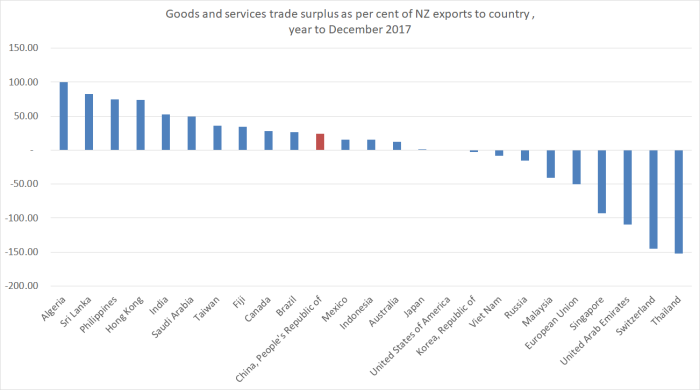
Here is a chart showing the bilateral goods and services trade surpluses/deficits for the top 25 “trading partners”, taken straight from an SNZ table.

bilateral trade surpluses

It is a mildly interesting chart, but I’m not sure it tells us much about anything, and certainly not about trade or economic policy.   Should we think better of Algeria and Sri Lanka  (which presumably have a taste for milk powder) than of Switzerland and Thailand?  I can’t think why we should.  And I suspect that if the bilateral balance with China ever swung into deficit –  and it does move around quite a bit with milk powder prices –  Mr Jacobi would be the first to (rightly) push back against true local mercantilists suggesting that such a deficit was reason for concern.

It isn’t even as if the trade by New Zealand firms with Chinese firms is extraordinarily large.  It is about the same size as our trade with Australia –  a country with about 2 per cent of China’s population.  Overall exports/imports as a share of GDP aren’t large at all for a country our size.  And here is quick table New Zealand China-based economist Rodeny Jones put out last week

NZ has only middling trade exposure to China by regional standards:

% of exports to China/HK 2017

Taiwan 41%
Australia 37%
Korea 32%
Singapore 27%
Philippines 25%
NZ 25%
Japan 24%
Malaysia 19%
Thailand 18%
Indonesia 15%

Mr Jacobi’s argument has the feel of rank opportunism.   Perhaps that might be acceptable in a corporate lobbyist (although I doubt it in the longer run) but Jacobi’s salary as Executive Director of the New Zealand China Council is largely paid by the New Zealand taxpayers.  We deserve better.

As it is, Mr Jacobi’s questionable economics is just the basis for another bid for New Zealand to maintain its subservient, deferential, attitude towards Beijing, and not get bothered about an expansionist hostile power seeking to exert influence in New Zealand politics.

“We need to see China as more than just a market. In New Zealand, China is looking for a long term, reliable partner which means working hard to build cooperation, trust and mutual respect even despite our obvious differences.

Indeed, the PRC is more than “a market”.  It is the government of a repressive dictatorial state, unable to produce for its own people the sorts of living standards places like Taiwan and South Korea have achieved, with an active agenda –  hardly masked –  of projecting its powerful and fundamentally different values [Jacobi’s own term from his recent speech] into countries and regions around the world, defying international law, and attempting to cow any country that makes a stand for its own values and its own self-respect.  It isn’t a regime worthy of trust, or respect.  Perhaps there are some trade opportunities for individuals, but it should be a clear case of “seller (or buyer –  but the sellers tend to have more concentrated interests) beware”,  in which it is more recognised that every time you defer to the regime, you advance an evil cause.

A bit like our politicians really.  Just occasionally, there is reason to think that perhaps our Minister of Foreign Affairs might take a different view.   There were the very delicately-phrased words in his speech the other day about Chinese activity in the Pacific.  There was the response, in after-speech questions, about the memorandum of understanding the previous government signed with the PRC on the Belt and Road Initiative (“I do regret the speed with which the previous government signed up”).

But what does it amount to?  Here is Winston Peters on Q&A yesterday, from the transcript

CORIN You know full well that the Chinese will be watching every word you’re saying right now. Are you worried that there could be—? They don’t like public declarations about the South China Sea from New Zealand. I know that. Are you concerned?

WINSTON No one has been more respectful of the place of modern China in the world than New Zealand First and Winston Peters.

Or

CORIN So do think there is too much? Because, I mean, we’ve got Anne-Marie Brady’s report. We’ve got Rodney Jones, Michael Reddell, others raising concerns and wanting a debate about Chinese influence in New Zealand – politics, but wider life. Do you think there is too much influence?

WINSTON Look, if you’re concerned about too much Aussie influence when it comes to banking you should say so upfront, and I have. If you think there’s been too much untoward American influence in this country in some ways then we should be upfront and say so, and I have. It doesn’t matter where it emanates from.

And thus our Foreign Minister, in his own inimitable style, but in much the same patterns as decades of his predecessors, trivialises the issue.  Just like Mr Jacobi in that speech a week or so back,

Of course, the other side of politics is no better.   Simon Bridges was also on Q&A.  Here he is on the Belt and Road initiative, a mechanism for Chinese power projection in many countries, partly (but not exclusively) by loading pliant recipient countries up with debt they have little prospect of servicing.

[UPDATE: Just after completing this post I noticed this new report on the debt aspects of OBOR.]

CORIN Give me an example of what the Belt and Road means?

SIMON Well, it means economic opportunity, and what do I mean by that? Infrastructure. You’re seeing China invest significantly in infrastructure around the world–

Never mind the strategic foreign policy perspectives, but there might be some consultancy opportunities for New Zealand firms.  It is reminiscent of Lenin’s line about the capitalists selling the rope they will, in time, be hung by.

I also heard Bridges on Morning Report this morning. It was straight out of the John Key playbook.  We will “engage positively”, and might even (quietly) mention the rule of law, democracy etc, all while avoiding the issues that should matter rather more to other countries, including New Zealand –  the expansionist efforts of the PRC beyond its own borders, and the influence activities in an increasing range of other countries, including our own.  I haven’t yet heard Bridges grilled about his MP Jian Yang, but on what we’ve heard so far there seems no reason to believe that he has departed from the Key/English approach (largely shared by the Labour Party) –  selling out our birthright, little by little, for the proverbial mess of potage.   Keep the deals flowing for the selected business elites, keep the party donations flowing and never mind any self-respect, or frank discussion of the nature of the regime, and the nature of the threats it poses.


Please improve immigration data, not undermine it

On her visit to Australia, the Prime Minister has been quoted as suggesting that departure cards might soon be discontinued, and that she will be pursuing her Customs and Statistics ministers on the matter.

I’m sure airlines and airport operators hate the cards.  There have been prevous efforts to get rid of them.  They are, nonetheless, a core element of the data collections (in conjunction with arrivals cards) that give us some of the very best immigration data anywhere.  In a country with –  year in, year out – some of the very largest immigration, and emigration, flows anywhere in the advanced world.

I wrote about this a few months ago when, under the previous government, Statistics New Zealand publicised the possibility/likelihood of departure cards being discontinued.  At the time, SNZ suggested that

“In the near future, the outcomes-based ‘12/16-month rule’ is expected to become a key component in how we determine the number of migrants in New Zealand.”

The “12/16 data” are the new series of permanent and long-term movements derived by lining up, using passport details, people coming and going, and waiting until more than a year after the initial movement to see if the movement loooks permanent or long-term.    It is all very interesting – I’ve praised SNZ for putting the collection in place –  and provides a more accurate measure of actual long-term comings and goings than the (stated intentions based) arrival and departure card.   But it is only available with a very long lag  (ie more than 16 months), whereas the existing PLT data are available monthly, with a few weeks lag (and in principle could be produced even more frequently).

I’m reproducing here the concerns I expressed in September

I’ve explained here previously why the resulting PLT data has its limitations.   It isn’t a good basis to use to look at immigration policy itself.  Approvals data from MBIE is better for those purposes –  and would be better still if they made the information available in an accessible format on a more timely basis.     And the PLT data are based on self-reported intentions, and intentions aren’t always what people end up doing.  Some people think they are leaving permanently, and are back six months later, and vice versa..   But intentions data isn’t nothing either  (just as business surveys capture intentions/expectations and things don’t always turn out as they expect).    The patterns –  and especially the cyclical patterns, the turning points –  in the PLT data tend to match those in the (lagged) 12/16 data quite closely.

There are quite enough gaps (and long lags) in New Zealand economic data as it is –  monthly CPIs, monthly manufacturing data, quarterly income measure of GDP just for starters –  that I’m just stagggered that key economic agencies are apparently willing to let SNZ/Customs go ahead and consider dropping departure (and arrival?) cards.  Where are Treasury and the Reserve Bank on this?

How, specifically, does it matter?   Without departure or arrival cards we would, of course, still have immigration approvals data for most non-citizens (other than Australians).  In principle, they could be published weekly or monthly with just a day or two’s lag, and be available in quite accessible formats.  Since approvals lead actual arrivals, there is certainly useful information in those approvals numbers (it is just that they aren’t made easily available now).

We could presumably also have data on the total number of people crossing the border (gross and net) from passport scanning.   I’m not aware that those numbers are published at present, but they could be.  And presumably they could be broken down by nationality (or at least by the passport the person happened to be travelling on).    That would be useful –  relative to having no arrivals or departures data –  but not very.   If you look at total net arrivals or departures (or net) data it is enormously volatile, and thrown around things like Lions tours –  in other words, holidaymaker and other short-term visitor numbers swamp movements of migrants.   Using that data alone, we’d have no ability to pick turning points for some considerable time after the turn had already happened.

The gaps would be particularly serious for the movement of New Zealanders, and more than half the variability in the 12/16 measure of net migration has arisen from fluctuations in the movements of New Zealanders.  We would have no secure way of knowing if someone leaving was planning to be off for a week’s holiday, or intending to stay away for ever.  The 12/16 method would eventually tell us what they did –  but there is a lag of almost 18 months on the availability of that information.    And even if the new plan involves keeping arrival cards and only getting rid of departure cards, most of the variability in New Zealanders’ migration movements is in the numbers leaving, not the numbers arriving.

Less importantly, without the departure cards we would seem likely to lose the ability to analyse migration (including reflows outwards by migrants who become NZ citizens) by the birthplace of the migrant.

Perhaps someone has done a robust cost-benefit analysis on getting rid of departure (and arrival?) cards.  If so, I would be keen to see it, and particularly keen to see how the relevant officials have factored in the loss of some of world’s best migration data to macroeconomic monitoring and forecasting, in a country with some of the most volatile immigration flows in the advanced world (and not a great track record of getting monetary policy, or housing markets, right as it is).  And even if one sets aside the macroeconomic analysts interests, it is not as if net migration numbers are one of those issues of no political salience at all.  Put an 18 month lag on decent data, and you risk not silencing debate – which some might wish for – but allowing all sorts of misconceptions and concerns to flourish, which no one will be in a position to allay.  It would, frankly, seem crazy.    Immigration has a economic and political salience here which it might not have in a country with land borders and small permanent inflows/outflows.

Frankly, it looks like a pretty irresponsible proposal.   The departure cards provide the only information on what New Zealanders are doing, and the comings and goings of New Zealanders are a big part of the PLT migration story (and aren’t, of course, under government control).

And in case anyone thought the PLT numbers were simply flaky measures, with no information

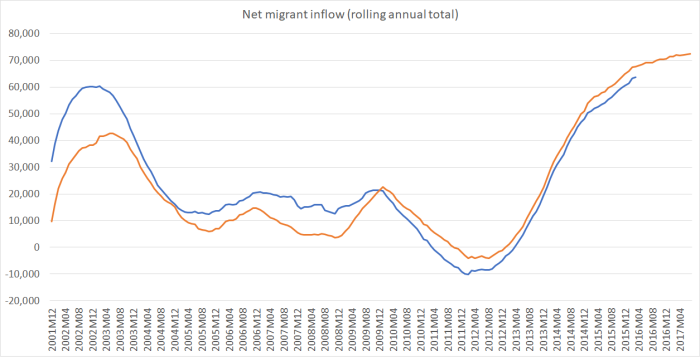
…here are the total net flows on the two measures [12/16 in blue, PLT in orange]

overall

They don’t match up perfectly –  one wouldn’t expect them to, and there is information even in the differences (eg what led people to change their plans) –  but no analyst would happily give up a series that provided a 17 month lead this (relatively) good on the 12/16 series.

Turning points matter a lot for macroeconomic analysis and monitoring, and the turning points in the two series are very similar.

The claim from Statistics New Zealand is that they can fill the gap with estimates that

will be generated through a probabilistic predictive model of traveller type (ie short-term traveller, or long-term migrant), based on available characteristics of travellers. Such a model will provide a provisional estimate of migration, which we can then revise (if required) as sufficient time passes for us to apply the outcomes-based measure.

I hope that they plan to rigorously evaluate the accuracy of such models, including when they’ve worked well and when they haven’t, and how well they capture the effects of policy changes, and that they expose their models and evaluation to external scrutiny before scrapping such a valuable source of hard data as the departure card.

And talking of data gaps, I’ve also written here before about the very long lags in MBIE making available, in readily usable form, the summary administrative data on actual immigration approvals (and estimates of the stock of migrants).   Some of the data you can get yourself, if you don’t mind manipulating spreadsheets that are hundreds of thousands of lines long, but for most people, for practical purposes, the data are really only available annually, and typically with quite a long lag.    That is really inexcusable.  Like it or not, immigration policy is a major instrument of government economic and social policy, and approvals data (and associated stock estimates) are a valuable part of informing the public debate.  Information is almost always better than no information.

[UPDATE: A reader highlights that not even the spreadsheets are currently available.]

MBIE publishes the summary results, and accessible tabular data, in their annual Migration Trends and Outlook publication. In many respects, it is a very useful publication, even if (a) the data are only annual (whereas, say, building approvals data are available monthly), and (b) the publication has a minimum lag of 4 to 5 months (in other words, data for the full year to June 2016 was only published in late November 2016).  That isn’t remotely good enough, especially for administrative data.  Neither MBIE nor SNZ has to collect the data –  it all sits in MBIE’s own systems, generated every single working day.  There is no obvious reason why the data  – all the summary data (number of approvals in each category, occupation, age, sex, country of origin etc) –  couldn’t be made accessibly available monthly within a few days of the end of each month.

I’ve made these criticisms previously.  And that was when Migration Trends and Outlook  was coming out on its normal slow timetable (a 5 to 17 month lag).   But go to the MBIE website looking for the 2016/17 publication –  in March 2018 –  and it still hasn’t been published, more than eight months after the end of the year in question, 20 months after the start of the period to which the data would releate.

Some readers might be inclined to suspect MBIE of some deliberate strategy to keep the information from the public.  I’m not.  That is not only because I’m not naturally a conspiracy theorist, and have had plenty experience of the failures of bureaucracy. It is also because a few months ago I was invited to a meeting by an MBIE official who was part of a team working on improving the Migration Trends and Outlook publication, looking for my comments/ideas on data, immigration research etc  The official seemed quite genuine, and enthusiastically told me of the efforts MBIE was putting in to improving the publications, and (if I recall rightly) the timeliness of the data (even while stressing that it was quite hard and there were “systemss issues”.  That meeting last year would have been before the usual publication data of the Migration Trends and Outlook publication, so I came away from the meeting quite encouraged.   I’m still quite willing to believe that MBIE has the project in hand, but in the meantime……where is the 2016/17 data?  It is now March 2018.

Adrian Orr as RB Governor

An offshore bank asked a while ago if I’d do a conference call for some of their financial markets clients with an interest in New Zealand, about what the appointment of Adrian Orr as Governor might mean for the Reserve Bank and monetary policy.  I did a 20 minute spiel for them yesterday afternoon, and while I won’t bore readers with all that material this post will reflect the gist of what I told them.  It builds on the post I wrote at the time Orr’s appointment was announced in December.

Adrian Orr takes office as Governor on 27 March.  But what is striking is just how little of the uncertainty that has pervaded monetary policy, ever since it was confirmed last February that Graeme Wheeler was going, has been resolved.   The Bank has at times run lines about the certainty the regime provides, but not at present –  and perhaps not for some time, even in the best of worlds.  What do I have in mind?

  • a Policy Targets Agreement has to be signed between the Minister and Orr before the latter can be formally appointed.  Whatever process of deliberation is going on –  around the key instrument of macro-stabilisation policy –  is occurring in secret.
  • this secrecy matters more than it usually might, given the government’s commitment to changing the statutory objective for monetary policy and the expectation that they will want to fit as much of that shift into the PTA itself as possible (as I’ve illustrated previously, that wouldn’t be too hard, but precise wording can still matter).
  • not only will we have new words, but a new (single) decisionmaker –  one who has had no involvement in macro policy for 11 years now.  We don’t know his “reaction function” or how we will interpret the (as yet unknown) rules.  Quite possibly, neither does he.  Typically, when the PTA changes there is quite a bit of jockeying even inside the Bank to bend the ear of the new Governor to one interpretation or the other.
  • if the PTA were the only issue, things might settle down quite quickly.  But it isn’t.
  • instead, we have the two stage review of the Reserve Bank Act, none of which will be finalised (some not even started) before the new Governor takes office.  They will be a large number of issues in play including:
    • details of the new statutory objective, and any associated reporting requirements,
    • the design of the proposed new statutory monetary policy committee including
      • the balance of internals and externals,
      • who appoints the members,
      • the names of these future monetary policy decisionmakers,
      • accountability arrangements for the members (including the future of the Bank’s Board).
    • issues around transparency including
      • the character of any published minutes,
      • the freedom of MPC members to articulate their own views in public
  • who future PTAs will be between, what form they will take, and whether there will need to be yet another PTA when the new committee is set up (perhaps 9 to 12 months away), and
  • even if there isn’t another PTA next year, whether a new MPC  (in particular the external members) will interpret the PTA the same way Governor Orr may do while he is the single decisionmaker.

And all that is just about the monetary policy side of the Bank.

Stage 2 of the review of the Reserve Bank Act –  which Orr will no doubt be weighing in on what it should even cover –  is likely to look at the prudential powers of the Bank, where there is lots of potential for change (or for battles to prevent change?).  For example

  • should the supervisory and regulatory functions be moved into a separate agency altogether,
  • even if not, should the Governor continue to retain single decisionmaker powers, and
  • either way, should the Bank have quite such extensive policymaking power (as distinct from the implementation and administration of those policies) as it does, especially over banks.

And there are lot of other issues that could usefully be looked at (eg, the legislative arrangements for funding the Reserve Bank, which are relatively unconstraining and not very transparent at all, or whether the Bank should have policy control over the currency issue, or whether there should be any limits on the extent of the Bank’s financial risk-taking).  Quite possibly, the Act –  now 30 years old, and having grown like topsy –  should be rewritten from scratch.

That is a very long list of battles to fight.  The current Reserve Bank senior management appears to have been fighting pretty hard for minimal change: someone last week characterised them to me as favouring any change so long as it leaves things pretty much as they are now.  We don’t know what Adrian Orr’s perspectives will be on any of these specific issues (he has said nothing at all since his appointment was announced), which only adds to the uncertainty.  But it is no secret that over the course of his career, he has vigorously fought for his patch, and has never –  to my knowledge –  been keen on giving up power, resources, or flexibility.  Many of the possible reforms would tend to do exactly that –  part of the reason why the current Reserve Bank management have also resisted them.  With Treasury known to favour change, and parties that make up the government favouring change (or at least the appearance of change), there is a lot to fight for.

On things the government is absolutely adamant about there is probably no point fighting –  why spend political capital for no expected gain.   But on most of these issues, it isn’t clear that the Minister of Finance has any very strong views, or even cares much.   My suspicion has long been that he has been mostly interested in something that looks and sounds a bit different –  enabling the party base (his, and that of his partners) to see and hear something that sounds not like a Roger Douglas creation.

How will the Bank (and the Governor) win as many of these issues as possible?   No doubt, good quality analysis will help a bit –  and the Bank probably has more resources at its disposal than The Treasury or private commentators.    But part of it is about confidence-building, and that will include how the Governor is seen and heard to handle policy in the coming months.

There has been quite a lot of interest in the (rather sterile) question of whether Adrian will be a “hawk” or a “dove”  –  more or less inclined to tighten (or loosen) monetary policy.    Mostly it is sterile because for most people it depends on the data  (I’ve been what most would call “dovish” for the last four years or so, but was at the “hawkish” end of the spectrum on the Bank’s OCR Advisory Group for much of the 2005 to 2008 period: I don’t think I’ve changed.)

We don’t have anything much to go as to how Adrian will be reading the data at present, or what (if any) distinctive analytical model he might bring to bear.  It isn’t stuff he has needed to think about – much more than any other public sector CEO might have –  for 11 years now.  That is a large chunk of anyone’s career.

I sat on the same OCRAG as him for perhaps five years, in two separate stints.  It was a long time ago now, but I don’t recall any particular “hawkish” stances or moments.  But he didn’t typically mark out the other extreme either (although when he left the Bank in 2000 there was some –  probably badly misplaced – market speculation that he couldn’t abide the hawkish stance of his colleagues).  He was an operator, a communicator, a manager, rather than someone with a strong view on the data.  It is hard to see why that would have changed now, having moved further away from “doing economics” as his day to day job.

There isn’t much sign in anything he’s said –  eg speeches he gave as NZSF head – that his view of the world is much different from a conventional mainstream stance.  And he’ll come into a Bank which has been convinced for years (and wrong) that core inflation is not far from beginning to pick up.  Again, a conventional view – even at the time of the 2014 policy mistake.

The data might shift on us (and the Bank) and justify a quite different stance in time, but even then it looks a lot as if Orr’s incentive will be to do little to step outside a mainstream market consensus, while putting a great deal of effort into communicating an emphasis on the government’s new employment objective (and the limited –  but not zero –  amount monetary policy can do).  Actual OCR setting needn’t be observably very different for people to recognise a difference of tone.  And that difference of tone is part of what will help secure confidence in their new Governor among the Minister and his Cabinet colleagues.  You are more likely to entrust more too –  take less away from –  a Governor who is perceived as “sound”.    Perhaps, as I’ve argued in recent posts, the data might even justify an OCR cut later in the year.  But what the Governor really won’t want are mis-steps: new Governors (all from outside for decades) have each been prone to them, and with so much else unsettled –  in play –  the stakes are higher than usual.

This isn’t to suggest Adrian is likely to be operating outside the Act –  old or new –  or that he’ll jeopardise our record of low and stable inflation. But there is –  deliberately –  a lot of flexibility in any inflation targeting regime.   And Adrian is a shrewd political operator.  And there are a lots of political battles to win.  It is always a mistake to assume that senior officials don’t have private and institutional interests to pursue, as well as public interest (eg core inflation) ones.

As I noted in my earlier post, the contrast between Adrian Orr and Graeme Wheeler as public communicators is likely to be refreshing (mostly).  Wheeler simply wasn’t comfortable in the public spotlight –  and had never had any prior exposure to it –  and so largely avoided it, and acted excessively defensively when he couldn’t avoid it.

It seems unlikely anyone will be making that criticism of Adrian Orr.  He’s had two stints as a commercial bank chief economist, and even in his most recent role –  head of the super fund –  he has been pretty open with the media.   The younger Orr could be shockingly frank, and at times quite vulgar in public –  unacceptably so in a central bank Governor.  No doubt in the intervening years, he’ll have gone some way to rein in his language, but his press conferences – and off the cuff remarks in speeches –  are likely to attract a great deal of interest.  An openness and sense of humour go a fair way in winning people over.  In a way, the communications side of things –  from Bank to public/markets –  may be easier in the near-term, while Adrian is the sole legal decisionmaker, and his advisers are internal.  It will be more challenging if we adopt – as we should –  a Swedish, UK or US system where, when the Governor speaks, he is simply one vote, and no more than primus inter pares.

Incidentally, the advent of someone who isn’t (or hasn’t been) the buttoned-up bureaucrat  will –  or should –  greatly increase the pressure on the Reserve Bank to follow the RBA and make available livestreams, or at very least audio recordings, of Q&A sessions the Governor engages in following speeches (on or off the record).

Adrian is pretty outgoing himself (to the extent of trespassing on personal space). And he has been pretty willing to challenge other people’s ideas (or disagree vigorously) –  the story is famously told of Alan Bollard letting Adrian loose, and he then taking on Peter Costello pretty directly, at the time the Australian authorities were bidding to take over bank supervision.    His track record also suggests that he has become an effective corporate manager –  not an unimportant skill as Reserve Bank Governor – but he doesn’t have a history of fostering open debate and challenge.  That was my observation at the Reserve Bank, and things don’t seem to have been that different more recently.  There is a distinct impression that he works well with those who don’t challenge him, and not so well with those who do; with those who fit his style and not with those who don’t.  Many of the abler people don’t seem to have lasted long.  He has successfully built strong teams of loyalists.   Perhaps it is a management model that might have a place in some contexts – private fiefdoms.  It is hard to see that it is the sort of model of leadership for the public sector.

Even less that it is what is needed for the Reserve Bank, heading into a new era, when many are looking for greater openness and less groupthink, in a environment where extreme uncertainty characterises almost everything (perhaps especially about monetary policy).     The Bank’s Board and the Minister –  the people who hired him –  will need to keep an eye out for these tendencies (although whether the Board –  in particular –  would care much is another question).   Otherwise there is a risk that anyone who challenges him –  statutory MPC member or not – could find themselves frozen out.

A former central banker observed to me the other day about one of the highly-regarded RBNZ Governors of the past: “he was a wonderful man, understated and wise, marvellous to work for, wrote beautifully, encouraged a great openness of thinking among the staff…..he wanted good economics practiced”

No one can be good at everything.  But in my view, a critical quality in a Governor should be a degree of depth and seriousness, that looks for the truth – or at least our best approximations to it – not the arguments that sound superficially appealing, or which fend off a particular critic for the day.  We might hope to learn something –  not just the latest hint about the OCR –  when we read the speeches of a really good senior central banker.  But there has never been much sign that Adrian is a deep thinker –  more the capable operative.  And I’m uneasy that he has repeatedly proved himself too ready to grab, and run with, someone’s superficially appealing idea, or a politically opportune story.

It was an approach on display at the Bank in the past, but it has also been generally visible much more recently.   There was the politically-opportune, but analytically not very persuasive, decision last year to unload carbon exposures from the NZSF, and then bury this major choice in his reset benchmark so that it is very hard to keep track of whether it will prove to have been a good call.  Even more starkly, there were his appearances in the media last year to defend the Fund.   I dealt with some of this stuff in eg this post.  There was plenty of playing politics –  even though his role, as a public servant, was to run the Fund not to champion the policy choice to have it.   There were rather strained attempts to champion the Fund’s investment returns  – even though the Fund’s own official documents stress that one really needs a 20 year horizon to evaluate the value added in such a high risk fund.  There were strained attempts to present as a sovereign wealth fund –  similar to Norway or Abu Dhabi –  what is actually a speculative investment vehicle for a country that still has net debt outstanding.   Investment performance was defended with not a Sharpe ratio, or a Crown cost of capital, in sight, and no engagement with the international literature on the limits of active management.  And despite weighing into the political debates, no attempts to frame the role of NZSF in the context of overall Crown finances (including the ability to absorb large adverse shocks), let alone those of citizens themselves.

In many of the areas he has touched on, there are perhaps quite reasonable serious perspectives to be brought to the table.  But they take a bit longer to develop and articulate.  My point here isn’t that there is necessarily anything wrong with the NZSF, or even its management under Adrian for the last decade. But rather that he sometimes seems unable to resist grabbing the superficially appealing soundbite, or playing to a political audience, or loathe (or unable) to engage at a more serious level.

Adrian has grown into new roles in past.  When he was first appointed chief economist of the Reserve Bank there was a fair amount of scepticism in some quarters.  The economics department was fairly dysfunctional and Adrian had little management experience.  In fact, he did a pretty good managerial job –  even if, on his own confession, it was a deliberately divisive approach, involving playing off one part the Bank off against another.

Perhaps he’ll do so again, stepping up to this much bigger job, in the spotlight not as a commentator, but as a policymaker.  I hope so, but the risks seem quite large, and the uncertainties quite real.  Better communications seem assured –  even with the constant uncertainty as to whether he can hold his tongue –  and I’m sure we’ll see lots of more or less deft political maneouvring. There are, after all, , lots of turf fights looming.   But whether he provides much impetus for better analysis, better policy, better thought leadership, or is interested in inaugurating of a new open, engaged, and accountable era for the Reserve Bank is another question.   They won’t be the direction –  the priority anyway – that Adrian’s natural inclinations seem to run.  Winning political and turf fights is more likely to be a priority.

And I really hope that not all the stories I’ve heard – including that one about Adrian on top of a bar in Courtenay Place –  are true.  Being Governor of the central bank –  bearing, for now, an enormous amount of individual power –  should bring with it an expectation (matched by reality) of gravitas and decorum.  I’m sure he’ll be at hit at the Reserve Bank’s annual financial markets function, but I’m not sure that is quite the relevant standard.

New Zealand and the PRC: links and questions

Anne-Marie Brady has been at the forefront of identifying, and highlighting, the ways in which the People’s Republic of China, through the Communist Party’s United Front work programme, appears to have been attempting to influence, and interfere with, public life in New Zealand –  both among the local ethnic Chinese community, and more generally.  Her Magic Weapons paper remains required reading, and for all that apologists have attempted to brush aside the issues raised in the paper, no one has made any serious efffort to engage with, and refute, the concerns she has raised.

Most other New Zealand academics, with familiarity with the Chinese language, have stayed silent.  But another person –  with Chinese language –  who has written, quite extensively, about the New Zealand situation is the author of the pseudonymous blog Jichang Lulu.    He has a new and substantial piece (if characterised by an idiosyncratic style) on the United Front activities in New Zealand, which is likely to repay reading for anyone interested in these issues.  Whoever the author is, his usual focus is regions far from New Zealand (Nordics) but has been paying a lot of attention to the New Zealand situation in the last year or so and appears to be quite well-connected.   I linked the other day to his detailed piece on PRC efforts to attempt to bring Norway and Mongolia to heel.

Much focus in recent months has been on National Party list MP Jian Yang.  But, of course, National is in Opposition at present. Jichang Lulu has raised specific concerns about senior Labour backbencher Raymond Huo, who also appears to have close connection to the PRC regime.   From his latest post

According to a source with knowledge of the matter, recent requests from a CCP-unfriendly NZ Chinese organisation to have ministers send Chinese New Year greetings were reportedly redirected to Raymond Huo, effectively making the ruling party’s leading United Frontling, whose PRC-consonant views are well–known, the government’s gatekeeper to contacts with the Chinese community. In contrast, ministers and other politicians didn’t hesitate to attend celebrations with PRC diplomats. In other words, the Party-state, through its local advocates, can vicariously veto official support for something as apolitical as a calendrical festivity, at least when the persons seeking such support happen to have Chinese surnames.

Huo currently chairs Parliament’s justice committee –  responsible for the triennial review of the election, and for handling new electoral legislation more generally.  And the way governments typically turnover their members, there has to be a pretty significant chance that he’ll be a member of the executive before this parliamentary term is out.  Much focus in recent times has been on past and present ties of senior National Party figures to PRC interests.  But with Labour in government –  and their party president an effusive public supporter of Xi Jinping –  it is about time harder questions were asked of the new government.

Another thing worth reading (although behind a paywall) is an article in The Australian today under the heading Cold War: Freeze on China Ties.  It builds on reports last week that

university leaders were concerned about Chinese government attempts to dissuade ­students from coming to Australia to study. In an escalation of the pressure on universities, school visits have been cancelled, senior educational meetings in Beijing have been “postponed” and messages warning of the dangers of studying in Australia have been posted on the website of the ­Chinese embassy in Canberra.

claiming that

China is putting Australia into a diplomatic deep freeze, stalling on ministerial visits, deferring a trip by our top diplomat and putting off a broad range of lower-level ­exchanges to pressure Malcolm Turnbull over the new foreign ­interference laws and naval challenges to disputed Chinese claims in the South China Sea.

Government sources are reported as conceding that “there is a diplomatic and ­bureaucratic stalling over a range of visits, as Beijing voices its ­displeasure at foreign-­interference laws”.

I guess this is the sort of thing that the subservient apologists in our own political, bureaucratic and business establishment worry about.  But perhaps it should prompt them to think again about the nature of the regime they want to cosy up to.    The PRC might have some capacity to hurt individual New Zealand economic sectors –  as, say, the Mafia or organised crime might in other countries – but our prosperity as a nation is simply not based on those firms’ trade with China.   And sometimes, just occasionally, there are advantages to distance: Korea, Vietnam, or the Philippines (let alone Taiwan) have to live with the PRC on their doorstep.  We don’t, and it is surely time to reflect on what manner of regime they abet, whether actively or by silence.

The other day, New Zealand Prime Minister gave her first major foreign policy speech.  As far as I could tell, it was better than it could have been on the PRC.

China’s global influence has grown along with its economic weight.  Its leadership on issues like climate change and trade liberalisation could add momentum to our collective efforts in those areas.

Naturally, there are areas where we do not see eye to eye with China.  My government will speak honestly and openly with our friends in Beijing.  Whether it is about human rights, pursuing our trade interests, or the security and stability of our region.

Taking that approach isn’t about singling countries out, , but about taking a consistent approach on the issues and principles that matter to us.

It wasn’t very grovelly –  none of the nonsense Murray McCully was using just a few months ago about China saving us through the financial crisis of 2008/09 –  although anyone who thinks China is somehow at the forefront of global trade liberalisation hasn’t looked very closely (or doesn’t wish to).

By contrast, here is Julie Bishop quoted in that same Australian article

After Mr Trump said he would “love” Australia to join the US in military passages through Chinese disputed territorial waters, Mr Turnbull refused to say in advance when an operation would take place. Such an operation, which the US has conducted in the past, would contradict ­Beijing’s claims of sovereignty in the South China Sea and assert the right of free passage for international shipping.

In Australia, Ms Bishop said: “We have been traversing the South China Sea for many years in accordance with international law and we will continue to do that. Australia is an upholder and defender of the international rules-based order. We believe strongly in the principle of freedom of navigation and freedom of overflight, and we will continue to traverse the South China Sea as we have in the past”.

I’m no great fan of the current Australian government more generally, but there is a degree of realism about the nature of the regime, and its external threats, that seems deliberately absent from the utterances of our own leaders, of whatever party.

Prompted by the events of the last few days, I wonder whether journalists might consider asking a few questions of some of our political leaders:

  • what do the Prime Minister, the Minister of Foreign Affairs think of the PRC actions in recent days to remove the term limit on how long Xi Jinping can serve as President?  One might hope that any answers would be somewhat more serious –  more engaged with the level of international unease – than suggesting, say, that, after all, we have no term limits, and our head of state reigns for life.
  • since National Party president Peter Goodfellow and Labour Party president Nigel Haworth (and former Prime Minister Jenny Shipley) have quite recently been effusive in their praise of Xi Jinping and his approach (links in the Jichang Lulu piece), how do they view this latest step?  It is no good attempting to say “oh, we are just party functionaries we do the organising”: if you are willing to praise the foreign leader of an aggressive dictatorial state, that increasingly threatens not only the human rights of its own people but other nations, you owe us your take on this latest step.
  • and since Bill English refused ever to engage seriously on the issue of Jian Yang –  the former PLA intelligence official, who now concedes he misrepresented his past to enter New Zealand, and who maintains very close ties to the PRC authorities –  perhaps they could ask Simon Bridges, the new National Party leader.  Is he comfortable having such a person in his caucus, and (reportedly) as one of the party’s leading fundraisers.   Most likely, Bridges would fob journalists off as English did whenever anyone asked, or fall back on the slurs his shadow Attorney-General has relied on.  But even if he did, at least we would have a clearer steer on the character of the man, and the nature of the new generation of New Zealand’s political leadership.


Causes of financial crises

Earlier in the week I wrote about a couple of the surveys, of US academic economists, conducted out of the University of Chicago by the IGM economic experts panel.

But another of their 2017 surveys caught my eye.  It was about the financial crisis of 2008/09.

Panellists (US ones, and those of the sister European panel) were asked (with detailed wording of each item at the link)

Please rate the importance (0=none; 5= highest) of each item below (presented to panelists in randomized order) in contributing to the 2008 global financial crisis.

And this was how the results came back (using the version where respondents indicated how confident they were of their views).

2007 IGM weighted-graph

For the most part, the European and American responses were pretty similar (not that surprising given (a) that they were asked about the same events, and (b) that quite a few of the US panel were academics who’d migrated from Europe).  Perhaps the only material differences are on the questions around the role of savings and investment imbalances, and around the role of direct government involvement in the housing finance market.  In neither case do the (weighted) average respondents think these issues were top-tier factors but in Europe extremely large current account deficits (savings/investment imbalances) were much more salient (Ireland, Greece, Spain, as well as various eastern European countries) –  as were the “reinvestment” pressures on eg German banks.  And on other other hand, in the United States, between the role of the agencies (Fannie Mae et al), the FHA, and direct federal pressure on banks to lend to support home ownership, the government has a far larger role in housing finance than in most countries.  And US housing finace was the epicentre of the crisis.

In some ways, it is a funny mix of questions/options.  Even if all these factors contributed in one sense or another to the 2008 crisis, they must have done so in quite different ways.  Take, for example, funding runs, resulting from maturity mismatches (short-term liabilities funding long-term assets).  Clearly they were a phenomenon observed in the crisis –  whether at Bear Stearns or Northern Rock or…. –  but since every banking system in the world, strong or otherwise, operates that way, it isn’t clear that the funding structures (or the runs) were a material cause of the crisis.

And one can criticise the rating agencies all one likes –  and I’m sure most of the criticism is well-warranted – but few people were compelled to use credit ratings to guide their asset allocation choices.  And, for all their faults, the rating agencies were generally only responding to much the same incentives that drove other active participants in the system.

And what might lament that regulators and supervisors didn’t catch the building risks before the crisis broke, but (a) they rarely do, and (b) generally, prudential regulators did not compel or coerce willing borrowers and willing lenders to undertake the transactions that ended badly.

It is interesting to see that the “too big to fail beliefs” item is ranked a fair way down the scale (the specific question is about the beliefs of bankers that their own bank was too big to fail).     That sounds about right.  In boom times, most participants are focused on maximising the upside, with little focus on the possibility of things going very badly.  And for the management and Boards of banks, even if their own bank does prove “too big to fail” it is probably little solace to the people involved –  they will still be ousted (RBS, for example, still trades but Fred Godwin –  knighthood and over-generous pension too –  is long gone).

I’m not quite sure what two or three factors I would rate most important.  But one that would rank fairly highly isn’t even directly on the IGM panel’s list: the creation of the euro and the inclusion of so many peripheral states in it.  That choice –  giving German interest rates to Ireland, Greece, Spain, and associated flows of capital –  greatly accentuated imbalances that might already have been there.   Again, it caused no bad loans directly, but fostered an environment in which they became more likely.

And I still find quite persuasive –  more so than the panels clearly –  the story around the importance in a US context (and the US crisis contributed greatly to crises in the UK, Germany and several other European countries)  of government efforts to promote easier access to housing credit.  As I summarised the story former US official Peter Wallinson told

It is that without repeated, sustained and frighteningly successful US government efforts – under both Clinton and Bush administrations – to promote easier access to housing credit, particularly through the agencies (Freddie Mac and Fannie Mae), there would most likely have been no serious US financial crisis.  Wallinson documents how government mandates compelled the agencies to drive down their lending standards, and how because of the dominant role of the agencies in the market, this contributed to a sustained deterioration in the quality of new housing loans being made across the United States.  As late as 2004, new mandates were imposed, forcing the agencies to meet higher low income lending targets with loans for new purchases, excluding any refinancing or equity withdrawal loans.

Finally, it is interesting to note that household debt (specifically “Elevated levels of US household debt as of 2007”) also doesn’t rank that highly as an explanation.  That has long seemed right to me –  apart from anything else, debt to income ratios at the time were higher in New Zealand and Australia (which had no crisis at all) and in the UK (which had no domestic housing finance crisis) than in the US.   But the Reserve Bank has tended to put (in my view) too much weight on the debt stock.

I noticed this week that credit growth in New Zealand (household or total) has now again dropped a little below the rate of growth of nominal GDP.  I don’t supppose it portends anything very much, but if our debt levels in 2007 didn’t cause a local crisis, the current debt levels don’t seem likely to either.

(with an estimate of Dec quarter 2017 GDP)debt to GDP NZ

It is striking just how little has changed in aggregate.   Debt stocks that, as a per cent of GDP, have barely changed over a decade, are very rarely the stuff of which crises are made.  Big increases in those ratios can sometimes be associated with subsequent crises –  that was what New Zealand had in the 00s, and thus we were worried in 2007 – but very bad banking seems to be what really matters, and in a well-disciplined market economy, “very bad banking” and “more debt” aren’t synonymous.


Not much encouragement in the productivity data

New Zealand’s weak productivity performance has been an on-and-off theme of discussion for decades.   We’ve been falling behind for 70 years now, something that was recognised by expert observers almost 60 years ago. In all that time, there has never been any sustained period when we’ve made any progress in closing the gap.   A typical cycle seems to involve Opposition politicians –  of whichever party –  suggesting that they will do better, and that under their stewardship we’ll catch Australia, get back into the upper half of the OECD, or whatever.   Once in office, the rhetorical concern often lasts for a year or two, and then typically nothing much else is heard or –  worse –  there are attempts to twist the data to try to render our underperformance less stark.

There was a bit of focus last year on New Zealand’s latest run of poor productivity outcomes.  I and others had noted that we seemed to have had no productivity growth for almost five years.  And, sure enough, Opposition parties picked up the issue to some extent, and the then-government attempted to play distraction and pretend everything was fine.

And then there was a change of government, and a couple of months later a new annual update on the GDP numbers.  The new numbers saw estimates of GDP for the last few years revised up a bit and –  since estimates of hours worked didn’t change – that translated through into a lift in estimates of real GDP per hour worked.  In some quarters, a sigh of relief was breathed.  And, to be sure, in this context more was undoubtedly better than less.

But when I dug into the numbers it still resulted in this chart

GDP phw worked NZ Jan18

We’d gone from having no labour productivity growth at all (actually marginally negative) over the last five years to total productivity growth over that period of 1 per cent (ie about 0.2 per cent per annum).   It is a little better than the previous iteration of data has suggested, but……it wasn’t anything to boast about.  It shouldn’t have made anyone much less uncomfortable.  And on the updated data this was the New Zealand vs Australia comparison.

AUs and NZ reaL gdp PHW

Once a year, Statistics New Zealand release official estimates of annual labour productivity growth for what they label the “measured sector” of the economy, which covers around 80 per cent of the economy (total GDP).  The latest release, including data for the year to March 2017, was out last week.  The “measured sector” includes about 80 per cent of the economy, where Statistics New Zealand is reasonably comfortable about its real output measures (the main exclusions are education and health).

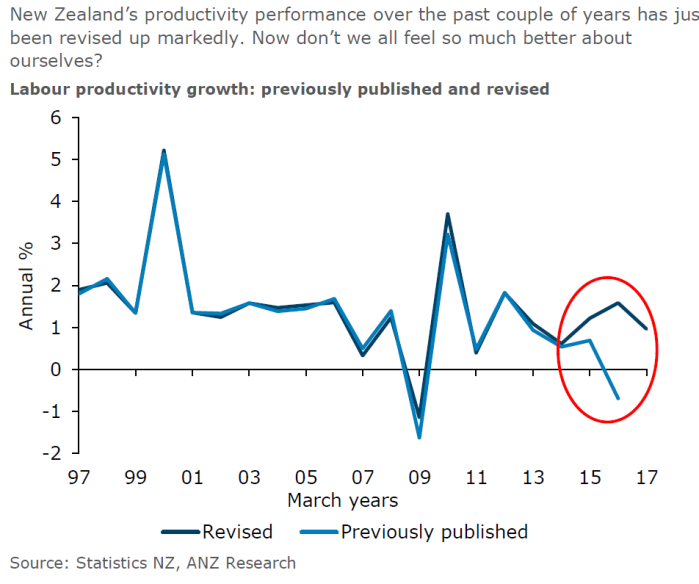
Unsurprisingly, there were some upward revisions in these numbers as well.   The numbers don’t get a great deal of commentary, but the reaction seemed encapsulated in this chart from one of the banks.

sharon

Not only were the numbers for the last couple of years revised up, but if you eyeball the chart productivity growth in the last decade doesn’t look much different than that for the previous decade.

That certainly looks more encouraging.

This is how productivity growth in (a) the measured sector and (b) the whole economy compare, based on the latest SNZ releases.   Here I’ve used just production GDP –  since it is production sectors SNZ uses to do the measured sector numbers –  and have shown the data in log form, in which a constant slope of the line means a constant growth rate.

measured sector and real GDP phw

Recall that the measured sector is about 80 per cent of the economy.  And for a gap of that size –  the measured sector productivity growth was 17 percentage points faster than that for the whole economy over the 21 years – to have opened up it suggests that productivity in the non-measured sector (the rest of GDP) must have done very badly indeed.

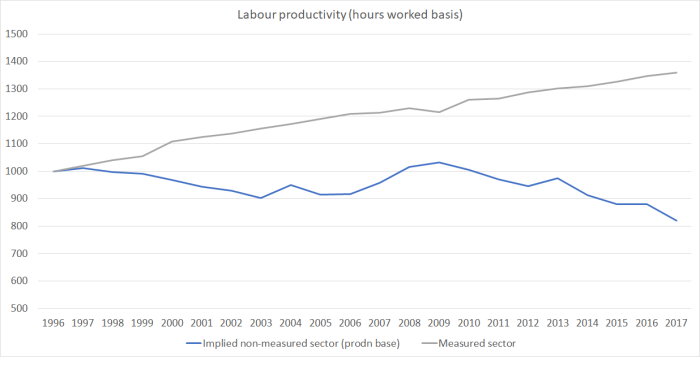
This little exercise is purely illustrative.  I’ve deducted measured sector productivity from the total, assuming the measured sector is indeed 80 per cent of the economy, and then multiplied what was left by 5 [(100/(100-80)] to produce a proxy residual index of implied labour productivity in the non-measured sector.  This is the result.

nonmeasured sector

It is only a proxy, calculated residually, and the precise numbers are sensitive to the (changing) exact share of the non-measured sector industries.  But the proxy suggests a pretty calamitous picture for productivity (especially, if summary numbers SNZ includes are to be taken seriously, in education) in the non-measured sector.  Disgruntled parental consumer of the education system that I am, something doesn’t seem to entirely ring true –  these aren’t, after all, quality-adjusted numbers.   When, as a matter of policy, money is being thrown at education and (eg) teacher/pupil ratios are being raised, one might expect crude measure of education sector productivity to fall.  But that doesn’t seem to have been the story of the last nine years –  whether the educational lobbies, or the former government, are to be believed.

One problem with the measured sector data is that there is no ready way to compare New Zealand productivity growth numbers with those for most other countries.    There are no standard compilations of such data and it would take a huge amount of painstaking effort for an individual to attempt to replicate the numbers for a reasonable range of other advanced countries.  Given the importance of common global (or at least advanced country) trends in productivity, that severely undermines how much use can be made of the aggregate data.

However, the Australian Bureau of Statistics publishes some very similar data, for what it calls the “market sector”, also around 80 per cent of the economy.  And SNZ themselves highlight the comparisons between the New Zealand and Australian productivity growth numbers in each of their annual releases.  As they note in the latest release, over the period since 1996 (the period for which the two countries have comparable data), labour productivity in the measured/market sector averaged 1.5 per cent per annum in New Zealand and 2.2 per cent in Australia (Australian data is for June years).   Over 21 years, those differences multiply up to big numbers –  and, in levels terms, we had already fallen well behind Australia by the mid 1990s.

You might have hoped that all those differences were early in the period. Unfortunately, the SNZ/ABS data suggest not.

measured sector nz vs aus

Starting from just prior to the 2008/09 recession (downturn in Australia) the relative performances of the two measuered sectors look depressingly similar to the pattern in the aggregate (real GDP per hour worked) chart I showed earlier.  Over nine years, Australia’s market sector managed total productivity growth a full eight percentage points fast than New Zealand’s measured sector managed.

All these charts just use hours worked as the relevant input measure.  Usually SNZ also publish (as do the ABS) the data using composition-adjusted labour input measures (eg if the amount of human capital per worker is increasing, as people get more skilled, that represents more inputs not higher productivity).   I’ve become a bit more sceptical of such measures in recent years, since proxies for human capital are often educational achievement numbers, and much of what Bryan Caplan writes about –  that much of formal education is about signalling rather than skill acquisition –  I find increasingly persuasive.  But this year I can’t even show you the numbers as SNZ ends their release noting plaintively

The composition-adjusted productivity in the measured sector data did not meet our quality standards for publication..The absence of this data does not affect any other data published in this release. We don’t have an expected release date for this data

Oh dear.

In sum, there isn’t much in the recent waves of productivity data/estimates that should give anyone serious about economic performance much comfort at all.   There are, no doubt, countries that have done worse than us on this score in the last decade, but  –  starting well behind –  we’ve made no overall progress in closing the gaps to other more advanced countries, and have continued to slip (quite materially) further behind our closest comparator, Australia.


Revisiting the case for splitting the Reserve Bank

The Minister of Finance has commissioned a two-stage review of the Reserve Bank Act.  The scope of the first part is pretty clear: it is about monetary policy (goals, transparency, and decisionmaking structures).  What, if anything, is included in the second stage is still up for grabs, with the Minister awaiting advice from the officials (a joint Treasury/Reserve Bank process) and from the Independent Expert Advisory Panel.   It seems likely that the Reserve Bank itself will try to keep any second stage to an absolute minimum –  as someone put it to me last week, the Bank seems happy with any reform that keeps things pretty much just as they are now –  and the arrival of Adrian Orr as Governor next month is likely, based on past performance, to reinforce that resistance.

A few weeks ago, I outlined the case that, as a key component of the second stage, the Reserve Bank should be split in two.  The Reserve Bank itself would remain responsible for monetary policy and associated activities (notes and coins, foreign exchange reserves, interbank settlement etc) while a new Prudential Regulatory Authority would take on responsibility for regulation and/or supervision of banks, non-banks, insurance companies, payments systems (and for the associated AML controls).

In favour of that position is that:

  • it is the more common model in advanced countries today (including Australia),
  • the synergies and overlaps between the various functions of the Reserve Bank are pretty slight (and probably no greater than, say, those between fiscal and monetary policy),
  • structural separation would allow for clearer lines of accountability, and
  • structural separation would allow for the creation of stronger, more effective, cultures  –  with appropriately skilled chief executives –  in each of the two successor institutions.

There hasn’t been a great deal of public commentary about this issue/option, but I noticed that the Shoeshine column in last week’s NBR picked it up.   NBR’s columnist  –  Jenny Ruth –  noted her support for structural separation (“a jolly good thing”).    She has been pretty critical of the Bank’s handling of a number of its prudential responsibilities, and is uneasy about the extent to which she believes the use of LVR limits –  by statutue, in pursuit of financial stability – “has become hopelessly confused with the Reserve Bank’s monetary policy functions”.

But in putting together her column she also talked to Massey banking academic David Tripe who “agrees there is a problem but isn’t so sure separation is the solution”.  He is quoted as saying

“My suspicion is that it wouldn’t improve matters because it would still be the same people doing the supervision”

and arguing

“We’ve got bank capture of the regulator –  the Reserve Bank asks for the data that the banks agree to provide, not the other way round”

On his first point, I guess my response would be that structural separation is not panacea, but that (a) change starts from the top, and (b) it should be materially easier to hold the financial regulator to account when it is responsible for only one main job (unlike today’s Reserve Bank).   And, as I’ve noted above, many of the other considerations also point in the direction of structural separation.  Finding a chief executive and senior management team who care primarily about the prudential regulation of the financial system –  whereas most of the senior management of the Reserve Bank over decades has always been more interested in (and had more background in) monetary policy –  is likely to be significant part of lifting the performance of the regulator.

Perhaps my one real unease is that a standalone regulatory agency could – if it were allowed to – become even more resistant to transparency and public accountability for its actions.  Whether there is a structural split or not, the officials and politicians doing the current review need to take steps to make the regulatory side of the Bank (as it is now) much more open.

(On Tripe’s second point, while I think there is something in what he says –  especially around data –  I rather doubt many of the banks would recognise the “regulatory capture” story.  On that note, I’m looking forward to the forthcoming publication of the New Zealand Initiative’s work on economic regulatory agencies, including the Reserve Bank.)

In her column, Jenny Ruth highlights a number of recent cases where the Reserve Bank’s handling of regulatory issues leaves a lot to be desired (and where, even if the Bank was correct, it has been so untransparent that we couldn’t possibly be confident of that).  I’ve written a bit about one of the cases she mentions –  the Westpac capital models issue.  The Bank has made no attempt to pro-actively disclose the relevant material (and would no doubt staunchly resist OIA requests), and although it claims it discovered the problem, as Ruth notes

“Westpac insiders say that Westpac outed itself. Shoeshine’s money in on Westpac”

Whatever the truth on that point, the whole episode did little to instill confidence in the Reserve Bank’s systems, processes, or accountability.

I haven’t written about the two other episodes Jenny Ruth highlights, both involving Kiwibank (you can read them for yourself).  Neither suggest that the Reserve Bank’s prudential wing has been on top of its game, or that they really have an instinctive handle on the nature of markets and financial institutions.

There are capable people in the regulatory/supervisory side of the institution (and I sat on the relevant internal policy committee for the best part of 20 years) but it is time for some refreshment, and the sort of restructuring that a fresh chief executive, focused on building and maintaining a strong and effective regulatory agency, can bring.  I’m not convinced, by any means, that all the regulatory framework is well-warranted, but if Parliament chooses to regulate, we need the job done excellently, and with considerable transparency and accountability.

NBR appeared on Friday morning.  As it happens, on Friday the Reserve Bank was taking regulatory action.   At 6.37pm an email dropped into my inbox stating that CBL Insurance had been placed in interim liquidation by the High Court, on application from the Reserve Bank.  The Reserve Bank is, of course, now responsible for the prudential regulation of insurance companies.

In time, I hope we see a substantial accounting by the Reserve Bank of its activities in this case, including its exercise of its powers to apply for the appointment of a liquidator.  In the meantime, I was interested in a piece on interest.co.nz by David Hargreaves who suggest that, based on what we’ve seen so far, this episode too raises questions about the handling of the Reserve Bank’s supervisory/regulatory role.

From the Hargreaves article

That the RBNZ was interacting, strongly it seems, with CBL Insurance going back as far as July last year was revealed by CBL Corporation to the NZX only as recently as February 5, almost in passing and then more explicitly on February 7.

Key parts of the February 7 revelation for me were that the RBNZ had done an independent review on CBL insurance, that it had, as long ago as July 27, 2017 issued a minimum solvency recommendation, and then – most crucially from my perspective – that on November 22, according to the statement from CBL Corp, RBNZ had issued directions to CBL Insurance, CBL Corporation and its subsidiaries, requiring them to consult on any non-business-as-usual transactions greater than $5m.

That last one, as far as I’m concerned is a biggie. Essentially a publicly listed company with a sharemarket value of three quarters of a billion dollars was put on the leash by the regulator three months ago. And yet nobody was told publicly.

The CBL February 7 statement went on to say that “these directions and discussions that CBL Insurance has had with RBNZ have been occurring under strict confidentiality orders prohibiting CBL from making any announcement to the market while those orders remained in place. These orders have now been lifted.”

Neither confirm nor deny

The RBNZ refuses to either confirm or deny that it had placed confidentiality orders on its interactions with CBL Insurance last year.

He goes on

I actually think the RBNZ had some obligation to let the public know it was engaging with this company.

I do not like the idea of regulation behind closed doors because it is suggestive, at least, whether that is the reality or not, of a holier than thou attitude. It is to me, the regulator putting themselves above the public.

I’m not sure how well prepared the RBNZ was for getting itself into a situation like this with a publicly listed entity like an insurance company.

I’m not so sure about “holier than thou”, but it is an example of just the sort of thing the Reserve Bank always used to worry about: if it had private information (especially about significant regulatory interventions) and customers were nonetheless allowed to carry on trading with regulated entity, doesn’t that then create at least some moral risk, some moral exposure, if the regulated entity subsequently failed?  It seems extraordinary, if true, that the Reserve Bank could ban a regulated entity talking about a regulatory intervention.

Hargreaves’ solution isn’t one I’d agree with

Personally, I would suggest creation of a separate authority to regulate and supervise the insurance sector. Yes, it would be more money, it would arguably be more bureaucracy, but sometimes that’s what you’ve got to do for the best results.

Frankly, I’ve never been quite sure that the case for prudential regulation of general insurance is particularly strong anyway, and would be very reluctant to see a standalone insurance regulator. But I take the Hargreaves story as reinforcing the case for a strong standalone prudential regulatory agency, led by people whose sole job is prudential regulation and supervision, and within governance and accountability structures that help ensure serious and effective scrutiny of how the regulatory agency does its job.

I gather that Treasury and the Reserve Bank have been consulting this week with private sector representatives on the possible prudential regulatory aspects of the Stage 2 review.  I hope that the idea of structural separation –  with all it could entail –  isn’t lost in the desire of Reserve Bank management to keep things just as they have (not overly effectively) been.

A semi-official take on New Zealand and China

The New Zealand China Council was established by the government a few years ago.  It exists primarily as an advocacy body, using (mostly) taxpayer money

in support of deeper, stronger and more resilient links between New Zealand and China.

It has been very close to  the government.  The Secretary of Foreign Affairs and Trade, and the chief executive of New Zealand Trade and Enterprise are both ex officio members of the Executive Board.  The Council is chaired by one former Deputy Prime Minister (Don McKinnon), and another member –  with considerable ties to People’s Republic of China institutions – is former Prime Minister, Jenny Shipley.   The Advisory Board, another 20 people, includes as members several of those about whom questions have been raised in recent months (Jian Yang, Raymond Huo, and Naisi Chen)  –  as well as, somewhat surprisingly, a senior journalist.

The public face of the Council seems to involve relentless optimism about things that don’t obviously seem to require taxpayer-funded advocacy (eg the several tweets about the first New Zealand avocadoes into China) and rather gushy, one-eyed, takes on the PRC/New Zealand relationship, always extremely careful never to utter a critical or sceptical word about the PRC.  More recently, in response mostly to the issues raised by Anne-Marie Brady (and the Jian Yang story) they seem to have been pushed somewhat onto the defensive.

The Council employs a part-time Executive Director, Stephen Jacobi.  He spent considerable time at MFAT, but from his own account his focus was Europe and North America (including as our deputy high commissioner in Canada) and in trade negotiations.  Since leaving MFAT in 2005 he has run his own consulting firm, and been employed as the public face of various trade-related bodies, including serving as Executive Director of the NZ US Council from 2005 to 2014.  He is articulate and readily available to the media, but has no specialist expertise in China or (indeed) on the workings of New Zealand democracy.   That isn’t a criticism –  after all, neither do I –  just to note that his arguments, and evidence, need to be reflected on and carefully examined, perhaps having regard to the interests that are paying him, not as coming from an expert authority in the area.

I’ve written previously about one of Jacobi’s speeches, given late last year at a regime party to mark the PRC national day.  Those were pretty brief (and obsequious) remarks, albeit to a PRC audience.  And so it was interesting to see that last week he had delivered a much more substantial address, Dancing with the Dragon – Opportunity and Risk in the New Zealand China Relationship, to the Nelson branch of the New Zealand Institute for International Affairs.  There is also a much shorter op-ed by Jacobi in the Herald today, headlined on the China Council’s own website as “Anti-China narrative not the Kiwi way”.   I’m not going to comment specifically on that piece –  it covers mostly similar ground to the speech – except perhaps to suggest that deferring to vested interests (business and political) who want us to hurry along and simply accept that there is nothing to see here shouldn’t be “the Kiwi way” either.

What of the speech?

The first couple of pages (of eight) is reasonably unexceptionable.   There are lots of statistics about the growth in trade between New Zealand firms and Chinese ones –  curiously, only about exports, and barely a mention of (the benefits of) the imports.   There is some nonsense about New Zealand alleged heavy reliance on China in the ‘global financial crisis”, but on the other hand a welcome acknowledgement that the New Zealand – China trade agreement isn’t the only factor explaining the growth in two-way trade and investment.  Of course, there is no acknowledgement that the interest of the entities exporting to China –  many represented around his board table – might not always be the same as those of New Zealanders as a whole.

But then he turns towards addressing the (quite limited) New Zealand public debate on issues around the activities of the People’s Republic of China and the Communist Party which controls it.  Part of Jacobi’s rhetorical strategy  appears to be to imply that anyone raising concerns about the Chinese regime and the Party that controls it, is somehow anti-China/Chinese more generally.  It is never quite put that like  –  just insinuations –  but the impression is pretty clear. Mention the poll tax, for example, to play up the guilt, but never mention that we and China (pre-Communist) fought on the same side in World War Two.   And never, ever (that would be job-ending for Mr Jacobi no doubt), note that across the Taiwan Straits is a highly succesful, prosperous, free, and non-threatening ethnic Chinese democratic state.  Never, ever, mention the unease apparently felt among numerous New Zealand citizens of ethnic Chinese origins –  some of whom migrated here to escape the party-state and its evil –  about the effective control regime-associated groups have over most of the Chinese language media in New Zealand, and many community groups.

Around the world there has been growing unease –  including in such impeccably liberal circles as academics –  about the growing number of Confucius Institutes established as part of many Western universities.  With PRC funding comes PRC restrictions, on hiring and on the sort of issues lecturers are allowed to address.   There are several of these institutes in New Zealand universities – Canterbury, Victoria and Auckland  In various places overseas there has been a pushback and some major universities –  notably Chicago – have closed their Confucius Institutes.   I’m sure no one has a problem with the PRC government subsidising Chinese language learning in New Zealand –  any more than with Alliance Francaise or the Goethe Institute –  but not as part of New Zealand universities, subject to a foreign governments controls and constraints.

Why do I raise this?  Because Jacobi included this line

There has been pleasing progress in the number of primary schools teaching Mandarin, especially with the help of the 150 Chinese language assistants in New Zealand, but this has not followed through at secondary and tertiary level.

I presume this is a reference to things like the Confucius Classrooms programme (or here) .  By this means PRC-funded and chosen people are operating directly in our school classrooms.  One can only imagine the awkwardness if a student asks about Taiwan or Tibet, the rule of law, or freedom of speech.

Can anyone imagine us allowing Soviet funded teaching in our schools in the 1970s, or German-funded teaching in the 1930s?  But Mr Jacobi, and his government-funded council, simply avoid ever confronting the nature of the regime.  (I’m sure they are quite aware of it, but if the public ever got concerned it might threaten the Council’s easy life, and the business and personal opportunities of some of its members.)

And then Jacobi turns directly to the recent debate, such as it has been.

Public debate about the relationship is to be welcomed in a robust democracy like ours, although care needs to be taken to ensure that public debate remains civil and properly focused on the issues.

And who is going to disagree?  But then perhaps Mr Jacobi could point us to examples of where the debate has been less than civil and not “properly focused on the issues”?  I can think of the former Attorney-General at an election meeting attacking Anne-Marie Brady as somehow “anti-foreigner”, but then I’m pretty sure he and Mr Jacobi are on the same side.    I’ve heard various claims that people raising issues are being “racist” or anti all things Chinese, but I’m pretty sure that not once have those sorts of slurs –  the stuff Jacobi purports to dislike –  been backed up with arguments and evidence.  In this speech, Jacobi certainly makes no attempt to.  For a taxpayer-funded body it is a pretty poor show really.  But then, unfortunately, it is par for the course.    Neither politicians, nor outfits like China Council, have made any attempt to address seriously and directly the issues raised in Professor Brady’s Magic Weapons paper, or the issues around the background and ongoing associations of National MP Jian Yang.

Jacobi notes that occasionally the New Zealand government and the PRC disagree

While we do have occasional public disagreements, these have not detracted from the momentum in the relationship.

If so, presumably because when such “occasional public disagreements” matter, politicians and diplomats scurry round and assure Beijing it will never happen again.  It is hardly news that the New Zealand government has operated a policy of avoiding do anything that might upset Beijing.  Nor that the PRC is not some typical country which recognises that the possibility of robust differences of view characterises real mutual –  as distinct from subservient – relationships in this world.

Politically, even while we receive occasional Chinese naval ship visits, we continue to maintain close defence and intelligence relationships with our Western allies.

I’m pretty sure we never welcomed naval vessels from the Soviet Union or Nazi Germany.  But even setting that to one side, Mr Jacobi simply never addresses the  unease our traditional Western allies –  including through Five Eyes –  have reportedly come to feel about the New Zealand government’s relationship with the PRC.  And he does not even seek to address the PRC’s own strategic interests, which might include a fostering a more semi-detached relationship between New Zealand and the countries which share rather more of our “fundamental values” [Jacobi’s own term].

And then there is the attempt to play distraction, with the suggestion that all that is going on is “soft power”, and “everyone does that”.

New Zealand itself uses soft power with great effect when it seeks to portray a positive view of our country overseas, including by funding visits by journalists and other “influencers” to New Zealand.

Although Americans, Europeans and Japanese all use soft power, it is the Chinese use of soft power that is being questioned today.

If the PRC wants to subsidise artistic or cultural displays in New Zealand, to foster a positive view of the regime, probably not too many are going to object very loudly.

But that isn’t the sort of influence that Professor Brady was writing about, and Mr Jacobi is well aware of that.    We don’t have (for example) formerly-French members of the New Zealand Parliament, constantly liaising with the French Embassy, and in front of whom former diplomats are careful of what they say.  And even if we did, there is a much greater commonality of “fundamental values” between,  say, France and New Zealand than there is between the PRC and New Zealand.  The British government doesn’t attempt to control the English language media in New Zealand.    The US government (and government-controlled entities) doesn’t dangle post-politics opportunities in front of former senior politicians.  No other government I’m aware of attempts to exert tight control over the students’ associations of its overseas students, in the way that the PRC does with the Chinese Students and Scholars Associations (CSSA).

Jacobi goes on

Some prominent members of the Chinese community have faced intense criticism about their past and present connections with the Chinese Government and the Chinese Communist Party.

Chinese community networks have been described as being a conduit for Chinese representatives to promote a positive view of China and to subvert local decision-making.

The funding of New Zealand political parties has also been highlighted.

Some of this criticism appears to be linked to a similar debate in Australia, although I would argue that the situation in Australia is quite distinct – although we share many things, we have a different political culture, we are not a military ally of the United States and we see our role in the world differently.

In all that, there is just nothing specific at all.  Jacobi doesn’t, for example:

  • address why it is appropriate to have as member of Parliament in New Zealand a former Chinese intelligence official, former (at least on paper) member of the Communist Party, someone who now openly acknowledges misrepresenting his past on forms to gain entry to New Zealand (apparently because that is what the PRC regime told people to do),
  • address the PRC control of the local Chinese language media, and associated (and apparently heightened) restriction on content,
  • address how it can be appropriate for the Mayor of Auckland to receive anonymous donations (from China) of $150000 for his mayoral campaign.

He asserts that the situation in Australia is ‘quite distinct’, but makes no effort to back his claim.  If anything his three points reduce to little more than “we’ve decided to just ignore these things, and that’s the way we do things in New Zealand”.    There is an increasing volume of material on Chinese influence activities in a range of countries, and if the situation here is not that of, say, the Maldives, or Cambodia or even perhaps the Philippines, there is little to suggest that things are materially different here than in Australia, or Canada, or a variety of European countries.

Jacobi response is

Recent allegations here in New Zealand have sought to identify ‘smoking guns’ but mostly without the proof or evidence to demonstrate culpable wrong doing.

Everyone in New Zealand is innocent until proven guilty.

If there has indeed been misbehavior or unwarranted interference, a higher standard of evidence needs to be provided so that this can be investigated by the proper authorities.

Innocent until proven guilty is, rightly, the criminal standard.  If crimes have occurred, they will need to be proved to that standard to secure a conviction.  But as Mr Jacobi knows very well (a) someone in authority needs to take an interest for anything to be proved to that standard, and our leadership appears to have an active lack of interest in doing so, and (b) plenty can be inappropriate or threatening that need not be illegal.    I’m not aware, for example, that anyone has suggested that Jian Yang’s membership of the New Zealand Parliament is, or should be, illegal (unless concerns about his citizenship application come to something).    The argument is that it is highly inappropriate in the specific conjunction of circumstances (PLA and Party background, deliberate misrepresentation of his past, continued close association with regime representatives in New Zealand, failure ever to say anything critical about the PRC regime, and so on).   Perhaps Mr Jacobi has a compelling and specific alternative perspective?  If so, it would be very interesting to hear it, but that would require engagement, rather than lofty disregard (“someone else’s problem”).    Perhaps next time he talks to Jian Yang he might suggest that in an open and democratic society, making yourself available to the local media for a searching interview is the way things should be done.  As it is, Yang has not made himself available for a single English language interview since the story first broke in September.  And this is an elected MP, paid with public money.

Jacobi has a brief discussion of trade ties.

I was struck by a comment on Twitter this week which suggested that China could if it wanted to “paralyse New Zealand’s economy at will”.

I’m not sure why China would ever see it in its interest to attempt to do such a thing

As I’ve noted in various posts, China can’t paralyse our economy.  We make our own prosperity.  But they could make a great deal of difficulty for specific industries.

And they have form in this regard.  Specifics around experiences of Norway and Mongolia are here, and the PRC was active in using sanctions on specific sectors on firms in South Korea last year over the deployment of the THAAD missile defence system.  So for Mr Jacobi to say “I’m not sure why China would ever see it in its interests” to do such a thing in respect of New Zealand is either simply deliberately avoiding actual recent experiences with this particular regime, or saying “so long as we never upset Beijing” we have nothing to worry about.  (Of course, in Norway’s case, it wasn’t even the government that upset Beijing, but a (prominent) private entity, the Nobel Prize     committee).   Surely we deserve better than this from taxpayer-funded mouthpieces?

There is plenty more questionable material in the speech

Chinese economic policy is changing too – a move away from investment-led growth to consumer-led growth and the realisation that a significant and growing share of the economy is now in the hands of the private sector rather than state owned enterprises.

A new generation of Chinese leadership is in office – President Xi Jinping has consolidated his power at the recent Party Congress.

The leadership knows the old style of economic management cannot continue, but it looks at the ravages the global financial crisis caused the Western economies and is determined not to see the same thing happen in China.

Globally we see China’s economic weight continue to grow and the mantle of leadership pass from an increasingly inward-looking United States to a more confident China.

China has some way to go to “walk the talk” of openness and inclusion, particularly in terms of the way it regulates its economy, but the language from Beijing these days is more appealing to many than what we hear from Washington.

China too is grappling with the demands of a growing middle class becoming more impatient with the restrictions on human rights and personal freedoms.

All of which is clearly designed to suggest that things are improving in the PRC, when demonstrably they aren’t.

For example, the economy might largely (and formally) be in private hands, but Mr Jacobi –  and his MFAT funders –  know very well that the Party has been increasingly extending its tentacles directly into private sector entities, domestic and foreign, and that no business in China can be considered much apart from the regime.

And China “has some way to go to ‘walk the talk’ of openness and inclusion”?  Is there any evidence  –  even a shred –  of an intention to adopt a culture of”openness and inclusion”?  The environment for people less than enamoured of the regime just seems to be getting tougher as Xi Jinping’s power is further consolidated.   (Nonetheless, it doesn’t stop the presidents of the National and Labour parties gushing about Xi and the regime.)

And the “middle class becoming more impatient with restrictions on human rights and personal freedoms”.  Perhaps they are, perhaps they aren’t.  But really what matters is the regime, and its resolve.  At present, that doesn’t seem to involve more freedom.  The chilling new “social credit” control scheme is just another example.  But you hear nothing of any of this from Mr Jacobi, and his supporters, who just want to keep the deals flowing.

Some modest political/societal convergence might have been a plausible narrative 15 years ago.  It isn’t now.  And really I’m sure Jacobi knows it, as he’ll know the expansionism in the South China Sea, the military stand-off over the Senkaku Islands, the suborning of various regional governments, and so on.

Perhaps the most chilling sentence in the entire speech was this one.

A second consequence is that as China’s confidence grows they will become less willing to accept challenges to their political system and their own decision making processes. This will require careful handling on the part of New Zealand

Quite possibly, Jacobi is descriptively accurate, but it doesn’t lead him to suggest that we might be increasingly wary of the PRC regime, or uneasy about the power projection (including into New Zealand) that accompanies this greater confidence. It doesn’t lead him to point that true friends – and genuinely self-confident people  –  live happily, and embrace –  challenge, debate and scrutiny.  Nothing about self-respect.  Nothing about the shared interests of like-minded countries.  No, apparently for Jacobi we should simply double-down and “engage even more with China, not less”.

There was the, surely laughably deluded –  but perhaps just an attempt at distraction –  invocation of his former MFAT colleague’s argument.

Former New Zealand Ambassador to China Michael Powles has written recently about the need for New Zealand to “develop the already strong relationship with China to increase the prospects for New Zealand to have influence with China as it wields increasing regional and global power”.

Michael writes that New Zealand has a lot of experience in being a “small friend to a great power” ie with Britain and the United States – co-operating actively but also discussing differences frankly.

In what plausible world does any of this make sense?  Set aside the fact that to the extent that we were ever a “small friend” to great powers the US and UK, it was based on shared values, shared heritage, largely common interests etc.  Friends, even brothers, don’t always agree, but they share crucial commitments or interests.  There is simply no sign that the sort of values the PRC regime lives by  –  increasingly so at present –  are ones most New Zealanders any part of.  And nor is there any reason to suppose that China would be likely to heed New Zealand’s counsel around the exercise of its rising “regional and global power”.      New Zealand’s policy, after all, seems to be premised on not upsetting Beijing, and the PRC are better placed than we are to know what will upset them.

At the very end of his speech, Jacobi returns to one of his early themes

With this engagement invariably comes public debate – it is a debate worth having, but we are a better nation if we respect the people about whom we speak.

Frankly, I don’t respect Xi Jinping, or the PRC regime, or the Chinese Communist Party.  The Party has been a great force for evil in its own country –  depriving tens of millions of liberty, and even life, and presiding over a system that can’t even produce prosperity (unlike, say, Singapore or Taiwan, or South Korea or Japan).

I don’t have much respect for Jian Yang either.  He may be a perfectly pleasant person, may even have been a competent academic.  But that isn’t the issue.  He served –  voluntarily –  an evil regime, in its military intelligence system, he misrepresented that past to get into New Zealand and into Parliament.  And if he has ever had a Damascus Road experience –  now deploring the evil he once served –  the public has heard nothing of it.  Oh, and despite being an elected member of Parliament –  on the list, elected by all National voters –  he simply refuses to front the media.   You can avoid searching scrutiny in the PRC, but you shouldn’t seek to (and shouldn’t be able to) here.

I don’t have much respect for those who’ve, apparently successfully, managed to exert regime control over Chinese language media here.

And I have even less respect for the New Zealand politicians, and party leaders, from every single party (so it appears), who simply let this stuff go by, and try to pretend there isn’t an issue.

Oh, but those weren’t the people Jacobi was meaning?   I guess probably meant ethnic Chinese New Zealand citizens. But as a group, they simply aren’t the issue anyone (including Professor Brady) has been raising issues about in this debate.   If anything, part of the issue is about protecting the rights and freedoms of these people –  fellow New Zealanders –  from the PRC regime interventions, and attempt to exert influence and control.   But it suits those who want to avoid the real issues to pretend that the debate is about ethnic Chinese in New Zealand more generally, rather than about the activities –  some probably illegal, others just threatening or flat-out wrong – of a heinous regime.

I’ve been reading a lot about the interwar period recently.  As I’ve done so, the more apparent the similarities between the current situation vis-a-vis the PRC and that of the 1930s.  Parallels are never in the nature of exact mirror images.  And perhaps in the end the differences will prove greater than the similarities.     But the same expansionist tendencies, the same denials of personal liberties, the same making trouble among diasporas, the same border disputes, perhaps even (in the long term) the same economic weaknesses, and (on the other side) much the same –  India aside this time perhaps –  desperate desire to appease and pretend there is nothing much to worry about.  As I say, perhaps the parallels are overblown, but I suspect we’d get much more value from some serious engagement on those sorts of topics, rather than more taxpayer-funded efforts to pat the public on the head, suggest there is nothing to worry about, and bat away any critics –  expert ones like Professor Brady –  as somehow insufficiently civil or respectful.

On which note, where are the rest of the genuine China experts in New Zealand?  Presumably many of them will have perspectives on these issues?  I wonder if the media have approached these people –  mostly academics paid with public money, partly to advance knowledge, public debate etc.  If they won’t talk, one has to wonder why not, and what that would say about our self-respect as a society, and our willingness to nurture and cherish what made countries like New Zealand what they were at their best.

At very least we deserve rather better, and more substantial, engagement with the issues and concerns from our elected leaders, and from their paid voices (such as Mr Jacobi).


An employment objective for monetary policy: some survey results

Some link or other took me recently to the website of the University of Chicago’s Booth School of Business and, in particular, the IGM (economic) Experts Panel that they run.

Every few months, this outfit runs surveys of US-based academics on interesting economic questions.  Their panel is described this way

our panel was chosen to include distinguished experts with a keen interest in public policy from the major areas of economics, to be geographically diverse, and to include Democrats, Republicans and Independents as well as older and younger scholars. The panel members are all senior faculty at the most elite research universities in the United States. The panel includes Nobel Laureates, John Bates Clark Medalists, fellows of the Econometric society, past Presidents of both the American Economics Association and American Finance Association, past Democratic and Republican members of the President’s Council of Economics, and past and current editors of the leading journals in the profession.

You might not go to this group for “truth”. Academic economists have biases and blindspots, like everyone else (and tilt leftward politically), and sometimes the answers can look quite self-serving.  But a panel like this is likely to provide a fair representation of what US-based economics academics are thinking about issues.  They even provide two sets of answers: the raw responses, and a set in which respondents self-identify how confident they are of their views on the particular topic.

Flicking through the surveys from the last year or so, there were a couple of some relevance to the current review of the Policy Targets Agreement –  a new PTA is required in the next few weeks –  and of the Reserve Bank Act.

The new government has indicated its intention to add some sort of employment dimension to the Reserve Bank’s statutory objective for monetary policy, and they have often cited the (to me rather vague) wording in the US and Australian legislation.   In the US, the Federal Reserve is required by law to manage the money supply to grow in line with production, with the aim of thus contributing to

the goals of maximum employment, stable prices, and moderate long-term interest rates.

The Fed itself has reinterpreted this mandate –  without statutory authority although probably not unreasonably – as

The Congress has directed the Fed to conduct the nation’s monetary policy to support three specific goals: maximum sustainable employment, stable prices, and moderate long-term interest rates. These goals are sometimes referred to as the Fed’s “mandate.”

Maximum sustainable employment is the highest level of employment that the economy can sustain while maintaining a stable inflation rate.

One of the concerns some commentators here have expressed is whether any employment dimension added to our central banking legislation will have any real meaning or substance.  My own view, articulated here previously, is that it could do, but whether or not it does depends on how the provision is written, and what sort of reporting and accountability obligations are imposed on the Reserve Bank in respect of the employment dimension of the goal.   The Minister of Finance has not yet proposed any specific wording.

Against this background, it was interesting that the IGM Forum asked their panel members about the US wording.

employment IGM Weighted by the respondents’ individual levels of confidence, 55 per cent thought “maximum sustainable employment” was well enough defined to be used beneficially in policymaking.  22 per cent disagreed, and the remainder were uncertain.

This survey was done only a couple of months ago.  In that light, it is also interesting –  although not directly relevant to New Zealand –  that more respondents thought the US was still operating below “maximum sustainable employment” than disagreed.

At very least, these sorts of survey responses suggest that the government can come up with a formulation that might pass muster, as useful, among academic economists.  As a practical matter – and most of these respondents haven’t spent much time around policy –  I’m sure they can.    As I’ve noted previously, Lars Svensson – the leading Swedish economist who did a review of New Zealand monetary policy for the previous Labour government –  certainly believes some such framing is desirable and practically useful.

It isn’t yet clear whether the government wants a formulation that is practically beneficial and makes some difference to the conduct of short-term monetary policy, or simply wants something that looks different.   With Treasury, and the Independent Expert Advisory Panel (of questionable independence if the report on the back page of Friday’s NBR is anything to go by), due to report very soon, we should have some stronger indications before too long.

There was another recent IGM survey question of some relevance to New Zealand and other countries.  Last July, panellists were asked their view of the following proposition

Raising the inflation target to 4% would make it possible for the Fed to lower rates by a greater amount in a future recession.

Weighted by the confidence of the individual respondents 86 per cent agreed.

The panel was also asked their view of this proposition

If the Fed changed its inflation target from 2% to 4%, the long-run costs of inflation for households would be essentially unchanged.

A majority (51 per cent vs 29 per cent) disagreed, presumably thinking the costs of inflation would rise.

I’d agree with the majorities in both cases, and would answer the same way if the questions were posed for New Zealand.    I’d prefer not to have the target raised to 4 per cent –  actually meeting (or perhaps slightly overshooting) the 2 per cent target would do for now –  because there are (modest) welfare costs from a higher inflation target in normal circumstances.   But limitations on macro policy in the next serious recession is a real challenge, and there is little sign that the Treasury or the Reserve Bank have really engaged with them (eg it never appeared in the work programmes in Reserve Bank statements of intent).      And if there isn’t a willingness to address the practical constraint on taking interest rates much below zero, the Minister needs to be taking much more seriously the option of a higher inflation target.   Better to address the problem at source, but there is no sign our government – or officials –  have been doing so.

For those of a technical bent, in a Brookings newsletter the other day I noted a description of an interesting looking new paper tackling this issue from another angle.

Decline in long-run interest rates increases optimal inflation, but not one-for-one
If the decline in long-run real interest rates in advanced economies persists, nominal interest rates may be constrained by the zero lower bound more frequently. To counteract this, some economists have supported increasing the inflation target. Using a new Keynesian DSGE model, Philippe Andrade of the Bank of France and co-authors find that a 1 percentage point decline in the long-run natural rate of interest should be accommodated by an increase in the optimal inflation rate of about 0.9 percentage point—an estimate that is robust to various specifications that allow for uncertainty about key parameters in the model.