Once were traders

For small countries in particular, foreign trade is a key element in economic prosperity.  Firms in your country develop products and services that people abroad want, and that enables your citizens to consume from the wider range of products and services the rest of the world has to offer.  It isn’t just final products, but trade in intermediate goods and services (inputs to other production) also enables specialisation and the general gains from trade.

Foreign trade wasn’t always important in the islands of New Zealand.  For the centuries after first settlement there was none.  And (although not solely for that reason) the people –  Maori –  were poor.   In modern New Zealand, foreign trade has been critical: 100 years ago there was a widely cited claim that New Zealand did more foreign trade per capita than any other country.  Hand in hand with that, we were among the countries with the highest incomes per capita.

But no longer, on either count.

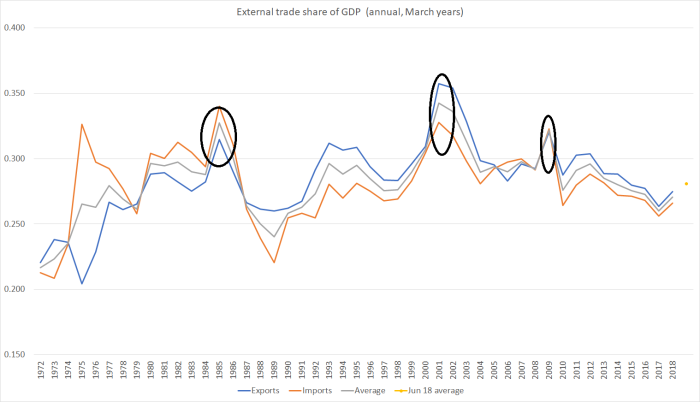
The latest quarterly numbers out last week did show an uptick in both exports and imports as a share of GDP.  But here is the chart back to 1972 –  annual data, plus the latest quarterly observation.

external trade share

The foreign trade share has been, at best, static for almost 40 years (in most countries they’ve been increasing).  The last few years have seen the trade share the weakest for almost 30 years (and the late 80s construction boom).  I’ve highlighted the only three occasions when exports and imports have averaged 30 per cent or more of GDP: the year to March 1985, the years to March 2000 to 2002, and the year to March 2009.   What was the common feature of those years?   It wasn’t the stellar success of outward-oriented businesses.  It was the (unexpected) severe weakness in the exchange rate: the devaluation of 1984, the period around the end of the dot-com boom when US interest rates were high, and New Zealand (and Australian) dollars were unattractive, and the international financial crisis (and extreme risk aversion) of 2008/09.   Based on the rest of the set of New Zealand policies, those low exchange rates weren’t sustainable, and there was a relatively quick rebound.

What of other advanced countries?

Big countries tend to do less foreign trade (share of GDP) than small countries.  That is no surprise, as there are many more markets and opportunities for specialisation (gains from trading) close to home.  Here are the OECD countries that in 2016 (last year with complete data) had exports and imports averaging less than 30 per cent of GDP.

Australia 21.0
Chile 27.8
Italy 29.0
Israel 28.2
Japan 15.6
Turkey 23.4
UK 29.1
USA 13.3

Of them, Italy, Japan, Turkey, the United Kingdom and the United States are big countries and big economies.    You’d expect to find them on this table, and if anything the anomaly is Germany, with a foreign trade share now in excess of 40 per cent of GDP.

Of the remaining countries, there are

  • Australia, with five times our population,
  • Chile, with more than three times our population, and with the second lowest labour productivity in the OECD (beating only Mexico), and
  • Israel, which isn’t much larger than New Zealand but which –  as I’ve highlighted here previously –  has a similarly lousy productivity growth record.

And all, in one form or another, with severe disadvantages of distance.

There has been a tendency in some circles to excuse New Zealand’s low foreign trade shares by citing distance, but simultaneously a reluctance to take seriously what is implied by that limitation.  If the opportunities for foreign trade from this remote location don’t look particularly good, isn’t there something deeply illogical (or worse) about continuing to use policy (as successive governments have done for last 25 years) to drive up our population –  more people in an unpropitious location?  All the more so when adopting that policy approach also involves driving the real exchange rate up, away from where it would likely settle otherwise.  Not all New Zealanders suffer in the process –  if you run a business geared, in effect, solely towards population growth you may well flourish –  but New Zealanders as a whole have.

For all the occasional talk about rebalancing the economy (from both main parties, at least when they first take office) none of it seems to take any serious account of this constraint.   Which is only set to become more seriously as –  relative to other countries –  the opportunities here shrink with the apparent determination to pursue net-zero emissions targets.  Planting (lots more) is unlikely to be a path to sustained prosperity or higher productivity.

These days, New Zealand’s per capita foreign trade will among the lowest in the advanced world.   Among the rich countries, only (very big) Japan and the United States will be materially lower than us.  It isn’t a mark of a successful economy.  But neither government nor opposition have any real strategy –  or interest? –  in turning things around.

Inflation and the tax system

When I went looking for the interim report of the Tax Working Group, I found that various other papers had been released.   These include background papers prepared by the Treasury and IRD secretariat looking at various possible options for reducing other taxes if, for example, new capital taxes were to provide more government revenue.

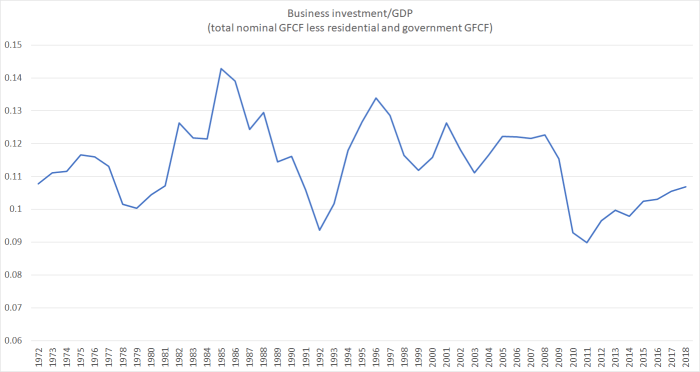
Among them was a short and rather unconvincing paper on productivity.   It was notable for highlighting how difficult it was to give any concrete meaning to the aspiration repeatedly expressed by the Minister of Finance, and included in the terms of reference, of “promoting the right balance between the productive and speculative economies”.  And it was also notable for the aversion of officials to lowering the company tax rate (or the effective tax rate shareholders pay on company income), even though they accept that our business income tax rates are now high by international standards, and that business investment (including FDI) is low by international standards. This chart is from the paper.  In general, what is taxed heavily you get less of.

corp income tax

But this time I was more interested in another of the background papers, this one on the possibility of inflation indexing the tax system.   Even with 2 per cent inflation, failing to take explicit account of inflation in the tax system introduces some material distortions and inefficiencies.  Many of the costs of inflation arise from the interaction with the tax system, and these distortions may be greater in New Zealand than in many other countries because of the way we tax retirement income savings (the TTE system introduced, as a great revenue grab at the time, in the late 1980s).

In the days of high inflation there was some momentum towards doing something about indexation. It had, for example, been a cause championed by former Reserve Bank Governor Ray White.  And in the late 1980s, the then government got as far as publishing a detailed consultative document.  But then inflation fell sharply (and maximum marginal tax rates were cut) and the issue died.  We don’t even have the income tax thresholds indexed for inflation, allowing Ministers of Finance ever few years to present as a tax cut an increase in revenue that should never have occurred in the first place.

In the early days of inflation targeting there might even have been a case for letting the issue die.  The inflation target was centred on 1 per cent annual CPI increases, and that target was premised on a view that the CPI had an annual upward bias of perhaps as much as 0.75 per cent per annum).  But since then, the extent of any biases in the CPI have been reduced, and the inflation target has twice been increased.   The inflation target now involves aiming for “true” inflation” of at least 1.5 per cent per annum.

The distortions are most obvious as regard interest receipts and payments.  Take a short-term term deposit rate of around 3 per cent at present.  Someone on the maximum marginal tax rate (33%) will be taxed so that the after-tax return is only 2 per cent. But if, as the Reserve Bank tells us, inflation expectations are 2 per cent, that means no real after-tax return.  Compensation for inflation isn’t income and it shouldn’t be taxed as such.  Only the real component of the interest rate (1 per cent) should be taxed.   The same distortion arises on the other side, for those able to deduct interest expenses in calculating taxable income: in the presence of inflation, this tax treatment subsidises business borrowing.  The amounts involved are not small.   As economist Andrew Coleman notes in his (as ever) stimulating TWG submission

Even at low inflation rates, these distortions are substantial. In 2017, for instance, residential landlords borrowed $70 billion. Even if the inflation rate is as low as 1 percent, this means residential landlords can deduct $700 million of real principal repayments from their taxable income, a subsidy worth over $200 million per year. New Zealand households lend in excess of $150 billion. When the inflation rate is 1 percent, lenders are expected to pay tax on $1.5 billion more than they ought. Many people who invest in interest-earning securities are elderly, risk averse, or unsophisticated investors. For some reason the New Zealand Government believes these investors should pay more tax than any other class of investors in New Zealand. It is a strange country that taxes the simplest, most easily understood, and the most easily purchased financial security at the highest rates. It suggests the Government has little interest in equity, its protestations notwithstanding.

There are other distortions too, notably around trading stock valuations and asset valuations on which true economic depreciation would be calculated.

As reflected in the paper released this week, officials are very wary about doing anything about fixing these distortions (and they fairly note that “no OECD country currently comprehensively inflation indexes their tax system”), and they devote many pages to outlining the practical challenges they believe would be involved, and the new distortions they believe would arise from partial approaches to indexation.

I have some sympathy with the stance taken by officials on the specific challenges to doing comprehensive indexation, especially in a way that does not bias transactions through favoured institutional vehicles.  But it is a particularly bloodless document that seems to reflect no sense of the injustice involved in taxing so heavily relatively unsophisticated savers (while subsidising business borrowers, especially those financing very long-lived assets).

This seems like a case where some joined-up whole-of-government policy advice would be desirable.  There would be no systematic distortions arising from the interaction between inflation and the tax system if there was no systematic or expected inflation.   Systematic inflation isn’t a natural or inevitable feature of an economic system –  in some ways it is about as odd as changing the length of a metre by 2 per cent a year, or the weight of a gram by 2 per cent a year.  In the UK, for example, (and with lots of annual variation) the price level in 1914 was about the same as it had been in 1860).  And the most compelling reason these days for targeting a positive inflation rate is the effective lower bound on nominal interest rates, itself created by policymakers and legislators.   Take some serious steps to remove that lower bound and (a) we’d be much better positioned whenever the next serious economic downturn happens, and (b) we could, almost at a stroke, eliminate the distortions –  and rank injustices –  that arise from the interaction between continuing, actively targeted, positive inflation, and a tax system that takes no account of this systematic targeted depreciation in the value of money.

It wouldn’t be hard, but our ministers, officials (Treasury and IRD), and central bankers currently seem utterly indifferent to the issue.

Debt default by the US government

There was a great deal of debt defaulted on during the Great Depression.   Businesses failed, farms went bust, and some mortgage borrowers defaulted too.    But a huge number of governments also defaulted on their obligations, not just in places like Greece or Argentina which had form in that regard, but including many of the governments of the richest countries in the world.  You could read about the New Zealand episode here.   Most countries in Europe (including the UK and France) defaulted on their (substantial) war debts to the United States –  in fact, only Finland paid in full.  But even the United States government defaulted.

There is an interesting and accessible new book out about that experience, American Default.   It is written by UCLA Chilean academic Sebastian Edwards (who has been used as an adviser and author here, including this paper at a Treasury/Reserve Bank conference a few years ago), who got onto the subject after acting as an adviser to law firms involved with sovereign defaults by Argentina after 2001.

Going into the Great Depression most countries were, directly or indirectly, on the Gold Standard (indirect in New Zealand’s case, where the banks managed the exchange rate to maintain parity with sterling which was fixed to gold).  But the US situation was a bit different than most.   After the experiences with inflation (and fiat money) during the Civil War, in the subsequent decades –  right up to the early 1930s –  US government bonds were issued with a provision (the “gold clause”) that entitled the borrower, at his/her own option, to be repaid in gold.  Many corporate bond contracts had similar provisions.  They were intended as a protection for the lender against unexpected inflation (arising when the fixed parity between dollars and gold was broken, or abandoned), and at least in the early decades must have allowed US borrowers to borrow more cheaply, and/or for longer-terms than they would have otherwise been able too.  In that respect, they were similar to the way in which many countries with a track record of high or variable inflation found it difficult to borrow in their local currency, and borrowed in foreign currencies instead.

By 1933, many countries (notably the UK) had already broken the link to gold.  But the US (and France and several other smaller European economies) hadn’t.  Breaking the link was part of what enabled those countries to begin recovering from the Depression (both by devaluing against gold-based currencies, and by allowing interest rates to be cut further).   By 1933, there was plenty of gold in the US, but no recovery –  indeed, Roosevelt took office in the midst of a banking panic.  As in many other countries, the price level had fallen significantly, such that the real value/burden of any debt contract outstanding was materially greater than had been expected only a few years earlier.

That said, the US government itself was not particularly heavily indebted.  Economic historian Peter Temin’s book on the Great Depression includes a table suggesting that gross debt of all level of US government in 1929 had only been about 35 per cent of GDP.  (By contrast, in New Zealand, Australia, and the UK general government public debt in 1929 had been in excess of 170 per cent of GDP.)   Corporate bonds outstanding seem to have been of a similar size.   Of course, in all cases these debt ratios rose as economies moved towards the depths of the Depression, as both real GDP and the level of prices fell.

It seems that Roosevelt didn’t have a clear strategy in mind when he took office (and the tie to gold hadn’t been a campaign issue).  The actual approach unfolded gradually over the year or two after he took office.  What did the US government do?

The first major step –  extraordinary in a free society –  was to simply outlaw private sector holdings of gold.   All but trivial amounts of gold had to be delivered to the government, with less than a month’s notice, for which holders were paid at the then still-current official price of gold (US$20.67 an ounce).   Private holdings of gold were forbidden for decades.  A few weeks later Congress passed a declaration explicitly prohibiting gold clauses in future securities issues, and abrograting (voiding) existing provisions.   The government then began buying up gold (in the international market) steadily raising the US dollar price of gold until in January 1934, with Congressional authorisation, the official price was reset at $35 an ounce (where it remained until 1971).  US citizens couldn’t get hold of gold, but the US remained willing to buy at the price from overseas sellers.

In effect, the US was off the Gold Standard and had devalued its exchange rate. Gold purchases were increasing the domestic monetary base. In combination, such measures should, and did, support a lift in US economic activity and in prices (commodity prices in particular, in USD terms, rose quite quickly and substantially as one might expect).

And, in the process, the US government managed a huge windfall gain for itself.  As another recent treatment of this episode (by Richard Timberlake, not referenced by Edwards) records, the book profits on the revalued gold was roughly equal to total Federal government revenues in 1934.  Compel citizens to sell you an asset at one price and then re-set the price, more in line with economic realities, and in the process transfer a great deal of wealth from citizens to the government.   It isn’t the sort of approach one would normally expect in a country with the rule of law.

But, of course, the interesting thing about the United States is the way the constitution sometimes intrudes in the freedom of governments to do just as they want.  Had a New Zealand, Australian, or British government adopted measures like those in the US, there would have been nothing much anyone could have done about it, once the parliamentary battle was lost.  But in the US many of these sorts of issues are only finally resolved at the Supreme Court, testing the validity of congressional or executive actions against the provisions and protections of the Constitution.

And that is what happened in this case, although only in respect of the abrogation of the gold clauses.  There were several cases taken, each with slightly different factual bases, covering both private and government obligations.    The claim wasn’t to be paid in physical gold –  private holdings of which were now illegal –  but to be paid the dollar value of the gold equivalent when the bond had been issued.  In dollar terms, that would be 69 per cent (35/20.67) more than otherwise.  There were substantial sums at stake.

As Edwards illustrates, the Supreme Court hearings were closely followed by markets and the press (and at the time the court was perceived to be roughly evenly divided between what might loosely be described as “conservatives” and those of a more moderate or “progressive” disposition).   Media coverage suggested that the government’s lawyers had not had the best of the hearings themselves.   The Court’s ruling was eagerly awaited, and with some trepidation by the government.  Contingency planning had been undertaken, and in Roosevelt’s papers is the draft text of an address he intended to deliver had the Court ruled comprehensively against the government, and papers outlining the actions he intended to initiate in response.    An adverse outcome wasn’t going to be acceptable.  Roosevelt seems to have regarded the abrogation of the gold clauses as an essential element in his overall strategy to lift economic activity and prices; indeed one of the key arguments made to the Supreme Court was around a justification of national emergency.

As it happens, the government won in practice.   The abrogation of the gold clauses, at least as applied to Federal government debt, was ruled unconstitutional (by an 8 to 1 margin).   But by a 5 to 4 margin, the Court ruled that the abrogation had not produced any damages to bond holders, and so those bondholders were prevented from taking further action (in something called the Court of Claims) against the government.  In other words, there were to be no practical consequences for having passed an unconstitutional law (I’m not entirely clear –  it isn’t discussed in the book – why having ruled it unconstitutional the Court didn’t overturn that provision, but clearly they didn’t).

Had the gold clauses in private and government bonds been allowed to stand, issuers would have been required to pay 69 per cent more (dollars) than otherwise (but, in effect, the same amount of gold).  In his book, Edwards seems to accept that this would have been a highly damaging, undesirable, and unacceptable outcome.  I’m less convinced.

For a start, they were the terms on which contracts had been entered into (at numerous different dates), and the cases before the Supreme Court all involved substantial and sophisticated issuers including the US government itself (although I understand that some residential mortgages at the time may also have contained the clause).  And it is not as if changes in gold parities and prices had never happened before (indeed, in other countries they had been frequent during World War One and the subsequent decade). No one, in contracting –  or purchasing – these bonds could credibly claim to have put no weight at all on the possibility of the US ever changing the gold price of dollars.  In fact, the US was still issuing bonds containing the gold clause into 1933, 18 months after the UK (for example) had gone off gold.

It is probably fair to suggest that no one really anticipated a deflationary event as severe and sustained as the Great Depression, but there is at least an arguable case that bankruptcy courts and limited liability exist to handle cases where things turn out unsustainably far from expectation.  But that is a case-by-case procedure, not a blanket transfer of wealth from lenders to borrowers.  In the US government case –  see the numbers earlier –  federal debt was not large and even Roosevelt acknowledged that losing the case would not have bankrupted the government.   Quite possibly the situation would have been different for some corporates.  But it is also worth remembering the whole point of the Roosevelt strategy (not so different in its end aims from those in many other countries), which was to markedly raise the economywide price level and reverse the sharp falls that had happened during the Depression.  To the extent that strategy was successful, the abrogration of the gold clauses would clearly leave lenders materially worse off than they would have been otherwise.  For borrowers in the tradables sector (admittedly probably a minority), the depreciation in the exchange rate itself markedly (and immediately) improved their capacity to service the debt, so it is even less obvious what the case was for the arbitrary use of government power to provide debt relief.

One of the government’s other arguments was that since the price level in the mid 1930s was materially lower than it had been a decade earlier, anyone who held the bonds throughout would be getting an unexpected windfall gain simply being paid out in dollars (since the purchasing power of those dollars was greater than it had been), let alone being paid out at the new higher gold price.  But even to the extent that argument was valid, it doesn’t take any account of secondary market trading in the affected securities.  A person who purchased a new issue bond in (say) 1926 might indeed be getting a windfall gain –  and windfall gains and losses happen all the time in economic life –  but a secondary market purchaser who’d purchased that bond in late 1932 would have lost out badly (and might well have put a high value on the gold clause as protection against just such an eventuality).

(To illustrate the windfall point, in the late 1980s and early 1990s New Zealand governments were determined to get inflation sustainably down. There wasn’t a great deal of confidence that would happen.  As late as November 1990, the 10 year bond yield averaged 12.96 per cent.  Actual CPI inflation in the subsequent 10 years averaged 1.8 per cent.  Similar windfall losses happened when inflation unexpectedly rose, and stayed up, in the 1970s.)

The sorts of revaluation effects the Roosevelt administration successfully tried to overturn happen not infrequently in systems where borrowers –  especially those not in the tradables sectors, without an export revenue hedge – have taken on considerable foreign currency debt, only for a substantial devaluation or depreciation in the exchange rate to occur.  It happened, for example, in New Zealand in 1984: much of the government’s debt was in foreign currency terms, and a 20 per cent devaluation immediately increased the servicing burden by 25 per cent.  Granted that New Zealand wasn’t in the depths of a depression in 1984 , but no one thought it would fair, reasonable (or even possible) to default on that additional servicing burden.

But in the early 1930s, both New Zealand and Australia were in the depths of really rather severe economic depressions –  perhaps not quite as bad as in the US, but certainly much worse than in, say, the UK.   Both countries had really large volumes of central, local (and state, in Australia) government debt issued abroad –  debt burdens far heavier than those facing the US government when Roosevelt took office.  The distinction between New Zealand or Australian pounds and pounds sterling wasn’t that clear in those days, but as the exchange rate diverged during the Depression, initially with government acquiescence and then at government direction (our own formal devaluation happened in early 1933) debts payable in London were suddenly costing the borrowers far far more than they had envisaged (in New Zealand pound terms).  And the price levels in New Zealand, Australia, and London were all quite a bit lower than initially envisaged.   New Zealand and Australian governments would have welcomed some debt relief on their overseas debts, but it never came: the powerful counterargument was “well, if we are going to successfully boost global price levels such relief won’t end up being necessary”.  And it wasn’t.

The big difference perhaps between the New Zealand and Australian cases and the US one in the 1930s is that the US debt was almost entirely held by domestic investors and was issued wholly under US domestic law.  The US didn’t need to tap international markets on a continuing basis, unlike both New Zealand and Australia.  And so New Zealand and Australia imposed defaults in respect of government  debt issued to domestic holders, but not to foreign ones, and the bulk of the (public) debt was foreign.  But rereading the account of the New Zealand (and Australian) experience in the 1930s, what is striking is the extent to which lenders were willing voluntarily to write down the value of their claims, voluntarily converting to less valuable (government) securities, apparently from some sense of “fairness” or the “national interest”.   One can wonder what sort of response Roosevelt would have achieved had he tried moral suasion rather than legislative coercion.   Perhaps it wouldn’t have worked for private sector issuers –  and for example, the New Zealand government used various legislative interventions in the 1930s to relieve farm debt –  but some case-by-case approach still seems preferable than the rather arbitrary use of legislative instruments to relieve all corporate borrowers from obligations they voluntarily entered into.  Especially, when the economy and the price level were just about to recover, improving (markedly) future servicing capacity.

Of course, had the US recovery subsequently been strikingly more robust and successful than those of other countries, there might be a stronger prima facie case for this (distinctive) debt relief component of Roosevelt’s strategy.  But it wasn’t.  As is well-recognised, it wasn’t until around 1940 that real GDP per capita in the US got back to 1929 levels (years behind, say, New Zealand, Australia, and the UK in that regard).  And the recovery in the price level also lagged.

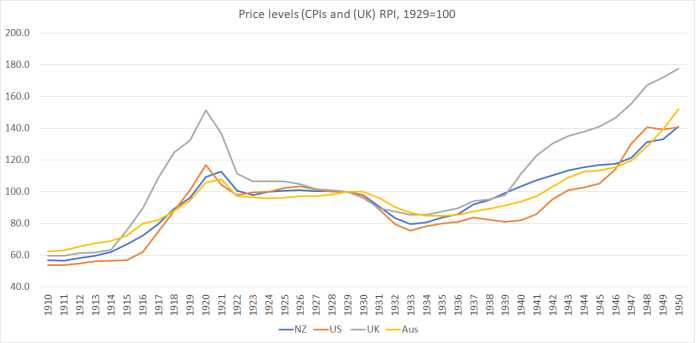
Here is a chart of the price levels, indexed to 100 in 1929.
price levels

Prior to World War One, price level movements tended to be quite slow and gradual.  There was little sign anywhere of entrenched expectations of future trend changs (up or down).  After World War Two, inflation became an entrenched feature of the system.  In this period, things were in transition.   There were windfall gains and losses, falling heavily on different groups at different times.   But if deflation was the story of the Depression specifically, across all four countries the dominant theme of the period is a lift in the price level.  Even by 1939, in New Zealand and Australia and the UK price levels were more or less back to pre-Depression levels (it took a few years longer in the US).     There seems little obvious case for a borrower, not initially over-indebted, to use legislative powers to abrogate contracts freely entered into to remove significant value from lenders, at a time when the entire of macro policy was to drive up the price level.

A fair, and interesting, point Edwards makes (and which I also make in the treatment of the New Zealand default) is that there were few obvious adverse consequences from this US default.  There is little sign that borrowers became more reluctant to lend, or charged higher risk premia.  If so, that suggests that perhaps people in aggregate really did see it as a step not unjustifed in the extraordinary circumstances.

It is an interesting book about a now little-known episode in US history.  Edwards combines history, economics, and legal analysis, but presents in a way designed to appeal to the intelligent lay reader, not just to the geeky economic historian.  Debt default episodes –  here, there, and everywhere –  should be better understood.  We surely haven’t seen the last of sovereign defaults perhaps –  the way fiscal policy is going – even in the United States.
A stuff-up by Statistics New Zealand

Many readers will recall the fiasco of the leak of an OCR announcement back in March 2016.  It turned out that the Reserve Bank’s systems were had been so lax for years that people in the lock-ups they then held could simply email back to their offices (or to anyone else) news of the announcement that was supposed to be being tightly held.  This weakness only came to light because someone in Mediaworks emailed the news of this particular OCR announcement to their office, and someone in that office emailed me (from memory I was supposed to go on one of their radio shows later that morning).  I drew the matter to the Bank’s attention.

In the wake of that episode, the Bank (rightly in my view) cancelled the pre-release lock-ups for journalists and analysts.  But other government agencies went right on, relying on trust more than anything else.   One notable example was Statistics New Zealand, which produces and publishes many of the most market-moving pieces of economic data.    When asked about any possible changes to their procedures (outlined here) following the Reserve Bank leak in 2016, they responded

Statistics NZ has not undertaken any reviews or made any changes to the department’s policy for media conferences following the Official Cash Rate leak at the Reserve Bank of New Zealand and the subsequent Deloitte report into that leak released last week.

and

While Statistics NZ has never had a breach, if that trust is abused and an embargo is broken, offenders and their organisation would be barred from attending future media conferences.

As I noted back then

Unfortunately, that was probably the sort of discipline/incentive the Reserve Bank was implicitly relying on as well.

Unfortunately, after the confusion the Prime Minister gave rise to earlier in the week, confusing the crown accounts and GDP (which had some people abroad worried that the Prime Minister actually had had an advanced briefing), there was apparently more trouble this morning.  But this time, the fault was entirely with Statistics New Zealand, and not with those in the lock-up.

The embargo for the lock-up on gross domestic product (GDP) for the June 2018 quarter, held today, 20 September 2018, was lifted about one minute earlier than the planned time of 10.45am.

The lock-up is held in Stats NZ’s Wellington offices from 10am to 10.45am, to allow key financial media, bank economists, and other government agencies to understand the information and ask questions about GDP, before the embargo is lifted. It is held under strict embargo conditions.

Stats NZ staff in the lock-up check official New Zealand time on the Measurement Standards Laboratory of New Zealand (MSL) website.

However, a computer script (JavaScript) bug meant that the official time clock website that appeared on the staff member’s phone picked up the phone’s own time setting, which was slightly fast.*

In other words, those in the embargoed lock-up had the data –  and could communicate it to their dealing rooms – a minute earlier than anyone not in the lock-up got the data.     And it seems to have mattered.  GDP was higher than expected and the exchange rate jumped.   People who were in the lock-up got the jump on that.  I’ve heard that the exchange rate moved before 10:45 (the official release time), which isn’t surprising if people in the lock-up had been told the embargo had been lifted.

What is striking about the statement SNZ put out –  and it wasn’t exactly distributed widely (say, to all the people who got the GDP release itself) –  is that there is no mention at all of these possible early trades, which (in effect) distributed money/profits from one group of people (those not in the know) to another (those in the know).  Unlike the 2016 Reserve Bank leak, there seem to have been real financial consequences to this mistake.  And it isn’t clear that Statistics New Zealand is taking it that seriously.   When I asked about any investigation being undertaken, the implication of their reply was that there would be no further investigation or review beyond the narrow technical statement I linked to earlier. I hope that is not correct (and I hope, for example, the Reserve Bank is insisting on something more).

Writing about these data lock-ups in 2016 I noted of the SNZ situation

Is Statistics New Zealand that different?  There is, obviously, no policy message SNZ is trying to put across with its releases, and so no risks of different messages getting to different people.  But the security risks are the same.  Perhaps it is simply more efficient to have everyone in the same room, to clarify key technical points, but couldn’t the same end be achieved –  on a more competitively neutral basis (to analysts based abroad, say) –  by a dial-in (even webcast) conference call held a bit later on the day of the release?

That still seems right to me. I cannot see the case for a pre-release lock-up (and I can see a case for a technical conference call later in the day).   Mistakes will happen while they keep on with lock-ups.   The reliance on trust seems to be as strong as ever, and (as far as we know) that has been honoured.  This time, the stuff-up was by Statistics New Zealand themselves.   It was unnecessary, and it will at the margin (and especially in conjunction with the political contretemps earlier in the week) damage confidence in our statistics agency and the integrity of our data.

A picture in continuity

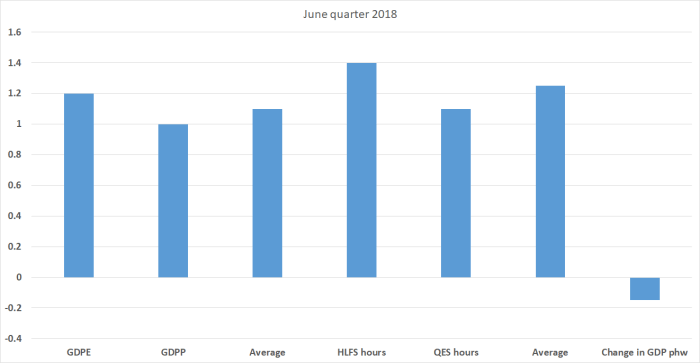
Here is a summary chart of the real GDP outcomes for the June quarter (expenditure and production), the hours outcomes (QES and HLFS), and the implied change in labour productivity (real GDP per hour worked), taking the average change in hours worked from the average growth in real GDP.

GDP q2 1

There was quite a bit more activity all round, but it took a larger percentage increase in labour inputs (hours) to get the published percentage increase in output (GDP).  In other words, labour productivity fell: not just the growth rate, but the level.

Here is the same chart for the previous quarter.

GDP q2 2

It was worse: less GDP growth, but also an even larger fall in GDP per hour worked.   Productivity growth for the first half of the year was -0.65 per cent.  That isn’t an annualised number, but an absolute change; a significant fall.

Perhaps you think this just shows how dreadful the new government is.  Here is the same chart showing the cumulative growth rates for the last six months of last year (in blue) and the first half of this year (in orange).

GDP q2 3

To me, the similarities are (much) more striking than the differences.    Importantly, the level of labour productivity fell in both halves.

Looked at from a productivity perspective –  and that really is where one should focus, especially when the unemployment rate is not too far from the NAIRU – it is a pretty dreadful performance.    Of course, simply looking at two six month periods on their own doesn’t tell one much, but nothing in these data is inconsistent with the poor productivity record for some years now.

And neither the last government nor this one appears to have any serious ideas for, or any serious interest in, fixing this failure.


Is this what leadership looks like?

When the news broke earlier in the year that Canterbury University academic Anne-Marie Brady’s house and office had been broken into, and that the only things taken seemed to relate specifically to her longrunning research work on the People’s Republic of China, the initial response from the government didn’t seem too bad.

Ardern said at the post-Cabinet press conference on Monday that “everyone would be concerned” if Brady had been targeted because of her academic work.

“If there’s evidence of that, we should be taking stock and taking action,” Ardern said. “I will certainly ask some questions.

“I would certainly want to be informed if there was evidence that this was a targeted action against someone who was raising issues around foreign interference.”

Brady  herself was impressed (although I think I thought –  and perhaps wrote – at the time that these comments seemed more designed to encourage the Prime Minister, rather than accurately describing any evidence to date of taking foreign interference “very seriously’).

“I am very heartened to see the Prime Minister is taking the issue of foreign interference activities in New Zealand very seriously and that she has instructed the security agencies to look into the break-ins I have experienced,” Brady said.

The story has been back in the media again thanks to the persistent efforts of Matt Nippert of the Herald.  Last weekend there was his widely-viewed (and linked to abroad) article “The curious case of the burgled professor”, and this morning the front page of the Herald has the story “SIS sweeps prof’s office“.

Electronic surveillance specialists from the Security Intelligence Service have carried out a search for listening devices at the University of Canterbury office of the professor revealed to be a possible target of Chinese espionage.

News of the sweep, confirmed by several university staff, comes as academic colleagues of Anne-Marie Brady came out in support of the China specialist….

The Herald understands a similar search for bugs by the Security Intelligence Service (NZSIS) has also been conducted at Brady’s Christchurch home, the site of another suspicious burglary being investigated by authorities.

From what is reported in that story, and in Radio New Zealand’s interview this morning with Anne-Marie Brady, the Police and the SIS seem to be doing a pretty thorough job.  Brady herself praises what she has seen and heard of their efforts.

But what of the Prime Minister?  Remember that this is the “leader” of whom Matt Nippert has reported

She won’t talk about the general issue, and here she is (quoted in Nippert’s article this morning) on the specific one.

Prime Minister Jacinda Ardern, asked about the case on Monday at her post-Cabinet press briefing, said she had yet to be briefed on whether the episode could be attributed to China.

“I have not received any further advice on that, but nor have I sought it. As it were, nothing has since been raised with me to suggest that it was, or wasn’t,” she said.

“Speaking more generally, what the underlying suggestion here is of foreign interference. I’ve been very, very cautious around always stipulating that New Zealand needs to be live to general issues of interference, and that’s something we keep a watching brief on.”

She hasn’t asked.  How convenient.  If she were really concerned about the issue, and the potential, you’d have thought she –  and her office –  would be all over an issue of this sort (as a matter of sovereignty, national security, defence of academic freedom etc, not as “interfering” in a potential criminal prosecution).

And as for that final paragraph, if that is “leadership” we’ve lost all sense of how a leader might actually act or speak.   Of course she probably isn’t in a position to make specific accusations –  especially not having asked for the information –  but what would have been so wrong about a clear and strong statement that she, and New Zealanders, would deplore and push back strongly against any foreign interference in New Zealand, and in particular if agents of a foreign power were found to have been responsible for the Brady break-ins.  She could even have gone on to say that if such evidence were found then –  even if it were not possible to launch criminal prosecutions (after all, we don’t have an extradition treaty with China) –  the damage to our bilateral relationship with such a country would be severe.

Instead we get this vacuous waffle

I’ve been very, very cautious around always stipulating that New Zealand needs to be live to general issues of interference, and that’s something we keep a watching brief on.

saying precisely nothing, from someone who appears to desperately hopes to avoid the issue.  Her response here is much weaker than her February one.

Does the Prime Minister stand for academic freedom in New Zealand, for the rights and freedoms of New Zealanders to do research, to speak out, to challenge other countries here in New Zealand, the rights of New Zealanders to be secure in their homes?  “Stand for” in the sense of being willing to pay a price to protect and defend?  Or is she more interested in doing everything possible to be able to look the other way, prioritising party fundraising, trade agreements, the interests of a few big corporates (and universities) and visits to Beijing over the values and freedoms of New Zealanders, including those like Professor Brady who’ve done in-depth research on PRC efforts here?

She, her party president, and their peers in the National Party together.

Automation, future of work, and other distractions

The Labour Party, led by the now Minister of Finance, has made great play in recent years of the looming “threat” of automation, and the claimed need to think hard about the Future of Work.  There was a taskforce in Opposition, repeated references in ministerial speeches, and now even a Future of Work Forum.  I’ve always been a little sceptical: the application of new technology has been a key part of how living standards have improved over the last few hundred years, and I’m sure most people are hoping for further improvements for themselves and their children/grandchildren.   And employment rates seemed to be about as high as they’ve been for decades.

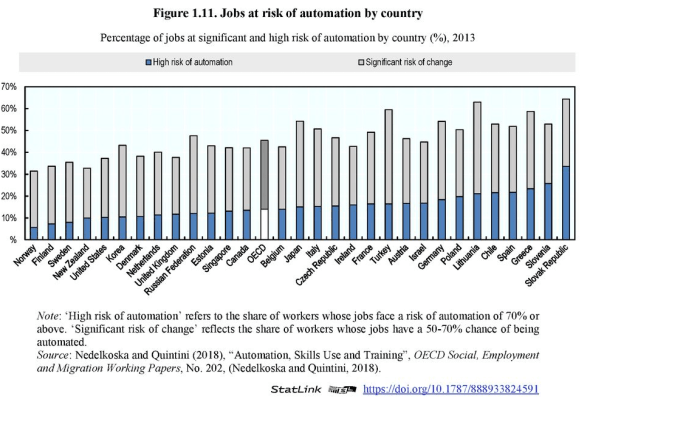
And so I was interested this afternoon flicking through today’s online Financial Times to find an article citing some new OECD work suggestiong that New Zealand is among the advanced countries with some of the lower propotions of jobs at significant risk of automation.  Here is the key chart from the OECD paper.

automation2

New Zealand fourth lowest share of jobs at high risk of being automated, and lowest in the OECD for the combined high and significant risks.

For the geeks, here is some text from the paper on how OECD researchers have been revising down their estimates.

automation 4

Automation will, no doubt, continue to happen.  It should.  We’ll generally be better off for it (even if some individuals will face difficult adjustments, as they did in every phase of activity –  indeed every business cycle – since the Industrial Revolution).  But particularly if this methodology is even approximately right, it reinforces my sense that the Labour Party – and now the government –  (probably with good intentions) use the Future of Work issue, and automation risks/possibilities, as a distraction from, and substitute for, their lack of interest/ideas in addressing the real economic elephant in the room: decades of underperforming productivity growth that mean we would now need a two-thirds lift in productivity (all else equal) to once again match the leading countries, most of whom we used to consistently outstrip.

As Morning Report reminded us today on the anniversary of women’s suffrage, we should celebrate the automatic washing machine, for all the time it freed up, and opportunities it allowed people (then largely women) to pursue.  It is only one of a myriad of such innnovations, past, present and future.

But New Zealanders get fewer of the gains than most advanced country citizens, as successive governments have done nothing to reverse the productivity failure.


An age of diminished expectations?

The Westpac McDermott Miller consumer confidence survey results are out this morning.  To the extent they get any media coverage, no doubt the focus will be on the headline result.  Here is the summary chart.

westpac 1

In Westpac’s words

Consumer confidence fell sharply in September, taking it to its lowest in six years.

There probably isn’t much predictive value in these results for actual economic data, but I find the results interesting in their own right: how people generally are feeling about their economic fortunes and the economy more broadly.  After all, respondents aren’t just the “ideological enemies” of the government.

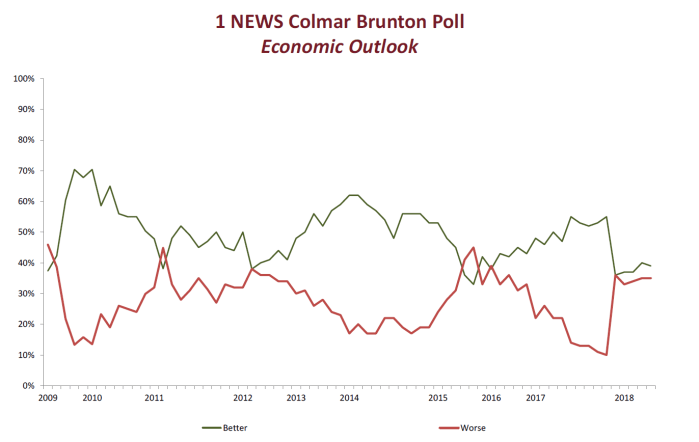
The Westpac results don’t seem out of line with the most recent Colmar-Brunton poll (taken six weeks ago) in which respondents are asked a single question.

“And do you think during the next 12 months the economy will be in a better state than at present, or in a worse state?”

colmar brunton

The public no longer seem very optimistic at all.

But in some ways I was more interested in the longer-term trends in a couple of the sub-components of the Westpac index.   For example,

westpac 2.png

People are now less optimistic about improvements in their own personal position than at any time in the last 30 years outside periods when the economy was already in the midst of a recession (and materially lower than in the fairly shallow 1997/98 recession).  And look at the contrast between confidence levels from say 1994 to 2007 (across two different governments) and those now.  It looks a lot like a fairly steady trend decline.

And then there is the question about the longer-term prospects for the economy itself.  Respondents might not know much analytically about the issue, but their perceptions are interesting nonetheless.

westpac 3

The latest observation isn’t startlingly bad (and there was that sharp –  but brief – dip a couple of years ago) but look how diminished expectations are now (last three years or so) relative to the entire history of the series.  There are individual quarters that are weaker (though note, not in the 2008/09 or 1997/98 recessions) but in thirty years there has been no three year period where medium-term optimism has been weaker than over the last three years (under National and Labour governments).   And this pessimism isn’t tied to the last recession –  look how upbeat people briefly were in the couple of years after the recession ended.

(The medium-term picture is less bad in the ANZ’s consumer confidence survey, (which has a much shorter run of data) and it would interesting to know the precise question asked, to help understand that difference.)

Then again, in an economy that has managed very little labour productivity growth in the last five or six years, and none at all in the last three years, perhaps it shouldn’t surprise.

real GDP phw jul 18

In an economy where the promises of economic reform decades ago came to little  (for younger readers, that is the then Minister of Finance back in 1989/90)

caygill 1989 expectations

And where none of the political parties – especially not National or Labour that have led all our governments – seem to care much if at all, or have any serious proposals for turning around the continuing decades of underperformance, isn’t the public quite rational in being much less optimistic than they were?

A more interesting question is why they/we don’t find a way of demanding something better.

A bouquet for the Government

They don’t deserve many, but this announcement this morning is unambiguously positive.

Cabinet papers will be proactively released, Minister of State Services Chris Hipkins announced today.

The move is part of the Government’s wider plan to improve openness and reflects its commitment to the international Open Government Partnership.

The Cabinet papers will be released no later than 30 business days after a Cabinet decision. This process will be in place for Cabinet papers lodged from 1 January 2019, Chris Hipkins – who is also responsible for Open Government – said. ……

“Cabinet papers will be released within 30 business days of the Cabinet decision unless there is good reason not to publish. If we can publish it, we will.”

It will, almost certainly, end up less good than it sounds.  But it is a start.    The official papers upon which our governors make their official decisions should be open to public scrutiny, with only a short delay.  As the Minister’s press release notes

“This change is consistent with the spirit of the OIA which states that information should be made available unless a good reason exists for withholding it.

“Proactive release of official information promotes good government and transparency and fosters public trust and confidence in government and the public agencies.”

Of course, only time will tell how (a) this government chooses to run the system, and (b) whether future governments regard themselves bound by the newly-established practice (the law isn’t being amended to require pro-active release, but it probably should be).  I don’t suppose we will ever see any Cabinet papers that might deal with awkward issues around the relationship with the People’s Republic of China, or PRC interference in New Zealand public and commercial life.   Perhaps we shouldn’t either.  Some things – a few –  need to be not only deliberated in secret, but to able to have the relevant considerations and supporting evidence kept under wraps for a longer period.  And, reasonably enough in my view, they won’t be releasing papers relating to recommendations for honours (they say they will withhold papers relating to appointments as well, and that is more concerning).

What worries me a little more is that

Individual ministers will have responsibility for releasing Cabinet papers, which will be subject to an assessment to decide if there are good reasons to withhold any of the information.

If individual ministers are making the decision, how will we be confident that all ministers are applying more or less the same standard?  There is no suggestion of a central monitoring process, and there will be more or less ornery ministers, more or less politically uncomfortable issues, weaker and less confident ministers, and –  as our arrangements have developed –  ministers who hold ministerial warrants but aren’t part of Cabinet, or even of the government itself.  Will, for example, the Greens ministers be bound by this new Cabinet practice?

But if the principle is that the official papers upon which our governors make their official decisions should be open to public scrutiny, with only a short delay, shouldn’t this principle be extended –  either voluntarily, or mandatorily –  to other state agencies that make major policy decisions, that attract considerable public interest and scrutiny?

One could readily extend the principle to the boards of all Crown entities (subject to similar specific exclusions as the Cabinet will apply to itself).

But, of course, the entity I particularly had in mind was the Reserve Bank.   The Bank’s longstanding line has been that, even though they make vital economic decisions that can materially affect the short to medium term performance of the economy, it would be costly, damaging, and confusing to release the background papers that the Governor receives prior to making his or her decision.  After all, they tell us, there is the MPS or the press release, and the Governor holds a press conference once a quarter.  What more do we need to know, they argue?   They simply generally refuse to release background papers –  although I did once manage to get them to release some that were ten years old (to make the point that, at most, there is a time dimension to any decision on whether material can be released under the OIA).

But those arguments apply –  if at all –  just as much to decisions made by Cabinet, often on much more complex and sensitive issues than those the Reserve Bank deals with.  Cabinet decisions are announced by ministers, the PM holds press conferences, and ministers are generally pretty accessible to the media  (more so than most Governors).  But the Cabinet has rightly decided to release (most) Cabinet papers, and recognises that doing so is right and proper in a free and open society, and will over time enhance confidence.

The same should go for the Reserve Bank.  If the Governor is serious when he talks about being open and transparent –  as he seems to be on all matters that he isn’t responsible for –  he’d take the lead on this issue, and announce that in future the big folder of background papers prepared going into each Monetary Policy Statement, together with the (anonymised) written advice of his advisers on the OCR decision, would be routinely released (perhaps with a small number of redactions) six weeks after the OCR/MPS announcement to which they relate.  Six weeks is long enough that plenty of new data will have emerged since the papers were written (indeed, it will be close to the next OCR decision), and short enough to still be of use/interest to analysts in understanding the Bank’s thinking (recall that we still have no idea what analysis they used last year when they announced they were assuming half of the building associated with Kiwibuild houses would be offset by reduced other residential building activity).

And if the Governor won’t take the lead, the Minister of Finance should insist on this sort of approach as part of the legislation and procedures around the establishment of the new statutory Monetary Policy Committee.

Most likely the Bank will continue to fall back on spurious arguments about potential damage to the “substantial economic interests of New Zealand” (an OIA ground that hasn’t been well-tested), or risks of confusion.  Those arguments are just wrong, and risk sounding (or perhaps are) self-serving: powerful bureaucrats protecting their particular monopoly on information/advice.  Cabinet has been willing to step beyond those arguments, and we should expect the Reserve Bank Governor –  a very powerful unelected policymaker –  to be even more ready to do so (being, after all, unelected and thus with less legitimacy).  If he doesn’t do so willingly, he should be left with no choice.


Having read the Our Plan speech

The Prime Minister’s speech on Sunday has attracted quite a lot of, generally not very favourable, attention.  I was interested in a few things that were there, and a few others that weren’t, particularly when compared to the Speech from the Throne that inaugurated the government’s programme last November.

The first was the apparent lack of ambition around the economy.    The Prime Minister continues to repeat the meaningless claim that “we’ve enjoyed enviable GDP growth in recent years”, as if headline GDP – as distinct from GDP per capita or GDP per hour worked –  means anything at all.    Here’s the track record: it has been pretty poor over the last couple of years (we’ll get an update on Thursday).

gdp pc to mar 18

Productivity growth has been even worse, and for longer.  Here, for example, is the comparison with Australia.

aus nz rgdp phw

The Prime Minister seems to sort of know there is an issue.

We cannot continue to rely on an economy built on population growth, an overheated housing market and volatile commodity markets. It’s not sustainable, and it risks wasting our potential.

That’s why our first priority is to grow and share more fairly New Zealand’s prosperity.

That means being smarter in how we work. It means an economy that produces and exports higher value goods, and one that makes sure that all New Zealanders share in the rewards of economic growth.

So what will we do?

First, we need a concerted effort to lift the prosperity side of the ledger. Working alongside business, we will encourage innovation, productivity and build a skilled workforce better equipped for the 21st century.

But what Our Plan has to offer is slim pickings indeed.  The only specific is

We are doing that by bringing back significant support for businesses to expand their investment in research and development through the R&D tax incentive, a key component of building a new innovative economy.

Perhaps you think R&D subsidies are a good idea. I’m rather more sceptical, and worry that there is no sign the government has thought hard about why firms don’t regard it as being in their interests to spend more here on R&D.   But don’t just take it from me.  I was interested that in the Secretary to the Treasury’s speech about productivity a couple of weeks back, which I wrote about here , there was no mention at all of R&D subsidies/credits as any part of the answer to our sustained underperformance.  If R&D subsidies were the answer, it would have to be a pretty small question, and our economic underperformance is much worse than that.

It was also interesting that the tax system seemed to have disappeared from the list of answers to our economic underperformance.    In the Speech from the Throne this

The government will review the tax system, looking at all options to improve its structure, fairness and balance, including better supporting regions and exporters, addressing the capital gain associated with property speculation and ensuring that multinationals contribute their share. Penalties for corporate fraud and tax evasion will increase.

and in various speeches since the Minister of Finance has continued to talk up tax system changes,  but in Our Plan on Sunday the only reference I could see to the tax system was those R&D subsidies.

And then there was this

After all, we have always been inclined to do things differently. Or to do them first.

Whether it’s Kate Sheppard championing the right to vote, Michael Joseph Savage designing the welfare state, or Sir Edmund Hillary reaching brave new heights – we don’t mind if no one else has done something before we do.

But we do mind being left behind.

and

You asked us to make sure New Zealand wasn’t left behind.

But the problem is, Prime Minister, that we’ve fallen badly behind, and nothing you or your predecessors did seems to be stopping, let alone reversing that decline.  Nothing.

Here are a couple of productivity charts, comparing New Zealand and some other advanced countries in 1970 (when the OECD data start) and 2016 (the last year the OECD has data for all countries).

First the G7 countries.

G7 comparison

As recently as 1970, real GDP per hour worked in New Zealand was more or less that of the median G7 country (100 years ago, we would have been ahead of all but one, and basically level with the US).    Now it would take a 30 per cent lift in New Zealand productivity –  with no changes in the G7 countries –  to get us back to parity with these big advanced economies.

And here is the same comparison for the (small) Nordic countries.

nordic comparison

It would take a 50 per cent lift in New Zealand productivity –  all else equal –  to match the median of these countries.    Even in 1970 we’d fallen behind them, but 100 years ago  –  in fact even when Michael Joseph Savage was in office – we were richer and more productive than all of them.

We’ve been left behind, and our politicians show no sign of doing anything to remedy the failure.

One could say much the same about housing.  The Speech from the Throne –  only 10 months ago –  was actually quite encouraging.  There were hints –  nothing specific of course –  that the government might actually want to lower the real prices of houses, reversing at least some of the disgraceful lift in house and land prices that policy (various strands interacting) has helped deliver over the last 25 years or so.

But what about in Our Plan?  There is talk of warm dry homes, and of the Kiwibuild lottery for the lucky few (“I cannot tell you how exciting it was to open the ballot for those first homes this week”), but of the market generally only this

“But not everyone wants to own, or can right now.”

And nothing –  at all – about what the government might do to systematically transform the outlook for those –  all too many –  who can’t.  It might be terribly exciting for the Prime Minister that a few can win the lottery –  as no doubt it is in the weekly Lotto draw –  but in a serious government wouldn’t it be much more satisfying to have laid the ground work for systematic, across the board, affordability?  In a country with so much land (in particular), it is pure political choice that we fail to have better outcomes.

There were a couple of other bits that took my eye.  There was this, in prominent bold letters.

That’s why our first priority is to ensure that everyone who is able to, is either earning, learning, caring or volunteering.

Frankly, what business is it of the government’s.  We aren’t resources at their disposal.  Provided someone isn’t a financial burden on the state, why does the Prime Minister think it is for her to suggest –  nay propose to “ensure” – that a life of leisure is not an option?  The mindset is disconcerting to say the least.

And then there was the international dimension.

That brings me to our final priority area- creating an international reputation we can be proud of.

In this uncertain world, where long accepted positions have been met with fresh challenge – our response lies in the approach that we have historically taken.  Speaking up for what we believe in, pitching in when our values are challenged and working tirelessly to draw in partners with shared views.

This Government’s view is that we can pursue this with more vigor – across the Pacific through the Pacific reset, in disarmament and in climate change, and in our defence of important institutions.

Ultimately though, my hope is that New Zealanders recognise themselves in the approach this Government takes.

I’d be ashamed if I recognised myself in the approach this government –  and its predecessors – take.  A government that is slow and reluctant to condemn Russia’s involvement in the Skripal poisoning, a government that appears to say nothing about the situation in Burma, a government that says not a word about the Saudi-led US-supported abuses in Yemen (trade deals to pursue I suppose).  And then there is the People’s Republic of China.

The Prime Minister apparently won’t say a word (certainly not openly –  and yet she talks about “transparent” government) about:

  • the aggressive and illegal militarisation of the South China Sea,
  • the growing military threat to Taiwan, a free and independent democracy,
  • about the Xinjiang concentration camps, the similarly extreme measures used against Falun Gong, or the growing repression of Christian churches in China,
  • about new PRC efforts to ensure that all Chinese corporates are treated, and operate, as agents of the state (is the Prime Minister going to do anything about Huawei for example?)
  • about the activities of the PRC in attempting to subvert democracy and neutralise criticism in a growing list of countries.

And what is she going to do about the Belt and Road Initiative, which the previous government –  in the specific form of Simon Bridges – signed onto last year, enthusing about a “fusion of civilisations”?

But then, why would we be surprised by this indifference.  Her own party president, presumably with her imprimatur, praises Xi Jinping and the regime.  Her predecessor, Phil Goff, had his mayoral campaign heavily funded by a large donation from donors in the PRC.   And she won’t even criticise the fact that a former PRC intelligence official, a keen supporter of the PRC, sits in our Parliament, refusing to answer any substantive questions about his position.

If those are her values, they certainly aren’t mine. I hope they aren’t those of most New Zealanders.

If her “response lies in the approach that we have historically taken” it must seem pretty unrecognisable to the people, many on her side of politics, who protested French nuclear tests, or against apartheid in South Africa (and associated rugby tours).   And would surely be unrecognisable to the ministers and Prime Ministers of that first Labour government, who were among those (internationally) most willing to take a stand against Italian and German aggression and repression in the 1930s.