Orr on women, and himself

Six weeks or so ago, I wrote a couple of posts in quick succession on issues fitting under the loose heading “women in economics”.   I commented on a recent conference paper produced by a couple of senior Treasury officials (one of whom was male), and on the situation at the Reserve Bank prompted by some comments from the (male) Governor and the release of some statistics on the proportion of female applicants for various positions, including that of Governor.    My overall sense was something along the lines of “there seems to be a real and longstanding problem –  perhaps not easily fixed – at the Reserve Bank, but that it was less clear that there was a wider problem”.    Those posts were not universally well-received, and I received various comments, open and private, suggesting that as a mere male I had no right to comment on these issues, that any perspectives had –  by assumption –  no value, and (in the words of one particularly strident commenter) that I should withdraw quietly and “reflect on how your internal biases are harming women”.

And then a few weeks ago, there was a newsletter around from GEN (the Government Economics Network) advertising a launch event for a Women in Economics Network (for anyone interested, they have a LinkedIn group here), at which the speaker was to be Governor of the Reserve Bank, Adrian Orr.  It was advertised as open to anyone, and since I have an interest in the issues –  particularly as they affected the Reserve Bank (where I was manager for a long time), and the contrast between their experience and that of other entities – I signed up to go along.  I also attended because it must be a decade since I’d heard Adrian Orr speaking in the flesh, and as I’ve been quite critical of some aspects of his nascent governorship, including his speeches, I was interested to see how he now came across to a live audience.

It seemed like a fairly well-attended event, held at The Treasury.  The audience apparently included some high school students and teachers, as well as lots of public service types, and was (as one would probably expect) around 85 per cent female.

The event began a bit oddly, with some sort of introductory greeting or welcome from Gabs Makhlouf, the politically-correct British Secretary to the Treasury.  It was in Maori, and I’d be surprised if more than a handful of attendees had a clue what he was saying.

The Governor was introduced by Vicki Plater, chair of the new network and a senior manager at The Treasury.  She noted in her introduction how, particularly as a  macroeconomist (a sub-discipline of economics with a particularly preponderance of men), it was a common experience to be (or feel like) the only woman in the room.

That resonated.  And so it was strange, and rather tin-eared, for the Governor to stand up and say, in his best jesting style “you know Vicki, most male economists also think they are the only economist in the room”.   It was, no doubt, a self-deprecating dig at a tendency of smart opinionated people to think, or act as if, they have “the” right answer to whatever is being debated.  But it seemed oddly inappropriate, as if to –  no doubt unconsciously – minimise the perspective and experience of women in (macro)economics –  the subject he’d been invited to address.

(It was also a bit strange that in the course of his comments –  speech and later panel discussion – Orr’s only unscripted references to individuals in the audience were to men.)

It wasn’t a long speech, but it was also striking how little content there was.   It was a paean to diversity and inclusion, but only in the most general and unspecific form.  We were told about some project the Bank has underway to re-tell its own story in terms of some Maori metaphor or mythology (the connection to the issue at hand being less than clear).  He asserted that somewhere around the Industrial Revolution humans had lost “the talent of working together in teams”, and we heard a brief snippet of his own experience of perceived exclusion at the recent Jackson Hole seminar (for top central bankers and the like).  He owned up to not himself being a great listener.   It wasn’t necessarily off the subject, but it all seemed pretty tangentially relevant.  If I was looking for the consistent theme it would be something around having to make an effort and break out of the constraints of established, unquestioned, ways of doing things.   There wasn’t much to disagree with, but equally you wouldn’t know that he was head of (and formerly held other senior positions in) an institution that has never had a women in a senior management role in policy or core operational areas in its 84 year history.  Perhaps that wasn’t the point; perhaps the point just was that senior male leaders (Governor and Secretary) cared enough to turn up.

Following the Governor’s talk there was a panel discussion, involving the Governor and a senior academic economist and an MBIE principal advisor (both women).   The Governor was again on form.  The MBIE principal adviser (of a Pacific background) noted that Pacific people in economics had few role models, and that the Governor was the pre-eminent role model.  His response: “I don’t know about being a role model; perhaps a sausage roll.”

There was a great deal of (seemingly) unquestioning acceptance of the unconscious bias model, with quite a few (unexamined) claims of conscious bias thrown in.    There was no discussion at all of how some occupations, and academic disciplines, end up very heavily female and others very heavily male, no discussion of the apparent “gender equality paradox” , just an inchoate sense of something, generically, being wrong. Quite what, specifically, wasn’t clear.

The Governor was the most confident communicator of the three, and since he tends to wear his heart on his sleeve we heard a few interesting anecdotes.  One was, I think, designed to illustrate how those in power can be unaware of the impact they are having on others.  He noted that shortly after his appointment as Governor was announced he’d had an email from a former staff member, who lambasted Adrian for the severely adversely impact he had apparently had, in some past professional role, on this person’s life.  This had apparently come as total news to the Governor, and it sounded as if the searing email had shaken him at least momentarily.  But the effect of the anecdote was rather undermined when he rushed on noting “but I got over it”.   Perhaps the problem really was with the writer, but it seemed to be a strange way to end –  perhaps confirmation of Orr’s earlier acknowledgement that he isn’t a good listener.

There was some discussion on calling out actions or words that display –  or are perceived to display – bias (the senior academic noted that she how did so openly and straightaway –  although when a new graduate later asked about this, it was acknowledged that it was not necessarily an option prudently open to everyone).   Orr told us about coming back from an appearance at Parliament’s Finance and Expenditure Committee and noting that all the Reserve Bank team had been male, suggesting that needed to change.  Apparently –  as these things do –  word got out, and down the organisation, crystallising in an email from somone (a manager I gathered) that in future appearances only women were wanted.   The point of the anecdote was that apparently someone had called this to the attention of the Governor and he’d corrected the messaging.  But it actually sounded more like a warning about the risks of loose words, emoting without a proper framework, from a new CEO.

In fact, you wondered whether those people at the Reserve Bank had really got the wrong message.  There was a question from the floor about quotas and whether or not they were a good idea.  All three panellists seemed a bit ambivalent, but the Governor actually came back to elaborate his initial quick response and stated that “positive discrimination is needed sometimes”.   That such discrimination would almost certainly be against the law seemed not to concern this senior public servant, speaking in an open forum.

In some respects, the Governor was in fine form on Friday.   The phrase “consummate communicator” was running round in my head, but as I reflected further I realised that that isn’t an accurate description at all.  Orr has a great way with words, and can be very entertaining, but effective communication involves getting appropriate alignment between audience, subject matter, and occasion.  In a senior public servant, gravitas also matters (pompous and old-fashioned as it might sound to some).  And as some of the comments above suggest, he tends to be a bit tone-deaf.   At the time, Orr was appointed, I included this snippet (drawing on a Bernard Hickey story)

Only a few weeks ago – when he must already have known that he was likely to become Governor –  Orr gave a speech to the Institute of Directors, in which he reportedly dismissed the views of Deputy Prime Minister on the economy as “bollocks” and went on to suggest, in answer to a question about nuclear risks in North Korea, that perhaps two issues could be solved at once ‘because Winston is going to North Korea”.  Recall that at the time, Orr was not some independent market economist, but a senior public servant.     He might well have been right in his views on the economy, but is this how senior public servants should be operating?

In his talk on Friday –  mostly among public servants – he probably was more relaxed than he usually is in public; it was very similar to the way he used to be when we both worked at the Bank.  But listening to Orr again, I was reminded of David Lange, who also had a great way with words.  Lange’s way with words developed, as I think even he recognised, as a defence mechanism  –  the way an overweight child pushed back and held his own in the playground.  I’m not sure what it is with the Governor, but perhaps he hinted at it himself in his remarks on Friday, noting that having grown up far from the halls of, say, Christ’s College, Auckland Grammar (or the female equivalents) – although didn’t most people? –  he had felt that he was having to push to be accepted, and in turn had had to come to accept that people with other upbringings also have valid and useful perspectives, their own strengths and weaknesses.  It isn’t clear to me that he has yet fully got over that background and the associated insecurities.  Perhaps a lot of it is just shtick –  a comedy routine –  but it is striking how often one hears from the Governor, or sees in profiles, references to his friends and relatives in Taupo and Rotorua, particularly those who didn’t have much formal education or interest in book-learning.  Have I ever heard, I wonder, any senior figure –  not running for office –  reference his conversations with his mates at the TAB (or the Wellington Club, or the golf club, or the church, or….well anywhere)?

The Governor is a smart guy.  No one disputes that.  But there are questions about his depth, his seriousness, and his judgement (see, for example, my comments last week on his recent speech).  Add in a dominant personality and a self-acknowledged reluctance to listen –  although, of course, self-recognition is some small progress –  and it reinforces the doubts about vesting so much power in his hands, or of structuring a Monetary Policy Committee in a way that continues to ensure his total dominance.

Meanwhile, we are still waiting for a thoughtful on-the-record speech on monetary policy and/or the Bank’s financial stability responsibilities.  I’m still waiting for a response to my OIA request about his, apparently rather loose, speech to INFINZ a couple of weeks ago.

And the specific issues at the Reserve Bank, where women have rarely (well never) achieved really senior roles in the central areas of responsibility, await the Governor’s attention.   It is, in my view and my experience, a complex story, but if it isn’t addressed seriously and well over the next few years –  better management, better structures, better people –  it will be increasingly awkward for the Governor and the Board (around half female) paid to hold him to account.
 

Recycled rubbish

That’s the title of my former colleague Ian Harrison’s response to the government’s consultative document on getting rid of (some types of) plastic bags.  The consultation itself closed yesterday, but nobody supposes the consultation itself was remotely serious –  the irrational ban is going to happen anyway.  Having dug fairly deeply into the material used to support/underpin the consultative document, Ian illustrates just how little substance there is to the case.

Here are his key conclusions

Supermarket checkout bags do not materially contribute to littering.  Common sense and overseas evidence tells us that supermarket checkout bags are not littered frequently. There is more littering of very small bags, but mostly they will not be caught by a ban. Supermarket bags possibly contribute only around 0.1-0.2 percent of littered rubbish by weight. The Ministry has neglected to conduct a survey on the actual extent of supermarket bag littering.

Supermarket checkout bags are efficient and cheap.  Checkout bags cost about 2 cents, weigh between 4 and 7 grams, and are generally reused for other purposes. They are best described as ‘double-use’ bags. The amount of plastic in supermarket bags has fallen by 75 percent over the past 20 years. Compliant ‘emergency’ bags weigh around 6 times as much and reusable bags 20 times as much. Research shows that they are typically not reused frequently enough to offset the higher weight, so the use of plastic in shopping bags could actually go up.

Impacts can be perverse.  A shopper cannot be given a cheap lightweight plastic bag that is used to transport goods, and serve as a bin liner. But she can buy a much more expensive lightweight drawstring bin liner, which is used only once.

Supermarket bags likely to have a lower overall environmental impact than many alternatives. Alternatives bags have a much higher environmental impact that is unlikely to be offset by the higher number of times they are used.

Reusable bags are a health risk.   Research shows that reusable bags harbor dangerous bacteria and are not cleaned frequently. Supermarket double-use bags are safe.

A ban is unlikely to materially reduce marine littering.  The reduction in the small amount of plastic entering the marine environment of plastic checkout bags will tend to be offset by increased number of heavier bags littered.

The circular economy approach to environmental and economic management is often irrational.  The circular economy approach to the economy is centered in China and has been part of their 5-year plans. China has one of the worst marine pollution records in the world. The circular economy can be an empty slogan, but if taken seriously it can result in very inefficient decision making because it tends ignores the impact on people and the community when recycling is pursued at all costs.

A ban cannot be imposed by regulation.  Under the Waste Minimisation Act the Minister must be satisfied that the benefits of a ban exceed the costs. As there is no analysis of the cost and benefits in the consultation paper, the Minister cannot be satisfied, unless serious work is done to assess the costs and benefits.

Evaluation methodology rigged to generate the right answer.  The weights and evaluation criteria were set to bolster the score of the preferred option of a ban. The evaluation methodology has many flaws and is not a substitute for a proper cost benefit analysis.

A ban will have an economic cost of more than $75 million per year.  A cost of $75 million a year is our assessment from an illustrative costing model.

A minimum charge is a more efficient response than a ban.  The minimum charge that would reflect the costs of provision and associated environmental and social costs would be about 3 cents per bag.

Many of those points aren’t new in themselves (I made some myself in earlier posts on this issue), although I was interested to learn of the origins of the “circular economy” nonsense that now seems to appear in many government documents and even ministerial speeches.  Nonsense?  Well, here are Ian’s words

It is way of thinking, that comes out of the ‘limits to growth’ perspective (Boulding 1966). The earth is finite, resources are finite, so they must be recycled and not lost to the economy. While this finite resources proposition is literally true in the very, very long run, what the approach tends to downplay or ignore, is the role of the price system in allocating resources. As resources become scarcer, prices increases, resources are allocated to the most valuable uses, and innovation is encouraged that finds new ways of doing things. More natural resources are discovered because they are more valuable. The world economy does not suddenly collapse when the resources suddenly run out.

Prices simply don’t appear at all when the “circular economy” is being discussed.

For anyone interested in looking behind some of the material used to make up the case in support of eliminating supermarket shopping bags, Ian’s paper is useful because he made the effort to read the background papers (those cited and those that should have been), and to work through the logic of the case ministers and MfE are making.   It has its lighter moments, as when he suggests supplementary measures, banning Christmas (all those plastic toys) or

Ban on the sale of pianos.  Littering of pianos on beaches and dumping in the marine environment have been of historical concern in New Zealand (Campion 1993). Piano littering poses a threat to fish and marine mammals, and to human health. The enjoyment of piano playing is a colonial construct and has no place in a modern inclusive multicultural society.

And a much serious side in suggesting that if New Zealand governments really wanted to help make a difference, there are some obvious places to start.

Alternatively we could do something that actually makes a difference.

In 2009 Sustainable Coastlines did a cleanup, with wide community support, on a small Tongan island with a population of 4600. They removed 50 tonnes of rubbish, compared to around 80 tonnes for all their New Zealand opertions spanning seven years.
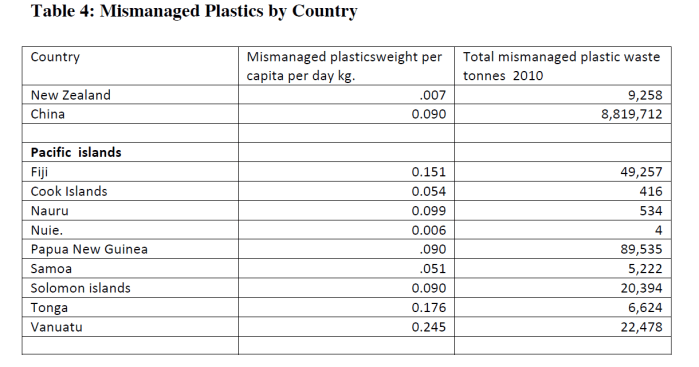
Below is a table taken from the report (Jambeck 2015) that provided the estimate of 8 million tonnes of plastics going into the oceans each year that has receivedwide spread attention. it shows annual total of mismanaged plastic waste, but this figure appears to be about four times larger than actual flows into oceans. While the individual country figures, the inputs and the methodology may be questionable in some respects, the data provides a reasobable representation of the scope for making improvement in the performance of our Pacific neigbours. Because New Zealand already has a robust refuse collection sytem and a reasonably good antilittering culture, the scope for large cost effective improvements here are limited. As we have demonstrated a plastic bag ban will make almost no difference, but has a large cost.

plastics

Our best strategy is to continue to build on voluntary efforts to clean up the coastal environment and to redirect, or supplement, our aid budget, to Pacific countries, where there will a much higher payoff in terms of reduced plastic pollution.

It is the sort of analysis one might do, or commission, if one were serious about looking at costs, benefits, and ways of maximising payoffs, as distinct from the sort of puff and rhetoric government agencies publish under the guise of analysis when they have a solution their masters want regardless and need to try to make some sort of case.


Electricity prices

I have fairly omnivorous interests but electricity, and the attendant policy issues, has never been among those interests.  When the sector was being reformed 20 years ago, it was one of the topics –  endlessly discussed on Radio New Zealand’s Morning Report – that I would simply zone out as I drove to work.  I don’t know how much our household pays each month for electricity and without looking it up couldn’t even name who our supplier is.

I hear the stories that appear each winter about the pressure some people face as regards electricity costs.  My (uninformed) presumption usually is that any issue is mostly about the shockingly poor rates of labour productivity in New Zealand, in turn reflected in the relatively low incomes the New Zealand economy supports, with some mix thrown in of changing tastes, poor disciplines, bad luck, and perhaps some issues at the margin around how the welfare system treats a handful of people.  Life is tough at the bottom.  Our “bottom” is so much worse than it need be, and successive generations of politicians should be held accountable for that.

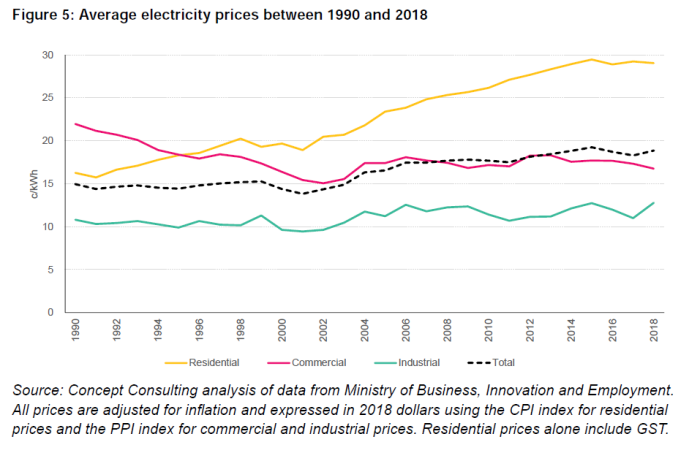
But when the electricity review document was released the other day, I decided to dip into some numbers and see what I could find out.   As has been highlighted repeatedly, there has been a big shift over recent decades such that residential user (real) power prices have risen substantially while commercial and industrial (real) prices have been pretty flat or even falling.

electricity 1So the argument goes, there was previously considerable cross-subsidisation in favour of domestic users.  In particular, there has been a big change in how distribution costs are allocated.
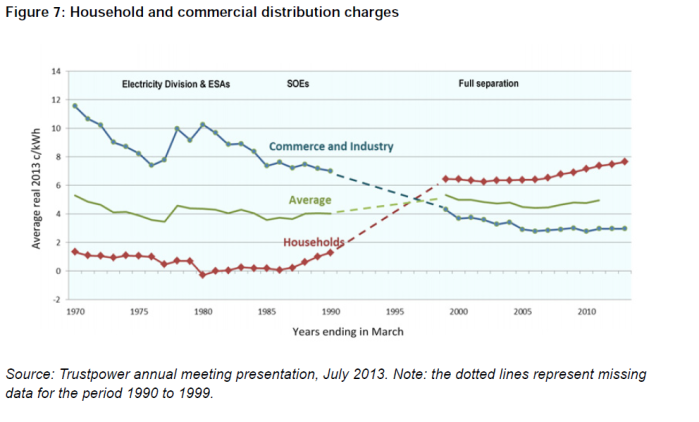
electricity 2But how do New Zealand prices compare with those in other advanced countries?  The review report has some charts showing those numbers, using OECD data (all national data is converted into USD using PPP exchange rates).
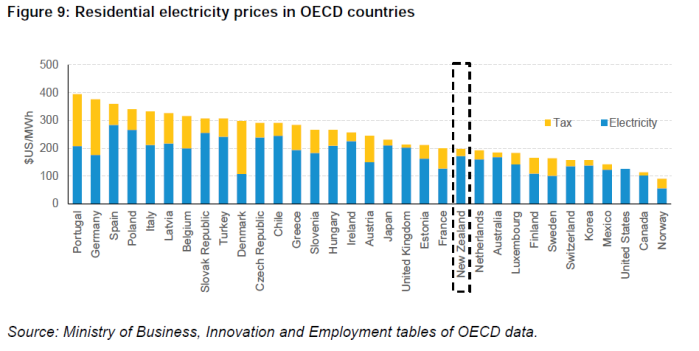
Here are household charges

electricity 3

Just focusing on the blue bars, the basic (ex-tax) electricity prices New Zealand households face is around those of the median OECD country.   We are, of course, poorer and less productive than the median OECD country, so the burden of any of the necessities of life will tend to fall more heavily here than in many other advanced countries.

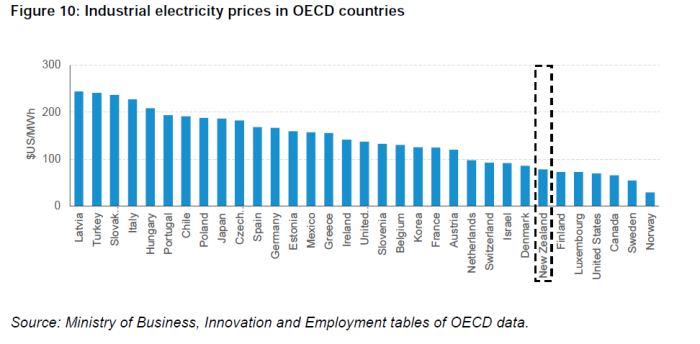
What about industrial prices?  Here is another chart from the review.

electricity prices

New Zealand prices for industrial users are among the lower in the OECD.

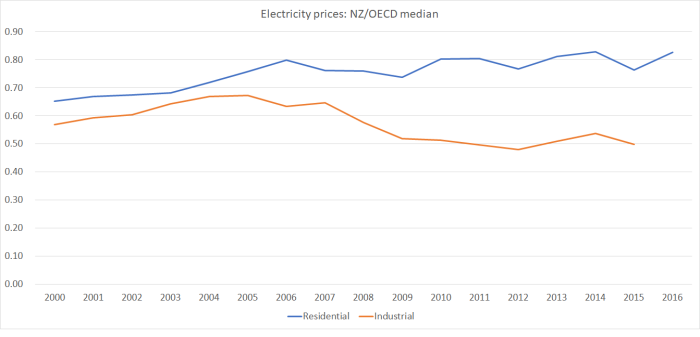
The OECD data MBIE reports goes back only to 2000, but here is how New Zealand prices have changed relative to those of the median OECD country over that period for both the residential and industrial series (using only the countries for which there is a complete series of data).

electricity 5

For what it is worth, there hasn’t been much change in the blue (residential) line over the last decade.

I was interested not just in the medians, but in the countries with the lowest power prices.  After all, it used to be something we boasted of here –  one of the great advantages of life (and business) in New Zealand: one of the arguments for the establishment of Comalco decades ago.   Norway, Canada, the US, Sweden, Finland, and Denmark (ex taxes) all have among the lowest electricity prices for both residential and industrial users.  In Norway, in particular, both lots of prices are far far lower than those in New Zealand.   And in Norway –  notwithstanding all that oil and gas –  something between 95 and 99 per cent (depending on which source you look up) of electricity generation is from hydro sources –  where the energy source itself comes, in effect, free.   The hydro+geothermal share in New Zealand also used to be above 90 per cent.

One reason why the hydro share of electricity production has dropped away in New Zealand is our relatively rapid population growth.  There are only so many rivers (and environmental/political constraints on using more anyway) and lots more people.

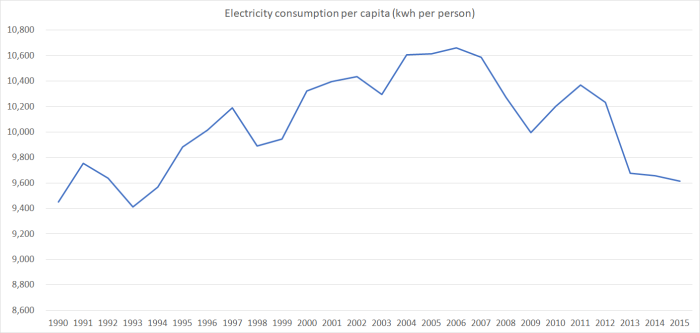
For a long time, the biggest factor driving electricity consumption/production wasn’t the number of people, but their (per capita) demands to use electricity.   I looked up an old yearbook.  Between about (I’m eyeballing a small chart) 1942 and 1955 electricity consumption per capita doubled.  Between about 1955 and 1971 it doubled again.  MBIE data show that by 1996 it had doubled again.   But here is the MBIE data on per capita electricity consumption since 1990 (sadly only updated to 2015).

electricity 6.png

Consumption per capita peaked in 2006, and in the most recent year was below the 10000 Kwh per capita first reached in 1996.  But our population now is almost a third larger than it was in 1996, and all of us (well, a few hermits aside perhaps) need/use electricity.

The new SNZ preferred (and genuinely better) measure of net migration only starts from 2001 and is only available up to early 2017.  But over just that period, net immigration of non New Zealand citizens –  with the most aggressive (per capita) immigration policy anywhere over most of that period – has contributed directly 741000 new people of a total population increase in that period of 936000.   All those people, natives and migrants, will have added to electricity demand.

Of course, the other factor that greatly influences the level of electricity production in New Zealand and, thus, the marginal price is the aluminium smelter at Tiwai Point, reported to consume perhaps 13 per cent of total electricity production.   The smelter was kept open a few years ago only as a result of new taxpayer subsidies (described by sceptics from the left and right as “corporate welfare”).

It is hard not to think that if our politicians had not been so determined to keep Tiwai Point open, and so determined to rapidly drive up our population in a unpropitious location (and despite the complete lack of evidence of resulting productivity gains), electricity prices for all other users would be rather lower.   Oh, and those with a renewables target in mind would have been able to rest easy too.

Then again, having adopted strategies that successfully lifted productivity –  clearly requiring something different in key areas to the approaches followed here for decades – would also have eased the burden on poor households of electricity prices.


On the anniversary of learning about Jian Yang

It was a year ago today that the Financial Times and Newsroom told us that we’d had a People’s Republic of China spy in our midst….well, in our Parliament actually.   Unknown to the voters – but presumably not to the National Party hierarchy, which must (presumably) have done its candidate vetting – for six years Jian Yang had sat in our Parliament, had sat each week in the governing party’s caucus, had spent several years on Parliament’s Foreign Affairs committee, and been part of official government delegations to the PRC.  And, so this joint FT/Newsroom investigation revealed, Jian Yang –  who had only moved to New Zealand in his 30s – had  (in the words of the FT article)

….spent more than 10 years training and teaching at elite facilities including China’s top linguistics academy for military intelligence officers, the Financial Times has learnt. Since being elected in 2011, Mr Yang has been a big fundraiser for the National party. He has consistently pushed for closer ties with Beijing and for international policies and positions echoing those of China’s Communist party.

He’d been a member of the military intelligence system of the People’s Republic of China….in colloquial terms, a spy.

The story sparked no action from the National Party –  other than the then Attorney General and minister for the intelligence services attempting to tar the stories as “racist” –  and Jian Yang was duly re-elected to Parliament ten days later, where he sits still.  Doing little (search Hansard, and you’ll find  – for example – that, despite being a third term Opposition MP, he has asked only two oral questions this Parliament).  And explaining less (he has refused all media comment to English language media for months, while apparently being quoted regularly in the PRC-dominated Chinese language media).  He has been fully backed by both the previous and current National Party leaders.

The story unfolded further.  Having initially claimed he’d been fully open about his past –  while explicitly asking the FT not to report it –  Jian Yang eventually acknowledged that he had withheld information about his PLA background when he had lodged residency and/or citizenship applications to New Zealand.  Extraordinarily, he told journalists that he had done this because the PRC authorities had told him to –  this even though by the time he was applying to New Zealand he hadn’t lived in China for some years.  But nothing seemed to happen as a result.   A few weeks earlier, the Green Party leader’s acknowledgement that in her youth she’d lied to claim welfare benefits, had (rightly in my view) cost her her job, and a full MSD investigation supposed to result in a refund.

It also emerged that Jian Yang had been a member of the Chinese Communist Party –  only a small minority of PRC citizens are members –  and although he claimed no longer to be a member, China experts say that from a CCP perspective no one leaves the Party unless they are expelled.   And Jian Yang had clearly been in favour with the Party, regarded as politically sound etc, or he’d never have been allowed  –  with his background in the PLA system  – to leave the country to study.

Various observers have noted the way in which Jian Yang prominently and frequently associates with the PRC embassy in New Zealand.  It was noted that in Jian Yang’s maiden speech –  where MPs often talk about the things that shaped them, their values etc –  he couldn’t bring himself to condemn the Tiananmen Square massacres.  In fact, in now seven years in Parliament it isn’t clear that he has ever said anything critical about the Party-state he chose to leave –  one of the most evil and repressive on the planet.

Even a doyen of the establishment –  former diplomat, current member of the board of the Contemporary China Research Centre, Charles Finny –  who claimed to have known for years of Jian Yang’s intelligence background was moved to comment in a TV interview that he knew that Jian Yang (and Labour MP Raymond Huo) was close to the PRC embassy, and that he was always careful what he said in front of either man.   The (unstated) implication was that he was worried that anything he said might well be passed back to the PRC Embassy.  It was an extraordinary admission, that he didn’t feel comfortable being fully open to people serving in New Zealand’s Parliament, who have sworn allegiance to New Zealand.

But then the whole situation is extraordinary:

  • we’d never have tolerated a former Gestapo official, who later acknowledged he’d lied about his background (on the instructions of his German masters) to get into the country, and who didn’t (once) have a bad word to say about the Nazi regime, to have served in our Parliament,
  • we’d never have tolerated a former KGB/GRU official who’d……..to have served in our Parliament, especially while the noxious Soviet regime was still in power,

And yet, even if Jian Yang won’t say so, that is the sort of regime the People’s Republic of China and its CCP rulers actually is.

In truth, there would probably be outrage (reasonably and understandably so) if someone with a background in US military intelligence lied about their background to get into New Zealand, and somehow got into our Parliament, refused ever to say anything critical about the US, and still spent lots of time close to the US Embassy.  And, for all its faults, the US is a long-term military and intelligence ally of New Zealand.

But about Jian Yang….nothing.  No investigation into those applications for residency/citizenship  –  by contrast, didn’t we turf out Indians on student visas who had (perhaps unknowingly) misrepresented their finances?   And not a word now from any member of Parliament, or any political party (there were a few comments suggesting unease from Winston Peters, but that was before he took office).

I’m sure there are decent people in Parliament, but none –  not one – seems to have any moral courage when it comes to this issue.   Don’t upset Beijing, don’t upset the donors, don’t upset that handful of big businesses that have chosen to make themselves highly exposed to the wrath of Beijing.

But then why would we really be surprised.  As Anne-Marie Brady’s paper –  released just a few days after the initial Jian Yang revelations – highlighted, the presence of someone like Jian Yang in a prominent place in New Zealand public life is just the tip of iceberg when it comes to the way in which the PRC has sought (successfully it seems) to seek influence in New Zealand (and a range of similar countries).  Little of it appears to be illegal, and perhaps little of it even should be (although tightening up, and closing some of the loopholes in, our electoral finance laws has merit, as would stronger rules on post-Parliament employment opportunities for former ministers).   The issue is more about political will.

And the political will is clearly to keep the New Zealand public in the dark as far as possible (did National advertise in 2011 their recruitment of an uncritical Communist Party member and former member of Chinese military intelligence?), play up spurious –  well, simply wrong –  arguments about New Zealand’s reliance on China for our economic fortunes, and do all they possibly can to play nice (and more) with Beijing.  Both National and Labour party presidents have been on record in the last year praising Xi Jinping and his regime, even as he has assumed more power, and the regime has become more repressive.  It is sickening.  But keep the money flowing, and simply set aside any values New Zealand governments once stood for seems to be the approach of all our political leaders, and their underlings.

Not a word, for example, has been heard from the Prime Minister or the leaders of the Green Party.   Given that Jian Yang is a member of an opposition party –  whom normally they would have no interest in protecting –  that suggests they think it is just fine to have a former member of Chinese military intelligence, who acknowledges he lied to get residency here, and who simply never says anything critical about Beijing, as a member of Parliament.   In my book, that makes them at least as bad as the current National Party leadership and MPs.

It is shameful.

A couple of weeks ago, ministers of the Five Eyes group issued a declaration about foreign interference in domestic politics, and wanting more surveillance powers etc.  Andrew Little, our justice minister and minister responsible for the intelligence services, was part of that grouping.   There were some fine words

We condemned foreign interference, being the coercive, deceptive and clandestine activities of foreign governments, actors, and their proxies, to sow discord, manipulate public discourse, bias the development of policy, or disrupt markets for the purpose of undermining our nations and our allies. Foreign interference threatens a nation’s sovereignty, values and national interests — it can limit or shape the polity’s ability to make independent judgements, erode public confidence in our political and government institutions, and interfere with private-sector decision making. We agreed the five countries would work collectively to counter foreign interference, protect our individual sovereignty, and ensure our values and interests are upheld.

But it is all a bit meaningless when successive New Zealand governments are so utterly supine around China, unbothered by the (plain as day) presence of Jian Yang in our Parliament.  Political leaders, cheered on by elements of big business, voluntarily assuming some sort of quasi-vassal status also sacrifices the nation’s values and the interests of its people.  It should erode public confidence in our leaders and our institutions.

Of course, the current government –  or at least elements of it – would have you believe that it is different.   And I was pleased to see them committing to purchase the P8 patrol planes-  even if the PRC threat to New Zealand isn’t really military, there is a military dimension to the threat to other free societies nearer the PRC.  And there are relationships to maintain with Australia (in particular) and the US, for non-PRC issues.  And they do seem rather worried about the activities of the PRC in the South Pacific and Melanesia –  potential debt-traps, potential military bases, and so on.

But they won’t name the evil.  They won’t speak openly about the character of the regime.  They won’t even call out the unacceptability of Jian Yang’s position.

There was a story on Newsroom the other day, clearly sourced directly from the Prime Minister, in which the message was supposed to be that the government was speaking up (“an increasingly frank New Zealand line on China”) –  including when a member of the Politburo came through Wellington last week.

“We acknowledged of course we are both countries on different development paths, that the nature of our political systems, but that we’ve always as our two countries found ways to discuss those differences in a way that works for our relationship, and I put human rights under that category,” Ardern said.

The detention of Uighur Muslims in Chinese “re-education camps”, the subject of concern by a United Nations panel, was raised under that banner, Ardern said.

 But that first paragraph is what all New Zealand politicians always say: we find ways to “discuss these differences”, but never actually mention them openly.  I’m sure the PRC leaders get used to those private ritualised conversations, which make no difference to anything.  Since they happen in private among “men or women of the world” they probably don’t even make anyone uncomfortable.  Couldn’t have that of course.

This time, it seems, there was some mention of the Xinjiang situation.  I guess that is better than no mention, but where is the moral leadership of the Prime Minister in shaping New Zealand perceptions of the regime she is dealing with?

Thus, having given lots of time to a New York Times columnist for a puff piece, a serious New Zealand journalist notes the continued refusal of the Prime Minister to engage seriously on issues around the PRC and New Zealand.

We hear nothing from our political leaders about:

  • the growing Chinese threat to a free and democratic Taiwan,
  • nothing about the ongoing militarisation of the South China Sea,
  • nothing about the debt traps associated with much of the PRC “aid”
  • nothing about the outrageous evil being perpetrated by the regime in Xinjiang (perhaps a million people in concentration camps),
  • nothing about new threats to religious liberty for Christian Chinese (“install surveillance cameras or close down”),
  • nothing about organ donor abuse,
  • nothing about new PRC laws to essentially require all Chinese companies to act as agents of the Party-state (including ones that operate here, notably Huawei),
  • nothing about the growing attempts to treat all ethnic Chinese abroad as forever part of the PRC

And, of course, nothing about that very visible tip of the iceberg Jian Yang.

The Xinjiang situation has been getting more attention internationally recently, including a searing report from Human Rights Watch.   One academic observer who read the report in full drew up a lengthy list, from the various interviews HRW did, about things that get you locked away.  Here are the first 10 –  the complete list is here.

Things which may cause you to detained without trial and locked away in an education camp indefinitely, in Xinjiang, China, 2018:

  • Owning a tent
  • Owning welding equipment
  • Owning extra food
  • Owning a compass
  • Owning multiple knives
  • Abstaining from alcohol
  • Abstaining from cigarettes
  • Wailing, publicly grieving, or otherwise acting sad when your parents die
  • Performing a traditional funeral
  • Inviting more than 5 people to your house without registering with the police department

But our political leaders show no sign of caring.  Actually caring, when you hold positions in government that enable you to do and say things, implies more than a quiet, and no doubt very very muted, pro forma word to your CCP peers when, at the same time, you are trying to negotiate new deals with them.

How about levelling with the New Zealand people about the nature of the regime – the Nazi Germany of our day, if (so far) with more staying power.   How about bringing even a modicum of a moral stance to politics, not subordinating everything to the business interests of a few firms, and the fundraising imperatives of the political parties?   Yes, it would require some courage, and some rare honesty.  But it would be much truer to the values most New Zealanders uphold.   Perhaps there would be a price –  there almost always is for things that matter, things that are worthwhile –  but if tiny Palau can stand up for itself (though for how long?) surely distant, diversified, New Zealand could?

Saying “enough” and refusing to any longer tolerate Jian Yang in our Parliament would be a (pretty modest but) telling start.  More likely, a shameful anniversary will pass in embarrassed silence…and again next year.

Another campaign speech from the Governor

Five and a half months into his Governorship, we’ve not had a single on-the-record speech from Adrian Orr about stuff that he is actually directly responsible for.  There hasn’t been a single speech about monetary policy –  still, by law, the Bank’s “primary function“.   There hasn’t been one either about banking regulation and supervision, financial stability more generally, let alone about the regulation of insurers and non-bank deposit-takers.   That is the stuff New Zealanders’ hard-earned taxes are paying him for, the job in which he is handed a great deal of discretionary policy power.  It is almost as if –  despite all the talk, all the cartoons – he has set himself the goal of being less open, less transparent, about stuff he should be accountable for than his ill-starred predecessor Graeme Wheeler.

Because even though Orr avoids talking about what he is responsible for, he talks a great deal –  but rather loosely – about almost everything else (almost all from the liberal agenda) under the sun.    There has been infrastructure, agriculture, climate change, bank conduct –  which you might think was the Bank’s business, but isn’t (it is, by law, a prudential regulator, not a conduct one) –  and so on.    Off-the-record at a recent event he has reportedly threatened a Royal Commission on banking conduct.  It is almost as if he thinks of himself as a politician.  On the record, his only speech until recently was championing some big corporate buddies and their exercise in climate change virtue-signalling, assiduously keeping on side with the new government.

Perhaps there is a gap in the market on the left-wing side of politics, where effective and capable leadership seems to be sorely lacking (come to think of it, that is probably so on the right-wing (so-called) side of politics too).   But if Orr is pursuing the bigger prizes he simply shouldn’t be doing it from the office of Reserve Bank Governor.  It matters, or should do, that people across the political spectrum (and with no interest in politics at all) can be confident that the Governor is using his office solely for the statutory purposes, and not to advance and champion personal political agendas.  I was no great fan of Graeme Wheeler’s, but I did believe that about him –  for all his faults, he was a self-effacing public servant.   Orr gives us no reason to have that confidence in him.  That degrades the institution.

The fact that most of Orr’s publicly-championed political preferences probably chime quite well with those of the current left-wing government shouldn’t make it any more acceptable than if he were championing causes favoured by, say, ACT or the Conservative Party (although at least in that case we’d be sure he was acting independently, not shilling for his mates or his personal ideologies, or in pursuit perhaps of victories in the various turf battles around the structures and responsibilities of the Bank).  It simply shouldn’t be happening.  It is an abuse of office, and the Minister of Finance and the Bank’s (supine) Board should be calling him out and insisting on a change in behaviour.

Last Friday we had another (very long) on-the-record speech from the Governor.  This one was under the heading “Geopolitics, New Zealand and the winds of change”.   It was odd from the start.  When the advisory came round telling us the speech  –  to a Workplace Savings conference –  was forthcoming, I wondered if any incumbent central bank Governor had ever given a speech with “geopolitics” in the title.  It didn’t seem very likely.   Most largely try to stay moderately close to their knitting –  the core responsibilities of their office.  And then, on reading the speech, it was odd to find that (notwithstanding the title) there was no references to geopolitics at all – the word or the thing.   That was a relief.  But what happened I wonder?  Did his senior advisers, the Minister of Finance, or MFAT prevail on him at the last minute to remove some material?

The Governor started his speech counter-punching

I know many people will be thinking, ‘what has the Reserve Bank Governor got to say about anything long-term? Doesn’t the Bank just sit and watch for outbreaks of inflation – shifting the official interest rate on a needs-be basis? Some will even comment publicly, ‘How dare the Governor speak outside of their 1 to 3 percent inflation mandate!’

I guess that was people like me.  No one has suggested that the Governor talk only about monetary policy –  although it would be a nice change if he did talk about it (say, preparing for the next recession) –  and, after all,  the Bank has extensive financial regulatory responsibilities.  No one would think it amiss if the Governor gave us a thoughtful analysis of just what is going on in the New Zealand economy at present, and how that fits with inflation prospects or financial risks.    But we’ve heard nothing like that.   And the Governor isn’t the Minister of Finance, he isn’t head of a think-tank, he isn’t an academic: instead he is a public servant, supposed to be politically neutral, operating within a specific legislative mandate.   If the Chief Justice or the Commissioner of Police were giving speeches like Orr’s it would be at least as inappropriate.

The Governor goes on

I hope to convince you we have a strong vested interest in, and influence on, the long-term economic wellbeing of New Zealand.

“We” here being the Reserve Bank.   But this is just wrong-headed (and inconsistent with the lines run by all his modern predecessors).   A country can have low and stable inflation and be poor or just underperforming (the latter the New Zealand story for decades), and it could have quite high inflation and still do rather well (see, for example, Turkey where labour productivity had almost caught up with that in New Zealand).    Discretionary monetary policy is, almost of its nature, about shorter-term economic stabilisation –  which matters a lot, but is just a quite different set of issues than those about longer-term prosperity.  Much the same goes for banking (and related) regulation –  to the extent it has a useful place, it is mostly about avoiding or limiting the short-term (but multi year) disruption that can accompany financial crises.  But, as the US amply demonstrates, financial crises –  nasty and disruptive, and even expensive, as they can be (and often having their roots in policy choices by regulators and their masters) – aren’t inconsistent with long-term prosperity.  Oh, and relatively poor or underperforming economies can still have a high degree of financial stability –  see, for example, New Zealand.

But Orr doesn’t make a contrary case, or demonstrate his proposition. He just asserts the connection between what he wants to say and the job he is paid to do.  And then moves on to six pages of (single-spaced) text on

I summarise the key plague on economic society as ‘short-termism’. This is the overt focus on the next day, week, or reporting cycle. In contrast, by long-term, I mean anything that ranges from ‘outcomes’ over the next few years, through to an ‘idealised vision’ that could last inter-generationally.

Remarkably, he advances not a shred of evidence, or sustained analysis, in support of his proposition.   Not that that is new, of course,  A few months ago he told the Finance and Expenditure Committee that banks and their customers had too much of a short-term focus, and thus he –  presumably blessed with an “appropriate” long-term perspective –  needed to step in.  But when I asked about any work the Bank had done to support such propositions, it turned out that there was none.  It was just off the top of his head.

It probably sounds good –  especially to senior bureaucrats not much given to introspection or historical reflection – to claim that there is too much short-term thinking in the world.  If only, if only, (they probably think) people would defer to people like them, the world would be a much better place.

Someone pointed out to me yesterday that Orr’s speech was strongly reminiscent of (the great US economist) Thomas Sowell’s description of the “conceit of the anointed” in his 1995 book.   I haven’t read the book, but as I dug some reviews and extracts, I was struck by how apt the comparison seemed to be.  There was this quote for example

“In their haste to be wiser and nobler than others, the anointed have misconceived two basic issues. They seem to assume: 1) that they have more knowledge than the average member of the benighted, and 2) that this is the relevant comparison. The real comparison, however, is not between the knowledge possessed by the average member of the educated elite versus the average member of the general public, but rather the total direct knowledge brought to bear through social processes (the competition of the marketplace, social sorting, etc.), involving millions of people, versus the secondhand knowledge of generalities possessed by a smaller elite group.

It is the knowledge problem all over again.  But Orr, of course, never touches on it.  His implicit model assumes a great deal of knowledge –  known with a great deal of certainty – and it ignores the repeated failures of governments and bureaucrats even (or perhaps especially) when they were trying to take “the long view”).    The real world is one in which we know –  as individuals, even very able ones – remarkably little.  And where frequent monitoring –  what might in some abstract full-information world feel like “short-termism” –  helps ensure appropriate course corrections, incorporating what we are learning.    We have to build institutions around those realities –  human societies have done so, over millennia.  None of this features in the Governor’s world, even as he celebrates the vast lift in living standards over recent centuries, little of it down to wise and far-seeing bureaucrats.

After all, plenty of well-intentioned politicians and bureaucrats have thought they were looking to the long-term.  The insulationist economic strategies adopted in New Zealand for decades after 1938 were conceived exactly that way, and didn’t end well.   Think Big strategies in the early 1980s were certainly conceived with a long-term view in mind: they were an utter disaster all round.  The idealists who passed the Resource Management Act thought they were consciously taking a long view.  Globally, the Club of Rome people in the early 1970s were extremely well-intentioned and, for most practical purposes, totally wrong.  And that is before we get to the wildly more extreme cases of those who thought they were building the “new Jerusalem” (so to speak) in revolutions and Communist takeovers in Russia and China.  Hitler, arguably, had the long-term in mind and it would have better for everyone if he’d settled for fixing the short-term challenges Germany faced in 1933.

But Orr acknowledges none of this as he airily asserts that the biggest problem the world economy faces in “short-termism”.  Arguably, one of the problems the New Zealand economy faced in the last decade was a Reserve Bank that wasn’t short-term enough in its focus –  convinced it knew where interest rates “needed” to head back to one day, they quite unnecessarily left tens of thousands of people involuntarily in the ranks of the unemployed.  And yet the Governor has praised their stewardship through that period.

It is a long speech and I’m not going to try to unpick every paragraph, but I did think it was worth picking up a few excerpts to highlight the shallow and reactive leftish thinking on display from one of our top public servants.  Among his list of “challenges”

Environmental degradation, with climate change now well accepted as a significant impact on economies worldwide. The impacts are physical through nature, and financial through changes in consumer and investor preferences, and regulation.

Perhaps the Governor hasn’t noticed that in most advanced countries air pollution, and often water pollution is (a) far less than it was 100 years ago, and (b) is far less than it is in emerging economies (notably China and India)?   And if he thinks climate change is having a “significant impact on economies worldwide” it might have been nice to have suggested a source.  Recall that the OECD –  about as centre-left technocratic a group as they came –  suggest a modest impact over even the next 40 or 50 years.

Ageing populations are also dominating the outlook for the next 30-plus years, with Japan being the canary for us all to watch. Their population is on the decline due to their demographic profile weighted so much to the elderly. Savings and consumption patterns are changing simply due to this population swing. The older have the savings and are demanding less in goods, but more in services, especially human contact. Loneliness is a significant and growing disease. Yet the owners of capital are struggling to create careers out of caring for the elderly, at least at incomes that attract and retain the people needed. The same could be said for tourism in New Zealand.

Has “loneliness” ever featured in a central bank Governor’s speech before (it appears twice in this one)?  If not, it would be for a good reason –  central banks have nothing to say on the subject.  Is there any substance to a sentence suggesting that a fall in the population is “due to” their demographic profile.  And what on earth do the last two sentences mean?   When willing labour is scarce surely (a) prices tend to rise, and (b) there is a substitution in favour of more physical capital?

And then there is inequality — the great cause of the left.

What do I mean by inequality? Well, even if the economic ‘pie’ has grown in total, the rewards are always skewed one way or another. Over recent decades, the rewards to the owners of capital (profits) have outstripped the owners of labour (wages) more than throughout economic history.

What does the Governor mean here by “skewed”?  He doesn’t tell us.  But he claims, or so it seems, that the labour share of income is somehow doing worse (levels or changes) that at any time in history.   Even if it were true, we might expect a more careful analysis of why, and the implications of such a change.  But here is chart I ran last year using OECD data of the labour share of GDP.

lab share since 1970

It is a remarkably variegated experience.  And if one were take a more recent period, the labour share of income here has increased a bit since about 2001 (not entirely surprising given that (a) employment has been quite strong and investment weak, and (b) that wage increases have increasingly run ahead of near non-existent productivity growth.

Or one could add, in a New Zealand specific context, that to the extent that inequality has widened much at all in recent decades, much of it is down to housing costs, in turn the direct result of choices (ostensibly long-term in nature) of officials and politicians.  Consumption inequality seems to actually be less than it was (chart in this link).

You might expect a senior New Zealand public servant opining openly, from his taxpayer-funded pulpit, about what is wrong with the world to actually know, and address, some of this stuff.

After all, in what is clearly a theme of elite official opinion in New Zealand at present, we should, Orr thinks, lead the world.

But, we do have opportunities to lead the globe in positive change if we can become more long-term in our economic activity.

Or

The great news is we are small, young of nation, lightly populated, green, kaitiaki (caretaking) of spirit, not dependent on the export of fossil fuels, and have a strong rule of law and sound moral compass. Significant and bold leadership is in our grasp.

This from the little country whose leaders have let it fall so far behind the rest of the advanced world in productivity –  what opens up so many other options and choices –  in recent decades?  (And, re those fossil fuels, personally I’d swap Norway’s economy for ours any day).

But that isn’t a problem for Orr.  He reckons the productivity failure is easy to overcome

The reasoning behind the low productivity is well understood but, apparently, difficult to combat in a coordinated, persistent, manner.

So with problem identification and solutions outlined, wouldn’t we just move on to resolution? Short-termism challenges us always and everywhere.

Appparently everyone agrees on (a) the analysis, and (b) the answers.  All we need is to abandon short-termism.  The superficiality of all this, the detachedness from reality –  hasn’t he noticed that there is no agreement at all on what the nature of the problem is, reflected in quite varying policy prescriptions –  almost beggars belief.

There is more glib stuff later (amid some odd Maori mythology) about how long-termisn will be our saviour

If company boards and managers have a long-enough horizon, then there are no externalities – all issues are endogenous to their actions (eg, pollution, employment, inclusion, and sustainable profit).

This is simply nonsense.  Externalities don’t arise because people – in this case the agents of company owners –  don’t have a long enough horizon, but (largely) because property rights and interests aren’t always clearly or properly assigned.  And you can have as a long a horizon as you like and still often, probably repeatedly, be wrong.  And if you want to worry about the long-term, I’m really glad that no one much 100 or 200 years ago worried very much about notions of global warming etc.  Had they done so our current global prosperity would simply not be.  Here is a nice line from a recent speech by the (greenish) chair of the Productivity Commission

British Economist Dimitri Zenghelis draws attention to the astonishing lift in global living standards since the onset of the industrial revolution (Zenghelis, 2016). The combustion of fossil fuels has been integral to that transformation and, in his words, “capitalism was founded on carbon”.

And we should be thankful for that, even as there may now be adjustment challenges.

I wanted to conclude with a couple of examples of Orr’s thinking on matters a bit closer to his core areas of responsibilities.   There was this, for example,

We can also be unpopular with wider New Zealand, as shifting interest rates and/or implementing and altering the loan-to-value ratio that banks are allowed to lend at, are often not immediate vote winners. These activities directly cut across our human instinct for instant gratification, despite in the long-run maintaining a stable financial system and reducing the scale of financial volatility and/or crises.

And yet neither Orr, nor Wheeler before him, has shown any evidence at all that New Zealand banks were lending inappropriately, or borrowers were borrowing unwisely when five years ago the Reserve Bank intervened in a functioning housing finance market – where the banks had just come through a nasty recession unscathed –  to stop willing borrowers and willing lenders getting together to assist people into a house.  It was well-intentioned I’m sure –  so many things are –  but mostly what it looks as though it achieved was to keep ordinary New Zealanders out of houses a bit longer than otherwise, in favour of cashed-up buyers who got slightly cheaper entry levels.  Ah, but Orr (and Wheeler) know better what is good for you and me.

And then this from the second to last paragraph

We still concentrate most of our investment in housing equity – rather than productive equity – relying on leverage from offshore borrowing. This is not a formula that will create ‘capital deepening’ in our economic efforts.

It is a popular line (echoed often by the Minister of Finance), but no less incoherent as a result.  A Governor of the Reserve Bank really should know better.     What is implicit in what he said there is that there is too much housing in New Zealand (“we concentrate most of our investment in housing equity”).  And yet most people think that, given our population growth, too few houses have been built, perhaps for decades.  Given our population growth, more real resources probably should have been devoted to building houses.  I imagine his defence will be something around the price of houses, but high prices of existing houses don’t divert any real resources anywhere (they mostly just shift wealth from younger people to older people –  each new loan creating a new deposit.  As the Governor will be well aware through the latest surge in property prices over the last five years, New Zealand net international investment position (loosely, borrowing from the rest of world) has been shrinking as a share of GDP.

We deserve much better from our central bank, and particularly from an individual entrusted with so much (specific) power as the Governor.    He should stick to his knitting –  and actually get on and talk about pressing issues he is actuallly responsible for –  he should stop championing personal political causes (even, or perhaps especially, if they happen to be music to the ears of the current government), and he should invest some time in thinking hard and rigorously about the claims and arguments he so readily tosses into the wind.  Failing to do so will risk diminishing him, but (considerably more importantly) it will diminish the standing of the Reserve Bank, and mark another step in the decline of effective policy leadership from New Zealand government agencies.

Not everyone will agree though.  I noticed a Letter to the Editor in this morning’s Dominion-Post from one Dave Smith of Tawa praising the Governor’s speeches (including this specific one) as a departure from the past pattern of “bland and uninspiring speeches”.    But central banks are supposed to be about as exciting as the crash fire brigade at the airport.  Leave the soaring rhetoric and the wider political vision to the politicians.  Apart from anything else, we have some choice over them.  We have none with Orr.

He is abusing, and degrading, his office.


A couple of (RBA) housing finance charts

Comment on the Governor’s sprawling speech “Geopolitics, New Zealand and the Winds of Change” (curiously, a speech in which “geopolitics” didn’t appear at all) is held over until tomorrow.

But I was reading an interesting speech from a senior RBA official, Assistant Governor Michele Bullock, which happened to include this chart.

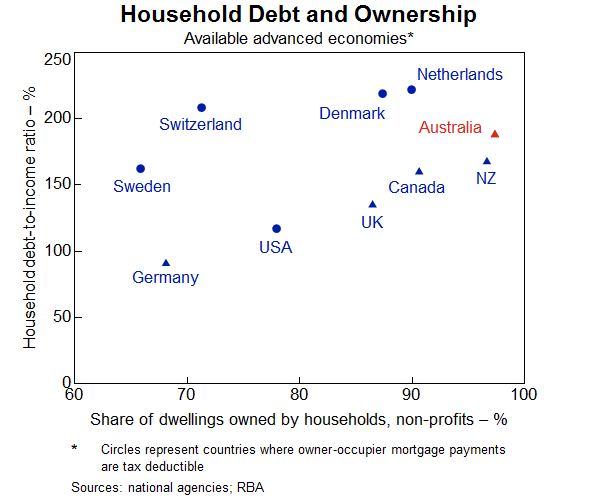
bullock

It captures a couple of important points relevant to thinking about household debt.   You quite often see comment about how high the level of household debt is in New Zealand.  But Bullock’s chart illustrates a pretty straightforward point: when almost all your housing stock is owned by households (whether owner-occupiers or investors) you’d expect that, all else equal, household debt relative to household income (or GDP for that matter) would be higher than in countries where a larger share of housing stock is owned by other sectors.  Of the countries Bullock shows data for, New Zealand and Australia have the highest share of the housing stock owned by the household sector.  New Zealand is very close to the median country in this sample, notwithstanding the high share of houses owned by households.

The chart highlights another important point sometimes lost sight of in international comparisons (but which our own Reserve Bank sometimes acknowledges).  In some countries, interest on an owner-occupied mortgage is tax deductible.  That might, all else equal, encourage household to take on more net debt (cost of borrowing and bringing forward consumption is lower), but it certainly tends to encourage people not to rush to pay off the mortgage even as they may be accumulating financial assets (and the tax treatment of some financial assets is also often quite favourable relative to, say, the situation in New Zealand).   And so Sweden, Switzerland, Denmark and Norway have much more gross household debt outstanding –  but not necessarily any more financial system risk –  than countries with similar household sector ownership of the housing stock but a different tax treatment.   (The US is a bit of an outlier here, and from the look of it the data may not be fully comparable.)

Of course, what Bullock doesn’t highlight in her chart is two things:

  • Australia and New Zealand have high house price to income ratios by international standards, which tends to boost the amount of household debt required to accommodate such prices, and
  • Australia’s compulsory private superannuation system will, all else equal, tend to mean that Australian households will more often have substantial financial assets tied up in superannuation schemes while at the same time having large outstanding mortgage debt.  (Kiwisaver, more recent and on a smaller scale, will now be tending to have the same sort of effect in New Zealand.)

There was one other interesting chart in the Bullock speech.

bullock 2

For all the talk about households taking on more and more debt, the median advanced country’s ratio of household debt to income hasn’t changed materially in a decade, despite the fall in global interest rates.  Of course, all else equal, if interest rates had been higher debt would have been lower, but so would real and nominal GDP, asset prices, inflation (but, pace Lars Svensson, debt to GDP ratios might not have been much lower)…..and unemployment would have been higher.   All else is never equal, and it is important to remember that interest rates are low for a reason (or set of reasons) grounded in the fundamentals of the really economy, factors which central bankers and banking regulators have little influence over.

The Secretary to the Treasury and productivity

As I noted in Saturday’s post about The Treasury, the Secretary to the Treasury –  he of the rushed citizenship presumably on the grounds of some exceptional services the previous government thought he might offer to New Zealand –  gave a speech last week on productivity.

One can feel a little sorry for senior public servants venturing into the public domain.  After all, there are limits as to what the head of a government department can really say, while still retaining the confidence of his/her minister (let alone that of the State Services Commissioner).  Political masters change and with those changes there are changes in what can’t really be said in public by their most senior advisers.  All of which is probably a good reason why heads of government departments shouldn’t really give any but the most anodyne (or perhaps obscurely technical) public addresses (in fact, most simply keep quiet in public – do a search for speeches by the Secretary of Justice or the chief executive of MBIE and you won’t find much, if anything).  After all, their primary job is to advise ministers, not to act as public lobbyists for their own policy preferences  Upon leaving office they are, of course, free to champion whatever causes they like.

But all that assumes some idealised fine public servants, who have laboured to generate judicious but penetrating insights.  Wise men and women whose words shed light in dark corners, enrich our understanding, and could –  if only we listened – help resolve some of these intractable challenges that face any modern government and society.

And then there are the Makhlouf speeches.  I written about several of them here (eg here, here, here and here).  They often read fluently enough at a first glance, before quickly turning to dust under any close examination.

Last week’s effort wasn’t that much better.  At least the Secretary to the Treasury was talking about productivity –  something I noted was strangely totally absent from The Treasury’s Briefing to the Incoming Minister last year – but he didn’t have a credible or robust story to tell.

The speech was delivered in Queenstown, so Makhlouf began with some local colour –  some good, some bad.  Among the less positive indicators was

The mean income for people in the Queenstown-Lakes District in 2017 was about $51,000 compared with the national mean of $59,000.  With low incomes but the highest average weekly rental cost in the country and an average house value of more than $1.1 million, the housing affordability problem in Queenstown is in the same league as Auckland.

To which the Secretary’s response was

In response, the Government’s Housing Infrastructure Fund is contributing $76 million in 10-year interest-free loans to support an increase in Queenstown’s housing supply.

So the Secretary to the Treasury now thinks interest-free loans by the government are sensible economic policy?    This isn’t supposed to be some local MP’s party-political broadcast, but the Secretary to the Treasury, guardian of the public purse.

The Secretary then touches on the failure that is New Zealand productivity growth, recognising that we’ve done poorly (while taking no responsibility as head of the leading economic advice agency).  But there is nothing new, and litttle specific.

There are various unsupported assertions  (emphasis added)

We know that our productivity levels stem from a number of factors including weak international connections, the small size of domestic markets, low investment in knowledge-based capital and weaknesses in the allocation of labour.

as if symptoms (in some cases arguable ones) are causes, and then a string of platitudes

It remains a fundamental truth that successful economies need, among other things, a stable and sustainable macroeconomic framework, sound monetary policy and a prudent fiscal policy. It remains true that a well-regulated financial system matters, that properly functioning markets matter, that price signals matter and that incentives matter. And, perhaps most important of all, it remains true that productivity matters.

No doubt largely true (I’d quibble about the “well-regulated” financial system, substituting “sound and stable) but New Zealand has had these features for decades, and we are just slowly drifting further behind.

The second half of the speech builds off this paragraph

The Treasury believes there are a number of factors that always matter for productivity: our human capital, the management of our resources, our international connections, the dynamism of our markets and the effectiveness of our rule-making. I want to say a few words about each of these. To improve our productivity we will have to be more effective in their utilisation and the interactions between them.

First, skills matter.  As if we didn’t know.

There seemed to be two areas of focus

In the Treasury’s view, to help achieve this there should be an emphasis on attainment of cognitive and non-cognitive foundational skills and social skills that are transferable and support life-long learning, as well as greater rates of progression to higher tertiary qualifications.

But I’m not sure what the first half of the sentence really means (Great Books programmes for all, to teach people to think and write?) and the second half looks like a bid for even more tertiary education, when there is little sign that the massive public and private spend on tertiary education in recent decades has been reflected in commensurate increases in productivity or earnings.  And none of this seems embedded in some comparative analysis about whether, and to what extent, New Zealand is doing worse than other advanced countries.

The other specific was slightly surprising

I should also add that we will need to look carefully at whether our social welfare system – which was initially set up to help people make transitions from one job to another in what was expected to be a similar trade – is optimal for the changing world ahead of us.

I presume he means the bits of the system around the unemployment benefit (or whatever it is now called) since most of the social welfare system wasn’t set up to support employment transitions at all (age pensions, widows’ pensions, DPB, sickness and invalid pensions etc), but as his current political masters have, as a matter of policy, been weakening the sanctions in the welfare system that were, supposedly, designed to assist such transitions, I’m left a bit puzzled as to what the Secretary means by this cryptic observation.  Perhaps he is toying with notions of a Universal Basic Income (but, charitably, I’ll assume not)?

Then there is a section on resources.  Some of it seems sensible enough, including around water use rights.  I’m right with him when he favours congestion charging.  But I’m left wondering whether he or The Treasury really believes that either is a significant part of the story explaining our severe relative underperformance.  I don’t.

And lets just say that I rather doubt the robustness of The Treasury’s analytical framework when the Secretary includes these sentences.

The Emissions Trading Scheme is a good example of a tool that can promote the more productive use of resources. Including agriculture within its scope would provide incentives for investment in R&D or innovation in on-farm practices and improve productivity.

An ETS can, no doubt, be a good mechanism for constraining emissions, and even for doing so in a way which might be economically efficient.  But it simply isn’t a way to improve New Zealand’s economywide relative productivity and/or incomes.  Impose an impost (perhaps quite justifiably) on firms in a particular industry, and those who survive will have to adapt their production techniques, perhaps even lifting their own firm productivity.  But it will also considerably shrink the industry in question, when it is an internationally tradable industry, when efficient alternative technologies don’t yet exist, and when other countries aren’t adopting the intervention The Treasury proposes.  All else equal, New Zealanders would be poorer rather than richer if this bit of the Secretary’s prescription was adopted –  the government’s own commissioned economic modelling, by NZIER says as much.

Then Makhlouf moves on to “international connections”, one of the ill-defined buzzwords in this debate.

Mostly it is just empty conventional slogans

Improving the flow of people, capital, trade and ideas will help improve productivity. Strong people-to-people relationships build confidence and understanding and promote learning. They help our businesses to identify capabilities that will help them improve their productivity and ultimately compete and succeed in both domestic and global markets.

All of which would have sounded good in 1984, and yet we greatly liberalised immigration, got rid of most tariff barriers, signed up to all manner of trade agreements, and……the productivity gaps are larger than they were, and actual trade (exports and imports as a share of GDP) is smaller than it was.  The Secretary is either unaware of these basic facts, or simply chooses to ignore them.

I’m closer to the Secrerary’s position when it comes to foreign investment –  where he has to step delicately around the recent legislative choices of his masters –  but there is no sign that he has thought hard about why foreign investment here isn’t more attractive or, indeed, why not many New Zealand based firms do much foreign investment themselves.

There is a section on “markets” that I’m going to skip over.  I don’t particularly disagree with much in it, but there also isn’t much specific there, and nothing to suggest The Treasury has thought seriously about the connection to sustained New Zealand relative productivity underperformance.  Much the same goes for the section on Rules.  I’m all in favour of robust policy evaluation –  it is a shame it hasn’t been applied to Treasury advice on productivity –  and I’m sure there are real opportunities there, but again is there any evidence that things on that score are worse here than in other countries?  Perhaps, but if so he doesn’t mention it.

(The dig at the massive taxpayer subsidy to the cattle industry was interesting, and welcome

Speaking of incentives, I find the situation around the eradication of mycoplasma bovis an interesting one. Responsibility for the genesis and subsequent spread of the mycoplasma bovis outbreak sits with the cattle industry. The question is, should the taxpayer compensate those affected, or should the industry pay for the consequences of the industry’s making? We might also ask what incentives are signalled to the industry by these different options.

And yet, how different is it anywhere else? )

There was an odd section on co-operatives, as if it was a matter for governments to decide on the appropriate sort of vehicles through which business activity is undertaken, and one on public sector productivity, which was really no more than a footnote.

And then there was tax reform.  Mostly, it was in praise of the New Zealand tax system, including the –  highly questionable –  claim, that

the New Zealand tax system is much less distortionary than the tax systems of other OECD countries

That might be true, more or less, if we look only across activities in the same time period, but is demonstrably not true once we take account of intertemporal dimensions.  Not consuming your income now and delaying until later (ie saving –  particularly retirement savings) is much more heavily penalised by the tax system here than in almost any other advanced economy.  That is a distortion The Treasury has been consistently reluctant to address or (it seems) even acknowledge.

There is also no recognition of the possible connections between low rates of foreign investment, and low rates of business investment (symptoms he touches on elsewhere) and business tax regime, where (for example) our company tax rate –  a key consideration for foreign investors –  is now towards the upper end of the OECD range.

And then it was interesting to see that in a speech on productivity, the specific policy proposal that the Secretary devotes most space to (in the entire speech, not just this section) was the call for a capital gains tax.

But there is one area where we stand out as an outlier and which I think needs further attention. The current approach to the treatment of capital income – in particular, capital gains – is highly inconsistent. Some gains are already taxed but others are not. The result is therefore something of a patchwork, the results of which can be unfair, regressive and distortionary. A more consistent approach to the taxation of capital gains would increase the fairness of the tax system, and reduce distortions by levelling the playing field between different types of investments.

For these reasons, the Treasury has long believed there is a real case to extend the taxation of capital income. I recognise that this would come with its own risks, and give rise to higher compliance and administration costs. But there are interventions available to address these risks. The extent to which the impacts are realised – whether positive or negative – will depend significantly on the design of policy.

Some readers will support a capital gains tax.  I don’t particularly, partly because a real-world one (ie the sort many other countries actually have) just introduces a whole new set of distortions, but does anyone seriously believe that a capital gains tax –  whatever the case on “fairness” grounds –  is going to make any material difference to economywide productivity?  And if there is such a case, not even the Secretary to the Treasury advances it.

The Secretary, of course, has to keep on side with his masters, so we read this

I should also add that there are many things being done to address points I’ve just raised. The government has been working on education and training, welfare reform, tax reform and trade relations, to name just a few of the actions happening.

If the Secretary to the Treasury really believes that the goverment’s policy agenda –  at least as revealed to the public –  is going to make a helpful difference in reversing the decades of relative productivity decline, he must surely be the only such person.    But I guess that if he is going to speak in public, he has to say such stuff.

In the final paragraph of the speech there is material for both a brickbat and a rare bouquet.

The brickbat?

And the ‘we’ means everyone: businesses, workers and government seizing the opportunities offered by being part of, and closer to, the fastest-growing region in the world.

Which is simply nonsense of course,   New Zealand is incredibly remote from Asia, or from any other major part of the world economy.     We might be a little less far from some of Asia than we are from Europe or much of North America, but we aren’t even a little close to the major bits of Asia, let alone “part of” it (whatever that means).  When the Seceretary was at home in London he was closer to Mumbai or Bangalore or Delhi than he is in Wellington.  He was actually a little closer to Seoul or Shanghai too.

It is a fundamentally unserious “analysis”.

But there is a bouquet.   Early in his speech, the Secretary was rather downplaying the failure of New Zealand policy, and policy advisers, in observing that labour productivity is “now about 20 per cent below the OECD average”  –  an average considerably lowered by the entry to the OECD of a large group of emerging countries (especially in eastern and central Europe), all of whom throughout modern New Zealand history were considerably poorer and less productive than New Zealand.

But the Secretary ends

Recent research indicates that if New Zealand’s productivity caught up with the better-performing countries in the OECD, our incomes would be 50-60% higher.

It doesn’t take much “research” –  a quick download of an OECD table does the job.   Here is an extract of that table I did recently for a paper I’ve been writing on these issues.

GDP per hour worked
USD, constant prices, 2010 PPPs
1970 1990 2017
New Zealand 21.4 28.6 37.2
Netherlands 27.4 47.5 62.3
Belgium 25.0 46.7 64.6
France 21.7 43.3 59.5
Denmark 25.1 44.8 64.1
Germany 22.3 40.7 60.4
United States 31.1 42.1 63.3
Median of six 25.1 44.1 62.8
NZ as per cent of median 85.4 64.9 59.2
Source: OECD

If anything, a 50-60 per cent lift is an understatement: it would take a two-thirds lift in New Zealand productivity to match the average of this group of high-productivity countries.   And such a lift could be expected to be mirrored in commensurately higher living standards,

But it is great to see the stark magnitude of our failure –  and “failure” is the only honest word for it – as the note the Secretary ends on, even if there isn’t much sign the institution he leads has any serious answers.

And, to be entirely fair, the Governor of the Reserve Bank’s own speech last week makes the Secretary’s effort look like a fine piece of public sector analysis and communications by comparison.  I will write about the Governor’s extraordinary speech tomorrow.


Stakeholders, The Treasury, and economic failure

The Treasury runs a survey of external stakeholders every couple of years, and usually publishes the results on their website quite quickly.  Last year, the results weren’t very good, so they delayed publishing them.  In fact, it was only a few days ago, in response to an OIA request from Eric Crampton at the New Zealand Initiative, that they finally released them.

As Eric notes the results aren’t all bad, but

Among those people interacting with Treasury about its core business of economics, macroeconomics, and fiscal projection, satisfaction dropped from 70% in 2015 to 47% in 2017. The proportion of stakeholders viewing Treasury staff as well-informed dropped significantly, as did overall confidence that staff do a good job, that Treasury challenges thinking on critical issues, and that Treasury can offer insights.

Eric has been concerned for some time about The Treasury’s de-emphasis on core economics and finance skills in Treasury’s recruitment.  For example, apparently

Only four of fifteen hired by Treasury in the 2019 graduate recruitment round had at least Honours-level training in economics and finance.

And then there are specific survey results like this (the blue bits are those respondents who think Treasury is improving)

Tsy stakeholder 1

and in the same vein

tsy stakeholder 2

Not exactly positive results for an agency whose website blares at people that

“The Treasury is New Zealand’s lead advisor to the Government on economic and financial policy”

In some ways, I’m not sure what to make of the survey results.  After all, if one goes to the demographics at the back of the survey document, in the latest survey an even larger proportion than usual of the respondents are from elsewhere in the public sector itself (the blue bars are the latest survey).

tsy stakeholder 3

Consistent with that, an even larger proportion than usual of respondents live in Wellington (58 per cent, up from 50 per cent in the previous survey).

There are, I’m sure, still plenty of individual good people in the public sector (including in The Treasury), but if in the land of the blind the one-eyed man is king, what happens when the entire kingdom is blind.  The public sector more generally is greatly diminished in its policy capabilities –  the sorts of concern Victoria University’s Simon Chapple raised last week – and it isn’t clear to me why, for example, one would trust the Ministry for the Environment (of flakey analysis of plastic bags and emissions) or the Productivity Commission (this week’s Green Party cheerleading) to recognise a good, or bad, Treasury when they saw one.   Either that, or The Treasury is now so poorly performing that even the rest of the public sector recognises it –  and this survey was taken last year, before the “wellbeing Budget” silliness, championed by Treasury, got underway.

Much as I lament the reduction in the extent to which Treasury is hiring people with strong economics and finance skills, I think that is a symptom rather than the cause of the problem.  In fact, at the upper levels of the organisation there is less of a vacuum of economics skills now than there was a few years back.  At one stage, I could spot only one person with a solid economics record in their senior management group, but now there are at least three, all of whom I’ve worked with previously.

But there is still little useful analysis or advice on turning around decades of economic underperformance.  Instead, what economics skills are being deployed seem to be being used on exercises in distractions –  focusing on all manner of aspects of “wellbeing” (recent papers on Asian and Pacific New Zealander dimensions of “wellbeing” –  are we soon going to see ones on European New Zealanders’ wellbeing, or middle-aged people’s wellbeing? ), while avoiding the elephant in the room, decades of economic failure, for which The Treasury seems to have given up thinking hard about serious answers.

In putting this post together, I noticed that the Secretary to the Treasury had actually given a speech this week about productivity.  Glancing through it – I may come back to it in detail next week – it seems about as devoid of serious analysis and answers as most of the rest of Treasury’s work during the term of Makhlouf’s stewardship.   He notes that productivity matters  –  but blind Freddy knows that –  and there are lots of conventional rhetorical tropes, but he appears to have nothing to offer the government or citizens on what might make a real and sustained difference to New Zealand’s fortunes.  He can employ all the economists graduating from our universities and it won’t much any difference unless the Secretary –  or his replacement next year –  and his senior management are really interested in digging a lot deeper, and asking uncomfortable questions about why economic policy, with the best of intentions, has done so poorly for such a long time.  He is now, perhaps, somewhat constrained by the government’s commitment to the feel-good “wellbeing Budget”, but that is no excuse –  they were led down that track by a Treasury not doing its core job well, and with nothing substantive on offer for a new government had it been interested in seriously addressing the productivity growth failure.

The Treasury is New Zealand’s lead advisor to the Government on economic and financial policy.The Treasury is New Zealand’s lead advisor to the Government on e

The Treasury is New Zealand’s lead advisor to the Government on economic and financial policy.

Reserve Bank Amendment Bill – a submission

Submissions to Parliament’s Finance and Expenditure Committee on the Reserve Bank of New Zealand (Monetary Policy) Amendment Bill close today.  Despite my scepticism about the value of the process –  given that the Bank and the Minister are already actively recruiting members of their tame Monetary Policy Committee –  I did lodge a submission this morning.

The full text is here Submission to FEC Reserve Bank of NZ Amendment bill Sept 2018

Most of it covers ground I’ve dealt with here over recent months, albeit in more abbreviated form. There are two main aspects to the bill:

  • the proposed change in the statutory goal of monetary policy, and
  • the creation of a statutory Monetary Policy Committee.

On the former

The case for having active discretionary monetary policy is – and always has been – about cyclical stabilisation.   We don’t need an active Reserve Bank to deliver broadly stable price levels over the longer-term.  And nothing monetary policy can do makes any difference to unemployment in the longer-run.   But there is a strong case for active monetary policy to limit the short-term downsides from severe adverse shocks – the Great Depression was the most stark modern example (and, indeed, it was the backdrop to the establishment of the Reserve Bank of New Zealand) but the argument holds in almost serious downturn.  Monetary policy should do what it can to stabilise the economy, subject to a longer-term nominal constraint (eg price stability).  And Parliament should be upfront with citizens about this (which is the way central banks typically try to operate in practice).

The formulation in the bill at present has a number of problems:

·       the whole point of what discretionary monetary policy can do (not just here but around the world) is to avoid (or keep to a minimum, consistent with price stability) periods of significant excess capacity.  Despite the attempt to argue otherwise in the Explanatory Note, “maximum sustainable employment” is not a measure of excess capacity.  Unemployment is much closer to an excess capacity measure.  It also has a considerably greater degree of historical and public resonance.

·       the proposed wording treats employment as good in itself, whereas labour is an input (a cost, including to those who supply it).  A high-performing high productivity economy might well be one in which people preferred to work less not more.    By contrast, lower unemployment (people who want a job, are searching for it, are ready to start, but can’t find a job) is unambiguously desirable, to the extent possible.

·       the wording makes no attempt to integrate the two dimensions of the goal, and

·       it continues to suggest that active monetary policy is primarily about medium-term price stability.  But we do not need monetary policy for that goal (a Gold Standard or something similar would do fine).  Instead, medium-term price stability is more like a constraint (a vitally important one) on the use of monetary policy to keep the economy operating close to capacity.

Accordingly, I argue that goal should be worded as something like:

“Monetary policy should aim to keep the rate of unemployment as low as possible, consistent with maintaining stability in the general level of prices over the medium-term.”

It isn’t anywhere near as radical as it might seem to some.  The working definition of “stability in the general level of prices over the medium-term” (1 to 3 per cent inflation, with a midpoint focus on 2 per cent) could be kept exactly as it now.  But it is clearer, and better aligns with what we should look for from the Bank and from the new MPC.  Keeping unemployment as low as possible really matters for individuals and their wellbeing.   But this formulation also keeps clear that the Bank cannot go pursuing its own views on what the unemployment rate can or should be if medium-term price stability is jeopardised.

As for the proposed MPC

Establishing a statutory Monetary Policy Committee is a sensible, well overdue, reform.  The New Zealand model, innovative in its day, was not followed anywhere else, and the existing model is also out of step with how we run almost every other public agency (and most private ones).

Nonetheless, the Monetary Policy Committee provisions of the bill as drafted are likely to achieve relatively little. They retain a far too dominant position for the Governor –  out of step with the typical chief executive role in other Crown entities –  including enabling the Governor to be very influential in the selection process for all other MPC members.

This legislation is an opportunity for more far-reaching reform, enhancing transparency and accountability and better aligning the governance of monetary policy with practice in open democracies abroad.  Doing so would strengthen confidence in the institution, and would also increase the chances of attracting consistently good potential appointees.

There are a number of detailed suggestions to improve the bill, including

In the bill (proposed new section 63C(3) the internal members of the MPC must be a majority. It would be very unusual for a statutory decision-making body for a government agency to be comprised largely of executive staff.  It confuses roles and risks undermining the value in creating a committee.  It is also an unusual –  although not unknown –  in central banks abroad (in some cases, outsiders fill executive roles during the term of their appointment).  A better model for New Zealand would be to have the Governor and Deputy Governor and three externals as members of the MPC.  The Committee would, of course, be expected to draw on staff expertise, but as advisers (in the same way that, for example, experts in Treasury advise the Minister of Finance)

In the bill, all appointments (internal and external) to the MPC would be made by the Minister on the recommendation of the Board. This is a very unusual model in New Zealand public life, where the standard procedure – for many important and very sensitive roles – is for direct ministerial appointment (Governor-General on advice of the Minister).  That model should also be adopted for the MPC, including for the positions of Governor and Deputy Governor.  Again, such an approach is typical in other countries.  It is consistent with the fact that members of MPCs collectively wield a great deal of power, and although voters have no way of holding them to account directly, they should be able to hold to account directly those who appoint the MPC.

And

As presently worded, the role of the MPC looks to be quite narrow (“formulating monetary policy” – a term not substantively defined, and possibly not even including OCR decisions). The MPC should be given explicit statutory responsibility for all aspects of monetary policy (including advice on the remit and, for example, foreign exchange intervention, liquidity provision, issuance of notes and coins), even if some operational aspects are then delegated by the MPC to the Governor.   This issue may appear arcane, but will assume considerable salience if the effective lower bound on the OCR is reached in some future recession.

and

The transparency provisions around the MPC should be considerably strengthened, to require the publication of substantive minutes (including at least the numerical balance of any votes) and, with a suitable lag, the pro-active release of the staff papers submitted to the MPC.   At present, aided and abetted by the Ombudsman (over decades), the Bank consistently refuses to publish any background papers until many years have passed (a striking contrast to the pro-active release of papers relating to each year’s Budget).    Making these amendments would largely remove the need for the proposed Charter (which implies direct ongoing ministerial involvement in how the MPC is run, and could in future be used to degrade transparency provisions), and allow the MPC to evolve its own processes and culture over time.

I touch on provisions such as the proposed abolition of the age restriction on the Governor, provisions to avoid last year’s (almost certainly unlawful) “acting Governor” appointment while dealing effectively with the substantive issues, and the role of the Board.

The bill retains the Reserve Bank Board as the entity principally responsibility for holding the Governor to account, adding responsibility for holding the MPC to account. Successive boards have done this job quite poorly (more because of incentives and institutional design than because of individuals), and have tended to act as if their role is to defend and champion the Governor.  It will be difficult to change that dynamic, and yet more important to do so with the addition of a statutory MPC and the potential tensions between the Governor and other members.   The bill usefully provides for a more normal system in which the Minister directly appoints the Board chair.  However, other helpful changes that could be considered include:

  1. providing the Board with specific (limited) financial resources of its own (at present it relies on totally on the Governor),
  2. removing the Governor as a member of the Board,
  3. renaming the Board the Monitoring and Accountability Committee (MAC), to be clear that the entity is a quite different sort of beast than a corporate board or a typically Crown entity board (the mindset most Board members bring to the role),
  4. making clear in legislation that the MAC is not itself part of the Bank, and is primarily responsible to the Minister and the public, and
  5. requiring the timely publication of the minutes of Board meetings and the pro-active release of (most) papers presented to the Board.

I conclude

The Monetary Policy Committee provisions of this bill are unambitious and disappointing, especially when set against the expressed aspiration of a once in a generation update to the legislation to reflect the way in which the world (including central banking) has changed since 1989.  Among the features of our age are a much degree of openness, a greater recognition of uncertainty and of the benefit of an open contest of ideas, and less willingness to build institutions based on a deference.  This bill reflects almost none of that.

In considering the bill, I would urge the Committee to look closely at the experiences of open central banks in the United Kingdom, the United States, and Sweden (in particular).  All are more open than anything envisaged in this legislation, and in the way the Minister has described his intentions for how the proposed New Zealand system should work.  Each of those central banks has had strong individuals willing and able to challenge consensus views, and to debate monetary policy issues thoughtfully and openly.  They do so in part by avoiding designing a system where the Governor (chief executive) has a too-dominant formal role.  The current bill does not really address that glaring weakness in the New Zealand system.

Officials, especially those at the top of the Reserve Bank, appear to find a more open model threatening, and have made various arguments against moving towards such a model here. But the interests of officials – including the protection of their own position – are rarely that well aligned with the interests of New Zealanders.    New Zealand has the opportunity to learn from the successful models abroad, in three very different countries, adapting the insights to the specifics of New Zealand (system of government, size etc).  By doing so, Parliament would, over time, greatly strengthen the institution itself, and New Zealand processes around the design and conduct of monetary policy.  We would all be better for such change.

This shouldn’t be a particularly partisan issue.  Everyone should want a better, more resilient, better-governed institution handling monetary policy, and for the regime itself to command confidence across the political spectrum.  I hope the select committee deliberations do finally prompt the Minister of Finance and the government to reconsider, to give up their small ambitions, and to embrace the idea of more far-reaching change and improvement in the way monetary policy is governed, contested, and accounted for.

Building work

Yesterday Statistics New Zealand released the quarterly data on building work put in place. The release included this chart.

building work

SNZ like this sorts of chart, which tend to reinforce the relentlessly upbeat tone favoured by the department.

But most economic series reach new highs quite frequently, even volume measures.  Real GDP, for example, is higher this year than it has ever been before, and almost all future years will be higher again.  Knowing that doesn’t tell one much.

For a start, one usually wants to transform these series into per capita measures, particularly in a country whose population is growing relatively rapidly.  New Zealand’s population, for example, has increased by just over 25 per cent since 2000, when that SNZ chart starts.

Here is the same data, over a longer run of time, in per capita terms.

BWPIP 1

In per capita terms, the volume of building work has been (a) pretty flat, and if anything falling back slightly, for the last couple of years, and (b) around the same level as the previous peaks (around 2004/05).

But the demand for new buildings isn’t just related to the level of the population, but to the increase in the population (with a flat population, most of the building work occurring would just be replacing the effects of depreciation of the stock).  And population increase is both high and quite volatile in New Zealand, mostly because of the effects of immigration policy and New Zealand emigration.

BWPIP 2

Just looking at the volume of building activity relative to population growth produces this chart.

BWPIP 3 The peaks on this measure happen when population growth is at its cyclical troughs –  unsurprisingly, since the normal base level of replacement and improvement work is still going on.
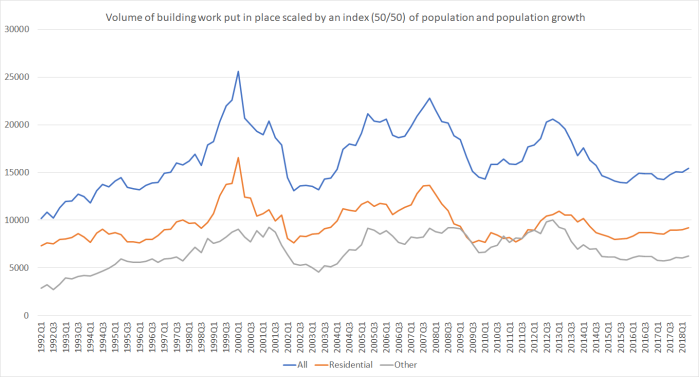
So what if we, somewhat arbitrarily, assign equal weights to the level of the population (influencing replacement/improvement demand) and the growth in the population (key driver of the demand to increase the total stock of buildings).  Doing that produced this chart.

BWpip 4.png

Two of the peaks (around 1999 and 2012) are still when population growth was at its lowest, but there is also a sustained period of strength through 2004 to 2007, a period when population growth was still quite high, but slowing.  House (and commercial property) prices were, of course, still rising.

What, if anything, to make of the current situation?

I’ve been sceptical for some time of the claim that there was insufficient building going on.  If that were so –  demand was persistently and substantially exceeding supply –  we would see prices rising strongly.  At least in Auckland that isn’t so now. On my telling, high land prices –  mostly reflecting regulatory and related constraints – have choked off large amounts of effective demand.  There are plenty of people who would like more houses at Houston or Atlanta prices, but not at Auckland (or Wellington or most other places in New Zealand) prices.  I’d consume more scallops (eg) at half the price too.  There are few/no signs I’ve seen that land prices are falling, so it is difficult to envisage much more effective demand emerging.  Unless developers themselves are making super-profits, why would the rate of new supply increase?

Having said that, population growth does appear to be beginning to slow.  If that continues and if building activity were to remain around the same levels as the last couple of years, then measures calculated relative to population growth would increase.  That seems to have happened over 2004 to 2007, so perhaps it can happen again.  But the economic climate seems less propitious now than it was then (credit conditions were looser, incomes were growing more rapidly, the terms of trade were beginning to lift, and so on).  And even then, it wasn’t enough to sustainably lower the level of house prices –  notwithstanding the temporary fall in the 2008/09 recession –  which isn’t surprising, as the core problem (land and associated infrastructure financing) had not been seriously addressed.