A new paper critiquing net-zero targets

I wrote a post a few weeks ago responding, in part, to absurd claims made in a TV interview by the Green Party co-leader and Minister for (against) Climate Change, James Shaw about the economic impact of pursuing the net-zero emissions target he and the Labour Party are championing.

He says investing in meeting our climate change goals will be a massive economic boost, rather than a burden.

“What we’re talking about here is a more productive economy, with higher-tech, higher-valued, higher-paid jobs. It’s clearly a cleaner economy where you’ve got lower health care costs, people living in warmer homes, congestion-free streets in Auckland.

“It’s an upgrade to our economy. It’s an investment, you’ve got to put something in, in order to generate that return. If we don’t, the clean-up costs from the impacts of climate change will well exceed the costs of the investment we’ve got to make to avoid the problem in the first place.”

The same tone had been evident in the officials’ Executive Summary to the government’s document consulting on the emissions targets and related issues.

This is our chance to build a high value economy that will hold us in good stead for the future. By upgrading our economy and preparing for the future, we can help make sure quality of life continues to improve for generations to come.

Believe all this, and there are no hard choices, no trade-offs, just stepping into the sunlit uplands in which enchanced prosperity and feeling good go hand in hand.

In my post on the alleged “massive economic boost” on offer, I quoted some extracts from a draft paper by my former colleague (and now Tailrisk Economics) Ian Harrison.

Ian has now put the final version of his paper on his website under the heading

The price of feeling good

A review of the emission targer options in “Our climate your say”

It is well worth reading for those who want to dig a little deeper into some of the specific issues than I have done (or had the energy for).

Here are Ian’s key conclusions.

The Zero emissions by 2050 target is a $200 billion ‘feel good’ project.  Compared to the alternative, zero carbon, target, the zero emissions target could cost an additional $200 billion; is unlikely to have a material impact on the behavior on the rest of the world; on innovation in New Zealand; or generate significant ‘co-benefits’.

The major benefit will be a ‘feel good’ factor for some people, at least until the effects of the policy start to bite.

The consultation on the options was a sham.  Our Climate did not provide an assessment of the pros and cons of the three options: zero carbon; zero carbon with a cap on other emissions; and zero emissions, that were presented. The document only promoted what appears to be the preferred option of zero net emissions by 2050. The reporting of the economic analysis was fabricated to make it appear that the three options had been considered.

The economic modelling was manipulated to reduce the economic impact of the zero emissions target.  The marginal cost of emissions reductions falls with a tougher target. This doesn’t make sense. Lower cost emission improvements should occur first, so the additional reductions under the tougher target will have a higher cost. The lower marginal cost outcome was achieved by restricting the amount of afforestation offsets (which are costless in the model) for the 50 percent reduction target, and giving the zero emissions target twice the allocation. The effect of this was to push most of the economic costs into the lower target option, reducing the marginal cost of the zero emissions option.

The reporting of the economic analysis obscured many of the negative economic impacts. Most of the results were presented as the difference between a 50 percent emissions target and a zero emissions target. This obscured the losses in getting from our current position to a 50 percent fall in emissions. Some of the modelling impacts, with prudent assumptions about technical change, are severe. For example, pastoral farming outputs fall by 60 percent, and household incomes could fall in absolute terms as the policy bites.

The economic modelling is deficient and needs to done again from scratch. The critical variable in any analysis is the rate of conversion of farmland to forestry, but this has not been modelled. There is no analysis of the optimal timing of emission reductions. The implied carbon prices appear to be unrealistically high which makes it difficult to draw conclusions from the analysis,

Climate change may have positive effects on New Zealand this century.  The Ministry has not produced a report on the costs of climate change. Our assessment is that climate change may have a small positive impact this century. The main reason is that more CO2 in the atmosphere promotes plant growth and increases output, which is significant for an economy with a large land based sector. This outweighs the economically relatively minor impacts from changes in weather patterns, and the cost of mitigating the impact of sea level rises.

Changes in the incidence of extreme weather events have been exaggerated.  Only moderate changes in extreme weather events have been projected in the UN Intergovernmental report on Climate Change. For example on the incidence of storms the report says ‘ Increase in intensity of cyclones in the south in winter but decreasing elsewhere. Increase in conditions conducive to convention storm development is projected to increase by 3-6 percent by 2070-2100 compared to 1970-2000.’

The benefits of innovations that will give New Zealand an ‘early mover’ competitive advantage have been exaggerated.   Most of the reductions in emissions will come from forest plantings, imported technology (such as electric cars), closing businesses such as New Zealand Steel, and by reducing livestock numbers. Most of this does not involve much innovation. A Ministry consultant described this innovation optimism this way. To presume that climate policy could make the difference would be a kind of exceptionalism and a serious leap of faith.

Economic costs of zero emissions target are significant.  The economic cost of the zero carbon target could be in the order of $75 billion. The additional cost of the zero emissions target, which requires twice the net abatements at a higher average cost, could be around $200 billion.

New Zealand’s sacrifice unlikely to change the world.  The argument for zero emissions is that it will encourage other countries to meet their commitments. The argument that going from a zero carbon target to a zero emissions target will make a material difference to the actions of other is at best another ‘serious leap of faith’. Depending on your viewpoint the zero emissions target is either a $200 billion vanity project, or a noble sacrifice. There are much cheaper ways of trying to influence world opinion.

Cheaper ways to influence world opinion.   Four ways of getting international attention and promoting the fight against climate change are suggested. They are: Taxes on international air travel; a ban on official business class air travel; virtual attendance at climate change conferences; travel to Wellington airport by bicycle by officials.

Or, more seriously, perhaps even to chip in an additional billion dollars a year in animal science research, to focus on the most difficult – and potentially costly – aspect of New Zealand’s emissions.  It is a great deal cheaper, on the government’s own numbers, than going full-tilt for the arbitrary self-imposed net-zero-by-2050 target.

And a couple of other extracts

Emissions framework fairness. It can be argued that the emissions measurement framework is not fair to New Zealand. Nearly half of our emissions relate to agriculture, but most of the output is exported. If the assessment was done on a consumption, or carbon footprint basis, our abatement responsibilities would exclude exports and account for the emission content of imports and would be lower considerably lower than under the current system.

By contrast, Norway is a large oil and gas producer and exporter, but does not have take responsibility for the emission consequences of its exports. Norway has just
announced that it plans to be emissions neutral by 2030 (mainly by buying international carbon credits) while planning to increase its oil exploration.

New Zealand’s emission record is often painted as poor. For example, the Productivity Commission, in its Low Emissions Economy report presented a figure showing New Zealand to have the fifth highest gross emissions per capita. If the emissions were calculated on a net footprint basis, we would be well down into the low emission end of the figure.

and

Many other countries are not doing as much as New Zealand.  As an example, consider the case of Singapore. As a high-income country [much more so than New Zealand], which is directly in the climate change firing line, we might expect a sense of urgency and substantive actions. So what is Singapore doing?

First, it signed up to a fairly soft ‘developing country’ Paris agreement target, promising that their emissions will peak in 2030. To our knowledge they have made no commitments beyond that date. In terms of what they are actually doing, we have relied on a January 2018 report from the Singapore Energy Studies Institute.   The main action is the introduction of a carbon tax, apparently to be at a fairly low level, for large companies from 2019. Between 30 and 40 companies will be affected.

In addition:

  • 2018 has been declared the year of climate action
  • Singapore will host a special ASEAN Ministerial meeting on Climate change
  • There will be some financing subsidies.

Food for thought.  And no sign –  not in the consultative document, not in the Productivity Commission report –  of any “massive economic boost” in prospect.


Ten years on

It is the season for books and articles reflecting on financial crises of a decade or so ago, the aftermath, and whatever risks might –  or might not –  be building today.  The collapse of Lehmans –  and the wise decision of the US authorities not to bail it out –  was 10 years ago this month, and although the US crisis had been underway for at least by a year by then, the Lehmans moment seems set to take a place in historical memory around the Great Recession rather parallel to the sharp falls in US share prices in October 1929 (the ‘Wall St crash’) and the Great Depression.  Not in any real sense the cause of what followed, but the emblematic moment in public consciousness nonetheless.

I’ve just been reading the big new book, Crashed: How a decade of financial crises changed the world, by esteemed economic historian Adam Tooze.  I might come back to it in a separate post, but for now would simply caution people that it is less good than his earlier books (around the Nazi economy, and the economic history of the West after World War One running into the Great Depression) had led me to hope.

But on a smaller scale, I picked up the Listener the other day and noticed on the front cover ’10 years after the GFC, former Reserve Bank governor Alan Bollard warns of new risks’.  Conveniently, I see that the article is freely available online.  The sub-heading tantalises potential readers

Former New Zealand Reserve Bank governor Alan Bollard warns that, although lessons were learnt from the global financial crisis, new risks have emerged that could trigger a repeat contagion..

Alan Bollard writes well, and often quite interestingly.  Extremely unusually (and in my view quite inappropriately), he actually published a book on his perceptions of the previous crisis in 2010, while still very fully-employed as Governor, a senior public servant.  There were quite severe limitations as to who, or what, he could be critical of (as I was reminded last night rereading my diaries of some crisis events I was closely involved in, and the Bollard published perspective on those events).     The Bank’s early reluctance to take seriously the emerging issues, as they might impinge on New Zealand, is not, for example, something you find documented in the book.

He must be in a somewhat similarly difficult position now.  He is Executive Director of the APEC secretariat, that grouping of Asian and Pacific (loosely defined) countries and territories, that includes China, Russia, the United States, Indonesia and so on.  I dare say Xi Jinping and Donald Trump won’t be watching nervously to see what Alan Bollard is saying, but the Executive Director knows that there are quite severe limits to what public servants can say while in office.

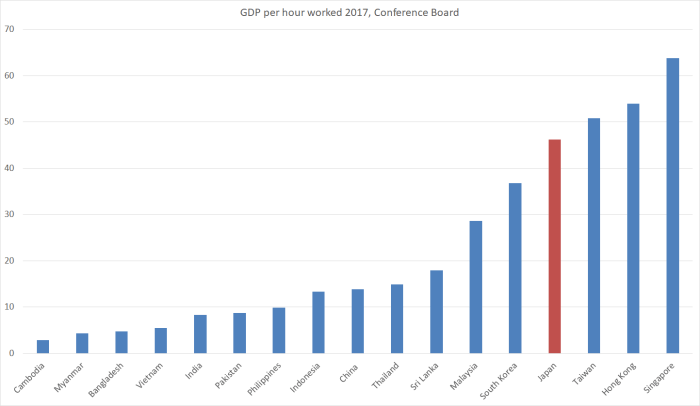
And, thus, much of the Listener article is a bit of a, perhaps slightly rose-tinted, rehash of some of the policy responses here and abroad (I will come back to deposit guarantee schemes on the tenth anniversary, next month).  There is some loose descriptive stuff on various developments in parts of the APEC region.  There was the suggestion that some countries (actually “much of the region”) in Asia is “anxiously worrying” about whether they could face a Japan-like low productivity future but to me, Japan still looks pretty attractive by regional standards.

japan

(New Zealand, for example, is at 42.)

In fact, I looked in vain for the promised analysis or description of the “new risks” that might “trigger a repeat contagion”.   Perhaps that was never Bollard’s intent, but the Listener had to attract readers to a fairly tame advertorial for APEC somehow.  The most we get is

We need to remember that the global financial crisis was originally triggered by a building bubble, and that is still on the minds of regulators throughout the region.

and

Meantime, we are very worried about the likely effects of the growing trade wars. It is too early to judge, but the stakes are high – trade growth has been the big driver behind the immense improvement in living standards through the Asia-Pacific region ……We are now on the alert for signs that these trade frictions could weaken exchange rates, hurt commodity prices, hit stock markets or cause financial volatility, against an unusual background of tightening monetary policy and loose fiscal policy in the US.

But then what more could a serving diplomat, not hired to be a high-profile problem solver (unlike, say, the head of the IMF) really say?

And it all ends advertorial style

As a big trader, New Zealand has always been susceptible to these tensions. But one international platform where they play out is coming closer: in just over two years, New Zealand will commence its year of hosting Apec. The organisation is a voluntary, consensus-driven one, where for 30 years we have promoted regional economic ties and tried out new ideas for trade and investment. As the upcoming chair of Apec, New Zealand will have to contend with continuing antiglobalisation pressures, big-economy tensions, climate-change damage and financial risks in the region. It sounds daunting, but there are many positives: We have learnt some of the lessons of the global financial crisis; banking regulation is tougher; banking chiefs are more cautious; economic demand is still growing; and the Asia-Pacific region is tied ever more closely by its trade flows.

It could have been a paragraph from a speech by one of his political masters.   I guess one wouldn’t know that one of his members (the People’s Republic of China) poses an increasing political and military threat to another (Taiwan) or –  closer to his own territory –  that few major economies have very much effective macroeconomic firepower at all when the next crisis or severe recession hits.  And really nothing at all about financial sector risks.  His final sentence –  “September 2018 should be a month much better than September 2008” –  is almost certainly true (at least outside places like Turkey and Argentina) but not really much consolation to anyone.

In his column in the Dominion-Post this morning, Hamish Rutherford touches a theme of various recent posts here: the limited macro capacity of many countries.  He rightly highlights how low global interest rates are, and the much higher levels of government debt in many countries.

To make matters worse, interest rates are already so low that some economists are speculating that if the Reserve Bank was to respond to a slowdown by slashing interest rates, in a bid to stimulate the economy, it may find that little of the money finds its way to households.

Debt levels among the world’s leading economies are, by and large, far higher than they were a decade ago. In the US, as well as threatening to kick off a global trade war, President Donald Trump’s administration is running the kind of deficit that would be wise in a recession, but at the late stage of a long economic growth cycle appears reckless.

But there was one point I wanted to take issue on.  He argues

Back in 2008, New Zealand benefited from its largest trading partner, Australia, avoiding recession and having almost no debt. This time Australia’s debt is climbing and there are doubts as to whether Canberra will have the discipline to return to a surplus, as the political state becomes more populist.

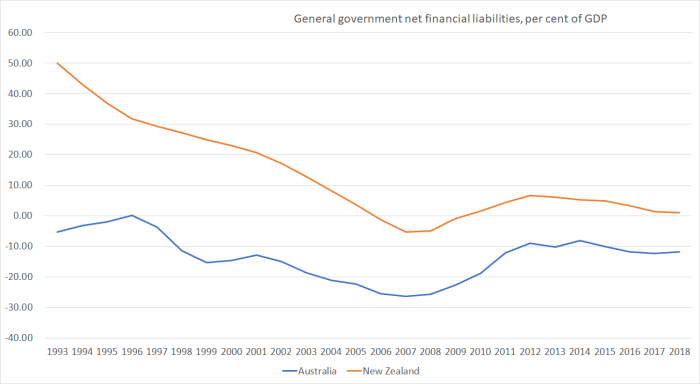
I don’t think that is true about either the past or the present.  We didn’t get any great benefit out of Australia’s fiscal stimulus in 2008/09, largely because if fiscal stimulus hadn’t been used, the Reserve Bank of Australia would probably have cut their official interest rates further.  Fiscal policy can be potent when interest rates have the effective lower limit, but they hadn’t in Australia (or New Zealand).  More importantly, and for all the New Zealand eagerness to bag Australian politics and policies, here is the OECD’s series of the net financial liabilities of the general government (federal, state, and local) for Australia and New Zealand, expressed as a share of GDP.

debt govt au and nz

Australia’s net public debt has been consistently below that of New Zealand for the entire 25 years for which the OECD has the data for both countries.  The gap is a little smaller now than it was a decade ago, and (on a flow basis) the New Zealand budget is in surplus but Australia’s isn’t.  But if there is a desire to use large scale fiscal stimulus in the next serious downturn, debt levels themselves aren’t likely to be some technical or market constraint in New Zealand, and even less likely in (less indebted) Australia.

And finally in this somewhat discursive post, a chart I saw yesterday from the BIS.

real house prices BIS

A story one sometimes hears is that low interest rates have driven asset prices sky-high setting the scene for the next nasty crisis.  Even if there are elements of possible truth in such a story, the story itself mostly fails to stop to ask about the structural reasons why interest rates might be so low.   All else equal, had interest rates been higher asset prices probably would have been lower – and CPI inflation would have undershot targets even further.  But as this particular chart illustrates, across the advanced economies as a whole real house prices now are much same as they were at the start of 2008.  That isn’t true in New Zealand (or Australia for that matter).  Interestingly, even in the emerging markets –  centre of current market unease –  real house prices are still not 15 per cent higher than they were at the start of 2008, when interest rates generally were so much higher.

But then only rarely is the next major economic downturn or financial crises stemming from quite the same set of financial risks as the last one.

The Productivity Commission’s zeal for net-zero

Among those holding the reins of power –  and their supporters –  there appears to be an almost passionate commitment to a goal of eliminating (net) all greenhouse gas emissions by 2050.  So passionate as, it seems, to care very little about the consequences for New Zealanders.  And since some of the easiest and least costly (probably actually net beneficial) ways to make big inroads on New Zealand greenhouse gas emissions run head-on into other passionately-held ideological commitments, those options simply get ignored as well.  None of this seems based on any robust analysis, either of the specific issues facing New Zealand, nor of the way in which the substantial costs of adjustment would be likely to fall most heavily on the poorest in our society.  Some, who should know better, seem to want to pretend that a major coerced reorientation of our economy would actually be net beneficial (in economic terms) to New Zealanders.

We’ve had another display of this sort of attitude today, with the release of the Productivity Commission’s final report into making a transition to a low emissions economy.   There is more than 600 pages of it.    In its evangelical tone –  not much detached analysis here – much of it could have been written by the Green Party.

There is, for example, no sign of any recognition that New Zealand may well benefit from global warming (consistent with previous OECD modelling and IPCC analysis). And yet, according to the the chair of the Commission in his Foreword.

We make that effort as a member of a global community with a shared interest in overcoming this challenge to our collective well-being. We cannot expect to influence others of the need to change if we cannot ourselves demonstrate the willingness and ability to play our part, to offer our assistance and to share the benefits of our experience.

It seems laughable to suppose that the world will be looking to a lead from New Zealand on these issues (if only because the pattern of our gases is so much different).  But even if they were, why would we sacrifice ourselves –  and our own lower income people –  on the altar of some issue which may well pose significant risks in other countries, but if anything is likely to make New Zealand a more pleasant, and productive, climate in which to live?  Mr Sherwin gives us no clues on the answer to that.

The report itself open with this claim on the first page of the Overview.

It is difficult to estimate accurately the economic costs of climate change, due to many uncertainties. Even so, broad estimates of the economic costs of escalating climate risks are daunting. Even at 2°C of warming, the Intergovernmental Panel on Climate Change (IPCC) estimates the annual economic cost at between 0.2% to 2% of global GDP, even if strong measures are taken to adapt to such change.

Deep in the body of the report, the Commission  –  which seems to have commissioned no modelling of the GDP impact of emissions reductions targets itself –  downplays the NZIER modelling results published in the recent official consultative document on a net zero target, which suggested GDP losses for New Zealand of 10-22 per cent if we pursue a proper net-zero by 2050 target.  But even half the potential losses NZIER estimated would be a lot larger than 0.2- 2.0 per cent (benefits) –  and recall the OECD modelling suggesting that the economic costs of climate change itself are concentrated in already warmer countries, not in temperate places like New Zealand.

The zeal to lead the world continues a page or two later

Further, by achieving a successful transition to a low-emissions economy, New Zealand has an opportunity to influence others in pursuing a low emissions economy. That influence can help reduce the risk of other countries failing to pursue mitigation pathways because they either do not know how to, or do not think it can be done while continuing to grow incomes and wellbeing. Such influence is likely to be particularly relevant in areas where New Zealand has expertise and experience (eg, techniques for pastoral GHG mitigation) and by implementing innovative policy solutions (eg, to reduce biogenic methane (CH4)).   New Zealand’s capacity to influence will be the greater if it can point to its own credible and substantial mitigation progress.

So, even though climate change won’t particularly adversely affect New Zealand, we should take a gigantic gamble –  that others might be hesitating about taking –  on the off chance that we can influence the world.   And all premised on the spurious benchmark that a net-zero target can be achieved “while continuing to grow incomes and wellbeing”.  The people who run the Commission really should know better than that: the benchmark shouldn’t be whether people in 2050 are better off economically than we are, but what difference the proposed policy initiatives will make to the outcomes we would have had otherwise.  Anything like a 10 to 22 per cent loss of GDP (relative to baseline) is enormous, and appears to be a risk the Productivity Commission has little interest in engaging with, such is their emotional commitment to the net-zero aspiration (or their political commitment to keeping onside with a new government).

And, of course, the Commission has a great deal of confidence in the ability and willingness of governments and public servants (people like them), to “get things right”, never once engaging with the generations –  centuries –  of records of government failure, or the limitations of human knowledge.  Thus we are earnestly told that one of the “problems” is

Discounting climate change pushes responses to it into the future. There is a tendency to punt policy choices into the future because of near-term costs and a belief that some disincentives will reduce in the future (eg, cheaper technology or increased cost of inaction). Yet as the future approaches (when action was due to occur), the salience of the short-term costs returns, creating a vicious cycle.

And yet in a country that has almost certainly benefited, probably modestly, from  global warming to date, it is almost certainly beneficial for us not to have taken action generations ago, when the technologies were not there to support such adjustment.

They more or less recognise some of this just a little later, in a rather incoherent paragraph

So, an important theme in this inquiry is that the long-term perspective must be introduced into politics and policymaking, domestically and internationally. Added to the long horizon is deep uncertainty about many aspects of the future. The combination of these two features requires political commitments and durability that spans many generations. Without durable and ambitious policies now, the signals for firms and households to move their production and consumption towards less emissions-intensive options will be weak, at best. The challenge is therefore how best to design the political and governance architecture in a way that effectively signals future policy intentions and provides a commitment to such intentions.

Long horizons and “deep uncertainty about many aspects of the future” in combination are not simply a good recipe for getting (good) “durable and ambitious policies”, or the sort of aspiration the Commission seems to have to make such issues –  with huge economic and social implications –  something bipartisan or even transcending politics.  But politics is about the sphere in which hard choices should be debated.

Ultimately though, laws and institutions will not endure unless underpinned by political consensus. Support across political parties is therefore vital; climate change is the ultimate intergenerational issue, and governments change. So, substantial cross-party support for the core elements of statutory and institutional arrangements will help provide policy permanence regardless of the make-up of the Government.

Even though, on the government’s own modelling, the adjustment costs are very large (and probably uncertain), the distributional consequences are severe, what other countries are doing in largely unknown and subject to change –  oh, and New Zealand itself isn’t particularly adversely affected by climate change.

A big part of the Productivity Commission’s vision of the path forward is afforestation on a huge scale.  At least they recognise –  unlike the NZIER modelling, which assumes the new forests are effective all a net gain –  that if this were to happen it would mostly displace existing uses of land for sheep and beef (although the Commission barely touches on the transitional economic implications of that –  there is, for example, no mention of the exchange rate in the entire report).  And even the Commission knows that this approach has its limits

Expanding forestry can achieve large reductions in net emissions up to 2050. Yet heavy reliance on forestry will create challenges in the longer term because it is not possible to expand without limit the land area under forest. With continued emissions reductions required after 2050 to achieve and maintain net-zero or negative emissions, New Zealand will need to find mitigation options for hard-to-reduce emissions sources.

Which might leave you wondering why we should massively reorient the economy now –  at likely considerable real economic cost –  to achieve an artificial goal of no specific relevance to New Zealand, net-zero by 2050.  The feel-good dimension might be fine for the Green and Labour parties, but we should expect more from the Productivity Commission.

Towards the end of their Overview, the Commission verges on the dishonest. There is a section headed, in big  bold letters

Many benefits from the transition
Investment and job opportunities

They note

An important framing point is to think about the potential cost of transitioning to a low carbon economy as an investment, rather than as a net-cost on the economy and taxpayers. With all nations playing their part, the return in the form of avoiding damaging climate damage is substantial.

Except that (a) the numbers don’t back this up (say a 2% of GDP global loss from climate change and a 10-22 per cent loss of GDP in New Zealand to get to net zero by 2050 (again, on the government’s own numbers)), and (b) thinking of something as an “investment” doesn’t make it a good call.  There was plenty of stuff the national accountants called “investment” during the Think Big era in the 1980s –  and actually late in any boom –  that was simply wasted resources.

They prattle about much of the investment being undertaken by the private sector, as if again somehow this was a good thing, or a sign of it being well-justified.  Regulation and taxes often force businesses to undertake investment spending that has little or no societal economic benefit.  Skewing the economy to achieve a net-zero target is not obviously different.

As for jobs

A low-emissions economy has the potential to be a major source of jobs growth in the future, with many jobs yet to be defined. The International Labour Organisation (ILO), for example, says that taking action in the energy sector alone to limit global warming to 2°C by the end of century can create around 24 million new jobs by 2030, more than offsetting losses in traditional industries.

But we already have something close to full employment.  We had something closer to full employment in the dark days when New Zealand protected every industry under the sun.  Market economies will generate jobs, and technological change mostly isn’t a threat to overall employment levels (any more than in the Industrial Revolution). The issue is what those jobs pay, and that is largely determined by productivity.  The Commission is curiously, conveniently, silent about the likely overall productivity losses –  those GDP losses NZIER identified will mostly be lost productivity.

I could go on quoting the politicised blather, but here is just one last quote from the Overview

New Zealand can achieve a successful low emissions economy, but there will be tough challenges. Delaying action will compound the transition challenge, making it more costly and disruptive, and limiting viable and cost-effective mitigation options in the future. If New Zealand fails to act, it risks being locked into a high emissions economy and missing potential future economic opportunities.

Mostly this is just rhetoric.  If we face difficult adjustments, including around animal emissions for which there are as yet few decent technological options –  beyond getting rid of the animals (and shifting production to other countries –  might it not make a lot more sense to delay adjustment, take advantage of economic new technologies as they arise, and so on.  After all, despite the rhetoric, neither Donald Trump, Xi Jinping, nor anyone else is looking to us to commit some sort of economic suttee, on the off chance of rising phoenix-like from the ashes.  The Commission, for example, is dead keen on electric cars, but presumably technology in that area will continue to improve, perhaps rapidly, and we might mostly be better off not leaping now, but waiting until the prices come further down.  Individual firms will make their own choices about long-term global market opportunities, and officials at the Productivity Commission are unlikely to be able to give them any useful guidance, about balancing costs and risks, opportunities and threats.

Longstanding readers will know that I had complained that the Commission’s draft report had entirely ignored the role that immigration policy had played in driving up New Zealand’s total GHG emissions in recent decades, and –  in particular – the way in which current immigration policy, if persisted with, will compound the economic difficulty of meeting any sort of low emissions target, let alone net-zero by 2050.  Population growth was treated as an exogenous constant in the draft report.   I made a submission on the draft report, again highlighting the issue and the fairly strong cross-country relationship between population growth and emissions growth (not only in total, not only in transport, but even in agriculture).

The final version of the report represents a very modest improvement.  There is no still no reference to immigration policy, past or present, in the entire document.  There is some more discussion of the contribution of population growth, and a single piece of sensitivity analysis that makes the rather obvious point that a lower population growth rate would lower the carbon price required to meet a net-zero target, but no recognition that in New Zealand – unlike many countries –  trend population growth is very directly influenced by specific policy choices around immigration.       As even the Commission notes, achieving a net zero target by 2050 will be “challenging”. Against that backdrop it seems remiss –  and highly political –  not to even put on the table the question of whether the target rates of non-citizen immigration should be revised down.  If the government and the Commission were serious about mitigating the costs of meeting such a target –  rather than pretending that there are real net economic gains –  they’d be taking a hard look at all the things that compound those costs, without providing much benefit to New Zealanders as a whole.  High rates of immigration –  to a country more remote than almost any other, with no demonstrated productivity gains over decades, and about to be put through the wringer of large structural changes undermining the competitiveness of much of the tradables sector –  look like a clear example.    But touching on such issues would challenge the priors of the elite, and we can’t have that it seems.

Productivity Commission documents come with this statement

The Productivity Commission aims to provide insightful, well-informed and
accessible advice that leads to the best possible improvement in the wellbeing
of New Zealanders.

Perhaps they think they aim to.  It doesn’t look as though they’ve done so with this report.  On the government’s own numbers –  ignored by the Commission –  the wellbeing of New Zealanders will be jeoparised.  But quite probably their advice will have improved the standing of the Commission with the new government.  Which is not at all the same thing.

This was the chart, from the government’s own modelling, that I included in a recent post

Six times the adverse impact on the bottom quintile as on the top quintile.  Breathtaking…..
 

Towards an MPC

A week or so ago, advertisements appeared in the major newspapers inviting applications from people wishing to be considered for appointment as external (non-executive) members of the Monetary Policy Committee.   Should you wish to apply, the advert is here, with applications closing on Friday.

All of which is quite remarkable.  The Monetary Policy Committee is to be created by legislation currently before Parliament,  and not expected to be passed until the end of the year (the select committee isn’t due to report back until early December). The appointments are not expected to take effect until April next year.  In fact, submissions on the Reserve Bank of New Zealand (Monetary Policy) Amendment Bill themselves also close on Friday.   The select committee process is supposed to involve members looking carefully at the details of the legislation, considering public submissions, and recommending any refinements or amendments the committee considers appropriate.  But you would have to wonder what the point of submitting is, at least on the MPC structure, powers etc, when the appointment process for members is already well underway.

As I’ve previously highlighted, one of the bizarre aspects of the proposed model is that the Reserve Bank Board (no doubt heavily influenced by the Governor, who is a member of the Board) get to control the appointments.  Appointees will, finally, be signed off on by Cabinet and appointed by the Minister of Finance, but the Minister will only be able to appoint people nominated by the Board.  Most of the Board members have no, repeat no, expertise in monetary policy (including its governance), and all but one of them were appointed by the previous government.  It is a weird abdication of responsibility, for a key aspect of short-term economic policy, not seen (as far as I’m aware) in any other major government appointments.  It is extraordinary that the Minister of Finance cannot directly appoint people he has judged appropriate to the role –  people who can, by their choices, have a big influence on the short-medium course of the economy.   The Minister of Finance (and his colleagues) are, after all, the only people we citizens can actually hold to account –  kick out – if things go wrong.

We’ve seen this sort of rather premature process from the Board previously.  Last year, they were advertising for candidates for a new Governor, with applications closing well before the election, even though the Board –  like everyone else –  knew that the then Opposition parties were promising reform of the Reserve Bank, including legislative change.

This time one must presume they have the approval of the Minister of Finance for kicking off the recruitment process.  After all, the advert is quite specific that there will be three external appointees, and that is a decision only the Minister can make (the legislation specifies only a range (2 or 3 externals)).  That, incidentally, guarantees that there will be four internal members –  the maximum allowed in the legislative provisions, and the bill requires an majority of internals.

That said, the process seems to have been rather rushed.  Applications are open for only two weeks, and when I contacted the recruitment firm the Bank’s Board is using to ask for the information pack and related detail, the initial response was that they didn’t yet have all the material from the client.  It took six days before the material finally arrived.

There was some interesting material in the advertisement

External MPC members need not have expertise in monetary policy or macroeconomic theory.

This is the more moderate version of what I was told the Governor had said the other day at the INFINZ function, that he didn’t want “you economists” (last I looked that was the Governor’s own background) because “we need different thinking”.

The bill itself says

The Minister may only appoint as an internal or external member a person who, in the Minister’s opinion, has the appropriate knowledge, skills, and experience to assist the MPC to perform its functions (for example, in economics, banking, or public policy).

Which is fair enough I guess, but I would hope that when the Minister finally comes to make appointments he insists that at least one of the externals in fact has a fairly strong background in monetary policy and macroeconomics.   Even the Bank’s Board –  which has no power over monetary policy at all –  has usually had such a person.  If there is no such person on the MPC, it will simply confirm from the start even more strongly what I have been arguing, that the new structure is likely to be ineffective, governor-dominated, and resembling in many ways the sort of system the Bank has had in place for the last 15 years or so (when a couple of externals  –  almost always with no economics background –  have participated in monetary policy deliberations, and provided an OCR recommendation, but have had little real influence most of time, and no accountability: any value was mostly in passing on a specific class of business anecdote).

What sort of people is the Board looking for?

External MPC members will require:

  • Exceptional intellectual acumen and communication skills
  • Experience exercising sound judgement to make effective decisions, in environments reflecting high levels of complexity and uncertainty
  • Capacity to engage with complex economic issues and make contributions which draw upon a range of relevant professional, educational and life experiences
  • Absolute integrity, reflecting genuine independence, rather than solely acting as a ‘voice’ for specific sectors or interest groups
  • The ability to operate in a manner consistent with the highly confidential nature of MPC decisions.

On the second to last of those, even the bill is a bit stronger

A person must not be appointed on the basis that the person represents a particular industry sector.

It would be quite concerning if anyone appointed to the MPC saw themselves as a representative or voice of a sector (even if not “solely”).  All members must surely be expected to operate solely from a national perspective.

But what of the first set of criteria?  I’m always a bit sceptical of adverts seeking “exceptional” anything, as there are very few people with such “exceptional” qualities anywhere.  Of the Reserve Bank’s existing senior management and Board, of those I’ve had anything to do with there are plenty of moderately capable people, but none whom I’d describe as having “exceptional intellectual acumen”.  Why does the Board think they are likely to attract such people to a part-time role, in which they will have little ability to influence policy, no independent resources, and (from what we’ve been told previously) no ability to articulate their views openly?  Oh, and not to mention people willing/able to devote 50 days a years in a part-time capacity at public sector board remuneration rates?

I’m also puzzled at the suggestion that MPC members should need “exceptional communications skills”.     Again, of management or the Board, only the Governor could possibly be considered to have such skills, and even he is often rather a loose cannon.  But more importantly, the Reserve Bank fought hard –  and the Minister sadly endorsed – a model in which MPC members will not be free to articulate anything other than an agreed MPC position on policy.  They won’t even be able to have their personal perspectives clearly recorded in the minutes of the meetings, let alone make speeches or give interviews that might seek to advance thinking or articulate a minority position, That is quite different from the situation in more open systems, notably those in the UK, the US, and Sweden: systems which function well, without any of the problems the Reserve Bank management (protecting their personal position) have tried to worry people with.

It will be interesting to see what sort of people the Board and the Minister come up with, assuming that Parliament eventually passes legislation along the lines of the current bill (and bear in mind that we have a minority government again).  It is hard to see why the roles –  probably little more than silent adjuncts to the Governor – would be attractive to really good people, or who will really be free to take them up (even an academic –  apparently not wanted by the Governor –  might struggle to commit 50 days a years, spread over the year, not just in the long summer vacation).

Potential conflicts of interest have always been a bit of an issue, and the main reason I asked for the information pack was to see how they proposed to handle that issue.  Frankly, the material I received –  which included a draft Code of Conduct –  suggested they haven’t really thought sufficiently hard about it yet.   The conflict of interest provisions look a lot like those I used to be subject to as a staff member participating in the OCR Advisory Group, but don’t really grapple adequately with the situation of part-time externals, presumably earning their living (or occupying their time) mostly doing other, non Reserve Bank, stuff.  For example, there is (reasonably enough) a prohibition on

Members must not be personally or professionally involved, directly or indirectly, in regular trading in financial markets in which the Bank has, or might have, a significant influence. This includes domestic wholesale money, bond and foreign exchange markets, interest and exchange rate futures, options and swaps markets, instruments linked to such markets, equities listed on New Zealand exchanges and prediction markets related to those issues in which the Bank might have a significant influence.

(If only the predictions market had not, in fact, been killed off by the previous government).

And under the legislation public servants and directors/employees of entities regulated by the Bank will be probibited.

But there is no sign that, say, someone in my position would be disqualified or conflicted (in terms of this specific policy), despite being a trustee of two superannuation schemes and devoting a fair chunk of my time to, at times quite vocal, commentary on aspects of economic policy.  I’d certainly regard both of those sorts of involvements as disqualifying –  even scrupulously observing confidentiality –  and I would expect most Monetary Policy Committees in other countries would do so too.

(And in case anyone is in any doubt, I have no interest in the MPC positions myself. They are set to be ineffectual figleaf positions.)

And so it will be interesting to see what people they finally manage to attract, both in the first round, and a few years later when the novelty has worn off.  A smart (but deferential) semi-retired person would probably fit the bill quite well, but since the government and the Bank have been clear they don’t want people who might rock the boat, and they apparently aren’t keen on economists, and since even the externals together will be a perpetual minority, you wonder why someone good would be interested.   Pocket money probably shouldn’t be the motivation, at least if the government were serious about putting in place a strong, well-functioning, MPC.  Of course, as it is, there is no evidence of such intent.

On our disappearing migration data

Having written here earlier in the week about the reckless and irresponsible way in which the government and Statistics New Zealand are degrading the quality of our very timely net immigration data (itself a major, and quite cyclically variable, economic indicator), I noticed a couple of comments that prompted me to dig out some numbers for this post.

The first, in a comment here, was that the self-reported intentions-based PLT measure probably couldn’t be counted on as very accurate anyway.  And the second, in someone else’s commentary, was that at least we will still (I hope) have monthly reporting of total passenger movements (tourists, business travellers etc as well as the permanent and long-term movements) from which a reasonable steer might be gleaned.

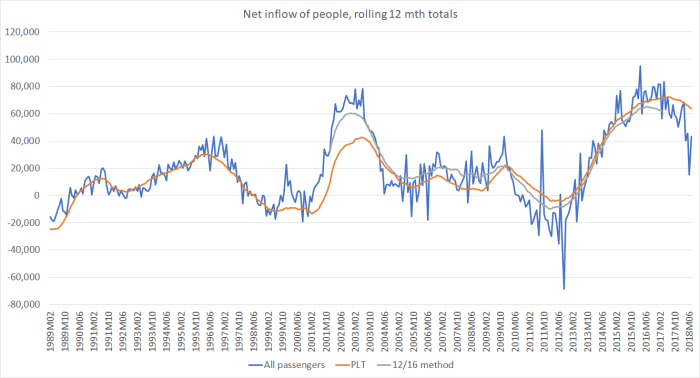
The best way of looking at whether the PLT measures are reasonable is to compare them with the new 12/16 method numbers –  available with a long lag, but which involve looking back, using passport records, and checking which people actually came (or went) for more than 12 months ((the threshold for the PLT definition).   Unfortunately, SNZ is still not publishing seasonally adjusted estimates for the 12/16 method numbers, so one can only really do the comparisons using rolling annual totals.   On this chart, I’ve shown the rolling 12 month totals for (a) the 12/16 method, (b) the PLT series, and (c) total net passenger movements for almost 30 years (although the 12/16 method data are only available this century).

migration 31 Aug

All the cycles are pretty similar, at least if one takes a broad sweep of the data.  That isn’t surprising, as most short-term visitors go home again pretty quickly, leaving something like an underlying trend of permanent and long-term movements.   And it confirms that the PLT numbers have been a useful –  although not perfect –  indicator of the actual permanent and long-term movements (captured in the 12/16 numbers).  Importantly, the turning points tend to be very similar.

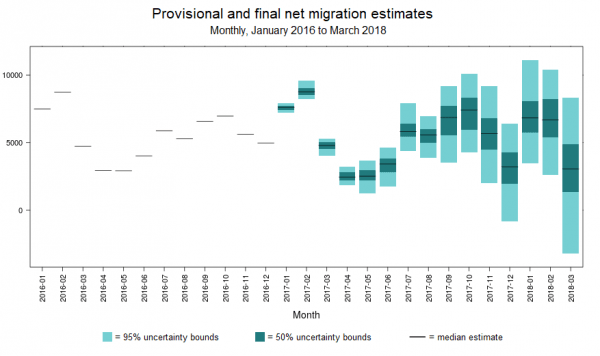
One wouldn’t expect those two series to be the same, as they measure different things: the PLT numbers are about intentions, and if plans change so will behaviour.  If lots of people come to New Zealand (or leave for Australia) and things don’t work out and they change their mind, ideally we would want to know.    The divergence that looks to have opened up between the grey and orange lines at the end of the (grey) series might prove to have been something like that.  But in future we won’t know because (a) we won’t have the PLT data at all, and (b) the grey line will only be available with a reasonable degree of certainty with quite a long lag.   As a reminder, here is the new SNZ chart I included in the post the other day, illustrating the huge error margins around the timely estimates SNZ proposes publishing using their new (unpublished and untested) methodology.

Provisional-and-final-net-migration-estimates2

But the other thing worth noticing is how noisy the blue line is.  There is a great deal of volatility, which makes distilling any signals (about permanent and long-term movements) very hard on a timely basis. That was why the PLT numbers have been so useful.  The blue line is thrown around in particular by big sporting events: eg the Lions tours in 2005 and 2017, and the Rugby World Cup in 2011.    There are big additional net arrivals, and then big additional net departures a month or two later, with mirror effects in the annual numbers a year later as well.  I have found the total net passenger arrivals data useful in the past –  in both 2002 and 2011 they pointed to something larger in the permanent and long-term movements than the PLT numbers themselves were reflecting, and that sense was later reflected in the 12/16 numbers (much larger net inflows in 2002/03, and somewhat larger net outflows in 2010/11).

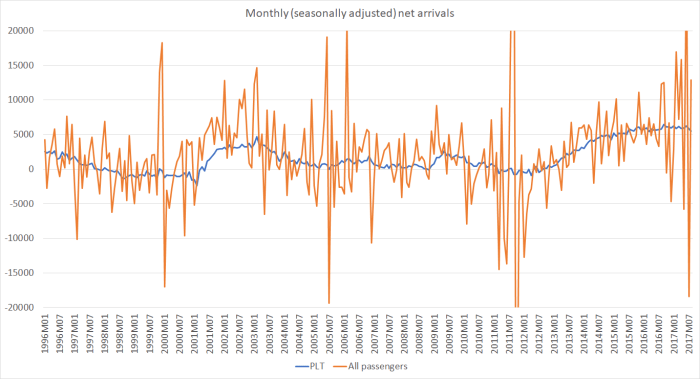
What of the monthly seasonally adjusted data (the stuff designed for high frequency timely monitoring)?  Here is a chart of the PLT and total series, with scales set so as not to allow the flows associated with the Rugby World Cup (in particular) to dominate the chart.

migration mthyl sa

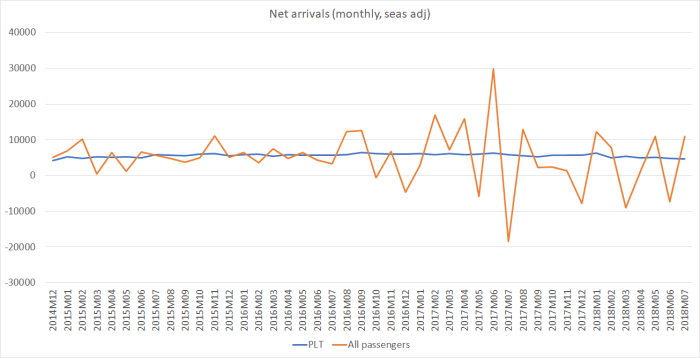
At a monthly frequency, the noise in the total passenger (orange) line totally dominates any signal, while the volatility in the monthly PLT series (that we are soon to lose altogether is very small).    What should perhaps be more concerning –  and is a bit perplexing –  is why the volatility of the total passenger series is itself quite variable across time, even outside the months associated with major sporting events.   Right now, for example, the volatility in the monthly series is quite extreme.    Here is the same chart for just the last four years or so.

migration mthly

The Lions Tour is very evident in mid-2017, but the heightened volatility goes well beyond that.

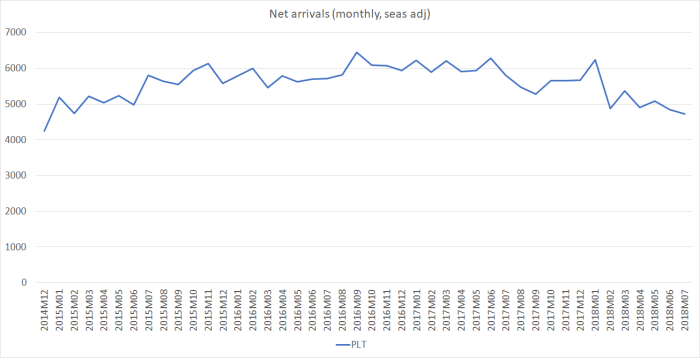
All of which leaves me not quite sure what to make of the very first chart.   The blue line (annual net inflows of all passengers) has fallen back a long way already (down from around 80000 to around 40000), and similarly-sized falls in the past have often been coincident with, or perhaps a little ahead of, large falls in the PLT numbers (and the 12/16 numbers).  There are some reasons to think we might see something similar now.  Fortunately, for the next couple of months we will still have the PLT data

PLT mthly

But after that –  thanks to government and SNZ choices –  we will be flying blind.    We’ll have good information eventually on what actually happened, but it will be available with such a lag as to be more use to economic historians than to people trying to make sense of, and respond to, contemporaneous economic developments.  And the net total passenger movements data is sufficiently noisy that it probably won’t give us much of a steer (and even then with big error margins) before the lagging 12/16 data do.

This is simply reckless behaviour around a major set of timely economic data.

Orr off the record on major policy matters

A reader mentions news that Reserve Bank Governor Adrian Orr was in typically loquacious form at a finance industry “networking event” held in Wellington last night.

Typically loquacious but, so the report suggests, perhaps going rather beyond the Bank’s public lines on monetary policy as articulated in the August Monetary Policy Statement, in a very dovish direction.     And weighing in on what sort of person he wanted (and did not want –  economists apparently not wanted) on the new Monetary Policy Committee –  the one where the Minister supposedly makes the appointment, the one where the legislation has not yet been dealt with by the relevant select committee.

Central bankers need to be very cautious in their communications around monetary policy.  The standard approach has been to communicate primarily via Monetary Policy Statements, where everyone has access to the same information (although I gather the Bank still holds confidential debriefs for bank economists as a group after each release, and if that isn’t potentially market sensitive it is hard to imagine what would be).  That approach is sometimes supplemented with speeches: on-the-record ones where there is anything at all interesting, important, or potentially sensitive being said, and off-the-record ones where it is just repeating the same lines previously made public.

The speeches themselves are not without their problems as the Reserve Bank of New Zealand handles things.  For instance, although the Governor has been in the role for five months now, there has been no on-the-record speech at all.  And even when Governors have spoken in the past, there is often considerable potential for nuance or shades of information in the Q&A sessions afterwards.  At the Reserve Bank of Australia, it is common practice for those Q&A sessions to be recorded and made available on the RBA website.  There is nothing comparable here, and the Bank has often refused to allow media access to events where the Governor –  a senior public official – is speaking.  If you are lucky enough to be there you get information that the market as a whole doesn’t have.  That simply shouldn’t be acceptable.

Perhaps some journalists might like to find out from participants, or from the Governor, what he actually said last night, complete with (potentially market-moving) nuances.  Any other readers who were there who want to flesh out the account I’ve heard feel free to get in touch or comment (anonymously if you like) below.

But as it was relayed to me, it doesn’t sound like the sort of approach we should expect from any serious person holding a major public role.

Work visas for shop managers

We learned yesterday that the firm that owns Burger King in New Zealand has been banned from using migrant labour (ie people on work visas, not resident non-citizens) for a year.

The penalty was imposed on Burger King not, it is reported, because of a migration-related offence, but because the company was founding guilty of breaches of the minimum wage laws in respect of someone (reportedly not on a work visa) working as a store manager.  A company that can’t be relied on to follow some aspects of labour law probably isn’t the sort of firm that should be counted on to treat short-term migrant labour well.  So even though I think our minimum wage is (relative to nationwide productivity and median earnings) too high, I’m not bothered at all by the ban.

But surely the bigger question that should be addressed to the government is why companies are able to use “migrant labour” in such modestly-skilled low-paying roles at all.   As a reminder (and complaining again about the inordinate delays in MBIE releasing timely data), in 2016/17 these were the top four occupations for the principal applicants in the Skilled Migrant category of our residence approvals programme  (in other words, the cream of the crop).

Main occupations for Skilled Migrant Category principal applicants, 2016/17  
Occupation 2016/17
Number %
Chef 684 5.7%
Registered Nurse (Aged Care) 559 4.6%
Retail Manager (General) 503 4.2%
Cafe or Restaurant Manager 452 3.7%


And among those who got (so-called) Essential Skills work visas

Number of people granted Essential Skills work visas by main occupations, 2016/17
Occupation Number %
Chef 2,178 6.6%
Dairy Cattle Farm Worker 1,617 4.9%
Carpenter 1,478 4.5%
Retail Supervisor 961 2.9%
Cafe or Restaurant Manager 942 2.9%
Retail Manager (General) 767 2.3%
Aged or Disabled Carer 748 2.3%

Large numbers of people who appear to have no particular qualifications or specialist expertise, doing jobs that often don’t seem to pay much more than the minimum wage (when the law is being followed at all –  and it is widely known that there are much more egregious cases than the Burger King example, where migrant workers are required to pay back, under the table, much of any salary as a ‘fee’ for getting them into New Zealand.)

There is an argument that some economists make that we can gain economically by letting in lots of quite unskilled people.  Even economists think such an approach is likely to leave lower-skilled natives worse off.

igm lowskilled

As I noted last year, commenting on one UK academic who celebrated the possibilities of lots of low-skilled migrants (lowering the costs of cleaning, childcare and so on)

What Bateman is in fact arguing for is a policy designed to explicitly help people like her, at the expense of poorer less highly-skilled Britons (in fact, in the roles she talks of typically poorer relatively unskilled British women).  No one person is ever an exact substitute for another, but there is a great deal of overlap.    Even though she never says it, what Bateman is arguing for is a policy designed to increase the differences in incomes between the highly-skilled and the less-skilled –  for the comfort of the highly-skilled (women and their spouses).

Many advocates of a fairly liberal approach to immigration like to downplay the possibility of any costs to low-skilled natives of the recipient country, but Bateman’s argument relies almost entirely on those costs.  Reasonable people can debate how large the actual adverse effects are, but Bateman clearly believes they are large –  that is why, in her view, immigration makes things so much easier for people like her.     And she can’t even be arguing  –  as some might –  that it is just a transitional effect, or otherwise the possibility of outsourcing domestic duties cheaply would soon go away again.  So it seems to be a vision of society that involves repeatedly importing new waves of lowly-skilled immigrants to keep the relative returns to low-skilled labour sufficiently low to make life comfortable for the professional classes.

Whatever the other arguments for and against immigration, it is hardly surprising that citizens might rebel against a proposal to bring in lots of foreigners to widen the income gaps in society –  not just those between nationals and non-citizen foreigners, but those between skilled and unskilled nationals.   Sceptics of other economic reforms will argue that some of those changes also had that effect, but even if so (which I mostly dispute) it was never the intention, or the envisaged long-term effect.  By contrast, Bateman’s argument is in effect for using immigration to maintain a permanent class of helots –  not always the same specific people, but a constantly refreshed pool of people able to earn relatively little, because of the direct competition fron unskilled new arrivals.

Of course, this isn’t the (avowed) approach of the New Zealand immigration programme, which is supposedly mostly about skills –  highly able and talented people, building on what is already here (inadequate as the advocates believe that is) to lift the productivity and incomes of us all.

But that story has long been threadbare.  The evidence for the productivity gains is non-existent (in a country whose productivity continues to drift further behind that of other advanced countries) and instead we import large numbers people with few very obvious skills, too often doing jobs which appear to pay not a lot more than the minimum wage.  It is a rort against New Zealanders.

Now that the government is falling over itself to pander to business interests on anything not central to its own (mostly economically damaging) agenda, there is clearly no chance of any sensible immigration reform under this government (any more than under its predecessor). If anything, talk of regionalising immigration policy would make things even worse.  But for what it is worth I repeat my suggestion around short-term work visas, which would get bureaucrats out of the rationing business, and rely more heavily on the market.

Institute work visa provisions that are:

a. Capped in length of time (a single maximum term of three years, with at least a year overseas before any return on a subsequent work visa).

b. Subject to a fee, of perhaps $20000 per annum or 20 per cent of the employee’s annual income (whichever is greater).

If it is really worth it to a firm to pay a $20000 annual fee on top of a salary to have someone on a work visa, well and good.  But that doesn’t seem likely for very many of the sorts of jobs that top the work visa occupational list.

And recall that markets can and will adjust.  The Canadian federal Minister of Immigration spoke at Victoria University the other day (I hope to come back to his address in greater length later): Canada is in the process of over-leaping New Zealand to claim the dubious crown of largest (per capita) planned migration programme in the advanced world.  The Minister told us lots of stories about skills shortages, and “desperate” needs for workers (in a country with an unemployment rate of 5.8 per cent) –  we heard several times about an apparently desperate need for “50000 truck drivers right now”, and yet never once did the Minister address or even mention the typical market adjustment mechanism: when demand for a resource is scarce, the price will tend to rise to encourage resources to move to meet the demand.      If it is hard to staff fast-food restaurants, or dairy farms, or rest homes, it is a sign –  in an economy that is, at best, only sitting around the NAIRU – that workers in those roles aren’t being paid enough.  It really is (almost) as simple as that.

A country is not a company

That was the title of an article by Paul Krugman, published more than 20 years ago now, in the Harvard Business Review.  The Prime Minister might perhaps consider reading it, and reflecting on it.

Yesterday morning the Prime Minister gave her promised speech on the economy.  It was, frankly, astonishing how little there was there.   There was some mention of the problems

Our overall objective is to build a productive, sustainable and inclusive economy.

On each score we have some way to go. When it comes to productivity, the OECD has said we are “well below leading OECD countries, restraining living standards and well-being”

and

We need to transition from growth dominated by population increase and housing speculation, to build an economy, that as I said, is genuinely productive, sustainable and inclusive.

and

First we want to grow and share more fairly New Zealand’s prosperity.

That means the gap between the highest and lowest income and wealth deciles reduces, real per capita income increases; the value and diversity of our exports grows and home ownership increases.

In particular we want to build our exports and have export led growth.

Which is all well and good, but there is nothing –   nothing –  in the speech about what the government proposes to do, and how it believes that the modest measures it does propose will deliver such better outcomes.   And, of course, no mention of the government initiative which, on the government’s own consultative document modelling, would severely undermine the competitiveness of core parts of our tradables sector, and reduce GDP by perhaps as much as 10 to 22 per cent.

And this from a Prime Minister who has now been in office for almost a year.  It is extraordinary.

But in this post I wanted to focus on the new Business Advisory Council the Prime Minister announced yesterday.  Perhaps it is all just window-dressing, intended to get some favourable headlines for a day or two, and perhaps placate the odd sceptic in the business community (although one might wonder how many sceptics will be invited onto the Council).    If so, I guess no real harm done.

But such councils can be a path towards cronyism.  On the one hand, attracting sycophants who like to be able to tell their mates they have the ear of the Prime Minister.  And on the other, more concerningly, enabling selected business heads to bend the ear of ministers and put pressure on them to make decisions favourable to the specific economic interests of those involved and their employers.  That might not be direct subsidies –  although we have had all too many of them in recent years –  but might involve making the case for regulatory changes which skew the playing field against new entrants, in favour of incumbents.

But by far the bigger issue, if the Prime Minister and the government are at all serious about the lines they ran yesterday, is “what do chief executives of businesses know about overall economic management, and the challenges of New Zealand’s longstanding productivity underperformance?”.  In Krugman’s words, a country is not a company.

Here are a few extracts from his article

What people learn from running a business won’t help them formulate economic policy. A country is not a big corporation. The habits of mind that make a great business leader are not, in general, those that make a great economic analyst; an executive who has made $1 billion is rarely the right person to turn to for advice about a $6 trillion economy.

Why should that be pointed out? After all, neither businesspeople nor economists are usually very good poets, but so what? Yet many people (not least successful business executives themselves) believe that someone who has made a personal fortune will know how to make an entire nation more prosperous. In fact, his or her advice is often disastrously misguided.

and

I am not claiming that business-people are stupid or that economists are particularly smart. On the contrary, if the 100 top U.S. business executives got together with the 100 leading economists, the least impressive of the former group would probably outshine the most impressive of the latter. My point is that the style of thinking necessary for economic analysis is very different from that which leads to success in business. By understanding that difference, we can begin to understand what it means to do good economic analysis and perhaps even help some businesspeople become the great economists they surely have the intellect to be.

and

Keynes was right: Economics is a difficult and technical subject. It is no harder to be a good economist than it is to be a good business executive. (In fact, it is probably easier, because the competition is less intense.) However, economics and business are not the same subject, and mastery of one does not ensure comprehension, let alone mastery, of the other. A successful business leader is no more likely to be an expert on economics than on military strategy.

And yet here was our Prime Minister yesterday (emphasis added).

The role of the Council will be to build closer relationships between Government and business, provide high-level free and frank advice to the Prime Minister on key economic issues and to create a vehicle to harness expertise from the private sector to inform the development of the Government’s economic policies.

….

“The Council will provide a forum for business leaders to advise me and the Government and to join us in taking the lead on some of the important areas of reform the Government is undertaking,” said Jacinda Ardern.

“The Council will report to me on opportunities it sees and identify emerging challenges. It will bring new ideas to the table on how we can scale up New Zealand businesses and grow our export led wealth.

“I want to work closely with, and be advised by, senior business leaders who take a helicopter view of our economy, who are long term strategic thinkers who have the time and energy to lead key aspects of our economic agenda.

Expertise on economic management, and the particular confounding challenges the New Zealand economy faces, just aren’t the sort of thing that tends to be fostered in the course of a corporate career.   Many of these people might have been superb marketers, exceptional operations managers, corporate finance whizzes, smooth operators around the edges of regulation and the tax system, and have risen to assume overall responsibility for (by New Zealand standards) fairly large organisations. They are absolutely vital skills, and business roles done well are a big part of how, in pursuing the interests of shareholders, society is also made better off.   But those skills bear no resemblance to the issues involved in addressing long-term economic underperformance.  For a start, the things businesses have to take as given are precisely the sorts of things governments often can vary, and (as Krugman eloquently notes) the sorts of constraints even a large business faces are very different from those an entire economy faces.   And so on.

There can be exceptions of course.  Sometimes people with a strong background in economics end up in top corporate roles.  Back in the day, for example, Don Brash as as private sector CEO was able to provide a valuable contribution in leading advisory groups around things like the introduction of GST.  More recently, Kerry McDonald –  former director of NZIER and later chief executive of Comalco and chair of the BNZ –  has continued to bring valuable contributions (eg here) to policy discussions and debates (although probably not ones likely to see him invited to join the Business Advisory Council).

But I don’t see many (any?) such people in the top tier of New Zealand business today. The head of Air New Zealand –  chair of the new council –  is reported to be obsessed with politics, but I don’t think we’ve ever heard his ideas on New Zealand’s longer-term economic underperformance.    Fonterra doesn’t have a permanent CEO, and Xero’s head is an Australian based in Australia.    The film industry and the export education industry survive on explicit or implicit subsidies.  And so on.  But even if there were a range of hugely successful outward-oriented businesses led by stellar CEOs lauded by their peers around the world……..it is simply a totally different skill set.

In her column in this morning’s Herald Fran O’Sullivan, who tends to articulate the perspectives of (in the Australian term) the “big end of town”, is pretty keen on the new Council.

Luxon positioned himself well to take a leadership role.

He recently hosted Finance Minister Grant Robertson to a private dinner in Auckland attended by a number of CEOs.

On the guest list were KiwiRail’s Peter Reidy, Spark’s Simon Moutter, Mercury’s Fraser Whineray and McKinsey and Company’s Andrew Grant. The Warehouse chair Joan Withers was also present.  …..

The chief executives at Luxon’s table are all “progressives” — interested in public policy, innovation and sustainability — and wanting to have a say and contribute to the direction of New Zealand.

Moutter led an innovation mission to Israel a couple of years ago to get a focus on the secrets to Startup Nation. Whineray led last year’s Go Swiss mission by business think tank, the New Zealand Initiative which delved into Switzerland’s focus on localism and vocational education — two contributing factors in that country’s success.

Kiwirail……that sink hole that absorbs billions of dollars of taxpayers’ money, contributing to our economic underperformance.

But it was convenient that O’Sullivan included this snippet, as before I read it I’d also been thinking of the cases of Simon Moutter and Fraser Whineray (the latter another head of a majority state-owned company).

As she notes, Moutter was dead-keen on the Israeli model.  I picked apart that idea in this post (followed later by this one).  As for Whineray and the Swiss trip (of which Fran O’Sullivan was part), they headed off to one of the very few countries to have had less productivity growth than New Zealand in the last 50 years (I wrote about some of the findings of the trip here).

It is great that these individuals care about New Zealand’s economic performance, but there is no particular reason to believe that in general they will have more useful perspectives to offer than the average moderately-educated voter chosen from the phone book at random.  Running a business no more equips you to provide useful advice on economic policy more generally (as distinct perhaps from specific bits around your industry) than it does to, in Krugman’s words, write great poetry or make military strategy.

Of course, the usual pushback against such business advisory councils –  again, at least if they are supposed to be anything more than window-dressing –  is that governments have access to a range of high quality contestible advice from….well…. economists (in particular those in key public sector agencies).    But that defence is weaker now that MBIE is run by an HR person with no policy or economics background (although apparently the CEO did previously work in Air New Zealand) and The Treasury seems to have given up on seriously addressing long-term productivity underperformance in favour of corralling a politically convenient, ideologically-driven grab bag of feel-good indicators into a forthcoming “wellbeing Budget”.


Do they expect to be taken seriously?

I don’t really have time for this today, but….

I wrote again yesterday about how getting rid of departure cards seems set to degrade the quality of our timely net migration data (currently some of the best available anywhere in the world, which we need since our net migration flows are large and volatile).  SNZ has previously promised that future PLT estimates

will be generated through a probabilistic predictive model of traveller type (ie short-term traveller, or long-term migrant), based on available characteristics of travellers. Such a model will provide a provisional estimate of migration, which we can then revise (if required) as sufficient time passes for us to apply the outcomes-based measure.

In media commentary yesterday, the Minister of Immigration was heard to suggest that under the new system the data will be better than what we’ve had now.

That seemed unlikely, but later yesterday morning SNZ put out a media release including this

Moving to the new methodology means it will be 17 months before final migration estimates are available. That’s because someone has to be in the country for 12 months out of 16 before they can be classified as a long-term migrant.

“A delay of that length would have been unacceptable to those who rely on migration data for planning and analysis, so we are developing a statistical model that will provide a provisional estimate of migration. A first look at provisional external migration estimates will be released tomorrow,” said Mrs Theyers.

In future, statistics for New Zealanders travelling overseas will be largely based on when they return. Some variables – including occupation and country of next residence – will no longer be available.

That statement itself confirmed one of my points –  some important data is going to be lost altogether (eg data on net outflows to Australia will in future have to be inferred, rather than available directly –  and while I’m sure that isn’t the motivation, that will be convenient for governments).  But there was a promise that they would reveal more today.  I was hopeful we might get a proper discussion paper, with details of their modelling techniques, and the results of backtesting, and (for example) the identification of key periods (especially around turning points –  a key focus of macroeconomic analysts) where the new procedure worked well and when it hadn’t.

But no.

What was released this morning was three charts and a page of text.  There is nothing about methodology, nothing about backtesting, nothing about the identification of turning points, in fact nothing that any serious analyst is likely to find useful.

We are told

To mitigate the impacts of such a delay, we are developing a statistical model that gives provisional estimates of migration to give a timelier statistic. The first provisional migration estimates are now available.

“Preliminary data presented today gives our customers their first glimpse of what migration statistics will look like once the outcomes-based approach becomes the official way we measure migration in New Zealand,” population insights senior manager Brooke Theyers said today.

But nothing at all about the model.

But here are results they are happy to show us

Provisional-and-final-net-migration-estimates2

(I presume that these numbers are not seasonally adjusted, which probably accounts for some of the jumping around in the median estimates from month to month).

Recall that under the 12/16 methodology, the numbers from 17 months ago become final (and are, in many –  but not all – respects better quality than the current PLT numbers).  But the latest monthly data has huge margins of errors –  even a 50 per cent confidence interval looks to be about 3000 people wide (on a monthly basis –  and bearing in mind that the average monthly inflow in recent years has been about 6000 people).

But to repeat:

  • no model,
  • no series as to how the estimates have evolved over time with the addition more data,
  • no backtesting,
  • no analysis of turning point information

Almost nothing at all.  And none of this is being consulted on, instead the government and SNZ are simply junking one of our best high frequency sets of economic data, about a variable which adds considerable volatility to the New Zealand economy.   We should expect a lot more, especially from a notionally independent national statistics agency.


The China Council surveys New Zealanders

Late last week the New Zealand China Council released its first Perceptions of China survey.  The China Council, you will recall, was established by the previous government, largely paid for with taxpayer money, with boards and advisory committees stuffed full of retired and current politicians, heads of government agencies, even an active journalist, and business people with interests in China to try to keep public opinion on side, and not worry their heads about the way successive governments cosy up to a heinous regime in pursuit of another dollar, another deal.  They have a hired gun –  a former MFAT diplomat – as Executive Director, who is never shy of articulating a pro- (People’s Republic of) China story, or of downplaying or attempting to trivialise any concerns about the nature of the regime, or its activities in countries like New Zealand.  I attempted to unpick one of his speeches a few months ago.   The PRC embassy in Wellington must regard him as a considerable asset, speaking in a New Zealand idiom to normalise the abnormal, downplay the risks, ignore the evil, and so on.

But survey data are usually interesting, and if the China Council is going to have a claim on our taxes, a decent survey is less bad than some of things they could spend money on.  There were a few interesting snippets in this one.    The first question asked “Would you say your general opinion of New Zealand’s relationship with these countries is positive, negative, or neutral”

china survey 1

The China Council was, of course, keen to highlight that 43 per cent of respondents answered “positive” and only 14 per cent “negative”.    But I’m not at all sure what to make of the results, partly because I’m not sure what to make of the question (I’m not sure how I’d answer it) and partly because of the cross-country comparisons.

For example, who is “New Zealand” here –  the government or individual citizens?  And, on the same note, who is “China”?  And is one being asked to describe or evaluate?  From what we see and hear, the New Zealand government and the People’s Republic of China have a generally good relationship (Comprehensive Strategic Partnership and all that), but that is something that I think is inappropriate and not in the interests of New Zealanders.

But I also found it striking that the results for China were so similar to those for Japan and for Fiji.  Japan is now a stable democratic prosperous First World country, no longer any threat to anyone.  Fiji is a semi-free small state, perhaps a nice place for a holiday, but poor and also no real threat to anyone other than its own people.   And then there is the People’s Republic of China – expansionist, aggressive, brutally suppressing the freedoms (political, religious or whatever) of their own people, without the rule of law,  engaged in economic coercion of any country that gets offside with them, and so on.  But, I suppose, there is a fair amount of trade between New Zealand firms and PRC ones.      Survey responses are what they are, and readers can only try to make sense of them, but on this occasion I suspect they can’t mean much.   Perhaps much of it is just about trade.  Perhaps the China Council has just been doing its propaganda job very effectively.

These were the results of the second question

china survey 2

I found these results interesting, and more than a little surprising (in fact, they go against the idea that trade explains the China answers in previous question).  But again, how would I answer?   Since trade is usually (not always) mutually beneficial, that would incline me towards “equally”.  And I put no weight on the spin, beloved of the previous government, that China had somehow “saved us” during the last recession.  I suppose I would answer “China”, but that is because I think New Zealand governments are excessively deferential, scared of their own shadows when it comes to China, and are selling out the interests of New Zealanders as a whole (around the integrity of our system, and the sort of values most New Zealanders espouse) for the business interests of a handful of firms (that somehow convince governments that what is good for them is good for us).  That’s my view, but it is a bit puzzling why the survey respondents both think China does best from the relationship, and that the relationship is positive.

There are some questions about trade, in which it turns out that people are aware that, for the moment anyway, China is our largest trading partner (well, Chinese firms and New Zealand firms –  trade isn’t government to government), and know that dairy is the largest export from New Zealand to China.  More New Zealanders want trade with China to increase than want it to decrease (and I’d probably be one of them – if China were to finally remove restrictions on services exports etc it would be particularly welcome).  But then there was this surprising (to me) result, in which respondents were asked about individual export sectors.

china survey 3

My own view would be almost exactly the opposite of this.  Export education is substantially a rort, cross-subsidised by access to work rights and immigration points, and it and tourism are two types of exports particularly vulnerable to the sort of economic coercion the PRC is now establishing a track record for.  By contrast, if firms can sell more fruit or fish to China, good luck to them (so long as they aren’t bending the ear of government – to go quiet on the PRC –  to do so).  Slightly off-topic, it is perhaps a telling reflection on New Zealand’s overall economic underperformance, what sorts of products aren’t on the list at all (eg advanced manufacturing).

What of foreign investment from the PRC in New Zealand?

china survey 4

Most respondents are only happy with foreign investment from the PRC with “strict vetting or controls”, and an overwhelming majority want restrictions to prevent majority ownership from the PRC.   I’m generally much more open to foreign investment than the median New Zealander, but regard PRC-sourced investment (where all firms have to be treated as, in effect, arms of a hostile state) as different.   But even so, I can’t see a case for (say) preventing majority PRC ownership of an office block in Queen St or The Terrace, or a hotel in Queenstown, or even a milk powder plant in Canterbury. On the other hand, allowing Huawei a role in New Zealand telecoms infrastructure seems reckless.

And then, presumably in the cause of defending Confucius Institutes in New Zealand (something the Executive Director has previously championed), there was a question about languages in schools.

china survey 5

I was mostly surprised that Japanese still scored so highly (a language spoken in only one, large but shrinking, country).  Whether Mandarin is really more “useful” than French or Spanish is anyone’s guess –  and how one defines “useful” is surely wholly in the eye of the respondent –  but learning a foreign language, whatever it is, is generally a useful discipline.  On the other hand, very few people who do several years of language study at high school ever emerge with much more than the ability to read a menu.  But the bigger point remains the one I made in a recent post on Confucius Institutes: when we teach foreign languages in our schools we should pay for, and resource, that ourselves, just as we do with maths and science teaching, not rely for support on foreign aid from a considerably poorer country, pursuing its foreign policy agenda.

Overall, some interesting data, with a few surprises and quite a few questions. It will be interesting to see how responses change, if at all, over coming years.

As for the China Council itself, the full prostration seemed to be on display late last week when they (a body largely funded by New Zealand taxpayers) held a “Gala dinner” to welcome the new PRC Ambassador to New Zealand.   I’m sure our authorities need to have formal, but distant, diplomatic relations with the PRC, but the “gala dinner” (not even just a “dinner”) is sickening to contemplate: people apparently so willing to set aside any values, any decent morality, any hardheaded assessment of the nature of the regime, to celebrate the arrival of today’s equivalent of the ambassador from the Soviet Union, Nazi Germany, late 1930s imperial Japan, Mussolini’s Italy (or a host of smaller, more modern, examples).    New Zealand once had the decency and moral sense to take some sort of stand against these regimes and their activities.  But…there is a dollar to be earned no doubt.

As often, one turns to the Chinese Embassy website for more information than one gets from the China Council.  There is no record of the speeches of the China’s Council Executive Director (or any other “worthy”), but the Embassy published the Ambassador’s speech.   Here is part of it

While we celebrate our achievements, we should also be sober-minded that the world is undergoing profound and complex changes. We need to deal with the economic and social divide in many countries, address the international divide between the existing powers and the emerging countries, and to handle the divide between 21st century realities and outdated policies. How do we respond to these profound challenges we face? What kind of vision should we have for our two countries and for our relationship? The choices we make today will not only influence our own development, but also have an impact on the long-term development of our relations and even the evolution of the world order.

China has made its own choice. The 19th Party Congress held last October drew a new blueprint for China’s development for the decades to come. China will continue to follow the path of socialism with Chinese characteristics. China’s development has entered a new era with the main task of addressing imbalances and inadequacies of our development, in order to meet growing needs of our people for a better life. China will continue to maintain a strong economic growth, guided by the new vision with greater emphasis on innovation, coordination, green growth, openness and inclusiveness.

This year marks the 40th anniversary of China’s reform and opening up. Tremendous achievements have been made over the past 40 years. As put in his keynote speech at the annual conference of the Boao Forum for Asia last April, President Xi Jinping reaffirmed that China would adhere to its fundamental national policy of opening-up, and pursue development with its door wide open. President Xi also announced a series of major measures for further opening up.

A stronger and more confident China will be able to make even greater contribution to the international community. China will stay as determined as ever to build world peace, contribute to global prosperity and uphold the international order. China will continue to follow the path of peaceful development, implement a strategy of opening for mutual benefit and win-win outcome. What China seeks is global partnership, instead of global dominance. Our aim is to build a new model of international relations and a community of shared future for mankind.

(That last phrase is apparently one of Xi Jinping’s specials.)

Presumably the audience lapped it up or (if ever inclined to a little scepticism about this rose-tinted, not to say tendentious, description of the world as seen from Beijing) said nothing.  This the regime that is today’s Soviet Union, today’s Nazi Germany –  whether in the way it treats its own people at home, lays claim on the loyalties of ethnic Chinese in other countries, pursues expansionist agendas abroad, seeks to silence critics and so on.

Gala dinner indeed…..