The IMF’s paper on New Zealand immigration

The International Monetary Fund (IMF), like their counterparts at the OECD, tend to be big fans of immigration.  And if some is good, more is generally better.  If immigration in some times or places make a lot of sense, it probably should do so in all times and places.  Or at least that is the sort of tone that often pervades their documents.   There is, no doubt, a variety of reasons for these stances –  some good, some less so – but it can’t hurt that these organisations are made up largely of highly-paid economists who have themselves left their own countries to ply their trade in some of the richer and more comfortable capitals of the world.   Theirs is, typically, a migrant’s perspective, rather than that of a citizen of a recipient country.  And no one doubts that migration typically, or an average, benefits the migrant.  If it didn’t, then mostly they wouldn’t move.

Last year, the IMF was out championing the potential gains from immigration in one of their flagship publications, the World Economic Outlook.    I wrote here about the work they were highlighting –  some empirical estimates suggesting some rather implausible things.

If this model was truly well-specified and catching something structural it seems to be saying that if 20 per cent of France’s population moved to Britain and 20 per cent of Britain’s population moved to France (which would give both countries migrant population shares similar to Australia’s), real GDP per capita in both countries would rise by around 40 per cent in the long term.  Denmark and Finland could close most of the GDP per capita gap to oil-rich Norway simply by making the same sort of swap.    It simply doesn’t ring true –  and these for hypothetical migrations involving populations that are more educated, and more attuned to market economies and their institutions, than the typical migrant to advanced countries.

Come to think of it, the model also implies that if 20 per cent of New Zealanders moved to Australia (oh, they already have) and an equivalent number of Australians moved to New Zealand, we could soon be as wealthy as Australia is now, simply by exchanging populations.   Believe that, as they say, and you’ll believe anything.   (Since the New Zealand Initiative also drew on this IMF work in their advocacy piece on New Zealand’s immigration policy, I also touched on the Fund research here.)

Last week, the IMF released their Article IV report on New Zealand.  In the main text, there is a pretty typical, but not very specific, tone around the generally beneficial effects of high rates of immigration to New Zealand.    The Fund’s Board happily went along, noting among other things.

Directors agreed that measures to lift potential growth should focus on leveraging the benefits from high net migration and interconnectedness.

As I noted last week, there was no hint of what these benefits might be, or how they might be “leveraged”.

But buried deep in the package of papers released with the Article IV report was an annex with some interesting empirical research on the economic effects of immigration. It can be found starting on page 39 of the report document.     These annexes, or what used to be called “selected issues” papers, involve someone on the Fund staff team doing some more in-depth work on a topic of relevance to the specific member country.  Topics are usually agreed with, and may be suggested by, the national authorities (in practice, the Reserve Bank and Treasury).   I commend those agencies for asking for, or agreeing to, this work.

In opening, the paper notes

Over 1990-2014, net migration measured as annual net flow of foreign born
population averaged about 0.9 percent of previous-year population, which is around twice the OECD average

and

In New Zealand both inflows and outflows fluctuate markedly over time, which has a resulted in more volatile net migration compared to most other OECD countries.

The IMF’s own starting presumptions are clear.

The educational attainments of New Zealand’s migrant population suggest that
migration policy has contributed to raising human capital

They include a chart showing that, relative to other OECD countries, a larger proportion of New Zealand’s migrant have a university degree, but appear unaware of the OECD skills data that shows that, even so, the average skill level of immigrants has still been lower than the average skill level of natives.

But the focus of the paper is on two quite separate pieces of empirical analysis, one focused specifically on cyclical effects in New Zealand, and the other focused on longer-term growth and productivity effects, but not specific to New Zealand at all.

The modelling of the cyclical effects appears to be very similar to some research work published by the Reserve Bank a year or so ago (the paper is here, and my discussion of it is included in this post), which distinguished between net migration flows between New Zealand and Australia, which are heavily influenced by what is going on in the Australian labour market, and other net migration flows.

For the “other” migration they find exactly the sorts of results one would expect, and which researchers in New Zealand have pretty much always found (going back many decades).   For these migration shocks, the demand effects tend to outweigh the supply effects in the short to medium term,   This is a point that seems to be repeatedly lost in the current popular debate on immigration.  Migrants aren’t just workers, they are consumers (and need new capital stock).  So in the short to medium term immigration shocks tend to lower unemployment (and increase the “output gap”).  All else equal, in the short to medium term, they increase inflation pressures.

Both the IMF and the Reserve Bank’s researchers find something a bit different for migration between New Zealand and Australia that is associated with Australian labour market shocks (proxied by changes in Australian unemployment).    Reduced net flows to Australia are associated with slightly higher unemployment (and lower employment) in the short-term –  and, thus, presumably weaker inflation pressures.

Unfortunately (and perhaps they were pressed for space), the IMF left out the critical point that the Reserve Bank’s researchers had acknowledged

the Australian unemployment shock could capture other indirect demand effects. There are common drivers of labour market movements in Australia and New Zealand, and these common drivers mean that the Australian and New Zealand unemployment rates typically co-move. A high Australian unemployment rate is reflected in higher unemployment in New Zealand, but also high net immigration.

In other words:

  • similar international shocks often hit both New Zealand and Australia.  When they do, Australian unemployment rises, and (net) fewer New Zealanders go to Australia, but New Zealand unemployment also rises, not because of the change in the immigration numbers but because of the international adverse shock itself.
  • Australia is also the largest trade and investment partner for the New Zealand economy.  Thus, any downturn in Australia (whether home-sourced or global) will reduce demand for New Zealand goods and services, and perhaps investment in New Zealand by the many Australian companies operating here.  All else equal, those effects will weaken demand and employment, and raise unemployment, in New Zealand.  At the same time, (net) fewer New Zealanders will be moving to Australia.  The estimates in the Reserve Bank and IMF models capture the combined effects of all this, not just the effects of a change in immigration flows between New Zealand and Australia.

On my reading, the safest conclusion remains –  as it always has –  that increased net migration inflows (especially if they arise from things exogenous to the New Zealand market –  whether global events or New Zealand policy changes) increase pressure on local resources in the short to medium term. But if, at the same time, demand in one of our major markets is also weak, the overall effect (of the weak international demand and the increased immigration) will not necessarily be to require higher interest rates.  If we could have one without the other, there would be a cleaner test.  With the Australian flows, no one has yet done the research to enable us to do so.

The second half of the IMF paper looks at “how migration affects growth, factor accumulation, and productivity in a sample of OECD countries”.      This is similar to what the IMF did in the paper they published last October (see above), and relative to that paper it has some pros and cons.

The downside is that it uses a smaller sample of OECD countries (this time only 14, whereas the earlier paper used 19).  And whereas in the earlier paper, all the countries were already advanced market economies in 1990 (when the data start), this one includes Hungary.   Unlike the earlier paper, this paper also includes Luxembourg, which complicates things because a large proportion of Luxembourg’s workforce doesn’t actually live in Luxembourg, so making sense of their data is harder than usual (there is, for example, a very large gap between GDP –  stuff produced in the country –  and GNI – income accruing to residents of the country).

On the other hand, the earlier paper only looked at GDP per capita, and simply hand-waved about where the large suggested gains from migration might be coming from, suggesting that we might expect to find a boost to total factor productivity (TFP) growth.  By contrast, in this exercise for the New Zealand Article IV the Fund’s researchers look specifically at productivity measures, both labour productivity and estimates of TFP.

The modelling exercise does not produce results for any individual country; rather they are average results across this pool of very different countries.   Here is the summary table from the IMF’s paper

imf migration results

Tables like that can be a bit hard to read.   On GDP per capita, the results suggest that over this period and for these countries on average

“a net migration flow of 1 per cent of total population is associated with an increase in output of nearly 1.5 – 2 per cent, driven by an increase in both employment and the capital stock”

That sounds good (and, if still implausibly large, not inconsistent with the results in the earlier IMF paper).   But note that there was no mention of productivity gains in that quote.   We’ve seen these sorts of results, in different types of models, in Australasia before.   Since migrants tend to be relatively young they, for example, tend to have a higher average labour force participation rate than natives (not too many 80 year migrants).   One can get a boost to GDP per capita, at least for a time, even if there are no gains in productivity, and if there are no gains in productivity there are no long-term gains to natives.  This was the sort of result the Australian Productivity Commission suggested in its recent report on immigration.

So what did this particular IMF cross-country empirical exercise suggest about productivity effects?

For labour productivity, you can compare the two lines ‘output” and “hours”.  On one specification, output and hours increased almost identically (so no labour productivity effects at all, and in the second specification of the model, output increases less than hours (1.54 vs 1.72).   We don’t know if that difference is statistically significant, but lets assume not.  At best, immigration produced no gains to labour productivity, across these particular 14 countries, in the last 25 years.

And what of TFP?  The authors report those results directly.  In both specifications, the coefficients are negative, but not statistically significant.  Again, at best, no TFP gains from immigration across this pool of countries over the last 25 years.

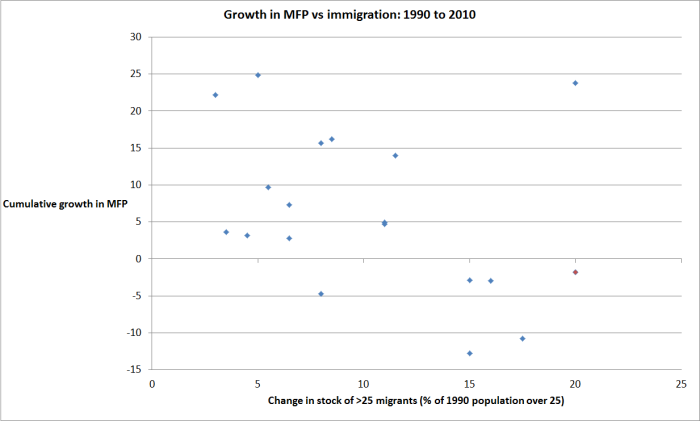
I’ve previously showed simple scatter plots suggesting that the correlation coefficient between immigration –  using the immigration data in the previous IMF study – and TFP growth, cross-country, is negative –  the outlier in the top right is Ireland, and as this post illustrated, Irish immigration growth came several years after its TFP surge.
imf-mfp

As I said, this new IMF work isn’t a New Zealand specific result.  But it might have been nice if the IMF authors, in a New Zealand focused paper, had included a chart or table highlighting how New Zealand’s experience compares to the average finding.  For example, of the countries in the study, only Luxembourg had higher net immigration (as a share of population) over the same period, and over the period we’ve had moderate per capita income growth, very weak labour productivity growth (third lowest of these countries over this period) and pretty disappointing TFP growth by international standards.  You would have to suppose that we look like an outlier (relative to this model, over this period).      Of course, there may be others things at work –  a relatively simple model like this can’t capture everything –  but if you are an international agency wanting to use international research findings to buttress a policy choice of a New Zealand government, surely you owe it to readers –  whether interested citizens, or officials and politicians –  to provide some detail on how New Zealand’s experience looks to compare to the general results of your model.

As I’ve said repeatedly, I’m quite comfortable with the idea that migration at some times and in some places will benefit natives of the receving country/region.  These particular results aren’t that encouraging on the score (no productivity gains on average), even for the larger group of advanced countries as a whole in modern times.  But if migration benefits natives economically in some times and places –  as it no doubt did in 19th century New Zealand –  there is no reason why that automatically translates to a conclusion that all cross-border migration anywhere and at any time is beneficial.  In fact, even in this study, a finding of no productivity gains (labour or TFP) across the whole sample must mean that, even if the model is robust, some countries will have had positive experiences and others negative.  My suggestion is that New Zealand’s has been negative.  Nothing in the IMF results challenges that.

Having said that, it was good to have the work done.  I hope the authors considered extending or refining it, and if they are still working on New Zealand issues to drawing out more explicitly how New Zealand’s experience is best explained.

If NZ was like Switzerland…productivity growth might be even slower

Reading the Herald over lunch, I was interested to learn that the New Zealand Initiative is leading a study tour (of 40 chief executives and chairs) to Switzerland to see what we have to learn from them.  According to the Herald’s account,

At the heart of a one-week study tour organised by leading think tank the New Zealand Initiative is a quest to examine the role “localism” plays in the Swiss economic success story.

The online version of the story even had a graphic,

Switzerland

Many of those items seem quite attractive.   Nonetheless, when the story was framed around Switzerland’s economic success, I couldn’t help wondering if the Initiative’s members might not be heading to the wrong place.

Once upon a time, Switzerland had either the highest or second highest measured productivity (real GDP per hour worked) in the advanced world.  The Conference Board has estimates back to 1950 – when Switzerland was just behind Luxembourg.  But in this post, I’ll use OECD data, which goes back to 1970.

As recently as 1970, Switzerland still held that sort of rank (as it did for nominal GDP per hour worked –  in some ways a superior measure, but good timely estimates for the current situation aren’t available).    These are the OECD countries for which there is 1970 data.

switz 1970

We weren’t doing too badly either –  just slightly below the median for example, and in the middle of the big European countries (Spain, UK, France, Germany and Italy).

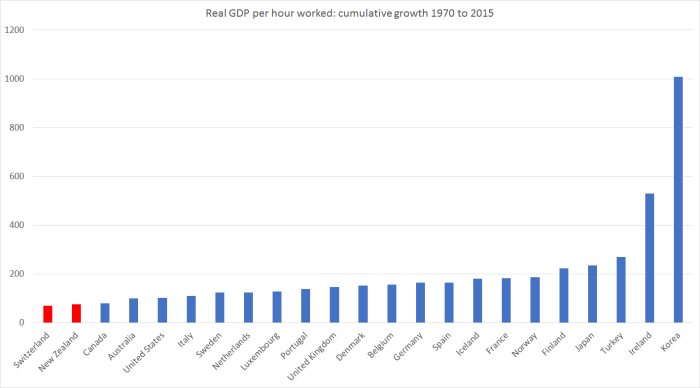
But here is the cumulative growth in this measure of labour productivity for the full period 1970 to 2015.

switz 70 to 15

Beaten even by New Zealand.  It is a pretty woeful Swiss productivity performance.    Even over the last 25 years when both countries have done a little better relatively (we beat six of the OECD countries), Switzerland still came in behind New Zealand.        Over the decades, they don’t even have the excuse of agricultural protectionism, or being remote in an age when personal connections have become more important.

And what about the present?  Here are the levels of real GDP per hour worked in 2015, for the now much larger OECD.

switz 2015

Switzerland is, of course, still a productive and prosperous economy.  But over the last 45 years, it has slipped a long way down the league tables.    As for us, of the countries on the first chart who had lower productivity than New Zealand in 1970, only Turkey, Portugal and Korea still do.    (I hadn’t really noticed previously that if they don’t shoot themselves in the foot, even Turkey will soon go past us if these numbers are to be believed.)

I’m sure there are many good things about Switzerland.  It is a much richer, and in many ways more successful, country than New Zealand.  But I’m not sure I’d be looking to them, or their governance models (fascinating as they are in many respects), for lessons on what New Zealand should do to lift its relative economic and productivity performance.

Labour on housing

There was nothing positive to be said about the previous Labour-led government’s approach to housing and house prices.  There is nothing positive to be said about the current National-led government’s approach.  The rhetoric while they were in Opposition had been encouraging.  The substance of reform has been almost non-existent, all the while cloaked in fairly brazen, even offensive, rhetoric from both Prime Ministers (Key and English) suggesting that it was all a mark of success, a quality problem, and so on, along with suggestions that the government’s approach was working.    By that standard, I hope I don’t live to see a failed housing policy.

There have been some hopes, in some circles, that the Labour Party, if they were to lead a new government after this year’s election, might be different.  Their housing spokesman seems pretty impressive, and seems to understand the issues.  In a no doubt mutually beneficial move, he and Oliver Hartwich, head of the business-funded New Zealand Initiative, even did a joint op-ed on freeing-up the market in urban land.   Places where landowners can use their land pretty freely tend not to have the sorts of grossly dysfunctional housing markets New Zealand (and Australia, and the UK, and much of the US east and west coasts) have, even if those places are big and fast-growing.

I’ve liked the talk, but have been a bit sceptical that it will come to much.  In part, I’m sceptical because no other country (or even large area) I’m aware of that once got into the morass of planning and land use laws has successfully cut through the mess and re-established a well-functioning housing and urban land market.  In such a hypothetical country, we wouldn’t need multiple ministers for different dimensions of housing policy.  I’m also sceptical because there is a great deal local government could do to free up urban land markets, but even though our big cities all have Labour-affiliated mayors, there has been no sign of such liberalisation.    The Deputy Mayor of Wellington for example leads the Wellington City Council ‘housing taskforce”.  Paul Eagle is about to step into a safe Labour seat.   His taskforce seems keen on the council building more houses, and tossing more out subsidies, but nothing is heard of simply freeing up the market in land.  Or even of looking for innovative ways to allow local communities to both protect existing interests and respond, over time, to changing opportunities.

I first wrote about this last October, when Phil Twyford had put out a substantial piece on Labour’s housing programme.   There was a five point plan.  Reform of the planning system appeared on the list, but briefly and well down the list.    As I noted then

It has the feel of a ritual incantation –  feeling the need to acknowledge the point –  rather than being any sort of centrepiece of a housing reform programme.

Yesterday, my doubts only intensified.  Labour’s leader, Andrew Little, devoted the bulk of his election year conference speech to housing, complete with the sorts of personal touches audiences like (although he didn’t mention the tasteful lavender out the front of his current house, which I walk past each day).  Media reports say the speech went down well with the faithful.

This time there was a four point plan.  It was a lot like Twyford’s plan from late last year, with one omission.   The continuing features were:

  • the state building more “affordable” houses,
  • restrictions on “overseas speculators” buying existing houses,
  • making “speculators who flip houses with five years pay tax on their profits,
  • “ring-fencing” losses on investment properties.

But in the entire speech –  and recall that most of it was devoted to housing –  there was not a single mention of freeing up the market in urban land, reforming the planning system etc.  Not even a hint.    I understand that giving landowners choice etc probably isn’t the sort of stuff that gets the Labour faithful to their feet with applause.   But to include not a single mention of the key distortion that has given us some of the most expensive (relative to income) house prices in the advanced world, doesn’t inspire much confidence.     Planning reform isn’t going to be easy.  Few big reforms are under MMP.  It probably isn’t something the Greens are keen on.  And if the putative Prime Minister isn’t on-board, hasn’t yet internalised (or even been willing to simply state it openly) that this is where the biggest problems lie, it is hard to believe that a new government would really be willing to spend much political capital in reforming and freeing up the system, no matter how capable, hardworking and insightful a portfolio minister might be.

Probably reforms of this sort don’t play well in focus groups (although surely there is some responsibility on political leaders to help shape the debate, and change what people respond positively to?)   On the other hand, presumably the data suggest that people react well to attacks on “speculators”, “loopholes”, “subsidies”, which appeared numerous time in Little’s speech.

The headlines around the speech were around the leader’s official confirmation that Labour will prohibit people from offsetting tax losses from investment properties against other non-property income.   This is, apparently, to “close a loophole” to stop “speculators” receiving “subsidies”.     In fact, it is nothing of the sort.

For better or worse, New Zealand has a comprehensive income tax system in which different types of factor income are treated much the same, and taxed at much the same rate.  There are various exceptions, and lots of devil in the detail (thus, for example, the establishment of the PIE regime a decade or so gave an advantage to funds in widely-held entities over individually-held assets).  It has long been pretty fundamental to that system that one tots up all the gains and losses over the course of the year, and then pays tax only on the overall net income.  It would be absurd, for example, to take a business with five operating divisions and tax them on the basis only of the lines of business that made profits, even though several of the other divisions may have made large losses.    Since time is money, it wouldn’t be much consolation to say “oh, don’t worry, you can offset those losses against future profits in those particular operating divisions”.

But that is just what Labour proposes to do.    There is no “subsidy”, there is no “loophole”.   There is simply a conventional comprehensive income tax system at work.  If you lose money on one activity, you can offset it against gains on other activities.

And, if you are concerned about favourable tax treatments then, within the comprehensive income tax model, the clear and unambiguous feature of the tax system that favours one group of potential house purchasers over another is the non-taxation of imputed rents on owner-occupied houses.    Relative to other potential purchasers, this feature provides a big advantage to unleveraged owner-occupiers (ie mostly those in late middle age and the elderly).   This isn’t some idle Reddellian claim.  You can see the calculations worked out carefully in a Reserve Bank discussion paper, The tax system and housing demand in New Zealand, from a few years ago, showing how the features of the New Zealand tax system affect what different types of potential purchasers will be willing to pay.

Within a comprehensive income tax system, I’m at a loss to understand the economic logic behind Labour’s proposed policy.  Presumably it will be fine to buy a farm (or shares in a farm) and offset losses on that investment against labour income?  Presumably it will still be okay to set up a small sideline business which makes losses for several years in the establishment phase, and to offset those losses against labour income?   But not for residential investment properties (or, one assumes, for shares in companies mainly devoted to holding such properties?)   Even though setting oneself up as the owner of an investment property, renting a house to tenants, is a small business.  In fact, it is a way that many people get into business, taking risks to get ahead.

Much of the discussion in the time since Little gave his speech has been on what sort of people will be affected –  whether it is the evil “speculators”, as opposed to “Mum and Dad”.  I’m not sure if there is much data available on that in New Zealand, but they are having a very similar debate in Australia, and I was interested to see a list from Australian Tax Office data published on the ABC website as to who had claimed rental losses in Australia, by occupational group.  People can make of it what they will.  The occupational groups most likely to claim rental losses in 2013/14 were anaesthetists (28.7 per cent of them).  But 22 per cent of Police did as well.

I’m opposed to ring-fencing, if we are going to have a comprehensive income tax system.  And, I’m doubly opposed to singling out housing for ring-fencing.   If there is an economic logic to ring-fencing, apply it more generally or leave it alone.  As it happens, we tried something similar before.  From 1982 to 1991, there were restrictions put on loss-offsetting against labour income for “specified activities” (at the time, the bugbear was people investing in things like kiwifruit orchards).  Even then, loss-offsetting was limited to $10000 per annum (rather than zero).

Are there problems with the current tax treatment?  Arguably so.  Some would claim that the absence of a full capital gains tax is such a distortion, allowing people to run operating losses in the expectation of future capital gains.     As it happens, Labour proposes to address that by, in effect, imposing a capital gains tax on any sales of investment properties within five years (presumably these are typically the “speculators”).  But even if they weren’t, the argument still fails.  In even a moderately efficient market, there are no rationally-expected real future capital gains on offer across the market as a whole.  If there were, people would bid up the prices further now to take advantage of (and thus eliminate) those gains.     There are windfalls –  gains and losses –  from large actual changes in capital values of assets, but it isn’t a systematic distortion in the system.     (In principle, I don’t have too much problem with a capital gains tax that (a) applies only to real (inflation-adjusted) gains, (b) applies on a valuation basis rather than a realisations basis, and (c) treats gains and losses symmetrically.  In practice, no such systems exist).

Where there is a systematic distortion in the system is around the treatment of inflation.  In an ideal system, there would be no systematically expected inflation.  In practice, we have an inflation target centred on 2 per cent annual inflation.  As a result, roughly speaking, nominal interest rates are around 2 percentage points higher than real interest rates, and real assets should be expected to increase in value by around 2 per cent per annum, even if there is no change in their real value.      The two percentage point component of interest rates that is just inflation compensation isn’t real income (no one is better off as a result of receiving it; no one’s purchasing power is improved).  And yet it is taxed as real income.  And for those borrowers who can deduct expenses, interest is fully deductible, even though the inflation compensation component doesn’t reduce the borrower’s real income.   That is a systematic advantage to such borrowers, and one for which there is not a shred of economic logic.

In my preferred approach, the inflation compensation component of interest income would not be taxed.  And the inflation compensation component of interest expenses would not be tax deductible for anyone.    As the Reserve Bank discussion paper I linked to earlier showed, this change alone would make quite a substantial difference to how much highly-geared investment borrowers would be willing to pay.  And it would be a genuine improvement in the comprehensive income tax system as well, without singling out on class of purchasers of one class of asset.

But it is worth bearing in mind, that none of these issues can explain anything about house price inflation behaviour in the last 10 or 15 years.  Over that period:

  • the loss-offsetting rules have been much the same,
  • the introduction of the PIE system disadvantaged individual holders of investment properties relative to, say, holders of financial assets in PIE vehicles,
  • in 2005, the tax depreciation rules were tightened,
  • from 2010, depreciation on properties was no longer tax deductible,
  • the inflation target was raised in 2002, but for the last eight or nine years, inflation expectations have been trending down again,
  • maximum personal income tax rates were also cut in 2010 (reducing the value of deductibility and loss-offsetting).

Any of these “distortions” should be capitalised into the price pretty quickly once they are announced and understood,  The only new measures in the last decade or so have reduced the relative attractiveness of property investment  (and that is before even mentioning LVR controls).  It typically takes shocks to displace markets.  In principle, the advent of non-resident foreign purchasers could have been an example (in the presence of supply constraints), but we don’t have good data.  So could unexpected population growth.

We should probably also be sceptical as to how much difference ring-fencing, as Labour propose, might make.  When I was at the Reserve Bank we came and went in our views on tax issues around housing.  But the one consistent observation over the years was to point out that many different countries had quite different regimes for the tax treatment of housing.  Some allowed loss-offsetting, some didn’t.  Some had capital gains taxes, some didn’t (and all those who did had various different rules).  Some had differential income tax rates for capital and labour income. Some even made a stab at taxing imputed rentals.  But it wasn’t obvious that the differences in tax treatments explained much about the levels of house prices, or about cycles in them.    And in a well-functioning land market, land –  the asset value that is, in principle, affected by tax system changes –  is only a fairly small component of a typical house+land price.

What tax rules do is affect who owns which assets.  Thus, for decades our tax system has tended to treat all owners of investment properties pretty equally.   Loss-offsetting was part of that.   But so was the fact that we didn’t give favourable tax treatment (generally) to insurance companies and superannuation funds.  In many countries, assets held in those sorts of vehicles are more lightly taxed.  Not surprisingly, managers of those vehicles can afford to pay more for the assets, and a larger share of the assets end up in such vehicles.

Ring-fencing rules can be expected to have similar effects.     If “Mum and Dad” with one investment property can’t offset a bad year’s losses against other income, but have to carry it forward and wait for a good income year from property, while a superannuation fund with lots of investment properties can (either because it is less leveraged or because losses on some properties can be offset against profits on others) more properties will be held in such vehicles.  It isn’t clear what the public policy interest is in such an outcome?  More generally, the change will disadvantage people starting out in the rental services businesses relative to those who are better-established and have larger equity.

In the end, so-called “speculative” opportunities, on any sort of widespread scale, arise mostly because governments got themselves into the land market, and by regulatory interventions, disabled the market from working smoothly to increase supply in response to increases in demand, or changes in tastes.   Wouldn’t it be better, more in the interests of middle New Zealand (and economic efficiency) to address the problem at source –  fix the regulatory failures –  rather than falling back on rhetoric about speculators and subsidies, which at best in tackling symptoms, not grappling with causes?

Fix up the planning system and all this will be yesterday’s issue.  Fix up the inflation distortion and you’ll also have a better tax system.  But if the planning system isn’t fixed then, whatever other short-term stuff Labour does (including immigration changes) will only provide temporary relief, and in a few years time we’ll be back with the same old housing affordability problems.  What a lost opportunity that would have been.

PS.  I see that Labour is invoking the Reserve Bank in support of ring-fencing.  Perhaps the current Governor does favour such a change –  although we’ve not seen any economic analysis in support of it from them –  but if so, it is an example of a proposal which the Bank was against before it was for.    In 2005, at the request of the then Minister of Finance, a group of senior Reserve Bank and Treasury staff was asked to review policy options for dealing with house prices.  I was part of that group (as was Adrian Orr, and incoming acting Governor Grant Spencer, and the current Chief Economist at The Treasury).  There is a nice treatment of the ring-fencing issues on pages 19 to 22 of our report.


A questionable indicator of the labour market (geeky)

The Reserve Bank has long been averse to too much focus on the unemployment rate.  Some of that was political.  Opposition MPs back in the 1990s would try gotcha games, trying to extract estimates of a non-accelerating -inflation rate of unemployment (NAIRU) with the aim of then being able to tar us with lines like “Reserve Bank insists full employment is x per cent unemployment” [at the time x might have been 7 per cent or more] or “Reserve Bank insists on keeping x per cent of New Zealanders unemployed”.   So there was an aversion to using the concept, and most certainly to writing it down.  If you don’t write things down, it is hard to have them OIAed.

But for decades there has been something a lot like a NAIRU embedded in successive versions of the models the Bank uses as a key input to the forecasting process.   But there was still an unease.  Some of it was those old political concerns.  Some of it was the aversion to being pressured into any sort of dual objective model –  even though discretionary monetary policy was only ever introduced to allow short-term macro stabilisation together with medium price stability.

In the last decade or so, it seemed to be some mix of things.   In 2007, the unemployment rate was down at around 3.5 per cent, but the official view at the time was that the overall economy was more or less in balance (as I noted yesterday the output gap estimates then were positive but quite small).  So, the unemployment rate tended to be discounted.   To the extent there were NAIRU estimates implicit in the thinking, they had been trending down for 15 years.  Perhaps, some felt, 3.5 per cent unemployment wasn’t much below a NAIRU at all.

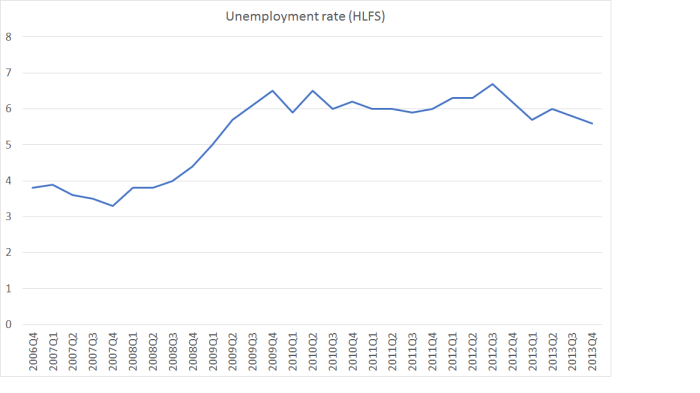
In the years after the 2008/09 recession, there seemed to be two problems.  The first was a quite genuine one.  The HLFS unemployment rate numbers were quite volatile for a while, and while it was clear that the unemployment rate was still quite high, it was hard to have much confidence in each new quarterly observation.    The rise in the unemployment rate in 2012 only further undermined confidence among some of my then colleagues.  The economy seemed to be recovering.

U 2006 to 13

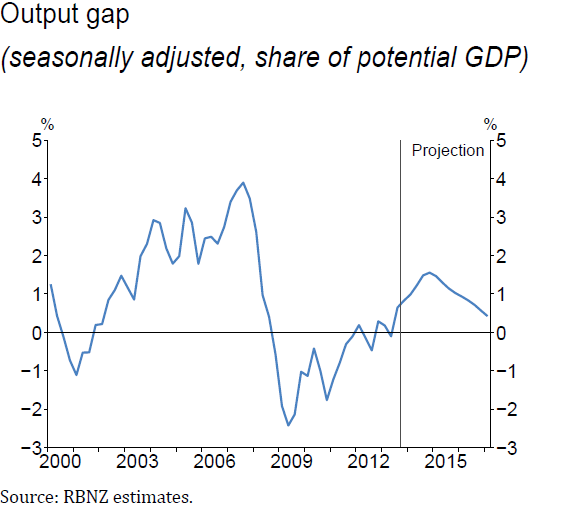
So there had always been a tendency to discount the unemployment rate.  Odd short term developments in the series itself reinforced that, and then as the recovery began to develop the Bank kept convincing itself that the output gap had all but closed.  If the output gap  –  which tended to be central focus for much of the analysis, even though it was something of a black-box, and prone to significant revisions –  had really closed, then surely the labour market must also be more or less in balance?  If the unemployment rate appeared to suggest otherwise, so much the worse for that particular indicator, which many at the Bank had never much liked.    When the Bank started the ill-fated tightening cycle in March 2014, they thought then that excess capacity had already been used up for a couple of years.  This is the output gap chart they ran then.

output gap mar 14 mps

At the time, the unemployment rate was still 5.6 per cent

(Contrast that output gap chart with the one from yesterday’s MPS, which I included in yesterday’s post.  At first glance, they look quite similar, but whereas in 2014 they thought excess capacity had been exhausted in 2011/12, now they think it was only exhausted in 2013/14.)

Various people had various ideas for how best to look at labour market data.  But mostly the unemployment rate was just ignored.

A year or two back, some US researchers had done an interesting exercise, trying to combine formally the information in a whole variety of labour market indicators, to distill an overall picture.  And somewhere along the line, someone got the idea of doing something similar for New Zealand.  And thus was born the Reserve Bank’s Labour Utilisation Composite Index, with the pleasing acronym of LUCI.

One day last April, Reserve Bank Deputy Governor Geoff Bascand gave a major address on monetary policy matters, Inflation pressures through the lens of the labour marketAs I noted at the time, it was little odd for him to be giving the speech –  as his day job was mostly responsibility for notes and coins, and the Bank’s corporate functions.  Then again, his ambition for higher office was pretty apparent, and earlier in his career he had led the Department of Labour’s Labour Market Policy Group.   Geoff on labour market matters should have been worth listening to.

The broad thrust of the speech was that high immigration wasn’t going to put much pressure on demand (contrary to the usual experience, and past Bank research), and that the labour market was pretty much operating at full capacity.  In support of these propositions, the Bank simultaneously released not just the speech, but three new Analytical Notes.    Since I had been harrying the Bank about its change of view of immigration, I focused then on the two immigration research papers, and identified a number of issues with them.     At the end of a long post I noted

There is a more material on other topics in Bascand’s speech, and another whole Analytical Note on other labour market issues which I haven’t read yet. I might come back to them next week.

But I never did.  Other things presumably distracted me, and thus I never got round to reading the Analytical Note introducing LUCI.   I didn’t until yesterday afternoon – I’d heard the Governor, or the Chief Economist, mention it at the press conference, and it was a wet afternoon, so I went and downloaded the paper.

The Reserve Bank has given quite a lot of attention to this brand new indicator.  In the Deputy Governor’s speech, it gets three whole paragraphs

Over the business cycle, a key driver of wage growth is the balance of supply and demand, or labour market ‘slack’. However, the unemployment rate is an inadequate indicator of labour market slack, particularly when the participation rate fluctuates. Researchers at the Bank have recently constructed a labour utilisation composite index, or LUCI, to help address this problem. Such indices combine the information in a large number of labour market variables into a single series of labour market tightness, and are used internationally to help gauge labour market pressures. The New Zealand index uses official statistics such as the HLFS and survey measures of the difficulty of finding labour, such as the QSBO.

By construction, the LUCI has an average value of zero. A LUCI value above zero indicates greater labour market tightness than usual – a value below zero indicates greater labour market slack than usual. Our research shows that, historically, a higher LUCI has been associated with stronger wage growth.

The LUCI suggests there was a large degree of slack in the labour market at the trough of the 2008-09 recession. The LUCI then gradually returned to zero, and has been around that level since early 2014 (figure 7). This movement is consistent with the range of the Bank’s suite of output gap indicators.

This wasn’t just some speculative new tool dreamed up down in the engine room by smart researchers, but still needing road-testing.  The Deputy Governor (presumably with the approval of the Governor and the Chief Economist) seemed sure it was action-ready.

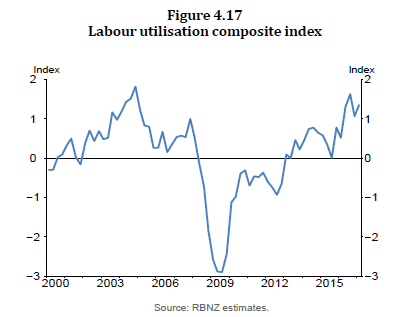
Consistent with that approach, a chart of LUCI has appeared in all but one of the five MPSs since that speech.    Here was LUCI as she appeared yesterday

LUCI may 2017

On the Deputy Governor’s telling

A LUCI value above zero indicates greater labour market tightness than usual – a value below zero indicates greater labour market slack than usual.

In other words, on that particular interpretation, labour market tightness was now more severe than it had been in 2007 (just prior to the recession), and almost as severe as at the peak of the series in around 2004.

And, of course, Geoff Bascand didn’t just make up that interpretation.  It was what the researchers had said in their Analytical Note, almost word for word.   It was also what the footnotes on the LUCI charts in the MPSs said.  At least until yesterday.     In yesterday’s MPS, slipped in so quietly, the interpretation of LUCI had changed rather materially.   The chart was still there, it still looked the same as ever.  But below it, it has these words written

Note: a positive value indicates a tightening in labour market conditions

Lay readers may not immediately notice the difference, but it is substantial.  When the indicator was launched, with some fanfare (there are many clever new indicators, and not many get three paragraphs in a Deputy Governor speech), a positive value was interpreted as the labour market being tighter than usual (thus the pesky single indicator, the unemployment rate could keep on being largely ignored).   But now a positive value simply means that the labour market is a bit tighter than it was last quarter.    If there was lots of slack last quarter, it simply doesn’t matter to the indicator –  all that matters is the direction of change.

The Bank didn’t draw this to readers’ attention at all.  They didn’t change the heading on the chart either.  It was a bit naughty really.       What it means is that whereas we once had an indicator –  using 16 different variables –  that might have suggested the unemployment was completely misleading as a measure of slack, what we actually have now in LUCI saying similar things to the unemployment rate.  The unemployment has been edging down, and LUCI has been positive.   But that LUCI number is now felt to tell us nothing at all about the absolute level of labour market slack (or even the level relative to a long run of history).

I don’t quite know how the Bank fell into this –  except, perhaps, for the wish (for a labour market measure suggesting the market was at full capacity –  in line with the output gap estimates) getting the better of hard-headed challenge and scrutiny.

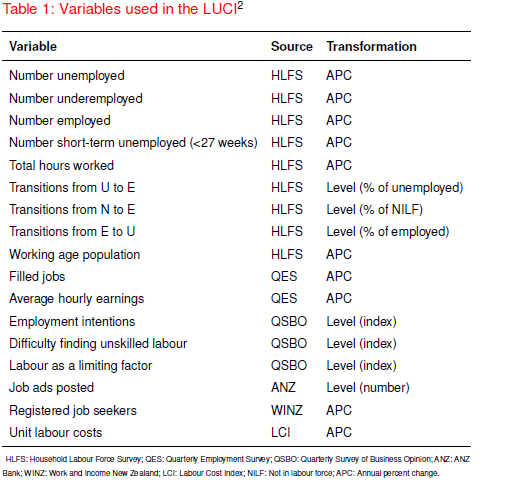
The approach they used to construct LUCI was very much the same used to construct the sectoral factor model of core inflation.  In essence (there), get the rates of price increases for all the CPI components, and look for a common theme (or “factor”) that runs through them all.    It seems to work quite well there.  All the variables are expressed the same way (percentage changes).      But LUCI is a bit different.     Here is the list of all the variables used.

LUCI components

They take each variable and standardise it relative to its own mean.

But it is an odd mix of variables.   There are annual percentage changes mixed in with levels.  And some of those levels measures (eg the QSBO ones) are the outcome of questions that are actually technically expressed in change terms.  It is also a mix of quantity measures and price (wage) measures.   When I looked through the list, the first real oddity that struck me was that unemployment itself is not expressed as a percentage rate.  Rather, they take the number of people unemployed and calculate the percentage change.   If, then, every single person was fully employed –  so the labour market was very tight –  this component  (used in calculating LUCI)  would be showing a zero percentage change.  They’ve done the same thing to all the quantity variables, so it should have been obvious from the start that what they were doing (at least for that half of the inputs) was looking at variables that would produce a change indicator, not a levels one.

I understand why they did it.  The unemployment rate trended down for 15 years or so.   The gap between the actual unemployment rate and the average unemployment rate wouldn’t be a very meaningful indicator.   But it meant, almost inevitably, that the new indicator couldn’t be an indicator of absolute labour market tightness, only (at best) an indicator of changes in tightness.

But there are other problems.  Think about what would happen if (to be deliberately extreme) the population doubled, and yet there was no change in “true” labour market tightness.    That isn’t far from the Reserve Bank’s story about the recent immigration shock –  they told us again yesterday that, contrary to past common experience, they think the demand and supply effects have more or less offset each other.

But if the population doubled, and there was no change in “true” labour market slack,  we would still expect to see employment, numbers unemployed, the number of short-term unemployed, numbers underemployed, the number of filled jobs, hours worked, the working age population, the number of job ads, and the number of registered job seekers all increase (that is roughly half the variables in LUCI).   The unemployment rate (%), for example, might stay the same, but both the numerator and the denominator would increase a lot.  Since LUCI uses annual percentage changes, it seems highly likely that such a shock would show up as a big increase in LUCI in the year the population shock happened  (in my extreme examples, the APCs would go to 100 per cent that year), even if there had been little or no actual change in labour market tightness.

It seems astonishing that, for a variable launched by a Deputy Governor in a speech playing down the net demand effects on a large immigration shock, this issue never seems to have occurred to them.

There are other, probably more minor and mundane, problems too.  These ones  probably weren’t foreseeable in April last year, but probably still should have been highlighted as they became apparent.  The revised HLFS was introduced in June last year.  It is pretty clear that the modifications to the questions have led to material step changes in the HLFS measure of hours worked and of employment (you can see the anomalies in the charts in this post from earlier in the week).   (For some reason, they don’t even use the QES measure of hours in LUCI).     Perhaps a distortion of this sort to only two of the component variables won’t have affected the common factor that the model is trying to identify.  But we don’t know.  I hope the Reserve Bank does.   This particular problem will wash out of the data in the next HLFS release (since a year will have passed, and LUCI uses annual percentage changes), but for now it is another reason not to have much confidence in LUCI as any sort of indicator of labour market tightness (level or changes).

I did put some of these points to the Reserve Bank yesterday, mostly just to check that my understanding of the technical points was correct. I had a helpful response this afternoon which essentially establishes that they are (obviously I’m not associating the Bank with the interpretations I’ve put on those technical points).

Overall, it isn’t a case of the Reserve Bank at its best.  I have no problem at all with them doing the research in the first place.  We should always be looking for new or better ways to understand what is going on, and how best to combine sometimes conflicting bits of data.      But it doesn’t have the feel of something that was at all well road-tested before being launched as a major indicator variable.  And then, when they did finally realise that it was much more like an indicator of changes in labour market pressure rather than the level of pressure, that recognition was sneaked through without even an explanatory note, leaving anyone who had taken the earlier use of LUCI at face value none the wiser unless they were a particularly assiduous reader (and I’m usually not, when it comes to changes in footnotes on charts).

We now have a recognition that LUCI isn’t a measure of overall pressure on the labour market.  It may be, loosely speaking, an indicator of changes in labour market pressure, but even then that reading is made more difficult when you get large population shocks (of the sort that NZ is prone to, with quite variable large immigration flows, in a way that many other countries are not), and when the Reserve Bank repeatedly assures us that its overall interpretation is that this particular population shock isn’t putting additional net pressure on demand, and may even be easing capacity pressure in the labour market.

We really should expect better from our central bank.  Speeches like Bascand’s, and documents like the MPS, will have had heavy involvement from all the members of the Governing Committee –  the Governor himself, the incoming acting Governor, the incoming Deputy Chief Executive, and the long-serving Chief Economist.   One can’t help thinking that they’d have been better served taking the unemployment rate –  actually designed directly as a measure of excesss capacity –  and wage developments rather more at face value.   And of recognising that, contrary to LUCI, no serious observer thought that the labour market was at its tightest in 2004.   It isn’t much harder than that.

Some puzzles about the Monetary Policy Statement

After the last OCR review I noted that if I was going to go on agreeing with the Governor, there might not be much point in writing about the OCR decisions.  I agree with him again today.

Writing earlier in the week about what the Bank should do I concluded

So where does it all leave me?  Mostly content that an OCR around 1.75 per cent now is broadly consistent with core inflation not falling further, and perhaps continuing to settle back where it should be –  around 2 per cent.   Of course, there is a huge range of imponderables, domestic and foreign, so no one should be very confident of anything much beyond that.

And I was pleased to see how much emphasis the Governor placed today on the inevitable uncertainties around the (any) forecasts and projections.   Trying to project where the OCR might appropriately be a year or two from now is mostly a mug’s game.  Getting the current decision roughly right is towards the limit of what the Bank can actually usefully do.  I think they have today, although only time will tell.

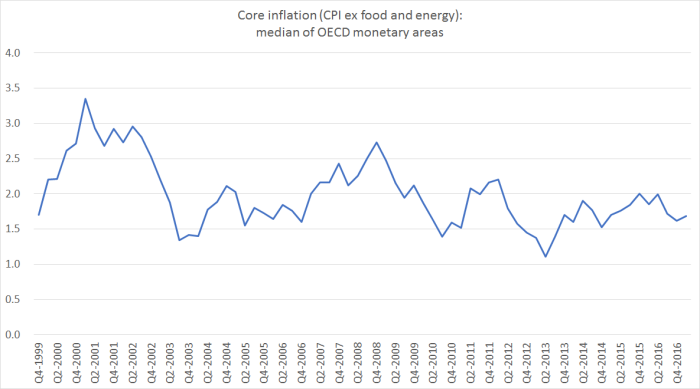
I also liked the continuing emphasis on how low core inflation is globally.  This is my chart making that point, taking the median of the core inflation rates of the places in the OECD with their own monetary policy (so that the euro-area counts as one observation, and individual euro-area countries don’t count at all).

OECD core inflation

But there were some puzzles and some unsatisfactory aspects in both the statement itself and in the press conference the Governor and his chief economist just hosted.

First, it is quite remarkable that there is no mention at all in the document of the forthcoming hiatus.  After 25 September, we’ll only have an acting Governor for six months (itself a questionably lawful appointment), and we won’t have a permanent Governor until next March.   The Policy Targets Agreement expires with the Governor, and there won’t be a formal Policy Targets Agreement in place during the interregnum.   The Reserve Bank Act requires that the Monetary Policy Statement address how the Bank will conduct monetary policy over the following five years.  Given that we also have an election approaching in which most of the opposition parties are promising some changes to monetary policy, there is more than usual uncertainty about the path ahead –  the people and the law/PTA to which they will be working.    It isn’t the Bank’s place to take partisan stances, but it would be only reasonable –  in a genuinely transparent organisation, complying with the law –  to touch on these issues, if only briefly.     At a trivial level, the PTA has been reproduced in the MPS for decades, reflecting the central role PTAs have in New Zealand short-term macroeconomic management.  What will be done in the November and February MPSs?   

Rather more importantly, although I agree with the Governor’s current stance, I’m not sure I’d be taking the same view as him about the outlook for monetary policy if I shared his economic forecasts.

Here is my puzzle.   This is the Reserve Bank’s chart of their estimate of the output gap.

output gap may 2017

They now reckon it has been pretty flat around zero for the last two to three years.  I’d be surprised if there has been quite so little excess capacity –  and in fairness, they do explicitly highlight the quite wide range of estimates they have  –  but it is their current central view.   But then look what happens starting now.  They expect quite a material positive output gap to emerge.     And they think that will translate into quite a lift in wage inflation.

wage inflation may 17

Now, it is quite true that they need to see a lift in wage inflation if core inflation, across the economy, is to settle near 2 per cent, the target the Governor has committed to.    But if I really believed that things in the wage-setting markets were likely to turn around that much that quickly, I’m not sure I’d be running with such an “aggressively neutral” (ANZ’s words) stance right now.  Perhaps it doesn’t really matter to the Governor –  the sole decisionmaker –  because he won’t be there?

I’m a bit puzzled as to why they expect such a material increase in capacity, and wage, pressures.   They expect to see real GDP growth accelerate a bit.  Over the 18 months to the middle of next year, they expect quarterly growth to average 0.9 per cent.  By contrast, in the last couple of years, on their preferred production measure, real GDP has grown by only 0.6 per cent a quarter on average.

It isn’t that clear why they expect such an acceleration (which we’ve seen forecast before).  Perhaps it is partly the lagged effect of last year’s fall in the OCR?  But then, as they note, bank lending standards appear to have tightening, and funding margins risen, which will offset some of the effects of the OCR cut.   Dairy prices have certainly increased, which will provide some support to spending.  The exchange rate has come down a bit recently (more so this morning) but the level the Bank assumes –  a TWI above 75 for the next year or so – isn’t much below the average for the last couple of years.

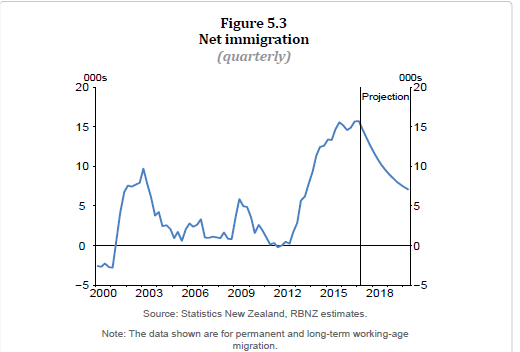
And then there is immigration.    Here are the Bank’s projections.

immigration may 17

They expect the net immigration numbers to start falling over very sharply, starting now.    As the Governor noted, they (and other people) always get their immigration forecasts wrong.   But any significant reduction in immigration –  and this is a halving in the next couple of years –  is a material reduction in both demand and supply for the whole economy.   It is more than a little surprising that the Bank believes we will see both an acceleration in total real GDP growth and a sharp slowdown in net immigration.

The Bank appears to still believe the story that, at least this time round, high net immigration has eased overall capacity pressures.  If they are sticking to that story –  and they appeared to in the press conference –  then perhaps that is why they think we should be expecting a sharp pick-up in wage inflation starting now.    It doesn’t ring true to me –  and it has never been how New Zealand immigration cycles have worked in the past –  but if that is part of their story, something they genuinely believe, then –  as I already noted – I’m a bit surprised by the “aggressively neutral” policy stance.  On my own reading of course, any material slowdown in net immigration (unless it is accompanied by a big Australian economic rebound) will weaken near-term demand more than supply, as it has typically done in the past.

Two other points that came up in the press conference seemed worth commenting on.

Bernard Hickey asked the Governor what the Bank’s definition of full employment was.  The Governor was quite open, if a little tentative, in suggesting something around 4.5 per cent.  That is lower than the actual unemployment rate has been since the first quarter of 2009 –  eight years ago.     But, as Hickey noted, it is still above the Treasury’s published estimate of near 4 per cent.     The actual unemployment rate now still stands at 4.9 per cent.

The Bank’s chief economist and Assistant Governor, John McDermott, then picked up the question.   The gist of his response was that it was a silly question.   At some length he tried to explain how the Bank relies on the output gap for its assessment of overall capacity pressures in the economy.  He went to argue that labour market variables were so slow to respond that if one waited to evidence from them before moving it would almost certainly be “too late”.    Doubling down, he argued that in a New Zealand context it was “almost impossible” to estimate any sort of NAIRU, and that any attempt to do so was just ‘guessing”.

In a way, I wasn’t surprised by these arguments.  He used to run the same lines to me when I worked for him.   But familiarity doesn’t make the arguments any more convincing.  For a start, everyone recognises that inflation targeting is supposed to work by focusing on the forecast outlook, perhaps 12-24 months ahead.  Monetary policy works with a lag.  In principle, waiting to see actual outcomes –  on whatever measures –  will typically mean acting too late.

But, on the one hand, this is the very same central bank which set a new world record this cycle, by twice beginning to increase interest rates (in 2010 and 2014) only to have to quickly reverse themselves.  It is quite a while since they were too late to tighten (and McDermott was the Bank’s chief economist in both instances).

And what of the output gap the Bank wants us to put our faith in?  Here was one of the leading international experts  (and a former practitioner) on inflation targeting, Prof Lars Svensson writing on measures of excess capacity (LSRU is the long-term sustainable rate of unemployment, the bit not influenced by monetary policy)

What does economic analysis say about the output gap as a measure of resource utilization? Estimates of potential output actually have severe problems. Estimates of potential output requires estimates or assumptions not only of the potential labor force but also of potential worked hours, potential total factor productivity, and the potential capital stock. Furthermore, potential output is not stationary but grows over time, whereas the LSRU is stationary and changes slowly. Output data is measured less frequently, is subject to substantial revisions, and has larger measurement errors compared to employment and unemployment data. This makes estimates of potential output not only very uncertain and unreliable but more or less impossible to verify and also possible to manipulate for various purposes, for instance, to give better target achievement and rationalizing a particular policy choice. This problem is clearly larger for potential output than for the LSRU.

He summed it up recently even more succinctly

My experience of practical policymaking made me very suspicious of potential output, essentially an unverifiable black box, and consequently of output gaps. Instead, it made me emphasize the (minimum) long-run sustainable unemployment rate and consequently the unemployment gap.

And it is not even as if McDermott’s point about lagging labour market data has much obvious validity relative to measures of the output gap.  I had a look at the peak of the last (pre 2008) boom.

The unemployment rate troughed in the September and December quarters of 2007.

The output gap –  as estimated today – peaked in the September quarter of 2007.

But that caveat (“as estimated today”) matters hugely.  At the time, there was huge uncertainty about, and significant revisions to, estimates of the level of the output gap.   In the December 2007 MPS, for example, there isn’t a chart of the quarterly estimated output gap.  But the estimate for the average output gap for the year to March 2008 was 0.6 per cent.  At the time, they (we) thought the output gap had peaked in 2005.    The Bank’s current estimate is that the output gap in late 2007 was around 2.5 per cent.    Those aren’t small differences.   And they are pretty inevitable.      By contrast, there has never been any doubt that the labour market was at its tightest in late 2007.

No one is going to disagree that it is hard to estimate a NAIRU –  or Svensson’s LSRU – with hugely great confidence.  But much the same –  typically only more so –  can be said of almost any of the concepts the Bank uses in its modelling, forecasting and policy assessments (eg neutral interest rates, potential output, and equilibrium exchange rate).  And, relative to output gap measures, the unemployment rate is a directly observable measure of excess capacity, easily comprehended and prone to few revisions.   And unemployment is something that citizens care directly about.

In McDermott’s shoes, I’d have said something like “we really don’t know, but we are pretty confident it is lower than the current 4.9 per cent unemployment rate.  Treasury’s estimate of around 4 per cent might not be far from the mark, but we won’t really know until we get nearer.  The fact that the unemployment rate is, with quite a high degree of confidence, above the NAIRU is consistent with wage and price inflation having been pretty subdued for a long time, and is consistent with the Bank’s stance, of keeping interest rates below our estimates of neutral for the time being”.    It wouldn’t have been hard to have run that line.

Perhaps people (eg FEC) might like to ask the Bank why it appears to put so much less weight on direct measures of unemployment than, say, their peers in the United States (or most other central banks) appear to.  None takes a mechanical approach, none assumes the NAIRU never changes, none assumes they know it with certainty.  But they seem to think it matters –  and might matter to citizens and politicians to whom they are responsible –  in a way that simply eludes the Reserve Bank.  It is partly why I’ve come to the conclusion that some form of what the Labour Party is promising –  a more explicit statutory focus on unemployment in the documents governing the Reserve Bank and monetary policy –  is the right way ahead for New Zealand.   Concretely, I’ve suggested that the Bank be required by law to publish periodic answers to Bernard Hickey’s question –  what is full employment, what is the (estimate) NAIRU?

Finally, I was interested in the Governor’s evasiveness when asked about possible statutory changes to the provisions in the Reserve Bank Act that currently make the Governor the sole legal decisionmaker.    It is fine to emphasise that in practice monetary policy decisions have always been made in a collective environment –  whether the Official Cash Rate Advisory Group in the past, or the current mix of the Governing Committee and the Monetary Policy Committee.   But we don’t have rules and laws for good times and when things are working well.   And, as it happens the Bank and Governor haven’t covered themselves with glory in the last seven or eight years.

The Governor simply avoided answering the question of whether the law should be changed, even if only to cement in the collegial practice.  Since (a) the Governor is leaving shortly, and (b) the Minister of Finance has commissioned advice on the issue and Labour (and the Greens) are campaigning for change in this area, it is hardly as if letting us know his views would tread on taboo territory.   Perhaps to do so would have been to acknowledge that in no other central bank does one unelected person –  a person selected other unelected people –  have so much power, not just in monetary policy but in financial regulatory matters.  It is something where change is well overdue.

Challenged as to whether legislative reform in this area might not enhance transparency (eg publication of minutes, or even the airing of alternative views), the Governor fell back on his old claim that the Reserve Bank is one of the most transparent central banks in the world.  That simply isn’t so. It scores well, as I’ve put it previously, when it publishes material on stuff which it knows little or nothing about (the outlook for the next few years, where its guess is as good as mine, and none of the guesses are very good).  But it is highly non-transparent when it comes to the stuff they do know about.  Thus, we don’t see any of the background papers that go into the OCR deliberations (although I did once use the OIA to get them to release 10 year old papers), we see no minutes of the deliberations, no record of the balance of the advice the Governor receives.  And competing views (on the inevitably uncertain outlook, and the right policy stance) are not aired at all.    That is a quite different situation from what prevails in many other advanced country central banks (although of course there is a spectrum, but we are at one end of it).

As another telling example of how untransparent thiings are in New Zealand, I was reading the other day a piece by John Williams, the very able head of the San Francisco Fed, and a member of the FOMC.    In the US system he is a pretty senior guy –  not Janet Yellen, but not just a Reserve Bank chief economist ever.   His widely-distributed article was devoted to advocate a material change in how US monetary policy is done –  abandoning inflation targeting in favour of price-level targeting –  to provide greater policy resilience in the next serious downturn.   I’m not persuaded by Williams’ case, but what struck me is how open the system is when such a senior figure can openly make such a case.  The markets didn’t melt down. The political system didn’t grind to a halt.  Rather an able senior official made his case, and people individually assessed the argument on its merits.

The other bit of the paper that struck me was this

Now that we’ve gotten the monkey of the recession off our backs, we have the luxury of being able to look to the future. This presents us with the opportunity to ask ourselves whether the monetary policy framework and strategy that worked well in the past remains well suited for the road ahead.

Such introspection is healthy and constitutes best practice for any organization. In fact, the Bank of Canada has already shown us the way. Every five years, they conduct a thorough review of whether their policy framework remains most appropriate in a changing world. This is an exercise all central banks should undertake, including the Fed.

I’ve made this point myself previously.  The Bank of Canada is very open about these reviews they conduct.   By contrast, in New Zealand, it is still a struggle to get from the Reserve Bank and Treasury papers relating to the lead-up to the 2012 PTA, and all the (limited) deliberations then took place behind closed doors.   We will have a new PTA early next year, and we know –  from other documents Treasury has released –  that Treasury had some sort of review underway and almost completed before the Minister decided to delay the appointment of a permanent Governor. But given that PTA is the guide to the management of the key instrument in New Zealand short to medium term macro policy, it would be both appropriate, and more truly transparent, for much of the background thinking and research to occur openly.  It is too near the election now, but a jointly hosted conference every five years reviewing the experience with the PTA and looking at alternative options (even if none ends up adopted) would be one feature, in our system, of meaningful transparency.  We have very little of that at present.

(And, sadly, we’ve never seen anything from our Reserve Bank on the possible challenges if the practical limits of conventional monetary policy are exhausted in a future severe downturn).

It will be a challenge for the new government to lift the performance of the Reserve Bank in future.  It would be easier to make a strong start in that direction by legislating first to make the appointment of the Governor a matter for the Minister of Finance (and Cabinet)  –  as it is in most other places –  not something largely in the hands of the unelected faceless Reserve Bank Board (which doesn’t even seem to manage well basic record keeping).

The IMF opines on the economy

The International Monetary Fund (IMF) was out yesterday with two major reports on New Zealand.    One was the Financial System Stability Assessment, the conclusion of the quite infrequent (the last one for New Zealand was in 2004) FSAP programme of reviews of the regulation of countries’ financial systems.  I haven’t read that document yet, but from media accounts there are some recommendation I’d agree with (eg deposit insurance, as second-best) and a great deal (mostly derived from the “nanny knows best” starting point) that I’ll have more problems with.

But this post is about the Article IV report –  the (typically) annual review and assessment of a member country’s macro economy.

Once upon a time, these reports were simply confidential advice to the government.  These days, at least for countries like ours, it is all out in the open.  And, partly in consequence, there often isn’t that much to see.  The IMF might be a prestigious organisation full of rather highly-paid economists, but it is striking how weak their surveillance reports often are.   Perhaps there just isn’t a gap in the market that can usefully be filled by a handful of Washington-based economists looking at our economy for a couple of months a year.

The challenge is compounded by the fact that no one much cares about New Zealand.  We are small, in an age when the IMF is heavily-focused on systemic risk, global spillovers etc.    We aren’t in Europe –  still over-represented at the Fund –  or from one of those Asian countries where governments are hyper-sensitive about anything the Fund says.    It is decades since we had an IMF (borrowing) programme ourselves.  And, whether this is cause or effect I’m not sure, but for decades no one here has paid much attention to the Fund.  As an example, our capital city newspaper this morning has some coverage of the FSSA, but really nothing at all about the Article IV report.  If a tree falls in the forest, and no one is around to hear it, does it make a sound?    (By contrast, when I was at the Board of the IMF, my Australian boss was very exercised about each year’s Australian Article IV report.  He’d get phone calls direct from the Treasurer about it, and the serious Australian media gave the reports a lot of coverage.)

Oh, and of course, the other challenge for those reviewing New Zealand is the features that stand out, and which haven’t readily and convincingly been explained.  Thus, we have a lot of reasonably good micro policies, we have pretty good government finances, a floating exchange rate, low and stable inflation, sound banks, high levels of transparency, and low levels of corruption.     And yet……having once been among the very highest income countries in the world, we now languish.  International agencies find Venezuela’s decline easy to explain.  New Zealand’s not so much.

But with all the resources at their command, including the benefit of being an organisation with data and perspectives on all the countries in the world, none of it really excuses the mediocre quality of what gets dished up each year.  Or the inconsistency from one year to the next.   Last year, for example, we were told that raising national savings rates was “critical” –  and it was reported that the NZ authorities agreed –  but this year there is barely even any mention of the issue.

This year we are served up some mix of regurgitated PR spin about how well New Zealand is doing, and when it comes to policy suggestions we get a grab-bag of bits of conventional wisdom, or favoured centre-left policy positions, without any discernible sign that the authors (or their reviewers in Washington, or the Fund’s Board) had any sort of robust framework (or ‘model’) for thinking about the New Zealand economy.

It isn’t easy to excerpt a fairly lengthy report, and often it is the omissions that are more striking than what is in the report itself.      Thus, the release opens with this

Since early 2011, New Zealand has enjoyed an economic expansion that has gained further broad-based momentum in 2016, with GDP growth accelerating to 4 percent, and the output gap roughly closing. Reconstruction spending after the 2011 Canterbury earthquake was an important catalyst, but the expansion has also been supported by accommodative monetary policy, a net migration wave, improving services exports, and strong terms of trade.

On its face, that all sounds quite good.  But countries don’t get rich by rebuilding themselves after disasters –  that reconstruction process mostly displaces resources from other, typically more productive and prosperous uses.   They don’t get rich through monetary policy either, valuable a role as it has in short-term stabilisation.  And although services exports grew quite strongly for a while (a) little or none of it was high value products (lots of tourism, and students pursuing immigration access at PTEs), and (b) in a world in which services exports are becoming steadily more important (as illustrated in eg this recent IMF working paper), for New Zealand services exports as a share of GDP are materially lower than they were 15 years ago.

In fact, you could read the entire Article IV report and not find any mention of the fact that, with total population growing at around 2 per cent annum and working age population growing at around 2.7 per cent annum, per capita income growth in the last few years has been pretty unimpressive.  And you’d find no mention –  explicit or by allusion – to the almost five years that have now passed since we saw any labour productivity growth in New Zealand.   I guess that would have undermined the relentless good news story the Fund staff seemed determined to tell.

Perhaps more surprising is the treatment of the external sector of the economy, typically a subject of considerable interest to the IMF.  Readers of the Article IV report in isolation would have no idea that exports (and imports) as a share of GDP have been falling –  not just this year, but for some time on average.  Nor would they appreciate that per capita real GDP of the tradables sector has shown no growth at all for more than 15 years.     The report does note that an overvalued real exchange rate is probably an obstacle to faster growth in the tradables sector, but again there is no hint of any sort of integrated understanding of what is going on with the real exchange rate, and what might make some difference in future.

The complacency, and weak analysis, carries over to the labour market.

The unemployment rate fluctuated around the natural rate of unemployment of 5 percent in 2016

But there is not a shred of analysis presented to suggest that the NAIRU for New Zealand is now anywhere near as high as 5 per cent.  It would be very surprising if it were that high, whether in view of continuing very weak wage inflation, the history of the last cycle (in which unemployment got to 5 per cent fairly early in the recovery), and changing demographics which are appearing to lower the NAIRU.  Oh, and not forgetting that our Treasury has published its own estimate of the NAIRU, at something close to 4 per cent.

The Fund isn’t really much better on the housing market.   They are all very interested in the various tweaky tools the government and its agencies have applied in the last couple of years (LVR limits, tax changes etc) and – contrary to many of the pro-immigration people in New Zealand –  they are at least quite clear that rapid increases in population are contributing directly to high house price inflation.    But there is no simple and straightforward observation that, at heart, the house price issue is a matter of regulatory failure, and that the current government (like its predecessors) has done little or nothing to fix the problems. Instead, we get banalities along these lines

Tighter macroprudential policies, higher interest rates, lower rates of net
migration, and increasing housing supply should help moderate house price inflation and stabilize household debt vulnerabilities in the medium term.

If you don’t change the fundamental structural distortions that gave rise to the problem in the first place, it is a little hard to take seriously the idea that things will come right even “in the medium term”.  You would not know, reading this report, that almost nothing substantive has been done to free up the market in urban land.    An organisation with the benefit of cross-country perspectives and databases might usefully have pointed out that this is an obstacle not just in New Zealand but in Australia, the UK, much of the east and west coasts of the US, and other places besides.  The silence might suit the current government, but it also makes the Fund complicit in the failure.  The Fund’s Board considered the material in the Article IV report on housing. They observed, in conclusion, that

Recognizing the steps being taken by the authorities to address the demand-supply imbalance in housing markets, Directors generally highlighted that further tax measures related to housing could be considered to reduce incentives for leveraged real estate investments by households. Such measures could help redirect savings to other, potentially more productive, investments and, thereby, support deeper capital markets.

Except that very little has actually been done on the supply side, and not much has been done to change the medium-term “demand-supply imbalances”.      Perhaps there is a place for tax changes (I’m sceptical, including that any changes would make much difference –  where else have they?) but the Board didn’t even seem to recognise that inconsistency in their own advice.  Do we have too many houses in New Zealand or too few?  Most people, rightly, would say “too few”  (a good indicator of that is the ridiculously high prices).    And yet the Fund Board thinks that a greater share of investment should go into other things, and a smaller share into housing?????   (As it happens, I agree with that, but only on the basis that we have much slower population growth, something there is no hint of in this report).

Buried deep in the report, is a recognition of some of the longer-term challenges facing New Zealand.

New Zealand’s structural policy settings are close to or mark best practice among
OECD economies, but persistent per capita income and productivity gaps remain. Income is lower than predicted by these policy settings, by an estimated 20 percent. Growth in labor productivity has declined, with multifactor productivity growth slowing from the early 2000s, and capital intensity has stagnated recently.

One could question even those details.  I wrote a bit about our structural policies a few weeks ago, as illustrated by the OECD’s Going for Growth publication.  There are plenty of areas in which we are well away from best practice, and overall at best you could probably say that our structural policies aren’t bad by OECD standards.  But there is no doubt that productivity levels are far lower than most would have expected based on those policies.

What does the IMF propose in response?   They reckon remoteness is a problem and for some reason, despite that, still seem very keen on lots of immigration.  But here is the rest of their list:

  • Targeting housing supply bottlenecks more broadly would safeguard the
    attractiveness for high-skilled immigration and business.
  • More central government property taxes, the proceeds of which would be distributed to local authorities.
  • Trade liberalization could help to strengthen competition and productivity, including in the services sectors.
  • Tax incentives for private R&D spending
  • As discussed during the last Article IV mission, there is also scope for tax reform to raise incentives for private saving and discourage real estate investment as a saving vehicle

And that is it.

I’d certainly support fixing up the land supply market and foreign trade liberalisation.  I’m a lot more sceptical of the other items.  And what about, for example, our high compayn tax rates?  But my real challenge to them is twofold:

  • first, where is the model or framework that explains how the absence of these policies is at the heart of New Zealand’s disappointing long-term economic performance (because it feels more like a grab bag of ideas they picked from one person or another), and
  • second, how large a difference do they really believe these measures, even if they were all implemented flawlessly, would make?     Without much more supporting analysis, they have the feel of playing at the margins, as if they felt obliged to offer up some suggestions, any suggestions.

A year ago, the Fund seemed quite taken with the idea that the persistent gap between our interest rates and those abroad was an important issue (they even cited approving my own paper on this issue), but that flavour seems to have disappeared this year.  And when they allude briefly to our high interest rates it is to fall back on the discredited risk premium hypothesis.

Of course, the government is just as much at sea.   The NZ authorities get to include some responses in the Article IV report.  In this section, they begin thus

The government’s ongoing Business Growth Agenda (BGA) aims to help overcome the disadvantages of distance and small market size, in particular by deepening international connections, with a focus on increasing the share of exports in GDP to 40 percent by 2025, and diversifying the export base.

Just a shame that, if anything, things have been going backwards on that count, and show no signs still of progress.

And, finally, from the final paragraph of the Executive Board’s assessment

Directors agreed that measures to lift potential growth should focus on leveraging the benefits from high net migration and interconnectedness.

But there is nothing in the report to show what these benefits might be (recall that the focus here is on potential growth, not the short-run demand effects), let alone what “leveraging the benefits” might involve (generally, I thought the IMF was uneasy about leverage).   I guess it is just an article of faith.

It is pretty depressing all round.  Supposed international experts fall for the spin, and can offer nothing very profound on even the longer-term challenges.  Our own government agencies seem to be at sea, or just happy to go along.   Our representative on the Board of the IMF  – no longer a public servant, but now the (able) former chief (political) policy adviser to John Key – was happy to go along.  In his statement to the Board, published as part of the package of papers, he observed

As staff observe, New Zealand’s structural policy settings are close to, or mark, best practice. Lifting productivity, in the face of New Zealand’s small size and isolation, therefore requires incremental reforms across a broad range of areas. Recognizing this, the Government has established the Business Growth Agenda as an ongoing program of work to build a more productive and competitive economy,

When various major OECD countries have productivity levels 60 per cent above ours, who are they trying to fool in pretending that we have policy broadly right, and just need to keep tinkering (“incremental reform”) at the margin?

As part of the package of material released with the Article IV report, there is an interesting empirical annex on immigration.  It isn’t well-integrated with the report itself, and I will cover it in a separate post.  The annex probably should have had some publicity in the local media, given the salience of the issue in New Zealand debate at present.

The backdoor to Australia – again

After my post last week on the apparent Australian concern that somehow New Zealand was providing a back door entry to Australia, for migrants who could not get into Australia directly, a commenter included a link to the text of a fascinating National Library lecture (itself drawn from a journal article) by Victoria University researcher Paul Hamer.   That made it clear both how longstanding these concerns have been  – going back 100 years or so –  and how focused they are on Pacific Island immigration to New Zealand.    Some of it looks like out-and-out racial biases.  But these days it is a bit different.

In their report on New Zealand out today, the IMF described our immigration policy as “fully merit-based”.   In fact, while that is more or less, and mostly, true, it isn’t fully so.  Within the annual target (“planning range”) of around 45000 residence approvals, we have Pacific quotas, for Samoa and for a group of other fairly small Pacific countries.    People from those countries can get in, to a certain extent, even though they do not have the skills, qualifications or whatever to get in through the standard nationality-blind policy.  In the year to March 2017, just over 1600 people were granted residence under these quotas.  In time, presumably, most will become New Zealand citizens.  They, like other New Zealand citizens, would then be free to move to Australia if they chose.   Australia, I gather, has no such nationality-specific immigration quotas.

In the past Australia’s concerns apparently extended to people from the Cook Island and Niue.  They are New Zealand citizens as of right, and don’t have to move here to be able to move to Australia.

What do the data show about this?    We do have PLT data on the departures of New Zealand citizens to Australia, broken down by birth country.  In my post the other day I just looked at the aggregate of the non-NZ (and non-Australian) born.  But one can dig deeper, using data that cover each year back to 2002.

Taking the Cook Islands born people first (since they aren’t covered by our immigration policy), there were total PLT departures to Australia from New Zealand of 3776 such people in the 16 years for which we have data.   That isn’t perhaps large  by Australian population standards, but it is equivalent to quite a large chunk of the small Cooks-born population.  Presumably, some other Cooks-born people might have gone directly to Australia (if there are direct flights).   The Cooks-born population of New Zealand in the 2013 Census was just under 13000.      However, a lot of those Cooks-born people came back again.  Over the same 16 years, the net outflow to Australia of Cooks-born people was a relatively modest 1248.

What about NZ citizens born in other countries, who mostly gain entry only through our immigration policy?

Here are the top half dozen or so birth countries of NZ citizens who left (net) for Australia

Net outflow to Australia of NZ citizens born in these countries  (Total, March years 2002 to 2017)
UK -8878
Samoa -8523
South Africa -7930
India -7086
Philippines -3983
Fiji -3552
China -3197

The UK tops the list.     Then again, there are many more British-born people in New Zealand than there are people born in any other country  (about 256000 at the 2013 Census).

So here are the net outflows over the sixteen March years (2002 to 2017) to Australia of foreign-born New Zealand citizens, as a percentage of the 2013 NZ resident population of people born in that country.

net outflow to Aus by birthplace

If the Australian government really is concerned about those Pacific Island inflows, the Samoa figures might appear to give them some support.   Then again, the South African and Sri Lankan born outflows, as a share of the respective populations, are almost as large –  and presumably those people got into New Zealand by meeting our nationality-blind tests.    For some of those birthplaces, the proportions seem quite remarkably high.

As it happens, the Cook Islands numbers are quite a way down the list, and Tonga further still.  SNZ don’t publish the data at a sufficiently disaggregated level to know what the proportions look like for New Zealand citizens born in Niue, Tokelau or Kiribati.

I don’t have  any great or specific interest in this apparent concern of Australia’s –  and frankly the absolute numbers seem pretty small relative to the size of Australia’s population (and overall migration inflows).  But, the subject having come up again, I was interested in what light the published data could shed on the issue.

Reflecting on the macro data

The Reserve Bank’s Monetary Policy Statement (Graeme Wheeler’s second to last) will be out on Thursday.  I’m not in the market economists’ game of trying to tell you what the Bank will do and say (although no one expects they will do anything concrete with the OCR this time).  I’m more interested in questions around what they should do.  In time, what they should do, they usually will do.  But sometimes not until they’ve tried the alternatives.

I wrote about last month’s CPI data a few weeks ago, concluding that there had been a welcome, and expected, increase in core inflation (it is what typically happens if inflation is below target and the OCR is cut fairly substantially) but that

With the unemployment rate still above estimates of the NAIRU, and most indicators of inflation suggesting that core is probably (a) still below target, and (b) not picking up very rapidly, it certainly isn’t time for hawkish talk about near-term OCR increases.

Not everyone agrees of course.  I noticed the BNZ’s economic commentary yesterday which opened with this confident assertion

There is no excuse for the cash rate to be just 1.75% in New Zealand.

I don’t think I’m unduly caricaturing their record to say that, for at least the last decade, the BNZ economics team has never seen an OCR increase they didn’t like, even –  or perhaps especially –  those which had to be quickly reversed.  But mindful that in the story of the boy who cried wolf, the wolf eventually did come, I thought it was worth having a look at the latest wave of data.  Last week, we got the full quarterly set of labour market data (HLFS, QES, and LCI), and the Reserve Bank’s quarterly expectations survey.  To cut a long story short, it doesn’t alter my view.

Take the expectations survey first.   The headline story was one in which the two year ahead expectations of the inflation rate (of a sample of moderately informed observers –  including me) rose quite materially, and now stand at 2.17 per cent (up from around 1.65 per cent in each quarter last year).

infl and expecs

This measure of expectations isn’t typically very volatile, but it is typically somewhat responsive to changes in headline CPI inflation.  We’ve just had quite a large change in headline inflation, so some increase in the expectations measure shouldn’t be surprising. It certainly shouldn’t be concerning.  After all, ideally, the Reserve Bank wants people to believe, and act as if they believe, that on average over time CPI inflation will average around 2 per cent –  the mid-point of the target range, and the explicit focus of the current (but about to expire) PTA.

In fact, no one really knows whether this survey measure captures how people actually think and behave in real transactions in the goods, labour and financial markets.   It might be as good a proxy as we have, but (a) we don’t know, and (b) it still might not be good at all.  Glancing at the time series, there is a tendency for falls and rise to be at least partly reversed quite quickly.

But if inflation expectations are really in some sort of 2 to 2.2 per cent range, I’d welcome that.  With repeated increase in tobacco excises –  not some underlying economic process –  there is a reasonable case, in terms of the PTA, that headline inflation should average a little higher than the mid-point, and than “true” core inflation.  Only if inflation expectations were to rise further from here might I start to get a little disquieted.

In trying to make sense of the inflation expectations numbers, one thing I haven’t seen mentioned is the Labour Party’s monetary policy release.   There was a quite a bit of focus last month on their pledge to add some sort of employment objective to the Reserve Bank Act, and concerned expressed in some quarters that that could lead to higher inflation over time.   If it was a factor, you’d presumably have to take the probability of Labour leading a new government (call it a coin toss at present?) and multiply that by the probability that the change in regime (and perhaps the sort of people a new government might appoint) would make a material difference over time.  I have no evidence one way or the other, but it wouldn’t surprise me if there was a small effect of this sort.   (My own two year ahead expectation in the survey was 1.5 per cent –  around the current rate of inflation in the Bank’s preferred sectoral factor model).

Not many commentators seem to pay much attention to the rest of the expectations survey, even though its strength is partly the range of macro questions that are asked (although I’ve suggested some modifications to the Bank in their review of the survey).

Take GDP for example. There is no sign of respondents expecting real growth to accelerate.  Two years out they expect annual real GDP growth of 2.6 per cent – down on the previous quarter, but not far from the average response over the last couple of years.    But the survey also asks for quarterly GDP predictions for the next couple of quarters, and year-ahead predictions.   That enables one to derive an implied six monthly growth rate for the second half of the coming year.  Here is the gap between the expected growth rates for the first six months and the second six months, going back to just prior to the 2008/09 recession.

expec GDP growthAs we headed into the recession there was a lot of expectation of a strong rebound.  Even up to around 2012, respondents expected growth to accelerate.   For the last few years they haven’t expected any acceleration, and now the expect it to slow.  To be specific, respondents expect 1.6 per cent total growth in the first half of this year, slowing to 1.2 per cent in the second half of this year.     We don’t know quite why –  perhaps they expect immigration numbers to slow –  but it doesn’t speak of a sense that things are getting away on the Reserve Bank.   Similarly, two years out respondents expected that the unemployment rate would still be 4.9 per cent.

Perhaps these respondents will be proved wrong –  they often are, forecasting is like that –  but at the moment it doesn’t look like an imminent risk of core inflation rising much further, or to levels that might prove problematic for a flexible inflation targeter focused on medium-term inflation outcomes around 2 per cent.

What of the actual labour market data?   We have some problems at present because of the breaks in various HLFS series that occurred when the revised survey questions were put in place last year.  I’m still staggered they could have made these changes without running the two sets of questions in parallel for perhaps a year, to allow robust adjustments to be made for the discontinuities.   HLFS hours worked measures, employment measures, and probably participation rate measures all seem to have been affected to some extent.   We are pretty safe in saying that the number of people employed in New Zealand did not grow by 5.7 per cent last year (as the HLFS suggests).

What of the simplest headline number, the unemployment rate?   There isn’t much doubt that the unemployment rate has been falling over the last few years.  It is what one should expect after a serious recession, and with the stimulus to demand provided by low interest rates and large migration inflows (given that immigration typically adds more to demand in the short-term than it does to supply, thus tending to lower unemployment and use up spare resources in the whole economy).

But what should be somewhat disconcerting is that the unemployment rate has (a) gone largely nowhere in the last year, and (b) is still well above pre-recession levels (unlike the situation in many other advanced countries with their own monetary policies).   In the prevous boom, the unemployment rate got down to around 4.9 per cent as early as the start of 2003.     The picture isn’t much different if one looks at the broader (not seasonally adjusted) SNZ underutilisation measure.

U and under U

There still appears to be some progress in using up spare capacity in the labour market, but not very much at all.

What about the rate of job growth.  Fortunately, we have two measures: the (currently hard-to-read) HLFS household survey measure of numbers of people employed, and the QES (partial) survey of employers asking how many jobs are filled.   Unsurprisingly, the trend in the two series are usually pretty similar, even if there is a fair bit of quarter to quarter volatility.

employment

Since we know there are problems in the HLFS, and the QES doesn’t look to be doing something odd, perhaps we are safest in assuming that the number of jobs has been growing at an annual rate of around 2.5 to 3 per cent.   That isn’t bad at all. But SNZ also estimates that the working age population has been growing at around 2.7 per cent per annum.  No wonder the unemployment rate is only inching down.

One can do a similar picture for the annual growth rates in the two (HLFS and QES) hours worked series.

hours qes and hlfs

It was pretty clear that there was around a 2 per cent lift in HLFS hours worked from last June, just on account of the new survey questions.  It seems safer to assume that total hours worked across the economy might have grown by around 3 per cent in the last year.   That is faster than the growth in the working age population, pointing to some increase in effective utilisation, but not a dramatic one.  For what it is worth, in the latest releases, the two hours measures were both quite weak in the March quarter.

(And remember that nothing in the expectations survey data suggested pressures were likely to intensify from here.)

And what of wages?    There is a variety of measures.  The QES measure is quite volatile –  there are issues of changing composition –  and I don’t put much weight on it.  But for what it is worth, average hourly earnings rose 1.6 per cent in the last year on this measure, around the lowest rate of increase seen for decades.    The Labour Cost Index measures should get more focus (but have some challenges of their own).

lci inflation 2Perhaps there is some sign of a possible pick-up in the analytical unadjusted series (which doesn’t try to correct – inadequately –  for productivity changes) but it is a moderately volatile series, and the most recent rate of increase is still below the peak in the last little apparent pick-up a year or two back.
A common response is “ah, but what about the lags?”.  But as we’ve shown, there is little sign of any material tightening occurring in the overall labour market, no sign of expectations that that is about to change, and so little reason to expect much different wage inflation outcomes over the next couple of years from what we’ve seen in the last couple.  At best, there might be some slight pick-up in wage inflation (especially if the increase in inflation expectations is real), but any pick-up is going to be from rates of increase that have, over the last couple of years, been consistent with disconcertingly low rates of core inflation.

So where does it all leave me?  Mostly content that an OCR around 1.75 per cent now is broadly consistent with core inflation not falling further, and perhaps continuing to settle back where it should be –  around 2 per cent.   Of course, there is a huge range of imponderables, domestic and foreign, so no one should be very confident of anything much beyond that.   But it is worth bearing in mind that the unexpectedly strong net migration over the last few years has been a significant source of stimulus to overall domestic demand (including demand for labour).  In the face of typically too-tight monetary policy, it is part of why the unemployment rate finally started gradually coming down again after 2012.

Whatever happens to the cyclical state of the Australian economy, the National government is already putting in place immigration policy changes that should be expected to lead to some reduction in the net inflow of non-citizens, and two of the main opposition parties are campaigning on promises of much sharper reductions than that.   If such policy changes come to pass then, all else equal, the OCR will need to be set lower than otherwise.  It isn’t something that Graeme Wheeler can or should actively factor into this week’s OCR decision, but it may well be something the acting Governor needs to think hard about (if any decisions he makes are in fact lawful) after the election.

Is there a Singaporean idyll?

Winston Peters was interviewed on the weekend TV current affairs shows.  Any sense of specifics on his party’s immigration policy seemed lacking – perhaps apart from something on work rights for foreign students.  But I rather liked his line that while ministers and officials have been telling us for years that we have a highly-skilled immigration policy, all we hear now is all manner of industries employing mostly quite low-skilled people telling us how difficult any cut back in non-citizen immigration would be.

But what really caught my attention was when, in his TVNZ interview, Peters reiterated his view that what New Zealand really needs, in reforming monetary policy and the Reserve Bank, is a Singapore-style system of exchange rate management.    It was also highlighted in his speech on economic policy last week.  It is clear, specific, unmistakeable….and deeply flawed.   It seems to be a response to an intuition that there is something wrong about the New Zealand exchange rate.    In that, he is in good company.   The IMF and OECD have raised concerns over the years.  And so have successive Reserve Bank Governors.   I share the concern, and I devoted an entire paper to the issue at a conference on exchange rate issues that was hosted by the Reserve Bank and Treasury a few years ago, and which was pitched at the level of the intelligent layperson interested in these issues.   Another paper looked at a variety of alternative possible regimes, including (briefly, from p 45) that of Singapore.

What is the Singaporean system?  In addition to the brief summary in the RBNZ paper I linked to in the previous paragraph, there is a good and quite recent summary of the system in a paper published by the BIS written by the Deputy Managing Director of the Monetary Authority of Singapore MAS).

The key feature of the system is the MAS does not set an official interest rate (something like the OCR).  Rather, they set a target path (with bands) for the trade-weighted value of the Singaporean dollar, and intervene directly in the foreign exchange market to manage fluctuations around that path.   There is a degree of ambiguity about the precise parameters, but the system is pretty well understood by market participants.    Interest rates of Singapore dollar instruments are then set in the market, in response to domestic demand and supply forces, and market expectations of the future path of the Singapore dollar.    It has some loose similarities with the sort of approach to monetary policy operations the Reserve Bank of New Zealand adopted for almost 10 years in the late 1980s and early 1990s, and which we finally abandoned in 1997 (actually while Winston Peters was Treasurer).   It is also not dissimilar to the approach –  the crawling peg –  used in New Zealand from 1979 to 1982 (at a time when international capital flows were much more restricted).

There is no particular reason why a country cannot peg its exchange rate, provided it is willing to subordinate all other instruments of macro policy (and short-term outcomes) to the maintenance of the peg.  It is what Denmark does, pegging to the euro.  Singapore’s isn’t a fixed peg, but the macroeconomics around the choice are much the same.

It is a model that can work just fine when the economies whose currencies one is pegging to are very similar to one’s own.  Denmark probably qualifies. In fact, Denmark could usually be thought of as, in effect, having the euro, but without a seat around the decisionmakers’ table.

It doesn’t work well at all when the interest rates you own economy needs are materially higher than those needed in the economies one is pegging too.    Ireland and Spain, in the years up to 2007, are my favourite example.  Both countries probably needed interest rates more like those New Zealand had.  In fact, what they got was the much lower German interest rates.  That had some advantages for some firms.  But the bigger story was a massive asset and credit boom, materially higher inflation than in the core countries, and eventually a very very nasty and costly bust.  Oh, in the process of the boom the real exchange rates of Spain and Ireland rose substantially anyway.    Because although nominal exchange rate choices –  the things that involve central banks –  can affect the real exchange rate in the short-term, the real exchange rate is normally much more heavily influenced by things that central banks have no control over at all.

One can, in part, understand the allure of Singapore. It is, in many respects, one of the most successful economic development stories of the post-war era.   Productivity levels (real GDP per hour worked) are now similar to those of the United States, and places like France, Germany and the Netherlands, and real GDP per capita is higher still.   You might value democracy and freedom of speech (I certainly do), but if Singapore’s achievement is a flawed one, it is still a quite considerable one.  And if Singapore is todaya big lender to the rest of the world, it wasn’t always so. Like New Zealand (or Australia or the US) net foreign capital inflows played a big part for a long time.  As recently as the early 1980s, Singapore was running annual current account deficits of around 10 per cent of GDP.

And the Singaporean model is not one of an absolutely fixed exchange rate.  It is a managed regime (historically, “managed” in all sorts of ways, including direct controls and strong moral suasion).  It produces a fairly high degree of short-term stability in the basket measure of the Singapore dollar.      But it works, to the extent it does, mostly because the SGD interest rates consistent with domestic medium-term price stability in Singapore are typically a bit lower than those in other advanced countries (in turn a reflection of the large current account surpluses Singapore now runs –  national savings rates far outstripping desired domestic investment).  As the Reserve Bank paper I linked to earlier noted

From 1990 to 2011, the average short term Singapore government borrowing rate was 1.8 percent p.a. below returns on the US Treasury bill.

Those are big differences (materially larger than the difference between the two countries’ average inflation rates).  And they mean that Singapore dollar fixed income assets are not particularly attractive to foreign investment funds.  By contrast, New Zealand’s short-term real and nominal interest rates are almost always materially higher than those in other advanced countries.   Partly as a result, even though Singapore’s economy is now materially larger than New Zealand’s, there is less international trade in the Singapore dollar than in the New Zealand dollar.

Winston Peters has talked about wanting a lower and less volatile exchange rate.  He has given no numbers, but lets do a thought experiment with some illustrative numbers.  The Reserve Bank’s TWI this afternoon is just above 75.  Suppose one thought that was, in some sense, 20 per cent too high, and so wanted to target the TWI in a band centred on 60, allowing fluctuations perhaps 5 per cent either side of the midpoint (so a range of 57 to 63).    What would happen?

The Minister of Finance might instruct the Reserve Bank to stand in the market to cap the exchange rate (TWI) at 63.   If our interest rates didn’t change, the Reserve Bank would be overwhelmed with sellers (of foreign exchange) wanting to buy the cheap New Zealand dollar.  After all, you could now earn New Zealand interest rates –  much higher than those abroad –  with very little downside risk (certainly much less than there is now).  In the jargon, people talk about “cheap entry levels”.   There is no technical obstacle to all this.  The Reserve Bank has a limitless supply of New Zealand dollars, but in exchange would receive a huge pool of foreign exchange reserves (it is quite conceivable that that pool could be several multiples of the size of New Zealand’s GDP, so large are the markets and so small is New Zealand).

Ah, but the Singaporean option doesn’t involve interest rates remaining at current levels.  Rather, they are now set in the market.  And so, presumably, our interest rates would fall, probably very considerably.  In the current environment, they might even go a little negative.   That would deal with the short-term funding cost problem associated with the huge pool of reserves.  But what would happen in New Zealand with (a) a much lower exchange rate, (b) much lower interest rates, and (c) all other characteristics of the economy unchanged?   The answer isn’t that different to what we saw in Spain and Ireland.  Asset prices would soar, credit growth would soar, general goods and services inflation would pick up quite considerably.  Of course, there would be more real business investment and more exports, at least in the short term.  And that would look appealing, but as time went by –  and it wouldn’t take many years –  the real exchange rate would be rising quite quickly and substantially (as domestic inflation exceeded that abroad).  Export firms would be squeezed again.   If anything, the higher domestic inflation would lower domestic real interest rates even more, so the credit and asset boom would continue.  And before too long it would end very badly.

That might sound over-dramatic.  And if the ambition was simply to stabilise the exchange rate around current levels, things probably wouldn’t go too badly for a while.  But Peters has been pretty clear that his aim is a lower exchange rate, not just a less volatile one.

The lesson?  You simply cannot ignore the structural features of the economy that give rise to persistently high real interest rates, and a high real exchange rate.  And those features have nothing whatever to do with the Reserve Bank or monetary policy.    They are about forces, incentives etc that influence the supply of national savings, and the demand for domestic investment (at any given interest rate).   All that ground is covered in my earlier paper linked to above.

Of course, the Singaporeans also increasingly can’t ignore those forces.  Decades ago, global financial markets weren’t that well-integrated, and the Singaporean web of controls was pretty extensive.  For some decades, even as Singaporean productivity growth far-outstripped that of other advanced countries, Singapore’s real exchange rate was not only pretty stable, it was falling.  Here is a chart of the BIS measure of Singapore’s real exchange rate all the way back to 1964.   The current system of exchange rate management didn’t start until about 1980.

Sing RER

It was, in many ways, an extraordinary transfer from Singaporean consumers to Singapore-operating exporters.  The international purchasing power the economic success should have afforded consumers and citizens kept getting pushed into the future.

But even in Singapore, these things don’t last forever.  Look at that last 10 years or so, when the real exchange rate has appreciated by around 35 per cent.   The real value of the SGD is still miles lower than where long-term economic fundamentals suggest they should be –  consistent that, the current surplus is still around 18 per cent of GDP –  but there has been a lot of change in its value over that time.  For many firms even in Singapore that must have been a challenge.  With US interest rates near-zero for much of that time, historically low Singaporean rates will have afforded the authorites fewer degrees of freedom than they had had previously.

(The Singapore authorities impose all sorts of other controls, including their compulsory private savings scheme and increasingly onerous direct controls on private credit.  I’m not going there in this post, partly because it will already be long enough, and partly because what I’ve heard from NZ First is about the exchange rate system in isolation).

Singapore is a (hugely-distorted) economic success story in many respects.  Some mix of the people, the policies and institutions, and the favourable geographical location all helped.   Nonetheless, it some ways it is an odd example for New Zealand First to favour.

For example, Singapore has had an extremely rapid population growth, mostly immigration-fuelled, in recent decades.  Here is a chart of Singapore’s population growth and that of Australia and New Zealand.

sing popn

(On my telling, Singapore has had opportunities, and lots of savings, and thus rapid population growth made sense, enabling more of those opportunities to be captured, even while real interest rates stayed lower than elsewhere –  although not, presumably, as low as they would otherwise have been.)

And Singapore’s economy is pretty volatile.  Sadly, the IMF doesn’t publish output gap estimates for Singapore, but the MAS estimates (in that document I linked to earlier) suggest much more volatility than we see in New Zealand or most other advanced economies.  And here is annual growth in real per capita GDP for New Zealand, Australia and Singapore.

sing real gdp

Hugely more volatile than anything we are accustomed to (and in recent years, interestingly, not even materially higher).

And for all that the MAS likes to emphasise the close connection between the exchange rate and inflation, here are the inflation rates of the three countries.

sing inflation

On average, the differences aren’t that large, but even in the last 15 years or so Singapore’s inflation rate has been more volatile than those of Australia and New Zealand.

It isn’t really clear that Singapore’s system is even serving them that well these days.

But what of exchange rate comparisons?  You might have supposed that Singapore’s exchange rate was a lot less volatile than New Zealand’s.  But here, from the RB website, is the monthly data for the SGD and the NZD, in terms of the USD since 1999.

SGD

And, yes, the New Zealand dollar is more volatile in the short-term, but even there over the last seven years or so the differences are pretty small.   And if hedging isn’t always easy, particularly for firms without large physical assets, it is a lot easier to hedge those sorts of short-term fluctuations than it is the longer-term real exchange rate uncertainty.  (And, of course, given Singapore’s faster productivity growth, you might still be troubled that our exchange rate has more or less kept pace with theirs, but that is a real and structural issues, not one that can be fixed by fiddling with the exchange rate system.)

As it happens, Australia is our largest trade and investment partner.   Here is how our exchange rate, relative to the Australian dollar, compares with the Singapore dollar relative to the US dollar.

SGD and NZDAUD

It is an impressive degree of stability.  Again, in the very short term the New Zealand exchange rate is a bit more volatile, but it isn’t obvious that for longer-term planning purposes New Zealand exporters have had it tougher –  on the volatility front at least –  than those operating from Singapore.

And, as a final chart, this one uses the BIS’s broad real exchange rate indices to illustrate movements in the real exchange rates of Singapore, New Zealand, and (another export-oriented development success story) Korea.

SGD NZD and KRW

Singapore’s real exchange rate has certainly been the most stable of the three, but if anything Korea’s has been more volatile than New Zealand’s.   It would clutter the gaph to have added it, but Japan’s real exchange rate has also been more volatile than New Zealand’s.

There are real exchange rate issues for New Zealand.  The fact that our real exchange rate hasn’t fallen, even as relative productivity performance has fallen away badly, is a crucial symptom in our overall long-term disappointing economic performance.  It has meant we’ve been less open to the world (lower exports, lower imports) than one would have expected, or hoped.   But the issue isn’t primarily one of volatility –  which is mostly what the Singaporean system now tries to address –  but of longer-term average levels.   This real exchange rate symptom appears to be linked to whatever pressures (NB, not superior economic performance) have given us persistently higher real interest rates than the rest of the world.   New Zealand First, and other parties, would be much better advised to focus their analysis, and proposed policy solutions, on measures that might directly address these real (as distinct from monetary) issues.    As it happens, a much lower trend rate of immigration seems likely to be a strong contender for such a policy –  taking pressure off domestic demand for resources, and freeing up resources to compete internationally.     Singapore simply isn’t the answer.


The sort of productivity growth we once achieved

Over the weekend I was (as you do) dipping into the 1968 edition of the New Zealand Official Yearbook, in pursuit of some material I might write about later in the week.

As I flicked through the pages, I stumbled on a table showing labour productivity for the previous 12 years.  It wasn’t an ideal measure.  There wasn’t a good series of hours worked nationwide in those days, so this series was a measure of real GDP per person employed.  But what really caught my eye was the numbers.  Over only 12 years, labour productivity was estimated to have increased by 28.9 per cent.  And this was in an era when experts, and official agencies, were starting to worry about New Zealand’s productivity growth, and to produce data showing that we were beginning to fall behind other advanced economies.

Here is the chart showing both the old data (for 1954/55 to 1967/68) and the same measure (real GDP per person employed) for the 12 years from 2004 to 2016.  For the more recent period I have (a) used an average of the production and expenditure GDP measures, and (b) adjusted for a lift in measured employment of around 2 per cent in June last year, solely because of the change in the HLFS itself.

real gdp per person employed

Over 12 years, they managed 28.9 per cent productivity growth in the 50s and 60s (with a fairly inward looking economy, with high levels of trade protection), and in our generation  in the same period we’ve seen only about 7.9 per cent growth.

Of course, much of the slowdown is a common phenomenon seen across the advanced world, so this isn’t intended mainly as a stick with which to beat New Zealand governments specifically.    But is a sobering reflection on how little material progress we, and other countries, are now making, relative to the astonishing progress seen in those post-war decades.

And, of course, we do have better data now.   A rising share of part-time workers tends to dampen GDP per person employed.  Here is real GDP per hour worked for the same modern period – ie 2004 to 2016.

real gdp per hour worked 04 to 16

Overall growth has been a bit stronger (12.1 per cent in total) on this better measure.  But this measure also puts the New Zealand specific problems into sharper relief.  We’ve had no productivity growth at all, on this measure, for four or five years.  And that isn’t a global phenomenon, just a New Zealand one.

Could we manage 28.9 per cent productivity growth over 12 years again?  It is only an average annual growth rate of a touch over 2 per cent, and the gaps now between New Zealand average productivity and that in the leading OECD economies are so large (they are more than 60 per cent higher than us) that it really should be achievable.   But it would probably require, as a first step, giving up the rhetoric suggesting that really everything is just fine in New Zealand, and starting to focus on measures that might make a real difference.