Various views on Reserve Bank reform

Undecided to the end, earlier this afternoon I went out for a walk resolved that I wouldn’t come home until I’d voted.  With guests to cook dinner for, it was an effective constraint.

The other day, the Herald ran a Bloomberg column by journalist Tracy Withers headed “RBNZ could be in for a shake-up”.  Much of the column is familiar ground, and complements my own post the other day on the coming reform of the Reserve Bank –  whichever party forms the next government.    But there were a couple of interesting snippets, one of which wasn’t in the version the Herald used but is now in the updated column the link will take you to.

The first is an explicit comment from the Secretary to the Treasury, Gabs Makhlouf.  It seems quite unusual for a neutral public servant to be commenting in public –  in another country as it happens – on any matter of possible new policy just a few days out from an election.   Save it for the post-election briefing to the incoming Minister of Finance, would surely have been the stance of most senior public servants (all the more so when it is an issue on which at several parties have explicit public policies).

Anyway, what does Makhlouf think about Reserve Bank reform?

Gabriel Makhlouf, head of New Zealand’s Treasury Department, said he favors formalizing committee-based decision making at the central bank but doesn’t have a view on whether the committee should include external members.
“I can see why people may be concerned about that, and I can also see the value of having externals, and the different perspective they bring,” he said in an interview in Singapore Friday. “It’s something we are definitely going to study quite carefully before we decide what to recommend to the government.”

Treasury has long-favoured a move to formalise a committee-based decisionmaking structure.  They unsuccessfully attempted to interest the then Minister of Finance, Bill English, back in 2012 before Graeme Wheeler was appointed.  But it is surely a little surprising that, after all these years, and five months after Iain Rennie’s report on such issues was finalised, that Treasury still doesn’t have a view on a key aspect of possible reform.  Or are they simply waiting for the election results to come in, and will then tailor their advice to the proferences of their new masters?  I’d like to think not, but is there good reason to do so?

The other interesting snippet –  and maybe it wasn’t new but I hadn’t seen the specific quote previously –  was about the views of the current Minister of Finance.

If a National-led government is returned to power, Finance Minister Steven Joyce has said he’s open to formalizing the existing committee structure but doesn’t favor outside members.
“We should have a look at it,” Joyce said in a July interview. “I wouldn’t see radical change. I think the Reserve Bank model serves us very well.”

I’d certainly disagree with his final sentence, but of course he is welcome to his view. But it does tend to confirm the suggestion I made in the post earlier in the week that the Rennie report must have proposed quite far-reaching reforms.  After all, if Rennie had concluded that the current governance model “serves us very well” and that no change was required, or only some minor changes such as formalising the current Governing Committee, surely the Minister of Finance would have released the report by now.  Rennie may not command enormous respect beyond, say, the current occupants of the Beehive, but had a former State Services Commissioner and former Treasury deputy secretary for macroeconomics concluded that no material change was appropriate –  and certainly nothing like the changes (still modest themselves) that Labour and the Greens have campaigned on – it would have been modestly useful to the National Party, who have attempted to argue that Labour and the Greens simply don’t have what it takes to be economic managers.

Given that the Rennie report to Treasury was paid for with public money, was finished five months ago, and is official information, it is pretty inexcusable that it has not yet seen the light of day.

(I should note that neither the Joyce comments nor those of Makhlouf comments seem to address the Reserve Bank functions other than monetary policy.   In those regulatory areas, reform is even more vital, given the relative lack of constraints on the Governor’s personal freedom of action –  nothing like the Policy Targets Agreement exists.)

The other thing that prompted this post was the Herald’s editorial on Thursday, prompted by the Bloomberg column, and headed “Meddling with OCR carries risks”.  The text doesn’t appear to be online.

Over recent years, the Herald has been a useful mouthpiece for the Reserve Bank, and for outgoing Governor Graeme Wheeler in particular.  By not asking any awkward questions, they’ve been given preferential access to soft interviews and profiles, and have reliably backed up the Governor’s choices –  even when hindsight proves those choices weren’t always the best.

The editorial is somewhat overblown, and lacking in any serious supporting analysis. It asserts

This country has no need to copy any country’s conduct of monetary policy.  New Zealand pioneered inflation targeting by an independent central bank and it served this country will through the global financial crisis whatever mistakes were others may have made.   The divergent targets of the US Federal Reserve possibly contributed to the crisis.

We certainly pioneered formal inflation targeting, although independent central banks had been around in several other countries for decades –  on that count we followed an international lead.  Actually, I’d agree that inflation targeting served us reasonable well through the crisis, as it served well a bunch of other countries.  The US only formally adopted inflation targeting after the crisis was over.  Some would argue that different rules (nominal GDP, price level targeting, wage targeting) might have led to even better responses, although I’m a bit sceptical of that claim.  And any suggestion that the “divergent targets” of the Federal Reserve may have contributed to the crisis probably rests on claims by US economist John Taylor that interest rates were held too low –  below the Taylor rule prescription –  in the early 2000s.  There may be something to that specific point, but…..the Reserve Bank’s own published analysis shows that we did much the same thing during that period.  It is one thing to argue that New Zealand’s monetary policy isn’t much different than that in countries with differently expressed statutory goals (including the US and Australia), but another to argue that our monetary policy is somehow superior to that of those countries.   There is just no evidence for that latter proposition.

Then there is a weird paragraph about the Labour Party’s proposal to add an employment/unemployment dimension to the monetary policy goal.  There are certainly some questions Labour needs to answer if they do happen to form the next government, but to conclude (rhetorically), “could a Labour Party bear a target of 0-4 per cent unemployment”?  one can only suppose the answer must be “yes, but they probably wouldn’t suggest being that prescriptive”.   Only a few people –  some able ones among them –  think full employment in New Zealand at present is lower than 4 per cent.

In the end, the editorial writers seem to conclude that adding an unemployment dimension might not do much harm after all (although they can’t conceive of it doing any good), and what really worries them is the governance proposals.

Labour’s proposed changes to the way the Bank operates may be more damaging.  The Governor would no longer be solely answerable for the key interest rate, the official cash rate (OCR) set eight times a year [isn’t it seven now?].  Labour would give the decision to a committee with some appointees from outside the bank.  Already the Governor consults widely. But sole accountability can produce better decisions. A committee allows blame to be dispersed.

I was pretty gobsmacked. As I noted in my post the other day, I criticize Labour`s proposals as excessively timid, and leaving too much effective power in the Governor.  But quite what is the Herald concerned about?  That we might have a decision-making structure for monetary policy a little more like those in

  • Australia,
  • the United States,
  • the United Kingdom,
  • Norway,
  • Sweden,
  • the euro-area
  • Israel (which had a single decisionmaker until a few years ago, but changed)

They are correct that we don’t need to follow what other countries do.  But there is often wisdom in the choices those other countries make, and when the current Reserve Bank Act was written few countries had reformed their practices in recent decades.  We were (so we thought) pathbreakers, but no country has followed us along this particular path.

Or perhaps the Herald is concerned that monetary policy might be governed the way the rest of the country is?  For example,

  • the Cabinet (actually a committee of people who aren`t technical experts),
  • most companies, while final decision-making power typically rests with a Board,
  • the governance of most or all other Crown entities, from the Board of Trustees of the local primary school, to that of powerful regulatory agencies like the Financial Markets Authority, or
  • our higher courts –  both the Court of Appeal and the Supreme Court decide each case with a panel of judges.

But perhaps New Zealand monetary policy is uniquely suited to single (formal) decision-making? It is possible I suppose, but frankly it seems unlikely.

And do notice the careful wording “sole accountability can produce better decisions”.  In theory perhaps it can, if we have as Governor someone uniquely talented and gifted with insight and judgements far beyond those of mere mortals.  But this is a real world.  If such people existed, it would be very hard to identify them in advance –  or perhaps even persuade them to serve.   And if those responsible for appointing a Governor thought they`d found such a superstar, only for reality to turn out a bit differently, that would be a recipe for worse outcomes than under a (much more robust) formal committee-based decision-making model. It is why in most areas of life we choose governance models of that sort, rather than beating on supermen (or women).

And today, I`m not even getting into questions of the actual judgements or track record of accountability of Graeme Wheeler.     That can wait for next week.

The editorial concludes that

our system of monetary management is working well. Labour should hesitate to meddle with it.

Actually, not many people would really agree.  Even Steven Joyce says he is open to some change. It is a risky system, out of step with international practice and New Zealand practice in other areas of public life.  It has gone hand in hand with a progressive weakening in the quality of the institution, and if one does wants to talk about relatively uncontroversial specific failures, bear in mind that the Reserve Bank of New Zealand is the only central bank in the world to have launched two tightening cycles since the 2008/09 recession, only to have to quickly reverse both of them.  Those were choices made by individuals given too much power by Parliament. Whoever forms the next government, it is time for a change at the Reserve Bank.
A story of two Attorneys-General

On Wednesday evening I wrote about the despicable conduct of our Attorney-General, senior National Party Cabinet minister, and minister for various intelligence agencies, Chris Finlayson.

Asked why it was appropriate for a (past and –  experts say –  probably present) member of the Chinese Communist Party and former member of the Chinese intelligence services (both acknowledged facts, neither of which was disclosed to voters when he was elected) to be a member of Parliament in New Zealand, Finlayson simply refused to engage or answer, other than to suggest the journalists raising the issue –  journalists from serious outlets including the Financial Times – were simply attempting to destroy the man’s political career and in the process were engaged in singling out a whole class of people for “racial abuse”.

Asked about the claims in an important new paper by Professor Anne-Marie Brady (of Canterbury University and the Woodrow Wilson Centre in Washington DC) on the efforts of the People’s Republic of China (state and party) to influence politics in New Zealand and about the close ties of various past and present National Party members to interests of the People’s Republic of China, our Attorney-General’s only response was to simply make stuff up.  He asserted that Professor Brady didn’t like any foreigners, only to have an audience member –  a former student of the professor’s –  point out that not only was Brady fluent in Mandarin, but that her husband was Chinese.

That account has received a bit of coverage –  although not, of course, that there was any sign of the New Zealand media following the issue up with, say, Mr  Finlayson, or his boss the Prime Minister, let alone with the Leader of the Opposition.  It might have been awkward all round I guess.

My own readership numbers yesterday were more than twice the normal level.

Senior Wellington lawyer and former MP, Stephen Franks wrote about the story on his blog,   He’d predicted this sort of response only a week or so earlier on Radio New Zealand.

Rarely, if ever in politics, does one get explicit, irrefutable proof of a risky and unpopular hypothesis within a week of venturing it.

But Attorney General Hon Christopher Francis Finlayson provided such proof last night.

Last week, after discussing on Radio NZ the Newsroom suspicions that NZ MP Jian Yang may be a spy for mainland China I blogged my explanation that time did not permit with Jim Mora. I predicted that the Communist government could expect their spies who have penetrated New Zealand leading circles to be sheltered by our  elite’s PC terror of being accused of racism.

Last night at an election candidate’s meeting Finlayson showed just how the accusing is done. The other  candidates then showed how effective it is in cowing them.

Others tweeted the story.  There was Rodney Jones, for example: Beijing-based New Zealand economist, who had himself last week called for Jian Yang’s resignation.

Numerous commentators offshore focused on China have been drawing attention to, and stressing the importance of, Professor’s Brady’s paper –  the one New Zealand’s Attorney-General could deal with only be attempting to smear the author.

Professor Brady herself tweeted a link to Stephen Franks’ post.

And then flicking round the web over lunch, I stumbled on a new story on the Sydney Morning Herald website.  The authors begin thus

Attorney General George Brandis is planning a once-in-a-generation shake-up of the legal framework governing who can lawfully influence Australian politicians, amid fears of clandestine Chinese Communist Party influence over politics in this country.

Having seen Professor Brady’s tweet drawing attention to Finlayson’s despicable comments, Fairfax’s Asia-Pacific editor, John Garnaut,  a former lawyer who had previously spent many years in Beijing as the Fairfax China correspondent was moved to tweet thus:

What a disgrace. How have things in New Zealand been allowed to sink this low so quickly?

For those interested in reading in more depth about the sorts of issues Professor Brady has raised, I would recommend an article on the Brady paper by an independent researcher on China who blogs at a site called Jichang Lulu (and who has also tweeted a link to the Franks account).  It is a substantial post on the issues in the (quite long) Brady paper.  The author knows China, but comes fresh to New Zealand.   As the author notes

New Zealand provides an example of successful United Front domination of a diaspora community. As of this election, the top ethnic Chinese candidates are linked to CCP organisations and support PRC policies. In New Zealand, the Chinese community can only realistically aspire to political representation by its own members through individuals approved by Beijing. This situation, enabled by the leaders of the top parties, effectively allows the extraterritorial implementation of PRC policy.

(This incidentally makes a nonsense of Chris Finlayson’s absurd allegation that anyone raising these issues is “racist”.   The alleged PRC interference in New Zealand affairs directly affects the freedoms in New Zealand of the many Chinese-origin New Zealand citizens – whether recent migrants or descendants  of those who came generations ago – who abhor the Beijing regime and its repression. State-sponsored actors are the focus of the story, and the paper.)

As he notes of Jian Yang

In the same Chinese-language interview quoted above, Yang says he used to be a Communist Party member, but he isn’t one any more. That presumably means ‘not an active member’; as Brady notes, you don’t just ‘leave’ the CCP. You are considered a member unless expelled. Considering Yang’s excellent relations with Chinese state entities and the praise state media award him, it would be ridiculous to assume he was expelled. In all likelihood, Yang is in fact a CCP member. Chen Yonglin 陈用林, a former PRC diplomat who defected to Australia in 2005, cast further doubt on Yang’s claims he was a PLA ‘civilian officer’. Based on his knowledge of military institutions before reforms in the late aughts, Chen estimates Yang was in fact a ‘soldier’ and probably reached the rank of  captain.

And

Perhaps even more remarkably, despite what an external observer would see as devastating evidence compromising a candidate before a tight election, his direct political adversaries in the Labour party produced absolutely no criticism of Yang. I’m not terribly knowledgeable about NZ politics, so perhaps I’m being naive, but is it normal to have such a major security revelation on a senior political figure days before an election and hear nothing from his rivals?

Noting that these are issues for the Labour Party as well.

In theory, Yang Jian’s direct adversary should be Raymond Huo (Huo Jianqiang 霍建强), a Labour Party MP. Yang and Huo compete for the Chinese-community electorate; Yang has been found to have a background in military intelligence, which he had declined to disclose in the past; Huo, whatever his sympathies, isn’t tainted by work for a foreign military. Recent polls have put Huo’s party a few points short of unseating the Nationals, or even able to lead a coalition. How can he not use this?

The only explanation that makes sense (and that is consistent with reactions from other senior politicians) is that he wouldn’t like to speak up against United Front interests.

Again it, as well as the original paper, is an analysis well worth reading.

We seem to have come to an extraordinary, and shameful, pass.  The very fact of the silence of most of the local media (the Herald’s recent article a welcome exception) and the refusal to engage seriously of any of our senior political figures (and responses by people like Jenny Shipley and Don Brash that could be seen to trivialise the issue) is surely worth a story in itself.

Fairfax’s local media have been very quiet on both the Yang story and on the arguments and evidence at the heart of the Brady paper – in the very week of a general election. Perhaps John Garnaut – recall, he is Fairfax’s Asia-Pacfic editor – would consider writing such an article? Perhaps the local papers might even publish it?   As he notes, the episode is  “a case study on how important it is to repel foreign interference before it gets to the political centre”.

But the primary responsibility for dealing with these issues can’t rest with foreign journalists, but with our own leaders.    I’m not sure that leaves me with much (any) reason for optimism.

(Due to New Zealand’s somewhat absurd electoral laws, I will remove any comments put up between midnight tonight and 7pm tomorrow that have any sort of party political tinge, so please refrain from making them.)

Investment data again highlight fundamental weaknesses

After an early morning with some boisterous visiting nieces and nephews, there is a certain calm retreat in getting back to some of the details of yesterday’s national accounts release.

I’ve written previously here about the investment numbers.  The state of investment spending is a useful, if never foolproof, indicator of the state of the economy.  Not so much in a mechanical adding-up sense –  a quarter of weak investment probably translates into a weaker quarter for GDP – as in the questions the data can pose about just what is going on more broadly, and the viable opportunities that businesses are finding, and taking up (or not), in New Zealand.

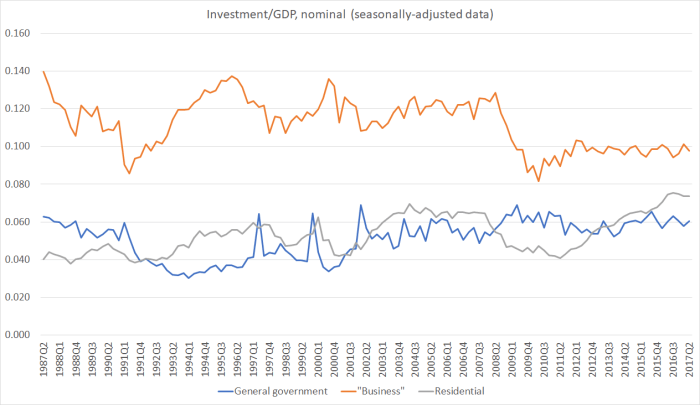
My typical starting point is a chart like this, breaking out investment spending into residential, government, and “business”.  (I put “business” in quote marks because, as the OECD does, it is calculated residually –  subtracting the other two components from total fixed capital formation.)

I shares of GDP june 17

Using quarterly data means living with a bit of “noise”, but not that much, and doing so enables us to see if there are any material changes emerging at the very end of the series.

I don’t want to say much about general government investment spending.   In recent years, that share has been averaging a bit higher than what we saw in, say, the five years before the last recession.  Then again, government (central and local) has faced significant post-earthquakes repair and rebuild expenditure, and the population growth on average over recent years has been a bit faster than that in the previous decade.  If anything, one might have expected the government investment share would have needed to be a bit higher still, at least given the range of functions governments currently take on,

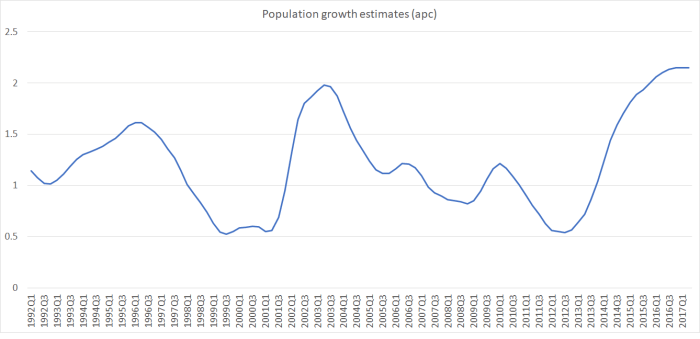
What of residential?   In nominal terms, residential investment spending (new builds and renovations etc) as a share of GDP is now just below the highest levels seen in the history of this series (and actually in the annual series which goes all the way back to the year to March 1972, thus capturing the peak of the building boom in the early 1970s).    Given the rapid rate of population growth –  a little higher, but lasting longer, than the growth rates 15 years ago –  one would expect to see a pretty high share of GDP being devoted to housebuilding and associated activities.   But you will notice that the residential line has fallen a bit in recent quarters, and consistent with that the volume of residential investment spending undertaken in the June quarter this year was about 1.4 per cent lower than such spending in the June quarter of last year.

popn growth apc

In this post, my main interest is in the business investment component (the orange line in the chart).  Strip out the modest quarter-to-quarter fluctuations up and down, and there has been no real change in the share of (nominal) GDP devoted to business investment for almost six years now.   Over the six years, business investment as a share of GDP has been materially lower (around 2 percentage points of GDP) than the average for the 15 years or so prior to the 2008/09 recession.    That is a big change.    And doubly so because of the sustained acceleration in the population growth rate in the last few years (and with it growth in the number of jobs).  Workers typically need capital equipment, even if it is nothing more than a laptop (and associated software) and a place to work.

Ratios of nominal investment spending to nominal GDP aren’t the only sensible way to look at things. In particular, in New Zealand a lot of capital equipment is imported (eg vehicles and most machinery, but not buildings themselves).  A high exchange rate –  such as we’ve had in recent years, but also had to a lesser extent in the last few years of the 2000s boom –  tends to lower the price (in NZD terms) of capital equipment.  The volume of business investment might still be growing quite rapidly, even if the nominal investment spending share of GDP is pretty weak  (of course, for tradables sector firms the high exchange rate is no gain –  capital equipment might be cheap, but the expected returns to any investment are also dampened).

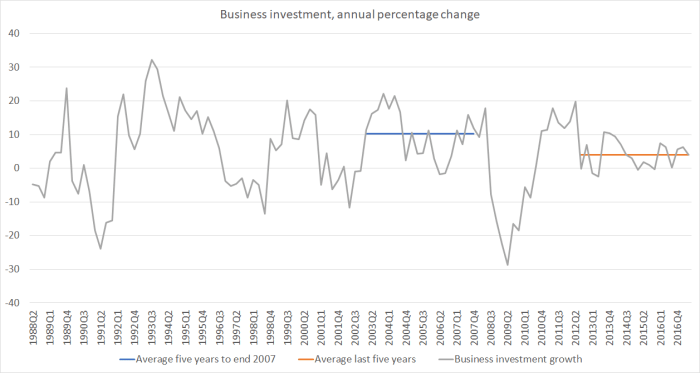
So here is a chart of the annual percentage change in real business investment.

bus i 2

The volume of business investment has been growing, but at a quite modest rate.  In the last five years of the previous previous boom, the annual growth rate was around 10 per cent per annum.  Over the last five years, the annual growth rate in the volume of busines investment has averaged only about 4 per cent (which also happens to have been the growth rate for the last year).

These pictures don’t really surprise me.  They are what one would have expected once one knew of (a) the magnitude of the damage caused by the earthquakes (from day one  at the Reserve Bank we knew this was a large non-tradables shock, which would skew activity away from business investment, especially in the tradables sector, for several years), and (b) the scale of the population increase.   Those pressures have helped hold our real exchange rate up so much and for so long, and reinforced the persistent large margin between our real interest rates and those abroad.  In that sort of environment, total business investment (share of GDP) is less than it otherwise would be, and –  although it isn’t able to be illustrated here –  what business investment does occur will be skewed away from tradables sectors.   Not even very high terms of trade levels were enough to counter-act the downward pressure on business investment growth, and monetary policy held tighter than it needed to be didn’t help either.

Looking back at that first chart, the weak and almost dead-flat business investment line was reminiscent of the productivity chart I showed yesterday.  It is also consistent with the weak export performance I wrote about last week.  The three indicators are causally related: business operating in, or which might have contemplated entering, the tradables sector, and thus taking on the world, simply haven’t been able to find sufficient attractive and remunerative opportunities.

The pressures associated with post-earthquake rebuild expenditure will wane, and probably already are.  But meanwhile, policy continues, year in and year out, to supercharge our rate of population growth, bringing in huge numbers of modestly skilled people, to a location where the successful opportunities for firms to take on the world with great products and services seem to be growing much more slowly than the number of people living here.  The flawed policy –  shared across both main parties and several of the minor ones –  just keeps making it harder than it needs to be for New Zealanders as a whole to get ahead.   Our immigration policy was crazy when lots of New Zealanders were leaving each year, but it is even more deeply problematic when the travails of Australia’s labour market mean that the outflow has (probably temporarily) largely ceased.


Productivity growth still missing in action

It was Paul Krugman, winner of the economics pseudo-Nobel Prize who famously captured one of the fairly basic insights of economics.  When it comes to material living standards in the medium to longer-term, if productivity isn’t everything, it is almost everything.   The terms of trade bob around, but probably won’t do much (harm or good) over the longer term, as they haven’t in New Zealand over 100 years.  But productivity growth –  managing to produce more per unit of inputs – is the basis for improved material living standards.   The best timely and accessible measure of productivity, widely used in international comparisons, is real GDP per hour worked.

Productivity growth in New Zealand has been pretty lousy in New Zealand for many decades, really since around the end of World War Two. We’ve had the odd decent run, but over the decades we’ve had one of the lowest rates of productivity growth of any advanced country.  We’ve slipped down the OECD league tables, and now part of the way we maintain reasonable living standards is by putting many more hours, over a lifetime, than the typical person in an advanced country.

Across the advanced world, productivity growth seems to have slowed from around 2005 (before the financial crisis).  We didn’t need to share in that slowdown, because productivity levels in New Zealand were so far below those of the OECD leaders.  Countries like the Netherlands, France, and Germany –  which historically we were richer and more productive than – now have labour productivity levels around 60 per cent higher than those of New Zealand.  We should have been able to close some of the gap in the last decade or so, utilising existing technologies, even if advances at the technological and managerial frontiers were slowing.  Various other poorer OECD countries –  notably the former Soviet bloc countries that are now part of the OECD – have done so.  We haven’t.

Several weeks ago the Prime Minister and the Minister of Finance were repeatedly claiming that New Zealand’s productivity performance in recent years had really been pretty good.  In fact, they suggested that under their watch we’d managed faster productivity growth than in other advanced economies and that the gaps were beginning to close.

I went to some lengths to unpick those claims.    New Zealand doesn’t have an official measure of real GDP per hour worked (unlike Australia, where the ABS routinely reports numbers as part of their national accounts release).  Instead, we have two measures of real GDP (expenditure and production), and two measures of hours (HLFS and QES).  Instead of just picking on one combination, I calculated all the possible methods, and looked at them individually and on average (nine in total).

For broad-ranging international comparisons, it often makes sense to use annual data, because not all countries have easily accessible quarterly data.  Unfortunately, the annual data are often only available with a lag, and the OECD doesn’t yet have annual data on real GDP per hour worked for all countries for calendar 2016.   But in the years from 2008 to 2015, on not one of the possible New Zealand productivity measures did New Zealand quite manage productivity growth as fast as that of the median OECD country.

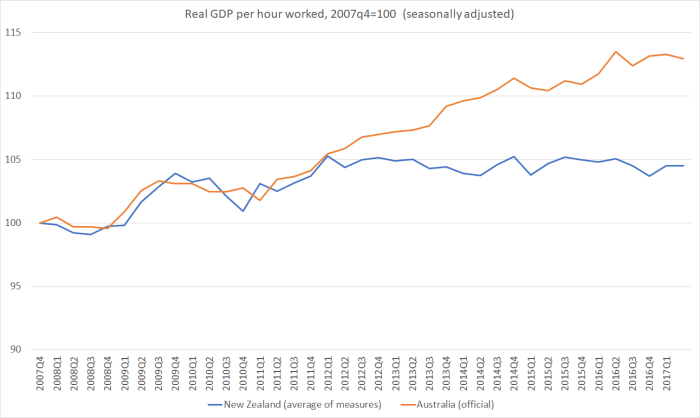
This morning Statistics New Zealand released the latest quarterly national accounts, which enabled me to update the various quarterly productivity series.   In this chart I’ve shown the average of the various possible measures, and compared the performance of New Zealand relative to that of Australia (using the official Australian data).  I’ve started the chart in the last quarter of 2007, just before the 2008/09 recession began.

aus vs nz ral gdp phw 2

Over the first few years, through the recession period and in the year or two beyond, productivity growth in New Zealand and Australia was modest, but we more or less kept pace.   But what is striking is how increasingly large and persistent the deviation has been since around the start of 2012.  Over the five years, we’ve had no productivity growth at all, and Australia has managed quite reasonable growth.   And over the last five years, using the average measure for New Zealand doesn’t mask anything: from the second quarter of 2012 to the second quarter of 2017, the strongest of the nine series recorded productivity growth of 0.8 per cent (that is, in total over five years) and on the weakest, the level of productivity fell by 0.6 per cent (in total over five years).  Best guess: zero.

Recall that at the start of the period the average of level of productivity in Australia was already well above that in New Zealand.  That gap has widened still further.  In the early days of this government readers will recall that there was a goal to close those gaps to Australia by 2025, only eight years away now.

It has been a dismal performance.  Productivity isn’t mostly about how hard people work, but is much more about the ability of firms to find opportunities here that generate high incomes, and in particular high wages.  That is very difficult when the real exchange rate is as persistently high as it has been here.  Particularly over the last few years, very rapid population growth has underpinned the strength of the real exchange rate, driving up the prices of non-tradables relative to those of tradables.

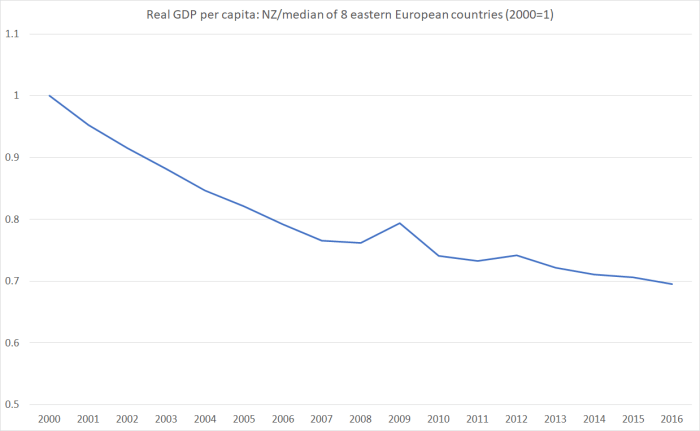
And what of the comparison I mentioned earlier with the former Soviet-bloc central and eastern European countries (Slovenia and Slovakia, Poland and Hungary, the Czech Republic, and Latvia, Lithuania and Estonia)?  Thirty years ago, all of them were in a much worse state than New Zealand, but like New Zealand they had an aspiration to reverse decades of economic underperformance and catch-up with the richer countries in the OECD –   in their case, particularly those in western Europe.     But here is how we have done relative to them over the period since 2000, when there is consistent data available for all the countries (and by then all the other countries had got well through the nasty shakeouts immediately after the fall of communism).

eastern europe 3.png

It is a steady and substantial decline in our productivity levels relative to those of these central and east European countries.   The data are only annual, of course, but as you can see in earlier chart, we’ve had no productivity growth at all recently so not incorporating the last couple of quarters won’t help the picture.   Some of these countries –  communist-era basket cases 30 years ago –  now have levels of productivity very similar to New Zealand’s.  Most are on a path that may well take them past us in the next decade or so.  Most, as it happens, have little or no population growth.  They make the most of their opportunities –  which are considerable, being close to western Europe –  with their own people.

To sum up, New Zealand has lagged a bit behind the median advanced country since 2007/08, and has had no productivity growth at all for the last five years.  We continue to drift further behind our closest neighbour, Australia, and now face the likelihood that before too long we’ll be overtaken by countries that, throughout modern history, were never previously as productive as New Zealand was, and which 30 years ago we’d have looked on as pretty hopeless cases.   We could do much better, but there is absolutely nothing to suggest that we will manage to do so pursuing current economic policies.  Sadly, there isn’t much sign that any of the parties competing for your vote on Saturday are offering anything materially different, that might finally begin to reverse almost 70 years of continuing relative decline.   The apparent refusal of our leaders to face the reality, and make steps to change, won’t alter the fact of our continuing relative economic decline.


Immigration, the election, and shelf-stackers

Back in February I had coffee with a senior journalist, who was convinced that immigration was going to be a central issue in this year’s election campaign.  The journalist cited the Trump and Brexit phenomena, and I suppose at the time Geert Wilders and Marine le Pen were in the wind.   I was a bit sceptical.  I’d, mostly, have welcomed such a central place in the election campaign for what I regard as one of the key long-term failings in our economic policy settings.   But I didn’t really see any sign of a Trumpian insurgent – or a mood that was just waiting for such a person – or of the fascinating mix of motivations (immigration was only one) that had driven the Brexit vote.  But my interlocutor told me that political party focus groups were picking immigration up as a key issue, and suggested that the media need to attract readers would help fuel an intense focus on immigration.  I think there was a sense back then that National was in such a strong position in the polls that an issue like immigration would, as much as anything, be hyped to help keep things interesting.

As I say, I was sceptical –  although interested in the focus group snippet (which I later had confirmed by one MP).   We had dreadfully high house prices, and a dismal productivity (and exports) performance. High immigration has played a part in both those outcomes.  But those weren’t, it seemed to me, the sort of visceral dimensions that seemed to have played such a part in other countries: our last experience of terrorism was state-sponsored, by France; we don’t have problems with illegal immigration (some upsides to being a remote island), and we haven’t had problems with substantial Muslim immigration.  And for all my concerns about the mediocre quality of the skills of the median migrant, we’ve done less badly on that count that many other OECD countries (again, land borders and an explicit economic focus to the programme both help).

But now we are two days out from the election, and it is clear that immigration hasn’t played a particularly important role in the campaign at all.  New Zealand First –  which might have been a natural recipient of votes if there had been an upsurge in serious concerns –  looks as if it might end up with a smaller vote share than it had in 2014.   The government made some minor tweaks to immigration policy this year, on top of some other minor tweaks last year.   And Labour’s immigration policy didn’t involve much change –  outside the overseas student sector –  and hasn’t (at least that I’ve seen) had any pro-active place in their campaigning.   Oh, and the Greens’ leader ended up abjectly apologising to his base, casting slurs all round, for even having suggested last year a rational debate on the appropriate rate of immigration.

It is interesting to ponder why immigration hasn’t been a key issue.  After all, if one focuses (inappropriately, but as the headline writers do) on the PLT numbers there has been no abatement in the net inflow (whether of non-citizens –  the bit policy bears on –  or the reduced outflow of citizens).  And the “true” net inflow is almost as high, as a per cent of the population, as the previous peak 15 years ago, and it has run on for longer.

One reason is, presumably, the change in the political personalities.  At the start of the year, many thought the campaign might see Labour at or below the vote share it got in 2014, and New Zealand First and Greens perhaps both polling in the teens, and scrapping for second place in a possible left-led government.  Perhaps that might have been a climate in which Labour and New Zealand First in particular might have more prominently battled to capture those who were concerned about immigration-related issues.  But the “Jacinda effect” transformed that outlook and the campaign has mostly been like something from the old days: two big parties, with some minor players struggling for attention and coverage.    And although Labour has stuck with the immigration policy announced under Andrew Little, it is clear that Ardern has made a conscious choice to de-emphasise that policy, even though the focus of the proposed changes was on the deeply-flawed student market.

But I wonder whether some other factors aren’t at least as relevant among voters (and for all the talk of “leadership” a great deal of what politicians do is “followership”).   For one, house price inflation has abated in much of the country, and although house prices in Auckland remain sky-high they’ve gone roughly sideways for a year or so.    Quite why that has happened is still debated, but it isn’t because (a) the rate of growth of the number of people needing a roof over their head has slowed, or (b) because housebuilding in Auckland is now proceeding so rapidly that it has got ahead of population growth, or (c) because regulatory reforms have freed up land use sufficiently that peripheral section prices are now plummeting.     More plausibly, it is some mix of (a) rising domestic interest rates, (b) the tighter LVR controls the Reserve Bank put on last year, (c) tighter credit standards the banks themselves have established, under the influence of parents and of APRA, and (d) reduced capital outflows from China as the regime has tightened-up its controls.  But whatever the precise reason, it has taken much of intense heat out of the house price issue –  imagine if the opposition has still been able to repeat endlessly “house prices in Auckland are up another [x] per cent in just the last six months.   And with it, much of the heat around the immigration issue?

And the other reason –  one of the reasons I was sceptical of the political salience of the issue at present –  is the point I have been arguing for (and that previous generations of NZ economists recognised ) for years.  In the short-term, high and unexpected immigration adds more to demand in the economy than it does to supply.  In other words, it tends to boost economic activity –  measured or headline GDP for example –  and put more pressure on scarce resources.  Migrants don’t take jobs from locals, or add to unemployment; if anything, in the short to medium term, they add more to the demand for labour (all that capital stock that needs to be built) than to supply, and thus migration inflows tend to reduce unemployment.   The sugar-high is a real thing.  The effects might not last long, but when the dose is repeated each year for several in a row, it does have an effect.

There might have been no productivity growth at all for five years, but that sort of concept or measure doesn’t easily get much public resonance.  Exports might be shrinking as a share of GDP, as the need to build to cope with a rapidly-rising population crowds out the tradables sector……but it is a geeky macro statistic, and not one that anyone has successfully built a narrative around.  And perhaps people aren’t feeling good about their wages, but as I’ve noted recently, real wages have been rising consistently faster than productivity for some years now.  It is an unsustainable, unbalanced, mix, but it isn’t one that was ever going to capture the public imagination in any sort of “build a wall” way.  In the short-term, for those (most) with jobs things don’t seem too bad.  And even the Leader of Opposition has repeated on numerous occasions that the economy is doing fine.

And, of course, few of us want to be nasty about individual migrants (and of course, as I argue, the issue is New Zealand policy, not the rational choices of individuals), and no one wants to be subject to the dread “r-word” slur.

In many respects, I’ve long thought that the best environment for a serious public pushback against the out-of-step, failing, immigration policy we have run for a long time, is in the next severe downturn.  I wouldn’t welcome recessions – and remain concerned that the government and the Reserve Bank aren’t doing enough to prepare for the next one – but in a sense it is in periods when things are manifestly not going well that one is perhaps more likely to find a willingness to contemplate serious change in policy.  That’s a shame –  the best time (easiest adjustment) to make changes would be now, when the economic environment globally isn’t too bad –  but perhaps it is unavoidable, especially when (as above) we –  fortunately – don’t have the visceral issues around immigration that some other countries do.

Immigration policy did come up at the local candidates’ meeting last night.   The minor party representatives were predictable –  the Greens candidate was adamant that we “knew” that migrants benefited us economically, while on the other side the most entertaining TOP candidate –  whose opening speech was done in iambic pentameter – made the case for easier access for really skilled migrants, but for fewer migrants overall to ease the (claimed) downward pressure on wages.

Chris Finlayson repeated some of the serious misrepresentations that seem to characterise his party’s view.  We were told of the lots of New Zealanders who were coming back from Australia (when in the year to June 2017, a net 4678 New Zealanders left for Australia) and about how the immigration policy was bringing in the tradespeople wiuth the skills needed for, for example, the housebuilding.  I heard the PM repeat that line –  who will build the houses if we cut immigration – on Radio New Zealand yesterday: I would draw his attention, and that of his minister and local candidate to the data suggesting that the net immigration of building trades people is very small relative to (a) the actual increase in the construction workforce in recent years, and (b) to the total increase in the need for new housebuilding occasioned by the rapid increase in the population.   High immigration is worsening, not easing, those pressures.

But it was Labour candidate –  and near-certain winner –  Deputy Mayor, Paul Eagle whose comments on immigration really caught my attention.  He was obviously feeling on the defensive about the issue, and thus even though Labour’s actual policy proposals focus (numerically) mostly on fixing up some of the rorts around the student visa sector, he never mentioned that issue at all.  Instead, he wanted to stress that Labour welcomed immigration, and that we need immigration in some sectors.  It sounded fine, more or less, until he went on:  “Island Bay New World needs people”.   So can we take it that official Labour policy, enunciated by a candidate likely to be an MP for many years to come, is that we need immigration –  perhaps even more immigration –  so that the supermarket shelves get stacked?  What, I wondered, had we come to?  Once –  in MBIE”s words – a “critical economic enabler”, and now shelf stackers?

(And for anyone interested in some more observations from our Attorney-General, someone asked from the floor about Jim Bolger’s recent denunciation of “neo-liberalism”.  This senior minister got up and indicated he had talked to Bolger about what he had said, clarifying that he had meant the policies adopted by Labour and National governments between 1984 and 1993.  Finlayson himself went on to characterise that period as one of “extremist economic policies” concluding that “that ideology does not work, and we are not that sort of party”.  One brave member of the audience –  Island Bay is a pretty left-liberal sort of place –  called out “but none of it has been repealed has it?”        Was it floating the exchange rate, removing farm subsidies, removing trade protection, making credit available to ordinary people, lowering maximum marginal tax rates, ending fiscal deficits as a norm, putting in place a good GST, removing union monopolies, privatising state-owned business operating in competitive markets, or what……that the Attorney-General of an allegedly centre-right pro-market government regarded as “extremist”? )

The political cone of silence, with slurs

I’m furious.

Local democracy came to Island Bay this evening, and I –  an undecided voter – joined the crowd at the local candidates’ meeting, in the Rongotai electorate.   Candidates congratulated themselves on a well-fought campaign –  as the National Party’s candidate put it, not a cross word had been spoken between any of them through all the various meetings they’ve attended together.  Most of tonight’s meeting was like that.  Most.

Over the years, I’ve heard nothing to suggest that the National Party’s candidate was other than an honourable and decent man.  The Hon. Chris Finlayson is the 8th ranked Cabinet minister, minister responsible for the intelligence services, and Attorney-General.  He appoints our judges.  And as he described himself tonight, he is “the first law officer in the land”.  You’d imagine he’d be at the forefront of defending the integrity of our democratic system and its institutions.  But not based on his performance tonight.

The format of the meeting allowed questions from the floor.  Each question had to be addressed to one particular candidate, but each other candidate also had a chance to answer.  On almost all the questions, almost all the candidates took the opportunity to answer.  But not on one question.

I got up and asked a question of Chris Finlayson, explicitly noting that I was not asking him as a minister responsible for the intelligence services (where I would have expected a fob-off) but as a senior National Party figure.   My question ran roughly as follows:

“Mr Finlayson, last week one of the world’s leading newspapers, the Financial Times gave considerable prominence to a story about a New Zealand MP.  That MP had been a member of the Chinese communist party, and part of the Chinese intelligence services.  He never disclosed that past to the public when he stood for Parliament, and has never taken the opportunity to denounce the evils of the Chinese regime.  Can you comment on why it is appropriate for such a person to be in our Parliament?  And could you also comment on the new paper by Professor Anne-Marie Brady raising concerns about the extent of China’s attempts to exert political influence in New Zealand, and about the close ties of various senior National Party figures with Chinese interests?”

The question was greeted not with embarrassed silence, but with pretty vigorous applause from the floor.

Finlayson –  our Attorney-General, first law officer of the land, senior National Party minister  – got up, briefly.   His answer ran roughly as follows:

“That was a Newsroom article, timed to damage the man politically.  I’m not going to respond to any of the allegations that have been made about/against him. I think it is disgraceful that a whole class of people have been singled out for racial abuse.  As for Professor Brady, I don’t think she likes any foreigners at all.”

And as I shouted back “the claim was about one man”, our Attorney-General sat down.  He’d simply refused to answer, or even address, the question, at any level other than suggesting that anyone raising these quite serious issues was a racist or a xenophobe.  Starting, presumably, with the Asia editor of the Financial Times, Jamil Anderlini a Kuwaiti-born Italian-American New Zealander who has spent almost 20 years in China, including more than a decade reporting from Beijing (and now is based in Hong Kong) through to Professor Brady, with all the other serious media outlets and China-focused commentators overseas who have reported the concerns somewhere in-between?   It was preposterous.  Plus, one couldn’t help thinking that he knew he was on weak ground.  After all, if there was a clear, simple, authoritative and compelling explanation, presumably he’d have given it.

I hold the Attorney-General –  first law officer of the land –  to a considerably higher standard than other local candidates.   And the specific question was actually about a National Party MP, National Party selection choices, and the ties of National Party figures to Chinese business and political interests.

And, as I said, on every other question this evening, all the other candidates rushed to the microphone to have their say, on everything from apprentices to housing to guidance counsellors.  But not one of the others said a word on the Chinese government’s politicial influence seeking in New Zealand, or specifically on Jian Yang’s position.   Not the Labour candidate –  deputy mayor of Wellington, and sure to become a member of Parliament on Saturday.  Not the quite highly ranked, and apparently very able, Greens candidate.  Not the TOP candidate, or the Conservative candidate.  Strangely, not even the New Zealand First candidate, who was presumably unaware that his party had taken a stand, both on Yang, and on the more general issues Professor Brady has raised about the activities in New Zealand of the Chinese government.     Not a word, from a single one of them.  It left me wondering about what our democracy was coming to.

As it happens, there was someone in the room who knew Professor Brady; in fact, this woman had done her masters thesis under Brady’s guidance.    Noting that Finlayson had tried to claim that Professor Brady didn’t like any foreigners, she proceeded to point out that not only was Brady fluent in Mandarin, but that her husband was Chinese.    Cue to guffaws and applause, and a rather grudging apology by the Attorney-General for his specific claims about one of our leading experts on China and its international activities.

It was a shameful performance all round.  The candidates can congratulate themselves all they like on the bonhomie of the campaign, but when not one of them will even address a serious question, raising concerns themselves raised by serious international publications and respected experts –  and Brady’s paper has been linked to and report quite widely –  it rather gives the game away.   As Professor Brady put it in her paper, the fear of giving any offence to the government of the People’s Republic of China –  a brutal  and aggressive dictatorship –  seems to have been raised to a defining feature of New Zealand politics, and not just by National.

We saw it on display tonight, nowhere more so than in the despicable performance by our Attorney-General and first law officer.   How safe is our democracy, our values and freedoms, our laws, in such hands?


Operating allowances don’t cover inescapable cost pressures

I didn’t have any intention of writing again about the Labour Party’s fiscal plans.  I’d already done so, prompted by the infamous Steven Joyce “fiscal hole” here and here.

But on Monday evening I was sent some analysis of the fiscal outlook prepared by a group of former senior Treasury officials, who were keen that I should give it some coverage.  They are keen to retain anonymity, but I know all those involved, and have a considerable regard for most of them.   Most, in my observation, would also seem considerably more likely to vote for ACT than for, say, Labour or parties to its left.  But  what they sent me wasn’t particularly value-laden; it was an attempt at a technocratic assessment of some of the basic pressures on government finances over the next few years.

I’m not going to swamp you with numbers  And trying to unpick and explain here the differences between core Crown and total Crown expense items, and which is relevant where, is sure to have your eyes glaze over, and (frankly) on a couple of points I couldn’t get clear answers myself.

But their main point is a simple one.  Budget projections of government tax revenue, including the PREFU ones that both Labour and National are relying on, include the effects of forecast wage and price inflation, and forecasts of a rising population.  On the other hand, most line items for government expenditure, as presented in the PREFU, do not do so.

But things governments purchase, and people governments employ, will become more expensive over time (that’s inflation).  And a rising population will also, over time and all else equal, require more public employees –  perhaps no more Treasury officials, but certainly more nurses and teachers, police and perhaps even Corrections officers.    Given the outlook for inflation and population growth, those cost pressures are largely inescapable –  at least without specific decisions to cut real per capita spending in some or other areas.   (When I say “inescapable”, of course governments can change inflation and non-citizen immigration targets, but given the targets they choose, there are future –  largely inevitable or inescapable –  spending consequences.

In fact, the PREFU documents would be much more useful –  as I noted a couple of weeks ago, picking up a comment on an earlier post – if they included some analytical tables showing expenditure numbers that adjusted for these all-but-inescapable inflation and population pressures.  If political parties presented their alternative plans relative to that sort of baseline we would all be much better off.

Instead, at present, we are given a table like this (or its total Crown equivalent)

PREFU extract

In this table, some specific line items show considerable increases over the four year period.  In particular, where there is a statutory requirement to make expenditures in a particular way, explicit allowance is made in the PREFU line item numbers.  New Zealand Superannuation expenditure for example –  eligibility and formula in statute –  is explicitly shown as increasing from $13043 million in 2016/17 to $16085 million in 2020/21 (included in the first line above).

But most government spending isn’t like that.  It is simply subject to appropriations after each year’s budget, and each government agency must make an explicit bid for any new spending, even that which (in effect) simply results from inflation or population increases.  So those –  largely inescapable –  prospective spending increases aren’t identified in specific line items in the table above.  Instead, it is all lumped together in the line labelled “Forecast new operating spending”, which –  in PREFU –  captures the cumulative total of the annual “operating allowances” the current government has identified for the next few years  (cumulative because the decision to spend $1000 million extra next year, and another $1000 million extra the following year means that in the second year, total spending would be $2000 million higher than what has been appropriated this year).

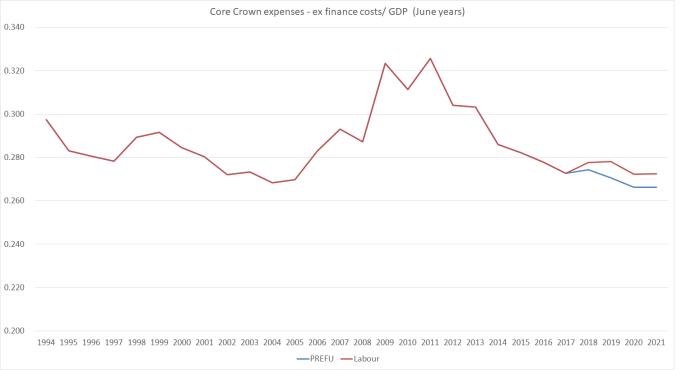
In other words, that new operating spending line can deceive.  From a Treasury budget management perspective it is all new money available to spend –  you don’t want government departments counting on what ministers and Parliament haven’t approved.  From a bigger picture perspective though it is a mix of money available for genuinely new initiatives, and money that will end up having to be spent to keep up with wage and price inflation and population.     Quite how much governments want to have available for genuinely new stuff is up to them –  and political and market tolerance for debt and taxes.  But in recent years, that proportion hasn’t been much.  Government spending has been falling as a share of GDP.    In fact, as I’ve noted previously, both parties tell us they expect to reduce government spending as a share of GDP further over the next few years.

core crown spending 17 election

Labour less so than National, but it is still a reduction.

And the other half of the point the former senior Treasury officials are making is that Labour seems to have promised to do quite a lot of new stuff over the next few years.  Specifically, in 2020/21 –  the final PREFU year, although not the last year of Labour’s plan –  they have announced specific policy promises that,  on their numbers, would have total spending $6058 million higher than under PREFU.

Of course, they are partly doing this through revenue measures –  primarily not proceeding with National’s promised tax cuts. On their numbers –  and the same economic assumptions – revenue will be $2341 million higher in 2020/21 than is provided for in the PREFU.    Since the projected surplus in 2020/21 is almost identical to that in PREFU, they have precommitted a net additional $3700 million to fund the (net) new policy promises.

And how much as-yet-unallocated spending provision is there in PREFU for 2020/21?  Well, we can see that number in the table above: $5495 million.   But if around $3700 million is already committed to meet policy promises, that leaves only around $1800 million.

Again, the question the former senior Treasury officials are raising in whether that is enough to cover the inescapable cost pressures.

Over the three years (from the current Budget numbers for 2017/18) to 2020/21, those “inescapable” pressures include projected:

  • Population growth of 4.6 per cent
  • Cumulative increases in the CPI of 6.2 per cent, and
  • Cumulative wage increases (QES measure) of 8.5 per cent.

Across core Crown agencies and Crown entities (the latter includes schools and DHBs) the government expects to spend $20142 million this year on “personnel expenses”.     Using those cost pressures:

  • forecast wage inflation alone would lift annual spending by around $1700 million by 2020/21, and
  • if the number of public employees kept pace with population growth that alone would add another $900 million to the wage and salary bill.
  • for an overall increase (the new workers will also get the higher salaries) of around $2700 million

But there was only about $1800 million left after the specific policy promises Labour has made.

Another item we could look at is Other Operating Expenses.   These are around $39000 million this year (2017/18 Budget).   Assume that the cost of whatever the government is purchasing increases at the rate of CPI inflation, and that the volume of purchases will increase with the forecast increase in population, and that would raise government spending on this item (simply to deliver the same volume of real services per capita) by about $4200 million by 2020/21.

Across just those two (large) items, the “inescapable” cost pressures would add $6900 million by 2020/21 to annual spending.    And yet, the government’s operating allowance –  passed to Treasury as current policy to use in PREFU – is for only $5495 million more spending by 2020/21.

We know the policy promises the Labour Party has made:  they’ve committed about $3700 million to meet specific policy promises.  We don’t have any decent estimate (that I’m aware of) of the cost of the National Party’s promises, although they seem almost certain to be less –  for now anyway –  than those the Labour Party has put out.

But the bottom line is that, on the macroeconomic assumptions both parties are using, the existing operating allowances (and revenue projections) are not sufficient to cover even what former senior Treasury officials would regard as “inescapable” cost pressures on the Budget over the next few years.  (In the spreadsheets they sent me, they didn’t explicitly allow for the population growth, but in my subsequent exchanges with their representative, they accepted that the population pressures on spending are just as real as the inflation ones.)   The gap  –  hole if you like –  appears likely to be materially larger for Labour than for National, but it is there for both sides of the political divide.

Of course, there are ways through that.  A government led by either main party could decide to make material cuts to services or other spending.     Labour seems to have talked of the Defence budget and perhaps Corrections.  National –  probably faced with a smaller gap –  has given us no clues.  And none of those possible cuts –  from either party –  has been outlined in any detail and debated in this election campaign.   Perhaps public service salaries could be held below general wage inflation.   Perhaps no more teachers or nurses could be hired even as the population increased?  Perhaps some extraneous (but mostly rather small) government agencies could be closed?

Then again, perhaps the spending as a share of GDP tracks just aren’t very credible, probably for either party (but probably more so for Labour).  As I’ve said before, it is a little hard to understand how, for example, a party can campaign on the idea of years of underfunding of core services, and yet suggest that government spending will fall as a share of GDP over the next few years if they are elected.

And when (properly measured) net core Crown debt is about 9 per cent of GDP, and the macro outlook suggests rising surpluses from here, it isn’t entirely clear why it would be sensible to do so, given the stuff that a left-wing party says that it wants to deliver.

The future is uncertain.  We could have a recession in the next few years, or a period of really strong growth.  But if we take the Treasury PREFU macro outlook as given, it is hard not to conclude that under whichever party we elect there will be more total spending (than in either PREFU or the Labour plan) as a share of GDP and somewhat higher public debt.   And before anyone starts hyperventilating about higher interest rates, a reminder of the Orr/Conway results I linked to on Monday: on those estimates, even a 10 percentage point increase in net debt to GDP might be worth about 6.5 basis points on long-term bond yields.   Realistic differences over the next three years would not be worth anything like an additional 10 percentage points on the debt to GDP ratio.

And finally, my suggestion –  indeed plea –  to The Treasury, and to possible new Fiscal Council (which Labour is proposing if elected)  –  is that for the next PREFU we should have analytical tables that take explicit identifiable account of the likely –  largely “inescapable” (in the words of the senior Treasury officials) cost pressures resulting from inflation and population growth.  There are real debates to be had on what level of real per capita services/spending governments should provide –  that is the stuff of politics –  but for these sorts of purposes a much more sensible baseline –  and a more enlightening one for voters –  is one that explicitly takes account of those pressures, and thus more clearly identifies how much is “left over” for genuinely new initiatives.  Anything beyond that amount has to be funded by either cuts in other spending, or lower surpluses.    But inflation means things cost more, and more people means more government spending (all else equal), and it doesn’t help to bury those pressures, as current practice –  led by Treasury, which decides what to publish –  tends to do.


A near-complete cone of silence

I’d been planning to write a post today about the near-complete cone of silence that seems to have descended over elite New Zealand around the Jian Yang scandal.   That a former member of the Chinese intelligence service, former (perhaps present, if passive) member of the Chinese Communist Party, still in the very good graces of the Chinese authorities –  never, for example, having denounced the oppressive expansionist regime he served –  sits in New Zealand’s Parliament, nominated to again win a seat in Parliament on Saturday, is both astonishing –  at least to those like me who haven’t been close observers of such things –  and reprehensible.   That it seems not to bother anyone in, or close to, power (at least enough to do or say anything) is perhaps even more alarming.  There was a wave of stories in the first 24 hours after the Financial Times/Newsroom stories broke, and then……well, almost nothing.

There has been a lame excuse offered up:  Jane Bowron in the Dominion-Post noted that it was election time and there is lots else to write about.  And actually I more or less buy the line that there aren’t the journalistic resources to do much new digging right now.  But (a) it is election week, when we make choices about the sort of people and parties we want governing us, and (b) how hard can it be to ask, and keep on asking, political leaders of whatever stripe about this story, on the basis of what has already been published, and on what Yang has already acknowledged (years later)?     Report, again and again if necessary, that a key political figure refused to comment, but don’t simply ignore the story.

But then Newsroom this morning had another important story, putting the Yang story in the much wider context of the systematic efforts of the Chinese authorities (state and party), and drawing on a new paper by University of Canterbury politics professor, and expert on China and its ambitions, Anne-Marie Brady.   Her paper Magic Weapons: China’s political influence activities under Xi Jinping  was presented at a conference in the United States a few days ago: the conference title “The corrosion of democracy under China’s global influence”.    What makes it so compelling is that it is a detailed case study of China’s efforts in New Zealand.  It isn’t heavy analysis, but simply nugget after nugget that builds a deeply disquieting picture, and perhaps makes disturbing sense of the cone of silence around Jian Yang.   Every thinking New Zealand should read Brady’s paper.

As she notes early in the paper

New Zealand’s relationship with China is of interest, because the Chinese government regards New Zealand as an exemplar of how it would like its relations to be with other states. In 2013, China’s New Zealand ambassador described the two countries’ relationship as “a model to other Western countries”.

With, one hopes, a degree of hyperbole, she goes on to note (quoting an anonymous source)

And after Premier Li Keqiang visited New Zealand in 2017, a Chinese diplomat favourably compared New Zealand-China relations to the level of closeness China had with Albania in the early 1960s.

She goes on to outline the huge effort China puts in to attempting to manage the Chinese diaspora, whether in New Zealand or other countries.

After more than 30 years of this work, there are few overseas Chinese associations able to completely evade “guidance”—other than those affiliated with the religious group Falungong, Taiwan independence, pro-independence Tibetans and Uighurs, independent Chinese religious groups outside party-state controlled religions, and the democracy movement—and even these are subject to being infiltrated by informers and a target for united front work.

She records that these efforts have greatly intensified under Xi Jinping – as internal repression in China has as well.

Even more than his predecessors, Xi Jinping has led a massive expansion of efforts to shape foreign public opinion in order to influence the decision-making of foreign governments and societies

This includes seeking, largely successfully, to gain effective control over Chinese-language media (with exceptions as above) and encouraging political involvement of overseas Chinese.

This policy encourages overseas Chinese who are acceptable to the PRC government to become involved in politics in their host countries as candidates who, if elected, will be able to act to promote China’s interests abroad; and encourages China’s allies to build relations with non-Chinese pro-CCP government foreign political figures, to offer donations to foreign political parties, and to mobilize public opinion via Chinese language social media; so as to promote the PRC’s economic and political agenda abroad.42 Of course it is completely normal and to be encouraged that the ethnic Chinese communities in each country seek political representation; however this initiative is separate from that spontaneous and natural development.

And neutralising, or even coopting,  members of local media and academe.

Coopt foreign academics, entrepreneurs, and politicians to promote China’s perspective in the media and academia. Build up positive relations with susceptible individuals via shows of generous political hospitality in China. The explosion in numbers of all-expenses-paid quasi-scholarly and quasi-official conferences in China (and some which are held overseas) is a notable feature of the Xi era, on an unprecedented scale.

As she notes, New Zealand hasn’t been immune to that strand of influence.   In part we do it to ourselves –  there are, for example, the New Zealand government sponsored New Zealand China Council media awards.  Or sponsored trips for selected journalists to China, paid for the New Zealand China Friendship Society (didn’t the Soviets used to sponsor such bodies?).    It becomes harder to ask awkward questions when awards and sponsored travel opportunities might depend on not doing so.   I don’t suppose the New Zealand China Council  –  chaired by Don McKinnon, including the chief executive of the Ministry of Foreign Affairs and Trade – would be at all pleased by open scrutiny and debate about Jian Yang’s background, his ongoing relationship with the Chinese authorities, and his presence in our Parliament.   It might –  no doubt would –  upset China, not a country known for its tolerance of robust scrutiny and challenge.  These days, one has to wonder whether we still are, at least when it comes to China.

One of the most interesting bits of the paper is Brady’s discussion of why New Zealand interests China.    Here is some of her text

But New Zealand is of interest to China for a number of significant reasons. First of all, the New Zealand government is responsible for the defence and foreign affairs of three other territories in the South Pacific: the Cook Islands, Niue, and Tokelau—which potentially means four votes for China at international organisations. New Zealand is a claimant state in Antarctica and one of the closest access points there; China has a long-term strategic agenda in Antarctica that will require the cooperation of established Antarctic states such as New Zealand. New Zealand has cheap arable land and a sparse population and China is seeking to access foreign arable land to improve its food safety.  ……

New Zealand is also a member of the UKUSA intelligence agreement, the Five Power Defense Arrangement, and the unofficial ABCA grouping of militaries, as well as a NATO partner state. Breaking New Zealand out of these military groupings and away from its traditional partners, or at the very least, getting New Zealand to agree to stop spying on China for the Five Eyes, would be a major coup for China’s strategic goal of becoming a global great power. New Zealand’s ever closer economic, political, and military relationship with China, is seen by Beijing as an exemplar to Australia, the small island nations in the South Pacific, as well as more broadly, other Western states.

Not all of it is wholly compelling –  Tokelau isn’t independent, and the Cooks and Niue aren’t members of many international organisations. But the overall story makes a lot of sense.   If you wonder about the Antarctic bit, Brady is an expert on China’s Antarctic policies and aspirations.

On the other hand, you have to wonder quite why New Zealand governments should pay so much court to China.  Exports from New Zealand firms to China account directly for only about 5 per cent of our GDP (exports from Canadian firms to the US are, by contrast, 23 per cent of Canada’s GDP). And many of those exports –  notably dairy products and lamb –  are for relatively homogeneous products that would end up sold elsewhere, perhaps at lower prices, if somehow China restricted the ability of New Zealand firms to export.    There is, of course, the Chinese student market –  almost half the total student visas issued last year were to Chinese students –  but, as is now well-recognised the export education industry is a pretty troubled and distorted one, often as much about immigration aspirations as about the quality of the education product on offer.   So university vice-chancellors, and their colleagues in lesser institutions, might have a strong private interest in not upsetting China but it isn’t obvious that the citizenry of New Zealand share that interest, when it comes to defending our values and our system.

Brady argues that the emphasis on the China relationship appears to have greatly intensified under the current government

the current prominence afforded the China relationship has accelerated dramatically under the government that won the election in 2008, the New Zealand National Party. The National Party government (2008-), follows two main principles on China: 1. The “no surprises” policy,72 which appears to mean avoiding the New Zealand government or its officials or anyone affiliated with government activities saying or doing anything that might offend the PRC government; and 2. a long-standing emphasis on “getting the political relationship right”, which under this National government has come to mean developing extensive and intimate political links with CCP local and national leaders and their representatives and affiliated actors in New Zealand.

She provides a concrete example of this desperate desire not to offend.

This cautiousness to not rock the boat over New Zealand-China relations lay behind New Zealand’s reluctance to join the USA and Australia to criticize China’s military base building activities in the South China Sea. Following massive pressure from Australia and the US, New Zealand Prime Minister John Key (2008-2016) and other ministers made a series of muted remarks in 2015 and 2016, but it was far from what  New Zealand’s allies had hoped for, who have frequently accused the National government of being soft on China. The New Zealand National government’s reticence to speak out on this issue, despite the fact New Zealand has the fourth largest maritime territory in the world and relies on respect for international norms for the protection of its rights, is one telling example of the effectiveness of China’s soft power efforts in New Zealand in recent years.

Brady highlights concerns around a number of local Chinese politicians –  not just Yang, but also Labour’s Raymond Huo and former ACT MP (and until recently, deputy leader) Kenneth Wang.   You can read some of those concerns, and apparently serious questions, for yourself.

Through much of the rest of her article, Brady writes in some detail about the various webs of connection that help create an economic interest among many leading New Zealand figures in not rocking the boat.  As I’ve noted previously, the Chinese banks operating in New Zealand have four former senior National Party figures on their various boards (Jenny Shipley, Ruth Richardson, Don Brash and former minister Chirs Tremain).  Jenny Shipley served for a number of years on the main parent board of one of the Chinese banks (all effectively still controlled by the Party) and has a number of senior appointments on boards sponsored by the Chinese government.    Senior National figures are closely tied into companies exporting dairy products to China.

As Brady notes, for the time being the issue is mostly around National Party figures, but surely only because their party is currently in government.  It seems unlikely that the Chinese would not be similarly keen on aligning Labour figures should the government change here.   She repeats the story of the fundraising for Phil Goff’s mayoral campaign: at a charity auction in Auckland, a bidder from China paid $150000 for the Selected Works of Xi Jinping.

Brady concludes with a big picture

SELRES_424b093c-5aa4-4648-8116-11850f67a020New Zealand’s needs to face up to some of the political differences and challenges in the New Zealand-China relationship and to investigate the extent and impact of Chinese political influence activities on our democracy. This study is a preliminary one, highlighting representative concerns. New Zealand would be wise to follow Australia’s example and take seriously the issue of China’s big push to increase its political influence activities, whether it be through a Special Commission or a closeddoor investigation. It may be time to seek a re-adjustment in the relationship, one which ensures New Zealand’s interests are foremost. Like Australia, we may also need to pass new legislation which better reflects the heightened scale of foreign influence attempts in our times. New Zealand can find a way to better manage its economic and political relationship with China, and thereby, truly be an exemplar to other Western states in their relations with China.SELRES_424b093c-5aa4-4648-8116-11850f67a020

That rings true to me. But for now, my interest is in the specifics of the Yang case.   It is extraordinary that a man with such a past –  and no interest in denouncing the tyrants he worked for –  is in our Parliament, and seems likely to be in it again next week.   But more alarming is the total silence of our elites.

I can’t believe that most of them –  media, politicians, past politicians –  are really comfortable with the situation.  But if they put their personal economic interests ahead of the interests, and values, of the people of our nation, by just keeping quiet, it makes no difference that they might be a little uncomfortable.  They have, in effect, sold their own country, and its values, for a mess of potage.

The media, and the academic community (the ones who still want to get to China anyway) are just as culpable –  most of the media not even now doing their most basic job and asking the questions – but I jotted down a list of senior politicians –  past and present –  that we should be able to look to for leadership.

We could look to current and past National Party leaders.   But Key and English have led the charge to strengthen the “vassal” relationship with the Chinese (and Brady reports that Key is now working for Comcast on its projects in China), and were the National Party leaders when Yang was recruited.    What about their predecessors?   Well, Brash chairs a Chinese bank , and Shipley has multiple Chinese directorships etc.  It would be costly to speak out.  But what about Jim Bolger –  certainly willing to speak out recently about “neoliberalism”, but what about submission to China’s interests?

What about former National ministers of finance.   Well, there is English, and Ruth Richardson (various Chinese directorships) –  and Bill Birch, but he is now quite elderly.   Or former Foreign Ministers?   Well, McCully should probably be asked about Saudi sheep deals…..and led the strategy to cosy up to China.  And Don McKinnon, but then he chairs the government’s China Council.    Any of these people could speak up –  sometimes principles cost –  but, sad as it is, perhaps it is no surprise they don’t.

And normally, a week out from an election you might expect strident comment from the Opposition.  But this time? Nothing?    And if it would disrupt the “relentlessly positive” narrative, what about former eminent Labour figures –  Cullen, Moore, Palmer, Goff, Clark?  Not a word though.

What of ACT’s leader?  Is this the sort of standard he accepts in the party he depends on?  What of the leaders of the Greens or the Maori Party?   Not a word from any of them.

The pattern of silence should leave us wondering just whose interests our leaders have been serving.     There is something to be said for politicians leaving office late in life and settling quietly into a dignified retirement.   It would be quite deeply disturbing if any of them are shaping their in-office approach to (eg) China with a view to their after-office economic opportunities –  consciously or otherwise.   A submssive approach to the Chinese government and party isn’t in our interests –  even if it might be in the personal interests of some present and former politicians and some business owners.

There are other people the media could –  if they were so minded –  seek comment from.  Mai Chen, for example, chairs something called New Zealand Asian Leaders.  Surely Jian Yang-  with such a disturbing past, so much hidden from the public, and a quite disturbing alignement with Xi Jinping’s Beijing now –  can’t be the sort of Antipodean Asian leadership they envisaged?

We aren’t, of course, a 1960s Albania to China.    But what the Yang episode highlights, as one example of the more general pattern Brady draws our attention to, is that we seem to have gone some considerable way down a slippery slope and need to pull back.  Some hard questions from the media, and some honest answers from politicians, would be a start.  And perhaps some courage on behalf of at least one of those decent people who has got too close to Chinese interests –  initially with the best will in the world – to say “enough”?

Before we (well, the rest of us) vote perhaps?

UPDATE (Wednesday pm).  This Herald article is at least in start in terms of the mainstream media addressing the issues and approaching some of the people concerned.

Reforming the Reserve Bank?

A week from now Graeme Wheeler will be clearing his desk on his last day as Governor of the Reserve Bank.  I’ll have some more to say about his stewardship of the role, either on that last day or perhaps when the Reserve Bank’s Annual Report and the Board’s Annual Report are published –  on past practice they should be released any day now, and I suspect Wheeler will want to publish before he leaves office.

But by next Tuesday also, most of the votes in this year’s election will have been counted.  Who knows how quickly, or slowly, but we’ll be on course for the formation of a government for the next three years.  Either way, change seems likely for the Reserve Bank –  and not just the unlawful term of an “acting Governor” , and in time the appointment of a new substantive Governor.

On the National Party side, you’ll recall that the Minister of Finance had Treasury hire former State Services Commissioner (and former Treasury deputy secretary) Iain Rennie to provide some analysis and advice on possible changes to the governance of the Reserve Bank.  Having had drafts reviewed by various experts, the report was completed months ago, but hasn’t yet seen the light of day.  Treasury has been blocking the release of even drafts of the report, or comments on the draft by reviewers, and nothing is heard from the Minister of Finance.    Presumably Rennie didn’t conclude that everything was just fine and no changes were required.  Had he done so, there would have been no reason not to publish, and it might even have been a small piece of useful ammunition against the sorts of reforms opposition parties are campaigning on.

The interesting question is (a) how far has Rennie gone in his recommendations, and (b) whether a re-elected National government (perhaps reliant on New Zealand First –  long critical of the Reserve Bank) would implement them?   I heard the other day a hypothesis that the report isn’t being released because it calls for reform so radical that the Reserve Bank would be split in two (a monetary policy and macro agency, like the Reserve Bank of Australia, and a prudential regulatory agency (like APRA).   There are pros and cons to such a structural split, but I haven’t for a long time heard anyone here seriously propose it as an option (and particularly not since the UK government brought all those functions back under one roof).    Time will tell, but I would hope Rennie would recommend things like (ideas previously proposed here, and practices in the UK):

  • moving (in law) to committee-based decisionmaking,
  • having external members appointed directly by the Minister,
  • separate committees for monetary policy and the prudential regulatory functions,
  • a mandated greater degree of transparency, and
  • (something Joyce asked for advice on) making Treasury primarily responsible for the legislation under which the Reserve Bank operates.

As I say, time will tell.  But if National is back in office, they will presumably want to move quite quickly on appointing a permanent Governor (the Board, which is driving the process, meets again later this week), and whoever takes the role would presumably want to know what legislative arrangements they would be operating under.

But what if Labour leads the next government?  They will have access to the Rennie report, although I had heard that Grant Robertson was quite dismissive when that report was initially commissioned.  Perhaps more importantly, they have campaigned on some quite significant changes to the monetary policy side of the Reserve Bank, notably:

  • a statutory Monetary Policy Committee, comprising insiders and outsiders, but with all the other members appointed by the Governor himself (and a non-voting Treasury representative),
  • adding a goal of full employment to the Bank’s monetary policy objectives, and
  • requiring publication of the minutes of the Monetary Policy Committee fairly shortly after any particular interest rate decision.

I’ve written about those proposals on various occasions previously (including here and, more recently, here).  In general, I’m sympathetic, but think the governance reforms are excessively timid (and haven’t yet tackled some important issues).

Unsurprisingly, Reserve Bank reform hasn’t a big part of the election campaign. But they were a big part of Alex Tarrant’s interview with Grant Robertson last week.  In fact, Robertson’s comments in that interview are by far the fullest I’ve seen since the day the policy was released some months ago.  In summary, they only increase my unease and concerns about possible lost opportunities.

Tarrant asked first about the pool of possible people to serve on such a committee

One concern is whether we’d have the depth of talent of candidates for such an outfit not connected to the large banks or businesses.

I’ve never found that a particularly persuasive concern.  We manage to run a country with a huge number of public sector board and committees, some on very technical manners and others not.  We have a Cabinet after all.   And will fill all those posts: the appointees aren’t always exceptional, but then again neither (in this case) are the Governors.

Robertson put his response this way

Robertson reckons we do. “We’ll be looking towards people with monetary policy expertise, in academia. We know that there are people who have served boards before, who have a strength and a knowledge and an understanding of monetary policy,” he says.
“The two ideas we’ve got [for Monetary Policy] are linked, in the sense that we do want to broaden the objectives of the Bank, and so therefore we’ll be looking for people who can bring some knowledge and expertise in the wider macro economy – the way in which employment is going.

Here is, I think, one of the areas in which he is risking making a mistake.  Perhaps he could find a decent academic with professional strengths in monetary policy, but there aren’t many of them here, and it isn’t the skill-set that is really most needed.  The technical expertise will always reside primarily inside the Bank.  What they should be looking for in outsiders to serve on a Monetary Policy Committee is a range of skills, but most of all a cast of mind that will mean those externals don’t just become a front for management.  The role needs people who will ask hard questions –  some of them technical perhaps, but many no more technical than one would might expect from a good Board director.

Tarrant didn’t raise the issue of who appoints the external members.   Robertson’s announced policy had been that the Governor himself would appoint the externals, and control when/if they could speak externally.  That would be a serious mistake, and is not a model followed by any of the central banks I’m aware of.   Monetary policy is a major aspect of short-term stabilisation policy (ie economic policy), and the decisionmakers should be appointed directly by the Minister of Finance (who is, after all, the only person we voters can hold to account).   When I raised this issue with him, he expressed concern that it wouldn’t be a “good look” for him to be grabbing the appointment powers to himself.  Frankly, I disagree; it would simply be moving towards standard international practice.   As I’ve noted previously, if he wants a Labour precedent, when Tony Blair and Gordon Brown took office in 1997 they reformed the Bank of England, made it operationally independent, established a (statutory) Monetary Policy Committe, and to this day most of the members are appointed directly by the Chancellor of Exchequer.    Allowing the Governor to appoint his or her own externals (and a minority of voters at that) is a recipe for maintaining the status quo, not changing it.  (After all, the Governor already appoints a couple of external advisers to help him on monetary policy, including (somewhat inappropriately) at present the Prime Minister’s brother.)

Tarrant moves on to the proposed addition of an employment/unemployment objective for monetary policy.  We still don’t have many specifics from Labour on how they propose to operationalise this change –  a change I generally support.  Robertson has talked of getting unemployment down to 4 per cent, but the state of knowledge isn’t such that it would make sense to add a numerical target to a new Policy Targets Agreement.    We don’t know what the long-run sustainable rate of unemployment (given eg deographics, labour market institutions, welfare provisions is) but we should want the Reserve Bank to be finding out.  By “finding out” I don’t just mean doing a lot of formal research –  although that would no doubt be part of the process –  but running policy in such a way that reveals, through developments in inflation, when we’ve got unemployment as low as it can sustainably go (ie without other micro reforms).

It looks as though there is quite a bit of work still to do to get this part of the package right.  My tuppenceworth is that appointing the right person/people is probably the most important element of the proposed reorientation: you want people making these decisions who realise that the whole point of discretionary monetary policy has always been to get and keep unemployment as low as possible consistent with maintaining price stability.    And I’ve previously suggested some specific statutory amendments that would help shift the orientation of the Bank:

  • require the Bank to publish updated estimates of the long-run sustainable rate of unemployment (or the NAIRU) at least once a year in the Monetary Policy Statement,  and
  • require that in each statutorily-required Monetary Policy Statement, the Bank explain the reasons why, in its view, actual unemployment deviates (or is projected to deviate) from the NAIRU, and the steps (if any) the Bank proposes to take to close the gap.

If appointing the right people is critical, what does Robertson have to say about that?

He expresses a modicum of concern that the new [not legally binding] Policy Targets Agreement between the Minister of Finance and Grant Spencer, notionally to come into effect next week, was done without any consultation with him.  But his concern comes to not much

Robertson was concerned that he wasn’t consulted when Steven Joyce signed the Policy Targets Agreement with interim governor Grant Spencer for the six-month period following the election. As it happens, he agrees with six months of the status quo. But, “when you’re in that period, immediately before the election, I do believe that it would have been better to have had some input from the Opposition in that.”

And, actually, in normal circumstances under the current law an incoming government would inherit a Policy Targets Agreement (and a Governor) with no automatic right to change that PTA (although new Ministers often ask nicely, and Governors have usually agreed).

Robertson should have been more concerned about the permanent appointments that have been made at the Reserve Bank in recent months, by the outgoing Governor, that risk boxing in a new Governor (and a new government).    Robertson’s governance model envisages that the members of the internal Governing Committee would become voting members of the Monetary Policy Committee.  But instead of making just an acting appointment to the (Deputy Governor level) role of Head of Financial Stability –  to cover the period while the current incumbent serves as “acting Governor –  a permanent appointment has already been made.   That role was filled by shifting Deputy Governor Geoff Bascand into the role, but then a permanent appointment has also been made –  of someone with no obvious value to add to things monetary policy or prudential –  as Bascand’s successor as Head of Operations.  Surely these permanent appointments should have been left to the new Governor, especially with the prospect of legislative change in the wind whoever leads the next government?   Allowing a new CEO to apppoint his own top team, when vacancies exist around the changeover, would seem at very least a common courtesy.   And people will exercise the monetary policy votes, not algorithms, so appointing the right people matters.

Strangely, Robertson doesn’t even seem that interested in the appointment of the new Governor, which the (current government appointed) Board has had underway for months.   Applications for the job closed weeks before the Labour Party started its dramatic rise in the polls.  And yet

So, is he happy with the current set-up where the Finance Minister can veto a board recommendation, but has no other power over the process?
“I’m not proposing any change to that,” he says. “I respect the independence, it’s a very important relationship.” One reason he has been talking about Labour’s designs is to give a heads up to anyone that applies for the job about where he’s coming from.

He keeps going on about “respecting” Reserve Bank independence, but that operational independence –  the responsibility to set the OCR independently of direct political involvement –  is a totally different matter from appointing the individual who, on current law, will have by far the largest policy influence on the short-term direction of the New Zealand economy.  He/she will determine what weight the Bank gives, for example, to the proposed employment objective.  And in almost every other advanced economy, the Minister of Finance or head of government has a key role initiating the appointment of the central bank Governor.  It is the way normal countries do things (perhaps with some role for non-binding parliamentary confirmation hearings).  It is what Philip Hammond or Scott Morrison do.  It is what Barack Obama did and (okay…) what Donald Trump shortly will do.    Our law should be changed.  Perhaps require the Minister to consult the Board –  although few if any of them have expertise in public policy or economic management –  but put the power, and the responsibility, squarely with the Minister of Finance.

I’m frankly not sure why Labour is so reluctant.  They are presented with the ideal opportunity here.  When, for example, Gordon Brown reformed the Bank of England he was faced with an experienced incumbent Governor, and a very strong internal deputy –  and yet they went ahead with reforms that markedly reduced the power of the Bank, and introduced powerful externals not under the thumb of the Governor.  Here, if Labour takes office they will do with a vacancy in the role of Governor.  Changing the law regarding the appojntment wouldn’t be a slap in the face to anyone (other than perhaps the Board, who are mostly a pretty faceless and unaccountable lot).  I’ve argued that, given the vacancy, one of the first steps of a new government should be a short amending bill to put the appointment power back in the hands of the Minister.  At present, he is on track for being presented with a status quo candidate (the Board has pretty consistently defended the status quo) when Labour (and the Greens and New Zealand First) are campaigning on changing the status quo.

What makes me say that?  Well, Robertson actually.    Because in the interview he says

How about the job description for the next Governor – is he OK with that? “Yes, but, as I say, the reason we gave the speech was to make sure that people were aware that, should we be elected, this is the direction we’re going in. The job description is what it is, as it stands today.”

It is frankly incredible.  The job description –  which I wrote about here –  was decided by the Board, all of whom were appointed by the National government.  The members aren’t openly partisan, but they were people National was comfortable with (when Labour was in power, they also had competent people on the Board, but the complexion was a bit different).   And the job description is framed under the Act as it stands (and quite rightly so –  it is all the Board can do).  But Labour is campaigning on material changes to the Reserve Bank Act, to its policy responsibilities, and to the personal powers of the Governor.  Surely it would seem likely that a subtly different set of skills would be appropriate under the current Act/PTA, than under whatever Labour and its allies are proposing?   Surely, at least to some extent, different sorts of people would be interested in the role (there are, for example, some people who would be resolutely opposed to any suggestion of adding an unemployment target, and might find it very hard to work under such a regime).   Even if Labour wasn’t going to adopt my suggestion of amending the Act to take the appointment into the Minister’s hands directly, they should be thinking of sitting down with the Board as soon as they take office, outlining their plans and visions, and inviting the Board to re-open the selection process, now that potential candidates are better placed to know what might be expected of them?

I was also interested in this comment from Robertson

Grant Spencer’s 1-3% target with a 2% mid-point will remain in place over the six months post-election. “We’ve got to take some time to get ourselves in and then have the discussions we want.”

I can understand where he is coming from, but…..parliamentary terms are only three years, and what he is effectively saying here is although he wants the Bank to focus on unemployment as well as inflation he is not going to anything about it until one-sixth of his first term is already over.   It wasn’t what Ruth Richardson did in 1990, Winston Peters in 1996, or Michael Cullen in 1999.  And even if he can’t amend the Act immediately to establish the employment objective –  and getting the details right does matter –  it would be quite within his powers to seek an amendment to the Policy Targets Agreement (which, in this case is non-binding anyway) to capture those unemployment concerns straightaway.  Given Labour’s clearly stated intention to legislate in this area, it also might not be unreasonable to at least consider use of a section 12 override (although this would probably run head-on into the concerns about the legality of the Spencer term and the supposed PTA).

And, then, finally, there is the large gap in all these reform proposals.  Tarrant didn’t ask about it and Robertson has never substantively addressed it.  The Reserve Bank has huge discretionary policymaking powers, especially over banks, which are (in law) exercised personally by the Governor, with no adequate accountability framework (nothing like the Policy Targets Agreement for example).  Any exercise that opens up the governance of the Reserve Bank –  as is likely under any government emerging after the election –  has to find a solution to those issues as well.  There are questions around which powers should be with the Minister and which with the Bank, and for those exercised by the Bank whether a committee (and if so of what sort) or an individual should (in law) wield them.   There are, probably second-order, issues around whether (so-called) macro-prudential analysis and regulation should be governed differently than the day-to-day regulatory regimes applying to banks, insurers, and deposit-takers.  I gather Labour recognises that the issues exist, but has as yet not really given any thought to how to resolve the issues.  I’m sure Treasury has some advice waiting for whoever does take office.

Robertson has been at pains to stress that the core of the Reserve Bank Act was passed almost 30 years ago (and previous core Reserve Bank Acts didn’t last that long).  There are enough issues outstanding –  lots not touched on in this post –  that doing the reform well really should be quite a major piece of legislation.  That will take time, but if he wants to embed change, reorient and lift the overall performance of the institution, he really should be thinking a lot harder (than he appears to be, based on this interview) about ensuring that he acts early to ensure that any government he is a leading figure in can choose as central bank Governor someone they are confident in, both as regards the conduct of policy, and about making effective the sort of structural and cultural changes they talk of.


Employment growth: simply not that spectacular

There was another post on Kiwiblog this morning, attempting to cast New Zealand’s recent economic performance in a particularly good light.   Here was the bit that really caught my eye:

this is not just exceptional job growth locally, but internationally. Here’s the percentage increase in in major OECD countries in 2016:

  1. NZ 5.7%
  2. Germany 2.9%
  3. Ireland 2.9%
  4. US 1.8%
  5. OECD 1.6%
  6. Australia 1.6%
  7. Sweden 1.5%
  8. UK 1.4%
  9. Canada 0.7%
  10. France 0.6%
  11. Finland 0.5%

Now there are at least three problems with this comparison:

  • it makes no allowance for the much more rapid rate of population growth in New Zealand than in almost any other OECD country,
  • it cherry-picks the OECD countries it compares us with (I’m not sure when Ireland and Finland became “major” OECD countries), and
  • it ignores the break in the HLFS hours worked and employment series in 2016q2.  In fairness, the author might not have been aware of the break, but serious economic analysts (including the Treasury) are.

I illustrated the break in the series in a post several months ago.

What about the rate of job growth.  Fortunately, we have two measures: the (currently hard-to-read) HLFS household survey measure of numbers of people employed, and the QES (partial) survey of employers asking how many jobs are filled.   Unsurprisingly, the trend in the two series are usually pretty similar, even if there is a fair bit of quarter to quarter volatility.

employment

Since we know there are problems in the HLFS, and the QES doesn’t look to be doing something odd, perhaps we are safest in assuming that the number of jobs has been growing at an annual rate of around 2.5 to 3 per cent.   That isn’t bad at all. But SNZ also estimates that the working age population has been growing at around 2.7 per cent per annum.  No wonder the unemployment rate is only inching down.

Now that we have 2017q2 data, so a full year on the new HLFS questions, the annual percentage growth rates of the two employment series have indeed converged again.

hlfs and qes E

In other words, one can’t take as meaningful any annual percentage growth in the HLFS employment (or hours) numbers for calendar 2016.

A better way to deal with all three issues is to look at the percentage point change in the employment to population ratio for the whole OECD group.   The most recent period for which we have full data for all countries is 2017q1.  For New Zealand, using growth in employment over the year to 2017q1 would still be distorted by the break in the series, so for New Zealand only I’ve shown the change in the employment to population ratio from 2016q2 to 2017q2.

E to popn last year

And on this – much more useful – comparison, New Zealand ends up as a middling performer, the median country.   There is no stellar New Zealand “job creating machine”, just a huge increase in working age population.     Job growth isn’t to be gainsaid, but it is productivity growth (or the absence of it) that is the key determinant of gains in medium-term living standards.  And did I mention that there had been no productivity growth, at all, for the last five years now?

(To be clear, I would not put much –  if any –  weight on a single year comparison.  After all, all labour force surveys have some sampling error.  But if people want to make sense of employment growth, in international comparison, over just the most recent year, this is really the only sensible way to do it.  As it happens, over that year, our change in the employment to population ratio was the same as that for the OECD as a whole.  It was just a bit less than that for the EU as a whole and for the euro-area –  who, of course, generally had a deeper unemployment hole to climb out of.)