A Victoria University professor on New Zealand immigration

By the end of World War Two there hadn’t been much net migration to New Zealand for 20 years.
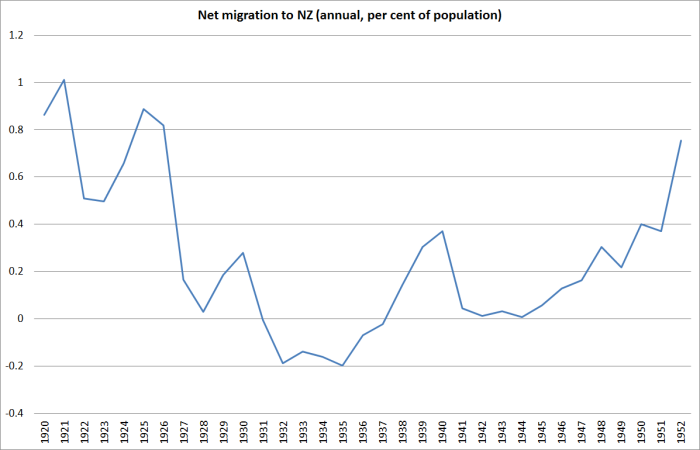
net-migration-20s-to-50s

There had been a big wave of assisted migration in the first half of the 1920s –  almost all those moving to New Zealand then were substantially financially assisted, initially largely by the British government, keen to assist ex-servicemen to resettle in the dominions, and then by the New Zealand government.  Financial assistance to migrants had long been a feature of New Zealand (provincial and central) government policy –  compared with the option of moving to Canada or the US (or even just staying in the UK), moving to New Zealand was expensive (time lost as well as fares).  But inflows to New Zealand dropped off after the mid 1920s and government assistance to migrants was largely discontinued from around 1927.  Over the twenty years, 1927 to 1946, annual net migration to New Zealand averaged less than 0.1 per cent of the population.  Not surprisingly, there was little movement during the war, and in the 1930s the outflows of the first half of the decade –  the UK was much less badly affected by the Great Depression than New Zealand was – largely balanced out the moderate inflows later in the decade.

At the end of World War Two, there was considerable angst about population prospects.  Birth rates around the advanced world, including New Zealand, had been low, and in many countries there was unease about what a flat or falling population might mean.  And the war itself had brought to the fore the idea that a lightly populated country might be unnecessarily prone to invasion threats.

There were no legal obstacles to immigration to New Zealand from Britain (or the other Dominions): as New Zealanders could move freely to Britain, so Britons could freely move here (as they could until the 1970s).  But in 1947, the government restarted the assisted migration programme – initially those selected had to contribute £10, but within a couple of years that requirement had been dropped.  Even though life in post-war Britain was pretty tough, and the gap in material living standards then was probably as large as it ever was, the government didn’t find it that easy to fill the number of free places it was offering.  But total immigrant numbers did pick up sharply and (as illustrated in the chart above) by 1952, the net inflow of immigrants had almost reached the sorts of levels soon in the first half of the 1920s.  And despite earlier worries about the birth rate, the “baby boom” happened here too.  In 1952, the total population increased by 2.5 per cent –  an even larger increase than we’ve experienced over the last year or so.

In 1952, Professor Horace Belshaw, an immigrant (as a child) himself, former student of Keynes at Cambridge, and by then McCarthy Professor of Economics at Victoria University and one of the most widely-published New Zealand academic economists of his day, turned his attention to the question of immigration to New Zealand.  In his short (32 page) booklet, Immigration: Problems and Policies, Professor Belshaw discussed some of the economic (and other) effects of high rates of immigration.

I’m going to reproduce here some of Belshaw’s material.  Regular readers will probably note a certain similarity with the economic analysis I have been presented about more recent New Zealand immigration policy (although I only found the Belshaw material a few years ago).

In beginning his discussion, Belshaw notes

In considering the volume of immigration which is in “the best interests” of New Zealand, it is necessary to distinguish between the “absorption capacity” at any particular time and what is desirable over the longer period…..we must compare the effects of a given growth of population with the effects of the larger population resulting from this growth.

…for example, the long run position will be affected by whether or not more intensive production in agriculture will yield a lower return per head with a somewhat larger population, whether the supply of electric power can be economically expanded to satisfy not only the increased use of electricity per head of population, but also the larger number of heads.  And the answer in both cases may be affected by technical discoveries not yet made.

Belshaw discusses a number of the transitional issues

Cultural absorption.  As he notes, most of the migrants at the time were from the UK and Northern Europe, and so

There will be personal misfits enough and the need to give assistance in orienting to the New Zealand way of life, but the cultures they bring with them at sufficiently close to our own to raise no special difficulty of absorption, and there are no social or political reasons to fear the growth of minority problems among groups which preserve a separate identity, such as have plagued the United States. On the other hand, migrants bring with them new skills, different accomplishments, and ways of looking at things which should prove economically advantageous and culturally enriching.

Immigration and the Labour Shortage

At the time when there are more vacancies than workers, it is natural to assume that immigration will relieve the labour shortage. This however, is a superficial view.  The immigrants are not only producers but also consumers. To relieve the shortage of labour it would be necessary for more to be contributed to the production of consumer goods or of export commodities used to buy imported goods than the increased numbers withdraw in consumption.  That is unlikely….[and] there will be some temporary net additional pressure on consumption.

Immigration and Capital Needs

Of much greater importance is the fact that each immigrant requires substantial additional capital investment, not in money but in real things.  Houses and additional accommodation in schools and hospitals will be needed. In order to maintain existing production and services, and even more to maximize production per head, there must be more investment in manufacturing and farming, transport, hydro-electric power, municipal amenities and so on.

To anticipate a little, immigration is not likely to ease the labour shortage while it is occurring, and is more likely to increase it because although additional consumers are brought in, more labour than they provide must be diverted to creating capital if the ratio of capital to production is to be maintained.  So the unsatisfied demand for consumers’ goods and therefore for labour to produce them will not be met.

…the fact remains that while it is occurring a population increase of the order under consideration will reduce the volume of capital per head, and for the time being cause production per head to increase slower than with a smaller rate of population increase. Immigration must be assessed in relation to its contribution to this situation.

The expansion of population of itself will increase inflationary pressures, for the net effect is to create additional purchasing power to finance capital creation without producing an equivalent volume of consumers’ goods and services.  This is another way of reiterating the point that it will not reduce labour shortages….. A sufficiently austere fiscal and financial policy might curb the inflationary effects, but not the necessity for capital formation nor the reduction for the time being in living standards.

As capital formation proceeds, the contribution of increased population to consumption will grow, and after five or six years may exceed current consumption per head. Meanwhile, however, each successive increase in population exerts inflationary pressures until such time as the aggregate increase in production from a larger population exceeds the annual capital formation needed by the growing population,  This would take a very long time.

He summarises his conclusions “in respects of current effects of immigration and population increase”.  Extracts:

2. Immigration of the scale contemplated is likely to increase inflation pressures and of itself increase rather than reduce the shortage of labour.

3. It will also increase the balance of payments problem and the need for credit controls, higher interest rates or import controls.

6. While it is occurring and for some time thereafter immigration on the scale contemplated is likely to lower living standards, either by reducing the supply of manufactured consumers’ goods or of facilities and amenities such as school and hospital accommodation, or by imposing additional strains on existing private and public capital.

My general conclusion is that the effects of such a volume of immigration on the New Zealand economy while it is occurring at the present time , are on balance prejudicial.

From the effects of immigration while it is occurring (and for several years afterwards), Professor Belshaw then turned more briefly to consider the effects of a larger population, once any transitional challenges had washed through.

Is it in the interests of New Zealand that the population should double in, say, 28 years (ie increase at a rate of about 2.5 per cent per year) and that immigration of a scale necessary to bring this about by supplementing natural increase should be arranged?  We reiterate that the problem is posed in these terms because immigration and natural increase have many similar effects.

He briefly looks at some non-economic factors

Strategic considerations.  In some quarters increased immigration is supported for strategic reasons. I have seen no analysis of the real issues by the proponents of this view, and in the absence of such a study confess to some reluctance to attach much weight to it in modifying opinions arrived at on other grounds.     ….a more likely strategy [than invasion] would be to blockade us into submission or ineffectiveness. The contribution of any conceivable immigration to New Zealand’s manpower then seems likely to make little difference.

Humanitarian Aspects of Immigration.  Presumably the immigrants will be better off than in their own countries, and the New Zealand community might be prepared to incur some sacrifices, if these prove necessary, to satisfy such a humanitarian impulse; but any possible volume of immigration will have a very small effect in relieving pressures in the home countries of the migrants.

Belshaw goes on to note that our then, in effect, “white New Zealand” immigration policy was unlikely to command much international admiration no matter how many migrants we took.

Cultural and Economic Enrichment.  Regarded from New Zealand’s own interests, a sizeable volume of immigration should prove advantageous in more ways than one…..The New Zealander who returns home after some time abroad [as Belshaw recently had] is often depressed at the unnecessary drabness and uniformity in the New Zealand way of life, and at the paucity and low level of achievement in many of the arts and crafts.  New blood may perhaps weaken the complacency with which these are accepted, and add spice and variety.  And there is no reason why these should be gained at the expense of those conditions and those national qualities which still make New Zealand so pleasant a place to live.  Is it really necessary, for example, that even in our main cities, our restaurants should be so reminiscent of the pioneering epoch (flies and all), and that the best food in the world should be so cavalierly treated?

As he notes, before turning back to economic considerations

this general line of argument supports the case for immigration, but not for any particular figure.

In commencing his economic discussion, Belshaw notes that

Presumably we should like to see such a trend of growth of population as is conducive to the maximum real income per head

while acknowledging that the answers and his opinions “must be very largely conjectural”.

He notes

it is a reasonable assumption that over the longer period immigrants will contribute much the same to both production and consumption per family as the general population. So we need not distinguish between immigrants and indigenous population when considering the effects of larger size, except insofar as the immigrants have brought new stimuli, arts and crafts, which we might otherwise lack.

Belshaw notes that there are some genuine economies from a larger population

As population becomes larger we should expect a variety of economies to result, increasing the effectiveness of labour applied to a given volume of capital.  The transport system would probably be more effectively utilized as the volume of traffic reduced overhead per unit of transport service…..There seems no reason why the machinery of government need increase pari passu with population apart from the extension in the range of government functions.

I believe these advantages to be real; but there is another side to the story.

….Here the capital requirements for population growth come into the picture. Previous discussion will have indicated that in my view these requirements are of such dimension as to greatly retard the increase in capital per head of population  Failure to increase, or even maintain capital per head will in large measure offset the benefits from a bigger population, increase the problem of bottlenecks, such as in relation to power, and by virtue of inflationary pressures distort the economy.  It seems unlikely that the annual increase in the production of consumers’  goods facilitated by a bigger population will offset the transfer of production to capital formation required by an increasing population. I fear that with a population increase of 2.5 per cent, we shall be faced with continued incentives to controls, primarily as a check on inflation…. Such controls may actually discourage enterprise. On these grounds I should consider that a smaller dose of inflation –  and therefore a smaller rate of population increase –  would be preferable.

Belshaw also discussed the scope for growth in exports, having devoted a considerable portion of his career to agricultural economics

The trend of external demand seems likely to be buoyant for farm products, though there may be recessions from time to time. Currently there are shortages in forestry products; but I have insufficient information to offer a judgement on prospective world demand some years hence. On the other hand, diversion of production to capital formation and the consequent internal inflationary pressure will adversely affect internal costs [in other words, raising the real exchange rate ] and divert labour away from farming and so impede expansion.  My view is that in consequence there will be less expansion in farming with a 2.5 per cent increase in population than with a smaller increase.

…I anticipated that we shall derive an expanded real income from overseas as a result of improvements in the terms of trade and of expanded exports; but reiterate that this expansion is likely to be larger with a smaller population increase….Hence on this score also we should expect a larger income per head with a lower population  increase.

Belshaw concludes his paper thus

Some probable developments favour immigration and others are unfavourable. But it is those elements favourable to the case for population increase which are most conjectural and uncertain. The current recurring disadvantages of a large population increase, and therefore of a large volume of immigration, seem to be more clearly demonstrable than the advantages of the larger settled population which would result from them.

The economy, and particularly the policy structure around it, in 1952 was different than it is now, and so not all the language easily translates into current discussions.  We don’t have exchange controls or (many) direct credit controls, and on the other hand, interest rates are much more variable, as are the nominal and real exchange rates.  But the essence of Belshaw’s story, almost 65 years ago, is really very similar to the lines I’ve been running about New Zealand.  Rapid population growth, now driven largely by immigration policy, almost inevitably puts considerable pressure on domestic resources, skewing resources away from production for consumption or exports to simply keep up with the capital requirements of a larger population.  Immigration doesn’t ease labour shortages, and if anything exacerbates them (at any economywide level).

Although I agreed with his conclusions, I didn’t find Belshaw’s analysis of the implication of a larger population as persuasive as his analysis of the transitional (multi-year) pressures.  But we know that there is no evidence that larger countries have achieved faster growth than smaller countries.  And I’d emphasise some different points than Belshaw does, especially the apparent constraints of distance/location, which would have been much less apparent in 1952, when agricultural and pastoral exports alone still produced top tier incomes for a small distant population.

But it is just a shame that successive governments in the 1950s and 1960s –  and again since the late 1980s –  have paid more attention to plaintive short-term cries from employers of “skill shortages, skill shortages” (only ever apparently relieved by recessions) than to the lack of good analysis and evidence that high rates of immigration actually make New Zealanders better off. Perhaps high immigration benefits native populations in some places and at some times –  I’m quite open to that possibility – but there is little sign they have in the past, or are now doing so, in post World War Two New Zealand.

After all, when Belshaw wrote, New Zealand had probably the third highest material living standards in the world.  Now, depending on the list you consult, we are no better than about 30th.  Other things have contributed to that glaring failure, but the repeated pursuit of a larger population (as a matter of policy) certainly shows no sign of having helped.  It was bad enough that the cautions of Belshaw –  and other economists –  were ignored back then. It is much worse now when for decades there has been a steady net outflow of New Zealanders, dispassionately assessing the prospects for themselves and their families in the country they know best, and deciding to leave.

Experts: harness them, don’t let them set the course

There was interesting long article in The Guardian the other day by Sebastian Mallaby, the author of a new biography of Alan Greenspan, on “The cult of the expert – and how it collapsed”.  His focus is central banking, but his concerns range much wider. For Mallaby, the (alleged) “collapse” of this “cult” is something to lament.

Of course, when you are brought up the son of a former senior British ambassador, educated at Eton and Oxford, previously a columnist for the Financial Times and then the Washington Post, when you are married to the editor of The Economist, when your books are biographies of two prominent unelected figures – Greenspan and James Wolfensohn, former head of the World Bank –  and when your column is published in The Guardian –  house journal of the British left-liberal technocratic elite – such a lament might be seen as not much more than a piece of class advocacy.

But I’ve usually found Mallaby interesting, and this column – which is well worth reading – had me reflecting again on quite what I think experts should be for.  To get ahead of myself (and pre-empt a long post), my answer was “advice” and “execution”, but only rarely for “decisions”.  That is a quite different answer than the one Mallaby offers. For him, experts simply need to sharpen up their act, become a bit more politically savvy, and show that they deserve the power they have assumed.

Quite early in his article, Mallaby poses the question thus

No senator would have his child’s surgery performed by an amateur. So why would he not entrust experts with the economy?

That one seemed pretty straightforward to me.  When one of my kids needed surgery a few years ago, I wanted expert advice on the options, risks and implications, and I wanted an expert carrying out the surgery, but the decision to proceed with one option rather than another wasn’t the surgeon’s.  It was mine.  The doctor has some specialized knowledge and technical skills, on the sort of case he had probably seen hundreds of times before (and I’d seen not at all).  And if the doctor ended up doing a completely different procedure than the one I’d authorized, or botched the operation, I had specific remedies and complaints procedures I could follow.  I’m sure there are complex cases, and sometimes genuine debate among medical professionals about the best way to treat some conditions, but ultimately the decision to proceed or not is made by the patient (or parent/guardian).

The same might go for house renovations.  A good architect, and capable expert builders and other tradespeople, can together enable an outcome that I couldn’t deliver myself.  Most of us need, and value, expert advice, and expert execution, but the decision to renovate the house, and how far to go, is the customer’s.  It is about choices and preferences on the one hand, and advice from experts who actually usually know what they are doing on the other.

It isn’t clear to me that there are very many areas of public policy where arrangements should be much different.

There are plenty of areas where in the administration of policy we don’t want politicians to have a hands-on role.  It is one of the cornerstones of our system that rules and laws, once established, should be applied impartially, without fear or favour.  Whether it is Supreme Court judges interpreting and applying the laws, or clerks administering benefit eligibility rules in WINZ, we don’t want politicians –  or any other of the “powerful” – getting a better deal, and more favoured treatment, than anyone else.  It is an ideal, and it isn’t always perfectly realized, but it is an ideal that is important to keep before us in designing and monitoring systems.  But it isn’t mostly an issue about technical expertise, but about impartiality in deciding on the administration of the rules.

Setting the rules themselves is quite a different matter.  That is, in many respects, the essence of politics and political debate –  hard choices, conflicting interests, conflicting evidence, and sometimes conflicting values.

As Mallaby notes, central bank operational independence, especially around monetary policy, became something of a stalking horse for people with interests in many other fields of policy.

The key to the power of the central bankers – and the envy of all the other experts – lay precisely in their ability to escape political interference. Democratically elected leaders had given them a mission – to vanquish inflation – and then let them get on with it. To public-health experts, climate scientists and other members of the knowledge elite, this was the model of how things should be done. Experts had built Microsoft. Experts were sequencing the genome. Experts were laying fibre-optic cable beneath the great oceans.

He draws on the published thoughts of Alan Blinder, Princeton economist, who spent time as chairman of the Council of Economic Advisers, and as vice-chairman of the Federal Reserve.  As Mallaby tells it:

His argument reflected the contrast between his two jobs in Washington. At the White House, he had advised a brainy president on budget policy and much else, but turning policy wisdom into law had often proved impossible. Even when experts from both parties agreed what should be done, vested interests in Congress conspired to frustrate enlightened progress. At the Fed, by contrast, experts were gloriously empowered. They could debate the minutiae of the economy among themselves, then manoeuvre the growth rate this way or that, without deferring to anyone.

To Blinder, it was self-evident that the Fed model was superior – not only for the experts, but also in the eyes of the public.


…..Blinder advanced an alternative idea: the central-bank model of expert empowerment should be extended to other spheres of governance.

Blinder’s proposal was most clearly illustrated by tax policy. Experts from both political parties agreed that the tax system should be stripped of perverse incentives and loopholes. There was no compelling reason, for example, to encourage companies to finance themselves with debt rather than equity, yet the tax code allowed companies to make interest payments to their creditors tax-free, whereas dividend payments to shareholders were taxed twice over. The nation would be better off if Congress left the experts to fix such glitches rather than allowing politics to frustrate progress. Likewise, environmental targets, which balanced economic growth on the one hand and planetary preservation on the other, were surely best left to the scholars who understood how best to reconcile these duelling imperatives. Politicians who spent more of their time dialing for dollars than thinking carefully about policy were not up to these tasks. Better to hand them off to the technicians in white coats who knew what they were doing.

And yet, 20 years on, there is no sign that the public  –  really anywhere in the advanced western world –  wants to hand more policy-setting power over to technocrats and unelected officials.  (On other hand, the power grab by officials –  and even ministers averse to the involvement of legislatures –  goes on in almost every country; the administrative state keeps growing.)

The Reserve Bank of New Zealand Act gets a brief mention in Mallaby’s article.  In conception, it was perhaps the strongest possible case for delegating operational policy decision to officials (“experts” –  although none of the three decision-making Governors since 1989 would really have qualified as monetary policy experts when they were appointed).   It seems to me that three or four beliefs/propositions underpinned the case for handing over decision-making power around the conduct of monetary policy:

  • politicians had all the wrong incentives and would almost invariably postpone hard decisions, creating a bias towards inflation, and excessive economic variability,
  • it was relatively straightforward to specify the goal society wanted pursued with monetary policy (so officials weren’t being asked to make meaningful trade-offs, just “read the data, and do the right thing –  the latter according to the societal rule”)
  • it was relatively straightforward for able technocrats to make the right decision –  consistent with the societal rule.
  • holding officials to account was quite straightforward.

There is a small element of caricature in the way I’ve written that list, but I think it gets at the essential assumptions behind the monetary policy bits of the Reserve Bank Act.

Perhaps it was a reasonable story for ministers and officials to tell themselves in the early post-liberalization years.  But none of it bears much relationship to reality.

Perhaps politicians postpone hard decisions on monetary policy –  though it has never been clear to me why this should have been more of a problems in respect of monetary policy (where the lags are quite short) than in other areas of public life (where the lags are often long, and adverse consequences hard to pin down even years later).  And, of course, we’ve now spent the best part of decade grappling with inflation rather lower than most official targets suggest desirable.

And people pretty quickly realized that technical experts could disagree –  at times quite vociferously –  and that there was no very obvious reason to consistently favour one technical expert over another.  And there were/are real choices being made –  on things that matter to voters, such as how much to prioritise lingering unemployment gaps, and on things where it isn’t easy for society to write down in advance how it wants to technical experts to manage the tensions and trade-offs.  And there is no reason to think that “technical experts” are any better placed to decide those trade-offs (or less prone to be influenced by their own class or educational interests/biases) than the public as a whole through the political process.

And, largely as a result, effective accountability for central bankers is limited at best –  really only at the time of potential reappointment.  There are no complaints procedures or expert review and investigatory bodies.  And while the New Zealand case isn’t general, in our case not only is the power handed over to an unelected agency –  notionally ‘expert’ –  but it has been handed over to a single individual for many years at a time.  That isn’t done in other areas of public policy, even when policymaking powers have been delegated by Parliament.

A fundamental part of any proposal to delegating policymaking power to “experts” has to be that such “experts” really know what they are doing.  But the evidence for that, even as regards monetary policy is now pretty slender.  I certainly wouldn’t be hiring as builder or a surgeon someone who had as bad a track record as the world’s central bankers have had over the last decade or so.  That isn’t intended as a personal criticism of any of them, all of whom have no doubt sought to do their best.  But they’ve constantly misjudged inflation pressures, and not randomly but systematically.  I’m not even suggesting replacing them with another bunch of superior experts.  It is just that the limitations of our knowledge are simply too great.  Even if we could all agree that the only thing we wanted from our central banks, year in year out, was 2 per cent inflation, there is no expert consensus on how best to deliver it, and what expert consensus there is has a pretty poor track record.

And, of course, there is even less agreement in practice –  where society seems not just to want 2 per cent inflation, year in year out. In the current climate, some favour a more aggressive use of monetary policy, perhaps to use demand to soak up laid aside labour and prompt a resurgence in the supply side of the economy (Janet Yellen’s recent speech seemed to point a bit in that direction).  Others are quite content to put inflation targets somewhat on the backburner for a while, out of fear of incipient financial crises (in this part of world, both Graeme Wheeler and Phil Lowe) seem inclined to that sort of thinking.  In Sweden not long ago the monetary policy decision-making body was torn apart by the tension between these sorts of views.  There is no straightforward generally agreed analytical framework, revealed only to the “experts”, enabling them to make such decisions better than anyone else.

Thus, I was bit troubled when I read Phil Lowe’s first speech as Governor.  In it he notes some of these choices and trade-offs, but then falls back on the (non-statutory) concept of “the public interest” (the RBA’s statutory goals are much vaguer than those of the RBNZ, but “the public interest” doesn’t feature, at least not directly).

He notes

So when thinking about what type of variation in inflation is acceptable, it is natural for us to start by asking ourselves: what is in the public interest?

But

Granted, this can be hard to define and opinions can differ

And

This might all be less tightly defined than some people would like. But given the uncertainties in the world, something more prescriptive and mechanical is neither possible nor desirable. Inevitably, judgement has to be exercised. Successive governments have appointed nine dedicated Australians to the Reserve Bank Board to exercise that judgement in the public interest.

I have a lot of sympathy for the view that a “more prescriptive and mechanical” target for discretionary monetary policy isn’t really possible.  But if it isn’t possible, why should suppose that Lowe, his deputy, the Secretary to the Treasury, and the non-executive directors –  not one of whom ever faces an electoral test –  are best placed to work out what is in “the public interest”?  Better than the (somewhat dysfunctional) elected governments?    If there is going to be an operationally independent central bank, I think the Australian governance model is clearly superior to our own (though in turn probably inferior to the UK’s) but why would one delegate such discretionary powers at all?  One could no doubt mount an argument for lower, or higher, interest rates in Australia at present, even with a shared assessment of the outlook for inflation.  The differences will turn on preferences, values and –  frankly –  hunches.  They won’t turn on, say, the sort of solid track record of a surgeon who has done much the same operation hundreds of times before.  None of us –  central bankers, outside economists, politicians, the public –  have ever seen quite such conjunctions of economic circumstances before.

None of which is some call for rank populism.  As I said very early on in this post, there is a valuable role for experts in advice and execution.  We want capable people who know exactly what they are doing conducting the market operations that implement monetary policy.  And it is likely that economists and related experts can offer some useful advice on the options that societies face around monetary policy and the underperformance of economies in recent years.  But the “experts” just don’t know that much at present – that isn’t an accusation, it is a fairly neutral description of what one reads in speech after central bank speech.  And it isn’t a matter of shame, but of alignment.  We shouldn’t –  and generally don’t –  delegate policy decisions when the evidence base is weak and there are real and contested tradeoffs.

And all this has been about monetary policy, where perhaps once the case for delegation looked strongest.  Banking regulation is perhaps a clearer illustration of my point: we want people administering the rules without fear or favour, we need detailed expertise on specific instruments or institutions, and we need expert advice as input to policymaking.  But in setting policy there are real and inescapable choices, and there is little obvious reason to think decision-making on what the rules should be should be delegated to “experts”.  Take LVR policy as a recent New Zealand example: all the choices have distributional implications, there is little or no established body of knowledge of research, and in the end the decisions that have been made rest on little more than educated hunches, and about risks, costs and tradeoffs.  Perhaps they are the right hunches, but we have no way of knowing. It isn’t remotely like asking a doctor to use his expertise to reset a broken bone.  If the case for such policy is so strong, let the experts persuade the politicians –  who are elected, and can be unelected.

Mallaby is writing with two backdrops in mind.  The first is his recent biography of Greenspan, who appears as a hero in the story.  And the second is what he appears to regard as the “disaster” of Brexit and the Trump insurgency (even if the latter now appears unlikely to storm the citadel).  About Greenspan, you can read Mallaby’s argument for yourself.  I’m more inclined to the view, reflected in Peter Conti-Brown’s book that I wrote about earlier in the year, that Alan Greenspan is an argument for term limits for heads of central banks.  Over 19 years as head of the Federal Reserve he became such a dominant presence, including in the political debate, that (among other things) his views somewhat overshadowed the looming risks that eventually culminated in the 2008/09 crisis.  And frankly, no matter how able –  and Greenspan didn’t walk on water –  there is something amiss when a technocrat, never facing an election, wields that much power.

I was (and am) a Brexit supporter, so I can’t share Mallaby’s distaste for Michael Gove’s dismissal of “experts” in that debate.  How one’s country should be governed, in close association with which other countries, seem quintessentially like an issue on which the public might quite reasonably have a view.  To be sure, as always, there is a place for expert advice on the issues and implications of the various possible choices, but “experts” have interests too, and they are necessarily or always those of the wider public.  As I noted earlier in the year, in many cases the end of the British empire led to independent successor states that struggled economically.  Perhaps independence was a “sensible economic choice”, but in sense that is the point; people value different things, and perhaps put a premium in that case on self-government, even if at some economic cost.

Towards the end of his article, Mallaby notes

Democracy is strengthened, not weakened, when it harnesses experts.

And I agree.  But the operative word there is “harnessed”.  Experts have a valuable role as advisers and –  in policy matters often a different set of “experts”  –  as implementers.  Expert advice can help illuminate the costs and consequences of the choices and tradeoffs societies make –  whether relatively mundane ones around monetary policy, or more existential ones around decisions to go to war, to construct welfare states or whatever –  but “experts” are typically ill-equipped to make those decisions for us.  In fact, often enough, even what appears to be a consensus of expert opinion –  or establishment opinion (often the same thing) – is left in tatters by experience.  To end on a note more of politics than economics,  there was a column in the New York Times a few days ago

Almost every crisis that has come upon the West in the last 15 years has its roots in this establishmentarian type of folly. The Iraq War, which liberals prefer to remember as a conflict conjured by a neoconservative cabal, was actually the work of a bipartisan interventionist consensus, pushed hard by George W. Bush but embraced as well by a large slice of center-left opinion that included Tony Blair and more than half of Senate Democrats.

Likewise the financial crisis: Whether you blame financial-services deregulation or happy-go-lucky housing policy (or both), the policies that helped inflate and pop the bubble were embraced by both wings of the political establishment. Likewise with the euro, the European common currency, a terrible idea that only cranks and Little Englanders dared oppose until the Great Recession exposed it as a potentially economy-sinking folly.

Like most cults, the “cult of the expert” is more dangerous than Mallaby –  or most of the expert class – acknowledges.  And hotly contested political debate, messy as it often, wrong directions that it sometimes takes, are how we make the hard choices, the trade-offs, amid the inevitable uncertainty. Abandoning that model is akin to gutting our democracy of much of its substance.  So I still want an expert operating on my child, but I want parliaments making laws and setting taxes (not officials) and parliaments taking us to war (not generals).  And I increasingly wonder whether monetary policy decisions should be left to officials either –  no matter how technically able, and how many of them on the decisionmaking panel.


Eden Park advertisers and the NZ tradables sector

My wife and son were watching the rugby test on Saturday evening but, not being overly interested in rugby, I started paying attention to the companies that were advertising at the ground.

All Blacks tests are one of the international showcases of New Zealand, with a substantial overseas broadcast audience.  And that particular test was against the Wallabies, and Australia is the largest export market for New Zealand firms’ goods and services.

I can’t be sure I jotted down all the advertisers: I was dependent on the camera angles Sky showed and I wasn’t paying rapt attention to every second of the game.

But these were the companies/brands whose adverts I thought I spotted:

AIG,  Adidas, American Express, Ford, Mobil, Asteron Life, DeWalt, Stihl, KitKat, Gatorade, Kia

Kennards, Owens, Resene, ASB, Pacific Build Supply, Bedpost, Barfoot and Thompson, Drymix, Rebel Sport, G.J. Gardner, Steinlager, Air New Zealand, Mainfreight and Zestel Gum (yes, I had to look up that one) and Auckland (Council or a CCO).

So I noted 26 advertisers.  One was a local government agency.  Of the remaining 25, 11 were overseas firms/brands, selling into the New Zealand market and in other countries.

It was the other group of firms/brands that interested me.  Of them, as far as I could tell only two were New Zealand based internationally-oriented firms: Air New Zealand, and Mainfreight (which now has substantial overseas operations).  And Air New Zealand, while currently very successful, collapsed only 15 years ago, remains majority state-owned, and one assumes its continuing independent status largely depends on the heavily regulated nature of the international airline and landing rights market.

I gather there are some reasonable substantial exports of Steinlager, but then Steinlager is a product/brand now produced by a Japanese-owned company.

Perhaps on another occasion a rather different mix of companies would have been advertising, and the New Zealand based ones might have been a more outward-oriented group.  But in microcosm, it did seem to capture something of the strangely-imbalanced New Zealand economy, struggling to make inroads in international markets or against international competition.

That phenomenon is nicely illustrated by my regular chart showing tradables and non-tradables components of GDP (recall that primary production and manufacturing, and exports of services make up “tradables” –  and the rest of GDP is non-tradables).  It is only a rough indicator, but it seems to have told quite sensible, intuitively plausible, stories.

T and NT GDP oct 16.png

In per capita terms, tradables sector GDP is still lower than it was on average in the first eight years of the 2000s (prior to the recession). In fact, the peak in the series was way back in 2004q2.  There has been no sustained growth in average per capita tradables sector production for 15 years.

That shouldn’t really be very surprising.  With able people and fairly good institutions, still the main thing New Zealand has going for it, as location for internationally-oriented businesses, is the natural resources that are here.  And when the population increases as rapidly as it has in the last 15 years, with no major new natural resources to tap, and with sustained upward pressure on the real exchange rate, it is hardly surprising that there has been so little (per capita) tradables sector growth.

Or so few successful outward-oriented New Zealand firms to advertise to the world from Eden Park.


Does Australia really need “the English influence”?

I’ve been intrigued for some time by the way in which some Australian business and media leaders seem to think that New Zealand –  perhaps especially under the stewardship of the current government – is a model of governance and economic management to be emulated.  Indeed, when it suits, this idea even reaches all the way up to some politicians.  On the day of his successful party-room coup to topple Tony Abbott, Malcolm Turnbull declared

“John Key has been able to achieve very significant economic reforms in New Zealand by doing just that, by taking on and explaining complex issues and then making the case for them. And I, that is certainly something that I believe we should do and Julie [Bishop] and I are very keen to do that again.”

As I noted in a post at the time, the list of “very significant economic reforms” was so short I couldn’t think of any.

What puzzles me more is when senior New Zealand commentators buy into the same story.  Fran O’Sullivan’s column in the Herald yesterday, “Oz needs the English influence” seemed to do exactly that.  It is interesting to know how some influential Australians see the New Zealand story, but O’Sullivan seems to share the belief, noting that our economic performance is “something to skite about when it comes to transtasman rivalry”.

Of course, everyone knows Australia has its problems.  They still have a federal government budget deficit, and we don’t. The Prime Minister has changed so often in the last decade, it must almost look familiar to Italians. And in Wayne Swan and Joe Hockey, they’ve had a couple of Treasurers who didn’t command much respect.  And Australia is coming off the back of a massive mining investment boom –  in many respects a nice problem to have, and in contrast to the lack of much of market-led export-oriented business investment boom in New Zealand any time in recent decades.

And, of course, if the National-led governments of the last eight years have all been minority governments, John Key and Bill English mostly seem to have managed the politics quite adeptly: they are still in office, and look to have a reasonable chance of winning again next year.  And English is a thoughtful Minister of Finance, even if not one with much of an economic plan.

But one can always find thoughtful individual ministers –  I recall reading speeches by Craig Emerson, a minister in the Rudd/Gillard governments and a former senior public servant, and wishing we had ministers who could give such thoughtful and rigorous speeches.

And Federal systems, and bicameral Parliaments, are just harder to manage –  but not necessarily worse for it – than the New Zealand system.

My benchmark remains the numbers.  It is no secret that GDP per capita (and all variants on it) is much higher in Australia than in New Zealand.   That has been so for at least 40 years.  It is the reason why lots of New Zealanders move to Australia, and only a small number of Australians come to New Zealand.

But I guess that in thinking about the Australian Key-English admiration  the focus should really be on how the data have changed in the last few years.  Has the vaunted Key-English style and substance succeeded in changing direction, closing the gaps between New Zealand and Australia?  After all, John Key was once quite explicit that his goal was to close the income gap between New Zealand and Australia by 2025.

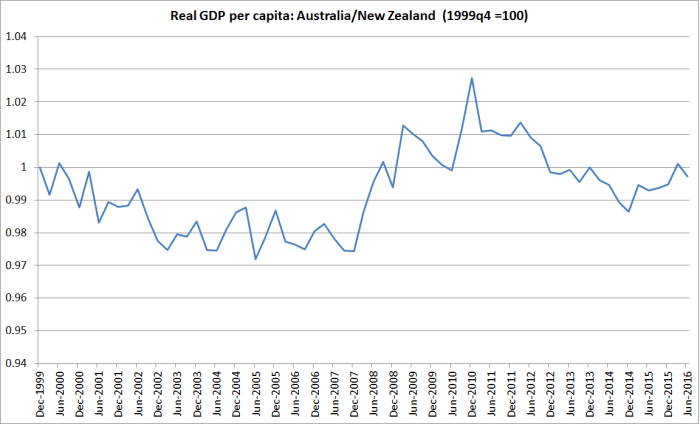
Here is the headline comparison, looking at real GDP per capita

gdp-pc-aus-vs-nz

On this measure, Australia was doing slightly less well than us during the previous boom.  They did much better than we did through the recession and the peak of the terms of trade boom.  And over the last few years, things have settled back again.  For the whole period –  this century to date –  New Zealand and Australian per capita GDP have grown at much the same rate.

New Zealand and Australian governments have almost no control over the respective terms of trade for their countries, and those series are quite volatile.  But if you dig into real per capita income measures (which take account of terms of trade fluctuations), New Zealand has done slightly better than Australia over the century to date.

But that seems to me to be about the absolute limit to the favourable story.

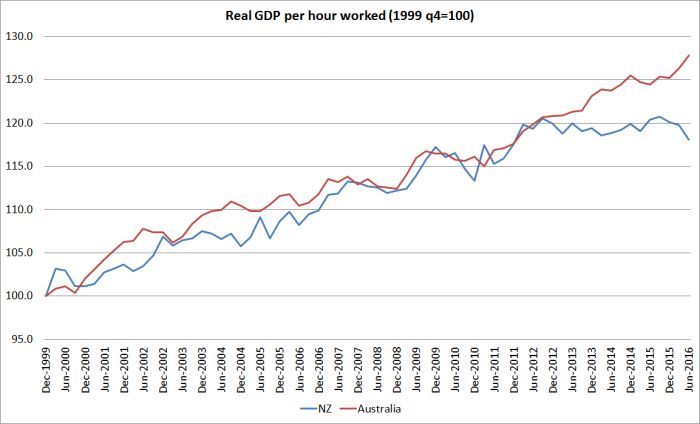
What about productivity growth, the foundation for sustained long-term prosperity?  Here is labour productivity

gdp-phw-nz-vs-aus

You can discount the very last New Zealand observation (on account of a break in the hours worked series, when SNZ updated the HLFS methodology).  But it isn’t exactly a picture which reflects well on New Zealand over the last few years (and especially the years when both countries have had centre-right governments).  In fact, the New Zealand numbers are so bad one half suspects SNZ might eventually revise some of the weakness away.  But in the meantime, no obvious advantage to New Zealand.

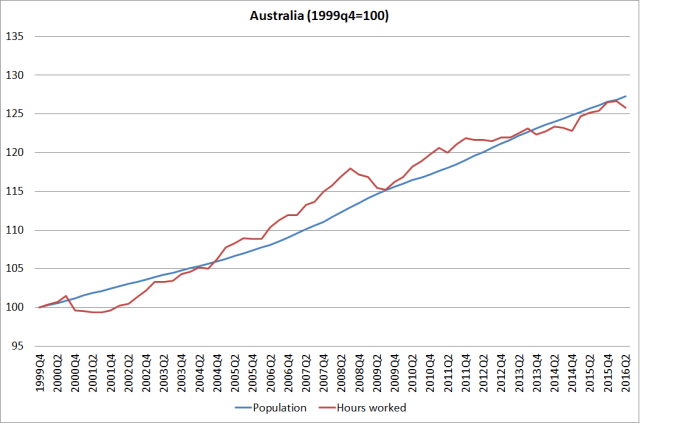
We’ve managed not to lose any more ground relative to Australia on GDP per capita. but only by working even more hours.    Here are Australia’s hours worked and population data

aus-popn-and-hours

And here is New Zealand, on exactly the same scale (and again, discount the very last hours observation).

nz-hours-and-popn

Of course, there is nothing wrong with working longer hours if that is what individuals choose, but for whole economies it isn’t usually a sustainable path to greater prosperity.  And while productivity gains are pure benefit, longer working hours –  especially with little or no productivity growth –  is mostly just a cost.

In some areas, New Zealand does typically do better than New Zealand.  Our labour market is less heavily regulated than Australia’s –  and much less subject to union corruption –  and, as a result, our unemployment rate is typically a bit lower than Australia’s.  Here are the two unemployment rates over the last few decades.

u-aus-and-nz

Right now, the gap between the two unemployment rates –  0.6 percentage points –  looks about normal.  But for much of the current government’s term what was striking was how high our unemployment rate lingered (and above Australia’s for several years).  It isn’t obvious that any special credit is due to the current New Zealand government.

But what about government finances?

It is certainly true that our central government has a modest surplus, while the Australian federal government is still in deficit.  But recall that Australia has a federal system, and the state budgets make  up quite a large proportion of overall government spending and revenue.  International agencies tend to focus on “general government” data –   central, state (where relevant) and local government.  Cyclical adjustment also matters.

Here is OECD’s latest estimates of the cyclically-adjusted general government estimates for the two countries.

net-lending-aus-and-nzAlmost indistinguishable not just now, but over most of the last 20 years.  I’m not sure I’m totally convinced, but that is the OECD’s read.  Again, nothing that particularly stands out to the credit of English/Key relative to Australia.
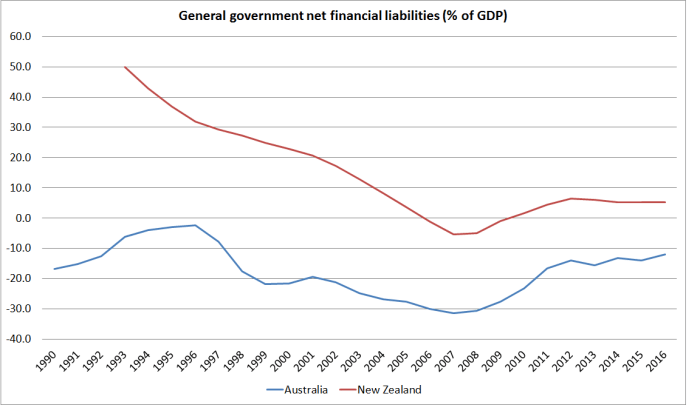
And here is the OECD data on government debt (net liabilities, across all three tiers of government) as a share of GDP.

gen govt net debt.png

New Zealand governments did a great job getting net debt down in the 90s and 00s, but  New Zealand’s net debt is still higher than Australia’s.  Since the last pre-recession year, 2007, Australia’s debt has increased more than New Zealand’s (share of GDP).  That probably is to the credit of Key/English, especially given some of the earthquake fiscal pressures, but on this measure, Australian governments’ net debt is still a bit less than ours was in 2007.

Business leaders also tend to believe –  as I do –  that, within limits, smaller government and lower taxes are conducive to better long-run productivity growth.  Stability in the share of GDP spent by government is also generally thought to matter (reducing uncertainty about future tax rates).

Here is general government spending as a share of GDP.

gen-govt-disbursements-aus-and-nz

Not only is Australian government expenditure lower as a share of GDP, but it is more stable.  And the gap between those two lines has not narrowed over the Key/English years; if anything it has widened.

And here is the picture of revenue

gen-govt-receipts-aus-nz

There isn’t much of a story about variability –  really big terms of trade fluctuations generate a lot of revenue volatility – but again Australian government revenue (mostly taxes) is consistently materially lower than that in New Zealand.

So I’m still a bit puzzled why the Australian business people and commentators seem so taken with the New Zealand story. There is (almost) nothing there. No serious reforms and (to the extent any disagrees with that assessment) no significant productivity growth. No sign of the gaps closing.   The size of government is bigger here, but then it has been for a long time.  And, more positively, the unemployment is a lot lower here, but again current numbers aren’t out of line with past patterns.

I presume much of it just comes down to two things:

  • whenever elites in any country are discontented with their own governments, it is easy to contrast them with some other group of politicians (whose own record is rarely examined closely) over the water,
  • the National-led government has been able to count (law changes it proposes mostly happen, and the details of the languishing RMA reforms are no doubt lost on opinion formers in Australia).  But then it is great deal easier to “count” here, where typically National needs one or two votes from parties it has longstanding confidence and supply agreements with.  It is just harder in Australia, between the role of the states, a governing bloc that is itself a coalition of the Liberal and National parties (National MPs having no say in who is Liberal leader and PM), and the Senate where it is rare for any party to be able to command a stable majority.

John Key and Bill English might be more successful politicians than Rudd, Gillard, Abbott, and Turnbull: the New Zealanders have won three elections, and the Australians have won only one each, and the first three have then been ousted by their own parties.

Perhaps that sort of political stability/political success has its own appeal in certain circles, but if we are judging political leaders by their fruit, there is still nothing much about the New Zealand economic story that should prompt any envy in the eyes of our trans-Tasman neighbours.  Sadly……still……after decades and decades.

Rugby might be another matter, but then I’m a cricket fan.


Getting back to monetary policy

Sometimes ill health does strange things. I’ve been quite unwell for the last couple of months (slowly getting back to normal now) and in that time my interest in current monetary policy and the monetary policy words/actions of the Reserve Bank dropped right away (displaced, according to my book list,  by copious Trollope novels and books of early 20th century history). I didn’t write a post about the last OCR review, and it is more than eight weeks since I last wrote a post about current monetary policy issues at all.

In the grand scheme of things, monetary policy just isn’t that important.  Bad monetary policy won’t impoverish us, and the best monetary policy possible won’t make any material difference in reversing our decades of economic underperformance.  But the same is true of lots of things, and monetary policy is one of the things I know.  And over shorter-term horizons it makes more difference to the fortunes of individuals (and firms) than many other things government agencies do.

The Reserve Bank is charged with keeping annual CPI inflation “near” 2 per cent on average.  Monetary policy takes time to work, and there are all sorts of “one-offs” that muddy the water, so no one would ever expect out-turns averaging bang on 2 per cent, except by chance.  The Policy Targets Agreement talks about “near”, and outlines various reasons why actual inflation might appropriate deviate from the target.  One of the salient ones is the direct impact of government taxes and charges: when the government raises tobacco taxes or cuts ACC levies, those aren’t things you hold monetary policy to account for, or expect monetary policy to try to offset.  Any other approach would deliver daft results.

So how do things stand on inflation now, four years into the Governor’s term?

Here is headline CPI inflation, the focus of the Policy Targets Agreement.

inflation-target-and-outcomes

The 2 per cent focal point has only featured in the Policy Targets Agreement since the end of September 2012  (although prior to that 2 per cent was also the (unstated and unfocused on) midpoint of the target range).

The Governor has often rightly called our attention to the role falling global oil prices have played in dampening headline inflation.  The CPI ex petrol series somewhat overstates the contribution of falling oil prices, because exchange rate pass-through into domestic prices is pretty full and immediate for oil/petrol, and the Governor’s monetary policy choices are one of the things that has held up the exchange rate.  But setting that caveat to one side for the moment, here is the CPI ex petrol series.

cpi-ex-petrol

Inflation on that measure is not only well away from the 2 per cent focus, but it is below the bottom of the 1 to 3 per cent target range.  And doesn’t really look to be picking up much, unless perhaps you put a great deal of weight on the one particularly low annual number at the end of last year.

What of the various other core measures?  At times, the Governor has put a very heavy weight on the Bank’s sectoral core factor model measure of inflation.  It has shown some signs of having turned a corner, and started picking up.  Unfortunately, the way that measure is calculated leaves it prone to quite significant revisions as new data are added (if I recall rightly, back in 2011, the real-time estimates suggested core inflation was above 2 per cent).

sectoral-core-revisions

In this chart, I’ve just shown the estimates for the sectoral core measure a year ago, and those now.  In that time, new data have led to past estimates of the sectoral core inflation rate being revised further down (ie the trough was worse than the Bank realized).  And the current estimate of 1.5 per cent is slightly lower than the 1.6 per cent being reported only a few months ago.

There is no perfect measure of core inflation –  empirically, or perhaps even conceptually.   And the measures the Bank and SNZ report show quite a range of numbers.

Annual inflation year to September 2016
Weighted median 1.7
Sectoral factor model 1.5
Factor model 1.3
CPI ex food and energy 1.1
CPI ex petrol 0.8
Trimmed mean 0.7

The median of those estimates is 1.2 per cent.

We are approaching the next Reserve Bank Monetary Policy Statement.  As everyone is aware the Reserve Bank has cut the OCR quite a long way over the last 16 months, and has indicated that its projections suggest further cuts will be needed to ensure that inflation settles back near 2 per cent.

Only two years ago, in its December 2014 Monetary Policy Statement, the Governor indicated that he expected further increases in the OCR, from the then level of 3.5 per cent.  They soon realized that was a mistake.  But here are those core measures for the year to September 2014 (the latest CPI data in December 2014) and for the most recent year.

Annual inflation year to September
2014 2016
Weighted median 1.7 1.7
Sectoral factor model 1.3 1.5
Factor model 1.4 1.3
CPI ex food and energy 1.4 1.1
CPI ex petrol 1.2 0.8
Trimmed mean 1 0.7

On only one of those six measures is core inflation any higher now than it was then, although in all cases there were lower numbers at some point between then and now.   The cuts in the OCR –  reversing the unwarranted 2014 increases – may have helped stem the decline in core inflation, but haven’t yet done much to get it back to near 2 per cent.

Perhaps there are still further increases in core inflation in the pipeline?  But recall that the largest cuts in the OCR were concentrated in 2015 –  100 basis points of cuts between the June and December 2015 MPSs.  Not all the effects of those cuts will yet have been felt, but the effects are likely to start waning fairly soon.   This year so far we’ve had 50 basis points of OCR cuts, some of which simply offset the impact of falling inflation expectations.  And the exchange rate has been rising this year.

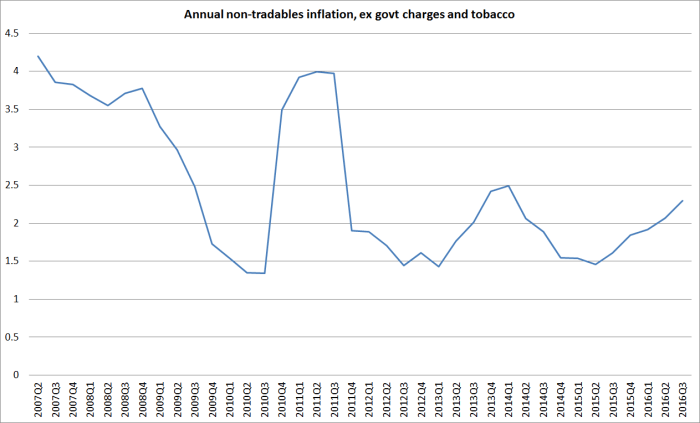
As I noted earlier, when governments raise indirect taxes (eg on tobacco) or cut government levies (eg the ACC component of vehicle registration fees) one really wants to look through such effects.  Unfortunately, SNZ does not publish a series for the CPI excluding taxes and government charges –  and I would urge them to consider doing so – but they do publish a series of non-tradable inflation excluding government charges and the cigarette and tobacco subgroup.  At present, those two exclusions capture the tobacco tax and ACC effects.  Non-tradables inflation typically averages well above tradables inflation (for various reasons) and so can’t meaningfully be compared with the CPI inflation target midpoint, although some people –  including some who should know better –  do so.  Here is the chart of that inflation series.

nt-ex-govt-charges-and-tobacco-oct-2016

To be consistent with overall CPI inflation of around 2 per cent, this series would have to be inflating at somewhere nearer 3 per cent per annum.  But this inflation rate has picked up quite a bit, and quite steadily over the last year or so.  That should be a slight cautionary note when considering what should be done with the OCR from here, but it is worth noting that this series also picked up quite a bit in 2013 and that proved to be a false signal.

Like the Reserve Bank, I do think the OCR should be cut further, and I expect it will be cut.  But I might be a little more cautious now than perhaps I would have been at the start of the year about just how large future cuts might desirably be.

Of course, in part that depends on one’s sense of the strength of the economy.   The global picture looks no rosier, and although dairy prices have picked up somewhat, other impulses must be waning.  Growth in tourist arrivals seems to be slowing, as does the sharp growth in foreign student numbers (and the residence approvals programme numbers have been cut a bit).  The Christchurch rebuild impulse is well past its peak, and I don’t see much reason for optimism about a renewed surge in other private domestic construction.  Then again, interest rates work with a lag, and although real interest rates are still higher than they were say three years ago, they are lower than they were 12 to 18 months ago.  And between new prisons (another non-tradables shock tending to boost the real exchange rate) and other government capital expenditure to catch up with the unexpectedly rapid growth in the population, there probably isn’t much reason to expect the modest per capita growth over the last couple of years to slow that much in the next year.

As I’ve said before, however, forecasting is a bit of a mug’s game.  For me, two considerations still tilt me to favouring at least another 50 basis points of cuts:

  1. The unemployment rate is still lingering well above official estimates of the NAIRU, and that is something monetary policy can do something about, and
  2. Because we will go into the next recession (whenever it is, although history would suggest some time in the next five years) with much less ability to cut the OCR than we have had in past recessions, in the current climate if monetary policy errs at all it should be erring towards delivering inflation outcomes perhaps a little above target (even if still “near 2 per cent”) rather than quite a way below target as in recent years.  Inflation expectations for the next few years quite a bit higher than we have now would be a positively desirable outcome.    The Bank doesn’t really have a mandate to target expectations much above 2 per cent, but if it is going to err –  as it has, quite materially, in recent years – better now to err on the high side.

And for all the rhetoric from the government and their cheerleaders, it is not as if the economy has been doing that well.  Non-existent productivity growth and no better than middling per capita GDP growth aren’t signs suggesting we should just ignore low inflation and bask in our “economic success”.


Rethinking immigration policy: the Greens

The Green Party has been rethinking its approach to immigration.

Not that long ago, the Green Party seemed to be pretty stridently in favour of New Zealand’s large scale, fairly liberal, immigration policy.  It was never entirely clear to me why.  They were the party that emphasized the potential environmental damage from more intensive dairy farming, and were usually reluctant to support new infrastructure projects, partly on environmental grounds.  And yet ever more people pretty inevitably means a need for more exports (in a country that has shown little ability to develop large scale exports much beyond the fixed natural resource base) and more infrastructure.  And globally, radical Green supporters are sometimes heard to call for population policies, potentially penalizing people having the number of children they might prefer, all in the “interests of the planet”.  So I was never sure quite why the New Zealand Green Party was so keen on large scale inward migration, when the combination of (shrinking) natural increase and the typical outflow of New Zealanders would have delivered us a fairly flat population if only we’d had a more modest, and internationally conventional, target level of non-citizen immigration.  The only arguments one ever heard were along the lines of “diversity is good”, but then New Zealand is already one of the most ethnically diverse countries in the world, and without a great deal of economic success to show for that very rapid diversification over the last few decades.  Perhaps they just wanted to share the bounty of New Zealand with as many people from other countries as they could?  Perhaps they really didn’t like New Zealand, and New Zealand culture as it was, and had an agenda for breaking that down?

But now the Green Party has had a rethink.   Trying to understand the change, and its implications, I listened to James Shaw on The Nation, and read a couple of substantive articles (here and here) with quotes from Shaw.

If I read the policy correctly, it is to set a target for New Zealand’s population growth of 1 per cent per annum, and to adjust immigration policy settings (each year, or even more frequently?) in light of changes in the rate of natural increase and in the net outflow of New Zealand citizens.  On the Greens’ own calculations that would have meant a targeted net inflow of around 17000 to 20000 this year.    That is not an order of magnitude different from the medium-term target rate of residence approvals I have argued for, of around 10000 to 15000 per annum.

Perhaps it is good short-term politics, but as policy it doesn’t look as though it has been particularly well thought through.

Rates of natural increase don’t change that much from year to year, and although there can be big movements in that series over time there is quite a lot of persistence in the changes (eg the post-war increase in the birth rate last for almost two decades).  But the net flows (usually outflows) of New Zealanders are very volatile, and very difficult to forecast.  Here is the chart of actual net flows of New Zealand citizens.

plt-nzers

Fluctuations of 30000 per annum in just a couple of years aren’t uncommon, and if one had access to (say) all the Reserve Bank and Treasury forecasts the near-impossibility of accurately forecasting those fluctuations would be quite apparent.

Perhaps the response would be “oh, we wouldn’t rely on forecasts, but on actual data”.  But then there would be a serious risk of actually exacerbating overall cycles in net migration.  If the net outflow of New Zealanders had been large in the last six months, perhaps the target for immigration approvals for non-New Zealanders would be increased.  But people (especially able and skilled people) don’t just shift to the other side of the world on a whim, or with no notice.  There are some quite material lags in the system, and by the time the increased number of non-New Zealanders starting actually arriving, it is quite plausible that the net outflow of New Zealanders might have shrunk again.  I don’t agree with MBIE about much, but on this point I agree with them totally: it simply isn’t possible to target successfully the overall net PLT flow (or, hence, population growth) on an annual basis.

Defenders of Shaw might argue that these points don’t matter much and what really matters is the average population increase over time.  But that wasn’t his argument: he explicitly cited concerns  around the extreme peaks in the net PLT series, over the sort we have seen in the last couple of years.

The whole idea here is to try and smooth out the peaks and troughs,” Shaw said

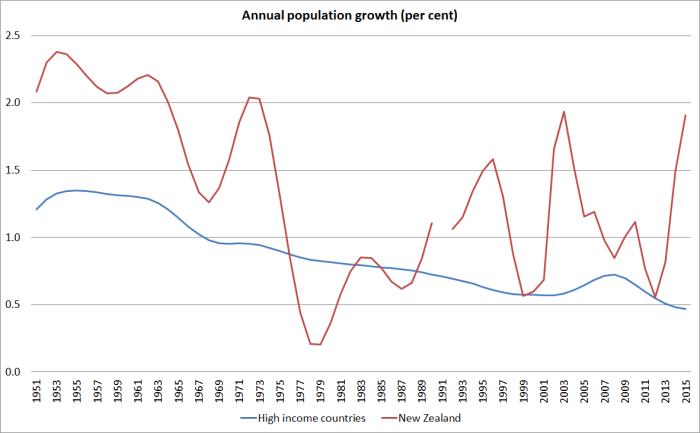
And if one is going to have an official population growth target –  as the Greens appear to be proposing –  why would one set it at 1 per cent per annum?   This chart shows population growth rates for high income countries (UN definitions and data) and New Zealand since 1950.

population-growth-world-and-nz

It has been 50 years since the high income group of countries (including immigrant receiving countries such as the United States, Canada, Australia, and New Zealand) had a population growth rate as high as 1 per cent.  At present, that growth rate is less than 0.5 per cent per annum.   And whether or not one welcomes the population growth New Zealand has experienced over the decades, there is no sign –  no evidence –  that it has produced any economic benefits for us at all.  If people choose to have lots of children that is one thing, but why would Shaw want our government to actively target above-normal (for high income countries) population growth?

But more generally, what is the case for a population growth target?  I can think of a few cases where perhaps one might make the argument: Israel, surrounded by hostile neighbours, probably wants as large as Jewish population as possible for external defence reasons.  They used to mount similar arguments in France a hundred years ago, as they contemplated how few young Frenchman there were relative to the number of young Germans.  But those sorts of arguments are just not relevant for New Zealand (or most other advanced countries).

Apart from anything else, it sets up all sorts of odd incentives and undesirable behavioural responses (although not necessarily much dafter than how New Zealand has actually run policy over the decades).  When economic circumstances change, people tend to leave underperforming regions.  That is rational and sensible for them and –  on the whole –  it even helps those who don’t leave. Patea and Taihape were once quite a lot larger than they are today.  Circumstances and opportunities changed and people over time moved away.  It would simply be daft policy for, say, local authorities in those areas to subsidise people to move in from elsewhere, even though the economic opportunities had moved away.

Under the Greens policy, if there is a significant upsurge in the number of New Zealanders leaving –  as, say, happened in the second half of the 1970s –  policy will, semi-automatically set out to replace them. The New Zealanders will have gone because, presumably, knowing New Zealand conditions well, they conclude that the opportunities abroad are better for them and their kids.  And in response the Greens want us to dig even further towards the bottom of the international barrel and find even more non-citizens to come and live here.  How likely is it that that would be a sensible policy?  Not very.  First, actual economic conditions and prospects in New Zealand have deteriorated, suggesting that New Zealand is less able than it was to offer real good incomes to able people.  And, second, to get a whole lot more immigrants, we would presumably have to lower the (economic) quality of those we take –  and perhaps quite a bit if the foreigners themselves do enough research to realise that relative opportunities here are also deteriorating.  It is not as if, on the government’s own evidence, we’ve been that successful in getting many very able people under current policy.

Of course, one could turn the story around, and be more optimistic.  If New Zealand’s prospects improved and suddenly many fewer New Zealanders were leaving, we would have to markedly reduce the non-citizen immigration inflow.  One could argue this as a good thing, in that we could raise the average economic quality of those we approve, but if one really believes in the economic benefits of immigration, why would you want to materially cut back the flow in circumstances in which New Zealand’s relative economic prospects appeared to have improved?

The arguments can also be applied to fertility rates and, thus, rates of natural increase.  If birth rates in New Zealand fell away sharply (to the sorts of rates –  around one child per woman – seen in many parts of developed Asia and some parts of Europe), what would the economic logic be of central government setting out to raise the target migrant intake (lowering the average migrant quality) just because New Zealand families decided to have fewer children?   After all, fertility choices might be partly a response to perceived economic prospects.   What sensible role for central planners is there in face of such fertility rate changes?

Turning back to the Greens, it isn’t clear that they have yet given much thought to how their proposal would work.

He did not give specifics on exactly which parts of the migration mix would be tweaked to achieve the 1% population growth, given the Government now has a planning range for permanent residency of 85,000 to 95,000 for the next two years, but does not have targets or caps for temporary work visas or student visas. Last week it temporarily suspended parental visa applications and lowered the planning range by 5,000. It is also reviewing work testing for work visas and student visa numbers.

A variable migration target implies constant tweaking of targets for permanent residency visas, both for skilled migrants and their families, along with targets for temporary work visas and student visas. Some elements cannot be controlled, including net migration of New Zealand citizens and working holidaymaker visas, given New Zealand has bilateral agreements with many countries that allow unfettered movements of such visas.

Shaw suggested student visas as one area that could be changed.

“We think that the government is actually barking up the wrong tree by putting the pressure on the family category,” he said.

“There’s huge numbers of students that are coming into New Zealand on temporary work visas and that’s actually where a lot of the pressure is coming from, especially on housing and on transport infrastructure.”

I think there is a lot wrong with our student visa policy, and with the liberality with which work visas are granted for fairly lowly-skilled positions, but……you can’t sensibly go making major changes to the parameters of the schemes every few months just because the forecast net outflow of New Zealanders has changed again.  It would put educational institutions in an impossible position, put firms considering hiring migrant workers in a very difficult position, and make the rules of the game so uncertain for potential migrants that you would risk undermining whatever merit the immigration programme has.  Even more than happens now, good people would seek out other countries with more stable and predictable regimes, and we’d be left with the fruit of an adverse selection process –  those sufficiently desperate to get in here that they’d apply despite the variability of New Zealand policy.   And while it is fine to talk about “smoothing out peaks and troughs” many of those pressure arise in specific regions, and it is even harder to practically manage those.  After all, New Zealanders tend to leave for Australia from across the whole country, while non-citizen arrivals (be it permanent or students) tend to disproportionately flock to Auckland.   So even if policy could be run to stabilize the overall rate of population growth from year to year –  and it can’t –  it might well markedly increase the variability of population cycles in Auckland specifically.  That doesn’t seem like an outcome the Greens would be wanting.

My own view remains that we should aim for a stable level of non-citizen (net) immigration, and set the stable target around a low level (consistent with the absence of any real evidence of benefits to New Zealanders as a whole).  But even a stable fairly high level of non-citizen immigration might be less bad in some respects than what the Greens are proposing, which assumes a degree of knowledge, and forecastability, that simply doesn’t exist.

I would keep the focus on the residence programme, and in turn keep that focused on the medium term.  If we are offering long-term residence in New Zealand, it shouldn’t be about meeting today’s immediate labour market needs, but about attracting a small group of young able energetic innovative people, who might make a useful contribution over their entire working lives.  I think we should welcome foreign students –  education should be just another export industry –  but without providing them with work rights here, and with only high level qualifications giving them a leg up on the path to residency.   And, as I noted the other day, for short-term work visas, I’d probably favour a salary test.  In all but very exceptional circumstances, simply don’t issue work visas for positions paying less than, say, $100000 per annum, and above that threshold take a fairly liberal approach.  Any employer could hire someone for up to, say, three years, but on a non-renewable visa.  If there are real temporary skills shortages arising from unexpected shifts in demand, such a policy will meet those needs, while over the longer term allowing the domestic labour market to work, as relative wage rates shift and people move from one occupation to another.  The scheme would be used, but there wouldn’t be 200000 approvals per annum.

In a sense the fatal conceit in the Greens new policy is the idea that New Zealand’s population growth rate can be held stable from year to year.  While New Zealanders are fairly free to move –  or not –  to the much larger Australian economy in response to changes in relative economic opportunities –  and while New Zealand incomes are so much lower than those in Australia –  we will almost inevitably have the sorts of swings in the net outflow of citizens I showed in the first chart above.  Trying to manage the inflow of non-New Zealanders year by year to offset those fluctuations would be (a) impossible, and (b) something of a fool’s errand even to try.   Whatever immigration policy we adopt, we really need to focus on the medium-term, in all dimensions.

Productivity growth: how have we been doing?

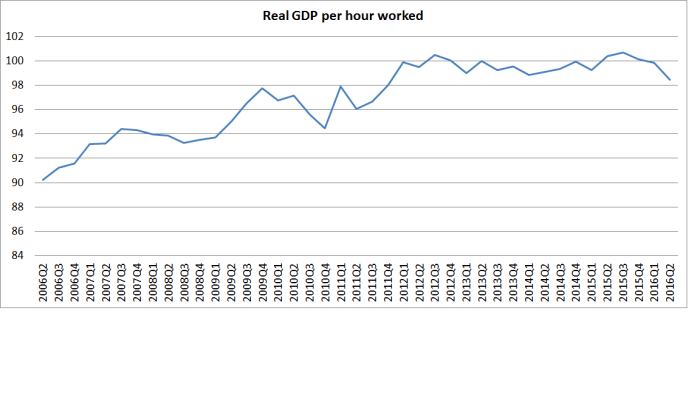
A few weeks ago I ran this chart, showing quarterly real GDP per hour worked for New Zealand for the last decade or so.  I used an average of production and expenditure GDP, and HLFS hours worked data.  The rather dismal picture was of no productivity growth at all for the last few years

real-gdp-phw-oct-2015

Comparable quarterly data isn’t readily available for a wide range of other countries, so for such comparisons one is forced back onto annual data from international databases such as the OECD’s.    And the international agencies take a while to get a full set of annual data –  thus, New Zealand’s annual national accounts for the year to March 2016 (used as the basis for the OECD’s 2015 annual numbers) won’t be released until next month.  We aren’t the only laggard –  for a third of the OECD countries there are only 2014 annual numbers available.

So how has our (labour) productivity growth compared with that of other OECD countries over, say, the decade to 2014?  Taking a decade is (like all such comparisons) a little arbitrary, but it should be long enough to largely eliminate the effects of year-to-year volatility.  And a comparison starting in 2004 and ending in 2014 means starting before the peak of the last boom, and ending when the worst of the 08/09 recession and the euro crisis was over (well, perhaps with the exception of Greece).

gdp-phw-oecd-oct-2016

I’ve highlighted New Zealand (in red) and the other Anglo countries (in green).  The median growth rate for this set of countries is a couple of observations to the right of New Zealand.   Note that I am using (real) national currency measures here.  If one wants to compare income or productivity levels across countries, one has to use PPP-adjusted measures.  But in comparing growth rates, the OECD recommend (sensibly) using national currency measures.

New Zealand’s performance hasn’t been notably bad by any means –  just a little below the median.  But then the goal has supposedly been to grow a bit faster than the other advanced countries, to close the large gap between productivity and incomes in New Zealand and those elsewhere in the OECD.  And in fairness, most of the countries to the far-right of the chart have lower levels of productivity than New Zealand –  so they are also trying (and succeeding in their case) in catching up.  But New Zealand couldn’t even quite match the productivity growth rates of the other Anglo countries –  traditional comparators.

Sometimes one detects a sense among people writing about New Zealand that small countries face a particular disadvantage, and that small countries couldn’t be expected to sustain as rapid income or productivity growth as large countries.   Taking a longer span of data, I had a look at that proposition in a post last year. There didn’t seem to be much, if any, support for the idea that big countries get rich faster.

But what about the last decade?

Here is same chart

real-gdp-phw-oecd-oct-16-big-vs-small

I’ve drawn the line no doubt a bit arbitrarily.  Netherlands has a population of around 17 million and it and all larger countries are “big”.  Other countries, with populations of 11 million or less are “small”.  If anything, the small countries have done slightly better than the large countries over this particular period, but the difference is not enough that I’d want to make anything of it.  But the message is still the same: New Zealand hasn’t done particularly well, and plenty of small countries have done better.

The OECD’s database goes back to 1970, but they only have full data for 21 countries (including New Zealand for that period).  Over the full period, we had the second slowest productivity growth of those 21 countries.

real-gdp-phw-1907-to-2014

And once again, the small countries and large countries are scattered either side of the median.

Over the last decade, we have actually grown very slightly faster than the median of these particular 21 countries. It has been our least bad decade since 1970.  But I wouldn’t take much comfort from that: (a) the difference was slight, (b) we grew a bit less rapidly than the whole OECD median, and (c) on our own more recent data (see first chart) we’ve had no productivity growth at all in recent years

Wellington airport and the runway extension

Fairfax’s Hamish Rutherford had a substantial piece in Saturday’s Dominion-Post on the proposed Wellington airport runway extension, under the heading If we build it, will they come? (a rather similar title to my own first post on the airport last year).  It seemed like a fairly balanced article, covering many (but not all) of the key uncertainties about the project.   Most of them wouldn’t be a matter for public concern if this was to be a privately-funded project, but it isn’t –  and everyone agrees on that.

There was an interesting quote to that effect at the start of the article from airport company chair Tim Brown.

As Tim Brown tells it, the first time he discussed a “back of the envelope”-type analysis of the cost to extend Wellington runway with the airport’s chief executive, Steve Sanderson, the conversation was “completely negative”.

…..Brown had just been presented an outline of a $300 million project, aiming to enable non-stop long-haul flights to the capital.

However, the  potential gains to the airport (two-thirds owned by Infratil, the rest by Wellington City Council) were likely to see a boost in profits that would only justify it investing around $100m.

Whatever the final costs of the project might be (and the estimates are unmoved in the years since), Brown was clear about the chances.

“Literally within 10 seconds I said: ‘So what? What do I care? We’re not going to do that, are we?’,” Brown recalled this week.

This isn’t a project that might need the last 10 or 20 per cent of the cost picked up by the taxpayer/ratepayer to make it viable.  Instead it only works –  even on their own numbers –  if the Crown/WCC picks up two-thirds of the capital cost (and ratepayers have already paid millions of dollars to get the proposal this far).  This is a politically-driven project at least as much (and probably more) than it is a WIAL/Infratil one.

The whole process is getting underway again now, both because the airport company (WIAL) has restarted its resource consent application, and because now that the election is past the ability of citizens and ratepayers to hold in check the big spending “boosterish” tendencies of the mayor and councillors is diminished considerably.  It is difficult to tell quite what the balance of the council now is, but the new mayor has been at the forefront of the various “booster” projects the Council is spending money on, and one councillor who was vocally opposed to the extension in the previous term is no longer on the council.  WCC’s track record –  of wanting to “do something”, spend money on big ticket initiatives, often with little or no public scrutiny (sometimes not even with scrutiny from councilors) – is pretty disquieting.

Presumably under some pressure during the election campaign, the new mayor Justin Lester modified his stance somewhat in responding to pre-election candidate surveys.

I have committed to seeking the resource consent for the airport extension project. It’s too early to say whether the project will proceed because the following three caveats will need to be satisfied before it proceeds:

1. Resource consent approval

2. Financial support from Central Government

3. Commitment from airlines to fly direct routes to Asia.

This is a 50 year project and needs careful consideration before any decision is made.

On the face of it, that looks like a fairly insurmountable set of hurdles.  It is very unlikely that any airline is going to give a commitment to fly direct long-haul routes between Asia and Wellington in advance of (multi-year) construction even starting –  they couldn’t know what would happen to fuel prices, the world/regional economy or the like in the intervening period.    That is especially so given the expressed lack of interest in flying long-haul from Wellington from the one airline that always will be flying New Zealand routes, Air New Zealand.

And, to date, central government seems to have been commendably non-encouraging about any suggestion of central government financial support.

So what –  beyond the track record of poor quality secretive spending – makes me uneasy about the Lester-led Council?  First, Lester knows very well that he won’t get commitments from airlines before the Council has to make decisions on whether to fund the runway extension –  but he might get non-binding expression of interests, which could be politically spun to sound a bit like commitments.  Second, the government has a  track record of ending up funding uneconomic infrastructure projects, including ones it initially poured cold water over.  One could think of Transmission Gully, or KiwiRail, or Northland (by-election) bridges or –  perhaps most concerningly – the City Rail Link in Auckland.   With a modest budget surplus to be subject to an electoral auction next year, is it so inconceivable that the government could change tack (government built houses and immigration last week) and throw $100 million in the direction of the runway extension?  Compared to the spending on Transmission Gully, it would be chicken feed.

And while Lester is quoted extensively in the Fairfax article, neither of the conditions in the pre-election quote above (airline commitments, central government funding) is repeated.  [UPDATE: I gather they are still part of his set of pre-conditions]

So ratepayers beware.  Citizens beware.

In the Fairfax article, Lester tries to blunt possible ratepayer concerns by suggesting the bulk of any Council funding should be raised from business rates rather than from residential ratepayers, because “the majority of the benefit would go to the business sector”.  That might sound superficially plausible (if there were material benefits at all) but the mayor seems unaware of the notion of tax incidence: that the party who writes the cheque to pay a tax or rates bill isn’t typically the party that bears the economic cost.   Much of any company tax is actually borne, over time, by workers –  because less investment occurs than otherwise, and wages are lower as a result.  Just as renters bear some/much of the incidence of rates bills paid by landlords, we should expect that the wider pool of Wellington citizens would bear much of the economic cost of higher business rates to fund an airport extension, even if no non-business ratepayer ever has to increase their direct rates bill.  This is an issue that should bother all citizens, not just business ratepayers.

A lot of the decision-making should turn on a robust cost-benefit analysis of the proposal.  WIAL and the Council have commissioned their own analysis, which suggests large positive national benefits.  Not many people who have looked carefully at the numbers have found their numbers persuasive.  Justin Lester seems to suggest this is all about self-interest

“I’m not going to have people telling me and telling Wellington and telling our council what we should be doing because of their own interests.”

If one wanted to descend to a similar level, one could ask about the incentives on and interests of councillors –  spending other people’s money on big ticket projects.  But, perhaps more importantly, advocates like Lester would do better to front up and explain why they disagree with specific points raised by critics –  whether those critics are representatives of the airline industry, or other commentators and economists.

In the last few weeks, questions have begun to surface about the estimated cost of the runway extension itself.  In a private sector project, citizens wouldn’t need to worry too much.  After all, if the company proposing the development gets it wrong, its own shareholders will be the ones who lose money.  But this is a project where large amounts of ratepayers/taxpayers money will be at stake, and where it isn’t clear how well aligned incentives really are.  The construction estimates are being done for WIAL, which has already concluded that it would only be worth them putting in around $100 million.  If the project is to proceed central or local government will be on the hook for the rest.  Mightn’t the incentives at present be to keep the construction estimates to the low end of a possible range?  Doing so might (a) increase the chances of getting a resource consent (since, sadly, the Environment Court needs to do an economic appraisal) and (b) increase the chances of getting central and local government approval to proceed, with political commitment to the project, with any later cost-overruns perhaps largely falling on those parties.

My own unease has been around three main points; developed in earlier posts:

(a) the large assumed increase in long-haul visitors to New Zealand, simply because of an option to fly long-haul into Wellington (rather than Auckland or Christchurch.

(b) the very large assumed “wider economic benefits” assumed to flow from such increases in visitor numbers, even if the passenger projections were accurate, and

(c) the discount rate being used to evaluate such gains (many of them decades into the future).

I dealt with the visitor number points in this post late last year.   The WIAL cost-benefit analysis uses passenger projections which assume an increase of 200000 visitors to New Zealand (building up over time) simply because it becomes physically possible to fly long haul into Wellington.   That seems implausible.  In his own look at the passenger projections, Ian Harrison of Tailrisk Economics, noted that the numbers assumed that within 20 years 30000 more Americans a year will come to New Zealand simply because they can fly directly into Wellington.   One can imagine a few more might want to arrive via Wellington, but is it really credible that so many more will come to New Zealand as a whole?  Perhaps more startling were the assumptions for “other Asia” (ie other than China and Japan).  At present, only around 30000 people come from those countries to Wellington in a year.  The projections assume that putting in a runway allowing long-haul flights will provide a boost of an additional 105000 visitors annually within 20 years.  Were Wellington Florence, perhaps it would be a credible story.  As it is –  and even with some more marketing spending and a heavily subsidized new film museum – it just doesn’t ring true.  Long-haul passengers don’t come to New Zealand for its cities –  the cities are mostly gateways, and in the case of the lower North Island, Wellington isn’t the gateway to much.  (And yes, I can see the South Island as I type, so perhaps there is a small “gateway to the South, by slow ferry” market).

I touched on the “wider economic benefits” and the discount rates in this post. Here are some extracts from that post:

But much the biggest issues relate to the possibility of benefits to New Zealand from additional foreign tourists buying real goods and services in New Zealand.  Sapere appear to have estimated a total for the likely increase in tourist spending in New Zealand and then subtracted an estimate for the cost of providing those services.  For that they have assumed that 45.5 per cent of the expenditure is domestic value-added (ie returns to labour and capital).  That approach doesn’t seem right and generates highly implausible estimates.

The producer surplus is the gain to the provider of a good or service over and above what he or she would have been willing to provide that service at.   The cost of providing the service includes the cost of intermediate inputs (materials etc) but also the cost of the labour and the cost of capital (a normal rate of return).  If the producer sells product at that cost, there is no producer surplus. In this context, there is no net economic benefits –  economic costs have just been covered.

Over the long haul, in reasonably competitive markets, producer surpluses should be very small (in the limit zero).  For a hotel that budgeted on 80 per cent occupancy, a surprise influx of visitors for the weekend will generate a producer surplus –  the windfall arrivals add much more to revenue than they do to costs of supplying the service.  But over the long haul –  and the airport project is evaluated over the period out to 2060 –  it is fairly implausible that there will be any material producer surplus resulting from well-foreshadowed increases in visitor numbers.  Most of what tourists spend money on in New Zealand are items such as accommodation, domestic travel, and food and beverage.  In all those sectors, capacity is scalable.  One would expect new entrants just to the point where only normal costs of capital were covered.  In the long run, supply curves for most of these sorts of services/products should almost flat.

My proposition is that there are few or no producer surpluses likely to arise from a trend increase in foreign tourism as a result of extending Wellington airport.  But even if there were, any such gains would have to be offset against the loss of producer surplus for New Zealand producer (to foreign producers instead) from New Zealanders taking more holidays abroad.  It makes little difference to the hoteliers if I take my holiday in London instead of Queenstown, while at the some time someone in Manchester takes his in Queenstown instead of taking it in London.

Even if the consultants are right that there would be more additional inward visitors than outward, any producer surpluses from either set of numbers should be small.  And the net of two small offsetting numbers is even smaller.

The safest assumption, in evaluating the WIAL proposal, is to assume that the economic benefits of the proposal all accrue to users, and that there are no material net economic benefits (or costs) to the rest of the community.  Perhaps there is a small amount in the net GST flow, but it is hardly worth focusing on given the scale of the other uncertainties.

Perhaps this point will seem counterintuitive to lay readers and city councillors.  Surely “Wellington” or “New Zealand” is better off from having more foreign visitors (assuming the numbers outweigh the increased outflow of New Zealanders)?  And if so, shouldn’t we –  Councils, government –  be willing to spend money to get those benefits?   The short answer is no.    Good and services cost real resources to provide, and in a competitive market simply providing more goods and services won’t make the city or country better off –  you need to be able to sell stuff that generates more of a return than it costs to provide (including the cost of capital).  Vanilla products and services typically don’t do that.  After all, labour that is used to provide services to tourists is labour that can’t be used for something other activity.  And over a horizon of 45 years we can’t just assume there are spare resources sitting round unused.  Spending public money to generate this economic activity will come at a cost of some other economic activity being displaced (as well as the deadweight costs of taxation, which are allowed for in the cost-benefit analysis).

If, to a first approximation, there are no “net incremental economic benefits” for the “rest of the community” then even if the WIAL/Sapere passenger number estimates are totally robust, the net benefits of the project drop from $2090 million to $954 million.

It is not as if the new visitors – even if they eventuate –  are likely to be top-end exclusive customers.  Business and government travel –  a significant part of the Wellington market –  is unlikely to be much affected, and any boost to overall visitor numbers seems likely to be mostly tourists, consuming fairly vanilla, easily replicable, goods and services.

And what of the discount rate?

It is very unlikely that any private company (or shareholder) would evaluate such a risky project using anything as low as a 7 per cent real cost of capital.  On the WIAL/Sapere numbers, even raising the discount rate to 10 per cent –  a fairly typical cost of capital for Australian companies according to a relatively recent survey by the RBA –  roughly halves the value of any net benefits from the project (even if all the other assumptions about passengers numbers, and “wider economic benefits” are in fact well-founded).  But this runway extension seems much riskier than the typical investment project –  it is location-specific, not usable for anything else, and relies on assumptions that involve transforming the nature of the business (ie there is no long haul capacity at present, and no one can know with any confidence how much demand there might be for the service).  It would be enlightening if Infratil/WIAL told us what cost of capital/discount rate assumptions they would use in evaluating such a project if all the risk were on them?  I’m sure, for such a hard-nosed bunch of operators, if would prudently be more than 10 per cent real.

The Fairfax article picks up a number of other points, including some comments from me. In some of those comments, I probably wasn’t as clear as I might have been.

A few weeks ago, Singapore Airlines –  assisted by a non-transparent Wellington City Council subsidy –  began flying several times a week between Singapore and Wellington, with a stopover in (of all places) Canberra.  No one know whether those flights will succeed (SIA reportedly wants to move to daily), and become viable without ongoing Council subsidies.  That uncertainty is reflected in the article.  Tim Brown from WIAL seems to believe that if the route succeeds, and attracts a larger proportion of foreign passengers, it would tend to support the case for the runway extension.  Justin Lester seems a bit nervous

Like the airport company, Lester also appears to concede that if the Singapore Airlines flights do not show the demand its supporters hope, it would be bad news for the runway extension.

“People are getting on and off these planes four times a week and if the demand doesn’t go up to seven times a week, you know, we won’t need to do it,” he said, quickly adding that this would be a “strong indicator” rather than proof the runway extension was not worthwhile.

I was quoted along similar lines

Would strong success of Singapore Airlines’ new route, with a high proportion of visitors, help prove the case of the missing passengers?

For a man who freely admits he is naturally sceptical about most public infrastructure projects, Reddell is surprisingly open to the idea.

“If they can make that route viable without larger public subsidies than they’ve got then I think that would be interesting”, especially given that passengers face being “stuck in Canberra for a couple of hours”.

But with several caveats.  First, even if the Wellington-Canberra-Singapore route proves viable, it only offers any insight on the long-haul issue if a material proportion of the passengers in and out of Wellington are not just Wellington-Canberra passengers (although it seems unlikely that a daily 777 flight just Wellington/Canberra would be economic).

Second, if such flights prove viable with the current runway, that is great. All involved are likely to gain.  But that is different proposition than spending  (an irreversible) $300 million on a new runway.  As I noted

However, Reddell adds, this may only prove Brown is right about the problem being a lack of marketing, without proving the airport extension itself was needed.

“I would open up the argument, [of] let’s subsidise some more flights, and if they don’t work we can shut them down, whereas with the $300m runway extension, it’s a sunk cost,” Reddell said.

“The great thing about marketing is you can shut it off. You can’t do much with a runway extension” that doesn’t work out.

In the cost-benefit analysis, one of the options they looked at was a big increase in marketing expenditure.  It produced net benefits not that much smaller than those purportedly on offer from the runway extension, and could be re-evaluated constantly, rather than being irreversible.

If central and local government do go ahead and fund the extension, it wouldn’t surprise me if 10 years hence there were a few long haul flights in and out of Wellington.  But, of itself, that would prove nothing about the economics of the project.  The financial contribution of central or local government would, no doubt, be treated as a bygone –  with no direct financial returns, and arguable and uncertain indirect ones –  and with a runway in place, and only its own capital contribution to cover, perhaps WIAL could attract a few flights.  That might leave today’s councilors feeling better, as they show the extension to their grandchildren, but is no reason to think that Wellington citizens and ratepayers will have been made better off as a result.

I’ve not touched at all on issues like the possibility that future carbon charges make long haul travel less attractive than it is today, or that rising sea levels might raise questions about Wellington airport more generally.  But they all should bring us back to Justin Lester’s point

This is a 50 year project

and

His “gut instinct” was that the case would eventually be proven, but it could be soon, or it could be decades away.

The costs of waiting simply aren’t that large.  If the proponents are right, the case will look that much more compelling  –  and less risky –  10 years from now.  If they are wrong, (lots of) real resources will have been irreversibly wasted –  and that burden will be felt not just by Wellington businesses, but by all citizens and ratepayers of Wellington.   I’d urge the incoming Council to reflect on that choice, and to take seriously what decisionmaking under uncertainty should mean.

BusinessNZ argues for more immigration

BusinessNZ describes itself as “New Zealand’s largest business advocacy body”.  Its chief executive, the lobbyist Kirk Hope, seems to have easy access to the op-ed pages of the Dominion-Post newspaper, and I’ve critiqued a couple of his columns (here and here) earlier in the year.

Hope –  and presumably BusinessNZ – is a big fan of high levels of non-citizen immigration to New Zealand.  Business groups have been for decades –  as far as I can tell, through all the decades of New Zealand’s relative economic decline.  We’ve had some of the highest controlled immigration flows of any country, and one of the worst relative economic performances.  However large the inflow it is never seems to be enough for the Manufacturers’ Federation (in decades past) or BusinessNZ now.  I have in front of me, the memoirs of Fred Turnovsky, twice head of the Manufacturer’s Federation and one of the “great and the good” of an earlier generation, where he records a lecture he gave at Waikato University in 1971 calling for a doubling in the officially proposed immigration target.

Earlier this week, following the government’s migration policy changes, BusinessNZ had a press release out –  under the heading Migration rules a sign of progress –  which seemed to welcome the changes.  I was quite surprised, but on closer inspection it wasn’t the small drop in the residence approvals programme target they were welcoming, or the cutback in the family quota (mostly non-working older parents), but simply the increase in the points requirement.

“Increasing the points required by skilled migrants to gain residence from 140 to 160 will help sharpen the annual intake towards higher skilled people.”

But, of course, increasing the points requirement isn’t an independent policy adjustment, it is just the logical corollary of a likely increase in demand for residence (mostly because of the large inflow of foreign students in recent years), while the availability of skilled migrant places hasn’t changed.  When demand changes the “price” needs to adjust.

And thus far I agree with Hope.  If we are going to allow in lots of “skilled” migrants, the more skilled they are, the better.  Of course, it is always hard for officials to detect skills, which makes it too easy to fall back on paper qualifications.

In an op-ed earlier in the year, Hope made the case for high levels of immigration to New Zealand on the grounds that we needed lots of immigrants to pay for our superannuation.

Restricting immigration as proposed would harm the economy.

With a birth rate just above replacement level, an ageing population and baby boomers retiring, we need immigrants to sustain the economy and pay for our superannuation, just as in decades past.

In response I noted

And on the NZS side of things, if there are affordability challenges with the current system, we have it in our own hands to modify the system to make it more readily affordable.  We could raise the age of eligibility –  National knows it needs to happen, even if the Prime Minister has pledged not to, and Labour campaigned for a higher age at the last election.  Other countries have made these sorts of changes.  We could also age-index NZS eligibility.  We could modify the entitlements of those who haven’t spent most of their working lives in New Zealand.  And there are other options I don’t support, but which would also ease the fiscal pressures, such as income and asset testing, or linking NZS increases to prices rather than wages.  And we can keep the way open for more older people to stay in the labour force for longer –  on that count, we already have one of the least distortionary old age pensions systems anywhere.  We are quite capable of managing the pressures ourselves.

Large scale immigration might make a small difference to NZS affordability, but it is an awfully big intervention for a really quite small difference.  As it is, New Zealand’s birth rate is around replacement, unlike many European and Asian countries, so the ageing population issues are in any case less pressing here than in most places.

In the end, the best way to support the various social spending commitments society wants to make is to foster a highly productive economy.  We’ve kept on failing to do that, and while immigration policy almost certainly isn’t the whole story, there is no evidence whatever that high rates of immigration have improved the position.

Strangely, the affordability of NZS seemed then to be his main argument for large-scale immigration.

But I suspect that was just an attempt to try to frame the issue in a more generally acceptable way.  In fact, business lobby groups in New Zealand tend to make the case for high levels of immigration largely in terms of keeping the cost of labour down.  Of course, they don’t put it in quite those words.  Instead, the constant refrain is “skill shortages” is mostly just another way of saying “I can’t get enough workers at the wage I want to pay”.    Markets have ways of taking care of looming shortages, or surpluses: the price adjusts.  We don’t hear of shortages of foreign exchange –  the price adjusts. The availability of tomatoes varies with the seasons and storms, but almost always any consumer can buy as many tomatoes as he or she wants, at a price which adjusts (up and down) quite frequently.

When it comes to people, and labour markets, these mechanisms don’t work instantaneously.  But markets take care of structural shifts in the demand for labour, if they are allowed to work.  A commenter argued earlier this week that we need lots of immigration to provide the workers to care for a growing elderly population.  No.  Immigration is certainly one option – look at the staggering number of aged-care nurses we’ve granted visas to in the last decade –  but so are changes in relative prices.  If the demand for labour in that sector increases, then over time relative wages in that sector will tend to rise. In turn, that will draw more New Zealanders to the sector, and will also reward investing in some more labour-saving technologies.  The same goes for almost any sector.  The wages changes might be small, if labour moves easily into the new in-demand sector, or large, if there is some reluctance of people to move into those roles.  But that is how the labour market would deal with shifts in the patterns of labour demand, if allowed to do so.

But to return to BusinessNZ.  Kirk Hope has another op-ed in the Dominion-Post this morning.  It is a useful piece because it is so explicit about his –  and his organization’s (?) -views.  Here is what he has to say:

One in four people in New Zealand is foreign-born, and many New Zealanders routinely leave to live in other countries.

This is what New Zealand is like – it’s ‘migration central’, awash with people coming and going, and it has always been this way.

This is simply quite historically misleading.  Large short-term migration is a new phenomenon –  we saw nothing like it in earlier decades.  And while it is no doubt true that “many New Zealanders routinely leave to live in other countries” –  I’ve done it three times –  the net outflow (the loss of almost a million New Zealanders) dates from when the growing gap between living standards in New Zealand and those in other advanced countries (especially Australia) started to become more apparent.  In successful countries, not many people leave for long.  Compare the net outflow of Norwegians from Norway with the net outflow of New Zealanders from New Zealand and you’ll see what I mean.

Business has long asked for more immigration…

You can’t get clearer than that.  We have probably the second largest controlled immigration programme in the advanced world (behind that other economic laggard, Israel), a residence programme three times the size (per capita) of that in the United States, large and growing numbers of short-term work visas, and still it just isn’t enough for business.

He elaborates

….as in more access to more skilled migrants to do the jobs that New Zealanders aren’t available for.

But as even Hope recognizes, in this and his earlier article, New Zealand hasn’t done very well at attracting really skilled migrants in recent decades.  Which shouldn’t really surprise anyone; after all, New Zealand is an awfully long way from anywhere (ie home and family), and simply doesn’t offer as good material living standards as many other advanced countries (including such migration recipient countries as Australia and Canada) do.   We haven’t been doing well at getting the best people to date, so why should expect to do better if we aim for even more migrants?

And Hope never once refers to the OECD data, cited by Steven Joyce and MBIE, suggesting that New Zealand workers’ skill levels are already among the very highest in the OECD (and the average immigrant had, on those measures, slightly lower skills than the average native).  Perhaps he doesn’t believe the numbers, but if so perhaps he could lay out his specific concerns with the data.  As I noted in my earlier post on that OECD data

Importing people doesn’t look as though it has been a means of raising skill levels here, or in most other countries.  In general that shouldn’t be surprising –  successful countries solve their own problems, and when they succeed they might share their bounty with newcomers. But a different sort of people is very rarely the answer to serious economic challenges.

But to revert to Hope

the points system will be able to deliver higher skills, but not necessarily the specific skills in most demand.

It might not answer the specific need for more engineers, construction managers, quantity surveyors, technologists, technicians and ICT workers – the actual skills needed today.

Fortunately, there is work underway to achieve more weighting in the points system to achieve specific skills such as these.

This is a sort of line he has run before and I commented then.

it is curious to see the leader of a business group reckon that he knows what skills and what industries will be the ones that will prosper in a future, more successful, New Zealand.  And it is puzzling to see so little faith placed in the workings of the labour market, or the skills and capabilities of New Zealand.  It is redolent of some sort of 1960s indicative planning mentality –  the sort of line of argument I have previously criticized MBIE for.

BusinessNZ tell us they believe in markets, private enterprise etc etc, but in fact they seem to want to shape our long-term migration policy around the ability of people like them – and MBIE bureacrats –  to work out quite what skills “the economy” needs right now.  Even though, in granting residence to a 25 year old, we are bringing in someone who might have 40 year plus of working life in New Zealand.  No one knows, or can know, what specific skills will be needed over that sort of horizon.    If we are going to bring in long-term migrants, with an economic focus, lets attract able, energetic, skilled people, with a realistic chance of adapting well to New Zealand, and not try central planning beyond that.

Hope goes on

Business will be hoping this work comes to fruition soon.

Without it, we face the danger of a breakdown in the political consensus around migration policy

If we are not able to import migrants with the specific skills needed, there will be little support for bringing in many migrants without them.

To the second sentence, I can only add “I hope so”. There is just no evidence –  from BusinessNZ, from the NZ Initiative, from MBIE, from Treasury, from National or Labour ministers – that the strong elite consensus in favour of high levels of non-citizen immigration has done anything, at all, to benefit the economic performance of the New Zealand economy as a whole. Perhaps it might produce such benefits in some times, some locations.  But our focus in on contemporary New Zealand –  this specific location.  Of course, the economy is bigger –  there are lots more people –  but there is no evidence, at all, that GDP per capita, or GDP per hour worked for New Zealanders are better as a result.  And that really should be the test, and especially in programme that is avowedly focused on the claimed economic benefits of the programme.   There is no more reason to simply assume that putting an extra million people in New Zealand –  roughly what our immigration policy has done in the last 25 years – would make any more sense than putting an extra million people in Wales, Scotland, Tasmania or Nebraska, if local territorial authorities in those places had control of their own immigration policy.

And what of that final sentence? For all I know, it might be descriptively accurate, but actually I suspect there is little support  now for “bringing in many migrants without them [skills]”.  Why would we, refugees aside?  There might be a case for attracting some really highly-skilled immigrants (not tied to specific current vacancies), but why would we want to bring in people with very limited skills.  At best, doing so could only drag down the relative returns to relatively lowly-skilled (absolutely or relatively) New Zealanders.  At worst, it could drag down our overall economic performance.

Hope goes on

These generalisations are not true. The fabric of New Zealand life, rather than being destroyed by immigration, is largely the result of ongoing immigration and is colourful, interesting and diverse as a result.

My focus in on the economic dimensions of the issue, but as a reminder –  and with no suggestion of causation – living standards in New Zealand (relative to those in other countries) were probably at their best in the 1950s, a period of a great deal of cultural homogeneity in New Zealand.  Large scale immigration –  particularly from different cultures than the native population –  changes societies, and there are likely to be both pros and cons from those changes.  If a country has meaning –  other than just a physical location –  it must involve something around shared identity and values.  If the economic gains from large scale immigration are slim or non-existent ( as I argue in the New Zealand case), one might want to examine more closely the other implications of large scale immigration –  whether that is about environmental pressures, or the declining relative place of Maori (the original native population).  But consciously or not, business lobby groups and their advocates tend to see little role for the nation state.

Having made his arguments about immigration, Hope attempts a pivot.  Never having succeeded in showing that there are widespread economic gains from our immigration programme –  let alone an even larger one – he turns paternalistic.  The problem apparently isn’t large scale immigration, it is the low level of skills of many New Zealanders.

For this group, upskilling is their most pressing need.

This is why the education system needs our focus as debate on immigration continues.

There needs to be more help for unskilled adults to get upskilled in basic areas of literacy, numeracy, communication and computing.

I’m not going to dispute that skills matter, or that the education system (or some families) could do better in equipping people for life and work.

But fundamentally this is a distraction.

The data show that New Zealanders on average have a fairly high level of skills. Not everyone of course –  here, or in any of those other countries.  And, in any case, much of the education system isn’t about adding skills, but about signaling and ranking.  We don’t have a high unemployment rate by international standards, or a low labour force participation rate (and here I agree entirely with BusinessNZ and the NZ Initiative that immigration does not raise local unemployment, or take jobs from natives).  So focus on skills and the best possible design of the tertiary education system all you like, but it really is a different issue from the appropriate immigration policy for New Zealand.

Towards the end of his article, Hope sums up

New Zealand’s shortage of in-demand skills is one of the most important and difficult problems we face, and changes in education should be a hot topic.

We are a nation of immigrants and descendants of immigrants, and our economy needs ongoing migration to cope with the skills gap we have at present.

It is quite staggering to find the leader of (ostensibly) market-oriented business lobby group discuss the labour market, access to skills etc, and never once mention wages (sectorally, or across the board).    His case might be more plausible if he stopped to engage with the counter-argument: why, over time, if there is a “shortage” of chefs (to take one of the leading skilled migrant categories) won’t relative wages for that set of skills rise, encouraging more people to (over time) shift towards those roles?  None of these adjustments happen overnight, but the market process usually works if it is allowed to.  But, of course, it is often just cheaper for firms to seek an overseas worker, than to lift returns to local labour across that set of skills.  Or if he stopped to think macroeconomically for a moment –  rather than simply at the level of the individual firm.

As for that final sentence, you have to wonder about which bit of the last 70 years of New Zealand economic history Hope missed.  We have had high (by international standards) non-citizen immigration for most of that period, and yet constant employer complaints down through the decades about “skills shortages”.  You’d almost suppose this was a really high-performing economy, with endless new outward-oriented opportunities and markets, crying out for people to tap those rapidly expanding markets.  Instead, our relative economic performance has been in decline for almost the whole post-war period, and our exports as a share of GDP has gone nowhere –  unlike almost every other advanced country –  for the last 30 years.    Perhaps BusinessNZ might like to reflect on the view – widespread among New Zealand economists in earlier decades (much to the dismay of Fred Turnovsky) –  that large scale inward immigration programmes add more to demand than they do to supply in the short-term, and thus –  at an economywide level – exacerbate rather than relieve “skill shortages”.  Individual firms don’t experience it that way, but that is the value of macroeconomics.

I could go on, but I’d really urge BusinessNZ to think again, and if they do want to continue to champion really large scale immigration programmes, to find some credible arguments and evidence for the programme (specific to New Zealand), and to engage with the track record of New Zealand’s immigration programme and economic performance over the last 70 years.  As they do, they might ponder the continued extremely high dependence of New Zealand on natural resource exports (perhaps 80 per cent on a broad definition), something that shows no sign of changing.  Our stock of natural resources isn’t increasing, and there is little obvious reason to think that we’ve needed a lot more people here to make the most of what we have.  Instead, we need to tap the smart and able people we do have, the strong institutions, and to get government out of the business of –  unintentionally –  persistently holding up the real exchange rate, and making it even harder than it should be to develop competitive firms based here. Markedly pulling back the immigration target –  not just playing at the edges as the government has done this week –  would be a big part of making that possible.


RIP timely mortgage approval statistics

The Reserve Bank has recently confirmed that it is going to kill one of the most useful statistical series it produces.

A decade or so ago, near the peak of the last house price boom, the Bank began collecting data on the number and value of housing mortgage loan approvals.  The data were never perfect, and the Bank’s statisticians always, slightly disdainfully, labelled them as “experimental”.

But they had a lot going for them nonetheless:

  • they were weekly data, whereas most Bank series are monthly or quarterly,
  • they were reported and released very quickly (data for last week is on the Bank’s website now), whereas most Bank series take the best part of a full month to collect and report,
  • they were about mortgage approvals, rather than drawdowns, so captured information at a materially earlier stage of the process (when one is close to agreeing to buy, rather than when settlement occurs), and
  • they told sensible stories that could be reconciled, then and later, with other things we knew about the housing and housing finance market.

Given that the Bank now puts much more weight on direct regulatory interventions in the housing finance market than it ever did before, you would think they would want all the data they could get –  and particularly very timely data.

But no.  The housing mortgage approvals series is to be discontinued next month.

The Bank would no doubt respond that they have, over the last few years, put in place a new set of data collections around housing finance.  They even have a new series of housing mortgage commitments, but (a) they have only three years of (monthly) data, and (b) the monthly data are available only with a considerable lag.    Check out the tables for the new series: today is 13 October, and the data for August are now there (and mid-August is now almost two months ago).  By contrast, as I noted above, last week’s new mortgage approvals are already on the website for the long-running “experimental” series.    It is significant step backwards, in terms of the public availability of timely data on what is, for the Bank, and rightly or wrongly, clearly a major market.

I made a brief submission on the proposal to discontinue this data, noting

The cumulative loss of information from the change could easily be 8 to 10 weeks of information (if, say, a mortgage approval is typically given perhaps a month before drawdown).  Even allowing for the fact that the mortgage approvals data is not a perfect predictor of actual drawdowns, the cycles in the approvals data have given good and consistently informative reads for a number of years now.  With the Bank varying LVR restrictions on average about once a year, losing 8 to 10 weeks of forward data seems cavalier –  even having regard to the inevitable compliance costs for banks (which must now be quite low for an established collection).

To which the Bank’s response last week was

We acknowledge that the housing approvals statistics provide more frequent and timely data, however, we do not believe that this a sufficient reason to continue with the collection.

I don’t think their heavy regulatory interventions, and repeated recalibrations of the restrictions, in the housing finance market are well-warranted –  in law or in economics.  But to intervene that heavily and then to simply abandon frequent timely data seems reckless.   Better more comprehensive later data can refine the insights from early takes –  as final GDP data several years on are better than the first cut estimates, but we don’t simply abandon publishing the first cuts – but in much of the business the Bank is in –  monetary policy and regulatory interventions –  preliminary insights are vital, and inform (heavily inadequately) the forecasts, and policy responses.  That is why, for example, the Bank does business visits, uses opinion surveys, and so on

Inside and outside the Bank, I’ve always found the mortgage approvals data useful and interesting.   Because it is weekly data, and not seasonally adjusted, I’ve taken to presenting the mortgage approvals numbers in a chart like this:

mortgage approvals oct 2016.png

The vertical access is the number (not value) of mortgage approvals per capita (using mid year population estimates).  The horizontal access is the week of the year.

There are data back to 2004.  The blue line is the average for the years 2004 to 2013, the decade prior to the use of LVR controls, and which encompasses both most of the last boom and the post-recession “bust”.   As you would expect, there is some seasonality apparent in mortgage approvals, but mostly around the Christmas/New Year period.

I’ve also shown the data for 2006 –  the year during the last boom when mortgage approvals per capita peaked –  and for 2015 and 2016.

There have been weaker years –  2010 and 2011 notably –  but the volume of mortgage approvals this year has simply not been very high.  It has averaged around the same as last year’s numbers –  but had looked as though it might be moving a bit higher before the Bank announced its latest set of LVR controls.  One of the great things about this high frequency timely data is that one can see approvals dropping off somewhat in the last couple of months, as one would expect given the new controls.

Taking a longer perspective, relative to the 2006 peak year, mortgage approvals per capita this year (and last) are only about two-thirds now of what they were a decade ago.   This is consistent with house sales per capita data, which are also running well below the peaks in the previous boom.

None of this is to suggest that high and rising house prices are not a problem. They are, and they are a disgraceful reflection on politicians and policymakers.  But it does help to illustrate that the issue is not primarily banks flooding the market with credit, or even a mania of buyers desperate for anything that moves.  The dollar value of credit is growing no faster (probably slower) than one would expect given the increases in prices –  higher-priced houses require more credit –  and the volume of mortgage approvals is actually quite low.

High and rapidly rising house prices are mostly a reflection of the severely distorted market in urban land –  distorted, that is, by central and local government –  exacerbated by policies that deliberately set out to rapidly boost New Zealand’s population, even when it is well-known that the housing and urban land supply markets simply can’t cope –  or at least not without seeing prices going sky-high, the market response to artificial, regulatorily-induced, shortages.

Direct interventions in the housing finance market are an inappropriate use of (too widely drawn) Reserve Bank powers.  But with their readiness to deploy those powers, and chop and change the rules, frequently, it is most unfortunate that they are dropping the most timely and frequent data on housing finance we have.