A modest start

The Minister of Immigration has today announced some changes in New Zealand’s immigration policy.

The centerpiece of New Zealand’s immigration policy has, for many years, under both National and Labour-led governments, been a target (“planning range” they like to call it) for the number of non-citizen residence approvals of 45000 to 50000 per annum.  For all the talk about the volatility in the net permanent and long-term migration numbers, much of that volatility simply results from choices of New Zealanders to go, or not.  That has little or nothing to do with immigration policy.   In terms of overall numbers, residence policy itself has been pretty stable.  Some years, actual approvals undershoot a bit, and sometimes they overshoot, but the target itself hasn’t changed for a long time.  Of course, New Zealand’s population has grown quite rapidly, so approvals as a share of the population have been trending down, while remaining high by international standards.

In today’s announcement, for the first time in a long time, the target has been cut.  The cut itself is small –  for the next two years, the annual target will be 42500 to 47500 non-citizen residence approvals.  In other words, the target has been cut by 5.5 per cent.

That is a small step in the right direction.  I’ve argued for some time that the residence approvals target should be lowered to something more like 10000 to 15000 per annum, and that to do so would, over time, offer a path towards a material improvement in New Zealand’s dismal long-term productivity and relative income performance. Now that the hitherto sacrosanct (although, as everyone accepts, initially rather arbitrary) 45000 to 50000 target has been cut, even if only modestly, I’d hope to see further reductions in the residence approvals target in years to come.

Perhaps as encouraging is the other change.  A large chunk of residence approvals have been going to people, often older parents, who would not qualify for New Zealand residence on their own merits, but get in simply because they have family already here.  Since our immigration programme is explicitly focused on the potential economic benefits to New Zealand, and New Zealanders, this large share of approvals going to  relatives undermined the (already slim) prospects that the immigration programme was ever going to benefit New Zealanders as a whole.

In today’s announcement, the government is

reducing the number of places for the capped family categories to 2,000 per year (down from 5,500)

In other words, all (and more) of the reduction in the targeted number of residence approvals will come from that group of migrants who never qualified to get here on their own merits.  If anything, there is a slight increase expected in the number of people who will gain residence based on their own skills etc.  All else equal, that is a step forward –  economically and fiscally.

As part of today’s announcement, the number of points required for residency has been increased.  That is really only a logical corollary of the likely increase in the number of applicants under the skilled migrant stream (as a result of the influx of foreign students in the last few years), but should mean that the people we do grant residence approvals to in the next couple of years will generally be of higher “quality” (in terms of the sort of characteristics the programme rewards) than those in the last few years.

Today’s announcement is a small step in the right direction, and thus welcome.  It helps illustrate what a useful and flexible tool the residence approvals target is.  Contrary to many naysayers, it is relatively straightforward to alter our residence approvals numbers.  Annual approvals will fluctuate, as will flows of New Zealanders, and flows of people on temporary visas, but, over time, it is the residence approvals programme target that largely determines the contribution of immigration policy to New Zealand’s population growth.   As a natural resource dependent country, in a very poor location from which to base other sorts of internationally-oriented businesses, we don’t need more people, which is why –  ideally –  today’s announcement will be the first of many over the coming decade.

As a reminder, the United States issues around 1 million green card a years: that is one green card per annum for each 319 people already in the United States.

Our new target, centred on 45000 residence approvals per annum, offers one new residence approval per annum per 105 people already in New Zealand.

The evidence base for running an immigration programme three times the size of that of the United States, to an extremely remote location with an underperforming economy, remains scant to non-existent, even after decades of the current policy.  A challenge for MBIE, and Treasury, and their respective Ministers, might be to show compellingly that New Zealanders as a whole are benefiting from the high immigration policy –  a policy that, slightly attenuated today, continues.

I’ve long argued that lowering the residence approvals target materially would, over time, lower the real exchange rate, and assist in shifting the economy towards a more international orientation (more exports, more imports, and less reliance on the non-tradables sector).  Media accounts suggest that the NZD actually fell on today’s announcement.  If so, that is welcome –  and consistent with the fact that asset markets tend to be forward-looking.  But, as everyone knows, exchange rates are volatile, and in the grand scheme of things, it is unlikely that a 5 per cent in the residence approvals numbers in isolation will make much discernible difference in the medium-term.  Now a 50 per cent fall, well….that really should make a difference.


Should the PTA be changed? Business leaders seem to think so

A couple of weeks ago, the Herald ran their annual Mood of the Boardroom survey, capturing the views of 101 (mostly) chief executives on a wide range of business, political and policy issues.  It is a slightly frustrating survey because, despite the heavy coverage the Herald gives it, they don’t report the exact questions, and as everyone surely recognizes, how one frames a question influences –  intentionally or otherwise –  the answers one gets.

Often enough the answers are pretty predictable.  Sometimes predictably depressing.  Daft and detached from reality as I’ve argued that the Prime Minister’s line about New Zealand as a haven for the rich, the “Switzerland of the South Pacific” is, the CEOs (79 per cent of them) seem to like it.

But the question that caught my eye was one about monetary policy.  Asked whether the government should “rewrite its agreement with the Reserve Bank”, so as to “consider wider economic factors beyond inflation” the answers reported were:

Yes                                    48 per cent

No                                      38 per cent

Unsure                              14 per cent

It is now less than 12 months until a new Policy Targets Agreement is required, and the Minister of Finance has poured cold water on the idea of major changes in the PTA.  But on this occasion, business leaders –  often important defenders of the status quo around monetary policy – seem to be calling for change.  As the Herald notes, it is “a marked change from previous surveys”.

It would be interesting to know quite what these CEOs had in mind, as there isn’t much hint in the supporting article.  One CEO is quoted as suggesting that the Reserve Bank needs to think about economic growth too, and that is about all.  There is no reference in the article to the exchange rate, unemployment, asset prices, credit or any of the considerations that people sometimes argue that the Bank should pay more attention to.  But since these respondents aren’t monetary policy experts, we can assume they don’t just have in mind minor technical rephrasing on some clause or other in the PTA.  There must be some genuine angst in CEO-land about how monetary policy is being run.

Without more follow-up questions, it is hard to know what the balance of thinking among respondents was.  Some will probably will favouring lowering the inflation target, to bring the target into closer alignment with actual inflation outcomes in recent years.  Perhaps some favour linking monetary policy and the Bank’s regulatory powers more closely.  Some might be channeling stuff they read from abroad suggesting a new approach to monetary policy is needed, with little real sense of what a different approach might look like (no other country having changed its framework).  But others might be reflecting more of a Labour/New Zealand First unease about the framework, emphasizing perhaps international competitiveness, or more of a focus on full employment.  Perhaps some are just reacting to the failings of the current Governor in conducting policy?

We don’t know what the balance is, but the survey result does feel rather like a straw in the wind, something for the powers that be to focus on as the negotiation of the new PTA next year approaches.  The latent unease among business leaders –  whatever motivates it –  reinforces the argument I’ve made here several times in the past that the process leading to negotiating a Policy Targets  Agreement really should be a much more open one.  The PTA is the principal guide to short-term macroeconomic management in New Zealand, for five years at a time, and yet it is a process shrouded in secrecy from beginning to (well after the) end.   There was no public consultation on the changes to the PTA in 2012 (or those in 2002), and even after the event the Reserve Bank has refused to release background papers relating to the PTA negotiation.

Perhaps none of this matters very much if there is a strong consensus in favour of the status quo –  although even then it is as well to have to articulate the case from time to time, and deal with the challenges, even if they come from only a small minority of voices.  But this time, according to this survey, a plurality of business leaders favours changing the PTA.  Regulatory agencies have to publish consultative documents on proposed changes. New legislation has to be worked through a select committee. The government publishes a Budget Policy Statement setting out in advance the key considerations that will shape its subsequent Budget.  But there is nothing remotely similar around the key policy guide to short-term macroeconomic management, the PTA.  Democratic deficits abound in matters relating to the Reserve Bank, but this is one that could be quite easily fixed.    As part of the lead-up to next year’s PTA, the Minister of Finance should announce that the Treasury will be hosting a workshop/conference, perhaps around six months from now, to consider papers on the appropriate content and structure of the Policy Targets Agreement.  Several background papers could be commissioned, the Reserve Bank and Treasury themselves might submit papers (with some caution about those from the Reserve Bank, given that it is the institution whose conduct the PTA is supposed to shape, and hold to account), and outside experts (academic and otherwise) and interested parties could be invited to contribute.

No doubt some would worry about “upsetting the markets” but (a) this is a democracy, and one that often espouses the importance of open government and (b), as importantly, markets can read too.  The Mood of the Boardroom results are no secret, and nor is the unease that most Opposition parties feel about the New Zealand monetary policy framework.  Nor, for that matter, is the ongoing international debate about how best ot run monetary policy in future a secret.

To be clear, I am not myself advocating material change.  If I were starting from scratch, I would rewrite the PTA at about half its current length, but would not change any of the central features of the current document.  That isn’t because the current system is perfect, or likely to be the end of monetary history (the system we still have 100 years hence), but because the case for any real-world alternative has not yet been made compellingly.  And because I think getting the forecasts more accurate, and reforming the governance of the Reserve Bank –  including getting the right people running the place – are more important than tweaking the target.

I was, however, interested in one of the Herald survey’s advocates of changing the PTA.  Don Brash, former Governor of the Reserve Bank, was included in the survey as chair of ICBC, one of the Chinese banks operating in New Zealand.  Don is quite clear in his view that

over the longer term monetary policy can’t significantly effect an improvement in real economic growth or employment.

But, he argues,

And the Government should probably either reduce or widen the inflation target band. It’s not obvious to me that an average movement in the price of goods and services (as measured by the CPI) of say 0.5 per cent a year should be regarded as a serious problem to be solved.

“There’s not much evidence of people holding off spending because the CPI is at current levels,” said Brash

I think Don Brash is just wrong on this one.

First, he ignores the extent to which the unemployment rate (just over 5 per cent) is still above the natural or sustainable rate in New Zealand –  estimated by Treasury at around 4 per cent.  Very low inflation is not necessarily a problem in itself, but it can point to an extent of unused capacity in the economy.  That is most obvious in the unemployment numbers, but is also reflected in just how weak per capita GDP growth has been in the current upswing.  We simply could have done better.

But my bigger concern is about what lowering the inflation target would do to our capacity to cope with future severe economic downturns.  I’d be happy, in an ideal world, to lower the inflation target, back to perhaps 0 to 2 per cent per annum (there are some modest upwards biases in the CPI measure of inflation).  Apart from anything else, the closer to price stability the economy averages the less distortionary the tax system is.

But…the rest of the advanced world has spent the last decade discovering the limitations of conventional monetary policy.  With current technologies, laws, and central bank practices, no one thinks that nominal policy interest rates can be cut much below zero (something around -0.75 per cent seems to be accepted as near a practical floor).  Fortunately, New Zealand hasn’t faced those constraints yet.  We had to cut the OCR as much as almost anyone in the advanced world, but since our interest rates have averaged so much higher than those in other countries, the OCR hasn’t yet fallen below 2 per cent (and even the doves don’t think it needs to go below 1 per cent).

As the Reserve Bank has noted, weak inflation over recent years has been accompanied by falling inflation expectations.  But those inflation expectations have typically fallen quite sluggishly, partly because people still seem to think that eventually inflation will get back to something around 2 per cent.  If the target was changed, to say 0 to 2 per cent, they would have no reason to expect inflation to average anywhere near 2 per cent, and their expectations (explicit and subconscious) would be revised down towards 1 per cent.  All else equal, that would amount to an increase in real interest rates –  and to prevent inflation falling further, nominal interest rates would have to be cut even more.

In typical downturns in New Zealand, the OCR (or the 90 day bill rate pre 1999) have been cut by hundreds of basis points (500 basis point falls haven’t been unusual).  Even with an inflation target centred on 2 per cent, we don’t have anything like that sort of leeway when next a recession hits New Zealand.  We would simply be foolish to give away any of the capacity we do have by cutting the inflation target now.  Of course, if the government, the Treasury and the Reserve Bank were finally going to get serious about taking the sort of steps that would largely remove the near-zero bound on nominal interest rates it would be a quite different matter.  But this issue need to be taken seriously in any discussion of future PTA options.


Labour and housing supply liberalisation

In a post the other day, I noted in passing that the political Opposition parties seemed to be as lacking as the government in any serious ideas or analysis as to how New Zealand’s dismal post-war economic performance might begin to be reversed.

That prompted a commenter to suggest that the Labour party did seem to be offering fresh ideas for dealing with the housing market, drawing my attention to a recent substantial post by Labour’s highly-regarded housing spokesperson Phil Twyford.  Twyford’s post is written with a left-wing audience in mind, but for anyone interested in housing policy issues it is worth reading.

There have been some encouraging words, at times, from Twyford on getting at the root cause of the housing problems –  the pervasive land use restrictions imposed or facilitated by central and local governments of both parties that have driven what should be quite a cheap product (suburban land) into one of the most expensive around.  It isn’t just a New Zealand phenomenon, but one seen in the United Kingdom, Australia, Canada, large chunks of the United States, and no doubt plenty of other non-Anglo parts of the advanced world.  Deal to those restrictions and houses will be as affordable as they still are in many other parts of the United States, or as they used to be here before the planners (bureaucratic and political) got control.

Twyford goes as far as to say that

The next Labour Government, led by Andrew Little, will be defined by how we respond to the housing crisis.

Of course, the current housing “crisis” got underway under the last Labour government  –  and neither that government, nor the current National-led government, have done anything much structural about it.

I’ve been a bit skeptical about quite how serious Labour is about structural reforms to make the housing market work better over the longer-term.  Unfortunately, Twyford’s latest piece doesn’t give me any reason for greater optimism.

He outlines a five point plan, as follows:

  1. “Bring back active government again” –  which means having the state building lots of houses for first-home buyers
  2. Tax changes

    (“We are going to tax speculators who sell a rental property within five years

    We are going to shut down the tax breaks that allow speculators to write off their losses.”)

  3. Restrict foreign buyers  (“We will ban non-resident foreign buyers from buying existing homes. And we will review the immigration settings to find a better balance between the country’s need for skilled workers and the impact on housing and the labour market”).
  4. Free up the planning system
  5. Build lots more state houses


Sure enough, doing something about the planning system is on his list, but (a) it is a long way down the list, and (b) it is the shortest section of any of those in his post.  Here is the total of what he had to say on the topic

4. We should be pragmatic about finding solutions and willing to adjust our policies when the facts change.

The right have constantly blamed Councils and planning laws for expensive housing. The left has always reflexively defended planning. But it’s a fact that restrictive land use controls have stifled building, and choked off the supply of land driving up prices.

We will reform the planning system so it can both protect the environment, while allowing us to build more and build better.

Which is fine, I guess, but says almost nothing of substance at all.  It has the feel of a ritual incantation –  feeling the need to acknowledge the point –  rather than being any sort of centrepiece of a housing reform programme.

Some of the other things on Twyford’s list may, arguably, be useful, or not harmful, in a transition (I’ve argued myself that if governments won’t/can’t reform the planning system they should pull back on immigration targets to give young New Zealanders more of a chance), but none get to the heart of the issue: allowing individuals and firms, and private markets, to much much more easily build houses in locations, and of densities, that suit them.

I hope I’m wrong.  Perhaps Twyford just felt the need to play down the market-oriented reforms because of his left-wing audience, but even if so that hardly fills one with confidence that his party has grasped where the fundamental problem is.

So I’m skeptical.  And for a number of reasons.  First, and a point I’ve made often before, there has been no case anywhere –  here or abroad – that I’m aware of where once the planning mentality has taken hold it has been enduringly unwound.  Perhaps the debate is a little further advanced in New Zealand than in some places –  although even the Obama Administration has made good, and sophisticated, noises on the importance of the issue –  but I see little reason to hope that New Zealand is about to lead the reforms.  At other times, and on other issues, New Zealand has been a reform leader, but there is no sign of any such appetite this decade.  Bad ideas and bad policies usually get discarded eventually, but it can take a very long time.

And for all the talk about the housing crisis, the National Party remains pretty popular.  It could well lose the election next year –  lots can happen in a year – but right now there is little evidence of a popular groundswell demanding far-reaching change.  For all the talk, bread and circuses –  and a few small measures to temporarily paper over specific cracks – seems to be enough to distract the populace.

And whatever the Labour Party genuinely thinks, if it should lead a government after the next election, it seems most unlikely that Labour will overwhelmingly dominate the government.  Perhaps they will have two-thirds or even three-quarters of the seats, but the Greens, and/or New Zealand First would have the rest.  In such an arrangement, each party has to decide what really matters to it, and what they can trade.  Perhaps far-reaching liberalization of planning law will be one of those things for Labour, but Twyford’s speech content doesn’t give one much confidence of that.  And the Greens aren’t known for supporting the physical expansion of our cities, or allowing markets to make such choices.  The other items on Twyford’s list look much more like the sort of stuff Labour and the Greens could happily agree on as a common housing policy: suppress demand, further mess up the tax system, and fall back on government as a chief provider of new housing.

And lest anyone think this is just an anti-Labour piece, it is also worth remembering that Opposition parties have talked a good talk on fixing the housing market before.     The National Party used a parliamentary select committee to run an inquiry into housing affordability in 2007 –  over the objections of the then Labour government –  and went into the 2008 election suggesting that it would fix the system.  Despite dominating all three governments since then, almost nothing has happened –  just more first home buyer subsidies, various demand suppression tools, and now talk of large government house-building programmes.

Labour and National are almost equally to blame for the mess we are in –  although of course, any incumbent government has to take a bit more of the blame.  But, no doubt, neither has done any far-reaching reform because there just isn’t the public demand for it –  and because neither really believes it enough to (a) properly prepare the ground, and (b) take some political risks and expend some political capital in a cause they think would genuinely advance the long-term well-being of New Zealanders.

I’d like to think I was wrong, and that Phil Twyford’s words really do foreshadow a Labour-led government that would lead a process of substantially freeing-up the housing supply market.

But if Labour is serious, perhaps they should think about the leadership opportunities they now have in local government.  Of our three largest cities, two now have Labour mayors, and the third has a mayor who was a former Labour Cabinet minister.  Central government might be an enabler of the land use restrictions, but it is local governments that put, and keep, the specific rules in place.  And local governments could lead the charge in removing those rules, freeing up land use restrictions in ways that could make a real difference.  Those three mayors can’t do everything in just a year, but if Labour is serious about liberalizing land use restrictions, Justin Lester, Phil Goff, and Lianne Dalziel could surely go quite some way before next year’s General Election to show us that Labour is serious about this stuff.  Sure, mayors don’t control councils, and only have one vote, but they have a  fresh mandate, and a bully pulpit (media cover mayors), and they lead our three largest cities.

Sadly I don’t expect much.  Here is the housing policy of the new Labour Party mayor of Wellington.

For starters, I’ll be sending a bill through to parliament to make rental WoF a reality in Wellington. If you’re paying rental for a house it’s only fair that house meets basic standards. Living in a warm, dry house that’s free of mould should be a right for every Wellingtonian.

I’ll also invest in social housing, so there’s more available for the people who need it most. This means a long term building program, partnering with third sector housing providers to increase the number of live-to-own dwellings. It also means improving the 2500 existing Wellington council owned social housing units, making them safer and better to live in. 

But that’s not enough. It’s vital that we look after those in need, but we also want Wellington to grow and prosper. That’s why I’m offering a $5000 rates rebate for anyone building their first home in Wellington. Newer homes means better quality homes, and Wellington needs to encourage fresh young talent and new families to move here if we want to keep thriving. 

Plus, I’m committed to establishing Build Wellington, an urban development agency that will utilise existing green-field land holdings for affordable, good quality residential development in the tradition of state and Council housing in years gone by.

Nothing, at all, about freeing-up land supply, just more statist “solutions”, and a local version of the sort of first home buyer grant central government offers –  the sort of tool that has been proved, time and time again, to do precisely nothing to improve housing affordability.

For those interested in housing policy and urban planning issues, I’ve been meaning to draw attention to the  stimulating new website/blog Making New Zealand


Not a recommended way to raise the export share of GDP

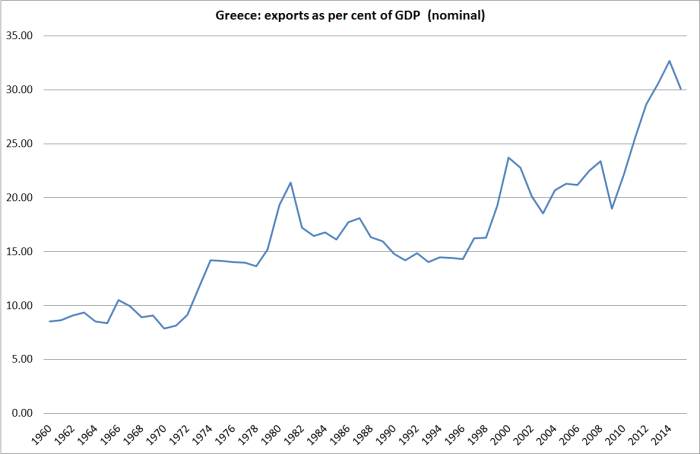
Flicking through the World Bank data for the previous post, I noticed Greece.

greece-exports-to-gdp

A very substantial –  10 percentage point –  increase in the export share of GDP in just a few years.

Unfortunately, of course, almost all the action is in the denominator.

Here is real GDP for Greece –  not per capita.

greece-gdp

And here are real exports.

greece-exports

Domestic demand collapsed, and there just hasn’t been much real improvement in competitiveness (or probably policy certainty, of the sort that might encourage much new investment).

Boosting exports: the exchange rate really matters

I noticed the other day a short piece on Treasury’s blog, written by one of their very able analysts, Mario di Maio, headed “How to get an export take-off“.  It appeared to be prompted by the government’s now long-standing target to raise the export share of GDP by 10 to 15 percentage points by 2025.  As I’ve noted before, the general sentiment behind the goal is probably broadly sensible –  successful economics typically trade more (imports and exports) with the rest of the world.  After all, the rest of the world is where the bulk of potential customers/suppliers are.  Of course, the problem with this particular goal is that (a) it doesn’t look as though it is going to achieve itself (good bureaucratic technique can include setting goals for things that were likely to happen anyway, and then claim the credit when they do), and (b) the government is doing absolutely nothing to bring about the sort of transformation of the economy that might reasonably be expected to lift the export (and import) share of GDP.  It is an old line, but no less true, that it is pretty crazy to keep on doing the same old thing, and expecting a different result.   So perhaps they don’t really expect a different result….and perhaps they don’t even care greatly, as by 2025 no doubt the government will have changed, perhaps more than once, and Key, Joyce and English will be doing something else (as Clark and Cullen –  who had similar vague aspirations –  are now).

The Treasury note is worth reading. It takes a quick look at some countries (all now advanced) that have achieved a 10 percentage point increase  in 10 years in the export share of GDP over the last 50 years or so.  The author finds 14 such countries, and has a quick look for any common factors.  Perhaps not surprisingly –  in a note of three pages of text – he doesn’t find many.  Indeed, he goes so far as to conclude

The diversity of the case studies cautions against drawing simple policy lessons from other countries for any New Zealand strategy to lift trade intensity. The diversity of approaches and circumstances means any single policy (or policy mix) would be misleading.

Personally, without a lot more background analysis –  and perhaps Treasury has done the analysis but just not published it – that seems too strong a conclusion.  If one were uncharitable, it could be seen as tending to avoid the real issues that specifically help explain New Zealand’s underperformance.  But perhaps that wasn’t the intention at all, and all they really mean is that we have to think hard about the specifics of New Zealand, and not simply latch onto one or other favoured overseas country as an example. If so, I agree.

I’m not going to use this post to pick at specific points in the Treasury note, but wanted to come at a similar issue in a slightly different way.

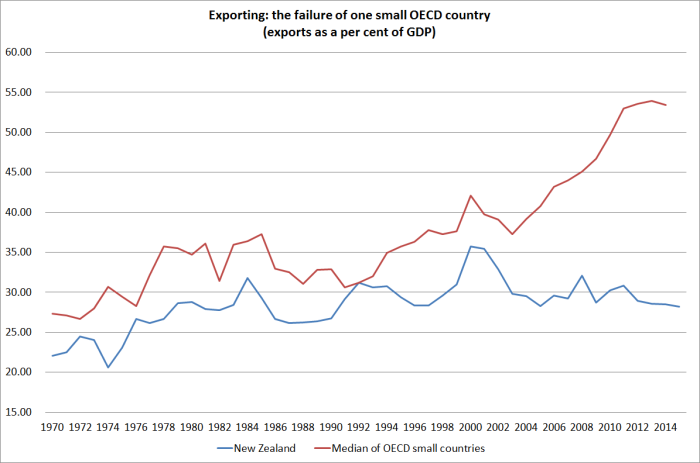
But first, lets remember quite how underwhelming New Zealand’s international trade performance has been.  This is a chart I ran a few months ago, comparing New Zealand and other small OECD countries since 1970.

exports small countries

The foreign trade share of GDP has gone basically sideways for almost 40 years.  It is hard –  but not impossible –  to get ahead with a performance like that.

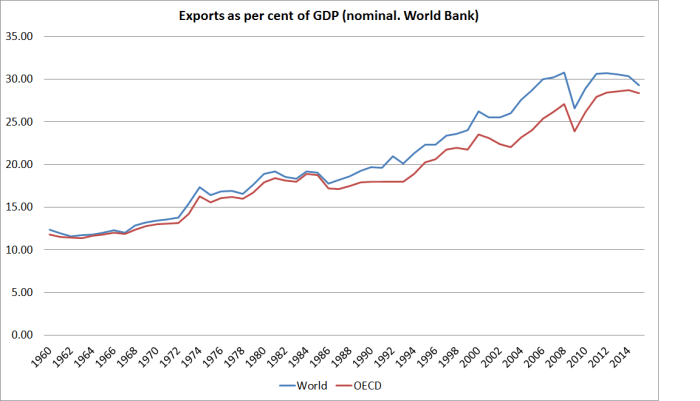
I usually use OECD data –  as in the chart above –  but the Treasury piece used the World Bank data, which has some advantages in capturing a wider range of countries.  For some countries, and aggregates, they also have data going a bit further back.

Here is the World Bank’s estimate of exports as a share of GDP, for the whole world and for the OECD, back to 1960.

exports-as-share-ofg-gdp-world

Over the 40 or so years when the export share of New Zealand’s GDP has barely changed, that for the OECD and the world as a whole has increased by between 10 and 15 percentage points.  The trend –  world, and advanced countries –  has been strongly upwards, and somehow we’ve managed to defy that trend.    Not all of that growth has been in export value-added, some has been the rise of global supply chains and the increased cross-border trade in componentry –  something that is never likely to be a feature of remote countries’ trade –  but that isn’t the bulk of the story by any means.

From the World Bank’s data, I picked out the advanced countries (OECD plus a few others), the emerging Asian countries, and Latin American countries (the latter mostly because they fascinate me, but also because they add a large number of countries that have underperformed for long periods).  The official New Zealand export data start in 1971, so I had a look at how the export shares of the countries I had data for had changed from 1971 to 1975 to 2011 to 2015.  Using five-yearly averages gets rid of some of the noise that arises from short-term exchange rate or commodity price fluctuations.  Data don’t go back that far for most of the former Communist countries of Eastern Europe, but I was still left with a sample of around 45 countries.

Over that period, New Zealand’s export share of GDP had increased by 5.9 percentage points.  Nine countries had had less growth in their export share than New Zealand.

Change in export share of GDP : 1971-75 to 2011-15  (percentage points)
Costa Rica 5.70
South Africa 5.00
Japan 4.80
Brazil 4.30
Guatemala 3.70
Israel 2.90
Norway 2.80
Colombia 2.50
El Salvador -3.50

Of those countries, only Norway could be counted as am unambiguous economic success story over that period.  All the others –  like New Zealand –  were underperformers at best.  One might make an exception for Japan –  until the late 1980s its economic performance was very strong – but then it is also worth remembering that at the start of the period exports as a share of GDP in Japan were only around 10 per cent of GDP (less than half of the export share in a small country like New Zealand).  Over the period since the early 1970s, Japan has increased the export share of GDP by almost 50 per cent (from around 10 per cent to around 15 per cent) while the increase from New Zealand has been only around 25 per cent.

The Norway experience is a reminder that a large export (and import) share of GDP is not a necessary conditions for a sustained acceleration in economic (and income) growth.  Then again, countries can’t count on discovering a huge new extremely valuable natural resource as a basis for improved prosperity.  Typically the path to prosperity involves firms finding products and services they can sell successfully to the rest of the world. We’ve failed on that count, and that shows no sign of changing.

Although Treasury seems to want to play down the importance of the real exchange rate, I think that in the New Zealand context it is much more important than they suggest.   One can never sensibly think of the real exchange rate is isolation from what else is going on in the economy.  A country with fast productivity growth might find that its export share of GDP is growing even as the real exchange rate is high or rising –  such is, say, the quality of the products or services firms in that country are selling.

But as everyone knows, New Zealand’s productivity performance over decades has been lousy, among the very worst in the advanced world.  Sure we have a few years from time to time when things don’t look too bad, but the multi-decade pattern of underperformance is clear and shows no sign of reversing.  Against that backdrop, it seems not just plausible –  but entirely reasonable –  to suggest that a real exchange rate that has been high or rising (rather than weak and falling) will, in the specific context of New Zealand, have been the main proximate contributor to the weak foreign trade performance (exports and imports).

I ran this chart recently.  It only goes back 20 years, but over longer periods the picture is much the same.  Our relative productivity performance deteriorated, but our exchange rate didn’t sustainably fall.

real exch rate

That sort of pattern typically happens only when some sort of domestic demand pressures keep holding up the real exchange rate (and domestic real interest rates).  In a country with a modest national savings rate, government policies that result in rapid population growth are an example of just such a pressure.   It is hard to foster an environment in which exporting is profitable/attractive when so much resource constantly needs to be devoted to meeting the (individually entirely reasonable) needs of a rapidly growing population.

Of course, “the exchange rate” can’t be fixed in isolation.  It is a symptom of what else has gone wrong with the policies of successive governments.  But like the old canary in a coal mine, the persistently strong exchange rate –  in a country of such persistently weak productivity growth –  is supposed to be a warning signal that something about economic policy is very wrong.

But why would we be surprised that nothing changes?  The Opposition appears to have no compelling analysis or ideas, and we have a government run by a Prime Minister who in a recent interview declared that

Where would chairing the UN Security Council rank in your career highlights?

Right up near the top

I guess when there have been eight years of no substantive economic reform, no progress in improving the relative performance of the New Zealand economy, no progress in reversing decades of relative economic decline –  just the pretence that somehow we are a global economic success story –  we shouldn’t be surprised that chairing an ineffective meeting of foreign officials and ministers, dealing with an intractable problem in a far-away land, counts as some sort of career highlight.

Young New Zealanders, facing unaffordable houses, and  the prospect of growing up in a country slowly drifting ever further behind, might perhaps have hoped for something rather more tangible rather closer to home.


Envy of the world, or middling at best?

Over the last couple of months I’ve lost track of the number of comments I’ve seen, from outlets that really should know better, suggesting that New Zealand’s economy at present is the envy of the world.  Radio New Zealand’s Checkpoint seems a particularly egregious offender, but that might just be because I often have it on while I’m making dinner.  But I’ve seen similar lines in the Herald, from Business New Zealand and a variety of other outlets.

The people running this line, when they aren’t just running propaganda, seem constantly to lose sight of just how much of our real GDP growth –  itself not that impressive by the standards of previous growth phases –  is accounted for by our very rapid population growth, in turn the result of our large (but fairly stable) inward immigration programme, and the reduction in the net outflow of New Zealanders.

Quarterly real per capita GDP data isn’t easily available for many countries, but the other day the IMF released its latest World Economic Outlook.  I had a look at how New Zealand is estimated to have performed over 2013 to 2016 relative to the IMF’s set of advanced countries.  Over this period, only two of these countries –  Israel and Luxembourg –  are estimated to have had faster population growth than New Zealand.

real-pc-gdp-growth-2013-to-2016-weo

Of course, we only have hard data to mid 2016, and even that will be subject to revision for some time.  But that is so for all these countries too.  Take the last three years together and New Zealand just doesn’t stand out.  It isn’t necessarily a bad performance (relative to other advanced countries over this period), but nothing much to write home about, absolutely or relatively.  And recall that we don’t exactly have the highest level of GDP per capita among these countries –  the aim, for decades, has been to catch up with the rest of the advanced world.  Over this three year period, we’ve made no progress at all.

We’ve had things working for and against us over that period.  The terms of trade have been high, but fell back quite a way from the peak, especially dairy.  We’ve had a significant boost to demand and activity from the Christchurch repair and rebuild process.  We’ve had a big (largely exogenous) boost to tourism, and a significant boost to export education.  We’ve had no constraints (other than self-imposed ones) on our ability to use monetary policy flexibly.  And we’ve had a massive boost to demand from the unexpected rapid growth in the population.  And yet, once again, we’ve made no progress in closing the gaps.

And, of course, our productivity performance in  recent years has been even worse.

real-gdp-phw-oct-2015No productivity growth at all in the last four years or so (even ignoring the last observation, where there is an unfortunate discontinuity in the HLFS hours worked series).

New Zealand the economic envy of the world?  I think not.

RBNZ Board: not doing the job Parliament gave them

The Reserve Bank of New Zealand’s Board published its Annual Report last week.  It didn’t attract any coverage, but then it was hard to find –  buried inside the Bank’s own large glossy (expensive?) report, and with no accompanying press release (not even a mention in the Governor’s own press release).    And it didn’t say much anyway.

The Board isn’t part of the decision-making structure of the Reserve Bank.  Unlike a typical corporate or Crown entity, all the powers Parliament has given to the Bank rest with the Governor personally.  The Board are agents for the public and the Minister in holding the Governor to account, and so need to be –  and to be seen to be –  at arms-length from management.   I’ve criticized the Board previously for not publishing its report separately, and not even insisting that it is separately visible on the Bank’s website.  The Board must have noticed that criticism because in this year’s report they claim that they are “specifically tasked…with publishing its annual assessment within the Bank’s Annual Report”.   Unfortunately, even on this small detail they are wrong.  The Reserve Bank Act allows the Board’s Annual Report to be published with the Bank’s report if the Board agrees, but it certainly does not require the Board to agree or mandate the way the Board report is buried inside the Bank’s report.   It is a small detail, but perhaps one again suggestive of a Board that too often sees itself as part of the Bank, working hand-in-glove with management, rather than as a fairly independent entity, charged with challenge and review of the Governor’s stewardship.  As I’ve noted previously, the practice until now of having a former staff member chair the Board seems to have been a part of that identification with management.

It is a hard job for the Board to do well.  Typically Board members aren’t experts in the areas the Bank is responsible for.  And they don’t spend much time on the issues either –  they aren’t paid that much, and the current and former chairs have both had demanding fulltime chief executive positions of their own.   The Board has no resources: there is no independent budget, no staff.  And not only is the Governor himself still a member of the Board, but the Board secretary is a member of the Bank’s senior management group.   The Board can ask for (but not compel) papers to be provided, but the Governor has total control over what they get back, even though it is the Governor’s performance they are charged with monitoring and evaluating.

So it is a deeply flawed model.  In no other area of public life I can think of has a review body been set up that is so close to, and so dependent on, the entity/person it is charged with reviewing.   Like so much of the rest of the Reserve Bank governance model, the role and structure of the Board is overdue for reform –  the more so as the Reserve Bank has chosen to exercise more and more discretionary powers.

Cynics might think that problems were deliberately built into the legislation, and that there was never any intention of the Board playing a serious role in holding the Governor to account.  The cynics are wrong.  As I’ve explained previously, the original conception of the Reserve Bank’s role was a fairly mechanical one, and even the first Governor thought of accountability as pretty mechanical –  if (core) inflation was outside the target range he would lose his job.   So there were genuine good intentions when the Act was written in 1989, and when it was amended in 2003, to require the Board to publish an Annual Report.  But good intentions haven’t produced good results.  Poor structures make serious review and accountability more difficult than it should be, but the individuals successive Ministers have appointed to the Board haven’t done much about doing the best with the flawed structure they operate within.  That is something those individuals –  all no doubt capable and competent people in their own fields –  need to take responsibility for.

This year’s Board Annual Report spans eight pages of text.  That might sound moderately promising, except that almost all of the text is descriptive material: lengthy lists of meetings held, topics discussed, and so on.  If you went to the Report looking to get a sense of the Board’s views  –  as might befit a body established by Parliament, paid with public money –  it would be pretty thin pickings.  As far as I could see, the only judgements were as follows:

  • “the Board’s overall assessment is that the Bank continues to perform its functions to a high standard….and contributes to New Zealand’s stability and prosperity”, which is interesting, but comes out of the blue with no supporting analysis or evidence.
  • “on the basis of the information and advice available to the Governor at the time of his decisions, the Board assessed that the four MPSs and the intervening OCR reviews met the requirements laid out in section 15 of the Reserve Bank Act”.  These are quite formal technical judgements, made at the time of each OCR decision, not ex post reviews of the conduct of policy, (and, in terms of attention to detail, section 15 of the Act deals only with MPSs, not with other monetary policy adjustments or OCR reviews).
  • “the Board agreed that the November 2015 and May 2016 Financial Stability Reports met the requirements contained in  section 165A(2)(a) and (b) of the Reserve Bank Act.
  • “the Board reviewed the Bank’s health and safety policies in the context of the new legislation and advised that these should be reviewed annually and be externally audited”, and
  • “the Board….endorsed the decision taken by the Governor to cease pre-announcement media lock-ups”.  I presume we shouldn’t interpret this as meaning that they disagreed with canning the pre-release analyst lock-ups.

Which is all very well, but in none of these occasions does the Board offer any basis for their judgements.  There is no sign in the text that they had thought about any alternative models, engaged with any alternative perspectives, or anything of the sort.  To the extent there is any analytical discussion at all in the Board’s Report (and it is brief), it could have been lifted straight from the Governor’s own report.  If the Board genuinely believes that the Governor has been doing a good job, even with the benefit of hindsight, that is certainly an option open to them, but surely they owe us  – the stakeholders –  rather more evidence of having engaged with the issues and alternative perspectives than is on display again in this report?  If there is one thing everyone recognizes about things like monetary policy, it is that reasonable people can interpret the same material differently, even given a pre-specified target like the PTA. But there is no sign of that at all in this report.   And is the Governor really so perfect that the Board could find nothing in the entire year about which it was willing to express concern?  I suppose it is possible, but I’m sure even the Governor would recognize that he is –  like all of us –  a flawed human being, rather than some plaster saint.

There are other areas for concern.  I highlighted last year my concern at how the Board seemed to see its role as “having the Governor’s back”.

Too often, the Reserve Bank’s Board seems to see a significant part of its role as being to help the Governor spread  his story and to explain the choices the Governor is making.

And this year the Board uses exactly the same words it used last year to describe the functions they host for locals “elites” on the evenings of Board meetings

This outreach is a longstanding practice of the Board to ensure visibility of its role among the wider community, and to facilitate directors’ understanding of local economic developments, and the wider public’s understanding of the Bank’s policies.

As I noted then

Worthy activities for management, but that isn’t the role Parliament envisaged for the Board –  whose purpose is to hold management to account, not help management explain their choices to (select elements of) the public.

The public needs awkward questions, not sympathy.  The Board isn’t there to be a part of the Governor’s PR programme, but as part of citizens’ protection in respect of perhaps the most powerful unelected individual in New Zealand.  But there is just no sign that the current Board members get the distinction, or are interested –  or perhaps capable –  of playing such a role.

There is also the constant risk of the Board getting too involved with management to be able to credibly hold the Governor to account.  I was interested in this extract from the Report

With the Governors present, the Board met three of the chairs and a deputy chair of the four major banks for discussions on two key issues: the governance of New Zealand subsidiaries of the large Australian banks; and regulatory issues that are currently front-of-mind for New Zealand bank boards. The banks discussed risks in the dairy and housing sectors and the impact of LVR limits on balance sheet risks. The banks also discussed the review of the Bank’s outsourcing policy and risks associated with possible cyber threats.

Sounds like an interesting series of meetings, but what role of the Board was being pursued here?  The Reserve Bank Board has no role in such areas of policy, and if its concern was about being able to hold the Governor to account, if the commercial bank boards were ever going to speak freely, they weren’t likely to do so with the Governor in the room.  Individually, such meetings probably do little harm, but they just reinforce a sense of a Board which serves the Governor’s interests more than it serves the interests of the people of New Zealand, or (more specifically) the sort of role Parliament set out for them.

The one key power the Reserve Bank Board has is to recommend the appointment of the Governor.  The Board –  not one of them elected, very few of them widely known, none with any accountability themselves –  control the appointment, since the Minister cannot appoint as Governor someone the Board has not recommended.  It is now less than a year until the current Governor’s term expires, and yet there is nothing in the Annual Report from the Board on how it thinks about the exercise of that appointment powers; no sense of what makes a good Governor in such a powerful public role, and no discussion at all of (for example) the Bank’s succession planning.  Successful organizations typically promote from within, but 1982 was the last time a Reserve Bank Governor was appointed from within –  contrast that with the Reserve Bank of Australia.  But you would have no sense from this report that the Board was even paying attention to such issues, or grappling with why the Bank appears to have had such a poor record of developing potential Governors.

As I said, with such limited resources and such dependence on Bank management, the Board members face quite a challenge to do the sort of job Parliament asks of them, and which citizens should expect.  There are plenty of much better resourced review agencies around the New Zealand public sector, and when a government finally gets round to reforming the Reserve Bank Act they should look hard at such models, but there is a lot more the current Board could do, and be seen to be doing.  Under the chairmanship of Arthur Grimes and Rod Carr, there was a strong predisposition to support the Governor and the institution’s decisions.  That needs to change. The Board works for citizens –  and the Minister of Finance –  not for the Governor.

The Board has recently chosen a new Chair, an outsider for the first time rather than a former insider.  The challenge for Neil Quigley will be to try to lift the performance of the Board, and reorient it in the direction Parliament clearly intended (including when it required publication of a Board Annual Report).  It won’t be easy, and some of the Board members might not be keen –  keeping cosy with the Governor is much easier –  but if they believe the current governance model is the appropriate one, and one that can work well, they owe to us, and to themselves, to show it can work much better, and offer much more scrutiny and challenge, than on the evidence before us it has been doing in recent years.  Apart from anything else, support and endorsement is usually that much more persuasive if there is demonstrable evidence that those who end up offering the support have posed hard questions, brought alternative perspective to bear, and come away convinced.  Unreflective echoing of the perspectives of the decisionmaker convinces few people anywhere.  If anything, it just leaves questions about the quality of institutional governance in the New Zealand public sector.

As individuals Reserve Bank Board members typically look better than that. But they need to demonstrate that they have what it takes in this demanding role.

(Three months ago, I outlined what I thought the Board should have covered in this year’s report.  To no one’s surprise, there is little or no overlap with the actual report.)


Subsidy city…airport, airlines and the Council

Earlier this week it emerged that the Wellington City Council’s decision to subsidise flights between Wellington and Canberra (and on to Singapore), details of which are still unknown to ratepayers, had been made on the basis of almost no supporting documentation.   There were, so the Ombudsman found, no emails, no cost-benefit analyses, in fact almost nothing at all.    As Stuff reported it:

Documents released by the Wellington City Council show that apart from a presentation made to councillors after the decision was made, the council generated a single two page document, which refers to the subsidy only in passing.

This subsidy could be as much as $8 million over 10 years.

Outrageous as the lack of documentation is, in a way it isn’t really surprising.  This is the Wellington City Council –  and the cabal at the top of the organization –  we are dealing with.  They aren’t exactly known for rigorous and robust policy and analysis processes.

In any half-decent public sector agency, proposing to use public money,  there would have been a proper substantive piece of policy analysis, reviewing the arguments and evidence,  critiquing the reasoning and evidence advanced by the private parties pursuing such a subsidy and, typically, an attempt at a properly quantified cost-benefit analysis.  Not all cost-benefit analyses are very robust, but if officials are forced to write down their reasoning and assumptions at least it opens things up to subsequent scrutiny and questions, based on numbers, not just the hunches or preferences of councillors.

But Wellington City Council doesn’t do things that way.

After refusing comment for several days, the Council’s CEO –  a temporary blow-in from the UK with no obvious expertise in evaluating industry subsidies or airlines – dug his own hole deeper today.

Lavery initially claimed that he had received a six-page report on the funding request written by “my staff”, before acknowledging that the report was actually written by Wellington Airport which had “different interests” to the council.

That looks a lot like a deliberate attempt by the Council to mislead the public.

The council commissioned no work of its own to review the airport’s claims, but could have, Lavery said.

“We could have done that, if we’d felt uncomfortable with it. But we didn’t, so we didn’t. And that’s not uncommon.”

So  he acknowledges that analysis done by the airport company will have been done primarily serving the interests of the airport company  (as it should) but nonetheless saw no reason to commission any analysis of its own, as regards the interests of the Council and the citizens and ratepayers of Wellington.  He didn’t feel “uncomfortable” with the airport company’s short paper.  And why would he?  I’m sure it was written persuasively and Lavery has no known background in aviation matters.  But that is precisely why he (and his bosses) should have commissioned some independent analysis.  Not to have done so might serve his “can do” mentality, but it looks and feels much more closer to dereliction of duty to the citizens of Wellington.

Lavery goes further

“The “paper trail” is the contract itself,” Lavery said.

Later he claimed government agencies often signed contracts without other documentation.

“That’s the way any contract goes. You get in rooms and have discussions. Then you write it up, that’s the way it works.”

Yes, I’m sure all the contractural terms are in the contract itself –  a contract so secret that not even councillors have access to its terms – but that simply isn’t the point.  What matters here is the disciplined process and analysis leading up to the decision to negotiate the contract at all.  And on that, in Lavery’s own words, there was all but nothing.

Of course, it is easy to focus on Lavery.  No doubt he likes the power the leading cabal of Council have entrusted to him .  He even argues that

The amount at issue was a “relatively modest delegation” Lavery said, adding that he had the power to allocate much larger amounts on sewerage schemes.

One is a core ongoing operational function of the Council, the other is a new industry subsidy, in a sector where councils don’t have a great track record.

But in fact the real responsibility here surely rests with the Council itself, and even more so on this particular occasion with the leading cabal –  the outgoing Greens mayor Celia Wade-Brown, the Labour Party Deputy Mayor Justin Lester, and councillor Jo Coughlan.  Lester was apparently a key figure in the discussion over this new subsidy, and Coughlan has chaired the Economic Growth and Arts Committee which seems to deal with such matters.

I suspect that what actually happened is that the airport company –  always keen to attract new flights – was negotiating with Singapore Airlines, who wouldn’t fly to Wellington (making a normal return on capital) without some sort of subsidy. So the airport company approached the senior “booster” councillors, and Lavery, with the idea of a subsidy scheme, all backed up (we are told)  by a six page paper from the airport company.  Lavery won’t really have been acting alone here –  even if he signed the contract –  but giving effect, with no supporting documentation, to the preferences of these key councillors, perhaps especially Justin Lester who will have been looking to the new flights starting around local body election time.

A lot of people attack this subsidy as corporate welfare.  I’m less sure about that. I doubt Singapore Airlines is benefiting much – the deal probably just makes it barely economic for them to trial this odd route.  Probably Wellington Airport, and its shareholders, are directly benefiting, since they make their money from people and planes passing through Wellington Airport.  But the biggest intended gainers really look like the Mayor (then still toying with re-election) and councillors Lester and Coughlan, wanting to be able to sell voters a line that “Wellington was prospering, new connections were growing etc”, all with ratepayers’ money as secret subsidies.   It was certainly convenient timing that the flights started almost to the week when the voting papers went out.

Justin Lester in particular seems to now be feeling some heat.

Lester believed the decision to subsidise the route was a good one, but called on Lavery to release further information.

“I haven’t seen enough information yet” to be satisfied the process had been robust. “I think there should have been more paperwork.”

Easy to say now as people are filling in their postal votes having read the Dominion-Post’s coverage.   But there is no evidence that the Deputy Mayor sought that sort of documentation and scrutiny back when he, and the rest of the cabal, were doing the deal.  Lavery has already told us about the documentation: there wasn’t any, and it is hard to believe that Lester was not aware of that all along.  As I say, Lavery won’t have been acting without political cover.

It is disgraceful all round.  And good reason to be very uneasy about how the Wellington Council will go about evaluating a proposal to contribute to the runway extension (on top of the considerable money already spent).  No doubt they will assure us that for a much bigger commitment there would be much more scrutiny, and much more transparency.  But how much confidence should voters have in such assurances?  Very lirtle, I’d suggest.

A couple of weeks ago, Treasury put out a link to a rather good few pages on a Policy Quality Framework, developed I gather in the Department of Prime Minister and Cabinet.  I can only commend it to the incoming Wellington City Council, and their employee Mr Lavery, as a starting point for evaluating policy proposals.  It is easy to read and digest, but would involve a sea change at the Council.  Evidence, rigour, and documentation have a great deal to commend them.  It is, after all, public money not that of Mr Lester or Mr Lavery..

To end, I’m reproducing a mock Council discussion sent to me the other day by an irate reader, and reproduced with his permission:

Today’s Dom Post on SQ flights left me more than outraged – quite ruined my breakfast
I can imagine the discussion at the Council table:
Councillor A: “ I have an idea – why don’t we increase the rates on struggling widows in Tawa and use the funds to subsidise shareholders in Singapore Airlines”
Councillor B: “Shouldn’t we call for tenders first as other airlines might be interested. After all Air NZ will lose traffic from Auckland?”
Councillor C: “ No we can’t do that – it is commercially sensitive?”
Councillor D: “ Hang on a minute – since when is a subsidy a commercial activity?”
Councillor E: “ Good point – perhaps we should rename it as market development and then the CEO can authorise it without bothering us”
Councillor A: “The taxpayers’ money will bring added business to Wellington – drawn from Christchurch and Auckland. And what is more, these flights will save Wellington business people 40 minutes compared to going via CHC to get the SQ flight from there. That is a big saving”
Councillor B: (the lone slightly more rational member): “ If business folks and others are enjoying a benefit that must be worth something to them – so why don’t we recoup the costs of the subsidy by a surcharge on the tickets for SQ flights?. Actually, come to think of it, the ratepayers are already subsidising all other flights out of Wellington through our involvement in the WIA so we could charge an extra fee on those too”

Councillor A: “ You all seem to be overlooking the multiplier effect; our own analysis (based on data supplied by the WIA and Singapore Airlines) shows a significant net economic benefit to Wellington”

Councillor B: “ But perhaps we should get a slightly more independent, disinterested party to review the business plan?“

Councillor C: “No, no  – we can’t do that– remember all this is highly commercial sensitive”

But, as I noted sadly to my correspondent, it was, of course, even worse than that. There was no such discussion around the Council table before the deal was signed –  just the inner cabal and Mr Lavery.  Even after the deal was done, councillors –  elected members –  are only allowed access to the terms if they pledge subsequent secrecy.  It is no way to run a government, but sadly it seems all too common in local government.  Wellington might well be no worse than most, but its failings are quite egregious enough.

UPDATE: When I wrote this post I hadn’t read the Herald story, from which this comes

“I think the current debacle in the press illustrates perfectly why it’s not appropriate to have it in the political domain. It gets politicised, and I think a lot of organisations wouldn’t touch us with a barge pole if that happened.”

The Dominion Post has reported the 10-year subsidy is worth up to $800,000 a year, but Lavery would not reveal the agreement, citing commercial sensitivity.

“We don’t want to lose out to competitor cities that would love to have the deal we have with Singapore Airlines,” he told Radio New Zealand.

Two thoughts:

  1.  “politicized” = voters/citizens concerned about how the city council they elect spends their money?    It simply isn’t the business of Councils to be subsidizing flights…..or election campaigns.
  2. “competitor cities”.  Those would be…..?  SQ already fly to Auckland and Christchurch, so was Lavery (and Lester) concerned about somehow “losing out” to flights from, say, Palmerston North to Canberra?


A boardroom coup?

The Reserve Bank’s Annual Report should be due out later this week.  With it, no doubt, will be the separate report by the Bank’s Board of Directors.  The Board has few/no executive responsibilities, and its prime responsibility is to (a) recommend the appointment of a Governor, and (b) to monitor the performance of the Governor.

The Bank’s own Annual Report is usually an anodyne affair, as no doubt it should be.  The Governor has plenty of other vehicles to comment on policy etc.  But the Board’s Annual Report should be different.  After all, it is the one time in the year when the Board makes a public statement.   But the operative word is “should”.  I wrote about last year’s Board report here –  that report said almost nothing, and seemed consistent with a Board view of itself primarily focused on “having the Governor’s back”, at least in public.  We’ll see soon if this year’s report is any better.

But then this morning, in a statement no doubt timed deliberately in advance of the Board Annual Report, came news that the Board had acted to replace both its chair, Rod Carr, and its Deputy Chair Keith Taylor.    In one of the odd and unsatisfactory features of the Reserve Bank Act, the Minister of Finance appoints Board members, but the Board members themselves appoint the chair and deputy chair from among their number.

And one of the practical problems of how the Act has worked since the new structure was put in place in late 2003 is that Board members have repeatedly (each year, since chair is an annual appointment) chosen former Reserve Bank staff as chair.  First Arthur Grimes (who had previously been Chief Economist and Head of Financial Markets) and since 2013 Rod Carr, former Deputy Governor (and Acting Governor for a time after Don Brash resigned).  I presume the Board liked the idea that the chair had some subject-specific expertise and experience, but the downside was that those chairs were all too ready to bring a management perspective to the Board.  When they ask questions, they might be the geeky questions that get asked on the internal Bank committees, it is too easy to get too close to management,  and externally they seem to have wanted to make sure they “have the Governor’s back”.   We saw a particularly egregious example of those sorts of faults in the way Rod Carr was egging on Graeme Wheeler, and backing him up, over Wheeler’s misjudgements in the OCR leak debacle.

But now Carr is gone, and with him his deputy Keith Taylor, replaced by the two economists on the Board: Neil Quigley (Vice-Chancellor of Waikato University) takes on the role of chair, and Kerrin Vautier becomes Deputy Chair.

In my experience, Quigley was always willing to ask hard questions, and look for alternative perspectives, even if that meant upsetting first Alan Bollard and then Graeme Wheeler.  Combined with a background that doesn’t include a stint in RB management, it looks like a step forward.

But it also looks as though the Board itself really wanted some things to be different. We are told:

Dr Carr said that he had advised the Board some months ago that he would not be seeking a further term as a Director of the Reserve Bank when his present term ends in July 2017. In light of that decision he had decided to step down as Chair.

But one might reasonably wonder if perhaps the causation was not the other way round?  Carr was in his first term as Board member, and could surely have expected reappointment to the Board by the current government.  Sure, he has a busy day job, but not necessarily any busier than it was when he first became Chair three years ago.   There might be a sense in which Board members had become discontented with Carr’s chairmanship, quietly foreshadowed the prospect of a “coup” at the next annual election, allowing Carr to go quietly, suggesting it was all his own decision.

The timing is also interesting given that Graeme Wheeler’s term expires a year (almost to the day) from now.  An experienced chair, in whom the Board had confidence, would have been a natural to oversee the process of identifying the person to serve as the next Governor.  That would have been so even if Carr had genuinely not wanted another term –  oversee the selection process, which would be over before Carr’s term expired, and then leave it to another chair to work with whoever is the new Governor.  By contrast, while Quigley has been on the Board for several years, he only becomes chair now, and has (as far as I’m aware) no experience in the leading a process to fill such a powerful role.  In itself, that shouldn’t be disqualifying –  and as I noted earlier, I think his appointment is a modest step forward –  but it does suggest something more in the nature of a board room coup has gone on.

If anything, Graeme Wheeler’s press release could be seen in the same light. I’m sure there was a nice laudatory press release from the then Governor when, in 2003, Rod Carr left the Bank staff.  And yet we get this today

When Dr Carr’s term ends as a Director, this will end a 10-year relationship with the Bank. Between July 1998 and July 2003, he was Deputy Governor and then Acting Governor of the Bank. In these positions he also served as a Director of the Bank until September 2002, since when Deputy Governors have no longer been Directors of the Bank. Dr Carr was appointed to the Board in 2012, and was first appointed Chair in September 2013.

Governor Graeme Wheeler paid tribute to Dr Carr’s contribution. “Rod has provided over a decade of invaluable service to the Bank, spanning key management and governance roles. He has been an outstanding Chairman and the Bank has benefited greatly from his intellectual rigour and sound advice and judgment.”

It is all a bit strange really.  Being a Board member is (supposed to be) quite different from being a senior manager, especially in the Bank legislative model.  And isn’t it a bit icky to have the person whose performance the Board, and Chair, are primarily responsible for monitoring lauding the excellence of the outgoing chair just a few days before the Annual Report –  the performance assessment on the Governor – is due?  I suspect Wheeler probably was rather keen on Carr’s unquestioning defence of the Governor.  But that might have been part of the problem –  just helping to reinforce that bunker mentality which characterizes the late-Wheeler Reserve Bank.

Today’s news really does start the process leading to the appointment of the new Governor.  I remain convinced that the Board –  all members unaccountable and barely known –  has far too much power in that process.  But better at least to start the current unsatisfactory model with something of a clean slate at Board chair level, and a perspective that isn’t shaped by a term as Reserve Bank senior manager.

PS: The Bank should probably be aware of the factual error in the press release.  Contrary to the statement in the blocked text above, Carr had served as a Board member throughout his term as Deputy (and Acting Governor).  He didn’t leave until the second half of 1993, and the provisions removing Deputy Governors from the Board weren’t in effect until after his departure.    It is all there on page 6 of the 2003 Annual Report.


Subsidy city…Wellington airport

At about 3pm, the first Singapore Airlines flight to Wellington, via Canberra of all places, lands at Wellington Airport.  Wellington-boosters, well represented on the Council and the Chamber of Commerce, talk up the first “long-haul” flight to and from Wellington.  All of which would be more impressive if it were not for the ratepayers’ money being (secretly – no information on the amounts or terms of these sweetheart deals, no robust cost-benefit analysis etc) used to make it all possible.    Were the flights financially self-supporting that would be the best evidence of them being “a good thing”.  But they aren’t.  That means (a) a presumption against them being “a good thing”, and (b) a likelihood that they won’t survive for long, at least without some permanent subsidy from the long-suffering ratepayers of Wellington. It probably isn’t a subsidy to the giant Singapore Airlines –  they’ll probably just manage a normal return on capital –  but by quite which canons of social justice ratepayers should be subsidizing government departments (probably the main purchasers of tickets on the Wellington-Canberra leg, and one of the larger sources of international passengers from Wellington) is beyond me.

But at least these sorts of subsidy deals can usually be terminated with not too much notice.  Other cities have tried this sort of thing, and the arrangements have typically fallen over before too long.  There isn’t much irreversibility about them.  The same can’t be said for the proposed Wellington Airport runway extension.  If it goes ahead, very large amounts of money will be irreversibly lost.

There was a very nice, accessible, article out a few weeks ago in City Journal by leading US economist Ed Glaeser.  In “If you build it…..” Glaeser tackles some of the “myths and realities about America’s infrastructure spending”.  There is a lot enthusiasm around, especially in centre-left circles, for more – much more –  infrastructure spending, to “take advantage” of the current very low global interest rates.  Enthusiasts, of course, rarely stop to ask why interest rates are so low, and expected to remain low, but set that caveat to one side for now.   Glaeser reports on a variety of studies on just how underwhelming most government-led infrastructure actually is: too often in regions that are declining rather than ones that are growing, all too often with low payoffs (and massive cost over-runs) at the best of times, and so on.  There are plenty of specific differences between the US situation and our own – we don’t have the Senate, steering funds to lightly-populated states, but then we have by-election promises to build bridges to anywhere –  but I don’t think we have anything to be complacent about.  His penultimate paragraph is relevant pretty much anywhere

Economics teaches two basic truths: people make wise choices when they are forced to weigh benefits against costs; and competition produces good results. Large-scale federal involvement in transportation means that the people who benefit aren’t the people who pay the costs. The result is too many white-elephant projects and too little innovation and maintenance.

Just last week we heard of the latest large cost-escalation in the hugely-expensive questionable Auckland inner-city rail loop.  “Who cares” seems to be the reaction of central (National) and local government (Labour) politicians –  ratepayers and taxpayers will pay.   In Wellington the largest regional roading projects for generations (probably ever) is underway at Transmission Gully.  The economics of the project are simply shocking, but that doesn’t seem to bother our National or Labour politicians.

And then there is the airport extension proposal.  Now, on paper, it might look like a project that might pass some of Glaeser’s tests.  After all, Wellington Airport isn’t owned by central or local government –  although Wellington City has a minority stake –  but by a company majority-owned by some fairly hard-headed infrastructure investors/operators, Infratil.

There are plenty of people around –  including commenters here on previous airport posts –  who will attack Infratil.  I’m not one of them.  Infratil is a private sector business, no doubt pursuing (as it should) the best interests of its shareholders.  And Infratil has been quite unambiguiously clear that the airport extension project simply does not stack up on commercial grounds.  In a comment on this blog six months ago, the chairman of the airport company Tim Brown put it this way:

The Airport extension is forecast to cost $300m. If airport users who get no value from it (people on smaller aircraft, people buying coffee, parking cars, etc) don’t pay anything towards it, then the estimated present value to the airport company from those who do benefit from the extension and do help pay for it may be about $100m. So on purely commercial grounds and avoiding cross subsidies the shareholders are expected to contribute that sum.
Clearly that makes it a dead duck on a purely commercial basis. Who would hand over $300m for something “worth” $100m?

Since Infratil owns 66 per cent of the airport company (WIAL) that would involve them putting up around $66m and the minority shareholder putting up $34 million.

So when people attack the idea of council or government handing over (lots of) additional money to get the project going (in addition to the millions the Council has already spent) as “corporate welfare”, they are simply wrong, at least as regards Infratil.   This project seems to be driven by the Council “boosters”, presumably why they’ve been so ready to spending large amounts of ratepayers’ money on it already.  If some branch(es) of government in fact do stump up hundreds of millions of dollars beyond what is commercially justifiable, some of it will certainly benefit some local businesses, but most of it will simply be money down the drain; spent on real resources to build an extension that simply has almost no economic value.  Other than the exercise commissioned by the airport company itself –  funded by the Council –  no one who has taken a hard look at the numbers regards the claims of large scale economic benefits as stacking up.  Of course, there are plenty of “boosters”, and others who think of (real) long-haul flights from Wellington as a nice idea, but the numbers simply don’t stack up.

Fortunately, it is local body election time.  If it weren’t, I fear the project might be rammed through with as little serious scrutiny as the cosy subsidy deal to fund a movie museum/convention centre in Wellington recently was.  (The movie industry, of course, surviving on large scale taxpayer subsidies).  At present, WIAL has a resource consent application underway.  (Of course, if the project can’t get a resource consent, the economics is irrelevant.)  Somewhat curiously, WIAL recently temporarily put the resource application on ice. This was, ostensibly, to allow them to take account of points raised in the numerous public submissions. I’m a bit skeptical of that story –  surely the submissions can’t have been much of a surprise –  and wonder if it isn’t a convenient way to minimize coverage of the issue during the local body election season.  Perhaps not, but the timing is certainly convenient.

A year ago, I assumed that the Wellington City Council – which hardly ever turns down an opportunity to waste money, and which is in the thrall of an “economic development” mindset –  would simply write the cheque, shifting large amount of ratepayers’ money into a project which  –  while fundamentally uneconomic –  it would not even secure a much-increased ownership interest in.

But as the election season has gone on, I’ve begun to be a little more hopeful that perhaps hard-headed analysis might actually play some role in the eventual decision on Council funding (or indeed, central government funding, where there is little sign of much greater discipline around capital spending).   Our mayoral race is hotly contested, and so there have been plenty of surveys asking candidates for their views on the airport extension.  Here I’m drawing mostly from a survey done by my local residents’ association.

Somewhat encouragingly, of the eight mayoral candidates not one is now unambiguously in support of spending lots of ratepayers’ money on the runway extension.

One of the mainstream candidates –  centre-right councillor Nicola Young –  is outright opposed

 Opposed. Initially I thought it should funded in line with its ownership (Infratil 66%, WCC 34%) but now I believe it would be a $300million folly. Subsidising international airlines is very costly, as Christchurch Airport discovered when it paid Air Asia X millions to get direct flights to Asia; the flights were cancelled after nine months

Another sitting councillor, this time from the left, Helene Ritchie, is also opposed

I have repeatedly opposed it and any funding towards it-including Council using rates to support an application by the Company for a  resource consent.

She further offends the elites by suggesting that voters should get to make the final decision on such an expensive proposal

The Environment Court should throw it out. If it is not thrown out, then as mayor I will call for a referendum/poll of the people, on this proposed rates funded $350 million (probably likely $500million) Airport Extension, asking residents, “Do you want to pay for the proposed airport extension? Should rates be spent on “corporate welfare”-an unnecessary airport extension?”

Another candidate –  left-wing economist Keith Johnson, campaigning (I suspect) against waste rather than to be elected –  is also clearly opposed

I am opposed to the project and have submitted a substantial paper detailing my objections to the Environment Court, covering safety, environmental, budgetary and business-case concerns.
I am absolutely opposed to the allocation of $90 million from Wellington City Council to the project, as the proposal essentially constitutes corporate welfare funded from the pockets of ratepayers.

A final minor candidate is also clearly opposed.

Unfortunately, most of the more likely candidates are somewhat more positive.

Sitting councilor Andy Foster probably isn’t going to be mayor, but despite being a typical “booster” most times when it comes to council spending, on this one he has clearly been having second thoughts.

It will depend on whether it can get over some very tough hurdles: consent, demonstrated airline commitment, robust economic case and obtain funding.  If it can, I will support it. If it doesn’t I won’t.  I suspect it won’t.

The election seems set to come down to a race between the current Labour Deputy Mayor (endorsed by the Greens) Justin Lester, the current Labour mayor of Porirua Nick Leggett, and the centrist councillor Jo Coughlan.  All three have a track record of supporting spending (lots of) public money on “economic development” projects, but I am mildly encouraged by how cautious they now seem to have become.

Here is Coughlan

I support the runway extension subject to it getting a resource consent, a business case that stacks up and appropriate funding. If the city does contribute, it should be reflected in our ownership skate. It should not be a donation

On that basis, the Council would end up owning a very large share of WIAL.  It is a middle of the road line, but it is important for Wellington voters to remember that the project is fundamentally uneconomic, and whether any money was contributed as an equity stake or as a “donation” doesn’t change that.  Central government had lots of equity stakes in Think Big projects in the 1980s.  They were all financial and economic disasters.

Here is Leggett, current mayor of Porirua

I support the idea of the runway extension. Wellington has to open itself outwards and create better connections internationally to grow jobs and investment.   I don’t support the council funding the extension beyond its 33% shareholding and if the Resource Consent is not successful – or the Government refuses to offer funding – then the project won’t proceed.

Ah yes, the “idea” sounds good.  But if it were such a good idea, users would pay for it.  That is the market test, usually a pretty sound one.  One gets the impression he doesn’t actually think the project will pass a proper cost-benefit analysis for the Council –  and $200m is a lot of money.  Leggett seems to be looking to central government –  and as he must drive past the Transmission Gully works each day on the way to the office, perhaps that is no wonder.  Wasteful capex is just par for the course –  especially when it could be dressed up in current fashionable rhetoric about advancing (with subsidies) export education and tourism.

And what of the Labour (and Greens –  even though as a party they ostensibly oppose the runway extension) candidate, Justin Lester?  He has been a strong advocate of the project, and was apparently the key figure in securing subsidies for the Singapore Airlines flights to Canberra. But now….

I have committed to seeking the resource consent for the airport extension project. It’s too early to say whether the project will proceed because the following three caveats will need to be satisfied before it proceeds: 1. Resource consent approval 2. Financial support from Central Government 3. Commitment from airlines to fly direct routes to Asia.
This is a 50 year project and needs careful consideration before any decision is made.

So even for Lester this is too big for the Council.  It can only proceed with central government funding.

Perhaps the most encouraging bit is his final sentence.  It is a long-lived project, and the option to delay must be a real one.  Perhaps in five or ten years time we will have a more secure feel for, for example, the viability of the new Singapore flights.  And –  for those more environmentally inclined than I am –  there is always the question of sea-level rise to consider, for a very low-lying airport.  Perhaps we could have another look in 20 years time?  Who knows, by then the benefits might be so overwhelming the users might even pay for the project?

In our council system, even mayors have only one vote.  Whichever of these candidates gets elected the project might still get significant additional council funding, or not.  And as central government has a terrible record of pouring money down sinkholes –  Transmission Gully, KiwiRail, probably the Auckland CRL etc – it might get funding from there even if the Council isn’t willing to stump up much.  But it is at least slightly encouraging that the mayoral candidates, reading the tea leaves of voter attitudes, have all either come out opposed to the Council paying for the project, or hedging support around with some tests that will be very hard to pass.

I’m not usually a single issue voter –  and the debacle of the Island Bay cycleway still concentrates the mind in other directions at times –  but this time I am.  There is simply too much money at stake, to allow boosters with the public cheque book to pursue their field of dreams vision for Wellington airport.

(For those wondering, I have  not run out of ideas or enthusiasm, just energy. I hope to be back to normal soon.)

UPDATE: From page 35 onwards of this Chamber of Commerce survey there are fuller statements of each candidate’s approach to the runway extension issue.   There isn’t anything very different than in the quotes I’ve included above, but for those interested the more detailed responses are worth consulting.  I strongly agreed with this line from Andy Foster

As much as possible all information pertinent to the decision should be made available to the Wellington community so that it can be scrutinised by everyone.