$100000 of coerced child labour

Late last year I ran a post on the shockingly bad economics of school fairs. At least in my observation of our local school, it would be more efficient all round for most people to simply write a cheque.  But at least school fairs are largely an optional involvement –  even if there is a bit of social pressure.  Parents can simply write a cheque instead, and children themselves don’t need to be involved much if at all.

My daughter’s intermediate school (as left-leaning as they come) practises a much more inherently exploitative and costly fund-raising model.  Fairs are mostly run by adults, happen at weekends, and are –  at bottom –  voluntary.  But at South Wellington Intermediate today is “market day”, the culmination of weeks of preparation in which for two hours this afternoon the kids will attempt to sell the fruit of their labours (typically food of various sorts) to parents, each other, and anyone else they can lure onto the grounds.

I’m not sure how much this exercise typically raises – I couldn’t find the relevant newsletter from last year –  but I’d be very surprised if they managed to raise as much as $20000 [UPDATE: The Principal has confirmed that it raises much less than that.]

But how is this money raised?

By the compulsory conscription of the children.  The kids have no choice about being involved: more-structured teaching is simply set aside to make space for all the time “market day” involves.  Kids are encouraged to beg for money (“seek sponsorship”) from local businesses.   Now some of the kids seem to quite enjoy what they are doing, but that isn’t really the point.  And outside North Korea, it isn’t how real businesses operate either.

Kids are sent to school to learn.  Despite what it often feels like to a child, the school years aren’t really that long –  perhaps 12 years of schooling, and 192 days of school per year.  Make allowances for teacher stop-work meetings –  why does the government as employer agree to these occurring during class-contact hours? – and the little that seems to get taught in the last day or two of each term, or the inevitable days when relieving teachers do little more than entertain kids, and the actual time available for teaching core content gets slimmed down quite quickly.

And then comes market day.  It is difficult to tell quite how much time this affair involves, but from listening to my kids’ accounts I’d be very surprised if it was much less than a week per child. Even tomorrow, when the school is closed in the morning for some reason, the message to my daughter was along the lines of “anyone coming to school tomorrow afternoon will just be tidying up after market day”.

Coerced child labour doesn’t have a direct price –  so probably the teachers and the Board think of it as free –  but it certainly has an opportunity cost.  One way of getting a fix on that is to look at how much parents pay for schooling in the private market.  There is a nearby private school, which some parents who are particularly frustrated by the inadequacies of the state intermediate do send their kids to.  It seems like a fair representation of a price of schooling.  From that school’s website, New Zealand residents pay around $16000 per annum at intermediate level, and international students (for whom there is no NZ taxpayer support) pay around $22000 per annum.    The private school probably has fancier facilities etc, so lets call the market price of a basic intermediate education $20000 per annum.

Since intermediate schools are only required to be open for 192 days a year, or just over 38 weeks, it seems reasonable to put shadow price on the education of around $500 per week per child.  So how much are the inputs to this fundraising exercise –  Market Day – actually costing?   Let’s assume that the kids don’t actually spend a full week on the thing –  or, alternatively, that there is some slight educational value in the thing –  but only four days each.  That would be $400 per child.  There are around 250 kids at the school, suggesting that $100000 of school time –  lost learning – is being taken to raise, at most, $20000.  And in addition to the $100000 of lost (well “stolen” would be more accurate) time there are all the donations of ingredients from parents –  again something over which we had little effective choice –  and the donations from local businesses.  It is just staggeringly uneconomic –  and has me looking less unfavourably on old-fashioned school fairs.

Is this any way to fund public services?   Perhaps the Air Force could plough up all that land at Ohakea and send their staff out to work each day growing turnips, grazing sheep or whatever to supplement their budget  (but at least staff are free to resign)?     Perhaps Treasury could run cake stalls on The Terrace each lunchtime to help cover their costs?  But even that would be less bad than compulsory stealing the scarce learning time of our children to, extremely inefficiently, raise funds to keep schools going.

My inclinations are to the right in matters of education. In my ideal world, schooling would be purchased on-market (as food is), with income support available for those society assesses to be in real need.  But that isn’t the model New Zealand has chosen.  I’m also not a parent with a taste for extravagant facilities: mostly I think schools spend too much on IT, and have smaller class sizes than they could sensibly (evidence-based) have.  So my practical preference would be for all state schools to be adequately funded from the centre, and for schools to be banned (statutorily prohibited) from using coerced child labour to fund raise.  If parents really really want something better for the kids in their school, parents can either write a cheque (compulsory but tightly capped fees) or do their own fundraising out of school time.

Sadly, this use of coerced child labour isn’t restricted to fundraising.  At my son’s otherwise rather good high school, a Year 9 boy is apparently rostered on each day to act as messenger boy for the office –  the child concerned spends no time in class, but just runs messages as required.  In this day of emails and cellphones it is a little hard to imagine quite how many physical messages need to be run.  But lets assume they still do need to be run.  The alternative approach would be to pay an adult the minimum wage to do the job.  Over a six hour school day that would be $91.50 a day.  And the value of schooling?  Well, remember those estimates I calculated from private school fees –  around $100 a day.  In other words, the school is simply cutting costs by coercing child labour.

Perhaps these issues don’t bother many people.  I think they should.  In the far-distant days of my youth, the only school fair (or equivalent) I recall in twelve years was one to raise funds for the 1974 Commonwealth Games.  I have no objection to voluntary activities to fundraise for worthy causes –  mufti days for charity etc –  but having schools force our kids to run cake stalls to keep their school going isn’t, to my mind, what an advanced country should look like. Apart from anything else, it is just so wildly –  almost unbelievably –  economically inefficient.

And I’m still not sure how the teachers (and Board) reconcile this coercion with their own left-wing approaches more generally.

UPDATE: Stuff covered this post here together with some responses from the intermediate school Principal.  To be clear, despite her comment that she deals with me fairly regularly, we’ve never actually met, and I think we might have exchanged two emails in the course of this year (I did raise some other concerns with her and the Board last year).  I mentioned my concerns about the forced labour behind the fundraising in an email to her earlier in the week, and had no response.

The fact remains that this is the prime fundraising exercise the school undertakes in the year, and it is all done on the basis of coerced child labour, including encouraging 11 or 12 year old children to “beg” to help fund the school.  State schools shouldn’t be run that way.  (And, as I say that, I have a modicum of sympathy with those running schools on current, generally inadequate, funding levels.  Such fundraising activities, let alone the use of coerced labour, didn’t happen 30 or 40 years ago.)

Hard Stuff or MBIE puff piece?

According to TVNZ,  “The Hard Stuff sees Nigel Latta tackling the key issues facing NZers”, funded with taxpayers’ money through NZ On Air.

I don’t think I’d watched any of Latta’s programmes previously, but when I heard a couple of years ago that he was planning to tackle immigration I suppose I welcomed the notion that a mainstream broadcaster would give serious coverage to a major instrument of economic (and social) policy.

Shortly after Latta’s new series got underway, I’d heard underwhelming things about the immigration episode from people who’d watched it on the website.  But I only got round to watching it this weekend, after it was broadcast last Tuesday.

Frankly, even with the warnings I’d had, I was staggered at how much of a puff piece it was.  In many respects MBIE and the Minister of Immigration must have been delighted. But if that is the strongest case that can be made for New Zealand’s large-scale non-citizen immigration policy, we should be pretty worried.  Being a bit of a naïve optimist at times, I keep expecting someone –  MBIE, Treasury, the Minister, supportive academics, whoever –  to come up with some pretty compelling evidence or argumentation to seek to demonstrate how New Zealanders have benefited (economically) from one of the largest actively managed immigration programmes in the world.  But they don’t.  It must leave thoughtful supporters of the policy at least a little uncomfortable.

Latta’s programme had three main interviewees:

  • Nigel Bickle, the senior bureaucrat who heads the Immigration New Zealand arm of MBIE and who –  being a public servant –  is simply the mouthpiece for government policy.  The MBIE website describes his background as  follows:  “the majority of his experience is in front-line service delivery, in a number of operational and support leadership roles specifically within complex organisations undertaking change”.  Those are really valuable skills in some public sector roles, perhaps even in Immigration New Zealand, but I’m not sure they suggest he has much to offer on the costs and benefits to New Zealand of a large scale immigration programme.
  • An immigration consultant, and
  • Professor Paul Spoonley, an academic sociologist, one of the key academic advocates of New Zealand’s immigration policy, and one of the key figures in the MBIE-funded research programme CADDANZ, a programme that simply assumes the benefits of large-scale immigration.  I dealt with some of his overblown economic claims here.

There was some brief snippets from several  other pro-immigration people –  including one who claimed, incorrectly, that there had been a net influx of New Zealanders to Auckland (thus to downplay the role of non-citizen immigration on house prices) when the data suggest quite the opposite over recent decades.   And there were several heartwarming snippets from immigrant families, and from the Principal of Rangitoto College and that was about it.

The intended message seemed to be “there’s really nothing to worry your silly little heads about”.  And while I suspect (hope) he didn’t really mean to tar everyone with any doubts about the programme in this way, the only reference to alternative perspectives  that I spotted in the entire programme was to “racist idiots”.  Take that….

We were told (reasonably enough) that some past mistakes in the immigration programme  had now been fixed.  For example, there really had been an influx of highly-qualified people in the 1990s whose qualifications were not recognized here (while now the programme puts a strong emphasis on applicants having a job offer).  I was a little surprised to learn that in the 2013 census data, 62 per cent of taxi-drivers really were overseas-born.  Some of the least satisfactory features of the family stream of the immigration programme have been fixed –  one such featured (sibling) arrival seemed to be working extremely hard, but as his two jobs were at Pak N Save and as a cleaner it didn’t seem likely that the spillover benefits to the rest of the economy were large.  And, of course, we still allow around 4000 a year in under “parent visas”.

Bickle  –  that “front-line service delivery expert” –  argues that we need lots of immigration because a country “can’t get wealthy trading with ourselves”.  There seemed to be quite a bit of confusion there.  Of course, small countries (in particular) need to trade internationally, but that tells one simply nothing about the case for (or against) large scale immigration.  As it happens, and as I’ve pointed out before, most countries –  and especially most countries of our sort of size population –  export and import a much larger per cent of their GDP than New Zealand does.  And that is true whether or not those countries have had lots of immigration.  Even the academic advocates of immigration accept that the evidence that immigration does much to boost the export share of GDP is pretty slender.  I’d argue that there is a good case that in New Zealand (specifically) rapid population growth has, if anything, crowded out growth in exporting.

Towards the end of the show, Latta was burbling on about how “the economic gains are a no-brainer”.  And – in his view –  there are no other plausible risks/downsides of a large scale immigration programme,  So, he concludes, “immigrants are doing us a favour” and we should really be grateful to them for choosing to settle here –  rather than, he implied rather than directly stated, complaining or indulging those “racist idiots”.

You might wonder how Latta concluded  that the economic gains to New Zealand were a ‘no-brainer’.  I did.  I guess that is what comes of approaching the issue with what appears to have been a pre-conceived answer in mind, talking only to advocates of the immigration programme, and misinterpreting (or misapplying) a consultant’s report.

For some time, MBIE (and its predecessors) have been paying consultancy firm BERL to produce a report every few years, drawing heavily on Census data as well as other material from government agencies, to produce an estimate of the fiscal impact of immigration.  The latest such report was released, MBIE tell me, a couple of weeks ago.  But, as it suited MBIE’s agenda, it had been provided to Latta well in advance of that (the programme was the website before the BERL report was available to the public).  On this particular methodology, BERL estimates that the average non New Zealand born person (“immigrant”) contributed a net $2653 to central government finances, compared with only a net $172 per New Zealand born person.

The Minister of Immigration and MBIE are obviously keen on this report,  Only a week or so ago, Michael Woodhouse, Minister of Immigration, appeared on TVNZ’s Q&A programme and was asked, near the end of his interview, if there was in fact any evidence that, over the longer-term, our immigration programme lifts exports, productivity etc.  Not in the least abashed, Woodhouse responded that there most certainly was such evidence, citing a report BERL “put out just last month” which demonstrated a very strong positive contribution.  I looked around for such a report and eventually had to ask MBIE what the Minister was referring to.  I was told it was the BERL fiscal paper linked to in the previous paragraph.

I hope the Minister had simply misunderstood that report.  It is an interesting exercise in its own way, but it has very considerable limitations.  Let’s start with those the BERL authors themselves list:

This study focuses on a subset of relevant issues and is subject to a number of limitations
1. The study concerns the impacts of gross immigration, not of net migration flows.
2. The study concentrates on fiscal rather than economic impacts. Due to this the study is limited to estimating the direct monetary impacts on the government’s operating budget.
3. The study does not cover all components of the government accounts.
4. This study captures a number of influences on differences in the fiscal impacts between population groups. Data limitations restrict the degree to which within group differences can be used to estimate overall impacts.

To be clear, the fiscal exercise does not even purport to look at the overall economic impact of immigration (good or ill).  It sheds no light at all on that issue.

But even in what it does look at, there are some quite severe limitations:

  • recall that the report estimates that both NZ born and immigrants made a net positive fiscal contribution to the government’s accounts.  Perhaps, but recall that in 2013 (the year studied) the government was still running quite a large fiscal deficit.  In other words, even if the study is roughly accurately capturing the relative contributions of immigrants and the native-born, it isn’t remotely accurately capturing the absolute contribution.
  • The BERL exercise does not appear to recognize at all that much of the demand for increased government capital spending now arises from the immigration programme itself (as it notes, between 2001 and 2013, the New Zealand born population aged 25 to 64 actually fell slightly while the foreign born population of that age increased by 222000 people).  Over those 12 years, 80 per cent of the total population growth has been among the foreign-born.   Assign much of the (above-depreciation) government capex to the immigration programme and suddenly even the fiscal numbers will look quite different.
  • These are snapshot effects rather than inter-generational ones.  It is hardly surprising that an immigration programme that brings in relatively young people involves less government operating spending (per capita) than for natives –  people that age are typically young and fit –  but if we want to think about even the fiscal impact of the immigration programme as a whole it would be important to look at the impact not just of the immigrants in the couple of decades post-arrival, but (for example) at the impact as those people age, and the impact of their own children (many of whom will be New Zealand citizens, but still a consequence of the immigration programme).
  • perhaps most importantly, any sort of exercise like this is only meaningful if it deals with very small changes (when one can keep the rest of the economy held constant).  By contrast, the potential for a large scale immigration programme to affect real interest rates, the real exchange rate, and the underlying structure of the economy, means these fiscal exercises offer no insight at all on the overall impact of immigration even on the fiscal accounts, let alone the wider economy.

I’ve never made much of the fiscal issues around immigration.  By international standards our residence programme , if large, isn’t bad  –  if it doesn’t attract many very skilled people, at least it does successfully focus on getting people quickly into the labour market.  But precisely because in the end we are largely bringing lots of people quite like us –  who can readily get jobs –  it is very unlikely that in the long-run there will be much net difference in the fiscal effects between the contributions of those whose ancestors have been here for generations and more recent arrivals.

But to revert to Latta’s –  and the Minister’s –  overblown claims, not even BERL would argue that their report sheds any light on whether New Zealanders are gaining economically from our large scale non-citizen immigration programme, that has now been in place (albeit with constant tweaks) for 25 years.  Perhaps there are such gains, but to demonstrate them one would surely need to grapple with such disconcerting statistics as:

  • New Zealand having had among the lowest (lower quartile) rates of productivity growth among OECD countries for the last 25 years (and perhaps the only OECD country with materially higher immigration – Israel –  is one of the few countries to have had even less productivity growth than New Zealand),
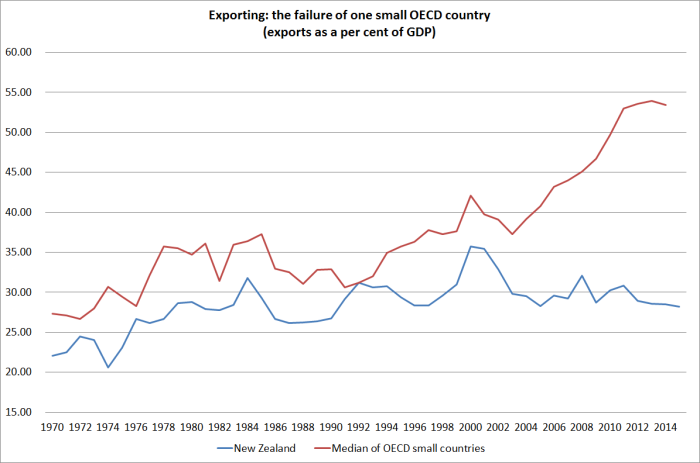
  • the failure of exports as a share of GDP to increase for 30 years

exports small countries

  • the failure of per capita tradables sector real GDP to have increased at all for the last 15 years (recall, this isn’t just a share of GDP – there has simply been no real per capita growth in our outward-oriented sectors in that time).
  • the fact that after all these years, our exports remain very heavily natural-resource based, sectors that would seem unlikely to have much need of a rapidly growing population.
  • the continuing relative decline of Auckland’s GDP per capita, despite the concentration of the immigrant population in Auckland.

Perhaps I shouldn’t really expect words like “productivity” to appear in prime-time mainstream TV, even when taxpayer-funded, but it was as if Latta had never heard of the concept, and those he interviewed just didn’t care.  There was an (immigration) programme to defend after all.  Who cares if New Zealand has been in gradual economic decline for 60 years or more? The elites apparently simply know that the economic gains of an extraordinarily large immigration programme are a ‘no-brainer’.

Actually, I suspect a few of them will have cringed, and squirmed rather uncomfortably, when they heard Latta make that claim.  But the defenders of the programme –  Ministers, officials, and academics –  really need to start coming up with something much persuasive if we are really to be confident (and few things are ever certain) that New Zealanders are benefiting from this large scale intervention.

LVR controls, regulatory philosophy (and the OIA)

I’ve had a bit of a relapse in my recovery and seem set to spend much of this week doing little more than lying on the sofa reading something not too taxing.  There are plenty of things I’d like to comment on substantively, but for now it won’t happen.

The Reserve Bank released its (latest –  third in three years) final LVR decision on Monday.  To no one’s surprise, after a sham consultation, they confirmed the Governor’s original plans, albeit with some curious refinements to the exemptions –  curious, that is, if one thinks that decisions on such things should be based on considerations – the statutory ones – around the soundness and efficiency of the financial system.

And although the lawgiver has now descended from the mountain and issued his unilateral decrees, which have the force of law, there is still no sign of a regulatory impact assessment.  There is talk in the summary of submissions that one is forthcoming, but really……when the regulatory impact assessment is published only some time after all the decisions have been made, it reveals quite how little weight the Governor seems to put on good processes.  And it is not as if the initial consultation document was sufficiently extensive and robust to cover the ground –  recall the “cost-benefit” analysis that consisted of a questionable list of pros and cons with no attempts to quantify any of them.

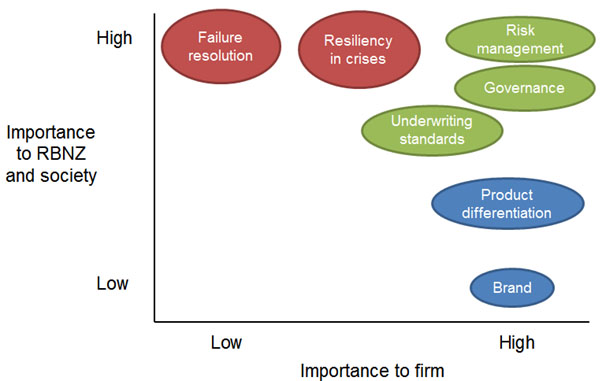
One of the other things I had hoped to comment on in more depth was a speech given last week by Toby Fiennes, the Reserve Bank’s Head of Prudential Supervision. on the Bank’s regulatory philosophy and supervisory practices.    It included this nice chart, outlining various aspects of financial institutions’ operations and how much, in the Bank’s judgement, they mattered to the “RBNZ and society” (as if these were the same thing) and how much they mattered to the institutions themselves.

Figure 1: Selected interests of the RBNZ, society and financial institutions

fiennes

Fiennes went on to note that the blue areas aren’t of much interest to the Bank (and don’t therefore attract much regulatory interest), while the red area are typically quite heavily and directly regulated.

But in this context, it was the comments on the green areas that caught my eye

Some things – like risk management and underwriting standards (in green) – are of strong interest to both the Reserve Bank and firms. Here we tend to use market and self-discipline. Examples of some of our supervisory practices in this area are:

  • Disclosure of credit risks;
  • Mandatory credit ratings;
  • Governance requirements; and
  • Publicly disclosed attestations by the board that key risks are being managed.

Now I know that the Bank’s prudential supervisors have never been keen on LVR restrictions, and that they are devised in a different department, but……..all controls are imposed under the same legislation –  indeed the same part of the legislation –  and by the same Governor.  And when housing loans are the biggest single component of banks’ credit exposure –  and banks have most to lose if things go wrong – and yet when the Bank has imposed three sets of direct controls on housing LVRs in three years, imposing its own judgements on underwriting standards, you might have hoped that practice and “philosophy” might have been better reconciled, or the gaps smoothed over in a speech by the Head of Prudential Supervision.

As regular readers know, I’ve been pushing to get submissions on Reserve Bank regulatory proposals routinely published.  Such publication is common practice in other areas of government, including submissions to parliamentary select committees.  If you make a submission seeking to influence public policy, that submission should generally be public as matter of course –  it should be one of the hallmarks of an open society.

Some progress has been made with the Reserve Bank.  If someone asks, they will now typically release submissions made by anyone who isn’t a regulated institution.  I asked for all the submissions on the latest LVR “proposal” to be released, and  –  as expected –  the Bank has released all those not made by banks (the regulated institutions in this proposal).  Anyone interested can find those submissions here. I have three remaining areas of concern.

The first is that release of submissions should be a routine part of the process for all consultations, not just when someone makes the effort (remembers) to ask.  The second is that on this occasion they have withheld the names of four private submitters.  As I noted, if you want to influence lawmaking, you should be prepared to have your name disclosed.  How can citizens have confidence in the integrity of lawmaking processes if they don’t know who the Bank is receiving submissions from, and what interests they may represent?  (Of course, since one of the anonymous submitters appears to have views very similar to my own, we can safely assume that that person’s views will have had no influence on the Bank.)

And the third concern is that the Reserve Bank is still consistently keeping secret the views of regulated entities (the banks in this case).  When the regulated lobby the regulator it is particularly important that citizens are able to see what arguments are being made, to ensure that the process remains robust and that the regulators are not being “captured” by their closeness to the regulated –  bearing in mind that the Bank is supposed to be regulating in the public interest, not that of banks.   As I’ve noted before, the Bank justifies withholding bank submissions on the grounds of section 105 of the Reserve Bank Act –  which they argue compels them to withhold such material.  In fact, that section of the Act gives no hint of a distinction between material received from banks and that from other parties,  If section 105 applies to submissions on proposed regulatory changes, the Bank is obliged to keep secret all submissions, not just those from banks.  As I’ve noted before, there is a good case for a small amendment to the Reserve Bank Act to make it clear that the section 105 protections do not apply to submissions on regulatory proposals and hence that banks should expect their submissions to the Reserve Bank on regulatory initiatives to be published, in just the same way that bank submissions to parliamentary select committees will generally be published.

I have appealed to the Ombudsman the Bank’s decision to withhold the bank submissions, in effect seeking greater legal clarity on what the section 105 restrictions actually apply to.  In the meantime, of course, if the banks have nothing to hide –  and I don’t imagine they really do –  they could chose to publish their submissions.  According to the Summary of Submissions “a few respondents urged tighter LVR restrictions on investors than proposed”, so perhaps the ANZ really did follow up on their CEO’s newspaper op-ed and advocate more far-reaching restrictions.  If so, citizens should have the right to know (customers might be interested to, but that is their affair).

Raising the inflation target….in 2002

There is a bit of discussion around (internationally more so than in New Zealand) about the possible merits of raising inflation targets, to something centred on 4 or 5 per cent annual inflation, rather than the 2 per cent focal point of most countries’ targets today.  The main argument for doing so is to raise nominal interest rates in more normal times, in turn creating scope to cut policy interest rates further in real terms in future serious downturns.

I doubt it is a viable option at present for most inflation targeting countries, simply because most have largely exhausted conventional monetary policy capacity –  policy interest rates are already near or below zero –  and many are struggling to achieve their current inflation targets.  It is, probably, still an option for New Zealand (with the OCR still at 2 per cent), although in my view raising the target is less attractive an option than taking action to reduce the impact of physical cash in creating a near-zero lower bound on nominal interest rates.  The costs of positive inflation rates may not be that large, but they increase as the target inflation rate increases –  and perhaps especially so in a country like New Zealand where income on financial savings (eg interest, which includes compensation for inflation) is taxed just the same as labour income.

Unlike most inflation targeting countries, New Zealand does have a history of having raised its inflation target.  We started out aiming for 0 to 2 per cent annual inflation rates, and then raised that target to 0 t0 3 per cent at the end of 1996, as one aspect of the National/New Zealand First coalition deal.  The Bank acceded to the change, but had not sought it.

Yesterday I was asked a question about the background to the second increase in the target.  In September 2002 the inflation target was raised from 0 to 3 per cent per annum, to the current 1 to 3 per cent per annum.  Why?   My short answer was “politics”, and this is my fuller answer.  I was quite closely involved –  at the time I was one of the Governor’s three direct reports –  but others will no doubt have slightly different memories/perspectives.

The opportunity for a change in the Policy Targets Agreement (PTA) opened up when in late April 2002 the long-serving Governor, Don Brash, unexpectedly announced his resignation from the Bank, effective immediately, so that he could contest the forthcoming general election as a National Party candidate.  Key figures in the governing Labour Party – in particular the Prime Minister, Helen Clark – were furious, including with the Reserve Bank’s Board which had agreed terms and conditions with Brash that had not required any stand-down periods when he left office.  I can’t speak for all my then colleagues of course, but my impression was that many people at the Bank, while perhaps wishing Don well personally, thought that resigning as Governor to go straight into party politics wasn’t quite the done thing, and risked undermining (albeit at the margin) the reputation of the Bank.

The Bank’s (and Brash’s in particular –  as single decisionmaker) stewardship of monetary policy had been contentious in some circles for a long time.  Both National and Labour stood solidly behind the Reserve Bank Act, and especially its monetary policy arrangements, but the Minister of Finance, Michael Cullen, had been uneasy for a long time as to whether the target framework was too restrictive.  Back in the mid 1990s, as Opposition Finance spokesman, he had actually campaigned to widen the target band to -1 to 3 per cent per annum, and when he had become Minister in 1999 he added to the PTA the explicit requirement to  “seek to avoid unnecessary instability in output, interest rates and the exchange rate”.   No one ever –  in fact, still –  knew quite what it meant, but it was a response to the continuing unease, including that around the monetary conditions index debacle of 1997 to 1998.

The Labour-Alliance government which came to power at the end of 1999 commissioned, as had been promised, an international review of New Zealand’s monetary policy arrangements and the conduct of monetary policy.  Michael Cullen wasn’t looking for radical change –  or he would not have appointed Lars Svensson, one of the academic experts on inflation targeting, as the reviewer –  although there was a sense that he would not have been averse to a recommendation to shift to a committee or Board system for making monetary policy decisions.  In the end, the review was pretty tame –  I was part of the secretariat, at the same time as being a Bank senior manager, and we went to some lengths to encourage Svensson not to be too effusive about the Brash stewardship, fearing that otherwise the report would lack credibility.    Svensson did recommend a move to a committee system, but his proposal –  for a committee of internal senior managers, somewhat akin to Graeme Wheeler’s Governing Committee  – got no political traction.    There was no political mileage in legislating to shift from one technocratic economist making the decision to four or five technocrats making the decisions.

There was also longstanding unease, and puzzles, as to just why New Zealand’s relative economic performance had not improved.  At the time, our exchange rate wasn’t high, but our interest rates were still high relative to those in the rest of the world, and there was no sign that the income or productivity gaps to the rest of the OECD were beginning to close.  There was questions around whether somehow something in the way monetary policy was being run, or the way the target was specified, was somehow contributing to the medium-term real economic underperformance.  Were we, for example, by holding interest rates so high unintentionally lowering potential GDP growth? In some circles there was a sense that the Bank jumped at shadows –  raising interest rates at the first hint of inflation, and never “gave growth a chance”.  As people pointed out from time to time, our inflation target was lower than Australia’s, but our interest rates typically weren’t.

Add into the mix the government’s unease with Don Brash’s views of the wider economic policy framework.  His speech at the August 2001 Knowledge Wave Conference, on how best to accelerate economic growth, didn’t go down well with the government (understandably –  I think those internally who had seen the draft were all pretty much of a view that it was material that should be saved for his retirement).  It all seemed to just add to a sense that something was wrong at the Bank, and in how monetary policy was being run.

Actually, the Bank had been quite aggressive in easing policy during 2001, probably more so that (with hindsight) was warranted.  The US recession, and the 9/11 attacks, prompted pre-emptive easings, from an institution determined not to make Asian crisis mistakes again.  But by early 2002, the talk was turning again to the prospects for OCR increases.  There had already been two 25 basis point increases by the time Don Brash resigned, and the projections and policy statements foreshadowed a lot more increases to come.

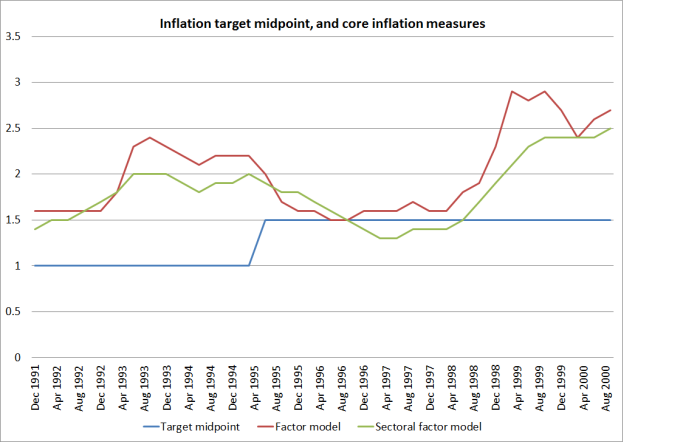
It is also worth remembering that, at the time, just over a decade into inflation targeting, the Bank had had inflation out-turns averaging well above the midpoint of the inflation target range.  That track record continued right through until the 2008/09 recession, and it made us unusual by the standards of inflation targeting central banks –  the more so, perhaps, because our rhetoric often stressed the importance of focusing on the midpoint of the target range (to maximize the chances the inflation would be within the target range).     This chart illustrate the track record –  although note that, at the time, we did not have either of these particular core inflation measures (they are just readily to hand).

target change in 2002

Inflation had been above the target midpoint throughout almost all the inflation targeting period, had never (in core/underlying terms) been in the 0 to 1 per cent part of the range, and by now (mid 2002) inflation was not only in the upper half of the range, but was rising.

Deputy Governor Rod Carr was appointed as acting Governor once Don Brash resigned, and he took the next few OCR decisions, and did the associated communications.  The OCR was raised at both of his first two OCR decisions, and in the May 2002 MPS in particular, Carr’s rhetoric was (and was widely seen as) very hawkish –  words of man who might be champing at the bit to raise the OCR.  The May projections had envisaged another 150 basis points of OCR increases over the following year or so which would, so the projections showed, bring inflation progressively back to around the middle of the inflation range.

In the Beehive, there seems to have been a sense that they definitely didn’t want the Board nominating a “Brash clone” as Governor, and a real unease about what another 150 basis points of OCR increases would do to the prospects for the sort of “economic transformation”, including the growth in the export sector, they were seeking.  What, people might have asked themselves, was the point of having really large OCR increases to get inflation to the midpoint of the target range when it had never been there for long previously?  And since (core/underlying) inflation had never been in the zero to one percent part of the target range, why not just pull the range up a bit?  To do so, it could be argued, wouldn’t change anything much.

Throughout this period, Bank staff were at work on a major series of background briefing papers to help whoever was nominated as Governor, and perhaps the Minister, in negotiating a PTA.  For the first time, since the Act had come into effect, we passed the real possibility of an outside appointee, perhaps with little or no background in monetary policy.  I can’t now see that collection of papers on the Reserve Bank’s website (but will happily link to them if they are there: UPDATE: they are here) but suffice to say that they did not advocate a change to the PTA, or to the inflation target specificially.  They were not, by any means, doctrinaire on the importance  of the current target range, but saw little prospect of any real economic gains from raising the target.

In the Beehive, there was also a bit of a sense that if Australia could do just fine –  indeed, so it was seen, to prosper – with an inflation target centred on 2.5 per  cent annual inflation, perhaps we should move to adopt the same target.  I gathered that the Prime Minister in particular was quite keen on that option.

In the end, the Secretary to the Treasury, Alan Bollard was appointed as Governor.  He agreed to change the target in two ways.

The first was eliminating the 0 to 1 per cent part of the target range, so that in future the target would be 1 to 3 per cent annual inflation.  My understanding/memory is that he did not see this as a route to higher inflation, but rather to cementing in something more like the average inflation outcomes of the previous few years.  But it ruled out the need to tighten simply to get back to a target midpoint on 1.5 per cent.  To Alan’s credit, he strongly resisted the Prime Ministerial preference for adopting the RBA’s target, centred on 2.5 per cent.  Staff advice was that a target as high as that could not really be considered consistent with the statutory requirement to pursue and maintain price stability.

The second was to introduce the concept of a medium-term horizon explicitly into the PTA, as in these extracts

For the purpose of this agreement, the policy target shall be to keep future CPI inflation outcomes between 1 per cent and 3 per cent on average over the medium term.

3. Inflation variations around target

a) For a variety of reasons, the actual annual rate of CPI inflation will vary around the medium-term trend of inflation, which is the focus of the policy target.

Since we had always run inflation targeting looking out at the medium-term projections, it was never entirely clear to what extent this change was substantive, and to what extent it was (as with many PTA changes) rhetorical –  making explicit what was already happening.

Shortly after he took office, Bollard gave a speech in which he tried to explain how he interpreted the new PTA.  The speech was much haggled over internally, and so what emerged was pretty carefully considered drafting. The key passage was

The key change in the agreement is that the inflation target has been explicitly defined in terms of “future inflation … on average over the medium term”. This implies that monetary policy should be forward-looking, and avoid getting distracted by transitory fluctuations in the inflation rate. In typical circumstances, we expect to give most attention to the outlook for CPI inflation over the next three or so years. If the outlook for trend inflation over that period is inconsistent with the target, we will adjust the Official Cash Rate. Our intention will be that projected inflation will be comfortably within the target range in the latter half of the three year period.

Note that the “key change” in his view was not the increase in the target –  consistent with the notion that the unused portion of the range was just being dropped off –  but the “on average over the medium-term wording”.  There are no references left to the midpoint of the target range, just a focus on being “comfortably within” the target range when we looked at projections 18 months to three years ahead.

I recall writing an internal paper, probably as part of haggling over this speech, arguing that if anything the new PTA might have given us less (or at least not more) flexibility –  a narrower target range balanced against the “on average over the medium-term” wording.

Bollard operated with the same operational autonomy over the OCR as others Governors had.  But I think those of us there at the time felt that he had much the same unease about how the Bank had been run –  and about the anti-inflation inclinations of key personnel –  as the Beehive did.  It wasn’t that long after he took office that the OCR was cut by 75 basis points.  As always, there were economic arguments that could be made for and against those cuts –  at least one seemed reasonable to me at the time –  but they proved quite ill-fated.  They had to be reversed, and more, although it took too long to do so –  and to his credit, at the end of his term, Bollard explicitly acknowledged that the cuts had been unnecessary.  The cuts, and the slow reversal of them, set the stage for core inflation increasing to above 3 per cent over the following few years.   Without the Policy Targets Agreement change, it would have been a little harder for that particular mistake to have been made.

(In discussions about raising inflation targets, a focus is often on the response of inflation expectations.  In a sense, Alan Bollard was gifted a modest “free lunch” –  he could stimulate the economy a bit more than otherwise in the short-term –  because there was no immediate increase in survey measures of inflation expectations when the target midpoint was raised, perhaps reflecting some sense that –  whatever our rhetoric –  the 0 to 1 per cent part of the old range had already become something of a dead letter.)

So, as I said, it was politics rather than solid economic analysis that drove the 2002 PTA changes.  To the extent that it reflected unease about New Zealand’s economic performance, they were good questions, but the wrong answer.  The same could, of course, be said for the desire of Labour, the Greens and New Zealand First to change the Reserve Bank Act now (rather than just the PTA).  There are real economic challenges and puzzles around New Zealand’s long-term economic underperformance, but changing purely nominal measures – like the way an inflation (or related) target is specified  –  is likely to be almost wholly irrelevant to responding to those problems,


Graeme Wheeler, Geoff Bascand, and the cluster munitions

As a a key regulator of components of the New Zealand banking and financial system, and an institution which puts a great deal of emphasis in its regulatory philosophy (expounded again in a speech given only last night) on strong governance systems  and protocols and the importance of directors taking very seriously their legal and other responsibilities, you might have supposed that the Reserve Bank would be punctilious in observing canons of good governance, to the limits of the legal requirements and beyond, for any institutions they themselves, and key managers, were associated with.  After all, that respect for the law, for boundaries, for the appropriate management of potential and actual conflicts of interest for example, would surely be second nature.  And, even if it weren’t, they would surely want to set a good example, and be whiter than white so that if questions even arose there would no doubt that the Reserve Bank was operating fully consistently with the best of the sorts of standards they espouse for (and often impose on) regulated institutions.

Unfortunately, if that had been your supposition, you would be quite wrong.

I’m a trustee of the Reserve Bank of New Zealand Staff Superannuation and Provident Fund.  The long-standing fund, long since closed to new members, is established and operates under its under trust deed.  It is a separate legal entity, with its own governance structures, lawyers,auditors, and is subject to the Superannuation Schemes Act, soon to transition to the Financial Market Conduct Act.  The Reserve Bank is a party to the deed that establishes the fund, but neither the Reserve Bank, nor its Board of Directors (nor for that matter the Minister of Finance) has any powers in respect of the Fund.  It cannot direct the trustees on their investments, or how to apply the rules, and nor has it any rights to demand information from the trustees.  The Bank has obligations to the Fund under the trust deed, but no specific rights or powers in respect of it.   By law –  common law and statute –  all trustees must operate in the best interests of the members of the Fund.  The Fund, in essence, exists for members, in effect holding some of their remuneration in a savings vehicle and then paying out pensions and other benefits, under the rules, in due course.

On paper, the governance model is quite elegant.  The Governor is a trustee.  The Bank’s Board appoints one of its members as a trustee, and they also appoint one member of the scheme as a trustee (although both these appointees serve at the pleasure of the Board, and appointments can be revoked at any time if those trustees get difficult).  And there are two trustees elected by the members for five year terms.  I’m one of those members’ trustees.    Most members are now retired, so typically members’ trustees also are (although I’ve been a trustee since 2008).

But whoever appoints the trustees, none of us serves as delegates or representatives of those who appoint us.  We are all –  equally –  subject to the same legal responsibility that in conducting the affairs of the Fund, we must serve the best interests of members.  If there is any (actual or potential) conflict between the interests of members, those conflicts need to be identified, but it is the interests of members that must be paramount.  For material conflicts, conflicted trustees should absent themselves from involvement in the matters where conflicts arise.

This isn’t novel stuff.  And it has long been recognized that when senior managers  (or directors) of sponsoring organisations serve as trustees of superannuation funds, there is a particularly serious risk of conflicts of interest arising, between the duties those individuals owe to their employer, and those they owe to the members of the superannuation scheme.  In the United Kingdom, the Pensions Regulator some years ago published a very useful and substantial guide to managing conflicts of interest in the context of superannuation schemes.

Management of these issues at the Reserve Bank scheme has been shockingly bad over the years.  From meeting to meeting, there often aren’t material conflicts, but when the conflicts do arise there has been no evidence that the Governor (or, typically, his alternate  –  since the Governor consistently claims to unavailable for meetings, even when scheduled a year in advance) has managed those conflicts in ways consistent with their overriding legal obligation, when acting as trustees, to act in the best interests of members.  I’m a bit of a starry-eyed optimist at heart, so have been constantly surprised at how indifferent to these responsibilities  trustees who are senior Bank managers have been.  Mostly, I don’t even think it is willful –  but sheer indifference, or failure to appreciate the importance of appropriately managing conflicts of interest, are almost as bad.  Perhaps especially in an institution that is a key financial regulator.

I could give you lots of boring detail about examples.  This is a troubled scheme, against which complaints have now been made to the Financial Markets Authority (regulator of such superannuation schemes).  But for now, those are issues for us, and many of them are very complex.

But this morning one of the issues has been put in the public domain by the trustees as a whole, acting under duress.  This morning, the trustees made their first ever press statement (stories here and here) .  And so since the matter is in the public domain, I feel free to give you some context.

On Wednesday last week, in the face of media coverage of some of the investments of the State Services Retirement Savings Scheme, I suggested to trustees that we should check with our investment managers on whether we had any similar exposures, about which questions might be raised.  As I noted then, I wasn’t particularly concerned for the fund itself –  a private body, and closed to new members –  but recognized that there might be some reputational questions for the Bank, and that we should probably be aware of any such exposures.  Our regularly quarterly meeting was to be held the next day, which would provide a good opportunity to discuss the matter (albeit, we already had a full agenda).

Our administration managers arranged to get the relevant information, at least at a high initial level, identifying that in one passive offshore equity fund we had holdings of, some of the underlying shares were those of firms associated with what might be considered “controversial weapons”.

The next day we held a meeting of trustees.  It was long and difficult one dealing with several other issues.  The Reserve Bank’s Deputy Governor, Geoff Bascand, is the Governor’s alternate (when the Governor is unavailable to attend) and also chairs the meeting.  He made no effort to raise the “ethical investment” issue, and when he tried to adjourn the meeting I pointed out that we had still not discussed this issue.  Geoff insisted he had another meeting, and rather than (say) handing over the chairmanship to another member, he simply refused to have a discussion, made no effort to schedule one even by email (we only meet quarterly) and ended the meeting and left.  Curiously, as he left the meeting he signed, as chair, a revised Statement of Investment Performance and Objectives (SIPO), a document all superannuation schemes need to have, that reaffirmed our existing investment approach, including (explicitly) the holdings in the offshore index fund that had the small “controversial weapons” exposures.

We heard nothing more until late on Monday when Geoff emailed trustees about a written parliamentary question that the Minister of Finance had received.  Predictably, questions had been raised about the holdings of the Reserve Bank superannuation scheme.  As is customary, the Minister’s office had referred the PQ to the Reserve Bank for advice on a draft answer.  The people who handle PQs etc in the Reserve Bank work to Geoff, as Deputy Governor.

It wasn’t clear to me what business it was of the Minister of Finance.  The Minister has no ministerial responsibility for the Reserve Bank superannuation fund (structure and governance as above) although he no doubt does have responsibility for the actions of the Reserve Bank (including vis-à-vis the Fund).   How the Minister chose to answer was, and is, up to him.  However, the information requested in the PQ belonged to the trustees, and no one else (in this context, the Reserve Bank or the Minister) had any legal right to demand it from us.  It was our information, and our members’ money.

In a well-governed institution, Geoff would have passed on the PQ to trustees and invited trustees themselves to consider how the Fund should respond.  If the Bank had wanted us to provide the information so that, in its interests, it could pass it on to the Minister, a proper request, cognizant of the legal responsibilities of the trustees, could have been made to the trustees.  And given the potential for the interests of the Bank and the trustees to diverge, Geoff would wisely have taken no further role in the discussions on the matter by the trustees.

But this was the Reserve Bank.  By the time, late on Monday afternoon, that trustees were even made aware of the issue, Geoff had already emailed our investment managers and got the detailed information that was being sought in the PQ.     In fact, he had known about the request since mid-afternoon on the previous Friday.  And when he emailed the investment managers, he didn’t keep the information to the trustees (or their own administration managers), he copied in Bank staff who had nothing whatever to do with the superannuation scheme.  Emails went back and forth on Sunday and Monday, every single one was copied to other Bank staff, and the trustees had still not been made aware of the issue.  To the extent that Geoff Bascand had a right to the information on the Fund’s investment, it was solely as an (alternate) trustee, not as Deputy Governor of the Bank, and he had no right at all to use that information himself for Bank purposes or to share that information with Bank staff, without the prior authorization of the trustees as a whole.

That made the whole exercise a fait accompli.  Whatever the attitude of trustees, the Bank now had our information and was free to use it as it chose.  Geoff’s email to the trustees late on Monday afternoon said “we have to supply information” –  but it wasn’t clear, at all, who “we” were.  The trustees were certainly under no legal obligation to do so.

As the first trustee to respond to Geoff, I noted that the Minister had no power over, or ministerial responsibility for, the Fund, noted that we needed to obey any laws constraining our specific investments, noted that shifting the portfolio in response to Bank reputational concerns could be costly so the Bank might need to consider reimbursing the Fund, and also highlighted the importance of ensuring that conflicts of interest were appropriately managed in handling this issue.

There was never of any sign of that.  The Bank –  having obtained our information without authorization –  simply advised us, via emails from Geoff (never clear from them whether acting as a trustee or as Deputy Governor) that the Bank would pass on our information to the Minister, would advise the Minister to answer the question fully, and would advise the Minister to say that the Bank would be seeking to encourage us to adopt an “ethical” investment policy.   Continuing his glaring inability to recognize the different interests of the Fund and the Bank, he urged trustees not to approach the Minister’s office directly “as the Bank was handling that”.     The Bank, of course, was not required  –  or expected – to operate in the best interests of members (or trustees).

We gravitated towards the idea of putting out our own public statement –  while Geoff continued to act as conduit for the Bank in telling us what the Bank “insisted” had to be in such a statement.  At one point, I explicitly asked Geoff, acting as trustee, what course of action he thought we should take, acting (as legally required) in the best interests of members.  He simply refused to answer directly, responding with the following extraordinary comment

Now I accept that this may reflect the Bank’s interests more than that of Trustees per se, but the reality is that a Bank director, the Governor and a bank employee are trustees (with me as alternate and chair).

All these people are legally required to act in the best interests of members.  For several years, I was an employee and a trustee, and I hope I always sought to do so.

Fighting something of a rear-guard action, I argued that if we were giving the information about these exposures to anyone, we  should at very least provide it to members of the scheme before we provide it to the Minister of Finance, let alone the public.   It is, after all, their money, and if there are to be any changes in investments as a result of a distaste for particular types of exposures, members’ preferences should presumably be the ones that count.  That request got nowhere either, with Geoff apparently much more interested in his day job as Deputy Governor.  We finally got a grudging statement that the information would be sent to members shortly after our public press release went out at 10am this morning.  It went out, baldly, with no context or background.  Frankly, it is the sort of process that treats members with disdain.  I can only apologise to our members for that.

There has been a suggestion that even a passive interest in cluster munitions firms, through a very broad-based index-linked fund –  we held one that mirrored the MSCI  World ex Australia index  –  was illegal under New Zealand law.  There is a range of views on that issue apparently, and reallocating any fund’s investment involves (potentially quite material) transactions costs, but even when it was suggested that we should consult our own lawyers, or the legal opinions of industry bodies, Bascand has little or no interest.  The best interests of members didn’t seem to matter, but the “reputation” of the Reserve Bank did. I have no particular problem with the Reserve Bank managing its own reputational risks –  recall, I was the first person among trustees to even raise the issues –  but for a Reserve Bank senior manager to abuse his position to force through the Bank’s interests is quite another matter.

In the press release it states that

Trustees will act expeditiously to eliminate our exposure to these firms.

In fact, when I pointed out yesterday that if we were going to say this, we really should have some sort of process in place to effect the change (eg formally request options and costs from our investment managers), I was simply ignored. Trustees have not commissioned any such process yet.    I guess what mattered more to the Bank was to (have the trustees) be seen to say it.

The press release goes on.

The Bank has requested that Trustees adopt a socially responsible investment policy and we will consider the matter at our next meeting.

At the time this press release was agreed there had been no such request at all.  When I asked again last night, shouldn’t we actually have a written request from the Bank if we were going to say there was such a request,  one finally came through at 8.24 this morning.  Interestingly, it came from the Bank’s Communications Manager, highlighting the extent to which this is mostly a Bank PR management issue.  Graciously, the Bank sent through a version of their “socially responsible investment policy”, expressing their “surprise” that the trustees did not have such a policy and commending to us the example of theirs.  This blatant attempt to seize the high moral ground was somewhat undermined  (in addition to the fact that the Governor himself is a –  absentee – trustee) by the fact that their own ‘responsible investment’ policy document does not apply to international ventures the Reserve Bank is party to, or to any specific countries.   Which is convenient because, as I used to point out as an insider, it allowed the Bank to invest New Zealand taxpayers’ money in Chinese government bonds, do swap deals with the Chinese central bank, even though China remains one of the greatest human rights abusers of modern times, as well as an aggressively expansionist power.  Maybe that is just fine, in the interests of international relations, but don’t try claiming the moral ground Governor.  Perhaps its just me, but $15000 of passive indirect holdings in companies that may be making cluster bombs, bother me much less than the Bank funding the butchers of Beijing.  Tastes on that will differ –  but the Reserve Bank’s assets are public money, and the superannuation scheme’s assets are not.

So let’s summarise:

  • as recently as last Thursday, this issue didn’t bother Bascand –  or his boss, who could have turned up to a trustees meeting –  enough to even have a discussion at a long-scheduled meeting.  Despite the points I’ve noted here, had they done so, I’d have suggested we get a prompt legal opinion, get out of such exposures expeditiously if they were illegal, and if not would have been happy to have agreed to restructure the portfolio if the Bank had covered the transactions costs etc of doing so.
  • But once the PQ was asked, the Bank panicked.  Good governance processes were over-ridden and in exchange after exchange, Geoff Bascand –  a man generally regarded as ambitious to become the next Governor –  prioritized the interests of the Bank over the interests of members of the superannuation fund.  That wasn’t just bad form, it was in breach of the fundamental duty of trustees.
  • When an institution communicates with an associated institution, that is only a email away, primarily by press release, you know that what is going on is mostly about spin and PR.

Does it really matter?  On the specific issue, perhaps not overly, and the final outcome might well have been the same anyway.  After all, I’d raised the issue before the MP did.  But as the old saying had it “take care of the pennies and the pounds will take care of themselves”.   It applies as much to doing the small stuff well, and having good and disciplined processes in place, and observed.  The Reserve Bank would surely expect no less from the institutions it regulates/supervises.  And when small stuff is done badly –  as it was here –  it often points to some rather serious problems in the institution concerned.   .

I don’t know how the Minister of Finance will eventually choose to respond to the original parliamentary question. I’ll watch with some interest, conscious that it will be one of those days when an Opposition MP can take heart.  That MP will have made a difference.

In the course of all this, it became clear that most dealings of the superannuation scheme, and all the email traffic over this issue, is captured by the Official Information Act (since two trustees are Reserve Bank employees, using Reserve Bank computers and email addresses) and thus the material is “held” by the Reserve Bank.  I wouldn’t necessarily encourage it, but anyone interested could seek the whole gruesome paper trail.


Chile: undermining the NBR editor’s own argument

Browsing on the NBR website yesterday morning, I noticed a headline: “Editor’s Insight: Migrant scaremongering will damage economy in long run”.   The headline didn’t exactly suggest fair and balanced reporting, but I don’t have an NBR subscription so didn’t pay it any more attention.

Later in the day someone showed me a copy of the text of the article.  In it, the editor of the NBR, Nevil Gibson, laments that

Hardly a day goes past when the anti-immigrant arguments aren’t being given the headlines and air time.  It has put government ministers on the backfoot as they attempt to justify New Zealand staying open for business.

Perhaps if there were evidence being produced of the benefits to New Zealanders of the large scale non-citizen immigration programme, that would be getting some air time too.  I’m sure ministers would be keen to use such evidence if it existed –  and the rest of us would be keen to see it.

Gibson singled out the interview with me in the latest North and South, noting of “the popular economic contention…that population growth has reduced per capita wealth, according to GDP figures”   that “these are quantitative but do not tell the full story of immigration benefits”.

Given that the non-citizen immigration programme is ostensibly driven by economic considerations –  recall MBIE’s phrase that it is a “critical economic enabler” –  I suspect most would settle for actually seeing evidence –  or even a compelling sense –  that per capita incomes of New Zealanders were rising over time as a result of the immigration programme.  But even Gibson seems to more or less accept that those benefits either don’t exist, or at least are hard to find.

Gibson devoted the final section of his article to a comparison between relatively high immigration countries –  New Zealand, Australia, and Canada, with passing reference to the much less open USA –  and Chile.

“Chile provides an example of an open economy like New Zealand’s but with a restrictive immigration policy.  It has fallen off the pace and Harvard-based Professor Ricardo Hausmann, a former planning minister in Venezuela, says the reason is the low proportion of foreign-born citizens”

Around 2 per cent of Chile’s population is foreign born, and the comparable figures for the other countries are New Zealand 28 per cent, Australia 27 per cent, and Canada 20 per cent.

Chile went through some pretty tough times in the 1970s and 1980s: very high inflation, military dictatorship, and severe financial crisis.  It was much more badly mismanaged than (then) heavily-protected New Zealand, even with the massive waste of resources that was Think Big, and a pretty bad financial crisis at the end of the 1980s.  And per capita incomes in New Zealand have always –  going back to first European settlement here –  been considerably higher than those in Chile.

But to read Gibson you’d expect to find that Chile was drifting ever further behind. Here is the relative productivity performance of the two countries, using the Conference Board’s estimates of real GDP per capita since the data begin in 1950.

chile and nz.png

On these estimates, 1990 was the best year for New Zealand relative to Chile.  We –  not Chile – have been in relative decline ever since.  As it happens, our current immigration programme has been in place since around 1990.

It isn’t just New Zealand.  Australia and Canada have also been losing a lot of ground relative to Chile, as has the United States.  Over the full 65 years, all those four high immigration countries have lost ground relative to Chile.

I’m not, repeat not, suggesting that the only factor explaining Chile’s pretty impressive productivity performance is the absence of a large non-citizen immigration policy.  Rather, I’d see it as an illustrative example of a point I’ve made many times previously: successful countries mostly make their own success, through the skills and talents of their people, the energy and dynamism of their firms,  the natural resource endowments they have, and the strength of their legal and cultural institutions.  Cargo cults –  “there is a better lot of people in other countries, if only we could get them here” – are not the answer.

Chile apparently hasn’t needed lots of foreign immigrants to put itself on a much better economic performance path.  And, by contrast, New Zealand –  in particular –  and Australia and Canada show few concrete signs of having benefited (and in particular of their citizens having benefited) from the large-scale non-citizen immigration programmes they’ve run for decades now.

So when Mr Gibson talks about a concern that lower non-citizen immigration might damage the economy in the long run, one has to wonder quite when he expects the tangible benefits for New Zealanders to show up.    It has been 71 years since World War Two ended and New Zealand restarted its large scale immigration programme (with an interruption between the mid 1970s and late 1980s).  We haven’t seen –  not even the advocates can’t point to –  the concrete economic benefits yet.  Perhaps I’m just an excessively cautious former bureaucrat, but I’ve rarely found the idea of just keeping on with a policy when, after several decades, there is no evidence of its benefits to New Zealanders a particularly attractive one.    It looks more like a pursuit of an “ideology”, without regard to the specific circumstances of our own country –  very remote, in an age when personal connections seem to matter more than ever, and strongly natural-resource based, suggesting little likelihood that lots more people would add much, if anything, to New Zealand’s medium-term productivity or per capita growth story.


“Ethical” investment

There has been a new upsurge recently in coverage of so-called “ethical” investment, and some mix of genuine and confected “outrage” over the investment of money in the shares of companies that may be involved in the production of various disapproved goods and services.  The main focus of attention has been on the government’s own investments – particularly those in ACC and NZSF –  and those of the government-promoted Kiwisaver funds, especially the default funds in which many people passively find some portion of their savings invested.  There even seems to be the possibility that some of these holdings may be illegal, and knowing/intentional breaches of the statutory ban on financing the production of cluster bombs carry very heavy criminal penalties.

In the Dominion-Post on Monday, Rob Stock had an article pointing out that moral concerns might not be limited to companies making cluster bombs, tobacco products, or whatever other product is particularly shunned right now.  I wasn’t entirely sure whether he was serious, or simply trying to highlight the absurdity of the whole business, but as he noted one could raise similar objections to holding the sovereign bonds of many countries based on the policies those governments run –  on his reckoning such a list could readily include Qatar, Israel, China, the US, Japan, Turkey, Russia, the Philippines.

Choices people make about what to do with their money are a moral matter.  Passively or actively, a person’s choices reveals what matters to them.  I’m a Christian, and so a believer in absolute truth.  But I doubt that would even lead to a unanimous view on what investments were appropriate, even among members of a single small local congregation.  How much greater is the difficulty in reaching a common view among much larger pools of investors, in an age when all faiths and none compete in the marketplace for ideas?

That is one reason why I remain staunchly opposed to the New Zealand Superannuation Fund.   In that fund, the government has taken money, by force, from citizens and invested it according to the moral precepts of those running the fund.  Actually, it is probably worse than that.  They’ll invest in anything (lawful), but will pull back if particular vocal lobbies succeed in creating too much perceived reputational risk for them.  It simply rewards the vocal, and the modern rent-seekers (pursuing a “cause” rather than personal profit) and forces minorities into investment holdings they may be quite uncomfortable with  (and in some cases probably keeps even majorities out of investments they might be quite comfortable with).

Some might be unhappy with investments in firms making weapons, tobacco products, involved in whale hunting, or in funding governments that apply the death penalty. Others probably have problems with coal or oil producers.  I don’t have a particular problem with any of those investments, but I do object to investing in (or having my taxes invested in), for example, firms associated with the Chinese government, or (US-listed) hospital chains providing abortions, or casino companies and so on.  My point is not to argue the merits of my particular concerns, but to highlight the near-impossibility of reconciling the range of individual concerns, individual freedom, and investments through large scale collective (particularly compulsory) entities.

In the genuinely private sector, and for schemes that are open to new money, there is a bit of a market test: funds won’t keep on investing in particular companies/products if investors are withdrawing their funds or new investors are going elsewhere.  But that doesn’t grapple with the moral point.   Personally, it leaves me uncomfortable with collective investment vehicles, unless they are very clear in advance of what sorts of companies, or governments, they’ll invest with.  You make your choices and I’ll make mine.  And all  but the most scrupulous –  or most morally indifferent –  will almost inevitably have to make trade-offs: what matters enough to adjust one’s investment (or consumer custom) in response to.

As it happens, I’m a trustee of a superannuation scheme –  the Reserve Bank Staff Superannuation and Provident Fund.   Our scheme is not a public body, isn’t subject to the Official Information Act,  and is not subject to any directions from either the Reserve Bank itself or the Minister of Finance. Neither the Crown nor the Bank gets any direct financial benefit from our investment choices.  We aim to ensure that we obey the law, and as the law requires, we seek to act in the best interests of members.  So the investments of our scheme are really only a matter for our members.  Probably the only thing the members have in common is that they work, or once worked (most are now retired) for the Reserve Bank.   Some will be smokers, some won’t.  Some will favour coal mining, others won’t.  Some will support Israel, others won’t.  And so on. Quite how the trustees of such a fund should invest, or avoid investing, is quite a challenge.  Since we have fiduciary responsibilities, it can’t just be on the basis of the personal preferences –  likes and dislikes –  of individual trustees –  let alone, some prevailing public “mood”.  In an age where one can no longer count on much common ground in values, morality etc, it is probably another reason to welcome the demise of old-fashioned workplace savings schemes.

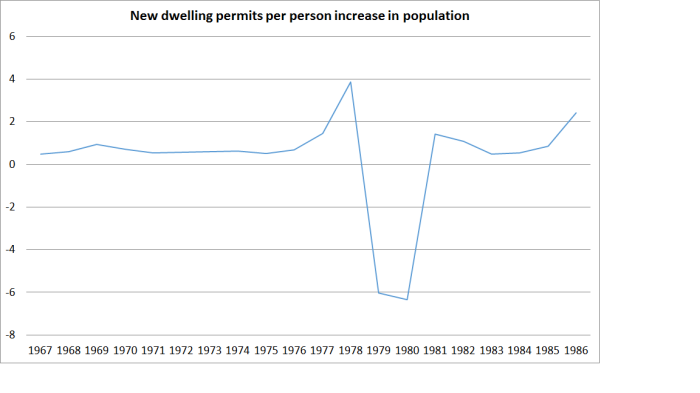
New dwellings and population growth

I hadn’t really intended to write anything today –  tempted as I was by the topic of so-called “ethical investing” – but yesterday’s post on how best to look at new building consents relative to population (growth) sparked a surprising number of comments so I thought some brief follow-up comments and charts might be in order.

My single main point yesterday was that new building permits per capita, whether compared across time or across TLAs, is not a particularly useful indicator of anything.  There are substantial differences in population growth rates –  both across time and across TLAs – so that simple comparisons of consents for new dwellings relative to the current stock of population won’t tell observers anything useful about how supply/demand balances are unfolding in particular markets, or how responsive land use and building regulation allow markets to be in particular times and places.

For either purpose –  and perhaps particularly for the latter – one really probably needs a more formal empirical model that can capture more of the idiosyncracies of particular times and places, and some of the two-way causation that can be at work (eg population growth generates demand for housing, but a readily responsive housing supply might also make such a locality more attractive to more people).  Fortunately, in comparing across TLAs in a single country we can treat a lot of things as constant (applying similarly across all TLAs) –  eg the same tax system, the same interest rates, the same banking system, the same trends in divorce rates, or childbirth rates (the latter two have clear implications for the number of houses demanded per capita).  But there are still local idiosyncratic features that need to be taken into account at times.  The most obvious of these in recent New Zealand history is the impact of the Canterbury earthquakes, which led to the loss of a lot of existing houses, especially in Christchurch city and Waimakariri (Kaiapoi).    Even if the population of those places didn’t change much at all, one would expect a lot of new dwelling consents in the years following such destruction simply to re-establish the previously desired volume of housing.  Seeing a lot of new dwelling permits in those (and neighbouring) localities might not tell one much about the responsiveness of the regulatory systems in those council areas, but simply about the specific nature of the shock.  And –  fortunately –  we don’t know how other localities (and their regulatory systems) would have responded to a natural disaster of that sort.

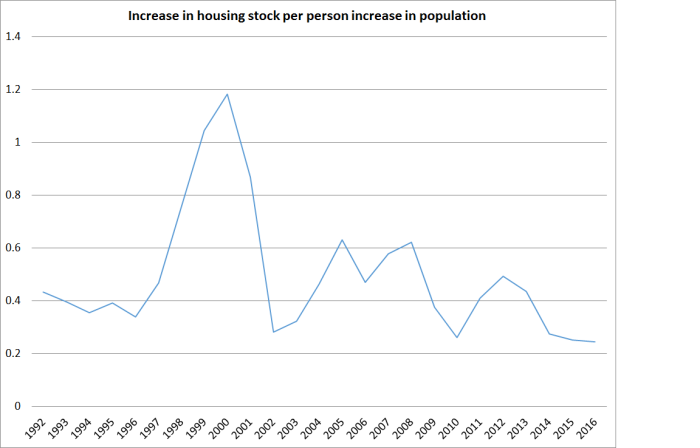
Building permits per capita don’t tell us much at all.  Building permits for new dwellings per person increase in population tells us more, but it is still a far from perfect measure –  especially when, as around Christchurch, there is a sudden need to replace existing lost houses.  So in my post yesterday I used the SNZ national data on housing stocks, and compared the (estimated) change in the housing stock to the (estimated) change in population.  This was the resulting chart.

housing stock

At a national level, the net increase in the number of houses has been very weak relative to (estimated) population growth, and there is no sign of any improvement.   It isn’t a perfect indicator –  changing birth rates or divorce rates might affect the desired number of people per house – but it is less bad than anything else we have.

What about at the TLA level?  We don’t have annual housing stock estimates (that I’m aware of) and the latest annual subnational population estimates are for June 2015.  So we are pushed back to using new dwelling consents.  Comparing consents with population growth produces silly answers in places with falling populations –  where there is usually some new building just to slowly replace the existing stock –  or even places with very low population growth rates.  So in what follows I’m just going to focus on places that are

  • relatively large, and/or
  • have had reasonable population growth

but with a particular focus on Auckland, greater Wellington, greater Christchurch, Hamilton and Tauranga.  The readily accessible data go back to 1996.

Here is an easy-to-read chart comparing the experiences of Auckland and Hamilton.  Both cities have had around a 40 per cent increase in population over the period.

akld and hamilton

But in only one year of these nineteen were more new houses being built per each new resident in Auckland than in Hamilton.  There might be some underlying demographic differences  –  as I said, ideally one needs a fuller empirical model –  but on the face of things it doesn’t reflect very favourably on the land use and building restriction of the Auckland council(s).  At least up to June 2015, there was no sign of the gap closing.

Tauranga has actually had faster population growth than either Auckland or Hamilton over the 20 years.  Here is what the chart looks like when we add Tauranga.

akld hamilton tuaranga

Pretty consistently higher (apparently more responsive to changes in demand) than Auckland in particular.  But what really stands out is the final four or five years on the chart.  Auckland and Hamilton are seeing less new building (relative to population growth) than they used to, while activity in Tauranga has held up at around the average for the previous 15 years.

What about Wellington and Christchurch?  The population of greater Wellington (Wellington, Upper and Lower Hutt, Porirua, and Kapiti) has grown by only 17 per cent over this period.  I never voluntarily defend Wellington local authorities.  Perhaps –  quite probably –  in a climate of heavy land and building regulation it is easier for building to keep pace with more modest population growth.  But for the full period, here is the number of new dwelling consents per person increase in population.

Auckland 0.32
Hamilton 0.38
Tauranga 0.45
Wellington 0.49

Greater Wellington has actually seen more building, relative to population growth, than even the least bad of those northern cities.

Christchurch is a story complicated by the loss of houses as a result of the earthquakes.  One would simply expect to see a lot more permits in that region following the earthquakes even if the population changed little.  Greater Christchurch encompasses three TLAs –  Christchurch city, Waimakariri and Selwyn.  The Selwyn council has a reputation for having facilitated growth –  including the otherwise improbable meteoric post-quake growth of Rolleston.

If we split the sample and look at the years up to June 2010 (ie before the first earthquake), the number of new dwelling permits in greater Christchurch relative to the (quite strong) growth in population had been higher than in Auckland, Hamilton or Tauranga over the same period –  but still a little behind Wellington.

The loss of existing houses muddies the post-2010 data.  If we take the full period (1996 to 2015) in the table above greater Christchurch comes out at 0.66 –  far above the other large cities.  But, of course, greater Christchurch lost lots of existing houses –  so the high numbers tell one nothing about supply/demand balances, or responsiveness of councils.

But one interesting angle is to look just at Selwyn.  Queenstown apart, Selwyn has had the highest population growth rate of any TLA in New Zealand over the last 20 years (107 per cent).  And Selwyn had few houses destroyed in the quakes. This is the chart of new dwelling consents per person increase in population in Selwyn.

selwyn

It is certainly a better experience than Auckland’s, but nothing to write home about.  In fact, in the sub-period prior to the quakes, the rate of new dwelling consents per increase in population was a little lower in Selwyn than it had been in Christchurch city itself. Of course, an open question is to what extent people moved to Selwyn because of a responsive regulatory system –  in turn pushed to its limits –  and to what extent because the land itself was more stable, and the new motorway made places like Rolleston very easy to get to and from.

And what if we add fast-growing Queenstown into the mix?

New dwelling consents per person increase in population (June years 1997 to 2015)

Auckland 0.32
Hamilton 0.38
Tauranga 0.45
Wellington (greater) 0.49
Christchurch (greater) to 2010 0.50
Queenstown 0.53

Of course, much of Queenstown’s construction is likely to be holiday homes, but nonetheless the contrast –  in a town with very rapid population growth – with Auckland (and even Hamilton) is striking.

As a final caution, do note that the sub-national population numbers for the period since the 2013 census are estimates, themselves derived from national population estimates.  In a couple of years’ time, after the next census, some of the recent population data could look quite different, affecting the interpretation of some of these recent construction numbers.  But in most cases, the patterns were well in place before even the 2013 census.


The badly dysfunctional New Zealand housing supply market

This chart has had a bit of coverage in the last few days.  It was produced by Statistics New Zealand, and was included in a useful release last week bringing together dwelling consent and population data over the last 50 years or so.

snz picture

As SNZ noted, there is a bit in the chart for everyone.

The number of new homes consented per capita has doubled over the past five years, but is only half the level seen at the peak of the 1970s building boom, Statistics New Zealand said today.

One sees these sorts of per capita charts from time to time, but I’ve never been sure they were very enlightening.  After all, the existing population typically doesn’t need many new houses built –  it is already housed, and the modest associated flow of new building permits will result mostly from changes in tastes, changes in occupancy patterns (eg more marriage breakups will probably increase the number of dwellings required for any given total population) or perhaps even the age composition of the population.  Even quite big differences in  the number of new dwelling permits per capita don’t, in isolation, tell you much: Marlborough and Gisborne have very similar populations, but over the 21 years for which SNZ provides the data, there were almost three times as many houses built in Marlborough as in Gisborne.

Mostly (at least in countries like this one), new houses are needed for increases in the population.  Marlborough’s population was growing over that period, and Gisborne’s wasn’t.

So we might be more interested in the growth of the housing stock relative to the growth of the population.   Growth in the housing stock is typically more interesting than building permits, because if two old villas are demolished to build six townhouses, it is the net addition to the number of dwellings that is typically more interesting, than the number of new units consented.  In recent New Zealand context, if lots of houses are destroyed by an earthquake, the gross number of new consents won’t offer much insight on the supply/demand balance.

SNZ produces some housing stock estimates.  I’m not sure quite how they do them, but they suggest that each year typically about 2000 existing dwellings are destroyed, a tiny proportion of the (current) stock of around 1.8 million dwellings.  If New Zealand’s overall population was static, there would still be a small amount of replacement activity and –  if the Gisborne numbers are roughly indicative –  perhaps 11000 new dwelling consents a year for the country as a whole would be fine.   Gisborne house prices, for anyone interested, are still lower than they were a decade ago.

Here is the nationwide picture since 1991.  This shows the increase in the number of dwellings per increase in the population  (thus, 0.4 means one new dwelling added for each additional 2.5 people).

housing stock

So, far from  the situation improving in the last few years –  as the SNZ chart above might have suggested (and as SNZ themselves suggested) –  things were worse than ever in the year to June 2016.  The population is estimated to have increased by 97300, and yet the housing stock is estimated to have increased by only 23800.  Talk about dysfunction, and no wonder house prices have been rising strongly.  In 1999, 2000 and 2001, by contrast, the population increased by only around 21000 per annum.

SNZ doesn’t have (or not that I can find) annual housing stock estimates back to the 1960s, but we can still look at the new building permit numbers relative to the change in the population.   Here is the chart showing new dwelling permits per person increase in the population.

housing 60sWhat happened?   Well, in the late 1970s the large scale outflow of New Zealanders got underway, and the number of non-citizen immigrants had also been scaled right back.  In the years to June 1979 and June 1980, the population is actually estimated to have fallen slightly, and yet 18000 and 15000 new dwelling consents were granted in each of those two years.  For the three June years from 1978 to  1980 there was no population growth at all, and yet there were more than 50000 new dwellings consented.  No wonder that over the late 1970s and through to around early 1981, New Zealand experienced the largest fall in real house prices (around 40 per cent) in modern history.

Nothing in the data suggests that the New Zealand housing and land supply market is now even remotely capable of coping with population increases of 2 per cent per annum.  Of course in some sense it should, and could, be fixed.  But there is little or no sign of it happening –  are there any reports of peripheral land prices in Auckland collapsing since the Unitary Plan was adopted? – which makes the continued active pursuit of rapid population growth look even more irresponsible (than it would already be, given the absence of evidence of other real economic gains to New Zealanders from such a, now decades-old, strategy)

Still abusing the Official Information Act

I still don’t have much energy back and posting next week is also likely to be light, but I didn’t want to let pass another shameless abuse of the Official Information Act.

Several weeks ago I lodged a submission with the Reserve Bank on their (long and slow) consultation on the publication of submissions to consultations.  I made the case for a default approach of full publication –  bringing the Bank into line with a widespread practice now in the rest of the public sector.  If necessary, I argued, the Bank should promote a minor legislative change that, for the avoidance of doubt, might ensure that they were fully able to release submissions on matters relating to the exercise of the Bank’s regulatory powers.

The consultation on publication of submissions was not about the exercise of regulatory powers, so there was no question that submissions to that consultation were covered by the Official Information Act.  So I lodged a request asking for copies of the submissions.

I don’t suppose they will have received that many submissions to this consultation.  Few of the submissions are likely to have been long.  The issues covered by the consultation concern the Reserve Bank only, not any other agencies, so there shouldn’t be any need for inter-agency consultation.  And of course the Act requires official information to be released “as soon as reasonably practicable”.  So my request should, quite easily, have been able to be dealt with within, say, 10 days.

But this afternoon I received this letter

Dear Mr Reddell

On 3 August 2016 you made a request  under the provisions of the Official Information Act (OIA), seeking:

“copies of all submissions received by the Reserve Bank on this consultation up to and including the close of the consultation period on 5 August 2016,” where the consultation you are referring to is the consultation on the default option for publication of submissions.

The Reserve Bank is extending by 20 working days the time limit for a decision on your request, to Friday 23 September 2016, as permitted under section 15A(1)(b) of the Official Information Act, because consultations necessary to make a decision on the request are such that a proper response to the request cannot reasonably be made within the original time limit.

You have the right, under section 28(3) of the Official Information Act, to make a complaint to an Ombudsman about the Reserve Bank’s decisions relating to your request.

Yours sincerely

Angus Barclay

External Communications Advisor | Reserve Bank of New Zealand 2 The Terrace, Wellington 6011 | P O Box 2498, Wellington 6140   +64 4 471 3698 | M. +64 27 337 1102

It isn’t the most time-sensitive request ever, and there have been more egregious Reserve Bank obstructions, but the law is the law.

Actually, I suspect they are delaying not because any “consultations” are necessary, but simply because it doesn’t suit them to release anything until they have released their own final decision.    But that isn’t a legitimate grounds for extending a request, and nor should it be.  The Bank is, of course, free to make its decision on the substance of the policy on its own timetable, but the submissions are public information.  A public institution committed to open government, transparent policymaking etc etc, would already have released the submissions.    But not the Reserve Bank.

The Ombudsman promised a few months ago to start reporting on how agencies did in responding to OIA requests.  It will be interesting to see how the Reserve Bank –  which actually does make much of its alleged openness and transparency (about stuff it doesn’t know –  the future –  rather than stuff it does know –  official information)  – scores.