Towards a Fiscal Council

Earlier in the year, the Labour and Greens parties released a set of Budget Responsibility Rules, envisaged at time as being the rules that would guide the two parties if they were in a position to form a government.    The actual new government, of course, includes New Zealand First, with the Greens at a partial arms-length.  Then again, James Shaw is now an Associate Minister of Finance.    The status of these rules isn’t clear, but since they haven’t been disavowed I’m assuming they will, at least broadly, provide the basis for the new government’s fiscal policy.

I wrote about the rules at the time they were announced.  I didn’t have too much problem with them, but outlined a number of areas where details might matter quite a lot –  including, for example, the fact that the appropriate prudent level of the fiscal balance should depend, in part, on the expected rate of population growth –  and areas where what look like very well-intentioned rules can be open to being gamed, potentially in quite sub-optimal ways.

My main interest, then as now, was in this item

Measuring our success in government

  • The credibility of our Budget Responsibility Rules requires a mechanism that makes the government accountable. Independent oversight will provide the public with confidence that the government is sticking to the rules.
  • We will establish a body independent of Ministers of the Crown who will be responsible for determining if these rules are being met. The body will also have oversight of government economic and fiscal forecasts, shall provide an independent assessment of government forecasts to the public, and will cost policies of opposition parties.

Labour and the Greens promised to establish a Fiscal Council.

If so, they will have plenty of support.  The OECD has regularly advocated the creation of such a body.  So –  from the right –  has the New Zealand Initiative.   Such entities are pretty common in advanced economies now, especially in Europe.

A few years ago, The Treasury commissioned Teresa Ter-Minassian, former head of the IMF’s Fiscal Affairs Department, to undertake an independent review of The Treasury’s fiscal policy advice.      She looked at the possibility of establishing a Fiscal Council, and wrote as follows:

As regards the possible creation of a Fiscal Council, if it were established, it should probably have a more limited role in New Zealand than in most other countries that have created similar institutions. A more limited remit for the Council would be justified by the degree of operational independence of the Treasury in forecasting and policy analysis, its well-established non-partisan reputation, its sound record of relatively accurate and unbiased macroeconomic and fiscal forecasts, and the already strict fiscal accounting and transparency requirements mandated by the Public Finance Act.

The main purpose of the Council would be to offer an independent expert perspective and commentary on the advice provided by the Treasury to the Government on fiscal policy issues, and on the decisions taken by the Government and the Parliament on those issues. Such a Council would not need to operate on a full-time basis, and therefore would not be very costly.

If the Council was constituted by a small number of well-respected national, and possibly international, figures, with substantial fiscal expertise, previous policy experience, and strong communication skills, its commentaries at key points in the budget cycle, and on such important documents as the Long-Term Fiscal Statement and the Investment Statement, could help increase the resonance of fiscal policy options and choices with the media and the public opinion, and build social consensus on needed reforms.

There are two, quite separable, dimensions to the Labour/Greens proposal.  The first element is that the Council

will be responsible for determining if these rules are being met. The body will also have oversight of government economic and fiscal forecasts, shall provide an independent assessment of government forecasts to the public,

and the second is that it

will cost policies of opposition parties.

In general, I support the establishment of a small body to do something along the lines of the first of those sets of responsibilities.  This is what I wrote earlier in the year

The main area where a fiscal council –  or indeed, a broad macro policy advisory council –  could add value is around the bigger picture of fiscal policy (not just rule compliance, but how the rules might best be specified, and what it does (and doesn’t) make sense to try to do with fiscal policy).

But there are still important caveats.  For example, it is fine to talk in terms of the council having “oversight of government economic and fiscal forecasts”, but quite what level of resource would that involve?  Does the proposal envisage that the core forecasting role, on which government bases its policies, would move outside Treasury?  Even if there was some merit in that, it would be likely to end up with considerable duplication –  since neither the Treasury nor the Minister is likely to want to be without the capability to have their own analysis done, or to critique the work of the fiscal council.  The UK’s experience is likely to be instructive here, but we also need to recognise the small size of New Zealand and the limited pool of available expertise.  Our population –  and GDP –  are less than a 10th of the UK’s.

Again, I think Labour and Greens are moving in the right direction here, so I’m keen to see a good robust institution created, not to undermine the proposal.   The success of such a body over time will depend a lot on getting the right people to sit on the Council, and to keep the total size of the agency in check.   Too large and it will be an easy target for some other future government –  no doubt enthusiastically offered up by a Treasury keen to remove a competing source of advice.  But make it too small, or with too many establishment figures on the Council, and people will quickly wonder what is the point.  As it is, we don’t have a lot of independent fiscal expertise in New Zealand at present (as distinct, say, from specific expertise on eg aspects of the tax system).   I presume that if they form a government later in the year, Labour and the Greens will be looking quickly to the experiences in this area of small advanced countries like Ireland and Sweden.

It would simply not be possible to offer any sort of detailed oversight of the Treasury’s economic and fiscal forecasts –  that went beyond the sort of commentary market economists or even people like me can add to the mix from time to time –  without a reasonably significant staff establishment (people who are over lots of detail, including around revenue forecasts).    And I’m not sure what would be gained by doing so.  We don’t have an obvious problem in that area.  And as the Ter-Minassian report points out, unlike the situation in many countries, the published and economic and fiscal forecasts in New Zealand are those of The Treasury, not those of the Minister of Finance.   One can overstate the importance of the difference –  the Secretary to the Treasury has a lot of irons in the fire with the Minister at any one time and so it is hard to envisage the Treasury forecasts being too different from what a Minister might prefer –  but it does provide some protection.

A Fiscal Council seems more likely to add value if it is positioned (normally) at one remove from the detailed forecasting business, offering advice and analysis on the fiscal rules themselves (design and implementation) and how best to think about the appropriate fiscal policy rules.  The Council might also, for example, be able to provide some useful advice on what material might usefully be included in the PREFU  (before the election, I noted that routine publication of a baseline scenario that projected expenditure using the inflation and population pressures used in the Treasury economic forecasts would be a helpful step forward).

As I noted in the earlier comments, presumably the government will be wanting to look at what is done in other small advanced countries.  Ireland (total cost around NZ$1m per annum) and Sweden are obvious examples.    Having said that, countries that are part of the EU (and especially the euro area) have some distinctive issues that aren’t relevant to New Zealand.  For a country in the euro, fiscal policy is the only short-term cyclical management tool available, and the risks of a tension between the short and long-term are greater, and there is less of an independent check on serious fiscal imbalances from monetary policy.   There is unlikely to be a simple-to-replicate off-the-shelf model that can quickly be adopted here, and some work will be needed on devising a cost-effective sustainable model, relevant to New Zealand’s specific circumstances.  That is partly about the details of the legislation (mandate, resourcing etc), but also partly about identifying the right sort of mix of people –  some mix of specific professional expertise, an independent cast of mind, communications skills, and so on.  A useful Fiscal Council won’t be constantly disagreeing with Treasury or the Minister of Finance (but won’t be afraid to do so when required), but will be bringing different perspectives to bear on the issues, to inform a better quality independent debate on fiscal issues.

I also wonder whether consideration should be given not just to a Fiscal Council but to something a bit broader, what I’ve labelled as a Macroeconomic Advisory Council.   The governance and monitoring model for the Reserve Bank is up for review.   There seems to be pretty widespread support for moving to a (legislated) committee-based decisionmaking model for monetary policy.    Few people seem to have yet focused on the Bank’s financial stability and regulatory functions, but the case for a committee is at least as strong for those functions.   And few people –  other than, presumably past Governor and Board members –  think the Reserve Bank’s Board has done a particularly effective job in holding the Governor to account.     Perhaps that model was always unrealistic –  the Board was inevitably always going to be too close to the Governor that it would focus more on having his or her back than on holding the Governor to account on behalf of the public.  Perhaps it is time to move away from that model, and consider whether the public interest might better be served by asking an independent Macroeconomic Advisory Council to contribute to the debate, and periodic review, of monetary policy and financial stability policy, in a similar way to what Fiscal Council proposals have in mind for fiscal policy.   Again, it wouldn’t be about second-guessing individual OCR decisions or specific sets of forecasts, but offering perspectives on the framework and rules, and some periodic ex-post assessment.    In a small country, it would also have the appeal of offering some critical mass to any new Council.

(I touched on this option in a post written in the very early days of this blog, where I linked to a discussion note on similar issues I had written in 2014. )

The second responsibility of the proposed Labour/Greens fiscal council would be the cost of policies for Opposition political parties.  I’m much more sceptical about that proposal, even though it has recently had support from Peter Wilson (formerly of The Treasury) at NZIER, and from the New Zealand Initiative.  I wrote about this idea at some length when the Greens first proposed a Policy Costings Unit (an idea which attracted quite a bit of support from across the spectrum).    I wasn’t opposed, just sceptical.  That remains my position today, and the recent election campaign –  the first for decades I’ve watched not as a public servant –  hasn’t changed my views.

This is what I wrote last January

In the end, people often don’t vote for one party or another on the basis of detailed costings, but on “mood affiliation” –  a sense that the party’s general ideas are sympathetic to the broad direction one favours.  And I can’t think of a New Zealand election in my time when the results have been materially determined by the costings (accurate or inaccurate) of party promises  – perhaps in 1975 National might have won a smaller majority if the cost of National Superannuation had been better, and more openly, costed, but I doubt it would have changed the overall result.

And then, of course, there is the fact that economists, and public agencies largely made up of economists, have their own predispositions and biases.    The Economist touched on this issue quite recently.  It isn’t that economists are necessarily worse than other “experts”, or that people consciously set out to favour one side or another in politics, but (say) whatever the merits of the sorts of policies the Greens have favoured, it is unlikely that the New Zealand Treasury (1984-90) would have evaluated them in ways that the Greens would have found fair and balanced.  Perhaps ACT might have the same reaction to today’s Treasury?  If it were only narrow fiscal costings an agency was being asked to evaluate, perhaps these predispositions of the analysts would not matter unduly (although even there, much depends on the behavioural assumptions one makes), but the Greens’ proposal includes analysis of the “wider economic implications” of policy proposals.

On balance, I still think there is a role for something like a (macro oriented) fiscal council in New Zealand, perhaps subsumed within the sort of macroeconomic or monetary and economic council I suggested here (but perhaps that just reflects my macro background).   And there is probably a role for better-resourcing select committees.  But when it comes to political party proposals, if (and I don’t think the case is open and shut by any means) we are going to spend more public money on the process, I would probably prefer to provide a higher level of funding to parliamentary parties, to enable them to commission any independent evaluations or expertise they found useful, and then have the parties fight it out in the court of public opinion.  The big choices societies face mostly aren’t technocratic in nature, and I’m not sure that the differences between whether individual proposals are properly costed or not is that important in the scheme of things (and perhaps less so than previously under MMP, where all promises are provisional, given that absolute parliamentary majorities are very rare).  If there are serious doubts about the costings, let the politicians (and the experts each can marshall) contest the matter.

Was there a problem in the most recent election?  There was a big debate around Steven Joyce’s claims of a “fiscal hole” in Labour’s plans.     But it seemed to get sorted out in the ensuing debate.  Various experts weighed in –  including the anonymous group of former senior Treasury officials – and a reasonable consensus seemed to emerge: Joyce had probably over-egged his claim, but that the Labour fiscal numbers would be tight indeed, perhaps very tight.     Was there a need for extra taxpayer-funded analysis to deal with those claims (which were as much about framing as about bottom-line numbers anyway)?  I don’t see the gap.    And arguments about a capital gains tax, for example, don’t really depend on (soft as soap bubbles) revenue estimates, but about the merits (and demerits) of such a possible tax.  That is the stuff of the political debate.  It is up to each side to marshall their arguments –  and experts, to the extent they are helpful –  and for those of us offering independent commentary to play some role in shedding light on the claims and evidence that are put forward.     Treasury officials –  even if seconded to a Fiscal Council –  certainly can’t be regarded as a disinterested voice on such an issue.

And some of the very biggest issues of the election campaign were around emissions reduction, water use and pollution, child poverty reduction, and even immigration.  Policy in each of those areas probably has some fiscal dimensions, but in few of those areas are fiscal considerations likely to be the key factor –  whether in shaping how people vote, or in the potential economic and social ramifications of the options voters are deciding among.    Actually, the same could be said of housing policy –  a costing unit might focus on whether the KiwiBuild costings looked plausible, but that is probably of second order importance to reaching a view on what overall mix of housing. tax, land use, immigration policies might offer the best way back to a functional and affordable housing market.

As it is, election costings unit haven’t become generally established in other countries, and outside the Netherlands, I can’t a single example that seems to be working very well.  NZIER’s (Australian) economist seemed keen on the Australian approach.  Unless I missed something, when I checked their election costings website for the last Federal election, not a single policy of the main opposition party (Labor) had been costed through that process.    Labor ran the incumbent (first-term) government extremely close in that election, and it wasn’t obvious at the time that they paid any price for not utilising that process.  And nor is it obvious why they should: in the end each voter gets just one vote (well, ok, both NZ and Australian systems are a bit more complex than that, but you get my point) and in deciding to how to cast that vote, most of us are probably making some  sort of overall assessment of the values, competence, vision of the respective parties, on whether or not it is “time for change”, and so on.  We simply don’t decide –  and probably are quite rational in doing so –  by attempting to evaluate detailed policy costings, or the regulatory equivalent.  In New Zealand, apart from anything else, we know that the election policies are opening bids, going into government formation negotiations.  We also know that incumbent government are advised, on details, by fairly competent officials, and that successive governments have a track record of managing overal fiscal policy in a fairly responsible way –  sometimes blindsided by events, but usually events that not even the wisest Treasury or Fiscal Council will have foreseen.

If anything, I’ve become more sceptical of the policy costing unit idea than I was when the Greens first raised the option.    Such a unit probably can’t do much harm, but it is hard to see it doing much good either, and risks skewing debate away from the issues that, in any election, matter rather more.  It is, perhaps, a Treasury official’s dream but –  valuable as good Treasury officials are –  not what will help voters evaluate competing visions and aspirations for how best our country should be governed.


Is there a plausible economic strategy?

In the new government, sworn in this morning, David Parker will take up the renamed role of Minister for Trade and Export Growth.

Early in their term of office, the outgoing government adopted a numerical target for lifting exports (as a share of GDP).  It was, no doubt, well-intentioned, but has provided the basis for quite a few posts here pointing out that no progress was actually being made towards that target, if anything trade shares of GDP were falling, and the pre-election advice from The Treasury was that, all else equal, the trade shares would continue to shrink.  The focus on exports, in turn, seemed to prompt a willingness to use actual or implicit subsidies –  be it in the film industry, export education, irrigation, convention centres, or firms like Rocket Lab –  or unpriced externalities (eg around water) rather than focusing on the fundamentals in a way that might have seen firms themselves increasing taking up new foreign trade oppportunities, responding to improvements in opportunities, markets and incomes.

I stress “foreign trade” rather than just “exports”.   We don’t want policy to be guided by some sort of mercantilist vision in which the purpose of economic life is to sell us much as we can to others, only to store up treasure at home.   Firms export because they can, and because doing so enables owners and employees to earn incomes, which enable them to consume (including from among the abundance the wider world has to offer).  Successful firms invest more heavily too, and many of the investment goods will typically be sourced from abroad.    Trade is good, and generally mutually beneficial.  Ideally, we would see quite a bit more of it: New Zealand firms successfully competing in wider world markets, enabling them and us to purchase more of stuff firms in other countries specialise in producing.    And if New Zealand is ever to catch up again with the rest of the OECD –  whether in productivity or incomes – the process of getting there is likely to involve a materially larger share of local production being exported but –  especially in the transition (which could last decades) –  a lot more investment.  Current account deficits aren’t even problematic when they rest on firm foundations of rising productivity and market-led business investment.  It was the story of 19th century New Zealand (or Australia or the United States).  It was the story of emerging Singapore and South Korea.

So I really hope that the new Minister of Trade and Export Growth (who is also the Minister for Economic Development) sees his role as being at least as much about putting in place the pre-conditions for sustained stronger import growth, as about export growth.  In successful economies, the two go hand in hand.

Here is how we’ve been doing over the 45 years for which we have official data.

trade shares

The last few years’ data are still open for revision, but there is no credible prospect that trade shares of GDP will have been rising.

In interpreting the graph it is worth noting a few things.  The first is that the peaks in the 1985, 2001, and 2009 years simply relate to unexpectedly weak exchange rates.  Most of our imports and exports are priced in foreign currency terms, so when the exchange rate falls sharply there is an immediate translation effects –  both imports and exports rise in NZD terms, even if the volumes haven’t changed at all.   In each of those three cases –  the 1984 devaluation, the slump in the NZD (and AUD) at the end of the dot-com boom, and the sharp fall in the 2008/09 recession –  the exchange rate falls were pretty shortlived.

The second is to note that external trade as a share of GDP was trending up for some time.  The economic policies New Zealand adopted after 1938 had tended to reduce our external trade.  There was a focus on increasing local manufacturing to supply domestic markets in consumer goods (directly reducing imports), and the increased costs of that domestic protectionism undermined the competitiveness of our (actual and potential) export producers (thus, shrinking exports as a share of GDP).

But in the 1970s and early 1980s there were signs of progress, lifting both export and import shares of GDP, even though the terms of trade for New Zealand were pretty dreadful during that period.  There will have been a mix of factors at work: the real exchange rate was trending lower, import protection was being reduced and, less encouragingly, there was a substantial use of export subsidies, both for non-traditional exports and (latterly) support for farmers too.  One argument made at the time for that export support was to counter the adverse competitiveness effects of import protection.  Better, of course, to remove both sets of interventions.  And that is largely what happened over the following decade.    Trade shares of GDP didn’t fall back.

It is perhaps tempting to look at the chart and conclude that taking the last few decades together there is quite a lot of variability in the series, and overall nothing very much has changed since at least the early 1980s.  That’s largely true, but it is also largely the problem.  Successful economies have typically experienced quite material increases in their foreign trade shares (imports and exports) in recent decades.  New Zealand hasn’t.  New Zealand –  or foreign – firms simply haven’t found the profitable opportunities here to take advantage of.    Even services exports are now only around the same share of GDP that they first reached in 1995.   Amazingly (I hadn’t previously looked at this number), services imports as a share of GDP have been lower in the last year than at any time in the past thirty years.

services trade

Not exactly a picture of a successfully internationalising economy.

I don’t find these outcomes –  worrying as they should be, as symptoms of our economic failure –  that surprising.  It is very difficult for firms to compete successfully internationally from such a remote location, based on anything other than location-specific natural resources.  Not impossible, but very difficult.  And so it shouldn’t surprise us that there aren’t many of them.   For whatever reason, in the global economy personal connections on the one hand and integrated value/supply chains on the other have become increasingly important.  The last bus stop before Antarctica –  a long way even from the next to last bus stop – just isn’t a propitious place, no matter how skilled New Zealand workers might be, and how innovative and entrepreneurial New Zealand firms might be.

It is also difficult to successfully compete internationally from here when (a) real interest rates and, in turn, the real cost of capital, for New Zealand investors have averaged so much higher than those in the rest of the advanced world.  Those real interest rate gaps have shown no sign at all of closing  (and they have little or nothing to do with monetary policy).  People push back sometimes arguing that interest rates can’t make that much difference.   They do, through two channels.  First, the standard approach to identifying an appropriate discount rate for project evaluation starts from a risk-free interest rates.  Ours are, and consistently have been, well above those in other advanced countries (something like a 150 basis point margin is a reasonable approximation of the average difference).  And, second, high real interest rates here have been accompanied, causally, by a persistently high real exchange rate, out of line with our deteriorating relative productivity.   In combination, that mix makes investment here harder to justify, and particularly makes investment in the tradables sector harder to justify.  Combine that with the disadvantages of distance and it is no real surprise the foreign trade shares of GDP haven’t increased.  Successful economies have an abundance of new profitable opportunities in which their firms, or foreign firms investing there, take on the world.  It has happened to only a very limited extent here.

But what concerns me is that the new government appears, at this stage, to have no more of a strategy than the outgoing government did for turning around the dismal productivity performance, or the static (or shrinking) foreign trade shares.      There have been encouraging hints of a recognition of the issue: in her speech to the CTU yesterday, the incoming Prime Minister referred both to a need to “boost our productivity”  and to the need to gear the economy more towards “value-added exports”.     But it isn’t clear that they have any real idea of how to get from here to there.   There was nothing any more encouraging in James Shaw’s speech to the same audience.   Or looking through the areas prioritised in the agreements Labour has signed with New Zealand First and the Greens.   If anything, the risk looks to be that the tradables sector will shrink further.

  • The new government plans to adopt measures that will reduce the size of the export education sector.  To the extent that involves a removal of implicit subsidies I think (as I noted yesterday) that is a step in the right direction.
  • The new government plans to phase out government subsidies for irrigation schemes.  From what I’ve seen, that is welcome too.
  • The new government is clearly heading in the direction of reducing exploration for oil and gas in New Zealand and its territorial waters.
  • The new government is clearly intending to take a more aggressive stance around emissions reductions, including moving towards the inclusion of agriculture in the ETS.
  • The new government seems likely to move more aggressively on increasing water quality standards faster,
  • And the new government is planning to increase minimum wages –  already high, by international standards, relative to median wages –  quite considerably over the next few years.
  • The new government is planning (or hoping for) a major acceleration in housebuilding activity.

You might agree or disagree with some or all of those measures individually. But every single one will put the tradables sector under more pressure, to some extent or other.

Take minimum wages for instance.  I recommend you read Eric Crampton’s piece (which I largely agree with).   Here is the Prime Minister’s take.

I know most businesses want a fair set of employment policies.  They know that we need decent wages if they are going to have customers for their products. They know that we need to boost our productivity, and low wages are a barrier to that because they discourage investment in training and capital. They know that we need a government that invests in skills and education.

I simply don’t buy into baseless claims that paying people well means there will be fewer jobs. In fact, the overwhelming weight of evidence is that strong wages for all working people help to boost growth and create jobs.

Wishful thinking at best.  We all, I imagine, want a country in which strong economic performance and strong wage growth goes hand in hand, but there is little or no credible evidence that, at an economywide level, one can get that sort of lift in performance by, say, mandating higher minimum wages.  It is putting the cart before the horse.  And if it worked anywhere, surely New Zealand should be the prime example, given that we already have high minimum wages relative to median wages (a policy maintained and extended by the previous National government).

And here is Shaw

And our whole intent will be to flip climate policy from being seen as a threat and a cost, to being seen as an opportunity and an investment in the future.

And, as I say, that means we’ll be creating tens-of-thousands of new jobs, paying decent wages, for workers and families all over New Zealand.

Not just high-tech city jobs, but out in the regions as well.

Here’s one example: trees.

We are going to plant hundreds of millions of trees to soak up New Zealand’s greenhouse gas emissions.

These trees, we’re going to plant them in the cities. We’re going to plant them in the towns. We’re going to plant them in in the National Parks. We’re going to plant them in the regions.

That’s going to be tens of thousands of jobs. That means lower unemployment. Lower poverty. Lower crime. Cleaner rivers. More native species.

It would be worth doing even if we weren’t saving the world.

One pictures the seas parting and New Zealanders walking together across the Red Sea to the promised land.

Whatever the merits of mass tree-planting –  which until now firms have not regarded as economic –  it doesn’t exactly seem like a high productivity industry.    And in the short-term (trees take decades to come to maturity) resources that are used planting trees can’t be used for anything else.

Lower unemployment is a worthwhile goal, and I really liked the new PM’s line

we have unemployment stuck stubbornly at 5% when it should be below 4%

but (a) deviations of unemployment from long-term sustainable levels are mostly a matter of monetary policy (so find the right Governor/commitee, and specify the mandate well) and (b) however many trees you plant, higher minimum wages will almost certainly come at some cost –  perhaps not that large –  in higher long-term sustainable unemployment rates.    And for all the complacency there has been in New Zealand about our unemployment rate, when I checked there were already 12 OECD countries with unemployment rates lower than New Zealand.  We simply should be doing better.

Of course, the usual economist’s response when (eg) proposing stripping away subsidies is “the market will provide”.  For example, a lower real exchange rate will allow some firms to expand, and other firms not yet visible to economists to emerge.  But how likely is it that that provides the answer this time?

Of course, the exchange rate has fallen perhaps 3 per cent in the last few weeks since the election (against the AUD, the best guide to idiosnycratic New Zealand effects).  It isn’t a large move, and may not be sustained.  And even at these levels isn’t outside the range it has fluctuated within over recent years.     Between a somewhat more expansionary fiscal policy (than the previous government was running), the aspiration to a big increase in housebuilding, and a continuation of the high target rate of immigration, it is difficult to see why we should expect any near-term material narrowing in the margin between New Zealand interest rates and those in the rest of the world.

Thirty years ago, Grant Spencer –  then Reserve Bank chief economist, now “acting Governor” –  published a book chapter in which he described pre-1984 New Zealand economic management this way

“In particular, the maintenance of high levels of aggregate demand supported a buoyant non-tradables goods sector while exporters faced more depressed market prospects”

When I re-read that chapter last week, it was hauntingly reminiscent of the last few years.  But it isn’t clear why the next few will be any better, unless there is sort of near-term cyclical downturn Winston Peters was warning about last week.  As I’ve highlighted previously, in real per capita terms, the tradable sector of our economy is now no larger than it was 2000 – two whole governments ago.  The risk, at present, is of further shrinkage.

So I do hope that the new Minister of Finance and Minister of Economic Development (and Trade and Export Growth) are turning their minds pretty quickly to how they might achieve the sort of reorientation in the economy that is generally recognised as needed, and which they – and the Prime Minister –  have themselves highlighted as a matter of concern.  (And, hint, regional development funds aren’t likely to be the answer either.   And over the last 15 years, “the regions” have been doing better than “the cities”)


(On matters of the new government, I was interested to see Andrew Little, new Minister of Justice, observe – on Twitter and Facebook – yesterday that “As Minister of Justice-designate I want to state from that outset that “pretty legal” is no longer the standard this country operates to!”.     Admirable sentiments, and I have no idea what specifics he had in mind [oh –  Steven Joyce no doubt], but might I suggest that he and the Minister of Finance review how we came to have a pretty clearly unlawful appointment of a Reserve Bank “acting Governor” by the outgoing Minister of Finance. )

The 1987 crash: experience and reflection

The upside of a decent memory and a pretty comprehensive diary is that one is reminded of how many things one misjudged, or at least sees differently now, over the course of decades.  In my case, the stock market crash of 1987 was one of those events.

There were excuses I suppose.  I was young –  just 25 –  and had only just come back from two years at the (central) Bank of Papua New Guinea – a place where I’d learned a great deal about economics, politics, regulation, statistics and so on but where, from memory, there were about five, rarely-traded, public companies.  In late August 1987, I’d taken up the role of Manager, Monetary Policy at the Reserve Bank, working for (current “acting Governor”) Grant Spencer.  The Reserve Bank wasn’t (formally) operationally independent at the time, and my section was responsible for our monetary policy analysis and advice, including that to the then Minister of Finance.    It was a very different world.  The Bank produced macroeconomic forecasts, but they weren’t that important in how policy was run.  We didn’t set an official interest rate, and to the extent we were guided by any financial market indicators, the “yield gap” –  between 90 day bill rates and five year government bond rates –  was the most important indicator.  My diary suggests my team spent a considerable portion of late 1987 working on a paper on the yield gap and the making sense of the slope of the yield curve, for a new Associate Minister who had trained as an economist and was intrigued.

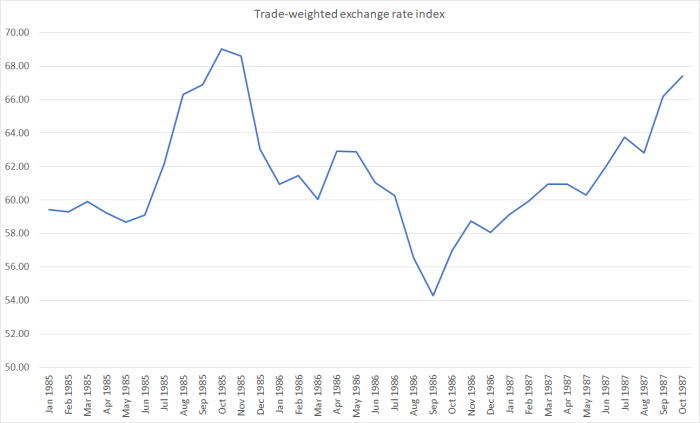
Official doctrine was that it was very hard to interpret the level of interest rates.  It was only three years since we’d liberalised, so didn’t have much sense of an appropriate interest rate in normal circumstances, and these circumstances were anything but normal (hence the focus on the yield gap –  if short-term rates were well above long-term rates then, in a climate where we were trying to drive down inflation, we couldn’t be too far wrong).  Much the same line applied to interpreting the exchange rate.   Both interest rates and the exchange rate were extraordinary volatile.

wholesale int rate 85 to 97

We didn’t really have a good model for forecasting, or making sense of, inflation either.   Again, that wasn’t really surprising.  So much had been liberalised quite quickly and a lot of economic relationships that had once held up no longer did.   Our basic approach was that inflation was a monetary phenomenon, but it wasn’t as if the monetary or credit aggregates could then give us much useful guidance either.

The focus was on bringing inflation down.  It was the one thing we knew the Reserve Bank could do, especially once the exchange rate had been floated, and I don’t suppose there was anyone who opposed that broad goal.   There wasn’t a very specific goal, but for some time the talk had been of “low single figure inflation” which was, at least at times, seen as emulating the success of the UK and the US earlier in the 1990s in bringing inflation down.

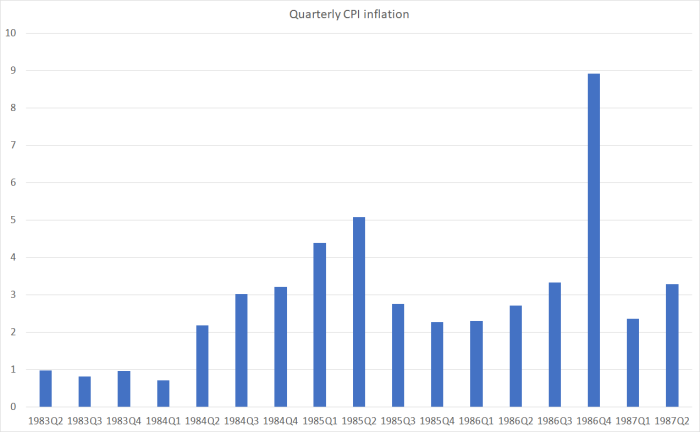
But inflation itself was all over the place.

CPI inflation 83 to 87

Annual headline inflation was 18.9 per cent in the year to June 1987.  Much of that reflected the introduction of GST in October 1986, but even abstracting from that quarterly inflation was volatile, and disconcertingly high.    There had been a sense that by early 1986 things were coming under control –  hence the sharp fall in interest rates in mid 1986 (see earlier chart) –  but that proved illusory.   Just before I came back to the Bank in August I recall seeing Grant Spencer interviewed on TV after the June quarter 1987 CPI numbers came out: quarterly inflation of 3.3 per cent (I think the Bank had been expecting something nearer 2 per cent) left the Chief Economist “flabbergasted”.   Low single figure inflation seemed a long way away, as the commercial construction boom, and the debt-fuelled sharemarket boom and associated strength in consumption raged on.    The (volatile) exchange rate offered some solace –  at the time, the pass-through from the exchange rate into domestic prices was still quite strong (we assumed something like a 46 per cent pass through) –  although I’m sure we all remembered that after the devaluation of 1984, a key policy priority had been cementing-in a  much lower real exchange rate.  (As a young graduate analyst, I’d been the minute-taker in various meetings on that theme involving the great and the good of the Reserve Bank and The Treasury).

twi 87

And so in September 1987, the biggest concern in the Economics Department of the Reserve Bank was that we were making little or no progress in getting inflation back down again.  Perhaps we weren’t going back to the 15 per cent inflation we’d often seen before the wage and price freezes of 1982 to 1984, but there didn’t seem much reason for confidence that once the GST effects dropped out we’d settle at much below 10 per cent annual inflation.  That wasn’t good enough for the government –  newly re-elected, and just about to launch the next wave of reforms  –  or for us.

Other parts of the Reserve Bank may have had different perspectives.  We didn’t do much banking regulation or supervision in those days, but a new function was just getting going, and I didn’t have much to do with them.  Our Financial Markets Department was probably a little more focused on the excesses in the markets –  including the big speculative plays on the NZD –  but the Bank wasn’t responsible for equity markets, and we didn’t have a “macro-financial stability” type of analytical function there or in Economics.   At the time we didn’t pay very much close attention to what was going on in other countries, but had we done so, we’d probably have seen a bunch of smallish economies undergoing similar post-liberalisation experiences (Australia and the Nordics), while congratulating ourselves that at least we’d floated our exchange rate (which the Nordics hadn’t).

But our focus in September/October 1987 was on tightening monetary policy if at all possible.  And on 7 October 1987, we’d actually announced a discrete monetary policy tightening (implemented by an increase in the margin above market rates at which we would buy back short-dated government securities from the market).   We’d tried to buttress the case for a tightening by arguing that the strength of the stock market was an indicator of demand and inflation pressures, but an older and (with hindsight) wiser senior manager insisted we remove that line.  My diary records that I thought the tightening was “pretty feeble” and that at a market function immediately after the announcement at least one of the market economists I talked to agreed (Grant Spencer, to his credit, disagreed).    Actual interest rates didn’t rise very much at all –  at least in the way we thought about things then – but by 16 October 90 day bank bill rates were 20.56 per cent.  There was no unease from the Beehive –  my diary for 15 October records of a meeting with Roger Douglas and his associate only “the latter almost gleeful at having closed almost 450 Post Offices”.

In many ways, our stance to this point was quite justifiable.  A key element of the macroeconomic management agenda ever since the 1984 election had been to end New Zealand’s really bad record of inflation.  And that was the Reserve Bank’s job.  Moreover, even if we had properly recognised the ever-growing fragility of the financial system etc, neither we –  nor anyone else –  had any way of knowing when those risks would crystallise.   Persistent strong domestic demand, even if built on foundations of sand, represented a serious threat to any sort of success in lowering inflation to what were, by then, becoming more internationally conventional levels.  So it probably wasn’t wrong to have tightened on 7 October, and may not even have been wrong for people like me to think that more tightening might yet be required.   Annual money and credit growth rates were, after all, still running at around 20 per cent –  indeed, a couple of days after the crash began we got new numbers that I called “presentationally (and factually) very embarrassing when [our chief critics] get hold of it”.  If there was a real squeeze on the tradables sector –  and there was –  the unemployment rate in mid 1987 was stable at around 4.2 per cent (lower than it is today).   At the time we didn’t really believe that seriously high unemployment would, for a time, be required to get inflation down –  I recall an IMF mission chief at the time reproaching us for this view – probably partly because after three years, unemployment hadn’t risen.  But whatever the truth of the matter, 4.2 per cent unemployment, amid a major economic restructuring, wasn’t exactly the 3 million unemployed of Thatcher’s Britain earlier in the decade.

So if there was a criticism to be made –  and I think it is probably fair that one should –  it was that we simply weren’t prepared for what followed.   There may have been people at the Bank –  older and wiser than me – who saw things differently then, and if so all credit to them.  But I was pretty closely involved on the monetary policy side throughout the following five years and I don’t think my blindspots were particularly unusual (I wrote many of the major papers, including the first ever Monetary Policy Statement, which has little or no sense of a post credit-boom bust to it_.  Again, it is possible that our banking supervision people saw things differently, but banking supervision –  such as it was – didn’t impinge on monetary policy or our macroeconomic forecasting and analysis.   We never really worked through what an asset bust and financial crisis meant for economic developments and prospects, and mostly treated them as peripheral issues.

On 20 October itself –  the first day of the crash in New Zealand –  I recorded in my diary “Bank not at all twitchy yet, which is good, and Douglas put on a brave face tonight”.   I saw the risk of economic contractions and real wealth effects, but for some reason seemed to see the risks as mainly those from abroad (commercial property busts overseas associated with potential credit contractions, recessions, falls in commodity prices etc) and thus potentially helpful in our own disinflation efforts.  For some – now unaccountable –  reason I noted that I didn’t see the New Zealand fundamentals as particularly problematic.   As I say, records of the past can make one wince.

A week or so later –  in one of those events I’ve never needed a diary to recall –  Paul Frater and Kel Sanderson, then the leading figures at BERL –  pretty vocal critics of our approach to monetary policy – came in to see Grant Spencer and me.  Sitting in Grant’s office

“among other topics, they gave us their gloomy assessment of the impact of the share price falls –  very pessimistic about comm. property and about the future size of many broking firms and merchant banks”.

They foreshadowed a financial crisis, and a lot of stress on bank balance sheets.  We were pretty dismissive of their concerns.

Within a day or two, concerns were mounting even within the Bank, focused on the fate of some of the investment companies (“Judge, Rada and Renouf”) and those they might drag down with them.   There was, I recorded, no panic over financial institutions themselves, but we’d had internal discussion of a possible liquidity response, agreeing in principle to raise the target level of settlement cash and perhaps cap the level of the discount rate (which normally moved with market rates) –  I think, from context, this hypothetical response was envisaged if interest rates rose (as, say, they did in the 2008 crisis).

A week later we acted.  It was never represented as a monetary policy easing –  although it was –  and so even today there is a mythology abroad (I saw it in a recent Liam Dann article on the crash) that the Reserve Bank did nothing in response.  On the day, 90 day bill rates –  which hadn’t risen since the crash, despite increase risk concerns and limit cuts –  fell 1.5 percentage points on the day.    (By August the following year, 90 day bill rates were down to 14 per cent –  a similar-sized fall to the active cut in policy rates the Reserve Bank implemented in 2008/09.)

My diary entry that day is sufficiently long, and embarrassingly wrong, that I won’t quote from it at any length: suffice to say that I called it a “precipitate panicky move”.  To be sure, the issue in the market at the time wasn’t the interest rate (which hadn’t risen) –  it was blind fear and an often-quite-rational newfound reluctance to lend –  and we had no evidence that inflation or inflation expectations would fall, and the Bank had over the years been too receptive to pressure from banks.  But, such were the genuine fears and rising risk aversion, that the response was only prudent.   Immediate responses can always be revisited once the immediate panic passes and, frankly, there wasn’t much, if any, moral hazard risk in the sort of action we took.   We weren’t lending more to anyone, let alone to bad credits.

But it wasn’t the way I saw it.  A few days later, apparently, I circulated a discussion note “provocatively titled ‘Is it time to lower the cash target’, (ie tighten up again) arguing strongly in the affirmative”.  The same day I recorded that Grant Spencer had deleted a description in a draft Board paper of the 6 November easing as “temporary”, observing to me “nice try”.  My approach wasn’t totally hawkish –  I also toyed with the idea of a cap on our discount rate, in case renewed crisis pressures spilled back into higher interest rates.  As the month went on and interest rates fell further, my arguments (in another “longer and more reasoned note”) starting commanding more sympathy among my colleagues, and some hawkish market economists.    The Deputy Governor even did the courtesy of ringing to discuss it.  But this was one of those times when –  at least with hindsight – the more senior were better judges of the situation than those of us further down the food chain.  In mid-November, I recorded a conversation with Iain Rennie –  then an analyst at Treasury –  in which he told me that the distribution of views was much the same at Treasury.

The (apparent) tensions betwen the financial stability and inflation control perspective must have been very real.  When my latest note was discussed at (the equivalent of) the Monetary Policy Committee, I recorded that there was plenty of agreement with the analysis and none with the recommendation (to reverse some of the easing) – “terrified of the possibility of collapses corporate and financial” , with rumours rife.

Of course, there were plenty of collapses to come, of corporates and fringe financial institutions.   Of the things that were feared, most come true.  In fact, reality was worse, because the crisis eventually engulfed mainstream large institutions on both sides of the Tasman.  Really bad lending –  whether to investment companies, or on a massive commercial propety boom –  eventually does that –  enabling a really big misallocation of real resources, and then eventually being found out.  Most of the waste isn’t in the crisis-aftermath; rather the bad seed is sown –  the waste actually happens – when all feels exuberant and the new investment is being recorded as an addition to GDP.

If I look back on my views during that frantic couple of months after the crash began, I was clearly wrong.  Even if monetary policy wasn’t going to do anything to save Judge, Renouf, the listed goat companies or whatever –  and nor should it –  it was quite clearly, even on the facts available at the time, a shock to the system which meant that lower interest rates were warranted.  Credit demand and associated activity would be weaker.  Interest rate falls would have happened anyway, even without our intervention (that was how the system worked then), but the nudge downwards, and the willingness to accommodate lower interest rates was clearly the right thing to do.

But it is also worth wondering what we might have done if we had correctly understood financial crises, asset busts etc, if we had envisaged several years of little or no growth, and two near-failures of our largest bank.  (That we didn’t, even later, is evident in a major article written by Grant Spencer and one his colleagues in late 1988 –  published the following year in a book on the liberalisation process, and which I reread last week –  in which the crash appears as not much more than a corrective to the excess enthusiasm for consumption up to 1987.)   The doves –  of whom there were plenty including Spencer and then Assistant Governor Peter Nicholl –  would, almost certainly have argued for further easings, allowing interest rates to fall materially further.       And yet it is far from clear that that would have been the right approach to have taken.

Inflation edged downwards only relatively slowly over 1989 and 1990, and it wasn’t until the big fiscal consolidation after the 1990 election, and as the 1991 recession unfolded, that we felt comfortable letting bank bill rates fall below the 14 per cent they got to in the months after the crash.  We, and other forecasters, misread the 1991 recession, but until that hit us we didn’t appear to be on track to getting inflation to target any sooner than the government had (by then) asked us to.  Inflation at the end of 1990 was still 5 per cent, and the target –  by then agreed by both main parties –  was 0 to 2 per cent inflation.  Getting inflation down isn’t technically difficult, but when real people and real institutions (with all their biases, incentives etc) are involved it can, and usually has been, costly and difficult.  Sometimes, a little learning can be a dangerous thing.  Perhaps a proper appreciation of the looming crisis, and the wasted real resources, at the end of 1988 would have made it even harder, perhaps even eventually more costly, to have secured something like price stability here.  I wouldn’t like to be seen as suggesting that we should welcome blind spots, or even ignorance, but sometimes perhaps they end up being less costly than idle theorising might suggest.

Finally, a week or so ago the Herald ran an interesting series of articles on the New Zealand experience in 1987.  The thing that most surprised me about those articles –  and in a way what prompted the thinking that led to this post –  was the almost complete omission of the role of banks in making it all possible.   Every over-optimistic borrower needs an over-optimistic lender if the loan is to happen.  There were plenty of the former, but all too many of the latter too –  whether state-owned lenders like the BNZ or the DFC or private sector ones, new entrants (NZI Bank anyone) or old, New Zealand owned or foreign-owned.  And the few institutions, on either side of the Tasman, who didn’t participate boots and all often weren’t particularly virtuous and far-seeing, but just slow.  Given another year or two, they’d probably have got into the mix too, and if existing management wouldn’t do so, well other managers could soon be found.

In many ways it was a classic financial crisis –  the definitive history of which has still to be written.  There was the displacement of genuine new opportunities, enough of a narrative for even the cautious to believe that the future would be quite a bit different and better than the past, official backing (indeed, at times, cheer-leading), extraneous feel-good factors like the America’s Cup, relatively weak market disciplines (especially in the financial sector), little experience in lending or borrowing in such a different world.  There were probably even some real success stories (I’m struggling to think of them, but readers can nominate some).   And it didn’t, to any material extent, involved lending to households.

It all happened surprisingly quickly.  14 July 1984 was the election day that brought the fourth Labour government to office, and 20 October 1987 began the crash –  just over three years.  It took far longer to unwind the mess than it did to create it.  It is the deterioriation in lending standards that happened so quickly that market monitors, and central banks, really need to be watching out for.    When they start sliding, a bank can be destroyed remarkably quickly.    Such marked deteriorations in standards aren’t every day events –  we, after all, have seen no bank failure since 1990 –  and they rarely arise out of the blue.  They usually take some shock –  some innovation –  that is likely to leave regulators just as uncertain what to make of it as the lenders are. That’s inescapable, but is a reason to be cautious about just how much useful difference even the best regulators can make.   Seeing no harm for 98 years earns you no real credit (and should not either) if you aren’t much better than the lenders in the other two years each century.

Reforming the Reserve Bank: some challenges for the new government

There will be more important issues facing the incoming government –  even in what are, broadly speaking, economic areas.

There are house prices, for example, where two successive governments have done nothing material to solve the structural problems that have been evident for 15 years now (present for longer).  It is a matter of (in)justice as much as anything.

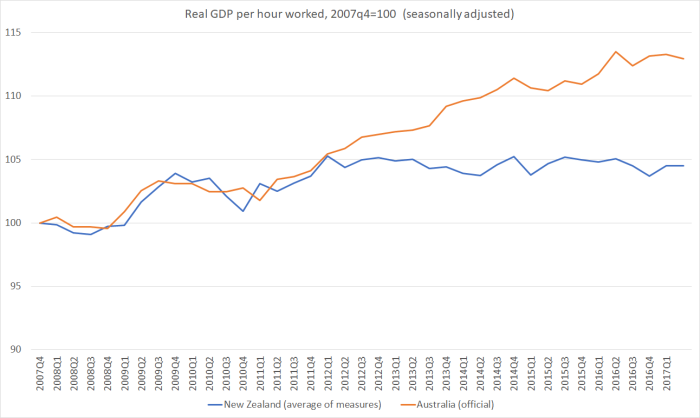
Or reversing the dismal productivity performance, epitomised by the last five years or no productivity growth at all.

aus vs nz ral gdp phw 2

Or reversing the dismal export performance which has seen exports as a share of GDP slipping –  not usually a path to sustained prosperity –  and which is forecast, by Treasury, to keep slipping (all else equal).

x to gdp

But if these things matter much more to our longer-term prosperity,  it doesn’t make an overhaul of the Reserve Bank less important.    And action on that front is now quite pressing.  Apart from anything else, the Bank has an (unlawfully appointed) caretaker Governor, and whoever is appointed as the new Governor –  under current legislation wielding huge amounts of power singlehandedly – will surely want to know quite what the shape of the job they are taking on is.   If the three parties who will be part of the new government are to be believed, any change isn’t just going to be limited to some slightly different words in the new Governor’s Policy Targets Agreement.

I wrote a post last week on the possible implications for monetary policy of a new government.   I’ll reproduce below the bits of that post that are relevant to the sort of Labour-led government we will actually have.

But the Reserve Bank isn’t just a monetary policy agency.  If anything, the case for legislative reform is even stronger in respect of the other functions (notably the extensive financial regulatory functions the Governor exercises under various acts) than it is for monetary policy.   These issues have less immediate political salience of course.  But whereas for monetary policy there is, at least, a statutorily-required Policy Targets Agreement which can be used as a legal basis to hold the Governor to account, there is nothing remotely similar in respect of the prudential regulatory powers.   The Governor –  whoever he or she may be –  exercises huge discretionary power, especially over banks, with little or no means for anyone to hold the Governor to account.  You might like LVR limits (I don’t).  But, whatever the merits of such controls, the Governor can impose or remove completely those controls on the basis of little more than a personal whim.  There are process hoops he or she would have to jump through, but no substantive constraints.  The same goes for debt to income limits.  Or higher, or lower, capital requirements on banks.

It is simply far too much power to vest in any one person – especially an unelected person, who cannot easily be removed from office.   A new Governor might be a truly exceptional person, blessed with wisdom and judgement far above the average.  But we have to build our institutions around typical people –  and typical public sector chief executives (including Governors), are typically average, a mix of strengths and weaknesses, insights and blindspots.

It isn’t the way in which other central banks and financial regulatory agencies are typically structured and governed.  No other country that has reformed its institutions in the last 40 years has given a Governor anything like as much personal power as our system does –  and even those who wrote our legislation would be flabbergasted at how much power our Governor actually wields since back then no one envisaged such an active discretionary regulatory role for the Bank.

Perhaps as importantly, it isn’t the way we govern almost anything else in New Zealand:

  • public companies have boards,
  • charities have boards,
  • the judiciary has several layers of appeal, and in the higher courts benches of judges decide cases rather than individuals,
  • the Cabinet itself is a decision-making committee, with the Prime Minister not much more –  in extremis –  than primus inter pares.  Prime Ministers can typically be ousted quickly by a party caucus.
  • Crown entities (from a school Board of Trustees to a major central government entity like the Financial Markets Authority) are governed by decisionmaking Boards.

Chief executives typically play an important role, but it is almost always an executive role, advising on and implementing a strategy set by others, and ensuring that the organisation itself functions effectively.     In areas of policy in particular, single decisionmakers are very rare, and in areas of policy with as much discretion as those the Reserve Bank exercises unknown.  And recall that governance structures don’t exist for the good times, or the occasions when everyone agrees; they are about resilience in tough times, resilience to inevitable human frailty.

It isn’t just a matter of policy discretion, moving away from the highly-unusual and risky single decisionmaker approach.   There are oddities such as the Reserve Bank being responsible for its own legislation –  something very unusual for a regulatory agency –  and thus, often, for reviewing its own performance.  We’ve seen that just this week: industry complaints that the Reserve Bank is reviewing its own performance as insurance industry prudential regulator.   No doubt the regulatory agency has useful input to such reviews, but they just can’t bring the degree of detachment and independence to a review of their own performance that the public should expect.

And then there is transparency.  The Reserve Bank has sought to claim over the years that it is highly transparent. In what matters, it is anything but.   The Bank scores well in transparency over things it knows almost nothing about: they will happily tell us what they think will happen to the OCR in 2019, for example.   But, unlike most government agencies or Parliament itself, they won’t, as a matter of course, publish submissions made on regulatory proposals.  They provide particular secrecy to the submitters with the deepest pockets and the strongest interest in limiting regulation (banks themselves), and rely on a provision of the Act that was never intended to cover such submissions and which is well overdue for reform.     They won’t publish the background papers to Monetary Policy Statements, even many months down the track (I did once succeed in getting 10 year old papers released).  They won’t publish minutes of the advisory Governing Committee meetings.  They won’t publish, even with a lag, even anonymised, the advice and recommendations the Governor receives when reviewing the OCR.  Like many government agencies, they are persistently obstructive, pushing the very limits of the Official Information Act.

I could go on, but won’t today.  Perhaps especially in a small country, an excellent central bank can be a significant part of the set of economic institutions that can help to shape and improve our economic performance.   We need better from the Reserve Bank –  not just specific decisions, but better supporting analysis, and a more robust and open institution (not one attempting to silence critics) than we’ve had in recent years.  And so reform shouldn’t just be about the odd line of legislation here and there, but about (re)building a capable, open, and accountable institution that supports better quality decisionmaking.  Finding the right person to be Governor, as one part of a new set of governance institutions, is a big part of that.  And that is where the urgency needs to begin.  Simply relying on names generated by a search and application process that began under the outgoing government, where applications closed even before the incoming Prime Minister became leader and gave much hope to her side, where applicants are all being interviewed and vetted by a Board of private company directors (and the like) appointed by the previous government –  and apparently content with how things have been – is most unlikely to be a good basis for identifying the right person.  And, again, it isn’t the way they do things in other countries.

I don’t want to be misread as suggesting that the Reserve Bank is more important than it really is.    Better macroeconomic management –  keeping the economy fully-employed, in a context of price stability – and appropriate financial system regulation, significant as they are, do not offer the answers to our long-term economic performance problems.  Those answers rest with structural policy choices that the Bank has no special role in.   But (a) good governance of very powerful institutions matters in its own right, and (b) in the short-medium term central bank choices, including around monetary policy, do make a real and material difference to economic performance.  Ours has been poor over the last decade.  In particular, we simply shouldn’t be in a position where the unemployment rate has been above any credible estimate of the long-run sustainable rate (or the NAIRU) for the whole of this decade so far.   Most other countries with their currencies, and own monetary policies, aren’t in the same situation.   This country can do so much better.  A better-led central bank, operating under reformed laws and institutional arrangements, can be one part of that mix.

(And now that the National-led government is leaving office, I am hopeful that the OIA request I lodged again 10 days or so ago for the Rennie review report and associated papers might at last lead to some documents being released.)

Here are the bits of last week’s post on what a Labour-led government might mean for monetary policy, (for ease of reading I’ve not block-quoted the material).

—————————————————————————————————————————

And what if Labour leads the next government, requiring support of the Greens and New Zealand First for legislation?  [We’ve already had confirmation, as I suggested then, that the Singaporean model is simply not going to happen.]

In that case, legislative reforms are more certain, but somewhat similar questions remain about what difference they might make.

Thus, the Labour Party campaigned on amending section 8 of the Act to include some sort of full employment objective.   They haven’t provided specific suggested wording, and would no doubt want official advice on that.  The Greens have endorsed that proposal and there is no obvious reason why New Zealand First would oppose it. But they might want to try to get some reference to the exchange rate or the tradables sector included, whether in the Act itself or in the Policy Targets Agreement.

Winston Peters’ private members bill [from a few years back] sought to amend the statutory goal of monetary policy (section 8 of the Act) this way (adding the bolded words)

The primary function of the Bank is to formulate and implement monetary policy directed to the economic objective of maintaining stability in the general level of prices while maintaining an exchange rate that is conducive to real export growth and job creation.

[As I noted then, this wording goes too far and asks the Reserve Bank to do something that is impossible (real exchange rates are real phenomena, not monetary ones).  I hope Labour and the Greens would not accept it, but we must presumably expect something of the flavour to find it way into the ACT or the PTA.]


I’ve also previously suggested that if Labour is serious about the full employment concern, it might make sense to amend section 15 of the Act (governing monetary policy statements) to require the Bank to periodically publish its estimates of a non-inflationary unemployment rate (a NAIRU), and explain deviations of the actual unemployment rate from that (moving) estimate.  In principle, something similar could be done for the real exchange rate, but the (theoretical) grounds for doing so are rather weaker.  Perhaps the political grounds are stronger, and such a change might encourage the Bank to devote more of its research efforts to real exchange rate and economic performance issues.

But –  and I deliberately use the same words I used above –  such legislative changes are not ones that would, on their own, make any practical difference to the conduct of monetary policy.  Reflecting back on the 25 years of advice I gave to successive Governors on the appropriate OCR, I can’t think of a single occasion when the advice would have been likely to be different under this formulation than under the current wording.

The Labour Party and the Greens also campaigned on legislative reforms to the monetary policy governance model (including a decisionmaking committee with a mix of insiders and relatively expert outsiders, and the timely publication of the minutes of such a committee.)   Although those proposals would represent a step in the right direction, they are rather weak. In particular, since Labour proposed that all the committee members would be appointed by the Governor, the change would largely just cement-in the undue dominance of the Governor.    But I’d be surprised if they were wedded to those details, and it shouldn’t be too hard to reach a tri-party agreement on a decisionmaking structure for monetary policy –  probably one that put more of the appointment powers in the hands of the Minister of Finance (as elsewhere) and allowed for non-expert members (as is quite common on Crown boards –  or, indeed, in Cabinet).

So legislative change in that area –  probably quite significant change –  seems like something we could count on under a Labour-led government.

But whether it would make much difference to the actual conduct of policy over the next few years still largely depends on who is appointed as Governor.   Not only will whoever is appointed as Governor going to be the sole decisionmaker until new legislation is passed and implemented –  which could easily be 12 to 18 months away –  but that individual will be an important part of the design of the new legislation and the sort of culture that is built (or rebuilt) at the Reserve Bank.

As I noted earlier, the appointment process for the Governor has been underway for months.  Applications closed at a time –  early July –  when few people would have given the left much chance of forming a government.  And the Board, all appointed by the current government and strong public backers of the conduct of policy in recent years, have the lead role in the appointment.   Perhaps a new Labour-led government would reject a Bascand nomination.  But even if they did so, they have no idea which name would be wheeled up next.

There are alternatives, if the parties to a left-led government actually wanted things done differently at the Bank.   First, they could insist that the Bank’s Board reopen the selection process, working within the sorts of priorities such a new government would be legislating for.  Or they could simply pass a very simple and short amending Act to give the appointment power to the Minister of Finance (which is how things work almost everywhere else).  Of course, there is still the question of who would be the right candidate, but at least they would establish alignment of vision from the start –  a reasonable aspiration, given that the Reserve Bank Governor has more influence on short-term macro outcomes than the Minister of Finance, and yet the Minister of Finance has to live with the electoral consequences.

Over time, governance changes are important as part of putting things at the Reserve Bank on a more conventional footing (relative to other central banks, and to the rest of the New Zealand public sector).   I think some legislative respecification of the statutory goal for monetary policy  –  along the lines Labour has suggested –  is probably appropriate: if nothing else, it reminds people why we do active monetary policy at all.   But on their own, those changes won’t make any material difference to the conduct of monetary policy  –  or even to the way the Bank communicates –  in the shorter-term (next couple of years) unless the right person is chosen as Governor.  Perhaps so much shouldn’t hang on one unelected individual, but in our system at present it does.

Symbols matter, but so does substance.  It will be interesting to see which turns out to matter more to a new government with New Zealand First support.

In closing, there is a long and interesting article in today’s Financial Times on some of the challenges – technical and political –  facing central bankers.  As the author notes, in many countries authorities are grappling with a mix that includes very low unemployment and little wage inflation.  In appointing a Governor for the Reserve Bank of New Zealand, it would be highly desirable to find someone who recognises, and internalises, that the challenges here are rather different.  Unlike the US, UK, or Japan (for example) New Zealand’s unemployment rate is still well above pre-recessionary levels –  when demographic factors are probably lowering the NAIRU –  and real wage inflation, while quite low in absolute terms, is running well ahead of (non-existent) productivity growth.    There are some other countries – the UK and Finland notably –  that also have non-existent productivity growth, but it is far from a universal story.  Productivity growth carries on in the US and Australia and (according to a commentary I read last night) in Japan real output per hour worked is up 8.5 per cent in the last five years (comparable number for New Zealand, zero).

Some of these issues are relevant to monetary policy (eg unemployment gaps) and some are relevant to medium-term competitiveness (wages rising ahead of productivity growth).  We should expect a Governor who can recognise the similarities between New Zealand’s experiences and those abroad, but also the significant differences, and who can talk authoritatively about what monetary policy can, and cannot, do to help.  Perhaps even, as a bonus, one who might even be able to provide some research and advice to governments on the nature of the economic issues that only governments can act to fix.


An alternative perspective on emissions and immigration

I’ve now got off my chest my annoyance at some of the “playing distraction” rhetoric David Hall used in his Newsroom piece responding to my column urging that the Productivity Commission inquiry into a transition to a low-emissions economy should at least consider the potential role of immigration (in boosting emissions in the past, and perhaps in offering a lower-cost abatement tool in future). But I wanted to come back to some of the more substantive issues Hall raises.

Bear in mind that my column was based on a submission to the inquiry the government asked the Productivity Commission to undertake.  The terms of reference which the Commission is operating under are focused on New Zealand’s own policy responses, and how to (maximise the benefits and) minimise the costs of meeting the target which the government has set.    The focus is –  rightly in my view – on national interests (costs and benefits to New Zealanders) now that the New Zealand government has already factored in its response to the (actual and perceived) global imperatives, in establishing an emissions reduction target under the Paris climate agreement.    Having determined how much reduction in emissions we will aim for, and made those commitments to other countries in an international context, the challenge now is how best to adjust, and what mix of policy instruments might enable us to deliver on those commitments.

Hall argues that “what matters from the perspective of Earth’s atmosphere is what people emit, not where they emit it”.  Maybe so, but the New Zealand government is not now making policy for the “Earth’s atmosphere”, but around an emissions reduction target it has signed up to for New Zealand.  In that context, where the emissions happen matters.

My submission was firmly set within that sort of framework –  one set by the government and recognised by the Commission.  In fact, in the Terms of Reference the three ministers were using exactly the same sort of analytical framework I was.

New Zealand’s domestic response to climate change is, and will be in the future, fundamentally shaped by its position as a small, globally connected and trade-dependent country.  New Zealand’s response also needs to reflect such features as its hjgh level of emissions from agriculture, its abundant forestry resources, and its largely decarbonised electricity sector, as well as any future demographic changes (including immigration).

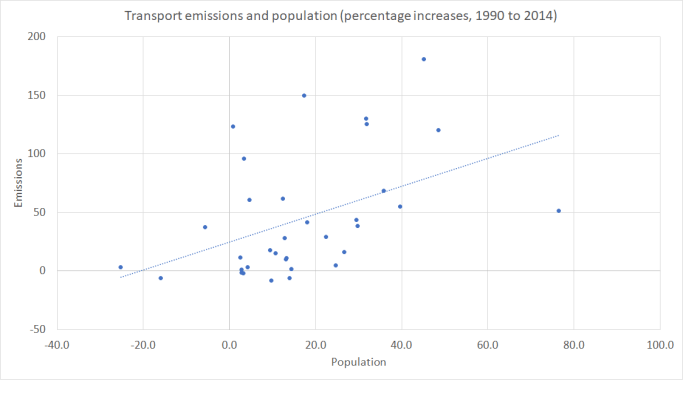
The focus of my submission was, in many respects, that the Commission had simply ignored that last phrase.  Population growth matters to emissions, all else being equal, and in New Zealand –  where non-citizen immigration is so (a) important, and (b) fully within government control –  population growth can, via immigration policy, and should be considered as an instrument to reduce emissions.    It might be uncomfortable for MBIE (champions of immigration), or for the Ministry for the Environment, but the point of Productivity Commission inquiries isn’t to make life comfortable for established interests.

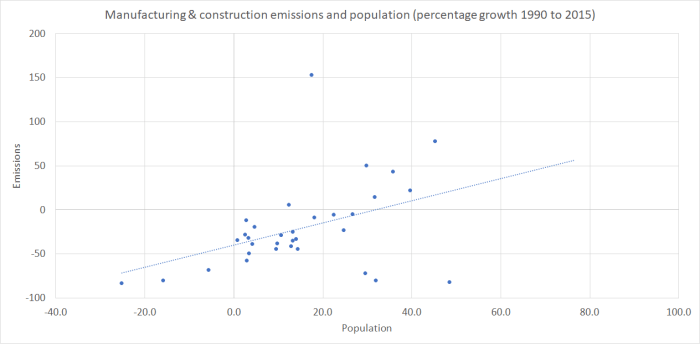
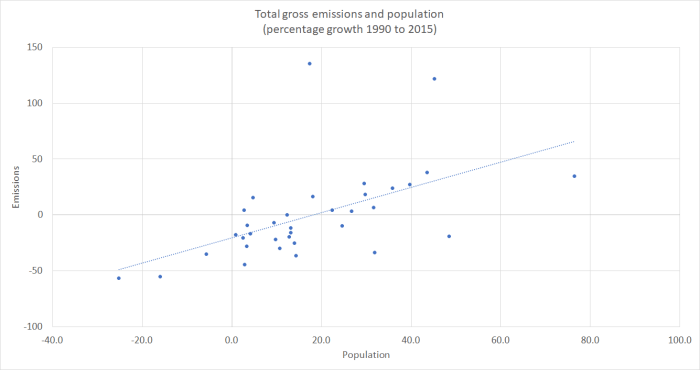
Hall is clearly uncomfortable with the idea –  the pretty basic fact –  that increased populations increase emissions, all else equal.   But again, discomfort doesn’t change the stylised facts.  As he acknowledges, “road transport emissions have increased by 78 per cent since 1990”, but…..

But the fault here lies with New Zealand’s over-reliance on private vehicles. Migrants (and citizens) contribute to road traffic by necessity, because alternative means of transport are less available, indeed far less so than many migrants are used to, coming from places where travel by trains, trams, cycles and footpaths is not unusual. If low-carbon alternatives in places like Auckland were more serviceable, migrants would doubtlessly utilise them, as indeed would citizens. And if the excuse for underinvestment is the lack of markets of sufficient scale, then population increase and cultural change will drive progress.

In other words, if governments and people did things differently than they actually did, emissions would have been lower.  No doubt, but that isn’t really the point.   Each of the alternatives Hall proposes would have had both public and private costs –  and the point of the exercise is to keep those costs to a minimum.  Perhaps he’d prefer a world of light rail and trains.  Most citizens don’t seem to, at least when confronted with real world costs –  and the economics of such proposals in New Zealand is generally shocking.    Actual transport emissions would have been a lot lower than they are now if, at the extreme, the population had been constant since 1990.  And if –  and it is a proposition for debate –  the immigration that so substantially boosted the population had few, no, or even negative productivity gains for New Zealanders, those emissions reductions could have been achieved at little or no economic cost at all.    There are plenty of ways to reduce emissions, but the challenge is to find the most cost-effective ones or –  in markets –  to set up the instruments in a way that allows private agents to identify the most cost-effective means of adjustment.

In my column and submission I had noted that it is generally accepted that New Zealand typically faces quite high marginal abatement costs to reduce emissions, relative to those faced by most other advanced economies.  When I wrote that, I wasn’t even thinking of it as a controversial proposition.  But Hall wasn’t happy with the claim.

This contradicts Reddell’s claim that “all informed observers recognise that the marginal abatement costs in New Zealand, through conventional means, are high”. I’ve written for Pure Advantage about the potential of forests – both production and permanent forests – to offset agricultural emissions in a way that isn’t only cost-effective but potentially profitable. This is corroborated by other “informed observers”, such as the Royal Society of New Zealand, the Parliamentary Commissioner for the Environment and Vivid Economics. The latter’s Net Zero in New Zealand report highlights other low-cost opportunities in energy efficiency, heating technologies, agricultural efficiency, and technological advances in methane vaccines and cheaper electric vehicles.

I’m happy to alter “all informed observers” to “most observers”, but I’m not resiling from the basic point.   Warwick McKibbin of ANU, who has done a lot of modelling on climate change and emissions abatement first produced estimates 20 years ago showing that that the “marginal abatement cost in New Zealand amongst the highest in the world”.  I’ve heard him repeat the point in various seminars and lectures over the years.    Why are the costs higher here?  Among other things, because a very large chunk of our emissions are agricultural, and there aren’t yet good technologies for reducing the emissions while keeping the animals.  And because our power generation is already largely hydro-based, so can’t easily be switched to alternative fuels to reduce carbon emissions.   This is an expensive place to reduce emissions –  an equal marginal cost approach would see us adopt a less aggressive emissions reduction target than most countries.    There are papers on the web from government agencies making exactly this point.

The Productivity Commission themselves recognise these points. For example, from their issues paper, on animal emissions.

Moderate emissions cuts are possible from certain agricultural technologies (eg, low-emission feds). However, a low-cost technology that delivers dramatic reductions in biological emissions appears far off, and may not emerge. While a methane vaccine could reduce CH4 emissions by up to 40%, no successful trials of such a vaccine have so far occurred.

Actually, for all the talk of alternative technologies, the Vivid Economics paper Hall links to makes much the same point about the sorts of constraints New Zealand faces.  Here is text from the Executive Summary (of a report funded by various MPS, foreign embassies and other donors).

In meeting this challenge, New Zealand is distinctive in at least three respects: its significantly decarbonised energy sector; its large share of difficult-to-reduce land sector emissions; and its large forestry sector. Elsewhere in the world, more focus has been devoted to reducing emissions from the electricity sector than from any other sector. Huge efforts and costs are now beginning to translate into progress. But for New Zealand, these challenges are of less significance. Its power sector consists primarily of hydroelectric and geothermal resources, providing firm, reliable capacity. Even with the challenge of decarbonising other parts of the energy sector (transport fuels, heat), the resulting relatively low-carbon energy mix provides the country with a considerable competitive advantage in a world that is placing increasing constraints on emissions. Yet, at the same time, the importance of the pastoral agriculture sector to the economy and social fabric of the country creates a huge challenge, although one that is laced with opportunity. Biological emissions from agriculture account for almost half of New Zealand’s gross emissions, a higher proportion than in any other developed country. While other developed countries may choose to not prioritise reducing these emissions in the short term, following suit would have important repercussions for New Zealand in meeting future targets.

Wishing it were otherwise does not make it so.  Marginal abatement costs are typically higher here than in other countries.  Those costs may well be falling –  as eg new battery technologies for example open up new options re transport emissions –  but those technologies are available to other countries too. They don’t change the specific challenges New Zealand faces relative to other advanced countries.   The emissions target we’ve committed to, whether through belief or interest, represent a new constraint on economic performance, and that constraint is more severe for New Zealand than for most, in a country with a long-term history of real economic underperformance.

Against that backdrop it would be irresponsible to simply wave our hands and pretend that immigration isn’t an issue (for us, as New Zealand, and our governments), ploughing on oblivious to the potential real economic costs of doing so.     Immigration policy needs to be considered as one strand in thinking about how best to design a New Zealand policy response, to minimise the net adjustment costs to New Zealanders.

I’d simply taken for granted what seemed like a fairly obvious point (even Hall reluctantly acknowledged it) that increased populations will have tended to increase emissions, all else equal. But until now I hadn’t had a look at the cross-country data to see if the relationship was actually there in the data.  It might not have been –  after all, countries might have responded to the rising populations by finding techniques and market instruments to lower per capita emissions sufficiently that there was no relationship left in the observed data.

Fortunately, we have quite detailed data on gross emissions for almost all OECD countries from 1990 to 2015.  In a few cases, the data are only up to 2013 or 2014, and in all the scatter plots that follow I’ve lined up the population changes with the emissons data (eg if for a country there is emissions data for 1990 to 2014, I’ve used percentage population change over that period).  But for 30 countries there is full data for all the variables I looked at.

None of these relationships are particularly tight –  these are simple bivariate relationships, and lots else was going on in each of these countries (eg in the former Soviet bloc countries, production processes had been extremely inefficiently energy-intensive).

I start with transport emissions (actually to 2015 despite the label). As Hall noted, transport emissions in New Zealand have increased a lot, as has our population.

transport emissions

Unsurprisingly, the relationship is upward sloping.

What about manufacturing and construction emissions?

manuf emissions

(That outlier up the top is Korea, which has still been massively industrialising.)

Total gross emissions?

total emissions

Hall seemed particularly perplexed, or perhaps outraged, by my points about agriculture

As I understand him, he argues that New Zealand’s high living standards depend upon dairy exports, which makes it politically infeasible to impose costs for environmental damages. The greater the population, the greater this reliance upon the dairy sector, and so the greater the reluctance to make polluters pay.

Again it seemed pretty descriptively accurate to me (whether it is an outcome he –  or I –  like or not). But even though agricultural emissions are much more of an issue for New Zealand than for most OECD countries, I was curious as to whether there was a relationship (across countries) between population growth and growth in agricultural emissions.  I didn’t have a prior expectation, but in fact this is what I found.

ag emissions

It is actually one of the tighter relationships, so I’ll repeat the proposition from my submission/column: with fewer people it seems quite plausible that we’d have had (tighter environmental regulation and) fewer cows and fewer emissions.

I could go on showing you charts all day, but I won’t try your patience.   Somewhat to my surprise there is actually even a (weak) positive relationship between population growth and per capita emissions and emissions per unit of GDP.  I’m not quite sure why that would be, although in New Zealand (and Australia’s) case, the migrants are moving to some of the OECD countries with, already, the highest emissions per capita and per unit of GDP.

The bottom line for New Zealand is that our immigration policy, which has very substantially boosted our population, has also substantially boosted our emissions over the last 25 years.   Our experience doesn’t look out of line with that of the rest of the OECD: growing populations are associated with more emissions, whether in transport, agriculture or just in total.   Given that marginal abatement costs, even if falling, are still high here relative to those in other advanced countries, it would frankly be irresponsible for any government, concerned primarily about the interests of New Zealanders, not to have the levers of immigration policy considered when assessing the best approach for New Zealand to take to meet its commitments.   The Productivity Commission should be doing so.

In the end, though, I suspect that the real difference between me and David Hall isn’t about any of these numbers.   He concluded his article

Because when it comes to global warming, it’s the carbon intensive economy, stupid. The only genuine solution is to transform the world’s high-emissions economies into low-emissions economies, so that anyone entering them by way of birth or migration can lead a prosperous low-carbon life. Our national emissions targets are a means to this global end. Focusing on peripheral issues like migration only distracts from the work that needs to be done. But that’s what happens when you tell the story of a global problem through a nationalist lens.

But all policy is national, and there is (fortunately) no supra-national government.  We’ve played our part in the international process with our emissions reduction commitments, which are ambitious given the high marginal abatement costs here.  But Hall’s approach suggests he doesn’t really care if there are cheaper, less costly, ways for New Zealand to meet its commitments, and thus reduce costs to New Zealanders (residents and voters); what he cares about is the global.  It is certainly one perspective, but it isn’t the one the government used in setting up the Productivity Commission inquiry.  In practice, it almost certainly isn’t the one New Zealand residents and voters will be using in assessing how governments handle these issues over the next 20 years and beyond.

My own column ended this way

The aim of a successful adjustment to a low-emissions economy is not to don a hair shirt and “feel the pain”. It isn’t to signal our virtue either. Rather, the aim should be to make the adjustment with as small a net economic cost to New Zealanders – as small a drain on our future material living standards – as possible. Lowering the immigration target looks like an instrument that needs to be seriously considered –  including by the Productivity Commission – if that goal is to be successfully pursued.

I’m probably less idealistic than David Hall. Perhaps 30 years as a bureaucrat does that to one.  But in responding to a comment on my earlier post today I noted

My take is that, as a high cost abater, we should impose as little cost on NZers as possible to be seen by friends and trading partners to be making our token contribution (because obviously in global terms it is only token).

Giving serious consideration to cutting our (unusually large) immigration targets looks as though it  should be good economic policy and good (national) emissions-reduction policy.

A researcher responds to Reddell on emissions and immigration

I’m sitting here a bit puzzled at what approach to contesting or debating policy they now teach and model at Oxford University, or practice at Auckland University of Technology.

A few weeks ago, I posted here a submission I’d made to the Productivity Commission’s inquiry into how New Zealand might make a transition to a low-emissions economy, and arguing that immigration policy should at least be considered by the Commission as one material influence on total New Zealand emissions, and as a potential tool to facilitate a cost-effective pursuit of the goverment’s emissions target.   Late last week, Newsroom published a column of mine based on that submission.       In that column I noted that

New Zealand has committed to a fairly ambitious emissions reduction target as part of the Paris climate agreement.  Of course, some political parties think the target isn’t ambitious enough, but New Zealand faces an unusual set of factors that affect our ability to reduce emissions here at moderate cost.  Appropriate policy responses, and the choice of the mix of instruments we choose to deploy, need to take account of that distinctive mix.

and concluded

The aim of a successful adjustment to a low-emissions economy is not to don a hair shirt and “feel the pain”. It isn’t to signal our virtue either. Rather, the aim should be to make the adjustment with as small a net economic cost to New Zealanders – as small a drain on our future material living standards – as possible. Lowering the immigration target looks like an instrument that needs to be seriously considered –  including by the Productivity Commission – if that goal is to be successfully pursued.

The backdrop of course –  and a point made in both the submission and my column – was the arguments I have been running for some years now suggesting that immigration policy itself been damaging to our economic performance, and thus has come at some net economic cost to New Zealanders.

But one academic reader decided that rather than engage primarily on the substance of the arguments I’d made –  the bottom line of which, after all, was simply that the Productivity Commission shouldn’t just ignore the issue –  he’d try to muddy the waters with some slurs.

David Hall is a young academic researcher at AUT, having returned to New Zealand relatively recently after doing a D. Phil at Oxford.   While he was in the UK he, for a time, had a regular Listener column.   His academic background appears to be in politics rather than economics, but he has been writing about climate change policy and was the editor of the recently-published BWB Texts book Fair Borders? Migration Policy in the Twenty-First Century, a collection primarily about aspects of New Zealand’s approach to and experience of immigration.  I’ve written previously about a couple of chapters in the book (here and here).  As I noted in the latter of those posts

As much as I can, I try to read and engage with material that is supportive of New Zealand’s unusually open immigration policy.   One should learn by doing so, and in any case there is nothing gained by responding to straw men, or the weakest arguments people on the other side are making.

Newsroom has published a response by Hall to my column (they even illustrated it with a photo of my own suburb, Island Bay).    There are some points of substance in Hall’s response, and I want to come back to them in a separate post.

But it was these two paragraphs that really annoyed me

What’s striking about all this is not only Reddell’s argument is from the perspective of climate change, but also economics. He resists the orthodox view that migration has a modest positive impact on national GDP. I’m no enemy of disciplinary iconoclasm, but it does beg for robust positive arguments. Reddell’s appeals to uncertainty (economists cannot prove definitively that migration increases GDP, therefore it might not be true) do not count. Climate scientists are all too familiar with this kind of denial.

So if economic evidence cannot always carry his arguments, one can only conclude that non-economic reasons are doing some of the work. To Reddell’s credit, he is explicit about his concerns for cultural cohesion, or that “Islam is a threat to the West, and a threat to the church wherever it is found”. These are real reasons for wanting to reduce immigration, but should be debated on their ethical and sociological merits, not couched in an idiosyncratic take on climate policy.

This is frankly pretty scurrilous stuff.

Apparently, when it comes to the economics of immigration, all I’m doing is “appealing to uncertainty” not advancing any “robust positive arguments”.  This is, so he claims, the economics equivalent of “climate change denial”.

First, lets look at what I’d actually said in my column

Of course, if there were clear and material economic benefits to New Zealanders from the high target rate of non-citizen immigration (the centrepiece of which is the 45,000 per annum residence approvals “target”) it might well be cheaper (less costly to New Zealanders) to cut emissions in other ways, using other instruments. But those sort of  gains –  lifts in productivity – can’t simply be taken for granted in New Zealand. Despite claims from various lobby groups that the economic gains (to natives) of immigration are clear in the economics literature, little empirical research specific to New Zealand has been undertaken. And there is good reason – notably our remoteness – to leave open the possibility that any gains from immigration may be much smaller here than they might be in, say, a country closer to the global centres of economic activity, whether in Europe, Asia, or North America.

Even many of those who are broadly supportive of New Zealand’s past approach to immigration policy will now generally acknowledge that any gains to New Zealanders may be quite small. And for some years now, I’ve been arguing for a more far-reaching interpretation of modern New Zealand economic history: that our persistently high rates of (non-citizen) immigration have held back our productivity performance (i.e. come at a net economic cost to New Zealanders).

It isn’t controversial to suggest that there has been little empirical research specific to New Zealand on the contribution of immigration policy to New Zealand’s economic performance.  It is simply an accepted fact –  and the chair of the strongly pro-immigration New Zealand Initiative accepted as much in an exchange here last year.   I also don’t think it is controversial to suggest that any economic gains to New Zealanders may be quite small –  it was, as I recall, the conclusion of Hayden Glass and Julie Fry (both generally pro-immigration) in their BWB Texts book last year.   Remoteness is generally accepted as an issue in New Zealand’s economic performance –  even if reasonable people differ on the implications and appropriate policy responses.

And then there was the reference to “and for some years now I’ve been arguing”.  Since the point of the emissions/immigration column was to argue that the connection should be considered, not to attempt to demonstrate that immigration has been economically costly, I didn’t elaborate in that column.  But it would, to most readers, have been a hint that there was a bit more to the argument than “appealing to uncertainty”.  If Hall himself hadn’t been familiar with my arguments, Google would willingly have helped.   There are, I see, 140 posts on this blog tagged with “immigration”, and there are plenty of speeches and papers, and a lengthy commentary on the New Zealand Initiative’s major piece earlier this year making the case for New Zealand’s immigration policy.  Only last week, in a post where I outlined some specific alternative immigration policy proposals, I linked to a recent speech outlining the economic case –  specific to New Zealand –  for rather lower target rates of non-citizen immigration.  People might disagree with my economic arguments and reading of New Zealand’s economic history, but none of those arguments is a mystery to anyone interested.

(In – very  – short, (a) extreme remoteness makes if very difficult to build many high productivity businesses here that aren’t natural resource based, and (b) in a country with modest savings rates, rapid population growth has resulted in a combination of high real interest rates and a high real exchange rate, discouraging business investment and particularly that in the tradables –  internationally competitive – sectors, on which small successful economies typically depend. I add to the mix how unusually large our immigration target is and how, despite the official rhetoric, the skill levels of the average and marginal migrants are not particularly high.)

But Hall’s rhetorical strategy rests on making as if none of this extensive body of argumentation and analysis exists, that I’m playing distraction, and then falling back on the “Muslim card”.

In parallel to this blog, I maintain a little-read (and these days, little written) blog where I occasionally write on matters of religious faith and practice, and sometimes on a Christian perspective on public policy issues.  If there is a target audience it is fellow Christians and in writing there I take for granted the authority of the Bible, and of church teaching and tradition over 2000 years.  I very rarely link to it here, as there is typically little overlap in subject matter and I know that most of the readers of this blog don’t share those presuppositions.

A couple of years ago, I wrote a couple of posts about refugee policy, prompted by some domestic commentary on the possible economic case for taking more refugees (in particular from Syria).   On this blog, I wrote something fairly short and narrowly focused on the economics, noting that there were unlikely to be net economic benefits to New Zealanders.  I concluded that

None of which is an argument for not taking refugees.  Doing so is mainly a humanitarian choice, not something we do because we benefit from doing so.  I don’t have a strong view on how many refugees New Zealand should take, but I don’t think possible economic benefits to us should be a factor one way or the other.

We do good because it is right to do so, not for what it might do for us.  Whether “doing good” in this case involves taking more refugees, or donating more money to cost-effectively assist in refugee support in the region, is a more open question.

A day or so later I wrote a longer post on my Christian blog on the refugee issue through the lens of the gospel, and included a link to that post at the end of the “economics of refugees” post.   At the end of quite a long post, aimed at Christian readers (and none of which I would resile from now) I included the phrase Hall now seeks to highlight.  Here is the full text

Islam is a threat to the West, and a threat to the church wherever it is found.  Political authorities in the West were right, and well-advised, to resist in the past, and at the Battle of Tours, at Lepanto, and at the gates of Vienna, to begin to turn the tide.    We owe it to the next generations of our own people to resist the creeping inroads of Islam.  If New Zealanders convert to that faith, there is of course little we can do, but neither compassion nor common sense requires, or suggests it would be prudent, for Western countries with any sense of their own identity to take in large numbers of Syrian refugees or migrants.

Frankly, I was a bit puzzled as to how Hall –  an apparently secular academic – was aware of this obscure post, with perhaps 100 readers in total, but not of the substance of my economic arguments.  But in an email exchange overnight, he tells me that he is actually familiar with this blog, and presumably with its economic arguments, and found the Christian post on refugees through this blog.   At least that answered that question, even if it doesn’t explain his attempt to pretend that I’m not raising substantive, or developed, economic arguments.

And as he acknowledges that he is familiar with this blog, perhaps he might have considered looking at the material I’ve posted here on the issues around culture, diversity etc.      There was, for example, this address to a Goethe Institute event on diversity etc.   Or a post earlier this year where I explicitly laid out some thoughts on culture and identity issues in response to one chapter of the New Zealand Initiative’s report.

I began the post by making the point I often use

My focus has tended to be on economic issues –  and thus to be largely indifferent on that count whether the migrants came from Brighton, Bangalore, Beijing, Brisbane or Bogota.  Almost all of my concerns about the economic impact of New Zealand’s immigration programme would remain equally valid if all, or almost all, our immigrants were coming from the United Kingdom –  as was the case for many decades.

Nonetheless, I noted that there were many groups of people who I would not have welcomed large number of migrants from

So long as we vote our culture out of existence the Initiative apparently has no problem.  Process appears to trump substance.  For me, I wouldn’t have wanted a million Afrikaners in the 1980s, even if they were only going to vote for an apartheid system, not breaking the law to do so.  I wouldn’t have wanted a million white US Southerners in the 1960s, even if they were only going to vote for an apartheid system, and not break the law to do so.  And there are plenty of other obvious examples elsewhere –  not necessarily about people bringing an agenda, but bringing a culture and a set of cultural preferences that are different than those that have prevailed here (not even necessarily antithetical, but perhaps orthogonal, or just not that well-aligned).

I went on, talking about the Initiative

They take too lightly what it means to maintain a stable democratic society, or even to preserve the interests and values of those who had already formed a commuity here.    I don’t want stoning for adultery, even if it was adopted by democratic preference.  And I don’t want a political system as flawed as Italy’s,even if evolved by law and practice.   We have something very good in New Zealand, and we should nurture and cherish it.  It mightn’t be –  it isn’t –  perfect, but it is ours, and has evolved through our own choices and beliefs.  For me, as a Christian, I’m not even sure how hospitable the country/community any longer is to my sorts of beliefs – the prevalent “religion” here is now secularism, with all its beliefs and priorities and taboos – but we should deal with those challenges as New Zealanders – not having politicians and bureaucrats imposing their preferences on future population composition/structure.

But the New Zealand Initiative report seems to concerned about nothing much more than the risk of terrorism.

A commonly cited concern in the immigration debate is of extremism. The fear of importing extremism through the migration channel is not unreasonable. The bombing of the Brussels Airport in 2016, in which 32 people were killed, or the Bataclan theatre attack in Paris where 90 people were murdered, shows just how real the risk is.

The report devotes several pages to attempting to argue that (a) the risk is small in New Zealand because we do such a good job of integrating immigrants, and (b) that the immigration system isn’t very relevant to this risk anyway.

The point they simply never mention is that in many respects New Zealand has been fortunate.  For all the huge number of migrants we’ve taken over the years, only a rather small proportion have been Muslim.

I went on

They highlight Germany –  perhaps reflecting the Director’s background –  where integration of Turkish migrants hasn’t worked particularly well over the decades, while barely mentioning the United Kingdom which is generally regarding as having done a much better job, and yet where middle class second generation terrorists and ISIS fighters have been a real and serious threat.  Here is the Guardian’s report on comments just the other day from a leading UK official –  the independent reviewer of terrorism legislation –  that the UK now faces a level of threat not seen since the IRA in the 1970s.  Four Lions was hilarious, but it only made sense in a context where the issue –  the terror threat –  is real.

But the Initiative argues that few terrorists are first generation immigrants, and some come on tourist or student visas (eg the 9/11 attackers) and so the immigration system isn’t to blame, or the source of a solution.  I’d largely agree when it comes to tourists, and perhaps even to students –  although why our government continues to pursue students from Saudi Arabia, at least one of whom subsequently went rogue having become apparently become radicalised in New Zealand, is another question.   But there are no second generation people if there is no first generation immigration of people from countries/religions with backgrounds that create a possibility of that risk.  Of course the numbers are small, and most people –  Islamic or not –  are horrified at the prospect of terrorism, or of their children taking their path.  But no non-citizens have a right to settle in New Zealand, and we can reduce one risk  –  avoiding problems that even Australia faces – by continuing to avoid material Muslim migration.

Having said that, I remain unconvinced that terrorism is the biggest issue.  Terrorists don’t pose a national security risk.  Whatever their cause, they typically kill a modest number of people, in attacks that are shocking at the time, and devastating to those killed.  But they simply don’t threaten the state –  be it France, Belgium, Netherlands, the US, or Europe.  Perhaps what they do is indirectly threaten our freedoms –  the surveillance state has become ever more pervasive, even here in New Zealand, supposedly (and perhaps even practically) in our own interests.

The bigger issue is simply that people from different cultures don’t leave those cultures (and the embedded priors) behind when they move to another country –  even if, in principle, they are moving because of what appeals about the new country.  In small numbers, none of it matters much.  Assimilation typically absorbs the new arrivals.  In large numbers, from quite different cultures, it is something quite different.  A million French people here might offer some good and some bad features.  Same goes for a million Chinese or Filipinos.  But the culture –  the code of how things are done here, here they work here –  is changed in the process.

So, Dr Hall, despite your attempts to suggest otherwise, basically none of my concerns about New Zealand’s immigration policy have anything to do with Islam at all.  Very few of the huge number of migrants we’ve taken over the years have been from Muslim backgrounds. It simply isn’t an issue New Zealand has faced (unlike, say, Australia).   As I’ve said previously, my economic arguments are blind to which country, or religious background, immigrants have come from.  We’ve taken lots and lots of people, from wherever, and the numbers are –  on my argument –  the issue, not the origins.   Those arguments apply as strongly to the post-war decades –  when most of the immigration was from the UK –  as they do in the last couple of decades.    And – to revert to the emissions/immigration connection, all those migrants –  wherever they’ve come from –  have added to New Zealand’s greenhouse gas emissions.

(To be clear, I would be uneasy about large scale Muslim immigration, on non-economic grounds.  But I’m quite sure I wouldn’t be alone in that –  in an exchange on his blog earlier in the year, even strongly pro-immigration New Zealand Initiative Chief Economist Eric Crampton noted that his one area of concern might be migrants who would undermine our democratic norms.  Eric seems to be quite strongly anti-Christian (and probably anti all religions) but he acknowledged that large numbers of Wahhabi Saudi immigrants –  not in prospect –  would be a serious concern.)

In reading some more of Hall’s own views on immigration, I found an interview with him in which he notes

But we also need to redistribute power and especially to give Maori greater influence over the ends and means of migration policy. I support Tahu and Arama’s call for tangata whenua to exercise greater influence on border policy as part of an emboldened tino rangatiratanga, not least because Māori have the most to lose from unfair migration.

I don’t agree with him on that, but my own thoughts on the implications of immigration policy for the Maori place in New Zealand are in the Goethe Institute piece linked to earlier and in a fairly-read post here earlier in the year, again prompted partly by the Initiative’s report.  In it I raised, for a general audience, concerns perhaps not a million miles from some of his own.

But don’t try to pretend that (a) there are not serious economic questions to be answered about the impact of our large-scale immigration programme, or (b) that I have not posed them, almost ad nauseum.   I’ll come back to some of the specifics around population and emissions targets, and the place of national policy in a wider world, in a separate post.

Exporting to a large communist state

One of the things that seems to worry establishment people in New Zealand is a belief that our economy is somehow very vulnerable to anything that disrupts the trade of New Zealand firms with China.  It is a more-than-slightly puzzling concern, since only around 20 per cent of our exports go to China, and exports themselves aren’t an overly large share of GDP in New Zealand.   For the firms involved –  even if not the wider economy –  there are clearly somewhat greater risks, since China has a demonstrated track record of being willing to use targeted trade sanctions for “punishment”.   Those are the risks you take, as a private company, when you choose to play in that particular sandpit.

For the world economy, of course, any serious dislocation of China’s economy is a significant risk.  With interest rates in most of the world not much above zero, any serious downturn in one of the world’s two largest economies could be quite problematic (as the US recession/financial crisis in 2008/09 was).      But such downturns generally do even more damage to the economy at the centre of the problems than to everyone else.  We all have a stake in a better-managed Chinese economy, even if the Chinese authorities are showing increasingly autarckic tendencies, and even if China isn’t anywhere near as internationally connected as the major Western economies are.  But that interest isn’t a good reason to orient foreign policy around deference to China, or to refuse to have an open debate about Chinese government interference in the domestic affairs of other countries.

One case study that sometimes get mentioned when people talk about the vulnerabilities of trade with China is Finland.   After a rather difficult time in World War Two –  gallantly losing to the Soviet Union in 1939/40, and then ending up on Germany’s side –  Finland spent the post-war decades in an awkward position.  A new word was added to the international vocabulary: Finlandization

the process by which one powerful country makes a smaller neighboring country abide by the former’s foreign policy rules, while allowing it to keep its nominal independence and its own political system.  The term literally means “to become like Finland” referring to the influence of the Soviet Union on Finland’s policies during the Cold War.

And largely, no doubt, just because of geography, much of Finland’s foreign trade was with the Soviet Union during those decades (it was a highly managed and regulated trade).  Eyeballing a long-term chart, over the post-war decades to 1990 around 20 per cent of Finland’s exports were to the Soviet Union. And in the 1970s and 1980s, total exports as a share of GDP averaged just over 25 per cent in Finland.   In other words, exports to the Soviet Union were averaging about 5 per cent of Finland’s GDP, pretty similar to New Zealand exports to China today.  (A century ago, by contrast, New Zealand exports to the United Kingdom in the 1920s were 20-25 per cent of our GDP.)

The Soviet Union ended messily, at least in economic terms.   Here is a chart, using Maddison data, of real per capita GDP in the (once and former) Soviet Union.

USSR GDP

In the slump, and associated disarray, imports plummeted, including those from Finland. In fact, in 1992 Finnish exports to Russia (the largest chunk of the former Soviet Union) were less than 1 per cent of Finnish GDP.

At the time, Finland itself was going through one of more wrenching recessions seen until then in post-war advanced economies.  The unemployment rate rose from 3 per cent to over 17 per cent in just three years, and real per capita GDP fell by 11 per cent from 1990 to 1993.

The collapse of the Soviet Union wasn’t the only thing going on at the time.  There were recessions in many western economies (including New Zealand and Australia) around 1991, but Finland’s experience was particularly savage (and also worse than the experiences around the same time of other Nordic countries).

One distinctive was house prices.

finland real house prices

Real house prices rose by about two thirds (across the country) in just a couple of years, and then more than fully reversed the increase.  The 50 per cent fall in real house prices involved a very sharp fall in nominal house prices, only matched in recent times in Ireland.

To some New Zealand readers it will all seem like just the sort of stuff they worry about.  Isn’t our economy heavily dependent on trade with China, which could easily but cut off or otherwise implode, and aren’t house prices extraordinarily high?  Isn’t the great Finnish recession exactly the sort of thing Graeme Wheeler and the Reserve Bank were warning of?

No doubt there are some similarities in what they were warning about.  But if Finland offers lessons for us, they aren’t about who our firms trade with, nor even really about house prices and housing lending exposures.  Instead, they are the (now) age-old lesson about the risks of severely overvalued exchange rates, with an overlay of a warning about the transitional risks of financial liberalisation (readers will recall that New Zealand and Australia also had a tough time in that transition in the late 1980s).

Finland had had quite high inflation even by the standards of many other European countries during the great inflation of the 1970s.    Persistently high inflation, in a fixed exchange rate system, is typically accompanied by a succession of devaluations.  We went through almost 20 years of something similar in New Zealand.   But in Finland in the 1980s they decided to break the cycle, and set out to maintain a “hard markka” –  the fixed exchange rate holding down imported inflation and, supposedly, imposing domestic disciplines that would lower domestically-sourced inflation.    Much of the advanced world was disinflating at the same time, and so for a while the approach looked pretty successful.  Core inflation was 12 per cent in 1980, and not much above 3 per cent by 1986.

But the Nordic economies, including Finland, were also liberalising their domestic financial systems in the 1980s.  And a necessary corollary of a fixed exchange rate system is that, with an open capital accounts, your country’s interest rates are heavily influenced by those abroad.   And German interest rates, which had been 7.5 per cent in 1980, just kept on falling –  the Bundesbank’s discount rate was 2.5 per cent by 1988.

In process –  fixed exchange rate, falling global interest rates – what followed was a massive speculative credit and investment boom in Finland. Lending and asset prices surged.  Inflation picked up, and Finnish industry became increasingly uncompetitive internationally.  That in turn created doubts about the stability of the exchange rate peg, prompting increases in domestic interest rates.

Here is what happened to the real exchange rate

fin rer

And a measure of real short-term interest rates

fin int rates

Real interest rates didn’t peak until well into 1992, two years after the recession began.  Why? Not because inflation was a particular problem –  it was back down to not much above 3 per cent in 1992 and falling fast –  but because of the extreme reluctance of the authorities to float the exchange rate.   There had been grudging periodic adjustments under pressure, but it wasn’t until September 1992 that the markka was finally allowed to float.

In the process –  the boom over the late 80s and the subsequent bust, both heavily linked to the fixed exchange rate  –  the Finns managed to bring on themselves a very severe domestic financial crisis.   And there had been huge shifts in the shares of various components of the economy.  Here was the export share of GDP.

exports finland

Investment as a share of GDP fell from around 30 per cent at the end of the boom, to around 19 per cent at the trough.

Floating exchange rates can be messy, but unless you economy is very closely aligned to –  and integrated with –  the currency of some other country, they are usually better than the alternative.  That was certainly Finland’s experience over the crisis of the early 1990s.

And what of the financial crisis?  Surely with house prices falling by that much, residential mortage losses must have been a big part of the story?  In fact, the overwhelming bulk of the problem loans were to businesses and although many residential borrowers did get into trouble –  rapid increases in unemployment and rising real interest rates in combination can be a toxic brew –   in the end only 1 per cent of household loans were written off.   That isn’t particularly surprising, is a point made in numerous studies, and is consistent with a survey of financial crises done a few years ago by the Norwegian central bank.  As they put it

We look at a wide range of national and international crises to identify banks’ exposures to losses during banking crises. We find that banks generally sustain greater losses on corporate loans than on household loans. Even after sharp falls in house prices, losses on household loans were often moderate. The most prominent exception is the losses incurred in US banks during the 2008 financial crisis . In most of the crises we study, the main cause of bank losses appears to have been propertyrelated corporate lending, particularly commercial property loans.

And thus it was in Finland (and neighbouring Sweden for that matter).  It is a point I’ve been making about New Zealand: when severe adverse shocks hit, provided your exchange rate is floating, not only does the exchange rate fall, but interest rates typically do too.  Those are typically very powerful buffers, especially in the case of an adverse shock that isn’t global in nature.

And what of the role of the collapse in Finnish exports to the (now) former Soviet Union.  I found various books and articles on my shelves about the Finnish experience –  it was one of the handful of defining post-war crises.  None of them regard that sudden drop as a particularly important part in the Finnish recessionary story.  For anyone interested, there is an interesting recent paper by a couple of Finnish researchers.  Their summary is as follows

It is shown that empirically, the strong credit expansion resulting from the simultaneous liberalization of the domestic financial markets and international capital movements has played the most important role in explaining the changes in real economic activity in Finland during the time period analyzed. In fact, over a longer time period (1980-2005) exports to Russia emerge as a countercyclical variable: slightly contractionary after the crazy years, and expansionary during the following depression [exports to Russia recovered somewhat after the first chaotic year or two].

Exporters were fairly soon able to find alternative markets for their products, helped –  after 1992 –  by the much lower real exchange rate.

And what of the overall Finnish economy itself?  After freeing the exchange rate and allowing real interest rates to drop sharply, the economy itself rebounded quite rapidly.  By 1997, real per capita GDP was already 4 per cent above somewhat flattering boom-exaggerated 1990 levels.

finland real pc GDP  And consistent with a story I’ve run here in various posts over the years, through all that disruption and dislocation, here is the path of Finnish real labour productivity (real GDP per hour worked).
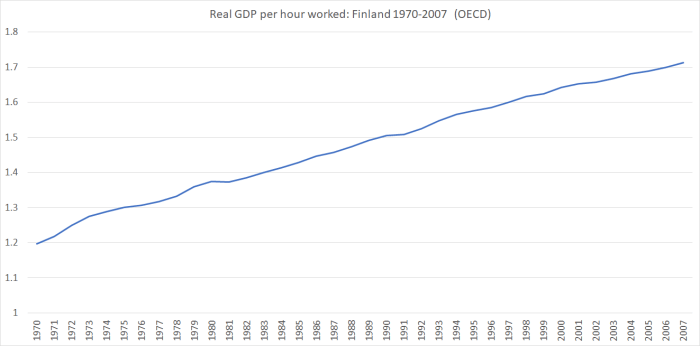
fin real gdp phw

As was the case with the numerous US financial crises in the 19th and early 20th centuries, there isn’t much sign of any enduring damage to productivity (levels or growth) from the Finnish crisis.  That’s reassuring, if not terribly surprising.

(Finland’s economic performance in the last decade has been pretty shockingly bad, including a productivity performance that –  like the UK’s –  is even worse than New Zealand’s over that period.  But that is a story for another day.)


Some Australian perspectives on PRC influence-seeking

For those interested in the activities of the People’s Republic of China and the Chinese Communist Party in this part of the world, Professor Anne-Marie Brady’s paper remains essential reading.   The material Professor Brady lays out on the New Zealand is deeply troubling, as is the near-complete subsequent silence from most of our political leaders.

But if New Zealand remains somewhat unique in having a Communist Party member and former member of the Chinese intelligence services –  who has never disavowed his past and remains very close to the People’s Republic of China embassy –  as a serving member of Parliament, the issues around PRC influence-seeking, pressure on the Chinese diaspora, and direct meddling in the domestic affairs of other countries aren’t unique to New Zealand. In yesterday’s post, I highlighted several links to contribution to the open and active debate on these issues in Australia.

But today a new collection of 22 articles, speeches etc on the issue of PRC activities in Australia (“The Giant Awakens” ) has been released by Vision Times, one of the relatively small number of remaining independent Chinese media in Australia (as in New Zealand, most of the Chinese media in Australia are now apparently under the effective control of the PRC).  More than half the authors are themselves ethnic Chinese, including a former PRC diplomat to Australia who defected a decade or so ago.

I haven’t read the entire collection, but of those I have read almost every piece struck a chord in one way or another, with so much of what is written about raising similar issues and concerns to those Professor Brady alerts us to in New Zealand.   I’d commend it to anyone interested in the subject, both because Australia (a) matters to us, and (b) seems to have very similar issues to us, and because…..well….sadly there is nothing similar in New Zealand.   The near-complete cone of silence still appears to hold.

I’d particularly commend the first paper in the collection by Professor Rory Medcalf, who is currently the Head of National Security College at the Australian National University.   It is an easy read –  only three pages – but an uncomfortable one.

A few extracts

Here in Australia we have seen the Chinese Communist Party involved in what appears to be multi-faceted campaign to influence our politics and independent policymaking. This includes propaganda and censorship in much of this nation’s Chinese-language media as well as channels of interference through intimidation of dissident voices and the establishment and mobilisation of pro-Beijing organisations on Australian soil. There is also the troubling question of political donations and their motives.

On political donations –  recall the magnitude of some of the disclosed donations here

It has also been reported recently that Australia’s main political parties have received close to $6 million in donations over the last few years from individuals associated with the Australian Council for the Promotion of the Peaceful Reunification of China. The Council, in turn, is reported to have connections to the United Front Work Department, an organisation which reports to the Central Committee of the Communist Party of China.

But whatever the mix of motives, one thing is clear. The donations were enough for the Director-General of the Australian Security Intelligence Organisation (ASIO) to take the highly unusual step of directly warning the major parties that they and Australia’s national security could be compromised by such donations. For the head of ASIO to take such a step suggests he was genuinely worried, from a national security and national interest point of view. Security agencies cannot take effective action on any of this because it has been entirely legal – all they can do is raise the alarm. It is now up to the political class to decide whether there is, within Australian democracy, enough self-respect to function without money linked to the Chinese Communist Party. This, after all, is a massive, secretive, self-interested and foreign organisation, with interests that can sometimes clash directly with Australia’s.

These issues are at least as much about the interests of ethnic Chinese New Zealanders and Australians

Indeed, much of the worry about such influence is within this country’s diverse Chinese communities. If, as a nation, we chose to ignore such concerns, we would be effectively treating such dissenting voices among our Chinese-Australian population as second-class Australians, whose freedom of thought and freedom of expression do not warrant protection.

So the issue of foreign interference needs to be addressed in a context of respect for the rights of Chinese Australians. That means this needs to be an issue that is seized and owned by the moderate, bipartisan centre of Australian politics. This way, the issue cannot be captured by extreme voices or be distorted, misconstrued or falsely portrayed as one of xenophobia.

One of the points I’ve been making in a New Zealand context is that our economic dependence on China is (often) much-exaggerated.

The risk is that we will buy the story that our economy is so comprehensively dependent on China that Australia cannot afford to cause China much difficulty on security and political issues, even when our interests diverge. Indeed, perceptions of Australia’s vulnerability to Chinese economic pressure are exaggerated. Economic pressure from China that would have the biggest impact on Australia – most notably through iron ore trade – would also impose restrictive costs on Beijing. Privately or publicly, Beijing criticises or complains to Canberra frequently over multiple issues. But the accompanying threats tend to be implicit or general – that the bilateral relationship will suffer some unspecified deterioration if Australia does not heed China’s wishes.

…..If Beijing felt it needed to send an economic signal to reinforce its displeasure, its initial response would likely involve non-tariff barriers over quarantine and safety standards, or making life difficult for businesses operating in China, with limited long-term economic impact on itself or Australia.

Beijing has adopted this approach towards South Korean business interests, yet has not succeeded in its goal of changing Seoul’s stance on missile defence cooperation with the United States. Economic vulnerability is often as much about perception as reality – and it is in China’s interests for Australia to imagine itself highly vulnerable. Already, some voices in business, academia and the media focus on the possible economic impacts of annoying China. The perception of economic harm can have an outsized effect on domestic interests, creating pressure for rapid political compromise. If we overreact to any Chinese economic threats and self-censor on issues perceived to be problematic for Beijing, it will not protect Australia from further pressure – it will signal that such pressure works.

And finally

Foreign interference in Australia is not solely a national security issue. It is a fundamental test of Australian social inclusiveness, cohesion, equity and democracy that we ensure all in this country have freedom of expression, freedom from fear and protection from untoward intervention by a foreign power.

It is a paper, part of a collection, that should be widely read in New Zealand.

In my post yesterday afternoon, I linked to an article published in the AFR by Peter Drysdale and John Denton, attempting to play down the issue of Chinese influence and suggesting that critics are “demonising” the People’s Republic, or indeed Chinese-Australians.   There is a nice, accessible, response to that article by John Fitzgerald, another Australian academic.

…for Australia, the issue at stake is not whether Leninism and liberal democracy can work happily and co-operatively in their separate jurisdictions but whether it is possible for a democracy to maintain jurisdictional separation in a dependent relationship with a Leninist state without adjusting its everyday modes of operation. Whatever we may think of authoritarian Leninist states, of which contemporary China is clearly one, they are founded on an ‘enemy mentality,’ and they have immense difficulty recognising the territorial and jurisdictional limits of their overweening hierarchical authority. How is a liberal Australia to deal with a Leninist China as that country becomes more assertive beyond its borders?

A bold free press is one of the few instruments a democracy has at its disposal to check the encroachment of a Leninist state into its jurisdiction. An open, respectful, and evidence-based conversation on this encroachment in the media is essential to getting Australia’s relationship with China right.

It is not demonising China to report what the Chinese government says about itself: that it is a wealthy and powerful Communist Party state that has no time for democratic accountable government, no independent courts, security, or media, that denies universal adult political participation, that offers no protection for the exercise of fundamental rights of freedom of speech, religion or assembly. In China this is called guoqing. There are no plans to change anytime soon. Similarly, querying the behaviour of a few named and alleged influence peddlers from China no more tarnishes the reputation of all Chinese Australians than querying the conduct of Putin’s agents in Washington impugns the loyalty of all Russian Americans.

Meanwhile, here in New Zealand the final election results will be declared tomorrow.  A self-confessed member of the Chinese Communist Party, former member of the Chinese intelligence services –  both facts hidden fron voters for years, and partially hidden from the New Zealand immigration and citizenship authorities “because that is what the Chinese authorities told us to do” – will once again be confirmed as a member of Parliament.  That alone –  the tip of the iceberg in the issues Professor Brady raises –  should be deeply troubling.  But our establishment elites seem unbothered.  Nothing is heard from the Prime Minister. Nothing is heard from the Leader of the Opposition.  Nothing is heard from the Green Party.  Nothing is heard from the Minister of Foreign Affairs.  And when last heard from, the Attorney-General and minister responsible for several of the intelligence services resorted to simply making stuff up.

“That was a Newsroom article, timed to damage the man politically.  I’m not going to respond to any of the allegations that have been made about/against him. I think it is disgraceful that a whole class of people have been singled out for racial abuse.  As for Professor Brady, I don’t think she likes any foreigners at all.”

The best response to erroneous claims is the facts. As far as I’m aware, nothing in the original Financial Times/Newsroom articles, nothing in Professor Brady’s paper, and nothing in yesterday New York Times article has been refuted.  I’ve not even seen anyone try.  Some mix of embarrassed silence, and brazening through, in the hope that the issue will just go away seems to be what our “leaders” now count as responsible leadership.

Deposit insurance wouldn’t put credit ratings at risk

There was a curious paragraph in an article by Alex Tarrant on interest.co.nz last week on post-election positioning .  Tarrant was writing about, in particular, fiscal positioning and the possibility that whichever party leads the next government could find its fiscal commitments put under pretty severe pressure because of the policy exepctations of the minor parties (New Zealand First on its own, or in conjunction with the Greens).  He argues that if Labour ends up back in opposition

It will also allow Labour to imply that National must have offered more to Peters on big-spending policies than Labour was prepared to. The hope for Ardern and Grant Robertson would be that National suddenly finds itself being attacked on throwing fiscal responsibility out the window with a set of coalition bribes. And this after the entire campaign was fought by National on sound management of the government’s books and plans to repay government debt to 10% of GDP, from about 23% now.

This could be a huge boost for a resurgent Labour Party even if it does go back into opposition. “We wanted to form a responsible government, but couldn’t get NZ First to agree to responsible spending.”

Labour might even be able to point to how certain policies might have put the government’s credit rating at risk – my understanding is that NZ First’s and the Green’s bank deposit insurance schemes could fit this argument.

The government’s credit rating currently benefits from ratings agencies placing less weight on that government would bail out a failed bank here, with the Reserve Bank’s open bank resolution policy and there being no government deposit guarantee/insurance in New Zealand. If introducing one means rating agencies rethink this position, the argument would be that a lower credit score would lead to higher government borrowing costs. (Peters’ policy on deposit insurance regards majority-owned NZ-registered banks; the Greens want a broader scheme.)

The main bit of the argument didn’t strike me as terribly persuasive –  the warm feeling of fiscal virtue would surely be of little solace to most Labour people on the dark winter nights if they did end up back in opposition for another three years.

But what had really caught my eye was the specific suggestion that New Zealand First or Greens preferences for some sort of deposit insurance scheme might imperil the government’s credit rating.  I’d made a mental note to come back to it, but yesterday someone asked my view on the suggestion, which is the prompt for this morning’s post.

The New Zealand government’s credit ratings are very strong.   There are foreign currency and local currency credit ratings, but for New Zealand only the latter now matter (there is little or no foreign currency debt, and no apparent plans to raise more).  Of the three main ratings agencies, one gives the New Zealand government a AAA rating –  the best there is –  and the other two give the government an AA+ rating, just one notch down.   That makes sense.   We not only have a low level of government debt (per cent of GDP) but successive governments have proved to have the willingness and capacity to keep debt in check when bad stuff happens.  The last time the New Zealand government defaulted on its debt was in 1933 –  and we had lots of company then.

Relatedly, our banking system has been strong and pretty well-managed.  There were some pretty serious problems in the late 1980s, immediately post-liberalisation, particularly with financial institutions that had been wholly government-owned (Rural Bank, DFC, and BNZ).   But since then –  and before that period for that matter –  banks have been pretty strongly-capitalised, and appear to have done a pretty good job of making credit decisions.  Banks took too many risks (were too complacent) in the 2000s around funding liquidity –  and needed a lot of official support on that score during the 2008/09 international crisis period.  But despite a really big credit boom in the 2000s, even a severe recession and quite a slow recovery –  and levels of income (servicing capacity) typically quite a bit below what would previously have been expected –  led to no serious systemwide impairment of the banks’ assets.  Loan losses rose, as they do in every recession, but to quite a manageable extent.   It was a similar story in Australia, Canada and quite a few other advanced countries.  The government put itself on the hook for some finance company failures (through the deposit guarantee scheme) and the ill-advised AMI bailout.  But that was it.

And these days, almost a decade on, pretty demanding stress tests on banks’ loan portfolios suggest that even a savage recession and a very severe fall in house prices would not be enough to topple any of the banks, let alone the system as a whole.  That isn’t grounds for complacency –  in the wrong circumstances lending standards can deteriorate quite rapidly –  but on the sort of lending the banks have been doing over the last decade or two, the banking system itself looks pretty sound.

Rating agencies still worry a bit about the large negative net international investment position of New Zealand (the net claims of foreigners –  debt and equity –  on all New Zealand entities).  Personally, I think that is an overstated concern: the NIIP position has been large for 30 years, but hasn’t (as a share of GDP) been getting any larger.  Mostly it is the net offshore funding of the banking system.   What matters then, from a credit perspective, is the quality of the assets on bank balance sheets (see above).   In my reading of the literature, big increases in banks’ reliance on foreign funding have often been a warning sign (internationally).  That hasn’t been the story here for a long time.

New Zealand is the only OECD country now that does not have a deposit insurance system.   The official rhetoric for a long time has been that depositors need to recognise that they can, and will, lose their money if their bank fails.  It is supposed to promote market discipline.  The Open Bank Resolution tool was devised to try to buttress that “no bailouts” message –  or at least to give ministers options in a crisis.  The OBR is designed to ensure that a bank can be reopened immediately after it fails (thus keeping basic payments services going). It does so through a mechanism that involves “haircutting” the claims of creditors –  the size of the haircut designed to be larger than the plausible, but still unknown actual losses –  while providing public sector liquidity support and a government guarantee to the remaning claims.  Without such a guarantee, rational creditors would mostly withdraw the remaining funds they did have access to as soon as the failed bank reopened.  In practice, since in a small system with quite similar banks all banks are likely to face quite similar shocks, such a guarantee might well need to be extended to the other banks (although I’m not aware that this latter point has ever been conceded by authorities).

It is no secret that governments tend to bail-out failed banks, and often end up offering a degree of protection that goes beyond anything in formal deposit insurance system rules.  That is particular so for retail depositors, but in the last major crisis of 2008/09 it was often true of wholesale creditors too (eg extreme pressure was brought to bear on the Irish government, by other governments and EU entities, not to allow wholesale creditors to lose money when Irish banks failed).

The practice might, in some abstract world, be undesirable, but it happens.    There are some signs now that authorities are putting more effort into trying to build regimes that make it more feasible for wholesale creditors to be allowed to lose money, while not disrupting the continuity of payments systems etc.  But there is no sign of such movement as far as retail depositors are concerned.

And despite the rhetoric, New Zealand’s track record hasn’t been so very different.  Governments twice bailed out the BNZ in the late 80s and early 90s.  The temporary retail deposit guarantee scheme was introduced with bipartisan support in the midst of the 2008/09 crisis.  And AMI –  an insurance company, not even a bank –  was bailed out, on official advice, only a few years ago.    Of course, many small finance companies also failed, and there was no bailout to those depositors.   But a rational retail creditor of a significant retail bank is quite likely to assume that if there is a bank failure, he or she will in the end be protected by the government.

Rational ratings agencies know this too.   In their ratings –  or banks and of sovereigns –  they take account of the probability of official government support.     It is likely to be a matter of serious concern in a shonky banking system, and in a country with high pre-existing levels of government debt.  It isn’t likely to be of much concern in a country with a good track record of stable banking, a low level of government debt, and a good track of reining in fiscal pressures.  And that is true whether or not there is a formal deposit insurance scheme in place.

For a long time I was staunchly opposed to deposit insurance –  like pretty much everyone at the Reserve Bank.  But I changed my mind probably a decade ago.  I’m not so worried by the question of whether it is “fair” or not for ordinary depositors to face the risk of losing money –  there are plenty of other areas where such uncompensated losses happen (eg house prices fall back, or the value of one’s labour market skills drops) –  as by realpolitik considerations:

  • at point of failure, governments are almost certain, whatever they say now, to bail out retail depositors of major core institutions, and
  • a pre-specificed deposit insurance arrangement increases the chances of OBR itself being able to work, and thus of being able to impose losses on wholesale creditors (notably offshore ones).

In an earlier post I outlined a scenario:

Suppose a big bank is on the brink of failure.  Purely illustrative, let’s assume that one day some years hence the ANZ boards in New Zealand and Australia approach the respective governments and regulators, announcing “we are bust”.

Perhaps the Reserve Bank will favour adopting OBR for the New Zealand subsidiary (since the parent is also failing they can’t get the parent to stump up more capital to solve the problem that way).    But why would the Minister of Finance agree?

First, Australia doesn’t have a system like OBR and no one I’m aware of thinks it is remotely likely that an Australia government would simply let one of their big banks fail.  But in the very unlikely event they did, not only is there a statutory preference for Australian depositors over other creditors, but Australia has a deposit insurance scheme.

I’m not sure of the precise numbers, but as ANZ is our largest bank, perhaps a third of all New Zealanders will have deposits at ANZ.

So, if the New Zealand Minister of Finance is considering using OBR he has to weigh up:

  • the headlines, in which ANZ depositors in Australia would be protected, but ANZ depositors in New Zealand would immediately lose a large chunk of their money (an OBR ‘haircut’ of 30 per cent is perfectly plausible),
  • and, even with OBR, it is generally accepted (it is mentioned in the Bulletin) that the government would need to guarantee all the remaining deposits of the failed bank (otherwise depositors would rationally remove those funds ASAP from the failed bank)
  • and I’ve long  thought it likely that once the remaining funds of the failed bank are guaranteed, the government might also have to guarantee the deposits of the other banks in the system.  Banks rarely fail in isolation, and faced with the failure of a major banks, depositors might quite rationally prefer to shift their funds to the bank that now has the government guarantee.

And all this is before considering the huge pressure that would be likely to come on the New Zealand government, from the Australian government, to bail-out the combined ANZ group.  The damage to the overall ANZ brand, from allowing one very subsidiary to fail, would be quite large.  And Australian governments can play hardball.

So, the Minister of Finance (and PM) could apply OBR, but only by upsetting a huge number of voters (and voters’ families), upsetting the government of the foreign country most important to New Zealand, and still being left with large, fairly open-ended, guarantees on the books.

Or, they could simply write a cheque –  perhaps in some (superficially) harmonious trans-Tasman deal to jointly bail out parent and subsidiary  (the haggling would no doubt be quite acrimonious).  After all, our government accounts are in pretty reasonable shape by international standards.

And the real losses –  the bad loans –  have already happened.  It is just a question of who bears them.  And if one third of the population is bearing them –  in an institution that the Reserve Bank was supposed to have been supervising –  well, why not just spread them over all taxpayers?    And how reasonable is it to think that an 80 year pensioner, with $100000 in our largest bank, should have been expected to have been exercising more scrutiny and market discipline than our expert professional regulator (the Reserve Bank) succeeded in doing?  Or so will go the argument –  and it will get a lot of sympathy.

So quite probably there would be some sort of joint NZ/Australian government bailout of the Australian banks and their New Zealand subsidiaries.  The political incentives –  domestic and international –  are just too great to seriously envisage an alternative outcome.

But let’s suppose the Australian government was willing to jettison the New Zealand subsidiary and leave it entirely to us what to do.  The domestic political pressures to protect retail deposits will still be just as real.  In those circumstances, a pre-established deposit insurance scheme (eg for retail deposits up to perhaps $100000 per depositor) would make it more feasible for a Minister of Finance to (a) cap the government’s support, and (b) allow the OBR tool to be applied, under which wholesale creditors would be allowed to lose money.   It still might never happen –  there will still be unease about ongoing access to foreign funding markets for the other banks –  but the option is more feasible than at present (with no deposit insurance in place).  From a fiscal perspective, a pre-specified credible deposit insurance scheme –  funded by a levy, and backed by a credible bank supervision regime –  could actually reduce the fiscal risks associated with a banking crisis, rather than increase them.

Finally, it is worth keeping the numbers in some perspective.  At present, properly defined net Crown debt is about 9 per cent of GDP.    Total (book) equity of all our banks is currently around $37 billion.   Savage stress tests at present suggest little risk of a severe shakeout making material inroads on that buffer.    Banking systems tend not to lose much money on housing-dominated portfolios, when those loans are put in place in floating exchange rate systems without much government interference in the housing finance market.  But lets assume a really savage scenario, in which across the banking system all the equity is wiped out, and 50 per cent more, and the government chooses to recapitalise the banking system.  That would involve  the government assuming additional gross debt of around 20 per cent of GDP.  But much of that would be “backed” by the remaining good assets of the banking system (in time the recapitalised bank could be sold off again) –  it is only the amount the government injects that is beyond replacing existing equity that represents a net loss to the taxpayer.  That amount would be less than 10 per cent of GDP, even on these extremely pessimistic scenarios.   You’ll remember a recent post in which I cited some earlier New Zealand research suggesting that an increase in government debt of that sort of magnitude might raise bond yields by just a few basis points.

Of course, if New Zealand ever did face a really severe shakeout of this sort there would probably be many other problems –  including fiscal ones (tax revenues fall when economies shrink).  The sovereign credit ratings might well be cut.  Not only would there have been huge real losses of wealth within the community, but something very bad would have been revealed about the quality of our banking institutions, our private borrowers, and of our official regulators.  But, again, whether or not we had a formal deposit insurance scheme would almost certainly be a third-order issue in the midst of such a disaster.

At present, with very robust government finances, and a banking system which, to all appearances, is also extremely sound, the choice to introduce a well-structured deposit insurance scheme would be very unlikely to affect the government’s credit rating.   There is an argument that some observers –  rating agencies even? –  might see it as a refreshing dose of realism about how banking crises actually play out, establishing institutions that better respect that realism –  and which charge depositors (through a levy on protected deposits) for the insurance they will, almost inevitably, be provided with.  Priced insurance –  even if imperfectly priced –  is almost always better than unpriced insurance.

And in case anyone thinks deposit insurance is some sort of weird “out there” policy, not only does almost every other advanced country have such a scheme, but a few years ago Minister of Finance Bill English was quite happy to concede, in responding to parliamentary questions from Winston Peters, that there are reasonable arguments to be made for such a scheme (particularly in view of the quite different regimes operating in Australia and New Zealand for many of the same banks).  And he didn’t appear to worry that deposit insurance might threaten the government’s credit rating.

(I’ve argued here that a proper deposit insurance regime increases the chances of OBR being able to be used, especially for wholesale creditors.   My long-held view about OBR hasn’t really changed: it is mainly a tool that could prove quite useful in handling the failure of a small retail bank (eg TSB or SBS), at least if the relevant parliamentary seats (New Plymouth or Invercargill) were not, at the time of failure, held by the governing party.)

The kowtow

EARLY IN the morning of 14 September 1793, George, Lord Macartney, the first British ambassador ever to visit the Chinese court, entered the imperial tent in Jehol, the Manchu capital, to see the emperor Qianlong.

As one, a thousand demonstrated their submission to the Son of Heaven by performing the ceremony of the kowtow. Three times they fell to their knees, and three times on each occasion they touched their foreheads to the ground. Macartney, however, refused to kowtow. He would bend one knee, he said, to his sovereign; both knees he would bend only to his God. Three times, with the greatest politeness, he went down on one knee. And three times, in the course of each genuflexion, in rhythm with the mandarins, he respectfully bowed his head. But he flatly refused to touch his forehead to the ground.

(from this)

There is a good article today in the New York Times today on the Jian Yang affair –  or non-issue as the National Party, and most other parties, and most of our establishment appear to believe (and want us to believe).   As the article notes

While New Zealand is a small country, it is a member of the “Five Eyes” intelligence sharing partnership along with the United States, Britain, Canada and Australia. And so vulnerabilities in New Zealand’s government could have wider import.

Curiously, not being particularly well-connected, I’ve had several people mention in the past few days private talk among our traditional allies of possibly ending New Zealand participation in Five Eyes over our government’s growing deference to China.   Whether that possibility would bother a majority of New Zealanders is questionable, but it should.

The article goes on

Chinese-language news media outlets in New Zealand reported that Mr. Yang had presented awards in April to members of the New Zealand Veterans General Federation, a group made up of former Chinese military or police officers now living in New Zealand. The awards were reportedly for members’ activities during a visit to New Zealand by Premier Li Keqiang of China, when they blocked the banners of anti-Chinese government protesters and sang military songs.

Chen Weijian, a member of the pro-democracy group New Zealand Values Alliance and the editor of a Chinese-language magazine, Beijing Spring, said Mr. Yang was “very, very active” in New Zealand’s Chinese community.

“When he speaks, he speaks more as a Chinese government representative, instead of a New Zealand lawmaker,” Mr. Chen said.

And this is how New Zealand now appears in yet another impeccably liberal part of the global press?

There are several organisations in New Zealand, partly or wholly government-funded that serve, in effect, as fronts to advance the establishment perspective on China.   There is the Asia Foundation, the Contemporary China Research Centre, and the New Zealand China Council.   The Council is chaired by a former National deputy prime minister, and includes a former National Prime Minister (who holds various positions in the gift of the Chinese government, and other Chinese directorships), the chief executive of the Ministry of Foreign Affairs, the chairman of Fonterra, and other mostly less well-known figures.  The Executive Director is Stephen Jacobi, a former diplomat and industry advocate (with a past focus on North America).

At the People’s Republic of China (PRC) national day celebrations last week, the Consul-General invited Jacobi to speak.  He posted the text of his remarks on the Council’s website.  Those brief remarks were both extraordinary and banal.   Extraordinary for the degree of deference to the PRC, and the indifference to any concerns around Yang and Raymond Huo, and yet probably just what one has come to expect from an establishment whose considered approach appears to be never, ever, openly say anything that anyone could possibly construe as critical of the PRC.   National day celebrations aren’t the time to gratuitously offend people, but with normal countries it is quite appropriate to recognise differences of values, interests, and perspectives.  We and the United States, or the UK, don’t always see eye-to-eye, as you’d expect with two different countries.  With China, per Jacobi, it is as if our hearts are at one –  or at least our minds are well-trained to pretend so.

It is an honour for me to be with you this evening and to convey the warmest greetings and congratulations of the New Zealand China Council on the 68th anniversary of the founding of the People’s Republic of China.

Toasting the founding of a regime that has brought forth so much evil…..it turns one’s stomach.  He goes on to describe it as an “auspicious day”.

The relationship is going from strength to strength, building on the firm foundation of mutual respect, shared interests and a history of co-operation.

As one observer of China noted, it is “Party-speak” (and not of the cocktail variety).

As we have watched China emerge as a major global power, we have continued Rewi’s pioneering spirit as we have built a Comprehensive Strategic Partnership based on expanding trade, investment and people to people links.

From the earliest days in the history of our country we have welcomed Chinese immigrants, thereby increasing the vitality and diversity of our nation.

And, so on the one hand we simply rewrite our own history –  Chinese migrants weren’t exactly welcome in the 19th century –  and on the other we blithely celebrate the emergence of a global power that simply flouts international law (South China Sea) and its own international commmitments (including around the WTO).  For a country –  New Zealand –  supposedly committed to a rules-based international order, it is extraordinary obseisance.

And then unadorned congratulations.

I would also like to congratulate Dr Jian Yang MP and Raymond Huo MP and the other MPs with us this evening on their re-election to Parliament.

If anyone close to the Council is remotely troubled by Yang’s past –  hidden from the electorate for years – or the wider arguments advanced by Professor Brady, they are obviously keeping very quiet.    As with Charles Finny the other day, this is the establishment falling right in behind the position of these questionable figures –  particularly Yang in our Parliament.

While we have achieved much together, I believe there is more to come.

For now, though, it gives me great pleasure to propose a toast to the health and prosperity of the great Chinese people and to the relationship between New Zealand and the People’s Republic of China.

It is almost as if Jacobi and the Council believe that the PRC has any concern with advancing the interests of New Zealand and New Zealanders.    And thus he concludes with his toast to a regime that has been responsible for the deaths of tens of millions of its own people (and tens of millions more unborn), that is increasingly repressive of its own people, is actively engaged in subverting the political process and values of countries like New Zealand, and which is an increasing expansionist threat to other countries in its neighbourhood.

Perhaps you might charitably think this is just stuff he had to say.  You sell your soul, and you pay the price.

But then earlier this week, Jacobi was tweeting his endorsement (“message in here for us kiwis too”) for a piece in the Australia Financial Review,  in which the authors –  an academic and a business figures –  push back, by very heavy use of straw men, against any concerns about the PRC and its activities in, in this case, Australia.  Nothing to worry about apparently, China no different from any other country, and foreign donations are just a “fact of life”.  And this in a country where earlier this year an Opposition Senator had to resign his shadow frontbench position over claims he’d been backing China’s position on the South China Sea in exchange for money.

At least there seems to be a serious debate occurring openly in Australia.   Denton and Drysdale can make their case for the defence in the AFR.  But others are considerably more sceptical.  There was an excellent sceptical piece in the Australian cultural, political, and literary monthly, Quadrant  by a former senior China analyst in the Australian Office of National Assessments and a former Australian ambassador to the Koreas.    And perhaps more powerful was a short article yesterday by a former senior Australian diplomat and deputy secretary in the Australian DPMC, “The China-Australia free trade agreement meets the all-controlling state”.

Philosophically, Australia and China occupy different solitudes regarding trade and investment. These days, not always, the underpinning attitude for Australia is free enterprise capitalism: commercially motivated, profit-driven, private sector enterprise, pursued within a clear legal framework. Beijing’s version is state capitalism, plus an underpinning of autarky: investment at home and abroad directed to national priorities, improving China’s competitive advantage (often using subsidies). The aim is to enhance China’s economic power and sovereignty.

and

At a societal level, President Xi has been emphatically reasserting the centrality of the Communist Party. Controls over China’s citizenry are being tightened—for example, by the ‘great firewall’ scrutinising and limiting access to the internet, and by closer monitoring of all citizenry for a ‘social credit score’.

and

The recurrent experience of foreigners seeking to invest in China has been that they are pressured to provide information on their secrets and systems as part of the price on entry. One fears for Cochlear and CSL. This is now being taken a step further. According to a recent Angus Grigg article in the Australian Financial Review, in future all foreign companies operating in China will be forced to hand over sensitive commercial data to Beijing under a system directed at generating a ‘social credit score’ for commercial enterprises as well as individuals.

More generally, while foreign investment in China is encouraged in cutting-edge industrial sectors, foreign firms are squeezed out once they reach maturity, with their key technologies secured. Writing some months ago in the Australian, Rowan Callick noted that China opened its mining industry to foreign investors about 20 years ago. At the peak, in 2009, there were 300 foreign mining operations in China. The number is now down to a handful. ‘Through a range of contrivances their services have been dispensed with.’

I presume Fonterra is well aware of all this, although one wonders if their farmer shareholders are.

There are other examples  (or here) of a robust debate in Australia, and serious open scrutiny of the way in which the PRC is attempting to exert influence in Australia.  Reasonable people might differ on the conclusions and appropriate policy responses, but in New Zealand any discussion or debate seems to be regarded as some sort of lese-majeste.    And yet this is the government of our country we are talking about.

One of the issues that needs to be tackled is our political donations laws.

In the Charles Finny defence of Jian Yang I linked to the other day, there was this line

It is my understanding that Dr Yang has become one of National’s most successful fundraisers, in much the same way Raymond Huo is important for the Labour Party’s fundraising efforts.

I dug out Barry Gustafson’s history of the National Party, published only thirty years ago.  There Gustafson’s records the active efforts of the party stalwarts to raise funds, while noting that

“An unwriten  but scruplously observed rule has always been that no MP should be placed in the position of seeking, receiving, or even being made aware of money collected on behalf of the party”

No doubt the culture change is not just of relevance to ethnic Chinese MPs or candidates.  MPs –  legislating in the interests of all New Zealanders –  shouldn’t be known for their fundraising prowess. But, more particularly, we shouldn’t be running a system where the largest known donor to the governing party is a foreign-owned company with quite modest New Zealand operations.

How has New Zealand come to this?   Where even the debate is almost disallowed, where neither the politicians nor the local media seem to have any interest in pursuing the issues (whether specific-  Yang –  or general, those raised by Brady).    When did we become the sort of country where the Financial Times and the New York Times  –  worthy outlets both –  are the ones raising more searching questions about New Zealand’s polity, and its relationship with a hostile foreign regime than our own media and our own political figures (past or present)?

What makes our establishment so willing to perform what amounts, in effect, to today’s full kowtow?