Not doing very well at all

I heard the Prime Minister on Radio New Zealand this morning running (again) the same spin that seems to go with the job, that somehow if New Zealand’s economic performance is perhaps not all we might hope for, it is at least as good –  better is the typical claim –  than other advanced countries.     Almost always such claims seem to rest exclusively on the rapid and policy-driven population growth New Zealand governments have chosen –  which boost the headline numbers, regardless of whether they leave the average New Zealander better off (in New Zealand’s case, experience increasingly suggests not).

But any meaningful comparison of economic growth across countries needs to adjust for differences in population growth rates.  Per capita statistics aren’t a radical innovation.  They have long existed for exactly that sort of purpose.

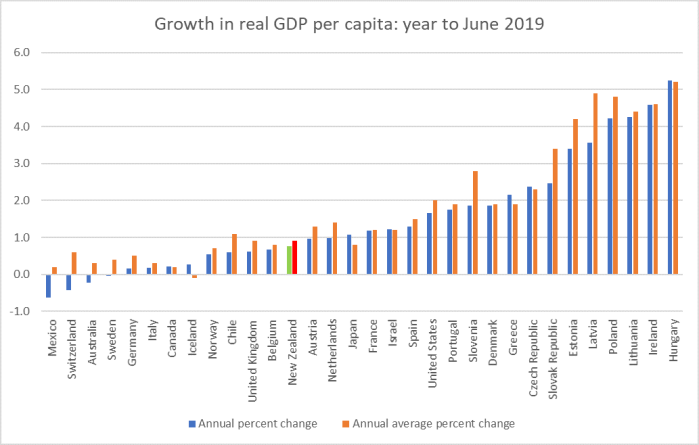
It used to be quite hard to get a reasonable sample of countries’ quarterly real GDP numbers.  But the OECD now routinely publishes such numbers.   A few countries seem to be a bit slow at providing the numbers the OECD uses, but when I checked there were 32 OECD countries with quarterly real GDP numbers up to and including the June quarter of 2019 (our most recent data).

This chart shows the latest annual growth rates for those countries, using national agency data for Australia and New Zealand and the OECD data for the rest.  There are two measures: the annual percentage change is the increase from the June quarter 2018 to the June quarter 2019, and the annual average percentage change is the increase from the year to June 2018 to the year to June 2019.   The latter series is a bit less noisy, but also a bit less timely.  As it happens, this time New Zealand’s rank is exactly the same on both measures.

Growth in real pc GDP

There are countries that have done worse than New Zealand: if one broke the group into thirds we’d be close to the bottom third of countries.  But that shouldn’t be much consolation, since we have much lower starting levels of GDP per capita (and GDP per hour worked) than most of the countries to the left of the chart.  The vision was (once) supposed to be that we might once again catch up with them.

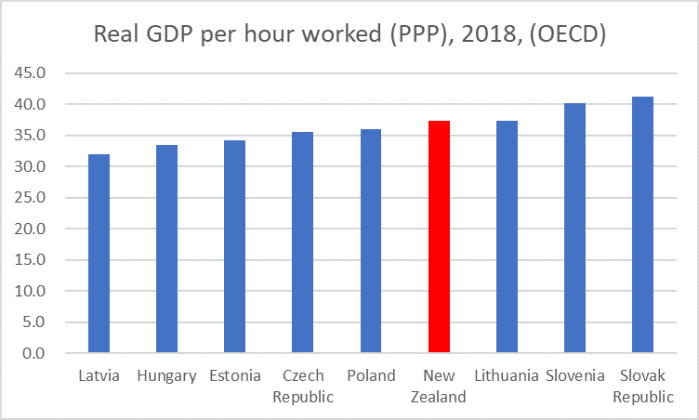
Instead, at best we’ve been roughly matching the countries that are much richer and more productive than New Zealand, while the countries that are increasingly similar to us in productive levels rack up really strong growth rates (see seven of the eight countries to the right of the chart –  and the Irish numbers are generally best discounted because of the corporate tax distortions).       Here are the respective productivity levels

east europe GDP phw

Over the last year, these countries averaged growth in real GDP per capita of just over 3.5 per cent per annum.  New Zealand?   About 0.8 per cent.     And yes growth rates are slowing around the world, but over the last three years, those eastern European successful economies averaged 4.3 per cent per capita growth, while New Zealand averaged 1 per cent (in the bottom third of OECD countries).  That is the sort of catch-up that can be achieved.

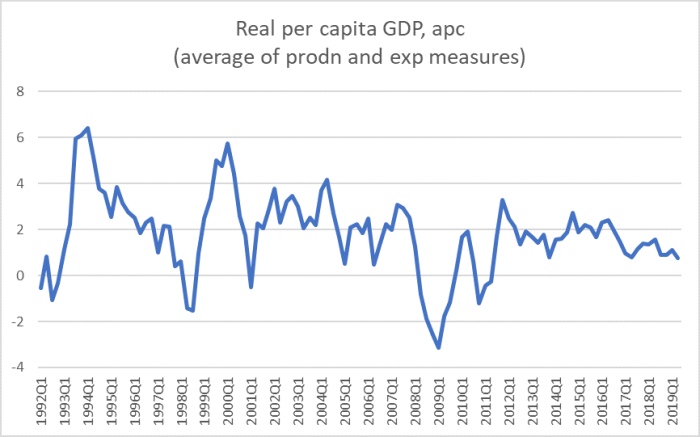
Are there potential caveats to all this?  In respect of comparisons with the older advanced economies (those now mostly materially richer and more productive than we are), yes.   GDP numbers are revised and with the added imponderable of the new results of the flawed census there will be changes to data over the next few months (SNZ is releasing some new labour market estimates later this morning). But nothing is likely to change the pattern I illustrated the other day

pc GDP growth

Growth in real per capita GDP – never good at the best of times this decade (compared to previous cycles) – has been tailing off, and that conclusion is most unlikely to be changed by any revisions.

Even more certainly, no conceivable revisions are going to change those huge gaps between the growth rates (per capita) of the rapidly emerging eastern European countries –  every single one of which was until now poorer and less productive than New Zealand for at least the last 160 years –  and the pitifully poor growth rates –  per capita GDP or productivity –  managed by New Zealand.  It is a bi-partisan failure, but Labour, Greens, and New Zealand First are now in government.  It is their responsibility, but they seem clueless, careless (ie many just don’t seem to care much if at all), and determined to do whatever possible to try to pretend there isn’t a problem, a failure, and that all is really pretty rosy in the economic garden, and if there are any issues they are all the fault of others.

The problem, the failure, starts at the top, with a Prime Minister and Minister of Finance who continue to simply repeat the spin, which bears little or no relation to the dismal reality of New Zealand’s multi-decade productivity underperformance.  But they are aided and abetted by the Governor of the Reserve Bank, who simply makes things up (he was yesterday out claiming that “The New Zealand economy has proved resilient through a period of weakening global growth and heightened global uncertainty”) and the situation won’t be helped by a Secretary to the Treasury who knows almost nothing about New Zealand or about managing a national economy.  Our economic and political institutions, and their key individuals, are failing us.  New Zealanders –  not those key decisionmakers and advisers –  pay the price of failure.

The economic plan that wasn’t

I’m not much into the notion of “economic plans” –  all too redolent of Communist states, known mostly for their consistently underwhelming economic performance.  But at least most of those old “plans” purported only to be five-year plans.  By contrast, earlier this week the current New Zealand government  –  with one year left of its three year term –  released a 30-year “Economic Plan”.    It was released under the signatures of Grant Robertson, Minister of Finance, who has shown no sign of understanding or caring much about New Zealand’s economic challenges, and Phil Twyford, now Minister for Economic Development, but best known for Kiwibuild.

I guess the government must have known there wasn’t much there.  It was, after all, released –  to little fanfare –  while the media were all concentrating on the Prime Minister’s progess in New York.

It is sold this way

The Government’s Economic Plan is set in the context  of our wellbeing agenda and is designed to build a  more productive, sustainable and inclusive economy  to improve the wellbeing and living standards of  all New Zealanders.

All lines and words we’ve heard endlessly now for two years.   The introduction goes on

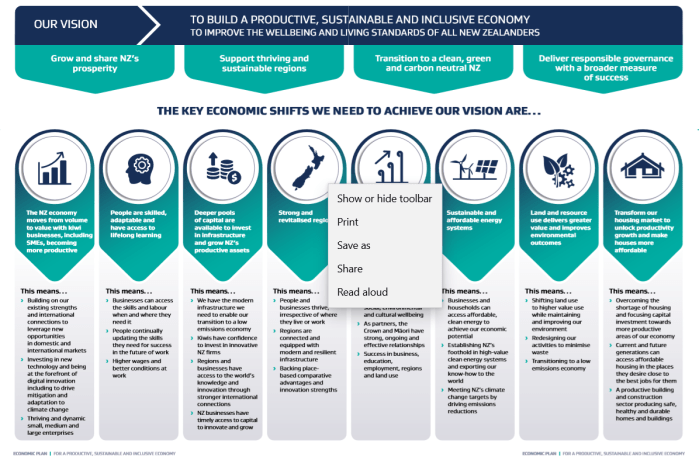
The Plan identifies eight key shifts and policy action related to each shift that will tackle the long-term challenges the New Zealand economy is facing. They signal our goal to balance outcomes across financial, human, natural and social capital, and will act as an overarching guide for government departments designing economic policy  [er…don’t elected government’s set economic policy, not government departments?]

These shifts and initiatives will deliver on the four economic priorities in Our Plan: to grow and share  New Zealand’s prosperity, support thriving and sustainable regions, transition to a clean, green and carbon neutral New Zealand and deliver responsible governance with a broader measure of success.

New Zealand has a unique opportunity to build on our strengths, and use these to lead the world on standing up to the economic challenges of the next 30 years, turning issues like climate change and the technological revolution into economic opportunities.

You might have thought that a good place to start would be recognising that we’ve trailed the advanced world for 70 years now, lagging behind on the productivity growth that underpins material standards of living and many other choices, rather than making idle and empty claims about “leading the world” in the next thirty.

Instead, there is the same complacency with which Labour went into the last election

New Zealand is recognised as being one of the best places in the world to live. Wellbeing is high for New Zealanders overall, but the benefits of economic growth have been unevenly distributed.

Nothing wrong with the growth performance really; just a matter of sharing the cake differently.

In fact, they sort of know that isn’t true. Get 10 pages into a glossy 30 page document and you do finally find this

Our productivity challenge is complex and long-standing.

But with no sign that they have any narrative explaining how we found ourselves in this position, or how the grab-bag of initiatives (there were 76 on one table –  including Kiwibuild) they list might make a sustained and significant difference.  (All governments for decades having had long lists – the previous government’s Business Growth Agenda as only the most recent, ineffectual, example.)

economic plan.png

In fact, top of the list of their proposed ways to see economywide productivity lift are yet more plans

Industry Transformation Plans – adding value to  key sectors of our economy and leveraging new opportunities.

Substance-lite.

The standard cliches are trotted out among the glossy photos

New Zealand is a trading nation and we want all  New Zealanders to benefit from trade. We are building stronger international connections so that Kiwi businesses get greater access to markets around the world – not just for goods, services and investments, but also for people and ideas. At the same time, we are supporting businesses to get the most from trade and grow the value and reach of our exports.

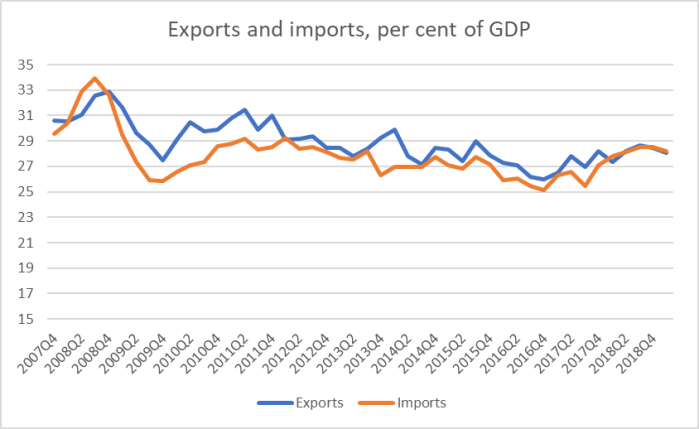
And yet, foreign trade (exports and imports) as a share of GDP is less now than it was at the start of the century, but there is no hint that the government (or its advisers) understand why.  No mention of the real exchange rate in the entire document.

And it sort of goes downhill from there.  Predictably, corporate welfare –  aka the Provincial Growth Fund –  tops the list of things that are going to make a favourable long-term difference to regional economies.    The top two initiatives that are supposed to “enable a step change for Maori and Pacific economies” (whatever they are) are

Te Arawhiti – Office for Māori Crown Relations – fostering strong, ongoing and effective relationships with Māori across Government.

Government procurement – working to provide opportunities for Māori and Pacific New Zealand businesses to access contracts from the $41 billion we spend each year in Government procurement.

Both might be sensible steps in their own rights, but they simply aren’t commensurate with the challenge.

And there are old, and still silly, lines

We know that New Zealand’s high house prices have diverted capital into the housing market and away from more productive uses. We need to redirect this capital to help businesses to innovate, invest in new technology and pursue growth opportunities.

I’m not sure how many times one needs to point it out but, given the the population, isn’t the conventional understanding that too few houses have been built, not too many?  More real resources –  on the government’s own original plans (Kiwibuild anyone?) – were supposed to be encouraged towards house-building.  And not a mention of actually getting house prices down again.

In fairness, one might acknowledge that the first item on their housing/productivity page sounds okay

Urban Growth Agenda and RMA reform – working to get our urban markets working so they can respond to growth, improve urban land affordability, and support thriving communities.

The problem is that it sounded good two or three years ago, buried deep in the Labour Party manifesto, and it still does.  But there has been almost no action so far, and no indication in market prices (eg of urban land) to suggest anyone much believes the government will act in ways that make a meaningful difference.

And it all ends with three pages of alternative “wellbeing indicators”, continuing to distract attention away from the decades-long failure on productivity.

There just isn’t much there. And nothing at all, for example, about the inevitable tensions (between, say, zero carbon goals and vague aspirations –  and that is all they are – to higher sustained productivity growth).  But, as ever, MBIE does well with the glossy heartwarming photos (from the family playing cricket on the beach at Sumner onwards).

But the Prime Minister must have wanted to suggest there was something there.   The Herald managed to secure an op-ed from her about the plan, as part of their “Mood of the Boardroom” publication.  Perhaps she didn’t choose the title but it (“My hope: a rising tide that will lift all boats”) didn’t suggest much agency, or hence much responsibility and accountability.

It was pretty vacuous piece, but as ever with her you get the sense that (a) she is more interested in sharing the pie that creating a climate conducive to rapid growth in the size of the (per capita) pie, and (b) that she has only a very limited understanding of the economic issues.  That mightn’t matter much if she had a strong team of senior ministers who did. But there is little or no evidence of that.

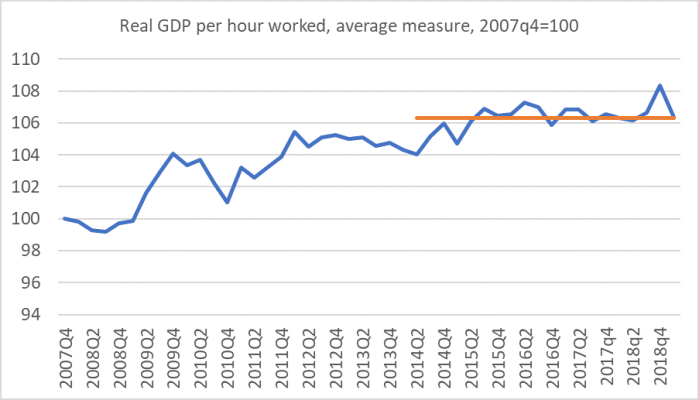
A good chunk of the article was devoted to make-believe stuff about just how well the economy is doing at present. Perhaps, knowing no better, she takes lessons from the creativity around the facts on display from the Governor of the Reserve Bank?  She seems unaware that growth has been slowing (from never particularly fast rates), that leading indicators are poor, that productivity growth is almost non-existent, and she continues to parrot lines about how good our growth rates by international standards in ways that simply take no account of the rapid population growth rates here (just this week revealed by SNZ to have been even faster than they previously estimated).  For someone focused on “wellbeing”, you might suppose that recognising that per capita GDP growth counts a lot more than the headline number would be a good first step.  But I guess not.

The underwhelming text continues

We need to invest in infrastructure, because it’s the springboard for future growth. This Government is investing record amounts in hospital and school building programmes, alongside large investments in transport safety, regional roads and public transport

Perhaps you will agree with her on the first sentence (although it is striking how few of the touted projects seem to pass robust cost-benefit assessments), but whatever the merits of building more hospitals and schools those aren’t the sorts of infrastructures likely to make much difference to our woeful productivity performance (there might be other good reasons for such spending).  Same goes for spending on “transport safety” –  it isn’t exactly decongesting bottlenecks is it?  And if you went for congestion pricing, existing infrastructures could be used much more efficiently.

And so it goes on.  What about housing?

We’ll also keep tackling the long-term challenge in housing. Our economy works for everyone only when everyone has a warm, dry home, and a decent standard of living.

Well, no.  A strongly-performing economy helps ensure/enable widely-spread decent standards of living.    And her policy solutions are all about symptoms not causes

That’s why we’ve stopped the state house sell-off, stopped offshore speculators from driving up house prices, and built over 2000 state houses in the last year.

and

Business leaders agree that growth in New Zealand has been predicated too much on capital returns, and not enough on productive investment. To build an economy that works for all of us, we need to focus on productivity and innovation, especially through small businesses.

“Capital returns” sound like good things –  good business make money for their owners –  but I’m guessing she was trying to suggest something about capital gains on property. Except that no serious economic analysis really supports that sort of story –  consumption as a share of GDP, for example, not having changed much for decades.  And where she gets the bit about small businesses being particularly important, goodness only knows. I suppose it sounded good.

The vacuity goes on, limited only by the length of the column.  She talks about how “we’ve always been an exporting economy” and having an “ambitious trade policy” but seems to have no idea that exports/imports as a share of GDP are (a) shrinking, and (b) small for a country our size, and somehow thinks that reforming the polytech sector is going to revitalise our services exports.  Well, maybe…..

I don’t suppose Prime Ministers write this sort of nonsense themselves, but capable governments, really interested in reversing the decades of underperformance, would have a lot more substance to put in the mouths of their leaders.  And capable leaders, with a serious understanding of the issues and imperatives, would simply demand much better.

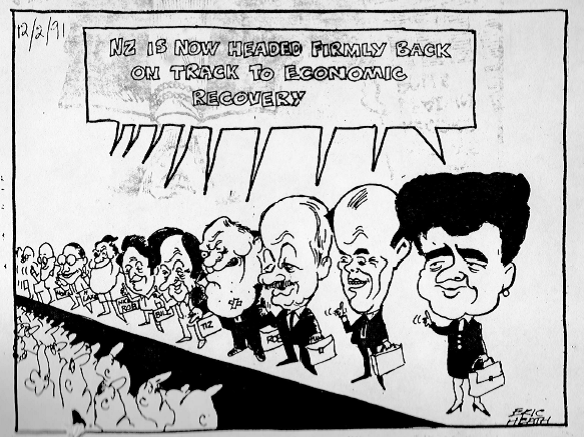
I’ve shown this old cartoon before.

richardson

It ran a generation ago now.

For some years, I had it pinned to the wall in my office –  the sad procession of successive Ministers of Finance who for decades (this cartoon implies back to the 1950s) had promised that New Zealand’s decline would be reversed (made worse in this case in that Ruth Richardson must have said something along these lines in February 1991, just as the severe recession of that year was taking hold).      Since then, we’ve had Bill Birch, Winston Peters, Bill English, Michael Cullen, and Bill English again, and although we’ve had plenty of cyclical ups and downs, never at any time have we looked like successfully or sustainably reversing our relative economic decline.   It saddens me every time I look at this cartoon –  so many decades, so much failure.

And nothing about Jacinda Ardern or Grant Robertson suggests we’ll manage any better if their policies were adopted than we have for the last 30 or 60 years.


Productivity growth across countries across time

This tweet caught my eye this morning.

The chart is from the latest weekly column from Martin Wolf, the economics columnist for the Financial Times.   It is a sobering reminder of what has been happening among economies rather nearer the frontier: productivity growth recently isn’t what it once was (even if the 50s and 60s are hardly representative historical decades).

But, of course, my main interest is in New Zealand.  And for OECD countries I prefer to use OECD data (which go back only to 1970).    Here is what a similar version of the chart above looks like using OECD data and adding Australia, Canada and New Zealand.   As with the chart above, I’ve ordered the countries from high to low based on average productivity growth in the most recent period (in this case, the last five years).

Real GDP phw OECD

In that most recent period (and, actually, for this decade as a whole) France has had the fastest productivity growth –  not something I’d have guessed –  and New Zealand brings up last place.  It isn’t that the green bar is missing for New Zealand, just that the average annual growth rate on this measure was 0.0 per cent. (Using my preferred measure of labour productivity growth, updated to include this morning’s release we do a little better for the last five years –  we come second to last (ahead of Italy) instead.)

And, of course, the pattern for New Zealand is a little different because we had that truly dreadful decade in the 1970s, when our productivity growth was clearly the worst in the entire OECD.

But here is how we’ve done simply relative to the G7 group as a whole.

NZ and G7 gdp phw

In not a single period has our productivity growth rate matched that of the G7 grouping as a whole.  We came close in the 1980s, but couldn’t match those leading industrial countries even then.  (And for the most recent period that conclusion holds even if use my preferred measure of New Zealand labour productivity.)   And whereas back in 1970, the level of labour productivity in New Zealand was very similar to that for the OECD as a whole, those growth differences cumulate, and now the G7 group has labour productivity just over 50 per cent higher than that in New Zealand.

Is something better possible?   Well, there is a loose relationship suggesting (as one might expect) that countries that had a lower starting level of labour productivity were also those with relatively faster productivity growth in recent years.  Catch-up can and does occur.   There were 10 OECD countries –  more than a quarter of the membership –  which had faster productivity growth than France over the last five years, often materially faster.    All of them were small.

That could have been New Zealand too –  after all, we now start so far behind the leading bunch –  but policy choices by successive governments (much the same regardless of which party occupies the 9th floor of the Beehive) meant it wasn’t so, and left us vying with places like Italy, Portugal and Greece (even the UK) for the unwanted poor performer award.


China and Japan

I’ve been reading a wave of books in the last few weeks about modern Japan –  the rapid economic rise from the mid 19th century, the out of control militarism that led to the war from 1937 to 1945, and the post-war revival (rather than the last few decades).   And as I read, it left me pondering the relative economic fortunes of Japan and China.

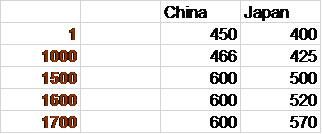
According to the standard reference source for such things – Angus Maddison’s collection of estimates of GDP per capita since the year 1 AD –  in earlier centuries Japan and China were more or less level-pegging for centuries, with China a bit ahead of Japan (a thousand years ago, China is generally accepted as having the highest material living standards anywhere).  Here are the estimates (in 1990 international dollars) through to the 18th century.

maddison chjp

There was, of course, a great divergence between economic progress and living standards in the leading European (and offshoots) economies and those of east Asia, but today I’m more interested in the less-highlighted, but scarcely less dramatic, divergence between economic performance in Japan and that in China.

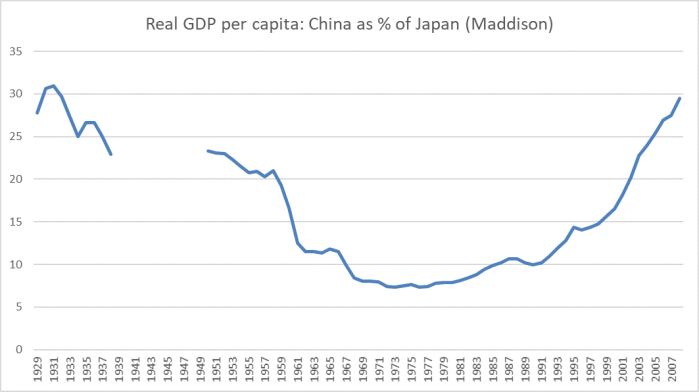
Maddison’s estimates report that –  despite having turned its back on the world –  Japan had moved ahead of China over the 18th century and the first half of the 19th century: for 1850 the reported estimates are Japan $679 and China $650.   There are only scattered estimates for China for the following few decades, but here is the reported estimate of average per capita real GDP per capita, China as a per cent of Japan.

China GDP pc as % of Japan
1850 88
1870 72
1890 53
1900 46
1913 40

A bit later, the annual estimates start –  with a break when Japan was attempting to conquer China.  Here is the chart to 2008 when Maddison’s estimates end.

chinajp

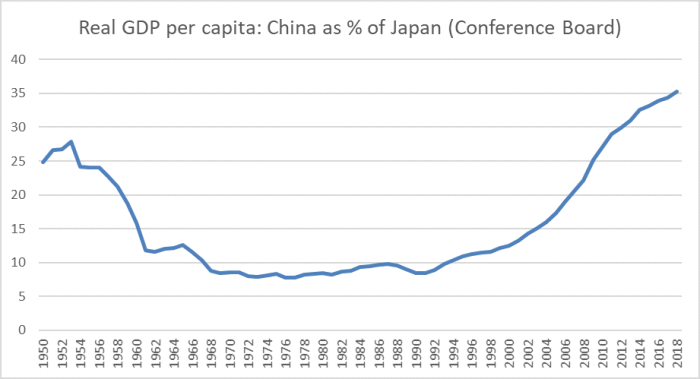
The Conference Board has estimates through to the present day, but they only start from 1950.   Here is the PRC’s real GDP per capita as a percentage of Japan’s.

chjp conf board

Productivity estimates are available only for even more recent periods, but on Conference Board numbers they show a pretty similar picture: as at last year, average productivity in the PRC just over 30 per cent of that in Japan.   And that is still probably worse than the situation at the turn of the last century (when –  see above –  China’s real GDP per capita was about 45 per cent of Japan’s).

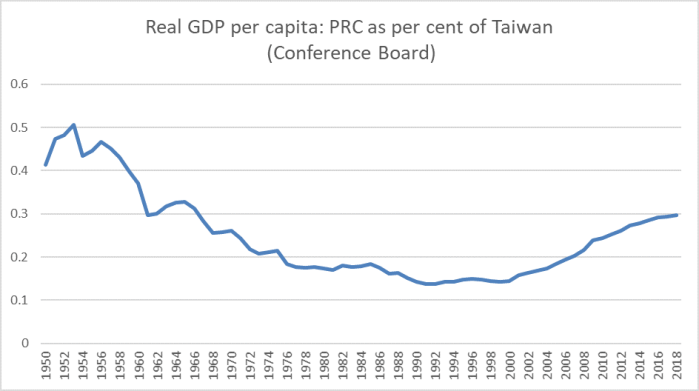
Of course, it isn’t only Japan that China has fallen so far behind.  Taiwan was a Japanese territory for 50 years after the Sino-Japanese War in the 1890s, and Korea was a Japanese colony/conquest for 40 years.  On the Maddison estimates, 150 years ago both Korea and Taiwan had GDP per capita (estimated at) not much different from that of China.    These days, South Korea (historically less well-developed than the north) has real GDP per capita about 10 per cent less than that of Japan, while Taiwan has real GDP per capita about 15 per cent more than that of Japan.    Both, in other words, are far ahead of the PRC.

taichi conf bd

Relative to Taiwan, the PRC has just now managed to get back up to the relative living standards just prior to the Cultural Revolution.  (And yet this is the regime whose “successes” Simon Bridges lauds.)

There isn’t really much debate about why the PRC has over recent decades still been the disastrous laggard among the historically more advanced east Asian economies (North Korea of course marking out an even worse extreme) –  absence of the rule of law, absence of the sorts of incentives that make for the efficient allocation of capital, primacy of the Party etc etc will do that to a country (the Soviet Union in the 80s was closer in living standards to Japan then than the PRC is to Japan now).

But in some ways I’m more interested in how the gaps opened up in the first place –  before 1950, or even before the overthrow of the Manchu emperors in 1911.  It is easy to say that Japan embraced greater openness, Western technology etc –  initially under external pressure –  but what was it that meant Japan (having, if anything, been more isolated than China for the previous few centuries) made that choice and China did not?   In looking around, I’ve found a couple of relevant journal articles, but if any readers happen to have suggestions of good treatments of the issue (book or article) I would really welcome them.

Services exports – another NZ weak spot

Various people in my Twitter feed were highlighting what appears to have been a quite interesting conference in Auckland over the weekend on external-trade related issues. I haven’t seen the papers, but at least from the various tweets I saw I was struck by an apparent air of unrealism, that doesn’t take much account of just how poorly New Zealand has been doing on the foreign trade front.  It is a bit like when MFAT and Cabinet ministers talk up this, that or the other new preferential trade agreement –  there have been a lot of them over the years – and yet we find ourselves now with foreign trade shares of GDP no higher than they were in (say) the early 1980s.   For younger readers, those were widely perceived at the time as dark days –  lots of import protectionism, terms of trade very low, CER not yet signed, and so on.

Services in one of those areas that trade experts seem to like to talk about, a lot.  Here was an MFAT tweet from the weekend conference.

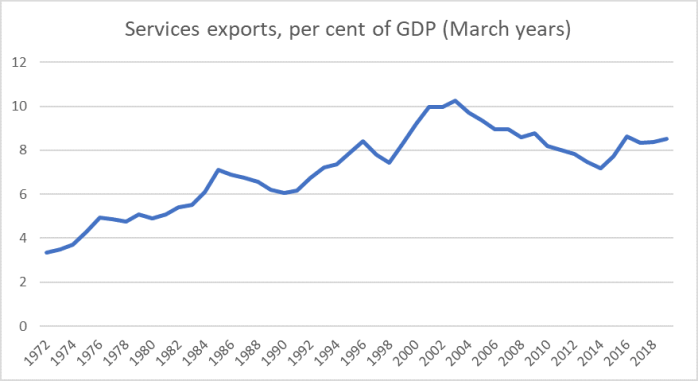
In a way that isn’t surprising.  In the median OECD country, services exports are almost 13 per cent of GDP, and the median increase in that share over the last couple of decades is about 4 percentage points.

But not in New Zealand.

Among the full group of 35 OECD countries, New Zealand has the 10th lowest share of services exports as a share of GDP.   But every single one of the other nine are countries that are far bigger than New Zealand: Australia, with almost five times our population is the next smallest.  For good and fairly obvious reasons, foreign trade tends to make up a smaller share of GDP in larger countries.

But what about the smaller OECD countries?  Almost two-thirds of OECD countries have populations of 11 million or less, and we are by no means the smallest of those countries.   Here are services exports as a share of GDP for the smaller OECD countries, truncating the vertical axis because Ireland and Luxembourg are so much higher than all the other countries on the chart.

services exports small OECD

New Zealand has the smallest share of services exports in GDP of all these smallish OECD countries –  and by quite a margin.       And it isn’t as if we are closing the gap.   Over the last 20 years, services exports as a share of GDP have barely changed in New Zealand (with some ups and downs) while for the median of the other smallish OECD countries, the increase was 6.7 percentage points of GDP.

NZ services exports

Now, of course, distance materially and fairly obviously affects quite a lot of what counts as services exports –  notably, our two largest classes of services exports, tourism and export education.

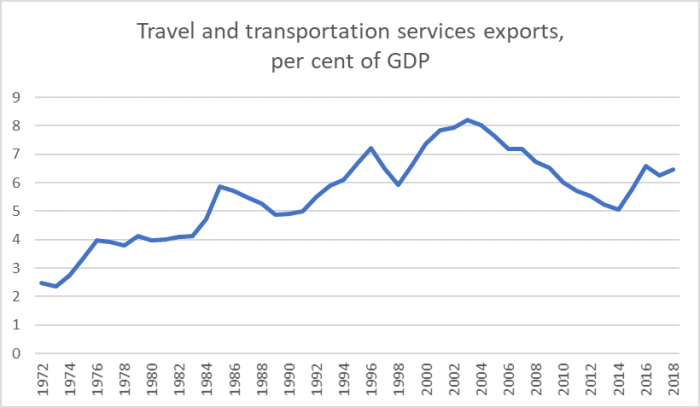
Here is a long-term chart showing all our travel and transportation exports (which includes freight and export education).

T&T services X

The picture looked quite promising 20 years ago.  Much less so now.

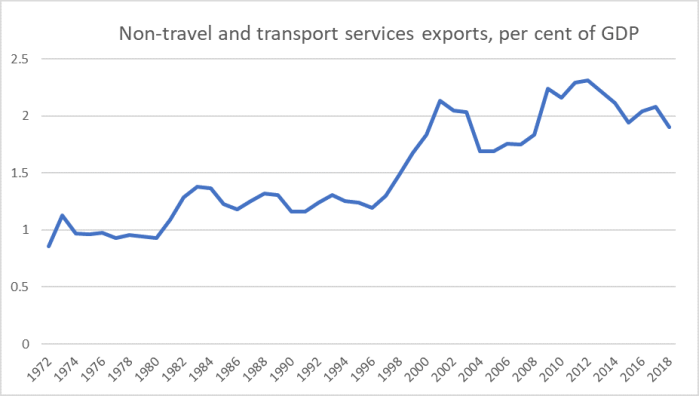
And, on the other hand, here are all the non-travel and transport services exports.   These, in principle, should have been where much hope was reposed.

non T&T services X

It is, perhaps, a more positive story, but not very much so.   After all, despite all the technological advances, and cheaper and better communications etc, this group of services exports is still (in gross terms) less than 2 per cent of GDP, and no higher as a share of GDP than was the case at the turn of the century.    As a share of total exports these (non travel and transport) services exports have risen a bit more, but even that increase isn’t particularly impressive, as there has been no growth in these services exports as a share of total exports this decade.

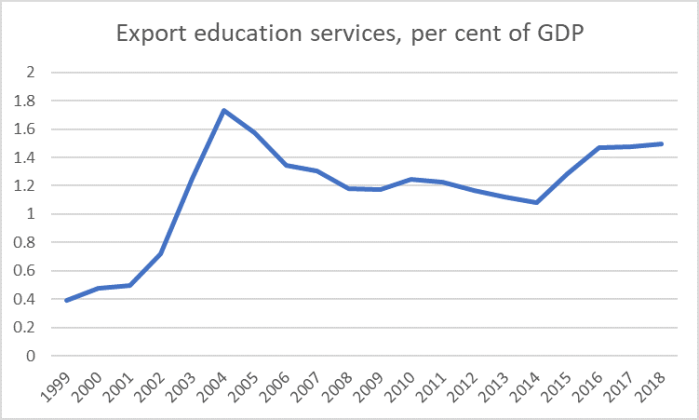
Out of interest, here is the export education component of services exports as a share of GDP.

X education

Ups and downs but –  even with all the subsidies to this sector (mainly through the immigration system) –  still now below the levels reached in 2004.    And it isn’t as if our universities are relentlessly climbing the global ladder, suggesting that fresh waves of new exports –  attracted by the quality of the product – are likely from this source.

Now, as experts like to point out, there is a services component in all or most goods exports too.  But (a) it isn’t as if New Zealand has been doing well with goods exports and (b) the overall character of our goods exports hasn’t been changing much either (eg lots of fancy manufactured products with a huge design or IP component).

For all the talk, services exports –  including the higher-tech ones people like to talk about in such seminars –  just haven’t done particularly well in New Zealand.

That doesn’t surprise me.   The combination of a persistently high real exchange rate –  direct consequence of other policy choices –  and the continuing constraints of distance (even for many of what may look like “push a button and it is done” services) seem to me to pretty much explain the story.  New Zealand is just not a great location to base many outward-oriented businesses, even as our governments pursue more and more people to live here.   It shouldn’t be surprising that the relative size of the tradables sector in New Zealand has been shrinking.

On such matters, I saw that in advance of the weekend workshop/conference, the Herald the other day had a full page profile of MFAT’s leading trade official, deputy secretary Vangelis Vitalis.     Rereading that piece, and exchanging notes with someone over the weekend about public sector senior appointments and our new Secretary to the Treasury, I was left wondering why Vangelis Vitalis wasn’t appointed to fill the role.  His is an enormously impressive and energetic guy, he knows New Zealand (and is a New Zealander), is open-minded and engaging, and thinks about economic issues and risks.    Perhaps he didn’t apply.  Or perhaps he just doesn’t fit the Peter Hughes model of safe generic public sector managers.  But it does seem extraordinary that the powers that be would pass over –  rather than, say, shoulder-tap –  such a significant economic and policy talent right here among us, already in officialdom.  You can negotiate all the preferential trade agreements in the world, and it won’t matter much for economic performance –  lacklustre for decades –  unless you get to the heart of the underlying problem.


80 years today since we entered World War Two

It is eighty years today since New Zealand declared war on Germany, joining the United Kingdom in responding to the unprovoked aggression of the German invasion of Poland.  Until just now, glancing at one of the government historical websites, this statistic hadn’t occurred to me

New Zealand was involved for all but three of the 2179 days of the war — a commitment on a par only with Britain and Australia.

It is estimated that 11928 New Zealanders died in the course of that conflict, a death rate (per million population) higher than in any other Commonwealth country.  Dreadful as the war was, it still strikes me as something closer to a just war (for our side) than most other conflicts in modern history –  although, of course, the counterfactual is unknowable.

Back in the very early days of this blog, I wrote a short post on some aspects of the New Zealand economy in and around World War Two (while lamenting the absence of a modern analytical book-length treatment).  Here is the gist of a few of the paragraphs from that post

Two things from the period did stand out.

The first is that, while New Zealand devoted almost as much of its GDP to the war effort as any of the major combatants (at peak similar to that in the UK, although the UK held the peak for longer), material living standards for the civilian population seemed to remain relatively high –  notably the quality of the diet, access to petrol etc.  Perhaps that partly reflects just what a rich country New Zealand then was.  Using Angus Maddison’s data:

1939 GDP pc

New Zealand’s GDP per capita in 1939 was second highest of those countries shown (a year earlier –  the US in recession –  we’d been top of the table).  It may have been easier to devote a larger share of GDP to the war in a rich country like New Zealand than in a relatively poor one like the USSR, where a larger share of resources would have to have been devoted to subsistence.

And the second point is the dramatic transition: New Zealand went from being on the brink of default in 1939 to being, in effect, defaulted on just after the war.  In 1939, in the wake of the imposition of exchange controls, Walter Nash emerged from a humiliating mission to London, with a very onerous schedule of overseas debt repayments.  If the war had not been looming –  which made the British government keen on maintaining good relations with the Dominions –  it is quite possible that New Zealand would have been unable to rollover maturing debt at all, probably ending in a default to external creditors.  By just after the war, New Zealand  –  having markedly reduced its external debt ratios during the war – made a substantial gift to the UK (as did Australia): in reality, Britain was quite unable to meet all its obligations and needed some of them written down.

In a paper a couple of years ago, some IMF economists looked at examples of countries that had markedly reduced their overseas debt.  The New Zealand experience during WWII was as stark as any of those reversals, but is too little studied.  It seems to have mainly resulted from a determination to pay for as much of the war as possible from taxation, together with the controls and rationing that limited private sector consumption and investment.  But it was not because of any strength in New Zealand’s terms of trade:

WW2 TOT.png

New Zealand’s terms of trade fell during the war years –  our import costs rose as global inflation increased, but there was little adjustment in the prices of the agricultural/pastoral products New Zealand sold to Britain.

Notwithstanding the lives lost (and the constraints on consumption, free speech etc) New Zealand’s experience of World War Two was pretty mild.  No combat occurred on our shores –  nor was it ever credibly likely to –  and we didn’t even have anything akin to the bombing of Darwin or of Pearl Harbor.

Of all the countries involved, perhaps Poland’s experience was worst.  I wrote a post here late last year, at the time of the 100th anniversary of the end of World War One (in turn leading to the re-establishment of an independent Poland), in which I noted that

My own reflection on Poland is that it is hard to think of a place in the western world (say, present day EU, other bits of western Europe, and western European offshoots – eg New Zealand, Australia, Canada, US, Argentina, Chile, Uruguay) that wouldn’t have been preferable to live in over the last 100 years or so, at least as judged by material criteria.   Perhaps if you were German, you have to live with the guilt of World War Two, but most of Germany was free again pretty quickly.   Romanians and Bulgarians might have been poorer on average, but they largely escaped the worst horrors of the German occupation.  To its credit, Bulgaria managed to largely save its Jewish population, while the Polish record was patchy at best.  With borders pushed hither and yon, and not a few abuses of other peoples (notably ethnic German) post-war, sanctioned by the state, the place then settled into 40 years of Communist rule.   There is a lot to admire about Poland, but I wouldn’t have wanted to live there any time in the 20th century.

And never more so than during and just after World War Two.

But against that backdrop it leaves the story of the Poland in the last 30 years or so all the more impressive.    Some will be critical of various aspects of Polish governance etc, but they are now bringing up 30 years of democratic government –  and changes of government –  something that would have been hard to imagine when I was young, or –  in the late 30s –  when my parents were young.

And then there is the economic performance.  In 1938, it is estimated that Poland’s average real GDP per capita was just a third of New Zealand’s.    The most recent IMF estimates suggest that this year, Poland’s GDP per capita will be 82 per cent of New Zealand.  New Zealand has, of course, been a poor performer, but relative to Germany over the period Poland’s GDP per capita has improved from 40 per cent to 60 per cent.

And then, of course, there is productivity: real GDP per hour worked.   We don’t have very long runs of data for this variable, but here is the ratio of Poland to New Zealand for the 25 years for which there are data for both countries.

poland real GDP phw

Them doing better doesn’t make us worse off (of course).  Their success is great for them and their people.

But, as we ponder the deeper issues of loss, sacrifice, freedom, the threat of tyranny etc –  all exemplified in the story of World War Two –  it might still be worth reflecting on how extraordinary New Zealand’s relative economic decline  (relative to every single country on that first chart above) would have seemed to our leaders in 1939 if someone could have told them then how poorly New Zealand itself would do over the next 80 years.


National on the economy

On Monday the National Party released their “The Economy” discussion document, the latest in a series of such documents they’ve published in recent months as they move towards setting policy for next year’s election.    The documents actively invite feedback, and if one should be sceptical of crowd-sourcing policy programmes mostly it seems like a worthwhile initiative.

A few weeks ago I was quite critical after Simon Bridges’s conference speech about the apparent lack of recognition of the structural failings of the New Zealand economy, let alone of any hint of a serious strategy that might reverse the decades of underperformance.

But, for all the almost ritualised mentions in Simon Bridges’s speech of the importance of a strong economy (even the Prime Minister mouths those sorts of line from time to time), there was nothing –  not a word –  to suggest that he recognises that the biggest obstacle to higher material living standards (whether in the form of cancer care or other public or private goods and services) is the woeful productivity record that successive governments –  led only by National and Labour –  have presided over.    There is plenty of talk about cyclical issues, but nothing about the structural failures, and nothing about what National might do that would conceivably make a real difference in reversing that performance.

Sure, it wasn’t primarily a speech about economics, but there has been nothing from Bridges or his colleagues elsewhere, and no hint of a recognition here, that much-improved productivity performance is the only sustainable path to much better material living standards.  And not a hint of a recognition that these failures were already well apparent in the government in which he served (latterly as Minister of Economic Development)

I went on to note that National appeared to be glossing over the fairly woeful overseas trade performance: exports and imports have been shrinking as a share of GDP.

I’m much less critical of the discussion document.   This line appeared on the first page, the leader’s own statement

New Zealanders’ productivity and income levels have fallen behind countries we once had similar income levels to, like Australia, the United States and leading European economies.

And from Paul Goldsmith’s opening

Improving productivity remains New Zealand’s most important economic challenge and the ideas discussed in this paper provide ways to meet that challenge, with the goal of raising incomes for all New Zealanders.

National understands that significantly lifting productivity is the only way to materially improve New Zealanders’ living standards. Increasing productivity means we can produce and sell more of what the world wants, at better prices, using fewer resources.

Good stuff.  And he goes on

New Zealanders’ living standards will not improve by simply redistributing what we
already have. Instead, we need to be absolutely focused on lifting New Zealand’s relatively weak productivity levels.

and

New Zealand’s core economic challenge is to lift our relatively weak productivity. To do that, our economy needs to become more internationally competitive. The world does not owe us a living. We are a small, isolated country far from global markets, which creates both opportunities and challenges.

and

The only way to materially improve the living standards of New Zealanders over time is to become more productive. Higher productivity means more in the back pockets of New Zealand families. New Zealand’s productivity is a more productive and competitive economy that lifts household incomes approximately 30 per cent below the top half of the OECD and 25 per cent below Australia.  New Zealanders also work more hours a year than any countries in the top half of the OECD. In 2017, for example, workers in Denmark, Germany, the Netherlands and Norway worked 300 hours less than New Zealanders.

Since the late 1990s, New Zealand’s productivity growth rates have been similar to that of the top half of the OECD. We need to be doing better to catch up and close the gap. That’s hard. It requires a relentless focus on productivity growth.

National is ambitious for New Zealanders and believes we should target higher rates of productivity in order to close the income gap with countries like Australia, the United States, Canada and leading European economies.

There was even talk of adopting a productivity growth target.

On foreign trade, we read this

New Zealand is a small country with a domestic market of only about five million people – so we depend on trade for generating greater prosperity. Trade supports over 600,000 jobs across our country, and is responsible for a higher standard of living and better quality of life for New Zealanders.

However, New Zealand has a relatively low exports-to-GDP ratio compared with other small, advanced economies. Lifting our exports will take further improvement but create new jobs and raise incomes.

So the rhetoric and some of the framing isn’t bad at all.    They could have made the same points even more brutally:

  • relative to the top tier of OECD countries (US, and leading half-dozen north European economies), productivity (real GDP per hour worked) has kept on slipping (in the last 25 years, productivity here has fallen from around 65 per cent to 60 per cent of those in the top-tier OECD countries while in, for example, Poland it has risen from around 30 per cent to around 55 per cent),
  • New Zealand has managed hardly any productivity growth at all over the last five years, and
  • not only are foreign trade shares (exports and imports) low for a country our size, but they’ve been shrinking.

But even if Simon Bridges in his introduction did note of the previous government “we didn’t everything right”, to have done so might have prompted too many hard questions about National’s own record.

What of the policy proposals and ideas?

I found a reasonable amount to like:

  • they haven’t fixed on a public debt target yet, but I liked the articulation of the flow fiscal goal (“Governments should aim for balanced budgets over time, so that surpluses in the good times offset the bad times”).  With little evidence of an overheating economy at present, that should have them arguing for a balanced budget now, not for surpluses,
  • I was pleasantly surprised that they remain committed to lifting the NZS eligibility age, and to introducing a somewhat more demanding residence requirement.    They should have gone further on both fronts (my thoughts on NZS here) –  said from the perspective of a household where my wife is 10 years younger than I am and still won’t be affected by National’s proposed change.  But we should be thankful for small mercies: on this issue, National has moved decisively on from the Key irresponsibility.
  • I like the idea they are toying with of adjusting for inflation the interest earnings and interest payments that are tax assessable/deductible.   Various people, including at times the Reserve Bank, have argued for this for years.  It is just and right to do so, but……there isn’t that much in the issue.
  • I like the mention of possibly using congestion pricing on some parts of the roading system.
  • I am encouraged that they are willing to think seriously about the possibility of lowering the company tax rate (although disquieted by talk of favouring small businesses through the tax system).  That said, given our imputation system, a lower company tax rate benefits foreign investors (we would generally benefit from more of such investment), and if they are serious about addressing this issue –  and productivity growth –  substantively then they need to think about options for lowering the taxation of capital income earned by New Zealanders as well.  Whether they have the political skills to manage the narrative around that sort of proposal is, at very least, an open question.
  • The talk –  not specific in this document –  of a proper overhaul of the RMA and serious liberalisation of the urban land market is encouraging.  The ability of the next generation to afford decent houses (and gardens etc –  the sort of place most New Zealanders seem to want) depends on it.
  • And I like the idea of a much tougher approach to new regulation, and some sort of commitment to reducing the overall volume of economic regulation.  On that count, I like the (adopted first in parts of Canada) idea of eliminating two old regulations for each new regulation (ie a shrinking cap on the volume of regulation itself).   There are risks around such an approach once it in turn becomes bureaucratised –  ministers and bureaucrats will game the system skilfully, so it would need serious leadership from the top, and sustained follow-through –  but for now the value is in the signal it sends.

And there is other stuff I like, often undoing bad calls by the current government (eg the ban on new oil and gas exploration and the planned labour reforms  – I found this note valuable on the latter).  There was even talk of possibly unilaterally lifting all remaining New Zealand tariffs, recognising that tariffs tax New Zealanders.

They were even surprisingly muted on immigration.  I thought this line from early in the document was quite cleverly drafted, with the focus on creating a climate in which New Zealanders no longer want to leave permanently.

New Zealand is also competing with the rest of the world for skills. If we aren’t internationally competitive our best and brightest leave for overseas and our living standards worsen relative to the rest of the world.

And if I disagree, quite firmly, with their paragraph on immigration itself  – after all, we have one of the highest levels of workforce skills among natives of any OECD country

Immigration can help to deliver a more skilled and willing workforce. National understands the benefits of sound immigration policy from an economic, social and cultural perspective. The skilled migrant levels should match industry needs and the administration of visas needs to be prompt and predictable. New Zealanders must be at the front of the queue for the jobs created by our growing and changing economy, but immigration will remain an important complement to that growth.

at least the “critical economic enabler” gung-ho rhetoric is gone, and this paragraph is a long way down the document.

Of course, there is other stuff I didn’t like.    Their section on regional development is about as devoid of a serious framework –  real exchange rate anyone? –  as anything from Shane Jones.  They still seem enamoured of big taxpayer subsidies to “glamour” industries (screen grants), and when they talk of privatisation it is never about efficiency or competition or accountability or things like that, but rather silly arguments about freeing up cash to spend on other things (when, as they know, the Budget is in surplus and the debt is low).   And they seem tantalised by the idea of more infrastructure spending without offering much assurance that the sort of schemes they might proceed with would be any better –  in economic return terms – than those of the previous National government.   Perhaps I’ve mentioned that there was next to no productivity growth economywide over the last five years or so?

But when I got to the end of the document, I guess my overriding reaction was a bit similar to my reflections on the reports of the 2025 Taskforce (the body set up by the previous National government to provide analysis and recommendations on closing the income and productivity growth gaps to Australia  –  by 2025, a date that mocks us now).  I had quite a lot of involvement in that process, and largely wrote the first report.  I also largely agreed with most of the recommendations the Taskforce themselves made –  very few of which were ever adopted.   And yet, as I reflected on the report in the months after it was released, I became increasingly convinced that, sensible as many/most of the recommendations were, they weren’t enough to make a decisive break in New Zealand’s economic and productivity performance.  Some important things were missing (although at the time I wasn’t really clear, even in my own mind, what they were).

Quite a few of things National is proposing look sensible. The general direction looks sensible.   The rhetoric is better than it was –  although, by itself, such rhetoric is cheap, and is the sort of thing most Oppositions for 25 years have eventually come round to saying.  But the scale of the policy response they are talking about is simply incommensurate to the scale of the problem (much of the policy mix they are suggesting is carrying on a broad approach they adopted in government, and productivity growth was very disappointing then).  For New Zealand average labour productivity to match that in top-tier OECD countries would require a 60 per cent lift from where we are.    That is simply huge.  Huge problems are rarely successfully answered with small changes (even a succession of them).

And so my challenge to National is along the lines of that the rhetoric is great, and I hope it reflects a shared sense that New Zealand’s long-term economic performance really is deeply disappointing, and has not sustainably improved –  relative to other advanced countries –  for any prolonged period for many decades now.  As they say, that has real implications for us, our children and our grandchildren, for the material living standards –  and public and private services –  we can achieve for the population as a whole.

But if you are serious, and you really mean what you say – all those good quotes I posted earlier –  you need to keep thinking harder, digging deeply, consulting broadly and testing and evaluating the proposals and analysis put to you.   Great ambitions need to be matched by excellent analysis, courageous policy, and skilful management of the political challenges.   Perhaps for many in the National caucus, winning the next election is all that matter, but I’d urge the party, and its members, not to focus on the small ambitions, but on the really big challenge that, successfully confronted, would so much transform New Zealand for the better, for almost all New Zealanders.

Why does good government matter?

That was the title of a speech Jacinda Ardern gave in Melbourne a couple of weeks ago.   For the short trip to Melbourne, the Prime Minister had eschewed commercial flights and taken an RNZAF plane instead, only to have the plane break down.  It later emerged (page 11) that her office knew how badly this bit of New Zealand’s government was run
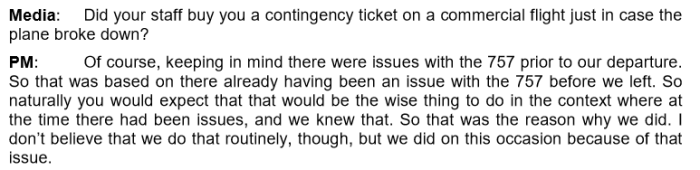
757.png

There must have been some wry chuckles in parts of the Australian government and public sector.

The “progressives” who turned out to hear Ardern (it was an ANZSOG event, so I presume lots were public servants and academics) appear to have loved her.  Stuff reported that

The event on Thursday night attracted more than 2000 people. Ardern appeared to rapturous applause, and was told that she had put fire in the belly and power in the hearts of Australians.

In The Guardian one particular left-wing Australian academic, a former adviser to Julia Gillard, lost all sense of reason and perspective, claiming Ardern as “one of the world’s great leaders”, and hankering for something different, for New Zealand type politics and reform.

In more recent times it seems that for every policy success achieved by New Zealand, Australia has suffered an equal and opposite failure.

Which is, no doubt, why so many hundreds of thousands of New Zealanders have migrated to Australia and so few Australians to New Zealand (even though we make it easier for them to come, than it is for us to settle in Australia) and why when our two countries were once more or less economically level-pegging, Australia is now so much richer and more productive than New Zealand is.  Don’t take it from me: as Australian Labor MP Andrew Leigh put it in his recent article, productivity makes a real difference, and creates real opportunities and choices.

For a time there was a strange phenomenon whereby people on the right in Australia tried to talk up John Key and Bill English as great leaders and economic managers (mostly, it seemed, in reaction to people they didn’t like in Australia –  whether Rudd, Gillard, Abbott or Turnbull).  Curiously, this particular left-wing academic manages to embrace that strange line as well –  Jacinda Ardern is great and so was John Key (“exceptional leadership”).  Going by results, could we perhaps trade these stellar figures for someone Australians think is less impressive, but who might actually address some of the serious New Zealand problems and failures?

But the real point of this post was about the Jacinda Ardern’s text.   When I first heard the title (“Why does good government matter?”) my immediate reaction was along the lines of “how would she know?”, but I guess it is possible to recognise what good government might be even if, as a serving Prime Minister, you aren’t presiding over such a beast.   A good start might be recognising that as Prime Minister you might perhaps be thought of as chief executive of the government but not –  contrary to the PM’s suggestion in her text –  of “the country”.

I’d have thought the question of why good government matters was pretty straightforward.  Governments exercise enormous power –  actual and potential (the latter especially in a country like New Zealand with few formal checks and balances) –  take an enormously large share of our incomes (equal to more than 30 per cent of GDP), and any agency that powerful needs to be kept in check, and we need assurances that those in charge of the goverment are operating efficiently, effectively, compassionately, honestly, openly, knowing their own limitations, and so on.    Good goverments can do some good.  Bad governments can be incredibly dangerous and damaging.  Look, after all, at the productivity or housing records in New Zealand –  or at the 10 per cent of working age adults living on welfare.

But there is little sense of any of this in Jacinda Ardern’s speech.  I guess she is a socialist –  former president of the International Union for Socialist Youth –  speaking to an audience of people with pretty similar beliefs about the desirability of a big and active government, with little emphasis on how –  time after time –  governments mess things up.

Ardern’s imperial mindset is on display early in the speech

Good government matters, because government affects everything.

Breathtaking.  The love of husband for a wife (and vice versa).  Of a parent for a child?  Our core beliefs –  those under the label of religion and others –  that shape what we value?   Friendships?  Whether or not the All Blacks win the World Cup?

I suppose you could mount a defence of the Prime Minister along the lines of bad governments can interfere even in these things, but there is not even a hint of that in her address – no sense at all of the appropriate limits of government or of the failures of even the most capable and well-intentioned governments.    In fact in the very next sentence she – I guess she is a Socialist –  goes on to suggest that this “government affects everything” line is something “we” (she and the smart active government types) “perhaps take for granted”.  She tells us, quite seriously, that she was “gutted” that an old school friend had no interest in politics: but then Ardern has never known anything but politics, and that simply isn’t (fortunately) the case for most people.   But she really wants to a better class of citizen to be worthy of people like her.

She goes on with unsupported stuff

Around the world, democratic values and institutions are under threat in a way that many of us never expected to see in our lifetimes.

It would perhaps be good if she were a bit more specific.   Perhaps she had the PRC in mind, and the way she and her colleagues repeatedly defer to PRC interests and pressures, allow PRC regime/Party-affiliated individuals to serve in our Parliament?  But I’m guessing not.

Perhaps she isn’t too keen to Vladimir Putin (neither am I) or Viktor Orban (not ideal either) but most adults are old enough (“our lifetimes”) to remember when these places were far far worse.   She surely can’t mean Brexit –  which was, after all, the choice of the British voters in a hotly-contested energised referendum?   And yet I fear she might, because in the next sentence we read

Nationalist sentiment that closes off the possibility of countries working together is surging.

Except that it doesn’t, does it.  Free and independent nations often choose to work together on specific items of mutual interest (eg no sign of the UK pulling out of NATO).  Aren’t Australia and New Zealand proudly independent countries –  doesn’t the PM tell us at every opportunity about her “independent” foreign policy? –  and yet we work closely together and are still able to disagree, and not subsume ourselves in one combined “New Australasia”.

Strangely, in her paean to good government, the Prime Minister talks of how

Norms that we in New Zealand and Australia take for granted – the rule of law, the peaceful transfer of power, freedom of expression – are being challenged in new and more explicit ways.

Must have been the PRC she was talking about again surely? But I guess not.

I’m old enough to remember when military coups in various African and Latin American countries were the regular fare on Morning Report, and when from the Fulda Gap eastwards few had the benefit of the rule of law, freedom of expression, and Party rule was something akin to the end of history.    Things are better now in so much of the world.  And 23 Democrats are lined up across the political spectrum to try to defeat Donald Trump in an open and contested election.

But she also mentioned “freedom of expression” –  the same Prime Minister whose government is beavering away on plans to restrict that freedom in New Zealand, whose government made mere possession of the manifesto of Brenton Tarrant an offence punishable by many years of imprisonment.

To this point she seemed to be merely warming up with some generic tropes for his left-wing audience.  And then it was into the red meat with a strong denunciation of the reforms of the 1980s and early 1990s –  all this from a Prime Minister of the same party that did many of the reforms.

In many countries, while the very wealthiest have grown consistently wealthier, the rest have seen little or no real rise in their incomes or their living standards – over decades.

Inequalities that deepened with the great deregulating reforms of the 1980s and 90s have become a permanent feature of these economies – not a brief moment of pain.

That is certainly the case in New Zealand.

Except that very little of that stacks up against the evidence.  In New Zealand wages have been rising faster than the capacity of the economy to pay (growth in nominal GDP per hour worked), income inequality hasn’t widened for decades, and to extent there have been issues in New Zealand they have to do largely with housing –  where successive governments have presided over grossly over-regulated urban land markets.

And look at her try to distance herself from and disown all sorts of reforms  (notice that “said to”)

Starting in 1984, through to the 1990s, we removed regulations that were said to hamper business, slashed subsidies, transformed the tax system, dramatically cut public spending and massively reduced welfare benefits paid to the sick, those caring for children and the unemployed.

Now we can argue whether those regulatory reforms were necessary, but regardless the numbers speak for themselves.

And yet she shows no sign of even understanding the numbers, repeating the same line she took into the 2017 election, claiming that in aggregate the economy did well, but the “right” distribution didn’t happen, as if oblivious –  or uninterested –  in the continued widening gap between the level of productivity in New Zealand and that in leading advanced OECD economies (and than in Australia).

She does go on to devote a paragraph to housing markets, but shows no sign of actually understanding the issues, suggesting that low interest rates are the cause of the problem.  Similarly she laments technological advance putting “people out of work” (it is called productivity –  doing more with less), seemingly oblivious to the incredibly high labour force participation (and employment) rates we actually have in New Zealand (higher, for example, than in Australia).

And in a line of (stunning) naivete, we read this

Stunningly, our most connected generation in New Zealand, has also been found to be our loneliest.

And in the next line (emphasis added),

what does good government look like, not for us but for the very people who are turning away from us?

The Prime Minister of the ANZSOG (public servant and academic) audiences, “people like us”.

And so she goes on

Domestically, some have chosen to reject the independent and expert public service and the possibility of a mutually respectful and diverse nation.

Could we perhaps have one of those “independent and expert public services”, instead of the degraded (for example) Treasury we currently have in New Zealand?

Abroad, they reject the international institutions that they paint as responsible for both economic and cultural problems when they aren’t necessarily at fault.

One of my old bosses used to jump up and down when we (unspecifically) tarred unnamed individuals.  She might be a fan of the EU, but there is no reason why the British public should be, or why them choosing the pull back from the push for a federal Europe should be any sort of marker of societal failure or decline.    And if the IMF, the World Bank, the UN etc do little harm, they don’t do much good either.  And if she wants to criticise the US over the WTO, perhaps she should say so directly –  or perhaps even live the view that free trade benefits most those who take off restrictions on their people, and take a lead and remove New Zealand’s remaining tariffs and import restrictions.

And then

So this is one answer that is available to people – and that some are signing up for. After all, fear and blame is an easy political out.

Except that some people –  parties and individuals, Labour included –  are to blame for our housing disaster, our dreadful productivity performance.  That blame should be sheeted home.

We get several mentions in the speech of high rates of GDP growth but (I think) not a mention of immigration –  which the PM and the ANZSOGers love –  and not a hint of per capita income growth, let alone the (lack of) productivity growth.  Productivity creates possibilities and options, eases hard choices etc.  But Ardern seems to prefer not to know.

And we get stories about “social and economic inequality” driving deprivation, poverty and crime, but nothing at all about cultural failures (a point Winston Peters was making this week), family breakdown, or choices and individual responsibility.   Free societies can’t flourish without strong and functioning families and cultures.

As she was talking to public servants, there is several pages of talk about public services reforms –  but nothing about transparency, nothing about accountability, nothing about excellence, nothing about (say) fixing a system in which the head of the State Services Commission largely exonerates his buddy the outgoing Secretary to the Treasury after a monumental stuff-up, revealing an inability to operate under pressure at the very top of our public sector.  Once upon a time Labour talked of being the “most open and transparent government ever”.  Now even people on the left just scoff and make fun of the claim.   And if the public service is in such good shape (as she claims) doesn’t it make it very clear that responsibility for the severe ongoing policy failures really lies with her (and her colleagues, and people elected before her from her party and others).

The speech ends with the claim that “Good government need not be an oxymoron”.  At one level that is obviously true, and yet at another it invites the reaction “and yet surely in New Zealand in recent decades it has proved to be so”.   And if it weren’t for the ideological blinkers of her audience (for whom her main appeal seems to be that she is the “not Scott Morrison” or the “not Donald Trump”, you’d have to marvel at the presumption of the Prime Minister offering lectures on good government to a country that is so much richer and materially more sucessful than New Zealand is, to which so many New Zealanders have moved in recent decades, and when her government has done so little.

For those –  as many do –  who praise Jacinda Ardern as a great communicator it was also striking to read the speech and not find a single fresh or interesting idea, not even a fresh or startling way of making an old point. It was as if some public servant or PMO staffer had simply turned the handle and churned out a set of cliched notes, empty of almost any substance, with nothing to leave people thinking.   Is there anything to this alleged communication skill, beyond the level of individual empathy –  not an un-useful quality in a Prime Minister, but hardly the foundation for any sort of transformative government.

In his Herald column last week, Matthew Hooton brought me up short with this summary

The Ardern Government is the emptiest and most incompetent in living memory,

But it is hard to disagree (despite some competition for the title) and the problem starts at the top.  So much of what the Prime Minister says is vacuous –  almost devoid of content –  and it has been matched by an absence of any serious steps to deal with pressing failures (or utter failure in, for example, an actual initiative: KiwiBuild), in turn presumably built on  no compelling narrative about what has been done wrong in the past, and what might make a material difference in the future.  Endless blather about wellbeing doesn’t change that failure.

For those who doubt the “vacuous” charge, consider finally this

Someone I debate these things with, perhaps inclined to making a few more allowances than I am, observed “even I have to agree that is pretty vacuous”.

We really need good  –  disciplined, rigorous, courageous, open, self-aware, limited – government.  We don’t have it.
 

Thoughtful analysis of productivity from the Opposition

The Opposition in the Australian Federal Parliament that is.

In my post yesterday, I noted  that Simon Bridges’s latest speech continued the pattern in which our Opposition pretends there is no real structural problem in the New Zealand economy: no decades of productivity underperformance, no near-complete absence of any productivity growth in the last several years (whether under National or Labour).

And so it was some mix of refreshing and depressing (would that it were so in our country) to yesterday read a new paper by the Australian Shadow Assistant Minister for Treaasury on “tackling Australia’s productivity crisis”.  No doubt it helps that the Shadow Assistant Minister was previously a professor of economics at the Australian National University (I wrote about a paper he gave in New Zealand last year here).   And perhaps the political context is different: it is now six years since the ALP was in (federal) office and it is three years until the next election.  And Leigh isn’t the highest profile ALP politician.  Nonetheless, a moderately senior figure in the main opposition party actually went to the effort of writing a serious paper on productivity failures in Australia (not even engaging mainly in gotcha politics –  all the fault of the other lot).   Would that it were so here.  If National doesn’t have any former professors of economics, I’m sure there must be some serious economists around who would be National supporters and might be happy to help, were the party to be seriously interested in addressing –  rather than avoiding –  the issue.

And I don’t say any of this because I agree with Andrew Leigh’s prescriptions.  Mostly I don’t –  in fact, to a first approximation I think he has the wrong mental model of the Australian economy –  but he is a politician showing every sign of trying to take the issue seriously.  Productivity growth is what underpins any long-term sustainable improvement in material living standards.  As he puts it (with his particular left-wing emphases)

Too often, Australians see productivity as a dirty word — synonymous with working harder, rather than working smarter. But productivity should lead to a better quality of life, in which people have more choices in the workplace and more opportunities to spend time with friends and family. The path towards higher productivity should also allow us to live in a cleaner environment, and to be more generous to the needy. Tackling major challenges, from gender equity to traffic congestion, is easier in a highly productive economy.

Here is how Leigh introduces his article

At the start of June, the Productivity Commission quietly dropped a bombshell. Australia’s productivity growth had basically stalled. Labour productivity — output per hour worked — was more or less flatlining. After a generation in which labour productivity had grown at almost 2 per cent a year, it had tumbled to just 0.2 per cent.

The commission called the results “mediocre” and “troubling,” but for some sectors they were downright appalling. In farming, mining, construction, transport and retail, labour productivity went backwards. In other words, workers in those sectors were producing less per hour than they had the year before. The latest numbers continued a trend of weakening productivity growth that the commission dates back to 2013.

To understand why Australia’s productivity crisis is so serious, it’s worth recognising why productivity matters. Through Australia’s history, our economy has become massively more productive. Australian workers today produce nearly four times as much output every hour than in the 1960s. This has been a central driver of rising living standards.

Productivity measures how efficiently the economy turns labour and capital into goods and services. When the Australian economy becomes more productive, we are producing more output from a given level of inputs. Higher productivity creates the potential for household incomes to rise faster than the rate of inflation. A more productive economy can be more generous to the disadvantaged, can reduce its impact on the natural environment, and can play a bigger role in international affairs.

Productivity doesn’t automatically bring fairness: in recent times, workers haven’t received their fair share of the modest productivity growth delivered by the economy. But without rising productivity, wages will eventually stagnate and living standards will stop increasing. Whether your priority is longer lifespans or lower taxes, raising Newstart or building motorways, you should be in favour of productivity growth. Productivity is the engine of the economy, and right now, that engine is making a nasty rattling noise.

Note that in the final paragraph of that extract is one difference between Australia and New Zealand.    In New Zealand wage growth has outstripped growth in nominal GDP per hour worked (ie the combination of terms of trade and productivity) for some time, but this is the Australian version of that chart

wages in aus

There is a variety of possible explanations, but the comparable New Zealand chart slopes upwards, not downwards.

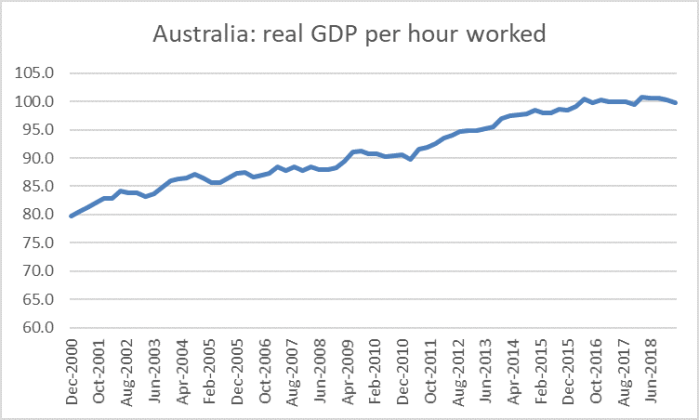
But how does the aggregate productivity picture look for Australia?  This is quarterly ABS series of real GDP per hour worked.

aus prod.png

In the last two or three years, the picture is quite as bad (no growth at all) as in New Zealand –  bearing in mind that the average level of productivity in Australia is far higher than in New Zealand.

Leigh makes a lot of an asserted relative deterioration in Australia’s position this century.  In doing so he relies on a recent speech from a senior Australian Treasury official on productivity (another contrast to New Zealand), reporting some research work Treasury had done.

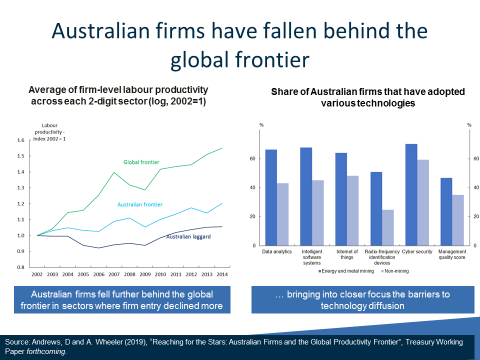
For Australia, the most hard-hitting presentation came from Treasury’s Meghan Quinn, who revealed that researchers in her department, led by Dan Andrews, had been investing in a new analysis that links together workers and firms, and delving deeply into fresh data about the dynamics of the Australian economy. Since 2002, Quinn showed, the most productive Australian firms (the top 5 per cent) had not kept pace with the most productive firms globally. In fact, Australia’s “productivity frontier” has slipped back by about one-third. The best of “Made in Australia” hasn’t kept pace with the best of “Made in Germany,” “Made in the Netherlands” or even “Made in America.”

Go to Quinn’s speech and you find this chart (unfortunately a bit fuzzy)

quinn

The left hand panel is the point Leigh is making.  It doesn’t look very good.

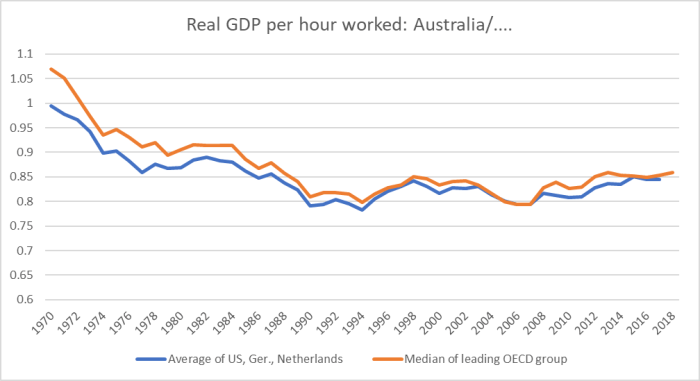
On the other hand, the economywide cross-country comparisons really don’t look so bad at all (and being annual data you don’t see the recent flattening in the way the quarterly chart above shows).

In this chart, I’ve shown Australia’s real GDP per capita compared to an average for Leigh’s three countries (Germany, Netherlands, US) and to the median for the leading OECD bunch (as I’ve used in previous charts and tables for NZ comparisons: US, France, Belgium, Netherlands, Germany, Austria, Denmark, Sweden).

AUs prod 2

On these economywide measures, the 1970s and 1980s were a pretty bad time for Australia, in relative productivity performance terms.   Since then, a pessimist might say Australia has more or less flat-lined relative to these leading OECD economies, while an optimist might suggest some modest beginnings of a catch-up process at work.   It isn’t a good performance at all –  the leaders are almost 20 per cent ahead of Australia and if the gaps are closing, it is an incredibly slow process –  but it is a rather different emphasis than in the Federal Treasury chart Leigh draws on.

That idea that it isn’t a good performance at all is reinforced once one realises the extent to which Australia has been able to draw anew on nature’s bounty in the last ten to fifteen years –  all those newly developed iron ore and LNG exports.  There has been nothing comparable in most of the other OECD countries I’ve used in the chart above (oil in the US might be closest thing, but much smaller relative to the size of the economy).   I haven’t looked in detail at the Australian Treasury research (which is still described as “forthcoming”) but perhaps what is going on is that existing Australia firms haven’t done that well (and as Leigh highlights the rate of business start-ups etc is low), but that the economy as a whole just has a whole lot of newly-exploited natural resources it has been able to use to hold up overall economic performance  (well done them: I had an email yesterday from some NZ public and private sector group oncerned to stop the depletion of New Zealand’s natural resources, a cause with which –  in this context –  I could not sympathise).

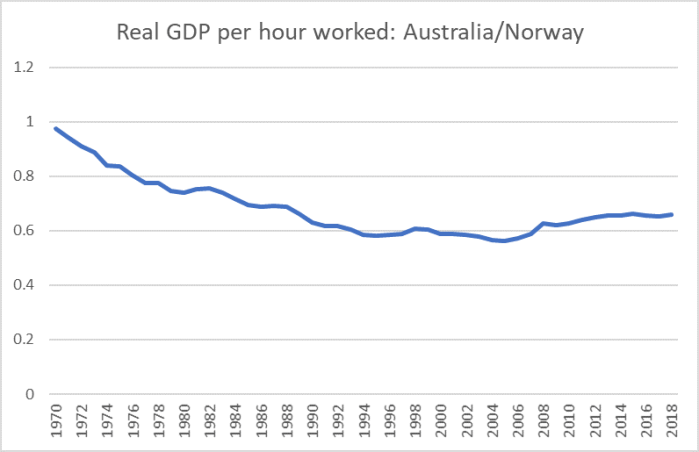
And yet, despite that, Australia has made very little progress in closing the gaps to the OECD leaders.  Here is another comparison I’ve long found interesting, looking at real GDP per capita in Australia relative to that in Norway, the other advanced OECD country able to exploit an abundance of natural resources in recent decades.

aus norway

Australia –  still building up its fresh wave of resource exports –  has regained a little ground relative to Norway in the last fifteen years (oil exports from Norway are falling, and gas looks to have peaked) but it isn’t dramatic, and has been barely a thing at all in the last few years.  And yet these two countries were more or less level pegging fifty years ago.

There wasn’t much (any?) mention of resource exports in Andrew Leigh’s article.  There also wasn’t much (anything?) on the other big change in Australian policy in the last fifteen years or so, the marked increase in policy-led immigration to Australia.  My own story of Australia’s underperformance is much like that for New Zealand.   Remoteness and distance are huge issues –  perhaps even increasingly important globally –  and the fortunes of both countries depend very very heavily on natural resources (and the ability of talented people and decent institutions to facilitate their extraction and utilisation).  It isn’t just a matter of simple division –  but it is close to it, bearing in mind what else we know about the Australian economy –  to suggest that had Australia’s population not been supercharged again by policy (like New Zealand bipartisan policy) that the bounty from the natural resources newly exploited would have translated into higher living standards for the average Australian, higher economywide productivity.

There are lots of detailed points in Leigh’s article, some of which seem more compelling than others (I’m not persuaded that getting more people into tertiary education is likely to make much economywide difference, when the people not going now are likely to be those who would benefit least from doing so –  it hasn’t been worth their while to do so). And I’m not convinced he has the right model to think about Australia –  where the bigger issues seem more macro in nature – but it is just refreshing to see a moderately senior active politician actively engaging in thinking about, writing about, talking about, how productivity performance might be markedly improved.  Because, as he says, it really matters to all of us.

Where there is no vision

Each year, as a disillusioned voter (pondering being a non-voter, for the absence of credible options) I go to the effort of tracking down the conference speeches of the main party leaders.  What party leaders choose to emphasise, in one of their most-covered speeches of the year, can be telling.  As, of course, can what they choose to omit.  When Labour was in Opposition I never took very seriously talk (eg from Phil Twyford) about  fixing land use regulation and thus materially lowering the cost of housing because the leader never mentioned the issue, including in conference speeches (Jacinda Ardern still doesn’t, in conference speeches or elsewhere).  Of course, there are other speeches and interviews in the course of a year, but the conference speech isn’t just for geeks (see, eg Q&A interviews) or specialist audiences.  Things leaders care about, highlight, and spend reputational capital on tend to be things that get done.  Others things, not so much.

What, then, did Simon Bridges have to say in his conference speech on Sunday?  There was lots of rather sickly shtick –  his wonderful wife, his lively children etc.   And there was a rather strained attempt to suggest that somehow he’d overcome deprivation and disadvantage himself

Because it is the National Party that has shown that a young Ngāti Maniapoto boy from West Auckland, who talks like a boy from West Auckland, the son of a Baptist preacher and a teacher, can grow up to become the first Māori leader of a mainstream party in New Zealand, and the first Māori Prime Minister of our great country.

(I struggle to take seriously that sort of line because “son of Baptist preacher and a teacher” exactly describes me –  our fathers were ministers in suburban Auckland at the same time –  and I’ve never once felt any disadvantage.)

Perhaps he has conveniently forgotten that one of his recent predecessors –  Don Brash –  was the son of a Presbyterian “preacher” and of a mother who left school before high school, or that the first National Party Prime Minister was the grandson of a Yorkshire farm labourer. Or, frankly, that as far as I can see not a single Labour or National Prime Minister has come from any economically-privileged background.  Perhaps there are people in politics born with the silver spoon in their mouth –  the National Party president most notably at present – but that hasn’t been the background of any modern Prime Minister (or major party leader).

There are even some things in the speech that did resonate with me, including many of his criticisms of the current government.  But the centrepiece was, of course, cancer care.  I don’t have a view on the substantive merits of the specific initiative National is proposing, which looks like smart tactical politics, but perhaps rather small beer.   I’m inclined to think health is underfunded (there is a chart and some thoughts in this pre-election post, and the Budget estimate of health spending of 6.1 per cent of GDP this year is pretty much in line with what Labour was envisaging then) even on the basis of our current economic performance) but that wasn’t really his case.

But, for all the almost ritualised mentions in Simon Bridges’s speech of the importance of a strong economy (even the Prime Minister mouths those sorts of line from time to time), there was nothing –  not a word –  to suggest that he recognises that the biggest obstacle to higher material living standards (whether in the form of cancer care or other public or private goods and services) is the woeful productivity record that successive governments –  led only by National and Labour –  have presided over.    There is plenty of talk about cyclical issues, but nothing about the structural failures, and nothing about what National might do that would conceivably make a real difference in reversing that performance.

Sure, it wasn’t primarily a speech about economics, but there has been nothing from Bridges or his colleagues elsewhere, and no hint of a recognition here, that much-improved productivity performance is the only sustainable path to much better material living standards.  And not a hint of a recognition that these failures were already well apparent in the government in which he served (latterly as Minister of Economic Development) –  and if you think politicians never make such acknowledgements then (and in fairness to Bridges) I should point out that in his brief speech at the start of the conference he did acknowledge that National hadn’t done that well on housing (“but we weren’t Phil Twyford”).

What do I have in mind.  Well, of course, there is the shrinking – sideways at best –  share of foreign trade (exports and imports) in GDP, even though successful economies –  ones catching up on the leaders – are almost always marked by a rising foreign trade share.

ex and im

But the simplest starkest chart is the one showing labour productivity growth (or lack of it).

GDP phw mar 19

No labour productivity growth at all for four years now, and barely any for seven or eight (perhaps 1 per cent total growth since 2011/12).     Mediocre or worse as I think the current government is, these failures –  stark even in international comparison (and this isn’t a great decade for global productivity growth) didn’t start with Ardern and Robertson.   Now, sure, National people like to quote growth in per capita GDP but (a) even that was much lower over National’s term than in the previous nine years (lower again now) and (b) to the extent it was respectable for several years this decade, that mostly had to do with reabsorbing workers displaced in the last recession (the unemployment rate falling from about 6.5 per cent to about 4.7 per cent when National left office).  To repeat, as the chart illustrates, there has been barely any productivity growth, and although the unemployment rate probably should be pushed lower (see Reserve Bank underperformance), it is only productivity growth that will underpin sustained growth in material living standards.

National is promising a discussion document on economic policy later in the year.  I’ll look forward to that, and will study it carefully, but at present there is nothing in what they are saying –  and nothing in the Bridges speech –  suggesting that they really envisage anything different from what they did in the previous nine years, the period in which the structural economic indicators languished, even as a pretty muted cyclical recovery was playing itself out.     Some of the specifics Bridges mentions may even make some sense, but (individually or collectively) they aren’t the stuff of a transformational lift in economic performance, of the sort New Zealand –  including our ability to fund cancer treatments –  really needs.  It isn’t clear National has such a vision, let alone any real ideas about how to bring such a transformation about.

Sadly, of course, that does not mark them out from the current government, where we regularly hear about building a more “productive and sustainable” economy, but see nothing specific that might make a credible and useful substantial difference.