Some public opinion on immigration

Over the course of the last week, I’ve noticed a couple of interesting polls on attitudes to (some aspects of) immigration.

First was a note by Katharine Betts, for The Australian Population Research Institute, drawing on data from the 2016 Australian Election Survey.   Two of the questions asked were

A1: ‘Do you think the number of immigrants allowed into Australia nowadays should be reduced or increased?’

A2:  ‘The number of migrants allowed into Australia at the present time has: gone much too far, too far, is about right, not gone far enough, not gone nearly far enough’

And one of the very interesting aspects of the survey is that election candidates were asked the same questions as general (voter) respondents.

Recall, too, that the target level of non-citizen immigration to Australia was increased a lot about a decade ago, and is now similar to –  just a little less than – New Zealand, in per capita terms.

Here is a chart of the summary responses to that second question.
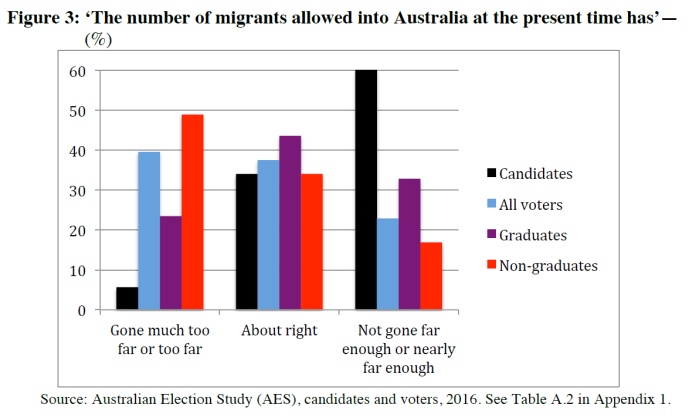
betts a2

Among all voters, more think things have gone too far than think there hasn’t been enough migration.  On the other hand, a majority favour either keeping things at the current high level or increasing immigration further  (the results are similar for the first question, the wording of which is more explicitly flow-based).

But what is most striking is the contrast in views between voters and candidates.   60 per cent of candidates favoured further increasing Australia’s rate of immigration while only 6 per cent favoured a reduction (a net 54 per cent favouring an increase).   By party, that result is massively dominated by Labor and Greens candidates, with Coalition candidates more evenly divided.    By contrast, among voters a net 17 per cent favoured a reduction, and among non-graduates a net 32 per cent favoured a reduction.

It will be interesting to see the results of any immigration questions in the New Zealand 2017 Election Survey, including the results by party.  In last year’s election, two of our now governing parties campaigned on policies intended to have the effect of reducing immigration (one half-heartedly, and one not very specifically).

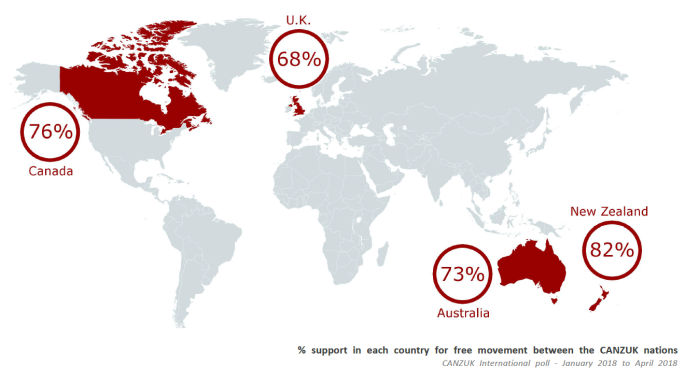
The other poll results were from the UK-based CANZUK International, which has been calling for free movement between Australia, Canada, New Zealand and the UK.  In New Zealand, some pro-immigration advocates –  including ACT’s David Seymour – have been championing the cause (and I noticed these results thanks to Eric Crampton of the New Zealand Initiative).

This was the question posed in New Zealand (country names re-organised according to which country is being polled)

“At present,citizens of the European Union have the right to live and work freely in other European Union countries. Would you support or oppose similar rights for New Zealand citizens to live and work in Canada, Australia and the United Kingdom, with citizens of  Canada, Australia and the United Kingdom granted reciprocal rights to live and work in New Zealand?”

And this is their summary graphic.
CANZUK

Pretty overwhelming support in all four countries (at least as the question is worded).  Interestingly, support is strongest in New Zealand –  perhaps because New Zealanders have been the biggest beneficiaries in recent decades of freedom to go to another of these countries (Australia)?

I’ve never been quite sure what to make of the CANZUK cause. I read a lot of imperial/Commonwealth history, and ideas like this sort of free movement area among the old ‘white Dominions’ are strikingly reminiscent of calls for an imperial federation or, much later, for imperial trade preferences (which became a big thing as the UK moved away from free trade itself).  I could be a little provocative and suggest that is wasn’t entirely dissimilar to the sort of immigration policies New Zealand and Australia ran until a few decades ago, that could be  –  not entirely inaccurately –  characterised as “white Australia” or “white New Zealand” policies.  In that sense, I’ve always been a bit puzzled by Eric Crampton’s enthusiasm for this particular formulation, when he is so ready to characterise sceptics or opponents of New Zealand’s current immigration policy as “xenophobes”.   The logic of his position looks as though it should favour open borders more generally, not just among these four advanced, fairly culturally similar, countries.  And yet, for example, even as an example of Commonwealth sentiment, not even South Africa –  let alone Zimbabwe, Kenya or Namibia – appears in the CANZUK proposal.

Of course, there is a pretty straightforward answer.   Almost invariably, public opinion in almost any country is going to be more open to large scale (or at least unrestricted) migration when it involves culturally similar countries than when it involves culturally dissimilar ones. In fact, there are good arguments that, if there are gains from immigration they could be greatest from people with similar backgrounds (and of course counter-arguments to that).  Reframe the question as “would you support reciprocal work and residence rights among New Zealand, France, Belgium and Italy?”, and I suspect the support found in the CANZUK poll would drop pretty substantially –  my pick would be something no higher than 50 per cent.  Reframe it again to this time include Costa Rica, Iran, and Ecuador (let alone Bangladesh, India, and China –  three very large, quite poor, countries) and people will start looking at you oddly, and the numbers will drop rapidly towards the total ACT Party vote (less than 1 per cent from memory).

And thus my own ambivalence about the CANZUK proposition.  If I were a Canadian (of otherwise similar Anglo background to my own) I’d say yes.  The historical and sentimental ties across these four countries –  less so Canada –  mean something to me.  I’d probably even add the US into the mix.  And across Australia, Canada, and the UK incomes and productivity levels are pretty similar –  although the prediction would still presumably be that there would be an increased net flow of people from the UK to Australia (in particular) and Canada.  As it is, I’ve repeatedly noted that my economics of immigration argument doesn’t distinguish between whether the migrants come from Birmingham, Brisbane, Bangalore, Buenos Aires, or Beijing.   We’ve made life tougher (poorer, less productive) for ourselves by the repeated waves of migrants since World War Two –  in the early decades, predominantly from the UK, and in the last quarter century more evenly spread.  Even though we are now materially poorer than the UK, enough people from the UK still regard New Zealand as attractive, that free movement – the CANZUK proposition –  would probably see a big increase in the number of Brits moving here (big by our standards, not theirs).  That might be good for them –  that’s up to them –  but wouldn’t be good for us.  Perhaps the effect would be outweighed by more New Zealanders moving to the UK long-term, but I’d be surprised if that were so.

The CANZUK proposition is an interesting one, and is worth further debate.  Apart from anything else, it might tease out what people think about nationhood, identity, and some of the non-economic factors around immigration (including some of those Wilson and Fry suggest).  As I noted, at present public opinion appears to be strongly in favour, but on the specific question asked in isolation.  It would be interesting to know, if at all, how responses would change if the option was free CANZUK movement on top of existing immigration policy, or (to the extent of the new CANZUK net flow) in partial substitution for existing immigration policy.   The two might have quite different economic and social implications.

Finally, on immigration-related issues, I recorded an interview yesterday with Wallace Chapman for broadcast on tomorrow’s Sunday Morning programme on Radio New Zealand.  It was prompted by a lecture I’m giving this week for Presbyterian Support Northern in their series on different angles on responding to (child) poverty –  mine being a focus on productivity.  My focus in the lecture isn’t on specific solutions, but rather on the need to make lifting productivity a top national economic priority, since in the longer-term productivity is the only secure foundation for much higher material living standards.  I’ll put up the text of my lecture here later next week, but the interviewer was more interested in possible specific solutions and thus quite a bit of our discussion was around immigration policy issues.   Not thinking very fast on my feet that day, I forgot to respond to his suggestion that higher minimum wages might be part of the productivity answer by noting that we already have one of the highest ratios of minimum wages to median wages anywhere…….and one of the worst productivity records over many decades.  Whatever the case for some mimimum wage, raising it is not part of the overall answer to fixing our productivity failures.


Revisiting the NZSF

There have plenty of stories in the last couple of days about the expressed wish of the New Zealand Superannuation Fund to become owner, or part-owner, of new light-rail projects.

There has been a range of reactions, from the gushingingly enthusiastic to the rather more sceptical.  Count me at the extremely sceptical end of that spectrum.  In fact, it is the sort of story that confirms – again – my longheld fears about NZSF.

Towards the gushing end of the spectrum was Stuff politics journalist Henry Cooke, whose piece ran under the heading “Super Fund gives huge vote of confidence to light rail plans”, when it is nothing of the sort.

This is a massive vote of confidence in the viability of the project from some of the savviest investors in the country.

But

Their proposal would see another huge sovereign wealth fund – Quebec’s – join them in a consortium to build, operate, and own the lines in perpetuity. Exactly how they would get a return on that investment is unclear at this point,

No doubt this is true

Politically this is already a win.

And even Cooke recognises the political nature of all this

By making a proposal on such a political project the Super Fund is making something of a political bet

Concluding that

For today though, this is a vote of confidence from the kind of person left-wing governments usually find it very hard to get votes from: high powered investors. They’ll take it with a smile.

I’m sure the government is delighted.  As their predecessors were when the NZSF and ACC teamed up –  off-market of course – to take part-ownership of Kiwibank, without actually providing any fresh expertise, and in the process reducing the transparency and accountability around (what is still 100% state-owned) Kiwibank.  But in the end these are votes of confidence from public servants, who know which side their bread is buttered on.

As I’ve written about here previously, NZSF aren’t great investment gurus.  They’ve made quite a lot of money taking big risks in a strongly rising global market, but the returns relative to risk, or to taxpayer’s cost of capital haven’t been particularly attractive and –  as even NZSF will acknowledge –  markets go down as well as up.   As for light-rail projects, the NZSF statement noted that around 2 per cent of the Fund is in infrastructure assets worldwide.  That doesn’t suggest any particular expertise in light-rail –  and they don’t point to any in the statement.   And almost any government project can be made viable for an investor if the associated contracts are skewed sufficiently favourably in the investor’s direction.

So this unsolicited (but no doubt welcome) expression of interest isn’t any sort of vote of confidence, and is probably better seen as a fishing expedition, doing what the Fund seems to be good at, playing politics.    Perhaps under the heading of “it is New Zealanders’ money” the NZSF can get a better deal from the government than others might (as NZSF and ACC presumably got a good value-transfer deal on Kiwibank, since no one else was allowed into the mix); perhaps the government might like the idea of an “arms-length” investor rather than putting in money directly and being directly accountable for the results.  Perhaps it will all come to nothing, but NZSF will have shown willing, and earned itself more political brownie points.

We also saw NZSF playing politics last year, with their decision to substantially reduce the carbon exposure in their portfolio.  Reasonable people might debate the economic merits of the judgement they took (I never found the arguments in the internal papers they released overly persuasive), but if it was simply an active management issue –  a bet on where markets would go over the next few years –  they’d have left their benchmarks unchanged, and enabled citizens to monitor risk and return on the punt they’d made.  They didn’t of course –  they claimed credit for the speculative call (which was no doubt popular with many voters, and with Labour/Greens –  and buried it in the benchmark itself, in ways that make it very hard for anyone to check whether it was a good economic call. I wonder if they are even monitoring it themselves, or whether they even care.

On the specifics of the latest NZSF initiative, my view was much closer to this

Retirement policy expert Michael Littlewood said he groaned inwardly at the news the Super Fund wanted to fund two new light rail networks.

He said light rail had a reputation for never finishing on time, cost over-runs and not making money unless it was subsidised by the taxpayer.

“Is this going to add to the security of New Zealand’s future payments of New Zealand Superannuation? I would have thought not.”

Littlewood said the Super fund was taxpayers’ money and if the rail was going to be paid for by taxpayers it should be done so directly.

“I’m not sure what the Super Fund adds to this process.”

Littlewood who co-authored a report last year that called for the fund to be dismantled, said private investments such as this would make that harder to do.

If there was ever a case for NZSF – something I’m not persuaded of (preferring the government to simply run down its debt, and leave investment risk-taking to citizens and private entities) – it had to involve scrupulously avoiding domestic politics.  It was the attraction of a passive approach to investment (hugging the respective indexes which –  among other things –  keeps costs down), mostly in offshore market.

Avoiding politics was always only going to become harder as the Fund got bigger.  I recall during the 2008/09 recession –  when the Fund was smaller than it is now –  the number of idealists and opportunists who were dreaming up schemes that the money in the NZSF could be steered towards.  It will be the same next time round, and the path NZS has been going down over the last few years of its own initiative –  Kiwibank, carbon, and now light rail –  will only increase the risk. And the pressures come from both sides.   People outside will badger governments and the Board/management with clever schemes.  On paper, NZSF is well-insulated.   But people in management and on the Board will have incentives to want to be well-regarded in the community, to be players, and to win and retain political allies.  For not many of them – Board or management –  will these not be the last jobs, last appointments, they are pursuing.   And if they can do it with sweetheart deals –  serving the interests of the government of the day, and of the Board/management but not necessarily the people of New Zealand – all the better for them individually: the return numbers can continue to be flattered, even though some of its returns to connections and to lobbying (often just a transfer among different taxpayer pockets, with lots of fees dripping off the side), not to raw investment expertise.

I’ve written in several recent posts about insights and arguments from the new book, Unelected Power, by former Bank of England Deputy Governor, Paul Tucker.  Tucker’s own expertise is in central banking, but part of the value of the book is in the way he seeks to develop a framework for thinking about the conditions under which it does, and doesn’t, make sense for government functions to be delegated to independent agencies, and the sorts of accountability mechanisms that need to be in place when such delegations are made.   Reflecting on Tucker’s delegation criteria, NZSF increasingly fails that test.

Tucker’s first criterion is whether the goal can be specified.  NZSF probably passes the test: the goal is something like maximising medium-term risk-adjusted returns.

But the second is more questionable:  “Society’s preferences are relatively stable and concern a major social cost”.   Even sticking to narrow business of investment, it isn’t clear that preferences are stable.  Sticking the money in, in effect, a big index fund is one thing, but plenty of people don’t (now) want carbon exposures, others don’t want whale exposures, others still won’t want weapons exposures, or tobacco exposures.  And others just won’t care.  (Views on NZS itself, of course, vary widely, even in the same political party from election to election.)

That relates to Tucker’s fourth criterion, that the independent agency will not have to make big choices on distributional trade-offs or society’s values, or that materially shift the distribution of political power.  When there is a big pot of money that politicians can quietly encourage their appointees to steer in ways that serve political ends, the case for independence is pretty weak.  No one is compelled of course, but it is a case of a double coincidence of desires.

The third criterion was “is there a problem credibly committing to a settled policy regime?”.  This was a key argument for an independent central bank.  It isn’t obviously an issue when it comes to an investment fund of this sort (where the amounts put into the Fund are determined politically).

The fourth criterion is not that relevant here: is there good reason to expect the policy instruments to work, with a relevant community of experts outside the institution.  Active management won’t make much money (if any) except by chance, but passive management can be expected to generate returns commensurate with the risk taken.  Unfortunately, of course, risk to the independent agency’s returns can be mitigated by within-government favourable deals.

The sixth criterion is that the legislature should have the capacity to oversee the independent agency’s stewardship adequately, and to assess whether the system is working adequately.  In almost no instance do our parliamentary committees provide the sort of effective scrutiny this sort of regime really requires for the cause of democratic legitimacy (a point I want to come back to on the Reserve Bank case).  NZSF doesn’t seem to be any sort of exception.

Politicians will make calls –  good and bad.  Often enough they will waste our money, perhaps with the best intentions in the world.  Sometimes they’ll do good with it.  But the key consideration there is that we can toss the politicians out –  or re-elect them if we reckon they are doing a good job.  We have no such ability to discipline the management or the Board of the New Zealand Superannuation Fund.  That is, of course, by design –  it is how the legislation is set up –  but it doesn’t make that design any more appropriate or legitimate.  And the behaviour of the Board/management indicates that this isn’t just a theoretical concern, but a practical one.  Anyone can see this light rail expression of interest as, in no small part, a political one –  even enthusiastic Henry Cooke recognised that.     That should be no business of an allegedly apolitical government agency, but the corrosive incentives –  such a big and growing pot of money to manage, so many vested interests keen to profit from dealing with the Fund –  seem to make it all but unavoidable.

We don’t need a New Zealand Superannuation Fund: the Crown has no vast stores of net financial wealth that need managing, the risk-adjusted returns are no better than average, and despite the name the Fund is just another pot of government funds, doing nothing for the affordability of public pensions.  All too much power –  over your money and mine –  is vested in the hands of people who themselves face little or no effective accountability, and such accountability as they may feel seems more often served by responding to the interests of governments of the day (of whichever stripe), or feel-good public moods.  Money-pots are dangerous things, in the hands of politicans or those who see their interests aligned to preferences of politicians.  As Michael Littlewood argues, and as I’ve argued previously  – it is past time to wind up the NZSF, using the assets to repay government debt.    If it is to be retained, the mandate should be revised to require them to stick closely to relatively liquid traded assets, and ones with little or no connection to New Zealand governments.


Something of a mixed bag

The Monetary Policy Statement was released this morning, followed by the Governor’s press conference.  It was less entertaining than I’d feared, and he mostly stayed on mandate – albeit drifting off onto answering several questions about bank conduct (with no real attempt to tie his rhetoric to the Bank’s statutory responsibilities) rather than monetary policy.  Then again, the journalists seemed to give him a fairly easy time.  I’ll come back to some of the comments and questions a bit later.

I heartily commend the Bank on one thing.  This is from the first paragraph of the MPS

The direction of our next move is equally balanced, up or down. Only time and events will tell.

That puts them in a quite different place than the financial markets as a whole, or than respondents to the Bank’s survey of expectations, where almost everyone is convinced the next OCR change will be an increase.  After my post yesterday on the Survey of Expectations, the Bank sent out to respondents their slightly more detailed report.   That showed that none of the 41 respondents expected the OCR a year from now to be lower than it is today (I do, but although I printed off a copy of my answers, I seem to have omitted to submit them).    Sure, each individual respondent will have a probability distribution around their own responses, but it is a telling contrast to the Bank that not one has a central expectation of a lower rate.  Presumably the Governor’s willingness to be so upfront about this even distribution of risks over the next year or two (albeit not substantively that different from the line the Bank has taken previously) will have contributed to the fall in the exchange rate this morning.

That said, I’d issue the same caution as I’ve made previously. The Governor claimed, in his very first line that

The Official Cash Rate (OCR) will remain at 1.75 percent for some time to come.

“Will” is a very strong statement in a very uncertain situation (domestically and globally).  Wise central bankers don’t hold themselves out as knowing more than they do.  The Governor’s hunch at present might be that the OCR won’t change for a while, but he doesn’t (and can’t) know that much, and bald statements of this sort risk leaving the Bank more unwilling to move quickly (up or down) than might prove warranted.  The contrast with the modest tone of current RBA statements is striking.

We also had an outburst of transparency. The Governor told us that the decision to hold the OCR had had the unanimous support of his Governing Committee colleagues, and his internal Monetary Policy Committee staff advisers.    It is nice of him to tell us.  Graeme Wheeler did that once, apparently to buttress the case for the move he was then making, but then adamantly refused to release the same information about other (historical) decisions –  I discovered recently that the Ombudsman is still working his way towards a decision on my request that he review Wheeler’s decision.  Perhaps the new Governor could change courses and make this information routinely available, with a suitable (but modest lag).   Disclosure of information can’t threaten the national economic interest –  Wheeler’s assertion –  just when it happens not to suit the Governor for it to be released.

There was plenty of gush about the economy.  This line took me a bit by surprise

The recent growth in demand has been delivered by an unprecedented increase in employment.

But this is the chart of the HLFS employment (corrected for the series break in 2016).

HLFS E

Perhaps he just meant “unprecedented” since the last growth phase?

And amid all the talk about employment –  and the welcome (overdue) focus on labour market indicators –  the word “productivity”, and the near-complete lack of any growth it over recent years, appeared not once in the text of the entire document.  Nor in the Governor’s discussion of what he saw as puzzlingly low wage inflation.

In the course of the press conference, the Governor talked about his goal being to communicate better and more widely –  not just to “four bank economists” –   and about how the Bank would have to learn to communicate in plain English.  It is a laudable goal I guess, but it did sound a lot like the lines Graeme Wheeler was using only a few years ago.  Wheeler avoided one on ones with journalists of course (at least ones that might ask awkward questions), which Orr does not seem likely to do, at least in his early stages.  But Wheeler also made much of the number of speeches he and his staff were doing up and down the country in his early years.  Communication seems easy when you are starting out, and aren’t on the back foot.

I mentioned earlier that the Governor mostly stayed on mandate in the press conference.  There were a couple of small exceptions.  The first was when he was asked about what the obstacles were in the housing market, and his first clear simple response was “lack of affordable land”.   Graeme Wheeler was simply never that clear, and it was never clear if he actually appreciated the importance of the land issue and the associated regulatory failures.  Housing policy isn’t a matter for the Bank, but it is encouraging that the new Governor appears to recognise, at an analytical level, the core failure.   The other exception, which seemed to pass unnoticed (or not followed up anyway) was when the Governor suggested that with interest rates at current levels the government should be doing more investment spending.  Those aren’t calls for the central bank, on an issue where there will considerable partisan division of views.

Two aspects of the monetary policy responses puzzled and disconcerted me.

Bernard Hickey asked the Governor what he thought of the argument that central banks should be raising inflation now, so as to raise nominal interest rates, to provide more policy leeway in the next serious recession.   Orr’s rather glib response was that “I don’t think much of it at all”, suggesting that (a) central banks should just do what is right now, and (b) that there are other tools, methods and instruments.   Which is fine except that core inflation – even in New Zealand –  has been well below target for years so that, at least with hindsight, the central bank hasn’t been doing the right thing now.  Partly as a result market measures of inflation expectations are well below target.  And there is no other country where supplementary instruments (eg QE) have been so demonstrably successful that core inflation has quickly got back to target, even in a gradual recovery phase.   The Governor needs to get to grips with preparing more seriously for the next recession.  It will be along, perhaps before too long.

Perhaps even more startling, was his response when asked a question in which it was noted that Graeme Wheeler had failed to hit the inflation target midpoint, and Orr was asked whether he would be happy to be judged on his performance against that metric.  That seemed to set the Governor off in defence of his predecessors, claiming that the economy was in near-ideal cyclical sweet spot, and that he could not imagine a better place to start from as Governor.  A bit later he chipped in that he thought the Bank had been doing a ‘remarkable” job in forecasting core inflation –  a variable that hasn’t been anywhere near the explicit 2 per cent target since that target was put in place by Bill English almost six years ago.  I wouldn’t have expected him to criticise his predecessors explicitly –  although he more or less did so when discussing communications approaches –  but surely we should have hoped that the new Governor might have regretted that inflation had so persistently undershot, and committed to do everything in his power to avoid a repeat?   His failure to do so is a little disconcerting to say the least.    Even with a focus on employment/unemployment, the Governor’s own charts suggest that the labour market was allowed to run with quite unnecessary excess capacity for several years because the Bank misjudged the extent of inflation pressures.

Once again, we have a set of Bank projections that suggest things are just about to come right.  Productivity, for example, is just about to pick up, and so is inflation.  The Bank thinks that in two years time we will be almost back to 2 per cent inflation.  The problem, of course, is that the Bank has been running the same line for years now, and it just hasn’t happened.  Partly perhaps because he embraced the record of his predecessors, the new Governor gave us no reason to be confident that this time things really will be different.  That is quite a gap.

I see that ASB, continuing the plays on the Governor’s name, deems it an “Orrsome start”.  I wouldn’t call it an “Orrful start”, but if there are some encouraging aspects, there is plenty of room for improvement.  The Governor  –  being fluent –  seems to be prone to speaking a bit more quickly than he thinks.  Over time, that won’t necessarily serve him, or the Bank, that well.     But the absence of solid answers about why this time inflation really will get back to target –  in an economy that seems unlikely to grow even as fast as (the modest rates) managed over the last few years –  remains the most obvious gap.  Perhaps MPs could consider asking the Governor this afternoon about why we should believe him and his colleagues this time?

A generous subsidy championed by the beneficiaries

Reading the Herald over lunch, I chanced upon a story under the headline $50m PhD subsidy pays off.   That is the $50 million per annum subsidy put in place more than a decade ago that allows foreign PhD students to study at domestic fees (apparently a saving for them for more than $30000 per annum each), allows full domestic work rights for them and their partner, and free access for their children to New Zealand public schools.

The story says it is based on a new report from Education New Zealand.  Education New Zealand, of course, is not exactly a disinterested party.  It is the government agency that champions the export education industry.  In their own words

ENZ is New Zealand’s government agency for building international education. We promote New Zealand as a study destination and support the delivery of education services offshore.

But I went looking anyway and found the new report.  They got a research firm to produce it for them, not (as far as I could see) involving any new research themselves.

There didn’t seem to be a great deal in the ENZ report on the PhD subsidy scheme, but there was this

Since the introduction of the PhD policy in 2005, the number of international PhD students has increased, and now makes up 45% of all PhD students. Berquist (2017) finds indicators that suggest this policy has been effective, such as an increase in New Zealand’s research output, with the rate of citation of New Zealand research rising from 0.96% of the world average before the strategy, to 1.26 times the world average for 2010-2014. The academic impact of research from New Zealand is also rising; and at a rate faster than Australia. In addition, all eight New Zealand universities are now in the top 450 of the QS world university rankings, compared to three in 2005.

That sounded quite good –  to be perfectly honest I didn’t have any strong priors on the merits of this programme –  but it did leave me wondering why, if it was such a good deal for the universities, they didn’t just price PhD products this way themselves, rather than turn to the taxpayer for more subsidies?

Here was what the Herald article reported the university lobby as saying

Universities NZ director Chris Whelan said the subsidy gave NZ universities an advantage over their overseas counterparts.

“We don’t know of any other jurisdiction that does it,” he said.

“Lifting rankings has a flow through to our ability to recruit students, and our ability to recruit world-class academics, and our ability to collaborate with researchers overseas.

“It’s this that is really strongly contributing to the rankings of a university like Auckland and feeding that virtuous cycle which works to attract more international students.”

The fact that no one else runs a programme like this should probably be a red flag –  the more so, as it is now 13 years since New Zealand introduced the subsidy.  Call it marketing spending, or whatever other label you like, but if the university lobby is right surely there is no reason for them not to fund it from within their own resources: their own argument is that it generates a virtuous circle for them?

But I was still curious about the evidence in support of the claims.  In that ENZ quote there was after all a reference to “Berquist (2017)”.  So I tracked that paper down.

It turned out not to be journal article or anything of that sort, but a paper that had been given at a conference in Australia a year or two ago.  Which might be fine, except that as I flicked to the end of the paper it showed the author

Brett  Berquist,   Director  International,   The  University  of  Auckland

In fact, his entire career seems to have spent in doing/promoting/facilitating international education.

I’m not here to criticise Mr Berquist. He has a job to do, and a business to promote, and may well do it very effectively.  He just wrote a conference paper; it was ENZ that chose to use it as the evidence for the effectiveness of this (really quite large) subsidy scheme.  All that said, Mr Berquist didn’t exactly bring a detached “academic” tone to his conference paper.

In  our  international  education  industry,  where  many  people  have  chosen  this  line  of  work  from  a   deep  personal  conviction  or  experience,  we  sometimes  seem  to  assume  that  the  general  public   shares  our  logical  views,  even  if  they’ve  not  had  our  personal  experiences  of  what  a  powerful   and  beneficial  force  international  education  can  be.

Subsidised industry =  logical views.  Anyone sceptical, presumably not so much.

I suspect there are plausible arguments to be made on both sides of this particular issue.  It is plausible that by means of this subsidy we end up attracting to stay some highly-skilled and innovative migrants who otherwise wouldn’t have considered New Zealand.  But even if so, we really need a proper cost-benefit analysis, because the upfront cost per person isn’t small and (according to the paper) the typical person finishing their PhD on this programme is already in their 30s.  On the other hand, there is the selection bias problem.  Really able people don’t pay fees to do PhDs at top overseas universities –  in fact, the top universities compete to get these people.  And since New Zealand universities aren’t top tier (even in many individual subjects), and we are offering a cheap programme, with attached work/residence points rights, it might be reasonable to wonder quite what quality the median foreign PhD student we are subsidising is.   I don’t know the answer.  And there might be some foreign students who really prefer Auckland or Victoria to Harvard, Chicago, NYU, Stanford (places young Reserve Bank economists have gone off to do PhDs at) or Oxford or Cambridge.     But, for now, we don’t seem to have the evidence.   It would benefit everyone –  well, perhaps not the universities –  for such in-depth research to be done by independent rsearchers.

I’m also a little puzzled about the reported cost of the programme.  The Herald article says

Numbers have leapt from less than 700 in 2005 to 4475.

The subsidy means doctor of philosophy (PhD) students at the University of Auckland pay only $6970 a year, the same as domestic students, compared with $39,529 for international doctoral students in education, fine arts, music and clinical psychology.

Nationally, the subsidy is budgeted to cost $50m in this financial year.

But if we now have 4475 foreign students doing PhDs, and are subsidising them each $32559 (on these Auckland numbers), that seems to multiply up to about $145 million per annum.  (And some of them would have been here anyway even without the subsidy –  arguably the better ones, for whom it was worth meeting the cost or who could earn the university’s own scholarships?)  And any domestic school fees, for those with kids, is on top of that.

Whatever the answer to that particular issue, for now one would have to say of the subsidy programme “case not proved”,  and take the Herald article with a considerable pinch of salt.  ENZ is probably always just going to produce as much propaganda as it can get away with, but I wonder if The Treasury has attempted a proper evaluation of the programme?


Towards the Monetary Policy Statement

Tomorrow brings the first of the Reserve Bank Monetary Policy Statements under the new Governor, Adrian Orr.  I’ve noticed several preview commentaries headed up with plays on the Governor’s surname: BNZ’s was “Either Or”, and ASB’s was “Rowing with a new Orr” .  I was tempted to head up this post with “Rowing with just one Orr”, a reminder that –  for all the promised new legislation (at least in respect of the monetary policy powers) –  for the time being, the Governor governs alone.  One unelected official alone has the legal authority to make OCR decisions –  and to decide on all the other bits of policy and operations the Reserve Bank has statutory responsibility for.   It isn’t a good formula –  failing tests of both legitimacy and robustness.  It isn’t helped by the threadbare nature of the parliamentary scrutiny of the Bank and the Governor.    In the terms Paul Tucker uses in his new book, the Governor is an ‘overmighty citizen’.

That isn’t Orr’s fault.  The law is what it (unfortunately) is, and perhaps will soon be changed.   But the conduct of the Bank, and the Governor personally, is something that Orr has totally under his control.    One of the things former Bank of England Deputy Governor Tucker advocates in his new book is that if central banks want to sustain operational independence, and if that independence is to work for the good of society, an ethos of self-restraint is really important.   It is reiterated in the very last line of his entire book

“Beyond the parameters of the formal regime, an ethic of sefl-restraint should be encouraged and fostered.”

Society delegates a great deal of power to our independent central bank.  It can do us good (we hope, typically) or harm, but unelected officials who exercise such great power need to act, and speak, as if they know their limits.  They aren’t politicians, they have no general mandate, and if they have a platform it is for the purposes Parliament has set down, not to champion personal causes, or even to “help out” governments in other roles.   It is a distinctly limited role.

In his first six weeks in office, there have already been reasons to doubt that the Governor understands, or shares, that view –  itself all the more important when (formally) the Reserve Bank is a one-man show.   We’ve seen him stray well beyond the Reserve Bank’s areas of responsibility in various interviews, and in ways that could often be read as quite politically-aligned.  We’ve seen him all over the place on financial conduct issues, and the politics of possible inquiries –  none of which has anything to do with his mandate –  including rushing to sign on with the FMA’s populist demands of banks, which again have nothing to do with the Reserve Bank’s statutory mandate or powers.   You can win cheap popularity for a time by going with the mob –  or even with popular elite opinions –  but you safeguard the institution and its important role, over the longer-term, by doing what Parliament asks you to do, in a moderate and responsible manner, and leaving other stuff to other people.

The real test for the Governor tomorrow is unlikely to be the Monetary Policy Statement document itself –  much as the analysts will be looking for evidence of a distinctive Orrian perspective.  The test is much more likely to be the press conference an hour later, and perhaps even the Finance and Expenditure Committee hearing later in the day.    Given the Governor’s garrulous style to date, journalists must be almost salivating at the opportunity to tempt the Governor into some rash remark, as he answers questions, live and unscripted, for a prolonged period.   Much of the rest of the Reserve Bank must be ever so slightly uneasy.

The BNZ commentary put it this way

…it goes without saying that Adrian Orr’s presentation style in the post MPS news conference will be more dynamic than his predecessor.

“Dynamic” perhaps being a euphemism for things like freewheeling, unpredictable, entertaining –  not words that (for good reason) one typically associates with a central bank Governor.   Leaders of political parties, yes; central bank Governors, no.  Central bank press conferences shouldn’t an occasion to which to bring the popcorn.

In many ways, I’m sure an Orr press conference will be a welcome relief after many of the Wheeler ones.  The previous Governor often came across as morose and defensive –  and even he wandered off reservation at times (I recall an answer about the possible implications of some North Korean action).  But I hope we don’t see an over-correction from an exuberant new Governor.  We should certainly welcome a more open and frank exchange on monetary policy issues, perhaps even a Governor willing occasionally to acknowledge the odd mistake, but unpredictable free-for-alls aren’t going to be good for the institution, for the individual, or for the country –  gruesomely entertaining as they might well be in the short-term.

One of the last bits of data before the MPS came out yesterday: the Reserve Bank’s quarterly survey of expectations (the Bank itself will have had the data several days earlier).  There wasn’t much of great interest in the the quarter to quarter changes.  But it is worth nothing that respondents seem to think we’ve reached the peak of the economic cycle: after eight years of expecting the unemployment rate to fall further over the medium-term, for the last few quarters they’ve been expecting things to turn around (albeit only a bit).

Looking through the longer runs of data, a couple of things caught my eye.  Analysts  (me included) often don’t pay much attention to year-ahead measures of inflation expectations, which get tossed around by all sort of short-term effects (oil price changes, changes in taxes and government charges, and even climatic effects on fruit and vegetable prices).  On the other hand, it is also a horizon analysts know a little more about –  there are specifics and not just models –  and a horizon where, by the time the expectation is being recorded, the Reserve Bank can’t do much more about the outcome.   So I thought this chart, showing year-ahead inflation expectations since mid-2012 was a sober reminder that monetary policy hasn’t been quite right.

infl expecs 1 year

Recall that the target was 2 per cent inflation.  These expectations – with all their short-term noise –  haven’t been centred on 2 per cent, but something a bit lower.  Not surprisingly, outcomes have also been centred somewhere lower: headline CPI inflation averaged about 1 per cent over this period, and even the Bank’s preferred core inflation rate measure averaged 1.4 per cent.   So even at these sorts of short horizons, the analysts have had an upside bias to their inflation forecasts, and even those forecasts haven’t centred at 2 per cent.  Perhaps a question might be in order for the Governor tomorrow?

I was also interested in another longer-run chart.  The survey asks respondents where they think the 10 year bond rate will be at the end of the current quarter, and in a year’s time.  The difference between those two responses is an indication of how respondents think the underlying trends in interest rate markets will start to play out.  Here is a chart of the actual New Zealand 10 year bond yield going back to 1995 when these survey questions start,

10 yr bond may 18

There are cycles, of course, but the trend has been pretty clearly downwards, especially so since around 2011.

And yet here is what respondents to the Reserve Bank survey expected.

bond expecs

The expected changes are never that large, but what is interesting is the sign of the expected movement.  With the exception of pretty brief periods when domestic interest rates here were particularly high (mid 90s and the couple of years prior to the 2008/09 recession) the Bank’s respondents have persistently expected bond yields to start rising again.   Even the short-term variability in the series has been lower in the  post-recession period, such is the apparent strength of the view.     Respondents  –  no doubt like the Reserve Bank, which has repeatedly told us that in their view neutral interest rates are much higher than current rates –  have mostly just had the wrong model.  (I’m not sure what my views would have been in the early post-recession period, although they were probably similar to the consensus. I’ve been in the survey itself for the last three years and my records suggest that in none of those surveys have I predicted an increase in bond yields –  in all but one I picked a reduction.)

Quite possibly, similar surveys in other countries would have produced similar results, but it is a cautionary reminder of just how wrong the mainstream view has mostly been in the post-recession years.

Last year the Reserve Bank revised the survey to add questions about expectations of inflation five and ten years hence (previously we’d had only two-year ahead expectations).   It is still early days, but the results look much as you might expect: both five and ten year ahead expectations seem centred on 2.1 per cent, just a touch above the midpoint of the inflation target (my own expectations for these horizons, which stretch beyond the current Governor/government, are lower).  Two-year ahead expectations are about the same.   With current 10 year bond rates at around 2.8 per cent, and inflation expectations (in the survey) at around 2.1 per cent over the whole 10 years, respondents seem to think New Zealand real interest rates are very low (only around 0.7 percentage points).

But again we have the contrast between the recorded (and anonymous) views of local survey respondents, and the implied view of people putting money on the outlook for inflation.  The current 10 year nominal government bond yield features in both comparisons.

But what about our inflation-indexed government bond yields?  The 7.5 year bond was at 1.34 per cent yesterday, and the 12.5 year bond was at 1.7 per cent, suggesting a 10 year real government interest rate of around 1.5 percentage points.

And here is the gap between the yield on a 10 year nominal bond, and the two relevant inflation-indexed bonds.

IIBs may 18

There isn’t any sign that markets are trading as if they believe inflation over the next 10 years will average where the respondents to the Reserve Bank survey say it will.  Ten years from now is roughly halfway between those two indexed bond maturity dates: the latest observation of the average of those two series would be around 1.25 per cent.  People with a choice of holding indexed or nominal bonds to maturity (eg long-term superannuation funds) will be worse off holding conventional bonds if inflation is anything like what the survey respondents think than if they held indexed bonds.  It is a real money choice.  Bondholders are positioned consistent with the survey respondents being wrong.

I labour this point for two reasons.  First, one reason for having inflation indexed government bonds is to provide a market check on what people actually transacting are acting as if inflation will be (rightly or wrongly).  And second, because when it regularly tells us that medium to long-term inflation expectations are stable at around 2 per cent, the Reserve Bank relies on survey measures, and appears to put no weight on market measures at all, even though they are telling a quite different story (and in fairly settled times).  The Reserve Bank never attempts to justify this one-eyed approach, and never seems to reference market-based expectations measures at all.

Given that the Bank itself, and survey respondents, have been so persistently wrong about inflation (and about interest rates) it might be worth someone –  journalist or MP –  asking the new Governor tomorrow about whether he is more confident average inflation is finally about to rise than people staking money on the issue appear to be, and if so what is the basis for his confidence.  Open engagement on that sort of issue is just the sort of thing that might have people reasonably thinking more highly of the new Governor.

(In a similar vein, the Minister of Finance has promised that the minutes of meetings of the future statutory Monetary Policy Committee will be published in a timely way.  There would be nothing to stop the Governor taking the lead now and publishing –  tomorrow or with a lag of no more than a couple of weeks – the minutes of any meetings of his Governirng Committee relating to tomorrow’s MPS and the associated OCR decision.  Doing so would be a small, but telling, promissory note, a token foreshadowing a new era of greater transparency.)

Why not split up the Reserve Bank?

That is, deliberately, a slightly ambiguous title for the post.   I favour splitting the Reserve Bank in two, setting up a new New Zealand Prudential Regulatory Authority to pick up the regulatory and supervisory responsibilities the Bank currently has (subject to various refinement).   I’ve made the case here and here, and late last week highlighted my former colleague Geof Mortlock’s new article articulating the case for change.   We know that the Reserve Bank’s conduct of those functions isn’t highly regarded and the minutes (and OIA releases) suggest that the Reserve Bank’s Board –  paid to hold the Governor to account in the public interest –  were asleep at the wheel while this situation was developing.  All told, I reckon there is a pretty clear-cut case – in principle, and based on the actual track record – for structural reform.  Structural reform is never a panacea, but with the right will, and the political determination that things will be done better in future, it can play a part, making a demonstrable break with the past and establishing a new and better institutional culture.

But, of course, there are counter-arguments.  The Reserve Bank is likely to be making them forcefully at present.  I suspect the Governor’s populist participation in the current attack on the banks – not grounded in any of his own legislation, not related to any systemic soundness threats – may be a part of that effort, wanting to appear “useful” to the government and somehow “in touch” with some sort of “public mood”.  (If so, that in itself should be grounds enough for structural and personnel changes.)

If I were the Bank I would probably be trying to arrange a visit from (Sir) Paul Tucker, former Deputy Governor of the Bank of England, who has just published a new book Unelected Power, on the delegation of economic powers to independent agencies, with a particular focus on central banks.  Despite his background on the markets side of the Bank of England, Tucker didn’t leave officialdom to make money in the financial sector, but instead turned to academe and has produced an impressive book.  I’ve already referred to it in a couple of recent posts, and expect to do so in a few more relevant to the current efforts to overhaul the Reserve Bank Act.    As one UK commentator recently described it

….it is mainly about central banking, and on this is it authoritative. It will be an essential read for everybody involved in monetary policy, or researching it.

Not by any means will everything he writes be music to the ears of our central bankers, but Tucker’s views on the structural separation issue will be.  Perhaps that isn’t too surprising, since he was Deputy Governor at a time when the British government was bringing the financial sector supervisory and regulatory functions back inside the Bank of England (albeit with separate government-appointed decisionmaking structures for the various functions).  The Bank of England model informed Iain Rennie’s report last year, and if a decision is finally made to leave all the existing Reserve Bank functions together a structure like that of the Bank of England (but slimmed down for our circumstances) would probably be the way to go.

Tucker doesn’t argue that the regulatory and supervisory functions have to be in the same institution as monetary policy but that, subject to certain important conditions, it is better if they are.    To my mind, one of the weaknesses of his book is that it is very focused on the US and the UK (with some discussion of ECB/Europe but the issues are very different there given the idiosyncratic relationship between the ECB –  set up by international treaty and not really very accountable to anyone –  other EU institutiuons, and the national states of the EU/eurosystem).  Thus he simply doesn’t engage with the experience of the many other advanced countries – in fact, most of those outside the euro –  where the primary role in prudential regulation/supervision is undertaken by an entity other than the central bank.   This was the list of such countries I ran the other day

Canada, Australia, Norway, Sweden, Korea, Japan, Poland, Chile, Turkey, Mexico, Switzerland, and Iceland

It is a mix of large and small, of countries with very big financial systems operating internationally and countries with mostly domestic banks, of countries where the split has been longstanding (eg Canada) and countries where it has been more recent (eg Australia), and countries that ran into financial crisis in 2008/09 and countries that did not.  I’d find Tucker’s claim for the superiority of his model (essentially the UK one) more compelling if he’d addressed the experience of some of these countries.

As I read his material on this issue, it seemed to me that Tucker had two main arguments for keeping prudential supervision/regulation and monetary policy together.

The first of these is about the central bank’s lender of last resort function (for which the relevant statutory provision in our legislation needs refinement).  A central bank is the only agency with the unquestioned ability to provide immediate liquidity to an individual bank, or to the system as a whole, when severe liquidity pressures arise –  whether it is a run to physical cash, or simply a freezing up of interbank markets leaving some players unable to operate with external injections of liquidity.     Failure to respond to systemwide increases in liquidity demand will, all else equal, be likely to result in the central bank falling short of its inflation target (through the resulting financial crisis and economic shakeout).  Provision of liquidity, and a responsiveness to changes in demand, is an integral part of modern central banking (even though the stress events may not occur even as frequently as once a decade –  in the New Zealand case, Y2K and the liquidity pressures around 2008/09).

Liquidity provision usually involves either buying assets outright from a bank, or lending on the security of those assets (mainly repo agreements).  That is easy when it involves the outright purchase of a well-known widely-traded asset like a government bond.  But it gets trickier when it is a loan (in economic substance, if not legal form) and when the assets involved are pretty opaque and not generally traded at all, and when the general injunction –  enshrined in legislation in some countries –  is that central banks should only lend to solvent institutions (solvency here being a positive net assets test, not an “ability to meet payments as they fall due” test).    To caricature just slightly, Tucker argues that a PhD in macroeconomics won’t be much use in enabling a central bank to decide whether or not to provide funds to a bank that comes knocking.  You need, instead (or as well), detailed banking and credit expertise.  Specifically he notes

Even opponents of “broad central banking” generally accept that, as the lender of last resort, the central bank cannot avoid inspecting banks that want to borrow.

Going on to argue that

A central bank must be in a position to track the health of individual banks during peacetime if it is to be equipped to act as the liquidity cavalry.

I’m not persuaded, for a number of reasons.  First, of course, we don’t “inspect” banks in New Zealand at all (but that is trivial point).   Second, clearly many countries operate with exactly the sort of model Tucker deems impossible or inadmissible (presumably by relying on some peacetime exchange of information, and wartime written recommendations or assurances from the prudential regulatory agency).   Third, the central bank making the decision to lend is not the only option: it would be possible to envisage a model in which the central bank was simply the operational agent, but the credit risk from any crisis support to an individual institution was taken directly by the government, on the advice (and analysis) of the prudential regulatory agency.   And, finally, LLR powers aren’t the only relevant ones.  In the 2008/09 crisis, perhaps the most important single regulatory response in New Zealand was the deployment of the Minister of Finances’s extensive guarantee powers (under the Public Finance Act).    The Minister of Finance doesn’t do prudential supervision, and to the extent he needed comfort that any institutions guaranteed were likely to be solvent, he had to rely on advice from officials.  In this case, it was primarily the Reserve Bank, but it could as easily have been advice from a Prudential Regulatory Authority.   The same goes for choices (regrettable as they may be) to bail out individual institutions.

My claim isn’t that there can never be any advantages in having prudential supervision and central bank liquidity operations in the same entity, just that the case for them to be so isn’t generally compelling once set against the other arguments for structural separation.  In a crisis, it is typically all hands to the deck (including, for example, the Treasury and the Reserve Bank working together, even though they are separate institutions) and. more generally, there are numerous examples of interagency arrangements for information sharing.   It is undoubtedly important for all relevant agencies to coordinate closely, and have in place appropriate protocols and be prepared to run exercises to war-game the handling of crises.  But the functions don’t all need to be in the same agency, and there are likely to be costs in normal times to having them all together.

One point Tucker touches on elsewhere, but not here, is the importance of having people running functions believing in them.  It is, for example, dangerous to have financial supervision (or AML) in an institution where the chief executive doesn’t really believe in the importance or value of the function.  Reasonable people could argue that that –  rather than separation –  was part of the UK’s problem in 2007: the then Governor, Mervyn King, seemed quite averse to lender of last resort responsibilities, even though they were still an intrinsic part of the powers assigned to the Bank of England.

Tucker’s other main argument for keeping prudential and monetary policy functions together is one he lists under a heading “Harnessing the authority of the central bank”. noting that

If an economy’s central bank is already endowed with both authority and legitimacy, giving it responsibility for stability might be preferable to the uncertainties of starting afresh. In particular, the risks of industry capture might be reduced, as monetary policy makers’ standing in the community does not depend on bankers.

I’m not even persuaded by that final sentence – too many central bank policymakers have seen their post-central bank opportunities being among the bankers (just among Governors, Glenn Stevens, Ian Macfarlane, Ben Bernanke).     Tucker’s argument appears to be made in the UK context, where the prudential functions were split out of the Bank of England after 1997, into a new standalone prudential agency.  Perhaps the FSA never had the prestige of the Bank of England but it isn’t obvious that the problems the UK ran into were a reflection of lack of prestige or legacy legitimacy.  Political emphasis on promoting the financial sector was a significant part of the story.  And the Bank of England’s own analysis of the emerging macro risks didn’t exactly cover the institution in glory.

But, perhaps more importantly, there are other case studies.  The Reserve Bank of Australia had been around for decades when APRA was split out of it. It looks to have been a pretty successful split, and it isn’t at all obvious now that the RBA enjoys any greater authority or respect in its areas of responsibility than APRA does in its.   And, given the feedback on the Reserve Bank of New Zealand’s regulatory stewardship, I don’t suppose anyone would want to mount a serious argument here to leave the functions together because the Reserve Bank’s reputation and authority stands so high.

As it happens, Tucker isn’t too keen on New Zealand’s contribution to public sector management, including the notion (from the New Public Management literature of the 1980s) that one function per agency helps to enhance accountability.

In the UK, I suspect that NPM was a subtle (and baleful) influence on the 1997 decision to transfer prudential supervision away from the Bank of England.  That mattered beyond Britain’s shores. Given London’s position as a global financial centre and given that various other countries, including China and Korea, followed the UK, at least in some cases probably encouraged by the IMF, the UK contrived to put the world onto a false, even delusional, path,  Administrative fashions come unstuck eventually, and this one did spectacularly.

Methinks he doth protest too much  (even as he goes on to note that there are hazards in having the functions together).

He highlights one issue which I hadn’t given much thought to, arguing that if the central bank is to be responsible for both monetary policy and prudential supervision it needs to have the same degree of autonomy in each function.  He argues that if the central bank has less authority in supervisory areas than in monetary policy, it could provide a wedge through which politicians could exert pressure on the Bank over monetary policy.  I’m not so sure that is right or that, realistically, it is that important an issue especially if (as he insists) each function has its own statutory committee, and its own direct accountability.

But if there is something in what Tucker says, it would reinforce my doubts about keeping the functions together.  At present, in the New Zealand system the PTA is set every five years (and central bank budgets too), and beyond that there is no routine ministerial involvement in monetary policy.  On the regulatory side, plenty of powers are reserved to ministers (eg around failure management, AML, the rules of non-bank deposit takers, disclosure rules for banks) and as I’ve argued here before the Reserve Bank still has too much discretionary policymaking power over banks (LVR limits, with significant distributional consequences are a good example –  and one Tucker seems to have quite a lot of reservations about).  As I read him, he would favour delegating more policy power to the central bank in the supervisory/regulatory area.  Personally, I think there is a good case for giving the regulator less power, and for a clearer delineation between setting the rules of the game (politicians) and implementing them (independent agency).  And keeping the functions in separate institutions will make for stronger effective accountability –  a key theme of Tucker’s –  than two or three committees with the Governor and his Deputy sitting on all of them.  You can only fire – or not reappoint –  a Governor once.

One of reasons Tucker worries about differing degrees of independence is that it would not ‘be conducive to successful institution-building’, citing the way in which the Greenspn Fed looked down on supervisors as a “lower form of life”.   Again, I’m not sure I fully buy the argument –  it is more about the priorities and beliefs of the people at the top than about formal statutory remits –  but as both Geof Mortlock and I have argued in the New Zealand context, standalone agencies helps enable the creation of cultures of excellence in both institutions.   And even Tucker recognises that culture is one of the challenges to a multi-function central bank, even if both functions have equal statutory importance.

In many cases, these aren’t open and shut issues.  There are different models around the world, although on my reading in most advanced countries –  and especially most small ones –  structural separation is the route chosen.  It is far from obvious that the new British model is better than the old (only the next crisis is likely to test that), even if appropriately some issues have been clarified and powers refined out of the 2008/09 experience.  But in the New Zealand context, most of the arguments now line up pretty clearly in favour of structural separation, and the creation of a new standalone prudential regulatory agency, with powers, personnel, and governance/accountability structures specifically fit for purposes, rather than shoehorned into an institution designed primarily for a monetary policy role.


Auckland labour market outcomes: do any political parties care?

Among the various arguments advanced for why we should expect that large-scale government-led non-citizen immigration will prove economically beneficial to New Zealanders are claims about the labour market.

There are, for example, suggestions that the unemployment rate will tend to be (a bit) lower than otherwise, because ready access to offshore labour facilitates better skill-matching.  Larger labour markets  might work in the same direction –  easier for people displaced, or new entrants, to find jobs in a deeper more diverse market.

And there is the suggestion that average GDP per capita is likely to be raised just because the average immigrant is more likely to be of working age (few countries let in many 75 year olds). On this telling, even if there were no productivity gains (ie lifts in, say, GDP per hour worked) from large scale immigration, average incomes would be raised simply because of the implied higher rates of labour force participation.  In fact, this argument was run only a matter of weeks ago in an official Australian government document, a defence of Australia’s large-scale immigration programme published by the Federal Treasury and the Department of Home Affairs (the department directly responsible for immigration matters).  From page 27

After trending upward for almost three decades, Australia’s labour force participation rate declined from the early 2010s through to 2016 (Figure 22). This decline coincided with a large cohort of baby boomers reaching retirement, which weighed on Australia’s participation rate. Yet evidence shows that migrants, particularly skilled migrants, have helped curb the ageing of the population by boosting the labour force. Without the contribution from migrants, all else being equal, Australia’s participation rate would be lower than at present.

Many of these claims had initially seemed plausible enough to me.  In fact, in a major modelling exercise done for one of MBIE’s predecessor departments a decade ago –  and widely touted at the time –  the only overall economic gains from immigration resulted from this assumed higher participation rate.

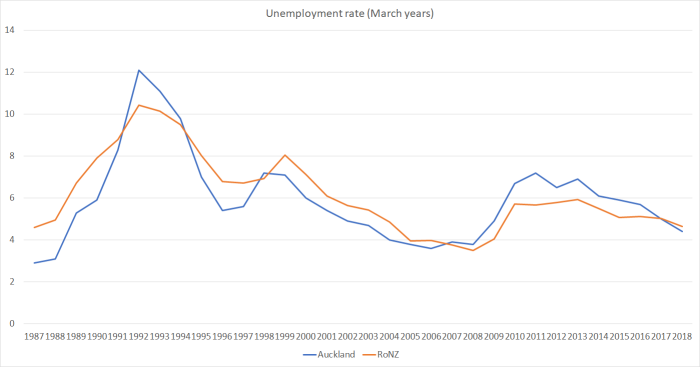
But a while ago I noticed that the unemployment rate in Auckland hadn’t been any lower than that in the rest of New Zealand.  This chart uses annual data, up to and including the latest release last week.

U rate akld and RONZ

Auckland is a good place to focus on. Not only is it by far the biggest labour market in the country, but it also has by far the highest proportion of foreign-born residents, and receives a disproportionate –  but not surprising –  share of the new migrants, temporary and permanent.    Labour market laws apply nationwide, but you might think that some would be a little less binding in Auckland than elsewhere –  for example, there is a nationwide minimum wage, but average productivity is higher in Auckland than on average in the rest of the country.  All else equal, again one might expect Auckland’s unemployment rate to have been a little lower than that in the rest of the country.

And yet over the 32 years for which we have the data there is no sign that unemployment rates in Auckland have been lower than those elsewhere.  There might be a bit of a cyclical pattern –  Auckland does worse in downturns (see early 90s, and the period from 2008 until recently), and better in periods of strong economic growth (and that cyclicality may itself be exacerbated by the large New Zealand cycles in net migration) – but there is no sign of much beyond that.

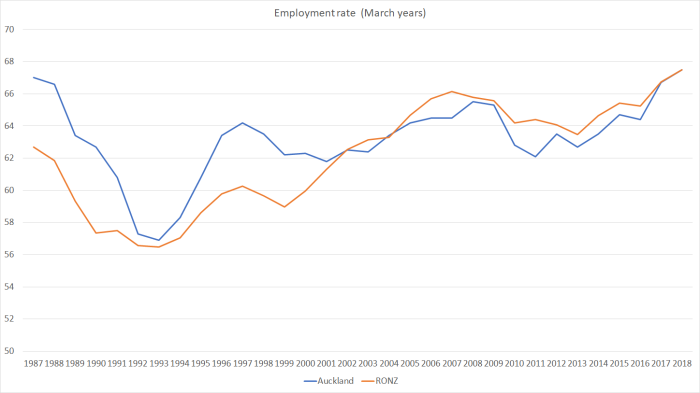
What about employment rates (calculated as the share of those aged over 15 in paid employment)?

E rates akld and ronz

Interestingly, employment rates in Auckland used to be quite a bit higher than those in the rest of New Zealand, but they aren’t now.    Perhaps the difference in the earlier period reflects differences in how the economic restructuring and reduction in trade protection affected different regions –  it seems plausible (although I’m happy to see any confounding evidence) that the initial job losses might have been more heavily concentrated outside Auckland, with the gap closing again over time.  Whatever the explanation for the earlier period, average Auckland employment rates have struggled to match those in the rest of the country over the last 15 years or so (periods encompassing two big waves of non-citizen migration).

And as I thought about it, this chart started to puzzle me more.  After all, the denominator is the population of working age, which includes all the elderly, and yet as the recipient of the largest share of migrants wouldn’t one expect Auckland’s working age population to be concentrated in the age ranges with the highest rates of labour force participation?   And there are the persistent stories of old people moving out of Auckland –  the money tied up in the overpriced house goes further in the provinces.

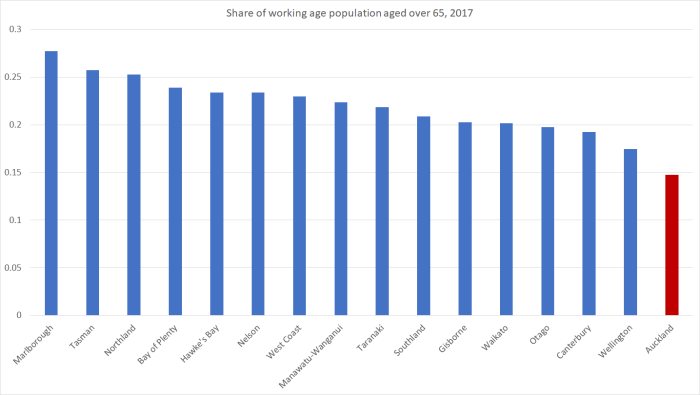
And, sure enough, here are the official estimates of the share of the working age population aged over 65 in 2017 (the numbers aren’t materially different from the firmer numbers from the 2013 Census).

over 65s wap

Auckland has by far the lowest share of its working age population aged over 65.  Across the country, those aged over 65 have an average employment rate of about 24 per cent, while for the working age population as a whole the employment rate is more like 68 per cent.    And yet, despite having so many fewer old people the overall employment rate in Auckland is no higher than in the rest of New Zealand taken together.

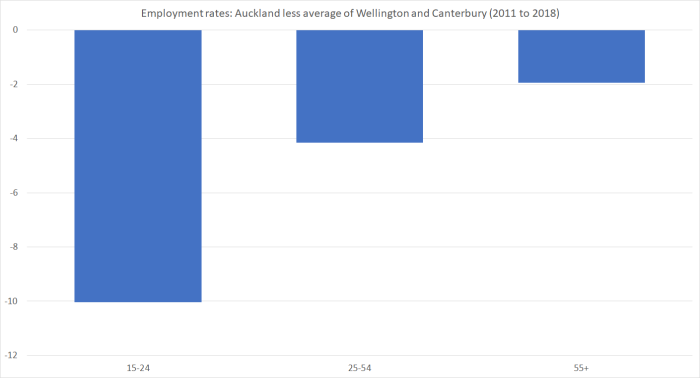
There isn’t a great of information about labour force status disaggregated by both age and regional council, but I did find some data for the last few years comparing Auckland and the Wellington and Canterbury regional council areas.

e rates by age and regional council

Even among the older cohort, employment rates in Auckland have been a little below those in Wellington and Canterbury (in not a single year was the Auckland rate higher than in either Wellington or Canterbury –  despite the smaller number of over 65s).  But in the younger cohorts the differences are quite a bit larger.   Perhaps some of the difference among the 15-24 cohort reflects the presence of foreign students (although many of them are working), but in the prime age cohort (25 to 54) the average employment rate in Auckland over the last eight years has been, on average, a full four percentage points lower than that in Wellington and Canterbury.

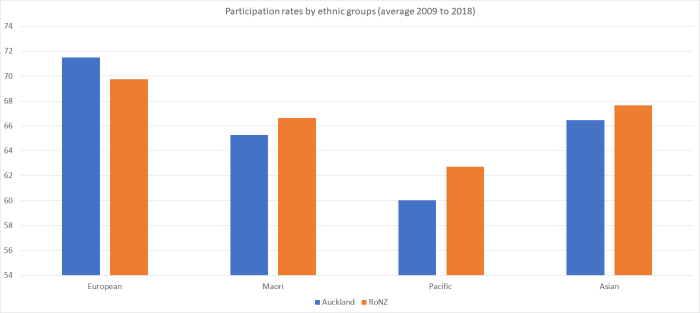
To be clear, this is a not a comment on the employment rates of recent immigrants (which may well be quite – even very –  high).  The HLFS simply doesn’t have that sort of data.  It is an estimate based on the Auckland economy as a whole.   And quite what explains it, I’m not quite sure.   For anyone wondering if the ethnic composition of Auckland’s population is part (cause or consequence) of the story –  whatever factors result in lower Maori and Pacific participation rates – here are the average participation rates for the last decade by ethnicity for Auckland and the rest of the country.

partic rate by ethnicity

European participation rates have actually been higher in Auckland than in the rest of the country.   But Maori and –  especially –  Pacific participation rates average materially lower.

Whatever the explanation, it isn’t obviously a story in which one of the largest non-citizen immigration programmes anywhere in the world, over decades, has produced an Auckland labour market that seems to be functioning in a way that might suggest economic gains across the board.  Unemployment rates are no lower than in the country as a whole, employment rates are materially lower once one allows for the much smaller number of old people in Auckland, and there might be straws in the wind (that final chart) suggesting that the ethnic groups that typically do most poorly in New Zealand anyway are even less likely to be engaged in the labour market in Auckland than in the rest of the country.

Throw in the data I mentioned the other day –  average GDP per capita in Auckland lower relative to that in the rest of the country than it was at the turn of the century, and the internal migration data suggesting that (in modest numbers) New Zealanders (net) are leaving Auckland – and it should leave the champions of current immigration policy very much on the defensive.  Unwilling or unable to fix the housing/land market, and with no obvious productivity or labour market gains to show for their Auckland-focused strategy, it increasingly looks like a Think Big disaster of a severity and pervasive effect (including on many of our most disadvantaged) that makes the 1980s version (the shockingly uneconomic energy projects) look like a mere bagatelle.

But, remarkably, no political party –  major or minor –  seems bothered.

(And before anyone pops up to remind me that I often point out that employment is an input not an outcome –  not, in itself, a measure of economic success –  that is, of course, true.  Nonetheless, there aren’t particularly good reasons to suppose that working age Aucklanders have stronger leisure preferences than otherwise similar people in the rest of the country –  faced with, eg, the same tax rates –  and some reason to suppose it might be the other way round (eg the sheer cost of purchasing a house).)

Misconduct

This week we’ve had the unseemly sight of leading public servants engaged in rank populism, publically demanding private companies prove their innocence of non-specific charges – and not in a court of law, but to the satisfaction of the “prosecutors” themselves, Adrian Orr and Rob Everett (with apparent encouragement from the Minister of Finance).  In the new Governor’s case, it wasn’t as if he’d even managed to keep to the same line from one week to the next: in interviews a couple of weeks ago he wanted us all to know that New Zealand was different and there wasn’t anything to worry about, but by this week he’d jumped on board –  perhaps not wanting to be left out –  with the chief executive of the Financial Markets Authority and was “demanding” answers from banks.

In the Governor’s case, the legislation he works under appears to give him no basis for such actions or demands –  his banking supervision powers are about the maintenance of a “sound and efficient” financial system, not about market conduct.   And independent central bankers –  overmighty citizens at present, with all that power in one man’s hand –  are well advised to stick to their knitting, the powers and responsibilities Parliament has specifically delegated to them.  Cheap populism is a dangerous path to take in pursuit of some faux legitimacy.    I’m much less familiar with the FMA’s statutory powers, but it is pretty unseemly to have public servants leaping into the public domain demanding that private companies justify themselves (with no specific charges or allegations) to them.   We are suppposed to be ruled by laws not by men, and just because Australian-owned banks aren’t overly popular in some quarters doesn’t exempt them from those precepts and protections.

Of course, the Governor and the FMA chief executive playing populism sets up its own equally unappealing set of responses.  The Bankers’ Association has published an open letter they sent back to Orr and Everett which is full of shameless pandering.  There was this

“Ultimately decisions about regulatory responses rightfully rest with you, and you have our commitment that we will support any response”

But

(a) none of this has anything to do with the Reserve Bank and the legislation it operates under,

(b) the FMA does not set its own regulations, but operates under legislation passed by Parliament and regulations promulgated by ministers,

(c) Royal Commissions, a la Australia, are entirely a matter for elected politicians, and

(c) no serious person is going to commit to support just any regulatory response, with no idea what form such responses might take.

There was also this

Proactive agenda of regulators: The New Zealand regulatory framework enables regulators to act dynamically and quickly before issues become significant, compared to the slower, less agile pace witnessed in Australia……We have also seen that foresign and adaptability in RBNZ’s use of loan-to-value lending restrictions, which proved effective in managing the escalating housing market and the associated economic risk.

Let me throw up now.

I’m still in the camp that thinks it inherently unlikely that matrix-managed subsidiaries of Australian parents are doing things that much differently here than in Australia (and, after all, the BNZ’s new chief executive has been part of the NAB Executive Leadership team for the last few years).  But evidence would be a good basis for regulators (those with suitable powers and responsibilities) to start inquiries, not highly-publicised populist fishing expeditions, and the associated slurs.  And evidence needs to go a bit beyond a suggestion that a bank might have suggested their Kiwisaver product to go along with your mortgage or cheque account –  akin to a burger chain encouraging you to consider fries with your burger.  If we must have populism, leave it to the politicians.  We can toss them out.

As I noted the other day, it isn’t as if the Reserve Bank and the FMA have been particularly good at dealing with specific conduct issues, on which they have detailed evidence.    The Reserve Bank’s misconduct –  and the passivity of the FMA –  doesn’t affect tens of thousands of people, but it doesn’t make it any more acceptable.  Perhaps it is a straw in the wind of the way many New Zealand institutions choose to operate?

After writing that post, into my email inbox popped the newsletter of that worthy NGO Transparency International.   Their website proclaims this mission

“A world with trusted integrity systems in which government, politics, business, civil society and the daily lives of people are free of corruption.”

The longserving chair of Transparency’s New Zealand arm is Suzanne Snively.  In this month’s newsletter she writes

The point of transparency and accountability is to strive to do the right thing in all activities.

New Zealand banks and insurance companies have been quick to distance themselves from the evidence found by the hearings before the Royal Commission.

The challenge is that New Zealand’s largest four registered banks – ANZ, ASB, BNZ and Westpac, are subsidiaries of Australia’s four largest banks. AMP is one of New Zealand’s largest insurance companies.

It is naive to believe that the New Zealand system is different without solid evidence. It is not enough to have the industry self-disclose. This after all, is what happened prior to the current Australian inquiry. Only through the process of independent scrutiny have we learnt what really is going on.

and

Based on evidence before the Commission that has to date been made public, much of the misconduct could be regarded as corruption. Corruption is the abuse of entrusted power for private gain.

The best antidote for corruption is the existence of strong integrity systems within organisations. An integrity system refers to the features of the entity’s structure that contribute to its transparency and accountability.

In high integrity organisations, transparency and accountability starts at the top, led by good governance supported by management policy and practice…….

New Zealand can own the leadership position and model good behaviour to the rest of the world.

Those are fine words.  So it is perhaps unfortunate that Ms Snively was closely involved in the abuse (misconduct at least) that I outlined the other day.

Back in the late 80s and early 90s, she was a Board member of the Reserve Bank.   Until the current Reserve Bank Act came into effect in early 1990, the Board was (in effect) the Reserve Bank –  all power and responsibility rested with them, and they delegated any powers they chose to the Governor.  After that, (in law) the Board assumed the current monitoring and accountability role.

The Bank’s Board had an active involvement in the reform of the Bank’s staff superannuation scheme (minutes from that era record substantive ongoing engagement).  Under the trust deed of the scheme, Board consent was required for any changes to the rules.   And a majority of the trustees of the superannuation scheme were either Board members themselves or appointed by the Board.  The then Governor was a trustee (ex officio), and so was Ms Snively.

And this  (extracted from the earlier post) was what happened in 1998, with Ms Snively serving as a Board member and trustee.

Suppose that the rules of a superannuation scheme explicitly required that any rules changes that could have an adverse effect on the interest of any member in that scheme could only be made with the unanimous consent of such members.

Suppose too that nonetheless the trustees of such a scheme went ahead and changed the rules of a defined benefit scheme in a way that allowed the employer to arbitrarily (ie no constraints at all) reduce the rate at which pension benefits were calculated (including in respect of periods of employment, and employee contributions, prior to the rule change).  No consent from potentially affected members was sought for this change.

Suppose that in making this change, they had the endorsement/consent of the board of directors of the employer, and of the chief executive of the organisation.

Suppose too that that new power was actually exercised by the employer, in a way which led to longstanding employees later retiring with pensions considerably lower than they would otherwise have been.  That represented a substantial wealth transfer (probably millions of dollars) to the employer.

It was an egregious abuse of power, and a betrayal of the trust responsibilities to members that all trustees had.

This wasn’t the only shady item during Ms Snively’s term as a government-appointed Board member, and as a trustee.   In 1991, a rule change was made to the scheme (not much more than a single line in a big package of changes).  It was done very late in the piece, with no consultation with members.   To this day, people argue whether it made anyone worse off, but under the law –  the Superannuation Schemes Act –  any rule changes were required to be advised in writing to members.  That simply wasn’t done.  It was an offence under the Act –  for which, fortunately for the trustees of the day, including Ms Snively, the statute of limitations has long since expired.  This point isn’t contentious: today’s trustees a few years ago issued a formal apology to members for that breach.

There is also reason to doubt that the rule change itself was ever properly made (consciously approved by the Board and trustees).  In fact, one trustee from that period has sworn an affadavit that he had no knowledge of the change (although he signed each page of the fairly-lengthy revised deed), suggesting questionable behaviour by Reserve Bank senior management.

Good governance when Ms Snively was on the Board and the trustees also appears to have involved the same law firm  (same lawyer) advising the trustees as was advising the Reserve Bank itself, despite the manifold potential for conflicts between the interests of members and those of the Bank.

These particular episodes occurred a long time ago (although, to the extent there was misconduct, the effects are still felt today –  that is nature of locked-in long-term retirement savings vehicles, one of the reasons there is a case for regulation).  And Ms Snively hasn’t been on the Board or a trustee for a long time.   But I understand that these issues were brought to her attention a few years ago, and she apparently displayed no interest in either getting to the bottom of them, or exerting the sort of moral suasion one might expect from someone who is head of Transparency International.

And it isn’t as if she is now completely detached from all things to do with the Reserve Bank.  A few months ago the new government appointed Ms Snively to head an Independent Expert Advisory Panel, listing as the first item that qualified her her former role as a director of the Reserve Bank.  She continues to play, apparently, a lead role in advising the government on the reform of the Reserve Bank Act, including the (rather large) chunks governing the Bank’s financial regulatory powers.

No doubt she has no legal powers or entitlements at this stage.  But part of leadership is a willingness to take a stand, to seek to exert some moral authority.  And particularly when you yourself are directly complicit in some institutional misconduct from years ago, all while now leading the cause of integrity in public life, one might have hoped –  perhaps might still hope? –  for more.  Integrity sometimes involves going the second mile; it isn’t just a matter of systems, processes, and bureaucratic procedures, or the attempted cover of “oh, I’ve moved on”.

Much the same might be said of today’s Reserve Bank Board.  They appoint a majority of the trustees, they appoint the chair of trustees, they have to give consent to any rule changes.  Until 2013 the then chair of the Board served as a trustee.  They are fully aware of all these issues, and until very recently the Governor himself served as a trustee.  But the Board seem to have seen their role as providing cover for the Governor, rather than ensuring that the right thing is done, and that past abuses are corrected, not kicked for touch, hoping the injured parties would just go away.   That sounds like the sort of misconduct –  not illegal, but not the sort of approach we should expect from ministerial-appointed people, explicitly there to hold management to account –  the authorities might make a start on.  There is, after all, something concrete to go on there, even if it doesn’t make such good headlines.

Debt: dodgy analysis from the IMF

I should really be doing something else, but I just read Brian Fallow’s column in today’s Herald outlining his views on why the government shouldn’t relax its own fiscal rules.   Reasonable people can differ on that –  and as per my post yesterday I’m certainly not arguing for the government to raise debt levels (per cent of GDP) from here.  But what caught my eye was some IMF “analysis” Brian quoted.

He introduced his article noting that on IMF data (or any other measure you like) New Zealand’s net or gross government debt is quite low as a share of GDP.  On my preferred measure, net debt is about 8 per cent of GDP.    But he goes on

A third reason for being cautious about ramping up government debt is that not all of its obligations are on the balance sheet.

In particular, there is the future additional cost of superannuation and health spending as the population ages.

The IMF has had a stab at calculating the net present value (NPV) of those increased costs out to 2050. We can think of that as how big a pot of money we would need to have set aside, earning compound interest, if those liabilities were fully funded.

It reckons the NPV of the pension spending increase out to 2050 is 54 per cent of GDP. That is $150b in today’s dollars, only partially offset by $38b in the New Zealand Superannuation Fund. The NPV of the expectable health spending increase is even larger, at 66 per cent of GDP.

When those two factors are accounted for, New Zealand is no longer a fiscal outlier, but sits in the middle of the range for advanced economies, between Germany (with its challenging demographics) and Ireland (with its debt crisis legacy).

That sounded interesting, so I dug out the chart Brian appears to be referring to from the latest IMF Fiscal Monitor publication.

IMF fiscal monitor implied debt chart

I don’t know quite how the IMF did their health and public pension numbers, or how comparable their estimates are across countries.  But just take them as what they are (our pension numbers are high because, unlike many countries, we haven’t done anything to raise the NZS age).   Allegedly, New Zealand is now in the upper half of the indebted advanced countries.

But this is a nonsense chart, adding apples and oranges.    It might make some sense if every country had the same starting deficit/surplus, in which case future differences in discretionary spending associated with ageing might be the only difference in the projected future debt paths across countries.

In fact, some countries are in (cyclically-adjusted) surplus, and some are in (cyclically-adjusted) deficits.     Israel, for example, is estimated to have structural deficits of 3.5 per cent of GDP, and the US is now estimated to have structural estimates of about 6 per cent of GDP.   Israel is much further down that IMF chart than we are, but annual deficits of 3.5 per cent of GDP  (before the effects of additional ageing) soon compound into very large numbers.

And New Zealand?   Here are the IMF’s own estimates of the average cyclically-adjusted fiscal balance for 2018-2023 (their forecast period).

fisc balances IMF

On the IMF’s own numbers we have the largest (structural) surpluses projected over the next few years of any advanced economy.  Structural surpluses of 2 per cent per annum, in a country with high real interest rates, compounds to a very big (positive) NPV really quite quickly.

As it happens, Germany is also projected to be running quite large surpluses. No wonder markets aren’t remotely worried about fiscal/debt risks in either Germany or New Zealand.     You simply can’t sensibly start with today’s debt, add one bit of additional future spending, and not take account of the baseline fiscal parameters that, in countries like New Zealand, mean we already have material fiscal surpluses (on the books, and in prospect).   Fiscal people at the IMF sometimes liked to quip that IMF stood for “It’s mostly fiscal” (the problems, and macro solutions, that is).  But they really should be producing better fiscal analysis than this (even if, perhaps, their main interest is big countries with both high debt and ongoing deficits).

None of which means I think NZS shouldn’t be changed. To my mind –  as voter –  failure to do so is both a fiscal and moral failure.  But, despite those future pressures, by international standards our fiscal position remains very strong, and there is –  objectively –  plenty of time to adjust (even if I personally might prefer the adjustment had already begun years ago).


Split the Reserve Bank in two

In the last few months, I’ve run a couple of posts making the case for splitting the prudential regulatory/supervisory functions of the Reserve Bank out into a standalone prudential regulatory agency.  The main post was here, with some follow-up comments here.  The case for structural reform has been further strengthened, in my view, by the results of the recent New Zealand Initiative survey on regulated entities, in which it is clear that most respondents have little or no respect or regard for the Reserve Bank in its supervisory roles (as distinct from the inevitable disagreements with a regulator that should be expected/encouraged).   There are good arguments in principle for structural separation, and there is no sign (say) that despite those in-principle arguments the Reserve Bank has been doing a superlative job anyway.

As I noted in the earlier post, in most OECD countries (outside the euro-area, where central banks no longer have a monetary policy job to do), banking regulation and supervision is done by a body other than the central bank.

But if we look at advanced countries that do have their own monetary policies, I could find only three others –  Czech Republic, Israel, and the United Kingdom –  in which the same agency is responsible for monetary policy as for prudential supervision.   The US is –  in this area as so many –  a curious hybrid system, in which the Federal Reserve has some –  but not remotely all – responsibility for prudential supervision.  But as far as I could tell, the following OECD countries have monetary policy and prudential supervision conducted by separate agencies:

Canada, Australia, Norway, Sweden, Korea, Japan, Poland, Chile, Turkey, Mexico, Switzerland, and Iceland

I’m not sure that Turkey or Mexico offer models of governance for New Zealand, but the presence on that list of small well-governed countries like Norway, Sweden and Switzerland –  as well as tiny Iceland –   gave me pause for thought.

Perhaps of most direct relevance to us in Australia’s place in that list.

Some others have also made the case for structural separation, including my former colleague Geof Mortlock.  Geof has a new substantive column out today forcefully making the case for change.   Geof and I have been disagreeing about things for 35 years since we started at the Bank in adjoining offices a couple of weeks apart.  He spent most of his Reserve Bank career in the regulatory side of the Bank and for the last decade or so has been a consultant on banking risk/regulatory issues, including a stint at the Australian Prudential Regulatory Authority.      Judging by the occasional emails we exchange and occasional comments here, I suspect we still don’t agree about very much –  quite probably including the substance and extent of financial system regulation and supervision.

But I agree with almost everything in his column today. I encourage you to read it, and I hope that Treasury officials working on Reserve Bank reforms and the Minister of Finance (and his associates) not only read it, but heed it.  It is an overdue change, and if the chance for reform isn’t grasped now the issue is likely to drift for another decade or two, with weak governance, weak accountability, and a regulatory body that is unlikely to command the respect it should earn whether from regulated entities, overseas supervisors or (most importantly) the New Zealand public.

Here is Geof’s list of the main reasons for change

  • It would reduce the concentration of excessive power in one government agency. Currently, the Reserve Bank has a very wide range of powers compared to most central banks in the OECD. It has responsibility for monetary policy, foreign exchange reserves management, currency intervention, operating significant parts of the payment system and securities settlement system, prudential regulation of banks, insurers and NBDTs, regulation of money laundering, regulation of the payment system, financial stability oversight, macro-prudential regulation and currency management. I will stop there. The sentence is already too long!  So is the range of functions under one agency. This concentrates excessive power in the Reserve Bank. It also creates potential and actual conflicts of interest, as I argue later in this article. A narrower span of functions would reduce this concentration of power and avoid conflicts of interest.
  • Removing regulatory functions from the Reserve Bank would enable the supervisory agency to focus on the job at hand without being distracted by the other central bank tasks, particularly monetary policy. ………the Reserve Bank has tended over the years to accord much greater emphasis, attention, management oversight, resourcing and public reporting to the monetary policy function than to its regulatory responsibilities. The Reserve Bank Board, likewise, has generally paid much greater attention to the monetary policy function than to financial sector regulation. (That said, the Board has performed very poorly in all of its monitoring roles. Sadly, it has been little more than a compliant rubber stamp and cheer leader for senior management).
  • Separation of the regulatory functions would also enable the Reserve Bank to focus on its core role of monetary policy and related functions, undistracted by the many regulatory issues which it currently oversees. This would likely be conducive to a more focused and effective central bank. It would help the central bank to lift its game in monetary policy – i.e. to keep inflation broadly around the mid-point of the inflation target range; something that it has consistently failed to achieve in recent years.
  • Separation of the regulatory functions would enable a senior management team to be appointed with the skills, knowledge and experience to perform the role effectively – i.e. people with deep knowledge of, and practical experience in, banking, insurance and financial regulatory issues. The current senior management team – and its predecessors – generally lack the skills, knowledge and experience required for the role.  …..
  • It would enable the regulatory agency to build the depth of knowledge and skills in its staff to perform the functions required of them. Currently, although the Reserve Bank has able people in the supervisory area, it lacks the depth and breadth of knowledge and industry experience to do the job as effectively as it should. ……

He adds a couple of other considerations that resonated with me

  • Separation of the supervisory function from the Reserve Bank would also remove potential conflicts of interest between the Bank’s functions. For example, there is a conflict of interest between the Reserve Bank’s role as owner and operator of core parts of the payment and settlement systems [notably the NZClear securities settlement system], and its supervisory responsibilities in these areas. It is rather like the referee of a rugby game also being an active player on the field. Even worse, this referee gets to write the rules of the game!
  • It would ensure that macro-prudential supervision policy is directed at the promotion of financial system stability rather than being used as a de facto monetary policy instrument or for other nefarious purposes that do not necessarily anchor to financial stability. Reflecting this, I very much doubt that, had the responsibility for macro-prudential policy been allocated to a separate prudential regulator, and not the Reserve Bank, the macro-prudential policy tools would have been used as aggressively and relatively clumsily as has been the case under the Bank.

I’m hopeful more than convinced of the argument in that final sentence.

Of course, structural separation is no panacea.  A new agency would need to be built from scratch, even if it took over the existing Reserve Bank staff.  It isn’t as if the field of suitable candidates to lead such an agency is thick on the ground, and building the sort of expertise and culture that the job requires will be the work of several years.  But, on the one hand, we face that challenge anyway: the Governor can’t simply ignore, or pay only lip-service to, the shocking feedback in the NZ Initiative survey.  And, on the other hand, if we don’t make a start –  and put in place structural preconditions that increase the chances of better institutions in the longer-term – things are unlikely to ever reach the standard they should.

It remains disconcerting that the second stage of the Reserve Bank Act review is being led jointly by the Reserve Bank and the Treasury, in a climate in which the Minister of Finance has shown little interest in these sorts of issues.  The situation is crying out for leadership from the government, and not allowing the existing Reserve Bank management to persuade the Minister to settle for something as little different as possible from the inadequate status quo.

(Geof’s comment on the severe weaknesses of the Reserve Bank Board echo my own over the years.  Neither their Annual Reports nor the minutes of their meetings record any dissatisfaction with management ever – even though their primary role is holding the Bank to account, and the Bank is made up of fallible human beings.    I wrote a few weeks ago about the “Charter” (really a code of conduct) the Board has devised for itself.  The “charter” talks of the Board’s right to advise the Governor, and asserts a right to be heard

The Board may advise the Governor on any matter relating to the performance of the Bank’s functions and the exercise of its powers. The Governor is not required to act on the Board’s advice, but is required to have regard to it.

Where advice relates to matters of significance, the Board may give that advice to the Governor in writing, having first discussed the matter with the Governor in a Board meeting.

The Board will maintain a record of any formal Board advice given to the Governor.

There was no record in the minutes over the last couple of years of any material oral advice (despite (a) legal requirements to maintain records of public affairs, and (b) some difficult issues, including –  for example –  the Toplis affair).  So I lodged an OIA request seeking copies of any written advice.

There was none of course. In fact, the Board chair went so far as to claim that this was a mark of the effectiveness of the Board.   I think he must have left off an “in”.    Geof’s term –  and I think I’ve used it before too –  was cheerleaders.  But hopeless at almost anything else, and useless to the citizenry. )