House price collapses, stress tests and the like – the RB speaks

I have been making the point (ad nauseum perhaps) that it is hard to reconcile the Reserve Bank senior management’s public anguishing about the threat house prices allegedly pose to the soundness of the New Zealand financial system with the results of their own 2014 stress tests, reported in the November 2014 Financial Stability Report.   The latest FSR does not even mention the earlier stress tests, despite the new regulatory controls the Bank is planning.

But in the Herald this morning –  not the Bank’s own statutorily-required accountability document – we find an official Reserve Bank spokeswoman quoted on the very topic.  Mary Holm, the Herald’s personal finance columnist had had a question from a reader about what would happen if house prices dropped sharply.  Surely, the reader suggests, banks would collapse?  So Holm went to the Reserve Bank for comment:

What does the RB think about the possibility of a property plunge. “Whether property prices could drop by half from today’s values is purely speculative,” she says. “Nevertheless, a 50 per cent drop matches some of the more severely affected economies in the global financial crisis such as Ireland.”

So they’re not ruling it out. But would such a drop cause banks to “collapse”? “The short answer is no, we do not believe so,” she says.

“The Reserve Bank conducts regular bank stress tests in collaboration with the Australian Prudential Regulation Authority. The most recent one was last year, and the results of it are featured in the November 2014 Financial Stability Report, pages 9 to 11, on our website.

“This stress-test exercise featured two imagined adverse economic scenarios over five years, one of which involved a sharp slowdown in economic growth in China, which triggered a severe double-dip recession in New Zealand. Among the impacts were house prices declining by 40 per cent nationally, with a more pronounced fall in Auckland – similar to your reader’s worst case scenario.”

So how would our banks fare?

“The Reserve Bank was generally satisfied with how the banks managed their way through the impacts of these scenarios, and we are comfortable that the New Zealand financial system is currently sound and stable, and capable of withstanding a major adverse event.”

So our own Reserve Bank, required to run prudential regulation to promote the soundness and efficiency of the financial system, is quite comfortable that, based on the asset structure of the major banks last year, our banks and our financial system would come through just fine if (Auckland) house prices were to fall by 50 per cent.

Note carefully, I am not misreading them as suggesting that our banks would always be robust to any such collapse in asset prices.  In other circumstances, with a different mix of loans on the books, the threat could be much much greater.  But as things stood last year –  and bank loan books haven’t changed much since then – the New Zealand financial system would be fine.  Recall that it is not residential mortgage loans that typically threaten banking systems, but construction and commercial property exposures.  The Reserve Bank spokeswoman mentioned the Irish case, but in Ireland it was reckless lending on a huge property development boom (commercial and residential) that played the central role in undermining the health of the Irish banking system, and in particular which brought down their most egregious lender , Anglo Irish Bank (read about it here).  We don’t have any such large scale credit-financed property development boom in New Zealand.

Which brings us back to the question, what does Graeme Wheeler think he is doing with his proposed new restrictions on banks lending to small businesses in the rental property market?  His spokeswoman just told us that the financial system was likely to be robust even if house prices fell 50 per cent, and his only statutory mandate is about the soundness and efficiency of the financial system.  His proposed new controls will impair the efficiency of the financial system, and his own spokeswoman says (what his FSR opened by saying as well) that soundness is just fine.  Dampening house prices temporarily just does not, and should not, figure as an objective in the Reserve Bank Act.

Just one other quick point on the Bank spokeswoman’s comments.  Holm reports her as saying:

“In the extremely unlikely event of a bank failure, our Open Bank Resolution (OBR) policy would apply. The aim of OBR is to allow a distressed bank to be kept open for business while placing the cost of its failure primarily on the bank’s shareholders and creditors rather than the taxpayer.

The first sentence of that statement is just wrong, as I’m sure the Bank now recognises.  Any decision to use OBR will not be a matter for the Reserve Bank, but for the Minister of Finance.  The chances of OBR being used in respect of a major bank have always seemed to me quite small.  It is a good tool to have available, and might be a credible option for the failure of a small New Zealand bank, but it has always only been one option to have in the toolkit (as the Bank reports here) , to present to the Minister of FInance at the point when a bank fails.   For the major banks, it is good to be able to scare the Australian authorities that we just might use it, but in most plausible failure scenarios OBR is much less likely than a government bailout.  And that is partly because New Zealand has not yet come to grips with deposit insurance.  Deposit insurance is  not an ideal policy by any means, but without it the chances that a Minister of Finance and his Prime Minister will agree to allowing widespread losses for retail investors seems vanishingly small.  That is a general proposition, not specific to the current government, but having bailed out every creditor of AMI this particular government does have form.

Monetary policy transparency – and the lack of it

The Reserve Bank makes much of its transparency around monetary policy.  A good example was this speech by central banking newcomer, Deputy Governor Geoff Bascand, which invoked a recent academic study by Dincer and Eichengreen, in which the Reserve Bank of New Zealand scored second on transparency, behind only Sweden’s Riksbank.

There is a range of different dimensions of transparency.   Central banks and monetary policy are generally materially more transparent, and open to scrutiny, than they were in the early post-liberalisation years.   But things aren’t necessarily so much more transparent than they were in earlier decades.  A fixed exchange rate, such as New Zealand had for many decades, was very transparent – probably easier to understand, and benchmark performance against, than the inflation target (with all its caveats and exclusions).  Reserve requirements on banks, and regulated interest rates were also very visible and open.  Price freezes were also transparent and, like them or not, LVR restrictions are rather more transparent than adjustments to minimum risk weights in bank regulatory capital frameworks.  More transparent policies are not always better policies than less transparent ones, but in respect of any particular type of policy more transparency will generally be better than less.  That is more about democracy, open government, and substantive accountability than it is about the ability of transparent policy to influence behaviour towards government ends.  On that latter score, the benefits of transparency are typically oversold.

Perhaps a useful distinction for thinking about the transparency of New Zealand monetary policy is between transparency about stuff one knows little about, and transparency about stuff one knows a lot about.  The Reserve Bank is very good about the former, and quite poor on the latter.

Let me explain.  Since the 1980s (and initially under the influence of the new Official Information Act) the Reserve Bank has been publishing economic forecasts.  No other central bank did so at the time.  For a long time the forecasts didn’t mean a great deal – I once sat in a meeting with Roger Douglas in which the then Deputy Governor memorably disowned the forecasts as “just those of the Economics Department”.  But by the mid- 1990s, as inflation targeting bedded down, economic and inflation forecasts became the centrepiece of how the Reserve Bank formulated, and talked about, monetary policy.  From 1997, and almost by accident, the Bank started publishing forecasts of its own actions.  A new model had a policy rule embedded in it, in which the interest rate adjusted to keep inflation, over the medium-term, near the midpoint of the target range.  The Reserve Bank of New Zealand was the first central bank to publish such endogenous interest rate projections.  It is still in a minority in doing so.  If one is going to publish forecasts, there are pros and cons to publishing an endogenous interest rate track (rather than, say, publishing economic projection based on current interest rates, or using market implied future rates).  My bias has always been not to have done so, but reasonable people can differ on that.

Economic forecasts take a lot of effort to put together, and a lot of effort to burnish and refine for publication.  They remain at the heart of the Reserve Bank’s Monetary Policy Statements, and interest rate announcements, more so than in many other countries.  And yet they contain almost no useful information.    The Reserve Bank publishes projections two to three years ahead, which in the case of the interest rate projections involves looked four to five years ahead (since interest rates work with a lag and are, in principle, set in response to the outlook for inflation pressures).  But no one knows anything very much about what will happen to the New Zealand economy, or that of the wider world.  Perhaps there might be a little bit of information in economic projections three to six months ahead, but beyond that the Reserve Bank has no useful information, and so can convey no useful information to the public or to markets.    The Governor might have a policy reaction function in mind (ie how he might react if things turn out the way the projections suggest) but that reaction function has never been disclosed and has probably changed over time (perhaps from quarter to quarter).

Suggesting that central banks don’t know much about the future should never have been a controversial proposition, but the last decade makes the point very starkly.  The Reserve Bank (like everyone else) was totally wrong-footed by the recession of 2008/09, and then has been consistently wrong about the outlook for inflation and interest rates since then.  I’m not particularly critical of them for that (after all, markets have mostly been more wrong, and other central banks almost as wrong).  It is the way the world is.  My point simply is that there is not much more information in a central bank’s medium-term economic forecast than in a horoscope.  And the horoscope takes a lot fewer expensive (and scarce) real resources to generate.

For all the rhetoric about forecast-based policies, the success of the Taylor rule in describing how central banks operated, across many countries and several decades, also illustrates that central banks mostly adjust policy by “looking out the window”.  Even contemporaneous data are ridddled with uncertainty and scope for revision, but looking at what is going on today and responding to that is about as good as it gets.  It might not be “optimal” in some models, but such models typically won’t capture the degree of uncertainty in the real world.

So our Reserve Bank –  like many of its peers –  is quite transparent about the stuff it knows almost nothing about, but it is really not very transparent about the stuff it knows a lot about.  Open government and accountability are more about those latter things.

Let me illustrate:

  • The Reserve Bank’s main forecasting model is still not public.  I gather the intention is to publish it (they keep referring to it as “forthcoming”) but it has now been in use for a couple of years, was put together at significant public expense (replacing a predecessor compiled at even greater expense), but is not public, and certainly not in a useable form.  Why not?  Similar concerns have been raised in the UK about the non-disclosure of the Bank of England’s model.  The point here is not that the model itself will offer any great insights to future policy, but that it documents the understanding of the Bank’s economic staff as to how the economy works, and what the key relationships are.  Those are insights we should have direct access to –  apart from anything else, we paid for them.  Similarly, it would be useful for observers to know what policy reaction function the Bank uses as the baseline in its model.   It is one benchmark which observers could use to pose questions about the Governor’s actual interest rate decisions.  And it would be useful to know whether, eg, changes in the PTA changed the reaction function staff used to describe policy.
  • The Bank does not publish any minutes of any of its monetary policy meetings (or those in other areas of policy, but that is a topic for another day).  The standard argument has been that the MPS itself is the New Zealand equivalent – it lays out the conclusions of the single decision-maker.  But that argument won’t wash.  Successive Governors have stressed that they operate collegial processes, seeking advice from a range of internal and external advisers. The current Governor says he makes major decisions in the forum of a Governing Committee.  Especially in an area as riddled with uncertainty as monetary policy, citizens should be entitled to understand the range of competing considerations and arguments that went in to shaping particular policy decisions.  Submissions to Select Committees on draft legislation are public, and private citizens’ submissions on public sector consultative documents are typically published, so why shouldn’t we, after the event, be able to see the range of perspectives that went into setting a particular interest rate?  Reasonable people can disagree on how full such minutes should be, and how quickly they should be released, but the Reserve Bank of New Zealand has refused to release such material at all.  Are substantive minutes being made at all of meetings of the Governing Committee?
  • The Reserve Bank does not release, even with a considerable lag, the key background papers considered by the Governor in preparing each quarter’s forecasts and MPS.  As regulars readers will know, when I recently requested these documents from a forecast round ten years ago (about which there can be no market sensitivity, and no difficulty around free exchange of views), I was fobbed off with the claim that they could not process the request in the standard 20 working days.  I’m still awaiting the final response.  I hope the Bank is thinking seriously about a new standard release policy for all these background papers –  perhaps releasing all them with a lag of no more than one OCR review after the decision to which they related.  Pro-active release of background documents is a growing practice in other areas of government (and has been around Budget papers)  but it has not yet come to the Reserve Bank.  This is hard information, generated at public expense, and yet there is no openness or transparency in making the material available.
  • There is little or no openness around the process for negotiating Policy Targets Agreements.  In Canada, several of the five yearly inflation control agreements (and these are not legally binding documents, just statements of shared understanding) have been proceeded by an extensive programme of research and debate on possible areas of change.  There has been nothing similar here, ever.  In New Zealand’s case, the possibility of ex ante transparency is not helped by weaknesses in the legislation: a PTA must be signed by the Minister and Governor before a new Governor is formally appointed.  If, by contrast, a Policy Targets Agreement were reached with the Bank – not an individual – at a time not tied to the appointment of the Governor, it would be much easier to run an open process.  Perhaps a year out from the expiry of a PTA, the Minister of Finance or Treasury could invite submissions. A workshop could be held to explore alternative proposals, even if the final result was simply to reaffirm the status quo.     But even now, there is no good grounds for an ex post lack of transparency.  What stops the Reserve Bank, the Treasury, and the Minister of Finance publishing all significant documents generated in the course of negotiating a new PTA once it has been published?  I recently asked for copies of the background documents to the 2012 PTA (something signed almost three years ago).  I didn’t want them to find out stuff I didn’t know –  I had some involvement in the process, and so had a fair idea of the issues that were discussed etc  –  but to serve the interests of public transparency, and to enable people to see how, if at all, risks like the zero lower bound were taken into account.  I was presented with a large bill that would have to be paid if I wanted to pursue the matter.  The Bank is probably within its legal rights to do so, but what does it say about the transparency of the institution and monetary policy that it does so?
  • The Reserve Bank’s Board exists to hold the Governor to account.  And yet papers that go to the Board, and the conclusions of the Board on monetary policy, are not published.  The Green Party was, for a while, routinely requesting Board papers, as much as anything to make a point about lack of transparency.   It is certainly true the the Board now publishes an Annual Report, but it is an anodyne document offering no real insight into the processes or debates the Board might have had, in assessing the Bank’s conduct of monetary policy.  Again, no doubt release would need to be with a lag.    For some other work I have underway, I recently obtained Board minutes from 20 years ago, unexpurgated.  But I wonder how someone would get on asking for material the Board considered on monetary policy perhaps one to two years ago?
  • Another aspect of monetary policy where the Bank is not very transparent is foreign exchange intervention.  Best practice internationally is to disclose such intervention within a few days. In the Reserve Bank of New Zealand’s case, there is no disclosure until the end of the following month (ie the lag can be as long as two months) and even then we are only left to deduce the size of the intervention from tables that have not changed since the intervention policy was introduced.  Again, best practice would make available, with a modest lag, daily data on the Bank’s intervention positions.  Doing so would enable people to better assess any impact of the intervention, and to better hold the Bank to account for the profits and losses on intervention (its large wager at our risk/expense).
  • The Bank also isn’t very good about transparent self-critical analysis of its own performance.  The provisions of the Act around Monetary Policy Statements are awkwardly worded, and need updating, but they actually require the Bank to provide a regular “review and assessment” of its own past policy.  That is difficult to do well, and there are inevitably lags involved, but it just isn’t done very much at all.  “Assess” means more than “describe and defend”.    Perhaps, for example, they could take the opportunity every two years or so to do a special chapter in an MPS self-critically reviewing their own performance.  The idea isn’t about a public whipping – monetary policy is one of those areas where everyone faces huge uncertainty.  We have live with the mistakes and misjudgements central banks make, but there needs to be a strong commitment to learn from those inevitable mistakes and account for them to citizens.
  • And finally, the Reserve Bank does not typically release its MPS OCR decisions until almost two weeks after they are made.  This is less an issue of transparency than of risk, but is out of step with practices anywhere else in the advanced world.

In each case, no doubt arguments can be made that particular items on my list should not be disclosed, or should only be disclosed to researchers years later.  My point is simply that the Reserve Bank is not very transparent, or committed to open government, on things it actually knows about –  its own operations, its own analysis, its own deliberations.  It is pretty transparent about what it thinks might happen in the future –  but that isn’t much use to anyone since the Reserve Bank knows no more than anyone else about the future, and “anyone else” knows almost nothing.

And the benchmark here is not just about what other central banks do.  It should be about a strong commitment to open government and substantive accountability.  To, for example, the principle in the Official Information Act –  one of the surprising legacies of the Muldoon government –  that

The question whether any official information is to be made available, where that question arises under this Act, shall be determined, except where this Act otherwise expressly requires, in accordance with the purposes of this Act and the principle that the information shall be made available unless there is good reason for withholding it.

A much more pro-active approach from the Reserve Bank would, over time enhance its own reputation, for good quality policymaking and for a commitment to recognising the obligations powerful government agencies should have in an open democracy.

Some other aspects of the FSR

In its Financial Stability Reports, the Reserve Bank consistently highlights two other areas of risk:

  • Dairy debt exposures of the banks
  • New Zealand’s quite large net international investment position

In this post I want to offer some thoughts on the nature of these risks, highlight perhaps a bigger risk that has never received a mention in an FSR, and end with a few thoughts on how the Reserve Bank might better think about FSRs.

Dairy farmers owed banks around $35bn as at June 2014.  That is more than the total capital of the banking system, and is the largest sectoral exposure of the New Zealand banking system.   Since each dollar of farm debt is generally regarded as much riskier than a dollar of housing mortgage debt it can’t be ignored as a potential area of threat to the banking system.  It also makes the New Zealand banking system different –  when I checked a few years ago, farm debt in New Zealand was about one tenth that in the US, even though US GDP was perhaps 100 times that of New Zealand.

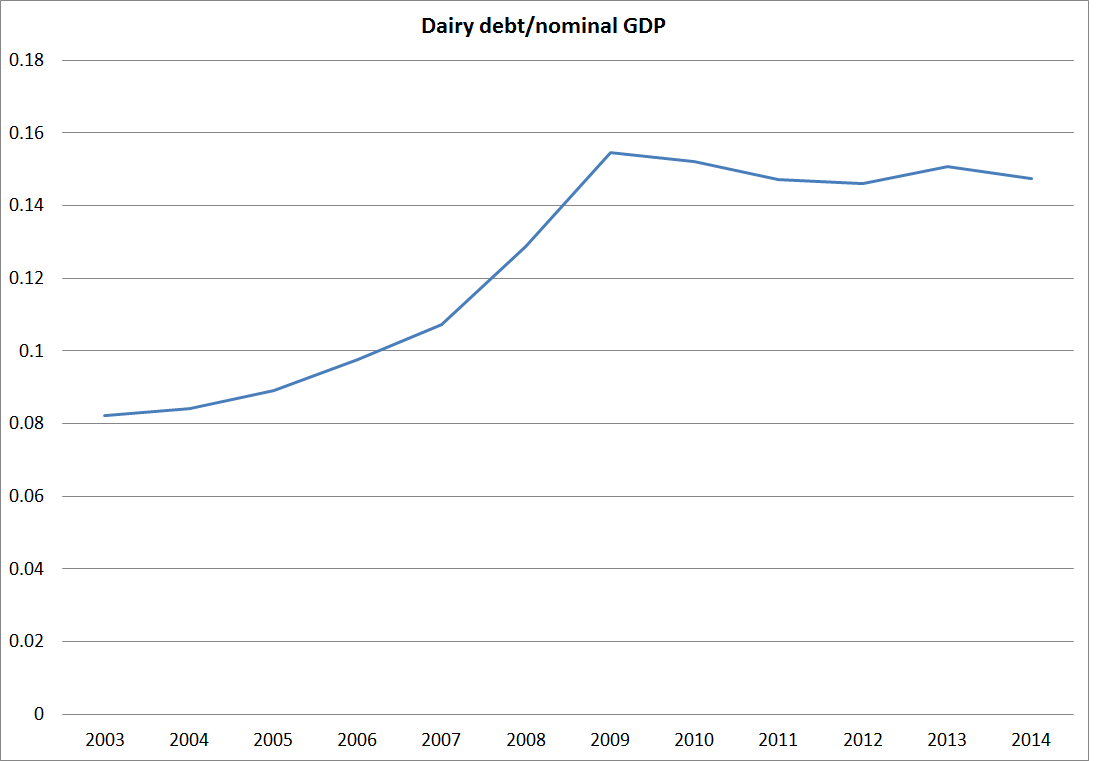
The Governor made much yesterday of the fact that dairy debt had trebled since 2003.  What we didn’t hear so much of is when that debt increased.  The chart below shows dairy debt as a percentage of GDP.  It rose very very rapidly to 2009, and has gone nowhere – actually fallen slightly – since then.

dairy

During that boom period, dairy land prices rose very sharply. Land prices fell a long way in the recession and even in the last couple of years land prices have been below the previous peaks (even in nominal terms).  It matters when the debt was taken on.  The worst of the loans taken in the boom –  and there were some pretty bad ones, as banks fell over each other to build market share, and buyers got sucked into some sort of bubble mentality –  have already failed.  Bank non-performing loans in respect of dairy exposures rose quite sharply over 2009 and 2010.  They could easily have got a whole lot worse, if the payout had stayed down for longer, and if banks had not all quietly recognised that in an illiquid market like that in dairy farms in a downturn, selling up many clients would rapidly drive the value of collateral even lower.

I did quite a lot of work, and thinking, on dairy risks in 2009.  I used to stir people up by describing dairy debt as potentially ‘New Zealand’s subprime’ –  potential for bad debts, exposures ill-understood both by parent banks and by offshore funders, and a market for collateral that was highly illiquid and, hence, with little effective price discovery.  And New Zealand has been down this path before – farm debt was a major problem in New Zealand, with all sorts of regulatory interventions, during the Great Depression. So I’m not complacent about the possibility of dairy risks.  But timing  matters a lot.  Not only has the worst of the boom-times debt already failed, but bank parents got quite a fright in 2009, and banks have had plenty of opportunity to manage their exposures over the last five years or so, including encouraging – or forcing – clients to take advantage of the good years to reduce debt levels.  I’m a bit of a pessimist on global commodity prices so it wouldn’t surprise me if farmers had a pretty tough few years ahead.  And in any sector where there is a boom followed by bust, some people will be caught out, and some will exit the industry.  But this is not 2009, and the chances of any material systemic threat, based on bank dairy books as they stand now, seems incredibly low.  A fresh dairy credit boom and land price spiral would be something quite different, but the last one was years ago now.

But I had some sympathy with the call I heard this morning for risk weights on dairy exposures to be raised.  My sympathy has nothing to do with the current situation, but with a fear that the weights were set too low in the first place.  Back in June 2011, the Reserve Bank published two Bulletin articles about dairy debt in the same issue.  One was a stress-testing exercise which used a plausible scenario that ended with 20 per cent of dairy loans having to be written off.  The other described the work the Bank had done on recalibrating risk weights for farm loans.  The authors reported that average risk weights on farm loans would in future be around 80-90 per cent.  That meant banks would be required to hold capital equal to perhaps 7 per cent of farm exposures (given that the minimum total capital requirement is 8 per cent of risk-weighted assets).  Requiring banks to hold insufficient capital to cover the Reserve Bank’s own contemporaneous stress test looked odd then, and still does now.  As I noted, current risks don’t look that large, but capital requirements are supposed to be set to be robust to all different phases of the credit and economic cycles.

(Incidentally, this is an example of a more general problem.  Would, for example, the Bank’s capital requirements for insurers be large enough that if the Christchurch earthquakes were repeated –  a real world stress test if you like – AMI would not have failed?  Given that the government chose to bail-out AMI at taxpayers’ expense, with the support of the Reserve Bank, and has shown no sign of regretting doing so, some questions might reasonably be asked.)

The Reserve Bank has long made much of New Zealand’s relatively large net international investment position (as a per cent of GDP).  It doesn’t make Chapter 1 this time round (which is welcome) but it is still there in later chapters, including the “Systemic Risk and Policy Assessment”.  New Zealand’s NIIP position is large by international standards, but it has been large for decades, and has shown no signs in the last 25 years of getting any larger.  That is a very different position from where countries like Spain and Greece found themselves in the years leading up to the euro crisis,  when NIIP ratios increased very rapidly.   New Zealand’s NIIP position is a symptom of some  persistent imbalances in the economy, but it is a chronic condition, not one that threaten crisis.   In fairness, the Bank now mainly focuses on rollover risk for domestic banks’ foreign funding, but even here I think they overdo it.   Even in the 2008/09 crisis, wholesale term funding markets were closed for only a relatively short period of time.   There was never any sign of idiosyncratic concerns about the Australian and New Zealand banking systems, even though on any objective measures the risks must have greater then than now.   Global market disruption – as, say, we might expect if the euro breaks up in a disorderly way –  could increase the cost of borrowing (as happened in 2008/09) but that effect can largely be offset through a lower OCR.  It just is not a first order risk for the soundness of the New Zealand financial system.  Wholesale funding can be an indicator of systemic vulnerability, but usually when wholesale funding has been running up rapidly because lending growth is far outstripping domestic deposit growth.  We went through that phase –  and our financial system got through it largely unscathed –  but it is not today’s risk.

I have been struck for some time by the absence of the word “deflation” from Financial Stability Reports.  For all my relative comfort about the health of the New Zealand financial system, the one thing that could really threaten it would be a period of significant deflation.  Why?  This isn’t Fisherian debt deflation story, but simply a reflection of the fact that almost all private debt is nominal.  If we were to experience a period of sustained deflation nominal asset prices could be expected to fall, and nominal wages (and profits) would also be expected to fall.  Those holding financial assets would be better off, but those with financial liabilities could be in quite serious strife.  For banks, the risks are entirely asymmetric – they don’t benefit from the increased real wealth of their depositors, but are heavily exposed to the increased real debt of those they have lent to.

Material or sustained deflation is not a high risk in New Zealand.  No doubt 25 years ago the Japanese didn’t think so either.  Deflation isn’t a non-existent risk for New Zealand either, especially in the current global environment – adverse demographics, the increasingly pervasive “bite” of the zero lower bound etc.  I’m not sure why the Reserve Bank is so averse to discussing the nature of the risk, even as an extreme scenario.  Yes, we know they have an inflation target of 1-3 per cent annual inflation, but there is no guarantee that a central bank will always be able to keep inflation up to current target levels and who knows what the future target will be.    This is one of those areas where the Governor, in preparing the FSR, needs to take off his hat as monetary policy decision-maker and just deal with the possible threat to the banking system – remote, but not impossible.

This post has ended up a little longer than I’d intended.  I want to finish with just a few thoughts on how I think the Reserve Bank should approach future FSRs.  In assessing risk, they seem rather stuck in a pre-2008 environment.  Back then, credit growth was very rapid across all classes of bank loan books, the finance company debacle was nearing its worst, asset prices generally were rising rapidly, banks were becoming progressively more dependent on short-term wholesale funding, and constant pressure was on to lower effective capital requirements (in the shift to Basle II).  It was quite reasonable to have entered 2008 quite concerned about possible threats to the health of the system.  But the New Zealand financial system came  through that severe recession, and the aftermath of a big credit boom, largely unscathed.  And almost nothing in the description of the pre-2008 years is relevant today.

Some of what has changed is just the result of market phenomena, but some is a result of worthwhile regulatory measures: higher minimum capital requirements, strong pushback against the pressure to erode risk weights, new liquidity and funding requirements and so on.  Some years ago, senior staff of the Bank’s Prudential Supervision Department used to tell the IMF each year that they presided over the safest banking system in the world.  That used to grate somewhat with the house pessimists (of whom I was one).  And yet, as it happened, they weren’t so far wrong.  The Bank should take some credit for the health and soundness of the financial system.  Of course, a central bank needs to keep a watching brief on emerging threats, but needs to be able to differentiate when they pose real threats to the soundness of the financial system, and when they are just the sort of thing that strong buffers are already in place to contain.  More energies might reasonably be put into reviewing the extensive regulatory net now in place –  not just to “iron out inconsistencies” (the sort of approach in the current regulatory stocktake) but to ask, and to invite serious outside perspectives on, what bits of the regulatory framework are really adding material value to the statutory goal of promoting the soundness and efficiency of the financial system.

Some more thoughts on housing and the FSR

A few more points struck me about the Reserve Bank’s latest FSR.  This longer post is about housing, and later in the day I’ll touch on another couple of issues.

There seems to have been a knee-jerk reaction, including in newspaper editorials this morning, that we should be grateful to the Reserve Bank that “something is being done” by someone, anyone.  That is a terrible way to make policy.  If a child is drowning no one cares who jumps in to rescue the child so long as someone does.  But if a child has a serious illness the last thing we want is random enthusiasts (let alone powerful government agencies with the coercive force of law behind them) jumping in with their own patent remedies.  The Auckland housing situation (a social and political scandal, as I’ve said before) calls for careful diagnosis, informed by experience and insights from the rest of the country, and remedies that deal effectively with the underlying issues and causes.

Banning banks from lending a cent over 70 per cent of the assessed value of a property to “investors” in “Auckland” is a solution in search of a real problem.  What makes the Governor so sure that 10 per cent of Auckland mortgage lending can safely be made in loans over 80 per cent of the value of the property if the buyer is an owner-occupier (or, apparently, some classes of bach owner), but that not one cent can be safely advanced to “investors” for more than 70 per cent of the value of the property? On the evidence of the FSR, there is nothing solid to provide that confidence, but perhaps there will be more in the forthcoming “consultation” document?

Controls are begetting controls, but controls also beget disintermediation.  One of the arguments in 2013 for the “speed limit” approach to LVR restrictions (as opposed to a blanket ban) was that it would limit the extent of disintermediation (mortgage lending business moving from banks to other lenders).  But now the Governor himself is resorting to a blanket ban, in respect of people running small businesses, who typically have a greater degree of financial sophistication (including regular dealings with advisers such as lawyers and accountants) than most first home buyers.  Another reason why the Bank wasn’t too fearful of disintermediation was the belief – which I think was real at the time, but in fact was just another misplaced hunch – that the controls would be short-lived.  That has also gone out the window now, with controls layered on controls (lending restrictions on banks still exist in the rest of the country, where house prices rose 2 per cent in the last year).

Non-bank lenders (especially non deposit-takers, over whom the Reserve Bank has no regulatory control) will probably be busy this morning planning how to gear up their businesses.  I wonder what assurance can the Reserve Bank offer that if fringe lenders gear up to provide loans to investment property purchasers (and have portfolios much less diversified than a typical bank’s) that both the efficiency and the soundness of the financial system as a whole will not end up impaired?  Perhaps again the answer will be in the “consultation” document?

For decades, bank supervision – dedicated to promoting the soundness and efficiency of the financial system, as Parliament required – went on behind the scenes.  Ordinary borrowers didn’t need to pay any attention to what the regulator was up to, and nor should they have to.   The Reserve Bank focused on ensuring that adequate buffers were in place in case something very nasty happened.  And they did that without directly impinging on any individual borrowers’ plans.   Risks to banks arise from whole portfolios of loans, not from individual loans to SMEs (which is what investment property purchasers, or refinancers, are).  The Reserve Bank set the minimum capital requirements based on whole portfolios of loans, and recognising systemic risks, and then private borrowers and lenders – surely better equipped for the job than any official – decided whether or not a particular loan made sense.     In the last couple of years there has been a sea change, and not for the better.

High Auckland house and land prices are almost entirely a reflection of poor quality policy: unnecessary central and local government rules that impede the ability of supply to respond adequately in the face of policy-fuelled rapid population growth[1].  It has almost nothing to do with credit policies of banks.  In again interfering with the credit policies of those private businesses, the Reserve Bank will be rather arbitrarily redistributing some gains and losses, while imposing some deadweight costs on the whole economy as the efficiency of the financial system is eroded (and probably that of the housing and holiday home markets as well).  The Bank’s actions will probably dampen Auckland prices a little, for a short time.  Some people will buy a little more cheaply than they might otherwise have expected, and others will miss out.   But where is “dampening house prices” as an objective in the Reserve Bank Act?

And all the while there is still no evidence of a systemic threat to the New Zealand financial system.    Yes, house prices might fall substantially at some point, but the Governor has no better insight than anyone else on when, if ever, the balance of regulatory land use restrictions and policy-fuelled population growth will change.  More importantly, his existing capital requirements have been shown, by the stress tests, to be able to cope if house prices do fall sharply.  Administering prudential policy to promote the soundness of the financial system is his job –  and he looks to have done it – not trying to protect some house buyers over others, or fussing over whether people might eventually lose money on a purchase, all with no better information about the risks than anyone else has.

In this morning’s Dominion-Post the Governor is again reported as invoking the spectre of the US post 2006 “bust”.  But if that really is the parallel he is worried about, he has shown no evidence, and produced no sustained narrative, to illustrate why he believes that is a serious threat here.   Is there, for example, any evidence of a sustained deterioration in lending standards here – as there was, induced by policymakers, in the US?   It is a little hard to believe when credit growth is so modest, and the evidence of his own stress tests argues against it.   But if he has a case, let’s hear it.  I upset the Governor deeply a couple of years ago when I suggested that New Zealand deserved better than one of the rushed documents being prepared in advance of the first LVR restrictions.  I’d repeat the suggestion now, but I’d reframe it:  the law requires him to do better.  Yesterday’s document just did not provide the material to allow us to assess the Governor’s policies, proposed, present, and past.  That reads like a breach of the law.  It might be something for the Bank’s Board to ponder when they discuss this FSR at their next meeting.

Actions like those of the Reserve Bank, going well beyond their statutory mandate, are threatening and damaging in more ways than one.  At a micro level, it disrupts the business and life plans of many people, adding to costs, and unnecessarily and arbitrarily skewing the playing field in favour of some classes of participants over others.  But it goes deeper.  Next month we mark the 800th anniversary of Magna Carta, which recognises that the government and its agents are often a threat to our liberties and need restraining.   The ability of private firms and individuals to go about their business should be restricted only when there is clear evidence of harm.  And when government does intervene, citizens are required to obey the law, not just the wishes of bureaucrats, having to cow before ominous threats that they are “expected to observe the spirit of the restrictions” not yet in place (which seems to be drifting rather too close to something like the Fitzgerald v Muldoon case).  Perhaps some good might eventually come from the latest episode if it finally prompts some interest (beyond the Green Party and The Treasury) in reopening important questions about the governance of the Reserve Bank –  just how much power, and how many functions, we should vest in a single unelected official.

[1] Low interest rates probably play a part.   Equilibrium land prices are typically higher when real interest rates are low, but without supply and land use regulatory restrictions the pure land component of a typical suburban house + land package would be pretty small.    Unimproved rural land (the factor in genuinely fixed supply) trades at less than $50000 per hectare.

An OIA response on capital gains taxes

While I was typing the previous post, where I mentioned this OIA request, the email below turned up.  Given that the Bank has found precisely one email, and released it with no deletions, it is (a) difficult to understand why Grant Spencer went public supporting a capital gains tax, when the Bank has previously been sceptical of any benefits from such a tax, and (b) difficult to see how the Bank has complied with the law in taking so long to respond.  Surely the timing of the press conference and of the Governor’s FEC appearance would not have had anything to do with how expeditiously they handled several simple OIA requests?

Michael Reddell

Via email: mhreddell  at gmail.com

Dear Mr Reddell

On 16 April 2015, you made a request under the provisions of Section 12 of the Official Information Act (the Act), seeking:

Any material prepared, or distributed, in the Reserve Bank over the last 12 months on capital gains taxes, whether on houses or on other assets.  Without otherwise limiting the scope of the previous sentence, this request should encompass any analysis of capital gains taxes undertaken by Bank staff or consultants to the Bank, any academic articles distributed widely among analytical or policy staff, minutes of any policy committee meetings in which capital gains taxes were discussed.  It should also include any advice on capital gains taxes provided to the Minister of Finance, the Minister of Housing, Treasury, Inland Revenue, and/or the Bank’s own Board.

The Reserve Bank is providing to you an email message to Deputy Governor Grant Spencer that he received while drafting the speech titled Action needed to reduce housing imbalances.

Email to Grant Spencer 24 Mar 2015.pdf

Academic articles that may have been distributed widely among analytical or policy staff are either publicly available documents or available upon request from the institutions that published them. Accordingly, the Bank is refusing this part of your request under section 18(d) of the Act – the information requested is publicly available.

Minutes of policy committee meetings do not include capital gains taxes and the Bank has not provided advice on capital gains taxes to the Minister of Finance, the Minister of Housing, Inland Revenue, or the Bank’s own Board. Accordingly, this part of your request is refused under section 18(e) of the Act – because the information does not exist.

The Reserve Bank intends to publish this response to you on its website. http://www.rbnz.govt.nz/research_and_publications/official_information/

Under the provisions of section 28 of the Act, you have the right to complain to the Ombudsman of the Reserve Bank’s decisions about your information request.

Yours sincerely

Angus Barclay

External Communications Advisor | Reserve Bank of New Zealand

2 The Terrace, Wellington 6011 | P O Box 2498, Wellington 6140

  1. +64 4 471 3698 | M. +64 27 337 1102

www.rbnz.govt.nz

Yet another policy lurch

Having now read the Financial Stability Report, and listened to the Governor’s press conference, I was surprised by the poor quality of the Report and of the policy that it discusses.  The FSR is supposed to contain material to enable us to assess the effectiveness of their use of their powers (here and here).  This one just does not.

Policy seems to be lurching from one intervention to the next, without any compelling analytical framework or evidence.  There also appears to be little sign of any historical memory.

For example, only six months ago the Bank was reporting the results of its own stress tests, which suggested that the major New Zealand banks (and presumably the financial system) were resilient to even very severe shocks to asset prices and servicing capacity.  And yet, despite announcing its intention to impose yet more, quite invasive, controls on bank lending to one sector of SMEs, there was no reference at all to this assessment and experience.  Perhaps the Bank does not believe the results of the stress tests, but if not surely they it owe it to us to explain why.  .

Similarly, the Bank laments that investors have become a larger share of property purchasers in Auckland (what is the “right” or “appropriate” share, and where is the “model” to determine that, we might reasonably ask them) but they don’t seem to see any connection between the imposition of the first LVR speed limit 18 months ago –  which will have borne most heavily first-home buyers, who have always been those who relied most heavily on debt finance –  and the greater presence of investors in the market.  At the time their own analysis and modelling (eg see chart on page 9) made the point that potential buyers who were displaced would, over time, be replaced by other buyers.  Their modelling also showed that the most that could be expected of the speed limit was a dip in house price inflation for a year or so, which would then be reversed as the new buyers entered the market.

If amnesia is a problem, so apparently is schizophrenia.  On the one hand, the FSR and the press release tell us that “New Zealand’s financial system is sound and operating effectively”, but on the other hand they apparently think that banks are operating so recklessly that not a single Auckland investor purchaser should be able to take a loan of over 70 per cent of the value of the property, no matter how sound a proposition that borrower might otherwise appear to his/her lender (including their flow servicing capacity).    Continuing the theme of an institution that can’t quite make up its mind – or perhaps doesn’t want to scare the investor horses, but wants cover for yet more regulatory interventions – the Governor told us in the press conference that he was becoming seriously concerned about financial stability risks.  If so, perhaps the first sentence of the Report should have been written somewhat differently.

The Bank also doesn’t seem to display much regard for good process.  It is going to produce a consultative document shortly on its proposals to restrict investor loans in Auckland (which I hope will have much more substantive justification for the proposed policy than is in the FSR), and yet it ‘‘expects banks to observe the spirit of the restrictions” now.  “Consultation” is supposed to have substantive meaning, and not just around the fine details of the regulations.  Is the Reserve Bank open to countervailing arguments, or has it already made up its mind and just going through the motions?  If the latter, it might leave itself exposed to the risk of someone seeking judicial review.

The Bank blunders in with these policies, each no doubt well-intentioned, but with little apparent recognition of the way that its actions affect real people, their lives and their businesses.  18 months ago a nationwide LVR speed limit was put in place, apparently because the Bank thought that house price inflation and associated credit growth was going to become a widespread problem.  If the Bank was omniscient it might be one thing, but they were simply wrong.   Ordinary house-buyers in Invercargill or Wanganui had to delay purchasing a house because of a mistaken Reserve Bank hunch.  And these weren’t measures that were ever necessary –  by contrast there will always be an interest rate in an economy –  since large capital buffers were already in place.  And in Auckland, the Reserve Bank’s earlier policy won’t have materially adversely affected those from upper income families, where parental support will have helped young people get around the 80 per cent limit.  But what about those without wealthier parents, who are surely disproportionately Maori and Pacific? There was no hint of that distributive impact in the Regulatory Impact Statement for the earlier restriction.    In Auckland the earlier restriction provided cheaper entry levels for the lucky (those who got inside the speed limit), the wealthy, investors, and cashed-up purchasers.  Is that good public policy?

Who will be adversely affected and who will benefit this time?  One group that springs to mind who might benefit are the fabled offshore investors.  No one has any good idea how many of these people there are, but as Grant Spencer acknowledged in the press conference his regulatory restrictions won’t bear on them.   From a financial stability perspective that might not matter to the Reserve Bank, but I suspect that to voters it will.  First penalise first home buyers. Then penalise people looking to build a rental property business (and perhaps those who rent from them).  And who will that leave?  The middle-aged cashed-up purchasers, and any offshore purchasers.  It doesn’t look fair, it doesn’t look like a reasonable use of Reserve Bank powers (when less intrusive instruments, such as risk weights and overall required capital ratios are available), and frankly it doesn’t look very democratic.

Of course, Parliament gave these powers to a single unelected official –  although I doubt that anyone in 1989 ever envisaged them being used for such purposes.  Jim Anderton, a staunch opponent of that Act, must now be rubbing his eyes in disbelief.  And, on the other hand, the current government was supposedly committed to reducing the burden of regulation, not increasing it.  One wonders if the Reserve Bank given much thought to the lobbying it now opens itself up to  –  carving out one set of rules for Auckland will, in time, open it to lobbying for special rules for other areas.   Cashed-up purchasers wanting to buy more cheaply in Queenstown might be knocking on the Governor’s door before too long.   If we must have regional policies (in bank regulation or other areas), let the choices be made by those whom we elect, and can toss out.

And then we are back with the larger questions.

  • Is there any evidence, from anywhere, ever, of a systemic financial crisis in a country where credit has been growing around the rate of growth of nominal GDP, and has been doing so for the last six or seven years?  The Bank has produced some interesting new data on gross credit flows, but it doesn’t change the underlying evidence from the international literature: when credit is not growing fast relative to GDP one of the key risks of a future crisis is missing.
  • Where is the evidence that loans to investors, all else equal, are riskier than other residential property loans?  Repetition of the claim over and over again is not the same as evidence.  As I have noted previously, the evidence from Ireland and the UK (tho in UK loan losses were always small) is not particularly enlightening, since the rush into buy-to-let properties was very much a late cycle phenomenon.  None of the sources the Reserve Bank mentions look at losses on like for like (eg similar age, similar LVR) loans.    In an earlier post, I questioned whether the Reserve Bank had any domestic evidence on losses on loans to investors, as compared to those to owner-occupiers, in those places where nominal house prices have fallen considerably in recent years.  If there really is the sort of difference the Reserve Bank asserts, surely it should be showing up in New Zealand data.   The one area where international evidence does seem to suggest that loan losses are greater is new house building –  but the Reserve Bank is still carving that out from the limits.

One word that appeared very little in today’s document was “efficiency”.  The Act talks repeatedly about the “soundness and efficiency” of the financial system. The efficiency references were put in for good reason – to limit the risk of recourse to direct controls, of the sort that plagued our system for decades.   By almost any definition, somewhat arbitrary controls like the LVR speed limit and the proposed new Auckland investor lending limit impede the efficiency of the financial system.  Almost inevitably there is some trade-off between soundness and efficiency considerations in any set of prudential measures, but in this document the Reserve Bank gives us nothing to allow us –  or those paid to hold the Bank to account –  to see how and why they have made the trade-offs they have.    What basis is there, for example, for imposing a blanket ban of any investor loans in Auckland in excess of 70 per cent LVR[1] when, for example, the soundness of the system could have been protected at least as well –  if there is a material threat at all –  with, say, higher risk weights for Auckland property loans more generally, which would not skew the playing field between different classes of potential borrowers/purchasers at the whim of the Governor.   There may be good grounds for the trade-off that is made, but they simply aren’t presented.  How can people assess the effectiveness of the Bank’s exercise of its prudential powers?

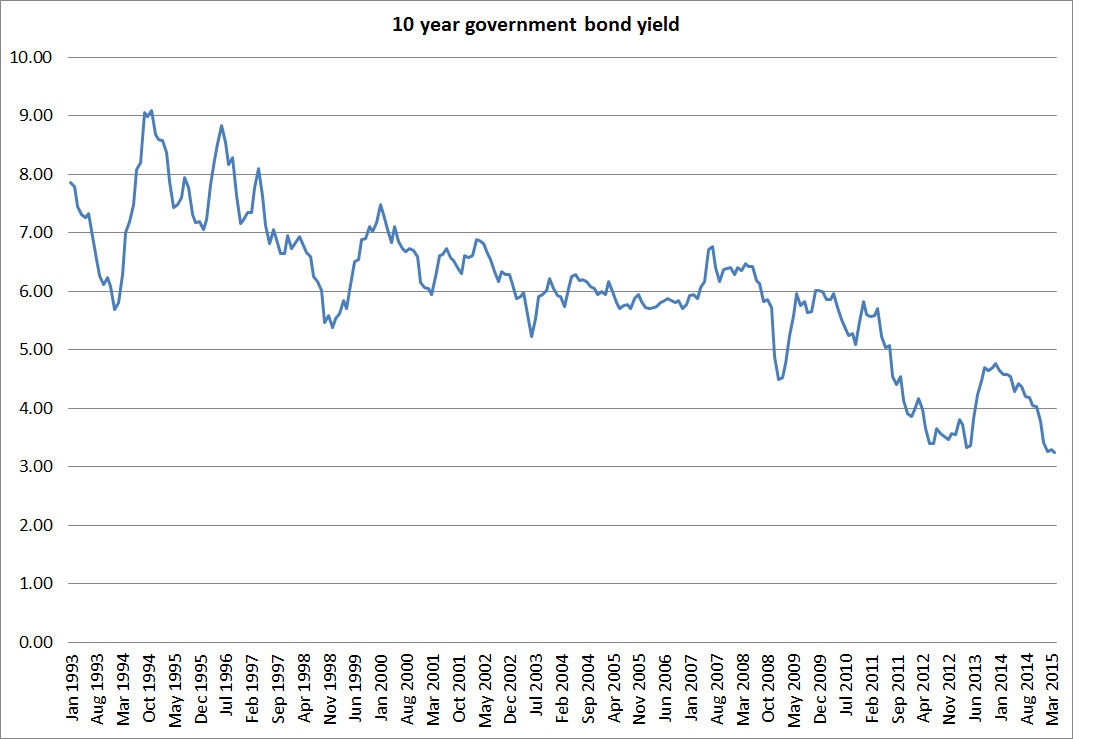
Finally, the Bank partly justifies its targeted intervention in Auckland, against one class of potential buyers, on the basis of rental yields in Auckland.  They argue that rental yields in much of the rest of the country are around 10 year average levels, but are at record lows in Auckland.  But has the Bank looked at a chart of New Zealand bond yields recently?  New Zealand 10 year bond yields are now at the lowest level probably ever (and certainly in the 30 years on the Reserve Bank’s website).  And the market now expects that the Bank will have to cut the OCR not raise it.  Shouldn’t we expect rental yields to bear some relationship to yields on alternative investments, such as long-term government bond yields.  Of course, the Bank would no doubt defend its stance by reference to the abnormally low level of bond yields globally.  And it is true that they are very low  (while NZ’s remain high by cross-country comparison), but the Reserve Bank –  even more than its overseas counterparts –  has been getting the future path of interest rates wrong for six years now.  Perhaps they will be right this time, but why should we be confident that they know better than the market?

10yr

It is difficult to fully make sense of what the Governor is up to. I suggested a few weeks ago that he didn’t want to be the person who presided over a NZ version of the US experience of 2006 onwards.  Which would be a laudable goal if there were any evidence that circumstances were even remotely similar. But there isn’t: overall credit growth is subdued, the Bank presents no evidence of a systematic deterioration in lending standards, and fundamental factors  provide a good basis to explain what is going on in house prices, both in Auckland and in the rest of the country.  Perhaps the Governor just wants to “do his bit” to solve the problems in Auckland, but (a) the Reserve Bank has no statutory mandate to focus on trying to manage house price cycles, especially in a single city, and (b) it isn’t clear how impeding access to finance (in a climate of modest per capita housing turnover, modest volumes of mortgage approvals and modest overall credit growth) is going to in any sense help deal with the structural problem.  There just isn’t a financial system problem –  and if there is the Bank just hasn’t made its case, and should get the evidence out there –  and it feels as if the Bank is misusing its extensive powers, based on a flawed reading of what is going on, and a failure to give due weight to how often past regulatory interventions have just made problems worse.

I pointed out a few weeks ago that it was now over a decade since the words “government failure” had appeared in a document on the website of the State Services Commission.  The Reserve Bank is now a major regulatory agency, exercising more and more powers by the decision of single unelected official.  I checked the Bank’s website, and the phrase “government failure” appeared only once (in a Bulletin article on historical crises), and “regulatory failure” appeared not at all.  It should disconcert citizens –  and those paid to hold the Bank to account –  that there is not more evidence of the Bank having reflected seriously on what that entire literature, and the experience of countless other regulatory bodies, might mean for how they should exercise their powers.

PS    In the press conference the Bank seemed to back away (perhaps just diplomatically) from the Deputy Governor’s expressed support for a capital gains tax. Almost a month ago, I lodged an OIA request for any material the Bank had considered on a CGT.   Since the Bank has taken so long to respond, and is required by law to respond “as soon as reasonably practicable”, I’m assuming they must have a considerable amount of substantive material that needs review.

[1] And, on the other hand, no such restrictions in Christchurch even though the Governor observed that he thought a glut of houses in Christchurch was quite likely.
Reviewing and challenging economic policy agencies

The Reserve Bank’s Financial Stability Report is due out later this morning.  As I have a few other things to do, and I want to read the whole thing (well, I might make an exception for the payments system discussion) I don’t expect to comment on it today.

Instead, I wanted to prompt some thought about how in New Zealand we ensure that there is adequate scrutiny and contest of ideas around powerful government agencies operating in the economic and financial area.

Late last year, Ross Levine, a professor at Berkeley, visited Victoria University and the Reserve Bank.  It was a very stimulating visit. One of Levine’s books, written with a couple of co-authors, is Guardians of Finance, in which he argues that US financial regulators are too close to those they are regulating, and that something needs to be done to counterbalance that bias.  To be clear, Levine is not alleging any personal financial corruption on the part of anyone involved, but rather highlighting the role played by the large financial resources of the sector, the complexity of the issues, and the revolving door which sees people moving between regulatory and regulated institutions.  The authors also highlight what they call “home-field advantage”  –  drawing from evidence from sports, they suggest that regulators will naturally become attuned to, responsive to, and share to some extent the perspectives of those whom they regulate (moving within a common professional, and sometimes personal, milieu).

Levine argues that these weaknesses were a significant part in explaining the 2008/09 crises, and that institutional change is needed as some form of counterbalance.  I found the connection to the crisis unconvincing for a variety of reasons, including but not limited to the fact that senior regulators who had tried to stand up against the risks building up in the system would almost certainly not have been reappointed.  But I was most interested in his proposal for a new US agency –  the Sentinel.

The one power this small institution would have would be the right to obtain any information it wanted/needed from financial regulatory agencies.  It would be insulated from short-term political pressure to some extent, by being funded by a prior claim on seignorage.  It would be shielded from too much financial sector or financial regulator influence by restrictions on the ability of staff to move from the Sentinel into financial sector or financial regulatory positions.  Any useful impact it had would come from the quality of its research and analytical material.   It is proposed that the agency would pay well, and offer a prestigious and influential opportunity for top-notch people from across a range of disciplines.

In reading Levine et al’s book, and in discussion with Levine during his visit, I had been thinking about the relevance of his insights to New Zealand.    The result was this discussion note

discussion note thoughts prompted by Levine et al’s Guardians of Finance

which I jotted down on the Saturday before Christmas, when my wife and kids had already left town.  (At the time, it was mainly for my then colleagues at the Reserve Bank, but since I expected to be leaving the Reserve Bank shortly I deliberately wrote it out of Bank time and off Bank premises.)

In it, I explore the idea of introducing greater challenge and contest in respect of a range of economic policy and advice functions in New Zealand  (not just, and not even primarily, financial regulatory ones).  The issues are different in New Zealand to those in the US in a wide variety of ways, but the lack of scrutiny and challenge is a much more serious problem here than there –  not through ill-will or malevolence on anyone’s part, but mostly because of being a small country.

I highlight the way that review agencies have been set up in many areas of New Zealand government in the last 30-40 years, and suggest that the scrutiny and review of the economic policy and advice functions now lag behind.  My concrete proposal was the establishment of a small Macroeconomic Council, to independently scrutinise and challenge thinking and policy (advice) emerging from agencies such as the Treasury, the Reserve Bank, the FMA, and MBIE.  Such an agency would deliberately operate outside government –  a contrast, say, with the Productivity Commission (which has done some very good work, but operates –  by statute –  inside government, largely on topics assigned by ministers).

There are weaknesses with the proposal, and if I were writing the note today I would make some of the case differently.  But I think there is a real weakness in our system, and the confidence that the public can have in the quality of regulatory and advisory processes suffers because too few resources are devoted to scrutiny and challenge.  In some ways, I’m uncomfortable suggesting spending more public resources, but as even the 2025 Taskforce pointed out, the things that governments really needs to do need to be done excellently.

In the meantime, I hope that the Financial Stability Report has complied with Parliament’s requirements and will

contain the information necessary to allow an assessment to be made of the activities undertaken by the Bank to achieve its statutory prudential purposes under this Act and any other enactment.

Remember, it is for us –  citizens, Parliament –  to make our own assessment.  The Bank’s own assessment is likely to be interesting, but we need the information and perspectives to evaluate their case, and their activities, to ensure (in the words of Levine’s sub-title) that regulators really are working for us.

Negative nominal interest rates

Late last week the New York Fed posted some interesting  and thoughtful speech notes by James McAndrews, their Director of Research, on “Negative Nominal Central Bank Policy Rates: Where is the Lower Bound” (see also some comments here from John Cochrane).

But McAndrews doesn’t really answer the question he poses, and instead offers a series of thoughts on some of the issues (institutional and policy) associated with negative nominal interest rates.   If it seems somewhat geeky it is, or should be, a pressing issue.  Four countries already have modestly negative policy interest rates for some balances.  Most other advanced countries have policy rates at or near zero and even in “high” interest rate Australasia the buffers are no longer large.

McAndrew outlines seven ”complications” with negative interest rates.  I won’t touch on them all –  read the speech.

The first, and best-known, is “avoidance”, the possibility of shifting into physical currency (which, at present, carries a zero nominal return).  He argues that currency is a less effective substitute for electronic money than many realise, and seems to put quite a lot of weight on the inconvenience of physical currency.  But that case seems a great deal stronger for mid-sized transactions than for the  store of value function of money.  I’m a trustee of a pension fund  and, to take an extreme example,  if nominal interest rates ever got to, say -10 per cent, I can’t envisage that I would have many qualms in agreeing to the bulk of the fund’s assets being held in secure (and insured) physical currency form, rather than interest-bearing securities as at present.  Yes, we would still need some electronic balances available to make our routine pension payments, but those transaction balances are small relative to the stock of assets.  In the same way that most of us still held zero-interest transactions balances in the high inflation era, we might still be quite comfortable to have, say, one week’s salary in an account earning a material negative interest rate simply because it is more convenient.  To settle wholesale payments, the transfer of claims over physical bank notes seems quite feasible (with time, and an expectation that interest rates would stay negative for a prolonged period).  The big risk central banks are concerned about is not that your cheque/EFTPOS account would be converted back into physical currency, but that banks and large investors would choose to convert their assets (where choices are heavily driven by relative expected returns).

Abolition of physical currency would, of course, eliminate this problem altogether.  I’m not in the camp of those who favour that option, and neither is McAndrews.  Indeed, I’m not sure that elimination of physical currency is even a legitimate call for a government to make.  As I outlined last week, I would rather go in the other direction, removing the government monopoly on banknotes[1], and allowing market competitive forces to get to work, including innovating smart ways to provide positive and negative returns on these nominal liabilities.  Central banks are monopoly providers, not known for their innovation and product development (an interesting OIA request might be to ask how many resources the RBNZ or RBA have devoted to product development and innovation in respect of physical currency, security features aside).  In time, whatever product innovation succeeded in the market could end up adopted by central banks themselves.  More immediately, central banks should be working on developing a retail electronic outside money product, which might in time displace physical central bank currency.  Banks have access to electronic outside money: why not the public?

In the shorter-term, abolition of physical currency is not even needed to provide material additional room for negative nominal interest rates.  A cap on total issuance, and allowing the conversion rate to fluctuate, would be enough to prevent wholesale conversion of electronic balances into physical currency.  It would be a significant step – two sets of central bank liabilities would have different values –  but not one that is either irrevocable, or particularly difficult to implement.

McAndrew also outlines various institutional frictions that might evolve differently if substantial negative nominal interest became more established.  For example, the ability to prepay tax obligations, or to delay depositing a cheque, could all represent ways to avoid a negative interest rate.  Frankly, most of these seem rather small issues, especially when weighed against the economic conditions that have led to negative interest rates becoming a realistic policy option.   Surely, for example, it would be easy enough for banks to alter their rules to require all cheques to be deposited more quickly than the current rules, perhaps especially those for large amounts?  And, if the US government has not already done so, the establishment of an interest rate (positive or negative) on prepaid taxes doesn’t appear that difficult.

I’m not going to go through each of McAndrews’ seven points, but will touch briefly on his two final ones.  He worries that establishing negative nominal interest rates might adversely influence public expectations of inflation, entrenching expectations of deflation.  Of course, anything is possible, but this seems very unlikely.  When policy rates around the world were slashed in 2008/09 that didn’t lead to a collapse in inflation expectations –  if anything there was unjustified degree of concern about future risks of high inflation.  In the end, decisive action to counter the risk of excessively low inflation (or deflation) seems much more likely to keep inflation expectations near target.   Indeed, one could that if the public realises that the limits of conventional monetary policy have largely been reached, then whenever the next downturn happens there is a more serious risk that inflation expectations will fall  much more rapidly than happened in 2008/09

His final point is about public acceptance.  Yes, negative nominal interest rates are a new phenomenon, and not one anyone has much familiarity with.  And no doubt central bankers, and politicians, would get many letters from aggrieved pensioners – just as happened when real and nominal rates fell over the 15-20 years prior to the recession. But the job central banks have taken on is one of macroeconomic stabilisation – stable inflation (or wages or nominal income) at as close to effective full employment as possible.  Big changes in relative prices (eg real interest rates) have distributional consequences.  Compensating losers is an option for governments and legislatures, but central banks need to keep a focus on cyclical macroeconomic stabilisation.  Yes, negative interest rates would be a communications challenge.   But prolonged high unemployment –  the risk if real interest rates can’t be cut enough –  is rather more serious than that.  Dealing with the unfamiliarity can’t be done fully until countries actually find themselves with negative interest rates, but central banks can make considerable progress –  especially in countries like New Zealand where negative rates are still some way away –  by starting early, preparing the ground and giving people a sense of what is at stake.

McAndrews ends this way:

Addressing the complications of negative nominal interest rates includes redesigning debt securities; in some cases, redesigning financial institutions; adopting new social conventions for the timeliness of repayment of debt and payment of taxes; and adapting existing financial institutions for the calculation and payment of interest, the transfer and valuation of debt securities, and many other operations. These innovations will require considerable time, resources, and effort. A benefit-cost analysis thus must weigh the potential advantages of negative rates against the costs of pushing back the tide of all of these conventions and institutions that have proven useful under positive nominal interest rates. That calculation likely will differ across countries, across institutional environments, and across the expected levels and duration of negative rates.

Much of that is fine, but it also reads rather complacently. In particular, it seems indifferent to the macroeconomic conditions that have given rise to discussions of this sort (and to negative nominal rates in several countries).    A common view, not universally shared but common, is that the US could usefully have had real short-term interest rates perhaps five percentage points lower than they were during the Great Recession of 2008/09  (in other words, given inflation expectations as they were, a negative nominal policy rate of perhaps -5 per cent).  The inability to do so meant, presumably, a material loss of output at the time, and a material number of people who spent time unemployed that would not otherwise have been necessary.  Those losses mount quite quickly.

Perhaps there is a strong public policy case for avoiding negative nominal policy interest rates.  I can’t see myself,  but if a consensus were to form on that side of the argument then, as I outlined a couple of weeks ago, there would be a strong case for a materially higher inflation target. Macro-stabilisation seems to require, at times, more deeply negative real interest rates than was generally appreciated when 2 per cent inflation targets were adopted.

But adopting higher inflation targets has its own institutional challenges and costs –  in particular, tax systems that are pervasively not designed to operate well with materially positive rates of inflation (and the non-payment of interest on physical currency).   And there is the practical problem that for most countries at present –  without the ability to take policy interest rates materially negative –  it is difficult to get inflation much higher than it is now.   It would seem preferable for finance ministries, legislatures, and central banks to now treat as a matter of some urgency the removal of as many as possible of the policy or regulatory roadblocks that limit the scope for materially negative policy interest rates before the next recession hits.

I have heard mention that Miles Kimball is visiting New Zealand shortly. If so, I hope the Treasury (and the RB) use the opportunity to explore options more seriously, and that the media take the opportunity to give the issue some more coverage.

[1] To repeat, this is NOT free banking.

It isn’t 1987 again…or even 2007

Terry Hall’s column in the Dominion-Post this morning is headed “Auckland housing ‘bubble’ has worrying shades of 1987”.

This just seems wrong.  Following 1987 New Zealand experienced a pretty severe financial crisis in which many corporates collapsed, and several major financial institutions either collapsed, or had to be bailed out by shareholders (including, in the BNZ’s case, the government).

It came, as financial crises typically do, on the back of several years of extremely rapid credit growth, far outstripping the rate of growth in incomes (or nominal GDP).  Private sector credit growth exceeded 30 per cent per annum for several years (charts here)  It was an environment of debt-fuelled craziness, of a massive commercial construction boom, and credit extended to “investment companies” with, it seemed, nothing behind them either than the hope-and-credit-fuelled values of other investment companies.  Claims were heard that New Zealand had a comparative advantage in takeovers.  Newly deregulated New Zealand and Australian lenders seemed to have few disciplined skills in credit or analysis, and as happened in several other countries at around the same time (eg the Nordics) it ended badly.

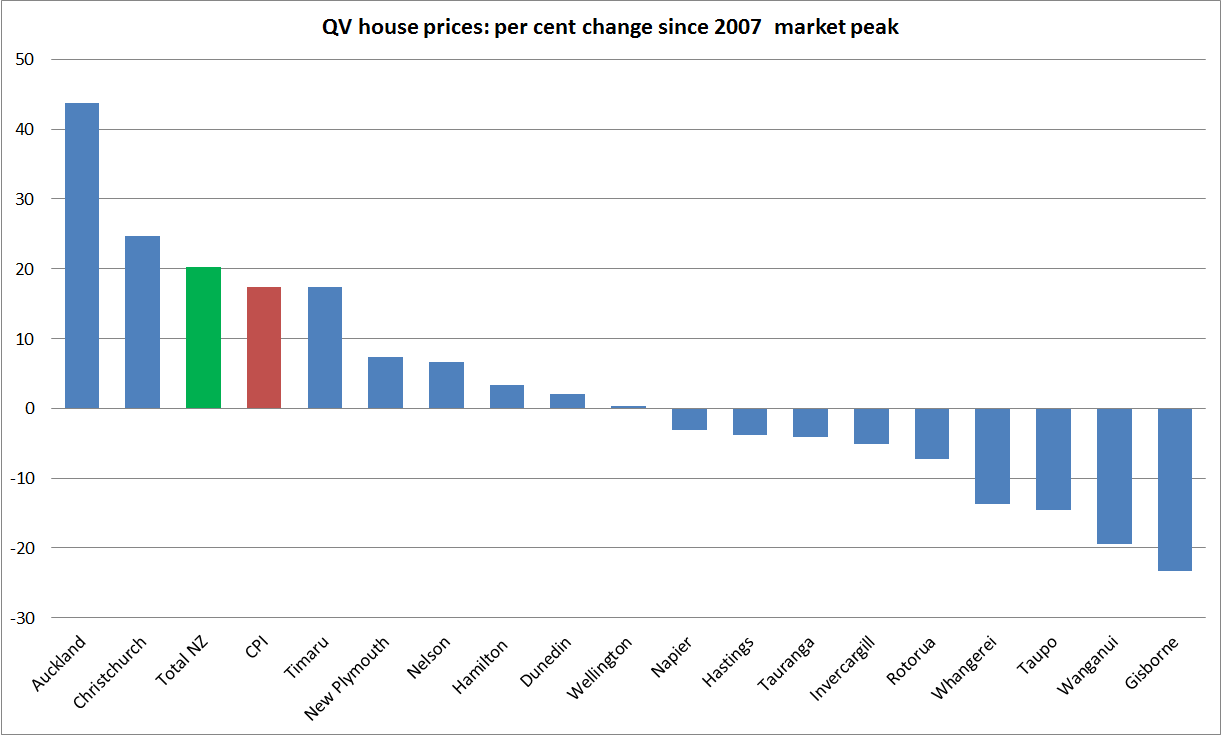
Take the current situation by contrast.  Yes, Auckland house prices are a social and political scandal, but they seem quite easy to explain on the basis of some simple fundamentals: restricted effective supply of developable land on the one hand, and rapid population growth (fuelled by cyclical differences between here and Australia, and an aggressive government programme of inward migration).  Where that combination of pressures isn’t apparent (which is most of the rest of the country) there is no particular or unusual upward pressure on house prices.  Indeed, in large parts of the country real house prices are lower than they were in 2007, the peak of the previous boom and just prior to the recession.

qv

It is difficult to think of a serious or systemic financial crisis anywhere that has not been preceded by rapid credit growth.  There may be exceptions – and I’ve urged the Reserve Bank to document those cases for us, if they can find them – but it is wise for regulators (and investors/shareholders) to be more uneasy than usual when credit is growing rapidly.  In those environments, lending standards tend to drop, and poor quality borrowers too readily get credit for propositions that won’t look good in the cold light of day.  But if credit growth is subdued, and has been for some years, the risk of any sort of financial crisis is likely to be very small.  In a New Zealand context, a prudential regulator might reasonably have been worried in 2007.  As it happened, without cause:  despite very rapid credit growth in the preceding years, bank lending decisions turned out to have been pretty robust.  Funding structures were a different matter.

But what is the situation now?

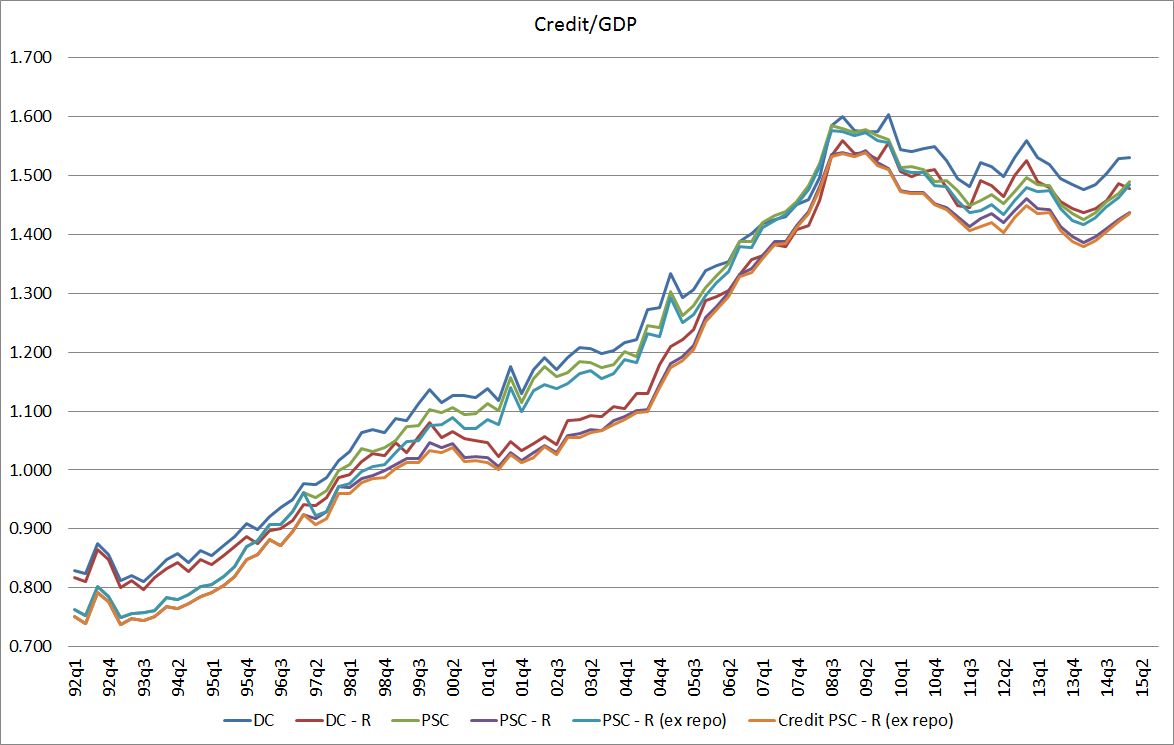
The Reserve Bank has six credit aggregates on its website.  Each has its advantages and disadvantages, but the overall picture is much the same whichever one one looks at.  This chart shows all six, as a ratio to nominal GDP, up to March 2015 (I’ve included a guess for nominal GDP growth in March quarter).  Credit to GDP peaked back in 2008, and in the seven years since then has shown no hint of moving to new peaks.  Given the sharp upward trend over the 15 or so years prior to 2008, this is a huge change.

credit to gdp

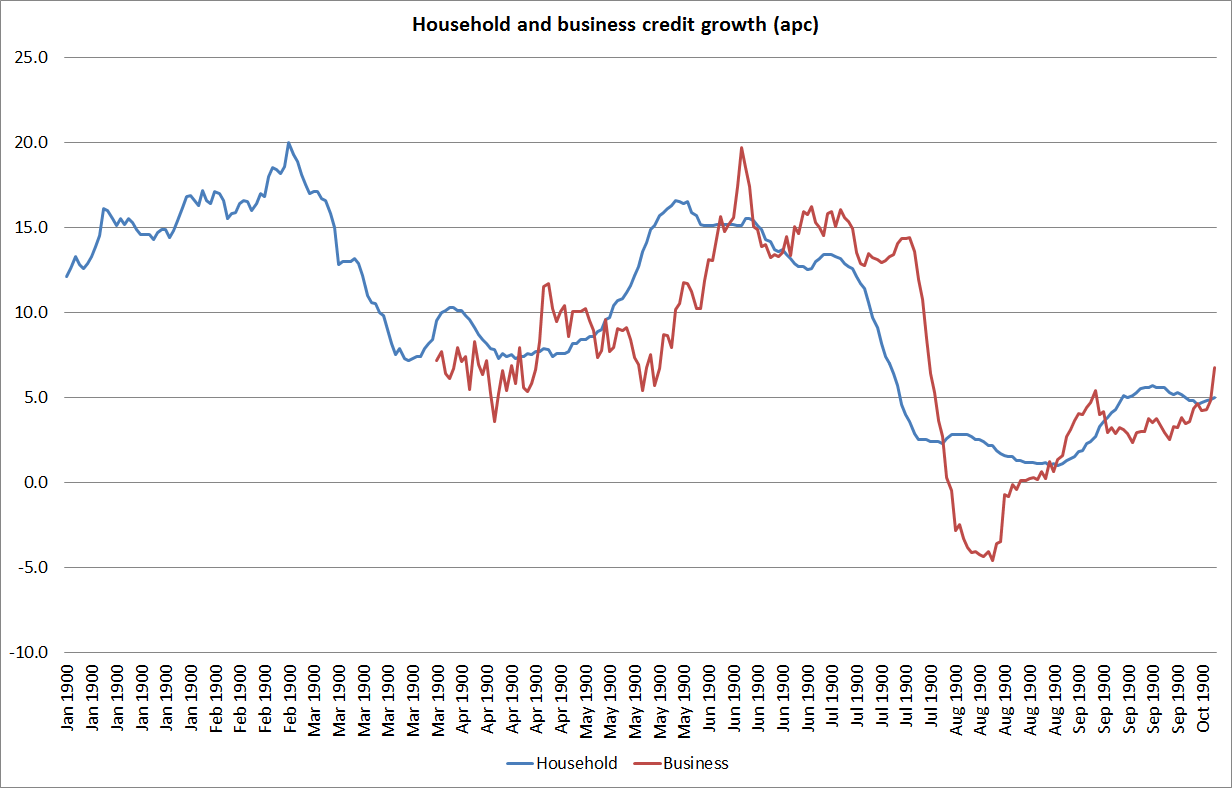
And what of annual growth.  This chart shows lending to households and the businesses (the latter including agriculture).  Lending growth to households has only been materially lower than it is now during the 2008/09 recession.
household credit
And it is often forgotten that there is still momentum behind the stock of household credit as a result of the increase in house prices last decade.  Houses don’t turn over that frequently and many properties being purchased today, in parts of the country with little or no new house price inflation, are being bought at prices higher than the vendor bought the house for (and took a mortgage for) perhaps 10 or 20 years ago.

For the current situation, consider the volume of new mortgage approvals – in recent months running below last year’s level, and well below levels seen in the boom years.

All of which brings us back to the Reserve Bank’s own stress test, reported in the last Financial Stability Report.  This was the most interesting scenario

In scenario A, a sharp slowdown in economic growth in China triggers a severe double-dip recession. Real GDP declines by around 4 percent, and unemployment peaks at just over 13 percent. House prices decline by 40 percent nationally, with a more marked fall in Auckland. The agricultural sector is also impacted by a combination of a 40 percent fall in land prices and a 33 percent fall in commodity prices. The decline in commodity prices results in Fonterra payouts of just over $5 per kilogram of milksolids (kg/MS) throughout the scenario.

And this was the result

Higher credit losses, combined with a decline in net interest income due to increased costs for bank funding, resulted in a significant decline in bank profitability. However, reflecting strong underlying earnings in the New Zealand banking system, these factors were only sufficient to cause negative profitability in a single year in each scenario

A repeat of 1987 is just not remotely in prospect at present.  If bank balance sheets start growing rapidly it might be time for some more concern, but at present issues around Auckland housing should be seen for what they are –  the outcome of policy blunders in which restricted supply runs into rapid population growth – rather than any sort of material threat to financial or macroeconomic stability.

I also noticed Liam Dann’s column in the Herald on a similar topic –  the headings are so similar the two papers could be sharing sub-editors.  Dann is clearly very influenced by his recent trip to China, with his explicit hankering for new controls and restrictions.  It is worth remembering not just that China is coming off a huge government-fuelled credit boom –  outstripping anything ever seen in New Zealand, even in the heady pre-1987 period – but also that the People’s Republic of China remains the outstandingly poor performer of the group of Chinese economies in East Asia. Over the long haul it is an underperforming middle income country with few or no policy lessons for New Zealand.

asiaGDP

Is the UK really a “significant success story”?

I wasn’t really intending to post anything today, but this morning I was sitting in the sun watching my daughter’s soccer and reading last week’s Spectator, where I found Nigel Lawson –  former Conservative Chancellor of the Exchequer  – suggesting that:

It is widely accepted overseas that the UK economic recovery since the 2008 banking meltdown is a significant success story, certainly compared with all other major economies except that of the US

That hadn’t been my impression, but (even allowing for the political motivation behind the comments) I thought it was worth having another quick look at the data.  I wasn’t sure which countries Lawson might have had in mind, but I took the G7 countries, and added Spain and Korea (both bigger than Canada) and the Netherlands.  That made 10 countries in total.

Not wanting to attempt anything very ambitious I downloaded some series from the latest WEO database and looked at a few charts.

The first was per capita real GDP growth from 2007 to 20014.  The median country had had around zero growth over 7 years, while per capita GDP fell 2 per cent in the UK.
uk1
The second was the change in per capita growth, comparing 2007 to 2014 against the previous seven years, 2000 to 2007.  As the UK had had the second fastest growth of this group of countries from 2000 to 2007, the slowdown subsequently was huge – almost as bad as that in Spain.  The IMF reckons that the UK had (just) the largest output gap of any of these countries in 2007.  One might be a little sceptical of that –  more pressure on resources than in Spain? – but the differences aren’t going to redeem the UK picture.

uk2

Unemployment rates in 2014 were higher than those in 2007 in eight of these ten countries.  Here the UK scores relatively well, with an increase less than one percentage point.

uk3

Investment as a share of GDP differs widely across countries, but in all but one of our countries, the investment share was lower in 2014 than in 2007.  The UK doesn’t do too badly on this measure either.

uk4

Much of the political-economic debate around the UK in recent years seems to have been around fiscal “austerity”.  The IMF estimates that the UK’s structural fiscal deficit, as a share of GDP, was a bit smaller than it had been in 2007.  But…..the imbalance in the UK’s fiscal accounts, on this measure, last year was still third largest of these 10 countries.

uk5

And finally, the current account balance.  At 4.8 per cent of GDP, the UK had the largest current account deficit of any of these countries.  If we look at the change in the current account balance from 2007 to 2014, the UK has had the third largest reduction in the current account surplus (or increase in the deficit).  There is no simple way to interpret whether this is a good or bad thing, but I imagine the UK authorities would be feeling a touch nervous if the deficit were to get much larger than it is now.

uk6

So what to make of Lord Lawson’s story?  The advanced world has done very badly since 2007, and that UK hasn’t been exempt.  It is by no means the worst of this group of countries, but I probably wouldn’t score it as even second best either.   But then the UK had a pretty stellar couple of decades prior to the recession.

If the IMF is to be believed, there is still a lot of fiscal adjustment to do at some point.  When it might be prudent to do that is not going to be an easy call for the reappointed Chancellor, with a increasingly fragile eurogroup just across the Channel.