Remote regions, immigration, and prosperity

A couple of years ago I did a post on some remote and very small places, many of which had quite a lot of land and very few people.  My point was to suggest that New Zealand was quite unusual in having so many people in such a remote spot, all the more so when much of the population growth had been accounted for by deliberate immigration policy.    As readers will know –  apart from anything else, I keep pointing it out –  over at least the last 70 years, productivity growth here has been pretty poor and we’ve drifted a long way down the global league tables.  My proposition is that the two stylised facts aren’t unrelated.

At the time of the earlier post, my young daughter was fascinated by a book on remote islands.   At the moment –  a bit older now –  she’s got really interested in Wales and keeps telling me all sort of interesting snippets.  But talking with her about Wales reminded me that at the time of the Lions Tour last year I’d been meaning to write a post highlighting just how little population growth there had been in some of the outer reaches of the United Kingdom.

More generally, I’d been thinking about how global studies attempting to assess the economic impact of immigration focus on comparing across countries.  In some ways, that makes sense –  data are often easier to come by, and countries control immigration policies.    But I suspect there is information in the experiences of remote regions.   After all, if there were typically really good economic opportunities in remote regions, people in a country are free to move there.  The population of the United States, for example, has risen by over 200 million people in the last 100 years –  through a mix of immigration and (mostly) natural increase.  Those peope have been free to locate themselves where the best opportunities are.   One can think of parts of Canada or Australia in the same way.  And if our politicians had made different choices in the 1890s, we could simply have been part of the Australian Commonwealth, and it seems unlikely that the economic opportunities here would have been much different if that choice had been made.

Here I’ve focused on the last 100 years or so.   Why?  Mostly because just prior to World War One New Zealand had probably the highest (or 2nd or 3rd highest) GDP per capita of any country in the world (per the historical tables put together by Angus Maddison).  But it was also some decades on from the first big waves of colonial settlement (whether here, Australia, Canada, or the mid-west and west of the United States).  At around 1 million people in the 1911 Census, New Zealand was already a functioning country of reasonable size (not large, but there are many smaller countries even today).

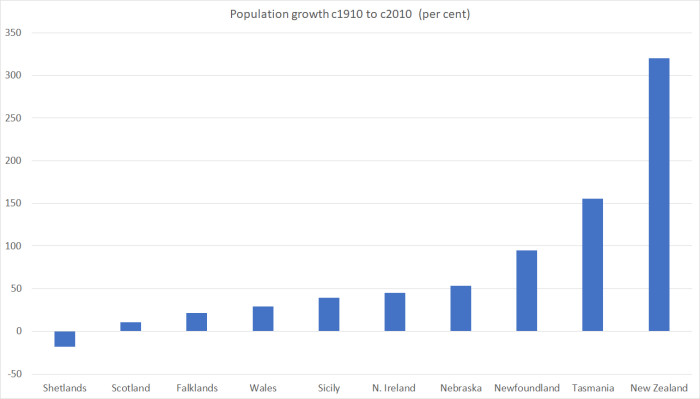
In this table I’ve focused on population growth between the Census nearest 1910 and the most recent Census (in most cases 2010 or 2011, but in New Zealand 2013).   The chart shows the percentage increase in population for these remote regions of countries, plus that for New Zealand  (Nebraska gets chosen as a “remote” US area mostly because I happen to have been there a few times.)

remote regions

Australia and Canada (and the US) have had rapid national population growth rates, but these remote regions  (Nebraska, Newfoundland, and Tasmania) have had much lower population growth rates than New Zealand.  (And, on checking, each of those three have lower population densities now than New Zealand does.)   But given that all of these regions have small populations, relative to the respective nation’s total population, there would have been nothing to stop lots of people gravitating to the remote spots if there was real evidence of good economic opportunities for many people in those places.

It has, after all, happened in some remote regions: West Australia for example, now has about 10 times the population it had in 1910, presumably attracted by the mineral resources that mean West Australia has the highest GDP per capita of the Australian states.    And two really remote parts of the United States –  which I didn’t show on the chart, partly because they were settled so much later (not admitted as US states until 1959) –  are Hawaii and Alaska.  Both have had faster population growth than New Zealand over the last 100 years (although between them only around 2 million people in total): in Alaska’s case no doubt the oil resources attracted people (Alaska also has among the highest GDP per capita of any state).

But over that hundred years –  or any shorter period you like to name really –  New Zealand (like Wales, Northern Ireland, Tasmania, Nebraska, or Newfoundland) has had no big natural resource discoveries, or asymmetric productivity shocks specifically favouring our location.   Like those places, we’ve only had the skills of our people and the instititutions we’ve built or inherited (in the case of this group a fairly-common Anglo set) to make the most of, and to overcome what appear to be the resurgent disadvantages and costs of distance/remoteness.  Our birth rates won’t have been much different over long periods, and New Zealand like all these places –  the Shetlands most extremely of the places on my chart –  have seen outflows of our own people.  The big difference here is immigration policy, which has actively sought to substantially boost the population.

Try a thought experiment.  Say the New Zealand and Australian governments had simply combined their respective immigration policies over the last 100 years or so  (eg if New Zealand was offering 45000 residence approvals per annum and Australia 200000 –  similar to the current policies –  the two countries simply said we’ll issue 245000 residence visas and the arrivals can go wherever they like), what would have happened.   By construction, the total population of the two countries would have been pretty much the same as what we actually see (5.4 million in 1910, and about 29 million now) but what would the distribution look like?     We know that in Australia –  given the same choice –  the remote region with a mild climate and no big new natural resources (Tasmania) saw much weaker population growth than the rest of Australia.   Why wouldn’t it be the case that New Zealand would have experienced much the same phenomenon?    At Tasmania’s population growth rate for the last 100 years we might now have a population of around 2.5 million.   After all, for almost 50 years now native New Zealanders have (net) been relocating to (the non-Tasmania) bits of Australia, so why –  given the free choice –  wouldn’t the migrants –  facing a free choice at the point of approval –  have done so too?

Would we have been better off?    The migrants who went to Australia instead presumably would have been –  both judged from revealed preference (they made the choice) and that incomes in Australia are higher than those here.  I’d argue that the smaller number of New Zealanders probably would have been economically better off as well.  Natural resources are still a huge part of the economic opportunities in these remote islands –  perhaps still 85 per cent of our exports –  and those limited resources would be spread across a considerably smaller number of people.  For those who simply prefer “more people” for its own sake, perhaps they’d have been worse off –  but then such people could have self-selected for Sydney or Melbourne (as Tasmanians of a similar ilk do, or people in Newfoundland who wanted to be part of something big self-select for Toronto).

I’m not suggesting something conclusive here, just that people pause for thought, and reflect on what questions the experiences.    For a remote place we aren’t particularly lightly settled, and especially not as a remote place without the sort of abundant natural resources of –  say –  a West Australia.  We’ve had no distinctive favourable productivity shocks, and we’ve long lost any claim to be the richest (per capita) country on earth.  It is no surprise that some people want to move here –  plenty would want to move to Nebraska if it had its own immigration policy like ours – but there isn’t much evidence, from experience of other remote regions, to suggest we benefit from them doing so.   Without big new natural resource discoveries, remote places –  regions, territories  – in the advanced world  tend to have quite weak population growth rates.  It isn’t obvious why in New Zealand we should let immigration policy up-end that otherwise natural outcome.

The Reserve Bank and financial regulation

Still working my way through the various articles and documents that turned up just before Christmas, I got to a lengthy issue of the Reserve Bank Bulletin, headed “Independence with acccountability: financial system regulation and the Reserve Bank”.   It is, I suspect, designed to fend off calls for any significant reform.

The Bulletin speaks for the Bank, and although as I read through the article I noticed distinct authorial touches and tendencies, when all is boiled down the author was sent into the lists to make the case for how things are done now: powers, governance, and accountability.  He does a pretty good job of presenting the party-line, against significant odds in many areas.    Even where one disagrees with the Bank’s case, it is a useful and accessible addition, in part because the Bank’s powers and responsibilities in regulatory areas have grown like topsy over the years and are scattered across various pieces of legislation.

Much of the first half of the article is designed to make a case for an independent prudential regulator, by reference to the theory and to the writings of the Productivity Commission.  But, for my tastes, it was far too broad-brush to add much value.  Probably no one disputes that we want the rules applied fairly and impartially, with politicians largely kept out of the process.  In the same way, we don’t want politicians deciding which person gets arrested and which not –  we want an operationally independent Police for that –  or who gets convicted  –  independent courts – or which airline passes safety standards and which not, and so on, so we don’t want politicians deciding to look favourably on one bank’s risk models and not on another’s.   There are many independent regulatory agencies –  or even government departments where the chief executive exercises responsibility in independently applying the rules –  but to a very substantial extent they apply and administer the rules, while other people make the policy/rules.

The Reserve Bank wants to make the case that in its area the rules/policy shouldn’t be set by elected people (whether Parliament itself, or ministers by regulation), but by an independent agency, and that the same agency should both make and apply the rules (without any possibility of substantive appeal).  It is the “administrative state” at its most ambitious –  unelected officials (a single one at present, not even directly appointed by a Minister) are lawmakers, prosecutor, judge and jury (and quite possibly the equivalent of the Department of Corrections as well).

The Bank seeks to rest a lot on the notion of time-inconsistency, a notion from the academic literature that is sometimes used to try to explain the high inflation of the 60s and 70s, and to make the case for an independent central bank to make monetary policy.  The idea is that even though one knows what is good in the long-run, the short-term benefits of departing from that strategy (and endless repeats of the short-term) mean that the long-term gains are never realised.  The solution, so it was argued, was to remove the short-term management of the business cycle from politicians.    I’m not particularly persuaded by the model as it applies to monetary policy (a topic for another day), and it is curious to see a central bank putting so much weight on that model after year upon year of inflation below target.  But today’s topic is financial regulation and financial stability, where the Bank would have us believe it is desirable/important to have the rules themselves –  the policy –  set by someone other than politicians.

No doubt it is true that there can be some tension between the short and the long-term around financial stability.  But that is surely so in almost every area of government life and public policy?  Underspending on defence now frees up more resources for other things now, but one might severely regret doing so if an unexpected war happens later.  Skimping on educational spending now won’t make much difference (adversely) to economic performance or the earnings of anyone (teachers aside I suppose) for a decade or two.  Running big fiscal deficits now can offer some short-term benefits, but at the risk of heightened vulnerability etc a decade or two down the track.   But in none of these areas do we outsource policymaking: they are political choices, and we then employ officials and public agencies to administer and deliver those choices.     The Reserve Bank has, as far as I’m aware, never offered any explanation as to what makes their specific area of policy different.   Sometimes they draw on academic authors writing about financial regulation, but many of those specialists fall into the same trap –  they see their own field, but never stand back and think about how democratic societies organise themselves across a wide range of policy.

As it happens, the current system around the Reserve Bank and financial regulation is a bit ad hoc and inconsistent to say the least, a point that the article more or less acknowledges.     Thus, for banks the Reserve Bank can vary the “conditions of registration” to change all sorts of big policy parameters, without any formal involvement from elected politicians at all (all the variants of LVR policy, from the first Wheeler whim were done this way).  But even for banks rules around disclosure have to be done by Order-in-Council, and thus require ministerial approval.  No one would write the law that way –  such different regimes for two different aspects of  bank regulation –  if starting from scratch (the actual legislation has evolved since 1986).

For insurance companies, the Reserve Bank itself can issues solvency standards (effectively, capital requirements for insurers), but for non-bank deposit-takers capital rules (and other main prudential controls) can only be set by regulation, again requiring the involvement and approval of the Minister of Finance.   (Incidentally, this is why LVR rules apply to banks but not non-bank deposit-takers: Wheeler could regulated banks directly, but couldn’t do the same for non-bank deposit-takers.

(And, as the Bank notes, it has “no direct role in developing rules associated with AMLCFT”, even though it administers and applies those rules for banks.)

At very least, there would appear to be a case for streamlining and standardising the procedures for setting the rules.     It isn’t clear why the Reserve Bank Governor should have almost a free hand when it comes to banks, but such limited scope to set policy when it comes to non-bank deposit-takers.   And, if anything, the case for ministerial involvement in settting the rules for banks is greater than that for the other types of institutions because (as the Bank acknowledges) bailouts and recessions associated with financial crises etc have major fiscal implications, and one might reasonably expect elected ministers to have a key role in setting parameters that influence the risk of systemic bank failures.   And, again as the Bank acknowledges, it isn’t easy to pre-specifiy a charter –  akin to say the Policy Targets Agreement –  for financial stability policy.

The Bank attempts to cover itself against suggestions that it might be, in some sense and in some areas, a law unto itself, by highlighting various ways in which the Minister of Finance might have some say.   There are, for example, the (non-binding) letters of expectation, the need to consult on Statements of Intent, and the potential for the Minister to issue directions requiring the Bank to “have regard” for or other area of government policy.     These aren’t nothing, but they aren’t much either –  and as the Rennie report noted, the power to issue “have regard” directions has never been used.    Even budgetary discipline is so weak as to be almost non-existent: there is a five-yearly funding agreement, but it isn’t mandatory  (something that needs fixing in the current review), isn’t particularly binding, and doesn’t control the allocation of spending across the Bank’s various functions.   The Minister of Finance doesn’t even get to make his own choice of Governor –  and all Bank powers still rest with the Governor personally.

The contrast with the other main New Zealand financial regulatory agency, the FMA, is pretty striking.   Policy is mostly set by the Minister (by regulation), advised by MBIE (to whom the FMA is accountable), and the powers of the organisation itself rest with the FMA’s Board, all the members of which are appointed directly by a Minister, and all of whom –  under standard Crown entity rules – can be removed, for cause, by the Minister.  Employees, including the chief executive, only have powers as delegated by the Board.    The FMA model is now a pretty standard New Zealand regulatory model, and an obvious point of comparison with the Reserve Bank.

Somewhat cheekily, the Reserve Bank attempts to present their own model as providing more scope for ministerial input than for the FMA  (see footnote 16, in which they note that for the FMA there is no power of government direction).   As regards policy, it isn’t necessary, since the government sets policy and appoints (or dismisses) the Board.   As regards the application of rules, one wouldn’t want –  and doesn’t have –  powers of government direction in either case.   As regards the banking system, mostly ministers can’t set policy, can’t hire their own Governor, and can’t fire him (re financial system policy) either.   The Governor and the Bank have far more policy power than is typical –  across other regulatory agencies –  appropriate, or safe.

The second half of the article is about accountability.  As they reasonably note, when considerable power is delegated to unelected agencies, effective accountability needs to provided for.    In their words “accountability therefore generates legitimacy and legitimacy in turn supports independence”.

It is, therefore, unfortunate that the Bank’s very considerable powers are matched, in this area in particular, by such weak accountability.   After pages of attempting to explain themselves and what they see as the various aspects of accountability, even they end up largely conceding the point.     These sentences are from the last page of the article

the BIS (2011) argues that financial sector accountability mechanisms should be focussed more on the decision making process rather than outcomes per se. This is because of the more intrusive nature of financial sector policy, and the issues associated with observing outcomes (lack of quantification and very long lags). Put another way, there should be less reliance on ex post accountability mechanisms and more obligations placed on ensuring decision-makers are transparent about the basis for their actions.

I’m not sure I entirely agree –  although there is certainly the well-recognised point that absence of crisis is evidence of nothing –  but at very least a focus on strong process might argue for:

  • a more effective separation between policymaking and policy administration (as is customary for many regulatory entities, but largely not for New Zealand bank supervision),
  • a decisionmaking structure in which power did not rest simply with a single individual, who is himself not directly appointed by an elected person,
  • decisionmaking structures that involve real power with non-executive decisionmakers,
  • effective and binding budgetary accountability,
  • a high degree of commitment to transparency and to ongoing external engagement,
  • a culture that is self-critical and open to debate,
  • perhaps some more effective scope for judicical review (including on the merits, rather than just process),
  • monitors with the expertise, mandate, and resources to ask hard questions and to critically review and challenge choices being made around policy and its application.

At present, as far as I can see, we have none of these for the Reserve Bank of New Zealand as financial regulator.

Take the formal monitors for example.  Parliament’s Finance and Expenditure Committee has little time, no resources, and little expertise.  The Treasury has no formal role, no routine access to Bank materials (or eg Board papers) and is probably quite resource-constrained in developing the expertise.

And what of the Bank’s Board?   By law, they play a key role, as agent for the Minister of Finance in monitoring the Governor, and (now) obliged to report publically each year on the Bank’s performance.    The Bank often likes to talk up the role of the Board –  doing so provides them cover, suggesting the presence of robust accountability –  but the latest article is surprisingly honest.  The Board gets a single paragraph, which simply describes the legislative provisions.  There is no suggestion of the Board have actually played a key role in holding the Bank (Governor) to account – not surprisingly, since in the 15 years they have been publishing Annual Reports, there has never been so much as a critical or sceptical word uttered.  Of course, it isn’t surprising that the Board doesn’t do a good job: it has no independent resources at all (even its Secretary is a senior Bank staffer), the Governor himself sits on a Board (whose main role, notionally, is to hold the Governor to account) and the Board members themselves typically have little expertise in the areas (quite diverse) around which they are expected to hold the Governor to account for.   (Their job is, of course, made harder by the rather non-specific mandate the Bank has in regulatory areas –  there is nothing akin to the Policy Targets Agreement (which has its own challenges in monitoring).)

What of some of the other claims about accountability?  The Bank points out that it is required to do regulatory impact assessments –  but these are typically done by the same people proposing the policies, and there is (or was when I was there) nothing akin to the sort of process some government departments have for independent panels vetting the quality of the regulatory impact assessments.

They are also required to consult on regulatory initiatives, and must “have regard” to the submissions.  But, except perhaps on the most technical points, there is little evidence that they actually do pay any real heed to submissions.    For a long time, they also kept the submissions themselves secret –  even attempting to claim that they were required by law to do so.  They’d publish a “summary of submissions”, which highlighted only the issues they themselves chose to identify.   As they note, and in a small win for a campaign by this blog, they have now started publishing individual submissions, belatedly bringing them into line with, say, Select Committees of Parliament or most other regulatory bodies.  But there is no sign of much change in the overall attitude, or of any greater openness to ongoing debate and critical scrutiny.

Then, of course, there is the Official Information Act.  The Bank is subject to the Act, but chafes under the bit, is very reluctant to release much, threatens to charge requesters, and generally seems to see the Act as a nuisance, rather than an integral part of an open and accountable government.

We had a good example just a couple of months ago as to how unaccountable the Bank is in its prudential regulatory areas.  It emerged that Westpac had not had appropriate regulatory approval for some model changes used in its risk-modelling and capital calculations.   But, as I noted at the time, the short Bank statement left many more questions than it answered, and no one –  including journalists asking directly –  has been able to get straight answers from them, even though capital modelling is at the heart of the regulatory system.

And, of course, if the formal monitors are lightly (or not at all) resourced, there isn’t much other sustained scrutiny.   Banks are scared –  and more –  to speak out: this is where culture matters a great deal, as banks will always have a lot of balls in the air with the regulator, and in an open society should feel free to openly challenge the regulator, without fair of undue repercussions.   Academics with much expertise in the area are thin on the ground, as are journalists with the time or expertise.

Mostly, in its exercise of its extensive financial regulatory powers, our Reserve Bank isn’t very accountable at all.   Providing it jumps through the right, minimal, process hoops it can do pretty much what it likes in many areas of policy, and the public is left just having to take the Bank’s word (or not) that things are okay.  That needs to change –  and thus phase 2 of the current review of the Bank’s Act needs to be taken seriously.    Making the changes isn’t about one single measure, and there are plenty of details that will take a lot of work, and thought, to get right.   Part of it is about building a better internal culture, one that (from the top) really wants to engage, and which welcomes challenge and critical review.

After yesterday’s post I had an email from a reader with considerable senior-level experience in the banking sector noting just how weak much of the formal scrutiny of the Bank is in these areas.

From my perspective the Bank would benefit from independent challenge about their prudential responsibilities, and cost-benefit analysis. I am unsure if they have reviewed this post the Westpac capital model issues.

I am unsure how the Board discharges the independent prudential review role effectively given their experience – two Directors have insurance experience  and no directors have Banking, payments system or other non-bank financial experience. Likewise experience of Insurance/Banking/Payments technology systems and risks. While there are some very good RBNZ executives they are not particularly strong in banking risk experience – funding, liquidity, credit etc.

…. I think it would be useful for the RBNZ at a governance level to have experience of how financial balance sheets, and liquidity operate under stress, they will have some very important decisions to make when the next financial crisis occurs.

Much of that rings true to me.    We have typically had Governors with more experience of macro policy, and perhaps financial markets, than of banking –  and yet financial regulation is a hugely important role in what the Bank does – and now have a new Head of Financial Stability with no background in banking or finance at all.   We have a Board responsible for monitoring the Bank across monetary and regulatory responsibilities, and with little specialist expertise.   The contrast with, say, the FMA is quite stark.

Quite what the right balance of a solution is, I’m not quite sure.   I favour moving to a committee-based decision-making structure, and moving more of the policy back to the Minister (with the Bank as a key adviser), but even a Financial Policy Committee might only have three or four externals on it, and no such group is going to encompass all the right bits of expertise.   As often, I guess it is partly about the willingness to ask the hard questions, and to be willing to commission independent expertise (whether from New Zealand or abroad, from academics or people with industry background) and to engage.   If the Board remains as a monitoring agency –  as Rennie recommends, but I’m sceptical of –  it needs to be provided with resources.   And the Minister needs to be willing to use his statutory powers to commission independent reviews of aspects of the Bank’s stewardship, to enable us (and the Bank) to learn from experience by critically evaluating performance (and process).  Personally, I’m still tantalised by the idea of a small independent agency resourced to pose questions, and commission research, on the stewardship of fiscal, monetary and financial regulatory policy.

If not all the answers are clear, what is clear is that New Zealand is a long way from having got the model right: the right allocation of powers, the right accumulations of expertise in the right places, the right cultures, and the appropriate mix of formal and informal accountability that can really give New Zealanders confidence in the regulation of the financial system.
 

Savings rates in international context

In putting together yesterday’s post, I stumbled on something I hadn’t noticed previously.  In yesterday’s post I showed only New Zealand saving rates –  in particular, net national savings (ie savings of New Zealand resident entities, after allowing for depreciation) as a share of net national income.  The net national savings rate has picked up quite a bit in the last few years, although not to historically exceptional levels.

But here are the New Zealand and Australian net national savings rates plotted on the same chart.

net nat savings nz and aus

For the last couple of years, the net savings rate of New Zealanders has been higher than that of Australians.  I wouldn’t want to make very much of a couple of years data, and over, say, the last 25 years, the average savings rate of New Zealanders has still been a little lower than that of Australians.  But even that average gap has been much smaller over that period than over, say, the previous 20 years.

It isn’t a story you would typically hear from those who argue that savings behaviour is at the heart of New Zealand’s economic challenges.   Some will point to the compulsory private savings system now in place in Australia (phased in from 1992).  There is no easy way of assessing the counterfactual –  what if the system had never been introduced? –  but there is no obvious sign that the system has led to a lift in national savings rates in Australia, whether absolutely or relative to New Zealand.  Others will (rightly) highlight the big tax changes implemented here in the late 1980s which materially increased the tax burden on income earned by savers (in a way pretty inconsistent with the recommendations of a lot of economic theory).  I don’t think those changes were appropriate, or even fair, and would favour a less onerous regime.  But in the decades since the changes were made, our savings rates have been closer to those in Australia (where a less onerous tax regime applies as well) than they were in the earlier decades.

One policy change that may have made a difference is overall fiscal policy: the improvement in New Zealand’s overall fiscal position (reduction in general government debt) has been larger than that in Australia (largely reflecting the fact that we were in a bigger fiscal hole 25 or 30 years ago).   Higher average rates of public saving may have lifted average national savings rates to some extent.

What about other countries.  In a paper I wrote some years ago for a Reserve Bank/Treasury conference, I illustrated that over time New Zealand’s savings rate hadn’t been much different from that of some other Anglo countries.  Here is a more recent version of that sort of chart.

net nat savings anglo

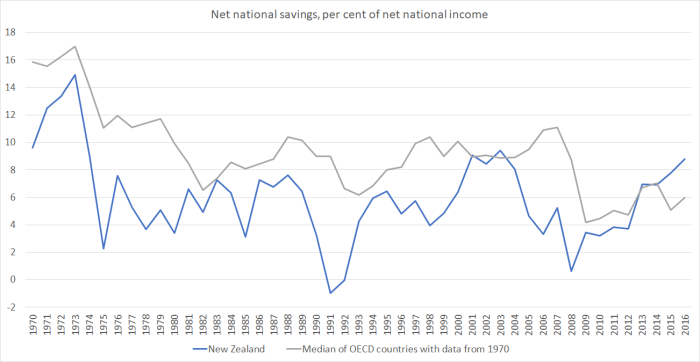
New Zealand’s national savings rates have typically been below those in the OECD group of advanced countries as a whole (and perhaps particularly some of the more economically successful of those countries –  whether by chance, cause, or effect).   But even on that score the last few years look a little different.   This chart compares New Zealand against the median of the 22 OECD countries for which there is consistent data over the full period.

net national savings oecd

It is quite a striking change, and the reasons aren’t at all clear (see yesterday’s post on the puzzles around the New Zealand data).  Perhaps in time some of the rise in the New Zealand savings rate will end up being revised away.  Perhaps the lift will prove real, but temporary (as, say, happened for a few years around 2000). But if not, the apparent change in the relationship between our savings rate and those in other advanced countries should help keep our real interest rates –  and our real exchange rate –  a bit lower than otherwise.  If sustained, that would be expected to lift our economic prospects a bit, all else equal.

But it is worth remembering that, all else equal, a country with materially faster population growth than its peers should typically expect to have a higher national savings rate over time than its peers.   All else is never equal of course, but New Zealand continues to have a population growth rate well above that of the median advanced country.


New Zealand savings rate trends

Making sense of savings behaviour (the bit of flow income not spent) in New Zealand is a bit of a challenge.  Perhaps that is true of other countries as well, but I know their individual stories less well.  In the New Zealand case, it isn’t helped by the rather limited historical data: we have an official estimate of national savings back only as far as the year to March 1972, we only have a sectoral decomposition of savings (household government, etc) back to 1987, and there is no official quarterly data.  Australia, by contrast, has all this data back as far as 1959.

Our sustained period of high inflation didn’t help either.   A significant chunk of any interest rate is typically compensation for inflation, and on the other hand in inflationary periods depreciation (typically on a historic cost basis) tends to be understated.  Decades ago, the Reserve Bank was pointing out that in that era, inflation was flattering our national savings figures.

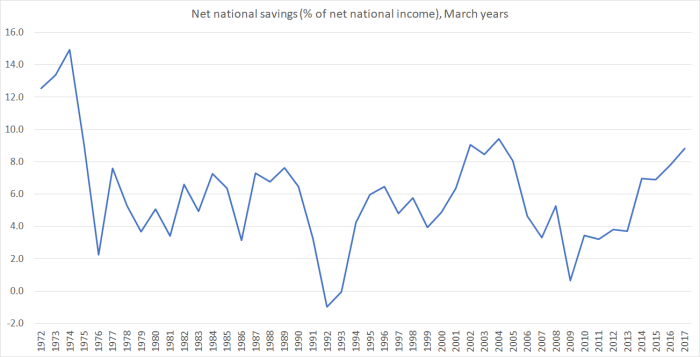
Here is the official series of net national savings expressed as a percentage of net national income (“net” in both cases being net of depreciation – or “consumption of fixed capital”, and “national” referring to the income and savings of New Zealand residents, as distinct from “domestic” –  as in GDP  –  being any activity occurring in New Zealand.)

net savings to nni jan 18

If your eye is anything like mine, you are probably drawn to those last few observations, suggesting quite a significant increase in the net national savings rate in the last few years.    It isn’t exceptional by historical standards –  the savings rate averaged just a little higher for several years in the early 2000s –  but is interesting nonetheless.   Of the other potentially interesting observations, I have no good story for why national savings rates were so much higher at the very start of the period (and thus can only lament the absence of a longer run of official data).   One thing is clear: the lowest points in the series (years to March 1992 and March 2009) coincide with severe recessions.   That probably isn’t too surprising.   But there isn’t anything really comparable on the other side: if savings rates have tended to be higher in cyclically stronger periods, the peaks certainly don’t coincide very strongly with cyclical economic peaks.   Perhaps the other thing to note is that for the last 40 years there has been no obvious trend in the series: fluctuations have been around a fairly constant average rate of 5 to 6 per cent.    Perhaps the reduction in the inflation rate masks an underlying modest trend improvement, but even if so, the high inflation era itself ended 25 years ago.

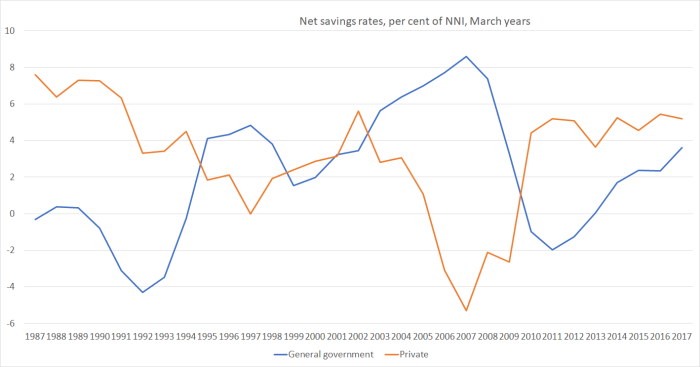
What about the sectoral breakdown of net national savings?   Here is the split between government and private savings.

savings rate jan 18

It is pretty well-recognised that there has been an inverse relationship between the two series.  Quite what that means, or why it occurs, is another question.    Some of it is about the automatic stabilisers built into the tax system (in particular).   Government tax revenue tends to increase more than proportionally in economic upswings, and vice versa (eg on the company tax side, many companies record losses in recession, and it may take a few years of a recovery before they start having a tax payment liability again).      Some may be about government spending taking the place of private spending: if the government suddenly starts paying for, say, childcare costs, households no longer have to and some of that money might now be saved.    Some might be about rational expectations of future fiscal adjustments –  not in some very long-term Ricardian sense, but just that political debate tends to compete to spend large surpluses when they do arise, and people may anticipate that they will soon have more money in their pockets (eg from tax cuts).   Whatever the reason, the pattern has been there over the last 30 years or so.  It is one reason to be a little cautious about the idea sometimes heard that, if raising national savings rates was some sort of national economic priority, it might be enabled by governments simply running larger surpluses.    History –  here and abroad –  suggests that such surpluses aren’t likely to be sustainable, at least when starting from a low debt position, and that the public will relatively quickly recognise that.

Having said that, it is interesting that over the last few years the increase in the national savings rate has been almost wholly reflected in a rise in government savings.  The private savings rate, by contrast, has been pretty stable for some years.

But what about the breakdown within the private savings rate.  This chart shows household and business savings separately, both as share of NNI.

savings rates jan 18 pte

It is useful to be reminded that for some decades now business (net) savings rates have been quite a bit larger than those of households.  Little commentary ever focuses on business savings rates.

Some commentators –  including, at times, the Reserve Bank –  tend to make quite a lot of the role of house prices in explaining household savings behaviour.   I’ve never really found that convincing, and suspect that fiscal policy may be more important an influence on the cyclical swings in the savings rate.  Why?   Well, consumption as a share of GDP has been remarkably stable over 30 years, in the face of huge increases in house prices, and quite substantial swings in house price inflation.   That shouldn’t really be a surprise: after all, higher house prices aren’t a net gain in the community’s real purchasing power, they just redistribute purchasing power a bit (to those just about the downsize and retire to the provinces, and away from those trying to purchase a first home).  And, as it happens, the low point in the household savings rate series came in the year to March 2003, just prior to the first great surge upwards in house prices.

And, of course, one keeps seeing talk –  typically from interested parties –  of the rising tide of Kiwisaver funds.  No doubt, there is a big increase in the stock of funds bearing a Kiwisaver label, but there is nothing in household savings data over the last decade that really suggests any material change in households’ overall rates of savings.   Those rates were very low when the government was running big surpluses, picked up somewhat when the government had big deficits (and the economic climate was uncertain) and have been falling off again in recent years as the budget moved back into (actual and prospective) larger surpluses.

As for business savings, I don’t know how to interpret the data at all.  There has been too little analysis (at least that I’ve seen) attempting to make sense of the swings in the years leading up to 2008 –  that really sharp fall in business savings rates well before the recession itself –  or of the extent of the subsequent recovery.    Terms of trade fluctuations, for example, don’t readily explain the patterns.    Of course, in the end  firms are ultimately owned by households, and the boundaries between the two may be somewhat permeable (and affected, for example, by tax changes and dividend distribution policies.)

I’m not one of those who is alarmed by New Zealand savings rates.   They are towards the low side in international comparisons (a topic for another day), but it isn’t obvious that that is because of specific policy distortions here which materially adversely affecting savings (and more so here than in other countries).   The government accounts have been fairly healthy for decades, our welfare and retirement income system discourages private savings less than those of many other countries, and although our tax system bears materially more heavily on institutional savings than the regimes of many other countries, one has to be cautious about putting too much weight on that argument: it is not, after all, as if savings rates have been materially lower since the late 1980s (when the tax system was markedly reoriented) than previously.   A highly successful economy would be likely –  based on international comparisons –  to see higher average savings rates, but that doesn’t mean that policies designed to boost savings rates could themselves do much to lift the performance of the economy (partly because policies designed to “boost savings” don’t themselves have a particularly good track record).   Rather, when firms are finding abundant investment opportunities, they will tend to be wanting to retain more in the business, and earning the rates of return that support those high business savings rates.

As a reminder, this post has been about flow savings rates.  Some people are keen to talk about asset revaluations, and gains in recorded wealth.     That is, largely, a different topic, but –  as already noted –  bearing in mind that we all have to live somewhere, higher house prices do not make us, as a community, better off.   Higher equity prices may well do so –  and thus US research used to find a stronger wealth effect on consumption from equity prices –  especially if those gains are reflecting underlying improvements in productivity etc.

Workers in a fool’s paradise

A couple of months ago I did a post highlighting some little recognised aspects of the New Zealand data on wages and labour income.   They suggested that, given the underlying relatively poor performance of the economy, workers hadn’t done badly at all. I was curious how the latest national accounts data had changed the picture.

The first chart that attracted my interest was the labour income (“compensation of employees”) share of GDP.   The data are only available annually, but they suggested quite a recovery in the labour share of GDP in the 00s, which had been sustained this decade to date.

COE

That was the picture on the previous iteration of data.     Here is the updated version.

COE jan 17

The picture is subtly different, and if anything the labour income share looks to have been shrinking gradually this decade, even if it is still well above where it was in 2001/2 (the historical low).

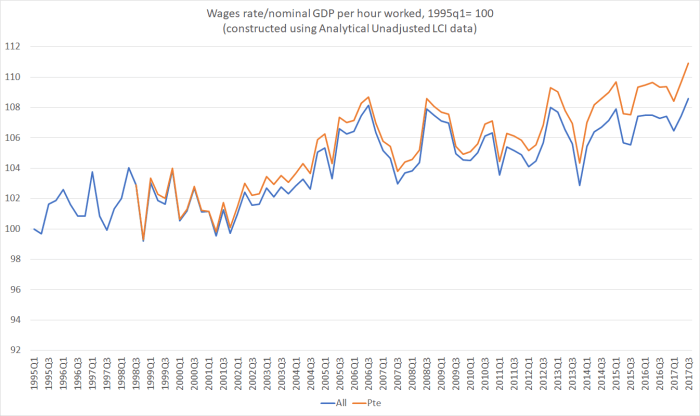
But the other chart, which I found more striking, was one in which I compared growth in nominal wage rates against growth in nominal GDP per hour worked.   I used the Statistics New Zealand Analytical Unadjusted Labour Cost Index series.  It isn’t widely referred to, but relative to the headline LCI series it is a pure wages series, not one in which SNZ has already tried to adjust for productivity, and relative to the QES, it is much smoother (the way economists typically think of wage-setting behaviour) and produces more sensible and plausible series (some of the problems with the QES were illustrated in the earlier post).

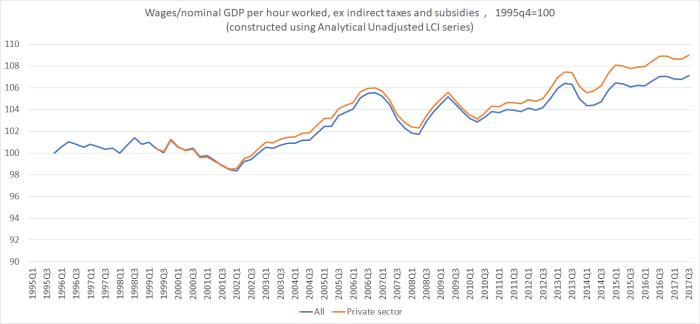
When I did the exercise earlier, on the old data, I found that cumulative wage inflation –  particularly that in the private sector –  had run quite a bit ahead of productivity (GDP per hour worked) since around 2002.    Here is the updated version of the chart.

wages and nom GDP phw jan 18

There is a lot of short-term noise in the series –  and wages last year were somewhat “artificially” boosted by the pay equity settlement – but if the extent to which wages have moved ahead of productivity is less than it was in the previous iteration of the data (GDP has been revised up, and wage rate data are unchanged), the trend I highlighted last year is still there.

In my earlier post, I noted that this chart had been done using GDP itslf, and that to be more strictly accurate I should have taken account of, eg, the 2010 change in GST (which boosted GDP but shouldn’t have affected wages).    Data on indirect taxes and subsidies are only available annually, so here is a smoothed (four quarter moving average) version of the chart, this time comparing wages against nominal GDP per hour worked excluding indirect taxes and subsidies.

wages and nom GDP phw ex taxes and subsides jan 18

What has been going on?   One possibility is that the Analytical Unadjusted wages data are just substantially wrong?   But they are series that have now been published by SNZ for more than 20 years, and I don’t have specific things I can point to suggesting that they are wrong.

If the data are picking up something real, what then might be the story?   Here was what I included in the earlier post.

My explanation is pretty simple: the (real) exchange rate, which stepped up sharply about 15 years ago and has never sustainably come down since.    When the exchange rate is high, firms in the tradables sectors make less money than they otherwise would have done.   The usual counter to that is that the terms of trade have risen.  But the increase in the real exchange rate has been considerably more than the higher terms of trade would warrant, and in any case much of the gains in the terms of trade have come in the form of lower real import prices, rather than higher real export prices.

And why has the exchange rate been so high?  Because the economy has been strongly skewed towards the non-tradables sector which –  by definition –  does not face the test of international competition.  Demand for labour in that sector has been strong, on average, over the last 15 years, and it is the non-tradables sector that has, in effect, set the marginal price for labour.  For those firms, in aggregate, the lack of productivity growth doesn’t matter much –  they pass costs on to customers.  But it matters a lot for tradables sector producers, who have to pay the market price for labour, with no ability to pass those costs on (while the exchange rate puts downward pressure on their overall returns).  Another definition of the real exchange rate is the price of non-tradables relative to those of tradables. Consistent with this sort of story, in per capita terms real tradables sector GDP peaked back in 2004 (levels that is, not growth rates).

It isn’t, to repeat, a story in which labour has done well absolutely.  As I illustrated the other day, over the last five years there has been about 1 per cent real productivity growth in total.  For decades, we’ve been slipping backwards relative to other advanced countries.   But given the weak overall performance, labour doesn’t look to have done too badly.   That isn’t a recommendation for the “economic strategy” the last two governments have pursued.  A climate in which firms don’t find investment attractive –  perhaps especially investment in the internationally-competitive tradables sector –  isn’t likely to be one that conduces to generating sustained high performance and strong medium-term income growth.

And here is the proxy for business investment (total investment less housing and government) as a share of GDP

bus inv jan 18

Despite some of the best terms of trade in decades, business investment has been poor this cycle –  following on from several decades when it has typically been well below that of the median OECD country (despite well above median population growth).  The notion that “investment has been weak in lots of countries”, even to the extent true, should be no consolation: we started so far behind there was (and is) plenty of scope for us to have caught up, not being so affected by financial crises, euro-area ructions, zero lower bounds or whatever.

It is a fool’s paradise model: non-tradables focused businesses (of which there are many) do just fine, supported by continuing rapid population growth, but there isn’t much net investment at all outside those sectors as New Zealand proves to be an increasingly unfavourable place to build and base internationally competitive businesses.  Productivity growth remains weak, perhaps even weakens further.   Wages might well outstrip productivity growth, but in the long-run only sustained productivity growth will support high material living standards here.   It isn’t a model that need end in crisis, but rather in mediocrity.  And New Zealanders could do so much better.


A very strong economy driven by the strong economic plan?

The latest quarterly GDP data came out just before Christmas, and they included substantial revisions to the data for the last few years, flowing on from the annual national accounts data released in November.

The actual level of GDP is now a bit higher than had previously been reported, but what caught my eye was the reported claim from the former Minister of Finance, Steven Joyce, that the new data suggested that there was no productivity growth problem after all.   You’ll recall that for some time I –  and others –  have been highlighting data suggesting that there had been basically no productivity growth at all in New Zealand for the last five years.

Here was Steven Joyce’s specific claim

Mr Joyce says the figures released today finally put to bed the fallacy that New Zealand was having a ‘productivity recession’.

and he went on to claim that

“These figures provide clear confirmation that the new Government has inherited a very strong economy driven by the strong economic plan of the previous Government.

So what do the productivity numbers look like on the revised GDP data?  You may recall that I’ve been calculating nine different measures of real GDP per hour worked (using the two quarterly measures of GDP, and the HLFS and QES hours data, and an average measure).    Since GDP for the last few years had been revised upwards and the hours numbers weren’t touched, productivity growth was inevitably going to be a bit stronger than previous estimates had suggested  (which was a relief, because the previous estimates had, if anything, suggested a modest fall in the level of productivity and that didn’t really ring very true).

Here is how the average measure of real GDP per hour worked has behaved over the almost 10 years since 2007 q4 (just prior to the 08/09 recession).

GDP phw worked NZ Jan18

Over the last 10 years (less one quarter), total labour productivity growth has been 6 per cent.    Over the last five years, New Zealand’s total productivity growth has been 1 per cent (ie about 0.2 per cent per annum).   It is a little better than the previous iteration of data has suggested, but……it isn’t much to boast about.

Using the same average measure, I calculated the average annual rate of productivity growth for a few historical periods:

  • Under the National-led governments in the 1990s,  average annual productivity growth was 1.2 per cent (quite dismal enough, given how far behind we had slipped),
  • Under the Labour-led governments of 1999 to 2008, average annual productivity growth was 1.0 per cent,
  • Under the National-led governments of 2008 to 2017, average annual productivity growth was 0.8 per cent, and
  • (as already noted), over the last five years, average annual productivity growth was 0.2 per cent per annum.

And here is the comparison with Australia, on the newly-updated New Zealand data.

AUs and NZ reaL gdp PHW

Australia’s numbers seems to have been flat for the last couple of years, but even over that short period we’ve done a bit worse than they have.

If these results are what Steven Joyce had in mind in talking of a “very strong economy driven by the strong economic plan” one can only really shake one’s head in despair.   If there was a plan to lift overall productivity performance, it clearly didn’t work.  Economic policy was simply misguided, and seems to have paid no attention to the severe limitations of our location.   Perhaps more depressing –  given that Joyce and his colleagues are in Opposition –  is that there is little sign that the new government has any more convincing a strategy  (and where is the deeply-grounded persuasive advice of MBIE and Treasury?).   One hopes –  but is that just against hope –  that they care.

On more mundane matters, I had cause to wonder about even the cyclical strength of demand when, over the holidays, one evening my wife and I walked from Epsom to Parnell and back, and were staggered by just how many empty shops there were in both Newmarket and Parnell.    Any reader insights into just what is going on (or not) in those up-market shopping districts would be of interest.


A few HYEFU thoughts

At the time the PREFU was published in August, I ran a short post illustrating that not even Treasury seemed to believe there was any prospect of increasing the export share of GDP in the next few years.  Their projections were that, on the then-government’s policies, the decline in the export share would continue unabated over the years to 2021.

The next set of Treasury forecasts were published in the HYEFU yesterday.  We have a new government  –  even a Minister for Export Growth –  so I was curious to see what the updated forecasts looked like.

This chart captures the actual export share of GDP, now through to the June 2017 year, and shows separately the PREFU and HYEFU forecasts.

exports hyefu

There is a bit of a lift between PREFU and HYEFU, but interestingly the downward trend is still in place in the last set of numbers.

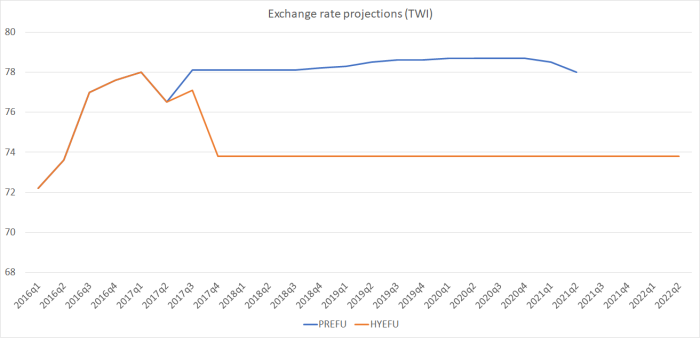
What has changed?  Mostly the exchange rate.   Here are the assumptions/projections for the exchange rate in the two sets of forecasts.

TWI hyefu

Over the full forecast horizon, the exchange rate is now assumed to be around 5.5 per cent lower than was previously assumed –  more or less just treating the fall in the last few months as if it will be sustained.   Some of that fall will flow through into the domestic price level, but it is still a real exchange rate fall of around 5 per cent.    But even though that fall is assumed to be sustained for several years –  4.5 years to the end of the forecast horizon –  there is no sign of the decline in New Zealand’s export share of GDP being reversed.  Presumably it would need (policy changes that brought about) a much larger sustained decline to really begin to make a substantial difference.

I know some commentators think the exchange rate could soon fall quite a bit further –  after all if the US keeps on raising interest rates, they’ll soon have a Fed funds target rate equalling our OCR.   But Treasury doesn’t think that is likely: they still have large increases in the OCR (and 90 day rates) forecast for the next few years, far larger (and sooner) than anything in the Reserve Bank’s numbers.   Frankly that still seems unlikely, but these are the projections/advice of the government’s leading economic advisory agency.  On their numbers, the prospects for the tradables sector don’t look good.

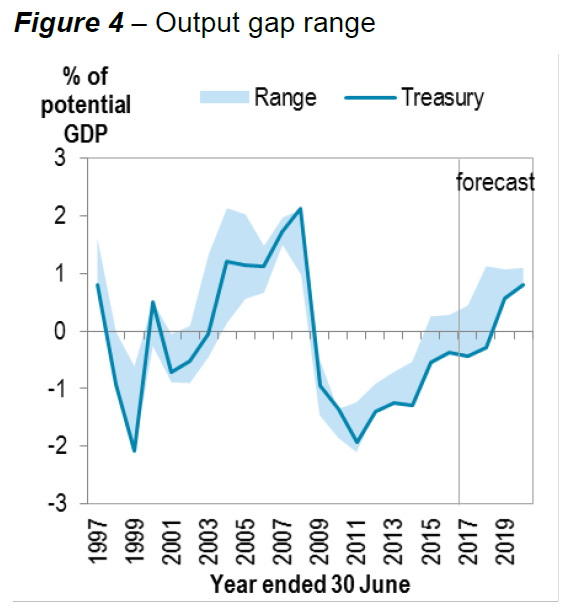
There are other sobering aspects in the numbers.   Take this chart for example.

output gap hyefu

The solid line is the Treasury estimate –  on their numbers the output gap is still estimated to be negative, bringing to 10 years the period in which our leading economic advisers think the economy has been running below capacity.   When things like that happen –  and they shouldn’t –  it is usually an adverse reflection on macroeconomic management.  It also isn’t very clear why things should suddenly come right next year –  with a forecast of the biggest change in the output gap in the last decade, suddenly moving the economy into an excess demand situation.  We’ll see.

And there are also some heroic forecasts for productivity growth.  Recall that we’ve had no productivity growth at all for five years now.  Treasury don’t expect any this year either.  But then suddenly things come right, and over the subsequent four years growth in real GDP per hour worked is expected to exceed 1.5 per cent per annum.  On quite what basis –  other than wishful hope –  it isn’t really clear.  Apart from anything else, the optimistic assumption probably flatters the fiscal numbers.

But in some ways the biggest mystery in the entire document is the bottom line fiscal numbers themselves. As I noted before the election, I found it hard to conceive that people voting for a change of governmnet, for a left-wing government, were really voting for government spending as a share of GDP to keep on falling.  On the government’s – perhaps over-optimistic numbers, core Crown expenses in the last forecast year is expected to be smaller, as a share of GDP, than in any year of the previous National-led government.    To be sure, lower government spending will keep some pressure off the real exchange rate, but there are other ways to deliver that outcome.   And it is curious to think that the governing parties campaigned on the existence of all sorts of deficits in the provision of public services, and yet their fiscal numbers keep net debt (including the assets in the NZSF) dropping away to almost nothing.

net debt

I doubt it will happen: the economy is likely to be weaker (and it would be unprecedented if we got to 2022 without a recession) and spending pressures are likely to be greater than allowed for in these numbers, but these are plans the government is articulating and defending.  I’m not entirely sure why.

But that is something to speculate on next year.  This is the last post from me for the year.  I imagine I’ll have found interesting stuff to write about  –  and the urge to do so –  by the second week of January or even earlier, but it might depend on whether the glorious Wellington summer continues.


Central bank e-cash

After my post last week, prompted by the Reserve Bank’s recent statement that

Work is currently under-way to assess the future demand for New Zealand fiat currency and to consider whether it would be feasible for the Reserve Bank to replace the physical currency that currently circulates with a digital alternative.

I exchanged notes with a few readers with some in-depth thoughts on the issue, and found my way to some other relevant material including the recent first report of the Swedish central bank’s e-krona project.    And I noticed that Phil Lowe, Governor of the Reserve Bank of Australia, was giving a speech on exactly that topic – “An eAUD?” –  yesterday.  I gather that among advanced country central banks this is now treated as quite a high priority issue.    But it is also interesting that –  contrary to the Reserve Bank of New Zealand comment about their work –  both the RBA and the Riksbank are only talking about the possibility of electronic retail cash as a a complement to physical currency, rather than a replacement for it (and Sweden already has one of the very lowest currency to GDP ratios of any country anywhere).

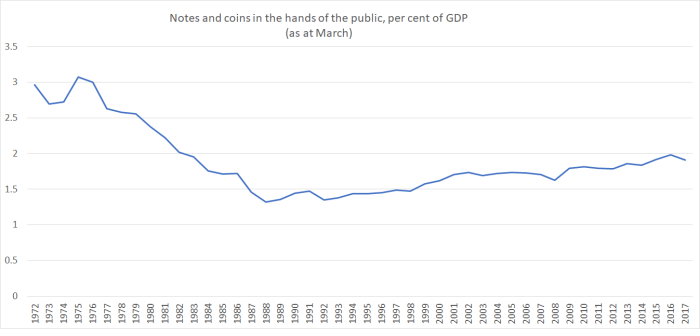
Lowe’s speech was interesting, but also unsatisfying and unconvincing in a number of important areas.    As a New Zealand reader –  from a country with many of the same banks (and presumably banking technology options) –  I was struck by the contrast in what has been happening to currency to GDP ratios in the two countries.   Lowe illustrates that the share of transactions being effected by cash is also dropping sharply in Australia.  But here is the New Zealand currency to GDP chart I ran last week

notes and coin

And here is comparable Australian chart from Lowe’s speech.

Aus currency to GDP
45 years ago, the levels of the two series were very similar.  Since then, the trends have been very different and now there are many more physical AUDs in circulation (relative to GDP) than NZDs.   But there is nothing in Lowe’s speech about just why so much physical currency continues to be held in Australia –  far more than any plausible transactions demands (supported by evidence from payments practices data) would support.    Ken Rogoff suggested, in a US context, that the bulk must be held to facilitate illegal activities, or tax evasion in respect of otherwise legal activities.   Perhaps Lowe felt it wasn’t his place to venture far into territory around lost tax revenue, crime etc, but it was still a surprise to see no mention at all, when the RBA seems largely content with currency physical currency arrangements.

I was also rather surprised to see no serious engagement with the issues around the near-zero lower bound on nominal interest rates, which arises because of the option to convert unlimited amounts of bank deposits etc into zero-interest physical currency, an option that would be likely to be exercised on a large scale if official interest rates were dropped much below, say, -0.75 per cent.  Like New Zealand, Australia hasn’t yet approached the near-zero bound.  Neither had the US, Japan, Switzerland, Sweden, or the euro-area, until they did.   But Australia’s official interest rate is now only 1.5 per cent.  Perhaps it will be raised a bit before the next serious recession hits, but no prudent central banker could be discounting the possibility that even the RBA will hit the effective floor –  and limits of conventional monetary policy –  when that next recession comes.    Dealing effectively with that floor  –  by significantly winding back access to physical cash –  should be one important consideration when central banks are considering e-cash options.  But Lowe doesn’t even mention the issue, and while the limits of monetary policy might not have been of much interest to his immediate listeners (the Australian Payment Summit), interest in his speech –  and the issue –  goes much wider than the immediate audience.   (Strangely, in the Riksbank’s work they also talk in terms of zero-interest e-cash options –  albeit with the flexibility to change that at a later date –  and thus don’t really grapple either with the near-zero bound problem.)

To me, the heart of Lowe’s speech was his discussion of the possibility of the Reserve Bank of Australia issuing one or other of two types of eAUDs.

  • An electronic form of banknotes could coexist with the electronic payment systems operated by the banks, although the case for this new form of money is not yet established. If an electronic form of Australian dollar banknotes was to become a commonly used payment method, it would probably best be issued by the RBA and distributed by financial institutions, just as physical banknotes are today.

  • Another possibility that is sometimes suggested for encouraging the shift to electronic payments would be for the RBA to offer every Australian an exchange settlement account with easy, low-cost payments functionality. To be clear, we see no case for doing this.

I’m not sure I have a particularly good sense of what the first option involves, but here is how Lowe describes the possibility

The technologies for doing this on an economy-wide scale are still developing. It is possible that it could be achieved through a distributed ledger, although there are other possibilities as well. The issuing authority could issue electronic currency in the form of files or ‘tokens’. These tokens could be stored in digital wallets, provided by financial institutions and others. These tokens could then be used for payments in a similar way that physical banknotes are used today.

But he doesn’t seem keen, and so I’m going to focus my discussion in the rest of this post on the second of his options.   The issues and risks are pretty similar for both options, and I favour (provisionally) something like the second option.

At present, central banks offer exchange settlement accounts to facilitate the interbank settlement of transactions (the RBNZ policy is here –  something they must be reviewing, as there was an RFP for work in this area a few months ago).   These accounts facilitate payments, but they also allow entities given access to such accounts to hold electronic claims on the Reserve Bank (that are free of credit risk).  Central bank physical banknotes are also credit risk-free claims on the central bank.   But one set of claims is newer technology, regularly updated, enabling banks to both easily make payments and store value, while the other is a declining technology.

Here is how Lowe describes the option in this area

Another possible change that some have suggested would encourage the shift to electronic payments would be for the central bank to issue every person a bank account – for each Australian to have their own exchange settlement account with the RBA. In addition to serving as deposit accounts, these accounts could be used for low-cost electronic payments, in a similar way that third-party payment providers currently use accounts at the RBA to make payments between themselves. Some advocates of this model also suggest that the central bank could pay interest on these accounts or even charge interest if the policy rate was negative.

I’m not sure anyone argues for this approach to “encourage the shift to electronic payments”, but rather to reflect the world we now find ourselves in, in which electronic payments media and (records of) stores of value overwhelmingly dominate.   If favoured banks and financial institutions are allowed access to risk-free overnigh electronic balances, why shouldn’t ordinary Australians (or New Zealanders) have such access?  After all, at the absurd extreme, central banks could still insist that to the extent banks wanted to deal with them, they did so in physical banknotes.  It would be wildly inefficient to do so, but it could be done.  But if it doesn’t make sense to restrict such “big end of town” transactions to physical currency, why does it make sense to restrict ordinary citizens’ access to central bank outside money?

But the RBA is firmly opposed to change of this sort.

On this issue, we have reached a conclusion, rather than just develop a hypothesis. The conclusion is that we do not see it as in the public interest to go down this route.

Why?   Lowe raises three concerns, of which two are substantive and one is mostly rhetorical.

If we did go down this route, the RBA would find itself in direct competition with the private banking sector, both in terms of deposits and payment services. In doing so, the nature of commercial banking as we know it today would be reshaped. The RBA could find itself not just as the nation’s central bank, but as a type of large commercial bank as well.

In times of stress, it is highly likely that people might want to run from what funds they still hold in commercial bank accounts to their account at the RBA. This would make the remaining private banking system prone to runs.

On both counts, I think he is largely wrong, and that any issues are quite readily manageable.

It isn’t at all clear why (many of) the public would want to use an RBA (or RBNZ) exchange settlement account for routine transactions services.  Revealed preference suggests that people are mostly very happy to run the modest credit risk associated with using private bank deposit and payment services.  Almost all of us now use bank deposits for most of our transactions –  even when physical cash is a perfectly feasible alternative (eg there is no additional cost in time or anything else to, say, taking out $400 from an ATM once a week rather than say $200).  And in the handful of places where private banknotes still circulate (eg Scotland) there doesn’t seem to be any unease about taking them, or transacting with them.

In addition, banks can offer bundled products –  cheaper fees for example where you have your mortgage, or term deposits, with the same bank as your transaction account.  No one proposes that central banks will be offering mortgages, term deposits or any of the rest of the gamut of products the typical commercial bank makes available.

I’m not aware that anyone is suggesting central banks should set out to out-compete banks.  The argument for making central bank e-cash readily available is about a fallback –  a residual option, much as cash is now for many purposes.   Central banks almost inevitably would lag behind commercial banks in their technology anyway, which wouldn’t make a central bank transactions account product particularly attractive.   And it could easily be kept that way –  don’t offer provision for regular direct debits etc, don’t allow overdrafts at all, keep the fees just a bit higher than those on commercial bank accounts, and –  of course –  be prepared to adjust the interest rates paid (or charged) on credit balances to limit potential demand.    What would be on offer would be a basic credit-risk free product –  something similar to the fairly basic products central banks provide to banks themselves.  Frankly, I’d be a bit surprised if there was much (normal times) demand at all (and I think back to the days –  decades ago –  when the Reserve Bank offered –  in direct competition with the private banks –  cheque accounts to its own staff; perhaps some people used theirs extensively,  but I used it hardly at all).

Lowe’s other concern –  and I’ve seen this concern in other places too –  is that provision of e-cash for ordinary citizens might destabilise the banking system.    As he noted earlier in his speech “it is likely that the process of switching from commercial bank deposits to digital banknotes would be easier than switching to physical banknotes. In other words, it might be easier to run on the banking system.”

Frankly, if the only thing that prevents runs on the banking system is that it is too hard to run to cash, central banks and regulators have bigger problems that they might need to address directly.  Runs are often quite rational –  there are real issues with the “victims” funding and/or asset quality.  If it really were easier to run with electronic central bank cash, banks – and their regulators –  might need to look to the size of the capital and liquidity buffers.   As it is, Lowe seems to be suggesting banks can free-ride on technical obstacles their (retail) depositors face.

But I’m not really persuaded that simply making available a basic retail e-central bank cash option would either increase the prevalence of runs or threaten the stability of the financial system.     When there is a concern about an individual bank (or non-bank) people “run” electronically anyway –  mostly they don’t withdraw their deposits into physical cash, but into liabilities of another private institution (and we seem to have been seeing such a quiet run on UDC in recent months).   Wholesale runs –  the sort that took down Bear Stearns and Lehmans –  all happen electronically.  Banks themselves can run straight to central bank cash, when they cut lines on each other.  Is the Governor really suggesting that it is just fine that wholesale investors should find it easy to run but not retail investors?  In practice, that is what he is saying.  In a systemic run –  or a period of heightened systemic unease – it is very easy for wholesale investors to find a safe asset (whether exchange settlement account balances for banks, or government bonds/ Treasury bills for others).  It isn’t for retail investors.  And recall that in New Zealand we have no deposit insurance.

If I’m uneasy at all about the idea of making available an eNZD (or AUD) for retail users –  a basic store of value/means of payment technology with no credit risk –  it is that demand would be very limited in normal times, and that if there ever was a systemic crisis it might prove very hard to scale the product quickly to adequately demand.   There are probably ways of resolving that concern, but it does need more work.

One other concern I’ve heard expressed if this if the central bank issued retail e-cash it would create a reinvestment problem –  what would the Reserve Bank buy and hold on the other side of its balance sheet (with associated credit and quasi-fiscal risks).  This is mostly a non-problem for several reasons:

  • normal times demand is likely to be low, and can be kept fairly low through pricing,
  • retail e-cash would probably go hand in hand with steps to reduce the stock of physical cash (and central banks already reinvest the proceeds of the sale of notes),
  • in a crisis, central banks have this issue anyway –  the substantial liquidity injections typically involve material credit risk anyway, and
  • in practice, many central banks typically reinvest the proceeds of note issue (or subscribed capital) in government bonds (predominant approach in New Zealand) or foreign reserves (typically mostly the government bonds of other countries).

With an integrated approach to gradually reduce the stock of physical currency, while making available a retail e-cash product, I would expect that if anything central bank balance sheets would shrink somewhat (especially in Australia, with a higher currency to GDP ratio) rather than grow.   Steps in that direction would:

  • help deal with the zero lower bound problem,
  • reduce the tax evasion etc issues apparently associated with large holdings of physical cash, and
  • provide ordinary citizens with the same sort of basic risk mitigant/payments product open to banks.

Finally, I said that one of Phil Lowe’s counter-arguments was mostly rhetorical. That was this one

The point here is that exchange settlement accounts are for settlement of interbank obligations between institutions that operate third-party payment businesses to address systemic risk – something that is central to our mandate. A decision to offer exchange settlement accounts for day-to-day use would be a step into a completely different policy area.

Well, yes, as conceived at present exchange settlement accounts are about interbank dealings.  That is a core part of the RBA’s (and RBNZ”s) responsibilities.  But the provision of basic “outside money” –  credit risk free –  has also long been a core part of both central bank’s responsibilitiies.  Retail e-cash helps fulfil that part of those mandates in a technological age.


Adrian Orr as Governor-designate

There are some good aspects in the announcement yesterday that the government intends to appoint Adrian Orr as the next Governor of the Reserve Bank.

For a start, the appointment will be a lawful one –  always a help.  Steven Joyce’s unlawful appointee as “acting Governor” will continue to mind the store until late March, and then at least we will be back to having someone lawful in office.   The unlawful interlude was unnecessary, and reflects poorly on governance and policymaking in New Zealand, but it will be soon be over.  Be thankful for small mercies.

It also seems highly unlikely that Adrian Orr will spend his first five years in office skulking in corners, avoiding any serious media scrutiny.   He is a vigorous and, mostly, effective communicator (on which more below) and in that sense is likely to be a welcome breath of fresh air in the Reserve Bank.  If he can model greater openness, across all the Bank’s function, it would be a significant step forward.

And there might be reason to hope that an Orr-led Reserve Bank might start to take transparency –  within and beyond the confines of the Official Information Act –  rather more seriously.  I’m not a huge fan of the New Zealand Superannuation Fund, but I am quite impressed by their transparency, including in dealing with Official Information Act requests.  When I asked recently for the background papers justifying the decision to cut the Fund’s carbon exposures –  they’d already pro-actively released some papers –  I got (from memory) something like 3000 pages of material.  When one asks the Reserve Bank for background papers to monetary policy decisions, one is repeatedly stonewalled (unless it is about things from 10 years ago).  I hope the contrast bodes well for the sort of leadership Adrian will bring to the Bank.

That is the positive side of the appointment.  But here is what I wrote earlier in the year, at the time when controversy was raging about his NZSF salary.

Orr simply isn’t –  and I wouldn’t have thought he’d claim otherwise –  some investment guru, blessed with extraordinary insights into markets, prospective returns etc etc.  He was a capable economist, and a good communicator (at least when he doesn’t lapse into vulgarity), who turned himself into a manager and seems to have done quite well at that.   He always seeemed skilled at managing upwards, and his management style (in my observation at the Reserve Bank) seemed to err towards the polarising (“are you with us, or against us”), attracting and retaining loyalists, but not exactly encouraging diversity of perspectives or styles.  He isn’t exactly a self-effacing character. (That is one reason I’m not convinced he is quite the right person to be the next Governor of the Reserve Bank.)

I’d stand by those comments today.

He is more of a manager –  and perhaps a salesperson – than an economist, despite some comments in the last day about him being an “exceptional economist”.  That has probably been so for at least 20 years now.  In itself, that isn’t a criticism, and there is a significant management dimension to the Reserve Bank role –  in particular, at present, a change management responsibility (both to implement whatever changes emerge from the Minister of Finance’s secretive review of the Reserve Bank Act, and to lift the internal performance, and improve the culture, of the Bank).

His management approach might be more questionable. In his first short stint at the Reserve Bank, 20 years ago, he took over a department that was severely demoralised and lacking the influence it would normally have had.  In a narrow sense, he did an effective job of turning around that underperformance.   But his style always seemed to be quite a divisive one, playing up “his team” at the expense of others, rather than seeking to lift the entire organisation  –  in fact, he boasted of it in his farewell speech when he left the Bank in 2000.  I haven’t observed him directly in the last decade, but I am struck by the number of able people I’ve known who’ve worked for him for a time, and then didn’t.    It wasn’t, as far as I could see, that they went on to bigger and better things either.  Adrian seems to build cohesive teams of loyalists.  That has its place, but it isn’t obvious that the Reserve Bank is one of those places.

What of his communications skills?  He can be hugely entertaining, and quite remarkably vulgar (an astonishingly crude analogy involving toothbrushes springs to mind).   Just the thing –  perhaps –  in an old-fashioned market economist.  Not, perhaps, the sort of thing we might hope for from a Reserve Bank Governor.   Financial markets can get rather precious about very slight changes in phrasing etc from the Reserve Bank, and it is hard to be confident just how well Orr will go down.  No doubt he will rein in his tongue most of the time –  and perhaps he has calmed down a bit with age – but it is the exceptions that are likely to prove problematic.

And what happens when some journalist or market economist riles him?    Perhaps a journalist might ask him about how he would approach an episode like the Toplis affair?  You (and I) might like to hope things would be different, but I have in mind an episode from Orr’s time as Deputy Governor.  A visiting economist was engaging in what they thought was a bit of robust dialogue with Orr in a meeting with several people at the Bank.  Shortly afterwards, Orr bailed the visitor up in the street and told him ‘never, ever, do that in front of my staff again”.

And yet, so we are told, part of the motivation for the forthcoming reforms to the Reserve Bank is to ensure that more perspectives are heard, and incorporated, in decisionmaking at the Bank.   How confident can we be that Orr will actually implement the reforms in a way that will foster debate and diversity, rather than clamp down on it and marginalise anyone he perceives as disagreeing with him?   Particularly if the person or people disagreeing with them doesn’t share his blokish style, or might simply know more about a particular issue than Orr does.

And how is Orr going to do –  repeatedly in the public eye, in a way he hasn’t been for the last decade –  with the sort of gravitas and political neutrality the role of Governor requires?  Only a few weeks ago – when he must already have known that he was likely to become Governor –  Orr gave a speech to the Institute of Directors, in which he reportedly dismissed the views of Deputy Prime Minister on the economy as “bollocks” and went on to suggest, in answer to a question about nuclear risks in North Korea, that perhaps two issues could be solved at once ‘because Winston is going to North Korea”.  Recall that at the time, Orr was not some independent market economist, but a senior public servant.     He might well have been right in his views on the economy, but is this how senior public servants should be operating?

I also have concerns about the way Orr engages with issues and evidence. My very first dealing with him involved some controversial reform proposals we were working on at the Bank, while Adrian was still in the private sector.   Adrian’s submission had played rather fast and loose with the data, something I pointed out to Don Brash, the then Governor.  Don went rather quiet and didn’t say much, which puzzled me a little, until a day or two later Adrian’s appointment as Reserve Bank chief economist was announced.  Much more recently, there was some debate earlier in the year about NZSF’s performance.   On a good day, and in official documents, Adrian will happily tell you NZSF’s performance can only really be judged over, say, 20 or 30 years horizons.  But then he will pop up in the newspaper suggesting that a few moderately good years –  amid a global asset market boom –  vindicate the existence of the Fund and the way it is run.    He keeps trying to convince us that he runs  a “sovereign wealth fund”, when it fact it is a speculative punt on world markets, using borrowed money (yours and mine).  He has simply refused to engage with the international evidence casting doubt on whether active funds management can generate positive expected returns in the long-run, and when he led the NZSF into a big (politically popular, but economically questionable) move out of carbon exposures –  an active management call if ever there was one – he took steps to ensure that taxpayers couldn’t really know whether his judgement paid off (hiding the change in the benchmark itself, rather than being constantly reported in devations from a benchmark).     I’m just not sure it is quite the degree of rigour, authority and independence of mind that we should be looking for in a Reserve Bank Governor.  What example, for a start, does it set for his own subordinates in how they marshall evidence and arguments for him?

On the same note, there was that speech Orr gave last month to the Institute of Directors (full text here).  It was given at a time when he knew he was in the final stages of the gubernatorial selection process.   It was advertised as a substantial speech

Looking Beyond Our Shores – Adrian Orr’s Address to the Institute of Directors

Adrian Orr’s address to the Institute of Directors, Wellington, 16 November 2017.
Adrian shares his thoughts on what directors need to think about to make sure New Zealand benefits from its place in the globalised economy.

So you might have expected some considerable substantive analysis.   But there wasn’t much there at all.     You won’t find anything about New Zealand’s underperformance –  productivity, exports, or whatever.   But you will find one conventional wisdom thought after another (albeit with a tantalising aside on Chinese influence), whether or not they apply to New Zealand  (eg “returns to the owners of capital versus labour –  which is stretched to extremes at present within and between nations” –  when the labour share of income has been rising in New Zealand for 15 years).  And then it devolves to “doing something” about climate change –  which might or might not be sound, but isn’t going to make us materially better off – and lots of self-praise (not all of it even accurate) for the NZSF.    A speech on how to “make sure New Zealands benefits from its place in the globalised economy” ends with these platitudes

My summary thoughts are:

  • Companies must take more long-term ownership of all their activities – it is the Board’s role; 
  • New Zealand needs to embrace a global reputation of longtermism, and sell it; and
  • We can start with climate and our culture at the company level.

No real answers, and not much depth there.   Perhaps it wasn’t characteristic –  I haven’t gone back and read his other speeches from recent years –  but this was the speech on a topic somewhat closer to his new areas of responsibility as a (singlehanded) key economic decisionmaker.

I’m sure there are those capable people who are genuinely impressed with Adrian (as presumably, the Reserve Bank Board was –  the same people who appointed Graeme Wheeler).  But don’t be fooled by the absence of any sceptical comment at all in the last day or so.     Of the people the media is likely to go to for comment, many will be needing to maintain a professional relationship with him in his new role, and others will work for organisations that do business with NZSF –  and Orr is still chief executive there for a few more months.

Only time will now tell how Orr does in the job.   For a time he will be by far the most powerful unelected person in New Zealand –  exercising singlehandedly all the monetary policy, regulatory, and intervention powers the various Acts give to the Governor –  and then and beyond responsible for leading the transition to a reformed Reserve Bank (details of which are still unknown –  including how much effective power will be left with the Governor).  As someone who is well-known to fight for his patch, his people, I’ve further revised down my estimate of the prospects for real change at the Bank –  especially around the financial stability functions where (a) the Bank is almost lawless, and (b) the Minister of Finance doesn’t care very much.  I’d like to believe he will do well –  for the New Zealand public –  but it is hard not to shake the impression that Adrian Orr is no Phil Lowe (RBA), Stephen Poloz (Bank of Canada), Philip Lane (central bank of Ireland), Stan Fischer (former central bank of Israel and recent vice-chair of the Fed).   In some ways he will be very different from Graeme Wheeler, but in many areas we could be exchanging one set of weaknesses for another.

But I suspect he will be wildly popular at the annual financial markets function the Reserve Bank hosts.   Bonhomie, backslapping, and plenty to drink tended to characterise those functions when I had to attend them.


Two BIMs and a bureaucrat

As I noted last week, government departments’ (and agencies’) briefings to incoming ministers have mostly become a bit of a joke: mostly devoid of any substance, typically specifically tailored to the preferences of the particular incoming government (ie written/finalised after the shape of the new government is clear), and mostly not much more than process pieces.  If one is interested in the actual substantive advice –  the sort of things the Lange government intended to make available when they began publishing BIMs in the mid 1980s –  citizens need to fall back on the Official Information Act, with all its limitations.

There are exceptions –  I wrote the other day about some substance in the Reserve Bank’s BIM.   And even on the little that is released, sometimes tantalising hints sneak through.  The intelligence services, for example, left unredacted a suggestion that governments might need to be concerned about the influence activities in New Zealand of foreign governments –  something neither the current Prime Minister nor her predecessor have been willing to take seriously or address openly.

Of the other economic functions, neither the Treasury nor the Immigration BIMs say much.  But sometimes there is quite a bit even in a few words.  Take immigration for example.    It was only a few years ago that MBIE was telling Ministers of Immigration (and the public) that immigration was a “critical economic enabler” –  a potential catalyst to transform New Zealand’s dismal productivity performance.   There isn’t much in this year’s Immigration portfolio BIM –  mostly process again –  but my eye lit on this paragraph

New Zealand’s immigration system enables migrants to visit, work, study, invest, and live in New Zealand. Economically, it contributes to filling skill shortages, encouraging investment, enabling and supporting innovation and growing export markets. Immigration has contributed to New Zealand’s strong overall GDP growth in recent years largely through its contribution to population growth. However, the evidence suggests that the contribution of immigration to per capita growth and productivity is likely to be relatively modest.

The theory –  dodgy bits like “filling skill shortages” and the more plausible bits –  is there in the first half of the paragraph.  But by the end of the paragraph, even MBIE has to concede that there isn’t likely to be much boost to per capita income or productivity at all –  the effects are “likely to be relatively modest”.  It is hard to avoid that sort of conclusion –  looking specifically at the New Zealand experience –  when (to take MBIE’s list from the second sentence) “skill shortages” have been a story told in New Zealand for 150 years, business investment has been weak by OECD standards for decades, firms haven’t regarded it as particularly attractive to invest heavily in innovation (again by world standards), and the export share of GDP is now at its lowest since 1976.  Still, it is good to see reality slowing dawning on MBIE.  On my telling, they are still too optimistic, but even on their telling when such a large scale policy intervention seems to produce such modest economic results it might be time for a rethink.

And what about the BIMs prepared by Treasury?   There isn’t much in the main Finance document (lots of process stuff, and plenty of talk of diversity and wellbeing and none on productivity).  There is an appendix specifically aimed to address what Treasury understand to be the new Minister’s priorities, but not much about Treasury’s own view of what needs to be done, or the pressing problems.    If anything, reading Gabs Makhlouf’s covering letter to Grant Robertson one might conclude that Treasury didn’t think there was much to worry about at all.

You are taking up your role at a time when New Zealand’s economy is in a relatively strong position.  There is solid forecast growth, complemented by fiscal surpluses and a strong debt position.  And while international markets still present a number of risks and uncertainties, overall the global economy –  as reflected in the IMF’s recent outlook –  presents opportunities for New Zealand to seize, in particular with Asia’s ongoing growth.

Presumably the Secretary didn’t think it worth emphasising five years of no productivity growth, seventy years of pretty weak productivity growth, shrinking exports as a share of GDP, sky-high house/land prices, pretty weak business investment and so on.  Or even the fact that notwithstanding “Asia’s ongoing growth” –  a story now for more than forty years –  nothing has looked like turning around New Zealand’s continuing gradual economic decline.    And perhaps when you are a temporary immigrant yourself –  as Makhlouf presumably is –  the cumulative (net) loss of a million New Zealanders isn’t something that concerns you?

In their BIM Treasury proudly asserts that “We are the Government’s lead economic and financial adviser”.  Perhaps they hold that formal office, but it is hard to be optimistic about the content of what they might be offering the government.

But Treasury also had some other BIMs for other portfolios they have responsibilities for.  The one I noticed was the Infrastructure one.    Buried in the middle of that document was this observation

Auckland’s ability to absorb growth has been reached. Environmental, housing and transport indicators all reflect a city under increasing pressure. Traditionally, Auckland has been more productive than other regions of New Zealand but, on a per capita basis, this productivity premium has been shrinking over time. Auckland is not performing as well as expected for its size and in comparison to other primary cities around the world.  There are opportunities to increase this productivity but only if supply constraints, especially transport and housing, are resolved.

That key middle sentence –  no hint of which appears in the main Treasury BIM –  could easily have been lifted from one of my various posts on similar lines.    They could have illustrated the point with a chart like this.

akld failure


Appearing in the standalone Infrastructure BIM, Treasury appear to want to blame these poor outcomes largely on infrastructure gaps –  a conclusion which I think is flawed –  but I’m encouraged to see a recognition of the problem in official advice to the Minister of Finance.   It is all a far cry from the rather lightweight celebratory speech Gabs Makhlouf was giving about Auckland’s economy only 18 months ago, which I summed up this way

[it] might all sound fine,  until one starts to look for the evidence.  And there simply isn’t any.  Perhaps 25 years ago it was a plausible hypothesis for how things might work out if only we adopted the sort of policies that have been pursued. But after 25 years surely the Secretary to the Treasury can’t get away with simply repeating the rhetoric, offering no evidence, confronting no contrary indicators, all simply with the caveat that in “the long run” things will be fine and prosperous.  How many more generations does Makhouf think we should wait to see his preferred policies producing this “more prosperous New Zealand in the long run”?

If the Secretary to the Treasury was going to address the economic issues around Auckland, one might have hoped there would be at least passing reference to:

  • New Zealand’s continuing relative economic decline, despite the rapid growth in our largest city,
  • Auckland’s 15 year long relative decline (in GDP per capita), relative to the rest of New Zealand,
  • The contrast between that experience, and the typical experience abroad in which big city GDP per capita has been rising relative to that in the rest of the respective countries,
  • The failure of exports to increase as a share of GDP for 25 years,
  • The fact that few or any major export industries I’m aware of our centred in Auckland (the exception is probably the subsidized export education sector) –  and by “centred” I don’t mean where the corporate head office is, but where the centre of relevant economic activity is.

There is nothing of economic substance on immigration in the main Treasury BIM this year, but perhaps over the next few years Treasury could start thinking harder about whether it really makes sense to be using policy to bring ever more people to one of the most remote corners on earth, even as personal connections and supply chains seem to be becoming ever more important, at least in industries that aren’t simply based on natural resources.

The one other thing that did catch my eye in the Treasury BIM was this paragraph

The Treasury Board. This external advisory group supports the Treasury’s Secretary and ELT to ensure that its organisational strategy, capability and performance make the best possible contribution to the achievement of its goals. Current members of the Board are the Secretary to the Treasury (Gabriel Makhlouf), the Chief Operating Officer (Fiona Ross), Sir Ralph Norris, Whaimutu Dewes, Cathy Quinn, Mark Verbiest, Harlene Hayne and John Fraser (Secretary to the Australian Treasury).

Now, to be fair, the “Treasury Board” has no statutory existence, and no statutory powers.  It isn’t even clear why it exists at all –  Boards are typically supposed to represent shareholders, and as regards Treasury, the Minister of Finance, Parliament, and the SSC are supposed to do that on our behalf.  But given that there is an advisory Board, what is a senior public servant from another country  –  the Secretary to the Australian federal Treasury –  doing on it?      New Zealand and Australia might be two of the closer countries in the world, but we don’t always have the same interests, and at times those interests –  and perspectives – clash rather sharply.    I gather John Fraser is quite highly regarded, but who does he owe allegiance to, and whose interests is he advancing in his work on the New Zealand “Treasury Board”?  I might not worry if he were a retired former Treasury Secretary from Australia, but he is a serving official of the Australian government.  It seems extraordinary, and quite inappropriate.   Did he, for example, have any involvement in the recent, superficially questionable, appointment of a former senior Queensland public servant to a top position in our Treasury?    Again, close working relationships between the two Treasurys –  each as servants of their own governments –  might be reasonably expected, and perhaps mutually beneficial.   But providing a senior official of another government with inside access to the senior-level workings of one of our premier government departments seems questionable at best.  GIven Makhlouf’s past enthusiasm for China, perhaps the appeasers at the New Zealand China Council will soon be suggesting he appoint someone from China’s Ministry of Finance could join Fraser on the “Board”?

And finally, some kudos for a bureaucrat.  As various people have noted, Graeme Wheeler went for five years as Governor –  as the most powerful unelected person in New Zealand –  without ever exposing himself to a searching interview, or making himself available for an interview on either main TV channel’s weekend current affairs shows.  His appointment might be highly legally questionable, he might be only minding the store for a few months, but yesterday Grant Spencer went one better than Wheeler and sat down for interview on Q&A with Corin Dann.    I thought he did well, but what really counted was just showing up, and being open to questions.

Since much of the interview was about Spencer’s speech last week, which I’ve already written about, there was much in it that I disagreed with.  But I’m not going over that ground again.  Perhaps the one new thing that caught my attention was when Spencer claimed that the Bank is independent for monetary policy, but not around things like LVRs.   That is simply factually untrue.  The Act makes it very clear that any decisions to impose or lift LVR restrictions are solely a matter for the Governor (also a point that the Prime Minister, the Minister of Finance and their predecessors have recognised).   Spencer went on to say that if the then government had not wanted the Bank to impose LVR restrictions they wouldn’t have done so.     That might be fine, but I hope they never apply that standard to monetary policy decisions.  And if LVR decisions really are more political and redistributive in nature, perhaps as part of the forthcoming review, the Reserve Bank Act should be changed so that the Reserve Bank offers technical professional advice, but the Minister of Finance makes the decision?.  We can, after all, toss out elected governments.