Raising bank capital requirements

I’ve been a little slow to get round to much comment on the Reserve Bank Governor’s proposals to require banks to fund a much larger share of their balance sheets with equity capital.  These aren’t small changes: from a starting point where they more or less accept that New Zealand bank capital ratios are already higher than those in most advanced countries, they want to compel banks incorporated here to adopt capital ratios that would be higher than (almost?) anywhere else in the world (including, notably, higher than in Australia).

I had a couple of initial posts (here and here) immediately after the consultative document was released, and one a couple of weeks ago on the way in which the Bank has continued to discount the results of demanding stress tests it has required banks to undertake.     Since I wrote that post the Reserve Bank has finally released (in response to OIA requests from me and others) various background papersOne of them specifically addressed the issue of the stress tests.  Suffice to say, whatever the validity of some of the specific points the authors identified, it did not materially my view of an awkwardness that the Bank still has to contend with; repeated very demanding stress tests suggests a very robust system, and yet the Bank proposes to go out on a limb with its capital requirements for banks incorporated here.  Various other people have written comments on the Reserve Bank’s proposals, and I’d commend to your attention most of a column by my former Reserve Bank colleague Geof Mortlock, and some observations from Roger Partridge of the New Zealand Initiative on the striking absence from the consultative document of any serious attempt at a cost-benefit analysis.

It is striking just how little substantive supporting analysis, and robust testing of alternatives, there is in the consultative document.  And although they have finally released various background documents, some of which are interesting, as those papers stretch back over almost three years through a couple of changes of Governor, it is impossible to know what bits the current Governor is or is not drawing from in reaching his proposals.  There has been no substantive speeches from, or searching interviews with, the Governor or his deputy since the document went out.

Of course, the Bank has a long history of not taking consultation very seriously –  they’d jump through the formal required hoops, and perhaps even amend the odd working detail here or there, but there was never much of a sense of being genuinely open to alternative perspectives.   On this particular proposal, so much money is involved that one can only hope that they are eventually forced to do better.  Perhaps there really as a compelling case for going out on a limb as they propose, but if so that case has not yet been made.  On the specific issue –  imposing more-demanding capital requirements than almost any of our peers (eg small open floating-exchange rate countries, with moderate-sized locally-focused banking systems, and government finances in good order) – nothing in the consultative document even makes the attempt.  Apparently we are just supposed to take the Governor’s word for it that it is all fine; that he knows what is best for us.

There is a range of areas where the analytical support is very weak.  I might come back to some of them. But today I’m going to start at the end and highlight one absence that I found particularly glaring.   Having reached the conclusion that a 16 per cent capital requirement would be appropriate for the large locally-incorporated banks, there is almost no discussion at all as to how banks and the financial system more generally might respond, whether in the protracted transition or in the longer-run.   Which might be okay in some quasi-academic document (of the sort they cite from overseas, trying to estimate “optimal” capital ratios), but shouldn’t be remotely acceptable when a regulator is consulting on far-reaching proposals, directly affecting private businesses (and potentially firms and households more generally), that it wishes to put the force of law behind.   We should expect to see that regulator lay out its workings, and tell us how it thinks things will unfold, in the specifics of the New Zealand economy and financial system.  Only then can we really unpick and challenge their reasoning and assumptions (implicit or otherwise).

The bottom-line appears to be that they think bank lending margins will rise to some extent (they report  –  reasonably enough –  not believing that Modigliani-Miller offset effects hold in full, at least in a potentially protracted transition) but that otherwise banks’ shareholders will happily divert most of their profits over the next few years into reinvesting in the business.  But they show no sign of having tested those assumptions, let alone of having thought more widely.

Why, for example, would the Reserve Bank not suppose that existing locally incorporated banks would respond to large increases in capital requirements in part by pulling back on their willingness to lend?  There are two ways to increase actual capital ratios: increase capital or reduce the volume (at least the growth rate) of assets relative to your prior plans.  It is not as if no banks anywhere have ever responded to increased capital ratio expectations (market or regulatory) by looking to reduce risk-weighted assets (it was a common in the EU after the last crisis).  Whether or not, in the long run, Modigliani-Miller effects really hold nearly in full, shareholders don’t tend to believe they do,  and if the New Zealand authorities insist on higher capital requirements, lending into the New Zealand market is going to look less attractive to shareholders in banks subject to those requirements.  Perhaps the Governor thinks there is already too much credit in the New Zealand economy and wouldn’t be unhappy if it becomes harder to get.  But none of that is discussed or analysed in the discussion document.

Similarly, there is no discussion at all of the fact that we are now eight or nine years into a growth phase, and that most probably there will be another recession along at some stage in the next five years (the planned transition period).  Now, of course, in truth the best time to increase capital requirements was always five years ago, but it doesn’t change the fact that  –  with capital ratios already comfortably high by international standards –  the specific proposal is to increase them over the next five.  In recessions borrowers tend to become more reluctant to borrow, and (typically quite rationally) lenders become more reluctant to lend, but if we go into a new recession in the next few years with banks still facing several years of increased capital requirements, isn’t it quite plausible that banks would become even more reluctant to lend than usual, exacerbating –  or dragging out –  the downturn.  And recall that the Reserve Bank has nowhere near as much monetary policy leeway in the next downturn as it did in previous ones.  That might reasonably make one more nervous than otherwise about ramping capital requirements over the next few years even if one could make a decent case in the abstract.  But none of this –  none –  is discussed, not even to allay concerns, in the consultative document.

There is also no discussion or analysis of the way in which the proposals will affect Australian (and other foreign) locally-incorporated banks differently than New Zealand owned banks.   Dividend imputation means that debt and equity are taxed similarly for New Zealand owned companies.  But dividend imputation doesn’t hold for foreign-owned companies, and substantial increases in capital requirements will impose a direct additional cost on the shareholders in foreign-owned banks (in this case, the Australian parents).   In other words, the Governor’s proposals skew the playing field away from the Australian banks (large and more diversified) in favour of the domestic banks (small, undiversified, and typically capital-constrained).  The Governor is known to have some animus towards the Australian banks –  and on that score he might even have political sympathisers (at least from rabble-rousers like Shane Jones) –  but none of this is identified or discussed in the consultative document.   I’d argue that we are generally better off having big banks that are part of offshore banking groups. Perhaps the Governor disagrees, but if so the onus should be on him to make his case, not to attempt to slip through regulatory measures that consciously disadvantage the foreign-owned banks incorporated here.  It is far from clear that boosting the competitive position of a 100% state-owned bank (Kiwibank) is any sort of longer-term gain to financial system soundness or efficiency.

There was also no discussion in the consultative document on the potential lenders who will not be subject to the Governor’s proposed capital requirements.  For example, those requirements will not apply to non-bank deposit-taking lenders (let alone any lenders who aren’t deposit-takers at all).  NBDT capital requirements aren’t something the Reserve Bank can set itself (same goes for LVR restrictions, which is why LVR restrictions were never applied to the NBDTs) and so it would appear that one set of regulated intermediaries will have materially lower capital requirements than another set.  All else equal, mightn’t we expect to see at least some disintermediation to these lenders?   At the other end of the spectrum, banks that aren’t locally incorporated are also not subject to Reserve Bank capital requirements.  If the Governor proceeds with his proposals, wouldn’t we expect to see more lending gravitate towards these lenders (subject to the local incorporation threshold limits), and at the “big end of town” to banks that aren’t registered in New Zealand at all.   The SME down the street might need to get credit from a local lender, but Fonterra or Air New Zealand don’t.   These effects wouldn’t arise if authorities around the world were all raising capital requirements to a similar extent, but they aren’t.   Not even APRA.  And yet there is no sign the Reserve Bank has thought hard about the potential disintermediation issues.

And even if all banks (broadly defined) globally were subject to much the same capital requirements, one might have to think about disintermediation to non-institutional providers of credit.  If capital requirements on a portfolio of mortgage loans are increased markedly and there is incipient pressure for bank lending margins to rise, it opens the door for more securitisation options.   But, again, none of this is touched on in the consultative document.

There have been suggestions, notably from at least one investment bank/broking firm, that the Reserve Bank’s capital proposals could increase New Zealand lending interest rates by as much as 100 basis points.   That, frankly, seems unlikely to me, not because banks (especially the Australian banks) won’t pull back on the supply of credit or because bank shareholders won’t look to maintain high targets ROEs for a while, but because of the potential disintermediation from the existing big-4 institutions.   Those alternatives limit the extent to which lending margins could increase (while the potential for offsetting OCR adjustments limits the extent to which retail lending rates themselves would rise).     On my story, there is a cost to the efficiency of the financial system –  a key constraint the Bank is required by law to take account of.   The core big institutions –  already very robust –  might be made a bit stronger, but in the process they would be of diminished importance in the financial system.  Any gains from stronger core institutions could be compromised by the greater proportion of credit flowing through other channels.  (A topic for another day is that entire proposal is built around the idea that the costs policy should try to mitigate relate narrowly to the failure of regulated institutions, rather than to the gross misallocation of credit –  and investment resources – in the good times, whether or not any core institutions fail when the reckoning occurs.   But there is no sign the Reserve Bank has considered whether the allocation of credit, and lending standards, will be maintained if there were to be significant disintermediation.)

I could go on, but won’t for now.  My point wasn’t to attempt to isolate every possible channel, but to note that in their consultative document –  where they are judge and jury in their own case –  the Reserve Bank has provided no analysis of any of these issues, not even to set our minds at rest.   Just nothing.  We should be able to expect better.


Yes, but….

Yesterday – no doubt with Waitangi Day in view –  the history teachers’ association was out with a call (even a petition) for the compulsory teaching of New Zealand history in schools.   You might suppose this was a job creation scheme for history teachers, but I’m happy to grant that that won’t be the only motivation behind the association’s call.

You might suppose that history teachers –  in particular –  might be interested in the entire story of our country, ancient and modern.  And yet, oddly, the “Petition Reason” seems only interested in one brief period.

Too few New Zealanders have a sound understanding of what brought the Crown and Māori together in the 1840 Treaty, or of how the relationship played out over the following decades. We believe it is a basic right of all to learn this at school

As it happens, in principle I strongly favour the teaching of New Zealand history in our schools.  I find it utterly astonishing how little  of the story of our country –  and what little there is (ANZAC Day, Waitangi Day) typically wrenched from context –  and of our people and cultures is taught in our schools.  As I recall, I got through the whole of school with no New Zealand history, other than one School Certificate history unit on the New Zealand and US welfare system.   From what three children wending their way through the school system tell me, it doesn’t seem much different now, unless one chooses to do history in years 11-13 (a pretty small minority), but where apparently it is now only permitted to study history with “implications for New Zealand”.  No man an island and all that, so I’m happy to argue all human history (and certainly western history) has implications for who we are today, but I don’t think that is quite what the history teachers or the Ministry of Education have in mind.  I don’t know much about how it is done in other countries, but I’m struck by my daughter’s English penfriends who tell about studying specific history courses at around ages 10 to 12.  There is so much about New Zealand, New Zealanders, and our interaction with the rest of western history, that could –  and ideally should –  be taught.

Of course, the whole philosophy of many of our “educators” is opposed to learning facts, let alone placing them in a coherent narrative.  How vividly I recall the activist principal of our local primary school telling a group of parents of new entrants that the school tried not to teach facts, as nothing specific they taught now would be any use fifteen or twenty years hence.  Any serious teaching of history –  not isolated tiny NCEA standards –  would fly in the face of that sort of mentality.

I’d almost go as far as the history teachers in calling it a “basic right” for children to be educated in where our country today has come from.  We don’t invent ourselves anew with each new generation, but as individuals and societies we are formed –  and informed –  by what came before us.  That is so even when many want to turn their backs on much of their origins.  Origins they still are.  And choices made yesterday affect institutions (broadly defined) today.

And what counts as history doesn’t simply begin at Paihia in 1840 (or even the few years just prior to that).   So, in principle, I would strongly favour teaching (say) 1000 years of history, introduced from new entrants and expanded as the capacity of the children to make sense of the material grows.    Look back to the first human settlement of New Zealand, and to (say, and inevitably arbitrarily) the Norman Conquest and subsequent British (and European) history.  Tell the stories, establish a sense of the flow, cover (inevitably a bit lightly for most) the politics, the religion, the key figures, the way in which governments developed.   For New Zealand, I’d tell the more recent story partly in a cross-country comparative sense –  New Zealand vs (say) Australia, Ireland, Canada, Newfoundland, or even Fiji and South Africa.  As it is, smart historically-oriented children probably know more about British Prime Ministers and US Presidents than they do about those who’ve directly led and shaped our own country.        One can, of course, mount an argument that those big countries were “more important”, and I wouldn’t really disagree, but New Zealand history is our history.  Depriving our kids of serious exposure to New Zealand history is akin to depriving them of any knowledge of their great-grandparents.

My son’s year 12 history teacher told the class yesterday that he didn’t support the history teachers’ association call, because kids typically weren’t interested in New Zealand history and there was no point teaching stuff kids weren’t interested in.  Frankly, that seems like an abdication of responsibility –  most kids aren’t that interested in maths and yet we give them no choice about learning it.  And it is also something of a vote of no-confidence in teachers: sure, most kids probably won’t be that interested in New Zealand history at 15 if they’ve never learned any previously (I wasn’t then), but if you start early and introduce key figures, key stories, in age-appropriate ways I’m reluctant to believe that kids will have no interest.  But even if they still claimed no interest, they need to know where we’ve come from.  After all, in a very few years each of them will be eligible voters.

What I found most interesting in the articles yesterday was where the pushback from teaching history was coming from.

But the associate minister of education and minister of Crown Māori relations, Kelvin Davis, was quick to quash any impression the government might make the topic compulsory.

Davis was formerly a teacher, so one might have thought he’d favour making New Zealand history, including New Zealand’s place in the world, an integral part of what schools teach.   It is the sort of subject that probably matters even more for those from disadvantaged backgrounds, who aren’t as likely to go digging themselves, or to be introduced to some structured narrative of New Zealand from home.

But supportive as I am in principle of a much more central role for history –  New Zealand history –  in what is taught in schools, what leaves me rather more ambivalent (“yes, but….”)  is the sort of people who would be teaching our history, and/or designing any curriculum.      Few of them seem to see New Zealand history as something to celebrate (I’m going to be fascinated to see how our Prime Minister treats the 250th anniversary of Captain Cook’s first visit), and there is a strong theme of shame –  the “black armband” approach to history –  combined with some agenda for how these people think society should be organised now or what role (say) the Treaty of Waitangi should play.  There is little sense of handing down the traditions and insights that made us who we are –  the sense that any society stands on the shoulders of those who went before –  and little interest in the past for its own sake (understanding, for example, why people believed and acted as they did), only as subject for judgement or grist to the mill in current political contests.   And I guess that is why the government resists the idea of making the teaching of history compulsory: they sense that many parents probably really aren’t keen on ill-educated indoctrination.

Give parents effective choice over schools –  proper and full funding for independent schools –  and I’d be a lot keener on translating support in principle for some serious structured teaching of New Zealand history (ups and down, successes and failures, and so on) into something worth implementing, in ways that might usefully amount to more than (often unwitting –  most teachers know no better) indoctrination.

There was a quote from G K Chesterton in an article I was reading yesterday (in the Australian periodical Quadrant)

The trouble with too many of our modern schools is that the State, being controlled so specially by the few, allows cranks and experiments to go straight to the schoolroom when they never have passed through the parliament, the public house, the private house, the church, or the marketplace. Obviously it ought to be the oldest things that are taught to the youngest people; the assured and experienced truths that are put first to the baby. But in a school today the baby has to submit to a system that is younger than himself.  the flopping infant of four actually has more experience and has weathered the world longer than the dogma to which he is made to submit.  Many a school boasts of having the latest ideas in education, when it has not even the first idea; for the first idea is that even innocence, divine as it is, may learn something from experience.

Dated as the wording may be, the ideas seem apt nonetheless.

And there is an interesting new article in Foreign Affairs by Harvard historian Jill Lepore on “Why a Nation Needs a National Story”.   I’m ambivalent about, or even unsympathetic to, where she gets to –  she wouldn’t quite put it like this, but it amounts to history as indoctrination/shaping –   but I was quite taken with this line

“Writing national history creates plenty of problems. But not writing national history creates more problems, and those problems are worse.”

We owe it to our kids to form them in where we (they) have come from.   Only when given a decent base of knowledge can they intelligently challenge interpretations and reach useful views as to what from history should be taken forward and what left behind.  Whether agents of the state, imbibing radical agendas often upending that heritage, can be trusted to do that job is quite another question altogether.

House prices and building: Australia and NZ

You may, like me, be intrigued by the stories emerging from Australia about falling house prices.    The fall in nationwide house prices isn’t that large –  still less than we experienced in New Zealand in 2008 – but (a) the economy isn’t in a recession, and (b) there is little sign yet that the falls are about to end soon.  Lower house prices would seem likely to mostly be “a good thing” –  cheaper goods and services typically are – and the banks are well-capitalised to cope with even some serious combination of bad economic times and falling house prices.  But on the other hand, whatever was causing this particular fall, I’d heard little to suggest that land-use rules were being substantially liberalised in Australia (any more than in New Zealand), so I’ve been –  and remain –  quite sceptical about the idea that Australian house prices would fall sharply and stay down.  And, of course, of anything similar in New Zealand.

Time will tell, but out of curiosity I decided to dig out a few numbers.   The first was a comparison of residential investment as a share of GDP.   This chart is in nominal (current price terms).

res nz and aus 1

And this is in real terms (which isn’t strictly kosher and is an approach frowned on by SNZ, but some analysts do it anyway).

res nz and aus 2

There are differences between the two charts, but the bit that caught my eye was that New Zealand has been devoting a larger share of GDP to house-building (and additions and alternations etc) than Australia for almost the entire decade.

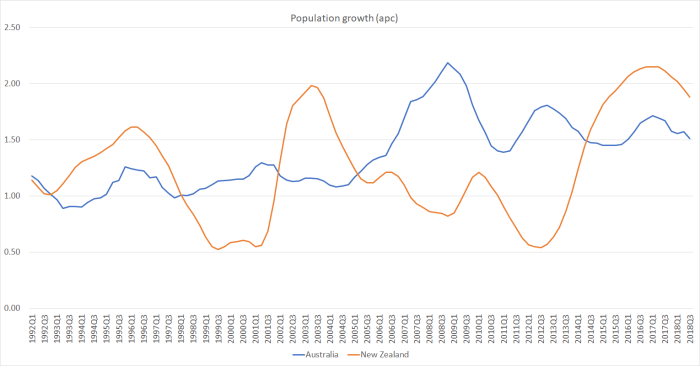
Population growth is one of the biggest determinants of how much accommodation will be demanded.  Here is annual population growth in the two countries.

popn nz and aus

Over the last four to five years, our population growth rate has run quite a bit ahead of Australia’s.   All else equal, one percentage point faster population growth requires something like two percentage points of GDP larger share of residential investment (the net stock of residential dwellings – themselves depreciated –  is well above 100 per cent of GDP).

At least two other things complicate comparisons.  First, a big chunk of residential investment spending in New Zealand for several years after the Canterbury earthquakes was about repair and rebuild, not adding to the housing stock (relative to the pre-quake situation) at all.  There was nothing comparable in Australia, and so all else equal one should have expected a larger share of resources devoted to housebuilding here than in Australia.  And the other relevant factor is that intensification often involves the demolition (and loss) of existing dwellings: even in normal (non-quake) times not all new dwelling approvals add to the housing stock.

New Zealand has a reasonably long-running quarterly series on the estimated number of private dwellings.   I could only find the comparable Australia series back to 2011.  But this is what trends in the number of people per dwelling look like over the last few years.

people per dwelling

On the face of it, that is a pretty startling difference. (I did find reference to some Australia census data suggesting that in 1991 population per dwelling in Australia was also around 2.7.)

A declining ratio of people per dwelling is what might one expect in functioning house and land markets.  After all, both countries are getting richer, birth rates are lower than they used to be, people are living longer (ie a larger share of life after kids have left home), lifelong marriage from an early age doesn’t seem to be becoming more a thing.  But it –  a fall in the ratio –  is much harder to achieve when regulatory obstacles mean house prices are driven sky-high.   Then people squash together a bit more.

Another way of looking at the last few years of that chart is that over the seven years to September 2018 Australia had population growth of 11.8 per cent and the stock of dwellings increased by 12.7 per cent.  In New Zealand, over the same period, the population is estimated to have risen by  11.6 per cent and the stock of dwellings increased by only 8.6 per cent.   For the entire housing stock –  slow-moving at best –  that is a really big difference.

I haven’t mentioned (a) the large share of apartments built in Australia in recent years (which some look on favourably –  the Reserve Bank here always used to tout that record –  and others are more inclined to mutter about future potential urban slums etc), or (b) differences in credit conditions on the two sides of the Tasman (responsible, on some tellings, for the recent weakness of the housing market).

But looking across the numbers I’ve presented here, and bearing in mind that there has been little or no effective liberalisation of land use laws in New Zealand (or a fix to the construction products market), it is hard to see any good reason to expect that we will see any material or sustained drop in house and urban land prices here.

house prices jan 19

There will be a recession along eventually, ringfencing and a capital gains tax (both dubious new economic distortions) might dampen things a little, and the Reserve Bank’s capital proposals if implemented might exacerbate any downturn, but in the end if land remains artifically scarce (a bit like new cars in 1950s New Zealand) it remains hard to envisage a serious or substantial adjustment.   And responsibility for that failure –  and failure it is –  has to be sheeted home to the political parties that vie to govern us, notably National and Labour.

Wages, earnings capacity and all that

There has been a line run in many quarters over recent years suggesting that wage inflation is surprisingly low.   There was a bit of that tone in several articles on such issues in the Sunday Star-Times yesterday, and it even appeared in the Leader of the Opposition’s speech last week

For many New Zealanders, incomes are struggling to keep up with the rising cost of living.

We’ll probably see more such stories when the next round of labour market statistics are released later this week.

As I’ve noted in various posts over a couple of years now (including recently), I’m not at all convinced by this story.

My preferrred measure of wage inflation is the Statistics New Zealand analytical unadjusted Labour Cost Index series.  The LCI is designed to be stratified –  comparing wage inflation for the same jobs (and so not facing the compositional issues the QES measures have) –  and the “analytical unadjusted” refers to the idea that these are straight wage measures, not ones that attempt to adjust for individual job productivity changes (as the headline LCI numbers do).  The series is only available back to the 1990s, but here is the history.

LCI 1

Nominal wage inflation has picked up a little, but is still well below what people got used to in the five years or so prior to the last recession.  But so is inflation for goods and services.

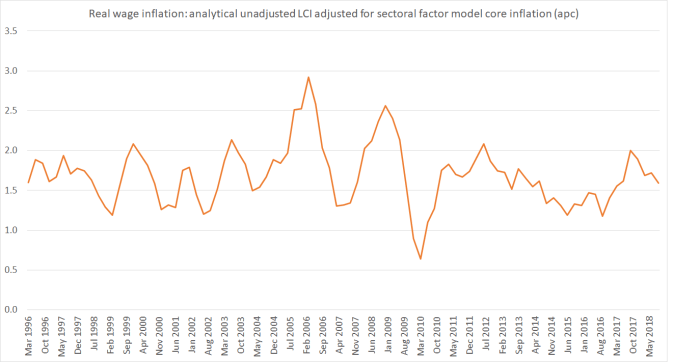
Here is the same wage series adjusted for the Reserve Bank’s sectoral factor model measure of core inflation (I could have used the headline CPI –  the averages don’t change materially, but there is a lot more “noise” in the CPI itself).

LCI 2

Two things caught my eye:

  • first, each and every year real wages (on aggregate across the economy) have risen –  even in the depths of the last recession.   It won’t have been (and won’t be) true for every individual, but it is true –  at least on these measures (generated by our national statistics agency, and the official agency best placed to tell us about core inflation) –  across the economy as a whole.
  • second, real wage inflation this decade looks to have averaged not materially different to what we experienced in the late 1990s and 00s.  There were individual years where faster wage inflation was recorded, but if there is a systematic weakness in real wage increases  this decade compared to what went before, the difference is pretty small.   And notwithstanding talk –  in those SST articles –  that the current labour market is “as good it gets” actually the unemployment rate is still above the lows of the 00s.

All of which is a little strange, because economywide productivity growth has slumped (to basically zero in recent years).  Here is a chart of estimated labour productivity back to 1995 when the LCI series starts. I’ve shown it in logs, so that a less steeply rising line accurately illustrates a declining growth rate of productivity.

lci 3

There is a bit of short-term noise in the series, but the key story is pretty easily visible: growth in labour productivity has been slowing, mostly recently to nothing.   All else equal, it should be a bit surprising if there are persistent gains in economywide real wages when there is little or no productivity growth.

Of course, the other consideration that affects economywide potential is the terms of trade. If the terms of trade increase then even if there is no growth in real labour productivity, the overall pot is bigger and –  all else equal –  it is likely that over time wages will rise to some extent to reflect that improvement.  It is a mechanical process, or a certain one, and there is a variety of possible channels, but in an economy that experiences considerable terms of trade variability it isn’t a factor that can simply be overlooked.

I’ve attempted to take account of the terms of trade in this chart, which I ran in post last month.

lci wages vs gdp

This chart compares how wages have been rising relative to the increase in nominal GDP per hour worked (the latter measure including both productivity and terms of trade effects).   A rising line –  as New Zealand has experienced (on these data) this century –  suggests that wages have been rising at a faster rate than the earnings potential of the economy.      That difference –  perhaps 13 percentage points over 17 years –  adds up to something quite significant.  On its own –  taken in isolation –  it is neither something necessarily good nor something necessarily bad.   There are distributional changes in any economy over time.  But it is something that could not continue at the same rate indefinitely (this isn’t a statement of ideology or sophisticated economic argumentation,  but simply a matter of basic arithmetic).

Here is another way to look at the issue. The chart shows the OECD’s relative unit labour cost measure of New Zealand’s real exchange rate, in this case back to 1980.

rer to end 18

I’ve broken into two the period since liberalisation in 1984.  In both periods –  although especially the earlier one –  there has been plenty of variability in the real exchange rate.  But the average in the second half of the period has been far higher than in the first half.  Since standard theory tells us to have expected exchange rate overshoots temporarily as part of getting inflation down, I could quite legitimately have focused simply on, say, the 10 years after 1991 and compared them to the more recent period.  My point is not that any single point of comparison is somehow the “right” one, simply that in an economy where productivity growth has lagged behind that in most of the rest of the advanced world, there is something anomalous about a real exchange rate as high as ours have been.  Since this is a unit labour cost measure, it fits nicely with the previous chart –  wages and salaries have been rising faster than the economy’s earnings capacity, and to a greater extent than in many other countries.   Consistent with all that, our firms (as a whole) haven’t been able to successfully increase their penetration of world markets (export shares have been flat or falling).

Not this is in any sense the fault of wage-earners, or indeed of individual firms, all of whom are mostly responding to the incentives the economy has thrown up, and how policy has tilted the playing field.  This decade, some of those things were unavoidable (the earthquakes) but others were pure, deeply misguided, public policy choices.   Rapid population growth generates lots of activity and demand for labour but –  at least in New Zealand’s case –  appears to have done nothing to improve the longer-term earnings capacity of the economy.

In the end, material living standards in any economy will largely reflect productivity growth.  And yet, somewhat weirdly –  but perhaps consistent with the increasing political cone of silence around that failure –  as far as I could see not one of the SST articles yesterday even mentioned the productivity failure as the biggest obstacle to sustainably higher wages and material living standards.    For now, we’ve been in a bit of a fool’s paradise –  wages appear to have been growing faster than economic capacity.  But unless something serious is done to reverse the productivity failure, it is hard to see that real wage inflation in the next decade will be able to be as high as it has been this decade.  The bigger question right now shouldn’t be why wage inflation is so low, but why it is still so high.

(None of this is to rule out the possibility of some problems with the analytical unadjusted LCI data, but (a) SNZ has not pointed users to serious problems, and (b) the picture I’m painting doesn’t seem inconsistent with either the labour share of GDP data or the real exchange rate measures.)


Donations, the PRC etc

There was interesting Herald story a couple of weeks ago suggesting that the National Party may be beginning to feel some heat about their affiliations with, and excuses for, and funds flowing from, the People’s Republic of China (or people with close associations thereto).    The story drew on a speech given by National’s spokesman on electoral law, longserving MP Nick Smith,  to the Nelson Rotary Clubs.  In that speech Nick Smith argued as follows

4.2 Banning Foreign Donations

The second change I want to promote is a ban on foreign donations. This proposal was floated by former Attorney General and SIS Minister Chris Finlayson in his valedictory speech last month with him forcefully arguing that New Zealand’s democracy is ours and should not be open to manipulation by any foreign influence. This risk has been highlighted in recent overseas elections.

The existing electoral law does put limits on foreign donors, but needs strengthening. Only kiwi citizens and residents should be able to donate to political parties or to campaigns that seek to influence an election outcome.

Such a change would need to be done with finesse so as not to discourage political participation by new New Zealanders. The issue is not about ethnicity. It is about New Zealand not allowing its democracy to be inappropriately influenced by overseas interests.

It isn’t that I disagree with Nick Smith on this specific, just that in raising it (and not other issues around electoral donations) he seems to be avoiding –  probably consciously and deliberately – some of the real specific issues that are apparent in New Zealand.

The Herald article summarised the current law this way

Current electoral law prohibits non-citizens or residents from donating more than $1500 to political parties, but these can be avoided by donating through New Zealand-registered corporate entities – such as companies, incorporated societies and trusts – which are allowed to donate regardless of whether they are owned or controlled by New Zealanders.

and in a recent commentary, Simon Chapple, director of Victoria University’s Institute for Governance and Policy Studies observed

Currently in New Zealand foreign donations to a party of up to NZ$1,500 are permissible. Moreover, foreign donations below this amount are not individually or collectively disclosed.

It would be easy for a foreign state or corporate body seeking political influence to channel a large number of donations into the system just under the threshold via numerous proxies. Whether such interference has been happening is unclear, since New Zealanders do not know how much money currently comes in to political parties via foreign actors.

Even if foreign donations are not a problem now, one could rapidly develop. A strong argument can be made that foreign money has no place in democracy, including New Zealand’s.

New Zealand would not be going out on an international limb by banning foreign donations. Foreign donations to political parties are not permissible in the [United Kingdom, Ireland and the United States. They are also banned in Canada but unfortunately a significant loophole exists. Australia is currently in the process of banning foreign donations.

And I’d certainly agree with Simon on that general point: foreign money should have no place in funding election campaigns or political parties.

So there probably is a good case for a blanket prohibition on donations (in cash or in kind) to political parties by non-resident non-citizens.  But that looks mostly like pre-emptively closing a possible source of a problem (although perhaps real in the case of Phil Goff’s last mayoral campaign) –  and thus looking as though you care –  when the real actual issues New Zealand faces in this area would not be addressed at all.   For example, the largest single (acknowledged) donation to the National Party a couple of years ago was from a New Zealand registered company owned and controlled by a PRC billionaire.  That is foreign money in New Zealand politics, and shouldn’t be allowed.  It would be bad enough if it were from donors in countries that generally shared New Zealand values and democratic norms.   It is far worse when the donor is from the PRC – or, if you like, North Korea, Equatorial Guinea or other repressive authoritarian states –  and (according to the media coverage) clearly in the good graces of Xi Jinping.   Personally, I would probably favour banning all corporate donations to political parties –  people are citizens, companies aren’t –  but at very least we should apply the same restrictions to foreign-controlled companies that we apply to non-resident non-citizen individual donations.

But laws can take you only so far, and I’m not convinced they can deal with what appears to be the rather bigger issue around New Zealand political party financing (probably mainly National, although it seems likely that Labour now in government will be seeking to get in on the act).   That requires decency, integrity, and a willingness to make a sacrifice –  in this case, not to take money from people –  not even New Zealand citizens or residents – with close associations with, declared support for, political regimes with values so inimical to, and inconsistent with, those that have underpinned New Zealand democracy, and its fairly free and open society.

It seems to be widely understood that National Party Jian Yang is the party’s biggest single fundraiser.  Jian Yang, as is now widely known, served in PLA overseas intelligence system and was (perhaps is) a CCP member, who eventually acknowledged that he misrepresented his past to get residency and citizenship in New Zealand. In all his years in Parliament he has never once criticised the PRC –  not even over Tiananmen Square (perhaps there is an opportunity for him on the 30th anniversary in a few months time) – he is observed to be very close to the PRC Embassy, and even a former diplomat (now a lobbyist, so hardly someone deliberately trying to stir up trouble) declared that he was always very careful what he said in front of Jian Yang.    It is, to put it mildly, hard to be confident that he is primarily serving the interests of New Zealand and New Zealanders.

I’ve noted previously comments made last year by serious senior people at a Chatham House rules event I was invited to

There was clear unease, from people in a good position to know, about the role of large donations to political parties from ethnic minority populations –  often from cultures without the political tradition here (in theory, if not always observed in practice in recent decades) that donations are not about purchasing influence.  One person observed that we had very much the same issues Australia was grappling with (although our formal laws are tighter than the Australian ones).  Of ethnic Chinese donations in particular, the description “truckloads” was used, with a sense that the situation is almost “inherently unhealthy”.   With membership numbers in political parties dropping, and political campaigning getting no less expensive, this ethnic contribution (and associated influence seeking) issue led several participants to note that they had come round to favouring serious consideration of state funding of political parties.

These will probably (almost) all be donations made by New Zealand citizens or residents, and nothing in what Nick Smith (or Chris Finlayson) was saying would even touch on them.

And thus late last year, Yikun Zhang sprang to brief public prominence, when Jami-Lee Ross revealed the tape-recording of his discussion with Simon Bridges about the $100000 donation(s), and the possible bid by one of Yikun Zhang’s associates for a place on National’s list.   I’m not mostly concerned with the question of whether this donation (or set of donations) was appropriately disclosed –  although in general I think there is a strong case for a lower, and more binding, disclosure threshold, tying all material donations back to identifiable natural persons –  but about the affiliations and identifications of Yikun Zhang and his associates.  We learned at the time the story broke that Yikun Zhang – despite being a long-time New Zealand resident (and citizen) doesn’t speak English.  We learned a lot about his involvement –  at senior levels –  in various United Front bodies, and the strong ties he appears to have with CCP entities back in the PRC.  It is, to put it mildly, hard for a dispassionate observer to be confident that he primarily has at heart the interests of New Zealand and New Zealanders.   Given the nature of the regime he enthusiastically and repeatedly assoicates with, no decent political party should voluntarily have any but the most formal relations with such a person, and certainly shouldn’t be soliciting money from, or through them.  It isn’t what decent people, with any regard for the integrity of our system, do.

In fact, of course, not only do they take his money, but Phil Goff, Jian Yang, and former National MP Eric Roy got together to nominate Yikun Zhang for an honour, something bestowed last year by the current government.  In effect, it appears, for services to one of the more evil –  most evil, judged by the numbers it rules –  regimes on the planet.

And of course we know that not just MPs but party officials seem to fall over themselves to praise that same regime, and run interference whenever there is a suggestion of problems (think of Todd McClay running Beijing propaganda lines about “vocational training camps in Xinjiang).  Peter Goodfellow, the National Party president, seems to work very closely with Jian Yang to pander to the regime, and keep the local donation flow going.  And on the Labour side, Nigel Haworth seemed to be little better.

So by all means, take up the specific suggestion to ban completely foreign donations.  It would be a small improvement on the current situation, but it would not even begin to tackle the deep corruption of the our political system around the PRC regime.  People who were long-serving senior ministers – Nick Smith and Chris Finlayson –  know that very well, even if they are genuinely well-meaning on their specific proposal.

But attempting to fool the public otherwise seems to be a bit of new theme.  That Herald story where I first saw reference to Nick Smith’s speech included this gem

In a related move, Parliament’s justice select committee have issued a rare invitation to the country’s intelligence agencies to give a – likely closed-doors and secret – briefing to MPs about “foreign interference” in local elections.

Nick Smith, a member of the committee and his party’s spokesperson for electoral law reform, confirmed the committee as a whole late last year sent a letter to the New Zealand Security and Intelligence Service (NZSIS) and Government Communications and Security Bureau (GCSB) inviting them to give evidence.

Smith yesterday said he hoped the NZSIS and GCSB would be able to provide insight on the local risks posed by issues such as the hacking the public officials’ communications, foreign donations, and anonymous and politicised social media campaigns.

“There is the issue of funding, and whether foreign governments are either directly, or indirectly through shelf companies, are using funds to inappropriately influence outcomes,” he said.

Smith said the invitation to the NZSIS and GCSB offered evidence to be given in secret if required. He conceded this would be an unusual move for usually-open committee meetings, but was justified: “I think this is a really important issue,” he said.

So a committee chaired by Raymond Huo, he of various United Front bodies, he who chose a slogan of Xi Jinping’s for Labour Chinese-language compaign in 2017, with a senior National MP promoting only the narrowest reform (while providing cover for Jian Yang) will invite the intelligence agencies to provide advice on foreign influence issues, but in secret.   Perhaps –  but only perhaps, because the fact of this hearing might be used to simply play distraction – it is marginally better than nothing, but we don’t need intelligence agencies to tell us there is an issue around the PRC. Both main parties know what they are doing –  who they associate with, who they take money from, who they honour, who they seek closer relations with, and who they refuse ever to criticise, no matter how egregious the regime’s abuses.  All the minor parties keep quiet and go along too.

There was column this week on Newsroom by political scientist Bryce Edwards argues that it is “urgent” that we start having a proper debate in New Zealand about the PRC and the relationship with New Zealand.   I don’t really disagree with him, although he seems to want an “elite” debate, and seems scared by the idea that the public might have a (strong) view (an “overly simplistic one” apparently, like ideas of good and evil perhaps?).

Edwards writes

Obviously, we can’t rely on the politicians to lead that [debate] – they’re too compromised, and they’re just too inclined to suppress the discussion. Instead it has to be other parts of the public sphere – especially the media and other public figures – that needs to step up to examine and discuss the issues.

But it seems like wishful thinking.  Sure there is the occasional voice from the margins –  whether Edwards or Anne-Marie Brady – but there doesn’t seem any sign that anyone in “elite New Zealand”, anyone who commands serious respect, is about to break ranks from the “keep quiet, keep the deals and donations flowing” sickening consensus of the last few decades.  Not former leading politicians, not church leaders, not leading business figures, no one.  Even if a few people mutter quietly –  even Fran O’Sullivan had some recent encouraging comments about donations – no one seriously breaks ranks.   The taxpayer even funds bodies that condemn taking action on Huawei.  So who does Edwards seriously think might lead such a debate?

As he says, all politicians have all sold their souls.  I was exchanging notes earlier this week with someone about Jian Yang.  It is easy to blame John Key and Peter Goodfellow for Jian Yang –  they either knew his background or should have, and didn’t really care (or worse) either way.  But the story of Jian Yang has been public for almost 18 months now and no one in politics has disowned him, called for his resignation, called for the National Party to remove him from their caucus.  Not Jacinda Ardern or Andrew Little, certainly not Bill English or Simon Bridges, not James Shaw or Marama Davidson, not David Seymour, not even (despite occasional timorous hints) Winston Peters.  Not even Jami-Lee Ross, who was at the centre of the whole donations business.  Not a single backbencher, of any party, was willing to break ranks and declare the situation unacceptable.  Fixed with knowledge, by their silence they now share responsibility.

It is little different on any of the other aspects of the PRC relationships:

  • the effective PRC control of the local Chinese language media,
  • the refusal to say a word about the Xinjiang abuses (or Falun Gong or Christian churches),
  • the refusal to say anything in support of Canada over the abduction of two of its nationals.

Probably most of these so-called leaders like to think they are somehow serving New Zealand interests.  People fool themselves that way, sometimes without necessarily fully realisng what they are doing.  They aren’t.

So, much as Bryce Edwards might deplore the prospect of an “overly-simplistic” serious public debate, or swelling tide of discontent, I’d cheer on the fact that it was happening at all.  Corrupted systems are rarely, if ever, upended and reformed without a strong strand of –  almost unreasonable –  public outrage.  It hasn’t happened here yet.  I’d like to say it was only a matter of time, but I’m a pessimist.    What would turn things around now after all these years in which our “elites” have degraded our political system (to complement their failures on other fronts, notably productivity)?  Labour and National are, after all, two sides of same coin on such issues, and together they seem to have a stronger hold on the political system (vote share combined) than we’ve seen for some decades.   We don’t have politicians of decency and integrity, and the public show little sign of (effectively) demanding something different.  The PRC Embassy must be pleased.


UPDATe (4/2):   There is a new column by Simon Chapple and a co-author on reviewing the rules around political donations.  I’m pretty sympathetic to the sorts of changes they propose, although as I argue above the PRC-influence issues around donations or more about atttitudes and integrity –  knowing what is right and wrong and eschewing the latter –  than something formal external (eg statutory) rules can deal with.


Highly productive countries tend to do more social spending

Earlier in the week I saw somewhere some charts drawn from the OECD’s Social Expenditure database, so I went to have a look.  In this database, and an associated report, the OECD attempts to gather reasonably consistent cross-country estimates of (what they describe as) social expenditure.  In this case, the numbers exclude spending on education (other than early childhood spending).

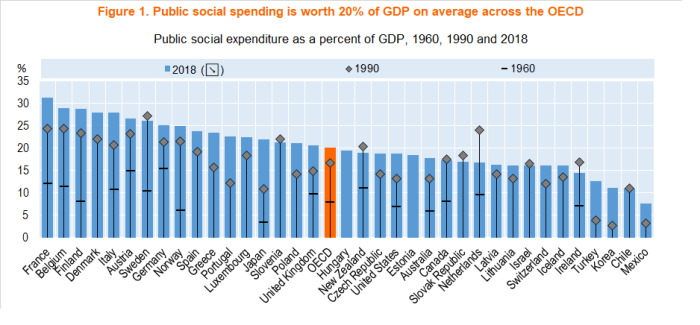
This is the first chart,

socex1

This is direct government spending on such things (health, unemployment and disability benefits, active labour market policies, age pensions and the like).   There probably isn’t much very surprising in the 2018 ranking themselves, although a few things caught my eye:

  • in among the European countries with above-median spending Japan now appears.  Not that long ago Japan had relatively low rates of government spending (share of GDP) but now it is higher than all the English-speaking countries,
  • among those English-speaking countries the Irish numbers are very misleadingly low because of the way features of the corporate tax regime have led measured GDP in Ireland to far outstrip the “true” level of economic activity occurring in Ireland, let alone the income accruing to Irish residents.
  • New Zealand was very close to being the median country in 2018.
  • and, whether or not one approves of such high levels of social spending (and I’m pretty uneasy) it should not be overlooked that among the nine largest spenders (share of GDP), seven are in the top-tier OECD group for average labour productivity (exceptions being Finland and Italy).       I’m not offering any thoughts about causation (and other very high productivity countries – US, Ireland, and the Netherlands –  below the median), but it remains a data point one has to take seriously.

And, of course, the other thing that is striking is how much social spending as a share of GDP has increased.  Perhaps 20 per cent of OECD countries have such spending a bit lower or much the same as in 1990 (New Zealand is one of them –  in 1990 the NZS eligibility age was still 60 and the unemployment rate was rising rapidly in the midst of our disinflation and restructuring), but in most countries there has been an increase even since 1990.   For the countries for which 1960 data were available, the increases have been very large in every single country –  although Japan (still pretty poor in 1960) stands out.

Interesting as these charts of direct public outlays are, they can be only part of the picture.  If the government compels you to save, or compels you to buy medical insurance, or offers tax treatments that incentivise such private spending, the differences between public and private spending can quickly get rather blurry.  Switzerland, for example, has a low share of public social spending but requires everyone to take out medical insurance.  That might, or might not, be a better system, but it means that low-ish direct public spending numbers don’t always tell a simple small-government (or self-reliant) story.   This isn’t a big issue for New Zealand, but here is the OECD’s attempt to reflect some of these different institutional arrangements and produce some bottom line estimates of net social expenditures (apologies that it is a little hard to read –  you can click here for a more legible version).  The orange dots are the ones to focus on.

socexp3

On this measure, the Netherlands and the US move a long way to the left (on the chart), only just behind France.  Switzerland (and Australia) also move a long way to the left.  Of the English-speaking countries, only Ireland now ranks below New Zealand, and that is just because of the tax-system distortion to the GDP numbers (done as a share of net national income, Ireland would spend more on social expenditure than New Zealand).

There are all sorts of quibbles possible about these numbers, including how safe it is to simply add them up (to what extent are the components really apples and oranges?), but it is probably salutary to note that there is now a stronger alignment between income/productivity levels and net social expenditure as a share of GDP than was evident in the first chart.  Countries towards the right of the chart are (almost entirely) the poorer and less productive OECD countries, and countries to the left of the chart tend to be the richer/more productive OECD countries (the outliers being Greece and Portugal).    Whether or not one approves of high rates of social spending, it is at least consistent with the story that much higher productivity gives countries, and individuals, options (practical and political) that poorer and less productive countries don’t have.   That might be something for our political officeholders –  increasingly indifferent to New Zealand’s productivity failure –  to reflect on.

And don’t think you can put the cart before the horse – in general, raising social expenditure won’t do anything much to raise (and may even lower) medium-term average economywide productivity.

Bridges and the State of the Nation

I mostly went looking for the text of Simon Bridges’ “state of the nation” speech yesterday to see if there were any signs, at all, that the Leader of the Opposition was going to confront New Zealand’s appalling productivity growth performance.   He had, after all, been Minister of Economic Development only 18 months ago.  There weren’t.

I’ll come back to economic performance and economic policy later, but the rest of the speech had some interesting snippets.

There was a long section on law and order.  There was plenty of rhetoric but one line in particular caught my eye

I am determined that under the next National Government, New Zealand will become the safest place to live in the world.

Wow, I thought, that sounds like a bold promise.  I don’t carry crime data around in my head, so I went looking.   Reporting and collection differences muddy cross-country comparisons of the incidence of crime, and for a full comparison you’d want to look at the full gamut of violent crime, theft and so on.   But the most comparable data across countries is that for the homicide rate.   Here are the homicide rates (per 100000 people) for advanced countries, using UN compilations of data.

homicides

Dreadful as any intentional homicide is, New Zealand doesn’t rank too badly, just a bit better than the median of this group of countries.  But Simon Bridges says that under the next National government, New Zealand will be the safest country in the world.   Say they come to office next year, and are in office for nine years.  That means he thinks that within ten years, they can take steps that will lower New Zealand’s intentional homicide rate by just over two-thirds, to match the record in places like Singapore, Japan and Luxembourg.

I ran this chart in a post late last year, using NZ Police data.

murders

Cutting our murder rate by more than two-thirds would involve getting, and keeping, it, down to the very lowest individual years managed in the last 100 years or so.   It would be laudable goal…….at least if Mr Bridges had any serious and plausible ideas about how to do it.  And the sort of change that really would support, over time, a much lower prison population.   Fifteen murders a year would still be fifteen too many, but even that seems like a tall order, even with an ageing population.  Mr Bridges promises that National will “continue to put forward the ideas” between now and the election to make his “safest place to live in the world” vision a reality.  Count me a bit sceptical, but I’ll watch with interest to see if there is some substance there.

The headline from the Bridges speech was around the promise to index the income thresholds in the tax system.  It would be a welcome, but well overdue, reform if someone finally does it.  But I wondered about some of the details.  This is how Bridges explained what they are proposing.

We will amend the Income Tax Act to make sure income taxes are adjusted every three years in line with the cost of living.

Within a year after every election, Treasury will advise the Government on how much the tax thresholds should be adjusted to account for inflation.

That means income tax thresholds will increase every three years to stay in line with the cost of living.

The first change will be in 2021 and relate to the tax years of 2018, 2019 and 2020.

We will include a veto clause so the Government of the day can withhold the threshold changes in the rare circumstances that there is good reason to do so.

But it will have to explain that decision to New Zealanders.

But why not

(a) adjust the thresholds every year, and

(b) adjust them automatically, with the formula written into the Income Tax Act?

After all, we manage to adjust (for example) NZ Superannuation rates automatically each year.

One of the arguments for indexing the thresholds is to reduce the ability of politicians to use occasional adjustments to present themselves as giving a tax cut.  The Bridges model –  adjustments only every three years, and only on the basis of the Minister of Finance responding to a Treasury recommendation – still seems to keep too much of that potential intact.  Adjusting for inflation will be in ministerial gift, not simply an automatic calculation routinely notified to taxpayers (according to legislative formula) by the Commissioner of Inland Revenue.

I’m also uneasy about this idea that the Minister could reject a specific  indexation recommendation.  First, if the adjustment were being done annually, the amounts involved are so small there could be no compelling reason not to proceed (with triennial adjustments the amounts get chunkier). And, second, we don’t apply this approach to (say) New Zealand Superannuation payments.  What the statutory formula says goes.

If a government thinks there is a persuasive case to raise tax rates –  and from time to time that may be necessary or appropriate –  they should be willing to come to Parliament and make the case in an open and transparent way.  That is, for example, what they have to do if they want to lower (real) NZS payments.    Inflation shouldn’t be able to be used to be used as a silent cover, enabling governments to grab more (real) revenue.

And then there was the economy.  Simon Bridges devoted a lot of space to it in his speech but there was very little serious content.  What it all boiled down to was:

(a) when we were in government our economy was a rockstar (he doesn’t use the word, just ‘one of the best performing in the developed world’)

(b) Labour is raising taxes

(c) Labour is doing wasteful spending (fee-free tertiary education and the the Provincial Growth Fund), and

(d) National would reverse the Auckland fuel levy, and any capital gains taxes, and not increase other taxes in a first term.

(It was notable that despite the talk of wasteful spending –  with which I agree with him on the specifics –  there were no promises to unwind those measures.)

And that’s it.  There was no suggestion of an economic reform strategy –  not even ideas to come –  or even a need for one.  Things would, it appears, be fine if only we had lower (Auckland) petrol taxes and no capital gains taxes.

So, as an aide memoire for Mr Bridges and his economic team, lets remind ourselves of some key New Zealand data.  I ran this table a couple of weeks ago

GDP per hour worked
USD, constant prices, 2010 PPPs
1970 1990 2017
New Zealand 21.4 28.6 37.2
Netherlands 27.4 47.5 62.3
Belgium 25.0 46.7 64.6
France 21.7 43.3 59.5
Denmark 25.1 44.8 64.1
Germany 22.3 40.7 60.4
United States 31.1 42.1 63.3
Median of six 25.1 44.1 62.8
NZ as per cent of median 85.4 64.9 59.2
Source: OECD

When Mr Bridges’ parents were young, New Zealand was still among the very richest and most productive countries on earth.    His children are born into a country where average productivity levels are barely 60 per cent of those in the top tier of the OECD.

And what happened under the government in which he was, by the end, a senior minister.

real GDP phw dec 18

Barely any productivity growth at all in the last five or six years (and allowing for the lags, and the fact that the current government has done little, the most recent year’s data reflects those some policy frameworks and choices).  We dropped further behind Australia over the last decade, and various eastern European countries –  never previously close to us in the last 150 years –  are either snapping at our heels or overtaking us.   Well done them.  Shame on us (and the succession of governments and oppositions).

Successful economies tend to trade a lot with the rest of the world.  Early in their last term, the National Party in government knew this –  reflected in the (slightly wrong-headed) targets for much higher exports as a share of GDP).   Here is the actual and forecast data (for exports –  the import chart isn’t that different) from the most recent Treasury HYEFU.

exports hyefu 18

Foreign trade as a share of GDP has been shrinking this century – under both National and Labour governments –  and nothing Treasury can see suggests that underperformance is about to be reversed.

But in two pages of speech text about the economy there was not a mention –  not even a hint – of any of this.  Of course, none of this is as immediately topical, or offering political mileage, as a possible capital gains tax.  But a serious leader might at least be able to point to the need to do so much better on the economic performance –  material standard of living – front.

It is only about 19 months until the next election.  Sadly, there is no sign from this speech that a future National goverment would be any more serious about reversing our relative economic decline than their predecessors –  of whatever stripe –  for the last 25 years.  Worse still, they seem to have given up believing there even is an issue.

School days and years

Sitting reading the Herald this morning as my oldest child headed out the door for his first day of the new school year –  two more still on holiday – I noticed that National MP Nicola Willis was making a bid for the state to do more child-minding for her and her husband   She has an op-ed trailing a private member’s bill she will seek to introduce to reduce the summer holidays for school children by a week or two.

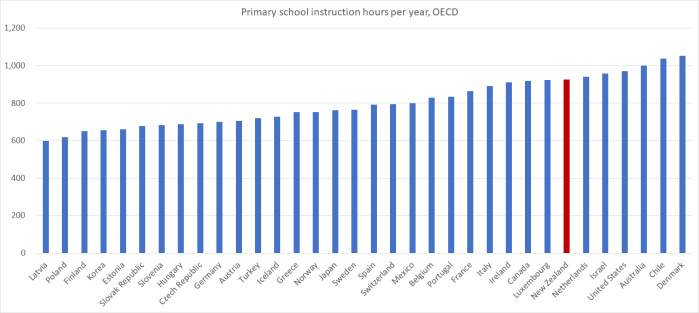
That had me wondering how our school year compared to those in other advanced countries.  For some reason, the OECD doesn’t have data on New Zealand in their tables showing the number of hours per year of instruction at primary school.  But the Ministry of Education website says that our primary school have to be open for 390 half days a year (195 days).    The standard primary school day seems to be from 9am to 3pm, and if we subtract an hour for lunch and fifteen minutes for another break, that leaves 4.75 hours per day of instruction time, for a total of 926 hours per year.   Here is how that estimate compares with the other OECD countries for which there is data reported.

school hours per year

In other words, we already have one of the higher primary school hours requirements among the OECD countries.  (Accordingly to one website I looked at, Australia has slightly shorter school years, but slightly longer school days.)  And recall that these aren’t voluntary hours, but coerced ones.   Finland is sometimes touted as having an excellent education system, so I was particularly interested in the hours numbers reported there.  There are some odd looking numbers –  South Korea has a reputation for long hours and very intense schooling, which doesn’t seem to square with these numbers – but I can’t see any credible way in which New Zealand is not already in the upper half of the OECD for schooling requirements.    And everyone recognises that schooling has a considerable element of (compulsory) child-minding about it: home-schoolers rarely spend 900 hours a year on the equivalent learning.

Perhaps also not entirely irrelevant when an MP wants to reduce holidays for kids is to look at minimum annual leave requirements for adults.  It wasn’t until 1944 there were any.  When I was the age Nicola Willis’s kids are now –  and the school year seemed the same length as it is now – that minimum was two weeks.  In 1974, the minimum was increased to three weeks, and in 2007 it was further increased to four weeks.   These weren’t changes proposed by the National Party, but there is no sign Nicola Willis or her leader wants to undo them, so why does she think our kids should be conscripted to the state’s service for even more weeks of the year, even as (most) adults appreciate the greater leisure?

Willis claims a high-minded motive

Most importantly, Kiwi kids feel the impact. Research shows the “summer slide” in student achievement is real. Kids’ literacy abilities can decline over the six-week break, with one study showing students losing months of progress over summer. Much of term one can be spent getting kids back to where they left off the following year. This is a real barrier to achievement.

Count me a sceptic on that one.  “One study” can be found to support almost any argument.  But even if it were true (a) plenty of workers come back to their desks after the summer holiday at a bit of a loose end, less focused than they might be for a few weeks, (b) formal literacy abilities are not the only capability we want our kids to develop, and (c) it would surely depend a great deal on the specific child  (my wife and I both recall going to library almost every day in our school holidays, and one of mine tells me she has read 33 books this month so far).   And if New Zealand’s PISA scores have been dropping –  under Nicola Willis’s party’s term of government –  that isn’t because we shortened the school year.   And if the holidays sometimes drag a little (a) boredom is often good for children (as they find ways to amuse themselves), and (b) so do terms and school years. I presume I’m not the only parent to have noticed children getting tired towards the end of terms, especially towards the end of the year.  They are children, and primary schools ones in particular don’t have the stamina of heathy adults.

But National Party MP Nicola Willis –  a party that once claim to stand for freedom, family etc –  now wants to compel kids into state-run schooling for more weeks of the year.

And why?   That alleged summer time literacy drop isn’t the real reason –  despite that “most importantly” the argument is only introduced late in her article.  What she wants is the state to force kids into school –  away from beaches, climbing trees, picking blackberries, reading, trying out cooking, hanging out with friends, siblings, parents, or whatever –  for longer to make it easier for parents to work long hours (over the course of a year).    It is really as simple as that.

I do have some sympathy for some parents –  not high income ones like Nicola Willis and her husband, for whom these things are purely choices.  Thanks to successive National and Labour governments, good housing in our major urban areas has been rendered ridiculously and totally unnecessarily financially out of reach of many people.  I have no idea how young couples manage to buy a house in this neighbourhood (I bought my first house here at 26 for the equivalent of $300000 in today’s dollar –  the median price in the suburb is now $900000), but part of it is both parents working full-time, not really from “choice”, but from something closer to “necessity”.   But how then do you manage school holidays?

I’m fortunate. Not only did I get into the housing market before the absurdity took hold, but in the five years we both worked fulltime we had a nanny, and I (enjoyed) taking all January off to be around with the kids.  And now we are comfortably a one income family and I (most of the time) really enjoy the holidays and the time with the kids (grown up before you know it anyway).

Not everyone has those options –  although I’m sure Nicola Willis and her husband could, despite her claims of how tough it is for them –  but that doesn’t make the appropriate answer to have the state coerce your kids into school for even more weeks (at the hottest time of the year).  Before you know it, people like her will pop up wanting to have kids in school to (say) 5pm each day as well –  much more convenient for workers I’m sure.

For a National Party MP to fail to recognise that substantial distinction between compulsory attendance (school) and voluntary childcare arrangements tells you again how statist the National Party itself has become.  Perhaps there are regulatory barriers to more after-school or holiday programmes –  one imagines the National government’s OSH rules might be part of that –  and it might be sensible to identify any of those and advocate removing them.  It would certainly make sense to deregulate the land market and make decent housing affordable again, in ways that would give many more families options around part-time work, longer holidays, or one parent or other not engaging in market employment at all for a time.  It might even make sense to explicitly encourage strong two-parent families.   Those are the sort of measures a National Party might once have proposed.   But these days they seem to be mostly statist me-tooers, proposing to deal with one egregious state stuff-up (the housing market) with yet more state coercion.   And this from a party that barely even supports effective school choice, so that more coerced time in schools also typically means not forming our children in the academic heritage of our civilisation, but quite a bit more (mostly unthinking) indoctrination in the values and political beliefs of the teachers.

And now, when the wind drops a bit, I’m off to the beach with my daughter.

What to make of the inflation data?

There seemed to be a little in this week’s CPI numbers for everyone.   The Reserve Bank’s favoured core inflation measure was unchanged at 1.7 per cent (and the model slightly revised downwards the estimate for a couple of quarters back), bringing up now a full nine years in which this core measure has been below 2 per cent.   The CPI ex food and energy series –  a standard international core inflation indicator –  doesn’t get much attention in New Zealand, but annual inflation in that measure was (up a bit) 1.6 per cent.  The last time that inflation measure was above 2 per cent –  excluding the GST change –  was late 2007.  That was so long ago, there will be voters in next year’s election who don’t even remember 2007.

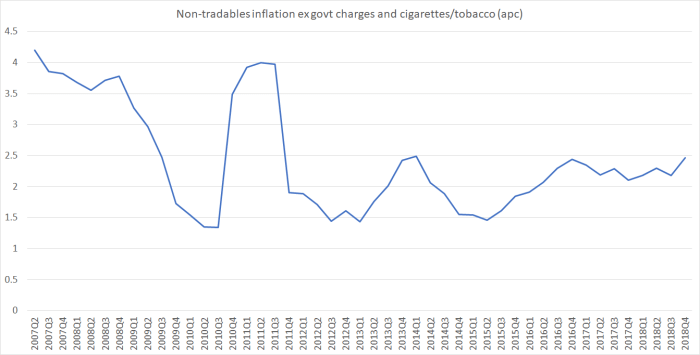
New Zealand inflation measures –  even the sectoral core measure –  are biased upwards these days by the repeated large increases in tobacco taxes.  The price indexes rise as a result, but these tax increases aren’t what economists typically think of when they use the term “inflation”.     Neither Statistics New Zealand nor the Reserve Bank publish a decent core measure that also excludes government charges and tobacco taxes, so I’ve come to quite like the series SNZ does publish for non-tradables inflation excluding government charges and cigarettes and tobacco.  Here is the annual inflation rate in that series.

nt ex jan 19

The annual inflation rate in this measure did pick up a little, but (a) is no higher than the last couple of local peaks, and (b) even 2.5 per cent core non-tradables inflation just isn’t consistent with core overall inflation being back to 2 per cent.   The Reserve Bank was still cutting the OCR in late 2016 when this particular inflation rate series was around current levels.

What about the wider world environment?  Here is CPI ex food and energy inflation for the G7 group of countries.

g7 cpi ex

The picture for China also doesn’t suggest global inflation is rising.

And all this is against a backdrop in which both the world economy and New Zealand’s economy seem to be losing steam.      The pick-up in the sectoral core factor model measure of inflation to 1.7 per cent in the last couple of quarters might be “encouraging” in some sense, if one could readily point to factors that were likely to intensify resource pressures from here, or drive up perceptions of a “normal” or natural inflation rate.  But….the Christchurch rebuild is winding down, immigration seems to edging down, and the terms of trade show no sign of moving to a new higher plateau. There is no fresh wave of productivity growth, inducing firms to invest heavily, and encouraging consumers to spend in anticipation of future higher living standards.  If you believe in housing wealth effects (I don’t see any evidence in aggregate for them), even house price inflation has faded.   There is some fiscal stimulus in the pipeline, but it is nothing like some of the positive demand shocks we’ve gone through in the last 10 or 15 years.  This has the feel of being about as “good as it gets” (thoroughly lousy when contemplating productivity, but here I’m just thinking of capacity pressures, and things which might boost core inflation).

And it isn’t too different abroad.   Global growth projections are getting revised down a little: in the US fiscal stimulus is fading and monetary tightening is beginning to bite, in the euro-area activity indicators are weakening (and add in some Brexit uncertainty on both sides of the Channel), and in China things don’t seem to be developing well.  Commodity prices were a big worry at the end of the last boom, in 2007 into 2008 –  concern about spillover into inflation expectations and wage demands – but not so much now.  And it isn’t as if global monetary policy has suddenly got a lot looser either.  There just isn’t much reason to think core inflation –  here or abroad –  is likely to rise further, and neither here nor in most countries abroad is inflation at target.   When the next recession comes, core inflation is likely to fall from here.

The market doesn’t seem convinced that there is higher inflation in prospect either.  Breakevens from the indexed and conventional government bond market have been falling in other countries.  And here is the New Zealand picture, updated so that the last observation in this monthly chart is yesterday’s data.

breakevens jan 19

In the US, at peak, markets were pricing future inflation averaging a touch above 2 per cent.  Here we never quite got even to 1.5 per cent, and in the last couple of months the breakeven inflation rate (implied expectation) has dropped away again.  People putting real money on these things are implicitly pricing the average inflation rate over the next 10 years in New Zealand at 1.1 per cent.   That seems too low to me, even allowing for an excessively cautious central bank over the last decade (and hardly a vote of confidence in the amended Reserve Bank legislation passed last month), but even if you are sceptical of the level, the direction should be troubling the Governor (and his associates just about to be appointed to the new Monetary Policy Committee).   There doesn’t seem to be any sense any longer that a normal inflation rate in New Zealand is 2 per cent. (My thoughts on making sense of the indexed bond numbers are here.)

It is clear that, with the benefit of hindsight, the OCR should have been a bit lower over the last couple of years.    That is simply the same as observing that core inflation has again undershot the target (and implied expectations suggest that outcome isn’t simply an anomaly).    That isn’t the same as recommending now that the Governor should cut the OCR at next month’s review – and I’m quite he won’t anyway.   There is a reasonable case to be made for a cut now – low inflation, growth pretty insipid etc, tempered by the fact that the unemployment rate (a lagging indicator) is probably around the NAIRU –  but the cautious bureaucrat still lurking in me probably wouldn’t yet go that far.  But the case for a more explicit easing bias does seem increasingly clear.

(It is always good to have diversity of views. My post the other day on the Prime Minister’s FT article seems to have excited another local economics blogger.  Apparently I am a member of the “New Zealand establishment” –  surely a thought that would appal them as much as it appals me –  and some sort of lackey of the National Party (and, worse, the US Republican Party).  I almost fell off my chair a few months ago when someone told me that Simon Bridges had made some positive remarks about this blog, but I doubt any regular readers would ever have taken me as sympathetic to a party that failed to do anything about productivity, failed to do anything about housing, and which seems more interested in pandering to the PRC –  and keeping the funding going –  than in the wellbeing of New Zealanders and the integrity of our society.)


Planning for the next recession

In a post earlier this week, I made passing reference to a new opinion piece on Newsroom headed “Why we need a recession plan”.  The article is written by another former Reserve Banker, Kirdan Lees, who these days divides his time between the University of Canterbury and economic consulting.  His article is organised around a list of five reasons, although it combines his arguments about the form any such plan should take.

I strongly agree that we need some serious, credible and open planning for the next recession (whenever it comes, but it is now eight or nine years since the last one and neither the foreign nor domestic outlooks are looking particularly rosy).  Indeed, in respect of monetary policy, it is a case I’ve been making for about as long as this blog has been running.    The case might have seemed a bit abstract four years ago –  especially to anyone who paid much attention to the Reserve Bank’s pronouncements (that interest rates were rising, and inflation would soon be getting back to target).  It should be much more pressing now, as the growth phase has got old and yet (New Zealand) interest rates are at record lows and inflation still isn’t back to target.  But, unfortunately, there has been nothing serious from the Bank –  under Wheeler, (unlawful) Spencer, or Orr.  They claim to believe there just isn’t a problem; that monetary policy can do as much as ever.

This is, more or less, Kirdan’s first reason.

Reason 1: The outlook now points to recession risk with little room for interest rates to do much

But interest rates have never been so low, leaving little headroom for monetary policy to kick in. Mortgage and lending rates can’t fall by much if the big banks are to retain margins. 

As a reminder, the real obstacle is around wholesale deposit interest rates. By common consensus, official interest rates could be lowered to perhaps -0.75 per cent, but any lower and the strong incentives are for people (including particularly wholesale investors) to convert their assets into physical cash and use safe-deposit boxes and strongrooms.  Conventional monetary policy no longer works then.     That means our Reserve Bank could cut the OCR by up to around 250 basis points –  more than many advanced country central banks could –  but in typical recessions they’ve needed to cut interest rates by 500 basis points (575 basis points last time, and the recovery then was very muted).

There are ways around this lower bound constraint, but the Reserve Bank and the government have shown no signs of any action (or even any serious analysis).  In principle, things could be done in a rush in the middle of the next recession, but that is almost always a bad way to make good policy, and by failing to clearly signal in advance that the authorities have credible responses in hand they are likely to worsen the problem (see below).

Kirdan doesn’t seem to see much scope for doing anything to increase the flexibility of monetary policy.  His focus is on fiscal alternatives.

Reason 2: By the time Treasury calls a recession it’s too late to trigger a fiscal stimulus plan

Not just Treasury of course.  Economic forecasters and analysts are hopeless at recognising recessions until they are well upon us (among the reasons why no one at all should take any comfort from the latest IMF update –  international agencies are among the worst in recognising things before they break).

It would always be better to have good forecasts, even so-called nowcasting (where is the economy right now –  given that our most recent national accounts data relates to the July to September period last year, and even that is subject to revision).      Kirdan is an optimist and believes we can do (materially) better than just waiting for the GDP data.

Today, a myriad of timely data exists: across transport movements, customs data, privately held data on small businesses (such as Xero) and consumption (such as Paymark). A small panel of experts could use that data to gauge recession risk and tell us when to pull the trigger.

In principle, of course, all these data are available to Statistics New Zealand (which could require them to be provided under the Statistics Act), and if the data could be available to “a small panel of experts” it could presumably be available to the Treasury and the Reserve Bank.

But even if these data can provide a few weeks advance notice of negative GDP quarters, there are bigger questions which more-timely data can’t answer.   The first is how long any downturn will last.  That matters quite a lot.   A couple of weak quarters might sensibly lead the Reserve Bank to consider a cut to the OCR, and probably the exchange rate would be weakening anyway.   But that is very different from a couple of weak quarters foreshadowing a deep and prolonged recession.   Telling the difference isn’t easy.  And who seriously supposes that –  in a democracy –  we are going to hand over to a panel of experts (self-appointed or otherwise) decisions about when to trigger big fiscal stimulus programmes which –  whatever their composition –  have huge distributional consequences.  These are inherently political choices, which will benefit from technical input, but the accountability needs to rest with those we elect (and can eject).

On which note

Reason 3: Economic theory can help: a fiscal plan needs to follow three principles
When it comes to fiscal stimulus principles, macroeconomists have their own triple-T: stimulus needs to be timely, targeted and temporary.

Which looks fine on paper, but is much less help in practice.  If you want “timely”. monetary policy can typically be adjusted faster than fiscal policy –  exchange rates, for example, adjust almost instantly to monetary policy surprises, and often in anticipation of monetary policy actions.   And monetary policy moves are designed to be temporary, but without tying anyone’s hands: you raise the OCR again when you are pretty sure inflation is going to back to target.

In the UK they tried what looked like a clever fiscal wheeze in the last recession: cutting the rate of VAT for a year, and only a year.  It looked like a fairly sensible move at the time it was announced –  encouraging people to bring forward consumption.  And it probably would have been if the downturn had been short and sharp, but it wasn’t.  More generally, people like the IMF championed fiscal stimulus in 2008/09, but again implicitly on the view that economies could rebound quickly.  When they didn’t, the mix of economic and political arguments about “austerity” took hold and only complicated the handling of the economy.

Of course, if you get can get your legislation through Parliament you can write cheques (electronic equivalent) quite quickly –  Kirdan is keen on focusing temporary additional spending on “poorer families” –  but you can’t do the same for the sort of infrastructure spending that those keen on fiscal stimulus often champion.

Kirdan’s reason 4 had me puzzled.

Reason 4: Trotting out the same tired approach will provide the same tired results 

One of the enduring traits of fiscal policy is tacking on extra spending in good times and taking away spending just when it is needed.

Hard to disagree too much with that second sentence –  pro-cyclical fiscal policy is a problem.

But even if you think there is a role for some active counter-cyclical fiscal policy, I wasn’t clear on the connection to what came next

Governments seeking a labour boost need a better targeted fiscal stimulus. That means targeting labour-intensive industries such as such as health and education, construction, horticulture, accommodation and retail industries. ….

But identifying labour-intensive industries is not enough. Maximum effectiveness comes from targeting the labour-intensity of the entire supply chain: labour-intensive industries that in turn use labour intensive inputs from other industries are the best bets for fiscal stimulus.

It seems to be an argument for, in effect, targeting reductions in average labour productivity –  by focusing on boosting industries that are (directly or indirectly) more labour-intensive.  Perhaps –  just possibly –  there is a case for something of the sort, as a pure short-term palliative, in a very deep economic depression, but in an economy where lack of productivity growth has been a decades-long problem (and particularly evident in the most recent growth phase) targeting low productivity industries doesn’t seem a particularly sensible medium-term approach.

Which brings us to the last point in Kirdan’s article

Reason 5: Articulating a trigger for the fiscal plan shapes the expectations of Kiwi businesses

I don’t think ministers can articulate a highly-specific trigger for action –  so much will depend on context (what is going on here and abroad) –  and attempting to do so is only likely to create a rod for the government’s back.  But where I do agree is that there needs to be a clear and credible commitment from both the government and the Reserve Bank that prompt and firm action will be taken if the economy turns down substantially, and particularly if that is in the context of a serious global event.

Kirdan’s focus is fiscal, and I have no problem with his points that (for example) debt to GDP should be expected to rise in a severe downturn, without threatening the medium-term commitment to moderate debt levels.  In fact, we would probably agree that there should be some public debate now about how the next downturn should be handled, as there is a risk that we get a serious downturn and the government is still fixated on its medium-term debt target (and avoiding leaving a target for National to attack them), even if that isn’t what is needed in the short-term.

But in my view, the argument generalises.  One of the problems we face going into the next severe downturn –  whenever it occurs –  is that (a) every serious observers knows that monetary policy has limited capacity, even in New Zealand and much more so in many other places (in the euro-area for example, the policy rate is still negative), and (b) that there are real political/social constraints on the flexibility of fiscal policy in many places (partly because debt levels are often high, partly because of distributional considerations, partly memories of post-stimulus austerity).  I’m not necessarily defending these constraints, just attempting to identify and describe them.

Faced with these limitations, the quite-rational response to a downturn will be to assume that there isn’t that much authorities will be able to do about it.  That, in turn, will deepen any downturn, and be likely (for example) to lower inflation expectations, making the recovery job even harder (it is going to be even harder to generate inflation in the next recession than it was in the last one).   Perhaps the general public don’t yet recognise these constraints, but many more-expert observers already do, and the news will rapidly spreads if and when a serious downturn gets underway.  What, people in Europe would reasonably ask, can the ECB do?  How much, Americans will reasonably ask, will the Fed be able to do?  And what appetite will there be for much large scale on the fiscal front.   These things matter to us, even if our government has more fiscal leeway than most, precisely because recoveries from serious recessions often result from the combined efforts of many authorities at home and abroad.  Many engines are likely to be missing in (in)action next time round.

I’m critical of our own government and Reserve Bank on these issues.  It isn’t clear that other countries’ authorities are doing anything much more –  there seems too much of simply hoping the situation will never arise and interest rates will get back to “normal” first.   But we can’t do anything about other countries, and we can get ready –  and have the open conversations – ourselves, taking account of the probable constraints other countries will face.     There may well be a place for some fiscal action in the next serious domestic recession, but monetary policy is better-designed for stabilisation purposes and we could be taking action now that would give people and markets much greater confidence that the lower bound won’t bind.      To the extent there is a role for fiscal policy, it is more likely to be used well if there is open debate and contingency planning now –  although my expectation is that, however much advance discussion there is, political constraints (community tolerance) will bite quite quickly.  We shouldn’t need discretionary fiscal policy in a short sharp recession, and it is unlikely to be there long enough in a deep and prolonged recession.

Finally, to anticipate comments about quantitative easing programmes.  Reasonable people can interpret the evidence about those programmes differently (I tend towards the sceptical, once we got out of the midst of the immediate crisis) but I’m not aware of anyone who regards even large scale QE programmes as more than pallid supplements to what conventional monetary policy could usually be able to do.

A serious Reserve Bank would be engaging –  indeed leading, given its role in stabilisation policy –  this sort of discussion and debate.  At our Reserve Bank the Governor has now been in office for 10 months and we’ve had not a single speech on monetary policy issues.  Quite extraordinary really.

(UPDATE: In my post last Friday about stress tests and the Reserve Bank’s plans to increase bank capital requirements, I referred to a letter the Governor had sent to a journalist who had written a critical article.  I noted then that I had lodged an OIA request for the letter, and that the Bank is legally required to respond as soon as reasonably possible.  Given that the letter was already in the public domain (the recipient being a private citizen) there were no obvious grounds for any deletions, except perhaps the name of the recipient.  The letter had been written only a couple of weeks ago, so there were no search problems, and no good “holiday period” grounds for delay.  That request was lodged nine days ago and I’ve still not had a response (and we also still haven’t seen the background papers the Governor promised in the letter that he was just about to release).     As it happens, the recipient of the letter –  Business Desk’s Jenny Ruth –  has now sent me a copy, which I appreciate, but that doesn’t justify this small scale Reserve Bank obstructionism around a major public initiative –  capital requirements –  in which the Governor will act as a one-man prosecutor, judge and jury in his own case –  at potentially large cost to the rest of us.)