More empty rhetoric, bad history, and absent analysis

There was an op-ed in the Financial Times yesterday that had all the appearances of being written by a fluent sixth former who wasn’t that smart and certainly wasn’t that deep.  But I guess we have to take the FT’s word that the column was in fact written by New Zealand’s Prime Minister, Jacinda Ardern.  It read like several of her other efforts (eg here) if with a bit less feel-goodism than some, and a bit more of just making things up.

Since the column is behind a paywall, I won’t be copying chunks of it directly into this post, but even if you don’t have access I hope you get the gist.

She starts with the claim that New Zealand is “tiny”, apparently oblivious to the fact that in the United Nations list of countries and territories there are 100 with populations less than four million.  But that claim is really just staging for her opening (and closing) claim about the mouse that roared: “we punch above our weight”.  This is the sort of vapid (typically deluded) story that countries –  and perhaps especially countries’ ministers and officials –  like to tell themselves in private, but which quickly become rather embarrassing, a sign of insecurity and doubt more than anything, when uttered in public.

The only concrete evidence she adduces for this claim is 125 years old: New Zealand being the first country to grant women the right to vote, in 1893.  Good for us, but rather a lot of water has flowed under the bridge since then.  (And even from that era, I happened to be reading last week a biography of that courageous British campaigner Josephine Butler, who led the push for the repeal of the Contagious Diseases Act (in 1886) – this was, perhaps well-intentioned, legislation that grossly infringed the dignity and civil rights of women. Out of curiosity, I looked up the New Zealand experience: we finally repealed ours almost 25 years after the Brits.)

Almost every country has some “first” to its name, and some black spots from its past.   In our short history (whether you think of it as 200 years or 1000) New Zealand is no different.  The Prime Minister moves on to the claim that we were “one of the first” to put in place a “cradle-to-grave social welfare system that endures in some form to this day”.  Do note that “in some form”, as if the Prime Minister is trying to suggest that in decades since then the welfare system has been ripped to shreds, only the tattered remains enduring, when in fact we now have 300000 working age adults receiving welfare benefits and about 750000 getting universal New Zealand superannuation.  And today’s health and education spending (numbers, share of GDP or whatever) puts 1938 in the shade.

(And no mention, of course, of the fact that just a couple of years later, New Zealand was putting in place  some of the most restrictive provisions around press freedom and conscientious objection found anywhere in the free world during the war.  As I say, even the sainted Peter Fraser  –  from the Prime Minister’s own party –  has his blackspots.)

The Prime Minister moves on to claim that “we are sometimes the first to learn valuable lessons”.   This is an introduction to the sixth former’s account of the reform process of the 1980s and early 1990s.

Starting in 1984, New Zealand went further and faster than nearly any country in embracing the prevailing neo-liberal economic experiment. We slashed the top tax rate, dramatically cut public spending, removed regulations that were said to hamper business and vastly reduced welfare benefits paid to the sick, those caring for children and the unemployed.

It isn’t even clear where to start here.  There is no recognition that we’d been quite late to the party, have wrapped up our economy in heavy protection and distorting regulation for several decades –  more so again than most other democracies.  Many –  not all –  of our reforms were about catching-up again.   And yet she can’t even bring herself to acknowledge the costs and distortions (notice that “were said to be”).   Or to claim some credit –  for her own party –  for the overdue reductions in trade protection that the reformers put in place.   Or to note that as the top marginal tax rate was cut, so the tax base was broadened, and opportunities to avoid paying tax were substantially diminished.

Here is the evil low-tax regime that was created, as illustrated with OECD data on general government total receipts as a share of GDP going back to 1995 (which is about when the reform process ended, and also when the OECD has fairly complete data).

receipts

Over that quarter-century, we’ve basically been the median OECD country (literally so in in several years this decade).   The comparable spending chart isn’t so very different (although we spend less than most relative to tax receipts –  another way of saying we’ve avoided deficits and kept debt low), although the one period in the last 25 years in which government spending looks quite low by international standards is……the first half of the term of the previous Labour government.

But even now the Prime Minister is just warming up because her theme appears to be inequality.  Never mind that the labour share of GDP hasn’t changed much in 30 years now, or that wage growth has been running ahead of growth in GDP per hour worked.   Never mind the indications that inequality measures haven’t changed much here for 25 years, or that much of any concerning developments seem to relate to the spiralling costs of housing –  a development only made possible by restrictions imposed and maintained by successive National and Labour governments.  No, it is all the liberalising economic reforms that are “to blame”.

And all this while, oddly (but as she did during the election campaign), appearing to accept that narrative that somehow our economic performance has been just fine.  But, of course, there are no mentions of our shockingly poor long-term productivity growth performance (past and present), no recognition that New Zealand export and import performance has been disappointing, no nothing.  Far from “punching above our weight”, it is hard to conceive how a country which had built what it had in, say, 1913 could have done so badly in the subsequent 100 years –  without even the excuse of the physical devastation of war, military coups, or Communism.

Of course, none of this seems to be based on any analysis or research.  Instead, the Prime Minister tells us of her childhood memories, in which kids in the town she was living in “weren’t born into a decade of hope and opportunity, but one of inequality where users had to pay for basic services”.  Perhaps she means they had to pay for food and electricity, but then users have always had to pay for those?  As for schools and hospitals, they were –  and are – more or less free, and we’ve never the British system of generalised free GP visits.  So what on earth is she talking about?

And then the violins start up to accompany a mournful tale of the death of democracy and of prosperity from which she, and the New Zealand way, can save us.

We don’t need to start again, but we do need to change the way we do things. In May, my government will present the world’s first “wellbeing budget”.

All, apparently, premised on the weird, tendentious (and borderline dishonest) claim that any government anywhere –  especially in the free world –  has ever defined success solely in terms of GDP.   Perhaps she could pause a moment in her progress among the left-liberal elites to give us some evidence for that claim?   Have governments not been spending on education, on health, on defence, on age pensions, even on arts and the culture for generations now?  Not just in New Zealand but around the advanced world.   Have not cost-benefit analyses –  that don’t just cover GDP effects –  been part of spending evaluation for decades?

And thus the great mystery of the much-vaunted “wellbeing budget”?  Is anything going to be any different from what we might we might expect from a left-wing coalition government anywhere that happened to be running budget surpluses.   In her column, the Prime Minister talks of spending more on mental health, especially for young people.  You might think that is sensible (I suspect that, even if some of the spending is worthwhile, it is going to be mostly papering over cracks, while refusing to address the social and cultural issues that underlie the problems we observe) but it is what left-wing governments typically do –  they throw more money at things.   Perhaps it is even what the voters want –  after all, globally, government spending as a share of GDP is typically higher than it was 50 years ago –  but don’t try to pretend that it is a whole different approach to life, economic management or government management.  One only has to look at the wellbeing dashboard to see a grab-bag of vapidity, rather than a serious approach to better policy.  It is, among other things, a cover for the utter failure to even begin to grapple with the repeated failure on productivity.

(And, of course, while on the subject of increased spending, there is the oddity that people from the left and right point to: she proposes to change the world, laments how public spending was slashed, but her government published plans just before Christmas that involve

On the government’s own numbers (and these are pure choices, made by ministers), core Crown spending in the coming five fiscal years (including 2018/19) will be lower every single year than the average in each of the three previous governments, two of which were led by National.  

She goes on to claim that “this isn’t woolly but a well-rounded economic approach”.  Perhaps around the Cabinet table and even among some of her Treasury acolytes they even believe this nonsense. In fact, it is no economic approach at all, consistent with a government that has done nothing –  seems to plan nothing –  to reverse the decades of relative economic decline, that have so badly limited the possibilities for New Zealanders (reflected, inter alia, in the decades-long exodus of New Zealanders).   Weirdly, she claims that this “well-rounded economic approach” is same one she plans to use to respond to (inter alia) climate change, domestic violence, and housing.   This in a week when the latest Demographia report again reminds us just dreadfully unaffordable housing is in New Zealand –  and when her surrogate senior minister could go through an interview on the subject on Morning Report yesterday and not even (that I heard) mention land liberalisation.

Warming to her theme, the Prime Minister calls on those around the world to look to her “wellbeing approach” could be a “model” for others to respond to the problems of the world.  She asserts

I wholeheartedly believe that more compassionate domestic policies are a compelling alternative to the false promise of protectionism and isolation.

Spending more is apparently the answer….but (on her own rules) not more than 30 per cent of GDP.   Nothing at all, of course, about lifting productivity growth.  Nothing about fixing the huge regulatory distortions that render housing so unaffordable in many countries, notably her own.  Just more compassion.  More kindness.

As I observed of one of her earlier vapid efforts

We don’t want political leaders who can’t identify with individual need, opportunity and so on.  And yet, when one is dealing with five million people –  and government policy choices affecting many or all of them  –  you need to be able to stand back and think about things differently, to analyse issues systematically, to recognise (for good and ill) the force or incentives, to think about the longer-term as well as the short term, and so on.   And even to recognise that values and interests can, and often will, be in conflict –  in many areas hers aren’t Family First’s or the oil and gas industry’s  (or mine for that matter).  Politics is partly about navigating those differences, seeking reconciliation where possible, but also about making hard choices and trade-offs.

There is no sign that she brings any of those skills to the job.  Just a smile and lots of breezy vapid blather.

The Prime Minister ends her column with another deluded call, suggesting that she hopes New Zealand can once again “punch above our weight” by “forging a new economic system based on this powerful concept [guardianship]”.   Which might perhaps be fine if there were any substance to what she is talking about, but there is no sign of any.  She wants to spend a bit more (but not much), she wants to eliminate net carbon emissions in an country with seriously high abatement costs which her own government’s consultative paper data suggest will fall most heavily on the poorest, and she does nothing at all to fixing the disgrace that is New Zealand housing affordability, or to even think about reversing decades of relative decline.   Perhaps it all sounds good to a few readers –  and Davos attendees –  but it offers nothing of substance to New Zealanders, let alone to the world.


Stress tests and bank capital

Just before Christmas the Reserve Bank released a consultative document on the Governor’s idiosyncratic proposal to increase required bank capital ratios to levels unknown anywhere else in the world.    I will have some fairly extensive commentary on aspects of that (unconvincing) document over the next few weeks, but today I wanted to focus in on stress tests –  something the Reserve Bank would prefer you paid little or no attention to in thinking about the appropriateness of their proposal.

Over the last decade or so, bank stress tests have come to play an important role in assessments of the soundness of banks, and banking systems, in many countries.   Devise a sufficiently demanding shock (or set of shocks) and then require banks to test their individual loan portfolios on those assumptions and see what losses would be thrown up.     Sometimes there has been a sense of the system being gamed – the shocks and associated assumptions deliberately set in such a way that banks the supervisors want to protect don’t emerge too badly.  There were suspicions of such issues in the US in 2009, and in the euro-area stress tests more recently (I heard a nice story about the clever way one set of tests were set up to minimise the adverse results for some Greek banks).    When you are in the middle of a crisis, that sort of thing is always a bit of risk: supervisors and their political masters have rather mixed motivations in those circumstances.

But there haven’t any credible suspicions of this sort of “rigging the game” in the stress tests conducted in New Zealand (and Australia) this decade.  That is no real surprise.  Our banking systems have appeared to be in good shape, and it wasn’t obvious that there was anything the supervisors and regulators would want to hide.  If anything, with both APRA and the RBNZ champing at the bit to interfere more in banks’ choices (especially around housing finance), the incentives ran the other way (if you could show more vulnerability, your case for intervention was stronger).  I was still at the Reserve Bank when the first results came in for the stress tests published in late 2014, and I vividly call a seminar in which various sceptics (me included) pushed and prodded, unconvinced that the results could possibly be as good as they appeared to be.  But, various iterations later, the broad picture of the results stood up to scrutiny.

There have been several stress test results published in the last few years (nota bene, however, that unlike the Bank of England, the Reserve Bank has not published results for individual banks.  The Bank of England approach should be adopted here –  publishing individual bank results should be a key component of disclosure and transparency.)  One of those was a dairy-specific stress test, about which I’m not going to say anything more  here (I had a few sceptical comments here).

The other two stress tests  are more useful in thinking about the overall soundness resilience of the banking system, in the face of severe adverse shocks.

The first set was published in late 2014.   This is how they described the main scenario

In scenario A, a sharp slowdown in economic growth in China triggers a severe double-dip recession. Real GDP declines by around 4 percent, and unemployment peaks at just over 13 percent. House prices decline by 40 percent nationally, with a more marked fall in Auckland. The agricultural sector is also impacted by a combination of a 40 percent fall in land prices and a 33 percent fall in commodity prices. The decline in commodity prices results in Fonterra payouts of just over $5 per kilogram of milk solids (kg/MS) throughout the scenario.

Auckland house prices were assumed to fall by 50 or 55 per cent (as large as the biggest falls seen anywhere).   In a 2015 commentary on these stress tests I pointed out just how demanding this stress test was, especially as regards the increase in the unemployment rate (around 8 percentage points).

My point is simply to highlight that the Reserve Bank’s stress tests were very stringent, using an increase in the unemployment rate larger than any seen in any floating exchange rate country in at least 30 years.  It is right that stress tests are stringent (the point is to test whether the system is robust to pretty extreme shocks)  but these ones certainly were.  And yet not a single one of big banks lost money in a single year.  That might seem a bit optimistic –  it did to me when I first saw the results –  but they are the Reserve Bank’s own numbers.

No bank lost money in a single year, and –  this is the Bank’s own chart –  none of them even had to raise any new capital (none would otherwise have fallen below minimum required capital ratios).

box-a-fig-a3-fsr-nov14

This should have been a bit of a problem for the Reserve Bank, as they published these results –  sold at the time as an indication of a sound and resilient system – just a few months before the then-Governor launched a new wave of LVR controls on housing lending.  I wrote various commentaries on this point back in 2015, and occasionally the Governor and his deputy seemed to squirm a little (one example here), but not ones to let rigorously done stress tests get in a way of a favoured intervention, they went on their merry way.   Ever since then, they’ve been trying to convince us that their interventions further reduced the risks associated with the New Zealand financial system.

In 2017, the results of another set of stress tests were published.     Here was how they described the main scenario in that set of stress tests.

The four largest New Zealand banks have recently completed the 2017 stress testing exercise, which featured two scenarios.1 In the first scenario, a sharp slowdown in New Zealand’s major trading partner economies triggered a downturn in the domestic economy. The scenario featured a 35 percent fall in house prices, a 40 percent fall in commercial and rural property prices, an 11 percent peak in the unemployment rate, and a Fonterra payout averaging $4.90 per kgMS. Banks were required to grow their lending book in line with prescribed assumptions, and also faced funding cost pressures associated with a temporary closure of offshore funding markets and a two notch reduction in their credit rating.

(By then, the unemployment rate was starting from a slightly lower level).

If this test was less demanding regarding the fall in house prices, it not only explicitly assumes huge losses in asset values across the full range of types of collateral banks take in their lending, but also imposed material increasses in funding costs (rather than allowing any such pressures to emerge endogenously), and required banks to keep on growing their lending through a savage recession (in which demand for credit is in any case likely to be very subdued).   If there are one or two areas where this stress test could have been made a bit more demanding, overall the test is likely to materially overstate the potential loan losses in an economic downturn of this sort, because large dairy losses and large housing/commercial losses are highly unlikely to occur at the same time.  In any serious adverse economic shock, both the OCR and the New Zealand exchange rate are likely to fall –  typically a long way.   A fall in the exchange rate acts as a huge buffer to the dairy payout, even if global dairy prices fall a long way in an international recession.   These are details –  perhaps important ones –  but they go to the point that overall the 2017 stress test was a pretty demanding one (which is what one wants –  there is no value in soft tests, especially in good times).

And again, no bank made losses, and no bank fell below the minimum capital requirements. Here is some of the Bank’s text.

Credit losses: Due to the deteriorating macroeconomic environment in the scenario, cumulative credit losses associated with defaulting loans were around 5.5 percent of gross loans. Losses were spread across most portfolios, with residential mortgages and farm lending together accounting for 50 percent of total losses. Credit losses reduced CET1 ratios by 600 basis points.

RWA growth: The key driver of RWA outcomes were (i) risk weights increasing in line with deterioration in the average credit quality of nondefaulted customers and (ii) the requirement that banks’ lending grows on average by 6 percent over the course of the scenario. RWA growth reduced CET1 ratios by approximately 160 basis points.

Underlying profit: The banking system’s net interest margin declined by approximately 50 basis points per annum in the scenario. Banks only gradually passed on higher funding costs to customers, reflecting a desire to maintain long-term customer relationships and that some customers are on fixed rates. Underlying profits remained sufficient to provide a substantial buffer of earnings that accumulate to around 550 basis points of additional capital for the average bank.

The banking system survived, quite comfortably, the very demanding test thrown at it, based on bank loan books as they stood in early 2017.  As the Bank goes on to note, the results are sensitive to the assumptions used, but the Reserve Bank had no incentive whatever to understate the potential scale of the losses –  after all, these stress test results were released when they already had their capital review project underway.

Of course, we had one more “stress test”; the actual events of 2008/09.   Going into that recession, the Reserve Bank had been becoming increasingly uneasy about bank balance sheets.  There had been several years of rapid growth in housing lending, but there had also been very rapid growth in commercial property and other business lending, and in farm lending, and a sense that not all of this lending had been done with anything like the discipline that might have been prudent.    The 2008/09 recession was pretty severe, and quite a bit of poor-quality lending was revealed (especially in the dairy sector).  And yet, of course, the banking system came through that shock substantially unscathed.   One could argue that the test really wasn’t that demanding, since asset prices didn’t stay down for long, but in a sense that was the point: even with a severe international recession, and lending standards that did seem to have become quite relaxed, we experienced nothing like the sort of asset price or unemployment adjustments that the stress tests assume.   Capital ratios then were lower than they are now –  the latter now regarded by the Bank as totally inadequate.    Really severe adverse events don’t arise out of the blue, they are typically a reflection (as in Ireland or Iceland) of severe misallocations and reckless lending in the years leading up to the reckoning.   This latter point is one that seems lost on the Reserve Bank.

You’d have thought the Reserve Bank couldn’t have it both ways.  Sure, the most recent stress test results are now two years old, but they’ve spent the last few years telling us that they are pretty comfortable with lending standards (especially after imposing their LVR controls).  What used to be a focus of particular concern –  Auckland housing –  has largely gone sideways since then, and overall credit growth has been pretty subdued.  There is no credible story they can tell (and they haven’t even tried) as to how robust balance sheets in 2017 are now such as to make it imperative –  using the coercive power of the state –  for banks to have much higher capital ratios again.

Stress tests do get a (brief) mention in the capital consultation document.  They acknowledge the results

64. Recent stress tests have found that the banking system can maintain significant capital buffers above current minimum requirements during a severe downturn. During the 2017 stress test, the capital ratios of major banks fell to around 125 basis points above minimum requirements, while earlier tests had a trough buffer ratio of around 200 basis points. However, stress test results are sensitive to assumptions on the scale and timing of credit losses, and on the ability of banks to generate underlying profit under stress.

To which one might reasonably respond with “well, sure, but that is the sort of things you are supposed to test”.

But where they get rather desperate is in the next paragraph.

stress test from consultative doc

And here we have come full circle, back to rather strained reliance on the US, Spain, and Ireland in the 2008/09 crisis.

This chart attempts to imply that there is something wrong with the stress test results, rather than drawing the more obvious conclusion that they say something good about the health of the New Zealand and Australian banking systems, and about the macro environments within which those systems are operating.

Take the first panel of experiences, those from the late 1980s and early 1990s.  All five countries had newly liberalised their financial systems.  Neither banks nor borrowers nor supervisors (to the extent that the latter even existed) new much about lending or borrowing in a market economy.  In New Zealand and Australia there was wild corporate exuberance.  And in the three countries where there were systemic banking crises, all that was compounded by fixed exchange rate regimes –  that misallocated resources during the boom phase and then compounded the adjustment difficulties in the bust.

And what of the second panel?   In both Spain and Ireland there was a fixed exchange rate (membership of a common currency, but it amounted to much the same thing for practical purposes), and in the United States there was a deeply government-distorted housing finance market.   None of those cases bear any resemblance whatever to the situation of the New Zealand economy (and banks) in 2019.   We haven’t had the reckless lending, and although a future severe recession will involve losses, there is no reason to think that the 2017 stress test results materially misrepresent the health of the system.  (As the Bank has noted in the past, research suggests that in most serious banking crisis it isn’t residential lending that is the problem, but corporate and property development lending. The Bank has also previously been on record highlighting the importance of the floating exchange rate in providing a buffer in severe shocks, but now they seem to wilfully downplay or ignore that.)

The consultative document is now out for….consultation (although I think few believe the Governor is serious about taking on board other perspectives, and being open to changing his view).    But a story out the other day suggests they aren’t content to wait calmly for submissions to come in, and that the Governor has returned to the fray already in a letter to a single media outlet

Orr was responding to a BusinessDesk story questioning whether the central bank’s proposed new capital requirements for the major banks amount to gold-plating.

(I’ve asked them for a copy of this letter –  clearly already in the public domain –  but even though the Official Information Act requires them to respond as soon as reasonably practicable, I’m still waiting).

And what does the Governor have to say?

Reserve Bank governor Adrian Orr says stress tests of banks have inherent limitations, suggesting they shouldn’t be relied on.

“We emphasise in our public articles that stress testing results should not be read at face value,” Orr says in a letter.

“Both the significant modelling uncertainties, and the fact that the banks know how/when the stress situation ends, limits the value of stress tests,” Orr says.

“Further, passing a stress test covering only dairy portfolios is not a meaningful indication of overall capital strength, given it is only approximately 10 percent of banks’ exposures.”

As Newsroom notes, the final point is simply irrelevant –  the Governor attempting to play distraction –  when as the Governor and anyone else interested knows the Bank has done economywide stress tests, across the entire loan books of the banks (see above).

And of course stress tests have inherent limitations.   That is one of the reasons to have as much transparency as possible about the tests so that users can evaluate for themselves just how demanding the Reserve Bank has been.   And while the Governor seems to want to imply that the limitation he highlights could understate the potential loan losses etc, there are alternative perspectives.  For example, knowing at the start of the stress test just how severe and lengthy the eventual shakeout (asset price falls, high and enduring unemployment) will prove to be may lead to more loans being called in earlier, perhaps at larger losses.    One thing we saw in the US in 2007/08 was that banks were able to raise fresh capital early on, at a time when few appreciated just how bad things were going to get.

I don’t, for example, recall anyone suggesting (for example) that the stress test results should result in a reduction in minimum capital ratios (despite the ample margins).  They are one input, but they should be something the Governor engages with a great deal more seriously, particularly when he proposes to go out on a limb and adopt capital requirements out of step with those anywhere else in the world.   And if he wants to run these arguments, it might be better form to do so in the published consultative document, than in knee-jerk responses to individual people casting doubt on his preferred option.  I can think of one or two half-decent counter arguments –  and I’ll come back to them in a later post –  but they aren’t ones the Bank has ever advanced.

Reality is that in thinking about the consultative document, on the one hand we have detailed and specific results from repeated stress tests (and the aftermath of a period of rapid lending growth and loose lending standards not many years ago), using the specifics of banks’ loan books as they stand.   A stake in the ground as it were.   And on the other hand, we have numbers that –  despite pages and pages of the document –  are really just plucked out of the air –  both the proposed requirements themselves, and the economic and financial consequences if those whims eventually form policy.

But more on some of those issues over the next few weeks.


Perhaps Councils could consider doing the basics right?

Wellington City Council is just one of the many local authorities whose staff and elected officeholders seek to use their office to pursue grand visions, that rarely stack up on any proper cost-benefit analysis.  In Wellington’s case there are big things like the airport runway extension, which fails on any decent analysis (notably the one that says no private sector owner would fund it) but only limps in through the planning process because councillors want to waste tens of millions of ratepayers’ money on it, or the convention centre, or the earthquake strengthening of the Town Hall (I quite like the building, but at what price?).  Or the smaller things like the Island Bay cycleway, supported by very few residents, costing ever more money, but……..part of the dream of Justin Lester and his team.

One might find their excesses slightly less annoying if the Council managed to get the basics right.  But they fail on that score too.  The housing and urban land market is only the most visible example –  a holiday climb to the top of Mt Kaukau is a reminder again of just how much land there is in Wellington City, and yet of how council restrictions mean house and land prices move to ever more unaffordable levels (a real estate agent’s letter yesterday suggested Wellington was the last significant rising market in Australasia).     Whose interests are they serving?  Certainly not those of the rising generation of Wellingtonians, but this is an ideology to pursue.

And then there are real basics like water.  Perhaps like many places, Wellington has watering restrictions in place over summer, whether or not there is much rain.  I don’t have too much problem with that, even if I can’t help thinking that using a price mechanism might be a better approach.  But it sticks in the craw when people are restricted in their ability to water their gardens while the Council does nothing about fixing leaks even when they’ve been reported (and WCC does have a user-friendly page for reporting such things).    This is a case in point.

leak

These leaks –  two side by side – have been going on for more than two weeks now.  I walk past them almost every day.  They were reported to the Wellington City Council more than two weeks ago: about two weeks ago I stopped and talked to someone who lived next to the water flows, who told me she had already reported it to the Council.

I watched it day after day, until finally yesterday I filled in the Council’s form and notified them again.  I even got a prompt response.   This is how it ran

We are aware of the leaks here and they are in progress with our Water Team to be repaired. There is a bit of a delay due to the location of the leak with it needing a traffic management plan in place for the crew to carry it out safety.

Talk about a jobsworth excuse.     This leak is at the very top of a dead end street.  To the left of where the leaks start there is a single private driveway, and just slightly closer to where I took the photo is the start of a pedestrian walkway.   It is true that there is a building site on the right (you can see one of the two entrances –  the other is on another street), but:

  • there is no through traffic at all,
  • the spot where the leak is could easily be fenced off with some cones, separating it from the traffic for the building site.

Perhaps more importantly, for several weeks the building site was closed for the Christmas holidays.  Work only resumed on Monday, and these leaks had been notified to the Council at least two weeks ago.  For several weeks there was almost no traffice anywhere near the leak –  and even now there is no through or passing traffic.

How do they ever manage when leaks occur on genuinely busy roads?  It is just waste.

But why would they care when there are ideological agendas to pursue?   I suppose voters keep electing these people, although between a Regional Council that stuffed up Wellington’s buses, and a city council that renders houses unaffordable, I’m firmly resolved not to vote for any incumbent (or anyone supported by incumbents) in this year’s local body elections.

Looking at some fiscal data

With the US partial government shutdown dragging on, I was digging around in the OECD’s fiscal data, with a particular emphasis on the US.  Of course, the shutdown itself has nothing to do with disquiet at the US fiscal position, or competing visions of the pace of adjustment back to budget balance.  There were once US politicians –  probably on both sides of the aisle –  who cared about balancing the budget, but if there are any such people left they are either inconsequential or keeping very quiet.   To the extent that fiscal issues play any role in next year’s presidential election –  probably unlikely –  they seem set to be conflicting visions of recklessness.

Here is a chart from the OECD comparing the core fiscal balances of the United States and New Zealand.   This measure is cyclically-adjusted, covers all levels of government, and is for the primary balance (ie excluding servicing costs).    There are various reasons for focusing on the primary balance, including the fact that interest costs can be heavily influenced by the rate of inflation (high in the 80s, low now), without telling one very much about the sustainability of the overall position.

us and nz fiscal

It is a striking chart.  Over 30 years there have only been two years when the US primary balance was higher (more positive) than New Zealand’s.   All else equal, New Zealand cannot run primary deficits quite as large as those of the US, as our real interest rates are typically higher than those in the United States.

But what of public debt?  In the early 1990s, when this particular debt series starts, the net government debts (per cent of GDP) in New Zealand and the United States were very similar.  But not now.

us and nz debt

And the US situation is seriously understated in this chart, because of the large unfunded public service pension liabilities that aren’t included in the debt numbers.   There is nothing remotely similar (small GSF liabilities only) in New Zealand.

The US isn’t alone (and one could mount an argument that the US is better placed to cope with higher public debt than many advanced countries as it still has a faster population growth rate than most).  Here are some of the G7 countries for the same period

g7 debt

Germany is little changed (point to point) and Canada has managed a large reduction.

I don’t take much comfort from the current low level of interest rates –  either they are low for a reason (eg lower productivity growth, lower population growth) or they will eventually “return to normal”, resulting in a heavy servicing burden.

Perhaps the thing I found most interesting was this chart, using OECD data for net government liabilities as a per cent of GDP and the OECD cyclically-adjusted primary balances.  One might have hoped that there would be some relationship between the two –  countries with very high debts, now running decent primary surpluses, and perhaps countries with very low debts running modest deficits.

net debt and primary bal

But, in fact, on this simple bivariate chart there is no relationship at all  (the US is the dot at the very bottom of the chart, while Greece –  surpluses – and Japan –  deficits –  are the two countries furthest to the right).

I wouldn’t read too much into the relationship.   What is captured in the debt numbers does vary across countries (see, eg, the pension point I noted earlier), as do the demographics (eg Japan now has a falling population), and the external constraints (eg Greece), but I found it a little sobering nonetheless.   There is a sense that, at least in some countries, the old self-correcting disciplines appear to have weakened considerably.

But they probably haven’t disappeared altogether, which brings us to what should be the biggest area of concern in the next few years.   When the next serious recession comes, there is little conventional monetary policy leeway in most countries (even in the US, 300 basis points less than going into the last recession), and not one of those G7 countries in the chart above has made any significant progress in rebuilding the public sector balance sheet. In fact, the two largest OECD economies – the US and Japan –  not only have high debt, but are also running some of the largest structural deficits, at a time when in both countries the unemployment rate is near record lows.


Productivity: any hope from Treasury?

In my post yesterday I noted briefly the dismal productivity record in New Zealand in recent years, nicely captured in this chart.

real GDP phw dec 18

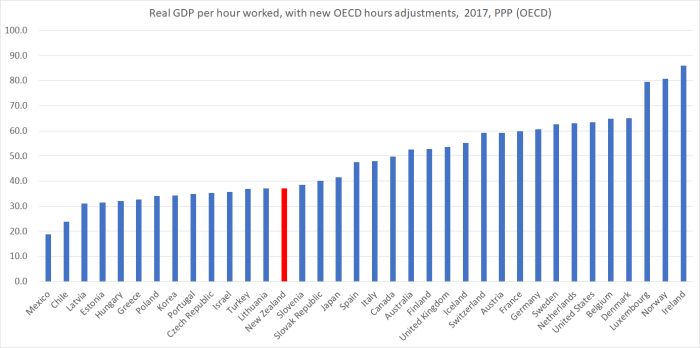
That poor record builds on decades or underperformance, dating back to the 1950s.  In all the time since then, there has never more than a year or two at a time when New Zealand has outperformed other advanced countries, and mostly we’ve achieved less productivity growth than they have.  As a result, we’ve moved from being among the very richest and most productive economies in the world to one where the top-tier of OECD countries have rates of labour productivity about two-thirds higher than those in New Zealand (and countries like Turkey and various former eastern-bloc countries –  where market economies were unknown for decades –  are nipping at our heels).  This table is from a chapter on New Zealand economic performance in a forthcoming book (which I foolishly allowed myself to be persuaded to participate in)

GDP per hour worked
USD, constant prices, 2010 PPPs
1970 1990 2017
New Zealand 21.4 28.6 37.2
Netherlands 27.4 47.5 62.3
Belgium 25.0 46.7 64.6
France 21.7 43.3 59.5
Denmark 25.1 44.8 64.1
Germany 22.3 40.7 60.4
United States 31.1 42.1 63.3
Median of six 25.1 44.1 62.8
NZ as per cent of median 85.4 64.9 59.2
Source: OECD

You might have hoped that this shockingly poor performance would worry someone in office –  political or bureaucratic.  But there is no sign it ever does, for long anyway.  It occasionally provides a good line for Opposition parties (of whichever stripe), or even for incoming governments in the heady days when everything is the fault of the previous government and you’ve not yet been expected to produce results yourself.  Our current Prime Minister and Minister of Finance were occasionally heard to refer to the problem in 2017, but hardly at all since then.

Once upon a time it was something one might have expected The Treasury to care about, have views about, and be offering rigorous advice to the government of the day (of whichever party) on.  After all, productivity is the only secure foundation for material prosperity, and material prosperity allows societies to make all sorts of other choices with fewer constraints than otherwise.  But that isn’t today’s Treasury.  If there are people in the organisation who still think about these things, it certainly isn’t an issue that ever seems to trouble the senior management – the more so under the lamentable stewardship of Gabs Makhlouf over the last eight years.  As I noted late last year, when Treasury is forced to write down its view on the productivity outlook, results make it clear they have the wrong model.

After my post yesterday, a commenter observed

The only hope on the horizon is the appointment of a new Secretary to the Treasury who is given or [secretly] works on a single goal of devising policy to genuinely increasing productivity…..

The Treasury has lost its sparkle over the last 30 years and it is time it regained some lustre, it’s ‘reason for being’ and grew some courage.

I couldn’t disagree with the sentiment, even if I wasn’t optimistic that there was any hope at all.  But the comment prompted me to have a look at the documents on the SSC website supporting the current advertisement for a new Secretary to the Treasury.

The procedure for the appointment of public service chief executives is set out in the State Sector Act.  Section 35 provides that when there is a vacancy the State Services Commissioner must

invite the Minister to inform the Commissioner of any matters that the Minister wishes the Commissioner to take into account in making an appointment to the position.

That is the Minister’s opportunity to scope the job, and identify his or her priorities.  And although there is now a perception that appointments are made by the State Services Commissioner, in fact the law is clear that the Cabinet can not only reject a nomination, but can appoint their own preferred nominee.   In other words, while Peter Hughes (the State Services Commissioner) has considerable influence, appointments ultimately reflect to a substantial degree the choices and priorities of ministers.  Thus, under the previous government it was ministers who fast-tracked citizenship for Gabs Makhlouf to allow him to be appointed. (And thus Bill English –  who later acquiesced in the reappointment of Makhlouf –  bears responsibility for the failures of The Treasury this decade –  including the complete absence now of any comprehensive analysis and advice on the productivity failure).

But what of the current search?  The advert and supporting documents will reflect the Minister of Finance’s own priorities and views of what The Treasury should be doing.

Even the short advertisement itself starts in an unpromising way.

The Treasury is the Government’s principal economic and financial advisor. Its work improves the wellbeing and prosperity of all New Zealanders by ensuring the nation’s macroeconomy is stable,

In fact, if anyone does macroeconomic stabilisation at all well it would be the Reserve Bank –  that is a key part of the Bank’s role.   Sure, The Treasury advises the government on policy around the Reserve Bank, but the Bank is both operationally independent and has a direct line to the Minister on the policy issues.  But not a mention of productivity –  lifting the level of economic performance –  or any of its cognates.

Later in the advert, I was briefly encouraged

The Secretary will be both an expert in financial and economic policy leadership and  state sector management and strategy.

Good luck finding a person with both sets of qualities, but I don’t want to cavil just yet –  an “expert in financial and economic policy leadership” would be good.   An expert in financial and economic policy itself might be even better –  someone who would command credibility among staff, ministers, and the wider policy community.

Three other documents accompany the advert.  One is purely process oriented, and I’m not commenting any further on it.

The second is the position description.  In the opening bumpf  about the organisation there is finally some welcome reference to Treasury’s responsibility for things around the level of economic performance (emphasis added)

The three key outcomes the Treasury works towards are improved economic performance and prosperity for all New Zealanders, macroeconomic stability, and a higher performing State sector.

But that’s it.  Once the document gets on to the specific position of Secretary to the Treasury, it is all lost once again.   There are the specific accountabilities for the Secretary, moving beyond the generic statutory responsibilities:

The Secretary of the Treasury is also accountable for:

• Leading and overseeing New Zealand’s public finance system;

• Working collaboratively with the State Services Commissioner and the Chief Executive of the Department of the Prime Minister and Cabinet to ensure a consistent and aligned approach to State sector system leadership;

• Advising on, and implementing strategies for, managing the Crown’s balance sheet including debt; risks; contingent liabilities; and the government’s investment in companies and other entities;

• Advising and reporting on fiscal management for the Crown and monitoring departmental operating and capital expenditure; and

• Building succession for the Treasury’s leadership team and working with colleagues to leverage the Treasury’s talent for system benefit while building a diverse and inclusive organisation where staff have career pathways.

Nothing about economic performance (level or variability) –  advice thereon – at all.

And these are policy-related “critical success priorities”

• Leading, organising and managing the Treasury so it delivers on the Government’s goal of a shared prosperity where all New Zealanders benefit from the wealth that growth in the economy provides;

• Refreshing the macroeconomic framework (fiscal, monetary and financial stability) to ensure it is fit for purpose for the next twenty years, including driving the further development of a wellbeing approach;

• Promoting greater transparency and understanding of the Government’s economic goals through supporting the embedding of wellbeing measures in the Public Finance Act and through the Secretary’s and other Treasury communications and engagements;

• Providing advice to assist the Government to meet its policy priorities within its Budget Responsibility Rules;

• Working collaboratively with others, including Māori, to collectively develop and deliver creative solutions to resolve long-term challenges including child poverty, housing, climate change, and freshwater;

The first of those is about distribution (not “growing the pie”), and the second is about some odd mix of stability and the wellbeing approach.  The third is about transparency, the fourth about fiscal policy, and the fifth perhaps illustrates the government’s priorities.  Productivity appears not to be one of them, from the agency styled as the government’s principal economic advisers.    I’m not necesssarily suggesting there is much wrong with what is on the list –  one can debate the vacuity of the wellbeing approach another day –  but what isn’t there is telling.

The third document is the application form, which is useful because it sets out the capabilities SSC (on behalf of the Minister) says it will be assessing applicants on.  These are the capabilities applicants are required to demonstrate (in writing)

Think, plan and act strategically; to engage others in the vision, and position teams, organisations and sectors to meet current and future needs.

Lead and communicate in a clear, persuasive, and impactful way; to convince others to embrace change and take action.

Work collectively across boundaries to deliver sustainable and long-term improvements to system and customer outcomes.

Drive innovation and continuous improvement to sustainably strengthen long-term organisational performance and improve outcomes for customers.

Bridge the interface between Government and the Public Sector to engage political representatives and shape and implement the Government’s policy priorities.

All probably fine and reasonable in their own way –  if what you want is some generic public service manager –  but again what is notable is the absences.   Neither here, nor anywhere in any of the documents, is there any sense of wanting someone who might model excellence as a policy adviser, or lift the performance of the organisation in a way that might deliver credible and compelling answers to the appalling productivity underperformance of the New Zealand economy.

And why not?  Presumably because neither Grant Robertson, nor his boss, nor his party, nor the parties they govern in league with, care.  Nothing –  in these documents, in speeches, interviews or anywhere –  suggests otherwise.

To revert to my commenter’s hope, I guess there is nothing to stop the person who is eventually appointed choosing to make productivity a priority and foster work developing compelling analysis and recommendations.  But it doesn’t seem very likely.  Even if Treasury isn’t as resource-constrained as some government agencies, there won’t be lots of capable staff resources readily able to be diverted to something that just isn’t a government priority.  But more importantly, what sort of person do we suppose is likely to get the job?   And why would such a person, who got through the selection process (acceptable to both SSC and the Minister) be likely to change their spots once in office.  What would be their incentive?  And how likely is it that they’d be the sort of person who would even care much, or understand the issues well enough to know where to start.

As was the situation eight years ago, there are few obvious strong contenders for the role –  at least among people with any serious economic or financial expertise.    Looking through the list of current Treasury senior management, there are some capable people (although part of a leadership team that appears more interested in, say, diversity than in productivity), but really only one of those people could conceivably offer that level of expertise at this stage.   Around the rest of the public sector, I wonder if Geoff Bascand (Deputy Governor at the Reserve Bank, who was open about the fact that he applied to be Governor and missed out) might be interested.  Perhaps there are ambitious people at MBIE – an agency better known for delivering on ministers’ priorities than for serious analysis.   One can’t help thinking that applicants who are female will, all else equal, have something of an edge. But none of the names that spring to mind seem any better than the likely underwhelming field of male applicants.

Then again, Grant Robertson isn’t serious about dealing with the country’s most important economic failing, so perhaps it doesn’t really matter much who oversees the playground where analysts divert themselves thinking about concepts of wellbeing, while New Zealand is likely to keep drifting further behind.

How are wage earners doing?

For the last few years –  probably almost since the economy began emerging from the long recession of 2008 to 2010 –  there has been talk about how low average wage increases have been.   Those lines have sometimes been run in discussions of the general rate of inflation –  all else equal, if inflation had been nearer target, average nominal wage increases probably would have been a bit higher –  but more often it seems to have been a real phenomenon people had in mind; some sense of wage earners being “left behind”.

I’ve been increasingly sceptical of that story, and did a few posts  12-18 months ago to illustrate the point.   Some of the data aren’t updated very often, and there are historical data revisions, so I thought it might be time to take another look.

The first series I’ve been interested in is the labour share of GDP –  as approximated by the share of all the value-added in the economy accruing as compensation of employees. To make this comparison, one needs to adjust out for taxes and subsidies on production (all else equal, a shift from income taxes to a higher GST won’t raise wages –  or leave people worse off on average – but will raise measured GDP).  The data are only available annually, and only up to the March 2018 year, but here is the resulting chart.

labour share 2018

There is a little bit of short-term variability in the series, but if (say) one compares the latest observation (year to March 2018) with the last observation before the recession (year to March 2008), the labour share of GDP is still a touch higher now than it was then.  In both cases, it was higher than it had been at any time in the previous fifteen years or so.   As I’ve noted previously, the trough was in the year to March 2002 (on my telling, this was not unrelated to the fact that the real exchange rate had then been around historic lows).

The other comparison I find interesting is to look at how wage rates have evolved relative to (nominal) GDP per hour worked.   Nominal GDP captures both any productivity gains the economy has managed and any terms of trade gains (as well as general inflation).  Over the longer-term one would expect those variables to be the biggest influence on developments in economywide wages.

In putting together this chart, I’ve used the SNZ analytical unadjusted series of the Labour Cost Index, which purports to be the right measure for these purposes (wage rates, rather than just average wages –  the latter distorted by composition changes, and wages before any adjustments for productivity –  the headline LCI series attempts to adjust for productivity gains).    The series doesn’t get wide coverage but –  absent any serious efforts to suggest the data are of unusually poor quality –  should.

Unfortunately, the analytical unadjusted LCI series is only available back to 1995 (the private sector sub-component only to 1998) but even that is now well over 20 years of data.

In the chart I have:

  • indexed nominal (seasonally adjusted) GDP per hour worked (using the HLFS and QES), and
  • indexed the analytical unadjusted LCI series,

both to 100 in the March quarter of 1995, and then taken the ratio of the wage series to the GDP per hour worked series (so that the resulting series is equal to 1 in the March quarter of 1995).

lci wages vs gdp

There is a fair bit of short-term noise, but the trend is pretty clear.  On this data, wages have been rising faster than the overall earnings capacity of the economy.   That was so in the 00s, and has been so –  albeit to a lesser extent – in recent years too.  For anyone inclined to want to debunk the analytical unadjusted series, note that this chart is not wildly inconsistent with the labour share chart I showed earlier: the labour share of total income has increased since the early 00s, with the biggest change occurring in the pre-recession 00s themselves.

So what is the problem?  There are two.  First, general economywide inflation has been unexpectedly low this decade, and below the target midpoint now for years.   Not surprisingly, against that backdrop nominal wage inflation has been lower than it might otherwise have been.

But the second –  and far bigger –  issue is that lack of productivity growth.   Here is my regular chart, last updated just before Christmas

real GDP phw dec 18

There has been no labour productivity growth for the last four years, and very little this decade.  Sure, the terms of trade have been reasonably good, but you cannot expect strong sustained growth in (real) wages if productivity growth is so moribund.   If anything, real wage growth has been surprisingly – and probably unsustainably –  strong given that feeble growth in the earnings capacity of the economy.    It is all consistent with a story of a high and overvalued real exchange rate  –  domestic demand pressures give rise to wage inflation, but in the process squeeze the outward-facing sectors of our economy.  You’ll recall that exports (and imports) peaked as a share of GDP at about the turn of the century, and are no higher now than they were 40 years ago –  even though successful small economies typically see a growing reliance on two-way international trade.

It would be good if our political “leaders” –  and their advisers in The Treasury –  actually focused on these sorts of imbalances and underperformances.  But nothing serious is heard any longer from the Prime Minister about the productivity underperformance.  Taking it seriously might confront them with hard choices, and I guess vapid rhetoric about “wellbeing Budgets” comes more readily.  New Zealanders –  including New Zealand wage earners –  deserve much better.


Cowering?

A month or so ago Meng Wanzhou, CFO of Huawei, was arrested in Canada, pursuant to an extradition request Canada had received from the United States.    Who knows what merit there is to the charges the United States wants to lay against her.   Should she be extradited, the substantive merits of the case will be determined in open court, with multiple layers of potential appeal.   Who know too whether the Canadians will actually extradite her –  open Canadian courts will reach a view on that (including on whether the alleged offences are also offences in Canada) and the federal Minister of Justice apparently makes the final decision.  Presumably, the court process will be open, and the Minister will face both political and public scrutiny for any decision they are finally called on the make.  In the meantime, after a hearing in open court, Meng Wanzhou is now out on bail in Canada.  Presumably she is free to talk to consular officials from the People’s Republic whenever it is mutually convenient.

All that is more or less how the extradition process works among countries with the rule of law.  We have our own long-running case in New Zealand, in which the United States has for some years been seeking the extradition of Kim Dotcom.

But the People’s Republic of China declared itself “outraged” by the arrest of Meng Wanzhou, calling for her immediate release.  It was, presumably, something akin to lese-majeste to have arrested such a prominent figure, regardless of any possible merits to the charges.

Part of the PRC response was to arrest – abduct or kidnap seem more apt words –  two Canadians in China.

Two Canadian men have been detained in China on suspicion of “endangering national security,” China’s Foreign Ministry said Thursday.

Spokesperson Lu Kang confirmed that entrepreneur Michael Spavor and former Canadian diplomat Michael Kovrig were taken into custody on Monday and that they are being handled separately.

No one seriously supposes there is any actual criminal activity behind these arrests.   Reports over recent weeks suggest very limited consular access, there have been no court appearances, and reports also suggest these people are being held in facilities where lights are on 24 hours a day, repeated interrogations occur, and so on.  As one of the Canadian papers reported

Chinese authorities are able to keep suspects in secret locations for up to six months – without access to a lawyer – as they gather evidence under a system called “residential surveillance at a designated location.” Those who have experienced the ordeal have described intense interrogation sessions and, on occasion, beatings and torture as authorities seek confessions that can be used in court or for propaganda purposes.

There is no indication that Kovrig has been beaten, although sleep deprivation through incessant lighting is classified as a form of torture.

It is the sort of behaviour rogue states engage in, the sort of conduct one might expect all decent people to deplore.   Apart from anything else, if China gets away with this sort of conduct in the case of Kovrig and Spavor (and it is hardly the first time they’ve engaged in hostage-taking of Canadians),  anyone from a free and open country is at risk –  perhaps especially people from second or third tier countries, such as Australia and New Zealand –  whether around future extradition cases or other points of tension involving the PRC.

Canada has called for the immediate release of these two Canadian citizens.  The Canadian government’s approach was backed by separate statements from the European Union, the United States, the United Kingdom, Germany and France.    For a time there was complete silence from the Australian government.   That prompted an open letter last week to Australia’s Foreign Minister from dozens of China-watchers and analysts in Australia –  including many with a long track record favouring engagement with the PRC.  This was their call

Since December 21, the European UnionUnited StatesUnited KingdomGermany and France have each issued statements of concern regarding the apparently political motivation for the arrests of these Canadian citizens, which raise serious concerns about legitimate research and business practices in China. It is time for Australia to do the same. 

In view of the risks this raises to Australian research and business activities that form the bedrock of positive Australia-China relations, we respectfully ask you to join the above-mentioned governments in supporting the Canadian government’s call for the immediate release of these two detainees.

The open letter seems to have been the prompt for the Australian government to finally make a comment, supported by the opposition the federal Labor party.   Senator Payne’s statement does not go as far as the signatories to the open letter sought, and in particular does not call for the immediate release of Kovrig and Spavor, but at least it was an official and public expression of concern.

Of the Five Eyes countries, the United States, the United Kingdom and Australia have all come out in public in support of Kovrig and Spavor, and in support of the Canadian government.    And what of New Zealand?

From our government –  and in fact from any elected political officeholder – nothing.   Just silence.  Her Excellency the Ambassador of the PRC to New Zealand, Wu Xi, must be delighted at such quiescence.   One can only imagine what our traditional friends and allies –  countries that share our commitment to the rule of law –  must make of this public utter indifference by the New Zealand government to the situation Canada, and its abducted citizens, face.  It isn’t even as if these were citizens of Trump’s America –  Justin Trudeau’s government has seemed on many of the same wavelengths as our own government.  And yet still the Prime Minister and the Minister of Foreign Affairs won’t utter even a word, pushing back against lawlessness by the PRC in mistreating citizens of a country we have longstanding close ties with.   It might be the summer holidays –  but then it is in Australia too –  but various ministers, including our Foreign Minister, managed other new public statements last week.    Staying silent is clearly a conscious choice –  a choice to be indifferent to evil, even when it happens to our friends.

Who knows, but perhaps our government has in fact raised the matter quietly with Beijing.  That is the standard line of successive New Zealand governments about every abuse.  But there is never any sign that these alleged representations make any difference, and public statements do matter –  if only to New Zealanders, in giving us a sense of in whose interests, and according to what values, our officeholders are actually governing.  This episode is yet another indication –  we’ve already seen it in their embarrassed indifference to Anne-Marie Brady – that when it comes to China the current government, like its predecessors, governs in the commercial interests of a few universities and big businesses, and of its own party fundraising, rather than for the values of New Zealanders.

But even so, you have to wonder what goes through their minds when Jacinda Ardern and Winston Peters decide to stay quiet, when our traditional allies speak out.   Does it not for a moment cross their mind that one day New Zealand might find itself in Canada’s position, and to wonder who –  if anyone –  might go into bat for us, and for our citizens if they were to be abducted by the regime in Beijing?

So the Ardern/Peters stance –  the awkward silence, as innocent Canadians are abducted and our friends speak up – seems both shameful and dishonourable, and yet imprudent too.  It serves no decent longer-term interest, but perhaps it suggests the Prime Minister is more desperate for that invite to Beijing –  to what end? –  than has previously been evident.

Jacinda Ardern and Winston Peters head the New Zealand roll of shame on this issue, since they are the most senior figures in the current government.   But the shame isn’t just theirs.  There is no sign of anything from Simon Bridges, Paula Bennett (perhaps both rather keen on those donations Yikun Zhang was arranging?), or Todd (“vocational training centres in Xinjiang) McClay.   Nothing from the Green Party or ACT leaders.   Nothing from the Minister of Justice (rule of law and all that). And of course nothing from our PRC-born and educated MPs.  In a decent society, they’d be at the forefront of condemning the abuses in the land of their birth.  In our society, it seems to be just fine that they keep very very quiet –  a silence that suits Beijing –  and help ensure that the donations keep flowing.  Perhaps a journalist might consider asking Raymond Huo his opinion on the abduction of the Canadians.  He was, after all, formerly a lawyer with a leading local law firm, and now he chairs the Justice select committee in Parliament.  You’d hope the rule of law meant a lot to him.  But, like his bosses, deferrring to Beijing, and never ever upsetting the murderous rogue state, appears to matter more than the rule of law, or standing by our friends and allies when they (almost inadvertently in Canada’s case) incur the wrath of a tyrant.

By their utter silence, on this as on so many other PRC issues, our MPs and ministers dishonour this country and its people.   Cowering in a corner, deferring to Beijing, is simply unbecoming people who purport to lead a free and independent country.


GCSB, China, and a craven government

It wasn’t until I’d read my way through two-thirds of this morning’s Dominion-Post that I realised what wasn’t in the paper (and I assume not in other Stuff mastheads elsewhere in the country).   On the foreign news page there was a little sidebar piece informing readers of the actions of the US Justice Department targeting People’s Republic of China state-sponsored commercial cyber-espionage, noting that this “coincided with an announcement by Britain blaming China’s Ministry of State Security for trade-secret pilfering affecting Western nations”.   But not a mention of the many other nations who had made similar announcements or (more importantly for these purposes) of New Zealand, or of the GCSB’s pretty blunt announcement yesterday morning.

The Government Communications Security Bureau (GCSB) has established links between the Chinese Ministry of State Security (MSS) and a global campaign of cyber-enabled commercial intellectual property theft.

“This long-running campaign targeted the intellectual property and commercial data of a number of global managed service providers, some operating in New Zealand,” Director-General of the GCSB Andrew Hampton said.

“This activity is counter to the commitment all APEC economies, including China, made in November 2016. APEC economies agreed they should not conduct or support ICT-enabled theft of intellectual property or other confidential business information, for commercial advantage.

I turned back tothe  start of the paper, went through page by page, and even had a look online.  There was simply nothing at all in the Dominion-Post –  paper to the capital’s policy wonks and political people.      Domestic news isn’t so thick on the ground at this time of year that you’d suppose the Stuff editors ran out of room, about a story about New Zealand official agencies reacting to the hostile actions of a major foreign power.

(By contrast, Radio New Zealand covered the story extensively yesterday, TVNZ has a story, Newsroom has it, and the Herald has two substantial pieces in its business section this morning –  even if its journalistic standards remain so low that Fran O’Sullivan is able to write repeated columns about China issue without any disclosure of her membership of the Advisory Board of the government-funded pro-Beijing propaganda operation the China Council, or her role as co-chair of the China Business Summit.)

I guess the complete silence saved Stuff reporting the odd way the powers-that-be handled the whole affair.   The official statement was released by a low-key career public servant, the head of the GCSB.   But there was no official statement from the government –  the people we actual elect and hold to account.  Contrast that with the situation in both Australia and the United Kingdom –  in the former the Home Affairs and Defence ministers issued an official statement, and in the latter, the Foreign Secretary.    At least one report I saw/heard here said that both our Prime Minister and our Minister of Foreign Affairs simply refused to comment at all.  Fran O’Sullivan –  worth reading mostly because influential people talk to her –  tells us that

According to senior sources there was some trepidation at Cabinet level before the decision to name China directly was agreed.

I’m glad the government was willing to go that far, but if they have any backbone at all, it seems like a pretty limp one.  They seem almost embarrassed, and distinctly uncomfortable, having gone even that far.

Later in the day, the Minister responsible for the GCSB –  Andrew Little – finally fronted up.   Little has form as something of an arch-appeaser and apologist for the regime in Beijing.    There was an interview with him last year (which I wrote about here), shortly after taking office, in which he refused to express any concern about the Jian Yang situation, about political donations or, in fact, about anything.

One thing that Little is not concerned about is any perceived growing influence of China in New Zealand.

In his interview with Radio New Zealand’s Checkpoint late yesterday, he was at pains to stress how good our (well, his government’s) relationship with the People’s Republic of China was.  He couldn’t exactly ignore the state-sponsored hacking his own officials had publicly identified that morning, but the language was as weak as he thought he could get away, and (so it seemed) it wasn’t as if such things should be allowed to get in the way of such a good relationships with (we were left to assume) such fundamentally decent people.   Never mind that it involved the PRC going directly against commitments they themselves had given at APEC (and in places like the G20 and in bilateral statements to the Australia, US, and British governments).   Never mind that it is another example of the PRC’s pattern of behaviour on so many fronts (including, for example, around the militarisation of the South China Sea).  It didn’t seem to greatly bother the only senior minister willing to comment at all.

Media accounts suggest that the PRC was informed in advance that the GCSB statement was coming.  That might be courteous and reasonable, but there was no hint of any follow up: of, for example, the government calling in the PRC’s Ambassador in New Zealand and lodging an official statement of protest.  And not a word at all from the Prime Minister –  or, it appears, from the Leader of Opposition, or the Opposition’s foreign affairs spokesmand Todd (“vocational training centres”) McClay.   No doubt, they all just hope the issue goes away as quickly and quietly as possible.

You are left wondering what sort of people –  people who purport to be leaders –  want the sort of good relationship (that our Minister of Justice and minister responsible for the GCSB spoke of) with the Chinese Communist Party rulers of the PRC.    They are, for now, a fact of life, but they perpetrate one evil after another –  and have done for almost 70 years now.  Even close to home, they intimidate members of the ethnic Chinese community in New Zealand, they exert control over most of the Chinese language media in New Zealand, and they physically intimidate a rare local academic willing to stand up and speak out.  All stuff the government and Opposition just don’t seem to want to know about, and wish it would just go away.   They, after all, have donations to collect, PRC-affiliated people to honour.  As for the nature of the PRC regime at home in China, or abroad elsewhere, there is almost nothing to their credit –  they are, to all intents and purposes, at least as evil in our day (and with a longer track record) than the Nazi rulers of Germany in the late 1930s.  Tens of millions have died already, a million Uighurs are today in concentration camps, the surveillance state grows ever more intrusive, churches are suppressed, (Canadians are abducted – the only word for it) and political liberty is non-existent.  And yet Jacinda Ardern, Andrew Little, Simon Bridges, Todd McClay and the rest value their relationship.  MPs and official turn up in numbers to their functions (eg this recent celebration of Belt and Road).  Decent people should be ashamed to associate with the regime on anything but the most distant and formal terms.  But not, it appears, our officeholders.

In fact, they have the bare-faced cheek to use our taxes to run a propaganda outfit promoting the Beijing relationship, and constantly minimising any questionable stuff Beijing does.     The China Council –  with its galaxy of prominent names, including former leading politicians, current senior officials, and business people who sup with the devil (without, it appears, a long spoon) –  only a few weeks ago was out lamenting the GCSB’s Hauwei decision.  It regularly laments any real debate about the PRC and openly states its role as shaping public opinion to see the world their way.     Perhaps not surprisingly there was not a word from them yesterday about the commercial cyber-espionage assessment.   (But there was a newsletter reminding readers of the gala dinner (their description) they had hosted for the new PRC Ambassador earlier in the year: she might be the representative of this hostile power, this rogue state –  that is effectively what the GCSB statement says –  but they put themselves –  at our expense –   in tributary mode.)  Isn’t it past time that the China Council was defunded?    If the people involved still want to champion Beijing, defend its excesses, and trample across New Zealand values and traditions, surely they can stump up their own money to do so.

The Herald’s coverage in the last 24 hours did include some rather interesting comments from Charles Finny.     Finny is a former diplomat and is now a lobbyist

a partner in Wellington lobbying firm Saunders Unsworth, which has represented Huawei in New Zealand. He is also chair of Education New Zealand, the government agency responsible for international education and marketing, with China the largest single catchment for foreign students studying in New Zealand.

He is also on the Board of the supine academic Contemporary China Research Centre.

But he does from time to time come out with interesting, and honest, comments.  Readers may recall last year that when the establishment was closing ranks behind Jian Yang –  perhaps the easiest to relate to concrete measure of how they shame us, and pay deference to Beijing –  Charles Finny went on TVNZ’s Q&A programme, and noted that while he both knew and liked Jian Yang, had no problem with him being in Parliament but that he knew he was close to the PRC Embassy and was always careful what he said around him (or Labour MP Raymond Huo).  Out of his own mouth….

Yesterday’s comments were to suggest that

New Zealand’s relationship with China is rapidly deteriorating as the country is swept up in what long-time trade and foreign policy adviser Charles Finny describes as a “new Cold War”

If it is indeed “rapidly deteriorating” that is not necessarily a bad thing (although it could be consequential), but whether it is or not, Finny’s comment seem a lot more honest an assessment than anything we ever get from the propaganda shop –  the China Council – itself.  In the article, Finny comes across as suggesting that it is the fault of the West if relationships are deteriorating, but it wasn’t clear to me whether he was really attempting to assign blame, or just recognising that when governments –  including ours –  make even a modicum of an effort to push back against PRC abuses (and our government is so feeble it won’t even speak up about Xinjiang –  far away –  or in support of Anne-Marie Brady, close to home), the bully boys in Beijing will take it amiss.  As bullies do, in the school yard or wherever.  Craven subservience is fine, anything else threatening.    In what sort of world does anyone  –  with anything other than dollars in mind –  think we should ignore the endless overstepping by the regime?

(Finny also pushes back against the government narrative that everything is just fine about (a) the Prime Minister’s desired visit to Beijing, and (b) the fact the PM had not seen in advance the Winston Peters speech last weekend.)

Do our politicians stand for anything, other than deals and donations?  It isn’t clear that they do.   They walk by evil and seem to want to pretend they have no realistic choice.  In the process, they dishonour us, and the values that underpin this society.  And they give aid and comfort to the CCP agenda.

Standing back a bit, for anyone interested in a nice piece of analysis of the PRC influence activities globally, but with many references to New Zealand, I’d encourage you to read the latest article and analysis by the independent China researcher who writes under the pseudonym Jichang Lulu and a co-author.   They conclude writing about the recent open letter from 300 overseas academics and others, addressed to the Prime Minister (and which she has not addressed, or done anything to allay the concerns that motivated it) in support of Anne-Marie Brady.

The CCP’s effort to coerce analysts into silence greatly concerns the China specialist community, judging by the unexpected number of signatures the letter attracted. These concerns are hardly conjectural. A signatory, Feng Chongyi of the University of Technology Sydney, was detained and interrogated for ten days in Guangzhou in 2017. The Swedish NGO worker Peter Dahlin, who also signed, was detained in China 2016 and only released after a staged confession. Colleagues who expressed support for the contents of the letter chose not to sign, fearing, in one case, being refused a visa and, in another, being taken hostage in retaliation for the recent arrest in Canada of Huawei CFO Meng Wanzhou (孟晚舟).

Beyond solidarity with a fellow researcher and interest in New Zealand’s democracy, the extent to which the appeal has resonated within the Chinese studies community points to global concerns over Xi’s increasingly authoritarian rule and the cooptive and coercive modes of its projection abroad.

But Andrew Little values his very good relationship with these thugs.


Productivity failure: Treasury clearly has the wrong model

In various commentaries on yesterday’s GDP data, I saw suggestions that the revisions to recent years’ data suggested that the New Zealand economy had been growing “strongly” in recent years.

As context for that observation, and perhaps shedding a bit of light on the sadly diminished expectations that appear to have taken hold in New Zealand, consider this chart, of real GDP per capita growth.

real GDP aapc 18

After a deep and quite long recession, the peaks in growth in per capita real GDP were a pale shadow of what had been achieved in the previous two economic cycles.   2 per cent annual per capita growth over the long-term would be a reasonably impressive result, but when the growth rate peaks at 2 per cent, and recessions come along every decade or so, it is no more than mediocre at best.  For the last couple of years  (these are annual average numbers) per capita growth has been at levels only previously experienced –  last 25 years –  on the eve of a recession.

But my main interest in yesterday’s numbers was the productivity estimates derived from them.  As I’ve been pointing out for a couple of years now, there has been next to no productivity growth at all in New Zealand for some years.  But in making that observation one is always somewhat at the mercy of the major annual SNZ data revisions.  Sometimes what looked to be in the data gets revised away completely.

How about labour productivity?  Recall that SNZ does not publish economywide productivity estimates –  there is no obvious reason why, when their Australian and British peers do –  so I’ve calculated one, using an average of the two measures of GDP (production and expenditure) and the two measures of hours (QES and HLFS).   And this is the resulting chart.

real GDP phw dec 18

No labour productivity growth at all for the last three years, and a total of 1 per cent productivity growth in the past six years.  Productivity growth under the previous Labour government wasn’t spectacular, but in the six years to the end of 2007 (just prior to the recession) we managed 8 per cent productivity growth.  But only 1 per cent this time round.    It is dreadfully bad, and there are no acceptable excuses.  You’ll hear people talk about global productivity growth slowdowns, and that is true to some extent, but it is largely irrelevant here, given that we start so far behind the leading OECD countries –  those at or near the productivity frontiers.   We have so much room to catch-up, and yet if anything again we’ve been drifting further behind.

Sadly there is little prospect of much change for the better.    Neither the previous government nor the current one appear to take New Zealand’s appalling productivity record seriously, in the sense of doing anything much about it, or even commissioning expert analysis and advice (reluctant as I’d be to suggest another “working group”).   And in a sense they’ve been accommodated in that stance by their self-proclaimed lead economic advisers, The Treasury.   Treasury publishes their HYEFU forecasts each December and buried in the supporting tables are forecasts for labour productivity growth (on an hours basis).    I could only find those tables back for the last five years, but here is what they have been forecasting (I’ve shown the four complete forecast years for each set of projections).

HYEFU forecasts for labour productivity growth published in Dec
Forecasts for June yrs 2014 2015 2016 2017 2018
2016 2.2
2017 1.6 1.6
2018 1.1 2.1 2
2019 1.2 0.8 1.5 2
2020 0.7 1.3 1.7 1.1
2021 1.4 1.5 1.2
2022 1.3 1.2
2023 1.2

They seem to have become quite a bit more pessimistic about the medium-term outlook in their latest forecast, but they are still picking almost 5 per cent labour productivity growth in the next four years, when over the last four years we’ve had almost none.   Look at the first column in the table done at the end of 2014: Treasury was actually expecting quite strong productivity growth over that period.  It is pretty clear that they simply do not understand what is going on, and do not have even roughly the right model.  Their productivity projections are wrong, in material ways, year after year.   And if they might be getting a little less unrealistic in the latest set of forecasts, that is small consolation because there is no sign they are offering advice to the government that might turn around the disastrous underperformance.   Too busy with the feel-good “wellbeing Budget” perhaps?

It has been another poor year for New Zealanders at the hands of our policymakers and their lead advisors:

  • no serious action to address and reverse the house price disaster that successive governments have been inflicting on us now for 25+ years (house and land prices up again),
  • no action at all to address the decades-long productivity growth underperformance (particularly bad over the last few years) that now sees a country once among the most productive in the world languishing in the league tables among former eastern bloc states, far far behind our former peers among the leading group of OECD countries,
  • and no sign that either the government or the Opposition really care,
  • or that our Treasury really understands at all the factors that explain the utter (and ongoing) productivity failure.

Governments, of course, don’t create productivity.  But they can and do put roadblocks in the path, often initially unwittingly.    But over time every such roadblock comes with own vested interests.    There is the old line from Upton Sinclair about

“It is difficult to get a man to understand something, when his salary depends on his not understanding it.”

Perhaps that explains the resistance of many in the business community to the changes that are needed.   It can’t explain Treasury’s failure.  I suspect that for them, and perhaps for many of our politicians, it is more a matter of ideological commitments, and an unwillingness to shine the light on the issues and policies that really matter if we care at all about lifting economic performance for our fellow New Zealanders.

Whatever the explanation, it is well past time for a change of heart, and for beginning again to take seriously finally reversing the decades of (relative) failure.


Productivity: no relief in the hours data

What I actually wanted to write about briefly today was prompted by this story in the Financial Times a couple of weeks ago which reported on the results of OECD work suggesting that harmonising the measurement of hours worked would reduce by about half the (rather puzzling) large gap in estimated labour productivity (real GDP per hour worked) between the UK on the one hand and France (and Germany) on the other hand.

The UK’s statistical agency makes very few adjustments to self-reported estimates of people’s usual hours, but French number crunchers adjust survey responses to include holidays, sick leave, strikes and work done in the “illegal economy”.

If the figures were produced on a comparable basis it would reduce the productivity gap between the UK and France to about 10 per cent, the OECD estimates.

The OECD paper is here.  It is a pretty dry account of a worthy exercise in trying to get greater standardisation of the hours worked estimates.   For the European countries they produce indicative overall labour productivity estimates using the proposed harmonised methodology.  This is the summary chart.

oecd hours chart

The blue bars are the current official estimates, while the white dots show the OECD estimates based on the new methodology for the countries where there were material differences.   There are some pretty substantial differences: Austria and Sweden move up to join the group of countries (US, France, Belgium, Netherlands, Germany, Denmark) which I’ve characterised as the OECD top-tier (setting Norway –  with abundant oil and gas –  tax-distorted Ireland, and tiny Luxembourg to one side).   But there are non-trivial differences for a number of countries further down the scale.   These revised estimates will be used in future OECD releases of productivity (levels) statistics.

When the FT article first appeared someone got in touch and asked if this could be part of the answer in New Zealand too.  My initial response was that the productivity gaps between New Zealand and the top-tier were so large there was no credible way any issue around hours measurement was going to explain much of it.   But it nagged in the back of my mind, so earlier this week I asked Statistics New Zealand about whether the OECD work had any implications for New Zealand productivity numbers.  SNZ don’t publish economywide productivity numbers, but their data is used by the OECD, who do.

I had a prompt and very helpful reply from Statistics New Zealand (kudos on this, if not on the Census).   They had apparently been fully consulted by the OECD researchers.  They had identified a handful of issues (which look quite minor in the scheme of things) around the New Zealand data, but the bottom line was

Recent correspondence by the authors  also noted: “As mentioned previously, but worth reiterating at this juncture, the paper currently only proposes changes to the estimates in a handful of countries (not including yourselves), based on available data.” In that regard, we consider ourselves to have fared better than some other countries reviewed in the publication.

Summary: our hours worked numbers look pretty much okay by international standards.  Unlike the Brits, our very large reported labour productivity gaps aren’t going to suddenly be revised downwards from this work.

That’s a shame  (substance is what it is, but reported numbers do matter).  But perhaps more sobering is that if our labour productivity estimates aren’t changing, and those of 10 other OECD countries (more than a quarter of the OECD membership) are, then our position relative to the rest of the OECD, mostly the advanced countries, now looks worse than it was previously.   In this chart, I’ve taken the latest official OECD numbers and made adjustments to the extent indicated in the OECD paper for Lithuania, Latvia,Poland, Portugal, Greece, the UK, Austria, and Sweden.

OECD GDP phw hours adj

On these estimates Lithuania – a part of the USSR as recently as 1991 –  is now only slightly behind New Zealand, likely to shortly be the third former eastern bloc country to overtake us.   And Poland –  whose experience I wrote about here last month –  is a lot less further behind that had been thought.    Even Greece and Portugal now look less bad relative to New Zealand, while the UK, Austria and Sweden are further ahead than we’d thought.  (Australia’s relative position also deteriorates of course.)

This isn’t a competition.  It is great news that Poland and Lithuania are doing even better than we thought.  But benchmarks are useful, and our performance relative to other advanced countries is –  and now has been for decades –  lousy.   And yet our political officeholders –  I refuse to call them leaders –  do nothing, and try to either spin the data or change the subject.

As I’ve noted previously, Turkey has now also almost reached New Zealand productivity levels –  something inconceivable just a few decades ago.  It was perhaps salutary to note news reports out of the climate talkfest in Poland last week that Turkey was objecting to being grouped as a “developed country”.   Their bid failed, but that they made it all should perhaps be a prompt to think that our own self-identification as an advanced economy is no longer as secure as it was –  a product more of history, than of current economic performance.  We really aren’t now much more than an upper middle income country, and that has consequences.