Immigration and productivity spillovers

In the run-up to the release this month of the new book by Julie Fry and Hayden Glass, which appears to focus on the potential for the immigration of highly-skilled people to contribute to lifting New Zealand’s long-term economic performance and the incomes of New Zealanders, I was doing a bit of reading around the issue.

At issue here is whether, or under what conditions, immigration to New Zealand of highly-skilled people can lift not only the average productivity of the workforce in New Zealand (that seems quite plausible in principle –  think of a tech company simply relocating a particular research lab, staff and all, to New Zealand), but whether something about the skills those people have can translate into lifting the skills, productivity, and performance of the people who were already here.  Those sorts of “spillovers” are really what we must be looking for if we are serious about running a skills-based immigration programme, as some sort of economic lever or, in the government’s words, a “critical economic enabler”.    We can think about this in the context of New Zealand’s own history.  European immigration to New Zealand in the 19th century brought people from the world’s (then) most advanced, innovative and economically successful society to a country where the indigenous population had been operating at a level not that much above subsistence.  It would be astonishing if the European immigration had not raised average incomes of the people living in New Zealand (ie including the immigrants).  But it would have been a pretty unsatisfactory programme if it had done nothing to lift the productivity, skills and income of the native New Zealanders.

Fry wrote an interesting working paper for the New Zealand Treasury a couple of years ago reviewing the arguments and evidence on the economic impact of (more recent)  immigration to New Zealand.  But when I went back and had a look at that paper I was a little surprised at how little focused discussion there was of mechanisms by which such productivity spillovers might occur –  whether in generating more new ideas, or in applying better the stock of knowledge already extant – and how that might (or might not) have played out in New Zealand.

I also had a look at the old Department of Labour’s 2009 research synthesis on the economic impact of immigration.  They had a nice discussion on the possible link between immigration and innovation.  As they note, for some types of migrants to the United States there is reason to think that such spillovers might be material

The main mechanism in the United States appears to be the education of foreign graduate students rather than skilled worker immigration. The United States is the global leader in academic research, so the country attracts the top foreign students from across the world (positive self-selection). These account for most doctoral graduates (but there appears to be no crowding out of the United States born from research universities) and many of these foreign born doctoral students work in research and development (R&D) sectors in the United States, leading to a positive correlation between concentrations of highly skilled migrants and concentrations of patent activity.

Unfortunately, as they note, there is little evidence of such gains or spillovers in the limited New Zealand research.  That might reflect the fact that our actual immigration programme has not been very highly skills oriented at all (something the data make pretty clear), which could perhaps be changed by altering the parameters of the immigration system. Or it might reflect some things about New Zealand that cannot easily be changed: we are small, and remote, relatively poor, and have universities which typically don’t rank highly as centres of research, in contrast to the United States which is not just the “global leader in academic research”, but large, wealthy and more centrally-located.   And despite the recent surge in New Zealand exports of education services, that hasn’t been centred on our universities (it is a welcome boost to exports, but not likely to be the basis of any productivity spillovers to New Zealanders).

George Borjas is a leading US academic researcher on the economics of immigration and had a very accessible post up the other day looking at the question of productivity spillovers, and highlighting a range of quite recent and fascinating studies on some “natural experiments”.  One of the cleanest such experiments was the purging by the Nazi regime in Germany of Jewish academics (and research students).

In 1933, shortly after it took power, the Nazi regime passed the Law for the Restoration of the Professional Civil Service, which mandated that all civil servants who were not of Aryan descent be immediately dismissed. That meant that Jewish professors like John von Neumann, Richard Courant, and Albert Einstein were fired from their university posts. Many of these stellar scientists found jobs abroad, particularly in the United States.

Researchers have been looking at what the impact of these dismissals, and relocations, was on the productivity of those around them.  That included the impact on the productivity (published research output) of the graduate students (PhD candidates) of those the dismissed academics had been working with, the impact on the output of former colleagues of those who had been dismissed, and the impact on the colleagues that dismissed academics found themselves working with later (in the case of those who subsequently took up US academic positions).

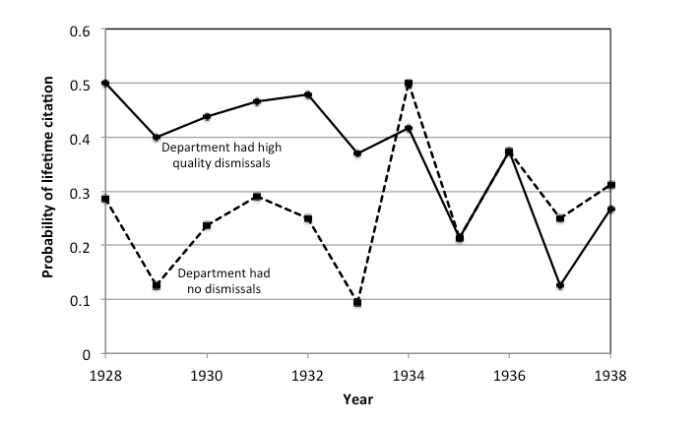
This is perhaps the starkest chart from Borgas’s post, drawn from this paper,  illustrating the lifetime impact on the graduate students left behind.
borjas chart

There are clear signs of a material adverse long-term impact (the mirror image of the sort of positive productivity spillovers those promoting a high-skills immigration programme are looking for).  PhD programme supervisors can matter hugely.    But any impact on the productivity of former colleagues was much less visible.

In another paper, recently published in the AER,  looking at the impact on innovation in the US from the relocation of these displaced Jewish scientists, the authors find that the new recruits did not increase the productivity of existing US inventors, but encouraged greater innovation in the US as a whole by attracting new researchers to their distinctive sub-fields of research.

Borgas sums up his take on this series of papers thus

My take from all this is very simple: At least in the experimental context, the evidence that high-skill immigrants produce beneficial spillovers is most convincing when the immigrants that make up the supply shock are really, really high-skill; when the number of such exceptional immigrants is sufficiently small relative to the market; and when those immigrants directly interact with the potential recipients of the spillovers.

Or as he put it in another of his own recent journal articles looking at the impact of the mass emigration of Soviet mathematicians following the fall of the Soviet Union

Knowledge spillovers, in effect, are like halos over the heads of the highest-quality knowledge producers, reflecting only on those who work directly with the stars

I found these papers fascinating in their own right (nerd that I am) but they also prompt thought about what we can actually hope for in a New Zealand context.  Even if we get past the sick-joke aspect of New Zealand’s  allegedly skills-based immigration, and the disproportionate number of chefs, aged care nurses, and café and shop managers, what could we really expect to be able to achieve with the best possible skills-based programme?

It would almost certainly be a much smaller programme.  And it would have to aggressively target the very best people – not be content with people who just happen to creep above a points-threshold, artificially boosted by a willingness to move to some of the more remote and less economically promising parts of the country.

But then one has to ask how realistic any of this is.    With all due respect to our green and pleasant, and moderately prosperous, land, why would the very best people want to come to New Zealand, let alone stay here?    We had our own stellar academic refuge from the Nazis –  Karl Popper taught at Canterbury for several years – but even he didn’t stay that long.  We have adequate, but not great, universities –  and there are many better in countries with many of the good things New Zealand can offer.  We have modest academic salaries.  We have small home markets, small networks of people working in possible similar areas, and if global markets in principle can be serviced from anywhere, evidence still suggests people tend to do it from closer rather than further away.  We seem to have almost nothing of what 1930s Britain or the US could offer to the displaced German academics –  or certainly nothing that a wide range of other countries couldn’t offer more of, more remuneratively.

But perhaps Fry and Glass can make a robust and more optimistic case.  I’ll look forward to the book, and will no doubt write about it here.


English on the PTA

Some interesting comments from Bill English on inflation and the Policy Targets Agreement appeared in the media over the weekend.

The lead comment was

Finance Minister Bill English says he’s willing to wait for next year’s review of the Reserve Bank’s policy targets agreement (PTA) to consider whether it is still appropriate in a global economy where inflationary pressures have dissipated.

That seems appropriate.  We have a statutory structure which provides normally for five-year PTAs.  That provides reliable guidance to the Reserve Bank and some predictability for the rest of us.  We don’t have to worry that whenever people get a little uncomfortable about the inflation numbers, the target will be revised up, or down, on the fly.  The Reserve Bank should just get on and meet the target, whatever it is at the time.

And, as it happens, it is only 18 months now until the Governor’s term expires.  (Of course, one of the downsides of the current structure is that the Governor will soon be making monetary policy decisions, the full effects of which on inflation will not be apparent until after his term has expired.)

The Minister also noted

English said he was reluctant to prejudge the outcome of the review, which would include advice from the Treasury, but noted he hadn’t seen any compelling argument that the agreement itself could change or any particularly coherent alternative.

I don’t myself favour material change to the PTA, although I think that coherent arguments can be made for a variety of possible alternative approaches.  I doubt that a different way of specifying the target would have made much difference either during the boom years when the Reserve Bank had monetary policy too loose, or over the last few years when policy has been too tight.  The mistakes and misjudgements over the years have been either forecasting ones, or ones reflecting the private preferences of the successive Reserve Bank Governors –  probably mostly some combination of the two.

The Minister goes on to note that

“I think they’re in some challenging territory. We’ve got an agreement in place and we’re happy that they’re acting consistent with the agreement. We are not trying to second guess the decisions the governor should make.

Again, if we are going to have an operationally independent central bank in respect of monetary policy, ministers generally shouldn’t be trying to “second guess” or put pressure on the Governor.  Except, that is, to fulfil the PTA – or “do his job”.

The New Zealand system is relatively unusual in providing such a prominent structured role for the Minister of Finance not just in setting a target for the Reserve Bank, and having  responsibility for ensuring that the Bank meets the target.   The Bank isn’t meeting the target, and has not done so for some years.

The Minister claims that the Bank is “acting consistent with” the PTA.  It is shame that the journalists behind the story didn’t ask the Minister more specifically what he meant.  I suspect the Governor really would like to see inflation a bit higher than it is, and core inflation (reflected in a range of measures) might still be just inside the target zone.  Of course, the forecasts always show inflation heading back towards 2 per cent, sometimes rather slowly.  It is just that actual inflation –  even stripping out oil prices, tobacco taxes, ACC levies and so on –  just hasn’t done so.  A proper assessment of the Governor’s performance would surely require not just a judgement about the Bank’s intentions, but about their competence and their actions.  If we delegate a major function of public policy to an unelected technocrat and his staff advisers, we should expect a very high level of technical capability to be on display.  Year after year of missing the target doesn’t suggest they have been meeting that standard.  They neither seem to adequately understand what is going on, nor to have been willing or able to adjust for their (widely shared) difficulties in how they run monetary policy.   When you market yourselves as the technical experts, backed by a high level of public resources, the performance standard has to be higher than if, say, a mere elected politician had been making the interest rate decisions.

In fact, I think what the whole experience is highlighting again is the unrealism around the Reserve Bank governance model.  The idea was to make a single individual responsible for a clear and specific target, and to dismiss that individual if he or she missed the target.  It was never a realistic approach, at least if one wanted a reasonably sensible monetary policy.  That had already become apparent under Don Brash’s term, but the point has been reinforced in the last decade.

Under Alan Bollard the Reserve Bank consistently ran with monetary policy that was too loose to be consistent with the PTA –  through a combination of technocratic forecasting errors, and gubernatorial preferences (a great deal of angst about the tradables sector).  There was no serious pressure on the Governor to operate in a way more consistent with the target, and if anything the political pressure –  at the height of one of the bigger booms in our modern history –  was for easier policy not tighter.  And yet the Minister of Finance was the one responsible for the Governor’s performance relative to the PTA.

And in recent years the Reserve Bank has undershot its target –  a failure made more obvious by the explicit addition of the midpoint reference to the PTA in 2012.  It has been some combination of technocratic forecasting errors and gubernatorial preferences (a great deal of angst about the Auckland housing market –  or on a bad day, about specific suburbs in Hamilton or Tauranga).   There has been no serious pressure on the Governor to operate in a way more consistent with the target –  not even, we are led to believe, from the Bank’s Board – even though the unemployment rate has lingered uncomfortably high and the growth performance of the economy, in per capita terms, has been poor at best.  The Minister of Finance is the one responsible for ensuring the Governor’s performance relative to the PTA, and yet (at least while the polls run strongly) the Minister has no obvious incentive to suggest there is anything wrong or disappointing about New Zealand’s economic performance.

My point here is not mainly to criticize the Minister.  I don’t think he  –  or his Board – is really operating as the Act envisaged, but mostly that is a reflection of the unrealism of the statutory provisions.  Our Act gives a huge amount of power to a single unelected individual on the assumption that a high level of effective accountability is possible.  History suggests it is not possible.  There is too much imprecision, and any concerns too quickly become personalized.   We would be better off with an alternative governance model –  a more internationally conventional one –  in which less emphasis was placed on the ability to dismiss an individual, or more emphasis was placed on spreading and sharing the power that is delegated to an unelected body.  It would be less ambitious than what we have now, but more realistic –  offering more ongoing effective scrutiny, with less high stakes emphasis on a single person (strengths, preferences, failures and so on).   In my model, we’d have a Monetary Policy Committee, appointed by the Minister of Finance, with members subject to hearings before the Finance and Expenditure Committee before taking up their position, serviced by technical experts from the staff of the Reserve Bank, with stronger effective statutory transparency provisions, and with the Secretary to the Treasury as an ex officio (perhaps non-voting) member, would be a much better way forward.  It would complement a Financial Policy Committee responsible for the regulatory and financial stability functions.

A model of this sort would not give us perfect monetary policy –  perfection is a useless standard in almost any area of public life –  but it would better reflect what we now understand about monetary policy, and effective accountability, than the current 1989 provisions do.

Finally, I noticed that the Minister talked about how the review of the PTA next year would ‘include advice from Treasury”.  That is all very well and good.  But the Policy Targets Agreement is the major instrument articulating how short-term macroeconomic management should be conducted in New Zealand over the following five years.  These reviews have typically been conducted with a totally unnecessary and inappropriate degree of secrecy, both before and after the event (recall the Reserve Bank’s refusal to release material relating to the 2012 PTA).  As I noted earlier, I don’t favour material changes in the PTA, but the Minister might be more likely to be exposed to arguments or evidence for a different approach if he opened up the process to wider input beyond just the Reserve Bank and the Treasury.  Governments and government agencies engage in public consultative processes on all manner of regulatory and related issues, most of which are no more important that the monetary policy regime.  If the Canadians can run a fairly open process, producing and scrutinizing relevant research, it isn’t obvious why we can’t.  As the current Policy Targets Agreement expires just more than three years since the last election –  and the political consensus around monetary policy is no longer strong –  the sooner such a process was got underway the more likely it is that it would produce something offering persuasive insights, rather than the merely partisan.


Real food prices….and housing market activity

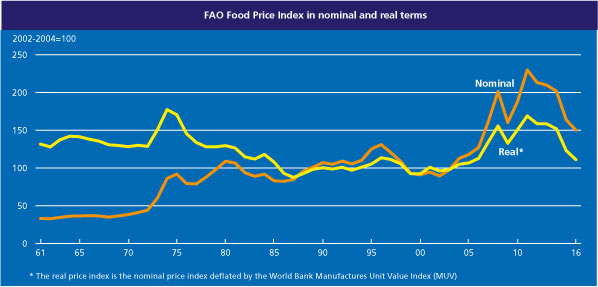
I stumbled on this chart yesterday.

fao chart

It shows the FAO’s food price index, all the way back to 1961, including a real series in which the nominal FAO index is deflated by the World Bank’s Manufactures Unit Value Index, “a composite index of prices for manufactured exports from the fifteen major developed and emerging economies to low- and middle-income economies”.   The FAO index itself is a weighted average of the international prices for cereals, vegetable oil, dairy, meat, and sugar.

Never knowingly optimistic, I was still a little surprised by the picture.  After all, a dominant story of the last 25 years has been one of falling prices of manufactures, driven in large part by the industrialisation of China, and reflected in (for example) sharp falls in the terms of trade for Japan and Taiwan.   And optimists around New Zealand have told stories about the growing global scarcity of water, rising Asian demand for high quality protein, and so on.   And yet on this measure real food prices –  the amount of manufactures a given amount of food commodities would purchase –  have been no better than flat.  If anything, at present prices seem to be moving back towards the lows of the 20 years from the mid 80s to the mid 00s.  And the dairy component doesn’t appear to have been behaving much differently than the other components of the index.

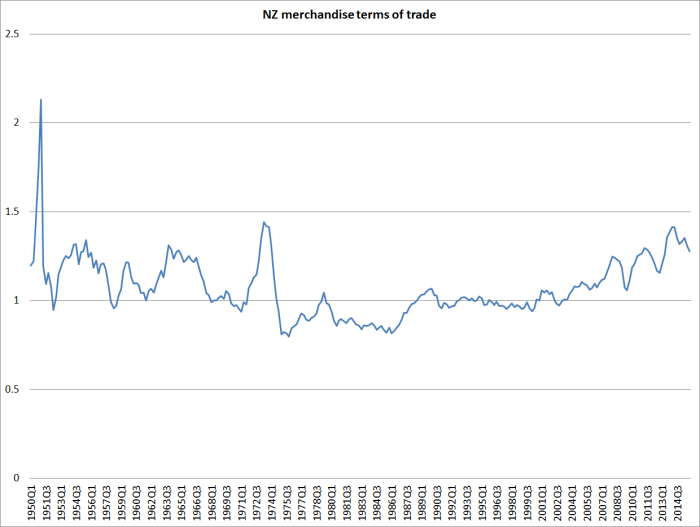
Of course New Zealand isn’t a low or middle income country, so perhaps this World Bank index isn’t representative of our purchases over time.  The WTO also has an index for prices of imports and exports of manufactures: it has only been running since 2005, and over that period prices of manufactures have increased less than those of food (as reflected in the FAO index).  Our own overall terms of trade  –  for a wider range of exports than food, and imports than manufactures – have still been quite good by historical standards (although even in the 1950s and 60s our incomes were drifting down relative to the rest of the advanced world).

merchandise tot

There appears to plenty of scope for productivity growth in agriculture (although there hasn’t been much in New Zealand in recent years), but there isn’t any more land being made here, and environmental/water concerns are limiting just how much more intensively existing land can be used.   For a country with a fairly rapidly growing population, that is still heavily dependent on its food exports, the prospects for sustained high incomes seems to rest on some combination of high productivity and high prices.  Or, of course, the rapid growth in other exports –  but over decades now that latter just hasn’t been happening.

On  completely different topic, this is one of favourite housing charts.

mortgage vols

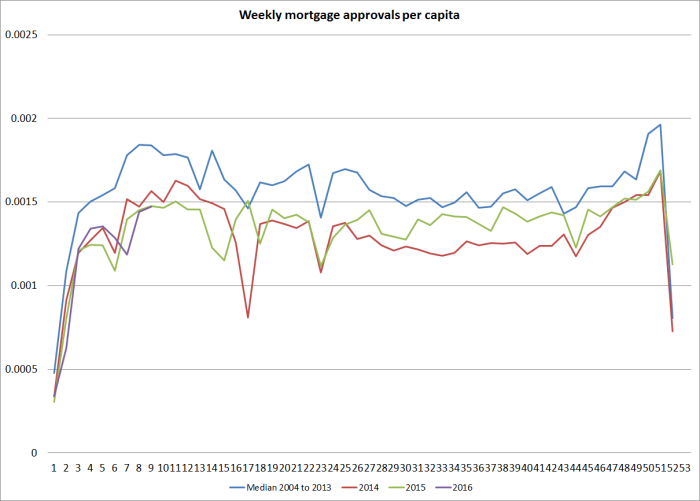
It shows the number of weekly mortgage approvals (with a rough adjustment to turn it into a per capita measure) for each week of the year, numbering 1 to 52/53.  That deals with (a) the rising trend in the population over time (material over a decade), and (b) the fact that the data aren’t seasonally adjusted.

I haven’t shown a (hard to read) version with lines for each year for which the Reserve Bank has data.  But you can see how much more active the mortgage market was on average over the first decade of the data than it has been over the last few.  In fact, in 2007, the peak year of the previous boom the line was around .0025 at this time of year –  in other words, more than 60 per cent more mortgages were being approved per capita at this time of year in 2007 than was happening this year (or last year).

The housing finance is now, unfortunately, quite badly distorted by the Reserve Bank’s increasing range of direct controls, but there is just nothing in this data to suggest a frenzied speculative boom.  In such booms, volumes tend to be very strong –  not just new loans, but turnover per capita too.  There was a plausible story like that, backed by the data, in the previous boom from 2002 to 2007.  There hasn’t been, and isn’t, in the last few years.  Individual potential buyers have no doubt been very worried about missing out, perhaps permanently, but the main factors behind what strength there has been in house prices –  considerable in Auckland-  was the government.  It encourages rapid population growth through a liberal immigration policy, and at the same time is responsible for the legislative framework that makes urban land scarce and impedes the physical expansion of the city.  That seems that like a crazy policy  mix to me, but it isn’t a frenzied credit boom –  and isn’t obviously any sort of “bubble” either.  The definition of a bubble is rather elusive, but suggests something completely detached from fundamentals.  But government policy parameters are fundamentals.  They could change, but there is little or no sign of them doing so.

Why harp on the point?  In the lead-up to next week Monetary Policy Statement some of those opposing OCR cuts do so on the basis of house price concerns.  House prices aren’t in the Reserve Bank’s monetary policy remit, but in any case there is no sign of irrational exuberance –  whether by buyers or financiers –  driving what is going on.  Rising (and absurdly high) real house prices in some areas appears to be largely a relative price change, attributable to pretty easily identifiable structural factors.  Orienting monetary policy around the price of a good, itself largely shaped by government structural policy choices, would be even odder than orienting it around, say, the price of gold –  a product which, at least, governments did not directly influence the supply.

The other relevant consideration is the question of just how much difference monetary policy shocks, and adjustments to the OCR, actually make to house prices.  In support of its LVR policies, the Reserve Bank used their model a couple of years ago to argue that achieving the same impact on house prices as they expected to achieve using LVR restrictions, they would have to lift interest rates (relative to baseline) by around 200 basis points.   The LVR restrictions were expected to lower house price inflation by around 1-4 percentage points in the first year (the effect fading away thereafter).  Modelling house prices well isn’t easy, but if this Reserve Bank analysis is even remotely right it seems unlikely that further cuts to the OCR over the next few quarters of even 50 to 100 basis points, offsetting falling external incomes, falling inflation expectations and rising offshore funding costs, would materially affect the level of national house prices.


Immigration: political parties all seem pretty much on board

There is an interesting column on interest.co.nz today by David Hargreaves calling for the government to act to reduce the rate of immigration.  I’m generally quite sympathetic to his call, although much of his argument is focused on the shorter-term pressures that arise from large (and large fluctuations in) immigration flows, whereas my interest is primarily in the longer-term economic implications of high trend levels of non-citizen immigration.  But the column is headed “National is putting short-term expediency ahead of the country’s future”, and there I’m inclined to part company.

Yes, the National Party dominates the current government, and has supplied all the Ministers of Immigration since 2008.  But, by and large, they are following the same policy, apparently with same implicit beliefs about the benefits of immigration and of a larger population, that the Labour Party led government before them followed, and the National Party-led government before that.  Elite opinion in New Zealand has been strongly pro-immigration, presumably believing that it is in the interests of New Zealanders, for a long time.  What is at issue isn’t really “short-term expediency”, but long-term economic strategy and beliefs.

Elite opinion approves strongly of immigration, and is resistant even to any questioning of the approach, and yet those same people and institutions struggle to produce any evidence of the benefits.

The Secretary to the Treasury is very keen on immigration, and yet The Treasury doesn’t seem to have been able to find any evidence of benefits from New Zealand’s large scale immigration programme, and has been rather cautious about the extension of working holiday schemes.

MBIE and the Minister of Immigration continually runs the line that immigration in New Zealand is an “economic lever”, and yet when I asked for copies of their advice and analysis there wasn’t anything of substance there either.  There are assertions about possible benefits, and various theoretical arguments, but no evidence that New Zealanders have actually benefited from the evolving programme New Zealand has actually run.

The New Zealand Initiative think-tank seems keen on immigration, and yet when the chairman recently put out a piece on immigration, he subsequently acknowledged (see his comment in response to my piece) that there are no New Zealand studies that demonstrate the benefits to New Zealanders of New Zealand’s immigration programme.

Late last year, Mai Chen published a lengthy Superdiversity Stocktake report, some mix of immigration advocacy and marketing around how best to cope with the greater ethnic diversity that has developed in New Zealand over the last few years.  And yet, in the hundreds of pages, there was no evidence advanced that New Zealanders have been, or will be, made better off by the large scale immigration programme.  Chen referred to various papers supposedly showing benefits from diversity, but few adequately distinguished causal links and correlations, and several were not even dealing with ethnic diversity.  The one New Zealand paper cited –  a Department of Labour modelling exercise from a few years ago –  is generally accepted to be of the sort which generates benefits from immigration if first ones assumes benefits from immigration.  In other words, it simply does not shed light on the bigger question.  Here is a link to a recent commentary on the some of the articles Chen refers to.

So neither our leading government economic agencies, nor our academics, nor our think-tanks, nor immigration-advocacy groups have been able to show any material benefits from the large scale immigration programme, even after 25 years.  And yet the leading political parties for some reason continue to recite the mantras –   it is “critical economic enabler” we are told, but enabling what?

And while National and Labour are largely responsible, since they have led all governments in New Zealand for decades, most of the other parties don’t really seem that different.

Here is the Green Party policy.  It doesn’t get very specific, but also evinces no real discontent with the thrust of the immigration policy New Zealand has been running for 25 years.

New Zealand First often gets coverage for its comments on immigration.  They raise some concerns, some of which I think have merit, and others not.  But read the policy and it certainly doesn’t feel like a party advocating a far-reaching change of approach.

The Maori Party  apparently no longer has any references to immigration on its website (and there was nothing in the 2014 manifesto), but when I looked previously there was nothing suggesting any discontent (which has always puzzled me because, whatever the economic merits of immigration there is no doubt that each new wave weakens the relative political position of Maori in New Zealand).

United Future has an updated online manifesto, and its immigration policy (page 84) suggests no real discontent, and just suggests various tweaks at the margins.

And the final party in Parliament is ACT.  You might presume that they’d have been dead keen on immigration –  open markets in people as well as goods.    In fact, their website offers a curious mix.  On the one hand, the say

ACT is and always has been the pro-immigration party

But they must have had someone reading Reddell because a few sentences later they qualify this with

ACT is also committed to monitoring the emerging literature that suggests immigration may make the domestic population poorer through a process of capital widening

They have a whole page, which is fairly uniformly positive, but with that caveat.

It is quite remarkable that we’ve gone for 25 years with one of the largest scale planned migration programmes in the world, have no actual evidence of the benefits to New Zealanders of this programme, and all the time have continued our slow relative economic decline, and yet not one of the p0litical parties appears seriously uneasy about what is going on.  On the one hand, it is a testimony perhaps to the moderation of New Zealanders, and to the fact that we haven’t had lots of illegal immigration or Muslim immigration,  But as David Hargreaves notes in his interest.co.nz piece, our rate of immigration has been much more rapid than that of the United Kingdom, where it has become a major issue for debate (and over recent decades the UK economy has been materially more success than our own).

I was interested to see the generally left-leaning Bridget Williams Books has a new book out shortly, presumably next week,  in their BWB Texts series, on New Zealand’s immigration policy and practice.

Here is the publisher’s blurb.

Migration and the movement of people is one of the critical issues confronting the world’s nations in the twenty-first-century.

This book is about the economic contribution of migration to and from New Zealand, one of the most frequently discussed aspects of the debate. Can immigration, in economic terms, be more than a gap filler for the labour market and help as well with national economic transformation? And what is the evidence on the effect of migration not just on house prices but also on jobs, trade or broader economic performance?

Building on Sir Paul Callaghan’s vision of New Zealand as a place ‘where talent wants to live’, this book explores how we can attract skilled, creative and entrepreneurial people born in other countries, and whether our ‘seventeenth region’ – the more than 600,000 New Zealanders living abroad – can be a greater national asset.

It will be interesting to see what material, and arguments, the authors have to offer.   If it isn’t offering the evidence itself, perhaps it least it might contribute to a greater appetite for serious debate and analysis as to whether we, as New Zealanders, are benefiting from the evolving immigration programme in the way in which the elites seem to take for granted that we are.


A non-New Zealander as Governor?

The Australian newspaper ran an article yesterday on the appointment of a new Governor to the Reserve Bank of Australia.  Glenn Stevens’ term expires in September.  As it now March, I was a little surprised to read that

A spokesman for current Treasurer Scott Morrison said ….that the specific process for choosing the new governor was still under consideration.

But perhaps that just reflects the overwhelming expectation that the highly-regarded Deputy Governor, Phil Lowe, will get the job.

The Reserve Bank of Australia has had a long history of Governors appointed from within –  in its (fairly short) history, only one Governor was appointed from outside (Bernie Fraser who moved from being Secretary to the Treasury).  But the article explored the possibility that the Treasurer could look outside the Bank, or even abroad, for a replacement for Stevens.

Even allowing for the recent appointment of an expatriate Australian banker as Secretary to the Treasury, it seems pretty unlikely that the Treasurer would do much more than take a cursory look at possible candidates other than Lowe.   If the Reserve Bank of Australia has perhaps been inclined to be excessively upbeat in recent years, it is not obvious that the Bank’s conduct of affairs has been so egregiously wrong –  or upsetting to the government – that it would make sense to reach beyond the pretty deep bench of senior officials that the RBA has maintained over the years.

As the article notes, the appointment of a foreigner to a role as central bank Governor is not unknown –  Mark Carney at the Bank of England at present, and Stan Fischer at the Bank of Israel are two I can think of – but it isn’t at all common in stable and advanced countries.  (New Zealand’s former Deputy Governor Peter Nicholl served as head as Bosnia’s central bank in the aftermath of the civil war in the 1990s).

When inflation targeting was young, and there was a strong belief that it would be easy to hold a Governor to account, there was a view in some circles that it might even be best to get a foreigner as Governor –  after all, the world labout market was so much deeper than that here in New Zealand, and since it was all very technical and the target was well-specified, the only thing that really mattered was technical expertise (perhaps even more than good judgement).

But no one looks at it quite that way now.  It is widely accepted that central banks excess a considerable degree of discretion.  That is so whether they are inflation targeting, nominal GDP targeting, wage targeting –  in fact, anything other than a fixed exchange rate, or Friedman’s fixed money base target rule.  There is considerable discretion, limited effective accountability, and the discretion is in areas of activity that matter to many people (ie the entire economy and financial system).  In that sort of climate it seems reasonable that people would prefer to be governed, or administered, by people from their own country.  No matter how capable other candidates might be, we don’t consider allowing people from abroad to become MPs or Cabinet ministers –  at least not until they have lived here for a few years and become citizens themselves.  It isn’t that all New Zealanders, or all Australians or all Americans, share the same values or views, simply a slightly inchoate but deep-seated sense that we should govern ourselves.  Part of it perhaps is that in any of those roles –  senior political ones, or powerful independent bureaucrats – the ability to explain oneself to the citizenry is a key aspect of the job, and that involves the ability to draw on common reference points, shared experiences etc.

In the Reserve Bank of Australia case, one could mount an argument that these issues are less compelling.  After all, the Governor is chief executive of the Bank and chair of the Board, but he doesn’t get to appoint the Board, and he isn’t a single decision-maker.  Interest rate decisions – the main decisions the Reserve Bank of Australia makes – are made by an outside Board appointed by the elected government.  Even the Deputy Governor is directly appointed by the Treasurer and sits, as of right, on the Board.

But what about New Zealand?

Here the formal process for appointing a Governor is laid out in the Act. The Reserve Bank Board nominates a candidate, whom the Minister of Finance can accept or reject.  If the Minister rejects that nomination, the Board must come up with another one.  The process can go as many rounds as it takes, but at no point can the Minister just impose his or her preferred candidate.  Personally, I think that is a weakness of our system –  it is unusual to give the Minister of Finance so little so in the appointment of such a powerful official.  Ours is a system where, formally, all the powers vest in the Governor personally, so the Minister of Finance also has no say in the appointment of any of the other senior officials of the Bank.

And compared to most central banks, the Reserve Bank of New Zealand exercises a large amount of discretionary powers in a wide range of areas.  In addition to monetary policy, the Governor has considerable autonomy in setting prudential regulatory policy (and the application of that policy), in foreign exchange rate intervention, in payment system operations, and in the physical currency.  On each individual limb, other central banks can be found that do what our Reserve Bank does, but take as a whole it would be difficult to find any central bank which (a) covers so many functions, (b) has so many powers formally delegated to the Bank, and (c) where all those functions vest with a single individual, the Governor.  It is a role at least as powerful as that of most Cabinet ministers – partly because of the actual powers the Governor wields, and partly because of how much more difficult it is to get rid of a person if they mess up (compare, say, Judith Collins and Nick Smith, as two senior ministers in the current government to have been dismissed when they erred).

As the Reserve Bank Board and the Minister approach the end of Graeme Wheeler’s term next September, there must be a temptation to consider overseas candidates.  After all, the current deputy chief executive will be in his mid 60s, a similar age to Wheeler, and was passed over when he sought to become Governor last time.  None of the other internal senior managers look like outstanding candidates –  and it was 1982 when an internal candidate was last appointed Governor (itself a pretty internationally unusual statistic).  Outside the Bank, the list of plausible contenders in New Zealand doesn’t seem overly deep either – and for almost all the names I’ve heard suggested I can think of material arguments against.

But I think it would still be a mistake to go global.  Some aspects of the role could be done by any able person –  revitalising, for example, the Bank’s research and analysis across the range of its policy functions.  That is partly just about good second and third tier appointments, and partly about being a voracious customer for the insights that analysis throws up .  But the role also needs someone who understand the New Zealand economy, the New Zealand system of governance, and someone who understands the New Zealand financial system.  And it needs someone who is comfortable, and credible, in telling the Bank’s story – and sometimes it will be a controversial or difficult story –  to New Zealand audiences.  Plenty of people criticized Don Brash over the years, but few doubted that his heart was in this country, and that its best interests were his priority.  In a small country, with a foreign-dominated financial sector, a very powerful central bank, and ongoing controversy about the role of monetary policy and New Zealand’s economic performance, it is hard to imagine any foreign appointee successfully filling the bill.

Of course, it might be a little easier if the governance of the Bank was reformed.  For example, in a system in which the Governor was chief executive, but had no more voting rights on monetary policy or financial regulation policy matters than others members of the respective committees, the stakes are a little lower.  But even then, I think such governance reform more appropriately opens the way to the appointment, from time to time, of a foreign expert as a member of one or other of the voting committees.  Since the Bank of England’s nine-person Monetary Policy Committee was established by legislation almost 20 years ago it has not been uncommon to have a foreigner sitting on that committee. In a New Zealand context, supplementing local expertise with outside perspectives in that way could have some appeal – if New Zealand government board fees were sufficient to attract quality candidates –  but we are still likely to be best, in all but the most exceptional circumstances, to look for a Governor from home –  as we do when we choose ministers, judges, (and these days Governors-General), military chiefs and so on.

As I’ve noted before, the next gubernatorial appointment is in any case complicated by the timing of next year’s election.  Graeme Wheeler’s term expires just beyond three years since the last election, and most of the opposition parties have been campaigning on changes to the monetary policy framework.  If they are serious about reforms, they are also likely to revisit the governance arrangements, to shift towards a model that is (a) more internationally conventional, and (b) more in line with how we govern other independent government agencies in New Zealand.  The current government would no doubt be within its legal rights to make an early appointment for the whole of a new five year term (having obtained a suitable recommendation from the Bank’s Board –  all of whom have been appointed, or reappointed, by the current Governor).  But given the timing it would seem an inappropriate use of power, that could materially complicate relations between the Bank and a future government.  Somewhat reluctantly, I think Graeme Wheeler should be asked to stay on for an additional year or so, allowing whichever party forms the next government to appoint a Governor to work with whatever model of monetary policy and central bank governance emerges from the electoral process.

Krugman on the case for more public investment

Paul Krugman had a piece on his blog a day or two ago making the case for increased (“much more”) public investment spending in the US.

There are three strands to his case.

The first is a proposition that the US is still “in or near” a liquidity trap. I’m not sure I’d use the term, but the general point is one I sympathise with.  Under current legislation and central bank practices (easy convertibility into banknotes on demand), few countries are very far from the effective lower bound on nominal interest rates.  And if a new downturn comes, that could make it very difficult for central banks to do much to help stabilize economies.   To me, that argues for action (legislative and administrative) to remove (or greatly ease) the lower bound constraint.

The second is a proposition that the last few years of disappointing real economic growth are helping to bring about a sustained reduction in future potential growth –  in his words,

demand-side weakness now breeds supply-side weakness later, so that there are big payoffs to boosting the economy through public spending

In principle, it might be a plausible idea. But there is no real evidence that things turned out that way during the Great Depression when, extremely weak as demand was, TFP growth remained strong.

The third –  actually first in Krugman’s list –  is that public spending as a share of GDP is now very low:

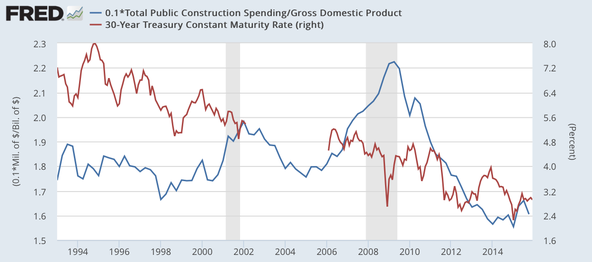
Government borrowing costs are at record lows; markets are in effect pleading with the government to borrow and spend. So why not do it? It’s completely crazy that public construction as a percentage of GDP has declined to record lows even as interest rates have done the same

And he includes this chart

krugman chart

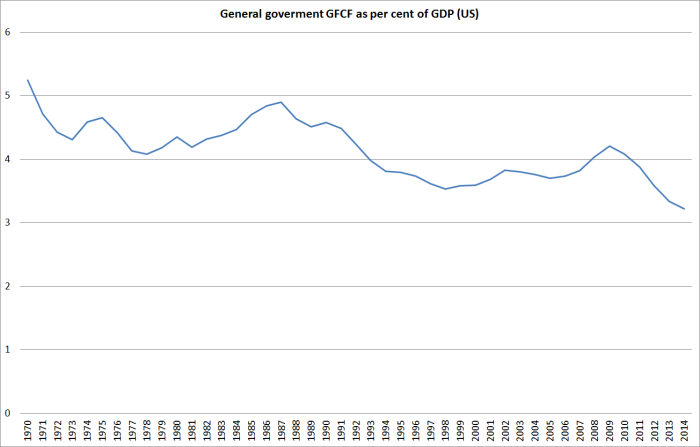
That chart only goes back to the early 1990s.  But here, for the US, is general government gross fixed capital formation as a per cent of GDP since 1970.

us gen govt gfcf

It is at a record low, which might seem to support Krugman’s case.

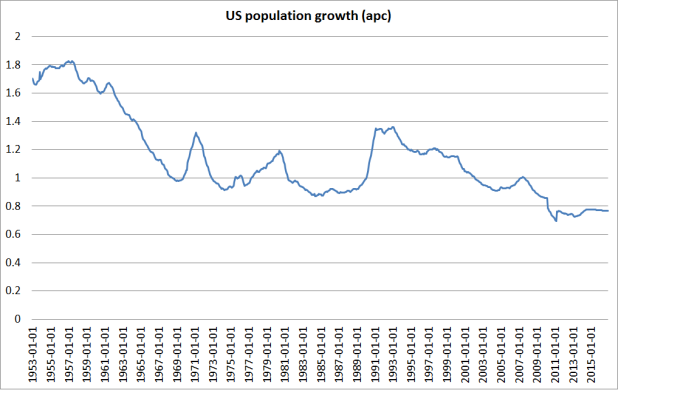
But then here is the annual rate of growth in the US population, in this case going back as far as the FRED series went, to 1953.  And what do we find, but that population growth is also estimated to be at its lowest for decades –  quite possibly in the entire history of the US.

us popn 2

If the population growth rate slows, less investment (as a share of each year’s GDP) is needed to maintain a desired stock of capital per person.  That is a good thing, on the whole –  available resources can be used for other stuff.  These effects are quite large.  Much of the government capital stock is in the form of quite long-lived assets, which depreciate slowly (schools, hospitals, roads etc).  Depreciation is one –  quite substantial –  component of the gross fixed capital formation spending, but a large share of government capital spending is about supporting the needs of a growing population.

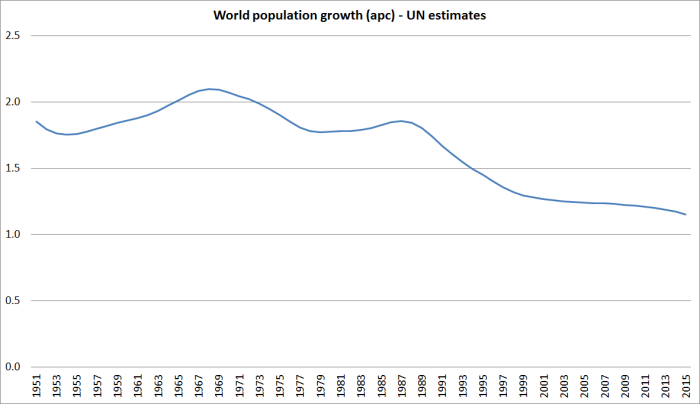
It isn’t just the US population growth rate that is slowing –  global population growth rates have been slowing markedly too.

world popn

A lower rate of population growth, and associated lower need for investment, is now pretty widely recognized as one of the factors that has been driving real interest rates down around the world.  One could argue, with Krugman, that markets are “begging governments to borrow and spend”, but it might be better to interpret is as markets as reflecting the twin declines, in population growth and in underlying multi-factor productivity growth.  There simply aren’t as many attractive projects around as there were.  It can take time for (desired) savings rates to adjust to that deterioration in investment prospects –  and that is usually where monetary policy has a part to play.  More government capital expenditure, if the remunerative projects aren’t there, doesn’t look like a particularly attractive way to boost the country’s longer-term economic fortunes. And as the US government is still running deficits, cuts in government savings don’t look particularly sensible either.

Perhaps the US is different, and the high-returning public projects (covering not just the low cost of debt but the overall cost of citizens’ equity) are there and able to be implemented effectively in a way that achieves those returns.  But the political process is such that even if, in principle, a large pool of such projects are there, there is no guarantee that those would be the projects that would be picked.

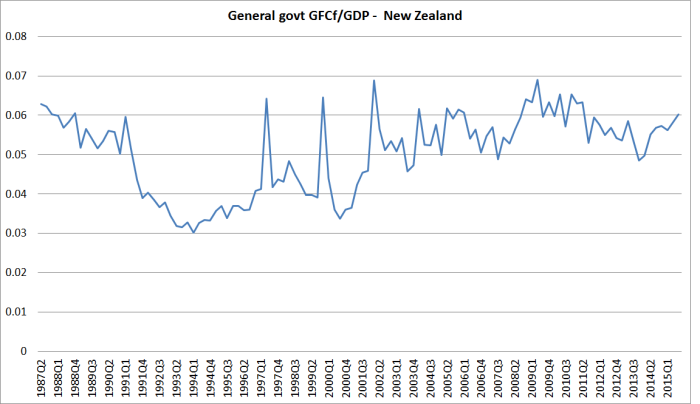
What of New Zealand?  Here is the chart of general government gross fixed capital formation as a per cent of GDP back to 1987.

gen govt gfcf

It hasn’t fallen, but then again our population growth –  while volatile –  has recently been higher than at any time since the 1970s.  There is an awful lot of wasteful public capital spending here, that fails to pass reasonable economic tests – Transmission Gully, the Auckland rail projects, the Dunedin stadium, and the fearful prospect of large amounts of ratepayer money extending Wellington Airport’s runway –  and we should be wary of the siren calls, even here, to increase government capital expenditure as a way of stimulating the overall economy.  Poor quality projects make us poorer.

Are there exceptions –  cases where demand might be so weak that perhaps even poor quality projects might help kickstart the economy (Keynes’s example of paying people to dig holes and fill them in again).  I’m not sufficiently doctrinaire as to say “never”, but equally it is difficult to think of any actual historical episodes where “sorting out monetary policy”, and complementing that with growth-oriented structural reforms, would not have been a better option.  It was in the Great Depression. It would have been in 1990s Japan.  It looks that way in most of the world, including New Zealand, now.


Immigration the source of Australia’s prosperity?

Late last year, veteran Australia journalist and author George Megalogenis’s new book Australia’s Second Chance was published.  Despite the single economic market, it is often hard to become aware of new Australian books, and not always easy to get hold of them either.  Somehow I stumbled on a reference to this book and read it a few weeks ago.

Megalogenis appears to be highly-regarded by the liberal-left in Australia, at least judging from the reviews of his previous book (which was launched by Prime Minister Julia Gillard) that are quoted on the inside cover of this one.   Wikipedia says he once was once married to the woman who is now Labour premier of Queensland and, whether because of that or despite it, he appears to have it in for Queensland –  not helped, it seems, by the large number of New Zealanders living there.

It is a well-written easily-read book, and for those who don’t know too many details of Australian history since 1788 it is full of interesting facts.  It is just a shame that the thesis that shapes the book is almost certainly almost totally wrong.

Megalogenis argues that immigration is what has made Australia rich, and is what will make it richer still in future –  if only the naysayers, sceptics, racists etc just get out of the way, and let Australia fulfil its manifest destiny.

You may think I am over-egging his story, but here are some lines from the last page of the book

Australia matters more than most nations because it remains a settlement with potential.  Our unique strengths…..come with a burden.  The rest of the world expects Australia to succeed, given our small population and resource endowment.  Our previous eras of poor performance were punished so severely because the world believed we had let it down.  This is the pragmatic argument for openness, because history tells us the alternative is an isolated belittled Australia.  A globally minded Australia will continue to thrive, because the world will project its best self on us.

and a page or two earlier, concludes that Australia’s

standard of living depends on the migrant

The test for Australia now, we are told, is “to keep them coming”.

It is really a very odd argument.

As one person I mentioned the book’s thesis to noted, in one sense it is clearly true.  Had there been no immigration to Australia since 1788, it seems most unlikely that per capita incomes of Australians would anything like as high as they are today.  They aren’t in, say, Botswana or Mongolia.

Then again, as far as we can tell from the historical estimates that are available, Australia’s per capita incomes were the highest in the world in about 1890.  Australia has not matched that performance in the 125 years since.

According to Megalogenis, Australia’s success has rested on repeated waves of immigrants, and when the flow slowed times were not typically good for Australians.  Mostly, it is a story that seems to reverse cause and effect.    Migrants are attracted to economic success and opportunities.  In the 19th  century it was hugely expensive to immigrate to Australia (or New Zealand) and people did so in large numbers either when someone else paid them to do (assisted migration) or when really good new opportunities (large expected income gains) opened up.

Early European Australia was a penal colony, hugely heavily subsidized by Britain, with few export opportunities and not particularly attractive as a place to relocate to (the total European population in 1820 was 33000).  The first big natural resource shock was the discovery of the natural pasturelands in western New South Wales in the 1820s.  In 1830, Australian wool accounted for 8 per cent of British wool imports (German states had been the dominant supplier), but by 1850 Australia accounted for more than half of a fast-growing market.  The associated income growth markedly boosted both the Australian colonies ability to support themselves, and to support a much larger population at the sort of living standards (or better) they might have been used to at home.

The gold rushes of the 1850s (and sustained high gold production for several subsequent decades) had a similar effect.   Whole new incomes could be generated in Australia, supporting high living standards (and associated imports) for a larger population.  Immigrants flooded in  –  as they did later to New Zealand in our gold rushes. Australian exports as a share of GDP rose to around 40 per cent –  a level never achieved since.  But there is nothing in the economic histories to suggest that the immigrants created the prosperity. Rather, the prosperity made Australia (and especially Victoria) attractive to immigrants.  Since the typical immigrants was a single male, content with a pretty rough standard of accommodation – so there weren’t huge initial capital stock requirements –  the standard result in Australian economic histories is that the huge inflow of immigrants dampened wages in Australia (relative to a counterfactual in which the gold discoveries had to be exploited only by people already there).

After a final gold rush in Western Australia in the 1890s, there were no great natural resource discoveries in Australia for decades.  Agricultural productivity gains continued to lift farm output –  and refrigerated shipping and new dairy technologies assisted Australia, although to a lesser extent than New Zealand –  but the best land was already taken.  Perhaps unsurprisingly, these weren’t great decades for remote Australia.  By global standards, it remained a rich and successful country, but no longer at the forefront-  indeed, on some of best measures around there wasn’t much per capita growth from 1890 until World War Two. Perhaps unsurprisingly, the rate of population growth wasn’t as rapid – European migrants weren’t quite so keen on coming as they had been (and, as in other settler countries, Asian migration was severely restricted).  For the first half of the 20th century, Australia was much like New Zealand –  an agricultural exporter, primarily to the United Kingdom.  Overall, the two countries generated rather similar living standards  –  and still had some of the faster rates of population increase anywhere in the advanced world.

Minerals began to come back to prominence in Australia from the 1960s.  Australia stopped doing stupid stuff to itself-  bans on iron ore exports were lifted, prospecting rights were improved etc –  and some combination of new discoveries and new opportunities (the rise of Asia) provided a whole new, increasingly large, income stream for Australia.  New foreign income opportunities support higher consumption demands from an existing population, and can sustain a higher population.  Mineral exports from Australia had been 1 per cent of total exports in 1951.  They were 18 per cent in 1974, 28 per cent in 1989, and 55 per cent in 2009.  And exports as a share of GDP were materially higher than they had been in the 1950s and 1960s.  New Zealand, of course, has had nothing similar (some argue that there is plenty of mineral potential, but if laws make it difficult or impossible to exploit, it doesn’t matter much whether the enthusiasts are right or wrong).

But, contrary to Megalogenis’s thesis, there is just nothing in the data to support the idea that the rapid (immigration-fuelled) population growth has been the basis for strong per capita income growth (over decades).  Rather it is the rapid total income growth –  particularly associated with mineral developments over the last 40 to 50 years –  that has enabled Australia to support pretty good incomes for a growing number of people.  Again, we in New Zealand had nothing similar on the income side, and so overall returns (eg GDP per hour worked) available to the growing number of people have continued to languish.

Now, to be clear, this is not some crude story in which physical resources inevitably make a country rich.  There are so many counter-examples I’m not going even going to attempt to list them.  But new physical resource discoveries, when combined with capable people, and strong institutions, have proved able to generate high per capita incomes for people in places where one might not otherwise have expected such good outcomes.  Norway is one example –  balancing all three components of that mix..  With more emphasis on the resources than the human capital or institutions, Brunei or Kuwait are other examples (or Equatorial Guinea and Gabon).   Australia is closer to the Norwegian end of the story –  the same North European combination of people and institutions, that have made for the most prosperous settled societies in history, augmented abundant natural resources (but spread over considerably more people than Norway).  Australia doesn’t seem like the sort of location that, natural resources apart, would easily generate top tier incomes –  never in its history has it looked like developing seriously internationally competitive manufacturing or services industries based in Australia.

Readers may be skeptical of the story I’ve been telling.  But don’t take my word for it.  Most of it (and most of the data I’ve quoted) is based on one of my favourite economics books Why Australia Prospered,  published in the prestigious Princeton Economic History of the Western World series, and written by the recently-retired leading Australian economic historian Ian McLean.  The value of the book is partly that he explicitly considers Australia through a comparative lens, looking at other settler economoies, including New Zealand.   I reread it after I’d read Megalogenis, and his story is essentially the one outlined in the previous paragraph.  There is no sense, anywhere in the entire book, that anytime in the entire modern history of Australia immigration has been an enabler –  allowing Australia to lift its per capita income above what it would otherwise have been.

And what of that bastion of careful economic analysis, the Australian Productivity Commission?  They produced a big report 10 years ago, that concluded that there were probably few or no benefits to Australians from modern immigration inflows.  And late last year, in response to another government request for a report on immigration, they produced another lengthy draft report.  I’d seen a few media reports suggesting that they had reached a positive conclusion on the benefits from immigration, but when I dug into the chapter on the economywide impacts of immigration (from p 263), I found that in their baseline scenario productivity growth and wages were lower in the scenario in which current immigration levels continued than in a scenario without immigration.  The differences are very small, and my only point here is that there is little or no support for the sort immigration-boosterism reflected in a book like Megalogenis’s.  The Productivity Commission do run an alternative more positive scenario – but essentially it amounts to “what if we just assume that skilled immigration materially boosts productivity growth”.  If one assumes gains going into the analysis, one gets gains out the other end.

Over the broad sweep of modern history Australia and New Zealand have had pretty similar approaches to immigration. And they’ve had similar institutions, and similar sorts of capable people.   In neither case is there any evidence that continued high rates of immigration have done anything to lift either country’s longer-term economic performance.  Rather successful economies successfully absorbed more people at little cost to their own people.  The big difference between the two countries in the last 100 years has been the discovery and exploitation of the vast mineral resources in Australia. That has enabled Australia to continue to offer fairly high incomes to a lot more people –  including many New Zealanders.  Without the new opportunities, products or markets, New Zealand has struggled to cope with its population growth, and continues to drift further behind the rest of the advanced world –  putting more people into a place with few natural advantages.

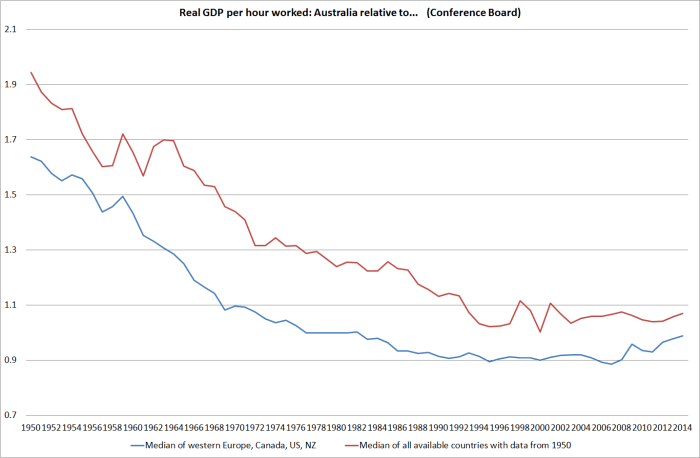
I described Australian incomes as “fairly high”.   And yet for all its huge natural resources, Australia’s real GDP per hour worked –  while a lot better than New Zealand’s – is no higher than the median of advanced countries.  For decades it fell relative to other advanced countries, and even over the last 20 years has done little better than hold its own.

aus real gdp phw relative

As a topic for another day,  might its people also have been better off without such rapid immigration-fuelled population growth?


New Zealand and Norway: a real exchange rate that hasn’t moved

On average, over time, one would expect the real exchange rate of a more poorly-performing country to depreciate against that of a better-performing country.

There is a whole variety of strands to a possible story about why one might expect to see such a relationship, and for why it would be helpful for the more poorly-performing country for such a depreciation to occur.  A less well-performing country will typically have found its firms less well able to compete in international markets (than those of the better performing country).  That, in turn might reflect a less attractive tax and regulatory environment, less real productivity growth, or changing demand patterns so that the world wants more of what the more successful country produces and less of what the less successful country produces.  Or it might even be about natural resource discoveries –  a country that discovers major new resources (eg oil and gas) just has more stuff that the rest of the world wants, and with good institutions such a country will tend to outperform other countries for a (perhaps quite prolonged) period.  And the citizens of a faster-growing country will rationally anticipate strong future income gains, increasing their consumption demand relative to the trajectory of consumption demand in the less well-performing economy.

I’ve illustrated previously that one of the striking stylized facts about New Zealand is that although our economic performance over the last 60 or even 100 years has been pretty disappointing by global standards, there has been no depreciation in our real exchange rate relative to those of other advanced economies.  No wonder our tradables sector has struggled.

This post is really just about illustrating the point by reference to one other particular small commodity exporting country, Norway.

For the first 100 years or more of modern New Zealand, no one doubted that per capita incomes in New Zealand were much higher than those in Norway.  New Zealand was one of the great economic success stories, while Norway struggled, and exported a lot of people, especially to the United States.  On the Maddison numbers, GDP per capita in New Zealand in 1870 was more than twice that in Norway.  By 1910, when New Zealand GDP per capita is estimated to have been the highest in the world, the margin was even more in our favour.

These days, GDP per capita in New Zealand is not much more than half that in Norway  (and the NNI per capita gap is even larger).  New Zealanders work long hours per capita, and our real GDP per hour worked is estimated to be only about 45 per cent of that in Norway.  Over the last few years, we’ve done a bit better than Norway, but the multi-decade trend has been strongly downwards.

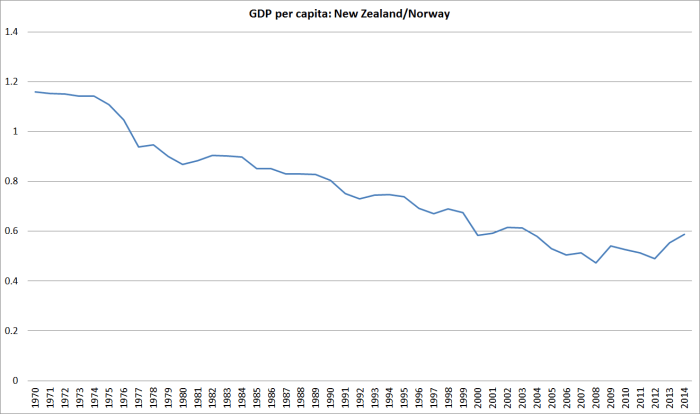
Here, using the OECD database which has estimates back to 1970, is New Zealand GDP per capita relative to Norway’s (in current prices, using current PPP exchange rates).  These are really large declines.  Back in the early 1970s we had incomes about the same as those of Norwegians.

gdp pc nz and norway

Norway began to pull away from other OECD countries when its large oil and reserves began to move into production in the 1970s.  We, on the other hand, suffered in the 1970s from a deep decline in the terms of trade, and new access restrictions on our major export products.

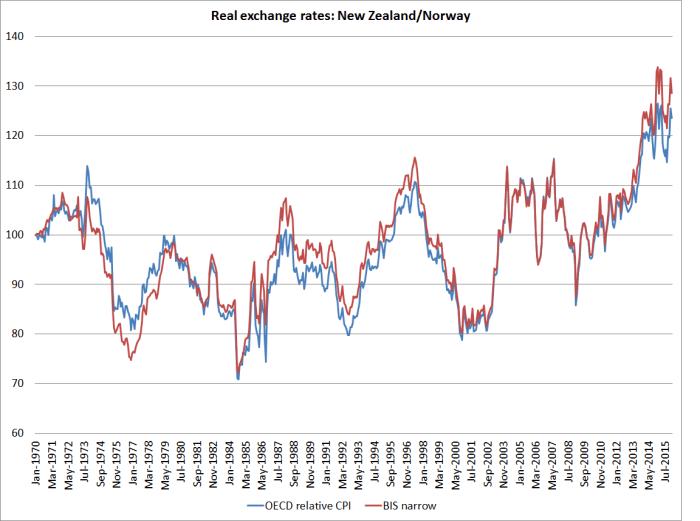
And yet here is a chart showing New Zealand’s real exchange rate relative to that of Norway since 1970.  I’ve shown two, very similar, series –  one is the OECD’s relative consumer prices index, and the other is the BIS’s narrow real exchange rate measure.

rer nz norway

Our real exchange rate (in particular) has been quite variable –  Norway’s has mostly been materially more stable –   but over the whole period there has been no trend whatever in the ratio of our real exchange rate to theirs (and in the last few years, New Zealand’s real exchange rate has risen a lot relative to Norway’s).

Using the OECD’s relative unit labour cost measure produces a slightly more encouraging picture for New Zealand –  but if there has been a trend decline at all, it has been quite small, compared with the magnitude of the deterioration in New Zealand’s economic performance (productivity, GDP per capita, usuable natural resource endowments).

Why has it happened?  Well, it is Saturday and I’m not planning to write an extended essay.  But my thesis is that it is a combination of things Norway has done, and things we have done.

On the Norwegian side, wisely or otherwise, much of the oil and gas revenues –  mostly accruing to the Crown – were diverted into the Petroleum Fund, and saved for a later day.   Norway has net government financial assets of around 250 per cent of GDP –  a figure that was less than 50 per cent only 20 years ago.  And there hasn’t been a large private sector offset   Norway’s positive net international investment position is now some 200 per cent of GDP.

What that has meant is that quite a large proportion of the new income earned in recent decades has not been spent.  And income not spent does not put upward pressure on the prices of non-tradables goods and services relative to those of tradables (another definition of the real exchange rate).  Norway has experienced some of that pressure –  Oslo is an expensive city – but a lot less than they would have without the huge savings rates.

Since the early 1970s, our government debt position hasn’t changed much –  it has gone up and down –  but was pretty low at the start of the period, and is pretty low now.  Our NIIP position has gone in the opposite direction of Norway’s, even though they were earning lots of (initially unexpected) income, and we were experiencing repeated disappointment.  On best estimates, our NIIP position was around -10 per cent of GDP in the early 1970s, and has been fluctuating around -70 to -80 per cent of GDP for the last couple of decades.

The Norwegians haven’t spent a larger share of their income even as their growth prospects improved, and we haven’t saved a larger share of ours even as our growth prospects deteriorated.  Neither choice is necessarily better than the other, but their choice tended to weaken their real exchange rate (all else equal) keeping more non-oil tradables firms competitive, and our choices tended to strengthen our real exchange rate, making it hard for the tradables sector to grow much.  For us, it tends to reinforce our decline.

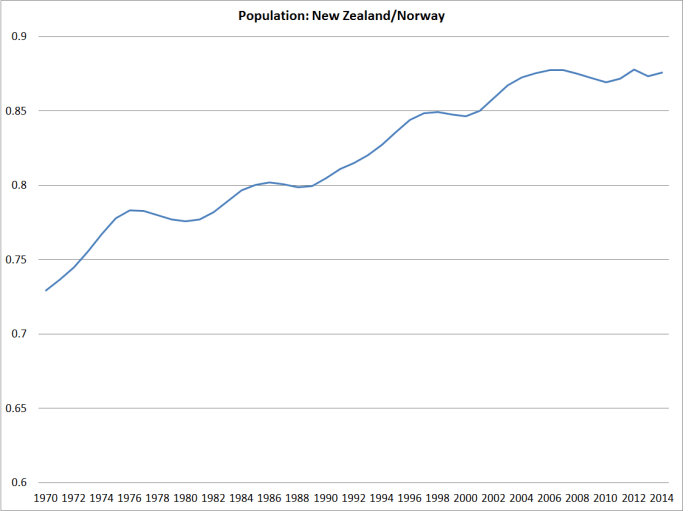
And then there are population choices.  When migration works well, it usually complements economic success that was already underway.  Rapid population growth, all else equal, tends to put upward pressure on a country’s real exchange rate –  it involves a high demand for non-tradables, putting upward pressure on non-tradables prices relative to those of tradables (set globally).  Norway’s population growth rate has increased quite a bit in the last decade, but over the full period since 1970, here is the chart showing the ratio of New Zealand’s population to that of Norway.

population nz norway

Our population –  in a country that has had one of the worst performances of any advanced country –  has grown materially faster than that of Norway, one of the most successful countries in the advanced world.  Not usually a recipe for success – in a family, or at a national level.

I don’t believe in population policy –  people should be free to have as many, or as few, kids as they can afford, and it should be no concern of governments –  but immigration policy is a different matter.  Our population has grown faster than that of Norway almost entirely because successive National and Labour governments have chosen to bring so many non-New Zealanders into the country (more than offsetting the upsurge in those leaving, mainly for Australia).  Doing so has helped impede the sort of the sustained downward adjustment in the real exchange rate one would have expected if governments had simply stayed out of the way.  It has made even harder for New Zealand to turn around the decades of economic decline.

It just looks like a wrongheaded policy, foisted on us –  at our expense, without seeking our endorsement –  by a succession of bureaucratic and political elites (different party labels or none, but similar ideologies and mindsets) who can offer barely a shred of evidence in support of the success of their strategy.

We can’t change the fact that Norway got oil or gas, and nor would we  wish to, or begrudge them their good fortune.  But it is pretty extraordinary that over 35 years when they’ve done so well and we’ve done so badly, there has been no change in our real exchange rate relative to theirs.  At our end of that relationship, it is as if governments have set out to stop the adjustment happening.   It wasn’t their conscious intent, but after this long lack of conscious intent makes them no less culpable.

Monetary policy is bust….

Or so Vernon Small, the Dominion-Post’s political columnist would have us believe.  His article appeared yesterday under the heading “Reserve Bank rules need major rethink”, and then online as “Monetary policy is bust, so why are we still banking on it”.

I reckon he has rather overstated his case.  “Reserve Bank ‘rules’ need following” might be a more accurate assessment.

Start with the odd line that Small got from the Minister of Finance, claiming that “no one ever thought it [the inflation targeting framework] would be used to try to lift inflation”.  I’m not sure where the Minister got that idea from, but as a reminder New Zealand is the classical case where it has been used, successfully, that way.  In 1996, the National-New Zealand First government raised the target midpoint from 1 per cent to 1.5 per cent.  And in 2002 the Labour government raised the target midpoint to 2 per cent (the then Prime Minister wanted to raise it further, to match Australia, and to Alan Bollard’s credit he resisted).  As I’ve noted previously, right through to the2008/09 recession the Reserve Bank delivered inflation rates averaging higher than the successive (and increased) target midpoints.

Small does have some nice lines that had me nodding in approval

….Governor Graeme Wheeler’s rejection of a “mechanistic” approach that would see low inflation immediately trigger a cut to interest rate, currently at 2.5 per cent. It is hard to find any sophisticated analysts in the area who has made such a “mechanistic” call, but hey! Straw men have no say over what goes into their stuffing.

But he can’t quite seem to make up his mind whether, as he says, “the prime tool of monetary policy, cuts to the official cash rate, cannot achieve the target”. [my emphasis added] or whether it is more a matter that “the Reserve Bank appears reluctant to try”.

No one has advanced any evidence that, or even a strong argument why, New Zealand’s inflation rate could not have been raised, or could not now be raised.  And I’m quite sure the Reserve Bank doesn’t believe such a story.  In my post the other day, I set out a list of factors that suggested that keeping inflation up around target should be less hard here than in most advanced countries.  And we know, for example, that another small advanced commodity exporter, Norway, has managed.

In a New Zealand context, no one seriously doubts that –  all else equal –  if the Reserve Bank were to come out with significant OCR cuts and a convincing statement of their determination to do whatever it takes to get and keep inflation near 2 per cent, that the exchange rate would fall.  Prices of tradables would rise to some extent, and returns to tradables production in New Zealand would also rise.  That combination of factors would lift the inflation rate –  and, over time, the latter would be the more important channel.

New Zealand isn’t a surplus country –  so we don’t find capital flooding home to our safe haven when international fears rise.  We are a small remote net-borrowing country, whose currency foreigners mostly hold because of the yield advantages it typically offers.  All else equal, when those yield advantages narrow or disappear so does a lot of the interest in holding New Zealand dollar assets.   Stories about what, on occasion, may have happened to exchange rates in Japan or Switzerland or the United States just aren’t particularly relevant here.

For a long time, I don’t even think it was a case of the Reserve Bank being “reluctant to try” to get inflation back to target. At least while I was still closely involved there was a quite genuine and quite widely-shared belief in the Bank that there would be sufficiently strong economic growth that the inflation rate would soon lift back to around 2 per cent, and would have gone beyond that midpoint if interest rates were not raised.  They were persistently wrong –  and, over time, that should involve some effective accountability for the relevant decisionmakers and advisers –  but it was a quite genuine belief. 

But over the last 18 months, it increasingly seems as though “reluctant to try” has been a more apt description of the Bank’s approach.   This has been exemplified in some of the rather shaky arguments they have begun to run.  Last year, for example, we were repeatedly told that headline inflation would rise because the exchange rate had fallen, but there was hardly any emphasis on the underlying or core inflation trends that they should have been focusing on.  More recently, we’ve had a convenient fixation on a single measure of core inflation, which just happens to be the highest around, when previously they had told us what most other central banks say –  there is no one ideal measure, and one needs the information from a range of series to interpret what is going on. Oh, and claims that it is “all about oil” when the data clearly don’t reflect that.  And attacking straw men  – claiming that those who advocate further OCR cuts are just inappropriately focused on headline inflation.

I don’t even think it is a case of the Bank looking for inflation under ever stone. Rather strangely, they have changed their view on the short-term demand effects of immigration –  in a way that supports the dovish side of the story –  and yet even though it was a major feature of the last MPS they can’t, or won’t, tell us why or show us their research or analysis in support of their story.

Perhaps the 2.5 per cent “barrier” has been a factor.  The OCR has never been taken lower than 2.5 per cent, and there might be a psychological/mental barrier for the Governor and his advisers to taking it lower.  If so, it shouldn’t be.  Prior to 2008 the OCR had never been lower than 4.5 per cent, but Alan Bollard rightly blasted through that floor, lowering the OCR to 2.5 per cent in late April 2009 (by when the worst of the financial crisis itself had passed).  There were debates in the Bank at the time as to whether it would be safe to go any lower –  at Treasury at the time we found that rather frustrating  –  but that was seven years ago.  Since then not only have we seen many countries with official interest rates near zero for long periods, but an increasing number tentatively experimenting with negative rates.  Historical reference points are an obstacle to good policy at present, rather than being a useful anchor. If anything, they make people doubt that central banks will do enough, soon enough.  In the end I’m sure the Bank will cut further, but once again they’ll have been behind the game, when they could have got ahead of it and helped recreate a climate in which people believe that, whatever was going on abroad, inflation would average around 2 per cent in New Zealand.

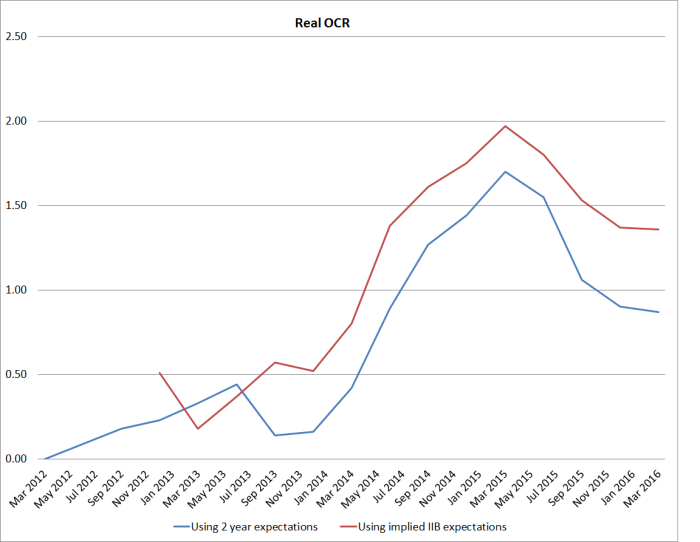
Were they reluctant to try?  Well, probably latterly.  Certainly the evidence is that they haven’t tried.  There has been a lot of focus on last year’s OCR cuts, but recall that they only reversed the previous year’s unnecessary increases.  Here is a chart of the real (inflation adjusted) OCR.

real ocr I’ve shown two versions.  One, which I prefer, deflating the OCR by the two year ahead inflation expectations from the Bank’s survey, and the second using the implied long-term expectations from the indexed bond market.  Whichever measures one uses, real interest rates have been rising not falling in New Zealand over the last few years.  In a climate of such persistently low inflation, that shouldn’t have happened.

It all adds up to a story of a central bank that has been poorly led and managed, and which has not managed monetary policy well.  It hasn’t been held to account well either.

But that doesn’t say the “rules” are wrong, it simply says they haven’t been followed well.  Perhaps we should try operating within the “rules” rather than rush to conclude that there is something wrong with the system itself.    There is no sign that delivering inflation near 2 per cent is impossible, or that it is undesirable, or that doing so would lead to otherwise weird outcomes. Protracted debates now about whether the framework is right is a distraction from the real, immediate, and easily remediable issues: even under the current framework, monetary policy has been, and is, simply too tight.

None of which is to say that we should not from time to time review the rules under which the Reserve Bank works.  I’ve been championing far-reaching governance reforms, to bring the Bank more into line with international best practice, and the way other government agencies in New Zealand are run.  And the Policy Targets Agreement itself expires with the Governor’s term in September next year (which creates timing problems I’ve noted earlier).  I’ve argued here previously that it would be a good idea to follow the lead of Canada, and announce now a joint (and open) work programme, involving the Reserve Bank and Treasury, and outside researchers and commentators, to review the issues around the best design and contents of the PTA.  The last PTA, and those before it, were done largely in secret –  even though the PTA is the main document governing short-term macroeconomic management in New Zealand –  and even now, three years on, the Bank refuses to release any material background papers relevant to that PTA.

We should advance work on both fronts –  governance reform, and open review of the PTA issues in advance of the next renegotiation.  I’m not convinced of the case for material change in the PTA –  or that eg nominal GDP targeting, or wage targeting, or adding an external balance consideration –  would make much practical difference anyway (points I’ve covered in earlier posts).  But the research should be done, and debated, openly, to test and explore the arguments and alternatives.

But the problem at present is not that inflation targeting is being followed too closely, let alone “mechanistically”, or that it is proving overly and inappropriately restrictive.  It is that isn’t being taken seriously by those – the Bank –  with a legal responsibility to do so.


Memo to the Minister: our low inflation is not a good thing

An interview with the Minister of Finance on inflation, monetary policy, and the Reserve Bank was reported in NBR (for those with subscriptions) yesterday.  The story is headed “English drops heavy hint to Reserve Bank” (to cut the OCR).  That may, or may not, have been the Minister’s intention – I suspect it was probably more about getting coverage on the right side of the issue, now that opinion among local economists has started to shift again.  The reporter, Rob Hosking, has appeared to be on the “hawkish” side of the argument until recently, and even in yesterday’s article seems to want to play down how well-established the fall in inflation expectations has become. (The breadth and extent of the falls are illustrated in this post of mine, and in a very good piece put out yesterday by the Westpac economics team.)

But my eye lit on some other comments by the Minister. Perhaps playing distraction, he observed

“While there are these discussions about Reserve Bank performance, you need to think through what the problems and the benefits of persistently low inflation are.  I think it would be worthwhile if the economists articulated those pluses and minuses a bit better.”

In between devoting too much of the last day or so to complying with new regulatory imposts of this supposedly red-tape cutting government (see the Financial Markets Conduct Act), I’ve been pondering the Minister’s question/suggestion and jotting down some notes.  I’m sure he has advisers in The Treasury who can articulate all these points for him, but in case not, here are my perspectives.

Why do we want low inflation?  Because economies work better that way, when (in Alan Greenspan’s words) people don’t have to think too much about inflation in the ordinary course of life and business.  And the tax system assumes inflation away, so high inflation can lead to some really nasty tax effects.

Why do we want stable inflation?  Again, as a predictable backdrop against which people can proceed, negotiating contracts, saving and investing etc.

Why don’t we set the target inflation rate at zero (or even half a per cent to allow for index number biases)?

Two main reasons. The first is a recognition that wages and some prices can be “sticky downwards” so that a modern economy might function less well if we insisted on targeting inflation near zero.  And the second is the lower bound on nominal interest rates.  It isn’t zero, but for the time being it isn’t far below.  With a very low target average inflation rate, average nominal interest rates will also be very low.  If so, when bad things happen (eg the next recession), the central bank might have limited leeway to do much about it.  This argument is less compelling when productivity growth is strong –  since equilibrium real interest rates will be higher –  and more so when productivity growth is weak.

There is a third “reason” in a New Zealand context.  We started out with a target centred on an annual inflation rate of 1 per cent per annum.  Under significant political pressure, successive governments  – including one of which Mr English was himself a junior minister – revised the target upwards in two stages.  It is now centred on 2 per cent –  very similar to the targets in most advanced countries.

All that is by way of prelude.  But it is also to remind the Minister that he has (now twice) signed Policy Targets Agreements in which the Reserve Bank’s target is centred on 2 per cent.  He has statutory responsibilities to assess the Governor’s performance in pursuing the target.  But he also has other powers.  If he so chose, he could invite the Governor to renegotiate the PTA and lower the target range.  Or he could use the section 12 powers of the Act to override the current target and temporarily impose a lower one.  Thus far, he has done neither of those.

When might one be comfortable with inflation being materially below 2 per cent?  One set of circumstances might be those the PTA itself talks of.

For a variety of reasons, the actual annual rate of CPI inflation will vary around the medium-term trend of inflation, which is the focus of the policy target. Amongst these reasons, there is a range of events whose impact would normally be temporary. Such events include, for example, shifts in the aggregate price level as a result of exceptional movements in the prices of commodities traded in world markets, changes in indirect taxes, significant government policy changes that directly affect prices, or a natural disaster affecting a major part of the economy.

When oil prices fall sharply that temporarily lowers the headline inflation rate.  When government taxes and charges are cut that temporarily lowers the headline inflation rate.  In both cases, good economic analysis and the PTA tell the Bank to be content to see headline inflation temporarily dropping away?  Why?  Because these aren’t persistent medium-term pressures, and it is those medium term pressures the PTA rightly focuses on (the stable environment for firms and households).    We deal with these sorts of one-offs with core inflation measures.  There is no one ideal measure but at present, when headline inflation in the most recent year was 0.1 per cent, the median of the various possible core measures is probably not much above 1 per cent.

No one is criticising the Reserve Bank for not reacting to those one-offs (even though the Governor has suggested otherwise).  The debate is about how the Bank should (or should have) responded to low core inflation.

Are there any benefits from having core inflation around 1 per cent at present?  I can’t think of any.

Could there be circumstances in which there would be benefits?  I can think of some.  If, for example, New Zealand (and perhaps the world) was experiencing a period of extremely rapid productivity growth then, all else equal, that would tend to drive down inflation rates everywhere.    Rapid productivity growth would underpin strong investment growth, and support a high level of neutral real interest rates (the marginal product of capital and the real interest rate should be related).  In such a climate one might also envisage a buoyant economy and a low unemployment rate –  plenty of jobs to take advantage of the newly productive opportunities.  In such a world, the Reserve Bank could adjust monetary policy to get inflation back up to around 2 per cent.   But society might reasonably say “why bother”, and consider changing the Bank’s target.    After all, there is no obvious excess capacity or unemployed resources lying round in this example –  the unemployment rate in this fortunate economy might already be below estimates of the NAIRU, and wage inflation would be likely to be strong, supported by the high productivity growth.   Turbo-charging a booming economy might seem rather risky and the arguments for a target centred on, say, 1 per cent rather than 2 per cent might seem reasonably good.  In the same vein, deflation driven by really fast productivity growth is a lot less concerning than deflation simply resulting from weak demand (the latter was the Great Depression story).

But the scenario I discussed in the previous paragraph bears not the slightest resemblance to New Zealand’s current situation (or, as far as I can tell, to that of the rest of the advanced world).

Do we have high, and stronger than normal, trend productivity growth?  No, like almost all advanced countries we’ve seen a marked slowing in productivity growth (labour productivity and TFP) in the last decade or so.

Do we have abnormally low unemployment rates?  Again no, even at 5.3 per cent –  which the respondents in the Reserve Bank’s recent survey don’t expect to be sustained –  the unemployment rate is well above most estimates of NAIRU.  Consistent with the excess capacity and low productivity growth, wage inflation is low and is expected to fall further.

We are also adjusting to a significant adverse terms of trade shock.  For all the talk of cheaper goods and services from abroad, the terms of trade have been falling.  When the terms of trade are falling we would normally expect to see the exchange rate falling, and domestic prices rising as a result. Core inflation measures never manage to capture all that effect, so that if anything in a weak terms of trade environment one might expect to see inflation running temporarily a bit higher than target.  Our exchange rate has not fallen very much (see the comparison with Norway), but that is partly because the Reserve Bank has presided over rising real interest rates over the last couple of years,  rather than cuts.

And, although it is becoming less of an issue now, the exogenous large boost to demand and activity resulting from the Canterbury earthquakes is yet another reason why one might have been more comfortable with inflation a bit above target, rather than well below, over the past few years.  Lots of resources needed to be diverted to the repair and rebuild process, and changes in relative prices are typically part of getting those resources in place.  Changes in relative prices need not boost the overall price level –  monetary policy can simply act to counteract them.  But, within limits, it generally isn’t sensible to do so.  We wanted the economy pushed as hard as was prudent, to get the repairs done and as much other stuff still  happening as possible. That probably implied a one-off lift in the price level –  of the sort suggested by the PTA itself (see references to natural disasters in the quote above).

Recall that the New Zealand recovery in the last few years has been the weakest and most anaemic in modern history.  Had it been the other way  – really unusually strong sustained growth –  again one might have been content to have monetary policy lean a little against the boom.  But it has been nothing of the sort –  instead we’ve had weak per capita growth, weak productivity, lingering unemployment, all in the face of a huge exogenous demand shock.

Those are sorts of combinations of circumstances in which discretionary monetary policy should be doing its utmost, not looking for excuses to justify repeat inflation outcomes well below the agreed target.

What about house prices?  I’m sure that in some minds, high house prices –  and the risk of them rising further –  is a consideration in opposing OCR cuts.  I might even sympathise with that logic if there had been broad-based large increases in real house prices and rapid supply-led growth in credit.  But again, that isn’t the story. In most of the country, real house prices are no higher, or materially lower, than those at the peak of the last boom.  Credit to GDP or credit to disposable income ratios have not risen in almost a decade, and most housing credit growth appears to be an endogenous response to higher house prices themselves.  There are real and substantial affordability problems in Auckland, but there is no real mystery about what has gone on there: the government runs an immigration policy that channels tens of thousands of people into a city, and then does not have a legislative framework in place the allows the physical size of the city to grow commensurately with the rapid population growth.  That just isn’t a consideration that monetary policy should be driven by – it is a relative price change, and the cost to the rest of the underperforming economy of using monetary policy is just too high.  Past Reserve Bank research has shown, quite plausibly, that it takes potentially hundreds of points of OCR changes to have any material impact on aggregate house prices.

We have a 2 per cent inflation target.  There is simply no good reason for us (or the Minister) to be content for the Reserve Bank not to meet that target (in core or underlying terms).   As I noted yesterday, the shocks and pre-conditions New Zealand faced should have made it easier to have meet the target here than other countries may have found it.  And none of the circumstances that might make one relaxed about a persistent undershooting of the target are present here now. We’ve simply been the victims of a poorly run monetary policy.  Under the New Zealand legislation, the Minister is the public’s agent who is supposed to sort out that underperformance.

Finally, in case anyone doubts the slow productivity growth story here is chart of TFP, based at the point when the Conference Board’s data start in 1989.  I’ve shown here the median of the West European, North American, and Oceania advanced economies (a group for which there is data all the way back), and the line for New Zealand.

tfp conf board

New Zealand’s performance has been pretty dire for a long time, but we’ve shared in the marked deterioration evident across the advanced world in recent years.  This is simply not a climate in which the wonders of human ingenuity are driving productivity strongly upward and driving prices more strongly down than usual. It is a climate in which monetary policy should do what it can, when it can. In New Zealand there are no material constraints, and neither we –  nor the Minister –  should be content with what has been being delivered.