LVRs, interest rates and so on

I was recording an interview earlier this afternoon, in which the focus of the questioning was the Real Estate Institute’s call for some easing in the Reserve Bank’s LVR restrictions.

Of course, I never favoured putting the successive waves of LVR restrictions on in the first place.  They are discrimatory –  across classes of borrowers, classes of borrowing, and classes of lending institutions –  they aren’t based on any robust analysis, as a tool to protect the financial system they are inferior to higher capital requirements, they penalise the marginal in favour of the established (or lucky), and generally undermine an efficient and well-functioning housing finance market, for little evident end.  Oh, and among types of housing lending, they deliberately carve-out an unrestricted space for the most risky class of housing lending –  that on new builds.

That doesn’t mean I think it is remotely likely that the Reserve Bank will be easing the restrictions any time soon –  apart from anything else, it would leave their consultation paper on debt to income ratio restrictions looking a little silly.   Of course, it would be good if the Reserve Bank did lay out some specific criteria for lifting these ostensibly temporary restrictions, but with the toxic brew of rapid population growth and continuing land use restrictions in place, if I saw the world as they seem to, I wouldn’t be in a hurry to lift the restrictions either.

In any case, it isn’t that clear quite how large a role the LVR restrictions are playing in the reduction in sales volumes.   They must be playing a part, but so too will higher interest rates, and the apparent increase in banks’ own lending standards, and pressure through the parents from APRA (on the lending standards across the whole of Australian banking groups).  Which, of course, is also why it isn’t clear quite how much difference any easing back in the New Zealand LVR controls might make.  Some presumably, but even the Reserve Bank has never claimed that LVR controls would have a very large impact on house prices, or housing market activity, for very long.   And while I noticed an article this morning about negative equity, it is worth bearing in mind that, on the REINZ index (not using median prices), house prices have risen 65 per cent in the last five years, and are currently 0.6 per cent off their peak.

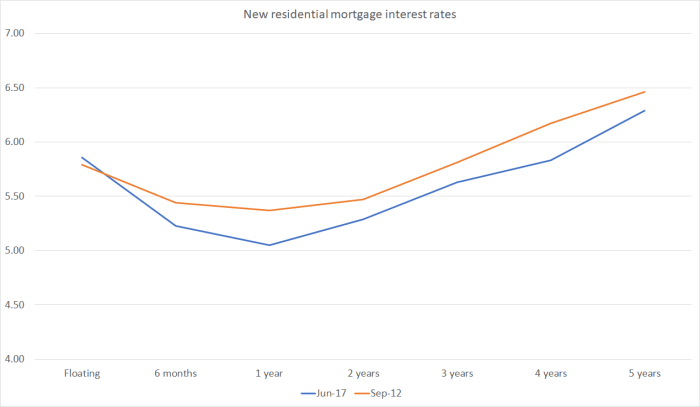
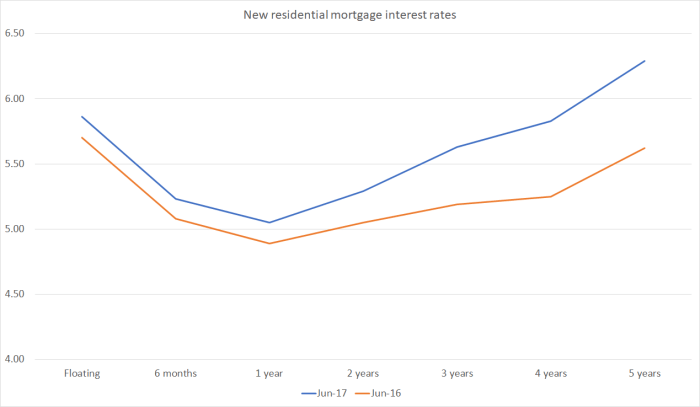
But what of interest rates?  A year ago, the OCR was 2.25 per cent, and today it is 1.75 per cent.  Thus, the Reserve Bank talks of having eased monetary policy.   Here are mortgage rates though.

mortgage ratesI don’t suppose anyone is taking out four or five year fixed rate mortgages, but across the entire curve, interest rates are higher not lower.   Or we could go back another year or so, to just prior to when the Reserve Bank began cutting the OCR.   The OCR has been cut by 175 basis points since then.   Even at the shortish end of the mortgage curve, rates are down only 50-70 basis points.

Having been reflecting this morning on Graeme Wheeler’s performance over his term, I had a look back at where interest rates were when Wheeler took office in September 2012.

mortgage rates sept 12Barely lower, even though core inflation –  on their own favoured measure – is as low today as it was then (and has been consistently low throughout his term).

I wondered if there were offsetting factors but:

  • Two year ahead inflation expectations are about 25 basis points lower than they were then (largely offsetting any reductions in nominal mortgage rates, to leave real rates little changed)
  • the TWI measure of the exchange rate is a bit higher than it was then,
  • the ANZ commodity price index, in inflation-adjusted world price terms, is hardly changed from what it was then.

Of course, the unemployment rate has fallen since September 2012, but there hasn’t been any sign of a pick-up in the best indicator of labour scarcity –  real wage inflation.

So, overall, it is a bit of a puzzle how the Governor expected to get core inflation back to fluctuating around the target midpoint without actually easing monetary conditions.  I don’t happen to agree with him on this one, but he keeps talking about how the huge migration inflows have reduced net inflation pressures (supply effects outweighing the demand effects).  If he really believes that it is even more puzzling that monetary conditions haven’t been eased.

I’m not sure how he’d respond.  But perhaps he could explain that too in the forthcoming speech.


WCC approach to housing problems: hot-bedding

I think the imported chief executive of the Wellington City Council, Kevin Lavery –  he of non-transparent subsidies to Singapore Airlines, and the like – must have pushed “send” on an email to staff without checking just who he was sending it to.   My household just received two copies, on two different email addresses, of what looks a lot like a staff email.  Since we used those two email addresses to make our separate submissions last night on the Island Bay cycleway –  and the Council otherwise wouldn’t have one of the addresses –  it looks as though he sent his staff email to online responders to the cycleway proposals

Most of it looks harmless enough, although it was wryly amusing to note the self-congratulation about the Council’s Annual Report

Congratulations to everyone involved with our 2015/16 Annual Report, which received a silver medal at the Australasian Reporting Awards. The award is a reminder that the public documents we produce are not just about our performance as an organisation – they are also an opportunity to communicate effectively with our stakeholders.

When this is the same Council that simply refuses to comply with the Official Information Act, in its local government manifestation.   Self-promotion, rather than transparency, is rather more like the hallmark of the council.

But included in the email was a “Good Reads” section, with links to various articles on housing and cities related issues.    Perhaps next time he could make room for Brendon Harre’s interesting new piece on “Successful cities understand spatial economics”. Out of interest, I did click on one of the links, described this way

Some interesting ideas from outside of New Zealand at possible solutions to housing affordability issues. I like this because it looks, with a different lens, at the challenge of providing adequate, secure and affordable housing and suggestions for tackling them.

Sounded promising.

But I was somewhat taken aback by what I found, in an article championed by the chief executive of a Council that is keen on promoting Wellington as a cool, successful, and prosperous city.

The author –  a freelance writer in the US –  is writing about a report from something called the World Resources Institute, on housing options.  Not mind, housing policy options for advanced countries, but for

the global south (India, Africa, Asia, Latin America) where the lack of affordable, adequate and secure housing in cities is projected to grow the fastest.

We are told that

The paper spotlights three key challenge areas “to providing adequate, secure and affordable housing in the Global South,” as well as suggestions for tackling them. They include the growth of informal or substandard settlements (i.e., slums), policies and laws that push poorer residents out of the city, or to its fringes, and, interestingly, an overemphasis on home ownership.

The authors apparently favour skewing the tax system to “incentivise renting”.

It gets worse

Beyond the policy-side, however, it also looks at a number of creative rental models, from land leases and co-ops to lump-sum rentals, which are popular in a number of Asian countries, including Thailand, China and India. …… The paper also makes a case for a practice known as “hot bedding,” in which “a bed space in a shared room is rented for a specific number of hours to sleep, typically 7 to 10 hours.”

Hot-bedding………

In conclusion,

“Promoting a range of rental housing options expands opportunities for more renters while testing which types of rentals best meet local demand,” the authors conclude.

I’m all for flexibility, but does the chief executive of the Wellington City Council really think that “hot bedding” is an appropriate or desirable solution for the increasingly unaffordable Wellington housing market?   Is his vision of the city he temporarily serves now so diminished he regards the growth of slums as the sort of pragmatic idea his staff should be interested in, to fix the mess the Council itself has created?

To be clear, I’m sure Mr Lavery believes none of those things.  And perhaps they are reasonable and practical partial solutions in very poor but rapidly urbanising countries.  But what does it tell us about his mindset – and that of his political masters –  that this is the sort of stuff he is encouraging his staff to read?    Most New Zealanders –  most Wellingtonians –  want to own their place.  They don’t have much tolerance for imported bureuacrats who think that home ownership

in many economies just takes up too much mental bandwidth

They are just excuses for the decades-long failure by New Zealand central and local governments.

Free up the land use rules instead. There is plenty of land in greater Wellington, but owners simply aren’t encouraged, or even allowed, to use it.  And look for creative ways of allowing greater density where people would prefer that, but in ways that respect the interests of current owners.  Above all, look and sound as if you think Wellington might have a future as a first world city, in which residents –  present and future –  might be able to buy good quality housing at genuinely affordable prices.

But “hot-bedding”………I still can’t quite believe it.  But it was good of Mr Lavery to send his email to (presumably) the wrong list of recipients, and thus shed further light on the sort of mindset that prevails at council headquarters.

UPDATE: While I was typing that another email arrived

For those of you who’ve unexpectedly received an email from Wellington City Council – we apologise profusely! The message from our Chief Executive was meant to be a routine communication to Council staff but we’ve hit the wrong button and so it’s received a considerably wider audience. Hopefully it provides a positive, albeit unintended, glimpse inside the engine-room of the Council.

“Positive” –  I think not.


Monetary policy, the Governor etc

In a post a couple of weeks ago I highlighted the extent to which monetary conditions appeared to have been tightening over the last few months, even as the OCR has been kept steady at 1.75 per cent.  Specifically, retail interest rates (lending and deposits) have increased, and the exchange rate has risen.  In addition, but less amenable to easy statistical representation, credit conditions have tightened, through some mix of Australian and New Zealand regulatory interventions and banks’ own reassessments of their willingness to lend.    Over this period there has been no acceleration in economic growth and inflation (whether goods or labour) hasn’t been increasing.  If anything, core measures of inflation –  already persistently below target –  have been falling away.

Yesterday the Reserve Bank released the results of the latest Survey of (business and economists’) Expectations.    The Reserve Bank has recently changed the survey, dropping a number of useful questions altogether, and missing the opportunity to plug some key gaps (eg there are no surveys in New Zealand of expected net migration).  They’ve also added some useful new questions, but for the time being are refusing to release the results of those questions –  including those around OCR expectations, house price expectations, and longer-term inflation expectations.

But one set of questions I was a little surprised that they left unchanged were those around monetary conditions.  I like the questions but it is a long time since I’ve seen anyone else write about the results.   Respondents are asked to indicate what their perception of current monetary conditions is (on a seven point scale, where four is neutral).  And then they are asked the same sort of question about expectations for the end of the following quarter and a year hence.

Broadly speaking, respondents tend to describe monetary conditions –  or at least changes in them –  as one might expect.   Here is the perception of current monetary conditions, dating back to the start of 1999 when the OCR was introduced.

mon condtions current

The peak in the series was right at the peak of the last OCR cycle, where the OCR was raised to 8.25 per cent.   Since then, although the Governor likes to describe monetary policy as extraordinarily accommodative, respondents have never thought that monetary conditions have been (or are) anywhere as easy as they were tight in 2007/08.  (When I completed the latest survey, I described current conditions as just a bit tighter than neutral.)

Note that latest observation.  Respondents reckon that monetary conditions have tightened.   The increase doesn’t look that large, and does come after a fall in the previous quarter.    But, the larger increases tend to occur either when the OCR is actually being raised, or when the Reserve Bank is talking hawkishly about the probable need for further OCR increases (thus, you can see the two big increases in 2014, when the Bank was in the midst of what it was talking of as 200 basis points of OCR increases).

But perhaps more interesting is that respondents also expect conditions to be quite a bit tighter by the end of the year, and again by the middle of next year –  and all that with no Reserve Bank encouragement at all.    And –  I would argue –  none from the underlying economic data either.

mon conditions ahead.png

The scale of the increase in the last few quarters is comparable in magnitude to the increase in 2013/14 when the Reserve Bank was talking up, and delivering, significant OCR increases.

Quite why respondents –  completing the survey in late July –  are expecting so much tighter is a bit of a puzzle.  But if it isn’t down to the Reserve Bank itself, or to the underlying economic/inflation data, perhaps it is reflecting trends respondents are observing –  the rising retail interest rates, high exchange rate and tightening credit conditions –  and that they are assuming that those things won’t reverse themselves, and may even intensify.

Personally, I think the case for somewhat easier monetary conditions is relatively clear at present: weak inflation, unemployment still above NAIRU, weak wage inflation, and a housing market that seems weaker than the toxic mix of land use restrictions and continued rapid population growth would warrant.  (To be clear, I’m not making a positive case for higher house prices inflation – though more housebuilding would be welcome –  just noting that the housing market is where, if overall conditions were about right (for the economy as a whole), we should be seeing continuing high inflation.)

Against that backdrop, I think it would be highly desirable for the Reserve Bank to make the point explicitly on Thursday that the economy has not needed, and does not now appear to need, tighter monetary conditions, and that some easing would be welcome and appropriate.    As I noted in the earlier post, I’m not sure it would really be appropriate for the Governor to cut the OCR –  given that (a) he hasn’t foreshadowed such a move, and (b) that this is his last OCR decision.    In a well-governed central bank –  such as almost every other advanced country has –  a change of Governor is less important: however influential the Governor’s views are, in the end he or she has only one vote in a largish committee.  All the other voters will still be there the next time an interest rate decision is made.

The problems here are compounded by the (a) the forthcoming election, so that no one knows what regime (what PTA) monetary policy will be being made under in future, (b) by the fact that we only have an acting Governor –  an illegal appointment at that – for the next six months, and people in acting roles are often loath to do anything they don’t strictly have to, and (c) by the lack of transparency in the Reserve Bank’s systems and processes.  When, say, Janet Yellen or Phil Lowe took up their roles as head of the respective central banks we knew a lot about how they thought about monetary policy.  Same goes for Mark Carney –  even though what we knew about him was from another country.    There is almost nothing on record as to how Grant Spencer these days thinks about monetary policy.  Even if he is to operate –  illegally –  under a (purported) PTA that is the same as at present, the PTA captures only a small amount of what is important to know: what matters as least as much is how the individual thinks about and reacts to incoming data.  With no speeches, no published minutes, no published record of the advice he has given the Governor on the OCR we know very little at all.

It is a model that badly needs fixing.  We simply shouldn’t be in a position where one person holds so much power, and hence their departure leaves such a vacuum (especially when, as will inevitably happen from time to time, such changes occur around election time).    We know that the Opposition parties are promising change –  roughly speaking in the right direction, although the details need a lot of work –  but what the National Party has in mind remains a mystery.   Treasury is refusing to release any of the versions of Iain Rennie’s report on central bank governance, claiming that the matter is under active consideration by the Minister of Finance.  That is a dodgy argument anyway –  since Rennie’s report to The Treasury is not the same as Treasury’s advice to the Minister (something I haven’t requested) –  but since they’ve had the final report for months now,  it shouldn’t be unreasonable to expect some steer from the Minister as to what his response might be.  As I’ve noted before, with the process of choosing a new Governor underway, at present neither candidates nor the Board have any real idea what a key aspect of the job might be.

The problems around “one man governance” aren’t restricted to monetary policy.   The Deputy Governor, Grant Spencer, gave a thoughtful speech the other day on “Banking Regulation: Where to from here?”.  But in a sense, the problem was in the title.  The Governor personally makes the policy decisions, and the Governor is leaving office next month.  Spencer will be minding the store –  illegally –  for a few months, and then retires early next year.  As we’ve seen in the past, the particular person who holds the role of Governor can make a big difference to the character and specific direction of regulatory policy –  LVR restrictions, for example, were (for good or ill) a legacy of Graeme Wheeler personally (and the earlier hands-off disclosure driven model, a legacy of Don Brash personally).  So in many respects it makes no more sense for Grant Spencer to be giving speeches on “where to from here” for bank regulation than it does for Steven Joyce to give such a speech on where to from here with tax policy.  In Joyce’s case, at least it is a campaign speech –  he hopes to still be in place next year, whereas Wheeler and Spencer will both be gone.  Neither they nor we know what their successors’ inclinations might be.

Again, that isn’t good enough.  We’ve personalised control of a major area of policy, when the general practice, here and abroad, is that when technocratic agencies exercise regulatory power they do so through boards that provide considerable continuity through time.  Individuals come and go, but they do so one at a time, and in a way that doesn’t dramatically change the balance of the board in the short-term.  That provides stability and predictability for both the institution itself, for those we are regulated (or indirectly but materially affected by regulation) and for those –  citizens –  with a stake in the agency.     We are well overdue for significant governance reforms to the Reserve Bank legislation.  And to say that is not to criticise the individuals –  Wheeler, or Spencer – who have to operate with the law as it stands it present, inadequate as it is.   The responsibility for the inadequate legislation  –  the iunadequacies of which have been brought into sharper relief in the last few years –  rests with ministers and with Parliament.

In closing, I do hope that when journalists get to question the Governor, and when later in the day FEC members get the same opportunity, they will not overlook the egregious and inexusable behaviour –  not sanctioned by any legislation –  by the Governor, his deputies, Geoff Bascand and Grant Spencer, and his assistant John McDermott –  in attempting to silence Stephen Toplis when they disagreed with some mix of the tone or content of his commentaries on them.     The intolerance of dissent, and the abuse of office, on display then aren’t things that can simply be let go silently by.   I’m as appalled as anyone by the lack of contrition Metiria Turei has displayed over her acknowledged past benefit fraud.  But bad as that is, abuse of high office by senior incumbents is, in many respects, a rather more serious threat.  Our elites seem to have become all too ready to do hardly even the bare minimum to call out, and expose, unacceptable behaviour by the powerful.  Here, we’ve seen no contrition, we’ve seen a Treasury advising the Minister to ignore the behavour, and a Minister of Finance –  legally responsible for the Governor –  happy to walk by on the other side, saying it is nothing to do with him.

(It was nonetheless interesting to read the BNZ’s preview pieces for this week’s MPS.  Perhaps they were just chastened by the data having not gone their way, or perhaps the heavy-handed pressure from the Governor really did work, because the tone (and spirit) of these latest commentaries is very different from what we saw –  and what so riled the Governor  –  in May.   Personally, I thought –  and think –  that the Governor’s May monetary policy stance was more appropriate than the BNZ’s, but that isn’t the point.  Our system is supposed to thrive on vigorous debate, and one isn’t supposed to lose the right to challenge the powerful just because in this case the Governor happens to regulate the organisation employing the critic.)


Unemployment: ethnic differences

Having written last Friday on some of the differences in unemployment rates by age cohort, I got curious about the HLFS data broken out by ethnicity.  I’ve never paid much attention to it –  much of the data hasn’t been published for long, and my main interest has always been macroeconomics (the whole economy, rather than specific outcomes for particular subgroups).

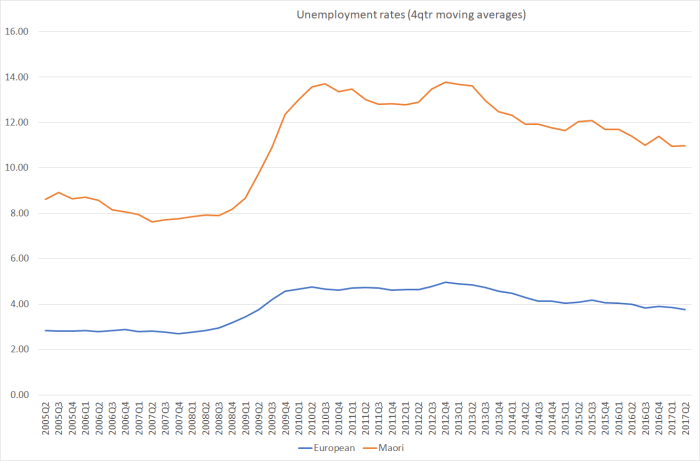
But many of the ethnic differences are stark.   Here, I will mostly focus on those between those identifying as European and those identifying as Maori.

Take the headline unemployment rates for example (the longest run of data I could find on Infoshare).

U by eth

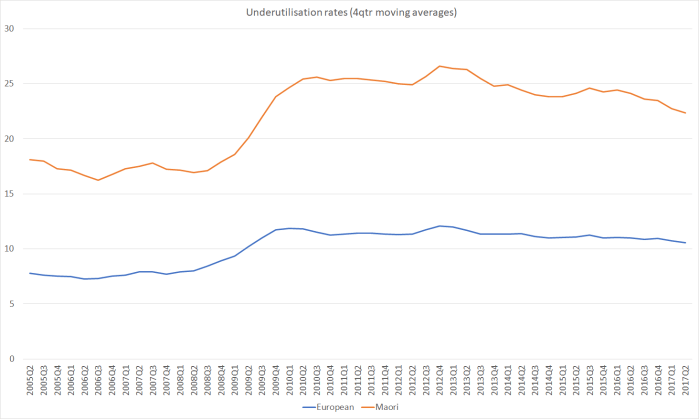
or the underutilisation rates

underutil by eth

The European numbers are bad enough –  10.5 per cent of the labour force underutilised –  but the Maori numbers are astonishing.  22.4 per cent of the Maori labour force underutilised is a sad reflection of (probably) a whole series of failures.    Perhaps because the numbers are so large, the gap between the Maori underutilisation rate now and that prior to the recession is visibly stark.

As I illustrated last week, labour market characteristics differ quite a lot by age cohort, and the Maori population is, on average, quite a bit younger than the the European population (both because of higher birth rates and because of lower life expectancy).

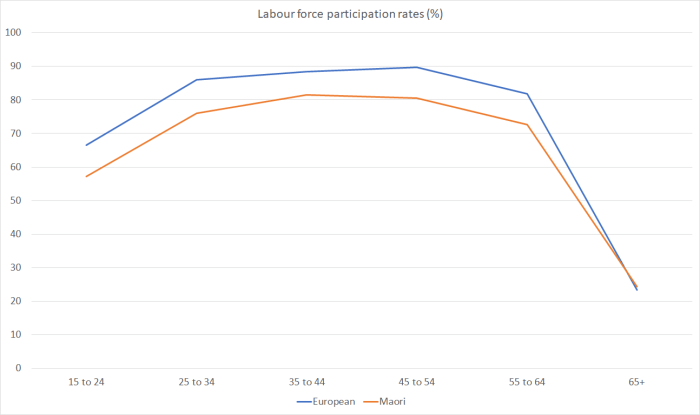
But even when one looks by age cohort, the differences between Maori and European outcomes are stark.   Overall labour force participation rate of Maori and Europeans aren’t so very different –  on average over the last three years, 67.2 per cent of working age Maori were in the labour force, and 70.2 per cent of Europeans.   But here are participation rates by age cohort for the two ethnic groups.

partic by age eth

In every cohort, except the 65 plus group, the European labour force participation rate is materially above that for Maori –  on average by almost 10 percentage points.   I’m not sure what to make of the 65 plus group, where Maori and European participation rates are almost equal.   It may be, at least in part, a reflection of greater Maori relative poverty (less success in building up wealth over earlier years).

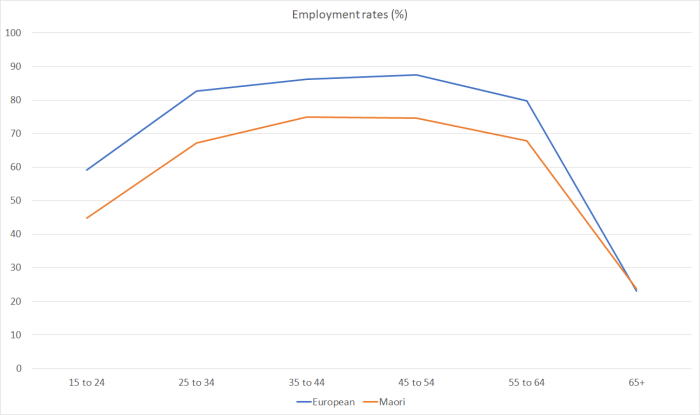
The picture is even more stark if one looks just at employment rates (given that Maori unemployment rates are higher).

empl rates by age eth

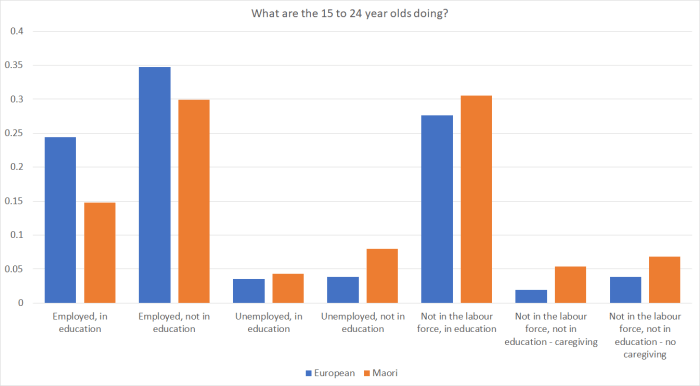
Focusing in on young people, here is what the data show people aged 15 to 24 are doing (again averaged over the last three years).

15 to 24

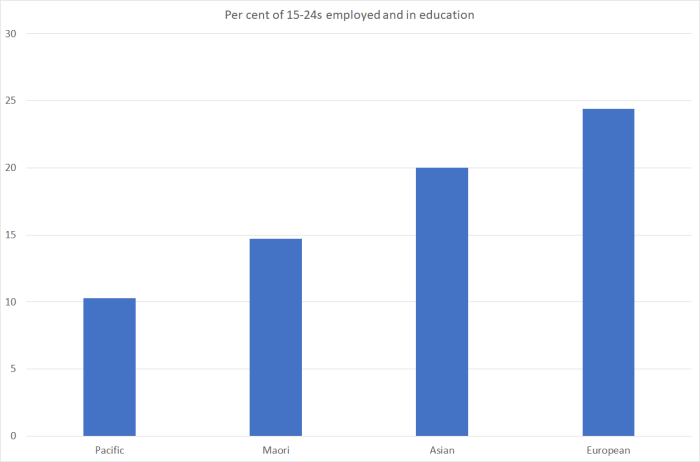
Interestingly, a slightly larger proportion of the the Maori young population are in education and not simultaneously in the labour force than is the case for young Europeans.     Perhaps the most visible difference on that chart is the first set of bars –  the much larger proportion of European young people simultaneously working and studying than for Maori.      Here is a chart (over the same three years) of that one component for each of the four ethnic groups SNZ reports the results for.

15 to 24 employed

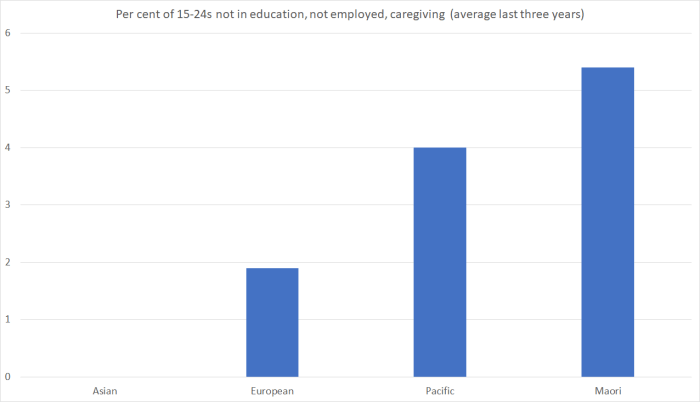
I did notice the difference in the “not in education, not in the labour force –  caregiving” proportions.  Here is that chart for each of the four ethnic groups.

15-24 caregiving

SNZ reports no (statistically significant) numbers of young men in this category.  In other words,  around 11 per cent of young Maori women are engaged in full-time caregiving (presumably mostly for young children), doing no study or even an hour’s paid work (the HLFS criterion) a week.   By contrast no (statistically significant numbers of) young Asian women are.

I’m not going to attempt to hypothesise about why the differences in these various charts (or various others in the data) exist.  But none of the gaps strike me as things simply to be relaxed about.   Says he who is –  contentedly – not in the labour force, not in education, and is caregiving children.

Unemployment: age matters

Despite the reaction of the foreign exchange market, there didn’t seem to be much new in the suite of labour market data the other day.  Sure, employment was down a touch, and the participation rate fell back.  Then again, it had been hard to take entirely seriously the reported strength of the participation rate over the last year or so.  And the unemployment rate did keep edging downwards (although at this rate it will take another two years until the unemployment rate is back to where it was when the current government took office) and hours worked, in both the HLFS and QES, grew quite strongly.   And there wasn’t much sign of any pick-up in wage inflation.  So unless you had been determined to believe the data was  just about to confirm an overheating economy, probably not too many surprises.  We’ll see next week what the Governor of the Reserve Bank makes of it.

But, largely prompted by a question in Parliament yesterday, I downloaded the age breakdowns in the HLFS.  Unemployment rates are very very different by age cohort.

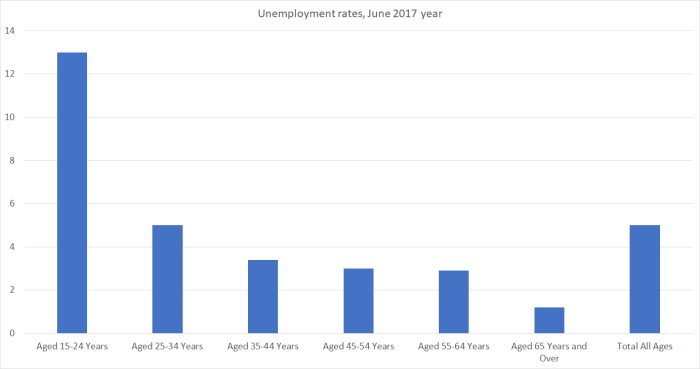
Here are official unemployment rates for the latest year, by age.

U rates by age

People aged 15-24 and people aged 65 and over make up roughly the same share of the total working age population (about 18 per cent each).    But people in the young cohort make up 45 per cent of the total number of people unemployed, while over 65s make up 1.5 per cent of the unemployed.

And that difference isn’t something new.  Here are the average shares of the total number of people unemployed, by age cohort, for the entire history of the HLFS.

U by age avg

The age patterns shouldn’t be terribly surprising.    At one end of the spectrum,  young people are often in part-time work, dropping in and out of jobs (voluntarily or not), in transition between school, work, and further study, even in the course of a single year.  And, of course, they are just starting out –  finding out what they might be good at, or might enjoy, and proving themselves (or not) to employers.   High minimum wages (relative to median wages) hit younger people harder than other age groups.

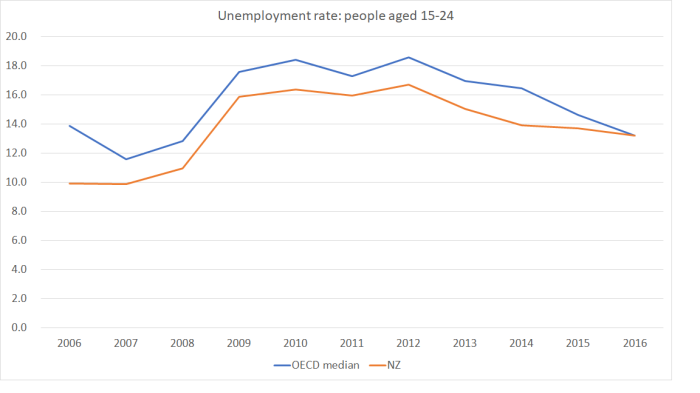
Every OECD country has an unemployment rate for 15-24 year olds materially higher than the overall unemployment rate –   although as I was confirming that I was a little surprised to discover that although our overall unemployment rate has been consistently below that of the median OECD country, our unemployment rate for young people is now as high as that in the median OECD country.

U 15 to 24

At the other end of the age spectrum, by contrast, work is typically much more of a choice.  Almost everyone living here aged 65 or over is entitled to NZS, the state pension.  If old people are working, they probably aren’t changing jobs very often –  their circumstances are rarely changing as rapidly –  and if for some reason they lose their job, they may not be particularly aggressive in looking for a new job. Recall that the official definition of unemployment involves actively searching for work and being available to start right away.  With a stable income buffer, that search of active search is likely to be less imperative for most than it will be for young people just starting out.

It is relatively easy to understand why there are quite high unemployment rates for young people and quite low ones for old people.  But these differences can matter for how we think about the overall unemployment rate if the importance of different age cohorts in the labour market has been changing over time.  It has.

age shares of lab force In the early 90s 5 per cent of old people were in the labour force (working or actively seeking), and now that figure is almost 25 per cent.  By contrast, the labour force participation rate for 15-24 year olds is now only around 63 per cent (it was 74 per cent when the HLFS began).    (Frankly, the drop in youth participation rates surprises me a bit given that (eg) university fees are much much higher than they used to be, and that one has to work only an hour a week to be counted as employed so, for example, after school jobs should be captured.)

The change in the age structure of the work force does then affect how we think about any particular rate of unemployment.   The natural rate of unemployment for young people –  normal frictional stuff –  is materially higher than that for old people, so that a 5 per cent aggregate unemployment rate means something different than a 5 per cent unemployment rate does today.

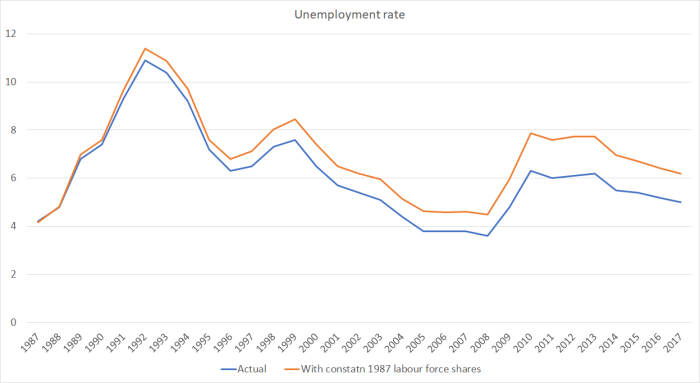
One way of illustrating the point is shown in this chart.  It shows the actual reported unemployment rate, and also an artificial unemployment on the assumption that each age cohort had the same unemployment rate is actually had, but that the relative size of the various age cohorts was the same as it was in 1987 (the first year for which there is data).

U rate age adj

For the last year, the actual unemployment rate was 5 per cent.  With constant age chort shares, it would have been 6.2 per cent.    It isn’t an effect that makes much difference from year to year, but over time it can materially affect how we look at any particular unemployment rate.    In effect, and all else, the change in composition of the labour force –  more old people, fewer young people, –  appears to have lowered the NAIRU.

As one final chart, here is the change in the unemployment rate (in percentage points) for each age cohort, from the year to June 2008 (the previous cyclical low point) to now (year to June 2017).

U chg by age

The overall unemployment rate is still 1.4 percentage points higher than it was then.   There has been almost no change in the unemployment rate for the over 65s –  which isn’t surprising as, for reasons outlined above, there is very little cyclicality in that series. On the other hand, it is quite sobering how large an increase in the unemployment rate for 15 to 24 year olds there has still been.   Some of that is cyclical, and some will likely reflects the effects of higher minimum wages, but whatever the cause it should be cause for disquiet, given how important it is to get a start in the labour market and to stay connected.


A fresher approach for ordinary New Zealanders

I’m as fascinated by the rise of Jacinda Ardern as any other political junkie.  I’ve always been a bit puzzled, struggling to see what issue she has led or what blows she had managed to land on the government.    Then again, she seems to have something different –  perhaps even more electorally important.   I’ve been dipping into accounts of Bob Hawke’s rise –  the last case I’m aware of that where major opposition party changed leaders close to an election (in that case only four weeks out) and won.     It isn’t clear that Bob Hawke was a better Prime Minister than Bill Hayden might have been, or that David Lange was a better Prime Minister than Bill Rowling would have been, but in both cases the new leaders had something –  a degree of connection, engagement etc –  that the deposed leaders didn’t.     Reading the accounts of the last weeks of Bill Hayden’s leadership of the ALP, the party had become as disheartened and lacking belief in its own ability to win (despite still leading in the polls), as some suggest the New Zealand Labour Party had become.    Quite what the Ardern phenomenon amounts to I guess we’ll see over the next few weeks.  From her comments so far, I could imagine her campaigning as Hawke did –  both the upbeat theme of “reconciliation”, and the more cynical description in (sympathetic) leading Australian journalist Paul Kelly’s book “no avenue of vote-buying or economic expansion was left untouched”.

For now, we are told that the “Fresh Approach” slogan is apparently out, and a new slogan and some new policies are soon to be launched.  Since no party really seemed to be campaigning on policies that might make a real and decisive for ordinary New Zealanders’ prospects, in many respect a fresher approach should be welcome.  Of course, it rather depends what is in that policy mix.

My interests here are primarily economic.  In an interview with the Dominion-Post this morning, the journalist put it to Ardern that “National will campaign on its economic record. Is that where Labour is weak?”.     Perhaps it is Labour’s weak point.  But what sort of “record” is the government to campaign on?  An unemployment rate that, while inching down, has been above the level it was when they took office –  already almost a year into a recession –  every single quarter of their entire term?  An economy that has had no productivity growth for almost five years?     House prices that, in our largest city, have gone through the roof?  Exports that are shrinking as a share of GDP?    And, at best, anaemic per capita real GDP growth?   If it is a weakness for Labour, it must be in large part because (a) their messaging has been terrible, and (b) nothing they offer seems likely to make any very decisive difference to the mass of ordinary New Zealanders.

What might?   Here’s my list of three main sets of proposals.    An effective confident radical Labour Party could offer the public these sorts of measures –  in fact, on some points arguably only a left-wing party could effectively do so (Nixon to China, and all that).

  1. A serious commitment to cheap urban land and much lower construction costs.
    • In a country with abundant land, urban land prices are simply scandalous.   The system is rigged, intentionally or not, against the young and the poor, those just starting out.  Too many of Jacinda Ardern’s own generation simply cannot afford to buy a house.
    • To the extent that there are poverty and inequality issues in New Zealand, many of them increasingly trace back to the shocking unaffordability of decent housing.   With interest rates at record lows, housing should never have been cheaper or easier to put in place.
    • And yet instead of committing to get land and house prices down again, the Labour Party has been reluctant to go beyond talk of stabilising at current levels.  Talk about entrenching disadvantage……(and advantage).
    • It is fine to talk about the government building lots of houses, but the bigger –  and more fundamental –  issue is land prices.  It is outrageous, and should be shameful, for people to be talking of “affordable” houses of $500000, $600000 or even more, in a country of such modest incomes.  International experience shows one can have, sustainably, quite different –  much better –  outcomes, but only if the land market is substantially deregulated.
    • I don’t have any problem if people want to live in denser cities –  I suspect mostly they don’t –  but it is much easier and quicker to remove the boundaries on physical expansion of cities (while putting in place measure for the associated infrastructure).   Labour’s policy documents have talked of moves in this direction –  as National’s used to do –  but it is never a line that has been heard from the party leader.     If –  as I propose –  population growth is cut right back, there won’t be much more rapid expansion of cities, but make the legislative and regulatory changes, and choice and competition will quickly collapse the price of much urban, and potentially developable, land.
    • It is clear that there is also something deeply amiss with our construction products market –  no one seriously disputes that basic building products are much more expensive here than in Australia or the US.  Make a firm commitment to fix this.  Perhaps it involves Commerce Commission interventions (supported by new legislation?)?  Perhaps it might even involve –  somewhat heretically –  a government entity entering the market directly.     But commit to change, to producing something far better for New Zealanders.
    • The vision should be one in which house+land prices are quickly –  not over 20 years –  headed back to something around three times income.  A much better prospect for the next generation.
    • No one will much care about rental property owners who might lose in this transition –  they bought a business, took a risk, and it didn’t pay off.  That is what happens when regulated industries are reformed and freed up.    It isn’t credible –  and arguably isn’t fair –  that existing owner-occupiers (especially those who just happened to buy in the last five years) should bear all the losses.   Compensation isn’t ideal but even the libertarians at the New Zealand Initiative recognise that sometimes it can be the path to enabling vital reforms to occur.  So promise a scheme in which, say, owner-occupiers selling within 10 years of purchase at less than, say, 75 per cent of what they paid for a house, could claim half of any additional losses back from the government (up to a maximum of say $100000).  It would be expensive but (a) the costs would spread over multiple years, and (b) who wants to pretend that the current disastrous housing market isn’t costly in all sorts of fiscal (accommodation supplements) and non-fiscal ways.
  2. Deep cuts in taxes on business and capital income
    • the political tide is running the other way on this one –  calls for increased taxes on foreign multi-nationals and so on –   but it remains straightforwardly true that taxes on business activity are borne primarily not by “the rich”, but by workers, in the form of lower incomes than otherwise.  So if you really care about New Zealand workers’ prospects, cut those taxes, deeply.
    • and one of the bigger presenting symptoms of New Zealand’s economic problems is relatively low levels of business investment.   Taxes aren’t the only thing businesses  –  and owners of capital  –  think about, but they are almost pure cost.   Tax a discretionary activity and you’ll get a lot less of it.   That is especially true as regard foreign investment –  those owners of foreign capital have no need to be here if the after-tax returns aren’t great.  For all the (mostly misplaced) concerns about sovereignty, foreign investment benefits New Zealanders –  ordinary working New Zealanders.     Cut the tax rates on such activity  –  they are already higher than in most advanced countries –  and you’ll see more of it taking place.    More investment, and higher labour productivity, translates into meaningful prospects of much higher on-market wages –  the sorts of wages they have in the advanced countries we were once richer than.
    • simply cutting the company tax rate will make a material difference to potential foreign investors.   It won’t make much difference for New Zealanders’ looking to build or expand businesses here, because of our imputation system    That’s why I’ve argued previously for adopting a Nordic system of income taxation  –  in which capital income is taxed at a lower rate than labour income.  Note the description –  it is a system not run in some non-existent libertarian “paradise” but in those bastions of social democracy, the Nordic countries.  Not because they want to advantage owners of capital over providers of labour, but because the recognise the well-established economic proposition that taxes on capital are mostly borne in the former of lower returns to labour.
    • some argue against cuts to business taxes on the grounds that it will provide a windfall to firms (especially foreign firms) already operating here.  Mostly, that is false.  It might be true if foreign firms dominated our tradables sector –  where product selling prices are set internationally.  But in New Zealand, foreign investment is much more important in the non-tradables sectors.  Cut taxes on, say, the banks, and you’ll find the gains being competed away, flowing back to New Zealand firms and households in lower fees and interest margins.  If for some reason it doesn’t happen, feel free to invoke the Commerce Commission (and/or expand its powers).
    • much lower business taxes should be a no-brainer for an intellectually self-confident centre-left party serious about doing something about long-term economic underperformance and lifting medium-term returns to labour.     I’m not really a fan of capital gains taxes, but if you need political cover promise a well-designed CGT –  it probably won’t do much harm, especially if you take seriously the goal of delivering much cheaper houses and urban land (see above –  there won’t be many housing capital gains for a long time).
  3. Deep cuts to target levels of non-citizen immigration
    • This item might be entirely predictable from me, but it is no less important for that.    Labour started out with some rhetoric along these lines, but as I’ve noted previously what they actually came out with was a damp squib, that would change very little beyond a year or so.   So
      • Cut the number of annual residence approvals to 10000 to 15000 per annum –  the same rate, per capita, as in Barack Obama’s (or George Bush’s) United States,
      • Remove the existing rights of foreign students to work in New Zealand while studying here.
      • Institute work visa provisions that are  (a) capped in length of time (a single maximum term of three years, with at least a year overseas before any return on a subsequent work visa) and (b) subject to a fee, of perhaps $20000 per annum or 20 per cent of the employee’s annual income (whichever is greater).
    • In substance, you will be putting the interests of New Zealanders first, but you will also strongly give that impression –  a good feature if you are serious about lifting sustained economic performance, while being relentlessly positive about it, and about your aspirations for New Zealanders.
    • Change in this area would immediately take a fair degree of pressure off house prices, working together with the structural housing/land market reforms (see above) to quickly produce much much more affordable houses and land.  Markets trade on expectations –  land markets too.
    • You’ll also very quickly alter the trajectory of urban congestion –  those big numbers NZIER produced in a report earlier this week.
    • But much more importantly in the longer-term, you’ll be markedly reducing the pressures that give us persistently the highest real interest rates in the advanced world, and
    • In doing so you’ll remove a lot of pressure from the exchange rate.  Lets say the OCR was able to be reduced to around typical advanced country levels (say 0.25 per cent at present).  In that world, the NZD offers no great attraction to foreign (or NZ institutional) holders – it is just one of many reasonably well-governed countries, offering rather low interest rates.  In that world, why won’t the exchange rate be averaging 20 per cent (or more) lower than it is now?
    • And that should be an adjustment to be embraced.  Sure, it will make overseas holidays and Amazon books etc more expensive, but in sense that is part of the point.  We need a rebalanced economy, better-positioned for firms to take on the world from here.  Combine a lower exchange rate, lower interest rates, and lower business tax rates, and you’ll see a lot more investment occurring –  and firms successfully selling more stuff internationally.  And with more investment will come the opportunities for sustainably higher wages –  and all the good stuff the centre-left parties like to do with the fiscal fruits of growth.

I don’t suppose anything like this will actually be part of the fresher approach.  But if it were……we could really look forward to a better, more prosperous, and a fairer New Zealand.

Blunders of our local government

Shortly after I began this blog, I wrote about a couple of books on government failure.  There was Why Government Fails So Often which had a US focus, and The Blunders of our Governments which had a UK focus.

The authors of the second book define a blunder as

as an episode in which a government adopts a specific course of action in order to achieve one or more objectives and, as a result largely or wholly of its own mistakes, either fails completely to achieve those objectives, or does achieve some or all of them but contrives at the same time to cause a significant amount of “collateral damage” in the form of unintended and undesired consequences….financial, human, political or some combination of all three.

Most of the specific episodes the authors wrote about were on quite a large scale.  But smaller debacles can be just as telling.   Take, for example, the Island Bay cycleway.

I was the among the hundreds of local residents who crammed into a local church last night for the latest round in what must surely be a case study in how not to do things.  Unless, that is, your purpose is to deliberately and repeatedly ignore the cleary-stated wishes and preferences of the most directly affected members of the public –  in this case, the residents of the suburb.

Some years ago, the Wellington City Council and its cycling (Island Bay resident) mayor kicked off an ambitious (to give it the most flattering possible description) plan to build a cycleway from the sea (Island Bay) to the city.  The cost would, we were told, be modest and the benefits considerable.

As most readers will know, Wellington is not a flat city.  And much of the territory the cycleway was supposed to go through included older suburbs with cramped housing, narrow streets, and no nice wide grassy verges.   Berhampore isn’t Grey Lynn.  It was never remotely likely that creating a cycleway the full length planned would be cheap or easy.  Probably not very sensible either, but set that observation to one side.

By contrast, the main road through Island Bay is flat and wide (at least by Wellington standards), lined with pohutakawa trees that help make it a pleasure to be around home at Christmas.  So, thought the Council enthusiasts and the cycling lobby group, lets start in Island Bay.  A cycleway might go nowhere, but at least we’ll have made a start: they’d show sceptics what could be done.  It should have bothered evidence-based policymakers, that (a) there that weren’t many cyclists, and (b) that over the decades there had been very few accidents.   In other words, not much case for doing anything at all.  The status quo seemed to be working well.  Not, of course, that that ever deterred a visionary with someone else’s money and no effective accountability.

The process that led to the cycleway being constructed a couple of years ago was deeply flawed.  There was no proper consultation with residents, and the Council simply barged ahead with their plan.  In the process, they spent around $1.7 million –  that was originally what the entire cycleway (sea to city) was planned to cost.   And thus we have today a bizarre cycleway.    There still aren’t many cyclists.  There are more accidents than there were.  And in the one potentially dangerous part of the road –  though recall, with few or no actual accidents over the years –  through the main shopping area, there is no cycleway at all.    Visibility is much worse than it was (especially turning from side streets. or getting out of driveways of houses on The Parade), and the designers coped with bus-stops by weaving the cycleway onto the footpath in places.    Dozens of car parks were removed –  and anyone who does find a parallel park has to remember (in this small part of the city alone) to look on the passenger side before opening the door, lest they open the door into the path of a (rare) cyclist.   It is an outcome that has almost nothing to commend it.

Most of all, most residents really don’t like it or want it.   The Residents Association last year organised a vote of residents.   It wasn’t perfect, but as these things go it was organised pretty well, the checking was pretty good, and the final result wasn’t even close.  On a pretty big turnout, there was overwhelming opposition  (80 per cent plus, if I recall correctly) to what the council had landed us with.

That prompted a rethink.  In a constructive spirit, the Residents Association and the Council agreed to work together in a consultative process on better options.  That was more than a year ago.   There was a series of public meetings and workshops, and then the council staff went away to consider.  In all this, the elected councillors seem to have been largely absent  –  as if the staff ran the council, not the councillors.

Last week. the council staff revealed four new options, and opened a short period of public consultation on those options.    When I picked up the newspaper and read the story, I was flabbergasted. I have a low opinion of the Wellington City Council, but even I wasn’t prepared for what I read:

  • four possible options, not one of which involved simply unwinding what was done a couple of years ago and putting The Parade back as it was,
  • the cheapest of these four options –  recall, to fix something that had already cost $1.7 million –  was anouther $4.1 million (others cost up to $6.2 million).

And having taken out 34 parking places when they put the cycleway in, the council bureaucrats now proposed to take out another 57 parking places – including, in three of the four options, removing more than half the public carparks currently available in the shopping centre.

It was incredible.

And thus there was a huge turnout to the public meeting last night, at which council staff and their engineers/architects attempted to make their case (burbling on about “urban design principles”, the priority of safety etc) and councillors rather lamely defended the process.  We’ll see what the overall tone of the submissions/votes is, but I think it is prety easy to predict that residents’ opinion will be overwhelmingly opposed to any of the four council options, and in favour of something that looks a lot like a simple reinstatement of the way things were until a couple of years ago.

The committee of the Residents’ Association, and representatives of the local business community, took the stage to denounce the council.    The president of the association –  who has been keen to work with the Council –  described the process as a travesty of democracy, noting further

Greco called the four sanctioned options an insult, and warned the removal of 57 car parks could economically ruin the suburb.

She said residents had been put in an untenable position by arrogant council officers.

They offered a fifth option, which they estimated –  using some of the council’s own numbers – could be put in place for well under $1 million.   Applause from the floor suggested that at least among those attending the meeting it would command a great deal of support.

Who knows how it will end.   Most councillors don’t live in Island Bay, and aren’t necessarily responsive to residents’ wishes.  It is easy for them simply to impose a Green/cycling agenda, at ratepayers’ expense.  Of our own two ward councillors, neither will be standing at the next local body election –  one is heading for Parliament in a rock-solid safe Labour seat, and the other is also running for Parliament, in Christchurch, and plans to move to Christchurch anyway. He appears more interested in his Green Party agenda than in the interests and preferences of residents.

There are roughly 8000 people in Island Bay.  The cheapest of the Council’s four options is another $4.1 million –  or around $500 per head.    I know that my family of five would much rather have the $2500.  In fact, if the Residents Association costings are roughly right, we could have our main street back, parking spaces and all, fewer accidents, easier driving, better visibility, and still save 80 per cent of that money.

Island Bay is at the end of the road.   Get to the end of our suburb and the next stop would be Antarctica.  There is no through traffic, so no obvious reason why people outside the suburb should have any say at all, especially when the clear preference of residents is the spend much less money (most would prefer none had been spent in the first place) than the Council bureaucrats want to spend.    The principle of subsidiarity – making decisions at the lowest level possible –  seems highly relevant here.  If the Council don’t trust expressions of public opinion so far, perhaps they could run a proper little referendum, restricted to Island Bay residents, and including the Residents’ Association option.  Ask people to rank the five options, use preferential voting, and see which option wins.    It seems highly likely that the cheapest option would win, and not just because it is cheapest but because it reflects the way most residents would prefer Island Bay to be.

But I guess there is an ideology to pursue and bureaus to build.  And even our notionally centre-right government is apparently committed to lavishing public money (our money) on cycleways, whether they are needed and wanted or not.    I’m still torn as to whether the cycleway is a blunder of our (local) government, or a deliberate arrogant strategy.  Even if the latter, I suspect it is destined to end up the former.  It will be a long time before residents –  not just here, but in much of the rest of Wellington looking on –  will trust councillors again.

A radical alternative to macro policy?

Last Friday, an outfit called Strategy2040 New Zealand, together with Victoria University’s School of Government, hosted a lunchtime address by an Australian academic, Professor Bill Mitchell of the University of Newcastle.   He is a proponent of something calling itself Modern Monetary Theory, but which is perhaps better thought of as old-school fiscal practice, with rhetoric and work schemes thrown into the mix.

Mitchell attracted some interest on his trip to New Zealand.  He apparently did two substantial interviews on Radio New Zealand and attracted perhaps 150 people to the lunchtime address –  a pretty left-liberal crowd mostly, to judge from the murmurs of approval each time he inveighed against the “neo-liberals”.    In fact, the presence of former Prime Minister Jim Bolger was noted –  he who, without apparently recanting any specific reforms his government had put in place, now believes that “neo-liberalism has failed New Zealand”.     Following the open lecture, 20 or so invitees (academics, journalists and economists –  mostly of a fairly leftish persuasion) joined Mitchell for a roundtable discussion of his ideas.   Perhaps a little surprisingly, I didn’t recognise anyone from The Treasury or the Reserve Bank at either event.

Mitchell has it in for mainstream academic economics.   Quite probably there is something in what he says about that.  Between the sort of internal incentives (“groupthink”) that shape any discipline, and the inevitable simplifications that teaching and textbooks require, it seems highly likely there is room for improvement.   If textbooks are, for example, really still teaching the money multiplier as the dominant approach to money, so much the worse for them.   But as I pointed out to him, that was his problem (as an academic working among academics): I wasn’t aware of any floating exchange rate central banks that worked on any basis other than that, for the banking system as a whole, credit and deposits are created simultaneously.  He quoted the Bank of England to that effect: I matched him with the Reserve Bank of New Zealand.    And if very few people correctly diagnosed what was going on just prior to the financial crises in some countries in 2008/09, that should be a little troubling.  But it doesn’t shed much (any, I would argue) light on the best regular approach to macroeconomic management and cyclical stabilisation.  Perhaps especially so as (to us) he was talking about policy in Australia and New Zealand, and neither country had a US-style financial crisis.

He seemed to regard his key insight as being that in an economy with a fiat currency, there is no technical limit to how much governments can spend.  They can simply print (or –  since he doesn’t like that word – create) the money, by spending funded from Reserve Bank credit.     But he isn’t as crazy as that might sound. He isn’t, for example, a Social Crediter.    First, he is obviously technically correct –  it is simply the flipside of the line you hear all the time from conventional economists, that a government with a fiat currency need never default on its domestic currency debt.     And he isn’t arguing for a world of no taxes and all money-creating spending.  In fact, with his political cards on the table, I’m pretty sure he’d be arguing for higher taxes than New Zealand or Australia currently have (but quite a lot more spending).  Taxes make space for the spending priorities (claims over real resources) of politicians.  And he isn ‘t even arguing for a much higher inflation rate –  although I doubt he ever have signed up for a 2 per cent inflation target in the first place.

In listening to him, and challenging him in the course of the roundtable discussion, it seemed that what his argument boiled down to was two things:

  • monetary policy isn’t a very effective tool, and fiscal policy should be favoured as a stabilisation policy lever,
  • that involuntary unemployment (or indeed underemployment) is a societal scandal, that can quite readily be fixed through some combination of the general (increased aggregate demand), and the specific (a government job guarantee programme).

Views about monetary policy come and go.   As he notes, in much academic thinking for much of the post-war period, a big role was seen for fiscal policy in cyclical stabilisation.  It was never anywhere near that dominant in practice –  check out the use of credit restrictions or (in New Zealand) playing around with exchange controls or import licenses –  but in the literature it was once very important, and then passed almost completely out of fashion.  For the last 30+ years, monetary policy has been seen as most appropriate, and effective, cyclical stabilisation tool.  And one could, and did, note that in the Great Depression it was monetary action –  devaluing or going off gold, often rather belatedly – that was critical to various countries’ economic revivals.

In many countries, the 2008/09 recession challenged the exclusive assignment of stabilisation responsibilities to monetary policy.  It did so for a simple reason –  conventional monetary policy largely ran out of room in most countries when policy interest rates got to around zero.   Some see a big role for quantitative easing in such a world.  Like Mitchell – although for different reasons –  I doubt that.    Standard theory allows for a possible, perhaps quite large, role for stimulatory fiscal policy when interest rates can’t be cut any further.

But, of course, in neither New Zealand nor Australia did interest rates get anywhere near zero in the 2008/09 period, and they haven’t done so since.    Monetary policy could have been  –  could be –  used more aggressively, but wasn’t.

As exhibit A in his argument for a much more aggresive use of fiscal policy was the Kevin Rudd stimulus packages put in place in Australia in 2008/09.   According to Mitchell, this was why New Zealand had a nasty damaging recession and Australia didn’t.  Perhaps he just didn’t have time to elaborate, but citing the Australian Treasury as evidence of the vital importance of fiscal policy –  when they were the key advocates of the policy –  isn’t very convincing.   And I’ve illustrated previously how, by chance more than anything else, New Zealand and Australian fiscal policies were reamrkably similar during that period.   And although unemployment is one of his key concerns –  in many respects rightly I think –  he never mentioned that Australia’s unemployment rate rose quite considerably during the 2008/09 episode (in which Australian national income fell quite considerably, even if the volume of stuff produced –  GDP –  didn’t).

On the basis of what he presented on Friday, it is difficult to tell how different macro policy would look in either country if he was given charge.   He didn’t say so, but the logic of what he said would be to remove operational autonomy from the Reserve Bank, and have macroeconomic stabilisation policy conducted by the Minister of Finance, using whichever tools looked best at the time.  As a model it isn’t without precedent –  it is more or less how New Zealand, Australia, the UK (and various other countries) operated in the 1950s and 1960s.  It isn’t necessarily disastrous either.  But in many ways, it also isn’t terribly radical either.

Mitchell claimed to be committed to keeping inflation in check, and only wanting to use fiscal policy to boost demand where there are underemployed resources.    And he was quite explicit that the full employment he was talking about wasn’t necessarily a world of zero (private) unemployment  –  he said it might be 2 per cent unemployment, or even 4 per cent unemployment.     He sees a tight nexus between unemployment and inflation, at least under the current system  (at one point he argued that monetary policy had played little or no role in getting inflation down in the 1980s and 1990s, it was all down the unemployment.  I bit my tongue and forebore from asking “and who do you think it was that generated the unemployment?” –  sure some of it was about microeconomic resource reallocation and restructuring, but much it was about monetary policy).   But as I noted, in the both the 1990s growth phase and the 2000s growth phase, inflation had begun to pick up quite a bit, and by late in the 2000s boom, fiscal policy was being run in a quite expansionary way.

I came away from his presentation with a sense that he has a burning passion for people to have jobs when they want them, and a recognition that involuntary unemployment can be a searing and soul-destroying experience (as well as corroding human capital).  And, as he sees things, all too many of the political and elites don’t share  that view –  perhaps don’t even care much.

In that respect, I largely share his view.

Nonetheless, it was all a bit puzzling.  On the one hand, he stressed how important it was that people have the dignity of work, and that children grow up seeing parents getting up and going out to work.   But then, when he talked about New Zealand and Australia, he talked about labour underutilisation rates (unemployment rate plus people wanting more work, or people wanting a job but not quite meeting the narrow definition of actively seeking and available now to start work).   That rate for New Zealand at present is apparently 12.7 per cent –  Australia’s is higher again.     Those should be, constantly, sobering numbers: one in eight people.      But some of them are people who are already working –  part-time –  but would like more hours.  That isn’t a great situation, but it is very different from having no role, no job, at all.  And many of the unemployed haven’t been unemployed for very long.  As even Mitchell noted, in a market economy, some people will always be between jobs, and not too bothered by the fact.  Others will have been out of work for months, or even years.   But in New Zealand those numbers are relatively small: only around a quarter of the people captured as unemployed in the HLFS have been out of work for more than six months (that is around 1.5 per cent of the labour force).       We should never trivialise the difficulties of someone on a modest income being out of work for even a few months, but it is a very different thing from someone who has simply never had paid employment.  In our sort of country, if that was one’s worry one might look first to problems with the design of the welfare system.

Mitchell’s solution seemed to have two (related) strands:

  • more real purchases of good and services by government, increasing demand more generally.  He argues that fiscal policy offers a much more certain demand effect than monetary policy, and to the extent that is true it applies only when the government is purchasing directly (the effects of transfers or tax changes are no more certain than the effects of changing interest rates), and
  • a job guarantee.    Under the job guarantee, every working age adult would be entitled to full-time work, at a minimum wage (or sometimes, a living wage) doing “work of public benefit”.     I want to focus on this aspect of what he is talking about.

It might sound good, but the more one thinks about it the more deeply wrongheaded it seems.

One senior official present in the discussions attempted to argue that New Zealand was so close to full employment that there would be almost no takers for such an offer.   That seems simply seriously wrong.    Not only do we have 5 per cent of the labour force officially unemployed, but we have many others in the “underutilisation category”, all of whom would presumably welcome more money.     Perhaps there are a few malingerers among them, but the minimum wage –  let alone “the living wage” – is well above standard welfare benefit rates.   There would be plenty of takers.   (In fact, under some conceptions of the job guarantee, the guaranteed work would apparently replace income support from the current welfare system.)

But what was a bit puzzling was the nature of this work of public benefit.    It all risked sounding dangerously like the New Zealand approach to unemployment in the 1930s, in which support was available for people, but only if they would take up public works jobs.  Or the PEP schemes of the late 1970s.   Mitchell responded that it couldn’t just be “digging holes and filling them in again”.  But if it is to be “meaningful” work, it presumably also won’t all be able to involve picking up litter, or carving out roadways with nothing more advanced than shovels.  Modern jobs typically involve capital (machines, buildings, computers etc) –  it accompanies labour to enable us to earn reasonable incomes –  and putting in place the capital for all these workers will relatively quickly put pressure on real resources (ie boosting inflation).   If the work isn’t “meaningful”, where is the alleged “dignity of work”  –  people know artificial job creation schemes when they see them –  and if the work is meaningful, why would people want to come off these government jobs to take existing low wage jobs in the prviate market?

The motivation seems good, perhaps even noble.  I find quite deeply troubling the apparent indifference of policymakers to the inability of too many people to get work.   The idea of the dignity of work is real, and so too is the way in which people use starting jobs to establish a track record in the labour market, enabling them to move onto better jobs.

But do we really need all the infrastructure of a job guarantee scheme?  In countries where interest rates are still well above zero, give monetary policy more of a chance, and use it more aggressively.   For all his scepticism about monetary policy, it was noticeable that in Mitchell’s talks he gave very little (or no) weight to the expansionary possibilities of exchange rate.    But in a small open economy, a lower exchange rate is, over time, a significant source of boost to demand, activity, and employment.    And winding back high minimum wage rates for people starting out might also be a step in the right direction.

And curiously, when he was pushed Mitchell talked in terms of fiscal deficits averaging around 2 per cent of GDP.  I don’t see the case in New Zealand –  where monetary policy still has capacity –  but equally I couldn’t get too excited about average deficits at that level (in an economy with nominal GDP growth averaging perhaps 4 per cent).  Then again, it simply can’t be the answer either.    Most OECD countries –  including the UK, US and Australia –  have been running deficits at least that large for some time.

It is interesting to ponder why there has been such reluctance to use fiscal policy more aggressively in countries near the zero bound.   Some of it probably is the point Mitchell touches on –  a false belief that somehow countries were near to exhausting technical limits of what they could spend/borrow.      But much of it was probably also some mix of bad forecasts –  advisers who kept believing demand would rebound more strongly than it would –  and questionable assertions from central bankers about eg the potency of QE.

But I suspect it is rather more than that –  issues that Mitchell simply didn’t grapple with.  For example, even if there is a place for more government spending on goods and services in some severe recessions, how do we (citizens) rein in that enthusiasm once the tough times pass?  And perhaps I might support the government spending on my projects, but not on yours.  And perhaps confidence in Western governments has drifted so low that big fiscal programmes are just seen to open up avenues for corruption and incompetent execution, corporate welfare and more opportunities for politicians once they leave public life.  Perhaps too, publics just don’t believe the story, and would (a) vote to reverse such policies, and (b) would save themselves, in a way that might largely offset the effects of increased spending.      They are all real world considerations that reform advocates need to grapple with –  it isn’t enough to simply assert (correctly) that a government with its own currency can never run out of money.

I don’t have much doubt that in the right circumstances expansionary fiscal policy can make a real difference: see, for example, the experience of countries like ours during World War Two.    A shared enemy, a fight for survival, and a willingness to subsume differences for a time makes a great deal of difference –  even if, in many respects, it comes at longer term costs.

But unlike Mitchell, I still think monetary policy is, and should be, better placed to do the cyclical stabilisation role.    That makes it vital that policymakers finally take steps to deal with the near-zero lower bound soon, or we will be left in the next recession with (a) no real options but fiscal policy, and (b) lots of real world constraints on the use of fiscal policy.  Like Mitchell, I think involuntary unemployment (or underemployment for that matter) is something that gets too little attention –  commands too little empathy –  from those holding the commanding heights of our system.  But I suspect that some mix of a more aggressive use of monetary policy, and welfare and labour market reforms that make it easier for people to get into work in the private economy,  are the rather better way to start tackling the issue.   How we can, or why we would, be content with one in twenty of our fellow citizens being unable to get work, despite actively looking –  or why we are relaxed that so many more, not meeting those narrow definitions, can’t get the volume of work they’d like  –  is beyond me.   Work is the path to a whole bunch of better family and social outcomes –  one reason I’m so opposed to UBI schemes –  and against that backdrop the indifference to the plight of the unemployed (or underemployed), largely across the political spectrum, is pretty deeply troubling.

But, whatever the rightness of his passion, I’m pretty sure Mitchell’s prescription isn’t the answer.


Uncle Philip comes to visit

I wasn’t really planning a post today.  I’m in the middle of preparing a speech/presentation on the Reserve Bank and the housing market (working title “Intervening without understanding”).     But the Reserve Bank yesterday released some (a) comments on their forecasting review process and some aspects of monetary policy, prepared by a former BIS economist, and (b) the Bank’s spin on those comments.  Various people got in touch to say that they were looking forward to my reaction.

When an old uncle or family friend is in town and comes for dinner, the visitor will usually compliment the cook, praise the kids’ efforts on the piano, the sportsfield, or in dinner table conversation, and pass over in silence any tensions or problems –  even burnt meals –  he or she happens to observe.    Mostly, it is the way society works.  No one takes the specific words too seriously –  they are social conventions as much as anything.  One certainly wouldn’t want to cite them as evidence of anything much else than an ongoing, mutually beneficial relationship.

Philip Turner is a British economist who has recently retired from a reasonably senior position at the Bank for International Settlements.  The BIS is a club for central banks, and a body that has been champing at the bit for much of the last decade, encouraging central banks to get on and raise interest rates again.    Turner himself spent his working life in international organisations –  before the BIS he spent years at the OECD, where he developed a relationship with Graeme Wheeler (who was The Treasury’s representative at the OECD for six years or so).  He has never actually been a central banker, or involved in national policymaking.

Back in 2014, Graeme asked Turner to review the Reserve Bank’s formal structural model of the economy (NZSIM).   I didn’t have much to do with him on his visit then, but my impression (perhaps wrongly) was of someone now more avuncular than incisive (albeit with the odd interesting angle).   Having left the BIS last year, the Governor invited him back to New Zealand earlier this year, during which he sat through, and offered some thoughts on, the three-day series of forecast review meetings the Bank undertakes in the lead-up to each Monetary Policy Statement.  

There is nothing particularly unusual about that.  Perhaps twice a year the Bank has someone in who does something similar –  often a visiting academic or foreign central banker who was going to be in Wellington anyway.  It is an interesting experience for the visitor –  I will always remember the time Glenn Stevens (subsequently the RBA Governor) participated, and came out declaring that he now realised we were much less mechanistic than we seemed –  and usually there is the warm fuzzy feeling of mutual regard.  The visitors – friends of the Reserve Bank to start with –  get closer to the monetary policy process than is typically permitted in other central banks, and they are usually suitably appreciative.   Their reports, typically passed on to the Board, typically convey the sense of how good the process is, but sometimes there are even quite useful specific suggestions.    I’m not aware that such reports have ever previously been made public –  and I suspect that had someone asked for them under the Official Information Act, the Bank would have been as obstructive as ever.   Perhaps Turner’s report was particularly generous, perhaps the Governor was feeling particularly beleagured –  eg after the Toplis censorship attempts – but for whatever reason they have both released his report, and attempted to spin it well beyond what it warrants.

Actually, for those not familiar with the Reserve Bank’s internal process, the report may be of mild interest.   The description of the three days of meetings Turner sat through rang true –  and was interesting to me because it suggested things are still much as they were when I was last involved 2.5 years ago.  It will complement some of the other material the Bank itself has released on its processes.

In its press release, the Reserve Bank claims that Turner “commended the Reserve Bank’s forecasting and monetary policy decision-making processes”.  In fact, he did nothing of the sort.   He had no involvement in observing the preparation of the draft forecasts (the background work undertaken by the staff economists), he was not apparently invited to observe the Governing Committee discussions where the Governor makes his final OCR decision, and he engaged in no attempt to assess the Bank’s track record in forecasting or policy.  That isn’t a criticism of Turner.  He wasn’t asked to do those things.  Instead, he will have been handed a binder of background papers, and sat through perhaps 8 to 10 hours of meetings where those papers are discussed and issues around them identified.

That said, there is no doubt he is effusively positive about that process.

This process, which takes advantage of the small size of the central bank, avoids a problem that affects many other institutions. This is that unpopular or unorthodox opinions can get filtered out by successive levels in the hierarchy, as it is only more senior staff who make the presentations to Governors……

The open working-level culture is a credit to the RBNZ. Junior staff are given their voice. Views or arguments expressed by colleagues are challenged in a constructive and professional way. This is essential if the policy blind spots of a few individuals are to be avoided.

In my (rather long) experience there was an element of truth to all this.  The Bank is unusual in having very junior staff presenting directly to Governors.  That is generally good for them, and sometimes works well.  Then again, the Bank is a small organisation.  But it often involves people with quite limited experience or perspectives who can be quickly at sea when taken just slightly off their own safe ground or the established “model”.   It is an operational model that has some strengths, in staff development, but strongly prioritises (by default –  it is usually what 22 year old economists can do) fluent updates on the status quo.

There was also typically plenty of opportunity for people to chip in with unthreatening questions or clarifications.

But as for unpopular or unorthodox views being welcomed and heard……..

Perhaps things have changed a lot for the better in the last 2.5 years,  but it hadn’t been my impression of the Bank’s processes for quite some considerable time.   I largely stay clear of Reserve Bank people these days  (for their sake as much as anything) but nothing I hear through others suggests that the institutional culture has improved.  And how likely is it when the Governor is so outraged by external critical comments that he enlists each of his top managers to try to shut Stephen Toplis up, and when that fails he tries heavy-handed approaches to the CEO of the BNZ, a body the Governor himself regulates?  Whatever Turner’s (no-doubt genuine impressions) of the meetings he sat through, I suspect he saw what he wanted to see.      He formed a good impression of the Bank decades ago, his friend Graeme is now the boss and invites him over for a spot of post-retirement consulting, and when everything is presented as rosy, everyone is happy.

As a reminder, the Governor is so scared of diversity of view that he refuses to release –  even years after the event –  background papers, the balance of the advice he receives on particular OCR decisions, or the minutes of Governing Committee meetings.  But apparently Uncle Philip says all is good, and that should really be enough for us.

Turner saw what he thought he saw in the meetings he sat through.  Then again, he will have little or no familiarity with the New Zealand data, issues, or context.

And on that count what was perhaps more surprising was the rather strongly-worded declarations he offered on monetary policy (substance not decisionmaking process) in New Zealand in recent years.    One might suppose that such conclusions –  not just offered in passing over a drink, but now as an officially-authorised publication of the Reserve Bank – might require engaging with the data, with the details of the Bank’s mandate, with alternative perspectives, and so on.  But there is no evidence of any of that.

What specifically bothers me?  Well, for a start there is no mention of the fact that the Reserve Bank of New Zealand is unique in having run two quickly-aborted tightening cycles since the end of the 2008/09 recessions.  Then again, as I noted earlier, the BIS has long looked rather askance at low global interest rates, and has been keen –  with no mandate whatever –  to have advanced country interest rates raised again.  So was the Governor –  who keeps talking about how extraordinarily stimulatory monetary policy is.  But as an experiment, raising interest rates didn’t work out that well here.  And, at bottom, however good the process looked, the substance of the forecasts was repeatedly wrong.

Turner also gets into selective quotation of the Policy Targets Agrement.  He argues that

Clause 4(b) adds further that “the Bank shall implement monetary policy in a sustainable, consistent and transparent manner, have regard to the efficiency and soundness of the financial system, and seek to avoid unnecessary instability in output, interest rates and the exchange rate”. I have italicised these words because they describe a mandate that is realistic about what monetary policy can achieve. This mandate would not have been fulfilled in recent years, given the large shocks to international prices, by trying to keep the year-on-year inflation rate in New Zealand at close to 2 percent. To have achieved this, interest rates would have had to move by more than they have in recent years, and this would have created the unnecessary instability in output and the exchange rate that the RBNZ is enjoined to avoid.

Of course, no one has ever argued that headline CPI inflation should be kept at 2 per cent each and every year, so to that extent he is addressing a straw man.   Perhaps, charitably, he means keeping core inflation near target, something the Bank has failed to do for years.    But even then Turner omits a key phrase: the Bank is asked to avoid ‘unnecessary instability”, but only “in pursuing its price stability objective”.  The inflation target is paramount, and “unnecessary” variability here is clearly intended to  be distinguished from the necessary variability required to achieve the inflation target.    It isn’t an independent goal in its own right.

In fact, the whole of Turner’s quotation is pretty extraordinary once one remembers that this was the same Bank that marched the OCR  up the hill in 2014, only to have to smartly march it back down again in 2015 and 2016.  If that wasn’t “unnecessary variability” it is hard to know what would have been.  And quite what leads Turner to think that a stronger economy, getting inflation back to target, would have led to “unnecessary variability” in output –  when per capita growth (and even total GDP growth) has been anaemic by the standards of past cycles – is beyond me.  But no doubt Graeme and his acolytes told Philip so.

In his conclusion, Turner observes

The main conclusion is that the monetary policy process at the Reserve Bank of New Zealand works well. This is hardly a surprise given the RBNZ’s distinction as a pioneer in much of modern central banking (e.g. the inflation-targeting framework, the careful attention given to an accountability regime for the central bank that actually works) and given its high standing today among its central banking peers.

As I said, he seems to have formed a favourable impression of the Reserve Bank 25 years ago, and at this late stage isn’t minded to reassess.    If the Reserve Bank of New Zealand is still highly regarded among its “central banking peers” –  which frankly I doubt –  it can only mostly be because of that historical memory, of the pioneering days when –  for better and worse –  the Reserve Bank was genuinely innovative in monetary policy institutional design and banking regulation reform.  Frankly, I doubt many overseas central bankers pay much attention to New Zealand economic data, or to the publications and speeches of our central bank.  Why would they?  And no doubt Graeme is fluent enough when he turns up at BIS meetings.      Perhaps the biggest clue to what is wrong with that paragraph is the idea that we have “an accountability regime that actually works”.  No one close to it thinks so (however good it looked on paper 25 years ago).

Turner’s final paragraph is as follows

A final remark, in conclusion. Results over the past few years speak for themselves. The RBNZ has helped steer its economy through several large external shocks. Because it has done so without becoming trapped at a zero policy rate and without multiplying the size of its balance sheet by buying domestic assets, it has retained more room to pursue, if needed, a more expansionary monetary policy than is available at present to many central banks of other advanced economies.

This is simply almost incomprehensibly bad.     Inflation has been well below target, even in a climate of no productivity growth and lingering high unemployment.  If New Zealand isn’t “trapped” by the zero bound, it is entirely because we’ve persistently had neutral interest rates so much higher than those almost anywhere else –  which is neither to the credit nor the blame of the Reserve Bank –  and so were able (belatedly) to cut interest rates more than almost anyone else.  Because neutral interest rates are still, apparently, materially higher than those elsewhere, the Reserve Bank does have a bit more policy leeway than most other central banks when the next recession hits.  But, contra Turner, it is no cause for complacency –  no advanced country has enough room now –  and no credit to the Reserve Bank.

It is a shame the Reserve Bank is reduced to publishing, and touting, a report like this in its own defence.  When good old Uncle Philip, a fan of yours for years, swings by, it must be mutally affirming to chat and exchange warm reassuring thoughts.  But as evidence for the defence his rather thin thoughts, reflecting the favourable prejudices of years gone by, and institutional biases against doing much about inflation deviating from target, isn’t exactly compelling evidence for the defence.    Sadly, getting too close to Graeme Wheeler as Governor seems to diminish anyone’s reputation.  It is a shame Turner has allowed himself to join that exclusive club.


Some productivity snippets

I’ve shown previously various iterations of this chart, real GDP per hour worked for New Zealand and Australia.

real GDP phw july 17

It isn’t exactly an encouraging picture for New Zealand.   Then again, it is also a bit surprising.  For all of New Zealand’s underperformance over the decades, we haven’t usually diverged that badly from Australia over such a short period (the last four years or so).

That chart is for the whole of each economy, and just uses a crude measure of total hours worked.  The ABS and SNZ also produce annual data –  with quite a lag – in which they look only at the more readily measureable market sector of the economy (from memory around 85 per cent of the economy) and also attempt to adjust for changing labour quality over time (eg improvements in education and thus, in principle, human capital).

Here is that chart for labour productivity, indexed to 1000 in 1997/98, the first year for which the data are available for both countries.

market sector LP

The picture is much the same –  a new large gap has opened, in Australia’s favour, in the last few years.

Presumably part of those measured productivity gains in Australia reflects the massive private sector investment boom in the minerals and energy sectors that peaked back in 2011/12.

But out of curiosity I wondered how Australia had done recently relative to other advanced economies.    Using annual data from the OECD, percentage total growth in real GDP per hour worked over the five years 2011 to 2016 had been as follows:

Australia                                  5.3%

OECD Total                              6.3%   (and OECD median country, 5.7%)

G7                                              5.5%

EU                                              4.3%

Even the euro-area as a whole (2.5 per cent) just beat out New Zealand (2.3 per cent).     In that light, Australia’s relatively strong productivity performance didn’t look so anomalous at all.

Over that five year period, these are the OECD countries that managed more than 10 per cent productivity growth:   Estonia, Hungary, Korea, Latvia, Poland, Slovakia, and Turkey.    In fact every single one of the emerging OECD countries (the former eastern bloc countries and Korea) –  all with lower initial levels of productivity than New Zealand – managed stronger productivity growth than New Zealand did.   All but Slovenia had faster productivity growth than Australia.    That is what convergence –  supposedly the goal for New Zealand –  is supposed to look like.

Of course, several of these emerging countries had had a much worse experience –  even on productivity, which often isn’t very cyclical –  than New Zealand over the crisis/recession period around 2008/09.   But even if one looks at, say, the last decade as a whole, they are mostly catching up (often quite rapidly) and we are not.  In fact, relative to Australia –  typical closest comparator, and the place where so much of the New Zealand diaspora dwells –  we are getting further behind.

I ran a chart a few weeks ago about how low investment has been in New Zealand.  As I noted of business investment it “is now smaller as a share of GDP than in every single quarter from 1992 to 2008.   And this even though our population growth rate has accelerated strongly, to the fastest rate experienced since the early 1970s.”

Of course, an important story out of Australia is how business investment has fallen back since the peak of the mining investment boom.   Here is the business investment proxy (total investment less general government investment less residential investment) for the two countries.

bus investment aus and NZ

Business investment in Australia, as a share of GDP, has fallen very dramatically over the last few years.   But it was a very big boom –  we had nothing of the sort in New Zealand.  And even at current levels, Australia’s busines investment still materially exceeds the share of GDP devoted to business investment in New Zealand.  In fact, the gap between the two lines isn’t that dissimilar to the typical gaps that prevailed before the mining investment boom got underway in the mid 2000s.

Then again, over the last 25 years Australia’s population growth has averaged a little faster than New Zealand’s.   All else equal, faster population would generally require a larger share of current GDP to be devoted to business investment just to maintain the average quantity of capital per worker.

But here is the chart of the two countries’ population growth rates

popn growth aus and nz

Australia’s current population growth rate (1.5 per cent) isn’t much above the 25 year average (1.3 per cent). In New Zealand, the average population growth rate over the last 25 years has been 1.2 per cent, but in the last 12 months the population has increased by 2.1 per cent.     We have lots (and lots) more people, but firms presumably have not been finding it profitable to increase investment (on average across the whole economy), in ways that might suggest some possibility of the sort of productivity growth that might finally allow New Zealand to join the club of fast-growing countries, catching up to the wealthier countries in the OECD.

Not that our politicians give any sense of being worried.  An ill-governed place like Turkey –  not richer or more productive than New Zealand in our entire modern history –  might shortly go past us.   Countries that labour under communist regimes thirty years ago might go past us.  But none of our leaders seems to care. None of our parties has a platform that suggests they care, let alone offering a programme that might make a real difference.