Contemplating trade restrictions and industry protection

I’m just back from a family holiday in sunny south-east Queensland.  Being a New Zealander, I have a visceral fear of snakes, but as we saw them only in the zoo, one could concentrate on the upsides of Australia.   Seriously good newspapers for example.  Daily surf swims in the middle of July.  Plastic bags in plenty of shops (Queensland seems to have outlawed – the very useful –  thin supermarket bags but not others).   And, of course, one could look around, and read the papers, and contemplate what productivity and higher material living standards really mean.  It was a while since I’d been in Brisbane, and the central city certainly had a look and feel more prosperous than what one finds in Auckland (or Wellington).

At the turn of the century, GDP per hour worked (PPP terms) was about 31 per cent higher in Australia than in New Zealand, and on the latest OECD estimates than gap is now 41 per cent.    And it isn’t as if Australia itself is some stellar productivity performer.  (Those with longish memories may recall a time barely 10 years ago when there was serious political talk of closing the economic gaps with Australia, but –  as a result of policy choices of both National and Labour governments –  the gaps have just widened.)

I couldn’t see state-level GDP per hour worked data for Australia,  but there is GDP per capita data.  The gaps between New Zealand and Australia aren’t as large for per capita income as for labour productivity, simply reflecting the longer hours the typical New Zealanders engages in paid work over their lifetime.  For Australia as a whole, GDP per capita (PPP) terms is “only” 34 per cent higher than in New Zealand.  In Queensland –  with below average state GDP per capita –  that gap is “only” about 25 per cent.   Even a 25 per cent difference purchases a lot of (say) cancer drugs, new cars of whatever other public or private goods and services people aspire to.  I’m sure the Australian health system has its problems, but I was struck reading three papers a day over 10 days not to see stories about health underfunding.    And yet the (various levels of ) Australian governments spend a smaller share of GDP (35 per cent) than New Zealand governments do (38 per cent).

So there was sun, surf, papers, productivity in Queensland.  And there was another thing I always look out for abroad.

trout 2

I prefer fresh but the little supermarket near where we were staying “only” had smoked.  Not, in this case, the Australian product but (so I was surprised to notice when opening the packet) Norwegian.

trout 3.jpeg

The wonders of a global market and all that.   But just not in New Zealand.

There are, of course, plenty of trout in New Zealand –  all descendants of trout introduced in the 19th century (it isn’t exactly a native species).  In fact, some of the trout species in Australia was introduced from New Zealand.

But if there are lots of trout in New Zealand, the only way you can consume any is to go and catch one yourself, or make friends with someone who fishes for them and who will gift a trout to you.   It is as if I could only consume milk if I owned a cow or had someone close by who would give me milk.  Perhaps the first half of that sentence did describe much of the world prior to the 20th century, but even then the sale of milk wasn’t banned.  But the New Zealand government has for decades now banned the sale of wild trout.

When I went looking, I discovered that the sale of other trout isn’t outlawed in New Zealand, but as a recent regulatory impact statement prepared by the Department of Conservation put it.

The sale of trout (except for wild trout) is allowed in New Zealand. The reason it is not available for sale is because there is no way to obtain trout to sell – trout farming, selling wild trout, and importing trout are all prevented by legislation or the CIPO.

(that’s a customs import prohibition order).  The prohibition extends to smoked trout.  Here is the latest version of the restriction, just renewed a few months ago.

Read literally, clause 4(1)(b) appears to suggest that the imports for sale are only prohibited if they are for amounts of less than 10 kgs.

trout 4.png

That can’t have been what was intended, but it appears to be what the law says. [UPDATE: I misread it.]

There was a policy process undertaken last year that led up to the government’s decision to renew the import ban.  It was weird policy process, described thus

There has been no public consultation on the options covered by this paper. The views of the various interest groups are well known to officials, but there may be Treaty implications if a firm decision was taken without formal consultation with iwi. The nature of the issues mean that a decision has to be made as to which set of interests should be given precedence.

Officials –  of course –  consider they know all that needs to be known.  And quite Treaty issues arise in respect of foreign trade in a species itself introduced to New Zealand is beyond me –  but fortunately I’m no longer a public servant.

Of the official agencies that were consulted, MFAT actually favoured allowing the import restriction to lapse. I’m not usually a fan of MFAT –  and had Beijing objected for some reason, no doubt they’d have taken the other side –  but well done them on this one.  It isn’t a good look when New Zealand prattles on about open trade, rules-based orders, when it maintains in place a near-absolute prohibition of the importation of an innocuous, but tasty, food product.

I guess no one looks to the Department of Conservation for high quality and rigorous policy analysis, especially on economic issues.  Their RIS on the trout CIPO did nothing but reinforce those doubts.

The entire official case for the prohibition of imports of trout (and, by implication, for continuing restrictions on domestic trout farming –  although that isn’t the focus of this particular policy process) appears to rest on supporting the recreational trout fishing industry.

22. The import prohibition and the prohibition on the farming of trout are aimed at protecting the New Zealand wild trout fishery.

Like, for example, banning deer farming to protect hunting of deer in the bush?  Or pig farming?  Or salmon farming?

The officials even acknowledge that (for example) allowing the sale of salmon has not led to widespread salmon poaching, and that other countries successfully manage to have wild trout fishing and trout sales.  But, they plaintively suggest, New Zealand is somehow different.   For example

If imported trout could be sold, the illegal sale of wild trout would be much more difficult and costly to detect.

Which is, of course, not an argument for maintaining the existing restrictions but for removing both import and domestic sales (and farming) restrictions, not continuing to run industry assistance to a small tourism sector –  somewhat akin to the protection that used to be offered to the New Zealand car assembly industry or the New Zealand television assembly industry.  You get the impression reading the document that the DOC officials have simply got all too close to their mates in Taupo, and are subject to regulatory capture.

The documents contains this paragraph

42. The Government’s objectives in regard to the issues examined in this paper can be summarised as follows:
• Maximise recreational and tourism values of wild trout fishery
• Maximise employment and economic values of wild trout fishery
• Maximise economic growth and employment opportunities in the wider economy
• Provide for maximum consumer choice in purchasing decisions
• Minimise risk of friction in negotiations with trading partners.

These objectives are not referenced to any fuller document in which “the government” makes its case, and they have the feel of being made up on the fly with little or no supporting analysis.   They go on to state

43. The interactions between these issues mean that it is not always possible to progress all of these objectives simultaneously. Actions that could advance some of the objectives may restrict progress on other objectives. Decisions on which objectives should be given precedence therefore need to be made by elected Ministers.

In a way, of course, that is true.   If your goal is to maximise the size of the protected sub-industry, whether buttressed by direct subsidies (think film), import bans (trout), domestic production of a related product (trout farming ban) it will conflict with overarching goals about consumer choices and economic efficiency (as well as that lesser goal about living the words about a free and open economy with respect to trading partners).  But, as in so many industries in the past,  that tension should be resolved in favour of the consumer and of economic efficiency.  In this case, it isn’t even clear that there really is much of a tension.  DOC’s RIS offers not the slightest evidence that allowing imports of trout meat (smoked or otherwise), or even allowing domestic farming of trout, would make any difference whatever to the number of North American anglers who come to Taupo.  Perhaps on the domestic side there might be a smaller number of trout fisherman…….in the same way that a much smaller proportion of us milk house cows, collect our own eggs, or whatever than we once used to.   The only “value” really being protected here is that people who don’t go fishing shouldn’t be able to eat trout in New Zealand.  If that is a values-based policy framework, it is a pretty weird one.  Logically, one might apply the same daft policy to native fish too.

It is really quite shoddy advice, in support of shoddy policy.   As one gets to the end of the RIS one gets the impression a reasonable number of government departments are beginning to conclude that the policy around trout is a nonsense and should eventually be revisited.   But it isn’t clear that DoC is among them –  then again, they are probably brought up to dislike all introduced species (may not even be too keen on people, disturbing that natural environment), and they simply aren’t the agency that should be responsible for an issue of industry protection policy and interfering with the ability of New Zealanders to easily consume a safe and lawful product.

There was petition last year seeking to introduce trout farming in New Zealand.  Whether it gets anywhere, only time will tell, but it is hard to be optimistic when the current government extended the existing import ban again only last year.   Perhaps New Zealand consumers will have to hope that foreign governments will take up the issue more seriously, and put more sustained pressure on the New Zealand government to remove the barriers between consumers and trout (more cheaply and efficiently than holidaying abroad).


Disclosing regulatory actions

I haven’t followed the CBL saga very closely at all. (Disclosure: until the end of 2014 I was a member of the Reserve Bank’s Financial System Oversight Committee, which advised the Governor on prudential policy matters, including insurance prudential supervision.  That Committee rarely dealt with individual institution issues, but nonetheless was part of the overall atmosphere around the Bank’s approach to regulatory and supervisory issues.)

But the one aspect of the CBL story I had paid attention to was the decision by the Reserve Bank in 2017 to ban CBL from telling shareholders, policyholders (actual or prospective), or other creditors of the Bank’s regulatory actions and interventions (specific directions).  It seems extraordinary to say that managers and directors of a company cannot tell their owners –  the people they actually work for – about important developments affecting their (the owners’) company.   It runs against most canons of what we understand about the importance of trust, or disclosure, and of the relationship between principals (owners) and agents (managers and directors).

I also haven’t yet read the full report the Reserve Bank commissioned on its handling of the CBL affair (and remain sceptical that a report commissioned by Bank management –  and which apparently sought no outside perspectives – was likely to be even close to a definitive assessment).  But I did turn to the short chapter 15 (from p136) on “Confidentiality and Disclosure”.

In that section, the reviewers outline the relevant parts of the legislation that the Reserve Bank was using, and was constrained by.   They refer first to Section 135 of the Insurance (Prudential Supervision) Act covers the protection of data supplied to the Reserve Bank for prudential purposes.  This provision is not actually very relevant here: it is mainly designed to ensure that the Bank –  and Bank staff –  can’t, by accident or intent, treat confidential information lightly.     And even then, the Bank itself can choose to release material in a number of circumstances, including these two

(c) the publication or disclosure of the information, data, document, or forecast is for the purposes of, or in connection with, the performance or exercise of any function or power conferred by this Act or any other enactment; or
(e) the publication or disclosure of the information, data, document, or forecast is to any person that the Bank is satisfied has a proper interest in receiving the information, data, document, or forecast; or

Section 136 also allows the Bank to approve publication.   And so stories that suggest that the Reserve Bank was not free to publish information about its concerns or its actions, under pain of potential heavy fines, are just not correct.  The reviewers themselves run this quite misleading line.

The confidentiality obligation on the Bank is an onerous one. Officers and employees of the Bank, and investigators, are liable on conviction to up to three months’ imprisonment and/or a fine up to $200,000 if they do not comply with this provision.

Rogue or cavalier employees are (rightly) at risk.  The Bank itself has considerable protections and freedom of action (again, largely rightly so).

The reviewers then turn to the (much more relevant) provisions around the disclosure of the giving of directives.  In July 2017, the Bank issued to CBL Insurance a direction covering a variety of matters, operating under section 143 of the Act.   Section 150 of the Act makes it an offence for anyone to disclose (other than to directors and advisers of the directed entity) that a direction has been given.      Again, there are substantial fines for breaches.  But, again, this provision of the Act did not constrain the Reserve Bank, because the Bank itself is free to disclose the existence of the direction, or to allow others to disclose the fact of the direction.

The Bank itself has subsequently sometimes sought to imply that really the confidentiality of the directions was CBL’s choice, arguing (factually correctly) that when in February 2018 CBL requested that the confidentiality restriction be lifted, the Bank agreed.    But that looks a lot like distraction. It is clear that, whatever the views of CBL managers and directors, in July 2017 the Reserve Bank was insistent on keeping the fact and content of the direction confidential. It acknowledged as much in a response to an OIA request from NBR in April 2018.

The Reserve Bank’s self-chosen reviewers (the one with some expertise in the field being a former Australian insurance regulator) backed the Reserve Bank’s call on this point.

It was appropriate to maintain confidentiality over these steps. Matters were at a fact-finding stage. The Bank had serious concerns that warranted action, but it had not yet gathered the relevant information, tested it with CBL, and arrived at a sufficiently informed position. Obviously public disclosure of the fact of an investigation or initial concerns that have not yet been tested would be highly damaging to the reputation of CBL and to the value of its parent.

Except that by this time matters don’t seem to have been just at the fact-finding stage.  Rather, the direction imposed specific restrictions on CBL Insurance’s business –  the sort of action the Reserve Bank never engages in lightly (and, as the rest of the report apparently elaborates, coming after several years of concerns and fact-finding).

The reviewers go on to defend the Reserve Bank, arguing

The primary reason for confidentiality is that the Bank, quite correctly, is cautious about releasing information on any licensed insurer (or licensed bank) that may affect public confidence in the licensed company until the Bank is sure of its position. The confidentiality requirement, however, creates a quandary for the boards of listed companies who have a continuous disclosure obligations under NZX rules/Corporations Act 2001 (AU) rules.

In the CBL case, the position is also confounded to some extent by the fact that CBL Insurance is a subsidiary of the listed entity, CBL Corporation, which itself is not licensed.

Given the risks to public confidence in a licensed insurer if the Bank is carrying out an investigation or otherwise querying the credentials of an insurer before anything is proven, it is entirely appropriate for the Bank to maintain confidentiality by not making any public disclosures itself and also exerting control over any potential disclosures by the insurer.

Expressed another way, it is important that the Bank retain the power to intervene at any time in the affairs of an insurer. The Bank has to be able to recognise and choose to act early on any potential risk issue that it identifies and it also has to be able to stand back, without adversely affecting public confidence in the insurer, if the potential risk is not realised.

Before concluding

The Bank’s actions in relation to confidentiality and disclosure in 2017–2018 were appropriate.

We do not consider there was any earlier occasion when it would have been appropriate for the Bank to make public disclosures.

The lack of disclosure at the time of interim liquidation can be said to have been awkward for shareholders because, with no prior disclosure by the Bank or CBL, they were deprived of information that they may well have judged to be relevant to their position as investors. Arguably it was also awkward for policyholders, but that is a secondary matter in the eyes of investors.

On that point we note that CBL Corporation issued two relevant press releases in August 2017. In the first, on 18 August 2017, it disclosed concerns by the Gibraltar FSC over Elite’s claims reserves, the Gibraltar FSC’s reference to possible inadequacy of CBL’s claims reserves, and announced a reserve adjustment. The CBL Corporation share price reacted at the time, falling some 30%, but a week later there was a second press release that promoted the company’s prospects and gave a purported explanation for the claims reserving adjustment. The share price recovered by around 10% and then remained more or less static until suspension of trading in February 2018.

It is the policyholders, however, to whom the Bank owes its responsibility, not the investors. The Bank’s essential prudential concern always must be that policyholder promises can be honoured, irrespective of the fate or views or fortunes of shareholders.

I’m not entirely persuaded, on a number of counts.  And I say that even though it is quite plausible that the way the Reserve Bank handled this specific aspect of the affair (non-disclosure) might have been in accord with common supervisory practice.

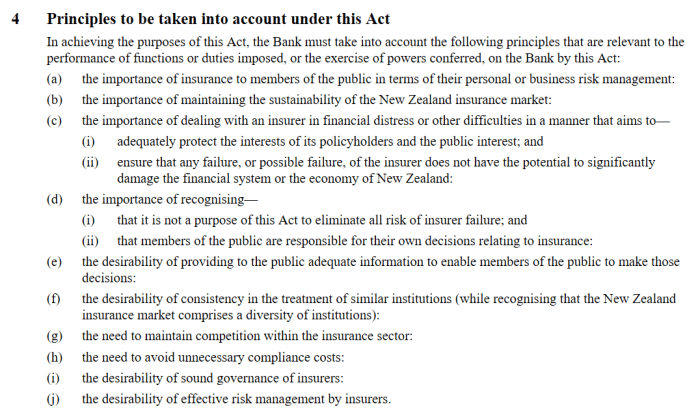
Here it is worth having a look at some of the specifics of the New Zealand act.  For example, the purpose provisions in the legislation

IPSA 1

When this legislation was being planned I argued that only the first strand should be included, and recall arguing explicitly that having “promote public confidence in the insurance sector” could, at some future date, be used to defend keeping real problems secret, in ways that might support short-term confidence, but would risk undermining long-term confidence in the sector and in the regulation/supervision of the sector.  That seems like a valid concern.  But even with that provision in the legislation, it provides no clear guidance on whether specific regulatory interventions should be kept secret, since the goal is not to protect individual firms, but with a sectoral focus.  And if one believes in the efficacy of supervision –  I tend to be sceptical –  knowing that the regulator is (a) on the ball, and (b) not hiding stuff, is most likely to support a sound and efficient sector over time, and support public confidence in the bits of the sector where such confidence is warranted.

The Act next has a long laundry list of “principles” –  no hierarchy, no weighting, no nothing (the sort of list Paul Tucker, in his book on delegated power, including to central banks, frowned on).

IPSA 2.png

But they are still worth mentioning because, contrary to what the reviewers imply, the New Zealand framework is not exclusively built around policyholder protection; indeed, even the one bullet that explicitly mentions policyholders puts the “public interest” as of equal importance.  As importantly, look down a couple of rows and you find another principle:  “the desirability of providing to the public adequate information to enable members of the public to make those decisions” (ie regarding insurance), which might argue for as much transparency as possible.  In short, you could pick any approach you like out of these purposes and principles (which makes it bad legislation from a citizen perspective –  albeit beloved by officials), and none of these specific considerations are discussed by the reviewers in considering the disclosure/confidentiality issues around CBL.  At least from the wider public perspective, that was a missed opportunity.

It is worth bearing in mind that as a society we have generally come to favour the continuous disclosure approach various stock exchanges have now adopted. Inside information is supposed to be kept to an absolute minimum, with owners being presumed to be entitled to know of any material developments affecting their companies.  Shareholders provide the capital than underpins the provision of services and markets, including those in insurance.  Continuous disclosure provisions typically have a carve-out where disclosure is prevented by law, and that is what the parent of CBL Insurance relied on in this case (that NBR OIA I linked to earlier has the text of email exchanges with CBL’s lawyers on non-disclosure to the market).   In this case, there was no automatic protection for information about the Reserve Bank’s direction –  which was highly relevant to shareholders, and others dealing with the company and its associates – since the Reserve Bank had full discretion to allow the fact of the direction to be disclosed (an option it explicitly rejected in an email dated 22 August 2018).

In this case, it may well have suited both the Reserve Bank and CBL managers/directors to keep the directions confidential, but their interests are not necessarily representative of either the public interest, or of the specific interests of the owners of CBL, or those dealing with the company. It isn’t even clear that their preferences aligned with the interests of policyholders, here or abroad: rather it is a paternalistic approach that says that the supervisor is better placed to look out for the interests of policyholders than are (actual or potential) policyholders themselves.  The evidence for that proposition seems slim –  including, in this particular case, based on what we read of the Bank’s handling of CBL over several years.

There are no easy or straightforward answers to these issues, which is why it would be valuable to have a fuller, and more open, exploration of the issues.    In principle, I believe it would be better –  including reducing the risk of the supervisory being morally liable for any later losses in a failure event –  for the default presumption to be that any use of formal direction (or similar) powers by a prudential regulator should be disclosed by that regulator, and should be subject to usual continuous disclosure provisions in the case of listed entities.     The alternative both corrodes public trust in regulatory agencies –  what are they up to that we don’t know about? –  and corrodes the trust that needs to exist, and be robustly nurtured, between managers/directors and owners and creditors of private business entities

But there are risks to adopting this approach.  The ones I’m concerned about – at least in the insurance sector –  aren’t some sort of market panic (runs on insurance companies don’t have the meaning they do for banks).  The share price of a listed entity might fall sharply –  but that seems an appropriate possibility –  and people might become more reluctant to deal with the firm (ditto, at least until after hard questions have been adequately answered).   My concern is more that disclosure might make the supervisory entity more reluctant to act when it should, and more reliant on moving into the non-legal shadows, relying on pressure and threats of direction.  Perhaps too we would risk seeing courts more actively involved as the regulated entity sought injunctions to stop a supervisor using directive powers?     Those are real risks that need debating, but they should not be conclusive arguments, especially when the alternative involves the regulator and managers/directors getting together to keep highly valuable information from shareholders (whose money is mostly at stake), policyholders, prospective policyholders, and other creditors.

My interests are really less on the specific CBL case –  although specific cases help focus attention –  than on thinking about potential problems with banks at some future date.  There are very similar powers in the Reserve Bank Act re the confidentiality of directions to banks, and the issues get even more complicated because (a) bank runs are a real issue, (b) our bank supervision legislation does not have a depositor protection focus, (c) the disclosure regime has been designed to encourage creditors to take responsibility for themselves, (d) the proposed deposit insurance regime is very limited in scale, and (e) most of our banks are subsidiaries of foreign listed entities (can the Reserve Bank enforce directions on Australian parents?).  My own prior is that the world’s banking regulators do not have such a stellar record that we should be entrusting them with such powers of coerced silence, preventing companies telling their shareholders and creditors etc that they are subject to directions from the regulatory authority.  Perhaps the best thing might be more directions, made public at the time they are given as a matter of routine, so that markets, media, and the public can learn to weigh and evaluate the significance or otherwise of the issues and risks the regulator is highlighting.

I’m sure mine is a minority position, and I’m putting the issue out there as much as anything to try to encourage some reflection and debate on the issues.  In reality, perhaps the issues are not be black and white (in general –  although each specific involves final decisions), but regulators need to demonstrate that they have earned the trust, and extensive powers, reposed in them.   And our laws, and the applications of them, should be framed against principles of open government, accountability for regulatory agencies, and a belief that –  within government and within firms –  sunlight is typically the best disinfectant.

On which note, it is now the school holidays and we are heading off to find some sunshine and warmth.  Most likely there won’t be another post here until 23 July.


Police: cosying up to tyrants, ignoring NZ law

I’ve already written about the slow and painful efforts to get Police to reveal details of the visiting professorship they had allowed one of their senior officers to take up at the PRC People’s Public Security University (the university of the Ministry of Public Security).

The day after the belated Police response finally arrived, a reader sent me a link to another example of the New Zealand Police cosying up to the regime in Beijing.  Here was the whole of my initial post:

A reader sent me the link, and this is what Google Translate generates:

Guangzhou Municipal Public Security Bureau and New Zealand Oakland Police Department signed a friendly cooperation arrangement
Source: Guangzhou Municipal People’s Government Foreign Affairs Office published:2019-05-05 17:51

guang 1.png

guang 3.png

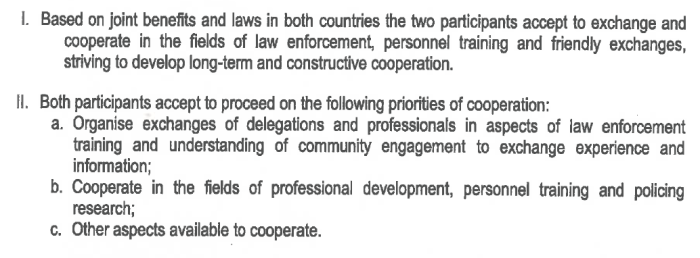
To celebrate the 30th anniversary of the conclusion of the international friendship city relationship between Guangzhou and Auckland, and to strengthen the police cooperation between the two cities, Yang Jianghua, deputy mayor of Guangzhou and director of the Municipal Public Security Bureau, and the assistant police chief of the Auckland City Police Department of New Zealand on April 29 Lena Hassan ( Naila Hassan ) signed a “friendship and cooperation with the Guangzhou Public Security Bureau Auckland, New Zealand Police to arrange the book” in the Guangzhou Municipal Public Security Bureau. It is reported that this is the first time that the Guangzhou police and foreign police have signed a cooperation intention, which indicates that the law enforcement agencies of the two places will formally cooperate in police exchanges and police training.

“Police exchanges” with the Guangzhou branch of the Ministry of Public Security………..  Surely this cannot mean that MPS officers will be let loose with law enforcement powers in New Zealand?  Surely…..

I looked on the Auckland police website, I looked at the Minister of Police’s website, and I looked at the main Police news releases page, and there was nothing about this deal.

I wonder if Police, or their Minister, were ever planning on telling New Zealand citizens and voters about their deal with the PRC domestic repression apparatus?

Yesterday, I mentioned the Gestapo, but one doesn’t need to invoke (quite valid) Nazi comparisons with the People’s Republic of China.   Would Police – or elected governments – have thought such friendship and exchange deals were appropriate with the domestic security forces of the Soviet Union, or Pinochet’s Chile, with Galtieri’s Argentina, with apartheid South Africa, or……or…..or……

It just should not be.  And it clearly isn’t the case that this is just normal stuff (“everyone does it”) –  it is the PRC side that stresses that this is the first such arrangement for Guangzhou.

I’m not fond of the phrase “social licence”, but if it must be used this is an example of how government agencies –  allegedly working for our interests –  risk forfeiting theirs.

I will be lodging an OIA requesting details of this agreement.

And so I did, on 8 May.   I asked Police for

1. Text (in English and – if it exists – Chinese) of the recent agreement signed between the Guangzhou bureau of public security and the Auckland police district.  

Copies of

2. Any advice re the agreement to the Minister (and/or his office)

3. Any consultation with other government agencies on it.

4. Any internal position papers evaluating the possibility of this agreement, including any risks, and pros and cons.

And I had an acknowledgement of my request the next day.  So far, so proper.

I heard nothing more for a couple of weeks and then I had this from Police in Auckland.

Good Morning  

We have received your request for information

Before we can process this request we require some form of photo ID.  The best is a photo of your driver’s licence and a photo of you holding your licence.

Now, I’ve been using the Official Information Act for years and had never had such a request.  In fact, Police has responsed to my earlier OIA just a few days previously (very slowly but) without asking for photo ID.  Apparently, agencies are allowed to check that someone is entitled to make a request, but Police by then had my address, my phone number, and I’m in the telephone book (and readily Google-able).

Anyway, I went back to them and asked them for the statutory basis for their request, noting that Police had responded to earlier requests without photo ID.  I heard nothing more.

A few days later (27 May), I had a letter from a Senior Sergeant in Auckland, extending my request by a couple of weeks (beyond the statutory 20 working days), to 18 June.  He claimed they needed the additional time because of the “consultation we need to do on your request”.  That extension was probably lawful (albeit only because it looks as though it had taken almost 20 (calendar) days for anyone Police to really look at the substance of the request).

And then on 20 June, I had another letter for Senior Sergeant Housley (who is the Auckland District Police OIA co-ordinator), this time extending the request to 18 July, citing the need for “further consultation”.      That argument was already wearing thin, but what really bothered me was that it is against the law to extend OIA requests if the extension is made after the statutory 20 working days has passed.  The Ombudsman has been quite explicitly clear on that.

Nothing in the OIA prevents multiple extensions being made, providing any extensions are made within the original 20 working day time period after receiving the request. For example, if an agency notifies the requester of a one week extension, and then later realises that a two week extension is actually necessary, a second extension may be notified as long as the original 20 working day time period has not yet passed.

In this case, not only had the 20 working days passed when the second extension was made but so had the deadline on the first extension.  I went back to Senior Sergeant Housley and pointed out that his extension was unlawful, but (unsurprisingly) I got no response.

This morning, I finally had a letter from Senior Sergeant Housley substantively responding to my request, politely thanking me for my “patience”.   And what little they released –  and, in fact, what little they held, gives the lie to the claim that “consultations” and “further consultations” were necessary.   All they released was the text of the agreement (see below), the substance of which the PRC side had been boasting of two months ago, and all they withheld was advice from MFAT on the wording of the agreement (which can’t have been very long, and which I never expected them to release –  standard OIA exceptions: my interest had been mostly in seeing who, if anyone, had been consulted.   I have now lodged a complaint with the Ombudsman about (a) the unlawful second extension, and (b) the dubious claims about “consultation” and (especially) “further consultation”.  But this is the Police…….in a well-functioning system, you’d hope a Police force would fall over itself to act lawfully, spirit and letter.  Then again, I guess this is modern New Zealand, where complying with the law seems like an optional extra for too many public agencies.

What of the substance?  Here is the agreement itself (Chinese and English), and Mr Housley’s letter.

Letter of Friendship Between Auckland Police and Guangzhou

Letter Mr Reddell July 2019

There are a few things of note in the (short) agreement itself (and any Chinese-speaking readers might like to check that the Chinese version says the same as the English version, both of which are signed).

First, it is pretty clear that the initiative for this must have come from the PRC side.   The first version of the agreement is in Chinese, and the English version is clearly a not-particularly-colloquial version/translation (“Based on joint benefits and laws in both countries, the two participants accept to exchange…” is clearly not something written by a native English speaker).

It is pretty easy to see what is in it for the PRC.  They have whole webs of organisations and agreeements designed to tie people, institutions, and countries more closely to their odious regime, lending a (hitherto) good name to one that should be held in very low esteem.  And New Zealand has clearly been a soft touch, and so (recall the initial release) the Auckland Police will have made a good place to start for a first such agreeement.

But what on earth is in it for New Zealanders?   Police officers hot-footed it to Guangzhou –  presumably at taxpayers’ expense –  to do the kowtow and sign up to an agreement that dignifies the repressive law enforcements mechanisms of the PRC as somehow akin to a Police force in a (hitherto) free, open and democratic society.  To what end, other than the typically craven approach of the New Zealand “establishment” –  more deals, more party donations, improved electoral prospects for Phil Goff?

Second, the substance, such as it is

guangzhou

It is a simple question really that Police make no attempt to answer: what benefits will the New Zealand Police –  supposedly responsible, via ministers, to the New Zealand public gain from their cooperation and exchanges with Guangzhou, a force that acts to enforce the will of the CCP (and where presumably no officer can serve if they are suspected at all of sympathies with –  say –  Christianity, Islam, Falun Gong, let alone the rule of law and democracy).  This force operates just over the border from Hong Kong, where civil liberties have already been jeopardised, aided and abetted by the Police.  Won’t all the senior officials the Auckland Police delegation were pandering to likely be CCP members?

And what of the letter I got from Police?

Among the things I found interesting is that there was no advice at all of this agreement to the offices of the Minister of Police or the Minister of Foreign Affairs.  I suppose most likely Police simply anticipated the preferences of our politicians –  after all, last week Ron Mark was signing up to a defence agreement with the PRC (quite extraordinary: we sign a defence agreement with a country that openly talks of seizing a free and democratic country by force).

Perhaps more worrying –  but perhaps not surprising, given the widespread Wellington view of Police competence and capability –  is that I was told there was no position paper or similar reviewing pros and cons, risks and opportunities etc that an agreement with the odious PRC forces might entail.   So what happened?  Did Guangzhou Police simply take someone in Auckland to lunch and sweet talk them into flying over to sign up?  It can’t quite have been that bad surely, but this simply isn’t proper or prudent policymaking.

But then they made up a rationale on the fly.  Recall that none of this was documented before the agreement was signed, it was simply in a letter to me dated today.

There is no formal ‘position paper’ in existence evaluating the possibility or the ‘pros and cons’ of the Letter. However the Police position is that 2019 will mark the 30th anniversary of the sister city relationship between Guangzhou and Auckland – Auckland’s longest standing and most successful sub-national partnership in China.

This relationship has been significantly strengthened as a result of the Tripartite Economic Alliance that was signed in 2014 between Auckland, Guangzhou and Los Angeles. The relationship between the cities goes back to the time of the gold rush in New Zealand, when many Chinese came across to New Zealand with a significant number finally settling in Auckland. Latest statistics indicating that up to one in three greater Aucklanders are likely to identify as Asian by 2038. Close transport connections (twice daily direct flights between the cities), the immense trade and significant crime connections make the relationship between Guangzhou and Auckland crucial to both cities. Other areas Police would benefit from this relationship include, training, narcotics and economic crime investigations.

In summary this is an extension to the sister city relationship. With the proposed growth in the Asian population in Tamaki Makaurau over the next two decades this letter of friendship will enhance the relationship and benefit both Guangzhou Public Security Bureau and Tamaki Makaurau Police as it will present opportunities for each of us to learn from our colleagues.

Much of which is simply weird.   We have a national Police force, not (unlike, say, the UK system) a city-based one.  What is the national Police force doing signing up agreeements with odious foreign forces to support the sister-city partnership signed up by some elected local body politicians?   Recall, that the current Auckland mayor substantially funded his last campaign with large anonymous “donations” including from an auction of works of Xi Jinping.  Goff was one of those who nominated the CCP-aligned Yikun Zhang for a royal honour, for what amounted in effect to services to Beijing.   This agreement has the feel of something that the Mayor’s office will have liked.  Perhaps it will help with this year’s fundraising?

And what about all that puffery about the Gold Rush?  We had German immigrants back to the 19th century and it didn’t make the first Labour government any keener on dealing with the Gestapo.   Perhaps the Senior Sergeant and his bosses didn’t notice that whatever the “Asian” share of the population 20 years hence, “Asia” is not the same as the PRC, not even all immigrant ethnic Chinese come from the PRC, and many who did come want to be free of the clutches and mindset of the PRC.  The PRC –  not China, but the PRC/CCP –  is a threat more than an opportunity, at least to anyone with a modicum of integrity and morality.

And, once again, what does the Auckland wing of the New Zealand Police think they are going to learn about policing from their friends in Guangzhou?  Whatever it is, seems unlikely to be in the best interests of New Zealanders.

There is a level at which it is tempting to just ignore these things.  Individually, I don’t suppose the agreement means very much.   Bad as Police are in many respects, they aren’t quite yet the Guangzhou bureau of public security, and this agreement is isolation won’t change that much.  But it all speaks of a mindset in which our establishment agencies and individuals seem to have lost any real sense of right and wrong, of fundamental decency, and recognising odious regimes when they see them.   Yes, there need to be basic, formally correct, relations with the PRC, as with a bunch of other dreadful regimes, but we simply shouldn’t be signing friendship agreements, declaring ourselves “strategic partners”, of offering to help make their dreadful regime even more effective in what it seeks to do.  Do our leaders –  politicians and Police – really live by any values other than deals, donations, and the bonhomie (and self-delusion) that goes with cosying up to such a regime?  Not on the evidence of agreements like this.

Oh, and the Official Information Act really does apply to Police to.  Our Police –  unlike China’s – are supposed to be subject to the law, not subject to the Party.


Failing statistics

I’ve had a series of points about New Zealand official statistics running round in my head and the list finally got long enough I thought I’d turn it into a post.

Most prominently, of course, there is the 2018 Census debacle.  Almost 16 months on there is still no data published, as the SNZ efforts to compensate for their own systematic failures by trying to fill in the gaps go on.   We still have to wait another two months before we begin to see some results at last.    Consistent with the deeply attenuated nature of public sector accountability in New Zealand, no one has resigned, no one has been sacked.  No one has even offered a genuine and heartfelt apology.  It should be simply remarkable that the Government Statistician, Liz McPherson is still in her job.  Instead, when the nature of the debacle was already apparent, McPherson was reappointed to a second term.   If she knew there were going to be problems –  eg underfunding – she had a moral obligation to have made that clear and to have considered resigning and going public if the issues weren’t dealt with.  If she didn’t know, she shouldn’t be in the job anyway.

There doesn’t seem to have been a parliamentary inquiry into what went wrong, and we still haven’t even had the report from the reviewers that McPherson herself appointed to review how her organisation has handled things (due to SNZ this month, although who knows when we  –  the public  – will see it).   One wonders if the reviewers will note SNZ’s apparent greater focus on various right-on political causes than on doing the basics well.  Probably not –  it isn’t the way to get future review-type appointments.

(Here I will largely skip over questions about whether it is really appropriate for the coercive powers of the state to compel us all to tell the state whether we are able to wash or dress ourselves.  I am seriously contemplating a rare act of civil disobedience at the next census, simply refusing to answer such grossly intrusive questions.)

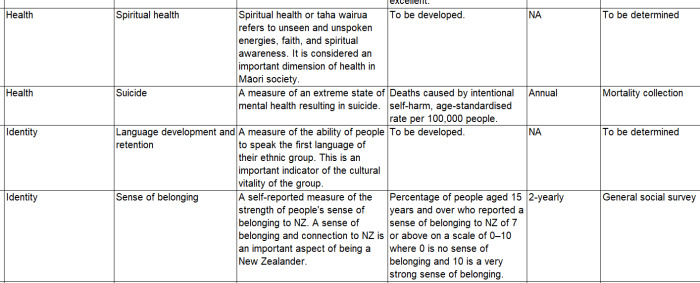
But, having mentioned the SNZ priority on trendy causes, there is the Indicators Aotearoa New Zealand project I wrote about here.   Dozens and dozens of indicators about New Zealand (reminder to SNZ “New Zealand” is the name of the country), some perfectly sensible and already published, and others strange, vacuous, almost impossible to measure meaningfully (in one or two cases all three).   You might recall this extract from the table

indicators

where, for example, only Maori “spiritual health” (whatever it is) seemed to matter.  Or where if descendants of Croatian immigrants don’t speak Serbo-Croat that is somehow a problem for New Zealand, the New Zealand government, or (indeed) those individuals.  Or where our statistics thinks a ‘strong sense of belonging and connection’ to New Zealand is something they should measure.  I was born here, most of my great-grandparents were born here, and I don’t need Ms McPherson to try to tell me whether or not I’m a proper New Zealander –  even though being “a New Zealander” is not, and never will be, my primary “identity”.

Eric Crampton captures some of the lunacy of it all in a recent tweet

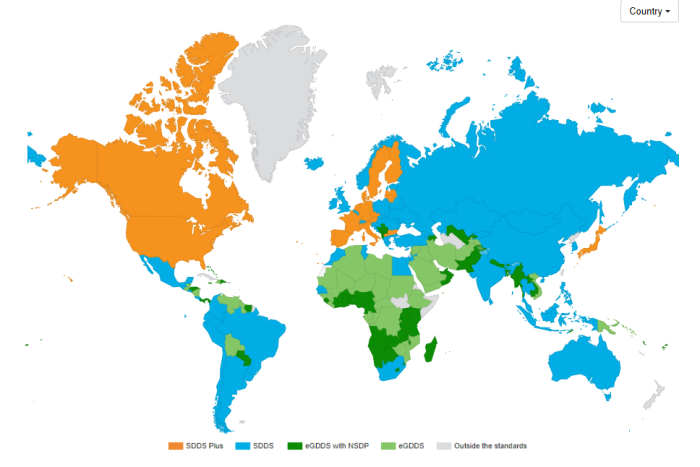
A couple of weeks ago a reader drew my attention to an International Monetary Fund graphic about which countries were meeting which international statistical standards (collection, publication etc).   Here is the summary chart

SDDS.png

drawn from this page.    The two most advanced standards are SDDS (Special Data Dissemination Standard) and SDDS Plus.    There are some lower level standards (the two shades of green) and then there are the countries outside the standards altogether.  Eyeballing the map, that would be (of independent countries) Cuba, North Korea, Turkmenistan, South Sudan, Somali, and…….New Zealand.   You can read all about SDDS here –  76 countries have signed up to it since 1996.

I have some history on this issue.  When SDDS was first launched, in the internal bureaucratic discussions on such matters I never regarded New Zealand signing up as a priority, and said as much.  At the time, from memory, it was mostly for advanced countries, and we were  (a) small, (b) having no trouble attracting international buyers for New Zealand dollar securities, and (c) these were still the days in the immediate wake of our far-reaching reforms.  Why would we need to sign up to such international agency bids for relevance (might have been the gist of my sentiment). At the time, from memory, I probably still adhered to the official RB view of “who wants a monthly CPI; there are more important priorities”.  In those days, we could not subscribe to the standard because, unlike most OECD countries, we had neither a monthly CPI nor a monthly industrial production series.  We still don’t (I’m not sure if the entry rules have changed though).    Both represent fairly significant gaps, and more recently (perhaps five years ago) even the Reserve Bank came round to the view that a monthly CPI would be desirable.

At one level, our continued failure to meet the requirements for these international standards doesn’t matter very much.  No one supposes we are, say, Zambia or Tajikistan.  Our statistics are honest, even if there are significant gaps.  We still don’t have problem selling New Zealand dollar securities.    But when –  as they do –  governments and officials parrot on about “rules-based orders”, the importance of international standards, it does look at least a little embarrassing not to be part of these, not very onerous, international standards.  And economic analysts would actually use data like a CPI or an industrial production series.

And then, of course, there are other weaknesses in this area. Our quarterly national accounts numbers –  which themselves have material gaps (no quarterly income measure of GDP) –  are released more slowly than those of almost any OECD country (and, of course, are still subject to significant revisions even then).

Talking of the IMF and statistics, another reader pointed out to me recently that New Zealand seems to have been reduced to accepting technical assistance from the IMF on some aspects of our financial statistics.   Not a big issue in its own right perhaps, but I was a bit surprised nonetheless –  technical assistance (foreign aid) from the IMF has usually been something for underdeveloped and emerging countries –  especially as I knew the Bank had had a temporary secondee from the IMF a few years ago, who seemed to do a lot of work on these specific areas.  Just seems symptomatic of the not-overly-job New Zealand is doing these days around official statistics.  I guess decades of poor productivity growth really does show up in choices –  whether about cancer treatments, and things nearer to public goods such as official statistics.

My final statistics gripe for the day relates to the immigration statistics. You will recall that last year SNZ, together with Customs, MBIE, the government, and no doubt under pressure from airlines/airports etc, got rid of departure cards.  With them went one of the key short-term economic indicators (PLT migration numbers) analysts have used for decades to track short-term economic developments.  Not only is migration more important here (larger, as share of population) than in most advanced countries, but there are big cyclical fluctuations in migration (of the sort not seen in most advanced countries), largely because of the relatively free access New Zealanders have to Australia.

SNZ led the official chorus trying to tell us that the new world would be better for everyone.  It was never going to be, and I pointed this out in several posts before the final decision was made.  Sure, using passport data to work out whether or not people actually stayed (or left) long-term would produce better long-term indications of actual movements, but only with a very long lag, and in the meantime we would lose all useful short-term information on the movements of New Zealanders.  Their model estimates for the short-term were always going to have such large margins of error –  perhaps especially around turning points –  that any signal was going to be very hard to discern from the noise.  SNZ tried to tell is it wasn’t so, and when the new data starting coming out a few months ago, they continued to release prominent monthly commentaries, emphasising the signal.  And they did the same thing in each successive month even as the inevitable substantial revisions threw the numbers around.

But they seem to have finally realised that there is a problem.  On Thursday evening, I received a consultative document from SNZ inviting comment on “options for release of international migration data”.  It is a rushed affair –  they want comments within a week, much faster than normal official consultations.  I couldn’t see the document on their website but there was no indication they wanted it kept confidential either.

As I have noted to SNZ in my response, there is little sign (still) in the document that they recognise the importance of immigration changes in the short-term economic developments in New Zealand (the official who sent out the document is a demographer and the main interest seems to be in the needs of fellow demographers).

Anyway, they are now toying with dropping monthly data altogether, with releasing data only quarterly (even if there was monthly data in each release), and with dropping high frequency commentary on the net migration numbers (the latter is a move I would support –  SNZ commentary to date has fed an inappropriate reliance on highly questionable numbers).     Fortunately, they do note that they are not looking at options such as only releasing data with a six months plus lag (when the revisions have started to settle down), or release data only annually –  good of them, but extraordinary that such options even get a mention, in a country where migration data makes such a difference (including in the political debate), and where good and timely data should have a priority.

(For what it is worth, I have gone back to them urging them to keep monthly data, released monthly, with a short lag, but released straight onto the website without commentary.  The data may be poor –  and that is SNZ’s responsibility –  but there is no good reason for them to sit on data which could be made available, for analysts to make of it what they can, even recognising that the signal to noise ratio is very low.)

I could go on –  there is, after all, the breathless enthusiasm for the IDI, with little apparent thought about where such tools might lead – but won’t today.

The bottom line looks like a mix of problems.  There probably has been underspending on official statistics over the years (public goods have few vested interests to champion them), as well as some misplaced priorities (whether coming from ministers or officials). which in turn encourages a champing at the bit for apparently smarter, apparently cheaper, alternatives –  be it the Census or the migration data or whatever.  But before thinking about throwing more money at the problems, there needs to be some real accountability –  the Government Statistician in particular, but also successive Ministers of Statistics.  If we are going to do government well, two aspects of that should be serious accountability –  if you stuff up badly at the top, and especially if there is no contrition –  you should lose you job –  and doing official statistics excellently.   New Zealand is failing on both counts (and, of course, the failure on accountability runs much more broadly than SNZ),


Annual Report time

The Reserve Bank’s year ended last week on 30 June and it will, thus, shortly be time for the Bank’s Board of Directors to turn their minds to preparing their Annual Report.

Most of the powers of the Reserve Bank rest with the Governor personally, although late in the year the new Monetary Policy Committee picked up responsibility for the conduct of monetary policy.  The Bank’s Board has no day-to-day (or strategic for that matter) decisionmaking powers.  The job of the Board is, primarily, to hold to account those who do have decisionmaking powers.  In an ideal world, their Annual Report should be a masterpiece of real accountability –  these people are paid (not that well admittedly) to act on our behalf in evaluating the performance of the Governor and the Bank.

This is what the Act requires

board report.png

Section 53(1) simply tells the Board, in slightly more detail, that their job is to “keep under constant review” what the Governor, the MPC, and the Bank are up to.

In many respects, this framework has long been a bit of a joke.    The Board has limited expertise for some of its responsibilities (basically none re the monetary policy requirement above), has no resources, has the Governor himself sitting on the Board, and has been minded to set its role more as having the back of the Governor, rather than providing serious scrutiny (behind the scenes, let alone through the statutory Annual Report).   And this has finally been recognised in the circles that count: the government’s consultative document on the Reserve Bank Act review proposes that in future the Board should be turned into a decisionmaking body, with monitoring and accountability responsibilities moving elsewhere.

The additional feature that made it unlikely that the Board would really provide serious scrutiny was their involvement in appointments.  On paper, the Minister of Finance appoints the Governor and MPC members. But he can do so only on the recommendation of the Board.  The Board –  with no real expertise or democratic mandate –  controls the appointments and –  as is human nature – will want to validate their own choices and judgements.   Perhaps it might be different four years into a Governor’s term, but the current Governor has been in office for little more than a year, and the MPC members only three months.  There is some turnover on the Board, but the majority of the current Board members collectively made all thse appointments.

Each year since starting this blog, I’ve done a post on the Board Annual Report, sometimes one in prospect and one in retrospect.  Possibly there has even been some useful impact.  As I noted in last year’s post, the Board Annual Reports have improved somewhat over recent years.    In my view, last year’s report even warranted a (bare) pass mark.    But it was easy last year.  The new Governor had been in office for only three months – honeymoon period and all that – and his predecessors, lawful (Wheeler) and unlawful acting (Spencer), had gone.  If there were issues, mostly they were still the responsibility of the departed.

It will be interesting to see what the Board comes up with this year (we won’t see the published version until October).  There are a lot of issues they really should be addressing.  And as I was pondering the other day writing a post like this, my old Reserve Bank colleague –  now a consultant – Geof Mortlock sent me a copy of an open letter he had sent to the Board chair, Neil Quigley, copied to the Governor, the (acting) Secretary to the Treasury, and to Grant Robertson, Paul Goldsmith, James Shaw, and David Seymour (but not to the other Associate Ministers of Finance, Shane Jones, David Clark and David Parker).  In his letter, Geof outlines a series of questions/issues he believes the Board should be addressing in this year’s Annual Report.  I’m reproducing it here.

Mr Neil Quigley
Chairman
Board of the RBNZ
Dear Neil,
Further to my previous emails, I have given thought to the types of questions I would be addressing if I were a director on the RBNZ Board. Given that one of the Board’s main roles is to assess the performance of the Governor and the RBNZ across all of its functions, I would expect the Board, in its forthcoming annual report, to address a number of key matters that call into question the adequacy of the RBNZ’s performance in the last year.
Previous Board reports have been fairly light in content and uncritical of the RBNZ’s and Governor’s performance.  This has been a contuining weak point in the RBNZ governance arrangements.  I am hoping that this year’s report will be much more substantial and probing, given the rather troubling performance issues that have arisen in the past year (and indeed in prior years, for that matter). If the Board is to have value in the RBNZ governance process, it needs to demonstrate in its report that it has asked probing questions and held RBNZ senior management to account. It also needs to identify, in its report, the matters on which it has given advice to the Governor.  In addition, I would expect to see in its report a summary of the extent to which the Board has sought the views of external parties to provide it with supplemental information with which to assess the RBNZ’s performance and that of the Governor. This is important, given the need to avoid excessive dependency on the views of RBNZ management and staff in performing the Board’s assessment function.
In this context, I thought it might be useful to set out the types of questions I would expect the Board to enquire into and to report on in its annual report.  These are set out below.  I would be happy to elaborate on any of these matters if that would be helpful.
Questions the Board should be asking and forming a view on
Below is a list of the main questions I believe the Board needs to ask and form a publicly reported view on.
Monetary policy
–  Given that the inflation rate (on a range of measures) has been consistently below the mid point in the target range, why has the RBNZ not lowered the OCR to a greater degree and earlier than it has?  Is the Board satisfied on the analytical processes undertake and judgements made by the RBNZ in this regard?
–  Is the Board satisfied with the degree of transparency that has been revealed to date in statements made by the new Monetary Policy Committee, particularly as regards the possible divergence pr differences of views on the Committee and the capacity for individual members of the Committee to have their respective views publicly revealed so as to enhance transparency and accountability.
–  Is the Board satisfied that the Monetary Policy Committee is operating on the basis of a free and frank exchange of view and not hindered by undue dominance from the Governor?  Has the Board spoken one-on-one with members of the committee in this regard?
–  Is the Board satisfied that the RBNZ is giving sufficient attention to how it would seek to respond to a significant economic recession, having regard to the fact that the OCR is already very low and, in all likelihood, may be further reduced in coming months, and hence there is reduced scope to use the OCR to combat recessionary forces?  Is it satisfied that the RBNZ is putting in place a robust contingency plan for addressing the risks of a recession in a very low interest rate environment, and if so, on what basis has the Board reached that view?
Prudential policy
–  What enquiries has the Board made as to why the RBNZ did not discover the ANZ capital model breach at a much earlier stage than actually occurred?
–  Is it satisfied that the RBNZ has the systems, staff and policy framework required to enable it to reliably detect non-compliance by banks and insurers, and to detect emerging financial stress?
–  Is the Board satisfied that the RBNZ was sufficiently proactive in evaluating the adequacy of the bank director attestation issues that arose in ANZ (and might exist in the case of other regulated entities)?
–  What enquiries has the Board made with RBNZ senior management and external parties as to the adequacy of the RBNZ’s approach to banking and insurance supervision, having regard to the fact that the IMF assessed the RBNZ as being non-compliant with around 50% of the Basel Core Principles (i.e. the international standards on banking supervision), and that a similar failure applies in the case of insurance supervision?
–  Why does there appear to have been no significant actions taken by the RBNZ to make the necessary changes to its approach to banking and insurance supervision to bring it into alignment with international principles and best practice?  What has the Board done about this lack of action?
–  Is the Board satisfied with the adequacy of the RBNZ’s consultation processes on prudential policy issues, having regard to the serious concerns raised by many parties about the lack of meaningful consultation, the lack of transparency in RBNZ responses to issues raised in submissions, the failure of the RBNZ to adequately take into account many of the legitimate criticisms made of its policies and processes, and the lack of robust cost/benefit analysis?  What is the Board doing to address these concerns – eg raising the issues in question with the Governor and Minister?
–  In the case of the bank capital proposals, what enquiries has the Board made of parties outside the RBNZ to satisfy itself as to whether the capital proposals were well thought-through, thoroughly costed, and subject to rigorous external scrutiny (before they were released)?  Is the Board concerned at the level of criticism being made of the Governor and the RBNZ in respect of the bank capital proposals, and if not, why not?
–  Is the Board satisfied that the RBNZ has done sufficiently robust analysis of the issues in question to justify the extremely large increase in capital ratios being proposed, including in respect of assessing the existing probability of bank default, the level of economic contraction needed to trigger bank default (based on reverse stress testing), whether alternative approaches (such as bail-in debt, as being proposed by many other jurisdictions) would be a more cost-effective approach), and the assessment of the economic impacts of the proposals?  Has the Board made enquiries with external parties on these matters or merely relied on information and views provided to it by the RBNZ’s senior management?
–  Is the Board satisfied with the Governor’s handling of criticism made of him and the RBNZ with respect to the bank capital proposals, including as to whether the credibility of the RBNZ is being damaged by the way the RBNZ has been responding to criticism?
–  What performance metrics does the Board apply in assessing the RBNZ’s performance of its prudential regulatory and supervisory responsibilities?  How does it reach a view as to whether the RBNZ is performing satisfactorily or unsatisfactorily?  And, using whatever criteria the Board does use, what is its assessment? (The same question on performance metrics applies across all of the RBNZ’s functions.)
–  What analysis has the Board undertaken in relation to the RBNZ’s approach to bank recovery and resolution issues?  Is it concerned that the RBNZ is one of the few prudential supervisory authorities in the OECD that has not yet introduced recovery planning requirements for banks?  Is it concerned that the RBNZ has not undertaken any resolvability assessments or resolution planning of the major banks, other than for the limited (and, frankly, very odd) purpose of facilitating the separation of the subsidiaries from the parent banks?
–  Is the Board concerned that the RBNZ’s OBR policy is widely regarded as being unworkable in a systemic crisis and likely to cause financial instability if ever a government was daft enough to implement it?  Does the Board make enquiries as to why the RBNZ has not pursued resolution policies that entail a joint trans-Tasman resolution that seeks to minimise costs for NZ taxpayers by keeping the group intact, as opposed to making a presumption of separation of the NZ subsidiary from the parent bank?
–  Is the Board concerned that, in many key respects, the RBNZ has failed to implement policies that would bring it into alignment with international best principles and practice with respect to banking supervision, insurance supervision and bank resolution (as the IMF has pointed out)?
–  In all of these matters, to what extent has the Board engaged in an in-depth manner with external parties to enable it to be in a stronger position to assess the performance of the RBNZ?
Communications
–  Is the Board satisfied with the quality and frequency of public communications made by the RBNZ in respect of all of its functions?
–  How does the Board respond to criticisms made that the Governor has not given any serious, in-depth speeches on monetary policy, prudential policy, financial stability or other matters relating to the RBNZ’s functions since he assumed office?
–  What analysis does the Board undertake to compare the RBNZ’s quality of public communications with that of other central banks, such as the RBA, Bank of England, Bank of Canada, etc?
These are just a small selection of questions I would be asking if I were a director on the RBNZ Board.  I do hope that the Board’s annual report sheds light on the Board’s enquiries into these matters and provides a robust set of views as to what its assessment of performance is and the reasons for reaching those views.
Regards

(And lest anyone think we hunt as a pack, Geof and I disagree quite vigorously on various aspects of the Bank – including the nature, role of, and reasonable expectations from, prudential supervision, and regular readers of comments section here will have found various fairly strongly-worded criticisms of me and my views of various other issues.)

They are good questions and I’d echo many or most of them (although it isn’t the role of the Board to impose their judgement over that of the Governor’s on specific policy issues).  I’d add some around the Maori strategy, the tree god nonsense, and the prioritisation of resources when the Bank tells us it is resource-starved. I’d want to ask about the performance of the Deputy Governor (recall that they are supposed to report on his performance) as the key line manager responsible for prudential policy initiatives (notably, the bank capital proposals), and around the approach taken by the Board itself in selecting MPC members (eg, whether the Governor was too heavily involved in a committee that should act partly as a check on him, and whether suitable classes of able, expert, and available people were excluded from consideration from the start.).  I’d also be posing question about the adherence of the Bank to the letter and spirit of the Official Information Act and –  more pointedly still – about the Reserve Bank Board’s own adherence to the requirements of the Official Information Act and the Public Records Act (on the OIA, see this recent post for their cavalier disregard for the law).  Oh, and perhaps about their handling of the serious culture, conduct, and compliance concerns in the Bank’s superannuation scheme, where the Board appoints half the trustees, including the chair (each of whom serve solely at the pleasure of the Board).

The second terms on the Board of both the chair and deputy chair expire early next year and it is customary for Board members to serve only two terms.  This is the opportunity for them, leading the Board, to show us –  before the law is changed  –  what might have been, and to model at last serious monitoring and accountability.  It isn’t as if there are not pressing issues on which they should be explaining to us how they have held the Governor and Deputy Governor to account.  The shockingly poor process and seriously weak substance, all overlaid with populist spin. in the bank capital proposals should be central to that.

A new BIS paper that undermines the Reserve Bank’s case

At the end of my long post yesterday on the Reserve Bank’s latest efforts to spin the Governor’s plans to increase very markedly minimum capital ratios for locally-incorporated banks, I noted

PS.  As Martien Lubberink at Victoria has pointed out there is another international agency paper out just recently that really doesn’t help the Bank’s case much if at all. I might touch on that tomorrow.

His post is here (complete with the sly –  if obscure, presumably deliberately so –  dig at the Governor in the final paragraph).

The paper he was referring was recently published by the Bank for International Settlements as a Working Paper of the Basel Committee on Banking Supervision, with the title “The costs and benefits of bank capital – a review of the literature”.   The paper was released only a couple of weeks ago, and it should be studied carefully by anyone interested in the issues here in New Zealand, including (one hopes) the Reserve Bank.

The paper begins

In 2010, the Basel Committee on Banking Supervision published an assessment of the long-term economic impact (LEI) of stronger capital and liquidity requirements (BCBS (2010)). This paper considers this assessment in light of estimates from later studies of the macroeconomic benefits and costs of higher capital requirements.

That earlier paper is referenced everywhere the issues are discussed, including in the Reserve Bank’s papers earlier in the decade, and in its consultative document for this review.   It supported –  to some extent made –  the (macro) case for higher capital ratios, in particular higher than had been in place up to that point (shortly after the crisis).  A review and update of the issues, by a group involving officials from the BIS, the Bank of England, the Banque de France, the Fed and Comptroller of Currency (among others) has to be taken seriously, including when the authors highlight the limitations of their own work, and outline areas needing further research.   The paper looks at many of the same studies the Reserve Bank cites but –  in Lubberink’s words –

The conclusions of the Basel Committee study, however, are different. They are much more modest than the findings of the RBNZ.

Before going on, I should say that I have serious problems with elements of the approach taken in the earlier and more recent BCBS papers (various points outlined at greater length in my own submission).   In particular, this work (and the Reserve Bank) treats all output losses in recessions associated with financial crises as being attributable to the financial crisis (bank failures etc) itself.  That is almost certainly wrong, and substantially overestimates the cost of crises themselves –  the loan losses that lead to bank failures arise from misallocations of investment resources (and/or overheated economies) and those misallocations will be corrected anyway (with likely output costs), whether or not any bank fails.   Remarkably –  and this is clearer in the more recent paper –  they also treat output losses in countries that didn’t have domestic financial crises (think Australia or Canada in 2008/09) as costs of financial crises, rather than allowing for the more plausible story that common third factors will have been driving, say, productivity growth slowdowns across the advanced world.  As I’ve argued (and as Cline, in a PIIE paper a few years ago, also made the case), if you want to isolate the output costs of financial crises, a better way is to look at the differential growth performance between (otherwise similar) countries that did and did not experience domestic financial crises.

A great deal turns –  in these sorts of modelling exercises – on how costly the modellers assume crises will be.  Both my points in the previous paragraph suggest the BCBS conclusions –  as to how much capital is likely to be warranted –  are likely to materially overstate the “true” numbers.

There are all sorts of other limitations to the BCBS work. For example, it focuses on “banks”, but doesn’t address the fact that for an individual country – think New Zealand –  a capital requirement on locally-incorporated banks won’t affect branches of foreign banks operating locally, or non-bank lenders.  Disintermediaton costs don’t figure.  It also, more generally, won’t apply to debt capital market funding.   Unlike the Reserve Bank, the BCBS paper does touch on the issue of alternative resolution mechanisms –  the Bank long favoured the OBR approach, but it was never mentioned in the consultative document, even though the more confident you are of OBR (I’m not, but they were) the less capital is required –  but it doesn’t touch on the issue of a banking system in which the large banks all have strong foreign parents.  And it doesn’t take account – in the macro calculations – of the possible income losses to New Zealanders from the higher equity returns to foreign shareholders (much of the overseas modelling seems assume redistribution of income within the country).  This latter point, in particular, has been covered in Ian Harrison’s papers.

On my reading, this is the bottom line chart in the BCBS paper.

bcbs chart.png

They report the net marginal economic benefit (slightly lower GDP each year, offset against savings from a less serious crisis decades hence) from higher bank capital ratios, drawn from a series of studies.    On these models there were really big gains in lifting capital ratios, up to around to around 9-10 per cent.  If there are gains at all –  and they don’t report margins of error around these estimates –  they are looking extremely small beyond about 13 per cent.    Perhaps that doesn’t sound too far from the 16 per cent number the Reserve Bank is proposing for the big banks but (among other limitations, many made inevitable by data limitations):

  • this modelling is done on actual capital ratios, not regulatory minima (a 16 per cent minimum ratio is likely to see banks aim for something between 17 and 18 per cent actual ratio), and
  • none of this modelling takes account of differences in accounting and regulatory treatment across countries: conventional wisdom, (backed by estimates done by PWC) suggest that effective capital ratios in New Zealand (and Australia) would be far higher if things were measured the same way they were done in various other advanced countries, and
  • none of it takes account of the regulatory floor in how risk-weighted assets are calculated.  As the Bank is quite open about, a significant part of what is proposing is that in calculating risk-weighted assets, the big banks will have a floor of 90 per cent of what the standardised rules would generate (the more normal floor is, as I understand it, about 72 per cent).  A 17.5 per cent headline actual capital ratio would, on RB proposed rules, be akin to something like 20 per cent in the sort of framework the BCBS authors are looking at.

Nothing in this paper suggests any reason for confidence that effective capital ratios of, say, 20 per cent of risk-weighted assets would be generating net economic benefits, even on the (overly pessimistic) macro assumptions the authors are using.  But that is what the Reserve Bank claims to believe.  The onus, surely, is on them to show us, and to engage on their assumptions and analysis – in open dialogue – well before decisions are made.

And then lets go back to the macroeconomic inputs.    If most of the costs of recessions associated with financial crises would have happened anyway (see above) then the output losses used in these models are substantially overstated.   Higher capital ratios make no difference to whether those losses occur.  Cline (the lower blue line in the chart) uses assumptions more similar to mine: you can see where the crossover point (to net costs) is for him.

Note too that real interest rates and the real cost of capital are higher in New Zealand than in most advanced countries.  The median (real) discount rate used in the studies the BCBS paper looks at is something like 3.5 per cent and none uses a real rate higher than 5 per cent.  A standard New Zealand Treasury guidance for cost-benefit analyses on regulatory proposals is (real) 6 per cent.  Using a higher discount rate materially reduces any benefits from a crisis assumed to arise, probabilistically, decades in the future.   And yet even on the studies reviewed by the BCBS, there is no consensus in favour of anything near as high as the effective capital ratios the Governor is proposing.

And, as I’ve pointed out previously, all this work implicitly assumes that any higher capital ratios can be made binding for decades to come.  Since there is no pre-commitment technology, and actual rules have been changed every few years, there should be a further discounting of any potential gains, particularly in light of the inevitable transition costs from big increases in capital requirements (which are frontloaded, and represents permanent losses, for what may be a temporary policy).

It was also interesting to be reminded, in an annex, of this feature of the earlier (LEI) BCBS modelling

The main results of the LEI appear in Table 8, p 29, of BCBS (2010).  The calibration used is the following:

• the probability of a crisis is 4.6% for a capital ratio of 7%, and declines at a diminishing rate to 0.3% for a capital ratio of 15%.

In other words, a probability of a crisis every 333 years with an (actual) capital ratio –  calculated as more conventionally abroad –  of 15 per cent.  And yet the Reserve Bank’s proposals were supposed to be calibrated to a crisis every 200 years, and yet still somehow generate effective capital ratios of 18 per cent plus for the big banks.

Now in many respects Martien Lubberink’s comment is fair, that for all sorts of reasons

studies on bank capital are more quicksand than a sound foundation for policy recommendations.

And yet, they have been repeatedly invoked by the Reserve Bank, and –  when read carefully – do still provide a commonsense test against which the benchmark the Governor’s ill-considered far-reaching proposals for New Zealand.

The whole exercise really should be suspended.  Come back to it perhaps in a few years’ time when a revised Reserve Bank Act is in place, and when there has been proper parliamentary and public scrutiny of the assignment of powers to the Reserve Bank (which policymaking powers should rest with ministers and which with agencies).  And use the intervening period to undertake some serious local research, working collaboratively with APRA (recognising the common risks, common ownership, likely common resolution) and engaging in workshops and seminars to tests the strengths and weaknesses of staff thinking and research well before decisionmaking authorities reach a provisional view.

And, in meantime, take comfort from the fact that before the IMF suddenly swung in behind the Governor, when there were no institutional pressures at play that international agency only a year ago told us, and told the world, that there were ample capital buffers in the New Zealand banking system.

IMF capital

The risks haven’t changed materially in that time, it is just that the gubernatorial whim has since been revealed.  Such whims are a terrible basis for making serious policy, especially when there are no checks, no appeals, on the Governor’s ability to impose such substantial transitional and ongoing costs on New Zealanders.


,

Reserve Bank still spinning

Earlier this week, the Reserve Bank published (almost all of) the submissions it received on the Governor’s proposal to increase very markedly the share of bank balance sheets that need to be funded by equity.

Welcome as it is to have the submissions –  it is easy to forget that not four years ago the Reserve Bank was still reluctant to publish any submissions it received at all (even though it was the norm for government agencies, parliamentary select committees, and so on) –  the Governor sought to use the occasion for some more spin in support of his proposal (on which he alone will, a few months from now, make the final decisions –  the rest of us, whether Minister of Finance, banks, businesses or citizens will simply be stuck with the results of his whim, with no mechanisms for appeal or review.)

Instead of just releasing the submissions –  which could have been done weeks ago, very shortly after submissions closed –  the Bank chose to release a 22 page document labelled “Summary of Submissions” and a lengthy and argumentative press release in the name of the Deputy Governor.

I haven’t read all the submissions, or even looked at them all, but one reader –  distracting himself from other stuff he should have been doing –  did look at them all, and sent me a spreadsheet with the names of the submitters, the length of each submissions, and broad tenor of any comments.

A good consultative process draws out perspectives or comments or evidence that the consulting agency may not have thought of, may have chosen to ignore, may have interpreted differently, may have missed the point of, or whatever.  Having received that material, the consulting agency would carefully consider those perspectives, (in principle) looking to make the best decision, open to a revised perspective.   Of course, that sort of openness is rare –  it runs against human nature, particularly where the people making the final decision are the people who proposed the scheme in the first place.

And a consultative process shouldn’t be thought of, or presented as akin to, a public opinion poll.   If one wanted to make such decisions by public opinion poll then I guess (a) we wouldn’t delegate them to a specialised agency, and (b) we would commission a properly structured poll.   Apart from anything else, (a) people who are opposed to what is proposed are typically more likely to submit than those in favour, and (on the other hand) (b) especially when the numbers involved are small, it is easy for a handful of low-information submissions to be generated on either side of the issue.

The Reserve Bank, however, has tended to present the submissions as something of an opinion poll.     There was the silly line that “in general, submitters support the Reserve Bank’s objective to ensure that New Zealand’s financial system is safe” –  yes, and we support motherhood and apple pie too.  The issue isn’t whether the system should be “safe”, but how safe, and at what cost, on what assumptions.  And then

There was significant and wide-ranging media and public interest in the How much capital is enough? (PDF 545 KB) paper, with written feedback from 161 submitters.

Yes, 161 submitters is a lot more than the nine submissions they received on the previous paper in the longrunning capital review  but in the grand scheme of things –  considering the scale of the changes the Bank is proposing – it isn’t many.   And more than 20 per cent of the submissions turned out to be six lines or less: whether the submitter was for or against what the Governor was proposing (and in some cases it really isn’t clear) there is no useful information for a proper consultative process in submissions that short (unless perhaps one of the big banks had submitted “Dear Adrian, We agree.  Do start soon.”, which they didn’t).

Thus, when the Deputy Governor says

Many submitters, particularly from the general public, support the proposed higher capital requirements for banks.

He is correct.  Many did.  Very briefly.  Usually without much engagement in the argumentation and issue (although one of the Governor’s mates did write in to offer support and some argumentation, although strangely even he referred to some evidence that capital ratios should be 13-14 per cent, which led him to the view that the Bank’s proposed (minimum) ratio of 16 per cent was “acceptable”.)

And look at this attempt to play the populist card – the public versus the banks – a bit further

Some submitters, in particular banks and business groups, question whether the proposed increases are too large and too costly.

As they know very well, there were a variety of other serious –  more than half a dozen lines long – submissions from people with no vested interests who were very sceptical of the Bank’s proposal, and of the argumentation and evidence in support of it.

You also have to wonder how well the Bank would be able to defend a claim (perhaps in a judicial review) that the consultative process was a sham.  The Deputy Governor again

Increasing the amount and quality of capital can be reasonably expected to mean that banks can survive all but the most exceptional shocks, Mr Bascand says. “We think the costs of doing so are outweighed by the benefits – someone’s cost is for society’s broader benefit.”

(do note the attempt to play vested interests again: “someone’s cost”).  Isn’t it still months until the final decision is supposed to be made?  And yet the Deputy Governor can confidently declare not just ‘in putting out the consultative document we thought it likely benefits would exceed costs”, but (present tense) “we think the costs…are outweighed by the benefits”.  And if the Deputy Governor already knows perhaps he could release that cost-benefit analysis that so many submitters and other commentators have been calling for.  I guess they haven’t yet back-fitted the numbers to suit the Governor’s conclusion yet.

Continuing with the spin, the Deputy Governor moved on to invoke support from the International Monetary Fund and the OECD, both of whom released comments on the New Zealand economy last week.

Following its recent mission to New Zealand, the International Monetary Fund has released a Concluding Statement that highlights the need for strengthening bank capital levels and that the proposals appear commensurate with the systemic financial risks facing New Zealand. The Organisation for Economic Co-operation and Development’s latest Economic Survey of New Zealand expects increases in capital will likely have net benefits for New Zealand.

It is hard to make much of the IMF comments at this stage.  They are not much more than a couple of sentences in a press release, with no published supporting analysis.  And the Fund almost always backs the authorities – who are the people they talk to most  –  especially when central banks and regulators want to put more restrictions on banks. Why wouldn’t they?  Any economic costs don’t sheet home to them.  But the IMF’s support isn’t without its problem for the Reserve Bank.     Here is what they said

The new requirements would increase bank capital to levels that are commensurate with the systemic financial risks emanating from the dominance of the four large banks with similar concentrated exposure to mortgages, business models and funding structures.

Which, by logical deduction, appears to be saying that current levels of capital are grossly inadequate to the risks the New Zealand banking system faces. But there was no hint of these serious risks in past Financial Stability Report from the Reserve Bank (although they amped up the rhetoric in the latest one), and –  perhaps more to the point –  no hint of that in past IMF Article IV staff reviews or Executive Board discussions.  This snippet is from last year’s Article IV report, published as recently as June last year.

IMF capital

Not a word from staff, from the Board –  or, indeed, fron the New Zealand authorities in their published comments –  of a pressing need for a huge increase in minimum capital ratios.

The Deputy Governor also attempts to deploy the OECD in support.  They typically aren’t particularly expert in such matters, but here is what they actually said:

The Reserve Bank has proposed large hikes in bank capital requirements. High bank capital requirements reduce the cost from financial crises, but might also dampen economic activity through higher lending rates. On balance and nothwithstanding considerable uncertainty, increases in bank capital are likely to have net benefits, but the impacts should be carefully monitored.

Take it from me – I negotiated line by line wording on numerous OECD reports –  that is about as tepid as it gets.  It doesn’t even endorse the huge increases in minimum capital the Governor is proposing –  the comment is simply about “increases”, and there is a long way from current levels to what the Governor has planned.

And if you doubt my take on the OECD, here is their own slide from the presentation when they released the report in Wellington last week.

OECD capital.png

And these comparisons are just of headline required ratios (triangles are actuals I presume), while part of the Reserve Bank proposal is to materially increase the calculation of risk-weighted assets for the big 4 banks, to an extent that would, in effect, add another three percentage points or so to those New Zealand numbers, which already –  in the OECD’s words – “exceed those in other OECD countries”.

So, spin all the way down.    Complete with the observation about their continuing consultation –  fishing around to find some supporters perhaps

It is continuing its stakeholder outreach programme, which includes conducting focus groups to understand the public’s risk appetite, and engagement with iwi, social sector and industry groups, financial institutions and investors. It has also engaged three external experts for an independent review of its proposals.

They elaborate a little in the document that supposedly summarises the submissions.  On the iwi point “a workshop with Maori service providers” –  but why, what specific issues might there be for “Maori service providers” (whatever they are) from any others –  Catholic, Pacific, or whatever?   And the workshop they plan with “social service providers and NGOs” really looks like an attempt to drum up support for the shonky “social costs of crises” material they’ve run previously, and which Ian Harrison (in particular) has comprehensively demolished.  I will be lodging an Official Information Act request for the reports etc from any focus groups –  again it looks a lot like an attempt at distraction, a populist Governor trying to summon a mandate from “the people”, rather than from Parliament.

Also from that Summary of Submissions, this attempt to spin the issue (wasn’t this supposed to be a summary of submitters’ view and analysis?)

It’s about keeping New Zealanders, their investments, and the economy safe from the disastrous impacts of financial instability and the failure of a registered bank, which historical evidence suggests can be very long-lasting and go beyond just the financial costs for people.

Loaded language (and not even particularly well written).  Nothing like a bogeyman to scare people with I suppose, but surely only fairly geeky people even read a document like this.  Who is the Governor hoping to impress?  Not much sign of calm, balanced, detached and objective consideration, that’s for sure.

(Having said that, it was noticeable reading through the Summary itself how few arguments staff managed to find from the submissions in support of what the Governor was proposing.)

The other person who has weighed in this week is the Minister of Finance, with a rather plaintive appeal to everyone to get on and talk nicely, as if he was a harried parent pleading with children to just play nicely (“pleeeeeeease”) at the end of a long tiring day.   The Minister is reported to have called for a “mature debate”, observing

“I want to remind all parties that we are still in a consultation process. I am calling on all interested participants to listen to and work with each other constructively as this work is carried out.”

It wasn’t exactly authoritative.

Perhaps he might address his concerns specifically to the Governor, including via the Acting Secretary to the Treasury and the Bank’s Board (whose job to work for the Minister and the public to monitor and hold to account the Governor).   And perhaps he needs to wake up to the power asymmetries here: we have a single unelected official (largely appointed by some other unelected board members, all appointed by the previous government), championing huge increases in minimum capital requirements, having made no effort to socialise thinking or test reasoning before settling on a view, and is now judge and jury in a case he himself is prosecuting.  And the “defendants” –  not just banks, but the wider economy –  have no rights of appeal.  And the way the Governor has conducted himself –  dismissive of sceptical comments, strong elements of pre-meditation, no cost-benefit analysis, no serious analysis of the transition, no serious engagement with the Bank’s preferred resolutiuon tool (the OBR), “independent” experts handpicked by him to review the proposal (but barred from talking to anyone else without his permission) and so on –  doesn’t exactly inspire confidence.  He talks a lot about “making banks safer”, but all independent analysis  –  and their history –  suggests the banks are fairly safe already: we could reduce lots of risks in society to near-zero (the road toll for example) but the costs just aren’t worth it. He simply hasn’t made the case that this proposal –  which he cannot commit would even endure beyond his governorship – is worth the risks and costs.

The Minister of Finance does not have formal powers to stop the Reserve Bank.  It is right and proper that the Minister should not be able to interfere with supervisory decisions or judgements involving individual institutions, but what is going on here is probably the largest policy initiative (bigger than, eg, outsourcing/local incorporation) around bank regulation in many decades.  Big policy calls –  in areas where there is huge uncertainty (as the OECD, among others, says there is here) – really should be a matter for politicians.  At very least, they shouldn’t be a call for a one-man band with a bee in his bonnet (and without even any particular specialist technical expertise).

If the Minister really wanted to display some leadership he would call in the Governor (in consultation with the Secretary to the Treasury) and strongly urge that the entire review be put on hold.   There are several and sufficient reasons to do so:

  • the government has made provisional decisions around deposit insurance, but there has been no attempt to link that initiative and the bank capital proposal,
  • Phase 2 of the review of the Reserve Bank Act is well underway, and the provisional intention is that the Governor should no longer be the sole decisionmaker on matters of prudential policy, and that in future Treasury should play a stronger review role,
  • there is absolutely no urgency about doing anything about bank capital now (as every one recognises banks are strongly capitalised and have strongly capitalised parents, and it is only a few years since capital ratios were increased),
  • if anything, there is a strong case for doing nothing right now: the looming economic slowdown and diminished inflation pressures that are leading to OCR cuts remind us again of the approaching limits of conventional monetary policy.  The last thing we should be doing in that climate –  when stress tests etc show that bank balance sheets are sound –  is throwing more sand in wheels, potentially impeding credit availability over the next few years.

Of course, the Governor could refuse such a request, but he would be very unwise to do so.   The Governor has no public mandate, no independent source of legitimacy, and this is not an issue about the supervision of an individual institution –  it is about overall economic management, where the big parameters (eg inflation targets, debt targets……and financial stability goals, which are harder to pin down) should be made by those we elect, and can toss out again.   It should hardly be controversial if the Minister were to suggest to the Governor that he would be prepared to legislate so that in future changes in bank conditions of registration –  the lever the Bank uses –  could only be done by Order-in-Council, not simply on the Bank’s whim.  After all, that is how the prudential regime works for non-banks (and you’ll note there is no proposal in front of us to markedly increase capital requirements for non-bank deposit takers).

We need expert advice from the central bank – something we aren’t getting at present –  and expert independent adminstration of the rules, but the big policy calls (which involve significant risks, which no one can determine definitively) need to be the responsibility of the elected government.

For anyone interested, my own submission is here.

PS.  As Martien Lubberink at Victoria has pointed out there is another international agency paper out just recently that really doesn’t help the Bank’s case much if at all. I might touch on that tomorrow.


Emissions and immigration policy

Just listened to an RNZ interview with National’s climate change spokesman Todd Muller, around the silly question of whether or not a “climate emergency” should be declared.  Muller called it symbolism, but symbols have a place –  it is much worse than that, just empty feel-good virtue signalling  (whether or not you think our governments should be more aggressive in doing something to lower New Zealand emissions).

But Muller introduced his comments referring back to a sense as early as 1990 that something needed to be done.  And it reminded me of the single worst policy National and Labour have presided over for the last 30 years, in terms of boosting emissions from New Zealand: immigration policy.

New Zealand’s population in 1990 was about 3.3 million.  Today it is almost five million.  And here is a chart, using official data (which has some weaknesses, but the broad picture is reliable) of the cumulative inflow of non-New Zealand citizens since 1990.

PLT 2019

That data series was dumped last year, but you can add another 60000 or so people in the year since then.    Almost all of them needed explicit prior approval from New Zealand governments –  more than 1.1 million of them.

Over such a long period, the cumulative inflow becomes a little misleading.   It understates the impact.  Of course, over 30 years some of the migrants will have died, but many more will have had children (or even grandchildren).  Those children will (mostly) be New Zealand citizens, but that doesn’t change the fact that their presence –  and their emissions (resulting from their life and economic activity) – results from explicit immigration policy choices.

Those who are made uncomfortable by all this but simply wish to dismiss it will say “oh, but emissions and climate change are a global problem, and it doesn’t really matter where the people are”.  Strangely, this is not usually an argument the same people invoke when they favour (say) New Zealand oil and gas exploration bans, or other New Zealand specific actions that will have either no impact on global emissions, or only a trivial impact.

As you will no doubt recall, it is not as if New Zealand is already some low-emissions nirvana.  Per unit of GDP (average) emissions in New Zealand are among the very highest, and per capita (average) emissions are also in the top handful of OECD countries.    The typical migrant to New Zealand is not coming from a country that has higher emissions than we do.    Rather the reverse.  Of course, it isn’t easy to distinguish (empirically) the marginal and average emissions, but it is simply silly to suggest that the policy-driven rapid population growth has not had a material impact in boosting total New Zealand emissions –  migrants drive cars and fly, migrants live and work in buildings (that often use concrete), migrants have even helped maintain the economics of the dairy industry.  On a cross-country basis, I showed in an earlier post the largely unsurprising relationship betwen population growth and change in emissions over decades.  New Zealand’s experience was not an outlier (except perhaps in the sense of much faster –  policy-driven –  population growth, reflected in the emissions growth numbers.  If anything, and at the margin, New Zealand’s immigration policy has probably increased global emissions.

Of course, there would be a reasonable counter-argument to all this if it could be confidently shown that the high rates of immigration –  highest in the OECD for planned immigration of non-citizens over the period since, say, 1990 – had substantially boosted average productivity in New Zealand.  Then the additional emissions, and associated abatement costs (not small), would simply have to be weighed against the permanent gains in material living standards from the immigration itself.  But even the staunchest defenders of high –  or higher still – rates of immigration can’t show those sorts of productivity gains and (since demonstrating it would be a tall order) can’t even come up with a compelling narrative in which large productivity gains from immigration go hand in hand with the continued decline in our productivity performance relative to other advanced economies.

If the government (or the National Party) were serious about “doing our bit” (or just “being seen to do our bit”) about emissions and climate change, and if –  at the same time –  they really cared much about living standards of New Zealanders (‘wellbeing’ if you must), they would be taking immediate steps to cut permanent immigration approvals very substantially.  Not only would that lower population growth and emissions growth relatively directly, but it would result in a materially lower real exchange rate, which would greatly ease the burden on competitiveness that other anti-emissions measures are likely to impose over the next few years, would ease pressures on the domestic environment (and might even, thinking of my post earlier this week, ease the economic pressures on the dairy industry, while providing margins to deal directly with the environmental issues around that industry).

For the country as a whole –  New Zealanders –  it would be a win-win.   That isn’t to pretend there would not be some individual losers –  we’d need fewer houses, potentially developable land would be less valuable, and some industries (particularly non-tradables ones) that have come to rely on migrant labour would face some adjustments.  But, and lets face it, there is no sign the existing model –  in place in some form or another for several decades –  has worked well for the average New Zealander –  the productivity performance has been lamentable, and we’ve created a large rod for our own back on the emissions front.

But our political parties – every single one in Parliament, based on words and on their records in government –  would prefer to pretend otherwise, and keep on with the failed, corrosive, immigration policy, which hasn’t worked for us, is unlikely to ever do so (given our remoteness etc) and is so far out of step with what the bulk of advanced countries do.


The Government’s Industry Strategy

When I heard yesterday that the now-former Economic Development minister David Parker had made an encore appearance to launch something called “From the Knowledge Wave to the Digital Age”, I wondered why he would want to remind anyone of the Knowledge Wave, a conference held under the previous Labour government in late 2001. Of course, my impression of that event was somewhat jaundiced by the fact that my boss, then-Governor of the Reserve Bank Don Brash, had made a “courageous” and somewhat ill-judged speech at the conference –  against the advice of many of his senior staff, at least as to content – that with hindsight could have been read as an audition for his post-Bank forays with the ACT and National parties (although I’m 100 per cent sure it wasn’t intended that way).

But the bigger problem is that, for all the talk, all the ink spilled, at that conference and through the subsequent Growth and Innovation Framework nothing much changed for the better.  The productivity gaps (New Zealand vs other advanced countries) didn’t start to close, the economy didn’t become more foreign trade (outwards and inwards) oriented, there were no fresh waves of greenfields FDI.   Instead, we had a reasonably strong cyclical upswing (rapid house price inflation, general inflation showing signs of getting away)…..followed by a nasty recession and a sluggish subsequent decade.

David Parker gave a speech at the launch of what is supposed to be “the Government’s Industry Strategy”, and that is going to be my focus here.  I haven’t read the full 50 page document, but I’ve skimmed through it and will include a few observations drawn from that.

Perhaps how people react to “Industry Strategy”  is one of the ways one tells them apart.  I was a bureaucrat for a long time  (but in the era in which the Reserve Bank believed in letting markets work and eschewed direct government interventions as much as possible), but when I hear the words “Industry Strategy” my heart does not leap with excitement, rather I think of the Soviet Union, the eastern-bloc, the People’s Republic of China (that not-overly-productive middle income country), or even –  more mundanely –  New Zealand’s own past failures in this regard: plans and conferences and strategies, often with little to show for it (when we are fortunate) but often enough with white elephants to mark the landscape, or memories of money just poured down the drain.  But I guess it is different in today’s Labour Party, or in today’s MBIE –  the modern version of the Department of Industries and Commerce (too many in the National Party seem to have had the same inclinations).   The government has a plan, a strategy –  or a whole series of them –  not for the economy as a whole (getting the basic structures right etc) but for individual industries.  And, with little accountability and no market discipline at all, they are keen to use your money and mine to back those strategies, boldly going where private investors have, thus far, decided not to.

As often with David Parker, there are sometimes glimpses of recognition of real problems.

I believe there is no doubt we inherited an economy based on excessive property speculation and high rates of immigration driving consumption led growth. The latest OECD report on New Zealand confirms this.

The infrastructure deficit left behind – not just schools, hospital, roads and public transport, but also private and public housing – will take a decade to catch up.

This is serious, but the adverse effect on productive investment was also profound.

Low per capita investment in our productive businesses has inhibited the diffusion of technology, and the development of innovative new products and services.

I wouldn’t frame some of it quite that way (notably that Labour trope about “excessive property speculation”) but, broadly speaking, he isn’t wrong.   Perhaps a shame there is no mention of the real exchange rate, at all, but it isn’t nothing.

The problem is, though, that this is buried deep in a speech which is mostly full of breathless energetic accounts of great things already done and great stuff the government (and industry) are about to do.

The flip side of the enormity of the 4th industrial revolution on the future of work, is the correspondingly huge potential for business.
It is an exciting time.
A myriad of new ways of new products and services are being made possible.
Most improve productivity.
Many are needed to decarbonise the world to avoid catastrophic climate change, or to combat pollution of our rivers and oceans. Others will overcome debilitating disease, improving the lives of millions.
I believe that it is the duty of every government to address both the future of work, and to maximise the up-side by chasing down as many of these commercial opportunities as we can, so as to harness the new jobs and value.

(I’m still old-school enough to think of outrages when I see the word “enormity” but let that pass).

Notice that second to last line, it is the “duty” of governments to “chase down” commercial opportunities.   In part, presumably, because in the Minister’s view it is all some sort of zero-sum game.

It is a race. Others want the prizes that we seek. 

Which isn’t the way most economists think of economic growth and development, perhaps especially not in a country that start so far behind the global productivity frontiers.

And then it just becomes completely delusional

Since the 1970s successive governments have wrestled with our productivity challenges; how we add value, upskill and diversify our economy.

We should acknowledge the important milestones and efforts of yesteryear.

They show that when we together have a plan and chart a direction, our economy strides forward.

To repeat, there is no time in the last 46 years –  say, since the UK entered the EEC (the Minister’s reference point) –  when New Zealand has made any sustained progress in closing the productivity gaps to the other advanced economies.  Instead, as I illustrated in Monday’s post, they’ve kept on widening.  They are widening now, after five years –  both governments –  of no productivity growth.

Of course, the officials themselves know this –  even if they squirm in their chairs  –  and, to his credit, Parker didn’t stop them including this chart in the fuller document.

MFP parker

It isn’t the chart I’d have chosen myself, but it makes the point nonetheless.  And recall that all three of these countries were already materially richer, with higher levels of labour productivity in New Zealand, back in 1990.

In fairness, the Minister does have a place for the private sector

Government can direct investment towards the regions, and champion sectors where we see a comparative advantage, but it is the mobilisation of the private sector which delivers the jobs the big gains.

Better if they just left aside the picking winners –  or even propping up losers –  implicit in the first half of the sentence.

And this is where the Minister praises the Knowledge Wave and the Growth and Innovation Framework, going on to note

Our predecessors identified three priority areas. These were chosen because of their potential for export growth and because of the underlying importance that competence in the sector had to the wider economy. Spillover benefits.

The crucial sectors identified were ICT, biotechnology (with a food and beverage bent) and, thirdly, the creative sector and design.

They got it right and I am pleased to doff my cap to those who called it at the time.

Not that reference to export growth.   We get this guff

Our telco competence is a considerable achievement, and a prerequisite to the development of Xero, Vista, Coretex and a myriad of other companies that sell software as a service, which have flourished.

And the other sectors have boomed too.

Fisher and Paykel Healthcare. A2 Milk and a range of other food and beverage companies. Weta Workshops and its spinoffs. Now household names. Billions of dollars in enterprises that have helped build our country.

The Growth and Innovation framework is the GIF that keeps on giving. Computer gaming, robotics, customer service avatars, nutrient monitoring software.

The race is on.

Our TIN200 companies are growing strongly, with technology exports now our third largest export sector (after tourism and agriculture). New hires abroad as well as export sales growth are described in the TIN200 report on the table.

One can pick all sorts of holes in that  (massive film subsidies for example, or the fact –  as I’ve documented here before –  that on no proper statistical definition of exports are “technology exports” “our third biggest export sector.  But don’t worry about those sort of picky details.   Wouldn’t the Minister’s text lead an uninformed reader to suppose that the outward orientation of New Zealand’s economy had markedly increased since the early 2000s?   Nothing in the speech suggests otherwise, but (again) lurking in the full report was the sort of chart I run here regularly.

exports parker.png

It just hasn’t happened.   There are individual success stories, of course –  as there have been throughout our history –  but it doesn’t add up to much, when productivity growth has lagged further, and our export/import shares have gone sideways or downwards.     That, apparently, was the legacy of those earlier planners (actually I doubt all their words etc added up to much at all).

But the Minister is breathless in his enthusiasm and goes on

Kiwisaver and the Cullen Superannuation Fund have deepened our investment skills and capital markets.

New Zealand Trade and Enterprise has been important in helping many exporters sector navigate their risky journey into new markets.

Our seed or angel investment capital market has matured. The innovation ecosystem has strengthened as management capability and globalisation ambitions have both grown.

We still suffer a gap in series A and B capital rounds, which this slide shows – something we have addressed in our latest Budget.

The $300m boost, and lead being shown by our largest NZ investor – the Guardians of the NZ Superfund – will attract private sector investment and help our firms to achieve their potential.

This will help to directly fill the current ‘capital gap’, and draw in other capital from NZ and abroad.

Give me leave to differ.   National savings rates haven’t improved materially, whatever NZTE has done –  let alone all those preferential trade agreements, which Parker is trying to negotiate more of – exports haven’t become a more important part of the economy, more firms aren’t showing they can foot it globally.       And when you are reduced to lauding a government money-pot, with no market disciplines and little accountability, as your catalytic hope, it is all a bit thin, and worrying to boot.      And I have no real idea what that final sentence means –  but if he means low rates of business investment, in reasonably well-run countries, private firms will invest eagerly to take advantage of profitable opportunities, when they exist.

The breathless energy continues

There is no time for delay. The seemingly exponential growth in opportunities will within just a decade or two morph into the law of diminishing returns.

At one level its simple, if we want these innovative parts of the economy to grow faster, we have to apply more of our precious resources to the task.

Don’t ask me what it means, but it would certainly good if there was some serious recognition from the top of government that our economic performance has really been pretty lousy for decades and an evident determination to get to the bottom of why, rather than just trying to pick a few more “winners”.

The gush goes on, sector by sector (you can read it for yourself), but haven’t we heard it all before.  They were probably discussing such things, enthusiastically, at the National Development Conference 50 years ago.

The speech ends with a full page on “Industry Transformation Plans”. I’m guessing they probably won’t come to much, so perhaps little harm done, except that more years pass, and more energy is devoting to avoiding the real issues.  Here is a sample of the Minister’s great enthusiasm for what government can and will do with these plans.

These describe an agreed vision for the future of a sector, and set out actions required to realise this vision.

Industry Transformation Plans are in train across large sectors of our economy – in agriculture with the Primary Sector Council for example.

Our first Industry Transformation Plan was the Construction Sector Accord. It was co-developed by an industry Accord Development Group. Industry leaders working with the Government.

Our next Industry Transformation Plans focus on four other priority sectors: food and beverage, digital technology, forestry and wood processing, and – as I have said – agritech.

The Prime Minister’s Business Advisory Council and the Future of Work Tripartite Forum will provide strategic leadership.

Key components of each plan will include assessments of the opportunities and risks from digitalisation, the future of work and skills training.

Risk sharing between government, businesses and labour to enable skills training to upskill existing workforces will be crucial to avoid the rising inequality which will otherwise flow from the future of work.

Each plan will also set out decarbonisation pathways, ways to increase exports, as well as an assessment of capital constraints. Partnerships are needed.

Business, workers and government all have a stake in every industry and we need to partner to make a real difference for New Zealand.

It is almost literally incredible.  The hubris, the lack of any apparent recognition of the limits of government knowledge, the complete absence of any sense of the benefits of vigorous competition, of creative destruction even, or market disciplines and so on.  Bill Sutch might have been proud.

It is sad in a way.  I suspect David Parker is better than this, and knows that this sort of stuff just isn’t likely to be any more transformative than the last (or first) wave of goverment talkfests.  But when you aren’t willing to even think about tackling the real issues  – the real exchange rate doesn’t appear in the 50 page document either –  I guess you need a lot of sound and fury, lest –  just a year out from an election –  it look as if the government is doing nothing, has no ideas, or doesn’t really care.  Sadly, all the talk is likely to signify almost nothing, in making a real difference, reversing the economic underperformance, and even building (in the government’s own words) “an economy that is more productive, sustainable, and inclusive for all New Zealanders”.


Apocalypse Cow

That was the title of Wellington economist Peter Fraser’s talk at Victoria University last Friday lunchtime on why Fonterra has failed (it is apparently also a term in use in various bits of popular culture, all of which had passed me by until a few moments ago –  and a Google search).    Peter is a former public servant –  we did some work together, the last time Fonterra risks were in focus, a decade ago –  who now operates as a consultant to various participants in the dairy industry (not Fonterra).   He has a great stock of one-liners, and listening to him reminds me of listening to Gareth Morgan when, whatever value one got from purchasing his firm’s economic forecasts, the bonus was the entertainment value of his presentation.       The style perhaps won’t appeal to everyone, but the substance of his talk poses some very serious questions and challenges.

The bulk of Peter’s diagnosis has already appeared in the mainstream media, in a substantial Herald  op-ed a few weeks ago and then in a Stuff article yesterday.  And Peter was kind enough to send me a copy of his presentation, with permission to quote from it.

His starting point is with the misplaced belief among senior political figures 20 years ago that by allowing the creation of Fonterra –  using legislation to override the Commerce Commission – the door would be opened to the evolution –  in pretty short order –  of something equivalent to New Zealand’s Nokia.  In revenue terms, the promise had been

From a starting point of only $5B, they outlined a six-fold increase in revenues in only 10 years to $30B.

Critically, just under two-thirds of the $30B would come from what is euphemistically known as ‘value add’: specialised ingredients and biotech-heavy products.

So this was almost $20B of revenue from a starting point of ‘nothing’.

Actual revenue now, 17/18 years on, is about $20 billion (including a structural improvement in world dairy prices) and relatively little is from those vaunted specialised products.   The rate of return on that business, in turn, is barely higher than that on the bulk commodity business.

And

A much cited figure is the 2018 value report published by the International Farm Comparison Network (IFCN). This ranked Fonterra 17th out of the 20 companies in terms of value creation.

Its figures show while Fonterra collects the second largest amount of milk (and is the world’s largest milk exporter), its estimated turnover per kg of milk solids is only US60c.

By comparison, Danone is the 11th largest milk processor, but it turns over US$2.40 for every kg to make it the best performer. Nestlé is next at US$1.90 per kg. The average across the entire group is $1.00.

The “failure” is nicely illustrated in the share price (the non-voting shares were listed in 2012).   The comparison against the NZX index is stark, as is that against industry peers.

fraser 1

Apparently the share price fell further in June (and Peter told us that on Thursday the share price closed a touch below the initial valuation back in 2002).

Fonterra asset sales have been in focus this year.  They started when the market value of the company was much higher than it now is, and haven’t kept up, so that the ratio of market value to debt is now higher than it was.

fraser 2

For various reasons I don’t want to get into the fine details of DIRA, but as I understand the essence of Peter’s story is that:

  • farmers themselves never much cared about the added-value ideas (New Zealand’s Nokia and other dreams).  Why would they?  They are farmers, and their interests were primarily about a high price for their milk, and a high/rising price for their land.
  • between provisions in the legislation and in the constitution of Fonterra, the rules mean Fonterra has been paying materially too much (Peter says 50c per kg)  for milk purchased from suppliers,
  • dividends on the shares have been limited,  which doesn’t matter to (voting) farmer shareholders, but does matter to the outside shareholders, and retentions (or retaining earnings) –  now the main source of additional capital in a cooperative –  have also been low.
  • given Fonterra’s dominant market position, the too-high milk price also drives up the price of milk other industry participants have to pay.   That has encouraged more milk production – including “half way up Mt Cook”, and with associated environmental issues –  but also makes it difficult for firms to make profitable investments in other (value-added) products.

Peter again

…the idea of using the ingredients business as a springboard to a value creation business was part of the original concept and is actually a good one.

The problem is, it basically didn’t happen.  There are two reasons for this.

Firstly, Fonterra relies heavily on payout subordination so has very high gearing – something it seems the Board has failed to learn from after courting near disaster during the GFC.

This constrains Fonterra’s ability to borrow further, such as for acquisitions or to finance value creation activities.

The other problem is woeful levels of retentions, which are critical for a coop because without new capital from a growing milk supply, retentions are only other way of getting new capital.

So Fonterra remained a capital starved, deeply indebted and under performing farmer-owned cooperative.

That “near-disaster” ten years ago (his account here) was when I first met Peter.  Global funding markets was seizing up, world dairy prices had fallen sharply, land prices were falling, and lenders to dairy farmers were becoming seriously uneasy (including parents in Australia that hadn’t fully appreciated quite how much exposure, to a sector with very illiquid collateral, had been taken on).   In those days, struggling farmers had one buffer and Fonterra one exposure, that doesn’t exist today –  redemption risk (on the farmers’ own production-related shares in the co-op).

That particular risk has now been shifted back onto farmers, which probably leaves Fonterra’s own lenders a bit more comfortable (but in turn removed one discipline from the Board).  But there is still a hugely high level of debt (presumably largely from international markets and banks).

Peter argues that, unless something dramatic changes pretty soon, Fonterra is likely to run into crisis within the next five years or so (and, he argues, since the current government probably likes to believe it will still be in office five years hence, they really need to focus on this now).

I was among those at the presentation the other day who weren’t entirely sure how this mooted crisis would come about, or what form it might take.   After all, Fonterra isn’t a conventional company.  The traded shares –  the price of which has been falling away –  are not a direct stake in Fonterra.  The share price could go to zero (if, say, unit holders lost confidence there would ever be dividends, tied to value-added returns) without rendering the co-op itself insolvent.    The banks and bond markets that have lent to Fonterra are exceedingly unlikely to lose their money –  that is what (milk) payout subordination means –  but it is likely that quite a few of the existing facilities have caveats and covenants about financial conditions Fonterra has to meet.  And the asset sales programme of recent months seems fairly explicitly premised on the idea that the market price of the shares (and those the notional market value of the co-op) mattersa, including to lenders.    Presumably there has to be a risk that if Fonterra’s underperformance continues, lenders would become increasingly reluctant to renew existing facilities, and the costs of what credit they could still obtain would rise?

And, of course, there is only so much money to go around (perhaps rather less if commodity prices were to fall away sharply in a recession in the next few years), and what is paid to providers of capital (debt or equity) can’t be paid to farmers.  The dairy farm industry has an uncomfortably high, and rather concentrated, level of debt already. And dairy land values are underpinned, to a considerable extent, by the actual and expected milk price.  50 cents off the milk price for one year might not make much difference to land values, but if Fraser is right and prices are perhaps 50c too high generally, adjusting the milk price itself into line with that would severely impede the profitably of many dairy farms (as Fraser notes, on-farm costs have been rising, and much of any margin New Zealand dairy farmers had relative to the rest of the world appears to have been greatly eroded.  Fonterra also risks losing suppliers, and ending up with stranded assets.

The sketch outline of Peter Fraser’s story –  directional pressures – seems plausible to me, but here I’m mostly trying to tell his story rather than sign up to it all.  I don’t claim enough industry familiarity for that, and haven’t been exposed to serious alternative arguments –  if there are some, bearing in mind the repeated underperformance over a long time now.  The Fonterra statement to Stuff, in response to Fraser, didn’t instill great confidence

Fonterra managing director co-operative affairs Mike Cronin responded in a statement:
“Our focus right now is on the future of our co-op. We’re well down the path of a strategy review which will enable us to deliver on our potential and meet people’s expectations. We know where we want to go, but how we get there will take time. We will play to our strengths – our New Zealand provenance, our pasture-based farming model and our dairy know-how.”

Fraser’s presentation ended with these lines

fraser 3

That final line –  Westland as dress rehearsal –  is also where I want to end.    Fraser argues that, most likely, Fonterra will need extensive recapitalisation and that –  short of nationalisation –  there is no likelihood that the New Zealand market could provide the necessary capital, and thus that a foreign takeover is the most likely market solution.

Perhaps it would be the eventual market solution, but I struggle to believe that the market would be allowed to operate in such a case.  The politics of foreign ownership of Fonterra would be too much for any major political party –  in today’s climate – to swallow.  Most likely, we’d have government moneypots –  the New Zealand Superannuation Fund and ACC –  corralled to provide the new capital  (those two are already half owners of KiwiBank, and NZSF falls over itself to pursue politically-attuned projects).

If I read Peter correctly, he believes things could be turned around.  But that there is little sign of it from either Fonterra –  and no demand for it from their farmers –  or from the government.