Doomed to repeat history…..or not

Last week marked 10 years since the pressures that were to culminate in the so-called “global financial crisis” burst into the headlines .

Local economist Shamubeel Eaqub marked the anniversary in his Sunday Star-Times column yesterday.  It grabbed my attention with the headlines Ten years on from the GFC” and “We appear dooomed to repeat history” .  

Frankly, it all seemed a bit overwrought.

It seems inevitable that there will be yet another crisis in the global financial system in the coming decade.

There have been few lessons from the GFC. There is more debt now than ever before and asset prices are super expensive. The next crisis will hopefully lead to much tighter regulation of the financial sector, that will force it to change from its current cancerous form, to one that does what it’s meant to.

The first half of the column is about the rest of the world.  But what really caught my attention was the second half, where he excoriates both the Reserve Bank and the government for their handling of the last decade or so.    This time, I’m defending both institutions.

There are some weird claims.

We were well into a recession when the GFC hit. So, when global money supplies dried up, it didn’t matter too much, because there was so little demand to borrow money in New Zealand anyway.

Here he can’t make his mind as to whether he wants to date the crisis to, say, August 2007 (10 years ago, when liquidity pressures started to flare up) or to the really intense phase from, say, September 2008 to early 2009.

Our recession dates from the March quarter of 2008 (while the US recession is dated from December 2007), but quite where he gets the idea that when funding markets froze it didn’t matter here, I do not know.  Banks had big balance sheets that needed to be continuously funded, whether or not they were still expecting any growth in those balance sheets. And they had a great deal of short-term foreign funding.  Frozen foreign funding markets, which made it difficult for banks to rollover any such funding for more than extremely short terms, made a huge impression on local banks.  For months I was in the thick of our (Treasury and Reserve Bank) efforts to use Crown guarantees to enable banks to re-enter term wholesale funding markets.  Banks were telling us that their boards wouldn’t allow them to maintain outstanding credit if they were simply reliant on temporary Reserve Bank liquidity as a form of life support.

Despite what he says I doubt Eaqub really believes the global liquidity crunch was irrelevant to New Zealand, because his next argument is that the Reserve Bank mishandled the crisis.

The GFC highlighted that our central bank is slow to recognise big international challenges. They were too slow to cut rates aggressively. They were not part of the large economies that clubbed together to co-ordinate rate cuts and share understanding of the crisis.

I have a little bit of sympathy here –  but only a little.  I well remember through late 2007 and the first half of 2008 our international economics people patting me on the head and telling me to go away whenever I suggested that perhaps events in the US might lead to something very bad (and I’m not claiming any great foresight into just how bad things would actually get).  And I still have a copy of an email from (incoming acting Governor) Grant Spencer in August 2007 suggesting that it was very unlikely the international events would come to much and that contingency planning wasn’t worth investing in.

And, with hindsight, of course every central bank should have cut harder and earlier.  I recall going to an international central banking meeting in June 2007 when a very senior Fed official commented along the lines of “some in the market are talking about the prospect of rate cuts, but if anything we are thinking we might have to tighten again”.

As for international coordination, well the Reserve Bank was part of the BIS –  something initiated in Alan Bollard’s term.  Then again, we were tiny.   So it was hardly likely than when various central banks did coordinate a cut in October 2008 they would invite New Zealand to join in.  Of its own accord, the Reserve Bank of New Zealand cut by 100 basis points only two weeks later (having already cut a few weeks earlier).

But what did the Reserve Bank of New Zealand actually do, and how did it compare with other advanced country central banks?

The OECD has data on (a proxy for) policy rates for 19 OECD countries/regions with their own currencies, and a few other major emerging markets.   Here is the change in the policy rates between August 2007 (when the liquidity pressures first became very evident) and August 2008, just before the Lehmans/AIG/ agencies dramatic intensification of the crisis.
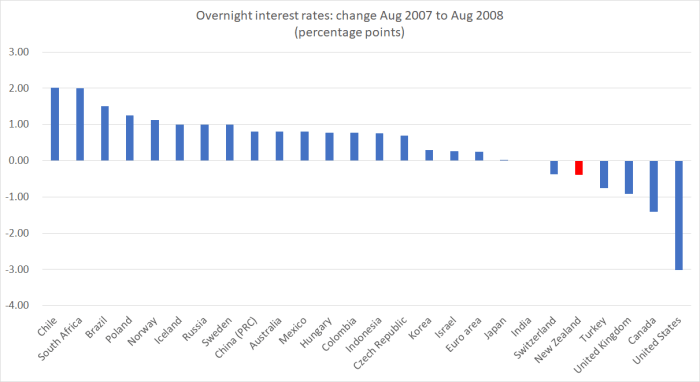
policy rate to aug 08

The Reserve Bank had cut only once by this time.  But most of these countries had done nothing to ease monetary policy.  It wasn’t enough, but it wasn’t exactly at the back of the field, especially when one recalls that at the time core inflation was outside the top of the target range, and oil prices had recently been hitting new record highs.

That was the record to the brink of the intense phase of the crisis.  Here is the same chart showing the total interest rate adjustment between August 2007 and August 2009 –  a few months after the crisis phase had ended.
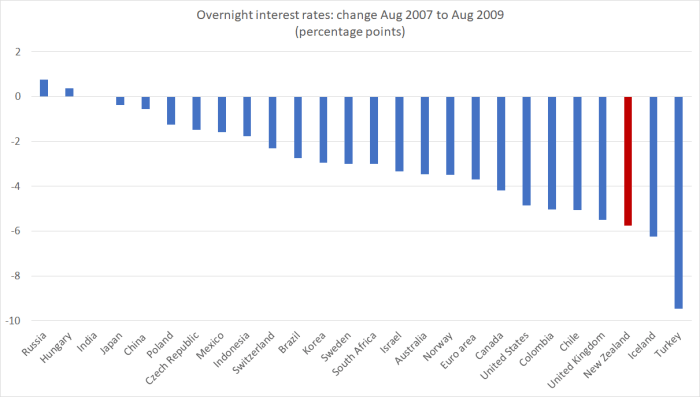
policy rate to aug 09

Only Iceland (having had its own crisis, and increased interest rates, in the midst of this all) and Turkey cut policy rates more than our Reserve Bank did.   In many cases, the other central banks might like to have cut by more but they got to around the zero bound.  Nonetheless, the Reserve Bank cut very aggressively, to the credit of the then Governor.  It was hardly as if by then the Reserve Bank was sitting to one side oblivious.

Obviously I’m not going to defend the Reserve Bank when, as Eaqub does, he criticises them for the mistaken 2010 and 2014 tightening cycles.  And the overall Reserve Bank record over several decades isn’t that good (as I touched on in a post on Friday), but their monetary policy performance during the crisis itself doesn’t look out of the international mainstream.   Neither, for that matter, did their handling of domestic liquidity issues during that period.

Eaqub also takes the government to task

The government bizarrely embarked on two terms of fiscal contraction. This contraction was at a time of historically low cost of money, and a long list of worthy infrastructure projects in housing and transport.

Projects that would have created long term economic growth and made our future economy much more productive, tax revenue higher, and debt position better.

Our fiscal policy is economically illiterate: choosing fiscal tightening at a time when the economy needed spending and that spending made financially made sense.

To which I’d make several points in response:

  • our interest rates, while historically low, remain very high relative to those in other countries,
  • in fact, our real interest rates remain materially higher than our rate of productivity growth (ie no productivity growth in the last four or five years),
  • we had a very large fiscal stimulus in place at the time the 2008/09 recession hit, and
  • we had another material fiscal stimulus resulting from the Canterbury earthquakes.

Actually, I’d agree with Eaqub that the economy needed more spending (per capita) over most of the last decade –  the best indicator of that is the lingering high unemployment rate – but monetary policy is the natural, and typical, tool for cyclical management.

And, in any case, here is what has happened to gross government debt as a share of GDP over the last 20 years.
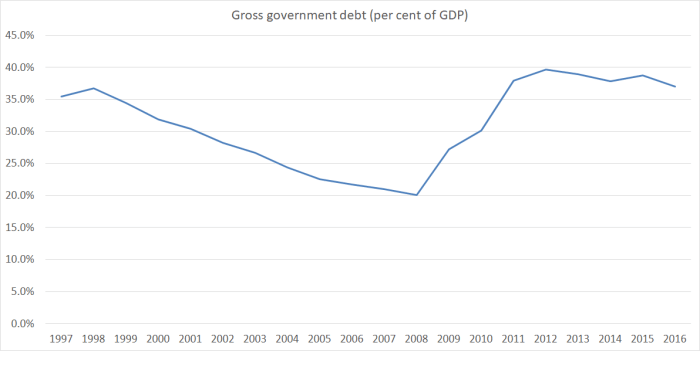
gross govt debt

Not a trivial increase in the government’s debt.   Not necessarily an inappropriate response either, given the combination of shocks, but it is a bit hard to see why it counts as “economically illiterate”.  Much appears to rest on Eaqub’s confidence that there are lots of thing governments could have spent money on that would have returned more than the cost of government capital.  In some respects I’d like to share his confidence.  But I don’t.   Not far from here, for example, one of the bigger infrastructure projects is being built –  Transmission Gully –  for which the expected returns are very poor.

Eaqub isn’t just concerned about how the Reserve Bank handled the crisis period.

Our central bank needs to own up to regulate our banks much better: they have allowed mortgage borrowing to reach new and more dangerous highs.

I’d certainly agree they could do better –  taking off LVR controls for a start.  But bank capital requirements, and liquidity requirements, are materially more onerous than they were a decade ago.  And our banking system came through the last global crisis largely unscathed –  a serious liquidity scare, but no material or system-threatening credit losses.  Their own stress tests suggest the system is resilient today.  If Eaqub disagrees, that is fine but surely there is some onus on him to advance some arguments or evidence as to why our system is now in such a perilous position.

Macro-based crisis prediction models seem to have gone rather out of fashion since the last crisis.  In a way, that isn’t so surprising as those models didn’t do very well.     Countries with big increases in credit (as a share of GDP), big increases in asset prices, and big increases in the real exchange rate were supposed to be particularly vulnerable.  Countries like New Zealand.   The intuitive logic behind those models remained sound, but many countries had those sorts of experiences and had banks that proved able to make decent credit decisions.  And we know that historically loan losses on housing mortgage books have rarely been a key part in any subsequent crisis.     Thus, the domestic loan books of countries like New Zealand, Australia, Canada, the UK, Norway and Sweden all came through the last boom, and subsequent recession, pretty much unscathed.

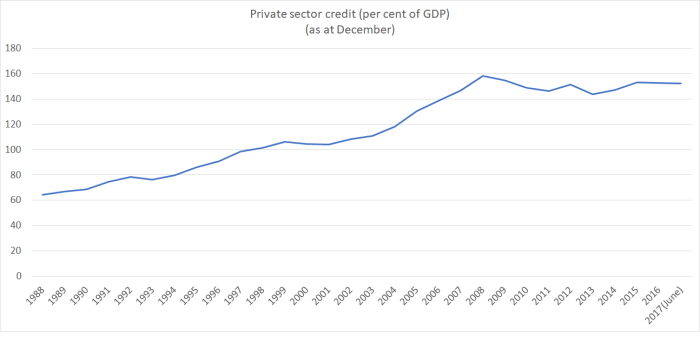
One of the key indicators that used to worry people (it was the centrepiece of BIS concerns) was the ratio of credit to GDP.  Here is private sector credit as a per cent of GDP, annually, back to when the Reserve Bank data start in 1988.
psc to gdp

Private sector credit to GDP was trending up over the two decades leading up to the 2008/09 recession.   There was a particularly sharp increase from around 2002 to 2008 –  I recall once getting someone to dig out the numbers suggesting that over this period credit to GDP had increased more in New Zealand than it had increased in the late 1980s in Japan.  It wasn’t just housing credit.  Dairy debt was increasing even more rapidly, and business credit was also growing strongly.   There was good reason for analysts and central bankers to be a bit concerned during that period.  But what actually happened?  Loan losses picked up, especially in dairy, but despite this huge increase in credit –  to levels not seen as a share of GDP since the 1920s and 30s – there was nothing that represented a systemic threat.

And what has happened since?  Private sector credit to GDP has barely changed from the 2008 peak.  In other words, overall credit to the private sector has increased at around the same rate as nominal GDP itself.  It doesn’t look very concerning on the face of it.  Of course, total credit in the economy has increased as a share of GDP, but that reflects the growth in government debt (see earlier chart), and Eaqub apparently thinks that debt stock should have been increased even more rapidly.

It is certainly true that household debt, taken in isolation, has increased a little relative to household income.  But even there (a) the increase has been mild compared to the run-up in the years prior to 2008, and (b) higher house prices –  driven by the interaction of population pressure and regulatory land scarcity – typically require more gross credit (if “young” people are to purchase houses from “old” people).

If anything, what is striking is how little new net indebtedness there has been in the New Zealand economy in recent years.  Despite unexpectedly rapid population growth and despite big earthquake shocks, our net indebtedness to the rest of the world has been shrinking (as a share of GDP) not increasing.  Again, big increases in the adverse NIIP position has often been associated with the build up of risks that culminated in a crisis –  see Spain, Ireland, Greece, and to some extent even the US.   I can’t readily think of cases where crisis risk has been associated with flat or falling net indebtedness to the rest of the world.

There is plenty wrong with the performance of the New Zealand economy, issues that warrant debate and intense scrutiny leading up to next month’s election.  In his previous week’s column, Eaqub foreshadowed the possibility of a domestic recession here in the next year or two: that seems a real possibility and our policymakers don’t seem remotely well-positioned to cope with such a downturn.     But there seems little basis for “GFC redux” concerns, especially here:

  • for a start, we didn’t have a domestic financial crisis last time round, even at the culmination of two decades of rapid credit expansion,
  • private sector credit as a share of GDP has been roughly flat for a decade,
  • our net indebtedness to the rest of the world has been flat or falling for a decade,
  • there is little sign of much domestic financial innovation such that risks are ending up in strange and unrecognised places, and
  • whereas misplaced and over-optimistic investment plans are often at the heart of brutal economic and financial adjustments, investment here has been pretty subdued (especially once one looks at capital stock growth per capita).

In other words, we have almost none of the makings of any sort of financial crisis, “GFC” like, or otherwise.

House prices are a disgrace. We seem to have no politicians willing to call for, or commit to, seeking lower house prices.  But markets distorted by flawed regulation can stay out of line with more structural fundamentals for decades.  If house prices are distorted that way, it means a need for lots of gross credit.  But it tells you nothing about the risks of financial crisis, or the ability of banks to manage and price the associated risks.
LVRs, interest rates and so on

I was recording an interview earlier this afternoon, in which the focus of the questioning was the Real Estate Institute’s call for some easing in the Reserve Bank’s LVR restrictions.

Of course, I never favoured putting the successive waves of LVR restrictions on in the first place.  They are discrimatory –  across classes of borrowers, classes of borrowing, and classes of lending institutions –  they aren’t based on any robust analysis, as a tool to protect the financial system they are inferior to higher capital requirements, they penalise the marginal in favour of the established (or lucky), and generally undermine an efficient and well-functioning housing finance market, for little evident end.  Oh, and among types of housing lending, they deliberately carve-out an unrestricted space for the most risky class of housing lending –  that on new builds.

That doesn’t mean I think it is remotely likely that the Reserve Bank will be easing the restrictions any time soon –  apart from anything else, it would leave their consultation paper on debt to income ratio restrictions looking a little silly.   Of course, it would be good if the Reserve Bank did lay out some specific criteria for lifting these ostensibly temporary restrictions, but with the toxic brew of rapid population growth and continuing land use restrictions in place, if I saw the world as they seem to, I wouldn’t be in a hurry to lift the restrictions either.

In any case, it isn’t that clear quite how large a role the LVR restrictions are playing in the reduction in sales volumes.   They must be playing a part, but so too will higher interest rates, and the apparent increase in banks’ own lending standards, and pressure through the parents from APRA (on the lending standards across the whole of Australian banking groups).  Which, of course, is also why it isn’t clear quite how much difference any easing back in the New Zealand LVR controls might make.  Some presumably, but even the Reserve Bank has never claimed that LVR controls would have a very large impact on house prices, or housing market activity, for very long.   And while I noticed an article this morning about negative equity, it is worth bearing in mind that, on the REINZ index (not using median prices), house prices have risen 65 per cent in the last five years, and are currently 0.6 per cent off their peak.

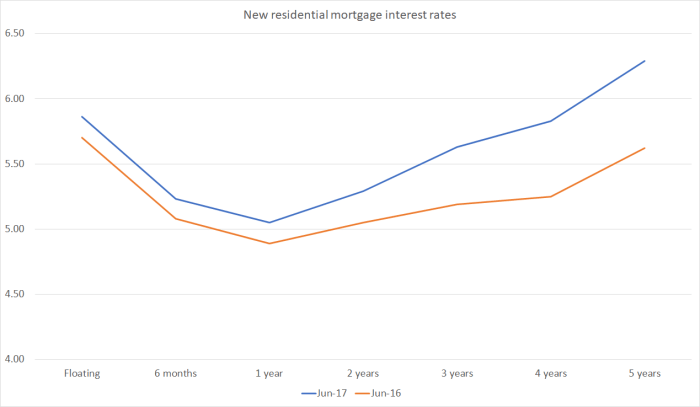
But what of interest rates?  A year ago, the OCR was 2.25 per cent, and today it is 1.75 per cent.  Thus, the Reserve Bank talks of having eased monetary policy.   Here are mortgage rates though.

mortgage ratesI don’t suppose anyone is taking out four or five year fixed rate mortgages, but across the entire curve, interest rates are higher not lower.   Or we could go back another year or so, to just prior to when the Reserve Bank began cutting the OCR.   The OCR has been cut by 175 basis points since then.   Even at the shortish end of the mortgage curve, rates are down only 50-70 basis points.
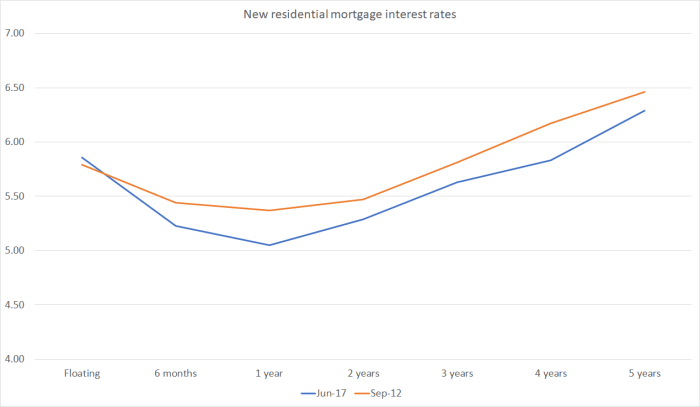
Having been reflecting this morning on Graeme Wheeler’s performance over his term, I had a look back at where interest rates were when Wheeler took office in September 2012.

mortgage rates sept 12Barely lower, even though core inflation –  on their own favoured measure – is as low today as it was then (and has been consistently low throughout his term).
I wondered if there were offsetting factors but:

  • Two year ahead inflation expectations are about 25 basis points lower than they were then (largely offsetting any reductions in nominal mortgage rates, to leave real rates little changed)
  • the TWI measure of the exchange rate is a bit higher than it was then,
  • the ANZ commodity price index, in inflation-adjusted world price terms, is hardly changed from what it was then.

Of course, the unemployment rate has fallen since September 2012, but there hasn’t been any sign of a pick-up in the best indicator of labour scarcity –  real wage inflation.

So, overall, it is a bit of a puzzle how the Governor expected to get core inflation back to fluctuating around the target midpoint without actually easing monetary conditions.  I don’t happen to agree with him on this one, but he keeps talking about how the huge migration inflows have reduced net inflation pressures (supply effects outweighing the demand effects).  If he really believes that it is even more puzzling that monetary conditions haven’t been eased.

I’m not sure how he’d respond.  But perhaps he could explain that too in the forthcoming speech.


Three Governors and monetary policy

Graeme Wheeler indicated yesterday that he will shortly be giving a speech offering some reflections on his time as Governor.    It is a good idea, at least in principle.  Wrapping up his 10 years as RBA Governor last year, Glenn Stevens gave a thoughtful speech along those lines (which I had intended to write about, but never got round to).   Wrapping up his 10 years as Governor of the Reserve Bank, Alan Bollard did an interesting interview with one of the editors of the Bulletin – he even acknowledged having made a mistake early in his term.

It is hard to be very optimistic about the forthcoming Wheeler speech, but ….. perhaps……this time.  Someone emailed me last night, after my comments on yesterday’s news conference, suggesting that

surely at heart you would have been more disappointed if Wheeler had finally answered questions in a meaningful way.  Would have made the past 5 years of communication even more painful.

I’d have been astonished certainly, but I have a naively optimistic streak and I’d like to  be pleasantly surprised, even this late in the game.  When he was appointed, I had had high hopes for the Governor.

But the promise of a forthcoming review speech, and an exchange with someone yesterday about the relative performance of the three Governors who have operated in the inflation-targeting era (in which I found myself defending Graeme), got me reflecting on how one might do those comparisons, at least in respect of monetary policy.

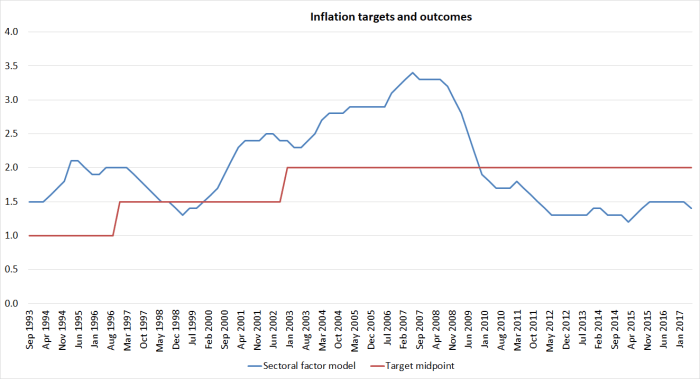
One could simply look at deviations of inflation from target.   Using headline CPI inflation wouldn’t help much there –  the CPI in the 1990s was constructed materially differently than it is now.  And when Don Brash took office there wasn’t an inflation target at all.  But the Bank is fond of its sectoral factor model measure of core inflation.  That measure has only been around for the last five years or so, but the Bank has calculated the series back to September 1993.   And as it happens, the first inflation target that last long enough for performance to be measured against it was the one adopted by the incoming National government in December 1990 –  inflation was to be 0 to 2 per cent by December 1993.

So here is the sectoral factor model measure graphed against the midpoint of the successive target ranges.

targets and outcomes

There are several things to notice:

  • this measure of core inflation has been much more stable in the Wheeler years than in any previous five year period,
  • none of the three Governors kept sectoral core inflation (or any other measure) close to the midpoint of the target range, and
  • the biggest deviations were in the last years of the previous boom, when this measure of core inflation was actually outside the target range.

In terms of average deviations

Brash 0.5
Bollard 0.5
Wheeler 0.6

But the Bollard decade was a tale of two halves: far above the target midpoint for his first six years or so, and then increasingly below the midpoint by the end of the period.

All this said, I wouldn’t want to put too much weight on those numbers, for various reasons including:

  • monetary policy works with a lag.  One can’t blame Graeme Wheeler for the first 12-18 months’ outcomes during his term.  Then again, the last three or four years’ numbers aren’t much different from those early in his term,
  • this measure didn’t exist, and certainly wasn’t being used, in the Brash or Bollard years (that said, no one disputes that inflation ran above the target midpoint during their terms, for various –  different –  reasons),
  • only since Wheeler took office has the target midpoint had any formal status.  In practice, Don Brash did aim for the midpoint, and often referred to it in public communications.  Alan Bollard didn’t regard the midpoint as being particularly important, and thought (and talked) in terms only of being comfortably inside the target range (thus at times we published projections with inflation settling back to around 2.5 per cent).

The fact that inflation averaged well above the target midpoints during the Brash years often surprises people.  Don had a reputation as an inflation-hating hardliner (an “inflation nutter”), which was –  at least in some respects –  well-warranted (he could also, at times, be a political pragmatist, to the dismay of the real hardliners).   He took the targets, and the midpoints, seriously.  So why was inflation averaging persistently above target?  My story is that he – we –  never quite realised how much higher than international interest rates New Zealand interest rates needed to be to keep inflation here in check.  In today’s terms, we underestimated the neutral interest rate.  In a way that wasn’t surprising.  After the great disinflation, we expected our interest rates to converge to those of the rest of the world –  and international visitors encouraged us in that view (I well recall the day a visiting senior Australian sat in my office trying to argue that we must have policy wrong because interest rates were still so much higher than those in Australia).    That convergence has simply never proved possible –  I argue because of the interaction of high immigration and low savings, but the “why” is a topic for another day.  Everyone realises that now, but we didn’t in the 1990s.   It led us to forecast lower inflation rates than we ended up achieving, and because – in effect – we believed our model we kept making what amounted to the same mistake.

Alan Bollard’s “mistake” was different.  He came into office with a sense that Don –  and those around him –  had been too hardline, and that if only we “gave growth a chance” we could get better outcomes all round.  I suspect he really did care about unemployment. He certainly cared a lot about the tradables sector, and the rising and high exchange rate quickly became quite a constraint on what he was willing to do with the OCR  (it was something of a political constraint too).  He was probably less willing to tighten than the median of the staff advice would have been, but actually staff advice also had something of the wrong model.  People just didn’t realise how much momentum there was behind the boom, or how structural (to the interaction of population and land use regulation) the lift in house prices was.   Because of the exchange rate, Alan was unwilling for too long to contemplate taking the OCR anywhere near the (real) peaks of the 1990s, even though by most measures –  whether unemployment or capacity utilisation –  the pressure on resources was much greater.

All three Governors made what would now be generally recognised as mistakes.  Some lasted shorter than others.  We held off adopting an OCR for years too long.  In 1991 we made the now-incomprehensible mistake (I strongly supported it at the time) of trying to hold up interest rates even as the economy was falling away rapidly into a recession, on some misguided view around the interpretation of the yield curve slope.  That lasted only a matter of months.  Then there was the MCI debacle in 1997 and 1998.  And scarred by that experience, we were too quick to cut the OCR in 2001 –  responding to a US recession that never much affected us.

Alan Bollard later openly acknowledged that his interest rates cuts in 2003 had been a mistake (at the time I’d thought at least the first one was appropriate).  And in 2010 the Bank was too quick to start raising interest rates, and had to reverse itself quite quickly.

As for the (single) Wheeler term, it was dominated by the mistake of promising to raise the OCR a lot, actually raising it by 100 basis points, and then the Bank only slowly and reluctantly having to more than fully reverse itself.     Perhaps more seriously still, there has been no apparent effort to position New Zealand for the next recession, when the OCR won’t be starting at 8.25 per cent.

Some of the mistakes the Reserve Bank has made have been in company (other central banks doing similar things).  Most haven’t.  In some cases, it has been a clear example of the Governor imposing his will on the organisation –  those 2003 OCR cuts were over the advice of a majority of OCRAG –  but most haven’t.  Then again, chief executives shape organisations, recruit people they are comfortable with, and sometimes don’t really welcome the airing of alternative views.  I don’t think, with hindsight, the institution’s record has been particularly good –  and I say that as someone who was heavily involved, at times at very senior levels, for a long time.  Sadly, it doesn’t seem to be improving.

I’m reluctant to try to reach a view on whether, overall, Wheeler has been worse than his two predecessors.     After all, the circumstances the three men faced were very different:

  • Don Brash was in charge during what we liked to think of as the “heroic” phase, slaying the inflation beast that ravaged New Zealand for the previous 25 years.  But, beyond that, he –  and we –  were learning what it meant to run monetary policy in a low inflation environment.  We had few effective yardsticks –  although we were probably more reluctant than we should have been to have consulted other countries’ practices and experiences.
  • On the other hand, Don presided over monetary policy through probably the most stable period ever in New Zealand’s terms of trade.
  • Alan Bollard presided during the most dramatic financial crisis the world had seen for decades –  perhaps since 1914.  I didn’t agree with all his stances in that time –  some he himself changed quite quickly –  but in many ways that 18 months or so was his finest hour: the willingness to improvise liquidity policies and to cut the OCR again and again, in large dollops.
  • Recessions: Bollard and Brash had to cope with them (ie externally sourced ones –  1991, the Asian crisis, the dot-com bust, and 2008/09). and Wheeler simply hasn’t.
  • Different shocks: Brash presided over the period of wrenching fiscal and structural adjustment, which made much of the data harder to read.  Bollard presided during a whole new period of persistent and unexpected strength in the terms of trade (we hadn’t paid them much attention until to then) and the Canterbury earthquakes.  All three Governors have had to grapple with the toxic mix of population growth and land use regulation spilling into rising trend house prices –  but it was the Bollard years that saw the largest, and most widespread, increase in debt/GDP ratios and private sector lending more generally.
  • In his early years, Brash had to deal with a severe domestic financial crisis and the aftermath of a very damaging credit, equity and commercial property boom.  Neither Bollard (despite the finance companies) nor Wheeler had to face something similar.

But, in many ways, I’d argue that Graeme Wheeler, and the Bank he presides over, have had it relatively easy.    Over his period there has been:

  • no international recession,
  • no major overseas financial crisis (the euro crisis transitioned into chronic state around the time Wheeler took office),
  • no deeply dislocative domestic shocks,
  • a stable backdrop of global inflation,

And unlike many of his international peers, he has always had total flexibility to adjust the OCR as required (the near-zero bound simply wasn’t an issue) and there were no looming fiscal crises in the background either.

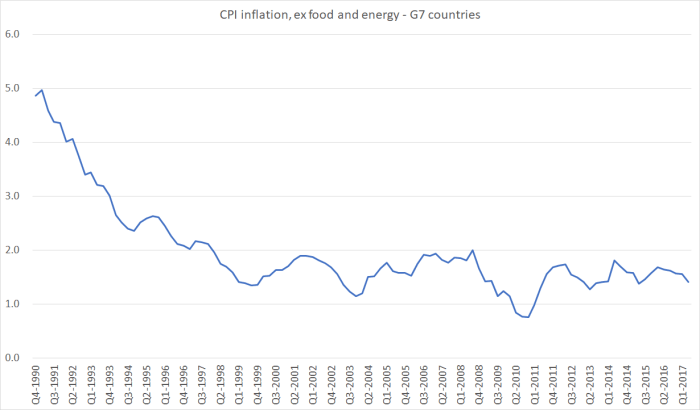
You might be surprised by the comment about stable global inflation. But here is the OECD’s measure of G7 core inflation (ie CPI ex food and energy).

CPI ex G7

Pretty stable for almost 20 years now.  Of course, within that some countries have done better than others.  And the interest rates that have been consistent with keeping inflation around these levels have fallen a long way.  But there aren’t huge inflationary or deflationary shocks from other advanced economies.  Contrast this chart with the New Zealand core inflation chart above.    And recall that, unlike New Zealand, most of the G7 countries were pushed to the absolute limits of conventional monetary policy.

It is fair to acknowledge that the recent swings in the terms of trade have been quite large –  so I’m not trying to suggest that getting monetary policy just right was easy (if it were that easy, we wouldn’t be paying a lot of people a lot of money to get it right).    But broadly speaking, a lot of things have been working in the Reserve Bank’s favour in recent years, that their peers in other countries haven’t had:

  • as already mentioned, the Reserve Bank had full OCR flexibility, and
  • an unemployment rate persistently above their own estimates of the NAIRU (a basic pointer to a demand shortfall, something conventional monetary policy can remedy),
  • high terms of trade (on average), supporting demand overall,
  • the effects of Canterbury earthquakes were quite disruptive late in Bollard’s term, but ever since Wheeler took office, they’ve been a consistent source of demand growth [NB I’m not suggesting earthquakes make us richer, but the reconstruction is a significant source of demand –  helpful if demand is otherwise scarce.] and
  • really rapid population growth (hard to forecast, but persistently surprising on the upside throughout Wheeler’s term –  the last quarter of net outflows, seasonally adjusted, ended a few days after he took office), and
  • although fiscal policy was net contractionary at the start of his term, even that has swung round to neutral or mildly expansionary more recently.

There is no reason to think it has been any harder to get things right –  forecasts and reality – than in the earlier years, and some reasons why it should have been easier to keep inflation up near target.

Non-tradables inflation, the bit the Reserve Bank has most medium-term influence over, should have been relatively easy to get up to levels more consistent with meeting the overall inflation target.  And yet, the Bank’s sectoral factor model measure of non-tradables inflation is no higher now than it was when the Governor took office.

Arguments about technological change, structural changes in labour demand, or whatever simply aren’t relevant to this conclusion.  They provide opportunities for faster growth without unduly fast inflation –  surely, broadly speaking, the goal of economic policy?  They provide the oppportunity to run the labour market a bit harder and get more people –  often people who find life a bit difficult – into employment.   In such a world, one does well –  getting inflation back to target –  by doing good.    Instead, all too often it has come to seem as though the Wheeler Reserve Bank is more concerned about house prices –  especially in Auckland – than it is about inflation or unemployment, even though –  when pushed –  they will acknowledge that monetary policy can’t do much about house prices.  And all this with no good model of house prices, and the failures of land use regulation.

So, yes, we’ve had stable (core) inflation in the Wheeler years, but stable at too low a level –  in his own words, an “unnecessarily” low levels.  He agreed to deliver it higher, and had a lot of things working in his favour to get it higher.  He wasn’t faced with rapid productivity growth –  driving prices down  –  rather the contrary.  And he was never faced with a fully employed labour market.    He simply didn’t do his job, when he easily could have.  He seemed to allow himself too readily to believe that somehow he faced the same challenges some of his peers bemoaned at BIS meetings –  when the preconditions for rapid (per capita) demand growth, a strong labour market, and inflation around target were much different here.

Would another Governor faced with the same circumstances have done differently in recent years?  We can’t really know.  There have always been some economists and commentators running a different tack but (a) as far as we can tell, most of the rest of the Reserve Bank senior officials have supported the Governor’s approach, and (b) most domestic market economists have done so most of the time as well.     It was the sort of defence we used in the Bollard and Brash years –  few ever consistently argued for tougher policy.  But it isn’t that persuasive an argument –  we charge the Reserve Bank Governor, resource him, and pay him well, to do better.

Where I suspect we can conclude that a different Governor would have done better is in perhaps the more peripheral aspects of monetary policy:

  • it is hard to believe that any other Governor would have been so reluctant to acknowledge a mistake.  Even if reluctant to accept the fact, most would have found more effective, appealing, lines to use,
  • Most possible Governors would have been much more willing to open themselves up to serious scrutiny, especially when questions around performance started arising.  Good ones would prove their competence and capability in part by their ability to engage with and deal with alternative perspectives.
  • Surely no other possible Governor would have taken the pursuit of Stephen Toplis to quite such lengths.  We know other Governors have at times expressed irritation with particular views, but that is very different from deploying your entire senior management team to attempt to close a critic down, and then when that failed  writing to Toplis’s employer – an institution the Bank actively regulates – to attempt to have him censored,
  • (oh, and other possible Governors probably wouldn’t have attempted to tar publically, in the cool light of day, someone who highlighted a serious weakness in the Bank’s systems).

It is hard not to think that a different Governor wouldn’t have produced stronger speeches – more akin to the quality one finds from Governors in other advanced countries –  or demanded, and received, more consistent depth and excellence in the quality of the analytical work underpinning the advice on monetary policy.

I’m not going to conclude that Wheeler did monetary policy worse than his predecessors –  and I will be interested to see his own arguments in his forthcoming speech –  but even considered in isolation it doesn’t look to have been a creditable record, whether on substance or on style.   That is something the Bank’s Board –  and whoever might shortly be Minister of Finance –  need to reflect on seriously, not just in identifying a specific successor, but in strengthening the institution as a whole.


Consistent to the end…..sadly

Consistent to the end, the outgoing Governor of the Reserve Bank today both refused to accept that he’d made any mistakes, while refusing any comment at all on some of the more searching questions.

The news conference was on the occasion of the release of his statutory monetary policy accountability document, the Monetary Policy Statement.    It was the last opportunity journalists will get to question him.  And yet faced with questions about the Toplis affair (his use of public resources, including his senior managers, to attempt to close down critical commentary from an employee of an organisation the Bank regulates), he simply refused to comment.   I’m sure he is now feeling quite embattled and defensive, but surely it should be unacceptable for a powerful public official to simply refuse all comment on such a chilling example of abuse of executive office?   If he doesn’t think it is an abuse, and thinks somehow people shouldn’t be allowed to aggressively criticise him, he should at least have the decency to say so openly.   I hope members of Parliament use their opportunity this afternoon to ask questions on this matter, and to insist on answers.

The Governor also tried to avoid most questions about his term in office (but was happy to provide a long answer to a curious question about risks around North Korea, on which he has (a) no accountability, and (b) no more knowledge than the rest of us).  Apparently there is a speech coming –  which may be interesting, but it provides no opportunity for follow-up challenge or scrutiny.   Asked if his critics have been fair, and if at times their criticism may have clouded his judgement in decisionmaking, he claimed he will cover that in his speech.  If so, that should be interesting.      Asked also about:

  • what surprised him about the economy in the last five years,
  • about his inflation record in the last five years, and
  • what his successor should worry about

he refused to provide any answers, and simply referred everyone to the forthcoming speech.

One journalist finally voiced a widespread concern and asked if the Governor had been open enough with the media, noting that the Governor appeared not to have given a single live interview in five years.     The Governor claimed to have been pretty open, citing the press conferences he holds.  He also claimed that his colleagues do interviews, but simply never engaged with the fact that he personally is legally responsible for the exercise of a great deal of power –  not just monetary policy, but in regulatory policy areas –  and simply doesn’t face up, ever, to anything but soft-ball interviews.  A press conference, with 20 other media and where the Governor gets to decide whose questions to take when, is simply very different from a sustained searching interview –  whether on Morning Report or one of the TV current affairs shows.

Towards the end of the interview, the Governor seemed to change tack a little.  After repeated questions about his stewardship, he came out claiming that things have actually gone pretty well really over the last five years, and that the Reserve Bank deserves credit for that.   It was like a performance straight from the National Party advertising unit.  Growth had, we were told, averaged 3 per cent and there had been plenty of employment growth.  Even house price inflation was somehow claimed as to their credit (I think the fact that it is temporarily low in Auckland).   Oh, and core inflation averaging 1.5 per cent –  when he had explicitly accepted a task of keeping it around 2 per cent –  was also apparently just fine.    These results should, apparently, dispel any suggestion that, even with hindsight, monetary policy had on average been too tight.

He did acknowledge in passing that there hadn’t been much productivity growth –  which isn’t his fault –  but there was no mention at all of the weak per capita GDP growth (by comparison with earlier recoveries), no mention of an unemployment rate that has been above even the Bank’s too-high NAIRU estimate for eight years now, and no mention of a very high labour underutilisation rate.   And even on the inflation front, he seemed to want to blame all the problems on the rest of the world: low tradables inflation, as if a persistently high exchange rate had nothing to do with that.  He attempted to claim that non-tradables inflation (averaging around 2.2 per cent) had been just fine, when everyone recognises that getting core inflation near 2 per cent would have required non-tradables inflation rather nearer 3 per cent (which shouldn’t really have been hard amid a big building boom).  And non-tradables is what the Reserve Bank has the greatest degree of medium-term influence over.  If the Bank deserves credit for the last five years –  whether for style and communications, or for specific policy – it can only have done so relative to a particularly low benchmark.

Even now, said the Governor, he was quite comfortable with his decisionmaking in 2014 and 2015 –  when he unnecessarily raised the OCR by 100 basis points, and then was slow and reluctant to reverse those cuts.    I’m not sure what he thinks he gains by never ever conceding any mistakes.  He’s human surely.  We all make mistakes.

All in all it was a pretty disappointing, if not overly surprising, performance.  Whoever takes up the job of Governor next year will surely face a huge challenge, in shifting the organisational culture –  which must have been infected by Wheeler’s approach –  and lifting performance.

And all that was before even getting to the content of this Monetary Policy Statement.  

There was the odd good thing I noticed.  LUCI, the ill-fated Labour Utilisation Composite Index –  sold for a year or so as a measure of absolute tightness in the labour market, before they finally realised that it was mainly an indicator of changes in that tightness (a difference that matters quite a lot) –  seems to have quietly exited the stage.

But there were various more troubling points:

  • they were at pains to note that their estimate of the neutral OCR has carried on falling.   But, as in the chief economist’s speech a couple of weeks ago, there was no attempt to translate that into estimates of how neutral mortgage rates, or neutral deposit rates have changed.  As I noted then, widening spreads between the retail interest rates and the OCR suggest that if we take the Bank’s neutral OCR estimates seriously, their implicit estimates of neutral retail rates have been rising.   That seems seriously implausible.   It matters because the Bank keeps talking –  and forecasting –  on the basis that monetary policy is highly stimulatory. It almost certainly isn’t.
  • and although they did note that mortgage interest rates are higher than they were last year, there was no attempt anywhere in the document to explain why the Bank considers that monetary conditions need to be tighter now than they were last year (especially as growth and core inflation have been surprising on the low side).
  • it was quite surprising how upbeat they appeared to be on the global economy.  In fact, their upside scenario is one in which global inflation picks up quite a bit.   That migth have seemed a plausible possibility a few months ago, but with US inflation ebbing and no real signs of any increase in core inflation anywhere else, it looks (frankly) a little desperate.  Perhaps it is a reflection of the Governor’s continued conviction that global monetary policy is highly accommodative/stimulatory?   Were it actually so, one might have expected an increase in inflation before now.
  • the Bank seems focused on the idea that the labour market is almost at capacity.  Their projections have the unemployment rate levelling out at 4.5 per cent, suggesting that is their estimate of the NAIRU.  Between demographic factors on the one hand, and wage inflation outcomes on the other, that seems unlikely.

But perhaps my biggest puzzle is where all the forecast growth is coming from.

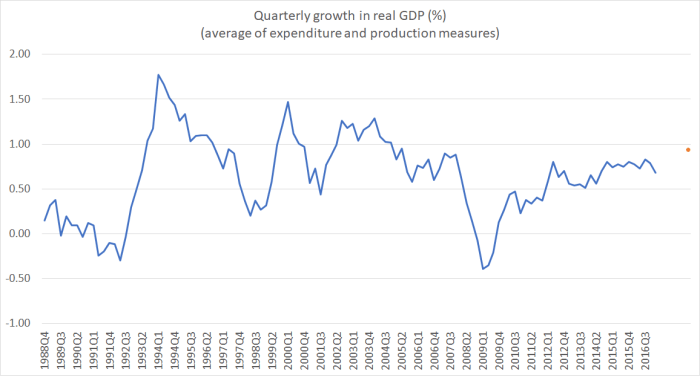
Over the next six quarters, the Bank projects that quarterly GDP growth will average just over 0.9 per cent. This chart shows six-quarter moving average of GDP growth (in turn, averaging the production and expenditure measures).

GDP growth qtrly

The orange dot shows the forecast for the next six quarters.  Their projections suggest that the economy will grow more rapidly over the next 18 months than it has managed on a sustained basis at any time in the current recovery.   You might not think that the difference looks large, but:

  • the Bank already recognises that monetary conditions are tighter than they were last year,
  • the Bank is forecasting a substantial reduction in the net migration inflow, and no one seriously doubts that unexpectedly rapid population growth has been the biggest single driver of headline GDP growth in recent years.  However much immigration adds to supply, it adds a lot to demand.

So why are we to expect a sustained growth acceleration from here?   Although it isn’t stated in the document, I hear that the Bank is invoking the expected fiscal stimulus (from promised measures announced in the Budget).  In isolation that might make some sense, but against the projected halving in the net migration inflow and the actual tightening in monetary conditions, it doesn’t really ring true.     If anything, the risk now has to be that over the next 18 months, headline GDP growth averages lower than we’ve seen in the last couple of years.

In many respects, the MPS is just another production in the long line of Reserve Bank documents that hold out the promise of higher medium-term inflation, but with little reason to expect it to happen.     But I was interested in one line in the policy section of the document. Often the Bank sounds quite complacent about non-tradables inflation, suggesting that everything is under control.  But this time they explicitly note that “a strong lift in non-tradables inflation is necessary for inflation to settle near the target midpoint in the medium-term”.   That, for central-bank-speak, is a pretty strong statement.    It might seem to argue for a more aggressive easing.

But they seem torn.  On the one hand, they go on to note that even “higher levels of growth may not be accompanied by significant increases in inflationary pressure”.   On the other, there is another strong statement about wage inflation: “increasing capacity pressure is likely to support wage growth in the near term“.    I guess that is quite a benchmark they’ve set for themselves –  and quite a surprising one after all these years of one-sided forecast errors.  If it doesn’t happen, and there seems little obvious reason why it should start now, I hope the Governor’s successors will be revisiting the stance of policy.

You might be wondering, so why not just cut the OCR and “give growth a chance”?  The Governor’s response to that is

an easing of policy, seeking to achieve a faster increase in inflation, would risk generating unnecessary volatility in the economy

I’m not quite sure what standards he is judging “unnecessary” by here?  It isn’t as if growth has ever been particularly rapid in this recovery (see chart above).  It isn’t as if unemployment has ever dropped, even temporarily, below the NAIRU.  It isn’t as if inflation has been surprising on the upside.  It isn’t as if productivity has been rocketing away.   It is as if the Bank is simply allergic to taking any steps that might possibly run a risk of (core) inflation going over 2 per cent, after all these years below.  In practice, it looks a lot like 2 per cent inflation represents a practical ceiling, rather than a target midpoint.

The Governor concluded his press release claiming that “monetary policy will remain accommodative for a considerable period”.  Fortunately, he will have no say in that matter.  Unfortunately, since we know neither who will be making the decisions, or what PTA they will be working towards –  recall that Labour, with the support of eminent economists like Lars Svensson, favour adding an explicit unemployment objective (to help make clear why we have active monetary policy in the first place) –  there isn’t really much information in that statement at all.   Much of the uncertainty is inevitable –  no one knows the future –  but quite a bit would be avoidable if we had a better statutory mechanism for Reserve Bank decisionmaking.

The search for the new Governor presumably goes on (the Reserve Bank Board would, on normal schedule be meeting next week).  Should the Opposition parties win power, I hope that one of their first actions (because time is pressing) will be a quick amendment to the Reserve Bank Act, to give the Minister of Finance the power almost all his overseas peers have, to appoint directly as Governor someone with whom he is comfortable, not someone the outgoing government’s Board delivers up to him.  In fact, it would be a sensible change whichever group of parties forms the next government.


Reading a NZ economist supporting large-scale immigration

As much as I can, I try to read and engage with material that is supportive of New Zealand’s unusually open immigration policy.   One should learn by doing so, and in any case there is nothing gained by responding to straw men, or the weakest arguments people on the other side are making.

At present, supporters of our unusually open immigration policy hold all the levers of power, and dominate much of the media.   But what has surprised me over the years I’ve been thinking about these issues is how unpersuasive I find the pro-immigration material, perhaps especially that written in a New Zealand context.   I’m not sure whether dominating elite opinion for so long has meant they no longer put the effort in, or what.  But whatever the reason, I’ve expected stronger arguments and evidence –  in support of a policy now run for 25 years –  and haven’t found them.

At the start of the year –  in a document that they were quite open about being aimed at Winston Peters, and those who might be listening to him –  the New Zealand Initiative came out with a substantial publication, largely devoted to saying that there was really nothing to worry about: if they couldn’t demonstrate the economic gains to New Zealanders (a point they acknowledged) there were few or no downsides.   If there was a case for any refinements, it was very much at the margins.  I devoted a series of posts(captured in a collected document) to examining the case they’d made.    I remain surprised at the limited extent to which an institution run by economists engaged with the specifics of New Zealand’s longer-term economic (under)performance.

A month or two ago, BWB Texts published Fair Borders? Migration Policy in the Twenty-First Century , a collection of chapters by various New Zealand authors (mostly, it would seem, of a left-liberal persuasion).  I wrote earlier about the chapter on a particularly unusual feature of the New Zealand system: we are the only country with any material amount of immigration (and one of only a handful in total) allowing people to vote if they’d resided here for just a year.

But my main focus is on the economic perspectives, both because that is my own background, and because successive governments have sold the immigration programme primarily as a tool to improve New Zealand’s economic performance and the economic outcomes of New Zealanders.   One doesn’t see it any more, but MBIE used to call the immigration programme a “critical economic enabler” .

And in Fair Borders there is a chapter on the economics of immigration, headed “International Migration: The Great Trade-Off”.   The author is Hautahi Kingi, a young New Zealander –  with a fascinating back story, that left me disquieted about aspects of our system –  who has recently completed a PhD on the ‘macroeconomics effects of migration’ at Cornell, and now works for a consulting company in Washington DC.

He begins his chapter in praise of migration –  not just something good, but something “central to human experience” –  harking back to some mythical day when humans were free to wander savannahs and steppes, constrained only by wild animals, unfamiliar climate, and hostile people who were already there, but not by official border guards.

As he notes, actually, 95 per cent of people live in their country of birth.  Probably a fairly high percentage live within 100 miles of where they were born.   Given this, Kingi concedes,

immigration policies have the potential to transform not just our economies, but the structure of our societies and institutions.

Which is, of course, part of what many people worry about.  Societies and institutions exist as they are for good reasons.    G K Chesterton had some wise cautions to those who happily lay into such institutions.

Kingi continues “by definition, international migration is a global issue”.  Well, I suppose so, in that for any international migration to occur at least two countries are involved.  But there is no necessary reason why immigration policy should be considered a global issue at all.   It isn’t like issues around pollution or climate change.  And few countries do treat it as an international issue.  They make immigration policy, as they seek to make policy in most other areas of governments, primarily in the interests of their own citizens/voters.

Kingi’s first main section is about what he describes as “the global perspective”.   He is pretty persuaded by the papers which seek to show that if only all countries opened their borders and people could move wherever they wanted there would be a massive – perhaps 100 per cent –  increase in world GDP.  In his words “from a global income perspective, no other policy offers anything remotely as appealing”.

But, in fact, he doesn’t make much of a case.  Sure, open migration would beat out foreign aid –  the alternative policy he quotes – as a means to lift average incomes.  But whoever supposed that most foreign aid ever did much good –  Peter Bauer was writing about this stuff decades ago –  or that much of it wasn’t more about foreign policy (cultivating relationships with foreign governments) than about lifting living standards in recipient countries.     Free trade in goods and services does much more than foreign aid.

Perhaps more importantly, surely the most compelling and effective means to lift living standards en masse is for countries to adopt growth-friendly policies and institutitions.  China is the most obvious example in recent decades.   They have a long way to go –  on both policies and outcomes –  to get to First World living standards, but what they have achieved in recent decades is transformative, and obvious.  And for hundreds of millions of people.

Unfortunately Kingi –  and many of the libertarians who also run such arguments –  end up running a latter-day version of the line one used to hear decades ago from people on the dripping-wet left wing side of economic debates: the poor are poor because the rich are rich.    To a first approximation, it is simply false.    People in New Zealand, or the UK, or France, or Denmark aren’t rich because we won some lottery, or just got lucky, but because our ancestors developed, and we maintain, cultures and institutions that develop and maintain a high level of productive capability (encouraging and rewarding people for investing in human and other forms of capital).   Sadly, too many other countries have failed to do so.   (The need to work hard to maintain such cultures is part of why I think Oliver Hartwich’s Herald op-ed today is profoundly wrong: character matters greatly.)

It is not as if change is imposssible –  look at the convergence achieved in recent decades by a handful of east Asian countries.  It is not as if our relative position is immutable either –  not 1000 years ago, China was well ahead.   But prosperity, en masse, is mostly about the institutions, broadly defined, that societies develop and maintain.  Doing so is hard work.

Are there exceptions?  Well, yes of course.  In our age, if you don’t have too many people, and you do have lots of oil and gas, your people can be very rich, even without many of the supporting institutions that otherwise seem to be required.  But those are windfalls, in a sense achieved by free-riding on the gains –  demand and technology – developed elsewhere.

Generally, even if individuals might feel themselves lucky or unlucky, societies –  and all of us exist within societies – aren’t lucky or unlucky: they are the product of successive generations of choices.   Immigration restrictions don’t “elongate the misery” of poor countries: the choices of those societies are primarily what have that effect.

Can one import prosperity?  To some extent one can.  After all, New Zealand (and Australia and the like) are examples.  Material living standards weren’t high for indigenous people pre-colonalisation.  But New Zealand and similar countries had lots of land, a temperate climate, and by importing not just lots of people from the then most advanced economic culture (and all the legal and associated institutions), something a bit like Europe was created here.   Maori shared –  perhaps to a lesser extent than might have been desirable –  in the prosperity that was created here.   But –  and these are Kingi’s words – “movement of people entails movement of culture and norms”.    A New Zealand that was once largely the place of Maori isn’t really so any longer.

But that 19th century example –  that transformed Australia, New Zealand, Canada, Argentina, Uruguay, Chile, and US –  isn’t really relevant to New Zealand’s situation now.  Even if we wanted to engage in such a mass transplantation, there is no economic culture hugely more advanced than what we already have.

So Kingi’s focus is the other way round –  it is on the gains to migrants from being able to shift from poor countries to rich countries.  There is no doubt that, for individuals at the margin they are considerable –  it is why we see foreign students willing to pay $40000 for a job in New Zealand, with the aim of qualifying for a New Zealand residence visa.

But the staggering gains in the papers Kingi cites don’t result from quite modest flows, but from “massive” movements of people.  In his words “movement of people entails movement of culture and norms” –  and if those effects are small for modest migration flows, they are likely to be substantial for “massive” movements.  In the long-run, migrants import their own economic destiny –  just as we (descendants of the 19th century migrants from the UK) did.   And if poor migrants in large numbers ultimately bring their own cultures and institutions, it is most unlikely that in the long run they’d be better off here to anything like the extent the academic papers suggest.  After all, geographic New Zealand is no better intrinsically suited to economic prosperity for lots of people than many other parts of the world –  arguably (or so I’ve argued) our remoteness makes us less so.

Strangely, Kingi’s poster-child example of large scale immigration is the Gulf Cooperation Countries, such as Qatar and Kuwait.  86 per cent of Qatar’s population is made up of migrants. Qatar has probably the highest GDP per capita in the world.  It is obviously appealing to the poor migrants, who keep coming, but I’m not sure why Kingi regards it as a remotely appealing basis on which to sell mass migration to New Zealanders.   For a start, these are classic states with massive natural resources and (originally very few people).  It is no surprise that there are windfall gains that could be spread around.   But as even Kingi acknowledges, the exploitation of lowly-skilled foreign labour in countries like this is appalling (even if one wants to engage in economists’ talk of both sides benefiting or it wouldn’t happen).  It simply isn’t how we would want a society to be structured.  And although he notes that this large scale migration goes on without causing any great domestic political problems, (a) the migrants have few rights, and no political rights (even fewer typically than the natives), and (b) these are societies not exactly known for freedom of speech, freedom of the press and the like,  And, sadly, slavery –  or its modern equivalent –  can look quite appealing to the slaveholders and those who benefit from the practice.   It remains morally repulsive.

If you’d only got this far in Kingi’s chapter, you might suppose he was an out-and-out advocate of open borders and free migration, here and everywhere.     But it is here that he gets more interesting.  Note the trade-off in his chapter title, and he seems to recognise that whatever large scale migration might do for the migrants, it could well harm at least some natives.  I think he gives a fair account of the international debate about the impact of immigration on the wages of lowly-skilled natives

Although this debate continues unresolved in academia, it is at leasr conceivable that immigrants may negatively affect those native workers with whom they compete most closely for jobs.  The experience of globalisation in recent decades should teach us to take this potential concern very seriously.

He looks to reconcile what he sees a a global imperative to allow high immigration (generally) with the risk of harm to vulnerable natives, favouring better-educated migrants.

But as notes, immigration is’t just an economic issue.  And here too he seems torn.  He’s a paid-up member of those who “embrace multi-culturalism as a cherished part of progressive society” and yet recognises that “mass migration” can have a ‘potentially corrosive effect on that society”.    But as I say, he is torn.

When people cross borders, so do their cultures and norms, and we are almost always richer and stronger for it.

But

more diverse societies also tend to reduce the provision of public goods and erode support for the welfare state

Unlike some libertarians, that erosion of support for the welfare state seems to be a bad thing for Kingi.

and

[ethnic divisions] can severely undermine the social institutions sustaining an economy because, despite the assurances of modern legal systems, “virtually every commerical transaction has within itself an element of trust”

He notes

The impact of immigration on a country’s social fabric can be an uncomfortable issue to discuss because it forces us to acknowledge and confront lamentable tribal aspects of human frailty.

Institutions and societies evolve to cope with human fraility –  aka “reality”.

And almost in passing he notes a Maori dimension

modern Aotearoa was founded on the principle that tangata whenua have rights to their culture that should not be overridden by settlers.  At the heart of the critique against colonialism is a concern for the enforced erosion of culture.

Kingi sets out the concluding section of his chapter with the proposition that there is a moral dilemma between the global and domestic perspectives.

by restricting the entry of foreigners…we effectively accept the substantial inequality outside our borders in order to protect the veneer of equality within.

You can see where his economist instincts lie.  But he is simply wrong about the trade-off, at least once large numbers of people are involved.  Societies make, and sustain, their own destinies.   He argues that

migration is, and always has been, the best tool for reducing suffering  in our world

But demonstrably that isn’t so.  Europe didn’t get rich on the back of migration –  even if the 19th century outflows helped them a bit.  China didn’t lead the world –  and recover its standing in the last 40 years –  on the back of migration.   Perhaps some libertarians wish it were otherwise, but migration –  country to country –  has always been a distinctly minority experience.   It lifts prospects for relatively small numbers –  if the people of North America are generally richer than the countries of their ancestors, people of South American typically aren’t.  Rising prosperity, reduced poverty, mostly result from choices, conscious or unconscious, that societies make about how to organise and discipline themselves.

I’m not sure quite where Kingi himself ends up.  His chapter is strikingly high level, and despite being in a book focused on New Zealand hardly engages with the New Zealand economic experience (or New Zealand social/cultural issues) at all.  It certainly doesn’t recognise how unusually large New Zealand’s residence approvals programme is by modern international standards.

Perhaps when Kingi ends this way

While international migration represents a life-changing opportunity for many, it also threatens the livelihoods of others and strikes to the core of our societies by changing their structure, their jobs, their culture, their appearance

he is still working his way towards a policy prescription for modern New Zealand.

As part of Radio New Zealand’s recent podcast series on New Zealand immigration, Kingi and I did a series of email exchanges on these issues –  me as the sceptic and Kingi as the supporter.  Radio New Zealand tells me that the series of letters was well-received by readers,  in part for the very different angles they present on the economic issues.  I want to come back to that exchange, perhaps next week, to elaborate on some of the key points we each chose to make when confronted with the other’s arguments, under pretty tight word limits.


WCC approach to housing problems: hot-bedding

I think the imported chief executive of the Wellington City Council, Kevin Lavery –  he of non-transparent subsidies to Singapore Airlines, and the like – must have pushed “send” on an email to staff without checking just who he was sending it to.   My household just received two copies, on two different email addresses, of what looks a lot like a staff email.  Since we used those two email addresses to make our separate submissions last night on the Island Bay cycleway –  and the Council otherwise wouldn’t have one of the addresses –  it looks as though he sent his staff email to online responders to the cycleway proposals

Most of it looks harmless enough, although it was wryly amusing to note the self-congratulation about the Council’s Annual Report

Congratulations to everyone involved with our 2015/16 Annual Report, which received a silver medal at the Australasian Reporting Awards. The award is a reminder that the public documents we produce are not just about our performance as an organisation – they are also an opportunity to communicate effectively with our stakeholders.

When this is the same Council that simply refuses to comply with the Official Information Act, in its local government manifestation.   Self-promotion, rather than transparency, is rather more like the hallmark of the council.

But included in the email was a “Good Reads” section, with links to various articles on housing and cities related issues.    Perhaps next time he could make room for Brendon Harre’s interesting new piece on “Successful cities understand spatial economics”. Out of interest, I did click on one of the links, described this way

Some interesting ideas from outside of New Zealand at possible solutions to housing affordability issues. I like this because it looks, with a different lens, at the challenge of providing adequate, secure and affordable housing and suggestions for tackling them.

Sounded promising.

But I was somewhat taken aback by what I found, in an article championed by the chief executive of a Council that is keen on promoting Wellington as a cool, successful, and prosperous city.

The author –  a freelance writer in the US –  is writing about a report from something called the World Resources Institute, on housing options.  Not mind, housing policy options for advanced countries, but for

the global south (India, Africa, Asia, Latin America) where the lack of affordable, adequate and secure housing in cities is projected to grow the fastest.

We are told that

The paper spotlights three key challenge areas “to providing adequate, secure and affordable housing in the Global South,” as well as suggestions for tackling them. They include the growth of informal or substandard settlements (i.e., slums), policies and laws that push poorer residents out of the city, or to its fringes, and, interestingly, an overemphasis on home ownership.

The authors apparently favour skewing the tax system to “incentivise renting”.

It gets worse

Beyond the policy-side, however, it also looks at a number of creative rental models, from land leases and co-ops to lump-sum rentals, which are popular in a number of Asian countries, including Thailand, China and India. …… The paper also makes a case for a practice known as “hot bedding,” in which “a bed space in a shared room is rented for a specific number of hours to sleep, typically 7 to 10 hours.”

Hot-bedding………

In conclusion,

“Promoting a range of rental housing options expands opportunities for more renters while testing which types of rentals best meet local demand,” the authors conclude.

I’m all for flexibility, but does the chief executive of the Wellington City Council really think that “hot bedding” is an appropriate or desirable solution for the increasingly unaffordable Wellington housing market?   Is his vision of the city he temporarily serves now so diminished he regards the growth of slums as the sort of pragmatic idea his staff should be interested in, to fix the mess the Council itself has created?

To be clear, I’m sure Mr Lavery believes none of those things.  And perhaps they are reasonable and practical partial solutions in very poor but rapidly urbanising countries.  But what does it tell us about his mindset – and that of his political masters –  that this is the sort of stuff he is encouraging his staff to read?    Most New Zealanders –  most Wellingtonians –  want to own their place.  They don’t have much tolerance for imported bureuacrats who think that home ownership

in many economies just takes up too much mental bandwidth

They are just excuses for the decades-long failure by New Zealand central and local governments.

Free up the land use rules instead. There is plenty of land in greater Wellington, but owners simply aren’t encouraged, or even allowed, to use it.  And look for creative ways of allowing greater density where people would prefer that, but in ways that respect the interests of current owners.  Above all, look and sound as if you think Wellington might have a future as a first world city, in which residents –  present and future –  might be able to buy good quality housing at genuinely affordable prices.

But “hot-bedding”………I still can’t quite believe it.  But it was good of Mr Lavery to send his email to (presumably) the wrong list of recipients, and thus shed further light on the sort of mindset that prevails at council headquarters.

UPDATE: While I was typing that another email arrived

For those of you who’ve unexpectedly received an email from Wellington City Council – we apologise profusely! The message from our Chief Executive was meant to be a routine communication to Council staff but we’ve hit the wrong button and so it’s received a considerably wider audience. Hopefully it provides a positive, albeit unintended, glimpse inside the engine-room of the Council.

“Positive” –  I think not.


Monetary policy, the Governor etc

In a post a couple of weeks ago I highlighted the extent to which monetary conditions appeared to have been tightening over the last few months, even as the OCR has been kept steady at 1.75 per cent.  Specifically, retail interest rates (lending and deposits) have increased, and the exchange rate has risen.  In addition, but less amenable to easy statistical representation, credit conditions have tightened, through some mix of Australian and New Zealand regulatory interventions and banks’ own reassessments of their willingness to lend.    Over this period there has been no acceleration in economic growth and inflation (whether goods or labour) hasn’t been increasing.  If anything, core measures of inflation –  already persistently below target –  have been falling away.

Yesterday the Reserve Bank released the results of the latest Survey of (business and economists’) Expectations.    The Reserve Bank has recently changed the survey, dropping a number of useful questions altogether, and missing the opportunity to plug some key gaps (eg there are no surveys in New Zealand of expected net migration).  They’ve also added some useful new questions, but for the time being are refusing to release the results of those questions –  including those around OCR expectations, house price expectations, and longer-term inflation expectations.

But one set of questions I was a little surprised that they left unchanged were those around monetary conditions.  I like the questions but it is a long time since I’ve seen anyone else write about the results.   Respondents are asked to indicate what their perception of current monetary conditions is (on a seven point scale, where four is neutral).  And then they are asked the same sort of question about expectations for the end of the following quarter and a year hence.

Broadly speaking, respondents tend to describe monetary conditions –  or at least changes in them –  as one might expect.   Here is the perception of current monetary conditions, dating back to the start of 1999 when the OCR was introduced.

mon condtions current

The peak in the series was right at the peak of the last OCR cycle, where the OCR was raised to 8.25 per cent.   Since then, although the Governor likes to describe monetary policy as extraordinarily accommodative, respondents have never thought that monetary conditions have been (or are) anywhere as easy as they were tight in 2007/08.  (When I completed the latest survey, I described current conditions as just a bit tighter than neutral.)

Note that latest observation.  Respondents reckon that monetary conditions have tightened.   The increase doesn’t look that large, and does come after a fall in the previous quarter.    But, the larger increases tend to occur either when the OCR is actually being raised, or when the Reserve Bank is talking hawkishly about the probable need for further OCR increases (thus, you can see the two big increases in 2014, when the Bank was in the midst of what it was talking of as 200 basis points of OCR increases).

But perhaps more interesting is that respondents also expect conditions to be quite a bit tighter by the end of the year, and again by the middle of next year –  and all that with no Reserve Bank encouragement at all.    And –  I would argue –  none from the underlying economic data either.

mon conditions ahead.png

The scale of the increase in the last few quarters is comparable in magnitude to the increase in 2013/14 when the Reserve Bank was talking up, and delivering, significant OCR increases.

Quite why respondents –  completing the survey in late July –  are expecting so much tighter is a bit of a puzzle.  But if it isn’t down to the Reserve Bank itself, or to the underlying economic/inflation data, perhaps it is reflecting trends respondents are observing –  the rising retail interest rates, high exchange rate and tightening credit conditions –  and that they are assuming that those things won’t reverse themselves, and may even intensify.

Personally, I think the case for somewhat easier monetary conditions is relatively clear at present: weak inflation, unemployment still above NAIRU, weak wage inflation, and a housing market that seems weaker than the toxic mix of land use restrictions and continued rapid population growth would warrant.  (To be clear, I’m not making a positive case for higher house prices inflation – though more housebuilding would be welcome –  just noting that the housing market is where, if overall conditions were about right (for the economy as a whole), we should be seeing continuing high inflation.)

Against that backdrop, I think it would be highly desirable for the Reserve Bank to make the point explicitly on Thursday that the economy has not needed, and does not now appear to need, tighter monetary conditions, and that some easing would be welcome and appropriate.    As I noted in the earlier post, I’m not sure it would really be appropriate for the Governor to cut the OCR –  given that (a) he hasn’t foreshadowed such a move, and (b) that this is his last OCR decision.    In a well-governed central bank –  such as almost every other advanced country has –  a change of Governor is less important: however influential the Governor’s views are, in the end he or she has only one vote in a largish committee.  All the other voters will still be there the next time an interest rate decision is made.

The problems here are compounded by the (a) the forthcoming election, so that no one knows what regime (what PTA) monetary policy will be being made under in future, (b) by the fact that we only have an acting Governor –  an illegal appointment at that – for the next six months, and people in acting roles are often loath to do anything they don’t strictly have to, and (c) by the lack of transparency in the Reserve Bank’s systems and processes.  When, say, Janet Yellen or Phil Lowe took up their roles as head of the respective central banks we knew a lot about how they thought about monetary policy.  Same goes for Mark Carney –  even though what we knew about him was from another country.    There is almost nothing on record as to how Grant Spencer these days thinks about monetary policy.  Even if he is to operate –  illegally –  under a (purported) PTA that is the same as at present, the PTA captures only a small amount of what is important to know: what matters as least as much is how the individual thinks about and reacts to incoming data.  With no speeches, no published minutes, no published record of the advice he has given the Governor on the OCR we know very little at all.

It is a model that badly needs fixing.  We simply shouldn’t be in a position where one person holds so much power, and hence their departure leaves such a vacuum (especially when, as will inevitably happen from time to time, such changes occur around election time).    We know that the Opposition parties are promising change –  roughly speaking in the right direction, although the details need a lot of work –  but what the National Party has in mind remains a mystery.   Treasury is refusing to release any of the versions of Iain Rennie’s report on central bank governance, claiming that the matter is under active consideration by the Minister of Finance.  That is a dodgy argument anyway –  since Rennie’s report to The Treasury is not the same as Treasury’s advice to the Minister (something I haven’t requested) –  but since they’ve had the final report for months now,  it shouldn’t be unreasonable to expect some steer from the Minister as to what his response might be.  As I’ve noted before, with the process of choosing a new Governor underway, at present neither candidates nor the Board have any real idea what a key aspect of the job might be.

The problems around “one man governance” aren’t restricted to monetary policy.   The Deputy Governor, Grant Spencer, gave a thoughtful speech the other day on “Banking Regulation: Where to from here?”.  But in a sense, the problem was in the title.  The Governor personally makes the policy decisions, and the Governor is leaving office next month.  Spencer will be minding the store –  illegally –  for a few months, and then retires early next year.  As we’ve seen in the past, the particular person who holds the role of Governor can make a big difference to the character and specific direction of regulatory policy –  LVR restrictions, for example, were (for good or ill) a legacy of Graeme Wheeler personally (and the earlier hands-off disclosure driven model, a legacy of Don Brash personally).  So in many respects it makes no more sense for Grant Spencer to be giving speeches on “where to from here” for bank regulation than it does for Steven Joyce to give such a speech on where to from here with tax policy.  In Joyce’s case, at least it is a campaign speech –  he hopes to still be in place next year, whereas Wheeler and Spencer will both be gone.  Neither they nor we know what their successors’ inclinations might be.

Again, that isn’t good enough.  We’ve personalised control of a major area of policy, when the general practice, here and abroad, is that when technocratic agencies exercise regulatory power they do so through boards that provide considerable continuity through time.  Individuals come and go, but they do so one at a time, and in a way that doesn’t dramatically change the balance of the board in the short-term.  That provides stability and predictability for both the institution itself, for those we are regulated (or indirectly but materially affected by regulation) and for those –  citizens –  with a stake in the agency.     We are well overdue for significant governance reforms to the Reserve Bank legislation.  And to say that is not to criticise the individuals –  Wheeler, or Spencer – who have to operate with the law as it stands it present, inadequate as it is.   The responsibility for the inadequate legislation  –  the iunadequacies of which have been brought into sharper relief in the last few years –  rests with ministers and with Parliament.

In closing, I do hope that when journalists get to question the Governor, and when later in the day FEC members get the same opportunity, they will not overlook the egregious and inexusable behaviour –  not sanctioned by any legislation –  by the Governor, his deputies, Geoff Bascand and Grant Spencer, and his assistant John McDermott –  in attempting to silence Stephen Toplis when they disagreed with some mix of the tone or content of his commentaries on them.     The intolerance of dissent, and the abuse of office, on display then aren’t things that can simply be let go silently by.   I’m as appalled as anyone by the lack of contrition Metiria Turei has displayed over her acknowledged past benefit fraud.  But bad as that is, abuse of high office by senior incumbents is, in many respects, a rather more serious threat.  Our elites seem to have become all too ready to do hardly even the bare minimum to call out, and expose, unacceptable behaviour by the powerful.  Here, we’ve seen no contrition, we’ve seen a Treasury advising the Minister to ignore the behavour, and a Minister of Finance –  legally responsible for the Governor –  happy to walk by on the other side, saying it is nothing to do with him.

(It was nonetheless interesting to read the BNZ’s preview pieces for this week’s MPS.  Perhaps they were just chastened by the data having not gone their way, or perhaps the heavy-handed pressure from the Governor really did work, because the tone (and spirit) of these latest commentaries is very different from what we saw –  and what so riled the Governor  –  in May.   Personally, I thought –  and think –  that the Governor’s May monetary policy stance was more appropriate than the BNZ’s, but that isn’t the point.  Our system is supposed to thrive on vigorous debate, and one isn’t supposed to lose the right to challenge the powerful just because in this case the Governor happens to regulate the organisation employing the critic.)


Unemployment: ethnic differences

Having written last Friday on some of the differences in unemployment rates by age cohort, I got curious about the HLFS data broken out by ethnicity.  I’ve never paid much attention to it –  much of the data hasn’t been published for long, and my main interest has always been macroeconomics (the whole economy, rather than specific outcomes for particular subgroups).

But many of the ethnic differences are stark.   Here, I will mostly focus on those between those identifying as European and those identifying as Maori.

Take the headline unemployment rates for example (the longest run of data I could find on Infoshare).

U by eth

or the underutilisation rates

underutil by eth

The European numbers are bad enough –  10.5 per cent of the labour force underutilised –  but the Maori numbers are astonishing.  22.4 per cent of the Maori labour force underutilised is a sad reflection of (probably) a whole series of failures.    Perhaps because the numbers are so large, the gap between the Maori underutilisation rate now and that prior to the recession is visibly stark.

As I illustrated last week, labour market characteristics differ quite a lot by age cohort, and the Maori population is, on average, quite a bit younger than the the European population (both because of higher birth rates and because of lower life expectancy).

But even when one looks by age cohort, the differences between Maori and European outcomes are stark.   Overall labour force participation rate of Maori and Europeans aren’t so very different –  on average over the last three years, 67.2 per cent of working age Maori were in the labour force, and 70.2 per cent of Europeans.   But here are participation rates by age cohort for the two ethnic groups.

partic by age eth

In every cohort, except the 65 plus group, the European labour force participation rate is materially above that for Maori –  on average by almost 10 percentage points.   I’m not sure what to make of the 65 plus group, where Maori and European participation rates are almost equal.   It may be, at least in part, a reflection of greater Maori relative poverty (less success in building up wealth over earlier years).

The picture is even more stark if one looks just at employment rates (given that Maori unemployment rates are higher).

empl rates by age eth

Focusing in on young people, here is what the data show people aged 15 to 24 are doing (again averaged over the last three years).

15 to 24

Interestingly, a slightly larger proportion of the the Maori young population are in education and not simultaneously in the labour force than is the case for young Europeans.     Perhaps the most visible difference on that chart is the first set of bars –  the much larger proportion of European young people simultaneously working and studying than for Maori.      Here is a chart (over the same three years) of that one component for each of the four ethnic groups SNZ reports the results for.

15 to 24 employed

I did notice the difference in the “not in education, not in the labour force –  caregiving” proportions.  Here is that chart for each of the four ethnic groups.

15-24 caregiving

SNZ reports no (statistically significant) numbers of young men in this category.  In other words,  around 11 per cent of young Maori women are engaged in full-time caregiving (presumably mostly for young children), doing no study or even an hour’s paid work (the HLFS criterion) a week.   By contrast no (statistically significant numbers of) young Asian women are.

I’m not going to attempt to hypothesise about why the differences in these various charts (or various others in the data) exist.  But none of the gaps strike me as things simply to be relaxed about.   Says he who is –  contentedly – not in the labour force, not in education, and is caregiving children.

Unemployment: age matters

Despite the reaction of the foreign exchange market, there didn’t seem to be much new in the suite of labour market data the other day.  Sure, employment was down a touch, and the participation rate fell back.  Then again, it had been hard to take entirely seriously the reported strength of the participation rate over the last year or so.  And the unemployment rate did keep edging downwards (although at this rate it will take another two years until the unemployment rate is back to where it was when the current government took office) and hours worked, in both the HLFS and QES, grew quite strongly.   And there wasn’t much sign of any pick-up in wage inflation.  So unless you had been determined to believe the data was  just about to confirm an overheating economy, probably not too many surprises.  We’ll see next week what the Governor of the Reserve Bank makes of it.

But, largely prompted by a question in Parliament yesterday, I downloaded the age breakdowns in the HLFS.  Unemployment rates are very very different by age cohort.

Here are official unemployment rates for the latest year, by age.

U rates by age

People aged 15-24 and people aged 65 and over make up roughly the same share of the total working age population (about 18 per cent each).    But people in the young cohort make up 45 per cent of the total number of people unemployed, while over 65s make up 1.5 per cent of the unemployed.

And that difference isn’t something new.  Here are the average shares of the total number of people unemployed, by age cohort, for the entire history of the HLFS.

U by age avg

The age patterns shouldn’t be terribly surprising.    At one end of the spectrum,  young people are often in part-time work, dropping in and out of jobs (voluntarily or not), in transition between school, work, and further study, even in the course of a single year.  And, of course, they are just starting out –  finding out what they might be good at, or might enjoy, and proving themselves (or not) to employers.   High minimum wages (relative to median wages) hit younger people harder than other age groups.

Every OECD country has an unemployment rate for 15-24 year olds materially higher than the overall unemployment rate –   although as I was confirming that I was a little surprised to discover that although our overall unemployment rate has been consistently below that of the median OECD country, our unemployment rate for young people is now as high as that in the median OECD country.

U 15 to 24

At the other end of the age spectrum, by contrast, work is typically much more of a choice.  Almost everyone living here aged 65 or over is entitled to NZS, the state pension.  If old people are working, they probably aren’t changing jobs very often –  their circumstances are rarely changing as rapidly –  and if for some reason they lose their job, they may not be particularly aggressive in looking for a new job. Recall that the official definition of unemployment involves actively searching for work and being available to start right away.  With a stable income buffer, that search of active search is likely to be less imperative for most than it will be for young people just starting out.

It is relatively easy to understand why there are quite high unemployment rates for young people and quite low ones for old people.  But these differences can matter for how we think about the overall unemployment rate if the importance of different age cohorts in the labour market has been changing over time.  It has.

age shares of lab force In the early 90s 5 per cent of old people were in the labour force (working or actively seeking), and now that figure is almost 25 per cent.  By contrast, the labour force participation rate for 15-24 year olds is now only around 63 per cent (it was 74 per cent when the HLFS began).    (Frankly, the drop in youth participation rates surprises me a bit given that (eg) university fees are much much higher than they used to be, and that one has to work only an hour a week to be counted as employed so, for example, after school jobs should be captured.)
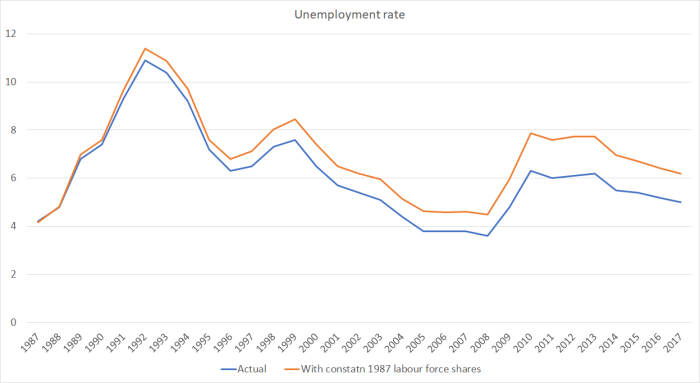
The change in the age structure of the work force does then affect how we think about any particular rate of unemployment.   The natural rate of unemployment for young people –  normal frictional stuff –  is materially higher than that for old people, so that a 5 per cent aggregate unemployment rate means something different than a 5 per cent unemployment rate does today.

One way of illustrating the point is shown in this chart.  It shows the actual reported unemployment rate, and also an artificial unemployment on the assumption that each age cohort had the same unemployment rate is actually had, but that the relative size of the various age cohorts was the same as it was in 1987 (the first year for which there is data).

U rate age adj

For the last year, the actual unemployment rate was 5 per cent.  With constant age chort shares, it would have been 6.2 per cent.    It isn’t an effect that makes much difference from year to year, but over time it can materially affect how we look at any particular unemployment rate.    In effect, and all else, the change in composition of the labour force –  more old people, fewer young people, –  appears to have lowered the NAIRU.

As one final chart, here is the change in the unemployment rate (in percentage points) for each age cohort, from the year to June 2008 (the previous cyclical low point) to now (year to June 2017).

U chg by age

The overall unemployment rate is still 1.4 percentage points higher than it was then.   There has been almost no change in the unemployment rate for the over 65s –  which isn’t surprising as, for reasons outlined above, there is very little cyclicality in that series. On the other hand, it is quite sobering how large an increase in the unemployment rate for 15 to 24 year olds there has still been.   Some of that is cyclical, and some will likely reflects the effects of higher minimum wages, but whatever the cause it should be cause for disquiet, given how important it is to get a start in the labour market and to stay connected.


A fresher approach for ordinary New Zealanders

I’m as fascinated by the rise of Jacinda Ardern as any other political junkie.  I’ve always been a bit puzzled, struggling to see what issue she has led or what blows she had managed to land on the government.    Then again, she seems to have something different –  perhaps even more electorally important.   I’ve been dipping into accounts of Bob Hawke’s rise –  the last case I’m aware of that where major opposition party changed leaders close to an election (in that case only four weeks out) and won.     It isn’t clear that Bob Hawke was a better Prime Minister than Bill Hayden might have been, or that David Lange was a better Prime Minister than Bill Rowling would have been, but in both cases the new leaders had something –  a degree of connection, engagement etc –  that the deposed leaders didn’t.     Reading the accounts of the last weeks of Bill Hayden’s leadership of the ALP, the party had become as disheartened and lacking belief in its own ability to win (despite still leading in the polls), as some suggest the New Zealand Labour Party had become.    Quite what the Ardern phenomenon amounts to I guess we’ll see over the next few weeks.  From her comments so far, I could imagine her campaigning as Hawke did –  both the upbeat theme of “reconciliation”, and the more cynical description in (sympathetic) leading Australian journalist Paul Kelly’s book “no avenue of vote-buying or economic expansion was left untouched”.

For now, we are told that the “Fresh Approach” slogan is apparently out, and a new slogan and some new policies are soon to be launched.  Since no party really seemed to be campaigning on policies that might make a real and decisive for ordinary New Zealanders’ prospects, in many respect a fresher approach should be welcome.  Of course, it rather depends what is in that policy mix.

My interests here are primarily economic.  In an interview with the Dominion-Post this morning, the journalist put it to Ardern that “National will campaign on its economic record. Is that where Labour is weak?”.     Perhaps it is Labour’s weak point.  But what sort of “record” is the government to campaign on?  An unemployment rate that, while inching down, has been above the level it was when they took office –  already almost a year into a recession –  every single quarter of their entire term?  An economy that has had no productivity growth for almost five years?     House prices that, in our largest city, have gone through the roof?  Exports that are shrinking as a share of GDP?    And, at best, anaemic per capita real GDP growth?   If it is a weakness for Labour, it must be in large part because (a) their messaging has been terrible, and (b) nothing they offer seems likely to make any very decisive difference to the mass of ordinary New Zealanders.

What might?   Here’s my list of three main sets of proposals.    An effective confident radical Labour Party could offer the public these sorts of measures –  in fact, on some points arguably only a left-wing party could effectively do so (Nixon to China, and all that).

  1. A serious commitment to cheap urban land and much lower construction costs.
    • In a country with abundant land, urban land prices are simply scandalous.   The system is rigged, intentionally or not, against the young and the poor, those just starting out.  Too many of Jacinda Ardern’s own generation simply cannot afford to buy a house.
    • To the extent that there are poverty and inequality issues in New Zealand, many of them increasingly trace back to the shocking unaffordability of decent housing.   With interest rates at record lows, housing should never have been cheaper or easier to put in place.
    • And yet instead of committing to get land and house prices down again, the Labour Party has been reluctant to go beyond talk of stabilising at current levels.  Talk about entrenching disadvantage……(and advantage).
    • It is fine to talk about the government building lots of houses, but the bigger –  and more fundamental –  issue is land prices.  It is outrageous, and should be shameful, for people to be talking of “affordable” houses of $500000, $600000 or even more, in a country of such modest incomes.  International experience shows one can have, sustainably, quite different –  much better –  outcomes, but only if the land market is substantially deregulated.
    • I don’t have any problem if people want to live in denser cities –  I suspect mostly they don’t –  but it is much easier and quicker to remove the boundaries on physical expansion of cities (while putting in place measure for the associated infrastructure).   Labour’s policy documents have talked of moves in this direction –  as National’s used to do –  but it is never a line that has been heard from the party leader.     If –  as I propose –  population growth is cut right back, there won’t be much more rapid expansion of cities, but make the legislative and regulatory changes, and choice and competition will quickly collapse the price of much urban, and potentially developable, land.
    • It is clear that there is also something deeply amiss with our construction products market –  no one seriously disputes that basic building products are much more expensive here than in Australia or the US.  Make a firm commitment to fix this.  Perhaps it involves Commerce Commission interventions (supported by new legislation?)?  Perhaps it might even involve –  somewhat heretically –  a government entity entering the market directly.     But commit to change, to producing something far better for New Zealanders.
    • The vision should be one in which house+land prices are quickly –  not over 20 years –  headed back to something around three times income.  A much better prospect for the next generation.
    • No one will much care about rental property owners who might lose in this transition –  they bought a business, took a risk, and it didn’t pay off.  That is what happens when regulated industries are reformed and freed up.    It isn’t credible –  and arguably isn’t fair –  that existing owner-occupiers (especially those who just happened to buy in the last five years) should bear all the losses.   Compensation isn’t ideal but even the libertarians at the New Zealand Initiative recognise that sometimes it can be the path to enabling vital reforms to occur.  So promise a scheme in which, say, owner-occupiers selling within 10 years of purchase at less than, say, 75 per cent of what they paid for a house, could claim half of any additional losses back from the government (up to a maximum of say $100000).  It would be expensive but (a) the costs would spread over multiple years, and (b) who wants to pretend that the current disastrous housing market isn’t costly in all sorts of fiscal (accommodation supplements) and non-fiscal ways.
  2. Deep cuts in taxes on business and capital income
    • the political tide is running the other way on this one –  calls for increased taxes on foreign multi-nationals and so on –   but it remains straightforwardly true that taxes on business activity are borne primarily not by “the rich”, but by workers, in the form of lower incomes than otherwise.  So if you really care about New Zealand workers’ prospects, cut those taxes, deeply.
    • and one of the bigger presenting symptoms of New Zealand’s economic problems is relatively low levels of business investment.   Taxes aren’t the only thing businesses  –  and owners of capital  –  think about, but they are almost pure cost.   Tax a discretionary activity and you’ll get a lot less of it.   That is especially true as regard foreign investment –  those owners of foreign capital have no need to be here if the after-tax returns aren’t great.  For all the (mostly misplaced) concerns about sovereignty, foreign investment benefits New Zealanders –  ordinary working New Zealanders.     Cut the tax rates on such activity  –  they are already higher than in most advanced countries –  and you’ll see more of it taking place.    More investment, and higher labour productivity, translates into meaningful prospects of much higher on-market wages –  the sorts of wages they have in the advanced countries we were once richer than.
    • simply cutting the company tax rate will make a material difference to potential foreign investors.   It won’t make much difference for New Zealanders’ looking to build or expand businesses here, because of our imputation system    That’s why I’ve argued previously for adopting a Nordic system of income taxation  –  in which capital income is taxed at a lower rate than labour income.  Note the description –  it is a system not run in some non-existent libertarian “paradise” but in those bastions of social democracy, the Nordic countries.  Not because they want to advantage owners of capital over providers of labour, but because the recognise the well-established economic proposition that taxes on capital are mostly borne in the former of lower returns to labour.
    • some argue against cuts to business taxes on the grounds that it will provide a windfall to firms (especially foreign firms) already operating here.  Mostly, that is false.  It might be true if foreign firms dominated our tradables sector –  where product selling prices are set internationally.  But in New Zealand, foreign investment is much more important in the non-tradables sectors.  Cut taxes on, say, the banks, and you’ll find the gains being competed away, flowing back to New Zealand firms and households in lower fees and interest margins.  If for some reason it doesn’t happen, feel free to invoke the Commerce Commission (and/or expand its powers).
    • much lower business taxes should be a no-brainer for an intellectually self-confident centre-left party serious about doing something about long-term economic underperformance and lifting medium-term returns to labour.     I’m not really a fan of capital gains taxes, but if you need political cover promise a well-designed CGT –  it probably won’t do much harm, especially if you take seriously the goal of delivering much cheaper houses and urban land (see above –  there won’t be many housing capital gains for a long time).
  3. Deep cuts to target levels of non-citizen immigration
    • This item might be entirely predictable from me, but it is no less important for that.    Labour started out with some rhetoric along these lines, but as I’ve noted previously what they actually came out with was a damp squib, that would change very little beyond a year or so.   So
      • Cut the number of annual residence approvals to 10000 to 15000 per annum –  the same rate, per capita, as in Barack Obama’s (or George Bush’s) United States,
      • Remove the existing rights of foreign students to work in New Zealand while studying here.
      • Institute work visa provisions that are  (a) capped in length of time (a single maximum term of three years, with at least a year overseas before any return on a subsequent work visa) and (b) subject to a fee, of perhaps $20000 per annum or 20 per cent of the employee’s annual income (whichever is greater).
    • In substance, you will be putting the interests of New Zealanders first, but you will also strongly give that impression –  a good feature if you are serious about lifting sustained economic performance, while being relentlessly positive about it, and about your aspirations for New Zealanders.
    • Change in this area would immediately take a fair degree of pressure off house prices, working together with the structural housing/land market reforms (see above) to quickly produce much much more affordable houses and land.  Markets trade on expectations –  land markets too.
    • You’ll also very quickly alter the trajectory of urban congestion –  those big numbers NZIER produced in a report earlier this week.
    • But much more importantly in the longer-term, you’ll be markedly reducing the pressures that give us persistently the highest real interest rates in the advanced world, and
    • In doing so you’ll remove a lot of pressure from the exchange rate.  Lets say the OCR was able to be reduced to around typical advanced country levels (say 0.25 per cent at present).  In that world, the NZD offers no great attraction to foreign (or NZ institutional) holders – it is just one of many reasonably well-governed countries, offering rather low interest rates.  In that world, why won’t the exchange rate be averaging 20 per cent (or more) lower than it is now?
    • And that should be an adjustment to be embraced.  Sure, it will make overseas holidays and Amazon books etc more expensive, but in sense that is part of the point.  We need a rebalanced economy, better-positioned for firms to take on the world from here.  Combine a lower exchange rate, lower interest rates, and lower business tax rates, and you’ll see a lot more investment occurring –  and firms successfully selling more stuff internationally.  And with more investment will come the opportunities for sustainably higher wages –  and all the good stuff the centre-left parties like to do with the fiscal fruits of growth.

I don’t suppose anything like this will actually be part of the fresher approach.  But if it were……we could really look forward to a better, more prosperous, and a fairer New Zealand.