Flabbergasted

In the years after the financial crises of 2008/09 one often read plaintive cries of “and who went to prison?”, and angry claims that the system was rigged. I can’t say that I was ever much moved by such lines. We simply don’t – or shouldn’t – generally imprison people for being bad at the business they are in, whether it is banking or baking, even if the businesses themselves were big, and the people concerned had employers who’d previously paid them lots (and lots) of money.

There has been a plethora of books about aspects of that crisis period. Glancing along my bookshelves just now I counted 100 or more, most of which I’ve read. Some were very analytical, some were lively descriptions of some aspect or other of that period, some country-specific, some more general, some were more about policy and policy institutions, some more about bankers and financial markets, but not one of them disconcerted me (and that is putting it very mildly) in the way that Rigged, a new book by BBC economics correspondent Andrew Verity did. (Amazon Australia shows the publication date as 1 August 2023, but I ordered it and it arrived a few days ago). It is a simply astonishing story, which shows a whole set of authorities (notably the British ones) in a very very bad light.

The context is the so-called “LIBOR crisis”. For readers who followed that story over the last decade, much of what follows won’t be new, especially if you’ve been in the UK. But I hadn’t really, because it seemed to be mostly a moral/political panic, in the “why aren’t evil bankers in prison?” vein. And, to be honest, from what little I had read of the story, I knew that I’d observed stuff in the little New Zealand markets in my years in the Reserve Bank’s Financial Markets Department that, if you were concerned about this sort of thing, was arguably more egregious.

LIBOR is (or was) the “London Interbank Offer Rate” (there was also LIBID – “bid” – although I don’t think it gets a mention in the book). It was a major set of benchmark short term interest rates, in various currencies, off which many other contracts are priced. LIBOR rates were set each morning – under the auspices of the British Bankers’ Association (BBA) – when cash dealers in each of 16 banks would indicate (for each currency and term)

“At what rate could you borrow [unsecured] funds, were you to do so [in the London market] by asking for and then accepting inter-bank offers in a reasonable market size just prior to 11 am?”

The submissions would be ranked, with the top and bottom four excluded and the remaining eight averaged. Individual banks’ experiences could be expected to differ a bit (although not by much in normal times), and for any individual dealer answering the question there might be a (tightly-bunched) range of possibilities. It was an estimate, informed usually by data in fairly liquid markets, with the exclusion and averaging rules dealing with outliers and, thus, typically expected to result in a reasonable central estimate. Very short-term rates would typically be very close to the relevant central bank’s policy rate. Within each bank, there was often a bit of jockeying: other dealers might have positions that would benefit a little from that day’s LIBOR rate being just a bit higher or a bit lower, but since the cash dealer had to lodge a response at which his (they were almost all male at the time) bank could borrow, any leeway was apparently very slight, perhaps one basis point, occasionally two.

And so it had gone on for a couple of decades. Regulators knew how the system worked, the adminstrators (BBA) knew how the system worked, as did participants in the markets.

But then the financial crisis began to build in the second half of 2007 (the crisis period is often dated from 9 August that year, the Northern Rock crisis became public in early September 2007). Short-term interbank funding markets were no longer as liquid as they had been and material gaps started to open up between where banks would lend to each other unsecured and the central bank policy rates (either for fully collateralised lending or risk-free deposits at the central bank itself). And there were swirling differences in market and media perceptions of which banks might be a bit less sound than others.

You might have hoped that each bank’s dealer would simply continue to submit each day his best estimate of what his bank could borrow at unsecured and let things fall where they may. But that didn’t happen. Instead it became something of a “dirty secret” (except not very secret at all since people in banks and markets knew it, as did the key regulatory bodies, and there were even stories in the major financial newspapers) that the published LIBOR rates no longer represented a best estimate of what individual banks (or the sector as a whole) could borrow from each other at. Verity focuses in on Barclays, where the cash dealer seems to have tried quite vigorously to follow the rules, which resulted in Barclays posting rates above those of the rest of the panel of banks, which (submissions being visible to others) in turn prompted concerns “if they are having to pay that much they must be in more trouble”, and even a sell-off in the share price. And so the pressure came on the dealer from above to bring his submissions more into line with those of the other banks. He, rather grudgingly (documenting his concerns and uttering them to anyone who would listen), went along. Regulators and central banks on both sides of the Atlantic were aware of what was going on, and if anything seem to have been more sympathetic to Barclays than (say) concerned that posted rates (used as benchmark pricing across the system) no longer reflected real borrowing costs.

As the financial crisis intensified so did the problems (some quite practical, in that at times the markets had frozen so badly that really no bank could borrow unsecured from others, so in truth there probably should have been no LIBOR rate at all). The gaps between unsecured interbank rates (both “true” rates and published LIBOR rates) and policy rates was high and widening, at times when central banks – in the UK, but in most other countries – were cutting policy rates deeply to try to lean against the collapse in demand and economic activity. Market rates often weren’t coming down much (in some cases they were rising) and politicians and their advisers were often getting increasingly uneasy.

And so the pressure – and this is extremely well-documented in the book – came on banks to put in lower LIBOR submissions. Doing so wouldn’t change actual borrowing rates – either interbank or the retail rates that the wholesale rates influenced – but I guess it was going to get better headlines, and it might make it “look” like things (policy responses) were “working”. In the UK case (the focus of the book), this involved not just very senior figures at the Bank of England, but them channelling pressure from The Treasury and Downing St itself (people named include very senior and otherwise respected figures, including a current Deputy Governor of the Bank of England, and someone who was until last year the permanent head of The Treasury in the UK). Very senior bankers were left in no doubt that the authorities wanted the LIBOR rates marked down, and they complied, ordering their underlings (the cash dealers and their immediate bosses) to bring LIBOR submissions more into line. The differences here were not a matter of a basis point or two, but often 50 basis points or more. Relative to the LIBOR rules, anyone with a contract in which they received the LIBOR rate was, in effect, being bilked out of a lot of money (vice versa if you were paying LIBOR). One could, of course, argue, that central banks were actively trying to lower short-term rates generally by a lot, but…….acceptable instruments don’t generally include pressuring bankers to write down numbers that simply don’t reflect reality. If central banks really wanted market rates even lower, they had tools available to make that happen directly.

The more pragmatic and less idealistic of you may here be drumming your fingers and going “needs must”, and in a crisis what needs to be done gets done. I wouldn’t agree with you – institutions are supposed to be built for resilience under stress, not for fair weather events only – but if that was the end of the story, it would have been quickly lost to history.

But it wasn’t the end of the story.

As the crisis faded, in some circles the narrative that someone “needed to pay” took hold. At least in the UK, as I read the book, there wasn’t much interest in pursuing anything around LIBOR, until the Americans got involved. You might reasonably wonder what the activities of British officials in Britain and British employees of British banks in Britain, as regards a benchmark rate owned and administered by a British entity (the BBA) had to do with the US, and its Department of Justice and CFTC. They seem like good questions, but such is the world as it is, and the trans-national overreach of the US on matter financial. As Verity tells it, Obama’s nominee for head of the CFTC had had close ties to Wall St and wasn’t going to get confirmed by the Democrat-controlled Senate unless he was going to take a credible stance as an avenging angel of wrath.

My interest is less in the US side of things than in the UK, where (thanks to leaks in particular) the book is astonishingly well-documented. Anyway, the US started pursuing banks abroad (Barclays in particular in this book), in what seems like a bizarre process in which they relied on the banks themselves to search their own documents, and then negotiated (large) administrative fines, which saved the banks and their CEOs and chairs, all while throwing under the bus a few fairly junior employees who’d initially been more or less compelled to talk to the US authorities, thinking of themselves as expert witnesses etc, only to find themselves personally in the gun,

These employees became alert to the prospect of spending much of the rest of their lives in a US prison, (having regard to the very low acquittal rate in US courts) for things they were quite sure they had never done, except as normal, accepted commercial practice, well known to central banks and regulatory agencies on both sides of the Atlantic, typically either authorised or instructed by senior managers within their own banks. And so several became convinced their only option was to get themselves charged in the UK, preferably engaging in a plea deal that might involve, to all intents and purposes, lying to conform with the preferred narrative of the UK authorities, to get to stay in the UK and not destroy themselves and their families financially. Others preferred to defend themselves in the UK, several were charged in the US (before US courts finally overturned the very basis on which they had been charged).

And, to be quite clear here, none of all this regulatory and legal action involved anything that had gone on during the financial crisis (when not only had authorities, notably the Bank of England, been aware of how the system worked, they had actually been part of engineering LIBOR submissions a long way from actual market rates). Instead, the bounds of interest were very carefully drawn to cover only the period prior to the crisis beginning to unfold. The focus was on how these dealers had lodged their LIBOR submissions in normal times, as many many like them had done for a couple of decades. The focus was on other people in each bank suggesting to the dealer that their positions might benefit from a slightly higher or slightly lower LIBOR (the basis point or two mentioned above, in reaching a necessarily imprecise estimate).

And what was the offence? Well, there was none in statutory law. None.

Instead, the authorities wheeled out an old common law offence “conspiracy to defraud”, which – at least as Verity tells it – was so little regarded by the UK commercial barristers prior to the crisis that there had been a push to remove it. Under these provisions/precedents, there was no need to show that anyone had lost, or to quantify any losses. And yet the political rhetoric was all about egregious rip-offs, suffering customers, and rigged markets. Judges ruled – without allowing appeal – that it was enough that someone in a bank had suggested to the bank’s cash dealer that his/her positions might benefit from a slightly lower/higher LIBOR and the dealer to say something like he’d see what he could do. There was – according to English justice- a conspiracy to defraud – all recorded in emails and trading room recorded phone calls. The same judges then refused to allow testimony from expert witnesses as to how markets actually worked (in one case regarding EURIBOR submissions, the UK judge refused to allow testimony from the people who had written the code of conduct around the operation of EURIBOR).

Here, some scale and perspective is worth noting. As I noted above, LIBOR worked with a panel of 16 banks, with the four highest and four lowest for any particular currency/term on the day excluded. If perhaps a dealer in one bank had shaded his bank’s estimates 1 basis point in one direction (remember that plausible range was typically not much more than a couple of basis points), then even assuming there was not some other bank with exactly the opposite interest, the chance of affecting LIBOR at all was low, and the magnitude of any plausible effect tiny. There are hard numbers at places in the book.

By contrast, the activities during the financial crisis period, done in full awareness and often with the encouragement of the authorities and of specific named very senior bankers, never saw judicial scrutiny.

And so eight bankers – cash dealers – went to prison in the UK, serving non-trivial custodial sentences, for offences that no one thought were offences until the “avenging angel” mood took hold in the wake of the crisis. And when I say “no one” here I mean not just the dealers, but their bosses, their bosses’ bosses (the chief executives of the banks were the board of the BBA which administered LIBOR), and the central banks and regulatory authorities on both sides of the Atlantic, but particularly (and at very senior levels) the Bank of England. Not one Bank of England official rang the police (or SFO) at any point to express concern at the normal commercial way they knew the market worked, and those senior people are on record during the crisis encouraging/abetting/ (perhaps) instructing, bankers to deviate from the LIBOR rules, including passing on the political pressure from Downing St (which was no part of any central banker’s mandate).

And yet, as Verity records, in 2015 at the height of the hysteria – and amid the criminal trials – the then Governor of the Bank of England delivered a major speech in which he would “publicly demand that the government should change its sentencing guidelines to raise the maximum jail term for “rogue traders” from seven to ten years”. This was (is) the same central bank that (Verity records) “George Osborne had urged the central bank to come clean about its role in Libor, [but] the Bank of England had decided against that. Freedom of Information requests would be consistently rejected in the succeeding years”.

Your reaction might be to wonder why anyone would be particularly sympathetic to well paid (not very senior) bank traders. Because it was an egregious abuse of justice: sound process and integrity matter whether it is a scruffy teenager or a nicely-dressed multi-millionaire trader facing the system. Any of us could one day be in gunsights of the state. I mean, if one were going to (in effect) create retrospective offences and start prosecuting bankers for them mightn’t one prosecute those in charge (all the way up) who were actively aware of how things worked, authorised and rewarded people, and at times directly instructed behaviour that was egregiously distortive (in terms of LIBOR rules/practices (rather than, as in at least one case a ‘whistleblower’), and consider expert testimony from people with responsibility for overseeing the relevant markets etc.

The conduct of three lots of people in this whole affair warrant scrutiny:

  • the politicians.   How did Cabinet ministers stand by and allow these prosecutions and imprisonments when (if nothing else) they knew the people who managed and instructed those charged walked free, with no criminal or civil consequences whatever?   And how did former PMs and Cabinet ministers (Gordon Brown, Alistair Darling –  Chancellor during the crisis) never speak up and out, not just about their own roles but the disproportion of sending low level people to prison while their bosses walked free?  It is the sort of act of omission that leads people to simply despise politicians,
  • the senior bankers.  Many despise them already, but really……..you keep your job and your bank or walk way with tens of millions in retirement packages etc, while seeing former staff – who acted on your instruction and authorisation – sent to prison, people against whom charges were laid only because you did your own searches of your own bank records, saved yourself, and tossed some staff to the criminal authorities.  Just despicable.   Who ordered Peter Johnson (cash dealer at Barclays) to mark down his submissions, despite Johnson’s explicit written dissent?  Why, the very top tier of Barclays’ management.
  • the central bankers (and the like).  I expect better from central bank and Treasury officials.  Not necessarily excellence or at times even basic competence, but integrity and decency.   I’ve met and dealt with some of the individuals named (I recall now sitting in the Bank of England’s chief economists’ seminar in May 2008, in the early days of the crisis, listening to Sir John Gieve, deputy governor responsible for financial stability – altho, curiously, not named in the book) so perhaps it shocks me more.   Perhaps one can defend the approaches senior BoE or HMT (or even Downing St) officials took during the crisis, but they actively aided (and seem to have pressured banks to facilitate) the distortion of LIBOR.  I’m not suggesting any of them should have been prosecuted, but how (a) does the Bank of England justify not revealing in full its own part and knowledge during the period, all while Mark Carney as Governor was baying for the blood of traders, and b) how come that, even in retirement, not one of these people spoke out and suggested that it was simply wrong to be sending these people to prison.   None of them appears to have been willing to speak to Verity, none has spoken in public, and we are left guess whether just possibly one or two might have said quietly “I say old chap, are we really sure about this?” (if so, to no apparent effect).  It reflects very poorly on all involved, some of the most senior (and otherwise) respected figures in British economic and financial policy.  One could see it – perhaps unfairly but it isn’t obvious what other interpretation makes sense – as circling the wagons in their own defence, and that of their peers who ran the banks.  Never mind the juniors, we can destroy their lives and marriages and send them to prison.   (These the same people whose own policy misjudgments –  viz recent inflation (Andrew Bailey gets a couple of minor mentions in the book) – result in few/no consequences beyond gilded retirements and knighthoods or peerages.)

From the sound of the book, the English prosecutorial and judicial systems have quite a bit to answer for as well, but….I’ll leave that to the lawyers.

The whole thing smacks of a witchhunt: someone must pay, these individuals their bosses have helpfullly pointed us to are someones, so they will do (and it wouldn’t do to pursue the bosses or else, perhaps, confidence in the system might be eroded –  which if true should have at very least raised questions as to whether the whole grossly-slanted chain of prosecutions, where eg juries were never allowed to know what regulators had known in advance, was being pursued for any reason other than the a politically-driven effort at distraction).

It is hard to tell if I’ve done a 325 page book justice.  All I can do is to encourage people to read it.  Yes, it is about technical stuff, but Verity does an impressive job of explanation and translation, and his story is supported with copious direct quotations, most of which would never have come to public light if a big dump of documents and recording had not been leaked to him.  I’m going to leave you with the Amazon review comments of Sarah Tighe, herself a lawyer, ex-wife of one of those sent to prison (there is a recent extended interview with him here)
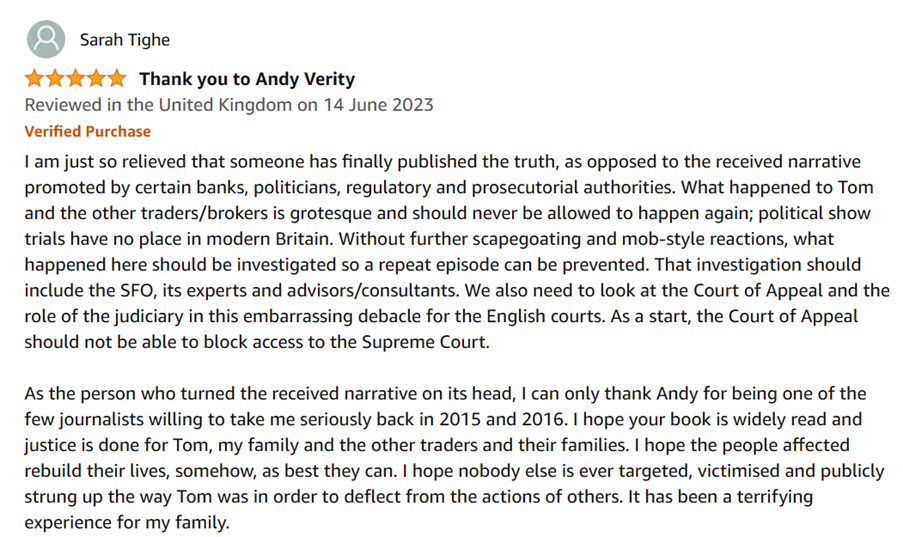
tighe

I went looking for reviews of the book, and couldn’t yet find any yet. But interest in the issue seems to be rising again in the UK (here is a recent parliamentary speech from a senior backbencher).

One fears that even if the individuals eventually have their convictions overturned (and how do you compensate someone for a life destroyed?) that officialdom in particular will never have to answer the hard questions it seems it (collectively and as accountable individuals) should.

PS Someone who isn’t named in the book, but the division he ran is, is the Reserve Bank’s Deputy Governor whose CV includes this

Now that was probably a fourth [UPDATE: or perhaps 5th1] tier position in the Bank of England, and he took this specific position up just after the worst, so he wouldn’t have been in any sort of direct decision-making role. But one is left wondering how he feels about those sent to prison while he’d been a fairly senior part of a system and institution that was encouraging banks actively to manipulate LIBOR submissions/rates. It should matter in someone who is (a) on the MPC, b) is head of financial stability here, and c) must be one of the favourites to himself be the next Governor of the Reserve Bank. There is that old line “the standard you walk by is the standard you accept”. No one should accept – or walk by – the standards of officialdom on display in this book.

  1. See references to Hawkesby in footnotes to the organisation chart on page 60 of this later BoE report

An external MPC member speaks

This blog has been a bit quiet in recent weeks (if anyone has insights on what sections 15D and 98 of the Government Superannuation Fund Act do and don’t allow I’ll be happy to hear from you) but I hope to make up for it this week.

In the 4+ years the statutory Monetary Policy Committee has been in existence, there has been not a single public speech given by any of the three external members. There have been no serious interviews either, just one petulant and testy set of responses to some emailed questions late last year, responses that I characterised at the time this way:

At times, Harris displays all the grace and constructive open and engagement we might expect in a rebellious 15 year old told they have to make conversation with Grandma at the family Christmas celebrations. If the answers aren’t quite monosyllabic grunts. most of them might as well be.

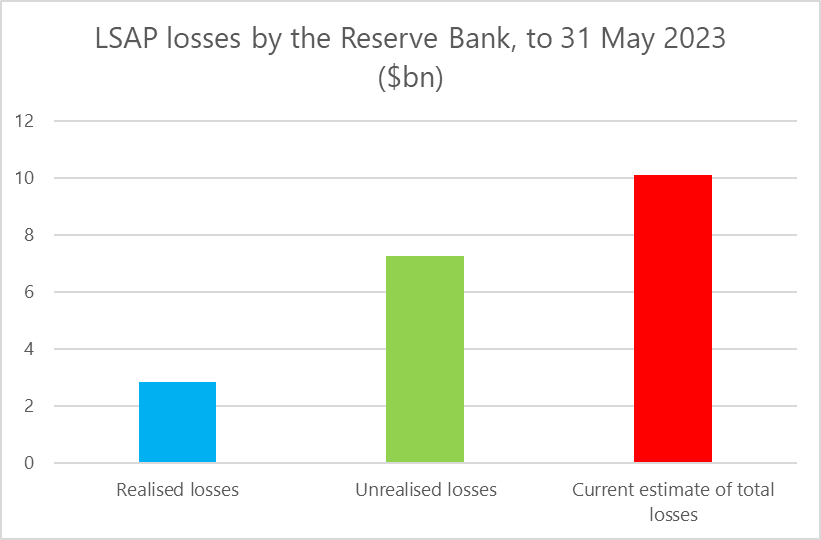
There have never been any rules against external MPC members speaking, just some mix of the Governor’s wishes and their own predilections (shy, lacking confidence in their own views, reluctant to face scrutiny, or simply not believing in either openness or accountability?) that meant it never happened. It really was quite astonishing: not only was it a new regime, which one might have thought participants might have wanted to show off at the best it could be, but we then went into a period of turmoil and fairly extreme policy experimentation, quickly followed by……the biggest monetary policy failure in decades (that high and persistent core inflation), as well as $10 billion of financial losses, for which the taxpayer (you and me) were on the hook. Surely any decent person, charged with all the power and responsibility they personally took the taxpayer’s dime to assume, would want to explain their thinking, their mistakes, and the lessons they’d individually learned.

But not Harris, Buckle, and Saunders, all three now limping towards the end of ill-starred terms in office (each having been reappointed once, they can’t be appointed again – Harris and Saunders will be gone by this time next year, and Buckle by early the following year). And we know nothing at about their views, their contributions, their defences, the lessons they’ve learned, or even any contrition they might feel. Of that latter, presumably none or surely they’d have told us. Decent journalists are only an email or phone call away. Meanwhile, we live with the inflation, the looming recession…..oh, and as taxpayers are $10 billion poorer as a result of their choices.

You’ll remember that the external members were selected in a process whereby (in the words of a Treasury paper to the Minister of Finance)

Which did tend to select against people who might either think hard or make serious and self-critical attempts to learn from their mistakes.

You may also remember a strange article a few weeks ago in which the Minister of Finance and The Treasury (but not the Bank or the Bank’s Board) tried to pretend that there had never been any such restriction. A couple of us are still waiting for responses to OIA to better make sense of quite what game Treasury and the Minister were playing there, but my post a few weeks back makes clear – from their own contemporaneous words at several points through the process- that there had in fact been such a restriction. It appears to have been removed for the next round of MPC appointments (vacancies being advertised at present), and if so that is a welcome step forward.

And somehow, one of the external members, (emeritus professor) Bob Buckle, emerged from his monetary policy purdah to deliver a keynote lecture at the recent conference of the New Zealand Association of Economists (invited, he tells us, by the council of the NZAE no less). His topic? “Monetary policy and the benefits and limits of central bank independence”.

There is 25 pages of text and more than 150 references at the end. But here’s the thing. I’m pretty sure I learned nothing from the lecture and wasn’t prompted to think harder or differently about anything.

In a way, perhaps that isn’t surprising. Buckle’s focus has tended to be on empirical macro (VAR models and all that) and some public finance and tax issues. He doesn’t have a publication record in areas around central bank independence, and has not (that I’m aware of) offered any speeches, presentation, papers or anything with interesting or challenging angles on the issue over the course of his academic career. He is, in many respects, a pleasant establishment figure (and there is a place for them) not one who will make you think about things freshly or differently.

Perhaps the council of the Association of Economists was thinking, “well, after four turbulent years as a foundation member of a Monetary Policy Committee perhaps he will offering some perspectives informed by his experience as a policymaker. After all, he done no speeches, but this will be a more academic audience, which might be in his comfort zone. And, after all, a lot hasn’t gone well for monetary policy in the last few years”. If so, they must have been disappointed.

Someone who was there sent me a message later that day

I’m no expert so cannot speak about the literature he described, but the lack of NZ content was so noticeable it was weird. Cliches about “elephant in the room” and all that. He did mention “we need to wait for full assessment” when someone asked a question about the covid monetary interventions, but he was obviously uncomfortable saying even that.

It seemed impossible to distinguish from a paper he might have written had he never been appointed to the MPC. Was there nothing he thought differently about, or understand more (or less) from having been inside the tent? If so, he clearly wasn’t inclined to tell us. And, in fact, as my correspondent pointed out there was hardly anything about New Zealand at all (I checked and there are no mentions of “New Zealand” outside footnotes and references that are more recent than about 1990).

It can’t have been just that he didn’t want to offer any thoughts relevant to the immediate monetary policy situation (where will the OCR peak and when and why?). It must instead have been that he had nothing insightful or challenging to say on his own topic (just possibly, the Governor had persuaded him to deliver something so grey and un-insightful, but (a) that would hardly be in the Governor’s interest (he is usually keen to talk up his committee), and (b) real insight shines through anyway. There was none in Buckle’s paper.

There might, for example, have been thoughts on accountability. The literature is replete with references to the importance of accountability if a central bank is to have operational autonomy. But how does Buckle think about that specifically, having been one of those who were to be (in principle) held to account, in tough times. What sort of accountability does he think really matters and why? What, if anything, made a difference to his own conduct/advice. He offers us nothing.

Or, say, on communications. What is it that convinced Buckle, now as a policymaker, that never hearing from (ostensibly) powerful key policymakers (and it isn’t just no speeches or no interviews but no select committee appearances) is the best way to run an operationally independent central bank? Again, no insight.

And if operational independence for central banks tends to reduce inflation (there is some suggestion in the literature that it may), is that always and everywhere a good thing. After all, in the aftermath of 2008/09, a whole bunch of countries went through a protracted period of inflation undershooting the target. Perhaps an inflation-happy Minister of Finance might then have been better than an independent central bank? Perhaps not, but the issue isn’t addressed (not even, more extremely, in the Japanese context). And on the other side, there is no serious engagement – even slightly speculative – on what the experiences of the last few years tell us about the case for central bank independence? The implied promise 30 years ago was that if we handed over day to day control to central bankers, we wouldn’t see core inflation of 5-7 per cent again. And yet we did. Buckle never engages much with Tucker’s criteria for delegation to expert agencies (either for central banks, or by comparison with other government activities), but it isn’t controversial that the case for delegation is stronger, all else equal, when the delegatee knows what it is doing.

There is nothing at all about whether, and if not why not, it might be important to buttressing central bank monetary policy operational independence to do something about fixing the effective lower bound on nominal interest rates.

There isn’t even any sense of an intuitive familiarity with the experiences of other countries. What, if anything, do we learn from the cases of the (very small handful) of advanced countries that hadn’t given independence to their central banks (low inflation Singapore being a prime example). These aren’t just issues for New Zealand, but he is a (retired) New Zealand academic and a New Zealand policymaker.

And so on.

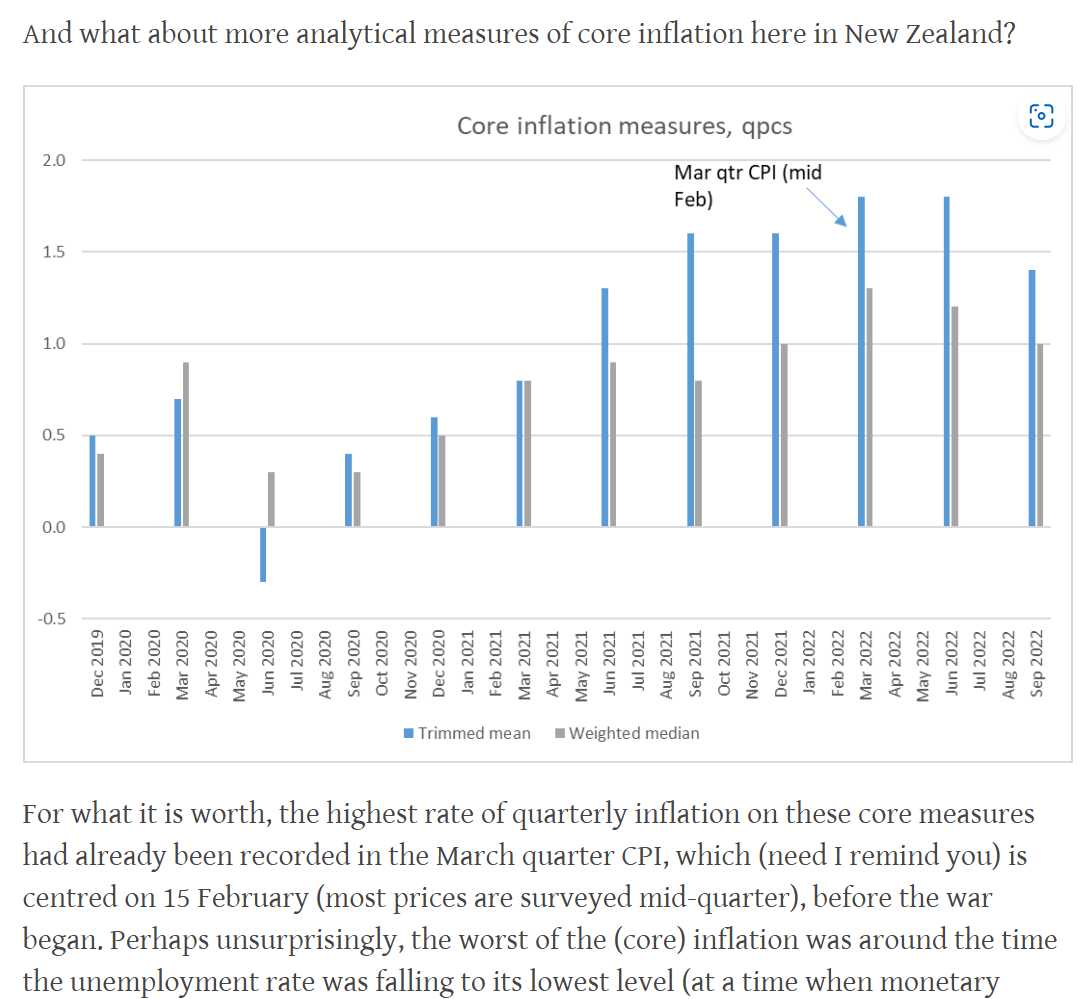
There were various small things I took exception to. There were hints of Orr (misleading Parliament) in a couple of attempts to shed some of the blame for inflation onto the Russians, as if core inflation had not already reached its peak (and unemployment its trough) before that invasion

There was the somewhat surprising claim

That footnote 50 took you, among other places for other countries, to the Reserve Bank’s report marking its own homework late last year. Sure enough, when you check it the word “mistake” doesn’t appear at all (or “error”) and there is no expression of “regret” at all (you’ll recall Orr’s standard line is the non-regret regret “I regret that NZ has had to deal with a pandemic, the war etc”).
And if this paper might not have been the place to go into all that in detail, wasn’t it an obvious place to think aloud about the place for contrition (people being human, mistakes being inevitably, and some of those mistakes are very costly indeed to people who are not themselves policymakers, while often appearing to have no consequences at all for those who made the mistake) in the independence/accountability context.

One interesting line that popped up in several places during the speech was a concern about anything that might tie the hands of the MPC.

This paper suggests there are intersections between legislated objectives and operational independence that could have implications for central bank independence and the political acceptability of CBI. These intersections involve expanding central bank mandates, conditions attached to the pursuit of primary objectives of monetary policy, and funding arrangements that could influence central bank independence over the choice and scope of alternative monetary policy instruments.

That is fairly wordy, but what it means is that Buckle thinks they need to be free to lose $10 billion again on fresh highly risky financial interventions (having neither here nor in the 2022 self-review either expressed contrition for the actual losses, shown how they would do better in future, or explored whether there might be reasonable limits to the financial losses taxpayers might be willing to let unelected officials incur (almost all government spending has to be appropriated by Parliament first, but not when the MPC takes the public balance sheet for a spin)).

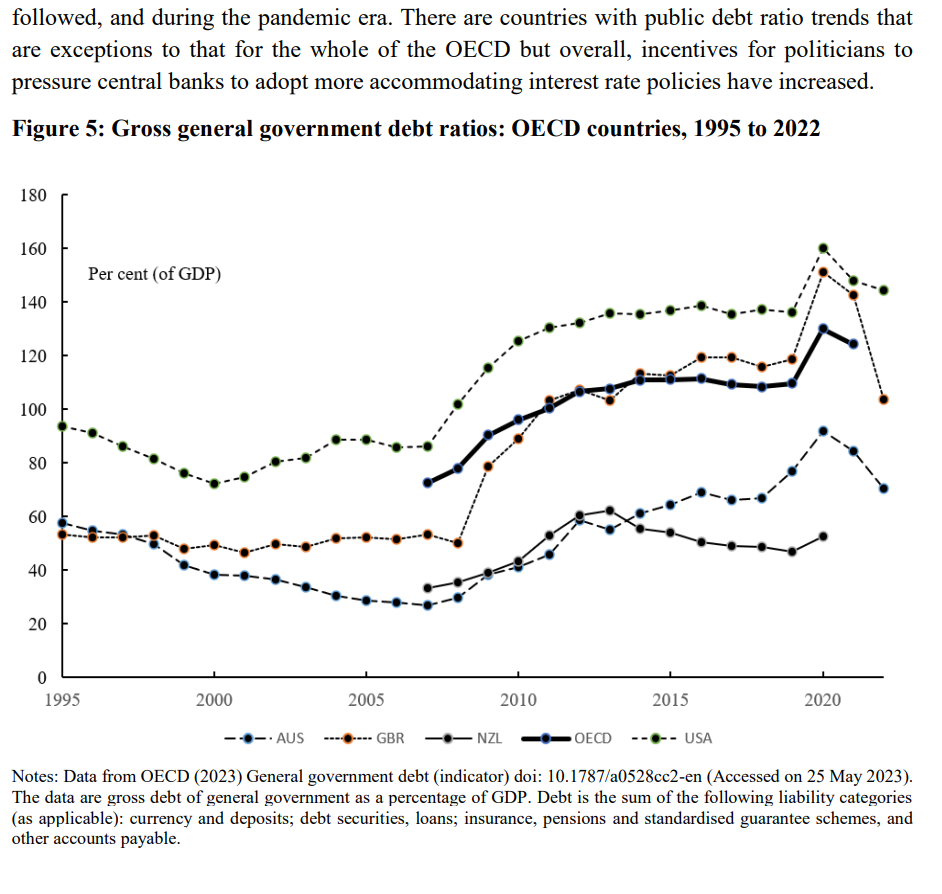
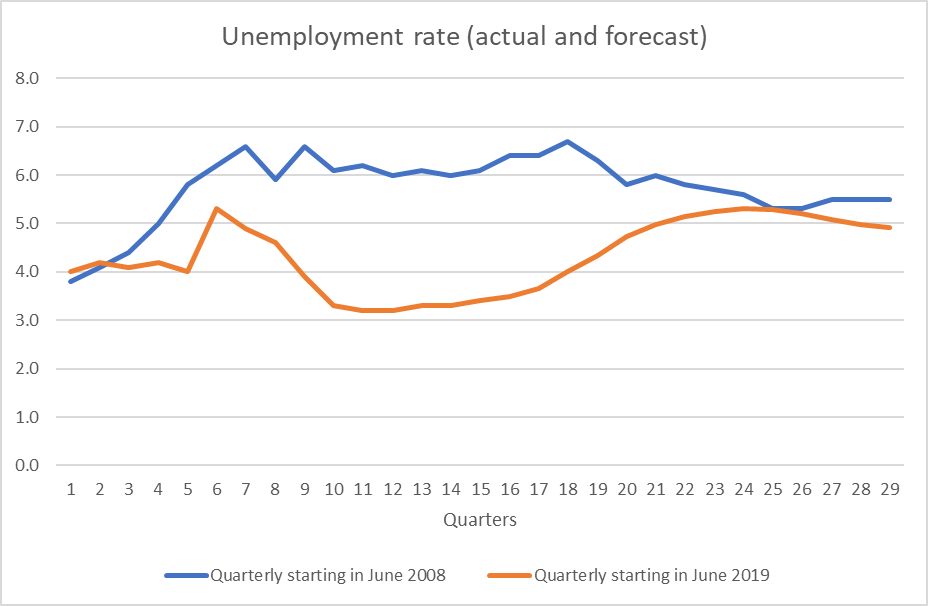
Which brings me nicely to the last substantive section of Buckle’s paper, on fiscal policy connections. It is fairly unenlightening (and reminded me of the ambitious play by the Secretary to the Treasury for a greater role for fiscal policy just before everything went to pot on inflation). But Buckle repeats, unreflectively, suggestions that central bank independence might have led to lower fiscal deficits (and seems to think this is automatically a good thing). He then suggests that times are changing and fiscal policy might be more of a threat, illustrated with this chart

Perhaps, but here is another way of looking at things. Here is net government debt for half a dozen small to middling inflation targeters with independent central banks, including New Zealand

All these countries have pretty moderate levels of net debt, and all except Australia (barely) have had a falling ratio of net government liabilities to GDP over the last 30 years.

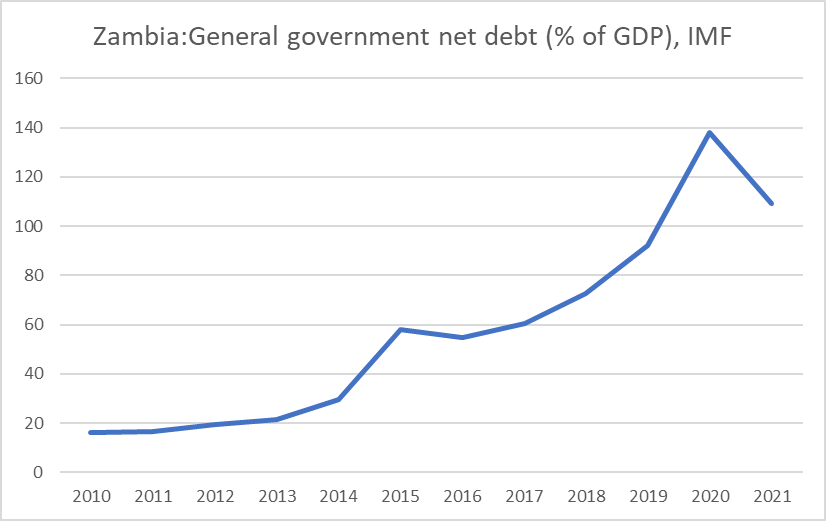
On the other hand, here are some other (larger) countries with independent central banks (in the euro area by far the most independent of any of the central banks)

All four lines slope upwards, and in all four cases debt is a lot higher than it was in 1995, early in the new era of central bank independence.

Perhaps it is fair to suggest there may be some future issues in some of these countries for central banks, but you’d have thought that a New Zealand policymaker might recognise the very wide range of country experiences (which might also make one a little sceptical that whether or not the central bank is independent explains much if anything of advanced country fiscal choices and outcomes).

No doubt there will have been some readers who got something from something like the Buckle lecture (I passed it on to my economics student son eg, and there is always a use for introductory material), but from a serving policy maker, to a premier New Zealand economics audience, it really is pretty disappointing.

Buckle is probably the least unqualified of the external MPC members, but efforts like this are a reminder of how far from the frontier of best practice New Zealand’s new MPC – creature of Orr, Quigley, and Robertson – is. One can only hope that if there is a new government that they will care enough to insist on much better (in the RB, and in so many of New Zealand’s degraded public sector institutions)>

The $10bn amendment

Late yesterday afternoon the Minister of Finance issued a new Remit to the Reserve Bank Monetary Policy Committee (his statement is here, the new Remit itself is here). The Minister’s statement tends to minimise the entire thing (and nothing really about the inflation target changes), but – no doubt consciously and deliberately – gives not a mention to the most material addition to the Remit.

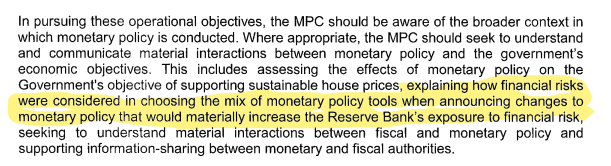
The lead-in to the more-specific targets section of the Remit is now as follows:

This was the backdrop to the additional words I’ve highlighted

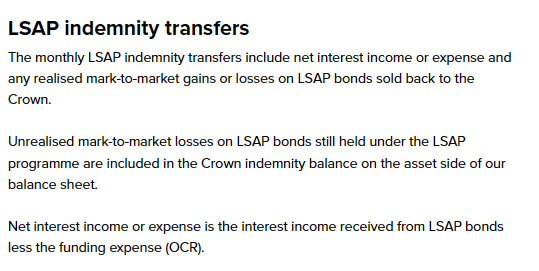
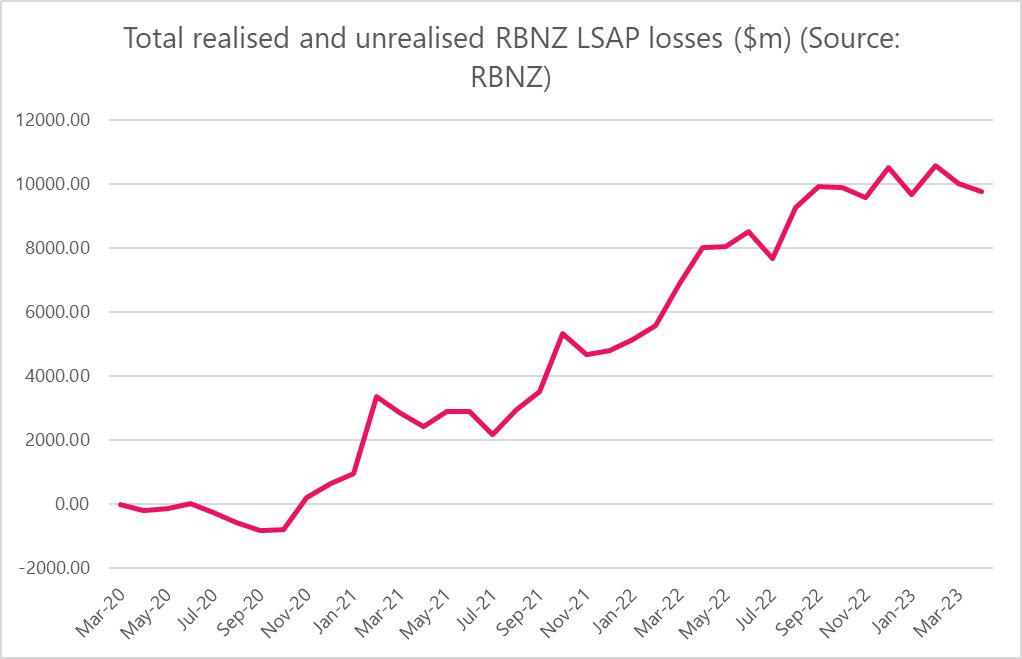
$10 billion of so of losses of taxpayers’ money as a result of Reserve Bank MPC choices around the LSAP programme, choices that had the imprimatur of the Minister of Finance (and apparently no objection from the Treasury). As the bonds are being sold back to The Treasury, the realised component of the losses is mounting significantly each month ($317m in indemnity payments were made to the Bank last month), but total estimated losses hang fairly steadily around $10 billion.

The addition to the Remit is welcome. Formally, it doesn’t bind the MPC to anything much (note that “where appropriate” at the start of the second sentence, which appears to conditions things in the third sentence too) but will add put pressure to a) do some advance analysis and b) disclose their thinking and analysis when next the MPC is tempted to throw caution to the wind and take huge risky punts in the financial markets (conventional monetary policy, by contrast, poses very little financial risk to the taxpayer). In 2020 there is no sign they ever did the risk analysis, they certainly never shared anything substantive with the public, they just took the plunge, and over the following months got the Minister to agree to up their gambling limit, still with no serious risk analysis, and no disclosure.

But think what it cost the taxpayer – you and me – to get here: it really is the $10 billion amendment.

MPC members have never made a serious attempt to defend either the alarmingly poor process or the wildy costly financial outcomes. The Governor has waved his hands and blustered about the (wider economic) gains being “multiples” of the losses, but has produced no serious analysis to support such claims (and in the unlikely event there was such a boost to aggregate demand, that would mean the LSAP programme had directly contributed to the high inflation looming recession mess we are in now), while the external MPC members have never said anything about anything they’ve been responsible for. And yet, having simply thrown away $10bn, on no good process or analysis, each of Orr and the three externals have been reappointed by…….Robertson, the man who signed off on the indemnity, not having himself demanded serious supporting analysis from the MPC or The Treasury.

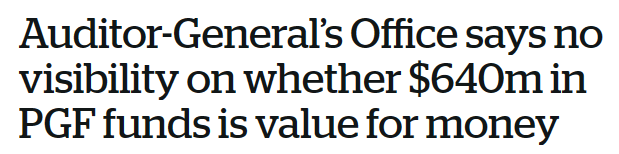
There was an article in the Herald the other day about the Auditor-General having reviewed aspects of that great Labour/New Zealand First boondoggle, the Provincial Growth Fund. This was the headline

The LSAP involved multiples of the amounts involved in the PGF, clear and documented losses, and no serious attempt to show whether there were any benefits at all. $10 billion is a lot of money. It would seem an obvious case for the Auditor-General to look into, given that none of those we should rely on as first line of defence (RB Board, Treasury, Minister of Finance, FEC) seem at all interested. Much easier to file it under experience, avoid even any serious expression of contrition (whether for these losses or the inflation debacle), reappoint all those involved, and just throw out bone with a slight (if welcome) amendment to the Remit.

Mendacity

On Monday the Reserve Bank Board put out a release indicating that it was opening applications to fill two external MPC vacancies (which will arise next year when the second and final terms of Peter Harris and Caroline Saunders expire). By law, the Minister of Finance can appoint to the MPC only people the Board has recommended (the Minister can reject nominees, but cannot simply impose his/her own people). There are all sorts of problems with this process and with the people involved in it, but that is for another day and another post.

When I opened Monday’s emailed release, my eye lit immediately on this

This appeared to be quite a change from the stance adopted by the Board (which includes the Governor) and the Minister of Finance since the MPC was set up under which (to quote from a January 2019 Treasury report to the Minister released to me by the Minister of Finance (page 14) in June 2019 in a response to an OIA request which had asked, inter alia, about policies designed to exclude persons or types of persons)
Anyway, it seemed like good news. I exchanged notes with a few people idly speculating on what might have changed their mind. Perhaps they (Bank, Minister) had just got sick of being mocked for being the only central bank in the world where expertise was an active disqualifying factor? Perhaps The Treasury, with a newly-strengthened oversight role in respect of the Bank, had played a part? Perhaps the new Board, deeply underqualified bunch of government mates as it was, had as fresh faces thought the old ban looked odd. Perhaps Orr and Quigley were conscious that the government might well change later in the year and that the Opposition parties already seem to look askance at various of their choices, structures, and individuals? Getting rid of the absurd ban might neutralise one more obvious irritation. We don’t know (although I have lodged an OIA request, which might – months down the track – shed a little light). It is fair to note that the very next sentence in that extract above read as follows

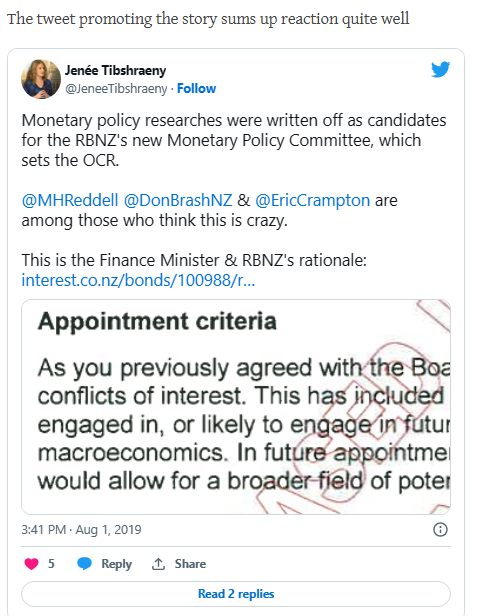
On Twitter, the Herald’s Jenée Tibshraeny mentioned that she was approaching Grant Robertson’s office to ask about the apparent change of stance.

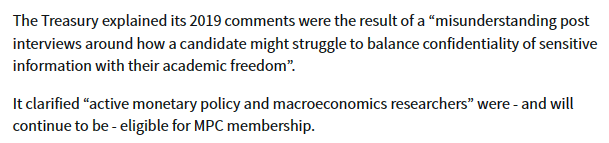
Late yesterday, her story appeared. The key bits relevant to this post were a direct quote from the Minister

and a direct quote from The Treasury

(to be clear, the Bank’s sticky fingers do not appear in this story at all).

There are all manner of problems with these lines given – by powerful people and institutions – to the journalist.

For a start, why did news of the blackball emerge at all? Well, that was because an academic – who could have been well-suited to the MPC role – got in touch with me in late 2018 or early 2019 and told me that he had reached out (possibly to the Board chair himself, but I can’t now be sure of that) and been explicitly told that there was no point in applying because the Board would not be considering anyone who was an active, or likely future, researcher on macro or monetary policy matters. Since the person concerned (understandably) did not want me directly quoting him, I lodged OIA requests with the Board and the Minister of Finance to see what I could smoke out (responses written up in a post here). The Minister’s response, linked to above, revealed the policy which had apparently been agreed between the Minister and the Board. The description tallied more or less exactly with what the academic had independently told me.

The revelation of that policy agreement didn’t just die in a blog post here. Jenée Tibshraeny, then at interest.co.nz, picked it up, talked to various central bank watchers etc and wrote a story. She even talked to the Minister of Finance and to the Bank.

Her story is here. My post following it is here. Here were the lines from the Minister and the Bank

There is not the slightest suggestion there that Treasury had used ‘over-zealous language” or that the critics had got the wrong end of the stick. Rather, they are defending their stance. In fairness, you would have to say that the Minister seemed fairly half-hearted (and I have heard suggestions over the years that Quigley, the Board chair, had been the driving force behind the blackball, and that Robertson had just gone along), but he doesn’t disavow the policy or Treasury’s description of the policy.

And there, the odd jeer aside, the matter rested for a while. The new MPC was what it was, there were going to be no external vacancies for a while, and of course there was Covid.

But by late 2021 I was focused on the fact that the end of the first terms for two MPC members was approaching and started highlighting the question as to whether the blackball on expertise was still in place. Others were talking about it too, including to Tibshraeny. She had the access the rest of us didn’t and asked the Minister or his office about the policy.

As it happens, documents show they were always just planning to reappoint Buckle and Harris, so there was never a fresh search programme (or even a serious evaluation process). So they could have avoided Tibshraeny’s questioning, but instead they seem to have been quite clear (her story is here) with these two extracts

Most central bank commentators and watchers lamented (even former MoF adviser Craig Renney, quoted in the article, seemed less than convinced by the policy) but it all seemed pretty clear. The policy was what it was (recorded by Treasury) and the authors were standing by it. Had there even been any lack of clarity or misunderstanding, either the Bank or the Minister could have had their comms people make that clear. But of course, there was no misunderstanding, just a pretty clear (bad) policy.

All of which brings us back to those lines, from the Minister himself and from The Treasury, in yesterday’s Herald article. They seem utterly detached from reality, oblivious to the past paper trail. It is hard to avoid concluding that they are, and are intended as, mendacious spin. One might now have low expectations of a member of the current Cabinet, but what explains lines from The Treasury – a government department, not a political agency? I’ve lodged an OIA with Treasury to see if any useful light can be shed.

In the Herald article Robertson is also reported playing distraction with the observation that “the MPC’s three existing external members had done research”. Caroline Saunders publishes a lot of research, but she isn’t (and doesn’t pretend to be) a macroeconomist, so what she does or doesn’t publish is simply irrelevant to the blackball Robertson and the Bank had put in place. I’m not aware Peter Harris has ever published any research, and certainly not in his term on MPC, which isn’t surprising as he has never really been a research economist. Bob Buckle, a former Treasury official and retired VUW academic macroeconomist, has published papers in recent years (and perhaps MoF hoped the journalist would look up his VUW page). Papers on non-macro topics (of which there are several) are no more relevant to the blackball than they are for Saunders. There are two (largely descriptive) papers on macro topics that have been published while Buckle was on the MPC, but both were written before he took up the MPC role (one is a chapter in a book in which I also had a chapter, so I know well the painstakingly slow publication process). All of which made sense: for Buckle, the MPC role was largely a retirement job, and the quid pro quo seems to have been that he got the role and had to agree not to do future macro research, which probably wasn’t an inconvenience for him as he was retiring anyway. And in his MPC role, Buckle has not once given a speech, a paper, even an interview on New Zealand macro or monetary policy matters.

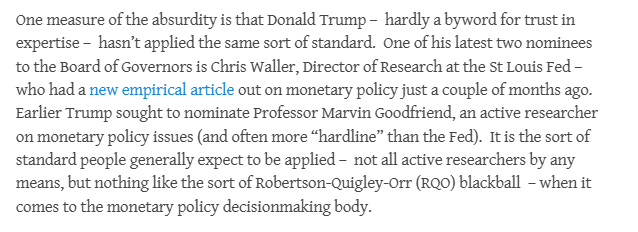
I can understand why Grant Robertson might now be embarrassed about having adopted a restriction (on expertise in central bank decisionmaking) that made him, on that score, worse than Donald Trump.

But what is staggering is Robertson descending to Trumpian standards of utter disregard for truth or the public record. And that The Treasury seems to have been aiding and abetting that descent.

Revisiting a couple of old charts

The recent quarterly national accounts data prompted me to update a couple of charts that I used to run here regularly, one of which I hadn’t bothered updating since the start of Covid.

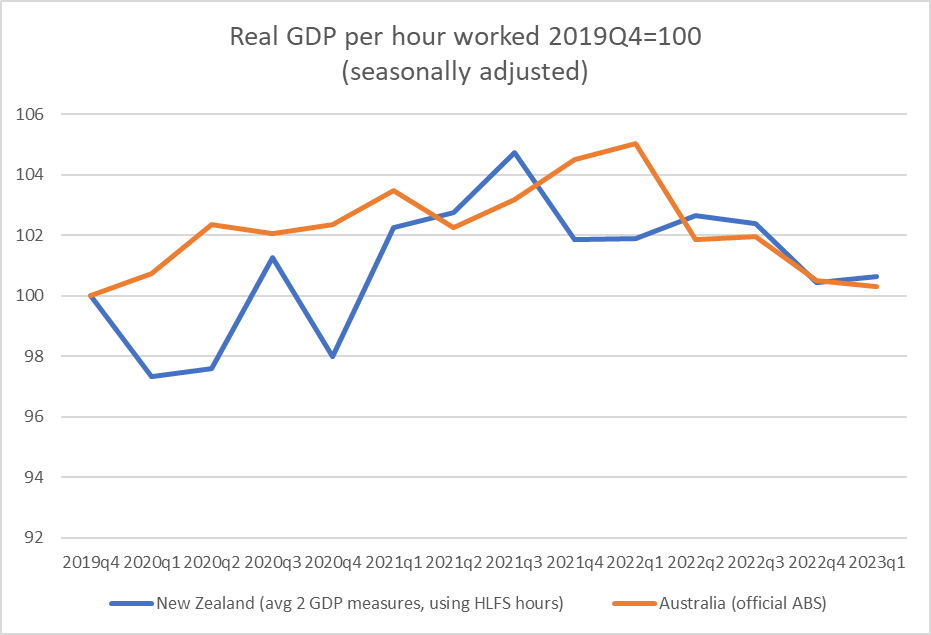
The first is for labour productivity. In New Zealand, we don’t have an official series (level or index) of economywide labour productivity (real GDP per hour worked) but it is easy enough to construct one (or several) using the two quarterly measures of real GDP (production and expenditure) and one or both of the HLFS hours worked and QES hours paid data. I used to simply turn all the series into indexes and divide the average of the two GDP series by the average of the two hours series.

Covid messed up those estimates. For example, under the wage subsidy scheme a lot of people were being paid (as a matter of policy) for hours they were forbidden to, or were otherwise unable to, work. And on a more enduring basis, we now have a higher baseline level of sickness, which comes and goes with waves of Covid, and so for the time being I’m just using the HLFS measure of hours (since it is measuring the hours people tell SNZ they were actually working for). It also then allows for a more-direct comparison with the official ABS real GDP per hour worked series for Australia.

With series for both countries indexed to 100 in 2019Q4, the last pre-Covid quarter, this is how the productivity indicators have done over the last few years.

There is quite a lot of “noise” in the New Zealand numbers, and I still have very little confidence in the any of the numbers for lockdown quarters themselves (in early 2020 and late 2021), but taken over the entire 13 quarters (from before Covid was on any horizons in either country, to now where there are few/no regulatory disruptions) both countries end up with – on current estimates – next to no productivity growh at all over the full Covid period.

I don’t find that particularly surprising (although who knows what the numbers will eventually be revised to) – Covid was a really big disruption and costly dislocation in all sorts of ways – and was much more puzzled by the earlier indications that a reasonable level of productivity growth had been maintained (even allowing for compositional points – eg low productivity motel cleaners and cafe waiters were some of the disproportionately most likely to have lost their jobs in 2020). Perhaps too there is now some cyclical and compositional effects at work: both labour markets have recently been substantially overheated and almost anyone who wanted a job could get one, probably averaged labour productivity a bit downwards.

But they are hardly numbers to be complacent about. For what it is worth, UK official numbers on growth in economywide real GDP per hour worked are (a bit) less bad than these Australian and New Zealand numbers, and US non-farm labour productivity (thus not strictly comparable) while weak in recent quarters still looks to be not far from a pre-Covid trend line.

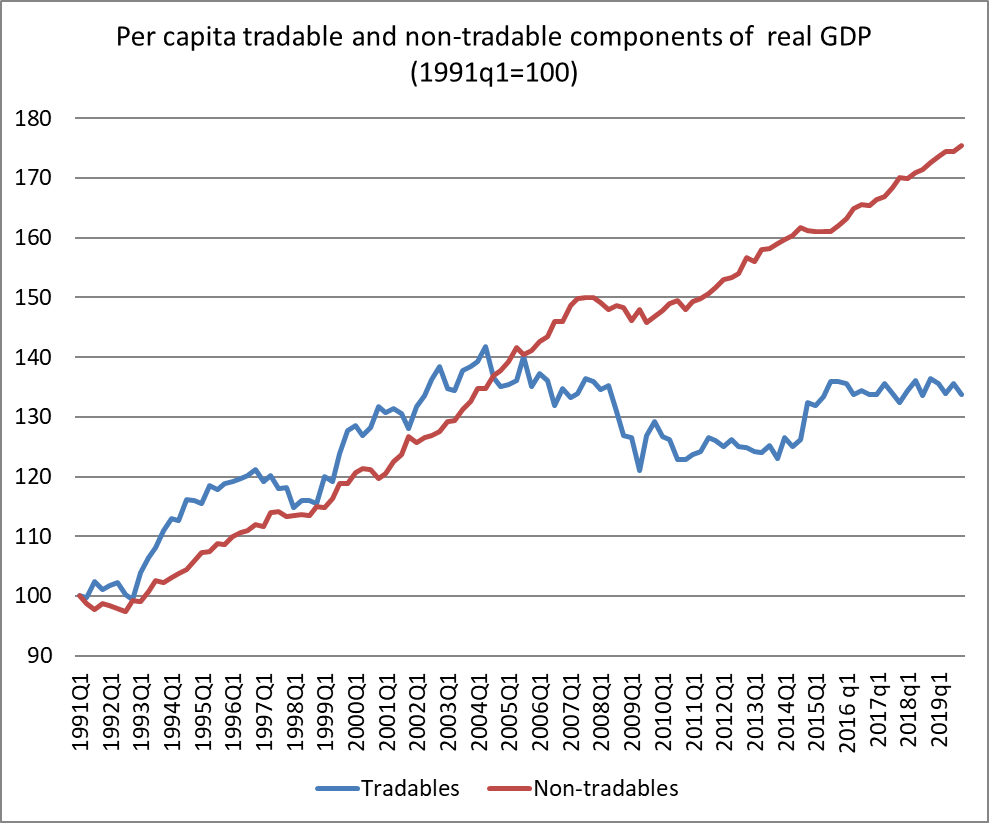
My second chart has, over time, raised more hackles. Almost 20 years ago a visiting IMF mission team were looking at how the (then newly) rising exchange rate was affecting the economy, and one of their people put together a chart crudely illustrating the relative performance of the tradables and non-tradables sectors of the economy. Tradables here was represented by the production GDP components for the primary and manufacturing sectors, to which was added (in a way that makes statisticians wince, but which isn’t without meaning) exports of services from the expenditure GDP accounts. They were, loosely, the bits of the economy either producing for exports or facing direct international competition. The non-tradables component was the rest. I think I later hit on the idea of expressing the series in per capita terms, to cope with longer runs of time.

This is roughly what the chart looked like around the time it was devised.

If anything, the tradables sector had been growing faster than the non-tradables sector in the 1990s and early 00s, which was sort of what the opening-up narratives had led people to expect. But after about 2002, activity in (this proxy for) the tradables sector seemed to be going sideways. All else equal that might not have been too surprising for a cyclical rise in the exchange rate (back then, the New Zealand real exchange rate experienced really big cyclical swings).

This is what the chart looked like the last time I bothered updating it, just prior to Covid

The non-tradables sector had continued to grow quite strongly (in per capita terms), while this proxy for per capita tradables sector output had had its ups and downs but was by the end of 2019 no higher than it had been in 2002. A common narrative on this blog through its first few years was that the economy had become increasingly inward-focused, even though sustainably successful economies tend to be ones with rapidly growing tradables sectors (not, to repeat myself for the umpteenth time, because exports are special, but because there is a big global market out there and successful competitive firms will tend to find global customers).

I stopped looking at the data for several years because when the government says people can’t travel then of course services exports (notably tourism, but also export education) were going to dip quite sharply, and all it was doing was reflecting the priority placed on Covid control, nothing about underlying competitiveness issues.

But now things are returning to normal. We don’t have restrictions on people coming, and nor do most countries, and even China is opening up (for outbound travel) again. So it seemed worth coming back to my indicator chart.

I was quite surprised by what I found.

Non-tradables real per capita output has still been running well above trend, consistent with an overheated economy (high inflation, large current account deficit), as we’d seen on a smaller scale in the mid 00s. But the proxy for the real per capita output of the tradables sector hasn’t yet recovered much at all, and is only about 10 per cent higher than it was 32 years ago.

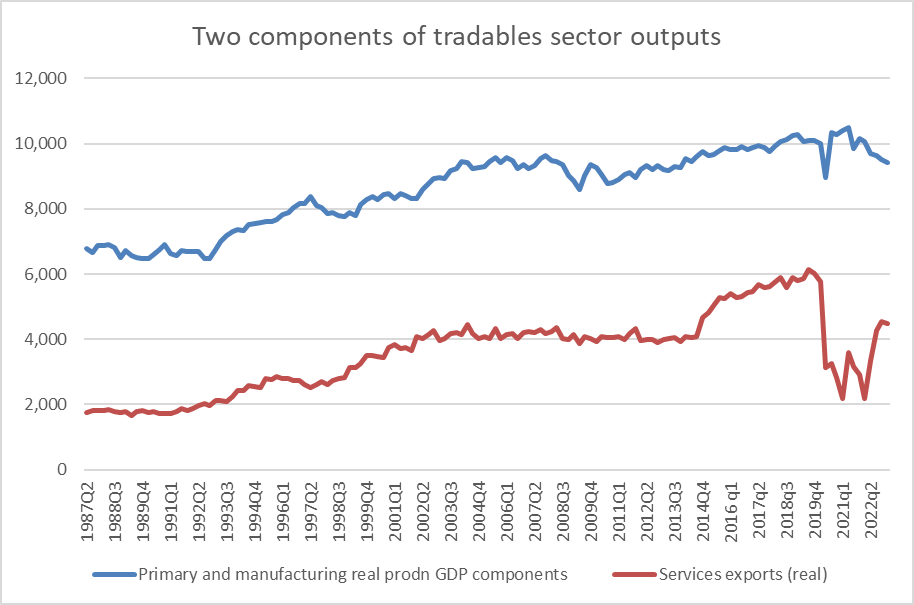
Something didn’t seem right. After all, there were a lot more tourists around.

And sure enough the data (seasonally adjusted but not per capita here) show that services exports have recovered a lot as the Covid restrictions were lifted. But notice the blue line, the GDP components of the primary and manufacturing sectors. It has its ups and downs but the level of the latest observation was first reached in 2004Q1 (when the population has only just passed four million).

It is an increasingly inward-focused economy, where policy (such as it is) is only tending to reinforce such developments. It doesn’t have the feel of the foundations for a prosperous and highly productive economy for New Zealanders – this generations, or our children and grandchildren.

But while the big political parties fight over the keys to the Beehive offices and cars, it would be most surprising if one sees any serious or sustained engagement with data like these (or the policy choices that have given them rise) in the election campaign over the next few months.

Reading “The China Tightrope”

The China Tightrope is the title of the new book by Newsroom’s foreign affairs reporter Sam Sachdeva. The subtitle is “Navigating New Zealand’s relationship with a world superpower”. In the quite limited New Zealand media coverage of the China issues, Newsroom has been better than most. In conjunction with the Financial Times, in 2017 they helped break the story of then National MP Jian Yang’s highly questionable, hidden from the public (and in important respects from the NZ immigration and citizenship authorities), past, including as a CCP member and teacher at a PLA university run at least in part to train spies. They gave considerable coverage to Anne-Marie Brady’s Magic Weapons paper that was released at about the same time. They even ran a post I’d originally written here on NZ/PRC issues.

There was quite a lot of coverage of these issues for a couple of years after 2017, but then the issue seemed to rather die away, at least as far as the media were concerned. And even as more and more of the true character of the CCP regime in China under Xi Jinping became apparent. The all-consuming nature of Covid probably helped, as did the (apparently) joint decision by Jacinda Ardern and Todd Muller (in perhaps the only worthwhile thing he did in his brief stint as National leader) to jettison MPs Raymond Huo and Jian Yang just prior to the 2020 election. Remove the headline risk and you reduce the frequency of headlines must have been the hope. Professor Brady, a world expert on Chinese influence issues, also appeared to turn away from public engagement (perhaps not entirely surprisingly after some of her experiences) and without prominent credible expert voices there often wasn’t that much for busy journalists to report. Establishment New Zealand had, after all, never really wanted scrutiny or challenge at all; there were too many cosy interests (all no doubt legal) to protect. Hadn’t the previous government set up and funded (and the current government maintained it) the New Zealand China Council largely to influence the public narrative in an emollient direction. There there, nothing to worry your heads about. We the bureaucrats and business people have it all under control, never ever uttering even a concerned word about the nature of the regime or its activities and interests here. And that suited both political parties, with strong fundraising interests.

So when it was reported a few months ago that Sam Sachdeva was writing a book on the issues it piqued my interest. There aren’t, after all, that many serious books on New Zealand current political issues.

Sachdeva appears to have faced considerable challenges in writing his book. There were probably practical issues (how much space the publishers would allow, where to pitch the book to get a reasonable level of sales in a small market, and so on). Then there was the problem that any journalist writing such a book needed to be conscious of his ongoing day job. Push too hard in the book and the access required to do the day job might well be jeopardised.

As it is, access seems to have proved to be quite an issue for Sachdeva in writing the book. We are explicitly told that Jacinda Ardern refused to engage at all (consistent with the Herald’s Matt Nippert’s experience earlier in her PM-ship in which he spent a year or more fruitlessly seeking an interview on PRC issues, Nippert also having pursued some of the Jian Yang story). Sachdeva is hardly some scandal-mongering reckless pseudo-journalist, but the then Prime Minister, and leader of a large political party implicated in a number of these issues, simply refused to engage. That was no doubt convenient for her.

The other person we are told who refused to engage was Professor Brady:

Brady initially indicated a willingness to speak with me for this book, before ultimately declining om the grounds that everything she might say was already in her research, and it would be ‘impossible’ for me to say anything authoritative about the New Zealand-China relationship given my lack of Mandarin-language skills and expertise in the CCP system.

For someone who has talked up the role of universities, and academics, as “critic and conscience” it didn’t seem a very constructive sort of approach. After all, quite a lot has happened since 2017. Then again, there have been indications that whereas in 2017 Brady was very much outside the official tent, and ready to air (what seemed like reasonable) complaints, that in recent years she may have taken on roles, formal or informal, that leave her feeling less free to speak. Her occasional comments on Twitter have tended to be relatively positive about the current government, and it would have been good to have heard some of those angles and arguments elaborated.

We know that Ardern and Brady refused to speak to Sachdeva. He provides a list of the people he did talk to, whose views are attributed. There is also a comment that “Other interviewees whose thoughts are included are not listed, as they agreed to speak on condition of confidentiality”. It isn’t clear quite what sort of people might be included here – if it is mostly people from within the ethnic Chinese community in New Zealand, well and good (there are probably legitimate fears of PRC intimidation and threats), but I recall a suggestion that at least one government (MFAT) official might have been included, which seems less than ideal. Either way, it is hardly as if there are revelations (breathtaking or otherwise) in the book.

What is less clear is the situation of others. Did Sachdeva not ask, or did they refuse to talk. Here, I have in mind:

  • current senior National Party figures (Luxon, Brownlee, McClay (he of, for example, the infamous “vocational training schools, and none of our business” approach to the Uighur concentration camps).  I recall exchanging notes with Sachdeva on Twitter several months ago and if I recall correctly he told me he had had a request in for many many months for an interview with Luxon on foreign affairs issues, to no avail.
  • Simon Bridges (who –  and not Bill English as Sachdeva says –  signed the 2017 Belt and Road MOU, the one envisaging a “fusion of civilisations” etc, who did the 2019 trip to China, glowing state-media TV interview and all, organised by Jian Yang, and who did nothing to deal with the Jian Yang situation.  Oh, and who was consistently critical of Ardern for not being sufficiently obeisant before China.
  • Jami-Lee Ross
  • Nanaia Mahuta, Damien O’Connor (for the foreign policy/trade side of things) and whoever was the Minister of Justice and the Minister for the intelligence services at the time the book was being written
  • Jian Yang or Raymond Huo
  • Phil Goff (he of the very large “donation” –  auction proceeds for the works of Xi Jinping – from a Beijing source to an earlier mayoral campaign)
  • Peter Goodfellow
  • Nigel Haworth
  • The Green Party’s foreign affairs spokesperson
  • Ingrid Leary (the Labour backbencher who is now a co-chair of the Inter-Parliamentary Alliance on China, but who seems to keep very very quiet on such issues)

Remarkably, the only current member of Parliament Sachdeva (who was chair of the parliamentary press gallery only a handful of years ago) said he talked to is Simon O’Connor, the rather-marginalised National MP who is from time to time willing to speak up on these issues (also part of IPAC), but is nonetheless constrained by being a fairly junior member and spokesperson in a caucus whose leaders tend to have quite different views.

I was also a bit surprised that he had not talked to Prof Geremie Barmé, an Australian academic expert on PRC issues now resident in New Zealand (who had written an open letter  –  addressed broadly, but including to the then Prime Minister – urging people to take seriously the arguments and evidence Anne-Marie Brady was advancing).  The letter ended thus

Since September 2017, Professor Anne-Marie Brady’s work has attracted overwhelmingly positive global attention. It has also been subjected to vilification by Chinese officialdom. Regardless, her work continues to influence the debate about China’s “sharp power” on the international stage, and it contributes to practical policy discussions in Europe, North America and in Australia. This work remains ever more pressingly relevant to the public life, and the future, of her homeland.

On the other hand, Sachdeva did get interviews with John Key, Tim Groser, and Murray McCully (and the former Executive Director and the current chair of the China Council) of the trade-trumps-all school (and who, to be fair, came to office before Xi Jinping).

And if he talked to the director of the Contemporary China Research Centre (which is apparently hosting a roundtable discussion on Sachdeva’s book in Wellington tomorrow night, which I can’t make), who seems to have become a bit more sceptical, and keen to distance himself from PRC interests, than when I wrote about some of his comments here in 2018, another surprising omission is Tony Browne. Browne is a former NZ ambassador to Beijing who for a considerable time chaired the Victoria University Confucius Institute (PRC funding etc and all, photo of Xi Jinping on its page on the Vic website), chairs the Contemporary China Research Centre (supposedly an independent forum for expertise and debate, but which shares an office with the Confucius Institute), and still appears to serve as a consultant to the PRC government entity that drives the entire Confucius Institute movement internationally. Oh, and he is also the NZ course director for the ANZSOG training programme run each year (but disrupted by Covid) for up and coming mid-level CCP officials (and where they get access to many of Australasia’s great, good, and powerful). I’m something of a Browne sceptic, but he does have a thoughtful case to make for the sort of engagement/involvement I’m critical of.

If I was extending the list of those I was surprised not to see interviewed it would include (a) at least one or two university vice-chancellors (supposedly balancing critic and conscience responsibilities with being big export businesses to China), (b) representatives (present or past) of entities like Fonterra or Zespri or Air New Zealand, or c) perhaps some freer-now-to-speak former senior MFAT officials. Perhaps a little flippantly, the New Zealand Police too, who like cosy relationships with Beijing, and allowed one of their own senior official to accept a role as visiting professor at a Chinese domestic security (aka repression and concentration camps) university. I guess they too have a case to make.

None of this is to suggest that Sachdeva is particularly sympathetic to the gruesome pro-China bonhomie that flows from the lips of John Key. He clearly isn’t. Or that he has not talked to sceptics and critics (Winston Peters and Ron Mark appear in the list of interviewees, and people like former FT Asia editor Jamil Anderlini and Australian researcher and author Alex Joske.

Nor does he fall for all the spin one sometimes hears. He rightly draws attention to the academic paper suggesting that the NZ-China preferential trade agreement probably made little or no difference to NZ GDP per capita (although reports unsceptically claims about China’s alleged role in “saving” or underpinning New Zealand economic performance after 2008, and reports uncritically conventional lines about new trade deals – UK and EU – being likely to make a material difference to New Zealand exporters’ trade with China).

There also isn’t much sense as to how perceptions and policies have been shifting over the years. Some argue that the current government is much better on PRC issues than its predecessor (perhaps just because the external backdrop is changing). Is it really so, and what is the evidence and the counter-arguments? I’m a bit sceptical myself, but Sachdeva should have had the connections and access to offer a persuasive case on issues like that. He didn’t do so.

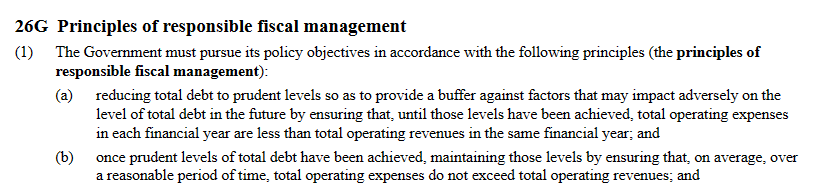
Overall, I think my frustration with the book is that a) I didn’t learn anything and b) I wasn’t made to think harder/deeper. He didn’t seek (or at least find) sources who could shed light on events and interests (notably, for example, around the National Party, or around autonomous sanctions (where National has put forward legislation that Labour consistently refuses to support), let alone around the threats and pressures within the local Chinese community. And he doesn’t advance a robust and detailed argument for any particular approach to the PRC issues (whether one I’d prefer or some other), developed in ways that force one to think harder about one’s own view. For example, what, if any, place is there for morality in foreign policy? Is realpolitik everything, but even if it is where should that take New Zealand policymakers? Or to what extent should the business interests of particular and sectors shape the policy choices and stances of governments? Coverage of the Pacific issues (notably the Solomons) seemed weak, as did the treatment of Taiwan issues (is it really appropriate that no NZ political leader will ever explicitly acknowledge that China is threatening to invade Taiwan, and that invasion of other countries, notably free and democratic ones, really isn’t acceptable, and is it any more likely those same craven politicians will be any less bad after an invasion, when they willl presumably want their markets back pronto). He is more inclined to report someone’s glib line – eg big donations don’t really matter because migrant Chinese just want their photo with a decisionmaker, which they might struggle to do at home – rather than digging deeper and exploring (evaluating) the nature of the risks.
And so I’m left wondering what contribution the book finally makes: aren’t the sort of people who are likely to buy/read the book already fairly familiar with the issues at the level they are covered here? If others do buy and read, will they be left any better informed or influenced than some inchoate sense that “its awkward” (and that Sachdeva has a bit of hankering for a bit more state funding of political parties).

It is all coming into focus again now:

  • We have an election coming, and (as he notes) no serious changes have been made to electoral donations laws that allow foreign-controlled NZ resident companies to donate heavily,
  • We have an election coming, and the leader of the main opposition party has never it appears been willing to face serious questioning about his approach to PRC issues, whether as foreign policy or domestic intimidation and interference,
  • We still have a member of Parliament who has been described as having close United Front ties, and other political parties appear to continue to choose ethnic Chinese candidates based on their acceptability to the PRC interests,
  • Several of our universities now appear to be under severe financial pressure and would presumably champ at the bit to have more PRC students, with all the attendant economic leverage that would grant (and unwillingness to stand up as critic and conscience)
  • We have Prime Minister –  amid a busy year, not doing that well in the polls – nevertheless not too busy to go and make obeisance in Beijing.  Note that ministers will talk a talk about diversifying trade and reducing exposure to (the somewhat overstated wider coercion risks from) China, but where is the PM leading a big trade mission, talking of introducing new (and newly subsidised) industries to the market.  Of course, he will say he will mention human rights etc issues, but (a) does anyone take that seriously, beyond a “Mr General Secretary, you know we have to mention Xinjiang” and his interlocutor nods knowingly, knowing that actions and inactions speak louder than ritual incantations.  Hipkins trots off to China while the PRC authorities hold indefinitely on trumped up charges a journalist from our closest ally.
  • On trade, the issue is not whether private firms trade with partners in China, rather it is whether politicians here are, or are not, willing to adjust their behaviour to protect those specific sector interests, or the beliefs and values of New Zealanders.
  • The Taiwan threats become more pressing by the year, and yet there is no public debate or political leadership here on the issues/threat/risks,
  • Systematic media and political coverage of the PRC inroads in the Solomons (most notably but not exclusively) is limited to say the least.

There is even the small matter of whether Chinese language teaching in our state schools should be provided and funded by the New Zealand government and taxpayers or if it should continue to be heavily funded by the totalitarian, repressive, expansionist PRC authorities (through Confucius Institutes) including allowing those same authorities to vet for political/religious/ideological compliance the Mandarin language assistants put in front of kids in our classrooms.   This would be an easy one to do the right thing on, but neither the universities (3 of them) that host these outposts of PRC policy, nor the schools, nor the government (nor the Opposition) seem to have any interest.  What hope then for a more robust stance in other areas of policy, where vested interests are stronger.  Sachdeva never did draw comparisons between New Zealand’s responses in the past to apartheid South Africa, Nazi Germany, or (nuclear testing) France.  He should have.

I’ve written previously about the economic coercion issues and so won’t at length here.  On specifics, I thought Sachdeva accepted too much at face value past stories of coercion (yes, Norwegian salmon exports to China fell sharply, while those to Vietnam –  neighbouring country –  rocketed) and didn’t really distinguish the interests of particular firms and sectors (which can be powerful lobbies, especially if they operate in secret) from overall national economic performance, especially for economies with their own monetary policy and a floating exchange rate.  Similarly, he was too ready to take at face value lines about differences between Australia (iron ore exports) and New Zealand (milk powder): dairy is another globally traded product, and what isn’t sold in one market will end up being sold elsewhere (perhaps at a different prices).  But my point in closing is not so much whether or no my argument is correct, as that in a rare NZ-focused book on the subject the arguments and issues just weren’t teased out and tested in a way that could have made a useful contribution to the (all too often too thin) New Zealand debate on the PRC issues.

Land value rating for Wellington

The New Zealand Initiative’s Eric Crampton had a good column in Saturday’s Post making the case for land-value rating in Wellington. It was written with Eric’s customary clarity and, on the surface, makes a pretty persuasive case for change. I would normally provide a link but…….despite being a subscriber to the hard copy Post, the new website is anything but welcoming and I don’t feel inclined to send readers their way. But as I’m going to be arguing more with what isn’t in Eric’s column rather than what is, it shouldn’t matter unduly.

For a long time I’ve been more inclined than not to sympathise with the idea of land value rating. But in recent months there has been a group championing change in Wellington (including via an anonymous Twitter account), and since their arguments seemed less than entirely honest it got me thinking a bit harder about whether or not the case for change is really as persuasive as I might previously have been inclined to grant. (And before anyone asks, on the numbers this group used in a Stuff article a month or two back – that I can no longer find – my rates bill wouldn’t have been materially changed by what they were proposing.)

The basic argument for land-value rating is along the lines that, at the margin, it encourages a more economically efficient utilisation of land (a scarce fixed factor which is not going anywhere). The anonymous Twitter account was using as an example a section in the central city currently used as a (single level) carpark. On that site, capital value rates will be lower than land value rates would be, all else equal, and thus at the margin a shift in the rating base might encourage the owner to develop more quickly (or sell the land to someone else who would).

Which sounds fine on paper until one remembers the huge other distortions on land use that Wellington City Council already imposes.

The most obvious, in the rating space, is the egregious business differential, which the left-wing champions of change are very very quiet about indeed.   From Eric’s article

If an apartment tower is right next to a commercial office tower [of identical capital value]…..the commercial tower will pay 3.7 times as much in rates

As Eric notes, Auckland and Christchurch also have differentials, but they are materially smaller than the one applied in Wellington (Christchurch is apparently increasing its to 2.2 times).  I guess you get away with it in Wellington because of the huge captive industry (central government and all the supporting consultancies and other support services) but if I were interested in reforming the rates system in Wellington, and at all interested in providing a better environment for private sector business investment in the moribund Wellington economy
I’d be looking very hard at slashing (ideally abolishing) that business rate differential. All else equal, that would increase the average rates burden on the typical residential ratepayer………which wouldn’t be popular with the voters, but which might prompt harder questions about the extent of the wasteful spending undertaken by the Council (starting with uneconomic convention centres, moving on to super-expensive Town Hall refurbishments, or tens of millions on repairing (rather than replacing) a 30 year old library building, just as examples). Anyone proposing shifting to land value rating without doing something about the business rate differential isn’t making a serious contribution around economic efficiency at all, and is advocating a policy that could actually worsen overall outcomes.

And all that is before we focus in on the way the Wellington City Council (like many/most councils round the country, but egregiously so given Wellington prices) actively rigs urban land prices, by making it difficult, or often impossible, to develop the abundant amount of land (often, in Wellington’s case in particular, land with rather limited economic alternative uses) that the territorial local authoritiy includes. In the last year, their ideological allies on the Wellington Regional Council have also been at it, trying to entrench restrictions on expanding the physical footprint of urban areas. Those restrictions drive up the price of existing urban land, solely as a result of the artificial scarcity those same local authority politicians and their planner allies championed. There is nothing at all natural or fundamental about the land values the left-wing councillors and their allies want to tax: it is all the fruit of a rigged market of their own creation. So count me cautious of those campaigning for land value rating, when the same people show no willingness at all to free up land use and drive down land prices. In fact, having once made the change, they’d have a vested interest in not lowering land prices, because a reduction in land prices relative to capital values would shift the burden of rates back to those you promised relief to when making the case for change.

If, by contrast, the Wellington City Council (or any other local authority) was to see the light and actually allow land to be used as its owners desire (not just as politicians prefer), the case for land value rating might then be strengthened somewhat since as all private land would again be on a more or less equal footing, and the relationships between land values across space, and between land and typical capital values, would be more fundamentally grounded.

All that said, I might still be wary for a couple of reasons.

First, the same argument the champions of land value rating propound – encouraging development – could also be used to argue for higher rates generally (the heavier the burden on undeveloped or lightly developed land the more the incentive to develop it and earn some income off it). I have no enthusiasm for still-higher rates given the evident low quality of so much of the spending already – and yet the councillors reputedly keen on land value rating are mostly also big government people.

Second, it isn’t obvious that encouraging efficient land use is any natural part of a local authority’s business (let alone that local authorities would consistently seek to do so – the evidence of recent decades being against them, given the arbitrary, ideological preference-based, restrictions they’ve actually imposed). One might mount a central government case for a revenue-focused land tax which, if comprehensive and enduring (unlike past land taxes in NZ) might have some economic efficiency benefits (fewer efficiency costs than other possible revenue streams per dollar of revenue raised), but this is an issue of local governments. From them we might want efficient building consenting, clean and paved streets, functioning street lights (that don’t drop on heads), public libraries perhaps, and not much more, generally keeping themselves out of interfering with the choices of private firms and households as much as possible.

Third, somewhat linked to the second point, I’d like as much as possible of what local bodies do to be funded directly on a user-pays basis, and what can’t reasonably be done user-pays directly should be done using a revenue (rates) structure that bears as close a relationship as possible to those who benefit pay. And there I’m unpersuaded by the argument that land values are a better proxy for those who benefit than capital values (6 townhouses on one section will use more services than one house on the same section).

Fourth, there are localities in New Zealand (and Australia) that already (or still) use land-value rating. None of the advocates for change in Wellington have yet (that I’ve seen) produced careful studies showing the sustained difference the choice of land value rating can make (or has made). I recall doing a speech to the Property Investors Association in Nelson several years ago and the land-value rating issue came up. The people I was talking to told me that the Nelson and Tasman District Councils (both covering bits of the Nelson urban area) each had quite different rating bases: one land-based, one capital-based. If so, it would be really interesting to see a serious paper looking at what difference that choice had made (to, for example, land utilisation issues, house prices etc).

The actual experience of other localities and other models is relevant because what those calling for Wellington to shift to land-value rating as proposing is really quite a big redistribution, and it seems reasonable that the onus should be on those proposing material windfall gains and losses (even if for most the difference might be modest) to demonstrate that they system they propose has genuinely produced materially better results where it has been used (and thus represents a potential Pareto improvement).

In talking this over with my son, at one point I suggested that I’d have been fine with land-value rating had it been introduced in 1840 when modern Wellington was founded. But, on reflection, I’m not even sure I hold to that, and am quite sure that the left-wing of the Wellington City Council wouldn’t have been. After all, Wellington wasn’t some terra nullius but had Maori residents and landowners, many of whom would have had little or no market income from their land. The rational economist might have come along and suggested a land-value rating system to encourage efficient utilisation of scarce land, and to cries of “but we have no cash income” or “but this undermines our deep connection with the land” those rationalists would perhaps have responded “oh, no problem, just sell the land and move somewhere else; downsize, put the proceeds in the bank and sit back and watch the new city flourish”. Or they might have excluded the Maori land, which then would have dramatically undermined their original efficiency case.

But if that was 1840 hypotheticals, what about 2023 reality? Shift to land-value rating in a city where land prices have been rigged (by artificial regulatory scarcity) by the same council, and what happens to the economics of the local bowls or tennis club (properties that may, not incidentally, actually use very few council services). No doubt the council and the Crown would protect their own playing fields (schools, government reserves, and council parks don’t pay rates) but why should we be adopting a revenue model (quite unrelated to use of council services) that would have the effect of driving out private sector green spaces from our cities and towns (unless of course you are a left-winger who doesn’t really like private provisions and intermediate civil associations at all).

And then there are the elderly. There are many (private) reasons why an older person or couple might rationally choose to downsize, shift to a retirement village or whatever (stairs, maintenance burdens, or just freeing up some capital) but there is no public policy interest in seeking to affect or accelerate that process (contrary to some rhetoric you hear at times, about how old people “need” to move out – or be moved out – of big old family houses). But that is exactly the sort of effect land-value rating has – and to some is designed to have. If some elderly couple wants to sell their grossly overpriced Wellington house (mostly section) and move to (much cheaper) Christchurch, that is their affair and potentially a quite rational response to the Council’s artificial land-use scarcity. But a lot of elderly people want to stay in the locality they have lived in for decades, close to the people and institutions they’ve been part of for decades. There is no public policy merit in whacking a tax on their backyard – quite unrelated to any council services they are likely to be using – to encourage them to move on and allow conversion into townhouses (after all, the Council could – and should – simply free up greenfields development in the land-abundant Wellington City. And it is no consolation to be told “oh, never mind that you don’t have the cash – you can give us a charge over your estate and build up a big debt to be settled by your heirs”. There is just no public policy case. The underlying issue – which should be easily affordable readily available housing – could, and should, be dealt with directly.
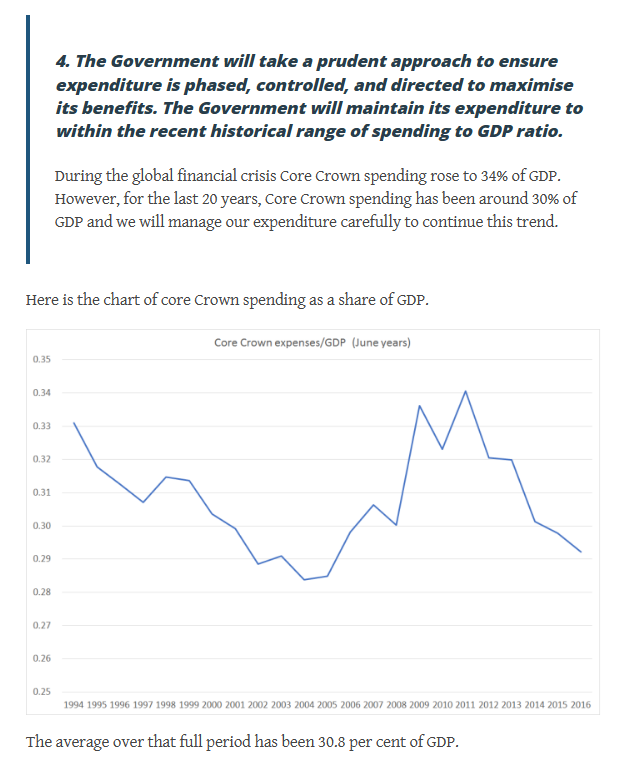
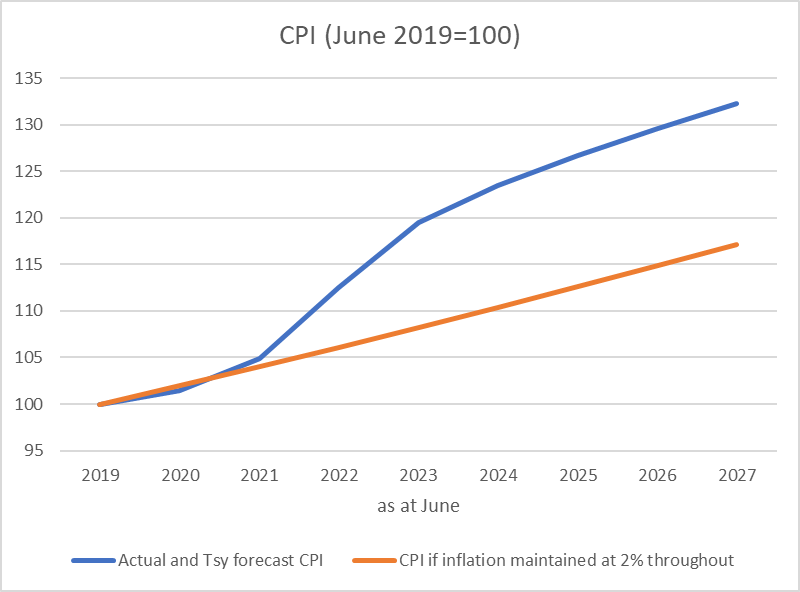
There is a case, at least on paper, for a modest land-value tax, applied equally to all land, at a national level. That such taxes are not widespread should give pause for thought (when I was involved in the 2025 Taskforce and the issue came up David Caygill reminded us that he’d been the Minister of Finance who’d abolished New Zealand’s land tax which by then had been whittled down to applying only to CBD commercial properties), as should the fact that land is becoming steadily less important as a factor of production. But there is a reasonable debate to be had at a national level, as one strand in a national efficient revenue strategy.

At a Wellington City Council level, it all has the feel of something that appropriates in bastardised form the economic arguments and wants to use them to serve the ideological interests of the same councillors who have no general interest in economic efficiency at all, but are keen on some intensively-developed, relatively poor, pseudo Manhattan on Port Nicholson, not because the fundamental economics and individual personal choices drove such outcomes (if they did, then fine) but simply because this sort of urban leftist really hates New World cities and the sort of well-spread cities that wealth and transport technologies (and modest populations – Wellington City has less than 250000 people) made possible. They really don’t like backyards, sunlight, gardens, or soccer or cricket with the kids down the drive. And, refusing to accommodate private choices (costs appropriately internalised) they now want to transform the rates system to reinforce their personal and ideological preferences.

But if the councillors want to surprise us and (a) remove that huge business differential, and (b) free up land use across the whole city (abundant land and all) then perhaps it might make sense to have a conversation as to whether a shift to land-value rating, or perhaps a 50/50 mix (that might better reflect service use), would on-balance make some sense.

In Africa

It was the Monday a few days before Christmas 1992 when a colleague wandered into my office and asked if, by any chance, I was interested in a couple of years in Zambia. My colleague had just returned from a few years at the IMF in Washington and had been rung the previous day by a former colleague of his desperately looking for someone who was interested in being resident economic adviser to the Zambian central bank, all at short notice, as the incumbent was due to leave shortly, and the reform programme (and IMF programme) was in trouble, with inflation through the roof. If I recall correctly, they’d had someone lined up, who had a baby, but news of a cholera outbreak had come through a few days previously. The job was going vacant again.

My knowledge of central Africa was sufficiently sketchy that, in those pre-internet days, I had to wander down to Bennetts bookshop on Lambton Quay and buy a Lonely Planet guide to Africa to (a) securely locate Zambia on a map and (b) find anything at all about it. I rang the guy who was just about to finish up (an RBA secondee I knew), and if some of his stories were sobering – consumer good scarcity so real that he told me that afternoon they’d released the staff because some or other essential had finally appeared in shops – the job itself sounded challenging and potentially rewarding, with a new Governor with no background in central banking or macro but with a serious commitment to overhauling and lifting the performance of the institution. Within 24 hours I had a (very remunerative) offer on the table.

The Reserve Bank subscribed to the hard copy Financial Times and a couple of days later an issue with a Zambia supplement landed on my desk

Zambia FT special

What wasn’t to appeal? Idealism even in the FT headline. Zambia was, if I recall correctly, only the second African country to have restored multi-party elections and to have changed governments.

I was young and single and had more or less done what the Bank had asked me to do when they’d prevailed on me to take my then-current job a year earlier. The slaying the inflation beast phase in New Zealand looked to be more or less over. The Bank knew I was looking round, although their ideas of a next role were a bit less unorthodox than heading off to somewhere like Zambia. A little reluctantly, they agreed to the secondment.

Inflation in Zambia was 181 per cent in the year to December 1992 and, if anything, rising (monthly inflation rates were about 10-12 per cent), and with all the donor goodwill in the world (and there was a lot of it towards the Chiluba government, just 12 months into the new era) things had to change. Making sense of what was going on wasn’t helped by the (literal) inability of the central bank to produce a balance sheet (there had been a serious computer system failure months earlier.

It was a wild, exciting and often frustrating, time to be there. As a place to live – and despite the mostly great climate – there was a little to commend it, but professionally that first chaotic year pushed one to the limit. In some respects, it was the best job I ever had, with that sense of being able to make a real difference, and see the people around me growing and developing capability.

As the blame for any really serious bouts of inflation rests with politicians, so ultimately does the credit for beating it (not only wasn’t our central bank formally independent, but when the governing party has 80 per cent of the seats in Parliament changing legislation wouldn’t have been much of an obstacle anyway). And if the roots of really serious inflation are always fiscal, so are the solutions. Zambia’s was the “cash budget”: the Minister agreed that money would not be spent that was not first in the government’s accounts at the central bank (whether from taxes, donor grants, or domestic borrowing), and each morning we and Ministry of Finance officials would pore over the numbers to get a sense of what payments could go through.

When it was made to work – and it was harder than it sounds, with threats and political tensions almost by the day – we presided over a liquidity squeeze on a scale rarely seen. Flicking through old diaries yesterday I found reference to Treasury bill auction yields at times averaging 600 per cent or more. The exchange rate, which had relentlessly trended down for many years, stopped falling and even began appreciating in nominal terms – it was to be a savage appreciation in real terms. I don’t have monthly data to hand (yes, even then Zambia – unlike modern New Zealand – had a monthly CPI) but if I recall correctly we even had a couple of negative inflation months. It wasn’t a new dawn of price stability – annual inflation settled in a range around 30-40 per cent – but the looming threat of hyperinflation has been beaten.

It was hardly a new dawn of prosperity. As in most places, difficult structural reforms have short-term real economic costs, and driving out entrenched inflation is rarely costless either. We didn’t have timely national accounts data then, so this chart caught my eye when I put it together a few weeks ago: notice the almost 20 per cent fall in real GDP per capita in a single year from 1993 to 1994. We knew it was tough – aside from anything else, exporting firms were not slow telling us – but the numbers are still sobering. Cold turkey treatments aren’t easy. In the space of a few months, we went from having the IMF doubting the seriousness of the authorities (and in fact outright lies were at times told by the authorities to the IMF to keep the programme on course) to having them concerned we had “got religion” and were overdoing things.

The Governor, Dominic Mulaisho, was probably the most inspiring person I ever worked for. As I said earlier, he’d had no background in central banking or macro, had only been appointed in 1992, and had had a history as a senior official in various leading government agencies in the post-independence period. He was also a published novelist, educated in Catholic mission schools before university in (then) Southern Rhodesia, and was, I think, always disappointed that my own command of Shakespeare and English poetry didn’t match his. He could be endlessly frustrating – I found diary reference to a 7 hour Monetary Policy Committee meeting one Saturday, an MPC that then was just about data presentations and lifting the quality of economic analysis and debate – but had an absolute commitment to better days for his country, and for the institution, and a stubborn integrity that finally cost him his job a couple of weeks before my term ended in 1995 (we were trying to close down a Zambian multi-national banking group that was evidently insolvent, but which had powerful friends). As just one indication of what he was up against, the night before I left the country he invited me round to his house and over drinks told me the story of travelling abroad with the then Minister of Finance who took him aside and (so my diary records) said “Governor, my aim is to get rich and to get rich quick. Your job is to help me do that, not to obstruct me. Why don’t you help me?” (both men are now dead).

The prompt for this post is that I have spent the last couple of weeks back in Zambia. Times have changed. Several of the young grads I worked with then now hold some of the most senior positions in the central bank (and the chief economist from those days is now the Minister of Finance). Zambia isn’t without its continuing macroeconomic challenges. Debt-fuelled splurges over the last decade ended in a default on the foreign debt in 2020.

And if there seems to be lots of donor and international agency goodwill towards the new government (and many of the great and good have visited Lusaka this year, including Janet Yellen, Kamala Harris, and the IMF Managing Director), hopes of a substantial debt writedown are currently stalled.

You can see the investment the debt helped finance in the data

Investment rates of 40 per cent of GDP are high by anyone’s standards.

But it was also visible as I walked and was driven around Lusaka over the last couple of weeks. You can see the new public infrastructure and the new private investment (shiny new office complexes, and the proliferation of small malls in the middle income parts of the city), even if the old main street, Cairo Road where the central bank is, was much the same as ever. It is visibly a different, and less raw, place than it had been 30 years ago. And you find something of that in the numbers too: in a country with a very rapid population growth rate, real GDP per capita is estimated to have risen 60 per cent since 2000.

The group I was working with asked a lot of questions about the contrasts and my experiences 30 years previously. As I reflected on it, one that struck me was the nature of the region. In 1993 when I first went, Zambia itself was a little more than year on from a democratic transition. Lusaka had hosted the ANC in exile and if they’d mostly returned home, the transition to democracy in South Africa was still a hopeful prospect rather than an accomplished fact (Chris Hani was assassinated just a few weeks later). The Angolan civil war still raged, the Mozambique conflict had ended only a year earlier, Namibia had become independent as recently as 1990, in Malawi the brutal Hastings Banda still ruled, and the genocide in Rwanda was only a year away. The DRC was, well, the DRC. (By contrast, Harare was a haven of functionality, before the chaos descended in Zimbabwe). These days, if democratic transitions aren’t common outside Zambia, peace and relative stability reigns, and there is a sense of relative normality about much of the region. Various countries have managed some material real income growth. And the best hotel in Lusaka – that I lived in for a year, and stayed in again last month – is now owned by, of all entities, the Angolan sovereign wealth fund.

But then there is the longer-term context. Back in the 1990s we used to tell the story (including to the numerous international visitors who passed through) that at independence in 1964 Zambia had been a bit richer (per capita income) than Taiwan and South Korea (one of the richest countries in Africa, at a time when South Korea and Taiwan were already in the early stages of their growth trajectory). I put this chart on Twitter a few weeks ago

And here is the Zambian version alone

Almost 60 years on, real GDP per capita is barely higher now than it was at Independence.

It is a great country, with friendly people, abounding in physical resources (land area alone is equal to France and Germany combined) and still a major copper producer. If you have never been to the Victoria Falls you really should one day. And there are many countries in Africa worse off than Zambia (and much richer South Africa has also seen next to no real per capita GDP growth since the mid 70s). There is a lot I like about the place, but……the challenges before them to achieve and sustain big improvements in material living standards for their people are huge.

(Among the things to like, I picked up Covid while I was in Zambia. Unlike New Zealand, a colleague could wander down the street to the nearby chemist and buy me a cold and flu remedy that really worked – no bans on pharmacy sales of pseudoephidrene products there.)

Two sets of fiscal deficits

In the government’s Budget, the Treasury projects that on current policies the government will be running an operating deficit for six straight years (while in the 7th the surplus is so tiny that even if it were not for Eric Crampton’s point about tobacco excise revenue we might as well just call it a coin toss as to whether, if the economy played out as Treasury projects we’d see a surplus or a deficit that year).

People have from time to time pointed out that under the previous National government there was also a spell of six straight years of deficits. In fact, here is a chart. The blue lines shows actual fiscal balances from the last surplus (year to June 2008) to the first surplus again (year to June 2015), while the orange line shows actual and Treasury forecasts from the year to June 2019 (last surplus) to the first (tiny) projected surplus (year to June 2026)

In each period, there was one really really large deficit year. In the earlier period that was the year to June 2011, which captured much of the cost to the Crown resulting from the Canterbury earthquakes. In the more recent period, the peak deficit was the year to June 2020, the period encompassing the first and longest Covid lockdown (huge wage subsidy outlays and all).

If these forecasts come to pass we”ll have had an operating surplus (or balance) in five of the last seventeen years.

What about context? In both periods there was a very big exogenous event: earthquakes in the one period and Covid (lockdowns) in the other. Both were, almost necessarily, very expensive for the government. Few people have much problem with meeting many of the direct costs as fiscal obligations.

But….there was a really important difference between the two periods. In the first, the economy headed straight into a fairly deep recession (partly domestically-sourced – our inflation rate had got above the top of the target band – and partly the global downturn associated with the 2008 financial crisis. It was all aggravated by the fact that the 2008 Budget was very expansionary – and yes, that was extravagant and it was election year, but the Treasury advised them that such an approach would not push the budget into deficit over the forecast horizon. It wasn’t one of Treasury’s better calls.

By contrast, at the end of 2019, the unemployment rate was low and, notwithstanding the brief but severe interruption to output around the lockdowns, has mostly remained very low since. When there isn’t excess capacity in the economy, tax revenue tends to come flooding in.

Here is a comparative chart of the unemployment rates in the two periods.

That difference in the unemployment rates makes quite a big difference to the fiscal outcomes, for any set of spending choices. You might criticise the previous government for doing nothing about a Reserve Bank that let unemployment linger well above the NAIRU for so long, as you might criticise the current government for doing nothing about a Reserve Bank that had the economy so overheated for so long. But the economic backdrops to those paths of fiscal deficits were simply very different: with an overheated economy and lots (and lots) of fiscal drag, the revenue was flooding into Treasury over recent years. There was simply no good macroeconomic reason for having operating fiscal deficits at all in an overheated economy, especially once the big direct Covid spending had come to an end (which it had a year ago). By contrast, the earlier government presided over a very sluggish recovery – and so weak, relative to target, was inflation that there was barely any fiscal drag. Even if the Budget was structurally balanced, cyclical factors would have left a small deficit (on Treasury and Reserve Bank numbers there was a negative output gap every year through to 2016).

If the unemployment rates and output gaps give a sense of the cyclical slack (or overheating), labour force participation rates are also valuable context

A materially larger share of the population is now in the labour force now than in the period of that previous run of deficits (and given that unemployment rates have been lower this time, the difference in employment rates is even larger. Revenue has been abundant.

I’m not really convinced there was an overly strong case for the previous government having continued to run operating deficits in the last couple of years of their stretch of six. Had the Reserve Bank been doing its job better, perhaps they wouldn’t have (the economy would have been more fully employed and inflation would have been nearer the target).

But I’m quite convinced there has been no good economic case at all for operating deficits in 22/23. 23/24, or 24/25. Take 22/23 (the year just ending) as an example: on Treasury estimates there has been a positive output gap, and the unemployment will have averaged about 3.5 per cent (well below anyone’s estimate of NAIRU). And with 6-7% inflation, fiscal drag has been a big revenue raiser. And if there has been any residual direct Covid spending (a few vaccinations?), the amounts involved must have been vestigial indeed. So cyclically the revenue was flooding in, but they still ran a deficit: it was pure choice to undertake routine operational spending without the honesty to go to the electorate and raise the taxes to pay for that spending.

The cyclical position is less favourable over the next couple of years – the recesssion (as indicated by the 2 percentage point rise in the unemployment rate) required to get inflation back down again – but the government has chosen to adopt discretionary new giveaways with borrowed money.

It isn’t just some idiosyncratic Reddell view that operating budgets should be balanced (none of this is about capital spending or arguments about infrastructure). It is there in the Public Finance Act

Now, if I was writing the Public Finance Act, I wouldn’t word things quite that way. But……the Public Finance Act is something both main parties have signed up to. It may make sense to borrow to fund useful longer-term investment, but it makes no sense to be borrowing to pay the groceries, especially in times when income has been more abundant than usual.

Just two more Budget charts. The first is one I showed on Twitter yesterday

Now, there is plenty of scope for political argument about the appropriate size of government spending, and left-wing parties will typically be keener on higher numbers than right-wing parties. My own interest here is more about fiscal balances, but it is worth being conscious of just how much larger a share of the economy is now represented by Crown operating spending than was the case even five or six years ago. Those were the days of the pre-election Labour/Greens budget responsibility rules

Next year’s spending at 33 per cent of GDP is not quite at the previous peaks (Covid and the earthquake years) but nor might one really have expected it to be. But there is an election to win I guess.

And finally, inflation. Treasury doesn’t run monetary policy but (a) the Secretary sits as a non-voting MPC member, and (b) Treasury are the Minister’s advisers on the Bank’s performance, so they aren’t just any forecaster. On the Treasury numbers, it isn’t until the year to June 2027 that CPI inflation gets back to the middle of the target range (the 2 per cent midpoint the MPC is supposed to focus on).

This chart uses Treasury’s annual numbers to illustrate what a difference the monetary policy mistake has made, and is making, to the price level

The blue line is the actual (annual) data and the Treasury forecasts. The orange line is what the price level would have looked like in a stylised scenario in which the MPC had delivered 2 per cent inflation each year over this period. The difference is substantial: the price level in the blue line is almost 13 per cent higher than in the orange line by the end of the period. The Minister of Finance appears to be quite happy for the current gap (about 10 per cent) to keep widening for the next five years. He shouldn’t be.

We do not run a price level targeting regime. That means bygones are treated as bygones and we don’t attempt to pull the actual inflation rate back down to the orange line having once made the policy mistake that pushed it so far above. It does not – or should not – mean indifference to the arbitrary redistributions that big unexpected changes in the price level impose, strongly favouring borrowers (especially those with nominal debt and long-term fixed interest rates) and heavily penalising financial savers (holders of real assets can be largely indifferent over time). Inflation – and especially unexpected inflation – is deeply damaging, and there were good reasons for reorienting monetary policy to deliver medium-term price stability. But now the powers that be appear unbothered by 7 years in succession of inflation above the target midpoint. It seems about on a par with being happy to set out to deliver six successive years of operating deficits. Poor fiscal policy, poor monetary policy, poor performance from both the Governor and MPC and the Minister of Finance (the latter not only having direct responsibility for fiscal policy, but overall responsibility for monetary policy and the people he appoints to conduct it). It will be interesting to compare the Reserve Bank (considerably more up to date) forecasts next week.

I’m going to be away for the next couple of weeks so there won’t be any new posts here until after King’s Birthday.

New LSAP data

There have been various posts here over the last couple of years about the losses to the taxpayer resulting from the Reserve Bank’s Large Scale Asset Purchase (LSAP) programme. Some of these have been more about explaining than excoriating (the latest such explanatory post is here).

As I noted in that most recent post, in the early days of the LSAP the line item on the Reserve Bank balance sheet for the claim on the Crown indemnity was a rough but reasonable estimate of the total losses, based on market prices as at the successive balance dates. It became an increasingly inadequate indicator as the LSAP programme started to be unwound, with the longest-dated bonds being sold back to Treasury, losses being realised, and payments being made from the Treasury to the Reserve Bank under the indemnity.

But the amounts of those indemnity payments were not being routinely disclosed (eg the RB does not publish a monthly income statement) and analysts were reduced to picking up snippets of information from OIAed documents. It wasn’t exactly transparent.

Anyway, in an OIA request to the Treasury and in a conversation with someone from the Bank I suggested it would be helpful if the monthly indemnity payment amounts by Treasury were to be routinely disclosed. That way, whatever debates we might want to have about the merits or otherwise of the LSAP programme, at least we would all be working with the same numbers.

And thus it has come to be, and this morning a new spreadsheet on the Bank’s website went live with monthly updates on payments and receipts under the LSAP indemnity. The link to it is about half-way down this page.

Here are the two components

Here is the Bank’s own description of the numbers in the blue line

There were net transfers to Treasury for a while because the coupon rates the Reserve Bank was receiving were higher than the (OCR) funding cost.

And here is the chart showing total losses, realised and unrealised.

The total will keep fluctuating a bit from month to month as market rates change, but the variability will gradually diminish as (a) the size of the remaining LSAP portfolio continues to steadily shrink, and (b) the longest-dated bonds have been sold back first. But for at least the last eight months, something around $10bn in total losses has been the best (market price) guess.

There were two points to this post. The first was to use the new data to illustrate better than has been possible until now with hard numbers just what has happened with the LSAP gains and losses over time. And the second was to acknowledge the Bank and thank them for making the data available. The losses probably aren’t something the Bank is really comfortable with, but one shouldn’t be hiding from the hard numbers, and in publishing them regularly now the Bank apparently is not. And that is welcome.

$10 billion is, however, a lot of taxpayers’ money to have lost.