Official corruption, there and here

On holiday in the (remarkably for mid-July) sunny South Island, I was reading Dictatorland: The Men Who Stole Africa, by British journalist Paul Kenyon.  It is well-worth reading for anyone with an interest in Africa, or indeed in economic (under)development. Over 400 or so pages, it is a series of accounts of leaders of post-colonial African countries who enriched themselves –  typically almost obscenely so –  from the vast natural wealth of the continent.    There are exceptions of course; notably well-governed Botswana.   And there were countries where idealistic disastrous policies impaired the material wellbeing of the citizenry without any great personal enrichment of the leaders (Tanzania and Zambia under Nyerere and Kaunda are two examples).  But Kenyon’s focus is on a series of countries with abundant natural resources (oil or very fertile land in his particular examples), one or more brutal leaders, and, at very best, mediocre material living standards for their people –  think Congo, Zimbabwe, Nigeria, Equatorial Guinea, Libya, Ivory Coast (with the rather different, but equally bleak, Eritrea thrown in for good measure).  Eritrea may – the author reports – have abundant oil and gas, but the regime simply refuses to allow any exploration.   Looting by leaders and their cronies was too often a big part of the story –  billions in foreign banks, fancy houses in Paris, London and the like.  The way various Western companies –  oil companies notably –  acted as enablers of this evil is pretty unedifying too.

Many many books and learned articles have been written on failures of post-colonial Africa.  I’m not sure that any of the stories really persuade me, except perhaps in the most reduced-form sense: there were weak institutions for sure, but they needn’t have stayed weak; the boundaries of many countries were artificial at best, but a strongman (arguably necessary to hold some countries together) could have lived modestly, governed wisely, and so on.   And if one were to blame the colonial predecessors –  in some cases dreadful (think Leopold of the Belgians), in others not much better than indifferent – much of east Asia also emerged from (relatively shortlived) colonial rule at around the same time, and the small Pacific countries emerged even later.  Much of the Middle East emerged from Ottoman rule only a little earlier.   And if, indeed, there is a “natural resource curse” of sorts –  at least in the presence of weak institutions – there are places like Brunei or Norway (independent since 1905).

I spent a couple of years in Zambia, working as the economic adviser to the central bank.  Kenneth Kaunda hadn’t been overly brutal, and hadn’t much enriched himself.  But under his watch, his country’s economy and material living standards had been severely impaired nonetheless.  In the midst of the liberalisation/disinflation shakeout in the early-mid 1990s, per capita GDP is estimated to have been more than a third lower than it had been at independence in 1964.  In the “what might have been” file, the story was often told of how at independence Zambia –  rich in copper, and with abundant agricultural land and a small population – had had per capita GDP similar to (or a bit higher than) those in Taiwan or South Korea.   Zimbabwe had also been about as well-off as those two east Asian states, which themselves had only emerged from fairly brutal decades of Japanese occupation in 1945.   These days, Zambia and Zimbabwe “enjoy” per capita GDP between 5 and 10 per cent of those of Taiwan and South Korea.

Another way to look at Africa’s economic failure is to compare the growth performance with New Zealand. In 1960, New Zealand was still among the richer of the advanced countries of the world. Nowhere in Africa had estimated per capita incomes more than about half of New Zealand’s (South Africa and Algeria), and most had incomes not much more than a tenth of New Zealand’s.  As readers know, over the subsequent decades we have been among the worst performing of the advanced countries.  So beating New Zealand’s growth record over the decades since 1960, should have been easy.  But of the 25 African countries for which the Conference Board database had data (in PPP terms), only 7 did.   Taken as a whole, the continent couldn’t even manage to make gains relative to the advanced country laggard New Zealand.  Of the 18 east Asian countries in  the Conference Board database, every single one grew faster than New Zealand over the period since 1960.   Looting by Africa’s leaders is far from the only story, but at very least it was symptomatic of the wider failure –  as well as being morally inexcusable.

Official looting isn’t, of course, confined to post-colonial Africa. It is mercifully rare in New Zealand, but in the course of my holiday I stumbled on an extraordinary example from the early days of settlement,  In Nelson, we stayed in Blackmore Cottage, (the warmer version of) a house first built in the early 1850s for Edward Blackmore, who had been appointed by Governor Grey as Collector of Customs and sub-treasurer in Nelson.  The owner was keen to tell us the story.  Blackmore had started by lying about his qualifications –  claiming an Oxford degree when he’d done no more than qualified to matriculate (never even attending) – but that was just the start.  He appears to have collected customs duties (at the time, the bulk of regular government revenue other than land sales) and simply never passed the revenue to the government.  At the time, it appears, people appointed customs collector had to provide sureties or guarantors, but Blackmore never provided these either.  Questions were soon asked, repeatedly, but the mails were slow, and it appears that Governor Grey himself took Blackmore under his wing (when senior public servants started pursuing him).  By the time the incident came to a head a year or two later, Blackmore owed the Crown around 2000 pounds.   That mightn’t seem like much, but total customs revenue for the entire country in 1855 was 105000 pounds.

No one seems quite clear what Blackmore did with the money, but it was probably failed business ventures.  He’d even bought a couple of islands.  But whatever he did with it, there wasn’t much left by the time things came to a head.  You might suppose that he’d have been arrested and served a considerable prison sentence –  defalcation is no trivial crime. But, astonishingly, there were no legal consequences at all.   Instead, someone in the Nelson community apparently gave Blackmore ten shillings, and took over whatever assets were left, apparently with the intention of liquidating them and paying any proceeds to the Crown.  Ten shillings (or perhaps it was in addition to the fare) seems to have been enough for the Blackmore family to leave for Sydney, whence the law did not pursue them.  Blackmore was, reportedly, no more successful in Australia, running for a time (before it failed) a private school, at which two of Australia’s earliest Prime Ministers were educated.

The Blackmore affair seemed to create quite a stir.  There was a near-unanimous resolution in Parliament that Blackmore should be arrested, wherever he was.  There was a parliamentary inquiry into the failures of senior civil servants in dealing with Blackmore (the question was whether those civil servants should have their pensions docked.  But Blackmore was never arrested, never prosecuted. never punished.  Perhaps it was simply too embarrassing for some senior people?  Whatever the latter day failings of our leaders –  and they are many –  looting in office is almost unknown.

And with that post-holiday whimsy, I’ll start to get back to the regular round of posts.
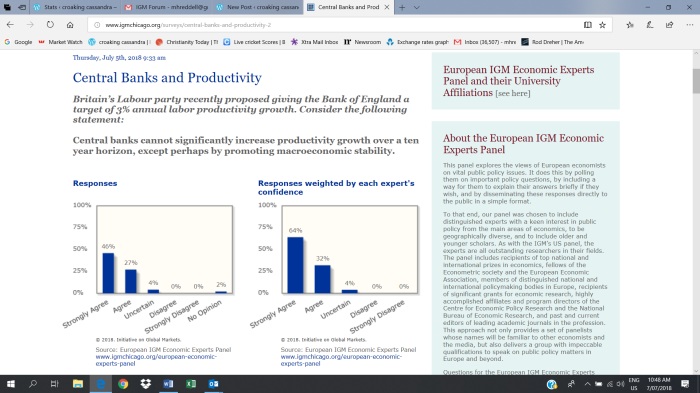
When economists all agree

There was a new survey out last week from the European IGM panel of economics experts, about the recent proposal from the UK Labour Party to give the Bank of England an economywide productivity objective.  These were the results:

IGM productivity

Not a single economist in the panel seemed to think this was a good idea. Not one thought that central banks can make any material difference to productivity growth, except by promoting or maintaining macroeconomic stability.  Note that the question wasn’t just about monetary policy, and the Labour Party policy talks of the use of regulatory tools as well.

I share the view of the panellists, but it is interesting to see the answers coming through so strongly when the Bank of England itself (notably the chief economist Andy Haldane) has at times been quite vocal in arguing (drawing from this speech) that the costs of financial crises are large, and are either permanent or semi-permanent.    I’ve long been rather sceptical of that proposition (some arguments developed at the first link in the previous sentence).   Whether the respondents to the IGM survey connected the two stories I don’t know –  many would probably just have been running the conventional macro story that monetary policy is more or less neutral in the longer-run –  but the results are a useful reminder of just how limited monetary policy and banking regulation are in doing good, once one gets beyond the relatively short-term (perhaps three to five years).

It being school holidays, I’m taking a break and will resume late next week.   There are many things I haven’t got round to writing about so far this year, and I hope to put some of them high on the priority list in the coming weeks, including taxation.  For example, there are the officials’ papers for the Tax Working Group, in which it is recommended that rates of taxation on business incomes should not be lowered.    With such weak long-term rates of business investment, and low rates of productivity growth, you might have thought this was an obvious place to look.  But not, apparently, to the Treasury and IRD officials.  The bacillus of Treasury’s wellbeing approach has reached even into these background papers: lower rates of business taxation would, it is asserted, damage “social capital”.


The real exchange rate mattered in 1985, and it still does

In Christchurch tomorrow evening, Anne Krueger is giving the 2018 Condliffe Lecture.

Krueger is an eminent figure in economics, now in her 80s.  She had a distinguished academic career, specialising mostly in trade and development issues, and she also spent time as first Chief Economist at the World Bank, and then later (until 2006) as first deputy managing director of the International Monetary Fund.   (My lasting impression of her, as an international bureaucrat, was the day she declaimed at a Board retreat about the challenges the IMF faced as a small organisation –  at the time staff numbers totalled about 3000.)

According to Canterbury University

In the University of Canterbury’s 2018 Condliffe Lecture, Anne Krueger will explore the topic: “Is it harder or easier to develop rapidly than it was a half century ago?” in her talk on development and economic growth.

She will argue, we are told

“In this lecture, I shall argue that while the future is never entirely foreseeable, there are a number of considerations that point to greater ease of development now than in the past. These include: the diminishing rate of increase in populations in most low income countries; the fact that much more is understood now (albeit still imperfectly) about development (and especially how not to achieve it); that global markets are much larger; and obtaining information of all kinds is much easier.”

There are also some technological advances that make development easier: mobile phones; continuing discoveries of improved technology in agriculture; advances in materials sciences; and so on.

I hope a copy of her text is made available.

I’m not sure how often Professor Krueger has been to New Zealand, but there is a record of a visit in 1985, when she was at the World Bank.  She delivered a lecture under Treasury’s Public Information Programme, under the heading Economic Liberalization Experiences – The Costs and Benefits (if anyone wants a copy, it appears to be held in the University of Auckland library, but isn’t online anywhere).

As she noted

As a newcomer to the New Zealand scene, it would be foolhardy of me to attempt any assessment of the policies implemented in support of the New Zealand quest for economic liberalization.  It may be useful, however, to discuss what liberalization more generally is usually about, and to attempt to draw on the experience of other countries for lessons and insights that may potentially be applicable –  by those of you more knowledgeable about the situation here than I – in evaluating the progress of liberalization in New Zealand.

It is a very substantial lecture (18 pages of text), drawing on the experiences in previous decades of a wide range of other countries grappling with twin challenges of stabilisation (inflation, fiscal etc) and liberalisation..   The small bit I wanted to highlight –  which saddened me when I first read it a few years ago, and still does, from a “what might have been” perspective –  was about the exchange rate.

Two important lessons emerge from the Southern Cone [of Latin America] experience: failure to maintain the real exchange rate during and after liberalisation is an almost sure-fire formula for major difficulties and the defeat of the effort.  The reason for this is that a liberalization effort aimed at opening up the economy must induce more international trade; it is not enough that there be more imports, there must be more exports.  Since the exchange rate is the most powerful policy instrument with which to provide incentives for exporters, its maintenance at realistic levels which provide an incentive to producers to export is crucial to success.

and a few pages later she returns to the theme

“In particular, the exchange rate regime must provide an adequate return to producers of tradable goods, particularly to exporters”

At the time, this would have resonated strongly with senior New Zealand officials.  One of the starkest memories of my first year at the Reserve Bank, fresh out of university, was being minute secretary to a meeting in late 1984 attended by the top tiers of the Reserve Bank and The Treasury.  It was a just a few months after the big devaluation that ushered in the reform programme: senior officials were explicitly united in emphasising how vital it was to “bed-in” the lower exchange rate, and ensure that the real exchange rate stayed low.

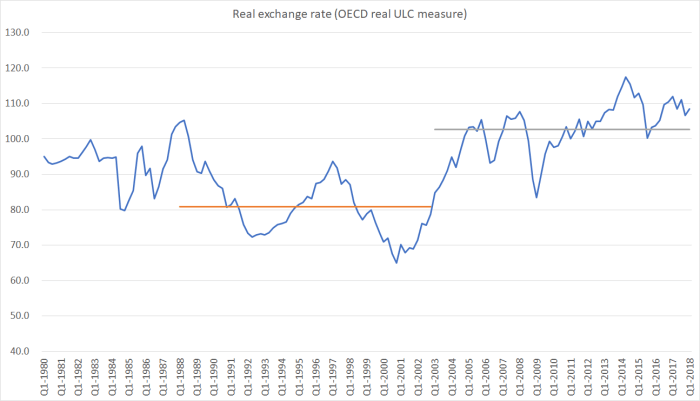
You can see that 1984 devaluation in this chart of the real exchange rate I ran a few weeks ago.

ULC jun 18

In fact, the gains from the devaluation were swallowed up very quickly by inflation.    When we finally got on top of inflation, the real exchange rate did average lower for some time –  and during those years the tradables sector of the economy (and export and import shares) were growing relatively strongly.  But for the last 15 years, the real exchange rate has averaged even higher than it was prior to the start of the liberalisation programme.  It hasn’t been taken higher by a stellar productivity performance.

It shouldn’t be any surprise that the export and import shares of GDP have fallen back, and that there has been no growth at all in per capita tradables sector GDP this century.    Successful sustained catch-up growth –  of the sort New Zealand desperately needs – doesn’t come about that way.

Perhaps some attendee might ask Professor Krueger for any reflections on her 1985 comments about the importance of the real exchange rate in light of New Zealand’s disappointing economic experience since then.  And linking back to the topic of her 2018 lecture, can we now catch-up fast, having failed so badly to do for the last 30+ years?  Fixing the badly misaligned real exchange rate, a symptom of imbalances but which is skewing incentives all over the economy, seems likely to be imperative.  New Zealand just isn’t that different: wasn’t then, isn’t now.


Free speech, even for odd or obnoxious views

Last week the Mayor of Auckland, Phil Goff, announced –  using what powers isn’t clear –  that no venue owned or managed by the Auckland Council would be made available for hire by organisers for an event involving a couple of controversial Canadian speakers, who had been planning to visit New Zealand next month.

I’d never previously heard of the speakers, or the organisers.    When I looked them up, some of the views one or other has apparently propounded seemed, frankly, kooky.  Here, for example, is a (unverified) report of some of Stefan Molyneux’s views.

According to Jessica Roy of Time magazine, Molyneux argued that violence in the world is the result of how women treat their children, and that “If we could just get people to be nice to their babies for five years straight, that would be it for war, drug abuse, addiction, promiscuity, sexually transmitted diseases, … Almost all would be completely eliminated, because they all arise from dysfunctional early childhood experiences, which are all run by women.”

Odd, or even obnxious, as some or many of their views might be, they are quite at liberty to hold them, or express them.  And New Zealand audiences should be free to listen to them, whether to cheer, to heckle, or just out of curiosity.

No owner of a private venue should be under any obligation to rent out a venue –  or provide a media outlet – but councils should be a different matter altogether.   Council property is paid for by all the local residents and ratepayers, and when such venues are available for hire or use by private groups, there should be a strong and clear commitment that the political views of those who happen to be councillors, mayors, or council staff at the time won’t influence which groups are allowed to use such facilities for their functions/meetings.  There are plenty of causes around that individual people will count as obnoxious –  stances on a contentious issues such as abortion law is a good example, where either side tends to view the other in a very deeply hostile light –  and it isn’t for those who happen to hold office at a particular time to impose some sort of ideological litmus test on views that can be uttered in public facilities.    Such an approach would smack of the sort of authoritarian semi-democracies of Turkey, Russia, or Hungary –  where elections still take place, but those in power stack the field by denying access to the public square to views/people they find awkward, disagreeable or threatening.

The stance taken by Auckland Council staff and the mayor shouldn’t be tolerated, no matter how odd or obnoxious many of us might find most of views of Lauren Southern and Stefan Molyneux.  And plenty of views now regarded as mainstream, almost obligatory in “polite society”, would have been regarded as threatening or obnoxious only a few decades back.

A group of concerned people have got together to challenge the Auckland Council’s right to deny use of their venues.  It appears to breach the Human Rights Act, and is inconsistent with the (non-binding) New Zealand Bill of Rights.  I’ve pledged to donate to the fund being raised to seek a judicial review of the Council’s action.  I’d encourage you to think of doing so to, whatever your view (or none) of the substantive views held by Southern and Molyneux.  This issue –  effective freedom of speech –  should be one of those issues that unites people from left and right (and people in open support of this cause range from Don Brash to Chris Trotter), and nowhere in particular on the political spectrum, who care about a functioning democracy, robust debate, and who believe that ideas –  even obnxious ones –  are best debated, not suppressed by government agencies.

The website is……https://freespeechcoalition.nz

I have also encouraged the organisers to consider working with a sympathetic member of Parliament to seek to introduce, via the ballot, a private members bill, to require all local authorities and similar public entities (eg school boards of trustees) to adopt a hiring or facilities use policy that does not use judgements about whether those in control of deciding on facilities use happen to agree with any views that would be expressed or not. These are community facilities, and when made available for outside use, it should be clear that no ideological litmus tests can be applied.

Choices: New Zealand and the PRC

There was an article on interest.co.nz the other day from the New Zealand resident American geopolitical and strategic affairs consultant, Paul Buchanan.  In his column –  well actually even in the headline –  he argues that

New Zealand is facing a very tough choice between our security interests and our economic interests, and that choice may have to be made very soon.

This is, as he sees it, a choice between the PRC and that of the United States (and our traditional allies).

Perhaps, but I reckon Buchanan misunderstands the nature of New Zealand’s economic exposure to the PRC.  The economic interests involved aren’t those of the country as whole –  countries make their own prosperity – but rather of a relative handful of, perhaps politically influential, businesses (and universities)  And if there is a choice it is more likely to be between the sort of values and friendships that have guided this country for the last 100 years and more, and those of one of the most brutal aggressive regimes on the planet; a regime which, as this article highlights, is becoming worse –  more threatening to its own and others –  not better.  It should be no choice at all, unless our politicians are now quite without shame.  Values and beliefs –  the things that unite people, communities, countries, beyond just common material interests –  don’t appear in Buchanan’s story.

Buchanan sets up his article noting that New Zealand`s trade and security relationships had diverged.   He seems to present it as a matter of active choice, whereas I would see it –  at least on the trade side –  as a natural evolution.  There was no conceivable world in which the bulk of our firms` overseas trade (and it is firms that trade, not governments) would continue to be with UK counterparts, or even with Australian or US firms.   That is true in respect of both imports and exports.   Our previous position –  buying and selling from firms in a single dominant country –  was historically not the norm.   These days –  though you wouldn’t know it from Buchanan’s article –  our foreign trade is relatively unusually widely spread.  No single country’s firms –  not even the very largest or the very closest –  take or provides more than a quarter of our foreign trade.  And, unfortunately, our foreign trade is rather smaller, as a share of GDP, than it would be if our economy were more successful.   To the extent that one worries about trade with the PRC –  and some individual firms clearly should, having chosen to sup so large with the “devil – a much larger share of Australia’s trade is with PRC counterparts than New Zealand’s.

Buchanan presents New Zealand as caught on the horns of a dilemma, or as he puts it

…that makes the New Zealand’s stance more akin to straddling a barbed wire fence while standing on ice blocks rather than balancing between competing great power interests.

It seems he sees it as a choice because he has bought into the narrative, often promoted by the previous government, that somehow our (so-called) prosperity (weak productivity, shrinking tradables sector etc) owes much to the PRC.

On the one hand, the Chinese presence in New Zealand has been materially beneficial. But that has come with strings attached that are believed to compromise the integrity of New Zealand institutions. For its part, New Zealand’s Anglophone orientation has not recently paid similar material dividends even though it gives it a seat at the table in security meetings with our traditional partners.

But where is the evidence that, in anything other than a willing buyer/willing seller sense, New Zealanders as a whole have particularly profited from the relationship with the PRC?   Is there reason to suppose that more milk powder would have been produced, if PRC buyers hadn`t purchased it from New Zealand sellers?  It is a globally-traded product, and what isn`t sold in one place is sold in another. In that respect, it is a little like oil.   The same goes for many of our exports, which aren`t specifically designed from the Chinese market.  And no one supposes that the PRC is about to impose export bans on the sort of stuff New Zealand firms purchase from the PRC.

Trade is, generally, mutually beneficial, and so things that disrupt trade patterns are generally costly.  But the cost of any particular disruption can easily be overstated, especially in a bilateral relationship where total exports to a particular country (in this case, New Zealand to the PRC) total only around 5 per cent of GDP.   Dairy prices fluctuate from week to week and, quite a lot, from season to season.  On the other side, so do oil prices.  But economies have a lot of capacity to adapt, and instruments like monetary policy and a flexible exchange rate that help smooth the adjustment.  It isn’t always easy for particular firms –  but they’ve made choices about their exposures, and the failure to manage them effectively – but the focus of policymakers needs to be on the economy, and country, as a whole.

Buchanan sets up a looming almost inevitable choice, about rising US/PRC tensions (economic, but even more so strategic)

The question is therefore not a matter of if but of when and for/against who?

He offers this scenario of “going with” the PRC (although it isn’t entirely clear what specifically he thinks this choice would involve doing, or not).

Should New Zealand choose China, it will lose the security umbrella and suffer the diplomatic wrath of our most traditional and closest international partners. The consequences will be felt in a loss of trade and diplomatic ostracism, but most acutely in damaged security relations with other Western democracies. The Five Eyes listening posts in New Zealand will be dismantled and all of the highly sensitive equipment, to say nothing of archived records and stored data, will be removed under duress. This could prompt a revolt within the New Zealand intelligence community given its Anglophone orientation, and when coupled with “dark” influence operations by former allies could cause civil unrest amongst those disinclined to cast their lot with the Chinese. It could even lead to covert and overt hostile responses from jilted partners, who will likely discontinue military relations with New Zealand, including sale and supply of equipment. There will be a moment of national reckoning.

I`d certainly join any protests against such a choice – utterly morally reprehensible as it would be.  It would be akin to Marshall Petain treating with Hitler, with less excuse. It isn`t entirely clear why Buchanan thinks this opting for the PRC option is a realistic possibility though.   All he offers is economic coercion initiated by the PRC.

Should New Zealand opt to side with the US and its security allies, it will suffer serious economic losses as a result of Chinese retaliation. This has already been presaged by the PRC response to New Zealand’s support for the International Court of Arbitration’s ruling in favour of the Philippines in its dispute with China over island-building in contested waters, where state-controlled media editorials warned New Zealand over the consequences of siding against China (including in trade). More broadly, there is ample record of Chinese economic retaliation against countries that do not toe its preferred line on a number of issues, so New Zealand has both immediate and contextual reasons to see the writing on the wall.

This is all rather overwrought.   I’ve written previously about PRC attempts at economic coercion.   In a case that will have bothered the PRC far more than anything New Zealand could do, and where the PRC authorities had far more effective leverage, –  missile defence system being installed very close to the PRC – the central bank of Korea estimated an effect from PRC coercive measures of perhaps 0.4 per cent of GDP.

As I noted in that earlier post, a couple of industries –  one government-owned anyway (the universities) – have made themselves overly-dependent on the PRC.  A sudden stop on PRC students or tourists coming to New Zealand (the option that would hurt here and do least harm to PRC people themselves), would be very disruptive to those industries.  But those are risks they need to be managing –  and not just by persuading governments never to see anything upsetting to Beijing.     No matter what the PRC did, there is no sense in which the “writing is on the wall” for the New Zealand economy.   The next international recession –  whatever its cause – is more of an issue to worry about (especially as our authorities aren’t that well prepared).

So we can choose to abandon traditional allies, and abandon any interest in supporting democratic countries in the east Asia region, and in doing so abandon any sort of self-respect as a nation.  Or we could summon some self-respect, and perhaps give some lead (moral if not military) in pushing back against PRC intrusions abroad (including here specifically), and abuses at home.  But whichever choice our leaders ended up making –  and it should be no choice at all –  it isn’t one that seriously threatens our (rather attenuated) economic prosperity (let alone our physical security).

On which note, it was interesting to see that in a week the government had moved from being unwilling to name the villain in the South China Sea, to being a bit more explicit in the Strategic Defence Policy Statement released on Friday.  Even then, they can barely bring themselves to disapprove, and cloak there concerns in all sorts of rather laughable diplospeak such as the suggestion that “China is deeply integrated into the rules-based order”.  When it suits perhaps, but that is not at all the same thing –  what matters is the choices made when it doesn’t suit.  And those aren’t encouraging.

Also interesting to note the contrasts in the comments of two senior officials, one from New Zealand and one from Australia.  Our outgoing ambassador to the PRC, John McKinnon, was profiled in the Dominion-Post on Saturday.

Some have expressed unease over China’s expanding influence in the Asia-Pacific region. Canada’s Security Intelligence Service has claimed China is busy “co-opting political and economic elites” in New Zealand.

McKinnon makes it clear it is not a topic he will comment on; nor will he discuss current government policy towards China or the policies of the ministers he has served while in Beijing.

He also does not want to venture an opinion on whether China will move towards a more Western-style democracy.

“To understand the dynamic of what’s driving China now you have to understand where they’re coming from. It’s something they have to make their own decisions about and I can’t foreshadow what will happen.”

I’m enough of a bureaucrat to not encourage officials to speak out-of-turn openly. But clearly his masters also had no interest in him ruffling any feathers at all, even as the defence strategy document was being released.

And on the other hand, in his final days in his role, the outgoing head of the Australian defence forces comments thus

Defence chief Mark Binskin says Beijing’s broken promise not to militarise the South China Sea means it has squandered the trust of its neighbours and undermined its aspirations to regional leadership.

and

Asked about China’s trajectory since he took over in 2014, Air Chief Marshal Binskin agreed “it has changed” and cited the “very, very concerning” militarisation of features as well as “the influence of some nations starting to come down into the south west Pacific”.

Chinese President Xi Jinping said during a 2015 visit to Washington that his country had “no intention to militarise” the artificial islands it had built in the strategically important South China Sea.

Air Chief Marshal Binskin dismissed Beijing’s claims that its placement of weapons on built-up features in the Paracel and Spratly archipelagoes were purely defensive and said other countries around those waters were entitled to stand up for their legal and territorial rights.

 “I don’t think there is trust there … because [according to] all the reports that you see, they are militarising,” he said. “They’ll put a spin on that and say it’s only for defensive reasons. But … if you didn’t build an island, you wouldn’t need to defend it. If there are weapons on those islands, they are militarised.”

Asked what the militarisation was for, he said: “I think that they are looking to expand into there and I think it is quite obvious what their approach is.”

Not, sadly, the sort of thing one hears from New Zealand ministers or their senior officials.  But then, why would they, when they seem unbothered by Jian Yang as a member of Parliament, and where the parties seem to compete over which president can offer the most laudatory praise of Xi Jinping and the PRC.

Do our leaders –  National, Labour, New Zealand First, or Green –  care any longer about anything but the quiet life, and the next trade transaction? Do they feel no shame at all about associating with such a heinous regime?  If so, how would we know?  Thank goodness that wasn’t the approach of people like Michael Joseph Savage, Peter Fraser or their then Opposition counterparts.

Are things better or worse than 50 years ago?

I saw reference the other day to a new(ish) multi-country survey conducted by the Pew Research Center last year, asking people in 38 countries whether life in their country was better, worse, or not much different for people like them than it had been 50 years previously.  Among the people I saw tweeting a link to the survey results, there seemed to be general incredulity that anyone could not think things were better now than they had been 50 years previously.  The focus of those comments was particularly on the US results, where 41 per cent of respondents thought things were worse, and 37 per cent though things were better.

But, as it happens, the US results were close to the middle of the field.

pew

At the extremes, the results are not remotely surprising. In 1967 Vietnam had been in the midst of a longrunning war, and now is relatively prosperous and stable, even if not free.  And in 1967 Venezuela was pretty prosperous, whereas now it is poor and chaotic.

And if it is mostly rich countries above the median line, and mostly poor countries below it, that picture isn’t uniform.

New Zealand wasn’t covered by the survey, but Australia, the UK, and the US were.  Australian and British respondents were net positive, while US respondents were slightly net negative.   To the extent that overall economic performance is a material part of what shapes respondents’ answers to such a question, I suspect that New Zealand answers would be less positive than those for the US and the UK.  After all, over that half century almost a million New Zealanders net left the country in pursuit of better opportunities abroad, mostly in Australia.

In a bit over half the countries covered in the survey (but not, for example, in Australia), there was a statistically significant difference in which those with a higher education were more likely than the less educated to say that things had improved.

pew 2

Without being aware of this survey, I wrote about the 2017 vs 1967 question on another blog a few months ago.   I came to the conclusion that, taken as a whole, I’d answer “worse” if asked this particular survey question about New Zealand (even though transplanted 50 years back, this blog would have been impossible, and I’d have been grinding out an existence in some public sector job, probably longing for retirement).

Here is how, in that earlier post, I described some of the things I would put on the positive side of any such assessment.

For sure, there are things to be thankful for –  that favour 2017 over 1967.   Real per capita GDP, for example, is around twice what it was 50 years ago –  that is the ability to consume more stuff.  “More stuff” encompasses “better stuff” –  cars that are better-built, that are air-conditioned; TVs that offer (in NZ) more than a single channel; a rich array of eating-out options; much more affordable overseas travel, and smartphones with the resources of the internet in our pocket.   And yet in 1967 New Zealand most people had fridges, ovens, washing machines, TVs and radios, cars, and it is far from obvious how much real gain new and better gadgets have brought.  Some no doubt, but much?   People like to talk, for example, of the immediacy of news via the internet.  But how many of us really need that immediacy that much?  I look at some copies of Time magazine on my shelves from the late 1960s –  sure it was only weekly, but the content was generally far superior to that in today’s newspapers or news magazines.  I’m not suggesting I’d prefer the 1967 model in this respect, but how large is the gain?  (In some ways, this is  economist Robert Gordon’s point)  After all, in 1969 I heard the broadcast of the moon landing live, played out into our school playground.

Life expectancy is quite a bit longer than it was too –  infant mortality has dropped further, and life expectancy among the old has also improved considerably.    And there are more work options for women in particular –  if most discriminatory laws had gone by 1967, old models in which married women were typically out of the workforce either permanently or for long periods while children were around still prevailed.  In many more-formal ways, options for Maori have considerably improved –  witness the number of Maori MPs as just one small example.  In 1967 people like me couldn’t find an audience with something like a blog.

And on the other hand, specific to New Zealand:

  • so many New Zealanders have left (a regrettable thing in itself, for community and family relationships/networks etc),
  • the house price disaster.  Just prior to 1967, my parents bought a (new) first house on a single (not especially high) income.  Few have that opportunity now,
  • rates of imprisonment are so much higher now than then,
  • rates of welfare dependency are so much higher now than then,
  • a far smaller percentage of children are growing up in two-parent families,
  • the normalisation of drug use (my 13 year old niece told me the other day of recently being offered marijuana in the playground in a nice middle class New Zealand high school),
  • pervasive access to, and use of, pornography,
  • more social isolation and higher rates of mental illness,
  • the growth of the regulatory (and surveillance) state,
  • the deference paid by our elites to one of the most brutal states on earth, in contrast say to New Zealand attitudes to the Soviet Union in 1967.

I could go on to include things more specific to the decline of Christianity in the west, and in New Zealand specifically, but I won’t belabour that point here.  As a parent, my impression is that it is harder to raise children well now than then.

In the Pew results, there was not a statistically significant difference between attitudes of young and old respondents in most countries, but among those where the young were more upbeat were the UK, the US, and Australisa.  Most probably, one would find such a difference in New Zealand.

When we discussed these results around the dinner table, it was suggested that woman might be more inclined to answer positively than men.  I am not sure I share that prior, but unfortunately no results were reported by gender (perhaps suggesting that there were not any consistent or interesting differences, given the typically fairly comprehensive nature of Pew analysis).   Sadly, there also was not any analysis of differences by political inclination (liberal vs conservative), which one would expect to explain some of the differences in responses within, and perhaps between, countries.

I can see how some people would answer that things were better now (many liberals –  depending on the components of the liberal agenda emphasised – would be expected to), and economists seem often to weight most heavily income measures (undoubtedly higher than half a century ago), available technology, and life expectancy.   But these results suggest that to people around the world the answer is not clear cut.  Perhaps in some cases those negative answers involve people just looking at the past with nostalgic rose-tinted glasses, but the diversity of results across countries suggests something more is at work than that.

Productivity: still doing poorly

I had been planning to write today about some of the recent Reserve Bank material on electronic currency.  I even took the papers away with me yesterday to read on some flights, but in the course of that reading  –  coincidentally, en route to another funeral – I discovered that a former Reserve Bank colleague, only a year or two older than me, had died a couple of months ago.    We hadn’t been close, but I’d known him off and on for 35 years beginning with an honours course at VUW in 1983, and when I’d last seen him six months or so ago he’d been confident the cancer was beaten.   What left me a bit sick at heart was that I had commented here last month, moderately critically, on a recent Reserve Bank Bulletin article of which he had been a co-author.   None of the comments were, as I reread them, personal.  But I’d have written differently had I known.  So I’m going to put aside issues around the Reserve Bank for a few weeks (and the blog is taking a holiday next week anyway).

So instead, having listened to a few upbeat stories in the last few days, including the IMF mission chief for New Zealand on Radio New Zealand this morning, talking about the “sweet spot” the New Zealand economy was in etc, I thought it was time to update some productivity charts.

Here is real GDP per hour worked for New Zealand.

real GDP phw jul 18

I’ve marked the average for the last year, and for the 12 months five years’ previously.  If anything, things have been going backwards a bit for the last three years, and for the last five or sx years taken together, productivity growth has averaged no better than 0.3 per cent per annum.  Some “sweet spot”, especially when our starting position relative to other advanced economies was already so far behind.

And here is the comparison with Australia –  in many respects the OECD economy with most in common with New Zealand (distance, resource dependence, Anglo institutions), and also the exit option for New Zealanders.

real GDP nz and aus jul 18

In 1989, when this chart starts, New Zealand was already behind Australia.   Since then, we’ve lost another 15 percentage points of ground, about 0.5 per cent per annum.  A decade ago perhaps one could have mounted an argument that the decline had come to an end: looked at in the right light, perhaps we were even showing signs of some modest closing of the gap.  But then we took another step down, and the rate of decline in the last decade as a whole has been about the same as that for the full period since 1989.

For almost a decade now, I’ve been sobered by the performance of the former eastern-bloc countries that are now part of the OECD.  Thirty years ago, when we –  already a market economy –  were in the throes of reform, they were just beginning the journey to freedom (Estonia and Latvia were still actually, involuntarily, part of the Soviet Union).   Their starting point was, of course, a great deal worse than ours –  for all the early 80s talk of New Zealand having an economy akin to a Polish shipyyard –  but the common economic goal was catching-up, reversing decades of relative decline.

In the decades since, New Zealand has lost ground relative to the richer countries of the OECD (and, as per the chart above, has lost a lot of ground relative to Australia, even more recently).  The former eastern-bloc countries have done a great deal of catching up.  They still have a long way to go to catch that group of highly productive northern European economies (Belgium, Netherlands, France, Germany, Denmark), but New Zealand is on track to be overtaken: on OECD numbers Slovakia now has real GDP per hour worked higher than that in NEw Zealand.

There are seven former eastern-bloc countries in the OECD.  The OECD is filling in 2017 data only slowly, and so in this chart I’ve shown real GDP per hour worked for New Zealand relative to the median of the six former eastern-bloc countries for which there is 2017 data (the country for which they don’t yet have 2017 data is Poland, which managed 7 per cent productivity growth in the four years to 2016, a period when New Zealand –  on the measure the OECD uses –  had none).

eastern bloc

Some of these former eastern-bloc countries had a very rocky ride (notably Estonia and Latvia, which ran currency board arrangements in the 00s, and had massive credit booms, and then busts), but the trend is still one way.  They are catching up with us, and we aren’t catching up with the sort of countries we aspire to match.

The pace of decline (New Zealand relative to these former eastern-bloc countries) has slowed, as you would expect (in 1995 it was still quite early days for post-communist adjustment) but the scale of the chart shouldn’t lead us to minimise the recent underperformance.   In 2007, we had an economy that was 20 per cent more productive than the median former eastern bloc OECD member, and last year that margin was only 12 per cent.

The measure of success in this economy shouldn’t be whether we stay richer and more productive than Slovenia or the Czech Republic.  All of us are a long way off the pace, far from the overall productivity frontier (best outcomes).    But what these former eastern bloc countries help highlight is that convergence can and does happen, if you have the right policies and institutions for your country (in all its relevant particulars).  Policymakers here used to genuinely believe that. It is no longer clear that they – or their Treasury advisers –  any longer do.

On which note, Paul Conway of the Productivity Commission recently published an interesting article in an international productivity journal on New Zealand’s productivity situation and policy options.  Commission staff were kind enough to send me a link.  Paul Conway has a slightly more optimistic take on the last decade or so than I do, but common ground is in recognising the total failure to achieve any catch-up or convergence.  There is a lot in Paul’s article –  which, not surprisingly, is not inconsistent with his earlier “narrative” on such issues that he wrote for the Commission itself, and which I wrote about here.   I will come back later and write about Paul’s analysis and prescription –  there is a lot there, some of which I agree with strongly, and some of which I’m much more sceptical of.  For my money, he materially underweights the importance of a misaligned real exchange rate as a key symptom, which has skewed incentives all across the economy.     But it is good to see public service analysts contributing substantively to the (rather limited) debate on these issues.


Savings and investment

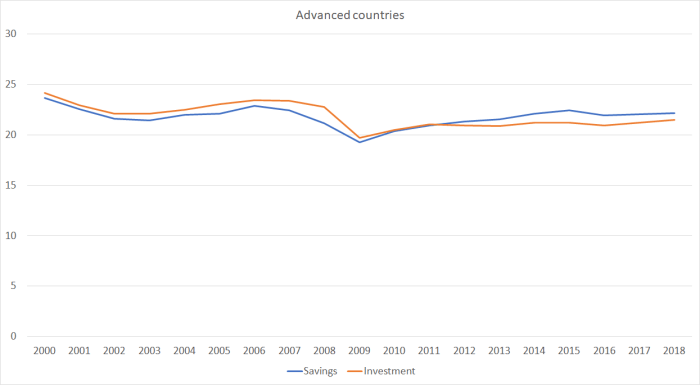
Pottering in the IMF WEO database yesterday, I found myself looking at savings and investment trends.  Here is chart for advanced countries as a group, with the data expressed as a percentage of GDP.

adv country savings and investment

In some ways, it is quite a remarkable chart –  remarkable for what isn’t there.  Over the entire period I’ve shown –  2000 to (estimates for) 2018 – the gap between the aggregate savings rate and the aggregate investment rate has only twice exceeded 1 per cent of GDP.    The measures for the world as a whole –  where savings and investment have to equal each other, if correctly measured –  isn’t much less variable.  It is almost as if the advanced world countries just trade with and borrow from or lend to each other.   For what it’s worth, both investment and savings rates –  the former specially –  are now lower than they were in 2007.   That probably isn’t too surprising, given demographic trends and weak productivity growth.

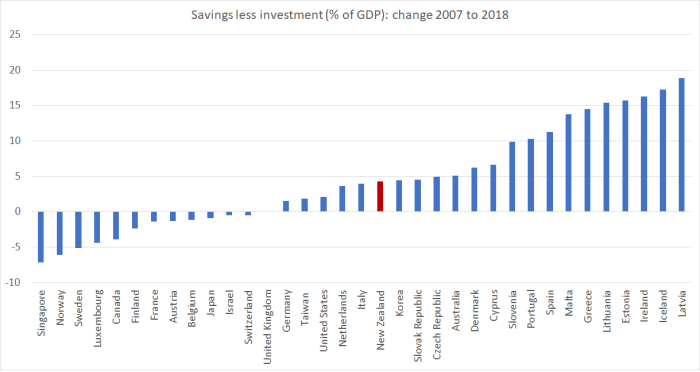
And, of course, the aggregate chart covers a huge amount of variation in individual country experiences.   2007 was the peak of the last boom.   Here is a chart, by country, of the change in the gap between savings and investment rates from 2007 to 2018.

chg in s and i

Broadly speaking, current account deficits and surpluses have narrowed in advanced countries (eg Singapore’s surplus has shrunk a lot, and Latvia’s deficits have shrunk).  But, as the first chart shows, almost all that adjustment looks to have occurred within the advanced country grouping.  As it happens, New Zealand is the median country on this chart.

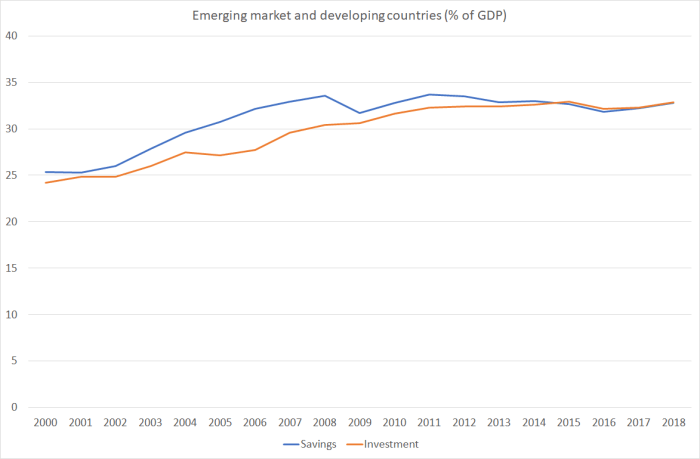
Of course, it isn’t so different in the rest of the world taken together –  the IMF’s class of emerging markets and developing countries.  Here is the aggregate savings and investment chart for that large group of countries.

s and i emerging

There was a big increase in both savings and investment shares in the 2000s, and if anything the aggregate investment share –  already far higher than in the advanced world –  still appears to have been trending upwards more recently.    (The picture isn’t much different if one simply looks at Asia –  often the focus of discussions about big imbalances.)

In the emerging/deveoping country group, there has been a bit more variability in the gap between savings and investment rates –  or at least there was in the peak boom years prior to 2008 –  but both at the start of the period and at the end, just like advanced countries as a group, emerging and developing countries as a group are basically financing all their own investment.  Again, there is huge variability in individual countries’ experiences –  China comes to mind, but so too do places like Argentina and Turkey.  But in aggregate –  and despite all the talk –  the advanced world finances itself and the emerging/developing world does the same.

I’m sure there are learned articles around on this issue (which I don’t have time today to try to track down) but it isn’t at all what (very) simple theory would have predicted.  There isn’t any simple obvious reason why savings and investment patterns should have tracked so closely within these aggregate groupings of countries, and yet not between individual countries.  It wasn’t, for example, how things were between the advanced and emerging economies in the late 19th century.  But it has been for the last couple of decades, and IMF projections don’t suggest they expect any change in the next five years.

I might try to dig out some articles addressing the issue, give it some more thought, and perhaps write another post down the track trying to better understand this pattern.

Falls in business confidence: 2000 and 2018

There have been numerous articles in recent days about the fall in business confidence, as reflected in various survey measures.  What, if anything, is it telling us?  Why is it happening?  What might turn the situation around, and so on?  Both sides of politics have a strong interest in their own particular interpretation.   On the one hand, general business confidence has tended to be weaker relative to actual outcomes under Labour than under National-led governments (if so, the falls might tell us nothing that we don’t already know –  that we have a Labour-led government).  And, on the other hand, (so the argument goes) the government is doing and saying quite a few things that many in the business community genuinely regard as inimical to growth, and thus it should be no surprise that sentiment is weaker now, and with it future growth prospects –  for those who particularly want to gild the lily, especially relative to the stellar performance allegedly achieved in the later years of the previous government.   As regular readers know, I treat that latter bit as laughable: productivity growth being almost non-existent, the relative size of the tradables sector having shrunk, business investment having been weak, and so on.  Oh, and the housing situation got even worse.

(The IMF Board –  whose assessment of New Zealand just dropped into my inbox – must be firmly of the “business just don’t like Labour” school, but then their assessment of the past, present, and future seems laughably detached from reality.  Believe that assessment, and you’ll believe that – at least in per capita terms –  things get even better from here, building on the “economic expansion with notable momentum” of the last half-dozen years.)

I’m not going to try to put myself in the minds of those answering these surveys but there seem plenty of reason to be rather pessimistic on the outlook from here.   Some –  perhaps many –  are the responsibility of our government, but others are not.     The global environment looks shakier than it has at least since the height of the euro crisis in 2012, with significant fragilities evident all over the place: in the euro-area itself, the ever-increasing uncertainty around Brexit, pressures in various large emerging market economies, rising US-driven trade tensions, the legacy of a debt-fuelled boom in China, and so on.   And against that backdrop, few countries have much fiscal or monetary space to respond vigorously when the next downturn comes.   Recognition of that is beginning to seep into general consciousness.

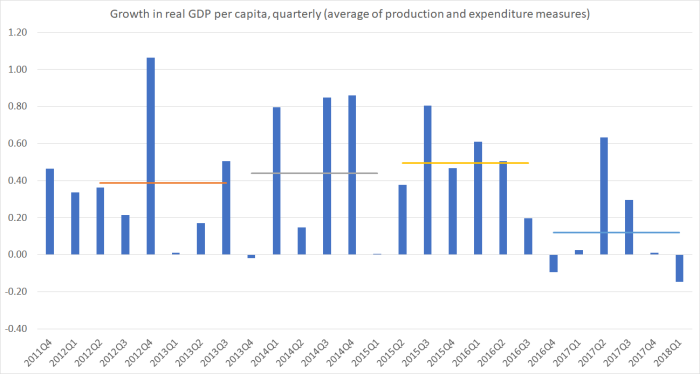
And it isn’t as if things have been going particularly well over the last couple of years.  This chart shows GDP per capita growth, with the horizontal bars marking successive 18 months periods.

gdp pc to mar 18

Perhaps the most recent weakness will end up getting revised away, but at the moment there doesn’t seem to be any particular reason to expect that.   There has been little or no productivity growth, and very weak per capita income growth.  It can take time for awareness of that sort of thing to take hold, especially in an election campaign session when National (party garnering the most business votes) was trying to tell a very upbeat story.

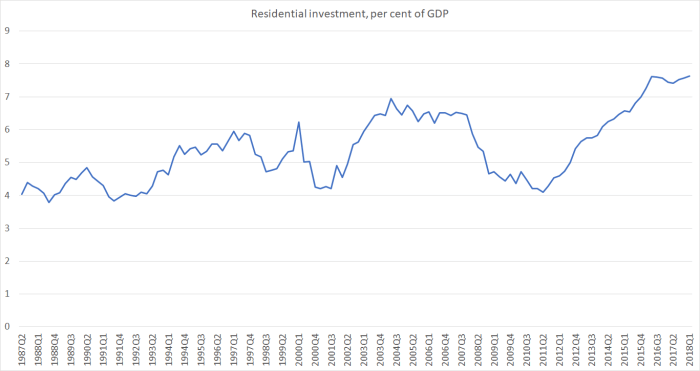
Perhaps not unrelatedly, the biggest proximate boost to growth in recent years has been house-building activity (related to earthquakes and the unexpected surge in the population).

res i to june 18

How plausible is it to expect any sort of repeat of the last few years?  Not very, I’d have said, both because the population pressure is beginning to ease, existing house price inflation seems to be stabilising (for now anyway) and the government has, despite fine words buried deep in the manifesto, done nothing to fix up the urban land market.  If anything, housebuilding activity is likely to fall back somewhat in the next few years, and housebuilding typically plays a key proximate role in explaining short-term economic fluctuations.

Perhaps business investment could take its place.  But consider:

  • investment spending, other than on housing, is now 2 percentage points of GDP lower than it was at the previous peak (mid 2000s),
  • the exchange rate, while have weakened a bit, is still in the range it has fluctuated within for the last 7 or 8 years,
  • plenty of policy initiatives don’t look terribly conducive to encouraging more business investment:
    • sustained and large increases in minimum wages (even if there is some spending to replace labour)
    • concerns, fair or not, about other labour relations law changes,
    • scrapping new oil and gas exploration licences,
    • the uncertainty engendered by the shocking policy process used to make that decision, and  (not mentioned in any other article I’ve seen)
    • the government’s net-zero carbon emissions target, which their own consultative document (and their own independent consultants’ numbers) suggest will act as a material drag on the economy for several decades to come, if pursued with the sort of zeal key ministers at times suggest. (Of course, the previous government’s target would also have acted as a drag, but (a) many thought they weren’t entirely serious about it, and (b) the marginal costs of pushing further into this territory can be expected to increase quite substantially).
    • the considerable uncertainties engendered by these targets (since few policy parameters, including expected carbon prices are remotely clear).
  • if one wanted to focus on individuals, one might also feel uneasy that none of the top 4 ministers in the government command any confidence that they instinctively understand –  or care greatly –  what makes for a high-performing economy.   Several of that top tier simply seem out of their depth, and few of the rest command much respect either.  (I was no fan of the previous government but –  rightly or not –  business took a different view of Steven Joyce, Bill English, and John Key.)

I have also been interested in the comparisons with the “winter of discontent” that followed the election of the Labour-Alliance in late 1999.  Some of that experience is quite nicely covered in this piece although I think the author is rather too optimistic about the current situation.  As he notes, the level and tone of commentary on this new government is nothing like as vociferous as what greeted the incoming 1999 government (complete with plans to raise taxes, repeal and reform the Employment Contracts Act, repealing ACC privatisation, and installing Jim Anderton –  opponent of most of the 80s reforms –  as deputy Prime Minister).  It hadn’t been that long since the polarising reform phase had ended.  And while Michael Cullen was much more able than Grant Robertson, his acerbic tone –  and all too obvious revelling in his own intelligence –  only enhanced the tensions.

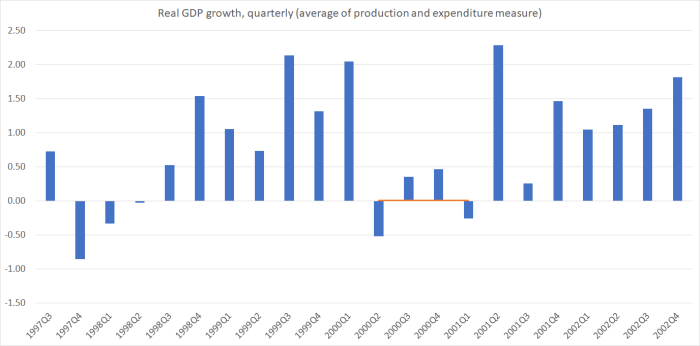
It was a tough period.  Here is the chart of quarterly GDP growth (not per capita –  annual population growth then was around 0.6 per cent).

real gdp 00

GDP growth averaged zero for a year –  before rebounding quite strongly.   Some of that slowdown –  which I don’t think we ever fully understood at the Reserve Bank –  may have been a direct response to the change of government and proposed new policies.   But it was far from being the only factor.  It was still relatively early days in the recovery after the 1998 recession –  so there was still lots of unutilised capacity –  but there had been a big surge in investment during 1999 (even though a change of government was widely expected).  At the time, two factors that seemed to play a part were the Y2K effect –  every firm and its dog was devoting lots of resources to ensuring systems were robust –  and building associated with the defence of the America’s Cup in Auckland in early 2000.  Both were time-limited, and the relevant dates were very close to each other.    Whatever the reason –  and, as I say, I don’t think I’ve ever seen a particularly compelling analysis of that specific period –  there was a (quite unexpected) slowdown in activity, and in particular in investment spending.   Perhaps  –  well, quite probably –  higher interest rates played a role –  we raised the OCR by 200 basis points in six months from November 1999, none of it because of the change of government.  It was our first go at actually adjusting official interest rates –  the OCR was only introduced in early 1999 –  and with hindsight, they do seem like rather aggressive moves.

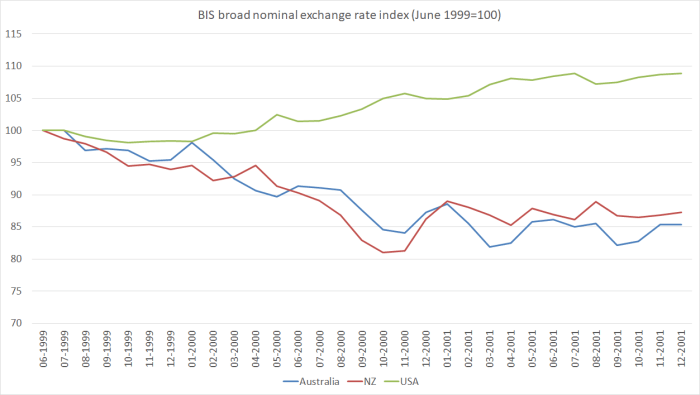
One factor that did play quite a large role then was the exchange rate, which fell very sharply in 1999 and 2000.    Some vocal critics wanted to pin the blame on the change of government (expected and actual) –  I recall one particularly strident Reserve Bank Board member bending my ear about the point at the time.  But that story was simply wrong.  Here is a chart of the BIS measures of the exchange rate for New Zealand, Australia, and the US.

bis exch rates 00

The New Zealand and Australian exchange rates were basically tracking each other, with no obvious role for a “new left-wing government” effect.   What was going on?  Well, two things.  First, and probably most importantly, although New Zealand was raising interest rates, so was the US, and indeed until now this was the only period since deregulation when our interest rates had matched those of the US.  And, secondly, this was the era of “new economy” vs “old economy” –  the NASDAQ peak in the dotcom boom peaked in March 2000, and capital was flowing towards these perceived new opportunities and away from “old economies” like Australia and New Zealand.   That period proved quite shortlived, and by the start of 2001 the Fed was cutting interest rates and the US itself had entered a mild recession (not mirrored in either New Zealand or Australia).

Which brings me back to the observation earlier that –  politics aside, and the pressure from one news cycle to the next –  the current situation should be more concerning.  There was a pause in growth then, of the sort we haven’t seen yet this time, but:

  • the previous episode came early in a recovery phase not late,
  • it came at a time when population pressures were quite weak, and there was a reasonable chance of an acceleration (as happened a year or two later),
  • the global environment looks less promising (despite the dotcom bust in the US, much of Asia was recovering strongly after the crisis/recession of 1998),
  • productivity growth over the previous few years had been reasonably good in th late 1990s,
  • there were some specific, time-limited, factors that can be pointed to, contributing to the pause back then,
  • whatever you think of the policies Labour brought in the 1999/2000, in terms of creating additional uncertainty and an additional drag of prospective growth well into the future, they were as nothing as compared to the implication of a net-zero emissions target,

and perhaps the biggest difference of them all is the real exchange rate.  The current level is about 30 per cent higher than it was in 2000, and it had fallen a long way to get to those 2000 levels (and not on heightened risk concerns etc).  Those falls created a credible prospect of new business investment in the tradables sectors.  There is nothing comparable now, and we’ve probably exhausted the limits of domestic demand (especially residential investment) as a support for headline GDP growth.

One could add to the mix that if anything goes wrong, sourced here or abroad, there isn’t much capacity for macrostablisation policy to respond.  Yes, the OCR could be cut –  and probably already should have been, given the persistent undershoot of the target (another difference to 2000) –  but the Bank is likely to be increasingly uneasy the further it cuts from here, and on its own estimates can’t cut more than about 250 basis points in total.   And whatever the merits (or otherwise) of the 20 per cent debt target, it will come under new pressure in any downturn, and the (market and business) pressures to stick to it will only intensify in that climate –  “show us your mettle, minister” will be the watchword.


The debate on PRC influence on Q&A

Late last week I posted as a standalone item the comments that Peter Jennings, director of the Australian Strategic Policy Institute (and former senior Australian defence strategy official), had made in response to my post about last week’s Asia New Zealand foundation roundtable on People’s Republic of China (PRC) influence/interference in New Zealand.   Jennings was pretty critical of successive New Zealand governments’ attempts to pretend there is no issue.

This morning someone pointed out to me that Jennings had been interviewed on TVNZ’s Q&A programme on Sunday, so I took a look.  His comments were pretty moderate (especially about New Zealand), and largely focused on the Australian situation, and the new foreign interference laws passed with support from both the Liberal-National coalition and the Labor Party.   He highlighted issues around political donations, the Sam Dastyari affair (Labor senator forced to resign over inappropriate activities in this area), and noted that, between Federal and state Parliaments, there was concern that Dastyari’s wasn’t the only worrying case.

Re New Zealand, he noted that New Zealand seemed to face similar pressures as Australia, and that things weren’t that different in Canada, in the UK, and in many EU countries, and that in his view it would be smart if New Zealand and Australia tried to align their approaches.   While noting that New Zealand and Australia had different geographies and different strategic imperatives, he noted some risk to the bilateral relationship (important to both sides) if our governments don’t take the PRC intrusions seriously.

Corin Dann, the interviewer, pushed back, suggesting for example that Sir Don McKinnon would see things differently.  McKinnon is, of course, head of the government-sponsored China Council, designed never to see anything concerning, never to say anything upsetting, about Beijing and its activities.   As Jennings noted, there is an interest in having an effective relationship with the PRC, but that all countries needed to recognise that there were downsides as well as upsides in relationships with such a massive power, in the process of being more dictatorial.   He argued that even if officials were confident they had things under control –  something he was explicitly sceptical of in his comments here –  it was important for governments to take publics with them, and engage in open dialogue on the issues, risks, and responses.

Dann again attempted “what-aboutism” – every country spies, there is no military threat etc.  Tell that to Taiwan –  or countries with lawful claims in the South China Seas –  was my reaction, but Jennings was a bit more emollient, simply pointing out that countries like ours did not engage in large scale intellectual property theft by cyber-hacking etc.

And finally, asked about the PRC backlash to the new Australian laws, Jennings noted that the PRC (and some its populist media) didn’t like the new approach, but that the relationship goes on.  He argued that there was a mutual interest in a “steady relationship”, and that the PRC would come to recognise that Australia couldn’t do less than say “thus far and no further”.   Given past PRC attempts at economic coercion (which I wrote about here) that seemed optimistic.

All in all, it was pretty emollient stuff, and there wasn’t even any material bad-mouthing of New Zealand governments –  an approach which, fair and accurate or not, tends to get the backs of New Zealanders up.

But it was still all too much for two members of the Q&A panel, political scientist Bryce Edwards and former Minister of Defence, Wayne Mapp.  The word “overwrought” appeared so often that one could almost use it to describe their reaction.

Edwards began claiming that there “no compelling evidence of a problem” in New Zealand, and asserted that the new laws continued Australia’s journey down a path towards being an authoritarian illiberal state, where people could no longer participate freely in political debate and protests.  To be honest, I wasn’t really sure what he was on about – and I hold no brief for the specifics of Australian legislation.  The BBC –  no right-wing authoritarian outlet – summarised the law thus

The laws criminalise covert, deceptive or threatening actions that are intended to interfere with democratic processes or provide intelligence to overseas governments.

They are designed to include actions that may have fallen short of previous definitions of espionage.

Industrial espionage – the theft of trade secrets – is among new criminal offences, while people who leak classified information will face tougher penalties.

The government also plans to ban foreign political donations through a separate bill later this year.

But I presume that what Edwards is on about is material in this Guardian article.   But even if the specific points the critics make were sound  –  and both government and opposition disagree with them – they are details, perhaps even important ones, not a challenge to the basic proposition about PRC activities and agendas in Australia and similar countries.

Former Defence Minister Wayne Mapp then joined in, claiming that Australia would not put any pressure on us to follow suit, because our political donations laws were very tight.  That would, presumably explain how former Foreign Minister Phil Goff was able to get a very large donation to his mayoral campaign from a PRC-based donor, through a charity auction organised by, among others, Raymond Huo?  I’m not disputing that the New Zealand laws are tigher than Australia’s, but here is the relevant section from my post on the Asia NZ roundtable last week.

There was clear unease, from people in a good position to know, about the role of large donations to political parties from ethnic minority populations –  often from cultures without the political tradition here (in theory, if not always observed in practice in recent decades) that donations are not about purchasing influence.  One person observed that we had very much the same issues Australia was grappling with (although our formal laws are tighter than the Australian ones).  Of ethnic Chinese donations in particular, the description “truckloads” was used, with a sense that the situation is almost “inherently unhealthy”.

Dr Mapp went on to claim that there was no need at all for new laws in New Zealand, lauded New Zealand’s role as a pioneer in relations with the PRC, and highlighted favourably the New Zealand government’s choice to eschew the term “Indo-Pacific” in favour of “Asia-Pacific”.   I can’t excited about that latter point –   New Zealand has no exposure to the Indian Ocean, and on the other hand Asia is a big place, including Israel and Syria as well as the east Asian bit.  But Mapp went on to declare that concerns about New Zealand were ‘overwrought” and that he would put his trust in his former National Party colleague Don McKinnon, over the perspectives of Peter Jennings.   The McKinnon approach, like that of the China Council more generally, has been to consistently pooh-pooh any concerns, and in the article I linked to a few lines back even asserted that

To suggest we are too scared or cautious to ever rock the boat with China is simply incorrect.

I think most of us –  agreeing or disagreeing with the stance –  will take the evidence of our senses over Don McKinnon’s make-believe.

At this point, Anne-Marie Brady’s work, and her Magic Weapons paper, finally came up.  Bryce Edwards volunteered that she had raised some points, especially about particular MPs (Jian Yang and Raymond Huo) and their closeness to PRC interests, that hadn’t really been debated, and which needed to be debated.  But this was all too much for Wayne Mapp, who asserted that we hadn’t had the debate because we didn’t need to –  the claims were all overwrought.  Weirdly he then went on to assert that we wouldn’t go down the Australian path because we don’t have overwrought debates like the Australians do.  One can only assume he was determined to keep it that way, and keep on avoiding debate and serious scrutiny of the issues.

So, for example, one can only assume that Dr Wayne Mapp, former Cabinet minister, former military intelligence officer, former law professor, and current Law Commissioner, is quite unbothered about such facts as:

  • his own party putting Jian Yang on its list and, through successive elections, never disclosing his past.
  • that past included study and work as part of the PRC military intelligence system, and
  • membership of the Communist Party
  • (experts point out that no one voluntarily leaves the Chinese Communist Party, and that given his military intelligence background he would only have been allowed to go abroad if was regarded as politically sound)
  • Jian Yang himself now acknowledges, after the media exposed his past, that he had withheld key details from the New Zealand immigration authorities, and that the PRC authorities had encouraged him to do so,
  • that in seven years in Parliament he has never once said anything critical about the PRC regime, whether about Tianammen Square or more recent abuses (domestic and foreign),
  • that a prominent former diplomat and lobbyist has gone on record of Jian Yang (and Raymond Huo) that both are close to the PRC embassy, and that he is careful what he says in front of either man.
  • or about the efforts of his own former Cabinet colleague, Chris Finlayson, to tar Anne-Marie Brady as some sort of xenophohic racist –  one of the more despicable events of the last election campaign.

No, according to Dr Mapp, there is no problem here, just a few “overwrought” claims.

But, as I’ve pointed out previously, calling things “overwrought” or “sensational” is no substitute for dealing with the specifics of Brady’s paper.  I’m not aware that anyone has rebutted anything much in her paper, despite plenty of opportunities over almost 10 months now.  They aren’t just about Jian Yang, or even Raymond Huo.  There are the party presidents grovelling to the regime, whether for fundraising or trade purposes.  There are things like a former MP trying to block out from local Council minutes any record of listening to citizens with an alternative view on the regime.  And it isn’t as if the issues and threats are all in past either –  I was told just this morning about a university which has, under pressure, withdrawn, permission to screen a documentary on campus about aspects of the PRC regime.  And much of it is about pressure on New Zealand citizens of ethnic Chinese orientation, unseen to most of us, but no less real for that.

It was a pretty extraordinary performance from Dr Mapp in particular.  As Jennings had usefully pointed out, it is not as if these issues are unique to New Zealand  But the sustained denial –  whether wishful thinking or a deliberate choice to look the other way –  of any issue, any risk, any problem, does seem to be something rather more specific to successive New Zealand governments and the Wellington establishment.  They seem willing to sacrifice self-respect, and any interest in our friends and allies in other democratic countries including in east Asia, for the mess of pottage –  some mix of trade for a few firms, and keeping the flow of political donations flowing.