A possible new Policy Targets Agreement

“we have unemployment stuck stubbornly at 5% when it should be below 4%”

Those were the words of the Prime Minister in her speech to the CTU on Wednesday.  The latest published unemployment rate was a bit below 5 per cent.   But the average for the last four quarters is 4.95 per cent, and that for the last seven quarters is 5.0 per cent.

And “it should be below 4%”?   That’s a great aspiration –  ideally the unemployment rate should be much lower than 4 per cent, because even 2.5 per cent means that over a 40 year working life the average person spends a whole year unemployed – ie without any work, but ready to start work, and actively looking for work.     But I presume the reference to “below 4%” is more than that, and is something about what is attainable (sustainably) on, broadly speaking, the current labour market regulations, demographics, and welfare provisions.   Most observers think that the rate of unemployment consistent with stable inflation near the target is around 4 per cent.    Some, plausibly –  but we won’t know unless/until we get there – think it is lower than that.   Certainly there has been no sign of any acceleration in wage inflation with the unemployment rate near 5 per cent.

Most material deviations of the unemployment rate from the true (but not directly observable) long-run sustainable rate are, to a first approximation, due to monetary policy choices.    That was true in years leading up to 2008, when the unemployment rate was lower than the long-run sustainable rate –  monetary policy was too loose, and inflation was rising to outside the target band.  It has been true for the last eight or nine years when, at least with hindsight, monetary policy has mostly been a bit too tight. People who are unemployed, unnecessarily, have paid the price.    It isn’t the done thing to mention this in polite society –  few of whose members are affected directly by unemployment –  but it is true nonetheless.

And so I welcome the fact that we have a government that says it is serious about expecting the Reserve Bank to run monetary policy in a way that promotes full employment –  keeping unemployment as low as is consistent with a sustainable low and stable inflation rate.     I like the fact that the Prime Minister talks about lowering unemployment in her first speech.  (Whether she will do so as readily later in her term is another question).    And I’ve come to agree that adding some reference to unemployment to the mandate given to the Reserve Bank is desirable.     It has always been implicit.  We have active discretionary monetary policy to minimise the output and employment losses when severe adverse shocks hit.  Otherwise, we’d have stuck with the Gold Standard, which was really good for delivering long-run average price stability but –  by design –  less good at short-term stabilisation.

The New Zealand Initiative –  from the right –  disagrees.   In their newsletter this week Oliver Hartwich writes

Yet the real problem is that dual mandates do not work, not even in theory. They are the result of a misunderstanding as anyone who studied economics over the past half a century would know.

The best way for a central bank to achieve both low inflation and low unemployment is to make it pursue price stability alone.

The next RBNZ governor will no doubt be aware of that. In which case, she could safely ignore any dual mandate passed down from the new Government. And keep focussing on targeting inflation.

But that is simply not so.    It is certainly true that over the medium to longer-term monetary policy can only affect nominal variables (inflation, nominal GDP or whatever) and has no impact on real ones such as unemployment.  Most everyone agrees on that.  But it is equally true that monetary policy actions have a short to medium term impact on real variables, not just on prices.  Indeed, in the short-term the real effects are often larger than the price ones.   It isn’t something one can exploit to get unemployment permanently lower –  the long-run Phillips curve is more or less vertical – but it does mean that all discretionary choices about monetary policy are simultaneously choices about both inflation and output/unemployment.  The Reserve Bank knows that.  In fact, every advanced country central bank –  in countries with fairly stable inflation expectations –  knows that.

There is also some disagreement from the left.  In his column in yesterday’s Herald, Brian Fallow was sceptical about Labour’s proposed changes (the details of which we have not yet seen)

…in a later speech outlining his approach, Robertson said: “Had a mandate to maintain full employment been in operation in New Zealand it is likely that it would have constrained the bank’s [subsequently] aborted tightening of the official cash rate in 2010 and 2014. This would in turn likely have seen a faster return to target inflation and faster economic growth.”

Well, maybe. But counterfactual assertions about what would have happened if what did happen had not happened stand on epistemologically boggy ground.

Back here in the actual world, data from the OECD last week shows that New Zealand’s employment rate – the proportion of people aged between 15 and 64 who are employed – is at 76.2 per cent, the fourth highest level among the OECD’s 35 members.

Fallow goes on at some length about employment rates.   But employment rates simply aren’t the relevant variable for monetary policy (although they might tell us about all sorts of other areas of labour market, tax, retirement income etc policies): unemployment rates (and other measures of excess capacity) are.   People who want a job, are available now to start work, who are actively searching for a job, but just can’t find one.

(Having said that, as I’ve written previously I’m not sure that simply a different mandate would have changed the policy mistake of 2014.    With most reasonable possible formulations of an unemployment objective, a hawkish Governor misreading the data (as Wheeler was) would have been likely to have made the same mistake: the right person (“people” when they move to a committee model) matter at least as much as any tweaks to the formal mandate.)

I noticed in the Dominion-Post this morning what appeared to be a suggestion that amendments to the statutory goal for monetary policy might find their way onto the government’s 100 day plan, perhaps in part to ensure that the new mandate was in place before the new Governor is due to take office in March.

No doubt such a limited statutory change could be done quite quickly.  To simply make that narrow change would involve quite a short piece of legislation.  But getting the words right matters – and it isn’t something Parliament should be changing frequently.

Then again, all parties to the new government have also favoured changes to the governance model of the Reserve Bank, and that isn’t something that should be rushed.  The focus to date has been on monetary policy decisionmaking, but the case for reform is probably stronger for the Bank’s financial regulatory functions (where there is nothing akin to the PTA, and too much depends on what is little more than personal gubernatorial whim).   Getting the right governance model for these two quite different functions, and for all the remaining functions of the Bank, and all the consequential changes, takes time to do properly, and would benefit from a full Select Committee process.

As it happens, much of what the government appears to want to achieve can be done through the Policy Targets Agreement anyway.   There is no (lawful) Policy Targets Agreement at present, but a new one needs to be agreed with the incoming Governor before he or she is appointed.   Since the proposed emphasis on unemployment is implicit in the existing framework anyway – it is what a Governor doing his or her job should be keeping a keen eye on in determining the appropriate stance of policy –  simply writing it down more explicitly in the PTA does not raise any particular issues of inconsistency with the existing legislation.

Some might question that, but I’ve had a go at producing a concrete draft of a PTA that captures what seems likely to be the sorts of issues that motivated the Labour Party to promote legislative change.     The resulting text (below) isn’t my ideal framing of the PTA.  Instead, I worked with the text of the most recent document and made as few changes as possible while (a) capturing the spirit of the proposed changes, and (b) avoiding any inconsistency with the existing legislation.  I’ve highlighted the three paragraphs where I’ve proposed changes:

  • 1(b), a now-customary part of the document, where the government of the day lays out briefly its economic objectives, and how it sees monetary policy fitting in,
  • 3(b) where I’ve added words to make clear what has been well-understood since day 1 of inflation targeting, that in managing deviations of inflation from target a key consideration is to minimise short-term output and employment costs, and
  • a new 4(c) which would require the Bank to publish NAIRU estimates, explain why any (actual or forecast) deviations of the actual rate from those estimates was occurring, and to explain what steps it was taking (with monetary policy) to minimise the extent (magnitude and time) of those deviations.

There might well be improvements to this suggested wording.  But these, relatively simple, changes could quickly give effect to what seems to be the thrust of Labour’s proposals.   I’d welcome any comments or alternative suggestions.

Of course, if the government is serious about making a difference –  rather than just signalling one – words alone won’t suffice, whether in the PTA or the Act.  They need to take steps also to find, and put in office, the right people.  The combination –  people and mandate –  gives us a more serious chance of getting unemployment down to around the long-run sustainable rate, and keeping it near there as much as possible, than continuation of the status quo.

These are changes of the sort that the leading academic who reviewed the Reserve Bank’s handling of monetary policy for the previous Labour goverment  (Lars Svensson) would seem likely to endorse.  Svensson served subsequently for several years on the Monetary Policy Board of the central bank of Sweden, where his firm advocacy of an unemployment focus helped get Swedish monetary policy back on track, delivering lower unemployment and inflation nearer the target.  He might be worth consulting again.

Policy Targets Agreement

This agreement between the Minister of Finance and the Governor of the Reserve Bank of New Zealand (the Bank) is made under section 9 of the Reserve Bank of New Zealand Act 1989 (the Act). The Minister and the Governor agree as follows:

1. Price stability

a) Under Section 8 of the Act the Reserve Bank is required to conduct monetary policy with the goal of maintaining a stable general level of prices.

b) The Government’s economic objective is to promote a growing economy in which full employment is achieved and maintained.   The management of monetary policy, subject to the medium-term constraint of a low and stable inflation rate, plays an important part in supporting this objective.

2. Policy target

a) In pursuing the objective of a stable general level of prices, the Bank shall monitor prices, including asset prices, as measured by a range of price indices. The price stability target will be defined in terms of the All Groups Consumers Price Index (CPI), as published by Statistics New Zealand.

b) For the purpose of this agreement, the policy target shall be to keep future CPI inflation outcomes between 1 per cent and 3 per cent on average over the medium term, with a focus on keeping future average inflation near the 2 per cent target midpoint.

3. Inflation variations around target

a) For a variety of reasons, the actual annual rate of CPI inflation will vary around the medium-term trend of inflation, which is the focus of the policy target. Amongst these reasons, there is a range of events whose impact would normally be temporary. Such events include, for example, shifts in the aggregate price level as a result of exceptional movements in the prices of commodities traded in world markets, changes in indirect taxes, significant government policy changes that directly affect prices, or a natural disaster affecting a major part of the economy.

b) When disturbances of the kind described in clause 3(a) arise, and consistent with a goal of minimising the short-term output and employment costs, the Bank will respond consistent with meeting its medium-term target.

4. Communication, implementation and accountability

a) On occasions when the annual rate of inflation is outside the medium-term target range, or when such occasions are projected, the Bank shall explain in Policy Statements made under section 15 of the Act why such outcomes have occurred, or are projected to occur, and what measures it has taken, or proposes to take, to ensure that inflation outcomes remain consistent with the medium-term target.

b) In pursuing its price stability objective, the Bank shall implement monetary policy in a sustainable, consistent and transparent manner, have regard to the efficiency and soundness of the financial system, and seek to avoid unnecessary instability in output, interest rates and the exchange rate.

c) The Bank shall publish its estimates of the sustainable long-run rate of unemployment in each Policy Statement made under section 15 of the Act.   When the unemployment rate (as measured in the HLFS) deviates, or is forecast to deviate, from this estimate the Bank shall explain why these outcomes are occurring, or are expected to occur, and what steps it is taking to minimise the extent to which the unemployment rate deviates from its estimate of the long-run sustainable rate.

c) The Bank shall be fully accountable for its judgements and actions in implementing monetary policy.

Grant Robertson
Minister of FInance


…….
Governor Designate
Reserve Bank of New Zealand

Dated at Wellington this ..th day of …. 201….


Reflecting on foreign ownership

[An Australian website yesterday reproduced, without my permission, my entire post on the new government’s immigration policy, running it under the heading “Is Jacinda Ardern a fake?”.   That heading does not –  even in the slightest –  represent my view.  I’m assuming the new government will do as they said in their manifesto.   And while I’m a bit sceptical as to how committed the new Prime Minister really is –  the policy having been adopted under her predecessor and she never having talked about it in public fora – the point of the article was (a) that the policy itself does not represent any significant change in the likely future contribution of immigration to population growth, and (b) that various overseas commentators have taken the, quite clearly laid out, Labour policy as something much more dramatic than it actually is.]

A few weeks ago, my 14 year son, mad-keen on ancient history and starting to study economics as well, brought home from the library a book about the economy and society of ancient Greece.  I’m not sure he read much of it, but I found it fascinating.   Among the things I learned was that the ancient Greek states, Athens most notably, generally banned foreigners – even resident foreigners – from owning land.   These states were typically actively engaged in international trade, and often encouraged foreigners with particular specialised skills to settle among them.  So it clearly wasn’t an autarkic approach –  some sort of isolation and national self-sufficiency.

But it caught my attention partly in the context of the change of government here, and the proposed new restrictions on non-resident foreigners being able to purchase existing dwellings.   But the issue goes wider than that, and the ambivalence about foreign investment and foreign ownership of New Zealand assets dates back decades at least.    And the Labour-New Zealand First agreement commits to

“strengthen the Overseas Investment Act and undertake a comprehensive register of foreign-owned land and housing”

This in a country where the OECD already rates our existing restrictions on foreign investment as more severe than those of almost any other advanced country (even if there is some genuine debate about how restrictive our screening regime –  what counts in the index –  actually is).

Of course, the proposed ban (which could yet turn into a heavy tax, to get around FTA constraints) on foreign purchases of existing properties, isn’t really much of a ban on foreign ownership at all.  Non-resident foreigners would be able to purchase a brand new house, with no particular restrictions, but not an existing house.    Since new and existing houses are, to a considerable extent, substitutes –  especially if you aren’t planning on living in the house – it isn’t even clear why the proposed ban would do more than throw a little sand in the wheels.   And land-use restrictions have been the main source of driving house+land prices far beyond sensible levels –  the best alternative use of those resources.   So it isn’t clear why a restriction on non-resident foreign purchases of existing houses will do anything to lower the price (increase effective supply) of developable urban land.   If governments can’t, or won’t, fix the land market, there might be more logic in a total ban on non-resident foreigners purchasing dwellings in New Zealand.   Were there to be strong evidence of a significant effect on our market of such non-resident foreign purchases, I could see a reasonable second or third-best case for such a restriction.  I’d prioritise the ability of our own people –  immigrant or native –  to buy a house+land over the freedom to sell to non-resident foreigners.    That’s a value judgement, but one I’m comfortable with.

To be honest, I’m not sure what to make of the data we have.  Lots of people are quite sceptical of the LINZ data, but I’m still struck by how high the non-resident numbers actually seem to be, at least in Auckland and Queenstown (the numbers are very small elsewhere).   For the first six months of this year, almost 5 per cent of Auckland gross sales were to buyers wholly or partly non tax residents of New Zealand.  In Queenstown-Lakes, the proportion was more than 10 per cent.   There were non-resident sellers as well, of course.  And some of those people (on both sides) were New Zealand citizens –  eg a New Zealander who has settled in Australia, no longer treated as a tax resident of New Zealand, and a few years later sells a New Zealand property.  But at a time when Chinese data show that capital outflows from China have hugely diminished

cap outflows

it is rather surprising how many purchases (net) were still being made by Chinese tax residents, even on the LINZ data with all its limitations.    (In Auckland, net Chinese purchases make up more than the total net foreign purchases –  ie people tax resident in other countries were net sellers.)   And recall that China is the issue simply because the place is currently so badly governed –  absent the rule of law –  that its own people don’t feel safe keeping their money in their own country: we never had an influx of Japanese, French or British purchasers.

With a well-functioning urban land market, sales of houses/apartments to non-resident foreigners  –  even ones that just sat empty –  could be just a modestly rewarding export industry.   But we are a very long way from that sort of well-functioning market.

In Eric Crampton’s piece the other day, he highlighted that the proposed restriction would affect those here on work visas, as well as those who were not resident at all.   If so, that was something I hadn’t realised.   But his argument against drawing the line there wasn’t particularly persuasive

If someone is building a life here, it shouldn’t matter what visa they’re on.

But it does.   If you are here on a student visa, or a temporary work visa, you might well hope you are now on a path to “a life here”.  There might even, in some cases, be an implied expectation that that is how things will turn out.  But New Zealand has not made a decision, at that point, to grant your wish.  It does that only at the point where you get a residence visa (and then permanent residence).  At that point we’ve said you can stay,  but not before.  If there is going to be ban or a tax, I don’t have a strong view on where the line should be drawn (there are avoidance issues wherever it is drawn).  In practice though, not many people going to another country (or even another city) for just a couple of years will buy a house –  the transactions costs are just too high –  so if we are going to impose restrictions, I’m not convinced drawing the line in a place that banned those on temporary visas would be particularly problematic.

But restrictions on non-resident purchases of urban dwellings are mostly a second-order distraction from the real regulatory failures that have rendered house prices here –  and in similar places abroad (eg Australia, UK, California) –  so unaffordable.

Perhaps more sensitive, and more difficult, issues are around other foreign ownership issues.  In reading around how they did things in Athens, I noted that foreigners might not have been able to own property, but they had the same access to the courts as citizens.  These days, however, we –  and many other countries –  go one further and give foreign investors better access to dispute resolution than we provide to domestic investors, through the investor-state dispute settlement (ISDS) provisions included in numerous preferential trade and investment agreements, including TPP (and presumably the replacement for it, now close to finalisation).    I wrote about these provisions back in 2015, quoting a writer for the New Yorker

“these provisions have been opposed by an unusual coalition of progressives and conservatives”

and a contributor to –  not exactly left-wing – Forbes magazine that ISDS provisions represent a

“subsidy to business that comes at the expense of domestic investment and the rule of law”

In a country with a good quality legal system, it should simply be offensive and unacceptable that we provide foreign investors access to different courts and dispute settlement procedures, under different rules, than are available to domestic firms (even in the same industry).   Equal status before the law is –  or was –  one of the cardinal principles of our democracy.    At very least, citizens should always have at least as good rights as non-citizens or non-residents.   (And that should apply to our citizens when operating in other countries, relative to the citizens of those countries –  but that is an issue for those governments, not ours.)

What of the foreign investment itself?

There are easy cases, at either end of the spectrum.  I don’t suppose anyone much is going to have a problem with a foreign investment fund owning an office block in Queen St.  And I don’t anyone would have opposed restrictions if, say, the Soviet Union had found willing sellers for the whole of Stewart Island.

The hard stuff is where to draw the line between those extremes.   There is a case –  I think generally quite a good one –  for a pretty relaxed view for most potential buyers and most potential assets.  In part, that is a property rights view.  If I own an asset and want to sell it, government restrictions on who can buy the asset lowers, probabilistically, the price I can command.  It is, in the jargon, an uncompensated regulatory taking.     Then again, a lot of the value of any (location-specific) asset arises from choices society has made collectively, about institutional quality, rule of law, good governance etc.  Auckland airport, for example, wouldn’t be worth much if New Zealand were an ill-governed hell-hole.

There is also the argument that the New Zealand and, in time, New Zealanders generally will benefit most if the assets are owned by those best able to utilise them.    When foreign investors bring technology or management expertise to a New Zealand industry or opportunity that isn’t as developed here, it is likely that in time there will be a wider benefit to New Zealand.  That was how, for example, Tasman Pulp and Paper was set up, under government sponsorship in the 1950s.  Or Comalco.  (And, yes, I deliberately choose examples where there might be some doubts as to whether these firms should have established here in the first place.)

There are also diversification arguments.  It bothers some people, but doesn’t really bother me, that most of our banking system is foreign-owned.  There are some possible downsides –  and we might have been better off if the foreign ownership was not so concentrated in Australia –  but my reading of the international (and New Zealand) experience is that we are probably better off (more stable) for having a largely-foreign owned banking system.

There are also bureaucratic competence/incentives arguments. Our current overseas investment act in many cases requires demonstrating that a proposed foreign purchase would be “beneficial to New Zealand”.   Beyond the evidence of, say, a foreign buyer being willing to offer the highest price, how comfortable can we be that officials and politicians have the ability or incentives to make those judgements correctly?

There are also arguments about debt vs equity.    You might, in some cases, worry about control passing to foreign owners.  But if domestic owners are reliant on lots of foreign debt there can be different, but at times more intense, levels of vulnerability.    Debt can be called up, or simply not rolled over.

Foreign investment has played a significant part in New Zealand’s economic history, and its economic development.  Sometimes in quite odd ways: the protectionist insulationist policies of post-war New Zealand encouraged quite a high degree of private direct foreign investment, as the most cost-effective way for foreign firms to get their products into the New Zealand market (inefficient and costly as it may have been for New Zealanders).  But my reading of the New Zealand evidence and data is that foreign investment restrictions aren’t to any material extent what holds New Zealand’s productivity performance back.  It is a more a case of there being too few good profitable new potential investment opportunities, whether for domestic investors or foreign.

None of this is really an argument for a laissez-faire approach, even if I’d still be more hands-off than most New Zealanders might.      National cohesion and national identity aren’t easy to pin down, but are both real and important.  And part of that –  perhaps especially in a small country –  is the control/ownership of land.   I find it quite plausible that there might be international agricultural operators who could add new and different value to New Zealand operations through ownership and management of substantial parcels of agricultural land.  But if, on the other hand, a growing number of wealthy offshore people simply wanted to own South Island stations and install local managers to farm much as they always have, I also don’t care very much if political unease is real enough that we end up simply saying “no” to such purchases on a large scale.  Again, at an extreme, if non-resident non-citizen buyers ended up owning 80 per cent of the land in some locality –  be it Northland or central Otago, or wherever –  then I think we’d have undermined something about what it means to be New Zealand –  given undue weight, including in local government, to the interests of people who aren’t part of this polity – in that area.     A country is some mix of people in some specific place; a bundle of tangible people and land, not just an idea.

How real are those particular risks?  I’m not sure –  perhaps the new register will help give us a better sense.  And there are plenty of countries –  other open liberal societies – that place few or no restrictions on such purchases.    But perhaps things are a bit different in a small country?

And then there are the national security dimensions, which seem to be treated too lightly here.  A standard response is “but the local government can always regulate things” .  I don’t think it is typically an adequate response if, say, a hostile foreign power owned key telecoms networks or ports/airports: regulation and governments just aren’t that good, and can also become too responsive to the interests of the overseas investors.    Of course, confronting this issue also involves identifying the minority of countries that count as potential “enemies” and, on the other hand, which are countries where there is (a) a substantial commonality of interest, and (b) where investors can be reasonably assumed to be working in their own interests, not those of their home governments.   At a time when the Soviet Army was just across the border, the West German government would have been crazy to have allowed Soviet interests to have purchased and controlled major West German infrastructure or technology assets.   We’d have been crazy to sell Stewart Island to Soviet interests.

Today’s Soviet Union is China, with the difference that these investment hypotheticals are increasingly real, used as a direct means of extending political reach.   That is nothing about race, and everything about (geo)politics.  I don’t think that taking these issues and threats seriously means banning all, or perhaps even most, Chinese foreign direct investment.  But it means a greater degree of realism, than tends to have pervaded recent governments, that their interests are not our interests, that all or most Chinese corporates are effectively under the thumb of the government and Party, and that not all voluntary transactions are likely to be beneficial for New Zealand as a whole even if they benefit both the buyer and the immediate seller.

There is no particularly strong conclusion to this post.  Drawing appropriate lines –  and translating them into legal rules –  isn’t easy, and that is often a good reason for restraint.  And yet neither is defining, or  fostering and sustaining, nationhood.  But that something is hard isn’t an excuse for simply ignoring the potential issues.  Part of doing that well is perhaps first fostering a compelling and convincing sense that governments are governing in the interests of New Zealanders as a whole.  Of course, different people will see those interests, and the policies that best serve them, differently –  that’s politics. But finding the right answers –  as perhaps around immigration –  is unlikely to proceed best by simply exchanging slogans.

Is there a plausible economic strategy?

In the new government, sworn in this morning, David Parker will take up the renamed role of Minister for Trade and Export Growth.

Early in their term of office, the outgoing government adopted a numerical target for lifting exports (as a share of GDP).  It was, no doubt, well-intentioned, but has provided the basis for quite a few posts here pointing out that no progress was actually being made towards that target, if anything trade shares of GDP were falling, and the pre-election advice from The Treasury was that, all else equal, the trade shares would continue to shrink.  The focus on exports, in turn, seemed to prompt a willingness to use actual or implicit subsidies –  be it in the film industry, export education, irrigation, convention centres, or firms like Rocket Lab –  or unpriced externalities (eg around water) rather than focusing on the fundamentals in a way that might have seen firms themselves increasing taking up new foreign trade oppportunities, responding to improvements in opportunities, markets and incomes.

I stress “foreign trade” rather than just “exports”.   We don’t want policy to be guided by some sort of mercantilist vision in which the purpose of economic life is to sell us much as we can to others, only to store up treasure at home.   Firms export because they can, and because doing so enables owners and employees to earn incomes, which enable them to consume (including from among the abundance the wider world has to offer).  Successful firms invest more heavily too, and many of the investment goods will typically be sourced from abroad.    Trade is good, and generally mutually beneficial.  Ideally, we would see quite a bit more of it: New Zealand firms successfully competing in wider world markets, enabling them and us to purchase more of stuff firms in other countries specialise in producing.    And if New Zealand is ever to catch up again with the rest of the OECD –  whether in productivity or incomes – the process of getting there is likely to involve a materially larger share of local production being exported but –  especially in the transition (which could last decades) –  a lot more investment.  Current account deficits aren’t even problematic when they rest on firm foundations of rising productivity and market-led business investment.  It was the story of 19th century New Zealand (or Australia or the United States).  It was the story of emerging Singapore and South Korea.

So I really hope that the new Minister of Trade and Export Growth (who is also the Minister for Economic Development) sees his role as being at least as much about putting in place the pre-conditions for sustained stronger import growth, as about export growth.  In successful economies, the two go hand in hand.

Here is how we’ve been doing over the 45 years for which we have official data.

trade shares

The last few years’ data are still open for revision, but there is no credible prospect that trade shares of GDP will have been rising.

In interpreting the graph it is worth noting a few things.  The first is that the peaks in the 1985, 2001, and 2009 years simply relate to unexpectedly weak exchange rates.  Most of our imports and exports are priced in foreign currency terms, so when the exchange rate falls sharply there is an immediate translation effects –  both imports and exports rise in NZD terms, even if the volumes haven’t changed at all.   In each of those three cases –  the 1984 devaluation, the slump in the NZD (and AUD) at the end of the dot-com boom, and the sharp fall in the 2008/09 recession –  the exchange rate falls were pretty shortlived.

The second is to note that external trade as a share of GDP was trending up for some time.  The economic policies New Zealand adopted after 1938 had tended to reduce our external trade.  There was a focus on increasing local manufacturing to supply domestic markets in consumer goods (directly reducing imports), and the increased costs of that domestic protectionism undermined the competitiveness of our (actual and potential) export producers (thus, shrinking exports as a share of GDP).

But in the 1970s and early 1980s there were signs of progress, lifting both export and import shares of GDP, even though the terms of trade for New Zealand were pretty dreadful during that period.  There will have been a mix of factors at work: the real exchange rate was trending lower, import protection was being reduced and, less encouragingly, there was a substantial use of export subsidies, both for non-traditional exports and (latterly) support for farmers too.  One argument made at the time for that export support was to counter the adverse competitiveness effects of import protection.  Better, of course, to remove both sets of interventions.  And that is largely what happened over the following decade.    Trade shares of GDP didn’t fall back.

It is perhaps tempting to look at the chart and conclude that taking the last few decades together there is quite a lot of variability in the series, and overall nothing very much has changed since at least the early 1980s.  That’s largely true, but it is also largely the problem.  Successful economies have typically experienced quite material increases in their foreign trade shares (imports and exports) in recent decades.  New Zealand hasn’t.  New Zealand –  or foreign – firms simply haven’t found the profitable opportunities here to take advantage of.    Even services exports are now only around the same share of GDP that they first reached in 1995.   Amazingly (I hadn’t previously looked at this number), services imports as a share of GDP have been lower in the last year than at any time in the past thirty years.

services trade

Not exactly a picture of a successfully internationalising economy.

I don’t find these outcomes –  worrying as they should be, as symptoms of our economic failure –  that surprising.  It is very difficult for firms to compete successfully internationally from such a remote location, based on anything other than location-specific natural resources.  Not impossible, but very difficult.  And so it shouldn’t surprise us that there aren’t many of them.   For whatever reason, in the global economy personal connections on the one hand and integrated value/supply chains on the other have become increasingly important.  The last bus stop before Antarctica –  a long way even from the next to last bus stop – just isn’t a propitious place, no matter how skilled New Zealand workers might be, and how innovative and entrepreneurial New Zealand firms might be.

It is also difficult to successfully compete internationally from here when (a) real interest rates and, in turn, the real cost of capital, for New Zealand investors have averaged so much higher than those in the rest of the advanced world.  Those real interest rate gaps have shown no sign at all of closing  (and they have little or nothing to do with monetary policy).  People push back sometimes arguing that interest rates can’t make that much difference.   They do, through two channels.  First, the standard approach to identifying an appropriate discount rate for project evaluation starts from a risk-free interest rates.  Ours are, and consistently have been, well above those in other advanced countries (something like a 150 basis point margin is a reasonable approximation of the average difference).  And, second, high real interest rates here have been accompanied, causally, by a persistently high real exchange rate, out of line with our deteriorating relative productivity.   In combination, that mix makes investment here harder to justify, and particularly makes investment in the tradables sector harder to justify.  Combine that with the disadvantages of distance and it is no real surprise the foreign trade shares of GDP haven’t increased.  Successful economies have an abundance of new profitable opportunities in which their firms, or foreign firms investing there, take on the world.  It has happened to only a very limited extent here.

But what concerns me is that the new government appears, at this stage, to have no more of a strategy than the outgoing government did for turning around the dismal productivity performance, or the static (or shrinking) foreign trade shares.      There have been encouraging hints of a recognition of the issue: in her speech to the CTU yesterday, the incoming Prime Minister referred both to a need to “boost our productivity”  and to the need to gear the economy more towards “value-added exports”.     But it isn’t clear that they have any real idea of how to get from here to there.   There was nothing any more encouraging in James Shaw’s speech to the same audience.   Or looking through the areas prioritised in the agreements Labour has signed with New Zealand First and the Greens.   If anything, the risk looks to be that the tradables sector will shrink further.

  • The new government plans to adopt measures that will reduce the size of the export education sector.  To the extent that involves a removal of implicit subsidies I think (as I noted yesterday) that is a step in the right direction.
  • The new government plans to phase out government subsidies for irrigation schemes.  From what I’ve seen, that is welcome too.
  • The new government is clearly heading in the direction of reducing exploration for oil and gas in New Zealand and its territorial waters.
  • The new government is clearly intending to take a more aggressive stance around emissions reductions, including moving towards the inclusion of agriculture in the ETS.
  • The new government seems likely to move more aggressively on increasing water quality standards faster,
  • And the new government is planning to increase minimum wages –  already high, by international standards, relative to median wages –  quite considerably over the next few years.
  • The new government is planning (or hoping for) a major acceleration in housebuilding activity.

You might agree or disagree with some or all of those measures individually. But every single one will put the tradables sector under more pressure, to some extent or other.

Take minimum wages for instance.  I recommend you read Eric Crampton’s piece (which I largely agree with).   Here is the Prime Minister’s take.

I know most businesses want a fair set of employment policies.  They know that we need decent wages if they are going to have customers for their products. They know that we need to boost our productivity, and low wages are a barrier to that because they discourage investment in training and capital. They know that we need a government that invests in skills and education.

I simply don’t buy into baseless claims that paying people well means there will be fewer jobs. In fact, the overwhelming weight of evidence is that strong wages for all working people help to boost growth and create jobs.

Wishful thinking at best.  We all, I imagine, want a country in which strong economic performance and strong wage growth goes hand in hand, but there is little or no credible evidence that, at an economywide level, one can get that sort of lift in performance by, say, mandating higher minimum wages.  It is putting the cart before the horse.  And if it worked anywhere, surely New Zealand should be the prime example, given that we already have high minimum wages relative to median wages (a policy maintained and extended by the previous National government).

And here is Shaw

And our whole intent will be to flip climate policy from being seen as a threat and a cost, to being seen as an opportunity and an investment in the future.

And, as I say, that means we’ll be creating tens-of-thousands of new jobs, paying decent wages, for workers and families all over New Zealand.

Not just high-tech city jobs, but out in the regions as well.

Here’s one example: trees.

We are going to plant hundreds of millions of trees to soak up New Zealand’s greenhouse gas emissions.

These trees, we’re going to plant them in the cities. We’re going to plant them in the towns. We’re going to plant them in in the National Parks. We’re going to plant them in the regions.

That’s going to be tens of thousands of jobs. That means lower unemployment. Lower poverty. Lower crime. Cleaner rivers. More native species.

It would be worth doing even if we weren’t saving the world.

One pictures the seas parting and New Zealanders walking together across the Red Sea to the promised land.

Whatever the merits of mass tree-planting –  which until now firms have not regarded as economic –  it doesn’t exactly seem like a high productivity industry.    And in the short-term (trees take decades to come to maturity) resources that are used planting trees can’t be used for anything else.

Lower unemployment is a worthwhile goal, and I really liked the new PM’s line

we have unemployment stuck stubbornly at 5% when it should be below 4%

but (a) deviations of unemployment from long-term sustainable levels are mostly a matter of monetary policy (so find the right Governor/commitee, and specify the mandate well) and (b) however many trees you plant, higher minimum wages will almost certainly come at some cost –  perhaps not that large –  in higher long-term sustainable unemployment rates.    And for all the complacency there has been in New Zealand about our unemployment rate, when I checked there were already 12 OECD countries with unemployment rates lower than New Zealand.  We simply should be doing better.

Of course, the usual economist’s response when (eg) proposing stripping away subsidies is “the market will provide”.  For example, a lower real exchange rate will allow some firms to expand, and other firms not yet visible to economists to emerge.  But how likely is it that that provides the answer this time?

Of course, the exchange rate has fallen perhaps 3 per cent in the last few weeks since the election (against the AUD, the best guide to idiosnycratic New Zealand effects).  It isn’t a large move, and may not be sustained.  And even at these levels isn’t outside the range it has fluctuated within over recent years.     Between a somewhat more expansionary fiscal policy (than the previous government was running), the aspiration to a big increase in housebuilding, and a continuation of the high target rate of immigration, it is difficult to see why we should expect any near-term material narrowing in the margin between New Zealand interest rates and those in the rest of the world.

Thirty years ago, Grant Spencer –  then Reserve Bank chief economist, now “acting Governor” –  published a book chapter in which he described pre-1984 New Zealand economic management this way

“In particular, the maintenance of high levels of aggregate demand supported a buoyant non-tradables goods sector while exporters faced more depressed market prospects”

When I re-read that chapter last week, it was hauntingly reminiscent of the last few years.  But it isn’t clear why the next few will be any better, unless there is sort of near-term cyclical downturn Winston Peters was warning about last week.  As I’ve highlighted previously, in real per capita terms, the tradable sector of our economy is now no larger than it was 2000 – two whole governments ago.  The risk, at present, is of further shrinkage.

So I do hope that the new Minister of Finance and Minister of Economic Development (and Trade and Export Growth) are turning their minds pretty quickly to how they might achieve the sort of reorientation in the economy that is generally recognised as needed, and which they – and the Prime Minister –  have themselves highlighted as a matter of concern.  (And, hint, regional development funds aren’t likely to be the answer either.   And over the last 15 years, “the regions” have been doing better than “the cities”)


(On matters of the new government, I was interested to see Andrew Little, new Minister of Justice, observe – on Twitter and Facebook – yesterday that “As Minister of Justice-designate I want to state from that outset that “pretty legal” is no longer the standard this country operates to!”.     Admirable sentiments, and I have no idea what specifics he had in mind [oh –  Steven Joyce no doubt], but might I suggest that he and the Minister of Finance review how we came to have a pretty clearly unlawful appointment of a Reserve Bank “acting Governor” by the outgoing Minister of Finance. )

The new government’s immigration policy

It was confirmed yesterday that the new government’s immigration policy will be the policy the Labour Party campaigned on (albeit very quietly).  And so we learned that the new government will remain a fully signed-up adherent of the same flawed, increasingly misguided, “big New Zealand” approach that has guided immigration policy for at least the last 25 years.

If that is disappointing, it shouldn’t really be any surprise.     The Green Party approach to immigration is pretty open –  the “globalist” strand in their thought apparently outweighing either concern for New Zealand’s natural environment or any sort of hard-headed analysis of the economic costs and benefits to New Zealanders.  Only a few months ago, they were at one with the New Zealand Initiative, tarring as “xenophobic” any serious debate around the appropriate rate of immigration to New Zealand.  Never mind that population growth is driving up carbon and methane emissions, in a country where marginal abatement costs are larger than in other advanced economies, and yet where the same party is determined that New Zealand should reach net zero emissions only 33 years hence.

As for New Zealand First, they talk a good talk.  But that’s it.   As I noted a few months ago, reading the New Zealand First immigration policy (itself very light on specifics)

If one took this page of policy seriously, one could vote for NZ First safe in the expectation that nothing very much would change at all about the broad direction, or scale, of our immigration policy.     Of course, there would be precedent for that.  The last times New Zealand First was part of a government, nothing happened about immigration either.

Even so, I was just slightly surprised that there wasn’t even a token departure from the Labour Party’s immigration policy that New Zealand First could claim credit for.   The New Zealand Initiative’s report on immigration policy earlier in the year was largely (and explicitly) motivated by concerns about what New Zealand First might mean for immigration policy.

Six months ago, when we started scoping the Initiative’s immigration report, we had a very specific audience in mind: Winston Peters. Our aim was to assemble all the available research and have a fact-based conversation with New Zealand’s most prominent immigration sceptic.

Turns out that, perhaps not surprisingly based on the past track record, that they needn’t have bothered.

And so Labour’s election policy will be the immigration policy of the new government.    The policy documents themselves are here and here.   I wrote about the policy here at the time it was released in June, before the Ardern ascendancy.   It was notable how little attention Labour gave to immigration policy during the campaign –  perhaps it didn’t fit easily with the “relentlessly positive” theme –  and I understand there was a conscious decision by the new leadership to downplay the subject.    It will be interesting to see now whether they follow through on their manifesto, but very little about immigration policy requires legislative change so, in principle, the changes should be able to be done quite quickly.  In fact, as the biggest proposed changes affect international students one would assume they will be wanting to have those measures in places in time for the new academic year.

What also remains quite remarkable is the extent to which Labour’s policy has been taken as a substantial change.  Serious overseas media and intelligent commentators have presented Labour’s proposals as some sort of major sustained change in New Zealand approach to immigration, and thus to expected immigrant numbers.    To read some of the Australian and American commentary you might have supposed, say, that in future New Zealand’s immigration approvals might be cut towards, say, the sorts of levels (per capita) that prevailed in the United States under Bush and Obama.

Labour’s policy is, of course, nothing of the sort.  Under the proposed policy, New Zealand will remain –  by international standards –  extraordinarily open to non-citizen migrants, with expected inflows three times (per capita) those of the United States, and exceeded only (among OECD countries) by Israel in a good year (for them).

What determines how many people from abroad get to settle permanently in New Zealand is the residence approvals programme.   Under that programme, at present the aim is to grant around 45000 approvals to non-citizens each year (Australians aren’t subject to visa requirements, but in most years the net inflow of Australians is very small).  The outgoing government reduced that target (from 47500) last year.   Labour’s immigration policy document does not, even once, mention the residence approvals programme.  That was, no doubt, a conscious choice.  They are quite happy with the baseline rate of non-citizen immigration we’ve had for the last 20 years; quite happy to have the highest planned rate of non-citizen immigration anywhere in the OECD.  Medium-term forecasts of the net non-citizen immigration inflow will not change, one iota, if Labour proceeds with their policy.  For some of course, that will be a desirable feature.  For others it is a serious flaw, that results from failing to come to grips with the damage large scale immigration is doing to the economic fortunes of New Zealanders.

Of course, there are planned policy changes.    There are various small things:

  • an increased refugee quota,
  • steps to increase the utilisation of the existing Pacific quotas,
  • more onerous requirements for investor visas (including requiring investment in new “government-issued infrastructure bonds”),
  • a new Exceptional Skills visa,
  • a KiwiBuild visa

Taken together, these won’t affect total numbers to any material extent.

There is also a (welcome) change under which they will

Remove the Skilled Migrant Category bonus points currently gained by studying or working in New Zealand and standardise the age points to 30 for everyone under 45.

All else equal, these changes won’t affect the number of people getting residence, or materially affect the average quality (skill level) of those getting residence.   That is a shame: at present, too many migrants aren’t that skilled at all, and maintaining such a large approvals target (in such a remote, not very prosperous, country) makes it hard to lift the average quality.

The bigger changes are under two headings.    The first is around temporary work visas.   Here is what they say they will do.

Labour will:

• Actively manage the essential skills in demand lists with a view to reducing the number of occupations included on those lists

• Develop regional skill shortage lists in consultation with regional councils and issue visas that require the visa holder to live and work within a region that is relevant to their identified skill

• For jobs outside of skills shortages lists, Labour will ensure visas are only issued when a genuine effort has been made to find Kiwi workers

• Strengthen the labour market test for Essential Skills Work Visas to require employers to have offered rates of pay and working conditions that are at least the market rate

• Require industries with occupations on the Essential Skills in Demand lists to have a plan for training people to have the skills they require developed together with Industry Training Organisations

• Review the accredited employers system to make sure it is operating properly.

The broad direction seems sensible enough –  after all, the rhetoric has been about lifting the average skill level of the people we take.   But as I noted in my comments in June, the policy is notable for its touching faith in the ability of bureaucrats to get things right, juggling and managing skills lists, and now extending that to a regional differentiation.   There is no suggestion, for example, of letting markets work, whether by (as I’ve proposed) imposing a flat (quite high) fee for work visas and then letting the market work out which jobs need temporary immigrant labour, or by requiring evidence that market wages for the skill concerned have already risen quite a lot.  The latter would have seemed an obvious consideration for a party with trade union affiliates.

On Labour’s own estimates, these changes won’t have a large effect on the number of people here on work visas at any one time, although in the year or so after any changes are implemented, the net inflows that year will be lower than they otherwise would have been.

Much the same goes for the biggest area of change Labour is proposing, around international students.

Labour will:

• Continue to issue student visas and associated work rights to international students studying at Level 7 or higher – usually university levels and higher

• Stop issuing student visas for courses below a bachelor’s degree which are not independently assessed by the TEC and NZQA to be of high quality

• Limit the ability to work while studying to international students studying at Bachelor-level or higher. For those below that level, their course will have to have the ability to work approved as part of the course

• Limit the “Post Study Work Visa – Open” after graduating from a course of study in New Zealand to those who have studied at Bachelor-level or higher.

In general, I think these are changes in the right direction.  Here were some of the comments I made earlier

I’m a little uneasy about the line drawn between bachelor’s degree and other lines of study.  It seems to prioritise more academic courses of study over more vocational ones, and while the former will often require a higher level of skill, the potential for the system to be gamed, and for smart tertiary operators to further degrade some of the quality of their (very numerous) bachelor’s degree offerings can’t be ignored.  …… I’d probably have been happier if the right to work while studying had been withdrawn, or more tightly limited, for all courses.   And if open post-study work visas had been restricted to those completing post-graduate qualifications.

The proposals are some mix of protecting foreign students themselves, protecting the reputation of the better bits of our export education industry, and changes in the temporary work visas rules themselves.     In Labour’s telling –  and it seems a plausible story –  the changes are not designed to produce a particular numerical outcome, but to realign the rules in ways that better balance various interests.  The numbers will adjust of course, but that isn’t the primary goal.

Labour estimates that these changes will lower the number of visas granted annually by around 20000.   That is presented, in their documents, as a reduction in annual net migration of around that amount.   But that is true only in a transition, immediately after the changes are introduced.  The stock of people here on such student and related visas will fall, but after the initial transitional period there will be little or no expected change in the net inflow over time (which is as one would expect, since the residence approvals target is the key consideration there).

To see this consider a scenario in which 100000 new short-term visas are issued each year, and all those people stay for a year and a day (just long enough to get into the PLT numbers).  In a typical year, there will then be 100000 new arrivals and 100000 departures.

Now change the rules so that in future only 75000 short-term visas are issued each year.  In the first year, there will be 75000 arrivals and (still) 100000 departures (people whose visas were issued under the old rules and who were already here).  But in the next year, there will be 75000 arrivals and 75000 departures.    Measured net PLT migration will have been 25000 lower than otherwise in the first year, but is not different than otherwise in the years beyond that.

That doesn’t mean the policy changes have no effect.  They will lower the stock of short-term non-citizens working and studying in New Zealand.    They will ease, a little, demand for housing.  In some specific sectors, with lots of short-term immigrant labour, they may ease downward pressures on wages (although in general, immigrants add more to demand than to supply, and that applies to students too).   But it won’t change the expected medium-term migration inflow.

Oh, and the student visa changes will, all else equal, reduce exports

Selling education to foreign students is an export industry, and tighter rules will (on Labour’s own numbers) mean a reduction in the total sales of that industry.   Does that bother me?  No, not really.  When you subsidise an activity you tend to get more of it.  We saw that with subsidies to manufacturing exporters in the 1970s and 80s, and with subsidies to farmers at around the same time.  We see it with film subsidies today.  Export incentives simply distort the economy, and leave us with lower levels of productivity, and wealth/income, than we would otherwise have.   In export education, we haven’t been giving out government cash with the export sales, but the work rights (during study and post-study) and the preferential access to points in applying for residence are subsidies nonetheless.  If the industry can stand on its own feet, with good quality educational offerings pitched at a price the market can stand, then good luck to it.  If not, we shouldn’t be wanting it here any more than we want car assembly plants or TV manufacturing operations here.

I participated in a panel discussion on Radio New Zealand this morning on Labour’s proposed changes.  In that discussion I was surprised to hear Eric Crampton suggest that the changes would put material additional pressure on the finances of universities.    Perhaps, although (a) the changes are explicitly aimed at sub-degree level courses, and (b) to the extent that universities are getting students partly because of the residence points that have been on offer, it is just another form of “corporate welfare” or subsidy that one would typically expect the New Zealand Initiative to oppose.      Whether hidden or explicit, industry subsidies aren’t a desirable feature of economic policy.

Standing back, Labour’s proposal look as though they might make a big difference in only a small number of sectors, notably the lower end of the export education market.  If implemented, they will be likely to temporarily demand housing demand –  perhaps reinforcing the current weakness in the Auckland housing market, along with some of their other proposed legislation (eg the extension of the brightline test and the “healthy homes” bill).   But they aren’t any sort of solution to the house price problem either: after the single year adjustment, population growth projections will be as strong as ever, and in the face of those pressures only fixing the urban land market will solve that problem. Time will tell what Labour’s policy proposals in that area, which have sounded promising, will come to.

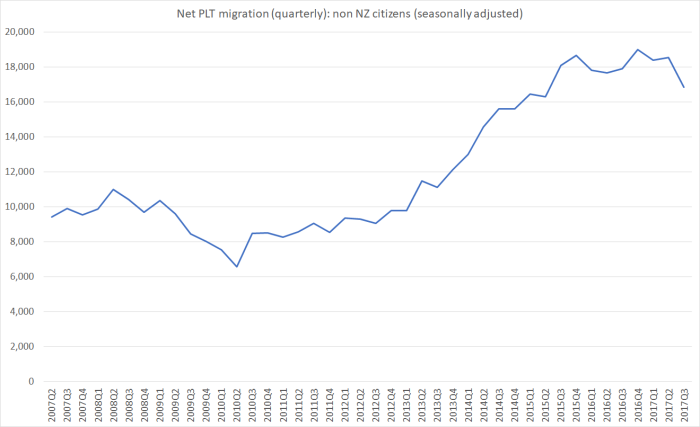
Two final thoughts.  One wonders if whatever heat there has been in the immigration issue –  and it didn’t figure hugely in the election –  will fade if the headline numbers start to turn down again anyway.   The net flow  of New Zealanders to Australia has not yet shown signs of picking up –  but it will resume as the Australian labour market recovers.  But in the latest numbers, there has been some sign of a downturn in the net inflow of non-citizens.

PLT non citizen

There is a long way to go to get back to the 11250 a quarter that is roughly consistent with the 45000 residence approvals planned for each year.  But, if sustained, this correction would provide at least some temporary relief on the housing and transport fronts.  As above, Labour’s changes will have a one-off effect on further reducing this net inflow in the next 12 or 18 months, but nothing material beyond that.

And in case this post is seen by the new Minister of Immigration, or that person’s advisers, could I make a case for two things:

  • first, better and more accessible data.  The readily useable migration approvals is published only once a year, with a lag even then of four or five months.  The latest Migration Trends and Outlook was released in November 2016, covering the year to June 2016.  It is inexcusably poor that we do not have this data readily, and easily useable, available monthly, within a few days of the end of the relevant month, and included (for example) as part of Statistics New Zealand’s Infoshare platform.  The monthly PLT data are useful for some things, but if you want a good quality discussion and debate around immigration policy, make the immigration approvals data more easily available.    As a comparison, building permits data is quickly and easily available, reported by SNZ.  Why not migration approvals?
  • second, considering referring the issue of the economics of New Zealand immigration to the Productivity Commission for an inquiry.   Perhaps the current policy, as Labour proposes to amend it, has all the net gains the advocates say it does.  If so, the Productivity Commission could helpfully, and in a non-partisan way, demonstrate that.  But there are still serious issues around New Zealand’s unusually liberal immigration policy, in a country so remote and with such a poor track record in increasing its international trade share.  Whatever the economic merits of immigration in some places, it is by no means sure that large scale immigration here is doing anything to improve the fortunes of most New Zealanders.  It may, in fact, be holding us back, being one part of the story as to why we’ve failed to make any progress in closing the productivity gaps with other advanced economies.  It would seem an obvious topic for the Productivity Commission, and a good way of lifting the quality of the policy debate around this really substantial policy intervention.


Wishful Australian thinking

I’ve been fascinated for some time by the way elements of the right wing of the Australian business and political community have sought to lionise John Key and Bill English.      On the day of his successful party room coup, Malcolm Turnbull was at it

“John Key has been able to achieve very significant economic reforms in New Zealand by doing just that, by taking on and explaining complex issues and then making the case for them. And I, that is certainly something that I believe we should do and Julie and I are very keen to do that again.”

As I noted at the time, I couldn’t think of any such “very significant economic reforms”, although there were various useful modest reforms, offsetting other backward steps.

The “look at New Zealand, why can’t we do it like them” theme has endured to the end.  There was a column along those lines in The Australian the other day headed “Bill English, John Key leave NZ a far stronger economy”, by Nick Cater, Executive Director of the Menzies Research Centre, a think tank affiliated to the Liberal Party (his column is reproduced here).

The column was so full of questionable claims and overstatement that it was almost hard to believe it was written by a serious commentator.  Near the start Cater notes

Key and English were described more than once as the quiet achievers. The governments they led as the bore-cons introduced reforms in tax and welfare while balancing the budget without fanfare or fuss. Seldom has the demise of a New Zealand government caused such political shockwaves on this side of the Tasman. In a period of near-universal political volatility, it raises the dispiriting possibility that simply governing well may no longer be enough. The Key and English legacy compares starkly with Australia’s record over the same period.

The first item is his list of achievements is this

In 2008, when the National Party came to power, New Zealand was 24th on the World Economic Forum’s Global Competitiveness Index, six places behind Australia. Since then the positions have been ­reversed. Today New Zealand is in 13th place on the index, eight positions ahead of Australia.

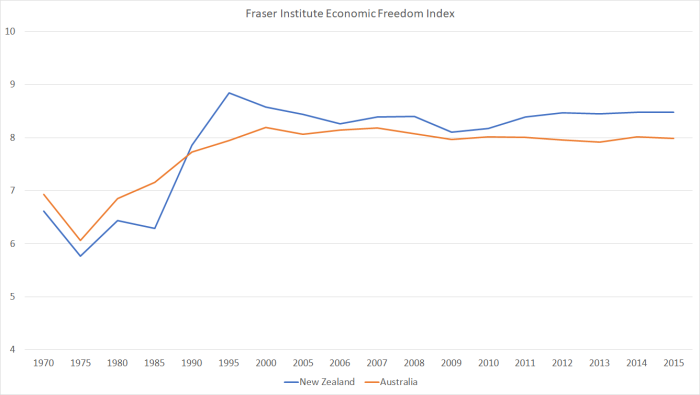
I’m not so familiar with that particular index, and tend myself to use the Fraser Institute’s economic freedom index, partly because there is a long time series of data.

econ freedom

The big story, for both countries, is surely that of a lot of reform and liberalisation in the 1980s and 1990s, and almost nothing material since then.   On this measure, of course, New Zealand does better than Australia, and has at every reading for more than 20 years now.   Perhaps New Zealand policymakers have done slightly better than their Australian counterparts in the last nine years or so but any differences are pretty small.

Cater then turns to GDP outcomes

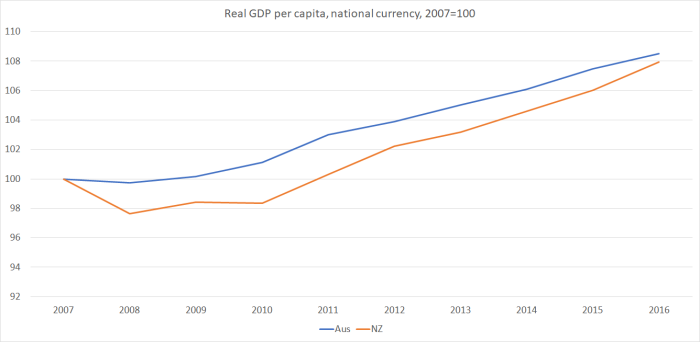
New Zealanders are still poorer than Australians on average but they are catching up fast. Nine years ago GDP per capita in New Zealand was 30 per cent lower than in Australia, now the gap has narrowed to 19 per cent.

Would that it were true, but it isn’t.    Here is real GDP per capita for the two countries, both indexed to 100 for calendar 2007, just prior to the global recession..

real GDP nz vs aus

Over that time, we’ve done just slightly worse than Australia has.  Cater might argue for starting the comparison from 2008. but I doubt even he is going to credit John Key and Bill English with ending the global recession.

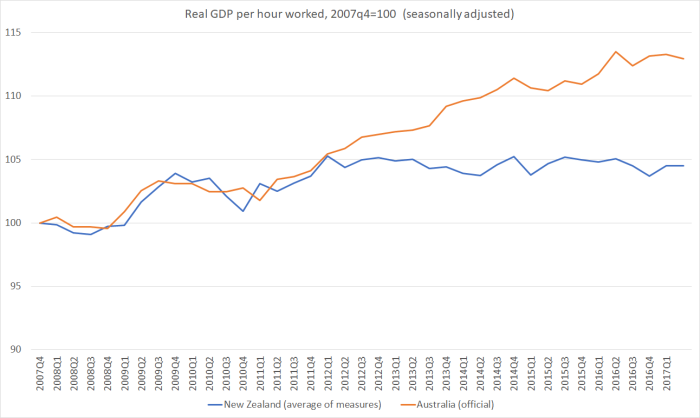
The productivity growth comparisons, of course, are particularly unfavourable to New Zealand, esepcially over the last five years.

aus vs nz ral gdp phw 2

Productivity is something closer to what government policy can usefully and materially influence (although other stuff matters too).

If we assume that governments have the power to control the economy — which incidentally 33 per cent of Australians no longer believe, according to the most recent Australian Electoral Study — then Key and English governed exceedingly well by ­almost any measure.

On the bits governments have a fair influence over we’ve done particularly badly relative to Australia (less badly relative to some other countries).  But there are bits of the economy that national governments have almost no control over whatever.  Commodity prices are perhaps foremost among them.  Our government can’t do anything much about the dairy price and the Australian government can’t do much about, say, iron ore prices.    Fluctuations in the terms of trade affect real per capita income measures even when the volume of production doesn’t change.

TOT aus and NZ

Australia had a huge terms of trade boom up to 2011, and even now if we take the last 15 years as a whole Australia’s terms of trade have increased more than ours have.   But since 2007/08, our terms of trade have done a bit better than Australia’s.  Hard to see how governments on either side of Tasman deserve credit or blame for those developments.

But as a result of these terms of trade swings, on a measure that adjusts for the effects of the terms of trade (real GDI per capita), New Zealand has grown three percentage points faster than Australia since 2007.  A nice-to-have windfall to be sure, but (a) even that gap makes only tiny inroads into the accumulated levels differences between New Zealand and Auatralian incomes, (b) the terms of trade are volatile, and who knows what they’ll do to the income gaps in the next decades, and (c) in the long-run, productivity growth is almost everything, when growth in living standards is in question.

As Cater notes, there has been a big change in trans-Tasman immigration (although even those flows have been quite –  typically –  variable over the last nine years).

The relative change in economic fortunes has changed the migration flow across the Tasman. Inward ­migration from ­Australia exceeded outward ­migration last year for the first time in a quarter of a century.

Of course, that last time –  quarter of a century ago –  was when the Australian labour market was also doing very badly.   New Zealand’s was as well, but when you are looking at moving to another country, conditions in the destination market matter a lot.   Australia has struggled in the last few years, but actually both countries are still among the diminishing number of advanced countries where the unemployment rate is still well above pre-2008 downturns levels.   That reflects no great credit on governments, or central banks, on either side of the Tasman.

Then, of course, there is a fiscal policy.  Personally, I think the outgoing government has done a pretty reasonable job on that score –  as, in fact, its predecessors for the previous 20 years had done.

But even here Cater gets some things quite badly wrong

While treasurer Wayne Swan was doling out cash and spending billions on poorly conceived make-work projects to help Australia survive the 2008-09 ­financial crisis, English gave personal and business tax cuts.

I’m no fan of the Rudd/Swan fiscal stimulus programme, but….. the appropriate comparison here is that we had no active discretionary fiscal stimulus to attempt to counter the recessionary forces.  None.  And the almost accidental stimulus that happened to be in place resulted from the Budget choices of the outgoing Labour government which had put in place tax cuts and spending increases at a time when Treasury was advising them that the government accounts would remain in surplus even after those initiatives.

Of course, there were some tax reforms here  –  in 2010 –  and conventional wisdom tends to count them “a good thing” (I’m less convinced, because the package of measure increased the effective taxation levied on capital income, against the prescriptions of standard economic analysis).   But I’m not aware of any analyst who thinks those changes made a material difference to New Zealand’s economic performance in the last few years.

Cater quotes some debt numbers that I don’t recognise

Today the New Zealand budget is in surplus while Australia is still running deficits. Ten years ago the New Zealand government’s gross debt stood at 25 per cent of GDP while Australia’s sat on 20 per cent. Today the positions are reversed. Australia’s net public debt is at 47 per cent; New Zealand’s hit a peak of 41 per cent in 2012 and has steadily declined to 38.2 per cent.

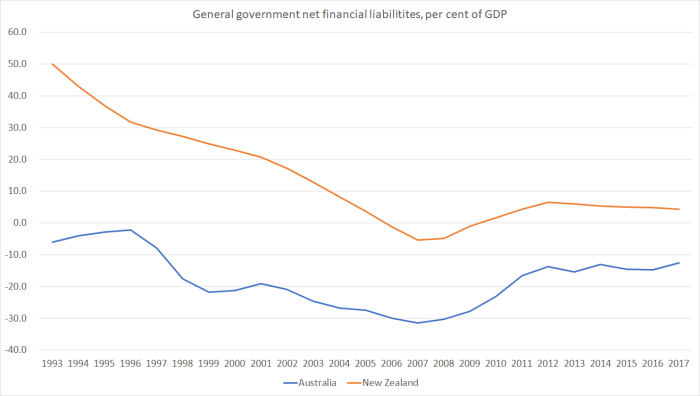
Here are the OECD’s number for general government net financial liabilities as a share of GDP.

gen govt net liabs nz and aus

Every year for the last 25, Australia’s overall government net debt has been less than ours, and if the gaps between the two countries has closed a bit in the last few years, the change is pretty small and the similarities, in the respective paths, are more striking than the differences.     Of course, we’ve had one nasty shock they haven’t had –  earthquakes.  Then again, they’ve been coping with a really big correction in the terms of trade.

On both the tax and spending sides of the government accounts, we have a slightly bigger government (share of GDP) than Australia –  and more variable one.  None of that has looked like changing over the last nine years.

Perhaps you thought this was just an economic case.  But, no.  Cater is just getting into his stride.

The achievements of Key and English are by no means limited to the economy, however.

Cater appears to be a big fan of the “investment approach” to welfare and related government spending.    I’m still more ambivalent –  the use of data appeals, of course, but big-government joined-up data makes me very nervous (hints of, eg, Chinese social credit scores).   For now, I’m happy to look for evidence of results.  Cater is convinced.

From this thinking flowed a new approach to welfare that has since been adopted by the Abbott and Turnbull governments to great effect.

and

In its second of two [three?] terms the ­National government first halted the long-term trend of rising welfare dependency and then ­reversed it. The number of New Zealanders claiming sole parent benefit has fallen by a quarter as 20,000 single parents found work. Long-term welfare dependency has fallen substantially. In 2012 78,000 New Zealanders had been collecting benefits for 12 months or longer. By June this year the number had fallen to 55,000.

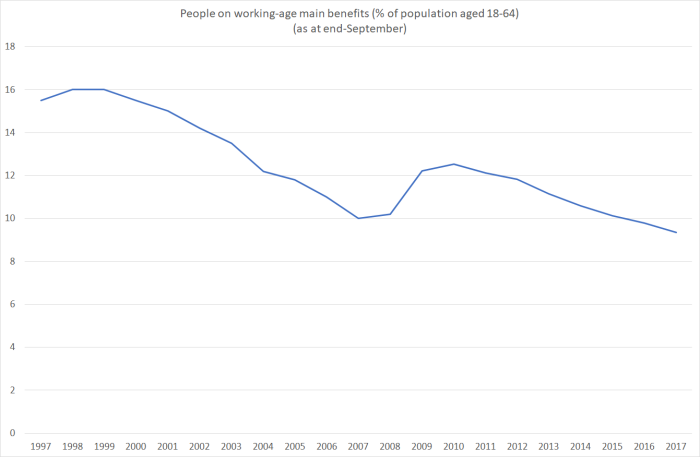
The first sentence is simply wrong.   Here is the MSD data on the number of working-age main benefit recipients as a percentage of the population aged 18 to 64.

benefits 2017

There was a recession in the first term –  welfare benefit numbers rise in recessions –  and then the downward trend that had been in place for the previous decade resumed.   But as of last month, the share of the working age population on these main welfare benefits was only very slightly below where it had been in September 2007.

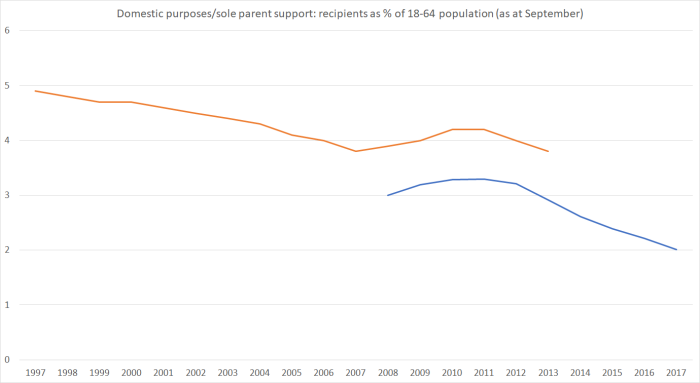
In a way, that isn’t surprising.  Unemployment is still well above pre-recession levels.   But it should be somewhat troubling, both on that count, and because one component of benefit numbers has dropped away quite sharply.     As Cater notes, the number of sole parents on the benefit has fallen away a lot.  Here is the chart – there is a discontinuity in the series associated with the welfare changes (including labelling changes) in 2013.

DPB

The trend was underway during the decade prior to the recession.  The pace of decline has certainly accelerated since then (at least since 2013), but since the overall number of benefit recipients as a share of the working age population hasn’t changed since 2007, other categories must have increased.

It would also be interesting to see a serious study of just what role policy changes have played even in the decline in sole parent beneficiaries.   After all, teen pregnancy rates have been dropping globally –  for reasons not, I think, that well-understood – and in New Zealand the teen birth rate halved between 2008 and 2016 (but, even so, was still higher than the comparable rate in Australia).  Welcome as that trend is, it seems unlikely that New Zealand government policies will have been a large part of the explanation.

And, of course, over the outgoing government’s term there has been a huge increase in the number of elderly age-benefit recipients (2011 saw the first baby-boomers turning 65).   In the last months of the outgoing government, there was finally talk of lifting the age of eligibility –  something Australia began years ago –  but it was going to happen 20 years hence.  And now –  for now –  it isn’t going to happen at all.

At this point, Cater leaves the numbers behind.

The government’s strategy of taking the public with them on reforms, ­explaining the logic well in advance in language people could follow, adjusting ­expectations and then implementing the promised changes, was remarkably successful until the end.

On what measures I wondered?

And he concludes

For 11 years he and Key had written a counter-narrative to that prevalent in Australia that reform was all but impossible in the era of Facebook and Twitter. While Australia appeared stuck in a policy drought, New Zealand was breaking new ground, discovering new ways to measure government programs by their results and finetuning them accordingly. Feel-good policy, sentimentalism and identity politics were anathema to them.

English and Key proved that centre-right parties were not condemned to be nasty parties, ­focused on numbers rather than people, as they doggedly cleared up their predecessors’ fiscal mess. Devoid of ideology, fiercely pragmatic, self-aware and inspired, the pair stands as inspiration to the rest of the developed world in these anxious and volatile times.

So horrendous house prices, no productivity growth, an export sector shrinking as a share of GDP are the sorts of things that provide an inspiration to the world?  I’m flabbergasted.    The terms of trade have certainly been favourable, and yet even the outgoing Minister for Primary Industries has been heard to talk of the possibilities of “peak cow”.   Where exporters haven’t done badly, it has too often –  export education and dairy being prime examples –  been partly a result of unpriced subsidies and environmental externalities.

Relative to Australia, the story of the last nine years isn’t all bad.  Neither country has been managed that well.    There are some good stories.  Broadly speaking, New Zealand’s fiscal policy is one of them, but too much can be made even of that.  A much lower balance of payments current account deficit is often counted as another good story, except that much of the contraction reflects (a) the slump in global interest rates, reducing the cost of our external indebtedness, and (b) the weakness of investment even years into the recovery phase.   Perhaps we’ve had tidy stewardship, but going nowhere.  A safe pair of hands at the bridge perhaps, but with the ship meandering without clear direction, or any compelling sense of how better outcomes might be achieved.

All of which should not be taken as any sort of enthusiasm for the new government.  No doubt –  like their predecessors –  they’ll do a few sensible things.  But, like their predecessors, at present they (or the constituent parties) show little sign of either understanding the nature of New Zealand’s dismal long-term economic performance, or of adopting the sorts of policies that could at last begin to reverse that decline.  A pessimist might incline to the view that things may even get gradually worse –  and here I’m not thinking of the cyclical pessimism Winston Peters was enunciating on Thursday night.

There have been very few periods in the last 150 years when policy has been much better managed in New Zealand than in Australia.   The last nine do-little-or-nothing years (following on from a similar nine years) hasn’t been one of those periods.   That is to the credit of neither New Zealand or Australian politicians, but of course Australia’s starting point is so much less bad than ours.


The 1987 crash: experience and reflection

The upside of a decent memory and a pretty comprehensive diary is that one is reminded of how many things one misjudged, or at least sees differently now, over the course of decades.  In my case, the stock market crash of 1987 was one of those events.

There were excuses I suppose.  I was young –  just 25 –  and had only just come back from two years at the (central) Bank of Papua New Guinea – a place where I’d learned a great deal about economics, politics, regulation, statistics and so on but where, from memory, there were about five, rarely-traded, public companies.  In late August 1987, I’d taken up the role of Manager, Monetary Policy at the Reserve Bank, working for (current “acting Governor”) Grant Spencer.  The Reserve Bank wasn’t (formally) operationally independent at the time, and my section was responsible for our monetary policy analysis and advice, including that to the then Minister of Finance.    It was a very different world.  The Bank produced macroeconomic forecasts, but they weren’t that important in how policy was run.  We didn’t set an official interest rate, and to the extent we were guided by any financial market indicators, the “yield gap” –  between 90 day bill rates and five year government bond rates –  was the most important indicator.  My diary suggests my team spent a considerable portion of late 1987 working on a paper on the yield gap and the making sense of the slope of the yield curve, for a new Associate Minister who had trained as an economist and was intrigued.

Official doctrine was that it was very hard to interpret the level of interest rates.  It was only three years since we’d liberalised, so didn’t have much sense of an appropriate interest rate in normal circumstances, and these circumstances were anything but normal (hence the focus on the yield gap –  if short-term rates were well above long-term rates then, in a climate where we were trying to drive down inflation, we couldn’t be too far wrong).  Much the same line applied to interpreting the exchange rate.   Both interest rates and the exchange rate were extraordinary volatile.

wholesale int rate 85 to 97

We didn’t really have a good model for forecasting, or making sense of, inflation either.   Again, that wasn’t really surprising.  So much had been liberalised quite quickly and a lot of economic relationships that had once held up no longer did.   Our basic approach was that inflation was a monetary phenomenon, but it wasn’t as if the monetary or credit aggregates could then give us much useful guidance either.

The focus was on bringing inflation down.  It was the one thing we knew the Reserve Bank could do, especially once the exchange rate had been floated, and I don’t suppose there was anyone who opposed that broad goal.   There wasn’t a very specific goal, but for some time the talk had been of “low single figure inflation” which was, at least at times, seen as emulating the success of the UK and the US earlier in the 1990s in bringing inflation down.

But inflation itself was all over the place.

CPI inflation 83 to 87

Annual headline inflation was 18.9 per cent in the year to June 1987.  Much of that reflected the introduction of GST in October 1986, but even abstracting from that quarterly inflation was volatile, and disconcertingly high.    There had been a sense that by early 1986 things were coming under control –  hence the sharp fall in interest rates in mid 1986 (see earlier chart) –  but that proved illusory.   Just before I came back to the Bank in August I recall seeing Grant Spencer interviewed on TV after the June quarter 1987 CPI numbers came out: quarterly inflation of 3.3 per cent (I think the Bank had been expecting something nearer 2 per cent) left the Chief Economist “flabbergasted”.   Low single figure inflation seemed a long way away, as the commercial construction boom, and the debt-fuelled sharemarket boom and associated strength in consumption raged on.    The (volatile) exchange rate offered some solace –  at the time, the pass-through from the exchange rate into domestic prices was still quite strong (we assumed something like a 46 per cent pass through) –  although I’m sure we all remembered that after the devaluation of 1984, a key policy priority had been cementing-in a  much lower real exchange rate.  (As a young graduate analyst, I’d been the minute-taker in various meetings on that theme involving the great and the good of the Reserve Bank and The Treasury).

twi 87

And so in September 1987, the biggest concern in the Economics Department of the Reserve Bank was that we were making little or no progress in getting inflation back down again.  Perhaps we weren’t going back to the 15 per cent inflation we’d often seen before the wage and price freezes of 1982 to 1984, but there didn’t seem much reason for confidence that once the GST effects dropped out we’d settle at much below 10 per cent annual inflation.  That wasn’t good enough for the government –  newly re-elected, and just about to launch the next wave of reforms  –  or for us.

Other parts of the Reserve Bank may have had different perspectives.  We didn’t do much banking regulation or supervision in those days, but a new function was just getting going, and I didn’t have much to do with them.  Our Financial Markets Department was probably a little more focused on the excesses in the markets –  including the big speculative plays on the NZD –  but the Bank wasn’t responsible for equity markets, and we didn’t have a “macro-financial stability” type of analytical function there or in Economics.   At the time we didn’t pay very much close attention to what was going on in other countries, but had we done so, we’d probably have seen a bunch of smallish economies undergoing similar post-liberalisation experiences (Australia and the Nordics), while congratulating ourselves that at least we’d floated our exchange rate (which the Nordics hadn’t).

But our focus in September/October 1987 was on tightening monetary policy if at all possible.  And on 7 October 1987, we’d actually announced a discrete monetary policy tightening (implemented by an increase in the margin above market rates at which we would buy back short-dated government securities from the market).   We’d tried to buttress the case for a tightening by arguing that the strength of the stock market was an indicator of demand and inflation pressures, but an older and (with hindsight) wiser senior manager insisted we remove that line.  My diary records that I thought the tightening was “pretty feeble” and that at a market function immediately after the announcement at least one of the market economists I talked to agreed (Grant Spencer, to his credit, disagreed).    Actual interest rates didn’t rise very much at all –  at least in the way we thought about things then – but by 16 October 90 day bank bill rates were 20.56 per cent.  There was no unease from the Beehive –  my diary for 15 October records of a meeting with Roger Douglas and his associate only “the latter almost gleeful at having closed almost 450 Post Offices”.

In many ways, our stance to this point was quite justifiable.  A key element of the macroeconomic management agenda ever since the 1984 election had been to end New Zealand’s really bad record of inflation.  And that was the Reserve Bank’s job.  Moreover, even if we had properly recognised the ever-growing fragility of the financial system etc, neither we –  nor anyone else –  had any way of knowing when those risks would crystallise.   Persistent strong domestic demand, even if built on foundations of sand, represented a serious threat to any sort of success in lowering inflation to what were, by then, becoming more internationally conventional levels.  So it probably wasn’t wrong to have tightened on 7 October, and may not even have been wrong for people like me to think that more tightening might yet be required.   Annual money and credit growth rates were, after all, still running at around 20 per cent –  indeed, a couple of days after the crash began we got new numbers that I called “presentationally (and factually) very embarrassing when [our chief critics] get hold of it”.  If there was a real squeeze on the tradables sector –  and there was –  the unemployment rate in mid 1987 was stable at around 4.2 per cent (lower than it is today).   At the time we didn’t really believe that seriously high unemployment would, for a time, be required to get inflation down –  I recall an IMF mission chief at the time reproaching us for this view – probably partly because after three years, unemployment hadn’t risen.  But whatever the truth of the matter, 4.2 per cent unemployment, amid a major economic restructuring, wasn’t exactly the 3 million unemployed of Thatcher’s Britain earlier in the decade.

So if there was a criticism to be made –  and I think it is probably fair that one should –  it was that we simply weren’t prepared for what followed.   There may have been people at the Bank –  older and wiser than me – who saw things differently then, and if so all credit to them.  But I was pretty closely involved on the monetary policy side throughout the following five years and I don’t think my blindspots were particularly unusual (I wrote many of the major papers, including the first ever Monetary Policy Statement, which has little or no sense of a post credit-boom bust to it_.  Again, it is possible that our banking supervision people saw things differently, but banking supervision –  such as it was – didn’t impinge on monetary policy or our macroeconomic forecasting and analysis.   We never really worked through what an asset bust and financial crisis meant for economic developments and prospects, and mostly treated them as peripheral issues.

On 20 October itself –  the first day of the crash in New Zealand –  I recorded in my diary “Bank not at all twitchy yet, which is good, and Douglas put on a brave face tonight”.   I saw the risk of economic contractions and real wealth effects, but for some reason seemed to see the risks as mainly those from abroad (commercial property busts overseas associated with potential credit contractions, recessions, falls in commodity prices etc) and thus potentially helpful in our own disinflation efforts.  For some – now unaccountable –  reason I noted that I didn’t see the New Zealand fundamentals as particularly problematic.   As I say, records of the past can make one wince.

A week or so later –  in one of those events I’ve never needed a diary to recall –  Paul Frater and Kel Sanderson, then the leading figures at BERL –  pretty vocal critics of our approach to monetary policy – came in to see Grant Spencer and me.  Sitting in Grant’s office

“among other topics, they gave us their gloomy assessment of the impact of the share price falls –  very pessimistic about comm. property and about the future size of many broking firms and merchant banks”.

They foreshadowed a financial crisis, and a lot of stress on bank balance sheets.  We were pretty dismissive of their concerns.

Within a day or two, concerns were mounting even within the Bank, focused on the fate of some of the investment companies (“Judge, Rada and Renouf”) and those they might drag down with them.   There was, I recorded, no panic over financial institutions themselves, but we’d had internal discussion of a possible liquidity response, agreeing in principle to raise the target level of settlement cash and perhaps cap the level of the discount rate (which normally moved with market rates) –  I think, from context, this hypothetical response was envisaged if interest rates rose (as, say, they did in the 2008 crisis).

A week later we acted.  It was never represented as a monetary policy easing –  although it was –  and so even today there is a mythology abroad (I saw it in a recent Liam Dann article on the crash) that the Reserve Bank did nothing in response.  On the day, 90 day bill rates –  which hadn’t risen since the crash, despite increase risk concerns and limit cuts –  fell 1.5 percentage points on the day.    (By August the following year, 90 day bill rates were down to 14 per cent –  a similar-sized fall to the active cut in policy rates the Reserve Bank implemented in 2008/09.)

My diary entry that day is sufficiently long, and embarrassingly wrong, that I won’t quote from it at any length: suffice to say that I called it a “precipitate panicky move”.  To be sure, the issue in the market at the time wasn’t the interest rate (which hadn’t risen) –  it was blind fear and an often-quite-rational newfound reluctance to lend –  and we had no evidence that inflation or inflation expectations would fall, and the Bank had over the years been too receptive to pressure from banks.  But, such were the genuine fears and rising risk aversion, that the response was only prudent.   Immediate responses can always be revisited once the immediate panic passes and, frankly, there wasn’t much, if any, moral hazard risk in the sort of action we took.   We weren’t lending more to anyone, let alone to bad credits.

But it wasn’t the way I saw it.  A few days later, apparently, I circulated a discussion note “provocatively titled ‘Is it time to lower the cash target’, (ie tighten up again) arguing strongly in the affirmative”.  The same day I recorded that Grant Spencer had deleted a description in a draft Board paper of the 6 November easing as “temporary”, observing to me “nice try”.  My approach wasn’t totally hawkish –  I also toyed with the idea of a cap on our discount rate, in case renewed crisis pressures spilled back into higher interest rates.  As the month went on and interest rates fell further, my arguments (in another “longer and more reasoned note”) starting commanding more sympathy among my colleagues, and some hawkish market economists.    The Deputy Governor even did the courtesy of ringing to discuss it.  But this was one of those times when –  at least with hindsight – the more senior were better judges of the situation than those of us further down the food chain.  In mid-November, I recorded a conversation with Iain Rennie –  then an analyst at Treasury –  in which he told me that the distribution of views was much the same at Treasury.

The (apparent) tensions betwen the financial stability and inflation control perspective must have been very real.  When my latest note was discussed at (the equivalent of) the Monetary Policy Committee, I recorded that there was plenty of agreement with the analysis and none with the recommendation (to reverse some of the easing) – “terrified of the possibility of collapses corporate and financial” , with rumours rife.

Of course, there were plenty of collapses to come, of corporates and fringe financial institutions.   Of the things that were feared, most come true.  In fact, reality was worse, because the crisis eventually engulfed mainstream large institutions on both sides of the Tasman.  Really bad lending –  whether to investment companies, or on a massive commercial propety boom –  eventually does that –  enabling a really big misallocation of real resources, and then eventually being found out.  Most of the waste isn’t in the crisis-aftermath; rather the bad seed is sown –  the waste actually happens – when all feels exuberant and the new investment is being recorded as an addition to GDP.

If I look back on my views during that frantic couple of months after the crash began, I was clearly wrong.  Even if monetary policy wasn’t going to do anything to save Judge, Renouf, the listed goat companies or whatever –  and nor should it –  it was quite clearly, even on the facts available at the time, a shock to the system which meant that lower interest rates were warranted.  Credit demand and associated activity would be weaker.  Interest rate falls would have happened anyway, even without our intervention (that was how the system worked then), but the nudge downwards, and the willingness to accommodate lower interest rates was clearly the right thing to do.

But it is also worth wondering what we might have done if we had correctly understood financial crises, asset busts etc, if we had envisaged several years of little or no growth, and two near-failures of our largest bank.  (That we didn’t, even later, is evident in a major article written by Grant Spencer and one his colleagues in late 1988 –  published the following year in a book on the liberalisation process, and which I reread last week –  in which the crash appears as not much more than a corrective to the excess enthusiasm for consumption up to 1987.)   The doves –  of whom there were plenty including Spencer and then Assistant Governor Peter Nicholl –  would, almost certainly have argued for further easings, allowing interest rates to fall materially further.       And yet it is far from clear that that would have been the right approach to have taken.

Inflation edged downwards only relatively slowly over 1989 and 1990, and it wasn’t until the big fiscal consolidation after the 1990 election, and as the 1991 recession unfolded, that we felt comfortable letting bank bill rates fall below the 14 per cent they got to in the months after the crash.  We, and other forecasters, misread the 1991 recession, but until that hit us we didn’t appear to be on track to getting inflation to target any sooner than the government had (by then) asked us to.  Inflation at the end of 1990 was still 5 per cent, and the target –  by then agreed by both main parties –  was 0 to 2 per cent inflation.  Getting inflation down isn’t technically difficult, but when real people and real institutions (with all their biases, incentives etc) are involved it can, and usually has been, costly and difficult.  Sometimes, a little learning can be a dangerous thing.  Perhaps a proper appreciation of the looming crisis, and the wasted real resources, at the end of 1988 would have made it even harder, perhaps even eventually more costly, to have secured something like price stability here.  I wouldn’t like to be seen as suggesting that we should welcome blind spots, or even ignorance, but sometimes perhaps they end up being less costly than idle theorising might suggest.

Finally, a week or so ago the Herald ran an interesting series of articles on the New Zealand experience in 1987.  The thing that most surprised me about those articles –  and in a way what prompted the thinking that led to this post –  was the almost complete omission of the role of banks in making it all possible.   Every over-optimistic borrower needs an over-optimistic lender if the loan is to happen.  There were plenty of the former, but all too many of the latter too –  whether state-owned lenders like the BNZ or the DFC or private sector ones, new entrants (NZI Bank anyone) or old, New Zealand owned or foreign-owned.  And the few institutions, on either side of the Tasman, who didn’t participate boots and all often weren’t particularly virtuous and far-seeing, but just slow.  Given another year or two, they’d probably have got into the mix too, and if existing management wouldn’t do so, well other managers could soon be found.

In many ways it was a classic financial crisis –  the definitive history of which has still to be written.  There was the displacement of genuine new opportunities, enough of a narrative for even the cautious to believe that the future would be quite a bit different and better than the past, official backing (indeed, at times, cheer-leading), extraneous feel-good factors like the America’s Cup, relatively weak market disciplines (especially in the financial sector), little experience in lending or borrowing in such a different world.  There were probably even some real success stories (I’m struggling to think of them, but readers can nominate some).   And it didn’t, to any material extent, involved lending to households.

It all happened surprisingly quickly.  14 July 1984 was the election day that brought the fourth Labour government to office, and 20 October 1987 began the crash –  just over three years.  It took far longer to unwind the mess than it did to create it.  It is the deterioriation in lending standards that happened so quickly that market monitors, and central banks, really need to be watching out for.    When they start sliding, a bank can be destroyed remarkably quickly.    Such marked deteriorations in standards aren’t every day events –  we, after all, have seen no bank failure since 1990 –  and they rarely arise out of the blue.  They usually take some shock –  some innovation –  that is likely to leave regulators just as uncertain what to make of it as the lenders are. That’s inescapable, but is a reason to be cautious about just how much useful difference even the best regulators can make.   Seeing no harm for 98 years earns you no real credit (and should not either) if you aren’t much better than the lenders in the other two years each century.

OIA: unexpected bouquets and brickbats

I have been critical over the years of the Reserve Bank’s approach to Official Information Act requests.  I made mention of it, in passing, just this morning.   The long-established practice had been to withhold absolutely anything they could conceivably get away with, and to delay as long as possible anything they really had to release.   The presumptions of the Act (well, specific provisions actually), of course, operate in the opposite direction.

In the last couple of weeks I had lodged requests for a couple of pieces I had written while I was still working at the Bank in 2014.   One was the text of a speech, on New Zealand economic history and the evolution of economic policy, to a group of Chinese Communist Party up-and-coming officials, delivered as part an Australia New Zealand School of Government programme (in which they got to hear from John Key, Gerry Brownlee, Iain Rennie, no doubt a few others, and me).     The other was a discussion note I had written on how best to think of New Zealand’s economic exposure to China.    The second request was lodged only late on Monday.    I could not envisage any good (lawful) reason for them to withhold the material, but that often hasn’t stopped the Reserve Bank in the past.  If they released the material at all, I was anticipating a 20 working day wait.

But this afternoon, I received both documents in full.  I was shocked.  I took the opportunity to send a note to the Bank thanking them for the prompt response.  And as I have often been critical here of aspects of the Bank’s handling of various things, including OIA requests, I thought I should take the opportunity to record my appreciation openly.    Who knows what prompted the change, but it is an encouraging sign.  Perhaps the “acting Governor” (a sound caretaker, unlawful as his appointment may be) is making a positive difference?

On the other hand, I’ve usually been pretty openly positive about The Treasury’s approach to OIA requests.  One isn’t always happy with their decisions, but there is a strong sense that they generally do all they can to be as open as possible.    There is the look and feel of an agency that seeks to comply with the spirit of the Act, as well as the letter.

But not when it comes to the Rennie review.   Some time ago, they refused a journalist’s request for the terms of reference for the review.   They also refused to release some of the papers associated with the Rennie review (including drafts of the report) that I had requested some time ago .   In July they told me they wouldn’t release papers because of “advice still under consideration” (even though that is not a statutory ground, and Rennie is neither a minister nor an official, and even though I had not then requested a copy of the final report which had been delivered in April).

But time has moved on, and so early last week I lodged a fresh request.  This time I asked for:

I am requesting copies of :

  • the draft supplied to Treasury on 5 April 2017
  • the report delivered to Treasury on 18 April 2017
  • the version of the report sent out for peer review
  • the completed report incorporating any comments provided by the peer reviewers.
  • copies of comments supplied on the draft paper by peer reviewers
  • file notes of meetings Rennie or assisting Treasury staff had with non-Treasury people in the course of undertaking the review (including the Board of the Reserve Bank).

I am also requesting copies of any advice to the Minister of Finance or his office on the Rennie review, and matters covered in it, since 18 April 2017.

And this afternoon I got a response from The Treasury, refusing to release any of this material.

Their justification?

This is necessary to maintain the current constitutional conventions protecting the confidentiality of advice tendered by Ministers and officials.

That is, in principle, a valid statutory ground (unless public interest considerations trump it).  But…..Iain Rennie is not an official or a Minister, but was rather a contractor to The Treasury.

But what about the advice to the Minister himself (or his office)?  Well, according to Treasury,  “Mr Rennie’s report has not been tendered to the Minister of Finance, nor has any other Treasury advice on this issue since the report was commissioned.”

So, the report which was requested by the Minister of Finance himself (he told a journalist so in April which is how news of the review became public), which was finalised more than six months ago, has not been sent to the Minister of Finance at all, and nor has any advice from Treasury been sent.  Since oral briefings are covered by the Official Information Act, we must then assume that a notoriously hands-on minister has no idea what is in a report he requested, and which was finished six months ago.   Perhaps, but it seems unlikely.

Treasury tries to claim in its letter “that this work was commissioned to inform Treasury’s post-election advice”.  But that certainly wasn’t the impression the Minister of Finance was giving in April, when this was presented as his own initiative.   But even if that story is true, it still isn’t grounds for withholding a six months old consultant’s report paid for with public money.  It is official information, and releasing the report is not the same –  at all –  as releasing Treasury’s views on it.

There were three external reviewers of the draft report.  Comments were sought from:

  • Charles Goodhart, an academic and former Bank of England official and MPC member,
  • Don Kohn, former vice-chair of the Fed, and currently a member of the Bank of England’s Financial Policy Committee, and
  • David Archer, former Assistant Governor of the Reserve Bank and now a senior official at the Bank for International Settlements.

The comments of the first two are withheld on the standard ground “to maintain the current constitutional conventions protecting the confidentiality of advice tendered by Ministers and officials”, but neither Goodhart nor Kohn is either an official (of New Zealand or –  in Goodhart’s case of anywhere) or a Minister, and these are comments on a draft report I’m seeking, not something ever likely to get as far as the Minister of Finance.

Archer’s comments are withheld on different grounds:

  • “the making available of that information would be likely to prejudice the entrusting of information to the Government of New Zealand on the basis of confidence by the Government of any other country or any agency of such a Governoment or by an international organisation”

But there is no indication that Archer was commenting on behalf of an international organisation, but rather was offering personal views (rather than confidential “information”).   It isn’t, say, confidential information about the business of, say, the BIS.

  • “to protect information which is subject to an obligation of confidence where the making available of the information would likely prejudice the supply of similar information or information from the same source and it is in the public interest that such information should continue to be supplied”.

There is no evidence that (a) Archer’s comments, made presumably in a personal capacity, were subject to an “obligation of confidence”, or (b) that publishing his comments on a draft report would make him less likely to provide such comments (not clearly “information” in any case) on future Treasury consultants’ reports on Reserve Bank issues.      And nor is there any reason why this clause should apply any more to Archer’s comments than to those of Goodhart and Kohn –  for which it has not been invoked.

It is all (a) incredibly obstructive and (b) not remotely convincing.  I will be appealing The Treasury’s decision to the Ombudsman.  Perhaps some journalist might consider asking Steven Joyce if it is really true that he has no idea what is in the Rennie report that he asked for eight months ago, which was completed six months ago, and which is held by his own department.  Even if that is true, it is not good grounds under the Act for withholding a consultant’s report, let alone drafts of it.

So, well done Reserve Bank.  And it is a shame about The Treasury.


Reforming the Reserve Bank: some challenges for the new government

There will be more important issues facing the incoming government –  even in what are, broadly speaking, economic areas.

There are house prices, for example, where two successive governments have done nothing material to solve the structural problems that have been evident for 15 years now (present for longer).  It is a matter of (in)justice as much as anything.

Or reversing the dismal productivity performance, epitomised by the last five years or no productivity growth at all.

aus vs nz ral gdp phw 2

Or reversing the dismal export performance which has seen exports as a share of GDP slipping –  not usually a path to sustained prosperity –  and which is forecast, by Treasury, to keep slipping (all else equal).

x to gdp

But if these things matter much more to our longer-term prosperity,  it doesn’t make an overhaul of the Reserve Bank less important.    And action on that front is now quite pressing.  Apart from anything else, the Bank has an (unlawfully appointed) caretaker Governor, and whoever is appointed as the new Governor –  under current legislation wielding huge amounts of power singlehandedly – will surely want to know quite what the shape of the job they are taking on is.   If the three parties who will be part of the new government are to be believed, any change isn’t just going to be limited to some slightly different words in the new Governor’s Policy Targets Agreement.

I wrote a post last week on the possible implications for monetary policy of a new government.   I’ll reproduce below the bits of that post that are relevant to the sort of Labour-led government we will actually have.

But the Reserve Bank isn’t just a monetary policy agency.  If anything, the case for legislative reform is even stronger in respect of the other functions (notably the extensive financial regulatory functions the Governor exercises under various acts) than it is for monetary policy.   These issues have less immediate political salience of course.  But whereas for monetary policy there is, at least, a statutorily-required Policy Targets Agreement which can be used as a legal basis to hold the Governor to account, there is nothing remotely similar in respect of the prudential regulatory powers.   The Governor –  whoever he or she may be –  exercises huge discretionary power, especially over banks, with little or no means for anyone to hold the Governor to account.  You might like LVR limits (I don’t).  But, whatever the merits of such controls, the Governor can impose or remove completely those controls on the basis of little more than a personal whim.  There are process hoops he or she would have to jump through, but no substantive constraints.  The same goes for debt to income limits.  Or higher, or lower, capital requirements on banks.

It is simply far too much power to vest in any one person – especially an unelected person, who cannot easily be removed from office.   A new Governor might be a truly exceptional person, blessed with wisdom and judgement far above the average.  But we have to build our institutions around typical people –  and typical public sector chief executives (including Governors), are typically average, a mix of strengths and weaknesses, insights and blindspots.

It isn’t the way in which other central banks and financial regulatory agencies are typically structured and governed.  No other country that has reformed its institutions in the last 40 years has given a Governor anything like as much personal power as our system does –  and even those who wrote our legislation would be flabbergasted at how much power our Governor actually wields since back then no one envisaged such an active discretionary regulatory role for the Bank.

Perhaps as importantly, it isn’t the way we govern almost anything else in New Zealand:

  • public companies have boards,
  • charities have boards,
  • the judiciary has several layers of appeal, and in the higher courts benches of judges decide cases rather than individuals,
  • the Cabinet itself is a decision-making committee, with the Prime Minister not much more –  in extremis –  than primus inter pares.  Prime Ministers can typically be ousted quickly by a party caucus.
  • Crown entities (from a school Board of Trustees to a major central government entity like the Financial Markets Authority) are governed by decisionmaking Boards.

Chief executives typically play an important role, but it is almost always an executive role, advising on and implementing a strategy set by others, and ensuring that the organisation itself functions effectively.     In areas of policy in particular, single decisionmakers are very rare, and in areas of policy with as much discretion as those the Reserve Bank exercises unknown.  And recall that governance structures don’t exist for the good times, or the occasions when everyone agrees; they are about resilience in tough times, resilience to inevitable human frailty.

It isn’t just a matter of policy discretion, moving away from the highly-unusual and risky single decisionmaker approach.   There are oddities such as the Reserve Bank being responsible for its own legislation –  something very unusual for a regulatory agency –  and thus, often, for reviewing its own performance.  We’ve seen that just this week: industry complaints that the Reserve Bank is reviewing its own performance as insurance industry prudential regulator.   No doubt the regulatory agency has useful input to such reviews, but they just can’t bring the degree of detachment and independence to a review of their own performance that the public should expect.

And then there is transparency.  The Reserve Bank has sought to claim over the years that it is highly transparent. In what matters, it is anything but.   The Bank scores well in transparency over things it knows almost nothing about: they will happily tell us what they think will happen to the OCR in 2019, for example.   But, unlike most government agencies or Parliament itself, they won’t, as a matter of course, publish submissions made on regulatory proposals.  They provide particular secrecy to the submitters with the deepest pockets and the strongest interest in limiting regulation (banks themselves), and rely on a provision of the Act that was never intended to cover such submissions and which is well overdue for reform.     They won’t publish the background papers to Monetary Policy Statements, even many months down the track (I did once succeed in getting 10 year old papers released).  They won’t publish minutes of the advisory Governing Committee meetings.  They won’t publish, even with a lag, even anonymised, the advice and recommendations the Governor receives when reviewing the OCR.  Like many government agencies, they are persistently obstructive, pushing the very limits of the Official Information Act.

I could go on, but won’t today.  Perhaps especially in a small country, an excellent central bank can be a significant part of the set of economic institutions that can help to shape and improve our economic performance.   We need better from the Reserve Bank –  not just specific decisions, but better supporting analysis, and a more robust and open institution (not one attempting to silence critics) than we’ve had in recent years.  And so reform shouldn’t just be about the odd line of legislation here and there, but about (re)building a capable, open, and accountable institution that supports better quality decisionmaking.  Finding the right person to be Governor, as one part of a new set of governance institutions, is a big part of that.  And that is where the urgency needs to begin.  Simply relying on names generated by a search and application process that began under the outgoing government, where applications closed even before the incoming Prime Minister became leader and gave much hope to her side, where applicants are all being interviewed and vetted by a Board of private company directors (and the like) appointed by the previous government –  and apparently content with how things have been – is most unlikely to be a good basis for identifying the right person.  And, again, it isn’t the way they do things in other countries.

I don’t want to be misread as suggesting that the Reserve Bank is more important than it really is.    Better macroeconomic management –  keeping the economy fully-employed, in a context of price stability – and appropriate financial system regulation, significant as they are, do not offer the answers to our long-term economic performance problems.  Those answers rest with structural policy choices that the Bank has no special role in.   But (a) good governance of very powerful institutions matters in its own right, and (b) in the short-medium term central bank choices, including around monetary policy, do make a real and material difference to economic performance.  Ours has been poor over the last decade.  In particular, we simply shouldn’t be in a position where the unemployment rate has been above any credible estimate of the long-run sustainable rate (or the NAIRU) for the whole of this decade so far.   Most other countries with their currencies, and own monetary policies, aren’t in the same situation.   This country can do so much better.  A better-led central bank, operating under reformed laws and institutional arrangements, can be one part of that mix.

(And now that the National-led government is leaving office, I am hopeful that the OIA request I lodged again 10 days or so ago for the Rennie review report and associated papers might at last lead to some documents being released.)

Here are the bits of last week’s post on what a Labour-led government might mean for monetary policy, (for ease of reading I’ve not block-quoted the material).

—————————————————————————————————————————

And what if Labour leads the next government, requiring support of the Greens and New Zealand First for legislation?  [We’ve already had confirmation, as I suggested then, that the Singaporean model is simply not going to happen.]

In that case, legislative reforms are more certain, but somewhat similar questions remain about what difference they might make.

Thus, the Labour Party campaigned on amending section 8 of the Act to include some sort of full employment objective.   They haven’t provided specific suggested wording, and would no doubt want official advice on that.  The Greens have endorsed that proposal and there is no obvious reason why New Zealand First would oppose it. But they might want to try to get some reference to the exchange rate or the tradables sector included, whether in the Act itself or in the Policy Targets Agreement.

Winston Peters’ private members bill [from a few years back] sought to amend the statutory goal of monetary policy (section 8 of the Act) this way (adding the bolded words)

The primary function of the Bank is to formulate and implement monetary policy directed to the economic objective of maintaining stability in the general level of prices while maintaining an exchange rate that is conducive to real export growth and job creation.

[As I noted then, this wording goes too far and asks the Reserve Bank to do something that is impossible (real exchange rates are real phenomena, not monetary ones).  I hope Labour and the Greens would not accept it, but we must presumably expect something of the flavour to find it way into the ACT or the PTA.]


I’ve also previously suggested that if Labour is serious about the full employment concern, it might make sense to amend section 15 of the Act (governing monetary policy statements) to require the Bank to periodically publish its estimates of a non-inflationary unemployment rate (a NAIRU), and explain deviations of the actual unemployment rate from that (moving) estimate.  In principle, something similar could be done for the real exchange rate, but the (theoretical) grounds for doing so are rather weaker.  Perhaps the political grounds are stronger, and such a change might encourage the Bank to devote more of its research efforts to real exchange rate and economic performance issues.

But –  and I deliberately use the same words I used above –  such legislative changes are not ones that would, on their own, make any practical difference to the conduct of monetary policy.  Reflecting back on the 25 years of advice I gave to successive Governors on the appropriate OCR, I can’t think of a single occasion when the advice would have been likely to be different under this formulation than under the current wording.

The Labour Party and the Greens also campaigned on legislative reforms to the monetary policy governance model (including a decisionmaking committee with a mix of insiders and relatively expert outsiders, and the timely publication of the minutes of such a committee.)   Although those proposals would represent a step in the right direction, they are rather weak. In particular, since Labour proposed that all the committee members would be appointed by the Governor, the change would largely just cement-in the undue dominance of the Governor.    But I’d be surprised if they were wedded to those details, and it shouldn’t be too hard to reach a tri-party agreement on a decisionmaking structure for monetary policy –  probably one that put more of the appointment powers in the hands of the Minister of Finance (as elsewhere) and allowed for non-expert members (as is quite common on Crown boards –  or, indeed, in Cabinet).

So legislative change in that area –  probably quite significant change –  seems like something we could count on under a Labour-led government.

But whether it would make much difference to the actual conduct of policy over the next few years still largely depends on who is appointed as Governor.   Not only will whoever is appointed as Governor going to be the sole decisionmaker until new legislation is passed and implemented –  which could easily be 12 to 18 months away –  but that individual will be an important part of the design of the new legislation and the sort of culture that is built (or rebuilt) at the Reserve Bank.

As I noted earlier, the appointment process for the Governor has been underway for months.  Applications closed at a time –  early July –  when few people would have given the left much chance of forming a government.  And the Board, all appointed by the current government and strong public backers of the conduct of policy in recent years, have the lead role in the appointment.   Perhaps a new Labour-led government would reject a Bascand nomination.  But even if they did so, they have no idea which name would be wheeled up next.

There are alternatives, if the parties to a left-led government actually wanted things done differently at the Bank.   First, they could insist that the Bank’s Board reopen the selection process, working within the sorts of priorities such a new government would be legislating for.  Or they could simply pass a very simple and short amending Act to give the appointment power to the Minister of Finance (which is how things work almost everywhere else).  Of course, there is still the question of who would be the right candidate, but at least they would establish alignment of vision from the start –  a reasonable aspiration, given that the Reserve Bank Governor has more influence on short-term macro outcomes than the Minister of Finance, and yet the Minister of Finance has to live with the electoral consequences.

Over time, governance changes are important as part of putting things at the Reserve Bank on a more conventional footing (relative to other central banks, and to the rest of the New Zealand public sector).   I think some legislative respecification of the statutory goal for monetary policy  –  along the lines Labour has suggested –  is probably appropriate: if nothing else, it reminds people why we do active monetary policy at all.   But on their own, those changes won’t make any material difference to the conduct of monetary policy  –  or even to the way the Bank communicates –  in the shorter-term (next couple of years) unless the right person is chosen as Governor.  Perhaps so much shouldn’t hang on one unelected individual, but in our system at present it does.

Symbols matter, but so does substance.  It will be interesting to see which turns out to matter more to a new government with New Zealand First support.

In closing, there is a long and interesting article in today’s Financial Times on some of the challenges – technical and political –  facing central bankers.  As the author notes, in many countries authorities are grappling with a mix that includes very low unemployment and little wage inflation.  In appointing a Governor for the Reserve Bank of New Zealand, it would be highly desirable to find someone who recognises, and internalises, that the challenges here are rather different.  Unlike the US, UK, or Japan (for example) New Zealand’s unemployment rate is still well above pre-recessionary levels –  when demographic factors are probably lowering the NAIRU –  and real wage inflation, while quite low in absolute terms, is running well ahead of (non-existent) productivity growth.    There are some other countries – the UK and Finland notably –  that also have non-existent productivity growth, but it is far from a universal story.  Productivity growth carries on in the US and Australia and (according to a commentary I read last night) in Japan real output per hour worked is up 8.5 per cent in the last five years (comparable number for New Zealand, zero).

Some of these issues are relevant to monetary policy (eg unemployment gaps) and some are relevant to medium-term competitiveness (wages rising ahead of productivity growth).  We should expect a Governor who can recognise the similarities between New Zealand’s experiences and those abroad, but also the significant differences, and who can talk authoritatively about what monetary policy can, and cannot, do to help.  Perhaps even, as a bonus, one who might even be able to provide some research and advice to governments on the nature of the economic issues that only governments can act to fix.


The tech sector…and ongoing economic underperformance

The 13th annual TIN (“Technology Investment Network”) report was released a couple of days ago.  I’ve largely managed to ignore the previous twelve –  breathless hype and all –  but for some reason I got interested yesterday, and started digging around in the material that was accessible to the public (despite lots of taxpayer subsidies the full report is expensive) and then in some of the New Zealand economic data.   Perhaps it was the seeming disconnect between the rhetoric from the sector, and its public sector backers, and the reality of an economy that has had no productivity growth at all for five years, and where exports as a share of GDP have been falling (and are projected by The Treasury to keep on falling).

The centrepiece of the report is an analysis of “New Zealand’s top 200 technology companies” (by revenue) where, as far I can tell, “New Zealand’s” here means something about the base of the company being in New Zealand, whether it is owned here or not.  I’m not quite sure either what the definition of a “technology” company is, and it is worth remembering that almost every type of economic activity uses technology in ways that were inconceivable even 50 years ago.  Often new technologies are developed and adopted inside companies that wouldn’t think of themselves primarily as “technology companies”.   No one doubts the important pervasive role that technology plays, in New Zealand and in any moderately-advanced economy.   But the TIN Report appears to focus on a pretty broadly-defined group of companies in biotech, ICT, and (more than half) in “high-tech manufacturing”.

Here are the top 10 companies from the list

Date founded Total revenue ($m)
Datacom 1965 1157
Fisher & Paykel Appliances 1934 1146
Fisher & Paykel Healthcare 1934 894
Xero 2006 295
Gallagher Group ca. 1938 232
Orion Health 1993 199
Douglas Pharmceuticals 1967 190
Tait Communications 1969 175
NDA Group 1894 175
Temperzone 1956 175

Perhaps most immediately striking was the gap between the first three companies on the list and the rest of them.   But I also realised that I’d visited quite a few of these companies (the Reserve Bank’s business visits programme), in some cases a long time ago.  Tait was one of the good news stories we used to tell in the 1980s –  economic times were tough, and we had a selection of (sometimes rather desperate) anecdotes of economic transformation.  So I dug out –  as best I could –  the dates each of these firms was founded.    Of the top 10, as many (one each) had been founded in the 19th century as in the 21st century, and only one more had been founded in the last three decades of the 20th century, even as the New Zealand economy was being liberalised.      It isn’t exactly the image one has of really top-tier technology companies.  Sure IBM and Hewlett-Packard have been round for a while now, but Google, Facebook, and Amazon all date from the last 25 years  –  and they’ve managed to dominate world markets, not just been big in New Zealand.

Actually, a somewhat similar point even found its way into the TIN press release

Companies with over $20 million revenue grew at twice the rate of companies below NZ$20 million.  The 90 companies with revenues NZ$20 million and over grew at 8.4%, compared to just 3.8% revenue growth for the 110 companies with under $20 million in revenue.

Nominal GDP in New Zealand grew by 5.9 per cent in the year to June, and yet the second tier of New Zealand based technology companies could only manage sales growth of 3.8 per cent in the last year (and even that number is subject to a form of survivor bias –  some firms that did worse will have dropped out of the list).  I was, frankly, astonished at quite how weak the revenue growth seemed to have been.

The headline TIN were keen to highlight was that the annual worldwide sales of the TIN 200 companies had now passed $10 billion (just a bit more than Foodstuffs supermarkets).   $10 billion isn’t a trivial sum of course, but New Zealand GDP last year was $268 billion dollars (and gross sales are higher than GDP) –  so worldwide sales of these 200 companies were just under 4 per cent of New Zealand’s GDP.    They were also keen to highlight 43000 people employed around the world.  Again, not a small number but just over 2.5 million people are employed in New Zealand at present.    In many of these companies, overseas employment –  an important part of making the businesses successful –  is quite a large share of the total.  For many of the companies, data aren’t easily accessible, but from Fisher and Paykel Healthcare’s latest annual report I learned that of its 4100 employees, 1800 are overseas.

Writing of the $10 billion revenue number, the TIN Managing Director noted

It is not just a number but a marker that indicates that our technology exporters are well and truly entrenched as a critical part of New Zealand’s economic growth

Perhaps he isn’t aware that there has been no productivity growth for five years?

But what of “exports”?  We are told that these 200 firms have “more than NZ$7.3 billion sourced through exports”.   They carefully describe that in their headline as “the equivalent of 10 per cent of all New Zealand’s exports”, but some media rather loosely translated this into a story that these tech companies now account of 10 per cent of New Zealand’s exports.

Without access to the full report, it is difficult to know quite how they calculate the number.  But almost certainly, a lot of that $7.3 billion –  perhaps total overseas sales –  will in fact be counted as other countries’ exports.  Chinese-owned Fisher & Paykel Appliances, for examples, manufactures in Thailand, Mexico, China and Italy.    Fisher and Paykel Healthcare manufactures in Mexico, and presumably most of that production goes to the United States.   And if, say, Datacom has big operations in Australia, much of the value-added from that operation will accrue to Australian employees.

I don’t have a problem with any of that.  It is how successful international businesses work.  In most cases, the relevant intellectual property is probably being generated in New Zealand, and the value of that should be captured by those doing the work, and the owners of the relevant businesses (in many, perhaps most, cases, New Zealanders).

But how does all this fit with the overall economic performance story.  One of the public sector funders of the TIN report was quoted in a Newsroom story yesterday

Victoria Crone, chief executive of one of the sponsors of the report, Callaghan Innovation, said technology was a key for growth in New Zealand’s economy. “Every dollar invested in the tech sector creates three dollars of growth in the New Zealand economy. Doubling or tripling the contribution of dairy or tourism by simply expanding these sectors is simply not practical given their respective demands on land, water and infrastructure.

“By contrast all the tech sector needs to expand is more brains, more ideas and more capital to bring them to market.”

Which might all sounds fine, but how have those tech sectors actually been doing?  Getting too deeply into the line items of our export data isn’t really my thing but (for example) SNZ publish a summary breakdown of merchandise exports, with a category of “elaborately-transformed manufactures” (not all of which would typically be thought of as anything like “technology exports”).    Here is how elaborately-transformed manufactures on the one hand, and primary products on the other, have done as shares of total merchandise exports, going back to 2003  (just before the first TIN Report was published).

share of merch exports

And over that period, total merchandise exports have fallen from 21.4 per cent of GDP to 18.6 per cent of GDP.

What about services exports –  the weightless economy and all that?

Again, it is a challenge to break out the things that most people will think of as “technology exports”, so I’ve erred on the side of including more items rather than less.   There is greater detail for the last few years, but to go back further the data are less disaggregated.    From the annual services exports data I summed four categories

Services; Exports; Charges for the use of intellectual property nei
Services; Exports; Telecommunications, computer, and information services
Services; Exports; Other business services
Services; Exports; Personal, cultural, and recreational services

The latter because the largest component of it appears to be film and TV exports (Weta workshops, Peter Jackson etc).

These components of services exports are, as one would perhaps hope, a larger share of total services exports than was the case 15 or 20 years ago.    Unfortunately –  and unusually for advanced economies –  services exports in total have not been growing as a share of GDP.    This chart shows these four components of services exports as a share of GDP.

tech services exports

It looks quite sensitive to the exchange rate (as one might expect), but whatever the reason the share in the most recent year is still around where it was in 2000 or 2001.  Even with, for example, those amped-up film subsidies.

Still on the trail of (overall) success stories, I thought I’d check out the investment income account of the balance of payments.  New Zealand shareholders will still be better off –  as I noted earlier –  even if there aren’t exports directly from New Zealand if their offshore operations are generating profits.  Whether those profits are remitted to New Zealand or reinvested in the business abroad, it is a gain for New Zealanders (and captured in the Gross National Income numbers, although not in GDP –  the latter is about production in New Zealand).   The published data in the investment income account isn’t broken down by economic sector, but there is data on different types of income.    I focused on two columns

Primary Income; Inv. income; NZ inv. abroad; Direct inv.; Income on equity etc; Dividends and distributed branch profits
Primary Income; Inv. income; NZ inv. abroad; Direct inv.; Income on equity etc; Reinvested earnings

Unfortunately, the data are patchy to say the least so I can’t show a time series chart.  And bear in mind that these profits are from direct overseas investment by New Zealand firms in all economic sectors.    But here are the total returns under these two headings for the five years to 2000 and for the last five years, both expressed as a percentage of GDP (over those five year periods).

profits on NZ inv abroad

Remember that these are profits from firms in all sectors, but if there are big transformative tech sector profits they must be pretty well hidden.

When, many years ago now, I read Brian Easton’s economic history of New Zealand since World War Two, one of the things I noted then was the evidence Easton had gathered for how the composition of New Zealand’s exports had changed rapidly in the past.

Back in the 1960s, in the Official Yearbook Statistics New Zealand reported a high-level table of the composition of our exports.  The traditional products were these

Meat
Dairy
Wool
Fruit and vegetables
Animal by-products

In 1962, these products made up 85 per cent of (estimated) total goods and services exports.  Just a decade later in 1972, those same products made up only 67 per cent of total goods and services exports.  Subsidies probably played a part –  counteracting the additional cost imposed by our own tariffs and import quotas.  Then again, film subsidies (or Rocket Lab subsidies) anyone?

In earlier decades, new technology  –  it was all technology that made it possible –  meant that dairy products went from being only for the domestic market to being our second largest exports in 30 years.

By contrast, the performance of today’s New Zealand based tech sector seems pretty distinctly underwhelming.  I’m sure there are plenty of good firms, and plenty of able people trying to build them –  New Zealand isn’t short of able people, or of a regulatory environment that makes it easy to start new businesses –  but in aggregate the results should really be seen as rather disappointing.  Vic Crone talks of how, in her view, “all the tech sector needs is more brains, more ideas, and more capital to bring them to market”.    New Zealand has never had a problem with any of those three.  It looks rather more as though the opportunities just aren’t here – in a location so remote –  to any great extent, and the challenges of remoteness are just compounded by a real exchange rate that has got persistently out of line with the deteriorating relative competitiveness of the New Zealand economy.

The taxpayer –  through Callaghan and NZTE – has been helping pay for this report, and the associated puff pieces made available to the public.  One can only hope that a new government (of whatever stripe) might start by asking some hard questions, of those agencies and of MBIE and Treasury, that look behind the hype.  I’m not optimistic –  all sides seem to have a stronger interest in believing the spin than in confronting the real and persistent underperformance.  Then again, the good thing about being a pessimist is that just occasionally one can be pleasantly surprised.


OCR cuts as plausible as increases

The CPI data for the September quarter were released yesterday.  They were the last for the period Graeme Wheeler was Governor of the Reserve Bank –  charged with targeting inflation – although of course the lags mean that policy choices Wheeler made will still be influencing inflation through next year.    The target Wheeler willingly signed up for five years ago was 2 per cent CPI inflation.  In his time in office, he saw annual inflation that high only once (of 20 observations).  On his preferred core measure –  which is probably the best indicator of the underlying trend in inflation –  September 2009 was the last time core inflation was as high as 2 per cent.

In fact, here is that (sectoral factor) measure of core inflation back a decade or so.

core inflation

There are various readings one could put on that chart.  On the one hand, core inflation (on this measure) has been astonishingly stable in the last six years or so.   That would normally be to the credit of the Governor concerned.   Then again, the same Governor explicitly signed up for a focus on 2 per cent inflation, and there has been no sign that the trend in inflation is any closer to fluctuating around 2 per cent than it was in 2012.

On the other hand, at the start of chart, back in 2006/2007 at the peak of the last boom, inflation was clearly too high (relative to the target the government had given us).   Partly for that reason, I continued to recommend OCR increases throughout most of 2007.  With hindsight –  but probably only in hindsight – those increases weren’t needed.  But my point here is to recognise that the gap between actual core inflation and the target midpoint (2 per cent) was materially larger then that it is now.  As it happens, we didn’t have this particular core measure in 2007, but when we sat around the table debating what Alan Bollard should do with interest rates then, we knew a best estimate of core inflation was around 3 per cent (we were also pretty confident that the unemployment was well below a sustainable level).  In fact, at the time the Bank’s Board was asking uncomfortable questions as to quite how 3 per cent annual core inflation squared with the statutory mandate of “a stable general level of prices” (I wrote a, from memory, slightly casuistical paper in response.)

So, if there are legitimate questions about the conduct of monetary policy right now –  the Bank having already undone its 2014/15 mistake –  they pale in comparison with those that should have been being asked in 2007.  (As I recall it, Stephen Toplis was raising such questions then, and attracting the ire of the then Governor).

What do yesterday’s inflation data show?

I’ve previously shown a table of six core inflation measures

Core inflation, year to Sept
CPI ex petrol 1.8
Trimmed mean 2
Weighted median 2
Factor model 1.8
Sectoral factor model 1.4
CPI ex food and energy 1.5

A couple of those measures are actually bang on 2 per cent.  On the other hand, the Reserve Bank has been consistently clear in recent years that its favoured measure is the sectoral factor model (a statistical exercise that searches of underlying common trends in the disaggregated components of the CPI), and international comparisons often use a CPI ex food and energy measure (it is the one core measure the OECD reports for its member countries).

Hawks might be inclined to dismiss the Bank’s preference for the sectoral factor model as just “cover for a reluctance to raise the OCR to where it ‘should’ be”.  I think they would be wrong to do so.  It isn’t that long since the median core inflation measure was running materially below the sectoral factor model number, and the Bank was then asserting that the core inflation measure was a better guide.   I wasn’t fully convinced at the time, but it seems that they were probably right.

We only have consistent data for all six core measures back three years or so, but even that is enough to illustrate the point.  In this chart I’ve shown the sectoral core measure and the median of the other five measures.

core inflation measures oct 17

The gap between the two lines was larger a couple of years ago than it is now.  I don’t think many observers will find it that credible that in the sort of economy we’ve experienced in the last couple of years “true” core inflation has picked up as strongly as the blue line suggests.  The general understanding of how inflation works, in settled and stable economies, is that there is lots of short-term noise, but that the underlying trend –  the bit monetary policy should usually focus on –  is pretty sticky and slow-moving.   Personally, I find it more convincing to believe that core inflation has been pretty consistently low for several years than to suppose it has gone through the quite large cycles some of the other measures suggest.  In support of this proposition, over the almost 25 years for which we have estimates from the sectoral factor model, it is easy –  with hindsight –  to tell a persuasive story about what was going on in that series.  Less so with some of the other measures.

One other way to illustrate the point is to compare the sectoral factor model numbers to a couple of the other core inflation indicators for which there is a long run of data.    This compares the sectoral factor model and the factor model (an earlier iteration, using a similar class of filtering techniques).

core measures

Or in this one a comparison of the sectoral factor model with the CPI ex food and energy (in the latter I haven’t manually excluded the 2010 GST spike).

core measures 2

You will struggle to find an economist who thinks that, in an economy like New Zealand’s, the underlying trend in inflation is anything like as noisy as those other measures suggest.

We don’t have a formal Policy Targets Agreement at present, but for some years now PTAs have included this phrase

For a variety of reasons, the actual annual rate of CPI inflation will vary around the medium-term trend of inflation, which is the focus of the policy target.

There isn’t much sign either that the medium-trend of inflation is fluctuating around 2 per cent –  where it supposed to have been –  or that it has been increasing and getting any closer to target.

Here is another way of looking at the issue.   Headline inflation is thrown around by changes in taxes and government charges, and although SNZ don’t (unfortunately) publish a series of CPI inflation excluding taxes and charges (as many other countries’ statistical agencies do), they do publish a series of non-tradables inflation excluding government charges and the cigarettes and tobacco component (the latter having been the subject of repeated large tax increases in recent years, which have nothing to do with the underlying inflation process).  The data only go back 10 years or so, but here is what that chart looks like.

NT ex govt charges and tobacco oct 17

This measure of core non-tradables inflation is off its lows (in 2010, 2012, and 2015) but shows no sign of racing away.    Construction cost pressures play a big role in this series, but even with the pressures in that sector, this measure of non-tradables inflation is currently running at only around 2.25 per cent.   The 2014 peak was (a bit) higher. (Consistent with this story, wage inflation –  although quite high relative to productivity growth –  has also been showing no signs of acceleration).

I saw one commentary yesterday suggesting that if non-tradables inflation was above 2 per cent that was grounds for thinking about tightening –  after all, 2 per cent is the inflation target midpoint.  Actually, for decades non-tradables inflation has averaged well above tradables inflation.  Our benchmark in discussions at the Bank was often along the lines of “a 2 per cent inflation target means tradables inflation averaging about 1 per cent and non-tradables inflation averaging about 3 per cent”.  As it happens, for the 17 years the Bank has data on its website, tradables inflation has averaged 1.0 per cent, and non-tradables inflation has averaged 3.2 per cent (CPI inflation averaged 2.2 per cent).

If the Reserve Bank is serious about ensuring that core inflation fluctuates around  per cent, they will need to be seeing quite a lift in non-tradables inflation from here.  There is nothing in the data suggesting that lift is already getting underway.  And, of course, that is largely why their own projections haven’t shown any OCR increases for some considerable time.

Against this backdrop, the troubling question remains why every commentator (I’ve seen) has been focused on the timing of a potential OCR increase (even if all agree it is probably still some time away).    Core inflation is persistently below target, the best measure of core inflation shows little or no sign of picking up, and –  not irrelevantly – the unemployment rate is still above any credible estimates of the long-run sustainable rate.  It is not as if rapid productivity growth is driving prices downward either –  some sort of “good low inflation”.  Instead, there is no aggregate productivity growth.  And few commentators seem to envisage GDP growth (headline or per capita) accelerating from here.  Even if there are some encouraging signs in the world economy at present, it isn’t at all clear to me why one would think the next OCR change was any more likely to be an increase than a cut.

I wouldn’t be pushing for an OCR cut at present, but it isn’t hard to envisage how we might be better off if the OCR was a bit lower than it is now.   I’ve resisted the argument that house price inflation should be an additional factor in OCR decisions, and I’m not about to reverse that stance just because house price inflation is (temporarily?) subdued, but for those who did want to give house price inflation some extra weight even that argument against further OCR cuts probably has to be put to one side for now.

In conclusion, I noticed this paragraph in the BNZ commentary on yesterday’s numbers

What is peculiar to New Zealand, however, is the very confused governance picture we have at the moment. Not only do we have a caretaker governor but we also don’t know who the incoming government is or what its expectations are for future fiscal stimulus, the Policy Targets Agreement and the Reserve Bank Act itself. Until these questions are answered it is very difficult to make any meaningful comment on future RBNZ action with any degree of certainty.

I’d largely agree with all that. It remains possible that the Bank could be operating under a different PTA as soon as next week (it happened to varying degrees in each of 1990, 1996, 1999 and 2008), and even then the (unlawful) caretaker Governor has little or no effective mandate to do anything much, minding the store until a permanent appointee is in place.  Of course, even when all those uncertainties are resolved –  Governor, and any (or no) changes to the PTA or Act – it will still be hard “to make any meaningful comment on future RBNZ action with any degree of certainty”.   Doing so would require a degree of knowledge about future inflation pressures not gifted to central banks, or to private forecasters.  We (more or less) know what we see now, and not much beyond that (ever).