Twenty companies manufacturing TVs

No, that isn’t a statistic from South Korea or China.  It is New Zealand in 1963.

My in-laws live in Waihi and whenever we are up there I point out to the children the old television factory, just off the main road, and give them a little reminder about the bad old days when New Zealand destroyed value by manufacturing and assembling television sets.  Somehow I must have been under the impression that there was just one television manufacturing factory in New Zealand.

But browsing in a second-hand bookshop the other day, I stumbled on Electric Household Durable Goods: Economic Aspects of their Manufacture in New Zealand, an NZIER Research Paper published in 1965.  There is 15o pages of analysis, statistics and discussion –  not everyone’s cup of tea, but I found it fascinating.

It doesn’t just have information on manufacturing.  There is an interesting reminder of just how many more electrical appliances New Zealand households back then had than their counterparts in other advanced countries.

durables

These sorts of international comparisons probably always have to be treated with some caution, but there is nothing very inconsistent with the data suggesting that at the time New Zealand still had among the highest real incomes per capita anywhere.   Actually, I was a little surprised there were quite so many consumer electrical goods here, since New Zealand had high protective barriers which meant many such things cost more here than in other advanced countries.  But, as the report notes, household electricity prices in New Zealand at the time were around half those in the United States and Australia, and around two-thirds of those in the United Kingdom.   A government commission of inquiry had recently noted that in most areas the price of domestic electricity was below the cost of production and transmission.

The domestic manufacturing of electric household durable goods was largely a result of the very heavy regime of import protection and controls put on from 1938 and kept in place, with varying degrees of intensity, for decades afterwards (that Waihi factory didn’t close until the mid 1980s).  As the NZIER piece notes

Before 1939, production of electric household durable goods in New Zealand, other than electric ranges and domestic radios, was practically non-existent.

Even for electric ranges, the report manages to cite statistics that over 80 per cent of those in use in 1939/40 had been imported.

The import controls which began in 1938 were precipitated by a foreign exchange crisis – which might well have led to a serious sovereign debt default if it had not been for the looming war –  but also reflected an active desire by the government of the day to promote domestic manufacturing (for a variety of reasons, including pessimism about the prospects for (and volatility of) agriculture, a desire for greater self-sufficiency, and so on).

In some sense it worked.  Many firms which had previously been importers and distributors turned to manufacturing.  The NZIER paper quotes from the company history of Fisher & Paykel –  a company established as importers and distributors.

The adoption by the Government in 1938 of a policy of controlling imports by licensing created an immediate problem for Fisher & Paykel Ltd,, as the company was trading principally in appliances imported from the USA. As dollar imports were even more restricted by the new system of import control than those from sterling sources, it became necessary to find alternative means of meeting a demand already barely filled and steadily increasing. The alternative was to produce the necessary appliances within the country, and so, in 1939, Fisher & Paykel entered the manufacturing field.

All sorts of New Zealand and foreign firms set up manufacturing operations here, producing all sort of products on a very small scale.  It individually rational, and often highly profitable, but wildly inefficient.  It took many decades to unwind.

But import licensing was considerably relaxed for a few years in the 1950s (although there were still typically tariff barriers), and there was a brief but substantial resurgence in imports of electrical household durables.  During the brief period of liberalization, annual imports of washing machines (for example) were ten times what they had been in the periods of heavy controls before and after.  Unsurprisingly, during that liberalization period there was some reduction in the number of domestic producers.

But when tight import controls were re-imposed in 1958, the whole focus on developing New Zealand industry was taken still further, with an emphasis on encouraging “manufacturing in depth”, and “since 1958 manufacturers in all industries have been encouraged to increase the ‘local content’ of their production”.

Television has been introduced into New Zealand since 1958 [experimental broadcasts only until 1960] and provides an excellent illustration of the policy in practice.  Not only is the supply of receivers to the New Zealand market the sole prerogative of New Zealand manufacturers, but the manufacture of television tubes and other components in New Zealand has been deliberately encouraged……..where manufacturers are allocated a licence to use overseas exchange which is not tied to any particular product (the so-called “pool” licensing system), it pays to take advantage of the facilities of as local supplier even if some cost disadvantage is incurred.

And thus it was that in 1963 “the number of firms engaged in the manufacture of [TV] receivers (20) constituted a record for the production of any electronic consumer good in New Zealand”.    The number of firms producing componentry is not listed.  The New Zealand Official Yearbook records that in 1963/64 there were 35 firms engaged in “radio and television assembly and manufacture”, producing 113904 TVs and 93676 radios.  The scale (or rather lack of it) is almost beyond belief  –  the average firms was producing just under 6000 units per annum.

Much of the focus of the NZIER is on the (in)efficiency of the New Zealand manufacturing operations.   The author went to some length to get good data, including from foreign firms with manufacturing operations here and abroad. They cite one example of a European manufacturer of radios (a sector where, they noted, the economies of scale were less than those for the production of televisions) who supplied data on the estimated costs of production for different size production runs.  That European manufacturer noted that they typically manufactured in Europe in production runs of 100000, but in New Zealand reasonably large firms typically did runs of around 5000 units.  The cost of production per unit on that scale was around twice that for the European-sized production runs (scaling up to runs of one million units was estimated to produce further per unit cost savings of less than 10 per cent).   Other estimates led the authors to conclude that New Zealand production was typically costing at least twice the “world” price.

The NZIER piece was primarily analytical and descriptive, rather than being policy-focused.  But the author, rather drily, concludes:

If the cost of producing radio and television sets in New Zealand are likely to remain 100 per cent above costs of production in large industrial countries (and on the basis of the evidence presented in chapter VI this is a generous assessment of the higher costs of production in New Zealand) then it is a valid question as to whether the capital and labour now engaged in this industry could not be employed elsewhere to the greater national benefit.

Indeed.

Such staggeringly wasteful economic policies for so long.

(And since we have only continued to lose a little more ground relative to other countries since these particular policies were scrapped, one might hypothesise some ongoing policy problems.  But that isn’t for today’s post.)

(And for anyone wanting a slightly caricatured sense of how things were, I recall this Alan Gibbs speech on New Zealand assembling television sets)


Looking to the FSR

This Wednesday brings the release of the latest Reserve Bank Financial Stability Report.  With pre-release lock-ups having (appropriately) been discontinued, the Governor’s press conference will, for the first time, occur an hour or two after the release.  That will mean that journalists will have had a chance to talk to analysts and industry representatives before questioning the Governor.  In principle, that should make for some more searching questioning and scrutiny.

Presumably the document will focus on the two main areas of credit exposure in the New Zealand financial system: dairy, and housing.

It isn’t that long since the Bank released the write-up of the dairy stress test it did with the major rural lending banks last year.  I thought that write-up was a bit too optimistic  – in particular, it was based on a stress test assuming a fall in dairy farm prices much less than the fall in Auckland house prices that they had assumed in their earlier housing shock stress test – but I don’t see any reason to change my view that the dairy book does not represent a systemic threat to the soundness of the New Zealand banking system.  It would be good to see a discussion this time based on some less positive scenarios, (and hopefully without the Governor taking on the mantle of a politician in trying to offer guidance to –  or exert moral suasion on –  banks as to how they should deal with farmer clients).

But most interest is likely to centre on the Bank’s discussion of the housing market, any resulting risks it sees to the health of the financial system, and whether the Bank is planning to devise yet more direct regulatory controls on banks’ housing lending activities.

On the policy front, the best thing they could do would be to simply abolish the various LVR restrictions puts in place over the last three years.  Those restrictions were ad hoc, ill-grounded, intrusive, and unnecessary.  If the Reserve Bank has concerns about the ability of the banks to withstand severe adverse shocks –  and if they do, those concerns have not been laid out in public backed by robust analysis – it is free to propose, and consult on, requirements for banks to fund a larger share of their assets from capital rather than deposits.  Capital requirements are less costly, less intrusive, and require considerably less knowledge by offficials.

Of course, the Reserve Bank won’t be lifting the restrictions, and the real interest seems to be whether the tentacles of this one-man branch of the administrative state will extend even further into the business operations of private companies (and their customers). Will LVR limits be further refined, and extended?  And will the Bank decide to try (consulting on) limits on the debt to income ratios of borrowers?

Consistent clear communication has not been the Governor’s strong point, so in a sense it is anyone’s guess.    The Reserve Bank does have a non-binding Memorandum of Understanding with the Minister of Finance on (so-called) macro-prudential policy.  In that document, the Bank undertakes that

The Bank will consult with the Minister and the Treasury from the point where macro-prudential intervention is under active consideration, and will inform the Minister and the Treasury prior to making any decision on deployment of a macro-prudential policy instrument.

We have heard noises from the Prime Minister about possible land taxes, but nothing about new banking regulatory controls.  And, although the document is non-binding, limits on debt to income ratios are not, at present, included in the MOU’s list of possible instruments “considered useful in the New Zealand context”.   That said, debt to income limits were preferred by The Treasury to the Auckland investor LVR restrictions imposed last year.

If the Reserve Bank is going to propose yet more new controls, one can only hope that the rationale, and supporting analysis, will be done to much higher and more demanding standard than what was offered in 2013 when LVR limits were first imposed, or last year when the investor restrictions were introduced, and the regional differentiation of LVR limits was imposed.  One of the things I pointed out then was how little research the Reserve Bank seemed to be doing, or publishing, in support of its new enthusiasm for direct controls on the banking system.  That doesn’t seem to have changed.

There has not, for example, been a single Discussion Paper, Analytical Note, or Bulletin in the last 18 months on the efficiency of the financial system and the way regulatory imposts affect efficiency, or any cross-country research evidence on what marks out financial systems that have had domestic financial crises from those which have not.    No more has been heard recently of the loose comparisons they attempted to draw last year between New Zealand and the experience in Ireland and the United States, but instead of replacing those comparisons with more in-depth research and analysis there has just been silence.    Given (a) the scale and nature of the Bank’s regulatory interventions and inclinations, (b) the potential size of the risks, and (c) the significant research resources they have been funded for, that silence doesn’t seem very satisfactory.

It would, for example, still be good to know whether the Bank has been able to identify any examples of countries with banking systems which have come under severe stress from housing lending when

(a) there is little of no direct government intervention in housing finance,

(b) when debt to income ratios have been little changed from those over the previous decade, and

(c) in a floating exchange rate country.

As the Bank has noted previously, vanilla housing loans have rarely, if ever, been at the heart of a systemic financial crisis.  For all the worries about Ireland, for example, the problems there were mostly those of speculative building (commercial property in particular, but also residential), and a monetary system that meant interest rates were set for German and French conditions, not those in Ireland itself.

The Reserve Bank Act sets out the bare minimum of what Financial Stability Reports must contain

A financial stability report must—

a)  report on the soundness and efficiency of the financial system and other matters associated with the Bank’s statutory prudential purposes; and
(b) contain the information necessary to allow an assessment to be made of the activities undertaken by the Bank to achieve its statutory prudential purposes under this Act and any other enactment

Typically FSRs have not done the basics well.  The Reserve Bank might prefer that “efficiency” did not feature so much in the various bits of legislation it is responsible for, but Parliament has chosen otherwise.  And yet the reporting on the efficiency implications of regulatory policy has typically been quite weak –  and there has been no research the Bank has done to draw on or refer to.  In one sense, it may not have mattered much when the Bank’s policy approach was fairly non-intrusive.  But the current Governor clearly believes he is better able to determine the structure of banks’ loan portfolios than they are.  However, he has offered no analysis of the efficiency implications of his choices, or even a discussion of how best to think about the issue.

It is now almost three years since the first LVR limits were announced.    Surely we should also be expecting to see some good empirical analysis of what impact those restrictions have had?  And not just on the things the Governor cares about –  house prices and financial stability –  but the side-effects and distributional implications that got so little attention in the regulatory impact assessment the Bank prepared when it imposed the policy.    The investor finance restrictions are newer, so it will be hard to provide much concrete analysis of the impact just yet, but the Act requires them to make the effort.   Of course, it isn’t enough simply to say ‘house prices are materially higher than they were when the regulatory restrictions were imposed’  but citizens might reasonably ask what useful impact these intrusive new controls –  imposed on the whim of one unelected individual –  have had?  And how, for example, does the Bank think banks themselves have responded?  Since the banks are profit-maximizing entities, and the Reserve Bank has constrained one line of business, where have banks sought profits instead?  And can we be confident that even if the level of risk in the directly-constrained books has been reduced slightly, that the restrictions have made any difference to the overall riskiness of the banks, and the system?

There may well be good answers to these questions, but so far there has been little sign of the Reserve Bank providing the analysis that would enable us to be comfortable.  And recall that providing the material necessary to allow readers to assess the Bank’s regulatory activities is not an optional extra, but a statutory requirement.

Of course, to make the point is also to recognize how weak the system actually is for promoting effective accountability:

  • The Governor personally decides on all the regulatory measures, and is also personally responsible for the contents of the FSR.  It isn’t plausible to expect that FSRs will ever contain anything suggesting doubts about choices a Governor has made, and it is unlikely that they will ever contain a balanced and comprehensive set of material allowing readers to draw their own conclusions. The Act describes the FSR as an accountability document.  In fact, it is better seen as a marketing document.
  • The Bank’s Board has some responsibility for scrutinizing the Governor, including around FSRs.  But the Board has limited resources, is too close to management, and has a track record of seeing its role as being to provide cover for the Governor, and to assist the Bank in its outreach activities (see last year’s Annual Report).  The Minister’s recent letter of expectations, which explicitly asked  the Board about the balance between soundness and efficiency may help a little, but it is going to be difficult for the Board to ever adopt anything other than a pro-management perspective.
  • Parliament’s Finance and Expenditure Committee has limited resources for scrutiny.

There is never going to be perfect scrutiny or accountability, and being a small country brings inevitable resource constraints.  But there are some possible institutional improvements.  For example, a separation of the role of chief executive of the institution from that of policy decision-making would be a step in the right direction.  And I’ve argued previously that there is a case for something like a Macroeconomic Policy Council, a small body that would have responsibility for undertaking or commissioning independent reports on aspects of the conduct of fiscal analysis and policy, monetary analysis and policy, and financial regulatory policy.  Operating at arms-length from the Reserve Bank and Treasury, such a body would contribute to a better quality debate on policy issues in these areas, and help provide the assurance to citizens, and MPs, that the quality of policy, and of supporting policy analysis and advice, was running consistent up to the sort of standard we should expect.  Our current system puts too much legislative weight on self-assessments (in the case of the Bank, both for MPSs and FSRs).  They typically don’t happen to any great extent at present, and it is probably unrealistic to think that institutional incentives will ever allow them to happen in a way that offers much genuine insight on policy choices and analysis, and certainly not when the results might be awkward for the institution and individuals publishing the self-assessment.  If we are serious about scrutinizing powerful unelected individuals wielding huge discretionary powers, which we should be, that really needs to change.

By the way, it is worth remembering when the FSR comes out that the Reserve Bank has no statutory responsibility for the housing market.  It has just two main roles:

  • maintaining a stable general level of prices, and
  • using its various regulatory powers to promote the soundness and efficiency of the financial system.

Dysfunctional housing markets are a matter for elected national and local government politicians.


Technology, Bill Gross, and prime-age employment

Bill Gross, the renowned US bond manager, puts out a monthly Investment Outlook opinion piece, a public outlet for some of his ideas and concerns.  I used to read them quite regularly, and although I don’t do so these days, somewhere I saw a reference to the latest issue, and so dug it out.

His focus this month is on the advance of technology and the possible threat to the future employment opportunities of people in advanced countries.  Among his possible solutions is a Universal Basic Income –  as he notes (and despite the recent flurry of interest on the left in New Zealand) it has also had significant support on the right, especially in the US.

The centerpiece of his discussion is this chart

Chart I: Advance of the Robots, Retreat of Labor

Bill Gross March 2016 Chart
Source: U.S. Bureau of Labor Statistics

As he describes it:

As visual proof of this structural change, look at Chart I showing U.S. employment/population ratios over the past several decades. See a trend there? 78% of the eligible workforce between 25 and 54 years old is now working as opposed to 82% at the peak in 2000. That seems small but it’s really huge. We’re talking 6 million fewer jobs. Do you think it’s because Millenials just like to live with their parents and play video games all day? I think not. Technology and robotization are changing the world for the better but those trends are not creating many quality jobs. Our new age economy – especially that of developed nations with aging demographics – is gradually putting more and more people out of work.

It is certainly a rather bleak picture, for the United States.  But it isn’t remotely representative of the experience across the advanced world.

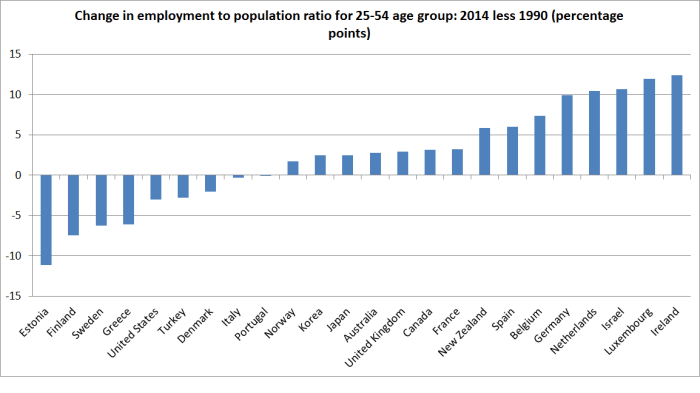
The OECD only has detailed annual labour market data to 2014.    In the US, as Gross illustrates, the employment to population rate in 2014 for the 25 to 54 age group was 3.0 percentage points lower than it had been in 1990.   A handful of countries had done even worse – Estonia, Finland, Greece and Sweden (three of them countries with little or no macro policy flexibility, now inside the euro).  But the median OECD country (for which there was data right through the period) had employment to population rates 2.6 percentage points higher in 2014 –  when most Western economies weren’t exactly buoyant –  than in 1990.  New Zealand did better than the median, being 5.8 percentage points higher than in 1990.

employment to popn change

In fact, in eight of the 34 OECD countries, employment to population ratios for 25 to 54 year olds in 2014 were at the highest levels they had been in the last 25 years.  On the other hand, 14 countries had employment to population ratios for this age group that were more than 3 percentage points below the 25 year peak.  Perhaps unsurprisingly, 12 of them were euro-area countries, plus the United States and Sweden.

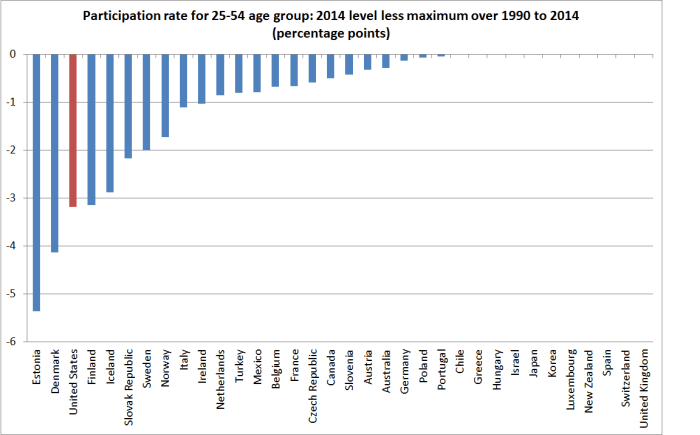
But employment to population ratios are quite substantially affected by the economic cycle.  Participation rates  –  those employed and those actively seeking work – are less severely affected.

participation rate 2104 less post 1990 peak

The participation rates for these prime-age people in 2014 were higher than they had been in 25 years for fully a third of the OECD countries (11 of 34, including New Zealand).  And another 13 countries had participation rates in 2014 within 1 percentage point of the peak (participation rates are somewhat cyclical, and in few countries was 2014 a year of intense cyclical pressure on labour resources).  The US was among a very small handful of countries where the participation rate was still well below the previous peak.

And here is how the US experience compares (and contrasts over the last 15 or more years) with that of the median OECD country, in a chart going back to 1980.

e to popn since 1980

Looking at the participation rate, the contrast is even more striking and appears to have begun earlier.

partic rate since 1980

Quite what is going on in the United States is an interesting question, but it looks to have been quite idiosyncratic.

Perhaps the answer lies in technological developments.  In much of the economy, the US represented the technological frontier for several decades.  But as an explanation it doesn’t really ring true when the US experience is contrasted with that of a bunch of similarly high-productivity (GDP per hour worked) northern European countries.

And perhaps there is a future to worry about in which there won’t be jobs for many of those who want them.  But it does seem to have been a recurrent worry, going back at least as far as the Industrial Revolution, and –  so far at least –  the concern hasn’t come to anything very much for the economy as a whole.  Productivity gains enable society to have more for the same, or fewer, inputs: labour once used to, say, connect telephone calls now does other stuff.  In general, therefore, productivity gains are something to celebrate, and if anything the concern in the last decade or so has been how weak underlying productivity growth appears to have been.

Of course, at least when the public sector is concerned, genuine productivity gains resulting from the application of technology don’t always free up any labour anyway.   My local community newspaper reports this week that the Wellington City Council libraries are introducing a new RFID self-service book-issuing system, which will “be quick and make using the library simpler”.  What’s not to like about that?  Cost savings should  flow from that, I thought, which should be welcomed by the ratepayers.  But no.  Instead:

The council’s community facilities leader, councilor Sarah Free, said the upgrade would offer users the best of modern technology.  … “I’m pleased to say there will be no staff reductions as a result of this upgrade”.

Perhaps there really is a revealed need for additional staff who will “focus on helping people find specialized resources or use library services”.  It feels a bit like gold-plating to me –  a council always keen to spend money, and rarely to save it – but in a sense in just illustrates the way in which the nature of jobs changes as technology advances without –  as yet –  any sign that it leaves large chunks of the population, who want to work, unable to find work.


A belated price for the OCR leak

More than three weeks after the Reserve Bank released the results of its OCR leak inquiry comes news that the Bank has finally taken some specific action against MediaWorks, the media group responsible for the leak.  We learn today –  although not via a open release from the Bank –  that representatives

“from Mediaworks news outlets are excluded from Reserve Bank media conferences until further notice”

In the Reserve Bank’s release on 14 April there was no hint of any specific sanctions for MediaWorks.  Instead, taking the opportunity to tar junior staff (and me), the Governor lauded MediaWorks management, noting that:

Deloitte was assisted in its investigation by Mediaworks’ legal team, who undertook an internal investigation, uncovered emails that confirmed the leak, and reported these to Deloitte.

The leak prompted the Reserve Bank (quite appropriately) to discontinue lock-ups for media and market analysts, but to the extent that was a penalty it was one imposed on all those who had previously participated (and was, perhaps, a greater burden on some of the more specialist entities).

Unfortunately for the Reserve Bank, it quickly became clear, upon reading the Deloitte report, that MediaWorks management must in fact not have been terribly helpful, at least until very late in the piece.

It is possible that MediaWorks senior management, including the former chief executive Mark Weldon, was not aware there was even an issue until 21 March.  The leak had occurred on 10 March, and although I drew attention to it that day (both directly to the Bank and, later, on a post here), it only got attention and coverage in the mainstream media on 21 March.    But at that point it got considerable coverage, and there is no way the senior management of a major media organization, with their own corporate Group Head of Communications, could not have been aware there had been a leak.  At that point, it would presumably have taken no more than an hour to have had the internal IT people check the emails of the MediaWorks staff in the lockup (even if they had no knowledge or suspicion of their own organization’s involvement, just to be on the safe side). That would have confirmed that MediaWorks was the organization responsible.

At that point, as the Deloitte team was (by their own account) only just turning their attention to media outlets as the possible source of the (then) possible leak, MediaWorks could have come forward and alerted the Reserve Bank to their responsibility.   That would have looked like full and early cooperation.  Even better, they could have pro-actively told the Bank, and Deloitte, how long this practice, of journalists emailing draft stories back to the office from the lock-up, had been going on.  There is no suggestion in the Deloitte report that what happened was just an accident (someone hit the wrong key on their laptop).

In fact, the Deloitte report makes it clear that MediaWorks did not approach either them or the Reserve Bank until 5 April, more than two weeks later, and then only when the Deloitte team sought meetings with each media person who had been in the lock-up.  At that point, presumably, the staff concerned and their managers left senior management with little option.

It isn’t really that clear why the Reserve Bank gave so much cover to MediaWorks in their 14 April statement.  A simple statement that MediaWorks had not approached the Reserve Bank until more than three weeks after the leak had occurred would have been considerably more appropriate than the positive statement on the role of the MediaWorks legal team. They were, no doubt, working largely to protect the interests of their own organization –  an organization which has been notably unforthcoming in answering questions about just really went on, who had sanctioned these breaches of the lock-up rules etc.

I suspect the answer to my question has something to do with the Reserve Bank’s desire to play down the whole episode.  Their systems were shown to have been very weak, and totally reliant on trust. It took no sophisticated signaling techniques for this leak to occur –  just clicking Send on an email.    Systems that might have reasonably robust 20 years ago –  when lock-ups were more useful, because ordinary readers couldn’t simply download the MPS at 9am and read for themselves what the Bank had to say –  simply hadn’t kept up.  The Bank has accepted no responsibility for that, or released any internal reviews it has undertaken as to how such vulnerabilities were allowed to arise.

But the inquiry also raised some questions about just how seriously the Reserve Bank itself had taken the issue in the first place.  Had they really taken seriously the possibility of a leak they could have taken action on 10 March.  I had suggested to them that morning that they focus on media outlets.  It wouldn’t have taken much effort for the Bank – Governor and Deputy Governors – to have rung the heads of each media organization in the lock-up  (I’m not sure how many that would be, but I’m assuming no more than 20) and asked them to (a) check emails of all of their staff who had been in the lock-up, and (b) arrange for signed statements to be prepared by all those in the lock-up swearing that they had not been responsible.  Had there in fact not been a leak (and the Reserve Bank couldn’t be sure then) it wouldn’t have cost much.  As it was, it surely would have identified the culprits within hours.    Instead, we learn that the Deloitte inquiry did not focus on media until after they met me on 18 March –  more than a week later –  and as late as 21 March the Bank was on record as talking only of “allegations” of a leak.

To be frank, given the Bank’s general attitude to me, and their unease about the issues I have been raising, and the questions I’ve been posing, I can understand why they might have been a little wary.  But the fact remains that, for all the Governor’s huffing and puffing about whether I told them what I knew at 8:30 or 9:08, they don’t seem to have done much with the information for several days at least.  And when they finally did discover the truth they appear to have been at pains to help protect MediaWorks’ corporate image.   There are still unanswered questions about whether MediaWorks was shown the draft Deloittle report, and whether it was given the chance to comment on the Reserve Bank’s press release in draft.

But this all brings us back to the question as to what has changed now (other than the CEO of MediaWorks).  Banning MediaWorks from Reserve Bank media conferences for a time seems like a reasonable sanction, but why wasn’t it done three weeks ago?  Since the Governor never acknowledges mistakes, and rarely makes himself available for interviews, perhaps we’ll never know. Then again, perhaps someone will ask at the FSR press conference next week.  They might also ask what “until further notice” means.  What are the conditions that MediaWorks has to meet?  Such an indefinite suspension seems unwise, and could give rise to speculation that the suspension might be lifted if MediaWorks outlets were seen to be covering the Bank in a not-unfavourable light.  Better, probably, to have banned them for three or six months, and then put the matter behind them.  And if the conditions for lifting the suspension don’t relate to the tone of the coverage of the Reserve Bank, do they relate to getting fuller and more complete answers from the new management about just what had been going on?  That might not be an unreasonable stance to have taken, but the Bank should be upfront about it.  As it is, we were left with the impression on 14 April that the matter was over as far as the Bank was concerned.

There is still a series of questions outstanding for both the Reserve Bank and MediaWorks.  Those for the Reserve Bank concern me most, because the Bank is a powerful public sector organization, which really should be much more upfront with the public when things go wrong (as inevitably occasionally they will).  I hope that some light will be shed on some of those questions when a series of Official Information Act and Privacy Act requests I have lodged with the Bank (and its Board) are answered.  Those answers are due in a couple of weeks, and I suspect that the Reserve Bank will delay responding just as long as it possibly can.

UPDATE: The question of why the Reserve Bank provided such cover to MediaWorks is deepened if this piece by John Drinnan is accurate.

The report talks about workers, but I understand senior news staff received the leak. I spoke to a Bank spokesman at the time the Bank stopped lockups, and it was unhappy about the way it was dealt with.

If the Bank was really unhappy, why imply otherwise, commending the assistance of MediaWorks?


“Quality problems”

Sometimes I find the Prime Minister’s claims about the New Zealand economy, and Auckland, almost breathtaking.  There is an insouciance about them that almost defies belief. They certainly defy data.

In a speech to an Auckland business audience yesterday –  there is a report here, and also video footage –  the Prime Minister repeated his breezy claims that Auckland’s “challenges” around housing and transport are “a quality problem”, and a “sign of success”, and that both the city and the country are doing “incredibly well”.

Perhaps that is how it appears when you are already wealthy, live in a large house in a prime inner suburb, and have a taxpayer-provided chauffeur at your constant disposal.  Neither housing nor traffic problems must impinge terribly much.

I’ve commented on a lot of the detailed issues previously, including the Prime Minister’s apparent vision of New Zealand as a Switzerland of the South Pacific, and am not going to go through all the detail again here.

But let’s just repeat some of it in summary:

  • Auckland has some of the highest house price to income ratios anywhere in the advanced world.  And we know that there are plenty of larger fast-growing cities in the United States where prices and price to income ratios are much lower.  Auckland prices –  and actually those in much of the rest of the country –  are a sign of policy failure, not a sign of success.
  • Despite extremely rapid population growth  –  relative to the rest of the country, and by the standards of largest cities in OECD economies –  Auckland’s economy seems to have been persistently underperforming.  The sheer size of the economy keeps growing, but per capita income growth has lagged behind.   Using SNZ regional nominal GDP data, Auckland average incomes were 12 per cent above those in the rest of New Zealand in 2015, but they had been 24 per cent higher in 2000. A curious definition of success.  We don’t have regional real GDP data, but the ANZ’s regional trends indicators (which try to proxy regional real GDP growth) suggest much the same sort of underperformance, dating back even further than 2000.  Per capita income growth supports living standards and consumption growth prospects.  Auckland’s economy has been seriously underperforming on that count, despite all the rhetoric about the importance of agglomeration gains in our one moderately-large city.

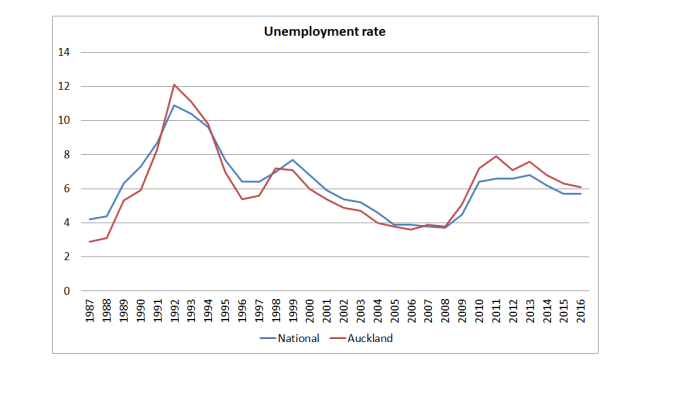
As it happens, for most of the last decade even the unemployment rate in Auckland has been consistently higher than that in the rest of the country, even though Auckland has a much deeper labour market and one might have supposed that matching labour demand and supply in a changing economy would be that much more frictionless there than in other regions.

auckland UAnd it isn’t just that Christchurch has had a very low unemployment rate through the repair and rebuild period.  Graphing the Auckland unemployment rate against that of the median region produces much the same picture.

The Prime Minister goes on

“You’ve got net migration not just strong from India, China and Australia but actually net migration from around the country,” Key said.

Well, sort of.    Actually, in the last year around a net 3500 New Zealanders left for Australia, and a slightly smaller (net) number of Australians arrived.  Net inward migration is not a trans-Tasman phenomenon at present –  except, of course, in the sense that a more usual state of affairs has been a large net outflow.

In fact, our net inward migration results almost entirely from the government’s immigration policy choices.

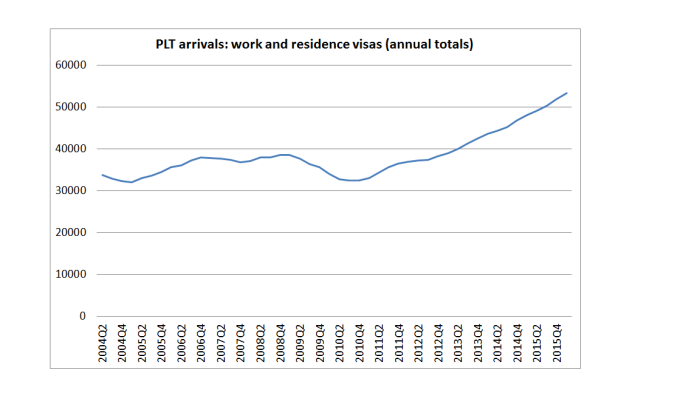
I hadn’t really appreciated the extent of the increase in the number of people arriving on work and residence visas (ie every single one needing explicit government approval) in the last couple of year.

plt arrivals work and residenceAnd the massive increase in student visa numbers (mostly to second tier non-university entities), many of whom later acquire residence, is on top of that.

All of which might be a cause to celebrate if there were any sign that these massive migration inflows –  probably the second strongest wave of immigration in the last 100 years – was doing any good in lifting the incomes or living standards of New Zealanders (and particularly Auckland, where the largest proportion of migrants end up).

But there seems to be no evidence of that at all. Certainly government agencies haven’t been willing or able to produce any.  If anything, there is reason to worry that the policy-driven influx of people is undermining income prospects of New Zealanders.

And what about the claim that people are coming to Auckland (“net migration”) from the rest of the country?  That really caught my eye when I saw it yesterday. Perhaps the Prime Minister has access to some data not generally available, but it isn’t the story in the official data, and hasn’t been for sometime now.

In our quinquennial censuses Statistics New Zealand asks where people were living five years previously, which enables them to produce data on internal migration.  As censuses have long been done at five yearly intervals, that generally provides a comprehensive estimate (and I stress “estimate” because not everyone who fills in the census seems clear on where they lived five years previously).  Because of the Christchurch earthquakes, the scheduled 2011 census was postponed to 2013.  The results of that census give us a picture of internal regional migration from 2008 to 2013.

internal migration 08 to 13Net, a small number of New Zealanders left Auckland for other parts of the country.  Relative to Auckland’s population, the estimated outflow is tiny, but there is just no sign of New Zealanders flocking to the “success” of Auckland (and note that this period includes the outflow of people from Christchurch in couple of years after the earthquakes). Perhaps things have been different in the last three years, for which we don’t yet have data.

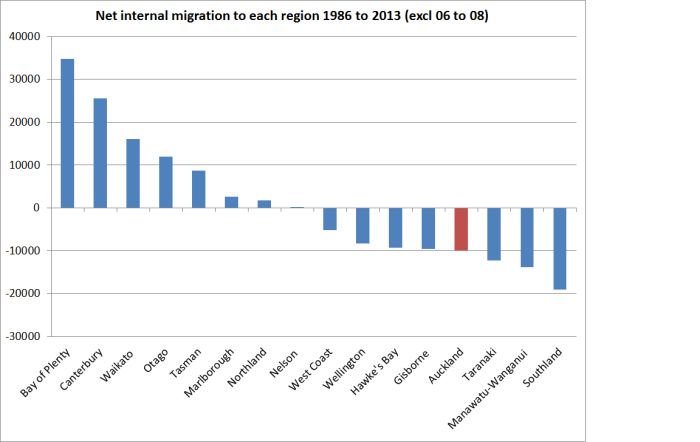
But if so, it would be quite a reversal. SNZ has compiled this data back  as far as the 1986 to 1991 five-yearly period.  The last five yearly period in which Auckland experienced a net inflow of people from elsewhere in the country was from 1991 to 1996.

Here is chart which covers the estimated net internal migration to each region for the period 1986 to 2013 (with the two years 2006 to 2008 missing, because they weren’t captured by any of the censuses).

internal migration 86 to 13.png

Internal migration has certainly happened on a significant scale (gross and net).  But, net, it hasn’t been to Auckland.

Add in the huge outflow of New Zealanders to other countries (mostly Australia) over that period, and it looks a lot like New Zealanders avoiding Auckland.  And that shouldn’t really be surprising: despite its really pleasant physical location, housing has become increasingly unaffordable and income growth has lagged behind.    Other places do worse (as a share of population), but Auckland was supposed to the beacon of opportunity and our future economic prosperity.

Of course, one can always attract foreigners from poorer countries,  and that is what successive governments have done (especially, in effect, in Auckland).  But that isn’t a sign of economic success.  It is, instead, an economic (and social) strategy (“critical economic lever” is MBIE’s term), and one which increasingly looks to have failed –  at least if the benchmark is, at it should be, benefits to the living standards and incomes of New Zealanders.

As for the Prime Minister’s final claim, that the New Zealand economy is doing “incredibly well”, words almost fail me.  At a cyclical level, our unemployment rate at 5.7 per cent is still uncomfortably high (and much higher than it was when the government took office, and currently the same as Australia’s when we’ve typically managed better unemployment outcomes).  Productivity growth –  whether labour or MFP – remains mediocre at best, and there is no sign whatever that New Zealand is making up any of the ground lost relative to other OECD countries in the last 50 years or more.

Most people in New Zealand who want to work have jobs, and material living standards for most are still quite comfortable.  But it is the continuation of a long slow relative decline.  And nothing the current government –  or its predecessor –  has done has done anything to begin to reverse that decline.  The big-Auckland “strategy” does increasingly look to have been something really quite bad, worsening living standards for Aucklanders (especially in conjunction with the “rigged” dysfunctional land supply market), and dragging down prospects for the rest of New Zealand.

As I said at the start, the insouciance in the face of all this underperformance almost defies belief.  But what matters much more is that it simply defies the data.


Does voter turnout explain dysfunctional housing supply markets?

I learned something from listening yesterday to Radio New Zealand’s 4-5pm show “The Panel”.  Bernard Hickey was one of the panellists and he was waxing eloquent about the apartment building boom apparently underway in Melbourne.  I’ve long known that Australia was one of the handful of countries in which voting is compulsory in federal elections (in company, apparently, with North Korea, Ecuador and so on, as well as a handful of more respectable stable democracies).

What I hadn’t known, and which Bernard highlighted, is that voting is also compulsory in Australian state and local authority elections.  In fact, it isn’t a universal requirement for local elections, but voting certainly is compulsory in local council/mayoral elections in New South Wales, Victoria,  and Queensland, the three most populous states, with the three largest cities.   Compulsory voting – at least in Australia, North Korea may be different –  doesn’t produce anything like a 100 per cent voter turnout.  But turnout in Australia is far higher than in New Zealand, where voting is voluntary.  At our last local authority elections in 2013, even with postal voting, turnout was only 39 per cent.

This all got me thinking about one explanation sometimes offered for the dysfunctional (“rigged”) housing supply market.  Why, people sometimes wonder, do the existing land use rules persist, even though they seem to put the hurdles in face of starting out as a home owner ever higher?  Our Productivity Commission weighed in on that topic in their land supply report released late last year  The Productivity Commission’s report was very sympathetic to local authorities.  As I noted at the time:

The Commission shows no signs of unease with the concept of urban planning, and indeed seems to treat as wholly legitimate the choices of local councils to pursue particular visions of urban form (especially compact ones). It is simply those pesky voters who stand in the way of councils realising their visions.

The Commission took the view that turnout in local authority elections was one of the problems.  They noted that older age groups were more likely to already own existing houses, and were also more likely to vote in local authority elections.

The significantly higher voter participation of older groups in local government elections, and the markedly higher home ownership rates among older New Zealanders, means that homeowners are likely to be the dominant voters in local government elections.

And

The dominance of homeowners in local government political processes could help to explain a number of the characteristics of land use regulation and the provision of infrastructure discussed in subsequent chapters of this report.

And

Local politicians will find it particularly difficult to resist the preferences of existing homeowners where those owners organise into residents’ associations, where ward voting makes councillors responsive to particular communities, or where community/local boards are formally established to act as a voice for an area.

Before concluding with an official Finding (F3.17 on page 60)

Groups that have high home ownership rates have higher rates of participation in local government elections. The influence of homeowners in local government elections and consultation processes promotes local regulatory and investment decisions that have the effect of reducing land supply for housing.

The young, the renters, the new arrivals disproportionately choose not to vote, and so they get done over in the political process.  House prices stay high as a result.

I’ve never found the story particularly persuasive.  It might be an element in a story for why existing home owners can often limit more intensification in their own neighbourhoods.  But private covenants  –  now pretty pervasive, as the Commission recognises – represents voluntary market instruments to achieve much the same sort of protections for new developments.  But existing home-owners have no strong or permanent interest in preventing the physical expansion of their city, provided that the costs of expansion are appropriately allocated.   And homeowners have children and grandchildren – who will want to buy homes in time – and we might reasonably suppose that they care at least as much about the interests of those generations as local councilors and council bureaucrats do.

I didn’t find it a persuasive story –  although it was a convenient story for council staff and Wellington bureaucrats to tell each other.  It can be hard to find  good voters to back bureaucrats’ preferences….

But the compulsory voting arrangements in Australia provide us with a bit of a natural experiment.  Voting in Australia has been compulsory for a long time, and it has always been voluntary here. I think it is safe to treat those arrangements as prior to the expansion of urban land use restrictions.

If the Productivity Commission’s story was correct –  as any material part of the story – we should be able to look across housing markets in Australia and New Zealand, and see what difference compulsory voting and voter turnout in local elections makes.   Price to income ratios should be lower in Australia than in New Zealand, and lower in compulsory voting states of Australia than in the other states.

The Demographia report is the best collection of price to income ratios.  Here are the New Zealand cites/regions they report data for, from late last year.

Median House Price/Median Household Income
Auckland 9.7
Christchurch 6.1
Dunedin 5.2
Hamilton 5.1
Palmerston North/Manawatu 4.1
Napier-Hastings 5.0
Tauranga 8.1
Wellington 5.2
Median of these markets 5.2

There are a lot more cities in Australia (Demographia capture all those with populations above about 100000 –  details are here).  Here are capital city multiples, and the median market multiple for all the Australian cities.

Median House Price/Median Household Income
Sydney 12.2
Melbourne 9.7
Brisbane 6.1
Adelaide 6.4
Perth 6.6
Hobart 5.6
Darwin 6.0
Canberra 5.9
Median of ALL Australian markets 5.6

Looking across the New Zealand and Australian cities, there doesn’t seem much prima facie evidence to support the Productivity Commission voter story.   These are snapshot numbers, and the picture might look a little different if one compared markets in a different year.  And there is always other stuff going on in each market –  rating schemes, land taxes, stamp duties, foreign investor restrictions, capital gains taxes, marginal income tax rates and so on –  but there doesn’t seem to be much support for the “middle aged and elderly capture the electoral process and skew housing markets to their own advantage” hypothesis.  In fact, I noticed that in Victoria, voting is compulsory only until age 70 – a concession, apparently, with the effect of (modestly) favouring the interests of the relatively younger groups.

One could generalize the point.  Voting isn’t compulsory in UK national or local body elections and their housing supply markets seem just as dysfunctional.  Voting also isn’t compulsory in the United States, and yet we see hugely different housing supply markets (and housing affordability outcomes) in different growing cities, largely reflecting differences in land use restrictions.  Atlanta is one of the success stories.  When I checked, I found that voting was once compulsory in Georgia –  but it ceased being so in 1787.  It doubt that is making much difference today.

All regulatory provisions are endogenous –  they arise out of political and bureaucratic processes in a variety of often complex and not particularly transparent ways.  In democratic societies, the public can –  ultimately – defeat any law or regulation, if enough of them care enough.  But the Australian experience suggests it is a much more complex story than one which casts local government (and even more central government) as the “good guys”, looking out for the interests of the marginalized, while the middle aged and elderly who choose to turn out to vote, rig the system in their favour.   I’d be putting much more weight on the ideologies and values of councils and their staff, and the entire ‘planning’ industry, (reinforced or enabled by central government officials and ministers).  Make an issue complex enough and sufficiently non-transparent, and it can take a long time for enough people to really realise what has been going on.  And by then the mess can certainly be very –  politically –  difficult to undo.


Appointing a central bank Governor

I commented yesterday on the unusually powerful role the Reserve Bank of New Zealand’s Board plays in determining who will be appointed as the Governor.  The Minister finally makes the appointment, but he can only appoint someone the Board recommends.   And the influence  of Board members is multiplied because the Governor of the Reserve Bank of New Zealand exercises an unusually large degree of power.

In New Zealand, the Governor is single (legal) decision-maker (and recently provided a written reaffirmation of that position as practice as well as law). And the Bank exercises power not just over monetary policy, but over a raft of regulatory policy matters (as well as the administration of supervision) in respect of banks, non-banks, and insurance companies, and a variety of other generally less contentious discretionary functions (notes and coins, foreign exchange intervention, payments system, and the operations of the key securities settlement system).  And in many areas the Reserve Bank’s legislation is quite permissive, leaving considerable policy discretion to the person who happens to be Governor (LVR limits –  whether or not to have them, and how they should be used –  is one recent example).  Even in respect of monetary policy, as have seen in the last few years, the Policy Targets Agreement (inevitably and probably sensibly) leaves plenty of room for interpretation.

So who gets appointed to the position matters a lot.  That person, while no doubt in receipt of lots of advice, will have considerable discretionary influence in many areas.   They aren’t just technocratic judgements either.  Reasonable people will have quite different views on appropriate policy in a lot of these areas, partly reflecting differences in what weights they put on different considerations and values (fluctuation in unemployment vs swings in house prices, say).     And they are typically areas in which there are either no rights of appeal, or where the courts have been very reluctant to second-guess decisions of executive officials.  Unlike, say, the Minister of Finance, the Governor does not typically require new legislation or parliamentary approvals (Budgets mean nothing without securing supply in Parliament, and public money can’t be spent without parliamentary appropriations), and doesn’t even have to front up to question time in Parliament each day.   In formal legal terms, the Governor is not even subject to parliamentary control on the level, let alone the composition, of the Bank’s expenditure.

So the ability to determine who gets this role is extraordinarily influential.    But this power rests not with the Prime Minister, not with the Minister of Finance, not with the Governor-General, but with half a dozen low profile individuals, themselves appointed by the Minister of Finance but for five year terms (in a system with three year parliamentary terms).  These people operate in secret –   past Annual Reports have been bland exercises in supporting whoever the incumbent Governor is –  and face no parliamentary scrutiny either when they are appointed or, generally, at any time during their term.

Who are these people?

The current non-executive directors (plus the Governor who is also a director) are:

Rod Carr

Bridget Coates

Neil Quigley

Jonathan Ross

Tania Simpson

Keith Taylor

Kerrin Vautier

Mostly company directors, a couple of former senior finance sector executives, a couple of (mostly micro) economists, a couple of university administrators, and a lawyer.  I’m sure they are all fairly able people in their own fields, but why would we delegate to those people in particular the ability to determine who will exercise that huge discretionary power the Governor has.  I’m not aware that any of them has ever stood for, or been elected to, public office, and we know little of their preferences or views on the sorts of issue whoever is Governor will get to decide.  But those preferences (explicit or not) will almost certainly influence the sort of person they put forward.  When I worked at Treasury I helped provide advice to the Minister on possible Board candidates –  including some of those now on the Board –  but we never looked into the questions of Board members’ policy preferences.  The focus was typically on a range of experiences and skills to help do the ongoing monitoring role.  But in fact the power to determine who (and what sort of person) is appointed Governor is probably where the Board members have most influence, and the least scrutiny.

I’m not suggesting that they exercise that power carelessly.  Or that they are necessarily blind to the political environment.  Since the current Act was put in place, the Board has chosen two Governors (Don Brash was already in place when the Act was passed, and reappointments are a somewhat different matter).

There was quite a strong sense of political involvement in the process after Don Brash left in 2002. The then Prime Minister was furious with the Board for having allowed the Governor to be employed on conditions that allowed him to go straight from running the central bank one day to active party politics the next.  And word was also understood to have come down that the government would not be receptive to the nomination of a “Brash clone”, widely regarded as anyone who had been in senior management under Don Brash.   But my sense (I was second tier manager at the time) was that the Board played the process fairly straight.  They employed an executive search firm –  but I’m not sure how much effort the recruiters would have put into understanding the policy preferences and inclinations of candidates.  I understand that at the final interview stage it was a choice between Rod Carr (Deputy  –  and then acting –  Governor), Murray Sherwin, Deputy Governor until quite recently, and Alan Bollard.  People can debate whether Alan was really the best pick but all three were serious credible candidates.

In 2012, again an executive search firm was used.  I understand that the choice quickly resolved to one between the longstanding incumbent Deputy Governor, Grant Spencer, and Graeme Wheeler, with the suggestion that Board members were quickly wowed by Wheeler’s experience in international bureaucracies, and the big name referees he cited.  Again, on paper both candidates looked quite impressive, but I wonder how much effort the Board put into understanding and assessing the candidates’ policy preferences and inclinations.  And, of course, even if they had made time to, what qualified the Board members to assess those –  innately “political” – preferences and determine which set was, in some sense, “best”?  That, surely, is what we have politicians to do.

If the Board doesn’t do it, and the Minister can at no point impose his own candidate, then what we end up with is either a candidate who accords with the implicit (often unstated and perhaps unrecognized) biases, preferences, and interests of Board members, or something more random.  A person might be chosen because they are thought to be, say, a good manager, and/or, have some familiarity with macroeconomics and finances.  But what they might do with the considerable powers they are to be given is simply unknown –  even to the Board.  That simply isn’t good public policy governance.

I’m also not suggesting that if in 2002 and 2012 the appointment of the Governor had been solely in the hands of the Minister of Finance we would necessarily have had different people appointed.  Bollard and Wheeler both looked like establishment candidates when they were appointed,  As I noted, the Labour government in 2002 was pretty clear it didn’t want Brash people, and Alan Bollard’s give-growth-a-chance mentality (in contrast to perceptions of “crush growth Brash”), if it had ever been enunciated, would probably have resonated with Michael Cullen and Helen Clark.  And Bill English was known to have been keen to find a place back in New Zealand for Graeme Wheeler.  But those decisions really should have been in the hands of somone the voters could toss out, not a bunch of fairly anonymous Board appointees, who often enough will have been appointed by the previous government.

I can think of no other powerful independent office holders which are appointed, in effect, by unelected unscrutinised people.  The State Services Commissioner appoints head of core government departments, but those department heads typically have little or no policy flexibility –  policy is set by ministers, and departments advise and administer.  The State Services Commissioner himself is, in effect, appointed by the Prime Minister, as is the Police Commissioner. Judges are appointed by the Governor General, on  the recommendation of the Attorney General. The Chief Electoral Officer is appointed by the Governor General on the recommendation of Parliament, as is the Ombudsman. The Governor General is appointed on the advice of the Prime Minister.   And all boards of decision-making Crown entities (eg FMA, NZQA, TEC, EQC) are appointed by ministers (those Boards in turn employ chief executives, but the power rests with the Board, not with the CE.)

There is simply nothing comparable in New Zealand to the situation of the Reserve Bank in  (a) the extent of policy discretion held by an unelected official, and (b) the extent to which other unelected officials control the appointment of the person (the Governor) exercising that discretion.   It is a reach too far –  too much distance between those we elect, and the person exercising the (considerable) discretionary powers.  Perhaps it might matter a little less if these were decision-making committees being appointed (as is typical with central bank), but in this case it is one man –  and any one person while have his or her own biases, preferences, idiosyncrasies and flaw.

What happens abroad?  Well, typically the head of the central bank is appointed directly by politicians, most commonly the Minister of Finance or President. With a bit of help, I found a handful of countries where the appointment is subject to parliamentary ratification (the US is the most obvious example, but it is also the case in Japan, and in several emerging economies).  The Reserve Bank had an article not long ago on some of these issues, including a useful table on appointment arrangements etc ( I had editorial responsibility for the article, but have just noticed an error, in that the Japanese requirement for parliamentary ratification was somehow overlooked).

But what about cases at the other end of the spectrum?

In Sweden, the Governor (and other monetary policy decision-makers) are appointed by the General Council.  That might sound a bit like our Board, but it isn’t.  It is a parliamentary committee, appointed by MPs from their number, after each election, in proportion to the various parties’ representation in Parliament.  The Minister of Finance doesn’t get to appoint the decision-makers, but elected politicians certainly do.   (Note in Sweden the central bank has much less discretionary power than our Reserve Bank has, as it is ot responsible for banking regulation and supervision).

The closest parallel to the New Zealand arrangement is Canada.  The Bank of Canada also has, in law, a single decision-maker, the only other advanced country central bank to have such a model.  The Governor is appointed by the Board, with the consent of the Minister (in substance the same approach as in New Zealand). One difference from the New Zealand system is that members of the Board in Canada are appointed for three year terms (rather than five years in New Zealand) in a parliamentary system in which elections typically occur every four years (rather than three years in New Zealand).  It is also worth noting that in Canada the Secretary to the Treasury sits as a non-voting member of the Board, and that the Bank of Canada also has little or no responsibility for supervisory/regulatory matters.

My point is not that there are no parallels with the New Zealand model –  Canada, with quite old legislation and a much narrower range of responsibilities, is strikingly similar,  But our model remains quite unusual, and seems to leave a rather large democratic legitimacy gap: there is much more effective discretion for central bankers than was realized when the law was passed in 1989, few other central bank decisionmakers are appointed this way, and there is nothing remotely comparable in how we appoint key decisionmakers is other areas of the New Zealand government and public sector.

I suggested yesterday that at very least the Reserve Bank Act should be amended to provide simply for the Governor to be appointed by the Minister, taking advice and nominations from anyone the Minister chooses.  I also suggested the idea of parliamentary select committees hearing before any new Governor takes office, along the lines of the model now quite successfully used in the United Kingdom.  We don’t have a constitutional system of parliamentary ratification of appointments, or indeed for Parliament to be directly involved in making appointments (with the except of the important deliberately non-partisan positions such as the Ombudsman or the Chief Electoral Officer).  Perhaps one could argue that the Governor has so much power an exception should be made for his position, but I wouldn’t go that far.

As I noted yesterday, our FEC is less likely to do the scrutiny job well than, say, the House of Commons Treasury select committee does.  Able government members very quickly become ministers, and the ones who aren’t yet want to be soon.  Rocking the boat by openly asking hard questions of a ministerial appointee-designate probably isn’t particularly rewarded.  And, unlike the UK, we don’t have much a hinterland of able former ministers from the governing party who stay on in Parliament, and are often willing  –  and better positioned – to pose those sorts of questions.   Our select committees also simply aren’t well-resourced.  But FEC hearings would be better than the situation we have at present, and not being tied to actual MPS or FSR announcements (which are what Governors mostly front up to FEC for), the process might encourage more serious questioning.

(A reader got in touch to suggest something beyond FEC hearings: perhaps a debate in Parliament itself on the appointment, with the whips off.  That just seems too out of step with our system of government for me.  Apart from anything else, the policy inclinations and character of a person appointed to have big discretionary influence over monetary and financial policy doesn’t seem like the sort of area one would want to remove party discipline for. A Minister of Finance might reasonably tolerate his MPs grilling a Governor-designate in a select committee, but should be able to expect his party to ultimately support his appointee to such an important position. )

The Governor of the central bank is a position unlike the Ombudsman, the Chief Electoral Officer, or the Auditor General.  Those positions really need to be non-partisan in nature, since they are focused on the process of our democracy.   The Governor, by contrast, exercises considerably discretionary power, and it is the nature of things that there will be differences, often along partisan lines, in how the Governor should exercise that power.  There is a case for some specific policy decisions of the Governor to be at arms-length from the government of the day, but there is strong public interest in understanding the inclinations and preferences of the person appointed to the role.  Hard questioning of anyone appointed to a position wielding considerable discretionary power is likely to make for a better functioning system of government.  And sheeting home responsibility for those appointments to politicians whom we can turf out, rather than to little known appointees who owe citizens little and over whom we have little leverage, is perhaps even more fundamental.

The system of appointing the Governor really needs to change.


Reforming the Fed…and the RBNZ

I’ve been working on a review of an interesting new book by an American academic, Peter Conti-Brown, with a background in law and financial history, on reforming the governance of the US Federal Reserve System.  The Power and Independence of the Federal Reserve is a funny mix of a book.  At a time, in the years following the 2008/09 financial crisis, when all sorts of people from different parts of the political spectrum have concerns about the Fed –  be it concerns about the influence of bankers, unease about the quasi-fiscal choices the “technocratic” central bank has been making, pushes to “audit the Fed” and so on –  the author sets out to aim for a pretty broad audience.  It isn’t just an academic tract –  he clearly hopes to be read by think-tankers, Congressional staffers and intelligent voters who perhaps have a vague sense that “something is wrong”.   It is difficult to imagine an equivalent book in New Zealand selling more than 100 copies.  There are some advantages to size.

There is the odd amusing story to spice up the text.  Picture the early Board members of the Fed worrying about where they would rank in the official US order of protocol.  Unimpressed at the State Department’s ruling that they would “sit in line with the other independent commissions in chronological order of their legislative creation” they escalated the matter all the way to Woodrow Wilson.  The President, clearly unimpressed with the pretensions of the Board members, told his Treasury Secretary “well, they might come right after the fire department”.   The State Department ruling stood –  in order of precedence, Fed Board members ranked behind the board of the Smithsonian.

One of Conti-Brown’s key themes is that if laws matter, and of course they do, individuals and the intellectual climate of the times matters more.  He devotes quite a lot of space to illustrating how, with largely unchanged legislation, the conception of the Fed, and the relationship between it and politicians (especially Presidents), has changed markedly over the decades.  (A somewhat similar story might be told about the Reserve Bank of Australia, over its rather shorter history.)  Marriner Eccles –  chair of the Fed under Franklin Roosevelt –  saw the role of the Fed as being to work hand in glove with the Administration.  The modern conception of an operationally independent central bank is very different –  perhaps especially in the US where the Administration has no role in setting policy targets (unlike, say, the UK or New Zealand).

Of course, the notion that individuals matter shouldn’t really be a stunning insight.  But much of the modern notion of an operationally independent central bank rests of the implicit view that there are technocratic answers to the problems we delegate to central bankers.  If so, then it really shouldn’t matter much which technocrat holds the key job(s) at the central bank.  That view was near-explicit in the way the New Zealand framework was set up: set the goal clearly enough, and make the Governor dismissable if he fails, and pretty much anyone will do.

Life –  macroeconomics, and financial regulation –  isn’t like that. Central bankers and financial regulators make choices, especially (but not only) in crises and, whatever the relevant legislation says, the values, ideologies and experiences of those who hold decision-making powers will matter, at times quite a lot.

And so much of Conti-Brown’s book is, in effect, around appointment and dismissal procedures for key positions in the Fed.  He is particularly exercised about the positions of the heads of the regional Feds, and indeed of the regional Federal Reserve Banks themselves (“we get a sense [from past Congressional testimony] that nobody knew exactly how to define these strange quasi-private quasi-public structures”).

The US Constitution itself has an appointments clause.  “Officers of the United States” can only be appointed by the President with the “advice and consent” of the Senate.    There is an exception for “inferior officers”, for whom Congress may specify that the President alone or the head of an agency (him or herself a principal officer, appointed by the President with Senate advice and consent) may make the appointment.  Members of the Fed’s Board of Governors are “principal officers” and are subject to Senate confirmation.    The President can also dismiss principal officers, but the courts have also ruled that, for independent agencies such as the Fed, the President cannot dismiss a principal officer at will (eg just for policy differences).

Regional Fed presidents, who exercise what looks like considerable authority as rotating members of the FOMC, are not appointed by the President, do not face Senate scrutiny, and are also not appointed (or dismissable, even for cause) by people who are themselves principal officers.  In Conti-Brown’s words “the Reserve Banks and FOMC, as currently governed, are unconstitutional,  The separation between the US president and the Reserve Bank presidents is simply too great”.

Conti-Brown argues that the role of the regional Presidents, and their relationship with the rest of the system, should be markedly changed.  He proposes putting the Board of Governors clearly in charge, giving them exclusive responsibility for the appointment and dismissal of regional Presidents, and effectively reducing the regional Feds to no more than branch offices.  In his model, the regional Fed Presidents would all be removed from the FOMC, except as (in effect) senior staff observers, so that all monetary policy decisions will have been made only by people selected by the President, and subject to the Senate advice and consent process.

I’m less persuaded by that as a solution.  For a start, from a distance, it looks politically unsaleable.  Even if the locations of the regional Feds reflects the politics and economics of 1913, rather than 2016, those institutions are “facts on the ground” and there would presumably be a great deal of resistance to removing that regional vote, and explicitly undermining the clout and status of the regional institutions.  An alternative model, which he discusses, seems more plausible.  Instead of subordinating regional Fed Presidents to the Board of Governors, why not instead make each regional Fed appointment a presidential appointment, with the full advice and consent process?   It looks like a model that achieves much the same end –  presidential appointment (and dismissability) and Senate scrutiny, without risking undermining the intellectual diversity that strong regional Feds have at times brought to the system. (I was struck a few years ago by the ability of a senior (regional) Fed researcher to publish a scholarly book that was quite critical of the Fed’s handling of monetary policy, including in quite recent years.)

Conti-Brown also proposes changes at the Board of Governors.  He rightly highlights that the legislation vests power in the Board of Governors itself, not in the Chair, and yet –  to a greater or lesser extent –  all modern chairs have been allowed to assume a disproportionate amount of power and influence.  Conti-Brown cites one former senior staffer as saying he would never have wanted to be appointed to the Board, as he would have far power/influence there.  Part of the issue arises because of the repeated reappointments of chairs.  Conti-Brown proposes term limits for the chair (two five year terms, so that there is a serious scrutiny of appointees at least every 10 years), and changes to the Board appointment terms as well.  Personally, I suspect the recent proposal by former senior Fed economist, and now Dartmouth professor, Andrew Levin, for a single non-renewable seven year term for all senior Fed officials (board, chair, regional Presidents) would be a better way to go.

Conti-Brown also argues that key staff at the Board of Governors also have a big influence on policy, and that consideration should be given to making them presidential appointments, so that their values, ideologies, experiences etc can be tested and scrutinized.  He is particularly concerned about the role of Fed’s General Counsel, whose advice has mattered a lot in handling financial crisis and regulatory issues.  Making such positions presidential appointments seems like a step too far.  Of course, advisers should be expected to have some influence.  But the formal powers in the system rest with the Board of Governors (and the FOMC), the people who chose whether or not (and to what extent) to accept the advice offered by even the most senior staff.  Ensure strong public scrutiny of those people for sure.  But not the next tier down.

As so often with American books on public policy issues, it is light on international comparisons.  Appointment and dismissal procedures for central bankers (and financial regulatory bodies) differ widely.  Then again, I’m not aware of any other advanced countries with a system even remotely like that of the United States.  The structure looks out of step with what we expect in public policy agencies today, and parts of it appear to be unconstitutional.

I found the US issues and analysis fascinating.  But that is partly because thinking about the systems used in other countries, especially key ones, can help one think about the model for New Zealand.  We don’t have a written constitution, and we don’t have a federal system.    But we do, I think, expect that delegated powers will be exercised by people appointed by people we elected.  That is typically the case with the numerous Crown agents and entities.  Board members and Board chairs are appointed by the relevant Minister, and key decision-making powers typically rest with the Boards themselves.

That isn’t the case with the Reserve Bank of New Zealand, which exercises a great deal more discretionary policy flexibility (in monetary policy, and in financial regulatory matters) than any other statutory agency I’m aware of in New Zealand.    There are some plausible reasons for putting some of the Reserve Bank’s functions at a considerable arms-length from day-to-day ministerial intervention (one could think of the administration of prudential policy as it applies to individual institutions), but even if one accepted all those arguments, there still don’t look to be good grounds for our governance model.

In the United States, the United Kingdom or Australia, the Governor (or chair) of the central bank is appointed by the government of the day.  In the US case, the Fed chair is subject to Senate advice and consent, but only a presidential nominee can be appointed.  The Senate cannot substitute its own candidate.  In both Australia and the UK, the respective central government has untrammeled ability to appoints its own candidate.  In the euro-system, there is lots of horse-trading and haggling among heads of government and finance ministers, but Draghi was appointed by politicians, from a field identified by politicians and their advisers.

Contrast that with the New Zealand system.  The Minister of Finance appoints the Governor, but he can only appoint a candidate nominated by the Bank’s Board.  The Minister can reject a nomination (as the US Senate can) but at no point in the process can he or she impose their own candidate.  Now, of course, the Board itself is appointed by the Minister, gradually.    Board members are appointed for five year terms, and although there are provisions for the removal of Board members, removal can only be done for cause (oddly, one possible cause is obstructing the Governor, but there is nothing comparable about the Minister). A new government might easily take more than a whole three year term to be able to achieve a majority of its own appointees on the Board.  And the Minister of Finance does not even get to determine which of the Board members serves as chair, typically a quite influential role in any Board.

This was a model that was set up when the conception of the role of the Reserve Bank was (a) quite narrow, and (b) highly technocratic.  If the Minister could specify a PTA clearly enough, who was on the Board or who was Governor wouldn’t matter much at all.  But as everyone now recognizes, PTAs can’t sensibly be written that clearly, and there is nothing comparable for the other functions that the Governor exercises considerable discretion over.  The values, ideologies and experiences of whoever is appointed as Governor are likely to matter considerably –  much more so in New Zealand, since a single individual exercises those powers, with few near-term checks and balances.

So, operating wholly behind closed doors, the members of the Bank’s Board get to determine the person who wields more power, and more discretionary power, than almost any person in New Zealand, at least in matters economic.     The individuals on the Board are probably mostly good and quite capable people (I know several of the current Board moderately well).   But whose values and interests, and what “ideologies” or implicit models, are they serving  or reflecting (consciously or otherwise)?  What accountability is there for the choices they make, which can have material implications for short-term economic performance and for the soundness and efficiency of the financial system?  It seems like a model with all too little democratic legitimacy.

If we are going to stick with the single decision-maker model for the time being (it will, surely, in time be amended) at least we should move back to a more conventional system in which the Minister of Finance (or Governor-General acting on advice) makes the appointment.  He can take advice from whomever he wants –  Treasury, the Bank’s Board, lobby groups, his colleagues –  but his nominee should have to go through proper select committee hearings before taking up the role.  We don’t have a model of parliamentary ratification of appointees in New Zealand, but the British model in which appointees to the Bank of England policy committees face considerable scrutiny in select committee hearings seems to add some value to the process, even though the committee cannot formally stop an appointment going ahead.   It might be harder to do well in New Zealand, since there is less of a hinterland of MPs not eagerly jockeying for the next promotion to the ministry, but it has to be better than what we have now.  At very least, Opposition MPs on the relevant committee could question, scrutinize and challenge the person the government has appointed to the role of Governor.  The current Governor might, for example, have been scrutinized on how he thought about the housing market and the role of policy.

If we going to keep the role of the Reserve Bank Board as being primarily about holding the Governor to account, direct ministerial appointment of the Governor also seems preferable.  Under the current model, the Board is responsible for the person appointed as Governor.  That gives them an interest in judging that person to have done the job well (if the Governor is judged to have failed in that regard, it is at least in part a reflection on the people who chose the Governor).   Monitoring someone clearly appointed by the Minister could be another matter (although structures still create risks that the monitoring Board gets too close to the Governor).

Over the longer-term, I think we need to move to a system in which committees appointed the Minister of Finance (and subject to parliamentary scrutiny before taking up the role) make monetary policy decisions and whatever financial regulatory decisions should appropriately be delegated to the Reserve Bank.

In the meantime, there is the becoming-pressing issue of the expiry of Graeme Wheeler’s term next year.  As I have noted previously, it expires right in the middle of the likely election campaign (almost three years exactly since the last election).  All main Opposition parties are campaigning for a different approach to monetary policy (time will tell what that specifically means).  How can it be appropriate for a Board appointed exclusively by the current government to be recommending an appointee as Governor (who will exercise huge discretionary powers over our economic fortunes and financial system), to a Minister  whose government might be out of office by the time the new appointment takes effect.  A new government might have a quite different emphasis and should, in my view, more easily be able to give effect to that.

I’m not sure what the right answer is, given the current legislation. I’ve previously, somewhat reluctantly, suggested that Graeme Wheeler, if willing, should be offered a one year extension to his term, allowing the longer-term appointment to be made under the new government (National or Labour led).  However, his performance over the OCR leak issue (including , in effect, minimizing the serious misconduct of a major corporate)  makes me wonder whether even for a short period that would be a prudent option.  Appointing an acting Governor –  probably one of the existing deputies –  for perhaps six months, might a better option.  There is statutory provision for it –  it was what happened when Don Brash resigned.

The US model does look as though it needs reforming.  But, perhaps even more pressingly, so does New Zealand’s. It is simply out of step with

  • the range of functions and discretionary activities the Bank now undertakes
  • overseas practice in central banking and financial supervisions
  • governance of other independent Crown entities in New Zealand.

It puts too much power in the hands of one person, and that a person whose appointment is largely determined by unelected people, operating with little or no effective scrutiny.
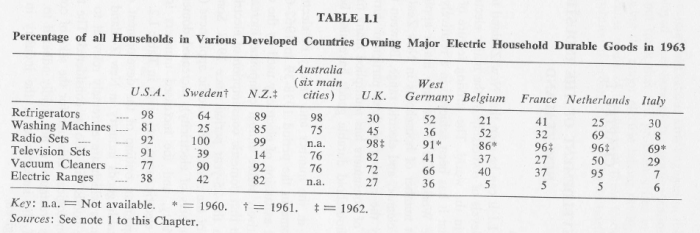
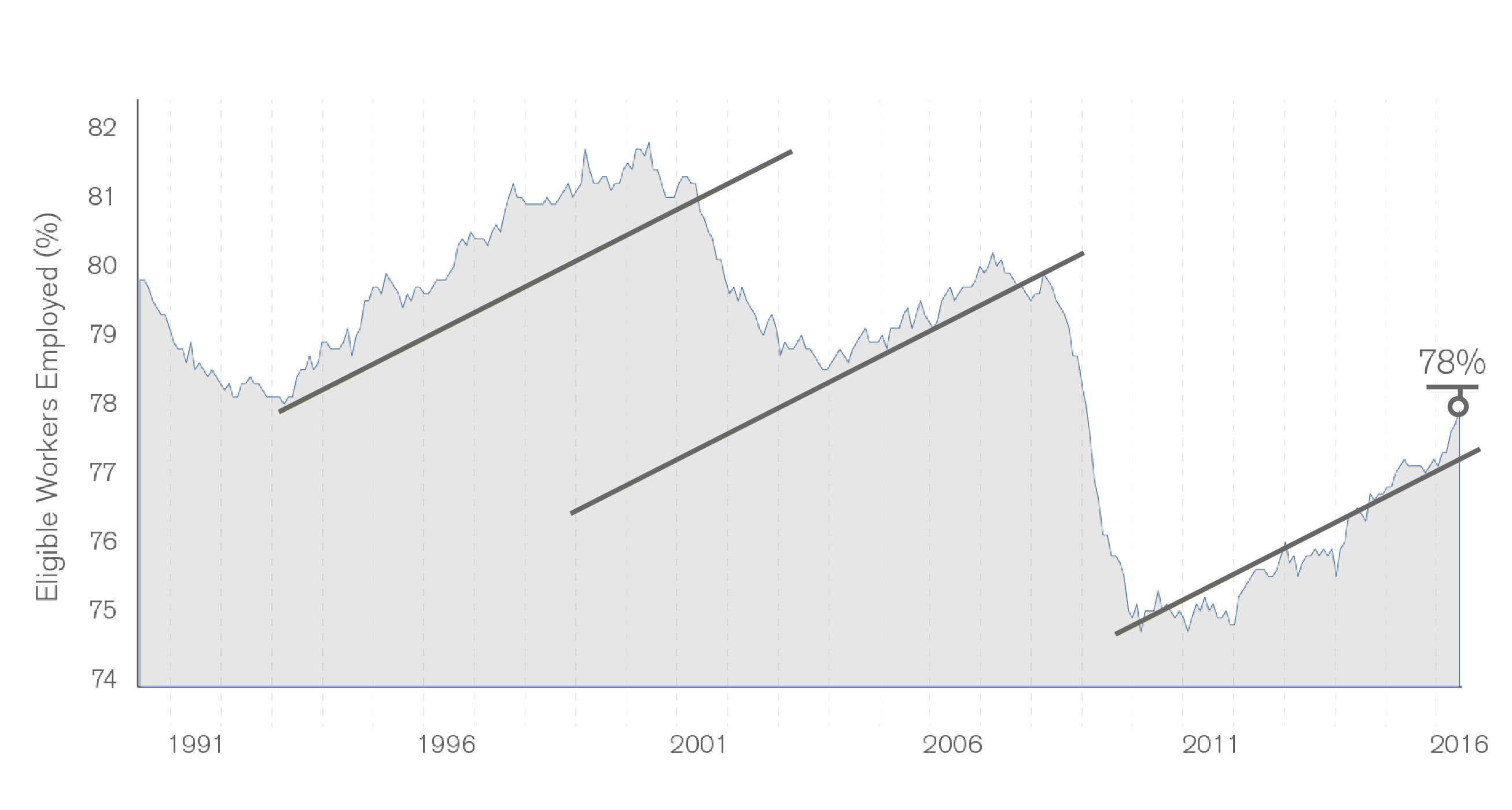
 

Housing, land tax, and associated things

The Prime Minister attracted considerable coverage last week for his suggestion that a tax might be applied non-resident (however defined) holdings of land.  The Prime Minister wasn’t very specific about the options he had in mind, but it probably didn’t matter – it got some mostly favourable coverage on an issue (house prices, in Auckland in particular) where the government probably senses that it might be politically vulnerable.

Quite how house prices play politically has never really been clear to me.  I’ve noted before that I’m not aware of a single example of a city or country that, having once put in place restrictive land use regulation, has ever substantially unwound those controls.  I can well understand existing users’ unease about greater intensification, and in particular the coordination challenges that can arise. Existing owners as a whole in suburb near the central city might be (considerably) better off financially from allowing their land to be used more intensively, but that won’t necessarily be so for each of them if such development occurs piecemeal, or if benefits are captured by those first in the queue.   The market seems to deal with these issues through private ex ante contracts, the covenants that are now used in most new subdivisions (and which the Productivity Commission was quite disapproving in its report last year).

And I can also understand that no one really wants the value of their property to fall much.  Of course, for many it actually doesn’t matter very much.  If you haven’t got a mortgage and plan to live in the same city for the rest of your life, the market price of houses in your area just isn’t (or shouldn’t be) that important to you.  For those with very large recent mortgages it is another matter.  For them, and especially those who aren’t owner-occupiers, falling house prices look like a visceral threat.

But then the mortgage-free are in many cases those with children, already adult or approaching adulthood, who face the huge –  increasingly insurmountable – hurdles to entering the owner-occupation market.  That should be quite some motivation to be concerned about policies which keep house prices very high, or keep driving them up further.  Increasing the physical footprint of cities, and allowing that process to happen in ways and in places that offer the best opportunities (rather than where Council officials and politicians dictate) looks as though it should be the answer.  But bureaucrats and politicians obstruct those processes, and seem to get away with it because the issues are complex, and because they cover their tracks, blaming high house (and urban land) prices on banks, the tax system, the building industry, “speculators”, “land bankers”, becoming a “global city”, or whatever.

Other bureaucrats and politicians peddle the line that high levels of non-citizen permanent immigration are somehow good for us.  High house prices are just one of those things –  a price of progress, indeed of success, so the Prime Minister would often have us believe.

Once in place, distortionary policies, even very costly ones, often last for a long time.  We saw that in New Zealand with the import licensing regime first put in place in the 1930s, which wasn’t finally abolished until 1992.  It was an enormously inefficient system, driving up costs on many items (and restricting choice) for most people, it was contested politically (largely unwound in the early 1950s, and then re-imposed by the next government).   But the entrenched interests of those who benefited from the system (or thought they did) combined with ideologies of “national development” to make it very difficult to undo.  Licence-holders themselves obviously benefited, but many of the employees of firms producing products protected by the licensing regime thought they did too.    And transitions are/were costly – we saw a lot of that in the 1980s, when big steps were finally made in dismantling the regime.  A larger proportion of the population is employed now than was then, but that didn’t mean the transition wasn’t difficult, and even traumatic, for many individuals, and even for whole towns.

One might have hoped that the rigged housing market was different, but it doesn’t seem to be.  The distributional effects (winners and losers) are far larger than any aggregate adverse effects (I’m skeptical that GDP is much smaller than otherwise because the housing market is so badly distorted).  And unfortunately, those most adversely affected tend to be the poorer, younger, less sophisticated elements in society –  those on the peripheries.  One might have hoped that one or other main party would have made grappling with these issues a real priority, consistent with the underlying values they claim to represent:  National perhaps on some ‘property-owning democracy’ line, in which communities will be stronger etc when property ownership is more broadly based, providing a “fair go” to the hardworking and aspiring classes.  Or Labour, built on a fight for the rights and interests of ordinary workers, campaigning for the full inclusion and equal opportunities for peripheral groups.

But it simply doesn’t happen.  Instead, the Prime Minister keeps talking of high house prices as “a good thing”, and a sign of success.  And for all the somewhat encouraging talk from Labour’s Phil Twyford, less than 18 months out from an election, there is little public sense of a party making fixing the housing market a defining issue.  Time will tell.  Rigged markets are hard to unscramble –  politically hard, not technically so.    Doing something far-reaching could be very costly for groups who would quickly become quite vocal, and loss aversion is a powerful force.

Where do land taxes fit within all this?  I outlined some of my skepticism about a general land tax in a post late last year.    But the Prime Minister’s latest comments relate only to non-resident purchasers.  The theoretical arguments for a general land tax don’t apply to one explicitly targeted at a specific subgroup.  Instead a land tax appears to be one of the few possible tools (specific to foreign purchasers) left to the government –  having signed up to a succession of preferential trade (and other) agreements – if, as the Prime Minister put it, it could be shown that non-resident purchasers were a big influence on the housing market.  Of course, we haven’t yet seen the data the government has started collecting, but even when we do there will no doubt be lots of debate about what it means.    Say that it shows that 1 per cent of purchases in the last six months have been from non-resident foreigners.  One per cent doesn’t sound much.  But the significance depends on a various things, including a variety of elasticities.  If the supply of houses and urban land was totally fixed (it isn’t, but this is just an illustrative example), a one per cent boost to demand could have a considerable impact on the price of houses.  If New Zealand residents were deterred from buying by even the slightest increase in price, then an increase in non-resident foreign demand might have very little impact on price even if supply was largely fixed.    Various quantitative researchers will have various estimates of these different elasticities.   But some past work has suggested that a 1 per cent increase in population, say, can have a material impact on house prices.

I had a couple of posts on the non-resident purchases issues last year.  Despite my general stance strongly favouring a pretty liberal regime for foreign investment, the housing supply market is so badly messed up that I don’t think we should rule out restrictions targeting non-resident foreign purchasers, as a second or third best option (perhaps especially if there was evidence that a large proportion of such purchases were being left empty).  The capital outflows from China –  which is where the main issue is –  are historically unprecedented.  They aren’t a normal phenomenon of an emerging economy, but a reflection of a whole variety of things that are badly wrong with the governance and rule of law in China.

But is a land tax the answer?  If it is, it is a pretty unappealing one.   It would seem to be a tax planners’ dream.  One of the appeals of a general land tax is that the land is fixed, and some identifiable entity (person, company, trust, government) one owns each piece of land.  It doesn’t really matter who owns it, but someone will have to pay the tax.  A land  tax focused only on some definition of non-resident purchasers means it makes a huge difference who owns the land.  If I own it, there is no tax liability.  If a family in Shanghai owns it there is.  Which looks like a pretty clear incentive to have the land owned by New Zealanders, and (to the extent there is demand) the things on the land owned by the foreigners.  No doubt lots of clever intrusive anti-avoidance provisions could be added to any land tax legislation but to quite what end?  Are we better off if, say, the non-residents purchasers bought apartments (which typically have a smaller land component) rather than, say, standalone houses?  Perhaps if it stimulated a supply of new apartments –  for which there would be an enduring demand –  but not if it largely just reallocated who owned what within an existing housing stock.

And there is, of course, the question of what might be a reasonable rate of land tax.  Long-term New Zealand government bond yields in New Zealand are among the highest in the world.  At present, those real bond yields are just over 2 per cent per annum.  Imposing a tax of 1 per cent per annum on value of land (including farm land?)  would be a very heavy burden in such a low yield environment.  Perhaps it might not matter too much to those seeking to safeguard their capital (return of capital rather than return on capital), but if so it might not make that much difference to offshore demand either.   I’ve seen talk of higher rates –  Rodney Hide’s Herald column yesterday talked of a 3 per cent annual rate –  but in such a low yield environment such tax rates could quickly starting looking like expropriation, confiscatory in intent.  I suspect our preferential trade agreement partners might start looking askance at that.

For what it is worth, I think a serious response to the house and urban land price affordability issue would have several dimensions, including:

  • limiting the assessability and deductibility of interest to the real (inflation-adjusted) interest only.  The ability to offset losses in one activity against profits in others is a good feature of the tax system not a flaw, but there is no good economic case for taxing the inflation component of nominal interest, or allowing borrowers to deduct the inflation component.  This is a small issue, especially at present when inflation is so low, but it would be good tax policy and work towards slightly better housing market outcomes.
  • creating a presumptive right for owners to build, say, two storey dwellings on any land, with associated provisions to developers/purchasers to cover the costs of associated infrastructure (whether through private provision, or differential rates).
  • sharply cutting the target level of residence approvals under the New Zealand immigration programme, from the current 45000 to 50000 per annum to perhaps 10000 to 15000 per annum.  Since there is no evidence that New Zealanders, as a whole, have been gaining from the high trend levels of immigration –  and indications that Auckland, prime recipient of the inflows, has been persistently underperforming, this would represent immigration policy reform in any case.  But it would also have material implications for trend housing market pressures as well.

The third element would be the one that would be easiest to implement.  But, of course, like the policies around housing supply –  or import licensing (see above) –  the distributional implications of the current arrangements (positive and negative) are probably larger than the overall economic effects.  Those who see themselves as “winners” from the current arrangements –  a funny mix , including those who genuinely benefit, and those with a “feel good” preference for diversity  –  are likely to be more vocal, and more easily heard, than those who pay the price of an misguided approach to economic management: a “critical economic lever” (MBIE’s words) that has done little or nothing positive for New Zealanders as a whole.  The parallels with Think Big in the 1980s, or with the protective regime of the 1930s to 1980s, each well-intentioned and with their own internal logic, are sobering.