How much foreign stuff do we use in our exports?

In my post this morning, I mentioned the way that, for many countries, exports now contain a larger share of imported inputs than they did in earlier decades, as the cross-border trade in componentry has grown (facilitated by, inter alia, reduction in regulatory barriers).  Each imported input represents value-added (returns to labour, land, and capital) in the country where those inputs were produced.

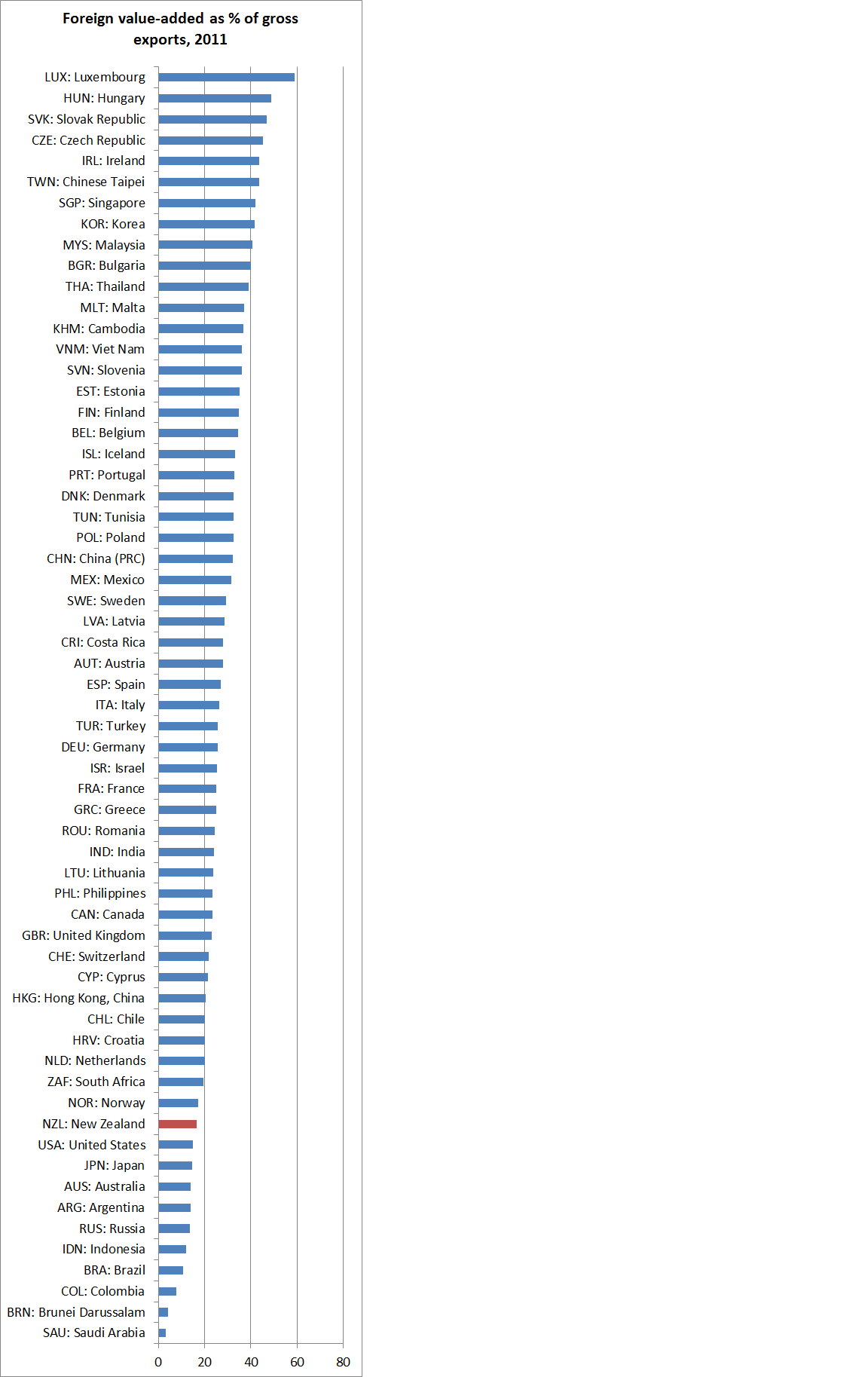
Here is the OECD-WTO data on the estimated percentage shares of foreign value-added in each country’s gross exports in 2011.  They have data for 60 countries, which makes for a long chart.  Keep going and you will eventually find New Zealand.  59 per cent of Luxembourg’s gross exports actually reflected value-added generated in other countries, but for New Zealand the comparable number was just under 17 per cent.

foreign value added

Only 10 countries had a lower foreign value-added share than New Zealand.  And of the bottom thirteen countries, eleven would be considered as primarily commodity exporters (whether raw or processed).  Commodity production doesn’t lend itself to cross-border trade in componentry.    The exceptions are the United States and Japan.    The US number probably shouldn’t be too surprising – there is after all an enormous domestic supplier base. On a smaller scale, I guess the same goes for Japan, but the Japanese number was a bit of a surprise.  At the other end of the scale is a mix of Asian and EU countries.

Occasionally, it is suggested that the low share of imported inputs in our exports is itself a sign of New Zealand’s underperformance.  Perhaps, but China and Mexico stand out as large countries with a large foreign value-added share of their exports, and rather low levels of per capita incomes.  Assembly businesses are presumably economic if labour is relatively cheap.

The first snapshot of these data are for 1995.  Back then, 18 countries has a smaller foreign value-added share of exports than New Zealand did.  And only a handful of countries had more than 40 per cent of their gross exports accounted for by foreign value-added.  From 1995 to 2011 the median country’s share rose from 21.5 to 26.5 per cent, but the median wasn’t very representative: lots of countries saw little change, or the foreign share even shrank (for both China and New Zealand that share fell slightly), while for a large group of countries that foreign value-added share of their exports rose by 10 percentage points or more.

On their own, these numbers are interesting, but don’t necessarily lead anywhere.  They tell us more  about economic geography and the type of goods that are exported than anything about performance.  But, of course, Denmark was once largely an agricultural exporter as well (two thirds of all Denmark’s exports were agricultural in the 1930s), and had it stayed that way it would (a) be poorer today than it is, and (b) would probably have a much lower foreign value-added share of its exports.  What would the export mix of a New Zealand that generated top tier OECD incomes gain look like?  I don’t know, and nor does anyone else.  If we got there by uncovering and utilising huge mineral resources, we’d probably stay towards the bottom of the chart (like much richer Australia).  But there might be other paths –  a swathe of home-grown high tech industries – that might push our foreign share of exports further up.  But our geography –  last bus stop before Antarctica  – means that we are never likely to be found near the top of this particular chart.  Israel, small and with a large high-tech sector caught my eye as one possible comparison.

Once were international traders

J.B Condliffe was one of the greater New Zealand economists of the first half (or so) of the 20th century. One evening earlier in the week I was dipping into his New Zealand in the Making, an economic history of New Zealand, the second edition of which was published in 1959. On the first page, I noted this line

“Today New Zealand claims the largest overseas trade per head of any country in the world”

Those were the days when the story was often told about about how exposed to foreign trade New Zealand was.  Protectionists wanted to reduce that exposure.  In the 1950s, global trade as a share of GDP was much lower than it is today.  Even New Zealand’s trade share  was a little lower than it is now (services exports were not material in those days, and merchandise exports were around 27 per cent of GDP).  Our export share of GDP was about that high even though New Zealand had very heavy industry protection in place,  promoting domestic manufacturing.  That acted as a tax on exports, reducing both exports and imports below what they would otherwise have been.

The late 1950s were also the days when New Zealand still had among the highest per capita incomes in the world.  In the mid- late 1950s, Maddison estimates that New Zealand incomes were behind only those in the United States and Switzerland.  Whatever the “true” number, we were still in the top tier of material living standards

How do things compare today on foreign trade?

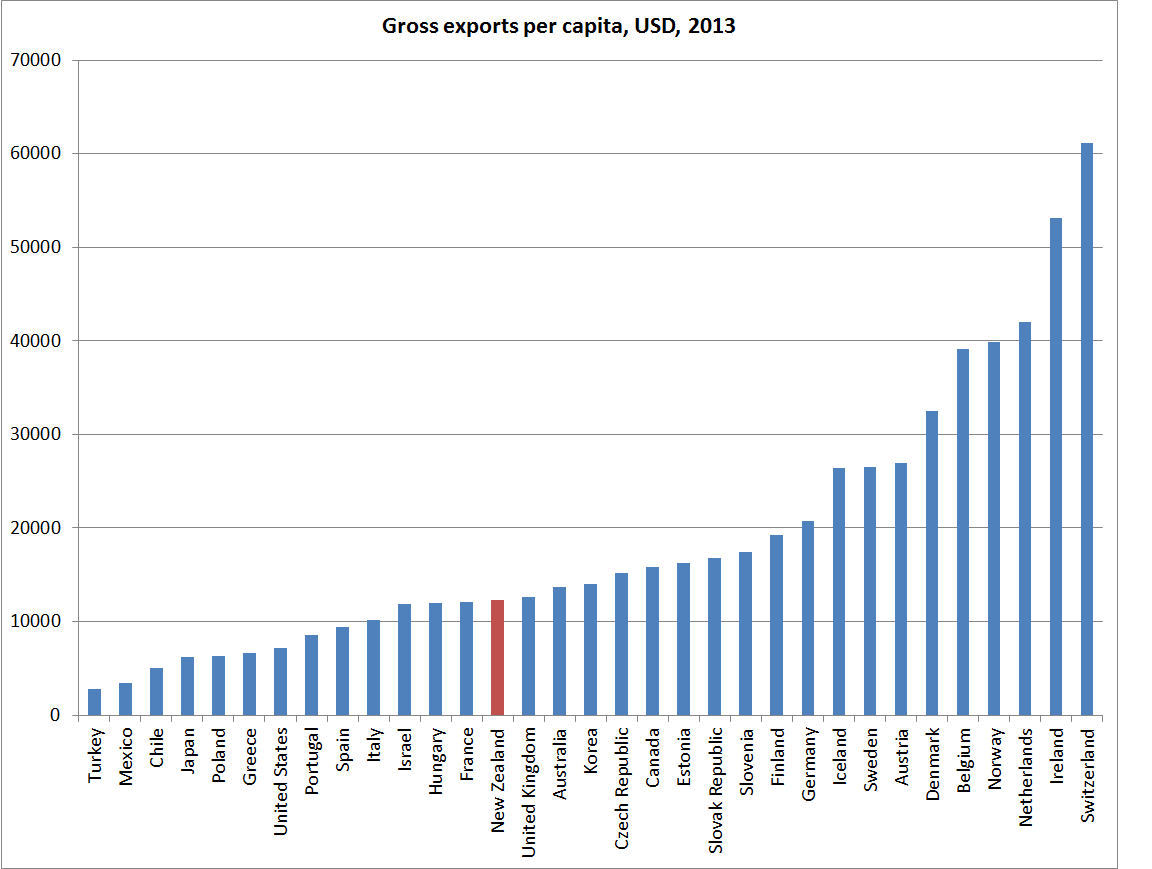
I dug out the OECD data for total exports per capita (for 2013) and converted them into a common currency.  Here is the chart.

gross exports pc

New Zealand is in the bottom half of this chart.

Big countries tend to export less than small countries –  fewer firms need to tap the wider world when there is already a large market at home – and distant countries tend to export less than countries that are close to lots of other markets.  Firms in the United States, for example, export a lot less per capita than firms in (similarly well-off) Switzerland does.

Whatever the situation in the 1950s, it would have been a little surprising if we had been in the top tier of the 2013 chart.  One of the big changes in international trade since the 1950s has been the rise, particularly in manufacturing, of “global value chains”, where different stages of production occur in different countries.  In other words, a car finished in Germany and exported to France might include a substantial proportion of components produced in (and exported from) a range of Eastern European countries.    And some other products exported from, say, Slovakia will use lots of components imported from Germany.  The value of a country’s gross exports rises with this (typically mutually beneficial) activity, but the share of a country’s total value-added (which GDP is capturing) resulting from exports might not have risen much at all.  For New Zealand, a long way away, this sort of trade doesn’t happen in the way that it might between say Austria and the Czech Republic.

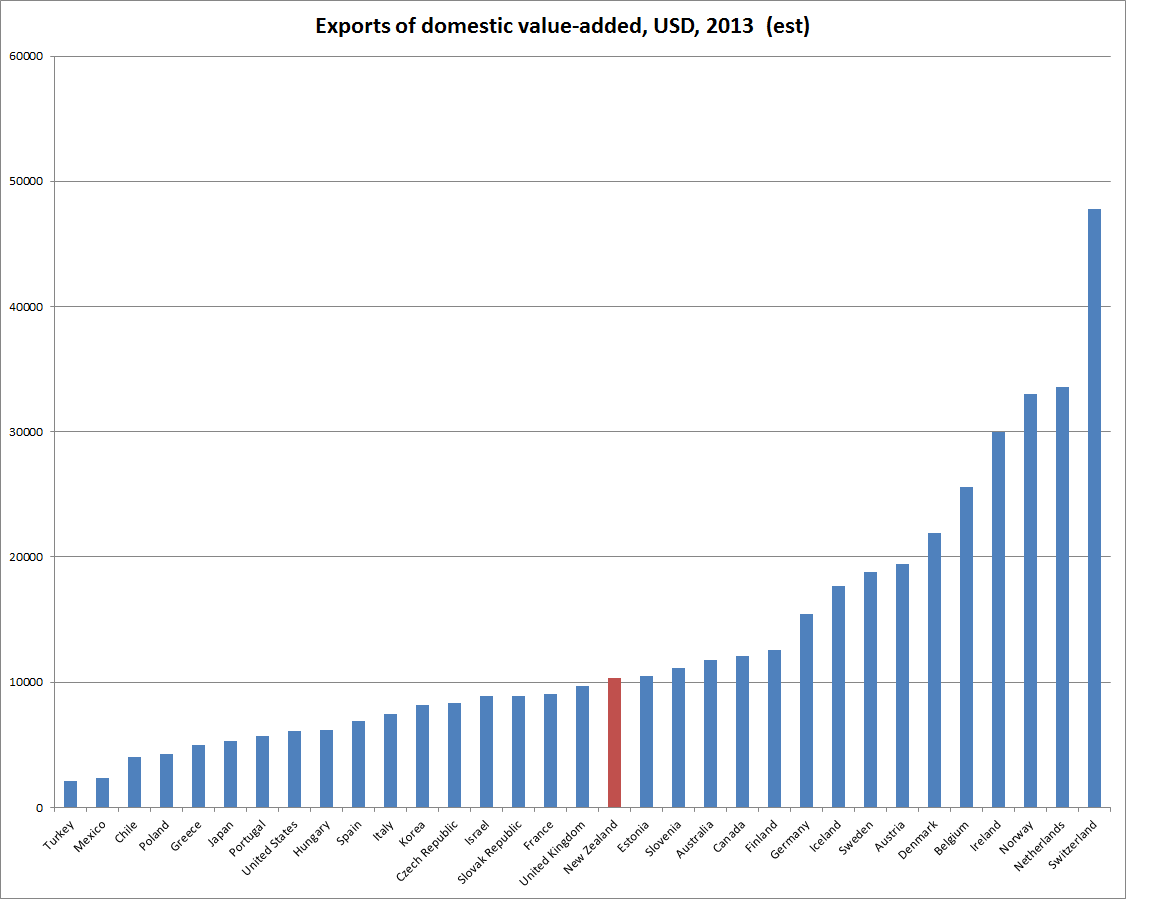
The OECD and WTO have recently done the work of trying to trace what proportion of each country’s exports are domestic value-added.   The latest data are for 2011, but the domestic value-added shares don’t fluctuate much from year to year (production patterns don’t change that fast).  Applying the 2011 data on the share of exports that reflect domestic value-added to the 2013 exports data, we get a chart of per capita exports of domestic value-added.
gross value-added exports

Here, New Zealand shows up just above the middle of the pack, but with a level of exports per capita (near the peak of a terms of trade boom) that was only a third to a quarter of the exports of domestic value-added from the Netherlands and Switzerland.

It is a far cry from the 1950s position of the largest overseas trade per head.  And, of course, today we languish in the bottom third of OECD countries for GDP per capita.

There is always a danger of seeming to come across as suggesting that exports are either good for their own sake, or are the only possible route to prosperity.  We export (or sell anything) to support present and future consumption, and for an individual or a firm it makes no particular difference whether goods or services are sold to domestic or foreign purchasers.  But at a whole economy level, the export underperformance nonetheless remains a disconcerting indicator.  We can’t remedy New Zealand’s underperformance just by exporting more –  Mao was exporting grain during the great famine, and we’ve had export subsidies in the past ourselves –  but successful economies tend to be those with increasing numbers of the products that the wider world wants to buy more of, at prices that encourage further innovation and investment.  Many individual firms have done well, but in aggregate New Zealand doesn’t seem to have been in that position.

What has gone wrong?  I’ve argued that our real exchange rate has been out of line with the productivity fundamentals for decades.  Excess domestic demand has driven up the price of non-tradables relative to tradables, skewing investment and activity away from the tradables and export sector.  Part of that story –  a significant part in my view – has been the active large scale inward migration programme, which has diverted resources away from global markets to (what successive governments have instead made) their most profitable use; meeting the physical capital (houses, road, factories, shops, offices etc) needs of a population that has continued to grow quite rapidly.  The only time since World War Two when our governments pulled back from actively pushing up the population was from the mid 1970s to the late 1980s, and in that period we messed things up in other ways – the Think Big debacle, a post-deregulation credit and property boom and bust, and of course a very weak terms of trade.

I’ve commented previously on the government’s peculiar exports target.  There is no chance of meeting that target  on any sort of sustainable basis, without changing the factors that give rise to the persistently higher real interest rates and the high real exchange rate.

Looking forward to a robust assessment of the Reserve Bank’s performance?

The Children’s Commissioner has today released its first annual State of Care report.  The Commissioner is not required to publish such a report, but he is required as follows:

13 Functions in relation to Children, Young Persons, and Their Families Act 1989

  • (1) The Commissioner has the following functions in relation to the Children, Young Persons, and Their Families Act 1989:
    • (a) to investigate any decision or recommendation made, or any act done or omitted, under that Act in respect of any child or young person in that child’s or young person’s personal capacity:
    • (b) to monitor and assess—
      • (i) the policies and practices of the department; and
      • (ii) the policies and practices of any other person, body, or organisation that relate to the performance or exercise by the person, body, or organisation of a function, duty, or power under that Act or regulations made under that Act:
    • (c) to encourage the development, within the department, of policies and services that are designed to promote the welfare of children and young persons:
    • (d) on the Commissioner’s own initiative or at the request of the Minister, to advise the Minister on any matter that relates to the administration of that Act or regulations made under that Act:

The State of Care report is to be is “an annual summary from our independent monitoring of Child, Youth and Family’s policies, practices and services”. The report is 60 pages long , and it appears to ask some pretty serious and searching questions. It has certainly resulted in considerable media coverage this morning.

The Reserve Bank’s Board will, if last year’s schedule holds, just have finalised their Annual Report for the year ending June 2015. Last year’s report was signed by the Board on 26 August 2014.

The Reserve Bank Act lays down the responsibilities of the Board. They aren’t the same as those of the Children’s Commissioner as regard CYF, but the Board acts primarily as the agent of the Minister of Finance and the public to hold the Reserve Bank Governor to account.  They must report to the Minister if the Governor isn’t performing, and may recommend dismissal.

For the last decade or so, the Board has had to publish an Annual Report

The Board must prepare, for each financial year, a report setting out the Board’s assessment of the matters referred to in section 53(1).

And section 53(1) reads as follows

53 Duties of Board
• (1) Subject to this Act, the Board of the Bank shall—
• (a) keep under constant review the performance of the Bank in carrying out—
• (i) its primary function; and
• (ii) its functions relating to promoting the maintenance of a sound and efficient financial system; and
• (iii) its other functions under this Act or any other enactment:
• (b) keep under constant review the performance of the Governor in discharging the responsibilities of that office:
• (c) keep under constant review the performance of the Governor in ensuring that the Bank achieves the policy targets agreed to with the Minister under section 9 or section 12(7)(b):
• (d) determine whether policy statements made pursuant to section 15 are consistent with the Bank’s primary function and the policy targets agreed to with the Minister under section 9 or section 12(7)(b):
• (e) keep under constant review the use of the Bank’s resources.

Last year’s Board Annual Report (pages 6 and 7) was totally anodyne. It was the first report since former Acting (and Deputy) Governor, Rod Carr took over as chair. The report was less two pages long and is almost totally descriptive (and still manages to contain a relatively minor, but telling, factual error, which I have recently drawn to their attention). The Board’s report comes bound in the middle of the Bank’s own Annual Report.

The contrast with the Children’s Commissioner’s report is striking. I think it sheds some light on the weakness of this area of the governance/accountability of the Reserve Bank. The office of the Children’s Commissioner isn’t heavily resourced, but it has resources of its own. By contrast, the Reserve Bank’s Board has no independent financial or staff resources – indeed, its Secretary is one of the senior managers of the Bank. The Board meets on Bank premises – in “the Board room”, although of course the room is primarily used for a range of day-to-day management and policy meetings. For a Board whose primary responsibility is about holding the Governor and Bank to account (ie a very different role from a corporate or even Crown entity board), it is curious (and inappropriate) that the Governor is a member of the Board itself. In the years since the Governor ceased being chair, both subsequent chairs have been former senior managers of the Bank.   Reading past Annual Reports it sometimes seems that the Board sees part of its role as being to help the Governor spread the good news and explain the choices the Governor is making.

It simply isn’t a recipe for being able to maintain appropriate distance from the Governor, to enable critical evaluation and commentary to take place. However good the individuals are – and there are able people on the Board – the structure is set up in ways that make it unlikely that they will be willing or able to stand up to a Governor (at least to one who has any ability at all to manage his relationships with Board members). The Governor has resources, profile, and spends all day on this stuff. Board members gather for a few hours a month, and consider papers submitted and prepared by staff (who all work for the Governor).

This year’s Annual Report might perhaps cover, in some depth, issues such as:
The way that core inflation has now been well below the middle of the target range for some years
• The significant policy mistake that was made last year, in raising the OCR repeatedly and only very belatedly beginning to slowly cut it again.
• The poor quality of the Bank’s research, analysis and argumentation around the housing market, and around the new investor finance restrictions in particular.
• The obstructive and non-transparent approach the Bank has taken, including with respect to compliance with the Official Information Act

What is about the Governor’s performance, and stewardship of resources, that has led to these outcomes? And what steps are being taken to avoid a repetition?  Many outsiders might have a view, but the Board has unique access to the inner workings of the Bank, and the ability to grill management.

A report of two pages, effectively stating that they have lots of meetings, see lots of papers, and generally think the Governor does a good job, doesn’t really cut it. I’m not a huge fan of the Children’s Commissioner, but in this area he seems to have shown a way that the Reserve Bank’s Board might think about following. It is important to have external review of CYF – children in their care are very vulnerable. But when a single unelected official has as much clout as the Governor of our central bank does – having a huge impact on the short-term performance of the economy, and the numbers of people unemployed, speculating with a huge balance sheet, and with the seemingly arbitrary ability to decide who banks can and can’t legally lend money to, it is also very important that we have serious and substantive evaluative monitoring and reporting on the Governor’s conduct. When he makes mistakes – and he’s human so he will – we pay the price.  The Board is charged with doing that assessment, and we should expect to see evidence of it.

I don’t expect we’ll get what I’m looking for. The system needs far-reaching institutional reform. But even under the current law, the Board could offer us much more evidence of critical scrutiny than we’ve been seeing so far. 60 pages might be a little too much, at least annually, but 10 pages of serious reporting and evaluation, published separately from management’s reports, might be a start. If the Board hasn’t engaged substantively with the sorts of issues I’ve outlined above, the annual report isn’t due until 30 September, so perhaps they should pull what they‘ve done already back from the printers and start again.

Reforming govenance: a totally secretive Reserve Bank

As readers will know, I have for some time been making the case that it is past time to reform the governance of the Reserve Bank.  The Bank’s governance model –  a single unelected decision-maker for a wide range of functions – is out of step with how other countries run these functions, and with how other autonomous New Zealand government agencies are run.  There was some logic to why it was set up that way 25 years ago, which I set out here. But whatever the logic in 1989, it is a model that is not really fit for purpose now, especially given the much wider range of functions the Reserve Bank is now undertaking.

This isn’t a particularly controversial statement.  A couple of years ago, the Treasury recommended to the Minister of Finance that work be undertaken towards changing the governance model.  Many market economists have supported change, and the independent review of monetary policy commissioned by the previous government 15 years ago recommended change.  The Green Party has for several years argued for change, and the Labour Party seems to have toyed with proposing change.

Decisions around legislative governance structures are matters for the Minister of Finance and Parliament.  The Governor has to work within whatever legislative framework is established.  But the Governor himself knows that the existing legislative isn’t ideal.  Shortly after he arrived at the Reserve Bank, I gave him a copy of an earlier paper I had written setting out the background to the current model, and making the case for change.  In response he noted that it had helped inform his thinking on the issues.    In 2013 he gave a speech in which he informed the public that he had decided to make decisions in the forum of a Governing Committee –  himself and his three deputy/assistant governors.  He retained the legal powers and responsibilities, but he envisaged working formally in that committee model.   In his speech, he spoke quite favourably of central banks where decisions are the responsibility of executive committees.  And there was no first principles defence of a single decision-maker model.

So it is pretty clear that the Governor favoured legislative change, and along the lines of an internal executive body (which also happen to be much the same lines as Lars Svensson recommended in that review 15 years ago).  He has also made some rather rash comments to staff about his views on the rather different governance ideas of some particular political parties.

I put in a request for copies of the work that had been done on governance issues over the last two years or so.   This was what I requested

Copies of any papers done by the Reserve Bank on statutory governance issues in the last two years (i.e.: since 1 July 2013).  To be specific, I am requesting:

  • any papers (draft or otherwise) provided to Treasury or the Minister of Finance on these issues;
  • any papers provided to the Governor or the Governing Committee on these issues
  • any internal working or discussion papers on governance issues;
  • any file notes or other records of discussions on these issues between the Governor, and the Secretary to the Treasury and/or the Minister of Finance.

Getting a reply from the Bank took almost two months (the statutory norm is no more than 20 working days), and when it finally came it was surprisingly bald.  Taking almost two months to release almost nothing might be look deliberately obstructive.

They released most of one paper, which is largely about how so-called “macro-prudential” issues are dealt with in other countries.  (Anyone interested can find a copy here)

For the rest, here was the response

The Reserve Bank also holds other information that falls within the scope of your request but which is being withheld from release under the provisions of the Act noted below. 

Reasons that information is being withheld:

  • 9(2)(d) to protect the substantial economic interests of New Zealand.
  • 9(2)(g)(i) to maintain the effective conduct of public affairs through the free and frank expression of opinions by or between or to Ministers of the Crown or members of an organisation or officers and employees of any department or organisation in the course of their duty.
  • 9(2)(f)(iv) – to maintain the constitutional conventions for the time being which protect the confidentiality of advice tendered by Ministers of the Crown and officials.
  • 9(2)(h) – to maintain legal professional privilege.
  • 18(d) – the information is or will soon be publicly available.

At least this now confirms publicly that there has been a work programme underway.   Given that it took two months to reply, it appears to have been something quite substantive, including professional legal advice (and in an earlier holding reply they told me that they had 9786 (no doubt rather coarsely filtered) documents to consider).  And it wasn’t just internal Reserve Bank workings –  it will have got as far the Minister (note the third bullet), and will have involved extensive discussions with Treasury at a variety of levels.

This reply is simply extraordinary.  It is one thing to withhold bits of a particular paper on specific statutory grounds, but I cannot see what grounds they can possibly have for withholding (for example) even the titles of the papers covered by my request.  And the notion that disclosure of  background work on possible governance reform could harm the “substantial economic interests of New Zealand” is just laughable.  Perhaps the Governor is rather exaggerating the importance and impact of the Bank’s governance arrangements?

I was interested in the final item on their list of excuses.  Wanting to be reasonable before highlighting this response, I asked the Bank a couple of days ago when anything would be “soon publicly available”.  Perhaps they do have a speech forthcoming, or a treatment of the issue in the forthcoming Annual Report?  But they have not even replied to my email.

If the Official Information Act really provides protection for every single one of the papers covered by my request, including the titles of those papers, the Act is even more toothless than most had realised.  In fact, I suspect that this is a case of instititutional arrogance and over-reach by the Governor, who doesn’t really seem to regard himself as accountable to the public.  Perhaps the Governor is embarrassed, or frustrated, that the Minister of Finance or Treasury were not convinced by his particular arguments?  Perhaps he had staff simply look at one option, and ruled out of court any serious consideration of the wide range of options used internationally and elsewhere in the New Zealand public sector to govern powerful public agencies?  Whatever the explanation, he doesn’t want us to know.

If the work on statutory governance reforms has been completed, there is no obvious good reason for withholding the material that was done.   The statutory purposes of the Official Information Act are as follows:

The purposes of this Act are, consistently with the principle of the Executive Government’s responsibility to Parliament,—

(a)  to increase progressively the availability of official information to the people of New Zealand in order—

(i) to enable their more effective participation in the making and administration of laws and policies; and

(ii) to promote the accountability of Ministers of the Crown and officials,—

and thereby to enhance respect for the law and to promote the good government of New Zealand:

Reform of the governance of the Reserve Bank is a long-running issue, and not obviously one of those issues that needs to be worked on in total secrecy.  Indeed, any work the Reserve Bank has done could help inform an ongoing discussion about the best possible options for the future.   And all this material has been generated at the expense of the taxpayer.  It is official information, and there is a public interest in its release.  And even if work is still going on, the case for such total secrecy seems very hard to make.

Plenty of free and frank material is released under the Official Information Act.  As an example, not long ago, The Treasury released some pretty critical comments on the Reserve Bank investor finance restrictions. What makes the Reserve Bank different?   The Treasury has also released its 2012 advice on reforming Reserve Bank governance.  What about the Reserve Bank makes it so special that it believes the same law does not apply to it –  that every single piece of paper anyone in the Bank has done on statutory governance reform must be totally withheld?

As I’ve said previously, the Reserve Bank is much less transparent than it likes to make out.  This is just another example.  We’ll see whether the Ombudsman agrees with their interpretation of the Act.  Whether or not she does, this decision by the Governor is not the hallmark of an open and accountable public institution, committed to scrutiny and debate and to improving policy and institutions through the contest of ideas.

On peripheral share markets, and the mess that can still lie behind them

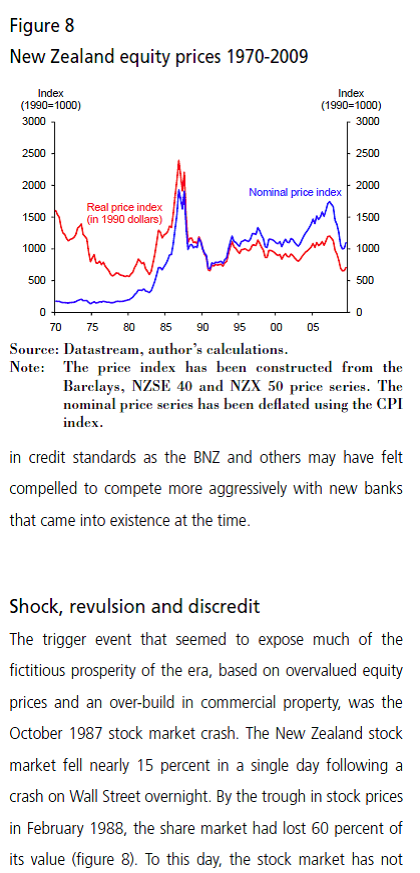
As the wild gyrations around the sharp decline in Chinese share prices dominate the business news headlines,  the chart of the Shanghai share price index was reminding me of another chart, from our own history.

The historical data are hard to come by so I’ve had to use this chart, which covers a rather long period, from a good Reserve Bank Bulletin article about past New Zealand financial crises (mostly, the 1890s and the 1980s). In China’s case, a 150 per cent increase in share prices in a year or so, most of which has now been given back in only a few months (of course, it is perhaps worth remembering that there was an even bigger boom, to even higher peaks, in 2006/07).   In New Zealand’s case, the boom in real prices was even larger – if it took a slightly longer period of time – and the bust was complete.

NZ share prices 80s

There is lots of discussion at present – often from US-centric people – about how the Chinese share market is somewhat peripheral to the economy. And, in some senses, no doubt it is. The share market has always been relatively peripheral to the New Zealand economy too, and market capitalisation as a share of GDP has typically been low. Between farms, farmer co-ops, wholly foreign-owned companies, and state-owned companies, most economic activity simply wasn’t represented by listed companies. Take state-owned companies as an example. In 1986/87, the government still owned several banks, insurance companies, the post and telephone system, the one TV company, the railways, the airlines, the largest petroleum company, and the steel mill. There were no New Zealand listed banks, and no vehicles for direct equity exposures to our largest export industries (sheep and dairy products).  Forestry was probably the only major export industry with material listed exposure.

And yet the market went crazy, and when it burst it was the start of some very tough years for New Zealand. The whole post-liberalisation mania has not been adequately documented (unlike, say, the Nordics booms and busts of much the same time), but it was characterised by much more than just crazy share prices for the minority of people with any material direct exposure to the market. These things rarely happen in isolation. We had a massive credit boom – private sector credit growing at 30 per cent per annum – and a massive commercial property boom, skewing real resources into places that proved not really to offer economic returns. The absurdity of some of what went on during that period was captured in the suggestion of one (brief) high flyer, that New Zealand had a comparative advantage in takeovers. Few bankers had any experience in disciplined credit risk analysis in a liberalised market economy – and nor did their shareholders (whether government or Australian private). And, in any case, bonuses weren’t being paid to people who stayed clear of the boom for long. Highly leveraged investment companies were all the rage – often the principal asset was overvalued shares in other investment companies.

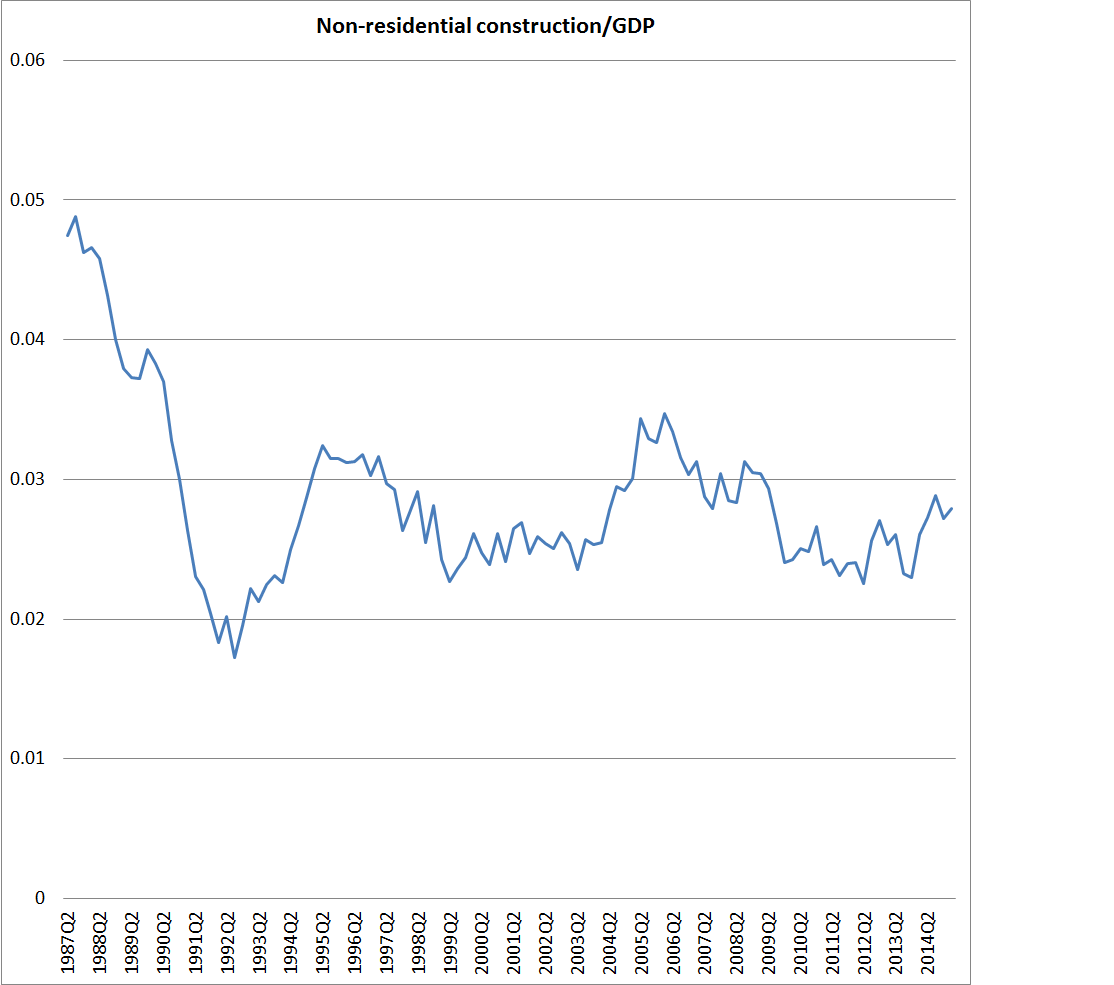
As one illustration of what went on, here is the commercial property picture.  A 3 percentage point of GDP fall is huge, and of course the boom-times share of GDP has never been regained, suggestive of how overblown that market had become.

non-res 80s

As they often are, central bankers were slow to recognise what was going on. The section I managed wrote a paper to the Minister of Finance a few weeks before the crash arguing (as I recall) that the strength of the share market was a pointer to the underlying strength of the economy (and hence a reason to tighten monetary policy). A week or two after the crash, my boss and I were visited by a firm of economists we were often dismissive of – they urged us to recognise that a savage commercial property and banking shake-out was about to get underway. We were polite but pretty dismissive.

Those are the sorts of episodes that leave financial crises in their wake, and which often have nasty and prolonged real economic consequences. Some of us at the Reserve Bank might have initially been a little sceptical, but the liquidity stresses soon became very apparent. Within weeks we had acquiesced in a sharp fall in short-term interest rates (we didn’t directly set them then), which eventually totalled 400-500 basis points.  The exchange rate came down as well. And it still took years for the economy to really recover.

No two situations are ever quite the same. New Zealand was trying to vanquish double-digit inflation, a situation few countries these days find themselves in. But ill-disciplined credit booms, of the sort we had in the 1980s, and of the sort the Chinese have had – on a far larger scale and with fewer market disciplines – are often enormously damaging. Often there is an equity market mania dimension to these things, but the mania is often the epiphenomenon rather than the main event; symptoms of something deeper going on. And the timing will never be quite precise – we had a mania in 1986 around a company (investment and finance) whose shareholders, in their private capacity, were backing what appeared for a time likely to be a successful tilt at the yachting America’s Cup. Of itself, it probably did little or no real economic harm, but it was symptom of the excesses, and of the undisciplined nature of the times.

So count me as a little sceptical of the notion that because not many Chinese hold shares, we don’t need to worry about what is going on there. As here, it is a matter of looking to the phenomena behind the headlines – in their case, several years of one the largest, least-disciplined domestic credit and investment booms in history.

Oh, and there are simply no parallels between the 1987 New Zealand position – which brought down several major financial institutions, including our largest bank – and the New Zealand position now. I wrote about that (lack of) parallel a few months ago.

Does anyone believe core inflation is about to rise?

The next Reserve Bank Monetary Policy Statement is scheduled for 10 September. Unless they’ve materially changed the timetable, this will be the week in which the Governor, his staff and advisers will be in long meetings, working their way through the data from the last few months and the draft economic forecasts. The forecasts are finalised to be not-inconsistent with the Governor’s preliminary OCR decision (which is usually made at this stage of the process, but can be revised very late in the piece).

One set of data was released only yesterday (although the Bank will have had it last week). That is the results of the Reserve Bank’s two expectations surveys. The household survey, of around 1000 people, asks only about CPI and house price inflation, while the other one, the Reserve Bank’s Survey of Expectations asks quite a wide range of questions about financial and macroeconomic variables. I’m not sure how many respondents they now have, but it used to be around 70. Respondents were a mix of people from business, the labour market, the financial sector, and economists (I’m now one of them). We used to treat this survey as the responses of an “informed” group, even if not many were experts in each of the areas on which they were questioned. The surveys have both been going for quite a long time now, and complement the quite different sorts of information available from business and consumer confidence survey. For some years, we ran a staff version of the Survey of Expectations, which occasionally raised interesting question when it showed up material differences between staff and respondents’ expectations.

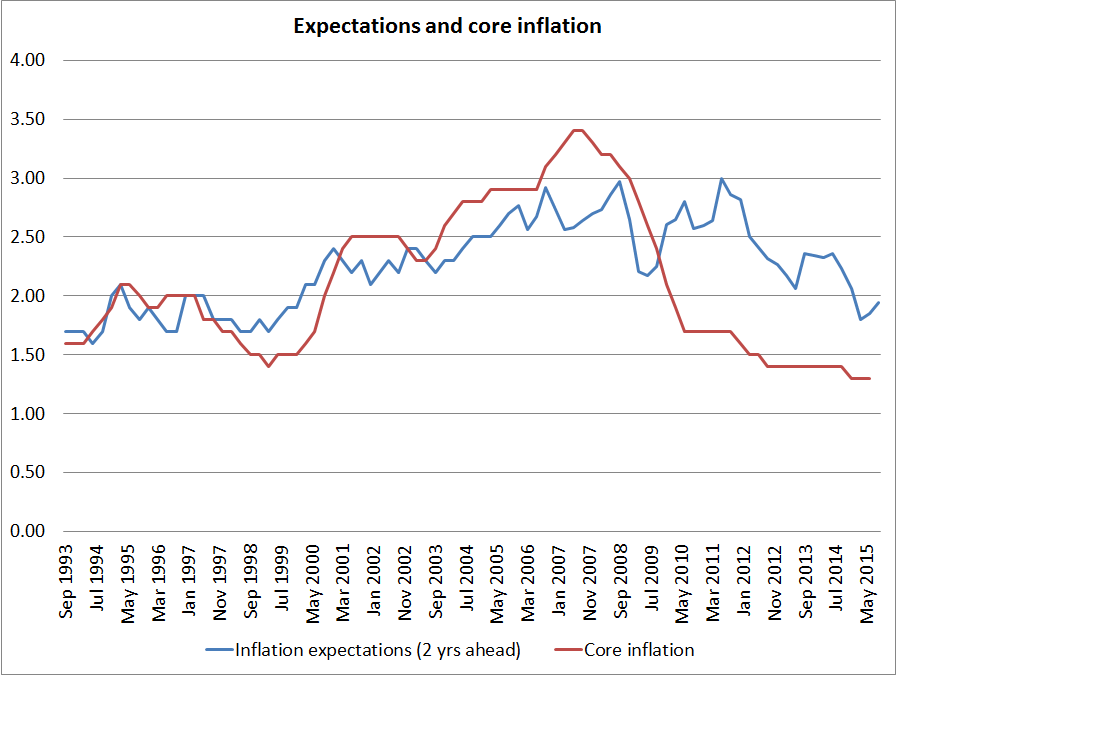
Of all the questions in the two surveys, only one tends to get any media coverage (or even much market economist coverage). That is the question in the Survey of Expectations about what respondents expect the annual inflation rate to be in two years time. It gets focus because it is the variable that the Reserve Bank pays most attention to, and relatedly because it appears in many of the Reserve Bank’s formal models of the inflation process. The two year ahead measure gets the focus because it should largely “look through” most of the short-term fluctuations in inflation (oil prices ups and downs, tax changes, and so on, which can have a large effect on short-term inflation, but shouldn’t normally affect medium-term inflation). And, empirically, the two year measure seemed to do reasonably well (together with some measure of excess demand) in equations explaining (core) inflation; or at least it did until the last few years.

expecs and core inflation

You may recall that in the July OCR review, and the Governor’s subsequent speech, the Bank affirmed its view that although current headline CPI inflation is still very low (0.3 per cent in the year to June), it would soon be back to around the 2 per cent middle of the target range.   They talked in terms of inflation being back near the midpoint by early-mid next year.  I and others have previously made the point that, even if so, this would be just a one-off lift in the inflation rate, as prices adjusted to a lower exchange rate, and would not represent a lift in core inflation pressures.

Respondents to the Survey of Expectations seemed only partly convinced by even this element of the Bank’s story. Year-ahead inflation expectations picked up from 1.32 per cent to 1.46 per cent, and two year ahead expectations also rose slightly, up from 1.85 per cent to 1.94 per cent. Among households, year ahead expectations rose, while five year ahead expectations were unchanged.  The Reserve Bank is likely to take some comfort from these results, reinforcing the Governor’s bias (at least at the time of his speech) that the OCR didn’t need to be cut much more. But I think they would be wrong to take any comfort from them. As I dug through the numbers, I was staggered at how weak they were (and as I say that as one who is more pessimistic than the mean response on most, but not all, questions).

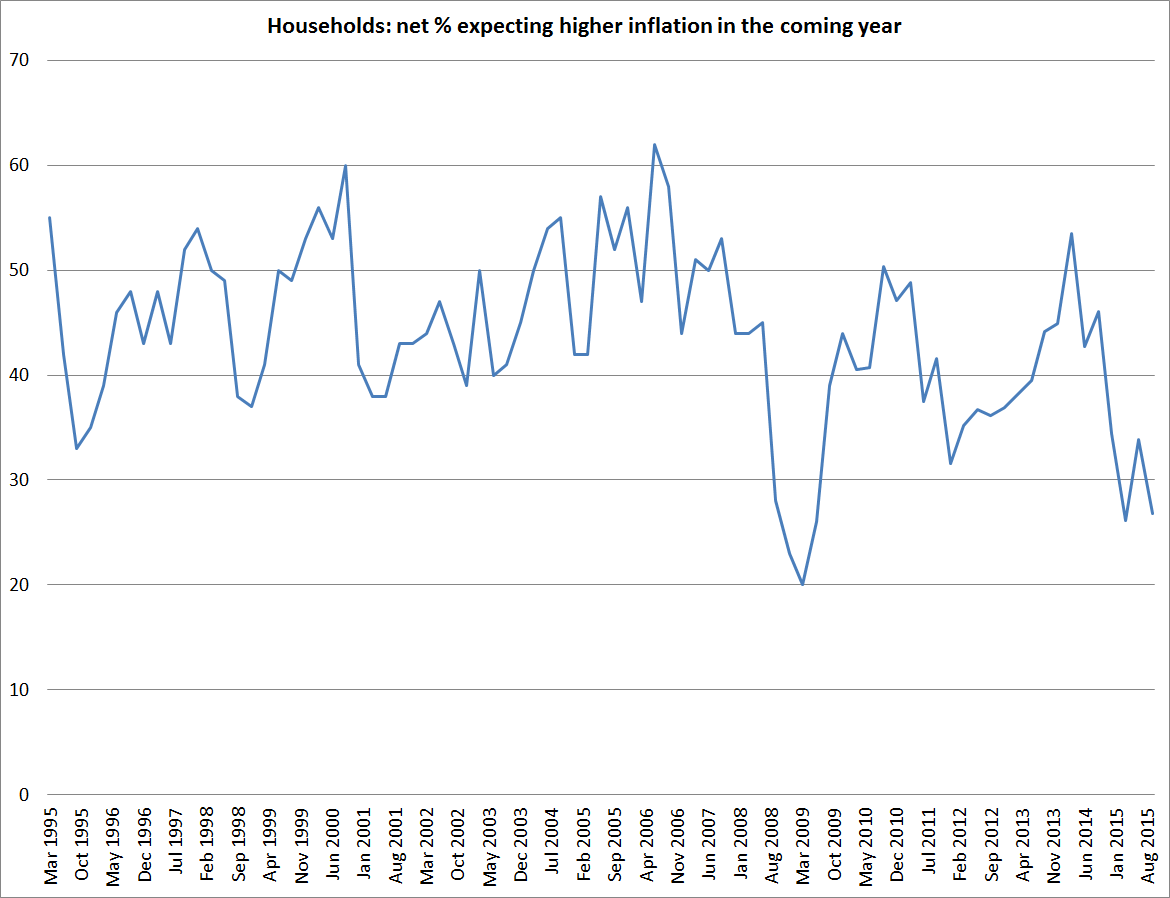
Let’s deal with households first. The numerical expectations that respondents reported did increase, but the survey also has a question – which, from memory, gets a better response rate –  as to whether the respondent thinks the annual inflation rate will rise, fall, or stay the same over the coming year. Households have always – every quarter since 1995 – reported a net expectation that inflation will rise over the coming year, but this quarter’s response was one of the lowest ever.

households higher

The only time a smaller proportion of people expected inflation to increase over the coming year was at the end of 2008, when the actual annual inflation rate was peaking at just over 5 per cent ($150 oil prices and all that). Quite reasonably, and in the middle of a severe recession, not many expected the inflation rate to increase from there. The Reserve Bank apparently expects inflation to rise from 0.3 per cent to something around 2 per cent by the middle of next year. That is a really large increase to publicly project – and it got a lot of coverage – but households don’t believe it. They don’t expect inflation to rise much at all. They might be wrong, of course, but they don’t seem to believe the Bank at present.

What about the more informed group, the respondents to the Survey of Expectations? Here we have the luxury of getting a bit more of sense of how respondents (collectively) are thinking, since we get answers to a whole variety of macro and financial questions (although perhaps the Bank might think of adding a house price inflation question to this survey).

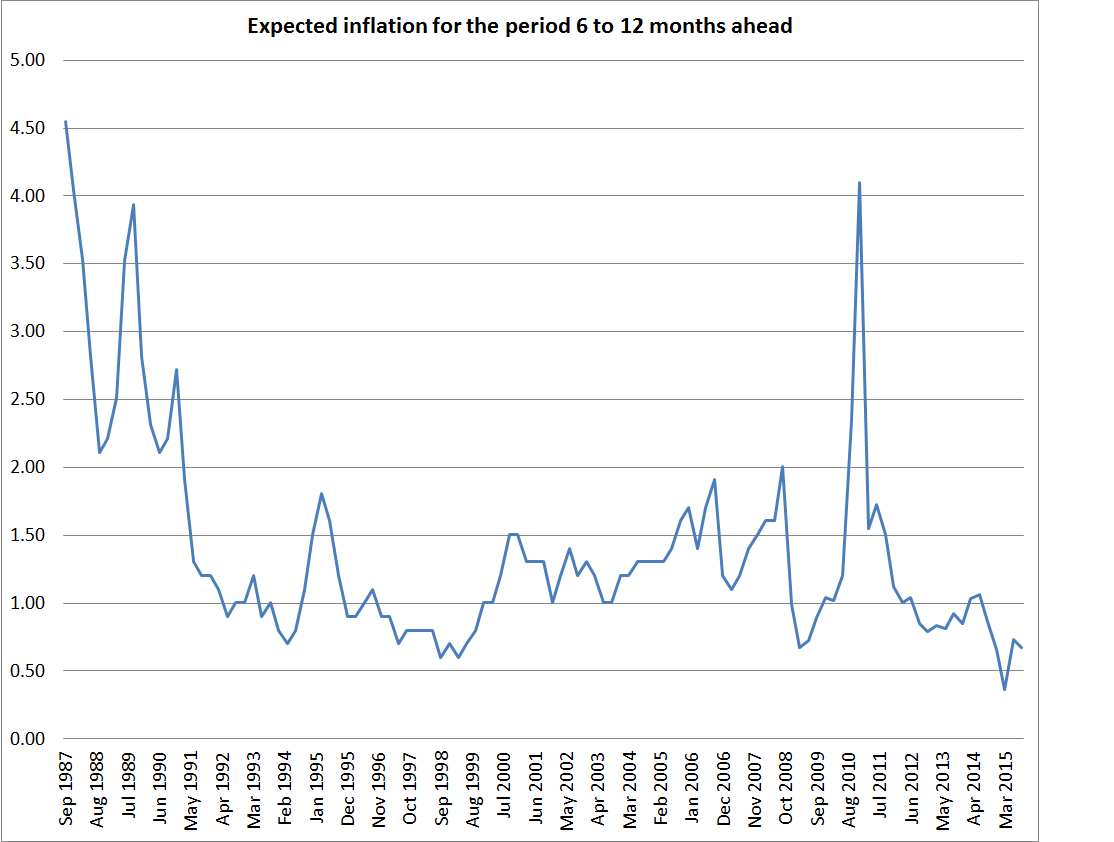
Respondents are asked a number of inflation questions. They are asked for their expectations for each of the next two quarters (in this case, September and December) and for their year-ahead expectation. That means we can back out an implied expectation for the second six months (in this case the first half of next year). There isn’t much sign that respondents expect inflation to rise. They are expecting inflation of 0.67 per cent for the second six months of this year (still one of the weakest six month ahead expectations ever), and 0.78 per cent in the first six months of next year.  In other words, there is hardly any pick-up in near-term inflation even following one of the sharpest three month falls in the exchange rate we’ve seen since the  float thirty year ago. It is exactly the same extent of pick-up, from the first half of the year ahead period to the second half, as the average expected in the surveys done over the previous two years.

expcs 6 to 12 mths aheads

Like the Reserve Bank’s projections, the Survey of Expectations respondents take account of any changes in monetary policy they expect over the survey horizon.   We get a direct steer on that from the questions about the expected 90 day bank bill rate in a year’s time.   In this survey, that expectation fell sharply, down by 92 basis points  – and the only time there has been a larger fall than that was at the height on the financial crisis in 2008/09.  Respondents expect that the OCR next June will be around 2.5 per cent – probably not a lot different than the Governor had in mind in his speech. Even with these big cuts in interest rates, respondents don’t see the rebound in expected inflation.

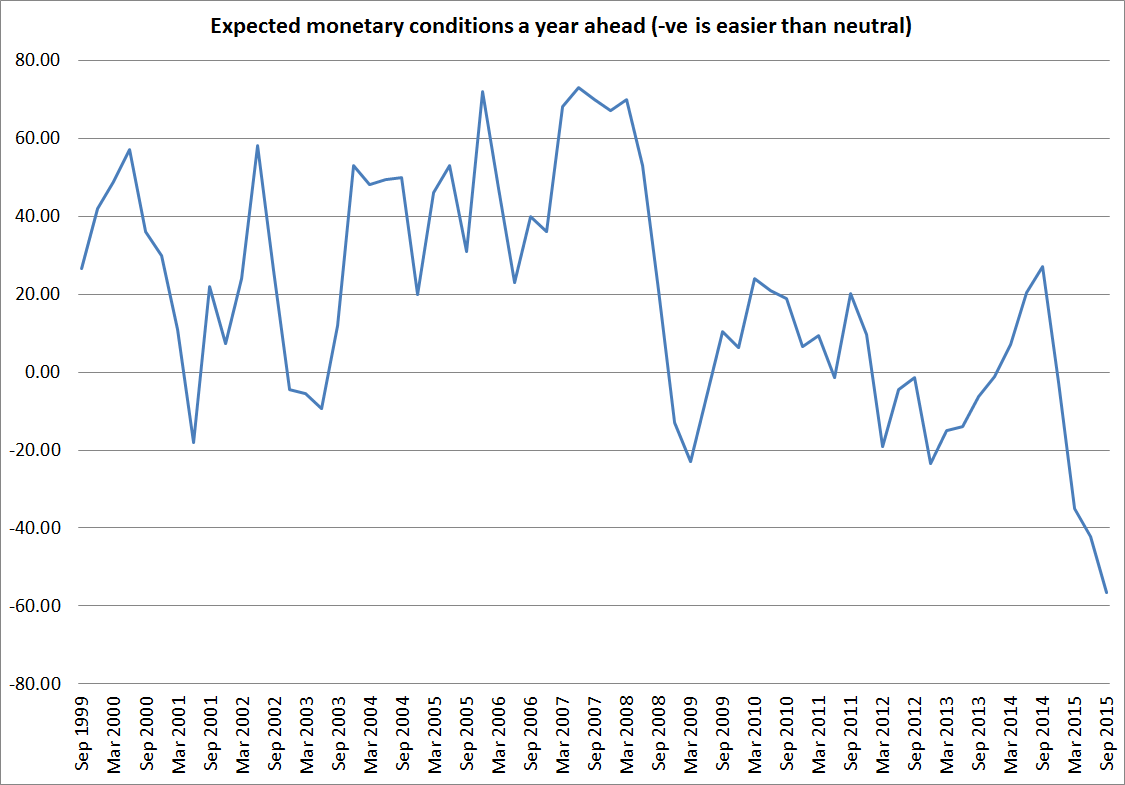
The survey also asks respondents about their perceptions of monetary conditions (actual and expected). “Monetary conditions” isn’t defined, and respondents may be influenced by factors such as interest rates, exchange rates, share prices, and credit conditions.   Respondents think conditions at present are (quite considerably) on the easier side of neutral, but what caught my eye is that this is the first quarter in the history of the survey when respondents have both thought current conditions were loose now, and expected them to get looser still over the coming year.

expec mon cond

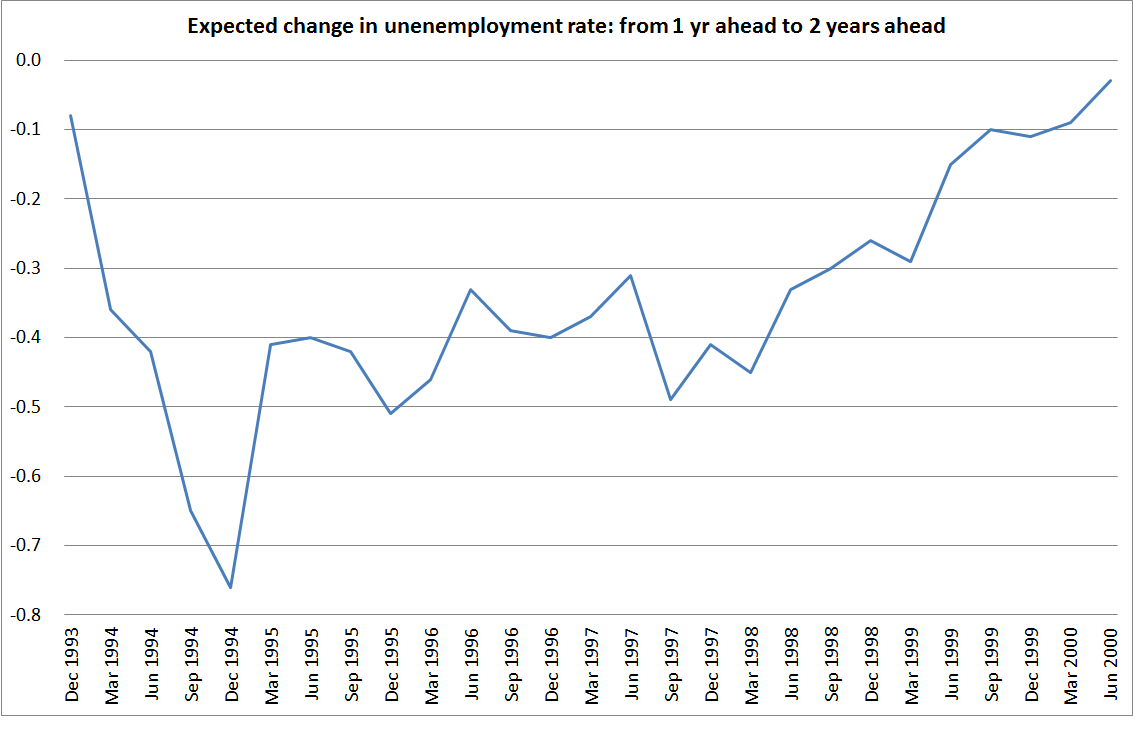
Survey respondents’ GDP growth expectations have also fallen   Expected growth rates of around 2.3 per cent for the year ahead and two years ahead would barely even match potential growth over that period, suggesting little prospect of an increase in core inflation. Consistent with this story about potential, unemployment rate expectations have risen notably, and are expected to stay at around 5.8 per cent for the next two years. If anything, medium-term expectations are getting more pessimistic – for the first time since 2009, the unemployment rate two years hence is not expected to be below that in one year’s time.

U expecs

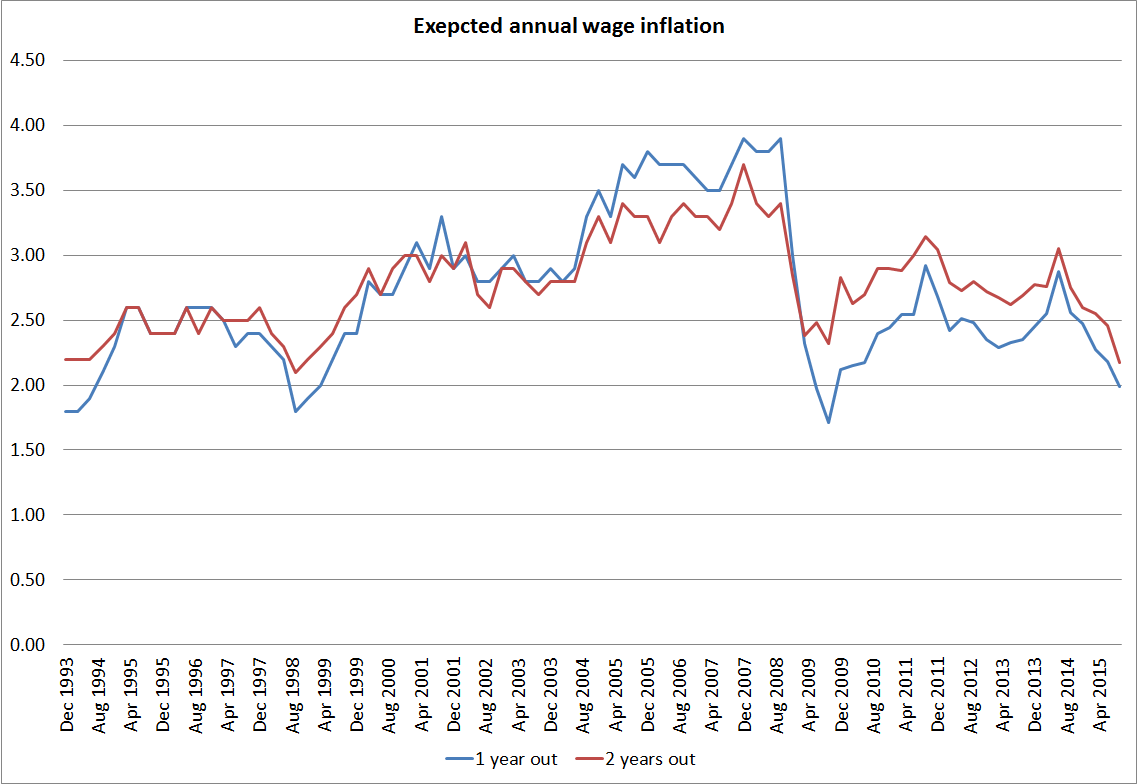
And finally, the one question where respondents were even more pessimistic than I was. Wage inflation expectations picked up coming out of the recession back in 2009/10 (and recall there are more business-affiliated respondents in this survey – it wasn’t just household aspirations), but have been going sideways, or falling, for the last few years. The survey asks respondents about expected wage inflation one and two years ahead. In big booms one expects to see the two year ahead expectation below the one year ahead one – intense pressure on wages now, but they will abate as the market equilibrates. And in deep recessions, one expects the reverse: very weak wage pressures in the near-term but some recovery in the medium-term as the market equilibrates. You can see that pattern in the chart, both pre and post 2008.

wage inflation expecs

But what is striking is what has happened in the last year or so.   As actual wage inflation has been falling, expectations of future wage inflation have been falling, but the two year ahead expectations that have been falling faster than the one year ahead expectations. In the more than 20 years these questions have been run, medium-term wage inflation expectations have been lower only once – that in the middle of a recession in 1998, when the inflation target was 0.5 percentage points lower than it is now.   Respondents to this survey seem to have just given up on the idea of any labour market pressures in the foreseeable future.   There is barely any real wage inflation expected:  nominal wage inflation – before allowing for productivity growth – is expected to only barely above 2 per cent.

The respondents to these surveys might be quite wrong. But the sorts of people who fill in the Survey of Expectations are the sorts of people the Reserve Bank should be wanting to convince. Some of them are real decision-makers. Others might be, in Nigel Lawson’s memorable phrase, “teenage scribblers”, but they are the sort of people who pay more attention than most to this stuff. And they do not see any inflation pressures out there, at present or in prospect over the next couple of years.

Which brings us back towards monetary policy. Even after the first two cuts, the OCR is still around 50 basis points higher than it was at the end of 2013, even though inflation expectations – business and household – are probably 50 basis points lower than they were then. In other words, the Reserve Bank has substantially raised real New Zealand policy interest rates, over a period when markets tell us that real New Zealand long-term rates – the market’s view of what will be required over the next 15-20 years – have been falling. Perhaps that would have made sense if core inflation had been getting away on the Bank and it had needed to act fast to bring it under control. In fact, core inflation has just kept on being very low, surprising the Bank, and well below the target (and accountability) midpoint.

After the Governor’s speech, I posed the question of how the Bank hoped to get core inflation back to around 2 per cent, given its current very cautious approach to lowering interest rates.  Add in the lack of any confidence the Survey of Expectations respondents appear to feel, and the question is redoubled now.  It seems most unlikely that another 25 or 50 basis points of OCR cuts will be anything like enough –  cuts of that sort are already factored in to these survey responses,  And all this in a survey completed 2-3 weeks ago.  I suspect a survey done today might be a little more pessimistic still.

Grant Spencer speaking on the housing market again

Reserve Bank Deputy Governor, Grant Spencer, gave another speech on housing yesterday. I was pretty critical of his previous effort (here and here).

The latest Spencer speech has some interesting material in it.   But too much of what he is saying doesn’t seem to be based on any substantial research or analysis. A good example is around tax. Apparently the Bank now regards”tax policy as an essential part of the solution, given the historical tax-advantaged status of investor housing”. But if it is an essential part of the solution why are they content with such modest changes? And what has happened to previous Bank analysis suggesting capital gains taxes would have little sustained effect on house prices?   Grant Spencer has neither presented, nor referenced, any analysis that supports either limb of his statement.     Indeed, previous Reserve Bank work, done by someone who now works at the heart of the Bank’s regulatory interventions, showed that to the extent that the tax system favoured housing, the greatest biases (by a considerable margin) were in favour of the unleveraged owner-occupiers.    That work was done in 2008, and since then the tax situation of investor property owners has become relatively less favourable, because of the depreciation changes in 2010.

And yet there is not a mention in the speech of the awkward issue of tax on imputed rents on owner-occupied houses[1]. As I noted yesterday, the Bank seems to have adopted a disconcerting style of endorsing whatever measures the government of the day is happy with, and staying quiet on other aspects of policy that might directly affect house prices (eg first-home buyer subsidies, large scale active immigration programme, arguments about stamp duties for non-resident buyers, and the non taxation of imputed rents).   That sort of pandering has become too common in government departments, but shouldn’t be the standard adopted by an independent Reserve Bank.

There is lots in the speech I could comment on. But I want to focus mainly on one of my perennial issues, the stress tests undertaken by the Reserve Bank and APRA last year, and reported in the November Financial Stability Report. As regular readers will know, faced with a pretty severe test:

  • real GDP falling 4 per cent,
  • house prices falling 40 per cent (and 50 per cent in Auckland) and
  • the unemployment rate rising (by more than it has in any floating exchange rate post-war country) to 13 per cent.

banks came through largely unscathed. Loan loss expenses peaked at around 1.4 per cent of banks’ assets (compared to a peak of around 0.8 per cent in 2009). That seemed like the basis of a pretty sound financial system. Don’t just take my word for it: in the FSR the Reserve Bank itself observed “the results of this stress test arereassuring, as they suggest that New Zealand banks would remain resilient, even in the face of a very severe macroeconomic downturn.”

The Reserve Bank Act allows the Bank to use its regulatory powers to “promote the soundness and efficiency of the financial system”. How, I have asked, could further highly intrusive restrictions be warranted when the system was so sound, especially as such restrictions have inevitable efficiency costs? For quite a while, we got nothing in response from the Governor and his staff. The Governor simply avoided answering a direct question on the issue at Parliament’s Finance and Expenditure Committee – even though the Bank has often argued that the Governor’s appearances at FEC are a key part of the accountability framework.

The Reserve Bank finally addressed the issue in the consultative document, released on 3 June, on the proposed investor property finance restrictions. This was what they had to say.

The Reserve Bank, in conjunction with the Australian Prudential Regulation Authority, ran stress tests of the New Zealand banking system during 2014. These stress tests featured a significant housing market downturn, concentrated in the Auckland region, as well as a generalised economic downturn. While banks reported generally robust results in these tests, capital ratios fell to within 1 percent of minimum requirements for the system as a whole. Since the scenarios for this test were finalised in early 2014, Auckland house prices have increased by a further 18 percent. Further, the share of lending going to Auckland is increasing, and a greater share of this lending is going to investors. The Reserve Bank’s assessment is that stress test results would be worse if the exercise was repeated now.

We don’t know what other submitters made of this argument, but in my submission I argued that this was both a weak and flawed claim.  Weak, in that there is no claim that the results would be “materially:, “significantly” or “substantially” worse.  And flawed in that higher asset prices would, all else equal, provide a larger equity buffer in the event of a subsequent fall.

In its response to submissions, released last Friday, the Bank went some way to acknowledging this point

It is true that rising house prices do not immediately increase the risks of losses in a stress test. Indeed any given percentage fall in house prices will leave house price levels higher in absolute terms if house prices have risen further prior to the downturn (so someone borrowing years prior to the downturn may still have substantial equity). The Reserve Bank is mindful, however, that gross housing credit originations are substantial (in the order of 30% of the outstanding stock of housing credit each year). So elevated levels of house prices tend to lead fairly quickly to higher levels of borrowing and debt to income ratios for many borrowers. Additionally, if house prices rise further relative to fundamentals they are likely to fall further in a downturn.

But again this is misleading.   The statistic that 30 per cent of the stock of housing credit is newly originated each year tells us nothing about risk. A borrower shifting his or her (otherwise unchanged) debt from one bank to another will be captured in the Reserve Bank’s gross originations data, but that shift does not change the risk in the banking system. Overall, debt is growing very sluggishly, and the Bank has still not given us a single historical example where a banking system has run into crisis when for the previous several years the stock of the debt had been growing no faster than nominal GDP.   In principle, too, a higher peak of prices might suggest a larger fall, as the Bank says, but they already allowed for a 40 per cent fall, and a 50 per cent fall in Auckland, and I’m not aware of any historical case in which house prices have fallen much more than 50 per cent.

So far, so unconvincing.   But in his speech yesterday, Grant Spencer took a new and interesting tack on stress tests.  Here is what he had to say

There is a point to clarify here around the stress testing that the Reserve Bank conducts on the banking system as part of our prudential oversight function. Sometimes commentators incorrectly interpret the aim of macro-prudential policy as preventing bank insolvency. From a macro-prudential perspective, we may wish to bolster bank balance sheets beyond the point of avoiding insolvency. Stress tests help to inform our assessment of the adequacy of capital and liquidity buffers held by the banks. However, they are only one of the tools contributing to that assessment. In a downturn, banks will typically become risk averse and start to slow credit expansion in order to reduce the risk of breaching capital and liquidity ratios. In a severe downturn, faced with a rise in impaired loans and provisions, banks may start to contract credit which can quickly exacerbate the economic downturn. In this way, a financial downturn can have severe consequences for macro-financial stability well before the solvency of banks becomes threatened.

In 2014, the four largest New Zealand banks completed a stress testing exercise that featured a 40 percent decline in house prices in conjunction with a severe recession and rising unemployment. While this test suggested that banks would maintain capital ratios above minimum requirements, banks reported that they would need to cut credit exposures by around 10 percent (the equivalent of around $30 billion) in order to restore capital buffers. Deleveraging of that nature would accentuate macroeconomic weakness, leading to greater declines in asset markets and larger loan losses for the banks. Such second round effects are not reflected in the stress test results. A key goal of macro-prudential policy is to ensure that the banking system has sufficient resilience to avoid such contractionary behaviour in a downturn.

I suspect that Grant has my comments in view here. Actually, I had long assumed that the Reserve Bank did not aim to prevent all bank insolvencies – the official line, after all, has long been “we don’t run a zero failure regime”. Prudential policy has avowedly been aimed to reduce the probability of an institution failing, but not to prevent all failures. That seems to me like the right public policy approach.

But I have also assumed that the aim of prudential measures (call them “macro-prudential” if you like, but there is no distinction in the Act) was to promote the maintenance of a sound and efficient financial system. Why? Because that is what the Reserve Bank Act, passed by Parliament, says the Bank is to use it powers to do.   It is not clear that the Bank has any statutory mandate for actions motivated by a “wish to bolster bank balance sheets beyond the point of avoiding insolvency”, and especially not when there is apparently no regard being paid at all to the efficiency of the financial system.

Anyway, Spencer goes on to argue that the real purpose of the controls – whatever the Act says – is to avoid banks contracting credit in a severe downturn.   But actually in a severe downturn – and especially one associated with a prior credit and asset price boom of the sort the Deputy Governor worries about – some contraction of credit seems like a good and desirable outcome. No doubt it would be unhelpful if the doors was closed to all loan applications, but no adjustment process ever occurs perfectly or costlessly. In fact, as the Reserve Bank noted in its discussion of stress tests in the FSR last November, “it can often be difficult to implement mitigating actions in the midst of a severe crisis”, and as a result “the Reserve Bank’s emphasis tends to be on ensuring that banks have sufficient capital to absorb credit losses before mitigating actions are taken into account”.

Spencer worries that a material deleveraging could exacerbate the extent of the fall in GDP and asset prices, and the rise in unemployment, worsening the credit losses relative to those highlighted in the stress test scenario. That is a plausible argument in principle, but it drives us back to the question of how demanding were the stress test scenarios in the first place.

I’ve already mentioned how demanding the unemployment component of the stress test was. No floating exchange rate country since World War 2 has had an increase in the unemployment rate as large as implied in the Reserve Bank tests. Countries are typically much better able to adjust to shocks if the exchange rate floats, than if they are fighting to defend a fixed exchange rate . Interest rates can be cut further and with fewer constraints, and the exchange rate itself can fall, a lot.

The Reserve Bank used a scenario in which nationwide house prices fell by 40 per cent, and Auckland prices by 50 per cent. Since 1970 I’ve found only been six episodes in which advanced country real house prices have fallen by more than 40 per cent (the stress tests rightly use nominal house prices, so a 40 per cent fall in nominal house prices is a more demanding test than a 40 per cent fall in real  prices).

Five of those six cases occurred in countries with fixed exchange rates. In only three of those cases was there a material fall in GDP, but the falls that did happen were very large: Finland’s GDP after the 1989 house price peak fell by 10 per cent, Ireland’s GDP after the 2006 house price peak fell by 9 per cent, and Spain’s GDP after its 2007 house price peak fell by more than 7 per cent[2].      Based on historical experience, to get an increase in the unemployment rate from around 5 per cent to 13 per cent, and a more than 40 per cent nationwide fall in nominal house prices, it would probably take more a more severe recession than a 4 per cent fall in GDP.    US real (altho not nominal) house prices fell by almost 40 per cent in the late 00s, but even there the unemployment rate did not rise by as much as is assumed in the Reserve Bank of New Zealand’s stress tests.  Losses on mortgage portfolios mostly arise from the interaction of falls in nominal prices and sharp rises in the unemployment rate.

What do I take from that? If the stress tests have been done robustly – and no one has raised serious substantiated doubts about that, the scenario probably already implicitly reflects any short-term deepening of the recession that might result from any active deleveraging banks might undertake. Banking crises everywhere – Finland, Spain, Ireland, Norway, Korea, Japan (and the United States) –  has seen some deleveraging, and the effects of that are reflected in the historical data.

I welcome the attempt to address the stress tests directly, and to attempt to defend current policy against the results of that work.  But it still doesn’t seem to stack up. The Reserve Bank has a statutory mandate to use prudential powers to promote the soundness and efficiency of the financial system. The Bank’s own numbers suggest the system is sound “even in a very severe macroeconomic [and asset price] downturn”, and direct controls have real and substantial efficiency costs which the Bank just does not address. And cyclical stabilisation is primarily a matter for monetary policy, a point the Deputy Governor also does not address.

This post has gone on long enough, so I’m going to largely skip having another go at Spencer’s unsubstantiated enthusiasm for high-rise apartments, pausing only to note that his continued enthusiasm for the number of apartments in Sydney – where land use restrictions are even tighter than in Auckland – , reads rather oddly given that Sydney is one of the few cities with higher house price to income ratios than Auckland.   I have no problem if people want to live in apartments – laws should allow them to be built – but I’m not sure there is any good basis for the Reserve Bank Deputy Governor to be trying to dictate people’s housing choices.  There is plenty of land in New Zealand.

And, finally, I was struck by Grant’s observation that housing issues keep the Reserve Bank “awake at night”.   He went on to note that “when something keeps you awake at night, it is good to do something about it”. Perhaps.  Sometimes, it might be good to get up, read a book for half an hour and go back to sleep. If my kids wake with a bad dream, I give them a hug and send them back to bed.   Focusing on the facts can also be a way of dealing with the night worries. Avoiding too much caffeine and rich food can help too.

Lying awake at night can induce tiredness and irritability, reducing one’s ability to analyse issues clearly. The Reserve Bank has offered lots of snippets of information, and lots of prejudices, but very little sustained analysis on the nature of the risks to the soundness and efficiency of New Zealand’s financial system. As someone put it to me yesterday, it is also a very macroeconomic speech, conveying little sense of what is going on in domestic credit markets.  I suggest the Bank should  focus again on the stress test results, and the very demanding assumptions used in those tests, keep a close eye on credit standards, and that they then look to monetary policy to do the cyclical stabilisation job. The price of financial stability is constant vigilance, but the Bank still looks as though it is jumping at (financial stability) shadows. Their own earlier hard analysis suggests a pretty robust financial system, no matter the insanity of the mix of other policies that is producing house prices as high as they now are in Auckland. That is a measure of the success of the Reserve Bank – charged by Parliament with financial system soundness and efficiency, not house price stabilisation – not the basis for a need for ever more costly and inefficient interventions.

(And in case any of this sounds complacent, I suspect I’m much more worried about the New Zealand and world economies right now than the Bank has given any hint of being.)

[1] I don’t necessarily favour such a change, but then I don’t think tax issues play a material role in explaining house price behaviour in New Zealand.

[2] In Korea nominal prices fell gradually during the real economic boom of the 1990s, in Japan nominal prices fell for 20 years, without a very severe recession, and in Norway in 1980s there was also no substantial recession. Both Norway and Korea had fixed exchange rates through most of these periods.
What rates of return do major US firms require to invest?

In my post on Saturday about the appropriate New Zealand public sector discount rate, I linked to an article from the Reserve Bank of Australia’s Bulletin which included the results of a survey in which Australian firms’ CFOs were asked what hurdle rates of return their firm used in evaluating proposed investment projects.

This was the chart of those survey results:

rba hurdle rate

Prompted by a commenter, I was curious whether there was something similar for the US.  I found this JP Morgan piece, undated but apparently from last year, which reports the hurdle rates that some major US firms have disclosed.  Here was the chart, and a little commentary, from that piece.

JPM US hurdle rates

If anything, this small sample of US firms had eve higher hurdle rates than the Australian firms.

In both cases, there are a few companies using hurdle rates as low as the 8 per cent real recommended by New Zealand’s Treasury for evaluating public sector investment and regulatory proposals, but not many.  As JPM point out, these high hurdle rates are a little surprising, and it may be that firms are missing out on some opportunities, but firms are presumably making decisions that appear rational to them, subject to the threat of takeover if they underperform.

Government finances are quite highly cyclical, and it seems to me that we would need a pretty compelling case for encouraging governments –  which face rather weak disciplines –  to use our money more freely than private businesses would do.  Things governments really need to do –  true public goods –  should easily pass high hurdle rate tests.

Birthplaces of our net PLT migrants

The chart below shows the birth countries for the net permanent and long-term (self-identified) migrants for the 14 years ending March 2002 to 2015 (SNZ has a break in the series prior to that).  SNZ don’t break out all the countries, but these are the ones they separately identify.  “Net” is emphasised by the large negative number for the New Zealand-born.

I don’t have a point to make.  I hadn’t had a look at the birthplace data for a while, and I’m always conscious that two of my children are net PLT immigrants, so I was a little curious.

plt by birthplace
A few things surprised me a little, in the second tier of countries.  I was a little surprised at how many people had come from the United States, Japan, Germany and France –  all countries with higher per capita incomes than New Zealand.  Of course, the flows are tiny relative to the respective home populations, and some portion will be people like my kids (New Zealanders born overseas while their parents were working abroad), but it was a flow I was a little surprised by.  Perhaps relatedly, the size of the flow of Australian-born immigrants was interesting –  similar in total to the flow from the United States, despite being closer and despite Australian citizens having free entry.  I wonder what proportion of the Australian-born net flow is the children of New Zealanders who went to Australian for a few years and then came home?

On a somewhat selective account of policy measures affecting the housing market

In the somewhat party-political and evidence-light press release on housing the Reserve Bank has just released…

“Much more rapid progress in producing new housing is needed in order to get on top of this issue. Tax policy is also an important driver, and we welcome the changes announced in the 2015 Budget, including the two year bright-line test, the proposed non-resident withholding tax and the requirement for tax numbers to be provided by house purchasers.”

…it is perhaps not too surprising that, once again, there is no reference to the enhanced first-home buyer subsidies announced, as it happens, a year ago today, as the centrepiece of the Prime Minister’s launch of the National Party election campaign.   We know quite a lot about first home buyer subsidies.  In the presence of supply constraints, all they do is bid up the price of houses (house plus land).  Other countries have tried them (Australia closest to home).  They don’t raise home ownership rates or do any socially useful thing.  And, if the subsidies don’t last for ever (which they often don’t, especially in real terms –  for example, Sir Robert Muldoon had a short-lived one of these subsidies late in his term), they simply increase the risk of a nastier correction in house prices later.  Those corrections are what the Governor, and his deputy, often tell us they are worried about.

You might think it would be inappropriate for an unelected central bank to be commenting on party election promises, even when they become legislated government policy.  And I would have some considerable sympathy with that position.  But the same surely goes for other aspects of tax policy, regulatory policy, government data collection policy and so on (eg the list in the press release), all of which are contentious in some circles or other.  Oh, and was there any mention of the role of immigration policy –  the bit directly controlled by central government?

Today’s papers report on the take-up of the enhanced subsidies. Fortunately, perhaps, Auckland prices are already too high for many potential Auckland buyers to bid prices higher.  But elsewhere, in Tauranga, for example, where people worry about the spillover from the Auckland boom, those who’ve used that subsidy will have bid prices up just a little faster than otherwise.  But no mention of it from the Reserve Bank?

In getting so involved with regulatory matters, that go well beyond its areas of responsibility, the Reserve Bank is playing a dangerous game.   There is a strong, but not unarguable, case for central bank autonomy on monetary policy, but the case is much harder to sustain when the unelected Governor is weighing in, with words and actions, to decide who should and shouldn’t get credit, what general regulatory interventions make sense, and which he thinks don’t.  And when it stays quiet on really bad policy that drives house prices higher, but helped generate some useful headlines in the middle of an election campaign,

The Governor –  and his deputy –  would be well-advised to stick to their knitting.  Get inflation back to around the middle of the target range and keep it there (it would make a change), and focus on indirect instruments (capital requirements) to promote the continued soundness and efficiency of the financial system.  And leave the rest to the political debate, and decisions made by those whom we can hold to account.