Time to cut

Tomorrow the Governor will announce his latest OCR decision and publish the Reserve Bank’s June Monetary Policy Statement.    Having been inside the Reserve Bank for so long, I don’t claim any great expertise in reading the tea leaves as to what the Governor will actually have chosen to do when 10 days or more ago, he sat down, took advice, and made his decision.  I think he probably will not cut the OCR, but if so that will, most probably, be a mistake, compounding the series of mistaken monetary policy judgements he has made since the start of last year.  I shocked some colleagues in the middle of last year when I opined that the Reserve Bank would cut the OCR before the Federal Reserve raised US policy rates.   It was a rather speculative call at the time.    I’m still sticking to it, but I’ll be surprised if confirmation comes quite yet.

One of the things about monetary policy (at least, active discretionary forecast-based monetary policy) is that there will always be considerable uncertainty as to just what the right OCR will be.  As I’ve observed before, with that level of uncertainty there is no particular shame in being wrong, provided one learns quickly from the mistake.  The Reserve Bank doesn’t seem to have been very good at that over the last 18 months.  It should have been apparent pretty quickly that there was little or no basis for the tightening cycle that the Governor initiated last year, when he boldly foreshadowed 200 basis points of OCR increases.  But any recognition of that point has been pretty slow and grudging. Mea culpa, mea culpa, mea máxima culpa it most certainly is not.   Too bad about the people who have lingered on unemployed for longer than was necessary.  Perhaps tomorrow’s MPS will contain some retrospective self-examination of how those mistakes came to be made, and what lessons can be learned from them.  If such self-examination is not strictly required by the section of the Act governing MPSs,  it is pretty strongly encouraged.

A journalist asked me the other day if it was just embarrassment that made the Governor reluctant to reverse course.  I don’t think so.  I think is about views of the world.  All of us have them, and need to have them to make sense of things at all.   And views of what is going on in the world –  paradigms, models – don’t change quickly.  There is a tendency (again, in all of us) to discount observations that might undermine our story, and focus on data, insights, or arguments that tend to support our story.    That makes it hard to get material changes of view, and all the more so when a single decision-maker, who does not set out to foster the contest of ideas and the open-minded examination of alternative views, is in charge.    A downside of the single decision-maker model is the tendency to assign too much weight to one person’s “model”.

In the Governor’s defence, of course, outside observers are still split on what he should do tomorrow.  Many of the market economists in 2013 and 2014 were even more hawkish than the Governor, and each of them faces the same challenge of revising their view of what is going on.

I’m just going to make three other quick points:

  • I noticed the BNZ economics team out a little while ago picking that the OCR would not be cut tomorrow, but arguing that if the OCR was cut the Reserve Bank would signal a series of OCR cuts of perhaps 100 basis points or more.  I think that is very unlikely to be right.  Practically, there just is not much time between the previous OCR review and finalising the forecasts for this Monetary Policy Statement, and big changes in the whole direction of the forecast don’t seem very likely in that time.  But perhaps more important is the point about paradigms or views of the world.  It seems much more likely that the Governor would back reluctantly into any OCR cuts, treating them as little and precautionary.  He could do that within a world view in which he thought the future OCR would still have to be at least as high as it is now.  That seems much more likely than that he would –  with no foreshadowing – embrace a full-scale reversal of last year’s OCR increases.  It might happen, perhaps it even should happen, but it seems very unlikely at this stage.
  • The data.  I know some market economists have changed their view, and their OCR calls, since the last OCR review at the end of April.  But to me, the data since late April don’t seem enough for a major change of view.  For those, like me, who think the OCR should have been lower there has been nothing to contradict that view.  There is no sign of inflation pressures building, and perhaps a little more sign of the building boom tailing off, a little more sign of excess capacity in the labour market, and a little more weakness in dairy prices.   It has been enough to shift a few people across the line, but if one had been a confident believer in the sort of story the Reserve Bank was telling in its last MPS, it would have been nowhere near enough to have prompted a radical revision of one’s view.    The same goes for the world economy.  To me the data flow, especially from the emerging world, looks weak and quite worrying, but that is the read of someone inclined to a pessimistic take.  The Governor, by contrast, has repeatedly articulated a story about the strength of global growth.
  • I like the NZIER’s Shadow Board process, where a group of outsiders offer their views not on what the Reserve Bank will do, but on what it should do.  At times it has been interesting to watch divergences between what bank economists are telling us the Bank will do, and what they think it should do.    Those involved in the Shadow Board are asked to assign probabilities that a range of different possible OCRs will be appropriate, recognising the uncertainty most of us face.    I’m not sure if they are still doing it, but the NZIER innovation prompted the Reserve Bank to introduce such a system for the group advising the Governor on what he should do with the OCR.  We provided written advice (one page each) but also assigned probabilities.  It was designed to help foster debate, and to help recognise (and help the Governor recognise) that when one adviser was advocating one rate and others another rate, both recommendations were typically medians or means of a distribution of views.    The latest Shadow Board results, for tomorrow’s OCR decision, came out today.  Here is the chart of the individual respondents’ views.

shadow board

Two things strike me about the chart.  The first is how tightly bunched the distributions actually are.  It is as if all of them have a difficulty with grappling with just how uncertain we should be about what the right level of the OCR will turn out to have been.  I wonder if they are answering “what would you do if you were Governor” rather than “what OCR will prove to have been right for New Zealand given the inflation target”?  But the second observation is how the two academics in the group –  Viv Hall and Prasanna Gai –  have the tightest distributions of them all.  Viv is 85 per cent confident that 3.5 per cent is right, and Prasanna is 100 per cent confident.    Academics usually remind practitiioners of the huge margins of uncertainty in any of this stuff.  Fan charts have not been popular in New Zealand , but they do help to illustrate the historical range of uncertainties.  Presumably, given the way the PTA is written, the appropriate OCR today depends on the things that will determine the trend inflation outcomes a couple of years hence.  Who can say that they know that with any confidence?

For what it is worth, my own distribution of probabilities for the appropriate level of the OCR tomorrow is roughly as follows:

OCR                                       Probability

1.5                                          5

2                                              5

2.25                                        10

2.5                                          10

2.75                                        12.5

3.0                                          15

3.25                                        12.5

3.5                                          10

3.75                                        10

4                                              5

4.25                                        5

My distribution is wider, and much flatter, than any of those in the Shadow Board grouping, and yet it still feels too narrow to really grapple with the huge uncertainty we – and the Reserve Bank –  all face.

There is a great deal of complex, and pseudo-sophisticated, debate around monetary policy.  But when:

  • Core inflation has been below target midpoint for years
  • Unemployment is still above any estimate of NAIRU
  • Major commodity prices are falling
  • The building cycle –  often a key element in business cycles, and more so than usually this time given the salience of Christchurch –  looks to be turning,
  • And there is little or no sign of material demand or inflation pressures globally

the decision around the OCR really should be straightforward.  It should be cut.
New Zealand manufacturing since 2007

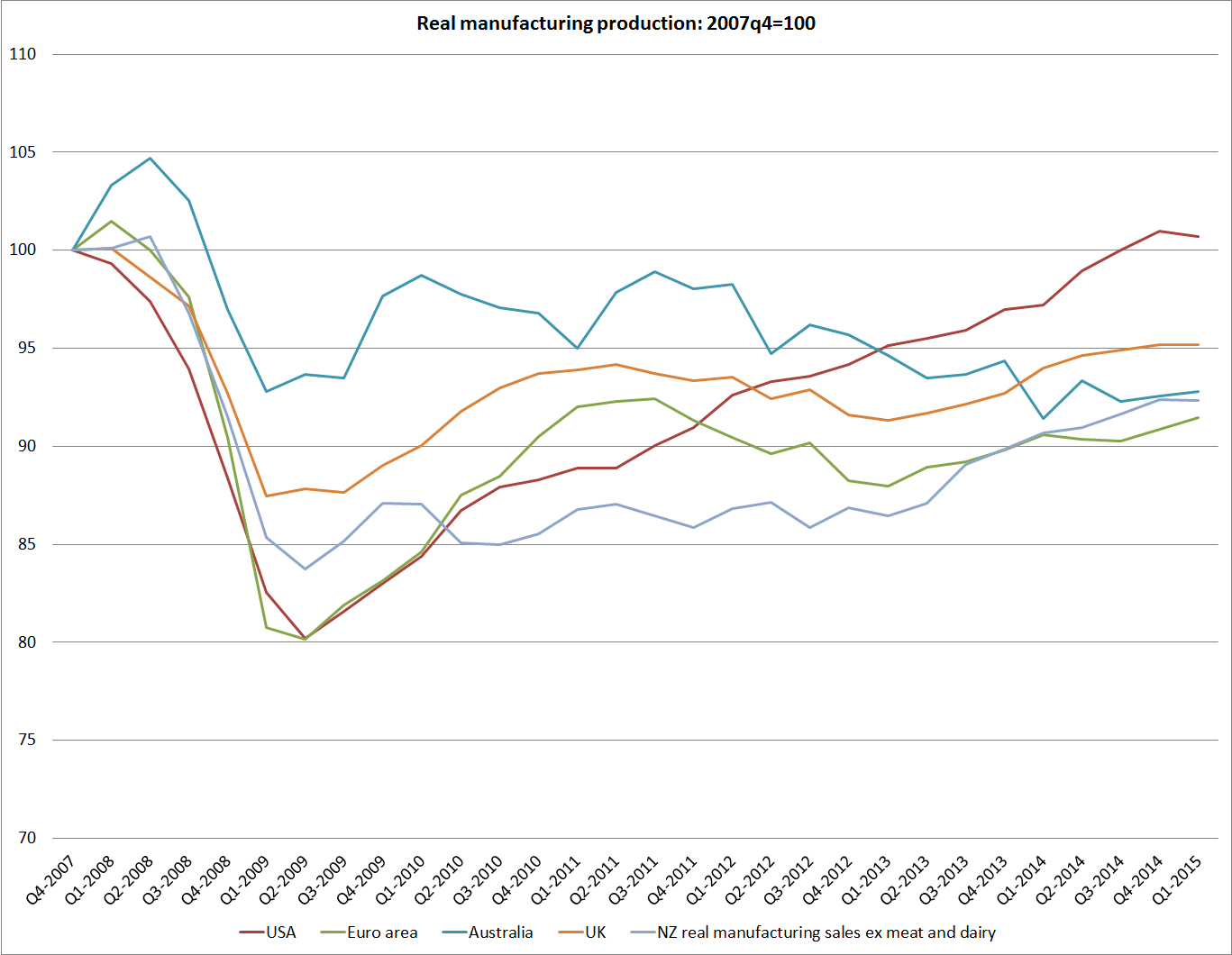
The quarterly manufacturing survey came out this morning.  Noticing that growth in the sector seemed to be levelling off I was curious as to how things looked relative to levels just prior to the recession.

As is well known, the manufacturing share of GDP has been falling for decades in most advanced countries.  China, for example, has picked up a big chunk of global manufacturing, and services have become progressively more important everywhere.

But this chart shows the volume of manufacturing activity (not as a share of GDP, not per capita, just the level) for a few countries/areas since 2007q4.  For the other countries, it is OECD data, while for New Zealand I’ve used the volume of manufacturing sales ex meat and dairy (the rather less noisy series SNZ also publishes).

manuf

I haven’t been paying much attention to these data in the last year or two, but I was interested how far below 2007 activity levels New Zealand manufacturing still is.  As previous Reserve Bank work pointed out, once one strips out meat and dairy, a lot of the activity in New Zealand manufacturing is a derived demand off the back of construction-sector activity.  And the construction sector here has been pretty robust, particularly on the back of the huge volume of work in Christchurch.

But I was also somewhat sobered by how similar the path of manufacturing activity has been in New Zealand and in the euro-area as a whole.  Note that these are not per capita measures, and euro-area population is pretty flat while ours has risen 6 per cent of so since 2007.

The US performance looks relatively good, but in fact is still slightly less good than (flat to falling population) Germany.

I’m not one of those who thinks that the relative decline of manufacturing is a tragedy, but on the other hand I also don’t think that it is a matter of total indifference.  Most likely, the relatively weak manufacturing sector performance in recent years, despite the buoyant construction sector, is a reflection of the persistently high real exchange rate.  Like Graeme Wheeler, I think the real exchange rate is out of line with medium to longer–term economic fundamentals.  A more strongly performing New Zealand economy, one making some progress in closing the gaps to the rest of the OECD, would be likely to see a stronger manufacturing sector.  It might still be shrinking as a share of a fast-growing economy, but a manufacturing sector that has seen no growth at all in almost 20 years doesn’t feel like a feature of a particularly successful economy.

Using the same data series as above, I had a look at what has happened since 1995q1.  Six OECD countries have had weaker manufacturing sector activity than New Zealand.  At least three are current cyclical basket cases (Spain, Italy and Greece), and the gap between the growth rates in manufacturing volumes and in population has been weaker only in Italy, Spain, and France.

Numbers like this certainly don’t suggest immediate policy remedies, but they probably should continue to prompt thinking about just what explains New Zealand’s disappointing economic performance.

Growth 1995 to 2015
Manufacturing Population
Italy -17.6 7.8
Spain -10.7 20.2
France -5.3 11.3
Greece 0 3.3
Japan 0.2 1
UK 1.6 9.9
New Zealand 4.3 22.7

The terms of trade and NZ’s recent economic performance

As people often point out when I run charts like those in yesterday’s post, real or volume measures of value-added are all very well, but they don’t capture the direct effects of fluctuations in the terms of trade.  We can spend what we earn, and what we earn is a combination of volume and price.

For some purposes, ignoring the terms of trade effects can be more useful.  After all, a country like New Zealand is exposed to quite volatile terms of trade, and those terms of trade are almost wholly outside our control, year to year.  Some firms probably have price-setting power in world markets, and there is some evidence that New Zealand droughts have a short-term impact on world dairy prices, but our overall terms of trade are largely beyond our control.  By contrast, productivity measures (labour or multi-factor) are about what New Zealand (firms) do with the hands we are dealt, and the opportunities we make for ourselves.  It is exceptionally rare (probably unknown) for countries to get sustainably rich just  –  or even primarily –  on changes in the terms of trade.

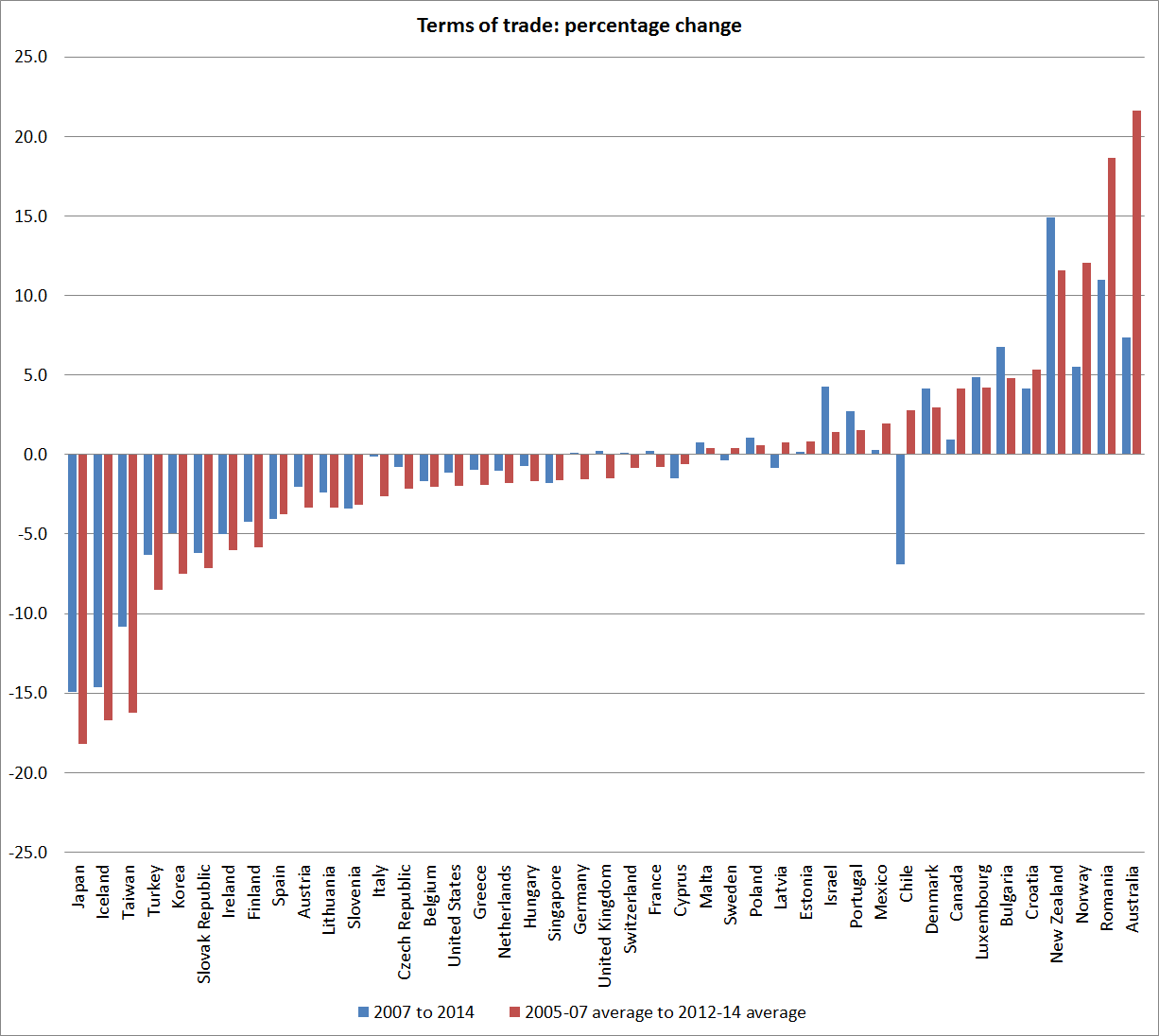
But New Zealand’s terms of trade have done quite well over the last decade or so, reflecting a combination of falling real import prices and good prices, on average, for dairy products in particular.  Here is one chart showing changes in the terms of trade for the 43 advanced countries I discussed yesterday.  There are two different cuts here: the percentage change from 2007 to 2014 and the percentage change from the average level for 2005-2007 to the average level for 2012-2014.  On both New Zealand shows up as having done well.  Indeed, on the measure from 2007 to 2014, we’ve had the largest increase in the terms of trade of any of these countries (no doubt it will fall back somewhat in 2015).

tot crosscountry

How much difference does the terms of trade make? Well, we export and import amounts equal to around 30 per cent of GDP, so a 15 per cent boost to the terms of trade is roughly equivalent to an increase of another 5 percentage points, on top of any growth in the volume of output.  That is certainly a useful boost, but if you look at the first chart in yesterday’s post, it is hardly enough to dramatically transform our ranking.     Looking at the terms of trade does not materially alter the story of how disappointing our overall economy performance has been since 2007.

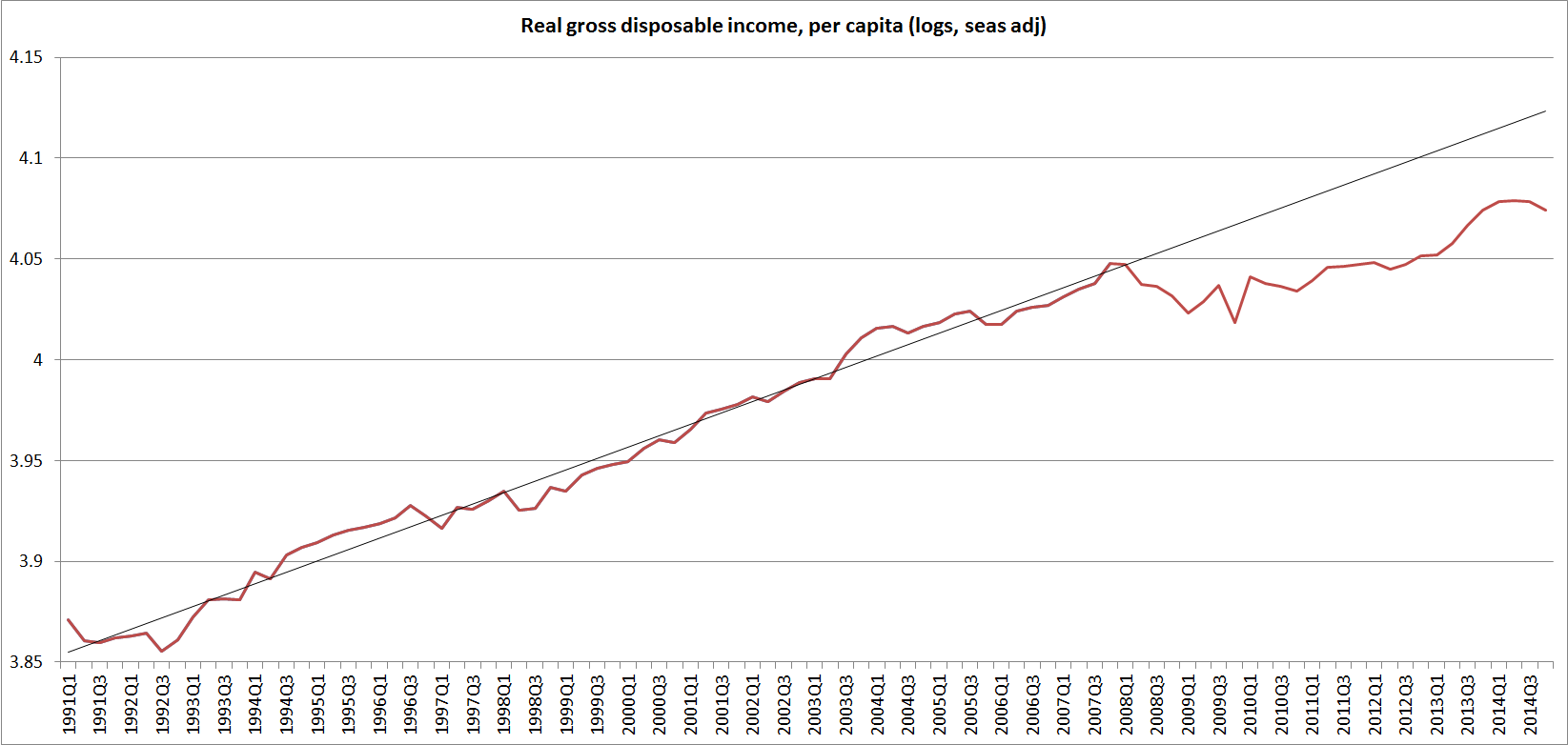
Statistics New Zealand produces a series of per capita Real Gross Disposable Income.  This series tries to estimate New Zealanders’ real purchasing power.  It takes account of both the direct effects of the terms of trade, and of changes in how much of what is produced here has to be paid to foreign providers of (mostly) capital.  Over the period since the recession New Zealand has enjoyed a strong terms of trade, and low interest rates –  as a country with a high level of external debt, we had an unexpected lift in purchasing power as the servicing costs of that debt fell sharply and stayed low.

Here is a chart of that RGDI series.  At present, RGDI per capita is still around 15 per cent below where it would have been if the 1991-2007 trend had continued.

rgdi

So far I’ve focused on the direct effects of the terms of trade.  But it is a little surprising that the strong terms of trade, boosting incomes and relative prices, has not provided more of a boost to real activity in the economy.  A rising terms of trade (and especially an unexpected lift) would typically be expected to stimulate business investment:  higher prices for the goods and services New Zealand firms sell will encourage more investment in those industries. As Daan Steenkamp has illustrated, the terms of trade boom in Australia helped prompt an enormous surge in business investment, which had no counterpart in New Zealand.  Of course, our exchange rate has been very strong, which might have offset much of any additional incentive to invest in the tradables sector in aggregate.  But the higher incomes (higher real purchasing power) might still have been expected to generate a significant boost to investment in the non-tradables sector.  We haven’t seen much sign of it.

As I’ve noted before, if the lift in the term of trade proves quite short-lived it might prove to be a boon that there was not an investment boom, putting in place long-lived projects on the back of a temporary lift in relative prices in our favour.  But most observers do not seem to expect New Zealand’s terms of trade gains of the last decade to fully unwind.

So I’m still puzzled as to why New Zealand has not done better given the very favourable terms of trade.  At the margin, overly tight monetary policy in the last few years has not helped.  And one other factor is the role of the Canterbury earthquakes and the associated repair and rebuilding process.  As the Reserve Bank recognised right from the start, this represented a major non-tradables shock, and all the more so because most of the cost was being covered by offshore reinsurers.  Real resources had to be devoted to the work in Canterbury, and for the most part we New Zealanders did not have to save more to pay for the work (we’d already paid the insurance premia).  Real resources –  especially labour –  can’t be used for two things at once.  Without the earthquakes and the subsequent repair process, those resources would have been freed up for other uses.  Lower interest rates would have been likely to have resulted in a lower exchange rate, improving the attractiveness of investment in New Zealand’s tradables sectors.

Is it enough to explain why New Zealand has not done better?  I don’t really think so, but the impact of the earthquake is certainly one constraint on New Zealand that Australia has not faced, and may be one reason why we have done less well than Australia on most measures since 2007.

How has New Zealand done, compared with other advanced countries, since 2007?

Before I left the Reserve Bank a couple of months ago I had been working on a paper looking at how New Zealand’s economy had performed relative to those of other advanced economies over the period since 2007.  The advanced world as a whole has done pretty badly over that period, but our interest was just in New Zealand’s relative performance.   The Bank’s work has not been published, so I’m going to run some of the ideas and material here (drawing, of course, only on publically available material).

One obvious question is who are the relevant comparator countries.  The member countries of the EU, of the OECD, and Singapore and Taiwan make a reasonable group.  Data are readily available for almost all variables of interest for almost all these countries back to at least the mid-1990s.  And around half of these 43 countries have higher GDP per capita than New Zealand, and half a lower.  There is another group of countries at least as rich as New Zealand, but whose economic fortunes are almost totally shaped by oil.  For these purposes I have set them to one side.  But my comparator grouping does include several countries whose largest exports are commodity-based: New Zealand, Australia, Norway, Chile, Mexico, and Canada.  No comparator group is ever ideal, and no two economies ever face the same set of conditions, but this group seemed large enough to be interesting and small enough to be tractable.

Another question is what period to look at.  I’m focusing on the period since 2007 because 2007 was for most countries around the peak of the previous business cycle –  and just before the financial crisis and global recession took hold in 2008/09.    One could make a case for starting a few years earlier, but when I looked into starting in, say, 2005, it did not make much difference to the cross-country comparisons.  For some things, I’m going to compare how economies have done over 2007-14 with how they did in the previous decade (1997 to 2007).  Again, that choice is to somewhat ad hoc, but it does reflect (a) the limitations of data (for many of the eastern European countries data starts getting patchy any earlier), and (b) that for New Zealand at least 1997 was also a business cycle peak.

To anticipate one objection, many countries’ economies were stretched to the limit in 2007, running positive “output gaps”.  So we should have expected weaker growth since then than in the previous decade.  But (a) the slowdown in growth rates far exceeds anything that can be explained by initial output gaps, and (b) New Zealand’s output gap was not large (by international standards) in 2007.

As time permits, I will run a series of charts and offer some thoughts on New Zealand’s performance, again in an international context.  As I’ve noted previously, New Zealand hasn’t done particularly well in recent years.   A disappointing performance isn’t new, but New Zealand looked as though it had a number of things going for it in recent years.

So let’s have a look at how New Zealand has done?

The first chart is growth in real GDP per capita from 2007 to 2014 (total growth, not annual average growth). These data are drawn from the IMF WEO database, and are calculated in national currencies.

gdppc

On this measure, New Zealand has done just a little better than the median country, and very similar to a bunch of countries from Japan to Canada.   Of the commodity-exporting countries, however, only Norway did less well than New Zealand over this period.

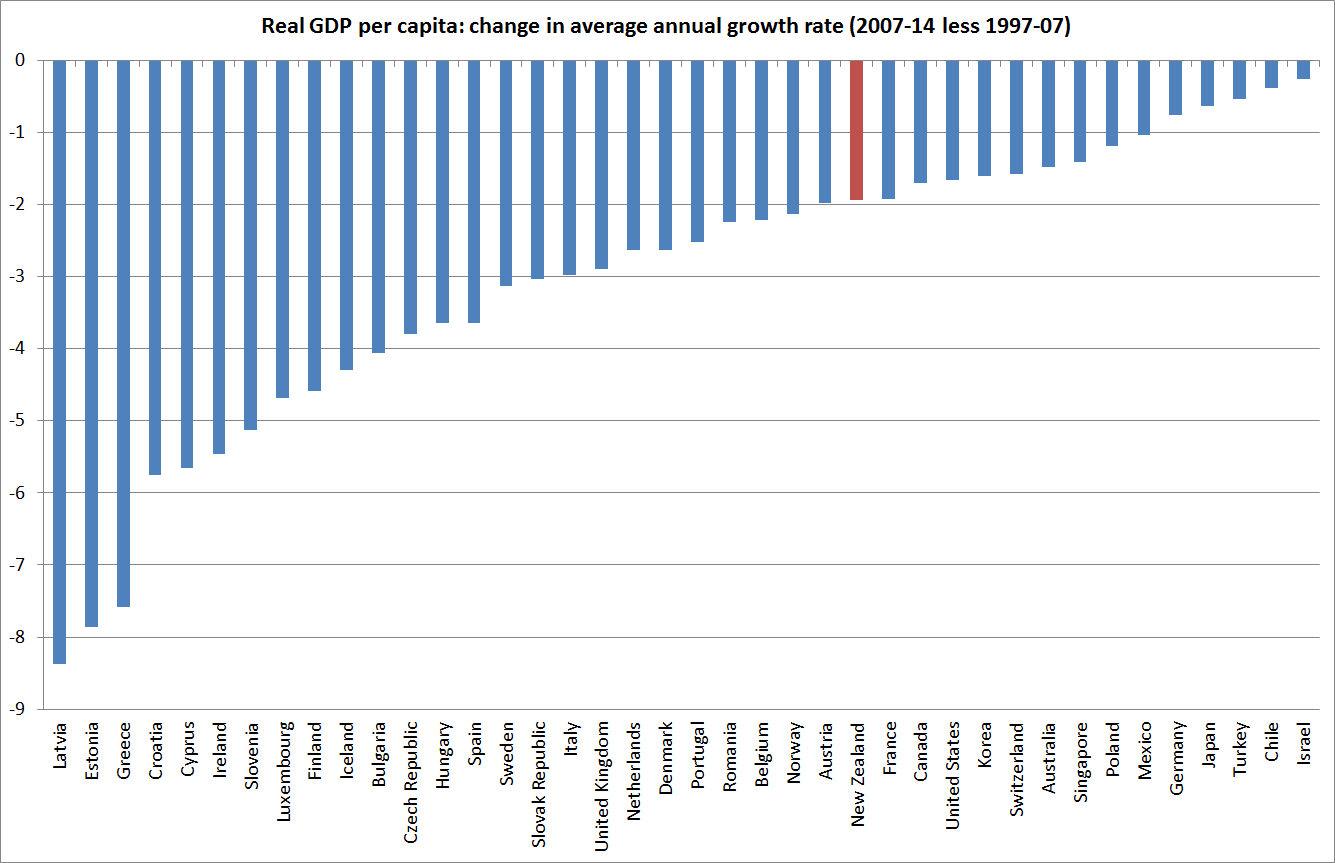
The second chart shows the change in annual average growth rates: how average growth over 2007 to 2014 compared to that for 1997-2007.  Every single one of the countries for which the IMF has data back that far had slower growth in the more recent period than in the earlier period.    New Zealand did just a little less badly than the median country, but again among the commodity-exporters we did better only than Norway.

gdppcchg

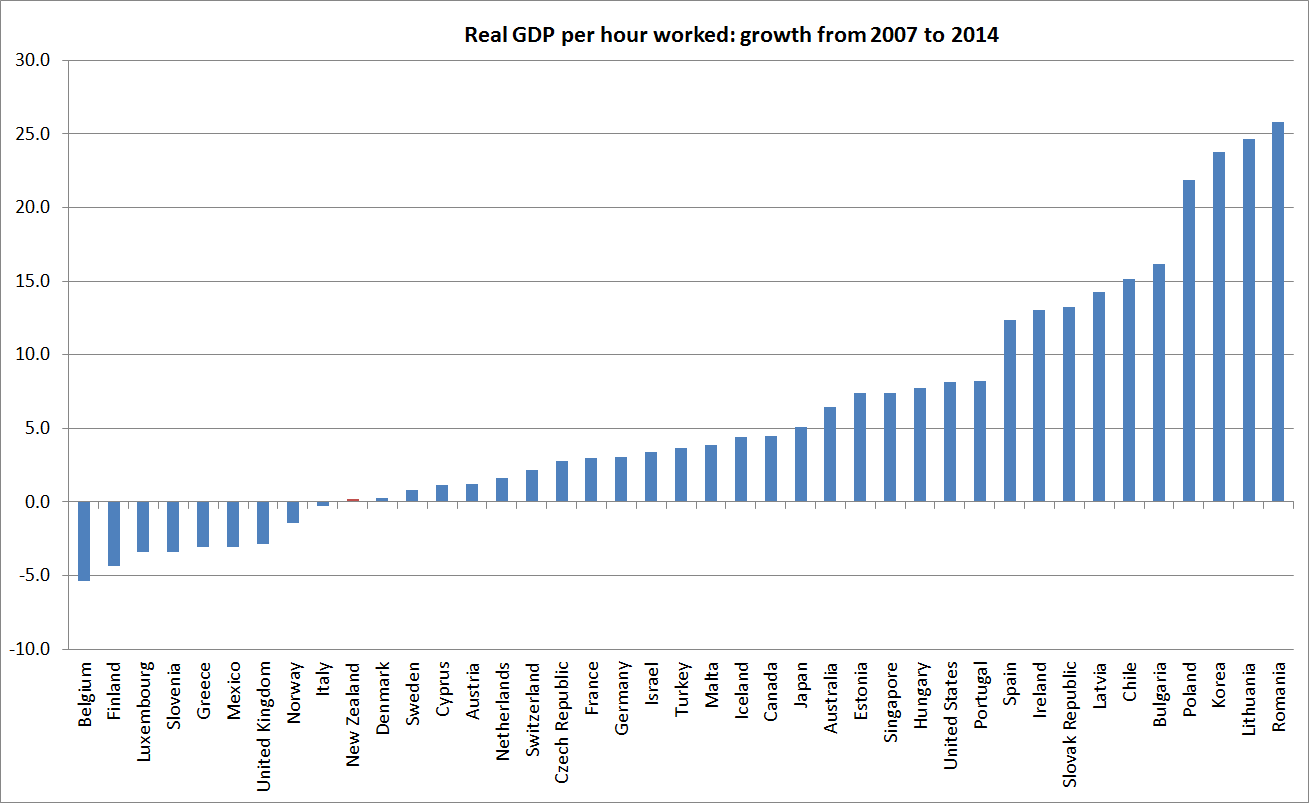
Real GDP per capita is a useful measure for many purposes, and it is the most readily available such statistic.  But it does get thrown around by recessions and booms.  A country in a deep recession (such as Greece) might experience a big fall in its real GDP per capita, but the average productivity of its employed workers might be much less adversely affected.  There are “distortions” even here.  In recessions, relatively less productive workers are more likely to be out of work.  But real GDP per hour worked measures are much less cyclically variable than real GDP per capita measures.

Hours worked per capita data are available for all the countries I’m interested in (except, for some reason, Croatia).  I used them to generate real GDP per hour worked measures, again in national currency terms.

gpdphw

Here, unfortunately, the picture is much less favourable for New Zealand.  Only nine of the countries did worse than New Zealand, and again among the commodity exporters only Norway was worse.

The reconciliation lies in what happened with hours worked per capita.

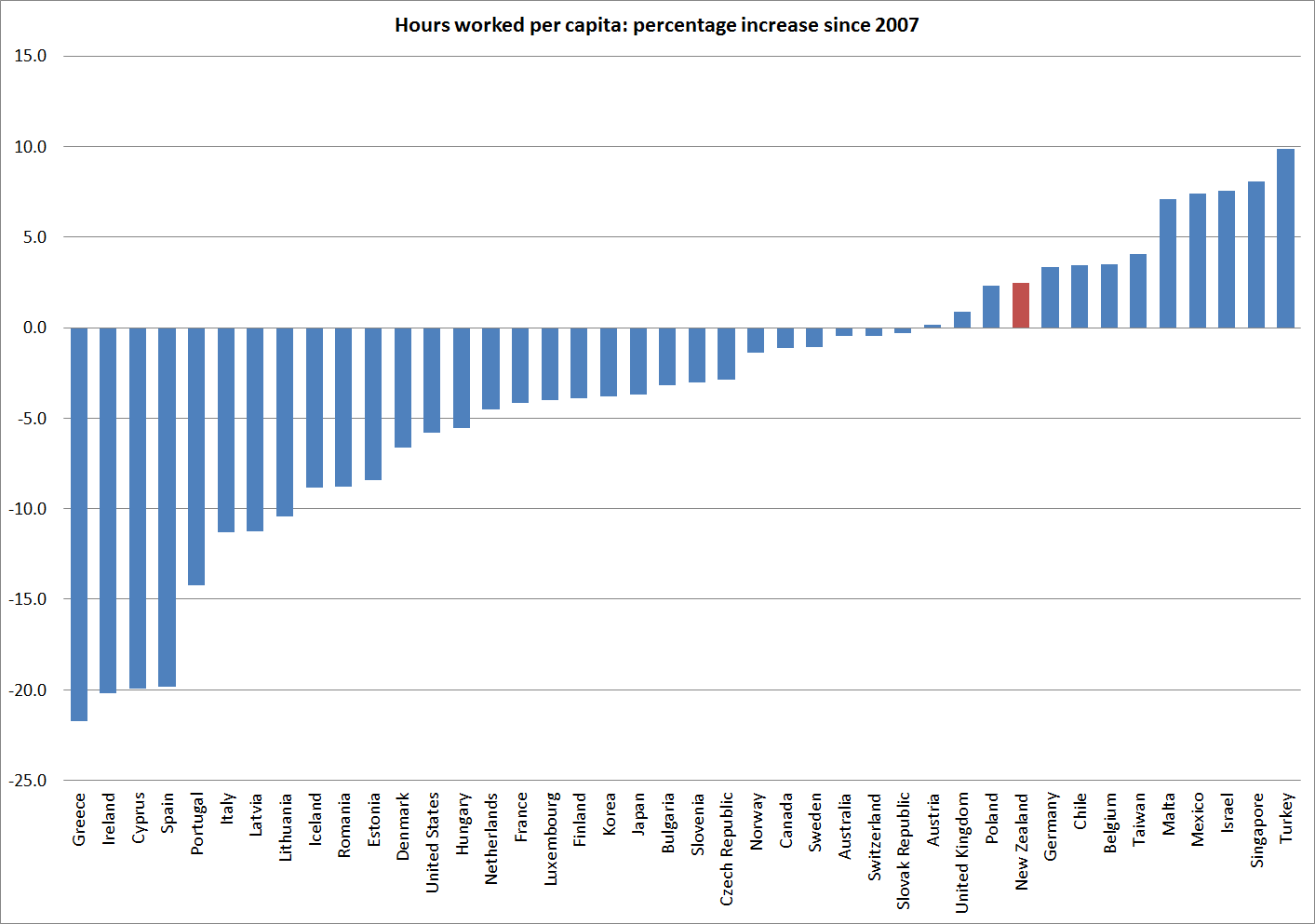
hours

Only a small number of countries had more of an increase in hours worked per capita than New Zealand since 2007.

Hours worked are an input (which comes at a cost) not an output, so higher hours worked aren’t automatically a good thing.  There are good dimensions to it, if (for example) people are coming off long-term welfare back into the workforce, or older people are keen and able to stay in the workforce.  Hours worked per capita also gets affected by different demographic patterns –  they will be lower in countries with lots of under-15s or over 70s.  But, equally, part of the story of New Zealand in the last 25 years is that we have managed to limit the deterioration in our GDP per capita, relative to that in other countries, by working more.  Productivity would be better.

Over the full period since 1990, here is the change in hours worked per capita for New Zealand and the other Anglo countries, countries with reasonably similar demographics to our own.

hoursanglo

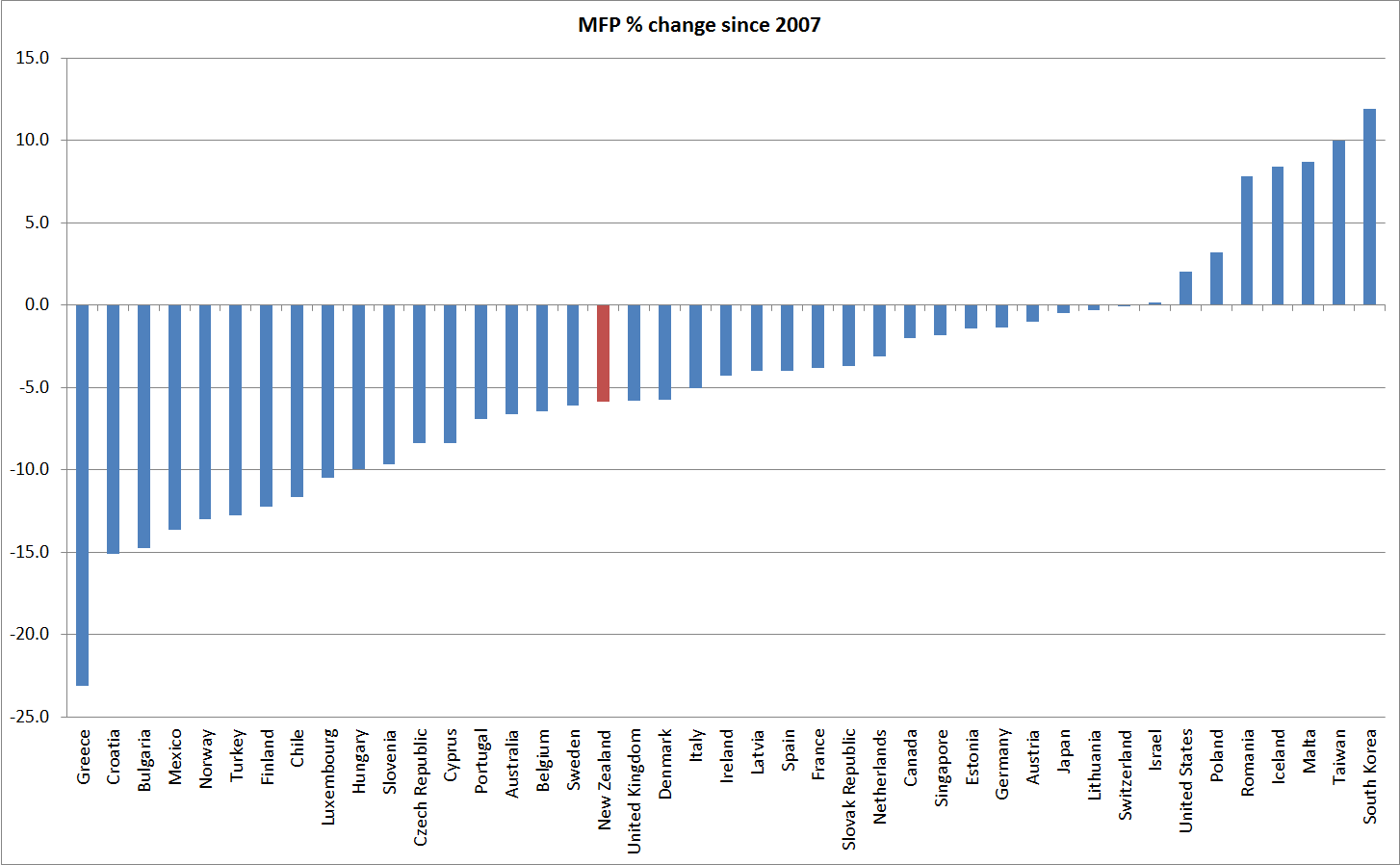
And, then of course, there is multi-factor (or total factor) productivity.  On this measure, which I’ve shown before, most countries have had no MFP growth at all since 2007:

mfp

Time to reform Reserve Bank goverance – the Bank does different things

Reader numbers tell me that anything on housing is more popular than things I write on Reserve Bank governance.  And, in fairness, the housing issues are probably more important.   But a good quality central bank, subject to best-practice governance models, matters too, and the governance issues are actually much easier to deal with. Any minister willing to pick them up would be pushing at an open door.  There would (and should) be debate around details, but no one would fight for the status quo.

This is last in my series of posts on the basic case for changing the Reserve Bank governance model adopted in 1989.  I haven’t set out to re-litigate the choices made in 1989.  At this point, doing so would only be of historical interest, and in any case I’ve tried to illustrate the quite rational and reasonable basis on which the 1989 choices were made.  But things are different now, and the governance model needs to be overhauled to reflect the way things are today.

As I noted on Tuesday, no other country does things the way we do (gives a single unelected official formal decision-making powers over both monetary policy and financial regulatory policy), even though many countries have reformed their systems since 1989.

As I noted on Wednesday, in no other area of policy in New Zealand are decisions made the way we allow Reserve Bank policy to be made.  Policy decisions (as distinct from the application of policy in individuals’ cases) are typically made by elected politicians, or by boards, not by single officials.

As I noted yesterday, back in the late 1980s monetary policy was seen by some as likely to be pretty straightforward and uncontroversial, involving little exercise of discretion. As one of my former colleagues put it, exaggerating to make the point, “with the right PTA, any bozo could be Governor”.  In fact, experience here and abroad suggests that considerable discretion is needed, and the choices have material implications for the short-term performance of the economy.  So it isn’t the sort of policy for which one might appropriately rely just on the talents and preferences of a single unelected individual, no matter how able.

And, if the conception of monetary policy has changed, so has the conception of the Bank itself.  The sort of organisation the Bank was seen as becoming materially influenced the governance model chosen.

In 1989, the Reserve Bank was seen as being en route to becoming a rather simple institution.  It would be primarily a monetary policy institution, with next to no financial risks on its quite small balance sheet.  Banking registration and supervision powers were put in the Act, but no one envisaged the Bank as being engaged in much active discretionary prudential supervision (and key failure management powers were, in any case, reserved to the Minister).

I’ve already talked about the changed conception of monetary policy, which meant that a PTA did not provide any simple or easy way to hold the single unelected decision-maker to account.  But the changes to the rest of the Bank, and their implications for governance and accountability, are probably even greater, and more important.  The Bank has been assigned by Parliament a much wider range of regulatory responsibilities (non-bank deposit-takers, insurance companies, AML, and the payment system (where it is bidding for still more powers)).  That alone represents a hugely greater weight on regulatory matters.  But in addition the Bank has chosen to use its existing statutory powers over banks in ways that involve much greater degrees of discretion.  The most obvious examples are the recent and proposed LVR restrictions, but there is also a lot of (not very transparent)  discretion involved in the approval processes for the capital models used by the big banks in calculating regulatory capital requirements.  Where considerable discretion is involved, the personal preferences of the decision-maker become important.    And that discretion can’t easily be constrained by something like a PTA  –  it is pretty much common ground that nothing like a PTA, that would materially constrain discretion, could be put in place for the financial stability policy responsibilities the Bank has.   The state of knowledge is just too limited[1].

Note that, for these purposes, I’m not questioning whether or not the Bank should have such powers, or should interpret them as it does.  I’m simply making the point that when so much discretion is involved it is inappropriate –  and not seen anywhere else –  to have a single unelected official making the decisions.  It is simply too risky.  It isn’t the way the New Zealand generally allows policy to be made.

New Zealand has pretty good quality institutions and systems of government and public sector governance.  The Reserve Bank governance model has become out of step with practice globally,  with that in the rest of the New Zealand public sector, and with what the Reserve Bank now actually does.  It really is Time to Reform the Governance of the Reserve Bank.

As things appeared in 1989

At the time Reserve Bank was thought of as being (in the process of becoming) a relatively simple institution.  Exchange control had gone in 1984, direct controls had been removed by early 1985, and government banking, tendering and registry functions were gradually being removed from the Bank.  No one in officialdom had much interest in foreign exchange intervention and the foreign reserves the Bank was allowed to hold were well-hedged.

The 1989 Act gave the Reserve Bank powers in a variety of areas, but the Bank was overwhelmingly seen as a monetary policy institution[2]  Many of the clauses of the Act were devoted to the registration of new banks, and the management of bank failures, but there was little or no sense that the Bank was likely to become a particularly active regulatory agency. People close to the work on the 1989 Act report that in detailed discussions around the drafting of the 1989 legislation, little or no attention was given to governance issues as they affected the regulatory responsibilities of the Bank.  Thus, although the governance arrangements (single decision-maker, complemented by the monitoring role of the Board) covered all the Bank’s responsibilities, it is clear that they were designed primarily with (the rather simple conception of) monetary policy in mind.

And, by contrast, how they are today:

The third aspect that has turned out materially differently than the designers of the 1989 legislation expected is the wider role of the Reserve Bank.

In the late 1980s, the Reserve Bank was envisaged primarily as a monetary policy institution, with a very limited – and well-hedged – balance sheet. Since then the Bank’s roles have expanded considerably, but there has been no material change in its (single unelected official) governance.   What are the changes in role?

The Bank has taken on substantial foreign exchange risk, including a more active foreign exchange intervention role. In crisis periods it has assumed substantial credit risk.  And whereas in 1989 the registry business was in steep decline, the Bank is now the owner and operator of New Zealand’s major securities clearing and settlement system.

But perhaps the most substantial changes have been in the supervisory and regulatory functions, which now take a much larger, and a more active, place.  Considerable amounts of regulator discretion are now being exercised, as to policy and the implementation of policy.  The change has accelerated in the last half-dozen years with:

  • The move to Basle II and then Basle III capital models (involving approval of risk models, and the exercise of detailed discretion and judgement on risk weights etc)
  • The introduction of the so-called macro-prudential (time-varying) approach to regulation of banks, including the 2013 residential mortgage LVR “speed limit” and the recent proposal for a ban on high LVR property investor lending in Auckland.  Regional differentiation in the way prudential policy is applied is yet another new step in regulator discretion.
  • The Reserve Bank becoming responsible for the regulation of non-bank deposit-taking institutions
  • The Reserve Bank becoming responsible for insurance supervision.
  • The Reserve Bank becoming responsible for implementing anti-money laundering etc legislation in respect of the financial institutions it regulates, and
  • The Reserve Bank’s bid (not yet successful) for more payment system powers.

It is common ground that there no framework in the Act for defining output-based performance standards for these functions and that for most of them it is simply not possible to do so.  That is not a criticism of the Reserve Bank, or of the roles Parliament has assigned, but simply a description of the difficulty all countries face in these areas.

So the Reserve Bank is now an organisation that, with the acquiescence of ministers and sometimes with the specific mandate of Parliament, has a wide range of functions and powers, but typically has rather ill-defined, and hard to measure, goals[3].   But that means it is very difficult to defend a conception of the Bank in which having a single (unelected) decision-maker provides for clear and decisive point of accountability across these multiple different functions and responsibilities.

[1] Although it has been pointed out that the UK Banking Act makes an effort in this regard.

[2] Section 8 of the Reserve Bank Act still states that monetary policy is the “primary function of the Bank”.

[3] In one or two areas there are memoranda of understanding with the Minister of Finance, but these documents have no legal status, and bind neither subsequent ministers nor subsequent governors.

Reserve Bank spending plans – as transparent as those of the SIS?

Sometimes events determine what I write about.  I had no intention of writing two posts today about Reserve Bank governance, but then I saw that Parliament had ratified the new Funding Agreement for the Reserve Bank.  Since these things come round only every five years, and since the Funding Agreement is a material part of the Bank’s governance framework, today was the day to write about it.

Most government activities are funded, following each year’s Budget, by annual appropriations made by Parliament.  Huge documents are published providing details of the plans the government is seeking appropriations for.

By contrast, historically most central banks were funded from their own resources, and legislatures had no real say in their spending.  A statutory currency monopoly generates a lot of income, even in this era of lower interest rates and electronic payments.  When the Reserve Bank was being reformed in the 1980s, everyone agreed that that model was inappropriate. Some parliamentary accountability/approval for the Bank’s spending was needed.  But, equally, since the main point of the reforms was to provide operational independence for the Reserve Bank on monetary policy, no one really favoured a system of annual parliamentary appropriations for the Bank.  The concern was that a Minister of Finance who wanted the Bank to run looser monetary policy could use the threat of a cut to the next year’s appropriation as behind-the-scenes leverage on the Governor.  Such pressure might be particularly easy to exert since the Governor was both sole monetary policy decision-maker, and chief executive of the organisation.

The model that was settled on and passed by Parliament was a five-yearly Funding Agreement.  Under this model, the Governor reaches an agreement with the Minister of Finance as to how much the Bank can spend in each of the next five years[1], and that agreement only becomes effective when it has been ratified by Parliament.  In fact, it is not even obligatory to have a Funding Agreement – the Act says only that the Governor and Minister “may” reach an agreement, and if there is no agreement then, in principle, the Bank has no formal constraints on its spending.

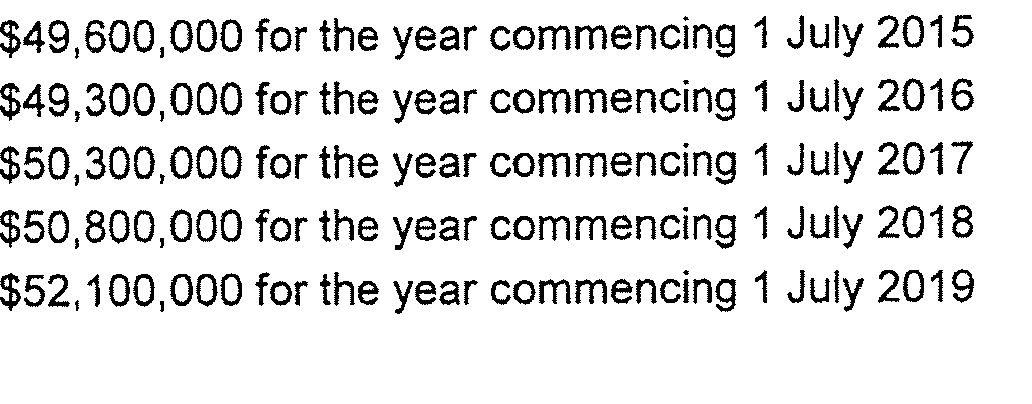
Parliament ratified the latest Funding Agreement last night, after a short debate (of which more below).  The Bank and the Minister had agreed that the Bank will spend $49.6 million this coming year, rising by about 5 per cent in total over the following 4 years[2].

I don’t have any particular argument with the size of the Funding Agreement total, or the modest increase over the next few years (although it does seem to be a larger increase than many government departments, with flat baselines, have been experiencing).  My concern is about process.

In particular, for one of the most powerful government agencies in New Zealand, the agreement contains almost none of the information people might reasonably need, whether as MPs or citizens, to know whether $49.6 million is the right amount.  The entire document runs to just over two pages, but the meat of it is simply five lines

funding agreement

That is the same level of detail we get in the Estimates about the spending of the SIS – and at least Parliament (a) has to vote for the SIS’s spending, or the spending can’t happen, and (b) has to vote each and every year.

MPs were asked to vote on the Funding Agreement yesterday with no information about what the Bank and the Minister proposed that the Bank would do with the money.  Presumably the Minister is aware of the Bank’s plans, but he now has no control over them beyond the top line number.  In particular, the Bank has two quite distinct main statutory functions and it would be useful to know how the spending is split between monetary policy and financial stability.  And within financial stability, how much is being spent on responsibilities under the Reserve Bank Act and how much on those under the Insurance (Prudential Supervision) Act?  And how are those splits envisaged as changing over time?

There is nothing in the Act that requires funding agreements to be so abbreviated, and there is certainly nothing that would have stopped the Bank, the Minister, and Treasury releasing background papers to accompany the Funding Agreement, either before it was put to Parliament.  That would have given MPs, and outside observers, the opportunity to scrutinise the plans for the Bank’s spending before the matter came to a vote in the House.  Estimates hearings for other departments spring to mind.

The Funding Agreement system was a huge step forward when it was introduced in the 1989 Act.  But it is really not good enough 25 years on.  It could be made to work in much more open and transparent way without any legislative changes (as above).

But after 25 years, it is probably time for a re-think of the entire model.  Why should the Reserve Bank be able to spend at all without parliamentary appropriation?  Even if one doesn’t go that far, shouldn’t the (elected) Minister be responsible for telling the Bank how much it can spend, not reaching a (legally voluntary) agreement with the (appointed) Governor on the matter? The Governor can provide advice, and make a bid for spending (as all agencies around town do), but the Minister and Parliament should decide.   Is there really any case for not making the Reserve Bank’s regulatory functions (at least) subject to an annual parliamentary appropriation?  And if monetary policy decision-making responsibility were to move to a non-executive committee would there still really be a need for monetary policy to be funded five years at a time by Parliament[3]?  I’m not sure how I’d answer that final question, but it should at least be asked.

The Funding Agreement model, as laid out in statute, and as it is worked in practice, is just another example of the gaps, the democratic deficits, in the governance model Parliament has put (left) in place for the Reserve Bank.  The onus for change is with the Minister and with Parliament.

And just briefly on the parliamentary debate itself, which you can read here.  It wasn’t Parliament at its finest, but then what could MPs do with so little information? Perhaps even with more information it would still have been an opportunity for hammering hobbyhorse issues?  But what if there had been an estimates hearing first?

In addition to the Associate Minister, four MPs spoke:

  • Grant Robertson seemed to be suggesting that the Bank needed more resources because the government had abdicated policy around the housing boom to the Bank.  More seriously, he argued that the Bank “should be funded for a comprehensive overview of monetary policy and of the policy targets agreement”, arguing (and this is the first time I have heard him speak on the PTA) that New Zealand needs “the kind of policy targets agreement that would enable monetary policy that actually supports the exporters of New Zealand.”
  • Russel Norman spoke, almost entirely about the housing market and financial stability.
  • For New Zealand First Fletcher Tabuteau spoke.  He took the opportunity to advocate significant change in the Reserve Bank, including the change in objectives proposed in private members bills in the previous Parliament by Winston Peters.  Somewhat gratifyingly (I think) he quoted me, and the article last weekend on my governance ideas, noting that I considered the current Reserve Bank governance model “outdated, risky, and out of step internationally”.
  • David Seymour (ACT) also spoke.  It was a curious speech, perhaps intended primarily as a rebuttal of the previous speaker.  He claimed that the Bank of Canada is modelled on the Reserve Bank of New Zealand (which is simply wrong), and appeared to blame the US housing bust on multiple objectives of the Federal Reserve (not a view that would be very widely shared).

But what else could they talk about when they have no more information about planned expenditure than is provided about the SIS?

[1] This is an approximation, both because the Bank can dip into capital (so the agreement does not formally cap the Bank’s spending even on the areas it covers) but also because various aspects of the Bank’s activities are not covered by the headline Funding Agreement total.

[2] Note that in the previous Funding Agreement the Bank had approval to spend $56.4 million in 2014/15.

[3] And actually one problem with the Funding Agreement model has been the difficulty of envisaging what spending will be required five years hence (in both real and nominal terms). No corporate board signs off on budgets five years ahead.

Time to reform Reserve Bank goverance – conceptions of monetary policy

I’ve been arguing that it is Time to reform the governance of the Reserve Bank.  Earlier in the week, I pointed out that no other country does things the way we do (giving a single unelected official discretionary control over monetary policy and much of financial regulatory policy), and that New Zealand does not operate any other areas of policy in this way.  Other policy decisions are generally made by elected politicians or by boards, not by single unelected officials.

But, as I have also pointed out, the model adopted in 1989 had its own logic.  Not only did it reflect (slightly uneasily) the public sector reforms then being put in place, that set out to establish powerful but accountable (and dismissable) chief executives of core government ministries, but it also reflected views about monetary policy that were around at the time.  And when the 1989 Act was being written, and debated, it was the monetary policy role of the Bank that got far and away the most focus. The Act said (and still says) that monetary policy is the “primary function” of the Bank.

The gist of the story is this (more extensive background is here and here):

  • Monetary policy in the late 1980s was highly contentious and subject to lots of uncertainty.  Policy was focused on getting inflation down once and for all, in a newly-deregulated economy where many indicators were hard to interpret.
  • But in some quarters, especially in the Treasury, there was a view that the issues could (and should) all be made much simpler, especially once the initial post-liberalisation period passed.  If, for example, the Reserve Bank could be required to target a steady growth rate in the money base, there would be little room for discretion, and no room for debate as to whether or not the Bank had done its job.
  • Even if those sorts of targets weren’t feasible (and I don’t think anyone in the Reserve Bank ever thought they were), perhaps an inflation target itself could a very close approximation.  If inflation ended up inside a target range, job done.   If not, then not.
  • In short, in the minds of some those shaping the Act there was a sense that monetary policy should not be particularly controversial, and should be a largely technical matter, not involving material amounts of discretion.

Against that backdrop (and I’m inevitably stylising views somewhat), a single unelected decision-maker made some sense. The person would have little effective discretion, and could be dismissed if he/she stepped out of line.

Of course, actual monetary policy, whether in New Zealand or abroad, turned out nothing like that stylised story, even in a low inflation environment.  If done sensibly, monetary policy under inflation targeting involves huge amounts of discretion, amid a great deal of uncertainty.  There are choices to be made that have implications for the price level, and for how things like the unemployment rate and the real exchange rate (and the impact those have on livelihoods of people and businesses) for several years at a time.  Oh, and there hasn’t been an election since 1990 when monetary policy has not been a campaign issue for at least some of the parties.

So the single unelected decision-maker is not a model other countries use, it isn’t how we in New Zealand run other areas of policy, and it also doesn’t fit well with how monetary policy actually works, here or abroad.

Here are the relevant extracts from my paper:

As things were seen in the late 1980s:

This outputs vs outcomes framework was an important factor in the debate around how the Reserve Bank of New Zealand should be governed[1].    From the original discussions around the possibility of converting the Reserve Bank into an SOE, through until at least a year after the Reserve Bank Act was passed, elements of the Treasury were heavily influenced by a strand of thought that reckoned that monetary policy could be appropriately, and perhaps best, configured as an “output” problem.  If so, an autonomous decision-maker could be held clearly and directly accountable for delivering a pre-specified desired output.

At one stage, the idea of a statutory quantitative limit on the Reserve Bank’s note issue was floated.  Rather more persistent was the view that a target rule for growth in the money base – something that could be directly controlled by the Reserve Bank if it chose – was the appropriate basis for setting monetary policy.  If so, it would have been easy to judge whether (or not) the Bank had done its monetary policy job.

Within the Reserve Bank and Treasury it was largely common ground that something like price stability was the appropriate medium-term desired outcome.  However, it was also accepted that, in a market economy, inflation was not directly controllable by policy actions, and could be influenced (indirectly) by monetary policy only with fairly long and variable lags, and subject to a variety of exogenous shocks[2].   A robust relationship between the monetary base and medium-term price stability might have provided a suitable foundation for an outputs-based approach.  But such a relationship never emerged.

The point here is not that the governance aspects of the 1989 Act mechanically reflected views of particular individuals about which operational targets the Reserve Bank should use to conduct monetary policy.   It is more that the milieu inevitably, and perhaps even appropriately, affected the thinking about institutional design.  On the one hand, public sector reforms processes put a strong focus on individualised accountability.  On the other, there was a sense – perhaps rarely written down explicitly, but implicit in a lot that was written – that once low inflation had been achieved, the conduct of monetary policy should be relatively straightforward and not especially controversial.  The implicit vision of monetary policy was of an important, but essentially technical, matter.

And now:

Except for fixed exchange rate countries, output-based approaches to monetary policy do not work.  That was fairly generally recognised internationally by the time the 1989 legislation was passed, but ideas around an output-based framework still had an impact on the New Zealand framework.

For a time perhaps, some hoped that even though an inflation target was for an outcome, it might still be amenable to output-like accountability regimes.  If inflation outcomes were inside the target range, the Reserve Bank had done its job, and if not, then not[3].  But it has not proved to be that simple, for a variety of reasons.  Even core inflation outcomes can be away from the target midpoint for years, and considerable amounts of judgement are required to interpret the Policy Targets Agreement (including, but not limited to, questions around avoiding “unnecessary variability” in output, interest rates and the exchange rate).

Monetary policy setting, in the forecast-based approach adopted across the advanced world, involves considerable discretion.  Reasonable people can reach quite different views

And since Reserve Bank discretion involves choices that can materially affect output and unemployment, for periods of perhaps 1-2 years at a time, or the real exchange rate (and hence relative returns across major sectors of the economy), these choices matter to many people.  To be clear, monetary policy choices materially affect only the price level in the long run, but transition paths (especially when discretionarily chosen) have real implications for real people.

At the time the 1989 Act was passed, monetary policy was highly controversial (as, of course, was much of the rest of the reform programme). But the implicit view was that once low and stable inflation was established monetary policy would be a fairly low-key matter, not exciting much debate or political contention.  In fact, since 1989 there has not been a single general election in which at least one party has not been campaigning for change to the monetary policy aspects of the Reserve Bank Act[4]. Latterly, the tide has been rising, and at the last election for example all the parties on the political left were campaigning for change.  The point here is not whether (or not) the advocates for change are correct, simply to highlight that monetary policy remains contentious, and that to vest all powers in such a controversial area in a single unelected official increasingly seems anomalous.

……..

If a central bank has discretion – and all modern ones (not adopting fixed exchange rates) do – then preferences and values come into play, and it is not obvious why the preferences of a single unelected official should be given such a high weight.

One previous Reserve Bank Governor sometimes liked to argue that he wasn’t very powerful at all – that he was tightly constrained and really had little choice around the decisions he took.  If he really believed it (and he was talking only of monetary policy in any case), I think he must have been the only one to have done so.

Reflect, for example, on the last boom during the 2000s.  Core inflation ended up persistently well above the target midpoint (with no action taken against the Governor by either the Board or the Minister).  That suggests that a different Governor could equally legitimately have made choices that delivered inflation as far below the midpoint of the target range.  Over a 10 year view that difference might not have made much difference to the end-point level of GDP, but it almost certainly would have made a huge difference to the trajectory of GDP, and of many economic activity/price variables, including house prices, debt, the exchange rate, and exports.

Or consider the years since 2007.  Actual decisions have been widely regarded as PTA- consistent, but different Governors could have made a plausible case for a materially looser stance.    That is real, and largely untrammelled[5], power of the sort that societies such as ours very rarely repose in a single person –  elected or not –  no matter how able.  (Indeed, this was the gist of Lars Svensson’s case, in his 2001 review for the previous government, for a formal decision-making committee. Svensson thought very highly of the then Governor, but argued that we needed to build institutions to cope with the less good ones –  less technically able, less inclusive, less good judgement or whatever.)

[1] These issues are treated in Singleton, in a Bulletin article on the origins of inflation targeting http://www.rbnz.govt.nz/research/bulletin/1997_2001/1999sep62_3reddell.pdf, and in  this Reserve Bank piece on monetary policy accountability and monitoring http://www.rbnz.govt.nz/monpol/about/2851362.html

[2] As the Bank itself noted in one 1988 paper, the problem with inflation targeting (relative to, say, money base targeting or a fixed exchange rate) is that it had a “trust us, we know what we are doing” dimension.

[3] The high tide of this sentiment was Don Brash’s unequivocal statement in a radio interview in 1993 that if inflation went above 2 per cent (the top of the then target range) he would lose his job (this statement is reproduced in an interview with Dr Brash included in the September 1993 edition of the Reserve Bank Bulletin).

[4] As far as I am aware, this degree of electoral debate over central banking, spanning multiple elections, is unique to New Zealand.

[5] The note on accountability and monitoring, referenced earlier, discusses some of the practical constraints on what appears in statute to be the Board’s considerable freedom of action to hold a Governor to account.

Yet more on stress tests

Two more points on the stress testing issue.

I’ve mentioned a couple of times that someone who was at the Finance and Expenditure Committee hearing on the day of the Financial Stability Report had told me that the Governor deliberately refused to answer a question about the stress tests, and the implications of those results for assessments of the stability of New Zealand’s financial system.

I’m told that the transcript of that hearing is now on the public record, so here is the relevant question and answer.  The questioner is National MP Chris Bishop, who is deputy chair of the committee:

Bishop             Thanks, Governor. I’m just interested in teasing out what the specific risks to financial stability are for Auckland house prices, because the banking sector has rising capital and liquidity buffers; they exceed the minimums. The banks came through the stress testing pretty well last year. Credit growth is relatively restrained, and as a percentage of GDP, credit is below where it was in 2008-09. So given all that, what are the specific risks to financial stability—which is what we’re discussing here today—from the rising Auckland prices?

Wheeler           I think they’re very substantial. I mean, if you look at mortgage commitments, you quoted a number that credit flowing to the housing sector was low. It is on a net basis, but if you look at mortgage commitments, they’re growing at around 20 percent. House prices in Auckland are growing at around 17 percent. They’ve been growing in the rest of the country over the last year at around 2 percent. If you look at house prices to disposable income in Auckland, that ratio is 7.4 percent. But the rest of the country is 4.2 percent. If you look at rental yields in Auckland, they’re at historic lows, which suggests that there’s a lot of people basically investing for capital gain, whereas the rental yields across the country are basically where they have been for the last 10 years.
If you look at the median house price in Auckland, it’s up 60 percent since 2008. We had the highest rate of house price inflation in the OECD from 2003 to 2008. So the median house price in Auckland is now 60 percent above that. If you look at the Demographia survey that was done last year, we were 14th out of 370 housing markets around the world, in terms of affordability. If you look at the survey that was done by ANZ Bank in terms of investor expectations, late last year, basically, investors in Auckland were forecasting that house prices would increase by 75 percent over the next 5 years. Now, our job is to try and keep inflation, on average, at around 2 percent per annum. So that’s just a phenomenal increase in house prices that are anticipated, and that would just drive house price to disposal income ratios up at a huge rate.

So there’s a whole range of reasons why there are major, I think, financial stability risks around Auckland.

The Governor raised a number of interesting issues, and possible areas of risk, but did not respond to any of Bishop’s points or questions.  Now sometimes MPs at select committees can ask questions just to be on record as having asked them, or to make partisan points.  And so there is an art in how public servants respond to such questions.  But Bishop’s questions and points don’t look as though they fit either of those categories.  They seem to be entirely reasonable questions, drawing on the Bank’s own factual material, and yet the Governor simply chose not to engage or respond.  That doesn’t seem very wise, or very accountable.

And now, back to some geeky stuff.  In discussing the stress tests this morning I mentioned the issue of what size house price fall one might reasonably assume if the stress tests were re-run today.  But as someone pointed out, neither I nor the Bank touched on the other factor that is critical in assessing the likelihood of large loan losses, and that is what happens to unemployment.

By and large, falls in house prices alone do not result in large losses for banks.  Between with-recourse lending and a general desire to avoid moving (which is costly and disruptive), owner-occupiers don’t tend to default if they can service their debts.  Banks can, typically, foreclose if the borrower has negative equity, but are unlikely to do so if the debt is being serviced.  Much the same is likely to go for lending for investment properties –  if rents are high enough to cover the debt service, banks aren’t likely to foreclose.  Foreclosing (itself expensive) crystallises a loss, which might otherwise never happen.

Similarly, high unemployment alone doesn’t typically lead to large loan losses on residential lending.  Some individuals will end up losing their houses, but if they have to sell up (or be sold up) the sale price will usually cover most or all of the debt outstanding.

What gets really nasty is the scenario in which house prices fall a long way and unemployment goes up a lot (and stays high for a while).  In that scenario, many people can’t service their debts (even if the OCR is cut) and if they have to sell, in many cases the proceeds won’t be large enough to cover the debts.

That is the scenario the Reserve Bank’s stress tests (rightly) focused on.  It is the true test of the quality of the residential mortgage loan book.

The Reserve Bank tells us that in the stress test they assumed that the unemployment rate “peaks at just over 13 per cent”.  The unemployment rate at present is 5.8 per cent, and the “natural rate” is probably around 5 per cent.  The modern low was 3.4 per cent.  So 13 per cent is a long way away.  In normal times it would take around an 8 percentage point increase in the unemployment rate to get to “just over 13 per cent”.

I was curious how unusual 13 per cent unemployment rates were, so I downloaded the OECD data as far back as it goes.  In most cases, that is just over 30 years (but we also know that in most OECD countries the earlier decades were decades of pretty full employment).

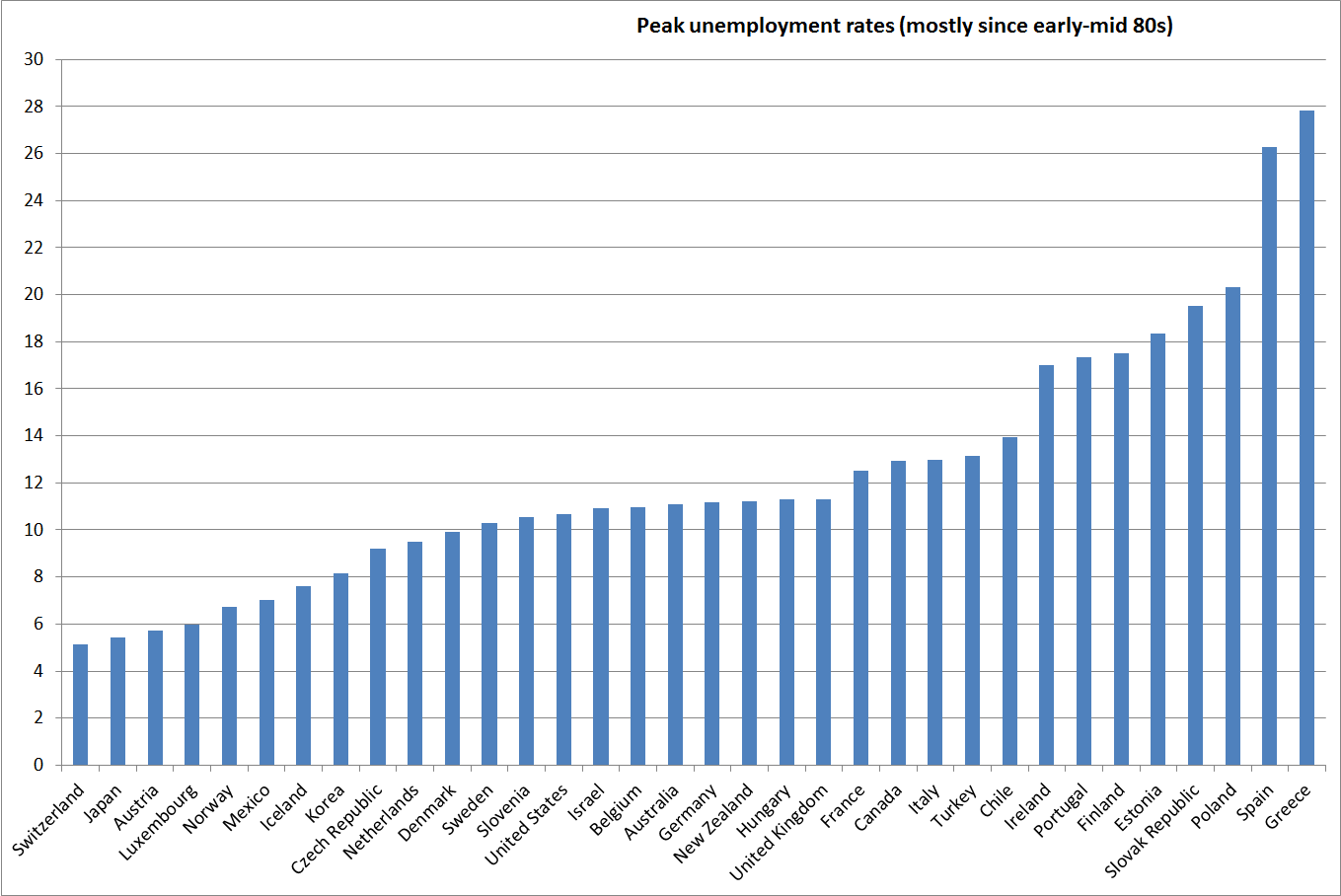
Here is the chart of the highest unemployment rates on record for each of the 34 OECD countries.  Only 13 of the 34 countries has had an unemployment of 12.5 per cent or above in more than 30 years.

peakU

I took a look at those countries.  First, I wanted to understand how much the unemployment rate had increased by in each of those country episodes.  If the NAIRU in one country had been 10 per cent (perhaps reflecting very restrictive labour market regulation), an increase in the unemployment rate to 13 per cent would have much different implications than if that country’s NAIRU was 6 per cent.

Of the 13 countries whose unemployment rates had peaked at over 12.5 per cent, in one case that peak was the first observation in the database (so I couldn’t tell where the unemployment rate had risen from).  Six of the other 12 had had increases in their unemployment rates of 8 percentage points or more (from the previous cyclical low to the measured all-time peak).  Thus, for example, Greece’s unemployment rate peaked at 27.8 per cent last year, but had been as low as 7.5 per cent in 2008.

But the other factor I looked at was the exchange rate regime these countries had been using when their unemployment rate rose to 13 per cent or more.  In only two of the 13 cases had the exchange rate been floating, and in neither of those cases had the unemployment rates increased by anything like 8 percentage points.

Why do floating exchange rates matter?  Simply because they act as a buffer when the economy is hit by severe shocks.  Greece, Spain, and Ireland have had very high unemployment rates (and large increases in those rates) in the last few years because they have had no independent national monetary policy, and no ability for their national nominal exchange rates to depreciate.  The US, the UK, and Iceland, on the other hand, each having had a nasty financial crisis, had nothing like the extent of those increases in unemployment.

Adjustment is a great deal harder, and more costly, without the additional flexibility the floating exchange rate provides.  But New Zealand has had a floating exchange rate for 30 years now, and when the economy has been in serious difficulties the exchange rate has fallen a long way.  No one really doubts that the same would happen again if, say, there was a serious recession here that involved the OCR being cut to, or near, zero.

I’m not suggesting that the unemployment rate could not possibly rise by 8 percentage points here.  From 1987 to 1991, the unemployment rate did rise by 7 percentage points, to around 11 per cent, even with a floating exchange rate.  But that was a pretty stringent test:

  • Huge amounts of labour-shedding from public and private sector structural reform
  • A serious domestic financial crisis
  • And the transitional costs of both lowering inflation markedly, and closing the fiscal deficit, at the same time.

My point is simply to highlight that the Reserve Bank’s stress tests were very stringent, using an increase in the unemployment rate larger than any seen in any floating exchange rate country in at least 30 years.  It is right that stress tests are stringent (the point is to test whether the system is robust to pretty extreme shocks)  but these ones certainly were.  And yet not a single one of big banks lost money in a single year.  That might seem a bit optimistic –  it did to me when I first saw the results –  but they are the Reserve Bank’s own numbers.

And so, again, we are left wondering where is the evidence for the Governor’s latest regulatory initiative?

The Reserve Bank’s stress tests – again

On 13 May, the Reserve Bank released its latest Financial Stability Report. As part of that release, the Governor announced that he intended to impose a ban on (highish LVR) lending secured on Auckland residential investment properties. The Bank indicated that a consultation document on the proposal would be released in “late May”.

The consultation document finally appeared yesterday. I have some fairly extensive comments on the contents of the document, and on the process. I will be making a submission, and will publish that here in due course.

But today I wanted to focus on just one aspect: the place of the stress tests the Bank undertook, with APRA, last year.

As a reminder, the results of the stress tests were reported in the November 2014 FSR (details on pages 9-11 here). The Reserve Bank was, apparently, then very happy with the resilience of the banks (individually and as a system – the latter rather than the former being the required statutory focus). As they noted:

The Reserve Bank’s emphasis tends to be on ensuring that banks have sufficient capital to absorb credit losses before mitigating actions are taken into account. The results of this stress test are reassuring, as they suggest that New Zealand banks would remain resilient, even in the face of a very severe macroeconomic downturn.

As I noted on 13 May, it was somewhat surprising then to find no reference to these stress test results in the latest FSR, even as the Governor was moving to impose very restrictive and intrusive new controls. I suggested that perhaps the Governor did not believe the stress tests. But if so, he owed us an explanation for why, especially in view of the fairly unconditionally positive coverage of the stress test results which he had signed off on in finalising the November report.

I was further puzzled when someone who had attended the Finance and Expenditure Committee hearing on the FSR told me that when the Governor was questioned about the stress test results and their implications for conclusions about the soundness of the financial system, he had simply avoided answering that element of the question.

However, the Reserve Bank then referred to the stress test results in responding to questions to the Herald’s personal finance columnist, Mary Holm. I covered those comments earlier.

On 16 May, there was this extract:

What does the RB think about the possibility of a property plunge. “Whether property prices could drop by half from today’s values is purely speculative,” she says. “Nevertheless, a 50 per cent drop matches some of the more severely affected economies in the global financial crisis such as Ireland.”
So they’re not ruling it out. But would such a drop cause banks to “collapse”? “The short answer is no, we do not believe so,” she says.
“The Reserve Bank conducts regular bank stress tests in collaboration with the Australian Prudential Regulation Authority. The most recent one was last year, and the results of it are featured in the November 2014 Financial Stability Report, pages 9 to 11, on our website.
“This stress-test exercise featured two imagined adverse economic scenarios over five years, one of which involved a sharp slowdown in economic growth in China, which triggered a severe double-dip recession in New Zealand. Among the impacts were house prices declining by 40 per cent nationally, with a more pronounced fall in Auckland – similar to your reader’s worst case scenario.”
So how would our banks fare?
“The Reserve Bank was generally satisfied with how the banks managed their way through the impacts of these scenarios, and we are comfortable that the New Zealand financial system is currently sound and stable, and capable of withstanding a major adverse event.”
Note that present continuous tense in the final sentence: we are comfortable “that the New Zealand financial system is…capable of withstanding a major adverse event”.

That was reassuring, but it did appear inconsistent with proposals for heavy-handed new controls on the other.

And then the following Saturday, we got some more comment from another Bank spokesperson.

“We repeat our comments from last week that the Reserve Bank was generally satisfied with how banks managed their way through the impacts of two adverse economic scenarios in the 2014 bank stress tests, which included a scenario similar to what your reader describes.
“We are comfortable that the New Zealand financial system is capable of withstanding a major adverse event, such as a collapse by up to 50 per cent of the Auckland housing market.”
These words, given to the Herald after the publication of the FSR and published less than two weeks ago, stated quite explicitly that the Bank is “comfortable that the New Zealand financial system is capable of withstanding a major adverse event, such as a collapse by up to 50 per cent of the Auckland housing market”.

And there I half-expected the matter to rest. Since policy development around LVRs seemed to be on a (rather distant) parallel track to stress-testing analysis, I half-expected the consultation document to avoid any mention of the stress-testing results at all, the Bank having reaffirmed only 10 days or so ago the resilience of the system.

But in yesterday’s consultation document, they do address briefly the stress-testing issue. Here is what they say:

The Reserve Bank, in conjunction with the Australian Prudential Regulation Authority, ran stress tests of the New Zealand banking system during 2014. These stress tests featured a significant housing market downturn, concentrated in the Auckland region, as well as a generalised economic downturn. While banks reported generally robust results in these tests, capital ratios fell to within 1 percent of minimum requirements for the system as a whole. Since the scenarios for this test were finalised in early 2014, Auckland house prices have increased by a further 18 percent. Further, the share of lending going to Auckland is increasing, and a greater share of this lending is going to investors. The Reserve Bank’s assessment is that stress test results would be worse if the exercise was repeated now.

First, they note that “capital ratios” in the stress test fell to within 1 per cent [percentage point] of minimum requirements for the system as a whole. But here is how those results were described in the November FSR.

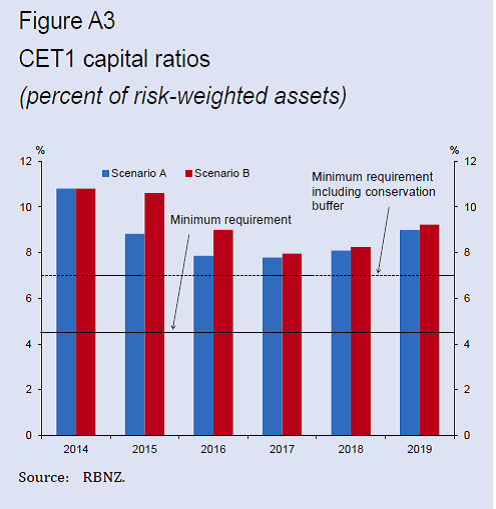
Common equity Tier 1 (CET1) capital ratios declined by around 3 percentage points to a trough of just under 8 percent in each scenario, but remained well above the regulatory minimum of 4.5 percent (figure A3). Banks are also required to maintain a 2.5 percent conservation buffer above all minimum regulatory capital requirements, or else face restrictions on dividends. On average the banking system fell within this buffer ratio in both scenarios, due to total capital ratios falling close to minimum requirements (figure A4). Average buffer ratios reached a low of 1 percent in both scenarios. As a result, some banks would have been faced with restrictions on their ability to issue dividends. The intention of the buffer ratio is to provide a layer of capital that can readily absorb losses during a period of severe stress without undermining the ongoing viability of the bank. Given the severity of the scenarios, capital falling within buffer ratios was an expected outcome.

In other words, the Bank seemed pretty comfortable. As they should have been. A banking system that can withstand a very severe asset market correction and adverse macroeconomic shock with, at worst, “some banks would have been faced with restrictions on their ability to issue dividends”, while all were always above minimum required ratios (themselves calculated using risk weights that are demanding by international standards) is an extremely strong banking system. Plenty of banks abroad raised additional capital during 2008/09 without ever coming close to failure, but not one of the big New Zealand banks ever needed to raise any new capital in these stress test scenarios. But that it is what one would expect when capital buffers are large, and credit to GDP ratios have been going nowhere for seven or eight years.

As the Bank also notes, it is not even that the loan losses in the scenario were large enough to cut into the dollar level of capital banks held: the deterioration in capital ratios arises only because the risk weights on bank loan books rise in the course of the severe downturn. Not a single bank had less capital at the end of the severe stress scenario than at the beginning.

CET1 (tier one, common equity) is the focus of the Bank’s capital framework.  Here is the chart from the stress test results.

CET

The Bank also rightly notes that the scenarios for the stress tests were finalised in early 2014 and things have changed since then. Of course, they have not changed materially in the two weeks since the Bank publically reaffirmed the resilience of the system, but let’s put that detail to one side for the moment.

Unfortunately, neither the Bank nor I can easily tell what this set of facts means for the results if the stress tests were to be run today. Auckland house prices have certainly increased a lot in the last year, the share of lending going to Auckland has increased, and a greater share of this (Auckland) lending is going to investors.  But other things have changed too – among other things, nominal incomes are higher than they were then, and interest rates look to be lower for longer than the earlier scenario envisaged. Those owing the large accumulated stock of debt (a stock that continues to worry the Bank) have had more time, and more income, to strengthen their own ability to handle adverse shocks.

Perhaps the much higher level of Auckland house prices now suggests that any future stress test scenario should use an even larger fall than the 50 per cent used last year. But 50 per cent is about as large a fall in house prices as has been seen, on any sustained basis, anywhere. If a 50 per cent fall is still a reasonable scenario from the new higher level (as I’d argue it is, given that no one has a good basis for knowing the “equilibrium” level of prices in the presence of ongoing regulatory constraints and policy-fuelled population growth), then all else equal there would be fewer loan losses for banks in an updated test not more.

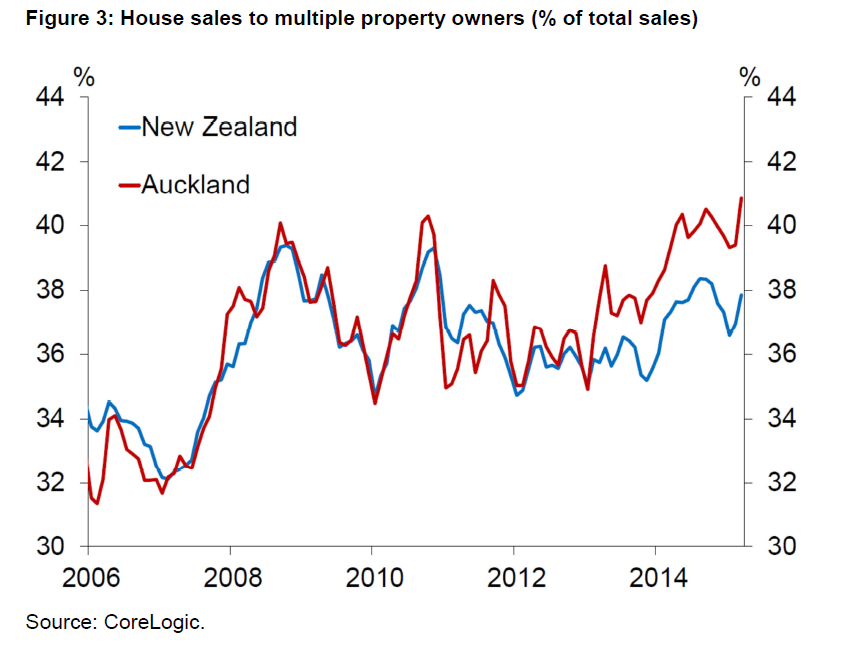
It is certainly true that a higher share of residential lending is now taking place in Auckland (although I suspect the share of the stock can’t have changed much in one year). In the stress test scenario that would, mechanically, mean a higher level of losses (since the scenario assumed a larger fall in house prices in Auckland than elsewhere). And of the lending in Auckland a little more has been going to investors. But note that final point carefully – as Figure 3 in their consultation document illustrates, the proportion of house sales being made to “multiple property owners” (the proxy for investors) is now no higher than the average in the series since 2008.

multiple

The investor property share is higher than previously in Auckland but (a) the difference from the rest of New Zealand is small, and (b) the greater role of investors is partly due to the earlier LVR restriction, which will have forced some first home buyers out of the market, to be replaced by investors. Moreover, in the consultation document the Bank indicates that the earlier LVR restriction has improved the overall “resilience” of the financial system. Even if one believed that lending to investors was riskier than lending to owner-occupiers, all other characteristics of the loan held equal (and the Bank has still not yet persuasively made that case), the overall implications of any changes in portfolio structures over the last year look likely to be small.

Stress tests run today would certainly produce different results to stress tests run a year ago.  But housing loan losses have hardly ever been at the heart of a banking crisis, the stock of debt is rising only slowly, and the 2014 results were so strong that it is difficult to believe that the Bank’s analysts are seriously wanting us to believe that stress tests run today would suggest that the financial system was now imperilled. Indeed, I noted the careful way their claim was worded – they suggest that the results today would be “worse”, but not “materially” or “substantially” worse. Given how strong the 2014 results were – as the Bank itself told us – a slight deterioration, in a business so fraught with uncertainty, should not really be a matter of particular concern.  Recall that in last year’s tests –  an exercise to which the Bank and APRA devoted a lot of resource –  not a single bank had a single year of losses.    It might sound too good to be true, but it is the Bank’s own work, and “no losses” leaves rather large room for them to be wrong without the soundness of the system being in jeopardy.

Unfortunately, the Bank seems to be all over the place on this issue. It is difficult not to feel some sympathy for the staff who are required to dream up rationalisations, and explain away past robust results, to provide some support for the Governor’s strong pre-determined views.  But if they really do believe that stress tests run today would result in a materially greater threat to the financial system then (a) they should probably have steps in train already to raise required levels of bank capital, and (b) it might have been helpful if they made the case in the Financial Stability Report.

Time to reform Reserve Bank governance – domestic public sector perspectives

Yesterday, in discussing my proposition that it is now Time to reform the governance of the Reserve Bank I outlined the contrast between the international perspectives available in the late 1980s when Parliament set up the governance model for the Bank and those available now.  Very few countries then  central banks (or financial regulatory agencies) that had statutory and effective operational policy independence. There was no international standard that could have been followed.  But of the many countries who have reformed their institutions since 1989 not one has followed the New Zealand model.  It is very rare for a single unelected individual to have sole legal responsibility for monetary policy decisions, and unknown for one such person to have decision-making authority on both monetary policy and major policy aspects of financial institution regulation and supervision.

Today, I went to look briefly at how New Zealand public sector governance, and conception around it, have changed since 1989.   The Reserve Bank is just one among many New Zealand public sector agencies, and it is inevitable, and highly appropriate, that thinking around how to design, manage, and govern other New Zealand public sector agencies should influence how we structure our central bank and financial institution regulatory agency.  Huge change took place in the New Zealand public sector in the late 1980s, and the Reserve Bank was somewhat uneasily fitted in to the model.

Back then, the Governor of the Reserve Bank was seen as somewhat akin to a core government CEO. In the reforms of the day, those CEOs were to have performance agreements with ministers, and would be able to be dismissed if they did not achieve the “output” targets specified in those agreements.  Departmental CEOs were envisaged as having considerable operational autonomy to achieve these measureable goals.

The state sector has changed considerably since then.  For a variety of reasons, departmental chief executives have much less autonomy, and there is much greater emphasis on departments working together, and a recognition that most key decisions rest with ministers.  The public service CEO model is not a good guide to how to organise the Reserve Bank, which does have considerable autonomy in policy.

By contrast, the Crown entity model has been developed and systematised subsequently.  The numerous Crown entities each perform statutory roles, across a range of types of activities (some more policy-oriented, and others largely just service delivery).  But I am not aware of any of these entities in which a chief executive has principal policymaking powers.  Rather, key framework decisions are typically made by the board of the respective entity –  and members, and the chair, are directly appointed by a minister.  The Reserve Bank is not a Crown entity (in the formal central government organisation chart) but as a model for governing agencies that exercise independent authority on behalf of the Crown the approaches used in Crown entities (perhaps especially the “Crown agents” class) seem to be a much more suitable starting point for thinking about governing the Reserve Bank.

In the rest of our system of government, single individuals simply do not exercise the degree of power –  without meaningful prospect of appeal or review – that Governor of the Reserve Bank has.

Some extracts from my paper:

As things stood in the late 1980s:

The Reserve Bank was just one of many New Zealand public sector agencies to face far-reaching reforms in the late 1980s.

The governance of government-owned commercial operations had been reformed first (the   SOE model came into effect in 1987).  For entities operating under the SOE model, the governance was to be very similar to that in a conventional corporate: the Minister appointed Board members, who in turn appointed a CEO to conduct affairs under authority granted to him/her by the Board.    For a time, the Treasury had been very interested in the possibility of applying the SOE model to the Bank[1].

The State Sector Act 1988 (and the Public Finance Act 1989) dealt with the non-commercial departments.  The insights that shaped that legislation were more practically relevant to later discussions around the Reserve Bank.

Under the previous state sector legislation, heads of government departments had permanent appointments – a model which had both significant advantages (as regards free and frank policy advice) and significant disadvantages (all but impossible to get rid of weak performers).  The new legislation put chief executives of government departments on fixed term contracts and provided for the establishment of performance agreements between chief executives and the respective ministers.  It provided stronger operational autonomy (from Ministers and from the State Services Commission) for chief executives and agencies, and the focus was on being able to hold individuals to account.

A key part of this, at least conceptually, was the attempt at a clear delineation between, on the one hand, the “outputs” of government agencies (things agencies could directly control – e.g. volume and quality of policy advice; hours devoted to traffic patrols etc) and, on the other hand, “outcomes”.  Outcomes (e.g. a lower crime rate) were things that politicians and the public probably most cared about.  Outcomes were typically affected by the actions of government agencies, but there was no direct and unambiguous mapping between specific actions of agencies and desired “outcomes”.  The conception was that CEOs could be held directly accountable for the achievement of output targets that were set by Ministers in performance agreements.

And as things stand now

Some aspects of 1980s public sector reform have proved resilient.  The domestic SOE model proved relatively successful for commercial operations owned by government, and relatively enduring, in form as well as in substance.  It is becoming less important, particular since the recent wave of partial privatisations, but the proposition that government business activities should be managed commercially, using fairly standard business governance models, has stood up well.

By contrast, in core government departments, the usefulness of the outputs vs outcomes approach as a guiding principle for assignment of responsibilities, and accountability, has probably not lived up to the hopes of the designers.   And, not unrelatedly, the degree of effective operational autonomy for (single decision-maker) department chief executives is far less than was probably envisaged by the early advocates of the model.  More recently, as a matter of active policy, departmental autonomy now appears to be consciously discouraged, with an emphasis on “whole of government” or “joined-up government” approaches –  whether with a view to cost-savings, better policy outcomes, or both.

Much about the way policy is implemented is politically sensitive (i.e. voters expect politicians to be accountable for choices about both “whats” and “hows”).   A government concerned to lift educational standards (an outcome) cannot conceivably simply leave to the Secretary of Education the question of whether to adopt, say, a National Standards regime as an “output” in support of the government’s desired “outcome”

As a result, the clean delineation between outcomes and outputs has rarely worked overly well.  Government departments still have single (unelected) decision-makers (i.e. their chief executives) but those individuals have little effective independence over outward-facing “how” decisions[2] (or, increasingly, over key aspects of the internal management of their own agencies).

There have always been many government entities beyond departments and SOEs.  Numerous Crown entities exist to carry out a wide variety of public functions[3].   A consistent framework for these institutions did not exist in the 1980s but in 2004 the Crown Entities Act was passed.  It was designed, in Treasury’s words, to “reform the law relating to Crown entities and provide a consistent framework for the establishment, governance and operation of Crown entities. It also clarifies accountability relationships between Crown entities, their board members, their responsible Ministers and the House of Representatives”.

The Reserve Bank is not, formally, a Crown entity, standing in a category of its own in the government organisation chart.  There is no obvious reason for that to continue, since there is little obviously unique about the role or functions of the Bank.  But the point I wish to make here is simply that, across the wide range of Crown entities (and various sub-categories within that grouping), I am not aware of any case where a chief executive has principal or exclusive decision-making powers  Crown entities typically exist to give effect to:

  • implement some aspect of government policy (e.g. EQC, ACC, FMA, NZQA),
  • provide advice and/or participate in public debate (e.g. Productivity Commission, Retirement Commission, Law Commission), or
  • carry out some function government has determined to fund and provide (e.g. NZSO, Te Papa).

In some areas, of course, aspects of the application of policy will shade into policy itself, but matters with pervasive external effects are not simply decided by a CEO.  Each of the significant entities I am aware of have a board which has ultimate responsibility for the conduct, and key framework decisions, of the organisation[4].  Board members, and typically the chair, are directly appointed by Ministers, and each chief executive exercises their delegated power under the direct authority of the respective board.

The practice of collective decision-making (and/or formal review or appeal rights) goes still broader, and is deeply entrenched in our system. Indeed, in New Zealand public life, it is difficult to think of any other position in which the holder wields as much individual power, without practical possibility of appeal[5], as the Governor of the Reserve Bank does.  Judges, of course, have the power to imprison – but all lower court decisions are subject to appeal, and higher courts sit as a bench, so that no one person’s view alone decides the case.  Resource management consent decisions, which hugely and directly affect property rights and values, are subject to appeal.  Individual Ministers exercise significant authority, although often requiring the involvement of Cabinet.  In New Zealand, all ministers are elected MPs, and any individual minister serves only at the pleasure of the Prime Minister.  The Prime Minister, of course, has huge power, but cabinet government is a key feature of our system, and (more hard-headedly) the Prime Minister holds power only while he commands the confidence of his own (elected) caucus.  As Kevin Rudd found, that confidence can be withdrawn very quickly.

Typically, public policy decisions that have far-reaching ramifications or that are not customarily made within clear and prescriptive guidelines, are either made collectively, or are subject to appeal, or both.       There is nothing comparable in respect of the Reserve Bank.

[1] The ideas are discussed, not entirely impartially, in chapter 5 of the Singleton et al history of the Reserve Bank.  Note that at the time there was no formal framework for Crown entities.

[2] Of course “who” decisions (eg on prosecutions, or tax audits, or licenses etc) rightly remain far-removed from Ministers.

[3] http://www.ssc.govt.nz/state_sector_organisations sets out all current state sector organisations.

[4] I have not attempted to work through the entire list of Crown entities to check their respective pieces of legislation, so if there are exceptions I would be happy to be advised of them.

[5] The override powers in Section 12 of the Reserve Bank Act do, of course, provide some scope for acting to deal with a Governor doing rogue things – but are not a routine part of governance (and have never been used).  The Reserve Bank can induce, or materially worsen, a recession without significant threat of those powers being used.  Perhaps, for example, it did in 1998, during the MCI fiasco.