Real economic costs of financial crises – part 1

A couple of days ago I looked at how one might best classify countries, as to whether or not they had experienced a “financial crisis” since 2007.  But this chart is one reason why I’ve become increasingly sceptical that “financial crises”, however one defines them, have large or enduring adverse real economic effects.  I think I first saw it in a sets of slides by Nobel laureate Robert Lucas, and every so often I would use it to try to stir up a bit of debate at the Reserve Bank.

maddisonUS

It is a quite simple chart of real per capita GDP for the United States, back as far as 1870.  These are Angus Maddison’s estimates, the most widely used set of (estimated) historical data, and as Maddison died a few years ago they only come as far forward as 2008.  The simple observation is that a linear trend drawn through this series captures almost all of what is going on.  More than perhaps any other country for which there are reasonable estimates, the United States has managed pretty steady long-term average growth rates over almost 140 years.  And yet, this was a country that experienced numerous financial crises in the first half the period.  Lists differ a little, but a reasonable list for the US would show crises in 1873, 1884, 1893, 1896, 1901, 1907, perhaps 1914, and 1929-33.  There were far more crises than any other advanced countries experienced.

And yet, there is no sign that they permanently impaired growth, or income.  One never knows the counterfactual, but right through this period the US kept on towards establishing the dominant position it was to hold in the decades after World War Two.  Even the Great Depression, awful as it was (costly as it was to many people) does not look to have had permanent adverse effects.  Another source I’ve bored people with over the past few years is Alexander Field’s excellent relatively recent book on US economic growth, productivity, and the Great Depression, A Great Leap Forward.  Field reports the best estimates for TFP growth in the US over the last century, and growth was faster from 1929 to 1941 than in any of the other periods he presents.  One might quibble about when to start and end these sub-periods, but 1929 was before the downturn became well-established, and 1941 is around when GDP per capita got back to pre-crisis trend (before temporarily going well above it in World War Two).

fieldtfp

The United States in the Great Depression had almost all the factors that are often cited to explain why financial crises might have permanent or very long-lasting adverse effects:

  • Lots of bank failures, and in a system without nationwide banks, disrupting the intermediation process.
  • Lots of corporate failures
  • Big changes in the price level (steep deflation)
  • Huge regulatory uncertainty (including around the robustness of the judicial system –  see, eg Roosevelt’s attempt to stack the Supreme Court)
  • Significant fiscal costs (in this case, not bank bailouts, but the defaults by other Western countries on the huge US World War One loans).

And yet the underlying rate of innovation is estimated to have gone on just as strongly as before.

This is not, remotely, to trivialise the Great Depression.  But it still looks a lot more like an event that became as severe as it was because of inadequate demand, and was resolved when sufficient strong aggregate demand returned (in the US case not until World War 2).  Output lost in the interim is a real and substantial cost to the people involved, but the numbers get really big if something changes the long-term future path of growth.  And there is no sign of that having happened in the many financial crises the US experienced from the 1870s to the 1930s.

A few years ago, Andy Haldane of the Bank of England got a lot coverage for a speech in which he presented this table, suggesting that the cost of the 2008 financial crisis could be huge –  100 per cent or more of annual GDP.

haldane

If so, it could be argued that everything should be done, all resources of the state thrown at, avoiding such events, which –  as Haldane put it –  our children and probably our grandchildren might be paying for.  But if there is little or no permanent reduction in the future path of per capita income, as a result of the financial crisis itself, the real economic costs of crises are much much smaller.  And the benefits of any regulatory measures to reduce the risk of crises are commensurately smaller –  all the more so when we allow for how little any of us know about the long-term costs and benefits of such regulatory restrictions.  Even recessions occurring at the time of a financial crisis can’t all (or perhaps even mostly) automatically be ascribed to the crisis itself.

I’ll have a few more posts on related issues in the next few days or weeks.  But recall where I started on this, and where I will loop back to. Per capita income GDP growth in New Zealand and the United States since 2008 has been very similar, even though New Zealand had only a minor domestic financial crisis, while the US was at the epicentre of a major global liquidity event,  and many significant US institutions failed or came close to failing, and US lenders experienced very large losses.   Sadly, as earlier posts have illustrated the relative productivity performance in New Zealand (relative to the US)  has been even weaker.

us vs nz 2

Immigration policy: 106 per cent of net new housing demand

I’ve just read Shamubeel and Serena Eaqub’s book Generation Rent¸one of the Bridget Williams Books series of short, often stimulating, books on New Zealand issues.    Housing is perhaps the ultimate topical issue, and I hope the Eaqubs’ contribution is widely read.

There is plenty in that I agree with, as well as quite a bit that I disagree with.  I might come back to the rest of the book when I have a bit more time, but today I wanted to focus on just one “framing” issue.   How one frames an issue often influences how readers think about it.

The Eaqubs have collected the data from old Yearbooks, and censuses, to show where population-based pressures on housing demand have arisen from over last fifty years (strictly, from the 1961 Census to the 2013 Census).  They present the influences under the following headings:

  • Natural increase,
  • Change in average household size, and
  • Net migration

Under this decomposition 61 per cent of the increase in the number of households has arisen from natural increase, 30 per cent from a reduction in average household size.  The remaining 9 per cent results from net migration.

Put that way, it allows them to present migration (and, hence migration policy) as a fairly minor issue, only really material in a short-term or cyclical sense. As we know net migration is quite variable and not particularly forecastable in the short-term.

But there is another way to look at the numbers.  The New Zealand government has no ability to control the movements of New Zealand citizens, inwards or outwards, so discussions of the role of immigration policy really should focus on the movement of non-New Zealand citizens.   Non-citizens can only come and live in New Zealand with the permission of the New Zealand government –  active permission is required in most cases, while policy allows Australian citizens to come and stay without prior approval.    There are lags in the system, and not everyone who is approved actually comes (or stays) but by and large we can think of the net flow of non-NZ citizens as the contribution of immigration policy.  Since 1960, there has been a net inflow of non-New Zealand citizens every (March) year except 1979.  If economic conditions here are poor, non-New Zealand citizens can leave again too.  In that sense the net inflow of non-New Zealand citizens understate the role of immigration policy in boosting demand for housing.

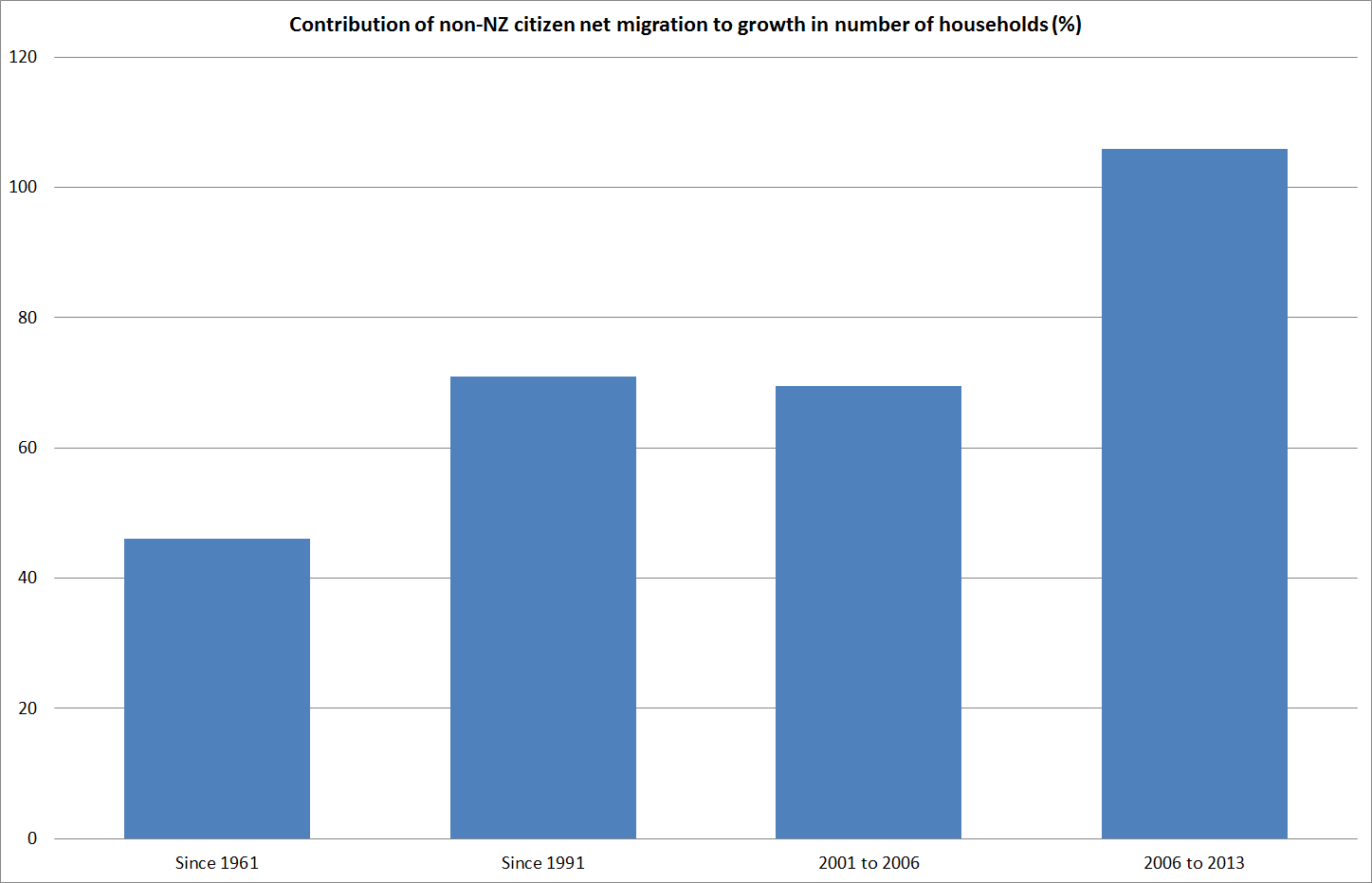
So what has the impact of non-NZ citizen net migration to New Zealand been?   In the 52 years from April 1961 to March 2013 there was a net inflow of 1139351 non-New Zealanders.  Over the same period (between the two censuses), the number of private occupied dwellings in New Zealand has increased by 918000.  With around 2.7 people per dwelling, the net inflow of non-New Zealand citizens has contributed 46 per cent of the total increase in the demand for houses since 1961.

The impact doesn’t happen all at once –  in 1961, people didn’t live at 2.7 per dwelling, but they do now.  And, of course, many of the non-New Zealanders who migrated in 1960s will have died by now.  But most of them will have had children or grandchildren since they moved to New Zealand –  and since the average birth rate in New Zealand has been above replacement, the effective contribution to housing demand from immigration policy is likely to have been higher than suggested by the raw numbers.  As birth rates have dropped, that may not be so in future.

Since 1961 there has been a variety of changes in immigration policy.  From the late 1970s to the late 1980s, inflows of non-New Zealanders were very small.  But what about the most recent since immigration policy was changed to actively pursue much larger inflows (at present, policy aims at 135000 to 150000 permanent residence approvals on a three year rolling basis)?

From 1991 to 2013, non-New Zealand citizen immigration accounted for around 71 per cent of the change in the number of households (or dwellings required).  For the last two intercensal periods the contributions of non-New Zealand citizen net immigration were as follows:

  • 2001 to 2006        70 per cent
  • 2006 to 2013       106 per cent

Even I was a little taken aback by the last number but, of course, it just reflects two things:

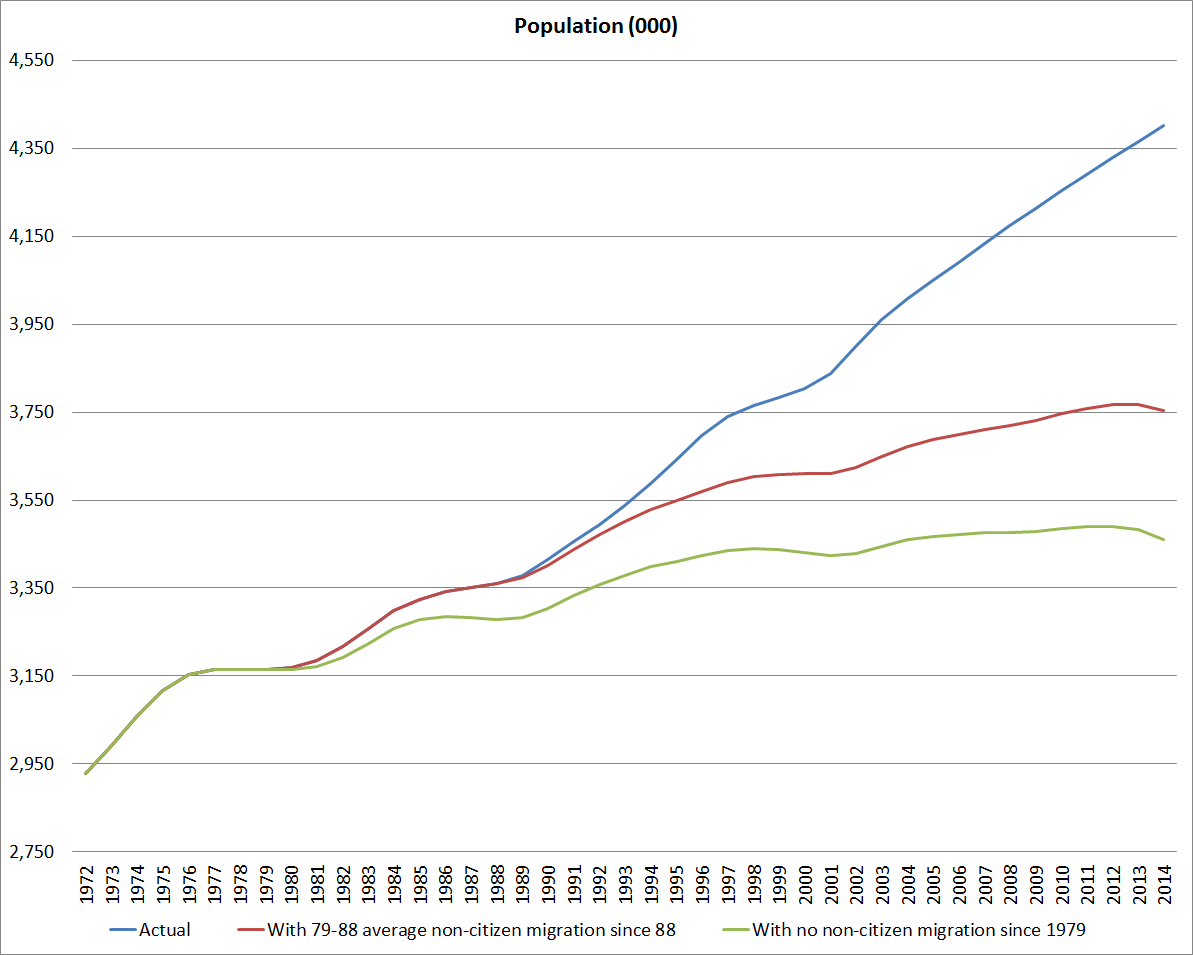
  • The chart I showed the other day illustrating that with no (or much lower) non-citizen immigration New Zealand’s population would now be flat or slightly falling
  • No change in the average person per dwelling number between 2006 and 2013.

non citizen plt to households

These numbers aren’t precise.  It is quite possible that new immigrants start off with a higher than average persons per dwelling –  as, on average, non-New Zealand immigrants are poorer than the average resident population.  And the number of people per dwelling is itself partly endogenous to house prices –  if house prices had not been so high, more people would have been able to fulfil their desire to, for example, live on their own.  It is also possible that without the high level of non-New Zealand inflow, the outflow of New Zealanders (which, all else equal, massively reduced the demand for housing) would have been a bit smaller.

But what the numbers do make clear is that immigration policy choices made by successive New Zealand governments account for a very large share of the new household formation, and housing demand, in New Zealand.  If anything, that share has been rising as natural increase slowed.

And, of course, these numbers also tell us nothing about what the appropriate target rate of non-citizen immigration is.  But, unless we can construct a regulatory environment in which the supply of housing and urban land are hugely more responsive to demand than they have been in recent decades, then any conversations around demand influences, and the potential influence of policy on them, needs to engage seriously with the role of immigration policy.  At present –  given what it is knows about supply responsiveness – the government’s immigration policy is actively driving house prices, especially in Auckland, at the reach of too many of those who would like to buy –  citizen or not.

ISDS provisions

In his column in the latest New Yorker James Surowecki looks at Investor-State Dispute Settlement (ISDS) provisions that feature in many bilateral and multilateral trade and investment agreements.  These provisions allow individual investors in some circumstances to seek redress against domestic governments not just in domestic courts, but before an international arbitration tribunal (most commonly the ICSID, which is based at the World Bank).

As Surowecki notes, “these provisions have been opposed by an unusual coalition of progressives and conservatives”.

Advocates argue that ISDS provisions help to encourage foreign investment.  For some of the opponents, that would almost be enough of an argument itself.  For them, foreign investment itself is threatening.   But plenty of people who are generally keen on pretty open foreign investment are also somewhat wary.  I reckon that regulatory obstacles, and screening regimes, in respect of foreign investment  in New Zealand should be materially reduced, but partly because I think foreign investment should be treated as similarly to domestic investment as possible, I’m not sure why we should be providing separate remedies, and separate quasi-judicial fora, for disputes taken by foreign investors.  If we do need greater protection for investors, and for citizens, against arbitrary actions of governments lets have that debate domestically, amend our domestic laws accordingly, and provide equal protection to all.

The first such ISDS provision apparently dates back only to a Germany-Pakistan agreement in 1959.  And, of course, a great deal of foreign investment happened before then – in fact, the whole first great age of globalisation, prior to World War One,  Huge amounts of debt and equity finance went abroad from Europe (the UK in particular) into colonies of settlement in particular.  That included countries with pretty good legal institutions from the start (such as New Zealand) as well as places like the new, and often shaky, states of central and south America.  And it wasn’t just colonies of settlement  –  destinations included Turkey, Persia and China.

Last week I was reading a fascinating older book about just these sorts of issues.  Finance, Trade, and Politics: British Foreign Policy 1815-1914 by D C M Platt, who went on to become a pretty eminent economic historian, looks in detail at how the British government dealt with the interests abroad of British lenders and investors (be they debt holders or concessionionaires or….).  The short answer is that, unless there were really pressing political considerations involved, or the initial obligations themselves arose out of an inter-governmental agreement, the British government took the stance, and held to it pretty firmly, that difficulties with foreign governments were mattered to be dealt with by the investors themselves in the courts, tribunals, and political processes of the country concerned.

The government, and Foreign Office officials, were constantly lobbied to provide additional support to British investors, and the pretty consistent response was “no”.  Governments were typically sympathetic, but they took the view that investors dealing in foreign countries needed to look after themselves.  This, recall, was the government of the strongest power at the time, the government of the country that was, by far, the largest source of foreign debt and equity finance.  And it was a great age of financial globalisation.  And not an ISDS in sight.  If the approach wasn’t followed perfectly, it still looks to me like a pretty good model, that worked pretty well.  Surowecki suggests that “in the old days, aggrieved American investors would call in the Navy to protect their interests”.  If so, it certainly wasn’t how the British did things.

A common argument from defenders of ISDS provisions is that very few claims are lodged, and in very few cases do ruling go against national governments.  But Surowecki notes that ‘nearly 100 have been filed in the past two years, as against some five hundred in the previous quarter century before that”, presumably partly a reflection of that fact that such provisions are becoming more common, but also (perhaps) of a greater degree of activism. He reports that investor-protection is an increasingly prominent part of US law-school curricula.

The other argument is that inclusion of ISDS provisions helps encourage foreign investment.  But the evidence I’ve read suggests, unsurprisingly, that this is true only for recipient countries that have had poor quality domestic legal systems.  For them, the offer of ISDS provisions is a credibility-enhancing device, designed to provide potential investors greater reason for confidence in the security of their investment.  The evidence also suggests that there are few or no gains in foreign investment flows between pairs of countries (eg US and UK) that already have perfectly good domestic legal systems.

From a New Zealand perspective, one argument might be “we have a good legal system, so there might be no gain, but there is no probable cost either”.  I’m not entirely convinced.  After all, Philip Morris is pursuing an ISDS case against Australia over plain-packaging of cigarettes, a remedy that would presumably not be open to them under Australian domestic law.  I’m not expressing (and don’t have) a strong view on that, as yet unresolved, case, but it seems to me that advocates of such ISDS provisions need to make a stronger case for why different remedies should be opened up to foreign investors, and why the domestic courts and domestic political process –  on which the rest of us must rely –  are not sufficient.  There may be such a case, but I’ve not yet seen it.

The unease should be heightened when we recognise the limitations of the ISDS process.  There are a couple of useful backgrounders on ISDS issues by Gary Clive Hufbauer on the Peterson Institute website (eg here).  Hufbauer is a supporter of ISDS provisions, but he draws attention to both the lack of appeal provisions in ISDS tribunals, and the lack of transparency (“ICSID does not require parties to post their briefs and arbitration decisions on the web so that the public knows the arguments and the rationale for any award”.   Appeal provisions are pretty fundamental to our system of justice.

Perhaps the argument for New Zealand signing up to such provisions, whether in TPP or other agreements, is that it helps New Zealand firms investing abroad.  But at a pragmatic level, the countries we are negotiating TPP with now almost all have pretty good domestic legal systems.  And why does the New Zealand government think it is part of its role to negotiate provisions to allow New Zealand investors more rights in respect of investment in overseas countries than those countries provide to their own domestic investors?   The hands-off approach was good enough for Palmerston, Gladstone, and generations of their contemporaries.

ISDS provisions are probably not the most important aspect of TPP, or other similar agreements.  But there doesn’t seem to be much else on offer.  Countries like New Zealand seem fairly certain to be losers from extended intellectual property protections, and the comments from John Key and Tim Groser still don’t suggest any prospect of great movement on dairy protectionism.  And if the strongest argument for TPP really is something like strengthening the US relative to China (a goal which I have no particular problem with),the longer-term success of any such strategy depends on perceptions of legitimacy.  Given the unease many people seem to feel about ISDS provisions, which can look (whether or not they are) like something that is “designed to put corporate interests above public ones”, and the limited evidence of any real economic gains from such provisions, it isn’t obvious why ISDS provisions serve the interests of ordinary citizens or governments, in democratic countries with robust legal and political systems. In the words of a contributor at Forbes, (not, probably, high on Jane Kelsey’s regular reading list) ISDS provisions seem disconcertingly like a “subsidy to business that comes at the expense of domestic investment and the rule of law”

Financial crises since 2007

I’ve been working my way through a series of posts on the post-2007 economic experience of a large number of advanced countries, with a particular focus on trying to make some sense of New Zealand’s (no better than middling) experience.

Today I wanted to have a quick initial look at the incidence of financial crises, since the shorthand for what has gone in recent years has often been “since the financial crisis” or “since the [so-called] GFC”.  Many authors, including some pretty serious and respected ones, have ascribed much of the poor economic performance to the “financial crisis”, adducing the experience as evidence supporting a case for much tighter regulatory restrictions all round.  And there are plenty of theoretical discussions as to how financial crises might have detrimental economic effects.

But what do we mean by a “financial crisis”?  Many authors who try to classify events do so by looking at the gross or net fiscal costs of a crisis (eg the costs of bailouts, recapitalisations, guarantee schemes and so on).  I’ve long thought that was a flawed basis for classification, for a variety of reasons:

  • A country that allowed its banks to fail, with no bail-outs, might have no direct fiscal costs at all, yet on any plain reading could have experienced a very substantial crisis.
  • Most (though not all) of any fiscal support for troubled financial institutions tends to benefit citizens of the country concerned, and so redistributes wealth rather than destroying it.  There may be all sorts of adverse incentive effects, and deadweight losses from the taxes required to cover the fiscal costs, but the level of fiscal support is not a very meaningful indicator of the cost to society.  In rare cases (eg Ireland) the fiscal costs themselves can become quite directly problematic, in terms of on-going market access, but that is not the general experience.
  • A country’s banking system might be very highly capitalised, such that no banks actually failed even under severe stress, and yet on most reckonings the country concerned would have experienced a financial crisis.
  • In some cases, banks will have experienced the bulk of their losses on offshore operations, while the intermediation business in the home economy might have been fine.  The home government might choose to bailout the bank concerned, but there are few obvious reasons to think that those offshore losses (and the choice to bail) will have much effect on the home economy.  A good example, in the most episode, was the losses sustained by German banks.  On many classifications, Germany shows up as having had a financial crisis, and yet almost all of the increased loan losses resulted from offshore exposures (particularly in the United States housing finance market).  If we are trying to understand the economic implications, it probably makes more sense to think of those losses as a US event than a German event.

So instead, I proposed a classification based on non-performing loan data, which the World Bank collects and reports by country.   The proposition here is that, if there are sustained economic consequences from something we can label a “financial crisis”, they are likely to arise primarily from the initial misallocation of resources that led to the loan losses in the first place.  Gross over-investment in a particular sector (say, commercial property in New Zealand in the late 1980s, or in Ireland in the last decade) eventually leads to losses.  The projects don’t live up to expectations, and real resources devoted to those projects can’t easily or quickly be reoriented to other uses. Buildings lie empty, or even half-completed. If there are problems, they arise whether or not any bank ever fails, or is bailed-out by the state.  And banks have to reassess their entire models for generating income, and are likely to become more risk averse as a result of the losses their shareholders faced.  There might be additional costs if a large number of major financial institutions actually close their doors permanently after a crisis (that argument is part of the case for the OBR tool in New Zealand), but relatively few major institutions actually closed their doors in the period since 2007.

The table below classifies countries based on data on banks’ non-performing loans (NPL) from the World Bank’s World Development Indicators. The 20 countries that had a substantial increase in the stock of domestic NPLs after 2007 (the final two columns), are treated as having experienced a domestic financial crisis.

Non-performing loans since 2007
NPLs
Source: World Bank.

Note:

Very low and stable: NPLs:                     less than 2.5 percent of loans throughout, remaining at a stable percent of loans

Moderate and stable: NPLs:                  2.5 to 5.2 percent of loans throughout, remaining at a stable percent of loans

Moderate and small increase:               : NPLs greater than 2.5 percent of loans throughout, increasing by less than 2.5 percentage points

Mostly, the classification looks intuitive, and much as expected. All advanced countries that had a support programme with the IMF during that period are in the financial crisis category. At the other end of the spectrum, the commodity-exporting advanced countries (including New Zealand) all avoided a domestic financial crisis on this, as well as other, measures.

Two points may be worth noting. First, although the extreme liquidity crisis in the United States in 2008/09 attracted headlines – and had global ramifications – loan losses in the United States have been overshadowed by those in many European economies.  One element of this is that more loans in the United States were not on the books of banks (and this is bank data). Second, although some banks in countries such as Germany and Switzerland got into material difficulties, in most cases those were the result of losses incurred in the United States.  As discussed earlier, these losses probably had different implications for the performance of the home (German or Swiss) economy than losses arising out of domestic lending business.

If this classification looks broadly sensible, it is somewhat ad hoc, and might not easily generalise to other crises and other times, even if broadly comparable data were available for earlier periods.

One can’t just jump from this classification to the chart of GDP per capita performance to see whether countries that had financial crises, on this measure, did worse than those that did not.  Apart from the many other influences on any country’s performance, it is also important to recognise that any causation can run in both directions.  The argument that a quite-unexpected period of very weak economic performance will have generated large loan losses (many projects will have been based on assumptions that, however apparently reasonable, did not play out as expected) is at least as strong (I’d argue stronger) than the proposition that “financial crises” themselves cause sustained economic underperformance.  Loan losses did not cause Greece’s problems, but were an integral of an overall process of economic mismanagement and misallocation of resources that led to Greece’s disastrous underperformance in recent years.

And what of New Zealand?  We have had pretty low banking system NPLs throughout.  Finance company losses mattered a lot to investors in those companies, but were still quite modest relative to the overall stock of loans in New Zealand.  There were fiscal costs, through the deposit guarantee scheme, but without the international rush to guarantee schemes there would have been much the same loan losses and probably no direct fiscal costs.

As no major institutions failed, and (economywide) there was little evidence of sustained over-investment in any particular class of asset, one would not generally think of New Zealand having experienced a domestic financial crisis.  Funding was disrupted for a time in late 2008/09, and that was among the factors inducing a greater degree of caution among lenders, but 6-7 years on it seems unlikely that any domestic financial stresses have materially affected New Zealand’s overall performance.  For some sub-sectors, the picture might have been a little different, as finance companies had been major financiers for property developments, but for the economy as a whole the effect seems likely to have been quite peripheral.  And yet, our economic performance has been similar to that of the United States, the epicentre of the initial crisis, and where the increase in actual loan losses was substantial.

Central banks blogging

The Bank of England has launched a new staff blog, and the fact of the blog –  rather than the initial content –  has attracted some attention.  The Bank of England summarises its aim this way:

Bank Underground is a blog for Bank of England staff to share views that challenge – or support – prevailing policy orthodoxies. The views expressed here are those of the authors, and are not necessarily those of the Bank of England or its policy committees.

Tony Yates, a former BOE staffer, seems surprisingly optimistic.

There is a growing number of ex central bank bloggers, eminent (Bernanke) or otherwise, but central bank blogs are uncommon, if not entirely new.  The New York Fed has been running the Liberty Street Economics blog for a while, and Macroblog at the Atlanta Fed has been around for even longer.  At a supranational level, there is the iMFdirect blog.

But a blog is just a technology, one of many “communications channel” that central banks, as powerful public institutions can use.   The interesting point is the suggestion that the BOE blog will be a vehicle in which staff can “share views that challenge –  or support –  prevailing orthodoxies”.

That certainly would represent quite a change for most central banks.  But again, it is along a spectrum.  Many/most central banks have long published research and discussion paper series, which typically carry a disclaimer that the views were those of the authors and not necessarily those of the institution (at the Reserve Bank, we drew a strong distinction between Bulletin articles which carried no disclaimer, and thus could be taken as, in some sense, the views of the Bank, and other papers). Central bank analysts and researchers give conference papers, dealing with a variety of technical or policy issues, which carry similar disclaimers.  And not that many years ago, I heard Janet Yellen, then only vice-chair of the Fed, give a speech at a conference, and that speech also carried the standard disclaimer[1].

But the truth is that most central banks –  and I’m sure other government agencies, even those with operational independence, are no different –  typically have quite strict, but not always clear (to themselves or staff), limits to what staff are allowed to say in such documents or papers.   I’m still somewhat surprised, and impressed, that senior Fed researcher Robert Hetzel has been able to publish major books carefully (but critically) reviewing the Fed’s conduct of monetary policy.  Perhaps it is an advantage to be a very big but decentralised central banking system.

Tony Yates gives some of the flavour of this (historically quite tight) control in a BOE context, and I have also heard some BOE horror stories from people who used to work there.  It will be interesting to watch the BOE experiment, but I suspect it will end up being a channel primarily for the sorts of pieces on the blog today –  one on a topic not related to the Bank’s responsibilities at all, and one a nice, but anodyne, piece of analysis illuminating the rather obvious point that risks of deflation rise if shocks happen when conventional monetary policy has reached its limit.

And that is fine.  Openness and transparency in powerful public agencies are important, and there is far too little of both.  But the ability to have robust debate within an organisation in the formative stages of policy development is also important.   Great leaders can probably cope with challenge and scrutiny wherever it comes from, but on average we have to expect average leaders.  Often enough, they will feel threatened if someone down the organisation is being used by external critics to bash the organisation.  I’ve mentioned earlier how Graeme Wheeler got the Ombudsman to block release of a discussion note I had written, some time previously, on governance issues.    I think he was worried that the Green Party –  who have championed the cause of reform and greater transparency at the Reserve Bank –  would use my note to “politicise the issue” [aren’t institutional design and governance issues appropriately political choices?] and to undermine his own preferred approach to reform.

In many ways, a central bank blog is not much different than what we were trying to do at the Reserve Bank when we set up the Analytical Notes series a few years ago (a product I edited) –  or the Fed’s FEDS Notes series.  Our idea was that analytical pieces, that weren’t heading for journal publication, could be published, carrying a disclaimer that they were the views of individuals not the Bank.  Since any of this material would have been discoverable under the OIA, it was thought good for openness, and for staff themselves, to have a vehicle for putting such material in the public domain.  Sometimes it was actively used by the institution to get supporting material out for scrutiny.  There are quite a few interesting papers in this series, and I’ve already linked to several of them, but I’m pretty sure there was nothing in them that challenged current orthodoxies.  Prone to challenge orthodoxy as I was personally, I was pretty good at judging what could be got out the door, and phrasing things accordingly.

I’m not suggesting that the Reserve Bank has typically been a monolith in how staff participated in external events.  We hosted, with Treasury, an exchange rate policy forum a couple of years ago  –  to which a range of business and other people were invited.   All the papers were published with no “censorship” (at least for the Reserve Bank ones) and are still on official websites.  My paper involved a fairly critical perspective on New Zealand’s immigration policy and the potential adverse macroeconomic implications (not, of course, that the Reserve Bank is responsible for immigration policy).  I’ve given discussant comments at international central banking conferences casting doubt on the benefits of publishing extensive central bank forecasts, and have a chapter in a recent (fairly obscure) book suggesting, with all sorts of caveats, that we should not automatically think of inflation targeting as the ‘end of history’ (although this did prompt efforts at censorship by one new Deputy Governor).

But all that is different from whether staff should be able to question, in public, current policy preferences and frameworks.  Much as I think the Governor’s LVR policies are unnecessary, inappropriate and costly, I really don’t see that it is appropriate, or in the interests of good government processes, for staff to be saying so, even with all the qualifications in the world, in public fora.  And I’ve thought the Governor’s monetary policy decisions over the last few years were wrong, but no matter how carefully crafted the argument was, it wouldn’t have been appropriate to run that argument in public as a staff member.  In fact, I did a variety of speaking engagements in which I persuasively made the case for the Governor’s stance.  That was the external-facing bit of the job.  And rightly so.

Perhaps in some idealised world all debate could or should be open –  Tom Scott once ran a cartoon satirising Don Brash’s commitment to open comment and suggesting Don would have liked to broadcast all monetary policy deliberations live  –  but it isn’t the world we live in.  Organisations need to be able to have robust debate internally, without the sense of a simultaneous parallel track being pursued externally by people who happen to disagree on a particular issue.  And as I listen to accounts of people reluctant to comment on this or that issue because, for example, it might affect their future consulting opportunities, it is a reminder of why it is not a realistic alternative vision.

Now, I’m quite sure the Bank of England has no intention of allowing that level of dissent or openness either.  Perhaps pieces that “challenge current current orthodoxies” will be published when Mark Carney or Andy Haldane themselves want to challenge such “orthodoxies”, but it will be a surprise if we see pieces directly challenging views advanced by those senior managers.  The blog might also be used actively at times as a place for testing the waterr –  putting an idea or some analysis out, in a controlled way, but with some plausible deniability (‘it was just the author’s view”).

I’m not critical of that approach.  If I have a criticism, it is that perhaps the Bank of England is overselling what the blog can be.  If it can be a vehicle for some shorter and more informal pieces of analysis, or for translating into English some of the more technical working papers, it will probably serve a useful purpose.  And its existence is something of a “brand marker” –  the Bank’s current management wanting to mark itself out from the past.

In the end, there are always going to be judgements about the appropriate level of openness.  It will depend on the person, the issue, and even the specific external environment.  For some issues, treated in some ways, at some times, senior management will be comfortable with alternative perspectives (perhaps even quite critical, but well-argued, ones) from staff being published.  On other issues, the market or political sensitivities just make it unrealistic.

There are delicate balances to be struck.  For example, if central banks want to have and retain top-flight researchers there needs to be a reasonable commitment to a willingness to publish.  And a willingness to publish a range of views can help signal a general openness to challenge and the contest of ideas.  And engagement with alternative perspectives –  genuine engagement, not just an evangelisation exercise –  is important.  But robust internal debate –  with ex post scrutiny and document discovery –  remains far more important to well-functioning central banks.  Central banks, and those holding them to account, should be much more concerned to establish that those processes and cultures are in place.  In my observation and experience, that increasingly has not been the case at the Reserve Bank of New Zealand.

[1] It struck me at the time, because at much the same time the Reserve Bank Communications Department was trying to insist that we should not use the disclaimer in any presentation, on the grounds that when anyone was speaking anywhere they were speaking “for the Bank”.

“Market failure” or failure to let the market work

Brian Fallow has a piece in the Herald today, prompted by the Productivity Commission report,  that champions more active government involvement in the housing market, with barely a hint that anything governments do ever goes wrong.  The words “masterplanned”, when uttered of the activities of government entities, other than tongue in cheek, should send something of a shiver of alarm through the citizenry, rather than a frisson of excitement.  The track record isn’t good.

But what struck me was the claim that the Productivity Commission’s report “is unequivocal about the fact that we are dealing with market failure here”.    Where, I wondered, was the evidence of the market being allowed to work?   One might more accurately sum up the Auckland property market as the most probable outcome of two sets of government policies.  Restrict the supply of land, and at the same time actively take steps to maintain rapid population growth, and what would one expect but high land prices?  One might more accurately call it “policy success”  (predictable outcome of deliberately chosen measures, if anyone had actually done the analysis) than “market failure”.  But surely no politician was ever dumb, or venal, enough to have wished for the sorts of outcomes we’ve seen in Auckland in particular in recent decades?

Which is not to disagree with Fallow’s concluding observation “the status quo is perilously unsatisfactory”.  Well, yes, but instead of proposing providing new compulsory acquisition powers –  not just to elected ministers, as at present, but to unelected, barely accountable, appointees – how about giving the market a chance?  Free up land supply (zone it all residential, as a default) and urban land will quite quickly become affordable again, and arguments about “hold-outs” surely become moot (if any land can be built on).  Oh, and our ancient freedoms are respected as well.

It is a sobering reflection on the growth of the regulatory state that yet more encroachments on peoples’ liberties, with even fewer protections, are proposed in the week in which we mark the 800th anniversary of Magna Carta.

Can resource pressures in 2007 explain NZ’s middling performance since?

I’ve been blogging about what has happened in advanced economies since 2007, with a particular focus on trying to shed a bit of light on New Zealand’s overall performance.

New Zealand’s overall performance has been mediocre at best.  Of course, “mediocre” is better than we’ve done for much of the post-war period, but (a) it isn’t the impression some have had of New Zealand’s recent performance, and (b) there were reasons to think we should have done better.

Our terms of trade have been strong, we didn’t have a serious domestic financial crisis, and we neither hit the zero bound nor were under any great pressure to undertake fiscal consolidation.  Add in a floating exchange rate to the mix, in a world in which fixed exchange rate countries have mostly struggled, and things looked propitious for New Zealand.  On the other hand, the earthquakes required a major diversion of resources away from other activities –  the repair work has been both quite low productivity in nature (which isn’t a criticism, just a description of the nature of many of the repairs) and as a major non-tradables shock it diverted resources from the tradables sector.

One factor people sometimes cite for New Zealand’s no-better-than-middling performance is the initial pressure on resources.  The argument goes that the economy was stretched in, say, 2007, that inevitably growth in subsequent years would be slower.  And there had been a perception –  I contributed to it in one Reserve Bank article –  that New Zealand had experienced more intense pressure on resources than many other advanced countries.

Absolutely, this story can’t account for much.  Average annual growth rates since 2007 have been around 2 percentage points lower than they were in the decade or so previously.  Most output gaps in advanced countries were around 2 to 3 per cent in total.  So, yes, working off the excesses built up in the boom can explain some of the subsequent weaker growth but not much.

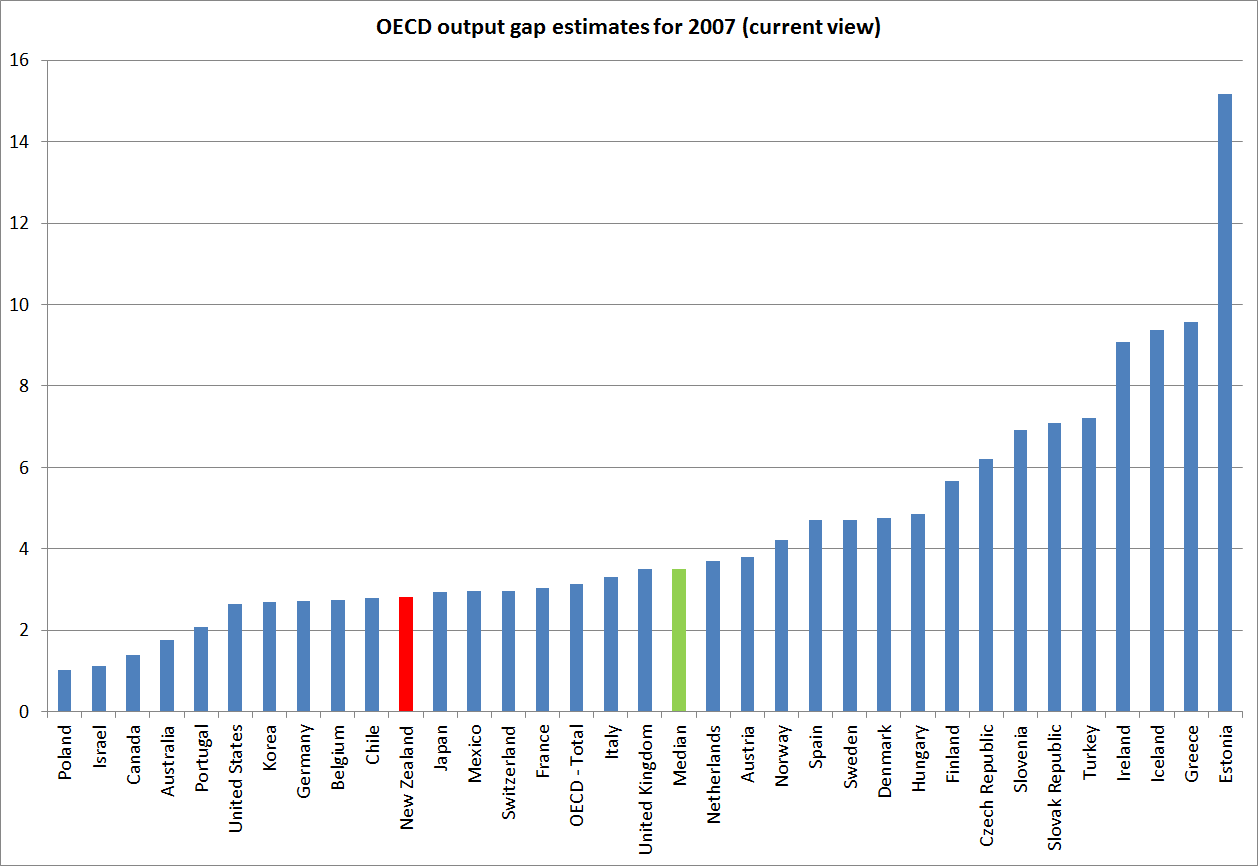
But, and more importantly, for my story, based on current international agency estimates New Zealand’s output gap prior to the recession wasn’t large by international standards.  No one agency does output gap estimates for all my sample of advanced countries, and for some of the countries there are no IMF/OECD estimates at all.  Since each agency uses different methodologies, estimates are comparable across countries and across time in an individual agency’s database, but we can’t simply combine the IMF and OECD estimates.  I should also stress the word “current”.  The next two charts are the respective 2015 estimates for output gaps in 2007 –  ie with all the benefit of hindsight, and later vintages of data.

Here are the current IMF estimates for 2007.  All these advanced economies are estimated to have had positive output gaps in 2007 –  even Japan, which is consistent with the views BOJ officials were espousing back then, although not a view widely held in the rest of the West.  The IMF estimates that New Zealand then had an output gap of around 2.4 per cent of GDP, just slightly below the median for this group of countries., and just slightly higher than that for the United States.  I don’t know the details of some of the other countries, but the estimate for Spain does look surprisingly low.

imfoutputgap

And here are the current OECD estimates for 2007 output gaps.  They estimate that New Zealand had an output gap of around 2.8 per cent of GDP, not that far below the median, but only 10 OECD countries are estimated to have had smaller output gaps than New Zealand just prior to the recession.   The Spanish estimate looks more sensible, and I’m not going to even try to make sense of what a 15 per cent output gap (in Estonia) even means.

oecdoutputgap

So New Zealand is generally regarded as having had a materially positive output gap in 2007, but it was no higher (in fact, a little lower) than those of most other advanced economies for which we have current estimates.  I’ve focused here on 2007, but the story is the same if one looks at 2006 or 2008 or the average of all three years.  Extreme pressures on resources prior to the recession can’t explain our mediocre relative performance since 2007.  Most countries had a little more excess to work off.  If anything, since the agencies current think that New Zealand has little (or no) spare capacity left, unlike most other advanced countries, our relative performance since 2007 might overstate what proves to be sustainable.

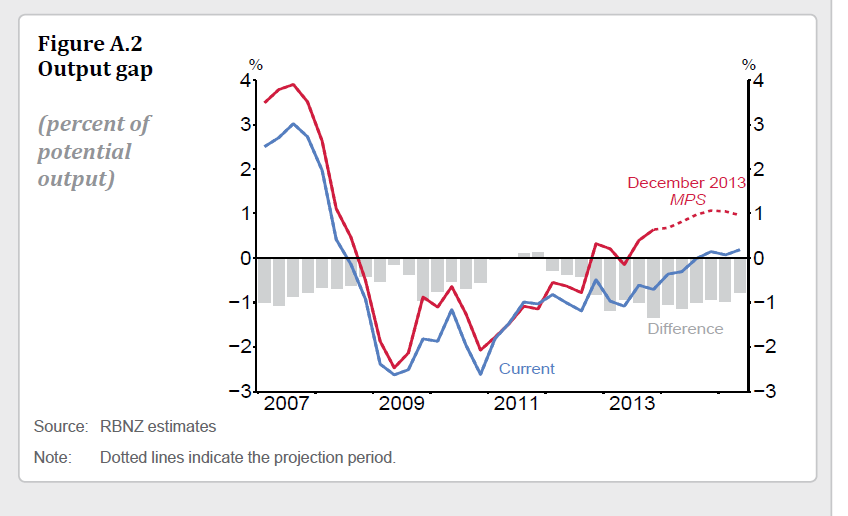
Incidentally, the current IMF and OECD estimates for New Zealand’s 2007 output gap are not so different from the Reserve Bank’s own latest estimates (around 3 per cent), in this chart from last week’s MPS.
mps output gap
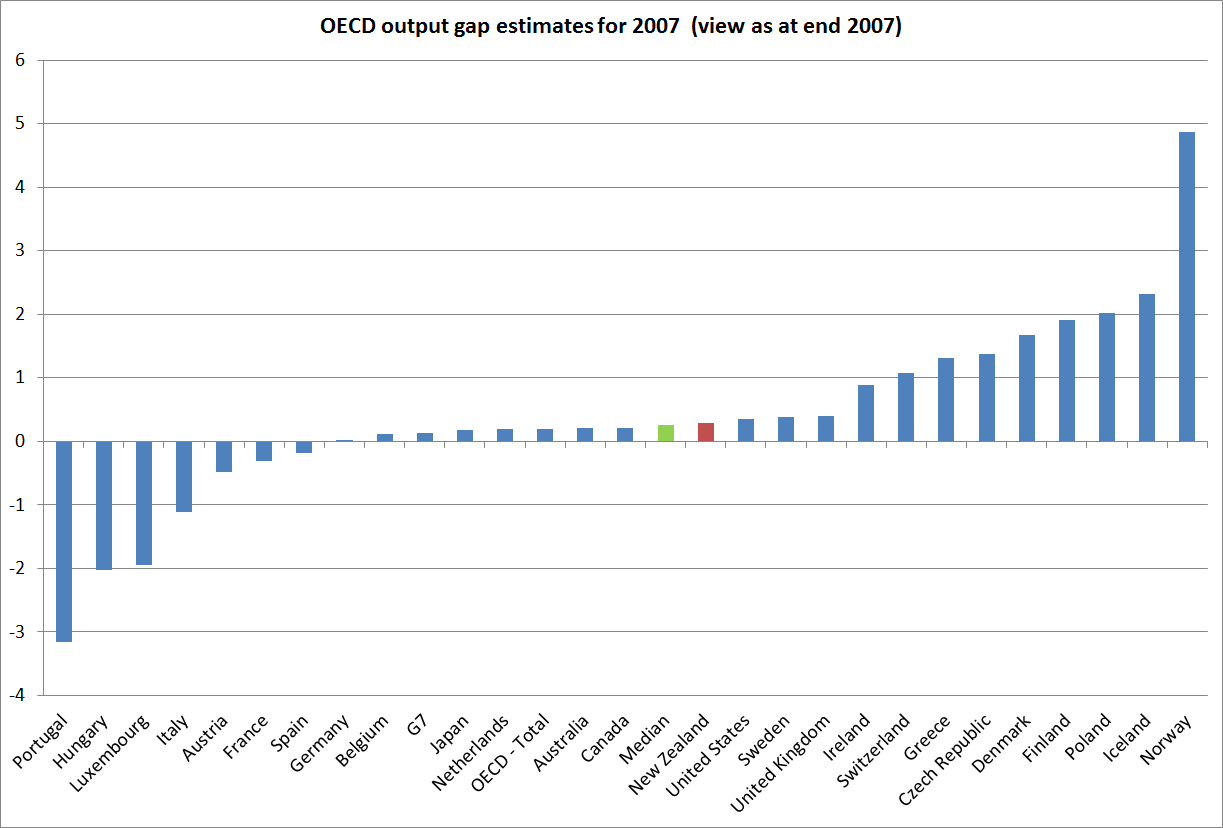
And one last chart, just to show how perceptions, and estimates, change.  This is the chart of the OECD’s output gap estimates for 2007 published in December 2007 –  before there was any widespread sense of a major recession looming. New Zealand was then estimated to be almost the median country, but notice how much lower the estimated output gap estimates all were.  For many countries, including Spain incredibly, the output gaps were estimated to have been negative, and only a handful of countries were estimated to have had positive output gaps much above 1 per cent.  This is not to pick on the OECD –  my impression is that their estimates are no more variable than those of the IMF, or of our own Reserve Bank or Treasury.  But it does make the point that if the output gap is a useful conceptual device, and is a useful summary metric for making sense of history, it is difficult to give it much reliable operational content in conducting policy.  The unemployment rate will often provide a less murky read.

oecdoutputgap2007

Paul Bloxham’s “rock star”

Reading the Herald over lunch, I found a piece by Paul Bloxham (of HSBC), author of the original “rock star economy” description, defending his image.  The sub-editors headed it “NZ’s economy still moves like Jagger”.

Personally, I am enough of an old fogey that “rock star” summons up unwelcome images of dissipation, licence, and worse.  I’ll take Bach or Handel any day.  But, anyway, Bloxham insists that New Zealand is some sort of “Nirvana” (apparently a rock group, that ended badly –  and, yes, I did have to look it up).    I’m not sure where lingering high unemployment fits into his story, or weak growth in productivity or per capita income.  Yes, there are many places worse off than New Zealand, but as I’ve been illustrating over the last couple of weeks many have been doing better.

Bloxham seems to focus on growth in total GDP, and certainly many OECD countries have much weaker growth than New Zealand has had.  But they also typically have very low population growth.  Our population growth is normally faster than that in the rest of the OECD, and has accelerated rapidly in the last year or so. On the latest SNZ estimates, our population is up 1.8 per cent on last March.  That might be good or might not –  perhaps less good if a lot of it just reflects New Zealanders not going to Australia because unemployment is also high in Australia.  Per capita real GDP growth just has not been that strong, and per capita income growth looks likely to slow even further as the terms of trade fall.

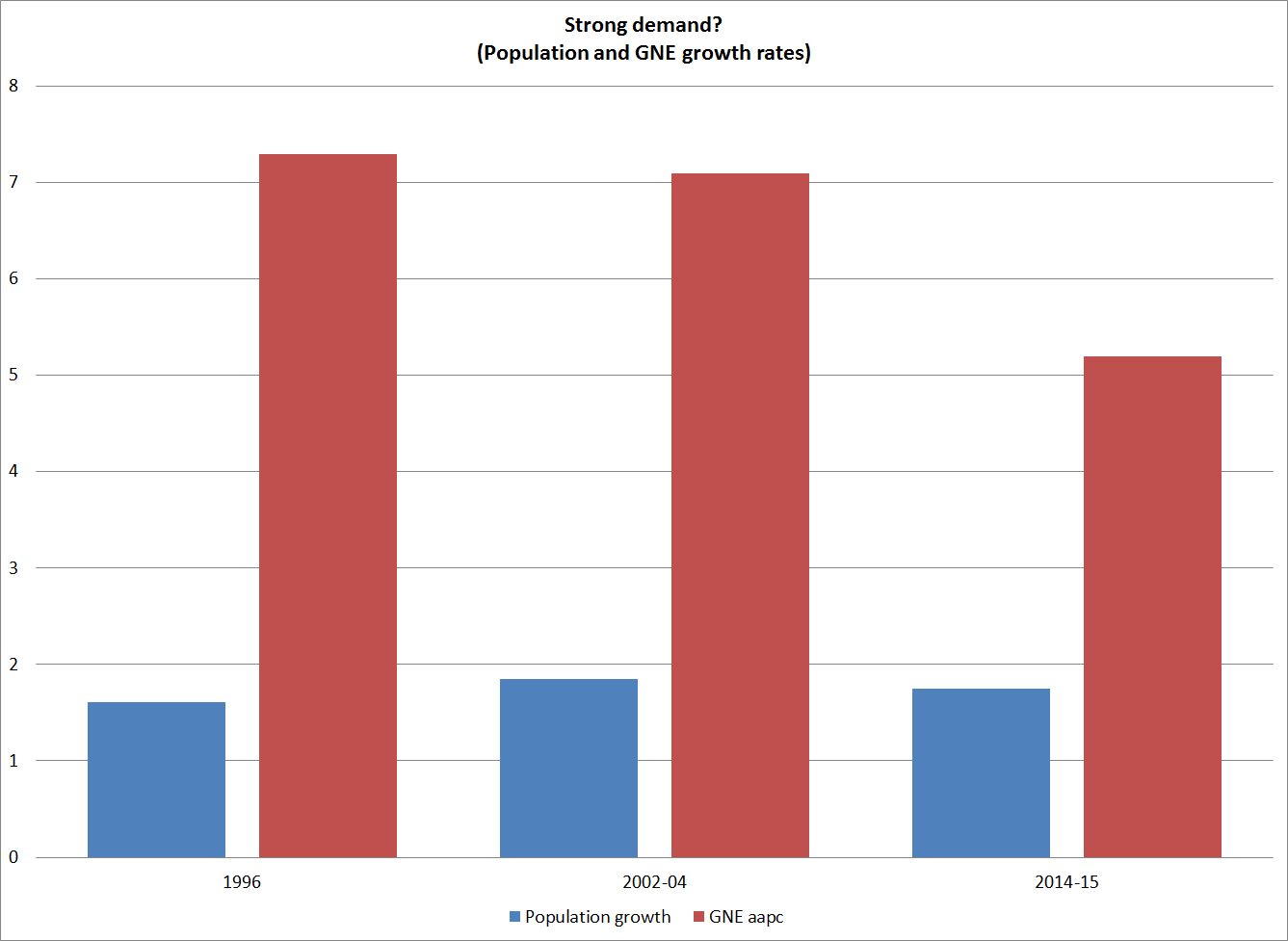
Bloxham is also convinced that demand is strong.  But rapid population growth tends to lead to rapid demand growth –  more people need accommodation, cars, other durables, and just the regular stuff of life (food, clothing etc).  SNZ’s quarterly population series only goes back to 1991.  But in the period since then there have been three episodes when annual population growth got up to at least 1.6 per cent –  in 1996, over 2002-2004, and the last couple of quarters.  Population growth rates and growth in domestic demand are quite strongly correlated. Here is how domestic demand growth (GNE) has been in each of those episodes (I’ve used aapcs for GNE, but the fall-off in the noisier apcs is even sharper).   Domestic demand growth has been much weaker over the last year than in the previous high population growth episodes, even though this time we have a large exogenous boost to demand resulting from the Canterbury earthquake rebuild.

nirvana

As I noted on Saturday, it is not that demand has been so strong, and supply has grown even faster to meet it. It is more case of rapid population growth, and some additional domestic labour supply growth (similar to that in other OECD countries), being accompanied by unusually weak growth in domestic demand.

The Productivity Commission on land supply

The Productivity Commission yesterday published its draft report on improving the supply of land for housing.  It builds from earlier work by the Commission and others identifying supply restrictions as one of the most important explanations for the high price of houses (more strictly, house+land) in New Zealand.

There looks to be a lot of fascinating material.  Being history-minded, the first thing I read was the fascinating little research note on the history of town planning in New Zealand.  Modern documents that quote from 1839 New Zealand newspapers appeal to me, even if the author of that research note seems more taken with the “need” for “town planning” than I would be.  And was the New Zealand Company really much involved in the founding,settlement and planning of Christchurch?  The books on my shelves don’t suggest so.

I also read the Summary Version of the report.  It is a summary, and while it lists the findings and recommendations and outlines the arguments,  there is a no doubt a lot more in the remaining hundreds of pages.  Some answers to my points below may lie in those pages, and I hope to look at them in more depth in coming weeks.

Land supply issues matter a lot.  That was one of the points the 2025 Taskforce stressed back in 2009.  It is a shame that the Commission does not pick-up the Taskforce’s recommendation that Councils be required to develop and publish indicators of the prices of otherwise similar land that is, and is not, zoned for residential development.  Information and data are a key input to any analysis, and even when the current public and official focus on these issues fades, it will be important to maintain the flow of data.

But what of the Commission’s own ideas and analysis?  Here is a list of thoughts/observations/concerns, in no particular order:

  • It is good to see the Commission come out in favour of land-value rating, reversing the trend in recent decades towards capital value rating.  Land value rating tends to focus the minds of owners of the scarce resource, land.  There are other ways to tackle “land banking” (ie don’t allow regulation to make new urban land scarce in the first place), but land value rating would be a step in the right direction.
  • As would, on a much smaller scale, levying local authority rates on Crown land.
  • But, as with many Commission reports, there seems to be a too-ready sense that government is the source of on-going solutions, rather than the source of the underlying problems.  In other words, the report doesn’t mainly focus on getting government (central and local) out of the way, but on finding smarter or better ways of the government being actively involved (eg “this means a greater degree of publicly-led development”).  Perhaps it shouldn’t be too surprising  –  after all, two of the three commissioners are former heads of government departments, and the Commission works on projects requested by government, in a process where ministers are advised by government departments –  but it is something to watch out for.  I had a similar reaction to the Commission’s recent draft social services report.
  • The report does not seem to grapple at all with the indications from historical cross-country experience that as cities grow richer they tend to become less dense, not more dense.  It also does not engage with the Demographia data suggesting that Auckland is already a relatively dense city by advanced New World standards.  I’m not at all suggesting that regulation should impede denser development, but some of the Commission’s lines of arguments become less persuasive if greater density is unlikely to be the main preferred market response to ongoing population pressures.
  • For example, the Commission focuses on the idea that local authorities do a poor job in this area because of the excessive weight of existing homeowners, concerned about the losses of price and amenity value on their houses.  That sounds plausible if we think about establishing high rise apartment through Epsom, but it is far less clear that existing home owners have any strong objection to greater ongoing development on the periphery of cities, where historically most new building has happened.     After all, existing home owners have children who will be looking for housing before too long –  but again the intergenerational perspective seems to be lacking in some of the Commission’s work.
  • The Commission does not seem to give much weight to the idea that restrictions on development at the periphery may have as much to do with the biases, preferences  and ideologies of Council staff.  Perhaps there is nothing to that suggestion, but I wonder how many Council staff come to work each morning dedicated to facilitating citizens doing as they like with their own property, rather than shaping and imposing a vision on “their” city.  I read the Wellington City Council’s recent draft long-term plan, and it confirmed my worries.
  • The Commission proposed removing “District Plan balcony/private open space requirements for apartments”, which sounds sensible.  But what about site coverage ratio restrictions?
  • I reckon the Commission oversells the gains to be had from improving land supply.  I’m reluctant to say that because I think the gains that are on offer –  much lower house prices –  are substantial and important, especially for the younger and poorer sections of the urban population.  But I’d say it is “case unproven” when it comes to gains in real GDP, or real GDP per capita.  The Commission cites recent work by Hsieh and Moretti, which suggests that releasing adequate land could lift GDP per capita in the US by as much as 9.5 per cent.  Perhaps it is true, and perhaps it is true of Auckland.  But New Zealand is already a highly urbanised country, Auckland already makes up a large share of the total population, and Auckland has had faster population growth than almost any other largest city in an OECD country in the decades since World War Two.
  • Related to this, the Commission seems to be too ready to embrace agglomerationist arguments.  Yes, it is true that cities tend to have higher levels of productivity than smaller centres, but that does not mean that policy designed to drive the growth of big cities will, of itself, lift productivity.  Yes, policy should avoiding impeding the distribution of population within the country to its most productive locations, but not go beyond that.  In fairness, many of the Commission’s specific recommendations are about removing roadblocks, but the supporting text often seems to go beyond that.
  • For example, there is the unsupported proposition that “Councils and their elected representatives also need to lead in persuading their communities of the benefits of growth. These are difficult conversations.  Facilitating growth requires communities to change, and change is hard.  Some people will lose from that change.  But the community as a whole, and New Zealand, will benefit from it”    Setting aside the condescending tone, where is the evidence that population growth is a “good thing” –  because population growth is the issue here?  Again, if we are going to have fast population growth, we need to find ways to absorb it, without causing scandals like, for example, current Auckland house prices.  But a reasonable voter (or elected representative) might reasonably ask “haven’t we had rapid population growth for 70 years, and some of the poorest  growth in productivity/GDP per capita of any advanced country?
  • The Commission proposes providing powers of compulsory land acquisition for housing purposes.  At one level, the claim that “compulsory acquisition of property by the state can be justified if it is in the public interest” is circular.  What is “the public interest”?  The public interest might, for example, involve the protection of private property rights, including the right to hold property undisturbed.  This is another example of the Commission’s apparent reluctance to grapple with pervasive government failure and abuse of regulatory powers.  The abuses of eminent domain powers in the United States should be a salutary warning here.  The Commission goes on to argue that “given the significant social and economic harm caused by the current housing situation, a good case exists for compulsory acquisition powers to assist in the assembly of sites for large masterplanned developments.”    As if to water down the rather shocking nature of this proposal, the report suggests that powers don’t need to be exercised much, as they can provide leverage (in the same way a mugger with a baseball bat won’t need to hit me to get my money) and the chair is also quoted as suggesting the powers might only be to deal with “holdouts”.     But it just is not clear why such powers should be given to public agencies.  In a well-functioning economy, housing is readily provided by the private sector.  Public agencies and political leaders got us into this mess, and why would we expect that new powers would not be abused?   Have powers of compulsion worked well in central Christchurch?  It hadn’t been my impression.
  • The Commission does not seem (I may have missed it) to touch on a more radical option.  Why not, for example, explore a proposal that would allow any land to have houses built on it, by right perhaps up to three storeys high?  One might make exceptions for geologically unstable land, but shouldn’t the presumption be shifted back in favour of the private land owner?    With something like that sort of model, combined with land value rating, it is difficult to envisage that peripheral urban land prices would be very high for very long.    Yes, I know this proposal does not deal with all the transport  and infrastructure issues, and many of the Commission’s suggestions on these issues appear sensible.

Keen as I am to see a more responsive supply of urban land, I came away from the report with a question.  Supply and planning restrictions have become an increasing obstacle to affordable urban house prices in many advanced countries in recent decades.  There are individual areas that have held out – Houston is among the best known – but are there any cases where there has been a move back from heavily planned and regulated urban land markets to much more liberalised ones?  I’m not aware of any, but my detailed knowledge in this area is pretty limited.  My prior is to be a bit sceptical about how likely it is that far-reaching changes to the planning regimes, of the sort that would materially reverse the growth in real urban land prices, could be made, and then made to last.  If the Commission is aware of examples of successful substantial durable reforms it might be helpful to include them in the final report.  A low prospect of success is not a reason for not doing the analysis and continuing to make the case, but there is a question as to where political capital might best be devoted.

Which brings me to my final point.  The Commission has to take population growth as given, since it was asked by ministers to look at land supply issues.  But it is too often forgotten that most of our population growth in recent decades, and all of it now, arises directly from active government policy.

The chart below shows New Zealand’s actual population, and what it might have been under two different immigration scenarios.  Immigration policy only affects the movement of non-New Zealand citizens, and so what I’ve shown here is what population would have looked like if there had been no net non-NZ citizen immigration, and if net non-NZ citizen immigration had been kept at the sort of levels seen in the 1980s.  They aren’t precise estimates by any means –  it is possible, for example, that if there had been less non-New Zealand citizen immigration, there might have been somewhat less New Zealand citizen emigration.  But it is just designed to make the point that population pressures on the housing market are not any longer about the choices of New Zealanders (to have children or not, to stay or to migrate) but about active government policy.   With 1980s levels of non-citizen immigration, the total population would now be flat or falling slightly.   The only aspect of the non-citizen migration that is unrestricted is the (modest) flow of Australian citizens: all other arrivals require explicit government approval, and a planned policy of high net inward migration of non-citizens.

population scenarios

If we are worried about house prices –  and I certainly think we should be  –  a strategy with a higher probability of durable success might be to combine land supply liberalisation with some reduction in the targeted level of inward migration (bearing in mind that our government’s target for inward migration of non-citizens is itself very high by international standards).  There would still be considerable cycles in net immigration flows (as the net outflow to Australia waxes and wanes with the economic cycles), but the trend is the issue for longer-term affordability concerns.

And to hark back to the discussion on why New Zealand interest rates have been so persistently high, if lack of sufficient agglomeration and scale were really the big issue in New Zealand, we should tend to see low interest rates, and a low exchange rate, not the reverse.

Labour market since 2007

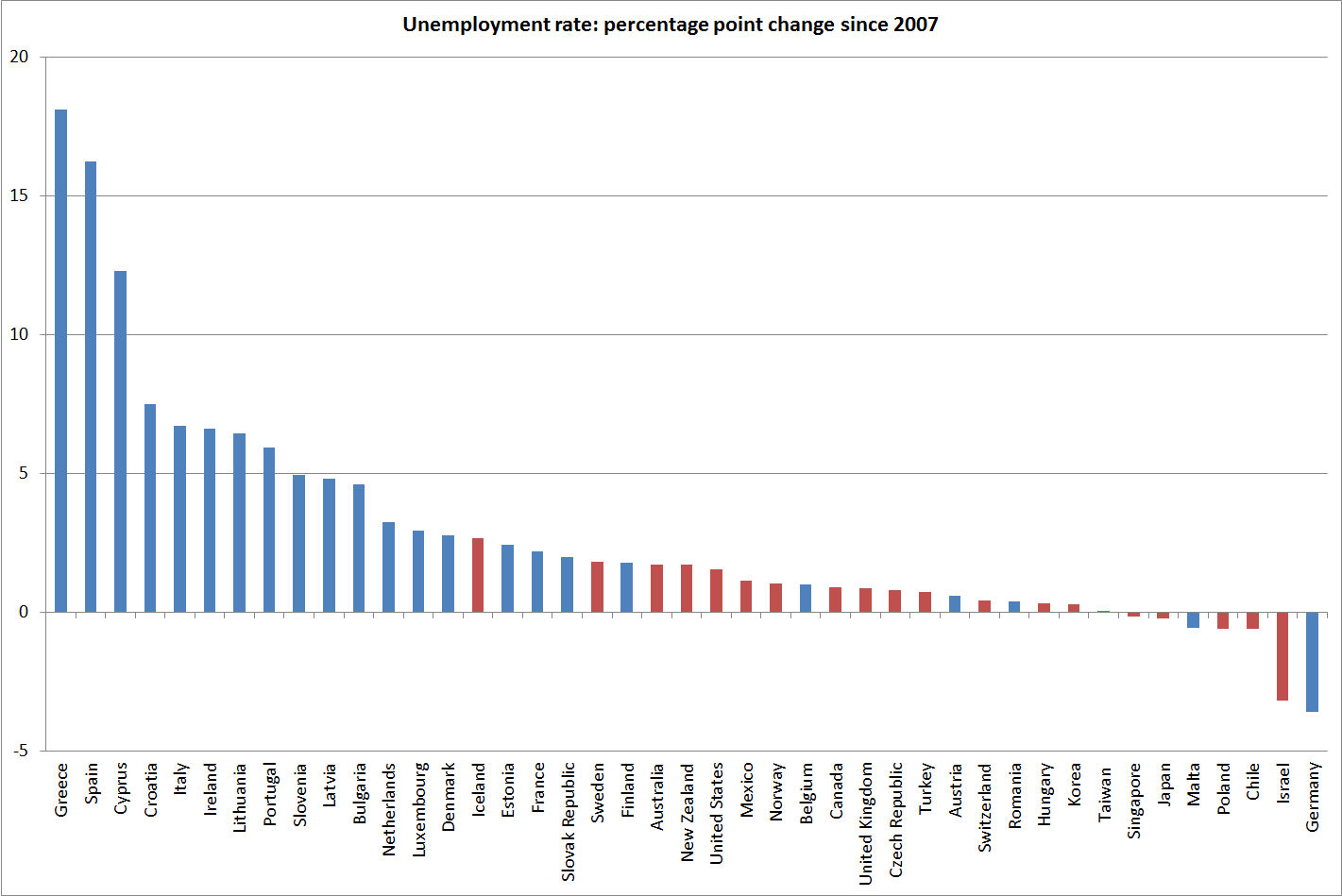
One other dimension of economic performance since 2007 is the labour market.  Using the IMF WEO database, which reports only annual data, here are the changes in advanced country  unemployment rates from 2007 to 2014.

U0714

New Zealand is almost the median country on this measure.  The unemployment rate was 1.7 percentage points  higher in 2014 than in 2007, almost identical to the increase in Australia, and slightly worse than for the US (of course, the US unemployment rate rose far higher and has subsequently fallen more rapidly).  On this chart, I’ve coloured red the countries with floating or flexible exchange rates.  It is pretty starkly obvious how the worst increases in the unemployment rates are concentrated in the euro-area countries, which have had no domestic policy flexibility.  On the other hand, once the fixed exchange rate regimes are allowed for, it is uncomfortably apparent that of the flexible exchange rate countries New Zealand has had the third largest (really second-equal) increase in its unemployment rate.  (And yet, for some reason, we were the advanced economy whose central bank was raising its policy rate.)

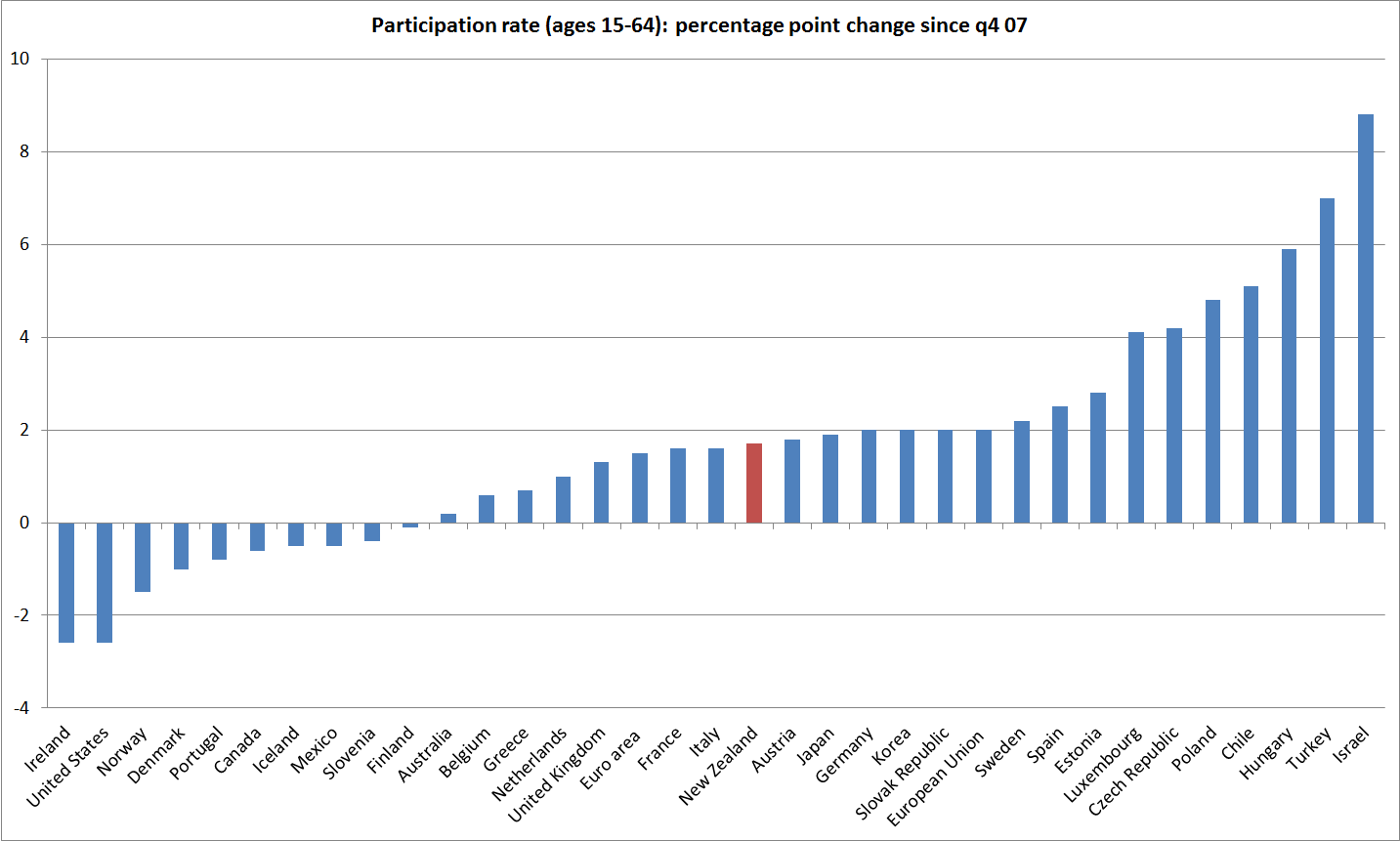
There has been a tendency in some circles to downplay the continuing high unemployment in New Zealand, by noting that participation rates have been increasing.  But here are the participation rate changes since 2007, this time just for OECD countries (I couldn’t quickly see comparable data on Eurostat).

participation

It is certainly true that participation rates have been rising in New Zealand, but not to any greater extent than in other OECD countries.  Again, New Zealand is about the median country in this group, and the increase here is just slightly more than in the euro-area as a whole, and just slightly less than in the EU as a whole.  Rising participation rates in most countries, at a time when unemployment rates are still above pre-recession  levels in most countries is an interesting phenomenon  – and somewhat unexpected given that participation rates typically tend to fall when unemployment is rising and rise when it is falling (thus the weak Irish participation rate is little real surprise).  The countries that struck me most forcibly were Greece and Spain, which have had huge increases in their unemployment rates and yet have seen labour force participation rates increasing.  Without anything more concrete to go on abouto what has happened in these two countries, I can only assume it is something around things being so tough that absolutely everyone is having to look for any work they can get, even if the probability of finding it is quite small.

Overall, then, the labour market remains another area of disappointing economic performance for New Zealand,  It is, of course, one that is more readily amenable to the ministrations of macroeconomic policy.  Easier monetary policy over recent years –  which there was demonstrably room for, given core inflation outcomes relative to the midpoint of the target range –  would have helped reabsorb the people who are unemployed more quickly than is currently in prospect.

Of course, one counter-argument to this line of argument is that the New Zealand labour market was unusually overheated in 2007.  Perhaps, but as we’ll see tomorrow there is nothing in international agency estimates to suggest that New Zealand’s economy was more stretched than most other advanced countries were just prior to the recession.