Questions about the OCR leak, the inquiry etc

Questions about the handling of the OCR leak issue aren’t going away.  Last Saturday, I posted some thoughts on some issues that the Reserve Bank and MediaWorks should be asked about, flowing from a careful rereading of the relevant documents.

Since then there has been a variety of articles –  especially focused on MediaWorks – in the mainstream media.   Jenny Ruth had a piece on the NBR website “Were there other MediaWorks leaks from Reserve Bank lockups”.  Hamish Rutherford has a substantial and useful piece in the Dominion-Post this morning “MediaWorks Owes an Explanation” (although I have considerably more readers than he reports) and John Drinnan’s media column in the Herald today is largely devoted to media aspects of the leak and its aftermath.

It is perhaps understandable that the mainstream media has focused mainly on the media dimensions –  many of them are grumpy at losing the opportunities previously afforded by the lockups (although others quietly acknowledge that the lockups were really products of a different technological age and probably had to go).  I don’t have much sympathy on that count, having called a month ago for the lockups to be scrapped.  But I do share the surprise that there has been no evident specific  sanctions meted out to MediaWorks, the chief culprits in the whole affair.  Various people have suggested that MediaWorks should have been banned from lock-ups, rather than ending the practice altogether.  Ending lock-ups was the right thing to do, but it is still surprising that there appear to be no other concrete consequences for MediaWorks’ flagrant breach of the rules (not reported to the Bank for weeks).   Then again, what other sanctions were available?  One might have been to deprive MediaWorks of, say, opportunities for any interviews with the Governor. But since he doesn’t give interviews, I guess that option wasn’t available.

There are questions for MediaWorks, but in the end they are a private company and have to make their own judgements about what to tell us.  It is disappointing that they have not been more open.  I’m not so much bothered about them not naming the person who sent the email from the lock-up, but about things like:

  • had these sorts of leaks happened before by MediaWorks staff?
  • why did it take more than three weeks for MediaWorks to acknowledge that its employees were responsible (including more than two weeks after the issue had extensive media coverage).

But, as I say, MediaWorks is a private organization.  The Reserve Bank, by contrast, is a powerful public body.  We should expect an open and transparent approach by public institutions when bad stuff happens, and the Bank is subject not just to the Official Information Act, but also to parliamentary scrutiny.  I think there is a range of questions to which the public deserves answers from the Bank:

  • Did the Bank, or Deloitte, ask MediaWorks whether these sorts of breaches had occurred before.  If not, why not.  If so, what was the response?
  • Why does the inquiry report not address issues around “the process for transmitting the Governor’s OCR decision to see if any improvements are needed”, even though the Bank had told me the Deloitte inquiry would cover such matters?
  • Was MediaWorks given a chance to comment on the draft inquiry report, or the draft of the Reserve Bank news release of 14 April?
  • Why does the Reserve Bank press release go out of its way to stress the cooperation of MediaWorks, when MediaWorks did not report the breach until more than three weeks after it occurred?
  • Why does the news release not accept any responsibility for the Bank having run lock-ups with such lax security procedures that a breach of this sort could happen so easily?
  • Have any Reserve Bank officials been disciplined or reprimanded for failing to update security procedures to reflect the advances of technology?

In support of seeking answers to these, and other, questions, I have lodged an Official Information Act request with the Reserve Bank.  It requests the following information:

Terms of reference

  • Copies of the terms of reference for the Deloitte inquiry, including the TOR as at 15 March 2015 (the date of Nick McBride’s approach to me), and any subsequent variants, (formal or informal).
  • Copies of any advice to or from the Board regarding the terms of reference

MediaWorks’ 5 April advice

  • Copies of the initial MediaWorks advice to the Reserve Bank and Deloitte on 5 April (date as per the inquiry report).  In the event that the advice was oral, please provide copies of any filenotes or other records of conversations with MediaWorks.
  • Copies of any follow-up requests for further information made to MediaWorks or its representatives by the Reserve Bank or the Deloitte inquiry team.

The Deloitte inquiry report

  • Names of any person or organisation, beyond the Reserve Bank’s staff or Deloitte, invited to comment on the draft report.
  • Copies of any advice provided to the Reserve Bank by non-executive members of the Reserve Bank Board on the draft report.

The Reserve Bank’s 14 April news release

  • Copies of all drafts of the 14 April news release
  • Names of any persons or organisation beyond the Reserve Bank’s staff or Deloitte, invited to comment on the draft news release.
  • The time at which MediaWorks was given a copy of (a) the draft, and (b) the final news release.
  • Copies of any comments made to the Bank by (a) MediaWorks and/or (b) non-executive Board members on the draft news release.

Internal Reserve Bank committees

  • Copies of the relevant sections of the minutes of any meetings of (a) the Governing Committee, and (b) the Senior Management Group at which the (possible/actual) OCR leak, and/or the Reserve Bank’s response to it, were discussed.

I remain more than a little aggrieved, having brought the issue to light in the first place, at having my conduct described by the Governor as “irresponsible”, but I have addressed those issues in a separate letter to Governor.


Ambivalence about expectations of the Board

(For those interested in the ongoing lock-up issues, my thanks to an offshore reader for drawing my attention to newly-released Audit Report by the Federal Reserve’s Office of Inspector General on the Fed’s lock-up procedures and processes.  The Fed procedures appear to have left open significant risks of leaks and breaches of embargoes –  and there was one actual breach last year.  In effect, again the system relied largely on trust.  The report contains a variety of recommendations to tighten security. A Reuters article on the OIG is here.)

Since reading yesterday morning (eg here ) about the OIA release by the Minister of Finance of a near-final draft of a new (November 2015) “letter of expectation” to Rod Carr, chair of the Reserve Bank’s Board, I’ve been trying to work out what to make of it. (The letter itself is near the back of the document released here.)   On the whole, I think it is probably a step forward, at least in the specific current circumstances.  But it has some dangers too, and risks undermining some of the good features of the statutory governance model for the Reserve Bank.

I’ve written previously about the Minister of Finance’s letter of expectation to the Governor , and in due course will be interested in this year’s letter.  Last year’s was surprisingly light on (ie there was no reference at all to) any concerns about the persistent deviation of inflation from the target.  The Minister and the Governor have a clear and direct legal relationship across a variety of strands: the Minister appoints (and can dismiss) the Governor, the Minister and the Governor sign a PTA that governs  the Bank’s conduct of monetary policy, and the Minister has a wide range of powers in a variety of matters (mostly regulatory, but including also fx intervention) dealt with in the various pieces of legislation the Reserve Bank is responsible for.

The relationship between the Minister and Board members is designed to be much weaker than that.   Board members are appointed by the Minister, and can be dismissed by the Minister (for cause),  but (unusually) the Minister does not even get to decide which of the Board members will be the Chair.  That is decided by Board members themselves.    The Board has quite a limited ongoing legal relationship with the Minister of Finance.  They are responsible for making a recommendation to the Minister as to who to appoint as Governor, and they are required to provide advice to the Minister on the Bank’s annual dividend.   But that is about it.  The Board must prepare a (published) Annual Report, which must be physically delivered to the Minister, but is not specifically described in the Act as a report to the Minister.

It is when things go seriously wrong that the Board is supposed to start talking to the Minister.   Section 53(3) of the Act provides that

If the Board is satisfied—

(a) that the Bank is not adequately carrying out its functions; or
(b) that the Governor has not adequately discharged the responsibilities of that office; or
(c) that the performance of the Governor in ensuring that the Bank achieves the policy targets fixed under section 9 or section 12(7)(b) has been inadequate; or
(d) that a policy statement made pursuant to section 15 is inconsistent in a material respect with the Bank’s primary function or any policy target fixed under section 9 or section 12(7)(b); or
(e) that the resources of the Bank have not been properly or effectively managed; or
(f) that the Governor, except as provided in his or her conditions of employment has, while holding office as Governor,—
  • (i) held any other office of profit; or
  • (ii) engaged in any other occupation for reward; or
  • (iv) had an interest in a bank carrying on business outside New Zealand; or
(g) that the Governor is unable to carry out the responsibilities of office, or has been guilty of serious neglect of duty, or has been guilty of misconduct,—

the Board shall advise the Minister in writing and may recommend to the Minister that the Governor be removed from office.

That is (rightly) quite a high threshold to cross before the Board must make such reports to the Minister.  The Act never envisaged a close or regular reporting relationship between the Board and the Minister.

I have sometimes written of the Board as being essentially the Minister’s monitoring agent (and I see the new letter uses the same language).  But if it was a pardonable shorthand, on further reflection I don’t think it is a fully accurate description either.  What the Act seems to envisage is a model in which the Board is charged with reporting publicly on how well, or otherwise, the Governor has been doing his job, but is supposed to stay at quite an arms-length from the Minister: paid to keep an eye on the Governor certainly, but expected to stay quite clear of the Minister unless things are so bad that the possibility of dismissal is coming into focus.

And I think that is the way it should be, at least if we want to maintain an operationally autonomous central bank.   Why?  Because the whole logic of making the central bank operationally independent, especially on monetary policy, is based on the (not totally uncontentious) view that we will typically get worse outcomes if elected politicians are too close to the decision-making process.  Instead, we set up an open and transparent medium-term PTA, in which the Minister takes the lead in setting the target, and the Governor is responsible for implementing policy consistent with that agreement .  PTAs are deliberately written for terms of five years, and the Governor is left to get on with the job (with all the reporting requirements, public and market scrutiny etc).

And so I am a little uneasy about this new letter of expectation, even if it supposedly flowed from a conversation initiated by the Board (I take that with a pinch of salt, as the Board may well have been responding to the Minister’s public expression of unease with the Bank last year).

The letter seems to have three broad areas of substance.  The first is a list of Minister’s specific interests for the Board in its monitoring role.

  • Monitoring the performance of monetary policy with respect to the Policy Targets Agreement (PTA).  I expect the Board to provide me with a clear sense of its judgements and the basis for them in assessing performance in meeting the PTA, recognising that the policy targets have evolved to be flexible and forward looking.

  • Assessing the performance of the Bank in promoting the maintenance of a sound and efficient financial system.  I expect the Board to articulate how it judges performance with respect to this statutory objective. I am particularly interested in how the objectives of soundness and efficiency are promoted and balanced.

  • Monitoring the Bank’s regulatory policy processes. The Bank has important regulatory responsibilities.  I expect the Board to take a close interest in the robustness of regulatory policy development and to articulate how it judges performance with respect to this function.   In particular, the Board should:

    • – Keep under review how the Bank’s regulatory policy is developed in light of the Government’s response to the Productivity Commission’s report on regulatory institutions and practices, and how these changes improve regulatory practice.
    • – Test the Bank’s thinking on regulatory policy developments and be satisfied that the Bank has reasonably addressed any alternative perspectives from other relevant parties (eg, the Government, the Treasury, the Council of Financial Regulators, Australian stakeholders, the financial sector and the wider public through consultation).
  • Monitoring the Bank’s relationships.  The Bank has a number of important stakeholder relationships – with me, with the Treasury, with regulated entities and with other agencies.  I would expect the Board to keep under review how these relationships are operating in practice.

  • • Monitoring of operational functions.  The Bank has a range of operational functions, including those related to payment systems and currency.  I expect the Board to monitor the Bank’s operational performance and risk, particularly with regard to the use of the Crown’s resources and wider economic efficiency.  •

  • Organisational strategy and financial management.  The Bank is a complex organisation with a large balance sheet. I expect the Board to take a strong interest in the Bank’s strategy and financial management.  The Board should closely monitor the Bank’s performance against the Statement of Intent (SOI)

It is an interesting list, and in some cases quite pointed.  For example, the explicit recognition of the possible tensions between regulatory measures to promote system soundness, and the statutory provisions around the efficiency of the financial system.  Or “the Board should test the Bank’s thinking on regulatory policy developments and be satisfied that the Bank has reasonably addressed any alternative perspectives…. [including from] the wider public through consultation”.  That would certainly be welcome.

The letter of expectation also deals with the Annual Report

The annual Board report, as required under the Act, is the formal document that sets out the Board’s assessment of performance.  I expect this to provide enough detail to enable me and the wider public to understand how the Board has undertaken its review role.

I have written previously about the severe shortcomings in past Board annual reports.  Last year’s said almost nothing of any substance, and tended to reflect the prevailing practice in which the Board has seen itself as “having the Governor’s back”, and being part of the Bank’s efforts to spread its messages.

If this provision in the letter of expectation is a shot across the bows, suggesting that better and fuller Annual Reports should be produced, it is most welcome.  The Minister outlined a variety of specific areas he is interested in (above), and we should hope that there would be substantive material on each in the next Annual Report –  not just about the processes the Board used, but about its substantive assessments and residual uncertainties. I remain somewhat skeptical, but time will tell.

Towards the end of the letter, the Minister includes these paragraphs

The duties of the Board include keeping under review the performance of the Governor.  I would expect to discuss your assessment of the Governor’s performance from time to time.  I would not expect you to limit your communications on the performance of the Governor or the Bank to the narrow criteria set out in section 53(3), as I hope those circumstances would apply rarely if ever.

Greater visibility of the Board’s activities throughout the year would also be welcome and I would be interested in any suggestions you have to facilitate that.  In addition, I will ask my office to establish six-monthly meetings with me.  In advance of those meetings, I invite you to share any other documents regarding the Bank’s performance which would support the discussion.

Here I am just not sure.  It is no secret that I don’t think the current Governor has done a particularly good job, so in one sense the more questions asked about his performance the better.  But the institutions are not designed around any particular individual, and probably nor should the practical implementation arrangements be.  Non-transparent regular discussions between the Board and the Minister about the Governor’s performance create risks of inappropriate pressures being placed on the Governor (not just on monetary policy, perhaps more especially in regulatory matters).  Since the Minister has deliberately been given the power to dismiss the Governor only in fairly extreme circumstances, it isn’t clear what is gained by the Minister and the Board holding such conversations, unless those potential-dismissal thresholds are coming into view (and, as the Minister notes, he hopes that is “rarely if ever”).  Indeed, is there even a legitimate ministerial interest, given the choices Parliament has made about the structure of the Bank and the role of the Governor?  I think there are material flaws in the allocation of responsibilities under the Reserve Bank Act.  One of those is that the Governor has too much control of financial regulatory policy (as distinct from the application of that policy).  The Minister might share some of those concerns, but the right way to deal with the issue is to amend the Act, not use the Board as back-channel leverage.

When I first read that final paragraph in the letter, I wondered if “greater visibility” meant public visibility.  If it did, that would be quite inappropriate –  a good published Annual Report is the appropriate model and at other times the Board should have a low profile, not detracting from that of the Governor.  In fact, I think the Minister is only talking about the Board being ‘visible’ to him.  But, as discussed above, I remain uneasy about the idea of regular formal meetings with the Minister –  as distinct perhaps from the odd informal discussion over lunch –  especially if it involves additional “documents” being provided to the Minister.  It runs the risk of the Minister and Board second-guessing individual decisions by the Governor, and that simply isn’t the statutory model.

But there is another risk.  I’ve noted previously that the Reserve Bank Board has tended to act as if its role is to provide cover for the Governor.  In principle, they should be able to have free and frank exchanges with the Governor in private –  including on the issues the Minister touched on in his letter.  But if the Board is getting into a regular/routine reporting relationship with the Minister, I fear that the “have the Governor’s back” tendency will just be reinforced.  The Minister might appoint Board members, but they meet at the Bank, the Governor is a Board member, the Board has no resources of its own (only what the Bank provides), and a senior Bank manager is Secretary of the Board.  So far, they have only chosen former staff (Arthur Grimes and now Rod Carr) as chair.  They have become quasi-insiders.   None of this is intended as criticism of any of the individuals concerned; the incentives simply work together to make it a model that is never likely to generate regular hard-nosed rigorous scrutiny of the Governor’s performance.  It is a model that few, if any, other countries have adopted.

And so I’m left ambivalent about the letter of expectation to the Board.  On the one hand, it seems likely that this initiative has flowed, at least in part, from the tensions around the current Governor’s performance –  and so in that short-term sense, I’m pleased to see more questions being asked, and challenges posed.  And anything that produces better quality Board Annual Reports would be welcome.

But the model of governance Parliament established for the Reserve Bank 27 years ago does not envisage routine close ties between the Board and the Minister.   Indeed, I’m aware of no advanced country with an operationally independent central bank where there are such close ties.  If we want a central bank with operational independence, the Minister of Finance should be at a considerable arms-length.  In one sense, the Board is the Minister’s monitoring agent, but only with qualifications –  the role the Act envisages for the Board, as it related to the Minister, is for quite extreme circumstances.  The Board are not, say, the Minister’s employees who just happen to be representing him on some committee or other.

Of course, my overarching view is that the Bank’s governance model is flawed, and if there as ever a sound argument for it, it is no longer well-suited to range of functions the Bank undertakes, and is out of step both with international practice and with how New Zealand governs other public sector agencies. The model should be changed, and it remains something of a mystery why the Minister is so resistant to change.  My alternative, which uses the able people on the Board more actively in a decisionmaking role, was outlined here.


A bouquet for Statistics New Zealand

(and some questions as well).

I got home at lunchtime after a couple of hours out with the kids to find a very pleasant surprise.

Following the kerfuffle last week about the Reserve Bank’s leak inquiry, and the discontinuation of the Bank’s lock-ups for media and analysts, someone reminded me that not just Treasury but also Statistics New Zealand holds regular lock-ups involving market-sensitive macroeconomic information.   Statistics New Zealand runs lock-ups

for media and market commentators for Gross Domestic Product, Balance of Payments and International Investment Position, Consumers Price Index, and Labour Market Statistics releases.

I wondered (a) what procedures Treasury and Statistics New Zealand used,  and (b) whether either organisation had changed their procedures in light of the Reserve Bank’s leak inquiry and subsequent decision to discontinue lock-ups.

So last weekend I logged OIA requests with each organization, and assumed I’d hear something in a few weeks time.

But Statistics New Zealand responded this morning (in due course, their full response will be here).  Often enough, blanket refusals take 20 working days or more, but here was a department offering a prompt, clear and helpful reply, and offering to answer any follow-up questions.

Here are the SNZ procedures

Prior to the commencement of a media conference, Statistics NZ requires attendees to sign in and surrender their cell phones. In addition, Statistics NZ displays the following media conference rules for attendees to abide by:

  • the media conference is held as a ‘lock-up’
  • once you have entered the room, you must not leave until 10:45am when the embargo is lifted
  • please sign in, turn off your mobile phones, including smartphones, and put them in the compartment at the conference room entrance
  • laptop external wireless communication devices must be placed beside the laptop on the media room table for the duration of the media conference, and cannot be connected to the computer until the embargo is lifted
  • laptops or other devices that have internal wireless network capability must not connect or transmit until the embargo has been lifted
  • we reserve the right to inspect devices to ensure that internal wireless capability is turned off.

Statistics NZ staff are happy to assist you with any questions about these guidelines.

 Note: Before the media conference starts, attendees are permitted to call their office, from Statistics NZ provided phones, to set up redial capability for use at 10:45am.

And here is the response as to whether they have made any changes or reviewed their procedures

Statistics NZ has not undertaken any reviews or made any changes to the department’s policy for media conferences following the Official Cash Rate leak at the Reserve Bank of New Zealand and the subsequent Deloitte report into that leak released last week.

Unfortunately, Statistics New Zealand seems still to be relying, in effect, on trust  (in much the same way the Reserve Bank was doing).   But the headline statistics that they hold lock-ups for are highly market-sensitive, and will not infrequently move markets more than an OCR announcement will (as one would expect; it is the same data the Reserve Bank uses).  There is no sign of, say, any jamming technology (or other technical means) being used, to buttress the role of trust.

Statistics New Zealand notes that

While Statistics NZ has never had a breach, if that trust is abused and an embargo is broken, offenders and their organisation would be barred from attending future media conferences.

Unfortunately, that was probably the sort of discipline/incentive the Reserve Bank was implicitly relying on as well.

As I’ve argued previously, the case for pre-release lock-ups for monetary policy announcements is weak (with the possible exception of a highly secure 10 minute lock-up for core financial journalists, with no additional briefings –  something like the model the US Federal Reserve apparently uses).  Is Statistics New Zealand that different?  There is, obviously, no policy message SNZ is trying to put across with its releases, and so no risks of different messages getting to different people.  But the security risks are the same.  Perhaps it is simply more efficient to have everyone in the same room, to clarify key technical points, but couldn’t the same end be achieved –  on a more competitively neutral basis (to analysts based abroad, say) –  by a dial-in (even webcast) conference call held a bit later on the day of the release?

Anyway, the point of this post was to praise Statistics New Zealand for its timely (“as soon as reasonably practicable”) response to an OIA request.    Quite what approach Statistics New Zealand should take in future is a matter for them, but I would encourage them to think again about the risks, and about alternative –  perhaps preferable –  models for helping to ensure that users can get whatever technical insight SNZ can offer into the numbers it releases.    Breaches may never have happened, but when one does happen –  and (by accident or intent) with current systems  it must be a matter of time – it can suddenly get extremely uncomfortable.

UPDATE: For those with a taste for obscure historical episodes, chapter 1 of this document –  linked to by a commenter – is well worth a read on the great data leak of 1905.


Regional GDP revisited: has Auckland really been that weak?

In a couple of posts earlier last week, I used the regional (nominal) GDP data, showing how weak Auckland’s per capita GDP growth appears to have been over the last 15 years (the period for which the data exist).   And it didn’t appear that terms of trade changes could explain the regional patterns, since most of the gains in New Zealand’s terms of trade has reached our shores in the form of lower import prices, the effects of which should have been quite pervasive across the economy.

But as I got to the end of the second of those posts, I started to get a bit uneasy about the data.  I had noted that over the 15 years, Auckland’s population had increased by 30 per cent, and that of the rest of the country by only 13 per cent.  And yet, over the years (to 2013, for which we have detailed industry breakdowns), construction had been a smaller segment of Auckland’s GDP than in most other regions in the country. This was the chart:

construction share of gdp

I started digging into the data a bit further, and also got in touch with Statistics New Zealand (who provided me with some prompt, very helpful, assistance, including suggesting that some readers might be interested in how they put the numbers together).  My digging didn’t resolve any puzzles, but it didn’t highlight any very obvious errors either.

In a city with a rapidly growing population one would normally see a larger share of GDP devoted to construction (than at other times, or other places).  Construction isn’t just about houses, but the whole panoply of structures that a growing population needs over time.

Over the 15 years to 2015, Auckland accounted for 50 per cent of all the population growth in New Zealand.  And yet here is the Auckland share of the value of all building consents, and the Auckland share of the construction component of GDP (for which we only have regional data to 2013).

akld consents

One wouldn’t expect an exact mapping, since the two series are measuring quite different things (quite a bit of construction won’t need a building consent), but both are a long way below Auckland’s share of population growth  (and Auckland’s share of population growth was highest in 2001 and 2002).

The regional GDP data also have two components that should normally have a strong relationship with housing, and also with population growth.  These are:

Rental, hiring, and real estate services
Owner-occupied property operation

The latter series is straightforward –  in effect, the rental value of living in an owner-occupied house, which is proxied using market rental data.

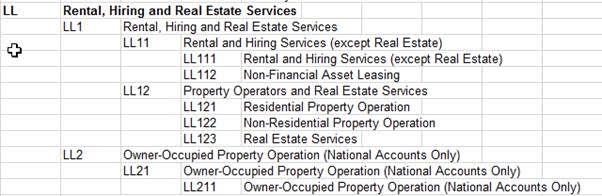
The “rental, hiring, and real estate services” is more complex.  It includes various sub-categories, for which the data are not provided separately.  Here is what is included, from a table SNZ sent me:

reg gdp categories

Ideally, I would like to look at only the LL12 and LL2 components, and thus exclude the non real estate leasing services (eg cars, machinery etc), but the data aren’t publicly available.

Surely, I thought, if Auckland’s population has been growing so much faster than the population in the rest of the country, this should be reflected in faster growth in these components of GDP.  I didn’t really expect it in respect of owner-occupied dwellings, because although Auckland rents have risen a bit faster than those in the rest of the country, rates of owner-occupation have been falling faster.  But everyone needs to live somewhere, renting if not owning, so I thought the effect should still show up if I combined the two components.  After all, the rental component also includes non-residential property, and more people generally implies more offices and shops too.

But this scatter plot is what I came up with (population growth on the x axis and growth in the sum of the two GDP components on the y axis):

housing scatter plot

I’d expected to see an upward-sloping relationship (recall, these aren’t GDP per capita components, but total GDP).  As I put it to SNZ, isn’t it a bit puzzling that growth in these two nominal GDP components over 13 years was greater in Southland than in Auckland?  Given where all the other regions sit, in a well-functioning housing market surely one might have expected the growth in these GDP components for Auckland to be up in the 140 to 160 range?

SNZ were able to tell me that there was a large growth, from a low base, in non-financial non real estate asset leasing in Southland.  That might help explain why these GDP components together grew surprisingly fast in Southland.  But it doesn’t explain why Auckland has been so weak relative to almost all the other regions (given the extent of its population growth).

Here is a chart showing Auckland’s share of total nominal GDP for each of these two components.

akld shares

And yet over this period Auckland’s share of the total population increased from 31 per cent to 33.5 per cent.

I guess that, overall, this is not wholly inconsistent with the divergence that has opened up in the population per dwelling numbers: trending down in the rest of the country but not in Auckland as house prices become increasingly unaffordable.

Out of curiosity, I redid the per capita regional GDP numbers excluding these two real estate related components.  In my original chart, Auckland had the third slowest growth in nominal per capita GDP from 200 to 2015.   In this alternative chart, we have the data only to 2013.    Over that period, Auckland had the slowest per capita total nominal GDP growth of any region.

What about on this adjusted, non-real estate, measure?

adjusted regional GDP growth

It doesn’t improve the picture.

I’m still not quite sure what to make of all this.  Ideally, we would have regional real GDP  data, but unfortunately that does not appear likely any time soon.  But on the basis of what we have, Auckland seems to have done particularly poorly over the last 15 years, despite (or partly because?) all the policy-induced population growth.  Some of that seems to relate to the poorly functioning housing supply market.  But even abstracting from the direct effects of that, it has to be seen as a pretty disappointing outcome, leaving many questions on the table.

(It also leaves me with some new questions, which I have not yet attempted to work through in my own mind, about my explanation for New Zealand’s persistently high (relative to other countries) real interest rates.  A topic for another day.)


China and New Zealand

The Prime Minister, a large flock of New Zealand business people, and various media representatives are in China.  It is not a particularly attractive sight, perhaps one of many reminders of why bilateral or regional preferential trade agreements are such an unfortunate policy option (as leading trade experts, and entities like the Australia Productivity Commission often remind us).  Allow for some trade diversion risks, and the ever-more-entangled rules of origin, and such deals are often bad enough.  And then there is the matter of making repeated obeisance before the leaders of a tyrannical regime, begging for their favour; the crumbs off their table.   Perhaps worst of all, our elected leaders don’t even seem to find it distasteful.

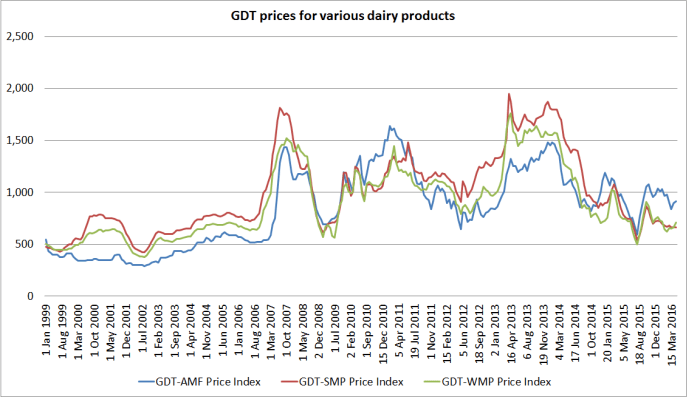
New Zealand firms do a fair amount of trade with Chinese firms, and that trade has increased considerably in the last decade. Despite some breathless commentary, China was never our largest “trading partner”,  but New Zealand firms do more trade with the Chinese than with firms and individuals in any other country than Australia.  But then our trade is quite widely spread across many countries, and much of it is in products which are pretty homogeneous (it isn’t clear that it much matters whether New Zealand firms export dairy products to Venezuela, Saudi Arabia, or China: New Zealand producers sell somewhere whatever is produced, and what matters most is the global prices for dairy products).  There is a great deal of talk about the benefits (or risks) of being concentrated on whole milk powder (WMP), but the prices of the various different dairy products all seem to cycle together, and idiosyncratic patterns for individual products don’t seem to last for long.   (GDT only has a long run of data for these three, but over the last five years one can also see it in a chart from a wider range of dairy products).

dairy prices components

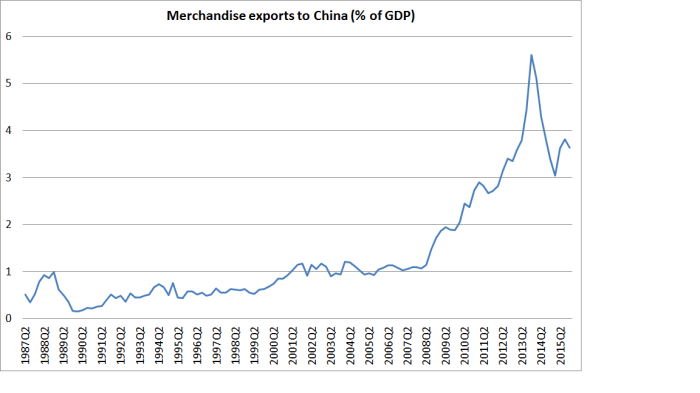
Here are our merchandise (goods) exports to China as a share of GDP.

exports to china % of GDP

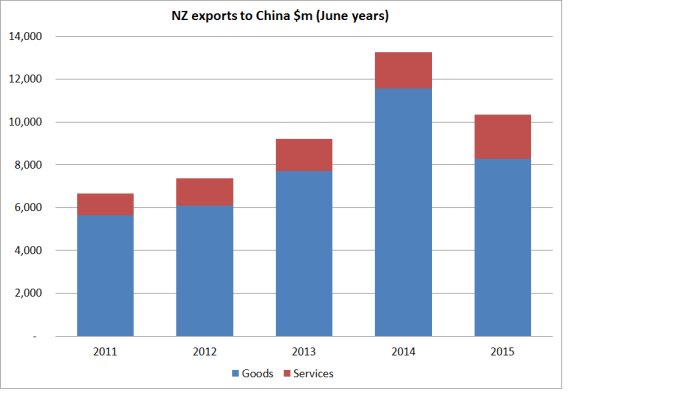
Services exports data by country is only available annually.  Here are total New Zealand exports to China for the last four (June) years.

total exports to china

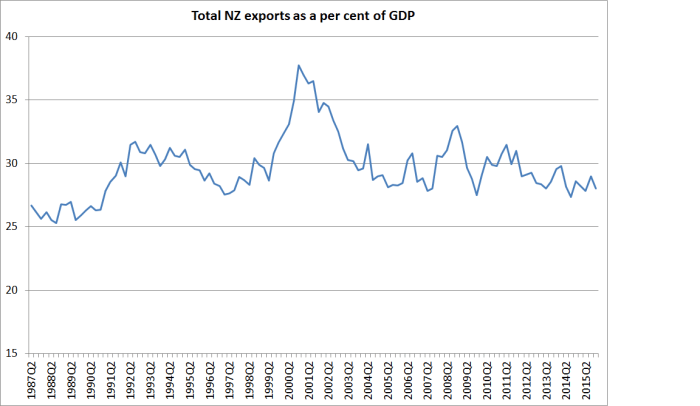
But how much difference has it all made?  The government has made much of trying to lift the export share of GDP, but here is a chart of that series.

total exports as % of GDP

Which has, as I’ve noted previously, been going nowhere for 25 years now.

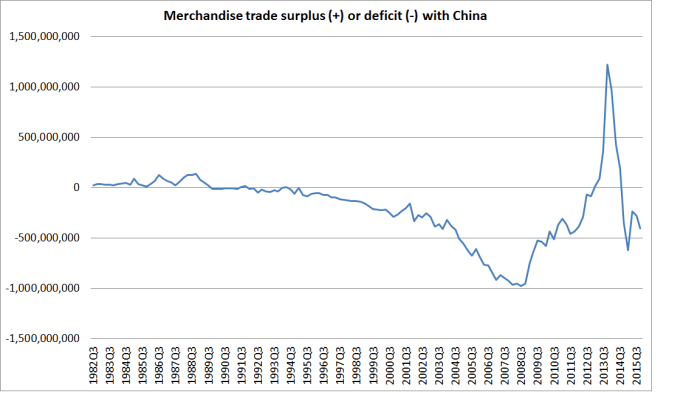
Of course, New Zealand firms import a lot from China as well.  Here is the merchandise trade balance between New Zealand and China since 1981.

merch trade balance with china

But once services trade is included, for the last three years New Zealand has run a goods and services surplus with China.

It was a little surprising to hear the Prime Minister in pursuit of investment from China

“But we in New Zealand will take that view from a Government perspective, that we’re a fast-growing economy, we want to to develop great international relationship and we also want to have a higher standard of living. We fundamentally don’t have enough private-sector capital of our own to fund that growth.”

Set aside the “fast-growing” economy claim for now – I guess the total economy has been growing quite a bit by OECD standards, even as per capita growth has been pretty dismal –  but what really struck me was the observation that “we fundamentally don’t have enough private-sector capital of our own to fund that growth”.  If the Prime Minister simply means that we run current account deficits (in which total domestic investment exceeds total national savings) that is, of course, true.    But it is not as if we have any trouble financing that current account deficit on world markets –  apart from any other indicators, that is evident in the persistently high level of the exchange rate.  Countries that have trouble financing themselves tend to have persistently weak real exchange rates.  We don’t.

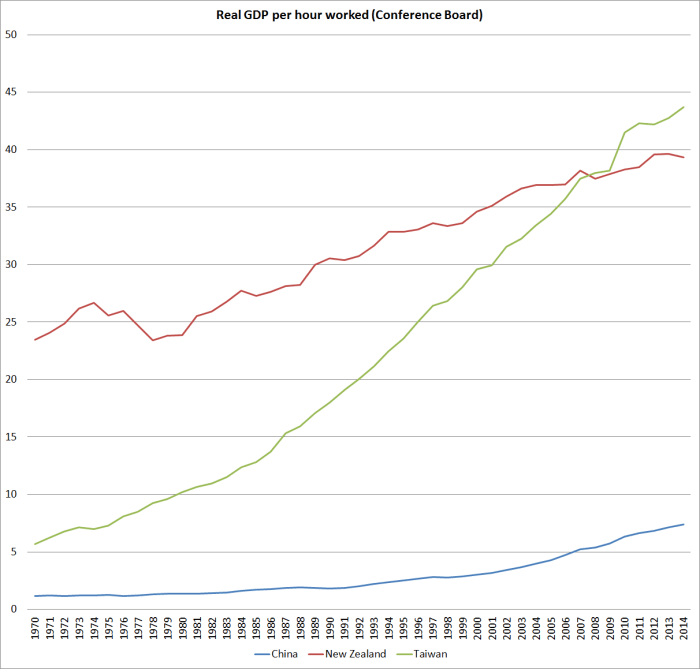
To be clear, I have no particular problem with foreign direct investment, and in general I think we should have fewer restrictions on it.   China is a slightly different issue, but mostly because all major businesses are ultimately state-controlled. I’m not suggesting any specific restrictions on Chinese FDI (except perhaps where national security considerations warrant it) but we need to remember just how badly distorted and underperforming China’s economy is.  It isn’t exactly one of the success stories of market capitalism, unlike say Taiwan.  New Zealand hasn’t done well in recent decades, but for all its fast growth (much real, some probably illusory), China’s overall levels of productivity are still astonishingly poor.

gdp phw nz china taiwan

The better of China’s firms may be very good at managing the twisted eddys of Chinese politics.  That is very different from thriving in a proper market economy, where the rule of law prevails, and connections to the powerful don’t (or are not meant to) matter much.  If FDI from China happens, so be it and some it may add wider value, but it isn’t the most obvious place to be pursuing FDI from (if politicians should be doing such marketing at all).  The real gains from FDI aren’t dollars of foreign capital but rather the ideas, technologies etc that really successful global firms can bring with them, with spillovers into the New Zealand business sector and the wider New Zealand economy.

And all this is without devoting space to our apparent studied indifference on the South China Sea issue (“we aren’t taking sides, we just want a resolution”, as if there is no difference between tyrannies and democracies –  Philippines and Japan for example), or talk of extradition treaties with China.  If people can be shown to have lied on their immigration applications, no doubt we should revoke their approval to be here, but are we seriously comparing the so-called “justice” system of China to that of countries like our own?   For all the talk of “fugitives” in New Zealand, we need to remember that much of the so-called anti-corruption programme of the last few years has been about purging those who got offside with the winners in the latest Party realignments.  Some of those now abroad might well be “bad guys”, but it isn’t clear that any people who matter in China’s government are, in any sense, “good guys”.

Finally, in all our enthusiasm for trade with emerging China, I amused myself yesterday by downloading the 1939 New Zealand Official Yearbook to see what trade we were doing with Germany and Japan in the 1930s.  Not much with Germany, but I’m imagining there must have been some breathless enthusiasm, at least in some circles, about our rising trade with large and emerging Japan, by then our third largest export market.

japan exports

,


Housing: what can be done

In the seemingly-endless housing supply debate, there is often a divide between those favouring greater intensification, and those favouring a larger physical footprint for growing cities.  My own policy view is squarely in the “it should be a matter of individual choice, provided the infrastructure etc costs of development are appropriately internalized, and the rights of existing property owners are protected” camp (and yes, I recognize that the definition of almost every word in that statement could be extensively debated). My practical prediction is that New Zealand is a society where most people –  people in their child-raising years –  will prefer to have a decent backyard (those living in Hastings or Timaru don’t flock to high rise apartment buildings or town houses with tiny sections), so long as regulatory restrictions don’t make that infeasible.  It was quite possible 50 years ago, when New Zealand incomes were much lower.  There is simply no reason, in a country with this much land, why it shouldn’t be now.

Apologists for the current disgraceful situation constantly cite Sydney, or Vancouver, or San Francisco or London, as if absurd regulatory restrictions in other places make it okay for us to mess up our housing/land supply market this badly.  Others look to the experience across the huge range of US cities.

Someone drew my attention to the chart below, drawn from the Wall Street Journal’s economics blog, and on a day when the house is over-run with builders (and holidaying children), it seemed worth reproducing.

scale of cities and house prices

Cities with rapidly growing populations (those big blue circles in the bottom right) have seen little or no increase in real house prices over the period 1980 to 2010.  They made it possible to build, relatively easily, and in turn made themselves attractive places for people to live.

I don’t know how large the increase in Auckland’s “developed residential area” has been over 1980 to 2010, or even how to go about trying to measure it, but I’d be astonished if it was anything close to even 100 per cent.

It is quite possible to accommodate rapid population growth without anything like the scandalous increases in real house prices we’ve seen in Auckland (or even, to a much lesser extent in many other urban areas in New Zealand).   Political leaders, of both main parties, who have failed to make it possible, posing a near-impossible burden on younger people in Auckland who don’t come from advantaged backgrounds, should really be held to account.  High house prices aren’t something to celebrate (NB Prime Minister)  –  and not even most existing home owners are better off, as they aren’t going anywhere –  but should really be a source of shame to those who rigged the market (or let the market stay rigged) and made it happen.

An underperforming taxpayer subsidised industry

Getting diverted again on Saturday, because of yet another road closure to assist the film industry, reminded me that I had been intending to write briefly about the screen industry data Statistics New Zealand released last week.

Perhaps I missed the coverage in the local papers, but the only media story I’ve seen on these data was in the Wall Street Journal, in a story headed “With no hobbits, New Zealand movie industry is hobbled”. The author quotes a US industry figure observing that “New Zealand is a global hub for filmmaking with an exceptional reputation”. Perhaps, but the numbers don’t seem to be moving in the right direction.

Gross revenue of screen industry businesses was $3221 million last year, slightly up for the year, but still 2 per cent lower (in nominal terms) than in 2012.

Gross revenue from production and post-production of feature films was (down a lot last year and) less than half of that in 2012.

There are almost 10 per cent fewer jobs in the screen industry than there were in 2005 (and while I promise not to keep mentioning it, New Zealand’s population is a lot larger than it was in 2005).

And this in an industry where 40 per cent of the revenue for “production” comes from the New Zealand government: it makes the export incentives in places a few decades ago to encourage non-conventional exports look niggardly.

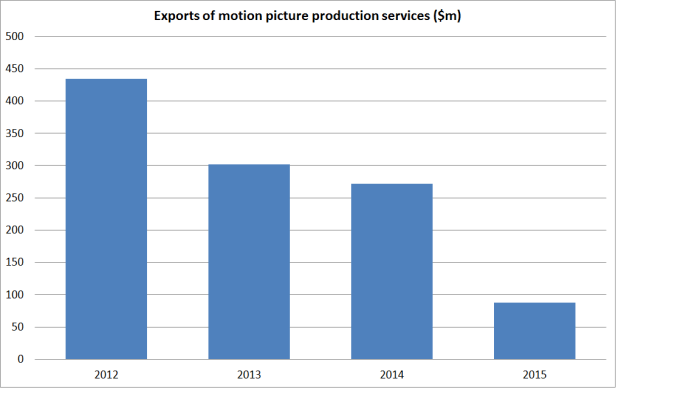
Statistics New Zealand also recently released a detailed breakdown of exports of servces for 2015.  Here is how exports of “motion picture production services” have gone over the last few years.

movie exports

There has been some growth in “Radio, TV, and other artistic services” but nowhere near enough to offset the fall in the movie side of things.

SNZ also reports some industry value-added estimates, but the most recent data relate to 2014 financial years.

screen industry VA

Presumably the 2015 numbers will be lower.

And although much the hype is around Wellington –  still important on the movie side of things – what is striking is the decline in the industry in Wellington.

screen gross revenue wgtn

Another way of seeing this over a longer period is to turn to the regional GDP numbers.

The published numbers don’t identify film or screen industry activities separately.  But they do have a category called “Information media, telecommunications and other services”.  Much of the screen business activity must be included in that industry segment.   But here is how the share of this industry segment in GDP has behaved for Wellington on the one hand, and for the median New Zealand region on the other.

film share of gdp

As I’ve noted in earlier posts, the industry breakdowns of the GDP data are only available to 2013.   When it is available, the relative picture for Wellington is likely to be even worse by 2015.

The Wall Street Journal article summed up the subsidies.

New Zealand, along with the UK, Canada, and several US states, offers incentives for businesses producing films here.  A cash grant was increased to 20%, from 15%, from 2014 –  partly to clinch the “Avatar” deal.  This allows international productions to claim back 20% of the money they spend in the country.  Some productions receive an additional 5% rebate.  And local ones receive a 40% grant.

Even MBIE was opposed to the increased subsidies.   The industry has the feel of a sinkhole, into which public money is poured with little very evident payoff.  At least when we subsidized manufacturing exports in the bad old days, we got more of them.  But screen industry exports have been falling.

The head of the government’s Film Commission is quoted as saying “we need to keep growing.  We want those jobs here”.   But do we?  If so, why?  And at what cost to the rest of us.  (And as the SNZ data show, most of these jobs aren’t even particularly well remunerated.)

Ah, but “industry experts say that the movie business’s economic contribution cannot be measured by revenue alone”.  Tourism spinoffs are apparently the thing.  WSJ readers are told of tourists spotted along “Miramar’s main retail strip”, but perhaps won’t appreciate that Park Road isn’t exactly Hollywood Boulevard.  More importantly, perhaps, as I highlighted last week, although tourism had a good year last year (and export education as well), New Zealand’s overall services exports remain weak by international standards (especially for small countries) and have been some of worst-performing among advanced economies over recent decades.

services X change since 2005

We massively subsidise the film industry with direct subsidies.  We also subsidise the tourism industry with the rapid expansion in working holiday programmes –  this time, the subsidy isn’t direct from taxpayers, but from lower-end New Zealand workers facing greater competition from temporary foreign workers.     Much the same could now be said for export education.

And yet we have so little to show for it all.  A better class of cafes in Miramar perhaps, but not much beyond that.  Sadly, it is all too typical of the disappointing New Zealand story –  although perhaps made worse by the direct government hand in these industries.


The OCR leak – some more thoughts

I was re-reading the documents released on the OCR leak.  There are three of them: the Deloitte report, the Reserve Bank’s press release, and the MediaWorks press release.  The latter document doesn’t seem to be on the web (and certainly not with the company’s 2016 press releases), but someone did send me a copy.  This is the text

Mark Weldon, Group CEO, MediaWorks said:

“MediaWorks unreservedly apologises to the Reserve Bank for this incident. Once MediaWorks was aware a leak had taken place, it conducted its own investigation to determine whether the leak had come from within MediaWorks and self-reported that to the Reserve Bank.”

Regarding the specifics of the matter, Richard Sutherland, Acting Chief News Officer, said:

“The leak was caused by a failure within News to follow proper process and changes have already been made as a result. We are addressing the breach with those concerned and new policies and training will be implemented moving forward.”

I also compared the Deloitte report with what the Bank’s legal counsel, Nick McBride, told me about the scope of the enquiry – which they had already commissioned by then – when they asked for my assistance.  I included the whole email in yesterday’s post, but this was the bit I had in mind today

The Bank has appointed investigators from Deloitte to try and find out whether there was a breach in security and, if so, how it occurred. They will also review the process for transmitting the Governor’s OCR decision to see if any improvements are needed.

A number of things struck me:

  • We have not seen the terms of reference for the Deloitte inquiry.  They are referred to in passing in the report, but are not attached.  That seems strange.
  • The substance of the report is less than three pages of text.  A full page of that is devoted to me.  I don’t have too many problems with it, but I understood it was normal public sector practice when inquiries are done to give those affected by the inquiry an opportunity to see, and comment on, the report in draft before it was published.  That didn’t happen for me (but there must have been coordination with MediaWorks –  did they see the report before it was released?).  Had the draft report been shown to me, I would have requested some wording changes.
  • Despite the comment in McBride’s email that the investigation would “review the process for transmitting the Governor’s OCR decision to see if any improvements are needed”, there is nothing at all on that topic in the published report.  I had offered some comments, in passing, on that matter when I met with the investigation team.  Were the terms of reference changed at a later date?  If so, why?
  • The MediaWorks statement says that “once MediaWorks was aware a leak had taken place, it conducted its own investigation to determine whether the leak had come from within MediaWorks and self-reported that to the Reserve Bank”.  But that seems inconsistent with the Deloitte report, which says that the source was identified only after “communication that we initiated with the journalists”.  The inquiry report says it only focused on the media after my meeting with the inquiry on 18 March, and I wrote about the leak possibility for the second time that day (and I know various MediaWorks employees read my blog), and the mainstream media gave a lot of coverage to the story on 21 March.  So news of the possible leak was widespread by then at the latest.  And yet MediaWorks only self-reported the information about the leaker “to RBNZ and to us [Deloittes] on 5 April 2016”, more than two weeks later.  It doesn’t take two weeks for an organization to track something like this down internally – MediaWorks knew which of its employees had been in the lockup.   It seems more probable that MediaWorks acted only after the inquiry team requested a meeting with the staff who had been in the lockup.
  • It is striking that the Deloitte report makes no attempt to assess whether what the MediaWorks person in the lock-up did on 10 March (file a draft story back to their office well before the embargo lifted) had been done before.  And the MediaWorks statement also does not address that issue.  There are various stories on the media grapevine that it was, in fact, established practice.  And while I have no way of knowing whether that is so, it is not inconsistent with the fact that the person who sent me the information presumably didn’t see anything extraordinary about doing so.   There is no suggestion in the report or statement(s) that the transmission from the lock-up was somehow accidental (inadvertently hit the wrong button, or somesuch), and if it wasn’t accidental perhaps it was customary.    It is unfortunate that the Reserve Bank’s inquiry does not appear to have attempted to assess whether that was the case, or even just note the possibility.
  • The Reserve Bank’s own statement seems very supportive of the MediaWorks hierarchy, even though (a) people in that organization knew what had happened from the start, (b) must have known it was against the rules, even before I started to draw attention to the issue, and (c) the timing suggests that the management action (and formal internal investigation) was all rather belated, occurring when their people realise they would be interviewed by the inquiry and would have to provide an accurate factual account of what happened.

There seem to be quite a few more questions that should be asked of both the Reserve Bank and the MediaWorks management.

In passing, I would note that I have read and heard many dismissive comments in the last few days from other media people about MediaWorks, and their coverage of economics and monetary policy issues.  I don’t watch their TV channel, and am not a commercial radio listener.  Nonetheless, I had actually been quite impressed that Radio Live had been keen to run interviews with some one like me on such diverse topics as the OCR, US monetary policy, Kiwibank, the real exchange rate and economic performance, immigration policy and so on.  As I say, I don’t listen to commercial radio (my wife kept saying “but no one I know listens to Radio Live”), so I’m not sure how representative those sorts of interviews are. But my experience had been a wholly positive one –  intelligent interviewers, aiming at popular market no doubt, asking sensible well-researched questions, and not obviously pursuing “gotcha” moments (but then why would they with a middle-aged rather serious economist, talking mostly about rather geeky issues?).

Someone has, however, drawn to my attention an NBR story in which Rob Hosking reports  that

“Mr Reddell did not at the time ask how they knew of the decision an hour before it was announced-  an omission which has apparently caused some resentment within Mediaworks who feel he should have warned them about this”.

Yeah right.  The MediaWorks people knew very well that the information was not supposed to be outside the lock-up.  What was I supposed to do –  assuming I had believed it was the fruit of a real leak which, as I noted yesterday, I had no particular basis for doing (25 years of MPSs having gone by without one) ? I genuinely didn’t know what to make of it.   I suppose I could have said “you do know you aren’t supposed to have that information, assuming it is true, don’t you?”  But the sender, and the people that person apparently overheard, already knew that. The 9am release time is no secret.  It was no worse sending it on to me than it was for them to have had the information, in breach of their express commitments to the Reserve Bank, in the first place.  I had no ongoing or formal relationship with MediaWorks (I generally talk to any media –  or anyone else –  who asks), and I reported the matter to the Reserve Bank because if there had in fact been a leak, it was their information and systems that had been compromised.  The guilty people were hardly likely to own-up unprompted.

The OCR leak: again/still

I’m heartily sick of the Reserve Bank leak story and hope that this is the last occasion I write about it.  But there were a few further points I wanted to make, partly in response to the coverage in the last 24 hours.

I would also add that despite several commenters on various stories having correctly noted that the longstanding system vulnerabilities mean that there may have been previous leaks over the years from people in the Reserve Bank’s media or analyst lock-ups, I’m not sure it would a wise use of time or resources now (or perhaps even possible) to attempt to prove it one way or the other.  But that is a matter for the Reserve Bank.

Much of the media commentary has been about the abolition of the Reserve Bank’s lock-ups.  The many good trustworthy people pay the price of one peripheral player cheating.  Worse, it will apparently be harder to get good reporting and consumers of news will suffer.  And, from some of the economists, a concern that financial markets might be more volatile for the “first few minutes” after the release while economists and traders try to digest what the Bank is saying.   I plead for some perspective.

All of this commentary loses sight of the simple point which I have made previously, and which the Reserve Bank statement yesterday also makes.  Other countries don’t do it the way we were.  No country that I’m aware of had provided advance lock-ups for economists and analysts for official interest rate announcements.  And the handful that do provide some tightly-controlled advance notice for a select group of journalists give them only a few minutes advance notification, not two hours.  Other countries’ central banks don’t provide their staff to provide private briefings to media or analysts in advance of release, in doing so providing different information to those inside those lock-ups than is available to those outside.     What the Reserve Bank wants to say  in its releases should be carefully drafted and refined, and then put in the official documents, and left to speak for itself.  Sometimes press conferences can be useful, but they should be viewable (as the Reserve Bank’s are) by everyone, not only by the select few.  If anything, under the new arrangements, the press conferences may even allow better scrutiny and more searching questioning of the Governor, since future press conferences will occur an hour after the release (rather than a few minutes after as has been the case until now).  That will allow journalists to talk to economists, politicians, sector group leaders etc before they pose their questions to the Governor.

It is worth remembering, again as I’ve pointed out previously, that half of each year’s OCR announcements have always taken place without benefit of lengthy explanatory lock-ups (or press conference).  The full scale lock-ups have been used for Monetary Policy Statements, but not for the other intervening OCR reviews.  I’m not sure there is any evidence that the market reaction to those one page statements has been any more difficult or volatile than for the MPS releases.

Nonetheless, I think there are still some aspects of the new regime that will require some bedding down, and perhaps later refinement.    I’ve long thought it was a mistake to release OCR announcements at exactly the same time as MPSs. A better model, in my view, would be to release the OCR decision as soon as it is made (further reducing another aspect of risk in the system) and then to release an MPS a few days later, as background analysis (looking forward, and providing ex post assessments).  In such a model, the MPS would be much less market sensitive (the main market-moving news is in the OCR announcement itself). For such a background document, there might be less harm (but less interest) in a lock-up to explore the technical detail of the forecasts.

More immediately, the Reserve Bank should consider adopting the idea proposed by former Czech central bank head of communications Marek Petrus (discussed on his Lombard Rates blog, and here on mine) that the Bank should host an analysts briefing later in the day of the MPS release.  In such a briefing,  analysts could ask questions of the Bank (in person or by phone –  akin to conference calls investment banks run), and the Bank  might also be able to use the occasion to resolve  openly any misinterpretations that had arisen over the day.  But the critical aspect of the arrangement is that the briefing would be webcast (as the press conferences are) so that everyone has the same information, whether in Wellington, Auckland, Singapore, or New York, whether economist or not.  A concern about the new system the Bank announced yesterday is that it will resolve one problem and open another.  The analysts lock-up (and the later economists’ lunch) has always had problems in that they sometimes provided information to attendees that wasn’t available to everyone else.  In the new world there is a risk that there will be high rewards for those – especially the Wellington-based – who, searching for nuance, secure coffee discussions with the Chief Economist or the Manager, Forecasting.

Somewhat surprisingly, even the Prime Minister has weighed in, calling for the Reserve Bank to reconsider, noting that Budget lock-ups had worked well.  I’m not sure whether The Treasury uses more robust systems to reduce the risk of leaks (perhaps they will be reviewing them in light of the Bank’s experience?), but even if they aren’t the case for a lock-up for Budget material is much stronger than for MPS.  First, there is typically a wide range of material across huge number of portfolio areas.  Second, often new initiatives are being announced, with technically complex details.  And third, not much about the Budget is typically very market-sensitive, especially as the Beehive typically provides strong hints (or more) on the juicy stuff in advance of Budget day.  By contrast, OCR announcements and MPS releases are really just the same old stuff over again (new data, new rate, but the same basic framework), but the bottom line is highly market sensitive, and there is no pre-briefing of selected journalists.

Changing tack, I have been a little surprised at how little of the media coverage has focused on the Reserve Bank’s weak systems.  Perhaps that is understandable: the media has the strongest interest in the story as it affects them (changes in lock-up arrangements), and the Reserve Bank is a powerful institution and most of them want to remain on good terms with the Bank (even while complaining quietly).  But what happened in this episode involved two things:

  • A MediaWorks staffer who breached his own express or implied commitments to the Reserve Bank (not to communicate the information before the embargo lifted)
  • A central bank that ran lock-ups that, it turns out, used no technological protections, and relied totally on trust to protect extremely sensitive information.

I was trying to explain the story to my children last night.  I told them that I had no reason to distrust the people who live on my street, but that nonetheless I would irresponsible if we went out and left the doors wide open, simply relying on trust that nothing bad would happen.   Most of the time, nothing bad would happen.  But if and when it did, people (including the insurance company) might reasonably talk of contributory negligence.

Managing highly sensitive information is not incidental to what the Reserve Bank does, but integral.  And yet they unnecessarily sit on the OCR decisions for six days, running risks of (inadvertent) release by someone inside the institution.  And they tell the Minister of Finance –  when he and his advisers will have their own agendas –  more than hour before the announcement.  And –  the focus of this episode –  they have dozens of people from the financial media and financial institution economists in lock-ups which were secured by no more than trust.    I don’t think I had realized until last night quite how bad the situation was.  On entering the lock-ups participants have to hand in their phones, but all continue to have access to their laptops with active internet connections throughout the lock-ups.  There was, apparently, no effort ever made to secure either individual laptops or the rooms where the lock-ups were held (to physically prevent transmission until the embargo is lifted).    In an earlier post, I touched on hypothetical risks –  the analysts lock-up used to be held in a room easily overseen from neighbouring apartments – but all the time anyone in the lock-ups could simply have emailed the news to anyone they chose.  It is staggeringly lax.  Mike Hannah, Head of Communications was quoted in yesterday’s press release on the new arrangements, but these previous lock-ups were his responsibility.  What were he, and his boss Deputy Governor, Geoff Bascand, doing in allowing such incredibly lax security?  They left the door wide open, and eventually (at least) one person walked through it.

As I noted yesterday, it is surprising that the Governor’s press release took no responsibility for any of this, and offered no apology for it.   I hope the Bank’s Board (and its audit or risk committee) is asking some hard questions.

Finally, I remain irked at being accused by the Governor of being “irresponsible”, for not passing on to the Bank the email I received (from someone not in the lock up) as soon as I received it.   As I have already noted, I had no relationship of trust with the Bank, owed them nothing, and in passing on the information at all –  acting with a sense of public responsibility, and a concern for the best interests of an organization I had worked for for decades –  I have probably jeopardised my future relationship with MediaWorks.  I am also irked that yesterday was the first time I had heard the Bank suggest that I was somehow to blame.  It has the feel of a line made up after the event, to distract attention from the real story: the Bank’s weak systems, and a security breach by a journalist who the Bank had allowed to participate in its lock-up.


Let me explain.  And if the detail is painstaking, feel free to stop here. This is for the record as much as anything.


As I have said previously, I received an email from a MediaWorks employee at 8:04am on the morning of 10 March.  It is reproduced in the Deloitte report.  It read.

We have just heard that the Reserve Bank is cutting by 25 basis points
I didn’t see the email straightaway  –  it is the sort of time my kids are getting ready to leave for school.  I saw it about 10 minutes after it arrived, and emailed back to the sender at 8:14
if true, that is very encouraging –  at last.  I  have thought it a bit more likely than the market pricing, but…one never quite knows
As I have noted all along, I had no way of knowing (until yesterday) if this was real information, or just the sender talking things up.     The tone of this email is not one suggesting I instantly believed there had been a genuine leak.
Various people have asked why the person sent the email to me in particular.  It had already been arranged that I was going to provide some on-air commentary on Radio Live later that morning on the OCR announcement.
I’ve gone through this stuff before, but in the following minutes various things went through my head.  I flicked onto the ANZ and Westpac exchange rate chart pages, half expecting, half fearing, to see a sudden movement in the exchange rate.  If there had been a genuine leak it seemed unlikely that I was going to be the only one to know, and in all my years at the Reserve Bank –  including running the Financial Markets Department –  our greatest fear had been market participants being able to profit from early access to such information.
At some point I thought about contacting the Reserve Bank.  That wouldn’t have been as easy as it sounds.  I’m not exactly persona grata at the Reserve Bank, I knew that key people would most likely actually be in the lockups, and I didn’t have their cellphone numbers.  Graeme Wheeler wasn’t in lock-ups, but he was hardly going to take my call.   I could have sent an email, but who was likely to be rushing to open emails from me in that dead half hour when their attentions were on the media and market lock-ups.   And, as I have noted previously, I didn’t know if the information was the result of a real leak.  If I’d passed it on to the Bank before 9am, and it turned out they weren’t cutting, what I could expect from them was not a “hey, thanks Michael, even though there clearly wasn’t a leak on this occasion, but we really appreciate you pro-actively coming forward” but more like “there he goes again, always willing to believe the worst, constantly undermining us”.   And so, since the market hadn’t moved, I kept the email myself for the remaining few minutes and as soon as I’d read and digested the key bits of the statement (my own priority), I sent this email through to John McDermott (Assistant Governor, and my former boss) and Mike Hannah, Head of Communications at 9:08am
Mike, John
For what it is worth, I received an email an hour ago from someone telling me that they had just heard that the Bank was going to cut by 25bps this morning.  I have no idea whether it was a well-sourced “leak” or just speculation, but I have no reason to doubt the person who told me, who in turn (as far as I’m aware) has no reason to pass on simple speculation.
Regards
Michael
As I’ve noted previously, there are no allegations in this email, simply information  –  information which I didn’t know what to make of, but which now at least seemed to warrant investigation.
I didn’t hear from them for a while (both were at the press conference).  Reflecting on it a bit further, at 9:47 I sent this follow-up
Just for the avoidance of doubt, the email did not come from anyone inside the Bank (or inside govt).
At 10:03 am I had this email from John McDermott, cc’ed to Mike Hannah

Hmm. Serious but this is very little information to go on. What time exactly did you get the email?

John

A couple of minutes later I responded

8:04am

And at 10:08 I sent this to Mike and John

and i’d be checking the media lock-up
At 10:29am I had this response from  McDermott

Thank you for letting me know. I am disappointed that somebody knew and thought it a good idea to spread the leak. Somebody with a decent character would have instead informed the Bank. You should let them know that for them to tell you puts you in a difficult place.

I had not noticed until now that McDermott even then apparently assumed there was a leak (“I am disappointed that somebody knew”).

And I responded at 10:37

No difficulty for me –  not as if I trade fx markets (or would ever use such information if I did). I did check the exch rate charts at the time, and had I seen any sudden move would have passed on the information before 9am.   I may mention the issue in my post on the MPS later in the day.
Regards
Michael
I did make mention of the issue some hours later in the my post on the MPS.   I noted, somewhat agnostically
And finally, as I have noted to them, the Reserve Bank might want look to the security of its systems.  I had an email out of the blue at around 8 this morning-  most definitely not from someone in the Bank –  telling me that the sender had just heard that the OCR was to be cut by 25 basis points.  I have no way of knowing if it was the fruit of a leak, or just inspired speculation, and was relieved to see the foreign exchange markets weren’t moving, but it wasn’t a good look.
And left it at that.
The next I heard was an email from Nick McBride, the Bank’s in-house lawyer, on 15 March

Michael

I think I saw you in Thorndon New World today when I was buying my lunch. Anyway, I am emailing you following your email to John McDermott and Mike Hannah at 9:08am Thursday 10 March alerting them to the possibility of a leak of the OCR decision. The Bank has appointed investigators from Deloitte to try and find out whether there was a breach in security and, if so, how it occurred. They will also review the process for transmitting the Governor’s OCR decision to see if any improvements are needed. I’m sure we both agree that it is the public interest to ensure the integrity of the process and tighten it as necessary.

As you are the person who has information that may indicate vulnerability in the process we would be grateful if the Deloitte investigators could talk to you about your email to John and Mike. We would suggest the meeting to discuss this take place at a convenient time for you at the Deloittes office here in Wellington (Level 16, 10 Brandon Street), ideally this week. If you could let me know the days and times you are available that would be appreciated. Deloitte should be able to fit in with you.

The lead from Deloitte is Ian Tuke and I have copied him on this email.

Thank you very much in advance for your cooperation. Feel free to contact me if you have any queries.

Nick

I thought this was a thoroughly professional approach, was relieved to hear about the inquiry, and we set up a time to meet.  There was no suggestion in Nick’s email, or in any of the earlier comments from McDermott, that I had done anything inappropriate.

A couple of days later I had a meeting with the Deloittes people conducting the inquiry.  I don’t have word for word what the senior guy said, but it was along the lines that the Bank had been very appreciative of me coming forward.  We had a good discussion, I gave them the original MediaWorks email (sender redacted) and I came away pretty content with how the Bank seemed to be handling the issue.

On 21 March, the following Monday, the media appeared to finally take some interest in the possibility of the leak.  Hamish Rutherford wrote a story on Stuff, in which he had sought comment from the Reserve Bank.   This is where I started to get a little annoyed with the Bank

The Reserve Bank has confirmed that following an allegation, it had launched an investigation.

“We are aware of an allegation that information may have been leaked ahead of the OCR announcement on 10 March,” a spokesman of the bank said.

While we have no evidence at this stage that any information was leaked, we take the integrity and security of market-sensitive information very seriously and have initiated an external investigation into the allegation.”

Note the repeated use of the word “allegation” –  a word, or idea, which had not appeared at all in Nick McBride’s email above (which simply talked of investigating the “possibility of a leak”).  As I have said repeatedly, I made no allegation: I passed on information, which appeared to raise some questions, and left it to the Reserve Bank to make what, if anything, it could of that information.

And then I heard nothing more of the matter until yesterday afternoon’s release.

The Bank has also taken to running the line that if only I had told them earlier, they would have avoided risks by bringing forward the release of the MPS (perhaps from 9am to 8:45am).  I’ve already touched yesterday on the implausibility of the idea that this would have solved their problems.  Graeme Wheeler should engage it a bit of introspection and ask himself just what his reaction would have been if somehow I had got hold of him or his advisers by 8:30 and told them what I in fact told them just after 9am.   After all, what I was passing was only hearsay (a solid report of what someone else had heard) at that point –  I didn’t know there had been a real leak, and so the Bank couldn’t be sure either.  And, frankly, the messenger would have mattered –  and I daresay Graeme would have been less inclined to react positively to hearing it from me, than from one of his admirers.  In reality, they would have debated the matter among themselves –  after it had taken perhaps five minutes to get the key people in the same room –  been not sure what to make of it, especially after checking the exchange rate screens.  Probably they would have waited it out til 9am.  Partly because if they hadn’t, and had released at 8:45, it would have created mayhem –  the markets moving suddenly with people still away from desks and screens, and the Bank could only have said something like “we received information, from a source we aren’t sure we trust, which suggested that there might have been a leak”.  I’m not sure how that would have made their position, then or now, any better.   Those who lost money would have been even more vociferous than usual (and understandably so).

In  conclusion to what has been a long post, I am sufficiently riled by the gratuitous attack that I am considering raising the matter with the Reserve Bank Board.  Are such ad hominem attacks on someone public-spiritedly providing (possibly at some cost to myself) information that enabled the Reserve Bank to (a) identify an actual leak, and (b) identify serious weaknesses in their systems, the sort of behaviour they expect or tolerate from their employee the Governor? I sincerely hope not.


The OCR leak

The Reserve Bank has this afternoon released the Deloitte report into the possible leak of the OCR on 10 March, and a press statement from the Governor.

I have given comments to various media outlets, but thought I should set down my assessment for the record.

It is extremely disappointing that it has now been confirmed that there was a leak.  One MediaWorks employee in the media lock-up apparently emailed several of his colleagues outside the lock-up.  My involvement in this unfortunate episode arose because a MediaWorks employee sent me the email that is reproduced in the Deloitte report.

It is unfortunate that the Deloitte report does not (and probably was not asked to) look into how it was that the Reserve Bank’s systems for managing lock-ups for incredibly sensitive information were as insecure as they proved to be.  From the Deloitte report it seems that no underhand technology or secret signaling was involved; simply someone emailing from their laptop.  I’m no technology expert, but I’m staggered that such an easy breach could have occurred.  When systems are weak, sooner or later they will result in a breach, by accident or deliberately.   It is also unfortunate that the Governor’s press release does not address this issue.

The Reserve Bank’s overall response to the confirmation of the leak is the right one.  Ending media and analyst lock-ups is a step I recommended in a post several weeks ago, reflecting the vulnerability of such events (especially as technology has advanced), the fact that few or no other central banks provide any advance information in lock-ups, and the fact that such lock-ups have at times meant people inside the lock-ups have better information on the Bank’s interpretation of the documents than people who do not attend such events.    The new model will bring the Reserve Bank into line with standard international practice.  It is a model that would, I hope, have been adopted even if it had been confirmed that on this particular occasion no leak had occurred.

There are further steps that should still be adopted to minimize the risks of inadvertent early releases of the OCR.  For example, the lengthy lag between taking the OCR decision and releasing it should be shortened.  I was also surprised to learn from the Deloitte report that the Minister of Finance had been aware of the decision before 8:04am on the morning of the release.  When the OCR system was established in 1999, the practice was to advise the Minister only 10 minutes or so before the announcement.  If the Minister needs to know at all (and it isn’t clear why), 10 minutes notice should be an ample courtesy.

The Governor’s press release was disappointing on several counts.

First, it took no responsibility at all for the Bank having run systems and procedures that allowed this leak to have happened.  Of course, the leaker should not have leaked, but the Reserve Bank should have managed its procedures in a much more robust way to ensure that the leak could simply not have happened (especially in the easy way it appears to have).

Second, I was struck by the grudging gracelessness of the statement.  This inquiry, the associated discovery, and the subsequent change of procedures, would not have happened if I had not, at my own voluntary initiative, informed the Bank of the information I received.  It is as simple as that.  Unlike those in the lock-up and their employers, I am in no relationship of trust with the Bank, owe nothing in particular to them, and had actually valued the outlet that MediaWorks from time to time had provided for my commentaries and views.  And yet the statement offers not a word of appreciation or thanks to me; instead it criticizes me for not telling them about the information earlier.

“The fact that several people outside the Bank, who had access to the information improperly, failed to alert the Bank immediately, was irresponsible and left open a significant risk that the Bank could have closed down quickly with an immediate official release.”

As I have been clear all along, I never knew (until today) whether there had been a leak, or whether someone was just engaging in some big talk.   And the fact that there had been no market movement made me reluctant to believe there was a real leak –  as did the fact that I had worked at senior levels at the Bank for many years, and been under the impression that security at the lock-ups was fairly water-tight.

Moreover, as readers know, the Bank’s attitude towards me over the last year has not exactly been positive and cooperative.  Perhaps I could have gone to them at 8:20 and said “someone just told me you are cutting this morning”.  In fact, the thought didn’t cross my mind initially.  But when it did, my reaction was “what if they aren’t cutting.  They will simply scoff, and say “there goes Michael again””.  And so I kept the email to myself –  still not sure whether it was real news or not –  until I knew the Bank had cut, whereupon I passed the information on to the Assistant Governor and the Head of Communications.

I gather this “Michael was at fault” line is now part of their stock response (someone this afternoon told me that John McDermott had run that line to him previously).

MediaWorks people were at fault, and the Bank had weak systems that allowed a serious leak to occur.  Had I been less professional and more opportunistic, I could have put the text of the email on my blog as soon as I found it. After all, I was in no relationship of trust with the Reserve Bank.  Unsure whether it was for real or not, I reckon I still have enough credibility that doing so would have created a lot of damage.  But I didn’t do that: I kept it to myself and instead I told the Bank about it as soon as I was sure I was not going to look stupid.  I was simply caught in the middle of this – and have spent several weeks with people suggesting or implying that I had made it all up, was making allegations etc

The Governor is also misleading to suggest that even if I had alerted them earlier they could have avoided problems by immediately releasing the information themselves.  That might have been their reaction –  although they would surely have had to ask how seriously to take my information –  but it wouldn’t saved chaos, and might only have made things worse.  The hour before the OCR is released is a dead zone in New Zealand markets.  Many people abroad focus on New Zealand again just a few minutes before the scheduled time of the release.  To have released at 8:35. generating huge market movements, when they couldn’t even be sure that a leak had occurred (a week later they were still just talking of me making “allegations”) would have made life a lot harder for them, with plenty of aggrieved and vocal offshore people.

I guess I wouldn’t really have expected gratitude, but the graceless (and blame-shifting)  tone of the Governor’s statement is really something that should have been beneath the dignity of someone so senior.