Population and real GDP per capita

I noticed a few comments to another of my posts about possible links between population size and economic performance.  My working assumption is that, on average, across all countries, there isn’t any such relationship.   Apart from anything else, if there were a positive relationship –  that was more than chance –  it would suggest that two countries merging would increase their respective real incomes.  And yet for at least the last 70 years, we’ve had steadily more countries emerging.  No doubt economics isn’t the only thing at work in those choices –  people might be willing to pay a price to be “free” and self-governing –  but it isn’t likely to be an irrelevant consideration either.

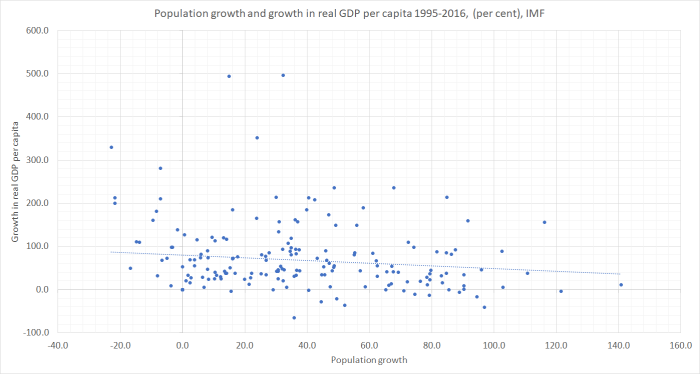
But what do the data show?   Here I’ve just used the IMF World Economic Outlook database data for 2016.

The first chart shows the relationship –  for the 193 countries/territories the IMF reports data for –  between real GDP per capita (in purchasing power parity terms) and population (each dot is one country).   The population term is expressed in logs.

popn and real GDP pc

As (I would have) expected, there is basically no relationship at all.   The simple linear regression line is actually slightly downward sloping, but that won’t pass any test of statistical significance.  Perhaps one could craft a story in which the top 10 countries (in terms of per capita income) all have quite small populations –  the biggest is around 5 million people – but since oil plays a big part in most of those individual cases even then one shouldn’t make too much of the point.

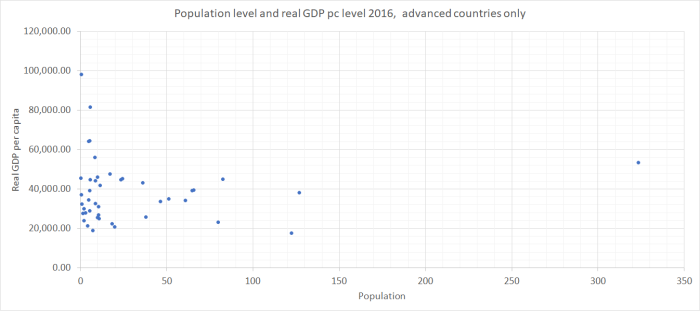
And here is the chart if we look only at the countries with populations from 0.5 million (a tenth of New Zealand’s) to 50 million (ten times New Zealand’s).  Since that is a much more compressed scale –  not everything from Tuvalu to the People’s Republic of China –  this time the population variable isn’t expressed in logs.

popn and real GDP pc 0.5 to 50m For those with sharp eyesight, New Zealand is a dot coloured orange.

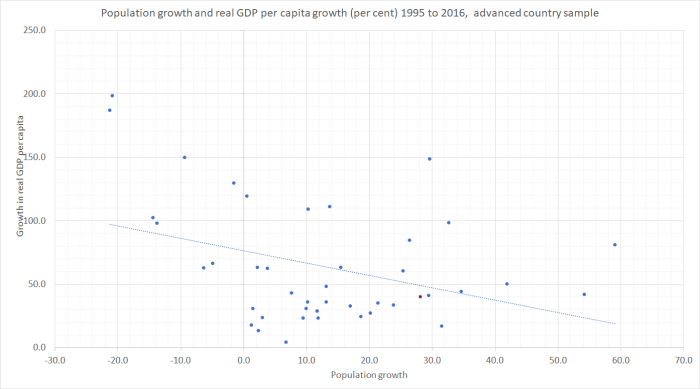
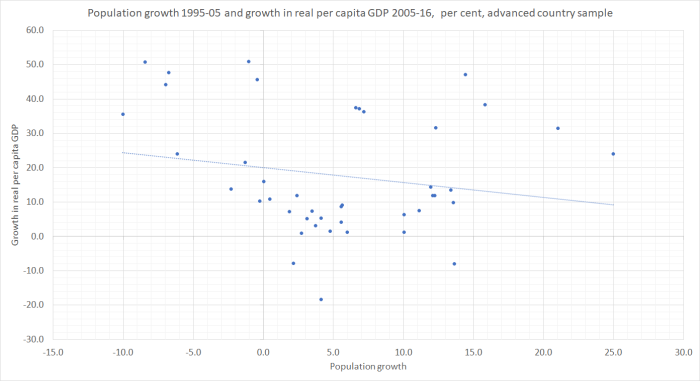
Again, there really isn’t any sort of relationship.  Again, the simple regression line is downward sloping, but there are lots of countries with very small populations and very low per capita incomes.   But even within this more-compressed range of populations, there is no sign at all of any sort of upward sloping relationship –  the idea that, on average, a higher population will be associated with higher per capita incomes.

Of course, within each of these dots there are complex historical relationships, as to how population in any particular country came to be what it was (some about conquest, making big countries out of small one; sometimes the historical carrying capacity of the land; in some the role of slavery (eg forced depopulation from Africa), in others the role of immigration policy.   Some locations offer better prospects than others and will, typically, have attracted or retained poeple accordingly.

But this post isn’t attempting to get into any of that. it is simply observing that at the most elementary level of numerical analysis there is no sign that countries with larger populations tend to be richer (whether as a matter of cause, or of effect).

A modern, high-value economy

That is what Regional Development minister Shane Jones says Taranaki is “transitioning to”.

And yet of the $20 million of government giveaways (your money and mine) designed

to help future-proof the Taranaki region by diversifying its economy, creating additional jobs and leveraging off the strong base the region has established through its oil, gas and agricultural sectors.

$5 million is going towards earthquake-strengthening a rather attractive provincial Anglican church, recently raised in status to a cathedral (more cathedrals as there are fewer Anglicans), and $13.3 million is going to build walking tracks on Mt Egmont.

It has more of a feel of a museum –  built, and natural –  than building or enhancing a “modern, high value economy” (such things rarely being built –  or enhanced –  by governments splashing cash around).

Perhaps there is a good case for more walking tracks in Taranaki.  I’m not, in principle, opposed.  It is crown land, and needs managing.  Nonetheless, it is hard to think of any country that has got to the global productivity or income frontiers with an emphasis on tourism.

As for the church building, I like it and I’ve worshipped there.   But what about it makes the earthquake strengthening of a private building a matter for national taxpayers to support?   Again, perhaps at least there is an element of consistency –  better perhaps than a government prohibiting demolition and yet not putting any money in.   But how it is consistent with lifting the longer-term economic performance of the economy –  regional or national –  is quite beyond me.

Then again, this seems to be a government that on the one hand isn’t keen on oil and gas, or dairy –  the two biggest outward-focused industries in Taranaki – and on the other isn’t interested in doing anything serious about getting the real exchange rate down.  So perhaps the hope isn’t really that today’s package will do anything much of substance –  certainly not to lift medium-term regional economic performance – but perhaps it might placate the natives for a month or two?


Inadequate Treasury advice

I wrote about the new –  and last ever –  Policy Targets Agreement when it was released by the incoming Governor and the Minister of Finance last week.  Mostly the changes were pretty small, and in some cases you had to wonder why they bothered (since the PTA system itself is to be scrapped when the planned amendments to the Reserve Bank Act are passsed later this year).

I lodged Official Information Act requests with the Reserve Bank and Treasury for background papers relevant to the new PTA.  I wasn’t very optimistic about what I might get from the Reserve Bank –  both because of a culture of secrecy, and because the incoming Governor probably wasn’t covered by the Official Information Act when he was negotiating this major instrument of public policy.   But The Treasury kindly pointed out that they had already pro-actively (if not very visibly) released several papers, including Treasury’s own advice to the Minister of Finance, and two Cabinet papers.

(I would link to those papers, but Treasury has been upgrading its website this week and the link they provided me with no longer works.  If I manage to trace one that does work I will update this.)  [UPDATE 9/4.   Here is the new link to those papers,]

Those papers help answer the question about why they bothered with the small changes.  The Treasury advice to the Minister of Finance was dated 7 February, well before Treasury had formulated its advice on Stage 1 of the Reserve Bank Act review, and before the Independent Expert Advisory Panel had reported. In other words, well before it was decided that PTAs would soon be done away with altogether.  Indeed, there are suggestions in the paper that most of the relevant work had been done 18 months ago –  they say they consulted “a number of economists and market participants over 2016” –  when they thought the Minister would be replacing Graeme Wheeler early last year (rather than falling back on the unlawful “acting Governor” route to deal with the election period).  Interestingly,  the advice suggests Treasury favoured, on balance, increasing the focus on the 2 per cent target midpoint and de-emphasising the 1 to 3 per cent target range, but the Minister appears to have rejected that option.

There are two Cabinet papers among the material that was released.  One was from 19 February, before the Minister had engaged with the Governor-designate on the possible wording of the PTA.  In that short document the Minister outlines for his colleagues the draft PTA he would be suggesting to Adrian Orr.  The other was from 19 March, advising his colleagues of the text he had agreed with Orr.

The differences in the two texts are small, but in my view the changes represent improvements relative to the Minister’s draft (for example, keeping the political waffle about climate change, inclusive economies etc, clear of the material dealing with the Reserve Bank’s own responsibilities).  Presumably Orr would have consulted senior Reserve Bank staff, but on the basis of what has been released so far, we don’t know.

The documents suggest that The Treasury has played the lead (official) role in reshaping the Policy Targets Agreement (the Treasury advice to the Minister refers to them having consulted the Bank, but there is no suggestion that the Bank staff had necessarily agreed with the recommendations, or any suggestion of a separate Reserve Bank paper).  In a way, the lead role for The Treasury makes sense –  macroeconomic policy parameters should be set primarily by the Minister, not the Governor-designate.  On the other hand, The Treasury will typically not have the degree of expertise, or depth, in issues around monetary policy that the Reserve Bank should have.   I welcome the Minister’s announcement that in future, when the Minister directly sets the operational goal for monetary policy, he will be required to do so after having regard to the advice (publicly disclosed) of both the Reserve Bank and The Treasury.

My main prompt for this post, however, was one element of The Treasury advice which seriously concerned me, and represented a grossly inadequate treatment of an important issue.

In Treasury’s advice to the Minister, they have an appendix dealing with a couple of aspects of the Policy Targets Agreement where they didn’t propose change.  The one I’m interested in was the question of the level of the inflation target itself.

Treasury note that “there have been a number of arguments advanced by commentators over recent years in favour of either a higher or lower inflation target”.

Treasury notes, correctly, that

The main argument in favour of increasing inflation targets is in order to ensure that central banks will have enough scope to lower interest rates in the face of a large contractionary economic shock that may result in monetary policy reaching the effective lower bound of [nominal] interest rates

Amazingly, this issue is dismissed in a mere two sentences.  As they note

a higher inflation target would lead to higher costs of inflation at all times, whereas the risks of a lower bound event occur infrequently

But instead of moving on to offer some numerical analysis, or even plausible scenarios, the government’s principal economic advisers simply observe that

Given this, the costs of a higher inflation target may outweigh the benefits

Or may not. But Treasury doesn’t seem to know, and doesn’t offer the Minister (or us) any substantive analysis.

Here is one scenario.  Recessions seem to come round about once a decade, and in typical recessions (admittedly a small sample) the Reserve Bank has needed to cut interest rates by around 500 basis points.  If it can only cut interest rates by, say, 250 basis points, and that difference meant even just 2 per cent additional lost output (eg the unemployment rate one percentage point higher than otherwise for two years, the annual costs of a higher –  but still low –  inflation rate would have to be quite large, for the costs of a higher target to outweigh the benefits.  Perhaps my scenario is wrong, but Treasury doesn’t offer one at all.

Treasury devotes more space to the possibility of lowering the inflation target.  They aren’t keen on that –  some of their arguments are fine, others flawed at best –  but even then they seem determined to play down the near-zero effective lower bound on nominal interest rates, noting that (emphasis added)

a lower inflation target marginally increases the risk that the ELB [effective lower bound] may be reached, thereby providing monetary policy marginally less space to respond to shocks

Those who have sometimes called for cutting the target probably have in mind cutting the target midpoint from 2 per cent to 1 per cent (where it was in the early days of inflation targeting).    When interest rates are 8 per cent, that might make only a marginal difference to the chances of the lower bound being reached –  indeed, that was standard Reserve Bank advice in years gone by, when the lower bound was treated as a curiosity of little or no relevance to New Zealand.   But when the OCR is at 1.75 per cent (and the central bank thinks the output gap and unemployment gaps are near zero) a 1 percentage point cut in the inflation target would hugely reduce the effective monetary policy space for dealing with serious adverse shocks.  The floor would be hit with relatively minor adverse shocks.

And they conclude this way

New Zealand’s inflation target has been changed a number of times in the past and frequent changes to the level of the target could undermine the credibility of the regime.

There were two changes in the level of the target inside six years, which was unfortunate.  But the most recent of those changes was 16 years ago.  At that time, the idea of running out of monetary policy room in New Zealand was little more than a theoretical possibility.  Now it seems quite likely whenever the next recession happens here, and has already happened to numerous other advanced countries.

As I hope readers recognise by now, I regard an increase in the inflation target as an undesirable outcome, a second-best option.  I would rather the authorities (Reserve Bank, Treasury, and the Minister of Finance) treated as a matter of urgency removing directly –  and with preannounced certainty and credibility –  the extent to which the near-zero lower bound on nominal interest rates bites, by reducing or removing the incentives in the face of negative interest rates for people (large holders of financial assets, rather than transactions balances) to shift to holding physical cash.   Even just ensuring that the Reserve Bank gets inflation up to around 2 per cent –  rather than the 1.4 per cent (core) inflation has averaged for the last five years –  would help.

But there is nothing about any of this in The Treasury’s advice on the main instrument of New Zealand macroeconomic policy.  It seems extraordinarily inadequate.  Perhaps they have provided some other, more in-depth, advice on these sorts of issues –  in which case it might be good to proactively release that –  but there is no hint of, or allusion to, any deeper thinking in the PTA advice.   “Wellbeing” is all the (content-lite) rage at The Treasury these days.  I’m not a fan, but perhaps they should reflect that one of the biggest things policymakers can do to avoid adverse hits to “wellbeing” is to avoid unnecessarily severe or protracted recessions (and spells of unemployment).     Indifference on this score is all the more inexcusable when the limitations arise wholly and solely from policymaker/legislator choices –  whether around the level of the inflation target or the system of physical currency issues (and the prohibitions on innovation in that sector).  Ordinary New Zealanders –  not Treasury officials –  risk having to live with the consequences of their malign apparent indifference.

As it happens, a reader last night sent me a link to a couple of new pieces on exactly these sorts of issues.  The first was the (brilliantly-titled) “Crisis, Rinse, Repeat” column by Berkeley economist and economic historian Brad Delong.  He concludes

It has now been 11 years since the start of the last crisis, and it is only a matter of time before we experience another one – as has been the rule for modern capitalist economies since at least 1825. When that happens, will we have the monetary- and fiscal-policy space to address it in such a way as to prevent long-term output shortfalls? The current political environment does not inspire much hope.

And his column took me on to recent work by his colleagues David and Christina Romer, and in particular to a recently-published lecture on macroeconomic policy and the aftermath of financial crises.

The authors focus on financial crises (and I have a few questions about which events are included and which are not), rather than recessions more generally, but it isn’t obvious to me why their results wouldn’t generalise.   Here is their abstract.

Analysis based on a new measure of financial distress for 24 advanced economies in the postwar period shows substantial variation in the aftermath of financial crises. This paper examines the role that macroeconomic policy plays in explaining this variation. We find that the degree of monetary and fiscal policy space prior to financial distress—that is, whether the policy interest rate is above the zero lower bound and whether the debt-to-GDP ratio is relatively low—greatly affects the aftermath of crises. The decline in output following a crisis is less than 1% when a country possesses both types of policy space, but almost 10% when it has neither. The difference is highly statistically significant and robust to the measures of policy space and the sample. We also consider the mechanisms by which policy space matters. We find that monetary and fiscal policy are used more aggressively when policy space is ample. Financial distress itself is also less persistent when there is policy space. The findings may have implications for policy during both normal times and periods of acute financial distress.

These are really huge differences.  And they reflect a combination (a) a substantive lack of capacity, and (b) a reluctance to use aggressively what capacity still exists when the bottom of the barrel is getting close.

Here is the chart they use for monetary policy space (and lack thereof).

romer chart

(the dotted lines are confidence bands)

The Romers offer some thoughts on the policy implications, including

Very low inflation means that nominal interest rates tend to be low, so monetary policy space is inherently limited. A somewhat higher target rate of inflation might actually be the more prudent course of action if policymakers want to be able to reduce interest rates when needed.

Our finding that policy space matters substantially through the degree to which policy is used during crises also implies difficult decisions. For example, it is not enough to have ample fiscal space at the start of a crisis. For the space to be useful in combating the crisis, policymakers have to actually enact aggressive fiscal expansion. However, countercyclical fiscal policy has become so politically controversial that policymakers might refuse to use it the next time a country faces a crisis.

What of New Zealand (included in their empirical sample)?      We have plenty of “fiscal space” –  both gross and net debt are pretty low (around the lower quartile of OECD countries).  In a technical sense that might substitute to some extent for a lack of monetary policy capacity (if a recession hit today, we start with an OCR at 1.75 per cent, while most countries were at 5 per cent or more going into the last recession).    But fiscal deficits blow out quite quickly in recessions anyway –  as the automatic stabilisers do their work –  and can anyone honestly assure New Zealanders that governments would be willing to engage in much larger than usual, more sustained than usual, active fiscal stimulus if a new and serious recession hits at some stage?  Of course they can’t.  Politicians can’t precommit (and even Treasury can’t precommit what its advice would be) and the political constraints on a willingness to actively choose to take on large deficits far into the future –  perhaps on projects of questionable merit –  would almost certainly be quite real (as they were in so many countries after 2008).  So we are better placed than some because of the fiscal capacity –  itself less than it was here in 2008 –  but we really should be taking steps to re-establish effective monetary policy capacity.  That might involve (my preference) dealing directly with the lower bound, it might involve changing the inflation target, it might involve putting more pressure on the Bank to get inflation up to 2 per cent, or it might even involve asking questions about whether inflation targeting (as distinct from levels targeting) offers more crisis resilience (senior US monetary policymakers have openly been discussing some of those latter issues).

There is no sign, for now, that The Treasury is taking the issue at all seriously, and there has been no sign –  in speeches, or Statements of Intent –  that the Reserve Bank has been doing so.  That needs to change.   Perhaps it is a good opportunity for the new Governor.  But the Minister –  rightly focused on employment issues –  should really be taking the lead, and insisting on getting better quality analysis and advice, engaging with the real risks and offering practical solutions, than what was on offer when the PTA was being reviewed.

Immigration policy: bus driver edition

Most of my discussion of New Zealand’s immigration policy centres on the residence approvals programme.  There is a good reason for that: it is where the numbers (of people) are.    In per capita terms, we grant about three times as many residence approvals as the Clinton/Bush/Obama United States did.

In the past 20 years, 864915 people have been approved for residence here.   MBIE data suggest that 80 to 90 per cent of those people are still here five years after approval (that proportion has been gradually trending upwards).   Assume that on average over the 20 years, 85 per cent have stayed on, and the residence approvals programme has boosted our population, all else equal, by about 735000 people.   That means a lot more houses are required –  and roads, schools, hospitals, shops etc –  and a lot more income-earning opportunities abroad need to be found (by the market –  it isn’t a central planning thing) to meet the appetite for stuff the rest of the world produces that each of us in a modern market economy has.

By comparison, as at 30 June last year, it is estimated that there were about 76000 people here on student visas, and 152000 holders of temporary work visas (some students have work rights, but they are still counted here as being student visa holders).

So if one has concerns about New Zealand’s immigration policy they should mostly centre on the residence approvals programme.   Mostly, but not exclusively.

In fact, over the last few years, changes in the stock of people here on short-term visas make up quite a large proportion of the overall net inflow of non-citizens.  Over the five years to June 2017, 225000 people were granted residence approvals.  Assume that the retention rate is around 90 per cent now, and in effect around 200000 of those people will still be here.

Over the same period:

  • the stock of people here on temporary work visas has increased by 62000 and
  • the number of people here on student visas has increased by 20000 (and student work rights were liberalised in that period).

In other words more than a quarter of the contribution of non-citizen immigration –  to things good, bad, or indifferent –  has come from the much-increased stock of people on temporary visas.  The individuals may change –  most temporary people go home again –  but the stock has increased sharply.   Changes in stocks (rather than specific individuals) matter for resource pressures, labour supply etc.

Student visas, in and of themselves, don’t bother me.  Education is an export industry, which just happens to be delivered to people here.  My unease is about the work rights, and preferential access to residency points –  which mean that immigration policy is, in effect, corporate welfare (implicit export subsidies) for universities, PTEs, etc competing in that market.

What prompted this post was the story this week about a bus company – Ritchies –  wanting immigration approval to recruit foreign bus drivers.  Bus drivers don’t make the list MBIE released of occupations for which there were more than 100 (so-called) Essential Skills visas issued last year, but these occupations were some that did.

Essential skills visa approvals 2016/17
Truck Driver (General) 400
Winery Cellar Hand 396
Waiter 345
Sales Assistant (General) 320
Personal Care Assistant 289
Massage Therapist 259
Baker 231
Painting Trades Worker 220
Builder’s Labourer 185
Kitchenhand 181
Fast Food Cook 118
Farm, Forestry and Garden Workers nec 116
Bar Attendant 102

On the face of it, such roles don’t seem notably more (or less) taxing than being a bus driver.  It is a responsible role, but not one requiring huge amounts of skills or training (according to the story I linked to above 6 to 8 weeks training suffices).    It isn’t the sort of role one naturally thinks of when officials and ministers talk about skills-focused immigration programmes.

The case Ritchies make is that they can’t find locals –  New Zealanders, or people already here –  to fill new roles.

Auckland Transport awarded Ritchies Coachlines the contract to run buses on the North Shore from September.

But the company said so far it had not been able to find enough drivers locally and had asked Immigration New Zealand if it could bring in 110 of them from overseas to plug the gap.

And I’m sure that is correct.  If you pay low enough wages, it is hardly surprising that people with other New Zealand options, aren’t lining up to work for you.

At least on the union’s telling

“The problem with Ritchies is that they pay over a dollar an hour less than the industry so their retention rates are minimal. People get trained up then they’ll go to other bus companies where the rates are better. Again Ritchies brings it upon themselves.

On the face of it, it looks like another case of a service contract won largely on the basis of (assumed) low labour costs.

The company more or less acknowledges the point

Mr Todd said the company would continue trying to recruit locally but only had until late June before it would need to look overseas for drivers including in Fiji, Samoa and the Philippines.

He admitted the $20.20 an hour it paid drivers would be difficult to get by on in Auckland but said this was the budget it had to work with.

“Lets face it, any job in the world, if you pay enough, you’ll get people to do it but…those costs will have to be passed on.”

Which is why I don’t really see the specific company as the bogey-man here.  They are operating in an environment –  bidding for public contracts –  where the overall level of funding seems to implicitly rely on access to very cheap labour (in this case, according to the company, from Fiji, Samoa, and the Philippines –  the jobs presumably not being attractive to bus drivers from the advanced world, since New Zealand is now a low income advanced country).

The same goes, more or less, for some other public-funded industries. Rest-homes, for example, rely heavily on immigrant labour from poorer countries: the existing level of rest-home subsidies constrain their options pretty severely.

No individual firm has a great deal of market power.  But the overall market is nonetheless skewed by policy choices successive governments have made about access to immigrant labour to fill what are mostly quite modestly-skilled roles.  Thus, rapid population growth, in a country with a modest savings rate, has pushed up the real exchange rate, meaning that at the margin individual farmers or individual tourism-service operators often genuinely can’t afford to pay higher wages  (and our overall tradables sector has shrunk too).    It is why we need not small tweaks at the margins –  should or shouldn’t bus drivers (waiters, kitchenhands, or whatever) be on the approved list – but an overhaul of the entire immigration system.

But as part of that we should:

  • establish a strong presumption against use of unskilled immigrant labour (which mostly –  although not entirely –  competes with and tends to drive down returns to domestic unskilled labour), and
  • get ministers and officials out of the game of determining which specific roles people can and can’t hire short-term immigrant workers for.

To that end, I’ve argued previously for a system in which Essential Skills visas are granted on these terms:

a. Capped in length of time (a single maximum term of three years, with at least a year overseas before any return on a subsequent work visa, with this provision to apply regardless of skill level).

b. Subject to a fee, of perhaps $20000 per annum.

If an employer really can’t find a local hire for a modestly-skilled (or unskilled) position, they’d be able to get someone from overseas, but only by paying (to the Crown) a minimum annual fee of $20000.  It is pretty powerful incentive then to train someone local, or increase the salary on offer to attract someone local who can already do the job. If you can’t get a local to do a job for $40000 per annum, there might well be plenty of people to do it for $50000 (and still cheaper than paying the ongoing annual fee for a work visa employee).

It isn’t, by any means, the full answer.   A much lower real exchange rate has to be an integral part of fixing the overall system, and that is only likely –  on a sustained basis –  if serious inroads are made on the residence programme.  But it would be a start.  It would increase the pressure to fix the residence programme, and it would also re-establish the presumption that one of the purposes of economic life and economic policy is to (sustainably) lift the wages of all New Zealand workers, and perhaps especially those at the bottom of the heap.    Economists might respond that there are gains from trade to be had by bringing in more unskilled people, and that (in principle) the domestic “losers” from such a policy can be compensated.  Of course, they never actually are compensated.  And it just isn’t the way most New Zealanders want their country to be.

By all means, lets welcome a small number of really able people migrants, and meet our international humanitarian obligations around refugees.  But lets drop the misguided belief, that has shaped policy now for too long, that bringing in lots of not-very-skilled people is somehow making us all better off.  It hasn’t, it isn’t, and it seems very unlikely to do so in the foreseeable future.


Reviewing the Board’s charter

In the recent report of the Independent Expert Advisory Panel, and subsequent Treasury advice, on the Reserve Bank Act, one of the things that surprised me was the way both groups (independent advisers and Treasury) simply seemed to take for granted the current role of the Board of the Reserve Bank and seemed to assume that the Board had done its role well and effectively.     The issue is simply not raised in the respective reports, even though the role of the Board is quite unusual – whether in a domestic public sector role, or in comparison with overseas central banks and financial regulatory agencies.  And so even though the government is proposing changes to the decisionmaking structure for monetary policy (and probably, later, for the financial regulatory functions) there is simply no serious analysis at all questioning whether, in light of experience, the role of the Board remains appropriate.   And that is even though few people I’ve ever discussed the matter with –  some ex-Board members apart perhaps –  thought that the Board was doing effectively a useful job on behalf of the Minister and the public.  At the Treasury-convened consultation meeting I attended, no one had a good word to say for the Board.

I’ve outlined the nature of my concerns previously (most recently here).   The Board has very little power –  other than in the appointment of the Governor –  and no resources of its own (that latter issue is touched on in the reports), and –  whatever the merits of the unusual model on paper –  it has ended up, over decades, serving mostly as providing cover for successive Governors. Even though their role is largely to review the Governor’s performance, in 15 years of publishing Annual Reports they have never once uttered even a modestly critical comment of the Bank or the Governor.  Since no one is perfect, that track record just reinforces the conclusion that the Board adds little or no value –  for the public, although no doubt it has proved useful to troubled Governors.   They provided no protection for Stephen Toplis or the BNZ when Graeme Wheeler deployed his entire senior management team to attempt to silence an independent critic.  And they egged on Graeme Wheeler when he used his official position, and public resources,  to attack me for drawing to his attention, and publicising, what proved to be a leak of the OCR.

With different people, perhaps it could do a better job, but the institutional incentives militate against that ever happening –  the Board is simply too close to management (the Governor himself is a member), and even the name (with suggestions of a corporate board) works against a proper conception of an arms-length body providing serious review, challenge, and scrutiny of a very powerful public agency.  Awkward individual members –  and there has often been at least one, sometimes with hobbyhorse issues –  aren’t much more than a nuisance with no outlet.  In my view, far more fundamental change is needed: either turn the Board into a proper decisionmaking body (as with a typical Crown entity),  abolish it, or if arms-length review and scrutiny is the goal, the relevant entity needs to be established outside the Reserve Bank, with independent resources and an independent mindset, and no sense that their role is to champion the Bank.

But in the Independent Expert Advisory Panel’s report there was a sentence  –  the very last one in the body of the report –  that caught my eye.

114. The Board has a code of conduct. The Panel recommends that this be reviewed in light of the legislative changes.

So I asked the Board for a copy of its code of conduct.   Apparently, there isn’t actually a document of that name, but the assumption is that the Panel was referring to a document rather grandly described as the “Charter for the Board”, which they released to me in full.

When I see the word “charter” I have in mind something that those who founded an entity might have issued, establishing and empowering the entity (dictionaries seem to back that interpretation).  Google tells me that, for example, there is a Radio New Zealand Charter, actually included in statute.  It is described thus

The Charter is an important document which sets out our operating principles.

It defines what we do so that everyone – staff, listeners and other stake-holders – can easily understand our objectives and what we are expected to provide for the New Zealand taxpayer.

and is readily available, for all to see, on the website.

The Reserve Bank Act sets out what the Reserve Bank Board is supposed to do.  The Minister of Finance’s letter of expectation to the Board can fill that out a bit.

The Reserve Bank Board’s “charter” doesn’t seem to have any status, except a set of agreed arrangements among the people who happen from time to time to find themselves serving together as the Board.  No wonder the independent panel loosely termed in a “code of conduct”.

Most of the document probably isn’t of much interest, but a few bits (and a few omissions) caught my eye.  First, there was the secrecy.  From the very first line

This Charter is confidential to RBNZ staff and directors. It must not be released to external parties without approval from the Chair of the Board or Governor.

Given that the Board exists solely to serve the interests of the Minister and the public, surely it would be normal, and natural, for a document of this sort to be routinely available on the website?   The Wellington City Council, for example – a notoriously OIA-averse body – manages to have its code of conduct for councillors readily accessible.   What, one wonders, is the Board trying to protect?  Probably nothing –  it is just the mindset.

There are questionable assertions (emphasis added)

The Board may advise the Governor on any matter relating to the performance of the Bank’s functions and the exercise of its powers. The Governor is not required to act on the Board’s advice, but is required to have regard to it.

Nowhere in the Act, that I can see, is there a requirement for the Governor to “have regard” for the Board’s advice –  a term that itself has legal meaning.  A Governor might be foolish to simply ignore advice from the Board, but the Board is set up primarily to review the Governor’s performance,  not to provide advice on policy or management issues.

The “Charter” goes on

Where advice relates to matters of significance, the Board may give that advice to the Governor in writing, having first discussed the matter with the Governor in a Board meeting.

The Board will maintain a record of any formal Board advice given to the Governor.

That is interesting. I have asked for copies of any such written advice.  I suspect there will have been none, but time will tell.

I’ve noted previously that the Board has no independent resources.  It doesn’t even appear to have a general right to whatever Bank information it considers it requires

The Governor will ensure that the Board has access to information, Bank staff and other resources that the Governor, in consultation with the Chair, considers the Board may require to perform its functions effectively.

In other words, the Governor determines what resources the Board has access to, even though the Board’s prime role is to scrutinise and hold to account the Governor.  Sure he is supposed to consult with the Chair –  and in practice can’t totally play hard-ball (since the Board could then conclude he wasn’t adequately doing his job), but the initiative and blocking veto rests with the Governor, not with the Board.

And they have a whole section on public communications, in which this is the most important clause.

The Governor has sole responsibility for the external communications of the Bank. The Chair and/or Deputy Chair, where required by statute or regulation such as by the Finance and Expenditure Committee of Parliament, may speak in those capacities. In no other circumstances shall a Non-Executive Director speak for the Bank or comment publicly on the conduct of the Bank’s functions.

In other words, no Board member –  chair, deputy chair or not –  will ever speak in public except when required by law to do so.  In this clause, the Board appears to be agreeing among themselves that, as a matter of principle, they will never speak –  even via the chair –  to any media in response to inquiries (whether about their processes, Annual Reports, OIA releases, or anything else or about their activities).   How can this possibly be consistent with open government?

The clause must be music to the ears of management.   Back when the current governance model was first set up, one of the big internal concerns was that the Board would become an independent source of commentary on monetary policy (it was why, at the time, the Governor still chaired the Board –  even though it existed to hold him to account).   And it seems quite right that Board members should operate under a policy of not offering running commentary on individual OCR – or LVR –  decisions, or the state of the economy.      But for the Board members to broaden that out and simply refuse to respond to, say, media inquiries on their own conduct, including their reviews of the Bank’s actions and performance, should be quite incredible.  It should be unacceptable.   These people are ministerial appointees, paid to serve the Minister and the public, and should be subject to scrutiny, and willing to make themselves (perhaps primarily through the chair) openly accountable –  not just when compelled to by law.

They might, for example, reasonably be challenged by a journalist over their apparent failure to comply with the basic provisions of the Public Records Act.     There are, it appears, no records of the process the Board undertook, over 15 months, leading to the appointment of the new Governor.    It is a pretty basic statutory requirement, which the Board is not exempt from.   (Curiously, in the Board’s charter there is no general commitment, or requirement, to keep proper records, or the comply with statutory provisions such as the Official Information Act or the Public Records Act.

But the omission that really did surprise me, at least a little, was that there was nothing in this “Charter” or code of conduct, about the handling of conflicts of interests.  Even the Act recognises that such conflicts are possible.

In considering the appointment or reappointment of a person to the office of non-executive director of the Bank, the Minister shall have regard, in relation to that office, to

  • that person’s knowledge, skill, and experience;
  • and the likelihood of any conflict between the interests of the Bank and any interests which that person has or represents.

The Act prohibits anyone who is “an employee of a registered bank or a licensed insurer’ from serving as a director, but there are few other restrictions.   For example, people who are Board members of regulated institutions are not prohibited from serving on the Reserve Bank Board, nor are people who serve as professional advisers (eg lawyers) to regulated institutions.  Someone who works for a payment system provider, or a clearing house –  or who is on their Board, or a consultant to such entities –  could have a clear conflict in respect of the Reserve Bank’s physical currency or NZClear operations.

These aren’t just hypotheticals.  One of the current Board members is also a member of the board of directors of a major insurer –  and the Reserve Bank, in addition to its ongoing supervisory and regulatory responsibilities in that sector, is now dealing with the recent failure of an insurance company, and the role of the Reserve Bank.

I suspect the Board does have some internal practices regarding the handling of all sort of potential conflicts of interests –  and they themselves can’t control who the Minister of Finance chooses to appoint.     But they look like the sort of thing that should be properly documented –  and disclosed – in any sort of code of conduct, or “Charter” for a major public agency.  The concerns are attentuated to some extent by the fact that the Board has few decisionmaking powers, but they have the right to offer advice on any of the Bank’s responsibilities and assert – see above – that the Governor is required to have regard to their advice.  And the members all have privileged access to information on both monetary policy and (probably particularly) regulatory policy.    I’m not sure what the appropriate boundaries are –  given the role of the Board as it stands –  but I hope the Board does, and can articulate their policies and practices.

The Board has not done, and is not doing, a good job.  It is set up by Parliament to serve our interests –  public, Parliament, and Minister –  but constantly seems to see itself mostly as a servant, and defender, of Bank management.  Those are two quite different roles.  The so-called Charter adds a little more to the list of concerns, and the reasons why the government, as part of the current review, should more seriously consider far-reaching structural change, reconfiguring the role of the Board and the way that public-funded review and assessment functions are undertaken.  The current model isn’t working, at least for anyone other than Bank management.

A “very, very healthy economy”?

In his press conference with the Minister of Finance, the day before taking office last week, the new Governor of the Reserve Bank offered some brief and gratuitous thoughts on the state of the New Zealand economy.

Orr said he was happy with where the economy was at the moment.

“I’d say that we are running a very, very healthy economy at the moment,” he said.

In one sense, it doesn’t greatly matter what the Governor of the Reserve Bank thinks.  His primary (monetary policy) job is to keep core inflation near 2 per cent (something Graeme Wheeler failed to do).  There isn’t much connection between whether or not an economy is doing well in some medium-term fundamental sense and the average inflation rate.

Then again, Orr is now the most prominent (and powerful) public sector economist, and was sharing a stage with the Minister of Finance.  Intended or not, his comments could reasonably be seen as an endorsement of economic management and performance by past and present governments. An endorsement of the status quo in fact.

Perhaps that wasn’t the Governor’s intention. Perhaps it was just the first thing that came to mind on his big day and he didn’t stop to think what he was saying? But perhaps he genuinely believes it, which in some ways would be even more concerning.   Especially as it is presented as an unconditional, absolute, statement, with two intensifiers.  If we take the Governor seriously, things must really be doing well here.

I’m not sure what the Governor had in mind.  But when I rack my brain and look for whatever positives I could find, this is what I came up with:

  • the terms of trade are near record levels,
  • government debt is pretty low, and the government operating accounts are in surplus,
  • the financial system appears to be sound,
  • after nine years above, the unemployment rate is now finally down to around the level the Reserve Bank thinks of as the NAIRU (the non-accelerating inflation rate of unemployment).

Try as I might, I couldn’t find anything more that suggested a “very very healthy” economy.  There were a few other indicators that perhaps a lay observer might try to cite, but economists probably shouldn’t:

  • employment rates are quite high.  We don’t put too many regulatory/tax obstacles in the path of employment (a good thing), but employment is a still cost –  foregone leisure –  not a particular achievement.  Unemployment and underemployment rates are typically the better indicators (when lots of people want work and can’t find it that is a problem),
  • interest rates are low.  As they are around the world, reflecting how difficult the advanced world has found it to achieve sustained growth since the last recession.  Ours remain well above those in most other advanced countries,
  • our balance of payments current account deficit is less than it was (and the external debt –  % of GDP –  is less than it was).  This is partly a reflection of unexpectedly low interest rates –  servicing costs are less than they were, and partly of pretty subdued investment,
  • headline annual GDP growth rates have not been high –  by standards of earlier growth phases –  but have sounded respectable enough (typically with a 3 in front of them).   But much of that simply reflects unusually rapid population growth rates.

And on the other hand, and in no particular order

  • how could we go past house prices?  How can the Governor –  of all people –  consider our economy to be “very very healthy” when house and urban land prices are so far out of whack that few young can any longer afford to buy a basic first home?
  • even if, on some metrics, we’ve done less badly than some countries in the last decade, almost the whole advanced world has done absolutely poorly.  Investment and productivity growth have typically been weak, and interest rates have needed to be astonishingly low for prolonged periods (not yet over) simply to support demand and activity.
  • real per capita GDP growth, even at peak, has been weaker than in previous recoveries,
  • if most of the advanced world has done quite poorly, New Zealand started so far behind that we needn’t have been badly affected.  Simply catching up some way towards the frontier would have been a considerable achievement.  But we haven’t. There has now been almost no labour productivity growth here for the last five or six years, and that shows no sign of changing yet.
  • inflation has been (is still) persistently below target (and thus below the level successive governments and Governors have considered desirable for the best possible economic outcomes),
  • although interest rates are low in absolute terms, they remain above those in most other advanced countries, for reasons that have nothing to do (see above) with superior productivity performance.
  • rates of business investment remain very subdued (despite, for example, the strong terms of trade, or rapid rates of population growth).
  • the growth in the economy has continued to be concentrated in the non-tradables sectors, rather than the bits in which New Zealand firms successfully compete against international competition here or abroad.   I haven’t shown this (indicative) chart for a while
  • T and NT to Dec 17
  • relatedly, the export share of GDP has been shrinking, when a typical aspect of any successful economic catch-up has involved a rising share of exports, as the success of domestic policy and domestic firms translates into more firms and more products beating the world (in turn, enabling more of what the world produces to be imported).
  • the real exchange rate remains very high, well out of line with developments in relative productivity and terms of trade trends.
  • meanwhile, among the other relatively poor OECD members many that did far more wrenching economic reforms than we did 25 or 30 years ago (and they needed to do more) really are making progress to catch the OECD leaders. In some cases, their average productivity levels are already at New Zealand levels, and almost all are growing faster than New Zealand.

And all that without even getting to the risks and costs that seem set to flow from grappling with things like improving water quality, and with successive government’s commitments to reducing carbon emissions, in a country with some of the highest marginal abatement costs anywhere.

Quite how the Governor can seriously think –  if he really does –  that this is a “very very healthy” economy is a bit beyond me.  It has the feel of ill-considered quasi-political rhetoric.  In a post a few weeks ago (with charts illustrating some of the points above) I called it a rather moribund economy, and that still seems right to me.

My young daughter asked me “what boring stuff are you writing about this morning”.  I told her it was about the health, or otherwise, of New Zealand’s economy.  “Does the economy have cancer?” she asked.  It isn’t like that I said, more like some chronic condition that won’t kill us, probably won’t even end in a crisis, but constantly holds us back from achieving what we might, from delivering better material living standards for New Zealanders.   The Governor of the Reserve Bank has a defined and limited job to do, which he can do whether or not the chronic ailment is fixed.  But he shouldn’t use his office and bully pulpit it provides to help politicians evade responsibility for the decades of disappointment.  The status quo has failed, is failing, and seems set to go on failing.

A double standard…or not

There has been plenty of criticism of the Labour-New Zealand First government for their failure to act meaningfully in support of the United Kingdom and other traditional western friends and allies, responding to the poisoning in Salisbury of the Skripals.  I’d agree with the critics.  Even Ireland –  not in NATO, Five Eyes or other military/intelligence alliances –  expelled a Russian diplomat in response.  But not New Zealand.   Add in that refusal to act to the Minister of Foreign Affairs’ attempts to minimise Russian responsibility for the downing of MH17 or to suggest Russian hadn’t been attempting to meddle in the US 2016 election, and it must be increasingly difficult for our friends and allies to take us seriously as either.

I don’t suppose Russia is much direct threat to New Zealand –  though cyber threats aren’t restricted by physical proximity.  But that shouldn’t really be the point.     Countries simply shouldn’t be able to get away with killing (or in this case, so far, attempting to kill) people going about their lawful business in other countries without some response.     And the provision of support in times of need is what friends and allies do –  in fact, it is one of test of friendship.  Kicking out diplomats (for a few months) is a feeble enough response, longer on symbolism than substance.  But the New Zealand government wasn’t even willing to get onside with the symbolic response.    Instead, we find our ourselves in the company of Greece – a country with very close historical and contemporary political, cultural and religious ties to Russia.

With enough determination even a country –  Russia – whose real GDP (in purchasing power parity terms) is only a third of that of just the biggest four west European economies combined, and about 20 per cent of that of just the United States, can wreak a lot of havoc if it chooses, especially to its smaller and weaker neighbours.  But it is still a country in relative decline.

So there is Russia and then there is the People’s Republic of China.  I’ve recently been reading the book Henry Kissinger wrote a few years about China, including US relations with the People’s Republic in recent decades.  It was a useful reminder that when the PRC and the United States opened up to each other almost 50 years ago now it was, from both sides’ perspectives, substantially about dealing with the greatest geopolitical threat of that era –  the Soviet Union, which had armies (and nukes) perceived to threaten western Europe, and armies massed on the northern borders of China.

Here was the relative economic capacities (real GDP in purchasing power parity terms) of the three countries in 1970.

econ resources 1970

Of course, the PRC had enormously more people than either of the other countries (and, as Kissinger reports, Mao had often talked of China’s ability to absorb losses of a few hundred million people in a nuclear attack).   Add in, on one side, the rest of NATO and, on the other side, the rest of the Warsaw Pact, and the western economic capacity was far far greater than that of the Soviet Union.    But states like the USSR could still pose a threat, by devoting a far larger proportion of their resources to military purposes.  Pre-war Germany was, after all, materially poorer than Britain and France (and respective empires) combined, and even a bit poorer than just the Soviet Union.  Real GDP in Japan in 1940 was about a quarter of that of the United States.  Japan and Germany lost –  they were both poorer, and had fewer people than the countries they took on – but it tooks years and enormous sacrifices to beat them.

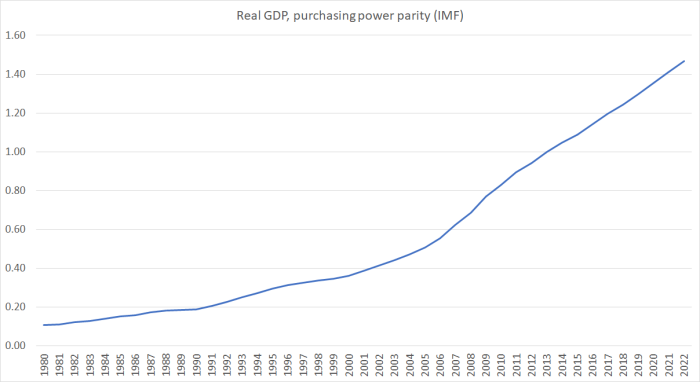
What of the situation now?   This chart shows the ratio of PRC to US total real GDP, again in purchasing power parity terms, from 1980 (when the IMF database starts) through to forecasts for 2022.

econ resources us vs china

In PPP terms, the size of the PRC economy exceeded that of the US a few years ago.  Even if you think China might have some rocky times ahead –  the overhang of all the internal debt – it seems highly unlikely that the PRC economy will ever again be as small as that of the US.  On IMF numbers, in 2022 total GDP in China will be roughly equal to that of the US, Japan and Germany combined.   Of course, material living standards in the PRC are much lower than those in the United States, but on the IMF projections by 2022 real GDP per capita in China is forecast to be about a third of that in the United States.  Soviet Union real GDP per capita in 1970 was about a third of that in the United States then.

There is plenty of talk from the PRC of its “peaceful rise” or “peaceful development”.  But even if we set Tibet to one side, this is the regime that has fought three aggressive wars (Korea, India, and Vietnam), which has used military action to seize islands and reefs in the South China Seas and which to this day has never ruled out the military conquest of its neighbour –  the now prosperous democracy of Taiwan.   If anything, the rhetoric around Taiwan has only been stepped up in recent years.  In defiance of international law, the regime has created artificial islands from rocks and reefs, and continues to expand its military capability on those “islands”.  The regime menaces Japan around the Senkaku Islands, and only last year there was the Doklam standoff with India.  If you are worried about Russian support for separatists in eastern Ukraine –  as most rightly are –  there is plenty enough to match it in the aggression of the PRC.  The PRC bullies and bribes regional goverments to gets its way (eg here) . And yet rarely a word is openly uttered by most Western governments, including our own.

And if Russia’s latest offence – egregious enough –  was attempting to murder a couple more Russian citizens in Britain, what of the People’s Republic?  There was a fascinating, and pretty disconcerting, article in Foreign Policy only a few days ago headed “The Disappeared” about the (alleged) activities of the PRC regime in kidnapping or otherwise coercing people who have left China –  who may even be citizens of other countries (and the PRC doesn’t legally recognise dual citizenship) –  to return.    There is even a suggestion, from a former Chinese diplomat who defected to the West a decade or so ago, that such activities may have occurred in New Zealand.

One of the first cases to spark debate dates to 2005, when Chen Yonglin, a Chinese diplomat who had defected to Australia, accused security forces of having drugged and kidnapped Lan Meng, the son of a former deputy mayor of Xiamen, five years earlier. Lan was allegedly drugged by Chinese security forces and transported from Australia back to China on a state-owned shipping vessel.

Chen, who was assigned to China’s consulate in Sydney at the time of his defection, claimed that Chinese officials abducted Lan in order to force his father, Lan Fu, to return to China from Australia to face criminal corruption charges. (Lan Fu returned to China in 2000 and is now serving a lifelong prison sentence.) Australian officials have contested Chen’s claims, and the alleged victim, like numerous others, apparently denied the story to Australian federal police.

But Chen remains adamant. Reached by phone in Australia, he confirms his account of Lan Meng’s rendition, citing numerous conversations about such abductions with Chinese military, intelligence, and diplomatic officials during his tenure at the Chinese Ministry of Foreign Affairs. He says while in office, he heard of at least one other Chinese-sponsored seizure in Australia, as well as one in New Zealand. Chinese operatives also performed similar kidnappings in Vanuatu and Fiji during this period, he says. (Chen says the New Zealand case involved a woman named Xie Li, who was kidnapped in Auckland in 2004 and returned to China via a state-owned shipping vessel.)

It would be interesting to know what the New Zealand government’s position is on this claim.  (Probably wishing it had never been aired, lest they be put on the spot.)

Along similar lines is a new article in The Economist, which cites that way the PRC regime uses threats to families back in China to coerce silence or return from dissidents abroad –  again, often citizens of other countries.   It reminds us again of the case of the Swedish citizen Gui Minhai

In countries with closer ties to China, agents have occasionally dispensed with such pressures in favour of more resolute action. Wang Dan, a leader of the Tiananmen Square protests of 1989, says that he and other exiled dissidents have long avoided Cambodia, Thailand and other countries seen as friendly to China for fear of being detained by Chinese agents. The case of Gui Minhai, a Swede who had renounced his Chinese citizenship, suggests they are right to do so. He was kidnapped by Chinese officials in Thailand in 2015 and taken to the mainland. In a seemingly forced confession broadcast on Chinese television, he admitted to a driving offence over a decade earlier.

It all seems as least as lawless as Russia, quite probably more so.   And yet in some parody of good government and the rule of law, a PRC senior official now heads Interpol.

We could go on, and focus on the PRC theft and dubious acquisition of all manner of intellectual property.

Or, then again, we could simply look at New Zealand itself, where the PRC is generally accepted as having exerted its energies here –  among New Zealand citizens of Chinese descent –  to get effective control of almost all the Chinese language media here (and something similar in Australia), and many religous and cultural bodies patronised by New Zealanders of Chinese descent.  Or we could look at the Labour Party MP who was adopting slogans from Xi Jinping for Labour’s campaign among the New Zealand Chinese community.   Or the National Pary MP, formerly a member of PRC military intelligence establishment, member of the Chinese Communist Party (which controls the PRC government), who closely associates with the PRC Embassy in New Zealand, and who has never once in his political career been heard to utter a criticism of the regime’s activities –  whether here, abroad, or back in China itself.    Who admits he lied about his background –  at the direction of the PRC regime –  when he came to New Zealand.  Perhaps the regime exercises leverage over him by threats to his family back in China.  If so, he clearly doesn’t have the capacity to operate as a member of Parliament in the interests of all New Zealanders. And if not, why can’t he bring himself to utter a word of criticism of such a noxious regime? (More generally, why won’t he front the English language media –  the bits not until PRC/CCP control –  at all?).

I wrote a post a few months ago, when the Jian Yang affair first broke about how it would have been inconceivable to have had a former KGB/GRU official in our Parliament in the 1970s –  at very least, not one who wasn’t a trenchant critic of the USSR he had left behind.  But I could bring that up to date.  Imagine if there was a former GRU officer in the House of Commons, or our Parliament, today.  It is inconceivable.  And yet that is the equivalent situation we face with Jian Yang as a New Zealand MP today –  something that no politicial figure will express any serious concern about, or that the National Party will do anything about.

Oh, and one of the responses to renewed Russian aggression in recent years has been to put on ice negotiations for a preferential trade agreement with Russia.  That suspension seemed prudent and appropriate –  both in managing relations with our friends in Europe, and on the substance of the case and the nature of the regime.  And yet our government –  and its predecessor –  seem quite unbothered about a preferential trade agreement with the PRC, or –  more pointedly –  about continuing to negotiate right now for an upgrade to that agreement.

I’m disappointed that our government has refused to join the Western (symbolic) response to the apparent near-certainty of Russian government responsibility for the Salisbury attack.  But in the scheme of things, the complaisance, the silence, the desire to do deals with the PRC –  the refusal to confront even a situation like the Jian Yang one domestically – concerns me, and should concern New Zealanders, considerably more.  If there is a serious double-standard at work in those who criticise the government about the Russia response, while never raising even a murmur about the PRC, perhaps there isn’t one in the government at all.  They seem simply supine all round.

There was a column in The Australian the other day from a former deputy head of the Australian Department of Defence (and now head of a think-tank) in which he observed

Sadly, New Zealand’s failure to join other democracies in expelling Russian spies and Wellington’s kowtowing to Beijing shows that this is one old ally that already has given up the fight for Western values.

One hopes that is a premature conclusion, but there doesn’t seem to be much evidence for the other side at present.  And it isn’t just a matter of values, or friendship, but of interests.  If the Soviet Union was the biggest geopolitical threat in 1970, it is hard not to conclude that the People’s Republic of China –  bigger and relatively richer than the Soviet Union ever was –  holds that title today.  Toadying served no country’s long-term interests in the 1930s, or during the Cold War.  It doesn’t today either.  Selling your birthright for a mess of potage wasn’t a great strategy for Esau, nor should it be for any one else with a modicum of self-respect.

Work visa numbers soar

Working my way through the text and tables that make up MBIE’s very-belated Migration Trends and Outlook for the year to June 2017, I found this on the very first page.

Temporary worker numbers continue to grow

At 152,432, the number of temporary workers present in New Zealand on 30 June 2017 was 16 per cent higher than the year before.

That is a staggering increase in a single year.  Perhaps just as well for MBIE –  and political advocates of the status quo – that these data are held so tightly and released so belatedly.  If this was normal economic data –  released, in accessible formats, every month a few weeks after the end of the month –  that sort of statistic would have been a valuable addition to the pre-election debate.      As it is, it is now 31 March 2018, and we have no idea whether the numbers have gone on increasing as rapidly this year.  Even if MBIE gets back to its normal publication schedule, we won’t know for another seven or eight months.    For a government that talks of a commitment to more open government, that should be inexcusable –  whether you support the current immigration policy or not.

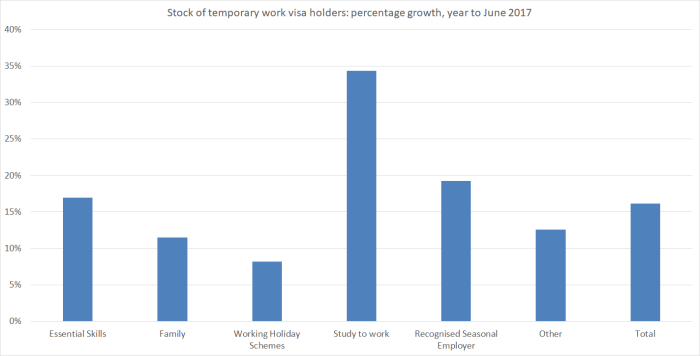
There are various different classes to temporary work visas.  Here are the growth rates for each of the main classes, as reported by MBIE.

work visas stock

There were big increases in the so-called Essential Skills category, but far and away the largest increase was in the Study to Work category –  people graduating from tertiary institutions, and granted the right to work here for a year in any job whatever.  Many of these people will, presumably be hoping to graduate to an Essential Skills visa or a residence visa.  Essential Skills (so-called) numbers aren’t capped, but residence visas are managed to a numerical target, reduced a little by the previous government.

Perhaps you had the impression that most temporary work visas were issued subject to some sort of labour market test (to be clear, I don’t favour such tests).  If you thought that, you were wrong.

work visas 2

Of the top 4 categories, only the Essential Skills visas are subject to a labour market test.  And Essential Skills visa holders make up just under a quarter of the people here on temporary work visas.

The number of people here on temporary work visas has increased by 63 per cent since 2009.   For those interested in nationalities, the main countries with large increases have been India and France (the latter presumably mostly Working Holiday visas).  The number of people here from the UK has increased a little, while numbers from Fiji and South Africa have actually fallen.

And these are the occupations where more than 500 Essential Skills visas were granted in 2016/17

Occupation Number %
Chef 2,178 6.6%
Dairy Cattle Farm Worker 1,617 4.9%
Carpenter 1,478 4.5%
Retail Supervisor 961 2.9%
Cafe or Restaurant Manager 942 2.9%
Retail Manager (General) 767 2.3%
Aged or Disabled Carer 748 2.3%
Dairy Cattle Farmer 508 1.5%

There might have been a building boom on, but actually that apparently-chronic shortage of chefs continues to dominate the numbers.   You may recall my pre-election post noting that the actual make-up of migrant numbers was exacerbating –  not easing –  workforce issues in the construction sector.

Here is another way of looking at the skill level of the people getting Essential Skills visas last year, using the broader occupational categories MBIE reports.

Occupations of people granted essential skills visas, per cent of total
Food trades workers 8.9
Hospitality, retail and service managers 7.1
Labourers 17.6
Community and Personal Service Workers 11.9
Machinery Operators and Drivers 4.4
Sales Workers 4.7
Clerical and Administrative Workers 3.2
Sub-total 57.8

When the labourers make up 18 per cent of those getting Essential Skills visas, I think people might reasonably conclude we’ve been sold a pup.   To be sure, only a small number of those people will end up getting permanent residence, but a large stock of imported labourers –  even if the people themselves are rotating –  is still more likely to be depressing New Zealand wages in those particular sectors, than adding to trend productivity for New Zealanders.  For those sceptical of any adverse wage effects, simply listen to the squawks of employer lobbyists when there is any talk of tightening the criteria.  The natural response when particular types of labour is scarce is for the price of that labour (wages) to rise.

On which note, I happened to read the “China Business” supplement that came as part of Thursday’s Herald –  mostly apparently paid for by firms wanting to keep on good terms with the People’s Republic.    One article that caught my eye was by the National Party’s spokesman for foreign affairs and trade, Todd McClay.    It was a curious article in some respects.  There was this claim, for example

Trade flows remain remarkably balanced for two countries whose economies are of such different size. This is not by chance, but a direct result of successive governments, officials and particularly Foreign Affairs and Trade Ministers regularly visiting China, to secure opportunities for Kiwi exporters.

I have not the slightest idea what the first sentence is supposed to mean (and it is only a few weeks since the China Council was touting that New Zealand trade with China was unbalanced –  more New Zealand exports to China than imports from it).  Surely, the Opposition must have some advisers who know some economics?

Then there was this

As a parliamentary colleague often says “words have meaning”. This is particularly true when Ministers speak of our international relationships. In fact when it comes to trade, “words have consequence”.

One certainly hopes words have meaning –  although sadly one fears that with politicians that isn’t always the case.  Quite what point McClay is making here also isn’t remotely clear, although perhaps it is a dig at anyone suggesting that, as regards China, New Zealand politicians might ever stand up for New Zealand values?

Then again, if words have meaning, what did Mr McClay –  Trade Minister at the time –  mean by these words when his government signed on to the People’s Republic Belt and Road Initiative last year?

BRI 2

Or did those words not have meaning?  “Fusion of civilisations” with such a noxious regime……..

But the main reason for linking to McClay’s article was his comment about negotiations to upgrade the New Zealand-China (so-called) Free Trade Agreement.

China can be expected to push for better access for investment and labour. The revised TPP has doubled the OIO investment threshold from $100m to $200m for China under a most favoured nation clause, but this has already been banked. Given the importance of China to the economy you can expect this will be a hot topic for negotiation.

So too will be access for temporary labour. It is a demand they have made of others and it is likely to be a demand they will make of us.

It is a “demand” that our government should simply refuse.   But as successive governments have traded away the interests of New Zealand low-end workers, in the way they’ve run our own immigration and work visa policies, it is difficult to summon much optimism that they will in fact resist.  From the tone of McClay’s comments, the National Party doesn’t seem to believe they should.

The failed economic strategy goes on

MBIE has finally released its annual Migration Trends and Outlook report.   This is an annual publication, in this case covering the year to June 2016.   When it was finally released –  five months later than usual –  it was nine months since the end of the year to which the data related.  And all of this is simply adminstrative data –  in MBIE’s own computer systems and files.  Government agencies manage to collect and publish building permits data within a few weeks of the end of each month.  MBIE’s performance here is inexcusable – the more so, as immigration policy is one of the major instruments of economic and social policy that the government wields.

When I’ve had time to work through the report and associated tables, I will no doubt have some more posts.  In the meantime, I will simply leave you with this extract.  From the roughly half of people granted residence approvals who come under the Skilled Migrant category, these are the top 4 occupations of the principal applicants (typically, almost by definition, any spouses will be less skilled –  if not, they themselves would presumably have been the principal applicant).

Recall the nonsense MBIE –  and to a lesser extent Treasury  –  have run about immigration policy as a critical part of economic transformation strategy (“critical economic enabler” used to be MBIE’s description).    It would be great to see some evidence for the transformative effect –  productivity gains for all, not wage reductions for New Zealanders in these and associated occupations –  of the annual influx of so many people “skilled migrants” to our restaurants, cafe, and shopping sectors.  Or, indeed, the aged care sector, where – as I’ve argued before –  the so-called pay equity settlement looks to have been mostly not a response to gender-discrimination, but to glutting the market with immigrant nurses (and, in work visas categories, other aged care workers).

Main occupations for Skilled Migrant Category principal applicants, 2016/17  
   
Occupation 2016/17
Number %
Chef 684 5.7%
Registered Nurse (Aged Care) 559 4.6%
Retail Manager (General) 503 4.2%
Cafe or Restaurant Manager 452 3.7%

MBIE is so slow in releasing the data that all these approvals occurred under the previous government. Sadly, there is no sign that things will be any different under the new government. Presumably, buying a franchise for a coffee shop will continue to be a path to –  in effect, buying –  New Zealand residence, and all the associated family immigration this new resident aspires to.  It probably wasn’t what the designers had in mind when they thought of entrepreneurial immigration, but it is the sort of shabbiness that our immigration system has been reduced to.

Real interest gaps remain large

There has been a bit of coverage lately about the fact that New Zealand 10 year bond yields have dropped to around, or just slightly below, those in the United States.    Here is the chart, using monthly OECD data, of the gap between the two.

NZ less US

Since interest rates were liberalised here in the mid-80s, the only other time our 10 year rates have been lower than those in the United States was in late 1993 and very early 1994.  That phase didn’t last long.  Bear in mind that back then we were targeting an inflation rate centred on 1 per cent –  lower than the US, and lower than the Reserve Bank of New Zealand is charged with targeting now.

As the chart illustrates, the spreads moves around quite a bit, but the recent narrowing in the spread looks to be significant –  it is (roughly) a two standard deviation event.  Then again, so is the narrowing in the short-term interest rate spread.  Usually our short-term interest rates are well above those in the United States, but by later this year it is widely expected that their short-term interest rates will be higher than ours.   When that sort of reversal is expected to last for a while, it will be reflected in the bond yield spread as well.

NZ less US short

The Federal Reserve’s policymakers expect to raise the Fed funds rate to, and even at bit above neutral, in the next year or two (“longer-run” in the chart below is a proxy for FOMC members’ view of neutral), while there is nothing similar in our own Reserve Bank’s published projections.

Fed projections

I’ve made considerable play of the persistent gap between our real interest rates and those abroad.    Do these recent developments suggest that if there was a problem it is now just going away?

Well, the gap between our bond yields and those in some other advanced countries has also narrowed.    Even the gap between Australian bond yields and our own –  a gap which has been remarkably stable over 20 years –  is narrower than it was (although all else equal their higher inflation target should be expected to result in Australian yields typically exceeding our own).

But here is the gap between our 10 year bond yields and those in some other small inflation-targeting OECD countries.

nz less scandis

There doesn’t seem to be anything out of the ordinary going on there (and 10 year bond yields in Switzerland –  like those in Japan and Germany –  are a bit constrained by being almost zero already).

And here is the gap between New Zealand’s 10 year bond yields and the median of yields in all those countries the OECD has data for for the entire 25 year period.

nz less median

If one simply focuses on the last 15 years –  when our inflation target was increased to 2 per cent (midpoint) –  the current spread is not very different to the average for that period.

There simply isn’t much sign of the persistent gap between our real long-term interest rates and those in other advanced countries going away.

In fact, dig just a little deeper and even the story vis-a-vis the US is a bit less encouraging.  Both countries now have long-term inflation-indexed government bonds, the yields on which are a pretty good read on long-term real interest rates.  US government inflation-indexed 20 year bond yields are currently about 0.9 per cent (even with pretty wayward US fiscal policy).  The Reserve Bank reports that our 17 year indexed bond yesterday yielded 1.82 and our 22 year bond was yielding 2.0 per cent.    A full percentage point gap on a 20 year bond –  even if a bit less than it was – still adds up to an enormous difference over time.  Markets aren’t convinced New Zealand and US real interest rates are sustainably converging any time soon (and, to those who want to throw in claims that the US is bigger or central to the system or whatever, recall that US bond 10 year yields are currently among the highest in the OECD –  in other words, it is quite possible for small advanced countries to have lower interest rates, over long terms, than the US).

The other thing markets don’t appear convinced about is that the Reserve Bank will achieve the 2 per cent inflation target (set for it again this week).   One can proxy this by looking at the gap between inflation-indexed bond yields (real yields) and nominal bond yields.

Here is the US version, using constant-maturity yields for the real and nominal series.

us breakevens

For the last year or so, markets have again been behaving as if the Fed is likely to deliver inflation around 2 per cent over the next 10 years.

But here is the (cruder) New Zealand version.   I’ve just used data on the RB website –  their 10 year nominal government bond yield, and the yields on the two indexed bonds either side of 2028 –  one maturing in September 2025, and the other maturing in September 2030.  Right now, 10 years ahead is almost exactly halfway between those two maturity dates.

NZ breakevens

Halfway between those two lines, for the latest observation, is a touch under 1.3 per cent.    It is a long way from the target of 2 per cent, and the gap is showing no signs of closing.

There are two challenges it seems:

  • if the government is at all serious about beginning to lift productivity growth and close the productivity gaps, they need to think a lot harder –  and be willing to do something about –  the things in the policy framework that continue to deliver us much higher real interest rates than those in other advanced countries,
  • and the new Governor has some work to do if he is to convince people that he is really serious about delivering future inflation averaging around 2 per cent.  Since the government itself just renewed that target, it should concern them –  and their representatives on the Reserve Bank Board –  that the target doesn’t appear to be taken that seriously by people investing money who have a direct stake in the outcome.