Work visas for shop managers

We learned yesterday that the firm that owns Burger King in New Zealand has been banned from using migrant labour (ie people on work visas, not resident non-citizens) for a year.

The penalty was imposed on Burger King not, it is reported, because of a migration-related offence, but because the company was founding guilty of breaches of the minimum wage laws in respect of someone (reportedly not on a work visa) working as a store manager.  A company that can’t be relied on to follow some aspects of labour law probably isn’t the sort of firm that should be counted on to treat short-term migrant labour well.  So even though I think our minimum wage is (relative to nationwide productivity and median earnings) too high, I’m not bothered at all by the ban.

But surely the bigger question that should be addressed to the government is why companies are able to use “migrant labour” in such modestly-skilled low-paying roles at all.   As a reminder (and complaining again about the inordinate delays in MBIE releasing timely data), in 2016/17 these were the top four occupations for the principal applicants in the Skilled Migrant category of our residence approvals programme  (in other words, the cream of the crop).

Main occupations for Skilled Migrant Category principal applicants, 2016/17  
Occupation 2016/17
Number %
Chef 684 5.7%
Registered Nurse (Aged Care) 559 4.6%
Retail Manager (General) 503 4.2%
Cafe or Restaurant Manager 452 3.7%


And among those who got (so-called) Essential Skills work visas

Number of people granted Essential Skills work visas by main occupations, 2016/17
Occupation Number %
Chef 2,178 6.6%
Dairy Cattle Farm Worker 1,617 4.9%
Carpenter 1,478 4.5%
Retail Supervisor 961 2.9%
Cafe or Restaurant Manager 942 2.9%
Retail Manager (General) 767 2.3%
Aged or Disabled Carer 748 2.3%

Large numbers of people who appear to have no particular qualifications or specialist expertise, doing jobs that often don’t seem to pay much more than the minimum wage (when the law is being followed at all –  and it is widely known that there are much more egregious cases than the Burger King example, where migrant workers are required to pay back, under the table, much of any salary as a ‘fee’ for getting them into New Zealand.)

There is an argument that some economists make that we can gain economically by letting in lots of quite unskilled people.  Even economists think such an approach is likely to leave lower-skilled natives worse off.

igm lowskilled

As I noted last year, commenting on one UK academic who celebrated the possibilities of lots of low-skilled migrants (lowering the costs of cleaning, childcare and so on)

What Bateman is in fact arguing for is a policy designed to explicitly help people like her, at the expense of poorer less highly-skilled Britons (in fact, in the roles she talks of typically poorer relatively unskilled British women).  No one person is ever an exact substitute for another, but there is a great deal of overlap.    Even though she never says it, what Bateman is arguing for is a policy designed to increase the differences in incomes between the highly-skilled and the less-skilled –  for the comfort of the highly-skilled (women and their spouses).

Many advocates of a fairly liberal approach to immigration like to downplay the possibility of any costs to low-skilled natives of the recipient country, but Bateman’s argument relies almost entirely on those costs.  Reasonable people can debate how large the actual adverse effects are, but Bateman clearly believes they are large –  that is why, in her view, immigration makes things so much easier for people like her.     And she can’t even be arguing  –  as some might –  that it is just a transitional effect, or otherwise the possibility of outsourcing domestic duties cheaply would soon go away again.  So it seems to be a vision of society that involves repeatedly importing new waves of lowly-skilled immigrants to keep the relative returns to low-skilled labour sufficiently low to make life comfortable for the professional classes.

Whatever the other arguments for and against immigration, it is hardly surprising that citizens might rebel against a proposal to bring in lots of foreigners to widen the income gaps in society –  not just those between nationals and non-citizen foreigners, but those between skilled and unskilled nationals.   Sceptics of other economic reforms will argue that some of those changes also had that effect, but even if so (which I mostly dispute) it was never the intention, or the envisaged long-term effect.  By contrast, Bateman’s argument is in effect for using immigration to maintain a permanent class of helots –  not always the same specific people, but a constantly refreshed pool of people able to earn relatively little, because of the direct competition fron unskilled new arrivals.

Of course, this isn’t the (avowed) approach of the New Zealand immigration programme, which is supposedly mostly about skills –  highly able and talented people, building on what is already here (inadequate as the advocates believe that is) to lift the productivity and incomes of us all.

But that story has long been threadbare.  The evidence for the productivity gains is non-existent (in a country whose productivity continues to drift further behind that of other advanced countries) and instead we import large numbers people with few very obvious skills, too often doing jobs which appear to pay not a lot more than the minimum wage.  It is a rort against New Zealanders.

Now that the government is falling over itself to pander to business interests on anything not central to its own (mostly economically damaging) agenda, there is clearly no chance of any sensible immigration reform under this government (any more than under its predecessor). If anything, talk of regionalising immigration policy would make things even worse.  But for what it is worth I repeat my suggestion around short-term work visas, which would get bureaucrats out of the rationing business, and rely more heavily on the market.

Institute work visa provisions that are:

a. Capped in length of time (a single maximum term of three years, with at least a year overseas before any return on a subsequent work visa).

b. Subject to a fee, of perhaps $20000 per annum or 20 per cent of the employee’s annual income (whichever is greater).

If it is really worth it to a firm to pay a $20000 annual fee on top of a salary to have someone on a work visa, well and good.  But that doesn’t seem likely for very many of the sorts of jobs that top the work visa occupational list.

And recall that markets can and will adjust.  The Canadian federal Minister of Immigration spoke at Victoria University the other day (I hope to come back to his address in greater length later): Canada is in the process of over-leaping New Zealand to claim the dubious crown of largest (per capita) planned migration programme in the advanced world.  The Minister told us lots of stories about skills shortages, and “desperate” needs for workers (in a country with an unemployment rate of 5.8 per cent) –  we heard several times about an apparently desperate need for “50000 truck drivers right now”, and yet never once did the Minister address or even mention the typical market adjustment mechanism: when demand for a resource is scarce, the price will tend to rise to encourage resources to move to meet the demand.      If it is hard to staff fast-food restaurants, or dairy farms, or rest homes, it is a sign –  in an economy that is, at best, only sitting around the NAIRU – that workers in those roles aren’t being paid enough.  It really is (almost) as simple as that.

A country is not a company

That was the title of an article by Paul Krugman, published more than 20 years ago now, in the Harvard Business Review.  The Prime Minister might perhaps consider reading it, and reflecting on it.

Yesterday morning the Prime Minister gave her promised speech on the economy.  It was, frankly, astonishing how little there was there.   There was some mention of the problems

Our overall objective is to build a productive, sustainable and inclusive economy.

On each score we have some way to go. When it comes to productivity, the OECD has said we are “well below leading OECD countries, restraining living standards and well-being”

and

We need to transition from growth dominated by population increase and housing speculation, to build an economy, that as I said, is genuinely productive, sustainable and inclusive.

and

First we want to grow and share more fairly New Zealand’s prosperity.

That means the gap between the highest and lowest income and wealth deciles reduces, real per capita income increases; the value and diversity of our exports grows and home ownership increases.

In particular we want to build our exports and have export led growth.

Which is all well and good, but there is nothing –   nothing –  in the speech about what the government proposes to do, and how it believes that the modest measures it does propose will deliver such better outcomes.   And, of course, no mention of the government initiative which, on the government’s own consultative document modelling, would severely undermine the competitiveness of core parts of our tradables sector, and reduce GDP by perhaps as much as 10 to 22 per cent.

And this from a Prime Minister who has now been in office for almost a year.  It is extraordinary.

But in this post I wanted to focus on the new Business Advisory Council the Prime Minister announced yesterday.  Perhaps it is all just window-dressing, intended to get some favourable headlines for a day or two, and perhaps placate the odd sceptic in the business community (although one might wonder how many sceptics will be invited onto the Council).    If so, I guess no real harm done.

But such councils can be a path towards cronyism.  On the one hand, attracting sycophants who like to be able to tell their mates they have the ear of the Prime Minister.  And on the other, more concerningly, enabling selected business heads to bend the ear of ministers and put pressure on them to make decisions favourable to the specific economic interests of those involved and their employers.  That might not be direct subsidies –  although we have had all too many of them in recent years –  but might involve making the case for regulatory changes which skew the playing field against new entrants, in favour of incumbents.

But by far the bigger issue, if the Prime Minister and the government are at all serious about the lines they ran yesterday, is “what do chief executives of businesses know about overall economic management, and the challenges of New Zealand’s longstanding productivity underperformance?”.  In Krugman’s words, a country is not a company.

Here are a few extracts from his article

What people learn from running a business won’t help them formulate economic policy. A country is not a big corporation. The habits of mind that make a great business leader are not, in general, those that make a great economic analyst; an executive who has made $1 billion is rarely the right person to turn to for advice about a $6 trillion economy.

Why should that be pointed out? After all, neither businesspeople nor economists are usually very good poets, but so what? Yet many people (not least successful business executives themselves) believe that someone who has made a personal fortune will know how to make an entire nation more prosperous. In fact, his or her advice is often disastrously misguided.

and

I am not claiming that business-people are stupid or that economists are particularly smart. On the contrary, if the 100 top U.S. business executives got together with the 100 leading economists, the least impressive of the former group would probably outshine the most impressive of the latter. My point is that the style of thinking necessary for economic analysis is very different from that which leads to success in business. By understanding that difference, we can begin to understand what it means to do good economic analysis and perhaps even help some businesspeople become the great economists they surely have the intellect to be.

and

Keynes was right: Economics is a difficult and technical subject. It is no harder to be a good economist than it is to be a good business executive. (In fact, it is probably easier, because the competition is less intense.) However, economics and business are not the same subject, and mastery of one does not ensure comprehension, let alone mastery, of the other. A successful business leader is no more likely to be an expert on economics than on military strategy.

And yet here was our Prime Minister yesterday (emphasis added).

The role of the Council will be to build closer relationships between Government and business, provide high-level free and frank advice to the Prime Minister on key economic issues and to create a vehicle to harness expertise from the private sector to inform the development of the Government’s economic policies.

….

“The Council will provide a forum for business leaders to advise me and the Government and to join us in taking the lead on some of the important areas of reform the Government is undertaking,” said Jacinda Ardern.

“The Council will report to me on opportunities it sees and identify emerging challenges. It will bring new ideas to the table on how we can scale up New Zealand businesses and grow our export led wealth.

“I want to work closely with, and be advised by, senior business leaders who take a helicopter view of our economy, who are long term strategic thinkers who have the time and energy to lead key aspects of our economic agenda.

Expertise on economic management, and the particular confounding challenges the New Zealand economy faces, just aren’t the sort of thing that tends to be fostered in the course of a corporate career.   Many of these people might have been superb marketers, exceptional operations managers, corporate finance whizzes, smooth operators around the edges of regulation and the tax system, and have risen to assume overall responsibility for (by New Zealand standards) fairly large organisations. They are absolutely vital skills, and business roles done well are a big part of how, in pursuing the interests of shareholders, society is also made better off.   But those skills bear no resemblance to the issues involved in addressing long-term economic underperformance.  For a start, the things businesses have to take as given are precisely the sorts of things governments often can vary, and (as Krugman eloquently notes) the sorts of constraints even a large business faces are very different from those an entire economy faces.   And so on.

There can be exceptions of course.  Sometimes people with a strong background in economics end up in top corporate roles.  Back in the day, for example, Don Brash as as private sector CEO was able to provide a valuable contribution in leading advisory groups around things like the introduction of GST.  More recently, Kerry McDonald –  former director of NZIER and later chief executive of Comalco and chair of the BNZ –  has continued to bring valuable contributions (eg here) to policy discussions and debates (although probably not ones likely to see him invited to join the Business Advisory Council).

But I don’t see many (any?) such people in the top tier of New Zealand business today. The head of Air New Zealand –  chair of the new council –  is reported to be obsessed with politics, but I don’t think we’ve ever heard his ideas on New Zealand’s longer-term economic underperformance.    Fonterra doesn’t have a permanent CEO, and Xero’s head is an Australian based in Australia.    The film industry and the export education industry survive on explicit or implicit subsidies.  And so on.  But even if there were a range of hugely successful outward-oriented businesses led by stellar CEOs lauded by their peers around the world……..it is simply a totally different skill set.

In her column in this morning’s Herald Fran O’Sullivan, who tends to articulate the perspectives of (in the Australian term) the “big end of town”, is pretty keen on the new Council.

Luxon positioned himself well to take a leadership role.

He recently hosted Finance Minister Grant Robertson to a private dinner in Auckland attended by a number of CEOs.

On the guest list were KiwiRail’s Peter Reidy, Spark’s Simon Moutter, Mercury’s Fraser Whineray and McKinsey and Company’s Andrew Grant. The Warehouse chair Joan Withers was also present.  …..

The chief executives at Luxon’s table are all “progressives” — interested in public policy, innovation and sustainability — and wanting to have a say and contribute to the direction of New Zealand.

Moutter led an innovation mission to Israel a couple of years ago to get a focus on the secrets to Startup Nation. Whineray led last year’s Go Swiss mission by business think tank, the New Zealand Initiative which delved into Switzerland’s focus on localism and vocational education — two contributing factors in that country’s success.

Kiwirail……that sink hole that absorbs billions of dollars of taxpayers’ money, contributing to our economic underperformance.

But it was convenient that O’Sullivan included this snippet, as before I read it I’d also been thinking of the cases of Simon Moutter and Fraser Whineray (the latter another head of a majority state-owned company).

As she notes, Moutter was dead-keen on the Israeli model.  I picked apart that idea in this post (followed later by this one).  As for Whineray and the Swiss trip (of which Fran O’Sullivan was part), they headed off to one of the very few countries to have had less productivity growth than New Zealand in the last 50 years (I wrote about some of the findings of the trip here).

It is great that these individuals care about New Zealand’s economic performance, but there is no particular reason to believe that in general they will have more useful perspectives to offer than the average moderately-educated voter chosen from the phone book at random.  Running a business no more equips you to provide useful advice on economic policy more generally (as distinct perhaps from specific bits around your industry) than it does to, in Krugman’s words, write great poetry or make military strategy.

Of course, the usual pushback against such business advisory councils –  again, at least if they are supposed to be anything more than window-dressing –  is that governments have access to a range of high quality contestible advice from….well…. economists (in particular those in key public sector agencies).    But that defence is weaker now that MBIE is run by an HR person with no policy or economics background (although apparently the CEO did previously work in Air New Zealand) and The Treasury seems to have given up on seriously addressing long-term productivity underperformance in favour of corralling a politically convenient, ideologically-driven grab bag of feel-good indicators into a forthcoming “wellbeing Budget”.


Do they expect to be taken seriously?

I don’t really have time for this today, but….

I wrote again yesterday about how getting rid of departure cards seems set to degrade the quality of our timely net migration data (currently some of the best available anywhere in the world, which we need since our net migration flows are large and volatile).  SNZ has previously promised that future PLT estimates

will be generated through a probabilistic predictive model of traveller type (ie short-term traveller, or long-term migrant), based on available characteristics of travellers. Such a model will provide a provisional estimate of migration, which we can then revise (if required) as sufficient time passes for us to apply the outcomes-based measure.

In media commentary yesterday, the Minister of Immigration was heard to suggest that under the new system the data will be better than what we’ve had now.

That seemed unlikely, but later yesterday morning SNZ put out a media release including this

Moving to the new methodology means it will be 17 months before final migration estimates are available. That’s because someone has to be in the country for 12 months out of 16 before they can be classified as a long-term migrant.

“A delay of that length would have been unacceptable to those who rely on migration data for planning and analysis, so we are developing a statistical model that will provide a provisional estimate of migration. A first look at provisional external migration estimates will be released tomorrow,” said Mrs Theyers.

In future, statistics for New Zealanders travelling overseas will be largely based on when they return. Some variables – including occupation and country of next residence – will no longer be available.

That statement itself confirmed one of my points –  some important data is going to be lost altogether (eg data on net outflows to Australia will in future have to be inferred, rather than available directly –  and while I’m sure that isn’t the motivation, that will be convenient for governments).  But there was a promise that they would reveal more today.  I was hopeful we might get a proper discussion paper, with details of their modelling techniques, and the results of backtesting, and (for example) the identification of key periods (especially around turning points –  a key focus of macroeconomic analysts) where the new procedure worked well and when it hadn’t.

But no.

What was released this morning was three charts and a page of text.  There is nothing about methodology, nothing about backtesting, nothing about the identification of turning points, in fact nothing that any serious analyst is likely to find useful.

We are told

To mitigate the impacts of such a delay, we are developing a statistical model that gives provisional estimates of migration to give a timelier statistic. The first provisional migration estimates are now available.

“Preliminary data presented today gives our customers their first glimpse of what migration statistics will look like once the outcomes-based approach becomes the official way we measure migration in New Zealand,” population insights senior manager Brooke Theyers said today.

But nothing at all about the model.

But here are results they are happy to show us

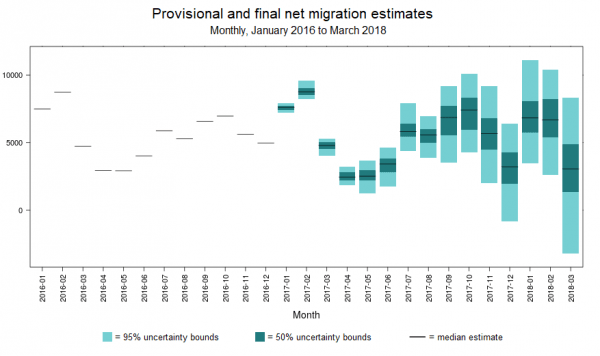
Provisional-and-final-net-migration-estimates2

(I presume that these numbers are not seasonally adjusted, which probably accounts for some of the jumping around in the median estimates from month to month).

Recall that under the 12/16 methodology, the numbers from 17 months ago become final (and are, in many –  but not all – respects better quality than the current PLT numbers).  But the latest monthly data has huge margins of errors –  even a 50 per cent confidence interval looks to be about 3000 people wide (on a monthly basis –  and bearing in mind that the average monthly inflow in recent years has been about 6000 people).

But to repeat:

  • no model,
  • no series as to how the estimates have evolved over time with the addition more data,
  • no backtesting,
  • no analysis of turning point information

Almost nothing at all.  And none of this is being consulted on, instead the government and SNZ are simply junking one of our best high frequency sets of economic data, about a variable which adds considerable volatility to the New Zealand economy.   We should expect a lot more, especially from a notionally independent national statistics agency.


The China Council surveys New Zealanders

Late last week the New Zealand China Council released its first Perceptions of China survey.  The China Council, you will recall, was established by the previous government, largely paid for with taxpayer money, with boards and advisory committees stuffed full of retired and current politicians, heads of government agencies, even an active journalist, and business people with interests in China to try to keep public opinion on side, and not worry their heads about the way successive governments cosy up to a heinous regime in pursuit of another dollar, another deal.  They have a hired gun –  a former MFAT diplomat – as Executive Director, who is never shy of articulating a pro- (People’s Republic of) China story, or of downplaying or attempting to trivialise any concerns about the nature of the regime, or its activities in countries like New Zealand.  I attempted to unpick one of his speeches a few months ago.   The PRC embassy in Wellington must regard him as a considerable asset, speaking in a New Zealand idiom to normalise the abnormal, downplay the risks, ignore the evil, and so on.

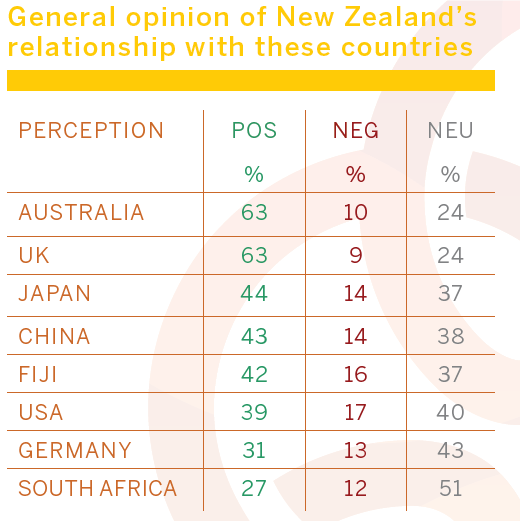
But survey data are usually interesting, and if the China Council is going to have a claim on our taxes, a decent survey is less bad than some of things they could spend money on.  There were a few interesting snippets in this one.    The first question asked “Would you say your general opinion of New Zealand’s relationship with these countries is positive, negative, or neutral”

china survey 1

The China Council was, of course, keen to highlight that 43 per cent of respondents answered “positive” and only 14 per cent “negative”.    But I’m not at all sure what to make of the results, partly because I’m not sure what to make of the question (I’m not sure how I’d answer it) and partly because of the cross-country comparisons.

For example, who is “New Zealand” here –  the government or individual citizens?  And, on the same note, who is “China”?  And is one being asked to describe or evaluate?  From what we see and hear, the New Zealand government and the People’s Republic of China have a generally good relationship (Comprehensive Strategic Partnership and all that), but that is something that I think is inappropriate and not in the interests of New Zealanders.

But I also found it striking that the results for China were so similar to those for Japan and for Fiji.  Japan is now a stable democratic prosperous First World country, no longer any threat to anyone.  Fiji is a semi-free small state, perhaps a nice place for a holiday, but poor and also no real threat to anyone other than its own people.   And then there is the People’s Republic of China – expansionist, aggressive, brutally suppressing the freedoms (political, religious or whatever) of their own people, without the rule of law,  engaged in economic coercion of any country that gets offside with them, and so on.  But, I suppose, there is a fair amount of trade between New Zealand firms and PRC ones.      Survey responses are what they are, and readers can only try to make sense of them, but on this occasion I suspect they can’t mean much.   Perhaps much of it is just about trade.  Perhaps the China Council has just been doing its propaganda job very effectively.

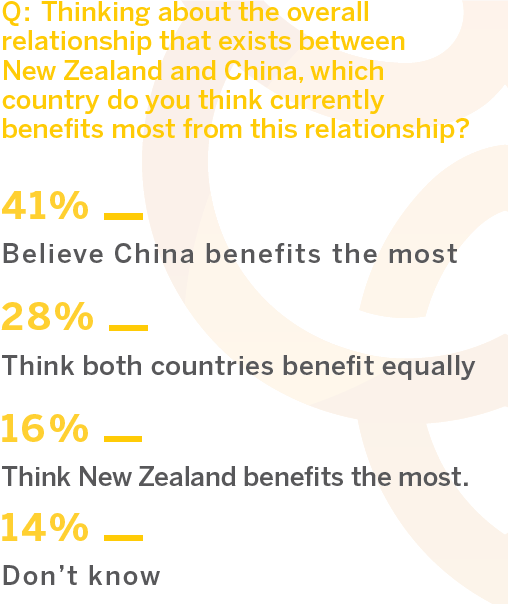
These were the results of the second question

china survey 2

I found these results interesting, and more than a little surprising (in fact, they go against the idea that trade explains the China answers in previous question).  But again, how would I answer?   Since trade is usually (not always) mutually beneficial, that would incline me towards “equally”.  And I put no weight on the spin, beloved of the previous government, that China had somehow “saved us” during the last recession.  I suppose I would answer “China”, but that is because I think New Zealand governments are excessively deferential, scared of their own shadows when it comes to China, and are selling out the interests of New Zealanders as a whole (around the integrity of our system, and the sort of values most New Zealanders espouse) for the business interests of a handful of firms (that somehow convince governments that what is good for them is good for us).  That’s my view, but it is a bit puzzling why the survey respondents both think China does best from the relationship, and that the relationship is positive.

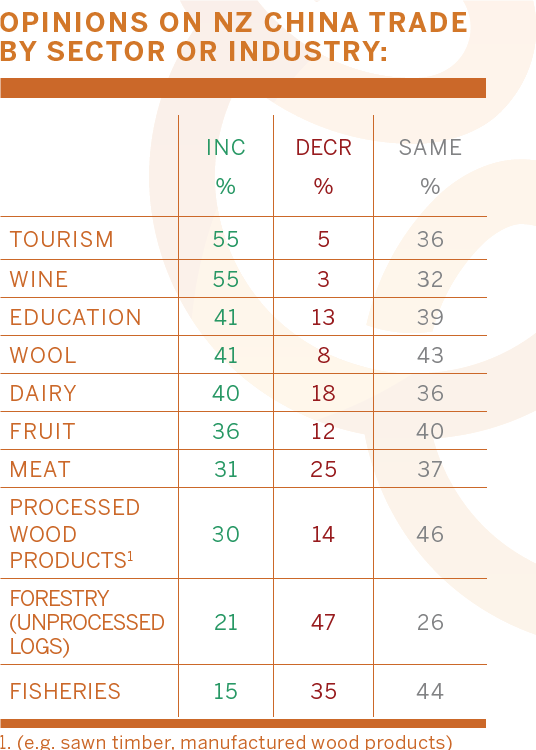
There are some questions about trade, in which it turns out that people are aware that, for the moment anyway, China is our largest trading partner (well, Chinese firms and New Zealand firms –  trade isn’t government to government), and know that dairy is the largest export from New Zealand to China.  More New Zealanders want trade with China to increase than want it to decrease (and I’d probably be one of them – if China were to finally remove restrictions on services exports etc it would be particularly welcome).  But then there was this surprising (to me) result, in which respondents were asked about individual export sectors.

china survey 3

My own view would be almost exactly the opposite of this.  Export education is substantially a rort, cross-subsidised by access to work rights and immigration points, and it and tourism are two types of exports particularly vulnerable to the sort of economic coercion the PRC is now establishing a track record for.  By contrast, if firms can sell more fruit or fish to China, good luck to them (so long as they aren’t bending the ear of government – to go quiet on the PRC –  to do so).  Slightly off-topic, it is perhaps a telling reflection on New Zealand’s overall economic underperformance, what sorts of products aren’t on the list at all (eg advanced manufacturing).

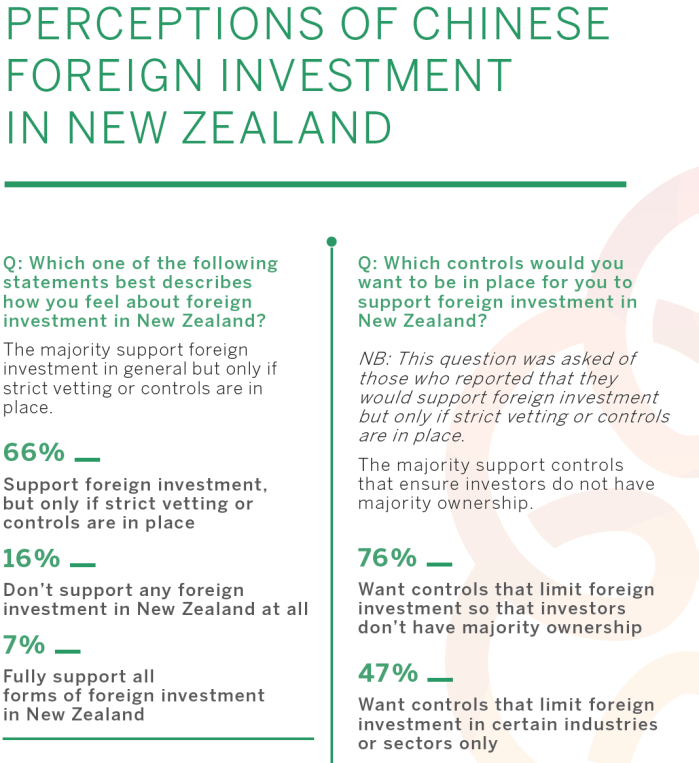
What of foreign investment from the PRC in New Zealand?

china survey 4

Most respondents are only happy with foreign investment from the PRC with “strict vetting or controls”, and an overwhelming majority want restrictions to prevent majority ownership from the PRC.   I’m generally much more open to foreign investment than the median New Zealander, but regard PRC-sourced investment (where all firms have to be treated as, in effect, arms of a hostile state) as different.   But even so, I can’t see a case for (say) preventing majority PRC ownership of an office block in Queen St or The Terrace, or a hotel in Queenstown, or even a milk powder plant in Canterbury. On the other hand, allowing Huawei a role in New Zealand telecoms infrastructure seems reckless.

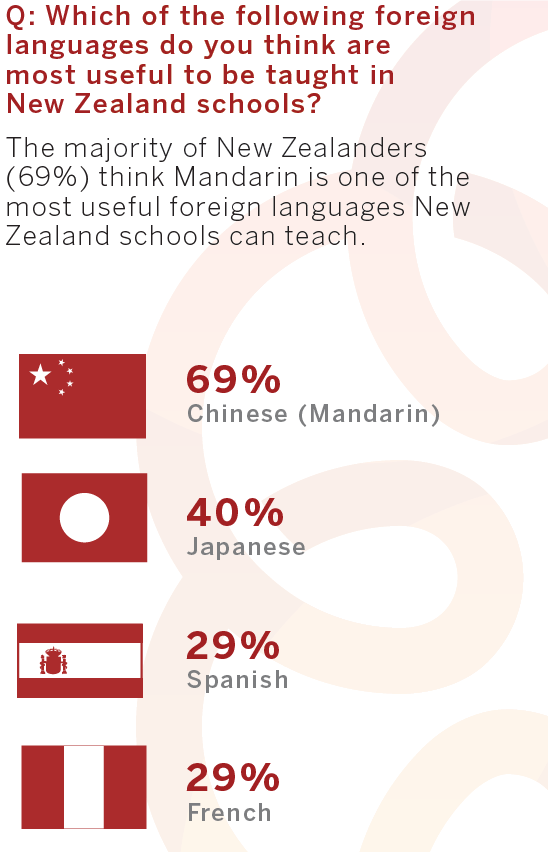
And then, presumably in the cause of defending Confucius Institutes in New Zealand (something the Executive Director has previously championed), there was a question about languages in schools.

china survey 5

I was mostly surprised that Japanese still scored so highly (a language spoken in only one, large but shrinking, country).  Whether Mandarin is really more “useful” than French or Spanish is anyone’s guess –  and how one defines “useful” is surely wholly in the eye of the respondent –  but learning a foreign language, whatever it is, is generally a useful discipline.  On the other hand, very few people who do several years of language study at high school ever emerge with much more than the ability to read a menu.  But the bigger point remains the one I made in a recent post on Confucius Institutes: when we teach foreign languages in our schools we should pay for, and resource, that ourselves, just as we do with maths and science teaching, not rely for support on foreign aid from a considerably poorer country, pursuing its foreign policy agenda.

Overall, some interesting data, with a few surprises and quite a few questions. It will be interesting to see how responses change, if at all, over coming years.

As for the China Council itself, the full prostration seemed to be on display late last week when they (a body largely funded by New Zealand taxpayers) held a “Gala dinner” to welcome the new PRC Ambassador to New Zealand.   I’m sure our authorities need to have formal, but distant, diplomatic relations with the PRC, but the “gala dinner” (not even just a “dinner”) is sickening to contemplate: people apparently so willing to set aside any values, any decent morality, any hardheaded assessment of the nature of the regime, to celebrate the arrival of today’s equivalent of the ambassador from the Soviet Union, Nazi Germany, late 1930s imperial Japan, Mussolini’s Italy (or a host of smaller, more modern, examples).    New Zealand once had the decency and moral sense to take some sort of stand against these regimes and their activities.  But…there is a dollar to be earned no doubt.

As often, one turns to the Chinese Embassy website for more information than one gets from the China Council.  There is no record of the speeches of the China’s Council Executive Director (or any other “worthy”), but the Embassy published the Ambassador’s speech.   Here is part of it

While we celebrate our achievements, we should also be sober-minded that the world is undergoing profound and complex changes. We need to deal with the economic and social divide in many countries, address the international divide between the existing powers and the emerging countries, and to handle the divide between 21st century realities and outdated policies. How do we respond to these profound challenges we face? What kind of vision should we have for our two countries and for our relationship? The choices we make today will not only influence our own development, but also have an impact on the long-term development of our relations and even the evolution of the world order.

China has made its own choice. The 19th Party Congress held last October drew a new blueprint for China’s development for the decades to come. China will continue to follow the path of socialism with Chinese characteristics. China’s development has entered a new era with the main task of addressing imbalances and inadequacies of our development, in order to meet growing needs of our people for a better life. China will continue to maintain a strong economic growth, guided by the new vision with greater emphasis on innovation, coordination, green growth, openness and inclusiveness.

This year marks the 40th anniversary of China’s reform and opening up. Tremendous achievements have been made over the past 40 years. As put in his keynote speech at the annual conference of the Boao Forum for Asia last April, President Xi Jinping reaffirmed that China would adhere to its fundamental national policy of opening-up, and pursue development with its door wide open. President Xi also announced a series of major measures for further opening up.

A stronger and more confident China will be able to make even greater contribution to the international community. China will stay as determined as ever to build world peace, contribute to global prosperity and uphold the international order. China will continue to follow the path of peaceful development, implement a strategy of opening for mutual benefit and win-win outcome. What China seeks is global partnership, instead of global dominance. Our aim is to build a new model of international relations and a community of shared future for mankind.

(That last phrase is apparently one of Xi Jinping’s specials.)

Presumably the audience lapped it up or (if ever inclined to a little scepticism about this rose-tinted, not to say tendentious, description of the world as seen from Beijing) said nothing.  This the regime that is today’s Soviet Union, today’s Nazi Germany –  whether in the way it treats its own people at home, lays claim on the loyalties of ethnic Chinese in other countries, pursues expansionist agendas abroad, seeks to silence critics and so on.

Gala dinner indeed…..


Tossing away valuable emigration data

We had confirmation yesterday that departure cards are to be scrapped.    This was flagged by the Prime Minister a few months ago, and I wrote about the issue here.   Since then it appears that there has been no proper public consultative process.

As I noted in March

I’m sure airlines and airport operators hate the cards.  There have been prevous efforts to get rid of them.  They are, nonetheless, a core element of the data collections (in conjunction with arrivals cards) that give us some of the very best immigration data anywhere.  In a country with –  year in, year out – some of the very largest immigration, and emigration, flows anywhere in the advanced world.

We are told by the government that this brings us more into line with other countries

On Sunday, Lees-Galloway said the move would bring New Zealand into line with other countries, few of which had departure cards with the level of detail required by the New Zealand card.

(although even then we appear to overshooting in scrapping the cards completely).

But the statistical and related policy issues New Zealand grapples with are different from those in many other countries, most of whom don’t have big outflows of their own citizens, or big cyclical fluctuations in those flows.     Immigration of non-citizens is managed through the administrative approvals required to get a visa.  But people don’t need government approval to leave again and New Zealanders (of course) are free to come and go without any prior approval from the New Zealand government.

So departure cards captured the intentions of people coming and going.  Those stating that they intend to have changed countries for 12 months or more make up the permanent and long-term migration data that, for decades, has been a major and very timely indicator of what is going on, in a country with some of the largest swings in net migration of any country in the world.   It isn’t as perfect indicator by any means –  very timely ones rarely are – but it has consistently contained valuable information, especially around turning points.   And now the government proposes to scrap this data collection.

The Minister of Customs reckons the cards aren’t necessary

Customs Minister Meka Whaitiri said the cards were no longer needed for their original purpose – to account for all passengers crossing the New Zealand border.

“We have smarter systems now that capture passenger identity information and travel movement records electronically,” she said.

“Information captured by the departure cards is now mainly used for statistical purposes.

“Statistics NZ has developed an alternative way to produce migration and tourism statistics, based on actual movements rather than passengers’ stated intentions on the departure cards.”

I certainly agree that departure cards aren’t needed to capture the total flows, but it is the timely breakdown of that data that has been extensively used for decades.   And the operative word there is “timely”.  The new 12/16 method data –  looking back and seeing how long people were actually here/away – is better for long-term analytical purposes, but it is available only with a 17 month lag, whereas the departure card based data is available within weeks.  That difference matters, and it is worth bearing in mind that 17 months is almost half a parliamentary term.

We are told that Statistics New Zealand has “developed an alternative way to produce” the data, but we’ve seen no details of this, and there has been no consultative document made available for comment.  In  my earlier post I included this quote from SNZ claiming that in future estimates of the PLT breakdown

will be generated through a probabilistic predictive model of traveller type (ie short-term traveller, or long-term migrant), based on available characteristics of travellers. Such a model will provide a provisional estimate of migration, which we can then revise (if required) as sufficient time passes for us to apply the outcomes-based measure.

I commented then

I hope that they plan to rigorously evaluate the accuracy of such models, including when they’ve worked well and when they haven’t, and how well they capture the effects of policy changes, and that they expose their models and evaluation to external scrutiny before scrapping such a valuable source of hard data as the departure card.

But we have seen no sign of such an evaluation at all, and yet in a few months that data that have been used for decades will be discontinued, with  no ability to recreate it in future if the new models that are talked about prove not to have been very good.

Without seeing the models it is hard to comment on where they might go wrong.  But the key point is that statistical models often work fine when past behavioural patterns keep on as they were in the past, and they often fail when behaviour changes.   It is the behavioural changes that are often of most interest to the analyst, and it looks as though there will now be very long lags before we have the data to enable any such changes to be recognised.

I just heard Iain Lees-Galloway claiming on Radio NZ that future statistical information will be improved by scrapping the departure cards.  That seems very unlikely – essentially impossible, because you cannot really know the intentions of travellers other than by asking them, and intentions actually matter in this business.

I could add to the lament around official immigration statistics that there has still been very little progress in making available regular, timely, seasonally adjusted, accessible data from MBIE on visa approvals.  These are major economic and social data for New Zealand, which should be readily available almost instantly, including through SNZ’s Infoshare site.  There is no reason why immigration approvals data should not be at least as readily useable as, say, building approvals data. I know MBIE has a project underway to improve the situation, and make available an immigration data dashboard, but it seems to be moving very slowly –  it must be a year now since MBIE first told me about it, and it is months since the person doing the work invited me to provide comments on a prototype.  It is encouraging that something appears to be in the works, but in the meantime we limp on with inadequate, not user-friendly, administrative data, while the government simply abandons the best timely data we have on what people leaving New Zealand are planning to do.


The Fed looks to options in the next serious recession

I’ve written quite a bit recently about the apparent complacency of the Reserve Bank (and The Treasury and the Minister of Finance) around the ability of monetary policy to adequately cope with the next serious recession (here, here, and here).

Against that backdrop, it was interesting to see a substantive report of a recent discussion of exactly these sorts of issues in the minutes of a meeting a few weeks ago of the Federal Open Market Committee, the arm of the Federal Reserve that makes monetary policy decisions.   One might reasonably suggest that the discussion is happening several years later than it should have –  the problems and the limitations of conventional monetary policy have been apparent for some years now (especially in countries like the US that reached the effective lower bound in the last recession) – but better late than never.   And in the US context, some individual members of the FOMC have felt free to speak openly (eg here) on the issues and some possible policy responses.  It is the way open monetary policy committee systems can work.

Here are some extracts from the FOMC minutes

Monetary Policy Options at the Effective Lower Bound

The staff provided a briefing that summarized its analysis of the extent to which some of the Committee’s monetary policy tools could provide adequate policy accommodation if, in future economic downturns, the policy rate were again to become constrained by the effective lower bound (ELB). The staff examined simulations from the staff’s FRB/US model and various other economic models to assess the likelihood of the policy rate returning to the ELB and to evaluate how much additional policy accommodation could be delivered by the current toolkit.

Somewhat surprisingly, a footnote indicates that the staff modelling was still based on an effective lower bound of 12.5 basis points (the actual low the Fed went to for years after 2008), even though other countries have gone modestly negative (and our Reserve Bank has taken the view that the OCR could go to, say, 0.75 per cent.  There is no hint in the minutes of the FOMC discussing a lower effective floor, or what steps might be considered to lower it.

The staff’s analysis indicated that under various policy rules, including those prescribing aggressive reductions in the federal funds rate in response to adverse economic shocks, there was a meaningful risk that the ELB could bind sometime during the next decade.

Hardly surprising, given that the current Fed funds target is 1.75-2.0 per cent, and recessions seem to come round every decade or so.

In the discussion that followed the staff’s briefing, participants generally agreed that their current toolkit could provide significant accommodation but expressed concern about the potential limits on policy effectiveness stemming from the ELB. They viewed it as a matter of prudent planning to evaluate potential policy options in advance of such ELB events. Many participants commented on the monetary policy implications of the apparent secular decline in neutral real interest rates. That decline was viewed as likely driven by various factors, including slower trend growth of the labor force and productivity as well as increased demand for safe assets. In such circumstances, those participants saw monetary policy as having less scope than in the past to reduce the federal funds rate in response to negative shocks. Accordingly, in their view, spells at the ELB could become more frequent and protracted than in the past, consistent with the staff’s analysis. Moreover, the secular decline in interest rates was a global phenomenon, and a couple of participants emphasized that this decline increased the likelihood that the ELB could bind simultaneously in a number of countries. A few other participants raised the concern that frequent or extended ELB episodes could result in expectations for inflation that were below the Committee’s symmetric 2 percent objective, further limiting the scope for reductions in the federal funds rate to serve as a buffer for the economy and increasing the likelihood of ELB episodes.

There was clearly a range of views round the table, but it was encouraging to see some members highlight a variant of a point I’ve made here: because firms, households and market participants know that central banks will have relatively more limited firepower in the next recession, it may be harder to keep inflation expectations near the target, which may compound the challenges.

In the US, high government debt and large deficits are likely to be a constraint on the scope for active fiscal policy to complement monetary policy.

Fiscal policy was viewed as a potentially important tool in addressing a future economic downturn in which monetary policy was constrained by the ELB; however, countercyclical fiscal policy actions in the United States may be constrained by the high and rising level of federal government debt.

That might be on “technical” grounds –  genuine risks of bond market sell-offs –  or the wider political constraints that I highlighted in my post the other day, and which are likely to apply even in less-indebted countries like New Zealand.

Participants generally agreed that both forward guidance and balance sheet actions would be effective tools to use if the federal funds rate were to become constrained by the ELB. In the Addendum to the Policy Normalization Principles and Plans statement issued in June 2017, the Committee indicated that it would be prepared to use its full range of tools, including altering the size and composition of its balance sheet, if future economic conditions were to warrant a more accommodative monetary policy than can be achieved solely by reducing  the federal funds rate.  However, participants acknowledged that there may be limits to the effectiveness of these tools in addressing an ELB episode. They also emphasized that there was considerable uncertainty about the economic effects of these tools. Consistent with that view, a few participants noted that economic researchers had not yet reached a consensus about the effectiveness of unconventional policies. A number of participants indicated that there might be significant costs associated with the use of unconventional policies, and that these costs might limit, in particular, the extent to which the Committee should engage in large-scale asset purchases.

The uncertainties seem considerable.

The FOMC discussion concluded this way

While the Committee’s current toolkit was judged to be effective, participants agreed, as a matter of prudent planning, to discuss their policy options further and to broaden the discussion to include the evaluation of potential alternative policy strategies for addressing the ELB. Building on their discussions at previous meetings, participants suggested that a number of possible alternatives might be worth consideration and agreed to return to this topic at future meetings. Several participants indicated that it would be desirable to hold periodic and systematic reviews in which the Committee assessed the strengths and weaknesses of its current monetary policy framework.

As one reader noted in sending me the link to these minutes “refreshing (at least directionally)”,   which sounds about right to me.   The FOMC still seems quite a long way from really grappling with the severity of the next serious recession, when they (and all their major peer central banks) will have (it appears) little conventional monetary policy leeway, there is a great deal of uncertainty about the potential of unconventional instruments, and everyone –  especially in the financial markets –  will know it.

But it is to their credit that they are willing to have a discussion of this sort, publish fairly substantive minutes highlighting some important differences of emphasis and uncertainties, and are open to independent (named) perspectives from members in speeches.    That said, it should disconcert people that the FOMC is not already rather better prepared for the next serious recession –  like all central banks, their ability to anticipate the timing of the next such event is non-existent.

The Governor of the Reserve Bank has apparently been at the Jackson Hole retreat for central bankers this weekend.  Perhaps he could compare notes with his US counterparts and come back ready for some more open and substantive engagement on these issues in a New Zealand context (after all, in a day or two, he’ll have been in office for five months and we’ve still not had a substantive speech from him on any topic the Bank is responsible for).  Encouragingly, the Governor is reported as telling an interviewer in the margins of Jackson Hole that

The “biggest challenge” is to “get inflation to rise”

But it will be much more of a challenge in the next serious recession if people can’t be confident that central banks, here or abroad, can do all that needs to be done.  At present, no one can reasonably be that confident.  New Zealand can’t fix the world’s problems, but our policymakers can ensure our economy is well-positioned.  Not doing more just because others are still not doing enough should be no more excusable than when all too many countries drifted to the limits of conventional monetary policy at the end of the 1920s.  It wasn’t as if no one then was highlighting the risks.

I have a few other substantial commitments over the next two or three weeks, which means that blogging here may well be quite light for a while.


Political ructions and a better economic performance

Years ago we in New Zealand sometimes had the gruesome spectacle of governing party coups (and the like).  There was the failed (“Colonels’ coup”) attempt to oust Muldoon in 1980, the ructions that led to Lange’s departure in 1988 and then (unelected) Palmer’s a year later, and the ousting of Jim Bolger in late 1997, and then the break-up of the governing coalition a year later.  But you have to be a certain age to remember any, let alone all, of those.

In Australia, by contrast they’ve been two a penny in the last decade.   It isn’t exactly the rate at which Italian governments used to turn over until relatively recently, or French governments in the ill-fated Fourth Republic (22 prime ministerships in 12 years) but it is quite extraordinary by Anglo country standards.  Has there ever been a time previously –  in New Zealand, the UK, Ireland, Canada, Australia – when four people in a row who successfully led their party to an election victory –  limping home in Turnbull’s and Gillard’s cases –  didn’t complete the subsequent (three years) term?  Perhaps Turnbull will, in fact, limp on, but even if he does it is hard to see to what end.

A mere three years ago, when Turnbull ousted Abbott I wrote a post about the strange phenomenon then gripping the Australian centre-right: New Zealand envy.  Here was Turnbull speaking just after his coup.

“John Key has been able to achieve very significant economic reforms in New Zealand by doing just that, by taking on and explaining complex issues and then making the case for them. And I, that is certainly something that I believe we should do and Julie and I are very keen to do that again.”

As I noted, it was very hard to think of such “very significant economic reforms”.  Moreover, as I illustrated in that post, New Zealand seemed to have drifted a bit further behind Australia economically over the previous few years.

I noticed Julia Gillard yesterday engaging in a bit of New Zealand envy, suggesting (probably tongue in cheek) that Australians might well consider moving to New Zealand.  Only, surely, if they wanted to be colder as well as poorer.  Recall that Australian incomes are far higher than those in New Zealand, the main reason why for the last 40 years so many New Zealanders (net) have gone to Australia, and so few Australians have come to New Zealand.   Even just since 1991, a net 470.000 New Zealanders have gone to Australia, and only 49000 (net) other passport holders have come to New Zealand from Australia.

And, like it or not, political instability (including ructions in successive ruling parties) doesn’t seem to have been a material factor impairing economic performance.  That was so for France and Italy after the war, and if –  as I illustrated last week –  if Australia’s economic performance hasn’t been great, given its resource bounty, it has still been better than New Zealand’s.

Here I’m going to focus on the period since the end of 2007, for two reasons.  First, it was about the time the Rudd government took office which –  although it wasn’t apparent at the time –  was the beginning of the era of Australian political instability.  And, second, because it is just prior to the recession of 2008/09.  In New Zealand, Labour was still in office for most of 2008, but comparisons from troughs of recessions are rarely very meaningful (and if Australia didn’t have a recession in the sense of a couple of negative quarters of GDP, it still had a big fall in income measures –  as commodity prices fell –  and a material rise in the unemployment rate).

First, there is an important background feature that governments don’t have any material influence over; the terms of trade.

aus nz tot

Australia’s terms of trade have been much more volatile than those of New Zealand over the last decade or so, but taken over the whole period there hasn’t been that much difference.  Both countries have benefited from the movement in world prices to about the same extent (Australia had also had a substantial lift from about 2002, not mirrored in the New Zealand numbers).

Then there are the headline national accounts comparisons: real GDP per capita.

real gdp pc aus nz

On that measure, at the end of the period there has been no change in the relative position of the two economies  (although the gap between the two lines for much of the period is lost output that is never likely to be got back).  No sign of any catch-up, although also no falling further behind either.

The terms of trade can make a material difference to economic wellbeing, and terms of trade gains are not directly reflected in the real GDP numbers (although the indirect effects – any increases in consumption or investment etc in response –  are there).   But on this occasion we don’t need to worry too much about that point because, as the first chart illustrates, over the full period both countries’ terms of trade have risen by about the same amount.

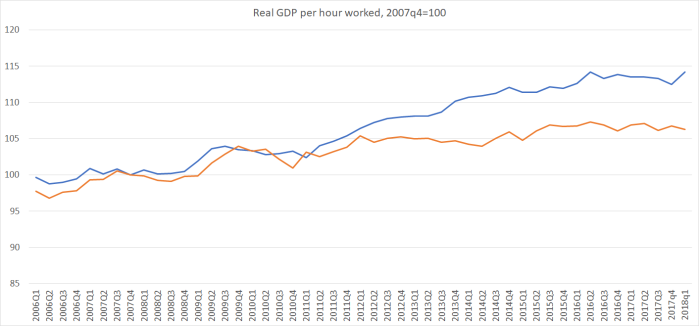
But if real GDP per capita in the two countries has grown by about the same percentage in each country over the last decade, there has been a really big difference in the composition of that growth, and not one that is positive for New Zealand in the longer term.   I have shown the labour productivity chart previously, but here it is again anyway.

aus nz rgdp phw

Some years we match Australian productivity growth, and occasionally even exceed it, but over the period since the end of 2007, labour productivity growth in Australia has exceeded that in New Zealand by about 8 percentage points.  That is a lot, especially when New Zealand was starting from so far behind.

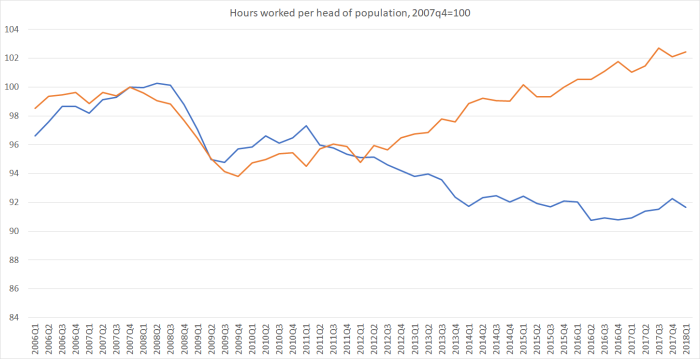
And here is a large component of the difference.  I’ve set hours worked per head of population equal to 100 in both countries in 2007q4, and shown how that measure has changed in each country since then.

hours worked per head

It looks a lot like that old story: New Zealand (in orange) more or less manages to “keep up” (not see real GDP per capita drop further behind) simply by working more hours.  That is no sustainable route to greater national prosperity, especially when hours worked per capita are already quite high by advanced country standards.

Of course, some will probably want to claim this as some sort of New Zealand success story –  “look at all those people we have in work etc etc”.   But working more hours isn’t some “good thing” for its own sake, and the unemployment rate is the best summary measure of whether there is slack in the labour market.   If Australia’s unemployment rate had increased materially more than New Zealand’s then one probably could tell a (cyclical) New Zealand success story.  But here are the two unemployment rates.

nz aus U rates

Most people reckon Australia’s NAIRU is higher than New Zealand’s (and that is a long-term negative for Australia, and the wellbeing of Australians), but that was so before the crisis too. In fact, the gap between New Zealand and Australian unemployment rates now (around 1 per cent) is exactly the same as the gap at the end of 2007.   Just as is the case in New Zealand, most Australian residents who actually want jobs have them.  So I don’t count the increase in hours worked here as any sort of mark of success.

None of this –  higher productivity growth in Australia in particular –  should be any great surprise.  If one looks across the OECD’s Going for Growth structural indicators (for example) the two countries score about as well, or poorly (on some indicators), as each other.  But Australia has seen come on stream huge new mineral production –  a new endowment they could tap –  and we’ve had nothing comparable (to what extent that is because similar resources aren’t there, or because policy choices prevent them being utilised is a topic for another day).  But with no other new opportunities apparent to match the new minerals –  and see the shrinkage in our foreign trade shares – our structural position relative to Australia has weakened further.

I’m not going to illustrate housing markets –  in any case mostly a state matter in Australia as I understand it –  but in both countries the best that can be said is that the outcomes, for ordinary people, have been lamentable, and disgraceful.

There is an argument sometimes mounted that the earthquakes were a significant drag that Australia didn’t have to face.  In terms of the existing stock of wealth, there is some truth in that (even recognising that much of the loss was reinsured abroad).  And the rebuild process –  which peaked several years ago now –  did take resources that couldn’t be used for other things.   But (a) on official estimates we had utilised capacity (output gap and unemployment gap) for most of the time, and (b) if there really were abundant international opportunities for firms here, bidding for capital and labour resources, we might have expected to see persistent upward pressure on our interest rates relative to those in the rest of the world, and associated inflation pressures.  We’ve not seen the inflation pressures at all (any more than in Australia) and the upward pressure on our interest rates relative to the rest of world occurred only while our Reserve Bank was messing up –  driving up the OCR before having to about-face and more than fully reverse themselves.

There isn’t a choice between chronic political infighting (of the Australian sort) and improved prosperity, but if there were I reckon I’d take the prosperity.  As it is, at least relative to New Zealand, Australia looks to have had both.  If there is an understandable tendency to rather look down on the political machinations, we should at least pause to ponder (again) our own long – and continuing – relative economic decline.

And now back to watching the gruesome spectacle across the Tasman.


Paying MPs

So poor have the economic outcomes been in New Zealand for decades –  that slippage from number one or two, to an also-ran lost well down the rankings –  that one could probably mount a reasonable case for asking all those who’ve been MPs –  or ministers at least –  for a refund on the salaries they’ve been paid.  The honourable ones among them should really hang their heads in shame.

But setting aside that perhaps unreasonable hankering, what to make of the latest angst over salaries for our members of Parliament?

First, what has become of the process doesn’t reflect well on either the previous government or the current government.  Both government seem to have panicked in the face of numbers that might have made awkward headlines (but typically involve small changes, the overall effect of which –  including any anomalies –  are likely to wash out over a period of several years), and rushed for crude interventions (freezes, legislation under urgency).  Take the current government as illustrative, they knew the previous government had passed legislation tying increases in MPs pay to public sector pay, and they knew on coming into office that public sector pay was going to be one of the pressure points they would face.   So why, if they weren’t willing to live with the current formula, didn’t they put in place a review (yes, another) as soon as they took office, 10 months ago.  Had they done so, any proposed changes could have extensively consulted on, perhaps even legislated by now.

Second, there is no way to put the setting of MPs salaries at a total remove from the political process.  The enabling legislation has to be passed by Parliament itself, and what is passed by Parliament can be amended by Parliament, even retrospectively.   But we should be looking to develop and maintain systems, and conventions, by which the main parties (a) agree on the rules, and (b) agree to live with the results.  It shouldn’t be that hard –  Parliament doesn’t remove judges who rule against them, and mostly doesn’t even legislate to overturn specific decisions the political process doesn’t like.   All sorts of things embarrass MPs and ministers, but when our system works well, it is just something they have to live with.  I guess it must be tempting to play politics with MPs pay, but it isn’t in the interests of our system of government in the longer run to do so.  It also isn’t in the interests of the systems to have MPs or ministers choosing not to take increases.  Nothing stops them donating to charity, but let their good deeds be done in secret, not as political plays.

There is an article in today’s Dominion-Post by Stacey Kirk taking a cursory look at how the pay of our MPs compares with that in the other Anglo countries (all of whom have considerably higher average per capita GDP than New Zealand does).

The superficial comparisons tend to suggest that our MPs do rather well.  But those comparisons don’t mean much for several reasons:

  • the conversions in the article are done at current market exchange rates, but New Zealand’s exchange rate is generally regarded as being structurally overvalued.  On such comparisons, all wage rates in New Zealand will be flattered.
  • as the article notes in passing, the comparisons she does only cover base salaries. It isn’t generally true that “perks and supplements” are “hidden” (her word), but they can be challenging for outsiders to fully track down, and put a price on.  Defined benefit pensions, for example (still provided in the US and UK for example, but not here), can be extremely valuable in a low yield environment.
  • the comparisons don’t take any account of post-political opportunities which in some countries (notably the US) can be very lucrative (arguably corruptly so).

There is no unalterably right or wrong answer to how much we should pay MPs (absolutely or relative to prevailing incomes in the economy).  Presumably no one favours the old UK (pre 20th century) system in which MPs were not paid at all.  The presumption was that MPs would have another income, which –  of necessity –  meant that the only people who could become MPs were those who did.   If it didn’t necessarily lead to much actual corruption in that historical context, it would certainly open the way for corruption if adopted today.  And I don’t suppose anyone much would support a system in which MPs were all paid $1 million a year: it might attract some really able people, but you’d also be pretty sure that most people competing for the role would be in it for the money.     Putting my cards on the table, I’m sure I wouldn’t want to pay MPs and experienced teachers the same, no matter how good the teacher (a principal of a decent-sized school might be another matter).

It pays to stand back and think about what we should expect from MPs.  There are only 120 of them ( almost a quarter of whom currently serve in the executive), with primary responsibility for scrutinising and holding to account the vast establishment that is the New Zealand government (myriad public agencies and departments, endless regulations and related instruments, and lots of new proposed legislation).  They aren’t the only bulwarks to be sure, but they are the ones with the formal powers and responsibilities –  the ability to summon public servants before select committtees, to demand answers from ministers in Parliament, to insist on changes in legislation, even on occasion to disallow regulatory instruments.  Details matter, context matters, principles matter.   The responsibilities range very broadly (not to mention the hours, for a job decently done).  These aren’t, or shouldn’t be, roles for some amiable person fresh off the street.  And, even in a small country, the public sector is formidably well-staffed, and well-resourced, relative to MPs.

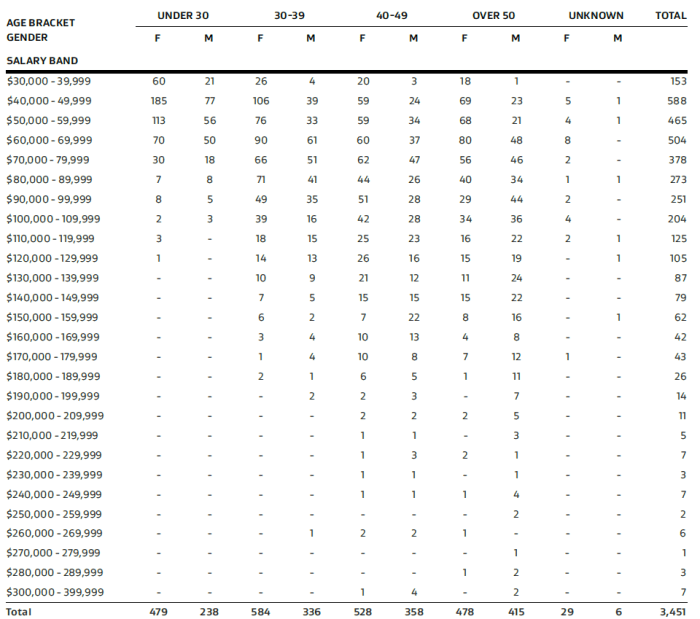
Take, for example, our largest government department, MBIE.  I went to their annual report and found the table of salaries.

MBIE salaries

Perhaps you could treat that very top-tier (chief executive and deputy CEs) as the equivalent of Cabinet ministers.  But this one agency also has 45 people earning between $200000 and $300000 per annum.  These will probably mostly be third-tier managers.    Some of you might be inclined to object that these people are themselves overpaid, but I rather doubt it for what we should be expecting from the sort of people who should fill these sorts of roles.    Of course, they are well above average salaries –  we expect much more than average sorts of skills from people filling them.

And these are sort of people whose work we expect MPs to challenge/scrutinise etc (without any of the sort of staff resources these public sector senior managers have at their disposal).

So I don’t have a sense at all that our MPs are overpaid, and wouldn’t have begrudged them a pay rise this year, or any year (in which private wages were rising).    There are perhaps anomalies in the sense that a new 25 year old MP gets the same as an immensely-experienced former Cabinet minister, but there is no easy way round that feature.  And we should steer well clear of the absurd suggestion from the far-left leader of the Greens, who proposed that MPs should get only the same dollar increase as in the average wage –  thus compressing the relative margins between MPs and the rest every future year for ever (well, unless we have a burst of deflation).

I’m not altogether persuaded by the story that able people won’t go into politics because the pay is too low.  No doubt it is so for some. For others, it will be the hours, the separation from family, the public spotlight or whatever. But we should be careful not to increase the risks of such a system, in some self-reinforcing spiral, in which we complain of dud MPs, and then set a reward structure which only increases the probability of disproportionately getting such people in future.  Ours is a thin democracy, with few effective protections against executive over-reach and the like.  We should be looking for very able people to fill select committee positions –  not just as a passage towards promotion, but as a vital role in and of itself.  I’ve argued previously we should provide more resources to members and select committees –  the public goods of good government need to be properly funded, not skimped on –  but while we consistently refuse to do that the calibre of people serving as MPs is all the more important.


If pushed on the New Zealand situation, the person I suspect could be overpaid in our system is the Prime Minister.  It is a big job to be sure, but it really isn’t one people pursue for the money.  No one we would want to be Prime Minister is likely to look, before entering Parliament, at the PM’s salary to decide if they can support a family on it.  As Stacey Kirk’s article points out, on the (crude) international comparisons we appear to pay our Prime Minister quite generously

Data released by international consultancy group IG in May showed Ardern was the fifth highest paid leader in a comparison of 32 members of the Organisation for Economic Cooperation and Development (OECD).

In a study of the pay gap between world leaders and average citizens, Ardern ranked third, earning 8.63 times the average New Zealand wage.

Post-politics opportunities are probably better for many of the heads of government in these other countries –  Bill Clinton or Barack Obama make their money from being President once out of office. Or Gerhard Schroder or Tony Blair.   That isn’t a model we could, or should want to, emulate. I’d rather pay the Prime Minister a decent salary, and expect a considerable degree of self-discipline and restraint once out of office.

As a bonus, perhaps they could take the steps need to reverse the decades of economic underperformance, that have depressed the earnings of most New Zealanders (and led so many to leave altogether).

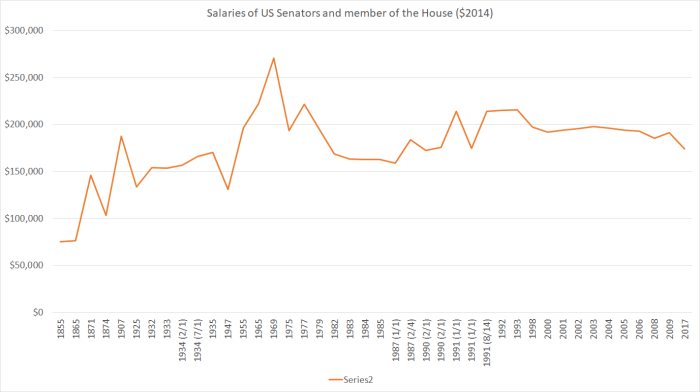
PS.   In digging around before writing this post, I stumbled on some data on the inflation-adjusted salaries of US Senators and members of the House of Representatives

us senator salaries

The dates aren’t evenly spaced, but remarkably there has been no growth in real salaries since the 1950s (and no growth in nominal salaries since 2009).  Real per capita GDP in the US today is about three times what it was in the mid 1950s.   That, at least, seems like a benchmark of badness, and something to avoid –  so bad is the US system, the members get no accommodation allowances, and so not a few sleep in their offices while in Washington, and look to opportunities to cash out in new roles in K Street.

Options for the next serious recession: fiscal policy

I’ve run various posts over the last few years urging the authorities (Reserve Bank, Treasury, and the Minister of Finance) to get better prepared for the next serious recession (and lamenting the relative inaction on this front in other countries too, many of whom are worse-positioned than New Zealand is).

As a reminder, we went into the last recession with the OCR at 8.25 per cent, while the OCR now –  years into a growth phase, with resources (on official assessments) fairly full-employed –  is 1.75 per cent.  In that last recession, the Reserve Bank cut interest rates a long way, the exchange rate fell a long way, there was really large fiscal stimulus cutting in as the recession deepened, and there were lots of other interventions (guarantee scheme, special liquidity provisions) and it was still as severe as any New Zealand recession for decades, and took years to fully recover from (on official output and unemployment gap estimates perhaps seven or eight years).   Lives were blighted, in some cases permanently, in an event where there were no material constraints on the freedom of action of the New Zealand authorities.  In fact, our Reserve Bank cut the OCR (over 2008/09) by more than any other advanced country central bank.

Next time, whenever it is, it seems very unlikely that the Reserve Bank will have that degree of freedom, particularly around monetary policy.  On current policies and practices around bank notes, it seems unlikely that the OCR could be usefully cut below about -0.75 per cent.  Beyond that point, most of the action would be in the form of people shifting from bank deposits etc to physical currency, rather than buffering the economic downturn.

Our Reserve Bank has long appeared disconcertingly complacent about this issue/risk.  The latest example was comments by the new Governor and his longserving chief economist following the latest Monetary Policy Statement.    They talk blithely about the unconventional policy options other countries have used, but never confront the fact that almost no advanced country could have been comfortable with the speed of the bounceback from the last recession.   Output and unemployment gaps of eight or nine years (the OECD’s estimate for advanced countries as a whole) aren’t normal and shouldn’t be acceptable.

Quite why the Reserve Bank is so complacent is something one can debate.   My hypothesis is that it is some mix of assuming we will never face the problem (recall that they have spent years hankering to get the OCR back up again) and of noting that other people/countries will most likely face the problem before New Zealand does.   They also like to remind us that New Zealand has a floating exchange rate as if this somehow differentiates us (as a reminder so do Australia, Canada, Norway, Sweden, the US, the UK, Japan, Korea, Israel, and even the euro-area as a whole).  Whatever the explanation,  robust contingency planning, and building resilience into the system, is what we should be expecting from the Reserve Bank (and Treasury).  There is no sign of it happening.  Meanwhile, the Governor plays politics in areas (eg here and here) that really aren’t his responsibility.

In my post on Saturday, I touched again on the desirability of doing something –  specific and early, consulted on and well-signalled –  about removing the effective lower bound on nominal interest rates.   That would tackle the issue at source.    Monetary policy has been the primary stabilisation tool for decades for good reasons.  Among other things, it is well-understood and there is a fair degree of (political and economic) consensus around the use of the tool.  And confidence that the tool is at hand in turn proves (somewhat) self-stabilising, because people expect –  and typically get – a strong monetary policy response.

Perhaps the other reason why authorities –  perhaps especially in New Zealand – have been so complacent is the view that “never mind, if monetary policy is hamstrung there is always fiscal policy”.  After all, by international standards, public debt here is low (on an internationally comparable measure from the OECD, general government net financial liabilities, about 1 per cent of GDP, which puts us in the lower quartile –  less indebted – among OECD countries.)

The implicit view appears to be that, with such modest levels of debt, if and when there is another serious recession, New Zealand governments can simply spend (or cut taxes) “whatever it takes” to get economic activity back on course again.   After all, the upper quartile of OECD countries have net general government liabilities in excess of 80 per cent of GDP.

I’m sceptical for a variety of reasons.

One of them is the experience of the last recession.  For this, I had a look at the OECD data on the underlying general government primary balance as a per cent of potential GDP:

  • general government = all levels of government
  • underlying = cyclically-adjusted (ie removing the impact of the fluctuating business cycle on revenue (mostly), and adjusted for identified one-offs (eg recapitalisations of banking systems)
  • primary balance =  excluding financing costs, so that comparisons aren’t affected by changes in interest rates themselves
  • as a per cent of potential GDP =  so that a temporary collapse in actual GDP doesn’t muddy the comparison

The numbers aren’t perfect, and there are inevitable approximations, but they are the best cross-country data we have.  Changes in this balance measure are a reasonable measure of discretionary fiscal policy.

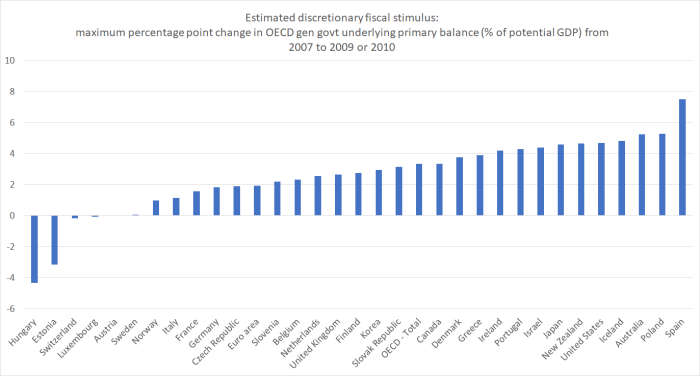
Here is how those underlying primary balances changed from 2007 (just prior to the recession) over the following two or three years.  I’ve taken the largest change I could find, and in every case that was over either two years to 2009, or over three years to 2010.

fisc stimulus

Some countries (Hungary, Estonia) were engaged in severe fiscal consolidation from the start.  Several others experienced almost no change in their structural fiscal balances.

Quite a few countries saw 5 percentage point shifts in their underlying fiscal balances.   Spain –  a country with no control over its domestic interest rates –  is recorded as having gone well beyond that.  I don’t know much about the specifics of Spain, but for those who are upbeat about the potential scope of discretionary fiscal policy I’d take it with at least a pinch of salt – on the OECD numbers, the Spanish primary deficit dropped again quite sharply the next year (and Spanish unemployment didn’t peak until several years later).

Note that both Australia and New Zealand are towards the right-hand end of that chart.  In Australia’s case, most of the movement resulted from deliberate counter-cyclical use of fiscal policy (the Kevin Rudd stimulus plans).  In New Zealand, by contrast, the change in the underlying fiscal position was almost entirely the result of discretionary fiscal commitments made by Labour government at a time when Treasury official forecasts did not envisage a recession at all.  From a narrow counter-cyclical perspective, those measure might have been fortuitous, but they were not deliberate discretionary counter-cyclical fiscal policy measures.  In fact, at the time they were seen in some quarters as exacerbating pressure on the exchange rate, and limiting the scope of any interest rate reductions.

Perhaps it is worth stressing again that in not one of the OECD countries did the reduction in structural fiscal surpluses (expansion in deficits) last more than two years.  In every single country, by 2011 structural fiscal policy (on this measure) had moved –  sometimes modestly, sometimes quite sharply –  into consolidation phase.  In most countries, either conventional monetary policy limits had been reached or (as in individual euro area countries) there was no scope for conventional monetary policy.  And it was to be years before output and unemployment gaps closed in most of these countries.

What is my point?   Simply, that it looks as though the political limits of discretionary fiscal stimulus were reached quite quickly, even in countries where there was no market pressure (any of the established floating exchange rate countries other than Iceland), and even though the economic rebound in most was anaemic at best.   That is why so many countries needed more conventional monetary capacity than in fact they had (and QE in various forms was not much of a substitute).

The OECD table on underlying primary balances only has data going back a few decades.  No doubt experiences in wartime were rather different –  in those circumstances huge shares of the nation’s resources can be marshalled and deployed in ways which (incidentially) stimuluate demand and activity.  But looking across the OECD countries over several decades, I couldn’t any examples of discretionary fiscal policy being used as a counter-cyclical tool materially more aggressively than happened over 2008 to 2010.  In Japan, for example, the structural fiscal balance worsened by about 6 percentage points over seven years after 1989.

So from revealed behaviour patterns, I’m sceptical as to just how much practical capacity there is for fiscal policy to do much, and for long, in the next serious recession, even in modestly-indebted New Zealand.    The limits aren’t technical –  they mostly weren’t last time –  but political.   Perhaps people will push back and run some argument along the lines of “oh, but we’ve learnt the lessons of unnecessary premature austerity last time round”.     To which my response would be along the lines of “show me some evidence, or reason to believe that things would, or even should, be much different next time”.   When – outside wartime –  has it ever happened?  And what about our political systems makes you comfortable that it is likely to happen next time?     We could probably run large structural deficits for a year or two, but pretty quickly the pressure is likely to mount to begin reining things back in again (especially if, for example, the next recession is accompanied by heavy mark-to-market losses on government investments –  eg NZSF).

And recall that here in New Zealand we had almost as much fiscal stimulus last time as any country, and even supported by huge cuts in interest rates (and without a home-grown financial crisis), we had a nasty recession (even a double-dip in 2010) from which it took ages to recover.

And all of this is without even examining how effective realistic fiscal policy is likely to be.    The easiest fiscal stimulus is a tax cut (or even a lump sum cash handout).   You can do clever ones, like the UK temporary cut in GST, which not only put more money in people’s pockets, but actively encouraged them to shift consumption forward –  only to then create problems as the deadline for raising the value-added tax rate loomed.   But putting money in people’s pocket –  in a recession, and often explicitly temporarily –  doesn’t guarantee they spend much of it.  The most effective demand-stimulating fiscal policy (supply side measures are another issue –  but lets just agree that deep cuts in company tax and related rates will not happen in the depths of a recession) is direct government purchases of goods and services.  Most talked of is government capital expenditure, infrastructure and all that.

But, approve or otherwise, no government has a reserve list of projects, designed and consented, just waiting to get starting the moment it is apparent the next deep recession in upon us (that moment usually being several months after the recession has begun).  It is almost certainly politically untenable for them to do so –  if the project is so good, so the argument will run, why not do it when times are good?  And so realistic government fiscal stimulus through the capital expenditure side will take months and years (more probably the latter) to even begin to get underway.   Faced with the actual physical destruction in Christchurch, look how long it took for major reconstruction to get underway.

What of income tax cuts?   Either the cuts are focused on those who pay the most taxes (in which case there is quickly one form of political pushback) or perhaps they take the form of a tax credit paid as a lump sum to everyone (in which case there is likely to be pushback of another political type –  ideas around “everyone becoming a welfare beneficiary).  I’m not attempting to defend either type of response, just to anticipate the risks.

By contrast, monetary policy –  the OCR –  can be adjusted almost immediately, and often begins to have an effect before the central bank even announces its formal decision (market expectations and all that).  And if monetary policy changes don’t affect everyone equally, they affect the entire country –  a borrower/saver/exporter in Invercargill just as their counterparts in Auckland.  In the line from a US Fed governor, monetary policy gets in “all the cracks” (although he was contrasting it with regulatory interventions).  Government capital expenditure is, by its nature, very specific in location.  There probably isn’t a natural backlog of major (useful) capital projects in Invercargill or Dunedin.

I’m not saying fiscal policy has no useful place in the stabilisation toolkit –  although my prior is that it is better-oriented towards the medium-term, with the automatic stabilisers allowed to work fully –  but that we should be very cautious about expecting that it is any sort of adequate substitute for monetary policy in the real world of politics, distrust of governments and so on, in which we actually dwell.    It is well past time for the Reserve Bank and the Treasury, led by the Minister of Finance, to be taking open steps towards ensuring that New Zealand has the conventional monetary policy capacity it would need in any new serious recession.


The Minister of Finance champions an economic strategy

Longstanding readers will know that I was pretty critical of the previous government for the utter absence of any sign of a set of economic policies that might have begun to reverse the decades of relative economic decline.  Worse, they and their acolytes too often seemed to make up stories about how well things were going when the data pretty clearly pointed in the opposite direction.   I’m not sure I’d be quite as harsh as Kerry McDonald and Don Brash, who recently gave the Key-English government an overall score of 0/10, but I’d be close, especially around productivity (and also around housing).

What has become increasingly disconcerting is that the new government –  now almost a third of the way through its term –  also has no credible ideas about reversing the decline and little interest either.  They seem increasingly reduced to making stuff up as well, and trotting out the same lines again and again without any sign of a really understanding the challenge, without any sign of a compelling analytical framework, and without any reason to think that the policies they talk of will make any material (helpful) difference.

I woke this morning to the news that the Minister of Finance had an op-ed in the Herald explaining how the government was going to restore our economic fortunes.   With suitably low expectations, I tracked it down.   Even with low expectations, I was struck by how weak it was, and left wondering why the Minister and his PR team thought the article was a good idea.

The Minister begins thus

The coalition Government is helping business modernise our economy to be fit for purpose for the 21st century.

Presumably he is aware that one sixth of the 21st century has already gone?  And that his party was in government for half that time?  But let that pass: as rhetoric it might be empty, but it is probably harmless.

This means being smarter in how we work, lifting the value of what we produce and export, supporting the environment, planning for future generations and giving everyone a fair shot at success. It means making sure that all hard-working Kiwis share in the rewards of economic growth.

All of which is hard to argue with, but isn’t exactly a) specific, or (b) new.  I keep a copy of National’s 1975 election manifesto by my desk, and flicking through it –  43 years on now – I think I spotted all those points (actually, in light of Eugenie Sage’s announcement on Sunday, I also found a pledge to “discourage all forms of environmental pollution and encourage the recycling of materials.  We will place a levy on difficult-to-dispose-of products’).   Labour’s 1972 manifesto, or its 1984 one, or its 1999 one probably had them all too.

Most New Zealanders know we cannot go on relying on a volatile mix of population growth, an overheated housing market buoyed by speculation, and exporting raw commodities as our growth drivers.

Quite a bit of that was in the 1975 manifesto too.    They are old lines, each trotted out by politicians of either main party for decades as the symptoms presented.     Not always even very accurately – does anyone actually think an “overheated housing market buoyed by speculation” added to national prosperity?   And not with much sense that the speaker had any sort of robust model of the New Zealand economy.  Let alone serious policies in response: for example, if this paragraph is to be believed, the current government is apparently uneasy about rapid population growth, but continues to run the same immigration policy as both its predecessor governments for the last 20 years.

And despite all this, a few sentences later the Minister of Finance tries to assert that

the fundamentals fuelling the economy are strong

Quite which “fundamentals” he has in mind – presumably not those in the previous quote (above) –  isn’t clear.  In fact, all he offers in support of his view is

Last week, the Reserve Bank said growth will still average 3 per cent over the next three years. And Mainfreight managing director Don Braid said recently: “I think the business environment is good right now.”

A government agency whose forecasts seem to command increasing scepticism among other forecasters, and one prominent business person.  Perhaps you are persuaded.  I’m not.

But finally we get to some of the things the government is promising.  First, what the Minister presents as a key component

Our plan to become more productive is built on getting our infrastructure sorted. This year, and for the next 10 years, we will invest more than $4 billion getting roads, rail and coastal shipping humming. We are sorting out Auckland’s congestion to save the $1b loss in productivity it causes each year.

Haven’t we heard these infrastructure stories (“we are taking steps to clear the backlog”) for 15 years now?  But even if they are doing everything well in this area, look at the number in the final sentence.   $1 billion –  assuming the estimate is robust –  is a great deal of money to you and me individually, but this is an economy with an annual GDP of $280 billion.  On the Minister’s own numbers, fixing congestion would lift GDP by about 0.36 per cent.  It would be very welcome, but it is tiny relative to the scale of the economic underperformance: with no productivity growth at all for the last three years, it might take 10 similar initiatives to just reverse the further slippage (relative to other countries) in the last few years.  But this was the only hard number in the entire article.

So what else does the Minister have to offer in his economic strategy?

We are investing to improve the skills of our workforce so that workers can adapt to changing workplaces. New programmes like our Mana in Mahi/Strength in Work apprenticeship scheme will get young people off the dole and support employers with the costs of giving them an apprenticeship to help them grow their business.

As I’ve noted numerous times previously, on OECD data New Zealand workers are among the most highly-skilled in the OECD.   And where the government is spending most heavily in the broad area of skills, it seems to be in providing fee-free tertiary education –  a policy that will (a) mostly redistribute money to people (and their families) who would already undertake tertiary education, and (b) to the limited extent it encourages further participation, presumably do so mostly among those for whom tertiary education offers lower expected returns.  It doesn’t have the feel of a productivity-enhancing policy, and the government has not (that I’ve seen) offered any numbers to the contrary.   As for getting “young people off the dole”, it is (of course) a worthy objective but haven’t we seen many such initiatives in the last 50 years?

Other policies supporting small and medium enterprises to manage costs include greater access to training programmes, e-invoicing and cutting compliance costs.

There may well be some useful stuff in that list.  But surely every government in modern times has talked of cutting compliance costs?  And, in practice, haven’t most ended up increasing them overall?  The previous government liked to boast of the 500 (?) items that comprised its Business Growth Agenda, but none of it (not even all of it) began to reverse decades of underperformance.  It was symptom of the drive for action without analysis.

New Zealand was built on innovation. The best path for us to get richer as a country is to invest in new opportunities and find better ways of doing things. The coalition Government is supporting business to lift research and development investment, with $1b set aside in the Budget for R&D tax incentives.

Hard to disagree with the second sentence, but without some compelling analysis suggesting that the government and its advisers understand why firms haven’t regarded it as worth their while to spend more heavily on R&D, it is difficult to be optimistic that more subsidies are the answer.   As I noted in an earlier post on the government’s proposals in this area

R&D tax credits aren’t the only form of government spending to subsidise business R&D – in fact, the government’s new scheme involves doing away with the current grants. And as it happens, OECD numbers suggests we already spend more (per cent of GDP) on such subsidies than Germany (DEU), and quite a lot more than Switzerland (CHE). [both of which have far far higher levels of actual business R&D]
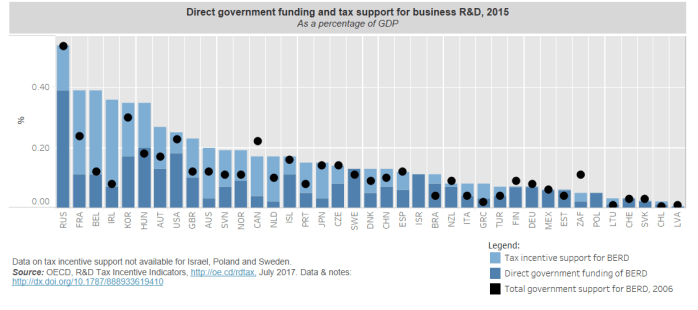
All of which might suggest taking a few steps back and thinking harder about why firms themselves don’t see it as worth undertaking very much R&D spending here. But given a choice between hard-headed sceptical analysis and being seen to “do something”, all too often it is the latter that seems to win out.

But we are only stepping up to the big stuff

Our bold goal for New Zealand to have a net zero emissions economy by 2050 is essential as we face up to climate change. This goal creates economic opportunities. The business community is alongside us, with 60 of our biggest firms forming the Climate Leaders Coalition. The $100 million Green Investment Fund and the One Billion Trees initiative are key parts of this work.

Perhaps it is “essential”.   Perhaps it even creates “economic opportunities” –  big changes in regulation and relative prices always do, for some people.   But the government’s own consultative document, and modelling commissioned for them from NZIER, suggests that once one looks at the entire economy, a serious net-zero emissions target by 2050 will result in losses of real GDP per capita of 10 to 22 per cent (relative to the baseline in which no such target is adopted by New Zealand).   No democratic government is history has ever consulted on proposals that would lead to such a dramatic fall in expected future living standards and productivity.  And, as a reminder, on the government’s own numbers, the costs would fall wildly disproportionately on the poorest New Zealanders.   And, yes, there probably will be a lot more trees planted –  many of them probably on good, easy to access and harvest, land –  but just last week the government had to announce large subsidies to get even that programme underway.  Subsidies have never been the path to improved economywide economic prosperity.  Of course, few suppose the government proposes adopting a net-zero target for economic purposes, but they should at least stop misrepresenting the analysis on the economic effects from their own consultants.

We are also committed to ensuring no one is left behind in our economy. That’s why we have put in place the Families Package and lifted the minimum wage. It is why we have a $1b annual fund for regional infrastructure and economic development opportunities.

So the regions are so “stuffed” that only an annual subsidy scheme is going to help ensure they aren’t “left behind”?    That seems to be the implication of what the Minister of Finance is saying there.   And perhaps the Minister skipped over the likely tension between the laudable desire (see above) to get young people off the dole, and the really substantial increase in the minimum wage his government is putting in place (at a time when there is little or no economywide productivity growth)?

There are challenges in the world that are outside of New Zealand’s control. That is why we are running a surplus and being prudent with our debt levels. We are also diversifying our export markets to create new opportunities for our exporters.

There is no hint of what, specifically, the Minister has in mind with his final sentence.  But there is a certain sameness to it, going back decades and decades (nice quotes –  including about the potential role of forestry –  in that 1975 manifesto I mentioned earlier).  And, actually, taken over the decades there has been a huge amount of diversification of export markets –  no single country takes more than a quarter of New Zealand firms’ exports – but it hasn’t enabled New Zealand to lift the foreign trade share of its GDP much.  In fact, over the last 35 years that share has shrunk.
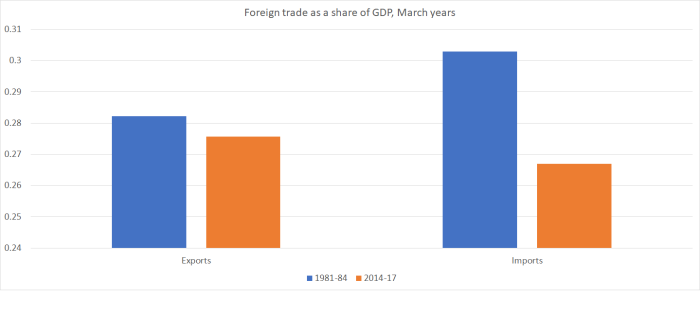
As Don Brash noted in his article the other day, the previous government had fine words too

Key spoke about the need to increase the export orientation of the economy, and set a target for exports of goods and services of 40 per cent of GDP, up from 30 per cent when he came to office. Today, exports are just 27 per cent of GDP

Just no policies to make a difference.

The Minister of Finance attempts to end his article on an upbeat note

We are committed to working with business, workers and communities to build a stronger, more productive economy that delivers the quality of life that all New Zealanders deserve.

A worthy objective indeed, but there is nothing in what he told his readers that is likely to address –  and begin to reverse –  the decades and decades of underperformance.  If we take seriously the government’s own numbers around the proposed emissions goal, the relative underperformance could be even worse under this government (were it to win nine years in office) than under its two predecessors.

I presume (hope) the Minister believes what he says, but until he starts to confront the implications of charts like this he is unlikely to make any progress (except perhaps by chance)
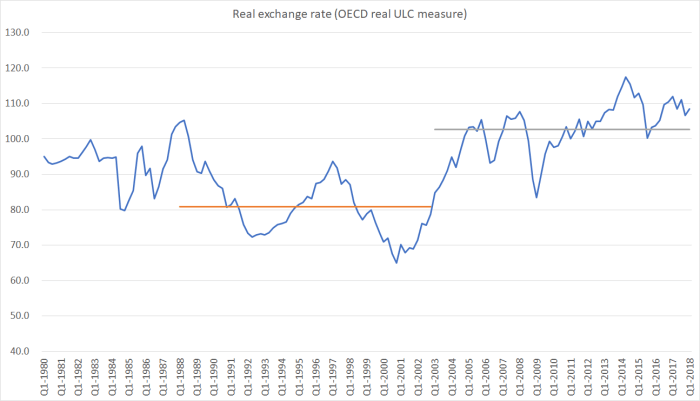
With a real exchange rate now averaging 25 per cent higher than in the previous 15 years, in a country where productivity has dropped further behind, it shouldn’t be any surprise at all that foreign trade shares are falling, that the economy is increasingly skewed towards the non-tradables sector (where competition is often, and often of necessity) quite limited, or that firms don’t see the likely payoff to investing heavily in R&D.   These are classic symptoms of a severely unbalanced economy.  Most often they arise from misguided government choices.  In our case, the biggest single misguided choice is the grim determination –  or perhaps enthusiastic dream – to keep on rapidly driving up our population in such an isolated location where the opportunities to take on the world from here seem few –  and all the fewer with such a severely out-of-line real exchange rate.

Really successful economies  –  ones with materially stronger productivity growth than their peers –  tend to have strong, and rising, real exchange rates.  But that strength is a consequence of success, an outcome of success, a way of spreading the gains.  Driving up the real exchange rate has never been a part of successful strategy to lift the relative productivity performance of the economy.  The reformers here in the 1980s recognised the importance of a sustained lower real exchange rate as part of a successful economic transition.  It is tragic that today’s political and economic leaders seem to have almost completely lost sight of that.

We have –  and will have –  a 21st century economy.  But the question is whether it will be a struggling upper middle economy, with hazy memories of glory days long gone, or one that once again matches many of the richer countries in the advanced world, something I’m pretty sure we could do, but for a small number of people.  If the government really believes they have the answer for how they can do it with a population that they  actively drive further up every year, they surely owe it to us to lay out their reasoning, their analysis, with much more specificity than the Minister of Finance has yet done.  That might include explaining why their clever wheezes and proposed reforms will make the difference their predecessors also claim to have aspired to for decades now.

Then again, perhaps tangible achievement no longer matters.  Under the government’s wellbeing approach perhaps warm feelings will substitute for world-leading incomes?